

FEDERAL COURT OF AUSTRALIA
Director of Consumer Affairs Victoria v Wens Bros Trading Pty Ltd [2019] FCA 39
ORDERS
DIRECTOR OF CONSUMER AFFAIRS VICTORIA Applicant | ||
AND: | WENS BROS TRADING PTY LTD (ACN 602 345 504) First Respondent WEN HUI XU Second Respondent | |
DATE OF ORDER: | 29 January 2019 |
NOTICE UNDER RULE 41.06 OF THE FEDERAL COURT RULES 2011 (Cth)
TO: WENS BROS TRADING PTY LTD (ACN 602 345 504)
AND: WEN HUI XU
IF YOU (BEING THE PERSONS BOUND BY THESE ORDERS):
(A) REFUSE OR NEGLECT TO DO ANY ACT WITHIN THE TIME SPECIFIED IN THE RELEVANT ORDERS FOR THE DOING OF THE ACT; OR
(B) DISOBEY A RELEVANT ORDER BY DOING AN ACT WHICH THE ORDER REQUIRES YOU NOT TO DO,
YOU WILL BE LIABLE TO IMPRISONMENT, SEQUESTRATION OF PROPERTY OR OTHER PUNISHMENT.
ANY OTHER PERSON WHO KNOWS OF THIS ORDER AND DOES ANYTHING WHICH HELPS OR PERMITS YOU TO BREACH THE TERMS OF THIS ORDER MAY BE SIMILARLY PUNISHED.
THE COURT ORDERS THAT:
1. The first respondent pay a pecuniary penalty of $225,000 to the State of Victoria.
2. The second respondent pay a pecuniary penalty of $190,000 to the State of Victoria.
Adverse Publicity Order (s 247 ACL and ACL (Vic))
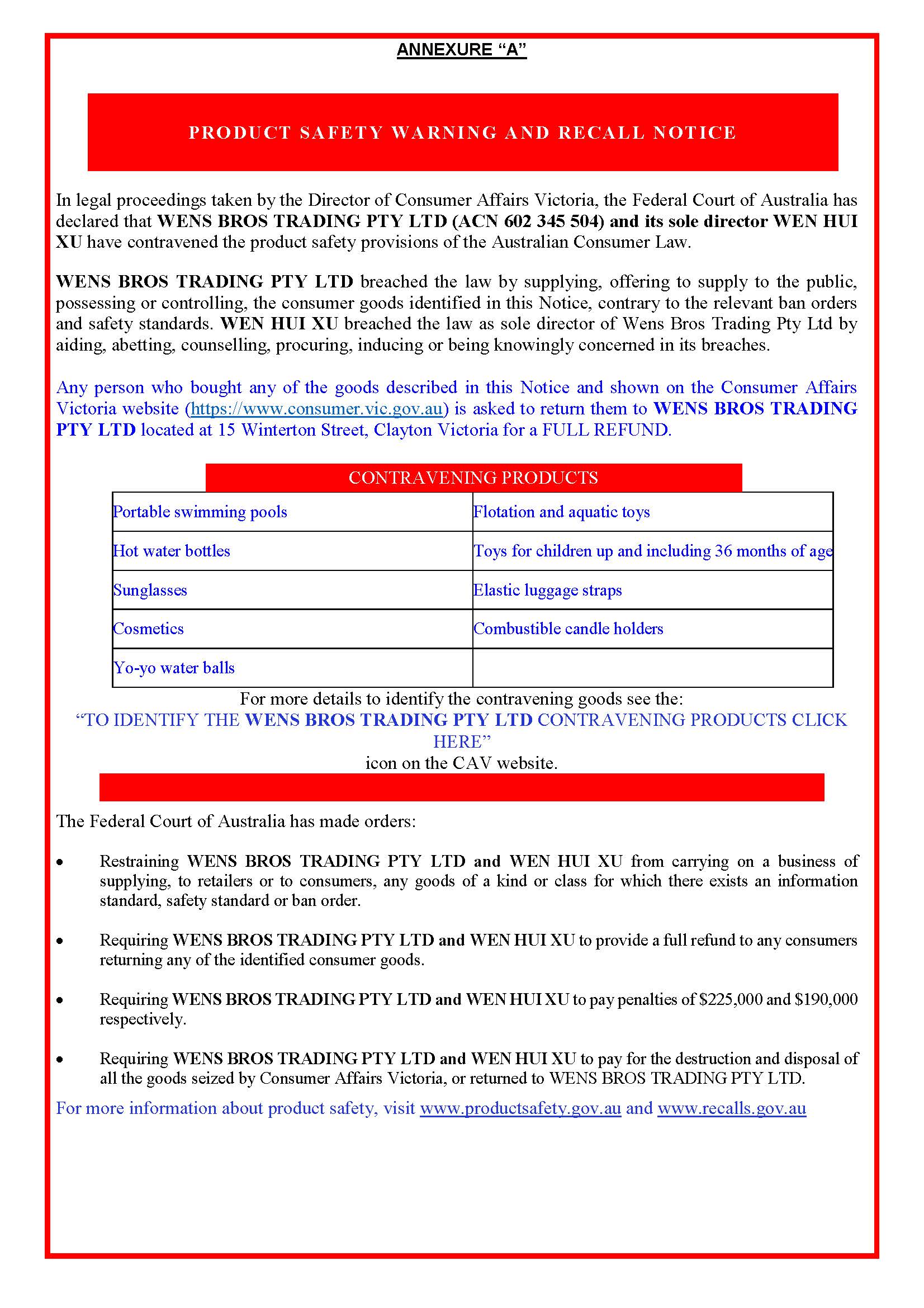
3. The respondents cause a notice in the form of Annexure A to these orders (the Important Public Notice) to be displayed at or near each point of sale and customer entry or exit at all premises at which they carry on any business supplying goods to consumers.
4. The respondents cause the Important Public Notice to be published in the Melbourne Herald Sun newspaper or The Age newspaper. The notice published must:
(a) be at least 28 centimetres in size or no less than one third of a page in the newspaper;
(b) use a minimum type size of 12 point Times New Roman or equivalent; and
(c) be in full colour.
5. The time limits specified in the injunctions in paragraphs 32 of the orders made in this proceeding on 16 May 2018 are to take effect from the date of publication of the Important Public Notice described in paragraph 3 of these orders.
Affidavit of compliance
6. The second respondent file and serve on the applicant, within 3 months from the date of these orders, an affidavit verifying that the respondents have carried out the obligations under paragraphs 3 and 4 of these Orders detailing what the respondents have done, including:
(a) In respect of paragraph 3, a photograph taken at or near each point of sale and customer entry or exit at all premises at which the respondents carry on any business supplying goods to consumers showing the display of the Important Public Notice;
(b) In respect of paragraph 4, by providing a copy of the corrective advertisement in the newspaper.
Costs
7. The respondents pay a contribution to the applicant’s costs of the proceeding in the fixed sum of $15,000 within 6 weeks of the date of these orders.
Note: Entry of orders is dealt with in Rule 39.32 of the Federal Court Rules 2011.
MORTIMER J:
1 These are proceedings brought by the Director in relation to alleged contraventions of ss 106, 118 and 136 of the Australian Consumer Law (Schedule 2 of the Competition and Consumer Act 2010 (Cth)) and the Australian Consumer Law (Victoria) (the Australian Consumer Law as it applies in Victoria pursuant to s 8 of the Australian Consumer Law and Fair Trading Act 2012 (Vic)). References in these reasons for judgment to particular provisions of the ACL should be taken to include a reference to the counterpart provisions in the ACL (Vic).
2 The respondents were initially represented in this proceeding by a lawyer. That lawyer filed a notice of ceasing to act in December 2017. The first respondent was given leave under r 1.34 of the Federal Court Rules 2011 (Cth) to be represented by Mr Xu, who is the sole director of the first respondent. Mr Xu represented himself at the hearing. Subsequent to the hearing, Mr Xu appointed a new lawyer.
3 After a mediation conducted by a Registrar of this Court in April 2018, the respondents made admissions about the alleged contraventions and agreed to some, but not all, of the relief sought by the Director. Mr Xu was invited by the Director to seek legal advice about the proposed form of agreed orders finalised as part of the mediation process, but declined to do so. The respondents were in any event given some time after the mediation before finally agreeing the contents of the agreed orders. A statement of agreed facts was prepared for the hearing and was admitted pursuant to s 191 of the Evidence Act 1995 (Cth). It contained the relevant factual and legal admissions.
4 As part of the outcome of the mediation process, the parties agreed on the terms of final orders as to the contraventions, to be made by the Court prior to the determination of penalties and other relief which remained contested by the respondents.
5 A hearing was held on 4 May 2018, attended by the legal representative for the Director, and by Mr Xu on behalf of himself and the first respondent. The Director confirmed that allegations of contravention in relation to a number of products, other than those to which I refer below, which were originally pressed by the Director were no longer pressed as a result of the outcome of the mediation. The parties confirmed there were still some outstanding matters which needed to be investigated and finalised about some of the products which were the subject of the alleged contraventions. It is not necessary to go into detail, but suffice to say there had been a compromise position reached about which products would be the subject of declarations of contravention.
6 The parties were given time to finalise their proposed orders. The Court informed Mr Xu that it might be wise for him to seek legal advice, but he maintained – in substance – that lawyers were too expensive, he had spent money on a previous one and he did not wish to spend any more money on lawyers.
7 On 16 May 2018, after the parties submitted a final version of proposed consent orders on liability, the Court:
(1) made declarations of contravention; and
(2) granted injunctions permanently restraining both respondents from carrying on a business of supplying, offering for supply or possessing goods of certain classes (paragraphs 29 and 30 of the orders) and requiring the return and destruction of contravening goods (paragraphs 31, 32 and 33 of the orders).
8 Programming orders were made for a final hearing on the contested aspects of the relief sought by the Director. In substance, the outstanding issues were the sum which should be imposed on each respondent by way of penalty, and whether an adverse publicity order should be made.
9 The Director had filed eight affidavits, with no objection by the respondents, although given that there were agreed facts the Director did not seek to read all of the affidavit material, nor adduce all of the exhibits to the affidavits. Instead, aside from the agreed statement of facts, some individual pieces of evidence were adduced through the three witnesses who were called to give oral evidence and certain paragraphs of the affidavits were read, principally to address the Director’s understanding of the outstanding factual matters contested by Mr Xu. Those matters for the most part supplemented the agreed facts without contradicting them, and as I explain below at [38], a degree of latitude was given to Mr Xu in his cross-examination of these witnesses.
10 Mr Xu required three of the individuals who had given affidavits for cross-examination. He filed three affidavits, to which the applicant did not object. Mr Xu also gave sworn evidence and was cross-examined.
11 The proceeding had been commenced by way of concise statement, and the respondents had filed a response, in some detail, to what was alleged. The Director made written and oral submissions on the contested aspects of relief, and Mr Xu made oral submissions at the hearing. Where appropriate, I refer to the parties’ submissions below.
12 For the reasons set out below, the Court accepts that penalties should be imposed on both respondents, but does not accept either party’s submissions about the appropriate amount. Rather, the appropriate amount sits somewhere in between the two sets of submissions. The Court accepts that an adverse publicity order is appropriate.
13 After a summary of the circumstances of the contraventions, these reasons concentrate on the resolution of the matters which remained contested by the respondents.
The respondents and their business
14 Since late 2014, the first respondent has carried on a business as a wholesale supplier, and a retailer, of a variety of consumer goods. At the time of the contraventions, the business was operated from two premises in Victoria: the wholesale premises in the suburb of Clayton and retail premises in the suburb of Hallam. However Mr Xu has been in broadly the same line of business for a long time, it appears though different corporations or as a sole trader. At the hearing in May 2018, prior to the liability orders being made, Mr Xu explained to the Court that he started his business in about 1995, but that he had trouble with Consumer Affairs Victoria in 2009, and then again with the matters which are the subject of this proceeding. He told the Court that he was now going to retire as the pressure had become too much, although later in the hearing he made it clear he was continuing to operate a business, but in a different field.
15 The products that have been supplied and sold by the respondents were many and varied: as the declarations of contravention reveal, they include toys (indoor and outdoor), personal and household goods. The goods which were the subject of declaratory relief included portable swimming pools, aquatic toys, battery operated toys for very young children, sunglasses, elastic luggage straps, candle holders and cosmetics. The evidence was that the respondents operated large, warehouse style premises, and the Hallam premises were open to the public.
16 The respondents’ business was profitable and of a significant size. There were agreed facts that for the financial year 2015, the first respondent imported products to a value of $526,284, and in the financial year 2016, the figure was $400,517. The first respondent had a gross sales revenue for the 2016 financial year of $678,072 and for 2017, a gross sales revenue of $652,576.
17 Mr Xu adduced no evidence of his personal financial position. The evidence showed that he declared a taxable income of $50,484 for the 2015 financial year and $54,606 for the 2016 financial year.
18 Mr Xu is a joint owner, with Hong Yue Song (his wife), of each of the premises from which the first respondent operated its warehouse outlet and retail store. Based on information provided by Mr Xu, the Director adduced evidence of ownership by Mr Xu (with his wife) of the house they reside in and a retail property at Northcote Plaza.
19 This evidence about the respondents’ financial position is relevant first in assessing some of the evidence given by Mr Xu and submissions made by him, and second in assessing appropriate penalties.
The nature of the contraventions in summary
20 The detail of the contraventions is set out in the declaratory relief granted on 16 May 2018. In summary, what was involved was the supply, the offering for supply or the possession of goods which contravened applicable safety standards imposed by a range of legislative instruments or standards promulgated for classes of goods pursuant to ss 104 and 114 of the ACL, s 139G of the Competition and Consumer Act and ss 65C, 65D, 65E and 172 of the Trade Practices Act 1974 (Cth). Each of ss 106, 118 and 136 of the ACL covers possession for supply, offering for supply and supply, and then deals with:
(1) Consumer goods that do not comply with safety standards (s 106);
(2) Consumer goods covered by a ban (s 118); and
(3) Consumer goods that do not comply with information standards (s 136).
21 The goods contravened applicable safety standards in a number of ways. In some cases (eg the “baby amusement pool”, the elastic luggage straps and the flotation rings), the product failed to display warnings of the correct kind about the danger posed by the product if not used correctly or under proper supervision. The elastic luggage straps can cause serious eye, facial and chest injuries if the strap is stretched beyond its capacity, causing it to unhook and spring back at the user at high speed.
22 In other cases, the manufacture of the product itself did not comply with applicable safety standards: eg the hot water bottles with a shell that was too thin, and with seams of insufficient strength, resulting in an increased risk they could burst or leak and cause personal injury. Some of the children’s toys had button-style batteries which could be removed too easily, presenting a choking hazard and had parts which were smaller than the minimum prescribed size, which meant if swallowed they could cause internal injuries. The sunglasses did not have, as they were required to, a removable label identifying the manufacturer or supplier and the lens category and description. Without such information consumers could be misled about the protection offered by the sunglasses and they could be exposed to very high levels of sunlight causing serious and sometimes irreversible damage including inflammation, cataracts, and a number of other conditions. Sunglasses without proper labelling could also lead to the sunglasses being worn at night when they in fact were manufactured from material that could impair night vision or reduce ability to distinguish colours while driving.
23 The cosmetics (which included things such as face paints, nail polish remover and temporary tattoos) did not have their ingredients identified in the required way, including using English names for the ingredients or “international nomenclature”. Absence of sufficient labelling can mean consumers may unintentionally expose themselves to ingredients causing allergic reactions.
24 The candle holders (which contained “happy birthday to you” candles) were products subject to a permanent ban because they were combustible: when subjected to flame or heat emanating from the candle, the holder ignited and remained lit for a period of five seconds or more after ignition. The products posed a fire risk and could have caused burns or similar serious injury.
25 The yo-yo water balls (called “smash waterball mouse”) were also the subject of a permanent ban because they had stretchable or elasticised cord capable of extending at least 500 millimetres in length, which could pose a strangulation hazard.
26 Although there were some references in the Director’s outline of submissions to injuries having been suffered through use of the hot water bottles, during the hearing the Director confirmed that these allegations of reports of injury were not pressed and should not be relied on in assessing the nature of the respondents’ contraventions.
27 The respondents did not make a lot of money out of the sale of the products – a fact that Mr Xu repeatedly emphasised in his submissions on penalty and other relief. Many of the products were sold for very low prices, on an individual item basis. For example the nail polish was $1 a bottle. A number of the products were $2 per item. Most of the sales were from the retail rather than the wholesale premises. As the agreed facts in [32] below reveal, a considerable number of hot water bottles were sold. The agreed facts also reveal a considerable number of sunglasses were sold (168). Sales of the other products were all below 50 items in total and some were in single figures. It was an agreed fact that in the relevant period, the first respondent sold the identified products for a total income of $1,400.50, and a profit of $521.
28 The first respondent was the principal contravener as it was the entity which supplied the goods. Mr Xu was declared to have aided and abetted or otherwise induced or been knowingly concerned in the contraventions within the meaning of ss 224(1)(c), (d) and (e) of the ACL. The evidence demonstrated comprehensively that Mr Xu was the controlling mind of the first respondent and was the sole individual with responsibility for how the business of the first respondent was conducted, and the way Mr Xu conducted this proceeding also made that clear: the business was “his” business, and he made all the relevant decisions.
29 The Director submitted, and I accept, that over nine categories of non-complying consumer goods; in 14 discrete product lines were involved in the contraventions. More than 20,000 units of non-complying goods were seized. The period of the established contraventions is some 18 months, during which time inspectors seized or sample purchased non-compliant goods on seven occasions spanning eight months. The Director undertook five inspections and two covert purchase visits. Despite the seizures, the evidence demonstrated that non-compliant goods in the same product categories were found repeatedly at the first respondent’s premises. For instance, non-compliant toys were detected on every visit. In other words, despite being told of the alleged contraventions, and the problems with the products, the respondents continued to display and supply non-complying products.
30 It should be noted that the respondents did voluntarily publish recall notices for the goods, in a staggered sequence of events. There are agreed facts about this sequence of events. It commences in late January 2017, when the Director’s staff advised Mr Xu that he and the first respondent should publish a recall notice for six of the impugned products, and provided him with a letter and an example of a voluntary recall notice which the Director advised should be published on the Australian consumer recall websites at www.recalls.gov.au. and www.productsafety.gov.au. A recall notice was published about two weeks later. The same process (of the Director’s staff emailing Mr Xu with advice and examples, and Mr Xu then placing a recall notice on the appropriate website) occurred again throughout May and June 2017, on several occasions.
31 This conduct all occurred before proceedings were commenced in September 2017.
32 It is an agreed fact that the first respondent reported the progress of the voluntary recall to the Director and stated:
(1) 632 hot water bottles had been returned;
(2) Refunds were given to consumers for the returned 632 hot water bottles;
(3) No complaints were made; and
(4) No illnesses or injuries were reported.
33 I return to other features of the contraventions when discussing the appropriate penalties below.
What the applicant seeks by way of further relief
34 The Director seeks a total pecuniary penalty for all of the contraventions in the sum of $250,000, in respect of each respondent.
35 The amount of penalty sought was one of the key issues contested by Mr Xu. On being asked by the Court what penalty he submitted would be appropriate, he suggested the sum of “less than $10,000” for the first respondent and “less than $10,000” for himself.
36 The Director also seeks an adverse publicity order under s 247 of the ACL. It named the first respondent and Mr Xu. In content it is proposed to be both a notice of the contraventions found by the Court and the orders made, and a further recall notice for the products concerned (including informing consumers of their entitlement to a full refund). Mr Xu opposed such an order, because he did not wish there to be any further publicity about this matter.
37 Finally, the Director seeks a contribution from the respondents to his costs, in the sum of $15,000, payable within six weeks of the date of any orders.
The factual matters the respondents sought to highlight or contest
38 One of the difficulties stemming from the respondents decision not to be legally represented was that Mr Xu experienced some confusion in accepting the legal consequence of having agreed certain facts, and the prohibition in s 191(2) of the Evidence Act concerning adducing evidence which contradicts or qualifies an agreed fact. In no sense was this due, in my opinion, to a lack of understanding by Mr Xu about what he had been prepared to agree by way of facts, nor to any desire to submit that facts previously agreed were incorrect or untrue. Rather, the confusion arose when Mr Xu sought to provide exculpatory evidence in an attempt to persuade the Court why it should only impose small penalties, rather than the significant penalties sought by the Director. Since he was self-represented, I gave Mr Xu some latitude about the way he framed his questions in cross-examination, his own evidence, and his submissions, so that there was the best opportunity to understand precisely what the points were that he sought to make. In summary, they were these:
(1) In relation to the hot water bottles, Mr Xu’s position was that he was given inconsistent information and advice by the Director’s staff about the kind of warnings the products needed to have. Mr Xu also appeared to suggest that he had made changes to the labelling of the hot water bottles after being advised by CAV that they were non-compliant.
(2) In relation to the candle holders, Mr Xu’s point appeared to be that at least on one visit by CAV staff to the wholesale warehouse, there were no candle holders present. The relevant CAV employee, Mr Charalambous, agreed with Mr Xu that this was the case with respect to the inspection he conducted on 1 September 2016.
(3) In relation to some of the products (for example, the swimming rings and toys) Mr Xu cross-examined witnesses to the effect that they did not seize all of such products that the respondents had in either of their warehouses, and instead only seized some. The point of this questioning seemed to be to highlight some kind of inconsistency in the way CAV staff behaved.
(4) As to some of the toys with batteries, Mr Xu was adamant, both in his own evidence and in cross-examination of the Director’s witnesses, that he was told by Mr Charalambous that if he put screws into the toys to hold the battery cover in place before the toy was sold, this would be fine. This is an example of a line of evidence which sought to contradict some of the agreed facts, although I am satisfied Mr Xu was attempting to use it to prove that he did what CAV staff told him to do. I do not accept Mr Xu’s evidence that he was given any such general reassurance by Mr Charalambous or anyone else. I accept Mr Charalambous’ evidence that in relation to some of the products (including some of the battery powered toys) he did make a judgment call at the time of seizing the goods, about which goods were likely to be non-compliant and which might be able to be said to be compliant, such that they could remain for sale or supply.
(5) In relation to the swimming rings, Mr Xu tendered evidence of correspondence with an overseas manufacturer in which the manufacturer acknowledged that he did not pay much attention to the requirements of Australian safety guidelines and requested a copy of details of the Australian safety requirements. The point of adducing this evidence appeared to be to demonstrate that the manufacturer bore some degree of responsibility for Mr Xu’s contravention.
39 Sometimes, in his cross-examination Mr Xu sought to ask questions about products which were no longer part of the alleged contraventions – for the purpose of demonstrating that, in his view, CAV made mistakes in some of the allegations they put to him. I disallowed questions which went to products that were no longer the subject of any declaration of contravention.
40 One important issue arose which should be noted separately. During opening submissions, it became clear (the detail need not be set out) that despite having been given three opportunities to look and consider the proposed agreed facts, and to make changes (which he did to some entries) there was one paragraph of the agreed statement of facts which Mr Xu disputed. That was [36](b)(iv) of the agreed statement of facts, which stated:
(iv) The following information was not accompanied with the hot water bottle ‘WARNING - HOT WATER BOTTLES CAN CAUSE BURNS. AVOID PROLONGED DIRECT CONTACT WITH THE SKIN”; This hot water bottle is made of natural rubber; This hot water bottle is designed to be partly filled”.
41 Seeing as Mr Xu was self-represented, and given he was adamant this fact was incorrect, I informed counsel for the Director that the Court would not accept this sub-paragraph as an agreed fact and the incorrect warning label would need to be proved. This was done through Mr Sargeant, by the tender of a number of photographs. Mr Sargeant gave evidence about the kind of non-compliance with the standards of the hot water bottles he seized: namely that their labels did not meet the warning requirements, because they omitted a line in the warning which said “[t]his water bottle is designed to be partly filled”. These faults were in addition to the casing of the hot water bottle being too thin, and the seams not being strong enough.
42 I accept Mr Sargeant’s evidence, and I reject Mr Xu’s suggestions the hot water bottles he and his company were supplying or selling did not have these defects.
My findings about the evidence of Mr Xu
43 Mr Xu struck me as an intelligent man, and an experienced businessman. I find he has had longstanding and extensive business relationships with China in particular, and it was an agreed fact that the first respondent is connected to, or is related to, a company based in China known as Yi Hui International Trade. In oral evidence, Mr Xu described how he gave instructions about how products were to be manufactured in China to comply with Australian standards: he and the first respondent therefore, were engaged in more than simply importing products.
44 I consider Mr Xu generally sought to adhere to the admissions he had made, but at the same time he did seek to diminish any culpability which might be seen to fall on himself. He did this by refusing to accept responsibility for his conduct, and generally seeking to blame the Director and his staff, or to present himself as helpless, which I do not accept he was. I deal with this more fully below.
45 Where Mr Xu’s oral evidence contradicted that of the Director’s witnesses, I prefer the Director’s witnesses. The three individuals who gave evidence (Mr Charalambous, Ms Lay and Mr Sargeant) all gave reliable evidence, and did not accept some of the versions of events Mr Xu put to them. For example, this passage of evidence about the issue of battery compartments in some of the toys:
MR XU: The question is – you say – you ask – you agree – we both agree you take the baby with the music blocks and without screws, you take it off. You even didn’t let me to ask you to take the music blocks off, leave the toys here as the softer toys, but you agreed, all the other toys, the battery with the screw holes – you said “You can leave it and ask your workers to put the screw on”. Is that what you – ? – I can’t recall getting into an agreement to that level of detail with you, Mr Xu. I do recall, however, there were – you know – a large number of these baby soft dolls.
That’s right; yes? – And they were – you know – consistently inconsistent, because they had a battery compartment that had provision for a screw to be put in it. They had a battery compartment that didn’t have provision to a screw in it; they had a battery compartment that had a provision for you screw – you know – didn’t even have a screw in it in the first place. They had a battery compartment that – you know – was hanging out of the body of the doll. They had a variation of – you know – designs of a battery compartment in that regard. I, in assessing those variety – those variations of battery compartment condition-slash-design – you know – made a judgment call, and I seized – you know – X number of dolls that, you know, I, you know, believed would fail safety standards for toys under three years old, mandatory safety standards, and I – you know – believed that you – you know – at that point did not have the capacity to make these dolls compliant before you sold them.
46 I find the three witnesses who gave oral evidence had reasonable recollections on important matters, were concerned to perform their duties professionally and with sensitivity to Mr Xu’s circumstances, and sought to assist him (where they could) to comply with the law. Ultimately, they drew the line at excusing the contraventions, which appeared to be at times what Mr Xu was suggesting they should have done, because he did not know what to do – he contended – to make the products compliant with Australian standards. In relation to this kind of suggestion, for example, this exchange between Mr Xu and Mr Charalambous:
…
Because – this time we are very friendly. Not like the 2009; you know? We didn’t mention that. You come in; we are friendly. Say “Charlie, you come to help me”, because we never know this, you know, the laws or whatever, and we are very friendly; is that right? I fully co-operated with you. I also asked you if –
HER HONOUR: Well, one question at a time, Mr Xu. What’s the question?
MR XU: The question is – I did – fully co-operated with you, and we just – you know? I did ask you if anything between, like, what the CAV or whatever laws and can ... I did ask you, and you just leave it there; is that right? – You did ask me?
Yes, for between –
HER HONOUR: Just let him – you’ve got to let him answer, Mr Xu. Let him answer.
MR XU: Okay. Okay.
THE WITNESS: So if I can understand Mr Xu’s question – so you asked me about CAV laws; is that what you’re asking?
MR XU: No, no, no, not about CAV law. Any products. For example – it’s between like – I can fix up or whatever? – Yes.
You know? You just leave it, I fix up. Is that what I did ask you; is that right? – No; not exactly along those lines. There would have been conversations that –
Yes, we are very friendly at that time. You know? And I just want –
HER HONOUR: Just let – Mr Xu – Mr Xu, you have to let the witness answer.
MR XU: Sorry. Yes. Sorry. All right. Okay.
HER HONOUR: I say again: you ask a question, the witness answers. You let him finish.
MR XU: Okay. Sorry.
HER HONOUR: All right? He’s trying to remember.
MR XU: Okay.
HER HONOUR: Away you go, Mr Charalambous? –Thank you. Mr Xu, I recall multiple conversations with you on 1 September over – you know – a significant period of time at your ware-house. Those conversations – you know – would have been – you know – professional, educational, and at the same time – you know –compliant-based. Those conversations would have also – you know – reflected all those issues that perhaps you’re trying to raise here and giving advice – well, my engagement would have included also giving you advice on Australian standards, how to be compliant – you know – what systems of Q and – quality control you have or may look at getting, and that would have been in our conversations. Now, I can’t recall at any time finding a product that I had concerns with that was non-compliant at that time of which I formed a view of that I let you keep and me – you know – complete my inspection.
47 The subject matter of this line of questioning is of considerable relevance on the issue of penalty. As Mr Charalambous made clear, Mr Xu was given advice by the Director’s staff about where to go to find resources to ensure the products that he and his company were selling and supplying were compliant with Australian standards, but the Director’s staff drew the line at undertaking the responsibilities which were properly those of the respondents themselves.
48 There were points at which Mr Xu attempted to have one of the witnesses agree to matters the witness simply did not accept. For example with Mr Sargeant:
[MR XU]
… I just want to hear more stories, because – on that day – and Matthew came to my ware-house and he checked it, because I don’t know. I ask him to show me how to do on the internet, to check the details, how to ... the goods or contravene goods, and you did – went to the computer and tried to show me; is that right? – Yes; that’s correct. I did.
Yes. But after 10 minutes, you can’t ... and you don’t laugh. Then I said “You are expert, can’t do it. How can we? I am 61 years old. I’m already out of date at present. How can I know how to do these things?” I said “You have to help me to do this”; is that right? – No, that’s not right.
What I say? – You did ask me to show you where to find information about mandatory safety standards and permanent bans and information standards.
Yes? – And I took to you the ACCC website, and I showed you where you could get information from, which – the Product Safety Australia, productsafety.com.au – sorry – gov.au has all of that information on it, which is a summary of safety standards, information standards and permanent bans, and I took to you that page and showed you where you could get the standards, and I explained that you would have to purchase the voluntary standards from SIA Global to get particular details – for instance – the exact wording of warnings and – yes; so I wasn’t able to get you those details on the day, because you have to pay for those, and I believe I told you that you should get legal advice and that you would have to pay for them, that I wasn’t going to provide that to you.
49 This is the kind of evidence where I accept the evidence of the Director’s witnesses, in preference to that of Mr Xu. This is an example, in my opinion, of Mr Xu attempting to diminish his own responsibility and foist it back on CAV.
50 Much of the cross-examination of these three witnesses went to matters which were not material to the question of penalty or an adverse publicity notice, being the only two matters in dispute. Sometimes, Mr Xu appeared to wish to have the Director’s witnesses confirm that he had done the right thing or that, at some stages when the Director’s staff were in touch with him, this was not because any of his products were non-compliant. He also seemed to suggest the Director’s staff took too long, or failed, to tell him some of the products he was selling were not compliant when there were opportunities to let him know this. For example, this exchange with Ms Lay:
MR XU: So I want to ask you again – when you that you asked me to take the CAV logo off – about the hot-water bottle – so is that means at the time, after the court, it means the rest of the hot-water bottle: the specification is all right, or you just didn’t check? – According to my recollection – I note this is not in my affidavit; this is just based on my memory. The reason why I called Mr Xu was about the CAV logo, because we wanted him to remove the logo, because CAV does not endorse products. It wasn’t about the safety; it was merely that he had the CAV logo on the hot-water bottle and that CAV does not endorse any products.
51 Ms Lay dealt courteously with Mr Xu in her evidence at such times, and she appropriately insisted that it was Mr Xu’s responsibility, and that of his company, to ensure the products being supplied and offered for sale were compliant.
52 There was also independent evidence that corroborated some of the Director’s witnesses’ evidence. For example, in relation to the hot water bottles (which were a focus of Mr Xu’s oral evidence and submissions), Mr Xu at one stage appeared to contend the hot water bottles had the correct labelling on them. However, the Director took Ms Lay to the test report for the hot water bottle which itself clearly showed the labelling was non-compliant.
Mr Xu’s evidence, his conduct concerning the contraventions and his previous conduct
53 I accept that Mr Xu did his best to conduct the proceedings in the way the Court’s processes required, and that from the time of the mediation onwards, he has acknowledged the need for the first respondent, and himself, to face up to the alleged contraventions and deal appropriately with them.
54 However, in making that finding I also find that Mr Xu has engaged in conduct which is not consistent with full acknowledgment of the contraventions and the need for the respondents to behave differently in the future. I make that finding for the following reasons.
55 Mr Xu has consistently sought to downplay the seriousness of the contraventions. He has done so by referring to the amount of money the first respondent made in the sale of the impugned goods, and what a small sum it was. For example:
As my own knowledge, I tried to, you know, to get rid of these things happen, and I don’t want to, you know, purposely to contravene. It’s ... the contravene a period of around two years; only sell less than $2000. And that’s – how can you say I purposely do this for $2000. Less than, about … dollars something, 400 something.
… I’m just get the local, this stuff from local, and the track through to the clearance centre, shopping clearance centre. It’s absolutely different story, totally different, not comparable; you know? I’m running a small business. That’s why it’s not for purposely sell for the profit; you know?
…
That’ s why my wife gets very upset. “You get all these cheap stocks and get trouble”. That’s why stop me to running the business. That’s why just the one, you know, one shop like this, and it didn’t sell much. Didn’t sell – only sells the quantity less than – more than 1000, less than 2000 dollars, all this stuff.
56 He did not recognise the risks posed by the goods he was selling, nor did he acknowledge the proper purposes of the safety standards and product bans.
57 Mr Xu also sought to cast himself as the victim of a consumer protection system that was too complicated for him to follow and understand, and put this forward as excusing his conduct and meriting a small penalty only. For example:
HER HONOUR: Well, I think it’s appropriate, given that line of questioning, Mr Ure, that I just make something clear to Mr Xu, in terms of what I anticipate is going to be your client’s submission. Mr Xu, as I understand it – and you can ask any more questions, Mr Ure that you want to – as I understand it, CAV are going to say to the court that you have not taken responsibility yourself for finding out what you need to do to make products safe. Instead, you say to CAV, “You tell me” –?–
[Mr XU:] No, I –
[HER HONOUR:] – and they are going to say to the court that is not their job. It’s your job, if you are selling things, to find out what you need to do to make them comply. Now, what do you want to say to me about that? Do you understand that’s your responsibility? –
[MR XU:] Because I explain to them, because I don’t know how to get this informations, you know, you just tell me whatever, you know, I can do follow your request, I can pass to the China side, if I import it. If not import like the local stuff, I get it, I can’t do anything. But if the importer, like I show all the letters responded from the manufacturer in China. They can do anything, you know. They can – like sunglasses, they straightaway send me the labels, category 3, and ask me just to put it on. When I say because you guys tell me you supplied that in Australia before, that’s the market, I’ve got to travel, and because I –.
[HER HONOUR:] So are you telling the court that you think CAV should tell you what to do?
[MR Xu:] – No, I did not think CAV should tell me, but I say to you just to help us, because we don’t know much a lot.
58 However, it was apparent that in the past Mr Xu simply did not wish to expend money on seeking advice about his legal obligations and those of any corporation he chose to run his business through. For example, this exchange (which also reveals part of Mr Xu’s reasoning about why only a small penalty should be imposed):
HER HONOUR: Thanks, Mr Ure. All right, Mr Xu, it’s your turn now to tell me – you’ve heard what Mr Ure has said. He has put it very clearly about what CAV says I should do. I think we should start with that. So they say I should impose a penalty on your company of $250,000, and they say I should impose a penalty on you personally of $250,000, and they say I should order a public notice setting out what you and your company have done and the penalties and orders that the court has made. Now, the first thing I think you should do is tell me whether you agree with that or you disagree and why.
MR XU: No. I disagree with that, because he said – I just repeatedly for these things just for myself, you know, to help the company to do like this. Every time – it’s already on the affidavit before. That’s, for example, the hot-water bottle. I did according to – after court at 2010, I did everything requested by the CAV. Then they get the ... I don’t know. For some reason get injured, but actually it’s not – what’s that – the Matthew – he already say that the product is not ours; you know? And after that, 2010, the Magistrates Court, I did everything according to their requesting, and you can see before that they’ve got the permanent warning on the products and the leaflets –
HER HONOUR: Mr Xu, the hot-water bottle was not safe.
MR XU: Yes.
HER HONOUR: It wasn’t thick enough.
MR XU: That’s right.
HER HONOUR: It didn’t have the right seals.
MRXU: Yes. But –
HER HONOUR: Now, you didn’t know that, because you didn’t check what needed – what it needed to have; isn’t that right?
MR XU: Yes, because for my – you know – I don’t know how to get this information, but only according to whatever they say; they say to me “Do this”, I do this.
HER HONOUR: You could have paid someone to tell you.
MR XU: Yes; that’s what I say – that’s what – yes. That’s what I think I have to in the future. I have to get something like this.
59 The following extract, during submissions, although rather long, is worthwhile reproducing in full because it demonstrates the attitude of Mr Xu:
MR XU: I didn’t want to – any – you know the – what’s that – the public warning or whatever, but the thing is, you can’t stop them. They are too powerful. Like the last time in year 2010, the judges there, the judge said they got sick of story, try to convince me to criminal, you know, and the judge said because they’re government, not argue with them. So you just – you said just recognise the ... without the convictions, that’s it, you know. Because they can do anything. I know this. They are powerful.
HER HONOUR: Well, you didn’t get a conviction last time, Mr Xu, so that was to your advantage. You didn’t get a conviction. You got a good behaviour bond, didn’t you?
MR XU: I don’t know, because they said – the judge told me – he said, “You –”
HER HONOUR: But the problem is, you’ve done it again.
MR XU: No, the thing is – that’s why I want to explain to them. After that, I did everything according to their requirement. I did not go to personally check – I didn’t know how to check properly, you know.
HER HONOUR: You didn’t hire anyone to give you any advice.
MR XU: No. I don’t know. Who gets this information? I don’t know where to get and who to get. I just after court I get the information from the Charlie – from the, you know, CVA officer, just before sitting there, and I said, “What I do properly, you know, to make this” –
HER HONOUR: Mr Ure has said to me that, really, what has happened after the Magistrates Court –
MR XU: Yes
HER HONOUR: – is that you took a risk.
MR XU: No, I never.
HER HONOUR: And you kept importing the products without having anyone to help you check. That you took a risk.
MR XU: No, no, no. I didn’t took a risk. I just took – because the CAV say to do it like this, I did it like this, you understand. I did it like this. I did whatever said – have to mark, you know, “Do not use boiling water inside.” That’s already – they showed it again under – what’s that – on the test report.
HER HONOUR: It’s – Mr Xu, it’s not CAVs job to tell you how to comply with the law. It’s not their job. It’s your responsibility to comply with the law.
MR XU: Yes, yes. Okay.
HER HONOUR: Do you understand that?
MR XU: Yes.
HER HONOUR: Because I’m not getting the sense that you do understand. I think you think someone else should do that job for you. It’s your responsibility.
MR XU: Okay.
HER HONOUR: Do you understand that?
MR XU: Yes. All right. If like this, that’s why – that’s why – I – I told you before, because I didn’t know such knowledge, that’s why I’ve got the very serious family trouble, my wife said, “You shut down everything”, you know. Didn’t do anything, because maybe you get more trouble, you know. That’s why.
60 Eventually, it appeared Mr Xu may have recognised how he needed to do things differently in the future:
[Mr Xu]:
… You know, it’s very easy job – not hard, you know, these days. You just tell them – said, “That’s the Australian requirement.” They can do it. Because I didn’t know, that’s why. I just listened to the CAV officer, Charlie, you know, say that, “You just do this, do this.” That’s why. And then later, I have to – if I run the business, I have to get the professionals around me. Yes, otherwise I will stuff it again, maybe.
HER HONOUR: Well, I’m waiting to hear if you have learnt that lesson. I’m not sure yet that you have learnt that lesson.
MR XU: No. No, I have to for later. I have to do like this. I can’t – I can’t, you know, because – because you – it’s already see these guys, you know, sitting there witness, and they can change anything. They just can say, “I forget it” or whatever, but I need – I have to get specialist to help me to do this, you know. Come to realise whatever they say, you know.
61 Mr Xu was also cross-examined about some statements he made to CAV staff during an interview conducted under s 126 of the Australian Consumer Law and Fair Trading Act 2012 (Vic). This was the cross-examination, and Mr Xu’s answers:
[Mr Ure]: … Mr Xu, I’m going to submit to the court –?–Yes.
– that you’ve indicated to Consumer Affairs that you would declare bankruptcy if Consumer Affairs prosecuted you. Now, did you say that in your interview with CAV? – I explain such things, yes. I did explain such –.
Did you say this:
If you guys, you know, seriously treated me, I just declare bankrupt. That’s it. That’s what I’m doing.
Did you say that? – Yes, I did. I did at the examination say that, because my small business, can’t stand, you know, pressure like this.
And did you also say, in an email to Naomi Lay:
I can terminate my business at any time and declare bankruptcy by your wish, but still, sincerely hope that you will make right decision.
? – I say this at – because Naomi Lay ever once told me, said “CAV, director of CAV can any time close your door.” Close my, you know, business. So that’s whether she ever once told me like this.
Shouldn’t this court view that as you threatening to use insolvency to avoid paying a penalty? – No, I never threaten. That’s a fact, is I’m running a small business like this. Did you see anybody, you know, like this treat a small business like that? And unless they’re a – you know, for example, combustible candle holders. Actually, the local supplier gave it to me and then they – they do the advertising on the radio, on the TV, on the newspaper, said I supplied and caused a fire or something. I don’t know, all the customer coming to me like this say – and too much pressure like this.
62 I am satisfied Mr Xu did make the statements attributed to him: he did not really deny them. Instead he sought to re-characterise them. I do not accept his re-characterisation. I consider Mr Xu was intimating to CAV that if he was prosecuted he could avoid the consequences by declaring bankruptcy, and winding up his company. As it has turned out, Mr Xu has not taken those steps. However, I find he was prepared to represent to CAV that he might do such things if they brought proceedings against him, and that his aim was to dissuade them from bringing proceedings. In the circumstances, I do not see this as especially relevant to the level of penalty, which should be set by reference to the contravening conduct itself. However, this kind of behaviour by Mr Xu is consistent with him seeking, as I have found above, to deny any real harm has come of the contraventions, to diminish their seriousness and to avoid personal responsibility for them.
63 Finally, Mr Xu was cross-examined about some of his financial interests. He had not volunteered any of this information. It became apparent that not only did he and his wife own the two commercial premises in Hallam and Clayton from which the retail and wholesale business had been run, and at least one of those properties were now leased to third parties, for substantial income. Mr Xu also confirmed that the Hallam property was for sale, at an advertised price of $2 million, he and his wife having purchased it in 2013 for $980,000. Mr Xu’s evidence was that both the commercial properties were not encumbered by a mortgage, but that at least one property was not owned outright by Mr Xu and his wife. Certificates of title in evidence indicate that the Clayton property is the subject of a mortgage, but the Hallam property is unencumbered. Mr Xu also confirmed he and his wife still had a commercial property in Northcote Plaza, which was leased.
Mr Xu’s previous conduct
64 Many of the extracts above contain references by Mr Xu to events in 2009 and 2010. The evidence was, and I find, that:
(1) On 23 December 2009, Mr Xu was charged by the applicant in the Moorabbin Magistrates’ Court with five counts of supplying non-compliant goods, including two counts relating to hot water bottles and two relating to goods the subject of a permanent ban order. The goods relating to the permanent ban order included the yo-yo water balls that the respondents were again caught still selling in 2016-2017. This is an important point. Despite his protestations and denials, the evidence is clear that Mr Xu was personally charged and dealt with (albeit without a conviction) in 2009/2010 for selling the yo-yo water balls. Yet he continued to sell them. He did not change his behaviour, or that of his company, at all. He took a risk that he could continue to get away with importing and selling them, despite knowing they were a banned product.
(2) The same is true of the hot water bottles – which were the subject of the charges in 2009, and again still found for sale in 2016/17. Children’s toys were also the subject of the 2009 charges.
(3) On 18 March 2010, the charges came before the Magistrates’ Court and were adjourned on Mr Xu’s undertaking to be of good behaviour, to make donations to the Royal Children’s Hospital, to publish a warning notice in the Herald Sun and to give refunds for returned goods.
65 Mr Xu continued to pay no heed to consumer law. The evidence shows, and I find, that CAV inspectors paid at least two more visits to the respondents’ businesses and found incidents of continuing non-compliance with product safety laws. In 2011, the applicant’s inspectors identified hot water bottles being supplied by Mr Xu and bearing the CAV logo without authorisation. Mr Xu removed the logo after being required to do so. In October 2014, CAV inspectors attended premises operated by Mr Xu and seized 252 suspected non-compliant luggage straps. These were the same kind of products which were the subject of the seizures and contravention allegations in 2016/17.
66 Despite the interactions with CAV, the respondents continued to stock goods in the same categories, without implementing any compliance program to ensure the products stocked complied with all relevant consumer safety laws. No lessons in fact appear to have been learned by Mr Xu from what occurred in 2009/2010, despite his suggestions to the contrary in submissions in this proceeding. Rather he, and through him the first respondent, put their commercial interests first, and continued to elect to spend money on matters other than advice or programs to assist them to comply with consumer safety laws. The approach appeared to be that Mr Xu was prepared to continue to stock non-compliant goods, to risk getting caught and then – and only then – would he react. Even then, his predominant reaction was simply to ask CAV to tell him what he should do.
Resolution
67 I am satisfied the relief sought by the Director should be granted. As I noted at the start of these reasons, my view of what amounts are appropriate by way of penalty differs from the figures put forward by the Director, but also differs substantially from the figures put forward by the respondents. I reach the appropriate penalty figures through something of a different route to that for which the Director contended.
68 Recently in Director of Consumer Affairs Victoria v Gibson (No 3) [2017] FCA 1148 at [20], [34]-[36] and [43]-[54], and then in Director of Consumer Affairs Victoria v Melbourne South Eastern Real Estate Pty Ltd [2018] FCA 1763 at [75], [81] and [106], I set out my approach to the applicable principles, in particular on the issue of penalty. I adopt what I said in those reasons. Where necessary below, I refer to particular aspects of the applicable principles.
Section 247 adverse publicity order
69 This is available for contraventions of Chapter 3, including ss 106, 118 and 136, which are the provisions the Court has declared the respondents have contravened.
70 The purpose of a notice under s 247 is protective and not punitive, although I accept that Mr Xu feels that further public airing in notice form of his contraventions of the ACL and ACL (Vic), and that of his company, is akin to a punishment. Its purpose is not to further embarrass Mr Xu, although again I accept that he may feel embarrassed, as may his family. However, embarrassment is no reason to refuse to order the publication of a notice under s 247, although it may well be a reminder to respondents that the consequences of conduct constituting the contraventions continue for some time. That in itself may have a general deterrent effect. Notices under s 247 do serve a wider purpose of general deterrence, as they publicise to the general community the consequences of contraventions. That is why in my opinion a notice is more likely to have this effect if the amounts of the penalties awarded by the Court are included. Other judges have taken this approach: see Director of Consumer Affairs Victoria v Alpha Flight Services Pty Ltd [2014] FCA 1434 at [37].
71 Notices also alert those members of the public who might be consumers of the affected products about the safety issues associated with them, and notify such consumers of how to get a refund and return the products. The evidence in this case is that the recall notices given by the respondents in 2017 were effective in relation to the hot water bottles, but there is no evidence they were effective in relation to the other products. Some of those other products could cause serious injuries, including to children (such as the battery operated toys): any reasonable measures to alert consumers to the need to return such toys should be taken.
72 I am satisfied the form of notice proposed by the Director is appropriate, subject to one matter. The Director’s proposed orders did not include Mr Xu personally as a party responsible for the publication of the orders. Mr Xu should be personally responsible for this, as well as his company. The orders will be amended accordingly. It is also appropriate to order Mr Xu, rather than the first respondent, to file and serve on the Director within three months of the Court’s orders an affidavit verifying that the respondents have carried out their obligations and what they have done.
73 I accept Mr Xu may perceive the Notice will cause him further embarrassment, and will serve to further publicise what he has been found to have done. I accept that may be unpleasant for him. However these are the consequences of being publicly accountable, through a legal process, for contraventions of the law.
74 I note the Director no longer seeks orders about a compliance program for the first respondent going forward, given the injunctions issued on 16 May 2018, and Mr Xu’s evidence about the different focus of his business.
Penalties
Maximum penalties
75 The maximum prescribed penalties do provide some kind of yardstick for Courts to use in individual cases: they set out the view of the legislature about what should occur in the worst case: see Australian Competition and Consumer Commission v Coles Supermarkets Australia Pty Ltd [2015] FCA 330; 327 ALR 540 at [6] (Allsop CJ).
76 As the Director submits, the declarations made on 16 May 2018 identify 27 contraventions by the first respondent and the same number of contraventions by Mr Xu of an accessorial nature. The maximum penalty for each contravention is $1,100,000 for a body corporate and $220,000 for all others: s 224(3) (items 9, 13 in the table). Therefore, the total maximum penalty is $29,700,000 for the first respondent and $5,940,000 for Mr Xu, if each contravention is viewed separately, which it is clear they should not be. In my opinion, because of the nature of the contraventions and their relationship to the sale or supply of individual products which were, as to each of them, small and of low value, examination of the maximum penalties does not take the Court very far at all in fixing an appropriate penalty.
77 The question of appropriate penalty must involve a consideration of all the circumstances and as the authorities recognise, there is some decisional freedom for individual judges to take views about what level of penalty is appropriate. In this proceeding, there are some particular factors concerning Mr Xu’s previous conduct, and his attitude to compliance obligations, which have influenced my view of what is an appropriate penalty, and I return to those below.
78 However I deal first with the express considerations under s 224(2) of the ACL before turning to other factors.
The nature and extent of the act or omission and of any loss or damage suffered as a result of the act or omission (s 224(2)(a))
79 I have set out the nature of the contraventions at [20]-[36] above. It is an important consideration in setting a penalty that these are breaches of safety and information standards, where the purpose of such standards is to avoid or minimise the risk of injury or harm to consumers, including consumers who are not in a position to protect themselves, such as children. The standards are detailed – for example, precise words to be included on warnings, and the precise placement of warnings on products. There was a sense in Mr Xu’s evidence and submissions that he considered the detail was too burdensome, or unimportant. Any such apprehension needs to be firmly rejected. The details are there because they are necessary. Warnings are intended to be read and understood – that is why what they say matters, and where they are placed matters. These are obligations appropriately requiring strict compliance.
80 While there was no evidence of any specific harm done to an individual consumer from the supply or sale of the impugned products, the risks are obvious from the summary I have set out above. Further, there was nothing isolated or accidental about the contraventions – many of the products were on sale or available for supply over a long period of time, and although goods were seized on seven occasions (five inspections and two covert purchases), the respondents continued to stock, display and sell the non-complying products. More than 20,000 units were seized. Therefore, the fact of the small sales numbers is less relevant. The products available for sale were in considerable quantities.
The circumstances in which the act or omission took place (s 224(2)(b))
81 I accept the Director’s submission that the respondents ought to have known the products did not comply with Australian mandatory consumer safety standards. That is part of the responsibility of conducting the kind of business the respondents engaged in. Mr Xu is, I have found, an experienced businessmen in this line of business, and has extensive contacts in China. He spoke frequently in his evidence and submissions of these contacts, and emphasised how “easy” it was to have changes made to labelling or product manufacture. He, and through him the first respondent, simply did not take the time and effort to find out what needed to be known about compliance. When in his evidence Mr Xu told the Court he “did not know” of the product safety requirements (or apparently, the bans), I find that he did not know because he did not take the reasonable and proper steps that a person operating a business such as his should have taken.
82 My finding the respondents ought to have known is confirmed by the circumstances of the 2009 prosecution. Mr Xu gave evidence about how he sought advice from CAV officers after this, and how he attempted to follow this advice. However he also accepted that he did not engage anyone to assist him, and he did not have a compliance program. These were failures for which he and the first respondent bear responsibility, not CAV. It was quite reasonable to expect Mr Xu to change his business practices after what happened to him in 2009 and 2010. He did not. The consequences are these proceedings. If necessary (although it may be a lesser state of mind than “ought to have known”), and for the same reasons, I am also comfortably satisfied the respondents were reckless as to the compliance of products they sold or supplied with Australian product safety law.
83 Where there were repeat contraventions of products which had been drawn to Mr Xu’s attention through the 2009 prosecution, I find he knew (and the first respondent can be taken to have known because Mr Xu was its controlling mind) that these products were non-complying and yet he continued to stock and sell them. Further, since the respondents’ places of business were the subject of several visits over a period of eight months, in relation to the later contraventions I am also satisfied there was actual knowledge on the part of Mr Xu, and through him the first respondent, of the failure of products to comply with safety standards, and actual knowledge of the need to check other products did comply. On the evidence, either no action was taken, or the action taken was insufficient to prevent further contraventions.
84 Although I do not see this as large factor in the present case, I also accept that businesses who refrain from spending money on compliance programs, or on advice about compliance, gain a commercial advantage: see Director of Consumer Affairs Victoria v Daiso Industries (Australia) Pty Ltd (No 3) [2017] FCA 1488 at [36] (Moshinsky J). Here, I find it is clear from the evidence Mr Xu was conscious not to spend money on actions he considered unnecessary, although that view was seriously mistaken and he does appear to now recognise that fact.
Whether the person has previously been found by a court in proceedings under Chapter 4 or this Part to have engaged in any similar conduct (s 224(2)(c))
85 I have made findings at [64]-[66] above about Mr Xu’s previous conduct. There was also the seizure of non-complying luggage straps in 2014. I do not consider the evidence about the use of the CAV logo in 2011 has any real bearing on the fixing of a penalty: I accept Mr Xu thought he was able to put this logo on after receiving and, in his view implementing, advice about product compliance, although that view was entirely mistaken.
86 Mr Xu’s previous conduct is a matter of some weight in fixing penalty. Not only did Mr Xu not alter the way he operated his business after this interaction with CAV, he continued to sell many of the very same products. As I have found, in my view he simply was prepared to take a risk of not being caught again, in order to continue to operate his business in the way he wished to, without additional expenditure and without changing what he was selling.
Other factors
Course of conduct and totality
87 It has been observed (see Australian Competition and Consumer Commission v Pental Limited [2018] FCA 491 at [60], Lee J), that the content of the “course of conduct” principle and the “totality” principle are not entirely separate. There is no doubt some overlap but as I have observed previously, it can also be seen that the principles perform different functions, at different stages of the penalty process: see Gibson (No 3) at [34]-[36], referring to Sayed v Construction, Forestry, Mining and Energy Union [2015] FCA 338. The Director submits there were three kinds of conduct in the contraventions – possession or control, offer for supply and supply (ie sale). He submits that this could be seen as one course of conduct, and that course of conduct occurred in relation to nine classes of consumer goods: candle holders, cosmetics, elastic luggage straps, sunglasses, children’s toys (various dolls and puppy dogs), hot water bottles, flotation rings, yo-yo water balls and baby pools. Therefore, the Director submits one way to approach fixing penalty is to fix nine penalties for the contraventions, on the basis there was a course of conduct for each category of consumer good.
88 I accept that is one approach. Another might be to take each of the three provisions (ss 106, 118 and 136) and characterise the conduct by reference to contraventions of particular provisions in relation to categories of goods. For example, there are six sets of contraventions of s 106, two sets of contraventions of s 118 and one set of contraventions of s 136. Some focus on the ACL provisions in characterising the conduct assists, because the conduct which is regulated or prohibited by each provision is quite different, and may be capable of being viewed at different levels of seriousness.
89 The Director did not however pursue the nine categories in terms of proposing the Court assign different penalties to each category, and then measure the sum of the penalties against the totality principle. Rather the Director contended a single sum should be imposed by way of penalty. The difficulty I have with this approach is that it tends to encourage a figure being plucked out of the air. There was no real reasoning by the Director in submissions about how the figure of $250,000 was arrived at.
90 I prefer to take the approach of assessing the respondents’ conduct by reference to the nature of the provisions contravened for each of the categories of goods, imposing penalties for each and then measuring the sum against the totality principle, bearing in mind the function of that principle is to act as a “check” against the imposition of penalties that, when considered as a whole, are too large or disproportionate: see Pental at [57]; Gibson (No. 3) at [36].
Deterrence
91 There is little weight in the present case to be given to specific deterrence in fixing the penalty. Mr Xu has made it clear in his evidence, and I accept, that he has moved away from the kind of business that may bring him into conflict with these kinds of consumer protection provisions again. He has, somewhat grudgingly, but I accept eventually genuinely, accepted that sometimes he needs to pay money for professional advice to ensure his business activities comply with the law. He gave quite a lot of evidence about the “trouble” these allegations, and the proceedings have caused him and his family. I accept that he genuinely believes there to have been significant reputational damage. I do not consider the size of the penalty is going to operate as specific deterrence: other aspects of these circumstances have already achieved that.
92 There is however a role of some weight to be played by general deterrence principles in fixing penalty in this case. The respondents are no different to many retailers and wholesalers who import relatively cheap products manufactured overseas, aimed at consumers who do not wish to spend very much on these kinds of goods – toys, baby goods, cosmetics, sunglasses. They are high volume, low price sales. The profit margin on each product is likely to be small. It may be tempting in such circumstances to cut corners in what a wholesaler or retailer accepts from overseas manufacturers in terms of product safety warnings and information. It may be easy to overlook how a $2 doll with a battery in it poses a risk to a small child of choking, or swallowing a battery. However those risks are very real. It may be time consuming, and cost money, to have ongoing negotiations with overseas manufacturers about what is needed to comply with Australian standards, and to keep up to date with product bans, recalls or other Australian consumer protection measures. It may be more costly to import compliant goods, or take more time to find them. A message needs to be conveyed, through the penalty fixed against the respondents, that this time needs to be spent, money on this kind of checking needs to be spent, and that Australia product safety standards have an important and serious role to play in low cost, high volume consumer goods just as they do in more expensive goods.
93 There are three additional matters on the subject of general deterrence.
94 First, I consider that it is particularly the case in relation to children’s toys that special care is needed in appreciating the risks and hazards associated with some goods. Where toys or goods are purchased for children (also consumers) who are unable themselves to manage or appreciate the risks and hazards posed by the goods, warnings, labels and safety standards play a critical role in reminding the adults who purchase them about the potential dangers the goods pose for children.
95 I also consider general deterrence has a special role to play in relation to goods being possessed or controlled, offered for supply or supplied when those goods are subject to a permanent ban. A permanent ban reflects an absolute judgment made by Australian authorities that a product is unsafe, or unsuitable, or both. It is easier to make allowances for retailers or wholesalers who, perhaps through carelessness, do not notice that the text of a warning is non-compliant with Australian standards. It is more difficult to accommodate the conduct of retailers or wholesalers in possessing, offering to supply and especially supplying a product which is the subject of a permanent ban. Operators needs to understand very clearly that a ban is absolute and must be adhered to.
96 Third, repeated conduct in disregarding, or paying no attention, to Australian product safety standards is to be condemned in strong terms. Business operators must understand that once they have had products identified as non-compliant, they must cease possessing or controlling, offering to supply and, especially, supplying those products to consumers, whether at a wholesale or retail level. They must understand it is not worth the risk of seeing if they can continue to import and sell such products and “get away” with it.
Other matters
97 The respondents’ co-operation, to a point, should be recognised in the amount of penalties fixed. In agreeing to orders on liability as to a number of the products, and in agreeing to a set of facts which could be placed before the Court, they assisted in saving valuable court time and resources, and valuable public funds which would otherwise have been expended by the Director. That said, Mr Xu did, during the course of the proceeding, seek to go back on some of the agreements or admissions he had made, and he did seek to contest some aspects of the allegations, so more time and resources were expended than might otherwise have been the case. Nevertheless, I take the respondents’ co-operation into account in their favour in fixing penalties.
98 The Director recognised in his submissions that the maximum penalties for a corporation are five times greater than the maximum penalties for an individual, but nevertheless submitted this difference should not be reflected in the penalties imposed in this case because Mr Xu was the sole director of the first respondent and was its controlling mind. In that sense, his responsibility for the conduct is as great as the first respondent’s. I accept that submission, although I consider it is important to recognise in the penalties fixed that the first respondent is the principal contravener and Mr Xu’s liability is accessorial. Each contravener must be responsible, separately, for its own course of conduct: see Australian Competition and Consumer Commission v Cement Australia Pty Ltd [2017] FCAFC 159 at [391] (Middleton, Beach and Moshinsky JJ).
99 The fact that the first respondent is a corporate entity with a sole director means any burden of penalties will fall on Mr Xu to see to their discharge, and he will experience the effects of the penalties in terms of income derived in the future from the first respondent. As I have found, Mr Xu did put a scenario to the Director during the course of his investigation that Mr Xu might try to avoid any financial consequences by having his company wound up and/or declaring bankruptcy. The existence of the first respondent should not provide a shield for Mr Xu from all responsibility for non-compliance with Australian product safety laws.
100 There was, as I have found, little contribution to the first respondent’s revenue from the sales of the contravening products, so the effect of the contravening conduct on the first respondent’s profit was minimal. I give this factor little weight where the contraventions are about safety standards rather than, for example, misleading or deceptive conduct.
101 However, I do take account of the overall financial situation of the respondents, at least insofar as the evidence reveals it, including that Mr Xu is now engaged in different commercial activities – either through the first respondent, on his own account, or through other corporate entities here and in China. Mr Xu could have adduced further evidence to clarify or alter the picture presented by the Director but he chose not to. I am satisfied that the respondents have the capacity to pay penalties of a reasonable size.
102 Finally, there was no culture of compliance with Australian product safety laws within the respondents’ business activities which could be said to count in their favour and to lead to these contraventions being seen as some kind of aberration. Indeed, the opposite is true: Mr Xu did not change his behaviour in a material way after the prosecutions in 2009/2010. He continued to sell the same products. He thought he could get away with it. He relied on being told by CAV when he was contravening the law, and then relied on no action being taken about those contraventions, or his future sales conduct going undetected. He continually resisted taking responsibility, himself and through the first respondent, for ensuring compliance with Australian product safety laws. Even during the proceeding, his first line of defence was to blame CAV for not giving him enough assistance in how to comply with the law. He, and others in his position, need to understand this approach is not acceptable.
Penalties against the first respondent
103 The first respondent is the entity primarily responsible for the contraventions. Taking into account all of the matters I have set out above, and recognising the first respondent’s primary liability, I consider the following penalties should be imposed:
(1) For possession or control, offer to supply and supply of products subject to a permanent ban (two categories – the candle holders and the yo-yo water balls), contrary to s 118 of the ACL – the sum of $100,000, being a penalty of $50,000 for each set of product contraventions. I consider these contraventions to be the most serious, and they were also the ones where the first respondent can be taken (because of Mr Xu’s knowledge) to know they should not have been available for supply.
(2) For possession or control, offer to supply and supply of products that did not comply with safety standards (six categories – the baby pools, the children’s toys, the hot water bottles, the flotation rings, the sunglasses and the elastic luggage straps), contrary to s 106 of the ACL – the sum of $105,000, being a penalty of $10,000 for each product category of adult goods that contravened these provisions and $25,000 for each category of goods intended for use by children. I consider these to be the next most serious set of contraventions because three of the categories involved goods to be used by children, who cannot take responsibility for their own safety and where it is necessary for retailers and wholesalers to be especially careful.
(3) For possession or control, offer to supply and supply of products with insufficient or non-complying information on their packaging (one category – the cosmetic products, of which there were four kinds), contrary to s 136 of the ACL – the sum of $20,000 given there were four different kinds of cosmetics in this category.
104 Reflecting on the total amount of the penalty imposed on the first respondent for its contravening conduct, I consider the total sum of $225,000 is appropriate and proportionate to the conduct involved.
Penalties against Mr Xu
105 In fixing the following sums, I have placed particular weight on the role of Mr Xu in the first respondent’s conduct, his previous conduct in 2009/2010 (which is separate from the first respondent), his refusal to seek advice and assistance to achieve compliance, the way he ignored seizures in 2014 and continued to supply products he knew were banned and/or non-compliant, and the length of time over which the contraventions which are the subject of these proceedings occurred, during which he continued to possess or control, offer for supply and supply products he knew were non-compliant or banned.
(1) For possession or control, offer to supply and supply of products subject to a permanent ban (two categories – the candle holders and the yo-yo water balls), contrary to s 118 of the ACL – the sum of $120,000, being a penalty of $60,000 for each set of product contraventions. I consider these contraventions to be the most serious, for reasons I have explained. These were dangerous products. One of these products was the subject of the 2009/2010 prosecution and yet five years later Mr Xu was still supplying it, when he well knew he should not be, and he needed no sophisticated compliance program to know this. The same is true of the candle holders – it should be an elementary step to see if a product is the subject of a permanent ban, and these were also the products for which Mr Xu can be taken (because of his knowledge of the need to comply with permanent product bans) to know they should not have been available for supply.
(2) For possession or control, offer to supply and supply of products that did not comply with safety standards (six categories – the baby pools, the children’s toys, the hot water bottles, the flotation rings, the sunglasses and the elastic luggage straps), contrary to s 106 of the ACL – the sum of $60,000, being a penalty of $5,000 for each product category of adult goods that contravened these provisions and $15,000 for each category of goods intended for use by children. As I have noted, three of the categories involved goods to be used by children, who cannot take responsibility for their own safety and where it is necessary for retailers and wholesalers to be especially careful, and this should be reflected in the amount of the penalties.
(3) For possession or control, offer to supply and supply of products with insufficient or non-complying information on their packaging (one category – the cosmetic products, of which there were four kinds), contrary to s 136 of the ACL – the sum of $10,000 given there were four different kinds of cosmetics in this category.
106 Reflecting on the total amount of the penalty imposed on Mr Xu for his contravening conduct, I consider the total sum of $190,000 is appropriate and proportionate to the conduct involved.
107 I have looked at the other decisions to which the Director referred the Court and while each case turns on its own facts, it is important to be satisfied either that the penalties being fixed fall within a reasonable range with comparable cases, or to be satisfied there are proper reasons why they do not. Looking at other decisions can also assist in ensuring some confidence about how principles of totality and course of conduct should operate in a given situation. Some level of consistency (or at least, consciousness of inconsistency and a reasoned decision to nevertheless impose a different outcome) can assist in public confidence that the judicial system is operating fairly. Of course, some of the cases to which the Director referred the Court involved, as Mr Xu pointed out, corporations of a much greater size than the first respondent. However, the size of the corporation, and its capacity to pay, are generally not the governing features of a penalty decision – the nature of the contravening conduct, and other fact specific circumstances tend to feature more prominently.
108 I note in particular:
(1) In Australian Competition and Consumer Commission v Cotton On Kids Pty Ltd [2012] FCA 1428, a penalty of $800,0000 was imposed in relation to 2,476 units of children’s pyjamas that were non-compliant with fire safety standards.
(2) In Director of Consumer Affairs Victoria v Dimmeys Stores Pty Ltd [2013] FCA 1371; 308 ALR 296 the first respondent (Dimmeys) was ordered to pay a penalty of $3,000,000 in respect of the supply, offering for supply and possession or control of girls padded flotation aids (7,160 units), baby bath squeeze toy sets (3,960 units), cosmetics sets (over 2,726 units) and basketball rings (15 units). Dimmeys Stores had at least two significant prior contraventions relating to product safety. However, I note the similarity in the type of product to the current situation, and also that there were still many more units seized from the respondents in this proceeding.
(3) In Alpha Flight Services, Qantas offered for sale in its in-flight shopping service a magnet product that was subject to a permanent ban in Australia because of the danger posed to children if the magnets were swallowed (they were small). A penalty of $200,000 was imposed on Qantas and a penalty of $50,000 was imposed on the contractor which supplied them. The number of units involved was 223.
(4) In two cases involving Japanese companies (one a subsidiary of substantial size of a large multinational and one a franchisee), penalties were imposed in relation to the possession and sale of five categories of non-complying product: in the case of the large company, in the sum of $1,000,000 (in relation to more than 60,000 units of product) and in the case of the franchisee $355,000 (in relation to around 15,000 units of product): see Daiso Industries (cited above) and Director of Consumer Affairs Victoria v Origo & Co Pty Ltd (formerly Daiso (Australia) Pty Ltd) [2018] FCA 1111.
(5) For the supply of non-compliant luggage straps alone (2,353 units over five months) a respondent was ordered to pay a penalty of $40,000: see Australian Competition and Consumer Commission v Sontax Australia (1988) Pty Ltd [2011] FCA 1202.
109 Taking into account these other decisions, I remain of the view that the penalty sums of $225,000 for the first respondent and $190,000 for Mr Xu are appropriate.
Costs
110 The Director has pursued this proceeding efficiently and with appropriate regard to the objects of s 37M of the Federal Court of Australia Act 1976 (Cth). The respondents have, to some extent, co-operated in the process and this has resulted in considerable savings of cost and expense, especially in avoiding a full trial. However there have been additional complications caused mostly through the respondents’ refusal to engage a lawyer to represent them during the hearing when, on the evidence, they could have afforded to do so. The sum of $15,000 is, in the circumstances, a relatively modest contribution to the Director’s overall costs of bringing this proceeding and I am satisfied it is appropriate to order the respondents to pay this sum.
Conclusion
111 There will be orders substantially in the form sought by the Director, with alterations reflecting the Court’s view of the appropriate penalty sums and the adverse publicity notices.
I certify that the preceding one hundred and eleven (111) numbered paragraphs are a true copy of the Reasons for Judgment herein of the Honourable Justice Mortimer. |
Associate:


