

FEDERAL COURT OF AUSTRALIA
Jessell on behalf of the Goorring Native Title Claimants v State of Western Australia [2018] FCA 2047
ORDERS
DATE OF ORDER: |
A. Pursuant to s 87(1)(a)(i) and (2) of the Native Title Act 1993 (Cth) the parties have filed with the Court the attached Minute of Consent Determination of Native Title which reflects the terms of an agreement reached by the parties in relation to these proceedings.
B. The terms of the agreement involve the making of consent orders for a determination of native title in relation to the land and waters the subject of this proceeding pursuant to s 87(2) and s 94A of the Native Title Act 1993 (Cth).
In these circumstances and with the consent of the parties, the Court determines, declares and orders that:
THE COURT ORDERS THAT:
1. It is satisfied that an order in the terms proposed in the attached Minute of Consent Determination of Native Title is within the power of the Court and is appropriate to be made pursuant to s 87 of the Native Title Act 1993 (Cth).
2. There be a determination of native title in the terms of the Minute of Consent Determination of Native Title attached. The determination is to take effect immediately upon the making of a determination under s 56(1) or s 57(2) of the Native Title Act 1993 (Cth) as the case may be.
3. Within 12 months of the date upon which these orders are made, a representative of the common law holders of the native title rights and interests shall indicate whether they intend to have the native title rights and interests held in trust and, if so, by whom. They are invited to do so by:
(a) nominating in writing to the Federal Court a prescribed body corporate to be trustee of the native title rights and interests; and
(b) including within the nomination the written consent of the body corporate.
4. If a prescribed body corporate is nominated in accordance with order 3, it will hold the native title rights and interests described in order 1 in trust for the common law holders of the native title rights and interests.
5. In the event that there is no nomination within the time specified in order 3, or such later time as the Court may order, the matter is to be listed for further directions.
6. There be no order as to costs
Note: Entry of orders is dealt with in Rule 39.32 of the Federal Court Rules 2011.
ATTACHMENT 'A'
DETERMINATION
THE COURT ORDERS, DECLARES AND DETERMINES THAT:
Existence of native title (s 225)
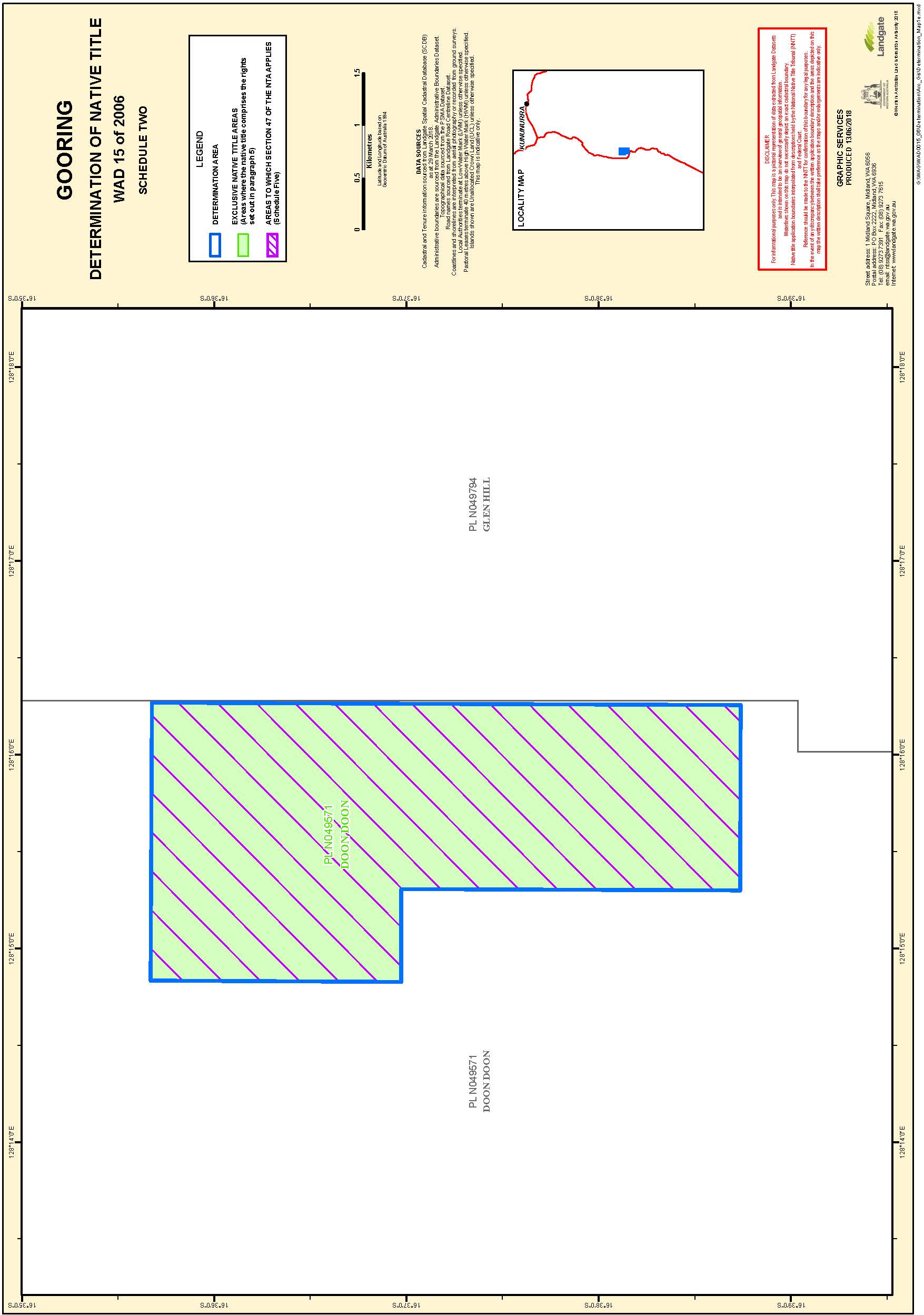
1. The Determination Area is the land and waters described in Schedule 1 and depicted on the map comprising Schedule 2.
2. Native title exists in those parts of the Determination Area identified in Schedule 3 (Native Title Area).
Native title holders (s 225(a))
3. The native title in the Determination Area is held by the native title holders. The native title holders are the people referred to in Schedule 4.
The nature and extent of native title rights and interests (s 225(b)) and exclusiveness of native title (s 225(e))
4. Subject to paragraphs 5, 6 and 7 the nature and extent of the native title rights and interests in relation to each part of the Determination Area referred to in Schedule 3 (being areas where any extinguishment must be disregarded) is the right to possession, occupation, use and enjoyment of that part of the Determination Area as against the whole world.
5. Notwithstanding anything in this Determination there are no native title rights and interests in the Determination Area in or in relation to
(a) minerals as defined in the Mining Act 1904 (WA) (repealed) and the Mining Act 1978 (WA);
(b) petroleum as defined in the Petroleum Act 1936 (WA) (repealed) and the Petroleum and Geothermal Energy Resources Act 1967 (WA); or
(c) geothermal energy resources and geothermal energy as defined in the Petroleum and Geothermal Energy Resources Act 1967 (WA);
except the right to take and use ochre to the extent that ochre is not a mineral pursuant to the Mining Act 1904 (WA).
6. Native title rights and interests are subject to and exercisable in accordance with:
(a) the laws of the State and the Commonwealth, including the common law; and
(b) the traditional laws and customs of the Native Title Holders.
7. For the avoidance of doubt, the nature and extent of native title rights and interests in relation to water in any watercourse, wetland or underground water source as defined in the Rights in Water and Irrigation Act 1914 (WA) as at the date of this determination is the non-exclusive right to take, use and enjoy that water.
Area to which s47 of the Native Title Act applies
8. Section 47 of the Native Title Act applies to disregard any prior extinguishment in relation to the area described in Schedule 5.
The nature and extent of any other interests
9. The nature and extent of other rights and interests in relation to the Determination Area are those set out in Schedule 6.
Relationship between native title rights and other interests
10. The relationship between the native title rights and interests described in paragraph 4 and the other interests is as follows.
(a) The determination does not affect the validity of those other interests;
(b) to the extent of any inconsistency between the other interests and the native title rights and interests, the native title rights and interests continue to exist in their entirety, but the native title rights and interests have no effect in relation to the other interests to the extent of the inconsistency during the currency of the other interests; and
(c) otherwise the other interests co-exist with the native title rights and interests. To avoid doubt, existence and exercise of native title rights and interests do not prevent the doing of any activity required or permitted to be done by or under the other rights and interests, and the doing of an activity required or permitted under those other interests prevails over the native title rights and interests and their exercise, but does not extinguish them.
Definitions and interpretation
11. In this Determination, unless the contrary intention appears:
'Determination Area' means the land and waters described in Schedule 1 and depicted on the maps at Schedule 2;
'land' and 'waters' respectively have the same meanings as in the Native Title Act;
'Native Title Act' means the Native Title Act 1993 (Cth);
12. In the event of any inconsistency between the written description of an area in Schedule 1 or Schedule 3 and the area as depicted on the map at Schedule 2, the written description prevails.
SCHEDULE 1
DETERMINATION AREA
The Determination Area, generally shown as bordered in blue on the map at Schedule 2, comprises all that land and waters bounded by the following description:
All those lands and waters subject to Mining Leases M80/599 and M80/600 (as defined by Department of Mines, Industry Regulation and Safety as at 23rd July 2010) within the external boundary of Lot 703 as shown on Deposited Plan 220061 being Pastoral Lease N049571 (Doon Doon).
Note: Geographic Coordinates provided in Decimal Degrees.
All referenced Deposited Plans and Diagrams are held by the Western Australian Land Information Authority, trading as Landgate.
Cadastral boundaries sourced from Landgate's Spatial Cadastral Database dated 29th March 2018.
Mining Tenements sourced from Department of Mines, Industry Regulation and Safety as at 23rd July 2010.
For the avoidance of doubt the application excludes any land and waters already claimed by:
• Native Title Determination Application WAD268/2010 Yurriyangem Taam (WC2010/013) as Registered in the Federal Court on the 29th September 2010.
Datum: Geocentric Datum of Australia 1994 (GDA94)
Prepared By: Native Title Spatial Services (Landgate) 11th July 2018
Use of Coordinates:
Where coordinates are used within the description to represent cadastral or topographical boundaries or the intersection with such, they are intended as a guide only. As an outcome to the custodians of cadastral and topographic data continuously recalculating the geographic position of their data based on improved survey and data maintenance procedures, it is not possible to accurately define such a position other than by detailed ground survey.
NTSS004 GW
G:\WAG\WAD0015_06\Determination\Determination_TD\WAD15_2006_Gooring_Determination_TD.DOC
SCHEDULE 2
MAP OF THE DETERMINATION AREA
SCHEDULE 3
EXCLUSIVE NATIVE TITLE AREAS
Areas where native title comprises the rights set out in paragraph 5
The following land and waters (generally shown as hatched in pink on the map at Schedule 2):
Section 47
Portion of Pastoral Lease N49571 Doon Doon | Lot 703 on Deposited Plan 220061 |
SCHEDULE 4
DESCRIPTION OF THE NATIVE TITLE HOLDERS
The native title holders are those Aboriginal people of the Miriuwung, Kija and Wularr language or dialect and country the subject of the determination who hold in common the body of traditional law and customs governing the area the subject of the claim. Those persons are:
(a) the descendants of:
(i) Polly Moojbi;
(ii) Sambo Djimbilainy;
(iii) Janguranga/Old Jimmy McCarthy;
(iv) Old Kitty;
(v) Paddy Wulbalminy;
(vi) Nellie Wadibarl;
(vii) Kneevil/Nyibil;
(viii) Djulmangurl/Joolmangool; and
(ix) Tjalpia; and
(b) persons recognised by those people in (a) above as having rights and interests in the area under traditional law and custom.
SCHEDULE 5
AREA TO WHICH SECTIONS 47 OF THE NATIVE TITLE ACT APPLIES
Section 47
Portion of Pastoral Lease N49571 Doon Doon | Lot 703 on Deposited Plan 220061 |
SCHEDULE 6
OTHER INTERESTS
1. Pastoral Leases
Lease Number | Location |
Portion of Pastoral Lease N49571 Doon Doon | Lot 703 on Deposited Plan 220061 |
2. Existing Interests under the Mining Act 1978 (WA)
Tenement ID | Tenement Type | Date of grant |
M 80/599 | Mining Lease | 23 July 2010 |
M 80/600 | Mining Lease | 23 July 2010 |
L 80/55 | Miscellaneous Licence | 23 July 2010 |
3. Other Rights and Interests
(a) Rights and interests, including licences and permits, granted by the Crown in right of the Commonwealth or the State pursuant to statute or otherwise in the exercise of its executive power and under any regulations made pursuant to such legislation.
(b) Rights or interests held by reason of the force and operation of the laws of the State or of the Commonwealth including the force and operation of the Rights in Water and Irrigation Act 1914 (WA).
(c) The right to access land by an employee or agent or instrumentality of:
(i) the State;
(ii) the Commonwealth; or
(iii) any local Government authority
as required in the performance of his or her statutory or common law duties where such access would be permitted to private land.
BANKS-SMITH J:
1 The Goorring native title claimants' application (Goorring application) is before the Court for determination pursuant to s 225 of the Native Title Act 1993 (Cth).
2 The Native Title Act provides for Aboriginal people to apply to the Court for determination of native title. In making a determination of native title, the Court is not creating native title but rather recognising what has always existed since well before European settlement. By the making of court orders, the Australian community collectively recognises that status.
3 One of the objectives of the Native Title Act is the resolution of claims by agreement, and this is facilitated by s 87. In this case, the parties have agreed to the terms of orders to be made by consent under s 87 of the Native Title Act.
The application - procedural history
4 The Goorring application was filed with the Court pursuant to s 61 of the Native Title Act on 17 January 2006. The application was notified by the Native Title Registrar pursuant to s 66 of the Native Title Act. The period of three months after the notification day referred to in s 66(8) and s 66(10)(c) of the Native Title Act ended on 28 June 2006.
5 The claim made in the Goorring application was considered by the Native Title Registrar pursuant to the s 190A of the Native Title Act (a consideration commonly known as the registration test). The Native Title Registrar was satisfied that the Goorring application was sufficient to meet the requirements of the registration test and details of the application were entered onto the Register of Native Title Claims on 17 February 2006.
The area
6 The Goorring application area is an approximately 11.645 kilometre square parcel of land within Pastoral Lease N49571 (Doon Doon), in the East Kimberley region of Western Australia. It is surrounded to the north, south and west by the Yurriyangem Taam native title determination application (WAD 268 of 2010), and to the east by the Miriuwung Gajerrong native title determination: Attorney-General of the Northern Territory v Ward [2003] FCAFC 283 (Wilcox, North and Weinberg JJ).
The native title claimants
7 The Goorring native title claimants are those Aboriginal people of the Miriuwung, Kija or Wularr language or dialect and country the subject of the determination who hold in common the body of traditional law and customs governing the area the subject of the application. The parties agree that those persons are the descendants of Polly Moojbi, Sambo Djimbilainy, Janguranga/Old Jimmy McCarthy, Old Kitty, Paddy Wulbalminy, Nellie Wadibarl, Kneevil/Nyibil, Djulmangurl/Joolmangool and Tjalpia, and other persons recognised by those descendants as having rights and interests in the area under traditional law and custom.
8 It is important to note that there have been some changes in the list of claimed apical ancestors from those in the application filed in 2006 and those in the list agreed for this determination, although the original application has not been formally amended.
9 Regardless, it is open to the Court to make a determination in terms of that proposed by the parties: see Billy Patch and Others on behalf of the Birriliburu People v State of Western Australia [2008] FCA 944 at [18] (French J) and Watson on behalf of the Nyikina Mangala People v State of Western Australia (No 6) [2014] FCA 545 at [33] (Gilmour J).
10 In this context, the Court was assisted by the affidavit of Mr Douglas D'Antoine filed on behalf of the Applicant (defined below). Mr D'Antoine is a legal officer of the Kimberley Land Council Aboriginal Corporation (KLC) and deposed to a process undertaken during the authorisation meeting with the Goorring claimants and in consultation with Mr Justin Lincoln, a senior anthropologist, to review the apical ancestors. Additional apical ancestors were included following further genealogical/anthropological research undertaken by the KLC in relation to the Goorring application and in consultation with the Goorring claimants. Each of Kneevil/Nyibil, Djulmangurl/Joolmangool and Tjalpia were added to the apical ancestor list and the spelling of Polly Moojbi's name was corrected. King O'Malley was removed from the original list. Mr D'Antoine said that the changes were unanimously agreed by the Goorring claimants in accordance with their traditional decision making process.
The parties
11 The applicant in this proceeding is comprised of Theresa Jessell, Patrick Thomas, Henry Park, Madeline Purdie, Kevin Morgan, Jacqueline Gallagher, Deanne Gerrard and James Dixon on behalf of the Goorring native title claimants (Applicant). Each of those persons is a member of the Goorring native title claimants.
12 The respondent is the State of Western Australia (State).
Authorisation of the consent determination
13 Section 61(1) of the Native Title Act permits the making of a native title determination application by those persons who are authorised 'by all the persons (the native title claim group) who, according to their traditional laws and customs, hold the common or group rights and interests comprising the particular native title claimed'. The Native Title Act vests the carriage of a native title determination application in the persons jointly comprising the applicant.
14 Section 62A of the Native Title Act relevantly provides that in the case of a claimant application, 'the applicant may deal with all matters arising under this Act in relation to the application'. This includes consenting to a determination of native title pursuant to s 87 of the Native Title Act.
15 Mr D'Antoine deposed in his affidavit to the fact that the Goorring native title claimants met at Kununurra on 23 October 2018 and at that meeting they considered and confirmed the authorisation of the Applicant to act in that capacity and to consent to the determination.
16 I am therefore satisfied that the Applicant is authorised to consent to the Court making a determination consistent with the terms now sought.
The material before the Court
17 The originating application filed on 17 January 2006 was supported by the following documents:
(a) s 62 affidavit of Una Morgan affirmed 14 December 2005;
(b) s 62 affidavit of Peggy Patrick affirmed 14 December 2005;
(c) s 62 affidavit of John Toby affirmed 14 December 2005;
(d) further affidavit of Peggy Patrick affirmed 15 December 2005;
(e) further affidavit of John Toby affirmed 15 December 2005; and
(f) affidavit of Morton Moore affirmed 15 December 2005.
18 No connection material has been filed in this matter, although it has been provided to the State, as discussed below.
19 The following materials were filed in support of this application:
(a) a minute of proposed orders and determination signed by the parties (Minute);
(b) Mr D'Antoine's affidavit; and
(c) joint submissions of the Applicant and the State (joint submissions).
Assessment of connection
20 The Applicant provided the State with both the Anthropologist's Connection Report for the Goorring Native Title Claim (WC2006/01 WAD 15/2006) by Justin Lincoln dated 20 March 2018 and Genealogies to the Anthropologist's Report dated 6 March 2018 in support of the Goorring claimants' connection to the claim area.
21 The joint submissions provided considerable detail regarding the connection to country, which I respectfully adopt and summarise as follows:
(1) As recorded by Elkin and Kaberry in the 1920s and 1930s, and by contemporary researchers such as Barber and Redmond, the principle for membership of Kija, Wularr and Miriuwung native title holding groups remains principally one of filiation (including adoption) via a parent or grandparent's pre-existing links to one or more estate countries. Subsidiary rights may arise from jarinny, ritual rights and responsibilities or long-term residence but these are only enduring rights if filiative links are also established. This is a system that is recognised across the region and which encompasses the Goorring application area.
(2) The descendants of the named apical ancestors for the Goorring application retain a connection with the Mandangala, Jimparla, Rugan or Tiltuwam estates in the vicinity of the Goorring application area, and self-identify as members of one or more of the three language groups associated with the area at the time of effective sovereignty.
(3) The current claimant group is genealogically linked to forebears who were on Goorring country prior to European settlement, and who themselves had affiliation to the Mandangala, Jimparla, Rugan or Tiltuwam estates, and hold rights in that country in accordance with the traditional land-holding system.
(4) From prior to effective sovereignty, the traditional people living in the East Kimberley, including within the Goorring application area, practised and adhered to a regional system of laws and customs. The laws and customs are characterised by a common belief in the Ngarranggarni creation stories, common recognition of a land tenure system and how rights in country are realised, and a common acknowledgment of a sub-section system that regulated marriage and kinship relations. It is a system of laws and customs that is practised today.
(5) The Goorring application area is an estate-based system of land tenure with patrifiliation being the ideal primary means of connection, with other subsidiary rights as mediated. Whilst claimants continue to assert affiliations to particular estate groups, they do so within the bounds of a larger societal structure which mediates rights and interests between those who assert rights and interests in an estate.
(6) The taking and use of the resources of the Goorring application area is a fundamental right of the claimants derived from the traditional laws and customs that connect them to an estate and the Goorring application area.
(7) Traditionally those who are connected to an estate via patrifiliation have the right to control the access to and use of that estate by others. The control of access to an estate is governed by those with authority within that estate.
(8) The area is rich is mythology which is closely related to the system of laws and social structure followed by the claimants. The journeys of the Dreaming (Ngarranggarni) beings left indelible marks in the landscape and, at the time of sovereignty, the antecedents of the claimants believed that these marks in the country were the living embodiment of an event and the journey of the mythical being or beings involved in that event.
(9) In addition to creating the landscape and its features, Ngarranggarni beings created the systems of law and social organisation. In the same way they formed the features in the landscape through their travels and interactions with each other these mythical beings also formed the social structures and norms that governed society.
(10) The claimants believe that a sub-section system is a societal structure ordained in the Ngarranggarni. At its broadest, the sub-section system classifies relations between people and provides for direction on how people relate to each other. On a more fundamental level the system provides for an idealised means to regulate marriage.
(11) Traditional customs and protocols ordained in the Ngarranggarni that serve to maintain the health of country are still practised today. To veer from these customs and protocols is to risk the health of country and the future abundance of resources.
The applicable requirements of s 87
22 The joint submissions seek that a determination of native title should be made pursuant to s 87 of the Native Title Act. That section provides that the Court may make a determination of native title by consent over an area covered by a native title application without holding a hearing where:
(a) the period specified in the notice given under s 66 of the Native Title Act has ended: s 87(1);
(b) agreement is reached between the parties on the terms of an order of the Federal Court in relation to the proceedings and the terms of the agreement, in writing signed by or on behalf of the parties, are filed with the Court: s 87(1)(a) and (b);
(c) the Court is satisfied that an order in, or consistent with, those terms would be within the power of the Court: s 87(1)(c); and
(d) it appears appropriate to the Court to make the orders sought: s 87(1A) and s 87(2).
23 The notification period referred to in s 66(8) and s 66(10)(c) of the Native Title Act has ended and so the condition in s 87(1) is satisfied.
24 The requirements of s 87(1)(a) and (b) of the Native Title Act are satisfied. There is an agreement in writing for a proposed determination of native title which has been filed with the Court. The agreement is reflected in the Minute which has been signed on behalf of the parties of the proceeding.
25 In accordance with s 87(1)(c) of the Native Title Act, the orders sought in the Minute are consistent with the terms of the agreement and are within the power of the Court to make for the following reasons:
(a) the Goorring application is validly made, having been authorised by the Goorring claimants according to a decision-making process that, under the traditional laws and customs of the claim group, authorised the Applicant to make the native title determination application;
(b) the Goorring application seeks a determination of native title in relation to an area for which there is no approved determination of native title (s 13(1)(a) of the Native Title Act) and there remains no approved determination in relation to the area the subject of the proposed determination (s 68 of the Native Title Act);
(c) there are no proceedings before the Court relating to native title determination applications that cover any part of the area the subject of the proposed determination which would otherwise require orders to be made under s 67(1) of the Native Title Act;
(d) the form of the proposed determination outlined in the Minute complies with s 94A and s 225 of the Native Title Act; and
(e) the requirements of s 87 of the Native Title Act are otherwise satisfied.
26 Section 87(1A) of the Native Title Act requires the Court to be satisfied that it is appropriate to make the determination sought by the parties. This is a discretion that must be exercised judicially and within the boundaries ascertained by references to the subject matter, scope and purpose of the Native Title Act: Brown (on behalf of the Ngarla People) v State of Western Australia [2007] FCA 1025; (2007) 203 FCR 505 at [22] (Bennett J).
27 The process envisaged by s 87(2) of the Native Title Act does not necessarily require the Court to receive evidence and make findings, or even to form a concluded view, as to whether the legal requirements for proving native title have been met: Watson on behalf of the Nyikina Mangala People v State of Western Australia (No 6) at [29]. Orders may be made under s 87 when the Court is satisfied that the parties have freely and on an informed basis come to an agreement: Ward v State of Western Australia [2006] FCA 1848 at [8] (North J).
28 In Ward, North J made the following comments as to s 87 of the Native Title Act:
[6] Section 87 gives the Court power to make orders following agreement between the parties to applications for determination of native title. However, the Court must be satisfied about a number of matters. Relevantly, it must be satisfied that the orders sought are within the power of the Court and that it is appropriate that the orders be made (s 87(1)).
…
[8] The Act makes mediation the primary means of resolution of native title cases. It is designed to encourage parties to take responsibility for resolution of proceedings without the need for litigation. Section 87 must be construed in this context. The section provides a power which is exercisable only when an agreement has been made. The power must be exercised flexibly and with regard to the purpose for which the section is designed. The section should not be construed to require parties in agreement to produce evidence as if in a trial. Consequently, in some circumstances, it will be appropriate to make orders under s 87 notwithstanding that the Court has not been provided with evidence of the primary facts substantiating native title.
29 In particular, s 87 is designed to encourage the parties to take responsibility for resolving proceedings without the need for litigation and must be exercised flexibly and with regard to the purpose for which the section is designed: Lovett on behalf of the Gunditjmara People v State of Victoria [2007] FCA 474 at [36] (North J).
30 The requirements of s 87(2) of the Native Title Act will often be met where the Court is satisfied that a relevant government respondent, such as the State, has through competent legal representation satisfied itself as to the cogency of the evidence upon which an applicant relies. Generally this will not involve the Court making findings on the evidence on which the government respondent relies, although the Court might consider that evidence for the limited purpose of being satisfied that the government respondent is acting in good faith and rationally: Munn for and on behalf of the Gunggari People v Queensland [2001] FCA 1229; (2001) 115 FCR 109 at [29]-[30] (Emmett J).
31 In this case, the Applicant and the State have been legally represented throughout the case management process.
32 Through an assessment process, which has included consideration of the connection material, the State has satisfied itself that the determination is justified in all the circumstances. The information and connection material provided by the Applicant is, in the view of the State, sufficient to demonstrate that the Goorring native title claims have a credible basis. The State is satisfied, as set out in the joint submissions, that the material presented is sufficient to evidence the maintenance of connection according to traditional laws and customs in the determination area.
33 In the circumstances, based on the material filed and taking into account the State's active role in the negotiations, I am satisfied that an order under s 87 of the Native Title Act is appropriate.
Nomination of a prescribed body corporate
34 At the date of the determination, no prescribed body corporate has been established to hold the native title recognised in the Goorring determination area.
35 By s 55 of the Native Title Act the Court must, either at the time of making its orders or 'as soon as practicable' after having done so, make such determinations as are required by s 56 and s 57 of the Native Title Act relating to whether the native title is to be held on trust and if so by whom (s 56), whether a prescribed body corporate will hold the native title on trust or whether such a body will perform the non-trustee functions as set out in s 57(3) of the Native Title Act. In the present case, at the time of the making of the Court's orders and the determination of native title, there has not been any proposal put to the Court concerning the operation of s 56 and s 57 in relation to the claim area. The parties have sought orders which allow the Applicant a period of 12 months from the date of the Court's orders to put a proposal to the Court. I am satisfied it is appropriate to allow the Applicant 12 months to prepare the necessary proposal.
36 In those circumstances, the orders will provide (as proposed by the parties in the Minute) that the determination of native title will take effect immediately upon the Court making a determination under s 56(1) or s 57(2) of the Native Title Act as the case may be.
Conclusion
37 A determination of native title will be made in accordance with the Minute.
38 The Goorring claimants have recognition by Australian law of their native title. The continued work and determination to pursue and finalise this claim is to be admired.
39 The legal representatives and the KLC are to be congratulated for the support and assistance provided to the claimants over many years. The State too should be congratulated on its contribution to this process, with both parties working to achieve the outcome of a native title determination.
I certify that the preceding thirty-nine (39) numbered paragraphs are a true copy of the Reasons for Judgment herein of the Honourable Justice Banks-Smith. |


