

FEDERAL COURT OF AUSTRALIA
Street on behalf of the Giniyjawarrni Yoowaniya Riwi Native Title Claim Group v State of Western Australia [2018] FCA 2019
ORDERS
|
DATE OF ORDER: |
THE COURT NOTES THAT:
A. The applicant in proceeding WAD 610 of 2017 has made a native title determination application (Giniyjawarrni Yoowaniya Riwi Application) that relates to the area of land and waters the subject of the attached determination of native title (the Determination).
B. The applicant in the Giniyjawarrni Yoowaniya Riwi Application, the State of Western Australia and the other respondents to the proceeding (the parties) have reached an agreement as to the terms of the Determination which is to be made in relation to the land and waters covered by the Giniyjawarrni Yoowaniya Riwi Application (the Determination Area). The external boundaries of the Determination Area are described in Schedule 1 to the Determination.
C. Pursuant to s 87(1)(a)(i) and (2) of the Native Title Act 1993 (Cth) (Native Title Act) the parties have filed with the Court their agreement in relation to this proceeding.
D. The terms of the agreement involve the making of consent orders for a determination of native title in relation to the land and waters the subject of this proceeding pursuant to s 87(2) and s 94A of the Native Title Act.
E. The respondents Shiying-Yougawalla No 2 Pty Ltd and Sterling Jack Buntine have agreed to the terms of the Determination on the basis of having reached agreement with the applicant in relation to those pastoral leases and portions of pastoral leases that are situated within the Determination Area. Following the Determination taking effect, the agreements will be executed and application will be made for the agreements to be registered as Indigenous Land Use Agreements on the Register of Indigenous Land Use Agreements as body corporate agreements pursuant to s 24BG of the Native Title Act.
F. The parties acknowledge that the effect of the making of the Determination is that the members of the native title claim group, in accordance with the traditional laws acknowledged and the traditional customs observed by them, should be recognised as the native title holders for the Determination Area as set out in the Determination.
G. Pursuant to s 87(2) of the Native Title Act, the parties have requested that the Court determine the proceeding without holding a hearing.
BEING SATISFIED that a determination of native title in the terms set out in Attachment A would be within the power of the Court and, it appearing to the Court appropriate to do so, pursuant to s 87 and s 94A of the Native Title Act and by the consent of the parties:
THE COURT ORDERS THAT:
1. In relation to the Determination Area, there be a determination of native title in WAD 610 of 2017 in terms of the Determination as provided for in Attachment A.
1. The Determination is to take effect immediately upon the making of a determination under s 56(1) or s 57(2) of the Native Title Act 1993 (Cth) as the case may be.
2. Within 12 months of the date upon which these orders are made, a representative of the common law holders of the native title rights and interests shall indicate whether they intend to have the native title rights and interests held in trust or by an agent. They are invited to do so by:
(a) nominating in writing to the Federal Court a prescribed body corporate to be trustee or agent of the native title rights and interests; and
(b) including within the nomination the written consent of the body corporate.
3. If a prescribed body corporate is nominated in accordance with order 3, it will hold the native title rights and interests described in order 1 in trust or as agent (as the case may be), for the common law holders of the native title rights and interests.
4. In the event that there is no nomination within the time specified in order 3, or such later time as the Court may order, the matter is to be listed for further directions.
5. There be no order as to costs.
Note: Entry of orders is dealt with in Rule 39.32 of the Federal Court Rules 2011.
ATTACHMENT A
DETERMINATION
THE COURT ORDERS, DECLARES AND DETERMINES THAT:
Existence of native title (s 225 Native Title Act)
1. Native title rights and interests exist in those parts of the Determination Area identified in Schedules 3 and 4 in the manner set out at paragraphs 4 and 5 respectively.
2. Native title does not exist in those parts of the Determination Area identified in Schedule 5.
Native title holders (s 225(a) Native Title Act)
3. The native title in the Determination Area is held by the people identified in Schedule 6 (Native Title Holders).
Nature and extent of native title (s 225(b) and s 225(e) Native Title Act)
Exclusive native title rights and interests
4. Subject to paragraphs 7, 8, 9 and 10 the nature and extent of the native title rights and interests in relation to each part of the Determination Area referred to in Schedule 3 (being areas where any extinguishment must be disregarded) is the right to possession, occupation, use and enjoyment of that part as against the whole world.
Non-exclusive native title rights and interests
5. Subject to paragraphs 6, 7, 8, 9 and 10 the nature and extent of the native title rights and interests in relation to each part of the Determination Area referred to in Schedule 4 (being areas where there has been partial extinguishment of native title and where any extinguishment is not required to be disregarded) are the following:
(a) the right to have access to, remain in and use that part. For the avoidance of doubt, some of the ways in which that right may be exercised include but are not limited to the following activities:
(i) to access and move freely through and within that part;
(ii) to live, being to enter and remain on, camp and erect temporary shelters and other structures for those purposes on that part;
(iii) to light controlled contained fires but not for the clearance of vegetation;
(iv) to engage in cultural activities in that part, including the transmission of cultural heritage knowledge; and
(v) to hold meetings in that part;
(b) the right to access and take for any purpose the resources on that part. For the avoidance of doubt, one of the ways in which that right may be exercised includes but is not limited to the following activity:
(i) to access and take water other than water which is lawfully captured or controlled by the holders of pastoral leases;
(c) the right to protect places, areas and objects of traditional significance on that part. For the avoidance of doubt, some of the ways in which that right may be exercised include but are not limited to the following activities:
(i) to conduct and participate in ceremonies in that part;
(ii) to conduct burials and burial rites and other ceremonies in relation to death in that part; and
(iii) to visit, maintain and protect from physical harm, areas, places and sites of importance in that part; and
(d) the right to be accompanied onto the Determination Area by any persons who, though not Native Title Holders pursuant to paragraph 3, the Native Title Holders may invite pursuant to traditional law and custom, being:
(i) spouses or partners of the Native Title Holders; and
(ii) persons who may assist with the performance of ceremonies or cultural activities, including sharing of knowledge about country.
6. The native title rights and interests referred to in paragraph 5 do not confer:
(a) possession, occupation, use and enjoyment of those parts of the Determination Area on the Native Title Holders to the exclusion of all others; nor
(b) a right to control the access of others to the land or waters of those parts of the Determination Area.
7. Notwithstanding anything in this Determination there are no native title rights and interests in the Determination Area in or in relation to:
(a) minerals as defined in the Mining Act 1904 (WA) (repealed) and the Mining Act 1978 (WA); or
(b) petroleum as defined in the Petroleum Act 1936 (WA) (repealed) and the Petroleum and Geothermal Energy Resources Act 1967 (WA); or
(c) water lawfully captured or controlled by the holders of Other Interests,
except the right to take and use ochre to the extent that ochre is not a mineral pursuant to the Mining Act 1904 (WA).
8. Native title rights and interests are subject to and exercisable in accordance with:
(a) the traditional laws and customs of the Native Title Holders; and
(b) the laws of the State and the Commonwealth, including the common law.
9. The native title rights and interests are subject to the Petroleum and Geothermal Energy Resources Act 1967 (WA).
10. For the avoidance of doubt, the native title rights and interests set out in paragraphs 4 and 5 do not confer exclusive rights in relation to water in any watercourse, wetland or underground water source as defined in the Rights in Water and Irrigation Act 1914 (WA) as at the date of this Determination.
Areas where extinguishment is disregarded (s 47B Native Title Act)
11. Section 47B of the Native Title Act applies to disregard any prior extinguishment in relation to each of the areas described in Schedule 7.
The nature and extent of any Other Interests (s 225(c) Native Title Act)
12. The nature and extent of other rights and interests in relation to the Determination Area are those set out in Schedule 8.
Relationship between native title rights and Other Interests (s 225(d) Native Title Act)
13. The relationship between the native title rights and interests described in paragraphs 4 and 5 and the Other Interests is as follows:
(a) the Other Interests co-exist with the native title rights and interests;
(b) this Determination does not affect the validity of those Other Interests; and
(c) to the extent of any inconsistency, the native title rights and interests yield to the Other Interests and the existence and exercise of native title rights and interests cannot prevent activities permitted under the Other Interests.
Definitions and interpretation
14. In this Determination, unless the contrary intention appears:
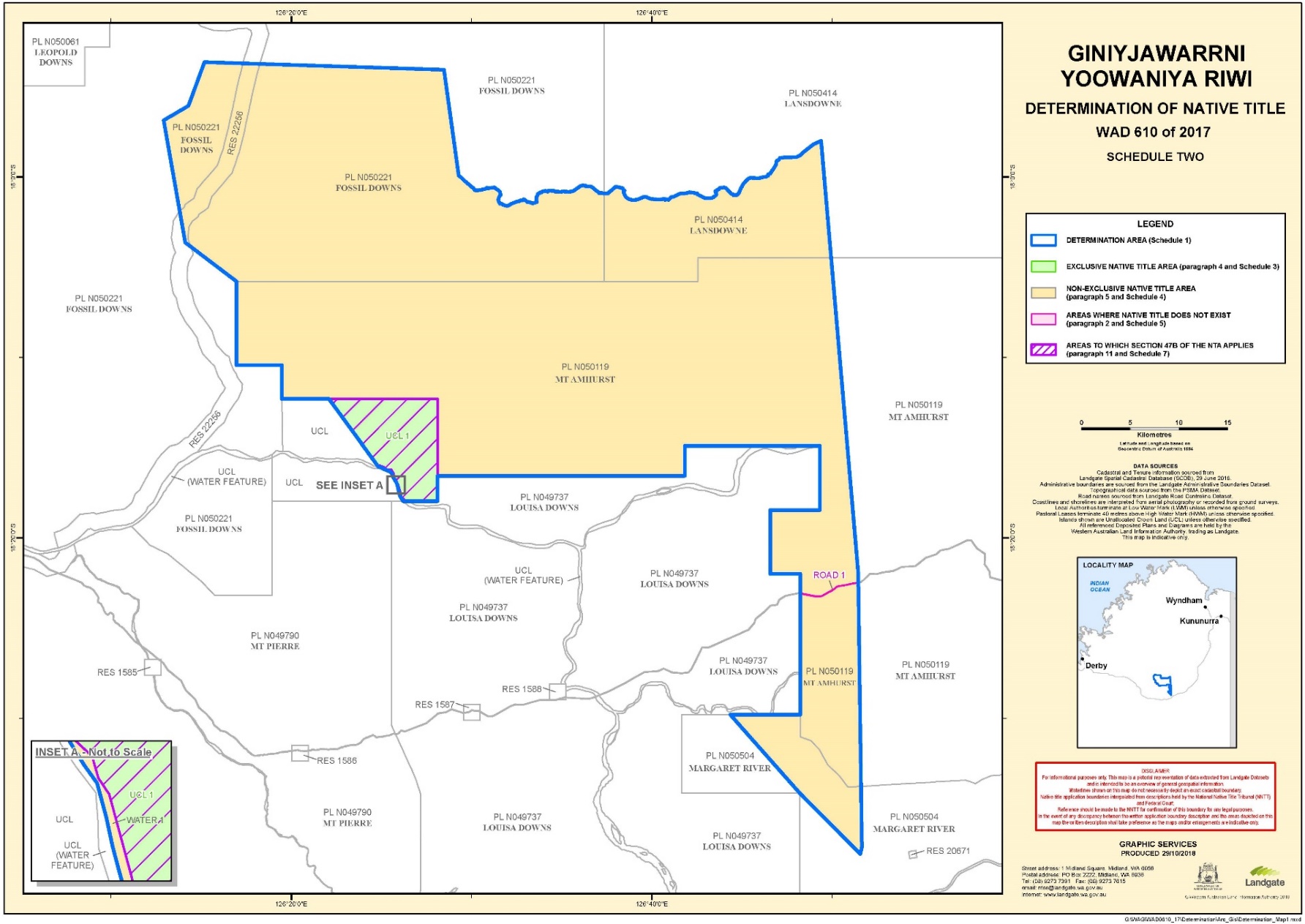
'Determination Area' means the land and waters described in Schedule 1 and depicted on the map at Schedule 2;
'land' and 'waters' respectively have the same meanings as in the Native Title Act;
'Native Title Act' means the Native Title Act 1993 (Cth);
'Other Interests' means the legal or equitable estates or interests and other rights in relation to the Determination Area described in Schedule 8 and referred to in paragraph 12; and
'State' means the State of Western Australia.
15. In the event of any inconsistency between the written description of an area in Schedule 1 or Schedules 3 to 5 and the area as depicted on the map at Schedule 2, the written description prevails.
SCHEDULE 1
DETERMINATION AREA
The Determination Area, generally shown as bordered in blue on the map at Schedule 2, comprises the land and waters within the external boundaries described below:
All those lands and waters commencing Latitude 17.934143 South, Longitude 126.238319 East and extending northeasterly and easterly through the following coordinate positions:
|
LATITUDE (SOUTH) |
LONGITUDE (EAST) |
|
17.893863 |
126.253049 |
|
17.900802 |
126.474421 |
Then southerly to the intersection of Leopold River with the southern bank of Little Gold River; Then generally easterly along that river bank to Longitude 126.823264 East; Then southerly to Latitude 18.365254 South, Longitude 126.857484 East; Then southerly to the centreline of Margaret River at Longitude 126.861010 East; Then southwesterly to Latitude 18.625170 South, Longitude 126.859406 East being a point on the present boundary of Native Title Determination WAD6008/2000 Gooniyandi Combined #2 (WCD2013/003); Then generally northwesterly along the boundaries of that native title determination to Latitude 17.947641 South, Longitude 126.215276 East; Then northeasterly back to the commencement point.
Note: Geographic Coordinates provided in Decimal Degrees.
Cadastral boundaries sourced from Landgate's Spatial Cadastral Database dated 29th June 2018.
Margaret River as defined by the National Native Title Tribunal and Native Title Spatial Services from digitized AUSLIG 1:250 000 georeferenced raster image.
Leopold River and Little Gold River data sourced from Commonwealth of Australia (Geoscience Australia) 2006.
For the avoidance of doubt the application excludes any land and waters already claimed by:
Native Title Determination WAD6008/2000 Gooniyandi Combined #2 (WCD2013/003) as Determined in the Federal Court on the 19th June 2013.
Native Title Determination Application WAD268/2010 Yurriyangem Taam (WC2010/013) as Registered in the Federal Court on the 29th October 2010.
Native Title Determination Application WAD45/2012 Jaru (WC2012/003) as Registered in the Federal Court on the 16th March 2012.
Datum: Geocentric Datum of Australia 1994 (GDA94)
Prepared By: Graphic Services (Landgate) 26th October 2018
Use of Coordinates:
Where coordinates are used within the description to represent cadastral or topographical boundaries or the intersection with such, they are intended as a guide only. As an outcome to the custodians of cadastral and topographic data continuously recalculating the geographic position of their data based on improved survey and data maintenance procedures, it is not possible to accurately define such a position other than by detailed ground survey.
SCHEDULE 2
MAP OF THE DETERMINATION AREA
SCHEDULE 3
EXCLUSIVE NATIVE TITLE AREAS
Areas where native title comprises the rights and interests set out in paragraph 4
The following land and waters (generally shown as green on the map at Schedule 2):
|
Portion of UCL1 |
Large area of UCL in south-west of Determination Area |
SCHEDULE 4
NON-EXCLUSIVE NATIVE TITLE AREAS
Areas where native title comprises the rights and interests set out in paragraph 5
The following land and waters (generally shown as yellow on the map at Schedule 2):
1. Pastoral Leases
|
Lease Number |
Station Name |
Location |
|
PL N050119 |
Mt Amhurst |
Lot 54 on DP 238350 |
|
PL N050221 |
Fossil Downs |
Lot 63 on DP 238592 |
|
PL N050414 |
Lansdowne |
Lot 53 on DP 220791 |
|
PL N050504 |
Margaret River |
Lot 83 on DP 238611 |
NOTE: The rights and obligations of the pastoralists pursuant to the pastoral leases referred to in paragraph [1] of Schedule 4 above include responsibilities and obligations to adopt and exercise best practice management of the pasture and vegetation resources, livestock and soils within the boundaries of the pastoral leases in order to manage stock and for the management, conservation and regeneration of pasture for permitted uses.
2. Reserves
|
Reserve Number |
Current / Last Purpose |
Location |
|
Res 22256 |
Stock Route - Wyndham to Margaret River |
Lot 330 on DP 66801 |
3. Water Areas
|
Water 1 |
Margaret River |
SCHEDULE 5
AREAS WHERE NATIVE TITLE DOES NOT EXIST (paragraph 2)
1. Public Works
The areas the subject of the following works:
(a) Roads:
|
MapInfo ID |
Description |
|
Road 01 |
Road 296 (Derby to Halls Creek) |
(b) Any other public works as that expression is defined in the Native Title Act and the Titles (Validation) and Native Title (Effect of Past Acts) Act 1995 (WA) and to which s 12J of the Titles (Validation) and Native Title (Effect of Past Acts) Act 1995 (WA) or s 23C(2) of the Native Title Act applies, within the external boundary of the Determination Area including the land and waters defined in s 251D of the Native Title Act.
SCHEDULE 6
DESCRIPTION OF THE NATIVE TITLE HOLDERS (paragraph 3)
1. The Native Title Holders are those Aboriginal people who:
(a) are descended from one or more of the people listed in paragraph [2] of this Schedule; or
(b) are recognised by the descendants of the people listed in paragraph [2] of this Schedule as having traditional rights and interests in the Determination Area under traditional law and custom.
2. The people referred to in paragraph [1] of this Schedule are:
|
1. |
Moogoo / Maudie |
|
2. |
Galu /Polly |
|
3. |
Lena |
|
4. |
Mala |
|
5. |
Milba / Melba |
|
6. |
Jalgumbirri |
|
7. |
Wadgimili / Sandy Smith |
|
8. |
Marmanda / Jeanie |
|
9. |
Sam Marbin |
|
10. |
Binji Marbin |
|
11. |
Nyiril |
|
12. |
Tom DamiDami |
|
13. |
Mary Minya |
|
14. |
Maggie Durlmariya |
|
15. |
Nyugurl / Tilly |
|
16. |
Tilly / Maliyambi |
|
17. |
Tim / Minany |
|
18. |
Jack Saddler / Guranda |
|
19. |
Walbalbiya |
|
20. |
Dindanyil |
|
21. |
Gurliny |
|
22. |
Diyim |
|
23. |
Ngiliyayiny |
|
24. |
Yamulukin |
|
25. |
Mirrowinja |
|
26. |
Barney Walarroo |
|
27. |
Jilgi |
|
28. |
Laidjai / Annie / Miringali |
|
29. |
Jack Widmeri |
|
30. |
Ningali |
SCHEDULE 7
AREAS TO WHICH SECTION 47B OF THE NATIVE TITLE ACT APPLIES (paragraph 11)
|
Portion of UCL 1 |
Large area of UCL in south-west of Determination area |
SCHEDULE 8
OTHER INTERESTS (paragraph 12)
The nature and extent of Other Interests in relation to the Determination Area are as follows:
[NOTE: Land tenure interests registered with the Western Australian Land Information Authority are current as at 29 June 2018. As at 14 November 2018, there are no current mining tenements or petroleum interests registered with the Department of Mines, Industry Regulation and Safety. All Other Interests are current as at the date of this Determination.]
1. Pastoral Leases
|
Lease Number |
Station Name |
Location |
|
PL N050119 |
Mt Amhurst |
Lot 54 on DP 238350 |
|
PL N050221 |
Fossil Downs |
Lot 63 on DP 238592 |
|
PL N050414 |
Lansdowne |
Lot 53 on DP 220791 |
|
PL N050504 |
Margaret River |
Lot 83 on DP 238611 |
2. Reserves
|
Reserve Number |
Current / Last Purpose |
Location |
|
Res 22256 |
Stock Route - Wyndham to Margaret River |
Lot 330 on DP 66801 |
3. Miscellaneous Rights and Interests
(a) Valid or validated rights and interests, including licences and permits, granted by the Crown in right of the Commonwealth or the State pursuant to statute or otherwise in the exercise of its executive power and under any regulations made pursuant to such legislation.
(b) Valid or validated rights or interests held by reason of the force and operation of the laws of the State or of the Commonwealth including the force and operation of the Rights in Water and Irrigation Act 1914 (WA).
(c) Rights and interests of members of the public arising under the common law including but not limited to:
(i) the public rights to fish and navigate in tidal waters (if any) in the Determination Area; and
(ii) the right of any person to use any road in the Determination Area (subject to the laws of the State) over which, as at the date of this Determination, members of the public have a right of access under common law.
(d) The right to access land by an employee or agent or instrumentality of:
(i) the State;
(ii) the Commonwealth; or
(iii) any local Government authority;
as required in the performance of his or her statutory or common law duties where such access would be permitted to private land.
(e) So far as confirmed pursuant to s 14 of the Titles (Validation) and Native Title (Effect of Past Acts) Act 1995 (WA) as at the date of this Determination, any existing public access to and enjoyment of:
(i) waterways;
(ii) the beds and banks or foreshores of waterways;
(iii) stock routes; or
(iv) areas that were public places at the end of 31 December 1993.
COLVIN J:
1 A determination of native title is a significant cultural and legal event. It recognises the existence as against all people in the whole world of the common or group rights held by identified Aboriginal people who, by reason of their traditional laws and customs, have connection with an area of land in Australia. It recognises matters that reach back well before this Court and the institutions of the government of which it is part. It describes the nature and extent of native title rights in relation to the determination area, the nature and extent of any other interests and the relationship between those rights and interests. It deals with whether the declared rights and interests in respect of the determination area, both land and waters, now exist to the exclusion of all others. It does not make the connections or confer them. It determines the existence of them. They were there before the determination, but by order of the Court they receive the recognition and legal protection afforded by a determination of this Court.
2 Jurisdiction is conferred on this Court to make such a determination by consent. In particular, s 87 of the Native Title Act 1993 (Cth) provides for a determination to be made where there has been notification of the native title application in the manner required and the period for parties with interests to apply to become a party has ended, agreement has been reached between the parties to the application on the terms of an order, the agreement has been reduced to writing signed by the parties and filed with the Court, the Court is satisfied that the order is within the power of the Court and it appears to the Court that it is appropriate to make the determination provided for by the terms of the order.
Consent determination
3 Today, the Court makes a determination of native title by consent under s 87 of the Native Title Act in respect of an application known as the Giniyjawarrni Yoowaniya Riwi application. It concerns an area of land of approximately 2212 square kilometres which is approximately 420 km east of Broome and 843 km north-east of Port Hedland. The application is made by Aboriginal persons descended from 30 apical ancestors or Aboriginal persons recognised by those ancestors as having traditional rights and interests in the area under traditional law and custom.
4 The application is the second part of a claim that has been progressed in two parts. The first part was the subject of a consent determination on 25 October 2016: Street on behalf of the Yarrangi Riwi Yoowarni Gooniyandi People v State of Western Australia [2016] FCA 1250. It recognised claims by the Gooniyandi People. As to the second part, a new claim was brought by orders made on 1 December 2017. It included a wider claim group. It concerns land that is Gooniyandi, Kija and mixed Gooniyandi/Kija country. It was accepted as a registered claim on 11 June 2018. It has been duly notified and the notification period ended on 10 October 2018. It is advanced with the support of the Kimberley Land Council.
5 The applicants who brought the claim on behalf of the Giniyjawarrni Yoowaniya Riwi native title claim group are Mr Mervyn Street, Ms Helen Malo, Ms June Davis, Mr Eric (Wally) Cox, Ms Frances Dawson, Ms Marion Dolby, Mr Nathan Lennard, Ms Jane Holloway and Mr Wayne Wallaby. The proposed determination was considered at a meeting of the claim group held in the Fitzroy Crossing Recreation Centre on 22 November 2018. The terms of the proposed determination were presented to the meeting. There were questions and discussion. Those present resolved by show of hands to agree to and authorise the consent determination.
6 The parties who have been joined to the application are the State of Western Australia, the Shire of Derby/West Kimberley, the Shire of Halls Creek and three pastoralists with interests in the area being Sterling Jack Buntine, Consolidated Australian Pastoral Holdings Pty Ltd and Shiying-Yougawalla No 2 Pty Ltd. They have each agreed to the determination by signing a formal record to the effect that they have reached agreement on the terms of orders to give effect to the determination and that they consent to the making of the orders and a determination of native title in terms of the determination.
7 The agreed terms describe the rights and interest, the areas to which they pertain and describe the persons who are the holders of those rights and interests. They deal with the matters set out in s 225 of the Native Title Act.
Connection to country
8 On the evidence before me, Gooniyandi People use riwi to indicate country that belongs to particular people by connection. Kija People use taam to indicate country over which particular people have a connection. Although these connections have changed they have done so through traditional patterns, laws and customs. These connections have been the subject of a report by Dr Heather Lynes dated November 2017. Dr Lynes is well qualified to provide such a report. The State has considered the report and acted on legal advice in accepting that connections to the land in the claim area have been established.
9 The applicants and the State have agreed a short description of connection to country for the claim area the subject of the application. It is in the following terms:
The Traditional Owners of the claim area belong to a regional society comprised of Aboriginal peoples and families from multiple language identifying groups, united in their cosmological belief system, known as the Ngarrangarni, as well as the traditional laws and customs deriving from the Ngarrangarni.
Encompassed in the Ngarranggarni is the origins of the world as it is known, as well as a guide to how one should behave in order to maintain the social order. The Ngarranggarni forms the basis of normative rules about rights and interests in country in the claim area.
At the time of British sovereignty in the claim area, in the Gooniyandi-identified areas of country, landed affiliations, which lead to rights and interests in land and waters, were claimed through two-step filiation - both on the paternal and maternal side - as well as spirit conception/spirit-centre and totemic affiliations.
In the Kija-identified areas of country, there was a stronger realisation of patrifilial descent-based local group countries, while other affiliations to country that bestow rights and interests in lands and waters, such as spirit conception and maternal country, were also recognised. In areas of country that were identified as "mixed" Gooniyandi/Kija, a combination of the above-stated principles applied.
Laws and customs relating to land and waters in the claim area continue to be based on principles of descent (including matrifiliation and patrifiliation) as well as spirit conception and ritual knowledge.
All of the earliest anthropological reports place Gooniyandi and Kija peoples in and around the claim area. Frontier violence and the gradual establishment of pastoral stations in the claim area during the 1880s and 1890s caused the ancestors of the Traditional Owners to be settled onto various pastoral stations over the following decades. This allowed for the Traditional Owners' ancestors to remain on or close to their traditional countries in most instances.
Senior Traditional Owners of the claim area grew up and worked on pastoral stations such as Fossil Downs, Lansdowne, Margaret River and Louisa Downs, which overlap and surround the claim area.
Early researchers documented the nature and extent of the Traditional Owners' rights and interests in the claim area, as well as rules about the manner in which said rights and interests may be exercised. The rights to control access to and use of country, to access and use country, and to take and use resources are all explored by early researchers. Likewise, early researchers documented the Traditional Owners' rules regarding the protection of country, decision-making about country, access to country and the use of resources from country. The laws and customs of the Traditional Owners relating to cosmology, kinship, social organisation and ritual practices all date back to times before British sovereignty.
Contemporary ethnographic accounts highlight that the rights and interests of the Traditional Owners continue to include the rights to speak for country, to control access to and use of country, the right to access country and use its resources as well as the right to protect places of traditional significance. The Traditional Owners also continue to adhere to rules about the ways these rights can be exercised, such as rules about protecting country, decision-making, controlling the use of country and taking its resources. The Traditional Owners' connection to the claim area can therefore be said to be based on laws and customs which have existed substantially unchanged since sovereignty.
Agreement to determination of native title
10 Where the procedures have been followed to notify an application and identify interested parties and thereafter those parties have freely and on an informed basis agreed the terms of a determination, then subject to the Court otherwise being satisfied that the determination orders are appropriate and any other matters that may be relevant to the exercise of discretion, the Court will exercise the statutory power to make the determination by consent without receiving evidence or embarking upon its own inquiry as to the matters that have been agreed: Ward v State of Western Australia [2006] FCA 1848 at [8]. The primary focus of the Court's consideration is upon the demonstration that there has indeed been the requisite agreement: Lander v State of South Australia [2012] FCA 427 at [11]. It does not embark upon its own inquiry as to the merits of the claim, but will consider evidence for the limited purpose of ensuring that the State in consenting has been a rational decision and is acting in good faith: Brown v Northern Territory of Australia [2015] FCA 1268 at [23].
11 The provision for consent determinations is to encourage parties to resolve matters concerning native title without the delay and division that may be associated with a court hearing. In considering whether to approve a consent determination the Court has regard to this evident purpose: Lovett on behalf of the Gunditjmara People v State of Victoria [2007] FCA 474 at [36].
12 For reasons I have given, I am satisfied that the agreement between the parties has been informed by due consideration of the connection of the members of the claim group to the land that comprises the claim area and that there is a proper foundation for the jurisdiction to make the orders sought.
13 In this case, the parties have had proper and experienced legal representation in reaching agreement. The State has been actively involved. The parties have directed their attention to assessing the claim and the connections of the claimants to the land. Searches have been conducted of land tenure, mining and petroleum registries to determine the nature and extent of any other interests and have included those identified interests in the determination.
The determination sought is appropriate
14 Section 87 provides that if other matters stated in the provision are established then the Court may make a determination by consent if the Court considers it appropriate to do so. Both the discretionary nature of the provision and the requirement for the Court to form a view that the determination is appropriate afford a degree of oversight and protection to ensure that the determination is being sought in circumstances that are consistent with the purposes of the Native Title Act and in the absence of any matter that might activate concern on the part of a Court acting judicially: Brown (on behalf of the Ngarla People) v State of Western Australia [2007] FCA 1025 at [22]. It is a broad protection to advance the purposes of the legislation when making consent orders and to ensure that an agreed determination is not given effect where there has been sharp practice, unfairness or impropriety, a lack of disclosure, a lack of good faith, a lack of advice or understanding or similar circumstance that would cause a Court guided by basic principles of justice and fairness to decline to approve the determination on the basis of consent of interested parties.
15 Further, as noted by Mortimer J in Freddie v Northern Territory [2017] FCA 867 at [18] when dealing with the appropriateness requirement in the similar power conferred by s 87A of the Native Title Act it is a requirement that 'recognises that the determination made by the Court is one made as against the whole world, and not just between the parties to the proceeding'. Therefore:
The rights conferred are enduring legal rights, proprietary in nature and in recognising them through a determination, the Court must be conscious of their character. The nature of the rights informs considerations such as the clarity of the terms of the determination (as to the claim area, the nature of the native title rights and interests and the manner of affectation on other proprietary interests); the need for appropriate notification and then the free and informed consent of all parties; and finally the State's agreement that there is a credible and rational basis for the determination proposed.
16 Having considered the terms of the proposed orders and the above considerations I am satisfied that it is appropriate to make the determination provided for by the consent orders.
Nomination of prescribed body corporate
17 Where a native title determination is made the Court must also determine whether the native title is to be held in trust and if so by whom: s 56(1). There is provision in s 56(2) as to the steps to be taken by the Court in that regard. They begin with a request to be made by the Court for a representative of the native title holders to indicate whether they intend to have the native title held in trust.
18 By s 55, if a determination that native title exists is made then the Court must 'at the same time as, or as soon as practicable after, it makes a determination' make the determination required by s 56. There must also be a determination under s 57 of the prescribed body corporate.
19 The consent orders provide for a period of 12 months for a representative of the native title holders to indicate whether the holders intend to have the native title rights and interests held in trust or by an agent. If there is no such indication then the matter is to be listed for directions.
20 The determination provided for by the consent orders will not take effect until the making of the determinations under s 56 and s 57. So there is every incentive for the parties to act as soon as practicable. In that sense, there will only likely be delay if there are practical difficulties in making the necessary arrangements. In those circumstances, while the period of 12 months is relatively long, I am satisfied that the orders provide for the determination required 'as soon as practicable'.
Conclusion
21 I commend the parties and their representatives for bringing this important matter to a conclusion by way of agreement.
22 Being satisfied as to the statutory requirements I make orders in terms of the consent determination recognising native title rights in respect of the claim area which concerns land that is Gooniyandi, Kija and mixed Gooniyandi/Kija country. The Court thereby recognises the enduring traditional laws and customs observed by those peoples in respect of the land the subject of the determination.
|
I certify that the preceding twenty-two (22) numbered paragraphs are a true copy of the Reasons for Judgment herein of the Honourable Justice Colvin. |
Associate:


