

FEDERAL COURT OF AUSTRALIA
Fairfax Media Limited, in the matter of Fairfax Media Limited (No 2) [2018] FCA 1930
ORDERS
FAIRFAX MEDIA LIMITED ACN 008 663 161 Plaintiff | ||
DATE OF ORDER: |
THE COURT ORDERS THAT:
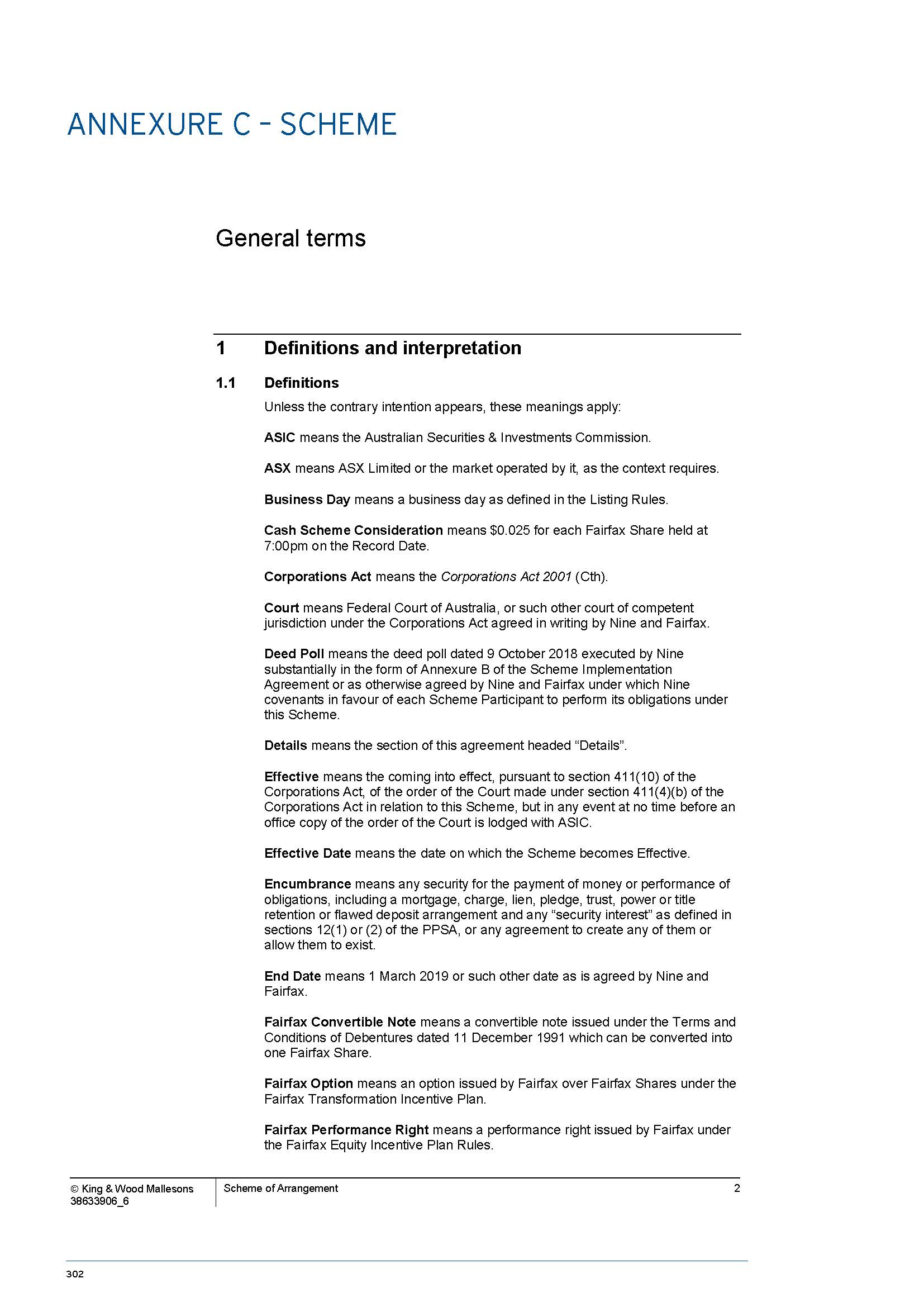
1. Pursuant to section 411(4) of the Corporations Act 2001 (Cth) (“Corporations Act”), the scheme of arrangement between the plaintiff and its shareholders in the form of Annexure A to these Orders (“Scheme”) be approved.
2. Pursuant to section 411(12) of the Corporations Act, the plaintiff be exempted from compliance with section 411(11) of the Corporations Act in respect of the Scheme.
3. These orders be entered forthwith.
Note: Entry of orders is dealt with in Rule 39.32 of the Federal Court Rules 2011.
GLEESON J:
1 On 27 November 2018, following the second court hearing in this matter, I made orders, including orders pursuant to s 411(4)(b) of the Corporations Act 2001 (Cth) (“Act”), approving a scheme of arrangement between the plaintiff (“Fairfax”) and its members relating to the proposed acquisition of Fairfax by Nine Entertainment Co Holdings Limited (“Nine”). The orders were made over the opposition of two parties: Antony Catalano and Aurora Funds Management Limited (“Aurora”).
2 These are my reasons for making those orders.
Background
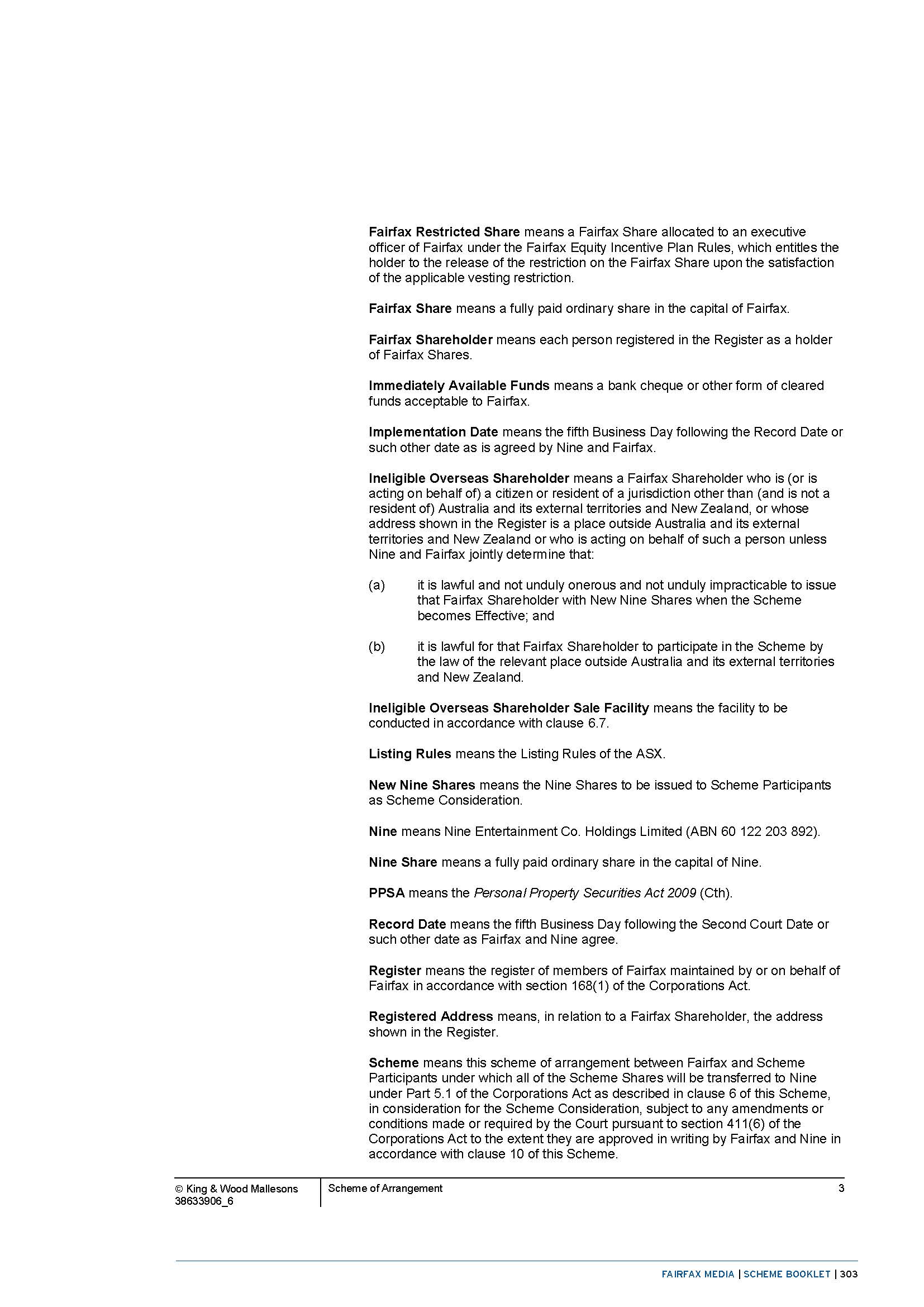
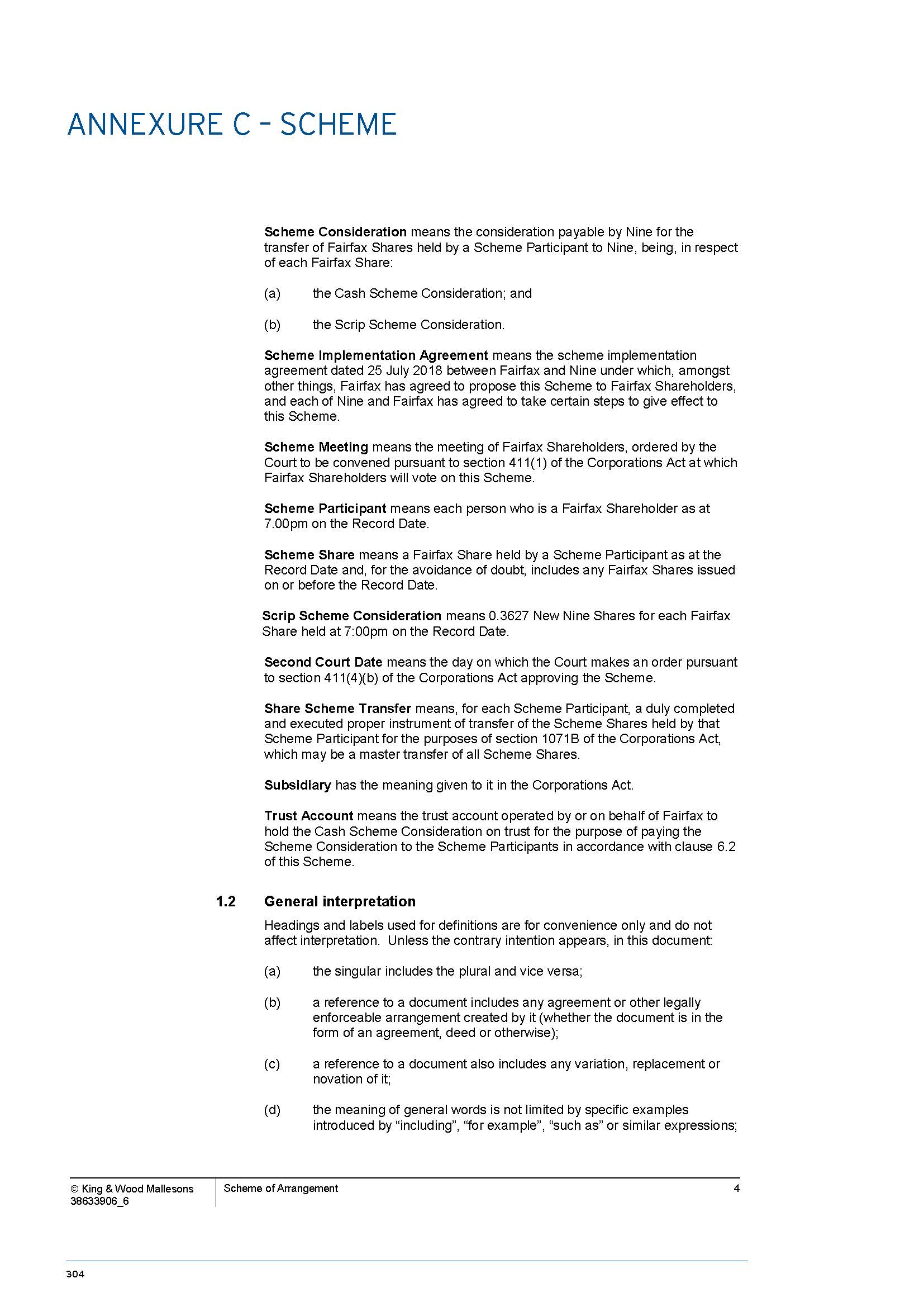
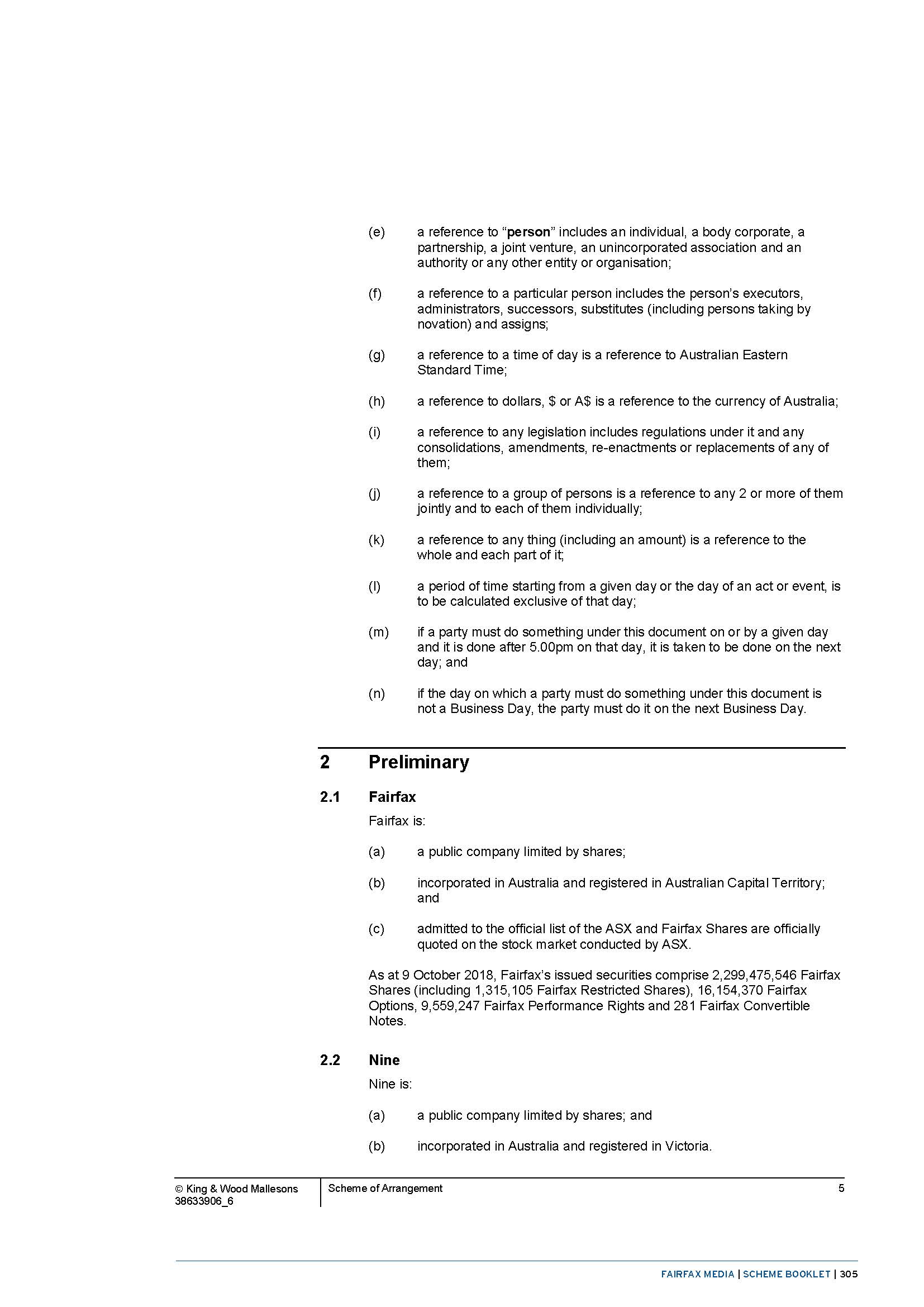
3 The details of the scheme are described in Fairfax Media Limited, re Fairfax Media Limited [2018] FCA 1610. In summary, the proposed scheme involves the acquisition by a Nine subsidiary of 100% of outstanding Fairfax shares for cash of $0.025 for each “Fairfax Share” held (where “Fairfax Share” is an ordinary fully paid share in Fairfax) and scrip of 0.3627 “New Nine Shares” for each Fairfax Share held (where a “New Nine Share” is an ordinary fully paid share in the capital of Nine to be issued to a scheme participant as scrip consideration).
4 Following completion of the scheme, Fairfax shareholders will own 48.9% of the combined group and Nine shareholders will own 51.1%.
Dispatch of scheme booklet and proxy forms
5 The scheme booklet was approved on 12 October 2018.
6 On 18 October 2018, the scheme booklet and proxy forms were dispatched to members of Fairfax in accordance with the Court’s orders, in hard copy and electronic form by Link Market Services Limited (“Link”), which was engaged to perform those tasks by Fairfax.
7 By oversight, Link was not instructed to dispatch the scheme documents to “undelivered email recipients” in accordance with order 10 of the 12 October 2018 orders. That order provided that, if Fairfax received an automatic, system generated notification that the scheme documents were unable to be delivered to the nominated email address of any member to whom scheme documents were dispatched to a nominated email address, the scheme documents would be dispatched to the relevant member by prepaid post or airmail or air courier. Senior counsel for Fairfax, Ian Jackman SC, noted that the scheme booklet was published online so that these shareholders may have read the booklet by that means.
8 The evidence was that there were 292 undelivered email recipients, representing a voting entitlement in respect of 1,345,515 Fairfax shares. If each of the relevant 292 members had voted against the scheme resolution, the results of the poll would have been 88.53% of votes cast in favour of the resolution (instead of 88.60%), and 70.02% of total number of members present and voting (in person or by proxy) (instead of 81.49%).
9 There was also an obvious and minor typographical error in the form of the proposed scheme resolution, as set out in the notice of scheme meeting in the scheme booklet. The error was corrected in the scheme resolution put to the scheme meeting.
Grant Samuel independent expert report
10 The scheme booklet included an independent expert report prepared by Grant Samuel & Associates Pty Limited (“Grant Samuel”) and dated 12 October 2018. This report concluded that the proposed scheme is in the best interests of Fairfax shareholders.
11 In my first judgment, at [17], I set out the following extract from the draft report, which was in the same terms as the report included in the scheme booklet:
The Scheme brings together two traditional Australian media groups with complementary businesses to create a leading integrated, diversified Australian media business with multiple digital and traditional assets. It involves Nine acquiring 100% of the shares in Fairfax but, while the Scheme is technically a control transaction, the commercial reality is that, from a shareholder’s perspective, it is a merger. Fairfax shareholders will, in aggregate, own 48.9% of the Combined Group and Nine shareholders will own 51.1%.
Accordingly, the analysis of fairness is different to that for a conventional control transaction. Rather than estimating the full underlying value of Fairfax including a control premium, the Scheme will be fair to Fairfax shareholders if the share of the value of the Combined Group received by them is equal to (or greater than) their proportionate contribution of value. Specifically, Grant Samuel has considered the relative contributions of sharemarket value and fundamental (underlying) value.
On the basis of sharemarket value, the aggregate interest of Fairfax shareholders in the Combined Group is materially favourable in comparison to the share contributed by them (reflecting the premium inherent in the Scheme terms at the time of announcement). Based on share prices over the three months prior to announcement of the Scheme on 26 July 2018, Fairfax shareholders are contributing approximately 45% of the value but are receiving a 48.9% share of the value. The outcome is similar in terms of relative contributions of fundamental value. Based on Grant Samuel’s estimate of fundamental value, Fairfax shareholders are contributing approximately 45% of equity value compared to the 49.5% of that value they will receive (i.e. 48.9% of the Combined Group plus 2.5 cents per Fairfax share). In effect, Nine is “paying away” synergy benefits arising from the merger to Fairfax shareholders to enhance the attraction of the transaction to Fairfax shareholders. The premium also provides Fairfax shareholders with some level of “insurance” against any post announcement weakness in the Nine share price.
12 This extract makes it clear that Grant Samuel assessed the scheme on the basis that it was a merger, and was not, in its view, to be assessed as a conventional control transaction.
13 Under the hearing “Key Conclusions”, the report states:
The terms of the Scheme are fair to Fairfax shareholders
The Scheme involves Nine acquiring 100% of the shares in Fairfax. In a typical control transaction, fairness involves comparing the full underlying value of the target with the value of the offer (with any scrip component to be valued at “market” value (i.e. minority value)). However, while there are factors that would suggest that there is a “change of control” (e.g. the proposed board and CEO), upon implementation of the Scheme, Fairfax shareholders will, in aggregate, own 48.9% of the Combined Group, there will be no controlling shareholder and Fairfax shareholders will retain the opportunity to receive a control premium at some time in the future. On this basis, in Grant Samuel’s opinion, the better view is that merger analysis is the appropriate basis on which to evaluate fairness.
Accordingly, in assessing fairness, rather than estimating the full underlying value of Fairfax including a premium for control, Grant Samuel has compared the share of the value of the Combined Group received by Fairfax shareholders with the relative contribution by Fairfax shareholders of sharemarket value and fundamental (underlying) value.
14 Mr Catalano submitted that the Grant Samuel report gave prominence to share market value, noting the following statement:
Based on a Nine share price of $2.25, the Scheme provides to Fairfax shareholders consideration with a market value of $.084 per Fairfax share which does not correspond to a full takeover value of Fairfax (although a full premium for control should not be expected given the transaction is essentially a merger).
15 In further support of this submission, Mr Catalano drew attention to the bolded words in the passage from the report set out at [11] above.
16 Mr Catalano submitted, and it was not disputed, that the emphasis placed by the Grant Samuel report (and the scheme booklet) on the share market value of the scheme for Fairfax shareholders was understandable because the overwhelming majority of the consideration offered to those shareholders was in the nature of scrip, not cash.
17 Mr Catalano also referred to Section 7.2.3 of the report, entitled “Takeover Analysis”. In that section, Grant Samuel noted that, while Grant Samuel did not consider it to be the appropriate basis for evaluation, the scheme could also be looked at as a takeover/control transaction. Grant Samuel performed an analysis of the value parameters of the scheme based on various alternative Nine share prices, from $2.15 to $2.75. The Grant Samuel report calculated premiums ranging from 4.5% to 32.8%, and noted most relevantly that:
(1) based on a Nine share price of $2.25, the scheme did not provide Fairfax shareholders with consideration that corresponded to a full takeover value of Fairfax; and
(2) at prices of $2.55 and above, Fairfax shareholders would be receiving a substantial premium and a significant payment for synergies.
18 Grant Samuel expressed the view that it was reasonable to expect some improvement in the Nine share price once there was certainty about the implementation of the scheme and as evidence of the achievement of expected cost synergies emerges.
19 Senior counsel for Mr Catalano, Andrew Broadfoot QC submitted that the takeover analysis was done on a basis that was divorced from reality as at the date that the shareholders were asked to vote, having regard to the significant decline in the Nine share price to $1.63 on the morning of the scheme meeting. Using Grant Samuel’s fundamental value analysis and a Nine share price of $1.63, Mr Catalano calculated that the value of the scheme per Fairfax share was $0.59 on which basis, he contended, the scheme would result in Fairfax shareholders being “short-changed by nearly $600 million”.
20 However, as Mr Jackman SC observed, the Grant Samuel report did not attempt to predict the Nine share price at the scheme meeting. Moreover, Mr Jackman SC argued, it was absolutely obvious to any shareholder with an interest in approaching the scheme as a control transaction, that $1.63 was well below what Grant Samuel had identified as the kind of Nine share price which would be needed to justify the transaction as a control transaction.
Advertisement of second court hearing
21 On 13 November 2018, the date of the second court hearing was advertised in The Australian newspaper by a notice in the form annexed to the 12 October 2018 orders.
Aurora’s request to examine voting instructions
22 By letter dated 17 November 2018, Aurora requested that access be given to its solicitor, Mr Kriewaldt, prior to the scheme meeting so that he could examine the original voting instructions and authorities for the 50 largest shareholders who had submitted voting instructions or authorities for the meeting.
23 By letter dated 18 November 2018, King & Wood Mallesons (“KWM”) on behalf of Fairfax declined that request on the basis that the wishes of shareholders are private matters and not something to be shared with third parties, including other shareholders without their consent. KWM noted that there was no entry in the Fairfax share register for an Aurora Funds Management entity.
24 KWM also stated that Link was charged with ensuring the integrity of the vote and that Fairfax had passed Aurora’s letter to Link with a request that it brings any “out of the ordinary” voting instructions by any shareholder with a material stake to the attention of the Chairman.
Mr Catalano’s “alternative proposal”
25 On the evening of Sunday 18 November 2018, the night before the scheduled scheme meeting, Mr Catalano wrote to Nicholas Falloon, non-executive director of Fairfax, and chairman of Fairfax’s board of directors, articulating what his submissions described as “a proposed alternative to the Scheme … in a nascent form”.
26 Mr Catalano’s letter commenced by setting out the following matters concerning the implied value of the scheme for Fairfax shareholders:
When The Scheme was announced, the implied value for Fairfax shareholders was 93.9c per share, such a price was at the upper end of Grant Samuel & Associate’s independent valuation of 87-94c of Fairfax’s assets, and with credit to the Fairfax Board, was probably a satisfactory transaction for shareholders. However, since that time, the implied value of The Scheme has declined to 61.6c per share, a 34% (or over $0.74B) reduction in consideration.
27 The letter stated relevantly that Mr Catalano was “conditionally prepared to step into the market of Fairfax to acquire an interest of up to 19.9 per cent (inclusive of the 1.2 per cent [he] currently beneficially own[s]) on-market, at a price superior to the intrinsic mark-to-market value of “[Nine’s] Scheme Proposal up to 65c per share”.
28 The proposal was stated to be conditional upon:
The Scheme Meeting being defeated.
Fairfax agreeing to appoint Mr Catalano to the Fairfax Board.
29 Mr Catalano’s letter requested that Mr Falloon adjourn the scheme meeting for a sufficient period, said to be at least two weeks, to allow shareholders and the Fairfax Board to properly consider the “alternative proposal”.
30 At 8.00 am, on the morning of 19 November 2018, the eight members of the Fairfax board met with Gail Hambly (Fairfax group general counsel and company secretary), David Housego (Fairfax chief financial officer), Dhruv Gupta (Fairfax group director, strategy and corporate development) and two partners of KWM. An extract of the minutes of the meeting records:
Directors discussed the content of the letter and considered that the letter did not in fact contain an alternative proposal at all. In coming to this conclusion they considered
1. The letter stated Mr Catalano was only “conditionally prepared to step into the market” to buy shares;
2. If he did buy on market he would only buy up to 19.9% of shares;
3. The conditional intent to purchase was conditional on “the Scheme meeting being defeated” and also on the Board agreeing to appoint Mr Catalano to the Board.
All directors noted that they would not vote in favour of Mr Catalano being appointed a director. They also noted that the proxy votes available for the Scheme meeting were heavily in favour of approval of the Scheme.
As the letter from Mr Catalano did not contain an offer much less a superior offer the Board noted that the provisions of the Scheme Implementation Agreement relating to the Board’s entitlement to consider a superior offer were not relevant.
…
A draft ASX release responding to media reports on the letter, inclusive of input from Board members, was considered by the Board.
IT WAS RESOLVED to disregard the Catalano letter, issue the ASX release and proceed with the scheduled Scheme meeting as provided in the Notice of Meeting.
Decline in Nine share price prior to scheme meeting
31 On 11 October 2018, the closing price of Nine shares was $2.10.
32 On 12 October 2018, the closing price was $1.84.
33 By Friday 16 November 2018, the last trading day before the scheme meeting, the Nine share price was $1.63.
34 Mr Catalano noted that the Fairfax share price also fell, from $0.77 on 25 July 2018 to $0.615 on 16 November 2018. Mr Catalano’s evidence was that, over this period, Fairfax share price declined by 20.1%, while the Nine share price declined 35.3% and the ASX200 index declined by 8.7%.
35 As Fairfax noted, the share prices from time to time were publically available facts, and the decline in the Nine share price (and the Fairfax share price) was the subject of repeated media comment in the period between the issue of the scheme booklet and the scheme meeting.
36 Nevertheless, as Mr Catalano noted, during the period from the despatch of the scheme booklet to the scheme meeting, the Nine share price was below the range of Nine share prices on which the Grant Samuel report had assessed the share market value of the scheme (which was from $2.15 to $2.75 per share).
37 Mr Catalano submitted that the Grant Samuel report did not consider the impact of a decline in the Nine share price of the magnitude that eventuated. Further, he argued that if (as appears to be the case) the assessment of the scheme value on the basis of share market value was undertaken on the basis of a range of assumed prices that differed very substantially from the actual prices at the time of approval, there is an appreciable risk that the Grant Samuel report may be misleading or inaccurate.
Scheme meeting
38 The scheme meeting was held on 19 November 2018, and was chaired by Mr Falloon. Pursuant to s 411(4)(a)(ii) of the Act, to be eligible for approval by the Court, the scheme must have been approved at the scheme meeting by the following different majorities:
(1) a majority in number of the members present and voting in person or by proxy; and
(2) 75% of the votes cast present and voting in person or by proxy.
39 The poll report stated that 1,453 shareholders, being 81.49% of persons present in person or by proxy and 88.60% of votes cast were in favour of the scheme resolution. On those figures, the statutory majorities in favour of the scheme were comfortably obtained.
40 Prior to the vote, John Patton, the chief executive officer of Aurora, said to Mr Falloon:
Notwithstanding the Board’s vote, and given the time delays and difficulties associated with the proxy voting process, do you believe it is appropriate to adjourn the meeting to provide shareholders with some time to consider the alternative proposal put forward by Mr Catalano before voting today.
41 Mr Fallon replied:
The Fairfax Board had no intention of adjourning the meeting or deferring the voting process today.
42 Mr Falloon did not see Mr Catalano in attendance at the scheme meeting. If he attended, Mr Catalano did not ask questions or otherwise participate in the discussion at the scheme meeting.
Aurora’s further requests to examine voting instructions
43 By letter dated 22 November 2018 from Aurora to Mr Fallon, Aurora:
(1) noted its shareholdings in its capacity as the responsible entity for the Aurora Fortitude Absolute Return Fund and through its custodian, BNP Paribas Nominees Pty Ltd;
(2) stated that it held concerns regarding the validity and effectiveness of voting papers and authorities given by shareholders in respect of the scheme meeting;
(3) sought to establish whether those concerns had a basis that warranted the matter being raised with the Court as part of its consideration of whether to approve the scheme; and
(4) requested that Mr Kriewaldt be afforded the opportunity to examine the original voting papers or authorities for the four largest Fairfax shareholders who submitted voting papers or authorities for the scheme meeting.
44 The letter noted that, as at 10 August 2018, based on disclosures in the Fairfax annual report, the top four shareholders held 1,837,245,426 Fairfax shares and, accordingly, these proxies should be determinative of the scheme outcome.
45 The four largest shareholders of Fairfax, who voted in favour of the scheme by proxy, are:
(1) HSBC Custody Nominees (Australia) Ltd (“HSBC”);
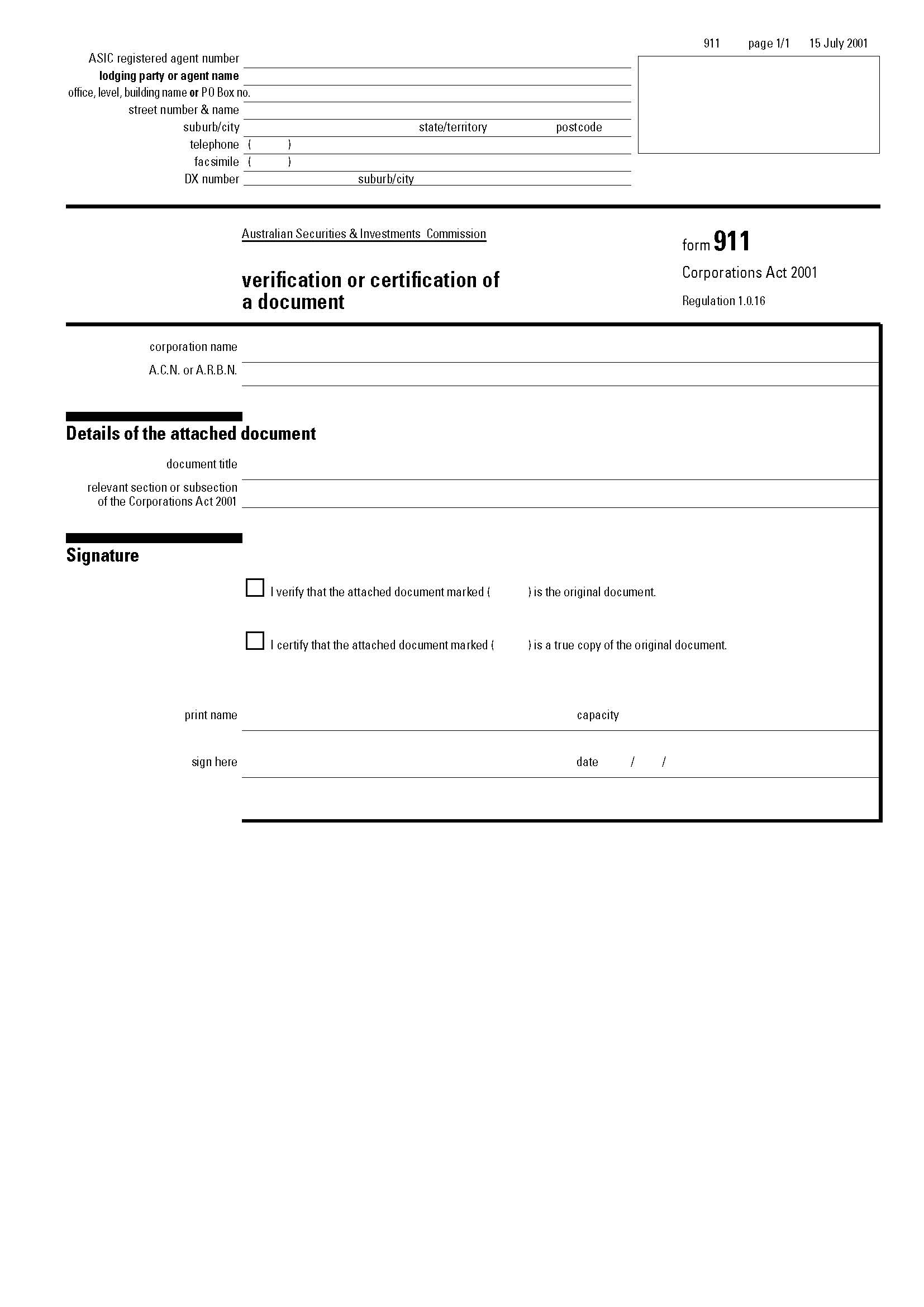
(2) Citicorp Nominees Pty Ltd (“Citicorp”);
(3) National Nominees Pty Ltd (“National Nominees”); and
(4) J P Morgan Nominees Australia Limited (“J P Morgan”).
46 By letter dated 23 November 2018, KWM informed Aurora that Fairfax would itself scrutinise the voting papers and authorities of its four largest shareholders to address “the unarticulated concern … as to the validity and effectiveness of those papers” referred to in Aurora’s letter. KWM sought details of the nature and basis of Aurora’s concerns.
47 Thereafter, there was further correspondence from Aurora to Mr Falloon, from Mr Kriewaldt to KWM, and from KWM to Mr Kriewaldt.
ASIC’s consideration of objections to scheme approval
48 On 26 November 2018, each of Mr Catalano and Aurora filed a notice of appearance in the proceeding, stating their respective intentions to oppose Fairfax’s application for approval of the scheme.
49 By letter dated 26 November 2018, the Australian Securities and Investments Commission (“ASIC”) wrote to Fairfax. The letter shows that ASIC was aware that Mr Catalano and Aurora had indicated intentions to raise objections at the second court hearing, and had provided ASIC with affidavits relevant to those objections. ASIC stated its intention to consider the objections of Mr Catalano and Aurora before deciding whether to provide a letter of no objection in accordance with s 411(17) of the Act.
50 Section 411(17) provides:
The Court must not approve a compromise or arrangement under this section unless:
(a) it is satisfied that the compromise or arrangement has not been proposed for the purpose of enabling any person to avoid the operation of any of the provisions of Chapter 6; or
(b) there is produced to the Court a statement in writing by ASIC stating that ASIC has no objection to the compromise or arrangement;
but the Court need not approve a compromise or arrangement merely because a statement by ASIC stating that ASIC has no objection to the compromise or arrangement has been produced to the Court as mentioned in paragraph (b).
51 ASIC stated, that in accordance with its policy set out in Regulatory Guide 60 “Schemes of Arrangement”, para 60.109, ASIC would consider any objection in so far as it raised matters that ASIC would usually take into account in deciding whether to give a letter of no objection. These were said to include:
(1) whether shareholders are adversely affected by the acquisition being implemented by a scheme of arrangement rather than a takeover bid and whether they receive equivalent (although not necessarily identical) treatment and protection;
(2) whether the underlying principles of equality and disclosure set out in s 602 of the Act have been observed in relation to the scheme;
(3) whether adequate information has been provided given the takeover context; and
(4) whether there is any aspect of the scheme process that may give rise to concerns regarding public policy, fairness or any other issue that may invite consideration by the court as to whether it should exercise its general discretion not to approve the scheme.
52 In relation to “concerns raised by Aurora in relation to potential voting irregularities”, ASIC expressed the following view:
ASIC is of the view that the matters of concern raised by Aurora regarding voting procedures and the validity of proxies and votes cast are not matters that justify ASIC withholding its letter of no objection in the circumstances. This is because:
(a) the issues raised are inherently procedural in nature and turn more so on factual matters to be established by evidence and the examination of rights existing between sophisticated parties rather than the broader policy considerations under RG 60 relevant to ASIC’s decision to give a letter of no objection; and
(b) the Court’s power to approve the scheme turns on achievement of the statutory thresholds in s 411 (4) of the Act and therefore matters relating to the validity of the voting is a matter for primary consideration by the Court based on the evidence presented by the parties.
53 In relation to “concerns alluded to in Mr Catalano’s affidavit of 26 November 2018”, ASIC stated the following matters:
• ASIC is of the view that it may decline to provide a letter of no objection as a result of the occurrence of material events shortly before a scheme meeting, or between a scheme meeting and the second court hearing, that call into question the currency of the will of shareholders expressed at that meeting. However, it is necessary to assess the possible impact of the event on shareholders’ decision-making. In ASIC’s view this is not a clear case, such as one where shareholders are offered the opportunity to participate directly in alternative transaction via a publicly announced takeover proposal. Accordingly, and without suggesting this would be necessary in every case, in the absence of direct evidence from sufficient Fairfax shareholders to alter the outcome of the vote confirming that they would have voted differently had they been aware of Mr Catalano’s proposal, ASIC is not minded to withhold its letter in these circumstances.
• ASIC does not consider the fact the Scheme does not incorporate equivalent protections to those included under the minimum bid price rule (as suggested in paragraph 44 of Mr Catalano’s affidavit) is a reason to withhold its letter of no objection. The rule applies by reference to the comparative value of pre-bid purchases by the bidder and the value of offer consideration at the time offers are dispatched and does not continue to apply throughout the currency of the offers.
54 Paragraph 44 of Mr Catalano’s affidavit states:
Had the Scheme progressed by way of a takeover under Chapter 6 of the Corporations Act 2001 (Cth), the Fairfax shareholders would have been protected against the decline in the value of Nine’s shares by reason of additional protections including ASIC Regulatory Guideline 9.200 which provides:
Changes in the market price of quoted securities offered as bid consideration may mean that a bidder needs to adjust the number of securities offered for each bid class security where quoted securities were also provided or agreed to be provided as pre-paid purchase consideration. This is because, for the purposes of the minimum bid price rule, the value of the bid consideration must remain equal to, or greater than, the value of the pre-bid purchase. Charges in the value of the quoted securities between the pre-bid purchase and the valuation time for the bid consideration will be relevant.
55 Finally, ASIC’s 26 November 2018 letter referred to an affidavit of John Dawson. ASIC suggested that the Court might be assisted by further evidence from Grant Samuel addressing any matters arising from the affidavit that Grant Samuel consider necessary, and confirming that their conclusions remain materially unchanged.
Expert opinion of John Dawson
56 The affidavit of John Dawson, to which ASIC referred, was sworn on 26 November 2018 and filed by Mr Catalano. The affidavit states that Mr Dawson is an executive director at Korda Mentha, a business advisory and investment firm.
57 Mr Dawson reviewed the Grant Samuel report that formed part of the scheme booklet and prepared a short report that addressed three questions posed by Mr Catalano’s lawyers.
58 The first question was:
Was it a reliable approach from a valuation perspective for the [Grant Samuel report], which was published on the ASX web-site in the Scheme Booklet on 12 October 2018 at 6.00 pm, and insofar as it used share-market value as one basis of analysis, to value the transaction on the basis of an assumed Nine share price of $2.25, given the closing price on that day was $1.84, having fallen from $2.10 on 11 October 2018?
59 The second question was:
In the light of the sharp decline in the price of nine shares from the date of the [Grant Samuel report] on 12 October 2018 to the date of the Scheme meeting on 19 November 2018 (and we note that on the trading day prior to the Scheme Meeting the share price as $1.63), would it have been good practice to ensure shareholders were properly informed to provide a supplementary report to assist shareholders in forming an opinion as to whether the transaction was fair?
60 Mr Dawson did not answer these questions directly, but made the following observations:
(1) For the purposes of assessing the fairness of the scheme of arrangement, Grant Samuel performed a “Relative Contribution Analysis” which compared the value contribution of Fairfax shareholders to the proposed combined entity with the value received by Fairfax shareholders in the proposed combined entity.
(2) Mr Dawson replicated that analysis as at 12 October 2018 and 23 November 2018.
(3) Mr Dawson’s analysis shows that:
i. As at 23 November 2018, the closing share price and one-week VWAP of both companies result in outcomes where the value contribution of Fairfax shareholders to the proposed combined entity marginally outweighs the value received by Fairfax shareholders in the proposed combined entity. Under all other scenarios, the value received by Fairfax shareholders to the proposed combined entity outweighs the value contribution of Fairfax shareholders in the proposed combined entity; and
ii. as a consequence of the change in the share prices of Nine and Fairfax over the period subsequent to the issuance of the Grant Samuel IER, the excess of the “Fairfax % received” over the “Fairfax % contribution” has decreased from in the range of 0.4% to 5% as at 25 July 2018 to:
A. 0.2% to 0.8% as at 12 October 2018; and
B negative 0.1% to positive 0.5% as at 23 November 2018.
(4) It is incumbent on preparers of independent expert reports to consider all information relevant to the preparation of such a report up to and including the date of the completion of the subject transaction and to advise shareholders if they believe the outcome of their analysis materially impacts on the conclusions reached in the report.
61 Mr Broadfoot QC submitted that it was Mr Dawson’s opinion that, as at the time of the scheme vote, it was no longer the case that Fairfax shareholders were receiving more value that what they were giving up. Mr Dawson did not say this in terms. His “Relative Contribution Analysis” contained 10 scenarios, none of which was clearly referrable to the date of the scheme meeting. It was not clear why Mr Dawson chose those scenarios and, in particular, why he chose to analyse the position as at 23 November 2018 (being 4 days after the scheme meeting). Without more explanation, I was not prepared to accept that the “Relative Contribution Analysis” demonstrated that, as at the date of the shareholders meeting, the Fairfax shareholders’ share of the combined group was not equal to or greater than their proportionate contribution of value.
62 As appears below, by the time of the second court hearing, Grant Samuel had not formed a view of the kind that Mr Dawson considered should be advised to shareholders.
63 I inferred from Mr Dawson’s responses to the first two questions that he was not prepared to answer either question with a definitive yes or no.
64 The third question was:
Are there any other matters that you consider relevant to the ability of shareholders to rely on the Grant Samuel report in forming an opinion as to whether that transaction was fair?
65 In posing this question, Mr Catalano’s lawyers noted the description of the premium being offered on p 16 of the scheme booklet (which references a price of $2.52 as at 25 July 2018) and drew attention to the statement in the Grant Samuel report (at p 156) that refers to the possibility that changed conditions can result in different opinions.
66 Mr Dawson responded as follows:
a. Grant Samuel’s assessment of the fairness of the Scheme of Arrangement was contingent on their view that the transaction was a “merger of entities of equivalent value” (refer to paragraph RG111.31 of RG111) and was not a “control transaction” as that terms is defined in RG111 (refer to paragraph RG111.31 of RG111). Grant Samuel’s rationale for their opinion is set out in section 2.2 of the [Grant Samuel report];
b. In preparing this letter of advice I have not had sufficient time to fully consider all matters relevant to a determination of whether in my opinion the Scheme of Arrangement represented a merger of entities of equivalent value or a control transaction;
c. However, I note that the terms of the Scheme of Arrangement, if approved, are such that Nine will assume certain characteristics of control including the following;
i. Fairfax shareholders will be disposing 100% of their shareholding interest in Fairfax and will no longer have control over that entity in its current form;
ii. Nine and Fairfax will have four directors and three directors respectively on the board of the proposed combined entity;
iii. Nine shareholders will have more than 50% of the voting shares of the proposed combined entity; and
iv. The Chief Executive Officer and the Chairman of the proposed combined entity will be Hugh Marks, the current Chief Executive Officer of Nine, and Peter Costello, the current Chairman of Nine;
d. Consequently, it is my preliminary view that there are good arguments that the Scheme of Arrangement is a control transaction. If it is a control transaction, the form of Grant Samuel’s assessment of fairness would need to change materially; and
e. However, I would like to review and consider additional information and review the [Grant Samuel report] in more detail before I finalise my views on this matter.
Grant Samuel’s opinion maintained
67 Fairfax read an affidavit of Jaye Gardiner, the Grant Samuel director who signed the report, affirmed on 27 November 2018 (the date of the second court hearing) confirming that Grant Samuel had not withdrawn the independent expert report and that it continued to be Grant Samuel’s opinion that the scheme of arrangement is in the best interests of Fairfax shareholders, in the absence of a superior proposal.
68 Ms Gardiner stated that she had reviewed the affidavits of Mr Catalano and Mr Dawson.
ASIC’s no objection letter
69 After hearing argument at the second court hearing, ASIC provided a no objection letter to Fairfax, which Fairfax duly tendered.
Grounds of opposition to approval of the scheme
70 Mr Catalano identified the following three “concerns” which were said to lead to the conclusion that the Court should not approve the scheme, at least as matters stood at the second court hearing:
(a) Whether on the basis of the Grant Samuel report included in the scheme booklet, shareholders were provided with information that was adequate to enable them to make a fully informed decision, as to how to vote, given:
(i) the basis upon which that valuation was prepared, in that it proceeded to assess the transaction as analogous to transactions in which there was not a change of control, and therefore on the basis that no “control premium” was warranted;
(ii) the significant changes in market conditions and in particular the substantial decline in the Nine share price between the date of approval of the scheme booklet and the date of the shareholder meeting, and in circumstances where shareholders were not provided with any updated valuation opinion prior to the 19 November 2018 scheme meeting;
(b) Concerns about how the vote took place;
(c) Concerns about how Mr Catalano’s “alternative proposal” was dealt with by Fairfax at the scheme meeting.
71 Mr Catalano’s submissions were supported by three affidavits, of Mr Catalano, Mr Dawson and Adam Rompotis, solicitor, each made on 26 November 2018.
72 As to (b), at the hearing, senior counsel for Mr Catalano, Mr Broadfoot QC, argued two points:
(1) that Citicorp had not validly appointed its proxies (by two proxy forms) because of defects in the certification of the power of attorney pursuant to which the proxies were signed; and
(2) the appointment by National Nominees of its proxy arguably indicated that Institutional Shareholder Services Inc (“ISS”) ought to have made a disclosure under s 671B of the Act, as a person with a “substantial holding” in Fairfax by reason of the terms of a power of attorney granted by National Nominees to ISS, and other shareholders and the market were adversely affected by the absence of such a disclosure.
73 Mr Catalano contended that, in circumstances where his proposal was precipitated by market volatility, the Fairfax board ought to have both provided the offer to shareholders and adjourned the proposed scheme meeting to ensure that shareholders were fully informed. Mr Catalano, who I accept is an experienced former Fairfax executive, expressed the belief that his strategy could have resulted in returns to shareholders of 87 to 94 cents per share. It is not possible to evaluate that belief on the limited material available to me.
74 Mr Catalano’s preferred position was that there should be another scheme meeting but, alternatively, he sought an adjournment of one to two weeks to enable “appropriate disclosures to be made” and further material to be put before the Court by the parties should they be so advised. The matter could then come back to the Court to determine whether a further meeting ought to be ordered.
75 On behalf of Aurora, Mr Kriewaldt raised the following two matters:
(1) the powers of attorney put forward by Fairfax did not identify instructions given that qualify the exercise of the power conferred and the Court should receive evidence of those conditions being satisfied before accepting the documents at face value; and
(2) the evidence concerning the proxy submitted electronically by HSBC was insufficient to establish the valid appointment of the proxy.
76 Aurora’s submissions were supported by an affidavit of Mr Patton affirmed 26 November 2018.
77 Neither Mr Catalano nor Aurora adduced evidence or made a submission to the effect that any wrongful admission to vote of shareholders would have made any difference to the result of the meeting.
Formal and structural matters
78 I was required to be satisfied that:
(1) at a scheme meeting convened in accordance with the Court’s orders under s 411(1) of the Act, a resolution in favour of the scheme was passed in accordance with the statutory majorities required for a members scheme by s 411(4)(a)(ii) of the Act;
(2) there has been compliance with the orders made at the first hearing; and
(3) ASIC had indicated that it had no objections to the scheme under s 411(17).
79 I was satisfied as to each of those matters, except that Fairfax did not comply with order 10 of the 12 October 2018 orders. As set out below, except in relation to Citicorp, I did not find that there was any defect in the appointment of proxies. However, there was no evidence that any wrongful admission of Citicorp to vote could have made any difference to the result of the meeting and, in that circumstance, I was satisfied that the statutory majorities for the resolution in factor of the scheme were achieved.
80 The failure to comply with order 10 is not a matter which precluded approval of the scheme, but was a matter of relevance to the exercise of the discretion to approve the scheme. While it was obviously unsatisfactory, I accepted that the non-compliance occurred by oversight and did not affect the result of the meeting. In those circumstances, I accepted that it should not cause me to refuse to approve the scheme.
81 The typographical error in the notice of scheme meeting in the scheme booklet was inadvertent and was also not a matter that warranted refusing to approve the scheme.
Conditions precedent
82 The evidence included two counterparts of a conditions precedent deed dated 27 November 2018. The deed records the confirmation of each of Fairfax and Nine that the conditions precedent in cl 3.1 of the scheme implementation agreement other than the condition precedent in cl 3.1(c) have been satisfied or waived in accordance with cl 3.3 of the scheme implementation agreement. The written submissions confirmed that each of the conditions precedent to the proposed scheme have been satisfied or waived except for those conditions related to court approval of the proposed scheme.
Voter turnout
83 In Avoca Resources Limited, re Avoca Resources Limited [2011] FCA 208 at [20], Gilmour J referred to Lion Nathan Limited, re Lion Nathan Limited (No 2) [2009] FCA 1261 where, at [6], Emmett J noted that 64% of eligible shares had been represented and voted at the scheme meeting, and Re MB Group plc [1989] BCLC 672 at 675 where Harman J described a turnout of 52% of scheme shares as “a high turn-out”.
84 At [21], Gilmour J noted that, since these cases, this Court has expressed an interest in knowing the turnout percentage of eligible shares (both for and against), and more recently of shareholders. His Honour noted that these percentages have no statutory significance, but a low turnout percentage might suggest a flaw in the convening procedure.
85 Lee Marshall, senior client relationship manager at Link, gave evidence that, as at 19 November 2018, there were 2,299,475,546 Fairfax shares on issue and 23,645 shareholders.
86 Accordingly, the voter turnout percentages for the scheme meeting were 76.31% of votes and 7.66% of shareholders.
87 Evidently, these percentages did not, without more, provide a basis for concern about the procedure for convening the scheme meeting.
Proxies
88 Fairfax engaged Link to receive and process proxy appointments for the scheme meeting.
89 The notice of the scheme meeting noted that a member could appoint a proxy to attend the scheme meeting and vote on their behalf. The notice identified several options for lodgement of a proxy form, including:
Lodge it online at www.linkmarketservices.com.au (click the proxy icon and follow the prompts). For online lodgement, you will need to enter your SRN or HIN shown at the top right hand side of your personalised proxy form with the notice of meeting. You will be taken to have signed your proxy form if you lodge it in accordance with the instructions on the website.
90 The notice also stated that further instructions for appointing a proxy were included in the proxy form. On the first page of the proxy form, under the words “LODGE YOUR PROXY” were five black boxes, next to the first of which were the words:
ONLINE
www.linkmarketservices.com.au
91 On the second page of the proxy form, under the heading “LODGEMENT OF A PROXY FORM”, was the statement “Proxy forms may be lodged using the reply paid envelope or”:
ONLINE
www.linkmarketservices.com.au
Login to the Link website using the holding details as shown on the Proxy Form. Select ‘Voting’ and follow the prompts to lodge your vote. To use the online lodgement facility, shareholders will need their “Holder Identifier” (Securityholder Reference Number (SRN) or Holder Identification Number (HIN) as shown on the front of the Proxy Form).
Legal framework
92 Section 250A of the Act relevantly provides:
(1) An appointment of a proxy is valid if it is signed, or otherwise authenticated in a manner prescribed by the regulations, by the member of the company making the appointment and contains the following information:
(a) the member’s name and address;
(b) the company’s name;
(c) the proxy’s name or the name of the office held by the proxy;
(d) the meetings at which the appointment may be used.
An appointment may be a standing one.
(1A) The regulations made for the purposes of subsection (1) may prescribe different requirements for the authentication of an appointment given to the company by different means (electronic or otherwise).
(2) If a company has a constitution, the constitution may provide that an appointment is valid even if it contains only some of the information required by subsection (1).
(3) An undated appointment is taken to have been dated on the day it is given to the company.
…
(6) An appointment does not have to be witnessed.
(7) A later appointment revokes an earlier one if both appointments could not be validly exercised at the meeting.
93 Section 250B(1) provides:
For an appointment of a proxy for a meeting of a company’s members to be effective, the following documents must be received by the company at least 48 hours before the meeting:
(a) the proxy’s appointment;
(b) if the appointment is signed, or otherwise authenticated in a manner prescribed by regulations made for the purposes of subsection 250A(1), by the appointor’s attorney—the authority under which the appointment was signed or authenticated or a certified copy of the authority.
94 The requirements to electronically authenticate the appointment of a proxy for the purposes of s 250B are set out in reg 2G.2.01 of the Corporations Regulations 2001 (Cth), which provides:
(1) For subsection 250A(1) of the Act, an electronic authentication of an appointment of a proxy must include:
(a) a method of identifying the member; and
(b) an indication of the member’s approval of the information communicated.
(2) If a member appoints a proxy by e-mail or Internet-based voting:
(a) the member must be identified by personal details (for example, the member’s name, address and date of birth); and
(b) the member’s approval of the information communicated must be communicated by a form of security protection (for example, the entering of a confidential identification number such as a shareholder registration number or holder identification number).
95 Regulation 1.0.16 of the Corporations Regulations provides:
(1) A document relating to a corporation or registered scheme that is to be certified or verified must be certified or verified in the approved form and signed by:
(a) a director or secretary of the corporation, or of the responsible entity of the scheme, who resides in Australia or an external territory; or
(b) an agent of the corporation or entity or, if the agent is a company, a director or secretary of the company who resides in Australia or an external territory.
96 The approved form for verification or certification of a document is form 911, which is:
97 Clause 5.9 of the Fairfax constitution concerns representation at general meetings.
98 Clause 5.9(i) provides:
An instrument appointing a proxy or attorney need not be in any particular form provided that it:
(1) is represented or reproduced in any mode in visible form (including by e-mail, through internet-based voting or other electronic form) or is communicated in any other manner approved by the directors from time to time;
(2) is signed or otherwise authenticated by the appointer or the appointer’s attorney in a manner acceptable to the directors; and
(3) otherwise complied with all the requirements of the Corporations Act and the Listing Rules.
For the purposes of this rule 5.9(i), the appointment of a proxy or attorney which is sent by or through electronic means (including by e-mail or through internet-based voting) in the manner specified for that purpose in the notice convening the meeting will be taken to have been authenticated in a manner acceptable to the directors if the appointment contains such details of the appointer as the directors may require from time to time or has been authorised by the appointer in any other manner approved by the directors.
99 Clause 5.9(j) provides:
In respect of instruments evidencing the appointment of a proxy or attorney:
(1) a proxy may not vote at a general meeting or adjourned meting or on a poll unless the validly executed or authenticated instrument appointing the proxy or attorney, and, if the instrument is executed, the authority under which the instrument is executed or a certified copy of such authority, is or are received at the place and fax number or electronic address, or lodged through electronic means in the manner specified in the notice calling the meeting, before the time specified for that purpose in the notice calling the meeting;
(2) the place may be the company’s registered office or other place specified in the notice and the fax number may be the fax number at the company’s registered office or other fax number specified in the notice; and
(3) the time may be a time before the time for holding the meeting and a time before the time for holding an adjourned meeting.
100 By s 128(1) of the Act, a person is entitled to make the assumptions in s 129 in relation to dealings with a company. Section 129(3) provides relevantly:
A person may assume that anyone who is held out by the company to be an officer or agent of the company:
(a) has been duly appointed; and
(b) has authority to exercise the powers and perform the duties customarily exercised or performed by that kind of officer or agent of a similar company.
101 Section 1322 of the Act provides:
In this section, unless the contrary intention appears:
(a) a reference to a proceeding under this Act is a reference to any proceeding whether a legal proceeding or not; and
(b) a reference to a procedural irregularity includes a reference to:
(i) the absence of a quorum at a meeting of a corporation, at a meeting of directors or creditors of a corporation, at a joint meeting of creditors and members of a corporation or at a meeting of members of a registered scheme; and
(ii) a defect, irregularity or deficiency of notice or time.
(2) A proceeding under this Act is not invalidated because of any procedural irregularity unless the Court is of the opinion that the irregularity has caused or may cause substantial injustice that cannot be remedied by any order of the Court and by order declares the proceeding to be invalid.
…
(4) Subject to the following provisions of this section but without limiting the generality of any other provision of this Act, the Court may, on application by any interested person, make all or any of the following orders, either unconditionally or subject to such conditions as the Court imposes:
(a) an order declaring that any act, matter or thing purporting to have been done, or any proceeding purporting to have been instituted or taken, under this Act or in relation to a corporation is not invalid by reason of any contravention of a provision of this Act or a provision of the constitution of a corporation;
…
(6) The Court must not make an order under this section unless it is satisfied:
(a) in the case of an order referred to in paragraph (4)(a):
(i) that the act, matter or thing, or the proceeding, referred to in that paragraph is essentially of a procedural nature;
(ii) that the person or persons concerned in or party to the contravention or failure acted honestly; or
(iii) that it is just and equitable that the order be made; and
…
(c) in every case—that no substantial injustice has been or is likely to be caused to any person.
HSBC electronic proxy
102 Mr Marshall gave evidence that HSBC lodged its proxy appointment in respect of the scheme resolution with Link online using the website “www.linkmarketservices.com.au”.
103 Mr Marshall’s evidence included a screenshot from the systems of Link recording HSBC’s online proxy lodgement, and a document titled “Vote receipt” obtained from HSBC. Mr Marshall’s evidence was that the “Vote receipt” was an automated receipt sent to persons who lodge proxies online using Link’s website.
104 I accepted Mr Jackman SC’s submission that the evidence demonstrated the electronic authentication of HSBC’s proxy appointment in accordance with reg 2G.2.01 because the screenshot showed that HSBC was identified by its name and address and HSBC’s approval of the information communicated by the proxy appointment was communicated by the entering of a confidential identification number (which was either a shareholder registration number or holder identification number).
105 Mr Kriewaldt submitted that the evidence was deficient because it did not identify who caused the lodgement of HSBC’s proxy appointment online, and therefore it was not established that that person was authorised by HSBC to effect the lodgement. Mr Kriewaldt argued, by reference to cl 5.9(j) of Fairfax’s constitution, that the Fairfax constitution requires the demonstration of the authority of the person who effected the lodgement and, in its absence, will not permit the proxy to vote. On that basis, Mr Kriewaldt argued, the HSBC’s proxy ought to have been disregarded.
106 Extrapolating from that evidence, Mr Kriewaldt contended that there is a “real issue” to be taken into account in considering whether to approve the scheme, namely, that it appears that any corporate member who purported to exercise a voting right through the online process may not have adhered to the requirements of Fairfax’s constitution because the online process does not provide for the authentication of the authority of the person who has completed that process on behalf of the relevant member.
107 I inferred from the terms of the scheme booklet and the proxy form that, consistent with reg 2G.2.01(2)(b), the entering of a confidential identification number is sufficient to authenticate a proxy appointment by internet voting in a manner acceptable to the directors of Fairfax for the purposes of cl 5.9(i) of Fairfax’s constitution. Clause 5.9(j) does not impose any additional authentication requirement. This approach is consistent with the assumption permitted by s 129(3) of the Act, and the case law as to ostensible authority, that a person may have authority to undertake certain actions on a company’s behalf where the company equips them with the means to convey such authority: Crabtree-Vickers Pty Ltd v Australian Direct Mail Advertising & Addressing Co Pty Ltd [1975] HCA 49; (1975) 133 CLR 72 at 80 and Pacific Carriers Limited v BNP Paribas [2004] HCA 24; (2004) 218 CLR 451 at [38].
108 Accordingly, I did not accept that Mr Kriewaldt had identified a possible deficiency in the Fairfax online voting process or in the appointment of HSBC’s proxy.
Citicorp
109 Mr Marshall’s evidence comprised two proxy forms in respect of the scheme resolution and a certified copy of a power of attorney dated 23 October 2018. In addition, Mr Jackman SC read an affidavit of Michael Forde, general counsel and company secretary of Citicorp, which confirmed that the proxy forms accurately recorded Citicorp’s voting intentions. Mr Forde’s affidavit also confirmed that he had signed the power of attorney and that Mark Fewell, who certified the power of attorney, is the “Vice President – Custody Operations”, one of the “Custody Attorneys” empowered to do certain things by the power of attorney.
110 On behalf of Mr Catalano, Mr Broadfoot QC put three contentions as to the validity of the votes in relation to Citicorp’s shares:
(1) The power of attorney was not certified in accordance with the approved form 911.
(2) The power of attorney was not certified by a director or secretary of Citicorp. It was not apparent from the face of the document that Mr Fewell was relevantly an “agent” of Citicorp and it was therefore not possible to determine whether r 1.0.16 was satisfied.
(3) The purpose of certification is to verify the validity of the relevant document. That purpose should not be accepted as having been achieved where the person signing the proxy and the person certifying the instrument under which the proxy was appointed are one and the same.
111 As to (1), I accepted this contention. However, I also accepted Mr Jackman SC’s submission that the failure to certify in accordance with the approved form, when the power of attorney was certified as a “true and original copy” was a technical defect in the authentication of the Citicorp proxy appointments, and of no substance. There may be a question as to whether, if the acceptance of the proxies was unauthorised, there was an irregularity of a substantive rather than procedural character: see Cordiant Communications (Aust) Pty Ltd v Communications Group Holdings Pty Ltd [2005] NSWSC 1005; (2005) 55 ACSR 185 at [95] and following. However, as Palmer J ultimately concluded in Cordiant at [108]:
A shareholder may have been wrongly excluded from voting, or wrongly admitted to voting, in circumstances in which the irregularity could have made no difference to the result of the meeting. In such a case, the court may, in the exercise of its discretion upon equitable principles, make a declaration that the result of the meeting is valid, notwithstanding the substantive irregularity which has occurred.
112 As to (2), Mr Forde’s evidence demonstrated that the power of attorney was signed by an agent of Citicorp, thus meeting the requirement of r 1.0.16(1)(b).
113 As to (3), the validity of the power of attorney was proved by Mr Forde as one of the signatories of the document. However, if the point was directed to whether Citicorp was wrongly admitted to vote, it went no further than point (1).
114 In those circumstances, I was satisfied that Mr Broadfoot QC’s criticisms did not lead to a conclusion that the statutory majorities in favour of the scheme resolution were not achieved.
National Nominees
115 Mr Marshall’s evidence was that Link received a proxy form from National Nominees dated 16 November 2016. Mr Marshall’s evidence also included a document entitled “Limited Power of Attorney” executed as a deed poll on 14 March 2010 (“deed poll”). This document recorded the appointment by National Nominees of Institutional Shareholder Services, Inc (“ISS”), acting through any of its offers or employees, as the true and lawful agent and attorney-in-fact for National Nominees “in accordance with the instructions and information as shall be provided by or on behalf of [National Nominees] to the Attorney from time to time” to, relevantly, appoint an individual to act as a proxy to vote at any or all general meetings in which National Nominees was interested as holder or nominee in respect of any or all of the account designations listed in the schedule to the document. The schedule referred, relevantly, to National Nominees’ holder identification number for shares in Fairfax.
116 Mr Marshall’s evidence also included a list of signatories, obtained from records on Link’s systems, which Mr Marshall believed to be the current list of authorised signatures for the purpose of the power of attorney referred to above. Mr Marshall noted that the signatories on the proxy form, and their signatures, appeared on that list.
117 By his third affidavit, Mr Marshall stated that Link was provided with an original version of the deed poll before the deadline for lodging proxies in relation to the scheme meeting.
118 Mr Catalano submitted that, if the power of attorney is construed as permitting ISS to determine how to vote, ISS holds a relevant interest under ss 608(1) or 608(9) of the Act and therefore ISS ought to have made disclosure under s 671B. On the available evidence, Mr Catalano argued, there was no such disclosure and this is a matter to be taken into account in deciding whether to approve the scheme because, absent such disclosure, shareholders interested in the outcome of the scheme were not able to communicate with the people who had the role of casting the votes in respect of the shares held by National Nominees in order to discuss the preferable outcome for Fairfax shareholders.
119 Further, it was argued, the market may have traded on an uninformed basis, believing that the votes attaching to the shares registered in the names of National Nominees were controlled by their beneficial owners, whereas in fact they may have been controlled by an undisclosed third party, namely, ISS. Mr Catalano speculated that the beneficial owners for whom National Nominees held the shares did not realise that their votes were being cast by ISS and were not able to determine the way in which their votes were cast.
120 This argument was not directed to the validity of the appointment of National Nominees proxy. Rather, it was directed to the possibilities that shareholders might have been disadvantaged in their efforts to communicate with other shareholders prior to the scheme meeting; that the market may have been misinformed; and that beneficial owners of Fairfax shares may have been unable to determine how their votes were cast. Evidently, these are matters of speculation. In the absence of evidence that the result of the meeting could have been different if ISS had made a disclosure under s 671B (assuming in Mr Catalano’s favour that such a disclosure was required), none of these matters would have caused me to decline to approve the scheme.
J P Morgan
121 Ultimately, neither Mr Catalano nor Aurora took any point as to the validity of J P Morgan’s proxy appointment.
Evidence of instructions to attorneys
122 Again, in the absence of evidence that the result of the scheme meeting might have been different if something was known about the instructions given to the National Nominees and JP Morgan attorneys, the circumstances did not warrant the provision of evidence as to the precise instructions.
Discretionary matters
General principles
123 The general principles which guide the Court’s discretion at the second court hearing are very well established. The Court has a discretion whether to approve a scheme, and is not bound to approve it merely because it has previously made orders for the convening of meetings or because the statutory majorities have been achieved: Seven Network Limited (ACN 052 816 789), re Seven Network Limited (ACN 052 816 789) (No 3) [2010] FCA 400; (2010) 267 ALR 583 (“Re Seven Network”) at [31], citing Re NRMA Limited (No 2) [2000] NSWSC 408; (2000) 156 FLR 412 at [22].
124 The Court will usually approach the task upon the basis that the members are better judges of what is in their commercial interests than the Court: Re Seven Network at [32] and [33].
125 Courts commonly have regard to the following matters identified by Jacobson J in Re Seven Network at [35]-[40] in deciding whether or not to approve a scheme:
(1) whether the shareholders have voted in good faith and not for an improper purpose;
(2) whether the proposal is fair and reasonable so that an intelligent and honest man or woman who was a member of the relevant class, properly informed and acting alone, might approve it;
(3) whether the plaintiff has brought to the attention of the Court all matters that could be considered relevant to the exercise of the Court’s discretion;
(4) whether there has been full and fair disclosure of all information material to the decision;
(5) whether minority shareholders would be oppressed by the scheme; and
(6) whether the scheme offends public policy: see, for example, Re Medical Australia Limited (No 2) [2017] FCA 1429 at [5]; Re Signature Capital Investments Limited (No 2) [2016] FCA 385 at [4].
126 In this case, the issues raised by the objectors were directed principally to the question whether Fairfax matters received full and fair disclosure of all information material to the decision whether to vote in favour of the scheme. On the same bases, Mr Catalano contended that there was a deficiency in the information provided to the Court.
127 There was no issue as to any want of good faith or improper purpose on the part of shareholders; or that the proposal was not relevantly fair and reasonable. There was no suggestion that minority shareholders would be oppressed under the scheme and nothing was brought to my attention which suggests that the scheme may offend public policy in any way.
128 Mr Catalano submitted that the requirement of disclosure is connected with the company’s obligation under s 412 of the Act to provide an explanatory statement. That statement must include “anything which, if known and appreciated, has the capacity to influence a [member’s] decision and judgment whether to vote one way rather than the other”: Re HIH Casualty and General Insurance Limited [2006] NSWSC 485; (2006) 200 FCR 200 (“Re HIH”) at [81].
129 Fairfax did not dispute that this was the relevant standard, nor did it dispute that a company should also disclose material new information which comes to light after the first Court hearing, and that any such disclosure must be timely.
130 In relation to the evidence of value, Mr Catalano referred to the decision in Re HIH, in which the Court refused to approve a scheme despite the shareholders’ vote in its favour. At [73], French J (as his Honour then was) found that the independent expert report had the potential to mislead shareholders by failing to refer to the effect of a fluctuating cash position on the utility of the evaluation at a particular point in time.
Grant Samuel report
131 At the second court hearing, Mr Kouts of ASIC confirmed that, in ASIC’s view, it was open to Grant Samuel to assess the transaction in the manner that it did. ASIC had an opportunity to consider the Grant Samuel report prior to the first court hearing, and also did not raise any concern with the Court about the report on that occasion.
132 Grant Samuel also reviewed Mr Dawson’s report and maintained its opinion.
133 Mr Broadfoot QC submitted that the Grant Samuel report does not say whether Grant Samuel would have been of the view that the transaction was fair, had their analysis been undertaken on the basis that they identified as appropriate to typical control transactions. As noted earlier, Mr Broadfoot QC argued that, if Grant Samuel was wrong in its valuation approach, and takeover approach was correct, then on Mr Catalano’s calculations, the scheme would result in Fairfax shareholders being worse off by nearly $600 million.
134 However, I accepted Mr Jackman SC’s submission that, by the time of the scheme meeting, it would have been obvious to any Fairfax shareholder that Nine shares were trading at a price well below the prices identified by Grant Samuel as necessary to justify the transaction as a control transaction.
135 In any event, as set out above, Mr Dawson’s opinion was expressed only tentatively. As Mr Jackman SC noted by reference to the passage set out at [13] above, the matters identified by Mr Dawson as a possible basis for assessing the transaction as one which should have been assessed as a control transaction were all explicitly identified in the Grant Samuel report.
136 In the face of ASIC’s position and Grant Samuel’s maintenance of its opinion I was not satisfied that Mr Dawson’s preliminary view provided a sufficient basis to order a further scheme meeting or adjourn the second court hearing for the purpose of considering whether to order a further scheme meeting. In particular, Mr Dawson’s report did not indicate with precision the particular information that he would seek and the particular analysis of the Grant Samuel report that he would wish to undertake in order to finalise his views. Likewise, it did not indicate whether there was anything in particular that might cause Mr Dawson to reach a concluded view that the scheme should have been assessed differently.
137 In those circumstances, I was not satisfied that the matters raised by Mr Dawson indicate that shareholders were not provided with information that was adequate to enable them to make a fully informed decision, as to how to vote, given the basis upon which that valuation was prepared. In particular, where the share price information was publicly available for both parties and where Grant Samuel had not changed its opinion, I was satisfied that there was no need for Fairfax shareholders to be provided with an updated report, addressing the changes in share prices following the distribution of the scheme booklet.
Mr Catalano’s “alternative proposal”
138 I had no reason to doubt the appropriateness of the decision made by the Fairfax directors on the morning of the scheme meeting to disregard Mr Catalano’s “alternative proposal” and proceed with the scheme meeting.
139 I also had no persuasive reason to believe that the “alternative proposal”, if known and appreciated by Fairfax members, had the capacity to influence a member’s voting decision having regard to the matters discussed and noted in the extract of minutes of the Fairfax board’s meeting that morning.
140 In this regard, I noted Ms Hambly’s evidence that she had received no communications from Fairfax shareholders indicating that they wished to change their voting directions, or otherwise expressing concern in relation to the voting at the scheme meeting, as a result of press reports concerning an alternative bid by Mr Catalano.
141 Ms Hambly also gave evidence that she had made enquiries of Fairfax personnel who had been working on the matter with her and, on the basis of those enquiries, she was not aware of any Fairfax shareholder having contacted Fairfax since the deadline for lodging proxies in relation to the scheme meeting to indicate that they wished to change their voting directions, or otherwise to express concern in relation to the voting at the scheme meeting, as a result of the press reports concerning an alternative bid by Mr Catalano.
142 Mr Marshall also gave evidence that he had not received, and Link had not received, communications from any Fairfax shareholder to this effect.
143 Accordingly, I was not persuaded that I should decline to exercise my discretion to approve the scheme because of Mr Catalano’s “alternative proposal”. I was fortified in that conclusion by Mr Kouts’ observation that ASIC would not be minded to withhold its no objection letter in the absence of direct evidence that Fairfax shareholders would have voted differently had they been aware of Mr Catalano’s proposal. ASIC, of course, ultimately provided its no objection letter.
Proxies
144 In the absence of evidence that any wrongful admission of Citicorp to vote made any difference to the result of the meeting, I was not satisfied that the matters raised by Mr Catalano or Aurora should cause me not to approve the scheme.
Conclusion
145 For these reasons, I was satisfied that I should approve the scheme and make the other orders that I made on 27 November 2018.
I certify that the preceding one hundred and forty-five (145) numbered paragraphs are a true copy of the Reasons for Judgment herein of the Honourable Justice Gleeson. |
Associate:


