

FEDERAL COURT OF AUSTRALIA
Sturt on behalf of the Jaru Native Title Claim v State of Western Australia [2018] FCA 1923
ORDERS
BARBARA STURT and others named in the schedule of parties Applicant | ||
AND: | STATE OF WESTERN AUSTRALIA and others named in the schedule of parties First Respondent | |
DATE OF ORDER: |
THE COURT NOTES THAT:
A. Pursuant to s 87A(2) of the Native Title Act 1993 (Cth) the parties have filed with the Court the attached Determination of Native Title which reflects the terms of an agreement reached by the parties in relation to these proceedings.
B. The terms of the agreement involve the making of consent orders for a determination of native title in relation to the land and waters the subject of this proceeding pursuant to ss 87A(4) and 94A of the Native Title Act 1993 (Cth).
C. The Third Respondents (Pastoral Interests) have agreed to the terms of Determination of Native Title on the basis of having reached agreement with the applicant in relation to those pastoral leases and portions of pastoral leases that are situated within the Determination Area. Following the determination taking effect, the agreements will be executed and application will be made for the agreements to be registered as Indigenous Land Use Agreements on the Register of Indigenous Land Use Agreements as body corporate agreements pursuant to s 24BG of the Native Title Act 1993 (Cth).
D. The applicant has agreed to the dismissal of the application in respect of the area of the land and waters the subject of the Jaru application that is outside the Determination Area (“Dismissal Area”). The Dismissal Area comprises the land (being Lots 53 as shown on Deposited Plan 91780 and Lots 350 and 351 on Deposited Plan 64837) which area is currently the subject of Reserve 28538. The parties have agreed that no determination is to be made over this area.
In these circumstances and with the consent of the parties, the Court determines, declares and orders that:
1. It is satisfied that an order in the terms in the Determination of Native Title in Attachment A is within the power of the Court and is appropriate to be made pursuant to s 87A of the Native Title Act 1993 (Cth).
2. There be a determination of native title in the terms of the Determination of Native Title in Attachment A. The determination is to take effect immediately upon the making of a determination under s 56(1) or 57(2) of the Native Title Act 1993 (Cth) as the case may be.
3. In so far as WAD 45 of 2012 relates to the area of land and waters covered by Reserve 28538, WAD 45 of 2012 is dismissed and no determination is made in relation to the land and waters comprised in that area.
4. Within twelve months of the date upon which these orders are made, a representative of the common law holders of the native title rights and interests shall indicate whether they intend to have the native title rights and interests held in trust and, if so, by whom. They are to do so by:
(a) nominating in writing to the Federal Court a prescribed body corporate to be trustee of the native title rights and interests; and
(b) including within the nomination the written consent of the body corporate.
5. If a prescribed body corporate is nominated in accordance with order 4, it will hold the native title rights and interests described in order 2 in trust for the common law holders of the native title rights and interests.
6. In the event that there is no nomination within the time specified in order 4, or such later time as the Court may order, the matter is to be listed for further directions.
7. There be no order as to costs.
ATTACHMENT “A”
DETERMINATION
THE COURT ORDERS, DECLARES AND DETERMINES THAT:
Existence of native title (s 225)
1. The Determination Area is the land and waters described in Schedule 1 and depicted on the maps comprising Schedule 2.
2. Native title exists in those parts of the Determination Area identified in Schedules 3 and 4 (“Native Title Area”).
3. Native title does not exist in those parts of the Determination Area identified in Schedule 5.
Native title holders (s 225(a))
4. The native title in the Determination Area is held by the Jaru people. The Jaru people are the people referred to in Schedule 6.
The nature and extent of native title rights and interests (s 225(b)) and exclusiveness of native title (s 225(e))
Exclusive native title rights and interests
5. Subject to paragraphs 8, 9 and 10 the nature and extent of the native title rights and interests in relation to each part of the Determination Area referred to in Schedule 3 (being areas where any extinguishment must be disregarded) is the right to possession, occupation, use and enjoyment of that part of the Determination Area as against the whole world.
The nature and extent of native title rights and interests (s 225(b)) and exclusiveness of native title (s 225(e))
Non-exclusive rights and interests
6. Subject to paragraphs 7, 8, 9 and 10 the nature and extent of the native title rights and interests in relation to each part of the Determination Area referred to in Schedule 4 (being areas where there has been a partial extinguishment of native title and where any extinguishment is not required to be disregarded) are that they confer the following non-exclusive rights on the Native Title Holders.
(a) The right to have access to, remain in and use that part, which includes but is not limited to the following activities:
(i) To access and move freely through and within that part;
(ii) to live, being to enter and remain on, camp and erect temporary shelters and other structures for those purposes on that part;
(iii) to light controlled contained fires but not for the clearance of vegetation;
(iv) to engage in cultural activities in that part, including the transmission of cultural heritage knowledge; and
(v) to hold meetings in that part.
(b) The right to access and take for any purpose the resources on that part, which includes but is not limited to the following activities:
(i) To access and take water, other than water which is lawfully captured or controlled by the holders of pastoral leases.
(c) The right to protect places, areas and sites of traditional significance on that part, which includes but is not limited to the following activities:
(i) To conduct and participate in ceremonies in that part;
(ii) to conduct burials and burial rites and other ceremonies in relation to death in that part; and
(iii) to visit, maintain and protect from physical harm, areas, places and sites of importance in that part.
(d) The right to be accompanied onto the Determination Area by any persons who, though not native title holders pursuant to paragraph 4, the native title holders may invite pursuant to traditional law and custom, being:
(i) spouses or partners of the native title holders; and
(ii) persons who may assist with the performance of ceremonies or cultural activities, including sharing of knowledge about country.
7. The native title rights and interests referred to in paragraph 6 do not confer:
(a) possession, occupation, use and enjoyment of those parts of the Determination Area on the Native Title Holders to the exclusion of all others; nor
(b) a right to control the access of others to the land or waters of those parts of the Determination Area.
8. Notwithstanding anything in this Determination there are no native title rights and interests in the Determination Area in or in relation to:
(a) minerals as defined in the Mining Act 1904 (WA) (repealed) and the Mining Act 1978 (WA);
(b) petroleum as defined in the Petroleum Act 1936 (WA) (repealed) and the Petroleum and Geothermal Energy Resources Act 1967 (WA);
(c) geothermal energy resources and geothermal energy as defined in the Petroleum and Geothermal Energy Resources Act 1967 (WA); or
(d) water lawfully captured and controlled by the holders of Other Interests,
except the right to take and use ochre to the extent that ochre is not a mineral pursuant to the Mining Act 1904 (WA).
9. Native title rights and interests are subject to and exercisable in accordance with:
(a) the laws of the State and the Commonwealth, including the common law; and
(b) the traditional laws and customs of the Native Title Holders.
10. For the avoidance of doubt, the nature and extent of native title rights and interests in relation to water in any watercourse, wetland or underground water source as defined in the Rights in Water and Irrigation Act 1914 (WA) as at the date of this determination is the non-exclusive right to take, use and enjoy that water.
Areas to which s 47A and s 47B of the Native Title Act apply
11. Sections 47A and 47B of the Native Title Act apply to disregard any prior extinguishment in relation to the areas described in Schedule 7.
The nature and extent of any other interests
12. The nature and extent of other rights and interests in relation to the Determination Area are those set out in Schedule 8.
Relationship between native title rights and other interests
13. The relationship between the native title rights and interests described in paragraphs 5 and 6 and the other interests is as follows:
(a) The Determination does not affect the validity of those other interests;
(b) to the extent of any inconsistency between the other interests and the native title rights and interests, the native title rights and interests continue to exist in their entirety, but the native title rights and interests have no effect in relation to the other interests to the extent of the inconsistency during the currency of the other interests; and
(c) otherwise the other interests co-exist with the native title rights and interests. To avoid doubt, existence and exercise of native title rights and interests do not prevent the doing of any activity required or permitted to be done by or under the other rights and interests, and the doing of an activity required or permitted under those other interests prevails over the native title rights and interests and their exercise, but does not extinguish them.
Definitions and interpretation
14. In this Determination, unless the contrary intention appears:
“Determination Area” means the land and waters described in Schedule 1 and depicted on the maps at Schedule 2;
“land” and “waters” respectively have the same meanings as in the Native Title Act;
“Native Title Act” means the Native Title Act 1993 (Cth);
In the event of any inconsistency between the written description of an area in Schedule 1 or Schedules 3 to 5 and the area as depicted on the maps at Schedule 2, the written description prevails.
SCHEDULE 1
DETERMINATION AREA
The Determination Area, generally shown as bordered in blue on the maps at Schedule 2, comprises all that land and waters bounded by the following description:
All those lands and waters commencing at a point on the Western Australian – Northern Territory Border at Latitude 19.018524 South also being a point on the present boundary of Native Title Determination WAD160/1997 Tjurabalan People (WCD2001/001) and extending generally westerly, generally southerly and again generally westerly along the boundaries of that native title determination to the southernmost southwestern corner of Pastoral Lease N049928 (Sturt Creek); Then northerly along the western boundary of that pastoral lease to the intersection with a southern boundary of Lot 330 as shown on Deposited Plan 55300; Then generally southwesterly, generally northerly and generally northeasterly along the boundaries of that lot to the intersection with a western boundary of Pastoral Lease N049928 (Sturt Creek); Then northerly along the western boundary of that pastoral lease to the easternmost northeastern corner of the northern severance of Pastoral Lease N049659 (Carranya); Then generally westerly, southerly and westerly along the boundaries of that pastoral lease to the intersection with an eastern boundary of Exploration Licence E80/2232 (as defined by the Department of Mines, Industry Regulation and Safety as at 17 July 1999); Then generally southwesterly, generally westerly and generally northwesterly along the boundaries of that exploration licence to its westernmost northwestern corner; Then northerly to the intersection with a northern boundary of Pastoral Lease N049659 (Carranya) with Longitude 127.034611 East; Then westerly and southerly along the boundaries of that pastoral lease to Latitude 19.319023 South being a point on the present boundary of Native Title Determination WAD25/2012 Yi-Martuwarra Ngurrara Part A (WCD2018/001); Then northwesterly and northerly along the boundaries of that native title determination to Latitude 19.040120 South, Longitude 126.803254 East being a point on the present boundary of Native Title Determination WAD6008/2000 Gooniyandi Combined #2 (WCD2013/003); Then northeasterly, northwesterly and generally northeasterly along the boundaries of that native title determination to Latitude 18.625170 South, Longitude 126.859406 East; Then northeasterly to the intersection of the centreline of Margaret River with Longitude 126.861010 East; Then generally northeasterly along the centreline of that river to the intersection with the northern boundary of the northeastern severance of Pastoral Lease N050504 (Margaret River); Then easterly along the northern boundary of that pastoral lease to the westernmost northwestern corner of the northern severance of Pastoral Lease N049432 (Lamboo); Then generally easterly along the boundary of that pastoral lease to Longitude 127.470772 East; Then generally northeasterly and generally southerly through the following coordinate positions.
LATITUDE (SOUTH) | LONGITUDE (EAST) |
18.398946 | 127.496101 |
18.404966 | 127.501266 |
18.398575 | 127.501266 |
18.398575 | 127.517933 |
18.365242 | 127.517933 |
18.365241 | 127.534599 |
18.348574 | 127.534598 |
18.348574 | 127.551265 |
18.331907 | 127.551265 |
18.331907 | 127.567932 |
18.365241 | 127.567932 |
18.365241 | 127.601265 |
18.398574 | 127.601265 |
18.398574 | 127.584598 |
18.431907 | 127.584599 |
Then westerly to a western boundary of the southeastern severance of Pastoral Lease N049860 (Koongie Park) at Latitude 18.431907 South; Then southerly and easterly along the boundaries of that pastoral lease to the intersection with a northwestern boundary of Mining Lease M80/451 (as defined by the Department of Mines, Industry Regulation and Safety as at 17 July 1999); Then northeasterly, southeasterly and southwesterly along the boundary of that mining lease to the intersection with a southern boundary of the southeastern severance of Pastoral Lease N049860 (Koongie Park); Then easterly and northerly along the boundaries of that pastoral lease to the westernmost southwestern corner of the southwestern severance of Pastoral Lease N049706 (Elvire); Then generally easterly, northeasterly and northerly along the boundaries of that pastoral lease to the southernmost southeastern corner of Pastoral Lease N050582 (Sophie Downs); Then westerly along the south boundary of that pastoral lease to Longitude 127.950888 East; Then northwesterly through the following coordinate positions.
LATITUDE (SOUTH) | LONGITUDE (EAST) |
18.277575 | 127.947152 |
18.276169 | 127.944536 |
Then northwesterly to a western boundary of Pastoral Lease N050582 (Sophie Downs) at Latitude 18.274762 South; Then northerly, westerly, northeasterly, again westerly and again northerly along the boundaries of that pastoral lease to the intersection with a southern boundary of Pastoral Lease N050018 (Alice Downs); Then easterly, generally northerly, again easterly and again generally northerly along the boundaries of that pastoral lease to Latitude 17.865235 South; Then easterly, northerly, westerly, again northerly and again westerly through the following coordinate positions.
LATITUDE (SOUTH) | LONGITUDE (EAST) |
17.865235 | 128.001261 |
17.831903 | 128.001261 |
17.831903 | 127.984594 |
17.815237 | 127.984594 |
Then westerly to the western boundary of Pastoral Lease N050582 (Sophie Downs) at Latitude 17.815236 South; Then northerly, easterly, again northerly, again easterly and southerly along the boundaries of that pastoral lease to the intersection with a northern boundary of Pastoral Lease N050018 (Alice Downs); Then westerly, southerly, easterly and northerly along the boundaries of that pastoral lease to the intersection with the southern bank of the Panton River; Then northeasterly along that river bank to the intersection with the southern bank of the Ord River; Then northeasterly along that river bank to the intersection with the southern bank of White Mountain Creek; Then easterly and southeasterly along that river bank to the intersection with the Western Australian – Northern Territory Border; Then southerly along that border back to the commencement point.
EXCLUSIONS
All that land comprising Reserve 18124.
Note: Geographic Coordinates provided in Decimal Degrees.
All referenced Deposited Plans and Diagrams are held by the Western Australian Land Information Authority, trading as Landgate.
Cadastral boundaries sourced from Landgate’s Spatial Cadastral Database dated 29th June 2018.
Mining Tenements sourced from Department of Mines, Industry Regulation and Safety boundaries as at 17th July 1997.
Rivers and Creek data sourced from Commonwealth of Australia (Geoscience Australia) 2006
For the avoidance of doubt the application excludes any land and waters already claimed by:
Native Title Determination Application WAD160/1997 Tjurabalan People (WCD2001/001) as Determined in the Federal Court on the 20th August 2001.
Native Title Determination Application WAD25/2012 Yi-Martuwarra Ngurrara Part A (WCD2018/001) as Determined in the Federal Court on the 12th March 2018.
Native Title Determination Application WAD6008/2000 Gooniyandi Combined #2 (WCD2013/003) as Determined in the Federal Court on the 19th June 2013.
Native Title Determination Application WAD610/2017 Giniyjawarrni Yoowaniya Riwi (WC2017/006) as Registered in the Federal Court on the 11th June 2018.
Native Title Determination Application WAD268/2010 Yurriyangem Taam (WC2010/013) as Registered in the Federal Court on the 29th October 2010.
Native Title Determination Application WAD6107/1998 Ngarrawanji (WC1996/075) as Registered in the Federal Court on the 25th June 1996.
Native Title Determination Application WAD6157/1998 Koongie-Elvire (WC1999/040) as Registered in the Federal Court on the 15th November 1999.
Native Title Determination Application WAD6182/1998 Malarngowem (WC1999/044) as Registered in the Federal Court on the 4th February 2000.
Native Title Determination Application WAD6007/1998 Purnululu (WC1994/011) as Registered in the Federal Court on the 27th March 1995.
Native Title Determination Application WAD6007/1998 Purnululu (WC1994/011) as Filed in the Federal Court on the 6th September 2018.
Datum: Geocentric Datum of Australia 1994 (GDA94)
Prepared By: Graphic Services (Landgate) 12th November 2018
Use of Coordinates:
Where coordinates are used within the description to represent cadastral or topographical boundaries or the intersection with such, they are intended as a guide only. As an outcome to the custodians of cadastral and topographic data continuously recalculating the geographic position of their data based on improved survey and data maintenance procedures, it is not possible to accurately define such a position other than by detailed ground survey.
SCHEDULE 2
MAPS OF THE DETERMINATION AREA
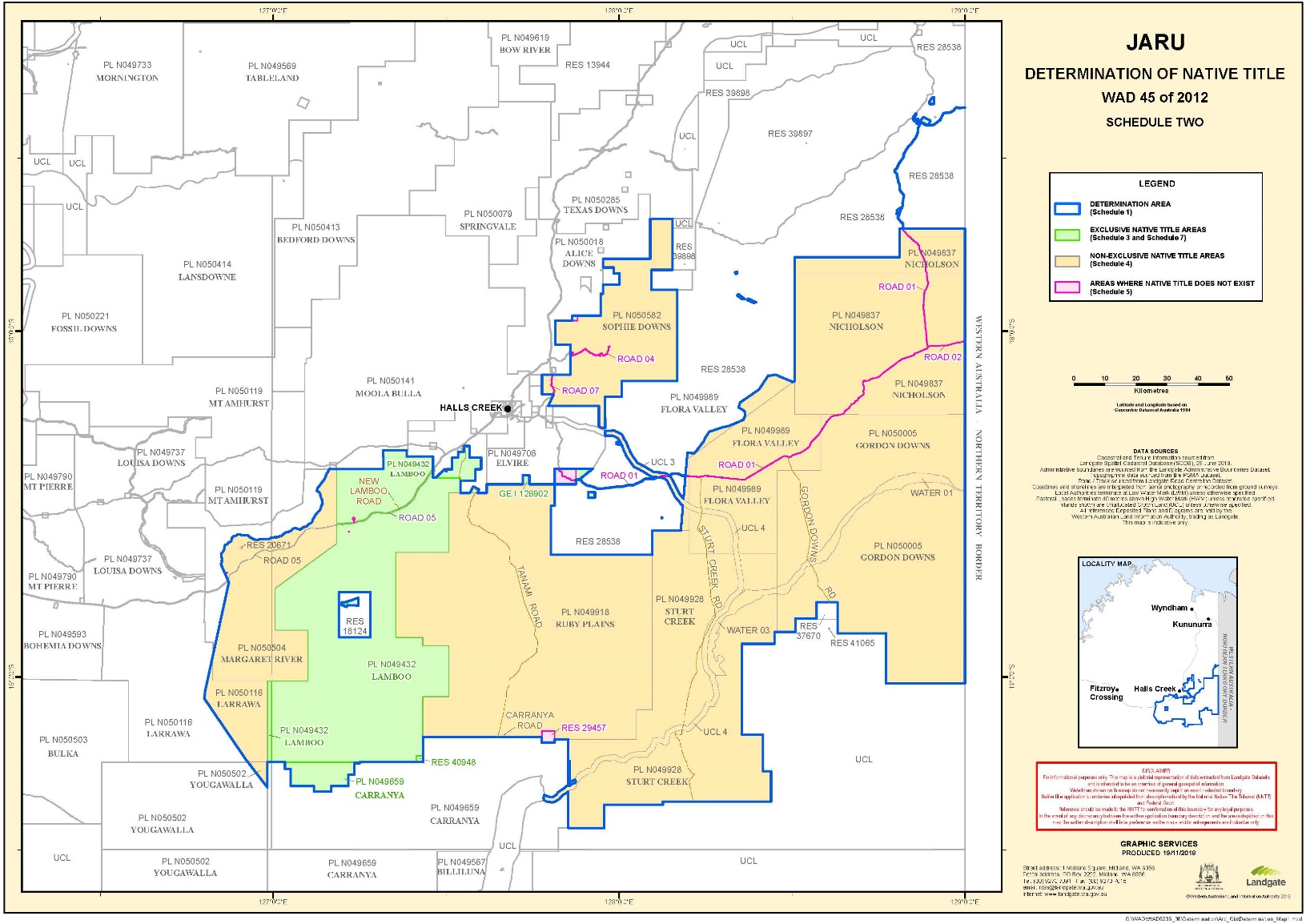
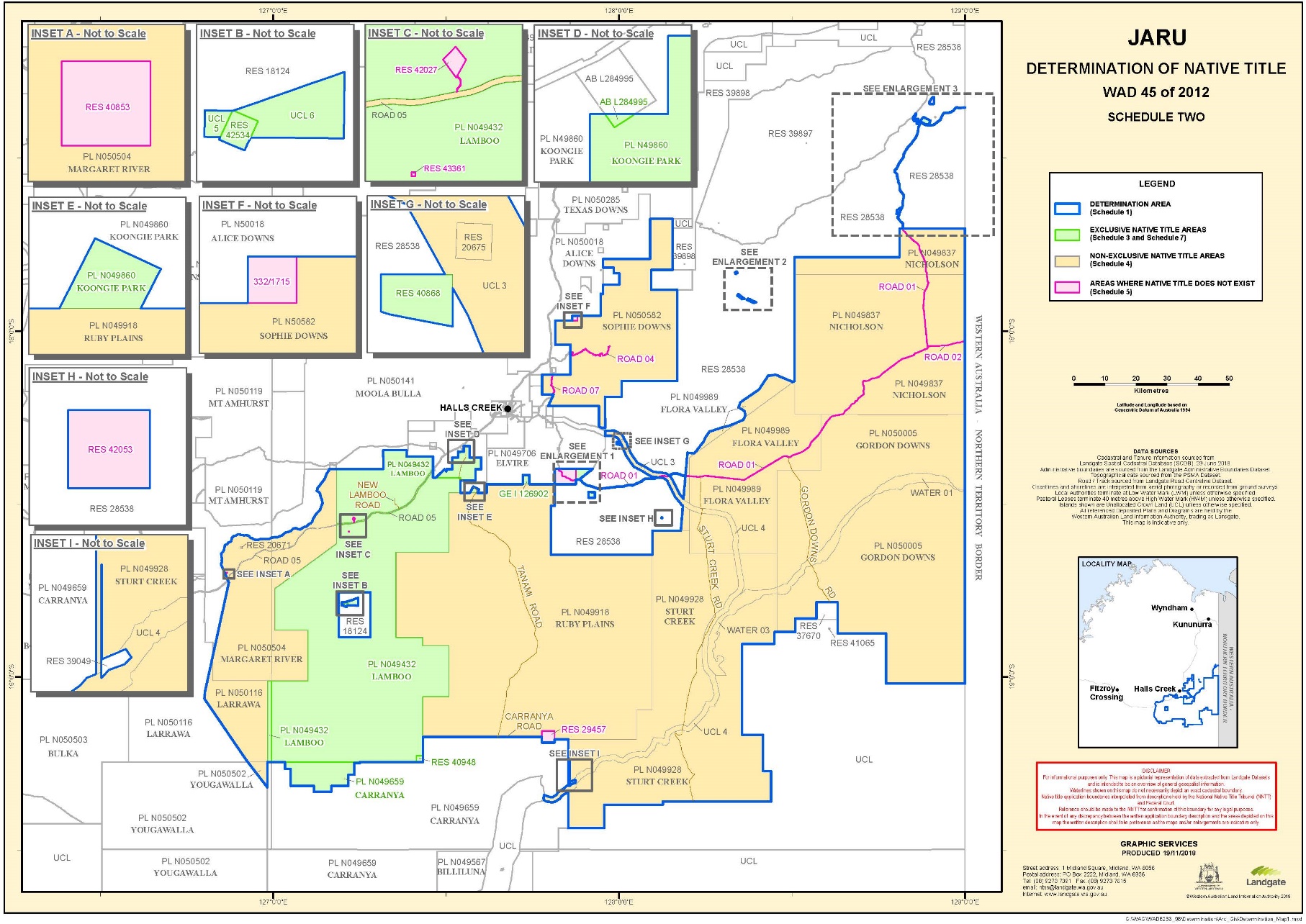
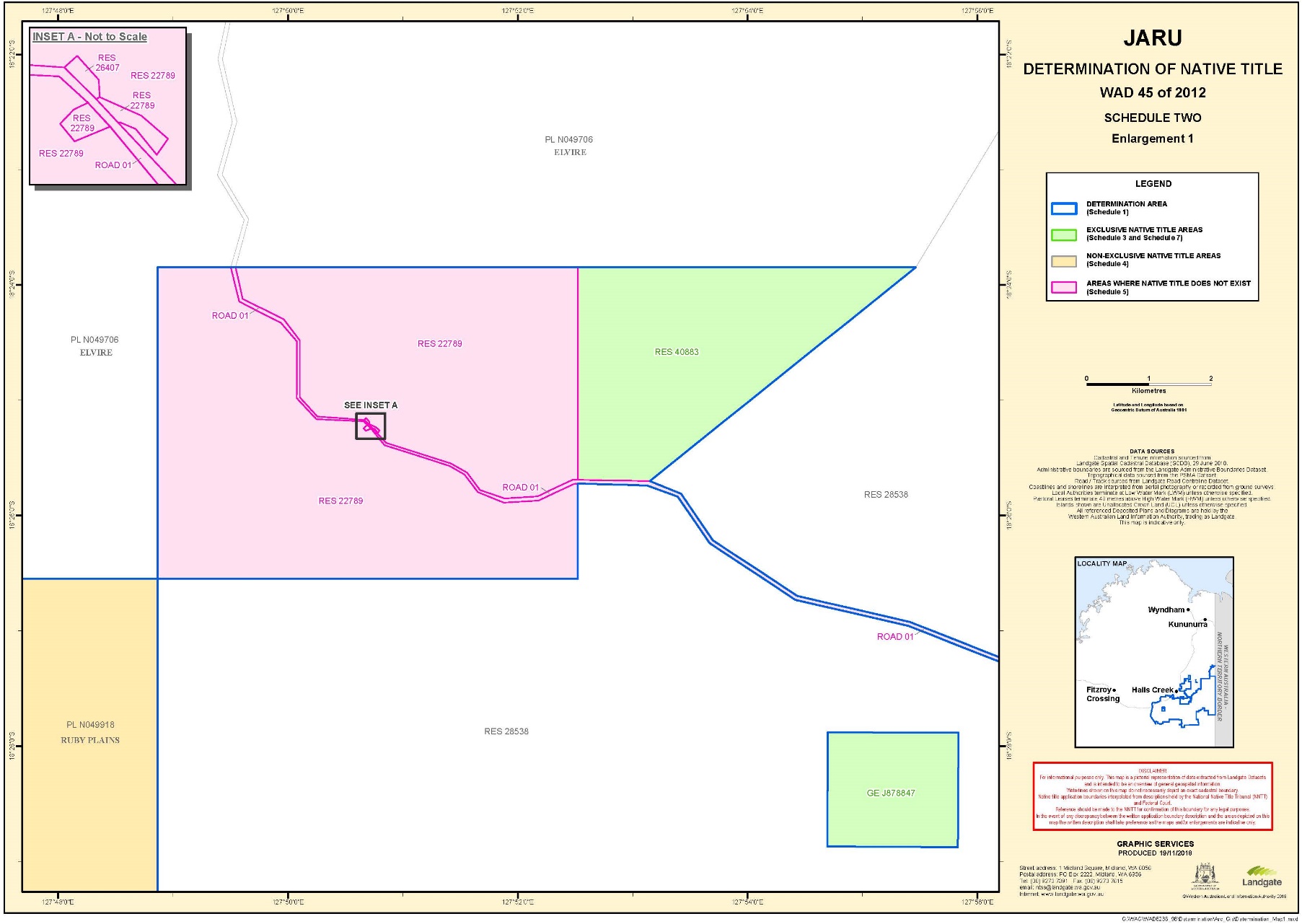
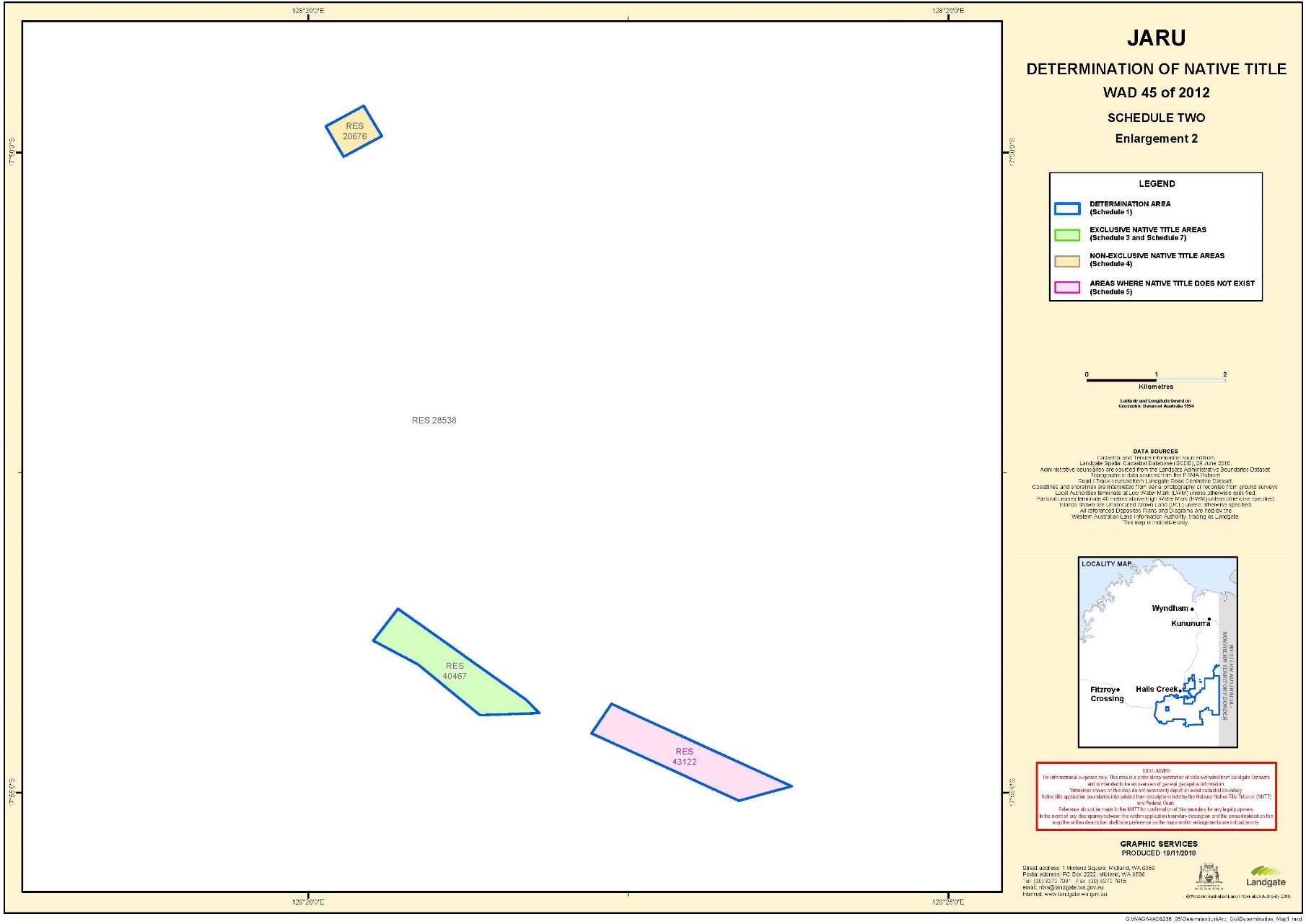
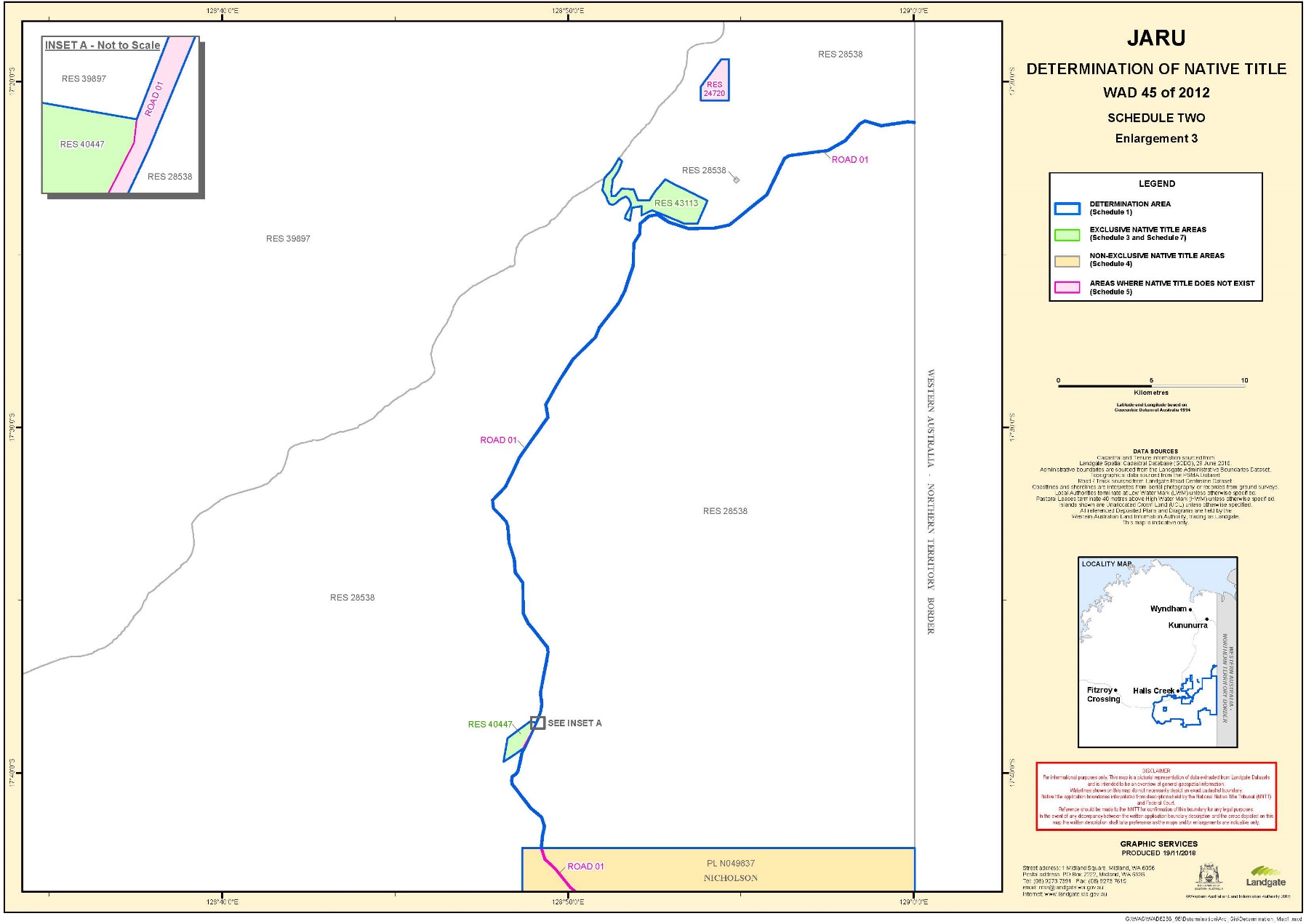
SCHEDULE 3
EXCLUSIVE NATIVE TITLE AREAS
Areas where native title comprises the rights set out in paragraph 5
The following land and waters (generally shown as green on the maps at Schedule 2):
Section 47A
Aboriginal Lease AB L284995 for the purpose of Use and Benefit of Aboriginal Inhabitants | Lot 132 on DP 191020 |
Reserve 40447 for the purpose of Use and Benefit of Aboriginal Inhabitants | Lot 49 on Plan 188384 |
Reserve 40467 for the purpose of Use and Benefit of Aboriginal Inhabitants | Lot 46 on Plan 188440 |
Reserve 40868 for the purpose of Use and Benefit of Aboriginal Inhabitants | Lot 50 on Plan 188963 |
Reserve 40883 for the purpose of Use and Benefit of Aboriginal Inhabitants | Lot 48 on Plan 188952 |
Reserve 40948 for the purpose of Use and Benefit of Aboriginal Inhabitants | Lot 78 on Plan 217733 |
Reserve 42534 for the purpose of Use and Benefit of Aboriginal Inhabitants | Lot 135 on Plan 190855 |
Reserve 43113 for the purpose of Use and Benefit of Aboriginal Inhabitants | Lot 83 on Plan 218429 |
General Lease I 126902 for the purpose of Use and Benefit of Aboriginal Inhabitants | Bulara Location 123 |
General Lease J 878847 for the purpose of Use and Benefit of Aboriginal Inhabitants | Lot 300 on DP 50243 |
N49432 Lamboo | Lots 48 and 115 on DP 220703 |
N49860 Koongie Park | Lot 109 on DP 194260 |
Portion of N49659 Carranya | Lots 14, 49 and 117 on DP 238110 |
Section 47B
UCL 5 and UCL 6 | Lot 134 on DP 93358 |
SCHEDULE 4
NON-EXCLUSIVE NATIVE TITLE AREAS
Areas where native title comprises the rights set out in paragraph 6
The following land and waters (generally shown as orange on the maps at Schedule 2):
1. Pastoral Leases:
Lease number | Location |
N49837 Nicholson | Lots 75 and 122 on DP 238413 |
N49918 Ruby Plains | Lot 127 on DP 238628 |
N49928 Sturt Creek | Lot 113 on DP 238478 |
N 49989 Flora Valley | Lots 62, 63 and 116 on DP 220788 |
N 50005 Gordon Downs | Lot 112 on DP 238205 |
Portion of N50116 Larrawa | Lot 66 on DP 220404 |
Portion of N50502 Yougawalla | Lot 62 on DP 220405 |
Portion of N50504 Margaret River | Lots 83 and 131 on DP 238611 |
N 50582 Sophie Downs | Lot 1554 on DP 68254 |
2. Reserves
Reserve number/purpose | Location |
Reserve 20671 for the purpose of Aerial Landing Ground | Lot 4 on Plan 91040 |
Reserve 20675 for the purpose of Aerial Landing Ground | Bulara Location 3 |
Reserve 20676 for the purpose of Aerial Landing Ground | Luman Location 4 |
4. Unallocated Crown Land
UCL MapInfo ID | Description | Location |
UCL 3 | Canning Stock Route | Lot 330 on DP 55300 |
UCL 4 | Canning Stock Route | Lot 330 on DP 55300 |
5. Water Areas
Water 01 | Sturt Creek |
Water 03 | Sturt Creek |
SCHEDULE 5
AREAS WHERE NATIVE TITLE DOES NOT EXIST
The following land and waters (generally shown as pink on the maps at Schedule 2):
1. Leases
CT Lease No/Purpose | Location |
Lease 332/1715 | Area of Reserve 1620 |
2. Reserves
Reserve No/Purpose | Location | Vesting/Leasing |
Reserve 22789 for the purpose of Recreation | Lot 80 on Plan 189029 and Lots 143 and 144 on Plan 194022 | Vested in Shire of Halls Creek |
Reserve 26407 for the purpose of Public Watering Facility | Lot 12 on Plan 169752 | Vested in Shire of Halls Creek |
Reserve 24720 for the purpose of Aerial Landing Ground | Luman Location 7 | Lease to Commonwealth of Australia |
Reserve 29457 for the purpose of Protection of Meteorite Crater | Lot 16 on Plan 75087 | Vested in National Parks Authority of Western Australia |
Reserve 40853 for the purpose of Repeater Station Site | Lot 28 on Plan 216002 | Vested in Australian Telecommunications Commission |
Reserve 42027 for the purpose of Quarry | Lot 69 on Plan 217171 | Vested in Commissioner for Main Roads |
Reserve 42053 for the purpose of Repeater Station Site | Lot 52 on Plan 91774 | Vested in Australian and Overseas Telecommunications Corporation Limited |
Reserve 43122 for the purpose of Aerial Landing Ground | Lot 86 on Plan 218500 | Vested in Aboriginal Lands Trust |
Reserve 43361 for the purpose of Repeater Station Site | Lot 60 on Plan 216003 | Vested in Telstra Corporation Limited |
3. Public Works
The areas the subject of the following works:
MapInfo Road Number | Description |
01 | Duncan Highway as shown on CPPs 503238 and 503243 and Dixon Range and Gordon Downs plans |
02 | Buntine Highway as shown on Gordon Downs SE 52-10 |
04 | Road 14494 as shown on CPP 502688 |
07 | Road 295 from Wyndham to Halls Creek |
(b) Any other public works as that expression is defined in the Native Title Act and the Titles (Validation) and Native Title (Effect of Past Acts) Act 1995 (WA) and to which section 12J of the Titles (Validation) and Native Title (Effect of Past Acts) Act 1995 (WA) or section 23C(2) of the Native Title Act applies, within the external boundary of the Determination Area including the land and waters defined in section 251D of the Native Title Act.
SCHEDULE 6
DESCRIPTION OF THE NATIVE TITLE HOLDERS
1. The native title holders are those Aboriginal people who:
(a) are related through filiation (meaning a series of parent-child relationships, including by adoption) to one of the Apical Ancestors who held rights and interests in one of the local estate countries comprising the Determination Area; or
(b) are affiliated to an Apical Ancestor and who have spirit conception and/or birth sites in one of the local estate countries in the Determination Area; or
(c) are recognised by the persons described above as:
(i) holding rights and responsibilities for certain songs and ceremonies which make reference to important sites in the Determination Area; or
(ii) holding rights and interests in one of the local estate countries in the Determination Area under traditional law and custom.
2. The Apical Ancestors are:
1 | Unnamed mother of Abier and Jenny Garrngarri |
2 | Barney Wiraluwa |
3 | Billabong Lurlmerri/Friday Ngormeeri/Modmiyarri |
4 | Jingargi (father of Bingangin, Tinka Rarrawarl, Jirngari and Warrayiwana) |
5 | Budubal (mother of Biddie Gilidngali) |
6 | Unnamed father of Burlburriny/Bulburi /Jimmy Rodgers, Labawu, Bowershed-Ngarna, Birriliji and Jeannie Wujuwany-Dijuwan |
7 | Camel (Campbell) Thompson |
8 | Dilin |
9 | Dinah |
10 | Dinbal |
11 | Dungarri |
12 | Durukman |
13 | Buggy Djimululun / Dzimululun (father of Fred Jalwarta) |
14 | Goormalangana |
15 | Unnamed father of Gurunbu Bangarlngaga, Pamarra and Wajika |
16 | Unnamed father of Imbaji Sturt and Mintipa |
17 | Jaluwirri |
18 | Jawuda Ngarnaji |
19 | Jimmy Springvale |
20 | Unnamed father of Jinaginya, Bambalawuja and adopted father of Mangangkajanka |
21 | Unnamed father of Jurnug, Gurugbirri, Nginda, Ningili and Jarndari, Jalarngurra and Bigibigi |
22 | Juwarigaliny Sambo |
23 | Unnamed father of King Paddy |
24 | Kulmariya |
25 | Kwarrarangana |
26 | Lineman and Nyutindeni |
27 | Linmarji/Linmarzi, (Husband of Dzulbir) |
28 | Mother (Mabuga) and father (skin name Jangala) of Lungyina/Angelina Scott |
29 | Mandangal/Madangal (Wife of Wolameri) |
30 | Mirrowinja |
31 | Ngarntingeni/Nyandinyeri |
32 | Ngiliyayiny/Nyiliyang |
33 | Unnamed mother of Nidbarir and Dzurin-Dzurin |
34 | Nidi (Mother of Rosie Mantel, Jack Jellari and Lui Mutji Brockman) |
35 | Ninjanung |
36 | Ngurlkaji (father’s father of Billy and Ray Duncan) |
37 | Nyiliga |
38 | Nyitunja |
39 | Nyowarany Billy Williams/Willie Williams |
40 | Unnamed father of Paddy Nyunkaja, Dodger and Ruby Janjug Tucker |
41 | Unnamed father of Pintuwuk, Polly Marrngu, Nalyirri, Lapawun and their unnamed sister |
42 | Unnamed father of Polly Gulungal and Ngularraji |
43 | Rosie Buyul |
44 | Unnamed father of Tommy Japulda Namarung and Porki Nanyjiyarri |
45 | Tommy Ngardad |
46 | Tommy Rosewood |
47 | Jimmy Turrukpany |
48 | Harry Wirriluwarn |
49 | Wurajartu |
50 | Yirin Paddy (Husband of Buyurrngali) |
51 | Yugaya |
52 | Yumunji/Yamanji “Nanny goat man” |
53 | Unnamed father of Gimanoonja and Piebald |
SCHEDULE 7
AREAS TO WHICH SECTIONS 47A AND 47B OF THE NATIVE TITLE ACT APPLY
Section 47A
Aboriginal Lease AB L284995 for the purpose of Use and Benefit of Aboriginal Inhabitants | Lot 132 on DP 191020 |
Reserve 40447 for the purpose of Use and Benefit of Aboriginal Inhabitants | Lot 49 on Plan 188384 |
Reserve 40467 for the purpose of Use and Benefit of Aboriginal Inhabitants | Lot 46 on Plan 188440 |
Reserve 40868 for the purpose of Use and Benefit of Aboriginal Inhabitants | Lot 50 on Plan 188963 |
Reserve 40883 for the purpose of Use and Benefit of Aboriginal Inhabitants | Lot 48 on Plan 188952 |
Reserve 40948 for the purpose of Use and Benefit of Aboriginal Inhabitants | Lot 78 on Plan 217733 |
Reserve 42534 for the purpose of Use and Benefit of Aboriginal Inhabitants | Lot 135 on Plan 190855 |
Reserve 43113 for the purpose of Use and Benefit of Aboriginal Inhabitants | Lot 83 on Plan 218429 |
General Lease I 126902 for the purpose of Use and Benefit of Aboriginal Inhabitants | Bulara Location 123 |
General Lease J 878847 for the purpose of Use and Benefit of Aboriginal Inhabitants | Lot 300 on DP 50243 |
N49432 Lamboo | Lots 48 and 115 on DP 220703 |
N49860 Koongie Park | Lot 109 on DP 194260 |
Portion of N49659 Carranya | Lots 14, 49 and 117 on DP 238110 |
Section 47B
UCL 5 and UCL 6 | Lot 134 on DP 93358 |
SCHEDULE 8
OTHER INTERESTS
1. Pastoral Leases
Lease Number | Location |
N49837 Nicholson | Lots 75 and 122 on DP 238413 |
N49918 Ruby Plains | Lot 127 on DP 238628 |
N49928 Sturt Creek | Lot 113 on DP 238478 |
N 49989 Flora Valley | Lots 62, 63 and 116 on DP 220788 |
N 50005 Gordon Downs | Lot 112 on DP 238205 |
Portion of N50116 Larrawa | Lot 66 on DP 220404 |
Portion of N50503 Yougawalla | Lots 15 and 62 on DP 220405 |
Portion of N50504 Margaret River | Lots 83 and 131 on DP 238611 |
N 50582 Sophie Downs | Lot 1554 on DP 68254 |
N49650 (portion of Burks Park within claim area) | Lots 203 and 300 on DP 42165, Lots 568 and 569 on DP 400203 |
N49706 (Elvire) | Lots 61 and 114 on DP 220251 |
N49860 (Koongie Park) | Lot 109 on DP 194260 |
N49432 Lamboo | Lots 48 and 115 on DP 220703 |
Portion of N49659 Carranya | Lots 14, 49 and 117 on DP 238110 |
Note: The rights and obligations of the pastoralists pursuant to the pastoral leases referred to in Schedule 8.1 include responsibilities and obligations in relation to the best practice management of pasture and vegetation resources (including conservation and regeneration), livestock and soils arising under valid laws of the State and Commonwealth, including the Land Administration Act 1997 (WA), Soil and Land Conservation Act 1945 (WA), Agriculture and Related Resources Protection Act 1976 (WA) and Biosecurity and Agriculture Management Act 2007 (WA).
2. Leases
General Lease I 126902 for the purpose of Use and Benefit of Aboriginal Inhabitants | Bulara Location 123 |
General Lease J 878847 for the purpose of Use and Benefit of Aboriginal Inhabitants | Lot 300 on DP 50243 |
3. Reserves
(a) The interests of persons who have the care, control and management of the following reserves and the interests of people entitled to access and use these reserves for the respective purposes for which they are reserved, subject to any statutory limitations upon those rights:
Reserve Number/Purpose | Location |
Reserve 40447 for the purpose of Use and Benefit of Aboriginal Inhabitants | Lot 49 on Plan 188384 |
Reserve 40467 for the purpose of Use and Benefit of Aboriginal Inhabitants | Lot 46 on Plan 188440 |
Reserve 40868 for the purpose of Use and Benefit of Aboriginal Inhabitants | Lot 50 on Plan 188963 |
Reserve 40883 for the purpose of Use and Benefit of Aboriginal Inhabitants | Lot 48 on Plan 188952 |
Reserve 40948 for the purpose of Use and Benefit of Aboriginal Inhabitants | Lot 78 on Plan 217733 |
Reserve 42534 for the purpose of Use and Benefit of Aboriginal Inhabitants | Lot 135 on Plan 190855 |
Reserve 43113 for the purpose of Use and Benefit of Aboriginal Inhabitants | Lot 83 on Plan 218429 |
Reserve 20671 for the purpose of Aerial Landing Ground | Lot 4 on Plan 91040 |
Reserve 20675 for the purpose of Aerial Landing Ground | Bulara Location 3 |
Reserve 20676 for the purpose of Aerial Landing Ground | Luman Location 4 |
(b) The interests of persons holding valid or validated leases over areas of the reserves identified above.
4. Existing Interests under the Mining Act 1978 (WA)
Tenement ID | Tenement Type | Date of grant |
E 80/2601 | Exploration Licence | 29 July 2002 |
E 80/3673 | Exploration Licence | 5 February 2007 |
E 80/3861 | Exploration Licence | 30 January 2008 |
E 80/4221 | Exploration Licence | 14 December 2009 |
E 80/4389 | Exploration Licence | 17 September 2010 |
E 80/4458 | Exploration Licence | 26 March 2012 |
E 80/4459 | Exploration Licence | 26 March 2012 |
E 80/4479 | Exploration Licence | 7 July 2011 |
E 80/4542 | Exploration Licence | 26 June 2013 |
E 80/4675 | Exploration Licence | 17 June 2013 |
E 80/4710 | Exploration Licence | 15 May 2014 |
E 80/4743 | Exploration Licence | 2 May 2014 |
E 80/4766 | Exploration Licence | 13 June 2014 |
E 80/4782 | Exploration Licence | 15 July 2014 |
E 80/4795 | Exploration Licence | 10 December 2014 |
E 80/4806 | Exploration Licence | 15 July 2014 |
E 80/4827 | Exploration Licence | 9 December 2014 |
E 80/4882 | Exploration Licence | 28 August 2015 |
E 80/4940 | Exploration Licence | 23 March 2016 |
E 80/4952 | Exploration Licence | 24 March 2017 |
E 80/4957 | Exploration Licence | 11 November 2016 |
E 80/4958 | Exploration Licence | 24 March 2017 |
E 80/4960 | Exploration Licence | 24 March 2017 |
E 80/4975 | Exploration Licence | 22 August 2017 |
E 80/4991 | Exploration Licence | 19 July 2017 |
E 80/5003 | Exploration Licence | 9 February 2017 |
E 80/5004 | Exploration Licence | 9 February 2017 |
E 80/5005 | Exploration Licence | 9 February 2017 |
E 80/5006 | Exploration Licence | 9 February 2017 |
E 80/5013 | Exploration Licence | 23 November 2017 |
E 80/5018 | Exploration Licence | 8 September 2017 |
E 80/5025 | Exploration Licence | 12 January 2017 |
E 80/5034 | Exploration Licence | 3 October 2017 |
E 80/5040 | Exploration Licence | 16 March 2017 |
E 80/5041 | Exploration Licence | 16 March 2017 |
E 80/5054 | Exploration Licence | 21 June 2017 |
E 80/5059 | Exploration Licence | 26 July 2017 |
E 80/5060 | Exploration Licence | 3 April 2018 |
E 80/5066 | Exploration Licence | 18 July 2018 |
E 80/5067 | Exploration Licence | 18 July 2018 |
E 80/5068 | Exploration Licence | 18 July 2018 |
E 80/5069 | Exploration Licence | 21 September 2017 |
E 80/5077 | Exploration Licence | 3 April 2018 |
E 80/5079 | Exploration Licence | 22 September 2017 |
E 80/5081 | Exploration Licence | 3 April 2018 |
E 80/5082 | Exploration Licence | 22 September 2017 |
E 80/5083 | Exploration Licence | 22 September 2017 |
E 80/5084 | Exploration Licence | 3 April 2018 |
E 80/5143 | Exploration Licence | 30 April 2018 |
E 80/5144 | Exploration Licence | 30 April 2018 |
M 80/247 | Mining Lease | 25 May 1988 |
M 80/291 | Mining Lease | 19 July 1986 |
M 80/343 | Mining Lease | 11 June 1992 |
M 80/355 | Mining Lease | 21 January 1993 |
M 80/359 | Mining Lease | 30 June 1993 |
M 80/362 | Mining Lease | 25 August 1993 |
M 80/471 | Mining Lease | 31 March 1998 |
M 80/503 | Mining Lease | 14 November 2000 |
M 80/615 | Mining Lease | 12 June 2012 |
M 80/627 | Mining Lease | 17 June 2014 |
L 80/70 | Miscellaneous Licence | 30 August 2012 |
L 80/71 | Miscellaneous Licence | 30 August 2012 |
L 80/76 | Miscellaneous Licence | 3 December 2014 |
L 80/77 | Miscellaneous Licence | 16 July 2014 |
L 80/78 | Miscellaneous Licence | 16 July 2014 |
L 80/79 | Miscellaneous Licence | 16 July 2014 |
L 80/94 | Miscellaneous Licence | 20 July 2018 |
P 80/1766 | Prospecting Licence | 7 June 2013 |
P 80/1767 | Prospecting Licence | 7 June 2013 |
P 80/1768 | Prospecting Licence | 7 June 2013 |
P 80/1769 | Prospecting Licence | 7 June 2013 |
P 80/1805 | Prospecting Licence | 13 June 2014 |
P 80/1828 | Prospecting Licence | 29 September 2016 |
P 80/1829 | Prospecting Licence | 29 September 2016 |
P 80/1830 | Prospecting Licence | 29 September 2016 |
P 80/1834 | Prospecting Licence | 14 November 2016 |
P 80/1835 | Prospecting Licence | 14 November 2016 |
P 80/1836 | Prospecting Licence | 14 November 2016 |
P 80/1842 | Prospecting Licence | 8 March 2017 |
P 80/1843 | Prospecting Licence | 8 March 2017 |
P 80/1844 | Prospecting Licence | 8 March 2017 |
P 80/1845 | Prospecting Licence | 8 March 2017 |
P 80/1846 | Prospecting Licence | 8 March 2017 |
P 80/1848 | Prospecting Licence | 12 December 2017 |
5. Roads
The interests of persons who have the care, control and management of the following roads and the interests of persons entitled to use those roads, being roads to which the non-extinguishment principle applies:
MapInfo Road Number | Description |
05 | Widening of the Great Northern Highway between Halls Creek and Wyndham |
N/A | Tanami Road |
N/A | New Lamboo Road (being the first 3.74 km from the turnoff from the Great Northern Highway) |
N/A | Sturt Creek Road |
N/A | That portion of Carranya Road located within the Determination Area |
N/A | Gordon Downs Road from its junction with Duncan Road to Kundat Djaru |
6. Other Rights and Interests
(a) Rights and interests, including licences and permits, granted by the Crown in right of the Commonwealth or the State pursuant to statute or otherwise in the exercise of its executive power and under any regulations made pursuant to such legislation.
(b) Rights or interests held by reason of the force and operation of the laws of the State or of the Commonwealth including the force and operation of the Rights in Water and Irrigation Act 1914 (WA).
(c) Rights and interests of members of the public arising under the common law including but not limited to:
(i) the public right to fish;
(ii) the public right to navigate;
(iii) the right of any person to use any road in the Determination Area (subject to the laws of the State) over which, as at the date of this Determination, members of the public have a right of access under common law.
(d) Rights of any person to access and enjoy (subject to the laws of the State):
(i) the Canning Stock Route;
(e) The right to access land by an employee or agent or instrumentality of:
(i) the State;
(ii) the Commonwealth; or
(iii) any local Government authority;
as required in the performance of his or her statutory or common law duties where such access would be permitted to private land.
(f) So far as confirmed pursuant to section 14 of the Titles (Validation) and Native Title (Effect of Past Acts) Act 1995 (WA) as at the date of this determination, any existing public access to and enjoyment of:
(i) waterways;
(ii) the beds and banks or foreshores of waterways;
(iii) stock routes; or
(iv) areas that were public places at the end of 31 December 1993.
(g) The rights and interests of Telstra Corporation Limited (ACN 051 775 556):
(a) as the owner or operator of telecommunications facilities within the Determination Area;
(b) created pursuant to the Post and Telegraph Act 1901 (Cth), the Telecommunications Act 1975 (Cth), the Australian Telecommunications Corporation Act 1989 (Cth), the Telecommunications Act 1991 (Cth) and the Telecommunications Act 1997 (Cth) including rights:
(i) to inspect land;
(ii) to install, occupy and operate telecommunications facilities; and
(iii) to alter, remove, replace, maintain, repair and ensure the proper functioning of its telecommunications facilities;
(c) for its employees, agents or contractors to access its telecommunications facilities in and in the vicinity of the Determination Area in performance of their duties; and
(d) under any lease, licence, permit, access agreement or easement relating to its telecommunications facilities in the Determination Area.
Note: Entry of orders is dealt with in Rule 39.32 of the Federal Court Rules 2011.
MORTIMER J:
1 The continuing connection of Jaru People to their country is strong, and they celebrate that ongoing relationship:
When I was young I used to dance at Gordon Downs out in the bush camp and at Nicholson and at Flora Valley. I dance my Grandfather’s dreamtime story. Ngapa dreaming, water. I learnt that story from the old people. That is our dreaming from our grandfather. We follow that dreaming all over Sturt Creek we sing that story and a couple of the women dance. Last year I danced at the AGM at Milba for that KALACC [Kimberley Aboriginal Law and Culture Centre] mob. Tonight I will sing at Nicholson block with all the old women to liven up my spirit.
2 Those are the words of Mrs Barbara Sturt, a Jaru elder and a member of the Jaru applicant. The Court’s determination will preserve, protect and recognise, in contemporary Australian law, what the Jaru People already know, and have always known, about their connection by traditional law and custom to their country.
The application
3 The orders made today for the determination of native title arise out of an application made pursuant to s 61 of the Native Title Act 1993 (Cth) and filed on 15 February 2012. The Jaru application was notified by the Native Title Registrar pursuant to s 66 of the Native Title Act. The period of 3 months after the notification day referred to in ss 66(8) and 66(10)(c) of the Native Title Act ended on 29 August 2012. The details of the claim were entered onto the Register of Native Title Claims on 16 March 2012.
4 Compared to two of the claims which adjoin it and remain undetermined – the Purnululu claim (WAD6007/1998) and the Djaru or Koongie Elvire claim (WAD6157/1998), both of which were filed in 1998 – the Jaru claim has not been in this Court for such a long period of time. However, that does not mean the Jaru people have not been waiting for this determination for a long time: they have. They have been waiting just as long, and now that waiting is over.
5 The Jaru application covered approximately 28,915 square kilometres in the central eastern and south-eastern Kimberley region of Western Australia, and slightly less than that area is the subject of this determination, for reasons I explain in [7] below. The Determination Area is located south east, south, south west and east of the townsite of Halls Creek, with an area also to the north east of Halls Creek, covering mostly the pastoral station of Sophie Downs.
6 There is riverine country to the north of the Determination Area, and semi-desert sectors in the south. The Determination Area is surrounded to the north and north-west by the Koongie-Elvire (Djaru), Purnululu, Malarngowem, Ngarrawanji and Yurriyangem Taam native title determination applications, to the south by the Tjurabalan native title determination and to the west by the Kurungal and Yi-Martuwarra Ngurrara native title determinations. The eastern boundary of the Determination Area is the border with the Northern Territory. It is here the Miriuwung Gajerrong determination lies next to the Determination Area.
7 There are two areas which are claimed in the Jaru application but are to be excluded from the Determination Area. One (Reserve 28538, south of Duncan Road as it departs from Halls Creek) is to be excluded entirely and no further claim by Jaru people will be made. The other (Reserve 18124, within the Lamboo Downs pastoral lease) will be subject to a separate application for a determination of native title, relying on s 47B of the Native Title Act once the Reserve is cancelled and the area reverts to unallocated Crown land.
The parties
8 The land tenure of the application area consists of large reserves and pastoral leases and unallocated Crown land. The tenure is reflected in the identity of the parties to the proceedings and the Determination.
9 The parties to the Jaru application, are:
(1) the applicant;
(2) the State of Western Australia;
(3) the Shire of Halls Creek;
(4) Kevin Stephen Brockhurst;
(5) Heytesbury Pastoral Pty Ltd;
(6) Sophie Downs Station Pty Ltd;
(7) The Nicholson Grazing Company Pty Ltd;
(8) Vicdon Holdings Pty Ltd;
(9) Yeeda Pastoral Company Pty Ltd;
(10) Yougawalla Pty Ltd;
(11) S. Kidman & Co Pty Ltd; and
(12) Telstra Corporation Limited.
10 The Jaru applicant is comprised of representatives from a number of clan groups making up Jaru people. This is apparent from evidence that was filed in relation to two interlocutory applications to which I refer later in these reasons. The evidence included extracts from the resolutions passed at the authorisation meeting which authorised the Jaru applicant. These resolutions show that members of the Jaru applicant were drawn from Bilinyana Jaru (Barbara Sturt, D Skeen Keddie (deceased), Peter Wein, Desmond Johnson); Yudu (Kadyanana Jaru) (Leslie Whippy, Timmy Cranbell, Barbara Cox, Deborah Gordon); Warl Jaru (Ross James, Kimberley Baird, M Butcher (deceased), Georgina Yeeda) and Nynin Jaru (Bonnie Edwards, Neenya Tesling, Roger Sturt and Edward Smith).
The native title holders
11 The parties have agreed, and the applicant and the State submit, that rights and interests in the Determination Area under traditional law and custom are held by the Jaru People by reference to any one of at least three pathways.
12 The first is having a relationship through filiation (being a series of parent-child relationships, including by adoption) to one of the apical ancestors who held rights and interests in one of the local estate countries comprising the Determination Area.
13 The second is affiliation to an apical ancestor, where people also have spirit conception and/or birth sites in one of the local estate countries in the Determination Area.
14 The third is being recognised by the native title holders who fall into the first two categories. There is recognition by Jaru people of those who:
(1) hold rights and responsibilities for certain songs and ceremonies which make reference to important sites in the Determination Area; or
(2) hold rights and interests in one of the local estate countries in the Determination Area under traditional law and custom.
15 The apical ancestors identified in the Determination are not identified in the same way as they were in the Jaru application. This matter calls for some explanation, as it relates to the two recent interlocutory applications filed shortly prior to the consent determination.
16 The Jaru native title claimants are those persons who are described in Sch 6 of the Determination, by reference to the following apical ancestors, as set out in Sch 6(2) of the Determination:
(1) Unnamed mother of Abier and Jenny Garrngarri
(2) Barney Wiraluwa
(3) Billabong Lurlmerri/Friday Ngormeeri/Modmiyarri
(4) Jingargi (father of Bingangin, Tinka Rarrawarl, Jirngari and Warrayiwana)
(5) Budubal (mother of Biddie Gilidngali)
(6) Unnamed father of Burlburriny/Bulburi /Jimmy Rodgers, Labawu, Bowershed-Ngarna, Birriliji and Jeannie Wujuwany-Dijuwan
(7) Camel (Campbell) Thompson
(8) Dilin
(9) Dinah
(10) Dinbal
(11) Dungarri
(12) Durukman
(13) Buggy Djimululun/Dzimululun (father of Fred Jalwarta)
(14) Goormalangana
(15) Unnamed father of Gurunbu Bangarlngaga, Pamarra and Wajika
(16) Unnamed father of Imbaji Sturt and Mintipa
(17) Jaluwirri
(18) Jawuda Ngarnaji
(19) Jimmy Springvale
(20) Unnamed father of Jinaginya, Bambalawuja and adopted father of Mangangkajanka
(21) Unnamed father of Jurnug, Gurugbirri, Nginda, Ningili and Jarndari, Jalarngurra and Bigibigi
(22) Juwarigaliny Sambo
(23) Unnamed father of King Paddy
(24) Kulmariya
(25) Kwarrarangana
(26) Lineman and Nyutindeni
(27) Linmarji/Linmarzi, (Husband of Dzulbir)
(28) Mother (Mabuga) and father (skin name Jangala) of Lungyina/Angelina Scott
(29) Mandangal/Madangal (Wife of Wolameri)
(30) Mirrowinja
(31) Ngarntingeni/Nyandinyeri
(32) Ngiliyayiny/Nyiliyang
(33) Unnamed mother of Nidbarir and Dzurin-Dzurin
(34) Nidi (Mother of Rosie Mantel, Jack Jellari and Lui Mutji Brockman)
(35) Ninjanung
(36) Ngurlkaji (father’s father of Billy and Ray Duncan)
(37) Nyiliga
(38) Nyitunja
(39) Nyowarany Billy Williams/Willie Williams
(40) Unnamed father of Paddy Nyunkaja, Dodger and Ruby Janjug Tucker
(41) Unnamed father of Pintuwuk, Polly Marrngu, Nalyirri, Lapawun and their unnamed sister
(42) Unnamed father of Polly Gulungal and Ngularraji
(43) Rosie Buyul
(44) Unnamed father of Tommy Japulda Namarung and Porki Nanyjiyarri
(45) Tommy Ngardad
(46) Tommy Rosewood
(47) Jimmy Turrukpany
(48) Harry Wirriluwarn
(49) Wurajartu
(50) Yirin Paddy (Husband of Buyurrngali)
(51) Yugaya
(52) Yumunji/Yamanji “Nanny goat man”
(53) Unnamed father of Gimanoonja and Piebald
17 There have been no applications to amend the s 61 application in this proceeding. Thus, the version of the s 61 application/Form 1 as it was filed in 2012 remains the applicable version. In this document, the list of claimed apical ancestors differs from the list proposed in the minute of consent determination submitted by the parties to the Court.
18 To take some examples relevant to the matters I discuss below, at paragraph 7 of Attachment A to the s 61 claim there appears the name “Bingangin”, and a list of six of his children. On the current list in Sch 6 to the Determination, the apical ancestor Jingargi is identified, including being identified as the father of Bingangin. In other words, in this case the list of apicals has reached back one further generation.
19 Another difference is that the s 61 application named many of the first generation of children from the identified apical ancestors. That detail has been removed.
20 Subject to the further findings I make below in the context of the interlocutory applications, I am satisfied that notwithstanding the differences between the list as it appears on the Jaru application and as it appears in the Determination, it is appropriate to identify the apical ancestors as they are identified in Sch 6 of the Determination. The nature of a determination by consent, and the priority that method of determination under the Native Title Act gives to the agreement of the parties means the Court is able to focus on the parties’ agreement, rather than insisting on a precise correlation between the initial application and the determination. The latter reflects the agreed position of all parties, including the State which has the duties to which I refer below, and it is that agreement which renders differences from the original application of less importance. In Billy Patch and Others on behalf of the Birriliburu People v State of Western Australia [2008] FCA 944 at [18], French J (as his Honour then was) said:
The letter from the State Solicitor pointed out that the amended application had not been further amended. The position of the parties was that provided the application were valid, the Court could proceed to make a determination in such form as it sees fit based on the evidence. It was not limited to making a determination in the form sought in the application. In any event, it argued that in circumstances in which the group of proposed native title holders is, in substance, the same group as the native title claim group, an amendment is unnecessary. I accept these contentions.
21 Further, as Gilmour J pointed out in Watson on behalf of the Nyikina Mangala People v State of Western Australia (No 6) [2014] FCA 545 at [33], a claim group’s ratification and authorisation of the proposed minute of consent determination, with the revised list of apical ancestors, is a further basis on which the Court can consider it is appropriate to determine native title by reference to a revised list of apical ancestors. In this proceeding, the resolutions to adopt a determination in this form, passed in August 2018, were passed unanimously.
22 In the joint submissions, the parties pointed to another factor the Court could take into account: namely, that the description in Sch 6 was the result of extensive additional genealogical/anthropological research undertaken in relation to the Jaru application and in consultation with the Jaru claim group. It is necessary to say a little more about this matter, by reference to both an affidavit filed by the Jaru applicant’s legal representative, Ms Justine Toohey and by reference to a recent affidavit filed by Dr Anthony Redmond, the anthropologist who conducted most of the research on this claim and whose research was presented to the State as the basis for its assessment of the connection of the Jaru People to the Determination Area.
23 In her affidavit Ms Toohey describes the process undertaken by Dr Redmond in October 2016 and thereafter, including meetings with claim group members to present them with his research to that point about which people could be established to have connection to the claim area, and to discuss and receive feedback from claim group members. After this process, his connection report was provided to the State in April 2017. Ms Toohey, who deposes that she attended the meetings, emphasises the point of the meetings was to ensure the claim group agreed Dr Redmond’s research was correct. The meeting occurred at Ringer Soak (32 claim group members attended), and in Halls Creek (96 and 78 people, respectively, attended on the two days). Ms Toohey deposes (at [13]):
Dr Redmond’s presentation was iterative, involved significant exchanges between himself and meeting attendees, and was aided by a map of the claim area projected on a screen at the front of the meeting venue, with general information on the map about the area of country associated with the apical ancestors identified in Dr Redmond’s research and discussed during the course of the meeting
24 Dr Redmond also provided his own affidavit, affirmed on 30 November 2018. This affidavit was read in opposition to the second interlocutory application brought in the last three weeks, and I consider it is appropriate to take its contents into account, given that the issue of the identification of apical ancestors in this determination of native title has been attended by some controversy.
25 Dr Redmond deposes that he began his work with the Jaru People in 2013, and it drew on earlier research he had conducted with Jaru people and their close neighbours, most particularly Kija and Gooniyandi people, since 2006. It involved considerable field work with claim group members, but also an examination of historical documents. Dr Redmond deposes (at [8]) that:
Over the course of my research project, I discussed the genealogical research extensively with a wide range of Jaru people who have vetted, commented, revised, and offered suggestions to clarify particular descent lines and country affiliations.
26 Dr Redmond also deposes to what occurred at the key authorisation meeting for this claim on 21 and 22 August 2018 at Halls Creek, and to the disputes at that meeting about the inclusion of the family of Ms Angeline Bedford (née Grant) as members of the claim group, with the related issue of the inclusion of the two apical ancestors Jingargi and Dungarri. He describes the steps taken to convey his research and conclusions to, particularly, those claim group members who were voicing concerns about the inclusion of these people. He describes (as did Ms Toohey in her affidavit) a 55 minute “break out” session, where Dr Redmond went through the issues with those Jaru people who attended the meeting, some of whom were raising concerns about the inclusion of these people.
27 In his affidavit, Dr Redmond explains in detail how he reached his conclusion that these two apical ancestors should be included, noting that Jingargi was already in the proposed claim group description circulated prior to the August 2018 meeting as a result of his research, as “unnamed father of Bingangin, Tinka Rarrawarl and Jirngari”, and further noting that his research (especially discussion with members of the Kalkarindji community in the Northern Territory) had revealed that Dungarri was a Jaru woman from Flora Valley, whose daughter was Nora Mungayi and whom Dr Redmond’s informants had met while she was living at Wave Hill. Dr Redmond describes how this is supported by Tindale’s genealogical records, although the station workers’ records for Wave Hill record Nora as a Gurindji woman. Dr Redmond describes how he considered this information, and how some of the opposing claim group members relied on it. He concluded it was likely Nora had either been identified in this way by the station manager, or had described herself using this broad language label when asked because it was the dominant language label in the community that she was living in at the time. It is not necessary to set out all of Dr Redmond’s careful and thorough reasoning, but it is helpful to set out his conclusion (at [42]):
While complexified by the multiple oral and secondary sources cited above, it is my opinion that the weight of that research data supports the inclusion of the apical ancestors, Jingargi (replacing the formerly unnamed father of Binganin, Tinka Rarrawarl and Jirngari on the list of apicals for the Proposed New Claim Group) and Dungarri on the Jaru native title determination application.
28 As I find below, these issues have caused real controversy, and some division, in the Jaru claim group, which has been challenging for all concerned, and for the Kimberley Land Council.
29 Nevertheless, for present purposes, I am comfortably satisfied that Dr Redmond has provided ample expert opinion to justify the inclusion of these two apicals, and to explain the changes in the list of apicals from the s 61 application to the form that appeared in the minute of proposed consent determination which was put to the Jaru People at the meetings on 21 and 22 August 2018.
The material before the Court
30 Aside from the material which accompanied the original Jaru application, no connection material has been filed with the Court. The affidavits which were filed with the Jaru application did have some substantive evidence about Jaru traditional law and custom, and how it connects Jaru people to the claim area. Those affidavits were from:
(a) Ms Tanba Banks (spelt “Tanbar” in the affidavit, which I understand is not correct);
(b) Ms M Butcher (deceased); and
(c) Mrs Barbara Sturt.
31 As I have noted earlier, the Court has had regard to the affidavit of Ms Toohey affirmed 21 November 2018, and the affidavit of Dr Redmond affirmed 30 November 2018. In addition, and especially on the issue of the authorisation meeting in August 2018 (see below) and the debate about appropriate apical ancestors and the connection of Ms Bedford and her descendants, the Jaru applicant has also relied upon, and the Court has had regard to:
(1) A further affidavit of Justine Mary Toohey affirmed 21 November 2018 and filed on 21 November 2018;
(2) An affidavit of Sarah Maree Mack affirmed 21 November 2018 and filed on 21 November 2018;
(3) An affidavit of Douglas Lawrie D’Antoine affirmed 21 November 2018 and filed on 21 November 2018;
(4) An affidavit of Dr William Henry Kruse affirmed 26 November 2018 and filed on 26 November 2018;
(5) An affidavit of Justine Mary Toohey affirmed 27 November 2018 and filed on 30 November 2018;
(6) An affidavit of Douglas Lawrie D’Antoine affirmed 28 November 2018 and filed on 30 November 2018;
(7) A joint affidavit of Timothy Mosquito and John Mosquito affirmed 29 November 2018 and filed on 30 November 2018;
(8) An affidavit of Marcie Rae Purdie affirmed 30 November 2018 and filed on 30 November 2018;
(9) An affidavit of Brenda Jean Garstone affirmed on 30 November 2018 and filed 30 November 2018;
(10) An affidavit of Callista Rose Dundas Barritt affirmed 30 November 2018 and filed 30 November 2018; and
(11) An affidavit of Anthony Paul Harrison affirmed 30 November 2018 and filed 30 November 2018.
32 The Court has also had regard to materials that were filed or provided to the Court on behalf of Ms Cox in relation to the interlocutory application accepted for filing on 27 November 2018:
(1) The materials annexed to the interlocutory application of Ms Kaylene Cox, accepted for filing on 27 November 2018;
(2) Further materials provided on behalf of Ms Cox on 30 November 2018, being:
(a) NNTT Extract of Jaru Claim Description – original claim description;
(b) Descendant Indented Chart for William Barney;
(c) Federal Court Extract for Limbunya Claim (NTD1/2017) dated 19 January 2017;
(d) Extract from NNTT Register – Tjurabalan Claim;
(e) Western Desert Land Claim report dated 24 September 1990;
(f) Email from Anthony Redmond to Kaylene Cox and Brenda Garstone dated 26 January 2018 (with four pages of attached hand drawn family trees); and
(g) Extract of claim description document distributed at Jaru authorisation meeting in August 2018, with annotations.
33 The Court considered these materials principally as part of determining the first, and then the second interlocutory application, to which I refer elsewhere in these reasons. Nevertheless, I consider it is necessary to include these materials here as some of the issues which arose during these applications must be considered, in a different but related context, in determining whether the matters of which the Court must be satisfied under the Native Title Act have been met.
Material provided to the State of Western Australia
34 However, significant connection material has been provided to the State. The applicant provided the State with considerable material on a without prejudice basis. I note the joint submissions indicate this material went both to connection, and to occupation for the purposes of s 47B of the Native Title Act and included:
(1) An anthropological report for the Jaru (WAD 45/2012) and Koongie Elvire (WAD 6157/1998) native title claims by Dr Anthony Redmond dated 25 April 2017. This report comprised three volumes;
(2) A signed statement of Robin Yeeda, dated 29 June 2018;
(3) Two affidavits of Valma Banks affirmed 29 June 2018;
(4) Two affidavits of Stewart Morton affirmed 29 June 2018 and one affidavit of Stewart Morton affirmed 26 July 2018;
(5) An affidavit of Timothy Mosquito affirmed 28 June 2018;
(6) An affidavit of Timothy Mosquito and Ivan Turner affirmed 25 July 2018;
(7) Joint affidavits of Frank Sampi and Kenneth Boomer affirmed 29 June 2018 and 24 July 2018;
(8) An affidavit of Kimberley Baird affirmed 24 July 2018;
(9) A draft affidavit of Mark Gordon annexed to the affidavit of Douglas Lawrie D’Antoine affirmed 3 July 2018;
(10) An affidavit of Angus Manson affirmed 26 July 2018; and
(11) An affidavit of Murray Gordon affirmed 26 July 2018.
35 I note in particular the State was provided with affidavit evidence from Mr Timothy Mosquito, who is one of the claim group members whose rights and interests in the Determination Area come through the apical ancestor Jingargi. In other words, the State had material specifically to satisfy itself about the connection and occupation of the family groups of people such as Mr Mosquito.
36 I am satisfied the State had ample material on which to make an informed decision about the connection of the Jaru People to the claim area. The basis for connection is also clearly explained in the joint submissions filed with the Court.
Some late objections
37 It is worth recapping here the recent history of this native title claim.
38 Connection material prepared by Dr Redmond on behalf of the applicant was provided to the State in April 2017. It was this material which the State ultimately accepted. After the provision of this material, the relevant parties agreed that the Jaru claim could be managed separately from the Purnululu claim, the latter having some particular challenges with competing views by claim group members, and some non-claim group member respondents, about who are the right people for Purnululu country, and where the boundaries of that country are.
39 From that time, the matter was in active and close case management towards a consent determination. As part of that process, the Court was informed of the authorisation meetings to be held in August 2018.
40 On 12 September 2018, the Court was informed by the applicant, having consulted with all other relevant parties that:
The parties confirm that all of the outstanding issues previously identified in the Joint Report filed on 17 August 2018 have now been resolved and that the content of the MCDNT is now substantively agreed.
41 On 21 September 2018, the Court ordered that a consent determination be listed on country on 6 December 2018. The parties, and in particular the KLC on behalf of the applicant, agreed this was feasible, although the timetable was tight.
42 As part of the evidence on the second interlocutory application (referred to below), the KLC read an affidavit of Mr Anthony Paul Harrison, a senior project officer within the KLC. Mr Harrison deposed that those who attended the August 2018 meeting were informed, through a power point, that a consent determination could take place as early as November 2018, subject to the availability of a judge to hear the matter.
43 Despite the disagreements at the August 2018 meetings, between that meeting and 20 November 2018, no action was taken by any Jaru claim group members to bring a challenge to the outcome of the authorisation meeting before the Court, or put in issue the progress of this matter to consent determination.
44 Invitations to the consent determination were mailed out to claim group members by the KLC on 15 November 2018. There were only two members of the applicant to whom an invitation was not sent: for one person the KLC had no mail address and could not send the invitation, the other had already confirmed attendance.
45 After these invitations were sent out, there was a meeting in Broome of five members of the Jaru applicant on 20 November 2018. Not counting the two deceased individuals, there are 14 individuals who make up the Jaru applicant. On any view, the meeting of 20 November 2018 with the KLC in Broome involved only a minority of the members of the Jaru applicant. However these five individuals: Georgina Yeeda, Bonnie Edwards, Ross James, Tim Cranbell, and Neenya Tesling, purported to instruct Ms Toohey to make an interlocutory application to vacate the consent determination, because of the issues with the apicals and the inclusion of the Bedford/Grant family. The interlocutory application was duly made.
46 The objectors’ concerns were set out in two documents: a letter to the KLC dated 20 November 2018, attaching a petition and which prompted the first interlocutory application to which I have referred, and a letter dated 27 November 2018, which the Court treated as a second interlocutory application, for reasons I explain briefly below.
47 The first – and formal – interlocutory application by the KLC, on the instructions of the five members of the applicant, sought to adjourn the consent determination. I heard that interlocutory application on Thursday, 22 November 2018. I was not persuaded to grant the adjournment of the consent determination at that time. I gave in summary the following reasons:
(1) First, at the meetings in August 2018 which had authorised the consent determination and the change in apical ancestors the claim group members had, on the evidence, resolved to do so unanimously, including by votes of some of the people and the named applicants who now sought to undo those resolutions;
(2) Second, there was a basis in the opinions of Dr Redmond, as reported by Ms Toohey, for the inclusion of Jingargi and Dungarri as apical ancestors on this claim;
(3) Third, there was a lack of material indicating what the concern was over the inclusion of a particular family in the claim group; and
(4) Fourth, I was concerned that the interlocutory application had been made on the basis of a minority of the members of the applicant – all of whom either voted in favour of the resolutions at the August 2018 meeting or were not present at that meeting. I was also concerned on the evidence provided by the KLC about the conditions imposed by the claim group through an earlier authorisation process on the authority of those individuals who constitute the applicant and that the instructions to bring the interlocutory application appeared to be contrary to the authority given to them. I considered it was in those circumstances more appropriate if the individual claim group members who wished to now raise opposition to the consent determination were required to do so on their own behalf.
(5) However, recognising the seriousness of the issues raised, I adjourned the interlocutory application and made orders requiring those who wished to contend there was a proper basis to adjourn the consent determination to file an interlocutory application themselves, with supporting material.
48 No further formal interlocutory application was filed. Instead, on 27 November 2018 a further letter was sent. The letter contended the objectors had not had an opportunity to obtain legal representation. It was sent, and received at an email address within the Court, prior to the deadline set in the orders made on 22 November 2018. Since it went to a generic email address, it did not come to the attention of my chambers, nor the Native Title Judicial Registrar or her staff, until after the deadline set in the 22 November 2018 orders. It did not come to anyone’s attention within the Court until the Court had, as had been contemplated by the 22 November 2018 orders, made orders dismissing the first interlocutory application. Given the signatories to that letter were without legal representation and needed to act quickly, I did not consider those technical issues should stand in the way of the matters they sought to raise. I accept the individuals did their best to comply with the short timetable the Court had set.
49 However, as was the case when I made the orders I did on Thursday, 22 November 2018, the proximity of the consent determination hearing and the tremendous resources involved on the part of the KLC and of the Court in an on-country consent determination in a remote location, meant any application needed to be heard and determined quickly, lest all those resources be wasted if the consent determination was to be vacated. I considered it was in the interests of the administration of justice to treat the objectors’ second letter as an interlocutory application and to list the second interlocutory application for hearing on 30 November 2018, which was the course contemplated by the 22 November 2018 orders. Registrar McGregor and her staff assisted the individuals as much as possible, consistently with their role within the Court, and the objectors did in fact have the assistance of a lawyer, Mr Franklin Gaffney.
50 On the evidence, some of the people who signed the petition accompanying the 20 November 2018 letter could not positively be identified as being members of the claim group, but I do not consider for the purposes of resolving the issue that is of great concern. Plainly there were a considerable number of people who had voiced concerns. The petition to the KLC contained 74 names and signatures. There was no debate that a number of people had genuine concerns.
51 The claim group members who raised concerns comprised of some people who are individual members of the applicant in this proceeding. They are:
(1) Mrs Barbara Sturt, who is the individual whose name the proceeding bears;
(2) Ms Georgina Yeeda;
(3) Ms Bonnie Edwards;
(4) Mr Ross James;
(5) Mr Tim Cranbell; and
(6) Ms Neenya Tesling.
52 In addition, other claim group members identified by the KLC as having signed the petition requesting the determination be adjourned, and as having attended one or both days of the authorisation meetings on 21 and 22 August 2018, were:
(1) Ms Kaylene Cox, who has acted as what she describes as Mrs Sturt’s “proxy” in correspondence to the Court;
(2) Ms Janene Bedford;
(3) Ms Daisy Howard; and
(4) Taylor Howard.
53 Not all the people who appeared to be principal supporters of the interlocutory application attended the hearing on 30 November 2018, despite being able to do so by telephone (as Ms Cox and Ms Yeeda did) and despite some individuals whose health is not good, such as Mrs Sturt, making the effort to attend in person in Perth.
54 Those who appeared were: Mrs Barbara Sturt, Mr David Toogar, Ms Kaylene Cox, Ms Brenda Garstone, Ms Georgina Yeeda, Mr Peter Wein, Mr Timothy Mosquito and Mr John Mosquito. Those who had asked the Court to vacate the consent determination but who either did not attend or did not seek to address the Court were: Ms Bonnie Edwards, Mr Ross James, Mr Tim Cranbell, Ms Neenya Tesling and Ms Marianne Skeen.
55 The objectors asked the Court to:
(1) adjourn or vacate the consent determination;
(2) refer their concerns to the National Native Title Tribunal for mediation;
(3) order that the KLC cover the costs of the mediation, including the legal costs incurred by the named applicants who are signatories to the letter dated 20 November 2018, or alternatively, to “order that the legal costs [of the NNTT mediation] be covered from the mining payments and royalties received from Northern Minerals Ltd arising from the Brown’s Range Co-existence Agreement which is managed by KRED Enterprises Pty Ltd, as trustee for the Jaru applicants”.
56 In reality, given the nature of the concerns raised by the objectors, it was clear they did not want the consent determination hearing simply adjourned. They were contending for a different form of consent determination, with different apical ancestors, and one which would exclude (as I note below) approximately 122 present claim group members. Accordingly what the objectors were applying for was really the vacation of the consent determination, and to return the proceeding to some kind of case management process – on their submissions, one that also involved sending the matter to the NNTT.
57 After a hearing lasting more than three hours, with some breaks, I dismissed the second interlocutory application. I gave short oral reasons at the time, which were revised and sent out to those who appeared. Those reasons centred on the clarity of the decision taken by the claim group, unanimously, at the August 2018 meetings, and the fact those resolutions bound the Jaru applicant (including those individuals who purported to object). Those oral reasons should now be read with the explanations I give in these reasons for not interfering with the agreement reached between the Jaru applicant and the other parties, as reflected in the August 2018 authorisation by the Jaru claim group, and for considering it appropriate to make the determination sought.
A brief description of the Jaru People, their traditional law and custom and their country in the claim area
58 The joint submissions provide sufficient information for the Court to be satisfied it is appropriate to determine native title in favour of the Jaru People, but of course the material to which the submissions refer is but a snapshot of the rich and deep culture of the Jaru People, shaped by their traditional law and custom, and by their abiding connection to Jaru country.
59 As I have noted on other occasions, in describing the traditional law and custom of a group of Aboriginal people, it is important to ensure that the authentic, abiding voice of those people themselves is heard, in telling the story of their country, and of the traditional laws and customs which connect them to it and have done since time immemorial. However, there is a role for academic studies and early accounts about Aboriginal and Torres Strait Islander Peoples in the proof of native title under the current Australian legal system. As this proceeding demonstrates in the role played by Dr Redmond as I have outlined above, sometimes the role played by an anthropologist can be critical in identifying with an objective and over-arching perspective the whole picture of the connection of various clans or groups, as one society, to a claim area.
60 The parties submit, based in part on Dr Redmond’s opinion, that the time of effective sovereignty in the Determination Area was between 1885 and the early 1900s. This was the time of the first incursions by pastoralists with large herds of cattle, as well as being the time of the (short lived) Halls Creek gold rush. Dr Redmond notes that the Turkey Creek ration and police depot was established by the government of Western Australia in the early 1900s. Turkey Creek is where the townsite of Warmun is now located.
61 I accept that is the appropriate time at which to identify effective sovereignty in the Determination Area.
62 At this time, the parties submit, there was a system of law and custom under which people were affiliated to country, and which has been maintained and transmitted from generation to generation, with rights and interests being held at the regional societal level. The parties submit, and I accept, that it can be inferred the system of law and custom had existed since prior to the declaration of sovereignty in Western Australia in 1829.
63 The parties submit, and I accept, that the rights and interests in land and waters which are distributed throughout the members of the Jaru claim group are derived from this body of traditional laws and customs.
Organisation of rights and interests under traditional Jaru law
64 What follows is based on the parties’ submissions, which in turn are based on Dr Redmond’s connection report and the evidence of the Jaru claim group members set out above.
65 Jaru People derive their rights and interests in Jaru country through local estate areas, which are their ngurra. Under traditional descent laws, one person may have rights and interests in more than one ngurra through different descent lines.
66 People may derive or acquire responsibility for ngurra in other ways, such as being born on that ngurra, or because a particular ngurra was the location of a spirit conception site (jarriny) for that person. In this situation however, the enduring and authoritative rights will generally come where there are also descent-based links to ngurra.
67 The importance of country on which a person is born is illustrated by this evidence from Mrs Barbara Sturt:
I grew up in Flora Valley, my grandmother used to take me to her birth country which was called Moondabarri or 18 mile, in English. This was a special place for her, she was born here and her mother came from here, we used to go to that place when I was a small girl.
68 Mr Stewart Morton’s evidence illustrates how factors such as birth, burial and also descent, can combine to make a place a person’s ngurra. His evidence in this aspect related to Bullawalla (Palm Springs):
I am a traditional owner for the area of [the UCL where Bullawalla is located] through my mother, Topsy Warinyali, who was born at Palm Springs, Bullawalla. … My mother got that country from her father.
… My grandfather is buried out at Palm Springs, on the big hill there. I still go out there to look after that place. I go and talk to him. I don’t show it to anybody.
69 Other responsibilities may also give a person interests in ngurra, such as possession of rights and responsibilities for certain songs and ceremonies which make reference to important sites in the ngurra in question. If a person is responsible for stories and songs about ngurra, whether that person has rights and interests in the particular ngurra is likely to depend on whether the senior members of the group responsible for that ngurra have accepted and recognised them as having such interests.
Obligations to country under traditional law and custom
70 Like their neighbours in the northern and eastern Kimberley, Jaru people possess a set of cosmological beliefs in the figure Galaru/Kalpurtu, the Rainbow Serpent. It is often called a snake in the evidence of Jaru people. Galaru/Kalpurtu shaped the earth in the Waljiri/ Ngarranggarni, which is a reference to that part of time where creation occurred. Galaru made everything which occurs in the world, including human beings and their social institutions. Galaru is omnipresent in country, as well as being evident in natural phenomena, and plays a role protecting country and punishing those who transgress against country.
71 Ms Tanba Banks and Mrs Barbara Sturt describe what this snake does and how it can punish people and enforce the law. Ms Banks’ evidence was:
On my country the snake does not like strangers, he can smell them, he knows that person is a stranger, he is like a rainbow.
The snake lives at Mistake Creek and in every waterhole.
72 Mrs Sturt’s evidence was:
There are some creeks all around my country where you cannot swim, strangers are not allowed to swim….If you go in the water the snake may wrap you and your legs, that big snake that galaru will drag you under the water.
If the snake sends a sign, like the water bubbling we know that the snake is there and we get away from that place.
In a big rain he might move, you can sometimes see that snake in big rain clouds, you can see a little light that moves really fast, this means that he is moving to another waterhole.
73 The parties submit, and I accept, that the evidence demonstrates that Jaru people have an obligation to protect not only ngurra, but all sites that have cosmological significance (due to the presence of beings such as Galaru), or sites of spiritual significance because of Jaru people who have been born there, or buried there. Mr Murray Gordon, speaking of Bulchibidi, in the southern part of the Determination Area, stated:
Throughout Bulchibidi there are drawings on the rocks that the old people did. These drawings were like a map of how to find water in the desert. It anyone touches those drawings, the spirits will come alive and those people will get sick.
…
There are billabongs in Bulchibidi and they are all sacred. Those billabongs have stories. The drawings on the rocks that the old people did are near those billabongs. Once my ancestors passed away, it became my responsibility to look after those billabong and those drawings. The old people will be angry if I don’t look after Bulchibidi. Even that old feather foot spirit will come after me.
74 Jaru law manifests itself also in rules about how cultural knowledge is to be transmitted. The parties submit and I accept that it is common for important Ngarranggarni places to be associated with age and gender prohibitions which highlight the importance accorded to the transmission of cultural knowledge and ongoing respect for the traditions held by the senior generation.
75 Living with and through Jaru law is evidenced in the creative activities many Jaru people engage in. Their art, and their performance stories, including songs, are ways in which the physical features of ngurra and their associated Ngarranggarni stories and songs can be displayed, so that the artist’s connections to that country can be publicised. The parties submit and I accept that the narratives which accompany the art of the Jaru people, and the stories and songs they perform, often reveal the depth of knowledge of the artists about their country. For example, Dr Redmond quotes the story which accompanies a painting by Mrs Barbara Sturt titled “Ngapa Water Dreaming”:
This painting represents the water from my country, Ringer Soak and Sturt Creek. In the Dreamtime it rained and rained for days and the land was under water. When the water dried up, it made water soaks everywhere, so my ancestors could drink from it. Today there are many soak waters around that country and we still drink from it.
The role of language in Jaru society
76 Most of the country in the Determination Area is identified with the Jaru language. However, due to the boundaries with neighbouring groups, along the edges of the Determination Area there are ngurra where people may identify themselves by different language groupings, such as Gooniyandi (in the north-west), Kija (in the north), Walmajarri, Wanyjirra and Ngardi (in the south), Warlpiri (in the south-east), and Mirriwung and Malngin (in the northeast).
77 These language differences are accommodated within Jaru traditional law and custom. Indeed, there is a category of Dreaming Story in which an ancestral being carries languages and social identities across the landscape, including across the Determination Area. During these travels the being shapes and names places within the landscape until they encounter an obstacle which renders them immobile and unable to travel any further.
Use and occupation of the Determination Area
78 The joint submissions convey a significant level of continuing use and occupation of the Determination Area by Jaru People. It is a fact that the great majority of the Jaru live in or close to the Determination Area. Most of these communities (numbering around 30) were established in the late 1970s and early 1980s as out-station settlements on pastoral leases. In one of the ironies of the disempowerment of Aboriginal people by the pastoralists attempting to take control of their country, many Jaru, in common with Aboriginal people in many parts of Western Australia, the Northern Territory, Queensland and South Australia in particular, secured work on the pastoral stations, and thereby were able to maintain both presence on and close connection with their country, even while it was purportedly being controlled by the pastoralists. This work also enabled Jaru to pass on knowledge to younger generations as they too either came to work on the stations, or to visit or travel through them.
79 Again, Mrs Sturt’s evidence provides an example of this:
I was born on Sturt Creek Station on a camp that was near the homestead. I was born around 1956, the department gave me the birth day of 1st July, this is the same date they gave to all the people around my age that were born in the bush. My mother passed away when I was born or soon after I was born. Not long after my grandparents, my father’s parents, Daisy and Billy took me to Flora Valley, they left Sturt Creek because of the loss in the family, because they were sorry.
80 Using both the communities which were established, and their presence on the pastoral stations themselves, the Jaru have been able, continuously, to travel through and across the Determination Area to fish, hunt, visit kin, and participate in ceremonial gatherings.
81 Access to country, and using, and taking the resources of their traditional country has always been, and continues to be, an important and pervasive feature of the everyday lives of the Jaru. These activities provide social, familial and cultural sustenance and status, as well as economic benefits. Ms M Butcher (deceased) described growing up and working on Ruby Plains pastoral lease:
On holidays [during the wet season] we would go camping, we would go all around we [sic] camp on the Benga (Elvire River) we would go to Sawpit Gorge and Palm springs. We would eat Jamarij (figs) and we would camp under that tree. We also went to Margaret River.
82 The joint submissions emphasise, and I accept that the Jaru’s use and occupation of their country always retains a spiritual dimension. The submissions refer to the evidence of Kimberley Baird:
I have a spiritual connection to that land on Lamboo station. I felt that when I first went there. It’s my grandmother’s country. I’d like to take my grandmother back there to be buried if I could. The first time I went and saw that cave at Limestone Bore, I felt like a renewed person, like an energy came out of nowhere. That’s why I want to bring my kids out there. I still have that connection to that land, it won’t die.
One day on Lamboo my sister and I were watching all the cockatoos. Those cockatoos were talking about us, they were the old people. They were happy that we were making an effort to go back to country. The old people want to bring people back out there to Lamboo. They teach you and look after you.
The authorisation of the consent determination by the Jaru claim group
83 By s 62A of the Native Title Act the Jaru applicant “may deal with all matters arising under this Act in relation to” the Jaru application. This includes consenting to a determination of native title pursuant to s 87A of the Native Title Act.
84 In this proceeding, the authority of the applicant is subject to conditions. These conditions were imposed by resolution of the claim group on 12 and 13 October 2011 at Halls Creek, when those individuals who constitute the applicant were authorised to make the application under s 61. There are two particularly relevant conditions in the 2011 resolution:
[Resolution C] The applicant must implement all further decisions of the Jaru Claim Group in relation to the Jaru Claim Group [sic] and must not act inconsistently with those decisions.
[Resolution D] The applicant must not amend, have listed for trial, agree to the determination of, or discontinue the Jaru Claim, without first obtaining a resolution of the Jaru Claim Group specifically authorising them to.
85 Ms Toohey deposed to the details of the authorisation process in her two affidavits affirmed 21 November 2018. I accept her evidence. Supplementary evidence about particular issues was given by Mr Douglas D’Antoine, Legal Officer employed by the KLC and Ms Sarah Mack, Native Title Services Unit Native Title Officer, KLC, who both affirmed affidavits on 21 November 2018.
86 On 21-22 August 2018, an authorisation meeting was held at the Civic Hall, Halls Creek. It was originally to be held with an authorisation meeting for the Djaru (Koongie Elvire) proceeding as well, but it was determined on the first day that this was inappropriate. Djaru business was thus put off to a further authorisation meeting in 2019. This fact is not insignificant: what it demonstrates is that those who attended the meeting well understood possible alternatives for an authorisation meeting such as this, and were well aware of the significance of the meeting and the decisions to be taken.
87 On the first day – 21 August 2018 – Dr Redmond met with attendees to review the proposed apical ancestors listed in the proposed claim group description (including regarding the inclusion of several additional apical ancestors). This discussion continued on the second day – 22 August 2018. As I have noted above, Dr Redmond had previously met with claim group members in October 2016 and onwards, before finalising his connection report in April 2017. These meetings in October 2016 are the subject of detailed evidence from Ms Toohey which I accept. They are what resulted in the connection report which was ultimately accepted by the State and which led to its consent to the determination of native title. I infer from the evidence that Ms Bedford and her family, and the families descended from Dungarri, and from Jingargi, were included in this connection report, at least by implication. While it can be accepted that further changes to names of the apical ancestors were made in August 2018, the point of this evidence about October 2016 is to demonstrate there was a careful and thorough consultation process aimed at ensuring the correct apical ancestors were identified, and that people had plenty of chances to speak up and insist the wrong apicals were being included.
88 Ms Toohey’s evidence describes the process at the August 2018 meeting in detail: it involved power points, and a person-by-person discussion of each apical ancestor, on the evidence with time spent on ancestors whose inclusion or exclusion needed further discussion. I am satisfied it was a careful and thorough process.
89 Mr D’Antoine exhibited a note from Dr Redmond about a break out session at the authorisation meeting, which is relevant to the issues raised by the Jaru petitioners. I accept the evidence of Mr D’Antoine, and accept the note by Dr Redmond. There is no conceivable reason why these individuals would not accurately report to the Court what occurred on these days. Further, Dr Redmond subsequently affirmed an affidavit in which he confirmed the account given in his note. I accept his evidence.
90 There was no real challenge by the objectors to the process by which the meetings were advertised: I am satisfied on Ms Toohey’s evidence the meetings were widely and properly advertised, and claim group members were clearly informed of what was going to be discussed. There were some general allegations that “people felt” rushed, or were confused, but there was no specific evidence of such matters. To the contrary, it seemed to me from the statements and arguments I did hear from the objectors that the positions of different members of the claim group were well known and long held. Indeed, that is the whole reason there was a “break out” session about the inclusion of Ms Bedford and her family. There was no doubt at the August 2018 meeting about the two sides of the argument about her inclusion. That break out meeting was lengthy and spirited.
91 On 22 August 2018, resolutions were passed:
(1) By the original claim group: a resolution changing the list of apical ancestors in the claim group description for the Jaru native title claim; and
(2) By the amended claim group: resolutions authorising the consent determination minute and concerning the authority of the applicant for the new claim over Reserve 18124, and future acts.
92 The resolutions were recorded as being passed unanimously. As I have noted, those who subsequently objected but were present at this meeting did not record any objection to the resolutions, and were included in the unanimous vote. Some people, such as Ms Cox, left before the vote was taken. Ms Cox explained this to the Court by saying she had a disagreement with Ms Bedford and after that disagreement, did not think she should stay. I do not doubt the genuineness of what Ms Cox told the Court. However, the factual and legal consequence is that she did not register any dissenting vote when the vote was taken, and the vote was unanimous in its support for the resolutions I have set out above.
93 A number of other matters may be noted about the contentions put by the individuals who appeared before the Court on 30 November 2018. The first is that there was much reference to, and reliance on what occurred at a “bush meeting” at Ringer Soak a few weeks before the August 2018 authorisation meeting. Mr Wein, who appeared in Perth on 30 November 2018 and spoke to the Court, chaired that bush meeting. Mr John Mosquito, one of the 122 people whose exclusion is sought by Mrs Sturt, Ms Cox and others, also attended that meeting, and gave an account of it when he addressed the Court. I am satisfied on the basis of what several people told the Court about that meeting that it had a different purpose, was convened with the assistance of KRED Enterprises (and not the KLC) and was focussed on which people had rights to speak for the country affected by the proposed mine at Browns Range. While it does appear to be the case that the outcome of that bush meeting was some kind of decision to exclude the Bedford/Grant family, and those descended from Jingargi and Dungarri, from participation in negotiations about the mine, this is a different issue altogether, and only concerned the country affected by the mine, not the whole of the claim area.
94 Second I find (and infer if need be) that the sources relied on by Ms Cox, and presented to the Court, were all sources to which Dr Redmond had regard. Ms Cox also accepted she had opportunities to speak to Dr Redmond over the last two years about these issues. She also admitted, quite properly, that one of the pieces of information she wished to rely on came from Dr Redmond himself. In other words, if it were not already clear, Dr Redmond was aware of and had considered the source information which might have suggested these families were connected to other country to the east of Jaru country.
95 On the basis of the evidence I am satisfied the Jaru applicant was not only authorised to consent to the Court making a determination in or consistent with the terms of the Jaru Determination, but was required by the conditions imposed on it in 2011 to do so.
The applicable requirements of ss 87 and 87A
96 It is not necessary to set out the statutory requirements in ss 87 and 87A. The basic requirements are similar as between ss 87 and 87A, although there are additional requirements in s 87A because it relates to determination of only part of a claim area. In this Determination, as the joint submissions recognise, even though it may be possible to invoke the power under s 87, it is s 87A which should be applied, because the Determination is only over part of the claim area, as I have explained earlier in these reasons. The joint submissions explain why this is the preferable course, in terms which I accept:
This is because the balance of the Jaru Application will then be deemed to be amended to remove the area covered by the proposed determination (section 64(1B) of the Native Title Act) and will also be exempt from the re-application of the registration test (section 190A(1A) of the Native Title Act). The Jaru Application will remain registered following the amendment, and the Native Title Registrar will be obliged to amend the Register of Native Title Claims even though the registration test has not been re-applied (section 190(3)(a) of the Native Title Act).
(citations omitted)
97 I am satisfied, and the parties agree:
(1) the s 66 notice period has expired (s 87A(1)(b));
(2) as I have explained above, there is agreement that the proposed determination relates to only part of the land and waters the subject of the Jaru application (s 87A(1)(b));
(3) the relevant parties have filed the terms of their written agreement, by providing a proposed minute of consent determination (ss 87A(1)(c), 87A(1)(d) and 87A(2));
(4) the minute has been signed by all relevant and applicable respondent parties and by the applicant (s 87A(1)(c)). This means no further notice is required to be given under s 87A(3), and at the time of the preparation of these reasons for judgment, and the making of the Court’s orders, there are no objections for the Court to take into account under s 87A(8) of the Act. The earlier objections (even though not by parties to the proceeding) have been dealt with, as I explain above; and
(5) there are no other registered native title claimants or persons who claim to hold native title in relation to the Determination Area (s 87A(1)(c)(ii) and (vi)).
98 I am satisfied the orders sought are both consistent with the terms of the parties’ agreement as reflected in the minute of consent determination, and are within the Court’s power to pronounce (s 87A(4)(a)).
Whether it is appropriate to make the orders sought
99 The requirement that the Court be satisfied that the order is “appropriate” is present in both ss 87 and 87A: see relevantly s 87A(4)(b). It is obviously a core requirement.
100 I set out my approach to the question of “appropriateness”, and the Court’s function in the recent consent determination reasons relating to the Nanda People: see Drury on behalf of the Nanda People v State of Western Australia [2018] FCA 1849 at [52]-[56]. I adopt those observations here.
101 The joint submissions record the position of the State of Western Australia that it has satisfied itself that the determination of native title in the terms sought is justified in all the circumstances.
102 The State has, as the joint submissions record, conducted searches of land tenure, mining and petroleum registries to determine the nature and extent of “other interests” within the Determination Area. I am satisfied the searches have been carried out with the State’s usual diligence, and that the relevant interests are included in Sch 8 of the Determination.
103 I have dealt at several places in these reasons with the long running debates about the position of Ms Bedford and her descendants, and the apical ancestors Jingargi and Dungarri. As I stated in the reasons for dismissing the 27 November 2018 interlocutory application, it was important that the Court was made aware of this debate, and of the position of some senior and respected Jaru elders opposing the inclusion of Ms Bedford’s family, and the families descended from these two apical ancestors.
104 The evidence showed that approximately 122 claim group members would have been excluded had the views expressed by Mrs Sturt, Mr Toogar and Ms Cox prevailed. I gave close consideration to the perspective of those who objected, but as I explained in the oral reasons I gave on 30 November 2018, ultimately the will of the Jaru claim group was expressed unanimously at the authorisation meetings on 21 and 22 August 2018 and the members of the applicant (including the objectors such Mrs Sturt) are bound by that expression of will. Had Dr Redmond not consulted so widely and thoroughly, had people not been given a chance to explore with him their competing views, had Dr Redmond not been so clear in his conclusion, had the claim group only narrowly voted to pass the resolution, then a different outcome may have occurred.
105 However, in the circumstances as they were, I considered the will of the claim group at the meeting needed to be given effect. The authorisation processes for which the Native Title Act provides would otherwise be rendered nugatory.
106 Based on all the material, and for reasons I have set out, the Court is satisfied that it is appropriate to make the determination of native title that is jointly sought by the relevant parties. The Court is also satisfied that the proposed determination sets out a description of the nature and extent of the native title rights and interests of the Jaru People in relation to the Determination Area, and sets out the “other interests”, so as to comply with s 225 of the Act, and with s 223.
Nomination of a prescribed body corporate
107 At the date of the Determination, no prescribed body corporate has been established to hold the native title recognised in the Jaru People. Accordingly, there will be no determination under ss 55, 56 or 57 of the Native Title Act. In those circumstances, the Court’s orders will provide that the determination of native title will take effect immediately upon the Court making a determination under ss 56(1) or 57(2) of the Native Title Act, on proper material filed by the Jaru applicant.
Conclusions on the application
108 A determination of native title will be made in accordance with the parties’ proposed minute.
109 The Jaru People finally have recognition by Australian law of their native title. They are to be admired for their persistence and determination, in light of the many obstacles facing Aboriginal people and their communities. Their legal representatives, and their representative body, the KLC, are to be congratulated for the support and assistance provided. This proceeding has provided some particular challenges for the KLC, and for Ms Toohey and Mr D’Antoine in particular as the legal representatives of the Jaru applicant. The KLC, Ms Toohey, and Mr D’Antoine have conducted themselves with care, attention to detail and professionalism, and this should be acknowledged by the Jaru People, despite the disagreement of some with specific aspects of the Determination. The Jaru People have been well served by the KLC and without the KLC they are unlikely to have secured their native title.
110 The responsible and important role played by the State in this outcome should be favourably recognised. So too, the attitude and support of the other active respondents for this outcome.
111 It is ironic that the joint submissions of the Jaru applicant and the State relied heavily on the evidence of Mrs Sturt. I too have relied heavily on her evidence in these reasons. Yet Mrs Sturt was one of the strongest voices against the inclusion of Jingargi and Dungarri as apical ancestors, and against the inclusion of Ms Bedford and her descendants as native title holders, and against this consent determination proceeding with those inclusions. In those circumstances, Mrs Sturt may not wholly be in favour of her considerable and respected position within the group of Jaru native title holders, and her obvious deep knowledge of Jaru traditional law and custom, being relied on by the Court and in the submissions made to the Court.
112 However, the Court’s reasons for this consent determination provide a permanent record of the recognition by Australian law of the native title held by the Jaru People and Mrs Sturt’s contribution to making that recognition a reality was significant. It is to be hoped that she, and the other Jaru People who have strong views about the composition of the group of native title holders can come to accept the Court’s decision, and to understand that there was an objective and rational basis for that decision, one which the State of Western Australia accepted. It is to be hoped that on reflection all Jaru people will see this determination as the path to protection of Jaru country, and an opportunity for Jaru people themselves, working cooperatively, to make choices about how best to achieve that.
I certify that the preceding one hundred and twelve (112) numbered paragraphs are a true copy of the Reasons for Judgment herein of the Honourable Justice Mortimer. |
Associate:
SCHEDULE OF PARTIES
WAD 45 of 2012 | |
Applicant KIMBERLEY BAIRD
Applicant M BUTCHER (deceased)
Applicant BARBARA COX
Applicant TIMMY CRANBELL
Applicant BONNIE EDWARDS
Applicant DEBORAH GORDON
Applicant ROSS JAMES
Applicant DESMOND JOHNSON
Applicant D SKEEN KEDDIE (deceased)
Applicant EDWARD SMITH
Applicant ROGER STURT
Applicant NEENYA TESLING
Applicant PETER WEIN
Applicant LESLIE WHIPPY
Applicant GEORGINA YEEDA
Second Respondent SHIRE OF HALLS CREEK
Third Respondent KEVIN STEPHEN BROCKHURST
Fourth Respondent HEYTESBURY PASTORAL PTY LTD
Fifth Respondent S. KIDMAN & CO PTY LTD
Sixth Respondent SOPHIE DOWNS STATION PTY LTD
Seventh Respondent NICHOLSON GRAZING COMPANY PTY LTD
Eighth Respondent VICDON HOLDINGS PTY LTD
Ninth Respondent YEEDA PASTORAL COMPANY PTY LTD
Tenth Respondent YOUGAWALLA PTY LTD


