

FEDERAL COURT OF AUSTRALIA
Australian Competition and Consumer Commission v Oticon Australia Pty Limited [2018] FCA 1826
ORDERS
AUSTRALIAN COMPETITION AND CONSUMER COMMISSION Applicant | ||
AND: | OTICON AUSTRALIA PTY LIMITED ACN 061 969 006 First Respondent SONIC INNOVATIONS PTY LTD Second Respondent | |
DATE OF ORDER: |
THE COURT DECLARES, BY CONSENT, THAT:
Declarations in relation to the First Respondent, Oticon Australia Pty Limited (Oticon)
1. By publishing the advertisement in Annexure A to the accompanying Concise Statement [the First Oticon advertisement], between 17 June 2017 and 13 September 2017, Oticon, in trade or commerce:
(a) represented that in order to obtain a free hearing aid, a pensioner had to book a free hearing test at a hearing clinic by the deadline in the advertisement when in fact there was no such deadline to obtain a free (or partially subsidised) hearing aid under the Australian Government Hearing Services Program (the Hearing Program), and thereby engaged in conduct that was misleading or deceptive, or likely to mislead or deceive, in contravention of s 18 of the ACL, and made false or misleading representations, in contravention of 29(1)(m) of the ACL;
(b) represented that wireless technology that allowed a person to connect a hearing aid to a television, mobile phone or other digital device came included with the hearing aid at no extra cost when in fact the wireless technology which allowed consumers to link their hearing aid to other devices, such as televisions, was not included with the free hearing aid, but instead required additional accessories which were sold separately at an extra cost, and thereby engaged in conduct that was misleading or deceptive, or likely to mislead or deceive, in contravention of s 18 of the ACL, and made false or misleading representations, in contravention of s 29(1)(i) of the ACL; and
(c) represented that any user of the free hearing aid would no longer miss any conversations, when in fact whether a user would no longer miss conversations may depend on a person’s individual circumstances and the nature of his or her hearing impairment, and thereby engaged in conduct that was misleading or deceptive, or likely to mislead or deceive, in contravention of s 18 of the ACL, and made false or misleading representations, in contravention of s 29(1)(g) of the ACL.
2. By publishing the advertisement in Annexure B to the accompanying Concise Statement [the Second Oticon advertisement], between 20 September 2017 and 1 November 2017, Oticon, in trade or commerce:
(a) represented that in order to obtain a free hearing aid, a pensioner had to book a free hearing test at a hearing clinic by the deadline in the advertisement when in fact there was no such deadline to obtain a free (or partially subsidised) hearing aid under the Hearing Program, and thereby engaged in conduct that was misleading or deceptive, or likely to mislead or deceive, in contravention of s 18 of the ACL, and made false or misleading representations, in contravention of 29(1)(m) of the ACL;
(b) represented that wireless technology that allowed a person to connect a hearing aid to a television, mobile phone or other digital device came included with the hearing aid at no extra cost when in fact the wireless technology which allowed consumers to link their hearing aid to other devices, such as televisions, was not included with the free hearing aid, but instead required additional accessories which were sold separately at an extra cost, and thereby engaged in conduct that was misleading or deceptive, or likely to mislead or deceive, in contravention of s 18 of the ACL, and made false or misleading representations, in contravention of s 29(1)(i) of the ACL; and
(c) represented that any user of the free hearing aid would no longer miss any conversations regardless of individual circumstances and hearing impairment, when in fact whether a user would no longer miss conversations may depend on a person’s individual circumstances and the nature of his or her hearing impairment, and thereby engaged in conduct that was misleading or deceptive, or likely to mislead or deceive, in contravention of s 18 of the ACL, and made false or misleading representations, in contravention of s 29(1)(g) of the ACL.
Declarations in relation to the Second Respondent, Sonic Innovations Pty Ltd (Sonic)
3. By publishing the advertisement in Annexure C to the accompanying Concise Statement [the First Sonic advertisement], between 23 August 2017 and 6 October 2017, Sonic in trade or commerce:
(a) represented that in order to obtain a free hearing aid, a pensioner had to book a free hearing test at a hearing clinic by the deadline in the advertisement when in fact there was no such deadline to obtain a free (or partially subsidised) hearing aid under the Hearing Program, and thereby engaged in conduct that was misleading or deceptive, or likely to mislead or deceive, in contravention of s 18 of the ACL, and made false or misleading representations, in contravention of s 29(1)(m) of the ACL;
(b) represented that wireless technology that allowed a person to connect a hearing aid to a television, mobile phone or other digital device came included with the hearing aid at no extra cost when in fact the wireless technology which allowed consumers to link their hearing aid to other devices, such as televisions, was not included with the free hearing aid, but instead required additional accessories which were sold separately at an extra cost, and thereby engaged in conduct that was misleading or deceptive, or likely to mislead or deceive, in contravention of s 18 of the ACL, and made false or misleading representations, in contravention of s 29(1)(i) of the ACL; and
(c) represented that any user of the free hearing aid would no longer miss any conversations regardless of individual circumstances and hearing impairment, when in fact whether a user of the free hearing aid would no longer miss conversations may depend on a person’s individual circumstances and the nature of his or her hearing impairment, and thereby engaged in conduct that was misleading or deceptive, or likely to mislead or deceive, in contravention of s 18 of the ACL, and made false or misleading representations, in contravention of s 29(1)(g) of the ACL.
4. By publishing the advertisement in Annexure D to the accompanying Concise Statement [the Second Sonic advertisement], between 24 September 2017 and 28 October 2017, Sonic in trade or commerce:
(a) represented that in order to obtain a free hearing aid, a pensioner had to book a free hearing test at a hearing clinic by the deadline in the advertisement when in fact there was no such deadline to obtain a free (or partially subsidised) hearing aid under the Hearing Program, and thereby engaged in conduct that was misleading or deceptive, or likely to mislead or deceive, in contravention of s 18 of the ACL, and made false or misleading representations, in contravention of s 29(1)(m) of the ACL;
(b) represented that wireless technology that allowed a person to connect a hearing aid to a television, mobile phone or other digital device came included with the hearing aid at no extra cost when in fact the wireless technology which allowed consumers to link their hearing aid to other devices, such as televisions, was not included with the free hearing aid, but instead required additional accessories which were sold separately at an extra cost, and thereby engaged in conduct that was misleading or deceptive, or likely to mislead or deceive, in contravention of s 18 of the ACL, and made false or misleading representations, in contravention of s 29(1)(i) of the ACL; and
(c) represented that any user of a free hearing aid would no longer miss any conversations regardless of individual circumstances and hearing impairment, when in fact whether a user would no longer miss conversations may depend on a person’s individual circumstances and the nature of his or her hearing impairment, and thereby engaged in conduct that was misleading or deceptive, or likely to mislead or deceive, in contravention of s 18 of the ACL, and made false or misleading representations, in contravention of s 29(1)(g) of the ACL.
THE COURT ORDERS, BY CONSENT, THAT:
Injunctions
5. Oticon is restrained, for a period of 3 years from the date of order, from making representations, in connection with the supply of hearing aids, to the effect that:
(a) in order to obtain a hearing aid under the Hearing Program, a consumer must book a hearing test and/or check by a certain deadline, when no such deadline exists under the Hearing Program;
(b) a hearing aid device, or a range of hearing aid, includes features or technology at no extra charge, if those features or technology require the purchase of additional accessories; and
(c) without qualification, any user of a hearing aid would no longer miss any conversations regardless of individual circumstances and hearing impairment.
6. Sonic is restrained, for a period of 3 years from the date of order, from making representations, in connection with the supply of hearing aids, to the effect that:
(a) in order to obtain a hearing aid under the Hearing Program, a consumer must book a hearing test and/or check by a certain deadline when no such deadline exists under the Hearing Program;
(b) a hearing aid device, or a range of hearing aid, includes features or technology at no charge, if those features or technology require the purchase of additional accessories; and
(c) without qualification, any user of a hearing aid would no longer miss any conversations regardless of individual circumstances and hearing impairment.
Penalties
7. Oticon is to pay to the Commonwealth within 28 days of the date of order a pecuniary penalty in the total amount of $1.25 million, in respect of the contraventions declared at orders 1 and 2 above.
8. Sonic is to pay to the Commonwealth within 28 days of the date of order a pecuniary penalty in the total amount of $1.25 million, in respect of the contraventions declared at orders 3 and 4 above.
Publication orders
9. Pursuant to s 246 of the ACL, Oticon and Sonic will, within 28 days of the date of order, together take all reasonable steps to cause to be published, at their own expense, a corrective notice in the form of Annexure E to these orders, to be published in a nationally circulated newspaper with the same style and prominence as the original advertisements.
Non-party consumer redress orders
10. Pursuant to s 239(1) of the ACL, Oticon will, within 28 days of the date of order, offer refunds of the purchase price of the accessories to customers who purchased ConnectLine accessories between 17 June 2017 and 1 December 2017 that were:
(a) referred to in the first and second Oticon advertisements; and
(b) supplied together with the hearing devices which were otherwise free under the Hearing Program and also referred to in the first and second Oticon advertisements,
such offer to be open for a period of 6 months.
11. An order pursuant to s 239(1) of the ACL that Sonic, within 28 days of the date of order, offer refunds of the purchase price of the accessories to customers who purchased SoundGate3 accessories between 23 August 2017 and 28 November 2017 that were:
(a) referred to in the first and second Sonic advertisements; and
(b) supplied together with the hearing devices which were otherwise free under the Hearing Program and also referred to in the first and second Oticon advertisements,
such offer to be open for a period of 6 months.
Compliance orders
12. Pursuant to s 246 of the ACL, Oticon will, at its own expense:
(a) within 90 days of this order, establish and implement an Australian Consumer Law compliance program in a form to be agreed by the ACCC which accords with a Level 4 Compliance Program template published by the ACCC, or failing that, in a form to be ordered by this Court, to be undertaken by all directors, officers and employees of Oticon, whose duties could result in them being concerned with conduct that may contravene sections 18 and 29 of the ACL, being a program designed to minimise Oticon’s risk of future contraventions of sections 18 and 29 of the ACL; and
(b) maintain the Australian Consumer Law compliance program referred to in paragraph 12(a) above for a period of three years from the date of this order.
13. Pursuant to s 246 of the ACL, Sonic will, at its own expense:
(a) within 90 days of this order, establish and implement an Australian Consumer Law compliance program in a form to be agreed by the ACCC which accords with a Level 4 Compliance Program template published by the ACCC, or failing that, in a form to be ordered by this Court, to be undertaken by all directors, officers and employees of Sonic, whose duties could result in them being concerned with conduct that may contravene sections 18 and 29 of the ACL, being a program designed to minimise Sonic's risk of future contraventions of sections 18 and 29 of the ACL; and
(b) maintain the Australian Consumer Law compliance program referred to in paragraph 13(a) above for a period of three years from the date of this order.
Other orders
14. Within 28 days of compliance with each of orders 9, 12(a) and 13(a) above, Oticon and Sonic are to notify the ACCC, in writing, of compliance with those orders.
15. Oticon and Sonic to pay the ACCC's costs of and incidental to these proceedings as agreed or taxed.
Note: Entry of orders is dealt with in Rule 39.32 of the Federal Court Rules 2011.
PERRY J:
1.1 Application for declarations and orders by consent
1 The Australian Competition and Consumer Commission (the ACCC) is the statutory authority responsible for enforcing the Competition and Consumer Act 2010 (Cth) (the CCA). By an application filed on 12 September 2018, the ACCC sought declarations pursuant to s 21 of the Federal Court of Australia Act 1976 (Cth) (the FCA Act) that the first respondent, Oticon Australia Pty Ltd (Oticon) and the second respondent, Sonic Innovations Pty Ltd (Sonic), engaged in misleading and deceptive conduct, and made false or misleading representations, in trade and commerce contrary to ss 18, 29(1)(g), 29(1)(i) and 29(1)(m) of the Australian Consumer Law (the ACL), being Schedule 2 to the CCA. The ACCC also seeks orders for pecuniary penalties under s 224 of the ACL (as in force at the date of the contraventions), injunctions pursuant to s 232 of the ACL, corrective publication and compliance orders pursuant to s 246 of the ACL, and non-party consumer redress orders pursuant to subs 239(1) of the ACL.
2 Oticon and Sonic operate AudioClinic clinics and HearingLife clinics respectively around Australia. Both companies are incorporated in Australia and are wholly owned by William Demant Holding A/S, a Danish company.
3 The contraventions, which have been admitted by both respondents, concern the publication of four versions of relevantly similar newspaper advertisements for the respondents’ hearing clinics which carry the headlines “Pensioners go crazy for…”, published between 17 June 2017 and 1 November 2017 (the relevant period). The parties agree that the newspaper advertisements were aimed at pensioners who suffered hearing impairment and made the following representations:
(1) in order to obtain a free hearing aid, pensioners had to book a free hearing test by the deadline in the advertisement when no such deadline applied under the Australian Government Hearing Services Program (the deadline representation);
(2) wireless technology that allowed a user to connect a hearing aid to a television, mobile phone or other digital device was included at no extra charge with the free hearing aid (the wireless technology included representation); and
(3) any user of a free hearing aid would no longer miss conversations, regardless of a person’s individual circumstances and hearing impairment (the no missed conversations representation).
(together, the Representations)
4 The parties have also reached agreement as to the terms of relief sought from the Court to resolve the proceedings. However, as the parties submitted, the grant of relief was ultimately for the Court to determine in the exercise of discretion.
1.2 Principles applying to a determination of whether to give effect to agreed orders: the Court’s discretion
5 The principles applying to a determination of whether to give effect to agreed orders in this context are well settled and are conveniently summarised by Gordon J in Australian Competition and Consumer Commission v Coles Supermarkets Australia Pty Ltd [2014] FCA 1405 (ACCC v Coles [2014]):
70 … First, there is a well-recognised public interest in the settlement of cases under the Act: NW Frozen Foods Pty Ltd v Australian Competition & Consumer Commission (1996) 71 FCR 285 at 291. Second, the orders proposed by agreement of the parties must be not contrary to the public interest and at least consistent with it: Australian Competition & Consumer Commission v Real Estate Institute of Western Australia Inc (1999) 161 ALR 79 at [18].
71 Third, when deciding whether to make orders that are consented to by the parties, the Court must be satisfied that it has the power to make the orders proposed and that the orders are appropriate: Real Estate Institute at [17] and [20] and Australian Competition & Consumer Commission v Virgin Mobile Australia Pty Ltd (No 2) [2002] FCA 1548 at [1]. Parties cannot by consent confer power to make orders that the Court otherwise lacks the power to make: Thomson Australian Holdings Pty Ltd v Trade Practices Commission (1981) 148 CLR 150 at 163.
72 Fourth, once the Court is satisfied that orders are within power and appropriate, it should exercise a degree of restraint when scrutinising the proposed settlement terms, particularly where both parties are legally represented and able to understand and evaluate the desirability of the settlement: Australian Competition & Consumer Commission v Woolworths (South Australia) Pty Ltd (Trading as Mac’s Liquor) [2003] FCA 530 at [21]; Australian Competition & Consumer Commission v Target Australia Pty Ltd [2001] FCA 1326 at [24]; Real Estate Institute at [20]-[21]; Australian Competition & Consumer Commission v Econovite Pty Ltd [2003] FCA 964 at [11] and [22] and Australian Competition & Consumer Commission v The Construction, Forestry, Mining and Energy Union [2007] FCA 1370 at [4].
73 Finally, in deciding whether agreed orders conform with legal principle, the Court is entitled to treat the consent of [the respondent] as an admission of all facts necessary or appropriate to the granting of the relief sought against it: Thomson Australian Holdings at 164.
6 Chief Justice French, Kiefel, Bell, Nettle and Gordon JJ (with whom Keane J agreed) observed in Commonwealth v Director, Fair Work Building Industry Inspectorate [2015] HCA 46; (2015) 258 CLR 482 (Director, Fair Work Building Industry Inspectorate) at [57] also emphasised that in civil, as opposed to criminal, proceedings “there is generally very considerable scope for the parties to agree on the facts and upon consequences. There is also very considerable scope for them to agree upon the appropriate remedy and for the court to be persuaded that it is an appropriate remedy.” (emphasis original). More specifically, while acknowledging that there may be exceptions to the general rule, their Honours explained that:
58. … There is, however, no reason in principle or practice why civil penalty proceedings should be treated as an exception. Subject to the court being sufficiently persuaded of the accuracy of the parties’ agreement as to facts and consequences, and that the penalty which the parties propose is an appropriate remedy in the circumstances thus revealed, it is consistent with principle and … highly desirable in practice for the court to accept the parties’ proposal and therefore impose the proposed penalty. To do so is no different in principle or practice from approving an infant’s compromise, a custody or property compromise, a group proceeding settlement or a scheme of arrangement.
(Original emphasis, citation omitted)
7 In this regard, their Honour’s accepted at [59] the public interest in the imposition of civil penalties but considered that “[o]nce it is understood that civil penalties are not retributive, but like most other civil remedies essentially deterrent or compensatory and therefore protective, there is nothing odd or exceptionable about a court approving an agreed settlement of a civil proceeding which involves the public interest; provided of course that the court is persuaded that the settlement is appropriate.”
1.3 Consent declarations and orders made at the hearing on 31 October 2018
8 The parties also made oral submissions at the hearing on 31 October 2018. At the conclusion of the hearing, I made orders in the terms agreed, being satisfied of the matters set out above. These orders encompassed the declarations sought and the imposition of pecuniary penalties in the agreed amounts pursuant to s 224 of the ACL. The latter totalled $2.5 million to be paid within 28 days of the making of the order and comprise:
(1) a penalty of $1.25 million against Oticon in respect of the contraventions the subject of the declarations against it; and
(2) a penalty of $1.25 million against Sonic in respect of the contraventions the subject of the declarations against it.
9 I also made orders which may be summarised as follows:
(1) injunctions restraining Oticon and Sonic for a period of 3 years from making similar false representations in connection with the supply of hearing aids (orders 5 and 6);
(2) publication orders made pursuant to s 246 of the ACL requiring Oticon and Sonic to take all reasonable steps to publish a corrective notice in the form of Annexure E to the orders in a nationally circulated newspaper with the same style and prominence as the original advertisements (order 9);
(3) non-party consumer redress orders requiring Oticon and Sonic within 28 days to offer refunds for six months of the purchase price to customers who purchased ConnectLine and SoundGate3 accessories that were referred to in the first and second Oticon and Sonic advertisements respectively and supplied with the hearing devices which were otherwise free under the Hearing Program (orders 10 and 11);
(4) compliance orders made pursuant to s 246 of the ACL requiring Oticon and Sonic to establish and implement for three years an ACL compliance program in a form to be agreed by the ACCC which accords with a Level 4 Compliance Program template published by the ACCC (which was in evidence before me) or, failing that, in a form to be ordered by this Court (orders 12 and 13);
(5) orders that within 28 days of compliance with orders 9, 12(a) and 13(a), Oticon and Sonic are to notify the ACCC in writing of compliance with those orders (order 14); and
(6) an order requiring Oticon and Sonic to pay the ACCC’s costs of an incidental to the proceedings as agreed or taxed (order 15).
10 These are my reasons for making the declarations and orders against Oticon and Sonic.
11 In support of the orders sought, the parties tendered the Statement of Agreed Facts and Admissions (the Agreed Facts) and the annexures to the ACCC Concise Statement filed on 12 September 2018 (the Concise Statement). The annexures comprised first the text of the advertisements by each respondent which contravened the ACL, examples of the advertisements as published in various newspapers, and tables setting out the dates on which the advertisements appeared in various newspapers across the country.
12 The following explanation of the factual background to this application is taken largely from the Agreed Facts.
3.1 The Australian Government Hearing Services Program
13 Each of the advertisements refers to the Australian Government Hearing Service Program (the Hearing Program) and makes representations in relation to it. Since at least 2014, the Hearing Program has subsidised the cost of hearing products and services, including hearing aids, for consumers who satisfy certain eligibility requirements. Eligible consumers include Pensioner Concession Card holders, Department of Veterans Affairs Gold and White Card holders, members of the Australian Defence Force, and certain National Disability Insurance Scheme participants with hearing needs (Agreed Facts at [9]-[10]). Under the Hearing Program, eligible consumers may receive a fully subsidised hearing aid, or may choose to purchase a partially subsidised hearing aid. However, where the consumer purchases a partially subsidised hearing aid, she or he is required to pay the difference between the subsidy and the price of the hearing aid (Agreed Facts at [11]). Importantly, there is no particular date by which an eligible consumer must attend a hearing test in order to qualify for the Hearing Program (Agreed Facts at [29]).
3.2.1 The first Oticon advertisement
14 In the period from 17 June 2017 to 13 September 2017, Oticon published newspaper advertisements concerning the Oticon Ria2 hearing aid (the First Oticon advertisement) (Agreed Facts at [18]). A copy of the First Oticon advertisement is at Annexure A to the Concise Statement and was as follows:
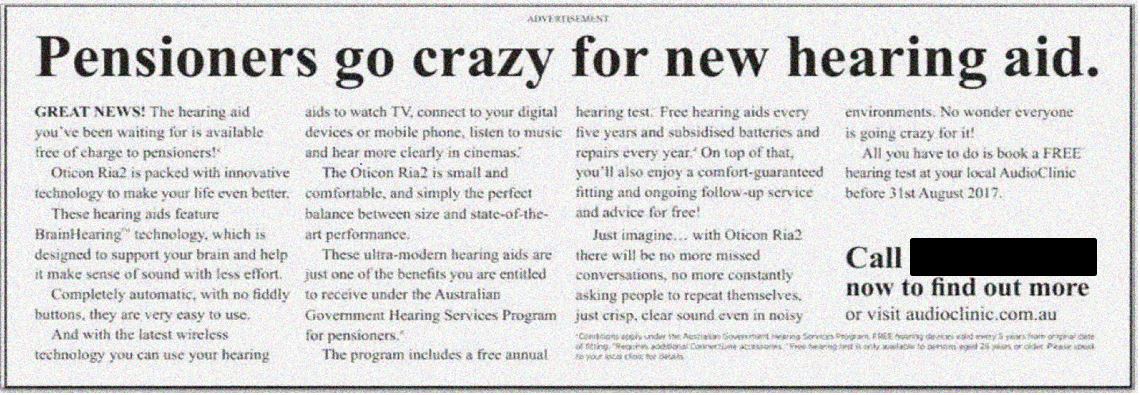
15 The text of the First Oticon advertisement was as follows:
Advertisement
Pensioners go crazy for new hearing aid.
GREAT NEWS! The hearing aid you’ve been waiting for is available free of charge to pensioners!*
Oticon Ria2 is packed with innovative technology to make your life even better.
These hearing aids feature Brain HearingTM technology, which is designed to support your brain and help it make sense of sound with less effort. Completely automatic, with no fiddly buttons, they are very easy-to-use.
And with the latest wireless technology you can use your hearing aids to watch TV, connect to your digital devices or mobile phone, listen to music and hear more clearly in cinemas.*
The Oticon Ria2 is small and comfortable, and simply the perfect balance between size and state-of-the-art performance.
These ultra-modern hearing aids are just one of the benefits you are entitled to receive under the Australian Government Hearing Services Program for Pensioners.*
The program includes a free annual hearing test. Free hearing aids every five years and subsidised batteries and repairs every year. On top of that, you’ll also enjoy a comfort-guaranteed fitting and ongoing follow-up service and advice for free!
Just imagine… With Oticon Ria2 there will be no more missed conversations, no more constantly asking people to repeat themselves, just crisp, clear sound even in noisy environments. No wonder everyone is going crazy for it!
All you have to do is book a FREE* hearing test at your local AudioClinic before 31st August 2017.
Call [telephone number] now to find out more or visit audioclinic.com.au
16 At the base of the advertisement the following was stated in exceptionally small print:
*Conditions apply under the Australian Government Hearing Services Programme FREE hearing devices valid every five years from original date of fitting. Requires additional ConnectLine accessories. Free hearing test is only available to persons aged 26 years or older. Please speak to your local clinic for details.
17 In my view, this small print would be extremely difficult for a person of advanced years to read (let alone a more youthful reader) and the ordinary pensioner reading the advertisement would, in my view, act completely reasonably in failing to read the small print.
3.2.2 The first Sonic advertisement
18 In the period from 23 August 2017 to 6 October 2017, Sonic also published newspaper advertisements concerning the Sonic Cheer20 hearing aid (the First Sonic advertisement) (Agreed Facts at [19]). A copy of the First Sonic advertisement is at Annexure C to the Concise Statement. The text and layout of the first Sonic advertisement was in substantially similar terms and was formatted, including as to font size, in the same manner as the first Oticon advertisement. The first Sonic advertisement read as follows:
Advertisement
Pensioners go crazy for new hearing aid.
GREAT NEWS! The hearing aid you’ve been waiting for is available free of charge to pensioners!*
Sonic Cheer20 is packed with innovative technology to give you clear and natural sound.
A key feature of this hearing aid is an advanced noise management system that helps you to hear better in most environments. It reduces unwanted background sounds to make clear speech the priority, and removes annoying feedback for squeal-free, easy listening.
With the latest technology, you can use your hearing aids to connect to your mobile phone for calls, watch TV or listen to music, all with the crystal clear sound.*
Sonic Cheer20 is discreet, comfortable, with the perfect balance of size, state-of-the-art performance.
These ultra-modern hearing aids are just one of the benefits you are entitled to receive under the Australian Government Hearing Services Program for pensioners.* The program includes a free annual hearing test,* free hearing aids every five years and subsidised batteries and repairs every year.* On top of that, you will also enjoy a comfort-guaranteed fitting, and ongoing follow-up service and advice for free!
Just imagine… with Sonic Cheer20 there will be no more missed conversations, no more constantly asking people to repeat themselves, just crisp, clear sound even in noisy environments. No wonder everyone is going crazy for it!
All you have to do is book a FREE hearing check* at your local HearingLife clinic before 30 September 2017.
Call [telephone number] now to find out more or visit hearinglife.com.au
19 At the base of the advertisement was the following exceptionally small print which read as follows:
Conditions apply to clients under the Australian Government Hearing Services Program. FREE hearing devices valid every five years from original date of fitting. Wireless capability requires SoundGate3. Audio streaming from and digital home phone requires TV and phone adapters. Free hearing check is only available to adults aged 26 years or older. Please speak to your local clinic for details.
20 The same points which I made earlier regarding similarly small print at the end of the First Oticon advertisement apply with equal force to this advertisement: see above at [17].
3.2.3 The second Oticon advertisement
21 In the period from 20 September 2017 to 1 November 2017, Oticon published revised newspaper advertisements concerning the Oticon Ria2 hearing aid (the Second Oticon advertisement) (Agreed Facts at [20]). A copy of the Second Oticon advertisement is at Annexure B to the Concise Statement was reproduced as follows:
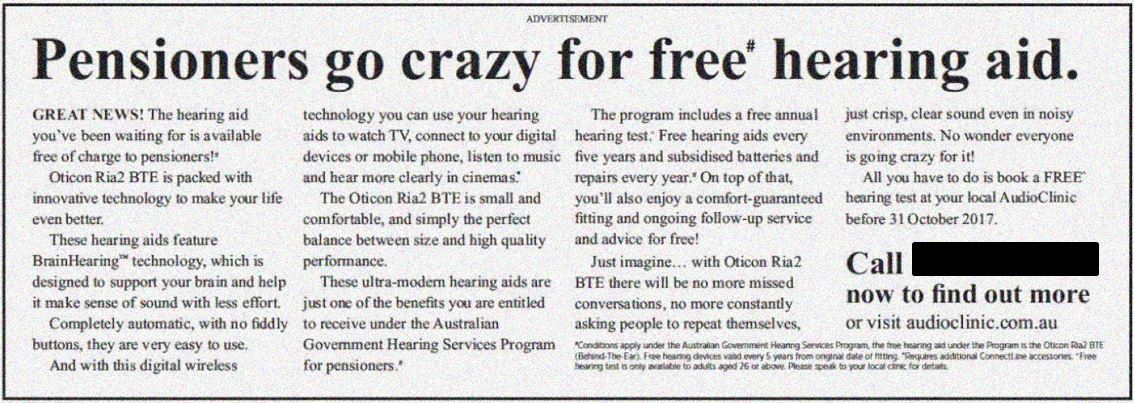
22 It can be seen that the text and formatting of the advertisement was the same as the first Oticon advertisement save for the following amendments: the reference to “go crazy for new hearing aid’ was replaced with “go crazy for free# hearing aid”; “the latest wireless technology” was replaced with “this digital wireless technology”; “state of the art performance” was replaced by “high quality performance”; “Oticon Ria 2” was replaced by “Oticon Ria2 BTE”; and the date by which it was said that the free hearing test should be booked was amended from 31 August 2017 to 31 October 2017. The small text in the Second Oticon advertisement also specified that “the free hearing aid under the Program is the Oticon Ria2 BTE (Behind-The-Ear).”
3.2.4 The second Sonic advertisement
23 In the period from 24 September 2017 to 28 October 2017, Sonic published revised newspaper advertisements concerning the Sonic Cheer20 hearing aid (the Second Sonic advertisement) (Agreed Facts at [21]). A copy of the Second Sonic advertisement is at Annexure D to the Concise Statement. Save for amending the reference to “go crazy for new hearing aid’ with “go crazy for free hearing aid”; “[w]ith the latest technology” with “[w]ith this digital technology” and “state of the art performance” to “high quality performance”, the only other relevant change made to the advertisement was to the date by which it was said that the free hearing test should be booked, namely from 30 September 2017 to 31 October 2017.
24 On 31 October 2017, the ACCC wrote to Oticon about the First Oticon advertisement. There was no evidence before me as to the ACCC’s contact with Sonic. In any event, by 1 November 2017, both Oticon and Sonic had ceased to cause the publication of all four versions of the advertisements (Agreed Facts at [15]).
4. THE STATUTORY CAUSES OF ACTION
25 Oticon and Sonic have admitted to contraventions of ss 18 and 29(1)(g), (i) and (m). Subsection 18(1) of the ACL provides that:
A person must not, in trade or commerce, engage in conduct that is misleading or deceptive or is likely to mislead or deceive.
26 Section 29 of the ACL relevantly provides that:
(1) A person must not, in trade or commerce, in connection with the supply or possible supply of goods or services or in connection with the promotion by any means of the supply or use of goods or services:
(g) make a false or misleading representation that goods or services have sponsorship, approval, performance characteristics, accessories, uses or benefits; or
…
(i) make a false or misleading representation with respect to the price of goods or services; or
…
(m) make a false or misleading representation concerning the existence, exclusion or effect of any condition, warranty, guarantee, right or remedy…;
27 The applicable principles are well established and may be briefly stated.
28 First, it was properly not in issue that representations may constitute “conduct” for the purposes of s 18 of the ACL: see e.g. Global Sportsman Pty Ltd v Mirror Newspapers Pty Ltd (1984) 2 FCR 82 (Global Sportsman) at 87-88 (the Court); and Australian Competition and Consumer Commission v Coles Supermarkets Australia Pty Limited [2014] FCA 634; (2014) 317 ALR 73 (holding relevantly that s 18 had been breached by false or misleading representations about par-baked bread).
29 Secondly, conduct is “likely” to mislead or deceive for the purposes of (now) s 18 if there is “a real or not remote chance or possibility regardless of whether it is less or more than fifty per cent’”: Global Sportsman at 87 (the Court) (citations omitted); see also in relation to s 9 of the Fair Trading Act 1999 (Vic) which is in the same terms as s 18, Noone (Director of Consumer Affairs Victoria) v Operation Smile (Australia) Inc [2012] VSCA 91; (2012) 38 VR 569 at [60] (Nettle JA) (Warren CJ and Cavanough AJA agreeing relevantly at [33]). There is however no requirement to establish that significant members of the public have been misled: .au Domain Administration Ltd v Domain Names Australia Pty Ltd [2004] FCA 424; (2004) 207 ALR 521 (.au Domain) at [25] (Finkelstein J). Furthermore, it is not necessary to show that the consumers may have been misled into actually purchasing the product. It suffices if consumers are “enticed into ‘the marketing web’ by an erroneous belief engendered by an advertiser, even if the consumer may come to appreciate the true position before a transaction is concluded”: Australian Competition and Consumer Commission v TPG Internet Pty Ltd [2013] HCA 54; (2013) 250 CLR 640 (TPG Internet) at [50] (French CJ, Crennan, Bell and Keane JJ)
30 Thirdly, there is no meaningful difference between the words “misleading or deceptive” and “mislead or deceive” in s 18 of the ACL, “false or misleading” in subs 29(1)(a), and “mislead” in s 33: Australian Competition and Consumer Commission v Birubi Art Pty Ltd [2018] FCA 1595 at [62] (Perry J).
31 Fourthly, the question of whether representations are misleading or deceptive or likely to mislead or deceive is a question of fact: Australian Competition and Consumer Commission v Telstra Corporation Ltd [2004] FCA 987; (2004) 208 ALR 459 at [49] (Gyles J). The question of whether conduct is misleading or deceptive (or likely to be so) is objective and “… is concerned with the effect or likely effect of conduct upon the minds of those by reference to whom the question of whether the conduct is or is likely to be misleading or deceptive falls to be tested”: Global Sportsman at 87 (the Court). Similarly as French CJ explained in Campbell v Backoffıce Investments Pty Ltd [2009] HCA 25; (2009) 238 CLR 304 at [25], and as was subsequently endorsed in TPG Internet at [49], the characterisation of conduct as misleading or deceptive or as likely to mislead or deceive “generally requires consideration of whether the impugned conduct viewed as a whole has a tendency to lead a person into error”.
32 Finally, the question of whether the representation or conduct had a tendency to lead a consumer into error can meaningfully be addressed only once the class of persons likely to be affected and their relevant attributes have been identified. As Gibbs CJ held in Parkdale Custom Built Furniture Pty Ltd v Puxu Pty Ltd (1982) 149 CLR 191 at 199:
…consideration must be given to the class of consumers likely to be affected by the conduct. Although it is true, as has often been said, that ordinarily a class of consumers may include the inexperienced as well as the experienced, and the gullible as well as the astute, the section must in my opinion by [sic] regarded as contemplating the effect of the conduct on reasonable members of the class. The heavy burdens which the section creates cannot have been intended to be imposed for the benefit of persons who fail to take reasonable care of their own interests. What is reasonable will [of] course depend on all the circumstances.
See also CPA Australia Ltd v Dunn [2007] FCA 1966 at [27] (Weinberg J); Australian Competition and Consumer Commission v Turi Foods Pty Ltd (No 4) [2013] FCA 665 at [75] (Tracey J); .au Domain at [15] (Finkelstein J); and Campomar Sociedad Limitada v Nike International Ltd [2000] HCA 12; (2000) 202 CLR 45 at [103] (the Court).
5. ADMISSIONS AS TO MISLEADING AND DECEPTIVE, AND FALSE AND MISLEADING, REPRESENTATIONS
33 Oticon and Sonic admit that in the relevant period, they each were aware of the following matters:
a. There was no deadline to obtain a free (or partially subsidised) hearing aid under the Hearing Program. Provided they remain eligible, pensioners could obtain a free (or partially subsidised) hearing aid under the Hearing Program subsequent to the publication deadline.
b. The wireless technology which allowed users to link their hearing aid to other devices, such as televisions, was not included with the free hearing aid at no extra charge, but instead required additional accessories which were sold separately at an extra cost.
c. The performance of a hearing aid, and whether the user of a hearing aid would no longer miss conversations, may depend on a person’s individual circumstances and the nature of his or her hearing impairment.
34 Oticon also admits that by causing the publication of the First and Second Oticon advertisements, it made the deadline representation, the wireless technology included representation, and the no missed conversations representation (as defined at [3] above).
35 Oticon further admits that:
(1) by making the deadline representation, it made false and misleading representations in contravention of s 18 and subs 29(1)(m) of the ACL;
(2) by making the wireless technology included representation, it made false and misleading representations in contravention of s 18 and subs 29(1)(i) of the ACL; and
(3) by making the no missed conversations representation, it made false and misleading representations in contravention of s 18 and subs 29(1)(g) of the ACL.
36 Similarly, Sonic admits that by causing the publication of the First and Second Sonic advertisements:
(1) Sonic made the deadline representation, wireless technology included representation and the no missed conversation representation;
(2) those Representations were false and misleading for the same reasons identified at paragraphs [33]-[34] above; and
(3) by making each of the Representations, Sonic contravened s 18, subs 29(1)(g), 29(1)(i) and 29(1)(m) of the ACL, as set out at paragraph [35] above.
6. GRANT OF DECLARATORY RELIEF
37 As Gordon J noted in ACCC v Coles [2014] at [74], the Court has a wide discretionary power to make declarations under s 21 of the FCA Act: Forster v Jododex Australia Pty Ltd (1972) 127 CLR 421 at 437-438 (Gibbs J) (Forster); Ainsworth v Criminal Justice Commission (1992) 175 CLR 564 at 581-582 (Mason CJ, Dawson, Toohey and Guadron JJ). Nonetheless, as Gordon J also held in ACCC v Coles [2014] at [75]:
Where a declaration is sought with the consent of the parties, the Court’s discretion is not supplanted, but nor will the Court refuse to give effect to terms of settlement by refusing to make orders where they are within the Court’s jurisdiction and are otherwise unobjectionable: see, for example, [Australian Competition & Consumer Commission v Econovite Pty Ltd [2003] FCA 964] at [11].
38 Thus, before making declarations, the Court should be satisfied:
(1) the question is real, and not a hypothetical or theoretical question;
(2) the applicant has a real interest in raising it; and
(3) there is a proper contradictor:
See Forster at 437-438 (Gibbs J).
39 These requirements are satisfied in the present case. First, the proposed declarations relate to conduct that is admitted to contravene the ACL and the proposed declarations contain sufficient indication of how and why the relevant conduct is a contravention of the ACL: BMW Australia Ltd v Australian Competition and Consumer Commission [2004] FCAFC 167; (2004) 207 ALR 452 at [35] (the Court); Australian Securities & Investments Commission v Westpac Banking Corporation [2018] FCA 1733 at [29] (Perram J). Secondly, it is in the public interest both for the ACCC to seek to have the declarations made and for the declarations to be made, and the ACCC, as a regulator under the ACL, has a genuine interest in seeking the declaratory relief. Thirdly, Oticon and Sonic are proper contradictors because they have contravened the ACL and are the subject of the proposed declarations. Furthermore, as Gordon J explained in ACCC v Coles [2014]:
78. … No less importantly, the declarations sought are appropriate because they serve to record the Court’s disapproval of the contravening conduct, vindicate the ACCC’s claim that [the respondent] contravened the ACL, assist the ACCC to carry out the duties conferred upon it by the Act (including the ACL) in relation to other similar conduct, inform the public of the harm arising from Coles’ contravening conduct and deter other corporations from contravening the ACL.
40 Finally, the facts and admissions in the Agreed Facts and annexures to the Concise Statement provide a sufficient factual foundation for the making of the declarations: see subs 191(2) of the Evidence Act 1995 (Cth); Australian Competition and Consumer Commission v Dataline.Net.Au Pty Ltd (in liquidation) [2007] FCAFC 146; (2007) 161 FCR 513 at [91]-[92] (the Court); Hadgkiss v Aldin (No 2) [2007] FCA 2069 at [20]-[23] (Gilmour J); ACCC v Coles [2014] at [79] (Gordon J).
7. CONSIDERATION OF THE APPROPRIATE PENALTY
41 I have already adverted to the task of the Court in cases where the parties have reached agreement as to the making of orders under the ACL: see above at [5]-[7]. It is important however to emphasise that the judicial restraint in scrutinising proposed settlements of controversies under the ALC and its predecessor, the Trade Practices Act 1974 (Cth), means that the Court will not substitute its own view of the orders or undertakings if the agreed orders, including penalties, fall with the range of an appropriate disposition of the case: Australian Competition and Consumer Commission v Real Estate Institute of Western Australia (1999) 161 ALR 79 at [20]-[23] (French J (as his Honour then was)). As Burchett and Kiefel JJ observed in NW Frozen Foods Pty Ltd v Australian Competition and Consumer Commission (1996) 71 FCR 285 (NW Frozen Foods) at 291:
There is an important public policy involved. When corporations acknowledge contraventions, very lengthy and complex litigation is frequently avoided, freeing the courts to deal with other matters, and investigating officers of the Australian Competition and Consumer Commission to turn to other areas of the economy that await their attention. At the same time, a negotiated resolution in the instant case may be expected to include measures designed to promote, for the future, vigorous competition in the particular market concerned. These beneficial consequences would be jeopardised if corporations were to conclude that proper settlements were clouded by unpredictable risks. A proper figure is one within the permissible range in all the circumstances. The court will not depart from an agreed figure merely because it might otherwise have been disposed to select some other figure, or except in a clear case.
(emphasis added)
42 Thus the High Court in Director, Fair Work Building Industry Inspectorate at [57] considered that it was open to the Court to receive submissions, including joint submissions, as to an appropriate penalty, and noted there was generally considerable scope given to parties to agree on an appropriate remedy.
43 The principles governing the imposition of a penalty were not in dispute. Under s 224 of the ACL, the Court is empowered to order a person to pay to, relevantly, the Commonwealth “such pecuniary penalty, in respect of each act or omission by the person to which [s 224] applies, as the court determines to be appropriate”. That provision applies relevantly only to the contraventions of s 29 of the ACL which is located within Part 3-1 of the ACL. Section 224 has no application to the contraventions of s 18.
44 Subsection 224(2) provides that in determining the appropriate pecuniary penalty, the Court must have regard to all relevant matters including (but not limited to):
(1) the nature and extent of the act or omission and of any loss or damage suffered as a result of the act or omission;
(2) the circumstances in which the act or omission took place; and
(3) whether the person has previously been found by a court in proceedings under Chapter 4 or Part 5-2 of the ACL to have engaged in any similar conduct.
45 Otherwise, potentially relevant factors include:
(1) the size of the contravening company;
(2) the degree of power of the contravener, as evidenced by its market share and ease of entry into the market;
(3) the deliberateness of the contravention and the period over which it extended;
(4) whether the contravention arose out of the conduct of senior management of the contravener or at some lower level;
(5) whether the contravener has a corporate culture conducive to compliance with the ACL as evidenced, for example, by educational programs and disciplinary or other corrective measures in response to an acknowledged contravention;
(6) whether the contravener has shown a disposition to cooperate with the authorities responsible for the enforcement of the ACL in relation to the contravention;
(7) the effect of the conduct on the functioning of the markets and other economic effects;
(8) the financial position of the contravener;
(9) whether the contravening conduct was systematic, deliberate or covert.
See: Trade Practices Commission v CSR Limited (1991) 13 ATPR ¶41-076 at [52152] (French J (as his Honour then was)); NW Frozen Foods at 290 (Burchett and Kiefel JJ); Australian Competition and Consumer Commission v Singtel Optus Pty Ltd (No 4) [2011] FCA 761; (2011) 282 ALR 246 at [11] (Perram J) (reversed on appeal in Singtel Optus Pty Ltd v Australian Competition and Consumer Commission [2012] FCAFC 20; (2012) 287 ALR 249 (Singtel Optus (FCAFC)), but not in a relevant respect).
46 However, this list is not exhaustive and should not be approached in a regimental or formulaic way as “[t]o do that would impermissibly constrain or formalise what is, at the end of the day, a broad evaluative judgment”, as Wigney J observed in Australian Competition and Consumer Commission v Visa Inc [2015] FCA 1020 (ACCC v Visa) at [81]-[83]. Thus, as I explained in Australian Competition and Consumer Commission v Homeopathy Plus! Australia Pty Ltd (No 2) [2015] FCA 1090 (Homeopathy Plus!):
23. The process of arriving at the appropriate sentence for a criminal offence involves an intuitive or instinctive synthesis of all of the relevant factors: Markarian v The Queen [2005] HCA 25; (2005) 228 CLR 357… at 373-374 [35]-[37] (Gleeson CJ, Gummow, Hayne and Callinan JJ). The same approach has been held to apply to civil penalties under the ACL and its predecessor provision in the Trade Practices Act 1974 (Cth): TPG Internet Pty Ltd v Australian Competition and Consumer Commission [2012] FCAFC 190; (2012) 210 FCR 227 at 294 [145] (the Court); Australian Competition and Consumer Commission v EnergyAustralia Pty Ltd [2015] FCA 274 at [103] (Gordon J); Australian Competition and Consumer Commission v Coles Supermarkets Australia Pty Limited [2015] FCA 330 (ACCC v Coles) at [6] (Allsop CJ). Instinctive synthesis was helpfully described by McHugh J in Markarian as meaning “the method of sentencing by which the judge identifies all the factors that are relevant to the sentence, discusses their significance and then makes a value judgment as to what is the appropriate sentence given all the factors of the case” (at 378 [51]). In short, as Gaudron, Gummow and Hayne JJ explained in Wong v The Queen [2001] HCA 64; (2001) 207 CLR 584 at 611 [75] (in a passage approved in Markarian at 374 [37]), “the task of the sentencer is to take account of all of the relevant factors and to arrive at a single result which takes due account of them all” (emphasis in original).
See also by analogy Barbaro v The Queen [2014] HCA 2; (2014) 253 CLR 58 (Barbaro) at [34]-[35] (French CJ, Hayne, Kiefel and Bell JJ).
47 A primary object of the Court in assessing an appropriate penalty where commercial profit is the driver of the contravening conduct is general and specific deterrence: TPG Internet at [65]. Thus, as the Full Court of the Federal Court said in a passage approved in TPG Internet at [66], “in relation to offences of calculation by a corporation where the only punishment is a fine, the punishment must be fixed with a view to ensuring that the penalty is not such as to be regarded by that offender or others as an acceptable cost of doing business”: Singtel Optus (FCAFC) at [62].
48 In considering the appropriate penalty to secure deterrence, some consideration must also be given to the size and financial position of the contravener. The sum required to achieve that object will be larger where the company has vast resources than in the case of a small company: NW Frozen Foods at 293 (Burchett and Kiefel JJ); ACCC v Visa at [96] (Wigney J); Australian Competition and Consumer Commission v Pental Limited [2018] FCA 491 at [48] (Lee J).
49 In undertaking this process, as I explained in Homeopathy Plus! at [27]:
… careful attention to maximum penalties will always be required because the legislature has legislated for them, they invite comparison between the case before the court and the worst possible case, and they provide, taken and balanced with all of the other relevant factors, a yardstick: [Markarian v The Queen [2005] HCA 25; (2005) 228 CLR 357] at [31] (Gleeson CJ, Gummow, Hayne and Callinan JJ). However, even where the maximum penalty is high and the amount necessary to provide effective deterrence is large, the amount of the penalty cannot be so high as to be oppressive. As Burchett and Kiefel JJ explained in NW Frozen Foods, “[p]lainly, if deterrence is the object, the penalty should not be greater than is necessary to achieve this object; severity beyond that would be oppression” (at 293).
50 Further, as I held in Homeopathy Plus! at [28], the Court may in some cases derive assistance from penalties imposed previously in comparable cases, particularly where those cases establish a pattern or range of penalties imposed for like contraventions.
51 Finally, the totality and course of conduct principles are also relevant to an assessment of pecuniary penalties. As the parties submit, the former requires the Court to consider all of the contravening conduct and to determine whether the total penalty for each offence aggregated together exceeds what is proper for the entire contravening conduct involved (the totality principle): Mill v The Queen (1988) 166 CLR 59 at 63 (Wilson, Deane, Dawson, Toohey, Gaudron JJ) (by analogy). The totality principle operates as a final check. As Goldberg J explained in Australian Competition and Consumer Commission v Australian Safeway Stores Pty Ltd (1997) 145 ALR 36 at 53:
The totality principle is designed to ensure that overall an appropriate sentence or penalty is [imposed] and that the sum of the penalties imposed for several contraventions does not result in the total of the penalties exceeding what is proper having regard to the totality of the contravening conduct involved.
52 The latter principle recognises, as the parties submit, the commonality of legal and factual matters between two or more contraventions, and that a contravening party should not be punished twice for common contraventions. As Middleton and Gordon JJ explained in Construction, Forestry, Mining and Energy Union v Cahill [2010] FCAFC 39; (2010) 269 ALR 1:
39. … The principle recognises that where there is an interrelationship between the legal and factual elements of two or more offences for which an offender has been charged, care must be taken to ensure that the offender is not punished twice for what is essentially the same criminality. That requires careful identification of what is “the same criminality” and that is necessarily a factually specific enquiry.
53 Their Honours then further explained that:
41. … where two offences arise as a result of the same or related conduct that is not a disentitling factor to the application of the single course of conduct principle but a reason why a Court may have regard to that principle, as one of the applicable sentencing principles, to guide it in the exercise of the sentencing discretion: Johnson v R (2004) 205 ALR 346; [2004] HCA 15 at [3] – [4] and [34] and Attorney-General v Tichy (1982) 30 SASR 84 at 92 – 3... It is a tool of analysis (Tichy at 93) which a Court is not compelled to utilise: Royer v Western Australia [2009] WASCA 139 at [21]-[34] and [153]-[156] (Royer).
(emphasis in the original)
7.2 Quantifying the contraventions: maximum penalty and the course of conduct principle
54 Section 29 of the ACL is contravened on each occasion that a false or misleading statement is made to a person. As for example Beach J held in Australian Competition and Consumer Commission v Hillside (Australia New Media) Pty Ltd trading as Bet365 (No 2) [2016] FCA 698:
12. … each communication of the “Free Bets” offer via the Bet365 website to each person that viewed the website involved a separate contravening act by Hillside Australia and Hillside UK for the purposes of s 224(1) and (3). A contravention of s 29 occurs each time a false representation is made. A representation is made when there is a communication of some form.
55 The maximum civil penalty under s 224 of the ACL as at the time of the conduct for each act or omission by a corporation which constitutes a contravention of s 29(1) is $1.1 million. If the view were taken that each individual advertisement constituted a contravention, the maximum notional penalty could exceed hundreds of millions of dollars. As such, the parties submitted that this was not an appropriate case in which the Court should commence with a maximum penalty arrived at on a purely mathematical basis for each individual advertisement from which discounts would then be subtracted. I agree that that approach would be inconsistent with both the totality and the course of conduct principles. Rather, I consider that it is appropriate, as the parties submit, to analyse the conduct in terms of the limited course of conduct undertaken by each of the respondents, with each version of the advertisements published being analysed as a course of conduct. On this approach, there are two courses of conduct for Oticon, namely: the first course of conduct stemming from Oticon’s decision to publish the first Oticon advertisement, and the second course of conduct stemming from the fresh decision by Oticon to publish the second Oticon advertisement. The same reasoning applies equally to Sonic, with the result that there were also two courses of conduct undertaken by Sonic.
56 I also note in this regard that a course of conduct may attract a maximum penalty which exceeds the maximum penalty for a single contravention. As the Full Court recently held in Australian Competition and Consumer Commission v Yazaki Corporation [2018] FCAFC 73; (2018) 357 ALR 55 at [230], “to treat a number of contraventions as subject to one maximum penalty … is to treat them, impermissibly, as one contravention”: see e.g. Australian Competition and Consumer Commission v Coles Supermarkets Australia Pty Limited [2015] FCA 330; (2015) 327 ALR 540 (ACCC v Coles [2015]) at [20] (Allsop CJ). Further, the Full Court has also recently observed that, just as the Court may approve a compromise of pecuniary penalty proceedings on terms proposed by the parties if satisfied that what is proposed is appropriate, so may the Court accept a proposal to impose a single penalty for multiple contraventions where it is persuaded as to the appropriateness of that course in the circumstances of the case: Australian Competition and Consumer Commission v Construction, Forestry, Mining and Energy Union [2017] FCAFC 113; (2017) 254 FCR 68 at [146] (the Court).
57 Adopting this broad view of the conduct of Oticon and Sonic leading to the contraventions and having regard to the mandatory considerations prescribed by subs 224(2) and the other considerations set out below, I accept that pecuniary penalties proposed in the sum of $1.25 million against each of Oticon and Sonic are appropriate.
7.3 Mandatory factors relevant to penalty
7.3.1 The nature and extent of the acts or omissions and any loss or damage suffered (subs 224(2)(a))
58 The nature of the contravening acts is, in each case, the publication of false and misleading representations by the respondents in connection with the supply of hearing aid devices, accessories and hearing services to Australian pensioners. I have earlier described the advertisements and the respects in which they were likely to mislead or deceive that class of consumers. Furthermore, the use of the word “free”, particularly when coupled with the deadline representation and the no missed conversations representation, is likely to have conveyed a compelling sales message to potential customers to act, and to act quickly, to book the hearing test and qualify for the free deal. The presentation of the advertisements reinforced those messages, emphasising the momentum to act quickly through the headlines “Pensioners go crazy for new hearing aid” in the first Oticon and Sonic advertisements and Pensioners go crazy for free hearing aid” in their second respective advertisements (emphasis added), and to call the number given “now”, as well as relegating the terms and conditions to extremely fine print.
59 The extent of the contravening conduct was set out in detail in the tables at Annexures A to D of the Concise Statement. In short a total of 85 advertisements were published in a five month period in 2017 as follows:
(1) in the period from 17 June 2017 to 13 September 2017 Oticon published the first advertisement relating to the Oticon Ria2 range of hearing aids in 17 newspapers with a total of 35 runs;
(2) in the period from 23 August 2017 to 6 October 2017, Sonic published the first advertisement relating to the Sonic Cheer20 range of hearing aids in nine newspapers with a total of 16 runs;
(3) in the period from 20 September 2017 to 1 November 2017, Oticon published the second advertisement relating to the Oticon Ria2 BTE range of hearing aids in 14 newspapers on a total of 24 occasions; and
(4) in the period from 24 September 2017 to 28 October 2017, Sonic published the second advertisement relating to the Sonic Cheer20 range of hearing aids in 10 newspapers on with a total of 10 runs.
60 In each case, the advertisements were published nationally across a suite of major state based newspapers such as the Daily Telegraph in New South Wales, the Adelaide Advertiser in South Australia, the Courier Mail in Queensland, and in The Australian which has a national circulation.
61 Following the publication of both the First Oticon Advertisement, Oticon and Sonic received reports that some customers had queried whether they would be eligible for the advertised hearing aids if their hearing tests were booked on a date after the expiry of deadlines in the advertisements. Whether Sonic received similar reports in respect of its advertisements is not clear on the Agreed Facts. However, the parties agree that Oticon and Sonic were aware from these reports that some consumers had interpreted the First Oticon advertisement and First Sonic advertisement as indicating that they would be entitled to a free hearing aid only if they booked a hearing test before the deadline indicated in those advertisements. Oticon and Sonic then revised the terms of the advertisements, resulting in the publication of the Second Oticon and Second Sonic advertisements. However, the Second Oticon and Second Sonic advertisements conveyed the same false and misleading representations as the First Oticon and First Sonic advertisements, as set out at paragraph [34] to [36] above.
62 In the relevant period, Oticon and Sonic sold collectively in excess of 10,000 hearing aids in the advertised ranges (Agreed Facts at [24]).
63 However, there is no evidence before the Court that the acts or omissions caused any loss or damage to any customers and the point was not the subject of admissions. The parties rightly submitted that the absence of such evidence is not determinative of whether harm was caused to customers as the parties submit (citing ACCC v Coles [2015] at [54]-[61] (Allsop CJ)). As such, I understand the parties to have accepted the possibility that the misrepresentations may have caused loss or damage to customers. Such loss or damage might have been, for example, the loss of an opportunity to make a different purchasing choice in respect of subsidised hearing aids or accessories, particularly given the pressure to buy within a limited period which the false deadline representation was likely to convey: see by analogy ACCC v Coles [2015] at [57] (Allsop CJ).
7.3.2 The circumstances in which the contraventions took place (subs 224(2)(b))
64 The circumstances have been outlined at [58]-[63] above. Further, the process by which the advertisements came to be published involved employees at the senior management level at both Oticon and Sonic reviewing and authorising the text and layout of the advertisements (Agreed Facts at [25]).
7.3.3 Whether the respondents have previously engaged in similar conduct (subs 224(2)(c))
65 The parties are agreed that Oticon and Sonic have not previously been found to have contravened the CCA or ACL (Agreed Facts at [32]).
7.4 Other factors relevant to penalties
7.4.1 The size and financial position of Oticon and Sonic
66 Oticon and Sonic are market leaders in the sale of hearing aid devices. As at 29 August 2018:
(1) Oticon operated 108 permanent AudioClinic hearing clinics around Australia and employed a total of 416 staff across all its retail brands (including AudioClinic) (Agreed Facts at [3]); and
(2) Sonic operated 67 permanent HearingLife clinics around Australia, employing 376 staff across its retail brands (including HearingLife) (Agreed Facts at [4]).
67 For 2017, calculated as at 31 December 2017, Oticon’s revenue was in excess of $83 million, with an after-tax profit of in excess of $3 million (Agreed Facts at [5]). Sonic’s revenue for 2017 as calculated at 31 December 2017 was in excess of $48 million with an after-tax profit of in excess of $1.7 million (Agreed Facts at [6]).
7.4.2 The deliberateness of the respondents’ conduct
68 There is no evidence that Oticon and Sonic set out to deliberately mislead consumers. However, as earlier mentioned, senior management personnel of both companies reviewed the advertisements and approved their publication (Agreed Facts at [25]).
69 Furthermore, in the advertisements, Oticon and Sonic each targeted customers over 65 years of age who received a pension from the Australian Government, and who suffered hearing impairment (Agreed Facts at [23]). More specifically, the parties are agreed that Oticon and Sonic’s conduct was deliberate in the sense that:
(1) The “Pensioners go crazy for…” advertisement was used by Oticon and Sonic to seize the attention of elderly consumers in receipt of a pension from the Australian Government, which as a group included vulnerable consumers.
(2) The terms of the advertisements, and in particular, the deadline representation were designed to create a sense of urgency or “fear of missing out” to prompt consumers to book a hearing test. Oticon and Sonic were aware that no such deadline existed under the Hearing Program, and that a person who was eligible for a subsidised device could obtain that device at any time.
(3) Oticon and Sonic knew that the accessories which were advertised as included with the free hearing aid were in fact sold separately, at an additional cost.
(4) Oticon and Sonic were also aware of the need to be careful about the use of the word “free” in connection with advertising, so as to avoid misleading customers.
(5) Oticon and Sonic knew that whether the user of a hearing aid would no longer miss conversations may depend on the user’s individual circumstances and the nature of his or her hearing impairment.
(Agreed Facts at [29])
70 Furthermore, Oticon and Sonic continued to include the deadline representation in the revised versions of the advertisements notwithstanding reports that customers had queried their eligibility for the advertised hearing aids in circumstances where the hearing tests were being booked at times after the deadline stipulated in the advertisements (Agreed Facts at [26]). As such, as the parties submit, this demonstrates that the advertisements had the effect intended by Oticon and Sonic. In addition, as I earlier explained, senior personnel in both respondent companies authorised the text and design of the advertisement which relegated the terms and conditions to fine print, including those terms and conditions relating to the purchase of additional accessories for wireless technology: see above at [16]-[17], [19]-[20], [22] and [23].
71 Finally, Oticon and Sonic were aware that the performance of a hearing aid and the question of whether the user would no longer miss conversations may depend upon the user’s individual circumstances and the nature of her or his hearing impairment (Agreed Facts at [38]). Yet that information was not conveyed by the advertisements. Rather, Oticon and Sonic authorised publication of the advertisement which conveyed the impression that any user of the advertised hearing aids would no longer miss conversations irrespective of their individual circumstances.
7.4.3 Senior management involvement in the conduct
72 With respect to the preparation, review and authorisation of the advertisements for publication:
(1) Oticon and Sonic engaged a third party to assist in the preparation of the text and layout of the advertisements;
(2) marketing personnel of Oticon and Sonic gave instructions to the third party in respect of the text and layout of the advertisements;
(3) senior management personnel of Oticon and Sonic reviewed the text and layout of the draft advertisements produced by the third party, based on the instructions from Oticon and Sonic; and
(4) senior management personnel of Oticon and Sonic authorised publication of the advertisements.
(Agreed Facts at [25])
7.4.4 Whether the companies have a corporate culture conducive to compliance with the CCA
73 Oticon and Sonic each have an existing compliance program that requires employees to review their Competition & Consumer Law Compliance Policy Manual every two years, or whenever there is a material change to the legislation. Furthermore, Oticon and Sonic have a regime in place to monitor employee compliance with this regime (Agreed Facts at [34]). Oticon and Sonic have also recently made improvements to the existing compliance program, including to the pre-publication clearance process (Agreed Facts at [35]).
74 In addition to this regime, Oticon and Sonic each have committed to the establishment and implementation of an ACL Compliance Program which accords with the Level 4 Compliance Program published by the ACCC or, failing that, in terms ordered by the Court. That Compliance Program is to be maintained by Oticon and Sonic for three years from 31 October 2018 (Agreed Facts at [36]). The template Level 4 compliance program is appropriate for large corporate entities and is appropriately rigorous. It requires among others things, the appointment of a suitably qualified compliance professional to conduct a competition and consumer law risk assessment, and the appointment of a director or senior manager as a Compliance Officer responsible for reporting to the Board and/or senior management. The program also provides for whistleblower protection, staff training, and annual compliance review. In addition, it requires the respondents to report material failures to the ACCC and maintain records relating to the compliance program to be provided to the ACCC if requested.
7.4.5 Whether the contraveners have shown a disposition to cooperate with the authorities responsible for the enforcement of the ACL in relation to the contravention
75 Oticon and Sonic have each provided a high level of cooperation with the ACCC from an early stage. Since discontinuing the advertisements after the ACCC raised concerns, Oticon and Sonic have not published any advertisements in terms that are the same, or substantially the same, as the advertisements in question (Agreed Facts at [30]). Further, Oticon and Sonic each admitted the contraventions of s 18 and subs 29(1)(g), (i) and (m) of the ACL (Agreed Facts at [40] and [41]). Oticon and Sonic have also agreed to injunctions being made against them restraining them from making similar false representations in connection with the supply of hearing aid devices for three years, and have committed to undertaking an extensive communication, refund and compliance regime.
76 I agree with the joint submission that the cooperative attitudes of Oticon and Sonic has saved the ACCC from incurring substantial cost in connection with the proceeding and conserved valuable Court resources. I also agree that this factor should be given considerable weight and that Oticon and Sonic are each entitled to a significant discount in penalty for this cooperation which is appropriately reflected in the agreed penalty amount.
77 While caution must be exercised in referring to penalties in other cases, as I earlier said at [50] above some assistance may be gleaned from penalties imposed in other cases. In the present case, suffice it to say that the authorities referred to in the Schedule of Precedents jointly handed up by the parties indicate that the proposed penalty is within an appropriate range.
78 Finally, given Oticon and Sonic’s agreement to the injunctions and to the fact that they ceased publishing the advertisements by 1 November 2017, I am comfortably satisfied that Oticon and Sonic are likely to abide by the proposed injunctive orders.
7.5 The appropriateness of the agreed penalties
79 Having regard to the matters set out above, I considered that the proposed penalty was appropriate for the following reasons.
80 First, it is important to ensure that a penalty be imposed that is likely to be effective in sending a strong message of deterrence to Oticon and Sonic and to other potential wrongdoers from engaging in similar conduct. The public importance of so doing is heightened given that the conduct was directed towards a vulnerable class, namely, elderly Australians in receipt of government pensions. As the parties submitted, Australia has an ageing population and it must be made clear to businesses that it is unacceptable to deploy advertising tactics which seize upon the vulnerabilities of a growing class of consumers in Australia.
81 Secondly, the conduct involved a national newspaper campaign with multiple runs over a period of five months. As such, while there is no evidence of direct consumer harm, the misleading and deceptive advertisements were likely to have been read by a large number of Australians as the parties accepted in the joint submission.
82 Thirdly, I considered that the proposed penalty was serious when the size and position in the market of Oticon and Sonic are considered.
83 Fourthly, I give significant weight to the high degree of cooperation demonstrated by Oticon and Sonic from the outset with the ACCC investigation and in seeking to resolve these proceedings by agreement as soon as they were advised of the ACCC’s intention to commence proceedings. As the parties submitted, this has avoided the need for a contested proceeding resulting in cost and resource savings for a publicly funded regulator, and savings in terms of Court time and resources (see also Australian Competition and Consumer Commission v Apple Pty Ltd (No 4) [2018] FCA 953 at [6] (Lee J)). It has also enabled the matter to be resolved within a short timeframe facilitating the timely implementation of the remediation and compliance regimes. This is also the first occasion in which proceedings have been instituted against Oticon and Sonic for contraventions of the CCA or the ACL.
84 On the balance therefore I considered that the penalty proposed by the parties fell with the range of an appropriate penalty.
85 For these reasons, I considered that it was appropriate at the conclusion of the hearing on 31 October 2018 to make declarations and orders in the terms proposed by the parties.
I certify that the preceding eighty-five (85) numbered paragraphs are a true copy of the Reasons for Judgment herein of the Honourable Justice Perry. |
Associate:


