

FEDERAL COURT OF AUSTRALIA
EGN17 v Minister for Immigration and Border Protection [2018] FCA 1810
ORDERS
Appellant | ||
AND: | MINISTER FOR IMMIGRATION AND BORDER PROTECTION First Respondent IMMIGRATION ASSESSMENT AUTHORITY Second Respondent | |
DATE OF ORDER: |
THE COURT ORDERS THAT:
2. The appellant pay the first respondent’s costs as agreed or assessed.
Note: Entry of orders is dealt with in Rule 39.32 of the Federal Court Rules 2011.
MARKOVIC J:
1 This is an appeal from orders made on 13 March 2018 by the Federal Circuit Court of Australia (Federal Circuit Court) dismissing an application for judicial review of a decision of the Immigration Assessment Authority (Authority): see EGN17 v Minister for Immigration [2018] FCCA 599 (EGN17). The Authority had affirmed a decision made by a delegate of the first respondent (Minister) not to grant the appellant a Safe Haven Enterprise visa (SHEV).
BACKGROUND
2 The following background, which is not in contention, is principally taken from the appellant’s submissions.
3 The appellant is an Iraqi citizen of Arab ethnicity and a Shia Muslim. On 2 December 2016 he lodged his application for the SHEV making the following claims:
(1) he was born in and spent most of his life in Basra;
(2) his father worked with the American forces in Iraq in 2005 as an interpreter and was threatened by the militia causing him to give up his job as an interpreter;
(3) in 2010 he gave up his occupation as a self-employed carpenter and joined a security company which provided security to foreign companies working in Iraq’s southern oil fields;
(4) in early 2011 and March 2011 he received two threatening letters. After receipt of the second letter, the appellant departed Iraq for Syria for around 10 days;
(5) as there were political demonstrations in Syria he decided to return to Iraq and resumed employment with the security company. He continued to work there until the end of 2011 when he was shot at in his car. Thereafter he went back to working as a carpenter;
(6) in about March 2012 a group of Asa’ib Ahl al-Haq (AAH) members came to the appellant’s shop and tried to intimidate him. One of the AAH members told the appellant he would kill him but was waiting for the order to do so. A few weeks after that and many times subsequently AAH members came to the appellant’s shop and took items;
(7) in the first week of April 2013 AAH members came to the appellant’s shop and informed him that they would return to collect a bed which the appellant was making. The appellant objected and the group informed him that they would consider his fate. The appellant finished the item, delivered it to his customer and departed Iraq;
(8) after the appellant left Iraq, militia members informed the appellant’s brother that if they found the appellant they would kill him;
(9) the appellant’s university qualifications could not secure him any employment because he was not loyal to any militia;
(10) his brother, who has fled to Finland, is a former police officer and the appellant could be harmed for that reason; and
(11) effective protection is not available in Basra because of the vacuum of power and relocation is not an option as the militia would target him wherever he is in Iraq.
4 The application for a SHEV was refused by a delegate of the Minister on 28 March 2017.
5 On 31 March 2017 the Minister’s decision was referred to the Authority for review. On 7 September 2017 the Authority affirmed the decision of the delegate of the Minister not to grant the appellant the SHEV.
6 The appellant sought judicial review of the Authority’s decision in the Federal Circuit Court. On 5 March 2018 he filed a further amended application.
7 On 13 March 2018 the application was listed for hearing in the Federal Circuit Court. The primary judge delivered ex tempore reasons dismissing the application.
the authority’s decision
8 The Authority accepted that:
(1) the appellant is an Iraqi citizen and a Shia Muslim of Arab ethnicity who was born and spent most of his life in Basra in the south of Iraq, apart from the few weeks he spent in Syria;
(2) the appellant had the university qualifications he claimed and it was plausible that he may not have been able to obtain employment consistent with his tertiary qualifications because of nepotism or discrimination;
(3) one of the appellant’s brothers may now be residing in Finland;
(4) the appellant’s father was employed as an interpreter for the American forces between 2003 and 2005 and in 2005 his father was threatened by militia as a result of his work with the Americans and gave up his job. His father was unwell from 2005 and died in 2013;
(5) the demand for the appellant’s carpentry may have diminished, high wages offered by the security company, which motivated him to accept a security supervisor role with it and from 2010 until the end of 2011 he concurrently worked as a self-employed carpenter and a supervisor of security guards for that company;
(6) the appellant received two unsigned threatening letters in the first three months of 2011 and he reported the first letter to the police but no action was taken as the perpetrator of the threat was unknown;
(7) the appellant left Iraq for Syria for a short time and upon his return resumed working for the security company;
(8) in late 2011 shots were fired at the appellant’s car by unknown persons but found that the appellant’s claim that militia fired at him to be speculative; and
(9) after the shooting the appellant stopped working for the security company and continued to work as a carpenter only.
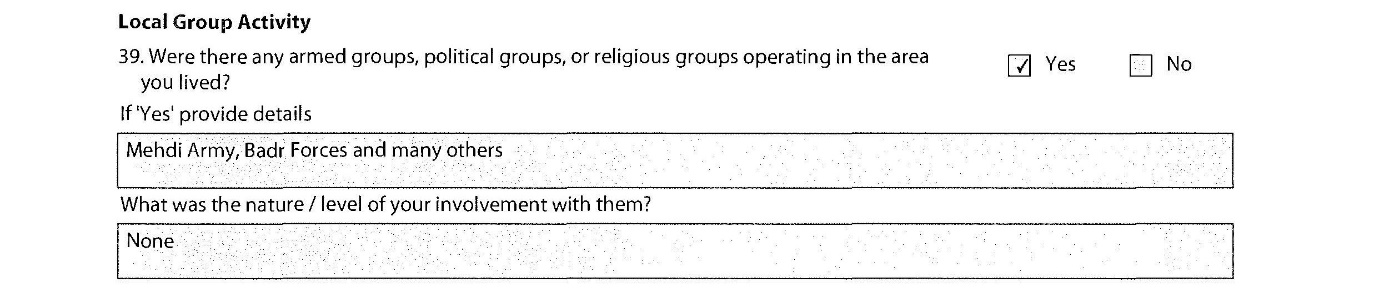
9 The Authority did not accept that:
(1) the appellant’s brother who resides in Finland was a police officer who fled because he was threatened by the Badr forces;
(2) between March 2012 and the appellant’s departure from Iraq in April 2013 he was threatened and visited multiple times at his carpentry workshop by members of the AAH who were aware that he had previously worked for the security company and who appropriated items that the appellant had crafted. The Authority noted that the appellant had made no mention of those events in his entry interview conducted only three months after his arrival in Australia and that, when he was asked in that interview about armed groups acting in his local area, he referred to “[Mahdi] Army, Badr Forces and many others” but did not name the AAH. As a result of that finding the Authority also did not accept that the appellant’s capacity to subsist was threatened;
(3) the AAH relayed a threat against the appellant through his brother after the appellant had departed Iraq. It found that the appellant had sought to embellish his profile with more recent claims involving the AAH to explain the significant gap between the anonymous threats he received when working for a company that supported foreigners and his departure from Iraq;
(4) the appellant was of any interest to the militias, including the AAH, in the 15 months he continued to work in Basra as a carpenter. The Authority said that, given more than five years had elapsed since the appellant had worked for the security company, he had not claimed that he would seek re-employment with the security company or a similar company if he returns to Iraq and there was no suggestion that he has any employment or offer of employment with such a company, it was speculative that the appellant may be able to seek similar employment in the future; and
(5) now or in the foreseeable future the appellant would be regarded as associated with the international community given his previous limited period of employment with a company providing security for foreign companies. It noted that country information did “not suggest that individuals who previously worked with the international community continue to suffer discrimination or violence years after they have ceased being employed in such roles”.
10 The Authority was satisfied that there was not a real chance now or in the foreseeable future that the appellant would suffer serious harm from the AAH and that the chance was remote that now or in the foreseeable future the appellant would suffer serious harm in Basra as a result of his former employment with the security company.
11 The Authority also considered the general security situation in Basra but, while it accepted that there may have been some deterioration in law and order there, was not satisfied that the risk of harm on that basis was more than remote. The Authority was satisfied that the level of harm did not rise to there being a real chance of the applicant suffering harm.
12 The Authority concluded that the appellant did not meet the requirements of the definition of refugee in s 5H(1) of the Migration Act 1958 (Cth) (Act) and did not meet s 36(2)(a) of the Act. The Authority also found that the appellant did not meet s 36(2)(aa) of the Act.
federal circuit court proceeding
13 The appellant raised three grounds in his further amended application filed in the Federal Circuit Court.
14 By the first ground the appellant alleged that the Authority acted without and in excess of its jurisdiction in the manner in which it dealt with his claim that upon returning to Iraq in 2011 he was shot at by the militia. The particulars to that ground in effect alleged that, because of the way it had dealt with that claim, the Authority had failed to consider an integer of it and had failed to take into account the possibility that the appellant had been shot at by the militia.
15 The primary judge found that, contrary to the appellant’s submissions, the Authority had not erred by failing to apply the “what if I am wrong” test. His Honour said that a fair reading of the Authority’s reasons did not reflect the Authority having any real doubt in respect of the finding made that the appellant’s contention that he was shot at by militia was speculative. The primary judge also rejected the appellant’s submission that the Authority’s reasons should be read as reflecting three different approaches. His Honour said that “[t]he use of the word speculative [did] not in itself convey that the Authority in its finding was entertaining a real doubt”. The primary judge rejected the first ground: EGN17 at [22]-[24].
16 By the second ground the appellant alleged that the Authority acted without and in excess of its jurisdiction when it did not accept that he was threatened and visited multiple times at his workshop by members of the AAH. The particulars to this ground asserted that the Authority’s reasoning at [38] as to why it rejected the claim was inconsistent with its observations at [37], where it set out a description of the AAH as a successor to the Mahdi army. As a result, the appellant alleged that the Authority made an erroneous finding or reached a mistaken conclusion about a critical fact and its reasoning was unreasonable or illogical.
17 The primary judge noted that the Authority identified two reasons to support its adverse finding at [38] where it rejected the appellant’s claim that AAH members had visited him: the first was the failure to mention those events in his entry interview; and the second was that, while he mentioned other groups, he did not name the AAH. The primary judge found that there was no inconsistency in the findings made by the Authority at [37]-[38]; that its reasoning was open to it and could not “be said to be illogical or unreasonable”; and that the reasons given by the Authority were “a rational and logical basis supporting [its] adverse finding”. The primary judge rejected the second ground: EGN17 at [25]-[27].
18 By the third ground the appellant alleged that the Authority acted without and in excess of its jurisdiction when it found at [39] of its reasons that it was satisfied that the appellant’s chance of suffering serious harm in Basra was remote now or in the foreseeable future. The particulars to this ground asserted that the country information relied on by the Authority in making its finding that it did not accept that now or in the reasonably foreseeable future the appellant would be regarded as associated with the international community was inconsistent with the country information cited at [35] of its reasons. This inconsistency was said to make the Authority’s decision unreasonable and illogical. The appellant asserted that the findings at [39] were not open to the Authority based on the country information.
19 The primary judge found that the Authority took into account the country information referred to in the footnotes at [31] and [35] of its reasons, namely the Department of Foreign Affairs and Trade “Country Information Report for Iraq 2017” dated 26 June 2017 (2017 DFAT Report) at [3.56]; that more than five years had passed since the appellant had worked for the security company and he had not claimed that he would seek similar employment; and its finding that the appellant was not of any interest to the militia, including the AAH, in the 15 months he continued to work as a carpenter in Basra. The primary judge found that, in those circumstances, it was open to the Authority to make its finding at [39]. His Honour found that the weight to be given to country information was a matter for the Authority and that it was open to the Authority to make findings in light of its other findings concerning the appellant.
20 The primary judge found that [3.56] of the 2017 DFAT Report was taken into account by the Authority and was not determinative of the issue of whether the appellant’s chance of suffering serious harm in Basra now or in the reasonably foreseeable future. His Honour found that the Authority provided rational and logical reasons in support of the adverse finding in respect of the appellant’s claim. The primary judge rejected the third ground: EGN17 at [31]-[33].
the appeal
21 In his notice of appeal the appellant raises three grounds of appeal corresponding to each ground raised below. In each ground the appellant raises as a particular that the primary judge failed to give adequate reasons. Given the potential for a different outcome based on a finding of failure to give adequate reasons or whether the appellant otherwise establishes appealable error in the primary judge’s consideration of the grounds included in his further amended application, I will first address the alleged failure to give adequate reasons and then the basis on which the appellant alleges the primary judge erred by each of the three grounds of appeal.
Adequacy of reasons
22 The appellant alleges that the primary judge’s reasons were inadequate in the way his Honour dealt with each of the grounds before him for consideration. The appellant submitted that this was so because of their brevity.
23 The primary judge’s reasons for decision were required to be sufficient to explain the basis on which the court proceeded and the reasons why the application before the court was dismissed: see SZKLO v Minister for Immigration and Citizenship (2008) 102 ALD 115; [2008] FCA 735 (per Flick J) at [26].
24 In DAO16 v Minister for Immigration and Border Protection (2018) 353 ALR 641; [2018] FCAFC 2 at [47]-[48] a Full Court of this Court (Kenny, Kerr and Perry JJ) said:
47 The requirement to give reasons is an incident of the judicial process and reasons ought to be given in any case in which an appeal lies from the decision in order to allow that right of appeal to be exercised: Public Service Board (NSW) v Osmond (1986) 159 CLR 656 at 667; 63 ALR 559 at 566; 9 ALN 85 at n 89 (Gibbs CJ). As Mahoney JA stated in Soulemezis v Dudley (Holdings) Pty Ltd (1987) 10 NSWLR 247 at 273:
Where, in the decision of an ordinary dispute, reasons are necessary, they are necessary because of the expectation that, being a judicial decision, a sufficient explanation will be given of why the order was made. And, in my opinion, it will ordinarily be sufficient if … by his [or her] reasons the judge apprises the parties of the broad outline and constituent facts of the reasoning on which he [or she] has acted.
48 However, the reasoning on the basis of which the primary judge reached his decision in this case is not revealed by his reasons. The primary judge addressed the grounds of judicial review by stating his conclusion for rejecting each ground at such a high level of generality that the basis for the conclusion is not exposed; nor do the reasons disclose that the primary judge considered fundamental aspects of the appellant’s case such as, for example, the challenge to the dismissal by the AAT of the evidence of the 16 witnesses. To find, for example, that adverse findings were open and cannot be said to lack an evident and intelligible justification is merely to assert a conclusion: see above at [25].
25 The reasons of the primary judge were delivered ex tempore. In CIT17 v Minister for Immigration and Border Protection [2018] FCAFC 150 at [40] a Full Court of this Court (Collier, Markovic and Lee JJ) relevantly said:
… As Mason P observed in Maviglia v Maviglia [1999] NSWCA 188 at [1], an ex tempore judgment should not be “picked over” and appropriate allowance should be given for the pressures under which judges are placed by the volume of cases coming before them: see also Yaacoub v Minister for Immigration and Border Protection [2018] FCAFC 39 at [28], Wyman on behalf of the Bidjara People v State of Queensland [2015] FCAFC 108; (2015) 235 FCR 464 at [57], BKL15 v Minister for Immigration and Border Protection [2016] FCA 802; (2016) 241 FCR 450 at 455-456, [16]. …
26 As submitted by the appellant, the primary judge’s reasons are brief. However, length is not the benchmark for adequacy of reasons. The primary judge summarised the Authority’s findings and reasons. After setting out the grounds of review his Honour then addressed each of those grounds in turn. His Honour did so in each case by first summarising the appellant’s submissions and then addressing those submissions. Despite their brevity, his Honour’s reasons were sufficient to disclose the basis upon which each of the grounds was dismissed particularly having regard to the nature of each of the grounds. His Honour’s reasons were not at such a high level of generality that the basis for his conclusions were not exposed.
Ground one
27 In ground one the appellant alleges:
1. That the primary judge erred in failing to find that the Immigration Assessment Authority (“IAA”) acted without and in excess of its jurisdiction in the manner in which it dealt with the applicant’s claim that upon returning to Iraq in 2011 he was shot at by the militia.
Particulars
a) The primary judge failed to give adequate reasons for rejecting ground 1 of the application;
b) The IAA at [36] accepted the shots were fired at the applicant’s car;
c) The IAA at [36] said that the claim that it was the militia who fired was speculative;
d) At [39] the IAA assessed his claims by reference to being shot at by “unknown persons” as opposed to the militia;
e) In failing to accept the applicant’s claim for being shot at by “the militia” the IAA failed to take into account the possibility of the occurrence of that event in other words there was a failure to apply the ‘what if I’m wrong test’.
28 This ground concerns [36] and [39] of the Authority’s reasons where the Authority relevantly said:
36. I accept that after a short period in Syria the applicant resumed working for [the security company] and that in late 2011 shots were fired at his car by unknown persons. I find the applicant’s claim that it was militia who fired at him to be speculative. I accept that after the shooting the applicant ceased to work for [the security company] and as (sic) result of financial necessity resumed working as a carpenter.
…
39. I have accepted that the applicant received two unsigned threat letters in early 2011 and that in late 2011 he was shot at by unknown persons. …
29 The appellant submitted that, although the Authority accepted at [36] of its reasons that he had been shot at, it did not appear to have accepted his claim that he was shot at by militia. The appellant further submitted that, contrary to the primary judge’s finding at [24] of EGN17, read fairly the Authority’s reasons, particularly in its use of the word “speculative”, indicate that it was entertaining real doubt as to whether the appellant was shot at by “the militia” although the Authority did not reject the claim outright. He said that the Authority purposely avoided making a positive finding that the gunmen could not have been the militia as he claimed and that, even on the Authority’s reasons, it was possible that the gunmen who fired at his car were the militia. That said, in his oral submissions the appellant conceded that perhaps there was not sufficient evidence to allow the Authority to make a finding on the balance of probabilities that he was shot at by the militia.
30 The appellant contended that the Authority appears to have assessed his claim that he was shot at by reference to the gunmen being “unknown persons” as opposed to “the militia”. The appellant said that the Authority ought to have considered the possibility that he was shot at by “the militia” as he claimed, which was possible given that the Authority had accepted that he had received two threatening letters, that his father was forced to leave employment because of threats and because it had accepted that, after the shooting, the appellant left his employment with the security company and commenced working as a carpenter.
31 The appellant submitted that whether a person had a well-founded fear of being persecuted for a Convention reason involves a question of degree. He further submitted that, while a decision-maker is entitled to weigh up the material before it and make a finding before it considers whether a fear of persecution on a Convention ground is well-founded, if such a finding is not made with sufficient confidence, the decision-maker may need to consider the possibility that the finding is incorrect when determining whether the appellant has a well-founded fear of persecution. The appellant submitted that, in this case, that is what the Authority should have done.
32 The appellant said that the Authority should have considered the possibility that his car was shot at by the militia and that, by failing to do so, the Authority fell into the jurisdictional error identified in Minister for Immigration and Multicultural Affairs v Rajalingam (1999) 93 FCR 220 (Rajalingam).
33 The principle relied on by the appellant, also referred to as the “what if I am wrong” test, was discussed by Sackville J (with North J agreeing) in Rajalingam at [60]-[64]. At [62]-[64] his Honour said:
62 In this context, it is not always possible for the decision-maker to be satisfied as to whether alleged past events have occurred with certainty or even confidence. When the RRT is uncertain as to whether an alleged event occurred, or finds that, although the probabilities are against it, the event might have occurred, it may be necessary to take into account the possibility that the event took place in considering the ultimate question. Depending on the significance of the alleged event to the ultimate question, a failure to consider the possibility that it occurred might constitute a failure to undertake the required reasonable speculation in deciding whether there is a “real substantial basis” for the applicant’s claimed fear of persecution. Similarly, if the non-occurrence of an event is important to an applicant’s case (for example, the withdrawal of a threat to the applicant) the possibility that the event did not occur may need to be considered by the decision-maker even though the latter considers the disputed event probably did occur.
63 Although the “What if I am wrong?” terminology has gained currency, I think, with respect, that it is more accurate to see the requirement discussed in Wu Shan Liang and Guo as simply an aspect of the obligation to apply correctly the principles for determining whether an applicant has a “well-founded fear of being persecuted” for a Convention reason. The reasonable speculation in which the decision-maker must engage may require him or her to take account of the chance that past events might have occurred, even though the decision-maker thinks that they probably did not. In the language of s 476(1)(e) of the Migration Act, a failure to do so may constitute “an error involving an incorrect interpretation of the applicable law or an incorrect application of the law to the facts as found”.
64 In my view, there is no reason in principle, and nothing in the reasoning of the High Court, supporting a general rule that the RRT must express findings as to whether alleged past events actually occurred in a manner that makes explicit its degree of conviction or confidence that the findings are correct. In Guo itself, the findings were not expressed this way, yet the joint judgment considered it was enough that the RRT appeared to have no doubt that the probability of error was insignificant. Moreover, had the Court intended to impose such an extraordinary burden on the RRT, it might have been expected to say so.
34 The Oxford English Dictionary relevantly defines “speculative” as based on conjecture rather than knowledge. The Authority’s finding is not a comprehensive rejection of the possibility that the appellant was shot at by the militia as claimed. But, by its description of the claim as “speculative”, it is tolerably clear that the Authority considered that the appellant’s claim that he was shot at by the militia was unsupported by any evidence.
35 The appellant in effect postulates a hypothetical that it may have been the militia who shot at him. But even where there is a hypothetical possibility that a different state of affairs might exist, it does not follow that the Authority had any real doubt about its finding or that it was required to apply the “what if I am wrong” test.
36 In my opinion, the Authority’s finding at [36] was not attended by any real doubt. The Authority accepted that the appellant had been shot at by unknown persons in late 2011 but it was not satisfied that he had been shot at by the militia at that time. Nor was the Authority in any real doubt about other key aspects of the appellant’s claims. It was not satisfied that the appellant was threatened by members of the AAH; it was not satisfied that the appellant would suffer serious harm as a result of his former employment with the security company; and it was not satisfied that he was of any interest to the militia in the 15 months he continued to work as a carpenter after leaving the security company. In those circumstances, as identified by Barker J in WZARE v Minister for Immigration and Citizenship (2013) 141 ALD 290; [2013] FCA 122 at [68]-[69] it is difficult to see how application of the “what if I am wrong” test could assist.
37 There was no error in the approach of the primary judge who reached the same conclusion. Ground one is not made out.
Ground two
38 In ground two of the notice of appeal the appellant alleges:
2. That the primary judge erred in failing to find that that the IAA acted without and in excess of its jurisdiction at [38] when it did not accept that the applicant was threatened and visited multiple times at his carpentry workshop by members of the Asaib Ahl Al-Haq (AAH) between March 2012 and April 2013.
Particulars
a) The primary judge failed to give adequate reasons for rejecting ground 2 of the application;
b) The reasoning for not accepting the claim set out in [38] were findings by the IAA that the applicant had made no mention of the (sic) these events in the entry interview and had only referred to the ‘[Mahdi] Army, Badr Forces and many others’ but did not name the AAH.
c) The IAA did not accept the claims made by the applicant because of a perceived inconsistency in the accounts given in the entry interview and a later account.
d) The above findings at [38] are inconsistent with [37] of the reasons where the IAA observed that the AAH was a successor to the [Mahdi] Army, established by the faction which rejected the disbanding of the Mahdi Army in 2008.
e) The claim made by the application related to threats post the disbanding of the Mahdi Army in 2008.
f) The above findings at [38] are contradictory to the observations made at [37].
g) In the circumstances the IAA made an erroneous finding or reached a mistaken conclusion about a critical fact.
h) The reasoning set out in [38] for not accepting the applicant’s claim is therefore unreasonable and illogical.
39 Ground two concerns [37] and [38] of the Authority’s reasons which provide:
37. According to the Center (sic) for Middle Eastern Strategic Studies the AAH is a successor to the Mahdi Army, established by the faction which rejected the disbanding of the Mahdi Army in 2008. It favours more radical methods and undertakes violent activities. It has influence in nine provinces where Shiites live and is the most powerful group in Basra. It is among the most prominent groups in the Popular Mobilization Forces.
38. I do not accept that between March 2012 and the applicant’s departure from Iraq more than a year later in April 2013 the applicant was threatened and visited multiple times at his carpentry workshop by members of the AAH who were aware he had previously worked for AI Zaitoon and who appropriated items the applicant had crafted. The applicant made no mention of these events in the entry interview conducted only three months after his arrival in Australia. In the same entry interview the applicant was asked about armed groups active in his local area. He referred to the ‘[Mahdi] Army, Badr Forces and many others’ but did not name the AAH. From this finding it follows that I do not accept that the applicant’s capacity to subsist is threatened. Nor do I accept that the AAH relayed a threat against the applicant to the applicant’s brother after the applicant had departed Iraq. I find that the applicant has sought to embellish his profile with these more recent claims involving the AAH to explain the significant gap between the anonymous threats he received as a result of his work for a company supporting foreigners and his leaving Iraq. I am satisfied there is not a real chance now or in the foreseeable future that the applicant will suffer serious harm from the AAH.
(emphasis added and footnotes omitted)
40 The appellant also relies on his answer given to question 39 in his application for the SHEV which is in the following terms:
41 The appellant submitted that the Authority’s reasoning at [38] of its reasons is unreasonable or illogical. He submitted that, to the extent the Authority found that the appellant’s failure to mention the AAH in his entry interview amounted to an inconsistency in his evidence, that finding was unreasonable, illogical and inconsistent with its observations at [37] of its reasons. The appellant further submitted that the Authority failed to take into account the fact that because it was a successor to the Mahdi army, the appellant could have referred to the AAH by reference to its predecessor. The appellant also said, by reference to his answer to question 39 of his SHEV application, that the AAH could be caught by the broad description of “many others”.
42 The appellant submitted that his claims in relation to the threatening letters and being shot at occurred after he commenced employment with the security company in early 2011. The appellant said that as the Mahdi army disbanded in 2008, his naming the Mahdi army could only be a reference to its successor, the AAH.
43 In relation to illogicality as a basis for jurisdictional error, in Minister for Immigration and Citizenship v SZMDS (2010) 240 CLR 611 (SZMDS) at [130]-[131] Crennan and Bell JJ said:
130 In the context of the Tribunal’s decision here, “illogicality” or “irrationality” sufficient to give rise to jurisdictional error must mean the decision to which the Tribunal came, in relation to the state of satisfaction required under s 65, is one at which no rational or logical decision maker could arrive on the same evidence. In other words, accepting, for the sake of argument, that an allegation of illogicality or irrationality provides some distinct basis for seeking judicial review of a decision as to a jurisdictional fact, it is nevertheless an allegation of the same order as a complaint that a decision is “clearly unjust” or “arbitrary” or “capricious” or “unreasonable” in the sense that the state of satisfaction mandated by the statute imports a requirement that the opinion as to the state of satisfaction must be one that could be formed by a reasonable person. The same applies in the case of an opinion that a mandated state of satisfaction has not been reached. Not every lapse in logic will give rise to jurisdictional error. A court should be slow, although not unwilling, to interfere in an appropriate case.
131 What was involved here was an issue of jurisdictional fact upon which different minds might reach different conclusions. The complaint of illogicality or irrationality was said to lie in the process of reasoning. But, the test for illogicality or irrationality must be to ask whether logical or rational or reasonable minds might adopt different reasoning or might differ in any decision or finding to be made on evidence upon which the decision is based. If probative evidence can give rise to different processes of reasoning and if logical or rational or reasonable minds might differ in respect of the conclusions to be drawn from that evidence, a decision cannot be said by a reviewing court to be illogical or irrational or unreasonable, simply because one conclusion has been preferred to another possible conclusion.
44 In relation to legal unreasonableness, in Minister for Immigration and Border Protection v Eden (2016) 240 FCR 158 (Eden) at [58]-[60] and [62]-[65] a full Court of this Court (Allsop CJ, Griffiths and Wigney JJ) summarised the principles as follows:
58 First, the concept of legal unreasonableness concerns the lawful exercise of power. Legal reasonableness, or an absence of legal unreasonableness, is an essential element in the lawfulness of decision-making: Li at [26] and [29] (French CJ), [63] (Hayne, Kiefel and Bell JJ) and [88] (Gageler J); Singh at [43]; Stretton at [4] (Allsop CJ) and [53] (Griffiths J).
59 Second, the Court’s task in determining whether a decision is vitiated for legal unreasonableness is strictly supervisory (Li at [66]). It does not involve the Court reviewing the merits of the decision under the guise of an evaluation of the decision’s reasonableness, or the Court substituting its own view as to how the decision should be exercised for that of the decision-maker: Li at [66] (Hayne, Kiefel and Bell JJ); Stretton at [12] (Allsop CJ) and [58] (Griffiths J); see also Plaintiff M64/2015 v Minister for Immigration and Border Protection (2015) 90 ALJR 197 at [23]. Nor does it involve the Court remaking the decision according to its own view of reasonableness: Stretton at [8] (Allsop CJ).
60 Third, there are two contexts in which the concept of legal unreasonableness may be employed. The first involves a conclusion after the identification of a recognised species of jurisdictional error in the decision-making process, such as failing to have regard to a mandatory consideration, or having regard to an irrelevant consideration. The second involves an “outcome focused” conclusion without any specific jurisdictional error being identified: Li at [27]-[28] (French CJ), [72] (Hayne, Kiefel and Bell JJ); Singh at [44]; Stretton at [6] (Allsop CJ).
…
62 Fourth, in assessing whether a particular outcome is unreasonable, it is necessary to bear in mind that within the boundaries of power there is an area of “decisional freedom” within which a decision-maker has a genuinely free discretion: Li at [29] (French CJ), [66] (Hayne, Kiefel and Bell JJ). Within that area, reasonable minds might differ as to the correct decision or outcome, but any decision or outcome within that area is within the bounds of legal reasonableness: Li at [66] (Hayne, Kiefel and Bell JJ); Stretton at [7] (Allsop CJ). Such a decision falls within the range of possible lawful outcomes of the exercise of the power: Li at [105] (Gageler J); Stretton at [11] (Allsop CJ).
63 Fifth, in order to identify or define the width and boundaries of this area of decisional freedom and the bounds of legal reasonableness, it is necessary to construe the relevant statute: Li at [24] (French CJ), [67]-[67] (Hayne, Kiefel and Bell JJ); Stretton at [55] and [62] (Griffiths J). The task of determining whether a decision is legally reasonable or unreasonable involves the evaluation of the nature and quality of the decision by reference to the subject matter, scope and purpose of the relevant statutory power, together with the attendant principles and values of the common law concerning reasonableness in decision-making: Stretton at [7] and [11] (Allsop CJ). The evaluation is also likely to be fact dependant and to require careful attention to the evidence: Singh at [42].
64 Sixth, where reasons for the decision are available, the reasons are likely to provide the focus for the evaluation of whether the decision is legally unreasonable: Singh at [45]-[47]. Where the reasons provide an evident and intelligible justification for the decision, it is unlikely that the decision could be considered to be legally unreasonable: Singh at [47]. However, an inference or conclusion of legal unreasonableness may be drawn even if no error in the reasons can be identified. In such a case, the court may not be able to comprehend from the reasons how the decision was arrived at, or the justification in the reasons may not be sufficient to outweigh the inference that the decision is otherwise outside the bounds of legal reasonableness or outside the range of possible lawful outcomes: Li at [76] (Hayne, Kiefel and Bell JJ); Stretton at [13] (Allsop CJ).
65 Seventh, and perhaps most importantly, the evaluation of whether a decision is legally unreasonable should not be approached by way of the application of particular definitions, fixed formulae, categorisations or verbal descriptions. The concept of legal unreasonableness is not amenable to rigidly defined categorisation or precise textural formulary: Stretton at [2] and [10] (Allsop CJ) and [62] (Griffiths J). That said, the consideration of whether a decision is legally unreasonable may be assisted by reference to descriptive expressions that have been used in previous cases to describe the particular qualities of decisions that exceed the limits and boundaries of statutory power. A number of those cases, and the descriptive expressions used in them, are referred to in Li and in the judgment of Allsop CJ in Stretton (at [5]). The expressions that have been utilised include decisions which are “plainly unjust”, “arbitrary”, “capricious”, “irrational”, “lacking in evident or intelligible justification”, and “obviously disproportionate”. It must be emphasised again, however, that the task is not an a priori definitional exercise. Nor does it involve a “checklist” exercise: Singh at [42]. Rather, it involves the Court evaluating the decision with a view to determining whether, having regard to the terms, scope and purpose of the relevant statutory power, the decision possesses one or more of those sorts of qualities such that it falls outside the range of lawful outcomes.
45 At [38] of its reasons the Authority rejected the appellant’s claim that between March 2012 and his departure from Iraq in April 2013 he was threatened and visited at his workshop multiple times by members of the AAH. As the primary judge observed at [26] of his reasons, it did so for two reasons: first, because the appellant made no mention of those events in his entry interview conducted three months after his arrival in Australia; and secondly, because, in the same interview, the appellant was asked about armed groups active in his local area and did not name the AAH.
46 The Authority’s reasons must be read as a whole. That is, its findings at [38] must be read in light of the matters set out at [37]. In the latter paragraph the Authority recognises that the AAH was a successor to the Mahdi army, established by the faction which rejected its disbanding in 2008, and that it is “the most powerful group in Basra”. Given those matters, in particular when it was established and its prominence, it was open to the Authority to find that the appellant’s failure to mention the AAH at his entry interview undermined his claim.
47 That a different conclusion was available, namely that contended for by the appellant, does not make the conclusion reached by the Authority illogical or irrational. It is clear that the Authority’s finding at [38] in relation to this particular claim made by the appellant could not be said to be so irrational or illogical that no reasonable or logical decision-maker could have arrived at the same conclusion on the same evidence. Nor could the decision be said to be unreasonable. For the same reasons, it was within the boundaries of the “decisional freedom” of the Authority based on the evidence and material before it. That was the finding made by the primary judge at [27] of his reasons. Ground two has not been made out.
Ground three
48 In ground three of his notice to appeal the appellant alleges that:
3. That the primary judge erred in failing to find that that the IAA acted without and in excess of its jurisdiction at [39] when it found that it was satisfied that the applicant’s chance of suffering serious harm in Basra was remote now or in the foreseeable future.
Particulars
a) The primary judge failed to give adequate reasons for rejecting ground 4 of the application;
b) The IAA at [39] did not accept that now or in the foreseeable future the applicant will be regarded as associated with the international community given his pervious (sic) limited period of employment with a company providing security for foreign companies.
c) The IAA at [39] relied on country information which did not suggest individuals who had previously worked with the international community continued to suffer discrimination or violence years after they have ceased being employed in such roles which is inconsistent and contradictory with the country information cited at [35] of the IAA’s reasons The findings of the IAA at [39] are inconsistent with the country information the IAA had regard to.
d) In that sense the decision of the IAA was unreasonable and illogical.
e) The IAA failed to have regard to the country information that stated that:
i. Many of those at risk of being targeted (for example, those most closely involved with the US military) have moved abroad; and
ii. In country contacts from the international community told DFAT that their local employees do not openly discuss their employment or association with the international community within their local communities.
f) The findings of the IAA at [39] were not open to it based on the country information.
49 This ground of appeal concerns [39] of the Authority’s reasons where the Authority relevantly said:
… The country information before me does not suggest that individuals who previously worked with the international community continue to suffer discrimination or violence years after they have ceased being employed in such roles. …
50 The country information in question was [3.56] of the 2017 DFAT report referred to in footnote 7 included in [35] of the Authority’s reasons which provides:
I accept that the applicant received two unsigned threatening letters in the first three months of 2011. I accept that the applicant made a report to the police about the first letter but no action was taken as the perpetrator of the threat was unknown. As noted previously, DFAT reports individuals who have worked with the international community (and, in particular, with the US Government) have faced recriminations since 2003. Overall, DFAT assesses that the risk of societal discrimination against individuals associated with the international community is high and the risk of societal violence is moderate.7
51 Paragraph 3.56 of the 2017 DFAT Report provides:
3.56 Individuals who have worked with the international community (and, in particular, with the US Government) have faced recriminations since 2003. Many of those at risk of being targeted (for example, those most closely involved with the US military) have moved abroad. In-country contacts from the international community told DFAT that their local employees do not openly discuss their employment or association with the international community within their local communities. Overall, DFAT assesses that the risk of societal discrimination against individuals associated with the international community is high and the risk of societal violence is moderate.
52 The appellant’s essential complaint is that the Authority impermissibly relied on an absence of information at [3.56] of the 2017 DFAT Report to draw its conclusions.
53 The appellant submitted that, while it was true that [3.56] of the 2017 DFAT Report does not refer to violence or discrimination against former workers with the international community years after ceasing their roles, it cannot be read to mean that such incidents do not occur. The appellant submitted that fairly read [3.56] of the 2017 DFAT Report was silent on the issue and that it was not open to the Authority to rely on that silence to support a finding that the risk of harm to him was remote.
54 The appellant contended that not only did the Authority accept that he had worked with the international community but it also accepted that he had suffered recriminations as a result of his employment with the security company which, he said, would not have been surprising given the country information. The appellant said that the 2017 DFAT Report suggested that the recriminations against former workers with the international community had been occurring since 2003 and that any finding made by the Authority that the years that have elapsed since he left his employment with the security company would somehow shield him from future harm is illogical and unreasonable.
55 This ground is not made out.
56 The statement relied on by the appellant, included at [39] of the Authority’s reasons, cannot be considered in isolation. At [39] of its reasons the Authority made the following findings:
(1) the appellant received two unsigned threatening letters and was shot at in 2011 by unknown persons;
(2) the appellant was not of any interest to militias in the 15 months he continued to work as a carpenter in Basra;
(3) more than five years had elapsed since the appellant had worked for the security company;
(4) the appellant had not claimed that he would seek re-employment with the security company or another company associated with foreigners if he returns to Iraq; and
(5) it did not accept that “now or in the foreseeable future the [appellant] will be regarded as associated with the international community given his previous limited period of employment with a company providing security for foreign companies”.
57 The Authority then noted that the country information does not suggest that people who previously worked with the international community continue to suffer discrimination or harm years after they cease employment (see [49] above) before drawing its conclusion that it was satisfied that “the chance is remote that now or in the foreseeable future the [appellant] will suffer serious harm in Basra as a result of his former employment with [the security company]”.
58 As the appellant correctly submitted, [3.56] of the 2017 DFAT Report does not deal with the effect of the passage of time on the likelihood of recrimination against persons who worked with the international community. To that end, the statement made by the Authority is a correct one. But the fact that the country information is silent on the issue, as observed by the Authority, does not preclude the Authority from drawing the inference that it did. Its findings at [39] are not inconsistent with the 2017 DFAT report.
59 The Authority’s finding that the risk reduces over time is not expressed to be made in reliance on [3.56] of the 2017 DFAT Report or, more accurately, the absence of anything in that report about the effect of the passage of time on the likelihood of recriminations. That was simply a factor which was relevant to its consideration. The inference it draws about the risk reducing over time is based on the critical facts set out at [56] above. The observation about the lack of anything to the contrary in [3.56] of the 2017 DFAT Report meant that there was nothing to suggest that the inference was not reasonably open. In those circumstances, the Authority’s statement at [39] could not be said to be irrational or illogical; it was not a state of satisfaction to which no rational or logical decision-maker could come based on the same facts and material: see SZMDS at [130]. Similarly, it could not be said to be unreasonable. The decision was not arbitrary or capricious but was based on rational grounds: Eden at [62]-[65]. I can discern no error in his Honour’s reasons.
conclusion
60 For those reasons the appeal should be dismissed. As the appellant has been unsuccessful he should pay the Minister’s costs as agreed or assessed.
61 I will make orders accordingly.
I certify that the preceding sixty-one (61) numbered paragraphs are a true copy of the Reasons for Judgment herein of the Honourable Justice Markovic. |


