

FEDERAL COURT OF AUSTRALIA
Tanioria v Commonwealth of Australia (No 3) [2018] FCA 1623
ORDERS
Applicant | ||
AND: | First Respondent SERCO AUSTRALIA PTY LTD Second Respondent | |
DATE OF ORDER: |
THE COURT ORDERS THAT:
1. The application be dismissed.
2. The second respondent pay the applicant’s costs in relation to the claim for conversion in an amount agreed or determined by taxation.
3. The applicant otherwise pay the respondents’ costs of the proceedings in an amount agreed or determined by taxation.
4. The cross claim be dismissed with no order as to costs, with the intent that each party bear their own costs.
Note: Entry of orders is dealt with in Rule 39.32 of the Federal Court Rules 2011.
(Revised from Transcript)
THAWLEY J:
1 The applicant’s visa was cancelled on 17 November 2014 and he was later placed in immigration detention pending his removal from Australia on 24 October 2016. In the proceedings, the applicant claimed that his detention was unlawful, that his wallet was unlawfully taken from him and that a PlayStation Portable device, to which he was entitled to possession, was unlawfully kept from him.
2 The applicant sought damages for false imprisonment against the Commonwealth of Australia and the company contracted by the Commonwealth to operate the immigration detention centre, Serco Australia Pty Ltd.
3 He also sought damages against Serco for the tort of conversion. Serco cross-claimed against the Commonwealth in respect of any liability it might be found to have to the applicant for false imprisonment or the tort of conversion.
4 At the beginning of the hearing a settlement was reached with respect to the claim in conversion. Accordingly, the only claim remaining was the claim for false imprisonment.
background FACTS
5 The applicant is a citizen of Fiji who first arrived in Australia on 20 January 1982, when he was one-and-a-half years old. He arrived on a visitor visa with his family. The family remained in Australia unlawfully after their visas expired.
6 On 31 August 1992 the family applied for permanent residence, listing the applicant as a dependant. The applicant was granted a Class BF Transitional (Permanent) Visa on 30 May 1996.
7 On 17 November 2014, the applicant’s visa was cancelled by the Minister under s 501(2) of the Migration Act 1958 (Cth). That section permits the Minister to cancel a visa if he “reasonably suspects” that the holder of the visa does not pass the “character test” and the visa holder does not satisfy the Minister that he does pass the character test.
The applicant’s detention
8 The initial detention of the applicant was carried out by officers of what was then called the Department of Immigration and Border Protection, now the Department of Home Affairs, on 27 November 2014.
9 According to a “Compliance Client Interview” record dated 27 November 2014, the applicant was informed he was being detained under s 189 of the Act as he was suspected of being an unlawful non-citizen. The “detaining officer” was M Beltran. The applicant was detained at 8:15 pm. The record also stated that the officer held and continued to hold a reasonable suspicion that the applicant was an unlawful non-citizen.
10 The applicant was taken by the Department’s officers to Villawood Immigration Detention Centre (VIDC) on 27 November 2014. The VIDC is a detention centre established and maintained on behalf of the Commonwealth under s 273(1) of the Act.
11 The Commonwealth, acting through the Department, entered into two contracts with Serco for the provision of services:
(1) the first contract was the “Detention Services Contract – Immigration Detention Centres” (DS Contract) executed on 29 June 2009; and
(2) the second contract was the “Immigration Detention Facilities and Detainee Services Contract” (IDF Contract) executed on 10 December 2014.
12 By various “instruments of authorisation”, certain employees of Serco were appointed “officers” for the purposes of the Act. There was no dispute in the proceedings that the instruments of authorisation were valid. Also, it was accepted that the instruments applied to employees relevantly involved in holding the applicant in detention.
13 Before he was kept at VIDC, an officer of the Department requested Serco to hold the applicant “on her behalf”. This occurred by way of a “Request For Service” which included:
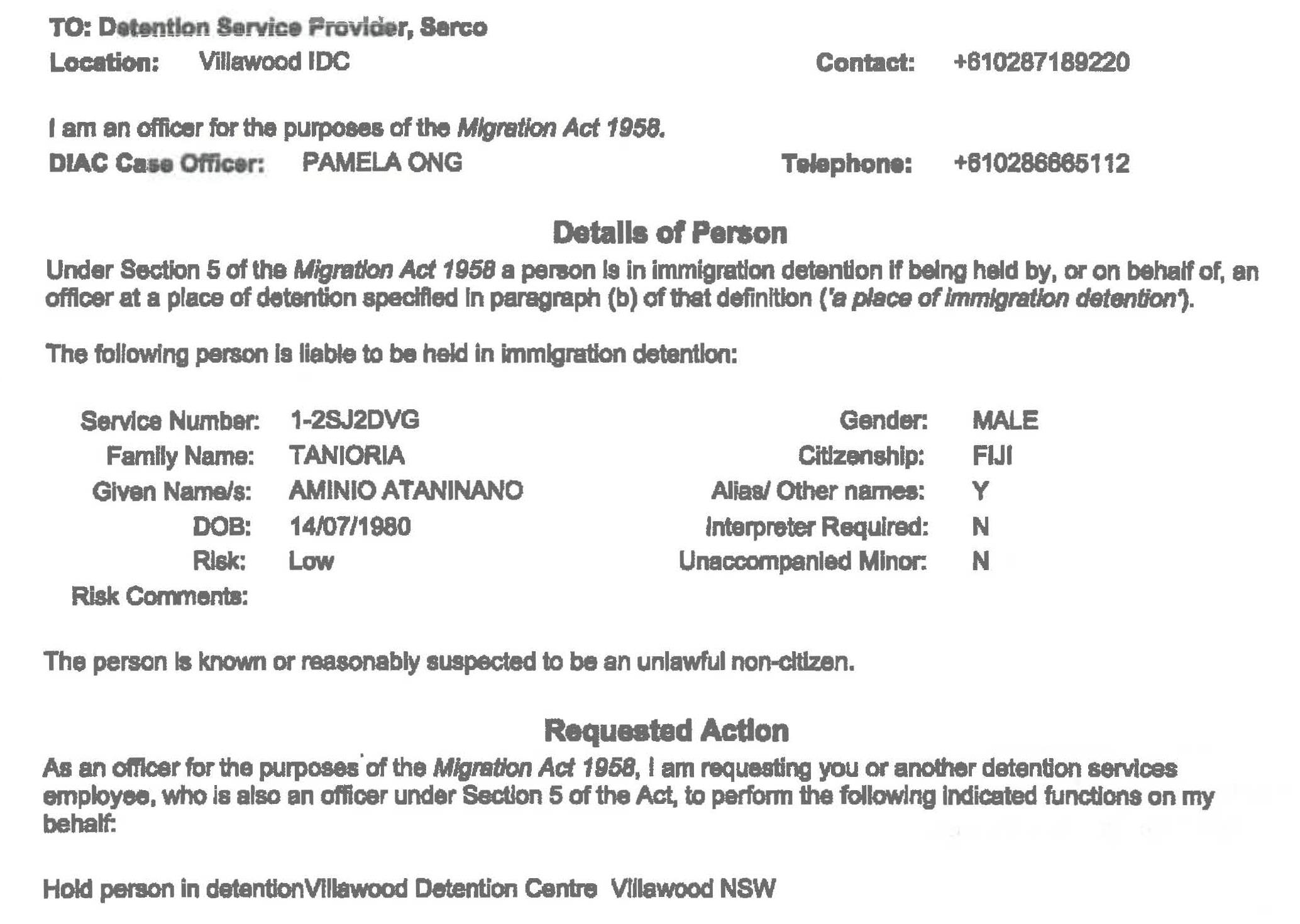
14 Serco completed a “Reception Assessment Process Checklist” which noted it had received a “Request for officers to Hold in Immigration Detention” form. This appears to be a reference to the “Request For Service” form. Both documents bear the same “Service Number”.
Removal from Australia
15 A “Request for Service” form dated 23 October 2016 included:
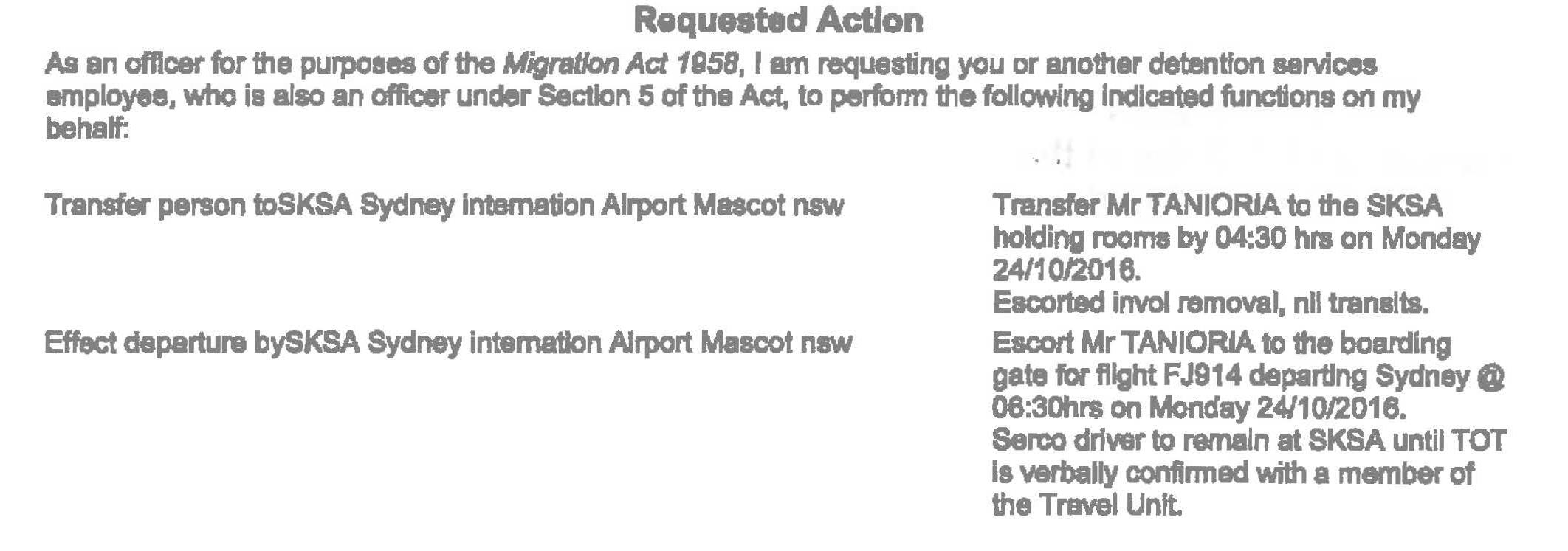
16 The applicant was removed from Australia on 24 October 2016 under s 198 of the Act.
LEGISLATIVE SCHEME
17 The applicant’s visa was cancelled on 17 November 2014 under s 501(2) of the Act. Upon cancellation, he became an “unlawful non-citizen” liable to be detained under s 189(1) of the Act. Section 189(1) provides:
If an officer knows or reasonably suspects that a person in the migration zone (other than an excised offshore place) is an unlawful non‑citizen, the officer must detain the person.
18 Section 196(1) of the Act provides:
Duration of detention
(1) An unlawful non‑citizen detained under section 189 must be kept in immigration detention until:
(a) he or she is removed from Australia under section 198 or 199; or
(aa) an officer begins to deal with the non‑citizen under subsection 198AD(3); or
(b) he or she is deported under section 200; or
(c) he or she is granted a visa.
19 Thus, section 189(1) requires an “officer” to detain a person known, or reasonably expected, to be an unlawful non-citizen. Section 196(1) requires a person detained under s 189(1) to be kept in immigration detention until one of the four events in s 196(1) occurs.
20 Tracey J observed in Graham v Minister for Immigration and Border Protection [2018] FCA 1012 at [87]:
… It is thus contemplated that an officer will, first, take an unlawful non-citizen into immigration detention and, thereafter, keep the person or cause that person to be kept in immigration detention.
21 The word “detain”, used in s 189(1), is defined by s 5(1), which includes:
In this Act, unless the contrary intention appears:
…
detain means:
(a) take into immigration detention; or
(b) keep, or cause to be kept, in immigration detention;
and includes taking such action and using such force as are reasonably necessary to do so.
22 The term “immigration detention” is defined in s 5(1):
immigration detention means:
(a) being in the company of, and restrained by:
(i) an officer; or
(ii) in relation to a particular detainee—another person directed by the Secretary or Australian Border Force Commissioner to accompany and restrain the detainee; or
(b) being held by, or on behalf of, an officer:
(i) in a detention centre established under this Act; or
(ii) in a prison or remand centre of the Commonwealth, a State or a Territory; or
(iii) in a police station or watch house; or
(iv) in relation to a non-citizen who is prevented, under section 249, from leaving a vessel—on that vessel; or
(v) in another place approved by the Minister in writing;
but does not include being restrained as described in subsection 245F(8A), or being dealt with under paragraph 245F(9)(b).
23 Section 5(1) defines “officer” in broad terms and includes:
(a) an officer of the Department, other than an officer specified by the Minister in writing for the purposes of this paragraph; or
…
(d) a member of the Australian Federal Police or of the police force of a State or an internal Territory; or
…
(f) a person who is authorised in writing by the Minister to be an officer for the purposes of this Act; or
(g) any person who is included in a class of persons authorised in writing by the Minister to be officers for the purposes of this Act, including a person who becomes a member of the class after the authorisation is given.
24 The statutory scheme therefore contemplates that an unlawful non-citizen can be kept in immigration detention by an “officer” or “on behalf of” an officer. In Graham at [90], Tracey J said:
… Properly construed these provisions contemplate that the persons associated with the places of detention reach an arrangement or agreement with the detaining “officer” such that the non-citizen is detained thereafter “on behalf of” that officer in the relevant institution.
25 His Honour stated at [91]:
Once an officer has performed the duty, imposed on him or her by s 189(1) and taken an unlawful non-citizen into immigration detention by restraining the person, detention has been effected. At this point s 196(1) requires that the unlawful non-citizen be kept in immigration detention until one or more of the four events prescribed by that subsection occur. The section speaks in the passive voice and does not impose this obligation on any specific person or entity. One (probably impracticable) way in which the detaining officer may satisfy the obligation imposed by s 196(1) would be personally to restrain the unlawful non-citizen for as long as it was necessary. More realistically, the officer could arrange for the unlawful non-citizen to be held on the officer’s behalf at one of the institutions (including a State prison) identified in paragraph (b) of the definition of immigration detention. So understood, there is no practical necessity to construe s 196(1) as imposing a duty on persons other than officers to hold unlawful non-citizens in detention.
26 Section 273(1) of the Act gives power to the Minister to establish and maintain detention centres at which an unlawful non-citizen may be held “by, or on behalf of, an officer”, to adopt the words at paragraph (b)(i) of the definition of “immigration detention” in s 5(1). Section 273 provides:
Detention centres
(1) The Minister may, on behalf of the Commonwealth, cause detention centres to be established and maintained.
(2) The regulations may make provision in relation to the operation and regulation of detention centres.
(3) Without limiting the generality of subsection (2), regulations under that subsection may deal with the following matters:
(a) the conduct and supervision of detainees;
(b) the powers of persons performing functions in connection with the supervision of detainees.
(4) In this section:
detention centre means a centre for the detention of persons whose detention is authorised under this Act.
SUMMARY OF THE PARTIES’ CASES
27 As ultimately put in oral submissions, the applicant’s case involved two principal submissions:
(1) First, that although s 273(1) of the Act authorised the Minister to establish a detention centre, it did not authorise such a detention centre to be operated by a third party. The operation of a detention centre by third parties could have been authorised if appropriate regulations had been made under s 273(2).
(2) Secondly, that the applicant’s detention by Serco or its employees was unlawful because s 61 of the Constitution contained an implied limitation that executive power (which, it was said, is what was involved in the detention of the applicant) could only lawfully be effected by “officers of the Commonwealth” and not by agents of the Commonwealth or agents of “officers of the Commonwealth”.
28 The Commonwealth’s response, which was adopted by Serco, was as follows:
(1) As to the first issue, s 273(1) read in context authorised the establishment of detention centres and their operation by a third party.
(2) As to the second issue:
(a) As a matter of fact, employees of Serco kept the applicant in immigration detention “on behalf of” (or as agent for) and at the direction of an officer of the Department (the Commonwealth). Serco was not independently exercising the power under s 196(1) of the Act. The question of whether s 61 of the Constitution contained an implied limitation that executive power only be exercised by an officer of the Commonwealth did not arise because it was an “officer of the Commonwealth” who relevantly kept the applicant in immigration detention.
(b) If, contrary to (a), Serco employees were independently exercising the power to detain under s 196(1) of the Act:
(i) its employees were authorised to do so by the Act and, because the legislature had provided the authority for them to do so, those employees were not exercising executive power. Accordingly, any implied limitation in s 61 of the Constitution was irrelevant;
(ii) even if the employees were exercising executive power contrary to (b)(i), s 61 of the Constitution did not contain an implied limitation that executive power can only be exercised directly by an “officer of the Commonwealth” and not by an agent;
(iii) if, contrary to (b)(i) and b(ii), the employees were exercising executive power and s 61 of the Constitution did contain the implied limitation for which the applicant contended, although the better view was that those employees were not “officers of the Commonwealth” for the purposes of the contended implied limitation, it was arguable that they were.
First Issue:
29 The applicant submitted that s 273(1) of the Act did not authorise a detention centre established by the Minister to be operated by Serco; it only authorised a detention centre to be established and operated by “officers of the Commonwealth”. Therefore, it was contended, the applicant’s detention was unlawful.
30 This argument was founded upon the decision of the Full Court in ARJ17 v Minister for Immigration and Border Protection [2018] FCAFC 98. In ARJ17, the Secretary of the Department decided to change the Detention Services Manual (“DSM”) with a view to removing mobile phones and Subscriber Identity Module (“SIM”) cards from the possession of all detainees. The DSM contained Commonwealth policies, amongst other things, with respect to access to personal property of detainees in immigration detention. To give effect to the Secretary’s decision, amendments were made to Chapter 8 of the DSM on 1 July 2016 with the intended effect of ensuring that detainees could not possess their mobile phones and SIM cards.
31 The applicant relied upon paragraphs [63] and [64] of the decision of Rares J, where his Honour said:
[63] The respondents contended that the power s 273(1) comprehended all that the regulation making power in s 273(2) and (3) entailed within the word “maintained”. They argued that the word “maintained” gave the Governor-General power to require officers to implement a policy of removing mobile phones from all detainees in detention centres.
[64] That argument must be rejected. The power conferred by s 273(1) enables the Minister, on behalf of the Commonwealth, to cause detention centres to be established and maintained. The power is addressed to the actions of acquiring, leasing or occupying land and buildings, undertaking any necessary building work (in the sense of construction work) and upkeep (in the sense of maintenance) of the physical land and buildings in which persons in immigration detention can be detained, as the definition of “detention centre” in s 273(4) suggests. In contrast, s 273 (2) and (3) enable the Minister to make regulations about how the detention centres operate and provide for their internal governance, including in respect of regulating the conduct and supervision of detainees.
32 These observations must be understood in context. The case was concerned with whether there existed power to make a blanket policy to take property from a detainee. It was not concerned with the authority to establish a detention centre operated by a third party. It was concerned with the right to remove property from detainees in an established detention centre. The Full Court held that the policy of taking the phones and SIM cards of all detainees was not authorised by any provision of the Act, including s 273(1) which included a power to “maintain” detention centres. The case was not concerned with whether s 273(1) gave power to “establish” a detention centre to be operated by a private company.
33 Flick J (with whom Rangiah J agreed) noted, at [103], that “[i]n the absence of statutory authority of a sufficiently unambiguous character, the compulsory taking of mobile phones and SIM cards would constitute a trespass or conversion of the property of the detainees”. His Honour concluded that legislative authority for the policy was not to be found, be it in s 252, s 252G or s 273 of the Act: at [104]. His Honour considered that ss 189 and 252(3), which confer statutory authority to “detain”, did not expressly confer authority to take possession of an individual’s property: at [105]. His Honour continued:
… There may, perhaps, be impliedly embraced within the authority to “detain” an individual an implied authority to also take possession of such goods as have an inherent capacity to frustrate the effectiveness of such detention. Many – and, indeed, various – examples of goods having such an inherent character were advanced during the course of submissions, including weapons of varying degrees of violence. But whatever may be the outer limits of any such implied authority to make good the detention of an individual, the power does not extend to goods not having such an inherent character such as mobile phones and SIM cards …
34 In respect of s 252(1), his Honour stated at [106]:
Nor should the statutory power conferred by s 252 of the Migration Act be construed any more widely than its express terms permit. The statutory power conferred by s 252(1) is primarily a discretionary power to be exercised by reference to the facts and circumstances presented to the person exercising that power and not by reference to a policy inflexibly applied. The power of search, in any event, is a power conferred for the “purposes” set forth in s 252(2), namely a power to search a person, and the person’s clothing and any property “to find out whether there is hidden on the person, in the clothing or in the property” certain items. Such a power cannot support the “search” of a person “to find” that which is not hidden. Section 252, moreover, is expressed in terms which vest a discretionary judgment in an “authorised officer” which is not mirrored in the policy itself. Thus, for example, whilst the policy authorises the retention of mobile phones and SIM cards until a person leaves a detention centre, s 252(4) of the Migration Act vests a discretionary power upon an “authorised officer” to “retain [a] weapon, document or other thing”, but only for such a period of time as the “authorised officer” independently “thinks necessary for the purposes of [the Migration Act]”.
35 In respect of s 252G, his Honour stated at [107]:
To the extent that the policy expressly seeks to invoke s 252G of the Migration Act as the statutory source of power upon which the policy is “based”, that section provides no such foundation. Section 252G, by its terms, is confined only to those persons who are “about to enter a detention centre” and does not apply to those already in detention.
36 His Honour also considered that the policy was not authorised by s 273(1) of the Act and, specifically, that section did not authorise the policy despite its reference to “maintaining” (as opposed to “establishing”). Flick J said at [108]:
More open to argument is the scope of the authority conferred by s 273(1) of the Migration Act to “cause detention centres to be established and maintained”. The concept of “maintaining” a detention centre may (perhaps) carry with it the authority to “maintain” such a facility so that it in fact remains a facility at which detention can be effectively achieved. Preventing that which may facilitate escape from such a facility could potentially, on such an approach, be embraced within the authority to “maintain” the facility. Even if that be accepted, it may be queried whether a power to “maintain” a “detention centre” is a sufficiently certain source of statutory power to search and remove articles from detainees. Even if such a construction of s 273(1) were to be accepted, such a construction would not authorise “maintenance” by way of Ministerial direction or policy. Clearer statutory language than that employed in s 273(1) would be required to permit such an interference with the property rights of those being detained.
37 Section 273(1) authorises the establishment and maintaining of detention centres. The meaning of “detention centre” is supplied by s 273(4) which says it “means a centre for the detention of persons whose detention is authorised under this Act”. As noted above, ss 189(1) and 196(1), read with the definitions of “detain”, “immigration detention” and “officer”, authorise detention “by, or on behalf of, an officer” as defined.
38 It is within the power conferred by s 273(1) for the Minister to establish detention centres which are operated for the Commonwealth by third parties, that is, to “outsource” the operation of the centres. Section 273(2) permits regulations to be made which might, amongst other things, regulate the operation of such detention centres. An absence of regulations in fact governing those operations does not have the consequence that the operation of a detention centre by third parties is unauthorised.
39 The significance of the decision in ARJ17 is that if, in the operation of a detention centre, the Commonwealth wishes also to take the property of the detainees, then there must be a statutory power to do so. Such powers do specifically exist in the Act, for example, in ss 252 to 252G. Those sections were found not to authorise the blanket policy the Minister sought to implement in ARJ17. The Full Court concluded that s 273(1) did not provide such a power either. For Rares J, that arose in part because of the way his Honour considered s 273(1) should be read with s 273(2).
40 The fact that s 273(2) allows for regulations to be made “in relation to the operation and regulation of detention centres” does not detract from the power of the Minister under s 273(1) to establish a detention centre to be operated by a third party.
Second Issue
41 The applicant claimed that his detention at VIDC was unlawful because he was kept there by Serco employees such that his detention involved the exercise of executive power by persons other than “officers of the Commonwealth” contrary to the Constitution. The applicant’s case was that executive power was vested in the Queen and must be exercised and maintained by the Governor-General under s 61 of the Constitution. Section 61 provides:
The executive power of the Commonwealth is vested in the Queen and is exercisable by the Governor‑General as the Queen’s representative, and extends to the execution and maintenance of this Constitution, and of the laws of the Commonwealth.
42 The applicant submitted that the exercise and maintenance of executive power must be by officers of the Commonwealth, referring in particular to ss 64, 67 and 75(v) of the Constitution. The applicant submitted that Serco was not an “officer of the Commonwealth” and nor were its employees, and that his detention at VIDC was therefore unlawful. The consequence, he submitted, was that both Serco and the Commonwealth were liable for damages for the tort of false imprisonment.
The applicant was kept in detention on behalf of the Commonwealth
43 There is no dispute that the applicant was taken into detention by the Commonwealth on 27 November 2014. The applicant says, however, that once taken to VIDC he was kept in detention by Serco, not by the Commonwealth.
44 The correct interpretation of the facts is that employees of Serco kept the applicant in immigration detention on behalf of the Commonwealth, that is, as its agent. That is made clear by the request made by the Commonwealth to Serco to hold the applicant in detention (see paragraph [13] above) and its request for Serco to release him from detention when the time came for deportation (see paragraph [15] above).
45 Although the Commonwealth requested the applicant to be held by employees of Serco who were authorised under the Act to hold the applicant in detention, that was in the context where employees of Serco were known to be authorised under the Act. The request was nevertheless for Serco to hold the applicant on behalf of the officer who knew or reasonably suspected that the applicant was an unlawful non-citizen.
46 Absent statutory authority, the detention of the applicant by the Commonwealth (or by any person) would have been unlawful. That is for the reasons given by Brennan, Deane and Dawson JJ (with whom Mason CJ agreed) in Chu Kheng Lim v Minister for Immigration, Local Government and Ethnic Affairs (1992) 176 CLR 1 at 19 (footnotes omitted):
Under the common law of Australia and subject to qualification in the case of an enemy alien in time of war, an alien who is within this country, whether lawfully or unlawfully, is not an outlaw. Neither public official nor private person can lawfully detain him or her or deal with his or her property except under and in accordance with some positive authority conferred by the law. Since the common law knows neither lettre de cachet nor other executive warrant authorizing arbitrary arrest or detention, any officer of the Commonwealth Executive who purports to authorize or enforce the detention in custody of such an alien without judicial mandate will be acting lawfully only to the extent that his or her conduct is justified by valid statutory provision.
47 When s 196(1) is read as part of the whole Act, particularly the definitions of “detain” and “immigration detention”, it is clear that an unlawful non-citizen can be kept in immigration detention by a person “on behalf of” an officer.
48 The unlawful non-citizen is kept in detention by the officer, not the third party; it is the officer who has caused the detention: Nolan v Ward [1920] VLR 604 at 607-608; Re Frazer; Ex parte McCarroll (1951) 51 SR (NSW) 234 at 239. The applicant was being held in VIDC “on behalf of” the officer who had requested the applicant be so held. The applicant was detained by the Commonwealth even though he was kept in detention at VIDC by agents of the Commonwealth.
49 Whilst not determinative of the issues in this case, it is relevant to note the conclusions reached by Gageler J in Plaintiff M68/2015 v Minister for Immigration and Border Protection (2016) 257 CLR 42 concerning the role of Wilson Security in exercising physical control of the plaintiff in that case whilst in detention on Nauru. His Honour said (emphasis added):
172. The conclusion to be drawn is that Wilson Security staff exercised physical control over the plaintiff so as to confine her to the Regional Processing Centre. The circumstance that any physical restraint of the plaintiff would only have occurred as a result of calling in the Nauruan Police Force does not affect that conclusion.
173. The further conclusion to be drawn is that Wilson Security staff exercised that physical control over the plaintiff in the course and for the purpose of providing services which the Executive Government of the Commonwealth had procured to be performed under the Transfield contract. They acted, in the relevant sense, as de facto agents of the Executive Government of the Commonwealth in physically detaining the plaintiff in custody.
50 His Honour had earlier said (at [128]) (footnotes omitted, emphasis added):
The overall constitutional context for any consideration of the nature of Commonwealth executive power is therefore that, although stated in s 61 of the Constitution to be vested in the monarch and to be exercisable by the Governor-General, the executive power of the Commonwealth is and was always to be permitted to be exercised at a functional level by Ministers and by other officers of the Executive Government acting in their official capacities or through agents. It is and was always to involve broad powers of administration, including in relation to the delivery of government services. Its exercise by the Executive Government and by officers and agents of the Executive Government is and was always to be susceptible of control by Commonwealth statute. And its exercise is and was always to be capable of exposing the Commonwealth to common law liability determined in the exercise of jurisdiction under s 75(iii) and of exposing officers of the Executive Government to writs issued and orders made in the exercise of jurisdiction under s 75(v). In “the last resort” it is necessary for a court to determine whether a given act is within constitutional limits.
51 The applicant submitted that his Honour’s reference to “agents” (emphasised in the passage set out above) should be understood as a reference to agents officially appointed such that they were “officers of the Commonwealth”. I do not understand the reference in that way.
52 It is also relevant to note the following passages in Lim at 30 to 32 (footnotes omitted, emphasis added):
In this Court, it has been consistently recognized that the power of the Parliament to make laws with respect to aliens includes not only the power to make laws providing for the expulsion or deportation of aliens by the Executive but extends to authorizing the Executive to restrain an alien in custody to the extent necessary to make the deportation effective. The clearest example is Koon Wing Lau v. Calwell. There, it was held by the Court that the Wartime Refugees Removal Act 1949 (Cth) was a valid exercise of the legislative power of the Parliament of the Commonwealth. That Act provided (s. 5):
“The Minister may at any time within [a specified period] make an order for the deportation of a person to whom this Act applies and that person shall be deported in accordance with this Act.”
Among the persons to whom the Act applied was “every person … who entered Australia during the period of hostilities and is an alien” (s 4(1)(a)). Section 7 provided, among other things, that a “deportee may ... pending his deportation ... be kept in such custody as the Minister or an officer directs”. It was held that, in their application to aliens, the relevant provisions were all within the “full power” of the Commonwealth Parliament “to make laws with respect to aliens”.
…
It can therefore be said that the legislative power conferred by s 51(xix) of the Constitution encompasses the conferral upon the Executive of authority to detain (or to direct the detention of) an alien in custody for the purposes of expulsion or deportation. Such authority to detain an alien in custody, when conferred upon the Executive in the context and for the purposes of an executive power of deportation or expulsion, constitutes an incident of that executive power. By analogy, authority to detain an alien in custody, when conferred in the context and for the purposes of executive powers to receive, investigate and determine an application by that alien for an entry permit and (after determination) to admit or deport, constitutes an incident of those executive powers. Such limited authority to detain an alien in custody can be conferred on the Executive without infringement of Ch. III’s exclusive vesting of the judicial power of the Commonwealth in the courts which it designates. The reason why that is so is that, to that limited extent, authority to detain in custody is neither punitive in nature nor part of the judicial power of the Commonwealth. When conferred upon the Executive, it takes its character from the executive powers to exclude, admit and deport of which it is an incident.
53 The applicant’s argument that there was an implied limitation in s 61 of the Constitution that the exercise of executive power only be by an “officer of the Commonwealth” does not arise because it was, on the facts in this case, an officer of the Commonwealth who in fact detained the applicant and who kept the applicant in detention.
Did Serco exercise executive power?
54 I have concluded that the detention of the applicant (including his being kept in detention) did involve an exercise of executive power, being one which had to be, and was, authorised by statute. Because the executive power was exercised by an officer of the Commonwealth it is not necessary to determine whether s 61 of the Constitution contains the contended implied limitation.
55 Nevertheless, in the event I am wrong and employees of Serco were in fact directly exercising the power under s 196(1), the applicant’s case for false imprisonment still fails. I address below the three arguments put forward by the Commonwealth which are summarised at paragraph 28(2)(b) above.
56 The Commonwealth submitted that – if it was Serco which directly exercised the power under s 196(1) as contended by the applicant – the applicant’s detention was not an exercise of executive power under s 61 of the Constitution. The Commonwealth contended that the exercise of those powers by Serco was required by s 196(1) of the Act; it was prescribed by statute and was not an exercise of executive power with the consequence that s 61 of the Constitution was not relevant. An officer who is authorised and required to do an act directly under a statute is not to be taken as exercising executive power under s 61 of the Constitution.
57 This argument was recorded in Tanioria v Commonwealth of Australia (No 2) [2017] FCA 1117 at [32] to [34]:
[32] The Commonwealth noted that its understanding of Mr Tanioria’s position was that the act of detaining people in accordance with the obligations in ss 189 and 196 of the Act is conduct that amounts to execution of the laws of the Commonwealth and therefore comes within s 61 of the Constitution. Against that, the first basis put by the Commonwealth for summary dismissal was that detention of an unlawful non-citizen is conduct that is directly authorised by the Act and that no specific warrant under s 61 of the Constitution is required to carry out a statutory duty. The Commonwealth submitted that it would be productive of confusion if Mr Tanioria’s argument was correct because s 61 vests executive power in the Queen and her representative, the Governor-General, but statutes commonly vest statutory powers in specific Ministers or officers, not in the Governor-General. The Commonwealth contended that there is no need to read into s 61 that a statutory power or duty imposed upon a particular officer somehow involves the officer exercising a power under s 61. Rather, it submitted that the officer performs the duty imposed by statute because it is authorised and required to do so directly under the statute.
[33] The Commonwealth relied in support of its submissions on The Australian Communist Party v The Commonwealth (1951) 83 CLR 1 (Communist Party Case) at 230, where Williams J said:
… Section 61 provides that the executive power of the Commonwealth is vested in the Queen and is exercisable by the Governor-General as the Queen’s representative, and extends to the execution and maintenance of this Constitution, and of the laws of the Commonwealth. The execution of the Constitution in the section “means the doing of something immediately prescribed or authorized by the Constitution without the intervention of Federal legislation” … . The maintenance of the Constitution therefore means the protection and safeguarding of something immediately prescribed or authorized by the Constitution without the intervention of Federal legislation. The execution and maintenance of the laws of the Commonwealth must mean the doing and the protection and safeguarding of something authorized by some law of the Commonwealth made under the Constitution. …
[34] The Commonwealth submitted that, because his Honour did not use the word “prescribed” in explaining the ambit of “the execution and maintenance of the laws of the Commonwealth”, s 61 of the Constitution does not extend to conduct performed by an officer of the Commonwealth where that conduct is required to be undertaken or prescribed by statute. It further submitted that s 189 of the Act imposes a duty on an officer to detain a person who he or she reasonably suspects to be an unlawful non-citizen. That is, it requires, rather than authorises, detention in those circumstances. The Commonwealth submitted that if, properly understood, Mr Tanioria’s detention as required by ss 189 and 196 of the Act was not the exercise of executive power under s 61 of the Constitution then his case would fall away entirely.
58 The fact that ss 189(1) and 196(1) of the Act provide for the applicant’s detention does not necessarily have the consequence that his detention does not involve the exercise of executive power. Sections 189(1) and 196(1) of the Act conferred on the Executive Government a statutory power to detain and keep the applicant in detention. Absent statute, there was no such power in the Executive Government: Plaintiff M68 at [159]. As I understood the argument, it was accepted that, if it was the Commonwealth who kept the applicant in detention, then this was an exercise of executive power (being one which was authorised by s 196(1)). The argument was that, if it was employees of Serco who kept the applicant in detention (rather than the Commonwealth by its agents), then this was not an exercise of executive power because it was directly authorised by statute. It is not necessary to determine this question because – even if Serco did exercise executive power – s 61 of the Constitution does not contain the contended implied limitation.
The asserted implied limitation
59 Section 61 of the Constitution does not contain an implied limitation requiring that the exercise of the executive power of detention be carried out only by “officers of the Commonwealth”. It has always been contemplated that executive power would be exercised at a functional level by Ministers, officers of the Executive Government acting in their official capacities or through agents: Plaintiff M68 at [128] (Gageler J); see also: Lim at 32 and Re Frazer at 239.
60 The exercise of executive power by the Executive Government, its officers and agents is, and has always been, susceptible to control by Commonwealth statute: Plaintiff M68 at [128]. Here, that control has been exercised by the Commonwealth Parliament in a way which gives “officers” as defined in the Act the authority to detain whether or not those “officers” are “officers of the Commonwealth” within the meaning of s 75(v) of the Constitution. The legislature has determined that an unlawful non-citizen can be kept in detention “on behalf of” an officer (that is, by an agent) whether or not that person is an “officer of the Commonwealth”. Those provisions do not infringe any implied limitation in s 61 of the Constitution.
Were Serco employees “officers of the Commonwealth”?
61 As noted earlier, the Commonwealth also submitted that, if the employees of Serco were exercising executive power and there was an implied limitation in s 61 of the Constitution to the effect contended by the applicant, the better view was that the Serco employees were not to be regarded as “officers of the Commonwealth”, but the contrary position was arguable, referring to R v Drake-Brockman; Ex parte National Oil Pty Ltd (1943) 68 CLR 51.
62 It is not necessary to decide whether that contrary arguable position is correct given my earlier conclusions.
DAMAGES
63 Even if the applicant had made out his claim for false imprisonment, he would only have been entitled to nominal damages for the reasons which follow.
64 The applicant accepted that, even if his detention at VIDC was unlawful, he would have been liable to have been detained in any event. His case was that this did not prevent him from a substantial award of compensatory damages because the quality of his detention at VIDC was worse than it would have been had he been detained lawfully, for example in a State prison. Before his detention at VIDC, the applicant had previously experienced a number of State prisons or correctional facilities.
65 It is relevant to note that this case was not pleaded. Indeed, in Tanioria, Markovic J stated at [91]:
… There is no allegation that Mr Tanioria’s alleged unlawful imprisonment was different in its duration or conditions to what would have been his lawful detention. In those circumstances, even if Mr Tanioria can establish his claim of false imprisonment, he may only be entitled to nominal, as opposed to compensatory, damages.
66 Nevertheless, neither the Commonwealth nor Serco put that his case should not be considered because of the applicant’s failure to plead it.
67 The gist of the action for false imprisonment (a trespassory tort) is for vindication of legal rights, not damage: CPCF v Minister for Immigration and Border Protection (2015) 255 CLR 514 at [155] (Hayne and Bell JJ). Where there is false imprisonment and the plaintiff would not otherwise have been imprisoned, substantial damages may be awarded absent proof of actual loss. The same conclusion does not follow where the plaintiff would otherwise have been imprisoned: R (on the application of Lumba) v Secretary of State for the Home Department [2012] 1 AC 245; Fernando v Commonwealth of Australia (2014) 231 FCR 251; CPCF at [324]-[325] (Kiefel J) and [512] (Keane J).
68 The nub of the applicant’s case, as put in oral submissions, was that the applicant’s experience was worse as a result of the difference in conditions and operations between VIDC and other places where he might lawfully have been detained.
69 In support of these submissions, the applicant relied on his evidence and the evidence of his partner, Ms Gurtala. The evidence of the applicant which was relied upon was:
3. Before November 2014 I had spent some time in prison institutions in NSW Including Mount Helliers. I say that the conditions at VIDC were worse for me [than] when I was in prison. In part this was because I was never sure who I could speak to or complain to when something was wrong. When I told the Department they would say it was Serco and when I told Serco officers they would tell me it was a Department problem.
70 The evidence of Ms Gurtala was:
55. The constant rules changes, lack of information and conditions in which he was detained are inhumane and unjust when I compare them to what happened to the Applicant while he was in jail.
71 Ms Gurtala also gave the following evidence in oral evidence:
COUNSEL: What I want to suggest to you is that although the individual facilities at the various gaols and at the Villawood Immigration Detention Centre are slightly different, the conditions in which the applicant was detained are more or less the same?
MS GURTALA: I can’t speak on behalf of the conditions of where he was detained because I never saw them. I only saw them from a visitor’s perspective.
COUNSEL: So it was – when you say in your affidavit that you found the position at Villawood worse than at New South Wales prisons, what you’re actually saying is you found from the visitor’s perspective---
MS GURTALA: Yes---
COUNSEL: ---it to be worse than at New South Wales gaols?
MS GURTALA: Well, I – I’ve – what I seen from Aminio’s own mental – the way his own mental health deteriorated, the cramped conditions in which we were kept. There was – wasn’t much room. There was many visitors to a detainee as opposed to a correctional centre where they kind of put time limits on some visits just so people could come through, and capped the amount of people that would – were able to come through. It was very – I said it was very cramped conditions. There wasn’t much room for the children to play in, and trying to keep that as sane and as normalised for – and, you know, to shield your children from what was happening was a lot harder because, like I said, when he was in gaol they at least had a date when he would be able to come back out to them.
COUNSEL: Yes. I just want to draw you back to my question which was when you say in the affidavit that the conditions in Villawood were worse than in New South Wales prisons, what, in fact, you’re saying is that from the perspective of the visitors and from the perspective of caring for your children, it was worse in Villawood than it was in New South Wales prisons?
MS GURTALA: Yes.
COUNSEL: And I suggest that the principal reason why it was worse was the uncertainty that you talk about in terms of not knowing whether the applicant would ever be released and ever be able to live in Australia again?
MS GURTALA: It was also knowing you would get there and they would tell you that they had lost your visitor’s form and you couldn’t see them when you had evidence of emails sent that you would show them. It was the fact that you would go there to spend, you know, a six – seven hour day there, having to feed the children and ensure you had adequate food for them, and then be told that you couldn’t take that food in. And there was no other facilities. There wasn’t even a vending machine to be able to buy chips there for them.
…
72 Serco contended, in submissions adopted by the Commonwealth, that the relevant policies applied by Serco were applied in all detention facilities whether privately run or State-run. Accordingly, the policies were likely to generate the same results wherever they were applied. The Commonwealth added, to the extent it was relevant, that at least one of the prisons where the applicant had been imprisoned before his detention had been privately run.
73 The evidence of the parties must be evaluated in accordance with the capacity of the parties to adduce evidence on the issue: Blatch v Archer (1774) 1 Cowp 63. The evidence referred to above was of a very general kind. The applicant’s evidence did not descend into the detail of what he allegedly raised by way of complaint or what alleged responses were given. There was no identification of the number of times he says he complained or the subject matter. There was no evidence of a comparison of the way in which he was treated at VIDC with the way in which he had previously been treated in State prisons with respect to complaints. Perhaps this reflects the fact that the case was not pleaded. In any event, Serco properly put that it was difficult for it to meet this generalised evidence in any meaningful way.
74 It was also pointed out that insofar as Ms Gurtala gave an account of her experiences as a visitor, this was not the experience of the applicant as a detainee. Her experiences, it was said, were of marginal, if any, relevance to the case on damages as put by the applicant. In any event, the applicant did not adopt Ms Gurtala’s experiences as being equivalent to his own or as having affected his experience and such matters should not be inferred in his favour when he could have given direct evidence on the issue: Commercial Union Assurance Company Australia Ltd v Ferrcom Pty Ltd (1991) 22 NSWLR 389 at 418E (Handley JA).
75 The evidence referred to above does not establish that there was a sufficient degree of difference in the ways contended between what the applicant experienced and what he would have experienced in another detention facility where he would have been lawfully detained.
76 I am not satisfied that the applicant would not have experienced equivalent anxiety and upset had he been kept in detention in a different facility. It may be accepted that the experiences may have been different, in some respects perhaps better, in some respects perhaps worse. On balance, however, I conclude that the experiences would have been approximately equal. Independently of the foregoing findings, I accept that the Commonwealth policies applicable to other detention centres are the same as those applicable to VIDC during the relevant time based on the evidence adduced in these proceedings. Accordingly, if the claim for false imprisonment had been made out, I would have only awarded nominal damages of $1.
CROSS-CLAIM
77 Serco cross-claimed against the Commonwealth in respect of any liability to the applicant on two bases:
(1) first, it claimed that the Commonwealth breached an implied term of the DS Contract and IDF Contract between the Commonwealth (by the Department) and Serco;
(2) secondly, it sought from the Commonwealth contribution or indemnity under s 5(1)(c) of the Law Reform (Miscellaneous Provisions) Act 1946 (NSW) for damages and costs it was liable to pay the applicants.
78 It is strictly unnecessary to deal with the cross-claim given my earlier conclusions. Nevertheless, I will deal with it briefly.
Contract claim
79 Serco contended that the DS Contract and the IDF Contract contained an implied term to the following effect:
The Commonwealth promised that if Serco performed its obligations under the contracts, it would be acting lawfully and would not be in breach of the common law and the Australian constitution.
80 It was accepted by both parties that the implied term claim could be dealt with on the basis that the DS Contract and the IDF Contract were equivalent. It was also accepted that I did not need to review the numerous modifications to the contractual arrangements and that I need only go to the specific clauses relied upon by the parties (in contracts which extended over hundreds of pages).
81 The parties agreed that the correct test to determine whether the contracts contained the asserted implied term was that identified in BP Refinery (Westernport) Pty Ltd v Shire of Hastings (1977) 180 CLR 266 at 283 and Codelfa Construction Pty Ltd v State Rail Authority of NSW (1982) 149 CLR 337 at 347, namely that the term must:
(1) be reasonable and equitable;
(2) be necessary to give business efficacy to the contract, so that no term will be implied if the contract is effective without it;
(3) be so obvious that “it goes without saying”;
(4) be capable of clear expression; and
(5) not contradict any express term of the contract.
82 The terms of the agreement between the Commonwealth and Serco included a clause which expressly dealt with indemnities: see cl 59 of the DS Contract and cl 58 of the IDF Contract. The implied term was not suggested to be inconsistent with that provision. However, the Commonwealth submitted that the parties were both sophisticated and had turned their minds to the issue of indemnity and had not included the implied term now suggested.
83 The Commonwealth also pointed to the following representation made by Serco in clause 58.1 of the DS Contract (emphasis added):
The Service Provider represents and warrants that:
…
(f) (no contravention) neither its execution of this Contract nor the carrying out by it of the transactions that this Contract contemplates, does or will:
(i) contravene any Law to which it or any of its property is subject or any order of any Government Agency that is binding on it or any of its property;
…
84 The implied term, if it existed, would reallocate the contractually agreed incidence of risk and make the Commonwealth liable to indemnify Serco for Serco’s actions in breach of the common law. Neither party was unsophisticated. The proposed implied term is not obvious. It is not required for business efficacy. It was inconsistent with the representation set out above.
85 In my view, the implied term fails to meet at least the first three of the five requirements identified by the test in BP Refinery. Accordingly, the cross-claim fails so far as it depends upon the existence of the implied term.
Claim for contribution or indemnity
86 Subsections 5(1)(c) and (2) of the Law Reform (Miscellaneous Provisions) Act 1946 (NSW) provide:
5 Proceedings against and contribution between joint and several tort-feasors
(1) Where damage is suffered by any person as a result of a tort (whether a crime or not):
…
(c) any tort-feasor liable in respect of that damage may recover contribution from any other tort-feasor who is, or would if sued have been, liable in respect of the same damage, whether as a joint tort-feasor or otherwise, so, however, that no person shall be entitled to recover contribution under this section from any person entitled to be indemnified by that person in respect of the liability in respect of which the contribution is sought.
(2) In any proceedings for contribution under this section the amount of the contribution recoverable from any person shall be such as may be found by the court to be just and equitable having regard to the extent of that person’s responsibility for the damage; and the court shall have power to exempt any person from liability to make contribution, or to direct that the contribution to be recovered from any person shall amount to a complete indemnity.
87 Section 5(1)(c), with s 5(2), creates a claim for contribution which did not exist at common law – see: James Hardie & Coy Pty Limited v Seltsam Pty Limited (1998) 196 CLR 53. The claim for contribution is a cause of action which is independent of the cause of action which the injured party has or had against the tortfeasor from whom contribution is sought: James Hardie at [28]. The cause of action arises only when judgment is given against the claimant seeking contribution, although that fact does not preclude a claim for contribution being instituted in anticipation of the resolution of the main action (as has been done here): James Hardie at [30].
88 Section 5(2) requires the contribution be “just and equitable having regard to the extent of that person’s responsibility for the damage”. The statute in terms directs attention to the extent of the responsibility of the person from whom contribution is sought. It directs attention to that matter in order to reach an appropriate apportionment.
89 In Podrebersek v Australian Iron & Steel Pty Ltd (1985) 59 ALR 529 at 532-3, the Full Court of the High Court (Gibbs CJ, Mason, Wilson, Brennan and Deane JJ) said:
The making of an apportionment as between a plaintiff and a defendant of their respective shares in the responsibility for the damage involves a comparison both of culpability, ie of the degree of departure from the standard of care of the reasonable man (Pennington v Norris (1956) 96 CLR 10 at 16) and of the relative importance of the acts of the parties in causing the damage: Stapley v Gypsum Mines Ltd [1953] AC 663 at 682; Smith v McIntyre [1958] Tas SR 36 at 42-49 and Broadhurst v Millman [1976] VR 208 at 219, and cases there cited. It is the whole conduct of each negligent party in relation to the circumstances of the accident which must be subjected to comparative examination. The significance of the various elements involved in such an examination will vary from case to case; for example, the circumstances of some cases may be such that a comparison of the relative importance of the acts of the parties in causing the damage will be of little, if any, importance.
90 In summary, the respective share in responsibility of each tortfeasor for the damage (or wrong) involves a comparison of:
(1) the culpability of each person (that is, the degree of wrongdoing or departure from the relevant standard of conduct applicable to each); and
(2) the relative importance of the acts of the parties in causing the damage (or wrong).
91 It is also relevant to take into account the relationship between the joint tortfeasors: Baden Cranes Pty Ltd v Smith [2013] NSWCA 136 at [77] (Basten JA). Here the relationship between the parties is set out in extensive contractual arrangements.
92 On the findings I have made, Serco kept the applicant in detention as agent of the Commonwealth and on its instructions according to policies set by the Commonwealth. Serco pointed to the decision of Sholl J in Edwards v Joyce [1954] VLR 216 at 220 where his Honour said (in obiter dictum):
The ordinary cases to which sec. 2(2), permitting the award of a complete indemnity, would apply are, I should think, such cases as that of an agent or servant committing a tort in the innocent and bona fide execution of orders from his principal.
93 There was nothing in the evidence which showed Serco to be independently responsible for particular loss (relevant to the false imprisonment claim) arising, for example, out of particular treatment of the applicant which was not in accordance with the Commonwealth policies. In my view, in the particular circumstances of this case, the Commonwealth would have borne the whole of the responsibility if the claim for false imprisonment had been made out.
CONCLUSIONs
94 After delivery of the foregoing reasons, the matter was stood down to enable the parties to consider and, if necessary, address the question of costs. On resumption, the parties had agreed the following orders:
(1) The application be dismissed.
(2) The second respondent pay the applicant’s costs in relation to the claim for conversion in an amount agreed or determined by taxation.
(3) The applicant otherwise pay the respondents’ costs of the proceedings in an amount agreed or determined by taxation.
(4) The Cross claim be dismissed with no order as to costs, with the intent that each party bear their own costs.
95 The Court made those orders.
I certify that the preceding ninety-five (95) numbered paragraphs are a true copy of the Reasons for Judgment herein of the Honourable Justice Thawley. |
Associate:


