

FEDERAL COURT OF AUSTRALIA
Mimebourne Pty Ltd as Trustee for the Fountain Family Trust v Gambaro [2018] FCA 1619
ORDERS
DATE OF ORDER: |
THE COURT ORDERS THAT:
1. The applicants be granted leave to appeal against the orders made by the Federal Circuit Court on 30 August 2018.
2. The appeal be heard and determined instanter with the applicants’ draft further amended notice of appeal standing as the notice of appeal and taken to be filed and served herein.
3. The appeal be allowed.
4. The orders made by the Federal Circuit Court on 30 August 2018 be set aside.
5. There be no order as to costs.
Note: Entry of orders is dealt with in Rule 39.32 of the Federal Court Rules 2011.
(Revised From Transcript)
LOGAN J:
1 Recently in Nobarani v Mariconte (2018) 92 ALJR 806 at [47], the High Court cited with approval a statement made by Samuels JA in Rajiski v Scitec Corporation Proprietary Limited (Unreported, New South Wales Court of Appeal number 146 of 1986, 16 June 1996 at p 27):
The absence of legal representation on one side ought not to induce a Court to deprive the other side of one jot of its lawful entitlement. An unrepresented party is as much subject to the rules as any other litigant. The court must be patient in explaining them and may be lenient in the standard of compliance which it exacts. But it must see that the rules are obeyed, subject to any proper exceptions. To do otherwise, or to regard a litigant in person as enjoying a privileged status, would be quite unfair to the represented opponent.
2 The present case, with all due respect to the learned Federal Circuit Court judge, whose order is the subject of an application for leave to appeal, may very well offer a paradigm example as to why adherence to that statement made by Samuels JA, now over a generation ago, remains salutary.
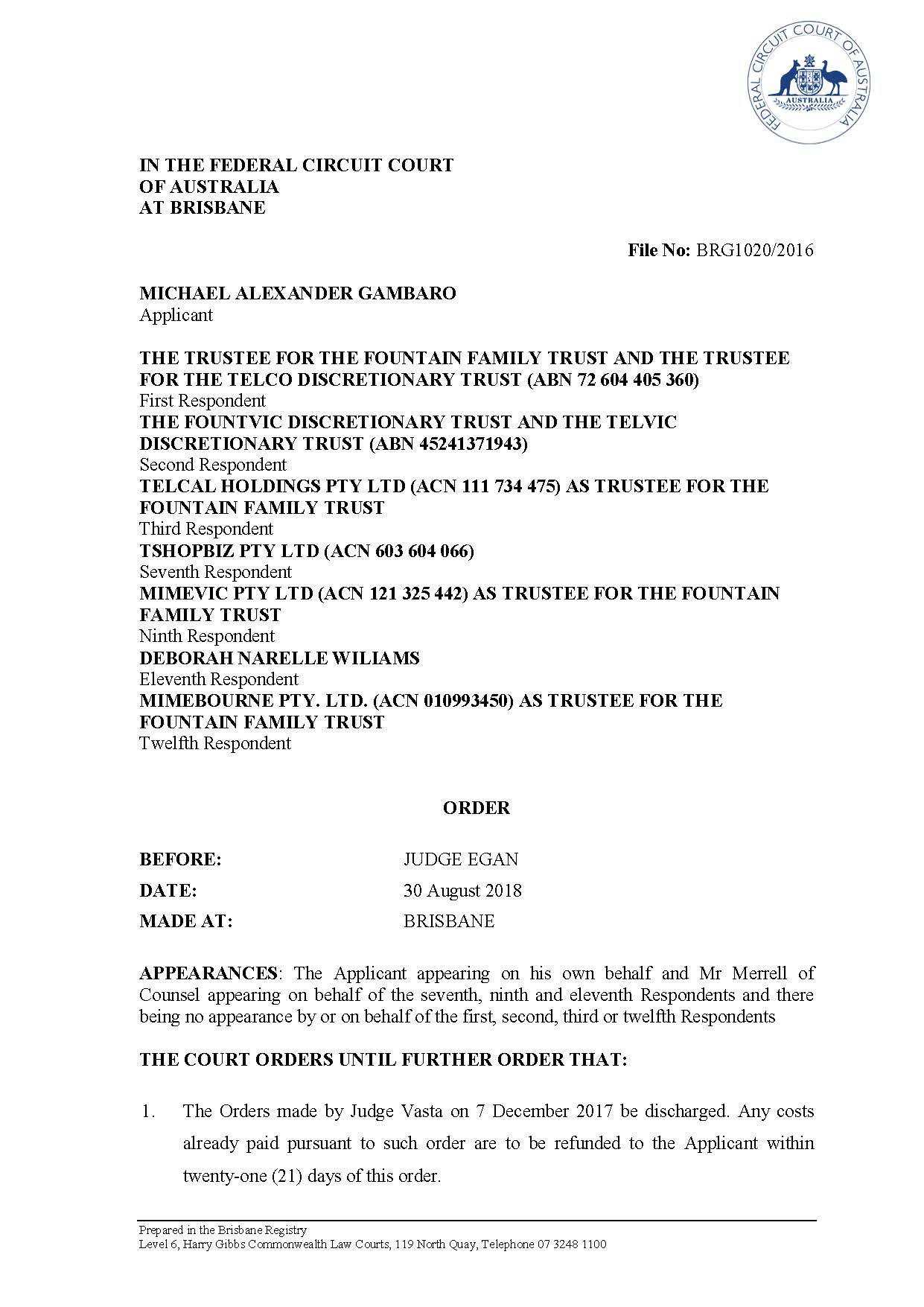
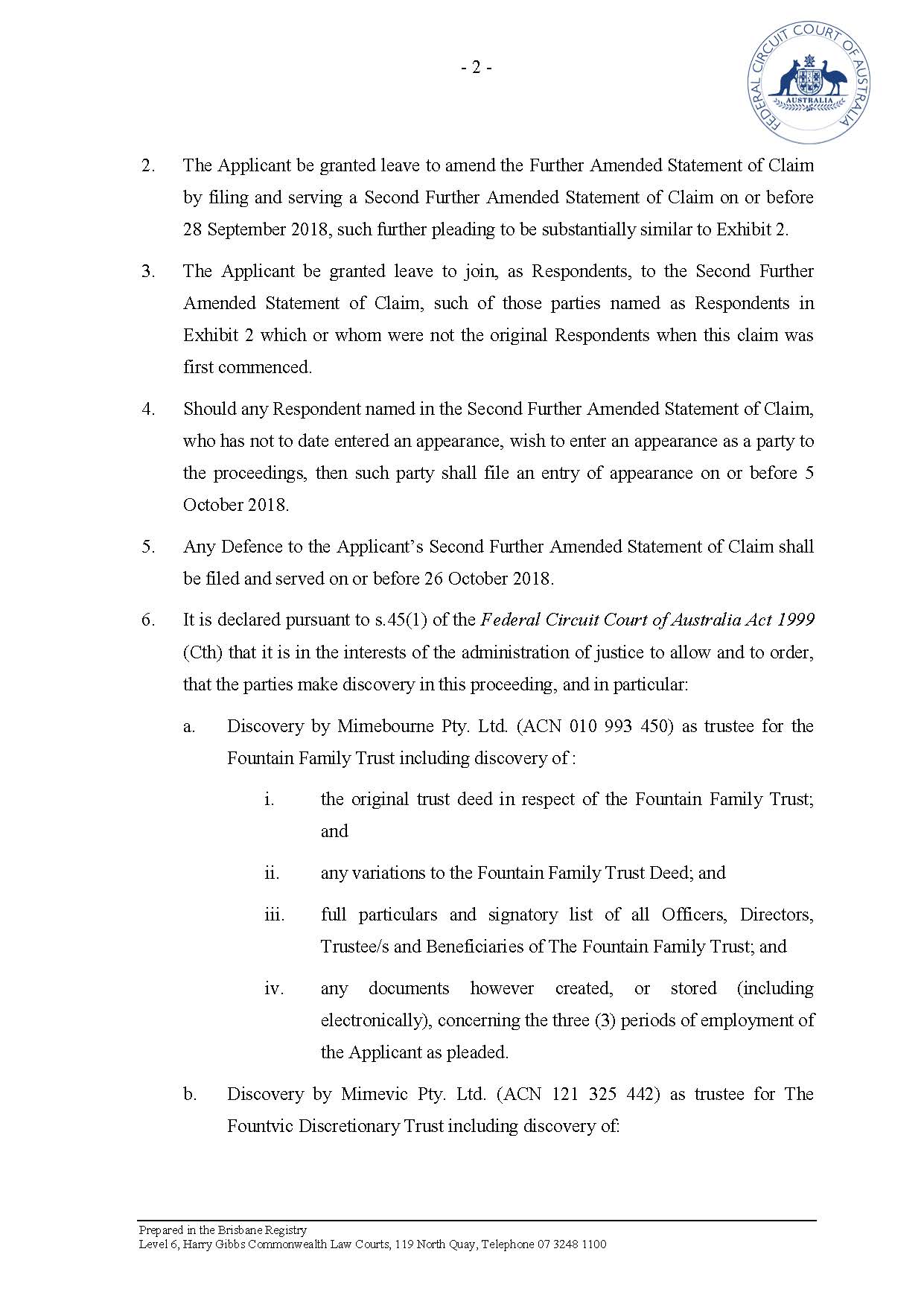
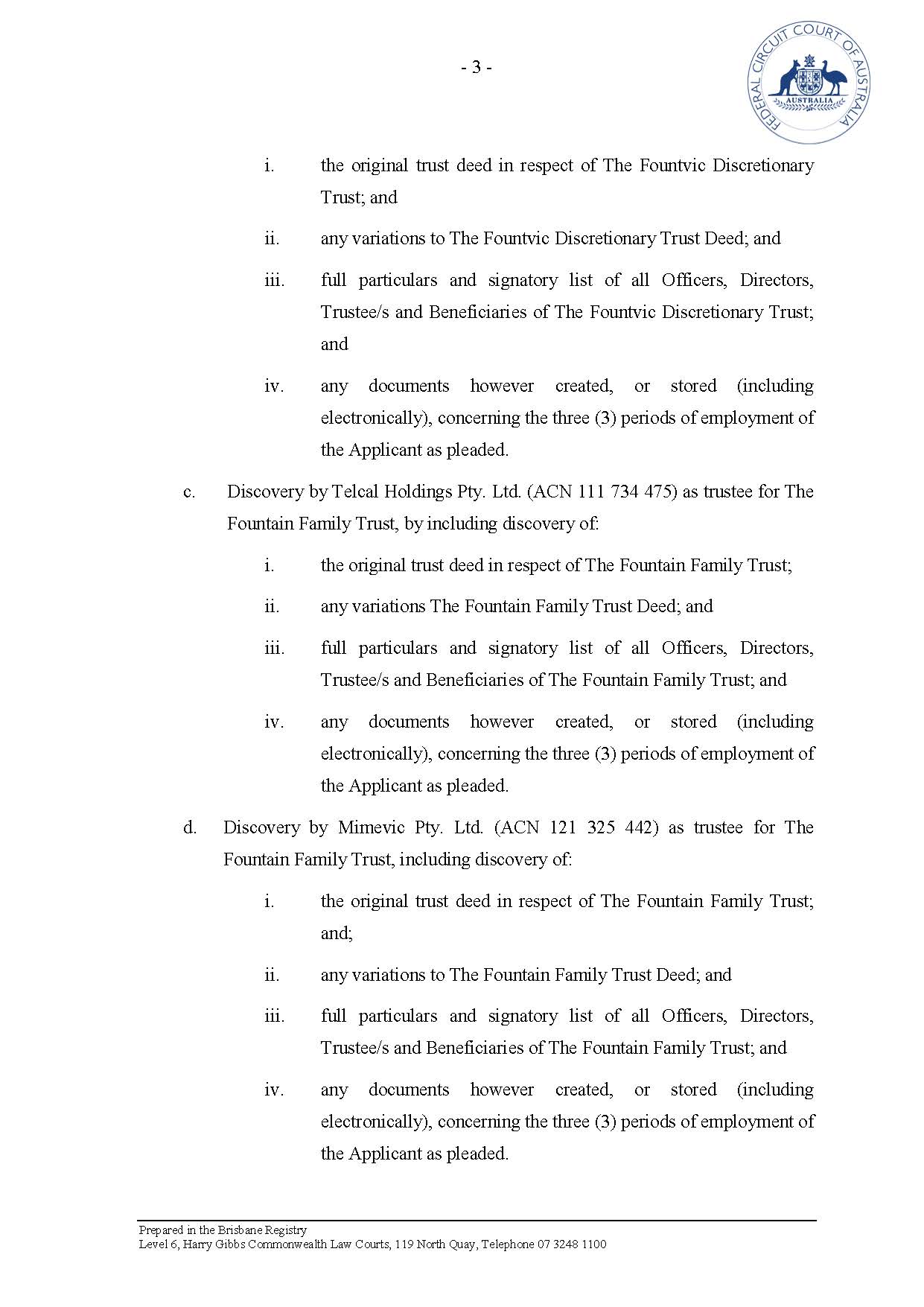
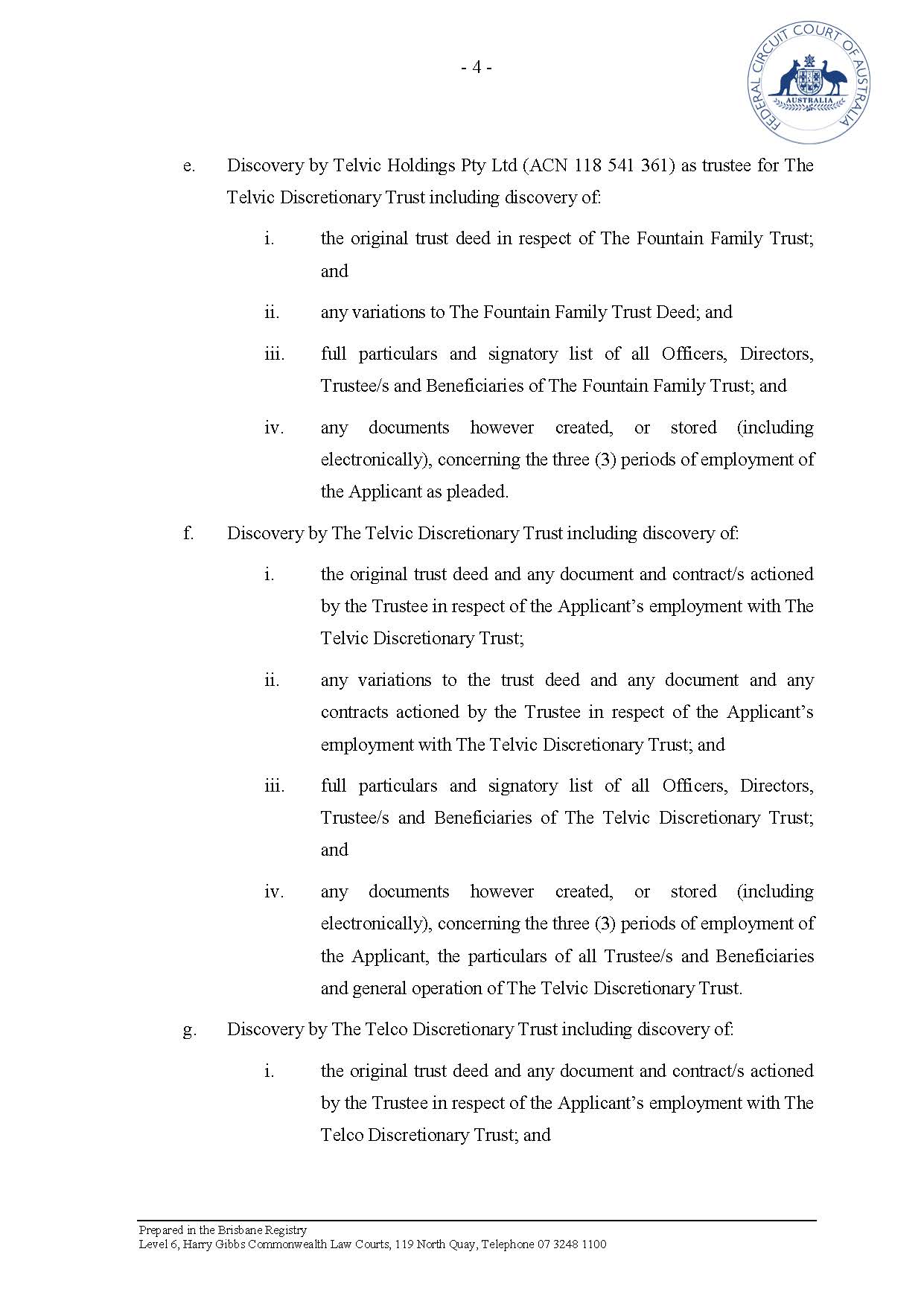
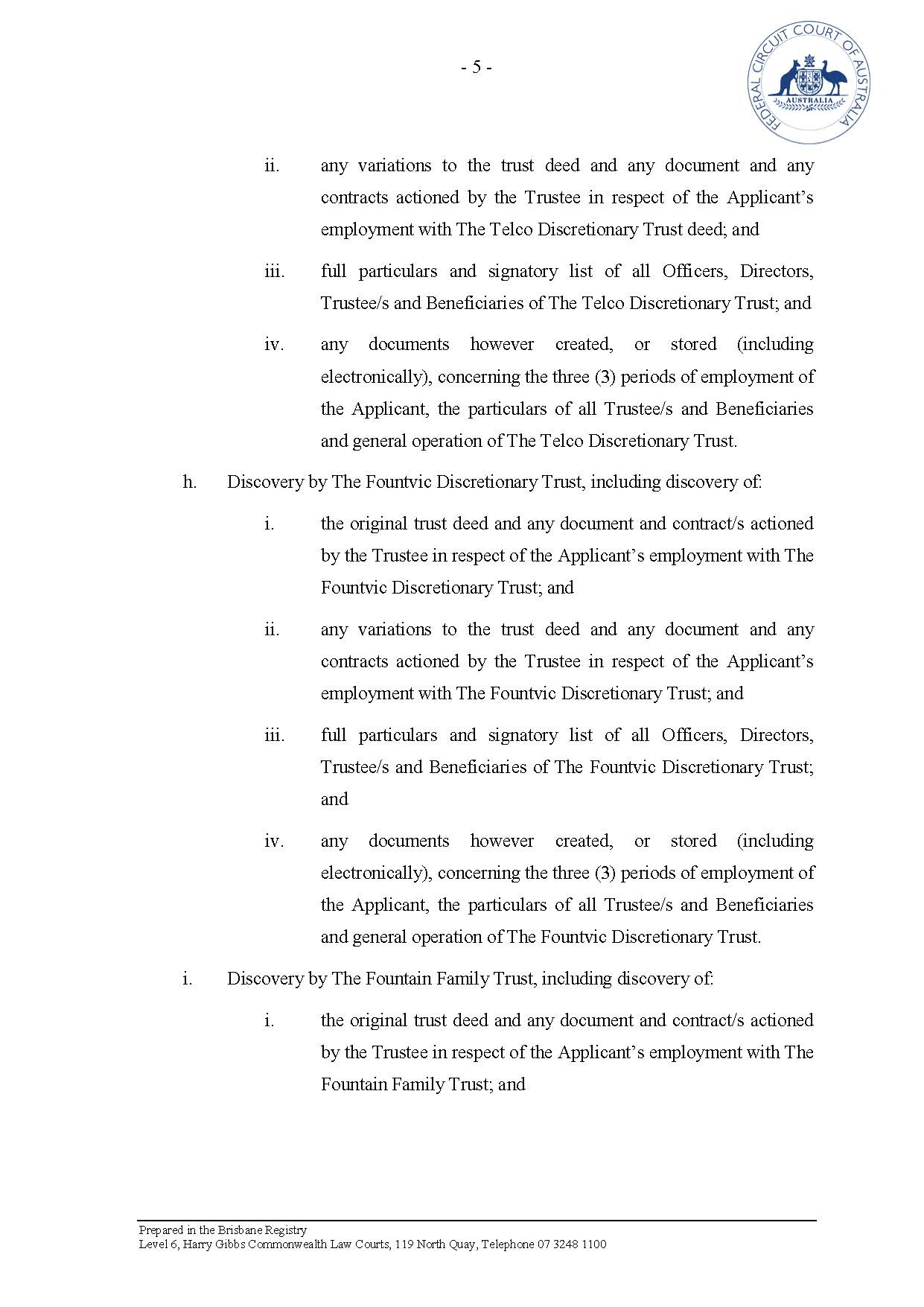
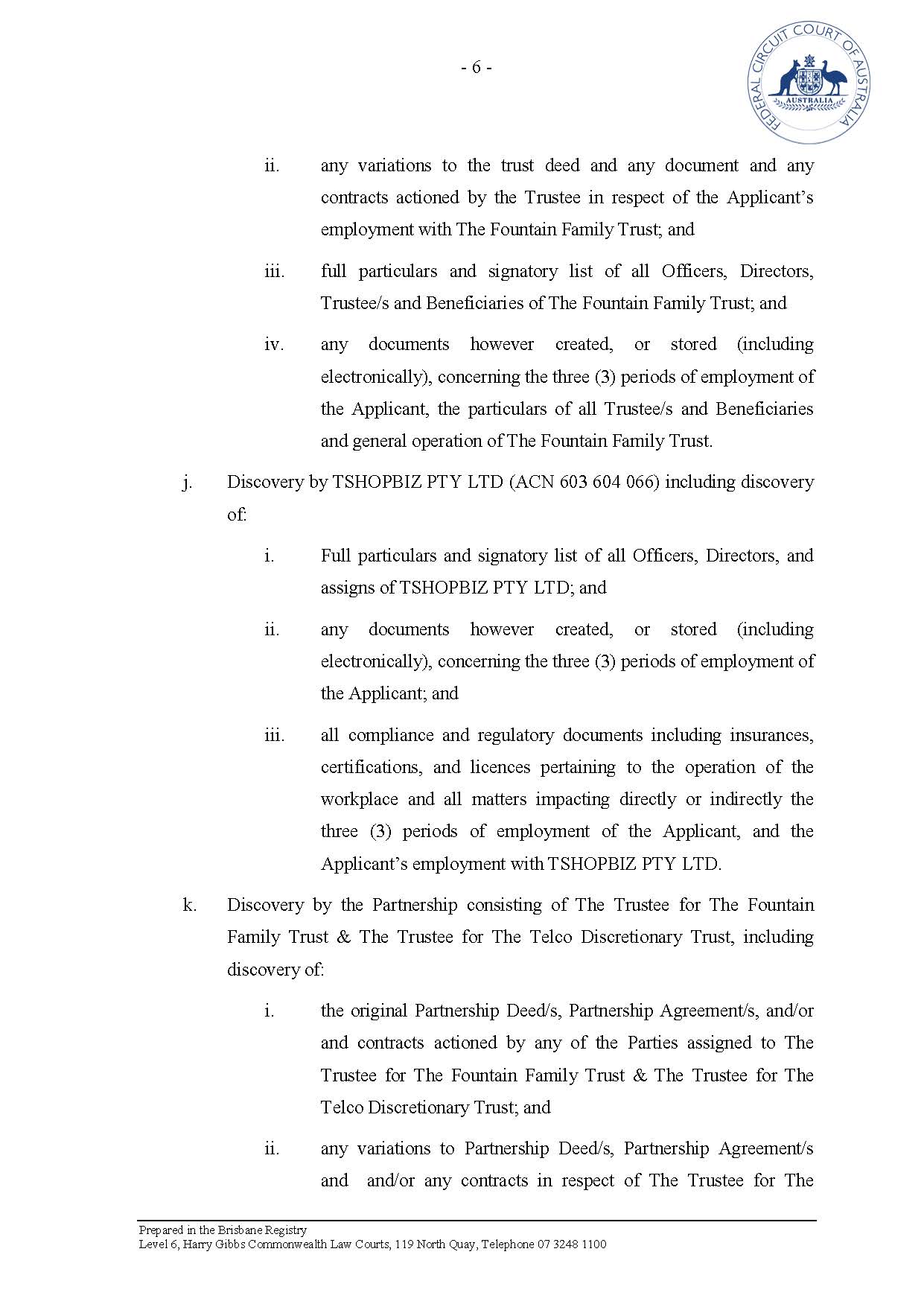
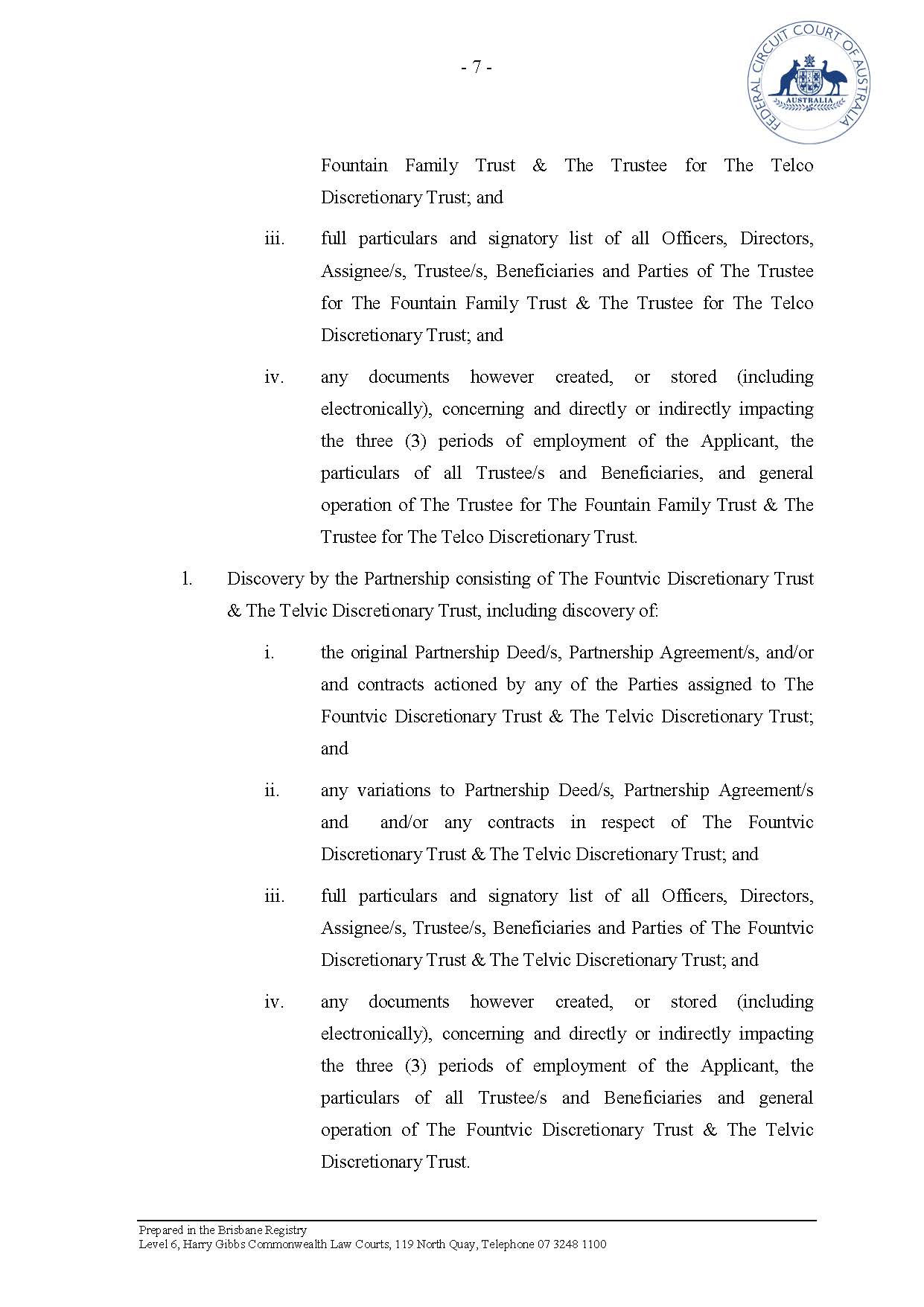
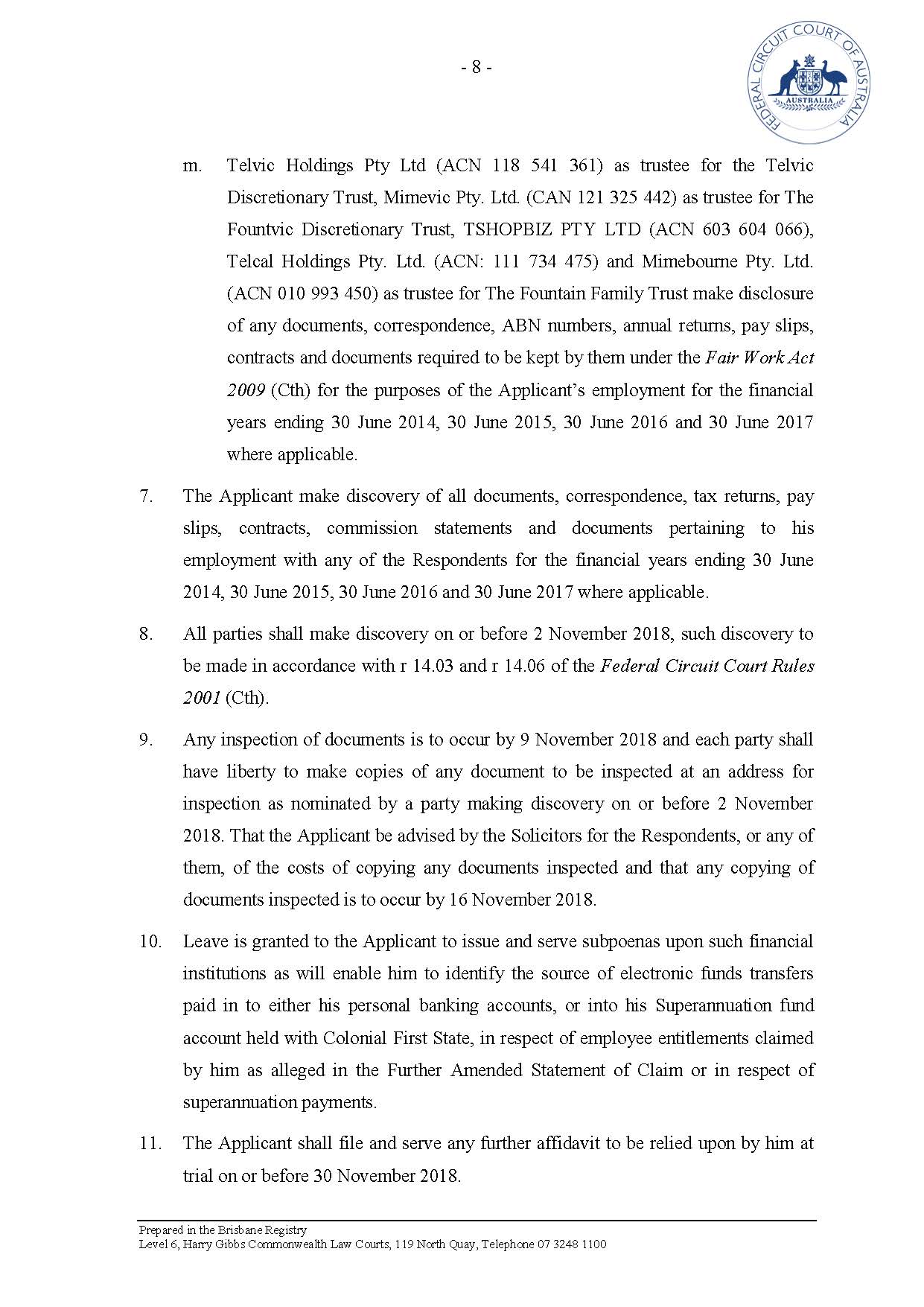
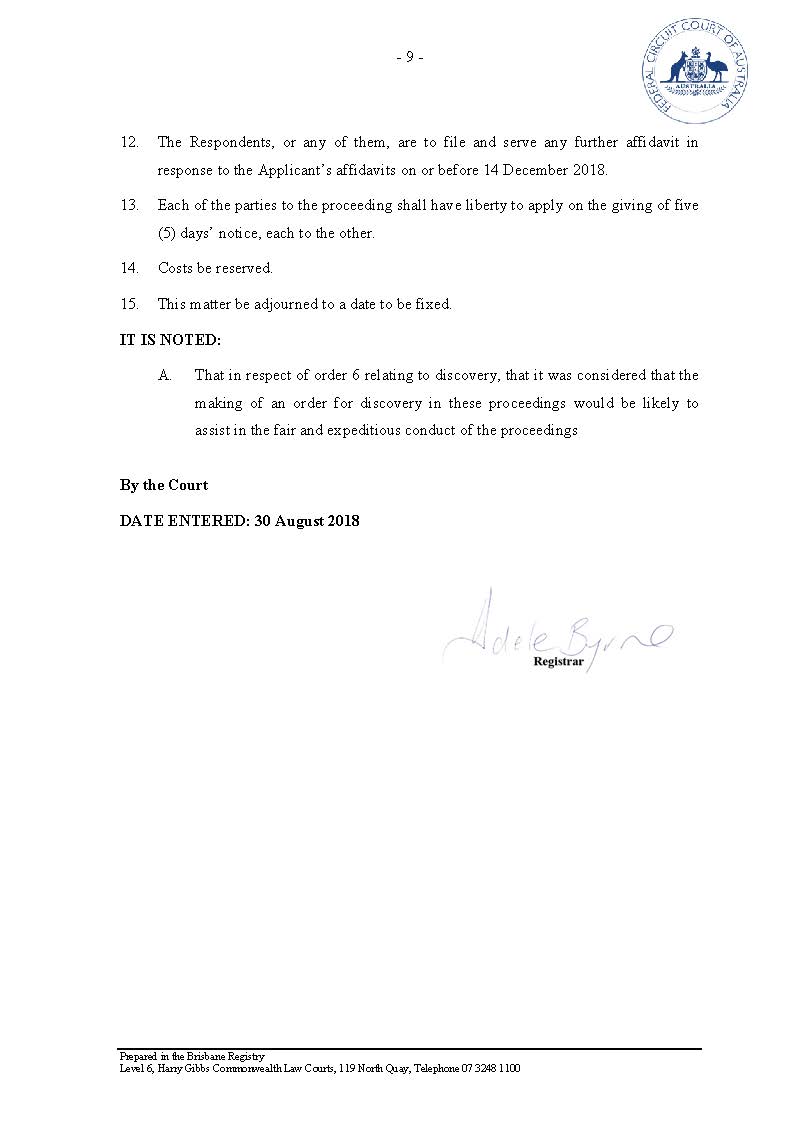
3 On 30 August 2018, the Federal Circuit Court made interlocutory orders permitting the joinder of additional parties, further amendment of a statement of claim and discovery against respondent parties, both of long standing and as joined by the order made that day. The order is a lengthy one. It would detract from the flow of these reasons for judgment to do other than to annex the order. The precise terms of the order are therefore to be found in the annexure to these reasons for judgment.
4 30 August 2018 was the first of two days which had long been set aside for the trial of a proceeding under the Fair Work Act 2009 (Cth), brought by the present respondent, Mr Gambaro. To give context to the orders made on 30 August, as well as to the challenge made by the present applicants, it is necessary to recite a chronology of events which led up to the making of the interlocutory order under challenge.
5 That chronology is, as to matters of fact, evidenced in an affidavit made by the applicant’s solicitor, Ms Aitken, filed on 14 September 2018. Those facts are accurately summarised in the outline of submissions filed on behalf of the applicants.
6 On 13 July 2016, Mr Gambaro filed in this Court’s Queensland District Registry an originating application under the Fair Work Act 2009 (Cth) (FWA), by which he alleged that he had been dismissed from employment in contravention of general protections found in that Act, together with a related statement of claim. That proceeding came before me on 2 August 2016, for an initial case management hearing.
7 Upon an assessment of the issues raised and likely length of trial, I formed the view that the case was one which, in the event that it did not settle at mediation, ought to be heard and determined in the Federal Circuit Court. Obviously enough, the claim made by Mr Gambaro was, as it remains, important to him but the length of employment concerned was relatively brief and no issue of general importance was raised. Further, the length of trial was such that it was apt to be dealt with in a court established to deal with a high volume of cases. It was, in short, a classic case for hearing and determination by the Federal Circuit Court.
8 As it transpired, the proceeding did not settle at mediation and therefore stood remitted to the Federal Circuit Court as a result of the orders made by me on 2 August 2016. On 2 November 2016, the parties were advised of the allocation of the case as a consequence of remitter to the docket of Judge Vasta, with a particular Federal Circuit Court file number BRG1020 of 2016 being allocated. On 2 December 2016, Mr Gambaro filed in the Federal Circuit Court’s Brisbane registry an amended statement of claim. Three days later, on 5 December, the then parties appeared before Judge Vasta for a directions hearing. At that time, his Honour made orders in relation to the filing of a further amended statement of claim by Mr Gambaro as well as the filing of other material by the parties. On 11 January 2017, a law firm, Hopper Green York, informed the applicants’ solicitors that they were now acting for Mr Gambaro and would be seeking an extension of time within which to file the further amended statement of claim. At that stage, the respondents to the FWA proceeding remitted to the Federal Circuit Court were the present fourth, fifth, sixth and eighth applicants.
9 There was an exchange of correspondence in relation to the filing of the further amended statement of claim between the lawyers then acting for Mr Gambaro and the fourth, fifth, sixth and eighth applicants’ solicitors. In the result, on 10 February 2017, a further amended statement of claim was filed by Mr Gambaro’s lawyers. That statement of claim had been settled by counsel. It named the following persons as respondents:
(a) TShopBiz Pty Ltd (ACN 603 604 066) as the seventh respondent;
(b) Mimevic Pty Ltd (ACN 121 325 442) as Trustee for the Fountain Family Trust as ninth respondent;
(c) Mrs Deborah Williams as eleventh respondent; and
(d) Telvic Holdings Pty Ltd (ACN 118 541 361) as Trustee for the Telvic Discretionary Trust as twelfth respondent.
The persons so named are the present fourth, fifth, sixth and eighth applicants.
10 On 17 March 2017, by their solicitors, those persons filed a defence. On 27 March 2017, Mr Gambaro filed a reply. As at the close of proceedings, there were admissions in the defence as to which entity employed Mr Gambaro for particular periods.
11 On 20 April 2017, Mr Gambaro filed affidavit material upon which he proposed to rely at trial. The filing of such material was, as contemplated, by orders made in December 2016 by Judge Vasta as those orders had come to be amended. Mr Gambaro’s then affidavit material for trial comprised an affidavit which he had made on 18 April 2017. He filed a further affidavit made by him on 9 June 2017.
12 On 3 and 4 July 2017, the then respondents (the present fourth, fifth, sixth and eighth applicants) filed the material upon which they propose to rely at trial. That comprised affidavits made by the following persons:
(a) Deborah Narelle Williams
(b) James Grant Fountain
(c) Leigh Ellen Redman
(d) Suzanne Colleen Braines
(e) Danielle Simone Perry
(f) Alexandros Limpaong Kamakaris
(g) Onitayor George-Coker
13 Mr Gambaro filed some affidavits in reply on 18 and 28 July 2017 respectively.
14 The following month, on 14 August 2017, a further directions hearing was held before Judge Vasta. At that time, orders were made which materially included an order that the proceeding be listed for a trial callover in the Federal Circuit Court at 9.30 am on 2 November 2017. On 11 September 2017, Mr Gambaro sent an email to Judge Vasta’s associate. In that email, he sought leave to make minor amendments, as they were termed, to the existing amended statement of claim, in other words, that filed on 10 February 2017. The following day, on 12 September 2017, the associate responded to this email advising that leave had been granted for him to make the requested amendments.
15 Later that month, on 21 September 2017, Mr Gambaro filed a yet further amended statement of claim. The riposte to that on behalf of the then respondents (the fourth, fifth, sixth and eighth applicants), was to file an application in a case the following month by which an order was sought that Mr Gambaro’s further amended statement of claim filed in September and its related amended originating application be struck out. In that month, on 30 October 2017, Mr Gambaro also filed an application in a case. Both Mr Gambaro’s application together with that of the then respondents (the fourth, fifth, sixth and eighth applicants), came on for hearing before Judge Vasta on 7 December 2017. At that time, his Honour made the following orders:
(a) the Respondent’s September Amended Statement of Claim and the Respondent’s amended Form 2 Claim and Application be struck out because they did not make minor amendments;
(b) the matter proceeds to hearing based on the documents filed by the parties prior to the directions hearing on 14 August 2017;
(c) pursuant to section 570(2)(b) of the Fair Work Act 2009, the Respondent was to pay the Applicants’ costs of the Applicants’ strike out application in the amount of $3,417.50;
(d) the Respondent was restrained from filing any further material in the matter; and
(e) the matter was set down for final hearing on 30 and 31 August 2018.
16 As can be seen, it was by virtue of that order made on 7 December 2017, that the trial was listed for hearing over two days on 30 and 31 August.
17 The interlocutory orders made by Judge Vasta on 7 December 2017 were never the subject of an application for leave to appeal to this Court. The then respondents prepared for trial on the basis of the orders which had been made in December 2017; not so Mr Gambaro, or at least not so on and from 31 July 2018. On that day, he filed in the Federal Circuit Court an application in a case by which he sought to add additional respondent parties, amend further the statement of claim and discovery. That application was not served on the then respondents (the fourth, fifth, sixth and eighth applicants) until 15 August 2018. That day, it should be recorded, is, in the Brisbane metropolitan area, the Exhibition Public Holiday. The application was not served at all by any of the prospective respondents by Mr Gambaro.
18 By that stage, the proceeding had been reallocated to the docket of his Honour Judge Egan for the hearing of the trial. Unsurprisingly, with respect, given the proximity of the trial and the very singular caseload burdens of the Federal Circuit Court, the application in a case was made returnable on the first day of the trial.
19 Regard to the transcript of proceedings before the learned Federal Circuit Court judge on 30 August 2018 discloses that the hearing and determination of the application in a case made by Mr Gambaro involved the better part of that day. There was an extensive exchange between his Honour and Mr Gambaro, as well as between his Honour and Mr Merrell of counsel who then appeared for the fourth, fifth, sixth and eighth applicants, (the then-existing respondents). On the application for leave to appeal, Mr Merrell came to appear, led by Mr Perry QC, for the original respondents, as well as those who came to be joined as respondent parties in the Federal Circuit Court as a result of the orders made on 30 August 2018.
20 It is obvious from the transcript of the proceedings that Judge Egan exercised considerable patience with Mr Gambaro and made a very considerable effort indeed to ascertain exactly what was sought by him and why. It is also obvious, with respect, that Mr Merrell made a considerable effort, as one might expect from counsel, to assist his Honour in that regard.
21 What is not apparent, with very great respect, is why his Honour came to make the order of 30 August 2018. That is because no reasons for judgment were given, either ex tempore that day, or on a later date. It would be unfair, both to his Honour and his parties, in my view, to endeavour to distil what those reasons might have been from the exchanges which occurred on 30 August 2018. At most, it appears that his Honour held a concern in relation to the identity of Mr Gambaro’s employer, either some or all of the period of his employment between 2014 and 2016. However that may be, the position which remains is that there were no reasons for judgment given.
22 Sometimes in the course of an interlocutory case management or directions hearing, an issue emerges which calls for the making of interlocutory orders and sometimes also the occasion for the making of those orders is all too apparent to the parties from the prior exchange which has occurred. Sometimes in these circumstances, when invited by the court as to whether reasons for judgment are required by either party, neither party signifies to the court that reasons for judgment are required. That particularly occurs when each party is represented by experienced legal practitioners, be they counsel or solicitors and, as I have said, the reasons for the making of the orders are readily apparent to such experienced practitioners from the exchange which has occurred.
23 Absent, though, that type of request made by a judicial officer and a signification by all affected parties that no reasons for judgment are required, the only occasion when one would not give reasons for judgment in respect of the making of interlocutory orders would be when those orders are sought consensually.
24 Last month in CIT17 v Minister for Immigration and Border Protection [2018] FCAFC 1510 at [39], a Full Court of this Court stated, with reference to earlier authority namely, DAO16 v Minister for Immigration and Border Protection (2018) 353 ALR 614 at [47] that:
It is a fundamental principle that adequate reasons must be provided by judicial officers in respect of orders given in the course of the judicial process.
The Full Court continued at [39]:
It is a heavy obligation ensuring that, where appropriate, those reasons may be submitted to appellant consideration.
Citing, in that regard, Wu v The Queen (1999) 199 CLR 89 at [71], their Honours added:
The meaning of “adequate” will, of course, vary on the facts and complexity of particular case.
25 Those sentiments apply just as much to reasons for judgment in respect of interlocutory orders as they do to final orders. Of course, in relation to interlocutory orders, the reasons may be abbreviated, having regard to the particular nature of the interlocutory application made. Here, though, the effect of the orders made on 30 August 2018, called for some particular exposure of a judicial reasoning process. That was because those orders necessarily entailed the adjournment of a trial that dates for which have been fixed for almost nine months. And so fixed in respect of a relatively routine claim under the FWA in relation to a period of employment which had ended in 2016.
26 The adjournment of the trial necessarily condemned each of the parties to a yet further delay in the hearing and determination on the merits of the issues raised. That, with respect, was undesirable in the interests of those parties and in the interests of justice, unless there was some other particular interest of justice which necessitated such an adjournment. That, though, called for judicial explanation. It is to be remembered that this case was one which had been case managed to the end of fixing those trial dates with very particular orders made in December 2017, the obvious intent which was to put the case in a state of evidentiary finality.
27 Another effect of the orders made on 30 August 2017 was to deprive the then-existing respondents (the fourth, fifth, sixth and eighth applicants) of the benefit of a costs order made by Judge Vasta on 7 December 2017. Of course, such orders are, in a case of this type under the FWA, exceptional. But that none of the orders made that day was ever the subject of an application for leave to appeal.
28 Yet another effect of the orders made on 30 August 2017, was to offer yet another opportunity to amend a statement of claim in respect of a case where one might have thought opportunity enough had been given and pleadings closed. Once again, though, if there were a particular reason why the interests of justice dictated the granting of a yet further opportunity to amend the statement of claim, that required a judicial explanation.
29 Yet further, the orders of 30 August 2018, imposed discovery obligations on parties added to the proceeding by that order without there being an opportunity extended to those joined parties to be heard. It also imposed a discovery obligation on the existing respondent parties. Discovery in the Federal Circuit Court does not arise as a right. It is plain enough from the terms of the order that his Honour well understood this. Even so, quite why the discovery order was made, given the history of the case, required a judicial explanation.
30 It is not that his Honour lacked power to set aside interlocutory application orders earlier made. So much is clear enough from r 16.05(c) of the Federal Circuit Court Rules 2001 (Cth) (FCCR). That rule has an analogue in r 39.05(c) of the Federal Court Rules 2011 (Cth) (FCR). In turn, in the history of this Court’s rules, an earlier manifestation is to be found in O 35, r 7(2)(c) of the now repealed FCR. Referring to that earlier rule in Dudzinksi v Centrelink (2003) FCA 308, Spender J observed at [11] that rule permits:
…the court a discretion to set aside a judgment after an order has been entered where the order was interlocutory. As the orders in respect of that rule indicate, exceptional circumstances have to be shown where an order one has entered will be set aside pursuant to that rule. It is in the nature of the slip rule. It is certainly not an alternate to the appellate procedure in respect of interlocutory judgments.
[emphasis added]
31 Rule 16.05(c) of the FCCR, like its Federal Court counterpart, is not qualified by a reference to exceptional circumstances. I would therefore, with respect, be wary about placing a gloss on the language employed in the rules. If though by “exceptional”, nothing more is intended, then there must be good reason, then I respectfully agree with that sentiment as to the occasion for acting under r 16.05(c). Good reason is not, in my view, to be found just in the circumstance that one judge may happen to disagree with a value judgment as to a particular interlocutory order made by an earlier judge with case management responsibilities.
32 A common example where the power conferred in r 16.05(c) and its analogue in this Court is exercised is in case management where circumstances have overtaken those which prevailed at the time when an earlier interlocutory order was made. Sometimes, of course, the parties agree that there is a need for the amendment of the earlier interlocutory orders. On other occasions, though, there may be a contest in which case r 16.05(c) provides a basis for setting aside an earlier interlocutory order if good reason is shown at the time. In the event of such a contest, though, it is only to be expected, subject to the exception which I have noted, that reasons for judgment would be delivered.
33 There are other observations which one might make about the orders made on 30 August 2018. Given that leave to join additional parties and further to amend the statement of claim was thought appropriate, one might, with respect, have thought that the occasion for whether or not discovery should be ordered against any party should await the filing of an amended defence and any amended reply. Only then would it become apparent what on the amended pleadings, were the issues and thus what need, if any, there was for discovery.
34 Another consideration, of course, which intruded, was in light of the High Court’s judgment in AON Risk Services Australia Limited v Australian National University (2009) 239 CLR 175. The importance of case management and related to that, the relative scarcity of judicial resources for the hearing of a trial, and the impact of an adjournment in terms of the likely new trial dates.
35 Yet further, the parties named by joinder were not in some cases legal entities at all, only trusts. It is a misconception, hardly one for criticism in relation to lay persons, that trusts are legal entities. A trust is an obligation in equity assumed by a legal entity. So, in form, the orders made on 30 August 2018 were erroneous in that regard in any event.
36 Yet another criticism which might be made of the form of the orders, is that the provision for discovery went well beyond that which might be regarded as directly relevant to an issue in the proceedings. That is so both in respect of the orders providing for discovery of trust deeds or variations, as well as particularly a requirement that discovery be given of “any documents however created or stored, including electronically, concerning the three periods of employment of the applicant as pleaded”. The latter imposed a wide ranging obligation on the face of the order, in respect of all documents created over the course of a period of employment. It seems as if what was intended was to order discovery in respect of documents evidencing employment either by contract or otherwise but that it is not the way the orders are framed.
37 After the hearing of 30 August 2018, and his Honour’s signification of an intent to make orders permitting amendment of the statement of claim in terms of a document which became Exhibit 2 (annexure MGAIC–J to an affidavit of Mr Gambaro made 29 August 2018), to allow joinder and to require discovery, there was advice given to the parties via his Honour’s associate that he would like them to attempt to come to an agreement on any changes to be made to the order which he had pronounced orally and to have that returned to chambers by 5pm on 4 September 2018. Exchanges with the associate then occurred by each of the parties. There was no agreement reached. The associate had communicated to the parties that, in the absence of agreement, the proceeding would be relisted before his Honour. It never was. Instead, orders in the form annexed were issued by the court. That, in the circumstances, was a denial of procedural fairness.
38 Mr Gambaro filed what he termed an Objection to Competency. It was not, with respect, apparent quite what the foundation of the absence of competency was. The order under challenge was interlocutory. It would certainly be the case that a notice of appeal filed without a prior grant of leave would institute incompetently an appeal but that is not this case. The applicants sought leave. Perhaps also, if any of the applicants was in liquidation and had purported to act other than via a liquidator, that might be a basis for the making of such an objection but no such status was, evidenced in respect of any corporate applicant. The Objection to Competency itself is therefore, incompetent.
39 As to the application for leave, the principles which attend such applications were stated by the court in Decor Corp v Dart Industries Inc (1991) 33 FCR 397 at [398] – [399]. In short, they are whether in all the circumstances, the judgment of the primary judge is attended by sufficient doubt to warrant it being reconsidered on appeal and whether substantial injustice would result if leave were refused supposing the decision to be wrong. Given that the orders made were interlocutory orders in respect of matters of practice and procedure, it is also necessary to recall the very particular cautionary notes sounded in respect of too readily permitting interference with orders made in matters of practice and procedure; see Adam P Brown Male Fashions Pty Ltd v Philip Morris Inc (1981) 148 CLR at [176] – [177] and other authorities collected by a Full Court of this Court in United States Tobacco Company v the Minister of Consumer Affairs (1988) 20 FCR 520 at 532.
40 In this instance, unfortunately, and with respect to the learned primary judge, the interests of justice do require that leave to appeal be granted. It is not just that reasons for judgment were not delivered when they should have been. The orders made, if they were obviously apt, might nonetheless be allowed to stand. But for the reasons which I have given, they were not. The occasion for making them, required reasons for judgment to be delivered. It was a very unusual thing indeed to make such orders on the first day of trial. That, in itself, gives pause for thought about the reasonableness in the circumstances of making such orders. They were made without apparently taking into account a relevant consideration namely, that the issues which would require discovery would only become apparent after the close of pleadings as a consequence of the joinder and further amendment permitted. Yet further, in relation to applicants other than the fourth, fifth, sixth and eighth applicants, the orders imposing a discovery obligation were made without affording them an opportunity to be heard. Further, on the pleadings as they stood on 30 August 2018, there were admissions in relation to the employing entity at given times.
41 It is an incident of the exercise of the judicial power of the Commonwealth that procedural fairness obligations must be observed. In relation to those parties and that discovery order, they were not. As to each of the applicants, none was afforded procedural fairness, having regard to the opportunity which it was indicated would be extended to them in the absence of agreement as to the final form of orders to make submissions in that regard before they were entered. Had such an opportunity been offered, one might have expected the deficiencies in relation at least to the absence of nominated legal entities as opposed to trusts to have been highlighted. The order on 30 August 2018 is one, then, which should attract a grant of leave to appeal.
42 On the initial return date of the present application earlier this month, an order which I made in the interests of justice was that argument on the leave to appeal application be treated as argument on the appeal. Thereafter, and lest there be any doubt on this subject, the Chief Justice determined that any appeal was one which was apt for hearing and determination by a single judge rather than a Full Court of this Court.
43 What necessarily follows from the statements which I have made above in relation the application for leave to appeal is that not only should leave to appeal be granted but that the appeal should be allowed.
44 The question then becomes what orders should be made? It does not necessarily follow that all of the orders of 30 August 2018 should be set aside or for that matter that orders in lieu thereof, other than just setting this aside, should not be made. It would, in my view, be possible to make such orders as were open to be made on the interlocutory application heard by Judge Egan on 30 August 2018.
45 For reasons already apparent, to make any order in respect of discovery would not, in my view, be at all appropriate. To permit the amendment further of the statement of claim or, for that matter, the joinder of parties would in theory be possible. After all, the trial, in all likelihood, on relisting, will not occur until next year. However that may be, there were, prior to 30 August 2018, numerous endeavours, including one made at a time when Mr Gambaro had the benefit of legal advice to amend the statement of claim. Further, it is not apparent to me, notwithstanding the affidavits read, that what Mr Gambaro described as source material, in other words, two employment contracts, were not available to him either at the time of the institution of proceedings or in any event at the time when, with the benefit of legal representation, including assistance from counsel, an amendment to the statement of claim was made. I consider that it is better that if there is, exceptionally, to be any further amendment to the statement of claim that this be the subject of a considered application made before the docket judge in the Federal Circuit Court.
46 There is a question as to whether costs should be ordered in respect of the appeal, including the application for leave to appeal, against Mr Gambaro. Occasion for that would only arise if I were satisfied that his unreasonable act or omission had caused the applicants and now appellants to incur the costs: see s 570(2)(b) of the FWA. Here, though, the initiative for the making of the particular orders came from the learned primary judge, in my view, having regard to the transcript, rather than Mr Gambaro. Mr Gambaro did nothing more than make an application which r 16.05(c) apparently on its face authorised. I do not consider that his actions were unreasonable, even though undoubtedly they have caused the applicants, unfortunately, but necessarily, to incur additional costs. So I am not going to make a costs order against Mr Gambaro.
47 That being so, occasion for consideration as to whether it would be appropriate to make an order under the Federal Proceedings (Costs) Act 1981 (Cth) does not arise.
48 The only further order required is that the matter be remitted to the Federal Circuit Court for further hearing and determination according to law.
I certify that the preceding forty-eight (48) numbered paragraphs are a true copy of the Reasons for Judgment herein of the Honourable Justice Logan. |
ANNEXURE
QUD 662 of 2018 | |
TSHOBIZ PTY LTD (ACN 603 604 066) | |
Fifth Applicant: | MIMEVIC PTY LTD (ACN 121 325 442) AS TRUSTEE FOR THE FOUNTAIN FAMILY TRUST |
Sixth Applicant: | DEBORAH NARELLE WILLIAMS |
Seventh Applicant: | MIMEBOURNE PTY LTD (ACN 010 993 451) AS TRUSTEE FOR THE FOUNTAIN FAMILY TRUST |
Eighth Applicant: | TELVIC HOLDINGS PTY LTD (ACN 118 541 361) AS TRUSTEE FOR THE TELVIC DISCRETIONARY TRUST |
Ninth Applicant: | MIMEVIC PTY LTD (ACN 121 325 442) AS TRUSTEE FOR THE FOUNTVIC DISCRETIONARY TRUST |


