FEDERAL COURT OF AUSTRALIA
PKT Technologies Pty Ltd (formerly known as Fairlight.Au Pty Ltd) v Peter Vogel Instruments Pty Ltd [2018] FCA 1587
ORDERS
DATE OF ORDER: |
THE COURT ORDERS THAT:
1. There be judgment for the first respondent/cross-claimant against the applicant/first cross-respondent in the amount of $383,956 (exclusive of interest).
2. The first respondent/cross-claimant pay to the applicant/first cross-respondent the amount of $9,808 (exclusive of interest).
3. The applicant/first cross-respondent is entitled to set-off the amount referred to in order 2 (and any interest thereon) against the judgment referred to in order 1.
4. Orders 1-2 are made without prejudice to the right of the parties to seek interest on the amounts referred to in those orders pursuant to s 51A of the Federal Court of Australia Act 1976 (Cth) ("s 51A interest").
5. The parties are to confer for the purpose of reaching agreement in relation to s 51A interest calculations.
6. Within 14 days the parties are to file and serve written submissions (limited to 3 pages in length) in relation to:
(a) the amount of any s 51A interest that should be awarded; and
(b) the costs of the proceeding generally including the costs of and incidental to the remittal hearing (but excluding the costs of the appeal from Edmonds J's orders of 17 December 2015).
7. Within 21 days the parties are to file and serve any written submissions in reply (limited to 2 pages in length).
8. The proceeding be listed before Nicholas J at 9.30am on 22 November 2018 for the purpose of making further orders relating to interest, costs and the final disposition of the proceeding.
Note: Entry of orders is dealt with in Rule 39.32 of the Federal Court Rules 2011.
NICHOLAS J:
Introduction
1 This proceeding was remitted by a Full Court for further hearing following the determination of an appeal and a cross-appeal against a judgment of another judge of the Court (Edmonds J): see Fairlight.AU Pty Ltd v Peter Vogel Instruments Pty Ltd (No 3) [2015] FCA 1422 and Peter Vogel Instruments Pty Ltd v Fairlight.Au Pty Ltd [2016] FCAFC 172.
2 Peter Vogel Instruments Pty Ltd ("PVI"), formerly known as Fairlight Investments Pty Ltd ("FI"), is the first respondent and cross-claimant in the proceeding, and Mr Peter Vogel is the second respondent. Fairlight.Au Pty Ltd ("Fairlight.Au"), which is now called PKT Technologies Pty Ltd, is the applicant and cross-claimant in the proceeding. Fairlight.Au was the respondent to PVI's appeal and the cross-appellant in the Full Court.
3 The orders of the Full Court require:
(a) the determination on the evidence adduced at the trial held in December 2014, and subject only to any order allowing further evidence to be adduced, any damages to which PVI is entitled:
(i) for repudiation of a written agreement dated 15 August 2010 ("the agreement") by the cross-respondent; and
(ii) for infringement of PVI's copyright in a computer program known as Dream II;
(b) the taking of an account of profits to which the applicant may be entitled for infringement of Fairlight.Au's trade mark;
(c) the determination of the entitlement of the parties to costs on the claim and cross-claim; and
(d) the determination of the disposition of the proceedings.
4 At the hearing of the remittal, Mr Vogel was granted leave to appear for PVI. Mr Sirtes SC and Mr Kaufmann appeared before me for Fairlight.Au, as they had done before Edmonds J and before the Full Court. PVI was also represented by Mr Vogel at the hearing before Edmonds J and by counsel before the Full Court.
Factual background
5 The background to the agreement was the subject of findings by the primary judge that were not disturbed by the Full Court.
6 In 1975 Mr Vogel, who is an electronics engineer, co-founded a company called Fairlight Instruments, which developed the world's first music synthesiser capable of sampling natural or instrumental sounds. It was known as the Fairlight Computer Musical Instrument or the Fairlight CMI. Mr Vogel enjoys a long-standing reputation as a co-founder of Fairlight Instruments and as the designer of the Fairlight CMI.
7 Mr Vogel worked at Fairlight Instruments for approximately 14 years. He ended his association with Fairlight Instruments in 1989.
8 In 2009 Mr Vogel decided to build a 30th anniversary commemorative version of the Fairlight CMI. He entered into negotiations with Fairlight.Au aimed at facilitating the production of the commemorative version which he called the Fairlight CMI-30A. As a result of these negotiations PVI, a new company established by Mr Vogel in October 2009 (which he called Fairlight Instruments Pty Ltd) entered into a written agreement dated 15 August 2010. Fairlight.Au was by this time controlled by KFT Investments Pty Ltd ("KFT").
The Written Agreement
9 The Full Court set out the terms of the written agreement entered into between PVI and Fairlight.Au at [10]:
This Agreement is made on 15th August 2010 between:
Fairlight Instruments Pty Ltd (ACN 140 173 397) of 10 Whitney Street, Mona Vale, New South Wales, 2103, Australia ("FI"); and
Fairlight.au Pty Ltd (ACN 104 307 888) of Unit 3/15 Rodborough Road, Frenchs Forest, New South Wales, 2086, Australia ("F.au").
Background
1. FI is a corporation established by Peter Vogel to develop and commercialise electronic musical instruments and related products.
2. F.au is a developer of technology for the audio and film industry.
3. FI wish to produce:
(1) a 30 Year anniversary model of the Fairlight CMI referred to as the "CMI-30A" and
(2) a PC compatible version known as the "Series IV", referred to collectively as the "CMI Products".
4. F.au will provide FI with:
(1) certain hardware and technologies including customised software development for the CMI Products
(2) a license for the use of the name "Fairlight" for the CMI Products during the term of this agreement; and
(3) supply of core components including sound library, on the terms contained in this agreement.
5. FI will raise the required development funds, manufacture, market and distribute the CMI Products internationally. FI warrants that it has sufficient capital to commit to contract F.au to carry out the development contemplated herein.
Operative provisions
Obligations of FI
6. FI will pay F.au a total of $200,000 (plus GST) for:
(1) the development of the Fairlight CMI Software; and
(2) worldwide use of the "Fairlight" name and brand for marketing purposes for the CMI Products developed and/or marketed by FI pursuant to and during the term of this agreement.
(3) Use of Fairlight name and brand cannot be sold or transferred to any other party without written agreement by F.au.
(4) F.au reserves the right to withdraw the right for FI to use the Fairlight name and brand, should the name and brand be used in any way which F.au deem to be damaging to the Fairlight Brand reputation.
7. FI will make the payment to F.au required by clause 6 by way of four payments, each of $50,000 (plus GST) (total of $200,000) against F.au's demonstrated meeting of milestones as agreed between the parties before commencement of the development project.
8. Based around the hardware and software provided to FI by F.au as described herein, FI will package, develop, manufacture and market Fairlight branded musical instruments.
9. FI will package, develop, manufacture and market Fairlight branded musical instruments at its own cost, pay F.AU a one-off fee for development of the software as specified below, and purchase F.au custom components including Crystal Core and SX-x devices.
10. FI will develop the necessary components of the CMI Products including the retro keyboard and CMI box ready to accept the F.au boards and software. FI will also undertake all aspects of the marketing of the CMI Products, including but not limited to:
(1) direct sales;
(2) sales channel management; and
(3) promotional activities.
11. FI will market and sell the CMI Series IV in a "sound-module" form, ie without a keyboard, but as CC-1 and Fairlight CMI software only.
12. FI will assist in the specification and testing process, and in gathering market feedback.
Obligations of F.au
13. F.au agrees to produce a software application emulating the sounds and user interface of the Fairlight CMI running on a PC using a CC-1 card.
14. In addition to hardware and software provided by F.au to FI, F.au will include a licensed version of the Fairlight CMI sound libraries.
15. F.au will supply the following products and technology to FI for the CMI Products:
(1) "Fairlight CMI Software" application;
(2) CC-1 card; and
(3) SX-8 or similar input/output device.
16. A detailed specification for the final CMI-30A product will be produced by the parties prior to commencement of development.
17. F.au agrees to complete the necessary CMI Hardware and Software within four months from order. 'Order' being defined as: signed agreement, signed specification of product, signed list of monthly milestones, signed definition of transferred IP, and receipt of first $50K.
18. F.au reserves the right to extend the 4 month delivery period should FI not make its stage payment in a timely manner.
19. F.au agrees that in the event that it is unable to supply hardware or software as contracted within a commercially reasonable time, or if an administrator or receiver is appointed to F.au, FI is automatically granted an immediate perpetual, royalty-free licence to use anything belonging to or controlled by F.au necessary for FI to complete the development or manufacturing contemplated by this agreement. This is provided that full payment for any work completed up to that point has been provided by FI to F.au.
Intellectual property rights
20. Upon receipt of the final payment-from FI, F.au agrees that the software and its source components developed by F.au pursuant to this agreement will transfer to FI. The exact definition of IP to be transferred will be defined in a separate document.
21. F.au does not own any of the FI business that commercialises the CMI Products and related products and technology.
22. FI will own the Fairlight CMI Software application and all its specific source code including elements of the Crystal Core source code. There are no other IP implications.
Sale of CMI Products
23. By default, a CC-1 card sold for use in a CMI system cannot run Dream II software without additional licensing. Likewise, a CC-1 card sold for use in a Dream II system cannot run CMI software without additional licensing.
24. All licensing will be handled through F.au, with appropriate and timely reporting to FI.
25. F.au will have the opportunity to purchase Fairlight CMI Software licenses to sell with existing and future F.au products at a price to be negotiated in the order of AUD $1,500.00 per license.
26. The Parties agree the following cost of components for the CMI-IV, subject to negotiation and based on exchange rates and discount for product volumes:
(1) Package 1 (CC-1, SX-8) AUD $2,542.00
(2) Package 2 (CC-1, SX-20) AUD $3,977.00
27. FI is licensed to offer CMI-30A customers an upgrade path to full Dream II capability, through purchasing a license from F.au at a price to be negotiated, in line with the prevailing list price.
28. F.au will also be able to market the CMI Products through its distribution channel.
General.
29. This agreement is governed by the laws of New South Wales, Australia.
30. All references to "$" are to Australian dollars.
31. This agreement binds the parties and their successors.
Term
32. After one year from signing, this agreement can be terminated on three months written notice by F.au if FI fails to purchase from F.au products to a minimum value of $50,000 per annum (calculated annually in arrears, commencing from the date of completion of the development contract contemplated herein).
33. This agreement can be terminated by FI by giving three months written notice.
34. Otherwise the agreement is ongoing unless terminated by agreement between the parties.
10 The primary judge found:
by virtue of clauses 3, 4 and 6 of the agreement, PVI was granted a licence to use the FAIRLIGHT trade mark worldwide, but only in relation to two products being the "CMI-30A" and the "Series IV;
during the term of the agreement, PVI had developed Apps for the iPhone and iPad ("the Fairlight Apps") which were promoted and sold by PVI under the FAIRLIGHT trade mark. The Fairlight Apps were found to be products that replicated the essential functions of the CMI-30A;
the licence conferred by the agreement to use the trade mark did not extend to its use in relation to the Fairlight Apps; and
by using the mark for the Apps from 22 March 2011, PVI infringed the trade mark.
11 The relief granted by the Full Court included the following declarations:
(1) Fairlight.Au validly withdrew the right for PVI to use the FAIRLIGHT name and brand pursuant to clause 6(4) of the agreement by notice given to PVI and Mr Vogel by letter dated 30 May 2012.
(2) From 1 June 2012, by reason of the withdrawal of the right for PVI to use the FAIRLIGHT name and brand, PVI did not have and does not have any right, licence or authority to use the FAIRLIGHT name and brand with respect to "CMI Products" as defined in the agreement (except for those already supplied under the agreement) or any other products or services or otherwise in the course of business.
(3) PVI contravened s 120 of the Trade Marks Act 1995 (Cth) by using the FAIRLIGHT trade mark in the course of trade without the licence or authority of Fairlight.Au from about March 2011, with respect to applications for use with or in respect of the iPad and iPhone or similar products and in marketing and selling such applications.
12 The Full Court did not grant any declaratory relief in respect of Fairlight.Au's repudiation of the agreement but it is clear from a reading of the Full Court's reasons for judgment that it concluded that the sending of the letter dated 30 May 2012 to PVI amounted to a repudiation of the agreement by Fairlight.Au. The Full Court observed at [70] that PVI seems to have accepted Fairlight.Au's repudiation but it did not make any more specific findings as to when or how PVI did so.
The Information Memorandum
13 In March 2011 PVI issued an information memorandum in which PVI sought to raise A$500,000 through a share placement. In this document Mr Vogel is described as a co-founder of Fairlight Instruments who performed ground breaking work in music technology. Mr Ross is described as Business Development Manager. At all material times Mr Vogel and Mr Duncan Ross were directors and shareholders of PVI.
14 The information memorandum, dated 11 March 2011 ("the Memorandum") included an Executive Summary. The Executive Summary stated:
• Thirty years ago Peter Vogel co-founded Fairlight Instruments, the company which developed the first keyboard instruments to use sound sampling technology.
• Fairlight.au Pty Ltd today is a recognised leader in the global audio post-production industry but is no longer active in the musical instrument market.
• Peter Vogel has now established a new company, Fairlight Instruments Pty Ltd, which seeks to capitalise on his reputation as an innovative product developer and - new technological advances by producing a new line of musical instruments.
• Fairlight Instruments has obtained a licence to use the Fairlight trademark from Fairlight.au Pty Ltd in the musical instruments market.
• Fairlight Instruments' first product, the CMI-30A, is a commemorative replica of the original Computer Musical Instrument (CMI), with the look and feel of the original but using modern technology to achieve dramatic cost reduction.
• After a first round of capital raising in 2010, a prototype CMI-30A was developed and showcased at the 2011 NAMM (National Association of Music Merchants) show in the USA in January. This launch generated tremendous interest around the world from both musical instrument distributors and end users.
• The CMI-30A will be a flagship product that will lead to a range of prestige musical instruments in various formats.
• A second round of capital is now being raised to fund production and continue product development. The current business plan suggest the following financials are achievable:
Part Year 1 March-June | Year 2 | Year 3 | Year 4 | |
Revenue (est) | $247,400 | $4,290,150 | $8,566,846 | $7,477,750 |
EBITDA | -$507,412 | $367,036 | $2,310,355 | $2,748,427 |
Investment | 500,000 |
• Fairlight Instruments is seeking to raise AU$500,000 with a minimum parcel of size of AU$100,000 for a total of 14% of the business.
15 The Memorandum contains a section headed "The Fairlight Story" which provides an account of the history of the Fairlight brand, the Fairlight CMI and the sound sampling technology developed by Mr Vogel. It explains that Fairlight.Au, the successor to the original Fairlight company, later moved out of the musical instrument market and into professional sound and video post-production equipment. In 2006 Fairlight.Au developed a new digital sample processor ("DSP") system known as "Crystal Core" incorporating a new technology delivering improved performance at a fraction of the cost of the old DSPs. Crystal Core technology is installed into computers using a Crystal Core media processor (a "CC-1 card" or a "CC-1"). The CC-1/SX12 was the CC-1 card developed by Fairlight.Au for use in the CMI-30A.
16 The Memorandum includes a section entitled "Fairlight Instruments in 21st century" which describes the business strategy which the proposed capital raising will be used to pursue. The following appears at pp 4-6:
Fairlight Instruments in the 21st century
Since the original Fairlight CMIs (Computer Musical Instruments) of the eighties, there have been many advances in the creation and production of electronic music. Although synthesised sounds today approach technical perfection, many musicians lament that current equipment and techniques produce sounds which lack the warmth and unique characteristics that defined music of the eighties and nineties.
Peter Vogel, who had not been involved in Fairlight.au for many years, was excited by the prospect of applying Crystal Core technology in the musical instrument market. As a result of discussions with Fairlight.au, in 2009 he established Fairlight Instruments with the intention of releasing a new breed of musical instruments based on the Crystal Core. Fairlight Instruments has now licensed the mature Crystal Core technology from Fairlight.au for use in a range of musical instruments Peter is now designing.
Strategy
Fairlight Instruments' broad strategy is to exploit the Fairlight brand and Peter Vogel's reputation as an innovator in music technology, both of which are held in great esteem by the global musical instrument market.
An underlying philosophy is to maximise return on investment in R&D by repurposing hardware and software to address multiple market opportunities.
Products will be targeted at a range of markets. These markets will include the vintage instrument market, professional musicians, prosumer and high end retail markets.
All products and software will be priced at the high end of the market reflecting both the brand values and high cost of product development and customised manufacturing.
The company will work proactively to more broadly re-establish the brand profile in high value markets. This will be done by association with thought leaders in the music industry including composers and performers in addition to engaging enthusiasts through a range of social networking media. Fairlight will also drive the brand into specific musical groups that may not have traditionally had extensive exposure to the brand - such as the hip hop movement.
Strategic joint venture opportunities will be pursued to provide brand lift and secure broad distribution.
High end, specialised products will be sold directly from Australia to end users, whereas products with mass appeal will be sold through conventional musical instrument distribution/retail channels.
Wherever possible, Fairlight will maintain a high industry profile including attendance at trade shows and industry forums.
Products
To commemorate the 30th anniversary of the sale of the first CMI systems, Fairlight Instruments' first product is a limited edition 30th Anniversary model, the Fairlight CMI-30A. This includes a 76 note keyboard, screen with "lightpen" and computer.
…
The 30A software combines the very best of the early CMIs, with a number of significant new features.
…
Some celebrities who put Fairlight on the map in the eighties have offered to assist with the re-launch of the CMI, including permission to include sounds which they used on their hits in the sound library to be supplied with the CMI-30A.
In the seventies, the CMI was by necessity complex and bulky, with a correspondingly huge price tag. Thanks to the extraordinary price/performance of the Crystal Core media processor (CC-1), the CMI-30A will not only faithfully reproduce the authentic CMI sound but go well beyond the original capabilities at dramatically lower cost and size.
Once the initial demand for the classic CMI has been met, the software developed for the CMI-30A will also be packaged with a CC-1 card and sold as a smaller and lower cost option for musicians who want the CMI sound but are not interested in the "retro" packaging and keyboard. This will be sold as the CMI-series 4 or "Naked 30A" and comprise a standard PC package with CC-1 and audio interface. No new hardware or software will be required for this product.
This product lineup maximises return on the company's investment in software, which is the major development cost.
17 There follows some discussion of the Fairlight App which is said to be due for release in March 2011. This appears at page 6:
Apple iOS Application
Fairlight Instruments has now completed development a Fairlight app for iPhone and iPad. Due for release in March 2011, this app was previewed at the 2011 NAMM show, where it generated enormous excitement. The app is intended to introduce a new generation of musicians to the famous and mythical Fairlight, while potentially generating significant revenue in its own right.
…
An Android version will be developed, subject to the commercial results of the iOS release. Software applications for Macintosh and PC platforms are also planned.
…
It is anticipated that the Fairlight App, CMl-30A and Naked-30A will sustain the business for at least the first year. During this time, feedback from the marketplace and the company's board of directors will drive development of significant new concepts in synthesis and sequencing. These will essentially be software upgrades and will breathe new life into the market from year 2 onwards.
18 There is then a description of other keyboard products referred to as the "Fairlight Father", the "Fairlight Unity" and the "CMI Module". The CMI Module was a small rack unit with network, USB and audio interfaces which, when connected to a computer running the CMI application, would provide the same functionality as the CMI-30A.
19 It is also said (at p 8) that it is an object of the company to market "software only derivatives of its product line" which "is potentially a much more profitable and lower risk activity than manufacturing hardware".
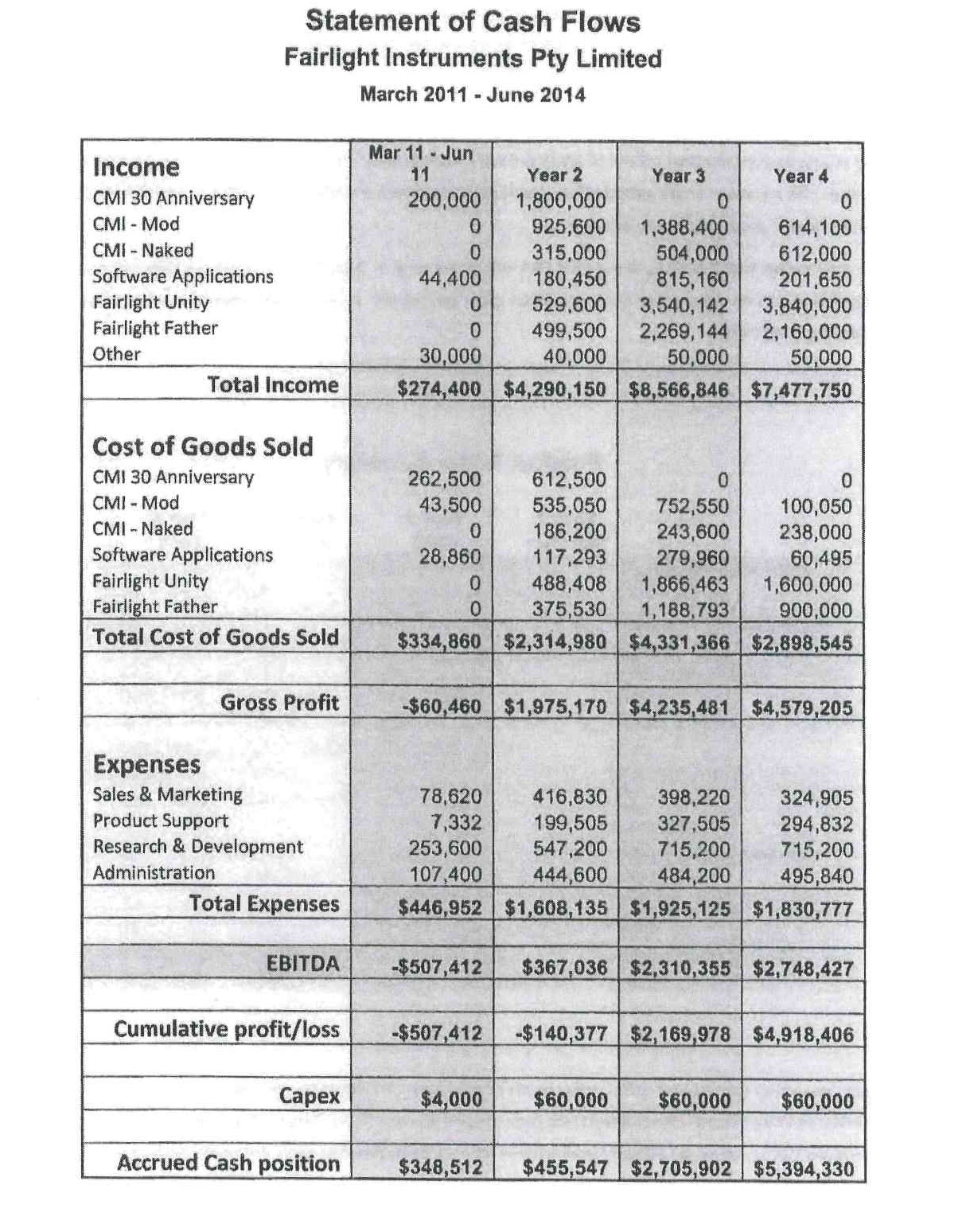
20 The Memorandum states that first production units of the CMI-30A were expected to be delivered in June 2011. It is said that a business plan had been prepared based on initial sales forecasts of ten units per month. Also included was a Product Sales Summary and a Statement of Costs Plan for the period March 2011-June 2014 and a Statement of Cash Flows for the same period. A copy of the latter is reproduced in Schedule A to these reasons.
21 The Memorandum includes the following description of investment risk at page 13:
As with any start-up company, investment in Fairlight Instruments Pty Ltd carries risk. However the risk is mitigated by the following factors:
• The Fairlight brand is already established and extremely well respected in the musical instrument and technology markets.
• Technical risk is low since prototypes have been constructed and demonstrated.
• Commercial risk is low because the market has been tested with positive results.
• The first software-only product, the Fairlight iOS App, is complete and ready to launch.
• The company's founder and major shareholder, Peter Vogel, is internationally recognised as a pioneer of music technology.
• The company has already sold the first CMI-30A and full production will commence in June 2011.
22 It is said that the proceeds of the capital raising would be used to fund "manufacture and marketing".
23 It is common ground that the capital raised by PVI as a result of the Memorandum was $100,000, which is well short of the $500,000 PVI sought.
24 It is important to note that the agreement between PVI and Fairlight.Au authorised PVI to sell only two particular products under the Fairlight name, viz. the CMI-30A and the Series IV, which was also referred to in the Memorandum as the "Naked CMI-30A". It is the CMI-30A and the Series IV that are referred to in the agreement as "the CMI Products". Edmonds J held at [34] that the agreement granted PVI a licence to use the FAIRLIGHT mark only in relation to these products.
25 It is common ground that the only CMI Product (as defined in the agreement) produced by PVI was the Fairlight CMI-30A. In total, there were 14 of these sold, about 10 of which were ordered in or about March 2011.
26 Leaving aside the Fairlight Apps, none of what Mr Vogel described as "follow on" products (ie. the Fairlight Father, the Fairlight Unity or the CMI-55 Module) referred to in the Memorandum were ever produced.
Damages for Repudiation
Background
27 PVI contended that the repudiation of the agreement resulted in a loss of sales of products that were waiting to be dispatched at the time of the repudiation for which PVI should be compensated, as well as the loss of the chance to profit from further performance of the agreement. The total amount claimed by PVI on this basis is approximately $9.5 million (exclusive of interest).
28 PVI contended that if the Court was not satisfied that the agreement would have proved profitable, then it was entitled to recover reliance damages which it calculated at approximately $1.28 million (exclusive of interest).
29 I was referred by Mr Sirtes SC to the written submissions that were relied on by PVI in the Full Court. As mentioned, PVI was represented by counsel before the Full Court by whom those submissions were prepared. In PVI's outline of submissions in chief to the Full Court the claim for damages for breach of contract was put as follows:
46. The appellant claims $1,196,929 in damages for breach of contract, summarised as: (a) $977,210 in reliance damages; (b) $219,719 in costs of mitigation.
47. The reliance damages component is comprised of: (a) $504,635 in general reliance damage; (b) $472,575 in research and development costs thrown away.
48. The $219,719 costs of mitigation are simply the value of refunds to customers who purchased a CMI-30A, as calculated by the respondents' expert.
(footnotes omitted)
30 Fairlight.Au argued in its written submissions to the Full Court that the claim for reliance damages was not sustainable for a number of reasons including, at para 7(b) of its written submissions, that PVI sought expectation damages on the basis that it was possible to predict what position PVI would have been in had the contract been performed and that PVI had no basis to also claim reliance damages.
31 The response to this submission in PVI's written submissions in reply was unequivocal. PVI said (at para 32) that it "… no longer pursues any claim for expectation damages … [a]ccordingly, there is nothing to preclude it from seeking reliance damages."
32 A real question arises as to whether PVI should now be permitted to maintain a claim for expectation loss given its submissions to the Full Court. Although the Full Court did not decide the damages issues, it is apparent that the appeal was conducted on the basis that PVI did not make any claim for expectation damages.
33 In any event, it is extremely unlikely that PVI would have ever made a profit from the agreement. This is because most of the projected revenue referred to in the Memorandum is attributable to sales of other products that were not the subject of the licence referred to in clause 4 of the agreement. Sales of these additional projects were included in the revenue projections apparently on the assumption that permission would be obtained from Fairlight.Au to use the Fairlight name in relation to those products at some time in the future. However, there was no evidence to suggest that there was any prospect of PVI obtaining that permission. By 30 May 2012, Fairlight.Au was not even prepared to allow PVI to use the Fairlight name on the CMI products.
The Relevant Principles
34 In Commonwealth of Australia v Amann Aviation Pty Limited (1991) 174 CLR 64 Mason CJ and Dawson J said at pp 80-81:
The general rule at common law, as stated by Parke B. in Robinson v. Harman [(1848) 1 Ex 850, at p 855 [154 ER 363, at p 365]], is "that where a party sustains a loss by reason of a breach of contract, he is, so far as money can do it, to be placed in the same situation, with respect to damages, as if the contract had been performed". This statement of principle has been accepted and applied in Australia [See Wenham v. Ella (1972) 127 CLR 454, at p 471, per Gibbs J].
The award of damages for breach of contract protects a plaintiff's expectation of receiving the defendant's performance. That expectation arises out of or is created by the contract. Hence, damages for breach of contract are often described as "expectation damages". The onus of proving damages sustained lies on a plaintiff and the amount of damages awarded will be commensurate with the plaintiff's expectation, objectively determined, rather than subjectively ascertained. That is to say, a plaintiff must prove, on the balance of probabilities, that his or her expectation of a certain outcome, as a result of performance of the contract, had a likelihood of attainment rather than being mere expectation.
In the ordinary course of commercial dealings, a party supplying goods or rendering services will enter into a contract with a view to securing a profit, that is to say, that party will expect a certain margin of gain to be achieved in addition to the recouping of any expenses reasonably incurred by it in the discharge of its contractual obligations. It is for this reason that expectation damages are often described as damages for loss of profits. Damages recoverable as lost profits are constituted by the combination of expenses justifiably incurred by a plaintiff in the discharge of contractual obligations and any amount by which gross receipts would have exceeded those expenses. This second amount is the net profit.
The expression "damages for loss of profits" should not be understood as carrying with it the implication that no damages are recoverable either in the case of a contract in which no net profit would have been generated or in the case of a contract in which the amount of profit cannot be demonstrated. It would be an invitation to the repudiation of contractual obligations if the law were to deny to an innocent plaintiff the right to recoupment by an award of damages of expenditure justifiably incurred for the purpose of discharging contractual obligations simply on the ground that the contract breached would not have been or could not be shown to have been profitable. If the performance of a contract would have resulted in a plaintiff, while not making a profit, nevertheless recovering costs incurred in the course of performing contractual obligations, then that plaintiff is entitled to recover damages in an amount equal to those costs in accordance with Robinson v. Harman, as those costs would have been recovered had the contract been fully performed. Similarly, where it is not possible for a plaintiff to demonstrate whether or to what extent the performance of a contract would have resulted in a profit for the plaintiff, it will be open to a plaintiff to seek to recoup expenses incurred, damages in such a case being described as reliance damages or damages for wasted expenditure.
35 Mason CJ and Dawson J continued at pp 85-86:
An award of damages for expenditure reasonably incurred under a contract in which no net profit would have been realized, while placing the plaintiff in the position he or she would have been in had the contract been fully performed, also restores the plaintiff to the position he or she would have been in had the contract not been entered into. In this particular situation it will be noted that there is a coincidence, but no more than a coincidence, between the measure of damages recoverable both in contract and in tort.
It should be observed that, in a case where it is not possible to predict what position a plaintiff would have been in had the contract been fully performed, as was the case in both McRae and Anglia Television, it is not possible as a matter of strict logic to assess damages in accordance with the principle in Robinson v. Harman. But the law considers the just result in such a case is to allow a plaintiff to recover such expenditure as is reasonably incurred in reliance on the defendant's promise. In this case, the law assumes that a plaintiff would at least have recovered his or her expenditure had the contract been fully performed. It will still be open to a defendant, however, to argue that, notwithstanding the fact that it is impossible to assess what profits, if any, the plaintiff would have made had the contract been fully performed, the expenditure claimed by a plaintiff would nevertheless not have been recovered even if, to use the examples of McRae and Anglia Television, the tanker had existed or the defendant actor, Oliver Reed, had participated in the production of the film. In essence, such an argument is to the effect that, far from being impossible to predict what the result of the contract would have been, if fully performed, it is possible to demonstrate that performance of the contract would not even have resulted in the recovery by the plaintiff of reasonable expenses incurred.
36 Their Honours said at p 89:
[A] plaintiff has a prima facie case for recovery of wasted expenditure once it is established that the expense was incurred in reliance on the promise of the party in breach, there being a failure of performance by that party.
37 Brennan J said at pp 104-108:
Where a contract has been rescinded for breach, the amount which a plaintiff has reasonably expended in reliance on the defendant's promise and which is wasted by reason of the defendant's breach of his promise is a proper subject of damages for breach of contract [McRae v Commonwealth Disposals Commission (1951) 84 CLR at pp 412, 414]. Damages assessed for wasted expenditure incurred in reliance on the defendant's promise may be described as reliance damages to distinguish them from damages assessed for loss of the benefits which the plaintiff expected from performance of the contract (expectation damages). A plaintiff who seeks to recover reliance damages must ordinarily prove that the net value of the benefits to which he would have been entitled if the contract had been performed ($B - $y) would have exceeded the wasted expenditure incurred in reliance on the defendant's promise ($x) and, to the extent that he fails to do so, his claim will fail. To discharge the onus of proof, however, the plaintiff may be able to raise and rely on an inference that a party would not incur expenditure in reliance on the other party's promise without a reasonable expectation that, on performance of the contract, the expenditure would be recouped. That is an inference of varying strength according to the circumstances. Sometimes, the inference would be of sufficient strength to enable the plaintiff to discharge the onus; sometimes, the inference would be too weak.
However, when a contract is rescinded for breach and that breach, by preventing the performance of the contract, has made it impossible for the plaintiff to prove that the net value of his contractual benefits ($B - $y) exceeds the wasted expenditure incurred in reliance on the defendant's promise prior to rescission ($x), it is just to shift to the defendant the ultimate onus of proving that, had the contract been performed, the net value of the plaintiff's benefits would not have covered the expenditure he had incurred before rescission.
…
The sufficient and necessary justification for shifting the onus to the party in breach in the assessment of damages for wasted expenditure incurred in reliance on the defendant's promise before rescission for breach is that the breach of the contract itself makes it impossible to undertake an assessment on the ordinary basis.
…
A plaintiff's inability to quantify his lost benefits is no justification by itself for casting on the defendant an onus to prove that the plaintiff would not have recouped reliance damages had the contract been performed. What justifies the reversal of the onus is the defendant's repudiation or breach which denies, prevents or precludes the existence of circumstances which would have determined the value of the plaintiff's contractual benefits.
…
Where justification for reversing the onus exists, reliance damages may be recovered; absent that justification, the plaintiff must recover expectation damages, if any, by proof of the value of benefits and the cost of performance; that is, by proof that $B - $y is greater than $x. These are alternative methods of assessing damages, but the plaintiff does not have an election as to the method. The plaintiff who seeks recovery of reliance damages must show that justification for reversing the onus of proof exists. Otherwise, he must endeavour to prove his damages on the ordinary basis.
38 Gaudron J said at pp 155-156:
It is also clear … that damages which are assessed by reference to wasted expenditure are awarded to compensate for loss of contractual rights or loss of profits and, despite any coincidence in effect, not to put the contracting party in the position in which he or she would have been if the contract had not been made. It follows that any loss which would have been involved in performing the contract must be brought to account. Were it otherwise, the plaintiff would be put in a better position than if the contract had been performed. It also follows that it is not correct to characterize damages assessed by reference to wasted expenditure as damages to be claimed by election or in the alternative to damages for loss of profits. However, as damages are assessed on that basis because the contract would not have produced a profit or it is impossible to prove what the profit would have been, it may be expected that a claim for wasted expenditure will ordinarily be framed as an independent claim or in the alternative to a claim for damages for loss of profits.
Once it is appreciated that damages assessed by reference to wasted expenditure are awarded to compensate for the loss of contractual rights or for loss of profits, it is apparent that what is involved is an assumption that the loss is no less than that which has been outlaid and wasted by reason of repudiation or breach. An assumption to that effect is no more than the recognition of the ordinary expectations of the world of commerce that the value of a contract will be no less than the cost of its performance. That assumption necessarily contemplates that damages will include preliminary expenses, as was held in Anglia Television.
The assumption which underlies the award of damages by reference to wasted expenditure, like all assumptions, is one which, once made, will ordinarily be maintained unless displaced by evidence pointing to the contrary. In a practical sense that may mean that the assumption will often be made and maintained unless the defendant proves otherwise. However, save in that limited and practical sense, I do not think it right to say, as was held in C.C.C. Films Ltd. [[1985] QB, at p 40] that the onus is on a defendant "to prove that the expenditure ... is irrecoverable because [the plaintiff] would not have recouped [his] expenditure".
39 Deane J said at p 118:
The frequent inability of curial procedures to determine with certainty what has happened in the past, let alone what would have been or what will be, necessarily gives rise to a need for a number of subsidiary rules governing the determination of the loss or injury which a plaintiff has actually sustained by reason of a wrongful act. One such subsidiary rule is that, even in an action for repudiation or breach of contract where damage is not an element of the cause of action, a plaintiff bears the onus of establishing the extent of his loss or injury on the balance of probabilities. To satisfy the requirements of that rule, a plaintiff must, if he is to recover more than a nominal amount in such an action, affirmatively establish assessable damage, that is to say, loss or injury which is capable of being measured in monetary terms. In many cases, proof of the full extent of the loss or injury sustained will involve establishing an evidentiary foundation for positive and detailed ultimate findings by the court upon the balance of probabilities. There are, however, cases where considerations of justice or the limitations of curial method render ultimate findings, about what would have been or will be, impracticable or inappropriate. In such cases, damages must be assessed on some basis other than findings about what would have ultimately happened if the repudiation or breach had not occurred or about the precise ultimate implications of the situation which exists after the repudiation or breach. In particular, it may be appropriate that damages be assessed by reference to the probabilities or the possibilities of what would have happened or will happen rather than on the basis of speculation that probabilities would have or will come to pass and that possibilities would not have or will not.
(citations omitted)
40 The High Court's decision in Amann was considered in Sellars v Adelaide Petroleum NL (1994) 179 CLR 332. The plurality said at p 349:
[W]here there has been an actual loss of some sort, the common law does not permit difficulties of estimating the loss in money to defeat an award of damages. The damages will then be ascertained by reference to the degree of probabilities, or possibilities, inherent in the plaintiffs succeeding had the plaintiff been given the chance which the contract promised.
This approach is not confined to contracts relating to games of chance, sporting contests or other competitions. Fink v. Fink concerned a contract to provide an opportunity for a reconciliation, breach of which was held to entitle the wife to damages. And there can be no doubt that a contract to provide a commercial advantage or opportunity, if breached, enables the innocent party to bring an action for damages for the loss of that advantage or opportunity. So, in The Commonwealth v Amann Aviation Pty Ltd, Mason CJ. and Dawson J. [at p 92], Brennan J. [at pp 102-104] and Deane J. [pp 118-119) concluded that a lost commercial advantage or opportunity was a compensable loss, even though there was a less than 50 per cent likelihood that the commercial advantage would be realized. Damages for breach of contract were assessed by reference to the probabilities or possibilities of what would have happened.
41 Their Honours also referred to the High Court's earlier decision in Malec v JC Hutton Pty Ltd (1990) 169 CLR 638. Their Honours said at pp 350:
In Malec v J C Hutton Pty Ltd ([(1990) 169 CLR 638], this Court drew a distinction between, on the one hand, proof of historical facts what has happened - and, on the other hand, proof of future possibilities and past hypothetical situations. The civil standard of proof applies to the first category but not to the second, particularly when it is necessary to determine future possibilities and past hypothetical situations for the purpose of assessing damages [pp 639-640, per Brennan and Dawson JJ; pp 642-643, per Deane, Gaudron and McHugh JJ].
In Malec, Deane, Gaudron and McHugh JJ. explained the way in which the matter is to be approached in these terms [at p 643]:
"If the law is to take account of future or hypothetical events in assessing damages, it can only do so in terms of the degree of probability of those events occurring .... But unless the chance is so low as to be regarded as speculative - say less than 1 per cent - or so high as to be practically certain - say over 99 per cent - the court will take that chance into account in assessing the damages. Where proof is necessarily unattainable, it would be unfair to treat as certain a prediction which has a 51 per cent probability of occurring, but to ignore altogether a prediction which has a 49 per cent probability of occurring. Thus, the court assesses the degree of probability that an event would have occurred, or might occur, and adjusts its award of damages to reflect the degree of probability."
…
Neither in logic nor in the nature of things is there any reason for confining the approach taken in Malec concerning the proof of future possibilities and past hypothetical situations to the assessment of damages for personal injuries. The reasons which commended the adoption of that approach in assessments of that kind apply with equal force to the assessment of damages for loss of a commercial opportunity, as the judgments in Amann acknowledge.
Damages for loss of profits – PVI's submissions
42 PVI submitted that the repudiation of the agreement by Fairlight.Au resulted in a loss of profit from sales of products waiting to be despatched at the time for which PVI must be compensated as well as the loss of the chance to profit from execution of its ongoing business plan. It argued that the loss of chance is compensable even if, on the balance of probabilities, it is more likely than not that the chance would not have come to fruition. It also argued that damages for deprivation of a commercial opportunity should be ascertained by reference to the Court's assessment of the prospects of success of that opportunity had it been pursued.
43 PVI further submitted that the most reliable measure of the likely profitability of its business was the Memorandum which provided an appropriate basis for estimating the profit lost as a result of Fairlight.Au's repudiation. The amount that PVI claimed as compensation for this loss was $5,077,918 which, it was said, would restore PVI to the position it would have been in two years after the repudiation if Fairlight.Au had performed its obligations under the agreement.
44 Mr Hood, the expert witness who gave evidence for Fairlight.Au, concluded that "there was no quantifiable loss of profits" which PVI could claim. This conclusion was primarily based on the actual sales of the CMI-30A made which, he said, cast doubt on the reliability of the sales projections contained in the Memorandum. In its submissions, PVI described this conclusion as "fatally flawed" because it did not take into account the reason for the poor sales of the CMI-30A which, it was submitted, was attributable to Fairlight.Au's failure to perform its obligations under the agreement.
45 As is clear from PVI's submissions, the primary evidence on which it relies to support its claim to having lost a valuable business opportunity as a result of Fairlight.Au's repudiation of the agreement was the Memorandum which, according to PVI, represented a credible business plan that was prepared well before the dispute the subject of this litigation first arose.
46 There are two main reasons why I do not think the Memorandum provides a credible basis for inferring that PVI's contract with Fairlight.Au may have proven profitable had it not been repudiated.
47 First, the reliability of the projections contained in the Memorandum is greatly diminished by the actual sales achieved compared to what was projected in the Memorandum. As previously mentioned, PVI's total CMI-30A sales numbered 14, about 10 of which were ordered in about March 2011, with very few sales being made after that time. There were no sales of the Series IV (or Naked CMI-30A).
48 Secondly, the projections in the Memorandum and, in particular, the statement of cash flows, was predicated on the ability of PVI to manufacture and sell a number of products under the Fairlight name that were not within the scope of the trade mark licence granted to PVI under the agreement.
49 As to the first of these points, PVI submitted that it could not meet its own sales projections due to Fairlight.Au's breaches of the agreement. The difficulty with this submission is that it was also made to Edmond J's who rejected it unequivocally. His Honour's finding that the evidence did not establish that Fairlight.Au was in breach of the agreement due to any delays that occurred in the delivery of computer software to PVI was not disturbed on appeal. This provides a complete answer to PVI's submission that the disparity between projected sales and actual sales of the CMI-30A should be disregarded on the basis that it was Fairlight.Au's breach of agreement that prevented PVI from selling more CMI Products than it actually did.
50 As to the second point, even if I was to accept that the projections in the Memorandum provided a reliable basis from which conclusions might be drawn as to potential profitability of PVI, it cannot be concluded that the loss claimed by PVI on the basis of such projections was attributable to Fairlight.Au's repudiation. This is because the cash flow forecasts in the Memorandum include the projected sales of the additional products not covered by the licence.
51 The cash flow projections for the period March 2011 to June 2014 included in the Memorandum project revenue attributable to the CMI-30A of $200,000 for the period March-June 2011 and $1,800,00 for the period June 2011-June 2012. They contemplate sales of 10 units in the initial March-June 2011 period followed by sales of another 90 units in the financial year ending June 2012. The projected cost of goods sold for the CMI-30A in the period March 2011-June 2012 totals $875,000 which equates to a gross profit from sales of $1,125,000.
52 The projected revenue included in the statement of cash flows includes nothing for sales of the Series IV in the initial period and sales of 104 such units, generating $315,000 of revenue, in the financial year ending June 2012. The cost of goods sold for the Series IV in the period June 2011-June 2012 totals $186,200 which equates to a gross profit of $128,800.
53 Hence, the projected gross profit from sales of the CMI Products during the period March 2011-June 2012 totalled $1,253,800. Expenses for the same period are shown in the statement of cash flows as slightly over $2,000,000. Even if these are assumed to be half what was projected, the earnings before interest, tax, depreciation and amortisation ("EBITDA") would be approximately $250,000 for the period March 2011 to June 2012. This may suggest that if the business had managed to manufacture and sell the CMI Products as projected in the Memorandum, the business may have been modestly profitable. But there are many assumptions underlying that conjecture. In particular, it assumes that the actual sales of the CMI Products were as projected, that the costs of goods sold was as projected, and that the indirect expenses would be approximately half what was projected.
54 In the result, I am not satisfied that PVI would have made a profit from the agreement. But it does not follow that PVI is not entitled to recover any damages in respect of Fairlight.Au's repudiation of the agreement. As I will explain, this is a case in which I am satisfied that PVI was likely to have recouped some additional portion of the expenditure incurred by it in the course of its performance of the agreement had the agreement not been repudiated by Fairlight.Au.
Reliance Damages – Fairlight.Au's submissions
55 Fairlight.Au made an overarching submission in respect of PVI's claim for reliance damages. It submitted that, having sought to prove and recover expectation or loss of profit damages, PVI was precluded from making any claim for reliance damages.
56 I confess to having had some difficulty following this submission. When pressed as to whether it was open to PVI to maintain claims for expectation damages or reliance damages in the alternative, Mr Sirtes SC submitted that it was not, apparently on the basis that PVI was precluded from doing so because it had elected to seek expectation damages.
57 It is true that a party cannot obtain an award of damages for both loss of profits and reliance damages. But this does not mean that a party cannot advance claims for expectation damages and reliance damages in the alternative. Gaudron J made this point very clearly in Amann at p 155. Although Brennan J said at p 108 that the plaintiff does not have an election to make as to the method of assessment, I do not take this to mean that a party cannot make alternative claims for damages for loss of profits and reliance damages. What his Honour was saying at p 108 was that the plaintiff must justify recovery of any reliance damages by showing that the defendant's repudiation "denies, prevents or precludes the existence of circumstances which would have determined the value of the plaintiff's contractual benefits." This is because the justification for allowing the plaintiff to recover reliance damages (or, more particularly, the reversing of the onus referred to by Brennan J) is that the defendant's repudiation of the agreement prevents the court from determining with certainty what position the plaintiff would have been in had the defendant fulfilled its contractual obligations.
58 Fairlight.Au also challenged PVI's reliance damages claim on other grounds raised in Mr Hood's expert reports. I deal with the various components of PVI's reliance damages claim and Mr Hood's responses to them in the next section of these reasons.
What is the proper measure of PVI's reliance damages?
Breakdown of PVI's reliance damages
59 PVI's written submissions included the following breakdown of its claim for reliance damages:
Mr Hood's reliance damages: | $508,724 |
Mr Hood's mitigation costs: | $209,860 |
Additional mitigation costs: | $66,484 |
R&D costs: | $472,575 |
Total reliance damages: | $1,257,643 |
60 In his first report Mr Hood calculated PVI's reliance damages (on various assumptions) at $508,724. This amount reflected what he referred to as "residual non-R&D costs". In a later report Mr Hood revised this figure to $504,635. The amount of $504,635 is slightly less than the figure referred to in PVI's breakdown, but in circumstances where PKT did not dispute any of the arithmetic underlying Mr Hood's revised calculation I propose to accept it.
61 As a matter of principle, and subject to some qualifications that I will return to, it is apparent that Mr Hood accepted that what he called "residual non R&D expenses" were properly recoverable as damages suffered by PVI as a result of Fairlight.Au's repudiation of the agreement.
62 The principal difference between the parties in relation to reliance damages relates to R&D costs. Mr Hood has excluded from his figure of $504,635 any amount expended by PVI on R&D. He calculated such expenditure to be $472,575, a figure which PVI accepted as correct in its submissions.
63 One reason why Mr Hood excluded the $472,575 from his reliance damages figure was that he could not be satisfied that the R&D expenses were solely related to the development of the CMI Products. However, he did accept, subject to his next point (which I will come to) that R&D expenses would be recoverable to the extent they related to the development of the CMI Products, assuming that Fairlight.Au's repudiation of the agreement rendered any resulting asset worthless.
64 The other point made by Mr Hood in relation to R&D expenditure was that it is by definition uncertain and, at the time the relevant expenditure was incurred, PVI could not know whether it would create anything of value. It was in this sense that he described it as a "black hole expense" or a "sunk cost".
65 I will first deal with Mr Hood's second point.
66 The R&D expenditure would not be recoverable if incurred by PVI irrespective of whether PVI had entered into the agreement. But in that situation the R&D expenditure would not be recoverable for the reason that it was not incurred for the purpose of performing the agreement, and therefore was not money lost as a result of Fairlight.Au's repudiation of the agreement. In essence, the question that arises is one of causation. If an innocent party is entitled to have damages for breach of contract assessed on a reliance basis, then it may be entitled to recover expenses incurred and wasted in reliance on the defaulting party's contractual promises under one or other limb of the rule in Hadley v Baxendale (1854) 9 Ex 341: see Amann at p 88 per Mason CJ and Dawson J. Hence, if the R&D expenditure was reasonably incurred by PVI for the purpose of performing the agreement, then I do not see why, as a matter of principle, it is not prima facie recoverable.
67 The first question in the present case is whether it can be said that the R&D expenditure was incurred in reliance on the Fairlight.Au's contractual promises. I think it should be inferred that PVI would not have incurred the R&D expenditure had it not entered into the agreement with Fairlight.Au. As I have explained, the use of the Fairlight brand was important to PVI's business plan. I do not think PVI would have incurred expenses developing the CMI Products without having obtained the right to market and sell those products under the Fairlight brand. Accordingly, I am satisfied that the R&D expenditure would not have been incurred in the absence of the agreement.
68 The second question is whether the reliance damages claimed are within the rule in Hadley v Baxendale. I am prepared to accept, as I think Mr Hood was, that R&D expenditure that related solely to the products the subject of the agreement would be recoverable under either the first or the second limb of the rule in Hadley v Baxendale. No submission to the contrary was made by Fairlight.Au.
69 Mr Hood made clear in his reports that he could not separate out the R&D costs that would enable him to say which of these may have been incurred in connection with the development of the CMI Products as opposed to any of the other products that were included in PVI's business plan and cash flow projects as set out in the Memorandum or other business activities in which Mr Vogel was involved. However, Mr Hood was able to determine from PVI's financial records that $31,088 of the R&D expenditure incurred by PVI related to the development of the Apps. PVI accepts that this amount should be excluded on the basis that it represents R&D expenditure on products not covered by the agreement.
70 In his affidavit of 28 October 2014, Mr Vogel said that the nett R&D expenditure relating solely to the CMI-30A was $478,053 In a later affidavit dated 17 November 2014 Mr Vogel referred again to the R&D expenditure of $478,053 relating to the CMI-30A which he said had been "thrown away". One of the difficulties I face in assessing this evidence is that the paragraphs in question were apparently the subject of an objection by Fairlight.Au, which, at its suggestion, Edmonds J was not required to rule upon.
71 Mr Vogel's evidence with regard to the R&D expenditure does not appear to have been challenged in his cross-examination. Nor did Mr Hood suggest that the R&D expenditure of $478,053 was excessive or unreasonable for the CMI Products. His point was that he could not be satisfied that the expenditure was solely related to the CMI Products. This point is in my view answered by Mr Vogel's unchallenged evidence.
72 As of March 2011 PVI was projecting that it would generate revenue of $2 million for sales of the CMI-30A period March 2011-June 2011 for a gross profit of $1.2 million, which equates to a gross profit margin of about 56%. With the benefit of hindsight, these sales forecasts were excessively optimistic. However, in the absence of evidence pointing to a different conclusion, it is not possible to characterise the R&D expenditure of $478,053 as unreasonable for products that were forecast to generate sales revenue of $2 million over a 15 month period.
73 It was submitted by Fairlight.Au that I could not be satisfied that the R&D expenditure did not produce anything of value that should be brought to account in determining whether the R&D expenditure was wholly or partly wasted.
74 Under the agreement PVI acquired rights to computer software developed by Fairlight.Au. However, the software was developed specifically for the CMI Products to be sold under the Fairlight name. In circumstances where the evidence indicates that there was only a very limited market (much smaller than projected) for the CMI Products I would not attribute anything more than a nominal value to the software. Moreover, Mr Vogel gave evidence that does not appear to have been challenged that the computer software was of no value to PVI because it was not supplied with all of the relevant source code. Further, he said that the software requires Fairlight.Au's Crystal Core hardware to function, which Fairlight.Au has not been willing to supply to PVI since May 2012. This evidence, which was not challenged in cross-examination, should be accepted. In my view it provides a complete answer to Fairlight.Au's submission.
Mitigation costs
75 To understand this aspect of PVI's claim it is necessary to refer to the particulars of loss and damage that were included in PVI's cross-claim. These particulars referred to "[m]itigation costs (to service existing customers)" of $780,000 made up as follows:
"Cost of developing alternative to CC-1/SX12 (conservative est)" $500,000
"Cost of developing alternative software (conservative est)" $200,000
"Retrofit alternative to CC-1/SX12 to 20 existing systems $4,000 each" $80,000
76 Mr Hood dealt with this aspect of PVI's claim in Section 6.3 of his report dated 24 June 2014 as follows:
6.3 Mitigation Costs
6.3.1 In assessing the cost to service existing customers, I note from the sales ledger [PVI 13.012] that total sales for the CMI-30A and related components in the period of 2011 and 2012 was $209,875, with subsequent sales of $61,900 (a combined total of $271,775).
6.3.2 One would hypothesize that, rather than pursue the cost of developing alternative software and retrofitting systems (at an unsubstantiated theoretical cost of $780,000) it would be prudent in mitigating losses to simply provide a full refund to customers minimizing costs to $219,719.
6.5.5 If one was to assume that the result of R&D expenditure was knowledge capable of being leveraged in future, incurring development costs for an alternative to the CC-1/SX12 and software may be rational (subject to a market for the products existing in the future). Should that be the case, then the market value of the software/firmware required could be the $200,000 that Fairlight was willing to provide software for in the original agreement, plus nominal licensing costs.
6.3.4 The evidence and history of sales (prior to any problems materializing) is overwhelmingly lower than anticipated in the IM (document PVl.12.012), being:
Anticipated | Actual | % of anticipated | |
Sales in the period Mar 11 to Jun 11 | $274,400 | $150,270 | 55% |
Sales in the period Jul 11 to Jan 12 | Approx. $2,145,075 | $30,284 | 1.4% |
6.3.5 Rational management may chose to discontinue the enterprise rather than continue to invest in, and create, a product which, the sales data suggests, the market may not have embraced.
77 It can be seen that Mr Hood describes the claim for mitigation costs in para 6.3.2 as (inter alia) "unsubstantiated". Mr Vogel responded to Mr Hood's report in an affidavit of 28 October 2014. In that affidavit Mr Vogel said (at para 84):
In relation to mitigation costs, I agree with Mr Hood (6.3.2) the most rational mitigation strategy would be to refund customers. 14 sales have been made and cost of refunds would be $308,000 including costs such as duties and freight, averaging about $5,000 per sale.
78 There is no suggestion that PVI has ever refunded any money to customers, that it has ever been asked to do so, or that it is liable to do so. Mr Hood addressed refund costs from a theoretical perspective when observing that it would have been more prudent for PVI to have provided refunds to a relatively small number of customers who purchased the CMI-30A rather than developing new software. Mr Hood's observation did not relieve PVI of the need to prove what costs is incurred in mitigating its loss, though it may have provided some basis for declining to award anything more than $219,719 in respect of PVI's reasonable mitigation costs.
79 Mr Hood was correct to say that the claims for mitigation costs were unsubstantiated. I was not referred to any evidence that could support a finding that PVI spent $780,000 or any other amount on mitigation costs at least not in addition to the residual non-R&D costs and the R&D costs also claimed by PVI. Even if I was to assume that PVI incurred costs developing an alternative to the CC-1/SX12 or some alternative software, there is no evidence to indicate that these costs did not form part of the expenditure that formed part of the R&D expenditure to which I have already referred. Similarly, there is no evidence to indicate that the costs of retrofitting the CC-1/SX12 to 20 existing systems (even though the evidences shows only 14 CMI-30A's were sold) was not accounted for in the $504,635 residual non-R&D expenses already allowed.
80 The final point to make in relation to this aspect of PVI's claim is that the lack of particularity (not to mention evidence) to support it makes it impossible to know precisely when those costs are alleged to have been incurred. But if it is assumed that they were largely incurred to enable the CMI-30A to be shown at the 2011 NAMM show that took place in California in January 2011, then it is difficult to see how this expenditure could be recoverable on the basis that it was reasonably incurred to mitigate loss inflicted by Fairlight.Au's breach of contract. I say this because there was no breach of contract proven against Fairlight.Au and the repudiation entitling PVI to terminate the agreement and sue for damages for breach of contract did not occur until May 2012.
Additional mitigation costs
81 In its written submission PVI claimed a further amount of $66,484. According to PVI, Mr Hood's calculation omitted additional mitigation costs "expended in a failed attempt to modify the software to work without the components Fairlight.Au refused to supply."
82 This aspect of PVI's claim was dealt with in Mr Vogel's affidavit of 5 September 2013. In that affidavit he says that R&D expenditure on CMI-30A during the 2012-2013 financial year was approximately $63,000 but that PVI's amount was still to be verified by PVI's accountant. He returned to this topic in his affidavit of 27 November 2017, producing a spreadsheet and invoices said to total $66,484. Mr Vogel says that these invoices relate to expenses incurred by PVI in developing an alternative to the Fairlight.Au software and hardware. He also said in his affidavit that PVI ran out of money before it could complete this development.
83 I am satisfied that some award should be made in respect of these additional mitigation costs. However, as with R&D expenditure for 2011 and 2012, it is necessary to make an allowance for R&D tax incentives received during the relevant years. The evidence shows that for the 2013 financial year this amounted to $29,918. Accordingly, I am satisfied that I should allow $36,566 in respect of the additional mitigation costs.
Loss of Opportunity Analysis
84 I am satisfied that PVI incurred further expenditure of $981,299 that might qualify for recovery as wasted expenditure. However, to award damages for the whole of this amount would be unjust. This is because it is highly unlikely that PVI would have recouped all of this expenditure if Fairlight.Au had not repudiated the agreement.
85 As I have explained, the licence to use the Fairlight name on CMI Products supplied, or to be supplied, by PVI was validly terminated in May 2012 with the consequence that PVI could no longer lawfully sell any CMI Products under or by reference to the Fairlight name. Moreover, the actual sales of CMI Products made by PVI in the period March 2011 to May 2012 were much less than projected in the Memorandum. Only 14 CMI-30A units were sold. At $20,000 per unit, that amounts to total sales of only $280,000 compared to projected sales of $2,000,000 for the period March 2011 to June 2012. The market for the CMI Products, or at least the CMI-30A, did not prove to be anywhere near as large as PVI expected.
86 PVI submitted that it would have been open to PVI to supply the CMI Products under a different name but still capitalise on Mr Vogel's reputation as the designer of the original Fairlight CMI. In its submissions Fairlight.Au sought to dismiss this possibility on the basis that it was contrary to the Memorandum which emphasised (at least implicitly) the importance of the Fairlight name to the business plan.
87 I do not accept that there would have been no market for the CMI Products if sold by PVI under a different name. The evidence of Mr Vogel's reputation as the designer of the original Fairlight CMI indicates that his name and reputation were closely associated with the Fairlight musical instruments by persons likely to be interested in acquiring the CMI-30A. Even so, I consider it highly unlikely that PVI would have sold enough CMI Products under a different name to fully recoup all of its expenditure.
88 I am satisfied that there would have been some market for the CMI Products that it was open to PVI to exploit after May 2012 using a different product name. It is not possible to say how substantial that market was likely to be. What is clear, however, is that it would have been much smaller than anticipated by the Memorandum.
89 What PVI's actual sales of CMI Products would have been if Fairlight.Au had not repudiated the agreement is impossible to say. But if, for example, it was assumed that PVI sold additional CMI Products (both the CMI-30A and the Naked CMI-30A) to the value of $750,000 at a gross profit margin of 40% (ie. less than was projected), that may well have allowed PVI to recoup expenditure in the amount of $300,000 depending on how those sales affected the overheads (ie. indirect expenses) of the business.
90 The present case is one in which the observations of Deane J in Amann at p 118 should be applied. To require proof on the balance of probabilities of what further sales of CMI Products would have been made by PVI were it not for Fairlight.Au's repudiation of the agreement would be impractical and unjust. Rather, it is appropriate in this case to assess damages by reference to the value that should be attributed to PVI's loss of the opportunity to recover at least some significant portion of PVI's expenditure. In the circumstances of this case, where I am required to assess damages based on a largely hypothetical state of affairs, I think this is the most appropriate approach to take. I regard it as consistent with the decisions in Malec, Amann and Sellars.
91 I accept that my assessment of PVI's loss involves a degree of speculation and guesswork, but this is unavoidable: see Sellars per Brennan J at p 364 citing Enzed Holdings Ltd v Wynthea Pty Ltd (1984) 57 ALR 167 at p 183.
92 I will allow a percentage of the wasted expenditure claimed (excluding mitigation costs) which reflects my assessment of the value of the lost opportunity. In my view an appropriate percentage figure is 30% which yields a figure of $294,390 (ie. 30% of $981,299). This figure reflects my view that, while the prospects of PVI recovering all of its expenditure were extremely low, the opportunity to recover at least some of that expenditure that was lost was not insignificant and of considerable value to PVI given Mr Vogel's reputation, and the time, effort and money that had been already spent on research and development for the CMI Products as of May 2012.
93 The total damages to be awarded to PVI in respect of Fairlight.Au's repudiation of the agreement are therefore $330,956.
Damages for Copyright Infringement
Background
94 The Full Court considered PVI's appeal against Edmonds J's rejection of PVI's copyright case at [71]-[84]. In those paragraphs the Full Court said:
[71] The primary judge's reasons at [125]–[137] included the following findings relevant to this ground:
(a) that the Agreement in clauses 20 and 22 did not operate to convey copyright in the software developed by Fairlight pursuant to the Agreement;
(b) that no other evidence adduced at trial established PVI's entitlement to ownership of the software;
(c) that there was no evidence that Fairlight had, without the licence of PVI, reproduced a substantial part of any copyright work owned by PVI; and
(d) that PVI had failed to supply any evidence of sales or copying by Fairlight such that it would allow the Court to award damages as a consequence of the alleged infringement.
[72] PVI contests each of these findings. A further relevant finding, which PVI does not contest, is that by April 2012, PVI had made all of the payments totalling $200,000 which were required by clauses 6 and 7 of the Agreement.
[73] PVI submits that the Agreement sufficiently operated as an assignment of Fairlight's future copyright, which is permissible pursuant to s 197 of the Copyright Act 1968 (Cth). It submits that evidence of ownership beyond the terms of the Agreement was present in the form of admissions made by the respondent, particularly when read in context with the evidence of the Chief Technical Officer of Fairlight, Mr Fibaek, to the effect first, that the software had been assigned to PVI, and secondly, that this software had been reproduced by Fairlight.
[74] Fairlight contended that clauses 20 and 22 of the Agreement were insufficient to convey title to PVI given the second sentence of clause 20 which said "[t]he exact definition of IP to be transferred will be defined in a separate document". It submitted that the purpose of the "exact definition" was to make clear that generic or third party proprietary software, not written by Fairlight, was to be identified as not included within the assignment. For this purpose a further document was required to complete the terms of the copyright assignment. Fairlight further submitted that the admissions made in the defence to the cross-claim were inadequate to discharge the onus upon PVI to prove either ownership or substantiality of reproduction necessary to establish copyright infringement.
Consideration
[75] In our view, this ground of appeal should be upheld.
[76] First, as a matter of construction, as we have noted above, there is no doubt that the parties had a clear intention that such software as Fairlight developed for the project was assigned to PVI upon receipt of the final payment of $200,000. That payment was made in April 2012. On a factual level, the need for exact definition arose because certain third party or generic software may have been necessary to complete the project. There is no doubt, as a matter of fact, that whatever third party or generic software was to be excluded from the software assigned was an insignificant aspect of the bargain being struck by the parties. They agreed that all software created by Fairlight for PVI was assigned to it, and the terms of clauses 23–25 indicated that the parties were content to nominate a fee for the licence-back ("about $1,500 per license"). In our view the mechanical step of identifying that software did not preclude the completion of the assignment of the software which originally lay in the hands of Fairlight.
[77] Secondly, in its cross claim, PVI alleged that Fairlight had sold the software known as the "Sound Design Sampler (SDS)" which included software, the copyright in which had been transferred to PVI pursuant to the Agreement.
[78] In [24(c)] of its defence to the cross-claim, Fairlight admitted that:
(i) Fairlight's SDS included source code written for the CMI-30A;
(ii) Fairlight has provided a small number of SDS units and/or licences to third parties.
(iii) By letter dated 1 June 2012 from... [PVI, it said]:
"We would like [Fairlight] to continue to use our CMI code in their SDS products. This is also mutually beneficial."
(iv) In the circumstances set out in the preceding subparagraph, at all relevant times [PVI] knew of and authorised Fairlight's use and reproduction of CMI source code written for the CMI-30A project in Fairlight's SDS products;
...
[79] The pleading went on to assert that in the circumstances PVI was "estopped and precluded" from saying that its copyright had been infringed, because PVI had authorised that reproduction.
[80] Further, the evidence of Mr Fibaek served to clarify that the "small number" of SDS units or licences provided to third parties (referred to in (ii) above) included two licences supplied by Fairlight after April 2012 (being the date upon which the copyright assignment took effect). His evidence confirmed that the Dream II product included the SDS software.
[81] Mr Fibaek went on at [12]:
Peter Vogel was aware that Fairlight had incorporated the CMI-30A code in Version 3.2 of Dream II, which incorporation in [sic, is] consistent with clause 25 of the Licence Agreement which provided that Fairlight could purchase CMI-30A software licences from Peter Vogel Instruments for 'in the order of' $1500 per licence.
(emphasis added)
[82] In our view, these admissions indicate that there was no factual dispute at trial that Fairlight had reproduced the entirety of the CMI-30A software in the SDS product, and that Fairlight accepted that, by virtue of clause 25 of the Agreement (or the later offer by PVI in its letter of 1 June 2012) it was obliged to pay a licence fee in the order of $1,500 in respect of that software.
[83] The consequence is that, by virtue of the evidence and admissions that we have identified above, PVI has succeeded in establishing that Fairlight had reproduced the SDS software in the two products identified, thereby infringing that work. Accordingly, in our view Ground 5 is made out.
[84] This may be a pyrrhic victory for PVI. It concedes that the quantification of its damages might be as little as $3,000, although it contends that it is also entitled to additional damages.
Compensatory damages
95 PVI submitted that compensatory damages for copyright infringement should not be limited to the amount of $1,500 per licence specified in clause 25 of the agreement. It was submitted that there should be an award of compensatory damages for at least $200,000 on the basis that this would represent a reasonable licence fee for what its submissions implied was a wholesale misappropriation of its copyright in the CMI-30A software.
96 PVI developed its argument on this issue in its written submissions as follows:
33. The "licence fee" approach is appropriate for quantification of damages, but this should be based on a licence to incorporate the entirety of the CMI-30A source code into Fairlight.au's own product, not the $1,500 "software licenses" referred to in par 25 of the Contract […], because although Fairlight had a right under the contract to sell software licences to its customers, they had no right to appropriate the source code in its entirety for its own product, as the Full Court found they did.
34. Clause 9 […] says the $200,000 was a "one off fee for development of the software", that is, the software development should be valued at $200,000. This is also consistent with Mr Fibaek's affidavit "… the new software which was to be written by Fairlight (and for which the First Respondent would be paying a fee of $200,000 plus GST) would be owned by the First Respondent". Accordingly, it is reasonable to say that the software was worth at least $200,000 to Fairlight.au and this is an appropriate figure for damages based on a notional unlimited licence.
(footnotes omitted)
97 In its submissions to the Full Court PVI submitted that there were seven licences sold by Fairlight.Au for the Dream II software that included source code for the program written by Fairlight.Au for PVI pursuant to the terms of the agreement. The figure of seven appears to have come from Mr Tino Fibaek's affidavit of 22 May 2014. Mr Fibaek, the Chief Technical Officer for Fairlight.Au, referred in para 10 of that affidavit to sales of seven licences.
98 Mr Fibaek's affidavit of 22 May 2014 stated:
3. The current version of the Dream II software in the public domain is Version 4.1 (which is also the most recent version). This version has reproduced all of the CMI-30A code written for PVI.
4. Clause 25 of the Licence Agreement provides that Fairlight can license this code to sell to third parties upon purchase and payment of a licence fee to Peter Vogel Instruments.
5. Since 2007, Fairlight has sold or otherwise provided CC-1 cards to about 700 customers.
6. CMI-30A code is present in Versions 3.2, 3.5, 4.0 and 4.1 of Dream II. The release dates of the various versions are as follows:
a. V3.2, released in September 2011;
b. V3.5, released during the first quarter of 2012;
c. V4.0, released in November 2012; and
d. V4.1, released in August 2013.
7. Any of the 700 customers who purchased a CC-1 card as referred to in paragraph 5 above have the capability to upgrade to either Version 3.2 or 3.5 of the Dream II program.
8. This CMI-30A code is not accessible by those who only have a licence to use the Dream II program; a further licence is required from Fairlight to run the CMI-30A code.
9. The CC-1 cards referred to above also contain the Fairlight SDS product. The SDS product is, as for the CMI-30A described above, not accessible, on an otherwise fully licensed Dream II system, unless a further licence is obtained by a customer from Fairlight.
10. Only seven such licences have been sold and delivered by Fairlight to third parties, as follows:
(a) The four 'Wave' consoles that were sold with SDS and invoiced on the following dates:
i. 27/5/2011
ii. 15/7/2011
iii. 31/1/2012
iv. 29/2/2012
(b) Swedish Radio on 30/11/2011
(c) Music and Effects on 28/2/2013
(d) Media Logic on 31/10/2013
11. Because of the present dispute, Fairlight has not and will not provide any further licences to SDS products relying on PVI owned code.
12. Peter Vogel was aware that Fairlight had incorporated the CMI-30A code in Version 3.2 of Dream II, which incorporation in consistent with clause 25 of the Licence Agreement which provided that Fairlight could purchase CMI-30A software licences from Peter Vogel Instruments for in the order of $1500 per licence.
13. In view of the present dispute between the parties, Fairlight has determined to remove all CMI-30A code from the next·version of the Dream II program.
14. The next version to be released is Version 5.0. This version is to be released shortly without any CMI-30A code.
99 There are a number of points to make about this evidence.
100 First, I am satisfied that the customers who have been supplied by Fairlight.Au with CC-1 cards (about 700 customers at the time Mr Fibaek made his affidavit) were able to upgrade to a fully licenced Dream II system that included the program for the CMI-30A. I also accept Mr Fibaek's evidence that Mr Vogel knew that Fairlight.Au had incorporated the CMI-30A code in Version 3.2 of Dream II.
101 Secondly, the findings of the Full Court make clear that title to the CMI-30A software was not vested in PVI until in or about April 2012 when the last of the four payments was made by PVI to Fairlight.Au pursuant to clause 7 of the agreement. Only seven customers ever upgraded to a fully licensed Dream II program that allowed access to the CMI-30A software. And only two of these upgrades occurred after title to the CMI-30A software was vested in PVI.
102 Thirdly, at the time Mr Fibaek made his affidavit, he expected that Dream II, Version 5, would be released "shortly" and that it would not contain any CMI-30A code. In the absence of evidence to the contrary, I am satisfied that the later versions of Dream II (ie. Version 5 or later) did not contain any CMI-30A code.
103 Mr Vogel made an affidavit in which he responded to Mr Fibaek's affidavit of 22 May 2014 in some detail. Mr Vogel said in his affidavit:
5. [Clause 25] does not authorise Fairlight.au to reproduce the CMI-30A code as part of a different product, as Fairlight.au did by incorporating it into their Dream II software or any other software. It was never my intention that Fairlight.au would do so and I never authorised Fairlight.au to do so.
6. What I did contemplate and what the contract reflects in clause 25 is that once the CMI-30A software was finished and saleable, Fairlight.au would be allowed to sell compiled object code versions of it on a copy by copy basis to their customers. The reference in the contract to purchasing "Fairlight CMI software licenses to sell" simply reflects the reality that in modern times it is not necessary to purchase physical media bearing the software, all that is required is to buy a licence to make a copy for the purchaser's use. This is what typically happens when, for example, software is sold by download over the Internet.
7. The important distinction in this context is between source code and object code. The intention of the contract was that Fairlight.au purchase licenses to the object code to be used by the customers, there was no permission for Fairlight.au to copy our source code and compile it into their object code, as they did.
104 As with much of the affidavit evidence, there are large parts of Mr Vogel's affidavit that is more in the nature of a submission than admissible evidence to which I would attach weight. It includes statements about the meaning and effect of clause 25 of the agreement and what he understood to be the parties' subjective intentions as to the operation of that clause. Nevertheless, Mr Vogel's affidavit does raise one important issue relevant to the proper construction of clause 24.
105 One of the key points made by Mr Vogel with regard to clause 24 is that it did not authorise Fairlight.Au to include the CMI-30A code in the Dream II product. In his oral submissions Mr Vogel drew an analogy between clause 24 and a computer shop that is entitled to sell licenses to supply a well-known software program, but not to use the code for that program for the purpose of compiling a different program.
106 I do not think this analogy is helpful. I think a better analogy is one in which the operator of a computer business has a licence to install a program on computer hardware that it supplies which may then be activated for use by the end user subject to payment for a licence fee. I think that situation more closely reflects what was contemplated in this case. It was open to Fairlight.Au to include CMI software on a CC-1 card in a Dream II system provided the relevant component could not be run without the user obtaining a licence. This view of clause 24 finds support in clause 23 which states that a CC-1 sold for use in a Dream II system cannot run CMI software without additional licensing.
107 In my view, Mr Vogel's interpretation of clause 24 reflects too narrow a view of the language used. Clause 24 permitted Fairlight.Au to deploy the CMI-30A code in its existing or new products (eg. Dream II with the CMI-30A software) in return for the payment of an agreed royalty in the order of $1,500 per licence.
108 The evidence satisfies me that there were only two sales of Dream II incorporating an activated version of CMI-30A software after the copyright in that software was vested in PVI. Compensatory damages in respect of those infringements should be assessed by reference to the licence fee referred to in clause 24 in the amount of $3,000.
Additional Damages
109 Section 115(2) of the Copyright Act 1968 (Cth) specifies the remedies that the Court may award in an action for copyright infringement brought under s 115(1). Section 115(4) provides:
(4) Where, in an action under this section:
(a) an infringement of copyright is established; and
(b) the court is satisfied that it is proper to do so, having regard to:
(i) the flagrancy of the infringement; and
(ia) the need to deter similar infringements of copyright; and
(ib) the conduct of the defendant after the act constituting the infringement or, if relevant, after the defendant was informed that the defendant had allegedly infringed the plaintiff's copyright; and
(ii) whether the infringement involved the conversion of a work or other subject-matter from hardcopy or analog form into a digital or other electronic machine-readable form; and
(iii) any benefit shown to have accrued to the defendant by reason of the infringement; and
(iv) all other relevant matters;
the court may, in assessing damages for the infringement, award such additional damages as it considers appropriate in the circumstances.
110 Section 115(4) allows the Court to make an award of additional damages if it is satisfied that it is proper to do so having regard to the particular matters referred to in subpara (b), (i)-(iii) and any other relevant matters. Importantly, the Court may award additional damages even though it is not satisfied that the relevant infringement was flagrant.
111 In Aristocrat Technologies Australia Pty Limited (ACN 001 660 715) v D.A.P. Services (Kempsey) Pty Limited (in liquidation) (ACN 055 803 542) (2007) 239 ALR 702 Black CJ and Jacobson J said at [41]-[45]:
[41] Flagrancy is not an essential prerequisite for an award of additional damages. It is sufficient if the court is satisfied that any one or more of the circumstances set out in s 115(4)(b) is established; Raben Footwear v Polygram Records Inc (1997) 75 FCR 88 at 93; 145 ALR 1 at 6; 37 IPR 417 at 422 (Raben) per Burchett J, at FCR 103; ALR 16; IPR 431 per Tamberlin J, at FCR 104; ALR 17; IPR 4320 per Lehane J; see also Polygram Pty Ltd, Island Records Ltd & A & M Records Inc v Golden Editions Pty Ltd (1997) 76 FCR 565 at 575; 148 ALR 4 at 14; 38 IPR 451 at 461 (Polygram) per Lockhart J; Sony Entertainment (Australia) Ltd v Smith (2005) 215 ALR 788; 64 IPR 18; [2005] FCA 228 at [158].
[42] Additional damages under s 115(4) may be awarded on principles that correspond to those governing awards of aggravated and exemplary damages at common law; Autodesk Inc v Yee (1996) 68 FCR 391 at 394; 139 ALR 735 at 738;35 IPR 415 at 418 (Yee) per Burchett J. The principle stated in Lamb v Cotongo (1987) 164 CLR 1 at 9–10; 74 ALR 188 at 192–3; 5 MVR 449 at 453, cited by Rares J at [114] is therefore applicable.
[43] The objectives of an award of additional damages include deterrence; s 115(4)(b)(ia). An element of penalty is an accepted factor in the remedy; Yee at FCR 384; ALR 738; IPR 418.
[44] One of the factors referred to in s 115(4)(b) is any benefit shown to have accrued to a defendant by reason of the infringement; see s 115(4)(b)(iii). In construing the English equivalent provision, Brightman J said that "benefit" implies that the defendant has reaped a pecuniary benefit in excess of the damages otherwise payable: Ravenscroft v Herbert & New English Library [1980] RPC 193 at 208. It is possible, however, that the benefit need not be confined to a pecuniary one; Polygram at FCR 576; ALR 15; IPR 462.
[45] There need not be any proportionality between the amount of compensatory damages awarded under s 115(2) and the amount of additional damages ordered under s 115(4); Raben at FCR 93, 103, 104; ALR 6, 16, 17; IPR 422, 431, 432; see also Microsoft Corp v PC Club Australia Pty Ltd (2005) 148 FCR 310 at 409–10; 67 IPR 262 at 360–1; [2005] FCA 1522 (PC Club) per Conti J.
112 It is necessary to say a little more about some other matters that I regard as relevant to additional damages in the present case.
113 The letter of 30 May 2012 did not contain any express statement purporting to terminate the agreement. But it is clear that this letter was relied upon by Fairlight.Au as a notice of termination that effectively brought the agreement to an end. In a letter to Mr Vogel dated 18 July 2012, Mr Burchartz of Burchartz Intelex, the solicitors for Fairlight.Au, made his client's position clear:
You have said that you will continue to use the Fairlight name in relation to the CMI-30A alleging that you are entitled to do so under what you term "the contract between our companies".
That agreement is at an end, as it was terminated by our client due to your breach.
The basis for that termination was clearly set out in a letter sent by our client to you. That letter withdrew the right to use the Fairlight name and brand.
You have also advised us that you propose to produce a further 85 CMI-30A devices and use the Fairlight name in relation to these.
You have no right to do so.
The licence to use the name Fairlight was restricted to the term of the agreement. The agreement is at an end.
Our client is no longer supplying hardware and software to your company as it is not obliged to do so.
114 It is apparent from this letter that Fairlight.Au was insisting that it had terminated the agreement for breach. Following a further email communication from Mr Burchartz to Mr Vogel, Mr Vogel wrote to Mr Burchartz on 20 July 2012 stating:
You say that your client's letter of 30 May, 2012 "operates as a termination of the agreement".
You say we were "advised of the fact of the termination during a meeting between yourself and Mr Kepper on 26 June, 2012" where we were specifically told:
• The CM130A agreement had been terminated;
• That there would be no ongoing relationship;
• Fairlight Au would not be supplying any further product."
I agree that Mr Kepper said these things, however that does not mean that the agreement has been terminated and I specifically rejected that proposition on several occasions. I repeat now that the contract is still in force.
This is followed by a lengthy discussion of various allegations of breach of contract postulated by each side after which Mr Vogel's letter continues:
We also note from news releases that Fairlight.au have shipped at least one console using the CMI software. Accordingly, we demand that Fairlight.au provide to us a list of all customers to whom they have supplied the CMI software so that we can invoice them pursuant to clause 25 of the contract.
115 There is no evidence to indicate that Mr Burchartz replied to this letter.
116 On 1 August 2012 Mr Vogel wrote to Mr Steve Kepper following up his letter of 20 July 2012. Edmonds J referred to Mr Kepper's position within KFT and Fairlight.Au, his role in the decision to terminate the agreement, and his failure to give evidence. His Honour said at [4]:
…
Mr Steve Kepper had recently been brought on board as a "trouble shooter" to "sort out" the financial difficulties that Fairlight had been confronting from the time it entered into the Agreement with PVI;
…
The affidavit evidence of Mr Steve Kepper was not read and no explanation was offered as to why not; after all, he was the person who purported to terminate the Agreement for the alleged breaches of it by PVI, and he had only "just come on board". The only inference one can draw is that he was "clearing the decks" and did not want to be cross-examined on why the "clearing of the decks" included termination of the Agreement.
…
117 Mr Vogel's letter to Mr Kepper of 1 August 2012 included the following paragraphs relevant to the copyright issue:
This letter is further to our letter of 20th July in which we said "We also note from news releases that Fairlight.au have shipped at least one console using the CM/ software. Accordingly, we demand that Fairlight.au provide to us a list of all customers to whom they have supplied the CMI software so that we can invoice them pursuant to clause 25 of the contract".
Unless your company provides such a list by 5pm on August 7, 2012 we will have no option but to make our own enquiries with the companies which own Fairlight consoles as to whether they are using our software (for which Fairlight.au should have paid us a royalty as per the agreement).
118 Mr Vogel wrote to Mr Kepper again on 17 August 2012. This is an important letter. In it Mr Vogel relevantly stated:
I refer to my letter of 1st August 2012 in which I requested an accounting of sales of the CMI software by Fairlight.au, and my letter of 20 July 2102 [sic] in which I requested Failright.au supply manufacturing information for the circuit boards which you are unwilling and/or unable to supply.
I note that I have received no reply to either letter.
I also bring to your attention that irrespective of whether the contract has been lawfully terminated by you (which it clearly hasn't), Fairlight.au is still obliged to perform the following minimum obligations:
1. Pay Fairlight Instruments for CMI software used in Fairlight.au's 'SDS'.
2. Provide proper documentation for all the software developed for us
3. Complete the software as per items in the 'milestone backlog' file
4. Port the sound engine to CC-1
5. Make MADI and MIDI out work
6. Fix the bugs currently in bugtrack or yet to be discovered
7. If, as you claim, the contract has been properly terminated, you are no longer entitled to sell our software, and accordingly you must agree that you will not do so.
…
Notwithstanding that you have no right to terminate the agreement, the relationship, or the supply of products, we demand that you inform us by 5pm Monday 20 August what you intend to do in relation to your outstanding obligations listed at 1-7 above, as well as in relation to the threatened proceedings against us.
(emphasis added)
119 Mr Vogel wrote to Mr Kepper again on 22 August 2012 noting that he had not received any reply to his letters of 20 July, 1 August and 17 August 2012. This letter was also ignored by Mr Kepper. His failure to respond may well be explained by his unwillingness to engage with Mr Vogel in protracted and argumentative correspondence. But even if that were so, I have no doubt that he would have understood the point that Mr Vogel was making in his letter of 17 August 2012 concerning further sales of CMI-30A software.
120 In April 2012 PVI made its final payment pursuant to clause 7 of the agreement. Clause 22 of the agreement expressly provided that PVI would own the Fairlight CMI software which PVI paid Fairlight.Au to develop.
121 The arguments relied upon by Fairlight.Au that were accepted by Edmonds J at [125]-[136] reflected a mistaken view of facts and law relevant to the subsistence and ownership of copyright in the CMI-30A software as is made clear in those parts of the Full Court's judgment to which I have referred. As the Full Court observed, the parties had a clear intention that the software that Fairlight.Au developed for the CMI-30A would be assigned to PVI upon receipt of the final payment, which PVI made in April 2012. I am satisfied that Fairlight.Au, at least through Mr Kepper, would have understood, or at least ought reasonably to have understood, that copyright in the CMI-30A software was assigned to PVI in April 2012.
122 Fairlight.Au's position by no later than 26 June 2012 (the day on which Mr Kepper and Mr Burchartz met with Mr Vogel) and to which it appears to have adhered at all relevant times thereafter, was that Fairlight.Au had terminated the agreement by the letter of 30 May 2012 and that it was at an end.
123 If the agreement had been terminated as Fairlight.Au contended, then it could no longer lawfully reproduce and distribute Dream II Version 4 incorporating the CMI-30A software without PVI's permission. Nor could it authorise any of its customers to use the CMI-30A software without PVI's permission. Mr Vogel's letter of 17 August 2012 made this very clear.
124 Notwithstanding its contention that the agreement had been terminated, and despite having received Mr Vogel's letter of 17 August 2012, Fairlight.Au issued licences to use the CMI-30A software to two of its customers. This was at a time when it either knew, or ought reasonably to have known, that the copyright in the CMI-30A software was owed by PVI and that it did not have PVI's authority to issue such licences.
125 Fairlight.Au's failure to cease issuing any licences to use the CMI-30A software, or at least not to do so pending resolution of the parties' legal dispute at a time when it was on notice of PVI's claim to ownership, reflected a reckless if not deliberate disregard for PVI's rights as copyright owner or, at least, a person who had strong legal grounds for asserting ownership of the relevant copyright.
126 I think a significant award of additional damages is warranted in respect of what I consider to have been a quite flagrant infringement of PVI's copyright in the CMI-30A software. In the circumstances, I am satisfied that an award of $50,000 additional damages is appropriate in this case.
Account of Profits For Infringement of the Registered Trade Mark
127 It is now necessary to determine what amount should be awarded to Fairlight.Au by way of account of profits for infringement of Fairlight.Au's registered trade mark ("the registered mark").
128 The Full Court made the following declaration:
The first respondent contravened section 120 of the Trade Marks Act 1995 (Cth) by using the FAIRLIGHT trade mark in the course of trade without the licence or authority of the applicant from about March 2011, with respect to applications for use with or in respect of the iPad and iPhone or similar products and in marketing and selling such applications.
129 The Fairlight Apps were made available by or on behalf of PVI for download on the Apple iTunes websites where they could be purchased and downloaded by customers in many countries including Australia.
130 It is important to note at the outset that the Full Court's declaration makes clear by its reference to s 120 of the Trade Marks Act 1995 ("the TM Act") that it was only concerned with PVI's liability to account for profits for infringement of Fairlight.Au's registered trade mark. This is of some significance where, as I will explain, most of PVI's sales of the Fairlight Apps were made outside Australia.
131 Fairlight.Au contends that the total sales of the Fairlight App made by PVI during the relevant period is $137,485. There does not appear to be any dispute as to the correctness of that figure. In any event, it is proven by the business records annexed to the affidavit of Ms Elizabeth Small.
132 PVI contended in its written submissions that of the total sales made, only $9,357 worth relate to sales made to Australian consumers. This is slightly different from what is disclosed in the business records annexed to Ms Small's affidavit. I am satisfied on the basis of those records, that $9,808 worth of sales relate to sales made to Australian consumers, and that the balance relates to sales made to customers in other countries.
133 The first question to be considered is whether the starting point for calculating the profits for which PVI is liable to account is total sales ($137,485) or merely Australian sales ($9,808).
134 Section 20 of the TM Act defines the scope of the exclusive right conferred on the registered owner of a trade mark. Section 20 relevantly provides:
(1) If a trade mark is registered, the registered owner of the trade mark has, subject to this Part, the exclusive rights:
(a) to use the trade mark; and
(b) to authorise other persons to use the trade mark;
in relation to the goods and/or services in respect of which the trade mark is registered.
Note 1: For registered owner see section 6.
Note 2: For use see section 7.
Note 3: In addition, the regulations may provide for the effect of a protected international trade mark: see Part 17A.
(2) The registered owner of a trade mark has also the right to obtain relief under this Act if the trade mark has been infringed.
Note: For what amounts to an infringement of a trade mark see Part 12.
135 Section 120(1) provides:
(1) A person infringes a registered trade mark if the person uses as a trade mark a sign that is substantially identical with, or deceptively similar to, the trade mark in relation to goods or services in respect of which the trade mark is registered.
Note 1: For registered trade mark see section 6.
Note 2: For deceptively similar see section 10.
Note 3: In addition, the regulations may provide for the effect of a protected international trade mark: see Part 17A.
136 Section 126(1) specifies the relief that a court may grant for the infringement of a registered trade mark which includes, at the option of the applicant for relief, damages or an account of profits.
137 In spite of the breadth of the language used in s 20(1) and s 120(1), these provisions are to be taken to operate within territorial limits. There is a presumption that general words used in a statute are interpreted to apply within territorial limits: see Jumbunna Coal Mine, NL v Victorian Coal Miners' Association (1908) 6 CLR 309 at 363 per O'Connor J and Barcelo v Electrolytic Zinc Co of Australasia Ltd (1932) 48 CLR 391 at 423-433 per Dixon J. The presumption applies to the general words used in s 20 and s 120 of the TM Act. Of course, the presumption may be rebutted if the construction that it produces is contrary to the policy or purpose of the relevant provision or the legislation in which it is contained. However, there is no basis for thinking that a construction that confines the operation of s 20(1) or s 120(1) to acts occurring within Australia is contrary to the purposes or policy of the TM Act.
138 It is well established that a person may infringe a registered mark by using it in relation to goods that he or she exports for sale abroad. Similarly, a person outside Australia may also infringe a registered mark by taking orders from Australian customers for goods that he or she proposes to export to Australia. This is because in each case there will have been a use by that person of the registered trade mark within Australia. The present case is rather different.
139 In this case Fairlight.Au seeks to recover the profits made from sales made by PVI in other countries in which there could never have been any infringing use of the registered mark. Selling goods, or offering them for sale, in a foreign country under or by reference to a particular trade mark, does not constitute an infringing use of a trade mark registered under the provisions of the TM Act.
140 It was submitted on behalf of Fairlight.Au that the declaration made by the Full Court was not limited to use of the registered trade mark within Australia. The difficulty with this submission is that the declaration refers expressly to s 120 of the TM Act. There is nothing in the reasons of the Full Court to suggest that it considered that the sale of a Fairlight App made though the Apple iTunes website to a person making such a purchase from another country would amount to an infringement of the registered mark.
141 Fairlight.Au also relied on the following statement in Shanahan's Australian Law of Trade Marks and Passing Off 6th Ed (Thomson Reuters (Professional) Australia Limited, 2016) at p 53:
It would appear there can be use in Australia for the purposes of the Act when a sale or offer for sale occurs in Australia but the goods are located, or the services will be provided, abroad.
(footnote omitted)
142 I respectfully agree with this statement. But it is concerned with the question of trade mark use and nothing more. There is no issue in this case that PVI used the Fairlight mark in Australia in relation to the Fairlight Apps without the permission of the registered owner and therefore infringed its registered trade mark. Nor is there any doubt that it authorised the use of the Fairlight mark in Australia on the Apple iTunes website which was directed to (inter alios) consumers in Australia: see Ward Group Pty Ltd v Brodie & Stone Plc (2005) 215 ALR 716 (Merkel J) at [36]-[43]. However, it does not follow that Fairlight.Au can recover from PVI the profits from sales PVI made in other countries unless it is shown that they arose out of offers to sell that were made in Australia.
143 Fairlight.Au also submitted that the profits obtained by PVI from the sales of the Fairlight Apps to consumers in Australia and other countries overseas were profits attributable to the infringing use. As I understood the submission, an inference should be drawn that the sales made to customers in other countries were the result of infringing use (presumably in advertising and promotions) that occurred in Australia. While I do not think it is open to serious dispute that sales made to Australian consumers where the result of infringing use, the evidence does not permit such a conclusion to be drawn in respect of sales to customers in other countries.
144 In the result, I am satisfied that the profits which Fairlight.Au is entitled to recover are confined to those made by it from sales to Australia consumers.
145 It was also submitted by PVI that any profits made by PVI by sales of the Fairlight Apps have not been shown to be profits made as a result of selling the Fairlight Apps under the Fairlight name. As Windeyer J explained in Colbeam Palmer Ltd v Stock Affiliates Pty Ltd (1968) 122 CLR 25 at 37-38:
… in the case of a registered trade mark, infringement consists in the unauthorized use of the mark in the course of trade in relation to goods in respect of which it is registered. The profit for which the infringer of a trade mark must account is thus not the profit he made from selling the article itself but, as the ordinary form of order shews, the profit made in selling it under the trade mark. This creates a difficulty in taking the account–a difficulty which also arises sometimes in cases of patents for improvements: see e.g. Goodlet v. Fowler. In passing-off cases an infringer has sometimes been required to account for the whole profits made by his selling of an article under a spurious description. For example in Lever v. Goodwin the Court of Appeal upheld the order of Chitty J. to this effect, Cotton L.J. saying that the sale of soap "in a fraudulent dress was a wrongful act" and that "the profit for which the defendants must account is the profit which they have made by the sale of soap in that fraudulent dress". In a case of that sort, where a man sells goods by a false representation, the profit for which he is accountable may well be the profit which he makes by selling the goods. But there is nothing in the evidence to suggest that in this case the defendant by its use of the plaintiff's trade mark in fact passed off the painting sets it sold as the goods of the plaintiff. There is no evidence that the name Craftmaster had come to denote for the Australian public the plaintiff's goods. Indeed it seems that the name was as likely, perhaps more likely, to have meant a kind of article than the products of either the plaintiff or the American company.
(citations omitted)
146 In the present case I am satisfied that the Fairlight mark was used by PVI in relation to the Fairlight Apps for the purpose of conveying a false representation to potential purchasers that there was a connection between the Fairlight Apps and the owner of the Fairlight brand. At the very least this use was likely to indicate to potential purchasers that the Fairlight App was sold with the permission of the owner of the Fairlight brand. As the Memorandum stated (at p 13) "[t]he Fairlight brand is extremely well respected in the musical instruments and technology markets." In my view PVI's use of the Fairlight name in relation to the Fairlight Apps was fraudulent in the relevant sense.
147 This brings me to the question of what deductions, if any, should be allowed in respect of PVI's general business overheads. PVI submitted that a revenue based percentage allocation of PVI's general business overheads to sales of the Fairlight App should form the basis of such an allowance. However, PVI is required to show (bearing in mind it has the onus) how and in what proportions various categories of its business overheads were attributable to the obtaining of the relevant profit: Dart Industries Inc v Decor Corporation Pty Ltd (1992) 179 CLR 101 at 119. There is no evidence to show that this exercise has ever been undertaken. In the circumstances, I do not propose to make any allowances for general business overheads.
Disposition
148 It follows that there should be a judgment in favour of PVI against Fairlight.Au for $383,956 (exclusive of interest) comprising:
(a) damages for wrongful repudiation in the amount of $330,956; and
(b) damages for copyright infringement in the amount of $53,000.
149 There will also be orders that:
(a) PVI pay to Fairlight.Au the amount of $9,808 (exclusive of interest) being the profits attributable to PVI's infringement of the registered trade mark;
(b) permit Fairlight.Au to set-off that amount (and any interest thereon) against the judgment entered in favour of PVI.
150 The parties should endeavour to reach agreement in relation to any interest calculations. They will be given the opportunity to file submissions on the question of interest and on the question of costs of the proceeding generally (excluding the costs of the appeal from Edmonds J's orders) including the costs of and incidental to the remittal hearing.
151 Orders accordingly.
I certify that the preceding one hundred and fifty-one (151) numbered paragraphs are a true copy of the Reasons for Judgment herein of the Honourable Justice Nicholas. |
Schedule A