FEDERAL COURT OF AUSTRALIA
Australian Competition and Consumer Commission v Oakmoore Pty Ltd [2018] FCA 1472
ORDERS
AUSTRALIAN COMPETITION AND CONSUMER COMMISSION Applicant | ||
AND: | OAKMOORE PTY LTD ACN 056 159 570 (and others named in the Schedule) First Respondent | |
DATE OF ORDER: |
Ampelite Contraventions
1. Between March 2009 and December 2011 the First Respondent (EGR) and the Fifth Respondent (Mr Horwill) were knowingly concerned in and party to contraventions of s 47(1) of the Competition and Consumer Act 2010 (Cth) (CCA) by the Third Respondent (Ampelite), in that:
1.1. Between March 2009 and December 2011 Ampelite engaged in the practice of exclusive dealing, as defined in s 47(4) of the CCA, by acquiring profiled polycarbonate sheeting (Polycarb) from EGR on the condition that EGR would not supply or seek to supply Polycarb to persons operating retail store networks, large commercial users and on-sellers (Commercial Purchasers), which conduct had the purpose of substantially lessening competition in the Australia-wide market for the supply of Polycarb to Commercial Purchasers by manufacturers with a distribution operation and distributors (Distribution Market).
1.2. EGR and Mr Horwill knew the factual matters set out in paragraph 1.1 above, and knowingly participated in Ampelite’s contraventions of the CCA.
Palram Contraventions
First Palram Contraventions
2. Between around December 2010 and February 2012 EGR and Mr Horwill were knowingly concerned in and party to contraventions of s 47(1) of the CCA by the Second Respondent (Palram Australia), in that:
2.1. Between around December 2010 and February 2012, Palram Australia engaged in the practice of exclusive dealing, as defined in s 47(4) of the CCA by acquiring Polycarb from EGR, on the condition that EGR would not supply, or seek to supply, Polycarb to Commercial Purchasers that were existing or potential customers of Palram Australia, which conduct had the purpose of substantially lessening competition in the Distribution Market.
2.2. EGR and Mr Horwill knew the factual matters set out in paragraph 2.1 above, and knowingly participated in Palram Australia’s contraventions of the CCA.
Second Palram Contraventions
3. Between around February 2012 and February 2013 EGR and Mr Horwill were knowingly concerned in and party to contraventions of s 47(1) of the CCA by Palram Australia, in that:
3.1. Between around February 2012 and February 2013, Palram Australia engaged in the practice of exclusive dealing, as defined in s 47(4) of the CCA by acquiring Polycarb from EGR, on the condition that EGR would not supply, or seek to supply, Polycarb to Commercial Purchasers that were existing or potential customers of Palram Australia, which conduct had the purpose of substantially lessening competition in the Distribution Market.
3.2. EGR and Mr Horwill knew the factual matters set out in paragraph 3.1 above, and knowingly participated in Palram Australia’s contraventions of the CCA.
THE COURT ORDERS THAT:
Pecuniary Penalties
4. In respect of its conduct in being knowingly concerned in the contraventions referred to in paragraphs 1.1, 2.1 and 3.1 above, the following pecuniary penalties be respectively imposed on EGR:
(a) Ampelite Contraventions (paragraph 1.1) – $2,100,000
(b) First Palram Contraventions (paragraph 2.1) – $2,100,000
(c) Second Palram Contraventions (paragraph 3.1) –$1,800,000
5. Accordingly, EGR pay to the Commonwealth of Australia a total amount by way of pecuniary penalty in the sum $6,000,000 within 90 days of the date of the date of this order.
6. In respect of his conduct in being knowingly concerned in the contraventions referred to in paragraphs 1.1, 2.1 and 3.1 above, the following pecuniary penalties be respectively imposed on Mr Horwill:
(a) Ampelite Contraventions (paragraph 1.1) – $125,000
(b) First Palram Contraventions (paragraph 2.1) – $125,000
(c) Second Palram Contraventions (paragraph 3.1) –$100,000.
7. Mr Horwill pay to the Commonwealth of Australia a total amount by way of pecuniary penalty in the sum of $350,000, within 90 days of the date of order.
Competition Law Compliance Training Program
8. Within three months of the date of this Order, EGR establish a compliance program, for employees and other persons involved in its business, including Directors, to ensure their awareness of the responsibilities and obligations under Part IV of the CCA, that complies with each of the requirements specified in Annexure A to this order.
Costs
9. EGR make a contribution to the applicant’s costs in the amount of $450,000, to be paid within 30 days of the date of these Orders.
Annexure A
COMPLIANCE PROGRAM
EGR must establish a Competition Law Compliance Program (Compliance
Program) that complies with each of the following requirements:
Appointments
1. Within three months of the date of this Order, EGR will appoint a director or a senior manager with suitable qualifications or experience in corporate compliance as a Compliance Officer with responsibility for ensuring the Compliance Program is effectively designed, implemented and maintained (the Compliance Officer).
2. Within three months of the date of this Order, EGR will appoint a suitably qualified, internal or external, compliance professional with expertise in competition law (the Compliance Advisor).
3. EGR will instruct the Compliance Advisor to conduct a competition law risk assessment within three months of being appointed as the Compliance Advisor (Risk Assessment).
4. EGR will use its best endeavours to ensure that the Risk Assessment covers the following matters, to be recorded in a written report (the Risk Assessment Report):
4.1. identifies the areas where EGR is at risk of breaching Part IV of the Competition and Consumer Act 2010 (Cth) (CCA);
4.2. assesses the likelihood of these risks occurring;
4.3. identifies where there may be gaps in EGR’s existing procedures for managing these risks; and
4.4. provides recommendations for any action to be taken by EGR having regard to the above assessment.
Compliance Policy
5. EGR will, within 30 days of the date of this Order coming into effect, issue a policy statement outlining EGR’s commitment to compliance with the CCA (the Compliance Policy).
6. EGR will ensure that the Compliance Policy:
6.1. contains a statement of commitment to compliance with the CCA;
6.2. contains an outline of how commitment to CCA compliance will be realised within EGR;
6.3. contains a requirement for all staff to report any Compliance Program related issues and CCA compliance concerns to the Compliance Officer;
6.4. contains a guarantee that whistleblowers with competition law compliance concerns will not be prosecuted or disadvantaged in any way and that their reports will be kept confidential and secure; and
6.5. contains a clear statement that EGR will take action internally against any persons who are knowingly or recklessly concerned in a contravention of the CCA and will not indemnify them in the event of any court proceedings in respect of that contravention.
Complaints Handling System
7. EGR will ensure that the Compliance Program includes a competition law complaints handling system (the Complaints Handling System).
8. EGR will use its best endeavours to ensure this system is consistent with AS/NZS 10002:2014 Guidelines for complaint management in organizations, tailored as required to EGR’s circumstances.
9. EGR will ensure that staff and customers are made aware of the Complaints Handling system.
Whistleblower Protection
10. EGR will ensure that the Compliance Program includes whistleblower protection mechanisms to protect those coming forward with competition law complaints.
11. EGR will use its best endeavours to ensure that these mechanisms are consistent with AS 8004:2003 Whistleblower protection programs for entities, tailored as required to EGR’s circumstances.
Staff Training
12. EGR will ensure that the Compliance Program provides for regular (at least once a year) training for all directors, officers, employees, representatives and agents of EGR, whose duties could result in them being concerned with conduct that may contravene Part IV of the CCA.
13. EGR must ensure that the training is conducted by a suitably qualified compliance professional or legal practitioner with expertise in competition law.
14. EGR will ensure that the Compliance Program includes a requirement that awareness of competition compliance issues forms part of the induction of all new directors, officers, employees, representatives and agents, whose duties could result in them being concerned with conduct that may contravene Part IV of the CCA.
Reports to Board/Senior Management
15. EGR will ensure that the Compliance Officer reports to the Board and/or senior management every three months on the continuing effectiveness of the Compliance Program.
Compliance Review
16. EGR will, at its own expense, cause an annual review of the Compliance Program (the Review) to be carried out in accordance with each of the following requirements:
16.1. Scope of Review — the Review should be broad and rigorous enough to provide EGR and the ACCC with:
16.1.1. a verification that EGR has in place a Compliance Program that complies with each of the requirements detailed in paragraphs 1 - 16 above; and
16.1.2. the Compliance Reports detailed at paragraph 18 below.
16.2. Independent Reviewer — EGR will ensure that each Review is carried out by a suitably qualified, independent compliance professional with expertise in competition law (the Reviewer). The Reviewer will qualify as independent on the basis that he or she:
16.2.1. did not design or implement the Compliance Program;
16.2.2. is not a present or past staff member or director of EGR;
16.2.3. has not acted and does not act for, and does not consult and has not consulted to, EGR in any competition law related matters, other than performing Reviews under this Order; and
16.2.4. has no significant shareholding or other interests in EGR.
16.3. Evidence — EGR will use its best endeavours to ensure that each Review is conducted on the basis that the Reviewer has access to all relevant sources of information in EGR’s possession or control, including without limitation:
16.3.1. the ability to make enquiries of any officers, employees, representatives and agents of EGR;
16.3.2. documents relating to the Risk Assessment, including the Risk Assessment Report;
16.3.3. documents relating to EGR’s Compliance Program, including documents relevant to EGR’s Compliance Policy, Complaints Handling System, Staff Training and induction program; and
16.3.4. any reports made by the Compliance Officer to the Board or senior management regarding EGR’s Compliance Program.
16.4. EGR will ensure that a Review is completed within one year of the date of this Order, and that a subsequent Review is completed within each year for five years.
Compliance Reports
17. EGR will use its best endeavours to ensure that within 14 days of the completion of a Review, the Reviewer includes the following findings of the Review in a report provided to EGR, (the Compliance Report):
17.1. whether the Compliance Program of EGR includes all the elements detailed in paragraphs 1 - 16 above, and if not, what elements need to be included or further developed;
17.2. whether the Compliance Program adequately covers the parties and areas identified in the Risk Assessment, and if not, what needs to be further addressed;
17.3. whether the Staff Training and induction is effective and if not, what aspects need to be further developed;
17.4. whether EGR’s Complaints Handling System is effective and if not, what aspects need to be further developed;
17.5. whether EGR is able to provide confidentiality and security to competition law whistleblowers, and whether staff are aware of the whistleblower protection mechanisms;
17.6. whether there are any material deficiencies in EGR’s Compliance Program, or whether there are or have been any instances of material non-compliance with the Compliance Program, (Material Failure), and if so, recommendations for rectifying the Material Failures.
EGR response to Compliance Reports
18. EGR will ensure that the Compliance Officer, within 14 days of receiving the Compliance Report:
18.1. provides the Compliance Report to the Board or relevant governing body;
18.2. where a Material Failure has been identified by the Reviewer in the Compliance Report, provides a report to the Board or relevant governing body identifying how EGR can implement any recommendations made by the Reviewer in the Compliance Report to rectify the Material Failure.
Material Failure means a failure, that is non-trivial and which is ongoing or continued for a significant period of time, to:
incorporate a requirement of the order in the design of the Compliance Program, for example if the Complaints Handling System did not provide any mechanism for responding to complaints; or
comply with a fundamental obligation in the implementation of the Compliance Program, for example, if no Staff Training has been conducted within the Annual Review period.
19. EGR will implement promptly and with due diligence any recommendations made by the Reviewer in the Compliance Report to address a Material Failure.
Reporting Material Failures to the ACCC
20. Where a Material Failure has been identified by the Reviewer in the Compliance Report, EGR will:
20.1. provide a copy of that Compliance Report to the ACCC within 14 days of the Board or relevant governing body receiving the Compliance Report; and 20.2 inform the ACCC of any steps that have been taken to implement the recommendations made by the Reviewer in the Compliance Report; or
20.3. otherwise outline the steps EGR proposes to take to implement the recommendations and will then inform the ACCC once those steps have been implemented.
Provision of Compliance Program documents to the ACCC
21. EGR will maintain a record of and store all documents relating to and constituting the Compliance Program for a period not less than seven years.
22. If requested by the ACCC during the period of seven years following the date of this Order, EGR will, at its own expense, cause to be produced and provided to the ACCC copies of all documents constituting the Compliance Program, including:
22.1. the Compliance Policy;
22.2. the Risk Assessment Report;
22.3. an outline of the Complaints Handling System;
22.4. staff training materials and induction materials;
22.5. all Compliance Reports that have been completed at the time of the request;
22.6. copies of the reports to the Board and/or senior management referred to in paragraphs 16 and paragraph 19.
23. In this Compliance Program, where EGR is required to provide a document to the ACCC, it must do so by furnishing the document to it at 23 Marcus Clarke Street, Canberra, ACT, 2601 or such other address to which the ACCC advises EGR in writing that the document is to be sent.
ACCC Recommendations
24. EGR will implement promptly and with due diligence any recommendations that the ACCC may make that the ACCC deems reasonably necessary to ensure that EGR maintains and continues to implement the Compliance Program in accordance with the requirements of this Order.
Note: Entry of orders is dealt with in Rule 39.32 of the Federal Court Rules 2011.
LOGAN J:
1 In June 2016, the Australian Competition and Consumer Commission (Commission) instituted proceedings against the First Respondent, Oakmoore Pty Ltd (EGR) and six other respondents alleging, either as principal contravener or accessory, various contraventions of the Competition and Consumer Act 2010 (Cth) (formerly the Trade Practices Act 1974 (Cth)) (CCA). One of the individuals named as a respondent was Mr Rodney Edward Horwill (Mr Horwill), the Fifth Respondent. The Commission claimed declarations in respect of the commission of the alleged contraventions, civil penalties in respect of such contraventions in an amount determined by the Court and ancillary relief.
2 Since the institution of proceedings, Ampelite Pty Ltd, the Third Respondent and one of its directors, Mr Hendrikus Antonius Verhagen, the Seventh Respondent on the one hand and Palram Australia Pty Ltd (Palram Australia), the Second Respondent and one of its directors, Talila Horesh, the Sixth Respondent on the other have each admitted certain contraventions of the CCA. On the basis of those admissions and consensually promoted penalty and other orders, so much of the proceedings as relate to those respondents were finalised by orders made by Gleeson J in August this year: see, respectively, Australian Competition and Consumer Commission v Oakmoore Pty Ltd [2018] FCA 1169 (Ampelite judgment) and Australian Competition and Consumer Commission v Oakmoore Pty Ltd (No 2) [2018] FCA 1170 (Palram judgment). The Commission has chosen not to proceed further with so much of the proceeding as entailed alleged contraventions by Palram Australia’s Israeli incorporated, publicly listed parent company, Palram Industries (1990) Ltd, the Fourth Respondent: Palram judgment, at [5].
3 Until very recently and as was their undoubted right, EGR and Mr Horwill chose to contest the Commission’s allegations. Though the entire proceedings were originally allocated to my docket of cases, once it became known that certain respondents were disposed to admit contraventions so much of the proceedings as related to those respondents was re-allocated to the docket of Gleeson J. If only out of an abundance of caution, re-allocation occurred so as to remove any basis for an allegation of an apprehension of bias in relation to my conducting the trial of the allegations against EGR and Mr Horwill, if I had earlier been exposed to factual admissions and related submissions as to penalty and other orders when dealing with the other respondents.
4 So far as the Commission’s case against EGR and Mr Horwill was concerned, on 20 December 2017, I confirmed that the trial would occur over a period of four weeks, commencing on Monday, 24 September 2018. That modified a provisional listing, by order of 16 May 2017, that the trial occur over six weeks commencing on 17 September 2018. At that time, interlocutory orders relating to a trial to occur then were made. Also on 20 December 2017, I made further detailed orders in respect of prior interlocutory steps, which included provision for mediation and, if that were unsuccessful, for an exchange of expert reports and a paperless trial, i.e. for all documentary evidence at trial to be received and recorded in electronic form. Mediation did not result in any agreed disposition of the proceeding. Over the course of this year, various further interlocutory orders were made to the end of the occurrence of the trial in the period fixed.
5 Last week, the Commission, EGR and Mr Horwill came to an agreement which manifested itself in the form of a Supplementary Statement of Agreed Facts and Joint Submissions, each filed on 20 September 2018. In the Joint Submissions, the Commission, EGR and Mr Horwill promote the making, by consent, of the following orders:
By way of declaration:
Ampelite Contravention
1. Between March 2009 and December 2011 EGR and Mr Horwill were knowingly concerned in and party to contraventions of s 47(1) of the CCA by the Third Respondent (Ampelite), in that:
1.1. Between March 2009 and December 2011 Ampelite engaged in the practice of exclusive dealing, as defined in s 47(4) of the CCA, by acquiring profiled polycarbonate sheeting (Polycarb) from EGR on the condition that EGR would not supply or seek to supply Polycarb to persons operating retail store networks, large commercial users and on-sellers (Commercial Purchasers), which conduct had the purpose of substantially lessening competition in the Australia-wide market for the supply of Polycarb to Commercial Purchasers by manufacturers with a distribution operation and distributors (Distribution Market).
1.2. EGR and Mr Horwill knew the factual matters set out in paragraph 1.1 above, and knowingly participated in Ampelite’s contraventions of the CCA.
Palram Contraventions
Between around December 2010 and February 2012 EGR and Mr Horwill were knowingly concerned in and party to contraventions of s 47(1) of the CCA by the Second Respondent (Palram Australia), in that:
2.1. Between around December 2010 and February 2012, Palram Australia engaged in the practice of exclusive dealing, as defined in s 47(4) of the CCA by acquiring Polycarb from EGR, on the condition that EGR would not supply, or seek to supply, Polycarb to Commercial Purchasers that were existing or potential customers of Palram Australia, which conduct had the purpose of substantially lessening competition in the Distribution Market.
2.2. EGR and Mr Horwill knew the factual matters set out in paragraph 2.1 above, and knowingly participated in Palram Australia’s contraventions of the CCA.
3. Between around February 2012 and February 2013 EGR and Mr Horwill were knowingly concerned in and party to contraventions of s 47(1) of the CCA by Palram Australia, in that:
3.1. Between around February 2012 and February 2013, Palram Australia engaged in the practice of exclusive dealing, as defined in s 47(4) of the CCA by acquiring Polycarb from EGR, on the condition that EGR would not supply, or seek to supply, Polycarb to Commercial Purchasers that were existing or potential customers of Palram Australia, which conduct had the purpose of substantially lessening competition in the Distribution Market.
3.2. EGR and Mr Horwill knew the factual matters set out in paragraph 3.1 above, and knowingly participated in Palram Australia’s contraventions of the CCA.
THE COURT ORDERS BY CONSENT THAT:
Pecuniary Penalties
4. EGR pay to the Commonwealth of Australia a pecuniary penalty in the amount of $6,000,000 in respect of its conduct in being knowingly concerned in the contraventions referred to in paragraphs 1.1, 2.1 and 3.1 above, within 90 days of the date of order.
5. Mr Horwill pay to the Commonwealth of Australia a pecuniary penalty in the amount of $350,000 in respect of his conduct in being knowingly concerned in the contraventions referred to in paragraphs 1.1, 2.1 and 3.1 above, within 90 days of the date of order.
Competition Law Compliance Training Program
6. Within three months of the date of this Order, EGR will establish a compliance program, for employees and other persons involved in its business, including Directors, to ensure their awareness of the responsibilities and obligations under Part IV of the CCA, that complies with each of the requirements specified in Annexure A to this minute of proposed consent orders.
Costs
7. EGR make a contribution to the ACCC’s costs in the amount of $450,000, to be paid within 30 days of the date of these Orders.
[sic]
6 The consent of the parties concerned is expressed to have been given for the purposes of r 39.11 of the Federal Court Rules 2011 (Cth) (FCR). That rule provides:
39.11 Consent orders
(1) A Judge may make an order in accordance with the terms of a written consent of the parties by initialling or otherwise annotating the consent and placing it on the Court file.
(2) The order must state that it is made by consent.
(3) The order has the same force and validity as an order made after a hearing by the Judge.
7 It will be necessary to make some observations about the ability, if any, to make, by consent, orders in the terms or even of the kind promoted by the parties. First, some elaboration is needed as to the evidentiary status of the Supplementary Statement of Agreed Facts and of facts related in the Joint Submissions.
8 The facts related in the Supplementary Statement of Agreed Facts are expressed to be agreed facts for the purposes of s 191 of the Evidence Act 1995 (Cth). So, too, are such facts as are related in the Joint Submissions. Each of these documents, together with more limited admissions jointly made in a Statement of Agreed Facts filed on 10 July 2018 was adduced in evidence and otherwise met the requirements of s 191 of the Evidence Act. That being so, no further evidence is necessary to prove the facts agreed. I make findings of fact accordingly. The presently material facts are to be found in the Supplementary Statement of Agreed Facts. The most convenient way of reciting them is to annex a copy of the Supplementary Statement of Agreed Facts to these reasons for judgment. I shall highlight only such of those facts as are necessary to explain the orders which I am making.
9 There is no doubt that the Court has jurisdiction to make the orders sought. The present is a civil proceeding in respect of which jurisdiction to hear and determine it is conferred on the Court by s 86(1) of the CCA. Indeed, in respect of this particular type of civil proceeding, the Court’s jurisdiction is exclusive of that of the Federal Circuit Court and of the jurisdiction of the courts of the several States and Territories: s 86(4) CCA.
10 There being a valid invocation of jurisdiction, the Court has power, in an appropriate case, to grant declaratory relief: s 21 Federal Court of Australia Act 1976 (Cth) (FCAA). The declarations proposed are expressed with the requisite precision: Rural Press Ltd v Australian Competition and Consumer Commission (2003) 216 CLR 53, [89]-[90]; Australian Competition and Consumer Commission v MSY Technology Pty Ltd (2012) 201 FCR 378, [35].
11 That the parties consent to the making of a declaration in particular terms is relevant but not determinative in relation to whether the Court should make that declaration. That is so even where the proposed declaration is expressed to requisite precision. Whether or not to make a declaration entails the exercise of a judicial discretion. Here, the facts agreed provide an ample foundation for making declarations in the terms proposed. There is a singular public interest in the Court’s declaring that the contraventions admitted have occurred: Australian Competition and Consumer Commission v Construction, Forestry, Mining and Energy Union (2007) ATPR 42-140, [6]. It is therefore an appropriate exercise of discretion to make a declaration in the terms proposed.
12 Does it follow from the making of a declaration as to the commission of contraventions that the parties can, by consent, oblige the Court to impose related civil penalties in agreed amounts?
13 In form, the consent filed by the parties, reciting as it did r 39.11 of the FCR, would suggest that they held the view that it was possible so to oblige the Court. But the Joint Submissions, amplified by the oral submissions of the parties, made it plain that no party contended that the Court could be so obliged. Rather, as the parties correctly submitted, the true position in a case such as the present is that it is for the Court to determine whether penalties in the amounts proposed by the parties should be accepted as appropriate, having regard to an explanation given by Burchett and Kiefel JJ in NW Frozen Foods Pty Ltd v Australian Competition and Consumer Commission (1996) 71 FCR 285 at 290 (NW Frozen Foods) in a passage expressly approved by French CJ, Kiefel, Bell, Nettle and Gordon JJ in Commonwealth of Australia v Director, Fair Work Building Industry Inspectorate (2015) 258 CLR 482, [28] (Fair Work Penalties Case):
There is an important public policy involved. When corporations acknowledge contraventions, very lengthy and complex litigation is frequently avoided, freeing the courts to deal with other matters, and investigating officers of the Australian Competition and Consumer Commission to turn to other areas of the economy that await their attention. At the same time, a negotiated resolution in the instant case may be expected to include measures designed to promote, for the future, vigorous competition in the particular market concerned. These beneficial consequences would be jeopardised if corporations were to conclude that proper settlements were clouded by unpredictable risks. A proper figure is one within the permissible range in all the circumstances. The Court will not depart from an agreed figure merely because it might otherwise have been disposed to select some other figure, or except in a clear case.
14 Prior to the disposal of the Fair Work Penalties Case at ultimate appellate level, some controversy had attended this explanation and the practice of consensual promotion of particular penalty outcomes, particularly in light of observations made by the High Court in relation to submissions by the parties as to an available range of sentences in criminal cases in Barbaro v The Queen (2014) 253 CLR 58. Given the resolution of the controversy by the outcome in the High Court in the Fair Work Penalties Case, it is not necessary or even appropriate to explore that controversy. Suffice it to say, the nature of that controversy and pertinent earlier authorities are fully discussed in a subsequent case note concerning the Fair Work Penalties Case: T Gordon, A Nail-Biting Finish to a (Civil) Penalty Shootout: Commonwealth v Director, Fair Work Building Industry Inspectorate Monash University Law Review (Vol 42, No 2) 497. The outcome and reasoning in the Fair Work Penalties Case was the subject of a notable, subsequent critique in the University of Otago’s 2016 F W Guest Memorial Lecture, delivered by the New Zealand barrister and sometime Rhodes Scholar, Ms Jenny Cooper: J Cooper, “Making the penalty fit the crime: the pros and cons of civil penalties as a means of enforcing commercial law” [2016] OtaLawRw 1 (http://www.nzlii.org/nz/journals/OtaLawRw/2016/1.html). However that may be, one defining distinction between the academy and the judiciary is respect for and deference to precedent according to the doctrine of stare decisis. I am bound to apply the approach settled by the Fair Work Penalties Case to the determination of penalties to be imposed. It follows that I must determine, having regard to what is said in that case, whether those jointly promoted are “appropriate”. The specification “appropriate” is exactly applicable to the present proceedings, given the employment of that word in s 76(1) of the CCA as the touchstone for the assessment of penalty.
15 Such a penalty determination is, in my view, assisted by a brief excursion into the provenance of the provision in the CCA for civil penalties.
16 Some of the earlier Australian provenance is canvassed in the Fair Work Penalties Case itself, at [16] et seq. But the provision in our jurisdiction for the enforcement, via provision for civil penalties of various statutory, regulatory regimes, was not, even at the start of the 20th century, a uniquely Australian phenomenon. Section 76 of the CCA is but one present Australian manifestation of proceedings by the Crown for the recovery of a pecuniary penalty of lengthy heritage in English law. Such proceedings, in turn, were but a particular species in a wider class of actions in respect of debts said to be owed to the Crown. They were usually commenced by information of the Attorney-General as a proceeding on the Revenue side of the King’s Bench Division (and, prior to the Judicature Act 1873 (UK), the Revenue side of the Court of Exchequer), although some could be commenced by common informers. They were described thus in G S Robertson, Civil Proceedings by and Against the Crown, 1908 (Robertson), p 171:
This class of information, the most frequent class in practice, is used by the Crown for the recovery of any debt alleged to be due to it, whether by way of penalty or duty, or under a contract or otherwise.
17 Robertson, at 174, states, with reference to Attorney-General v Freer (1822) 11 Price 183 [147 ER 441] (Freer) and Attorney-General v Bradlaugh (1885) 14 QBD 667 (Bradlaugh) that they “are to be regarded as civil rather than criminal proceedings”. Regard to these authorities discloses that the position is rather less emphatically stated in them than it is in Robertson (Freer discloses unanimous acceptance of a submission by the Attorney-General that the strictures of criminal pleading out not to be applied to a proceeding for a penalty but rather that longstanding civil practice ought to apply; in Bradlaugh, only Brett MR, (1885) 14 QBD 667 at 687, was emphatically of the view that such a proceeding was civil in character, Lindley LJ, at 715 being more circumspect. But Lord Goddard CJ later regarded the view expressed by Brett MR as authoritative: Brown v Allweather Mechanical Grouting Co Ltd [1953] 2 WLR 402. In Naismith v McGovern (1953) 90 CLR 336, at 340 (Naismith v McGovern), Robertson is plainly enough regarded as a source worthy of citation by a unanimous High Court (Williams, Webb, Kitto and Taylor JJ), although in the end it proved unnecessary for the Court to do other to express (at 341) the view that such a proceeding was penal in character, albeit one to be tried in accordance with the court’s civil procedure in the absence of any special order.
18 Whatever uncertainties once attended the character of a suit for the recovery of a pecuniary penalty, the Fair Work Penalties Case binds me to hold that the present is civil in character. It is useful to conclude the brief excursion into the origins of such proceedings with Naismith v McGovern for the reminder offered by that case that s 64 of the Judiciary Act 1903 (Cth) (Judiciary Act) is, subject to any express statutory provision to the contrary (and none is relevantly applicable here), applicable to such a proceeding. Then as now s 64 provides:
Rights of parties
In any suit to which the Commonwealth or a State is a party, the rights of parties shall as nearly as possible be the same, and judgment may be given and costs awarded on either side, as in a suit between subject and subject.
The definition in the Judiciary Act (s 2) of “suit” is inclusive and wide enough to include proceedings of the present kind. In my respectful view, appreciating this serves to underscore the aptness of the observations made by French CJ, Kiefel, Bell, Nettle and Gordon JJ in the Fair Work Penalties Case, at [57] in relation to the “very considerable scope” for the parties in civil proceedings, “to agree on the facts and upon consequences”, including “for them to agree upon the appropriate remedy and for the court to be persuaded that it is an appropriate remedy” (emphasis in original). These observations are, with respect, completely congruent with the evident intent of Parliament in enacting s 64 of the Judiciary Act. Viewed against their historical context, these are proceedings in respect of an asserted debt to the Commonwealth, said to be owed as a result of contraventions of a statutory regulatory regime ordained in the public interest by Parliament. Understanding this and Parliament’s intent that they fall within a class where the rights of the parties should, as far as possible, be the same as those attending a suit between subject and subject underscore why the promotion and acceptance of appropriate compromise should be regarded as unremarkable.
19 In turn this means that there can be nothing about the Court’s role in determining whether a jointly promoted penalty outcome is “appropriate” which is incompatible with a court established under Chapter III of the Constitution for the purpose of exercising federal jurisdiction. The CCA does not purport to provide for the mere registration as a judgment of an outcome determined by an emanation of the Executive (cf Brandy v Human Rights & Equal Opportunity Commission (1995) 183 CLR 245). Even in the context of a promoted compromise as to a penalty outcome, the determination of whether that outcome is “appropriate” is as pregnant with meaningful content as a determination of whether there exists an “unacceptable risk” (see Fardon v Attorney-General (Qld) (2004) 223 CLR 575). There can be no question that the task of the Court is merely that of “rubber stamping” an agreement struck between the parties. Penalisation by an exercise of judicial power just upon the consent of the parties is not made lawfully permissible by the CCA. Even before turning to whether a proposed penalty outcome is “appropriate”, the Court must, in terms of s 76(1) of the CCA, be satisfied that a respondent has contravened an applicable provision in Part IV of that Act, attempted to contravene such a provision or been an accessory to such a contravention. Insofar as the proposed orders promote a recital that the penalties are imposed “by consent”, they are not therefore appropriately drawn.
20 In the absence of an evidentiary foundation for such satisfaction, a penalty proposal promoted by the parties would, necessarily, have to be rejected. Of itself, this limits the scope for such a penalty proceeding to be used by the Commission as an instrument of oppression. It would not be possible, for example, to promote a penalty outcome in the absence of an evidentiary foundation for a contravention finding. In this sense, the promotion of a compromise outcome in the present type of case differs from other civil proceedings where, because of the legal incapacity of a party, a court is asked to sanction (in itself no mere formality) a compromise which provides for a damages award in circumstances where there is no admission of liability and which takes account of the risks of litigation in the derivation of the amount of the proposed award. Further, what is “appropriate” in terms of penalty must, inter alia, necessarily be informed by the contraventions of which the Court is satisfied on the evidence. These strictures, flowing from the text of s 76 of the CCA, necessarily qualify the general position in relation to a court’s giving effect to a compromise in civil litigation, as stated by Lord Bingham of Cornhill CJ, speaking for the Court of Appeal in Arthur J S Hall & Co v Simons [2002] 1 AC 615, 631 (subsequent appeal to the House of Lords dismissed and without the questioning of these observations):
The compromise of proceedings may involve any one of many different procedures; see, generally, Foskett: The Law and Practice of Compromise (4th edn.,1996); Green v Rozen [1955] 1 WLR 741. Adult parties of sound mind may ordinarily settle proceedings by an agreement made wholly out of court. … They may for a variety of reasons choose to embody their agreement in a consent judgment of the court; this will not in the ordinary way call for any exercise of judgment by the court: Foskett, op. cit., chapter 16, para. 16-02; Noel v Becker (Practice Note) [1971] 1 WLR 355. … If they do choose to embody their out of court agreement in a court order, the parties may agree that their agreed obligations are scheduled to an order in Tomlin form.
By contrast, a claim by or on behalf of a person under disability may not be validly compromised without the approval of the court: RSC Order 80 rule 10. Obtaining the approval of the court in such cases is no mere formality …
21 In the present case and as already observed, the agreed facts provide an ample evidentiary foundation for the making of the declarations proposed. Thus, the condition precedent to determining whether the penalties jointly proposed are “appropriate” is met. I am satisfied on the evidence that the contraventions occurred.
22 Are the proposed penalties “appropriate”?
23 As the joint submissions reveal, the penalties proposed are cast on the footing that there are multiple courses of conduct rather than one overall course of conduct in which EGR and Mr Horwill were knowingly concerned. The agreed facts support such a conclusion. Even in the absence of express statutory provision in respect of the effect on an applicable penalty of a course of conduct, it is always relevant (though not decisive), in terms of general principles attending the exercise of a penalty discretion, that the facts reveal a course of conduct: Australian Building and Construction Commissioner v Construction, Forestry, Mining and Energy Union (2017) 249 FCR 358, at [88] (ABCC v CFMEU). As I put to the parties in the course of oral submissions and each accepted, the inference to be drawn from the agreed facts is that EGR and Mr Horwill were each disposed knowingly to be concerned in the practice of exclusive dealing contrary to s 47 of the CCA if occasion presented itself in a way which was considered commercially advantageous. But the particular manifestations of that disposition each constituted being knowingly concerned in a discrete course of conduct.
24 Thus, even though, as the parties correctly submitted, “EGR could theoretically be separately penalised for its involvement in each of the numerous individual acquisitions of Polycarb comprising the Palram and Ampelite Contraventions” (adopting the nomenclature of the proposed orders), it is appropriate in the circumstances of the present case to approach penalisation on the basis of the course of conduct principle discussed in ABCC v CFMEU. Adopting that approach is not mandatory, even where a course of conduct is revealed on the facts but there is nothing in the overall circumstances of the case which would suggest to the contrary (cf Construction, Forestry, Maritime, Mining and Energy Union v Australian Building and Construction Commissioner (The Broadway on Ann case) [2018] FCAFC 126). Consistent with this approach, the orders provide for the separate penalisation of three distinct courses of conduct.
25 Having regard to the agreed facts, the following summary, offered by the parties in the Joint Submissions, in respect of pertinent background circumstances to the contraventions conceded is accurate. I adopt it without further attribution (once again, the nomenclature accords with that in the proposed orders).
The Ampelite Contravention
41. The Ampelite contravention occurred in a context where EGR had recently commissioned its Polycarb extrusion line (Line 3). At the time, EGR was regarded as a potential competitor, but had not yet undertaken its own direct distribution of Polycarb.
42. From late 2008 to March 2009, EGR and Ampelite negotiated in relation to a possible supply agreement for Polycarb. During the course of these negotiations, EGR made statements to the effect that, if it was unable to secure an acceptable volume commitment from Ampelite it would have to undertake distribution of Polycarb.
43. For example, on 22 December 2008, Mr Verhagen participated in a telephone conversation with Mr Horwill of EGR, during which:
43.1. Mr Horwill said that unless Ampelite was able to commit to purchasing a substantial amount of Polycarb from EGR, EGR would have no choice but to ‘go to the market’ (meaning, supplying Polycarb directly to Commercial Purchasers in the Distribution Market); and
43.2. Mr Verhagen said that he did not want EGR as a ‘fourth player’ in the Distribution Market.
44. In March 2009 Ampelite entered into an arrangement with EGR containing provisions that:
44.1. Ampelite would purchase 600 tonnes of Polycarb per annum from EGR for a period of one year with automatic renewals thereafter for periods of one year;
and
44.2. on that basis, EGR would not supply or seek to supply Polycarb to Commercial Purchasers.
45. Ampelite’s primary motivation for entering into the arrangement was to prevent EGR from supplying Polycarb directly to Commercial Purchasers as a distributor in the Distribution Market. EGR (through Mr Horwill) knew that this was a substantial part of Ampelite’s motivation for entering into the arrangement and was prepared to agree not to “go direct” in exchange for Ampelite acquiring a substantial volume of Polycarb from EGR.
46. Consistent with the terms of the Ampelite — EGR Arrangement, EGR did not commence direct distribution to Commercial Purchaser customers in the period from March 2009 to December 2011.
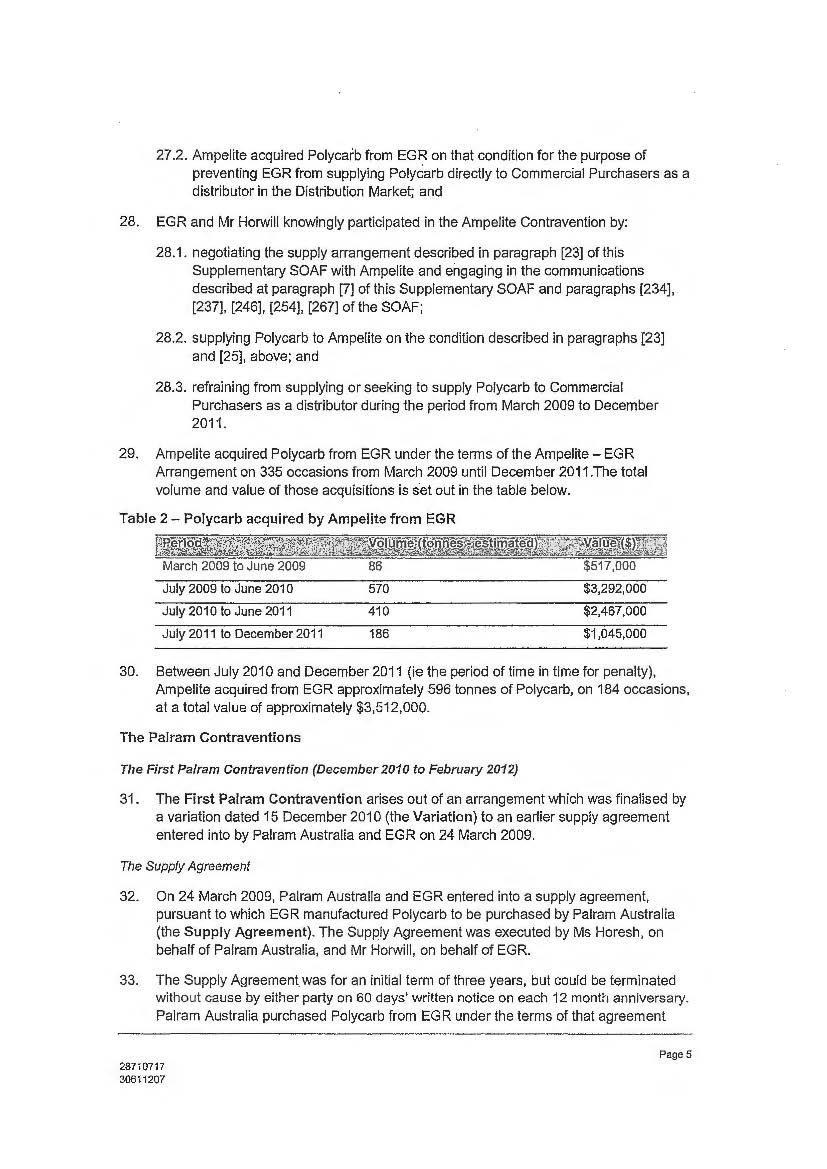
47. Ampelite acquired Polycarb from EGR under the terms of the Ampelite — EGR Arrangement (including the condition described at paragraph [44] above) on 335 occasions from March 2009 until December 2011.
48. These acquisitions were commercially significant. Over the entire period for which the agreement was on foot, Ampelite acquired approximately $7,300,000 worth of Polycarb from EGR.
49. While many of these acquisitions occurred outside the time for penalty, they provide context for the conduct that occurred subsequently. So far as the conduct which is in time for penalty is concerned (the period from 23 June 2010 to 31 December 2011), Ampelite placed a total of 195 orders with EGR. Those orders were worth about $3,512,000.44.
50. EGR and Mr Horwill intentionally participated in developing the condition under which Ampelite acquired Polycarb, which forms a key part of the Ampelite Contravention.
The First Palram Contravention
51. At the time of the First Palram Contravention, EGR was already supplying Polycarb to Palram Australia under an existing supply agreement.
52. The contravention arose in a context where Bunnings was conducting a review of its Polycarb supply arrangements. EGR had existing contacts with Bunnings through its water tank business.
53. EGR told Palram Australia that it would “go direct” and supply or seek to supply Palram Australia’s customers (including Bunnings) if Palram did not agree to a further volume commitment. Thereafter, Palram Australia acquired Polycarb from EGR on the condition that EGR would not supply or seek to supply Polycarb to Palram Australia’s customers.
54. EGR and Mr Horwill intentionally participated in the development of the condition under which Palram Australia acquired Polycarb, which forms a key part of the First Palram Contravention.
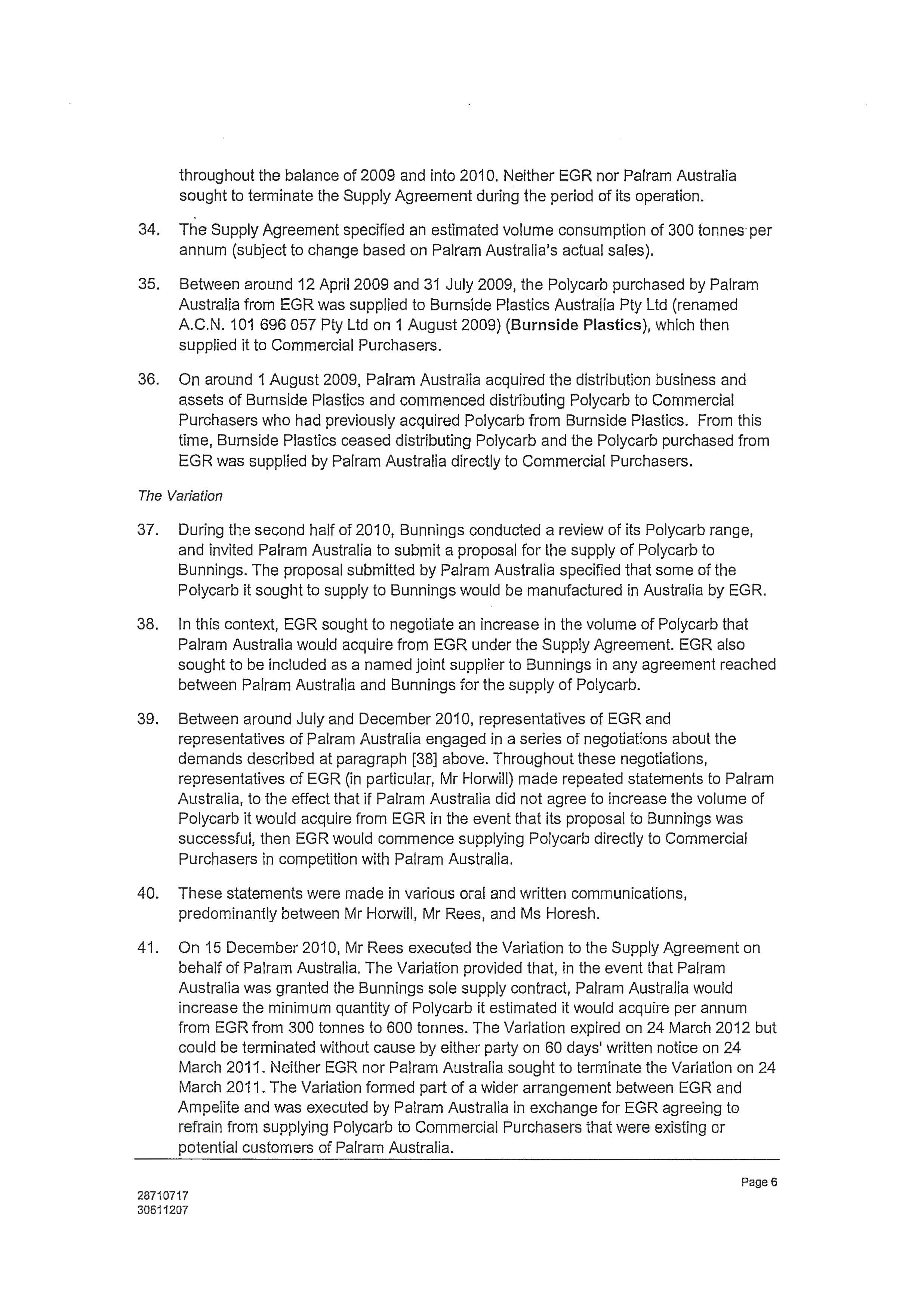
55. For example, on 22 July 2010, Mr Horwill sent an email to Ms Horesh, copied to Mr Rees, Mr Greg Horwill, Mr McLellan, Mr Stadtler, Mr Bell, Mr Eshed and Roee Oren, stating:
As Simon will tell you, Bunnings want to buy directly from EGR, but I have advised them that we work through Palram because you have distribution.
If we don’t get enough of the Bunnings Business we would have to go direct, which as you know is not what I want to do.
56. On 2 September 2010, Mr Bell sent an email to Mr Rees, copied to Mr Stuart McGlinchey, which stated:
Can you also advise when the Bunnings Review for Polysun might be so I can plan to attend. This deal is pivotal to how EGR approaches Polysun moving forward. Tallila [sic] advised EGR this week that from a corporate standpoint Palram could not increase their commitment to purchase more than 300 tonne pa from EGR. We have advised Tallila [sic] that in that case we will be looking to expand our sales of this product in a more direct way into the market in an aggressive fashion. We realise Palram Australia is likely to exceed the 300 tonne but we are looking for a substantial increase which could be provided by the Bunnings single source deal.
Supplying the market direct is not our preferred business model as you know but it is a step we will take very quickly if we deem it necessary.
57. On 14 December 2010, Mr Rod Horwill sent an email to Mr Rees, copied to Ms Horesh, Mr McLellan, Mr Bell, Mr Greg Horwill, Mr McLean and Mr Stadtler, stating:
I want to work with you but we cannot reduce the price. I need to know if you are working with me and I obtain your agreement on the volume and pricing. If so I will continue to support Palram - If not you have just created a very aggressive competitor and I assure you I take this very personal.
58. Mr Horwill followed the email in the preceding paragraph up with a further email later that day, which stated:
Simon I have to call George Kevan early - what do I tell we are working together, as I will not have a gun held at my head. Your actions are turning EGR into your competitor.
59. Also on 14 December 2010, Mr Horwill had a telephone discussion with Ms Horesh. Ms Horesh summarised the discussion in the following way in two separate emails to Mr Rees:
The bottom line of a very long conversation was that Rod is prepared to back away from his demand to change the Bunnings Supply Agreement with Palram to include EGR in it and ask that we re-commit to purchase 600 tons from EGR with Suntuf labels.
I said we will commit up to 600 tons.
One other thing that I forgot to mention — Rod as you well know can’t go on without any threats, so he mentioned that if you call George Kevin tomorrow and say that the deal with EGR is off, everything will blow in our face as he will go to Bunnings direct with ridiculous offer etc. etc...
60. On 15 December 2010, Mr Rees executed the Variation on behalf of Palram Australia. The Variation provided that, in the event that Palram Australia was granted the Bunnings sole supply contract, Palram Australia would increase the minimum quantity of Polycarb it estimated it would acquire per annum from EGR from 300 tonnes to 600 tonnes.
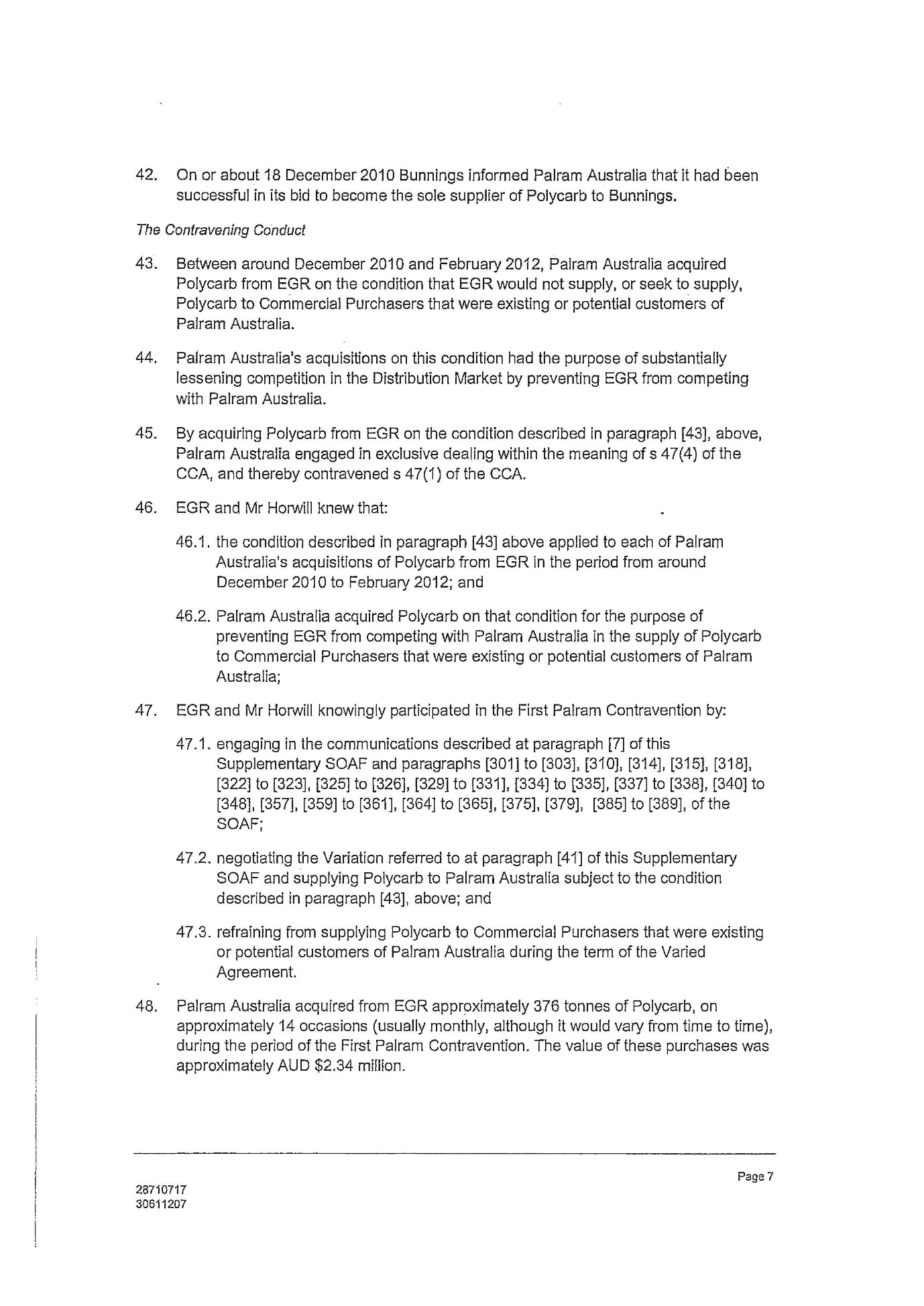
61. Between around December 2010 and February 2012, Palram Australia acquired Polycarb from EGR on the condition that EGR would not supply, or seek to supply, Polycarb to Commercial Purchasers that were existing or potential customers of Palram Australia.
62. These acquisitions were commercially significant. So far as the conduct which is in time for penalty is concerned (the period from 23 June 2010 to 31 December 2011), Palram Australia acquired from EGR approximately 376 tonnes of Polycarb, on approximately 14 occasions. The value of these purchases was approximately AUD $2.34 million.
63. EGR did not undertake its own direct distribution to Commercial Purchasers in the period from December 2010 to December 2011.
The Second Palram Contravention
64. EGR commenced its ‘Polysun Direct’ program in early 2012. By February 2012, EGR had three sales representatives speaking to customers to find out whether there was an opportunity to sell Polycarb.
65. The Second Palram Contravention occurred in a context where EGR had begun undertaking direct distribution to Commercial Purchasers through its ‘Polysun Direct’ program and Palram’s existing supply agreement was shortly due to expire (on 24 March 2012).
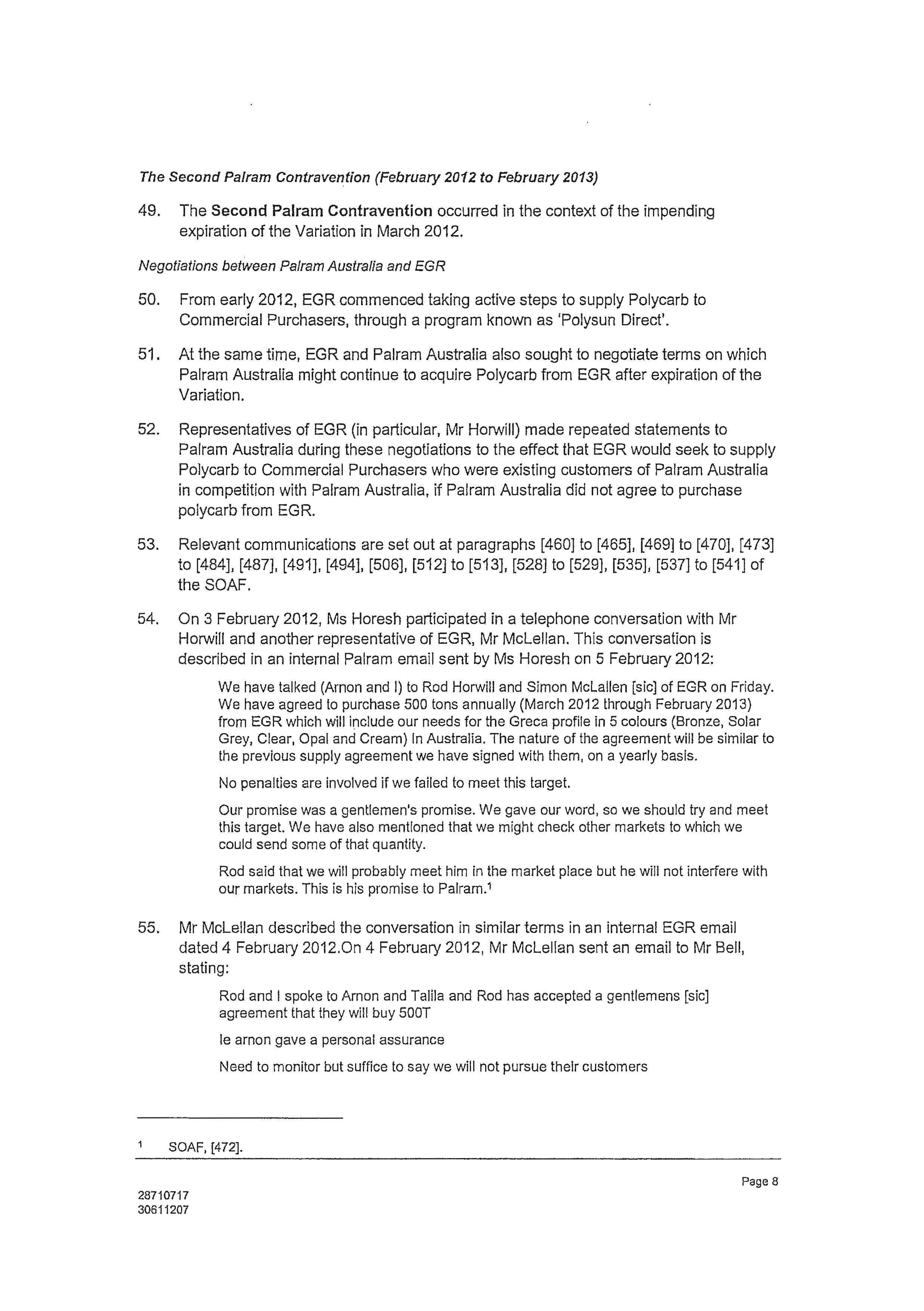
66. On 3 February 2012, Ms Horesh participated in a telephone conversation with Mr Horwill and another representative of EGR, Mr McLellan. This conversation is described in an internal Palram email sent by Ms Horesh on 5 February 2012 in the following way:
We have talked (Arnon and I) to Rod Horwill and Simon McLallen [sic] of EGR on Friday.
We have agreed to purchase 500 tons annually (March 2012 through February 2013) from EGR which will include our needs for the Greca profile in 5 colours (Bronze, Solar Grey, Clear, Opal and Cream) In Australia. The nature of the agreement will be similar to the previous supply agreement we have signed with them, on a yearly basis.
No penalties are involved if we failed to meet this target.
Our promise was a gentlemen's promise. We gave our word, so we should try and meet this target. We have also mentioned that we might check other markets to which we could send some of that quantity.
Rod said that we will probably meet him in the market place but he will not interfere with our markets. This is his promise to Palram.
67. Mr McLellan described the conversation in similar terms in an internal EGR email dated 4 February 2012:
On 4 February 2012, Mr McLellan sent an email to Mr Bell, stating:
Rod and I spoke to Arnon and Talila and Rod has accepted a gentlemens [sic] agreement that they will buy 500Tle arnon gave a personal assurance
Need to monitor but suffice to say we will not pursue their customers
Can you please let the team know
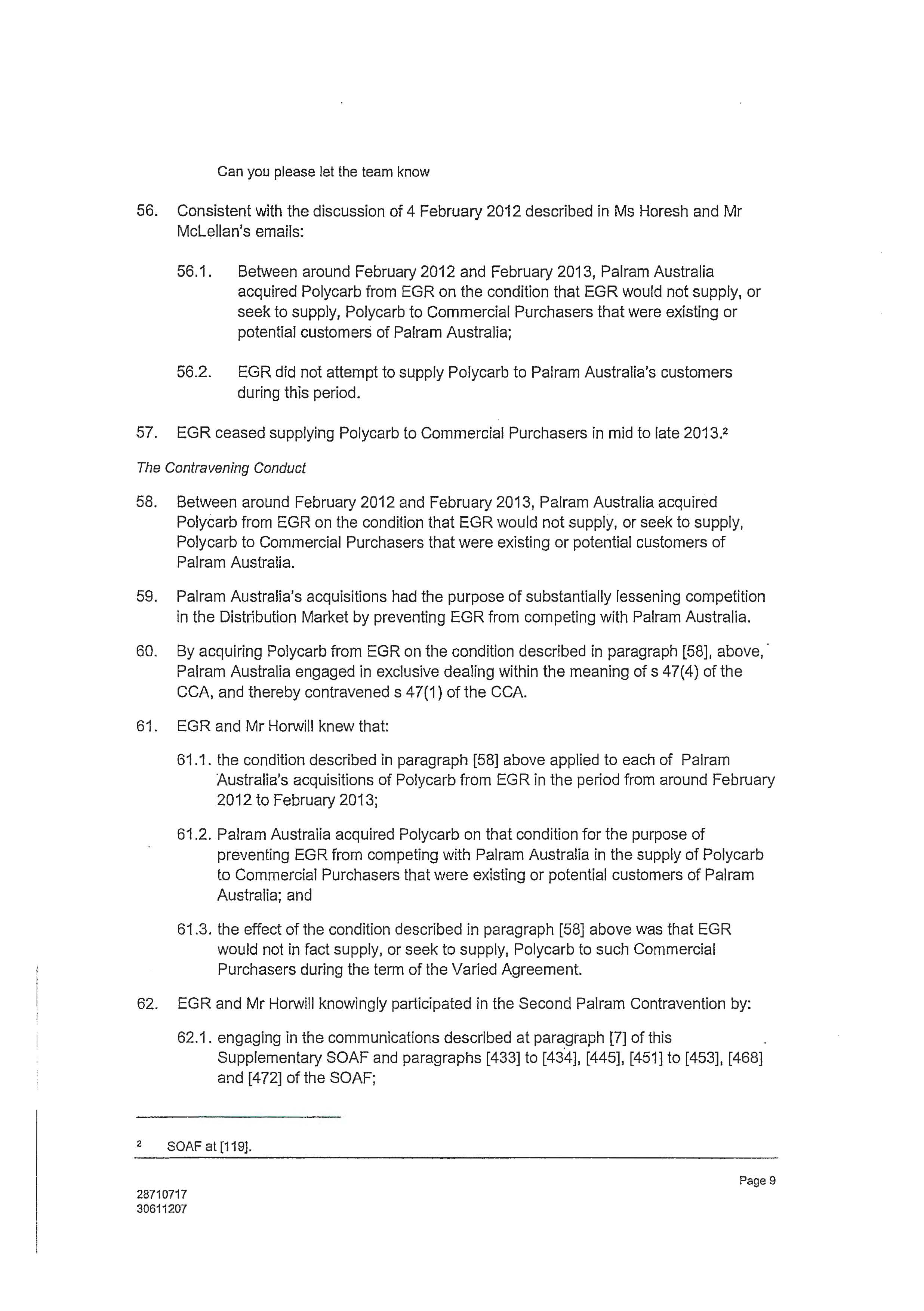
68. Consistent with the discussion of 4 February 2012 described in Ms Horesh and Mr McLellan’s emails:
68.1. Between around February 2012 and February 2013, Palram Australia acquired Polycarb from EGR on the condition that EGR would not supply, or seek to supply, Polycarb to Commercial Purchasers that were existing or potential customers of Palram Australia; and
68.2. EGR did not attempt to supply Polycarb to Palram Australia’s customers during this period.
69. EGR and Mr Horwill intentionally participated in the development of the condition under which Palram Australia acquired Polycarb, which forms a key part of the Second Palram Contravention.
70. These acquisitions were commercially significant and occurred in the context of Palram Australia having acquired Polycarb from EGR on the same condition on about 12 occasions during the First Palram contravention.
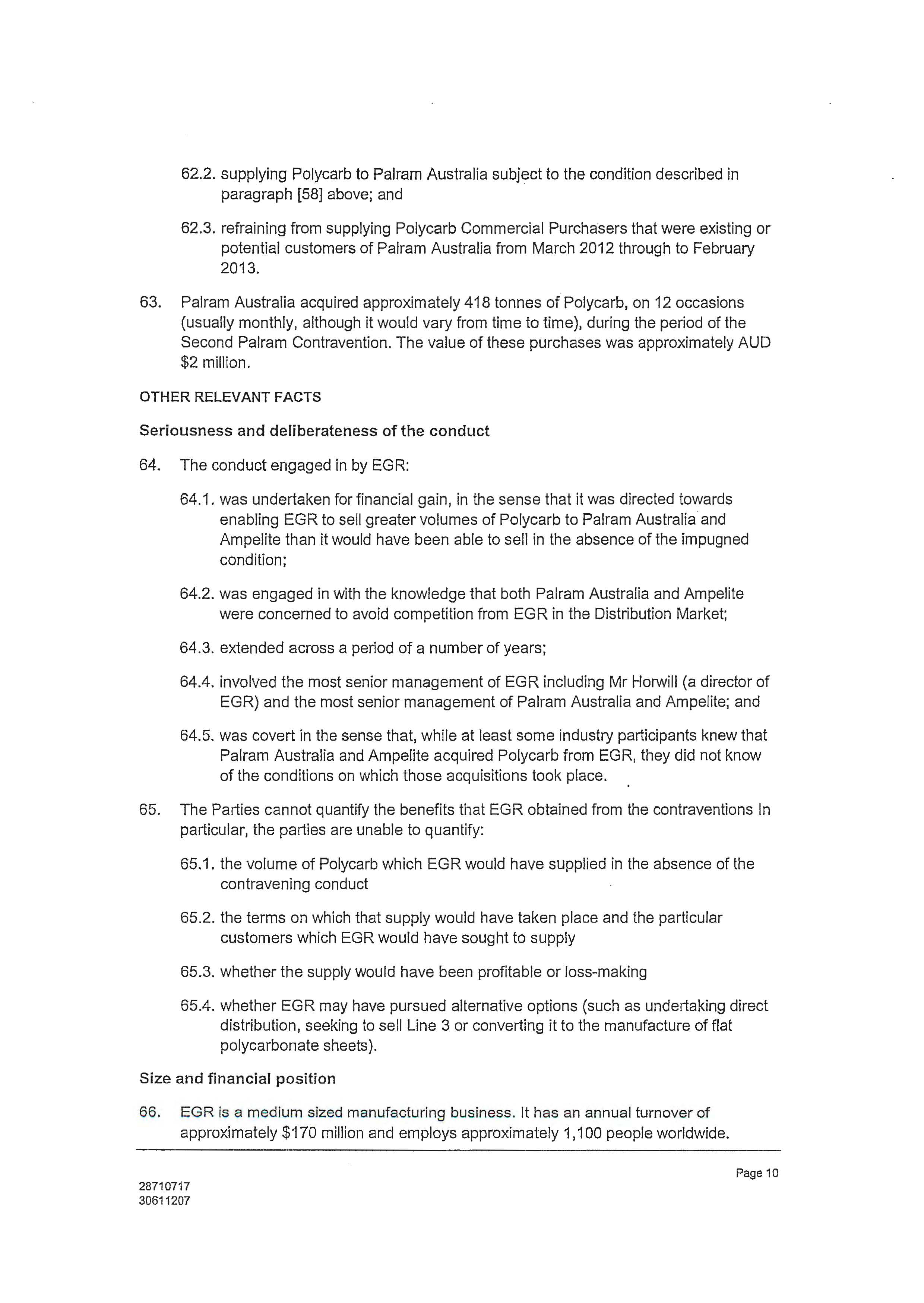
71. During the period from around February 2012 and February 2013, Palram Australia acquired from EGR approximately 418 tonnes of Polycarb on approximately 12 occasions. The value of these purchases was approximately AUD $2 million.
The size and financial position of the contravenor
72. EGR is a vertically integrated manufacturer and distributor of various products for the retail, building and automotive industries. It has factories and warehouses in Brisbane, a warehouse in Melbourne, and operations in the UK, USA, Thailand and China. It employs approximately 1,100 people worldwide.
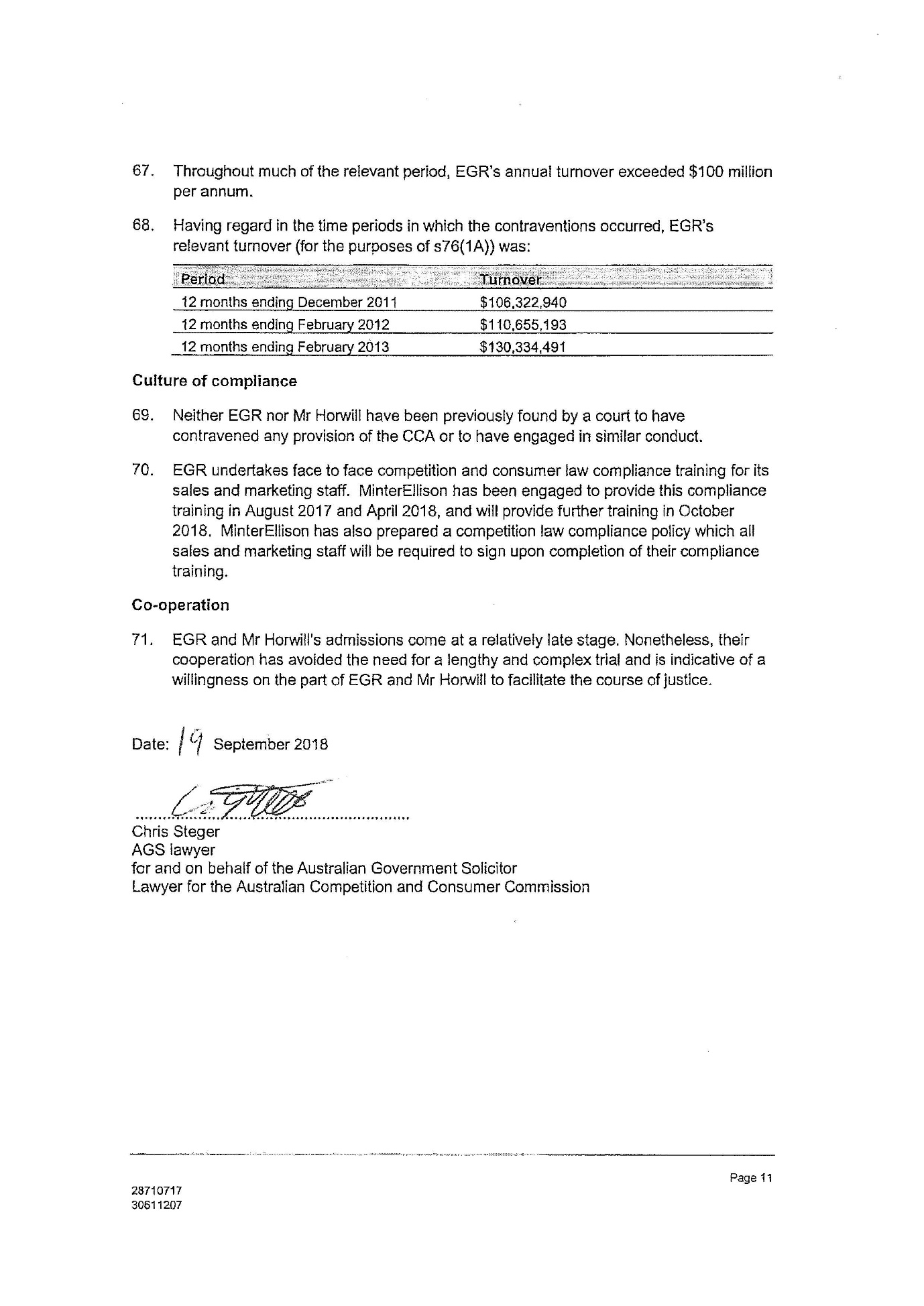
73. It is owned in equal shares by Mr Horwill and his brother, Greg Horwill. During the relevant period, EGR’s annual turnover was between around $100 million and $130 million per annum.
74. During the relevant period, EGR’s Polycarb sales constituted a relatively small part of its overall business, ranging from approximately $5.8 million (or roughly 5% of turnover) in FY 2009/2010 to $2.8 million (roughly 2% of turnover) in FY 2013/14.49
Degree of market power, as evidenced by market share and ease of entry into the market
75. The parties do not submit that EGR had any substantial degree of power in the Distribution Market during the Relevant Period. In the period prior to February 2012, EGR did not undertake direct distribution on its own account (although it did supply Polycarb to smaller distributors such as FGW and Galaxy Rooflite). It also held itself out as a potential entrant in the negotiations with Palram Australia and Ampelite that led to each of the three contraventions.
76. EGR commissioned Line 3 in about May 2008. Line 3 had the potential to produce up to 2,200 tonnes of Polycarb per year, if operated at full capacity. This was equal to approximately 40-50% of annual Australian consumption.
77. EGR commenced taking active steps to supply Polycarb to Commercial Purchasers through its Polysun Direct program in early 2012, but did not establish itself as a major supplier. It ceased supplying Polycarb direct to Commercial Purchasers in mid-late 2013.
26 It is plain enough from this summary that the conduct of EGR and Mr Horwill was systematic and deliberate. The disposition to which I have referred manifested itself in the form of a negotiating ploy in dealings with both Palram Australia and Ampelite of threatening to “go direct”, thereby exposing them to competition from EGR in relation to the supply of Polycarb to Commercial Purchasers. Mr Horwill’s involvement means that this disposition and its manifestation was conceived and implemented at the very highest managerial level in EGR.
27 It is an agreed fact that the conduct was covert in the sense that, while at least some industry participants knew that Palram Australia and Ampelite acquired Polycarb from EGR, they did not know of the conditions on which those acquisitions took place. That covertness is a relevant factor to consider in relation to determining whether the proposed penalties are appropriate, given the singular importance of deterrence in relation to civil penalty regimes designed to promote adherence to statutory regulatory regimes such as those found in the CCA: Fair Work Penalties Case, at [55] per French CJ, Kiefel, Bell, Nettle and Gordon JJ; and, in that same case, at [110] per Keane J.
28 The parties accept that the conceded contraventions circumvented the natural competitive process associated with new entry into an established market. They also accept that the conceded contraventions and conduct of that kind are apt to cause loss or damage to Polycarb customers, although it is not possible to quantify the extent of any loss or damage in the present case. Precisely what correlative benefit EGR and Mr Horwill derived from the contravening conduct is moot. What is agreed is that, while the exact benefits derived from their conduct cannot be determined, the penalties proposed are substantial portions of the value of the Polycarb acquired and significantly above any profits achieved by EGR in supplying that Polycarb. The latter is a singularly relevant consideration in deciding whether those penalties are “appropriate”. That is because, in Australian Competition and Consumer Commission v TPG Internet Pty Ltd (2013) 250 CLR 640, at [66], French CJ, Crennan, Bell and Keane JJ approved the statement by the Full Court in Singtel Optus Pty Ltd v Australian Competition and Consumer Commission (2012) 287 ALR 249 at 265 [62]-[63] that a civil penalty for a contravention of the law:
… must be fixed with a view to ensuring that the penalty is not such as to be regarded by [the] offender or others as an acceptable cost of doing business.
Having regard to the penalty amounts agreed, I am well satisfied that the penalties proposed have that commercially prohibitive quality.
29 Another important consideration in relation to penalisation is consistency of outcome as between various respondents. Consistency of outcome is not to be confused with exact equality of outcome. Rather, to the extent that there are differences in outcome, there must be some logical basis, referable to the circumstances of a particular case, which explains the differences in outcome as between particular respondents such that, overall, penalties can be seen to be consistent. Thus, while equality before the law is regarded as a hallmark of justice, that means nothing more than that similar cases ought to attract similar penalties.
30 Regard to the Ampelite judgment and to the Palram judgment bears out the accuracy of the following summary of penalty outcomes in respect of other respondents offered by the parties in the Joint Submissions:
Ampelite: $1 million for its conduct in the Ampelite Contravention noting, among other factors, a 50% discount for exemplary cooperation and in the context of other admitted contraventions involving attempts to make agreements with similar conditions to that in the Ampelite Contravention.
Mr Verhagen: $100,000 for his involvement in Ampelite’s contraventions described above (also subject to a 50% cooperation discount).
Palram Australia: $2 million for its conduct in the First Palram Contravention and $1.5 million for its conduct in the Second Palram Contravention, noting, among other factors, its cooperation (which occurred from an earlier stage relative to EGR).
Ms Horesh: an order pursuant to s 86E that she be disqualified from managing corporations for a period of 3 years. The evidence disclosed that Ms Horesh was member of a kibbutz, (an Israeli collective community) and did not own any assets or receive any wages or salary.
31 In the present case, though EGR and Mr Horwill came ultimately to concede particular contraventions, that concession occurred, for all practical purposes, at the door of the court. The description offered by the parties in the Joint Submissions, “relatively late”, while true in the sense of lateness relative to the concessions made by other respondents, rather understates just how late in the course of proceedings was that made by EGR and Mr Horwill. While neither unwelcome nor without value and undoubtedly therefore a factor to be considered in mitigation, the type of co-operation which has the greater resonance in mitigation is “whether the company has cooperated with and assisted the relevant regulatory authority in the investigation and prosecution of the contravention”: Australian Building and Construction Commissioner v Construction, Forestry, Mining and Energy Union (2017) 254 FCR 68, [104].
32 Concessions as late as those of EGR and Mr Horwill save the Commission and thus the public purse the costs of a trial and, once made, obviate the disruption of the lives of witnesses entailed in that trial. But that saving is very different from not visiting, as between solicitor and client, effectively all of the costs of preparation for a lengthy trial on the Commission or disrupting the planning of business and personal commitments by prospective witnesses. Further, when made at such a very late stage, though in theory that liberates judicial resources for alternative employment, in practice such alternatives are not always readily obtainable at short notice. Almost inevitably, late concessions in respect of a case for which there is a lengthy reserved trial period leave gaps in a judicial calendar. Some of these gaps can, of course, be filled by giving attention to reserved judgments but there is an almost inevitable consequence also that other cases which might, with greater advance notice, have been offered a trial during the period reserved have not and cannot then be offered a trial. The advantage to the administration of justice of an early concession is thus qualitatively different to the advantage conferred by a very late concession. For all of these reasons, the discount to be afforded EGR and Mr Horwill in respect of the concessions must be modest relative to that granted to other respondents.
33 The lateness of the concession in respect of contraventions in itself offers one logical explanatory reason in terms of consistency as to why they penalties proposed are appropriate, relative to those imposed on other respondents by the orders made in the Ampelite judgment and in the Palram judgment.
34 The applicable maximum penalty is always a relevant yardstick in relation to the imposition of penalties in a given case (as it is in sentencing in criminal cases). At all times material to the conceded contraventions, the applicable maximum penalty in respect of a contravention was that specified in s 76(1A) of the CCA (as it stood at 1 January 2007). In Australian Competition and Consumer Commission v Flight Centre Limited (No 3) (2014) 234 FCR 325, [8], I explained the effect of that provision as it then stood in this way:
[I]f it can be shown by the Commission that [a person has] obtained, directly or indirectly, a benefit that is reasonably attributable to a particular contravention, the body corporate can, depending upon the value of the benefit or size of its annual turnover, as defined, be exposed to a maximum penalty greater than $10 million in respect of that contravention.
35 As already noted, the parties cannot quantify the benefits that EGR obtained from the conceded contraventions. Taking into account the effect of a statutory limitation period and EGR’s annual turnover in the applicable remainder of the period of contravention, the parties are agreed that the applicable maximum penalties for EGR are as follows:
Ampelite contravention - $10.6 million;
First Palram Contravention - $11 million; and
Second Palram Contravention - $13 million.
36 As to Mr Horwill, in respect of each of the conceded contraventions, the applicable maximum penalty is $500,000: s 76(1B) of the CCA.
37 The penalties jointly proposed by the parties in respect of EGR are as follows:
Ampelite Contravention: $2,100,000
First Palram Contravention: $2,100,000; and
Second Palram Contravention: $1,800,000.
38 As to Mr Horwill, the jointly proposed penalties are:
Ampelite Contravention: $125,000
First Palram Contravention: $125,000; and
Second Palram Contravention: $100,000.
39 In the Joint Submissions, the parties put the following in relation to these proposed penalties:
They reflect the seriousness of the conceded contravening conduct and are cast at a level which, in the circumstances, cannot be regarded just as an acceptable cost of doing business.
Even aside from a qualitative difference in relation to co-operation, the differences between the proposed penalties and those imposed by the orders made in the Ampelite judgment and in the Palram judgment “reflect the differences in the maximum penalties available for EGR’s conduct (compared to Palram Australia and Ampelite’s conduct) arising out of EGR’s greater size and turnover”.
As between those proposed in this particular case in relation to particular contraventions, “reflect the differences in the nature and scale of each of the three courses of conduct”.
Offer appropriate recognition for the eventual outcome of a consensual approach by EGR and Mr Horwill to the resolution of the proceedings brought against them by the commission.
40 I agree with each of these propositions.
41 It is always relevant, having identified what appear to be appropriate penalties for particular contraventions, to consider the total penalty so as to ensure that it does not exceed what is proper for the contravening conduct considered in its entirety (a consideration termed the “totality principle”). Here, the total penalties proposed are $6 million in respect of EGR and $350,000 in respect of Mr Horwill. In my view, consideration of the proposed penalties in total underscores why each is apt rather than counsels any moderation.
42 The proposed orders do not make provision for penalties to be imposed individually, only for an order in respect of the total penalties. Though I acknowledge that such orders have, on occasion, been made in the past, they are not appropriate: Director, Fair Work Building Industry Inspectorate v Construction, Forestry, Mining and Energy Union (2015) 229 FCR 331, [40]-[41] (not reversed on this point by the High Court in the Fair Work Penalties Case). It is necessary that penalties be individually imposed in respect of related contraventions, although that does not prevent the making of an order for the payment of the resultant total. The order I shall make will reflect this change to that consensually proposed.
43 As to the proposed penalties, it only comes to this. For the reasons given above and in the following paragraph, I consider that they are “appropriate”.
44 As to other orders, s 86C empowers the Court to make an order requiring EGR to establish a compliance program as proposed. The making of such an order is certainly apt in the circumstances of this case. Indeed, that EGR jointly promotes with the Commission the making of such an order is, I consider, a factor to be taken into account in mitigation.
45 The breadth of the power conferred on the Court by s 43 of the FCAA amply supports the making of a contribution to costs order in a consensually fixed sum as proposed.
I certify that the preceding forty-five (45) numbered paragraphs are a true copy of the Reasons for Judgment herein of the Honourable Justice Logan. |
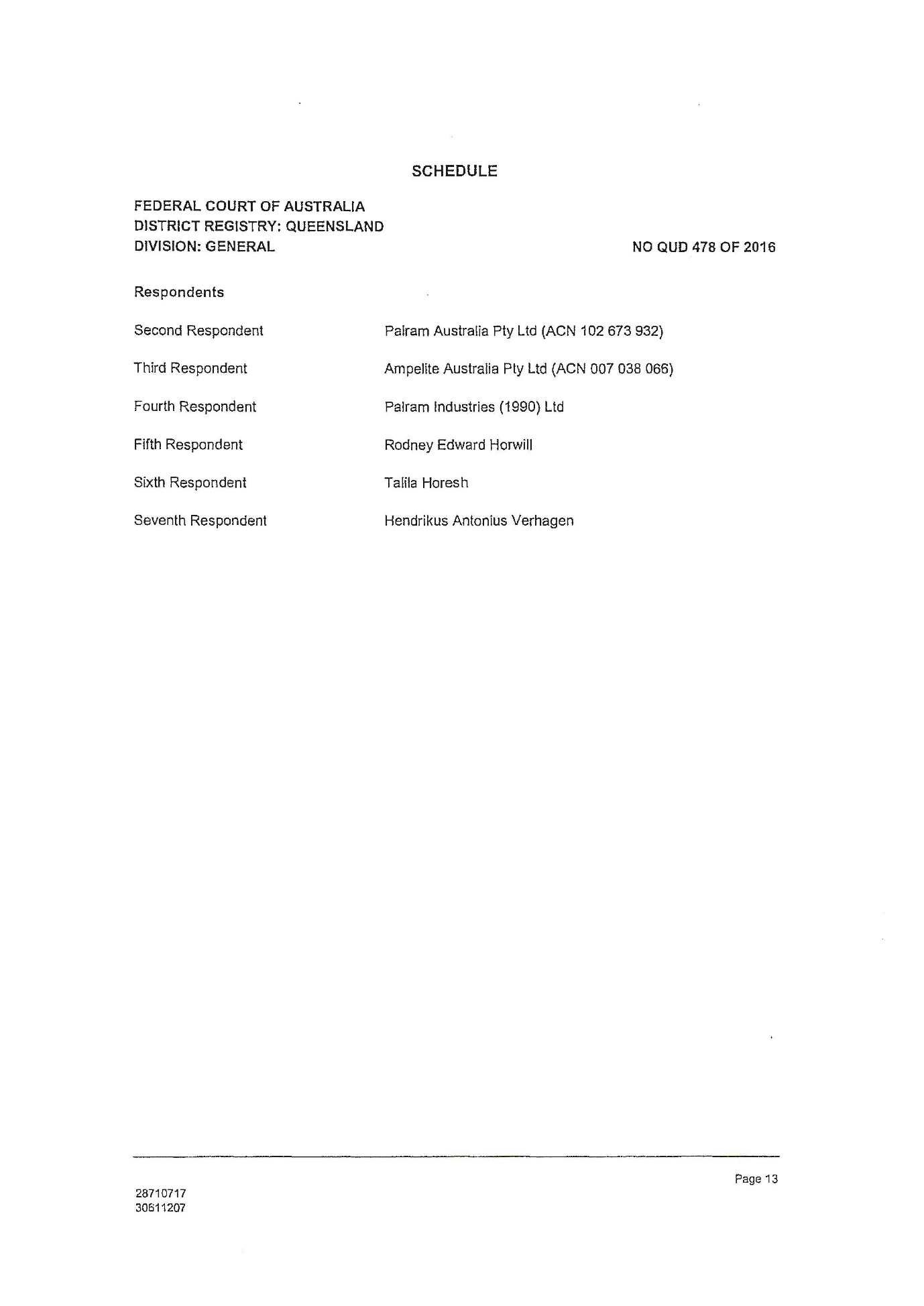
SCHEDULE OF PARTIES
QUD 478 of 2016 | |
PALRAM AUSTRALIA PTY LTD (ACN 102 673 932) | |
Third Respondent: Fourth Respondent: Fifth Respondent: Sixth Respondent: Seventh Respondent: | AMPELITE AUSTRALIA PTY LTD (ACN 007 038 066) PALRAM INDUSTRIES (1990) LTD RODNEY EDWARD HORWILL TALILA HORESH HENDRIKUS ANTONIUS VERHAGEN |
SUPPLEMENTARY STATEMENT OF AGREED FACTS