

FEDERAL COURT OF AUSTRALIA
Cao v Apollo Phoenix Resources Pty Ltd [2018] FCA 1445
ORDERS
THE COURT ORDERS THAT:
1. The interlocutory application filed on 31 August 2018 be dismissed.
2. The applicant pay the respondent’s costs.
Note: Entry of orders is dealt with in Rule 39.32 of the Federal Court Rules 2011.
MARKOVIC J:
1 Zhong Cao is a shareholder in, and until 22 August 2018 was (or on his case still is) also a director of, Apollo Resources Pty Ltd (Apollo).
2 On 18 June 2018 Mr Cao commenced proceedings against Apollo seeking declarations including a declaration pursuant to s 21 of the Federal Court of Australia Act 1976 (Cth) that Apollo engaged in conduct within the meaning of s 232 of the Corporations Act 2001 (Cth) (Act). The proceeding concerns Mr Cao’s shareholding in Apollo.
3 On 22 August 2018, at an Apollo board meeting, the directors who were present declared that Mr Cao was no longer a director of Apollo.
4 On 23 August 2018, on Mr Cao’s urgent application, the proceeding was relisted for case management hearing. The Court was informed that the parties had reached an agreement that Apollo would not notify the Australian Securities and Investments Commission that Mr Cao was no longer a director until 31 August 2018 and that, at that stage, Mr Cao was not in a position to inform the Court what relief, if any, he might seek as a result of the board meeting which took place on 22 August 2018. Accordingly, the Court granted leave to Mr Cao to file any interlocutory application he wished to press by 28 August 2018 and ordered that any application so filed be made returnable for case management hearing on 29 August 2018 and be listed for hearing on 6 September 2018.
5 On 28 August 2018 Mr Cao lodged an interlocutory application in which he sought the following:
1. A declaration that the vacating of Zhong Cao from the office of director of Apollo Phoenix Resources Pty Ltd (Apollo) that occurred, or may have occurred, at the Board Meeting of Apollo on 22 August 2018, is rescinded or otherwise void or to no effect.
2. A declaration that Zhong Cao remains a director of Apollo.
3. If the convenor of any board meeting chooses to give notice of that meeting to Zhong Cao, such notice is to be given through his solicitors, Maddocks, at least 3 business days before the scheduled time of the meeting.
…
The application came on for hearing in accordance with the orders made on 23 August 2018. At the commencement of the hearing counsel for Mr Cao informed the Court that Mr Cao no longer sought the second declaration.
6 Despite being included in an interlocutory application, the relief sought by Mr Cao is final in nature.
7 The evidence relied on by the parties was, in the case of Mr Cao, an affidavit affirmed by his solicitor, Timothy Alexander Atkin, on 28 August 2018 and, in the case of Apollo, an affidavit sworn by Christopher John Daws, a director of Apollo, on 3 September 2018.
background facts
8 Apollo was incorporated on 14 June 2012. It is a small mining exploration and investment company. It carries out mining exploration operations with the aim of identifying valuable mining tenements and then on-selling its tenement interests to mining companies. Its only sources of income are from the sale of assets and raising capital from its shareholders.
9 According to Mr Daws, Apollo derives commercial advantage from its ability to make swift decisions on opportunities that arise and from its agility in responding to market conditions, including market conditions for natural resources.
10 On or about 26 October 2015, upon the resignation of the previous directors, Mr Daws, Doug Daws and John Kingswood were appointed as directors of Apollo.
Mr Cao becomes a shareholder of Apollo
11 On 11 December 2015 Apollo resolved to issue 4,685 shares to Mr Cao representing 75% of its issued capital at the time. Those shares were ultimately issued on 2 February 2016. Mr Daws described the circumstances in which Mr Cao became a shareholder. In summary:
(1) in about August or September 2015 Dehong Yu responded to an advertisement posted on the “MinesOnline.com” website, an online platform connecting buyers and sellers of mining projects worldwide, for the Fortitude Gold project in which Mr Daws was involved at the time;
(2) after meeting with Mr Yu on or about 4 November 2015 Mr Daws received an investor term sheet from him naming Mr Cao as the proposed investor in Apollo;
(3) on or about 12 November 2015, following negotiation, Apollo and Mr Cao entered into an equity facility agreement (Equity Facility Agreement) which provided for payment by Mr Cao to Apollo of consideration of $2.6 million in return for which Mr Cao was to receive 75% of the fully paid capital of Apollo. Mr Cao was also entitled to elect three new board members to Apollo’s board;
(4) on or about 4 December 2015, during a visit to Kalgoorlie with Mr Yu, Mr Daws was made aware by Mr Yu that Mr Cao did not speak English and that Mr Yu would act as his translator after he invested. Mr Yu sought compensation for that role and on 11 December 2015 Apollo resolved to issue 62 shares to Mr Yu, representing 1% of the issued shares in Apollo at the time, in exchange for him providing translation services to Mr Cao; and
(5) the full amount due under the Equity Facility Agreement was ultimately paid by Mr Cao on 2 February 2016.
12 On 19 January 2016 Mr Daws sent a copy of Apollo’s constitution (Constitution) to Mr Yu by email.
13 Mr Daws’ evidence was that, since the introduction of Mr Cao to Apollo, the arrangement for providing him with information was that he, Mr Kingswood or Doug Daws would call or email Mr Yu, in turn Mr Yu would translate and forward the information to Mr Cao and then Mr Yu would email the translated documents to Mr Daws, Mr Kingswood or Doug Daws. Mr Yu also introduced Mr Daws to other associates of Mr Cao, including Will, from GWM Resources NL (GWM), Gary Gu and Tony Zhu. Mr Daws received emails from those persons which led him to understand that on occasion they assisted Mr Yu in providing translated documents to Mr Cao. Mr Daws believed that Mr Yu and his associates used WeChat, a Chinese messaging app, to communicate with Mr Cao, including to send him documents.
14 Neither Mr Yu nor Mr Cao have ever provided Mr Daws with an email address for Mr Cao. As far as Mr Daws is aware, Mr Cao does not have an email address.
15 On the limited occasions that Mr Daws met with Mr Cao during his trips to Australia, Mr Yu was always present and provided interpretation services to facilitate conversations between Messrs Cao, Daws and Yu or with other directors of Apollo. On one occasion, between 19 and 25 September 2016, when Messrs Daws and Kingswood and Doug Daws travelled to China and met with Mr Cao in Beijing, Mr Yu acted as a translator to enable communication between them.
Mr Cao and Mr Yu become directors of Apollo
16 On 19 November 2016 Mr Daws met with Mr Yu at Apollo’s offices. At that meeting Mr Yu:
(1) queried whether he and Mr Cao could be appointed as directors of Apollo. Mr Daws recalls a conversation to the following effect:
Mr Yu: Chris, I have spoken with Mr Cao and he has advised me that he wants to be a director of Apollo. He also wishes that I be made a director also.
Mr Daws: No problem. I will arrange the necessary paperwork to appoint both you and Mr Cao as Apollo directors, but it will mean that we need to make sure all the board papers reach Mr Cao in a timely manner and in a format that he can digest i.e. in Chinese.
(2) provided Mr Daws with a letter dated 22 August 2016 from Mr Cao which set out Mr Cao’s intention to transfer 20% of his Apollo shareholding to Mr Yu for no consideration. Mr Daws recalls a conversation to the following effect:
Mr Yu: I have also brought you a letter from Mr Cao written in both English and Chinese. He wishes to transfer a number of his Apollo shares to me so that following the transfer, he will hold 55% of Apollo shares and I will hold 20% of the shares.
Mr Daws: I can prepare the paperwork but Apollo will not be able to transfer the shares from Mr Cao to you until we see executed original copies of the appropriate share transfer forms, especially from Mr Cao, considering he is giving shares away.
17 On 20 November 2016, following his meeting with Mr Yu, Mr Daws sent an email to Mr Kingswood and Doug Daws which included:
I met with Dehong Yu yesterday for a few hours and he has made a few requests with regards to Apollo and Mt Edwards as follows;
1. He told me that Mr Cao wants both Dehong Yu and himself represented on the Apollo board. I told Dehong that this is not a problem to do but will mean that we will need to make sure all the board papers reach Mr Cao timely and in a format that he can digest (i.e. Chinese). I have told Dehong I will get the Company Secretary Kavi) to prepare necessary appointment paperwork (consent forms/Director Circular etc. etc.) so that it can be completed and approved.
…
18 According to Mr Daws on 2 January 2018 he learnt from Mr Kingswood that Mr Cao was in Australia and wished to meet with them. Given the subsequent events I infer that the reference to 2 January 2018 is an error and that it was in fact on 2 January 2017 that this occurred. Similarly, insofar as Mr Daws records that he subsequently met with Messrs Cao and Yu on 3 January 2018 at Apollo’s offices, I infer that the meeting in fact took place on 3 January 2017. During the course of the meeting Mr Daws recalls that they had a conversation to the following effect:
Mr Daws: So you are both going to become directors of Apollo when you sign the consents.
[Mr Yu speaking in Chinese to Mr Cao.]
[Mr Cao smiled and nodded.]
Mr Yu: It is all good. No problem.
Mr Cao and Mr Yu then each signed a consent to act as director in front of Messrs Daws and Kingswood.
19 Mr Daws recalls that at the meeting he also had a conversation to the following effect:
Mr Daws: Now that you and Dehong are directors, you will need to execute documents and that needs to happen in a timely manner. We will need to send documents to you both, such as notice of board meetings and circular resolutions to sign. They will all be in English.
[Turning to Mr Cao]
I understand that you are okay for Dehong to translate the documents for you. We will send the documents to Dehong and he will translate and send them to you, like he has been doing so far. Is that okay?
Mr Yu: I will translate that now.
[Mr Yu speaking in Chinese to Mr Cao.]
[Mr Cao smiled and nodded.]
Mr Yu: It is all good. No problem.
20 By circular memorandum of resolutions of the directors of Apollo signed by Mr Daws and Doug Daws on 18 January 2017 and Mr Kingswood on 20 January 2017, Messrs Cao and Yu were appointed as directors of Apollo. A general meeting of Apollo has not been held since that time and neither Messrs Cao nor Yu have requested that Apollo call a general meeting. It is not in dispute that the appointments of Messrs Cao and Yu as directors have not been confirmed by a resolution passed at a general meeting.
Apollo board meetings
21 Apollo board meetings are called on short notice. According to Mr Daws, a requirement that Apollo give three business days’ notice of board meetings to directors could interfere with its ability to make decisions quickly for the benefit of shareholders. However, Mr Daws notes that notice of board meetings is often preceded by weeks of informal discussions between the members of the board regarding the matters the subject of a proposed board meeting and collectively on more formal conference calls (Board Conference Calls). Messrs Kingswood, Yu, Daws and Doug Daws were present during Board Conference Calls, the purpose of which were to facilitate open discussion about matters affecting Apollo. Mr Daws recalls that during those calls, Mr Yu said words to the effect of “Ok, I will tell all of this to Mr Cao”.
22 According to Mr Daws, Mr Cao has never sought to have a translator other than Mr Yu present during Apollo board meetings nor has he sought to put in place arrangements for board documents to go directly to him, rather than to Mr Yu in accordance with the arrangements referred to at [13] and [19] above.
23 Mr Daws provided a summary of the dates of Apollo board meetings which have taken place since January 2017, the method of notice provided to the directors for each meeting, the business of the meeting and whether Messrs Cao and Yu were in attendance. That summary, which I did not understand to be in contention, is reproduced below:
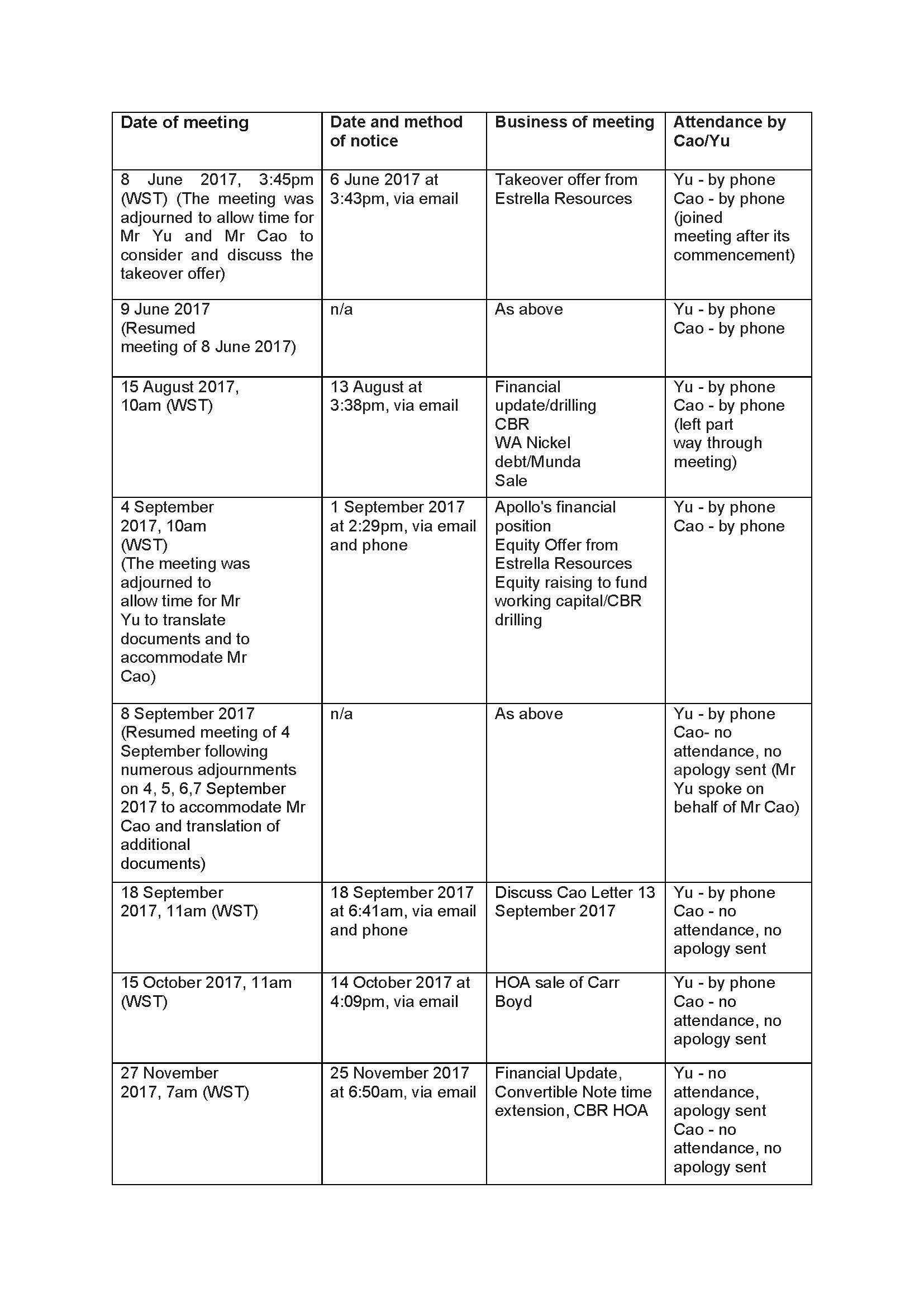
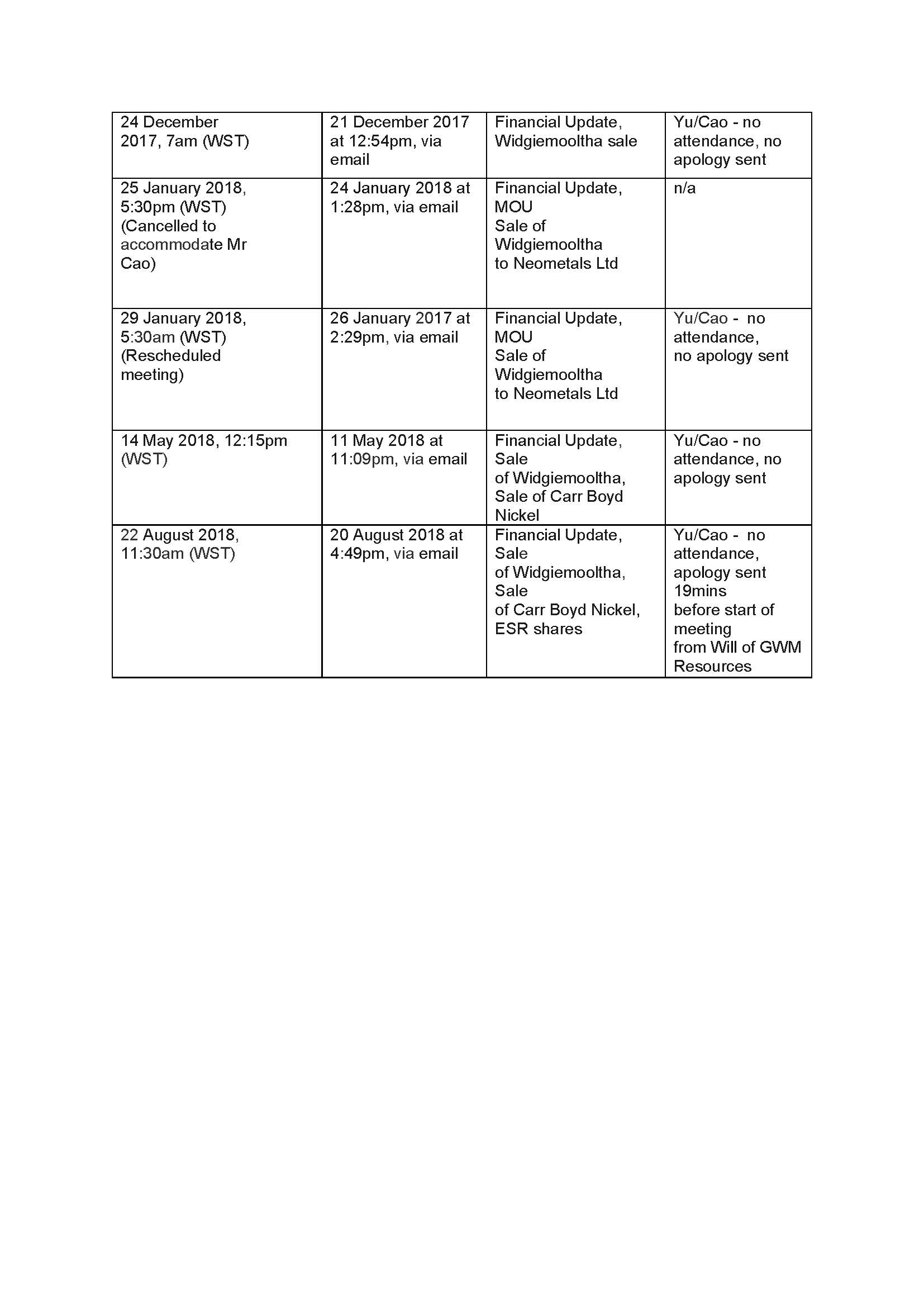
24 As is evident from Mr Daws’ summary, Mr Cao attended board meetings by telephone on 8 and 9 June 2017, 15 August 2017 and 4 September 2017. On 8 September 2017 Mr Cao did not attend the meeting but Mr Yu spoke on his behalf. Mr Daws notes that on occasions when Mr Yu expressed a need for further time to translate documents for Mr Cao and to consider documents, board meetings were adjourned to allow that to occur. Mr Daws recalls that the meeting on 8 June 2017 was adjourned to allow time for Messrs Cao and Yu to discuss matters and consider the documents and that similarly, the board meeting in September 2017 was adjourned on three occasions to allow Messrs Cao and Yu time to translate documents and discuss matters amongst themselves before they were required to make any decision.
25 The subsequent meetings which took place on 18 September 2017, 15 October 2017, 27 November 2017, 24 December 2017, 29 January 2018, 14 May 2008 and 22 August 2018 are in contention on this application. Mr Cao did not attend any of those meetings. I set out below the circumstances surrounding the calling of those meetings, including the notice given by Apollo to the directors for those meetings, and any responses received from Messrs Yu or Cao insofar as they were in evidence before me.
18 September 2017 board meeting
26 On Monday 18 September 2017 Doug Daws sent an email at 8.41 am to Messrs Daws, Kingswood and Yu in which he said:
This is to remind you that we have agreed to have a meeting at 11.00am (western Australian Standard Time) today (Monday 18th September) to discuss items needing attention for Apollo Phoenix Resources Pty Ltd..
Hopefully Mr Cao will be available via telephone and interpreter.
…
27 According to Mr Daws the email was sent at 6.41 am, which I assume was 6.41 am WST. The copy of the email tendered in evidence recorded the date as “Mon, 18 Sep 2017 08:41:24 +1000.”
15 October 2017 board meeting
28 On Wednesday 11 October 2017 Mr Daws sent an email to Doug Daws and Messrs Kingswood and Yu titled “Apollo Board Meeting” which included:
I have been informed of an offer to Apollo from the ESR board relating to Carr Boyd Nickel which ESR is currently seeking ASX approvals for and they will be informed by ASX no later than Friday if/how a potential deal could proceed. I have attached herewith a draft of the proposed HOA which outlines the general terms of the offer, I have canvassed some of our newer larger holders who are receptive of the approach an offer for Carr Boyd.
Can we call a board meeting for 5pm this Friday to discuss both the current financial position and potential offer from ESR for Carr Boyd Nickel, please let Doug know availability ASAP or another time which could suit.
29 On Friday, 13 October 2017 Mr Daws sent an email to “Tony” in which he said that he had spoken to Mr Yu who was in China until the following day and thus had not had a chance to translate the documents, although Mr Daws noted that he had discussed their contents. Mr Daws requested Tony to “translate for [Mr Yu] ASAP for the benefit of Mr Cao as we will need to get a phone call with the rest of the Apollo board to discuss the items no later than 5pm Sunday…”. Mr Daws concluded his email by stating that “[t]he board meeting for 5pm today will still proceed”. In his email in response Tony informed Mr Daws that “[w]e will do our best to translate the documents and send to [Mr Yu] ASAP”. Tony’s email was copied to Messrs Yu and Kingswood, Doug Daws and Will at GWM.
30 Despite the reference in Mr Daws’ email referred to in the preceding paragraph, an Apollo board meeting was not held on 13 October 2017. Rather Messrs Daws and Kingswood and Doug Daws held a Board Conference Call on that day.
31 On Saturday, 14 October 2017 Doug Daws sent an email to Messrs Daws, Kingswood and Yu titled “Agenda for meeting of Apollo Phoenix Resources Limited” in which he said:
Please find attached, the Agenda for the Board meeting scheduled for 11.00 am Sunday 15th October, 2017 to discuss the offer received from Estrella Resources Limited.
Dehong, can you please ensure that this advice is provided to Mr Tau and encourage him to participate so he can be fully informed. Thanks
…
I assume that the reference to “Mr Tau” is a typographical error and is in fact a reference to Mr Cao.
32 Mr Daws noted that there had been numerous lead up discussions between him, Doug Daws and Messrs Kingswood and Yu to discuss the offer received from Estrella Resources for the purchase of Carr Boyd Nickel Pty Ltd, a subsidiary of Apollo, which was due to expire at 12.00 pm on 15 October 2017.
27 November 2017 board meeting
33 On Saturday 25 November 2017 at 9.50 am (AEDT) Doug Daws sent an email to Messrs Daws, Kingswood and Yu copied to Will at GWM titled “Apollo Board Meeting 27 Nov” in which he said:
Please find attached the Agenda and accompanying papers for the Appollo Phoenix Board meeting scheduled for Monday 27th November at 7.00 AM.
Dehong could you please arrange for this message and its contents to be forwarded immediately to Mr Cao with the appropriate translations. Thanks. I have copied this message into Will in the belief that he will be able to attend to the translation required
…
34 There were four items included in the agenda. According to Mr Atkin, no papers were provided for item 1, “Approval of previous Minutes and Circular Resolutions”. Mr Daws explained that this was an oversight and, had the omission been pointed out to him, he would have provided the material. In relation to the balance of the items, Mr Atkin noted that the following papers were provided:
item 2, “Financial Report” – a one page creditors’ payment schedule. Mr Daws explained that this was usually the only financial information provided for board meetings;
item 3, “Convertible Loan Facility – Time Extension” – a copy of the convertible loan facility term sheet but no material was provided in relation to the proposed time extension. Mr Daws explained that there was no relevant material to provide in relation to that issue; and
item 4, “Pro-rata Carr Boyd Nickel Pty Ltd offer to Apollo shareholders” – a copy of the executed heads of agreement.
24 December 2017 board meeting
35 On Thursday, 21 December 2017 at 3.54 pm Doug Daws sent an email to Mr Yu titled “Apollo Board Meeting”, attaching the agenda for a directors’ meeting to be held on 24 December 2017 at 7.00 am WST in which he said:
…We have a number of bills to pay for Apollo and need to have a Board meeting ASAP to discuss this, and other matters.
Can you please confirm by return e-mail that you will be available to participate in the intended meeting and that you will be able to also send this on to Mr Cao and be ready to provide the necessary translations to him during the meeting?
…
29 January 2018 board meeting
36 On the morning of 23 January 2018 Mr Daws had a short conversation with Mr Yu in which he said words to the following effect:
We will be holding an important meeting and you and Mr Cao should participate. As usual, a meeting agenda and supporting information will be sent to you. Could you please translate and pass this on to Mr Cao?
37 On Wednesday 24 January 2018 at 4.47pm (AEDT) Doug Daws sent an email to Messrs Daws, Kingswood and Yu titled “Apollo Board Meeting”, attaching an agenda for a directors’ meeting to be held on 25 January 2018 at 5.30 pm WST, a one page creditors’ payment schedule and a letter dated 24 January 2018 from Neomaterials Pty Ltd. In his email Doug Daws said:
Please find herewith an Agenda and supporting documents for an Apollo Phoenix Resources Pty Ltd Board meeting convened for 5.30pm WST (8.30pm EST) tomorrow, Thursday 25th January, 2018.
Dehong will you please translate and forward the meeting notice and attachments immediately to Mr. Cao as it is important for him to participate so he can be fully informed. If you (or he) have any problem with this please advise me immediately so we can discuss it. This is a very important meeting as it contemplates the sale of the Widgiemooltha tenements.
The dial-in details are provided on the Agenda, as usual.
38 According to Mr Atkin he became aware of this correspondence on Thursday, 25 January 2018 at about 10.48 am (AEDT). At 12.21 pm Mr Atkin sent an email to Doug Daws which included:
We refer to the purported notice of Apollo Board Meeting contained in your email to some of the directors at 4.47 PM EDST on 24 January 2018
Our client objects to the holding of the board meeting as proposed in the notice. 24 hours is clearly insufficient time for our client to translate, review and digest the information provided.
Our client also regards the notice of meeting defective because it does not disclose the resolutions that you intend to put to the meeting, nor does it attach the documents referred to in item 1.
Any decisions purportedly made by the board at the proposed meeting will be contrary to law.
…
In addition to a paper regarding item 3, our client also requires at the very least:
1. copies of the previous minutes and resolutions referred to in item 1;
2. current profit and loss, cashflow and balance sheet in respect of item 2 and an explanation from management as to what is meant by the "MCR offer".
The proposed meeting should be postponed at least until this information is provided and our client is give (sic) a reasonable time to review and digest it along with the documents already provided.
Our client's ability to participate in decisions of the board in an informed manner is also being prejudiced by the continued refusal of the company to comply with its legal obligations to provide our client with requested documents. In that regard, we have not had any correspondence from the company or its lawyers regarding our client's Federal Court application. Can you please advise what the company's position is with respect to that application. All rights are reserved.
39 On Friday, 26 January 2018 Mr Daws informed Doug Daws and Mr Kingswood that the Apollo board meeting had been rescheduled to “allow sufficient time for Cao/Yu to translate documents”. Later that day Doug Daws sent an email to Messrs Daws, Kingswood and Yu providing a set of board papers for an Apollo board meeting scheduled for 5.30 am (WST) on Monday, 29 January 2018. Mr Daws explained that the meeting replaced the meeting previously called for 5.30 pm on Thursday, 25 January 2018 which had been cancelled. Mr Daws then said:
Dehong, can I call upon you to have these papers, including the notice of meeting, translated and sent forthwith to Mr Cao so he is fully informed and can participate with confidence as a normal course of business.
Correspondence from Mr Cao’s solicitor
40 On 6 February 2018 Maddocks wrote to Fairweather Litigation who I assume were solicitors for Apollo or persons associated with Apollo. Their letter addressed four points, including “the notice provided by Mr Daws to our client on 25 November 2017 and 24 January 2018 concerning board meetings set for 27 November 2017 (25 November Email) and 25 January 2018 (24 January Email), respectively”. Under the heading “Notice of Board Meetings” the letter provided:
2.1 Your letters of 11 December 2017 and 25 January 2018 assert that the notices provided by Mr Daws in the 25 November Email and 24 January Email were “in accordance with clause 26 of the Company's Constitution” and that, in any event, your clients were not required to provide any notice to our client.
2.2 Our client had not alleged any invalidity in relation to the notice. Our client simply requested an explanation as to why it was necessary to call board meetings in such haste. No such explanation has been provided.
2.3 Our client can only assume that meetings are being called in this way to make it difficult for our client to attend so as to be able to complain that our client had failed to attend (as they are now doing).
2.4 If your clients genuinely wanted our client to attend board meetings they would not call board meetings in this way, they would not ask our client to execute critically important circular resolutions without any information, and they would not withhold critical information from our client despite continuing requests. Their conduct in excluding our client from decision making by these means is transparently oppressive to our client.
41 Maddocks also wrote to Steinepreis Paganin, who were described as the solicitors for the company, on 6 February 2018. Maddocks’ letter was not in evidence before me but the response from Steinepreis Paganin, which was in evidence, included:
We are instructed that our client continues to have concerns with respect to your client’s conduct including his failure to attend board meetings over an extended period and causing proceedings to be instituted against the company in the NSW District Registry of the Federal Court of Australia, as referred to in previous correspondence.
…
With respect to paragraph 8 of your letter, other directors of the company (other than Mr Yu) have continued to keep informed about the company’s affairs through their attendance at board meetings and by direct discussions between members of the board and management without the need for recourse to requests for access through solicitors’ correspondence.
…
14 May 2018 board meeting
42 On Friday, 11 May 2018 Doug Daws sent an email to Messrs Daws, Kingswood and Yu titled “Apollo Board Meeting 12.15 pm WST Monday 14 May” in which he said:
Please be informed that Apollo Phoenix Resources Pty Ltd shall be holding a board meeting at 12.15pm on WST on Monday 14th May 2018 and requires your attendance/participation.
A Meeting Agenda is attached herewith along with all of the supporting information.
The dial-in directions are shown on the Agenda.
Please let me know your availability for attendance.
Dehong, can you please ensure that translated copies of all of this material is prepared and sent to Mr Cao, as usual, ,and as quickly as possible so he can participate in the meeting on a fully informed basis.
The “supporting information” which was attached comprised some 133 pages including the agenda for the meeting.
43 The meeting which took place on 14 May 2018 at 12.15 pm was recorded. The minutes indicate that Doug Daws, who is referred to as “DD”, Mr Daws, who is referred to as “CD” and Mr Kingswood, who is referred to as “JK”, attended the meeting and include the following:
CD. Asked who was on line?
DD. Replied DD and JK and CD.
CD. asked if anything had been heard from Dehong Yu (DY) and Zhong Cao (ZC)?
The Chairman (DD) advised the meeting he had not received a message of any kind from DY which, perhaps, causes us to ask whether they had received it but the notice had been sent in the same way as we have always don’t in the past to DY and ZC and I take it that there has been no contact from their lawyers?
CD. No and I suspect we won’t hear from them as per previous meetings they haven’t attended. In the past six months they haven’t responded to any e-mails at all – they didn’t respond to e-mails full stop going back twelve months and in recent times they’ve just passed the information through the lawyers and we seem to be hearing from their lawyers more than them.
DD. That’s what I mean – if they’d got it, and they’d contacted the lawyers, perhaps we would’ve heard from them which makes me think that maybe they haven’t got it but I have to presume that they have because nothing’s changed, we’ve don’t it the same way, so here we are at 12.25 pm and we have a number of very important matters to discuss and we have a quorum and I propose that we proceed to the meeting unless there is some objection.
JK. No, I’m happy to proceed
DD. So I declare the meeting open and we move to Item I…
Further correspondence from Mr Cao’s solicitor
44 On 25 May 2018 Maddocks sent a letter to Steinepreis Paganin. That letter addressed a number of issues not relevant to the current application. Under the heading “Notice of meeting” the letter included the following:
The impediment caused by your client's refusal is exacerbated by the recent family tragedy to befall Mr Dehong Yu. To date, your client has, as a matter of course, sent correspondence addressed to our client to Mr Yu on the expectation that Mr Yu will arrange for those documents to be translated and provided to our client.
Your client may be unaware, but Mr Yu's son was recently involved in a car accident and is in a coma. We understand Mr Yu's personal circumstances are such that his review of emails is now infrequent and sporadic.
Your client's refusal to send correspondence to us, coupled with Mr Yu's present personal circumstances, has essentially removed our client's ability to apprise himself of any actions undertaken by Apollo, either directly or through his agents.
Given the exacerbating factor of Mr Yu's personal circumstances, your client's continued refusal to provide us with copies of correspondence addressed to our client is both unfair and unjust. We urge your client to reconsider its position.
22 August 2018 board meeting
45 On 20 August 2018 at 6.48 pm (AEST) Doug Daws sent an email to Messrs Daws, Kingswood and Yu again titled “Apollo Board Meeting – Notice of meeting with Agenda for 11.30 am WST (1.30 pm EST) Wednesday 22nd August, 2018”. In the email Doug Daws noted that the agenda and supporting documents for the proposed meeting were attached. Mr Daws requested Mr Yu to “have the entire parcel of documents translated, and transmitted, to Mr Cao so hopefully he, and [Mr Yu], can fully participate in the meeting”. The attached agenda provided, omitting formal parts:
1) Approval of previous Minutes and Circular Resolutions (see attached)
Meeting 14 May 2018
[Douglas Daws]
2) Director Interest
[Douglas Daws]
3) Financial Report (see attached)
Creditor Payments/Bridging Loan/Share Purchases
[Chris Daws]
4) Sale of Widgiemooltha Tenements
Settlement update
[Chris Daws]
5) Director Fees
[Douglas Daws]
6) Vacation of Office of Directors
Memo from Steineipris Paganin
[Chris Daws]
46 On 20 August 2018 at 8.19 pm (AEST) Doug Daws sent a further email to Messrs Daws, Kingswood and Yu again titled “Apollo Board Meeting – Notice of meeting with Agenda for 1/30 am WST (1.30 pm EST) Wednesday 22nd August 2018”. In that email Doug Daws noted that he had omitted “an important agenda item for discussion at out (sic) meeting” and attached the documentation. The email continued:
Dehong, can I once again ask that you have this translated and despatched expediently to Mr Cao so he is fully informed and can be properly involved in the discussions at the meeting if he so desires. Do you think there is any merit in you providing us with his contact details so we can communicate with him direct to avoid you the inconvenience of having to worry about sending all this paperwork onto him every time we have a meeting?
…
47 Attached to the second email was a memorandum dated 16 August 2018 from Steinepreis Paganin to Apollo with the subject line “Vacation of office of directors”. Under the heading “Instructions” appearing on the first page of the memorandum, the following was recorded:
Steinepreis Paganin have been requested to provide this memorandum by way of background in order to assist the Apollo directors in deciding how to vote on the proposed resolution to declare the office of Mr Zhong Cao and Dehong Yu as directors of Apollo vacant.
48 Mr Atkin became aware of the emails and material referred to in [45]-[47] above at around 10.57 am (AEST) on Wednesday, 22 August 2018. It appears that the emails were forwarded to Maddocks by Will from GWM. Thereafter steps were taken by Amanda Whiteley, a solicitor in the employ of Maddocks, to have the meeting postponed. At 12.34 pm (AEST) Ms Whiteley sent a letter to Mills Oakley, the solicitors acting for Apollo in this proceeding, in which Maddocks noted that “providing a day and a half’s notice to some of the directors, and not providing notice to our client, is unreasonable” and that it appeared that Apollo had been in receipt of the “relevant material since 16 August 2018”. Maddocks requested Apollo to confirm that it would postpone the meeting.
49 There were subsequent exchanges by email and telephone between Ms Whiteley and Mills Oakley.
50 At 11.11 am (WST) Mr Daws received an email from Will at GWM which was addressed to Doug Daws and copied to Messrs Daws and Kingswood. In his email Will said (as written):
This is Will from Dehong company. Dehong just inform me that Mr Cao would not be able to attend that meeting because he was in Oversea. Dehong would not be able to attend that meeting as well.
All the meeting information and notice already send to Mr Cao’s Solicitor to go through.
Any further require, please let me know.
51 The Apollo board meeting proceeded at 11.30 am (WST) on 22 August 2018. Doug Daws and Messrs Daws and Kingswood attended the meeting. The minutes of the meeting, which once again refer to Doug Daws as “DD”, Mr Daws as “CD” and Mr Kingswood as “JK” provide:
(1) under the heading “Pre-meeting Advice”:
E-mailed advice had been received from “Will” from the Sydney office of [Mr Yu] that neither [Mr Yu] nor [Mr Cao] would be participating in the meeting.
CD commented that from the advice from Will they ([Mr Yu] and [Mr Cao]) have obviously received the notice of meeting. They have never previously provided such advice and wondered why they had done so on this occasion. Also the fact that we know [Mr Cao] is overseas, as we know, and the notice and all of the information from you (i.e. DD) has gone directly to [Mr Cao's] solicitors and not via [Mr Cao] so once again it shows that [Mr Yu] is basically using company information and passing it straight through to other third parties when he has no right to do so. We might have to take that up for further discussion. The fact that they are not attending is fine so we can get on with the meeting.
(2) under the heading “Item 6 Director Participation”:
DD. That takes us to item 6, the important matter of the advice we have received from Steinepreis Paganin. The fact is that [Mr Yu] has not participated in any meetings. The advice we have received from Will, presumably on their behalf today, is the first advice we’ve received from them other than letters, we have received from their lawyers for, well, many many months – probably almost a year.
CD. Yes it is probably either to ten months Doug. The last meeting that [Mr Yu] attended was the 29th November, 2017.
DD. It is probably like lighting the fuse on a hand grenade but we just can't continue to have a Board that is being obstructed, continually, by two individuals that are not participating. As far as I'm concerned, I'm prepared to move that they be formally advised that in accordance (sic) the advice we've received from Steinepreis Paganin that their Directors terms will cease forthwith.
CD. Yes, basically it's a declaration by the other Directors that their office is vacant under the Constitution - under Clause 9 of the Constitution, as per the memo. A Director automatically ceases to be a Director if the following two conditions are satisfied, and that's, first a Director is absent from meetings of Directors for six consecutive months without special leave from Directors. Well, neither [Mr Yu] or [Mr Cao] have attended meetings for more than six months, nor have they received any special leave from the Directors. Then the second item is that we declare their office vacant so I’m of the view, as you are Doug, that the way is clear to declare their offices vacant. (noise) ... Sorry Doug, can you hear me?
DD. Yes, say it again
CD. Basically (noise) ... is vacant, both [Mr Yu] and [Mr Cao] and we instruct the Company Secretary to strike them off the records, and ASIC records, as Directors as needed and inform them, as such, that that's what's occurred.
DD. Yes, well I'm in favour of that, are you John?
JK. Yes I am, I mean they haven't attended any meetings and so any bit of information we send, they hold us accountable which they're also a Director but doesn't attend. It doesn't make sense to me so they haven't attended all this year and part of last year so the Constitution states that they have failed to comply so it is vacant.
DD. I'll record that they are to be advised by the company Secretary that their Directorship of the Company is terminated under Clause 9.
CD. Yes, and that the current offices are declared vacant.
Apollo’s Constitution
52 Central to the resolution of Mr Cao’s application are cl 7 and cl 9 of the Constitution which respectively concern the appointment and removal of directors and when a director automatically ceases to be a director. Those clauses relevantly provide:
Appointment and removal of directors
7 The company or the directors may appoint a director, remove a director, or do both, by passing a resolution at a general meeting of the company.
The directors may appoint a director either to fill a casual vacancy or to add to their number. A director appointed by the directors ceases to be a director 6 months after the date of his or her appointment unless the appointment is confirmed by the company's passing a resolution at a general meeting.
Office of director becomes vacant
9 A director automatically ceases to be a director if any of the following applies:
…
• The director is absent from meetings of directors for 6 consecutive months without special leave from the directors, and the directors consequently declare his or her office vacant;
…
53 Part B of the Constitution deals with meetings of directors. Clauses 25 and 26 provide:
Directors may regulate meetings
25 The directors may regulate their meetings in the way they think fit.
Holding meetings
26 A director may convene a meeting of directors at any time. The company secretary must convene a meeting if requested by a director to do so. The convenor convenes a meeting by giving written or oral notice of it to all directors. The convenor does not have to give notice of a meeting to a director whom the convenor reasonably believes to be outside Australia.
54 Clause 33 concerns voting at a directors’ meeting and provides:
Voting and resolutions at a meeting
33 At a meeting of directors:
• each director who is present has one vote;
• an alternate director who is also a director has one vote as director and one vote for each appointing director who is absent from the meeting and by whom he or she has been appointed as an alternate; and
• the chair has a casting as well as a deliberative vote.
A resolution is passed at a meeting of directors if a majority of the votes cast is in favour of it. If there is only one director, he or she may pass a resolution in the way provided for by section 248B of the Corporations Act.
A summary of the parties’ contentions
55 Mr Cao seeks a declaration that his vacation from office as a director of Apollo that occurred, or may have occurred, on 22 August 2018 at the Apollo board meeting is rescinded or otherwise void or to no effect in reliance on s 232 and s 233 of the Act.
56 In summary, Mr Cao contends that a director of a company is entitled to notice of a board meeting and that notice must be reasonable and that, although the Constitution provides that notice need not be given to a director whom the convenor reasonably believes is outside Australia, in circumstances where the convenor chooses to give notice, that notice must be reasonable. He submits that Apollo failed to give reasonable notice of the board meetings. Mr Cao further submits that that failure means that he was not absent, within the meaning of cl 9 of the Constitution, from the board meetings relied on by the Apollo board on 22 August 2018 to make the declaration that his office was vacant. Mr Cao says that Apollo’s conduct in not providing reasonable notice of meetings to him and then relying on his non-attendance, or failure to seek leave from, the six meetings in question as a means of removing him as a director is oppressive, unfairly prejudicial to or unfairly discriminatory against him as a member in his capacity as a director.
57 Apollo contends that there are two reasons why the declarations sought by Mr Cao should not be made. First, it contends that by reason of the operation of cl 7 of the Constitution, Mr Cao has not been a director of Apollo since 20 July 2017. That is because his appointment as a director was not confirmed at a general meeting within six months of his appointment. Secondly, Apollo says that Mr Cao has failed to establish that the notice provided for each board meeting was not reasonable but contends that, in any event, reasonable notice was given and that the directors of Apollo were entitled to rely on cl 9 of the Constitution, as they did, to make the declaration vacating Mr Cao from office.
consideration
Was Apollo entitled to rely on cl 9 of the Constitution to remove Mr Cao as a director?
58 By the operation of cl 9 of the Constitution, a director automatically ceases to be a director if he is absent from board meetings for six consecutive months without special leave and the directors consequently declare his or her office vacant.
59 Mr Cao submitted that he did not receive proper notice of the meetings he did not attend and which were relied upon by Apollo to declare his office vacant pursuant to cl 9 of the Constitution. Accordingly, Mr Cao contended that he could not have reasonably attended or sought to be excused from those meetings. As for the 22 August 2018 board meeting at which Messrs Daws and Kingswood and Doug Daws sought to remove him from the office of director, Mr Cao only became aware of that meeting “at the last minute” and made an application to postpone the meeting through his solicitor. Had this application not been rejected, Mr Cao submitted that he could have had the information translated and sought advice and perhaps attended the postponed meeting. Mr Cao submitted that in all the circumstances the conduct was unfair and enlivened s 232(e) of the Act such that he was entitled to the relief sought under s 233 of the Act in the form of the first declaration and order set out in his interlocutory application.
60 Before turning to consider the issues that arise I set out a summary of the relevant legal principles.
Relevant legal framework and principles
61 Mr Cao relies on s 232 and s 233 of the Act. Section 232 provides:
The Court may make an order under section 233 if:
(a) the conduct of a company’s affairs; or
(b) an actual or proposed act or omission by or on behalf of a company; or
(c) a resolution, or a proposed resolution, of members or a class of members of a company;
is either:
(d) contrary to the interests of the members as a whole; or
(e) oppressive to, unfairly prejudicial to, or unfairly discriminatory against, a member or members whether in that capacity or in any other capacity.
62 Section 233 provides that the Court can make any order that it considers appropriate including those set out in subs (1).
63 In Campbell v Backoffice Investments Pty Ltd (2008) 66 ACSR 359; [2008] NSWCA 95 Basten JA, in considering the terms of s 232 of the Act, noted at [176] that the section had three elements, the first of which was to identify the relevant conduct. His Honour then went on at [177] to consider the second and third elements which he said respectively required characterisation of the conduct and identification of those who may be adversely affected by the conduct. At [180]-[184] his Honour said the following about the operation of s 232:
180 One effect of the expanded language adopted in 1983 appears to have been the abandonment of the restrictive definition of oppression, adopted in Scottish Cooperative Society, as requiring conduct which was “burdensome, harsh and wrongful”: at AC 342; All ER 71 (Viscount Simonds). It is now appropriate to ask whether the action was conduct available to the officer in accordance with the constitution of the company; whether it was exercised in good faith, for a proper purpose, on the basis of relevant conditions and without taking into account irrelevant considerations: see Wayde v New South Wales Rugby League Ltd (1985) 180 CLR 459 at 466; 61 ALR 225 at 230; 10 ACLR 87 at 91 (Wayde) (Mason ACJ, Wilson, Deane and Dawson JJ) and at CLR 469–70; ALR 233; ACLR 94 (Brennan J). In Thomas v H W Thomas Ltd [1984] 1 NZLR 686 at 693, Richardson J noted that there was overlap between the various concepts identified by the terms “oppressive, unfairly discriminatory or unfairly prejudicial”:
The three expressions overlap, each in a sense helps to explain the other, and read together they reflect the underlying concern of the subsection that conduct of the company which is unjustly detrimental to any member of the company whatever form it takes and whether it adversely affects all members alike or discriminates against some only is a legitimate foundation for complaint … The statutory concern is directed to instances or courses of conduct amounting to an unjust detriment to the interests of a member or members of the company.
181 Richardson J was clearly seeking to emphasise the breadth of the preconditions, both in their terms and by reference to those whose interests might be affected. It is doubtful if his Honour intended to substitute the concept of “unjust detriment” for the statutory language. In Morgan v 45 Flers Ave Pty Ltd (1986) 10 ACLR 692 at 704, Young J held that the proper approach was to ask “whether objectively in the eyes of a commercial bystander, there has been unfairness, namely conduct that is so unfair that reasonable directors who consider the matter would not have thought the decision fair”. His Honour proposed that the individual elements identified in the section should be considered “merely as different aspects of the essential criterion, namely commercial unfairness”.
182 That approach left open the question of whether the sole criterion of “commercial unfairness” incorporated the fourth element in the definition, namely conduct “contrary to the interests of the members as a whole”. In Re Polyresins Pty Ltd [1999] 1 Qd R 599 at 604–5; 28 ACSR 671 at 676, Chesterman J concluded that all four expressions overlapped and therefore each constituted an element in the broad criterion of “commercial unfairness”. However, as noted by Campbell J in Turnbull v National Roads and Motorists’ Assn Ltd (2004) 186 FLR 360; 50 ACSR 44; [2004] NSWSC 577 at [32], the structural change which removed the fourth element from the paragraph as it originally appeared and placed it in a separate paragraph, as now appears in s 232(d) and (e), required a different approach. The “contrary to the interests” element, now contained in paragraph (d), should be given a separate and independent operation because it may well cover conduct which is outside the scope of commercial unfairness.
183 Arguably there are two points of distinction which explain the separation of paras (d) and (e). Although para (e), by the inclusion of conduct oppressive to members, may include conduct oppressive to members as a whole, one sphere of operation of para (e), though not (d), is conduct which, either through intention or effect, operates prejudicially with respect to a member or class of members, as opposed to members as a whole. The second point of distinction is that the terminology of para (d) characterising conduct “contrary to the interests of” the members would appear to extend not only beyond disparate treatment of members, but also beyond conduct oppressive to the members as a whole. It is in this sense that the example given by Campbell J of “pointlessly wasteful” conduct has force.
184 More broadly, there is a danger in seeking to reduce the statutory language to the criterion of “commercial unfairness”. Not only does that terminology distract attention from the statutory language, but it tends to ignore important distinctions between different kinds of complaint and, if taken out of the context in which it was originally formulated, ignores the relatively strict test for judicial intervention. It is analogous to reducing to one criterion the various bases upon which it is open to an appellate court to intervene in relation to a discretionary determination of a trial judge, as set out in House v R (1936) 55 CLR 499 at 505, or reducing the grounds of judicial review of administrative action to one composite criterion. These examples are not remote from the present issue: in Wayde, the High Court adopted language which was reminiscent of both legal principles.
64 It was not in contention that, in the absence of a time stipulation in the Constitution, reasonable notice of directors’ meetings is required. In Wilson v Manna Hill Mining Company Pty Ltd [2004] FCA 912 (Wilson) at [17] Lander J observed that a directors’ meeting must be convened in accordance with the company’s constitution. At [23]-[25] his Honour said the following about the notice to be given to a company’s directors for a meeting of directors:
23 Each and every director of Manna Hill Mining was entitled to notice of any meeting of directors: Bell v Burton (1994) 12 ACLC 1037.
24 Notice of the meeting can be waived or dispensed with if all directors attend and if all directors treat the meeting as a meeting of directors: Roden v International Gas Applications (1995) 18 ACSR 454 at 456 per McLelland CJ.
25 The notice must be reasonable: Toole v Flexihire Pty Ltd (1991) 6 ACSR 455; Re Homer District Consolidated Gold Mines; Ex parte Smith (1888) 39 Ch D 546. In determining what is reasonable, the practice usually adopted by the Board is a relevant consideration. If reasonable notice is not given to all directors the meeting is not valid unless all directors are present: Barron v Potter (1914) 1 Ch 895.
65 In Re Keneally (as administrator of Australian Blue Mountain International Cultural & Tourist Group Pty Ltd (admin apptd)) (2015) 107 ACSR 172; [2015] NSWSC 937 at [57] Black J said:
Mr Sulan, who appears with Ms Oreb for Ms Lam, submits that the time required for reasonable notice of a meeting depends “upon the circumstances and its limit is determined by what is fair to both parties”: Perri v Coolangatta Investments Pty Ltd (1982) 149 CLR 537 at 567–8; 41 ALR 441 at 463; Hickey v Aselford [2003] NSWSC 185 at [26] (Hickey); McMaster v Eznut Pty Ltd (2006) 58 ACSR 199; [2006] WASC 109 at [162] (McMaster). In Hickey, Gzell J held that notice of a meeting to consider a resolution to appoint a voluntary administrator that was given one afternoon in respect of a meeting to be called for the following morning was reasonable notice. In McMaster at [169] and [178], a shorter period of notice was held to be reasonable where there was urgency in appointing an administrator and, in Ashrafinia v Ashrafinia [2012] NSWSC 500 (Ashrafinia), a short notice period was held to be reasonable where there was an urgent need to retain solicitors in respect of litigation. Mr Sulan submits that, in determining what is fair and reasonable, the relevant factors include the nature of the company and the nature of the business to be transacted: Toole v Flexihire Pty Ltd (1991) 6 ACSR 455 at 461; Ashrafinia at [33]. Mr Pritchard draws attention to substantially the same authorities as those to which Mr Sulan refers. The question essentially reduces to whether notice given at 1.16 pm of a meeting to be held at 3 pm that afternoon, being notice of less than 2 hours, was reasonable in the circumstances.
66 In the context of considering whether relief should be granted under s 1322(4) of the Act in relation to the period of notice given in that case, Black J said at [71]:
… The requirement for reasonable notice of a directors’ meeting is an important part of good corporate governance, and it seems to me there is a public interest in majority directors not being permitted to call meetings at unreasonably short notice, in the absence of objective urgency, where directors and shareholders are at loggerheads. …
67 The question of whether there must be notice of the business to be discussed at a directors’ meeting, an issue also raised by Mr Cao, was considered by Lander J in Wilson. At [26] his Honour said:
It is not essential that a director be given notice of the business to be conducted at the meeting, although it may be preferable and prudent to give notice of any special business: La Compagnie De Mayville v Whitley (1896) 1 Ch 788; Toole v Flexihire Pty Ltd (above).
See too Dhami v Martin [2010] NSWSC 770 at [47] where Barrett J noted that “[t]he general principle is that directors should come together whenever called on notice of reasonable length and without any expectation of being told why they are being summoned to a meeting”.
Was Mr Cao absent from board meetings for six consecutive months?
68 The first issue that arises for determination is whether Mr Cao was absent from directors’ meetings for six consecutive months. The meetings in issue were those that took place on 18 September 2017, 15 October 2017, 27 November 2017, 24 December 2017, 29 January 2018, 14 May 2018 and 22 August 2018. It was on the basis that Mr Cao was absent from the six meetings preceding the 22 August 2018 meeting that, at the board meeting on 22 August 2018, the directors of Apollo who were present declared that Mr Cao’s office as director was vacant. It was not in contention that Mr Cao did not seek special leave to be absent from any of the six meetings in issue. Resolution of the issue turns on whether reasonable notice was given to Mr Cao for each meeting. Factors relevant to the Court’s determination of that issue include the practice usually adopted by the Apollo board, the nature of Apollo and the nature of the business to be discussed and transacted at particular meetings.
69 At the outset I note that the terms of cl 9 of the Constitution refer to a director being absent from meetings “for six consecutive months”. There is some ambiguity in that language. If it is intended to refer to meetings actually held in six consecutive months, presumably on the basis that board meetings would usually be held on a monthly basis, that is not what occurred here. However, the six meetings in question were held consecutively and were the only board meetings over the relevant period. Neither party raised this as an issue and the matter proceeded on the basis that cl 9 could operate in relation to the board meetings in question. That is, that it would operate in relation to six consecutive meetings where those meetings were not held in consecutive months. That is an available construction of cl 9 and it was on this basis that the matter proceeded before me.
70 Mr Cao submitted that, in circumstances where the notices were sent to Mr Yu, the material for the meetings needed to be translated and passed onto him and then he had to attend by telephone or seek special leave to be absent, the period of notice was not reasonable. Mr Cao also made submissions specific to the circumstances of each meeting.
71 Apollo submitted that the fact that Mr Cao’s application was brought on an urgent basis did not diminish the burden of proof that he bore to establish his entitlement to relief. I accept that submission. In that context I note that neither Mr Cao nor Mr Yu gave evidence. As submitted by Apollo, the absence of evidence from Mr Cao or Mr Yu meant that there was no evidence that:
the notice period in relation to any meeting was in fact unreasonably short;
proper consideration could not be given to the material provided for particular meetings or, that if further time had been given, there would have been consideration of the material;
no proper translation could occur in the time provided; and
if longer notice had been given Mr Cao would have attended the meetings.
72 Apollo submitted that, given the absence of evidence from Mr Cao and Mr Yu, in the circumstances of this application an adverse inference arises that any evidence that Mr Cao would have given would not have supported his case in accordance with the rule in Jones v Dunkel (1959) 101 CLR 298 and referred the Court to Kuhl v Zurich Financial Services Australia (2011) 243 CLR 361 at [63]. Apollo invited the Court to draw such an inference. While such an inference may be available, given the conclusions I have reached on the evidence that was before me, including the absence of evidence on critical aspects of Mr Cao’s application, it is not necessary for me to take up that invitation.
73 I address each meeting in turn below but, before doing so, I set out the effect of the evidence that was before me in relation to the practices adopted to notify Mr Cao of board meetings and, more generally, Apollo’s relationship with Mr Cao.
74 First, the uncontroverted evidence is that Mr Cao authorised Mr Yu to receive notice of board meetings on his behalf. That was the practice which was adopted by Apollo. At no point did Mr Cao seek to change that practice. Mr Cao relied on his solicitors’ letter dated 25 May 2018 which said that, because of his personal circumstances at the time, Mr Yu’s review of his emails was “infrequent’ and “sporadic”. That letter also stated that Apollo had refused to send correspondence to Mr Cao’s solicitors. Mr Cao submitted that by that letter, as at 25 May 2018, he had raised concerns about whether communications that were going to Mr Yu were being received in a timely fashion and passed onto Mr Cao. He further submitted that the letter put Apollo on notice that the method it had been relying on to communicate with Mr Cao may no longer be reliable. That may well be so but a number of things are apparent from that letter:
(1) it did not request that an alternate arrangement to provide notice of board meetings be put in place. The reference to the “refusal to send correspondence to [Maddocks]” does not constitute such a request nor was there any evidence before me of such a request emanating directly from Mr Cao to Apollo;
(2) the letter is not evidence that Mr Yu was not continuing to fulfil his role as conduit for Mr Cao. It merely indicated that Mr Yu was no longer regularly reviewing emails; and
(3) in any event the next board meeting following despatch of that letter took place on 22 August 2018. There was no evidence before the Court of the frequency at which Mr Yu was reviewing emails at that time.
75 Secondly, the evidence clearly established that Mr Cao does not speak English and that Mr Yu was always present and provided translation services when Mr Daws and other directors of Apollo met with him. It was also established that Mr Cao did not provide an email address to Apollo for the purpose of receiving notice of board meetings or, it seems, any other information at least until May 2018 when, according to Maddocks, Mr Cao’s “nominations for electronic service under s 249J of the [Act]” had been provided. That nomination would of course only operate in relation to notification of meetings of members of Apollo.
76 Thirdly, Mr Yu was intimately involved in Mr Cao’s dealings with Apollo. He introduced Mr Cao to Apollo, was involved in Mr Cao’s purchase of shares in Apollo, had the initial discussion with Mr Daws in relation to Mr Cao’s request that he and Mr Yu become directors of Apollo and, when Mr Cao attended board meetings, he did so accompanied by Mr Yu.
77 Fourthly, until 4 September 2017 Mr Cao did attend board meetings by telephone with Mr Yu. At the 8 September 2017 meeting Mr Yu spoke on behalf of Mr Cao.
78 Fifthly, the evidence established that the nature of Apollo’s business was such that it derives a commercial advantage from having the ability to make decisions swiftly as opportunities arise and from its agility in responding to market conditions. The evidence also established that leading up to board meetings, the directors engaged in informal discussions between themselves and participate in Board Conference Calls. Mr Daws gave evidence that Mr Yu attended those calls and said he would relay the content of their discussions to Mr Cao.
79 Sixthly, putting to one side the 22 August 2018 board meeting, Apollo accommodated Mr Cao’s requests for additional time and rescheduled meetings. For example, the meeting scheduled to take place on 4 September 2017 was adjourned to 8 September 2017 and the meeting scheduled to take place on 25 January 2018 was rescheduled to 29 January 2018 to accommodate Mr Cao’s need for further time to translate and consider the material.
80 In the context of those matters and my observations at [71] above, I turn to consider each of the meetings in issue.
18 September 2017 meeting
81 This meeting was called by email sent on 6.41 am (WST) on 18 September 2017, the same day as the proposed meeting at 11.00 am and, according to Mr Daws, notice was also given by telephone. Mr Cao submitted that, according to Mr Daws’ evidence, the purpose of the meeting was to “[d]iscuss Cao Letter 13 September 2017” but there was no other evidence given about the meeting, including whether there was any urgency attached to it. Mr Cao submitted that four hours’ notice could not be considered reasonable in circumstances where it had to be received by Mr Yu, translated and communicated to Mr Cao who was in China and who would then need to either facilitate his attendance by telephone or communicate his non-attendance and seek special leave.
82 The email from Doug Daws giving notice of the meeting expressly stated that it was a reminder that “we have agreed to have a meeting at 11.00 am (western Australian Standard Time) today”. It was sent to Mr Yu, who was authorised to receive notices of board meetings on behalf of Mr Cao. No evidence was given by Mr Yu or Mr Cao contrary to the assertion in the email that there had been an agreement to hold the board meeting at 11.00 am (WST) on 18 September 2017. In addition there was no evidence:
of any contemporaneous complaint that the notice given was too short to enable Mr Yu to communicate with Mr Cao so that he could properly consider the relevant material and attend or alternatively excuse himself from the meeting; or
given by Mr Cao that the notice was in fact unreasonably short such that Mr Cao could not give proper consideration to the relevant material or arrange to attend or be excused from the meeting.
83 In those circumstances Mr Cao has failed to establish, and I do not accept, that the notice given for the 18 September 2017 meeting was unreasonable.
15 October 2017 meeting
84 Notice of the 15 October 2017 board meeting was given by email sent at 4.09 pm on 14 October 2017 for a meeting to take place the following day at 11.00 am (WST). Contrary to Apollo’s submission, Mr Cao submitted that the business of the meeting, which was to consider an offer from Estrella Resources, was not urgent. Mr Cao noted that the minutes of the board meetings held over the period 4-8 September 2017 recorded, at the meeting which took place on 4 September 2017, that Apollo “had received a further equity offer from Estrella Resources (ESR) for the purchase of Apollo Phoenix Resources assets”. Mr Cao submitted that, in circumstances where Apollo had been aware of the offer from Estrella Resources since September 2017, there was no explanation provided as to why the meeting was left until the last minute before the expiration of that offer or why, even if the meeting had to be held on 15 October 2017, notice was not provided well in advance of the meeting. Mr Cao contended that the urgency attaching to the meeting was of Apollo’s “own making” and not as a result of something that had arisen on 14 October 2017 which created an urgent need to call a meeting the following day.
85 Mr Cao’s submission is at best speculative. There was no evidence before me that the equity offer received from Estrella Resources referred to in the minutes of the board meeting which took place on 4 September 2017 was the same offer that was to be considered at the board meeting on 15 October 2017. The uncontroverted evidence was that Mr Daws became aware of an offer to Apollo “from the ESR board” relating to Carr Boyd Nickel which he communicated by email to, among others, Mr Yu on 11 October 2017; there were a number of discussions leading up to the board meeting on 15 October 2017, including with Mr Yu; and the offer from Estrella Resources was due to expire at midday on 15 October 2017.
86 Once again, there was no evidence of any contemporaneous complaint that the notice given was too short to enable Mr Yu to communicate with Mr Cao and for Mr Cao to attend or excuse himself from the meeting. Similarly, there was no evidence given by Mr Cao that the notice was in fact unreasonably short such that he could not give proper consideration to relevant material or arrange to attend or be excused from the meeting.
87 In those circumstances Mr Cao has failed to establish, and I do not accept, that the notice given for the 15 October 2017 meeting was unreasonable.
27 November 2017 meeting
88 Notice for this meeting was given by email on the morning of 25 November 2017. No particular submissions were made by Mr Cao about the period of notice given and in what way it was said to be unreasonable. Mr Atkins’ evidence addresses the material provided for the purposes of the meeting. Insofar as material was not attached to that email, I accept that was an oversight which would have been remedied had it been pointed out at the time.
89 Once again, there was no evidence of any contemporaneous complaint that the notice given was too short to enable Mr Yu to communicate with Mr Cao and for Mr Cao to attend or excuse himself from the meeting, nor was there any evidence given by Mr Cao that the notice was in fact unreasonably short such that Mr Cao could not give proper consideration to relevant material or arrange to attend or be excused from the meeting.
90 In those circumstances Mr Cao has failed to establish, and I do not accept, that the notice given for this meeting was unreasonable.
24 December 2017 meeting
91 Notice for this meeting was given to Mr Yu by email three days prior to the meeting on 21 December 2017, indicating that a meeting was required as soon as possible. No submissions were made by Mr Cao about the period of notice given and why it was said to be unreasonable. Indeed, counsel for Mr Cao informed the Court that no complaint was made about this meeting. In those circumstances and in the absence of any evidence to the contrary, I conclude that the notice given for the 24 December 2017 meeting was not unreasonable.
29 January 2018 meeting
92 This meeting was originally scheduled to take place on 25 January 2018. It was rescheduled to 29 January 2018 to accommodate Mr Cao’s request for more time to consider the material. Mr Cao alleged, through his solicitors, that 24 hours’ notice of the meeting was insufficient for him to translate, review and digest the information provided and that the proposed meeting should be postponed at least until certain information was provided and he was given “a reasonable time to review and digest it along with the documents already provided”.
93 Upon Mr Cao requesting more time, Apollo rescheduled the meeting. Despite the additional time provided for Mr Cao’s benefit, being a period of five days from the date of notice of the meeting until the date the meeting was held, Mr Cao did not attend the meeting. No evidence was given by Mr Cao that, despite the additional four days, the notice period remained unreasonably short such that he could not give proper consideration to relevant material or arrange to attend or be excused from the meeting. In those circumstances Mr Cao has failed to establish, and I do not accept, that the notice given for the meeting was unreasonable.
94 In the email sent by his solicitors on 25 January 2018, Mr Cao also complained that there had been insufficient information provided with the initial notice of the meeting despite some material being attached to the email. However, Mr Cao’s solicitor, Mr Atkin, acknowledged that “additional material was provided” with the second notice sent on 26 January 2018 for the rescheduled meeting on 29 January 2018. Mr Cao made no contemporaneous complaint and there was no evidence before me that the material provided for the rescheduled meeting was insufficient.
14 May 2018 meeting
95 Notice of the 14 May 2018 board meeting was given by email sent on 11 May 2018 to, among others, Mr Yu. Mr Cao referred to the minutes of the meeting (set out at [43] above) which record some concern on the part of the directors in attendance about whether Messrs Yu and Cao had in fact received notice of the meeting.
96 The uncontroverted evidence was that this meeting was necessary to ensure that Apollo could hold meetings with its shareholders to approve the proposed Carr Boyd Nickel share placement before Australian Securities Exchange imposed timelines expired. In other words, there was urgency attached to the requirement for the meeting. The minutes of the meeting reinforce the need to proceed with the meeting because there were “a number of very important matters to discuss”.
97 The queries raised by the directors at the commencement of the meeting do, as Mr Cao submitted, raise an issue about whether Messrs Yu and Cao had received the notice. By that stage Mr Cao had engaged Maddocks, who were communicating on his behalf with Apollo in relation to various issues, and the directors present observed that there had been no contact from those lawyers. Mr Daws observed that in the past six months neither Messrs Yu nor Cao had responded to any emails and that in recent times they passed information on through their lawyers. Doug Daws observed that the notice had been sent in the same way as it had been sent in the past and thus, on that basis, they could assume that it had been received and that, as a quorum was present, the meeting should proceed.
98 Doug Daws gave three days’ notice of this meeting in the usual way that had been agreed by sending the notice through Mr Yu. By that stage, Mr Cao’s non-attendance was not unusual and, in the opinion of those directors who were present, reflected his disengagement in the company. Further, there was no evidence of any contemporaneous complaint that the notice given for this meeting was too short to enable Mr Yu to communicate with Mr Cao and for Mr Cao to attend or excuse himself from the meeting. From Apollo’s perspective there was simply silence.
99 Maddocks’ letter dated 6 February 2018 addressed to Fairweather Litigation did not constitute a contemporaneous complaint about the notice given for this meeting. It was sent months before the 14 May 2018 meeting and referred to the notice provided on 25 November 2017 and 24 January 2018 for board meetings scheduled on 27 November 2017 and 25 January 2018 respectively. Of course, by that time the latter meeting had been rescheduled because Mr Cao had informed Apollo that he required more time. The effect of Maddocks’ letter was not to request a change in the way in which notice was to be given to Mr Cao but to suggest that meetings “being called in this way… make it difficult for [their] client to attend so as to be able to complain that [their] client had failed to attend (as they [were] doing now)”.
100 Finally, there was no evidence relied on before me by Mr Cao that the notice was in fact unreasonably short such that he could not give proper consideration to the relevant material or arrange to attend or be excused from the meeting.
101 In those circumstances Mr Cao has failed to establish, and I do not accept, that the notice given for the 14 May 2018 board meeting was unreasonable.
22 August 2018 meeting
102 The notice for the 22 August 2018 board meeting was given by email dated 20 August 2018 to, among others, Mr Yu with a follow up email sent later that evening attaching material for item 6 in the agenda “Vacation of Office of Directors”. A number of issues are raised by Mr Cao in relation to this meeting.
103 The first issue is whether he was given reasonable notice of the meeting. Mr Cao submitted that, in circumstances where Apollo was preparing to declare his office vacant, a decision which would adversely affect his rights, he was entitled to proper notice of the meeting and an opportunity to be present and respond to the matters that were being put against him. Mr Cao noted that Apollo had received a detailed memorandum dated 16 August 2018 from its lawyers which was intended to guide the decision by the other directors to remove him from office. He submitted that it could be inferred that the memorandum was available to Apollo from 16 August 2018 and that it could have been provided to him and Mr Yu much earlier than it was. He contended that the memorandum contained a substantial amount of information to be translated, digested and on which to obtain advice about serious matters affecting his position as a director.
104 In resolving that issue, two questions arise for consideration. The first question is whether Mr Cao received notice of the meeting. In my opinion he did. So much can be inferred from the fact that Apollo was informed by Will of GWM that Mr Cao would not attend the meeting as he was overseas and because copies of Mr Daws’ emails, providing notification of the meeting and providing further information, were provided to Maddocks who, in turn, sought an adjournment of the meeting on Mr Cao’s behalf. I infer those steps were taken on instructions received from Mr Cao.
105 The second question concerns the length of time between the notification of the meeting and the meeting taking place and whether that period was so short that it made the notification of the meeting unreasonable. Mr Cao complains that, because one of the items of business to be considered at the meeting affected his position as a director of Apollo, the time given for him to consider the relevant material was insufficient. He points to the fact that the memorandum of advice relied on by the board was dated Thursday, 16 August 2018 but was not circulated until Monday, 20 August 2018. There was no evidence about the date on which Apollo received the memorandum but it was clearly sometime between 16 and 20 August 2018. Notwithstanding that, in my opinion, Mr Cao has not established, and I do not accept, that notification of the meeting was unreasonable. I have reached that conclusion for the following reasons:
(1) the two day notice period was not unusual in the circumstances of this company. A number of meetings were held with a two day notice period, including meetings that Mr Cao attended;
(2) all of the directors of Apollo received the same notice, Mr Cao was not treated any differently;
(3) the email notifying the directors of the meeting was sent to Mr Yu in accordance with the usual practice that Apollo had been instructed to adopt. No instruction had been given to change that practice. In Doug Daws’ email when he notified the directors of the time of the meeting, he expressly requested Mr Yu to bring the material to Mr Cao’s attention “expediently” so that he would be “fully informed” and could be “properly involved in the discussions at the meeting”. Mr Daws also asked Mr Yu if he saw any merit in providing Apollo with Mr Cao’s contact details so that it could communicate with him directly and “avoid [Mr Yu] the inconvenience of having (sic) worry about sending all this paperwork onto him every time we have a meeting”. There was no evidence of any response to that request;
(4) Will from GWM informed Doug Daws and Messrs Daws and Kingswood that “Mr Cao would not be able to attend that meeting because he was in Oversea (sic)”. No further information was provided, for example about Mr Cao’s whereabouts, whether he was unable to attend by telephone because of his current location, whether he would be available at a different time or, importantly, that the period of time provided to consider the material for the meeting was insufficient. That is, the email did not explain why Mr Cao could not and did not attend the meeting. That he was overseas was not an explanation that would have assisted the other directors of Apollo at the time given that Mr Cao lived in China and was thus usually overseas but had attended board meetings in the past. Based on Will’s email, Apollo was entitled to proceed on the basis that Mr Cao would not be attending the meeting. Will’s explanation for Mr Cao’s non-attendance does not provide a basis upon which the Court could find that the notice given for the meeting was unreasonable;
(5) the letter dated 22 August 2018 from Maddocks to Mills Oakley and the subsequent communications between those solicitors similarly does not provide any basis upon which it could be found that the notice given of the meeting was unreasonable. The letter asserted that providing a day and a half’s notice was unreasonable and sought an adjournment of the meeting. It did not say why; it did not assert that Mr Cao had not had a proper opportunity to consider the material that was provided for the purpose of the board meeting; and it did not propose an alternative time for the meeting and explain why such an alternative would be a better time and what was to happen in the interim; and
(6) critically, Mr Cao has not provided any evidence on this application to explain why the notice given was not sufficient to enable him to consider the material and why he could not attend the meeting.
106 The second issue raised by Mr Cao is an allegation that the circumstances giving rise to the meeting were unfair because the subject matter of the meeting was not clearly articulated in the notice convening the meeting. Apollo submitted, and I accept, that the authorities establish that there is no requirement to give a director notice of the business to be discussed at a proposed board meeting. However, in my respectful opinion, what is required may ultimately need to be resolved by reference to the nature of the business to be dealt with at a particular meeting. But that is not an issue that needs to be resolved here. I do not accept that the subject matter of the meeting was not clear. The agenda for the meeting was provided with Doug Daws’ first email which included item 6, “Vacation of Office of Directors Memo from Steineipris Paganin”, and Doug Daws’ second email, sent approximately an hour and a half later, attaching a copy of the Steinepreis Paganin memorandum.
107 The third issue concerns the construction of cl 9 of the Constitution. Mr Cao submitted that, at the 22 August 2018 board meeting, the directors present purported to make a declaration under cl 9 of the Constitution vacating his office as director. He further submitted that, had he attended the meeting and not agreed to the declaration, cl 9 could not have been invoked given the ambiguity of its language. That is, Mr Cao contended that cl 9 required all directors present at the meeting to declare the office vacant. In support of that construction he submitted that cl 9 is included in the Constitution to guard against someone who fails to turn up and, if they continue to fail to turn up, then a declaration pursuant to the clause can be made but if the person does turn up then the declaration cannot be made.
108 This submission relies on what Mr Cao would have done had he been at the 22 August board meeting but there is no evidence from Mr Cao about this. Putting that to one side, I do not accept Mr Cao’s construction of cl 9 of the Constitution.
109 The relevant part of cl 9 of the Constitution relied upon by Apollo provides that a director’s office will be vacated if the director is absent from board meetings for six consecutive months without special leave from the directors and the directors consequently declare his or her office vacant. Mr Cao contends that the effect of the wording in cl 9 is that it requires all directors present to declare the absent director’s office vacant. Such a construction introduces into the clause an assumption that it only operates where the relevant director is not present at the board meeting at which the declaration is made because, if the affected director were present, it is unlikely that he or she would support the declaration. According to Mr Cao’s proposed construction, if not all directors present declare the office of the relevant director vacant, a declaration pursuant to cl 9 could not be made. To introduce that qualifier into the clause would make a nonsense of it and effectively render it otiose because continued absence from board meetings could be cured by attending the meeting at which the declaration to declare his or her office vacant was to be made.
110 Clause 9 is silent on the number of directors that should be present at the relevant meeting to make the declaration. However, cl 33 of the Constitution provides that a resolution will be passed at a meeting of directors by a majority of the directors present, each of whom has one vote. There is no carve out for a declaration pursuant to cl 9. Construing the Constitution as a whole, the proper construction of cl 9 is that the declaration would be made if a majority of directors present at the meeting supported the declaration.
111 The fourth and final issue raised, which was articulated by counsel for Mr Cao in oral submissions, was that no declaration had in fact been made at the meeting. I do not accept that to be so. The minutes of the meeting (see [51] above) demonstrate that the directors present considered the issue of whether a declaration should be made. The meeting was recorded and the minutes are effectively a transcript of what was said at the meeting. They show that the directors present discussed the issue, satisfied themselves that Messrs Yu and Cao had not attended board meetings for six months and then each joined in supporting or agreeing to the declaration. Consideration of the item concluded with Doug Daws saying that he “will record that they [i.e. Messrs Yu and Cao] are to be advised by the company Secretary that their Directorship of the Company is terminated under Clause 9” and Mr Daws saying “[y]es, and that their current offices are declared vacant.”
112 Mr Cao has not established that he was not given reasonable notice of the 22 August 2018 meeting or any of the meetings leading up to that meeting. Nor is it the case that no declaration was in fact made at the 22 August meeting. It follows that Mr Cao has not established that it was unfairly prejudicial to hold the meeting on 22 August 2018 in the face of his opposition and rely on his absence from meetings of which he said he had not received reasonable notice. Once Mr Cao was absent from six meetings preceding the 22 August 2018 board meeting, the Apollo board could make the declaration under cl 9, which it did. It was not unfair for it to proceed in the manner it did in circumstances where notice of the board meetings in question had been given and Mr Cao had not attended nor sought special leave to be excused from them. That an issue was raised in May 2018 about whether Mr Yu was a reliable conduit did not make Apollo’s reliance on the meetings that had taken place prior to that date unfair nor did it make the notice given of the 22 August 2018 meeting unfair.
113 This application was filed and heard on an urgent basis. Given that and the conclusion I have reached in relation to the vacation of Mr Cao’s office as director pursuant to cl 9 of the Constitution, it is not necessary for me to consider Apollo’s alternate argument that Mr Cao ceased to be a director on 20 July 2017 by reason of the operation of cl 7 of the Constitution.
conclusion
114 It follows that Mr Cao’s interlocutory application should be dismissed. Costs should follow the event. I will make orders accordingly.
I certify that the preceding one hundred and fourteen (114) numbered paragraphs are a true copy of the Reasons for Judgment herein of the Honourable Justice Markovic. |
Associate:


