

FEDERAL COURT OF AUSTRALIA
Australian Competition and Consumer Commission v Cornerstone Investment Aust Pty Ltd (in liq) (No 4) [2018] FCA 1408
Table of Corrections | |
In cases cited and in para [728], the citation “ Kobert v Australian Securities and Investments Commission [2018] FCAFC 18; (2018) 352 ALR 689” has been amended to “Kobelt v Australian Securities and Investments Commission [2018] FCAFC 18; (2018) 352 ALR 689” |
ORDERS
AUSTRALIAN COMPETITION AND CONSUMER COMMISSION First Applicant COMMONWEALTH OF AUSTRALIA Second Applicant | ||
AND: | CORNERSTONE INVESTMENTS AUST PTY LTD (IN LIQ) ACN 082 383 640 Respondent | |
DATE OF ORDER: |
THE COURT ORDERS THAT:
1. Within 14 days of the date of these orders, the parties file and serve short minutes of order to give effect to the reasons for judgment handed down on 19 September 2018 and for the further conduct of the matter.
Note: Entry of orders is dealt with in Rule 39.32 of the Federal Court Rules 2011.
INDEX
GLEESON J:
1 This case concerns abuse of the VET FEE-HELP Assistance Scheme (“VET FEE-HELP”). VET FEE-HELP was a program provided under the Higher Education Support Act 2003 (Cth) (“HES Act”) by which loans were made available to students enrolled in vocational education and training courses.
2 The applicants are the Australian Competition and Consumer Commission (“ACCC”) and the Commonwealth of Australia.
3 The respondent, which formerly traded as Empower Institute (“Empower”), is now in liquidation. In October 2011, Empower was approved by the Commonwealth as “VET provider” in accordance with cl 6 of Sch 1A of the HES Act. Its sole director and shareholder throughout the relevant period was Jim Yang. From November 2014 to the end of the relevant period, the chief executive officer of Empower was Dr Joo-Gim Heaney. No claim was made in the proceeding against either Mr Yang or Dr Heaney, or any other senior executive of Empower.
4 On 30 May 2017, I granted leave to the applicants to proceed against Empower pursuant to s 500(2) of the Corporations Act 2001 (Cth): Australian Competition and Consumer Commission v Cornerstone Investment Aust Pty Ltd (in liq) (No 3) [2017] FCA 749.
5 On 1 and 2 August 2017 there was a hearing on liability only. The hearing was conducted on an undefended basis. The precise relief ultimately to be sought by the applicants will depend upon the findings on liability but may include declaratory relief, orders for pecuniary penalties and orders for non-party consumer redress. As Beach J noted in Australian Competition and Consumer Commission v Get Qualified Australia Pty Ltd (in liquidation) (No 2) [2017] FCA 709 (“Get Qualified”) at [5], s 140(2) of the Evidence Act 1995 (Cth) applies in a case of this nature, which involves allegations of a serious nature and potential claims for pecuniary penalties. It was therefore necessary for the ACCC to establish its allegations by clear and cogent proof of the necessary elements.
Outline of applicant’s case against Empower
6 The applicants seek relief arising from Empower’s alleged contraventions of ss 18, 21 and 29(1)(g) and (i) of the Australian Consumer Law (“ACL”), contained in Sch 2 to the Competition and Consumer Act 2010 (Cth) (“Act”). Sections 18 and 29 respectively prohibit misleading or deceptive conduct and false or misleading representations about goods and services, while s 21 prohibits unconscionable conduct. The applicants also seek relief arising from Empower’s alleged contraventions of ss 74, 75, 76, 78 and 79 of the ACL – the unsolicited consumer agreements provisions.
7 The case concerns Empower’s conduct during the period 1 March 2014 to 30 June 2015 (“relevant period”). According to Empower’s records, 53 of the 8,425 students enrolled during this period completed their course. This represents a completion rate of less than 1% for those students who incurred VET FEE-HELP debts following their enrolments (some 6,548 students in the relevant period). For this outcome, Empower received a total of $64,188,285.90 in VET FEE-HELP payments for the relevant period. These figures are one indicator of the shocking waste of government funds illustrated by this case; waste which occurred by the imposition of millions of dollars in VET FEE-HELP debts on consumers who apparently did not achieve the educational outcomes that should have accompanied those debts. The waste occurred because the Commonwealth made massive payments to Empower on the basis of its enrolments.
8 On the ACCC’s case, it was predictable at the time of enrolment that Empower’s students were highly unlikely to complete their courses because they were not suitable candidates, being both unlikely to be capable of completing them and unlikely to be able to take advantage of the skills taught by the courses in the future.
9 The applicants’ case includes the following allegations:
(1) Empower’s marketing and enrolment process involved a system of conduct or pattern of behaviour that was, in all of the circumstances, unconscionable in contravention of s 21 of the ACL. By that process, Empower enabled and encouraged its recruiters and employees to maximise the number of consumers they recruited for Empower’s courses so as to maximise the financial benefit derived by Empower in relation to students enrolled in its courses.
(2) The purpose and effect of Empower’s marketing and enrolment process was to maximise the number of students enrolled in its courses in respect of whom Empower received VET FEE-HELP payments from the Commonwealth and the revenue it derived from those students.
(3) Empower engaged third party “marketers” (who in turn engaged numerous “brokers”) (together, the “recruiters”) to market its courses and recruit students on its behalf. In the course of these activities, Empower’s recruiters made false and misleading representations to prospective students including that Empower’s courses were “free” and that students would receive a “free” laptop for signing up to a course. Empower’s recruiters also gave prospective students cash to sign up to a course. The courses were not free and anyone who signed up to a course with Empower incurred a debt to the Commonwealth of around $15,000 for the cost of the course. Empower’s recruiters failed to explain this adequately (or at all) to the students who they were signing up.
(4) Empower incentivised its recruiters to sign up as many students as possible by paying them commissions, in some cases up to $4,395.60 per student. Empower’s recruiters achieved Empower’s objective. In the relevant period, there were 8,425 student enrolments in the three diploma level courses Empower offered – the Diploma of the Business, the Diploma of Management and the Diploma of Early Childhood Education and Care. VET FEE-HELP debts were incurred in respect of 6,548 of these enrolments and Empower received at least $64.4 million from the Commonwealth for these enrolments.
(5) The completion rate at Empower was so low as to call into question the “real nature” of Empower’s business.
(6) The statistical evidence indicates that persons from areas of social disadvantage and Indigenous students were particular targets of Empower’s marketing and enrolment system.
(7) Empower’s recruiters targeted people living in public housing and in remote Aboriginal communities and Aboriginal missions. Empower conducted group sign-ups in people’s homes and in public bars, amongst other places.
(8) Empower provided no ACL training to its employees or to the recruiters signing up students on its behalf, and after around May 2014, it conducted no language, literacy and numeracy (“LLN”) testing or any other screening to ensure only suitable and engaged students were enrolled. Empower enrolled students who were unlikely to be able, or inclined, to undertake and complete the diploma level courses.
(9) Empower permitted the marketing and enrolment system to continue to operate notwithstanding knowledge by its senior staff of the low engagement rates and the unsuitability of the students it enrolled, and in the face of numerous complaints Empower received about the conduct of its recruiters. These matters demonstrate that Empower was principally motivated by the significant financial rewards it stood to gain by endorsing and permitting to continue a marketing and enrolment system with the features described above.
(10) Empower, and its senior employees, stood to make (and did make) extraordinary sums of money from the operation of this system, and those financial rewards provided a motive for Empower to encourage and permit a marketing and enrolment system with these features to develop and continue.
(11) Empower contravened ss 18, 21 and 29 of the ACL and the unsolicited consumer agreements provisions of the ACL in respect of 15 particular individuals, referred to as Consumers A, B, D to G and I to Q (“Consumers”). Empower’s conduct in respect of the Consumers also exemplifies the operation of Empower’s unconscionable marketing and enrolment system.
Attribution of recruiters’ conduct to Empower
10 The applicants contended that each of the recruiters marketed Empower’s courses and recruited students as an agent of Empower, such that their conduct is taken to have been engaged in by Empower pursuant to s 139B(2)(a) or (b) of the Act.
11 The consumer evidence demonstrates multiple contraventions of the ACL by Empower, including misleading and deceptive and unconscionable conduct provisions, and the unsolicited consumer agreements provisions.
12 In particular, the consumer evidence demonstrates multiple instances of vulnerable consumers who were duped into applying to enrol in Empower’s courses, unconscious that they would incur substantial liabilities to the Commonwealth by doing so, by promises of “free” laptops and cash payments.
13 Empower targeted areas with significant populations of persons of low socio-economic status to recruit its students.
14 At least in the period June to mid-December 2014, Empower conducted a system or engaged in a pattern of behaviour comprising: (a) using recruiters who were practically untrained, who received no ACL training and who were remunerated on a commission basis for securing enrolments; (b) offering inducements to enrol, particularly Google Chromebooks; and (c) making unsolicited consumer agreements with no process for ensuring compliance with the relevant provisions of the ACL. The system was directed to enrolling students from a disadvantaged sector of the community.
15 These features of Empower’s system, when coupled with cursory verification of students’ bona fides by telephone and no LLN testing, meant that it was essentially a matter of luck whether a consumer would enrol with an adequate understanding of the services acquired and the debts that would be incurred. The system incorporated no adequate safeguards for ensuring that Empower’s courses were suitable for consumers who enrolled and who thereby incurred a VET FEE-HELP debt. Further, it incorporated no adequate safeguards for ensuring that Empower’s recruiters complied with the ACL and did not dupe consumers into enrolling in an online course and thereby incurring a VET FEE-HELP debt. The system was used by Empower to derive significant income from government funding, while consumers incurred significant liabilities to the Commonwealth.
16 In those circumstances, by its operation of that system, Empower engaged in conduct that was, in all of the circumstances, unconscionable in contravention of s 21 of the ACL.
17 In Australian Competition and Consumer Commission v Unique International College [2017] FCA 727 at [5] (“Unique”), Perram J considered the operation of VET FEE-HELP during the period 1 July 2014 to 30 September 2015 and identified the following pertinent features of the scheme, features which were also applicable during the relevant period in this case:
• it was available to Australian citizens or holders of a permanent humanitarian visa who were resident in Australia, provided that they were enrolled in a full fee paying course approved for VET FEE-HELP …;
• the Commonwealth would pay in full whatever the tuition fee was for each unit of the approved course and would treat the combined amounts as a loan to the student;
• the loan would be repayable through the tax system once the student began to earn more than the ‘minimum repayment income’ ($53,345 for the period 1 July 2014 to 30 June 2015; $54,126 for the period 1 July 2015 to 30 June 2016) on the income above that amount at a sliding scale of between 4% to 8%. The highest rate became applicable at $99,070 during the relevant period;
• each person had a maximum lifetime amount which could be borrowed through this and other related schemes (such as HECS). This amount was indexed and was $97,728 for the 2015 financial year. The amount which the student had at any time borrowed was specified in an account maintained by the Commonwealth called the FEE-HELP balance;
• there was a 20% loan fee on top of the tuition fee which was also payable to the Commonwealth and which was debited to the student’s FEE-HELP balance; and
• the amount of the student’s FEE-HELP balance was indexed to the consumer Price Index (‘CPI’).
18 The decision in Unique, which has numerous factual and legal similarities to the present case, is presently under appeal. However, I do not understand the findings set out above to be contentious.
19 A student who enrolled in one of Empower’s courses and satisfied the criteria in Schedule 1A of the HES Act was entitled to a loan under VET FEE-HELP for each unit of study: HES Act Sch 1A cl 43. Where a student was entitled to an amount of “VET FEE-HELP assistance, the Commonwealth was obliged to lend the relevant amount to the student and pay the amount lent to the VET provider (here, Empower) in discharge of the student’s liability to pay the tuition cost for each unit of study: HES Act Sch 1A cl 55.
20 Empower was required to identify a date (“census date”) for each unit of study after which a student enrolled in the unit of study, and who was entitled to VET FEE-HELP, incurred a debt to the Commonwealth: HES Act Sch 1A cl 67; see also VET Guidelines 2013 Ch 7 and VET Guidelines 2015 Pt 7, both made under Sch 1A cl 99(1) of the HES Act. The debt amounted to 120% of the loan (s 137-18(2) of the HES Act), and was incurred regardless of whether the student completed the unit of study in which they were enrolled (although it was subject to remission in limited circumstances).
21 A student’s liability to pay amounts to the Commonwealth in reduction of the student’s debt, when their income exceeded the “minimum repayment income” threshold, arose under s 154-1 of the HES Act. For the 2013-2014 financial year, the minimum repayment income threshold was $51,309. Perram J identified the thresholds for later years in the passage set out above.
22 In about July 2013, Mr Yang approved a strategy called “Project Empower” for the establishment of a vocational education college targeted to disengaged members of society of all age groups. A slide pack explaining the strategy identified the target demographic as “disengaged members of society (predominately [sic] long term unemployed) of all age groups and backgrounds who are eligible for VFH funding”.
23 A staff induction handbook described Empower’s learning method as follows:
Flexible Learning
EI offers flexible learning and online study options using our state of the art eZone online delivery platform. eZone is the engine of EI’s course flexibility. It is a cloud based learning management system that you can access via the internet which allows you the flexibility to study where and when you want.
24 Thus, it was necessary to have internet access and a degree of computer literacy in order to complete the courses successfully because the courses were designed to be studied online.
25 As initially conceived by Andrew Hartland, Empower’s “Director” (a title, not referable to any formal appointment) until April 2014, Empower would provide “blended learning”, that is, mostly online education that students could supplement by coming to the college. Students were not required to attend the college as part of their course requirements.
26 The courses offered by Empower were called a Diploma of Management, a Diploma of Business and a Diploma of Early Childhood Education and Care.
27 In its response to a notice issued by the ACCC under s 155 of the Act, dated 24 June 2015 (“s 155 response”), Empower briefly described the course content for each of the courses as follows:
(1) The Diploma of Business was “designed to give students the confidence to succeed by providing the foundation knowledge and skills required to start, manage or work in a business environment”.
(2) The Diploma of Management was “designed to provide individuals with the core leadership skills required by contemporary managers. Students learn how to manage teams and projects, operational planning and performance to become a successful leader”.
(3) The Diploma of Early Childhood Education and Care was said to “give students the qualification needed to work in all areas of children’s services including pre-schools, occasional day care centres and family day care centres. Students learn how to manage staff who look after children, how to create a safe working environment and how to promote inclusive policies and coordinate the workplace. With theory and practical work placements, students gain the skills and knowledge needed to become great teachers in the childcare sector. On the work placement, students learn skills in a child care environment under the guidance of a child care professional”.
28 The Diploma of Management and the Diploma of Business each cost $14,800.00. The cost of the Diploma of Early Childhood Education and Care was $15,000.
29 A document entitled “Revised Verification Call Script” on Empower letterhead gives some indication of the skills required to undertake the courses. They are modest and comprise:
(1) computer literacy, sufficient to do an online course; and
(2) LLN proficiency, including sufficient understanding of written and spoken English to undertake a course conducted in English.
30 Empower’s first students commenced in March 2014.
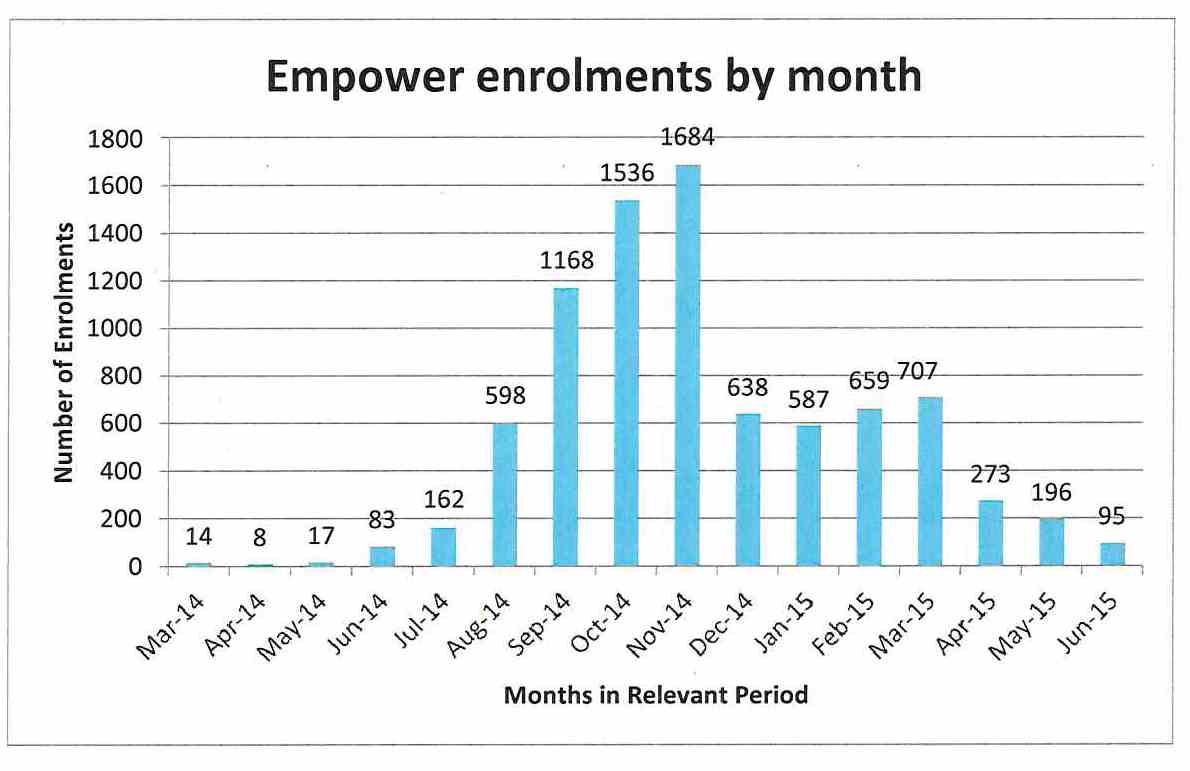
31 An ACCC senior investigator, Andrew Francis, determined from a spreadsheet provided by the Australian Skills Quality Authority (“ASQA”), and apparently provided to ASQA by Empower (“Empower master spreadsheet”), that during the relevant period, Empower had 8,425 enrolments. The following chart shows Empower’s enrolments during the relevant period, by month:
32 Mr Francis determined that, of these 8,425 enrolments, there were 1,877 enrolments for which the relevant consumers were not charged for any census date, and incurred no debt. Accordingly, there were 6,548 enrolments for which the relevant consumers were charged a fee by Empower for a census date. This figure includes enrolments where the relevant consumer was charged a fee by Empower but the resulting debt was remitted after it was incurred.
33 Data obtained from the Department of Education and Training (“DET”) lists 6,412 enrolments with a first census date falling within the relevant period, that being 136 less enrolments than recorded in the ASQA data.
34 Mr Francis’s evidence was that this discrepancy was most likely because the ASQA data identifies enrolments by enrolment date, whereas the DET student data identifies enrolments by census date, and as the DET student data does not include enrolments where a debt was incurred but remitted before 22 March 2016.
35 Students were enrolled across Australia, although mainly in New South Wales. The data analysed by Professor Tony Vinson, an expert engaged by the ACCC, showed that New South Wales accounted for 87.7% of enrolments.
36 The Empower master spreadsheet identifies the persons who recruited the consumers to the various Empower courses. Mr Francis’s evidence was that six organisations are identified on the spreadsheet as responsible for the recruitment of 6,465 (77%) of the 8,425 enrolments, namely:
(1) Active Group International;
(2) Amity Administrative Services Pty Ltd (“Amity”) (including brokers);
(3) RK Holdings Australia Pty Ltd trading as Inwork Recruitment (“Inwork”) (including brokers);
(4) SR (Aust) Pty Ltd known as Sam’s Education Services (“SR Aust”);
(5) Fundamental Education Pty Ltd (“Fundamental Education”); and
(6) Qualify Me Pty Ltd (“Qualify Me”).
37 As noted below, the applicants’ evidence referred to five occasions, which the applicants referred to as “group sign-ups”, when multiple individuals were enrolled to Empower’s courses.
38 Without additional evidence, particularly evidence that these dates reflect the date on which the recruiter dealt with the relevant consumers, I am not satisfied that I should infer that there were “group sign-ups”, apart from those about which there is evidence. However, I do accept that the volumes of enrolments indicate a very concerted effort on the part of Empower’s marketers to maximise enrolments in the second half of 2014. I also infer that the marketers were strongly incentivised to procure enrolments for Empower by the commissions which Empower offered, as identified below.
Empower’s receipts under VET FEE-HELP
39 Empower has admitted that, in respect of consumers enrolled in Empower courses during the period 1 March 2014 to 31 October 2015, it received $94,459,228 from the Commonwealth.
40 Kathryn Woodall, a public servant within the DET, gave evidence that a total of $64,188,285.90 in VET FEE-HELP payments was made to Empower for the relevant period.
41 In Unique, Perram J found (at [11] and [13]) that in 2015 Unique International College enrolled 4,677 students in its courses and received $56,183,632 in revenue, apparently all – or substantially all – of which comprised payments received from the Commonwealth under VET FEE-HELP. At [616], his Honour said that “the sums of money involved here are so very large that they may be seen as providing a motive for Unique to engage in exploitative practices”, while at [717] his Honour stated that “[t]he sums of money which Unique was making, therefore, are capable of being evidence that Unique had a real motive to engage in the kind of targeted conduct alleged”.
42 I accept the applicants’ submission that the sums of money involved in this proceeding can also be seen as providing a motive for Empower to engage in exploitative practices, or to condone or turn a blind eye to such practices by its recruiters.
Empower’s marketing and enrolment system
43 The enrolment process involved the completion of a form by the consumer entitled “Student Enrolment Form (VET FEE-HELP), apparently created by Empower (“enrolment form”). The form sought information about the proposed student and their course selection, including their language, qualifications and employment. The form set out the terms and conditions of the agreement between Empower and the consumer for the provision of the relevant course, and a declaration to be made by the consumer.
44 In addition, the consumer was required to complete an Australian Government form entitled “Request for VET FEE-HELP assistance” which prominently states: “You MUST read the VET FEE-HELP information booklet before completing this form”.
45 There was a third form entitled “VET FEE-Help Disclaimer FORM”. It is not clear whether this form was completed by some or all enrolees during the relevant period. The form was required to be signed by both student and agent and it contained the following statements:
6) The consultant has explained to me that the VET FEE-Help is ‘study now pay later’ loan funded by the government
7) Any study tools provided, are directly supplied by the institute for the purpose of completing the course.
8) I understand that the compulsory repayment threshold for the 2014-15 income year is $53,345 i.e. repayment start [sic] once I start earning more than $53,345 per year.
9) I understand the course I am enrolling in is delivered online via e-learning portal.
46 A witness who was a former employee of Empower, Monique Chan, prepared a flow chart of the enrolment process as at early November 2014 (and a flow chart for a proposed new process). Ms Chan described the existing process as follows:
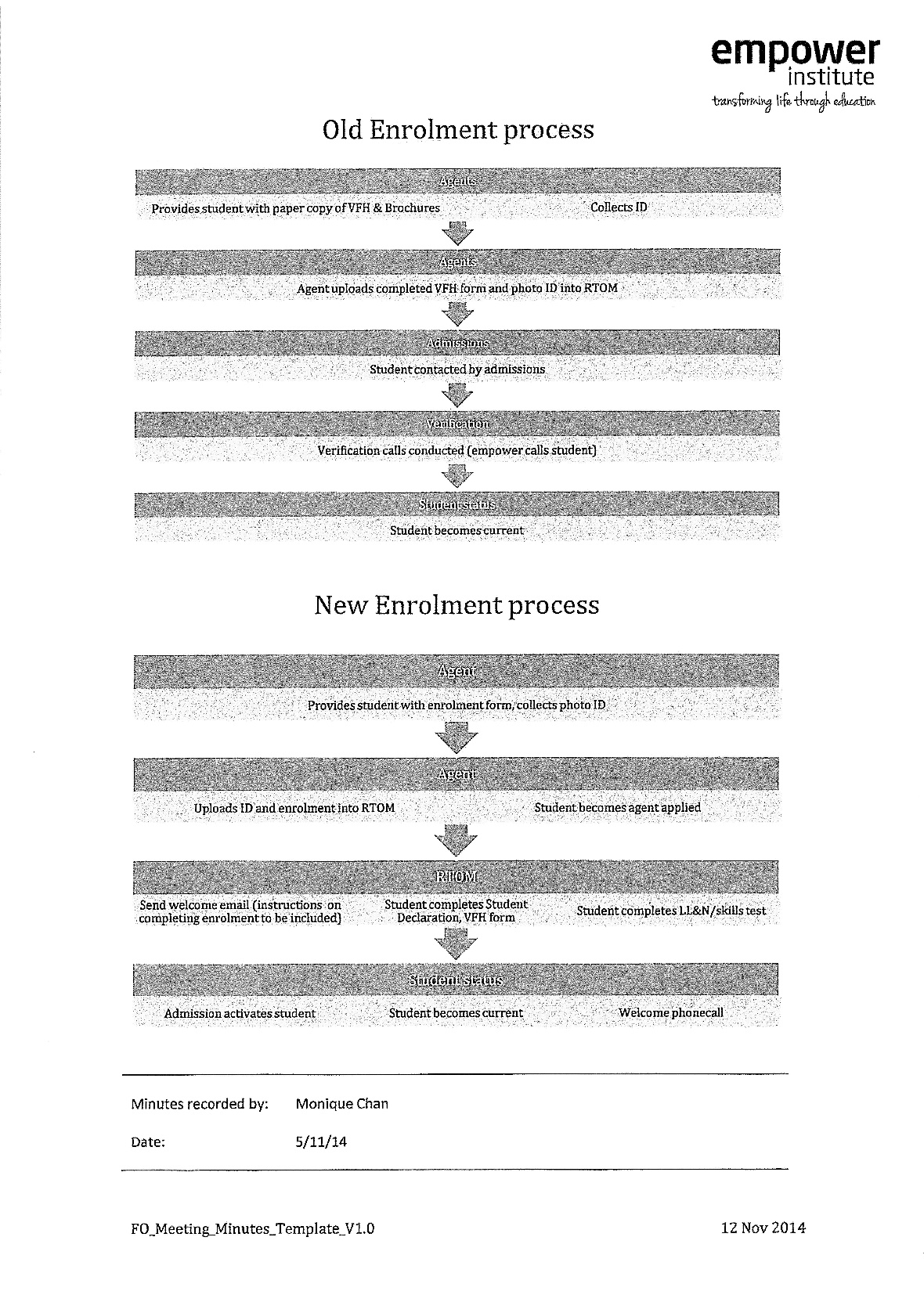
47 Ms Chan proposed a different process, in which the VET FEE-HELP form would be sent to the consumer after their interaction with the agent. This change was intended by Ms Chan to address complaints, about which Ms Chan had heard, that agents were pressuring students to enrol or not explaining the enrolment process correctly.
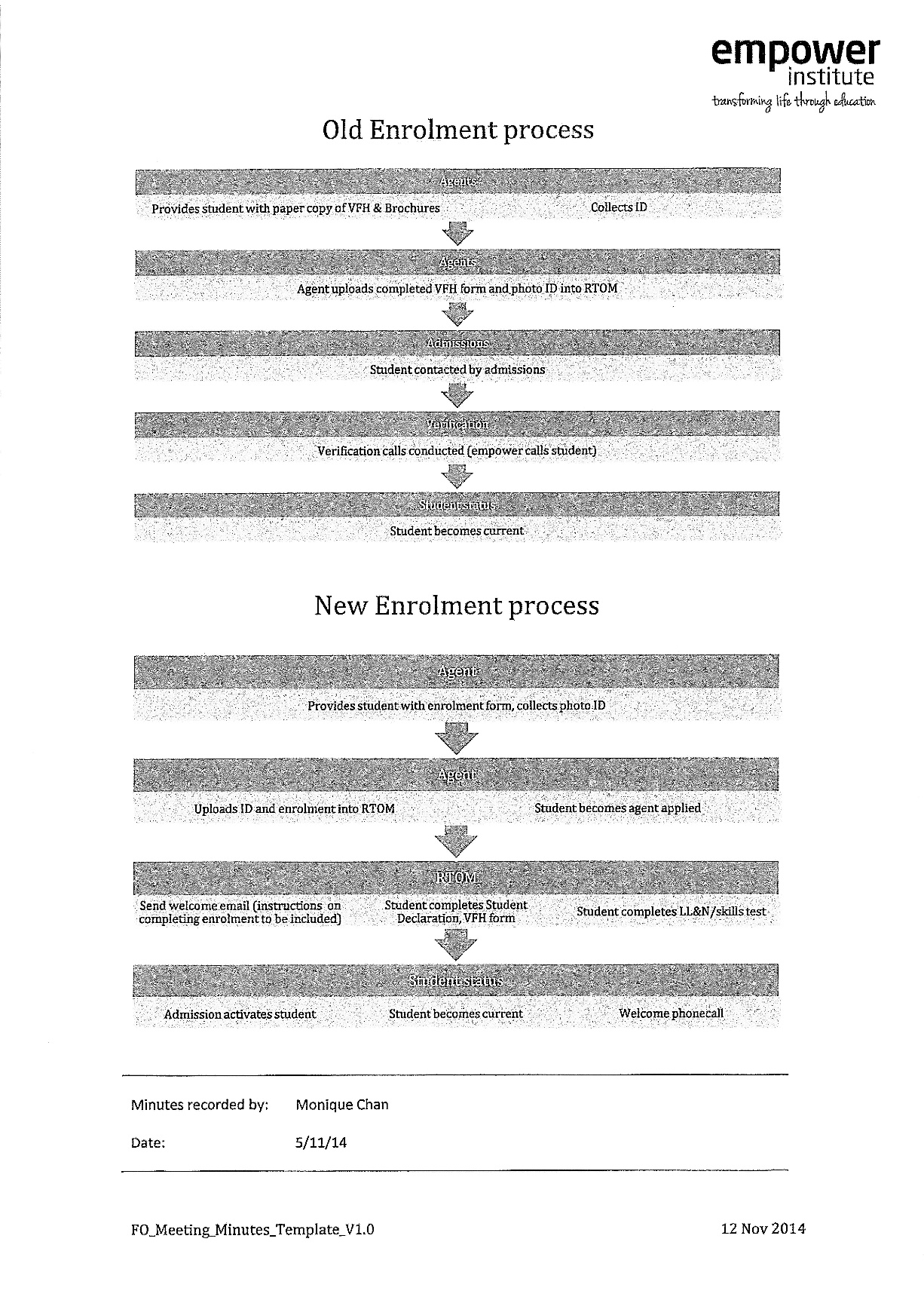
48 At a meeting on 5 November 2014, Empower decided to adopt the process proposed by Ms Chan. The minutes of the meeting record that there was discussion “regarding how to manage and minimize agent interference in enrolment process”. Concerning the enrolment process, the minutes state “new process established to improve accountability of agents and ensure students are fully informed”.
49 Ms Chan summarised the new enrolment process in the following flow chart:
50 Ms Chan prepared a student declaration form for the new process, but never saw that it was used. Ms Chan said that her proposed process was “never properly implemented” but her evidence did not give details to explain this.
51 At the 5 November 2014 meeting, there was also discussion of a service called “DocuSign”, which enabled student signatures to be securely incorporated into forms. Ms Chan’s evidence was that “DocuSign” was not introduced while she was at Empower. Ms Chan left Empower in mid-December 2014.
52 In the s 155 response, Empower provided a different flow chart which purported to describe its enrolment process. This flow chart described three steps, named:
(1) offer status;
(2) enrolled status; and
(3) current status.
53 The flow chart does not provide a complete picture of the enrolment process, because it refers to an “enrolment checklist” used “to go through the application” and a step described as:
6. Verification team to call applicant for verification of details and disseminate vital information as per verification script.
54 In their third further amended concise statement (“concise statement”), the applicants alleged that the marketing and enrolment process involved the elements considered below.
55 The applicants contend that, in the period from 1 March 2014 to 31 March 2015 (that is, the majority of the relevant period), Empower offered inducements to consumers to enrol in a course, including cash payments, “iPads” and laptop computers. The applicants also contend that, in the same period, Empower offered inducements to consumers in the form of a $100 gift voucher for referring a friend to enrol in an Empower course.
56 In its s 155 response, Empower stated that it offered the following inducements to enrol in each of the three Diploma courses until 31 March 2015: “Free lap top [sic]” and “$100 for referring a friend”.
57 In its response to the applicants’ second further amended concise statement (“concise response”), Empower admitted that between March 2014 and 31 March 2015, it offered $100 gift vouchers to students for referring a friend. The evidence included a brochure published by Empower, which includes the words:
If you have a friend that you think could benefit from an Empower Institute transformation let us know and be rewarded*.
When your friend enrols and passes the first census date for Stage 1 of their Empower Institute course we will reward you with a $100 gift voucher.
58 Empower also admitted that, during this period, it provided Chromebook computers to students enrolled in its courses “in accordance with its Chromebook Policy”.
59 The majority of the applicants’ witnesses gave evidence that he or she was offered a “free” laptop for enrolling in a course. Consumer Q’s evidence was that he was told by a salesman that he would get a free computer when he finished the course. Consumer J’s evidence was that she was told by a friend that “[t]here’s a mob giving out laptops for signing up”. She also received a brochure which referred to Empower institute, and a Diploma of Business course. At the top of the brochure are the words:
FREE GOOGLE CHROMEBOOK LAPTOP*
Terms and Conditions apply Visit empower.edu.au for details
60 Consumer F’s evidence included a copy of the same brochure.
61 A document entitled “MKT Complaints Register” provided by Empower to the ACCC as part of its s 155 response (“Empower’s Complaints Register”), includes records of the following complaints:
(1) from a consumer, received on 18 November 2014, that “she was encouraged to just sign up to get a ‘free lap top [sic]’”; and
(2) from two persons, received on 25 March 2015, that “a an [sic] signed up an autistic [sic] without any parental supervision and by luring him to get a free laptop”.
62 In each of these cases, Empower’s Complaints Register records action taken in response to the complaint.
63 An untitled document which appears to be a business record of Empower appears to list cancellations of enrolments and includes the following reasons for cancellations (errors in original):
(1) ID 9051: “…agent said government is giving free laptop”.
(2) ID 11156: “…the sales man who came over to my house to promote the course gave us false and misleading information. There was at no stage he mentioned anything about any fees or cost involvle, infact [sic] these were his words: Australian Government is offering a wonderful promotion for ALL Australian citizenship to receive free laptop and have the opportunity to do a free course online…”.
(3) ID 9074: “he said one indian guy came to his house yesterday and he told him sign up and he get a free laptop; wasn’t told anything about laptop”.
64 Five of the Consumers (Consumers A, E, J, M and Q) gave evidence that they were paid $50 cash for signing up to a course. In each case, these witnesses gave evidence that they enrolled in a course with Empower at an occasion where multiple individuals were also enrolled. These occasions are the “group sign-ups”, referred to at [173] below.
65 Based on the evidence of the five Consumers, I find that all or substantially all of the people who were enrolled in Empower’s courses at these “group sign-ups” received $50 as a cash incentive for their enrolment.
66 The applicants did not point to evidence about the source of the cash payments.
67 Based on the evidence set out above, I find that in the period from 1 March 2014 to 31 March 2015, Empower offered laptop computers, namely Google Chromebooks, as an inducement to consumers to enrol in their courses. I am not satisfied that Empower ever offered iPads, an Apple brand product, to consumers to enrol in its courses. As appears below, two of the Consumers (Consumers K and L) give evidence that they were offered an “iPad” as an inducement to enrol. However, in my view, the use of the word “iPad” by the relevant recruiters is not sufficient to demonstrate that it was a part of Empower’s marketing and enrolment system to offer iPads as an inducement, where that word may be used (mistakenly) as a generic description of a tablet computer.
68 I also find that, in the same period, Empower offered incentives, in the form of $100 gift vouchers, to persons who referred a consumer to enrol in Empower’s courses.
69 Having regard to the seriousness of the allegation that Empower offered cash payments as an inducement to enrol in its course, I am not satisfied that Empower itself made those payments where there is no evidence about the flow of funds and it is plausible that salesmen who enrolled the students may have been sufficiently incentivised to make those payments from their own resources.
Commissions paid to employees to recruit students
70 The applicants contend that, in the period from March 2014 to April 2015, Empower authorised a number of its employees to market and recruit students for its courses and paid those employees a commission of $65 for each student they recruited.
71 There are two relevant employees: Benga Ohunayo and Greg Devine. They were each appointed to the role of “Business Development Manager” by letters of appointment dated 20 February 2014. The role is not described in detail. The letters of appointment refer to an “Empower Sales Bonus Scheme” which “closely focuses behaviour on wealth creation for the business”. This scheme does not appear to correspond with the commission arrangement that appears to have existed between August and December 2014.
72 For those months, Mr Ohunayo and Mr Devine claimed the following commissions based on the following student enrolment numbers:
Month | Ohunayo students | Ohunayo commission | Devine students | Devine commission |
August 2014 | 256 | $16,640 | 50 | $3,250 |
September 2014 | 466 | $30,290 | 209 | $13,585 |
October 2014 | Not stated | $46,930 ex GST | Not stated | $17,745 ex GST |
November 2014 | 1227 | $79,820 ex GST | 375 | $24,375 |
December 2014 | 1315 | $85,475 ex GST | 680 | $44,200 ex GST |
Total | $212,225 | $103,155 |
73 Mr Ohunayo and Mr Devine claimed their commissions by emails accompanied by spreadsheets naming students which apparently supported the commission claims. Mr Ohunayo’s August claim was based on a spreadsheet which listed 256 students, with a student ID and a course name. The spreadsheet included a column headed “AgentName” and a column headed “Comm. Paid”. The following names are listed in the “AgentName” column:
(1) Amity;
(2) SR Aust;
(3) Australian Training Colleges; and
(4) Qualify Me.
74 For 73 enrolments the “Comm. Paid” includes the amount of $1,210. For the balance, the amount of $0 is recorded.
75 Mr Devine’s August 2014 claim is accompanied by a spreadsheet in a different format. It includes student names, IDs, nationality, course ID and course names, and a column headed “AgentName”. The following names are listed in that column:
(1) Sierra Marketing;
(2) QF Recruitment Services;
(3) John Abdelmalek;
(4) DanaMondry Independent Course Advisor; and
(5) Career Development & Training.
76 As the applicants submitted, it is reasonable to infer from the monthly spreadsheets that Mr Ohunayo and Mr Devine were claiming bonuses, not for their personal efforts to recruit individual students, but for their management of third party agents who procured enrolments for Empower. This inference is supported by the 29 August 2014 emails from Mr Ohunayo to Mr Yang and Mina Fakhouri claiming commission “based on agent managed”.
77 There is no evidence of commissions claimed by or paid to Mr Ohunayo or Mr Devine outside the August to December 2014 period. The applicants submissions did not point to evidence that the commissions were paid by Empower, however, there are two emails from Mr Fakhouri to Mr Yang dated 8 January 2015 in which Mr Fakhouri provided Mr Yang with the commission claims for December 2014 and states, in each case: “[C]ould you please let benga when this will be paid [sic]. Also the outstanding November invoice”.
78 I infer from these emails that Mr Ohunayo and Mr Devine were paid the commissions they claimed for August, September and October 2014 by Empower.
79 The applicants contended that, from at least around June 2014, Empower entered into written contracts with 22 entities (“marketers”) during the period to market its courses and recruit students.
80 The “Project Empower” strategy proposed “initial reliance on 3rd party domestic agents” for student acquisition. Mr Hartland drafted a standard “Sales Representative Agreement”, which is substantially the same as the contracts made with the various marketers.
81 The evidence included 20 contracts entitled “Company/Sales Representative Agreement”, one contract entitled “Sales Representative Agreement” between Empower and QF Recruitment Services (“QF Recruitment agreement”) dated 15 May 2014 and a “Memorandum of Understanding” between Empower and SR Aust dated 20 June 2014.
82 Five of the “Company/Sales Representative Agreements” were executed after 31 December 2014. One of the agreements, was signed by the relevant sales representative (Lajos Eross) on 1 July 2015 – that is, after the relevant period – but Empower’s s 155 response nevertheless identified that marketer as an external sales representative from 31 March 2015.
83 According to Empower’s response to the ACCC’s s 155 request, 16 of the contracts were suspended or terminated in March 2015.
84 Each of the Company/Sales Representative Agreements contained the following provision (emphasis added):
2.1 Empower hereby appoints the Company/Company/Sales Representative as an authorised non-exclusive independent representative to sell and promote all services provided by Empower with no limitations of graphical area, but accepts there will be limitations as to approved and prohibited marketing channels.
2.2 The Company/Sales Representative shall devote such time, energy and skill on a regular and consistent basis as is necessary to sell and promote the sale of Company’s services during the term of this Agreement. Company/Sales Representative’s sales and promotional efforts shall be directed toward the following:
a) Generating leads to commence in Empower’s educational courses
b) Promoting the value of the Empower’s educational products
c) Identifying suitable candidates
d) Conform to any lawful directive by Empower as it relates to the sales and promotions of its products.
85 Clause 3 of the Company/Sales Representative Agreements provided relevantly:
3.1 The Company/Sales Representative agrees to comply with all relevant legislation both State and Federal including but not limited to:
…
c) Competition and Consumer Law
…
3.2 The Company/Sales Representative agrees to operate in a manner which is not misleading or deceptive and which could be construed to be detrimental.
86 Each of the Company/Sales Representative Agreements contained the following provision entitled “Sub Contracting”:
7.1 The Company/Sales Representative shall not sub-contract any part or parts of its obligations under the Agreement unless it has made prior application in writing to Empower giving full particulars of its obligations, which it wishes to sub-contract and of the proposed subcontractor and has obtained the written approval of Empower.
7.2 An approval to sub-contract any part of the work or obligations under this Agreement given by Empower in pursuance of this clause shall not relieve the Company/Sales Representative of any of its liabilities or obligations under this Agreement.
87 The QF Recruitment agreement contained provisions relevantly similar to the provisions just set out.
88 The entry into these contracts reflects an obvious aim on the part of Empower to increase its enrolments substantially.
89 By its concise response, Empower admitted that it did not enforce the requirement for written consent to subcontract under clause 7. Empower also admitted that the marketers engaged approximately 39 entities to recruit students. The applicants’ submissions identified 34 brokers, who were engaged by the marketers.
90 To the extent set out above, I accept that the contracts authorised the marketers to act for Empower or act at Empower’s direction. To the same extent, I accept that the contract required the marketers to apply to Empower in writing and to obtain its written approval to sub-contract any of their obligations under the contracts.
91 The Company/Sales Representative Agreements and the QF Recruitment agreement purported specifically to exclude an agency relationship in the following provisions:
4.1 The Company/Sales Representative is not by virtue of this Agreement an agent or representative of Empower.
4.2 The Company/Sales Representative shall ensure that it and its representatives conduct themselves at all times in dealings with third parties in such a manner as not to infer that the Company/Sales Representative is an agent or representative of Empower.
…
8.3 This Agreement shall not create a partnership, joint venture, agency, employer/employee or similar relationship between Empower and the Company/Sales Representative. The Company/Sales Representative shall be an independent contractor.
92 If read literally, these clauses would negate the appointment to be Empower’s “authorised non-exclusive independent representative to sell and promote” Empower’s services because that appointment, given with the consent of the agent, itself creates an agency relationship. Accordingly, I do not conclude that these provisions have such an operation.
93 Clause 5 of the Company/Sales Representative Agreements and the QF Recruitment agreement provided relevantly:
5.1 The Company/Sales Representative agrees to be bound by the Marketing Compliance Checklist as provided by the Empower and any such related Policies. The Marketing Compliance Checklist is provided as an Appendix to this Agreement.
5.2 The Company/Sales Representative will inform Empower of any Sales Channel intended for use and once approved, will ensure that the Company/Sales Representative and any of the Company/Sales Representative’s agents complies with all lawful directives, policies, templates, procedures and prohibitions for marketing via that channel.
In addition to the foregoing, the Company/Sales Representative shall assist Empower and shall perform any and all services required or requested in connection with Empower’s business, including, but not limited to, such services of an advisory nature as may be requested from time to time by Empower.
The Company/Sales Representative shall periodically, or at any time upon Empower’s request, submit appropriate documentation of any and all sales and promotional efforts performed and to be performed by the Company/Sales Representative pursuant to this Agreement.
94 “Sales Channel” is not defined in the agreements.
95 The “Marketing Compliance Checklist” sets out seven matters applicable to all marketing material, including ensuring the correct use of the “NRT” (nationally recognised training) logo where featured and, where VET FEE-HELP is mentioned, ensuring the VFH logo is used correctly.
96 The applicants contended that, from at least around June 2014, Empower paid each marketer a commission for each student recruited, in an amount ranging from $1,000 to $4,395.60 per student.
97 The commissions payable under the written contracts differed, by both course and structure. For example, under the contract between Empower and Active Group International, the commissions were set out in a schedule to the contract, as follows:
Diploma of Business
Diploma of Management
1.0 COMMISSION PAYABLE
First Census - $1,320 for each student plus GST
Second Census- $450 for each student plus GST
Third Census- $450 for each student plus GST
…
Diploma of Early Childcare
1.0 COMMISSION PAYABLE
First Census- $1,000 for each student plus GST
Second Census- $500 for each student plus GST
98 Under the contract between Empower and Amity, the commissions were set out in a schedule to the contract, as follows:
Diploma of Business
Diploma of Management
1.0 COMMISSION PAYABLE
First Census - $1,100 for each student + GST
Second Census- $560 for each student + GST
Third Census- $560 for each student + GST
1.1 COMMISSION PAYABLE (once 100+ students have passed 2nd census, Amity commission rate moves to 20% flat rate, see below break down)
First Census- $1,100 for each student + GST
Second Census- $1,100 for each student + GST
Third Census- $760 for each student + GST
99 The figure of $4,395.60 comes from the Empower master spreadsheet. Mr Francis gave evidence that he identified nine records of payments of commissions in that amount for nine enrolments in Brewarrina, NSW. The spreadsheet contains a column headed “Name of third party”. In each case, the name is “Amity Administrative – R S Admin”.
100 Fundamental Education’s contract also provided that after 120 students passed the second census, the commission payable for Business and Management enrolments moved to a 15% flat rate.
101 From the Empower master spreadsheet, Mr Francis calculated that the following organisations received the following total commissions for the enrolments in the relevant period:
(1) Active Group International: $ 251,774.96;
(2) Amity: $5,433.491.93;
(3) Inwork: $2,946,523.37;
(4) SR Aust: $4,003,510.97;
(5) Fundamental Education: $1,009,741.79; and
(6) Qualify Me: $1,608,484.68.
102 The applicants contended that marketers themselves paid commissions to “brokers” they engaged in a manner similar to commission payments made by Empower to the marketers.
103 The applicants’ written submissions referred to eight agreements between Inwork and various brokers, and 25 written agreements between Amity and various brokers. Although the agreements provide for payments of various commissions to the party designated as “Company/Company/Sales Representative”, the applicants did not point to any evidence of payments made pursuant to these agreements.
Marketing and training materials
104 The applicants contended that, during the relevant period, Empower provided training and instruction and marketing materials to the recruiters and its employees in connection with the marketing and recruitment of students to its courses.
105 In its s 155 request, the ACCC asked Empower to provide:
… details of all training, assessments, instructions, directions, policies and scripts provided by, or on behalf of Empower Institute to each of the Empower Institute Sales Representative identified in response to Paragraph 3 of Schedule 1 to this notice, which provide instructions or guidance on how to:
(a) contact prospective students for the purpose of marketing VET FEE-HELP course, and
(b) promote, supply or offer for supply, VET FEE-HELP course.
106 Empower’s answer referred to documents (1) and (2) below (see [108]), and a brochure described as “VET FEE HELP”. The brochure is directed to potential students; it is not expressed to provide instructions or guidance to recruiters.
107 A similar request was made for documents provided to Empower staff members. Empower’s answer to that request referred to brochures described as “Dip Early Childhood” and “Dip Business” and a document entitled “Verification Call Script”.
108 The applicants’ submissions referred to the following documents:
(1) A slide pack entitled “Agent Enrollment [sic] Process 2015”. It seems to have been created in about January 2015, but there is no evidence about who received or saw the slide pack. The first slide states:
It is mandatory that the applicant is explained VFH thoroughly. Click below for more information on VFH.
The slide pack identifies acceptable forms of identification and contains pages entitled “Indigenous Documentation” and “Enrolment Process Change”. The final page, entitled “Agent Representation Changes” states:
• Agents will no longer be able to wear Empower branded polo shirts while promoting Empower products and must have an ID card of the agency they represent.
Example:
Agent name: John Smith
Agency name: Vet study
Authorised contractor of Empower Institute
• Agency must provide Empower with contact details, preferred names and a photo ID for all sales reps promoting Empower products.
• Empower will be conducting random field visits to agency sales representatives
• Empower will no longer provide assistance in the below
1. Financial assistance with booking shopping centres
2. Banners/Point of Sales Stands
3. Reimbursement of proof of citizenship documents
(2) A slide pack entitled “Empower Institute Orientation”. This set of slides is directed to students who have been enrolled, informing them of matters such as how to contact Empower and how to log onto “eZone” (see [23] above) and the student portal.
(3) A two page document entitled “Company/Sales Representative Monitoring Policy”. This document was created in May 2015, one month before the end of the relevant period. Prior to its creation, Empower did not have a similar document. The stated purpose of the policy is:
… to ensure that all Empower Institute’s sales representatives and sales persons are consistently and periodically monitored by Empower Institute so that Empower Institute’s sales representatives and sales persons are compliant with the law, are ethical and comply with the terms and conditions of the Company/Sales Representative Agreement’s Terms and Conditions.
(4) A five page document entitled “Student Cancellation Policy and Procedure”. This policy appears to have become effective on 1 May 2015. A draft email from Empower to agents advising them of the “change of policy” included the following (errors in original):
The Australian Skills Quality Authority (ASQA) has determined that students should only be charged for subsequent amounts of VET FEE HELP fees (ie pass second censes) if these students demonstrate engagement with their institution through completion of progressive assessment items
.…
Empower Institute endeavors to contact every student a number of times throughout the census periods. However, we ask that you, as the agent, also make every attempt to engage with your students to get them to progress in their studies and to demonstrate that you are an agent who can vouch that these are genuine students who are studying.
(5) A four page document entitled “Academic and Non-Academic Grievance Handling Policy and Procedure”. This document sets out a process for addressing complaints.
109 I am not satisfied that these documents were provided to marketers, brokers and employees during the relevant period. What emerges from the material identified by the applicants and the s 155 response is that there was practically no training material produced by Empower to guide marketers or brokers. Document (1) provides limited guidance and a link to information about VET FEE-HELP; document (2) does not appear to be directed to marketers and brokers and there is no evidence that it was provided to them; documents (3) and (4) were created in May 2015, at the very end of the relevant period, and in any event there is no evidence that they were ever provided to marketers or brokers; and there is no evidence that document (5) was provided to marketers or brokers.
110 This conclusion is supported by the affidavit evidence of Ms Chan. Ms Chan was employed as the Quality and Compliance Manager at Empower from about 3 November to mid-December 2014. She was responsible for reviewing the content of Empower’s courses, developing compliance and complaints policies for Empower and investigating and preparing response to regulatory reports of complaints lodged against Empower. At a recruitment interview, Mr Yang proposed that Ms Chan “do quality and compliance” for Empower. When she asked what systems were in place, Mr Yang replied “we don’t have anything in place and that’s why we need you”.
111 Shortly before she started working at Empower, its operations manager, Suresh Basnet, said to Ms Chan:
Could you start as soon as possible? Empower just received a complaint from the Department of Education and Training and we need to deal with it quickly. We need you to respond to the report and build a strategy to make sure it doesn’t happen again.
112 The “complaint” from the DET was probably the 30 October 2014 notice referred to at [233] below.
113 Ms Chan’s evidence was that, when she commenced at Empower, there was no staff or agent training programs in place. Her evidence was that she proposed mandatory training for all Empower staff and agents, including on consumer law, to Dr Heaney. Ms Chan also told Mr Ohunayo that there needed to be a meeting with recruiters to make sure that they were clearly advised on what they could and could not do when enrolling a student. So far as Ms Chan was aware, there was no such meeting while she was at Empower.
114 On the basis of Ms Chan’s evidence and the material provided in answer to the s 155 notice, I find that prior to 2015, Empower’s recruiters were not provided with any training in relation to the content of the courses conducted by Empower, the requirements to complete a course or the important aspects of VET FEE-HELP for consumers. Based on the “Agent Enrollment [sic] Process 2015”, in 2015, there may have been some training of recruiters.
No Australian Consumer Law training
115 The applicants contend that, during the relevant period, Empower did not provide any training or instruction to the recruiters or to its employees in relation to compliance with the ACL.
116 As noted above, Ms Chan’s evidence was that, when she commenced at Empower in November 2014, there was no staff or agent training programs in place.
117 Based on Ms Chan’s evidence and Empower’s response to the s 155 notice set out above, I make the following findings for the duration of the relevant period:
(1) Empower did not provide any instruction or training to its recruiters on how to market its courses and interact with students in a way that complied with the ACL, beyond the exhortation in the January 2015 slide pack to “explain VFH thoroughly”.
(2) Empower did not instruct its recruiters about their obligations arising pursuant to ss 18, 21 and 29 of the ACL, or the unsolicited consumer agreement provisions in the ACL. Empower did not provide any practical guidance and how to act in accordance with these obligations.
(3) Empower did not provide its recruiters with a marketing script to follow to ensure that what they said to prospective students was not misleading and complied with the stringent requirements of the unsolicited consumer agreement provisions.
No monitoring of marketing and recruitment practices
118 The applicants contend that, during the relevant period, Empower did not monitor the marketing and recruitment practices of the recruiters or its employees, including in respect of the recruitment of students who were not capable of undertaking or completing the courses in which they were enrolled.
119 The applicants’ submissions did not identify evidence in support of this contention.
120 In particular, there was no evidence as to whether or not Empower conducted the “random field visits to agency sales representatives” mentioned in the “Agent Enrollment [sic] Process 2015” slide pack.
121 Ms Chan and Empower’s s 155 response also identified “verification calls” as being a part of Empower’s enrolment process.
122 Empower told the ACCC that it provided its employees with the “Verification Call Script”. The document provided by Empower to the ACCC is entitled “Revised Verification Call Script”, however, the evidence also included a document entitled “Verification Call Script for Agents”.
123 Each script concerns a call to verify details following the receipt of an enrolment application. The evidence of Dr Heaney, at her s 155 examination, was to the effect that the scripts represented what took place from about May 2015, but may also have operated for some period before then. Dr Heaney’s evidence was that prior to this, some students were “verified” by Empower and some by the relevant agent. Ms Evans, who worked at Empower during October 2014, gave evidence that she helped another staff member, Clare Walker, with her job of calling students recruited by agents to determine whether they wanted to undertake their courses.
124 Both scripts refer to the importance of the “census date” as the last date on which the student can cancel enrolment without incurring a VET FEE-HELP debt for that census period. Both scripts also include questions directed to ascertaining the student’s computer and LLN proficiency. There are also particular questions for a potential student over the age of 60.
125 Ms Chan also gave evidence that there was a script used by marketers and student services staff when calling students to verify their enrolments. Ms Chan described the script as “fairly basic” and said that it dealt with checking the student’s identification details.
126 Based on this evidence, I am not satisfied that Empower did not monitor the marketing and recruitment practices of the recruiters or its employees during the relevant period.
No processes to prevent enrolment of incapable students
127 The applicants contend that, during the relevant period, Empower did not take steps to ensure that it did not enrol students who were not capable of undertaking and completing the courses in which they were enrolled, including by:
(1) not requiring assessment or adequate assessment of the literacy, numeracy or computer skills of consumers (from May 2014);
(2) not determining whether they could use or had access to an internet connection or email, so as to determine whether they were capable of undertaking or completing a course; or
(3) not requiring any minimum formal educational qualifications, or minimum number of years of schooling for students to be eligible to enrol in a course.
128 In support of this contention, the applicants relied on the evidence of the Consumers as well as evidence from former employees of Empower, namely Caron Bryan, Amanda Evans, Ms Chan and Sanjeev Dheer.
129 As to (3), the applicants did not suggest that there necessarily should have been any such minimum requirements for enrolment. However, such requirements might have been a way of ensuring that students were not enrolled into a course that was beyond their capacity to complete.
130 As noted at [29], the pre-requisites for completing a course conducted by Empower successfully were modest, but not non-existent. They comprised:
(1) computer literacy, sufficient to do an online course; and
(2) LLN proficiency, including sufficient understanding of written and spoken English to undertake a course conducted in English.
131 It follows from the online nature of the courses that a student also needed access to an internet connection and email.
132 Ms Bryan’s evidence supports the finding that it was necessary to have a degree of literacy and numeracy in order to complete the courses conducted by Empower successfully.
133 Ms Bryan is a learning designer who was employed by Empower from December 2013 to August 2014. Ms Bryan developed a “Study Skills Survey” (“SSS”) to test whether students were appropriate candidates for an Empower course. The SSS consisted of tests for numeracy and literacy skills, a writing task and an interview with Ms Bryan. From February to April 2014, Ms Bryan administered the SSS to 34 prospective students.
134 In late April or early May 2014, Mr Hartland was replaced at Empower by Mr Fakhouri. From around that time, Ms Bryan noticed that, when she began to assess the new students, she found that about half of them did not speak English and some could barely write.
135 From May 2014, Ms Bryan saw that students were being enrolled whom she had marked as unsuccessful in their SSS, or whom she had not assessed at all. Around this time, Ms Bryan was transferred into the role of Academic Manager and her primary responsibility became preparing for an upcoming ASQA audit. She stopped delivering the SSS to students. In about June 2014, Ms Bryan told Suresh Basnet, Empower’s Operations Manager, that she would not assess a batch of students “because too many of them are not the right calibre”. Mr Basnet replied “I’ve spoken with Jim. This is how it is. Caron, you’re going to have to move on if you don’t like it”.
136 On another occasion, Ms Bryan told Mr Basnet of her opinion that Empower had students “who just want to get the laptop and cannot do the course. We have to do something about it.” On yet another occasion, when Ms Bryan raised her concern with Mr Basnet, he replied “Jim won’t listen to me anymore. He only wants to talk to Mina [Foukhari]”.
137 At some time after the audit and before she left in August 2014, Ms Bryan stopped seeing the SSS forms in use.
138 Ms Evans was employed as a Student Engagement Officer at Empower from around 30 September 2014 until her dismissal on 31 October 2014. Ms Evans’ evidence was, relevantly, that there was no literacy and numeracy test for the “business courses”, presumably referring to the Diploma of Business and Diploma of Management courses offered by Empower.
139 Ms Chan gave evidence of a conversation with Mr Yang, in which she expressed the need for a minimum standard for students enrolling in Empower’s courses. According to Ms Chan, Mr Yang responded by saying “thanks for your concern”.
140 Ms Chan also advocated for the development of an online LLN test to be developed by a qualified trainer. Her evidence was that Mr Yang said that he did not want to hire someone to fill this role.
141 Ms Chan’s employment with Empower was terminated by a letter dated 16 December 2014. The letter explained the reason for her termination as follows:
A vital component of your role as Compliance Officer is an effective level of teamwork and communication with other managers and staff; these have not been met.
142 Mr Dheer was employed by Empower from 1 July 2015 to 27 October 2015, that is, outside the relevant period. His evidence was that he did not see any basic literacy, language or numeracy skills tests administered prior to enrolling students. He gave evidence of a conversation with Sharmila Patel, Empower’s Academic and Operations Manager, in which he raised his concern that almost all the students he dealt with were not capable of doing their courses. Ms Patel responded by saying “I am trying to fix the situation but we need to enrol as many students as possible because the rules will change at the start of next year”.
143 The applicants also relied on the evidence of the Consumers to support the contention that Empower lacked processes to prevent enrolment of unsuitable students. As set out below, that evidence shows that on several occasions consumers were enrolled without steps being taken to ensure that they were capable of undertaking or completing the relevant courses, whether by reason of insufficient literacy, numeracy or computer skills, or for some other reason such as a disability that made the consumer an unsuitable candidate for one of Empower’s courses.
144 The verification script and the revised verification script provide for consumers who were called to be asked questions about their computer literacy and the LLN proficiency. They also provide for particular questions about capacity to complete a course in the case of a student over the age of 60. The verification script includes the following:
Consumer Literacy: Could you please tell me what level of computer skills do you have? Do you understand that the course is an online course and that you will need a good level of computer skills and understanding to undertake this course? Do you have anybody who will be assisting you with your computer skills?
LLN Proficiency: Do you consider yourself proficient in the literacy and numeracy skills required to undertake this course? As English is the medium of communication for this course, how would you therefore, rate your skills at understanding written and spoken English?
Disability: Could you advise if you have any known disability or learning difficulty as defined under the Disability Inclusion Act 2014 that could potentially affect you doing this course successfully.
145 The revised verification script is relevantly similar.
146 Having regard to the paucity of the marketing and training materials supplied by Empower in its s 155 response, and taking into account the Consumers’ descriptions of the processes by which they were enrolled and the evidence of the former employees of Empower, I find that from about May 2014, Empower had no processes apart from the verification scripts to prevent the enrolment of students were not capable of undertaking or completing the relevant courses, whether by reason of insufficient literacy, numeracy or computer skills or for some other reason such as a disability that would make the consumer an unsuitable candidate for one of Empower’s courses.
147 The evidence does not reveal the extent to which students received calls from Empower that conformed to the verification scripts. However, on at least one occasion in January 2015, Empower conducted verification calls in relation to some students and discovered that a student was unable to speak English. Mr Fakhouri proposed to Mr Yang that this student’s enrolment be cancelled. Thus, on that occasion, Empower’s verification call process was effective in identifying a student who would have been incapable of completing a course and enabling that student’s enrolment to be cancelled.
Summary of findings concerning Empower’s marketing and enrolment system
148 In summary, I find that at various times during the relevant period:
(1) Empower offered Google Chromebook computers to consumers who enrolled in its courses.
(2) Empower offered incentives, in the form of $100 gift vouchers, to persons who referred a consumer to enrol in Empower’s courses.
(3) Empower paid commissions to two of its senior employees for each student recruited through a recruiter during late 2015.
(4) Empower systematically used marketers to market to and to recruit students. Two of the marketers, Amity and Inwork, engaged brokers to market to and recruit students.
(5) Empower paid commissions to marketers for recruiting students.
(6) Empower provided practically no training to its recruiters, including no training on compliance with the ACL.
(7) Empower’s system for ensuring that students were capable of completing its courses was limited to its “verification calls”.
Purpose and effect of Empower’s marketing and enrolment system
149 The applicants contended that Empower’s marketing and enrolment process enabled, encouraged and incentivised the recruiters and Empower’s employees to maximise the number of students they recruited for Empower’s courses so as to maximise the financial benefit derived by Empower in relation to students enrolled in its courses.
150 I have no doubt that the substantial commissions paid to Empower’s marketers and apparently paid to Mr Ohunayo and Mr Devine encouraged and incentivised them to maximise the number of students they recruited for Empower’s courses. Their respective and successful efforts to increase Empower’s student population in turn increased the financial benefit derived by Empower from its business of providing vocational education courses. It is reasonable to infer that the payment of commissions was intended to produce that effect.
Methods used to recruit students
151 The applicants did not contend that the marketing and enrolment process was implemented in a uniform manner by all recruiters and employees of Empower. Rather, they contended that certain “marketing methods” were used to recruit students to Empower’s courses “as part of the implementation of Empower’s marketing and enrolment process”.
152 Whether certain activities are aptly described as “methods” is relevant to the applicants’ case that Empower engaged in a system of conduct or pattern of behaviour that was unconscionable by the implementation of its marketing and enrolment process. As discussed below, by s 21(4)(b) of the ACL the proscription against engaging in unconscionable conduct may apply to “a system or conduct or pattern of behaviour whether or not a particular individual is identified as having been disadvantaged by the conduct or behaviour”. The Macquarie Dictionary (7th ed, Macmillan, 2017) defines the word “method” as:
noun 1. a mode of procedure, especially an orderly or systematic mode: a method of instruction.
2. a way of doing something, especially in accordance with a definite plan.
3. order or system in doing anything: to work with method.
4. orderly or systematic arrangement.
153 In the concise statement, the applicants identified the following nine activities or omissions as marketing methods used by the recruiters and Empower’s employees:
(1) Targeting particular locations, including rural and remote towns and Indigenous communities and areas with significant populations of low socio-economic status, and conducting face-to-face marketing.
(2) Paying or offering to pay Aboriginal persons to assist in recruiting Aboriginal students to enrol in Empower’s courses.
(3) Offering cash and “iPads” and laptops to consumers to enrol in Empower’s courses.
(4) Making various false or misleading representations, as set out in para 1.4 of the second further amended originating application, including that the courses and/or the laptops were “free”.
(5) Not explaining or adequately explaining to students VET FEE-HELP, the nature of their obligations if they received assistance under VET FEE-HELP, or that they would have a debt to the Commonwealth after the census date for each unit of a course.
(6) Not informing or not adequately informing consumers about the nature and content of the courses, including that they were delivered via an online learning platform.
(7) Continuing to recruit consumers even after being advised that the consumer could not or did not intend to undertake the course.
(8) Not taking steps to ensure that consumers who enrolled in the courses were capable of undertaking or completing the courses.
(9) Enrolling consumers in Empower courses without their knowledge or consent.
154 As set out below, the evidence included instances of these activities and omissions in the course of procuring enrolments. However, the applicants did not identify facts, beyond the activities and omissions themselves, by reason of which it was contended that those activities or omissions were a mode of procedure, or occurred in accordance with a definite plan or a system.
155 It is also necessary to distinguish between activities and omissions used by recruiters, and those used by employees of Empower. In particular, there is no evidence of employees of Empower using the alleged methods (2), (4), (5) and (6). To the extent that consumers were enrolled without their knowledge or consent (alleged method (8)), there is no evidence that any employee of Empower knowingly procured an enrolment in those circumstances.
Method 1: Targeting of particular locations and use of face-to-face marketing
Targeting pockets of disadvantage
156 The applicants contended that Empower’s recruiters targeted particular locations, including rural and remote towns and Indigenous communities and areas with significant populations of persons of low socio-economic status.
157 Given that Empower’s target demographic was “disengaged members of society (predominately [sic] long term unemployed) of all age groups and backgrounds who are eligible for VFH funding”, it would not be surprising if the applicants’ contention was correct. The applicants did not suggest that there was anything improper about this target demographic. To the contrary, as Perram J noted in Unique at [623], there are sound reasons to think that the VET student cohort is different in its socio-economic and Indigeneity profile from the general population.
158 The consumer evidence provides several instances of consumers who were recruited from rural and remote towns and Indigenous communities and areas with significant populations of persons of low socio-economic status.
159 The applicants also sought to demonstrate their contention by reference to the expert evidence of Professor Tony Vinson, a social researcher, and Dr Matthew Ericson, an expert in social demographic research and statistical analyses.
160 Professor Vinson was provided with the DET student data relating to enrolments in the relevant period. Broadly, Professor Vinson was asked to use the enrolment data and data from the Australian Bureau of Statistics (“ABS”) to assess the socio-economic profile of the students Empower had enrolled. That included the number of students enrolled from locations classified as “rural or remote,” the percentage of Indigenous students enrolled by Empower (as compared to the general population), and the socio-economic status of locations from which students were enrolled by Empower.
161 Professor Vinson concluded that, in New South Wales, the rate of enrolments increased by remoteness.
162 Professor Vinson also concluded that, on a share of population basis, there was an almost nine-fold “over-representation” of Indigenous students among the students Empower enrolled. If the composition of the pool of Empower students reflected the proportion of Indigenous people in the Australian population, one would expect to find 2.5% of the total number of Empower students (6,412) to be Indigenous, being 160. Instead, Empower had 1,389 Indigenous students, being an almost nine-fold (8.7 times) over-representation (based on a comparison with the general population).
163 Professor Vinson also found that socially disadvantaged postcodes accounted for a disproportionate number of Empower students. For example, at the national level, 21.4% of Empower enrolments came from the most disadvantaged ventile (i.e., the bottom 5% of disadvantage areas), a more than four-fold (4.3 times) over-representation. Further, 33.3% of enrolments came from the bottom 10% of most disadvantaged areas, and more than half (54.2%) of enrolees came from the bottom 25% of most disadvantaged areas. Similarly, regarding NSW enrolments (which made the major contribution to the pool of Empower enrolees), Professor Vinson concluded that their “dominant feature” was the concentration of enrolees at the disadvantaged end of the continuum, and that this was a finding of statistical significance.
164 Among Indigenous enrolees, Professor Vinson found a statistically significant over-representation of enrolees from the most disadvantaged areas. In NSW, 35.1% of indigenous enrolments in Empower were from the first four most disadvantaged ventiles, compared with 41% of enrolments in Empower generally. Both of these figures, Professor Vinson observed, reflect an “over-representation” in “poorer” areas than if enrolments were spread evenly across the ventiles. If the threshold is moved to the five most disadvantaged ventiles, then 60.1% of Indigenous enrolees are accounted for, compared with 50.8% of general enrolments. At the reverse end of the scale, only 2.4% of the Indigenous enrolments and 4.8% of general enrolments were in the last five relatively advantaged ventiles.
165 Professor Vinson also conducted more detailed analyses on enrolments around Penrith, Kingswood and Narromine, in the fifth, ninth and twelfth ventiles of disadvantage. This analysis enabled him to identify that Empower enrolments were drawn from the most disadvantaged areas within those postcodes. Professor Vinson concluded that this result was highly statistically significant. Professor Vinson further concluded that enrolees from these middle range ventiles were, in fact, located in the more disadvantaged areas within them.
166 Dr Ericson expressed the following opinions on locational social disadvantage of Empower enrolments compared to TAFE enrolments in the equivalent period:
(1) Empower enrolments nationally were drawn from regions which were on average, less remote than TAFE enrolments. However, Empower enrolments were more heavily concentrated in areas of greater social disadvantage than TAFE enrolments (on the ABS Socio-Economic Indexes for Areas scales) as remoteness increased.
(2) In comparison to TAFE enrolments, Empower had a much greater proportion of Indigenous enrolments.
(3) Empower’s enrolments came from areas of greater average socio-economic disadvantage than TAFE enrolments. For example, the two most disadvantaged quintiles of areas on the ABS scales (i.e., the bottom 40% of disadvantaged areas) constitute 49.05% of TAFE enrolments compared to 69.1% of Empower enrolments. In each course offered by Empower, Empower students were more socio-economically disadvantaged than the students enrolled in a corresponding TAFE course.
(4) Empower’s Indigenous enrolees were drawn from markedly more disadvantaged areas than TAFE’s Indigenous enrolees.
167 Based on this evidence, I accept that, in accordance with its stated target demographic, Empower targeted areas with significant populations of low socio-economic status to recruit its students.
168 I also conclude, from the facts concerning Empower’s enrolments, that there were recruiters who targeted rural and remote towns and Indigenous communities to enrol students with Empower. The evidence does not establish that Empower targeted those places and communities by, for example, instructing or encouraging recruiters to seek enrolments in particular locations. The evidence also does not establish that Empower’s recruiters targeted consumers living in public housing although, consistent with its stated target demographic, it would not be surprising if this was the case.
Face-to-face marketing by calling on consumers at their homes
169 There was consumer evidence from seven witnesses that they were enrolled in Empower’s courses by salesmen who called at their homes, namely from Consumers A, D, G, K, L, N and O. Consumer F also gave evidence that he took some recruiters to an Aboriginal mission outside Mildura, NSW, where the recruiters door-knocked to seek students.
170 An email from Mr Fakhouri to Mr Yang dated 16 January 2015 shows that one marketer, Active Group International, recruited students by door knocking.
171 On the basis of this evidence, I conclude that there were recruiters who engaged in door knocking to enrol students in Empower’s courses during the relevant period.
Approaching consumers at Centrelink offices
172 There was one consumer witness, Consumer N, who was approached by a salesman promoting Empower’s courses as he left the Centrelink office at Bankstown, NSW.
173 There is evidence of multiple consumers being enrolled into Empower courses on five occasions, on the following dates:
(1) the Coonamble RSL, Coonamble, NSW in late 2014;
(2) a home in Brewarrina, in about August 2014 and again in early 2015;
(3) Diggers on Darling, Bourke, NSW in October 2014; and
(4) the Western Star Hotel, Dubbo, NSW in September 2014.
174 Mr Francis’s evidence revealed spikes of significant enrolments within short periods which, the applicants submitted, was indicative of a more widespread practice of “group sign-ups”. Mr Francis gave evidence that the Empower master spread sheet revealed the following facts:
(1) in August 2014, SR Aust enrolled 309 consumers into Empower courses, including 92 consumers in Mount Druitt, NSW;
(2) on 8 October 2014, SR Aust enrolled a further 50 consumers in Mount Druitt;
(3) between 21 and 23 October 2014, SR Aust enrolled 86 consumers in Bourke, NSW
(4) on 22 October 2014, SR Aust enrolled a further 62 consumers in Mount Druitt;
(5) on 29 and 30 October 2014, Amity enrolled 186 consumers in Moree, NSW;
(6) on 10 and 11 November 2014, Amity enrolled 62 consumers in Coonamble, NSW;
(7) on 11 November 2014, Amity enrolled 46 consumers in Narromine, NSW;
(8) between 5 and 14 November 2014, SR Aust enrolled 48 consumers in Wagga Wagga, NSW; and
(9) between 4 and 12 November 2014, Inwork enrolled 61 consumers in Wagga Wagga.
Method 2: Use of Indigenous people to recruit Indigenous students
175 The Consumers gave the following evidence, some of which is hearsay, that recruiters paid or offered to pay Indigenous people to assist in recruiting Indigenous students to enrol in Empower's courses:
(1) Consumer A was told by an Indigenous man that he knew from Dubbo that he was being paid for getting people to come and sign up.
(2) Consumer E gave evidence of an Indigenous woman handing out $50 in cash to recruiters who said they were from Empower. The Indigenous woman told Consumer E’s mother that she was being paid to help out the recruiters. Consumer E heard the woman say that she was in Coonamble for three days, and was then going to Walgett, NSW. The woman said that she and the recruiters had already “done” Dubbo. This evidence is broadly consistent with the evidence that, on 10 and 11 November 2014, Amity enrolled 62 consumers in Coonamble.
(3) Consumer F, who is Indigenous, was given $200 cash by a recruiter after taking some recruiters to an Indigenous mission outside of Mildura. He was also offered $400 if he helped to sign up 40 people and $1,000 for 50 people. Consumer F was told that the recruiters were enrolling only Indigenous people and that their task was to “help Aboriginal people”. A recruiter explicitly asked Consumer F to introduce the recruiter to his brothers, sisters, cousins and friends so that he could see if they wanted to sign up, and explicitly asked whether there was a local mission. Consumer F was directed to door-knock the houses in the mission, and he complied. At each house he said: “These people are going around, signing people up to courses and giving out free laptops and notebooks”.
(4) Consumer G, who is Indigenous, said that she was offered $500 cash by some recruiters if she introduced them to other people to sign them up for courses.
(5) Consumer J, who is Indigenous, was told by an Indigenous woman called Debra Ryan (also known as Beverley Ryan) that she would get $50 if she brought five more people to a house where recruiters were enrolling students in Empower courses. She was paid another $50 after bringing another eight people to the house.
(6) Consumer M, who is Indigenous, gave evidence that she was told by an Indigenous woman named Beverley Ryan that her sister was helping the recruiters who enrolled Consumer M in an Empower course, and said that her sister was being paid “$500. $1,000 if we take them to Bourke”.
(7) Consumer M was told by one of the recruiters that, if she got six people to sign up, the recruiter would give her $100.
176 Additionally, Consumer I, who is Indigenous, was enrolled after a relative arrived at his home in a car with a recruiter. The relative started the conversation by saying: “Do you want a laptop? There’s no gimmick, it’s all for free”.
177 Based on the direct evidence, but disregarding the hearsay evidence, I find that there were several instances of recruiters paying or offering payment to Indigenous people for securing enrolments of other Indigenous people in Empower’s courses. The relevant recruiters were Careerpoint Pty Ltd (“Careerpoint”) and SR Aust.
178 In the case of Consumer I, his relative was apparently solicited to assist the recruiter with the task of finding students. This strategy of paying or using Indigenous people to secure enrolments is consistent with a strong motivation on the part of recruiters to secure enrolments. In my view, it is likely that the recruiters were motivated by the substantial commissions which they received for those enrolments.
179 The strength of the recruiters’ motivation to secure enrolments is also evidenced by the instances in which consumers were paid $50 each to sign up. Evidence of these payments was given by:
(1) Consumer A, from Bourke, who also saw other people receiving $50 notes from an Indigenous man, apparently after being enrolled;
(2) Consumer E, from Coonamble, who also saw other people who had signed up receiving $50 notes from an Indigenous woman, apparently after being enrolled;
(3) Consumer J, from Brewarrina, who also saw about six people being given $50, apparently after being enrolled;
(4) Consumer M, from Dubbo; and
(5) Consumer Q, from Brewarrina.
Method 3: Offers of cash and computers
180 As set out earlier, I accept that offers of cash and Google Chromebook computers were methods used by Empower (and by recruiters at the behest of Empower) to secure enrolments.
181 I also accept that three recruiters used offers of cash as inducements to secure enrolments by Indigenous consumers of other Indigenous consumers. That is properly described as a “marketing method” used by those recruiters, namely, Careerpoint and SR Aust.
182 The applicants contended that recruiters and employees of Empower made false or misleading representations including that:
(1) the courses were free, or were free unless the consumer’s income was in an amount which they were unlikely to earn on completion of a course, or at all;
(2) in order to receive a “free” laptop computer they needed to sign up to a course and provide identification and personal information; and
(3) the courses were specifically for Aboriginal people.
183 I am satisfied that each of these representations was false or misleading because there was a cost for the courses and the laptops, being the incurring of a debt to the Commonwealth on the terms of VET-FEE HELP; and as Empower’s courses were not specifically for Aboriginal people.
184 The applicants also sought findings on the basis of Empower’s Complaints Register provided by Empower to the ACCC. The register includes a column entitled “Complaint Description”. Two particular complaints are that:
(1) on 5 September 2014, that an agent declared they were representing the government offering funded courses; and
(2) on 18 November 2014, that an agent “tricked the complaint [sic] and her partner and was misleading and acted fraudulently”.
185 Without any verification from the complainants or admission by Empower, I am not satisfied that the Complaints Register provides a sufficiently reliable basis for the findings sought by the applicants.
186 On 18 December 2014, Empower signed a “Company/Sales Representative Agreement” with Active Group International. According to an email from Mr Devine to Mr Yang and other entitled “Active Group Issues - Serious and Ongoing”, Empower had been “bombarded” with complaints about Active Group’s staff misleading people about VET FEE-HELP. In January 2015, Empower conducted verification calls in relation to students enrolled by Active Group International. The results of those calls included that three consumers wanted to cancel, the first saying that this was because she was not told that she would have a debt if she did not earn $53,000 per annum, the second as he said was not explained anything about VET FEE-HELP and the third as he was not aware that he was enrolled.
187 Without any verification from the relevant consumers, I am not satisfied that the Complaints Register evidence is sufficient to justify findings that these three consumers (or any other consumers recorded in the Register) were enrolled on the basis of false or misleading representations.
188 The applicants also sought findings on the basis of the consumer evidence. The particulars to the concise statement referred to 11 relevant instances. The submissions referred to an additional witnesses.
189 Consumers F and J each received a brochure from Empower which promised a “FREE GOOGLE CHROMEBOOK LAPTOP”. Consumer F was enrolled by Careerpoint in December 2014. Consumer J was enrolled by SR Aust in August 2014.
190 The evidence includes instances of Consumers who were told by one or more recruiters that Empower’s courses were “free”. Consumers A, D and Q are examples.
191 Consumer E was told that the courses were effectively free because she was unlikely to earn the threshold income at which the cost would be paid. Specifically, Consumer E’s evidence was that the recruiter told her:
We are offering free courses. If you don’t make over $54,000 a year, and don’t become a manager or something, you don’t pay it back. I don’t think you’ll become a manager and make $54,000, so you won’t have to pay for it.
192 The evidence includes instances of consumers who were offered a “free” laptop by one or more recruiters. Consumers A, B and E are examples.
193 Some Consumers were told that the courses were free unless their income reached an amount that they were unlikely to earn.
194 Consumers F and O were told that the courses were specifically for Indigenous people.
195 I accept that these misrepresentations were made as inducements to the relevant Consumers to enrol in Empower courses, and therefore were used by the relevant recruiters to implement Empower’s marketing and enrolment process.
196 Having regard to the brochure, apparently provided by Empower to recruiters, that was given to Consumers F and J by different recruiters at different times, I am satisfied that both recruiters and employees of Empower routinely made a misrepresentation to consumers to the effect that they would receive a “free” laptop computer if they enrolled in one of Empower’s courses.
197 Otherwise, I am not satisfied that Empower used alleged marketing method (4) (misrepresentations) in any systematic way or apart from the instances recorded by the consumer evidence.
Method 5: Not explaining VET FEE-HELP
198 The applicants contended that all but one of the Consumers (Consumer B) received no or no adequate explanation of VET FEE-HELP. I accept that contention.
199 There is a separate question whether the lack of explanation was a “marketing method”. Putting aside the incentivisation of recruiters by commission payments, there is no evidence that recruiters were instructed, directed or encouraged not to explain VET FEE-HELP.
200 I do not accept that the consumer evidence supports a conclusion that recruiters failed to explain VET FEE-HELP adequately or at all as a means of securing the various consumers’ enrolments. Accordingly, I am not satisfied that alleged marketing method (5) was used by recruiters and employees of Empower to implement the marketing and enrolment process.
201 However, it is obvious that a failure to explain to consumers the potential costs to them of the scheme would make them less likely to decide not to enrol because of an unwillingness to bear those costs. It is reasonable to assume that Empower was cognisant of that obvious fact.
Method 6: Not informing consumers about nature and content of courses
202 The applicants’ particulars to alleged marketing method (6) identify 12 instances in which the recruiter did not explain the course to a consumer prior to enrolment. The relevant recruiters are identified as Amity, Careerpoint (six instances), Qualify Me and SR Aust (four instances).
203 Some but not all of the particulars are borne out by the evidence. For example, the first relevant particular is that the recruiter (Amity) did not explain the course to Consumer Q. Consumer Q’s evidence was that he was given a pamphlet and that he and a salesman spoke about the courses. Consumer Q said:
I recall that the salesman told me that the course should take 6 to 12 months, that it was an online and that it was some type of management course. I cannot now recall all of the details. The salesman did not give me any information about the course or what it involved other than the brochure.
204 Consumer Q did not state in his affidavit that the recruiter did not explain the course to him. Thus, I am not satisfied that Consumer Q’s evidence supports the use of the alleged marketing method (6) in relation to Amity.
205 The second relevant particular is that the recruiter did not explain the course to Consumer O. Consumer O gave evidence that the “salesman did not tell me anything about the content or any other detail about the courses”. I am therefore satisfied that Consumer O’s evidence supports alleged marketing method (6).
206 The third relevant particular is that the recruiter did not explain the course to Consumer B. Consumer B’s evidence was that she “did not ask the marketers anything about any course because [she] only wanted a free laptop”, and that she “[did] not know what course [she] agreed to sign up [to]”. She also gave evidence that while she was given pamphlets, besides discussing VET FEE-HELP and laptop, “the marketer did not say anything else about the colleges or the courses” and that she “did not read any of the papers at the time”. Consumer B’s evidence thus also supported alleged marketing method (6).
207 The fourth relevant particular is that the recruiter (Qualify Me) did not explain the course to Consumer N. Consumer N did not state in his affidavit that the recruiter did not explain the course to him. Thus, I am not satisfied that Consumer N’s evidence supports alleged marketing method (6) in relation to Amity.
208 The seventh relevant particular is that the recruiter did not explain the course to Consumer K, including whether it was taught online or face to face. This is the sole particular which refers to the allegation that consumers were not informed that the course was delivered via an online learning platform. Consumer K gave the following evidence which supports the particular:
The saleswoman did not tell me anything about the courses. She did not tell me if the course was taught online or face to face. I did not ask for more details. I did not plan to do any course because I knew it would have been too hard for me. I only wanted to get the free laptop.
209 In my view, the evidence supports a conclusion that two of the recruiters (Careerpoint and SR Aust) enrolled various of the Consumers without informing or adequately informing them about the nature and content of the courses. In one instance, a consumer was not told by a Careerpoint recruiter that the course was delivered via an online learning platform.
210 There is no evidence to identify the particular individuals who were involved on these occasions. In the absence of any more evidence that the particular occasions identified in the evidence reflected a mode of procedure, a plan, an instruction or direction or an orderly approach, I am not satisfied that recruiters and employees of Empower used alleged marketing method (6) in any systematic way.
Method 7: Recruitment of consumers with stated intention not to undertake course
211 The applicant’s particulars to alleged marketing method (7) identify four instances in which the consumer stated facts indicating a lack of intention to undertake the relevant course prior to or during the enrolment process (or, in the case of Consumer I, his grandmother stated her belief that Consumer I was unable to undertake the course). The relevant recruiters are identified as Careerpoint (two instances), Qualify Me and SR Aust. The relevant consumers are Consumers G, I, N and O.
212 Even assuming that the particulars are supported by the evidence, such that there is evidence of four instances of the use of alleged marketing method (7), those instances are too few to justify a conclusion that they reflect a widespread pattern of similar behaviour. As such, like alleged marketing method (6), in the absence of other evidence, I am not satisfied that recruiters and employees of Empower used alleged marketing method (7) in any systematic way.
Method 8: Not taking steps to ensure that students were capable of undertaking or completing courses
213 I have previously found that Empower had no processes for ensuring that consumers were capable of undertaking or completing the courses, apart from the verification scripts: see [146] above. Further, the facts set out above demonstrate that Mr Yang rejected a recommendation from Ms Chan to reintroduce LLN testing of students: see [140] above.
214 There is a separate question whether that lack of processes was a “marketing method”. In my view, more evidence would be required to make a finding that it was a means of recruiting students. Rather, it was an absence of a filter that would have protected vulnerable consumers from acquiring a service that would be of no benefit to them.
Method 9: Enrolling consumers in Empower courses without their knowledge or consent
215 The applicants’ submissions identified four instances of this conduct:
(1) Consumer A (the relevant recruiter being SR Aust);
(2) “complaint 27” in Empower’s Complaints Register;
(3) a complaint that the recruiter did not inform the student of the census date; and
(4) a complaint concerning Teapii-O-Moeroa Pumati in March 2015.
216 The evidence for instance (1) was that Consumer A understood that he had been enrolled in a business course, but not that Empower was the course provider.
217 Instances (2) and (4) refer to the same student. The Complaints Register indicates that the complaint was accepted, and the student’s enrolment was withdrawn without fees.
218 As described by the submissions, instance (3) is not a complaint of enrolment without knowledge or consent.
219 Again, these instances are too few to justify a conclusion that they reflect a wider pattern of similar behaviour. Again, in the absence of other evidence, I am not satisfied that recruiters and employees of Empower used alleged marketing method (9) in any systematic way or in any cases other than the ones identified by the evidence.
Empower’s knowledge concerning its enrolments and the conduct of marketers
220 The applicants’ concise statement identified the following five matters to demonstrate that Empower was aware of the conduct of the recruiters and its employees in implementing the marketing and enrolment process:
(1) Empower prepared and provided training materials, policy documents and forms to recruiters in relation to the marketing and recruitment of students to its courses.
(2) Empower received complaints from students and regulatory agencies in relation to the marketing and recruitment practices of its recruiters from at least September 2014.
(3) Empower’s contracts with its marketers required them to inform Empower of their intended locations for marketing, for Empower’s approval.
(4) Empower had access to an online portal through which recruiters submitted the details of each student they had recruited for enrolment in an Empower course to Empower, which contained information relating to the number and locations of students enrolled in Empower’s courses during the relevant period, and whether those students had passed the various census dates for their courses.
(5) Empower was aware, or ought to have been aware, of the low completion rate and the low levels of participation and engagement of students enrolled in its courses during the relevant period.
221 These five matters, if proved, do not require a finding that any particular officer of Empower was aware of any particular instance of conduct by any particular recruiter or employee in implementing the marketing and enrolment process at any particular time.
222 Further, it is generally not possible to find knowledge on the part of a company without identifying the person or persons whose knowledge is to be attributed to the company. Thus, in Krakowski v Eurolynx Properties Ltd [1995] HCA 68; (1995) 183 CLR 563 at 582-3, the plurality cited with approval the following statement of Bright J in Brambles Holdings Ltd v Carey (1976) 15 SASR 270 at 279:
Always, when beliefs or opinions or states of mind are attributed to a company it is necessary to specify some person or persons so closely and relevantly connected with the company that the state of mind of that person or those persons can be treated as being identified with the company so that their state of mind can be treated as being the state of mind of the company …
223 There may be more than one directing mind and will of a company and who it is will depend on the circumstances in which the particular question of attribution arises: Australian Competition and Consumer Commission v Prysmian Cavi E Sistemi S.R.L. (No 12) [2016] FCA 822 at [224]; Commonwealth Bank of Australia v Kojic [2016] FCAFC 186; (2016) 249 FCR 421 at [135]
224 The applicants’ submissions did not address the issue of attribution of knowledge. I have considered the applicants’ submissions on Empower’s awareness by reference to the states of mind of Mr Yang, Dr Heaney, Mr Fakhouri and Mr Devine.
225 That said, there is no reason to doubt that Empower was aware of the conduct of the recruiters and its employees in (a) targeting pockets of disadvantage; and (b) making offers of cash and computers.
226 As to (a), this method reflected Empower’s target demographic as approved by Mr Yang in July 2013.
227 As to (b), offers of $100 gift vouchers to students for referring a friend and of Chromebook computers were admitted by Empower and referred to in their marketing materials; they involved financial outlays by Empower.
228 Otherwise, for the reasons set out immediately below, I am not satisfied that the five matters identified above permit a finding that Empower was aware of any particular conduct or patterns of conduct of recruiters or its employees in implementing the marketing and enrolment process.
Matter 1: Preparation and provision of training materials, policy documents and forms to recruiters in relation to marketing and recruitment
229 As a general proposition, Empower’s preparation and provision of particular materials and documents does not demonstrate that there was any relevant awareness of the conduct of its recruiters. This is particularly the case where the applicants do not argue that relevant materials or documents directed or encouraged recruiters to engage in the alleged marketing methods (apart from the known methods of targeting pockets of disadvantage and offers of $100 gift vouchers and Chromebook computers).
Matter 2: Complaints from students and regulatory agencies
230 Empower’s Complaints Register records 34 complaints relating to the conduct of its recruiters (including two complaints that the student had not received his or her laptop), made between 5 September 2014 and 15 June 2015. The complaints involved serious allegations including, for example, that an agent had promised the student completion of the first stage of their course without doing anything.
231 In August 2014, Empower received enrolment cancellation requests from three students, recruited by Qualify Me, who variously said they were misinformed about the course. There is no evidence that these requests came to the attention of any of Mr Yang, Dr Heaney or Mr Fakhouri.
232 On 5 September 2014, there was a complaint that an agent “declared they were representing the Government offering funded courses”. Empower’s Complaints Register shows that this complaint came to the attention of Mr Devine.
233 Although the evidence did not explain how, by mid-October 2014, Mr Fakhouri and Mr Ohunayo were aware that there had been complaints from students which required them to exercise greater control over the conduct of Empower’s recruiters. In an email dated 17 October 2014, Mr Fakhouri recorded that there had been complaints that:
• Students are not aware of what VET FEE HELP is
• Students are not aware of what the course costs are
• Students are told to sign the VET FEE HELP form to receive a free laptop
• Student are not aware what course they have signed up for
• Student are told to come in at any time to receive a free laptop
234 Mr Fakhouri asked Mr Ohunayo to tell all agents that students would not be converted to “current student” and would not be allowed to pass the first census until Empower’s team had verified, among other things, that the student understands “VET FEE HELP and Course costs”.
235 In early November 2014, the DET sent Mr Yang a notice under cl 24 of Sch 1A to the HES Act dated 30 October 2014, arising from an allegation that persons representing Empower:
… have been targeting the indigenous population in a particular area, many of whom have little or no formal schooling and little chance of completing a high level vocational course, and signing them up for VET FEE-HELP assistance. Those recruited were given laptops and cash.
236 The notice sought information including details of the process Empower undertook to engage its students in signing the Commonwealth Assistance Form and students’ understanding of their financial liability for the VET FEE-HELP income contingent loan.
237 By the DET’s 30 October 2014 notice, referred to earlier, Mr Yang became aware of an allegation set out above. Internal Empower correspondence shows that Dr Heaney and Mr Fakhouri were also aware of the notice in November 2014 and were involved in preparing the response to the notice.
238 On 5 November 2014, there was a complaint that SR Aust had enrolled a woman into two colleges. On 13 November 2014, there was a complaint that an agent had been targeting a building in Telopea “saying it’s a free government course and you don’t have to pay the money back”. Empower’s Complaints Register shows that each of these complaints came to the attention of Mr Ohunayo.
239 According to Ms Chan, around the time she started with Empower on 3 November 2014, Dr Heaney told her about a complaint that at least 40 people were signed up in a regional Indigenous community in Coonamble. Ms Chan also learned that Empower had received complaints of people being offered $50 to sign up for a course; a complaint that Empower was enrolling people who were homeless into their courses; and a complaint that Empower was enrolling people who did not have access to the internet. Ms Chan also learned of a complaint that Empower agents were saying that the laptops provided by Empower were free. Ms Chan spoke about these complaints with Mr Fakhouri.
240 In November 2014, Mr Ohunayo sent an email to Mr Fakhouri concerning a student who claimed to have felt that the agent “coerced her into signing for the course”. Mr Fakhouri asked Mr Ohunayo to cancel the student’s enrolment.
241 Also in November 2014, Empower cancelled two students following a complaint that they had been enrolled through the “trickery” of a recruiter. Empower’s records show that Mr Devine was informed of this complaint.
242 On 2 December 2014, Mr Ohunayo instructed the cancellation of a student who had made the following complaint (errors in original):
I am in no position to make any sort of payment as my only income is my disability pension from Centrelink. Also, please note that when your representative came out to my place to tell me about this course I was told the only fee which might apply is if my income exceeds $53,000.00 a year then I would have pay for the laptop which I did not received, so therefore I am sorry but don’t expect me to pay for something that I did not actively took part in. Please do the needful also it would be good idea if you could advise your representatives to give out full information to customers when they visit them so this sort of problems can be avoided in the future.
243 On 4 December 2014, Dr Heaney was sent an email complaining about the circumstances of Consumer A’s recruitment. The complaint suggested that Consumer A had been enrolled by another college but had received a Chromebook from Empower. Dr Heaney made inquiries and learned that Consumer A had been enrolled by SR Aust with Empower. Dr Heaney asked Mr Fakhouri to look at the complaint urgently, saying “We may have to cancel him or he will go off to the DET to complain?”.
244 On 18 December 2014, a student requested to cancel his enrolment on the basis that the salesman who came to his door had deliberately led him to think that the Department of Education had sent him and that he was anxious about incurring a debt unwittingly. There is no evidence that the request came to the attention of any of Mr Yang, Dr Heaney, Mr Ohunayo or Mr Devine.
245 Ms Chan also gave evidence of two complaints that she received during her time at Empower, which ended on 16 December 2014. She conveyed both complaints to Mr Fakhouri and Mr Ohunayo. In one case, an apparently homeless and drug affected student came into Empower’s office and said: “I was signed up by an agent at a refuge I was at. I was told that I’d be given $50 if I signed a friend up”.
246 In the other case, a person called the Empower reception and said:
There was this guy named Sam who approached me on a train and signed me up for an Empower course after he told me I would not have to pay for the course because I’m unemployed.
247 As earlier noted, in January 2015, Empower conducted verification calls in relation to some students and discovered that a student was unable to speak English. Mr Fakhouri proposed to Mr Yang that this student’s enrolment be cancelled.
248 On 13 February 2015, Mr Devine send Mr Yang, Dr Heaney and Mr Ohunayo an email concerning serious allegations against an agency called “Active Group”. Mr Devine’s email said, relevantly:
There have been a number of serious allegations against the agency which we have warned them for already and another serious situation today. As you know Benga and I have worked tirelessly to work with agents and their staff to reduce the number of complaints and we were getting results as complaints were down. Since Active Group has started we have been bombarded with complaints regarding their staff misleading people about Vet Fee Help.
Aside from this we now have evidence of multiple occasions (5 or more now) where their sales reps have created a new email address or sent the docusign email to themselves and filled out the Vet Fee Help form and student Declaration form without the student knowing anything about it. This is a clear case of attempted fraud and things like this can and will shut down the Empower Institute as the magnitude of this is very serious. The other concerning thing is that we have requested explanation of these actions and dismissal of the sales reps but it has been ignored by Towha meanwhile he is constantly pressuring Empower to enrol his students. It’s as if he can do anything he pleases with no consequences. Another example of this behaviour is the fact that he was told his staff could not door knock which has also been ignored.
249 On 23 February 2015, Dr Heaney (with the knowledge of Mr Yang, Mr Ohunayo and Mr Devine) terminated Active Group’s contract with Empower. The termination letter included the following:
You have received a warning on the 4th of February 2015 and since then, there have been several new cases against your agency of not only unethical behaviour but cases which can be considered criminal activity and government fraud.
250 By letter dated 4 March 2015 from ASQA, Dr Heaney was informed of 11 complaints received by ASQA. The complaints included the following, as summarised by the applicants’ submissions:
(a) Empower or its agents had targeted and recruited people on the street and pubs in Coonamble and offering them free laptops and $50 cash to enrol, without telling those people about the VET FEE-HELP debt they would incur. The people recruited would not have had the capability to complete the course. (Complaints 1006239, 1006276, 1006578)
(b) People enrolled by Empower often did not have the capacity to complete a diploma qualification, and had limited language and computer skills. (Complaint 1006624) Empower targeted vulnerable people who will never complete the course and have no intention of studying. (Complaint 1006631)
(c) Empower’s recruiters had been targeting public housing areas offering free laptops to people to enrol, including through door knocking. (Complaint 1006449) Empower’s recruiters had door knocked people with “Do Not Knock” stickers on their door. (Complaint 1006663)
(d) Of the thousands of people enrolled, only a small percentage were actively studying, and Empower provided no English language support, and many students could not complete their courses. (Complaint 1006361)
(e) Empower’s marketing was misleading and deceptive (Complaint 1006624)
(f) Empower’s teaching materials did not meet standards, and there was a lack of evidence that its trainers were appropriately qualified. (Complaint 1006624)
251 Dr Heaney responded by letter dated 12 March 2015. Mr Yang was sent a copy of the response.
252 By email dated 31 March 2015, Mr Devine was informed of the complaint made by Ms Pumati, that she was enrolled behind her back.
253 The applicants relied on six instances of complaints about recruiters offering “free laptops” to consumers. The first instance (18 December 2014) is referred to above. I could not locate the second (16 January 2015), third (13 February 2015) or fourth instance (23 March 2015) in the evidence. The fifth instance (25 March 2015) is recorded in Empower’s Complaints Register, but there is no evidence that Mr Yang, Dr Heaney or Mr Ohunayo were aware of it. The sixth instance (15 June 2015, involving three students) is recorded in the Register but there is no evidence that Mr Yang, Dr Heaney or Mr Ohunayo were aware of the instance.
254 The applicants relied on five instances of occasions on which recruiters allegedly made false or misleading representations, including that courses were free. The first instance (7 September 2014) is recorded in the Register but there is no evidence that Mr Yang, Dr Heaney or Mr Ohunayo were aware of it. The second instance (18 November 2014) is recorded in the Register and the Register indicates that it came to the attention of Mr Ohunayo. The third instance (16 January 2015) is recorded in the Register and in an email from Mr Fakhouri to Mr Yang, indicating it came to Mr Yang’s attention. The relevant complaint was that the student was not told that “it would remain as debt if she didn’t earn $5300 a year”. The applicants did not point to evidence of the fourth instance (13 February 2015) or the fifth instance (14 May 2015) in the evidence.
255 The applicants relied on five instances of occasions on which recruiters were alleged not to have explained or adequately explained VET FEE-HELP. As to the first instance (received 7 October 2014), Empower’s Complaints Register shows that it was disputed by the relevant agent and the student’s enrolment was cancelled. The Register does not indicate that any of Mr Yang, Dr Heaney or Mr Ohunayo were aware of the instance. I was unable to locate the second instances in the evidence. The third instance (25 February 2015) was recorded in Empower’s Complaints Register. It was reported by Dr Heaney. Although it is not entirely clear, the fourth instance (10 March 2015) was probably recorded in Empower’s Complaints Register, which shows that it came to the attention of Mr Ohunayo. The sixth instance (15 June 2015, involving three students) is referred to in [236] above.
Matter 3: Marketers’ contractual obligations
256 Matter (3) was particularised at row 12 of annexure A to the concise statement. This referred to clauses 2.1 and 5 of Empower’s contracts with marketers.
257 The relevant provisions are set out at [84] and [93] above. I do not accept that they, either separately or together, require a marketer to inform Empower of their intended locations for marketing, for Empower’s approval. In particular, there is nothing to indicate that the words “marketing channels” in clause 2.1 and “Sales Channel” in clause 5 refer to locations for marketing. The applicants did not identify any reason for concluding that this is a plausible interpretation of those words.
258 In any event, to the extent that the contracts required marketers to inform Empower about their historical and intended sales and promotional activities, the applicants did not point to evidence of compliance with that requirement. Accordingly, these obligations permit no finding as to Empower’s state of awareness concerning the conduct of recruiters and employees.
Matter 4: Empower’s online portal
259 The applicants made two submissions, purportedly in support of matter (4). The first submission, unrelated to the portal, was that Empower’s master spreadsheet demonstrated that Empower was aware of the recruiters’ use of brokers. I accept that.
260 The second submission referred to a computer program called “RTO Manager” by which a recruiter could log a student’s enrolment as well as the name of the relevant recruiter.
261 Evidently, these two submissions do not demonstrate matter (4). However, even assuming the correctness of matter (4), that matter does not suggest knowledge of any of the conduct referred to as “marketing methods” except to corroborate the conclusion that, to Empower’s knowledge, recruiters targeted pockets of disadvantage because, as described, the online portal gave Empower the means to know the locations of its students.
Matter 5: Low completion rate and low levels of student participation
262 Matter (5) was particularised at row 12 of annexure A to the concise statement as follows:
Empower’s awareness of the conduct of its recruiters, or of facts which may have put Empower on notice relating to the conduct of its recruiters, included its knowledge of information recorded in its RTO portal and other systems, of the low rates of student participation and completion in its courses. Empower also created and approved the user names used by recruiters to access Empower’s RTO portal.
263 Matter (5) suggests an alternative case based on “facts which may have put Empower on notice”, rather than awareness of facts. However, it is not possible to infer awareness of the alleged conduct from a finding that Empower ought to have been aware of certain matters.
264 As earlier noted, according to Empower’s records, 53 of the 6.548 students enrolled during the relevant period completed their course. Ms Chan’s evidence was that no student had graduated when she checked during her employment with Empower (in November and December 2014). Thus, throughout the relevant period, members of the senior management had no reason to suspect that there had been any more than a handful of graduates.
265 The applicants’ evidence concerning the knowledge of various Empower employees, including senior management, of low levels of student activity included the following:
(1) In October 2014, Amanda Evans was employed by Empower and given the title “Student Engagement Officer”. About two weeks into her employment, she received an excel spreadsheet listing 2,200 student enrolments from March to October 2014. The spreadsheet contained data about the students’ engagement history with Empower’s online platform. According to Ms Evans, the spreadsheet shows that only 4% of students had logged any activity. Ms Evans was asked to contact the inactive students to ask them what could be done to help them “get active”. Ms Evans gives evidence of being told things by students that are consistent with the alleged marketing methods, for example, that they had been door knocked at their home or that they had been offered $50 or $100 to sign up. Ms Evans said that she reported these claims to Mr Ohunayo or Ms Patel.
(2) On 22 October 2014, Ms Evans sent Mr Fakhouri an email entitled “Low attendance” and attaching a report containing student attendance data. Ms Evans stated: “As you can see, we have a very large number of students in all courses that are not active”. On 23 October 2014, Ms Evans also sent Mr Fakhouri a report which combined information concerning agents and student attendance for the period 3 March to 23 October 2014, and including a spreadsheet which recorded 0% attendance for all 607 students enrolled in the management course.
(3) In November and December 2014, Ms Chan observed that many students had never logged onto their online course, or had not logged on for months.
(4) In December 2014, Mr Fakhouri gave an instruction that 182 students, recruited by SR Aust, were to be withdrawn following the discovery that they were coming up to the second census date with 0% of the students having logged into their accounts . Shortly after, Mr Fakhouri countermanded this instruction.
(5) In January 2015, Mr Fakhouri sent an email to Leor Shavel asking why 226 students “from your agency” had never logged onto Ezone.
(6) In late February and early March 2015, there were communications between Dr Heaney, Mr Yang and Mr Ohunayo concerning whether inactive students could or should be withdrawn from enrolment in order to avoid paying agents commission.
266 For those who knew them, these facts gave cause for serious concern about the circumstances in which so many inactive students had been enrolled. In particular, they provided grounds to suspect that students may have been enrolled without an adequate understanding of the consequences for them of participating in VET FEE-HELP, or in order for a recruiter to secure a commission without any commensurate benefit to the relevant consumer and potentially to his or her disadvantage. However, I do not accept that the facts gave rise to an awareness that any particular method or methods had been used to obtain enrolments.
267 The applicants also alleged that the completion rate at Empower was so low as to call into question the “real nature” of Empower’s business. It is not necessary to consider the “real nature” of Empower’s business in order to address the alleged contraventions. In particular, it was not suggested that Empower was not operating a business of providing vocational education services. In those circumstances, I have not addressed this contention separately.
Conclusions about Empower’s marketing and enrolment system during the relevant period
268 From about June 2014, Empower adopted a system of marketing its courses through marketers who were incentivised to maximise enrolments by commission payments, and who entered into contractual arrangements with Empower on broadly similar terms proposed by Empower. In the period August to December 2014, when most of Empower’s enrolments occurred, the system was reinforced by a commission arrangement for Empower’s “Business Development Managers”, under which they each received commissions on enrolments by the marketers.
269 Contrary to what seemed to be suggested by the applicants’ submissions, the engagement of brokers by marketers was not pervasive and involved only two marketers: Amity and Inwork. However, as noted earlier, these marketers were each associated with a substantial volume of Empower’s enrolments.
270 On the available evidence, the system involved no training of recruiters about relevant ACL provisions (which included the provisions dealing with unsolicited consumer agreements, addressed below), and no training of recruiters at all, at least prior to 2015.
271 The evident purpose of the system throughout that period was to maximise Empower’s enrolments of students and thereby its receipt of VET FEE-HELP payments and, consequently, Empower’s distributable profits.
272 Consistent with Empower’s target demographic of “disengaged members of society (predominately [sic] long term unemployed) of all age groups and backgrounds who are eligible for VFH funding”, an important element of the system was the offer of Google Chromebook laptops which are low cost devices that are commonly used in the education market. A consumer who already had access to a computer running one of the dominant operating systems (Microsoft Windows and Apple macOS) was less likely to be attracted to the offer of a Google Chromebook.
273 There is no evidence of instructions or recommendations made to Empower’s recruiters about areas that they should target for enrolments. However, the fact that Empower’s enrolments tended to come from disadvantaged communities is consistent with Empower’s target demographic. In those circumstances, it is more likely than not that Empower’s recruiters generally attempted to recruit students from Empower’s target demographic as a result of Empower’s encouragement to do so.
274 Between June and mid December 2014, Empower had no systems in place to ensure that its courses were marketed to consumers with a genuine interest in undertaking them, and a likely capability to complete the courses. Apart from its verification calls, Empower had no systems to prevent recruiters from duping consumers into incurring VET FEE-HELP debts so that Empower could receive government funding. The system permitted door knocking to obtain enrolments and “group sign-ups”. The system also permitted payment of cash incentives. The system also permitted the enrolment of consumers who had no interest in receiving Empower’s services, and no ability to benefit from those services. The system resulted in Empower achieving the high volume of enrolments identified above in the period August to December 2014, that is, the majority of the enrolments in the relevant period.
275 Concerning the periods 1 March 2014 to 31 May 2014 and mid December 2014 to 30 June 2015, the position is not clear. There is no reason to doubt that, throughout the relevant period, Empower sought both to maximise its student enrolments and to maximise its revenue from VET FEE-HELP payments.
276 As to the earlier period, there were only 39 enrolments which do not appear to have been obtained through third party recruiters and which were screened for literacy and numeracy. The evidence does not permit any finding to be made as to whether any of the alleged marketing methods were used in this period.
277 Ms Chan did not give evidence concerning the later period. There may have been some training of recruiters during this time. There also may have been some monitoring of recruiters’ activities by random field visits. Some of the marketers’ contracts may have been suspended or terminated. On the other hand, there is reason to suspect that there was no significant change after Ms Chan’s departure and for the rest of the relevant period. For example, Mr Yang and Dr Heaney were informed of the alleged payment of cash to members of an Aboriginal community by the 30 October 2014 notice. Even so, Consumer Q received $50 for making an enrolment application in March 2015. The onus is on the applicants to prove their case. In the absence of evidence of the kind given by Ms Chan as to the absence of adequate systems, I am not satisfied that the position during her employment at Empower continued after Ms Chan’s departure in mid-December 2014.
Empower’s relationship with its recruiters
278 Section 139B(2) of the Act provides:
Any conduct engaged in on behalf of a body corporate:
(a) by a director, employee or agent of the body corporate within the scope of the actual or apparent authority of the director, employee or agent; or
(b) by any other person:
(i) at the direction of a director, employee or agent of the body corporate; or
(ii) with the consent or agreement (whether express or implied) of such a director, employee or agent;
if the giving of the direction, consent or agreement is within the scope of the actual or apparent authority of the director, employee or agent;
is taken, for the purposes of this Part or the Australian Consumer Law, to have been engaged in also by the body corporate.
279 The applicants contend that the recruiters marketed Empower’s courses and recruited students:
(1) as agents of Empower, acting within the scope of their actual or apparent authority; or
(2) at the direction of a director, employee or agent of Empower; or with the consent or agreement of such a director, employee or agent of Empower, where the giving of the direction, consent or agreement is within the scope of the actual or apparent authority of the director, employee or agent.
280 Section 139B(2) contains the same elements and words as s 84(2) of the Act. When s 139B was inserted into the Act as part of the ACL reforms (via the Trade Practices Amendment (Australian Consumer Law) Bill (No 2) 2010 (Cth)), the Explanatory Memorandum accompanying the Bill stated, at [18.35], that s 139B “reflects section 84” of the Act. Authorities as to the meaning and scope of s 84(2) therefore provide guidance as to the meaning and scope of s 139B(2).
281 The applicants noted that the authorities have discerned in s 84(2) a legislative intention to attribute to a company conduct of persons which, under the general law, would not be attributable to the corporation. For example, in Walplan Pty Ltd v Wallace [1985] FCA 619; (1985) 8 FCR 27 (“Walplan”), Lockhart J (with whom Sweeney and Neaves JJ agreed) said, at 37, of s 84(2):
It is a statutory provision designed to facilitate proof of the responsibility of a corporation for the acts of its directors, servants, agents and others. It is designed to attribute to a corporation conduct of others for which the corporation would not necessarily be otherwise responsible.
In Trade Practices Commission v Queensland Aggregates Pty Ltd (No 3) [1982] FCA 329; (1982) 61 FLR 52, at 66, Morling J similarly said “… the language of s. 84(2) appears to disclose a legislative intention to extend, rather than limit, the liability of corporations for the actions of others”. Lindgren J’s statement in NMFM Property Pty Ltd v Citibank Ltd (No 10) [2000] FCA 1558; (2000) 107 FCR 270 (“NMFM”) at [1236] also goes to this point.
282 The term “agent” is not defined in the Act or in the ACL. It is thus appropriate to have regard to the meaning(s) of agent at common law.
283 It has been observed that the word “agent” is one that can cause difficulty because of its potentially wide and varying meaning: Tonto Home Loans Australia Pty Ltd v Tavares [2011] NSWCA 389 (“Tonto”) at [170] per Allsop P (Bathurst CJ and Campbell JA agreeing); NMFM at [512] per Lindgren J; see also Dal Pont, Law of Agency (3rd ed, LexisNexis, 2014) at [1.1].
284 The key feature of an agency relationship is that the agent acts on behalf of the principal. That this is the key characteristic of agency explains why, in Australian Competition and Consumer Commission v Maritime Union of Australia [2001] FCA 1549; (2001) 114 FCR 472, Hill J at [81] observed that s 84(2) appeared – by its reference to “on behalf of” in addition to “agent” – to have a “double requirement” of agency. In Tonto, Allsop P (with whom Bathurst CJ and Campbell JA agreed) said, at [177]:
Agency is a consensual relationship, generally (if not always) bearing a fiduciary character, in which by its terms A acts on behalf of (and in the interests of) P and with a necessary degree of control requisite for the purpose of the role. Central is the conception of identity or representation of the principal.
285 His Honour said further at [177]:
It is sufficient to recognise that the essential characteristic is that one party (A) acts on the other’s (P’s) behalf, and that this will generally be in circumstances of a requirement or duty not to act otherwise than in the interests of P in the performance of the consensual arrangement.
286 It is well established that where a question arises as to whether two persons have a relationship of agency, the label they apply to the relationship, or expressly disclaim, is not determinative of the nature of their relationship. As a result, a term in a written contract between the persons that their relationship is not one of agency will not determine the matter, although such a term must be given proper weight: South Sydney District Rugby League Football Club Ltd v News Ltd [2000] FCA 1541; (2000) 177 ALR 611 at [134]-[135] per Finn J.
287 As Allsop P observed in Tonto at [178], it should not be controversial that the concept of agency may properly extend to persons whose roles may be described as “canvassers” or “introducing agent”. There, his Honour quoted, with apparent approval, a passage from Bowstead and Reynolds on Agency (19th ed, Street & Maxwell, 2010) at [1-019], where the authors observed that such agents may only introduce a third party to the principal and leave them to enter a contract between themselves. However, such agents often “have authority to receive and communication information on their principals’ behalf, and in so doing have the capacity to alter their principals’ legal position”.
288 At [90] above, I found that the 22 contracts made with marketers authorised them to act for Empower or act at Empower’s direction. By cl 2.1, their authority was “to sell and promote all services provided by Empower”.
289 The applicants’ consumer evidence was directed to the conduct of representatives of the following recruiters, identified from the Empower master spreadsheet by Mr Francis:
(1) SR Aust (Consumers A, I, J and M);
(2) Careerpoint, a broker of Inwork (Consumers B, F, G, K, L, O and P);
(3) “Amity Administrative – RS Admin” (Consumers E and Q);
(4) Active Group International (Consumer I); and
(5) Qualify Me (Consumer N).
290 Mr Francis identified the recruiter who dealt with Consumer D as Fundamental Education. However, based on the evidence set out below, the person who dealt with Consumer D was a representative of “Inwork Recruitment – NS Education”.
291 As marketers, I accept that each of SR Aust, Inwork, Amity, Active Group International and Qualify Me were agents of Empower, authorised to sell and promote Empower’s services.
292 Careerpoint was a broker engaged by Inwork. The evidence included a written contract between Inwork “on behalf of Empower Institute” and Career Point executed on 28 October 2014. The contract contains a clause 2.1 in the same form as the marketers’ agreements, set out at [84] above. Empower’s s 155 response included Careerpoint in a list of Empower Sales Representatives, pursuant to a contract dated 1 June 2014. On the basis of these facts, I am satisfied that Careerpoint was an agent of Empower, authorised to sell and promote Empower’s services.
293 As appears below, Empower sent Consumer D an email which identified “Inwork Recruitment – NS Education” as its agent. On this basis, I am satisfied that the recruiter with whom Consumer D dealt was Empower’s agent, authorised to deal with Consumer D in connection with Consumer D’s enrolment application.
294 Similarly, Empower sent Consumer Q an email which identified “Amity Administrative – RS Admin” was its agent. On this basis, I am satisfied that the recruiter with whom Consumers E and Q dealt was Empower’s agent, authorised to deal with them in connection with their respective enrolment applications.
295 I am not satisfied that there was an agency relationship between Empower and RS Admin or Amity and RS Admin.
Other persons acting at the direction of a director, employee or agent of Empower or with their consent or agreement (whether express or implied)
296 For the purposes of s 139B(2)(b), the applicants identified Mr Yang, Dr Heaney, Mr Fakhouri, Mr Onuhayo and Mr Devine as persons who were a relevant “director, employee or agent”. The submissions did not identify any relevant direction from any of these individuals to any particular recruiter or any evidence that any particular recruiter acted with their express consent or agreement.
297 The applicants submitted that, having regard to the evidence of the relevant persons’ knowledge of the kinds of conduct being engaged in by Empower’s recruiters, and their permitting recruitment nonetheless to continue in the same fashion, they must be taken to have impliedly consented to recruiters behaving as they did. To the extent that it was sought, I do not accept that a finding can be made at that level of generality.
Conduct engaged in “on behalf of” Empower
298 In Walplan, Lockhart J said the following (at 37) about the meaning of the phrase “on behalf of” in s 84(2):
The phrase “on behalf of” is not one with a strict legal meaning and it is used in a wide range of relationships. The words are not used in any definitive sense capable of general application to all circumstances which may arise and to which the subsection has application. This must depend upon the circumstances of the particular case, but some statements as to the meaning and operation of the subsection may be made. In the context of s 84(2) the phrase suggests some involvement by the person concerned with the activities of the company. The words convey a meaning similar to the phrase “in the course of the body corporate’s affairs or activities”. The words “on behalf of” also encompass acts done by a corporation’s servants in the course of their employment, but those words are not confined to the notion of the master/servant relationship. Section 84(2) refers to conduct by directors and agents of a body corporate as well as its servants. Also, the second limb of the subsection extends the corporation’s responsibility to the conduct of other persons who act at the behest of a director, agent or servant of the corporation. Hence the phrase “on behalf of” casts a much wider net than conduct by servants in the course of their employment, although it includes it.
299 In NMFM, Lindgren J said the following as to the meaning of “on behalf of” in s 84(2) (at [1244]):
It seems to me that an act is done ‘on behalf of’ a corporation for the purpose of s 84(2) if either one of two conditions is satisfied: that the actor engaged in the conduct intending to do so ‘as representative of’ or ‘for’ the corporation, or that the actor engaged in the conduct in the course of the corporation’s business, affairs or activities. This view accords with what Kiefel J said in Lisciandro v Official Trustee in Bankruptcy [1995] ATPR 41- 436 at 40,903-40,904.
300 In light of these authorities, the conduct of the recruiters was conduct “on behalf of” Empower if it can be shown that they engaged in the conduct:
(1) intending to do so as “as representative of” or “for” Empower; or
(2) in the course of Empower’s business, affairs or activities.
301 In general, and subject to the question of conduct which might be outside the scope of the agents’ authority, the conduct of the agents in selling and promoting services provided by Empower was conduct engaged in on behalf of Empower because it occurred:
(1) in the course of their respective agency relationships with Empower;
(2) when the agents were acting as representatives of Empower; and
(3) for the benefit of Empower, that is, to build the business of Empower.
Within the scope of agents’ actual or apparent authority
302 In the law of agency, the liability of the principal for an agent’s defaults can be explained by the principal’s ability to stipulate an agent’s authority: Dal Pont, Law of Agency [22.15].
303 The expressions “actual authority” and “apparent authority” are not defined in the Act or ACL. It is therefore useful to have regard to the general law in determining their meaning.
304 At common law, the principal is civilly liable for an agent’s torts committed by the agent while acting within the scope of his or her actual or apparent (also called “ostensible”) authority: Ex parte Colonial Petroleum Oil Pty Ltd (1944) 44 SR (NSW) 306 at 308. As to the latter, Jordan CJ repeated the following statement from his decision in Bonette v Woolworths Ltd (1937) 37 SR (NSW) 142 at 151:
If an agent is authorised to do a particular class of acts, the principle is liable if the agent does an act of the class authorised notwithstanding that it is done mistakenly, negligently or wrongfully; and a principle cannot escape liability by expressly prohibiting his agent from making mistakes or being careless in carrying out his duties …
Concluding:
A principal is not, of course, responsible, either civilly or criminally, for anything done by a person who is in fact his agent, if it is done by that person on his own behalf and not in the course of the performance of his duties as agent or within the scope of his general authority as agent.
305 As a matter of interpretation, these principles apply under s 139B so that the conduct of Empower’s agents in selling and promoting Empower’s courses (being conduct of the authorised class) is taken, for the purposes of the ACL, to also have been engaged in by Empower.
306 This conclusion is consistent with cases in which the principal has been found liable for the misleading or deceptive conduct of its agent: see, for example, Aliotta v Broadmeadows Bus Service Pty Ltd (1988) 10 ATPR 40-873, Transport Accident Commission v Treloar (1991) ATPR 41-123 at 52,819 and Havyn Pty Ltd v Webster [2005] NSWCA 182; (2005) ATPR (Digest) 46-266.
307 It follows that the conduct of the agents in using any of the alleged marketing methods is, by s 139B, taken to have also been engaged in by Empower.
308 It also follows that the conduct of the agents the subject of the evidence given in relation to the Consumers below is, by s 139B, also taken to have been engaged in by Empower.
Consumer evidence
309 Each of the Consumers was located in New South Wales. Twelve of them are Aboriginal people. Thirteen of the Consumers were enrolled by Empower for the following courses on the following dates:
(1) Consumer A: 22 October 2014.
(2) Consumer B: 15 December 2014.
(3) Consumer E: 10 November 2014.
(4) Consumer F: 15 December 2014.
(5) Consumer G: 16 January 2015.
(6) Consumer I: 6 November 2014 and 5 February 2015.
(7) Consumer J: 25 August 2014.
(8) Consumer K: 12 November 2014.
(9) Consumer L: 12 November 2014.
(10) Consumer M: 15 September 2014.
(11) Consumer N: 19 November 2014.
(12) Consumer O: 15 December 2014.
(13) Consumer P: 15 December 2014.
310 Emails from Empower to Consumer D and Consumer Q, respectively dated 14 April 2015 and 12 March 2015, record the successful submission of an enrolment application on their behalves.
311 Based on the unchallenged affidavit evidence, I make the following factual findings concerning the interactions of the Consumers with Empower.
312 The findings are generally consistent with the findings contended for by the applicants in their written submissions. However, I did not make all the findings the applicants contended for. Regrettably, in some instances, the written submissions went further than the evidence or were inaccurate in various respects. In some instances, the submissions were contradicted by the evidence. In other cases, the written submissions made submissions about things that were not said or did not happen in the absence of evidence to support the negative proposition. As model litigants prosecuting undefended civil penalty proceedings, the applicants should not have asked the Court to make factual findings that were not open on the evidence.
313 Where I have not made a finding contended for in the written submissions, I was not satisfied that the evidence supported the relevant finding.
314 Consumer A is an Aboriginal man who was living in Bourke. He left high school in year 7 and has limited reading and writing skills. He does not have a computer or internet connection at home and does not know how to use a computer or email.
315 According to Empower’s master spreadsheet, on 22 October 2014 Consumer A was enrolled in a Diploma of Business course. The spreadsheet shows that the relevant agent was SR Aust.
316 In mid-October 2014, Consumer A went to Diggers on Darling, which is a public bar in Bourke, after being told by some unidentified people whom he knew that someone was handing out $50 notes and free laptops.
317 At Diggers on Darling, Consumer A saw about 15 to 20 local Aboriginal people gathered in the main room of the pub. He also saw four individuals of Indian appearance, whom the applicants referred to as “recruiters”. I infer that these individuals were representatives of SR Aust.
318 Consumer A saw John Derrick, an Aboriginal man that he knew from Dubbo, handing out $50 notes to people. John Derrick asked Consumer A if he was “Here for the laptop and 50 bucks?” John Derrick told Consumer A he was getting paid for getting people to come and sign up. John Derrick took Consumer A to speak to one of the recruiters in an adjacent room.
319 The recruiter asked Consumer A if he was “interested in $50 and a free laptop in a couple of weeks’ time?”. Consumer A indicated that he was and then the recruiter said to him: “You just need to sign up for a course. It’s online with the laptop and assignments are sent to you. It costs you nothing; you just need to sign up”.
320 The recruiter suggested a business course. Consumer A wanted a free laptop and $50 and understood from what the recruiter had said that the course was free, so he decided to sign up.
321 The recruiter said something to Consumer A about a university or a college but Consumer A did not remember the details. According to Consumer A, the recruiter did not tell him anything about the course except that it was a business course, but Consumer A also said that it sounded like the course would be hard.
322 In his affidavit, Consumer A said:
15. The salesman asked for my tax file number. I did not have it with me. I cannot recall whether I returned to work to get my tax file number, or called Charlotte Finch, who works at the radio station, but I got my tax file number and came back to the salesman.
16. The salesman then asked if I had an email address. I told him that I did not. He gave me a piece of paper with an email address written on it. I do not know how to use email and I no longer have this piece of paper. He did not tell me what the email address was for.
17. The salesman asked me to write down some other personal details. I cannot now recall exactly what information I gave him, but I believe that it included my address. I then signed some papers the salesman gave me. I did not read these papers. The salesman did not explain any of the paperwork he showed me. I did not have my reading glasses so I could not see very well. I do not recall any of the salesmen giving me any paperwork to keep with me.
18. One of the other salesmen then said to me words to the following effect:
“You get to keep the laptop after you've finished the course. It will probably take a week or two to get the laptop.”
19. John then walked up to me at the table and gave me $50 in cash. I then left Diggers. The process of signing up took about 15 minutes.
20. The salesmen did not say anything about how long the course was or low long I had if I wanted to cancel my enrolment in the course. They did not say anything about the cost of the course or that I would have a debt for doing the course or how to pay it back. The salesmen did not provide me with any paperwork about any of these matters either.
21. None of the salesmen asked me about the year I finished school or my employment.
323 Within days of signing up, Consumer A began to have doubts about whether he should have signed up. A work colleague assisted him to send an email dated 27 October 2014 to one of the recruiters, named “Kumar”, stating that Consumer A had “signed up to a course with Kumar when he was in Bourke about the 14th October 2014” and now wished to cancel his participation in the course. Later on the morning of 27 October 2014, Consumer A sent an email to a different vocational education provider, called the Australian Institute of Professional Education (“AIPE”), to similar effect. At this time, Consumer A believed that Kumar had represented AIPE.
324 A few weeks later, Consumer A received a laptop in the post sent by an entity called the Australian Institute of Higher Education (“AIHE”). The laptop was accompanied by a document entitled “Empower Institute Chromebook Policy” which included the following statement: “The Chromebook belongs to Empower Institute, and is on loan to the student until the student completes and graduates their enrolled course of study”.
325 A consignment note label shows that the laptop came from the AIHE. By email dated 4 December 2014, Consumer A wrote to AIHE to request that his enrolment be cancelled. He wrote:
This week I received a Chromebook from Empower Institute, sent by the Australian Institute of Higher Education. This is the first time I have heard of the Empower Institute or the AIHE and as I also have no knowledge of my course other than being told it was a Business course and therefore do not know the course start date, even with the information regarding Census Dates, on the Empower Institute website, it would be impossible for me to notify either Empower Institute or AIHE of my application cancellation, with Empower Institute or AIHE, before today. As such, regardless of the Census Date, on any course, I am giving notice of cancellation now.
If I am on any list, for any course with the Australian Institute of Higher Education I state now that I wish to cancel all and any application and do so with no penalty nor debt owed to Empower Institute, the Australian Institute of Education, the Australian Government nor any other third party.
If Empower Institute requires its Chromebook back, I have already emailed them to let them know to arrange its collection, as I do not require it because I have cancelled my course application.
326 Consumer A’s colleague helped him to write this email.
327 Consumer B is an Aboriginal woman who was living in Dareton, near the border of New South Wales and Victoria, in 2014. She left high school during year 9 in 2003. In late 2014, Consumer B was unemployed.
328 According to Empower’s master spreadsheet, on 15 December 2014 Consumer B was enrolled in a Diploma of Business course. The spreadsheet shows that the relevant agent was “Inwork (Careerpoint)”.
329 On late 2014, Consumer B visited her next door neighbour and cousin. Four individuals of Indian appearance, whom the applicants referred to as “recruiters” were talking to the cousin at her front door. I infer that the “recruiters” were representatives of Careerpoint. Consumer B’s father, Consumer F, was also there.
330 When Consumer B approached the cousin’s house, one of the recruiters said to her:
Do you want a free laptop? All you have to do is join a course. You don’t actually have to do the course if you don’t want to, but you can still keep the laptop.
331 The recruiters were not wearing identification and did not tell Consumer B which company they worked for.
332 Consumer B agreed to sign up for a course because she wanted a free laptop. She gave the following evidence about what was said concerning the cost of the course:
I said: Do we have to pay anything?
Marketer said: If you get a job after completing the course and you earn over $50,000 a year, you will have to start paying for the laptops.
333 Consumer B said:
At the time, I thought that I would never have a job that would pay over $50,000, so I agreed to sign up. I do not know what course I agreed to sign up to because I was only interested in getting a free laptop and was not planning to do the course.
334 Consumer B obtained identification documents from her home then returned to the cousin’s place. She sat down at a table out the front of the cousin’s home and one of the recruiters filled in a form entitled “Request for VET FEE-HELP assistance”. Consumer B signed the form which she thought was a form to sign up for a course. The recruiter did not explain the form to her or anything about VET FEE-HELP assistance or that she would incur a debt by enrolling in a course. Consumer B did not sign any other documents.
335 The recruiter showed Consumer B some brochures including a brochure from Empower. On one page, he wrote the names of three colleges (including Empower College) and three courses and, underneath “earn $53,345 pay 4% more tax”. Otherwise, the recruiters did not give Consumer B any information about the courses.
336 After showing Consumer B the brochures, the recruiter told Consumer B that he was going to phone a call centre and that they would ask her some questions. The recruiter instructed Consumer B about how to respond to the questions she would be asked. The recruiter said: “When you speak to the person on the phone, just answer ‘yes’ and say ‘I agree’”.
337 Consumer B did not think to ask at the time why the recruiter instructed her to do this. The person on the phone had a strong accent and Consumer B could not understand them very well. She did what the recruiter instructed and answer “yes” to the questions she was asked.
338 The recruiter then advised Consumer B again that she would have to pay for the laptop if she earned over $50,000 a year.
339 Consumer B states that she would not have signed up for a course if she had been told that she would incur a debt.
340 On 16 February 2015, after a solicitor at the Murray Mallee Community Legal Service contacted Empower on Consumer B’s behalf, Consumer B received an email from Empower which stated:
Your withdrawal has been completed in the system. Please be aware that you will not be charged for this course.
341 In April 2015, Consumer D was living in Emerton, in Western Sydney. He had three jobs as a hire car driver, an operator of a jumping castle business and as a storeman. He finished the equivalent of year 10 at high school overseas.
342 Consumer D was approached by a man whom the applicants describe as a “recruiter” for Empower outside the front of his home. Consumer D had just found out that day that his father had died. The recruiter had an English accent and introduced himself as Josh. He was wearing a card around his neck with the word “Empower” but no photo. Consumer D’s evidence was that he could not read any details on the card.
343 Josh told Consumer D:
I have some study programs which will allow you to earn more than $1000 per week. They are free; you don’t have to pay anything. They will let you better your career. Interested?
344 Consumer D told Josh that he did not have time, that his father had just passed away and that he wanted to go inside and be with his partner. Despite this, Josh continued his marketing pitch and indicated that the course would help Consumer D earn $100,000 a year.
345 After some time, Consumer D allowed Josh to come into his home. Josh showed him brochures, including for Empower’s Diploma of Business and Diploma of Management. Josh told Consumer D:
It’s all free and on-line.
…
You do them on line at your own pace. In fact, you could probably do two.
346 Josh also said:
It’s all free. You don’t have to pay anything. It’s a Government initiative but to be approved you have to be an Australian citizen or have an Australian passport.
347 Josh asked Consumer D for his tax file number. Consumer D’s partner queried why he needed this and whether this was a scam. Josh responded by saying:
No, I’m a good person. Look here’s my driver’s licence. If it was a scam, I would be offering you a free laptop. You pay for the course with your tax.
348 Consumer D was confused by Josh’s response but did not question him about it. He thought that maybe some of the tax he normally paid may be used to pay for the course. He did not think that there was any cost to him personally or that he would have a debt to pay off. Josh asked Consumer D for his mobile number and email address. Consumer D gave this information to Josh.
349 Josh then made a call on his mobile and gave the phone to Consumer D. The person on the phone confirmed Consumer D’s personal details and thanked him for enrolling. In answer to the question “Did Josh explain the courses to you?”, Consumer D’s evidence was that he said “Yes” but also that he was confused by the call because he did not think he was being enrolled in a course at that time.
350 Josh completed some forms on his phone but at no stage showed Consumer D what he was doing. Consumer D was not asked to sign anything and did not sign anything.
351 Josh wrote his name and mobile number on one of the brochures and gave them to Consumer D. Josh also wrote down that the course started on 20 April 2015 and cost $20,000, but that consumer D would only pay when he earned $1,000 per week and had a two week probation to decide.
352 Josh told Consumer D that: “You have a week to enrol as the course starts on 20 April 2015.”
353 Consumer D understood from what Josh had said that he had some time to decide whether he wanted to enrol.
354 Josh did not mention VET FEE-HELP to Consumer D. Josh did not tell Consumer D the address of the college. Josh did not give Consumer D copies of any forms other than the two brochures. Josh did not tell Consumer D that if he asked him to leave, he would be required to leave immediately.
355 Later that day, Consumer D received two emails from Empower. The first email confirmed his “enrolment application” which was said to have been successfully submitted by “Our agent, Inwork Recruitment – NS Education”. The email invited Consumer D to complete a VET FEE-HELP form hyperlinked to the email.
356 A second email enclosed a completed form entitled “Empower Institute – Student Declaration Form”. Consumer D had not seen this form before and had not checked the boxes in the form that were filled in. Contrary to the boxes that are checked in that form, Josh did not give Consumer D information about VET FEE-HELP, census dates, pre-requisite requirements or qualifications for undertaking an Empower course.
357 The Student Declaration Form contains an electronic signature which purports to be Consumer D’s signature. Consumer D does not have an electronic signature and he did not give Josh an electronic signature. It is not Consumer D’s signature, as demonstrated in the evidence by a comparison between it and the signature on Consumer D’s driver’s licence.
358 Thus, Josh or someone else falsified Consumer D’s signature on this form.
359 The second email also contained a completed form entitled “Request for VET FEE-HELP assistance”. This form identified the relevant VET provider as Empower Institute and the relevant course of study as a Diploma of Business. Consumer D had not seen this form before it was emailed to him and had not filled it in. Josh did not mention the words VET FEE-HELP to Consumer D. This form also contains a false signature. Consumer D did not sign this form and it is not his signature.
360 Concerned that he had been a victim of identity theft or fraud, on the following day Consumer D lodged an inquiry with NSW Fair Trading. The details of the inquiry included:
I had a home visit yesterday (14/4/15) from a guy claiming to be from Empower Institute and offering online courses to improve my work opportunities and get a job earning over $100K…
361 On 16 April 2015, Consumer D received an email from Empower which stated: “We are sorry to hear that you no longer wish to be enrolled into your diploma. You application has been deleted from the Empower system”.
362 Consumer E is an Aboriginal woman who was living in Coonamble, in western New South Wales, in 2014. At the time, she was a stay-at-home mum with four children, living in public housing. She had been unemployed since leaving high school in year 10, except for two weeks when she worked in a shop. She received a carer’s allowance from Centrelink in relation to one of her children.
363 According to Empower’s master spreadsheet, on 10 November 2014 Consumer E was enrolled in a Diploma of Business course. The spreadsheet shows that the relevant agent was “Amity Administrative – RS Admin”.
364 Consumer E described her reading as good, but finds it hard to read newspapers and skips bigger words. She described her writing ability as basic. In 2009, Consumer E started but did not complete a numeracy and literacy course at Coonamble TAFE.
365 At the time of making her affidavit, Consumer E did not have an internet connection at home. She was able to access the internet on her mobile phone, and had an old laptop which she used to play games and music. She did not know how to use Word or Excel. Her aunt helped her set up her mobile phone to receive emails, but Consumer E did not know how to send emails.
366 In late 2014, Consumer E attended Coonamble RSL because her cousin told her that she could get a laptop and $50 if she signed up for a course at the RSL. Consumer E waited to speak with three or four men of Indian appearance, referred to by the applicants as “Empower recruiters”. The men had paperwork and laptops set up at the back of a large room in the RSL on some tables and chairs.
367 While she was waiting, Consumer E saw an unidentified Aboriginal woman organising people to move forward to the recruiters. She also saw that woman and another Aboriginal woman, called Jenny, handing out $50 notes to people who had signed up.
368 Consumer E heard one of the recruiters say: “We’re from Empower and you can choose a course. You get a free laptop and $50 if you sign up to a course today. You’ll get the laptop in the mail in a few weeks”.
369 The recruiter pointed to a piece of paper on the table that had a few courses listed on it. Consumer E saw the words “Empower” and “VET FEE” on the paper. She did not understand what “VET FEE” meant. The recruiter then said to Consumer E:
We are offering free courses. If you don’t make over $54,000 a year, and don’t become a manager or something, you don’t pay it back. I don’t think you’ll become a manager and make $54,000, so you won’t have to pay for it.
370 Consumer E’s brother said: “How would you know we don’t earn that much? What if we do?”
371 The recruiter responded: “Well, you’ll have to pay it back then”.
372 Consumer E’s evidence was that, based on what the recruiter said, she thought the courses were free because she was unemployed and did not earn over $54,000. She thought that because she was receiving Centrelink benefits she did not have to pay for the course.
373 Consumer E told the recruiter that she did not finish high school. After some brief discussion, she and her mother went home to collect personal information which the recruiter said was necessary for paperwork. On their return, one of the recruiters gave Consumer E and her mother some forms and asked them to complete the personal details, saying that he would fill out the rest of the form.
374 Consumer E’s evidence was that she picked a Diploma of Community Services course and a Diploma of Management and Business course. She and her mother gave the recruiter their documents which the recruiter photographed on his mobile phone. He also helped Consumer E log onto her Centrelink account on his mobile phone to obtain her tax file number, and did the same for Consumer E’s mother.
375 Consumer E was handed a mobile phone by one of the recruiters. She spoke with a woman on the phone and gave the following evidence about their conversation:
She said: Do you know what you signed up for today? Do you want to do it?
I said: Yeah, I signed up for the Diploma of Management and Business and the Diploma of Community Services to work with kids.
She said: Yeah, the Community Services course will cover you working around kids. Both courses will take 12 months.
She told me a bit more about the Diploma of Community Services course, but I do not remember what she said. She did not tell me what I would have to do in the course in terms of tasks or assignments.
376 Consumer E recalled that the conversation with the woman on the phone then continued:
She said: Okay. Someone will call you to help you to start the courses if you get stuck.
I said: Okay.
She said: You’ll get your laptop in 2 weeks. Make sure you get your $50.
377 Consumer E’s evidence was that the lady on the phone did not explain anything about the Diploma of Management and Business course Consumer E had signed up to.
378 Consumer E then went to see the Aboriginal women who was assisting the salesmen handing out $50 notes. She told Consumer E and one of the recruiters present that she had run out of money. The recruiter left and returned ten minutes later with a bag of money which he gave the Aboriginal woman. The Aboriginal woman then handed Consumer E and a few others $50 cash each. The Aboriginal woman said: “I’m here tomorrow and the next day after that. Then we’re going to Walgett. We’ve already done Dubbo. Let people know”.
379 Consumer E waited for her mother to finish being signed up and get her $50 from the Aboriginal woman. She heard the woman tell her mother: “I’m just helping these people out and they’re paying me money. They also paid for my petrol to come down to Coonamble”.
380 Consumer E’s evidence was that she saw about fifty people, mostly Aboriginal people, being signed up by the Empower recruiters that day at Coonamble RSL.
381 The recruiters did not give Consumer E a copy of any of the forms she had signed or any brochures or written information about the courses or how to cancel from the courses.
382 The recruiters did not ask Consumer E or her mother whether they were good at reading and writing, whether they had any disabilities or whether they had access to a computer or the internet at home. Consumer E’s evidence was that the recruiters did not tell her how long the courses were (although the woman on the telephone told her they would take 12 months, as noted above) or what was involved in completing the courses.
383 In September 2015, an Aboriginal woman, who was a friend of Consumer E, knocked on Consumer E’s door. She was accompanied by a man whom the applicants referred to as an “Empower recruiter”. The woman and the man entered Consumer E’s home without invitation. Consumer E asked them to come outside the house. They walked out the front door to Consumer E’s front yard, near her car.
384 Consumer E then had a conversation with the Empower recruiter:
Recruiter: I’m [name] and I’m from Empower. We were here at the RSL last time. We need you to sign for the courses again as we lost your paperwork.
Consumer E: Oh yeah. I didn’t receive my laptop.
Recruiter: Well if you do it today, I’ll make sure you’ll get it. There was a lot of mix up with the sign up application, so we you need to fill in your forms again. What courses did you sign up for last time?
Consumer E: The Diploma of Business and Management and Diploma of Community Services courses.
Recruiter: Okay, we’ll sign you up for those again. I need your Medicare, tax file number and birth certificate.
385 Consumer E got her identification and gave it to the recruiter. The recruiter said, relevantly:
It’s the exact same form as last time. If you don’t earn over $54,000, you don’t have to pay any of it back. It’s to help Indigenous people to get a job. …
People on Newstart, family tax benefit and disability pension are entitled to get VET FEE HELP…
It’s a loan to pay for your courses to help you get an education and a job. You won’t get a debt. You will get the VET FEE-HELP letter in the mail, but you don’t have pay for it as the government pays for all of that. But it’s not like a loan for a car or to buy a house. I’ll get your tax file number off your Centrelink account.
386 Consumer E then logged into her Centrelink account on the recruiter’s mobile phone. He wrote down her tax file number on some forms. The recruiter then pointed to where to sign on the forms and she signed a few times. The recruiter did not leave her with any paperwork and he did not explain anything further to her about the courses. The recruiter then said: “You’ll get your laptop in the mail. I’ll chase it up and get on top of it as soon as possible.” The recruiter then left.
387 Consumer F is an Aboriginal man who, like Consumer B, was living in Dareton in 2014. He left school after year 9 and has been unemployed since 1999. He receives a disability support pension. Consumer F can read, but says that he finds it hard to understand some big words. In 2014, Consumer F did not have an internet connection at home and did not use email.
388 According to Empower’s master spreadsheet, on 15 December 2014 (the same day as Consumer B), Consumer F was enrolled in a Diploma of Business course. The spreadsheet shows that the relevant agent was “Inwork (Career Point)”.
389 Consumer F is a cousin of Consumer G and the partner of Consumer O. As earlier noted, he is the father of Consumer B.
390 In late 2014, Consumer F says two salesman of Indian appearance, referred to by the applicants as “Empower’s recruiters” were at the house of Consumer G, next door to the house of Consumer F. One of the recruiters came to Consumer F’s front door and said: “Hi. We are just out here enrolling people in courses and giving out free laptops and notebooks”.
391 A little later, the other recruiter joined the first one. They had a conversation to the following effect:
I said: What do we have to do for the free laptop and notebook?
Recruiter said: All you have to do is sign with us.
I said: Do we have to pay anything?
Recruiter said: No, it’s free. But you have to join a course. Can we come in?
392 Consumer F let the recruiters into his home because he wanted to hear more about the free laptops. Consumer O was present. The recruiters did not introduce themselves or state who they worked for before coming into the house.
393 The recruiters gave Consumer F an Empower brochure about the Diploma of Business. The brochure states at the top of the page ‘FREE GOOGLE CHROMEBOOK LAPTOP’.
394 Although the brochure contains some information about the course, including the course price of “$14,800 all inclusive”, Consumer F’s evidence was that he did not read the back of the brochure and that he did not remember reading anything on the brochure about the cost of the course and “the salesman did not read or explain this to me”.
395 The recruiters said that the courses were only available to Aboriginal people. At one point a conversation to the following effect took place:
Recruiter: If you enrol in these courses, you will get two free laptops and two free notebooks.
Consumer O: Why are you going around getting people to sign up and giving them free laptops?
Recruiter: To help Aboriginal people.
Consumer F: Who can do this course?
Recruiter: Just Aboriginals.
396 At another point there was a conversation to the following effect:
Consumer O: Will we have to go away to do the course?
Recruiter: No, the course can be done online in your home, so you don’t have to go away.
Consumer O: We don’t have the internet.
Recruiter: Don’t worry, the laptop comes with free Wi-Fi.
Consumer O: Okay. What do we need to pay to get in?
Recruiter: Nah, nah, you don’t have to pay anything. We’ve signed up a lot of other Aboriginal people for the courses. If you don’t want to do the course, you can either keep the laptop and notebook or sell them, they’re yours for free.
Consumer F: When will we get the laptops?
Recruiter: About two to three weeks.
397 After agreeing to sign up, Consumer F and Consumer O were asked for their birth certificate, tax file number and driver’s licence. They each signed a form after being asked to check that it was correct.
398 One of the recruiters then took photos of Consumer F and Consumer O’s identification documents on his phone.
399 Consumer F’s evidence was that the recruiters did not explain to him that, if he signed up for a course, he would owe money to the government. He thought the laptop and course were free.
400 The recruiters did not tell Consumer F how long the course was or how long he had if he wanted to cancel his enrolment in the course. They did not explain to him or give him a document that explained that he could cancel from the course during the relevant cancellation period. The recruiters did not tell Consumer F that if he requested them to leave they would be required to leave immediately.
401 After Consumer F signed the form, one of the recruiters asked him to introduce them to other Aboriginal people as follows:
Recruiter: Can you introduce me to your brothers, sisters, cousins and friends so I can see if they also want to sign up? Is there a mission around here?
Consumer F: There is a mission in Dareton, Namatjira Avenue. Some people there might be interested.
Recruiter: I need to sign up 20 people.
402 The recruiter offered Consumer F $200 cash if he helped him sign up 20 people, $400 for 40 people and $1,000 for 50 people, saying:
Recruiter: If you introduce me to 20 people, I’ll give you $200. I’ll look after you.
Consumer F: How long will this take?
Recruiter: If you take me there, I’ll look after you. If you introduce me to 40 people, I’ll give you $400 and 50 people, $1,000. I’ll go to the ATM and give you the cash straight away.
403 The recruiters then drove Consumer F to an Aboriginal mission on Namatjira Avenue, ten minutes from Mildura. The recruiters picked up two more recruiters on their way there. According to Consumer F, about 200 Aboriginal people lived at that mission.
404 One of the recruiters directed Consumer F to door-knock the houses in the Aboriginal mission to sign people up. Consumer F knew most of the people who lived there. The recruiter asked Consumer F to introduce him to each person at their homes. Consumer F said to each person at the homes he door knocked: “These people are going around, signing people up to courses and giving out free laptops and notebooks”.
405 Consumer F and the recruiters knocked on the door of his cousin. One of the recruiters said to the cousin: “You don’t have to pay for anything. If you don’t want to do the course, you keep the laptop and the notebook”.
406 The cousin agreed to sign up for a course. Consumer F saw the recruiters sign up about four or five people.
407 After door-knocking at the Aboriginal mission, the recruiters drove Consumer F to an ATM, withdrew some money and gave him $200 cash.
408 The recruiters asked Consumer F where else they could go to sign up more people. Consumer F took the recruiters to the house of another cousin. Consumer B and a third cousin were at this house. Consumer B said to them: “Are you interested in free laptops and tablets?” Each of them signed up with the recruiters.
409 The recruiters asked Consumer F where else they could go to sign up more people. He suggested Wentworth. The recruiters returned to Consumer F’s house the following morning and then left.
410 About two weeks later, Consumer F and Consumer O each received a laptop and notebook. They were unable to connect to the internet with the devices.
411 Consumer G is an Aboriginal woman who was also unemployed and living in Dareton in 2014. She is a cousin of Consumer F. In 2014, Consumer G was the full-time carer for her partner. She received a carer’s pension from Centrelink and her partner received a disability support pension.
412 Consumer G left high school without completing year 9. As of 2014, she had not undertaken any further academic courses. At the time, she had basic reading and writing skills, but required assistance from staff at the Murray Family Centre to complete Centrelink forms and other documents.
413 Consumer G did not have an internet connection at home and nor did she know how to use email. She gave evidence that she had a computer at home which she uses for games.
414 According to Empower’s master spreadsheet, on 16 January 2015, Consumer G was enrolled in a Diploma of Business course. The spreadsheet shows that the relevant agent was “Inwork (Career Point)”.
415 In late 2014, two persons of Indian appearance referred to by the applicants as “Empower’s recruiters” knocked on Consumer G’s door. Consumer G thought that the recruiters were from the government.
416 According to Consumer G, she and the recruiters had the following conversation:
Recruiter: We are going around giving out free laptops.
Consumer G: There must be a catch.
Recruiter: No there is no catch. You just have to sign up for a course. You don’t have to do the course if you don’t want to.
Consumer G: What course? I can’t do any courses because I’m on a carer’s pension for my partner.
Recruiter: You can do the course at home. The laptops are free from the government. You can keep the laptops or do what you want with them. They are worth over $1500 each. Can we come in?
417 Consumer G thought the recruiters were from the government. It was a hot day outside, so she let them into her home. The recruiters did not tell Consumer G that if she asked them to leave that they would be required to leave immediately.
418 The recruiters showed Consumer G some brochures about the courses. Consumer G looked at them quickly but did not read them because she was not interested in doing a course. According to Consumer G, the recruiters did not explain who the colleges were or any details about the courses.
419 Nor did the recruiters ask Consumer G any questions about her education or background.
420 One of the recruiters said: “You don’t need to do the course. You can keep the laptop or sell it”.
421 He also said: “If you don’t make more than a certain amount, you don’t need to pay. The government will pay”.
422 The amount the recruiter said was more than Consumer G received from the government as her pension. She understood from what the recruiters said that the government would pay for the course and the laptop.
423 Consumer G agreed to sign up to a course because she wanted a free laptop.
424 One of the recruiters then said:
When a college rings you, you will have to tell them what course you are doing. If AIPE ring, you have to tell them that you are doing the Diploma of Travel for your free laptop. If AVLC ring, tell them you are doing the Diploma Management. If Empower ring, tell them you are doing a Diploma of Business.
425 The recruiter marked up three brochures. He circled the words “Diploma Management” and wrote the words “Free laptop” and “AVLC”. AVLC appears to be a different vocational education provider. He also circled the figure “$13,000” and drew an arrow to the word “government”. On another brochure, he circled the words “Diploma of Business” and “Empower Institute”. Other than this, the recruiter did not explain the content of the brochures to Consumer G.
426 The recruiters asked Consumer G for her tax file number, photo identification and birth certificate. As Consumer G did not have her tax file number readily available, one of the recruiters called the Australian Taxation Office, and placed the phone on loudspeaker so Consumer G could identify herself and obtain her tax file number.
427 One of the recruiters asked Consumer G if she had an email address. When she said no, he wrote an email address on a piece of paper and gave it to her. Consumer G did not later try to use the email address because she does not know how to use email.
428 The recruiters then offered to pay Consumer G $500 cash if she introduced them to other people to sign up to courses. Consumer G did not accept the offer. They asked her if anyone else could help them and she suggested her cousin Consumer F. The recruiters left and walked to Consumer F’s house.
429 Consumer G’s evidence was that the recruiters did not ask her to sign any documents and she was not given a copy of any contracts or agreements. The recruiters did not explain VET FEE-HELP. The recruiters did not explain to Consumer G that she would incur a debt for agreeing to do a course. They did not tell her that she could cancel her enrolment nor explain how long she had to do this.
430 About half an hour later, the recruiters returned and told Consumer G that they had someone from Empower College on the phone. One of the recruiters had his mobile phone on loud speaker. The person on the phone asked Consumer G four or five questions. After each question, one of the recruiters nodded his head at Consumer G and mouthed the word “Yes” to her. She understood that he wanted her to answer “yes” to the questions that the person on the phone was asking her.
431 The recruiters then left.
432 Based on what the recruiters told her, Consumer G thought the laptop was free. That is why she gave the recruiters her details.
433 Consumer G’s evidence was that she could not do any course because she is her partner’s full-time carer. If the recruiters had told her the course would cost her money, she would have asked them to leave.
434 Subsequently, Consumer G was delivered both a HP laptop and a Chromebook.
435 Consumer I is a young Aboriginal man who was living with his grandmother in Wagga Wagga in 2014 and 2015. His grandmother had been Consumer I’s full-time carer for over 20 years and received a carer’s pension and allowance. Consumer I left school before completing year 10 and has never had a job. He receives a disability pension.
436 According to Empower’s master spreadsheet, Consumer I was enrolled in a Diploma of Management on two separate occasions: first on 6 November 2014 and second on 5 February 2015. Empower’s master spreadsheet shows that the relevant agents were SR Aust and Active Group International.
437 In addition to being signed up by Empower’s recruiters, Consumer I had been signed up to a course by Unique International College. In Unique, Perram J found that Unique’s dealings with Consumer I were unconscionable in very similar circumstances to this case. Perram J accepted (at [674] of Unique) that because of his various medical conditions (both physical and intellectual), Consumer I “is a very limited young man”, who “…is incapable of looking after himself”. His Honour held at [764] of Unique that signing Consumer I up to a tertiary course:
… involved the exploitation of an uneducated Indigenous person with no understanding of what he was agreeing to in return for a laptop which was worth substantially less than the debt which was being incurred.
438 Consumer I’s general practitioner gave evidence of Consumer I’s medical conditions, which include attention deficit hyperactivity disorders, oppositional defiant disorder and a mild intellectual disability, and deposed that he did not believe that Consumer I would have the capacity to give evidence in court proceedings, or the intellectual capacity or ability to recall accurately or concentrate to give evidence in court.
439 Consumer I’s grandmother gave evidence concerning Consumer I’s dealings with a man of Indian appearance alleged by the applicants to be one of Empower’s recruiters.
440 In late 2014, the grandmother was approached on the street by her cousin and a recruiter. The recruiter did not introduce himself or identify who he worked for. The cousin and the grandmother had the following conversation:
Cousin: Do you want a laptop?
Grandmother: What’s the gimmick?
Cousin: There’s no gimmick, it all for free
Grandmother: Okay, come around
441 At the house, Consumer I was inside. The cousin and Consumer I had the following conversation:
Cousin: [Consumer I], do you want to sign up for a laptop? It’s free
Consumer I: Yes
Cousin: The laptop is part of a course. You can do the course if you want to, even if you don’t the laptop is yours for free. It’s an online course. When you finish the course you will have to pay back the cost of the course but only if you finish the course and get a job. You pay back the course when you make $55,000 but no one is going to make $55,000.
Grandmother: No, I’m not interested.
Cousin: [Consumer I], you still interested?
Consumer I said: Yes
442 The cousin filled out some paperwork for Consumer I. The grandmother found Consumer I’s tax file number and pension card and gave them to the cousin. The cousin put some forms in front of Consumer I to sign. The grandmother saw that the paperwork was for a business management course but not which college was running the course. She said “[Consumer I] can’t do business management.” The cousin told her: “It doesn’t matter, he doesn’t have to do the course he still gets a laptop. If you have 20 people in your house they can all get a laptop”.
443 The cousin told Consumer I where to sign and Consumer I signed. According to the grandmother, “[t]he salesman just stood there”.
444 Neither the recruiter nor the cousin told the grandmother or Consumer I the name or address of the college running the business management course. Neither of them gave either the grandmother or Consumer I any paperwork about the course, including where it was run and what was involved, whether Consumer I could cancel from the course or how long he had to cancel from the course, or anything about the costs of the course.
445 Based on what the cousin told her and Consumer I, the grandmother thought the course was free.
446 Around Christmas 2014, Consumer I received a laptop from Empower. It broke about two weeks later.
447 In early January 2015, another recruiter came to the home of Consumer I and his grandmother. The grandmother and the recruiter had a conversation to the following effect:
Grandmother: Which one are you from?
Salesman: Empower College
Grandmother: You’re just the fella I want to see.[Consumer I]’s laptop is broken. Only half the screen works.
Salesman: It sounds like it’s the disc, get it repaired, sell it or get rid of it.
Grandmother: It should be under warranty.
Salesman: Look, I’ll get you another one, but [Consumer I] will have to sign for it.
448 The recruiter gave Consumer I some forms, which the recruiter filled in and Consumer I signed. As noted above, Empower’s records show that Consumer I was enrolled in a second Diploma of Business Management degree in February 2015.
449 A replacement laptop arrived about two weeks later.
450 Consumer I did not commence any course conducted by Empower.
451 Consumer J is an Aboriginal woman who was living in Brewarrina, in western New South Wales in 2014 and 2015. Consumer J left high school before completing year 10. Consumer J is unemployed and on a disability support pension. She does not have a computer or internet connection at home and does not use email.
452 According to Empower’s master spreadsheet, Consumer J was enrolled in a Diploma of Business on 25 August 2014. The spreadsheet shows that the relevant agent was SR Aust.
453 However, according to Consumer J, the events that led to her enrolment took place in early 2015. On that occasion, a friend of Consumer J said to her: “I am enrolling in a course. There’s a mob giving out laptops for signing up.”
454 Consumer J and her friend went to the house of an Aboriginal man. At the house, Consumer J saw three men of Indian appearance, referred to by the applicants as “recruiters” at the house. Consumer J also spoke with an Aboriginal woman called Debra Ryan, who is also known as Beverly Ryan. Debra Ryan told Consumer J that she was getting paid for taking the recruiters around. She said: “If you bring 5 more people, you’ll get $50”.
455 Consumer J was holding a bag containing money. She saw Debra Ryan give $50 to about six people who came out of the house.
456 Consumer J then spoke to one of the recruiters who asked her if she had any identification and whether she could sign some papers. She gave the recruiter some identification. The recruiter did not tell Consumer J the name of the college he worked for.
457 The recruiter showed Consumer J some paperwork. Some of it referred to a “VET program” but Consumer J was not familiar with that term and did not understand what it was. The recruiter did not explain or read any of the paperwork to Consumer J. Consumer J signed the paperwork as the recruiter told her to do.
458 When asked, Consumer J told the recruiter that she did not have an email address. The recruiter wrote an email address and password on a piece of paper and gave it to Consumer J, but did not explain what it was for.
459 The recruiter then gave Consumer J a brochure for Empower’s Diploma of Business course. According to Consumer J, she asked the recruiter about the course and they had the following conversation:
Recruiter: It is a business course and it is all online.
Consumer J: Will we be doing this in blocks or do I go to Sydney for classes?
Recruiter: When you first start the course, $15,000 will automatically go into your bank account to help you with the course. If your business is successful, and you make over $60,000, then you will have to pay the $15,000 back.
460 Consumer J wanted a free laptop and $50 and, based on what the recruiter told her, she thought the course was free. Consumer J thought that even if she could set up a business she would never make over $60,000.
461 The recruiter did not ask Consumer J whether she had finished school, whether she had a job, whether she could read or write, whether she could use a computer or the internet. Nor did the recruiter say anything about how long the course was or what was involved in doing it. He did not tell her how she could cancel from the course or give her any information about that. Consumer J tried to ask the other recruiters about the course, but they did not answer her questions. The recruiters moved her along.
462 Debra Ryan then gave Consumer J $50 cash, and told her that she would receive another $50 “if you bring 5 more people here”. They then had the following conversation:
Debra: We’ve come from Dubbo and Coonamble with these fellas. We’re heading off to Walgett next. My brother has a bus and he’s trying to get around town to find more people.
Towie: I don’t know where to go to find people to sign up.
Consumer J: I can get you two more people, Rhonda Bailey and Jacqueline Walford.
463 Consumer J subsequently brought another eight people to the house and Debra Ryan gave her an extra $50.
464 In June 2015, Consumer J received letter from Empower reminding her to make contact about collection of her Chromebook; in July 2015, Consumer J then received it in the post.
465 Consumer K is an Aboriginal woman from Ashmont, a suburb of Wagga Wagga, in southern New South Wales. At the time she gave her evidence, Consumer K was not employed and said she had never worked because of her disabilities, relying solely on a disability pension.
466 According to Empower’s master spreadsheet, Consumer K was enrolled in a Diploma of Business on 12 November 2014. The spreadsheet shows that the relevant agent was “Inwork (Career Point)”.
467 Consumer K is another witness who was also enrolled by Unique International College. At [767] of Unique, Perram J found that Unique’s dealings with Consumer K were unconscionable because of his Honour’s findings in relation to her “significant and visible impairment”.
468 Consumer K completed year 10 at high school but said that she had not completed any courses or further study since then. Her evidence was that she cannot read or write very well and can only read simple words.
469 Consumer K did not know how to use email. She had only used computers to play games and look at Facebook and YouTube. Before 2015, she had never owned a computer or laptop. She did not have internet connection at home.
470 Despite Empower’s record of an enrolment in November 2013, according to Consumer K, the events that led to her enrolment took place on an afternoon in early or mid-December 2014. On that occasion, Consumer K saw a woman of Indian appearance walk past her house, referred to by the applicants as “an Empower recruiter”. Consumer K called out to her: “Are you the people giving away the free laptops?”
471 The woman replied “Yes”. According to Consumer K, she and the recruiter then had the following conversation:
Saleswoman: If you sign up for a course you will get a free laptop and after six months you get a free iPad.
Consumer K: Can I sign up then?
Saleswoman: Yes, I will get you to sign the paperwork,
472 According to Consumer K, the recruiter did not tell her anything about the courses, including whether the course was taught online or face to face. Consumer K said she did not ask for more detailed: she did not plan to do any course because she thought it would be too hard for her. She just wanted the free laptop. The discrepancy between the saleswoman’s reference to a free “iPad” and Consumer K’s evidence that she wanted “the free laptop” was not explained.
473 After Consumer K had given the recruiter a Centrelink statement and some other identification documents, the recruiter handed her some papers and asked Consumer K to sign them. Consumer K signed as requested.
474 According to Consumer K, she did not read the documents because they looked too difficult. Consumer K understood that she was signing up for a course, but the recruiter did not explain the documents to her or tell her what the documents were.
475 The recruiter then wrote the names of two courses on the back of an envelope “Empower – Diploma of Business” and “AIPE – Diploma of Hospitality.” She also wrote down an email address and password. The recruiter gave the envelope to Consumer K.
476 According to Consumer K, she said to the recruiter: “I don’t really know how to use computers and I need the kids to help me with computers”.
477 The recruiter did not leave Consumer K with any paperwork or give her any brochures about the courses. She did not say anything about having to pay for the course. She did not explain that Consumer K would be taking a loan from the government or that she would have a debt if she enrolled in the course.
478 According to Consumer K, based on what the recruiter said, Consumer K thought the course was free.
479 The recruiter did not inform Consumer K that she was required to leave immediately upon Consumer K’s request. The recruiter did not tell Consumer K anything about being able to cancel her enrolment in the course, or how to do that, or give her anything in writing about that. The recruiter did not ask Consumer K whether she had any medical problems or disabilities that would stop her from doing the course.
480 In January 2015, Consumer K received a laptop in the post. Consumer K’s evidence does not record that she ever received an iPad.
481 Consumer L also lives in Ashmont. Consumer L has three children and, at the time of giving her evidence, received a single parent’s part pension and lives with her children in a housing commission house. She finished high school in year 9. She has completed a Certificate 3 in Child Care and a Certificate 4 in Community Service from TAFE. Consumer L works as a caseworker.
482 According to Empower’s master spreadsheet, Consumer L was enrolled in a Diploma of Business on 12 November 2014. The spreadsheet shows that the relevant agent was “Inwork (Career Point)”.
483 In around early November 2014, a man and a woman of Indian appearance (referred to by the applicants as “recruiters”) knocked on Consumer L’s door. This was despite the fact that Consumer L had a sticker stating “Please do not knock. No salespeople, thank you” affixed to her front window next to her front door (“Do Not Knock sticker”). The Do Not Knock sticker also had a picture of a hand knocking which has a red circle around it and a red line through it. The Do Not Knock sticker was around 8 centimetres by 5 centimetres in size, and was clearly visible at the front of Consumer L’s home.
484 The female recruiter said:
I’m offering people the chance to do an online course. The course is free and you get a free computer or a free iPad. You also get a designated person to support you throughout the course.
485 The recruiter said she was from a company offering courses on behalf of a college but Consumer L did not remember the names of the company or college.
486 Consumer L did not ask the recruiter why the course was free but thought that they were part of a government program to get people in the Ashmont area back into the work force. At the time, Consumer L was working at the Ashmont Community Centre which offered free short courses to people in the Ashmont area. Consumer L thought that these courses were something similar.
487 The recruiters asked if they could come into Consumer L’s home. Consumer L agreed and they sat down in her lounge room. Consumer L’s three children were in the lounge room with them and were quite boisterous. The recruiters did not tell Consumer L that if she asked them to leave her home they would be required to leave immediately.
488 Consumer L was interested in doing a community service course and asked the recruiters if they offered such a course. The female recruiter and Consumer L had a conversation to the following effect:
Recruiter: We don’t offer courses in community services. We do have courses in business management and book keeping.
Consumer L: I’m not really interested in those courses. I really want to do one in community services.
Recruiter: The business one would be good if you want to manage a business.
Consumer L: I used to sell brand name clothing online so it might help me.
489 After Consumer L asked about a course in travel and tourism, the female recruiter said:
I can sign you up for that course with another college but I’m not supposed to. We can also offer you a tablet for that one. You will get a computer for the business course and an iPad for the travel course.
490 Consumer L then told the recruiter to sign her up for both courses.
491 Consumer L was not interested in doing a business course, but she thought that she might as well try it because she thought it was free.
492 The recruiters asked Consumer L for various forms of identification which she provided. The male recruiter asked to use Consumer L’s mobile phone to photograph her identification documents. He then photographed her documents with her mobile phone. The male recruiter then commenced searching Consumer L’s phone for her email account and asked her “Which email can I use to send these?”. Consumer L was shocked that the recruiter was accessing her email but told him to use her Yahoo email. The recruiter used her mobile phone for a few minutes than handed it back to her. She looked at the sent items in her Yahoo email account and identified the email the recruiter had sent from her account at 2.43 pm on 7 November 2014 containing photographs of her identification. The recruiter emailed that material to the address “info@studyonline.edu.au”.
493 The female recruiter then said:
You will get an email from the colleges telling you that you are enrolled in the courses and what you have to do after that. You will receive a computer and iPad in the mail.
494 Consumer L’s evidence was that the recruiters were at her house for about 15 to 20 minutes. She felt rushed by the recruiters because they were talking very quickly to her and said that she did not have the opportunity to ask them questions.
495 After signing her up, the recruiters left her house. They did not leave her with any paperwork or ask her to read any information about the courses. They did not tell her how the courses were paid for. They did not tell her anything about the content of the courses or what they involved. Neither of the recruiters told her that there was a cost for the courses or how that would be paid. Neither of them mentioned that she would get a debt for the courses.
496 The recruiters did not tell Consumer L that she could cancel her enrolment or how she could do that.
497 In late November 2014, Consumer L received emails from AIPE and Empower.
498 In January 2015, Consumer L logged on to one of the courses in which she was enrolled to start the first assignment. She found it “too difficult and time consuming.” At that time her son was also diagnosed with an illness. She did not think she would be able to complete the courses. Consumer L contacted Empower and AIPE to withdraw her enrolment in the courses.
499 On 2 March 2015, Consumer L received an email from Empower that attached a “Commonwealth Assistance Notice”. The notice stated that she had a “VET Fee Debt” of $5,328 for her enrolment in the Diploma of Business course with Empower.
500 On 7 April 2015, Consumer L received an email from Empower thanking her for notifying them of her intent to withdraw from the Diploma of Business course. She apparently overlooked that email. On 2 June 2015, she received an email from Empower saying “[w]e will be sending the cancellation request by post”. On 24 June 2015, she received an email from Empower confirming her withdrawal from the Diploma of Business.
501 In August 2015, Consumer L made an online enquiry with the Australian Taxation Office. That enquiry revealed that she has accumulated $41,280 of debt under the Higher Education Loan Program. Other than the matters referred to in her affidavit, Consumer L was not aware of any other basis for this debt.
502 Consumer M is a 51 year old Aboriginal woman living in Dubbo. In 2016, she had been unemployed since 2011 when she was employed at the laundromat at Dubbo Hospital. She has received a disability support pension since 2012 after sustaining a back injury in 2011.
503 Consumer M left high school during year 8, but has completed some TAFE courses since then.
504 Consumer M does not have the internet at home. To access the internet, she uses the computers at Joblink, a job network agency in Dubbo. She can log into her email, but needs help from Joblink staff to send emails and attachments.
505 According to Empower’s master spreadsheet, Consumer M was enrolled in a Diploma of Business on 15 September 2015. The spreadsheet shows that the relevant agent was SR Aust. However, an email from Empower to Consumer M dated 11 September 2014 congratulates her on submitting an enrolment application. Another email from Empower, dated 15 September 2014, records her enrolment in the Diploma of Business course.
506 In around September 2014, Consumer M was told by a man named John Derrick that if she wanted to sign up for a course that day, she would get a laptop and $50. I infer that this is the same John Derrick mentioned by Consumer A (see [316] above).
507 Later, Consumer M attended the Western Star Hotel in Dubbo after being told by her sister that the “sign-up” was happening there. She saw four individuals of Indian appearance near a table, and four or five Aboriginal people lined up at the table. Consumer A also saw a local Aboriginal woman called Beverly Ryan. I infer that this is the same Beverly Ryan referred to by Consumer J. Beverly Ryan told Consumer M that “they” were offering a free laptop and $50 for signing up. She told Consumer M that her sister was helping the recruiters and was being paid “$500. $1000 if we take them to Bourke”.
508 Consumer M approached the recruiters. Her evidence is that they introduced themselves but did say who they worked for.
509 Consumer M had the following conversation with one of the recruiters:
Consumer M: Are you signing people up for the courses? Do you get a laptop and $50 if you sign up?
Recruiter: Yes, you’ll get two laptops for the two courses and $50.
510 Consumer M did not have much money at the time, and so thought that the $50 would help her out and was interested in signing up.
511 The recruiters asked for her licence, Medicare card and tax file number and Consumer M gave this to them.
512 Consumer M recounts the following conversation:
Recruiter: We have two courses that you can sign up for.
Consumer M: I don’t know how I’m going to do two courses.
Recruiter: You do it in your own time, within 12 months. You have to do two courses, you pick one and we pick one. The courses are online.
Consumer M: Alright, well I have HECS fees that I’m still paying off. Are there fees for these courses?
Recruiter: You won’t get a bill. You won’t have to pay it first up. If you’re on the pension or unemployment, you won’t have to pay it until you get a job and earn over $53,000.
513 One of the recruiters asked Consumer M to sign a number of forms without explaining or reading them to her, even though Consumer M told him that she did not have her glasses and could not read the enrolment forms. She signed the forms. The recruiter did not provide her with any copies of her forms or any information about the courses.
514 Afterwards, one of the recruiters (whose name was Kumar) gave Consumer M a $50 note.
515 Consumer M gave the following evidence:
None of the salesmen told me that I could cancel from the courses or how I could cancel from the courses. The salesmen did not give me any written material about this either. The salesmen did not say anything about the cost of the course. The salesman did not mention the words VET FEE-HELP to me.
The salesmen did not tell me which college was providing the course. They did not tell me anything else about the courses or the content of the courses.
516 In April or May 2015, Consumer M saw Kumar at a KFC restaurant in Dubbo. He said that, if she got six people to sign up, he would give her $100.
517 Consumer N is an Aboriginal man who lived in Villawood, in western Sydney in 2014. He lives alone in a one-bedroom housing commission unit. He finished school in year 9 and gave evidence that he can read basic sentences but has trouble understanding more complicated sentences and large words. Consumer N has never had a full-time job. He receives a disability support pension and relies on an advocate from the Aboriginal Disability Support Network to manage his finances and affairs. He occasionally sells The Big Issue on the street and makes about $10 a day when he does so.
518 Consumer N does not have a computer or internet access at home. He has an email address but does not use it.
519 According to Empower’s master spreadsheet, Consumer N was enrolled in a Diploma of Management on 19 November 2014. The spreadsheet shows that the relevant agent was Qualify Me.
520 In September 2014, Consumer N was approached by two salesmen, referred to by the applicants as “Empower’s recruiters” as he was leaving a Centrelink office in Bankstown. The recruiters told him if he signed up for a business management course they would try to find him work when he finished it. He gave the recruiters his pensioner card. He was not asked to sign anything. They handed Consumer N a pamphlet with the word “Empower” printed on it.
521 On 12 November 2014, a recruiter knocked on Consumer N’s front door despite the fact that he had a sticker affixed to his front door immediately below the door handle which said “Do not knock. No sales people. Thanks for respecting our wishes” (“Do Not Knock sticker”). The Do Not Knock sticker has a picture of a hand knocking which has a red circle around it and a red line through it.
522 Consumer N had placed the Do Not Knock Sticker on the front door of his home because he did not want to be disturbed by salespeople.
523 According to Consumer N, the recruiter was wearing an identification tag on his coat but he did not show it to Consumer N and did not introduce himself. Consumer N recounted the following conversation and events:
Recruiter: Would you like a laptop if you sign up for a course. It’s a business management course. The laptop and the course are free.
Consumer N: Where are you from?
Recruiter: Empower
Consumer N: I have already signed up with you.
I’m not sure if I had been signed up with Empower by the salesman who approached me outside of the Centrelink office. But I said that I had been signed up because I wanted the salesman to leave.
Recruiter: Give me your identification and I will check for you. Are you on a pension?
Consumer N: I’m on a disability pension.
Recruiter: In order to sign you up I need your tax file number and pension statement.
I did not want to sign up to do a course but I was feeling anxious and I just wanted him to leave. I was anxious because I had not me this person before. I felt nauseas and started sweating.
I walked back to my bedroom and looked for my tax file number. The salesman followed me to my bedroom. I did not invite him into my home. I did not tell him to get out because I thought he may get angry at me. I did not know how to handle the situation.
The salesman stood at the bedroom door and watched me while I looked for my tax file number. By this state I was feeling really anxious. I just wanted to give him what he had asked for so he would leave.
While I looked for my tax file number, we had a conversation in words to the following effect:
Recruiter: You have to look for it. You have to find it.
Consumer N: I’m frustrated I can’t find it. I don’t want to do the course.
The salesman did not reply. Because he did not answer me, I thought he was not going to leave until I found my tax file number, so I kept looking for it.
After looking for several minutes, I found my tax file number and read it out to him. The entire time I was looking, the salesman had been standing at my bedroom door.
Our conversation continued in words to the following effect:
Recruiter: Have you got your Centrelink pension card, birth certificate and drivers’ licence there also?
Consumer N: Yes, I will get them.
I found these documents in my bedroom and handed them to him. The salesman looked at them and wrote something down on a piece of paper. He was still standing at my bedroom door.
I thought it was very strange that he was inside my home, but I did not know what to say to him about this.
The salesman then walked outside my home. I saw him talking on his mobile phone. I do not know who he was talking to.
The salesman walked back through the front door into the lounge room and said: “You have to sign this.” The salesman handed me a document. The salesman did not tell me what the document was or explain its contents to me.
The salesman pointed to a line and I signed my name.
I did not read the document. I did not know what I was signing. I did not read it because I just wanted him to hurry up and leave my home. I just signed the document hoping he would leave.
The salesman did not give me a copy of what I signed or any other documents.
I then asked the salesman “Is the course really free” He said “Yes, you don’t have to pay anything.”
I did not think to ask the salesman anything else about the course because I was feeling anxious and I just wanted him out of my home.
The salesman then left my home. He was in my home for about 20 minutes.
The salesman did not explain to me that I would get a debt if I enrolled in the course. The salesman did not refer to the VET Fee Help scheme.
The salesman did not tell me of the address of the Empower Institute.
The salesman did not tell me that if I asked him to leave my home he would be required to leave straight away.
The salesman did not tell me that I could cancel from the course before a census date. He did not give me any documents about my rights to cancel from the course.
524 Shortly afterwards, Consumer N spoke with solicitors at the Aboriginal Legal Service in Redfern. He was told by a solicitor that he had been enrolled in a course with Empower and had incurred a VET FEE-HELP debt.
525 Consumer O is an Aboriginal woman from Dareton. She is the partner of Consumer F. Consumer O left high school after year 9. At the time she gave her evidence, she was unemployed and received a disability support pension.
526 According to Empower’s master spreadsheet, Consumer O was enrolled in a Diploma of Business course on 15 December 2014. As for Consumers B and F, the spreadsheet shows that the relevant agent was “Inwork (Career Point)”.
527 Consumer O’s affidavit essentially corroborated Consumer F’s version of events. After Consumer F told Consumer O that a recruiter was at their front door talking “about some free computers”, Consumer O recounted the following conversation with the recruiters:
Consumer O: What is the catch? You don’t get nothing for nothing?
Recruiter: You get a free computer if you sign up for a course that the government pays for. The courses are online. It’s a government program. The colleges get paid by the government and you get a free laptop whether you do the course or not. Do you have your tax file number, drivers licence and birth certificate?
Consumer O: We’re both on disability pension. I’m unlikely to work ever again. Does that matter?
Recruiter: It doesn’t matter. The fees don’t kick in until you earn $50,000.00 or more. You don’t have to pay anything unless you earn that much.
Consumer O: Is that the catch?
Recruiter: Yes, if you like, that’s the catch. But because you are on a disability pension you won’t earn that amount of money.
Consumer O: I don’t have any chance of doing a course. I have trouble staying awake more than 5 or 6 hours a day, and I have chronic pain.
Recruiter: It’s alright. You don’t need to do the course. The Government will reimburse the colleges for the laptops so you don’t have to worry about it. It doesn’t matter if you finish the course or not. Do what you want with the laptops, sell them or keep them.
Recruiter: This course is for Aboriginal people. We are here to sign up Aboriginal people.
528 Consumer O also gave the following evidence:
At no stage did either of the salesmen, or the person on the phone, tell me that, in signing up for a course, I would incur a debt to the government. I believed that I was signing up for a free government program. If I had known that the course and computer were not free, I would not have signed up.
529 Consumer P is a retired nurse from Wentworth, near Dareton.
530 According to Empower’s master spreadsheet, Consumer P was enrolled in a Diploma of Business course on 15 December 2014. As for Consumers B, F and O, the spreadsheet shows that the relevant agent was “Inwork (Career Point)”.
531 On 6 December 2014, her neighbour and two individuals with strong Indian accents (referred to by the applicants as “recruiters”) knocked on Consumer P’s door. The neighbour said “These men are from a college and are looking to sign people up for free courses”. Consumer P invited them into her home. They sat down at her table.
532 The recruiters were wearing photo identification tags but did not introduce themselves or identify the company that they were representing. According to Consumer P, they then had a conversation with her to the following effect:
Recruiter: This is a business management course. Because you are on a pension the course is free. You also get a free laptop.
Consumer P: I have a computer. I don’t want a free laptop. How come the course is free?
Recruiter: Because you don’t earn enough money the Government just pays it straight to the college.
Recruiter: You have to do two different courses. One is with Empower and one is with AVLC. They are both business management courses.
Consumer P: I just want to do one course not two.
Recruiter: You have to do the two courses because a certain amount of money has to go from the Government to the college for it to be free.
Consumer P: Are they on line courses?
Recruiter: Yes they are. You can complete them in 12 months and you will get two diplomas.
533 The recruiters asked Consumer P to provide identification including her tax file number. She telephoned the Australian Taxation Office to get her tax file number but she did not have enough information on hand for the Tax Office to give it to her over the phone. She continued to look for her tax file number and after some time located in her home. Consumer P started to feel flustered that the recruiters were in her home. She gave her tax file number to the recruiters who wrote it down in a contract.
534 One of the recruiters filled out two contracts and gave them to Consumer P. She briefly read parts of the contracts and signed them. There was a contract for AVLC and a contract for Empower.
535 Consumer P felt like the recruiters rushed her into signing the contracts. She would normally read a contract before signing it, but she felt flustered and wanted to get the recruiters out of her home. The recruiters did not explain the contracts to her.
536 Consumer P recalls that the contracts listed the names of the colleges, that the courses were business courses, the duration of the courses and the fact that they were to be done online.
537 Consumer P was not provided with any information that indicated that she was signing up to a loan or would get a debt for signing up to a course.
538 Once Consumer P had signed the paperwork she said: “Are the courses definitely free?”. One of the recruiters replied: “Yes they are. A copy of the contracts will be posted out to you. What is your address, phone number and email address?”. Consumer P then provided the recruiters with this information.
539 One of the recruiters then said “There is a cut-off date for cancelling from the courses. You have about 14 days to cancel if you want to”. The recruiters gave her some information sheets but did not explain the contents of them to her. She no longer has them.
540 The recruiters did not mention VET FEE-HELP and did not tell her that she would incur a government debt or loan for signing up to the two courses.
541 Consumer Q is an Aboriginal man from Brewarrina. At the time of giving his evidence, Consumer Q was unemployed and had received a disability support pension since about 2010. He finished school in year 9. He has completed a six month Indigenous Higher Education Pathways Program as a pathway into university. According to Consumer Q, he can read and write “but not very well”. When he swore his affidavit in February 2016, Consumer Q did not have a computer or internet access at home.
542 Although Consumer Q is not listed in Empower’s master spreadsheet, the evidence contains an email from Empower to him dated 12 March 2015 which states that “Our agent, Amity Administrative – RS Admin has successfully submitted an enrolment application on your behalf”.
543 In early 2015, Consumer Q was sitting in a park in Brewarrina when a friend of his pulled up in his car and told him that “Some people are coming up tomorrow, if you want to get a computer”. I infer that this is the same person whose home was mentioned by Consumer J (see [451] and following above).
544 The next day Consumer Q went to the friend’s home. There were about 15 people from the community inside the house. Two individuals of Indian appearance (referred to by the applicants as “recruiters from Empower”) then came into the home. They were casually dressed. According to Consumer Q, the recruiters did not introduce themselves or say who they worked for. They handed Consumer Q a pamphlet that had the words “Empower” and “Business Management” on it.
545 Consumer Q had a conversation with one of the recruiters to the following effect:
Consumer Q: Can you tell me about this course?
Recruiter: It’s a free course; it’s paid for by Centrelink and the government.
Consumer Q: Oh yeah?
Recruiter: What happens is the course gets paid by the government, and then when you graduate if you earn a lot of money, say $100,000, you pay it back then.
Consumer Q: I don’t have a computer or the Internet at home but I might be able to do the course at the Land Council. They’re supposed to be getting computers. They said they’ll set up 6 of them.
Recruiter: Yes, you can access the course at the Land Council. You will then get a free computer when you finish the course.
Consumer Q: I’m a pensioner.
Recruiter: It doesn’t matter.
546 After some further conversation about the courses, the recruiter asked Consumer Q for identification documents and took a photo of them with his mobile phone. The recruiter then put two pieces of paper in front of Consumer Q and asked him to sign them. Consumer Q signed the documents.
547 The other recruiter then said to Consumer Q:
I am going to put you on the phone to a lady from the college. She just needs to confirm some of your details. You must say you didn’t receive any money and you must say that you can use a computer.
548 Consumer Q then had the following conversation with a woman on the telephone:
Woman: Have you been offered any money to enrol in this course?
Consumer Q: No, I believe we are getting a computer.
Woman: Yes, that right. Do you know how to use a computer?
Consumer Q: A little bit.
Woman: What’s your date of birth?
Consumer Q: My date of birth is 20 May 1962.
549 He recalled that one of the recruiters said “If you’re not happy, you can cancel in two weeks”.
550 As he left the house, an Aboriginal woman from Coonamble gave Consumer Q a $50 note.
551 The recruiters did not say the name of the college they worked for. They did not ask Consumer Q about his educational background or whether he was employed. They did not give him any written information about the course, including about how much it cost. They did not explain that Consumer Q was getting a loan from the government to study the course.
False, misleading and deceptive conduct
552 The applicants alleged 74 contraventions of s 18 of the ACL in relation to the various Consumers.
553 In addition, the applicants alleged two contraventions of s 29(1)(g) and 70 contraventions of s 29(1)(i) of the ACL.
554 Section 18(1) of the ACL provides:
A person must not, in trade or commerce, engage in conduct that is misleading or deceptive or is likely to mislead or deceive.
555 Section 29(1) of the ACL relevantly provides that a person must not, in trade or commerce, in connection with the supply or possible supply of goods or services or in connection with the promotion by any means of the supply or use of goods or services:
(g) make a false or misleading representation that goods or services have sponsorship, approval, performance characteristics, accessories, uses or benefits; or
…
(i) make a false or misleading representation with respect to the price of goods or services; or
…
556 Conduct is misleading or deceptive if it induces or is capable of inducing error: Australian Competition and Consumer Commission v TPG Internet Pty Ltd [2013] HCA 54; (2013) 250 CLR 640 (“TPG”) at 39; Parkdale Custom Built Furniture Proprietary Ltd v Puxu Proprietary Ltd [1982] HCA 44; (1982) 149 CLR 191 (“Parkdale”) at 199.
557 It is not necessary to show actual deception to establish a contravention of s 18 of the ACL: Google Inc v Australian Competition and Consumer Commission [2013] HCA 1; (2013) 249 CLR 435 (“Google”) at [6]. Conduct will be likely to mislead or deceive if there is a “real and not remote chance or possibility” of misleading or deception regardless of whether it is more than fifty per cent: Australian Competition and Consumer Commission v Dukemaster Pty Ltd [2009] FCA 682; (2009) APTR 42-290 (“Dukemaster”) at [14]. Whether conduct (including representations) is misleading or deceptive is a question of fact to be determined in the context of the evidence as to the alleged conduct and as to all of the relevant surrounding facts and circumstances: Taco Co of Australia v Taco Bell Pty Ltd [1982] FCA 170; (1982) 42 ALR 177 at 200; Parkdale at 199; Google at [89], [102], [118]; Australian Competition and Consumer Commission v Coles Supermarkets Pty Ltd [2014] FCA 634; (2014) 317 ALR 73 (“Coles”) at [38].
558 It is well established that silence can amount to misleading or deceptive conduct. Silence is to be assessed as a circumstance like any other, and the question is “whether in the light of all relevant circumstances constituted by acts, omissions, statements or silence, there has been conduct which is or is likely to be misleading or deceptive.”: Demagogue Pty Ltd v Ramensky [1992] FCA 851; (1992) 39 FCR 31 (“Demagogue”) at 32, 41; Rafferty v Madgwicks [2012] FCAFC 37; (2012) 203 FCR 1 (“Rafferty”) at [277].
559 In s 29, the word “representation” is interpreted broadly and includes a statement, made orally or in writing or by implication from words: Given v Pryor (1979) 39 FLR 437 at 441. A half-truth may be a false or misleading representation. In Australian Competition and Consumer Commission v LG Electronics Australia Pty Ltd [2017] FCA 1047 at [53], in considering the possible application of s 29(1)(m) of the ACL, Middleton J said:
It can readily be accepted that a half a truth may be worse than a blatant lie. A half-truth may beguile the receiver of the half-truth into a false sense that he or she is receiving the whole truth and nothing but the truth – and hence is under the understanding, and reasonable and legitimate expectation, that the person giving the information is presenting all the information necessary for the recipient to act accordingly.
560 There is no material difference between the terms “misleading or deceptive” (in s 18) and “false or misleading” (in s 29): Dukemaster at [14]; Coles at [40].
561 There are numerous authorities which emphasise that the word “free” has a particularly strong attraction and unless adequately qualified it can readily produce a wrong understanding: see, for example, TPC v Optus Communications Pty Ltd (1996) 64 FCR 326. When marketing goods or services, qualifications need to be prominently and clearly spelled out so that the “magnetism” of the word “free” may be properly understood by a consumer: see Nationwide News Pty Ltd v Australian Competition and Consumer Commission (1996) 71 FCR 215 at 228.
562 In Fraser v NRMA Holdings Ltd (1995) 55 FCR 452, the question for the Full Court was whether an offer in a prospectus of “free” shares was misleading given that it was to members of a mutual association which proposed to convert to a company limited by shares and the offer was to its members. The Full Court said at 483:
Although it is no doubt true that in some contexts, such as in the expression “buy one, get one free”, the word “free” may be understood as meaning “without additional or marginal outlay over what is obviously being paid”, this is not invariably so. “Free” can easily be misleading or deceptive, depending on the context…We agree with the trial judge that in the present context of a document that strongly argued in favour of voting for the proposed changes, the persistent use of the expression “Free Shares” was in fact likely to engender the notion that the shares might be acquired without significant loss or outgoing and it was in this respect misleading or deceptive, or likely to mislead or deceive, to use that phrase.
563 In Unique at [725]-[726], Perram J said:
[725] The debt created by the VET FEE-HELP scheme was readily able to be understood by people who had no expectation of earning more than $50,000 as being the same as free. But free it was not. It reduced their ability to enrol in future vocational training courses. Such a scheme, when combined with the attractive offer of a free laptop, created a powerful impression of a very good deal. That powerful impression was incorrect, however. Having engendered such an impression with the laptops, it was misleading not to explain in the clearest terms precisely how the VET FEE-HELP scheme worked and the fact that it would leave each person who took the laptop with a lifetime debt as well as a reduced ability to access the VET FEE-HELP system in the future. And, the kind of explanation which was called for was one which was tailored to the audience which had been persuaded to attend the sign-up sessions by the lure of a free laptop in the first place. The cohort involved, even on Unique’s case, was a cohort in which disadvantaged persons featured. Such a group was even more exposed to the lure of the laptop than the general community. Thus, an even clearer explanation was called for.
[726] Perhaps put a little less formally, it was misleading to offer free laptops to groups of poorly educated and/or illiterate people on the basis that they sign up to VET FEE-HELP courses without explaining in the plainest of terms what the ramifications of this would be.
564 In Unique, Perram J found contraventions of s 18 of the ACL in relation to a number of consumers variously by: (a) not telling consumers they were enrolling in a course; (b) not telling consumers they would have to pay for the course; (c) not telling consumers the cost of the course; and (d) not telling consumers that enrolling in a course would leave them with a debt to the Commonwealth if they did not cancel by the relevant census date. The failure to inform students that they would have to pay for the course and about the cost of the course was also found to contravene s 29(1)(i) of the ACL.
565 The applicants submitted, and I accept that, it is false and misleading to offer “free” courses and “free” laptops on the basis that a consumer signs up to a VET FEE-HELP course without explaining to them that they will thereby incur a significant debt.
Consumer A
566 The applicants alleged:
[Consumer A] was told: (a) the course was free; (b) he could get a free laptop for signing up for a course. These representations are contraventions of ss 18 and 29(1)(i) of the ACL.
[Consumer A] was not told that: (a) that he was being enrolled in a course with Empower; (b) he would have to pay for the course; (c) the cost of the course; (d) enrolling in a course would leave him with a debt to the Commonwealth if he did not cancel by the census date. These were representations by silence. These are each contraventions of s 18 of the ACL. Representations (b), (c) and (d) are also contraventions of s 29(1)(i) of the ACL.
567 Expressed in this way, the allegations do not identify whose conduct constituted a particular contravention. As set out at [309] and [311] above, based on Empower’s master spreadsheet, I infer that the recruiters with whom Consumer A dealt were representatives of SR Aust.
568 I have found, at [317] above, that Consumer A was told:
(1) the course was free; and
(2) he could get a free laptop for signing up for a course.
569 These were false representations by representatives of SR Aust with respect to the price of Empower’s services, in contravention of ss 18 and 29(1)(i) of the ACL.
570 I have not found that Consumer A was not told that he was being enrolled in a course with Empower (see [319]).
571 I am not satisfied that it was false or misleading for the recruiter not to tell Consumer A that he would have to pay for the course because whether Consumer A would have to make any payment under VET FEE-HELP would depend upon whether he met the income threshold set by the scheme. At the hearing, Mr O’Bryan SC, senior counsel for the ACCC, accepted that contraventions based on this alleged omission should not be pressed.
572 I have found at [319] that Consumer A was not told the cost of the course or that enrolling in a course would leave him with a debt to the Commonwealth if he did not cancel by the census date. These omissions by representatives of SR Aust were misleading because, in their absence and together with the positive false representations identified above, Consumer A was likely to either believe incorrectly that the course was costless, such that he would not incur such a debt, or to fail to recognise that the course was not costless and that he would incur such a debt.
573 In my view, the consequence of these omissions was that the recruiter, SR Aust, engaged in misleading or deceptive conduct in its dealings with Consumer A. However, I do not accept that each of these omissions was a contravention of s 29(1)(i) because there is no relevant “false or misleading representation” within the meaning of that provision. The same reasoning applies to the various omissions considered below.
574 Accordingly, in dealing with Consumer A, SR Aust contravened ss 18 and 29(1)(i). As explained above, pursuant to s 139B of the Act, the conduct of SR Aust is taken to be the conduct of Empower. Accordingly, I am satisfied that Empower contravened ss 18 and 29(1)(i) in relation to Consumer A by reason of the conduct of SR Aust.
Consumer B
575 The applicants alleged, relevantly:
[Consumer B] was told: (a) she could get a free laptop for joining a course (b) she would only have to pay for the laptop if she earned over $50,000. These representations are contraventions of ss 18 and 29(1)(i) of the ACL.
[Consumer B] was not told that: … (b) the cost of the course; (c) enrolling in a course would leave her with a debt to the Commonwealth if she did not cancel by the census date. These were representations by silence. These are each contraventions of s 18 of the ACL. Representations (a), (b) and (c) are also contraventions of s 29(1)(i) of the ACL.
576 As set out at [322] and [323] above, based on Empower’s master spreadsheet, I infer that the recruiters with whom Consumer B dealt were representatives of SR Aust.
577 I have found, at [328] and following, that Consumer B was told:
(1) she could get a free laptop for joining a course; and
(2) she would only have to pay for the laptop if she earned more than a certain amount.
578 These were false or misleading representations by representatives of Careerpoint with respect to the price of Empower’s services, in contravention of ss 18 and 29(1)(i) of the ACL because they omitted to identify the liability that Consumer B would incur as a result of enrolling in the relevant course.
579 I have found, at [332] and [333], that Consumer B was not told:
(1) the cost of the course; and
(2) that enrolling in a course would leave him with a debt to the Commonwealth if he did not cancel by the census date.
580 These omissions by representatives of Careerpoint were misleading for the reasons given in relation to Consumer A.
581 Accordingly, in dealing with Consumer B, Careerpoint contravened each of ss 18 and 29(1)(i). Pursuant to s 139B of the Act, the conduct of Careerpoint is taken to be the conduct of Empower. Accordingly, I am satisfied that Empower contravened ss 18 and 29(1)(i) in relation to Consumer B by reason of the conduct of Careerpoint.
Consumer D
582 The applicants alleged:
[Consumer D] was told repeatedly that the study programs being offered were free. He was later told that it was a government-funded program and that he would only have to pay after he earned $1,000 a week. This was apt to confuse and likely to lead Carlos into error in terms of understanding the true state of affairs. The representations that the study programs were free contravened ss 18 and 29(1)(i) of the ACL.
[Consumer D] was not told that: (a) he was being enrolled in two courses; (b) enrolling in a course would leave him with a debt to the Commonwealth if he did not cancel by the census date. These were representations by silence. These are each contraventions of s 18 of the ACL. Representation (b) is also a contravention of s 29(1)(i) of the ACL.
583 Based on the email received by Consumer D from Empower, referred to at [349] above, I infer that the recruiter “Josh” with whom Consumer D dealt was a representative of Inwork Recruitment – NS Education, an agent of Empower.
584 I have found, for example at [340], that the recruiter represented to Consumer D that the study programs were free.
585 This was a false representation by Inwork Recruitment – NS Education with respect to the price of Empower’s services, in contravention of ss 18 and 29(1)(i) of the ACL.
586 I have not found that Consumer D was not told he was being enrolled in two courses.
587 Based on [350] and [352], I find that Consumer D was not told by Inwork Recruitment – NS Education that enrolling in a course would leave him with a debt to the Commonwealth if he did not cancel by the census date. This omission was misleading for the reasons given in relation to Consumer A.
588 Accordingly, in dealing with Consumer D, Inwork Recruitment – NS Education contravened each of ss 18 and 29(1)(i). Pursuant to s 139B of the Act, the conduct of Empower’s recruiter is taken to be the conduct of Empower. Accordingly, I am satisfied that Empower contravened ss 18 and 29(1)(i) in relation to Consumer D by reason of the conduct of Inwork Recruitment – NS Education.
Consumer E
589 The applicants alleged:
On the first occasion Empower’s marketers dealt with [Consumer E], she was told: (a) the course was free; (b) she could get a free laptop for signing up for a course. These representations are contraventions of ss 18 and 29(1)(i) of the ACL.
On the first occasion Empower’s marketers dealt with [Consumer E], she was not told that: (a) enrolling in a course would leave her with a debt to the Commonwealth if she did not cancel by the census date. These were representations by silence. These are contraventions of ss 18 and 29(1)(i) of the ACL.
590 As set out at [361] above, based on Empower’s master spreadsheet, I infer that the recruiters with whom Consumer E dealt were representatives of Amity Administrative – RS Admin, an agent of Empower.
591 I have found, at [356] and [355], that Consumer E was told:
(1) the course was free; and
(2) she could get a free laptop for signing up for a course.
592 As for Consumer A, these were false representations by Amity Administrative – RS Admin with respect to the price of Empower’s services, in contravention of ss 18 and 29(1)(i) of the ACL.
593 I have found that Consumer E was not told by Amity Administrative – RS Admin that enrolling in a course would leave her with a debt to the Commonwealth if she did not cancel by the census date. This omission was misleading for the reasons given in relation to Consumer A.
594 Accordingly, in dealing with Consumer E, Amity Administrative – RS Admin contravened each of ss 18 and 29(1)(i). Pursuant to s 139B of the Act, the conduct of Amity Administrative – RS Admin is taken to be the conduct of Empower. Accordingly, I am satisfied that Empower contravened ss 18 and 29(1)(i) in relation to Consumer E by reason of the conduct of Amity Administrative – RS Admin.
Consumer F
595 The applicants alleged, relevantly:
[Consumer F] was told that: (a) he did not have to pay anything for the course; (b) he could get free laptops for signing up to courses. These representations are contraventions of ss 18 and 29(1)(i) of the ACL. Representation (a) has the capacity the lead to error because Empower’s marketers did not explain to [Consumer F] that by enrolling in a course he would incur a debt to the Commonwealth.
[Consumer F] was also told that the courses being offered were only for Aboriginals. This was said to encourage [Consumer F] to sign up. This representation contravenes both ss 18 and 29(1)(g) of the ACL.
[Consumer F] was not told that: … (b) the cost of the course; (c) enrolling in a course would leave him with a debt to the Commonwealth if he did not cancel by the census date. These were representations by silence. These are each contraventions of ss 18 and s 29(1)(i) of the ACL.
596 As set out at [386] above, based on Empower’s master spreadsheet, I infer that the recruiters with whom Consumer F dealt were representatives of Careerpoint.
597 I have found, at [388] and [389], that Consumer F was told:
(1) he did not have to pay anything for the course; and
(2) he could get free laptops for signing up to courses.
598 Similar to the case of Consumer A, these were false representations by representatives of Careerpoint with respect to the price of Empower’s services, in contravention of ss 18 and 29(1)(i) of the ACL.
599 I have found, at [393], that Consumer F was told that the courses being offered were only for Aboriginals. I accept that this was a false representation that Empower’s services had benefits for Aboriginals. Accordingly, I accept that the representation was made by a representative of Careerpoint in contravention of ss 18 and 29(1)(g) of the ACL.
600 Based on my findings at [397], I accept that Consumer F was not told:
(1) the cost of the course; or
(2) that enrolling in a course would leave him with a debt to the Commonwealth if he did not cancel by the census date.
601 Each of these omissions was misleading in breach of s 18 of the ACL for the reasons given in relation to Consumer A.
602 Accordingly, in dealing with Consumer F, the recruiter contravened s 18, s 29(1)(g) and 29(1)(i). Pursuant to s 139B of the Act, the conduct of Empower’s recruiter is taken to be the conduct of Empower. Accordingly, I am satisfied that Empower contravened ss 18, 29(1)(g) and 29(1)(i) in relation to Consumer F by reason of the conduct of Careerpoint.
Consumer G
603 The applicants alleged, relevantly:
[Consumer G] was told that: (a) she could get free laptop for signing up to a course; (b) if she did not earn more than a certain amount, she did not need to pay for the course, the government will pay. These representations are contraventions of ss 18 and 29(1)(i) of the ACL.
[Consumer G] was not told that: … (b) the cost of the course; (c) enrolling in a course would leave her with a debt to the Commonwealth if he did not cancel by the census date. These were representations by silence. These are each contraventions of ss 18 and s 29(1)(i) of the ACL.
604 As set out at [412] above, based on Empower’s master spreadsheet, I infer that the recruiters with whom Consumer G dealt were representatives of Careerpoint.
605 I have found, at [414] and [419], that Consumer G was told:
(1) she could get a free laptop for signing up to a course; and
(2) if she did not earn more than a certain amount, she did not need to pay for the course, the government would pay.
606 Representation (1) was a false representation with respect to the price of Empower’s services, for the same reasons as given in relation to Consumer A. Representation (2) was misleading because it omitted to identify the liability that Consumer G would incur as a result of enrolling in the relevant course and so was likely to cause Consumer G to think that the course was costless to her, and that she would not incur any cost with respect to the services. These representations were therefore in contravention of ss 18 and 29(1)(i) of the ACL.
607 Based on my findings at [427], I accept that Consumer G was not told:
(1) the cost of the course; and
(2) that enrolling in a course would leave her with a debt to the Commonwealth if she did not cancel by the census date.
608 These are the same omissions that I have found were misleading in relation to Consumer A. Each of these omissions was therefore misleading in breach of s 18 of the ACL for the reasons given in relation to Consumer A.
609 Accordingly, I find that the recruiter contravened s 18 and 29(1)(i) in dealing with Consumer G. Pursuant to s 139B of the Act, the conduct of Empower’s recruiter is taken to be the conduct of Empower. Accordingly, I am satisfied that Empower contravened ss 18 and 29(1)(i) in relation to Consumer G by reason of the conduct of Careerpoint.
Consumer I
610 The applicants alleged relevantly:
On the first occasion Empower’s recruiters approached [Consumer I], he and [his grandmother] were told that: (a) [Consumer I] could get free laptop if he signed up for a course; (b) he would not have to pay back the cost of the course unless he completed the course, obtained a job and earned $55,000. Although these representations were made by [Consumer I’s cousin], she made them in the presence of, and on behalf of, the recruiter. The recruiter did not contradict anything [Consumer I’s cousin] said in his presence to [Consumer I]. These representations are contraventions of ss 18 and 29(1)(i) of the ACL.
On the first occasion Empower’s recruiters approached [Consumer I], he and [his grandmother] were not told that: …; (b) the cost of the course; (c) enrolling in a course would leave him with a debt to the Commonwealth if he did not cancel by the census date. These were representations by silence. These are each contraventions of ss 18 and s 29(1)(i) of the ACL.
On the second occasion Empower’s recruiters approached [Consumer I], he was told that he was signing paperwork to get a replacement laptop. He was not told that he was being signed up to another Empower course. These are each contraventions of ss 18 and 29(1)(i) of the ACL.
611 As set out at [434] above, based on Empower’s master spreadsheet, I infer that the recruiters with whom Consumer I dealt were representatives of SR Aust (first occasion) and Active Group International (second occasion).
612 I have found, at [438] and following, that on the first occasion Consumer I was told by his cousin in the presence of the first recruiter, SR Aust, that:
(1) he could get a free laptop for joining a course; and
(2) he would only have to pay back the cost of the course if he completed the course, got a job and earned over $55,000.
613 Representation (1) was a false representation with respect to the price of Empower’s services for the same reasons as given in relation to Consumer A. As for Consumer G, representation (2) was misleading because it omitted to identify the liability that Consumer B would incur as a result of enrolling in the relevant course and so was likely to cause Consumer I to think that the course was costless to him, and that he would not incur any cost with respect to the services. However, I do not accept that the conduct of the cousin occurred in trade or commerce and therefore I do not accept that her misrepresentations contravened the ACL.
614 Further, I do not accept that the conduct of Consumer I’s cousin is to be attributed to Empower: there is no evidence of any relationship between the cousin and Empower.
615 Based on my findings at [442], I accept that on the first occasion Consumer I was not told:
(1) the cost of the course; and
(2) that enrolling in a course would leave him with a debt to the Commonwealth if he did not cancel by the census date.
616 These are the same omissions that I have found were misleading in relation to Consumer A. Each of these omissions was therefore misleading in breach of s 18 of the ACL for the reasons given in relation to Consumer A. Pursuant to s 139B of the Act, the conduct of Empower’s recruiter is taken to be the conduct of Empower. Accordingly, I am satisfied that on the first occasion Empower contravened s 18 in relation to Consumer G by reason of the conduct of SR Aust.
617 At [445] and following I have found that on the second occasion Consumer I was told by the second recruiter, Active Group International, that he was signing paperwork to obtain a replacement laptop (his original laptop having broken). I have also found that Consumer I was not told that he was being signed up to a second Empower course. In my view, it is this omission which was misleading in contravention of s 18 of the ACL as, in its absence and together with the positive false representation just identified, Consumer I was likely to think that he was not enrolling in a second Empower course.
618 Accordingly, I find that the second recruiter contravened s 18 in dealing with Consumer I. Pursuant to s 139B of the Act, the conduct of the second recruiter is taken to be the conduct of Empower. Accordingly, I am satisfied that Empower contravened ss 18 in relation to Consumer I by reason of the conduct of Active Group International.
Consumer J
619 The applicants alleged, relevantly:
[Consumer J] was told that when she started the course she would receive $15,000 to help her with the course and that if her business was successful and she made over $60,000, only then would she have to pay the $15,000 back. This representation contravenes ss 18, 29(1)(g) and 29(1)(I) of the ACL.
[Consumer J] was not told that: … (b) the cost of the course; (c) enrolling in a course would leave her with a debt to the Commonwealth if she did not cancel by the census date. These were representations by silence. These are each contraventions of ss 18 and 29(1)(i) of the ACL.
620 As set out at [450] above, based on Empower’s master spreadsheet, I infer that the recruiters with whom Consumer J dealt were representatives of SR Aust.
621 I have found, at [457], that Consumer J was told by the recruiter that when she started the course $15,000 would be paid into her bank account to help her with the course, and that if her business was successful and she made over $60,000 she would have to pay the $15,000 back. This representation was false because the nature of VET FEE-HELP is that the “Commonwealth would pay in full whatever the tuition fee was for each unit of the approved course and would treat the combined amounts as a loan to the student”, and not that the Commonwealth would pay money directly to students: see Unique at [5] as extracted at [17] above. The representation was therefore in contravention of ss 18 and 29(1)(i) of the ACL.
622 Based on my findings at [459], I accept that Consumer J was not told:
(1) the cost of the course; and
(2) that enrolling in a course would leave her with a debt to the Commonwealth if she did not cancel by the census date.
623 These are the same omissions that I have found were misleading in relation to Consumer A. Each of these omissions was therefore misleading in breach of s 18 of the ACL for the reasons given in relation to Consumer A.
624 Accordingly, I find that the recruiters contravened ss 18 and 29(1)(i) in dealing with Consumer J. Pursuant to s 139B of the Act, the conduct of Empower’s recruiter is taken to be the conduct of Empower. Accordingly, I am satisfied that Empower contravened ss 18 and 29(1)(i) in relation to Consumer J by reason of the conduct of SR Aust.
Consumer K
625 The applicants alleged, relevantly:
On the first occasion that Empower’s recruiters approached [Consumer K], [she] was told that she would get a free laptop and iPad if she signed up for a course. This representation contravenes ss 18 and 29(1)(i) of the ACL.
On each occasion that Empower’s recruiters approached [Consumer K], she was not told that: …; (b) the cost of the course; (c) enrolling in a course would leave her with a debt to the Commonwealth if she did not cancel by the census date. These were representations by silence. These are each contraventions of s 18 and s 29(1)(i) of the ACL.
626 As set out at [464] above, based on Empower’s master spreadsheet, I infer that the recruiter with whom Consumer K dealt was a representative of Careerpoint.
627 I have found, at [469], that Consumer K was told by the recruiters that she would get a free laptop and iPad if she signed up to a course. Much as for Consumer A, this representation was a false representation with respect to the price of Empower’s services. It was therefore in contravention of ss 18 and 29(1)(i) of the ACL.
628 Based on my findings at [475], I accept that Consumer K was not told:
(1) the cost of the course; and
(2) that enrolling in a course would leave her with a debt to the Commonwealth if she did not cancel by the census date.
629 These are the same omissions that I have found were misleading in relation to Consumer A. Each of these omissions was therefore misleading in breach of s 18 of the ACL for the reasons given in relation to Consumer A.
630 Accordingly, I find that the recruiters contravened ss 18 and 29(1)(i) in dealing with Consumer K. Pursuant to s 139B of the Act, the conduct of Empower’s recruiter is taken to be the conduct of Empower. Accordingly, I am satisfied that Empower contravened ss 18 and 29(1)(i) in relation to Consumer K by reason of the conduct of Careerpoint.
Consumer L
631 The applicants alleged, relevantly:
[Consumer L] was told: (a) the course was free; (b) she could get a free computer or iPad for signing up for a course. These representations are contraventions of ss 18 and 29(1)(i) of the ACL.
[Consumer L] was not told that: … (b) the cost of the courses; (c) enrolling in the courses would leave her with a debt to the Commonwealth if she did not cancel by the census date. These were representations by silence. These are each contraventions of ss 18 and 29(1)(i) of the ACL.
632 As set out at [479] above, based on Empower’s master spreadsheet, I infer that the recruiters with whom Consumer L dealt were representatives of Careerpoint.
633 I have found, at [482], that Consumer L was told that:
(1) the course was free; and
(2) she could get a free computer or iPad for signing up for a course.
634 As for Consumer A, these were false representations with respect to the price of Empower’s services, in contravention of ss 18 and 29(1)(i) of the ACL.
635 Based on my findings at [493], I accept that Consumer L was not told:
(1) the cost of the course; and
(2) that enrolling in a course would leave her with a debt to the Commonwealth if she did not cancel by the census date.
636 These are the same omissions that I have found were misleading in relation to Consumer A. Each of these omissions was therefore misleading in breach of s 18 of the ACL for the reasons given in relation to Consumer A.
637 Accordingly, I find that the recruiters contravened ss 18 and 29(1)(i) in dealing with Consumer L. Pursuant to s 139B of the Act, the conduct of Empower’s recruiters is taken to be the conduct of Empower. Accordingly, I am satisfied that Empower contravened ss 18 and 29(1)(i) in relation to Consumer L by reason of the conduct of Careerpoint.
Consumer M
638 The applicants alleged, relevantly:
[Consumer M] was told that: (a) she would not have to pay anything unless she earned over $53,000; (b) she had to do two courses. These representations each contravene s 18 of the ACL. Representation (a) also contravenes s 29(1)(i) of the ACL.
[Consumer M] was not told that: … (b) the cost of the courses; (c) enrolling in the courses would leave her with a debt to the Commonwealth if she did not cancel by the census date. These were representations by silence. These are each contraventions of ss 18 and 29(1)(i) of the ACL.
639 As set out at [503] above, based on Empower’s master spreadsheet, I infer that the recruiters with whom Consumer M dealt were representatives of SR Aust.
640 I have found, at [510], that Consumer M was told that:
(1) she would not have to pay for the courses until she got a job and earnt over $53,000; and
(2) she had to do two courses.
641 Representation (1) was misleading because it omitted to identify the liability that Consumer M would incur as a result of enrolling in the relevant course and so was likely to cause Consumer M to think that the course was costless to her, and that she would not incur any cost with respect to the services. As for Consumer G, it was therefore in contravention of ss 18 and 29(1)(i) of the ACL.
642 Representation (2) was false as Consumer M was eligible to enrol in a single Empower course, and entitled to assistance under VET FEE-HELP in relation to that course, without any requirement that she also enrol in a second Empower course. It was therefore in contravention of s 18 of the ACL.
643 Based on my findings at [513], I accept that Consumer M was not told:
(1) the cost of the course; and
(2) that enrolling in a course would leave her with a debt to the Commonwealth if she did not cancel by the census date.
644 These are the same omissions that I have found were misleading in relation to Consumer A. Each of these omissions was therefore misleading in breach of s 18 of the ACL for the reasons given in relation to Consumer A.
645 Accordingly, I find that the recruiters contravened ss 18 and 29(1)(i) in dealing with Consumer M. Pursuant to s 139B of the Act, the conduct of Empower’s recruiter is taken to be the conduct of Empower. Accordingly, I am satisfied that Empower contravened ss 18 and 29(1)(i) in relation to Consumer M by reason of the conduct of SR Aust.
Consumer N
646 The applicants alleged, relevantly:
[Consumer N] was told: (a) repeatedly that the course was free; (b) he could get a free laptop if he signed up to a free course. These representations are contraventions of ss 18 and 29(1)(i) of the ACL.
[Consumer N] was not told that: … (b) the cost of the course; (c) enrolling in a course would leave him with a debt to the Commonwealth if he did not cancel by the census date. These were representations by silence. These are each contraventions of ss 18 and 29(1)(i) of the ACL.
647 As set out at [517] above, based on Empower’s master spreadsheet, I infer that the recruiters with whom Consumer N dealt were representatives of Qualify Me.
648 I have found, at [521], that Consumer N was told that:
(1) the course was free; and
(2) he could get a free laptop for signing up for a course.
649 As for Consumer A, these were false representations with respect to the price of Empower’s services, in contravention of ss 18 and 29(1)(i) of the ACL.
650 Based on my findings at [521] I accept that Consumer N was not told:
(1) the cost of the course; and
(2) that enrolling in a course would leave her with a debt to the Commonwealth if she did not cancel by the census date.
651 These are the same omissions that I have found were misleading in relation to Consumer A. Each of these omissions was therefore misleading in breach of s 18 of the ACL for the reasons given in relation to Consumer A.
652 Accordingly, I find that the recruiters contravened ss 18 and 29(1)(i) in dealing with Consumer N. Pursuant to s 139B of the Act, the conduct of Empower’s recruiter is taken to be the conduct of Empower. Accordingly, I am satisfied that Empower contravened ss 18 and 29(1)(i) in relation to Consumer N by reason of the conduct of Qualify Me.
Consumer O
653 The applicants alleged, relevantly:
[Consumer O] was told: (a) she could get a free computer or laptop if she signed up for course; (b) the fees don’t kick in until she earned $50,000 or more and she didn’t have to pay anything until she earned that much. These representations are contraventions of ss 18 and 29(1)(i) of the ACL.
[Consumer O] was not told that: … (b) the cost of the course; (c) enrolling in a course would leave her with a debt to the Commonwealth if he did not cancel by the census date. These were representations by silence. These are each contraventions of ss 18 and 29(1)(i) of the ACL.
[Consumer O] was also told that the courses being offered were for Aboriginals. This was said to encourage [Consumer O] to sign up. This representation contravenes both ss 18 and 29(1)(g) of the ACL.
654 As set out at [524] above, based on Empower’s master spreadsheet, I infer that the recruiters with whom Consumer O dealt were representatives of Careerpoint.
655 I have found, at [525], that Consumer O was told that:
(1) she could get a free laptop for signing up for a course; and
(2) if she did not earn more than a certain amount, she did not need to pay for the course.
656 Representation (1) was a false representation with respect to the price of Empower’s services for the same reasons as given in relation to Consumer A. As for Consumer G, representation (2) was misleading because it was likely to cause Consumer I to think that the course was costless to him, and that he would not incur any cost with respect to the services. These representations were therefore in contravention of ss 18 and 29(1)(i) of the ACL.
657 Based on my findings at [526] I accept that Consumer O was not told that:
(1) the cost of the course; and
(2) enrolling in a course would leave her with a debt to the Commonwealth if she did not cancel by the census date.
658 These are the same omissions that I have found were misleading in relation to Consumer A. Each of these omissions was therefore misleading in breach of s 18 of the ACL for the reasons given in relation to Consumer A.
659 I have found, at [525], that Consumer O was told that the courses being offered were only for Aboriginals. As for Consumer F, I accept that this was a false representation that Empower’s services had benefits for Aboriginals. Accordingly, I accept that the representation was made in contravention of ss 18 and 29(1)(g) of the ACL.
660 Accordingly, I find that the recruiters contravened ss 18, 29(1)(g) and 29(1)(i) in dealing with Consumer O. Pursuant to s 139B of the Act, the conduct of Empower’s recruiter is taken to be the conduct of Empower. Accordingly, I am satisfied that Empower contravened ss 18, 29(1)(g) and 29(1)(i) in relation to Consumer O by reason of the conduct of Careerpoint.
Consumer P
661 The applicants alleged, relevantly:
[Consumer P] was told: (a) repeatedly that the courses were free; (b) she could get a free laptop for signing up for a course; (c) she had to sign up to two courses, one with Empower and one with AVLC. Each of these representations are contraventions of s 18 of the ACL. Representations (a) and (b) are also contraventions of s 29(1)(i) of the ACL.
[Consumer P] was not told that: … (b) the cost of the courses; (c) enrolling in the courses would leave her with a debt to the Commonwealth if she did not cancel by the census date. These were representations by silence. These are each contraventions of ss 18 and 29(1)(i) of the ACL.
662 As set out at [528] above, based on Empower’s master spreadsheet, I infer that the recruiters with whom Consumer P dealt were representatives of Careerpoint.
663 I have found, at [530], that Consumer P was told that:
(1) the courses were free;
(2) she could get a free laptop for signing up for a course; and
(3) she had to sign up for two courses, one with Empower and one with AVLC.
664 As for Consumer A, representations (1) and (2) were false representations with respect to the price of Empower’s services, in contravention of ss 18 and 29(1)(i) of the ACL.
665 Much as for Consumer M, representation (3) was also false as Consumer P was eligible to enrol in a single Empower course, and entitled to assistance under VET FEE-HELP in relation to that course, without any requirement that she also enrol in a second AVLC course. It was therefore in contravention of s 18 of the ACL.
666 Based on my findings at [535] and [538] I accept that Consumer P was not told that:
(1) the cost of the course; and
(2) enrolling in a course would leave her with a debt to the Commonwealth if she did not cancel by the census date.
667 These are the same omissions that I have found were misleading in relation to Consumer A. Each of these omissions was therefore misleading in breach of s 18 of the ACL for the reasons given in relation to Consumer A.
668 Accordingly, I find that the recruiters contravened ss 18 and 29(1)(i) in dealing with Consumer P. Pursuant to s 139B of the Act, the conduct of Empower’s recruiter is taken to be the conduct of Empower. Accordingly, I am satisfied that Empower contravened ss 18 and 29(1)(i) in relation to Consumer P by reason of the conduct of Careerpoint.
Consumer Q
669 The applicants alleged, relevantly:
[Consumer Q] was told: (a) the course was free; (b) the course gets paid by the government, and when he graduated and earn a lot of money ($100,000) he pays it back then. Each of these representations contravene ss 18 and 29(1)(i) of the ACL.
[Consumer Q] was not told that:… (b) the cost of the courses; (c) enrolling in the courses would leave him with a debt to the Commonwealth if she did not cancel by the census date. These were representations by silence. These are each contraventions of ss 18 and 29(1)(i) of the ACL.
670 As set out at [540] above, based on Empower’s master spreadsheet, I infer that the recruiters with whom Consumer Q dealt were representatives of Amity Administrative – RS Admin.
671 I have found, at [543], that Consumer Q was told that:
(1) the course was free; and
(2) the course was paid for by Centrelink and the government, and when he graduated and earnt more than a certain amount he would pay it back then.
672 Representation (1) was a false representation with respect to the price of Empower’s services, for the same reasons as given in relation to Consumer A. As for Consumer G, representation (2) was misleading because it was likely to cause Consumer Q to think that the course was costless to him, and that he would not incur any cost with respect to the services. These representations were therefore in contravention of ss 18 and 29(1)(i) of the ACL.
673 Based on my findings at [549] I accept that Consumer Q was not told that:
(1) the cost of the course; and
(2) enrolling in a course would leave him with a debt to the Commonwealth if she did not cancel by the census date.
674 These are the same omissions that I have found were misleading in relation to Consumer A. Each of these omissions was therefore misleading in breach of s 18 of the ACL for the reasons given in relation to Consumer A.
675 Accordingly, I find that the recruiters contravened ss 18 and 29(1)(i) in dealing with Consumer Q. Pursuant to s 139B of the Act, the conduct of Empower’s recruiter is taken to be the conduct of Empower. Accordingly, I am satisfied that Empower contravened ss 18 and 29(1)(i) in relation to Consumer Q by reason of the conduct of Careerpoint.
Unsolicited consumer agreements
676 Chapter 3 Pt 3-2 Div 2 of the ACL, specifically ss 74 to 79 thereof, imposes particular obligations on “dealers” and suppliers of services in relation to “unsolicited consumer agreements”. The applicants alleged that Empower committed:
(1) 12 contraventions of s 74(a);
(2) 8 contraventions of s 74(b);
(3) 14 contraventions of s 74(c);
(4) 2 contraventions of s 75;
(5) 16 contraventions of s 76;
(6) 14 contraventions of s 78; and
(7) 68 contraventions of s 79(a)-(d).
677 The unsolicited consumer agreement provisions were included in the ACL with the purpose of addressing the information asymmetry between the supplier and consumer, the incentives for unfair conduct and the impact of unfair conduct given the added vulnerability or disadvantage faced by consumers in the context of unsolicited sales: see Get Qualified at [405(b)].
678 I have adopted the analysis of these provisions of Perram J in Unique at [736] and following, noting that his Honour did not follow Reeves J’s construction of s 69 in Australian Competition and Consumer Commission v ACN 099 814 749 Pty Ltd [2016] FCA 403 at [134].
679 The definition of “unsolicited consumer agreement” is set out in s 69, and has the following four elements:
(1) the agreement is for the supply, in trade or commerce, of goods or services to a consumer: s 69(1)(a);
(2) relevantly, it is made as a result of negotiations between a dealer and the consumer in each other’s presence at a place that was not the supplier’s ordinary business premises: s 69(1)(b);
(3) the consumer did not invite the dealer to come to that place for the purpose of entering negotiations: s 69(1)(c); and
(4) the total price paid or payable under the agreement is either not ascertainable at the time the agreement is made, or is more than $100: s 69(1)(d).
680 Section 70(1) creates a rebuttable presumption that an agreement is an unsolicited consumer agreement, as follows:
(1) In a proceeding relating to a contravention or possible contravention of this Division (other than a criminal proceeding), an agreement is presumed to be an unsolicited consumer agreement if:
(a) a party to the proceeding alleges that the agreement is an unsolicited consumer agreement; and
(b) no other party to the proceeding proves that the agreement is not an unsolicited consumer agreement.
681 Section 69 is not limited to door-to-door sales practices: see Unique at [733]-[734]. For the purposes of ss 69(1)(b), it is irrelevant who initiates the negotiations (i.e. the dealer or the consumer): Unique at [736]-[743].
682 Section 69(4) has the effect that an agreement which would otherwise be an unsolicited consumer agreement will not be so if it is an agreement which the regulations provide is not an unsolicited consumer agreement. Regulation 81 of the Competition and Consumer Regulations 2010 (Cth) (“Regulations”) specifies kinds of agreement that are not unsolicited consumer agreements for the purpose of s 69(4). Regulation 81 appears to have no relevant operation in the present case.
683 The applicants allege that Empower contravened variously ss 74, 75(1), 76, 78(1) and 79 of the ACL in relation to the various Consumers. Sections 74 to 76 and 78(1) impose obligations on a “dealer”, while s 79 imposes obligations upon a “supplier”. Section 77 imposes liability on suppliers for contraventions by dealers of ss 74 to 76.
684 A “dealer” is defined, relevantly, in s 71 to be a person who, in trade or commerce, enters into negotiations with a consumer with a view to making an agreement for the supply of goods or services to the consumer, or “calls on” a consumer for the purpose of entering into such negotiations.
685 A dealer “calls on” a consumer when “the dealer visits premises which are not his or her own (i.e. premises other than the business or trade premises of the supplier of the goods or services) and at those premises meets a consumer whether those premises are those of the consumer or not”: Unique at [746].
686 Section 74 states:
A dealer who calls on a person for the purpose of negotiating an unsolicited consumer agreement, or for an incidental or related purpose, must, as soon as practicable and in any event before starting to negotiate:
(a) clearly advise the person that the dealer’s purpose is to seek the person’s agreement to a supply of the goods or services concerned; and
(b) clearly advise the person that the dealer is obliged to leave the premises immediately on request; and
(c) provide to the person such information relating to the dealer’s identity as is prescribed by the regulations.
687 Regulation 82 of the Regulations provides that a dealer must provide their name and street address, and the street address of the supplier of the goods or services.
688 Section 75(1) states:
A dealer who calls on a person at any premises for the purpose of negotiating an unsolicited consumer agreement, or for an incidental or related purpose, must leave the premises immediately on the request of:
(a) the occupier of the premises, or any person acting with the actual or apparent authority of the occupier; or
(b) the person (the prospective consumer) with whom the negotiations are being conducted.
689 In Australian Competition and Consumer Commission v Origin Energy Electricity Ltd [2015] FCA 278; (2015) ATPR 42-495, the respondent admitted to contravening s 75(1) when its sales representatives called on a consumer at their home and did not leave their premises immediately when the consumer had a “Do Not Knock” sticker displayed on their front door: see [48]. It was also agreed that a consumer who stated repeatedly that “they were not interested” in what the salesperson was selling was sufficient to constitute a request to leave giving rise to contraventions of s 75(1): see [56] and [64].
690 In Australian Competition and Consumer Commission v AGL Sales Pty Ltd [2013] FCA 1030, Middleton J held at [133] that a “Do Not Knock” sign was sufficient to constitute a request to leave the premises:
[T]he Do Not Knock Sign conveyed a request for the salesperson to leave Ms Plant’s premises for the purposes of s 75(1) of the ACL. By directing the salesperson not to knock and stating that the salesperson was not welcome on the premises, it conveyed a clear direction that the salesperson was not authorised to carry out the purpose for which he had entered the premises and therefore that he should immediately leave the premises. If the occupier of the premises had made similar oral statements to the salesperson, it would have constituted a “request” for the salesperson to leave. No different result should follow by reason of the fact that the statements were contained in a sign displayed on the front door of the premises.
691 Section 76 states:
A dealer must not make an unsolicited consumer agreement with a person unless:
(a) before the agreement is made, the person is given information as to the following:
(i) the person’s right to terminate the agreement during the termination period;
(ii) the way in which the person may exercise that right;
(iii) such other matters as are prescribed by the regulations; and
(b) if the agreement is made in the presence of both the dealer and the person—the person is given the information in writing; and
(c) if the agreement is made by telephone—the person is given the information by telephone, and is subsequently given the information in writing; and
(d) the form in which, and the way in which, the person is given the information complies with any other requirements prescribed by the regulations.
692 The “termination period” is determined by s 82 of the ACL and ranges from 10 business days to six months, depending on various factors.
693 Section 78(1) provides:
If an unsolicited consumer agreement was not negotiated by telephone, the dealer who negotiated the agreement must give a copy of the agreement to the consumer under the agreement immediately after the consumer signs the agreement.
694 Section 79(1) provides relevantly:
The supplier under an unsolicited consumer agreement must ensure that the agreement, or (if the agreement was negotiated by telephone) the agreement document, complies with the following requirements:
(a) it must set out in full all the terms of the agreement, including:
(i) the total consideration to be paid or provided by the consumer under the agreement or, if the total consideration is not ascertainable at the time the agreement is made, the way in which it is to be calculated; and
(ii) any postal or delivery charges to be paid by the consumer;
(b) its front page must include a notice that:
(i) conspicuously and prominently informs the consumer of the consumer’s right to terminate the agreement; and
(ii) conspicuously and prominently sets out any other information prescribed by the regulations; and
(iii) complies with any other requirements prescribed by the regulations;
(c) it must be accompanied by a notice that:
(i) may be used by the consumer to terminate the agreement; and
(ii) complies with any requirements prescribed by the regulations;
(d) it must conspicuously and prominently set out in full:
(i) the supplier’s name; and
(ii) if the supplier has an ABN—the supplier’s ABN; and
(iii) if the supplier does not have an ABN but has an ACN—the supplier’s ACN; and
(iv) the supplier’s business address (not being a post box) or, if the supplier does not have a business address, the supplier's residential address; and
(v) if the supplier has an email address—the supplier’s email address; and
(vi) if the supplier has a fax number—the supplier’s fax number;
….
695 For s 79(1)(b)(ii), reg 85 of the Regulations prescribes the following information:
(a) the text ‘Important Notice to the Consumer’;
(b) the text ‘You have a right to cancel this agreement within 10 business days from and including the day after you signed or received this agreement’;
(c) the text ‘Details about your additional rights to cancel this agreement are set out in the information attached to this agreement’.
696 For s 79(b)(iii), reg 86 of the Regulations prescribes the following requirements:
(a) the front page of the agreement must be signed by the consumer;
(b) the front page of the agreement must include the day on which the consumer signed the document.
Alleged unsolicited consumer agreements
697 The applicants contended that each of the agreements entered into by the Consumers was an unsolicited consumer agreement by s 69 of the ACL.
698 I am not satisfied that there was any relevant agreement between Empower and Consumer D or Consumer Q because neither of them is recorded as a student on the Empower master spreadsheet. Otherwise, I am satisfied that there was an agreement for the supply, in trade or commerce, of goods or services by Empower to each of the other Consumers, within the meaning of s 69(1)(a). Applying the presumption in s 70, each of those agreements is an unsolicited consumer agreement within the meaning of the ACL.
699 The terms of the relevant agreements are set out on the student enrolment forms which, I find, were signed by each of the Consumers apart from Consumers B, D and Q. The terms, set out in font that is so small as to be barely legible, include the following (errors in original):
9. Cancellation and Refunds
Students of EI who wish to withdraw from a VET unit of study or VET course of study, must do so in writing using the Change of Enrolment, Deferral or Withdrawal Form which is available from EI staff or by calling 1800 367 893.
a) Refunds – Students Who Are Eligible For VET FEE-HELP Assistance
This section is applicable to students who are Australian citizen or permanent humanitarian visa holders (who are resident in Australia for the duration of the VET unit of study) who are enrolled in a Vet Fee-Help enabled course offered by Empower Institute.
In the event of a student withdrawing from a VET until of study on or before the census date of that unit of study
• 100% of any tuition fees paid by the student for that unit will be refunded to the student, and
• The student will not incur a Vet Fee-Help debt
In the event of a student withdrawing from a VET unit of study after census date for that unit of study
• No refund is applicable, and/or
• The student will incur a Vet Fee-Help debt
700 Based on the facts set out above, I find that:
(1) each of the recruiters who dealt with one of the Consumers was a “dealer” within the meaning of s 71; and
(2) in each case, the dealer “called on” the Consumer for the purpose of negotiating an unsolicited consumer agreement within the meaning of s 74.
Alleged contraventions and findings
701 The agreement, as documented in the student enrolment forms, does not comply with the requirements of s 79(a), (b) (in that it does not comply with (i)), (c) or (d) (in that it does not conspicuously and prominently set out Empower’s ABN or ACN). Thus, I am satisfied that, for each of the Consumers apart from Consumers D and Q, Empower failed to ensure that the relevant unsolicited consumer agreement complied with the requirements of s 79 of the ACL.
702 There was evidence of eight instances of contraventions of s 74(b), involving Consumers D, F, G, I, L, N, O and P.
703 There was evidence of five contraventions of s 74(c), involving Consumers I, K, N, P and Q.
704 There was evidence of two instances of contraventions of s 75(1), involving Consumers L and N, who were each door knocked despite the presence of a “Do Not Knock” sticker.
705 There was evidence that each of the 15 Consumers (Consumers A, B, D, E, F, G, I, , J, K (two instances), L, M, N, O, P and Q) were not given the information required by s 76(a), in writing as required by s 76(b), before making the relevant unsolicited consumer agreement.
706 There were ten instances of contraventions of s 78 by the recruiters’ failure to give various of the Consumers a copy of the student enrolment form immediately after it was signed, namely in the cases of Consumers B, E, G, I, K (two instances), L, M, N and O. Consumer A did not recall being given any paperwork to keep. In the case of Consumer D, he was not asked to sign any forms.
707 The applicants also contended, and I accept, that Empower, through its various recruiters, contravened s 74(a) by failing to clearly inform consumers of their purpose, being to seek the relevant person’s agreement to a supply of Empower’s services. An example is Consumer G. The relevant evidence is set out at [415] above.
708 The applicants alleged 18 contraventions of s 21(1) of the ACL comprising:
(1) Empower’s operation of its marketing and enrolment process; and
(2) the conduct of Empower’s recruiters in dealing with each of the 15 Consumers (including two instances of unconscionable conduct in relation to each of Consumers I and K).
Legal framework
709 Section 21(1) of the ACL provides relevantly:
(1) A person must not, in trade or commerce, in connection with:
(a) the supply or possible supply of goods or services to a person (other than a listed public company); or
…
engage in conduct that is, in all the circumstances, unconscionable.
…
(3) For the purpose of determining whether a person has contravened subsection (1):
(a) the court must not have regard to any circumstances that were not reasonably foreseeable at the time of the alleged contravention; and
(b) the court may have regard to conduct engaged in, or circumstances existing, before the commencement of this section.
(4) it is the intention of the Parliament that:
(a) this section is not limited by the unwritten law relating to unconscionable conduct; and
(b) this section is capable of applying to a system of conduct or pattern of behaviour, whether or not a particular individual is identified as having been disadvantaged by the conduct or behaviour; …
710 The applicants drew attention to the following features of s 21:
(c) [I]t is not limited by reference to equitable doctrines of unconscionability, which focus on individual transactions (see s 21(4)(a)).
(d) It is “capable of applying to a system of conduct or pattern of behaviour, whether or not a particular individual is identified as having been disadvantaged by the conduct or behaviour”. This statutory statement reflects the Full Court’s statement, in ASIC v National Exchange Pty Ltd (2005) 148 FCR 132 (“National Exchange”) at [30], (prior to enactment of such a statutory statement) that unconscionable conduct can involve systematic conduct directed to a group of unnamed persons.
711 The Explanatory Memorandum to the Competition and Consumer Legislation Amendment Bill 2011 (Cth) provides at [2.24]:
[P]aragraph 21(4)(b) of the ACL indicates Parliament’s intention that the provision may apply whether or not there is an identified person disadvantaged by the conduct or behaviour. This ensures that the focus is on the conduct in question, as opposed to the characteristics of a particular person, or the effect of the impugned conduct on that person. [Schedule 2, item 4, paragraph 21(4)(b) of Schedule 2]
712 Section 22(1) of the ACL provides relevantly:
(1) Without limiting the matters to which the court may have regard for the purpose of determining whether a person (the supplier ) has contravened section 21 in connection with the supply or possible supply of goods or services to a person (the customer ), the court may have regard to:
(a) the relative strengths of the bargaining positions of the supplier and the customer; and
…
(c) whether the customer was able to understand any documents relating to the supply or possible supply of the goods or services; and
(d) whether any undue influence or pressure was exerted on, or any unfair tactics were used against, the customer or a person acting on behalf of the customer by the supplier or a person acting on behalf of the supplier in relation to the supply or possible supply of the goods or services; and
…
(i) the extent to which the supplier unreasonably failed to disclose to the customer:
(ii) any intended conduct of the supplier that might affect the interests of the customer; and
(iii) any risks to the customer arising from the supplier's intended conduct (being risks that the supplier should have foreseen would not be apparent to the customer); and
…
(l) the extent to which the supplier and the customer acted in good faith.
713 The matters enumerated in s 22(1) assist in “comprehending the intended scope of meaning of unconscionable conduct”, but the presence of one or more matters contained in that sub-section is not necessarily determinative: Director of Consumer Affairs Victoria v Scully [2013] VSCA 292; (2013) 303 ALR 168 (“Scully”) at [41]-[42].
714 In Paciocco v Australia and New Zealand Banking Group Limited [2015] FCAFC 50; (2015) 236 FCR 199, Allsop CJ reviewed the authorities on unconscionable conduct (in the context of his Honour’s interpretation of the equivalent provisions of the Australian Securities and Investments Act 2001 (Cth) (“ASIC Act”) (see [724] below)) and stated at [296]:
The evaluation of conduct will be made by the judicial technique referred to in Jenyns. It does not involve personal intuitive assertion. It is an evaluation which must be reasoned and enunciated by reference to the values and norms recognised by the text, structure and context of the legislation, and made against an assessment of all connected circumstances. The evaluation includes a recognition of the deep and abiding requirement of honesty in behaviour; a rejection of trickery or sharp practice; fairness when dealing with consumers; the central importance of the faithful performance of bargains and promises freely made; the protection of those whose vulnerability as to the protection of their own interests places them in a position that calls for a just legal system to respond for their protection, especially from those who would victimise, predate or take advantage; a recognition that inequality of bargaining power can (but not always) be used in a way that is contrary to fair dealing or conscience; the importance of a reasonable degree of certainty in commercial transactions; the reversibility of enrichments unjustly received; the importance of behaviour in a business and consumer context that exhibits good faith and fair dealing; and the conduct of an equitable and certain judicial system that is not a harbour for idiosyncratic or personal moral judgment and exercise of power and discretion based thereon.
715 In this passage, the Chief Justice is referring to the following passage from Dixon CJ, McTiernan and Kitto JJ’s judgment in Jenyns v Public Curator (Qld) [1953] HCA 2; (1953) 90 CLR 113 at 118-119:
The jurisdiction of a court of equity to set aside a gift or other disposition of property as, actually or presumptively, resulting from undue influence, abuse of confidence or other circumstances affecting the conscience of the donee is governed by principles the application of which calls for a precise examination of the particular facts, a scrutiny of the exact relations established between the parties and a consideration of the mental capacities, processes and idiosyncrasies of the donor. Such cases do not depend upon legal categories susceptible of clear definition and giving rise to definite issues of fact readily formulated which, when found, automatically determine the validity of the disposition. Indeed no better illustration could be found of Lord Stowell’s generalisation concerning the administration of equity: “A court of law works its way to short issues, and confines its views to them. A court of equity takes a more comprehensive view, and looks to every connected circumstance that ought to influence its determination upon the real justice of the case”: The Juliana [1822] EngR 235; (1822) 2 Dods 504, at p 522 [1822] EngR 235; 165 ER 1560, at p 1567).
716 Although allowing the appeal, High Court affirmed the Full Court’s views on unconscionable conduct and did not suggest that Allsop CJ’s statements of principle were incorrect in Paciocco v Australian and New Zealand Banking Group Ltd [2016] HCA 28; (2016) 258 CLR 525 (see, particularly, [2], [70], [181]-[191] and [292]-[294]).
717 “Unconscionability” means something not done in good conscience, or conduct against conscience by reference to the norms of society; it is conduct that is “clearly unfair or unreasonable, or serious misconduct”: Australian Competition and Consumer Commission v Coles Supermarkets Australia Pty Ltd [2014] FCA 1405 at [36] cited with approval by the Full Court in NRM Corporation Pty Ltd v Australian Competition and Consumer Commission [2016] FCAFC 98 at [163].
718 The Full Court in Australian Competition and Consumer Commission v Lux Distributors Pty Ltd [2013] FCAFC 90; (2013) ATPR 42-447 (“Lux”) stated at [41]:
The statutory norm is one which must be understood and applied in the context in which the circumstances arise. The context here is consumer protection directed at the requirements of honest and fair conduct free of deception. Notions of justice and fairness are central, as are vulnerability, advantage and honesty.
719 In order to determine whether conduct is unconscionable, it is necessary to look at all the conduct, and this can be done by “standing back and looking at the whole episode”: Lux at [44].
720 Murphy J’s judgment in Australian Competition and Consumer Commission v Acquire Learning & Careers Pty Ltd [2017] FCA 602 (“Acquire”) provides a factually pertinent illustration of the application of these principles.
721 In Acquire, the respondent’s staff used personal information that Acquire had purchased to make unsolicited marketing calls to job seekers and aggressively market vocational education courses to them. The courses were run by education providers who had agreed to pay Acquire a fee for referrals and enrolments, sometimes a percentage of the course fee. Acquire aimed to enrol the job seekers, on the spot, into VET FEE-HELP eligible courses and also into VET FEE-HELP to pay for the relevant course. Acquire used various unfair and misleading sales techniques to induce job seekers. For example, its staff represented to consumers the primary or only purpose of the telephone call was for Acquire to find employment for the job seeker, when their purpose was in fact to procure the enrolment of consumers into a VET FEE-HELP assisted course. The enrolled consumers incurred debts of between $9,900 and $21,000 due to their enrolment in the courses: Acquire at [2].
722 At [3], Murphy J noted that Acquire admitted contravening conduct in relation to telemarketing calls it made to eight unemployed job seekers, and also that the contravening conduct was not that of rogue employees but rather was a core part of its business model. Acquire accepted that its sales system “courted the risk” of contravening the ACL. Relevantly, Acquire thus admitted to contravening s 21 of the ACL in relation to the eight job seekers.
723 At [40] Murphy J identified the following circumstances as giving rise to the relevant unconscionability in that case, Acquire admitting to having: (a) made false representations; (b) pressured the job seekers to complete the enrolment process immediately; (c) directed the job seekers to complete the online application process and submit a request for VET FEE-HELP assistance during the telephone call without providing them with sufficient opportunity to consider the appropriateness of and relevant information about the course and about such assistance; (d) suggested that Acquire was affiliated with the government; (e) not adequately disclosed the circumstances in which the job seeker would incur a debt to the Commonwealth through enrolling in a VET FEE-HELP course; and (f) not ascertained whether the job seeker understood the nature of his or her obligations under VET FEE-HELP.
724 At [41], Murphy J held that Acquire’s conduct was particularly egregious in four instances in which it was aware that it was enrolling job seekers with difficulties speaking and reading English, or who suffered from learning disabilities or mental illnesses.
725 Murphy J held at [42]:
I consider that Acquire took advantage of vulnerable job seekers for its own financial gain. It admits that its dealings were not done in good conscience (ACCC v Coles Supermarkets Australia Pty Ltd [2014] FCA 1405 at [1] per Gordon J), were unfair and unreasonable (Cameron v Qantas Airways Ltd (1994) 55 FCR 147; [1995] FCA 1304 at 179 per Beaumont J; Hurley v McDonalds Australia Ltd [1999] FCA 1728 at [22] per Heerey, Drummond & Emmett JJ) and were contrary to the business and social values which underpin acceptable standards for dealing with consumers (ACCC v Lux Distributors Pty Ltd [2013] FCAFC 90 at [41] per Allsop CJ, Jacobson and Gordon JJ).
System of conduct or pattern of behaviour
726 Even prior to the inclusion of s 21(4)(b) in the ACL, a system of conduct or pattern of behaviour could constitute unconscionable conduct: see Australian Securities & Investments Commission v National Exchange Pty Ltd [2005] FCAFC 226; (2005) 148 FCR 132 (“National Exchange”), especially at [33] and [43].
727 In National Exchange, the respondent sent unsolicited off-market share offers to members of a demutualised company to buy shares at a price substantially less than the market price. The Australian Securities and Investments Commission alleged that the respondent had engaged in unconscionable conduct in contravention of s 12CC of the ASIC Act. Section 12CC was intended to operate as a mirror provision to s 51AC of the Trade Practices Act 1974 (Cth) (“TPA”) (which is relevantly the same as s 51AB and is the predecessor provision of s 21 of the ACL): National Exchange at [29]. The terms of the section were, at the time, relevantly identical to s 51AC of the TPA. Similarly, the terms of s 12CB of the ASIC Act were relevantly identical to s 51AB of the TPA.
728 The respondent in National Exchange was found to have engaged in unconscionable conduct because, among other reasons, it had taken advantage of the fact that among the target company’s members there would be some people who would accept the offer against their commercial interests, persons whom National Exchange perceived to be vulnerable. As Besanko and Gilmour JJ put it in Kobelt v Australian Securities and Investments Commission [2018] FCAFC 18; (2018) 352 ALR 689 at [182]:
The Full Court held that National Exchange’s conduct was unconscionable because it had targeted a group to take advantage of the fact that there would be members of the group who would be inexperienced and ignorant as to their commercial interests and likely to act irrationally in that respect. The Court said that the offerees, or at least a number of them, were vulnerable targets who were ripe for exploitation and National Exchange’s conduct could be properly described as predatory (at [43]).
729 This observation suggests that a system of conduct or pattern of behaviour may be unconscionable, even though not every individual affected by the conduct or behaviour is or has been disadvantaged by the conduct or behaviour. What appears to have been significant was that the conduct targeted a group to take advantage of their likely, although not certain, vulnerability.
730 In Unique, at [720], Perram J noted that the applicant’s case about Unique’s system of enrolment largely involved an attempt to extrapolate from what happened at meetings in four locations to a more general procedure. His Honour then continued:
To do that successfully, it would be necessary to conclude that the events at Walgett, Taree, Tolland and Bourke were somehow representative and to reach that conclusion it would be necessary to know how the Applicants had selected the nominated consumers in those towns from amongst the thousands of persons enrolled with Unique across the relevant period.
731 At [721], Perram J found that Unique’s own evidence demonstrated the following “limited systemic features”:
(a) a strategy of targeting outlying areas, people of socio-economic disadvantage and Aboriginals;
(b) the gift of computers to proposed students on signing up;
(c) the use of incentives for its own staff to encourage them to sign up students; and
(d) the holding of sign-up meetings at the targeted locations.
732 At [757], Perram J further noted that the expression “system of conduct or pattern of behaviour” within the meaning of s 21(4) may include situations where an internal process is deliberately adopted as well as those situations where a process emerges without necessarily ever having been expressly articulated.
733 Having found a system of conduct or pattern of behaviour within the meaning of s 21(4) of the ACL with the four features set out at [728] above, Perram J then considered whether that system was unconscionable in contravention of s 21. Relevantly, at [778], his Honour concluded:
… I do not think that (b) to (d) by themselves would necessarily be unconscionable. With the correct student cohort and management practices this style of operation may well have been permissible. However, when the practices in (b) to (d) are deployed against a targeted group of disadvantaged persons very different issues arise. In terms of s 22(1), it seems to me relevant to note in an assessment of the system that the targeted cohort consisted of people who were unlikely to understand the documentation involved (s 22(1)(c)) and that the use of the gift of a free (or ‘lent’) computer was apt to confuse this particular cohort into thinking a very bad deal was a good one – in my opinion an unfair tactic within the meaning of s 22(1)(d). The effect of the system in (b) to (d) was to supercharge the exploitation of the disadvantaged group which was being targeted (and also Unique’s remarkable profits). The system was unconscionable within the meaning of s 21. In Get Qualified the respondent (“GQA”) operated a business involved in assisting and advising customers to obtain nationally recognised qualifications from registered training organisations (“RTO”) by the process of Recognition of Prior Learning. GQA assisted customers to gain formal certification of their skills on the basis of prior education and experience in the workplace by assisting them to compile evidence to submit to a RTO to obtain a qualification.
734 Beach J held that GQA contravened s 21 of the ACL by engaging in a system of conduct or pattern of behaviour that was unconscionable.
735 At [355] and following, his Honour identified 13 matters as the “principal elements” of GQA’s unconscionable conduct, including:
(1) GQA entered into employment and contractor agreements with sales representatives who had telemarketing sales experience but who did not necessarily have any expertise, experience, qualifications or specialist knowledge of the RPL process, as GQA did not require this as a criteria for employment in this role. GQA’s identified aim was to employ people who were ‘money hungry’. GQA paid sales representatives a salary or hourly rate plus commission based on the number of consumers whose agreements they procured to apply for qualifications from RTOs affiliated with GQA using GQA’s services. GQA provided limited and cursory training to its sales representatives about the RPL process and the competency requirements for qualifications offered by RTOs affiliated with GQA. GQA’s sales representatives were not qualified or sufficiently skilled to conduct comprehensive assessments of the consumer’s skills and experience. GQA referred to its sales representatives as “skills recognition specialists”, notwithstanding the limited expertise, experience, qualifications or specialist knowledge that GQA’s sales representatives had in the RPL process and the fact that they were not qualified to conduct comprehensive assessments of the consumer’s skills and experience.
(2) GQA sales representatives were directed to use unfair sales tactics.
(3) GQA sales representatives were encouraged by GQA to entice prospective customers to use GQA’s services by making representations, which were misleading or deceptive or false.
736 At [405], his Honour identified the following features of GQA’s system which constituted unconscionable conduct:
(a) GQA enticed consumers to enter into agreements under which they paid substantial sums of money to GQA by making the false and misleading representations about its services.
(b) …GQA systemically contravened unsolicited consumer agreement provisions contained in the ACL by using the ruse of a free assessment to obtain consumers’ contact details. In this regard, it should be noted that these provisions were included in the ACL with the purpose of addressing the information asymmetry between the supplier and consumer, the incentives for unfair conduct and the impact of unfair conduct given the added vulnerability or disadvantage faced by consumers in the context of unsolicited sales.
(c) Skills recognition specialists were not experienced in RPL and had very little training in RPL, so that they were effectively relying on the same material which was available to consumers as the source of their “expertise”.
(d) GQA trained its skills recognition specialists in the use of the conversation guide and the objection handling guide.
(e) GQA provided its skills recognition specialists with significant incentives to make as many sales as quickly as possible.
(f) GQA usually required consumers who agreed to use GQA’s services to make full payment of GQA’s fees (or in some cases, to make a partial payment with a payment plan) before GQA would assist them to compile a portfolio of evidence and make their RPL application. GQA provided credit facilities to assist consumers.
(g) Further, GQA imposed a strict requirement on its customers to complete the payment of fees in full before any application for a qualification based on RPL was submitted to the relevant RTO.
(h) It was only after the consumer made a payment to GQA that GQA provided the customer with an information pack, including details of the relevant competency requirements and the enrolment form. GQA did not provide the customer with a document containing the terms and conditions which applied to GQA’s services. This document could be accessed from the GQA website.
(i) GQA often failed to respond to customer concerns and correspondence in a reasonable time or at all and ultimately failed to obtain the promised qualification for many of its customers.
(j) In addition, GQA relied on an unfair contract term (its refund policy) to deny refunds to consumers, contrary to the promised 100% money back guarantee.
(k) Finally, notwithstanding the matters set out above, GQA’s policy was to take debt recovery action against consumers who wished to discontinue their relationship with GQA and sought refunds in accordance with the 100% money back guarantee.
737 At [65] and [66], Beach J set out the following propositions concerning proof of unconscionable conduct:
[65] [P]roof of examples of similar unconscionable conduct in respect of individual cases can be used to demonstrate the features of a system of conduct or pattern of behaviour, even though no particular individual need be identified as having been disadvantaged.
[66] Finally, the evidence of unconscionable conduct may be quite varied and, in some cases, not even substantial, but still form part of an overall pattern or system of unconscionability. It may be established by a systemic pattern of behaviour involving an accumulation of minor incidents.
738 However, as appears from the finding set out above, the conclusion that there was an offending system of conduct was not solely or even substantially based on examples of individual cases or an accumulation of minor incidents. Rather, it was largely based on general findings concerning GQA’s training, directions, instructions and incentives.
739 In Australian Competition and Consumer Commission v Titan Marketing Pty Ltd [2014] FCA 913, Titan admitted that it had engaged in unconscionable conduct in a systemic way by the use of a particular system for selling its first-aid kits. At [7], Rangiah J noted the following agreed facts:
It trained and instructed its sales representatives to make the false and misleading representations referred to above. It used a pro-forma contract document but took no, or no reasonable steps, to ascertain whether the consumers were capable of reading and understanding the document. It took no, or no reasonable steps, to ascertain whether the consumers understood or were capable of understanding the dealings, including as to what they were to receive, when they were to receive it and how much the kits would cost. It intentionally did not inform consumers about their “cooling off rights” under the ACL in relation to the contracts. It took no, or no reasonable steps, to ensure that consumers were informed of, or understood their rights under the ACL in relation to unsolicited consumer agreements. Titan’s conduct contravened s 21 of the ACL.
Did Empower’s marketing and enrolment process constitute unconscionable conduct?
740 The applicants contended that, by operation of the marketing and enrolment process, Empower engaged in conduct that was, in all the circumstances, unconscionable within the meaning of s 21 of the ACL, in that Empower:
(1) took advantage of its superior bargaining position relative to students, including vulnerable consumers;
(2) used undue influence and unfair tactics, including offering inducements to students;
(3) failed to adequately disclose information to students about the nature of Empower’s courses, including that all study was to be undertaken by way of an online learning platform;
(4) failed to adequately disclose to students the nature of their obligations if they received VET FEE-HELP assistance, including that they would incur a debt to the Commonwealth after the census date for each unit of the course;
(5) enrolled students in courses that were not suitable for them having regard to their limited formal education and limited reading, writing and computer skills; and
(6) enrolled students in courses for financial gain in circumstances in which the consumers incurred a debt regardless of whether they were capable of undertaking or completing the course.
741 The applicants submitted:
Because Empower’s marketing and enrolment process was a widespread system of conduct or pattern of behaviour, geographically and temporally, that process necessarily involved conduct in respect of each student affected by it. Some instances of conduct were worse than others, but the conduct complained of, taken as a whole, was unconscionable. However, this does not mean that the applicants bear an evidentiary burden of proving each instance of conduct in relation to all students, nor even a large or representative sample. It is sufficient to demonstrate that the marketing and enrolment process and the way in which it was put into effect was unconscionable as a system of conduct or pattern of behaviour throughout the relevant period.
742 The applicants submitted that, given the nature of Empower’s marketing and enrolment process and its elemental focus on maximising VET FEE-HELP revenue from the Commonwealth, the Court has a proper evidentiary basis to find that Empower’s unconscionable marketing and enrolment process operated with respect to all sign-ups that occurred in the relevant period. To the extent that the applicants’ case sought to extrapolate from the consumer evidence to a general system or pattern of behaviour, I do not accept that this is a permissible process of reasoning. As Perram J noted in Unique, it would be necessary to conclude that the Consumers were somehow representative of consumers enrolled during the relevant period. There is no legitimate basis for such a conclusion.
743 In particular, although there are grounds to suspect that conduct of the kind described in (3) to (6) above occurred more generally than is evidenced by the Consumers, the available evidence does not support a conclusion that Empower’s marketing and enrolment process generally involved conduct of the kind in (3) to (6). Rather, the evidence of the Consumers exemplifies the misconduct, including contraventions of the ACL, that was likely to occur as a consequence of Empower’s operation of a marketing and enrolment system that was unsupervised and unregulated and where the recruiters were incentivised to enrol students regardless of their suitability for a course, or their intention to undertake a course.
744 Accordingly, I am not satisfied that the ACCC has made out the contention that Empower engaged in conduct that was unconscionable within the meaning of s 21 of the ACL by reference to the six matters set out at [740] above.
745 The nature of Empower’s business was that it was government funded on the basis of student enrolments at particular “census” dates. VET FEE-HELP was designed so that it was possible for a consumer, having enrolled as a student, to incur VET FEE-HELP debts merely by the passing of a census date. Having enrolled as a student, a consumer was not required to do anything to engage with Empower to receive the educational services acquired, or to pay for the services acquired, assuming (as was likely) that the minimum income threshold was not met.
746 Accordingly, VET FEE-HELP incentivised Empower to derive income by enrolling students without regard to whether they would be motivated to complete the online courses offered because they were not paying for the educational services upfront and were (or believed themselves to be) unlikely to meet the minimum income threshold so that they did not expect to pay for the services at any time.
747 Empower’s stated target demographic was likely to include people who would be attracted to the idea of education of the kind offered by Empower in order to improve their situation in life (including their employment prospects), but who were vulnerable because their disadvantaged situations meant they lacked education, experience and opportunities that might otherwise have permitted them to take care of their own interests.
748 In other words, VET FEE-HELP provided a strong temptation to an unscrupulous educational services provider (and its recruiters) to prey on vulnerable consumers in order to increase its revenue from government funding, by providing consumers with a service that may be of little or no value to them, but which also may have been of no or no apparent cost to the consumer. Such consumers could be deceived as to the liabilities they incurred as a result of enrolment or convinced that those liabilities were not material to them because of their unlikelihood of significant income in the future.
749 Since Empower’s business was targeted at disengaged members of society (predominantly long term unemployed), its potential students were highly likely to include consumers who were financially and educationally disadvantaged, and who were consequently vulnerable to trickery and inducements.
750 My findings concerning the features of Empower’s marketing and enrolment system are set out at [266] to [275] above. Consistent with Empower’s stated target demographic of disengaged members of society who are eligible for VFH funding, I have found that Empower targeted areas with significant populations of persons of low socio-economic status to recruit its students. Nevertheless, in my view, the evidence does not establish that Empower’s processes were deliberately designed to take advantage of vulnerable consumers. Rather, they reflected a callous indifference to considerations of consumer protection, including whether its recruiters complied with the ACL or whether they duped consumers into enrolling in an online course and incurring a VET FEE-HELP debt, for the purpose of deriving income from VET FEE-HELP. Unlike the system found in Get Qualified, there was no direction to use unfair sales tactics or encouragement to make misleading representations.
751 However, at least in the period June to mid-December 2014 Empower conducted a system or engaged in a pattern of behaviour comprising: (a) using recruiters who were practically untrained, who received no ACL training and who were remunerated on a commission basis for securing enrolments; (b) offering inducements to enrol, particularly the Google Chromebooks; and (c) making unsolicited consumer agreements with no process for ensuring compliance with the relevant provisions of the ACL. These features of Empower’s system, when coupled with cursory verification of students’ bona fides by telephone and no LLN testing, meant that it was essentially a matter of luck whether a consumer would enrol with an adequate understanding of the services acquired and the debts that would be incurred. The system enabled Empower to receive substantial income pursuant to a government funded scheme intended to improve the lives of members of the community by providing them with education and, consequently, improved employment prospects. In my view, where the system was directed to enrolling students from a disadvantaged sector of the community – who were vulnerable to being misled or deceived – in order to accrue very substantial financial benefits to Empower, and where the system reflected a callous indifference to the consumer protection considerations I have identified above, a conclusion that, by its operation of that system, Empower engaged in conduct that was, in all the circumstances, unconscionable is justified.
Unconscionable conduct in relation to Consumers
Consumer A
752 The applicants alleged:
In light of [Consumer A’s] personal circumstances outlined above, the circumstances in which he was enrolled in a course by Empower’s marketers was unconscionable in contravention of s 21 of the ACL. Empower’s recruiters:
(a) signed up [Consumer A] at a group sign-up event;
(b) offered [Consumer A] $50 and a free laptop to sign up to a course;
(c) told [Consumer A] he would not have to pay anything;
(d) did not provide information to [Consumer A] about the nature or costs of the courses involved. In fact, they did not even inform him that they were signing him up to a course with Empower.
(e) did not explain the forms they asked him to sign or provide him with a copy of the forms he signed;
(f) did not explain the VET FEE-HELP scheme or the obligations arising from the VET FEE-HELP scheme if [Consumer A] enrolled in a course, or the significance of cancelling enrolment in a course prior to the census date;
(g) did not ascertain whether [Consumer A] was a suitable candidate with the intention of, and capability to, undertake and complete the course in which he was enrolled;
(h) made false, misleading and deceptive representations (including by silence), in contravention of ss 18 and 29(1)(i) of the ACL.
753 My findings concerning Consumer A are set out at [312] to [324] above. In short, Consumer A was duped into applying to enrol in an Empower course by the offer of $50 and a free laptop and the claim that it would cost him nothing. As set out above, in dealing with Consumer A, the relevant recruiter contravened ss 18 and 29, as well as various of the unsolicited consumer agreement provisions which are intended to protect consumers. But for Consumer A’s subsequent request to cancel, Empower stood to receive government funding as a result of Consumer A’s enrolment and, unbeknown to him, Consumer A stood to incur a substantial liability for the course which he was told would cost him nothing. I am satisfied that Empower’s recruiter engaged in trickery and contraventions of the ACL which were unconscionable in the circumstances because it exposed Consumer A unknowingly to a substantial liability in the form of a VET FEE-HELP debt.
754 Pursuant to s 139B of the Act, the conduct of Empower’s recruiter, SR Aust, is taken to be the conduct of Empower. Accordingly, I am satisfied that Empower engaged in unconscionable conduct in contravention of s 21 of the ACL in relation to Consumer B by reason of the conduct of SR Aust.
Consumer B
755 The applicants alleged, relevantly:
In light of [Consumer B]’s personal circumstances outlined above, the circumstances in which she was enrolled in a course by Empower’s recruiters was unconscionable in contravention of s 21 of the ACL. Empower’s recruiters:
(a) offered [Consumer B] a free laptop for joining up to a course;
…
(c) did not give [Consumer B] information about the cost and content of the course;
(d) did not explain the VET FEE-HELP forms that they required her to sign;
(e) did not adequately explain the purpose of the verification call and instructed [Consumer B] to simply agree with everything said during the verification call;
(f) did not explain the VET FEE-HELP scheme or the obligations arising from the VET FEE-HELP scheme if [Consumer B] enrolled in a course, or the significance of cancelling enrolment in a course prior to the census date, including that she would incur a debt;
(g) made false, misleading and deceptive representations (including by silence), in contravention of ss 18 and 29(1)(i) of the ACL;
(h) contravened the unsolicited consumer agreement provisions in the ACL;
(i) did not ascertain whether [Consumer B] was a suitable candidate with the intention of, and capability to, undertake and complete the course in which she was enrolled.
756 My findings concerning Consumer B are set out at [325] to [328] above. Consumer B was duped into applying to enrol in an Empower course by the offer of a free laptop and the cynical claim that she would not have to do the course. As set out above, in dealing with Consumer B, the relevant recruiter contravened various consumer protection laws in the ACL. Consumer B was manipulated by the recruiter to subvert whatever protective function Empower’s verification call might have served. But for Consumer B’s subsequent withdrawal from enrolment (through the assistance of a community legal service), Empower stood to receive government funding as a result of Consumer B’s enrolment and, unbeknown to her, Consumer B stood to incur a substantial liability for the course of which she was told nothing by the recruiter. I am satisfied that the conduct of Empower’s recruiter involved trickery and contraventions of the ACL and was unconscionable in the circumstances because it exposed Consumer B unknowingly to a substantial liability in the form of a VET FEE-HELP debt for the benefit of Empower.
757 Pursuant to s 139B of the Act, the conduct of Empower’s recruiter is taken to be the conduct of Empower. Accordingly, I am satisfied that Empower engaged in unconscionable conduct in contravention of s 21 of the ACL in relation to Consumer B by reason of the conduct of Careerpoint.
Consumer D
758 The applicants alleged:
In light of [Consumer D]’s personal circumstances outlined above, the circumstances in which he was enrolled in a course by Empower’s recruiters was unconscionable in contravention of s 21 of the ACL. Empower’s recruiter:
(a) repeatedly told [Consumer D] that he was offering free study programs that would help him earn a lot of money;
(b) continued trying to enrol [Consumer D] in an Empower course despite [Consumer D] informing the marketer that his father had just passed away that day;
(c) failed to inform [Consumer D] that he was actually enrolling [consumer D] in courses with Empower that day;
(d) did not explain the VET FEE-HELP scheme or the obligations arising from the VET FEE-HELP scheme if [Consumer D] enrolled in a course, or the significance of cancelling enrolment in a course prior to the census date, including that he would incur a debt;
(e) did not give [Consumer D] information about the content of the course or correct information about the cost;
(f) made false, misleading and deceptive representations (including by silence), in contravention of ss 18 and 29(1)(i) of the ACL;
(g) contravened the unsolicited consumer agreement provisions in the ACL;
(h) did not ascertain whether [Consumer D] was a suitable candidate with the intention of, and capability to, undertake and complete the course in which she was enrolled;
Further, either the recruiter or someone else at Empower, forged [Consumer D]’s signature on the enrolment documentation.
759 My findings concerning Consumer D are set out at [339] to [359] above. Consumer D was tricked into providing his personal details to the relevant recruiter by representations that Empower’s courses were free, as a result of which his signature was forged on two documents for the purpose of enrolling Consumer D in a course with Empower. As set out above, in dealing with Consumer D, the relevant recruiter contravened various consumer protection laws in the ACL. But for Consumer D’s discovery of the forgeries, Empower stood to receive government funding as a result of Consumer D’s enrolment. I am satisfied that the conduct of Empower’s recruiter involved trickery and contraventions of the ACL and was unconscionable in the circumstances because it exposed Consumer D to a substantial liability in the form of a VET FEE-HELP debt without providing him with information to enable him to make an informed decision about whether to incur that liability for the benefit of Empower.
760 Pursuant to s 139B of the Act, the conduct of Empower’s recruiter is taken to be the conduct of Empower. Accordingly, I am satisfied that Empower engaged in unconscionable conduct in contravention of s 21 of the ACL in relation to Consumer D by reason of the conduct of Inwork Recruitment – NS Education.
Consumer E
761 The applicants alleged:
In light of [Consumer E]’s personal circumstances outlined above, the circumstances in which she was enrolled for the first time in a course by Empower’s recruiters was unconscionable in contravention of s 21 of the ACL. Empower’s recruiters:
(a) told [Consumer E] at a group sign up event that they were offering free courses and would give her $50 and free laptop if she signed up to a course. The recruiters in fact paid [Consumer E] and her mother $50 each for signing up to a course;
(b) paid an Aboriginal woman to assist them to recruit people to sign up at the group sign up event. At that sign up event, around fifty people, mostly Aboriginal were signed up by Empower;
(c) failed to explain the forms they asked her to sign and, in fact, completed parts of the enrolment forms for her;
(d) did not give [Consumer E] information about the cost of the course or information about the content of the course;
(e) did not explain the VET FEE-HELP scheme or the obligations arising from the VET FEE-HELP scheme if [Consumer E] enrolled in a course, or the significance of cancelling enrolment in a course prior to the census date, including that she would incur a debt;
(f) made false, misleading and deceptive representations (including by silence), in contravention of ss 18 and 29(1)(i) of the ACL;
(g) contravened the unsolicited consumer agreement provisions in the ACL;
(h) did not ascertain whether [Consumer E] was a suitable candidate with the intention of, and capability to, undertake and complete the course in which she was enrolled, even after [Consumer E] informed recruiters she had not finished high school.
(i) failed to ascertain whether she could do a course including by failing to ask [Consumer E] whether she had an internet connection and whether she was able to send and use email.
762 My findings concerning Consumer E are set out at [360] to [384] above. Consumer E was duped into applying for two Empower courses on the basis of offers made by recruiters to people attending the Coonamble RSL of a free laptop and $50. She was cynically told that she could apply for a course that she would not have to pay for because she would not be likely to earn sufficient income to be required to pay. As set out above, in dealing with Consumer E, the relevant recruiter contravened various consumer protection laws in the ACL. Empower stood to receive government funding as a result of Consumer E’s enrolment and, unbeknown to her, Consumer E stood to incur a substantial liability of which she was told nothing by the recruiter. I am satisfied that the conduct of Empower’s recruiter involved trickery and contraventions of the ACL and was unconscionable in the circumstances because it exposed Consumer E unknowingly to a substantial liability in the form of a VET FEE-HELP debt for the benefit of Empower.
763 Pursuant to s 139B of the Act, the conduct of Empower’s recruiter is taken to be the conduct of Empower. Accordingly, I am satisfied that Empower engaged in unconscionable conduct in contravention of s 21 of the ACL in relation to Consumer D by reason of the conduct of Amity Administrative – RS Admin.
Consumer F
764 The applicants alleged:
In light of [Consumer F]’s personal circumstances outlined above, the circumstances in which he was enrolled in a course by Empower’s recruiters was unconscionable in contravention of s 21 of the ACL. Empower’s recruiters:
(a) did not introduce themselves or tell [Consumer F] who they worked for, they merely informed [Consumer F] that they were enrolling people in free courses and giving out free laptops;
(b) did not give [Consumer F] explain the brochure they gave [Consumer F] about the cost of the course or the content of the course;
(c) misled [Consumer F] by telling him that only Aboriginals could do the course;
(d) misled [Consumer F] by telling him that the free laptop they would provide him with came with free Wi-Fi so that he could do the course online;
(e) did not ascertain whether [Consumer F] was a suitable candidate with the intention of, and capability to, undertake and complete the course in which he was enrolled, including whether he had adequate numeracy and literacy skills to do the course;
(f) did not explain the VET FEE-HELP scheme or the obligations arising from the VET FEE-HELP scheme if [Consumer F] enrolled in a course, or the significance of cancelling enrolment in a course prior to the census date, including that he would incur a debt;
(g) made false, misleading and deceptive representations (including by silence), in contravention of ss 18 and 29(1)(i) of the ACL;
(h) contravened the unsolicited consumer agreement provisions in the ACL.
Empower’s recruiters then used Consumer F to introduce them to other Aboriginal people to sign up to courses. They paid him $200 in cash for helping them sign up people in an Aboriginal mission. During the visits they conducted, the recruiters continued to tell people that Empower’s courses were free and offered free laptops.
765 My findings concerning Consumer F are set out at [385] to [408] above. Consumer F was tricked into enrolling in an Empower course by the offer of a free laptop, and representations that the recruiters were seeking to help Aboriginal people including the false representation that the courses were available only to Aboriginal people. The recruiter cynically told Consumer F that he could keep or sell the laptop if he did not want to do the course. The recruiter then manipulated Consumer F to locate other Aboriginal people to enrol in Empower’s courses. As set out above, in dealing with Consumer F, the relevant recruiter contravened various consumer protection laws in the ACL. Empower stood to receive government funding as a result of Consumer F’s enrolment and, unbeknown to him, Consumer F (and other consumers located with Consumer F’s assistance) stood to incur a substantial liability of which he was told nothing by the recruiter. I am satisfied that the conduct of Empower’s recruiter involved trickery and contraventions of the ACL and was unconscionable in the circumstances because it exposed Consumer F unknowingly to a substantial liability in the form of a VET FEE-HELP debt for the benefit of Empower.
766 Pursuant to s 139B of the Act, the conduct of Empower’s recruiter is taken to be the conduct of Empower. Accordingly, I am satisfied that Empower engaged in unconscionable conduct in contravention of s 21 of the ACL in relation to Consumer F by reason of the conduct of Careerpoint.
Consumer G
767 The applicants alleged:
In light of [Consumer G]’s personal circumstances outlined above, the circumstances in which she was enrolled in a course by Empower’s recruiters was unconscionable in contravention of s 21 of the ACL. Empower’s recruiters:
(a) told [Consumer G] they were handing out free laptops from the government if she signed up to a course;
(b) told [Consumer G] she would not have to pay for the course unless she earned over a certain amount;
(c) did not tell [Consumer G] they were from Empower;
(d) did not enquire of [Consumer G]’s educational background;
(e) did not tell [Consumer G] the cost of the course or give her information about the content of the course;
(f) did not ascertain whether [Consumer G] was a suitable candidate with the intention of, and capability to, undertake and complete the course in which she was enrolled, including whether he had adequate numeracy and literacy skills to do the course or whether she knew how to use computers and email;
(g) did not explain the VET FEE-HELP scheme or the obligations arising from the VET FEE-HELP scheme if [Consumer G] enrolled in a course, or the significance of cancelling enrolment in a course prior to the census date, including that she would incur a debt;
(h) instructed her as to how to answer the questions being asked of her during a verification call;
(i) made false, misleading and deceptive representations (including by silence), in contravention of ss 18 and 29(1)(i) of the ACL;
(j) contravened the unsolicited consumer agreement provisions in the ACL.
768 My findings concerning Consumer G are set out at [409] to [432] above. I am satisfied that the conduct of Empower’s recruiter in dealing with Consumer G was unconscionable in the circumstances, which were relevantly similar to that of Consumer F, because it exposed Consumer G unknowingly to a substantial liability in the form of a VET FEE-HELP debt for the benefit of Empower.
769 Pursuant to s 139B of the Act, the conduct of Empower’s recruiter is taken to be the conduct of Empower. Accordingly, I am satisfied that Empower engaged in unconscionable conduct in contravention of s 21 of the ACL in relation to Consumer G by reason of the conduct of Careerpoint.
Consumer I
770 The applicants alleged:
In light of [Consumer I]’s personal circumstances outlined above, the circumstances in which he was enrolled in courses by Empower’s recruiters was unconscionable in contravention of s 21 of the ACL. Empower’s recruiter:
(a) failed to engage with [Consumer I] at all during the sign-up process. The evidence indicates that the recruiter simply allowed [Consumer I’s cousin] to make numerous false representations to [Consumer I], which he did not contradict, in order to get [Consumer I] signed up. These included the offer of a free laptop if he signed up to course the cost of which he would not have to repay unless he earned over $55,000;
(b) did not give him or [his carer] any information about the course. [Consumer I’s carer] informed the recruiter and [Consumer I’s cousin] that “[Consumer I] can’t do business management” and was told that did not matter, he did not have to do the course, and could just keep the laptop. The distinct impression created by these statements was that [Consumer I] could get a free laptop, no strings attached;
(c) made no enquiries as to whether [Consumer I] would be able to do the course. The recruiter did not ascertain whether [Consumer I] had the numeracy and literacy skills to do the course;
(d) did not explain the VET FEE-HELP scheme or the obligations arising from the VET FEE-HELP scheme if [Consumer I] enrolled in a course, or the significance of cancelling enrolment in a course prior to the census date, including that he would incur a debt;
(e) made false, misleading and deceptive representations (including by silence), in contravention of ss 18 and 29(1)(i) of the ACL;
(f) contravened the unsolicited consumer agreement provisions in the ACL.
The circumstances in which [Consumer I] was enrolled a second time in a course by Empower’s marketers was also unconscionable. Empower’s recruiter misled [Consumer I] by asking him to sign another form, purportedly to receive a replacement laptop when, in fact, he was signing [Consumer I] up to another course.
Again, the recruiter did not explain the VET FEE-HELP scheme and the fact that [Consumer I] would incur a debt for signing up. The recruiter did not provide [Consumer I] with critical information about the course or how much it cost. He did not provide [Consumer I] with copies of the enrolment forms. The recruiter contravened the unsolicited consumer agreement provisions in the ACL and made false, misleading and deceptive representations (including by silence).
[Consumer I] should never have been enrolled in a course with Empower.
771 My findings concerning Consumer I are set out at [433] to [448] above. Consumer I was tricked into enrolling in an Empower course by the offer of a free laptop. In the recruiter’s presence, Consumer I’s cousin told him that he did not have to do the course in order to receive the laptop. The first recruiter must have known that, while literally true, it was a suggestion that Consumer I could exploit VET FEE-HELP for his own benefit in a manner that was incompatible for the education purposes of the scheme, but he did not contradict or correct the cousin’s suggestion. Although Consumer I’s grandmother stated that Consumer I could not do a course in business management, the first recruiter took no steps to check whether Consumer I was a suitable candidate for the course. Consumer I was later tricked into enrolling into a second course to obtain a replacement laptop. As set out above, in dealing with Consumer I, the relevant recruiters contravened various consumer protection laws in the ACL. I am satisfied that the conduct of Empower’s recruiters in dealing with Consumer I was unconscionable in the circumstances because it exposed him unknowingly to a substantial liability in the form of a VET FEE-HELP debt for the benefit of Empower.
772 Pursuant to s 139B of the Act, the conduct of Empower’s recruiters is taken to be the conduct of Empower. Accordingly, I am satisfied that Empower engaged in unconscionable conduct in contravention of s 21 of the ACL in relation to Consumer I by reason of the conduct of SR Aust and Active Group International.
Consumer J
773 The applicants alleged:
In light of [Consumer J]’s personal circumstances outlined above, the circumstances in which she was enrolled in a course by Empower’s recruiters was unconscionable in contravention of s 21 of the ACL. Empower’s recruiters:
(a) conducted a group sign up event at a …house. They used Beverly Ryan, an Aboriginal woman, to help recruit students. Beverly Ryan handed out $50 notes to those that signed up. She gave [Consumer J] $50 for signing up;
(b) did not tell [Consumer J] they were from Empower. She only later worked out that they were from Empower because she saw that word on some paperwork that was not explained to her;
(c) told [Consumer J] that she would receive $15,000 to help her with the course and that if her business was successful and she made over $60,000, only then would she have to pay the $15,000 back. This was, of course false;
(d) in response to [Consumer J] telling them that she did not have an email address, they wrote down an email address for her, but did not explain what it was for;
(e) did not enquire of [Consumer J]’s educational background;
(f) did not ascertain whether [Consumer J] was a suitable candidate with the intention of, and capability to, undertake and complete the course in which she was enrolled, including whether he had adequate numeracy and literacy skills to do the course or whether she knew how to use computers and email;
(g) had [Consumer J] sign the enrolment forms, but did not explain them to her. They did not explain the VET FEE-HELP scheme or the obligations arising from the VET FEE-HELP scheme if [Consumer J] enrolled in a course, or the significance of cancelling enrolment in a course prior to the census date, including that she would incur a debt;
(h) did not tell [Consumer J] the cost of the course;
(i) did not answer the questions she had about the course and moved her along quickly so that they could sign-up other people;
(j) made false, misleading and deceptive representations (including by silence), in contravention of ss 18 and 29(1)(i) of the ACL;
(k) contravened the unsolicited consumer agreement provisions in the ACL.
After signing her up, the recruiters paid [Consumer J] to assist them to sign up more people.
774 My findings concerning Consumer J are set out at [449] to [462] above. Consumer J was tricked into enrolling in a course as a result of statements made by members of her local community to the effect that she would be given a laptop and $50 for “signing up”. She was manipulated to bring another eight people to the house where recruiters were securing enrolments for an extra $50. As set out above, in dealing with Consumer J, the relevant recruiters contravened various consumer protection laws in the ACL. I am satisfied that the conduct of Empower’s recruiters in dealing with Consumer J was unconscionable in the circumstances because it exposed her unknowingly to a substantial liability in the form of a VET FEE-HELP debt for the benefit of Empower and led Consumer J to unwittingly expose other consumers to a similar liability.
775 Pursuant to s 139B of the Act, the conduct of Empower’s recruiters is taken to be the conduct of Empower. Accordingly, I am satisfied that Empower engaged in unconscionable conduct in contravention of s 21 of the ACL in relation to Consumer J by reason of the conduct of SR Aust.
Consumer K
776 The applicants alleged:
In light of [Consumer K]’s personal circumstances outlined above, the circumstances in which she was enrolled in a course by an Empower recruiter was unconscionable in contravention of s 21 of the ACL. Empower’s recruiter:
(a) approached [Consumer K] at her home and did not introduce themselves or say who they worked for;
(b) did not tell [Consumer K] anything about the course or what was involved in doing it;
(c) did not tell [Consumer K] the cost of the course;
(d) did not enquire of [Consumer K]’s educational background;
(e) continued to market online courses to [Consumer K] even after she had told the recruiter that she did not know how to use computers;
(f) did not ascertain whether [Consumer K] was a suitable candidate with the intention of, and capability to, undertake and complete the course in which she was enrolled, including whether she had adequate numeracy and literacy skills to do the course;
(g) had [Consumer K] sign the enrolment forms, but did not explain them to her and did not give her a copy of them;
(h) did not explain the VET FEE-HELP scheme or the obligations arising from the VET FEE-HELP scheme if [Consumer K] enrolled in a course, or the significance of cancelling enrolment in a course prior to the census date, including that she would incur a debt;
(i) made false, misleading and deceptive representations (including by silence), in contravention of ss 18 and 29(1)(i) of the ACL;
(j) contravened the unsolicited consumer agreement provisions in the ACL.
The circumstances in which [Consumer K] was signed up a second time to an Empower course by Empower’s marketers was also unconscionable. Again, the recruiter did not say who he worked for. [Consumer K] told the recruiter she needed assistance with the enrolment forms and the recruiter filled in the forms for her. Again, the recruiter did not explain the VET FEE-HELP scheme and the fact that [Consumer K] would incur a debt for signing up. The recruiter did not provide [Consumer K] with critical information about the course or how much it cost. The recruiter contravened the unsolicited consumer agreement provisions in the ACL and made false, misleading and deceptive representations (including by silence).
777 My findings concerning Consumer K are set out at [463] to [478] above. Consumer K was tricked into enrolling in an Empower course by the offer of a free laptop and iPad. The cost of the course was not disclosed to her. Empower’s recruiter persisted in marketing the online courses to Consumer K despite being told that Consumer K struggled with the use of computers. As set out above, in dealing with Consumer K, the recruiter also contravened various consumer protection laws in the ACL. I am therefore satisfied that the conduct of Empower’s recruiter in dealing with Consumer K was unconscionable, particularly because it exposed Consumer K unknowingly to a substantial liability in the form of a VET FEE-HELP debt for the benefit of Empower.
778 Pursuant to s 139B of the Act, the conduct of Empower’s recruiters is taken to be the conduct of Empower. Accordingly, I am satisfied that Empower engaged in unconscionable conduct in contravention of s 21 of the ACL in relation to Consumer K by reason of the conduct of Careerpoint.
Consumer L
779 The applicants alleged:
In light of [Consumer L]’s personal circumstances outlined above, the circumstances in which she was enrolled in a course by an Empower’s recruiters was unconscionable in contravention of s 21 of the ACL. Empower’s recruiters:
(a) approached [Consumer L] at her home despite the fact that she has a Do Not Knock Sticker affixed next to her front door;
(b) did not introduce themselves or say who they worked for;
(c) told [Consumer L] they were offering free courses and free computers and iPads. On this basis [Consumer L] allowed the recruiters into her home. The recruiters made themselves at home and even asked to use her bathroom;
(d) signed [Consumer L] up to a course with another college and offered her a free laptop for that course as well;
(e) did not provide [Consumer L] with any written material about the courses, including their cost or what was involved in completing the courses. They did not leave her with a copy of any paperwork after they signed her up;
(f) accessed and used [Consumer L]’s email account on her mobile phone without her authority;
(g) rushed through the enrolment process and signed her up to two courses in less than 20 minutes. She was distracted by her three children during the sign-up process;
(h) did not explain the VET FEE-HELP scheme or the obligations arising from the VET FEE-HELP scheme if [Consumer L] enrolled in a course, or the significance of cancelling enrolment in a course prior to the census date, including that she would incur a debt;
(i) did not ascertain whether [Consumer L] was a suitable candidate with the intention of, and capability to, undertake and complete the course in which she was enrolled, including whether she had adequate numeracy and literacy skills to do the course;
(j) made false, misleading and deceptive representations (including by silence), in contravention of ss 18 and 29(1)(i) of the ACL;
(k) contravened the unsolicited consumer agreement provisions in the ACL.
780 My findings concerning Consumer L are set out at [479] to [499] above. Consumer L was tricked into enrolling in an Empower course by the offer of a free laptop and iPad. She was told the course was free. The recruiters entered her home despite a clearly visible Do Not Knock Sticker being affixed next to it. During the 15 to 20 minutes they spent in Consumer L’s home, the recruiters signed her up to the Empower course as well as a course offered by another vocational education provider. The recruiters gave Consumer L little to no information about the content of the course. As set out above, in dealing with Consumer L, the recruiters contravened various consumer protection laws in the ACL. I am satisfied that the conduct of Empower’s recruiters in dealing with Consumer L was unconscionable in the circumstances because it exposed her unknowingly to a substantial liability in the form of a VET FEE-HELP debt for the benefit of Empower.
781 Pursuant to s 139B of the Act, the conduct of Empower’s recruiter is taken to be the conduct of Empower. Accordingly, I am satisfied that Empower engaged in unconscionable conduct in contravention of s 21 of the ACL in relation to Consumer L by reason of the conduct of Careerpoint.
Consumer M
782 The applicants alleged:
In light of [Consumer M]’s personal circumstances outlined above, the circumstances in which she was enrolled in a course by an Empower’s recruiters was unconscionable in contravention of s 21 of the ACL. Empower’s recruiters:
(a) signed up [Consumer M] at a group sign-up event in a hotel in Dubbo;
(b) did not tell [Consumer M] who they worked for;
(c) told [Consumer M] that she would receive $50 and two laptops for signing up to two courses;
(d) told [Consumer M] that she had to sign up to two online courses to get the laptops and money;
(e) told [Consumer M] she would not have to pay anything unless she earned over $53,000;
(f) had [Consumer M] sign forms but did not explain to her what she was signing up for. They did not provide her with copies of the forms or information about the courses they signed her up to;
(g) did not explain the VET FEE-HELP scheme or the obligations arising from the VET FEE-HELP scheme if [Consumer M] enrolled in a course, or the significance of cancelling enrolment in a course prior to the census date, including that she would incur a debt;
(h) did not ascertain whether [Consumer M] was a suitable candidate with the intention of, and capability to, undertake and complete the course in which she was enrolled, including whether she had adequate numeracy and literacy skills to do the course and whether she had the skills to complete on online course;
(i) made false, misleading and deceptive representations (including by silence), in contravention of ss 18 and 29(1)(i) of the ACL;
(j) contravened the unsolicited consumer agreement provisions in the ACL.
783 My findings concerning Consumer M are set out at [500] to [514] above. I am satisfied that the conduct of Empower’s recruiter in dealing with Consumer M was unconscionable in the circumstances, which were relevantly similar to that of Consumer E, because it exposed Consumer M unknowingly to a substantial liability in the form of a VET FEE-HELP debt for the benefit of Empower.
784 Pursuant to s 139B of the Act, the conduct of Empower’s recruiter is taken to be the conduct of Empower. Accordingly, I am satisfied that Empower engaged in unconscionable conduct in contravention of s 21 of the ACL in relation to Consumer M by reason of the conduct of SR Aust.
Consumer N
785 The applicants alleged:
In light of [Consumer N]’s personal circumstances outlined above, the circumstances in which he was enrolled in a course by an Empower recruiter was unconscionable in contravention of s 21 of the ACL. Empower’s recruiter:
(a) approached [Consumer N] at his home despite the fact that he has a Do Not Knock Sticker affixed to his front door. The recruiter did not introduce himself;
(b) told [Consumer N] he could get a free laptop if he signed up for a free course. He repeatedly told [Consumer N] it was a free course;
(c) [Consumer N] has an anxiety disorder and physical and intellectual disabilities. [Consumer N] displayed physical signs of anxiety because there was a stranger at his front door.
(d) While [Consumer N] was located his identification, the recruiter entered his home uninvited. This caused [Consumer N] immense stress;
(e) ignored [Consumer N] when he told him he did not want to sign up to a course;
(f) instructed [Consumer N] to sign a document but did not explain to him what it was. [Consumer N] signed it because he was so anxious and just wanted the recruiter to leave his home;
(g) did not provide [Consumer N] with any information about the course and did not leave [Consumer N] with a copy of any documents including the forms he signed;
(h) did not explain the VET FEE-HELP scheme or the obligations arising from the VET FEE-HELP scheme if [Consumer N] enrolled in a course, or the significance of cancelling enrolment in a course prior to the census date, including that he would incur a debt;
(i) did not ascertain whether [Consumer N] was a suitable candidate with the intention of, and capability to, undertake and complete the course in which he was enrolled, including whether he had adequate numeracy and literacy skills to do the course;
(j) made false, misleading and deceptive representations (including by silence), in contravention of ss 18 and 29(1)(i) of the ACL;
(k) contravened the unsolicited consumer agreement provisions in the ACL.
786 My findings concerning Consumer N are set out at [515] to [522] above. Consumer N was pressured into enrolling in an Empower course. The recruiter knocked on Consumer N’s door despite a clearly visible Do Not Knock Sticker being affixed to it, and subsequently entered his home without invitation. The recruiter watched over Consumer N as he searched for relevant identity documents, cajoling him when he struggled to locate them. The recruiter ignored Consumer N’s express statement that he did not want to do the course, instead proceeding with the sign up process upon Consumer N’s location of the documents. Ultimately, having falsely reassured Consumer N that the course was free, the recruiter instructed Consumer N to sign the enrolment forms. As set out above, in dealing with Consumer N, the relevant recruiter contravened various consumer protection laws in the ACL. I am satisfied that the conduct of Empower’s recruiter in dealing with Consumer N was unconscionable in the circumstances because it exposed him unknowingly to a substantial liability in the form of a VET FEE-HELP debt for the benefit of Empower.
787 Pursuant to s 139B of the Act, the conduct of Empower’s recruiters is taken to be the conduct of Empower. Accordingly, I am satisfied that Empower engaged in unconscionable conduct in contravention of s 21 of the ACL in relation to Consumer N by reason of the conduct of Qualify Me.
Consumer O
788 The applicants alleged:
In light of [Consumer O]’s personal circumstances outline outlined, the circumstances in which she was enrolled in a course by Empower’s recruiters was unconscionable in contravention of s 21 of the ACL. Empower’s recruiters:
(a) approached [Consumer O] in her home and told her she could get a free computer if she signed up for a course that the government pays for;
(b) told [Consumer O] she could get a free laptop whether she did the course or not. They also gave her a brochure that indicated she could get a free laptop;
(c) were aware that [Consumer O] and her partner were on disability pensions and told her that she was not required to pay anything unless she earned over $50,000;
(d) told her the courses were for Aboriginal people;
(e) indicated that she could sign up to another course with AIPE;
(f) did not explain the VET FEE-HELP scheme or the obligations arising from the VET FEE-HELP scheme if [Consumer O] enrolled in a course, or the significance of cancelling enrolment in a course prior to the census date, including that she would incur a debt;
(g) did not tell her anything about the courses and did not leave [Consumer O] with a copy of any documents including the forms he signed;
(h) instructed [Consumer O] and her partner to sign some documents without explaining them. [Consumer O] thought the paperwork was to get the free laptops;
(i) did not ascertain whether [Consumer O] was a suitable candidate with the intention of, and capability to, undertake and complete the course in which she was enrolled, including whether she had adequate numeracy and literacy skills to do the course;
(j) made false, misleading and deceptive representations (including by silence), in contravention of ss 18, 29(1)(g) and 29(1)(i) of the ACL;
(k) contravened the unsolicited consumer agreement provisions in the ACL.
789 My findings concerning Consumer O are set out at [523] to [526] above. I am satisfied that the conduct of Empower’s recruiter in dealing with Consumer O was unconscionable in the circumstances, which were relevantly similar to that of her partner, Consumer F, because it exposed Consumer O unknowingly to a substantial liability in the form of a VET FEE-HELP debt for the benefit of Empower.
790 Pursuant to s 139B of the Act, the conduct of Empower’s recruiter is taken to be the conduct of Empower. Accordingly, I am satisfied that Empower engaged in unconscionable conduct in contravention of s 21 of the ACL in relation to Consumer O by reason of the conduct of Careerpoint.
Consumer P
791 The applicants alleged:
In light of [Consumer P]’s personal circumstances outlined above, the circumstances in which she was enrolled in a course by Empower’s recruiters was unconscionable in contravention of s 21 of the ACL. Empower’s recruiters:
(a) approached [Consumer P]’s home in the presence of her next door neighbour…. She invited them in to her home on the basis that she was told that the recruiters were signing people up for free courses. She then felt flustered when the recruiters were in her home;
(b) told [Consumer P] that because she was on a pension the course was free and she would also get a free laptop;
(c) told [Consumer P] that she had to do two courses, one with Empower and one with AVLC;
(d) did not explain the VET FEE-HELP scheme or the obligations arising from the VET FEE-HELP scheme if [Consumer P] enrolled in a course, or the significance of cancelling enrolment in a course prior to the census date, including that she would incur a debt;
(e) filled out two contracts and had [Consumer P] sign them. The recruiters rushed her through this process and did not explain them to her. She did not read them properly because she felt flustered;
(f) gave her some information sheets, but did not explain them to her;
(g) did not ascertain whether [Consumer P] was a suitable candidate with the intention of, and capability to, undertake and complete the course in which she was enrolled, including whether she had adequate numeracy and literacy skills to do the course;
(h) made false, misleading and deceptive representations (including by silence), in contravention of ss 18 and 29(1)(i) of the ACL;
(i) contravened the unsolicited consumer agreement provisions in the ACL.
[The next door neighbour] was being paid by the recruiters to assist them to sign people up to Empower courses.
792 My findings concerning Consumer P are set out at [527] to [538] above. I am satisfied that the conduct of Empower’s recruiter in dealing with Consumer P was unconscionable in the circumstances, which were relevantly similar to that of Consumer F, because it exposed Consumer P unknowingly to a substantial liability in the form of a VET FEE-HELP debt for the benefit of Empower.
793 Pursuant to s 139B of the Act, the conduct of Empower’s recruiter is taken to be the conduct of Empower. Accordingly, I am satisfied that Empower engaged in unconscionable conduct in contravention of s 21 of the ACL in relation to Consumer P by reason of the conduct of Careerpoint.
Consumer Q
794 The applicants alleged:
In light of [Consumer Q]’s personal circumstances outlined above, the circumstances in which he was enrolled in a course by Empower’s marketers was unconscionable in contravention of s 21 of the ACL. Empower’s recruiters:
(a) signed up [Consumer Q] to an Empower course at a group sign-up event at which there were around 15 other people. The recruiters did not introduce themselves or say who they worked for;
(b) told [Consumer Q] they were offering free courses, paid for by the government, that he would not have to pay back unless he earned around $100,000;
(c) were told by [Consumer Q] that he did not have a computer or access to the internet at home;
(d) told [Consumer Q] he would get a free computer;
(e) did not explain the VET FEE-HELP scheme or the obligations arising from the VET FEE-HELP scheme if [Consumer Q] enrolled in a course, or the significance of cancelling enrolment in a course prior to the census date, including that he would incur a debt;
(f) told him to sign some forms but did not explain them to him;
(g) did not give him any written information about the course or how much it cost;
(h) did not ascertain whether [Consumer Q] was a suitable candidate with the intention of, and capability to, undertake and complete the course in which he was enrolled, including whether he had adequate numeracy and literacy skills to do the course;
(i) made false, misleading and deceptive representations (including by silence), in contravention of ss 18 and 29(1)(i) of the ACL;
(j) contravened the unsolicited consumer agreement provisions in the ACL.
[Consumer Q] was paid $50 for signing up to a course.
795 My findings concerning Consumer Q are set out at [539] to [549] above. I am satisfied that the conduct of Empower’s recruiter in dealing with Consumer Q was unconscionable in the circumstances, which were relevantly similar to that of Consumers E, because it exposed Consumer Q unknowingly to a substantial liability in the form of a VET FEE-HELP debt for the benefit of Empower.
796 Pursuant to s 139B of the Act, the conduct of Empower’s recruiter is taken to be the conduct of Empower. Accordingly, I am satisfied that Empower engaged in unconscionable conduct in contravention of s 21 of the ACL in relation to Consumer Q by reason of the conduct of Amity Administrative – RS Admin.
797 I will hear further from the applicants as to the orders to give effect to these reasons and for the further conduct of the matter.
I certify that the preceding seven hundred and ninety-seven (797) numbered paragraphs are a true copy of the Reasons for Judgment herein of the Honourable Justice Gleeson. |
Associate:


