FEDERAL COURT OF AUSTRALIA
Australian Competition and Consumer Commission v Domain Name Corp Pty Ltd [2018] FCA 1269
ORDERS
DATE OF ORDER: | 14 June 2018 |
PENAL NOTICE
TO: DOMAIN NAME CORP PTY LTD, DOMAIN NAME AGENCY PTY LTD AND STEVEN BELL
IF YOU (BEING THE PERSON BOUND BY THIS ORDER):
(A) REFUSE OR NEGLECT TO DO ANY ACT WITHIN THE TIME SPECIFIED IN THIS ORDER FOR THE DOING OF THE ACT; OR
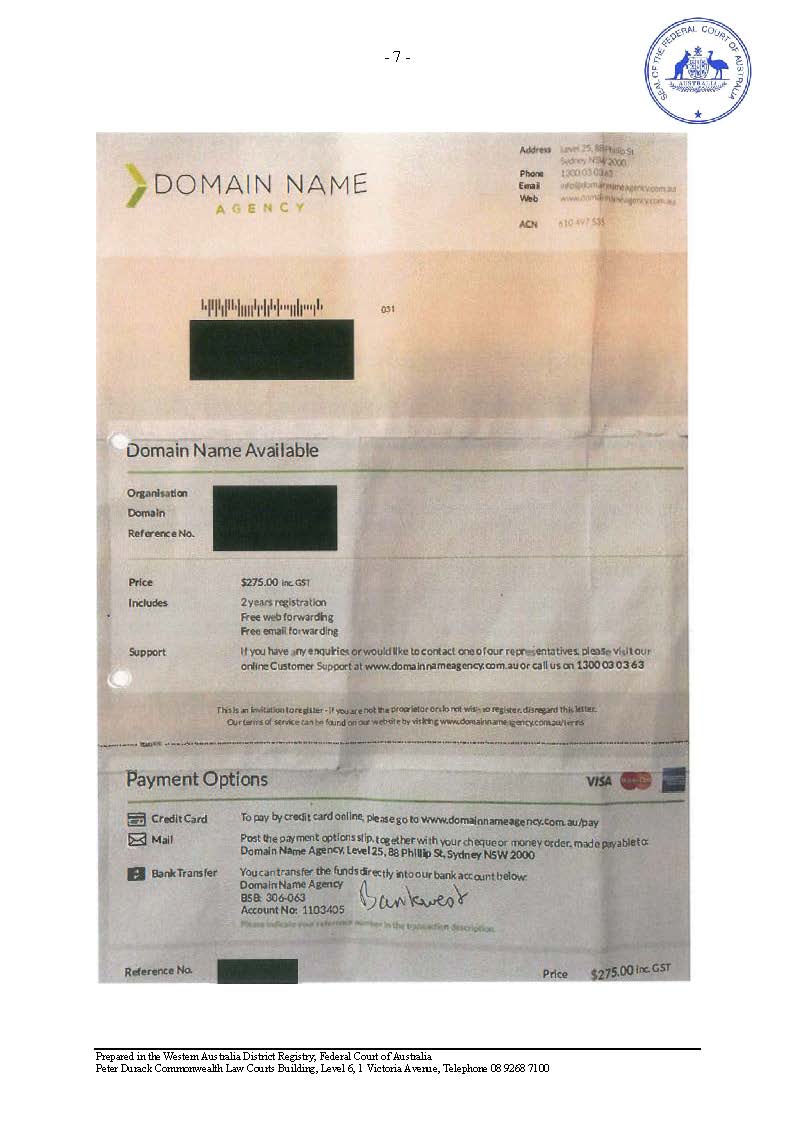
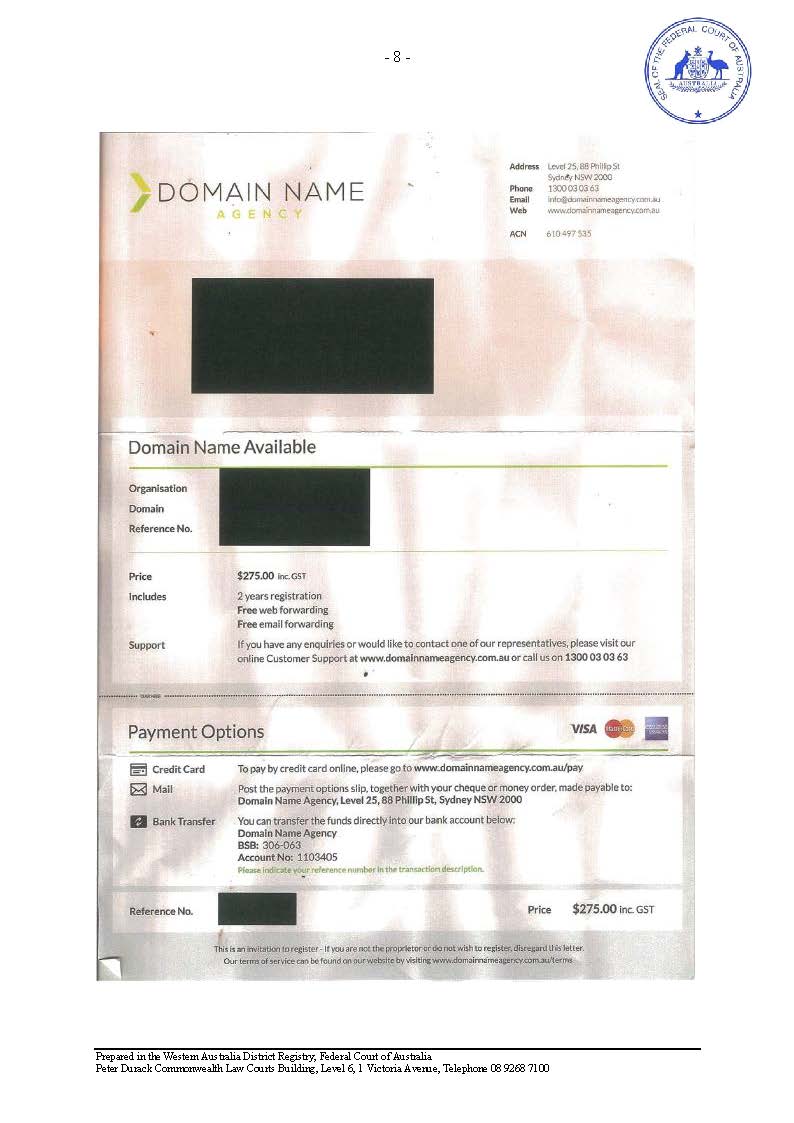
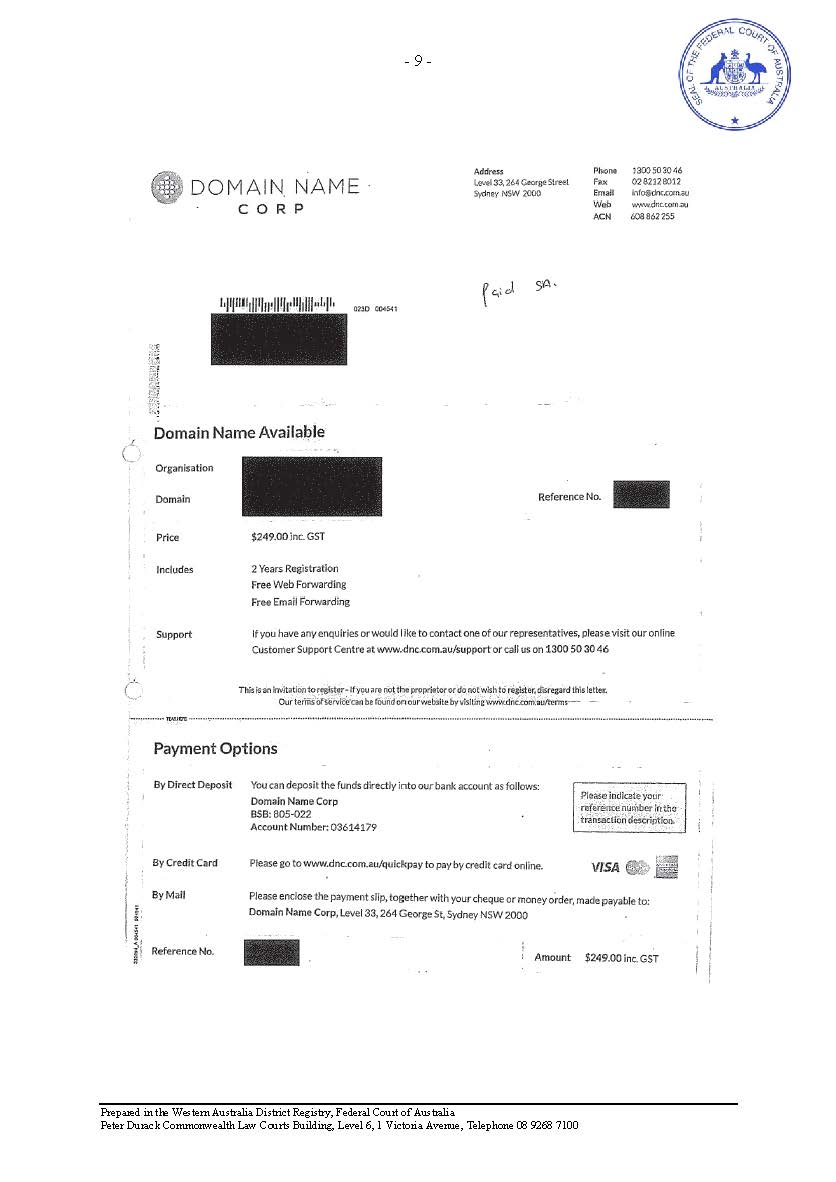
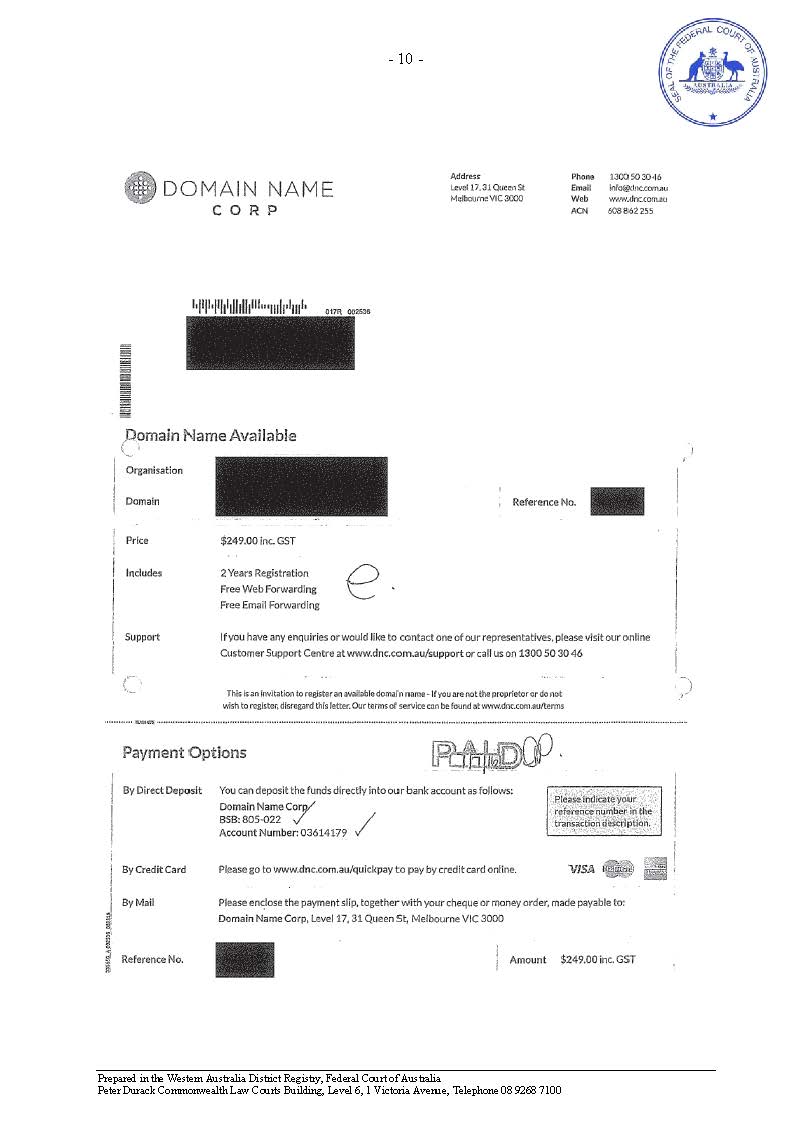
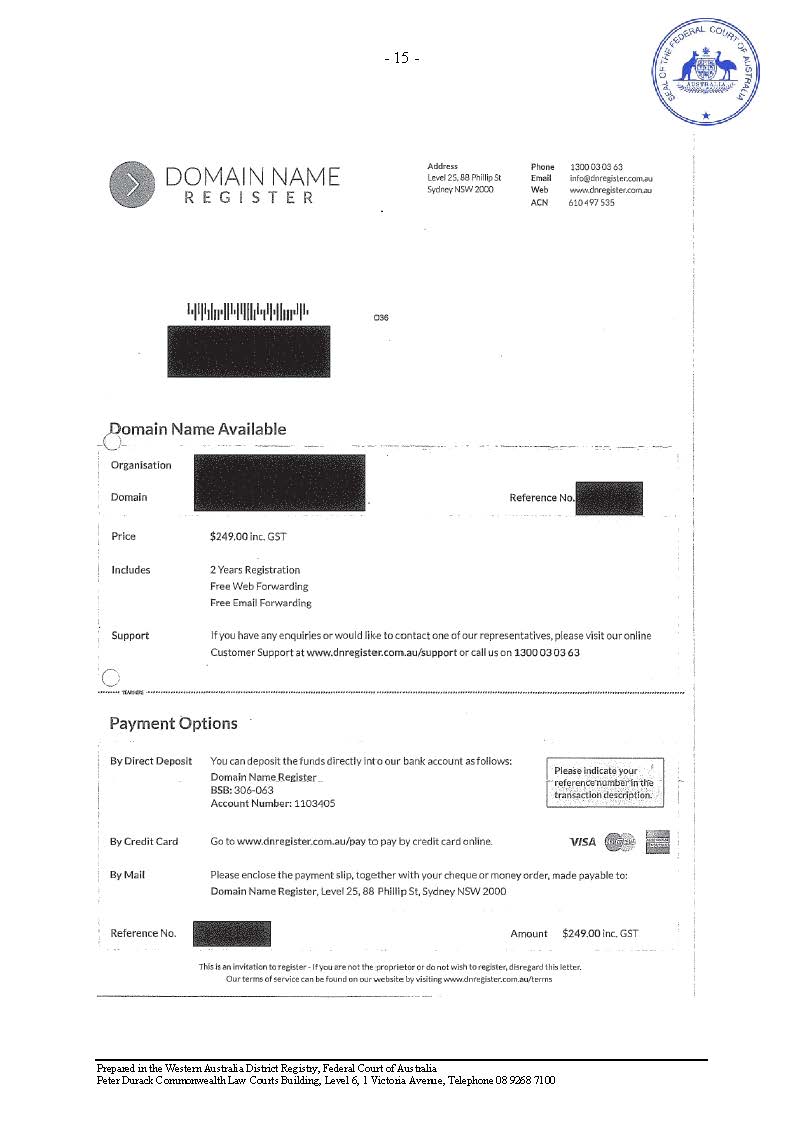
(B) DISOBEY THE ORDER BY DOING AN ACT WHICH THE ORDER REQUIRES YOU NOT TO DO,
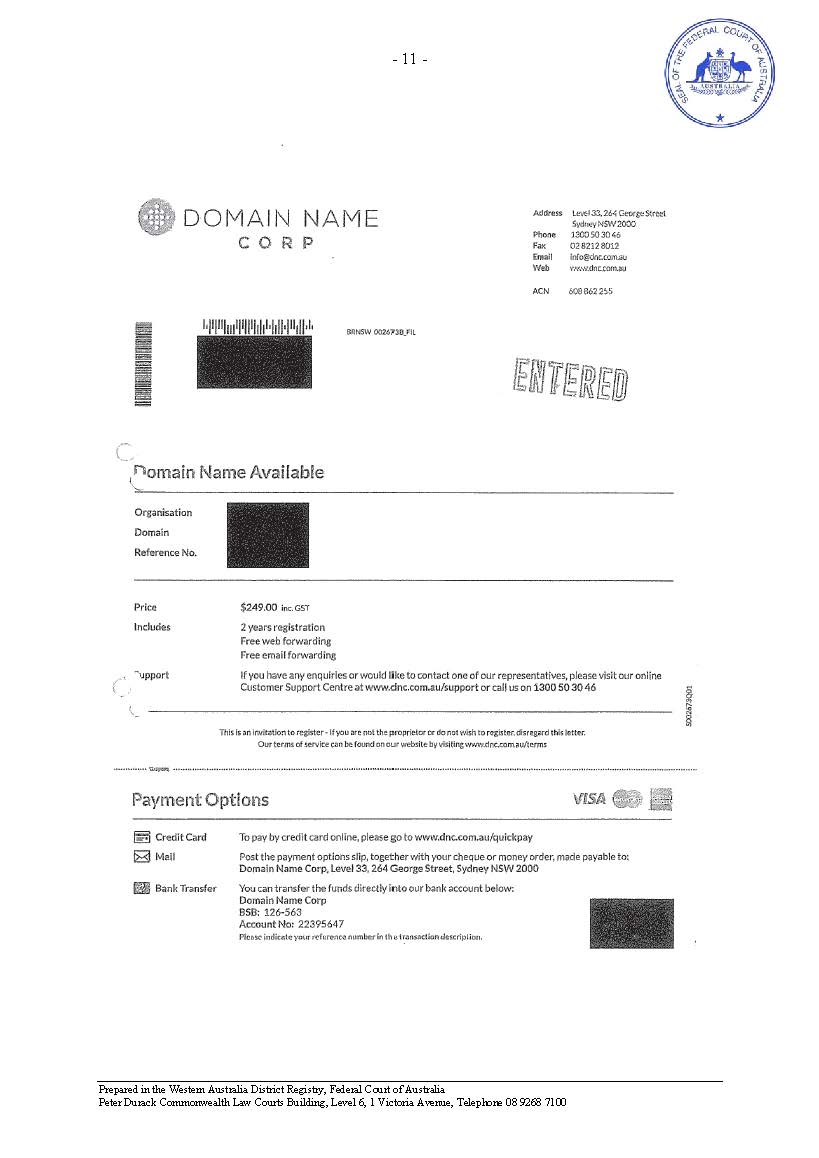
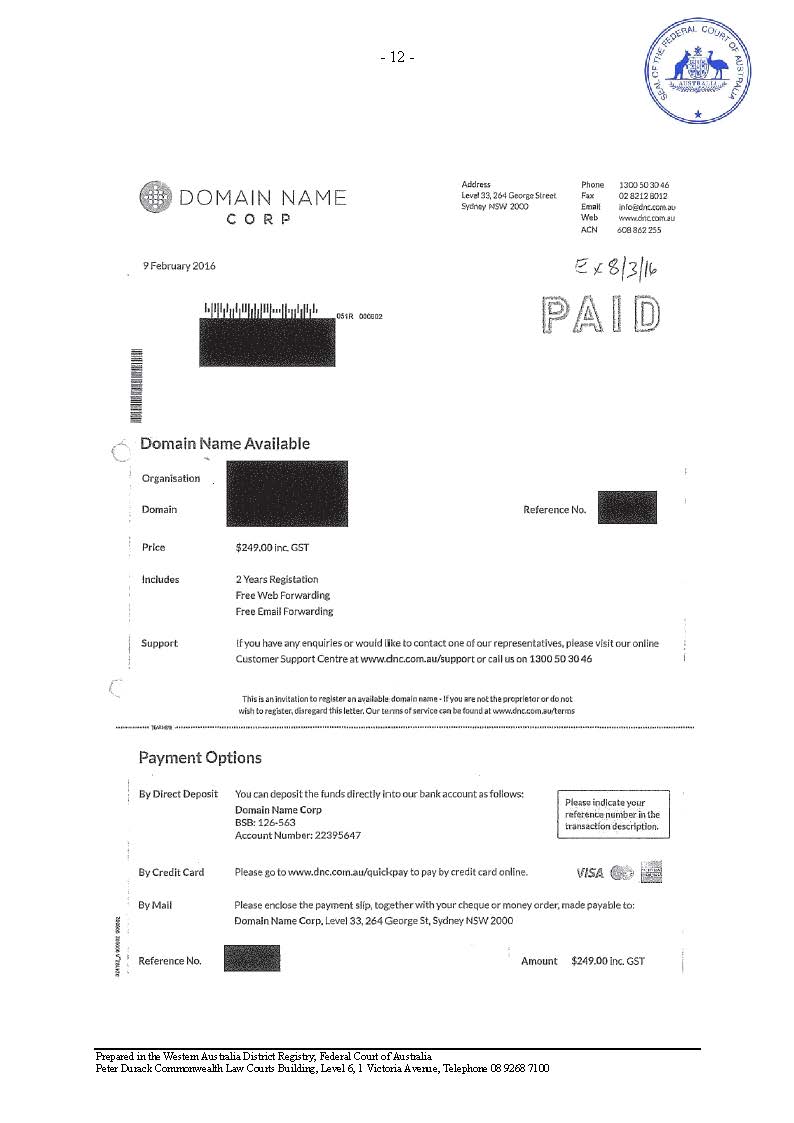
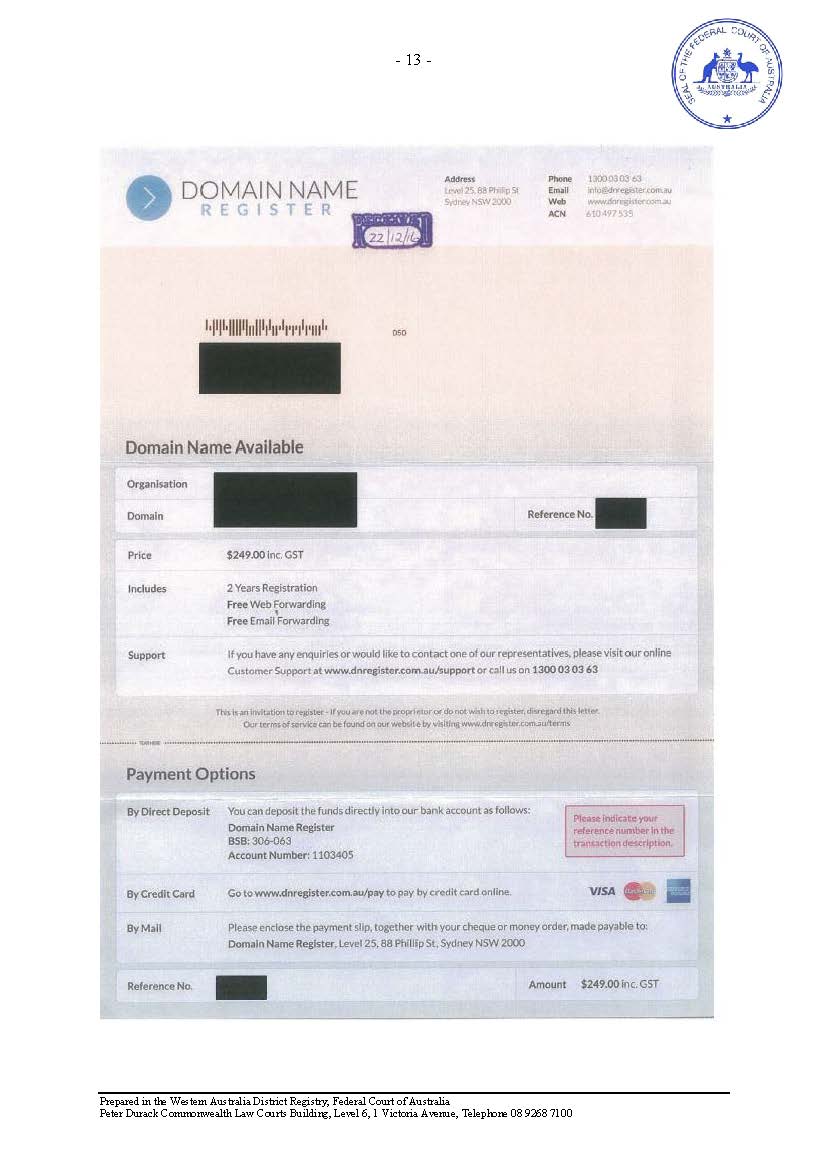
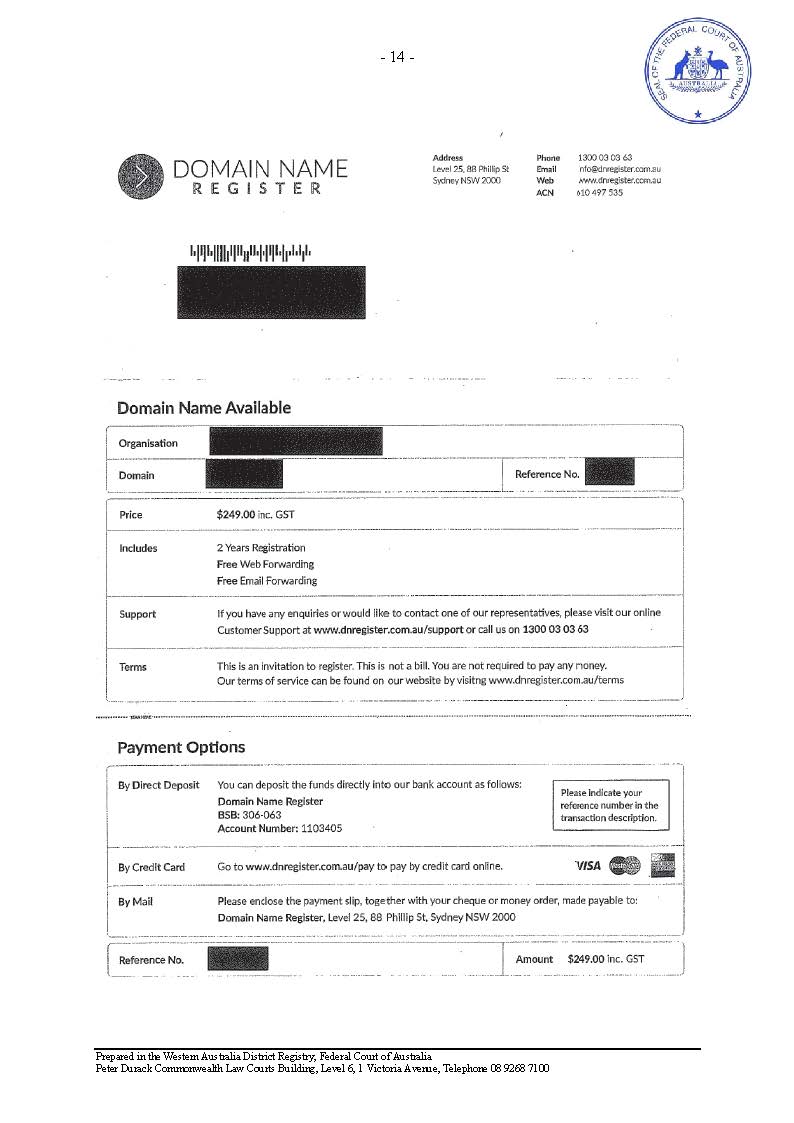
YOU WILL BE LIABLE TO IMPRISONMENT, SEQUESTRATION OF PROPERTY OR OTHER PUNISHMENT.
ANY OTHER PERSON WHO KNOWS OF THIS ORDER AND DOES ANYTHING WHICH HELPS OR PERMITS YOU TO BREACH THE TERMS OF THIS ORDER MAY BE SIMILARLY PUNISHED.
THE COURT ORDERS AND DECLARES THAT:
1. The First Respondent pay to the Commonwealth of Australia $1,500,000 pursuant to section 224 of the Australian Consumer Law (ACL), which is Schedule 2 of the Competition and Consumer Act 2010 (Cth) (the Act).
2. The Second Respondent pay to the Commonwealth of Australia $450,000 pursuant to section 224 of the ACL.
Injunction
3. The First and Second Respondents each be restrained for 3 years from the date of these Orders, whether by themselves, their officers, servants, agents or otherwise from sending unsolicited notices containing an offer to register a domain name that is substantially similar to a domain name already held by the recipient, without including on the face of the notice the words “This notice does not relate to the registration of your current domain name. This is not a bill. You are not required to pay any money” in text that is the most prominent text in the notice and is the equivalent of at least 16pt Times New Roman.
4. The Third Respondent be restrained for 5 years from the date of these Orders, whether by himself, his officers, servants, agents or otherwise from sending unsolicited notices containing an offer to register a domain name that is substantially similar to a domain name already held by the recipient, without including on the face of the notice the words “This notice does not relate to the registration of your current domain name. This is not a bill. You are not required to pay any money” in text that is the most prominent text in the notice and is the equivalent of at least 16pt Times New Roman.
Order disqualifying a person from managing corporations
5. The Third Respondent is disqualified from managing corporations for a period of 5 years commencing on the date of the making of this Order.
Other orders
6. The Third Respondent pay the Applicant's costs of the proceeding fixed at $8,000.
7. The reasons for judgment with the seal of the Court affixed thereon be retained on the Court file for the purposes of section 137H of the Act.
Declaratory orders
8. It is declared that the First and Second Respondents, during periods between in or around November 2015 to in or around April 2017, by way of sending notices to Australian businesses and organisations in the form annexed to these Orders and marked "Annexure A" (Notices), represented to Australian businesses and organisations that:
(a) payment to the First Respondent or the Second Respondent (as the case maybe) of the amount of money shown in the Notice would result in the extension or renewal of the recipient's existing domain name registration; and
(b) the recipient would not retain registration of the recipient's existing domain name if payment of the amount of money shown in the Notice was not made in accordance with the Notice,
when in fact:
(c) the Notice was unrelated to renewing the recipient's existing domain name; and
(d) the Notice was, in fact, an unsolicited offer for registration of a different domain name ending in either “.com” or “.net.au”, rather than in “.com.au”,
and the First and Second Respondents thereby in trade or commerce engaged in conduct that was misleading or deceptive or likely to mislead or deceive, in contravention of section 18 of the ACL.
9. It is declared that the First and Second Respondents, by engaging in the conduct referred to in Order 8, in trade or commerce in connection with the supply or possible supply of services and in connection with the promotion by any means of the supply or use of services, made false or misleading representations:
(a) in contravention of section 29(1)(g) of the ACL, that the services offered by the First Respondent or the Second Respondent (as the case may be) had the benefit of renewing the registration of an existing domain name registered by the recipient of the Notice; and
(b) in contravention of section 29(1)(l) of the ACL concerning the need for services, namely that the recipient of the Notice needed to acquire from the First Respondent or the Second Respondent (as the case may be) the registration service offered in the Notice in order to retain the recipient's existing domain name.
10. It is declared that the Third Respondent was directly knowingly concerned in, and a party to, the contraventions of the First and Second Respondents referred to in Orders 8 and 9.
Note: Entry of orders is dealt with in Rule 39.32 of the Federal Court Rules 2011.
MCKERRACHER J:
INTRODUCTION
1 This proceeding concerns the conduct of the first respondent, Domain Name Corp Pty Ltd (ACN 608 862 255) (DNC). and the second respondent, Domain Name Agency Pty Ltd (ACN 610 497 535) (DNA), in sending unsolicited hard copy notices (Notices), which appeared to be renewal notices, to Australian businesses and organisations offering registration of a domain name which was almost, but not entirely, identical to the businesses’ existing domain name. Many of these businesses paid between $249 and $275 to register the domain name offered, under the mistaken impression they were renewing their existing domain name.
2 DNC and DNA carry on a business as suppliers of internet domain name registration services. DNA also trades under the business name ‘Domain Name Register’ (DNR). The third respondent, Mr Steven Bell, is and was at all material times the sole director and shareholder of each of DNC and DNA.
3 The applicant, the Australian Competition and Consumer Commission (ACCC), brought these proceedings in respect of the Notices seeking declarations that the respondents’ conduct gave rise to contraventions of ss 18, 29(1)(g) and 29(1)(l) of the Australian Consumer Law (ACL), which forms Sch 2 to the Competition and Consumer Act 2010 (Cth) (CCA). The ACCC also sought orders for pecuniary penalties against DNC and DNA, injunctions against the respondents and the disqualification of Mr Bell from managing corporations for a period of five years.
4 By the time the matter came before me for hearing, the parties had agreed to relief in the form of pecuniary penalties, injunctions, and a disqualification order. Only the declaratory relief sought by the ACCC was opposed. On 14 June 2018, I made orders and declarations in the terms substantially sought by the ACCC. For the reasons set out below I am satisfied that the respondents’ conduct contravened the relevant provisions of the CCA and that the relief sought by the ACCC is appropriate.
BACKGROUND
5 Much of the background relevant to these proceedings is contained in a Statement of Agreed Facts and Admissions jointly made and filed on 27 February 2018, made for the purposes of s 191 of the Evidence Act 1995 (Cth). The Statement was signed on behalf of the ACCC, and by Mr Bell on behalf of the respondents, and relates to the conduct of DNC in sending Notices from November 2015 to at least September 2016 and DNA in sending Notices from August 2016 to at least April 2017 (collectively, the Relevant Periods). The Statement provides as follows.
The Notices
6 During the Relevant Periods, DNC sent approximately 229,000 Notices while DNA and DNR sent approximately 73,375 Notices.
7 Each of the Australian businesses and organisations that received Notices from DNC, DNA or DNR had an existing domain name registration that ended in ‘.com.au’. The Notices were unsolicited offers for an alternative domain name to be registered, ending in either ‘.com’ or ‘. net.au’.
8 During the Relevant Periods, the appearance of the Notices was materially the same as those contained in Annexure A. The variations that existed between the Notices included the following:
(a) different BSB and account information;
(b) differences in the wording of the disclaimer identified below; and
(c) layout and formatting differences.
9 During the Relevant Periods, the Notices had at least the following characteristics:
(a) sought payment of $249 (or up to $275 in relation to the Notices sent by DNA and DNR), in exchange for the registration of a domain name ending in either ‘.com’ or ‘.net.au’;
(b) the recipient’s name and address at the top left hand side of the notice;
(c) a ‘Payment Options’ slip at the bottom of the Notice;
(d) unique reference number for payment; and
(e) a disclaimer, in smaller print and not prominently displayed, stating ‘This is an invitation to register. If you are not the proprietor or do not wish to register, disregard this letter’.
10 As a result of these characteristics of the Notices, each appeared to be a renewal notice in relation to the existing ‘.com.au’ domain name already registered by the recipient.
11 Australian businesses and organisations paid, in total, an approximate sum of $1,800,270 to DNC and $526,984 to DNA.
12 Some recipients sought refunds from the respondent companies. Approximately $95,616 in refunds was paid by DNC to recipients and approximately $25,773 in refunds was paid by DNA to recipients.
Involvement of Mr Bell
13 During the Relevant Periods, Mr Bell was involved in all aspects of the businesses carried on by the respondent companies, including the following:
(a) instructing a third party company (Fuji Xerox BusinessForce Pty Ltd) to print and mail out the Notices to Australian organisations and businesses;
(b) managing the accounts that received monies from recipients of the Notices;
(c) marketing and promotion of DNC’s and DNA’s businesses;
(d) determining the characteristics in the Notices identified above; and
(e) approving the final form of the Notices.
14 During the Relevant Periods, five bank accounts received monies from recipients of the Notices distributed from DNC. These accounts were held by DNC and were as follows:
(a) Bank of Queensland account number 22395647;
(b) Beyond Bank account number 03614179;
(c) PayPal account number 2003887154366941028;
(d) P&N Bank account number 01949062; and
(e) Commonwealth Bank account number 10951388.
15 During the Relevant Periods, two bank accounts received monies from recipients of the Notices distributed from DNA or DNR. These accounts were held by DNA and were as follows:
(a) BankWest account number 0631103405; and
(b) PayPal account number 1691953009693234346.
16 During the Relevant Periods, Mr Bell was the:
(a) operator of the account identified at 14(a);
(b) signatory of the accounts identified at 14(b), 14(d)-(e) and 15(a); and
(c) primary authorised user for the account identified at 14(c) and 15(b).
17 Mr Bell obtained names and addresses of Australian businesses from their existing websites.
18 The account with Fuji Xerox was held during the Relevant Periods by Mr Bell.
Representations
19 DNC and DNA, by causing the Notices to be sent, conveyed the following representations:
(a) payment to DNC or DNA of the amount of money shown in the Notices would entitle the recipient to an extension or renewal of the recipient’s existing domain name registration; and
(b) without payment of the amount shown in the Notices and in accordance with the Notices, the recipient would not retain registration of the recipient’s existing domain name.
20 The unsolicited services offered by DNC or DNA did not relate to, or have the benefit of, renewing the registration of an existing domain name registered by recipients of the Notices.
21 Recipients of the Notices did not need to acquire from DNC or DNA the registration service offered in the notice in order to retain the recipient’s existing domain name.
22 DNC and DNA, by engaging in this conduct detailed above, during the Relevant Periods, engaged in conduct in trade or commerce, including in connection with the supply or possible supply of services and in connection with the promotion by any means of the supply or use of services.
23 By reason of his conduct detailed above, Mr Bell was directly or indirectly knowingly concerned in, or a party to, the conduct of DNC and DNA.
Facts relevant to relief
24 The facts relevant to the relief sought by the ACCC include:
(a) the loss and damage suffered by consumers cannot be exactly quantified, but is likely to include at least the amounts paid (at [11]), reduced by any refunds paid by recipients of the notices (at [12]);
(b) the contravening conduct was not insignificant and continued during the Relevant Periods for many months;
(c) the Notices were received by a wide range of Australian businesses and organisations, including commercial businesses and not-for-profit organisations;
(d) the payments received by DNC and DNA during the Relevant Periods as a consequence of the distribution of the Notices, cumulatively garnered at least $2,327,254 from Australian businesses and organisations. Of this, approximately 78% of the revenue was received by DNC, and approximately 22% of the revenue was received by DNA;
(e) during the Relevant Periods at least 9,300 Australian businesses and organisations paid for services, and at least 500 received a refund. It is not clear, however, how many Australian businesses and organisations would have wanted, but did not receive, a refund;
(f) the financial position and assets of DNC, DNA and Mr Bell are unknown. However, during the Relevant Periods, DNC and DNA received approximately $2,205,865, excluding refunds, from Australian businesses and organisations;
(g) the contravening conduct arose out of the conduct of DNC’s and DNA’s sole director, Mr Bell. The characteristics of the Notices that amounted to the contravening conduct were intentionally designed by Mr Bell;
(h) the respondents did not fully co-operate with the ACCC during its investigation. While during the period between approximately October 2016 and April 2017, DNC and DNA ceased sending Notices to Australian businesses and organisations, in around April 2017, DNA re-commenced sending Notices, despite the ACCC’s investigation. DNC, DNA and Mr Bell ceased sending Notices approximately one month before this proceeding commenced;
(i) DNC, DNA and Steven Bell have not previously been found by a Court to have contravened any provision of the ACL, or to have engaged in similar conduct to that described in this Statement; and
(j) during the Relevant Periods, DNC and DNA did not have compliance programs to assist them to meet their obligations under the ACL.
THIS PROCEEDING
25 On 2 August 2017, the ACCC commenced this proceeding seeking, by way of summary, the following relief:
(a) declarations pursuant to s 21 of the Federal Court of Australia Act 1976 (Cth);
(b) pecuniary penalties pursuant to s 224 of ACL;
(c) an injunction pursuant to s 232 of the ACL;
(d) a corrective order pursuant to s 246 of the ACL;
(e) an order pursuant to s 248 of the ACL against Mr Bell;
(f) an order for non-party consumer redress pursuant to s 239 of the ACL; and
(g) costs.
26 The ACCC contends that by engaging in the conduct agreed upon in the Statement, including the representations identified at [19], DNC and DNA, in trade and commerce:
(a) engaged in conduct that was misleading or deceptive or likely to mislead or deceive, in contravention of s 18 of the ACL; and
(b) in connection with the supply or possible supply of services or in connection with the promotion by any means of the supply or use of services, made false or misleading representations:
(i) in contravention of s 29(1)(g) of the ACL, that the services offered by DNC or DNA (as the case may be) had the benefit of renewing the registration of the recipient’s existing domain name; and
(ii) in contravention of s 29(1)(1) of the ACL concerning the need for services, namely that the recipient of the Notice needed to acquire from DNC or DNA (as the case may be) the registration service offered in the Notice in order to retain the recipient’s existing domain name.
27 Further, the ACCC says that as a result of his conduct and involvement in all aspects of the businesses carried on by each of DNC and DNA, Mr Bell was knowingly concerned in, or a party to, the contraventions of DNC and DNA.
28 The conduct of DNC and DNA caused many businesses and organisations to make payments for a service they may not have wanted or needed, under the mistaken impression they were paying to renew their existing domain name. Further, the Notices gave rise to the risk that some recipients would fail to renew their existing domain name registration in the mistaken belief that they had already done so.
The contravening conduct
29 The misleading conduct, and false representations, made to Australian businesses and organisations by DNC and DNA, consisted of Notices being sent which had the appearance of invoices or renewal notices for the registration of domain names held by the recipient. The Notices had this appearance because they were notices in respect of the registration of a domain name exactly the same as that for a domain name already held by the recipient, save that instead of ending with ‘.com.au’, as the recipient’s domain name did, they ended in ‘.com’ or ‘.net.au’.
30 The ACCC contends, and I accept, that all but the most careful reader of the Notices would be likely to have missed that small, but crucial, difference between the domain names. In making this submission, the ACCC relies on the affidavits of seven individuals who were employees or directors of recipients of the Notices (Recipients’ Affidavits). The evidence adduced is to the effect that they each understood the Notice to be an invoice for renewal of the registration of their existing ‘.com.au’ domain name.
31 Other characteristics of the Notices and the circumstances in which they were received increased the likelihood that they would be paid under that incorrect understanding, including:
(a) the layout of the Notices, including the inclusion of a reference number and a ‘payment options’ slip made them appear to be renewal notices;
(b) the fact that the Notices were specifically addressed to the recipient’s business made them appear to be renewal notices; and
(c) the Notices were likely to have been received by busy people, who were unlikely to spend much time looking at and into the notices, given that the amount of money they prompted the recipient to pay did not warrant a thorough inquiry (see also Australian Competition and Consumer Commission v TPG Internet Pty Ltd (2013) 250 CLR 640 per French CJ, Crennan, Bell and Keane JJ (at [47]).
32 The ACCC notes Mr Bell’s role in intentionally designing the Notices to have these characteristics, as was admitted in the Statement.
33 The respondents admitted in the Statement that by causing the Notices to be sent, DNC and DNA:
(a) represented that payment to DNC or DNA of the amount of money shown in the notice would result in the extension or renewal of the recipient’s existing domain name registration; and
(b) represented that the recipient would not retain registration of the recipient’s existing domain name if payment of the amount of money shown in the notice was not made in accordance with the notice,
when in fact
(c) the unsolicited services offered by DNC or DNA did not relate to, or have the benefit of, renewing the registration of an existing domain name registered by the recipient of the notice; and
(d) the recipient of the notice did not need to acquire from DNC or DNA the registration service offered in the notice in order to retain the recipient’s existing domain name.
34 The respondents also accepted in the Statement that:
(a) the conduct engaged in by DNC and DNA was in trade or commerce, including in connection with the supply or possible supply of services and in connection with the promotion by any means of the supply or use of services; and
(b) Mr Bell was directly or indirectly knowingly concerned in, or party to, the conduct of DNC and DNA complained of in this proceeding.
35 The ACCC therefore contends, and I accept, that the Statement sets out an agreed factual basis for this Court to make findings that:
(a) DNC and DNA engaged in conduct that was misleading or deceptive, or likely to mislead or deceive, in contravention of s 18 of the ACL;
(b) DNC and DNA made false or misleading representations that the services offered by way of the Notices had the benefit of renewing the registration of an existing domain name registered by the recipient of the Notice, in contravention of s 29(1)(g) of the ACL;
(c) DNC and DNA made false or misleading representations concerning the need for services, namely that the recipient of the Notice needed to acquire the registration service offered in the Notice in order to retain the recipient’s existing domain name, in contravention of s 29(1)(l) of the ACL; and
(d) Mr Bell was knowingly concerned in, or a party to, the contraventions within the meaning of s 224(1)(e) of the ACL.
36 Five of the deponents of the Recipients’ Affidavits make clear that they now believe that they got ‘nothing’ from having paid the amounts stated in the respective Notices. Five of the deponents of the Recipients’ Affidavits did not intend or want to acquire registration of a ‘.com’ domain name.
Orders sought
37 On 15 March 2018, the Court ordered that the parties file a joint minute of agreed proposed orders for final relief and any minute of final orders sought that were not agreed upon. The ACCC filed the following Minute of Proposed Consent Orders:
Pecuniary penalties
1. The First Respondent pay to the Commonwealth of Australia $1,500,000 pursuant to section 224 of the Australian Consumer Law (ACL), which is Schedule 2 of the Competition and Consumer Act 2010 (Cth) (the Act).
2. The Second Respondent pay to the Commonwealth of Australia $450,000 pursuant to section 224 of the ACL.
Injunction
3. The First and Second Respondents each be restrained for 3 years from the date of these Orders, whether by themselves, their officers, servants, agents or otherwise from sending unsolicited notices containing an offer to register a domain name that is substantially similar to a domain name already held by the recipient, without including on the face of the notice the words "This notice does not relate to the registration of your current domain name. This is not a bill. You are not required to pay any money" in text that is the most prominent text in the notice and is the equivalent of at least 16pt Times New Roman.
4. The Third Respondent be restrained for 5 years from the date of these Orders, whether by himself, his officers, servants, agents or otherwise from sending unsolicited notices containing an offer to register a domain name that is substantially similar to a domain name already held by the recipient, without including on the face of the notice the words "This notice does not relate to the registration of your current domain name. This is not a bill. You are not required to pay any money" in text that is the most prominent text in the notice and is the equivalent of at least 16pt Times New Roman.
Order disqualifying a person from managing corporations
5. The Third Respondent is disqualified from managing corporations for a period of 5 years commencing on the date of the making of this Order.
Other orders
6. The Third Respondent pay the Applicant's costs of the proceeding fixed at $8,000.
7. The reasons for judgment with the seal of the Court affixed thereon be retained on the Court file for the purposes of section 137H of the Act.
38 Separately, the ACCC filed the following Minute of Proposed Declaratory Orders:
1. It is declared that the First and Second Respondents, during periods between in or around November 2015 to in or around April 2017, by way of sending notices to Australian businesses and organisations in the form annexed to these Orders and marked "Annexure A" (Notices), represented to Australian businesses and organisations that:
(a) payment to the First Respondent or the Second Respondent (as the case may be) of the amount of money shown in the Notice would result in the extension or renewal of the recipient's existing domain name registration; and
(b) the recipient would not retain registration of the recipient's existing domain name if payment of the amount of money shown in the Notice was not made in accordance with the Notice,
when in fact:
(c) the Notice was unrelated to renewing the recipient's existing domain name; and (d) the Notice was, in fact, an unsolicited offer for registration of a different domain name ending in either ".com" or ".net.au", rather than in ".com.au",
and the First and Second Respondents thereby in trade or commerce engaged in conduct that was misleading or deceptive or likely to mislead or deceive, in contravention of section 18 of the Australian Consumer Law (ACL), which is Schedule 2 of the Competition and Consumer Act 2010 (Cth) (the Act).
2. It is declared that the First and Second Respondents, by engaging in the conduct referred to in Order 1, in trade or commerce in connection with the supply or possible supply of services and in connection with the promotion by any means of the supply or use of services, made false or misleading representations:
(a) in contravention of section 29(1)(g) of the ACL, that the services offered by the First Respondent or the Second Respondent (as the case may be) had the benefit of renewing the registration of an existing domain name registered by the recipient of the Notice; and
(b) in contravention of section 29(1)(l) of the ACL concerning the need for services, namely that the recipient of the Notice needed to acquire from the First Respondent or the Second Respondent (as the case may be) the registration service offered in the Notice in order to retain the recipient's existing domain name.
3. It is declared that the Third Respondent was directly or indirectly knowingly concerned in, or a party to, the contraventions of the First and Second Respondents referred to in Orders 1 and 2.
39 In a separate minute filed on behalf of the respondents, the respondents relevantly sought that the matter be finalised upon the terms of the Proposed Consent Orders and that the declaratory relief sought by the ACCC in its Proposed Declaratory Orders be dismissed.
40 While the primary issue ventilated in this matter at the final hearing was whether it was appropriate for the Court to make orders in the terms of the Proposed Declaratory Orders, it is necessary to briefly address why I considered it appropriate to endorse the Proposed Consent Orders agreed upon between the ACCC and the respondents.
PECUNIARY PENALTIES
41 Section 224(2) of the ACL provides that when determining the appropriate pecuniary penalty the Court must have regard to ‘all relevant matters’, including:
(a) the nature and extent of the act or omission and of any loss or damage suffered as a result of the act or omission;
(b) the circumstances in which the act or omission took place; and
(c) whether the person has previously been found by a court in proceedings under Chapter 4 or Pt 5-2 to have engaged in any similar conduct.
42 In addition to these three mandatory factors, the Court has identified the following further factors to be relevant in determining the pecuniary penalty to be imposed (see, for example, Australian Competition and Consumer Commission v Singtel Optus Pty Ltd (No 4) (2011) 282 ALR 246 per Perram J (at [11]); which can be traced back to French J (as his Honour then was) in Trade Practices Commission v CSR Ltd (1991) ATPR 41-076 (at [42]) and which have subsequently been developed by the Court):
(a) the size of the contravening company;
(b) the deliberateness of the contravention and the period over which it extended;
(c) whether the contravention arose out of the conduct of senior management of the contravener or at some lower level;
(d) whether the contravener has a corporate culture conducive to compliance with the ACL as evidenced by educational programmes and disciplinary or other corrective measures in response to an acknowledged contravention;
(e) whether the contravener has shown a disposition to cooperate with the authorities responsible for the enforcement of the Act in relation to the contravention;
(f) whether the contravener has engaged in similar conduct in the past;
(g) the financial position of the contravener; and
(h) whether the contravening conduct was systematic, deliberate or covert.
43 Deterrence, both general and specific, is a primary concern of the Court in imposing a pecuniary penalty: TPG Internet per French CJ, Crennan, Bell and Keane JJ (at [65]). The penalty must be sufficient so as not to be regarded by the offender or others as ‘an acceptable cost of doing business’: TPG Internet (at [66]) citing Singtel Optus Pty Ltd v Australian Competition and Consumer Commission (2012) 287 ALR 249 per Keane CJ, Finn and Gilmour JJ (at [62]-[63]).
44 The existence of cases where companies have engaged in similar conduct, such as Director of Consumer Affairs Victoria v Domain Register Pty Ltd [2017] FCA 1603 and .au Domain Administration Ltd v Domain Names Australia Pty Ltd (2004) 207 ALR 521, demonstrate the need for general deterrence in such cases.
45 The assessment of the appropriate penalty requires an ‘intuitive or instinctive synthesis of all relevant factors’, comparable to the judicial process involved in determining a sentence for a criminal offence: Australian Competition and Consumer Commission v Coles Supermarkets Australia Pty Ltd (2015) 327 ALR 540 per Allsop CJ (at [6] and the cases therein cited) (ACCC v Coles).
46 While the quantum of the pecuniary penalties is agreed upon between the ACCC and the respondents, the Court is not bound to endorse the figure suggested. The Court must ask whether the submitted penalty is appropriate: Commonwealth v Director, Fair Work Building Industry Inspectorate (2015) 258 CLR 482 (at [58]). However, the promotion of predictability of outcome in civil penalty proceedings is an important matter of public policy and one which is promoted by the practice of receiving and, if appropriate, accepting agreed penalty submissions: Fair Work Building (at [46]).
Consideration
47 I turn first to the mandatory considerations prescribed in s 224(2) of the ACL. In relation to the nature and extent of the conduct and of loss or damage suffered, and circumstances in which it took place, it is noted that the conduct by the respondents was a deliberate, and substantially successful, attempt to mislead numerous members of the public into paying DNC or DNA for a service they did not need or want and it was extensive having regard to the number of Notices sent by DNC and DNA and the span of time of the Relevant Periods during which the Notices were sent.
48 The loss cannot be precisely quantified, however, based on the amount paid to DNC and DNA by recipients of the Notices reduced by the refunds (as agreed by the parties in the Statement and recorded at [11]-[12]), the damage is likely to be approximately $1,704,654 in respect of DNC and $501,211 in respect of DNA. Further, the ACCC submits that whilst it is unclear how many Australian businesses and organisation would have wanted, but did not receive ,a refund, evidence in the Recipients’ Affidavits demonstrates that at least some who paid the amounts stated in the Notices were unaware that the payment was unrelated to the renewal of an existing service held by them until they were notified by the ACCC in relation to this proceeding and did not want, and would not have knowingly acquired, the service offered in the Notices had they been aware of this.
49 The Court does have regard to the fact that the respondents have not previously been found by a court to have contravened any provision of the ACL or to have engaged in conduct that is similar to the contravening conduct.
50 Turning to other relevant factors in assessing the appropriateness of the pecuniary penalty imposed, the ACCC submits that it is relevant that the contravening conduct of DNC and DNA arose out of the conduct of their sole director, Mr Bell, who intentionally designed the characteristics of the Notices that amounted to the contravening conduct (as agreed by the parties in the Statement). It was a contravention which arose from the conduct of senior management and, as already noted, it persisted over considerable periods of time, only ceasing one month before these proceedings were filed.
51 The ACCC also draws the Court’s attention to the absence of a corporate culture within DNC and DNA conducive to compliance with the obligations imposed under the ACL. In addition to that being acknowledged in the Statement, the Court accepts the ACCC’s submission to the effect that the ‘deliberate, extensive and protracted nature of the contravening conduct’ further evidences a lack of a culture of compliance with the ACL.
52 The extent of the respondents’ cooperation with the ACCC is also a relevant factor. It is noted that the respondents were cooperative in agreeing to the facts contained within the Statement and with the Proposed Consent Orders, but the respondents persisting in sending Notices following the commencement of the ACCC’s investigation is a factor weighing against them. Further, and as discussed more below in relation to the appropriateness of the Proposed Declaratory Orders, it is noted that submissions filed on behalf of Mr Bell sought to minimise his involvement in the contraventions despite the facts agreed upon in the Statement.
53 While the financial position and assets of the respondents are not known to the Court, the combined total of the revenue received by DNC and DNA, taking into account of the refunds, and based upon the Statement, is an approximate $2,205,865.
54 Ordinarily separate contraventions arising from separate acts or omissions should attract separate penalties: Registrar of Aboriginal and Torres Strait Islander Corporations v Matcham (No 2) (2014) 97 ACSR 412 per Jacobson J (at [197] and the cases therein cited). However, it may be appropriate to apply the ‘course of conduct’ principle where there is such an interrelationship between albeit separate acts that they ought to be regarded as one course of conduct: see, for example, Construction, Forestry, Mining and Energy Union v Cahill (2010) 269 ALR 1 per Middleton and Gordon JJ (at [39] and [41]). The general objective of the course of conduct principle is to ensure that the penalty imposed fairly reflects the substance of the offending conduct: Clean Energy Regulator v MT Solar Pty Ltd [2013] FCA 205 per Foster J (at [75] and the cases therein cited).
55 Each of the Notices sent by DNC and DNA constituted a separate representation to an Australian business or organisation, each attracting a maximum penalty of $1.1 million: s 224(3), item 2 of the ACL. However, the totality principle dictates that the total penalty for related offences ought not exceed what is proper for the entire contravening conduct involved: Australian Competition and Consumer Commission v EDirect Pty Ltd (in liq) (2012) 206 FCR 160 per Reeves J (at [72] and the cases therein cited). In this situation, determining the appropriate penalty is best done by reference to other factors, as there is no meaningful overall maximum penalty given the number of contraventions over an extended period of time: Australian Competition and Consumer Commission v Reckitt Benckiser (Australia) Pty Ltd (2016) 340 ALR 25 per Jagot, Yates and Bromwich JJ (at [157]).
56 In this instance, I consider the pecuniary penalty agreed upon by the parties to be appropriate. As the Full Court in Reckitt Benckiser noted (at [158]), the loss to consumers can serve as a useful guide in determining the appropriate pecuniary penalty to be imposed. While merely a guide, the fact that the penalties sought, $1,500,000 for DNC and $450,000 for DNA, are proportionate to the loss to consumers indicates their appropriateness. In light of the circumstances and the considerations detailed above, the imposition of the penalties that are being sought by consent is appropriate and justified.
INJUNCTIONS
57 Section 232 of the ACL provides the Court with the power to grant an injunction where the Court is satisfied that a person has engaged, or is proposing to engage, in conduct that constitutes or would constitute, relevantly:
(a) a contravention of a provision of Chapter 2 or Chapter 3 (s 232(1)(a)); or
(b) being in any way, directly or indirectly, knowingly concerned in, or party to, the contravention by a person of such a provision (s 232(1)(e)).
58 The proposed injunctions, three years for DNC and DNA and five years for Mr Bell, will restrain each respondent whether by themselves, their officers, servants, agents or otherwise from sending unsolicited notices containing an offer to register a domain name that is substantially similar to a domain name already held by the recipient, without including on the face of the notice the words ‘This notice does not relate to the registration of your current domain name. This is not a bill. You are not required to pay any money’ in text that is the most prominent text in the notice and is the equivalent of at least 16pt Times New Roman.
59 In Australian Competition and Consumer Commission v SMS Global Pty Ltd [2011] FCA 855 (at [59]), Murphy J identified the three limitations on the Court’s broad powers to grant an injunction under s 232 of the ACL:
(1) the relief should be designed to prevent a repetition of the contravening conduct;
(2) there must be a sufficient nexus or relationship between the contravention and the injunction; and
(3) the injunction must relate to the case or controversy.
60 While these limitations were identified in the context of consideration of contraventions of the Trade Practices Act 1974 (Cth) (TPA), the authorities on s 80 of the TPA provide guidance on the construction of s 232 of the ACL as the terms are relevantly identical: Australian Competition and Consumer Commission v Marksun Australia Pty Ltd [2011] FCA 695 per Gilmour J (at [56]).
61 Further, the following factors are relevant to informing the Court’s assessment of the appropriateness of granting an injunction:
(1) whether the ACL ought to be supplemented by the availability of sanctions applicable to contempt of court;
(2) the contraventions found;
(3) the risk of similar contraventions and the utility of an injunction in making that less likely;
(4) whether the conduct was intended, isolated or occurred many years before the enforcement proceedings;
(5) the clarity and specificity of the injunction; and
(6) the intended methods of enforcement of the injunction.
Consideration
62 In relation to preventing repetition, the ACL makes clear that the Court’s power to grant an injunction under s 232(1) may be exercised irrespective of whether it appears to the Court that the person intends to engage again, or to continue to engage, in conduct of a kind referred to: s 232(4)(a) of the ACL. Yet injunctive relief must serve a useful purpose: Australian Competition and Consumer Commission v Dataline.Net.Au Pty Ltd (2007) 161 FCR 513 per Moore, Dowsett and Greenwood JJ (at [110]).
63 In assessing whether the proposed injunctions are useful and appropriate, the risk of respondents committing similar breaches is relevant; however, the risk need not be high: SMS Global (at [62]). An intention towards recidivism can be inferred by the Court where past conduct may give an indication of future intention and demonstrate a propensity or inclination to offend: Dataline (at [108]).
64 The ACCC submits that this Court ought to infer there to be a risk of the respondents repeating the contraventions where the respondents, despite agreeing that they engaged in certain conduct and that it is appropriate to order the relief sought by way of the Proposed Consent Orders, continue to oppose the Proposed Declaratory Orders to the effect that the conduct complained of contravened the ACL.
65 The circumstances referred to above, as to the nature and extent of the respondents’ conduct, are relevant to the Court’s exercise of its discretion to order injunctive relief. I have already noted the repetition of the contraventions, which were engaged in by the respondents over a significant period of months. I consider the conduct engaged in by the respondents to be sufficiently serious so as to warrant imposing the injunctive relief agreed upon by the parties.
66 In the circumstances, I consider it to be appropriate that the consequence of any repetition of the contravening conduct by the respondents be not only the remedies that flow from a contravention of the ACL, but also the penalty of contempt of court. Further, it is appropriate to restrain Mr Bell, in conjunction with a disqualification order (to which I next turn), as an injunction will prevent Mr Bell from engaging in the conduct in any capacity, not just as a manager of a corporation.
67 Having regard to the terms of the injunctions sought, I consider them to have been formulated with precision, are capable of being readily obeyed, do not involve vague evaluative judgments and will not require the ongoing supervision of the Court. These factors support my conclusion that it is appropriate for the injunctive orders to be made.
DISQUALIFICATION ORDER
68 Pursuant to s 248 of the ACL, the Court may make an order disqualifying a person for managing corporations for a period that the Court considers appropriate if, relevantly:
(a) the Court is satisfied that the person has contravened, or has been involved in a contravention of, a provision of Part 3-1 of the ACL (s 248(1)(a)(ii)); and
(b) the Court is satisfied that the disqualification is justified (s 248(1)(b)).
69 As to the first requirement of contravention, the parties agreed in the Statement that Mr Bell was directly or indirectly knowingly concerned in, or a party to, DNC’s and DNA’s contravening conduct, that the contravening conduct arose out of Mr Bell’s conduct and that the characteristics of the contravening conduct were intentionally designed by Mr Bell.
70 As to the second requirement, Dowsett J in Australian Securities and Investments Commission v Cassimatis (No 9) [2018] FCA 385 (at [100]) recently endorsed Santow J’s summary in Australian Securities & Investments Commission v Adler (2002) 42 ACSR 80 of the principles applicable to a Court’s assessment of an application for disqualification orders. These include, relevantly:
(1) disqualification orders are designed to protect the public from the harmful use of the corporate structure or from use that is contrary to proper commercial standards;
(2) the orders are designed to protect the public by seeking to safeguard public interest in the transparency and accountability of companies and in the suitability of directors to hold office and by protecting individuals that deal with companies, including consumers, creditors, shareholders and investors;
(3) the orders have a motive of personal deterrence, though they are not punitive;
(4) the objects of general deterrence are also sought to be achieved;
(5) in assessing the fitness of an individual to manage a company, it is necessary that they have an understanding of the proper role of the company director and the duty of due diligence that is owed to the company;
(6) in assessing an appropriate length of prohibition, consideration has been given to the degree of seriousness of the contraventions, the propensity that the defendant may engage in similar conduct in the future and the likely harm that may be caused to the public;
(7) it is necessary to balance the personal hardship to the defendant against the public interest and the need for protection of the public from any repeat of the conduct;
(8) a mitigating factor in considering a period of disqualification is the likelihood of the defendant reforming; and
(9) the eight criteria set out in Commissioner for Corporate Affairs (WA) v Ekamper (1987) 12 ACLR 519 are influential in assessing an exercise of the Court’s powers of disqualification:
character of the offenders;
nature of the breaches;
structure of the companies and the nature of their business;
interests of shareholders, creditors and employees;
risks to others from the continuation of offenders as company directors;
honesty and competence of offenders;
hardship to offenders and their personal and commercial interests; and
offenders’ appreciation that future breaches could result in future proceedings.
71 Dowsett J in Cassimatis (No 9) also noted (at [101]) that since the High Court’s decision in Rich v Australian Securities & Investments Commission (2004) 220 CLR 129, it is clear that a disqualification order has a punitive aspect.
Consideration
72 In this case the parties have agreed to a disqualification of Mr Bell from managing a corporation for a period of five years. Given the length of the disqualification is agreed to between the parties, it is unnecessary to go through all of the criteria identified, particularly as many of the relevant criteria have previously been canvassed in these reasons.
73 The ACCC’s submissions focus on the public protection which would be assisted by the disqualification order. Specifically, the ACCC contends that the order would serve the purpose of protecting the public because:
(a) by intentionally designing the Notices to contain the misleading characteristics that contravened the ACL, to then to be sent out by DNC and DNA of which he was the sole director, Mr Bell has made harmful use of the corporate structure contrary to proper commercial standards; and
(b) the order will prevent Mr Bell from again using a corporate structure to, again, systematically and deliberately engage in conduct that contravenes the ACL.
74 Mr Bell engaged in deliberate conduct that resulted in the enrichment of DNC and DNA, of which he was the sole director, as a result of misleading members of the public. I am persuaded that a period of disqualification for five years is justified given the seriousness of the contraventions, the likelihood that Mr Bell may engage in similar conduct in the future, and the likely harm that may be caused to the public.
75 The likely deterrent effect is also persuasive. As is to be discussed, Mr Bell opposed the Proposed Declaratory Orders which stated that he was directly or indirectly knowingly concerned in, or a party to, the contraventions of DNC and DNA, conduct which had been acknowledged to have been engaged in by Mr Bell in the Statement. This opposition does suggest that Mr Bell does not fully appreciate the seriousness of the contraventions. While DNC and DNA paid refunds to those who sought them, Mr Bell has not voluntarily attempted to repay the misappropriated sums. Further, he continued to cause DNA to send Notices, despite knowledge of the ACCC’s investigation. In these circumstances, I am satisfied the disqualification order agreed upon will serve as a personal deterrent.
76 I have also had regard to similar cases in which persons have sent unsolicited notices referring to slightly different domain names. I consider that the period of disqualification sought in this proceeding is likely to serve the object of general deterrence by discouraging prospective contraveners from engaging in similar contraventions.
77 Mr Bell’s acceptance of the disqualification invites an inference that he will not suffer any undue hardship as a consequence of the order. In such circumstances, I regard it as appropriate to make the agreed upon order disqualifying Mr Bell from managing a corporation for a period of five years.
THE PROPOSED DECLARATORY ORDERS
78 The major point of controversy between the parties was the Proposed Declaratory Orders, specifically whether the Court ought to exercise its discretion to grant a declaration to the effect that Mr Bell was directly knowingly concerned in the contravening conduct of DNC and DNA.
79 It is important to note from the outset, and I discuss this further below, that the submissions filed on behalf of Mr Bell contradict much of what was agreed upon between the parties in the Statement. On one view, I should not have regard to these submissions as no leave was sought from the Court to depart from the facts agreed to in the Statement, however, for completeness, these submissions are detailed and addressed below.
Principles
80 Pursuant to s 21 of the Federal Court Act, the Court has a wide discretionary power to make declarations. In Forster v Jododex (1972) 127 CLR 421 (at 437-438), Gibbs J identified that before making declarations, three requirements should be satisfied:
the question must be a real and not a hypothetical or theoretical one;
the applicant must have a real interest in raising it; and
there must be a proper contradictor.
Mr Bell’s submissions
81 Mr Bell submits that despite agreeing to the facts recited in the Statement, he does not accept that he, in trade or commerce, engaged in conduct that was misleading or deceptive or was likely to mislead or deceive. Therefore, he does not accept that he has personally contravened s 18 of the ACL.
82 Mr Bell also submits that does not accept that he, in trade or commerce in connection with the supply or possible supply of services, or in connection with the promotion by any means of the supply or use of services, has:
(a) made a false or misleading representation that the services of the DNC and DNA had sponsorship, approval, performance characteristics, accessories, uses or benefits; or
(b) made a false or misleading representation concerning the need for any goods or services made available the DNC and DNA.
Mr Bell therefore does not accept that he personally has contravened either s 29(1)(g) or s 29(1)(l) of the ACL.
83 In making the submissions that he has not personally contravened the relevant provisions of the ACL, Mr Bell relies relevantly upon the following:
(1) the ACCC acknowledged in the Statement that each of the parties who received Notices from either DNC or DNA had previously registered a domain name ending in ‘com.au’;
(2) the ACCC accepted that all of the Notices issued by DNC and DNA constituted offers for registration of a different domain name ending in either ‘.com’ or ‘.net.au’.
(3) there is a clear difference in both appearance and applicability of a ‘.com’ and a ‘.com.au’ domain name;
(4) it is not stated anywhere on any of the Notices issued by DNC and DNA that they are for the renewal of domain names pre-registered by the relevant recipients; indeed, each of the Notices contained the words ‘Domain Name Available’ prominently displayed in large lettering;
(5) this clearly implies that the Notices offered the registration of a domain name that was freely available to anyone who may wish to obtain, and which was not already owned or registered by any other parties;
(6) many of the Notices carried the message ‘This is an invitation to register – if you are not the proprietor or do not wish to register, disregard this letter’, albeit in varying locations; and
(7) later in the Relevant Periods, the Notices instead bore a message, prominently located, which stated ‘This is an invitation to register. This is not a bill. You are not required to pay any money’.
84 In light of this, Mr Bell submits that the intended purpose of the Notices was clear, and that the existence of a ‘Payment Options’ section in the Notices afforded the recipient the opportunity to obtain a new name. It is said that the mere presence of a ‘Payment Options’ section and a reference number in each of the Notices does not automatically give rise to a reasonable assumption that the Notices referred to an opportunity to renew an existing domain name.
Mr Bell’s submissions on contraventions of s 18 of the ACL
85 Mr Bell submits that the declarations sought by the ACCC, as they pertain to him, should not be granted on the basis that he did not engage in any misleading or deceptive conduct. Mr Bell relies on Domain Register per Murphy J (at [64]-[74]), referring to the ‘seven established legal principles’ relevant in determining whether or not a finding of misleading and deceptive conduct under s 18 of the ACL should be made.
86 Mr Bell relies on TPG Internet (at [39]) in asserting that, broadly speaking, conduct is deemed to be misleading or deceptive, or likely to mislead or deceive, if it has a tendency to lead a person into error. It is submitted that the Notices issued by the DNC and DNA did not have any tendency to lead a reasonable person, giving due attention to the contents of the Notices, into any error as to the intended nature of the Notices. Issue is taken with the ACCC’s submissions that ‘[a]ll but the most careful reader of the notices would be likely to have missed that small, but crucial, difference between the domain names’, referring to the fact that the recipients of the Notices issued by DNC and DNA had all already registered a ‘.com.au’ domain name, whereas the Notices related to the registration of a ‘.com’ or a ‘.net.au’ domain name.
87 Mr Bell submits that it was incumbent on the recipients of the Notices to read them carefully and that were a person to read the Notices as a whole it is readily apparent that:
(a) the Notices offered the registration of an available, unregistered domain name ending in ‘.com’ or ‘.net.au’, and therefore did not constitute an option to renew a domain name already registered by the recipient; and
(b) none of the Notices were bills or invoices, and did not demand the payment of monies. None of the Notices contained a ‘due date’ for payment. The Notices were simply an offer or invitation to register an available domain name, at a stated price.
88 Relying on these factors, Mr Bell submits that a person who had taken due care in reading the Notice they received would have realised that payment of the amount stated in the Notice would not have resulted in extension or renewal of their existing domain name, and thus would not have been led into error. Further, Mr Bell submits that the fact that they were received by ‘busy people’, as the ACCC contends, was a matter of little weight and that the recipients lack of scrutiny of the Notices was not something Mr Bell could control.
89 Addressing the circumstances of the impugned conduct, Mr Bell refers again to the characteristics of the Notices described above (at [83]). Mr Bell accepts that the Notices could be construed as a representation pertaining to the renewal of a domain name previously registered by a recipient, but not that he designed the Notices with the intention of misleading or deceiving the recipients as to their purpose. Such a construction, Mr Bell submitted, would only arise if the recipient were to read the Notice without due attention and Mr Bell pointed to the willingness to issue refunds as further evidence of a lack of an intention to mislead or deceive. A comparison of the amounts received by DNC and DNA and the amounts refunded, Mr Bell submitted, demonstrated that in all probability those who did not seek a refund understood that they were purchasing a new, available domain name and not renewing an existing domain name already registered.
90 On the need for a sufficient causal link between the impugned conduct and the error, Mr Bell submits that s 18 of the ACL is not intended to benefit persons who fail to take reasonable care of their interests. Citing extracts of the Recipients’ Affidavits to the effect that the Notices were not the subject of great scrutiny, Mr Bell submits that there was a failure on the part of the deponents to take reasonable care of their own interests and therefore there was not the requisite causal link between Mr Bell’s conduct in designing the Notices and the error on the part of the deponents. While Mr Bell accepts that the accounts of only seven individuals did not preclude the Court from making adverse findings against him, it is noted that no further evidence was filed to suggest other persons were misled or deceived and the Recipients’ Affidavits filed reveal carelessness on the parts of the respective deponents.
91 Mr Bell, noting the number of Notices sent, accepts that the Notices were directed to a broad cross-section of the public. Thus the relevant class of people may range from the gullible to the astute, and the Court must consider whether the ordinary or reasonable members of that class would be misled or deceived: Google Inc v Australian Competition and Consumer Commission (2013) 249 CLR 435 per French CJ, Crennan and Kiefel JJ (at [7] and the cases therein cited).
92 Based on a class of this nature, Mr Bell submits that those persons that the ACCC would suggest as being representative of the class of persons who received the Notices (namely the deponents of the Recipients’ Affidavits) failed to take reasonable care of their interests or were simply confused by the contents of the Notices. Accordingly, Mr Bell submits the cause of the ‘errors made by the seven deponents’ was not conduct attributable to Mr Bell, for a hypothetical ordinary or reasonable member of the class would have taken due care in considering the Notice.
93 Mr Bell’s notion that the proportion of members likely to be misled or deceived by the Notices is not significant is also said to be evidenced by the proportion of refunds made in relation to the total number of subscribers. Further, Mr Bell draws the Court’s attention to the absence of evidence that those recipients who sought a refund did so because they believed they had been misled or deceived.
94 Mr Bell also points to the ubiquity of the internet in the modern business climate to suggest that almost everyone operating or employed by an Australian business or organisation would be familiar with its operation and different domain names. As such, Mr Bell contends that the hypothetical ordinary or reasonable member of the relevant class would appreciate the different endings of the domain names in the Notices.
95 Further, Mr Bell submits that the deponents of the Recipients’ Affidavits were merely confused by the content of the Notices and that confusion, not any false or misleading representations, lead to the ‘errors’. Citing statements in the Recipients’ Affidavits to the effect that the deponents were confused as to the difference between renewal of the pre-registered domain name held and the registration of a different domain name, Mr Bell submitted that the evidence does not reveal anyone was misled or deceived.
96 The final point Mr Bell made in relation to his alleged contravention of s 18 of the ACL, relying on the submissions described above, was there is a ‘complete absence of any evidence to support a proposition that any party was actually misled or deceived’ by the Notices of DNC and DNA.
Mr Bell’s submissions on the contravention of s 29(1)(g) and s 29(1)(l) of the ACL
97 In relation to the declarations as to false and misleading representations contravening s 29(1)(g) of the ACL, Mr Bell seeks to emphasise that the provision prohibits ‘a false or misleading representation that goods or services have sponsorship, approval, performance characteristics, accessories, uses or benefits’. Mr Bell notes that nowhere, however, on any of the Notices was it stated that they refer to the renewal of an existing domain name. Interpretation of each Notice in such a manner is based on an incorrect analysis of the purpose of the Notice by the respective recipients.
98 In relation to the declarations as to false and misleading representations contravening s 29(1)(l) of the ACL, Mr Bell seeks to emphasise that the provision prohibits ‘a false or misleading representation concerning the need for any goods or services’. Mr Bell submits that the Notices merely represented an offer or invitation to register an available domain name and did not:
(a) state that the recipient needed to avail themselves of DNC and DNA’s services in order to renew or extend their registration of an existing domain name;
(b) in any way demand payment from the recipient; and
(c) impose a specified timeframe by which payment should be made.
99 It is on the basis of these observations, that Mr Bell submits that respondents did not convey any need on behalf of a recipient of the Notice to use DNC or DNA’s services.
100 Finally, Mr Bell submits that the ACCC seeks its Proposed Declaratory Orders against the alleged conduct of DNC and DNA to also apply to Mr Bell on the basis that he was ‘directly or indirectly knowingly concerned in, or a party to, the contraventions of [DNC and DNA]’. It is noted that the provision of the ACL on which the ACCC purports to rely, namely s 224(1)(e), pertains only to the imposition of pecuniary penalties, which are not sought against Mr Bell.
101 On these bases, Mr Bell submitted that the proposed declaratory relief sought by the ACCC should not be granted as they relate to Mr Bell.
Submissions at the final hearing
102 At the final hearing, as already noted, oral submissions were confined to the issue of the appropriateness of the Proposed Declaratory Orders. Counsel for Mr Bell sought in oral submissions to refer to, and rely upon, matters disclosed and discussed between the parties during a confidential mediation conference. Written submissions to a similar effect were filed on behalf of Mr Bell and I refer to these below, however it is necessary to stress that while counsel for Mr Bell addressed the Court in this regard, those submissions were neither admissible, nor relevant.
103 The substance of the relevant admissible portion of the oral submissions made on behalf of Mr Bell were to the effect that given the nature of the penalties imposed against the respondents, and particularly against Mr Bell in the form of the five year injunction and five year disqualification order, the utility of the Proposed Declaratory Orders in notifying the public and communicating to the public the Court’s dissatisfaction with the contravening conduct was rendered redundant. As counsel for Mr Bell put it to the Court, ‘it doesn’t add anything’.
104 Counsel for Mr Bell also sought to emphasise that it was Mr Bell’s first offence and that he has saved the Court considerable time in engaging with the process. The significant saving to the public purse was noted, particularly, in light of the costs that would be incurred in hearing of this nature. It was submitted that the declarations sought by the ACCC go to penalty imposed on Mr Bell, do not assist the public at large and are unnecessary in these circumstances. It was submitted that they would hinder Mr Bell’s chances of re-establishing himself.
Consideration
105 This is an appropriate case for the making of declaratory orders in the terms of the Proposed Declaratory Orders filed by the ACCC and thereby indicating the Court’s disapproval of the contravening conduct.
106 First, addressing the requirements identified in Forster v Jododex, I accept the ACCC’s submissions that:
(1) the question as to whether the respondents’ conduct contravened the ACL is real and not hypothetical or theoretical. The proposed declarations contain sufficient detail as to how and why they relate to conduct that contravenes the ACL;
(2) the ACCC, as the public regulator under the ACL, has a genuine interest in seeking the relief; and
(3) the respondents are the proper contradictors, as the persons who engaged in the contravening conduct, and they have an interest in opposing the grant of declaratory relief.
107 Turning to the points made Mr Bell in his written submissions, the submissions did not address why the declarations ought not to be made on discretionary grounds, but rather they went to contentions to the effect that somehow Mr Bell was not knowingly concerned in misleading conduct and misrepresentations.
108 The grounds on which Mr Bell sought to resist the Proposed Declaratory Orders were entirely contrary and contradictory to the facts and law agreed to by Mr Bell in the Statement.
109 Section 191(2)(b) Evidence Act provides that in a proceeding, evidence may not be adduced to contradict or qualify an agreed fact without leave of the Court. Mr Bell’s submissions, as noted by the ACCC, were inconsistent with, or attempt to qualify, agreed facts in the Statement. They are not supported by evidence. In light of s 191(2)(b) of the Evidence Act, they could not be based on evidence. Therefore, whilst detailed above for completeness, I have given no weight to those submissions of Mr Bell. Further, I note:
(1) To the extent Mr Bell submits that there was a clear implication that the Notices offered the registration of an available domain name, not one which was already owned or registered, and that the characteristics of the Notices did not give rise to a reasonable assumption that the Notices referred to an opportunity to renew an existing domain name, this cannot be sustained in light of the facts agreed upon in the Statement and recorded at [9], [10] and [19] of these Reasons.
(2) To the extent Mr Bell submits that the Notices did not have the tendency to lead a reasonable person, giving due attention to the contents of a given notice, into any error as to the intended nature of the Notices as a person who had taken due care would have realised that the payment of the amount stated in the Notice would not result in the renewal or extension of their existing domain name, this cannot be sustained in light of the facts agreed upon in the Statement and recorded at [19]-[21] of these Reasons.
(3) Mr Bell’s submission that he did not intend to mislead or deceive the recipients of the Notices and that no false or misleading representations were made in the Notices cannot be sustained in light the facts agreed upon in the Statement and recorded at [19]-[21] of these Reasons.
(4) Mr Bell’s submission that the error made by the deponents of the Recipients’ Affidavits was not conduct attributable to Mr Bell cannot be sustained in light of the facts agreed upon in the Statement and recorded at [19]-[21], [23] and [24(h)] of these Reasons.
(5) Mr Bell’s submission that it was confusion that led to the errors made by the deponents of the Recipients’ Affidavits cannot be sustained in light of the facts agreed upon in the Statement and recorded at [9], [10] and [19]- [21], of these Reasons. For the same reason, Mr Bell’s submission that these errors were a consequence of an incorrect analysis of the purpose of the notice by the given recipient cannot be accepted.
(6) Mr Bell’s submission that the respondents did not convey any need on behalf of a recipient of the Notice to use their services cannot be sustained in light the facts agreed upon in the Statement and recorded at [19]-[21] of these Reasons.
110 Further, having proper regard to the relevant authorities, the evidence filed by the ACCC revealed that DNC and DNA contravened ss 18, 29(1)(g) and 29(1)(l) of ACL, and that Mr Bell was directly knowingly concerned in, or a party to, those contraventions such that it is appropriate to make the Proposed Declaratory Orders sought by the ACCC.
111 Mr Bell’s surprising submissions in the face of the content of the Statement are also not open to him as:
(1) Contrary to the parties agreeing to the representations recorded at [19] of these Reasons, Mr Bell submits that ‘it could be perceived by a recipient of such a notice that payment of the amount requested therein would result in extension or renewal of their existing registered domain name’. The parties agreed that the Notices ‘each conveyed’ the representations and it is not open to Mr Bell to now submit that such an interpretation is attributable to an ‘incorrect analysis’.
(2) Further, the Statement does not record that the distribution of the Notices ‘arose from the conduct’ of Mr Bell as he submitted, but that he was ‘directly or indirectly knowingly concerned in, or a party to, the conduct of DNC and DNA’ in sending out the Notices that conveyed the agreed upon representations.
(3) The Statement does not, as Mr Bell contends, merely record that ‘the characteristics of the notices were intentionally designed by [Mr Bell]’, but that the ‘characteristics of the notices that amounted to the contravening conduct were intentionally designed by [Mr Bell]’.
(4) Mr Bell submits that he does not accept that he ‘personally’ contravened the relevant sections of the ACL, however the ACCC is not seeking a declaration to that effect, rather a declaration that he ‘was directly or indirectly knowingly concerned in, or a party to, the contraventions of the [DNC and DNA]’.
(5) The respondents in the Statement agreed that ‘[t]he contravening conduct was not insignificant’ in light of its duration and, as a consequence, the Proposed Consent Orders were agreed to by the respondents. It is not open to Mr Bell to resist the Proposed Declaratory Orders on the ground that he ‘did not engage in any misleading or deceptive conduct’.
112 In written submissions, Mr Bell stated:
It is asserted by the [ACCC] that [DNC and DNA], in issuing notices to Australian businesses and organisations which the [ACCC] asserts had the appearance of invoices or renewal notices for existing domain names held by the given recipient, engaged in misleading and deceptive conduct…
This is not accurate. These matters are not mere assertions by the ACCC, rather they are facts agreed upon in the Statement. Given that the representations conveyed by the Notices were agreed by the parties in the Statement as being false, in addition to all of the other relevant circumstances that have been agreed in the Statement, I found that DNC and DNA engaged in conduct that contravened ss 18, 29(1)(g) and s 29(1)(l) of the ACL. Mr Bell’s liability, as a person knowingly concerned in, or a party to, the contraventions, follows.
113 Further, the manner in which Mr Bell applies the principles enunciated by Murphy J in Domain Register to resist a declaration that he was directly knowingly involved in contravening conduct, as the ACCC notes, is misconceived in two material ways and ought be rejected.
114 The first concerns the principle identified by Murphy J in Domain Register that for a contravention to be established, there must be a sufficient causal link between the conduct and the error on the part of persons exposed to it. It does not follow from this that the inquiry is whether the recipients of the Notices took reasonable care in dealing with them.
115 The relevant question is whether the conduct has a tendency to lead into error. That will provide a sufficient causal link. Given the facts agreed upon in the Statement to the effect that the Notices conveyed false representations, I am satisfied that the criterion is satisfied.
116 The evidence deposed to in the recipient affidavits’ reinforces this conclusion and is contrary to Mr Bell’s submission that ‘there is a complete absence of any evidence to support a proposition that any party was actually misled or deceived by any of the notices’. Further, I am not satisfied, as Mr Bell contends, that this evidence reveals a failure on the part of the deponent to take reasonable care.
117 Mr Bell appears to assert that given consumers were merely confused, the necessary contravention cannot be established. Murphy J noted in Domain Register (at [72]), ‘[c]onfusion or wonderment is not necessarily coextensive with misleading or deceptive conduct’. Whether the conduct caused confusion or wonderment cannot be substituted for the question of whether the Notices had a tendency to mislead in the circumstances in which they were received and considered. Mere confusion or inciting wonderment is insufficient, but being led into error is. In this matter, recipients were not merely confused or caused to wonder. They were led into the error of believing that they were required to pay the sums prescribed in the Notices. I do not consider these to be circumstances of mere confusion.
118 As to the alleged failure on the part of the recipients to take reasonable care, similar arguments were rejected by Murphy J in Domain Register. I accept that attention given to a communication by an ordinary and reasonable person may well be perfunctory, without being equated with a failure on the part of the members of the target audience to take reasonable care of their own interests. In a comparable way to assessment of advertising material, the ‘dominant message’ conveyed by the material is relevant: ACCC v Coles (at [6]); TPG Internet (at [45]). When considering the dominant message in the present case, the impression created in recipients of the Notices was that they were invoices for the renewal of the registration of existing domain names. It is appropriate, as the ACCC contends, to recognise that recipients might absorb only the general thrust or dominant message of the Notice, without this being a consequence of selective inattention or an unexpected want of sceptical vigilance on their part. I accept, that the Notices contained characteristics which made them misleading, for example, features that created the impression that the Notices were invoices rather than a form of advertising or offers to provide services and a de-emphasis of the text that the Notice was just ‘an invitation to register’.
119 The Notices must be examined in the context of the whole of the evidence. In this matter:
(a) the Notices had characteristics that a recipient would ordinarily associate with an invoice;
(b) the recipients of the Notices were likely to be responsible for paying multiple invoices a month in addition to other responsibilities;
(c) a recipient cannot be expected to have given the Notices the focused attention of the Court obliged to scrutinise them in the course of such proceedings;
(d) it is likely that ordinary reasonable members of the target audience would not read the notice closely because the $249 cost of registration does not constitute a significant business expense; and
(e) a brief reading of the Notices would not necessarily alert recipients to the difference between the offered domain names and their existing domain names.
120 I accept that there is sufficient evidence to support the ACCC’s contentions that:
(a) the recipients of the Notices included employees who had nothing to do with setting up or registering the domain name of the business or organisation; and
(b) the Notices were sent to a broad cross-section of the public, many of which are unlikely to have read it closely and are likely to have been busy and to have dealt with it speedily.
121 In light of these circumstances, it is not appropriate to find that the recipients failed to take reasonable care of their own interests, so as to indicate that the Notices did not tend to lead them into error. Rather, there is sufficient in this matter to find that a hypothetical ordinary and reasonable member of the class was, or is likely to have been, misled or deceived by the Notices. Mr Bell admitted in the Statement that he intentionally designed the characteristics of the Notices that amounted to the contravening conduct. While intention is not an element of the contraventions, it has long been recognised that, where a representation is made in terms apt to create a particular mental impression, and is intended to do so, it may properly be inferred that it has had that effect: TPG Internet (at [55]).
122 In light of Mr Bell’s admission that he intentionally designed the contravening characteristics of the Notices, his contention that the cause of the errors committed by the deponents of the Recipients’ Affidavits was ‘not any conduct attributable to the [Mr Bell] himself’ is not tenable.
123 Finally, in relation to Mr Bell’s submission to the effect that it cannot be inferred from the evidence before the Court that a there is insufficient evidence that a significant proportion of the relevant class would likely be misled or deceived, I accept the ACCC’s submission that it cannot be inferred that recipients who did not seek a refund understood that they were purchasing a new, available domain name and not paying for the renewal of their existing domain name.
124 All deponents of the Recipients’ Affidavits believed that they were paying for the renewal of their existing domain name, had not asked for a refund, and were not aware that this was incorrect until they were contacted by the ACCC. I accept that they would not have paid the invoice had they known that it was an offer to register a ‘.com’ domain name and that it can be inferred from this that a not insignificant number of people who were misled, and paid money as a result, did not ask for refunds.
125 The only discretionary basis put to the Court as a reason for refusing to make the Proposed Declaratory Orders were those raised at the final hearing, where Mr Bell’s counsel contended that such orders would effectively be ‘quasi-criminal’ in nature and thus would affect Mr Bell’s rights impermissibly when the purpose of declaratory relief is to identify impermissible conduct to the public.
126 In my view, that is not so as:
(1) it is appropriate for a declaration to be made to mark the Court’s disapproval of Mr Bell’s contravening conduct, especially in circumstances where the characteristics of the Notices that amounted the contravening conduct were intentionally designed by Mr Bell;
(2) the making by this Court of the Proposed Declaratory Orders will inform the public of the dangers arising from engaging in such contraventions of the ACL, namely liability for the remedial orders which may follow, and have a deterrent effect; and
(3) the ‘cooperation’ on Mr Bell’s part with the Court should not be overstated, for whilst there are Proposed Consent Orders agreed upon, the written submissions filed by Mr Bell did not properly traverse what they could have properly traversed in light of the agreed facts contained in the Statement, namely the discretionary matters. Rather the written submissions sought to belatedly mount a defence going to the contraventions of the ACL despite facts agreed upon in the Statement.
127 This was a case in which Mr Bell was not merely involved in DNC and DNA’s contravening conduct, but the sole director of the companies during the Relevant Periods.
Conclusion on the making of the Proposed Declaratory Orders
128 This is an appropriate case for declarations in the terms sought by the ACCC.
CONCLUSION
129 Finally, having reached the position that it is appropriate to make orders in the terms sought on the imposition of pecuniary penalties, injunctions and disqualification orders in the Proposed Consent Orders as against DNC, DNA and Mr Bell, and reaching the conclusion that the Proposed Declaratory Orders sought by the ACCC are appropriate, I also consider it appropriate to exercise the Court’s general discretion to award costs and order that Mr Bell pay the ACCC’s costs of the proceeding, fixed at $8,000.
I certify that the preceding one hundred and twenty-nine (129) numbered paragraphs are a true copy of the Reasons for Judgment herein of the Honourable Justice McKerracher. |
Associate:
Dated: 22 August 2018