

FEDERAL COURT OF AUSTRALIA
Reurich v Club Jervis Bay Ltd [2018] FCA 1220
ORDERS
Applicant | ||
AND: | Respondent | |
DATE OF ORDER: |
THE COURT DECLARES THAT:
1. The respondent’s conduct on 26, 27 and 28 December 2014, 19 April 2015, 12 June 2015 and 10 July 2015 in refusing to allow the applicant to enter its premises or denying him access with his assistance animal, by imposing terms on which it would provide him with services because of his assistance animal and/or in depriving the applicant of his membership of the respondent was unlawful discrimination under ss 23, 24 and/or 27 of the Disability Discrimination Act 1992 (Cth) (Act).
2. The respondent’s conduct on 26, 27 and 28 December 2014 and 12 June 2015, in not making reasonable adjustments in relation to the applicant’s assistance animal while at the respondent’s premises, was unlawful discrimination under s 23 and s 27 of the Act.
THE COURT ORDERS THAT:
3. The respondent pay damages by way of compensation to the applicant for the pain and suffering he has experienced as a consequence of the respondent’s unlawful conduct in the sum of $16,000 plus interest pursuant to s 51A of the Federal Court of Australia Act 1976 (Cth) from 15 September 2015.
4. On or before 7 September 2018 the parties are to file and serve submissions, not exceeding 5 pages in length, in relation to the costs of the proceeding and to indicate in the submissions whether that issue can be determined on the papers.
Note: Entry of orders is dealt with in Rule 39.32 of the Federal Court Rules 2011.
Table of Contents
[1] | |
2. MR REURICH, BOOFHEAD AND THE CLUB | [5] |
2.1 Mr Reurich | [5] |
2.2 Boofhead | [20] |
2.3 The Club | [33] |
2.4 Boofhead’s attendance at the Club | [37] |
2.5 Observations about the witnesses | [39] |
3. ALLEGED INCIDENTS OF DISCRIMINATION | [45] |
3.1 19 December 2014 Incident | [45] |
3.1.1 Mr Reurich’s recollection | [46] |
3.1.2 Mr Mandavy’s recollection | [56] |
3.1.3 Mr Simpson’s recollection | [58] |
3.1.4 My conclusions on the evidence | [62] |
3.2 21 December 2014 Incident | [63] |
3.3 Ms Muscat makes inquiries | [69] |
3.4 26 December 2014 Incidents | [71] |
3.5 27 December 2014 Incidents | [76] |
3.6 28 December 2014 Incident | [85] |
3.7 Mr Reurich is suspended from the Club | [92] |
3.8 31 December 2014 Incident | [94] |
3.9 Mr Reurich lodges a complaint with the AHRC | [99] |
3.10 Assessment of Boofhead | [100] |
3.11 The period from 31 January 2015 to 2 February 2015 | [103] |
3.12 Special board meeting of the Club | [112] |
3.13 10 February 2015 Incident | [114] |
3.14 Mr Tripp’s note | [120] |
3.15 March/April 2015 Incident | [121] |
3.16 19 April 2015 Incident | [124] |
3.17 23 May 2015 Incident | [137] |
3.18 24 May 2015 Incident | [143] |
3.19 29 May 2015 Incident | [149] |
3.20 10 June 2015 Incident | [151] |
3.21 11 June 2015 Incident | [159] |
3.22 12 June 2015 Incident | [161] |
3.23 Mr Reurich’s suspension from the Club | [175] |
3.24 Complaints made by the board against Mr Reurich | [178] |
3.25 10 July 2015 board meeting | [180] |
3.26 Notification of expulsion from the Club | [191] |
3.27 Complaint to the AHRC | [192] |
4. LEGISLATIVE FRAMEWORK | [194] |
5. RELEVANT PRINCIPLES | [208] |
6. CONSIDERATION | [224] |
6.1 Jurisdictional issue | [224] |
6.2 Does Mr Reurich have a disability? | [225] |
6.3 Was the Club aware of Mr Reurich’s disability? | [228] |
6.4 Is Boofhead an assistance animal within the meaning of s 9(2)(c) of the DD Act? | [230] |
6.5 Did the Club unlawfully discriminate against Mr Reurich? | [240] |
6.5.1 Direct discrimination: s 5(1) of the DD Act | [243] |
(a) Incident 1 – 19 December 2014 | [253] |
(b) Incident 2 – 21 December 2014 | [259] |
(c) Incidents 3 and 4 – 26 December 2014 | [263] |
(d) Incidents 5 and 6 – 27 December 2014 | [272] |
(e) Incident 7 – 28 December 2014 | [279] |
(f) Incidents 8, 9, 10 and 11 – 31 December 2014, 31 January 2015 and 1 and 2 February 2015 | [284] |
(g) Incident 12 – 10 February 2015 | [289] |
(h) Incident 13 – March/April 2015 | [291] |
(i) Incident 14 – 19 April 2015 | [295] |
(j) Incidents 15 to 19 – 23, 24, and 29 May 2015, 10 and 11 June 2015 | [298] |
(k) Incident 20 – 12 June 2015 | [300] |
(l) Incident 21 – 10 July 2015 | [311] |
6.5.2 Direct discrimination: s 5(2) of the DD Act | [320] |
6.5.3 Indirect discrimination | [338] |
6.6 Summary of findings of unlawful discrimination | [347] |
7. RELIEF | [348] |
7.1 Some principles | [350] |
7.2 Declaratory orders | [356] |
7.3 Orders for reinstatement | [358] |
7.4 Apology | [359] |
7.5 Damages | [362] |
7.5.1 Actual loss – glasses and mobile phone | [363] |
7.5.2 Non-economic loss for pain and suffering | [366] |
7.5.3 Aggravated damages | [371] |
7.6 Interest | [374] |
8. COSTS | [376] |
9. CONCLUSION | [377] |
MARKOVIC J:
1. introduction
1 The old saying goes that a dog is a man’s best friend but, as this case demonstrates, sometimes a dog can be more than that.
2 Peter George Reurich, the applicant, has a bearded Border Collie called Boofhead. For Mr Reurich, Boofhead is more than a pet. He is a constant companion who, as the evidence demonstrates, Mr Reurich depends on to assist him in coping with everyday life.
3 Mr Reurich lives in Jervis Bay on the south coast of New South Wales. This proceeding arose out of Mr Reurich’s membership at a local club, Club Jervis Bay Ltd (Club) and his interaction with the Club and some of its employees. Mr Reurich claims that the Club directly and/or indirectly discriminated against him on approximately 20 different occasions because of his disability without lawful justification in respect of access to the Club’s premises and/or the goods, services or facilities provided or made available by the Club in breach of the Disability Discrimination Act 1992 (Cth) (DD Act). The alleged unlawful discrimination took place between 19 December 2014 and 10 July 2015.
4 For the reasons that follow I have found that the Club unlawfully discriminated against Mr Reurich on eight occasions.
2. mr reurich, boofhead and the club
2.1 Mr Reurich
5 Mr Reurich moved to Vincentia in Jervis Bay in 2013. He believes that he suffers from an adjustment and personality disorder which manifests itself in various ways, including interpersonal issues, anxiety, panic attacks and depression. He has received psychological treatment to help cope with these issues since January 2012.
6 Tamara Lee has been Mr Reurich’s psychologist since January 2012. She has a bachelor of psychology and over nine years’ experience practising as a psychologist. Ms Lee prepared two reports in relation to Mr Reurich’s psychological conditions and his use of an assistance dog for the purpose of this proceeding.
7 In her report dated 20 January 2017 (First Lee Report) Ms Lee noted that, since he had first starting seeing her, Mr Reurich had sporadically attended 45 appointments depending on stressors at the time. According to Ms Lee, Mr Reurich has a number of psychological conditions that have impaired his occupational and social functioning. He habitually seeks counselling for assistance with coping with situations that arise as a result of these impairments. In Ms Lee’s opinion, Mr Reurich demonstrates symptoms of social communication disorder, attention deficit/hyperactivity disorder and paranoid personality disorder which are conditions that often lead to interpersonal issues and subsequent symptoms of depression and anxiety.
8 In the First Lee Report Ms Lee makes the following observations about Boofhead’s effect on Mr Reurich’s social interactions:
… Peter had advised that he felt more comfortable socially when he had his dog with him and from my interactions with Peter, the presence of his dog certainly seemed to soften his demeanour and reduce his outward anxiety symptoms. Because he was more aware of his dog's mental wellbeing than other people's state of minds, the presence of his dog also seemed to help Peter regulate his emotions better. 2 years on, I've found Peter's Service Dog to have both positive and negative effects. On the one hand, when people are respectful of the legitimacy of a Service Dog, Peter has found he is able to last longer in employment and to have positive social interactions out in the community. However, Peter seems to have great difficulty dealing with situations in which people are either not aware, or do not accept, the legitimacy of his Service Dog. These incidents seem to trigger Peter's paranoid thinking and his lack of appropriate social skills makes it challenging for him to address and resolve the situation. These communication and empathy skills are something that Peter and I continue to work on.
9 In cross-examination, Ms Lee elaborated on her statement that the “presence of his dog certainly seemed to soften [Mr Reurich’s] demeanour and reduce his outward anxiety symptoms”. Ms Lee thinks that when Boofhead is with Mr Reurich, he has slightly more self-awareness in that he cares about his dog, and if he is getting too loud, Boofhead starts to fret and Mr Reurich notices that. Thus when Mr Reurich has Boofhead with him he seems to be more self-aware and able to regulate his behaviour for example, in relation to the volume of his voice and his demeanour. Boofhead also serves as a way for Mr Reurich to connect with other people. Ms Lee has observed Mr Reurich out in public and has noticed that people come up to him, wanting to pat Boofhead and talk to him about Boofhead. This has led to positive social interactions which Mr Reurich otherwise lacks.
10 Ms Lee provided a second report dated 12 May 2017 (Second Lee Report) in which she was asked to comment on whether Mr Reurich “talking loudly, standing close, using swear words, being easily provoked [and] coming across as rude or aggressive” reflect symptoms of his mental health disorder. In that report Ms Lee said:
I would like to confirm that these are part of his Mental Health Condition and not, in my opinion, aimed at creating negative emotions in others. Peter's diagnosis of Social Communication Disorder is such because I do not have adequate developmental history to confirm a diagnosis of Autism Spectrum Disorder, which I strongly believe Peter has. This means that Peter has very limited insight into the impact that he has upon other people with regards to body language, tone of voice and maintenance of personal space. Peter becomes fixated on getting his point across and has limited capacity to accurately assess other people's responses to his demeanour. I have discussed with Peter on many occasions how the combination of his loud, projected voice and insistent speech patterns could create a feeling of intimidation in others and the need for greater personal space during the conversation. Peter has difficulty understanding this concept believing that if his intentions aren't hostile, then people shouldn't perceive them to be. This is a common deficit amongst clients with Social Communication Disorder and Autism Spectrum Disorder. In my opinion, Peter does not harbour violent or hostile intentions towards people, rather a fixation of having his point heard and having, what he feels to be, a judicious response. This is something I have tried to work with Peter on his therapy, with limited success.
11 Ms Lee elaborated on her observation that Mr Reurich has “a fixation of having his point heard and having, what he feels to be, a judicious response”. She explained that when Mr Reurich has an issue with someone, he will tend to continue addressing that issue for as long as he thinks he needs to do so. Ms Lee agreed that this characteristic could intimidate others. Ms Lee considered this to be a problem that Mr Reurich is likely to face fairly often in his day to day life and one that she has been trying to work on with him. Ms Lee also noted that, although Mr Reurich does not necessarily agree with her, he has a loud voice and, because of the way he presents, people need more personal space around him.
12 In a subsequent affidavit affirmed by Ms Lee, she provided a further explanation of statements that were made in the First Lee Report and the three mental health disorders of which Mr Reurich was said to display symptoms. She noted that Mr Reurich’s symptoms include difficulties with normal social communication; limited insight into the impact he has on other people with regards to the use of a loud, projected voice and insistent speech patterns; and suspicion, to the point of paranoia, about the intention of others. These symptoms lead him to experience intense feelings of anxiety and depression.
13 Ms Lee provided extracts from The Diagnostic and Statistical Manual of Mental Health Disorders (5th ed, American Psychiatric Association, 2013) (Mental Health Manual) which she said is used by psychologists in Australia to make mental health diagnoses. The extracts referred to the diagnostic criteria and symptoms for the three mental health disorders referred to in the First Lee Report, namely, social communication disorder, attention deficit/hyperactivity disorder and paranoid personality disorder, and the fourth mental health disorder referred to in the Second Lee Report, being autism spectrum disorder.
14 Ms Lee’s evidence was that Mr Reurich characteristically displays two of the diagnostic criteria for paranoid personality disorder according to the Mental Health Manual at p 649, which are:
suspecting without sufficient basis that others are exploiting, harming or deceiving him; and
reading hidden, demeaning or threatening meanings into benign remarks or events.
15 Ms Lee explained that, generally, when Mr Reurich has Boofhead with him he is more approachable. Without Boofhead Ms Lee thought that Mr Reurich, being a “big, loud person and … a larger male”, speaks rather loudly, stands quite close to people when he talks, without realising, and unintentionally is “quite confronting at times”. But with Boofhead present there is a different focal point for people. Boofhead allows people to have initial contact with Mr Reurich through him giving them time to understand that Mr Reurich does not intend to be hostile, he is just loud.
16 Ms Lee has only observed one negative aspect of Boofhead accompanying Mr Reurich which she did not foresee. That is, Ms Lee did not anticipate that Mr Reurich’s paranoid personality and general suspicion of people and their intentions has meant that, when people dispute the legitimacy of Boofhead, Mr Reurich will get quite angry and feel like he is being targeted. Negative reaction to Boofhead can thus be a trigger for Mr Reurich, an issue on which Ms Lee has been trying to work with him.
17 Ms Lee does not believe that Mr Reurich harbours violent or hostile intentions towards other people. But she agreed that many people do not know the difference between someone who does harbour violent or hostile intentions and someone like Mr Reurich.
18 Ms Lee agreed that Mr Reurich may possibly perceive negative interactions with people in a one sided way; will tend to see the other person as being at fault without recognising his own contribution to what might have happened; and, in the heat of the moment, might be unwilling or unable to agree when another person suggests that he may have broken a rule. However, Ms Lee said that in her sessions with Mr Reurich she assisted him in developing some insight into those situations. For example, when Mr Reurich brought in a video of his interactions where he was quite adamant that a person was being hostile towards him or was “out to get him”, Ms Lee was able to assist him to see things in a different way. Ms Lee observed that, on a few occasions, she saw Mr Reurich independently do that but, for the most part, he was quite stubborn in his belief that he was being targeted.
19 Ms Lee disagreed that Mr Reurich tends to exhibit an element of denial in his recollection of events and his role in them. In Ms Lee’s experience, while Mr Reurich lacks insight, he is incredibly honest about everything that has happened. As a result of his lack of insight, Mr Reurich often does not see a problem with what has happened and will not only not deny that things have happened, but actually produce video evidence, thinking there was no issue with what occurred. When Ms Lee would then explain her view of the recorded interaction, and that for example, he came across as intimidating or loud, Mr Reurich usually got upset, which Ms Lee concluded was indicative of Mr Reurich’s lack of awareness of the effect his behaviour had on others, not that he was denying what had occurred.
2.2 Boofhead
20 Boofhead, sometimes referred to as Boofy or Boof, has been with Mr Reurich since his birth in 2007.
21 Mr Reurich trained Boofhead over a number of years to “sit”, “stay”, obey other instructions and not eat food off the floor when it was dropped.
22 Boofhead bathes in the sea every two to four days in summer and every couple of weeks Mr Reurich gives him a bath with detergent. Boofhead attends the vet at least once a year and, as at January 2017, his vaccinations were up to date. Mr Reurich brushes Boofhead regularly and checks him for ticks and other things like grass seeds every day.
23 Mr Reurich feels that Boofhead offers him a freedom that he did not previously have, helps him with his disability and makes it easy for him to get out of the house. When he does not have Boofhead with him, Mr Reurich feels like he is missing something and becomes upset, starts to shake and often has to return home. According to Mr Reurich, if awful things are said to him about Boofhead, he becomes agitated and upset.
24 At the time of the incidents the subject of this proceeding Boofhead had what Mr Reurich agreed was “pretty long” hair. The photo of Boofhead from about that time which was in evidence depicted Boofhead as follows:
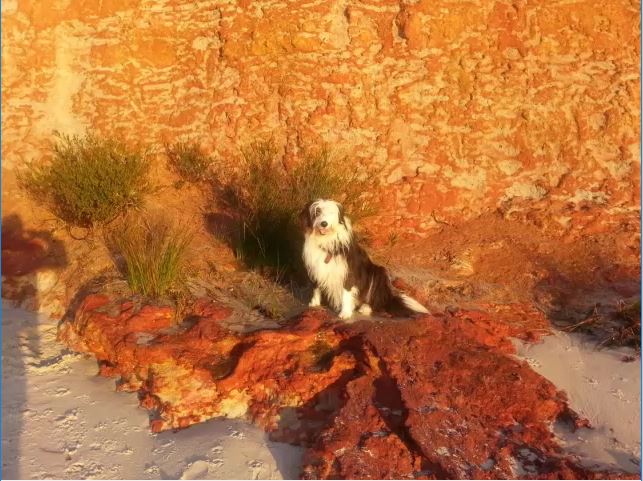
25 Psychiatric Service Dog Association (NSW) Incorporated trading as mindDog (mindDog) is a not for profit organisation that assists people to procure, train and accredit psychiatric assistance dogs. Catherine Phillips is the founder and chair of its board. A brochure issued by mindDog explains that a mindDog is “a psychiatric service dog providing essential support for someone with a mental health disorder”.
26 According to Ms Phillips, assistance dogs can be used by people with a range of different disabilities and can be trained to perform specific tasks to assist their handler. For example, for a diabetic, an assistance dog can be trained to alert for hypoglycaemic or hyperglycaemic attacks. For a person with an anxiety disorder the dog is not trained to undertake specific tasks. Rather, the handler needs to observe the dog’s body language in order to understand what the dog is telling them. Ms Phillips explained that because of the bond between the dog and its handler, the dog is aware of the handler’s physiology. If the handler is in a state of anxiety, Ms Phillips said that the dog will react to that and, for example, take the handler out of the situation causing them anxiety.
27 In late November 2014 Mr Reurich applied to mindDog to have Boofhead certified as a mindDog. The application form completed by Mr Reurich for certification of Boofhead was in three parts: part one was to be completed by the applicant applying for certification, Mr Reurich; part two was to be completed by the applicant’s medical practitioner; and part three was to be completed by someone who knew the applicant well but was not a member of his or her family.
28 In the application submitted by Mr Reurich for Boofhead, part two was completed by two practitioners: Dr Udit who described Mr Reurich as having “[a]nxiety, [a]djustment disorder” and who indicated that he expected a mindDog would help calm Mr Reurich down; and Ms Lee who described Mr Reurich’s condition as an “[a]djustment disorder with anxiety and depression” and a “[p]ersonality disorder not otherwise specified” and who indicated that she expected a mindDog would assist Mr Reurich because his “love for animals assists him in regulating his emotion”.
29 As part of the application, Mr Reurich completed home assessment forms, indicating that Boofhead had undertaken a home assessment test every fortnight over a six week period on 5 and 20 November and 3 December 2014. Ms Phillips explained that the home assessment program required applicants to answer “yes” or “no” to the same set of standard questions organised in two categories, “at home” and “out and about”, each fortnight for three consecutive fortnights. The questions in both categories aimed to uncover the relationship between the dog and its handler because the basis of psychiatric assistance dogs is the bond between the dog and its handler and how that develops. The home assessment also evaluated what the dog had been trained to do as this informed the relationship between the dog and its handler. The assessment was a standard form questionnaire that applied to all mindDog applicants and was not tailored to an applicant’s individual circumstances.
30 Upon receipt, Ms Phillips reviewed the application for Boofhead and deemed Mr Reurich and Boofhead to be suitable candidates. On 16 December 2014 she sent trainee material, a mindDog vest and an identity card to Mr Reurich. A copy of Boofhead’s licence, a brochure issued by mindDog and a photo of Boofhead in his trainee jacket appear below:
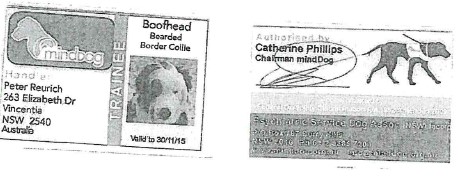
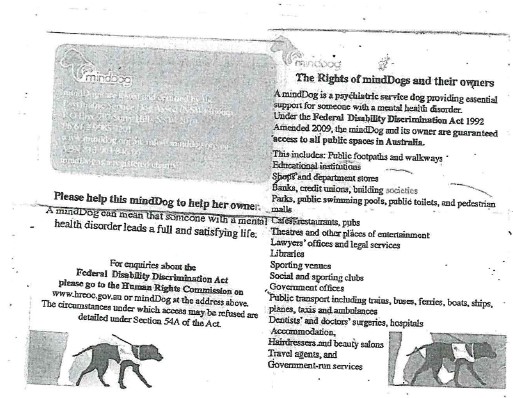
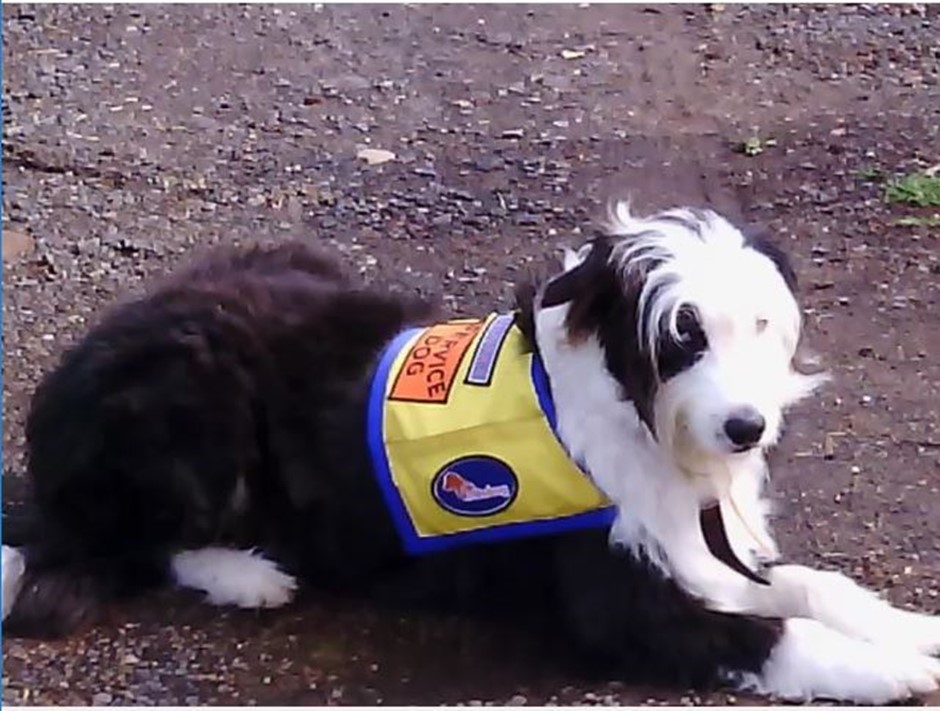
31 According to Mr Reurich, having Boofhead’s trainee licence and jacket would allow Boofhead to be trained to the standard required for the mindDog public access test. For example, armed with Boofhead’s trainee licence and jacket, Mr Reurich took Boofhead to the supermarket where he trained him not to look at meat displays and walk behind or next to him in the aisle.
32 On 27 October 2015, after the events the subject of this proceeding, Boofhead passed the mindDog public access test.
2.3 The Club
33 The Club is a licenced RSL club registered under the Registered Clubs Act 1976 (NSW). It is a not for profit entity with all profits redistributed for the benefit of members.
34 The Club’s mission as an RSL club is to provide for the wellbeing, care, compensation and commemoration of serving and ex-defence force members. The Club also provides a general service to the Jervis Bay community. It has various facilities for its members and guests, including a licenced restaurant, bistro, entertainment and gaming.
35 Mr Reurich joined the Club on 7 May 2013 and began to catch the courtesy bus to and from the Club. The Club provided Mr Reurich with a place to socialise and meet locals. As Mr Reurich was new to the area and single, he wanted to make friends and hoped to meet a girlfriend as well as able to dine there.
36 The incidents which form the basis of Mr Reurich’s alleged claims involved a number of the Club’s officers and employees. It is useful to introduce them here:
James Rodney Simpson, who is known as Rod, was the Club’s president for 13 years until October 2016;
Derek Ohlston has been the Club’s chief executive officer for approximately 31 years;
Jean-Claude Mandavy, who is referred to as JC, has been a supervisor at the Club for 10 years;
Jeffrey Brooks had dual roles as a supervisor and a security guard for eight years until December 2016. He was generally assigned to one of the two roles, though he usually worked as a security guard on Friday and Saturday nights and as a bar supervisor at other times;
Murray Feeney was a supervisor at the Club for seven years until 21 December 2016;
Rita Muscat has been the operations manager at the Club for approximately eight years. Prior to that she was the Club’s events manager for approximately two years and a supervisor for approximately three years. As operations manager Ms Muscat was responsible for ensuring that all patrons conformed to the Club’s rules and standards of behaviour for the safety and wellbeing of staff and guests in addition to ensuring that all patrons had a good experience when they came to the Club; and
Malcolm Tripp is the Club’s courtesy bus driver. Mr Tripp recalled that he drove Mr Reurich about 20-30 times between 2014 and 2015. He recalled that, about two to three months after he first collected Mr Reurich from his house in Vincentia to take him to the Club, he was accompanied by Boofhead who was wearing a service dog vest which he later learnt was a mindDog vest.
The Club employees referred gave evidence that they observed Mr Reurich behaving in an aggressive and/or intimidating manner, for example, by invading their personal space, cutting them off when they spoke and speaking with a raised voice. Their observations of and attitudes toward Mr Reurich are apparent from the evidence of each alleged discriminatory incident described below.
2.4 Boofhead’s attendance at the Club
37 Before Boofhead got his trainee jacket and licence, Mr Reurich would sometimes bring him to the Club but leave him outside. If Mr Reurich went to the Club at night he left Boofhead at home. When Mr Reurich did not have Boofhead with him at the Club, after about 90 minutes, he would feel anxious, tense and suffer from anxiety, at which point he would want to go home to Boofhead immediately. Despite his love of seeing bands play at the Club, he would not stay because he would start to feel physically unwell, sweat and tremble until he saw Boofhead again.
38 After Boofhead got his licence and jacket he attended the Club with Mr Reurich. According to Mr Reurich, Boofhead was usually by his side and, when he was not, that was because Mr Reurich needed to go to the bar, the bathroom or because he was talking to someone nearby but within sight of Boofhead. On those occasions Mr Reurich put Boofhead in a “stay” position and lay his lead over a chair or loosely tied him to a chair. Sometimes Mr Reurich would ask someone to keep an eye on him. Mr Reurich said that he only left Boofhead alone for very short periods of time and that Boofhead would almost always stay in the same place, either sitting, lying down or standing up with his head turned looking towards Mr Reurich. Mr Reurich could only recall one occasion when Boofhead moved around the Club without him when Mr Reurich had gone to the bathroom, and unbeknown to Mr Reurich, Boofhead followed him.
2.5 Observations about the witnesses
39 In his evidence Mr Reurich sets out a number of interactions with Club employees which took place between 19 December 2014 and 10 July 2015. He claims that in that period there were about 20 instances of discrimination in breach of the DD Act. Those incidents are described below. What occurred at the time of many of the incidents was the subject of disputed facts. Where that is the case, I have set out the contested evidence and my view of whose evidence should be preferred and why that is so.
40 Before setting out the evidence it is useful to say something about my observations of the witnesses.
41 For the most part I found Mr Reurich to be a reliable witness. He had an ability to recall detail, including the minutiae of events. In part his detailed recollection of events was assisted by videos he had recorded on his phone which may have been a way of coping with the paranoia that, in Ms Lee’s opinion, is a manifestation of his condition. Mr Reurich said that the videos helped clarify what happened but, clearly, they also assisted Mr Reurich’s recollection of events.
42 The Club submitted that Mr Reurich was not a reliable witness because, although Mr Reurich thought he had a good memory, in cross-examination it was demonstrated that he did not. In cross-examination, Mr Reurich agreed that he “was not Houdini or Stephen Hawking”, conceded that he might have confused one or two days and accepted that he sometimes gets things wrong and his memory fails him. In my opinion, these criticisms largely demonstrate the effect of the passing of time on a witness’s memory. Mr Reurich accepted that he does not have the genius of others and that he may have confused dates but that does not make him an unreliable witness. What is clear is that Mr Reurich was able to recollect the chronology of events and his interactions with various people with sufficient clarity. That Mr Reurich recounted the events in a particular way which appears “one sided” as the Club suggested is unsurprising. First, Mr Reurich was clearly concerned by the events that occurred to the point where he felt he needed to make a complaint to the Australian Human Rights Commission (AHRC) and thereafter commence this proceeding. Secondly, it is not uncommon for a party to give what could be described as a “one sided” account of events. The same could be said of the recollection of some of the Club’s witnesses. Further, in this case, that characteristic is also, it seems, a manifestation of Mr Reurich’s disabilities.
43 Mr Reurich is not someone who is able to easily moderate his behaviour. I mean no disrespect to him when I say that he demonstrated no ability to self-edit when giving evidence in cross-examination and that he was both literal and expansive in answering questions so that his evidence often strayed well beyond the ambit of the question he was asked. Despite that, I did not find Mr Reurich to be argumentative. Rather, he did his best to put all of the evidence before the Court and, as I have already observed, I found him to be a mostly reliable and satisfactory witness.
44 Mr Flecknoe-Brown, counsel for the Club, submitted that the Club’s witnesses were practical, working people who are plain spoken and do not draw fine distinctions. My own observations accord with that submission. The Club’s witnesses answered questions directly but in some cases their animosity towards Mr Reurich was plain. That is perhaps a consequence of the events which have passed and because they find themselves at the centre of this dispute. I have addressed relevant aspects of the Club’s witnesses’ evidence below.
3. alleged incidents of discrimination
3.1 19 December 2014 Incident
45 There are a number of different versions of the events which occurred on 19 December 2014. Accordingly, I have set out the relevant witnesses’ differing recollections in turn before concluding on the aspects of the evidence which I accept.
3.1.1 Mr Reurich’s recollection
46 On 19 December 2014, having received Boofhead’s mindDog vest in the post that day, Mr Reurich decided to go to the Club to see if it would accept Boofhead. According to Mr Reurich, Boofhead had not been in the ocean that day and did not smell.
47 Mr Reurich and Boofhead, wearing his yellow mindDog jacket, went to the Club at about 7.00 pm for the raffle. They were permitted to enter and Mr Reurich went to sit in the auditorium with Boofhead.
48 Ten minutes after Mr Reurich had taken his seat, he was approached by Mr Mandavy and they had an exchange to the following effect:
Mr Mandavy: Get the dog out of here. He’s not a seeing eye dog is he?
[this statement was then repeated a few times]
Mr Reurich: He’s a service dog and has a right by law to be here. He has the same rights as a seeing eye dog.
Mr Mandavy: Get the dog out of here. I know the law. He is not a seeing eye dog.
Mr Reurich: He’s a service dog.
Mr Mandavy: I know the law. You have to get the dog out.
Mr Reurich showed Mr Mandavy the mindDog brochure and Boofhead’s mindDog trainee licence. He said that Mr Mandavy “snatched” the licence from him and took it away.
49 Mr Reurich felt bewildered and in shock and, shortly after he started to have a panic attack because he thought that Mr Mandavy was going to destroy the licence. Mr Reurich left Boofhead in the care of friends and went to look for Mr Mandavy. He recalls that, as he had sweat and tears running into his eyes, he could not see properly and walked into a glass sliding door, breaking his glasses and hurting his nose.
50 Mr Reurich eventually saw Mr Mandavy with Mr Brooks and another gentleman, who he thought was Mr Simpson. He approached them and asked Mr Mandavy to return Boofhead’s licence but, according to Mr Reurich, Mr Mandavy took the licence and held it up high with his arm raised vertically so that he could not reach it without stretching upwards, which he did, taking hold of the licence. Mr Reurich felt humiliated. I pause here to note that Mr Mandavy denied that he held the licence above his head or that he withheld Boofhead’s licence. Rather, he said that he took the licence with Mr Reurich’s consent so that he could make a copy of it and investigate mindDog.
51 Mr Reurich recalled then having a conversation with Mr Simpson to the following effect:
Mr Reurich: You’re not a policeman, you have no right to take Boof’s licence off me.
Mr Simpson: Are you a war veteran?
Mr Reurich: No.
Mr Simpson: You have to leave the club.
Mr Reurich showed Mr Simpson the mindDog brochure and Mr Simpson agreed to make some inquiries.
52 Mr Reurich returned to his friends and Boofhead. Shortly after Mr Reurich said that he was approached by Mr Brooks who told him to “come to the foyer right now”. Mr Reurich described Mr Brooks’ tone as rude and abrupt but nonetheless went to the foyer as requested. I pause here to note that Mr Brooks does not recall being present during the exchanges set out at [50] above nor does he recall telling Mr Reurich to go to the foyer.
53 The following exchange took place when Mr Reurich reached the foyer:
Mr Simpson: Can we copy the dog’s licence and the brochure?
Mr Reurich: Ok, but be quick. It was stolen off me once by JC. It was very unprofessional.
Mr Simpson: JC was unsure so he took your licence to check.
Mr Reurich: No, JC told me that he knew the law.
54 Mr Reurich recalled that he could see Messrs Mandavy, Brooks and Simpson standing around the photocopier talking to each other. He did not know why it was taking so long and felt anxious. He could hear murmuring. Mr Reurich did not want to wait in case Boofhead’s licence was withheld from him. He recalled that he had the following exchange:
Mr Reurich: Is it going to take all day? Can I have my property back please, will this take all day?
Mr Mandavy (yelling): If you swear one more time, you’re out!
Mr Reurich was shocked because he had not sworn. According to Mr Reurich, the exchange continued as follows:
Mr Reurich: Mate, did I swear, did I?
Mr Mandavy (yelling): Yes, I just heard you.
Mr Reurich: I have turned on my camera, I want you to repeat that accusation.
Mr Mandavy: No.
55 Mr Reurich said that he asked for Boofhead’s licence back but Mr Mandavy said that he did not want to help him anymore and Mr Simpson told him that it was illegal to film in the Club and that he should delete it. A short time later Mr Reurich recalled he had a conversation with Mr Simpson to the following effect:
Mr Simpson: You don’t have to leave. You and the dog can stay.
Mr Reurich: Can we still take the courtesy bus?
Mr Simpson: Yes.
3.1.2 Mr Mandavy’s recollection
56 Mr Mandavy, on the other hand, recalled that the conversation he had with Mr Reurich was to the following effect:
Mr Mandavy: Hi Peter, can I ask you for what purpose your dog is here. I can see that he is wearing a service dog vest.
Mr Reurich: Boofhead is a mindDog and he is allowed to be here.
Mr Mandavy: May I please see your licence for Boofhead just so that I can confirm that Boofhead can come into the Club with you. I will check with Rod because I have never heard of a mindDog.
Mr Reurich: Here is the licence.
Mr Mandavy: Thanks Peter, I am going to make a copy of the licence now and speak with Rod.
Mr Mandavy said that he then went to speak with Mr Simpson and they both went to the office to make a copy of Boofhead’s mindDog licence and google mindDog because neither he nor Mr Simpson had heard of it.
57 While he was in the office with Mr Simpson Mr Mandavy observed Mr Reurich pacing up and down outside. Mr Mandavy recalled that he and Mr Reurich had a conversation to the following effect:
Mr Reurich: Give me my licence back right now, you are going to destroy it.
Mr Mandavy: Peter, I am just making a copy as soon as I am done I promise I will give it back to you.
Mr Reurich: You are discriminating against me.
Mr Mandavy: Peter, please lower your voice and keep calm, here is the licence. Please do not speak to me in this rude manner, I will not tolerate it.
Mr Reurich: F**k you.
Mr Mandavy: Please leave the Club Peter, I will not have you swearing at me.
Mr Reurich: I didn't swear at you.
Mr Mandavy: I heard you Peter. Please don't swear at me. Please leave the club immediately! Now!
Mr Mandavy recalled that Mr Simpson then asked Mr Reurich to leave because he was creating a scene and his rude behaviour was unacceptable. Mr Reurich turned on the camera on his phone and Mr Mandavy walked away from him at that point.
3.1.3 Mr Simpson’s recollection
58 Mr Simpson’s recollection of what occurred again differs in a number of respects. He recalled approaching Mr Mandavy and Mr Reurich because he could hear from the tone and pitch of Mr Reurich’s voice that they were having a heated discussion about a licence for Mr Reurich’s dog. Mr Simpson recalled that upon approaching Mr Reurich they had a conversation to the following effect:
Mr Simpson: Are you a war veteran?
Mr Reurich: No.
Mr Simpson: Can we please have a look and take a copy of your licence and the mindDog paperwork so that we can double check that mindDog is a legitimate organisation?
Mr Reurich: Yes but don’t steal it.
Mr Simpson: We are just going to make copies and check that it is all above board.
Mr Simpson specifically recalled asking Mr Reurich if he was a war veteran because he was aware that companion dogs, as well as other animals, were often used as therapy for war veterans who were suffering the effects of post-traumatic stress disorder.
59 Mr Simpson went to the office with Mr Mandavy to photocopy the mindDog licence. In cross-examination, Mr Simpson acknowledged that he had received Boofhead’s licence and the mindDog brochure; that those documents indicated to him that Mr Reurich needed a mindDog because of his medical condition; and that, upon receipt of that material, he would have been aware that Mr Reurich had some form of mental health disorder although he could not recall that Mr Reurich had ever said anything to him about his condition or the reason why he needed a mindDog.
60 While Mr Simpson was photocopying Boofhead’s mindDog licence, it became clear to him that Mr Reurich was becoming agitated. He saw Mr Reurich moving about erratically and staring at him and Mr Mandavy. Mr Simpson said that the following exchange took place:
Mr Reurich (yelling): I want my licence back. I want my licence back right now. You are destroying it.
Mr Simpson: We will give it back to you when we have finished copying.
Mr Reurich: I want it back right now, you are discriminating against me.
61 Mr Simpson cannot recall any further specifics of the conversation other than that Mr Reurich was shouting and behaving in what he described as a “physically intimidating manner” because of the way he was standing and clenching his fists. Mr Simpson recalled that the exchange took place in the Club’s reception where patrons passed through as they entered the Club. Because of the disruption being caused, Mr Simpson asked Mr Reurich to leave the Club saying:
Please leave the Club now. You can’t speak to people like that. That is conduct unbecoming of a member.
Mr Simpson said that Mr Reurich then removed his phone from his pocket and started to film him and Mr Mandavy which caused him to say words to the following effect:
Peter, it is illegal to film here. Please delete that video. Please just take the bus and move on for today.
3.1.4 My conclusions on the evidence
62 While the recollections of what occurred on 19 December 2014 differ, it is clear that:
(1) Mr Reurich attended the Club with Boofhead wearing his trainee mindDog vest for the first time;
(2) Mr Mandavy approached Mr Reurich to inquire why Boofhead was at the Club and was shown a copy of Boofhead’s licence which he took away. I do not accept that in their first interaction when making initial inquiries, Mr Mandavy asked Mr Reurich to leave the Club. To the extent that Mr Reurich said that occurred, he is mistaken or confused;
(3) Mr Reurich became agitated because he was concerned that he would not get Boodhead’s licence back and that Mr Mandavy may destroy it. There was an exchange between Mr Reurich and Mr Mandavy about the return of his licence during which time I accept it was withheld from Mr Reurich by Mr Mandavy who wanted to make further inquiries about it and show it to Mr Simpson;
(4) Mr Simpson then became involved and he and Mr Mandavy went to the office to photocopy the licence and look at the mindDog paperwork they had been given. While they were there they observed Mr Reurich acting erratically. I infer that once again Mr Reurich was agitated and concerned about whether Boofhead’s licence would be returned;
(5) Mr Reurich then started yelling for the return of his licence and possibly swore. Mr Simpson asked him to leave the Club because of the way he was behaving in the Club’s reception. Mr Simpson also asked Mr Reurich to stop filming the events when he starting using the camera on his phone; and
(6) ultimately, Mr Reurich did not in fact have to leave the Club. He was permitted to stay and take the courtesy bus home.
3.2 21 December 2014 Incident
63 On 21 December 2014 Mr Reurich and Boofhead were on the courtesy bus returning home from the Club when, according to Mr Reurich, the following exchange occurred:
Mr Tripp: Your dog makes me puke.
Mr Reurich: How can you say my dog makes you puke when you smoke cigarettes?
Mr Reurich said that Mr Tripp then “hit the brakes” and in a loud and aggressive tone shouted that he should “get off the bus”. Mr Tripp started driving the bus in silence until they arrived at Mr Reurich’s house where Mr Reurich got off the bus with Boofhead.
64 Mr Tripp recalled Mr Reurich and Boofhead getting on the bus on 21 December 2014. He recalled that as soon as Boofhead started climbing the stairs of the bus he smelt a “strong, foul odour”. He said that the conversation he had with Mr Reurich at the time was to the following effect:
Mr Tripp: Peter you cannot get on the bus when the dog smells like that. You have been told that the dog is unhygienic and has to be maintained to the appropriate standard.
Mr Reurich: How can you say my dog smells when you smoke cigarettes. You smell of cigarettes.
65 Mr Tripp felt personally insulted by Mr Reurich’s remark, particularly because, according to Mr Tripp, he was simply doing what he was told by a member of the board (whose identity he can no longer recall). That board member had told him that Boofhead could not get on the bus when he was dirty, smelly and unhygienic.
66 Mr Reurich said that, between 19 and 21 December 2014, he and Boofhead went to the Club unhindered once or twice.
67 The evidence established that on 19 December 2014, two days before the second incident, there was a discussion about Boofhead’s status as a mindDog and whether he was in fact permitted to enter the Club as a mindDog but there was no discussion about his appearance, no allegation by any officer or employee of the Club that he smelt, nor any evidence of any directive given to Mr Reurich that Boofhead had to meet particular hygiene standards. Despite Mr Tripp’s insistence that he had been so informed, I do not accept that Mr Tripp had or could have been informed as at 21 December 2014 that Boofhead could not get on the bus when he was dirty, smelly or unhygienic. Accordingly, I do not accept Mr Tripp’s version of this conversation.
68 It is appropriate at this point for me to comment on my impression of Mr Tripp as a witness. I generally found him to be an unsatisfactory witness. Mr Tripp gave me the impression that he simply does not like Mr Reurich. That is no doubt a result of the interactions between them. But that break down in their relationship affected the reliability of Mr Tripp's evidence and in some cases, such as this incident, I have not been able to accept his evidence.
3.3 Ms Muscat makes inquiries
69 On 22 December 2014 Ms Muscat telephoned Ms Phillips at mindDog and Penny from the AHRC. The purpose of these calls was to clarify the legal position in relation to permitting Boofhead into the Club in circumstances where there were concerns that Boofhead may present hygiene and health issues because, according to Ms Muscat, he was dirty, smelly and had matted fur. Ms Muscat said that in her conversations with both Ms Phillips and Penny, she asked if the Club could lawfully refuse entry to a companion animal that is not well groomed and maintained as the Club had previously asked Mr Reurich to leave the Club when Boofhead was scruffy, unkempt and smelt. Ms Muscat said that both Ms Phillips and Penny confirmed that the dog would need to meet hygiene and behaviour standards and that entry could be refused if he did not. Ms Muscat made a note of her discussions in the supervisors’ diary in the following terms:
All Supers – Re: Peter Reurich
I spoke with Catherine Phillips from "Mind Dogs" Re: Peter Reurich.
The dog needs to be well groomed & maintained. If he is scruffy, unkempt & smells we have the right to refuse entry.
Ta
Rita
Also spoke to Australian Human Rights Commission (Penny)
Dog needs to meet the hygiene & behaviour standards.
70 Despite what Ms Muscat told Ms Phillips and Penny, the evidence establishes that as at 22 December 2014, Mr Reurich had not been asked to leave the Club because Boofhead was scruffy, unkempt and smelt. It is not clear why Ms Muscat informed Ms Phillips and Penny that Mr Reurich was asked to leave the Club because Boofhead was “scruffy, unkempt and smells”. To the extent Ms Muscat said she informed Ms Phillips and Penny that was the case, she was clearly mistaken and I do not accept that aspect of her evidence.
3.4 26 December 2014 Incidents
71 According to Mr Brooks, on or about 26 December 2014 at around 11.00 am Mr Reurich entered the Club with Boofhead. Mr Brooks approached Mr Reurich and they had a conversation to the following effect:
Mr Brooks: Your dog does not meet the basic health and hygiene standards of the Club because he has a pungent smell, his coat is all matted and he is visibly dirty. Please remove your dog from the Club.
Mr Reurich: My dog doesn’t smell. You smell like cigarettes, how can you say my dog smells when you smell like cigarettes. You are a bully and you stink worse than the dog.
Mr Brooks: You cannot have a dog in here in that state. I will go and show you the paper work that says your dog has to be maintained and hygienic.
Mr Brooks prepared two contemporaneous notes of his interaction with Mr Reurich and completed an incident log dated 26 December 2014. In one of his reports he recorded that:
Boofhead emanated a pungent smell, his coat was all matted and visibly dirty, he was also not walking very well as he is an old dog. I also noticed that his nails were not clipped causing him to limp.
72 There was some confusion on Mr Reurich’s part as to whether the exchange with Mr Brooks referred to in the preceding paragraph occurred on 26 or 27 December 2014 but in cross-examination Mr Reurich agreed that he had attended the Club on the morning of 26 December 2014 with Boofhead and that he had a conversation to the effect set out above.
73 I accept that Mr Reurich attended the club with Boofhead on the morning of 26 December 2014 and accept Mr Brooks’ evidence about the interaction he had with Mr Reurich.
74 Later that day Mr Reurich wanted to return to the Club. Mr Reurich rang Mr Tripp and had the following conversation, which he recorded and which was the subject of an agreed transcript tendered in evidence (Agreed Transcript):
Mr Reurich: Husky RSL bus.
Mr Tripp: RSL bus, hello?
Mr Reurich: Hello, it’s Peter here. Who am I speaking to?
Mr Tripp: Mal.
Mr Reurich: Malcolm, it’s Peter. Can you pick me up from my place at XX XX Drive please?
Mr Tripp: Mate, you haven’t got your dog with you? Because I can’t have it on the bus.
Mr Reurich: Why not?
Mr Tripp: I can’t have it on the bus.
Mr Reurich: Who told you that?
Mr Tripp: Hey?
Mr Reurich: Why have they not allowed him on the bus? What’s the reason?
Mr Tripp: No mate I can’t have it on the bus.
Mr Reurich: Who told you?
Mr Tripp: Management.
Mr Reurich: Who’s management?
Mr Tripp: Management of the bus.
Mr Reurich: Okay,well I’ll come anyhow, without the dog, but they are wrong because it’s illegal what they are doing by the way. Do you know that?
75 Mr Reurich agreed to go to the Club on his own. However, he did not stay long and took the very next courtesy bus home because he missed Boofhead and felt anxious and unwell.
3.5 27 December 2014 Incidents
76 On or about 27 December 2014 at approximately 11.00 am Mr Reurich went to the Club with Boofhead. According to Mr Brooks, Mr Reurich was wearing dirty work clothes and a hard hat and Boofhead smelt, was dirty and had matted fur. The Club had dress regulations and dirty workwear and any form of headwear was not permitted.
77 Mr Reurich and Mr Brooks’ recollections of the conversation that followed differs. Mr Brooks recalled that the conversation was to the following effect:
Mr Brooks: You can't come in here wearing those clothes and with a work hat. I am going to have to ask you to leave, you know the dress code Peter. Also, your dog is still dirty and smelly.
Mr Reurich: There is nothing wrong with my dog. I am just coming in here to enjoy myself. My clothes are not dirty, I have just come from work. You are bullying me and discriminating against me.
Mr Brooks: I am treating you in the manner as I would treat any other patron who would present to the Club in breach of the dress code. Please leave.
78 Mr Reurich recalled that he had a conversation with Mr Brooks to the following effect:
Mr Brooks: You can’t bring your dog inside. He smells.
Mr Reurich: What?
Mr Brooks: You can’t bring your dog in, he smells. And his jacket says he is a trainee. He’s not trained. He’s not a service dog. Take him outside. We have a right to refuse service dogs if they are unkempt.
79 According to Mr Reurich, Mr Brooks then showed Mr Reurich the handwritten extract from the supervisors’ diary set out at [69] above.
80 Both Mr Reurich and Mr Brooks agreed that the conversation continued to the following effect:
Mr Reurich: How can you say that my dog stinks when you smoke cigarettes?
Mr Brooks: Take the dog out of here, or I will bar you!
Mr Reurich: This is not alright, this is disability discrimination.
Mr Brooks: Take the dog out!
Mr Reurich: Okay, Boof and I are going, but you’re acting unlawfully. This is discrimination.
81 As Mr Reurich and Boofhead were leaving Mr Brooks said “I’ll call the police” to which Mr Reurich replied “go ahead”.
82 After lunch Mr Reurich returned to the Club with Boofhead. As they were trying to enter, they were approached by Mr Brooks. They had the following conversation which Mr Reurich recorded and which was in the Agreed Transcript:
Mr Reurich: Can you …
Mr Brooks: Peter.
Mr Reurich: He doesn’t stink anymore. He didn’t stink then.
Mr Brooks: You cannot bring your dog in here.
Mr Reurich: Well you told me the reason was that because …
Mr Brooks: You cannot bring your dog in here.
Mr Reurich: Can you give it to me in writing please? Thank you.
Mr Brooks: I’m telling you now, take your dog out.
Mr Reurich: Can you give it to me in writing please?
Mr Brooks: Take your dog out.
Mr Reurich: Can you give it to me in writing then?
Mr Brooks; Take your dog out.
Mr Reurich: Will you give it to me in writing then?
Mr Brooks: I won’t give it to you in writing now.
Mr Reurich: Okay, well.
Mr Brooks: Take your dog out.
Mr Reurich: When will you give it to me in writing?
Mr Brooks: Talk to the boss next week.
Mr Reurich: Who’s the boss?
Mr Brooks: Derek Ohlston
Mr Reurich: Why can’t I speak to him now?
Mr Brooks: Because he’s not here.
Mr Reurich: Well, you know you’ve got your facts wrong.
Mr Brooks: I’m not going to argue with you mate. Take your dog out or I’ll cite you and give you a month.
Mr Reurich: You are going to give me a month are you?
Mr Brooks: Yep.
Mr Reurich: You might find yourself in court yet. Making threats like that.
Mr Brooks: Take the dog out (inaudible).
Mr Reurich: (inaudible) I’ve got a right to have him by law, by law.
Mr Brooks: I’m not going to argue with you.
Mr Reurich: I know well why …
Mr Brooks: Take the dog out.
Mr Reurich: You are arguing with me because by law he’s allowed …
Mr Brooks: Take the dog out.
Mr Reurich: Come here Boof. Come on mate ... Boofy come here [laughs]. You’re breaking the law by the way. You are breaking the law and you’re happy to break the law.
Mr Brooks: We’ll see you in court. Off you go.
Mr Reurich: Well, you will. Will you send the letter then please?
Mr Brooks: Don’t bring him in again.
Mr Reurich: Send me a letter.
83 Mr Reurich felt dejected and decided to leave.
84 Mr Brooks made a contemporaneous note of his dealings with Mr Reurich on 27 December 2014 which recorded (as written):
Peter Reurich entered the club again at approximately 11am with his dog Boofhead. I confronted him in the foyer this time he was wearing shorts and thongs and had a dirty work shirt and a hard hat on.
I told Mr Reurich he can not come into the club dressed like that and Boofhead has not had a bath and still smells and seems to be in the same condition as previously presented, with that Peter continued to abuse me and went out the front and tied his dog to the rail at the stairs where people could possibly trip on the lead. I went outside and told him to untie to dog and remove him from the premises. Mr Reurich then called me a 'Dickhead' and a 'Bully' and said he was going to sue me personally as well as the club.
3.6 28 December 2014 Incident
85 On 28 December 2014 Mr Reurich once again went to the Club with Boofhead and tried to enter. According to Mr Reurich, Mr Brooks stood in their way. They had the following conversation which was recorded by Mr Reurich and was in the Agreed Transcript:
Mr Reurich: Are you going to let me in today or are you going to act unlawfully again?
Mr Brooks: (inaudible)
Mr Reurich: Because, I’ll tell you what, Cathy is writing a letter to you…
Mr Brooks: Keep the dog out.
Mr Reurich: … to let you know that’s unlawful what you’re doing
Mr Brooks: Don't bring the dog in.
Mr Reurich: So you're going to act unlawfully, you don't care?
Mr Brooks: Don't bring the dog in, alright?
Mr Reurich: Well, if you direct me to take the dog out, I will but you are acting unlawfully, do you know that? You’re aware?
Mr Brooks: Take the dog out.
Mr Reurich: Do you understand? Have you read the rules?
Mr Brooks: Take the dog out.
Mr Reurich: Come Boof. Come here. Sit down, sit. [outside the front door].
Mr Brooks: (inaudible)
Mr Reurich: Trying to humiliate me for.
Mr Brooks: I’m not trying to humiliate you.
86 A short time later, Mr Reurich and Boofhead went back to the Club and had a further conversation with Mr Brooks at the entrance, which was again recorded by Mr Reurich and was in the Agreed Transcript:
Mr Reurich: You bastards you’re breaking the laws and you know it. I’ve told you number of times. Cathy is actually going to send you a letter (inaudible).
Mr Brooks: We’ve told you a number of times what the management's decision is.
Mr Reurich: The management is wrong and they'll find out because they’re getting a letter from Cathy. She's told me.
Mr Brooks: Write a letter to the board.
Mr Reurich: Well, I’ll have to.
Mr Brooks: In the meantime, this is the third day that I've told you the dog is not allowed in the club.
Mr Reurich: Call the police. You’ve promised to call the police. Call the police.
Mr Brooks: If you continue…
Mr Reurich: Call the police if you have to. I have every right to take him here by law.
Mr Brooks: Not by our law.
Mr Reurich: You can't make a law up. This is a, this is a federal law.
Mr Brooks: Mate, I'm not going to argue with you.
Mr Reurich: Well you’re arguing with me because you can't…
Mr Brooks: I'm not going to argue with you.
Mr Reurich: Well you are arguing with me.
Mr Brooks: Don't bring the dog here again. The next time you bring the dog in the front door, you're going to be suspended for a month and you won’t (unintelligible) right.
Mr Reurich: No, I won't. I won’t, I won’t be suspended for a month and I won’t be going…
Mr Brooks: Won’t you?
Mr Reurich: No I won’t.
Mr Brooks: How about I suspend you for a month now?
Mr Reurich: Well, if you want to try that on, you can try it.
Mr Brooks: Alright, listen to me will ya?
Mr Reurich: Can you give it to me in writing? Look, I'm not arguing with you, I'm, I’m going to come back for the raffles this afternoon right.
Mr Brooks: I'm suspending you now for a month so don't come back.
Mr Reurich: You are? Are you going to be here after lunch?
Mr Brooks: I will be here after lunch.
Mr Reurich: Well, I’m coming here for raffles and I’ve got Boofhead here which I’m entitled to do…
Mr Brooks: You’re suspended for a month.
Mr Reurich: You have no right to do that.
Mr Brooks: And you’ll get a letter from the board.
Mr Reurich: I want to talk to your big boss. Is the big boss going to be here?
Mr Brooks: You will talk to the big boss, don’t worry about that.
Mr Reurich: Can I speak to the big boss now?
Mr Brooks: He's not here on Sunday.
Mr Reurich: Why not?
Mr Brooks: Don't stand here arguing with me, you've got a month, now leave the club.
Mr Reurich: You can't do that. Are you kidding me?
Mr Brooks: Do you think?
Mr Reurich: You're acting unlawfully. You're acting irresponsibly. You're acting unprofessionally.
Mr Brooks: You've got a suspension mate, leave the club. You'll get a letter from the board. Don’t let him in. You’ll get a letter from the board.
Mr Reurich: Nope, you’ll be going to court. I’ll tell you what, I'm going to have you up for defamation, discrimination, discrimination, defamation and you're bullying me
Mr Brooks: Leave the club, leave the club. You're suspended for a month.
87 Mr Reurich went home with Boofhead and created a petition concerning Boofhead’s smell. That afternoon he returned to the vicinity of the Club with Boofhead. He did not go into the Club but tied Boofhead to a railing and asked people outside the Club if they would sign his petition agreeing that Boofhead did not smell.
88 Mr Mandavy approached Mr Reurich and they had the following exchange which was recorded by Mr Reurich and was in the Agreed Transcript:
… (inaudible)
Mr Reurich: And they’ve been accusing me of swearing at them (inaudible). No problem, thank you … Jeff tells me that I am barred from the club. Do you agree with that? Because there is no way I could be barred because I’ve done nothing wrong.
Mr Mandavy: Well, if Jeff barred you, that’s all there is (inaudible)…
Mr Brooks then approached Mr Reurich and the conversation, which was once again recorded by Mr Reurich and was in the Agreed Transcript, continued as follows:
Mr Brooks: What’s this?
Mr Reurich: It’s a petition.
Mr Brooks: Right, 50 metres off the premises mate.
Mr Reurich: Why is that? Why is that…
Mr Brooks: Now or I will ring the police and you get a $550 fine.
Mr Reurich: There won’t be no fine from me (inaudible).
Mr Brooks: You don’t think?
Mr Reurich: No.
Mr Brooks: You've got two minutes.
Mr Reurich: You want to screw it up?
Mr Brooks: 50 metres off the premises.
Mr Reurich: You want to screw it up?
Mr Brooks: 50 metres off the premises.
Mr Reurich: Why are you doing this for? Why are you doing this for?
Mr Brooks: Now.
Mr Reurich: What is your problem? I've done nothing here. I've done nothing wrong.
Mr Brooks: Mate, you're a goose.
Mr Reurich: I'm a goose?
Mr Brooks: You're a goose.
Mr Reurich: You've been talking to the same copper who (inaudible).
Mr Brooks: Get off the premises or I'll the police and you'll get a $550 fine.
Mr Reurich: Mate…
Mr Brooks: You've been warned.
Mr Reurich: I'm going off the premises…
Mr Brooks: You've been warned, you’ve been warned.
Mr Reurich: I'm going off the premises. I'm going off the premises, not because of what you said (inaudible).
Mr Reurich then left the area with Boofhead and in the days that followed continued to ask people to sign his petition.
89 Mr Brooks did not have a clear recollection of what occurred on 28 December 2014 but accepted, based on the recordings, that he had the conversations set out above. Mr Brooks accepted first, that he suspended Mr Reurich for one month because he thought that Mr Reurich had defied his order not to bring Boofhead into the Club in circumstances where he had been warned he would be suspended if he did so again; and secondly, that he did not suspend Mr Reurich because Boofhead smelt.
90 Mr Brooks relied on contemporaneous notes comprising two typed notes and a handwritten incident log report. The first typed note is described as Mr Brooks’ contemporaneous note of his dealings with Mr Reurich on 28 December 2014. The second typed note is a composite report of events which took place on 26, 27 and 28 December 2014. Mr Brooks’ first typed note recorded that:
Mr Reurich entered the club yet again on the 28th December at approximately 11am. His dog Boofhead was in the same condition as the previous 2 occasions, I again asked him to leave, Mr Reurich again abused me calling me a 'Dickhead' and 'Bully' and threatened me until such time as I became very short with him and demanded he leave the club premise, at that stage he left.
At approximately 2.30pm that afternoon he again came into the club, I again met him in the foyer, there seemed to be no change in the appearance or smell of Boofhead, as a matter of fact the dog looked as though he did not want to be there as Mr Reuirch was dragging Boofhead along by the lead.
I said to Mr Reurich I have had enough you are now suspended for 1 month. Mr Reurich then said "Fine, now I can sue you and this dirty little shithole of a club". Mr Reurich then went out of the club with a petition that he already had with him.
I witnessed Mr Reurich approach 3 patrons as they attempted to enter the club to sign his petition, they refused and when they came in they said to me "Who is that Dickhead?"
I then went out and said to Mr Reurich you need to leave the premises and not approach of 50 metres of club property as you are now a suspended person. I then witnessed him across the road trying to get people to sign his petition.
91 Part A of the incident log report recorded that the incident took place at 11.00 am in the reception and that Mr Brooks had informed Mr Reurich on 26 December 2014 that “he would be suspended for a month if he brought his dog back in”. Part B of the incident report recorded that:
Mr Reurich insists on bringing his dog into the Club despite being told on 3 occasions on 26, 27, 28/12-2014. When he came in with the dog on 27/12/14 I told him he had to leave and gave him appropriate documentation photocopys (sic) and that if he came back in with the dog I would suspend him for 1 month and he would have to front the board. The dog stinks and is scruffy and does not look in good condition. When he came in on 28/12/14 at 11am I told him to leave. He refused so I said you are suspended for 1 month. He came back in with the dog at app 14.30 - cont
I told him to leave so he stood outside the door with a petition trying to get people to sign it harassing them. I then went outside and told him to leave the premises 50 m from the carpark. Which after some more complaining he finally left apparently he is suing the Club and me personally.
3.7 Mr Reurich is suspended from the Club
92 After reviewing incident reports prepared by Mr Brooks in relation to Mr Reurich’s attendance at the Club between 26 and 28 December 2014, Mr Ohlston determined that Mr Reurich’s behaviour was unbecoming of a member of the Club and caused a letter dated 29 December 2014 to be sent to him. Mr Reurich received that letter on about 31 December 2014 after the incident described at [94]-[98] below which also occurred on 31 December 2014.
93 The letter relevantly said:
On Sunday 29th December, 2014 at approximately 11.00am it is alleged you entered the club with your dog. Supervisor Mr Jeff Brooks approached you and advised you are not allowed into the club with your dog. It is alleged you were informed on numerous occasions that your dog did not meet certain standards of the Disability ACT 1992 and that if you continued to enter the club with your dog you would be suspended for 1 month.
It is also alleged that when Mr Brooks asked you to leave the premises he provided you with documentation. As per the Disability Discrimination Act 1992 amended 2009 your dog "Does not meet standards of hygiene and behaviour that are appropriate for an animal in a public place'. It is further alleged that you attempted to enter the club again at approximately 2.30pm on Sunday 28th December, 2014 and when Mr Brooks asked you to leave the premises you refused and then began harassing Members and Guests entering the club requesting they sign a petition.
As a result of this incident you have been given one (1) month suspension for conduct unbecoming of a member. During this suspension period you are not permitted to enter the club premises or use club facilities.
We would like to advise that this report will be tabled before the Board at the next Board meeting on Wednesday, 28th January, 2015. The Board will then decide if you will be cited to appear before them to answer for your actions which is conduct unbecoming of a member of this club. You will be advised of their decision following that meeting. Until then you remain suspended from the club.
(original emphasis)
3.8 31 December 2014 Incident
94 On 31 December 2014, Mr Reurich went to the Club with Boofhead, having just returned from working in Sydney. Ms Muscat was informed by Mr Feeney that Mr Reurich was in the foyer with his dog and that he had been asked to leave but that he had requested to speak with a manager. Ms Muscat and Mr Feeney went to the foyer to meet Mr Reurich. Mr Reurich asked for a glass of water and Mr Feeney went to the bar to get it. The conversation between Ms Muscat and Mr Reurich, which was recorded by Mr Reurich and which was in the Agreed Transcript, was as follows:
Ms Muscat: Hey Peter, how you doing?
Mr Reurich: Rita, can I have a drink of water before we talk because I'm really dry. I've had a three hour trip.
Ms Muscat: Yeah I’ll go, I’ll go and get you a glass from the bar.
Mr Reurich: Can you do that for me?
Ms Muscat: Yeah I’ll get you a glass from the bar.
Mr Reurich: Can you do that for me?
Ms Muscat: Yeah, we’ll go and get you a glass from the bar.
Mr Reurich: Okay, well before I talk, I’m really dry.
Ms Muscat: (inaudible)
Mr Reurich: I feel the club’s dealt unfairly with me. And you're breaking the law because that was the law. I think, I think Cathy sent you a second letter this week, did she?
Ms Muscat: No, I haven't received anything.
Mr Reurich: Well she should have done.
Ms Muscat: We have the right to refuse the dog entry.
Mr Reurich: Why? Because it smells?
Ms Muscat: (inaudible)
Mr Reurich: Because, because he smells, are you telling me he smells?
Ms Muscat: Yeah, no.
Mr Reurich: Are you trying to provoke me?
Ms Muscat: No, no.
Mr Reurich: Mate, I've been to various people who tell me he doesn't stink. You’re trying to tell me that my dog smells?
Ms Muscat: Settle down. I'm not yelling at you.
Mr Reurich: I’m not yelling at you, I’m asking for a glass of water.
Ms Muscat: Lower your voice.
Mr Reurich: I’ve got laryngitis because I want a glass of water please.
Ms Muscat: I’m going to get you a glass of water.
Mr Reurich: Thank you.
Ms Muscat: You've been given a letter from the board.
Mr Reurich: I haven't got it yet. I haven't got home yet.
Ms Muscat: We’ve posted it.
Mr Reurich: Yeah.
Ms Muscat: We posted it to you (inaudible).
Mr Reurich: Yeah, mate I know and I’ll be taking you to court for that.
Ms Muscat: (inaudible)
Mr Reurich: Because you know what, you guys are out of line to do that. Youse are breaking the law.
Ms Muscat: We're not breaking the law.
Mr Reurich: You have actually.
Ms Muscat: No we haven’t.
Mr Reurich: You have, I believe so, you’ll find out. I find the whole thing bizarre. I’ve been here on Friday night, they carried on, Saturday night was fine, Sunday night was fine, the next Friday I come here you carry on again and claim my dog stinks, he doesn’t stink, that’s a load of crap. Like you just don’t like animals or something.
Ms Muscat: No I love animals, I’ve got two.
Mr Reurich: Well you’re not showing it.
Ms Muscat: I have dogs of my own.
Mr Reurich: Yeah well that’s okay, that’s alright. You’ll find yourselves in court, that’s it. Right, I’ve got hundreds of people, I’ve got signatures of people already. I was here for two minutes and I got four people sign the book. I got told to leave the premises.
Ms Muscat: (inaudible)
Mr Reurich: No I’m not harassing the patrons at all. I tell you what, I’ll be getting millions of signatures from all your patrons in here and they’re able to come in your club. They will very happily sign that my dog does not stink and you guys are behaving totally miserable. You’re breaking the law by what you’ve done.
Ms Muscat: We’re not, we’re not breaking the law Peter, we’re not breaking the law.
Mr Reurich: Well how can you prove my dog stinks?
Ms Muscat: Because he does.
Mr Reurich: (laughs)
Ms Muscat: That’s the opinion of a lot of people that were in the club, and a lot of patrons and guests that were in the club on the days that you were allowed to have the dog in the club. You’ve left the dog …
Mr Reurich: I don’t believe that, I know what this is all about, this is a bullying tactic.
Ms Muscat: (inaudible)
Mr Reurich: This is a bullying tactic of yours. It is.
Ms Muscat: You have to (inaudible). We’ve had complaints from patrons and I have to take those complaints seriously (inaudible).
Mr Reurich: Yeah.
Ms Muscat: You obviously don’t want to (inaudible).
Mr Reurich: Well I don’t get complaints anywhere else.
Ms Muscat: You’re not allowed in anywhere else either.
Mr Reurich: That’s not true at all.
Ms Muscat: Where are you allowed in?
Mr Reurich: I don’t have to tell you anything. I can go to the shopping centre, I can go anywhere I like.
Ms Muscat: That’s fine.
Mr Reurich: I’ve not been refused by any club I’ve been to. I’ve been to a number of clubs all over Sydney, all over everywhere and no one’s ever suggested he smells. They all, they all welcome him with a smile on their face, they don’t look miserable like you. You guys look miserable, you act miserable and you’ll be ending up in court looking more miserable.
Ms Muscat: Well you take it further.
Mr Reurich: Yeah I will take it further.
Ms Muscat: (inaudible).
Mr Reurich: Ah yeah.
95 Ms Muscat recalled that in addition to what is set out above, in the course of the conversation, Mr Reurich said words to the following effect:
I am not going to be subject to the board’s autocratic dictatorship at the round table of knowledge. They have no knowledge of anything to do with Boofhead. You are running a grubby little club and I am going to sue you for discrimination. No one here is fit to be in charge.
96 Ms Muscat recalled that while she was speaking with Mr Reurich she could smell Boofhead who, according to her, was emitting a foul odour. However, Ms Muscat did not inform Mr Reurich during the course of the conversation that she thought Boofhead smelt. She only told him that other people had complained about his smell. Ms Muscat accepted that none of those complaints was recorded in writing. Ms Muscat also recalled that Mr Reurich was yelling loudly at her in what she considered to be a rude and aggressive manner. As they were standing outside the Club other patrons were walking past and staring at what she described as an embarrassing scene, with Mr Reurich asking them “Can you smell my dog? Does it stink?”
97 On 31 December 2014 Ms Muscat prepared a diary note which, but for the last dot point which she added subsequently, recorded her discussion with Mr Reurich. The diary note does not refer to any complaints made by patrons about Boofhead’s smell nor does it refer to Boofhead in fact smelling.
98 On a date after 31 December 2014 Ms Muscat prepared a further report of her conversation with Mr Reurich. That report included:
The dog as I remember on the day looked un-kept & quite dirty. The dog is black and white however the dog was not white. The dog was dirty. As I approached Peter I could smell a stench of what can only be described as ‘wet dog’ coming from ‘boofhead’. Like stale sea water. The smell was quite pungent.
This was the first time that Ms Muscat recorded in writing that Boofhead smelt. Ms Muscat said that she prepared this report because she wanted to have something in writing about Boofhead’s smell.
3.9 Mr Reurich lodges a complaint with the AHRC
99 On about 2 January 2015 Mr Reurich lodged a complaint alleging disability discrimination against the Club with the AHRC (First AHRC Complaint).
3.10 Assessment of Boofhead
100 In January 2015 Mr Reurich contacted Ms Phillips at mindDog and informed her that he had been suspended from the Club because of Boofhead. Ms Phillips agreed that mindDog would assess Boofhead to ascertain if he was unhealthy or dirty.
101 On 9 January 2015 Ms Phillips and mindDog’s assessor, Gayl O'Grady, met with Mr Reurich and Boofhead. On that occasion Ms Phillips observed that Boofhead was in good condition, his coat was clean and he had no odour. Ms O’Grady, who assessed Boofhead, observed that he was clean, did not have an unpleasant odour, smelt of salt water, which was not an unpleasant smell, and had quite dry skin so she recommended some natural remedies. Ms O’Grady also observed that, like most mindDog clients, Mr Reurich was highly emotionally invested in the care and wellbeing of Boofhead and that Mr Reurich probably valued Boofhead’s wellbeing more highly than his own. She described Boofhead’s coat as shaggy and that it looked unkempt but was of the opinion that Border Collies have a naturally scruffy coat. Mr Reurich informed Ms O’Grady that Boofhead bathed in the sea at Jervis Bay on a regular basis and was also washed with detergent from time to time. In Ms O’Grady’s experience, dogs that were bathed in this way did not have an offensive odour.
102 At Mr Reurich’s request, Ms Phillips wrote a letter dated 24 January 2015 to the Club about mindDog and psychiatric assistance dogs in which she stated:
Peter has informed us that he has been denied access to Club Jervis Bay when a staff member named Rita claimed that his mindDog Boofhead was dirty and smelled.
Under the Commonwealth Disability Discrimination Act 1992 Part 9, it is illegal to refuse access to social and sporting clubs because an individual has an assistance dog. Boofhead is such a dog.
Under Section 54A of the Act, an assistance dog may be refused access on the grounds that it is unhealthy or dirty. On that one occasion it is possible (but unlikely) that Boofhead did have an odour.
However, Peter is well within his rights to bring a clean Boofhead into the club.
I and our Senior Assessor, Gayl O'Grady, met with Peter end Boofhead on Friday, January 9, 2015. Boofhead was in good condition, his coat was clean and had no odour.
To claim that a dog is dirty when it is not, in order to refuse access, is an infringement of the law.
If Club Jervis Bay continues to refuse access to Boofhead, then Peter may lay a formal complaint with the Human Rights Commission.
If you need more information about mindDogs please contact me on xxxx.xxx.xxx.
3.11 The period from 31 January 2015 to 2 February 2015
103 On 31 January 2015, Mr Reurich went to the Club with Boofhead. Mr Brooks informed Mr Reurich that he, but not Boofhead, could come in. Mr Reurich left feeling disappointed as, having waited until what he considered to be the end of the suspension period, he was looking forward to returning to the Club. He did not want to spend time there without Boofhead. Mr Brooks does not recall this conversation but I accept that Mr Reurich attended the Club on 31 January 2015, believing the suspension period had ended, and had a conversation with Mr Brooks as he recalled.
104 On 1 February 2015 Mr Reurich returned to the Club with Boofhead. On that occasion he had a conversation with Mr Feeney to the following effect:
Mr Feeney: Your dog can’t come in.
Mr Reurich: He is a service animal, that is discrimination.
Mr Feeney: He can’t come in. You’re liable to be barred again.
Mr Reurich: On what basis?
Mr Feeney: Because you are on the premises illegally with your petition. And also because of aggression.
Mr Feeney can vaguely recall having a conversation to this effect.
105 On 2 February 2015 Mr Reurich once again went to the Club. On that occasion he had a conversation with Mr Ohlston to the following effect:
Mr Reurich: They barred me. And now they say they'll let me in but not the dog. By law, you know that I'm allowed to take my dog in.
Mr Ohlston: Yes, if it meets certain criteria.
Mr Reurich: What's the certain criteria?
Mr Ohlston: Well, one is that it must be clean.
Mr Reurich: Well are you saying he's dirty, still, now?
Mr Ohlston: Well, doesn't look dirty to me.
Mr Reurich: Well, he hasn't been any different from day one to how he is now.
Mr Ohlston: There's other criteria too. He must never leave your side
Mr Reurich: If I tell him to stay somewhere, he stays there. I go to the bar, or the toilet, and he stays there. He's not a problem. And I'm happy to do that.
Mr Ohlston: Well, again, I've heard that you leave him in a room and go away.
Mr Reurich: No, that's not true at all. I've left him sitting there when I go to the bar or the toilet, or get my money to get my raffle. There's nothing wrong with that.
Mr Ohlston: There have been reports about your behaviour.
Mr Reurich: My behaviour? How is my behaviour wrong when I'm asking them to accept the fact that they're breaking the law? Which they were.
Mr Ohlston: I think it's the manner in which you go about it. You're abusing people.
Mr Reurich: That's not true, I never shout at anybody ever. JC accused me of swearing. I definitely did not swear. He tried to use that to throw me out of the Club as well.
Mr Reurich pointed to the letter dated 24 January 2015 from mindDog which he said was near Mr Ohlston and the conversation, which was partially recorded and which was in the Agreed Transcript, continued as follows:
Mr Reurich: I would eat nothing, he told me I had to spend money. That was years ago, forget that, this is now, I took the dog in, they let me in the door, everything’s good, I sat in there like I do now, he come up and accused me of him not being a seeing eye dog, and I said no he's not but he's service dog, he's entitled to be here.
Gave him my card and he ran off with it. I didn't give it to him. I showed it to him, and he’s grabbed it and took off with it. When I asked for it back ten minutes later because I was scared he was going to cut it up, he held it away from me and wouldn't give it to me. I had to get it off him right. That's not good professional behaviour. Your president, I think, who's the president, that little bloke, who's that? Who's the president or was it you here that time?
Mr Ohlston: Rod Simpson.
Mr Reurich: Yeah, that same day, first question he asked me - am I a veteran as if that's got a difference to do, what difference does that make if I'm a veteran or not? Then they were looking for every excuse under the sun to stop him from being here. They couldn't find nothing. So the next three days I was allowed in, there was not a problem, he was well behaved. You can have a look at the tapes, alright.
Mr Ohlston: Mm. Alright.
Mr Reurich: So, is there a problem now or not?
Mr Ohlston: There is, in so far as it's been before the board of directors and the board of directors have said…
Mr Reurich: Have the board of directors got this letter from MindDog, well you've got the letter there, you've seen the letter haven't you? Have you read that?
Mr Ohlston: Of course I have. When it goes before the board, then they can make a decision as far as the dog goes.
Mr Reurich: But what I'm talking about, is you're talking about Club policy and I'm talking about federal law, as stated in there, can you not read? That says federal law.
Mr Ohlston: Did you read the rest of the letter too then?
Mr Reurich: Yes. And the letter says I should be allowed in the Club and this is what she's asking you to do, so have you read the rest of the letter?
Mr Ohlston: Yes.
Mr Reurich: So, in other words you're not going to let the dog in?
Mr Ohlston: Not until, not until the board makes judgment on that letter.
Mr Reurich: Okay but how come I heard, I went to the papers, right and you know that.
Mr Ohlston: Mm hmm.
Mr Reurich: And you talked to Adam.
Mr Ohlston: Mm hmm.
Mr Reurich: And you told Adam…
Mr Ohlston: No, I didn't speak to Adam
Mr Reurich: You didn't speak to Adam?
Mr Ohlston: No.
Mr Reurich: Well who spoke to Adam?
Mr Ohlston: No, not me
Mr Reurich: Somebody spoke to Adam and said if my dog was washed, he’d be allowed in the Club. Now this is after I was barred. Now, I'm only being barred, but what reason did he bar me, do you know what reason he barred me for, can you explain why he barred me?
Mr Ohlston: Initially, from what I can gather and what reports I've seen, it was the state of your dog.
106 Mr Reurich recalled that the balance of the conversation, which was not recorded, was to the following effect:
Mr Reurich: That's not why I got barred. That's why he wasn't allowed in. All your people smoke illegally. They smoke within 12 metres of the entrance of your door. They smoke, and they tell me my dog stinks!
Mr Ohlston: Well, that's personal.
Mr Reurich: I think it's a personal thing, what they've done to me. Don't you think?
Mr Ohlston: No.
Mr Reurich: They tell me that he's not allowed in because he's a trainee dog. But he's allowed to do everything as a trainee that a service dog can do. He's never messed up once, he's always behaved. Three days after he's been here, they came up and told me he's not allowed in. They were rude about it.
Mr Ohlston: I'm not sure they were rude about it. I mean, that's your word against theirs.
Mr Reurich: So they're not going to let me in.
Mr Ohlston: Not until I get that letter from the Board.
Mr Reurich: You're the boss of this club, correct?
Mr Ohlston: I carry out what the Board tells me to do. At the moment the Board says the dog's not allowed in.
Mr Reurich: What makes the Board all mighty? The law is the law. How can they override the law. Do you agree there is a law for this?
Mr Ohlston: Yes, but I'm waiting for the Board.
107 Mr Ohlston agreed that he had a conversation with Mr Reurich to the effect set out in [105]-[106] above, but said that Mr Reurich had omitted the following part of their discussion:
Mr Ohlston: I need you to understand Peter, that we do not mind having Boofhead in the Club as long as he is neat and clean and within your control. The bigger issue here Peter is that you cannot come in here and abuse people. We have to ensure that the Club is a safe place for all members and we have to ensure that the rules of membership outlined in the constitution are abided by.
Mr Reurich: But I want to come in, my dog does not smell and is very hygienic. How can you say my dog smells when there are people here who smoke and smell of smoke, they are allowed in.
Mr Ohlston: Peter until we have a board meeting to discuss this issue I can't give you any other answer. That's not personal. It's just protocol. Most things that happen at the Club need to be put before the board.
Mr Reurich: Derek you are a liar.
108 Mr Ohlston recalled that on 2 February 2015 Boofhead looked as if he had been freshly washed. Hence, when Mr Reurich asked him whether Boofhead looked dirty, he replied that he did not. Mr Ohlston said that the point he was trying to make in his discussion with Mr Reurich, as recorded at [107] above, was that initially Boofhead was not allowed into the Club because of his dirty, smelly and unkempt state and related hygiene, health and safety concerns but, once Boofhead was clean and no longer posed health and safety issues, he could come into the Club. According to Mr Ohlston, it was Mr Reurich’s behaviour, being aggressive, abusive, intimidating and threatening, that was the cause of his suspension.
109 Soon after his exchange with Mr Ohlston, Mr Reurich left.
110 Mr Reurich again contacted Ms Phillips who agreed to write another letter to the Club. MindDog’s letter dated 3 February 2015 to the Club included the following:
Despite my letter of 20.01.15 to club management, Peter has again been told that he is not welcome at Club Jervis Bay when accompanied by his mindDog Boofhead.
As I initially pointed out, this is an infringement of the Commonwealth Disability Discrimination Act 1992.
You may wish to acquaint yourself with the case Sheehan v Tin Can Bay Country Club 2002.
In the beginning of this unnecessary drama, Peter was told that Boofhead was dirty and smelled. It is my understanding that at a meeting with Peter on 02.02.15, the manager of the club, Derek Olsen, admitted that Boofhead did not have an odour.
This admission would indicate that the original claim by club staff that Boofhead was dirty, was simply a ploy to refuse Peter access.
Mr Olsen also pointed out that before going to the bar or the lavatory, Peter would ask Boofhead to sit and stay. This is legitimate behaviour for an assistance dog. All mindDog clients have individual needs and ways of coping with their disorder. Peter and Boofhead have worked out a process that is effective for them.
Peter simply wants to enjoy the club's facilities with his mindDog. He has the legal right to do so and has asked me to proceed with a complaint against the club in the Human Rights Commission.
111 Mr Simpson took issue with Ms Phillips’ letter to the extent it suggested that Mr Reurich was refused access to the Club and discriminated against because of Boofhead. He said that Mr Reurich was asked to leave because of his abusive and threatening behaviour. While Mr Simpson accepted that he was not physically present between 26 December 2014 and 2 February 2015 to see Mr Reurich being denied access to the Club and he did not personally make the decision to suspend Mr Reurich from the Club in late December 2014 or in late January and early February 2015 not to permit him re-entry, he did not accept that he was incorrect when he said that Mr Reurich was asked to leave the Club because of his abusive and threatening behaviour.
3.12 Special board meeting of the Club
112 On 9 February 2015 at a special board meeting of the Club the letters dated 24 January 2015 and 3 February 2015 from mindDog were tabled and discussed by the board. Mr Simpson was present and Mr Ohlston was in attendance at the meeting. The minutes of the meeting record:
General Business:
1. Letter received from Cath Phillips – President of MindDog
RE: Peter Reurich M/Ship # 5629
Discussion was held regarding the letter received from Cath Phillips.
All were in agreeance to allow Peter Reurich entry to the club on the proviso that ‘Boofhead’ meets hygiene and behaviour standards. Mr Elliott advised he would like to see something in writing from the Health Department to advise Terms & Conditions that the dog is to be allowed entry into the club.
Mr Elliott said he would also like to know what the Country Club are doing regarding allowing Mr Reurich entry as Mr Duff advised he is now allowed entry into the Bowling Club.
Proposed Mr Roach Second Mr Paton
That Mr Peter Reurich is allowed entry to the club until such time as his dog ‘Boofhead’ does not meet hygiene or behaviour standards or he behaves in a manner which is conduct unbecoming of a member.
CARRIED
113 Mr Simpson agreed that the board did not set any specific hygiene or behaviour standards for Boofhead at the time it made its resolution. Mr Simpson said that he was aware that Mr Reurich had been told he was not permitted to walk away and leave Boofhead unattended by Club employees, but accepted that such a requirement was not referred to in the board minutes.
3.13 10 February 2015 Incident
114 On 10 February 2015 Mr Reurich and Boofhead went to the Club. There were two conversations recorded by Mr Reurich and included in the Agreed Transcript which took place on 10 February 2015. Mr Reurich alleged that prior to the conversations in the Agreed Transcript Mr Brooks told Mr Reurich to “take the dog outside”. The first conversation in the Agreed Transcript was between Mr Reurich, Mr Brooks and a third person who was not identified in the Agreed Transcript. The effect of that conversation was that Mr Reurich was informed by the unidentified person that he could not bring Boofhead into the Club because “there’s a process happening”, it had “to go before the board again now” and “while the process is happening, you can’t bring [Boofhead] until that process is done”.
115 The second conversation which was included in the Agreed Transcript was between Mr Brooks and Mr Reurich and was as follows:
Mr Reurich: It’s got nothing to do with the problem, Jeff. I think it's me you want to get rid of.
Mr Brooks: That's a possibility.
Mr Reurich: Well, why? What have I done? I've never mucked up here at all. I've never done nothing wrong in your club.
Mr Brooks: You're rude to people.
Mr Reurich: I'm rude to people? Who am I rude to?
Mr Brooks: Me for a start.
Mr Reurich: Haha, I’m not rude to you, you’re the one rude to me. You're breaking the law, for a start. I've never been rude to you. I've never had nothing to do with you basically because I think you were quite rude to me.
Mr Brooks: Is that, is that correct?
Mr Reurich: I think you’re quite rude to me in general, yeah.
Mr Brooks: Mate, put it this way, if I don't like your attitude, I don't have to let you in the club.
Mr Reurich: Well do what you have to do, can you come here for a minute?
Mr Brooks: This is a club for the members.
Mr Reurich: He's just making threats to me again.
Mr Brooks: I'm not making threats to you at all.
Mr Reurich: You were just telling, you’re just telling me you can stop me from coming in the club.
Mr Brooks: I can.
Mr Reurich: For no reason again?
Mr Brooks: Not for no reason.
Mr Reurich: What reason?
Mr Brooks: I don't like the way you're speaking to me.
Mr Reurich: Mate hahaha. I don't like the way you speak to me, you tell me my dog smells. That's not a very nice thing to say to a person. What if you smell all your customers and …
Mr Brooks: You told me the other week I smell.
Mr Reurich: Well you smell of cigarettes, you do. This is the point. You’re telling me my dog smells and you smoke cigarettes. And on top of that, your boss tells me the dog doesn't even smell so where does that leave you?
Mr Brooks: Well he didn’t the other day and what were you told?
Mr Reurich: He simply told me…
Mr Brooks: What did he tell you?
Mr Reurich: Derek told me my dog didn’t smell.
Mr Brooks That's fine and then what did he tell you after that? That it's got to go to the board meeting, that’s until they decided that your dog's allowed in the club.
Mr Reurich: No, the law's the law. You should have made your mind up by now. You should have a letter by now, a second letter from Cathy so and on top of that, I find you personally discriminated against me personally so I'm taking you to court…
Mr Brooks: Is that right?
Mr Reurich: Yes you have because you've discriminated against me and my dog, and tell me my dog's not trained, you tell me he smells, what else do you want to say about him, you don't like my dog?
Mr Brooks: I don't like your dog and I don't like you.
Mr Reurich: You don't like me?
Mr Brooks: No.
Mr Reurich: Well that's alright, but that doesn't mean...
Mr Brooks: And that's my opinion.
Mr Reurich: So you're in a position of power, you can't use that power to persecute me or discriminate against me, and that's what you've done.
Mr Brooks: Do you think?
Mr Reurich: You're going to use that power again are we?
Mr Brooks: Do you think?
Mr Reurich: Yeah, you shouldn't be using that power to discriminate.
Mr Brooks: I don't have to stand here and cop rubbish from you.
Mr Reurich: I'm not giving you rubbish. I’m trying to…
Mr Brooks: Yes you are.
Mr Reurich: Mate, this used to be an RSL club.
Mr Brooks: Yes.
Mr Reurich: ANZAC would be ashamed of you running this place.
Mr Brooks: Is that right?
Mr Reurich: So where do we stand, next time I come here can you tell me to go? Or have you barred me again or not?
Mr Brooks No.
Mr Reurich: Well you’re sort of threatening to do that again.
Mr Brooks: Not yet.
Mr Reurich: You were.
Mr Brooks: Not yet there you go, good on ya.
Mr Reurich left with Boofhead.
116 Mr Brooks did not bar Mr Reurich from the Club on 10 February 2015 nor at any time after that date. He did not recall whether in the period from 10 February 2015 to 12 June 2015 he told anyone that Mr Reurich was not permitted to enter the Club or not permitted to use the courtesy bus.
117 On or about 10 February 2015 Mr Reurich and Ms Phillips each received a letter from the Club dated 10 February 2015. I infer that Mr Reurich received this letter after his interactions referred to above for a number of reasons. First, the fact that it was dated 10 February 2015 means, unless it was couriered (which does not appear to be the case on the face of the document), that he received it after 10 February 2015. Secondly, Mr Reurich did not refer to the letter in his lengthy conversation with Mr Brooks. Thirdly, the Club employees with whom Mr Reurich spoke on 10 February 2015 were clearly under the impression that the board had not yet considered the matter. The letter to Mr Reurich stated:
This correspondence is to confirm the decision of the Board of Directors at their meeting held on Monday, 9th February, 2015 that the one (1) month suspension given to you is sufficient.
We would like to advise that you are allowed entry to the Club with your dog "Boofhead" on the proviso that Boofhead complies with appropriate hygiene and behaviour standards at all times whilst on club premises.
We would also like to remind you the Board of Directors will not tolerate aggressive or argumentative behaviour towards staff.
Please be aware if you behave in a manner not becoming of a member then the matter will be dealt with in accordance with Clause 49(a) of the Club's Constitution.
Mr Ohlston, the author of this letter, accepted that it said nothing about the need for Boofhead to be by Mr Reurich’s side at all times, at what distance Mr Reurich could be from Boofhead or when they could be separated. He accepted that nothing about that issue was put in writing to Mr Reurich in the period leading up to 12 June 2015.
118 The letter dated 10 February 2015 addressed to Ms Phillips stated:
With reference to your letter dated 3rd February, 2015 which was tabled for discussion at the Board of Directors meeting held on Monday 9th February, 2015.
Please find enclosed a copy of letter that was sent to Mr Peter Reurich.
The Board and I take exception to your comment in the correspondence dated 3rd February, 2015 in which you state "This admission would indicate that the original claim by club staff that Boofhead, was dirty was simply a ploy to refuse Peter access.”
Numerous staff members have attested to the fact that Boofhead was dirty and his hair so badly matted that it resembled dreadlocks along with an odour that permeated the foyer.
My staff does not tell lies or create fabrications which are entirely unnecessary as Mr Reurich was originally refused entry and suspended from the club for the period of one month for his abuse of staff members.
119 Following receipt of the letter dated 10 February 2015 from the Club, Mr Reurich withdrew the First AHRC Complaint.
3.14 Mr Tripp’s note
120 On 27 February 2015 Mr Tripp prepared a note to record what he described as the board’s direction to him in relation to Mr Reurich’s use of the courtesy bus. That note provided:
Re Mr Peter Reurich and his dog boofhead
Dog not allowed on bus seat at any time. The dog is also not allowed on the bus if it smells, dirty and or scruffy. If these requests are not met refuse entry onto the bus. Malcolm will be on holidays for two weeks, he has already advised Mr Reurich of these conditions. Malcolm has also discussed this situation with Rod Simpson.
3.15 March/April 2015 Incident
121 On a day in March or April 2015, which Mr Reurich can no longer precisely recall, Mr Reurich was on the Club’s courtesy bus with Boofhead when Mr Tripp told him that his dog smelt. Mr Reurich told Mr Tripp that he thought he was being a bully. Mr Tripp acknowledged that he had a conversation with Mr Reurich to this effect but denied that he was bullying Mr Reurich or discriminating against him. He said he was simply pointing out that Mr Reurich needed to keep Boofhead clean and hygienic.
122 Later at the Club Mr Reurich was approached by a couple who he did not know but who had been on the courtesy bus with him. The female said to Mr Reurich “You know, the driver asked us to complain to the [C]lub about your dog”. Her partner said to Mr Reurich “Yes, he said to write a complaint, tell the [C]lub the dog smells”. The female then said “We said no. We thought it was bizarre”.
123 Mr Tripp’s evidence was that he “was asked by a couple of patrons that the dog did smell and that [he] asked them to go and complain to management”.
3.16 19 April 2015 Incident
124 On 19 April 2015 Mr Reurich rang the Club requesting that the courtesy bus pick him up. He was put through to Mr Tripp who agreed to collect him that afternoon.
125 When Mr Reurich boarded the courtesy bus with Boofhead at around 3.15 pm, he had an exchange with Mr Tripp to the following effect:
Mr Tripp: Get the dog off the bus!
Mr Reurich: You’re acting illegally – Boof is allowed. You know that.
Mr Tripp: Get the dog off the bus!
126 Mr Reurich and Boofhead got off the bus and stood near the door. Mr Reurich got his phone out and said “wait a minute while I get my video on the phone” and then started recording on his phone. Mr Reurich and Mr Tripp then had the following conversation, which Mr Reurich recorded and which was in the Agreed Transcript:
Mr Tripp: Turn it off, now.
Mr Reurich: I just want… you’re on video now…
Mr Tripp: Turn it off or I’ll call the police.
Mr Reurich: Mate, I just want you to rephrase what you just told me that the boss, that the dog is not, he’s allowed by law on the bus.
Mr Tripp: No he’s not. Off.
Mr Reurich: Come here Boof.
Mr Tripp: (inaudible) you can get off.
Mr Reurich: Well, mate, by law he’s allowed to…
Mr Tripp: Off. I haven’t got time for this Peter.
Mr Reurich: Mate, you play the bullying little game like you did last time…
Mr Tripp: Turn it off Peter.
Mr Reurich: Well you’re on video, tell me again…
Mr Tripp: You should have been, you’ve been told…
Mr Reurich: You tell me…
Mr Tripp: I’ll turn about, you’ve been told, you have been said about that the dog is not allowed on the bus.
Mr Reurich: No, but the letter, but the letter does not say that.
Mr Tripp: (inaudible) Turn that f**king thing off now.
Mr Reurich: No, just wait a minute.
Mr Tripp: Turn it off.
Mr Reurich: I told you you’re on video.
Mr Tripp: Get off.
*door closes*
Mr Reurich: Mate…
Mr Tripp: (pointing) Turn that off. I’ll smash it.
Mr Reurich: Don’t touch me.
Mr Tripp: I’ll smash it.
Mr Reurich: Don’t you touch me.
Mr Tripp: Don’t you video without any…
Mr Reurich: I told you it was on video. I told you (inaudible).
Mr Tripp: I’ll get the police (inaudible).
Mr Reurich: Mate, get… Mate, do not touch me.
Mr Tripp: Off. Don’t… (inaudible) you hit me…
Mr Reurich: Mate, you touch me…
Mr Tripp: I’ll call the police.
Mr Reurich: You call the police. Go on, call them.
Mr Tripp: (inaudible)
Mr Reurich: Mate, the letter, if you wait, I’ll get the letter, if you wait I will get the letter and show you the letter cause you’re trying to be a bully and you’ve played this game before. You’re still on video.
According to Mr Reurich, during this exchange, Mr Tripp got out of the bus and came over to where he was standing with Boofhead outside the bus doors, lunged for Mr Reurich’s phone and started throwing circular punches at Mr Reurich while he raised his arms trying to defend himself. Mr Tripp’s last punch allegedly hit Mr Reurich. After final words were exchanged, Mr Tripp drove off without Mr Reurich and Boofhead.
127 Mr Tripp’s recollection of this incident differs. He recalled that at some time prior to 19 April 2015 he had been told that Mr Reurich was not allowed to come into the Club with Boofhead because Boofhead did not meet hygiene standards. He recalled that he had a conversation with Mr Reurich to the following effect:
Mr Tripp: Peter I can't take your dog on the bus at the moment, that's the decision of the board.
Mr Reurich: What! What do you mean you can't take my dog on the bus, does my dog smell, there is nothing wrong with my dog. This is against the law, this is discrimination.
Mr Tripp: I am sorry Peter, I am just doing what I have been told.
Mr Reurich: Could you please repeat this for the camera.
Mr Tripp: Peter, do not film me. Tum that camera off.
128 In cross-examination Mr Tripp accepted that he had not in fact been told by the board that Boofhead could not go on the courtesy bus but that it was Mr Brooks who had informed him that was so and that it was a decision of the board. Mr Tripp insisted that he “was only following orders” in not allowing Boofhead onto the bus. In contrast Mr Brooks said that he could not recall telling Mr Tripp that Boofhead could not go on the courtesy bus (see [116] above). Mr Tripp did not accept that he refused Mr Reurich access to the bus because he disliked him.
129 Mr Tripp said that, after his exchange with Mr Reurich set out at [127] above, Mr Reurich barged onto the bus, shoved the camera in his face, yelled and screamed at him and became physically intimidating. Mr Tripp then described his subsequent exchange with Mr Reurich in very similar terms to that described by Mr Reurich and set out at [125]-[126] above save that Mr Tripp:
(1) accepted that he attempted to reach out and grab Mr Reurich’s phone but that he did so because he was frustrated about being filmed and Mr Reurich kept pushing the phone in his face. He felt that his privacy was being violated;
(2) accepted that he told Mr Reurich that he was going to smash his phone but denied that he started throwing circular punches at Mr Reurich, that Mr Reurich put his arms up to defend himself or that he touched him;
(3) said there was no cause for Mr Reurich to ask him not to touch him as he had no intention of doing so and did not do so. Mr Tripp said that he is not a violent person and that he is much smaller than Mr Reurich; and
(4) said that Mr Reurich came very close to his face and punched him hard in the chest, causing him to take a step back. He also said he did not touch Mr Reurich and felt physically intimidated by him. After Mr Reurich punched him in the chest, Mr Tripp said got back on the bus, closed the doors and drove off. There were no other passengers on the courtesy bus at the time.
130 Mr Reurich denied that he touched, hit or pushed Mr Tripp as Mr Tripp alleged. Mr Reurich agreed that Mr Tripp was angry about being filmed and that people might feel that being filmed without their consent is an invasion of their privacy. But Mr Reurich said he filmed the incident because it was evidence that he could show if he ever had to prove that Mr Tripp told him to get off the bus. When Mr Reurich feels threatened he turns on the camera in his phone.
131 Mr Tripp prepared a note of his interaction with Mr Reurich. Although the note is headed “Note for 19th July 2015 re Peter Reurich” Mr Tripp says that he prepared it in April 2015 and that the reference to “19th July” is a typographical error. The note records:
Note for 19th July 2015 re Peter Reurich
I, Malcolm Tripp, was told by a Supervisor (Jeff Brooks) that Peter's dog was not allowed on the Bus because of smell, hygiene and that he allows it to sit on the seats.
When I went to pick up Peter I explained to him that the dog was not allowed on the Bus.
He got out his phone and started to film me. I asked him to stop filming, which he would not. I continued to ask him to stop filming me.
He shoved the phone in my face to which I tried to grab the phone.
He then punched me in the chest. I did not retaliate or assault him.
I then left and went back to the Club.
132 Mr Ohlston recalled having separate conversations with Messrs Tripp and Reurich about the 19 April 2015 incident in which they gave conflicting versions about what occurred. Mr Ohlston recalled that he had a conversation to the following effect with Mr Tripp:
Mr Tripp: There was an incident with Peter on the bus today. I asked him not to put the dog on the seat and he lost it and starting screaming at me that the dog could get on the bus. He started filming me. I asked him to stop but he would not stop. So I became very angry and had heated words outside of the bus with each other. Peter then pushed me in the chest and I left and drove away.
Mr Ohlston: Ok Malcolm, let me talk to Mr Reurich and get his version of events.
133 Mr Ohlston discussed the incident with Mr Reurich. They had a conversation to the following effect:
Mr Reurich: Derek, Malcolm won’t let me and Boof on the bus. He was being really aggressive towards me, he grabbed me and smashed my phone. He kept saying he’s got a letter saying the dog can’t come on the bus. There isn’t a letter. He knows the dog is allowed on the bus.
Mr Ohlston: Malcolm said you hit him. Look, your dog can go on the bus. He can’t get on the seat though.
Mr Reurich: He doesn’t do that.
Mr Ohlston: Don’t worry you and your dog can take the bus.
134 Mr Ohlston said that, given the conflicting versions and because it was a case of Mr Reurich’s word against Mr Tripp’s, he informed Mr Reurich that he and Boofhead could continue to use the courtesy bus.
135 I do not accept that Mr Tripp was informed that Boofhead could not use the courtesy bus. Mr Brooks could not recall telling Mr Tripp that was so and there is no evidence that between 9 February 2015, when Mr Reurich was permitted to return to the Club, and 12 June 2015, the date of Mr Reurich’s second suspension, that Boofhead was not permitted to enter the Club or evidence of any direction to that effect. In addition Mr Ohlston recalled that in Mr Tripp’s report of the incident to him, Mr Tripp explained the incident was precipitated by his request to Mr Reurich not to put Boofhead on the seat and not because, as directed by the board, he did not permit Boofhead to come on the bus. If the latter was in fact the case, then presumably Mr Tripp would have reported that to Mr Ohlston and one might expect that Mr Ohlston, the Club’s chief executive officer, would be aware of such a direction.
136 It is not necessary for me to determine whether Mr Reurich punched Mr Tripp as alleged or vice versa. Clearly, Mr Reurich was upset about being told that Boofhead could not travel on the courtesy bus and Mr Tripp was upset that Mr Reurich was filming him. These two issues then led to the altercation that followed.
3.17 23 May 2015 Incident
137 On the evening of 23 May 2015 Mr Reurich was at the Club with Boofhead sitting at a high table talking to some acquaintances. According to Mr Reurich, Boofhead was about three metres away from him sitting on the floor and had been there for some time.
138 Mr Mandavy recalls that on that evening he observed Mr Reurich on the dance floor in the auditorium before he moved away to talk to some women. He also observed Boofhead sitting and standing by himself in the lounge area, tethered to one of the tables. According to Mr Mandavy, Boofhead appeared to be fretting and frightened by the loud music, was shaking and was trying to walk away, fully extending his tether to a length of about one metre. Mr Mandavy was concerned for Boofhead but he was also concerned that his taut lead was a trip hazard for patrons.
139 While Mr Mandavy’s and Mr Reurich’s recollections of the conversation that followed differs in some respects, particularly as to its tone, the effect of their respective versions is the same. I have set out below Mr Mandavy’s recollection of the conversation which was to the following effect:
Mr Mandavy: Peter please stay with your dog at all times.
Mr Reurich: I can leave my dog as long as he is in my control.
Mr Mandavy: No you have to stay with him at all times as I understand.
Despite his directive to Mr Reurich, Mr Mandavy accepted that as at 23 May 2015 there was nothing in writing requiring Mr Reurich to stay with Boofhead at all times.
140 Mr Reurich recalled that Mr Brooks then came over and said “[t]hat’s right, you have to have your dog with you or else you’ll be barred again”.
141 At about 9.30 pm Mr Reurich took Boofhead outside for a walk. He returned at about 9.50 pm but the door was locked. Mr Reurich could see that there were still people inside, the lights were on and music was playing. Mr Reurich wanted to take the courtesy bus home. He located Mr Tripp and they had a conversation to the following effect:
Mr Reurich: I want to get the bus.
Mr Tripp: Bad luck. I called for the bus and you weren’t here.
Mr Reurich: But you knew I was here, I was just taking Boof out for a pee.
Mr Tripp: Bad luck.
Mr Tripp recalled having a conversation with Mr Reurich on this occasion. His version of the discussion is similar in effect, although more polite in its tone, with Mr Tripp explaining to Mr Reurich that he did not leave without him but that, when he called for the 10.00 pm bus, there was no one there so he started to tidy up tables instead.
142 Mr Reurich said that eventually Mr Mandavy came around and told Mr Tripp to “get rid of him”. Mr Tripp drove Mr Reurich and Boofhead home in the courtesy bus.
3.18 24 May 2015 Incident
143 On the morning of 24 May 2015 Mr Reurich went to the Club with Boofhead because he wanted to watch television. There are a number of televisions at the Club for members to watch and, according to Mr Reurich, the staff turn them on or change the channel when requested by members to do so. Mr Reurich said that he asked Mr Feeney to turn the television on but he refused and walked away.
144 Mr Reurich went to look for Mr Feeney with Boofhead. Upon finding him, he had a conversation to the following effect:
Mr Reurich: Can the TV please be turned on?
Mr Feeney: No.
Mr Reurich: Well, why not?
Mr Feeney: We’re setting up for tonight and can’t turn the TV on.
Mr Reurich: Look, we have five TVs, so could you put one on.
Mr Feeney turned on a television in the auditorium. It was on Channel 9 and Mr Reurich wanted it to be turned to Channel 10. The conversation with Mr Feeney continued to the following effect:
Mr Reurich: Can you put on Channel 10?
Mr Feeney: 9, 10, what’s the difference? What do you contribute to the club anyway?
Mr Reurich: What do you mean?
Mr Feeney: You drink water. What do you bring to the Club?
Mr Reurich: I bring Boofhead.
145 Mr Reurich said that Mr Feeney laughed in what he thought was a sarcastic tone. Mr Feeney changed the television to Channel 10 but Mr Reurich felt that he had to fight for something simple.
146 Mr Feeney could not recall the conversations set out at [144] above but recalled that Mr Reurich would often ask for the television to be turned on, which he would usually do. He did not recall ever refusing to change the channel.
147 I accept that Mr Reurich attended the Club on 24 May 2015 and asked Mr Feeney to turn on the television, which he did. Mr Feeney’s initial reluctance can be explained by the fact that they were busy setting up the Club for the evening, as Mr Feeney explained to Mr Reurich.
148 Mr Reurich then went to sit down and had an exchange with Ronnie, the barman. Ronnie told Mr Reurich that he could not sit in his chosen spot because he was setting up for the evening. Mr Reurich felt that over the past weeks the staff at the Club had been increasingly rude to him and he felt unfairly targeted.
3.19 29 May 2015 Incident
149 On the evening of 29 May 2015 Mr Reurich and Boofhead were at the Club. Shortly after 9.00 pm Mr Reurich left the Club to walk Boofhead. At the time Mr Mandavy told him that he might get locked out. Mr Reurich was surprised, noting that it had “just gone nine” and “nobody shuts the club that early”.
150 Mr Reurich returned with Boofhead at approximately 9.40 pm. He and Boofhead went out to catch the 10.00 pm courtesy bus home but saw it leaving without them. Mr Reurich said he had made a booking for the bus. He felt that the bus had deliberately left without him and Boofhead. They eventually caught a later bus home.
3.20 10 June 2015 Incident
151 On 10 June 2015 Mr Reurich was again at the Club with Boofhead. He said that a number of things occurred.
152 First, Mr Reurich asked Mr Tripp, who was at the bar, to turn on the television to Channel 9. At first Mr Tripp did not respond but they then had a conversation to the following effect:
Mr Tripp: No, I can’t leave the bar.
Mr Reurich: You can do it from the corner. The girls behind the bar turn it on from the corner for me. It sounds like the girls can do it better than you.
153 At the time Mr Tripp was in charge of the money box behind the bar, which had about $10,000 in it. Having been charged with that responsibility, Mr Tripp said he was not permitted to leave the bar area because of the risks involved in leaving cash unattended. Mr Tripp said that he explained to Mr Reurich that he could not leave the bar area but that he could page someone to come and assist. In response, Mr Reurich accused him of purposely refusing his request and discriminating against him. I accept Mr Tripp’s explanation for his inability to assist on this occasion and that he explained this position to Mr Reurich.
154 Mr Reurich then saw Mr Brooks walking past. Mr Reurich recalled that they had a conversation to the following effect:
Mr Reurich: Any chance of getting Channel 9 on, Jeff?
Mr Brooks: I’m busy.
Mr Reurich: So you’re ignoring me?
Mr Brooks: Yeah.
Mr Reurich: Well can you ask someone else to do it for me, if you’re busy, can you ask someone else to put it on Channel 9 for me?
Mr Brooks then walked away.
155 According to Mr Reurich, he then had Mr Brooks paged and, upon his return, had a conversation with him to the following effect:
Mr Reurich: I just wanted to see how busy you were. Can you put the TV on for me please?
Mr Brooks: I’m busy, I told you!
Mr Reurich: It takes two seconds! Well can I do it? I can do it. Malcolm could do it from the bar, but he won’t. Everyone’s busy. How come the girls can do it?
Mr Brooks walked away.
Mr Reurich: Good on you. Yeah, see you later. Come on Boof., come with me. Playing this little bullying game. Good on you.
156 Mr Reurich moved to a different part of the room. He once again repeated his request of Mr Tripp who ignored him. After that an employee of the Club, whose name Mr Reurich does not know, walked past and turned the television on at Mr Reurich’s request.
157 Mr Brooks cannot specifically recall the events of 10 June 2015 but made a note in a document titled “Report re mr peter reurich 13.6.15” recording the events of that day (as well as the events which took place on 11 June and 12 June 2015). That note relevantly recorded (as written):
On Wednesday 10.06.15 at 10.15 am peter and his dog boofhead came into the club he went to the bar and said to Malcolm glass of water and some lemon mal gave him the glass and put 2 pieces of lemon in a separate glass , he said I want the lemon in my hand mal said no I have to put it in a glass for health regulations peter said that's bullshit. He then walked out to the annex and said to me on the way past put the t.v on chanel 9 with a bit of volume considering the way he spoke to me and the fact that I was busy I chose to ignore him ,I then went out to the office , he followed me out to the foyer and demanded that I change the chanel on the t.v .I said peter I am busy at the moment I will get there when I get their. He said yeh derrick has told you to ignore me so I want to see him tell him I am waiting for him in the annex and don't be to long. He then went out to the audi bar where Malcolm was on his knees cleaning the fridge yelled at him to change the t.v so Malcolm ignored him for being rude. He then went and approached maz who was setting up her bingo and told her that it was dereks fault that noone would change the t.v for him so maz went and changed it as soon as she changed it he left demanding that Derek come and speak to him Jessica informed Derek then he left.
158 Mr Reurich’s and Mr Brooks’ versions of the interactions between them are not dissimilar. Mr Brooks declined to turn the television on because he was busy doing other things. He ignored Mr Reurich’s repeated demands both because he was busy and because of the manner in which those requests were made.
3.21 11 June 2015 Incident
159 On 11 June 2015 Mr Reurich was at the Club with Boofhead. He asked a female employee, whose name he cannot recall, to turn on the television. Mr Brooks was nearby and said “[i]t’s broken”. Shortly after, Mr Reurich saw that the television was turned on by another employee and that it was working.
160 Mr Brooks’ note referred to at [157] above recorded the events of 11 June 2015 as follows (as written):
Thursday 11.06.15 at 10.30 am peter again attended with his dog boofhead he went to the bar and got his lemon and water from nat buckley I was in the office at the time he came to the foyer and said to me that I had turned the t.v off and that he wanted it on chanel 9 and again that Derek has told us to ignore him in actual fact the t.v was on the inhouse station and as the in house was updating there was no picture on the screen he then went back into the annex and confronted Gordon who then reset inhouse then changed the channel for him as soon as Gordon did that peter left complaining that we were all bullying him.
3.22 12 June 2015 Incident
161 On Friday, 12 June 2015 Mr Reurich was at the Club with Boofhead. Ms Muscat usually worked late on a Friday and walked around the Club to observe what was happening. She recalled that she saw Mr Reurich arrive with Boofhead at about 7.30 pm and that he sat in the Waterfront Lounge. Ms Muscat observed Mr Reurich leave Boofhead unattended over the next couple of hours for periods of up to 20 minutes. She raised the issue with Mr Feeney who had observed the same thing.
162 According to Mr Reurich, on that evening, there was a band playing so he sat Boofhead away from the noise of the band while he was talking with people in the smoking area, which is separated by glass. Boofhead sat quietly and watched him through the glass. Mr Reurich said he was in the smoking area for about three minutes before he left and then stood approximately one to two metres away from Boofhead who remained in the same place the entire time. Mr Feeney approached Mr Reurich and they had a conversation to the following effect:
Mr Feeney: Go sit with the dog, that's the rules.
Mr Reurich: What do you mean that's the rule? That's not the rule.
Mr Feeney: You're not allowed in the club without staying with the dog
Mr Reurich: That's not the rule. You should read the rules, they don't say that.
Mr Feeney: No, you have to be with your dog at all times.
Mr Reurich: No, I spoke to Derek and he agreed I can leave the dog there.
Mr Feeney: You don't sit with the dog, you can leave
Mr Reurich: You're going to bar me?
Mr Feeney: If you don't stay with the dog, you can leave – and you can have two months!
Mr Reurich: Dickhead.
Mr Feeney: Right you are barred for two months
163 Mr Mandavy was nearby. He overheard Mr Reurich call Mr Feeney a “dickhead”. After speaking to Mr Feeney, he approached Mr Reurich and had a conversation with him. Mr Reurich recalled that the conversation that followed was to the following effect:
Mr Reurich: JC, Murray doesn't know the rules, he said I have to sit with the dog, but the dog is under my control, he isn't doing anything.
Mr Mandavy: You called a supervisor a dickhead and I have no alternative but to bar you for one month. You swore at a supervisor and I have no option but to ask you to leave.
Mr Reurich: That's wrong but I'll finish my drink, and I'll get the next bus.
Mr Mandavy: Finish what you have there, and then you must leave.
164 While Mr Mandavy’s recollection of his conversation with Mr Reurich differs in some respects, it was to the same effect as set out above. That is, Mr Mandavy told Mr Reurich that: he understood he had called Mr Feeney a “dickhead”; that he could not swear at supervisors; that he had no alternative but to suspend him for one month; and that he should leave immediately. Mr Mandavy also recalled that he told Mr Reurich that, if he did not leave after finishing his drink, he would call the police and would be fined for failing to leave licensed premises. Mr Mandavy accepted that, in the course of the conversation, Mr Reurich told him that he would catch the next bus.
165 Mr Mandavy was aware that Mr Reurich became agitated when people challenged Boofhead and his rights vis-à-vis Boofhead and agreed that Mr Reurich called Mr Feeney a “dickhead” because Mr Feeney had told him that he had to stay with Boofhead in circumstances where Mr Reurich did not agree that was the rule. Mr Mandavy said that, while use of the word “dickhead” is not unheard of in the Club, as a supervisor, he had to draw the line somewhere; that it does not matter, having regard to the range of possibilities, what swear word is used; and that, although there was nothing in writing which said that the Club will bar someone if they use the word “dickhead”, its use is enough to warrant barring a member for one month.
166 At about 9.30 pm Mr Feeney informed Ms Muscat, among other things, that he had spoken with Mr Reurich several times about leaving Boofhead unattended and that, among other things, he had been asked to leave because of his conduct. He also told Ms Muscat that, on the third occasion of making that request he, together with Mr Mandavy, had informed Mr Reurich that refusing to leave may result in an on the spot fine of $550 for failing to quit.
167 Ms Muscat recalled that while she was in the front office she could hear Mr Reurich arguing with Mr Mandavy. Although she could not hear exactly what was being said, she could hear Mr Reurich yelling and refusing to leave.
168 On his way out of the Club Mr Reurich saw Ms Muscat. They had a conversation to the following effect:
Mr Reurich: Rita, they're giving me a hard time. I'm leaving on the ten o'clock bus.
Ms Muscat: That's fine, yep.
Mr Reurich: They barred me, they can't bar me for what I didn't do.
Ms Muscat: He can suspend you for a month.
Mr Reurich: I'm going to take you all to court about this, because this is bullshit. You guys have done nothing but intimidate me and discriminate me.
Ms Muscat: It's not about discrimination, it's about acting as a member should act.
Mr Reurich: The way they carried on about my dog, who was sitting there quietly, he wasn't doing anything. I'm allowed to have him stay, I'm allowed to go to the toilet.
Ms Muscat: He was left unattended for long periods of time.
Mr Reurich: No, that's not true. You know it's not true. How did you go with the RTA? Derek told me you went to the RTA.
Ms Muscat: We did, we wanted to make sure. If the bus driver had an accident and the dog went through the window and was killed, that would be our responsibility. The club would be liable.
Mr Reurich: How come you don't get people to wear their seatbelts? Nobody wears them.
Ms Muscat: There are signs on the bus. But it's not legal. It's not a legal requirement, I've checked it with the RTA, they've confirmed it.
Mr Reurich: So where will the dog sit, is he alright?
Ms Muscat: Yes, the dog is your responsibility, we've checked it with the RTA. You're quite welcome to follow that.
169 Mr Reurich said that Mr Feeney then approached him and they had a conversation to the following effect:
Mr Feeney: I'm writing you a $550 fine.
Mr Reurich: You're putting it in writing, good.
Mr Feeney: I'll call the police if you don't go.
Mr Reurich: That's fine, call the police.
Mr Feeney: You don't have to be in attendance to get a fine.
Mr Reurich: There's no fine coming.
Mr Feeney: If you don't leave the premises, $550 fine.
Mr Reurich: You're so smart.
Mr Mandavy was nearby and the conversation continued with Mr Mandavy to the following effect:
Mr Mandavy: If you behave, and you do what you're told, with the dog, I don't have any problems. I've never refused you entry.
Mr Reurich: You waited as soon as you can to tell me to go. You lock the club doors on me when it's still trading.
Mr Mandavy: No. Once the doors are shut, they're shut. I can't let anyone back in. It's security. I had a gun to my head, somebody tried to rob me here, so I'm not going to have the front door open.
Mr Reurich: Well I've had people conspiring to trip me over and bash me up, I've heard.
Mr Reurich then left the Club with Boofhead and was taken home by the courtesy bus. Mr Tripp later reported to Ms Muscat that he felt intimidated by Mr Reurich who had videoed him with his phone without his permission.
170 Mr Feeney’s recollection of the events of 12 June 2015 also differs to that of Mr Reurich. He recalled that he noticed Boofhead sitting unattended in the lounge area of the Club and that he asked Mr Reurich to sit with Boofhead at all times whilst in the Club as this was the directive of the board. He recalled that he was probably told that was the directive of the board by Mr Simpson. Mr Feeney recalled having a conversation with Mr Reurich to the following effect:
Mr Feeney: Peter, you cannot leave your dog unattended.
Mr Reurich He is trained to sit by himself.
Mr Feeney: I have asked you 3 times to stay with your dog as that is the ruling of the board.
Mr Reurich: He is under my control. Don't speak about my dog like that, he can sit by himself, he is trained to do that. You are a dickhead. Derek told me I can do this with Boof, he is close enough to me.
Mr Feeney: Please leave if you are going to speak to me like that.
Mr Reurich: No, call the cops I don't care.
Mr Feeney: It is an offence not to leave a licenced venue when asked. Please leave Peter or I will call the Police.
171 Mr Feeney recalled that he asked Mr Reurich to leave the Club three times and, as he refused to do so, he called the police. The police subsequently attended the Club and said that they were going to fine Mr Reurich for failing to leave licensed premises when asked to do so.
172 Mr Feeney prepared two contemporaneous file notes of his interaction with Mr Reurich, gave the police a statement and prepared an incident report. The document which he describes as “a contemporaneous file note dated 12 June with the witness statement provided to the police” relevantly provides:
12th June, 2015
Re: Peter Reurich
As I was walking around the club doing my duty as Security Officer as I entered the Auditorium I noticed Boofhead cringing (due to the loud music of the band) under a table whilst Mr Reurich was socializing around the bar with other patrons, which was approximately 7m + away.
I approached Mr Reurich and advised him of the stipulations of entry to the club as directed by our Board Of Directors, that he must stay with Boofhead at all times whilst on the premise.
Mr Reurich proceeded to call me a 'Dickhead" and that his dog was trained to sit down when instructed. After Mr Reurich became aggressive I then asked him to leave to which he sat down and said "No, call the cops. I don't care" As to which I did call the police and they arrived and I gave them my statement. See attached copy of statement.
The Police informed me that Mr Reurich would be fined, Jean Claude Mandavy whom was the supervisor on duty also informed him that he was suspended for 1 month.
Mr Feeney accepted that neither this report, the file note nor the incident report mentioned that Mr Reurich left the Club before the police arrived. Mr Feeney did not agree that by that omission he intended the Club to believe that the police had dealt with Mr Reurich at the Club and that Mr Reurich had refused to leave.
173 Mr Ohlston recalled the incident on 12 June 2015 because the police became involved. He recalled speaking to a number of staff members about the events that occurred but did not specifically recall with whom he spoke. Because the incident was of a serious nature, Mr Ohlston requested all of the incident reports relating to the alleged events to be provided to him so that he could assess what had occurred and make a decision about whether the behaviour of either Club staff or Mr Reurich required him to take further action. After reading those reports, Mr Ohlston thought that Mr Reurich’s behaviour was of a serious nature and unbecoming of a member of the Club and that he would need to put the matter before the board.
174 Mr Ohlston was aware that Mr Reurich voluntarily left the Club on 12 June 2015 but he was unaware of whether the police arrived at the Club before or after Mr Reurich’s departure nor was he aware of whether the police in fact issued a fine to Mr Reurich on this occasion.
3.23 Mr Reurich’s suspension from the Club
175 By letter dated 15 June 2015 the Club informed Mr Reurich that he had been suspended for one month for “conduct unbecoming of a member”. Mr Reurich was also informed that “this report” would be tabled at the next board meeting on Wednesday, 24 June 2015 at which time the board would decide if Mr Reurich would be “cited to appear before [it] to answer for [his] actions which is “conduct unbecoming of a member” of the Club.
176 The incidents which gave rise to the one month suspension were described in the letter as follows:
I refer to the incident report dated Friday 12th June, 2015 which alleges at approximately 9.40 pm you were approached by Security staff member Murray Feeney who had asked you to sit with your dog at all times whilst on club premises. It is alleged that Murray had spoken to you on several occasions throughout the night and that other staff members had observed you leaving your dog unattended for lengthy periods of time.
It is further alleged you then told Murray that your dog is trained to sit by itself. Murray explained to you that it was a directive from the Board of Directors that you remain with your dog at all times whilst on club premises except for when you go to the bar or the bathroom. It is alleged you then called Murray a dickhead and said you have spoken with Derek and you were allowed to leave your dog unattended. Murray then asked you to leave the club to which you allegedly sat down and said "No, call the cops I don't care".
It is further alleged the Supervisor JC Mandavy then approached you with Murray and once again asked you to leave the club advising you a fine of $550 may be issued by the police for failing to leave the club when requested. It is alleged you began arguing with JC and Murray in the foyer before returning to the auditorium.
It is alleged several minutes later you approached Operations Manager Rita Muscat In the foyer and started yelling at her that the supervisors were picking on you and that they were discriminating against you and that you will be taking it further. Mrs Muscat advised you have been told in the past that your dog is not to be left unattended for lengthy periods of time but it is alleged you continued yelling at her and talking over the top of her.
It is further alleged you made further comments to Mrs Muscat about the courtesy bus not having a safety harness for your dog and that patrons do not wear seatbelts on the bus. Mrs Muscat explained to you the RTA confirmed the club does not need a safety harness for your dog and he is your responsibility.
Mrs Muscat then proceeded to advise you there are signs on the buses advising patrons to wear seatbelts and if they choose not to wear them then the club is not liable in the event of an accident.
(emphasis added)
177 Mr Ohlston, who was the author of the letter dated 15 June 2015, accepted that, despite what he included in the second paragraph of his letter, there was no directive from the board or anything in writing that required Mr Reurich to stay with Boofhead at all times other than when he went to the bar or the bathroom while on Club premises.
3.24 Complaints made by the board against Mr Reurich
178 By letter dated 25 June 2015 from the Club to Mr Reurich, Mr Reurich was notified that the board had made two complaints against him pursuant to rule 48 of the Club’s Constitution namely, that he had engaged in conduct:
unbecoming of a member; and/or
prejudicial to the interests of the Club.
The particulars of those complaints set out in the letter were identical to the matters set out in the letter dated 15 June 2015 from the Club to Mr Reurich (see [176] above).
179 Under the heading “Hearing” the letter included:
2. On Friday 10th July, 2015 at 9.30 am in a Meeting Room at the Club at 2-8 Currambene Street, Huskisson, New South Wales, the Board of Directors of the Club shall meet to hear the complaints and consider and if thought fit, pass any resolution pursuant to Rule 48 of the Club's Constitution as is considered by the Board in the circumstances to be appropriate.
3. Pursuant to Rule 48 of the Club's Constitution you are required to be present at the meeting of the Board at the time, date and place stated above. At that meeting and before any resolution is moved you will have the opportunity of giving in writing or orally any explanation or defence you may think fit in relation to this matter, to call any witnesses in your defence.
4. If found guilty, before any resolution imposing any penalty is passed, you will be given the opportunity of addressing the Board on such penalty. Pursuant to Rule 48 of the Club's Constitution, the Board has the power to reprimand, to suspend or expel you from membership of the Club.
5. If you do not attend the meeting of the Board at the date, time and place stated in section 2 of this notice, the Board may hear and determine the complaint in your absence and pass such resolution as it considers fit pursuant to Rule 48 of the Club's Constitution.
3.25 10 July 2015 board meeting
180 On 10 July 2015 Mr Reurich attended the special board meeting (July Board Meeting) with Boofhead.
181 The evidence before me established that the Club convened special board meetings when there was a charge against a member for a breach of the Club’s constitution. The member affected was usually notified of the meeting well in advance. The usual practice at such a meeting is:
at the commencement of the meeting the Chairman reads the charge to the member and provides particulars of the complaint;
thereafter witnesses are called by the Club and, if he or she wishes to, the member; and
after hearing from the witnesses the board considers its verdict by secret ballot with the majority prevailing.
The minutes of the July Board Meeting, which were in evidence before me, and which Mr Simpson said were an accurate record of what transpired, reflect the process described above.
182 The minutes of the July Board Meeting record, among other things, that:
after reading the charge laid against him, Mr Reurich pleaded “not guilty” to the charge;
Mr Reurich was not permitted to raise anything that occurred prior to 12 June 2015. Mr Simpson explained that this was because events that occurred prior to that date were not part of the charge against Mr Reurich which concerned only the events of 12 June 2015;
Messrs Mandavy, Feeney, Tripp and Campbell and Ms Muscat each provided written reports which were read out at the meeting and confirmed to be true by their respective authors who attended the meeting. Mr Reurich was given an opportunity to ask questions of these people, which he did;
at one point Mr Reurich asked if they could go to another room because he found “it hard to breathe in this dungeon”. Mr Simpson informed him that it was the only room available. Mr Reurich also stood up to stretch his legs while waiting for Mr Mandavy to join the meeting. Upon Mr Mandavy’s arrival Mr Simpson asked him to “please sit down”. Mr Reurich responded “I am stretching my legs ok, I am not a dog you don’t have to tell me to sit”;
Mr Reurich was asked if he had any witnesses to call in his defence, which he did not, and whether he wanted to give any evidence himself, which he did. The minutes relevantly record:
Mr Reurich said I know where this is going and I have had enough too so I am going as well. You make your decision and send me a letter. The Chairman asked Mr Reurich if he has any witnesses that he wants to bring in his defence. Mr Reurich said no, I told you before I can't get that witness because you won't let me in the club. By rights your club should be apologising to me for the first time Jeff barred me for no reason, Jeff barred me for absolutely no reason. All I was explaining to Jeff was that he was acting unlawfully and he said I was aggressive, that's not aggressive I was explaining to him he was acting unlawfully. The Chairman asked Mr Reurich if he has any evidence himself that he would like to give the Board. Mr Reurich said I have just given it to you. I don't make it a habit of swearing and I don't go around calling people dickhead, I did on that occasion, I used the wrong word, the correct word I should have used is moron because moron means stupid person.
Mr Reurich was then informed of the applicable procedure going forward, namely, that he would be asked to leave the room while the board decided if he was “guilty or not guilty” of the offence. Mr Reurich asked Mr Simpson “to just make a decision now because I am sure you guys are going to say whatever you are going to say” and then “stood up and said he will take his dog for a walk”. He was informed that the deliberation would take ten minutes after which he could come back in;
a secret ballot was held and the minutes note that “a guilty vote was unanimous”. The minutes then record:
Further discussion was held and previous reports were tabled along with a letter from a member of the club Mel Ohlson. Mr Roach asked the Chairman if this letter from Mel Ohlson was unsolicited by us. The Chairman confirmed it was as she came voluntarily to the club to hand in this letter. Mr Roach said with regards to this letter it is interesting to note that whilst Mr Reurich is prepared to leave his dog unattended on our premises he is not prepared to leave the dog unattended at the grocery store.
Proposed Mr Roach seconded Mrs Rundell
The Board should decide on a suitable penalty prior to bringing Mr Reurich back into the room in view of his current mental state.
CARRIED
A secret ballot was held for Mr Reurich’s sentence.
It was by unanimous decision that Mr Reurich is expelled from the Club.
Mr Reurich returned and was informed by Mr Simpson that the board had found him guilty of conduct unbecoming of a member and that as a result he was expelled from the Club.
183 Mr Reurich’s evidence about the meeting was as follows:
Mr Simpson asked if he had any questions about the report. Mr Reurich did not say which report he was referring to but I infer it was a report prepared by Mr Mandavy based on the content of the following exchange which Mr Reurich recalled:
Mr Reurich: Yes, JC accused me of swearing before, and he was wrong. He almost just admitted he was wrong. This is the first time, the 28th of December.
Mr Simpson: We're not talking about 28 December, we're talking about 12 June.
Mr Reurich: Ok, well I told Murray that I was going. That I'd finish my drink. And I told you that I was going to catch the bus. I did not say I wasn't going to leave. I told you I was going to catch the bus. And you threatened to call the cops, and I said "Go ahead and call the cops, I don't care.
Mr Mandavy: You know that's wrong Peter. You said to me you're not leaving, you go ahead and call the cops.
Mr Reurich: I didn't mention the bus?
Mr Mandavy: You did not mention the bus.
Mr Reurich: I think I did. I mentioned the bus to a few people. I told Murray. Or Rita, or somebody. I asked somebody about the bus and I'm sure it was you. I don't think you get the facts right sometimes.
Mr Mandavy: That's my facts.
Mr Reurich: Well my facts is I asked about the bus and you said I'd get the bus home and I was happy to leave, simple as that.
Mr Mandavy: When you call one of my staff a dickhead I have no option but to suspend you for a month. That's the rules.
Mr Reurich: I think it's very ordinary.
Mr Simpson: Alright, fair enough. Do you have any other questions of JC?
Mr Reurich: A few weeks ago, he told me to sit with my dog. Boofhead was sitting quietly where he always sits, and I was standing not far away from him. The letter from mindDog says I can have my dog with me, have him sit quietly. The idea of a mindDog is that I can get out and about-
Mr Simpson: We are not charging your dog. You Peter are being charged with conduct unbecoming.
Mr Reurich: I don't have any manager tell me to "sit", like he thinks I'm a dog. I tell my dog to "sit", I don't get told to sit. That's insulting.
Mr Simpson asked him if he had any further questions of Mr Mandavy. Mr Reurich was not permitted to raise matters that had not occurred on 12 June 2015 with Mr Mandavy;
a member of the board then read words to the following effect from a report which I infer was a report prepared by Ms Muscat:
Members have complained about the dog being on the bus. They say the dog should not be on the bus. The bus is a private service for members. It is not public transport. Peter has said we have a grubby little club, that staff are liars and that they discriminate against him, and we should not have to put up with it. He has little regard for our rules and policies and does everything in his power to agitate and undermine supervisors. He plays the discrimination card at every opportunity. It is conduct of a member that is unbecoming and he should be dealt with.
There was then an exchange to the following effect:
Mr Simpson: Rita do you confirm that is your statement?
Ms Muscat: Yes.
Mr Reurich was asked if he had any questions for Ms Muscat. The following exchange took place:
Mr Reurich: Yes. Rita, does my dog smell now? Because you used to accuse him of smelling. He never smelled.
Mr Simpson: Peter, that's not in the statement.
Mr Reurich: It's not true. I'm always polite to your staff. I say please. I ask for my water, I ask for some lemon, I always squeeze a bit of lemon in my glass, and I have never been rude to your staff, and I never called anyone a dickhead except for the last occasion, and the reason is they've been discriminating against me for a long time and they have been playing stupid little bullying games for a long time.
184 In cross-examination Mr Simpson agreed that at the time of the meeting he was aware that Mr Reurich had some form of mental health condition. Notwithstanding that, he believed that Mr Reurich had been accommodated at the meeting, which it seems was held downstairs in the old sub-branch room for two reasons. First, Mr Reurich would not have to walk through the Club in front of members, which he would have to do if the meeting had been held in the boardroom. Secondly, as the room had a door directly leading outside, Mr Reurich would have easy access if he had to take Boofhead out. Mr Simpson agreed that the board did not permit Mr Reurich to take a break when he said he was finding it hard to breathe; noted that Mr Reurich stood at some points during the meeting to stretch his legs and that he was ordered to sit down; and agreed that the board did not permit Mr Reurich to get some things off his chest because they were regarded as irrelevant and not related to the charge being heard.
185 Mr Simpson said that the reason Mr Reurich was expelled from the Club was because of what happened on 12 June 2015: he was not next to Boofhead; he called a supervisor a “dickhead”; and he failed to leave the Club, all of which the board regarded as conduct unbecoming. Mr Simpson said that Mr Reurich’s expulsion was not related to the board’s view that some patrons did not like Boofhead being in the Club.
186 The term “conduct unbecoming” is not defined in the Club’s constitution. Mr Simpson agreed that it would not be unreasonable for the board to have considered whether a different standard for “conduct unbecoming” might be appropriate for a member with a mental health condition, as compared to a member who did not have such a condition, although no one raised that as a possibility at the time. Mr Simpson could not recall the board discussing Mr Reurich’s mental health condition as part of its deliberations.
187 Mr Mandavy also gave evidence about the board meeting. He said that he was not there for very long, maybe five minutes, and that Mr Reurich kept butting in. Mr Mandavy cannot now recall what he said at the meeting but he accepted the minutes as an accurate record of the meeting. In relation to Mr Mandavy’s attendance at the meeting the minutes record, among other things:
… Mr Reurich said I told Murray I was going when I finished my drink and I told you JC that I was going to catch the bus. I did not say I wasn’t going to leave, I told you I was going to catch the bus and you threatened to call the cops which I said fine that doesn’t worry me.
JC said you know that is wrong Peter, because I said to you ‘Can I have a chat to you’ and you said I am not leaving so go ahead and call the cops. I then said so you want me to call the cops and you said yes because I am not leaving. Mr Reurich said I mentioned the bus to you then. JC said you did not mention the bus to me. Mr Reurich said I think I did and I mentioned the bus to a few people and I told Murray. JC replied ‘No you didn’t mention the bus to me at all Peter’. Mr Reurich said I asked you for the bus and you said yes you would put me on the bus, or Rita or somebody and I am sure it was you and I don’t think you have your facts right. Mr Reurich continued to say my facts are I asked you about the bus and you said I could get the bus home and I was happy to leave. …
Mr Mandavy accepted that, insofar as he denied that Mr Reurich told him that he would take the next bus home as recorded in the minutes, he was wrong and that in fact Mr Reurich had said that during their conversation on 12 June 2015. He accepted that the allegation that Mr Reurich had refused to leave the Club was an important part of why Mr Reurich was barred and acknowledged that Mr Reurich did in fact take the 10.00 pm bus voluntarily. Mr Mandavy did not accept that he had lied at the July Board Meeting. Rather, his explanation for his recollection at the July Board Meeting was that he had a lot of things to remember in running the Club and he could not remember the conversation he had with Mr Reurich. It might be that Mr Mandavy had a lot on his mind but it is difficult to accept that he would not recall what had in fact happened some four weeks earlier.
188 Mr Tripp attended the board meeting. Among other things, the minutes of the meeting record the following in relation to Mr Tripp’s attendance at the meeting:
Mr Reurich said I would like to know the day he told me that my dog makes him puke and when I said but you smoke cigarettes and he hit the brakes on the bus and we almost had an accident and he told me to get off the bus. Mr Tripp said the only time I have told you to get off the bus is when you stuck your phone in my face telling the cops your last name and I was at your house.
Mr Tripp accepted that the incident referred to in the minutes is recorded in his file note dated 24 June 2015 headed “To the board of Directors – Club Jervis Bay” which includes:
On one occasion he sat up the back of the bus and rang the police and then proceeded to push the phone in my face and kept saying “Tell the police your last name Malcolm” as he was getting off the bus.
189 Mr Tripp’s evidence in this proceeding included two other instances when he had asked Mr Reurich to get off the bus: on 21 December 2014 and 19 April 2015, described at [63]-[68] and [124]-[136] above. Mr Tripp did not accept that he had lied to the board by saying there was only one such instance. He attributed the discrepancy to the fact that he might have forgotten those additional instances at the time of the board meeting.
190 I do not accept that at the board meeting in July 2015, a few months after the relevant events, Mr Tripp would not have recalled that he told Mr Reurich to get off the bus on two other occasions in the relatively immediate past but some two years later in April 2017, he was able to recall the two additional events. In my opinion, Mr Tripp was less than fulsome when he responded to Mr Reurich’s questions at the board meeting.
3.26 Notification of expulsion from the Club
191 By letter dated 10 July 2015 from the Club Mr Reurich was formally informed that, at its meeting held on that day, the Club’s board had determined to expel him from the Club and remove his name from the membership register. The letter, which was signed by Mr Ohlston, noted that Mr Reurich was no longer permitted to enter the Club premises or use its facilities at any time.
3.27 Complaint to the AHRC
192 On 15 July 2015 Mr Reurich lodged a second complaint with the AHRC (Second AHRC Complaint).
193 On 10 August 2015 a delegate of the President of the AHRC notified Mr Reurich of his decision to terminate the Second AHRC Complaint because there was no reasonable prospect of the matter being settled by conciliation.
4. legislative framework
194 Mr Reurich makes his application under the Australian Human Rights Commission Act 1986 (Cth) (AHRC Act). At the time of commencement of the proceeding s 46PO(1) provided that if a complaint had been terminated by the President, an application could be made to this Court or the Federal Circuit Court of Australia, alleging unlawful discrimination by one or more of the respondents to the terminated complaint. Section 46PO(3) requires that the subject matter of the application be confined to or substantially the same as the subject matter of the terminated complaint or must arise out of the same or substantially the same acts, omissions or practices that were the subject of the terminated complaint.
195 Section 46PO(4) sets out the powers of the Court:
(4) If the court concerned is satisfied that there has been unlawful discrimination by any respondent, the court may make such orders (including a declaration of right) as it thinks fit, including any of the following order or any order to a similar effect:
(a) an order declaring that the respondent has committed unlawful discrimination and directing the respondent not to repeat or continue such unlawful discrimination;
(b) an order requiring a respondent to perform any reasonable act or course of conduct to redress any loss or damage suffered by an applicant;
(c) an order requiring a respondent to employ or re-employ an applicant;
(d) an order requiring a respondent to pay to an applicant damages by way of compensation for any loss or damage suffered because of the conduct of the respondent;
(e) an order requiring a respondent to vary the termination of a contract or agreement to redress any loss or damage suffered by an applicant;
(f) an order declaring that it would be inappropriate for any further action to be taken in the matter.
196 Mr Reurich alleges that the Club unlawfully discriminated against him under the DD Act.
197 The objects of the DD Act are set out in s 3. They are to:
eliminate, as far as possible, discrimination against persons on the ground of disability in the areas of, among others, access to clubs and the provision of goods, facilities and services;
ensure, as far as practicable, that persons with disabilities have the same rights to equality before the law as the rest of the community; and
promote recognition and acceptance within the community of the principle that persons with disabilities have the same fundamental rights as the rest of the community.
198 The terms “club”, “disability” and “reasonable adjustment” are defined in s 4(1) of the DD Act to mean:
club means an association (whether incorporated or unincorporated) of persons associated together for social, literary, cultural, political, sporting, athletic or other lawful purposes that provides and maintains its facilities, in whole or in part, from the funds of the association.
…
disability, in relation to a person, means [relevantly for the purpose of this proceeding]:
…
(g) a disorder, illness or disease that affects a person’s thought processes, perception of reality, emotions or judgment or that results in disturbed behaviour;
and includes a disability that:
(h) presently exists; or
(i) previously existed but no longer exists; or
(j) may exist in the future (including because of a genetic predisposition to that disability); or
(k) is imputed to a person.
To avoid doubt, a disability that is otherwise covered by this definition includes behaviour that is a symptom or manifestation of the disability.
…
Reasonable adjustment: an adjustment to be made by a person is a reasonable adjustment unless making the adjustment would impose an unjustifiable hardship on the person.
199 Section 11(1) sets out the factors to be taken into account in determining whether a hardship that would be imposed on a person would be an “unjustifiable hardship”. These are as follows:
…
(a) the nature of the benefit or detriment likely to accrue to, or to be suffered by, any person concerned;
(b) the effect of the disability of any person concerned;
(c) the financial circumstances, and the estimated amount of expenditure required to be made, by the first person;
(d) the availability of financial and other assistance to the first person;
(e) any relevant action plans given to the Commission under s 64.
…
(2) For the purposes of this Act, the burden of proving that something would impose unjustifiable hardship lies on the person claiming unjustifiable hardship.
200 Mr Reurich alleges that, in relation to each incident, the Club engaged in both direct and/or indirect discrimination. Those concepts are defined in s 5 and s 6 which provide:
5 Direct disability discrimination
(1) For the purposes of this Act, a person (the discriminator) discriminates against another person (the aggrieved person) on the ground of a disability of the aggrieved person if, because of the disability, the discriminator treats, or proposes to treat, the aggrieved person less favourably than the discriminator would treat a person without the disability in circumstances that are not materially different.
(2) For the purposes of this Act, a person (the discriminator) also discriminates against another person (the aggrieved person) on the ground of a disability of the aggrieved person if:
(a) the discriminator does not make, or proposes not to make, reasonable adjustments for the person; and
(b) the failure to make the reasonable adjustments has, or would have, the effect that the aggrieved person is, because of the disability, treated less favourably than a person without the disability would be treated in circumstances that are not materially different.
(3) For the purposes of this section, circumstances are not materially different because of the fact that, because of the disability, the aggrieved person requires adjustments.
6 Indirect disability discrimination
(1) For the purposes of this Act, a person (the discriminator) discriminates against another person (the aggrieved person) on the ground of a disability of the aggrieved person if:
(a) the discriminator requires, or proposes to require, the aggrieved person to comply with a requirement or condition; and
(b) because of the disability, the aggrieved person does not or would not comply, or is not able or would not be able to comply, with the requirement or condition; and
(c) the requirement or condition has, or is likely to have, the effect of disadvantaging persons with the disability.
(2) For the purposes of this Act, a person (the discriminator) also discriminates against another person (the aggrieved person) on the ground of a disability of the aggrieved person if:
(a) the discriminator requires, or proposes to require, the aggrieved person to comply with a requirement or condition; and
(b) because of the disability, the aggrieved person would comply, or would be able to comply, with the requirement or condition only if the discriminator made reasonable adjustments for the person, but the discriminator does not do so or proposes not to do so; and
(c) the failure to make reasonable adjustments has, or is likely to have, the effect of disadvantaging persons with the disability.
(3) Subsection (1) or (2) does not apply if the requirement or condition is reasonable, having regard to the circumstances of the case.
(4) For the purposes of subsection (3), the burden of proving that the requirement or condition is reasonable, having regard to the circumstances of the case, lies on the person who requires, or proposes to require, the person with the disability to comply with the requirement or condition.
201 Sections 8 and 9 concern, among other things, assistance animals. Section 8(1) provides that the DD Act applies in relation to having, relevantly, an assistance animal in the same way as it applies to having a disability. Section 8(2) provides:
(2) For the purposes of subsection (1), but without limiting that subsection, this Act has effect in relation to a person with a disability who has a carer, assistant, assistance animal or disability aid as if:
(a) each reference to something being done or needed because of a disability were a reference to the thing being done or needed because of the fact that the person has the carer, assistant, animal or aid; and
(b) each other reference to a disability were a reference to the carer, assistant, animal or aid.
202 An assistance animal is defined in s 9(2) as a dog or other animal:
(a) accredited under a law of a State or Territory that provides for the accreditation of animals trained to assist a person with a disability to alleviate the effect of the disability; or
(b) accredited by an animal training organisation prescribed by the regulations for the purposes of this paragraph; or
(c) trained:
(i) to assist a person with a disability to alleviate the effect of the disability; and
(ii) to meet standards of hygiene and behaviour that are appropriate for an animal in a public place.
203 Section 9(4) provides:
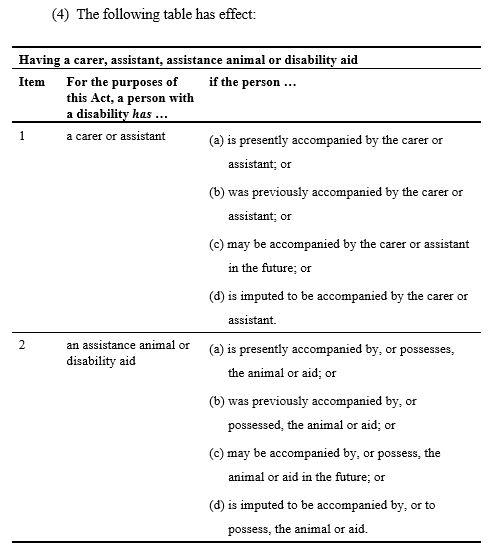
204 Section 10 provides that if an act is done for two or more reasons and one of the reasons is a person’s disability then, for the purposes of the DD Act, the act is taken to be done for that reason whether or not it is the dominant or a substantial reason for doing the act.
205 Part 2 of the DD Act headed “Prohibition of disability discrimination” sets out when discrimination will be unlawful. It relevantly includes ss 23, 24 and 27(2) which provide:
23 Access to premises
It is unlawful for a person to discriminate against another person on the ground of the other person’s disability:
(a) by refusing to allow the other person access to, or the use of, any premises that the public or a section of the public is entitled or allowed to enter or use (whether for payment or not); or
(b) in the terms or conditions on which the first‑mentioned person is prepared to allow the other person access to, or the use of, any such premises; or
(c) in relation to the provision of means of access to such premises; or
(d) by refusing to allow the other person the use of any facilities in such premises that the public or a section of the public is entitled or allowed to use (whether for payment or not); or
(e) in the terms or conditions on which the first‑mentioned person is prepared to allow the other person the use of any such facilities; or
(f) by requiring the other person to leave such premises or cease to use such facilities.
24 Goods, services and facilities
It is unlawful for a person who, whether for payment or not, provides goods or services, or makes facilities available, to discriminate against another person on the ground of the other person’s disability:
(a) by refusing to provide the other person with those goods or services or to make those facilities available to the other person; or
(b) in the terms or conditions on which the first‑mentioned person provides the other person with those goods or services or makes those facilities available to the other person; or
(c) in the manner in which the first‑mentioned person provides the other person with those goods or services or makes those facilities available to the other person.
…
27 Clubs and incorporated associations
…
(2) It is unlawful for a club or incorporated association, the committee of management of a club or a member of the committee of management of a club or incorporated association to discriminate against a person who is a member of the club or association on the ground of the member’s disability:
(a) in the terms or conditions of membership that are afforded to the member; or
(b) by refusing or failing to accept the member’s application for a particular class or type of membership; or
(c) by denying the member access, or limiting the member’s access to any benefit provided by the club or association; or
(d) by depriving the member of membership or varying the terms of membership; or
(e) by subjecting the member to any other detriment.
…
206 Section 54A applies to a person with a disability who has an assistance animal. It relevantly provides:
54A Assistance animals
…
(2) This Part does not render it unlawful for a person to request or to require that the assistance animal remain under the control of:
(a) the person with the disability; or
(b) another person on behalf of the person with the disability.
(3) For the purposes of subsection (2), an assistance animal may be under the control of a person even if it is not under the person’s direct physical control.
(4) This Part does not render it unlawful for a person (the discriminator) to discriminate against the person with the disability on the ground of the disability, if:
(a) the discriminator reasonably suspects that the assistance animal has an infectious disease; and
(b) the discrimination is reasonably necessary to protect public health or the health of other animals.
(5) This Part does not render it unlawful for a person to request the person with the disability to produce evidence that:
(a) the animal is an assistance animal; or
(b) the animal is trained to meet standards of hygiene and behaviour that are appropriate for an animal in a public place.
(6) This Part does not render it unlawful for a person (the discriminator) to discriminate against the person with the disability on the ground that the person with the disability has the assistance animal, if:
(a) the discriminator requests or requires the person with the disability to produce evidence referred to in subsection (5); and
(b) the person with the disability neither:
(i) produces evidence that the animal is an assistance animal; nor
(ii) produces evidence that the animal is trained to meet standards of hygiene and behaviour that are appropriate for an animal in a public place.
207 Finally, s 123 included in Pt 7 of the DD Act headed “Miscellaneous”, concerns conduct by directors, employees and agents. No issue was raised by the Club about whether its employees were acting within the scope to their authority. However, that section relevantly provides:
(1) If, for the purposes of this Act, it is necessary to establish the state of mind of a body corporate in relation to particular conduct, it is sufficient to show:
(a) that the conduct was engaged in by a director, employee or agent of the body corporate within the scope of his or her actual or apparent authority; and
(b) that the director, employee or agent had the state of mind.
5. relevant principles
208 In Purvis v State of New South Wales (Department of Education and Training) (2003) 217 CLR 92 (Purvis) a Commissioner of the Human Rights and Equal Opportunity Commission (Commissioner) determined that the state of New South Wales (State) had discriminated against Daniel Hoggan, the foster child of the appellant, on the grounds of his disability and declared, pursuant to s 103(b)(iv) of the DD Act, that the State should pay the complainant $49,000 as compensation. Daniel had an illness which resulted in brain damage. He had intellectual and visual disabilities and suffered from epilepsy. His disabilities were sometimes manifested by disinhibited and uninhibited aggressive behaviour. Daniel attended a State high school from 8 April 1997. In the period from 24 April 1997 to 18 September 1997 he was suspended five times for acts of violence against staff or students. On 3 December 1997 the school principal informed the State Department of Community Services, Daniel’s legal guardian, that Daniel would be excluded from the school because of the principal’s concerns for the health and safety of the staff and other students at the school.
209 In their joint judgment at [180] Gummow, Hayne and Heydon JJ identified the questions which arose on the appeal as follows: whether the Commissioner made an error of law in identifying Daniel’s disability; whether the Commissioner made an error of law in identifying what must be shown to demonstrate discrimination on the ground of that disability; and whether the State treated Daniel less favourably, in circumstances that are the same or not materially different, than the State treats or would treat a person without the disability. At [194] their Honours again referred to the three discrete questions that arose, classifying them as the “disability” question, the “comparator” question, and the “causation” question.
210 In relation to the “comparator” question at [223]-[224] Gummow, Hayne and Heydon JJ (with whom Callinan J agreed at [273]) said:
223 In requiring a comparison between the treatment offered to a disabled person and the treatment that would be given to a person without the disability, s 5(1) requires that the circumstances attending the treatment given (or to be given) to the disabled person must be identified. What must then be examined is what would have been done in those circumstances if the person concerned was not disabled. The appellant's argument depended upon an inversion of that order of examination. Instead of directing attention first to the actual circumstances in which a disabled person was, or would be, treated disadvantageously, it sought to direct attention to a wholly hypothetical set of circumstances defined by excluding all features of the disability.
224 The circumstances referred to in s 5(1) are all of the objective features which surround the actual or intended treatment of the disabled person by the person referred to in the provision as the “discriminator”. It would be artificial to exclude (and there is no basis in the text of the provision for excluding) from consideration some of these circumstances because they are identified as being connected with that person's disability. There may be cases in which identifying the circumstances of intended treatment is not easy. But where it is alleged that a disabled person has been treated disadvantageously, those difficulties do not intrude. All of the circumstances of the impugned conduct can be identified and that is what s 5(1) requires. Once the circumstances of the treatment or intended treatment have been identified, a comparison must be made with the treatment that would have been given to a person without the disability in circumstances that were the same or were not materially different.
211 Gleeson CJ addressed the issue at [11] as follows:
It may be accepted, as following from paras (f) and (g) of the definition of disability, that the term “disability” includes functional disorders, such as an incapacity, or a diminished capacity, to control behaviour. And it may also be accepted, as the appellant insists, that the disturbed behaviour of the pupil that resulted from his disorder was an aspect of his disability. However, it is necessary to be more concrete in relating para (g) of the definition of disability to s 5. The circumstance that gave rise to the first respondent's treatment, by way of suspension and expulsion, of the pupil, was his propensity to engage in serious acts of violence towards other pupils and members of the staff. In his case, that propensity resulted from a disorder; but such a propensity could also exist in pupils without any disorder. What, for him, was disturbed behaviour, might be, for another pupil, bad behaviour. Another pupil “without the disability” would be another pupil without disturbed behaviour resulting from a disorder; not another pupil who did not misbehave. The circumstances to which s 5 directs attention as the same circumstances would involve violent conduct on the part of another pupil who is not manifesting disturbed behaviour resulting from a disorder. It is one thing to say, in the case of the pupil, that his violence, being disturbed behaviour resulting from a disorder, is an aspect of his disability. It is another thing to say that the required comparison is with a non-violent pupil. The required comparison is with a pupil without the disability; not a pupil without the violence. The circumstances are relevantly the same, in terms of treatment, when that pupil engages in violent behaviour. The law does not regard all bad behaviour as disturbed behaviour; and it does not regard all violent people as disabled. The fallacy in the appellant's argument lies in the contention that, because the pupil's violent behaviour was disturbed, and resulted from a disorder, s 5 always requires, and only permits, a comparison between his treatment and the treatment that would be given to a pupil who is not violent. Rather it requires a comparison with the treatment that would be given, in the same circumstances, to a pupil whose behaviour was not disturbed behaviour resulting from a disorder. Such a comparison requires no feat of imagination. There are pupils who have no disorder, and are not disturbed, who behave in a violent manner towards others. They would probably be suspended, and, if the conduct persisted, expelled, in less time than the pupil in this case.
212 In relation to the causation question Gummow, Hayne and Heydon JJ observed at [236] that “the central question will always be – why was the aggrieved person treated as he or she was?” Gleeson CJ considered causation at [13]-[14]:
13 … However, ss 5, 10 and 22 are concerned with the lawfulness of the conduct of the school authority, and with the true basis of the decision of the principal to suspend and later expel the pupil. In the light of the school authority's responsibilities to the other pupils, the basis of the decision cannot fairly be stated by observing that, but for the pupil's disability, he would not have engaged in the conduct that resulted in his suspension and expulsion. The expressed and genuine basis of the principal's decision was the danger to other pupils and staff constituted by the pupil's violent conduct, and the principal's responsibilities towards those people.
14 In identifying and considering the basis of, and/or the legitimacy of, a decision, for the purpose of measuring the conduct of an alleged discriminator against the requirements of the Act, it is proper, and may be necessary, to have regard to the objects of the Act as defined in s 3, and to the scope and purpose of the legislation. Even though functional disorders may constitute a disability, and disturbed behaviour may be an aspect of a disability, it is not contrary to the scheme and objects of the Act to permit a decision-maker to identify a threat to the safety of other persons for whose welfare the decision-maker is responsible, resulting from the conduct of a person suffering from a disorder, as the basis of a decision. Just as questions of causation may be affected by normative considerations arising out of the legal context in which they are to be answered, a statutory question as to the basis of a person's decision may be affected by similar considerations. There is no reason for rejecting the principal's statement of the basis of his decision as being the violent conduct of the pupil, and his concern for the safety of other pupils and staff members. It is not incompatible with the legislative scheme to identify the basis of the principal's decision as that which he expressed. On the contrary, to identify the pupil's disability as the basis of the decision would be unfair to the principal and to the first respondent. In particular, it would leave out of account obligations and responsibilities which the principal was legally required to take into account.
(footnotes omitted)
213 In Zhang v University of Tasmania (2009) 174 FCR 366 at [63] Jessup and Gordon JJ held that the appellant’s discrimination claim failed because it could not be said that the respondent would have treated a person without the appellant’s disability any differently because the relevant comparator is a person displaying the same behaviour as the appellant but without the disability, not a person without the disability and without the behaviour. At [64] their Honours then referred to Purvis and said:
This was in effect the decision of the majority of the High Court in Purvis v Department of Education and Training (NSW) (2003) 217 CLR 92 at 97-103 (Gleeson CJ), 152-62 (Gummow, Hayne and Heydon JJ), 174-5 (Callinan J). Of significance to the present case is the manner in which five members of the High Court construed the DDA and, in particular, s 5 of the DDA as directing attention to the same circumstances involving the same conduct on the part of another person who is not manifesting that behaviour as a result of a disorder: at 100 (Gleeson CJ), 161 (Gummow, Hayne and Heydon JJ), 174-5 (Callinan J). To adapt the language of Gleeson CJ at 100, “[t]he required comparison is with a [candidate] without the disability, not a [candidate] without the [behaviour].” That assessment “requires a judgment both as to alleged differential treatment and as to the ground upon which action was taken”: Purvis 217 CLR at 99. As McHugh and Kirby JJ recognised (in dissent), everything turns upon identification of the relevant comparator; once it is accepted that “the appropriate comparator is not a student with behavioural problems, the case becomes a simple one”: Purvis 217 CLR at 136. Needless to say, that statement holds just as true if the comparator is a student with behavioural problems. Rightly or wrongly, a clear majority of the High Court has now held, contrary to McHugh and Kirby JJ, that the appropriate comparator is another student with behavioural problems; it is not now open to the appellant to reagitate that proposition in this Court.
214 Jessup and Gordon JJ then applied Purvis to the facts before them. At [66] their Honours said:
The first step is to consider the behaviour in question. It was not challenged below or on appeal that the appellant’s behaviour (eg slamming papers, crying, shouting, and arguing) was considered by UTAS to be disruptive. For example, Dr Hanson gave evidence that the appellant was “antagonising everyone she came into contact with at [UTAS], not just University academic or administrative staff but student association people as well”: Zhang v University of Tasmania [2008] FCA 516 at [45]. Not only did the trial judge accept Dr Hanson’s evidence, he noted: “Having seen [the appellant] giving evidence, Dr Hanson’s assessment does not come as a surprise to me. Ms Ormandy gave evidence that at a student function [the appellant] was upset and distressed and threw a plate of food at her”: Zhang v University of Tasmania [2008] FCA 516 at [46]. The relevant comparator is therefore another PhD candidate manifesting disruptive behaviour to the extent that there was a worsening of relations between her and other university members generally and eventually a breakdown of relations with her supervisor.
215 Following Purvis the DD Act was amended to its current form. Among others, s 4(1) was amended to include, at the end of the definition of “disability”, that “[t]o avoid doubt, a disability that is otherwise covered by this definition includes behaviour that is a symptom or manifestation of the disability” (original emphasis). The Explanatory Memorandum to the Disability Discrimination and Other Human Rights Legislation Amendment Bill 2009 (Cth) at [21] (Explanatory Memorandum) said that the amendment:
… implements Productivity Commission Recommendation 11.1 to add a note to the definition of disability to clarify that behaviour is a symptom or manifestation of a disability is part of the disability for the purposes of the Disability Discrimination Act. Although this reflects the current status of the law as pronounced by the High Court in Purvis v the State of New South Wales (Department of Education and Training) [2003] HCA 62, the recommendation is being implemented for the avoidance of doubt.
216 Recommendation 11.1 in the Productivity Commission’s Review of the Disability Discrimination Act 1992 Inquiry Report No 30 (2004) at p 302 relevantly provided:
Until this High Court decision, there was some doubt about this question, with various legal decisions pointing in different directions (box 11.1 and HREOC 2003b, pp. 67–70). Contrary to the views of some participants, the High Court decision on this point in the Purvis case represented a clarification, not an extension, of the DDA’s existing provisions. Following the High Court decision, it may be of value to remove any remaining confusion surrounding this issue by ensuring that it is clear that the DDA’s definition of disability includes behaviour that is a manifestation of a disability (as per part (g) of the definition in the Act). This does not imply that the definition of disability requires alteration or extension as a result of the High Court’s decision, but only that it requires clarification.
217 Mulligan v Virgin Australia Airlines Pty Ltd (2015) 234 FCR 207 (Mulligan) concerned an appeal from orders made dismissing Mr Mulligan’s application alleging that the respondent had discriminated against him contrary to the DD Act. Mr Mulligan sought to travel on the respondent’s airline with his assistance dog, Willow, but the respondent refused to permit that to occur. In a letter dated 19 September 2012, set out at [12] of Mulligan, the respondent informed Mr Mulligan, among other things, that it was required to comply with the DD Act and the Civil Aviation Regulations 1988 (Cth) and that the latter provided that an airline may only permit an assistance dog to travel in the cabin of an aircraft if it has passed a public access test, showing that the dog is suitable for travel on public transport and has been trained as an assistance dog by an “Approved Organisation” as defined. Because Mr Mulligan was unable to provide evidence that Willow had been appropriately trained and had passed a public access test, the respondent informed Mr Mulligan that it was unable to carry the dog in the cabin.
218 In the context of considering the respondent’s notice of contention and related grounds in its notice of cross appeal, a Full Court of this Court (Flick, Reeves and Griffiths JJ) considered whether the primary judge had erred by failing to find that Willow was not an assistance animal within the definition of s 9(2) of the DD Act because there was no probative evidence to support a finding that Willow met that definition. The Full Court held that, given the basis on which the primary judge disposed of the matter, he made no finding as to whether Willow was an assistance animal within s 9(2)(c) of the DD Act and accepted, in the circumstances of the case, that it could consider and determine the issue itself. At [125] their Honours said:
… We consider that the following evidence, when viewed cumulatively, supports such a finding:
(a) the contents of the letter from the Coffs Harbour Training Club Inc (see [5(a)] above), which describe Willow's training and the assistance she provided to Mr Mulligan in respect of inter alia his sight difficulties, which in our view, were correctly admitted into evidence by the primary judge for similar reasons to these set out in [119(b)] above; and
(b) the card issued to Mr Mulligan by Rail Corporation New South Wales which, in its terms, granted permission to Willow, as an “Assistance Animal”, to travel with Mr Mulligan on public transport services within New South Wales, as well as the similar card issued by the Queensland Translink Network, certifying that Willow was an “Assistance Animal”. These cards were admitted into evidence below without objection from Virgin Australia. It is necessarily implicit in the terms of those cards that both had been issued to Mr Mulligan on the basis that the two States' issuing authorities accepted that he had a disability which required him to be accompanied by Willow, who was certified to be an “Assistance Animal”, albeit for the purpose of public transport services and rail respectively. It is significant that the term “Assistance Animal” appears on the face of both cards in reference to Willow. Taking into account the context in which the cards were issued, namely to permit Willow to accompany Mr Mulligan when using public transport services to which the cards related, we consider that it is more probable than not that the reference to “Assistance Animal” on both those cards is a reference to that term as defined in s 9(2) of the DDA. Although, as noted above, both cards had expiry dates which do not coincide with the entire period of unlawful discrimination alleged by Mr Mulligan, Virgin Australia made no submission to the effect that this was significant to the probative evidence of those cards.
219 The Full Court also had regard to an expert report which considered matters such as the difference between a companion animal and an assistance dog trained to assist a person with a disability and the process for training an assistance dog to assist a person with a disability which had been relied on by the respondent before the primary judge. At [127] the Full Court determined that this evidence should be given little or no weight for the following reasons:
…
(a) the evidence was not directed to the relevant definition of an “assistance animal” within s 9(2) of the DDA;
(b) the evidence concerning training took no account of the proper construction of the word “trained” in s 9(2)(c) and, in particular, that the training for the purpose of that provision need not be training by an accredited or recognised dog training body. On this matter, we accept the AHRC's submission (see [68] above) that the word “trained” in s 9(2)(c) should be given its ordinary meaning and does not require training by an accredited or recognised dog training body, an approach which is supported by Collier J's decision in Forest v Queensland Health (2007) 161 FCR 152 at [92] and noting that this aspect of her Honour's judgment was not taken on appeal to the Full Court; and
(c) in any event, the Court did not have the benefit of reviewing a full copy of the expert report.
220 Having found that Willow was an assistance animal within the meaning of s 9(2)(c) of the DD Act, the Full Court then considered whether the respondent’s conduct in refusing to allow Willow to accompany Mr Mulligan in the cabin of the aircraft constituted unlawful discrimination contrary to s 24 of the DD Act.
221 In that context, at [143]-[144] the Full Court considered how s 5(1) operates and relevantly stated:
143 Section 5(1) requires a comparison to be made between the way in which the discriminator treats (or proposes to treat) a person with a disability and the way in which a person “without the disability” would be treated in circumstances that are not materially different. Choosing an appropriate “comparator” for the purposes of applying s 5 can be difficult. Some guidance is provided by the High Court's decision in Purvis (noting, however, that the current form of s 5 differs from that which was considered in that litigation). …
144 The majority approach in Purvis was applied by a majority of the Full Court in Zhang v University of Tasmania (2009) 174 FCR 366, which involved an allegation that the University had constructively terminated the appellant's candidature as a graduate student on the basis of her imputed psychological disability. The majority held at [66]:
The relevant comparator is another PhD candidate manifesting disruptive behaviour to the extent that there was a worsening of relations between her and other university members generally and eventually a breakdown of relations with her supervisor.
222 The Full Court noted that in applying s 5 it is also necessary to take account of s 5(3) and that the term “adjustment” as used in s 5(3), which is not directly defined in the DD Act, is to be given its ordinary meaning which, referring to Watts v Australian Postal Corporation (2014) 222 FCR 220 (Watts) at [22], is “an alteration or modification”. Their Honours at [147] also accepted that the possible application of s 5 could not be considered in isolation from s 8 in the circumstances of the case before them.
223 At [148] the Full Court said:
Having regard to both our finding that Willow was an “assistance animal” within s 9(2)(c) and also the meaning and effect of ss 5, 8 and 9, together with s 24, we consider that the following analysis applies:
(a) the references in s 5(1) and (2) and s 24 to “disability” are to be read as though they also included a reference to Willow as Mr Mulligan's assistance animal such that, in effect, Willow is to be regarded as part of Mr Mulligan's disability;
(b) in determining whether there was direct discrimination under s 5(2), a comparison is to be drawn between Virgin Australia's treatment of Mr Mulligan with his disability (ie his vision impairment) and which disability includes Willow as his assistance animal, and how the airline would treat the comparator which, in this case, is a person who is without a disability and therefore without a dog and wants to travel with the airline; and
(c) for the purposes of s 5(2), the circumstances are not materially different merely because Mr Mulligan requires adjustments for Willow to accompany him in the cabin, including the requirements specified in reg 256A(2).
6. consideration
6.1 Jurisdictional issue
224 In its defence and opening submissions the Club raised as an issue whether the Court had jurisdiction in relation to some of the pleaded conduct alleged by Mr Reurich to constitute unlawful discrimination because it was not the subject of the Second AHRC Complaint which had been terminated or referrable to the acts, omissions or practices that were the subject of that complaint as required by s 46PO(3) of the AHRC Act. However, in the course of argument, the Club indicated to the Court that it no longer pressed the jurisdictional issue. Accordingly, I do not propose to address it.
6.2 Does Mr Reurich have a disability?
225 Ms Lee’s evidence, which has not been contradicted, is that Mr Reurich displays symptoms of social communication disorder, attention deficit/hyperactivity disorder and paranoid personality disorder. Ms Lee made her diagnosis of social communication disorder because she did not have sufficient developmental history to make a diagnosis of autism spectrum disorder, although she strongly believes Mr Reurich suffers from the latter given his symptoms.
226 The manifestation of Mr Reurich’s mental health disorders, in particular his social communication disorder, include characteristics that the Club’s employees said they observed, such as, talking loudly, standing close, swearing, being easily provoked, coming across as rude or aggressive and being suspicious to the point of paranoia. The effect of Mr Reurich’s social communication disorder is that Mr Reurich has very limited insight, is not aware of the impact he has on others and becomes fixated with making his point.
227 I am satisfied that Mr Reurich has a disability as defined by s 4(1) of the DD Act. Ms Lee’s evidence clearly establishes that Mr Reurich has a “disorder … that affects his thought processes, perception of reality, emotions or judgment” as set out in subpara (g) of the definition of “disability” in s 4.
6.3 Was the Club aware of Mr Reurich’s disability?
228 From the time that Mr Reurich provided Boofhead’s trainee mindDog licence and the mindDog brochure to the Club’s employees on 19 December 2014, the Club was aware that Mr Reurich has a mental health disorder. The mindDog brochure clearly stated that “a mindDog can mean that someone with a mental health disorder leads a full and satisfying life” and that “a mindDog is a psychiatric service dog providing a central support for someone with a mental health disorder”.
229 While the Club was not aware of the particular nature of Mr Reurich’s disability, it was clearly aware that he had a disability that was classified as a mental health disorder.
6.4 Is Boofhead an assistance animal within the meaning of s 9(2)(c) of the DD Act?
230 The Club submitted that Mr Reurich had not discharged his onus of proof and established that Boofhead is an assistance animal within the meaning of s 9(2)(c) of the DD Act. It submitted that the evidence did not establish that Boofhead had been “trained to assist a person with a disability to alleviate the effect of the disability” or to “meet the standards of hygiene and behaviour that are appropriate for an animal in a public place”. In particular, the Club submitted that while the term “trained” used in s 9(2)(c) takes its ordinary meaning, such that the training does not need to be undertaken by an accredited person or organisation but could be undertaken by anyone, including Mr Reurich, the animal still must be trained to do specific things. The Club contended that the meaning of “trained” in s 9(2)(c) should be narrowly construed to include training that assists in alleviating the relevant disability. The Club submitted that there was no evidence that Boofhead was trained to do specific things to alleviate the effect of Mr Reurich’s disability other than by mere companionship, which the Club said is not enough to meet the definition.
231 The Club relied on Queensland v Forest (2008) 168 FCR 532 (Forest) to demonstrate the type of evidence that should have been called by Mr Reurich to prove that Boofhead was trained as required by s 9(2)(c) of the DD Act to alleviate the effect of his disability. Forest was determined prior to the amendment of s 9 of the DD Act to its current form. However, the Club submitted, and I accept, that the amendments do not affect its reliance on Forest as, prior to the amendments, s 9 contained materially identical words. In particular, s 9(1)(f) provided that a person discriminates against another person (aggrieved person) if he or she treats the aggrieved person less favourably because the aggrieved person is accompanied by an animal trained to assist him or her to alleviate the effect of the disability.
232 In Forest the appellant, the State of Queensland (Queensland Health), refused to permit one or other of the two dogs owned by Mr Forest into two health facilities operated by Queensland Health. Mr Forest contended that the dogs were trained by him to assist him to alleviate the effect of his psychiatric disability and that Queensland Health refused him access to the facilities and refused to provide him with services while he was accompanied by one or other of them.
233 In considering the issue of whether the two dogs were trained to assist Mr Forest to alleviate the effect of his psychiatric disability, Spender and Emmett JJ found at [106] that “[t]he question is not whether the dogs do in fact assist Mr Forest to alleviate effects of a disability but whether they were trained with that purpose or object in mind”. The Court then found it was unnecessary to determine the issue because of their conclusion that there was no discrimination within s 9 on the ground of Mr Forest’s disability: at [106].
234 At [90]-[91] Spender and Emmett JJ summarised the evidence that was given before the primary judge in relation to the training of the dogs as follows:
90 Ms Coop also expressed her opinion concerning the use that Mr Forest makes of Buddy. She reported that Mr Forest had trained Buddy to:
• move between him and someone else;
• approach another person;
• interact with another person;
• interact with Mr Forest in various ways, on command, depending on need: body contact, eye-to-eye contact, licking;
• act in a distracting way to get the focus off Mr Forest when he is in a state of distress;
• initiate the end of social interaction, by making “it's time to go” actions and sounds.
Ms Coop expressed the opinion that a bystander would be convinced that Buddy was acting naturally as a dog and not under human direction. She considered that that was effective for a person experiencing psychiatric disability because the recipient of Buddy's intervention would be completely oblivious to the assistance given. Nevertheless, Ms Coop considered that the assistance was real and tangible, as it made it possible for Mr Forest to interact more functionally than he otherwise could have. Ms Coop also expressed the opinion that Mr Forest had trained Buddy to meet all of the command requirements of the Public Access Test.
91 The standard of training of Buddy was supported by the evidence of Dr Owen Lavers, a veterinarian of 30 years’ standing, who expressed his opinion that Buddy was stable, well behaved and unobtrusive to the public and that Mr Forest had complete control over Buddy, such that he and his dog were not a public hazard. Ms Simone de la Fonteyne, the Assistant Chief Instructor of the Mooroobool Dog Obedience School, also gave evidence of her opinion that Knuckles was stable, well behaved and unobtrusive to the public at all times and that Mr Forest showed complete control such that he and Knuckles did not represent a public hazard at any time.
235 The Club relied on Forest to argue that evidence in the nature of that summarised at [90] should have been, but was not, present in this case. The Club thus submitted that Mr Reurich had not discharged his onus of proof to establish what Boofhead has been trained to do which alleviates the effect of his disability. Instead, the Club contended that the evidence before the Court merely established that Boofhead’s presence, of itself, assists Mr Reurich with the effects of his disability but that is materially different to an animal being trained to assist a person to alleviate the effect of the disability as is required by s 9(2)(c)(i).
236 I do not accept the Club’s submissions. Based on the evidence before me I am satisfied that as at 19 December 2014, the date of the first alleged incident, Boofhead was an assistance animal for the purposes of s 9(2)(c) of the DD Act. First, in relation to s 9(2)(c)(i) Boofhead was trained to assist Mr Reurich to alleviate the effect of his disability because:
(1) by 3 December 2014 Mr Reurich had completed Boofhead’s home assessment test over three consecutive fortnights. According to Ms Phillips, this test enabled mindDog to understand what the dog had been trained to do and understand the relationship between the dog and its handler;
(2) the application form submitted to mindDog for Boofhead identified that Mr Reurich had anxiety, depression and adjustment and personality disorders and that the presence of Boofhead and Mr Reurich’s love for animals helps to calm him and regulate his emotions;
(3) upon receiving the application form and supporting material, Ms Phillips was satisfied that Mr Reurich and Boofhead were suitable mindDog candidates and she provided him with a trainee vest and other relevant material. That is, as demonstrated by the home assessment test, Boofhead was trained in a number of respects. Boofhead’s status as a trainee would enable him to be further trained, including to the standard required for the public access test, but it did not, in my opinion, mean that Boofhead did not meet the requirements of s 9(2)(c)(i) of the DD Act during the relevant period and that he was not trained to assist Mr Reurich, a person with a disability, to alleviate the effect of that disability;
(4) Boofhead has been trained to be a loyal and well behaved companion to Mr Reurich, including to sit, stay and not eat food off the floor. The fact that he was trained to be so by Mr Reurich does not take Boofhead outside the requirements of s 9(2)(c)(i): see Mulligan at [127];
(5) Ms Lee’s evidence is that Boofhead’s presence makes Mr Reurich more approachable; that Boofhead provides a different focal point for people, alleviating some of the effects of Mr Reurich’s personality disorder; softens Mr Reurich’s demeanour; and reduces his anxiety symptoms;
(6) in contrast to a person with a physical disability, it is Boofhead’s presence and the fact that he provides a different focal point that has a positive effect on Mr Reurich’s symptoms. That Boofhead is not trained to do specific things, as for example a dog assisting a diabetic might be trained to recognise and take certain steps when their handler was having a hypoglycaemic or hyperglycaemic attack, does not mean that he is not trained to assist Mr Reurich alleviate the effect of his disability; and
(7) Boofhead, by his even temper and obedience, has been trained to assist Mr Reurich. It is these qualities that provide the calming influence. If Boofhead was a highly active, excitable dog lacking in obedience he would presumably not be trained to assist in alleviating the effect of Mr Reurich’s disability.
237 It follows that I do not accept the narrow construction of s 9(2)(c)(i) urged by the Club. There is no cause to read s 9(2)(c)(i) in a way which requires that it only applies where an animal has been trained to do specific positive acts to alleviate the effects of the relevant disability and that an animal’s mere calm presence cannot constitute such training. I do not accept that Mr Reurich has failed to discharge his onus of proof as alleged.
238 Secondly, in relation to s 9(2)(c)(ii) of the DD Act I am satisfied that Boofhead was trained to meet standards of hygiene and behaviour appropriate for an animal in a public place. That this is so is evident from the evidence given by Mr Reurich referred to at [21]-[22] above and from aspects of the home assessment test. For example, the questionnaire revealed that Boofhead did not defecate in the house, was calm with new visitors, walked beside Mr Reurich in a relaxed manner and was bathed.
239 Mr Reurich has Boofhead for the purposes of s 8 of the DD Act because he is presently accompanied by him as required by item 2 of s 9(4). Thus, pursuant to s 8(1), the DD Act applies in relation to having an assistance animal, that is, Boofhead, in the same way as it applies in relation to having a disability, which in this case, are Mr Reurich’s disabilities.
6.5 Did the Club unlawfully discriminate against Mr Reurich?
240 Mr Reurich alleges that the Club directly discriminated against him contrary to s 5 of the DD Act on approximately 20 different occasions and indirectly discriminated against him contrary to s 6 of the DD Act. He further alleges that in all cases the discrimination was unlawful contrary to ss 23, 24 and 27 of the DD Act.
241 The definitions for direct discrimination in s 5 and for indirect discrimination in s 6 of the DD Act are mutually exclusive and the same conduct cannot amount to both direct and indirect discrimination: see Sklavos v Australasian College of Dermatologists (2017) 347 ALR 78; [2017] FCAFC 128 (Sklavos) at [13] per Bromberg J; Griffiths and Bromwich JJ concurring at [179] and [213] respectively. Bromberg J went on to observe at [15] that, whilst the same conduct may be susceptible to multiple characterisations, it could not have been intended that the same conduct should attract more than one of the definitions provided by the DD Act for the term “discriminate”. At [22]-[23] his Honour said that the “fundamental distinguishing feature between s 5 and s 6” of the DD Act is the different causation question that those sections raise. In the case of s 5 of the DD Act, his Honour said that the causal link is the reason for the treatment of the disabled person by the discriminator, whereas in the case of s 6, the causal link with the disability is with the impact of the discriminator’s conduct upon the disabled person”.
242 I will deal with the allegations of direct and indirect discrimination in turn.
6.5.1 Direct discrimination: s 5(1) of the DD Act
243 The main focus of Mr Reurich’s case was on alleged direct discrimination by the Club contrary to s 5 of the DD Act.
244 I was provided with a document titled “Table of Incidents” by counsel for Mr Reurich (Table of Incidents) which set out the alleged acts of direct discrimination on the part of the Club by reference to the date of each incident, a summary of the alleged discrimination, the person who did the relevant acts and the cause of the discrimination. For all incidents, Mr Reurich alleges that the cause of the discrimination was because he had an assistance animal. For some of the incidents identified below, Mr Reurich also alleged additional causes of the discrimination namely, because of his disability per se and/or because of the way he sometimes speaks as a result of his disability that is, because of his behaviour that is a symptom of his disability.
245 Before considering each of the alleged incidents it is necessary to resolve an issue that arose about the identification of the relevant comparator for the purposes of s 5 of the DD Act.
246 Mr Reurich submitted that the relevant comparator for the purposes of s 5 is a person who does not have the disability which was the cause of the alleged discrimination in each case. That is, a person who is a member of the Club who does not:
(1) have an assistance animal;
(2) have a mental health disorder under subpara (g) of the definition of disability in s 4 of the DD Act; and/or
(3) exhibit behaviour that is a symptom or manifestation of the disability referred to in (2) above, relying on the closing words of the definition of disability in s 4 of the DD Act.
247 The Club submitted that the third limb of Mr Reurich’s proposed comparator was not available because of the decision in Purvis. That is, to the extent that Mr Reurich alleges that the discrimination arose because of his own disability or behaviour that is a symptom of his disability, the Club relies on Purvis and submitted that the characteristics of the comparator should, as in Purvis, include the behaviour that had occurred which constituted part of the relevant “circumstances” in which Mr Reurich had been treated as he was. The Club submitted that, accordingly, the comparator is a person without the disability who causes people to be offended, insulted, belittled, berated and intimidated (i.e. exhibits the same behaviour as the Club alleged Mr Reurich exhibited).
248 In response Mr Reurich submitted that Purvis:
(1) pre-dates the addition of the closing words to the definition of disability in s 4 of the DD Act and that one must apply those legislative words in preference to interpretations of them in extrinsic materials. I infer Mr Reurich was referring to material such as, the Explanatory Memorandum extracted at [215] above;
(2) involved acts of serious violence, a fact which was crucial to the ratio of the majority of the High Court, referring, for example, to [11], [183], [225] and [227]-[228];
(3) pre-dates the 2009 overhaul of the DD Act, which changed the Act from requiring “equality of treatment” to an Act requiring the “substantive conception of equality”. Mr Reurich submitted that its former status was important to the ratio of the majority in Purvis: see [200]-[206]; [217]-[218] and [229];
(4) related to “disturbed behaviour” under subpara (g) of the definition of disability in the DD Act whereas this is not a case where that limb of the definition applies; and
(5) goes only to the “circumstances” in s 5(1) of the DD Act but even that case recognises that what would be embraced in the circumstances will vary from case to case: at [225]. Mr Reurich contended that not all manifestations of the disability are reproduced in the “circumstances”. By way of explanation, Mr Reurich gave the example of a person whose disability was partial loss of hearing. If a symptom or manifestation of that disability is that the person sometimes speaks in an overly loud way, Mr Reurich submitted that it cannot be the case that Purvis requires overly loud speaking to be part of the “circumstances” for the purposes of the comparison.
249 Mr Reurich further submitted that ultimately the Purvis debate that arose between the parties was academic only because each of the alleged discriminatory acts had, as part of its cause, the presence of Mr Reurich’s dog, Boofhead (and some also had Mr Reurich’s disability per se). Under s 10 of the DD Act, where an act is done for two or more reasons, and one of the reasons is the disability of a person, the act is taken to be done for that reason. Accordingly, Mr Reurich submitted that as the cause of each of the discriminatory incidents in question were due to the presence of Boofhead, among other things, it is this reason that is treated as the reason for the discrimination, even if there is another reason which may not satisfy the requirements of the DD Act. In addition, Mr Reurich submitted that the decision in Purvis does not affect his reasonable adjustments or indirect discrimination case.
250 The 2009 amendment to the DD Act added, as part of the definition of disability in s 4, that to avoid doubt the definition of disability includes behaviour that is a symptom or manifestation of the disability. That is, the definition of disability now includes what has been termed a “characteristics extension” which encompasses behaviour that is a symptom or manifestation of the disability: see Rees N, Rice S, Allen D, Australian anti-discrimination & equal opportunity law (3rd ed, Federation Press, 2018) at [7.6.6]. Thus, as the authors of this text state, a symptom or manifestation of a disability should not be separated from the disability itself under the current definition in s 4.
251 However, Purvis was concerned with the application of s 5(1) of the DD Act and the identification of the comparator. As Mortimer J identified in Watts at [242], albeit in the context of s 5(2)(b) of the DD Act, “the function of a comparator in the context of discrimination is to facilitate the isolation of the reason why the person was treated as he or she was”. Accordingly, the identification of the comparator will depend on the relevant circumstances. It would be a false comparison to exclude all of the key manifestations of a disability where a person without the disability might have characteristics of the same nature. To adopt the comparator urged by Mr Reurich, that is, a member of the Club who does not exhibit behaviour that is a symptom or manifestation of the disability, would be to “direct attention to a wholly hypothetical set of circumstances” contrary to the approach identified in Purvis at [223]. The example given by Mr Reurich at [248(5)] above illustrates the flaw in his approach. Contrary to his submission, the relevant circumstances for the purpose of that example must comprehend a person who is not deaf but speaks with an overly loud voice. Otherwise the basis upon which the comparison would be made would be unrealistic and removed from the actual circumstances and reason for the alleged treatment.
252 I turn now to consider whether each of the alleged incidents amounted to direct discrimination pursuant to s 5(1) of the DD Act on the part of the Club and, if so, whether it was unlawful discrimination.
(a) Incident 1 – 19 December 2014
253 This was the first occasion on which Mr Reurich entered the Club with Boofhead. He was asked to produce Boofhead’s paperwork, which he did. While this paperwork was being reviewed by Messrs Mandavy, Brooks and Simpson, he became agitated and there were several exchanges in which Mr Reurich behaved in what I accept was a disruptive and loud manner.
254 Mr Reurich alleged that he was discriminated against because he was told by Mr Mandavy to “get the dog out” and by Mr Simpson that he would “have to leave” although ultimately Mr Simpson informed him that he could stay at the Club and take the courtesy bus home.
255 It is difficult to see how the Club discriminated against Mr Reurich on this occasion. The relevant comparator is a person without the disability and without an assistance animal who attended the Club, who was asked to demonstrate their entitlement to be in the Club, for example, their proof of age card or their Club membership, and who behaved in a disruptive and loud manner. That person would not have been treated any differently to Mr Reurich.
256 First, the request that Mr Reurich leave was made because of his own conduct and not because of Boofhead’s presence. A comparator who behaved in the same manner as Mr Reurich would have been treated the same way. That is, asked to leave.
257 Secondly, despite the strong words exchanged and the request to leave the Club, Mr Reurich was ultimately permitted to stay and was not denied access to or use of the Club or of the Club’s services contrary to ss 23, 24 or 27 of the DD Act. That is, even if there was direct disability discrimination pursuant to s 5 found on the facts, which is not the case, the discrimination would not be unlawful because, among other things, Mr Reurich was not denied access to premises or goods or services and the terms of his Club membership were not varied nor was he subject to any other detriment as is necessary to satisfy ss 23, 24 or 27 of the DD Act.
258 In any event, if the Club’s actions amounted to discrimination within the meaning of s 5 of the DD Act, that discrimination would not be unlawful because of s 54A(5) of the DD Act. On this occasion the Club requested that Mr Reurich produce evidence that Boofhead was an assistance animal. Accordingly, its conduct was not unlawful.
(b) Incident 2 – 21 December 2014
259 Mr Reurich alleged that on this occasion the Club unlawfully discriminated against him because of Boofhead when Mr Tripp ordered him and Boofhead off the courtesy bus.
260 The Club submitted that there was no reliable evidence that the incident occurred on 21 December 2014. It contended that, based on Mr Tripp’s evidence, all that could be found is that such an incident occurred on some date and that on that occasion, whenever it was, Mr Tripp smelt a strong, foul odour coming from Boofhead and as a result raised hygiene issues. Mr Reurich retaliated with an insulting remark and in response Mr Tripp ordered Mr Reurich to get off the bus.
261 I do not accept the Club’s submissions. In my opinion, this incident occurred as recollected by Mr Reurich on 21 December 2014 and on that day Mr Tripp simply ordered Mr Reurich off the bus and treated him rudely because of the presence of Boofhead, not because Boofhead smelt as alleged. For the reasons set out at [68] above, I do not accept Mr Tripp’s version of this incident, nor do I accept that there is no reliable evidence that the incident occurred on 21 December 2014. Both Mr Reurich’s and Mr Tripp’s evidence is that the incident occurred on that day.
262 The relevant comparator is a person without Mr Reurich’s disability and thus without an assistance dog who wanted to travel on the courtesy bus. In acting in the way he did, Mr Tripp discriminated against Mr Reurich pursuant to s 5 and s 8 of the DD Act. However, that discrimination was not unlawful pursuant to s 24(a) and/or s 27(2)(c) of the DD Act because, notwithstanding the treatment, the evidence establishes that Mr Tripp continued to drive the bus and dropped Mr Reurich and Boofhead home.
(c) Incidents 3 and 4 – 26 December 2014
263 Mr Reurich had two interactions with the Club on 26 December 2014. The first interaction, although included in Mr Reurich’s further amended statement of claim, was not included in the Table of Incidents. This may have been as a result of the confusion that arose on Mr Reurich’s part about whether certain events occurred on 26 or 27 December 2014. The second incident, an interaction with Mr Tripp, was not included in Mr Reurich’s further amended statement of claim but was the subject of evidence by Mr Reurich and Mr Tripp and was included in the Table of Incidents. I will consider both incidents.
264 In the morning of 26 December 2014 Mr Reurich entered the Club with Boofhead and was told by Mr Brooks that Boofhead could not be in the Club in his current state as he smelt, was visibly dirty and his coat was matted. I infer that after his exchange with Mr Brooks, Mr Reurich left the Club.
265 The identification of a comparator in this circumstance is not straightforward. But, having regard to the incident, it must be a person without Mr Reurich’s disability and therefore without an assistance animal who presents the same hygiene concerns as Boofhead did at the time Mr Reurich sought to enter the Club.
266 There was some evidence that the Club had a dress code, although the precise nature of the dress code was not in evidence. The Club also submitted that it was subject to relevant legal obligations imposed by:
(1) Liquor Act 2007 (NSW) (Liquor Act) generally and, in particular, ss 3(2), 73(1), 72(2)(a) , (3)-(8);
(2) Work Health and Safety Act 2011 (NSW) generally and, in particular, s 19;
(3) Food Act 2003 (NSW) generally and, in particular, s 21 (requiring compliance with the Australian and New Zealand Food Standards Code);
(4) Australian and New Zealand Food Standards Code generally and, in particular, standard 3.2.2 (especially cll 16,17 and 24);
(5) Registered Clubs Act 1976 (NSW) generally;
(6) ClubsNSW's Club Code of Practice (October 2015) generally; and
(7) occupier's duty of care at common law towards, in particular, staff and patrons.
267 Given the nature of those sorts of requirements and obligations imposed on the Club, one would readily reach the conclusion that a comparator with the characteristics identified at [265] above would be refused access to the Club. Further, as noted at [71] above, one of Mr Brooks’ contemporaneous notes describes Boofhead as emanating a “pungent smell”, having a “matted” coat, being “visibly dirty” and that his “nails were not clipped”. It was because of Boofhead’s appearance and hygiene that Mr Brooks barred Boofhead from entering the Club. It was the identification of this concern that caused Mr Brooks to act as he did. In other words the Club’s actions on this occasion were unrelated to Mr Reurich’s disability.
268 In my opinion, Mr Brooks did not discriminate against Mr Reurich pursuant to s 5 and s 8 of the DD Act by reason of denying Boofhead entry to the Club on this occasion.
269 Later on 26 December 2014 Mr Reurich wanted to return to the Club. He asked to be picked up by the courtesy bus but was told by Mr Tripp on the telephone that Boofhead was not permitted to ride the courtesy bus according to “[m]anagement of the bus” and that Mr Tripp would pick Mr Reurich up “without the dog”. Mr Reurich alleges that, in preventing Boofhead from accompanying him on the courtesy bus, the Club discriminated against him by treating him less favourably than someone without a dog and denying him access to the courtesy bus.
270 By the time Mr Tripp had that conversation with Mr Reurich, Ms Muscat had made her inquiries of mindDog and of the AHRC and Mr Brooks had earlier that day formed the view that Boofhead could not enter the Club because he did not meet health and hygiene standards. However, there was no evidence of any directive being given to Mr Tripp to that effect, namely, that Boofhead could not ride on the courtesy bus because of his hygiene and, in refusing to take Boofhead, Mr Tripp provided no such reason. He simply stated that he could not have Boofhead on the bus because “management” had told him so.
271 In those circumstances, the relevant comparator is a member of the Club who has does not have the disability and does not have an assistance animal and who wishes to travel on the courtesy bus. In my opinion, in refusing to take Mr Reurich with Boofhead on the courtesy bus, the Club unlawfully discriminated against Mr Reurich pursuant to s 5(1), s 8 and s 24(b) and s 27(2)(c) of the DD Act by refusing him access to services and/or a benefit provided by the Club. Mr Reurich was treated less favourably than the relevant comparator would have been treated in these circumstances. Unlike Mr Reurich, the comparator would not have been refused access to the courtesy bus.
(d) Incidents 5 and 6 – 27 December 2014
272 There were two incidents on 27 December 2014.
273 In the first incident, Mr Brooks told Mr Reurich that he could not enter the Club because of his attire and commented on Boofhead’s state as still being “dirty and smelly”. In his contemporaneous note Mr Brooks said that he seemed “to be in the same condition as previously presented”. Mr Brooks’ evidence is that he refused Mr Reurich access to the Club because of his attire which did not adhere to the Club’s dress code but he also accepted that he told Mr Reurich to “[t]ake the dog out of here, or I will bar you!”
274 The relevant comparator for the purposes of s 5(1) of the DD Act is a Club member without Mr Reurich’s disability, without an assistance dog who was dressed in work clothes and a work hat and who presented at the Club with the same hygiene concerns identified on 26 December 2014. That person would similarly have been refused entry to the Club. Mr Reurich was not treated less favourably than the comparator. Whether Mr Reurich was refused access because of his attire or because of Boofhead’s state or for both reasons does not matter because, in my opinion, none of those bases for exclusion would amount to discrimination pursuant to s 5(1) and s 8, such that s 10 of the DD Act (as outlined at [249] above) has no role to play.
275 The second incident occurred when Mr Reurich returned to the Club after lunch and Mr Brooks refused him entry with Boofhead. He told Mr Reurich to take the dog out repeatedly. At no point in the recorded exchange did Mr Brooks allege that Boofhead smelt or was unkempt. He simply maintained that Mr Reurich could not bring Boofhead into the Club and told him to take Boofhead out or he would “cite” him and “give [him] a month”.
276 The Club submitted that the refusal of entry into the Club on this occasion (and others like it referred to below) was because of the Club’s justifiable concern for ensuring compliance with hygiene, health and safety standards and referred to the obligations imposed on it set out at [266] above. The Club submitted that the relevant comparator for the purposes of s 5(1) for this and similar incidents is a Club member without Mr Reurich’s disability and without an assistance animal whose presence in the premises would create the same health and hygiene risks.
277 I accept that the Club has a number of duties imposed on it by the legislation referred to above. But on this occasion it is not evident that Mr Brooks refused entry because of Boofhead’s state and risk to hygiene. There is no explanation given by Mr Brooks as to why Mr Reurich was required to “take [Boofhead] out” and no contemporaneous observation made by Mr Brooks of his encounter with Mr Reurich on the afternoon of 27 December 2014. The note that was in evidence spoke only of the encounter that he had in that morning. Mr Reurich said in the course of his conversation with Mr Brooks that took place in the afternoon that “[h]e doesn’t stink anymore. He didn’t stink then”. It is possible that Mr Reurich bathed or cleaned Boofhead in the intervening period.
278 The relevant comparator is a Club member without the disability and without an assistance animal who wishes to enter the Club. That person would not, in my opinion, be barred from entry to the Club. The reason for precluding Mr Reurich from the Club was the presence of Boofhead. It follows that, in my opinion, the Club discriminated against Mr Reurich on the ground of his disability, because he was treated less favourably by the Club than a person without the disability in circumstances that were not materially different. The discrimination was unlawful under ss 23(a) and (b) and 27(2)(c) of the DD Act because he was denied access to the Club.
(e) Incident 7 – 28 December 2014
279 Mr Reurich alleged that the Club discriminated against him on 28 December 2014 because Mr Brooks refused him access to the Club with Boofhead and suspended his membership from the Club for one month because he was trying to enter with an assistance animal.
280 Contrary to the Club’s contention, I do not accept that Mr Brooks refused Mr Reurich entry to the Club on this occasion because Boofhead smelt. Based on the exchanges which took place that was not the stated reason for the refusal of entry. Mr Brooks told Mr Reurich not to bring the dog in and referred to “management’s decision” without referring to the substance of that decision.
281 The Club suggested that the recordings of the conversations that took place and that were in evidence were incomplete. Even if that is the case I am satisfied that, contrary to one of Mr Brooks’ notes and the incident report (see [90]-[91] above), Mr Brooks did not refuse Mr Reurich entry to the Club because Boofhead smelt or because his entry would pose a risk to the Club’s health or hygiene standards. As is evident from the conversation that took place, and as Mr Brooks agreed to be the case, he suspended Mr Reurich for one month because, having warned Mr Reurich that he would be suspended the next time he tried to bring Boofhead into the Club, Mr Reurich defied that order. Mr Brooks did not suspend Mr Reurich because of Boofhead’s condition nor because of Mr Reurich’s persistent argumentation as contended by the Club.
282 The relevant comparator is a Club member without the disability and without an assistance dog who wishes to enter the Club but who, as the Club contended, behaved as Mr Reurich did. That behaviour involved a persistence in wishing to enter the Club with Boofhead apparently in defiance of a direction not to do so and, putting the case at its highest, calling Mr Brooks a “dickhead” and the Club a “shithole”. As to the latter, even if the Club has a zero tolerance for swearing, it is difficult to see how calling a Club employee a “dickhead” or the Club a “shithole” during a heated discussion would result in the suspension of a member. In contrast, in Mr Brooks’ note of the events that occurred on 28 December 2014 he refers to other patrons who had observed Mr Reurich outside the Club asking him “[w]ho is that Dickhead?” That is, the Club appears to draw an artificial line about what constitutes acceptable language depending on whether it is used to describe or refer to one of its employees as opposed to one of its patrons.
283 In my opinion, the comparator would have been allowed to enter the Club and would not have been given a one month suspension from the Club for calling a Club employee a “dickhead” or for apparently refusing a direction. The Club’s conduct in refusing entry and administering the suspension as it did constituted discrimination pursuant to s 5(1) and s 8 of the DD Act because the Club treated Mr Reurich less favourably than it would treat the comparator. The discrimination was unlawful under s 23(a) and 27(2)(d) of the DD Act because Mr Reurich was denied access to the Club and the Club deprived him of his membership or varied its terms.
(f) Incidents 8, 9, 10 and 11 – 31 December 2014, 31 January 2015 and 1 and 2 February 2015
284 Mr Reurich alleges that on 31 December 2014, 31 January 2015 and 1 and 2 February 2015 he was prevented from entering the Club with Boofhead and that he was discriminated against because he had an assistance animal.
285 On 29 December 2014 Mr Ohlston determined that Mr Reurich should be suspended from the Club for one month for “conduct unbecoming a member” and sent Mr Reurich a letter notifying him of that decision. Mr Reurich had not received the letter at the time of his discussion with Ms Muscat on 31 December 2014. Mr Ohlston’s letter informed Mr Reurich that his report would be tabled before the board at its next meeting on 28 January 2015 to determine whether Mr Reurich would be cited to appear before it to answer for his actions and that “[u]ntil then [he] remained suspended from the [C]lub”. As it happened the board did not meet until 9 February 2015.
286 It is clear, on the terms of the letter, that at 31 December 2014 and 31 January 2015 Mr Reurich was suspended from the Club. Those dates were within the notified one month period. The relevant comparator for the purposes of those incidents is a Club member without the disability and does not have an assistance animal and who was suspended from the Club. In my opinion, the Club did not discriminate against Mr Reurich on those occasions. The comparator would be treated in exactly the same way as Mr Reurich. That is, during the period of their suspension they would not be permitted in the Club because of their suspension. Mr Reurich was not treated less favourably than the comparator.
287 According to the Club’s letter, Mr Reurich was suspended for one month but, as noted above, the letter also informed Mr Reurich that he remained suspended until the board had considered the matter. Unfortunately the Club did not hold a board meeting as foreshadowed on 28 January 2015 or any other date within the notified one month period of suspension. Understandably Mr Reurich keenly returned to the Club believing his suspension period had come to an end.
288 On 1 and 2 February 2015, despite the fact that the board had not yet met, the relevant Club employees told Mr Reurich that Boofhead could not come into the Club. On 1 February Mr Feeney told Mr Reurich that “[his] dog could not come in” which seemed to suggest that it was Boofhead, not Mr Reurich, who was not permitted in the Club and that Mr Reurich could enter but not with Boofhead. The exchange with Mr Ohlston on 2 February 2015 was lengthy and at some points suggested that it was Boofhead, rather than Mr Reurich, who could not enter the Club. However, ultimately it became clear that Mr Reurich’s suspension remained in place until such time as the board had met and determined otherwise. Despite the unfortunate sequence of events and the terms used during these exchanges I do not think that the Club discriminated against Mr Reurich on either occasion. Mr Reurich remained suspended from the Club. The comparator is as identified at [286] above. For the same reasons as set out at [286] above there was no discrimination.
(g) Incident 12 – 10 February 2015
289 Mr Reurich alleged that the Club discriminated against him on 10 February 2015 by treating him adversely because he had Boofhead with him. The conversation between Mr Reurich and Mr Brooks on 10 February 2015 was in less than polite terms, with each provoking the other in the course of the conversation. Mr Brooks expressed his animosity directly, saying that he did not like Mr Reurich or Boofhead. Mr Reurich alleged that prior to the commencement of the recorded conversation, Mr Brooks said “take the dog outside”. This is the only evidence that Mr Brooks treated him adversely because he had Boofhead with him. From the content of the subsequent recorded conversation, it is clear that Mr Brooks and an unidentified Club employee who was present for one of the conversations believed that the matter was still before the board and no determination had been made such that Mr Reurich’s suspension remained in place. Mr Reurich had not yet received the letter from the board notifying him that his suspension was at an end.
290 The relevant comparator in this case would be as identified at [286] above. In my opinion, Mr Reurich was not treated less favourably than the comparator would have been. The comparator would not have been permitted to enter the Club during the suspension period. Mr Brooks did not treat Mr Reurich in the way he did because he had Boofhead with him. The Club did not discriminate against Mr Reurich pursuant to s 5(1) and s 8 of the DD Act.
(h) Incident 13 – March/April 2015
291 Mr Reurich contended that, by reason of the adverse treatment he received on the courtesy bus, the Club discriminated against him because he had his assistance animal with him and/or because of his disability per se.
292 Mr Tripp accepted that he had a conversation in the terms alleged by Mr Reurich. In Mr Tripp’s opinion, when he told Mr Reurich that Boofhead smelt he was simply pointing out that Boofhead needed to be kept clean. Mr Tripp also accepted that he asked Club patrons to lodge a complaint against Boofhead.
293 In relation to both bases upon which Mr Reurich alleged the Club discriminated against him, the comparator is the same. That is, the comparator is a Club member without the disability and without an assistance dog who was on the courtesy bus. The comparator would not have the additional characteristic of presenting with health, safety and hygiene issues. Despite the fact that Mr Tripp told Mr Reurich at the time that Boofhead smelt, there is simply no evidence about Boofhead’s state and whether he posed health, safety and hygiene issues.
294 The comparator would have been treated differently. Mr Tripp would not have spoken to the comparator in the way he spoke to Mr Reurich nor would he have told other patrons to lodge a complaint about the comparator as the comparator does not have a dog. Mr Tripp’s comments were made because of Boofhead’s presence as was his suggestion to the other Club members that they complain. Thus, in my opinion, Mr Tripp treated Mr Reurich as he did because of his disability. It follows that the Club discriminated against Mr Reurich pursuant to s 5(1) and s 8 of the DD Act. However, as Mr Reurich was not denied access to the courtesy bus or any services of the Club on this occasion, that discrimination was not unlawful.
(i) Incident 14 – 19 April 2015
295 Mr Reurich contended that, by not permitting Boofhead to ride on the courtesy bus, the Club discriminated against him because of his assistance animal and/or because of his disability per se.
296 As set out at [135] above I do not accept that Mr Tripp was directed not to permit Boofhead on the courtesy bus by the board, Mr Brooks or any other employee or officer of the Club. Mr Tripp refused to permit Boofhead on the courtesy bus of his own volition.
297 In relation to the alleged discrimination because Mr Reurich had an assistance animal, the Club submitted that the comparator was a person without a disability and an assistance animal who presents with the same health, safety and hygiene issues as Boofhead. I do not agree. There is no evidence that Mr Tripp refused to take Boofhead on the bus because he posed health, safety and hygiene issues. On his own evidence Mr Tripp simply said that he could not take Boofhead because that was the decision of the board. In those circumstances, in my opinion, the comparator is a Club member who does not have the disability and does not have an assistance animal and who wishes to take the courtesy bus. Mr Reurich was treated less favourably than the comparator who would have been permitted to travel on the courtesy bus without question. That Mr Reurich was not permitted to do so is attributable to the presence of Boofhead. Thus the Club discriminated against Mr Reurich pursuant to s 5(1) and s 8 of the DD Act. That discrimination was unlawful because Mr Reurich was prevented from riding on the courtesy bus and thus denied access to a service pursuant to s 24(b) and s 27(2)(c) of the DD Act. That Mr Reurich was not permitted to do so is attributable to the presence of Boofhead.
(j) Incidents 15 to 19 – 23, 24, and 29 May 2015, 10 and 11 June 2015
298 Mr Reurich contended that on 23, 24, and 29 May 2015 and 10 and 11 June 2015 the Club discriminated against him because he had an assistance animal and/or because of his disability per se. Mr Reurich contended that on these dates he received dismissive and rude treatment at the Club from various employees. The incidents complained of on these dates are described at [137]-[160] above.
299 In my opinion, the Club did not discriminate against Mr Reurich on the grounds of having an assistance animal or because of his own disability on any of those dates by reason of the conduct which occurred. This conclusion is based on the following:
(1) there were two events on 23 May 2015:
(a) first, Mr Mandavy, after observing Boofhead by himself in the lounge area, directed Mr Reurich to stay with Boofhead, failing which, according to Mr Brooks, he would be barred. It is difficult to see how this direction resulted in conduct amounting to discrimination. Mr Reurich was asked to stay with Boofhead for safety reasons, namely, to ensure that Boofhead was not unsettled and did not present a trip hazard. The request had nothing to do with Mr Reurich’s disability but was to ensure the safety and comfort of other patrons. The comparator would be a Club member without the disability and without an assistance animal who was in the Club and was conducting himself in a way that presented a safety risk. I do not think that because of his disability Mr Reurich was treated less favourably than a person without the disability would be treated in circumstances that are not materially different. Even if I am wrong about that, I am content Mr Reurich was not barred or required to leave the Club and thus, if there was discrimination, it was not unlawful;
(b) secondly, Mr Reurich was not able to catch the 10.00 pm courtesy bus as he had intended. I accept Mr Tripp’s explanation that when it was time for the bus to depart Mr Reurich was not there. Nonetheless Mr Reurich was subsequently taken home on the courtesy bus by Mr Tripp. He did not refuse to take Mr Reurich on the courtesy bus. There was a valid explanation for Mr Reurich missing the 10.00 pm courtesy bus. The relevant comparator is a Club member without the disability and without an assistance animal who wishes to take the courtesy bus but who was not there when it was scheduled to depart. The comparator would also have missed the bus. It cannot be said that because of his disability Mr Reurich received less favourable treatment than the comparator in either case;
(2) on 24 May 2015 Mr Reurich requested Mr Feeney to turn on a television and then to change the channel. Mr Feeney did so, although he may have initially shown some reluctance because he was busy setting up the Club for the evening. The relevant comparator is a Club member without a disability and an assistance animal who wishes to have the television turned on at the Club. In my opinion, Mr Reurich was not treated any less favourably than the comparator. The television was eventually turned on for him. Any hesitation or frustration is explained by the fact that Mr Feeney was distracted with completing his work to set up the Club. Mr Feeney’s delay in turning on the television due to work commitments would have equally affected the comparator in either case;
(3) Mr Reurich complained that on 29 May 2015 the 10.00 pm courtesy bus intentionally left without him at around 9.40 pm. He and Boofhead eventually caught a later bus home. There is no evidence that the bus left without Mr Reurich deliberately and I do not accept that occurred. Mr Reurich simply missed the bus. He was in any event transported home at a later time by the courtesy bus. There is thus no basis upon which a claim of unlawful discrimination could be made out;
(4) the incidents on 10 and 11 June 2015 are similar. They both involve Mr Reurich’s requests that the television be turned on, which he says were ignored first by Mr Tripp and then by Mr Brooks. On each occasion Mr Tripp and Mr Brooks had a reason not to immediately turn the television on as demanded. Mr Reurich was clearly agitated by the events and concerned that he was being deliberately ignored but that was not the case. The relevant comparator is a Club member without the disability and without an assistance animal who wishes to have the television turned on at the Club and who behaves in the manner in which Mr Reurich behaved. That is, in a sometimes impolite and frustrated manner because he thought he was being ignored. In my opinion, Mr Reurich was not treated any less favourably than the comparator who would also have been told that his or her request could not be dealt with because of those employee’s other duties at the time.
(k) Incident 20 – 12 June 2015
300 Mr Reurich alleged that by treating him adversely, requiring him to leave the Club and suspending him for one month, the Club discriminated against him because he had an assistance animal and/or because of his disability per se and/or because of his behaviour. That is, the way he sometimes speaks which Mr Reurich says is a symptom of his disability.
301 The events of 12 June 2015 involved:
the alleged failure by Mr Reurich to comply with a direction that he had to “sit” or stay with Boofhead at all times. This was said to be a directive from the board although it was conceded that the board had not issued any such direction and this “rule” was not written down anywhere in Club policy or other documents;
Mr Reurich calling Mr Feeney a “dickhead” which resulted in his suspension from the Club and a request that he leave; and
an allegation that Mr Reurich refused to leave the Club when asked although Mr Mandavy accepted that Mr Reurich said he would do so after he finished his drink and ultimately did leave the Club voluntarily before the police arrived.
302 The Club submitted that their employees acted in a level-headed, professional manner which was appropriately firm during their interactions with Mr Reurich, in circumstances where Mr Reurich persistently refused to acknowledge the directions he was given and continued to argue and tell people off, accusing them of discrimination. The Club further submitted that any person who used offensive language with staff, repeatedly refused to leave, argued and said “call the cops, I don’t care” would have been treated in the same way as Mr Reurich. Mr Mandavy said that Mr Reurich was required to comply with Club rules and standards and that Mr Reurich was not treated differently to any other member.
303 In terms of Club “rules”, a copy of the Club’s Constitution was in evidence. Clause 28 of the Constitution provides that the “rights of members to use facilities and amenities of the Club are as the Board may determine from time to time by By-law or otherwise”. The by-laws were not in evidence. The Club also relied on s 73 of the Liquor Act, which is headed “Prevention of excessive consumption of alcohol on licensed premises”, and relevantly provides at subs (1) that a licensee must not permit any indecent, violent or quarrelsome conduct on the licensed premises.
304 The Club submitted that the comparator is a person without Mr Reurich’s disability but who nevertheless causes people to feel offended, insulted, belittled, berated and intimidated. That is, a person who generates the same feelings of personal anger as Mr Reurich. The Club, relying on Purvis, submitted that there was also the added element of the more specific and serious security concerns in licensed premises. It contended that the suspension had nothing to do with Boofhead and everything to do with maintaining order in the Club and ensuring compliance with the Club’s obligations.
305 The evidence establishes that, although Mr Reurich was told that it was a “rule” that he must stay with Boofhead at all times, there was no such board directive. Notwithstanding that, the direction was given because Club staff had observed Mr Reurich leaving Boofhead unattended for periods of up to 20 minutes which caused them some concern. Mr Reurich clearly felt that he was acting in a way that was permitted and so it was in response to the direction that he was provoked to call Mr Feeney a “dickhead”. That, in turn, led to his suspension. Mr Reurich was asked to leave and left when he finished his drink as he said he would.
306 In those circumstances, was Mr Reurich treated less favourably than a person without the disability in circumstances that are not materially different? In my opinion, having regard to what occurred, the relevant comparator is a Club member who does not have Mr Reurich’s disability and an assistance animal and who behaves in the same way as Mr Reurich behaved. That is, someone who does not follow Club direction thus causing potential safety hazards; who when asked to leave, initially refuses to do so; and who insults Club employees by calling one of them a “dickhead”. By its proposed comparator the Club seeks to generalise and exaggerate Mr Reurich’s behaviour such that the comparative circumstances would be materially different and thus contrary to the requirements of s 5 of the DD Act.
307 As I have already observed I accept that the Club must comply with a number of obligations imposed on it by relevant legislation. I also accept that it has its own rules and policies although, other than the Constitution, those rules and policies were not in evidence before me. However for the reasons that follow, in my opinion, the Club unlawfully discriminated against Mr Reurich on 12 June 2015 contrary to ss 5(1), 8, 23(a) and 27(2)(d) of the DD Act.
308 Having regard to all of the circumstances Mr Reurich was treated less favourably than the comparator. The direction to “sit” or stay with Boofhead was inflexible. Mr Feeney told Mr Reurich that he had to “sit” with Boofhead. His incident report described Boofhead “cringeing” under a table because of the loud music. I do not think that a comparator would have been spoken to as Mr Reurich was and told that he or she must conform as stipulated or leave the Club without further discussion or compromise. To the extent that the Club relies on s 54A(2) of the DD Act, the question of “control” is one of degree. Section 54(3) makes that plain insofar as it provides that an assistance animal may be under the control of a person even if it is not under that person’s direct physical control.
309 Similarly I do not think that the comparator would have been suspended because that person called Mr Feeney a “dickhead”. The evidence was that, notwithstanding the degree of seriousness, any profanity used would result in a suspension. I find it hard to accept that is the case but, even if I do, in my opinion, another person who called a Club employee a “dickhead” in circumstances that were not materially different to those that confronted Mr Reurich would not have been suspended for a month. Nor is it the case that Mr Reurich refused to leave the premises when directed to do so. The evidence establishes that he said he would leave and did leave when he finished his drink. A comparator in those circumstances would not have been treated as Mr Reurich was treated.
310 Thus the Club discriminated against Mr Reurich contrary to s 5(1) and s 8 of the DD Act. Mr Reurich was treated as he was because he had an assistance animal and not because he or Boofhead presented a threat to security or a safety hazard. That discrimination was unlawful because Mr Reurich was denied access to the Club as a result of it.
(l) Incident 21 – 10 July 2015
311 Mr Reurich alleged that, by imposing a life expulsion, the Club discriminated against him on the grounds of having an assistance animal, because of his disability per se and because of his behaviour which he says is a symptom of his disability.
312 The July Board Meeting at which the board determined that Mr Reurich should be expelled for life is described at [180]-[190] above. The decision to expel him was based on the events of 12 June 2015, namely, because Mr Reurich did not stay with Boofhead, he called a supervisor a “dickhead” and he did not leave the Club when asked, all of which amounted to conduct unbecoming of a member.
313 The relevant comparator is a Club member who does not have the disability and does not have an assistance animal, and who was cited with conduct unbecoming for the same reasons as Mr Reurich and who displayed the same behaviours as Mr Reurich at the meeting.
314 There were a number of unsatisfactory aspects about the July Board Meeting. The minutes of the meeting suggest that Mr Reurich was limited in the questions he could ask, as he was not able to stray beyond 12 June 2015; he behaved in a defensive way because he felt he was under attack, for example he likened the process to “a firing squad”; he “found it hard to breathe” and when he stood to stretch his legs was asked to sit down; and that, based on their evidence given in this proceeding, some of the witnesses did not faithfully recount prior relevant incidents at the meeting (e.g. Mr Mandavy, see [187] above). The Club’s employees who dealt with Mr Reurich clearly disliked him, which affected the way the meeting ran and its outcome.
315 But the critical aspect of the meeting was the finding that Mr Reurich was guilty of conduct unbecoming of a member based on the events of 12 June 2015 which led to the penalty imposed, expulsion.
316 Assuming the same evidence was given at a meeting involving the comparator, in my opinion, the comparator would not have been treated less favourably in terms of the outcome namely, a guilty verdict. However, the same cannot be said about the way in which the penalty was imposed. In that regard, in my opinion, Mr Reurich received less favourable treatment than the comparator in circumstances that are not materially different.
317 Clauses 48(e) and (f) of the Club’s constitution respectively provide that, where in a disciplinary proceeding concerning a member the board has reached a guilty verdict, it must inform the member of that verdict “prior to considering any penalty” and it must give the member “a further opportunity at the meeting to address the Board in relation to the penalty appropriate to the charge of which the member has been found guilty”. In line with the requirements of the Club’s constitution, and not surprisingly, Mr Simpson accepted in cross-examination that the usual procedure in board meetings such as this one, where a verdict of guilty had been reached, was to invite the member back into the meeting to be involved in the hearing as to penalty.
318 In the case of Mr Reurich, the minutes record that the board made the decision to determine his penalty while he was outside without hearing him on the issue “in view of his current mental state”. It plainly treated Mr Reurich differently to the comparator in circumstances that were not materially different and did so “because of his mental state”. That is, the comparator would have been invited back into the meeting to be informed of the verdict and given an opportunity to address the board on the appropriate penalty. Mr Reurich was denied this opportunity because of “his mental state”. That is, because of his disability. The penalty imposed was a lifetime ban. A comparator, given the opportunity to address the board, would not, in my opinion, have received a penalty of this magnitude having regard to the conduct the subject of the complaint which led to the guilty verdict.
319 In those circumstances, in my opinion, the Club unlawfully discriminated against Mr Reurich within the meaning of ss 5(1), 23(a) and 27(2)(d) of the DD Act.
6.5.2 Direct discrimination: s 5(2) of the DD Act
320 Mr Reurich generally alleged that the Club discriminated against him within the meaning of s 5(2) because it failed to make reasonable adjustments. By way of example, Mr Reurich said such adjustments could have included agreeing to objective standards for Boofhead’s entry into the Club, such as that Boofhead remain in Mr Reurich’s line of sight at all times and/or that he be permitted to be untethered within a certain distance from Mr Reurich; and agreeing to objective standards for Boofhead’s behaviour and hygiene.
321 Mr Reurich also alleged that in the running of the July Board Meeting the Club discriminated against him contrary to s 5(2) of the DD Act because it failed to make reasonable adjustments, such as not cutting him off when he wanted to raise something which did not concern the events of 12 June 2015; by not permitting him to take a break when he was having trouble breathing; by ordering him to sit down when he wanted to stretch his legs; and by not considering whether a different standard of conduct unbecoming should apply to a member who has a mental health condition. The Club objected to this ground as a basis for alleging that there was a breach of s 5(2) because it did not arise on the pleadings and only became apparent in Mr Reurich’s closing submissions.
322 The Further Amended Statement of Claim at [77] relevantly pleads the following in relation to Mr Reurich’s case based on s 5(2) of the DD Act:
77. As a result of the Respondent’s conduct, by reason of the above circumstances considered both individually or cumulatively, and with reference to ss 5, 6, 8, 9, 10, 11, 23, 24, 27, 29A, 54A and 123, Disability Discrimination Act 1992 (Cth), the Applicant says:
…
(iii) Further or in the alternative, the Respondent:
a. has not made or proposed to make a reasonable adjustment for the Applicant, and
b. this failure had or would have the effect that the Applicant is, because of the disability, treated less favourably than a person without the disability would be treated in circumstances that are not materially different.
i. The Respondent did not make any reasonable adjustment for the Applicant.
ii. Alternatively, any adjustments made by the Respondent were not reasonable, and
iii. A reasonable adjustment could include:
1. Enabling the Applicant to exercise control of his dog even if he was not exercising direct physical control
2. Identifying, in consultation with the Applicant and others, standards of hygiene and behaviour that are appropriate for an animal in a public place, and
3. Implementing those standards, in consultation with the Applicant and others, for the Applicant’s dog when on the Respondent’s premises and in its courtesy bus.
323 Rule 16.02(1)(d) of the Federal Court Rules 2011 (Cth) requires that a pleading must state the material facts on which a party relies that are necessary to give the opposing party fair notice of the case to be made against that party at trial. The allegations based on conduct at the July Board Meeting are not included in the particulars to [77(iii)] of the Further Amended Statement of Claim, nor were they the subject of any opening submission. In her opening submissions counsel for Mr Reurich made the following submissions to the Court in relation to the question of reasonable adjustments:
(1) at transcript 4.45-5.5:
Ms Burnett: Your Honour, as well as direct discrimination, the applicant relies on the reasonable adjustments provisions of the [DD Act], which I will come to. He has suffered from a failure of the club to make reasonable adjustments to accommodate his disability, such as implementing objective and agreed standards for Boofhead’s entry to the club. And he also relies on indirect discrimination in the form of imposing unreasonable conditions with respect to Boofhead, such as at first that Boofhead not be able to enter at all and later, for example, that he be at the applicant’s feet at all practicable times.
(2) at transcript 12.43-13.4:
Ms Burnett: The primary reasonable adjustments that should have been made here are for the club to formulate objective and agreed standards for Boofhead’s admission to the club. Instead, there were inconsistent, inconstantly applied, subjective and generalised so-called rules imposed by the club. It would not have been hard for the club to talk to [Mr Reurich] about what the standards should be – Mr Reurich, I should say. Mr Reurich’s keen sense of justice, and abiding by specific rules, which is intensified by his mental health condition, would have been accommodated if this reasonable step had been taken. …
324 While Mr Simpson was cross-examined about the conduct of the July Board Meeting and whether the Club could have approached the meeting differently, the argument that the running of the July Board Meeting amounted to discrimination within the meaning of s 5(2) of the DD Act was not articulated until the time of closing submissions. The Club submitted that it was taken by surprise and, had it known that this argument was to be put, it would have run its case to meet it for example, by calling evidence of the usual conduct of meetings and further evidence about the way in which this meeting was in fact run and organised.
325 In my opinion, the case that Mr Reurich seeks to make in relation to the July Board Meeting and the alleged conduct contrary to s 5(2) of the DD Act would not have been apparent to the Club until the time of closing submissions. I accept the Club’s submission that it is prejudiced by the articulation of the argument at that point and, in that regard, that Mr Reurich should be held to his pleading. Accordingly, I will not permit Mr Reurich to rely on the allegation that the Club discriminated against Mr Reurich contrary to s 5(2) of the DD Act at the July Board Meeting as set out at [321] above.
326 I turn then to consider the pleaded allegation that the Club discriminated against him within the meaning of s 5(2) because it failed to make reasonable adjustments in relation to the control and hygiene of Boofhead.
327 As noted above, an adjustment is a reasonable adjustment unless making it would impose an unjustifiable hardship on the person: see the definition in s 4(1) of the DD Act. The considerations to be taken into account in determining whether a person would be subject to “unjustifiable hardship” are set out in s 11(1) of the DD Act: see [199] above. Relevantly, the burden of proving that something constitutes unjustifiable hardship lies on the person claiming unjustifiable hardship.
328 In Watts at [22] Mortimer J said the following in relation to the definition of “reasonable adjustments” in s 4(1) of the DD Act:
22 Thus, s 4 has effect as a deeming provision. The word “adjustment” is left undefined by the statute and is to be given its ordinary meaning as “an alteration or modification”: Oxford English Dictionary (online edition). However, unlike other aspects of the DDA (see, for example, s 6) the statute does not leave it to the discriminator in the first instance and the Court in the second instance to determine whether an adjustment is “reasonable”. Although the word “reasonable” is used, it has no qualitative character in its context. It is simply part of a term defined by legislative declaration of what is outside the term. All that Parliament declares to be outside the term is a modification or alteration which imposes unjustifiable hardship on a person, taking into account the considerations applicable to identifying hardship of that nature, which are set out in s 11 of the DDA.
329 Giving the term “adjustments” its ordinary meaning as set out in Watts, the standards in relation to the control which Mr Reurich had to maintain over Boofhead while he was in the Club and Boofhead’s presentation and hygiene would be reasonable adjustments for the purpose of the DD Act. They are modifications which would enable all parties to understand the bounds of what was required for Boofhead to be in Mr Reurich’s control and to meet standards of hygiene. There was no evidence that making any of these adjustments would cause the Club unjustifiable hardship thus taking them outside the ambit of “reasonable adjustments”.
330 At [28] of Watts Mortimer J recognised that the first part of the phrase in s 5(2)(a), “does not make”, concerns the factual situation at the time a court assesses whether s 5(2) has been contravened. It directs attention to whether, as a matter of fact at that time, reasonable adjustments have been made. Her Honour went on to say that the second part of the phrase, “proposes not to make”, directs attention to “a (negative) position of the alleged discriminator, and also involves some speculation about the future”. At [30]-[31] her Honour concluded in relation to the second part of the phrase that:
30 In my opinion, two points should be made about the construction of the phrase “proposes not to make” in s 5(2)(a). First, it is not directed to intention or motive. It requires an objective judgement about the position taken by the alleged discriminator. It should not be regarded as intending an assessment of the discriminator’s subjective and ongoing state of mind. Consistently with the approach in Purvis 217 CLR 92; [2003] HCA 62, the statute requires a determination, as a matter of fact at the point in time when the discriminator’s conduct is challenged, of what the discriminator’s position in fact is.
31 Second, it is intended to identify a different factual situation from the phrase “does not make”. The latter looks to what has or has not been done by the time of complaint, in circumstances where the complainant says something should have been done. … It will also have work to do when there is continuing discrimination at the time a claim comes to be determined: in that situation both limbs may be engaged on the facts.
331 In Mr Reurich’s case, the Club did not make the reasonable adjustments at the time. There is no evidence that the Club attempted to consider and then convey to Mr Reurich any standards concerning his control of Boofhead while in the Club or Boofhead’s hygiene. There is evidence that Club employees conveyed some information to Mr Reurich about his control of Boofhead while he was in the Club and Boofhead’s hygiene. For example, Mr Ohlston informed Mr Reurich that Boofhead had to be neat and clean and within his control. However, I do not think that communications of that nature rose to the requirement of a reasonable adjustment. There was no consistent or precise information provided to Mr Reurich about the Club’s expectations or requirements and nothing was put in writing or in a formal sense to Mr Reurich. To that end, the statement in the Club’s letter dated 10 February 2015 that Mr Reurich be permitted entry to the Club with Boofhead provided Boofhead complies with “appropriate hygiene and behaviour standards at all times while on Club premises” did not amount to the making of reasonable adjustments. It was no more than a generalised statement.
332 The issue of whether the Club “proposes to make” the reasonable adjustments does not arise as Mr Reurich has been expelled such that the Club’s conduct cannot be assessed beyond the time of his expulsion. In any event, given the expulsion, it must be the case that the Club does not propose to make the reasonable adjustments.
333 The final question is whether the failure to make the reasonable adjustments has the effect that Mr Reurich was, because of his disability, treated less favourably than a person without the disability in circumstances that are not materially different: see s 5(2)(b) of the DD Act.
334 In this instance, the relevant comparator for the purpose of considering whether Mr Reurich was treated less favourably than a person without his disability in circumstances that were not materially different is a person who is a member of the Club and who does not have his disability and an assistance animal.
335 In Watts, after considering the decision of the plurality in Purvis in relation to the function of the comparator, Mortimer J said at [246]:
The subject matter of s 5(2) is substantive equality. Its focus is on the effect or outcome of not accommodating the needs of a disabled person, or, to use the language of Blackmun J, the effect or outcome of not treating them differently. As the plurality in Purvis foreshadowed, when that is the task, a different comparison is required from that in s 5(1). That is emphasised by the presence of s 5(3).
336 In my opinion, the effect of the Club failing to make the reasonable adjustments in relation to the control and hygiene of Boofhead was that Mr Reurich was treated less favourably than another member of the Club would have been treated in those circumstances. Mr Reurich was subjected to indiscriminate and imprecise direction about the control he had to exercise over Boofhead in the Club and the level of Boofhead’s hygiene such that he could not be certain what was required. As a result of the lack of precision and certainty about the requirements Mr Reurich was subjected to demands to remove or not bring Boofhead into the Club or onto the courtesy bus and, on some occasions, was declined entry into the Club and use of the courtesy bus. The comparator would not have been treated in the same way. That person would have been able to access the Club and its facilities without being subjected to the differing requirements put to Mr Reurich. Had the reasonable adjustments been made Mr Reurich would have understood what was expected of him and there would have been objective standards against which compliance could be judged rather than subjecting him to indiscriminate decisions about his ability to enter or remain at the Club or make use of its facilities.
337 The conduct contrary to s 5(2) occurred on 21 December 2014 (Incident 2), 26 December 2014 (Incident 3), 27 December 2014 (Incident 5), 28 December 2014 (Incident 7), 23 May 2015 (Incident 15) and 12 June 2015 (Incident 20). But the Club did not unlawfully discriminate against Mr Reurich on all of these occasions. The discrimination was unlawful on:
28 December 2014 and 12 June 2015 for the same reasons as were outlined above in relation to the findings for those incidents found to contravene s 5(1) namely, because Mr Reurich was denied access to the Club and/or access to services pursuant to ss 23(a) and 27(2)(d) of the DD Act; and
26 and 27 December 2014 because in each case Mr Reurich was denied access to the Club. In those circumstances the Club contravened s 23(a) and s 27(2)(c) of the DD Act.
On the other hand, the discrimination was not unlawful on 21 December 2014 and 23 May 2015 because Mr Reurich was not denied access to the Club or to services.
6.5.3 Indirect discrimination
338 Mr Reurich also alleged that the Club indirectly discriminated against him pursuant to s 6 of the DD Act.
339 The first requirement to establish indirect disability discrimination for the purposes of s 6(1) is that the discriminator, in this case the Club, requires or proposes to require the aggrieved person, in this case Mr Reurich, to comply with a requirement or condition: s 6(1)(a) of the DD Act. Any such requirement or condition, which is to be construed broadly so as to cover any form of qualification or prerequisite demanded, needs to be identified with some precision: see Mulligan at [153] and the case cited therein.
340 The alleged requirements or conditions with which Mr Reurich said he had to comply were that:
(1) he not enter the Club with Boofhead;
(2) if he entered the Club with Boofhead, Boofhead was to be:
(a) with him at all times;
(b) with him at all times unless he went to the bathroom;
(c) with him at all times unless he went to the bathroom or the bar;
(d) in Mr Reurich’s line of sight;
(3) Boofhead meet unspecified and subjective standards of hygiene and behaviour;
(4) he not ride the courtesy bus with Boofhead; and
(5) Boofhead ride the bus but not go on the seat.
341 Mr Reurich submitted that these conditions changed over time and were often imposed in an arbitrary and capricious way and without the Club informing him about them.
342 In my opinion, the only conditions imposed by the Club at various points that were established by the evidence for the purposes of s 6(1)(a) of the Act were that if he entered the Club, Boofhead was to be with Mr Reurich at all times unless he went to the bathroom or the bar, and that Boofhead meet unspecified standards of hygiene.
343 Next Mr Reurich must establish that because of the disability he does not or would not comply, or is not able or would not be able to comply, with the requirement or condition. Assuming that the requirements or conditions are sufficiently identified, there is no evidence that Mr Reurich does not or would not be able to comply with them because of his disability. First, Mr Reurich could and often did comply with a condition that he was to be with Boofhead at all times except when he went to the bar and bathroom. Secondly, while Mr Reurich would not be able to comply with a condition that Boofhead meet unspecified standards of hygiene that is not because of his disability. In my opinion, people without disabilities would also struggle to meet a requirement that is unspecified and subjective. Thus the requirements of s 6(1)(b) are not met.
344 The third requirement is that the condition has or is likely to have to the effect of disadvantaging persons with the disability. Given my findings in the preceding paragraph and the cumulative requirements of s 6(1) it is not necessary to consider this factor.
345 The same analysis as set out above applies in relation to s 6(2) of the DD Act.
346 It follows that Mr Reurich has not established that the Club indirectly discriminated against him.
6.6 Summary of findings of unlawful discrimination
347 For the reasons set out above, the Club unlawfully discriminated against Mr Reurich on the following occasions:
26 December 2014 (Incidents 3 and 4);
27 December 2014 (Incidents 5 and 6);
28 December 2014 (Incident 7);
19 April 2015 (Incident 14);
12 June 2015 (Incident 20); and
10 July 2015 (Incident 21).
7. Relief
348 Mr Reurich seeks the relief set out in his further amended originating application as follows:
(i) an apology from the Respondent
(ii) an order declaring that the Respondent committed unlawful discrimination contrary to the [DD Act]
(iii) an order directing the Respondent not to repeat or continue such unlawful conduct to the Applicant or any other person
(iv) an order that the Respondent permit the Applicant to access the Respondent 's premises with his dog
(v) an order that the Respondent not impede the Applicant in respect of the goods, services and facilities provided or made available by the Respondent to the Applicant and his dog
(vi) an order that the Applicant's dog may remain untethered whilst remaining in the Applicant's control whilst on the Respondents premises
(vii) An order reinstating the Applicant's membership, or alternatively an order reimbursing the amount he paid for membership
(viii) An order that the Respondent pay compensation to the Applicant, being:
a. Approximately $500 for the repair or replacement of glasses.
b. Approximately $1000 for damage to the Applicant's mobile phone.
c. $50,000 by way of damages for non-economic loss being for pain and suffering by reason of the hurt, distress, and physical and emotional suffering caused by the Respondent's unlawful interactions with the Applicant since December 2014, and
d. $50,000 as aggravated damages by reason of insult and humiliation caused to the Applicant by the Respondent since December 2014
(ix) An order that the Respondent pay interest on all outstanding amounts.
(x) An order that the Respondent pay the Applicant's costs.
(xi) Such further orders or relief as the Court considers just.
349 Mr Reurich has prioritised the relief he seeks as follows:
(1) of most concern to him are the declaration of breach and the order directing the Club not to repeat or continue such unlawful conduct in relation to Mr Reurich or any other person;
(2) next are the orders concerning readmission to the Club;
(3) thirdly, an apology;
(4) fourthly, orders for compensation; and
(5) fifthly, orders for damages for non-economic loss and aggravated damages and interest thereon.
7.1 Some principles
350 Section 46PO(4) of the AHRC Act (see [195] above) sets out the orders the Court can make upon being satisfied that there has been unlawful discrimination by any respondent.
351 In Clarke v Nationwide News Pty Ltd (2012) 201 FCR 389 at [337] Barker J noted that it was generally accepted that an order for damages by way of compensation for loss or damage suffered because of the conduct of a respondent may be made under s 46PO(4)(d) of the AHRC Act where actual loss or damage has been suffered and there is a causal connection between the loss or damage suffered and the respondent’s conduct.
352 In Qantas Airways Ltd v Gama (2008) 167 FCR 537, where at first instance the primary judge found breaches of the Racial Discrimination Act 1975 (Cth) and the DD Act, French and Jacobson JJ said the following at [94] in relation to the primary judge’s assessment of damages for the purposes of s 46PO(4) of the AHRC Act:
His Honour’s reasoning in relation to assessment of damages has already been outlined. The damages which can be awarded under s 46PO(4) of the HREOC Act are damages “by way of compensation for any loss or damage suffered because of the conduct of the respondent”. Such damages are entirely compensatory. In many cases, as in damages awarded under s 82 of the Trade Practices Act 1974 (Ch) the appropriate measure will be analogous to the tortious. That may not be every case. Ultimately it is the words of the statute that set the criterion for any award. In any case the discretionary character of the remedy allows an award of an amount “by way of compensation” which does not fully compensate for the loss suffered. In that respect, however, we are not satisfied that his Honour made any error.
353 In relation to the assessment of general damages by the primary judge at [99] their Honours said:
Appeal ground 6 asserted that the award of $40,000 by way of general damages was “manifestly excessive”. Qantas pointed out that in his reasons for decision, taking Naidu [2005] NSWSC 618 as a starting point, his Honour posited (although he did not say so expressly) a maximum figure of $200,000 if the discriminatory conduct could have been regarded as having caused his depressive illness. The figure of $40,000 which he selected reflected “… 20% as appropriate for the contribution to his condition of those discriminatory actions that I have found to have been proved” (at [127]). While the reasoning may be less than satisfactory, it reflects the difficulties of assessment of general damages where depressive illness is a serious element of the sequelae of a relatively few and isolated episodes of discriminatory conduct. The damages which may be awarded under s 46PO(4)(d) are in the discretion of the Court. They are “… by way of compensation for any loss or damage suffered because of the conduct of the respondent”. That remedial provision does not require that a damages award must provide full compensation. It may be that a lesser compensatory award will be made according to the circumstances of the case. The fact that the discriminatory conduct was a contributor to the onset of a depressive illness but not its sole cause, may be taken into account when determining what is an appropriate sum “by way of compensation”. In the circumstances we are not satisfied that his Honour erred in setting the award at $40,000. Having regard to the seriousness of the illness which his Honour found was suffered by Mr Gama, it cannot be regarded as excessive. Appeal ground 6 therefore fails.
354 In Mulligan Mr Mulligan sought a declaratory order that Virgin Australia had committed unlawful discrimination contrary to specified sections of the DD Act, an order directing the respondent not to repeat or continue that unlawful conduct and damages by way of compensation, including aggravated damages and exemplary damages. Mr Mulligan claimed $50,000 for non-economic loss, $50,000 for aggravated damages and $100,000 for exemplary damages to “punish the Respondent for their unlawful conduct and to deter like or further unlawful conduct against [Mr Mulligan] or other disabled customers”: at [158].
355 In light of its findings, the Full Court considered it appropriate to make a declaratory order of breach but declined to issue the direction to the respondent sought by Mr Mulligan because the Full Court found that there was “no reason to believe that the airline [would] not adhere to its relevant legal obligations having regard to the reasons in the judgment”: at [160]. Relevantly, in relation to damages at [165] and [167]-[168] the Full Court said:
165 Mr Mulligan made no claim for damages for economic loss. His claim was essentially one for general damages for pain and suffering relating to the stress he suffered as a result of Virgin Australia's conduct. As noted above, he also sought aggravated damages and exemplary damages.
…
167 As to his claim for aggravated damages, we accept that such damages are available under s 46PO(4) in an appropriate case to compensate a person where the harm they have suffered has been aggravated by the manner in which the conduct occurred, as well as in other circumstances, such as those discussed in Elliott v Nanda (2001) 111 FCR 240 at 297-298 by Moore J. Again, however, the matter needs to be taken no further because we are not satisfied that Mr Mulligan has identified any conduct on the part of Virgin Australia which would warrant an award of aggravated damages.
168 In these circumstances, the Court considers that Mr Mulligan is entitled to compensatory damages in the amount of $10,000.
7.2 Declaratory orders
356 I am satisfied that, in light of my findings above, it is appropriate for the Court to make orders declaring that the Club’s conduct in relation to certain incidents on 26, 27 and 28 December 2014, 19 April 2015, 12 June 2015 and 10 July 2015 constituted unlawful discrimination contrary to ss 23(a) and (b), 24(b) and s 27(2)(c) and (d) of the DD Act as specified above.
357 I am not satisfied that this is an appropriate case in which to make an order directing the Club not to repeat or continue such unlawful discrimination. Mr Reurich is no longer a member of the Club and I do not propose to make orders for his reinstatement as a member (see [358] below). Further, as similarly found in Mulligan at [160], given the circumstances of this proceeding and the findings made, I do not think it is necessary to make the more general order because there is no evidence to suggest that the Club would be likely to repeat or continue this discrimination.
7.3 Orders for reinstatement
358 The Club submitted that any orders for reinstatement of Mr Reurich to the Club would be oppressive and burdensome and may lead to further litigation. I agree. The relationship between the parties has broken down to such a degree that it would not be productive or realistic to make orders in the nature of reinstatement of Mr Reurich to the Club.
7.4 Apology
359 Mr Reurich seeks an apology from the Club. He has not provided any proposed form of apology for the Court’s consideration.
360 The Court has power to order an apology pursuant to s 46PO(4)(b). The circumstances in which this Court has ordered apologies was extensively examined by Mortimer J in Wotton v Queensland (No 5) (2016) 157 ALD 14; [2016] FCA 1457. At [1553]-[1554] her Honour relevantly said:
[1553] … The respondents refer to the observations of Hely J in Jones v Scully (2002) 120 FCR 243; 71 ALD 567; [2002] FCA 1080 (Jones v Scully) at [245] that “the idea of ordering someone to make an apology is a contradiction in terms”. That observation has some force and it has been followed in a number of other decisions of this Court to which the parties did not refer. In Jones v Toben (2002) 71 ALD 629; [2002] FCA 1150, Branson J said (at [106]) that “I do not consider it appropriate to seek to compel the respondent to articulate a sentiment that he plainly enough does not feel”. In Jones v Bible Believers’ Church [2007] FCA 55, Conti J similarly said (at [65]) that such an order would be “inappropriate”.
[1554] All three of those cases dealt with claims of offensive behaviour based on race arising under s 18C of the RDA, but the approach taken by Hely J in Jones v Scully has also been followed in cases dealing with other types of discrimination. In Forest v Queensland Health [2007] FCA 1236, which dealt with disability discrimination, Collier J expressed the view (at [13]) that “a court-ordered apology serves little purpose”. The Full Court allowed an appeal from her Honour’s decision in Queensland (Queensland Health) v Forest (2008) 168 FCR 532; 249 ALR 145; [2008] FCAFC 96 without reference to her Honour’s comments regarding an apology. In Poniatowska v Hickinbotham [2009] FCA 680 (Poniatowska), a sex discrimination case, Mansfield J expanded on the view that an ordered apology might be inappropriate, focusing on whether such an order would go further than was necessary to “recognise” wrongdoing and whether it would result in an apology that lacked sincerity (at [324]–[325]):
I do not propose to direct that any apology should be ordered against any respondent in the particular circumstances. Ms Poniatowska has already received an apology from Ms Sharrad in respect of the June 2005 allegations, and from Mr Lotito in respect of the Lotito allegations. Although I have made adverse findings against the respondents other than Mr A Hickinbotham and Homes, in my discretion under s 46PO(4) of the HREOC Act, I do not propose to order that any further apology be given.
There are a number of reasons for that. In the first place, in my view, the adverse findings made against the respondents in respect of the conduct concerning them individually is sufficient recognition for Ms Poniatowska of the inappropriateness of that conduct. The imposition upon those respondents, who variously denied the conduct specifically attributed to them or in some respects denied its significance, would put them in the position of requiring them to apologise for conduct which they did not accept that they had severally engaged in: see for instance the observations of Branson J in Jones v Toben (2002) 71 ALD 629; [2002] FCA 1150 at [106]; Jones v Bible Believers’ Church [2007] FCA 55 at [65].
361 In my opinion, it is not appropriate that I order an apology in this case and I do not propose to do so. As has been identified in other cases, it would serve little purpose and would likely lack sincerity. The declarations which will be made in relation to the breaches which have been established are sufficient to record the fact that the Club acted contrary to the DD Act and unlawfully discriminated against Mr Reurich.
7.5 Damages
362 Mr Reurich seeks orders for payment of damages for actual loss for his glasses, in the sum of approximately $500, and his mobile phone, in the sum of approximately $1000, and for non-economic loss for pain and suffering and aggravated damages.
7.5.1 Actual loss – glasses and mobile phone
363 Mr Reurich has alleged that his glasses were damaged on 19 December 2014. As I have found that there was no unlawful discrimination on the part of the Club on that day, Mr Reurich is not entitled to that claimed loss.
364 Mr Reurich says that his mobile phone was damaged on 19 April 2015 during the altercation with Mr Tripp: see [133] above. Although I note that, from the video of the incident on that day, Mr Reurich’s phone continued to work and to record the incident with Mr Tripp. Putting that to one side, while I have found that the Club unlawfully discriminated against Mr Reurich on that date, it is not clear whether or how Mr Reurich’s phone was damaged and if so, whether the alleged damage occurred on 19 April 2015. Even if I was satisfied that the phone was damaged on 19 April 2015 as a result of the contravening conduct, there is no evidence of Mr Reurich’s actual loss, for example, the actual cost of replacement or repair of his mobile phone as a result of the alleged damage.
365 In those circumstances I am not satisfied that Mr Reurich is entitled to damages by way of compensation for the cost of his glasses and mobile phone.
7.5.2 Non-economic loss for pain and suffering
366 Mr Reurich claims $50,000 for “pain and suffering by reason of the hurt, distress, and physical and emotional suffering caused by the [Club’s] unlawful interactions with [him] since December 2014”.
367 Mr Reurich gave evidence of the unhappiness, anxiety, dejection and, in some cases, bouts of depression that he said were caused by the Club’s conduct. For the incidents in relation to which I have found the Club unlawfully discriminated against him, Mr Reurich gave the following evidence as to his pain and suffering:
in relation to Incidents 3 and 4 which occurred on 26 December 2014 Mr Reurich deposed that he felt unhappy that his dog was excluded by the Club and that Boofhead was not permitted on the courtesy bus. He felt anxious about going to the Club on his own;
in relation to Incidents 5 and 6 which occurred on 27 December 2014 Mr Reurich deposed that he felt dejected and disappointed when he was again told to “take the dog out”;
in relation to Incident 7 which occurred on 28 December 2014 Mr Reurich gave evidence that he felt bewildered, in shock and started to feel depressed. He believed that Boofhead did not smell and that the Club was using that as an excuse to bar him because they did not like him and Boofhead;
in relation to his period of suspension Mr Reurich claimed he experienced periods of anxiety and had trouble sleeping;
in relation to Incident 14 which occurred on 19 April 2015, following Mr Reurich’s altercation with Mr Tripp, he said he felt upset and depressed;
following Incident 21 which occurred on 10 July 2015 Mr Reurich said the expulsion caused him to feel upset, sad and embarrassed because, as outlined at [35] above, the Club was a significant place for Mr Reurich. Being barred from the Club has meant that Mr Reurich can no longer go to his local club, has caused him to lose contact with some of the friends he made at the Club and has made him feel that some members of the local community have been turned against him. Mr Reurich said that he feels miserable for long periods of time except when he goes for walks and swims with his friends and Boofhead.
368 Mr Reurich claims $50,000 for non-economic loss for pain and suffering, an amount which I consider to be excessive, even if Mr Reurich had made out all of his claims.
369 This is not a case where the Club’s unlawful discrimination caused Mr Reurich’s disability. Rather it exacerbated his symptoms. It caused him to suffer anguish, upset, depression and some level of paranoia, given his feeling that, as a result of the expulsion, some members of the community have turned against him. While I accept that Mr Reurich has suffered as a result of the Club’s unlawful conduct, the impact of that conduct does not fall within the most serious of categories. Further there is no medical evidence that the conduct caused Mr Reurich’s condition to deteriorate. However, the Club was an important part of Mr Reurich’s life. It was a place where he could socialise and meet people. The contravening conduct resulted in him being denied access to the Club and ultimately to his expulsion. That has, as the evidence demonstrates, had a negative impact on Mr Reurich.
370 Having regard to the number of incidents which I have found amounted to unlawful discrimination as summarised at [347] above, the circumstances of the case and the Mr Reurich’s evidence of the impact of the conduct on him, in my opinion, Mr Reurich is entitled to an amount of $16,000 for non-economic loss for pain and suffering.
7.5.3 Aggravated damages
371 Mr Reurich also claims aggravated damages which are available under s 46PO(4)(d) of the AHRC Act in an appropriate case: see Mulligan at [167]. He submitted that there may be some circumstances of aggravation, such as when Club staff said things like “I don’t like you”, “I don’t like your dog” and when he was called a “goose”.
372 In Elliott v Nanda (2001) 111 FCR 240 at [179]-[185] Moore J set out some of the circumstances which may result in an award of aggravated damages. They were the manner in which a proceeding is conducted, for example where a plaintiff suffered added distress because of the method of cross-examination; where the proceeding is “unjustifiable, improper or lacking in bona fides”; and where there is delay occasioned, in that case, by a failure of the respondent to participate in the proceeding before the Human Rights and Equal Opportunity Commission which caused the applicant to suffer additional stress and mental anguish.
373 None of those or any similar circumstance is present here and the matters relied on by Mr Reurich to give rise to his claim for aggravated damages do not meet the threshold requirements for an award of damages of that nature. I do not think that an award of aggravated damages is warranted in this case.
7.6 Interest
374 Mr Reurich seeks interest on “all outstanding amounts” pursuant to s 51A of the Federal Court of Australia Act 1976 (Cth). The Club made no submissions in relation to Mr Reurich’s claim for interest.
375 There is no good cause shown why such an order should not be made. Accordingly, I am satisfied that an order for the payment of interest should be made on the amount to be awarded to Mr Reurich. In the absence of Mr Reurich specifying the date from which he seeks interest, it should be calculated from the date of the filing of the originating application commencing this proceeding.
8. Costs
376 The Club requested that I reserve on the question of costs. Accordingly, I will make orders for the parties to file and serve submissions on costs, not exceeding five pages in length, within 3 weeks of the date of publication of these reasons and to indicate in those submissions whether the question of costs can be dealt with on the papers or whether an oral hearing is required.
9. conclusion
377 I will make declarations and orders giving effect to these reasons.
378 Finally, I wish to record the Court’s gratitude to Ms Burnett of counsel, who was assisted by Mr Klank, and who appeared pro bono for Mr Reurich. Ms Burnett and Mr Klank were of considerable assistance to the Court.
I certify that the preceding three hundred and seventy-eight (378) numbered paragraphs are a true copy of the Reasons for Judgment herein of the Honourable Justice Markovic. |


