

FEDERAL COURT OF AUSTRALIA
Industrial Galvanizers Corporation Pty Ltd v Safe Direction Pty Ltd [2018] FCA 1192
Table of Corrections | |
Solicitor for the Second Respondent “SWS Lawyers” be amended to read “Kennedys Lawyers” | |
22 October 2018 | Paragraph [70] the two references to “Final Patent” be amended to read “Complete Patent” |
20 November 2018 | Solicitor for the First Respondent/Cross-Claimant “McCabes Lawyers Pty Ltd” be amended to read “SWS Lawyers Pty Ltd” |
ORDERS
INDUSTRIAL GALVANIZERS CORPORATION PTY LTD ACN 000 545 415 Applicant and Cross-Respondent | ||
AND: | SAFE DIRECTION PTY LTD ACN 156 459 684 First Respondent and Cross-Claimant HAYDEN WALLACE Second Respondent | |
DATE OF ORDER: | 10 August 2018 |
THE COURT ORDERS THAT:
(1) Pursuant to s 37AF of the Federal Court of Australia Act 1976 (Cth), until further order, these reasons:
(a) will be disclosed to the following persons only:
any judge, employee or other personnel of this Court;
the First Respondents, including its employees, directors, shareholders and external legal representatives;
the Second Respondent and its external legal representatives;
external legal representatives of the Applicant who have signed a confidentiality undertaking in the form agreed between the Second Respondent and the Applicant; and
such other persons authorised by the First or Second Respondents or as the Court may order;
(b) will not be open to public inspection or disclosed in open Court or disclosed in the open part of any Court transcript.
(2) Within 7 days of the date of this judgment, after conferring, the parties inform my chambers where, if at all, it is claimed that the reasons for judgment contain information in respect of which a non-publication order has been or should be made.
(3) Within 14 days of the date of this judgment, the parties endeavour to agree as to the appropriate form of orders (including as to costs) to be made reflecting the conclusions expressed in these reasons.
(4) In the event that no agreement is reached, within 21 days of the date of this judgment, the parties are to notify the Court as to the orders for which they contend (in mark-up) and supply written submissions of no more than 5 pages in length addressing their respective contentions and indicating whether they desire to be heard on the issues addressed.
Note: Entry of orders is dealt with in Rule 39.32 of the Federal Court Rules 2011.
BURLEY J:
1. INTRODUCTION
1.1 The parties and the issues
1 Guard rail posts perform the function of holding a rail in place for as long as possible during a collision by being collapsible in a controlled manner. This case concerns allegations of infringement of a patent for a guard rail post, a cross-claim challenging the validity of that patent, claims of accessorial liability on the part of a director of the respondent company and claims for misleading or deceptive conduct by the respondent company for promoting its products without a warning that they may infringe the patent.
2 The applicant (Ingal) is a company engaged in the design, manufacture and sale of road safety products, including guard rail products, fencing and road safety barriers. It is the owner of Australian patent No. 2008261143 B2 which is entitled “Improved Guard Rail Post” (Final Patent). Ingal contends that the first respondent (Safe Direction) has infringed a number of the claims of the Final Patent by making and selling the “RamShield Guard Rail Road Safety Barrier” (RamShield Product).
3 As matters have turned out, Safe Direction does not deny that the RamShield Product possesses all of the features of the claims asserted by Ingal. However, it advances a cross-claim that challenges the validity of these claims. Two issues arise for determination on the cross-claim. The first is whether the claims of the Final Patent lack novelty in light of the publication on 19 September 2013 of Australian patent No. 2013202501 (Safe Direction Patent). This turns on whether or not those claims are entitled to a priority date from an earlier version of the Final Patent (external fair basis issue). The second is whether the claims of the Final Patent are fairly based on the disclosures of the specification (internal fair basis issue).
4 The second respondent, Hayden Wallace has since 2012 been a director of Safe Direction and is employed as its Managing Director. From 1993 until 2012 he was an employee of Ingal (and its predecessor business), and in the years from 2005 until 2012 he acted as the Managing Director of Ingal. Mr Wallace is the named inventor of the Final Patent and the Safe Direction Patent. Ingal alleges that Mr Wallace authorised the infringing conduct of Safe Direction and is also liable as a joint tortfeasor in respect of the infringements of Safe Direction. It also alleges that Safe Direction and Mr Wallace are liable to pay damages, including additional damages, for patent infringement pursuant to s 122 of the Patents Act 1990 (Cth) (Act) or alternatively, to give an account of the profits that they have made from their infringing conduct.
5 In addition, Ingal contends that by offering for sale and promoting its RamShield Product, Safe Direction is engaging in conduct which is, or is likely to be, misleading or deceptive in contravention of s 18 of the Australian Consumer Law as contained in Schedule 2 of the Competition and Consumer Act 2010 (Cth) (ACL).
6 Safe Direction and Mr Wallace deny that they are liable to pay damages or additional damages in respect of any infringement. Safe Direction also denies engaging in any misleading or deceptive conduct, and Mr Wallace denies that he should be found liable as a joint tortfeasor or for authorising any infringing conduct of Safe Direction. Safe Direction and Mr Wallace were separately represented in the proceedings.
7 On 21 July 2016 orders were made to the effect that the issues of liability for any pecuniary relief be heard separately and before any hearing to determine the quantum of any pecuniary relief. This was subject only to the exception that issues relevant to the determination of liability for additional damages pursuant to s 122(1A) of the Act be heard at the same time as the liability hearing.
8 It is appropriate to note that the pleaded case for each of the parties raised a significant number of additional issues that, through the good sense and cooperation of the parties and their representatives, have fallen away. They are to be congratulated. The result is that the issues for determination were distilled by the parties to the following:
(1) The external fair basis issue;
(2) The internal fair basis issue;
(3) Whether Mr Wallace is liable as a person who has (a) authorised pursuant to s 13(1) of the Act or (b) been engaged as a joint tortfeasor in respect of the conduct pleaded in paragraph 11 of the Further Amended Statement of Claim;
(4) Whether the respondents are liable to an award of additional damages; and
(5) Whether Safe Direction has contravened s 18 of the ACL.
1.2 Summary of conclusions
9 For the reasons more fully explained below I find in favour of Safe Direction on the external fair basis issue, with the consequence that the claims of the Final Patent lack novelty in light of the Safe Direction Patent. I do not accept Safe Direction’s internal fair basis challenge. Against the prospect that I am wrong in concluding that the Final Patent is invalid, I have considered the claims made against Mr Wallace and find that he is not (or rather, would not be) liable as a joint tortfeasor with Safe Direction or as a person who has authorised Safe Direction to infringe the Final Patent. I also find that Safe Direction would not be liable for additional damages. Finally, I reject Ingal’s claim that Safe Direction has contravened s 18 of the ACL.
1.3 The witnesses
10 Wyndham John Davies is a solicitor in the employ of Sparke Helmore Lawyers, the solicitors acting for Ingal. He swore one affidavit in the proceeding, which puts into evidence documents relevant to Ingal’s claim. He was not cross-examined.
11 Raphael Grzebieta is the expert witness retained by Ingal. He is a Professor, Road Safety, at the Transport and Road Safety Research, School of Aviation at the University of New South Wales. He is a Fellow of the Institute of Engineers Australia and a Fellow of the Australasian College of Road Safety. He has a Bachelor of Engineering with First Class Honours from Kosciuszko Technical University, Kraków, Poland. In 1991 he was awarded a PhD by Monash University. He has extensive experience in the areas of road safety, road safety barrier crashworthiness and vehicle crashworthiness. Professor Grzebieta gives evidence relating to the technical field of the invention and the construction of the relevant patent documents. He affirmed two affidavits in the proceeding and participated in the preparation of a joint expert report with Dr Plaxico. He was not cross-examined.
12 Chuck Aldon Plaxico is the expert witness retained by Safe Direction. He is the Vice President and a Partner of RoadSafe LLC (RoadSafe), a company based in Canton, Maine, in the United States of America that provides a range of services to clients in the roadside and highway safety industries. Dr Plaxico was awarded a PhD in civil engineering from Worcester Polytechnic Institute in Massachusetts in 2003, a Master of Science degree from the University of Mississippi in 1995 and a Bachelor of Science degree in civil engineering from the University of Mississippi in 1992. He is RoadSafe’s Finite Element Analysis Group Leader and in that role uses finite element analysis to model and predict the complex dynamic event of vehicle collisions with roadside safety hardware systems, such as guardrails, to determine matters such as the extent of damage to both the hardware and the impacting vehicle. He has been practising and conducting research in the crashworthiness of roadside hardware using finite element analysis since 1993. He gives an overview of his knowledge of the features and functionality of roadside W-beam guard rail barrier systems, and the construction of the relevant patent documents. He swore one affidavit in this proceeding and participated in the preparation of a joint expert report with Professor Grzebieta. He was cross-examined.
13 Hayden John Wallace graduated as a civil engineer in 1992 from the University of Sydney, and was awarded a Master’s of Business Administration from the University of Technology, Sydney, in 2002. From 1993 until 1996 he was a Sales Engineer with BHP Civil Products (BHP). In 1996 BHP sold its civil products division to Ingal. From 1996 to 1998 he was the Brisbane Office Manager and from 1998 until 2001 he worked as a Marketing Manager in Sydney, before he was promoted to National Sales and Marketing Manager. On 1 January 2005 he was promoted to the position of Group General Manager of Ingal and in about 2007 his job title changed to “Managing Director”. He resigned from that position in February 2012. Whilst he was employed at Ingal he invented a number of road safety barrier inventions, some of which were patented. His later career is addressed in more detail in section 3 of these reasons. Mr Wallace affirmed three affidavits in this proceeding. The last puts into evidence documents produced by Safe Direction and Mr Wallace. He was cross-examined.
2. THE CROSS-CLAIM
2.1 Summary of the fair basis issues
14 The parties agree that the patents legislation to be applied to the dispute is the Act and the Patents Regulations 1991 (Cth) (Regulations) in the form that they took before the Intellectual Property Amendment (Raising the Bar) Act 2012 (Cth) commenced (see Schedule 1, part 3, cl 55). This is because Ingal requested examination of the Final Patent on 27 November 2012. Unless otherwise stated, all references to the Act and Regulations are to those versions.
15 On 21 December 2007 Ingal filed Australian Provisional Patent Application No. 2007907079 (Provisional Application) and on 19 December 2008 it filed complete Australian Patent Application No. 2008261143 A1 (Complete Patent). On 18 May 2015 Ingal applied to make certain amendments to the Complete Patent which were accepted by the Commissioner of Patents on 18 June 2015. The Final Patent as amended was advertised as accepted on 2 July 2015. I refer to the amended form of that patent as the “Final Patent”.
16 In relation to the external fair basis issue, Safe Direction contends that the form of claim 1 in the Final Patent serves to broaden the scope of the invention claimed when compared to the scope of the invention disclosed in the Complete Patent. It contends that, by the combined effect of ss 43 and 114(1) of the Act and regulation 3.14 of the Regulations, the priority date of the claims of the Final Patent must be deferred until 18 May 2015. There is no dispute that if the priority date of the claims is so deferred, then the claims of the Final Patent lack novelty in light of the prior publication of the Safe Direction Patent. The parties also agree that the appropriate comparison for the purpose of considering this issue is between claim 1 in the form that appears in the Final Patent and the disclosure of the Complete Patent. It is not necessary to consider the disclosure of the Provisional Application, which is materially the same as the disclosure of the Complete Patent.
17 The internal fair basis issue depends on the terms of s 40(3) of the Act. Safe Direction contends that the claims of the Final Patent are not fairly based on the disclosure of the specification of the Final Patent and are, therefore, invalid.
18 In the present case there was no real dispute that the language used in the patent documents in contention consisted of ordinary English, used in the context of the field of engineering to which the patents related. Issues concerning the construction of the patents are a matter for the Court, aided, where appropriate, by the evidence of experts in the field; Jupiters Ltd v Neurizon Pty Ltd [2005] FCAFC 90; (2005) 65 IPR 86 at [67]. In the main, the submissions made by the parties served to reinforce the fact that the construction issues that arise in the present case involve the consideration and interpretation of ordinary English words, albeit within the technical field of the patent. I found the evidence of Professor Grzebieta and Dr Plaxico to be of assistance in considering the patent issues for determination. They applied their expertise to the questions asked and endeavoured to aid the Court. In large measure, they agreed on matters of substance.
2.2 The relevant law – external and internal fair basis
19 Section 43 of the Act provides:
(1) Each claim of a specification must have a priority date.
(2) The priority date of a claim is:
(a) the date of filing the specification; or
(b) where the regulations provide for a determination of a different date as the priority date – the date determined under the regulations.
20 Section 114 provides:
(a) Where a claim of a complete specification claims matter that was not in substance disclosed as a result of amending the specification, the priority date must be determined under the regulations.
21 Regulation 3.14 provides:
If section 114 of the Act applies to a claim of a specification, the priority date of the claim is:
(a) in the case of an amendment which subsection 89(4) or (5) of the Act applies - the date on which the amendment is taken to have been made under that subsection; and
(b) in any other case – the date of filing the statement of proposed amendments that resulted in the disclosure referred to in subsection 114(1) of the Act.
22 In the present case regulation 3.14(b) is applicable.
23 Section 40(3) of the Act provides:
The claim or claims must be clear and succinct and fairly based on the matter described in the specification.
24 The test for determining whether a claim is fairly based within s 40(3) is determined by the application of the principles set out in Lockwood Security Products Pty Ltd v Doric Products Pty Ltd [2004] HCA 58; (2004) 217 CLR 274 (Lockwood) at [69] where the High Court said (citations omitted):
Real and reasonably clear disclosure". Section 40(3) requires, in Fullagar J's words, "a real and reasonably clear disclosure." But those words, when used in connection with s 40(3), do not limit disclosures to preferred embodiments.
"The circumstance that something is a requirement for the best method of performing an invention does not make it necessarily a requirement for all claims; likewise, the circumstance that material is part of the description of the invention does not mean that it must be included as an integer of each claim. Rather, the question is whether there is a real and reasonably clear disclosure in the body of the specification of what is then claimed, so that the alleged invention as claimed is broadly, that is to say in a general sense, described in the body of the specification."
Fullagar J's phrase serves the function of compelling attention to the construction of the specification as a whole, putting aside particular parts which, although in isolation they might appear to point against the "real" disclosure, are in truth only loose or stray remarks.
25 The language of s 114(1) is, plainly enough, different to that of s 40(3). The former requires examination of whether the nominated claim is for “matter that was not in substance disclosed” as a result of amending the specification. Section 114 and regulation 3.14 complement s 102(1) of the Act, which provides that an amendment of a complete specification is not allowable if, as a result of the amendment, the specification would claim matter not in substance disclosed in the specification as filed. The language of s 102(1) directs attention to the effect of the proposed amendment as filed, whereas s 114(1) does not refer to the specification as filed. For present purposes nothing turns on that difference, because the disclosure of the Provisional Application and the Complete Patent is agreed to be relevantly the same.
26 For the purposes of s 114(1) the question is whether the specification, in the form that it took before the amendment, made a real and reasonably clear disclosure of what was claimed as a result of the amendments; AstraZeneca AB v Apotex Pty Ltd [2014] FCAFC 99; (2014) 226 FCR 324 (AstraZeneca) at [242]. If the specification before amendment did make such a disclosure, then s 114(1) is not engaged and there is no deferral of the priority date due to the operation of that provision. The principles applicable to the consideration of internal fair basis as set out in Lockwood mostly apply to a determination of external fair basis; the claims must be fairly based on matter disclosed in the priority document; AstraZeneca at [242]; Sigma Pharmaceuticals Australia Proprietary Limited v Wyeth [2011] FCAFC 132; (2011) 119 IPR 194 (Sigma) at [70] (Bennett J) and [155] (Nicholas J) (Yates J not deciding the point – [210]-[212]). This involves the application of the principles set out in Lockwood and asking whether or not there is, in the Complete Patent, a real and reasonably clear disclosure of the matter that is the subject of the amended claims in the Final Patent. In this regard it is to be accepted that it is not appropriate to engage in an over meticulous verbal analysis or to seek to isolate in the body of the specification ‘essential integers’ or ‘essential features’ of an alleged invention and ask whether they correspond with the essential integers of the claim in question.
27 When considering external fair basis, regard must be had to the whole of the priority document, which in the present case is the Complete Patent, including the claims; Sigma at [78] (Bennett J), [163]-[164] (Nicholas J) and [220] (Yates J). The comparison is one of substance and involves asking whether there has been a real and reasonably clear disclosure of the invention claimed in the Final Patent in the priority document (here, the Complete Patent).
28 A similar task is undertaken in relation to internal fair basis, except that the relevant comparison is between the claim and the body of the specification. In each case the comparison must be conducted as a matter of substance. As the High Court noted in Lockwood at [69], the question is whether there is a real and reasonably clear disclosure in the body of the specification (or priority document) of what is claimed. In each case, it is appropriate to proceed on the basis that it is for the party asserting a lack of fair basis to establish that this is so.
2.3 The Complete Patent
29 The Complete Patent is entitled “Improved Guard Rail Post”. The Field of the Invention relates to posts for guard rails and in particular to the improvement of posts which assist the guard rail in performing its function during a collision.
30 The Background of the Invention is extremely brief. It identifies that prior art posts assist guard rail systems to perform their function of holding a rail in place for as long as possible during a collision by being frangible or being collapsible in a controlled manner.
31 The Background is followed by a section entitled “Summary of the Invention” which is of particular relevance to the current debate. It provides:
Summary of the invention
[004] The present invention provides a post for a guard rail system including an elongated mounting hole for the connection of a guard rail to the post, the mounting hole being located at a predetermined distance below an upper edge of the post, the post including one or more apertures or slots located above the mounting hole and at or below the upper edge, the one or more apertures or slots being axially aligned with a central longitudinal axis of the mounting hole.
[005] The apertures or slots can be elongated closed or open slots.
[006] A last slot before or at the upper edge can be an open slot.
[007] A last slot before or at the upper edge can be significantly larger in cross-sectional area than preceding slots.
[008] The last slot can be substantially wider than the preceding slots and is of sufficient width to allow a bolt head and or nut to pass through it.
[009] Land between adjacent slots can be frangible.
[O10] The land between adjacent slots can include weakened areas or portions.
[011] The land between adjacent slots is adapted to be torn or sheared by a bolt which is initially located in the mounting hole as the guard rail moves upwards relatively to the post during a collision.
[012] The present invention also provides a guard rail assembly comprising a rail and a post as described in the previous paragraphs.
[013] The rail can be bolted to the post by a bolt and a nut.
[014] The bolt can include a head and a first shank portion which is unthreaded and a second shank portion which is threaded for securing the rail to the post with a nut, the bolt being characterised by the first shank portion being substantially larger in diameter than the second shank portion whereby an external face of the first shank portion will bear against a surface of the post in the vicinity of the mounting hole.
[015] The first shank portion can slidably secure the rail to the post so that the rail is free to move between the head and an external surface of the post.
[016] The bolt can attached [sic] to the post after being threaded through the rail with a nut that is tightened to a torque which has been predetermined.
32 In his evidence Professor Grzebieta defines the term “frangible” (see [009] above) to mean “weakened, such that it is capable of breaking away and offering no resistance once the load exceeds a certain amount” and “land” (see [010] above) to mean the steel area left between the slots.
33 The Summary of the Invention is followed by a description of the 4 drawings included within the specification. The drawings and embodiments that are subsequently described are then said (at [17]) to amount to a description “by way of example only” of the invention. Figure 1 is a post in perspective view showing an outer surface thereof; Figure 2 illustrates a cross-section through a bolt and rail mounted in a post such as that of Figure 1; Figure 3 illustrates a similar post but with a single open slot above the mounting hole; Figure 4 illustrates another similar post but with a single closed slot above the mounting hole.
34 The figures are as follows:
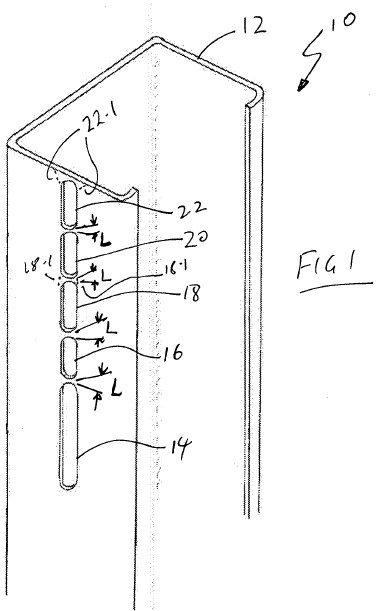
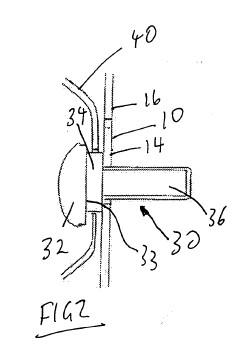
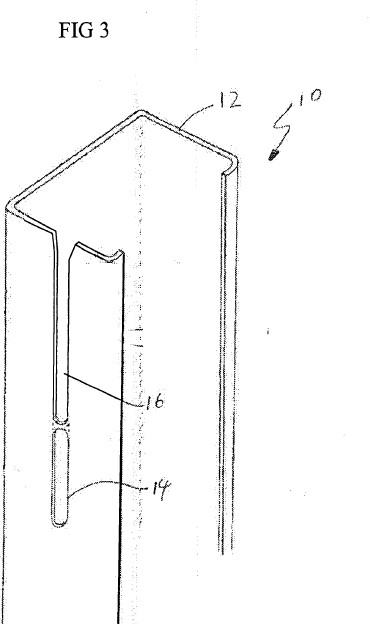
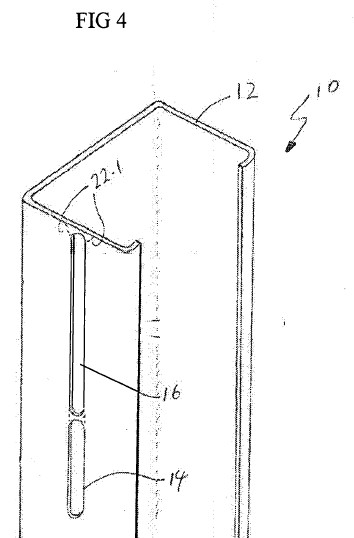
35 The Detailed Description of the Embodiment or Embodiments then provides:
[022] Illustrated in Figure 1 is a post 10 which is substantially of a C-shaped cross section 12. The post 10 has in one side an obround mounting hole 14 approximately 60mm in length and of a diameter or width being approximately the diameter of the threaded shank 36 of a bolt 30 as illustrated in Figure 2.
[023] Coaxially arranged between the upper end of the mounting hole 14 and the upper edge 12 of the post 10 is a series of four elongated obround slots or apertures 16, 18, 20 and 22 which extend, end to end, between the top of the hole 14 and the edge 12.
[024] The slots 16, 18, 20 and 22 are substantially the same width as the obround hole 14 and have their central longitudinal axes collinear with each other and with the central longitudinal axis of the mounting hole 14.
[025] Between adjacent hole 14 and slot 16, and slots 16 and 18, and slots 18 and 20, and slots 20 and 22, are lands L which are sized so as to enable a bolt 30 mounted in the mounting hole 14 if acted upon by a substantial upward force, such as may occur in a collision that the lands L will break or fracture, as a rail 40 is forced upward relative to the post 10 and the bolt 30 moves through the slots separating lands L or otherwise deforming them to fracture.
[026] If desired the lands L can be weakened by holes drilled or formed at either end of the land L or by weakened areas such as might be formed by V-shaped groove [sic] and the like. For example lines of weakness on the land L can be such as those illustrated as 18.1 in Figure 1.
[027] Whilst four slots 16 to 22 are illustrated a single slot with a single land between it and the top of the mounting hole 14 can be provided, giving a bolt 30 a clear run from the start of the single land L to the top of the post 12 as is illustrated in figure 3 and 4.
[028] Illustrated in Figure 2 is a cross section through a bolt 30, post 10 and rail 40 assembly. The bolt 30 utilised to mount rail 40 to the post 10 has a head 32, a reduced shank 34 and a further reduced diameter threaded shank 36. The shank 34 forms a shoulder which will not pass through the mounting hole 14 whilst the shank 34 allows the rail to slidably move along it between the underside 33 of head 32 and the external surface of the post 10 in the vicinity of the mounting hole 14.
[029] Such a bolt rail and post assembly will ensure that the rail is secured to the post 10 but is not clamped to the post 10 thus making it easier for the bolt 30 to slide relative to the post 10 in the mounting hole 14 and up through the lands L and through the adjacent slots towards the top edge 12 in the case of a collision.
[030] The last hole 22 can be provided as a much wider hole so that the nut which would secure the bolt 30 to the post 10 can simply pull through and escape from the post 10. Thus a large circular hole 22 can be provided or a square shape hole or slot being much larger than the external periphery of a nut or bolt head used to secure the rail 40 to the post 10.
[031] As an alternative the upper edge or land between the top edge of the slot 22 and the top edge of the post 12 can be removed such as shown by the dotted lines 22. l in Figure l or in Figure 3, allowing the bolt 30, once it reaches the hole 22 to simply slide off the end of the post 10 without having to engage another land L.
[032] Preferably the nut is torqued onto the bolt 30 so that the rail is secure, yet the rate of movement of the rail or the amount of force to move the rail relative the post will have to exceed a predetermined limit. Such a torque will need to be predetermined so that the rail will only move upwards when subjected to a force of collision of a predetermined amount so as to satisfy Australian and Overseas standards relating to such guard rail systems.
[033] Whilst the above embodiment shows a C-section post 10 other shape posts such as the "O" post known as the Ochoa post or other shape posts can be utilised with the present invention.
36 The specification then makes some general statements as to the way in which the reader is to approach it. In [034] it resolves any lingering confusion that may exist in understanding the word “comprising” which has been a familiar feature of patents in Australia for many years. Ingal places particular emphasis on the final two paragraphs of the specification:
[035] It will be understood that the invention disclosed and defined herein extends to all alternative combinations of two or more of the individual features mentioned or evident from the text. All of these different combinations constitute various alternative aspects of the invention.
[036] While particular embodiments of this invention have been described, it will be evident to those skilled in the art that the present invention may be embodied in other specific forms without departing from the essential characteristics thereof. The present embodiments and examples are therefore to be considered in all respects as illustrative and not restrictive, and all modifications which would be obvious to those skilled in the art are therefore intended to be embraced therein.
37 There are 13 claims included in the specification. For present purposes it is necessary only to identify claim 1, which is the only independent claim and the broadest of the claims (for convenience of reference, integer letters have been added to the claim):
(A) A post for a guard rail system including (B) an elongated mounting hole for the connection of a guard rail to said post, (C) said mounting hole being located at a predetermined distance below an upper edge of said post, (D) said post including one or more apertures or slots located above said mounting hole and at or below said upper edge, (E) said one or more apertures or slots being axially aligned with a central longitudinal axis of said mounting hole.
2.4 The external fair basis arguments
38 Safe Direction contends that the invention claimed in claim 1 of the Final Patent is not in substance disclosed in the Complete Patent. It submits that the case turns primarily on questions of patent construction and accepts that the scope for expert evidence on this subject is limited and does not depend on expert evidence to make out its case.
39 Safe Direction’s case is best understood having regard to claim 1 of the Final Patent, which is set out below (with integer numbers added) :
(1) A post and guard assembly (2) said post including an elongated mounting hole for connecting said guard rail directly to said post (3) by means of a bolt passing through said guard rail and said mounting hole (4) said mounting hole being located below an upper edge of said post, (5) said post including one or more apertures or slots spaced from said mounting hole and at or below said upper edge, (6) wherein one of said apertures or slots has a perimeter or peripheral length longer than the perimeter or peripheral length of said mounting hole.
40 Safe Direction contends that the Complete Patent discloses an invention which is a post for a guard rail system, or a guard rail assembly comprising such a post, having axially aligned apertures or slots located above the mounting hole (the axial alignment feature). It submits that a combination of claim 1 of the Final Patent including only integer (5) “said post including one or more apertures or slots spaced from spaced mounting hole and at or below said upper edge” does not adequately limit the scope of the invention claimed to meet the breadth of the disclosure in the Complete Patent. In particular, the breadth of that integer indicates that the claim covers a non-axially aligned configuration where the apertures or slots may be spaced adjacent to or even below the mounting hole. This, Safe Direction submits, claims matter not in substance disclosed in the Complete Patent.
41 Ingal submits that Safe Direction mistakes the nature of the matter disclosed in the Complete Patent. It contends that each of the elements of claim 1 of the Final Patent is identifiably present in the Complete Patent and that Safe Direction erroneously asserts that the axial alignment feature is disclosed in the Complete Patent as a mandatory component of the invention claimed therein. Ingal submits that s 114 does not involve the Court looking for essential integers or features or for “the invention” but for the disclosure in substance of “matter”. It contends that the Complete Patent is for a combination of features to achieve a controlled release of the post, but that it is not for a particular form of release mechanism. Insofar as the combination is concerned, Ingal submits that the Complete Patent discloses the use of an elongated mounting hole and one or more slots so as to facilitate the controlled release of the post from the guard rail, but that paragraphs [005] – [016] of the specification do not serve to confine the release mechanism of the post. In this regard, Ingal submits that the wording of the specification demonstrates that paragraphs [009], [010] and [011], when read together, provide optional embodiments and are not prescriptive. That is, the “land between adjacent slots can be frangible”; it “can include weakened areas or portions”; and the bolt can be but is not required to be adapted to tear or shear the land at the top of the mounting hole. Ingal submits that it is also significant that other release mechanisms are described in the specification, including the release of a bolt by moving vertically or axially through the last aperture or slot by exiting the top of the post and pulling the bolt through a much wider hole caused by a widened slot, as described in the Complete Patent at [030].
42 Ingal places emphasis on [035] of the specification, which indicates that the invention includes a combination of two or more of the individual features that are “mentioned or evident” and [036] which states that whilst particular embodiments have been described, it will be evident to those skilled in the art that the invention may be embodied in other specific forms without departing from its essential characteristics. Ingal relies on the evidence of Professor Grzebieta, who in his affidavit evidence expresses the opinion that the Complete Patent does not require the presence of the axial alignment feature for it to function in the desired manner. Professor Grzebieta gives evidence that the function of the apertures or slots is to create weaknesses in the land above, adjacent to or around the mounting hole. Ingal places particular emphasis on the following passage of Professor Grzebieta’s evidence:
…[A] configuration whereby the one or more slots are adjacent to or surround the mounting hole will, by reason of the frangible lands and/or weakened areas that arise from this configuration, facilitate the controlled release of the guard rail during a collision…
43 Ingal refers to Professor Grzebieta’s evidence to the effect that, having regard to the evident means by which the functional effect of the invention described is achieved, the disclosure of the Complete Patent includes a post with one or more slots or apertures positioned next to or surrounding the mounting hole together with the surrounding land tearing away from the post, causing the post to separate from the guard rail.
44 Ingal submits that the evidence of Dr Plaxico is consistent with that of Professor Grzebieta.
2.5 Consideration of external fair basis
45 In considering the matter disclosed in the Complete Patent, one must have regard to the entirety of the disclosure of that document as it would be understood by the person skilled in the art armed with the common general knowledge as at the relevant priority date. There was no dispute between the parties that both of the experts were suitably qualified, or that they approached their task in light of the relevant common general knowledge as at the relevant date.
46 The experts explain that the invention described in the Complete Patent is directed towards an improved post which assists the guard rail in better performing its function during a collision by allowing the guard rail to remain in place during a collision. This is done through the post being frangible or collapsible in a controlled manner as described in the specification. That is, the post releases the guard rail at an appropriate moment so as to facilitate redirection of the errant vehicle away from the hazard.
47 For present purposes the essential question is whether the Complete Patent made a real and reasonably clear disclosure of what was claimed as a result of the amendments; AstraZeneca at [242]. This involves first considering claim 1 of the Final Patent and then comparing that with the matter disclosed in the Complete Patent.
48 Claim 1 of the Final Patent is set out in [39] above. It is for a post and guard assembly consisting of a post that includes an elongated mounting hole for connecting the guard rail to the post using a bolt passing through the guard rail and the mounting hole, the mounting hole being located below the upper edge of the post and including one or more apertures or slots spaced from the mounting hole wherein one of the apertures or slots has a perimeter or perimeter length longer than that of the mounting hole. There is no dispute that the axial alignment feature is absent from this claim (and all other claims of the Final Patent, which are dependent on claim 1). The debate between the parties accordingly focusses attention on whether a combination that includes the limitations contained in that feature was in substance disclosed in the Complete Patent.
49 In my view the disclosure of the Complete Patent is of a post for a guard rail system and a guard rail assembly that consists of a number of features and which includes a limitation that the apertures or slots be located above the mounting hole and that they by axially aligned with a central longitudinal axis of the mounting hole (that is, the axial alignment feature). The apparent purpose of the particular alignment of the apertures or slots is, as Dr Plaxico said, to create a pathway for the bolt and the lands between these slots which are meant to create resistance by impeding the bolt’s upward movement through the slots. In reaching this view I have regard to the whole of the disclosure of the Complete Patent.
50 The Summary of the Invention provides the broadest description of the invention. It commences (at [004]) by informing the skilled reader that the invention provides a combination consisting of a post for a guard rail system that includes three requirements; first, that the post includes an elongated mounting hole for the connection of the guard rail to the post; secondly, that it includes one or more apertures or slots located above the mounting hole; thirdly, that the apertures or slots are axially aligned with the central longitudinal axis of the mounting hole. The second and third of these requirements contain the limitation present in the axial alignment feature.
51 The purpose of the axial alignment of the apertures above the mounting holes may be discerned from other parts of the specification and from the expert evidence. For example, in [011] the patent states that the land between adjacent slots is adapted to be torn or sheared by a bolt which is initially located in the mounting hole as the guard rail moves upwards relatively to the post during a collision. In the Detailed Description an embodiment described involves the coaxial arrangement of a series of slots or apertures 16, 18, 20 and 22 which are substantially the same width as the mounting hole 14. Each slot or aperture has its central longitudinal axis collinear with each other and the central longitudinal axis of the mounting hole. Between the mounting hole and the first slot and between each slot is a land L. In [25] the Detailed Description identifies that the lands L are sized so as to enable the bolt 30 that is located in the mounting hole to break or fracture the lands as the rail 40 is forced upwards in a collision. The Complete Patent goes on to describe (at [29]) that the post and rail assembly as described in Figure 2 will ensure that the rail is secured to the post 10 but is not clamped to it, thus making it easier for the bolt 30 to slide relative to the post “up through the lands L and through the adjacent slots towards the top edge 12 in the case of a collision”. The Complete Patent also refers to the use of a nut which is preferably torqued onto the bolt so that the rail will only move upward when subjected to a force of collision of a predetermined amount (at [32]).
52 It is apparent that the axial alignment feature of [004] serves the purpose of facilitating the controlled upward movement of the rail in the event of an errant vehicle coming into contact with it. This is the view of the experts. Professor Grzebieta (with whom Dr Plaxico agreed on this point) gives the opinion that the purpose of the lands between the apertures and slots is to allow “the guard rail to remain in place for as long as possible by its controlled released [sic] from the post, which in turn facilitates redirection of the errant vehicle away from the hazard”, and that making the lands between slots frangible or weakened in portions is to assist in that process.
53 Nothing in the language of the Summary of the Invention following [004] suggests that the invention does not include the limitation contained in the axial alignment feature. In [005] – [008] aspects of the apertures or slots first identified in [004] are described. In [009] – [011] aspects or the land between adjacent slots are described. The Summary then moves on to address the bolt and nut arrangement of the guard rail assembly already identified at [012]-[016]. Accordingly, it may be seen that each of [005] – [016] provides an additional detail or refinement to the broad statement of the invention as set out in [004]. In other words, the Summary of the Invention identifies the broad combination of features representing the combination of the “present invention” and the subsequent paragraphs refine or explain those features. Nothing in the Summary of the Invention suggests that the broad disclosure in [004], which specifically identifies the axial alignment feature, is but one embodiment of the invention disclosed.
54 Furthermore, nowhere in the disclosure of the Complete Patent is there a combination of elements where the apertures or slots are not mounted above the mounting hole and in axial alignment with the centre of the mounting hole.
55 Of course the embodiments are only examples of the invention described, and do not serve to limit its scope. But the specification of the Complete Patent is to be read as a whole in order to understand the matter disclosed, and the repeated references to upward force causing the bolt to move upward relative to the post (see [25]-[32]) reinforce the skilled reader’s understanding that the axial alignment of the mounting hole and apertures or slots is an indivisible part of the combination identified as the patentee’s invention. The arrangement of the mounting holes and slots depicted in Figures 1, 3 and 4 support that view.
56 Furthermore, the experts agree that the positioning of the slots or apertures relative to the mounting hole will determine which lands on the post are weakened or frangible. Such positioning will determine, during a collision: the release mechanism of the posts; the load (force) at which the release occurs; and the point in time during a collision at which the post will release the guard rail. That is, the configuration of the slots or apertures relative to the mounting hole will determine the manner in which the post facilitates the guard rail breaking away from the post so as to release the guard rail in a controlled way to facilitate redirection of the errant vehicle away from the hazard. As I have noted, the apertures serve to create a pathway for the bolt and the lands between these slots which are meant to create resistance by impeding the bolt’s movement through the slots.
57 This provides a technical explanation for the importance of the relative positioning of the mounting hole to the apertures and for the emphasis placed in the patent on the particular arrangements described. It confirms the importance of the affirmative disclosure in the specification of only apertures located above the mounting hole and the importance to be attached to the Statement of the Invention in [004]. It serves to reinforce the view that the patentee disclosed, and intended to disclose only a form of release mechanism that involves the axial alignment feature.
58 I note that the task upon which the Court embarks in considering the question under s 114 of the Act does not involve considering what is the invention disclosed in the Complete Patent but rather to consider and identify the “matter” disclosed in the Complete Patent. For this reason one must be cautious, in considering the breadth of the disclosure, in looking at the content of the claims of the Complete Patent - see Sigma at [78] (Bennett J) and [158] - [163] (Nicholas J). In the present case the question is to be answered having regard to the disclosure of the Complete Patent as a whole. It is possible for the body of a specification to describe matter that is not made the subject of a claim. For that reason it may be unsafe to consider the terms of the claims as indicative of the matter disclosed. For present purposes I do no more than observe that nothing in the claims of the Complete Patent suggests that the matter described is broader than that set out in the body of the specification.
59 I now turn to address specific aspects of Ingal’s arguments.
60 Ingal contends that it is a mistake to consider the disclosure of the specification by reference to an examination of what is “the invention” disclosed. This is because the test in s 114 calls for consideration of whether the claim is for “new matter” (A1 32). Ingal submits that each integer of claim 1 of the Final Patent can be discerned from the Complete Patent. The post and guard assembly of integer (1), post and elongated mounting hole of integer (2) and location of mounting hole beneath the upper edge of the post of integer (4) may be found in [004] of the Summary of the Invention. The bolt passing through the guard rail and mounting hole of integer (3) may be found disclosed in [013] – [016] of the Summary of the Invention and the spacing of the mounting holes of integer (5) may be discerned from figures 1, 3 and 4. The perimeter length of the apertures or slots of integer (6) are disclosed in figures 3 and 4. Accordingly, Ingal submits, the “matter” the subject of claim 1 of the Final Patent is disclosed.
61 In my respectful view, this argument overlooks the legal affinity to which I have referred in section 2.2 above between the test under s 114(1) for external fair basis and that which has been applied in the authorities for internal fair basis under s 40(3) of the Act. Although it may be accepted that a priority document may disclose more than one invention, and so one is not confined to consider what is the invention in the Complete Patent, nevertheless one must find a real and reasonably clear disclosure of the matter that is the subject of the amended claims in the Final Patent. In the present case this is not achieved by fishing around for separate integers and overlooking other material disclosures.
62 For the reasons given, in my view the Complete Patent discloses a combination that necessarily requires the inclusion of the axial alignment feature.
63 That is not to say that the specification does not describe alternative embodiments. Ingal is correct to observe that in one example (at [030]) the final release of the nut securing the bolt to the post occurs by the nut exiting through a widened slot at the top of the post that is much larger than the external periphery of the nut or bolt head used to secure the rail. However, that embodiment also describes how in the case of a collision the bolt 32 slides relative to the post 10 in the mounting hole 14 and up through the lands L and through the adjacent slots towards the top edge 12 of the post. Further, it is the “last hole” which is widened, further reinforcing the upward movement prior to exit. Accordingly, whilst in this embodiment the ultimate release of the nut from the final aperture or slot is not via upward movement, the axial alignment of the mounting hole with the apertures remains an integral part of it.
64 Ingal is also correct to observe that another embodiment might involve the bolt moving through a final open aperture or slot and out of the top of the post or alternatively, moving through a final land at the top of the post. However, these are each variants of the same invention, each utilising the same form of release.
65 Furthermore, the experts did not read the disclosure of the Complete Patent as requiring the apertures or slots to be precisely co-linear with the mounting hole, agreeing that it is a question of degree in each case depending on the positioning of the slots relative to each other and the mounting hole. However, both experts agreed that the tolerance for variation on axial alignment must be sufficient to permit the bolt to pass from one slot or mounting hole into the next adjacent slot.
66 Ingal advances an argument based on the contents of [035] and [036] of the specification. Ingal relies on Professor Grzebieta’s assessment of the function of the apertures or slots as being that they create weaknesses in the land above, adjacent to or around the mounting hole. Professor Grzebieta states in his evidence that the axial alignment of the apertures or slots with the elongated mounting hole is not required in order for the configuration to facilitate the guard rail breaking away from the post so as to release the guard rail in a controlled way. Ingal submits that it is evident from this and other similar evidence that, to those skilled in the art, the invention disclosed in the Complete Patent may be embodied in other specific forms whereby the weaknesses are created adjacent to or around the mounting hole, without departing from its essential characteristics. This, it submits, is permissible as a consequence of the invitation contained in [031], [036] of the Complete Patent.
67 In addressing this submission it is necessary to refer to the content of the joint expert report. In it, Dr Plaxico refers to and disagrees with Professor Grzebieta’s affidavit evidence to the effect that that the axial alignment of the apertures or slots with the elongated mounting hole is not required in order for the configuration to facilitate the guard rail breaking away from the post so as to release the guard rail in a controlled way. He expresses his understanding that the slots create a pathway for the bolt, and the lands between these slots are meant to create resistance by impeding the bolt’s movement through the slots. He notes that he is unable to identify anywhere in the Complete Patent where it describes an aperture position other than above and axially aligned with the mounting hole. In response Professor Gzrebieta disagrees that the intended function is “simply” to provide a pathway for the bolt. But he says that:
[He] is of the opinion that the slots also can be used to weaken land in the vicinity of the mounting hole. However, [he] agrees that the [Complete Patent] does not describe any other aperture position other than above the mounting hole and axially aligned with the mounting hole. However, it is [his] opinion that paragraphs [035] and [036] are suggestive that these features are not restrictive and may be varied, i.e. other aperture positions other than above and axially aligned with the mounting hole can be considered as alternative aspects of the invention.
(emphasis added)
68 The concession tied up in Professor Grzebieta’s observations in the joint expert report is that whilst a slot could be used in another way if differently arranged, the Complete Patent does not describe any such aperture arrangement or use.
69 Ingal and Professor Grzebieta’s reliance on [035] and [036] of the Complete Patent is misplaced. Those paragraphs do not provide a warrant to redefine the disclosure of the specification by reference to functional characteristics that are not disclosed in the description of the invention. Put another way, [35] and [36] serve to reinforce that the disclosure of the invention is not confined to the particular embodiments described. But they cannot be utilised to suggest that the patent is somehow broader than otherwise described. As Professor Grzebieta accepts in the passage from the joint report quoted above, the Complete Patent nowhere describes any aperture or slot position other than one that is in axial alignment with the mounting hole. Nor does the Complete Patent describe any principle of operation or the “function” that Professor Grzebieta mentions.
70 In my respectful view, the argument advanced by Ingal on the basis of this aspect of Professor Grzebieta’s evidence crosses the line between disclosure and inference. Professor Grzebieta accepts that the disclosure of the Complete Patent is of a guard rail in combination with the axial alignment feature, but infers that another way for the claimed invention to operate effectively would be to use the slots to weaken the land in the vicinity (next to or below) of the mounting hole. The inference is not disclosed in the Complete Patent.
71 It is now necessary to turn to claim 1 of the Final Patent which provides in its final two integers:
(5) said post including one or more apertures or slots located above said mounting hole and at or below said upper edge;
(6) wherein one of said apertures or slots has a perimeter or peripheral length longer than the perimeter or peripheral length of said mounting hole.
72 It may be seen that these final two integers contain no requirement that the apertures or slots be located ‘above’ the mounting hole and no requirement that they be ‘axially aligned’ with a central longitudinal axis of the mounting hole. Plainly enough the language of the claim places no constraint on the location of the apertures or slots. They may be located in a position that is not axially aligned with the longitudinal axis of the mounting hole and they may be located next to or below the mounting hole.
73 Accordingly, claim 1 (and the dependent claims) of the Final Patent claim matter that was not in substance disclosed as a result of amending the application; s 114(1) Act. The priority date of those claims must be determined under the Regulations, with the result that the priority date of the claims is the date of the filing of the amendments that resulted in the disclosure referred to in s 114(1); reg 3.14(b). By the agreement of the parties, this leads to the conclusion that the claims lack novelty and must be revoked.
2.6 The internal fair basis arguments
74 Safe Direction submits that by applying similar reasoning to that engaged in relation to the external fair basis issue, it should be concluded that the claims of the Final Patent lack internal fair basis within the requirements of s 40(3) of the Act. Safe Direction accepts that the language of [004] of the Final Patent reflects the language of claim 1, but submits that this is merely a “coincidence of language” of the type that the High Court in Lockwood at [87] recognised was not sufficient to confer fair basis. In particular, Safe Direction contends that none of the subsequent language in the Summary of the Invention discloses a mechanism for the release of the guard rail from the post other than that disclosed in the Complete Patent, and that mechanism for release is dependent entirely on the axial alignment feature. It submits that the disclosure of the Summary of the Invention in the Final Patent proceeds on the assumption that the bolt moves upwards from the mounting holes through lands ([007] and [011]) and that the detailed description does the same. In each case, the aperture is located above the mounting hole.
75 Ingal submits that the invention of claim 1 is disclosed in combination in [004] of the Final Patent, which is a consistory clause that is consistent with the disclosure of the balance of the Final Patent. Accordingly, all of the claims are fairly based.
2.7 The disclosure of the Final Patent
76 For the purpose of internal fair basis it is necessary to consider whether there is a real and reasonably clear disclosure of the invention claimed in the body of the specification. In the present case, this involves having regard to the combination set out in the claim and considering the language used in the Final Patent with fresh eyes, setting to one side the form that the specification took before amendment.
77 It is, however, possible to abbreviate my description of the content of the Final Patent, having regard to the contents of section 2.3 above. In this regard, it may be observed that the Field of the Invention and Background of the Invention sections of the Final Patent are the same as for the Complete Patent.
78 However, the Summary of the Invention has been materially altered by amendment. It now reads:
[004] The present invention provides a post and guard assembly said post including an elongated mounting hole for connecting said guard rail directly to said post by means of a bolt passing through said guard rail and said mounting hole, said mounting hole being located below an upper edge of said post, said post including one or more apertures or slots spaced from said mounting hole and at or below said upper edge, wherein one of said apertures or slots has a peripheral length longer than the peripheral length of said mounting hole.
[005] The one or more apertures or slots can be elongated closed slots.
[006] The one or more apertures or slots can be elongated open slots.
[007] A last slot before or at said upper edge can be an open slot.
[008] There may be only one aperture or slot spaced from said mounting hole.
[009] The land between said mounting hole and said one or more apertures or slots can be frangible.
[010] The land between adjacent slots can include weakened areas or portions.
[011] The land between said mounting hole and said one or more apertures or slots can be able to be torn or sheared by a bolt which is initially located in said mounting hole as the guard rail moves upwards relatively to said post during a collision.
[012] One of said one or more apertures or slots before or at said upper edge can have a width that is larger than a width of the preceding slot or aperture, to allow a bolt securing said guard rail to said post to pass through said last slot or aperture.
[013] The rail can be bolted to said post by a bolt and a nut.
[014] The bolt can include a head and a first shank portion which is unthreaded and a second shank portion which is threaded for securing said rail to said post with a nut, said bolt being characterised by said first shank portion being substantially larger in diameter than said second shank portion whereby an external face of said first shank portion will bear against a surface of said post in the vicinity of said mounting hole.
[015] The first shank portion can slidably secure said rail to said post so that said rail is free to move between said head and an external surface of said post.
[016] The bolt can be attached to said post after being threaded through said rail with a nut that is tightened to a torque which has been predetermined.
[017] More than one of said one or more apertures can be present, and a combined perimeter or peripheral length of said apertures or slots can be longer than the perimeter or peripheral length of said mounting hole.
79 The description of the drawings and detailed disclosure of the embodiments are in materially the same form as set out in section 2.3 above.
2.8 Consideration of internal fair basis
80 The requirement that a claim be fairly based within s 40(3) is that there be a “real and reasonably clear disclosure” of what is claimed. As the High Court emphasised in Lockwood, the invention must be broadly described in the body of the specification and not travel beyond the matter disclosed. This does not involve an analysis of the inventor’s rights to the invention, but an analysis of whether, as a matter of drafting, the claims can be said to reflect what is disclosed or stated in the body of the specification.
81 In the case of the Final Patent there is no doubt that the specification discloses all of the features of claim 1. That is, [004] describes as the “present invention” a post and guard assembly with a post including an elongated mounting hole for connecting the guard rail directly to said post using a bolt passing through the guard rail and mounting hole, the mounting hole being located below an upper edge of said post with the post including one or more apertures or slots spaced from the mounting hole and at or below the upper edge where one of the apertures or slots has a perimeter or peripheral length longer than the perimeter or peripheral length of the mounting hole. Each of these features is present in claim 1.
82 This has the consequence that Safe Direction must contend that, despite this disclosure, the invention as described in the specification is to be understood to be narrower than the content of [004]. It submits that the bolt of the invention disclosed in the body of the specification must nevertheless utilise the axial alignment of slots with a central longitudinal axis of the mounting hole. In this regard Safe Direction relies on the fact that the test for fair basis is one of substance and does not depend solely on a matching of words, but an understanding of the disclosure as a whole. It relies on Lockwood at [99] (citations omitted):
Doric submitted that Olin decided that a claim based on a consistory clause cannot be fairly based. It did not. Rather, as the Patentee submitted, the correct position is that a claim based on what has been cast in the form of a consistory clause is not fairly based if other parts of the matter in the specification show that the invention is narrower than that consistory clause. The inquiry is into what the body of the specification read as a whole discloses as the invention. An assertion by the inventor in a consistory clause of that of which the invention consists does not compel the conclusion by the court that the claims are fairly based nor is the assertion determinative of the identity of the invention. The consistory clause is to be considered by the court with the rest of the specification.
83 The difficulty for Safe Direction is that, contrary to its contention, other parts of the specification do not show that the invention is narrower than that described in the consistory clause. The language of the balance of the Summary is sufficiently open to allow for movement of the bolt in a direction that is not axially aligned with a central longitudinal axis of the mounting hole. None of the language of the summary mandates that the bolt must move upwardly. In [008] the optional requirement that one aperture or slot may be “spaced from” the mounting hole is consistent with the broader disclosure, and [011] is not expressed in language that unequivocally requires the bolt to move upwards (the land between mounting hole and aperture or slots can be torn by a bolt initially located in the mounting hole as the guard rail moves upwards).
84 Furthermore, the embodiments described and depicted in the balance of the specification do not assist Safe Direction’s submission. In short, nothing in the description of these embodiments suggests that the invention is not as described in the consistory clause.
85 Accordingly, in the event that the claims of the Final Patent are found to have an earlier priority date and therefore not to be invalid for want of novelty, in my view they would not be invalidated for want of internal fair basis.
3. LIABILITY OF MR WALLACE
3.1 Introduction
86 For the reasons set out in section 2.5, I have concluded that the Final Patent is invalid for want of novelty. I now turn to consider whether Mr Wallace would be liable either as a joint tortfeasor with Safe Direction or for authorising the conduct of Safe Direction in the event that I am wrong in my conclusion as to invalidity. In what follows, where I refer to the “infringing conduct of Safe Direction” or the like, I mean infringement by the importation, manufacture, sale and supply (and offers thereof) of the RamShield Product that, for present purposes, I shall assume is an infringing product.
3.2 The arguments
87 Ingal pleads that Mr Wallace is liable for authorising the infringing conduct of Safe Direction and for directing or procuring or otherwise participating in, being a party to, or joining in a common design with respect to Safe Direction’s infringing conduct and in so doing is liable as a joint tortfeasor. In respect of both, Ingal pleads that Mr Wallace has since 23 March 2012 been a Director and Company Secretary of Safe Direction with the carriage and control of the business of Safe Direction.
88 Ingal submits that the RamShield Product was Mr Wallace’s conception and design and that his involvement in it was “totally hands on” such that it can be concluded that he had a close personal involvement with it. It further contends that at least since 15 December 2015, when a letter of demand was sent, Mr Wallace had direct knowledge of the Final Patent and it may be inferred that he knew of it before then.
89 Ingal most particularly emphasises joint tortfeasorship. It relies on the decision of the Full Court in JR Consulting & Drafting Pty Ltd v Cummings [2016] FCAFC 20; 116 IPR 440 (Bennett, Greenwood and Besanko JJ) (JR Consulting) for the proposition that liability of a director requires that there be concurrence in the acts of both the company and the director causing the damage, rather than mere coincidence of roles. It submits that ultimately the director must be shown to have directed or procured the tort and gone beyond causing the company to make a commercial or business course of action that merely involves the discharge of the director’s duties and obligations. The additional component required is a “close personal involvement” in the infringing conduct.
90 In relation to “authorisation” Ingal contends that the decision of Bennett J in Inverness Medical Switzerland GMBH v MDS Diagnostics Pty Ltd [2010] FCA; (2010) 85 IPR 525 (Inverness) demonstrates the requirements, and that the existence of a power to prevent the infringing conduct is not a pre-requisite to a finding of authorisation under s 13(1) of the Act. It contends that whilst the decision of Beach J in Streetworx Pty Ltd v Artcraft Urban Group Pty Ltd [2014] FCA 1366; (2014) 110 IPR 82 (Streetworx) suggests a different and “overly broad” approach, the debate as to power to prevent is arid; because, on the facts of the present case, Mr Wallace did have practical power to do so.
91 Mr Wallace submits that at all relevant times Safe Direction has had a structure whereby its shareholders have controlled the company and its business, including in respect of the RamShield Product, pursuant to a confidential shareholders’ deed. Mr Wallace owns shares in a company that in turn has been 1 of 3 or 4 shareholders in Safe Direction from time to time. Although he has at all relevant times been a Director and the salaried Managing Director of Safe Direction, he has at all times been answerable to the shareholders in respect of the RamShield Product. In this regard, Mr Wallace emphasises that at no relevant time has he had the power to prevent Safe Direction’s exploitation of the RamShield Product and therefore to authorise that conduct. Furthermore, he has only been involved in Safe Direction’s exploitation as an employee and as a consequence, he is not a joint tortfeasor.
92 Mr Wallace resists Ingal’s arguments by directing attention to different aspects of the test for joint tortfeasorship as set out in JR Consulting and emphasising the requirement that the context must be such that the director is effectively standing apart from the company and directing or procuring it as a separate entity. In relation to the act of authorising infringement, Safe Direction places emphasis on the reasoning, inter alia, of the High Court in Roadshow Films Pty Ltd v iiNet Ltd [2012] HCA 16; (2012) 248 CLR 42 (Roadshow) at [69] where it was found (in the context of a copyright infringement case) that a person may not be said to “authorise” unless that person has a power to prevent the primary infringements.
3.3 The relevant law
Joint tortfeasor
93 In Inverness, the Court considered the liability of a director of a company that had been found to infringe a patent for certain medical devices. Bennett J observed that several tests had been propounded in the authorities and that two had received particular favour, with neither being preferred.
94 One was propounded by Lindgren J in Microsoft Corporation v Auschina Polaris Pty Ltd [1996] FCA 1069; (1996) 71 FCR 231 at 246, namely whether the director ‘directed or procured the infringing act’ (the Auschina test) (applying Performing Right Society Ltd v Ciryl Theatrical Syndicate Ltd [1924] 1 KB 1 at 15 per Lord Aitkin).
95 The second arose from a decision of the Canadian Federal Court of Appeal in Mentmore Manufacturing Co Ltd v National Merchandising Manufacturing Co Inc (1978) 89 DLR (3d) 195 which had been the subject of favourable consideration, but not direct application, in two Full Court decisions concerning copyright infringement; Allen Manufacturing Co Pty Ltd v McCallum & Co Pty Ltd [2001] FCA 1838; (2001) 53 IPR 400 and Cooper v Universal Music Australia Pty Ltd [2006] FCAFC 187; (2006) 156 FCR 380 (Cooper). That test involved asking, whether “the director made the infringing conduct his own in the sense that the director deliberately, wilfully or knowingly pursue[d] a course of conduct that was likely to constitute infringement or that reflected indifference to the risk of infringement” (Mentmore test). Her Honour noted at [182]-[183] that the mental element of this test needs to be properly understood when considered in the context of patent infringement, where there is no necessary mental element such that the test of deliberately, wilfully or knowingly pursuing a course of conduct likely to infringe must relate to the pursuit of the course of conduct, not to its characterisation. Accordingly the question posed was whether the director (at [183]):
…knowingly pursued a course of conduct which, judged objectively, led to infringement or was likely to constitute infringement, or reflected indifference to the risk of infringement.
96 In the context of that case, her Honour applied both the Mentmore test and the Auschina test when she concluded at [192]:
I am satisfied that Dr Appanna’s position as the Managing Director of MDS NZ and his participation in the procurement and distribution of the MDS devices in New Zealand and Australia are sufficient to establish that he deliberately, wilfully or knowingly pursued a course of conduct that resulted in MDS selling products that infringed the Inverness patents. Further, he was aware of competing products on the market and was indifferent as to whether or not those products were protected by patents. In taking part in the activities of MDS NZ and MDS Aus as a director and in the management of those companies, Dr Appanna directed or procured the obtaining of and the selling of the products that infringed Inverness’ patents. Accordingly, he is liable under both the Mentmore test and the Auschina test.
97 The most recent Full Court decision on the subject of joint tortfeasorship is JR Consulting. There, in the context of a finding of copyright infringement, the Court at [344]-[346] approved the approach set out in Inverness and also the approach taken by the Full Court in Keller v LED Technologies Pty Ltd [2010] FCAFC 55; (2010) 185 FCR 449 (Keller) at [290] and [291] (Besanko J) and at [404] (Jessup J) before observing at [347]:
In other words, unless the director is standing apart from the company, there will not be concurrence in the acts but merely a coincidence of roles in which the only true actor is the company itself.
98 The Court then referred to the different tests proposed by different courts, including the Mentmore test, the Auschina test and the views of the Court in Cooper, before concluding at [350] that there is not ultimately a great deal of difference between these lines of authority as the director:
…must be shown to have directed or procured the tort and the conduct must, clearly enough, go beyond causing the company to take a commercial or business course of action or directing the company’s decision-making where both steps are the good faith and reasonable expression of the discharge of the duties and obligations of the director, as a director. The additional component required is a “close personal involvement” in the infringing conduct of the company and inevitably the quality or degree of that closeness will require careful examination on a case by case basis.
(original emphasis)
Authorising patent infringement
99 It is an infringement of the exclusive rights of a patentee to exploit the invention and to authorise another person to do so; s 13(1) of the Act. The word “authorise” in s 13(1) has been found to have the same meaning as given to it under the Copyright Act 1958 (Cth) (Copyright Act); Bristol-Myers Squibb v FH Faulding [2000] FCA 316; (2000) 97 FCR 524 at [97] (Black CJ, Lehane J). This approach has been applied in the context of patent infringement in a number of first instance decisions of the Court, including Inverness at [194]; Kimberly-Clark Australia v Arico Trading [1998] FCA 1103; (1998) 42 IPR 111 at 129; and more recently in Streetworx at [390] – [396].
100 The word “authorise” has been held judicially to mean “sanction, approve, countenance”; University of New South Wales v Moorhouse [1975] HCA 26; (1975) 133 CLR 1 (Moorhouse) at 12 (per Gibbs J); at 20 (Jacobs J, McTiernan ACJ agreeing at 7). In the copyright context, it has been held that a person may not be said to “authorise” unless that person has a power to prevent the primary infringements: Adelaide Corporation v Australasian Performing Right Association Ltd [1928] HCA 10; (1928) 40 CLR 481 at 498-499, 503, 505; Moorhouse at 12; Roadshow at [69]. In Streetworx, Beach J applied this in the context of patent infringement finding (at [392]) that a person may not be said to “authorise” infringing conduct unless he or she at least has a power to prevent the particular conduct, citing Moorhouse. Ingal submits that his Honour’s statement to this effect is too broad and should not be followed. However, in my view his Honour’s conclusion is unsurprising in light of the acceptance by this Court that the meaning to be ascribed to “authorise” under the Act is the same as that found under the Copyright Act. I do not consider that approach to be plainly wrong and will apply it here.
3.4 Findings in relation to Safe Direction and the role of Mr Wallace
101 The evidence concerning the involvement of Mr Wallace in the affairs of Safe Direction, and the production of the RamShield Product, is set out in a set of admissions made on Mr Wallace’s behalf prior to the hearing, the affidavit and oral evidence of Mr Wallace, and documents tendered during the course of the hearing. These materials permit the following findings to be made.
102 Mr Wallace has since 23 March 2012 been one of two directors and the company secretary of Safe Direction and in that capacity has managed the business of Safe Direction. At all times, he has been paid a salary as an employee of the company. Mr Wallace as managing director supervises a business development director, office administrator and managers or supervisors dealing in the areas of sales and warehousing matters. The second director of Safe Direction is Terrence Charles Colquhoun, who is also experienced in the production and sale of road safety products and is Safe Direction’s business development manager. Mr Colquhoun is also indirectly a shareholder of Safe Direction, through North End Investments Pty Ltd (of which Mr Colquhoun is the director, secretary and sole shareholder).
103 Mr Wallace is the inventor of a patent the claims of which it contends cover the RamShield Product, invented the design of the RamShield Product, developed the concept of that product and managed the product development process of that product at Safe Direction. Furthermore, he wrote the specifications for the machinery used to produce the RamShield Product, including specifying the arrangement of the holes. The manufacturing supervisor for that product in Australia reported to Mr Wallace and Mr Wallace has procured the third-party testing of the product and managed that process. He has also had some limited involvement in the process of obtaining regulatory clearance for the RamShield Product.
104 Furthermore, Mr Wallace has, amongst other employees of Safe Direction, been involved in the promotion of the RamShield Product, demonstrated it to customers, provided quotes to prospective customers for the supply of the RamShield Product, accepted orders from customers for the sale of that product and made arrangements for the supply by Safe Direction of the product to customers. It was Mr Wallace who came up with the name “RamShield”.
105 Mr Wallace is also the contact for the bank in respect of Safe Direction’s trade finance facility and asset finance loan facilities which are used to operate the business of Safe Direction for purposes including the manufacture of the RamShield product.
106 In a website utilised by Safe Direction for promotional purposes, Mr Wallace is described as the founding director and a major shareholder of Safe Direction and as the inventor of numerous international patents for road and vehicle safety barrier systems including the RamShield Product.
107 Mr Wallace was also the sole inventor of the invention that is the subject of the Complete Patent, but left Ingal prior to the amendments that gave rise to the Final Patent.
108 In his affidavit evidence Mr Wallace explains the shareholding of Safe Direction. When Safe Direction was founded in March 2012, its sole shareholder was a company called LOIE Investments Pty Ltd (Investments), which is the trustee for the Wallace family trust. Mr Wallace and his wife are the sole shareholders of Investments and Mr Wallace is its sole director. From May 2012 various other people acquired shares in Safe Direction and since May 2012 the shareholding of Investments in Safe Direction has ranged from between 30% to 40% of the company and there have been between 3 and 4 shareholders. The identity of certain shareholders in Safe Direction is confidential. By consent of the parties, suppression orders have been made concerning this and other aspects of the internal operations of the company.
109 In August 2012 Safe Direction applied for a provisional application concerning the technology used in the RamShield Product. On 4 April 2013 Safe Direction applied for a standard patent covering the RamShield Product and that patent was subsequently granted on 2 January 2014. On 15 January 2014 Mr Wallace emailed the shareholders to notify them of the grant of the patent and then proceeded to undertake prototyping of the release mechanism within the RamShield product in early to mid-2014. On 6 May 2014 he sent an email to one of the shareholders seeking input into the practicality of manufacturing the proposed RamShield Product and profile cutting of the hole arrangement. In July 2014 the shareholders approved Safe Direction proceeding with the initial post design for the product, and on 28 July 2014 Mr Wallace sent an email to the same shareholder, attaching the final post design.
110 An initial production run of RamShield posts was made in China, and Safe Direction received those posts in October 2014. In October 2014 Safe Direction purchased a roll-forming machine used to manufacture guard rail product. The purchase at the time did not include the tooling for the RamShield Product because the development of the product was not yet completed, although the shareholders planned to purchase the tooling.
111 Initial crash testing of the RamShield Product was successfully conducted in December 2014 in New Zealand. The documentary evidence indicates that the shareholders were aware of, and agreed to these steps.
112 In March 2015 Safe Direction took steps to obtain financing for the acquisition of the roll-forming machine and tooling necessary to make the RamShield Product, and on 15 April 2015 the purchase of the tooling was completed. The documentary evidence indicates that the shareholders were informed of the steps involved in that process, and approved of them.
113 Following the successful completion of crash testing in December 2014 the RamShield Product was submitted for assessment by the Australian Safety Barrier Assessment Panel (ASBAP). That application was submitted on 14 April 2015 by Mr Terrence Colquhoun. ASBAP approval is required as a pre-cursor to obtaining regulatory approval from individual State road authorities for use of the barrier system on road networks.
114 The first sale of the RamShield Product took place in April 2015. Prior approval by the ASBAP or State road authority was apparently unnecessary for this sale because it was for use in a mine access road.
115 The design of the RamShield Product was modified during the period from October 2014 until about May 2015. The final ASBAP approval for the RamShield Product was in December 2015.
116 During the course of cross-examination there was some suggestion that Mr Wallace did not require the approval of the shareholders for the design of the post. However, Mr Wallace explained that, as a small and new company, embarking on the development of the post was a significant investment with a high degree of risk. Once the design was settled the post would be put through crash testing, the costs of which were significant and would be lost if the crash testing failed. The interest of the shareholders in that activity was acute. I accept that explanation.
117 I am satisfied, having regard to the evidence of Mr Wallace and the confidential documentary evidence that there was regular dialogue between the shareholders in relation to the design, testing, importation and manufacture of the RamShield product.
118 Since May 2016 Safe Direction has manufactured the RamShield Product in Australia.
119 Mr Wallace gives unchallenged evidence that the RamShield Product is central to the operation of the business of Safe Direction and that the company has invested in excess of $1.5 million in the development, importation, manufacturing and marketing of the product. This has included investing in roll forming machinery, which involved a capital outlay of approximately $900,000 in investment and investing in crash testing and crash validation tests for RamShield Product, which have cost in excess of $200,000. Safe Direction holds a current inventory of RamShield posts and associated raw materials used to produce RamShield posts to the value of $628,000. Mr Wallace gives evidence that Safe Direction’s current inventory holding of the product represents about 28% of the total inventory value held by the company.
3.5 Consideration
120 I have not recited all of the correspondence and other evidence concerning the operations of Safe Direction. However, in my view the evidence reveals that Safe Direction is a small company in which the directors and shareholders have an active interest in the operations of the business. Mr Wallace does not stand alone as the guiding mind of its operation, but rather engages in active collaboration with the other directors and shareholders, of which there were 3 in total in October 2014 and 4 in total after 3 June 2015. Mr Colquhoun, is also a co-director.
121 Safe Direction had sold a version of the Ramshield Product by April 2015 and continued to offer and sell the RamShield Product from that date. Thereafter, modifications were made to the product, the design being finalised in about May 2015. Final ASBAP approval was obtained in December 2015 and approval from other State road authorities was being sought as at January 2016. In arriving at that point it had committed internally (if not contractually – there is no evidence as to this) to the acquisition of expensive tooling to enable it to manufacture the product in Australia itself. It had spent considerable amounts on the development, design and testing of the product. All of these actions were significant events in the life of the fledgling company.
122 In his affidavit evidence Mr Wallace states that he has not and does not personally have the power to prevent the manufacture, sale, offering for sale, supply, importation or keeping by Safe Direction of the RamShield Product because of the terms of a Shareholders Deed (Deed) that was entered in about September 2014. That assertion does not establish the legal effect of the Deed, but it is relevant to Mr Wallace’s state of mind. The Deed provides in clause 7.7(a)(ii) that the company must not cease any material business operation of the company or make a material change to the nature of the business of the company without the approval of the shareholders by special resolution. A special resolution (broadly) requires a vote of 75% of the shareholding in its favour. The “business” involves the importing, manufacturing, marketing, selling and distributing of guard rail for use in roading.
123 No doubt as a Director and as the Managing Director Mr Wallace has the power to make day to day decisions on behalf of Safe Direction. However, it is apparent from the terms of the Deed that his power is constrained to ensure that the essential or “material” operations of the company are guided by its shareholders. There is of course room for disagreement as to what operation may or not be “material”. However, I have no doubt that the decisions to manufacture, sell, offer for sale, supply, import or keep the RamShield Product, were “material” in the requisite sense and that decisions to cease doing any of these things would likewise be material. Decisions to engage in these acts were made by the shareholders collectively, and not by Mr Wallace alone. The terms of the Deed, the evidence of consultations amongst the shareholders via email and Mr Wallace’s evidence support that conclusion.
124 All of those decisions were made by about May 2015. The amendment of the claims of the Complete Patent were sought on 18 May 2015. There is no evidence to suggest that Mr Wallace became aware of the amended claims (which were amended after his departure from Ingal) until 15 December 2015, when Ingal caused a letter before action to be sent to Safe Direction. By that time the course of Safe Direction had been well and truly set. The terms of the Deed required that there be a special resolution by the company to cease a material business operation of the company, which by 18 May 2015 and 15 December 2015 included any of the acts of importation, manufacture, sale or offering to sale of the RamShield Product.
125 Ingal submits that a number of the obligations under the Deed were not performed by the shareholders, such as the failure on the part of shareholders to conduct bi-monthly management meetings or to maintain minutes of board meetings. It also points to an absence of documents produced by Safe Direction and Mr Wallace that might indicate that it was the shareholders and not Mr Wallace who made decisions on behalf of the company. However, whilst these matters might suggest that Safe Direction and its shareholders did not attend to all of the formalities, they do not address the substance of clause 7.7(a)(ii) of the Deed and the evidence that was adduced by Mr Wallace concerning his interactions with the shareholders.
126 In my view the evidence demonstrates that the other director and the shareholders were actively engaged in the larger decision making of the company including in the conduct in respect of which Ingal contends Mr Wallace is liable as a joint tortfeasor or for authorising infringement. The position is quite different factually to that of Inverness and JR Consulting. Leaving aside the other matters to which I have referred, by reason of clause 7.7(a)(ii) of the Deed, Mr Wallace did not have the power to prevent the infringing conduct. That is sufficient to resolve the authorisation case in favour of Mr Wallace.
127 The same conclusion applies to the question of joint tortfeasorship, even though I accept that the power to prevent infringing conduct is not a requirement for that cause of action. Mr Wallace has not been shown to have directed or procured the infringement. His conduct did not go beyond causing the company to take a business course of action that amounted to the good faith and reasonable expression of the discharge of his duties and obligations as a director.
4. ADDITIONAL DAMAGES FOR PATENT INFRINGEMENT
128 Ingal seeks an additional amount in an assessment of damages for infringement pursuant to s 122(1A) of the Act. Although the assessment of quantum has been separated from liability, the parties agree that it is appropriate for the Court to determine whether, in the event of a finding of infringement, Safe Direction’s conduct has attracted the operation of s 122(1A).
129 Ingal alleges that Safe Direction has engaged in flagrantly infringing conduct. In its written closing submissions Ingal contended that although Safe Direction commenced the design of the RamShield Product before the Complete Patent was amended, it did not finalise the design until afterwards. However, that allegation was not notified to Safe Direction in any particulars and objection was successfully taken during cross-examination to questions concerning this point. Ingal then contends that Safe Direction was notified by letter before action of Ingal’s allegations of infringement on 15 December 2015, and yet after that date Safe Direction obtained final approval from ASBAP and was only then able to sell the RamShield Product for use on the State road networks. Furthermore, in May 2016, five months after being notified of the alleged infringement, Safe Direction began manufacturing the RamShield Product in Australia. Ingal submits that Safe Direction took a calculated risk in the pursuit of its own benefits in disregard of Ingal’s rights in circumstances where Ingal had made a credible assertion of its own rights. It submits that an award of additional damages is necessary and appropriate in order to deter Safe Direction and others in a similar position from engaging in a similar course of conduct.
130 Section 122(1A) provides:
A court may include an additional amount in an assessment of damages for an infringement of a patent, if the court considers it appropriate to do so having regard to:
(a) the flagrancy of the infringement; and
(b) the need to deter similar infringements of patents; and
(c) the conduct of the party that infringed the patent that occurred:
(i) after the act constituting the infringement; or
(ii) after that party was informed that it had allegedly infringed the patent; and
(d) any benefit shown to have accrued to that party because of the infringement; and
(e) all other relevant matters
131 In Zetco Pty Ltd v Austworld Commodities Pty Ltd (No 2) [2011] FCA 848 Bennett J said at [267]-[268]:
More than copying is required to enliven the application of s 122(1A). Patent infringement may occur whether or not there is copying. However, deliberate copying may be relevant to a decision whether to award additional damages. As in the application of s 115(4) of the Copyright Act 1968 (Cth), there must be an additional element to the infringing conduct to warrant additional damages (as in Raben Footwear Pty Ltd v Polygram Records Inc (1997) 75 FCR 88 at 93 per Burchett J and 103-104 per Tamberlin J and Sullivan v FNH Investments Pty Ltd (2003) 57 IPR 63 at [91]). Austworld maintains that there is no evidence of flagrancy of infringement or of a calculated disregard of Zetco’s rights to enliven the Court’s discretion to award such damages (MJA Scientifics International Pty Ltd v SC Johnson & Son Pty Ltd (1998) 43 IPR 275 at 281-282). Austworld has at all times denied patent infringement and has maintained its contention that the Patent is invalid. It cross-claimed for revocation of the Patent. The right to file a cross-claim arises from s 138 of the Act and by reason of Austworld’s position as a defendant in infringement proceedings (s 121 of the Act). As part of its continued assertion of invalidity, Austworld earlier sought a re-examination of the Patent in the Patent Office under chapter 9 of the Act.
Zetco says that ‘the only defence put forward is invalidity’. That, however, is hardly unusual where patent infringement is asserted, even where infringement is admitted. At the hearing, the basis of that defence seemed to rely in a large part on the evidence of Mr Morris. That evidence was only adduced on the first day of the hearing. However, the defence of invalidity was at all relevant times based on the AVG Quickie Valve and the other prior art valves, as well as obviousness. It cannot be said that the invalidity case was hopeless or improperly pursued. In my view, an unsuccessful defence of invalidity is not of itself sufficient to warrant the award of additional damages.
132 In my view Ingal has not established that it is entitled to additional damages for the following reasons. First, no evidence suggests that Mr Wallace or anyone else affiliated with Safe Direction had any knowledge of the amendments that were to be made to the Complete Patent until they were notified by Ingal’s letter before action on 15 December 2015. There is no suggestion that the RamShield Product was a copy of a product that embodies the claims of the Final Patent. Indeed, the Final Patent (as amended) was not advertised until 2 July 2015 and there is no evidence that Safe Direction became aware of it on that date. Secondly, upon receipt of the letter before action, Safe Direction raised a substantial defence to the allegation of infringement in the form of the external fair basis argument. Even on the hypothesis that my conclusions on that subject are wrong, it was certainly not a hopeless or improperly pursued defence. Thirdly, the decision on the part of Safe Direction to continue to pursue its own commercial interests in the face of allegations of infringement that objectively could be considered to be defensible is unlikely to amount to conduct that will attract an award of additional damages. Fourthly, the conduct of Safe Direction in continuing to market and sell the RamShield Product does not have the flavour of reprehensible conduct of the type that warrants an award of additional damages.
133 Taken together I am not satisfied that Ingal would be entitled, upon a finding of infringement, to an award for additional damages.
5. THE AUSTRALIAN CONSUMER LAW CLAIM
134 Ingal pleads that by reason of the offer for sale, sale, distribution, advertisement, supply, exhibition and promotion of the RamShield Product, Safe Direction has made a representation in trade or commerce to consumers, including local government authorities, that the purchaser will have a right to use the RamShield Product. In Ingal’s submission, this claim will stand or fall on the Court’s findings as to patent infringement. Again, consideration of this point proceeds on the hypothesis that my findings of patent invalidity are incorrect.
135 The area of dispute between the parties distils to the question of whether Ingal needs to plead and prove that Safe Direction made a separate representation to the effect that it has pleaded. Ingal says that it does not, and that it can rely on the broad fact that a representation necessarily must arise “expressly or implicitly” from the fact of the offer for sale, sale, distribution, advertisement, supply, exhibition or promotion of the RamShield product. In support of this proposition it relies on the decision of the Full Court in Ramset Fasteners (Aust) Pty Ltd v Advanced Building Systems Pty Ltd [1999] FCA 898; (1999) 164 ALR 239 (Ramset) at [67] and the decision of Jessup J in Sandvik Intellectual Property AB v Quarry Mining & Construction Equipment Pty Ltd [2016] FCA 236; (2016) 118 IPR 421 (Sandvik) at [272] – [277].
136 Safe Direction submits that neither of the cases cited support the generality of the proposition put. It submits that in those cases the pleaded case was of misleading or deceptive conduct by reason of mere silence or a failure to warn, whereas in contrast Ingal has pleaded a positive but implicit representation to the effect that, in the circumstances of a sale of the RamShield Product, the reasonable the purchaser would understand that it has a right to use the RamShield Product.
137 Further, Safe Direction submits that, in any event, Ingal’s case would fail because the representation, if made, was a statement of law made by a company professing to have no legal expertise and in those circumstances would only be misleading if it was not honestly held.
138 Section 18 of the ACL might enable a statement of law to amount to misleading or deceptive conduct, but it depends on the circumstances. McPherson JA said in Heydon v NRMA Ltd [2000] HCA 374; (2000) 51 NSWLR 1 at [431]:
A statement or representation which at common law might not perhaps give rise to liability because it is not one of fact, but of law or of opinion only, may nevertheless amount to “misleading conduct” for the purpose of s 52: see SWF Hoists & Industrial Equipment Pty Ltd v State Government Insurance Commission (1990) 6 ANZ Ins Cas ¶61-002; (76,688). That is because the effect of a representation falls to be judged under s 52 not, as at common law, by the state of mind or intention of the maker of the statement, but according to its effect or likely effect or impact on the person to whom it is directed: see Yorke v Lucas (1985) 158 CLR 661 at 666. However, in assessing its impact, a statement that is false is not necessarily misleading if, for example, it does no more than impart information apparently being passed on, for what it is worth, from another source without any concomitant belief in its truth or falsity: Yorke v Lucas (at 666); or if it is recognisable as an opinion that is not proffered or represented as necessarily being correct. In Inn Leisure Industries Pty Ltd (Prov liq app) v D F Mc Cloy Pty Ltd (1991) 28 FCR 151 at 167, French J said that:
…Expert advice as to the law may convey the representation that it is based upon an underlying body of knowledge, experience or expertise possessed by the person proffering it or to which that person has access. The situations in which advice, expert or otherwise, as to the law may be misleading or deceptive for the purposes of s 52 will depend upon the context and circumstances in which it is proffered and the representations implied or expressed that accompany it.
139 In Australian Securities and Investments Commission v Fortescue Metals Group Ltd [2011] FCAFC 19; (2011) 190 FCR 364 the Full Court (Keane CJ, Emmett, Finkelstein JJ) observed at [112] that in the circumstances of any particular case, the effect of a statement upon its audience may well vary, depending on the nature of the information conveyed and the terms in which it is couched. A representation may be couched in terms which are apt to be understood by an ordinary and reasonable audience only as a statement of opinion. On the other hand, a representation may be couched in terms which may ordinarily and reasonably be understood only as a statement of fact. In the first case, the existence of a reasonable basis for the statement means that the representation cannot be characterized as misleading or deceptive if the opinion is genuinely and reasonably held by the representor. That cannot be said in relation to the second category.
140 It is important to characterise the representation and its nature. Ingal’s pleading does little to assist in this regard. It alleges, in effect, that by the fact of the sale of a patented item, the vendor makes a positive representation “expressly or by implication”, that the purchaser has “a right to use it”. The representation made is one as to a legal right on the part of the purchaser and the alleged misrepresentation is as to the state of the law. Tied up in the pleaded case is an allegation that Safe Direction has represented that the product will not fall within the claims of any third party’s patent or that it is the subject of an appropriate licence from a third party.
141 On the basis of the sparsely pleaded case as advanced by Ingal, there is no information as to the circumstances in which the representation as asserted would be received by a consumer. Nor is there any evidence advanced by a consumer as to his or her perceptions of any representation. The case as advanced is, in effect, that the court should infer that in certain (unproved) circumstances in which the RamShield Product is sold, the reasonable consumer will conclude that Safe Direction has represented that the product does not fall within the claims of a patent owned by any third party, or that it is the subject of appropriate licences. So understood, such a representation cannot be anything other than an opinion of law. There was no suggestion that it was not an opinion honestly held. Indeed it was likely to be. This is sufficient to resolve the ACL issue in favour of Safe Direction.
142 Furthermore, the decision in Sandvik was, as Safe Direction submits, a failure to warn case; see [272], [275]. The same may be said of Ramset, where the case was based on the allegation that the respondent did not inform its customers that use of the infringing product constitutes patent infringement; see Advanced Building Systems Pty Ltd v Ramset Fasteners (Aust) Pty Ltd & Ors [1995] FCA 236; (1995) AIPC 91-129 (per Hill J); and the Full Court in Ramset at [66]. This was not what was pleaded by Ingal. Therefore, those cases do not assist Ingal. Accordingly, in the event that the Final Patent were to be valid, the ACL claim advanced by Ingal would, in my view, fail.
6. DISPOSITION
143 In the light of suppression orders made during the proceedings, it may be that aspects of these reasons are confidential. Furthermore, it is appropriate for the parties to confer and prepare draft orders giving effect to these reasons and addressing the question of costs. Accordingly, I order that:
(1) Pursuant to s 37AF of the Federal Court of Australia Act 1976 (Cth), until further order, these reasons:
(a) will be disclosed to the following persons only:
(i) any judge, employee or other personnel of this Court;
(ii) the First Respondents, including its employees, directors, shareholders and external legal representatives;
(iii) the Second Respondent and its external legal representatives;
(iv) external legal representatives of the Applicant who have signed a confidentiality undertaking in the form agreed between the Second Respondent and the Applicant; and
(v) such other persons authorised by the First or Second Respondents or as the Court may order;
(b) will not be open to public inspection or disclosed in open Court or disclosed in the open part of any Court transcript.
(2) Within 7 days of the date of this judgment, after conferring, the parties inform my chambers where, if at all, it is claimed that the reasons for judgment contain information in respect of which a non-publication order has been or should be made.
(3) Within 14 days of the date of this judgment, the parties endeavour to agree as to the appropriate form of orders (including as to costs) to be made reflecting the conclusions expressed in these reasons.
(4) In the event that no agreement is reached, within 21 days of the date of this judgment, the parties are to notify the Court as to the orders for which they contend (in mark-up) and supply written submissions of no more than 5 pages in length addressing their respective contentions and indicating whether they desire to be heard on the issues addressed.
I certify that the preceding one hundred and forty-three (143) numbered paragraphs are a true copy of the Reasons for Judgment herein of the Honourable Justice Burley. |


