

FEDERAL COURT OF AUSTRALIA
Director of Consumer Affairs Victoria v Origo & Co Pty Ltd (formerly Daiso (Australia) Pty Ltd) [2018] FCA 1111
ORDERS
DIRECTOR OF CONSUMER AFFAIRS VICTORIA Applicant | ||
AND: | ORIGO & CO PTY LTD (ACN 140 019 656) (FORMERLY DAISO (AUSTRALIA) PTY LTD) Respondent | |
DATE OF ORDER: |
THE COURT DECLARES THAT:
Projectile Toys
1. During the period 3 April 2012 to 24 November 2013, the respondent (Origo) contravened s 106(1) of the Australian Consumer Law, being Sch 2 to the Competition and Consumer Act 2010 (Cth), (the ACL) and the Australian Consumer Law (Victoria), being the Australian Consumer Law text applied by the Australian Consumer Law and Fair Trading Act 2012 (Vic) (the ACL (Vic)), in that, Origo in trade or commerce, did supply consumer goods of a particular kind:
(a) for which a safety standard was in force, namely the Consumer Product Safety Standard: Children’s Projectile Toys, Consumer Protection Notice No. 16 of 2010 (Projectile Toys Standard); and
(b) which did not comply with the Projectile Toys Standard, because:
(i) contrary to [4.18.1](b) of AS/NZS ISO 8124.1:2002 the consumer goods failed to have the perimeter of the high speed propeller or rotor in the form of a ring in order to reduce the risk of injury; and
(ii) contrary to [4.18.2] and [4.18.3] of AS/NZS ISO 8124.1:2002 the consumer goods failed to have any warnings or labels drawing attention to the potential danger of misuse in aiming them at a person’s eyes or face, or using projectiles other than those supplied or recommended by the manufacturer.
2. During the period 3 April 2012 to 24 November 2013, Origo contravened s 106(2) of the ACL and ACL (Vic) in that Origo, in trade or commerce, offered for supply (other than for export) consumer goods the supply of which is prohibited by s 106(1), because:
(a) contrary to [4.18.1](b) of AS/NZS ISO 8124.1:2002 the consumer goods failed to have the perimeter of the high speed propeller or rotor in the form of a ring in order to reduce the risk of injury; and
(b) contrary to [4.18.2] and [4.18.3] of AS/NZS ISO 8124.1:2002 the consumer goods failed to have any warnings or labels drawing attention to the potential danger of misuse in aiming them at a person’s eyes or face, or using projectiles other than those supplied or recommended by the manufacturer.
3. During the period 3 April 2012 to 24 November 2013, Origo contravened s 106(3) of the ACL and ACL (Vic) in that Origo, in or for the purposes of trade or commerce did possess or have control of consumer goods the supply of which is prohibited by s 106(1), because:
(a) contrary to [4.18.1](b) of AS/NZS ISO 8124.1:2002 the consumer goods failed to have the perimeter of the high speed propeller or rotor in the form of a ring in order to reduce the risk of injury; and
(b) contrary to [4.18.2] and [4.18.3] of AS/NZS ISO 8124.1:2002 the consumer goods failed to have any warnings or labels drawing attention to the potential danger of misuse in aiming them at a person’s eyes or face, or using projectiles other than those supplied or recommended by the manufacturer.
Toys for children up to and including 36 months of age
4. During the period 13 April 2011 to 26 April 2017, Origo contravened s 106(1) of the ACL and ACL (Vic), in that, Origo in trade or commerce, did supply consumer goods of a particular kind:
(a) for which a safety standard was in force, namely the Consumer Product Safety Standard: Toys for children up to and including 36 months of age, Consumer Protection Notice No. 14 of 2003 (Toys for children up to and including 36 months of age Standard); and
(b) which did not comply with the Toys for children up to and including 36 months of age Standard, because, when tested in accordance with the required testing provisions, the consumer goods either contained or liberated small parts which fitted entirely into the small parts cylinder without compression and in any possible orientation, thereby failing the reasonably foreseeable abuse test and small parts test in [4.2] and [4.4] of AS/NZS ISO 8124.1:2002.
5. During the period 13 April 2011 to 26 April 2017, Origo contravened s 106(2) of the ACL and ACL (Vic) in that Origo, in trade or commerce, offered for supply (other than for export) consumer goods the supply of which is prohibited by s 106(1), because those consumer goods did not comply with the Toys for children up to and including 36 months of age Standard, because, when tested in accordance with the required testing provisions, the consumer goods either contained or liberated small parts which fitted entirely into the small parts cylinder without compression and in any possible orientation, thereby failing the reasonably foreseeable abuse test and small parts test in [4.2] and [4.4] of AS/NZS ISO 8124.1:2002.
6. During the period 13 April 2011 to 26 April 2017, Origo contravened s 106(3) of the ACL and ACL (Vic) in that Origo, in or for the purposes of trade or commerce did possess or have control of consumer goods the supply of which is prohibited by s 106(1), because those consumer goods did not comply with the Toys for children up to and including 36 months of age Standard, because, when tested in accordance with the required testing provisions, the consumer goods either contained or liberated small parts which fitted entirely into the small parts cylinder without compression and in any possible orientations, thereby failing the reasonably foreseeable abuse test and small parts test in [4.2] and [4.4] of AS/NZS ISO 8124.1:2002.
Luggage Straps
7. On 14 November 2013, Origo contravened s 106(1) of the ACL and ACL (Vic), in that, Origo in trade or commerce, did supply consumer goods of a particular kind:
(a) for which there was a safety standard in force, namely reg 11C of the Trade Practices (Consumer Product Safety Standards) Regulations 1979 (Elastic Luggage Strap Standard), and
(b) those goods did not comply with the Elastic Luggage Strap Standard, because, contrary to reg 11C(3), (4) and (5), the elastic luggage straps did not have permanently attached the requisite prescribed warning as required by reg 11C(3) and in the prescribed manner as required by reg 11C(4) and (5).
8. On 14 November 2013, Origo contravened s 106(2) of the ACL and ACL (Vic) in that Origo, in trade or commerce, offered for supply (other than for export) consumer goods the supply of which is prohibited by s 106(1), because, contrary to reg 11C(3), (4) and (5), the elastic luggage straps did not have permanently attached the requisite prescribed warning as required by reg 11C(3) and in the prescribed manner as required by reg 11C(4) and (5).
9. On 14 November 2013, Origo contravened s 106(3) of the ACL and ACL (Vic) in that Origo, in or for the purposes of trade or commerce did possess or have control of consumer goods the supply of which is prohibited by s 106(1), because, contrary to reg 11C(3), (4) and (5), the elastic luggage straps did not have permanently attached the requisite prescribed warning as required by reg 11C(3) and in the prescribed manner as required by reg 11C(4) and (5).
Cosmetics
10. During the period 13 April 2014 to 26 March 2015, Origo contravened s 136(1) of the ACL and ACL (Vic), in that, Origo in trade or commerce, did supply goods of a particular kind:
(a) for which there was an information standard for goods of that kind in force, namely the Trade Practices (Consumer Product Information Standards) (Cosmetics) Regulations 1991 (Cosmetics Information Standard); and
(b) for which Origo failed to comply with the Cosmetics Information Standard because:
(i) the cosmetic product did not list the ingredients on the container or packaging or in another way that ensures that a consumer can be informed about the ingredients as required by reg 5(1) and 5(3); and
(ii) the list of ingredients was not prominently shown and clearly legible in their English names or their international nomenclature cosmetic ingredient names as required by reg 6(1) and (2).
11. During the period 13 April 2014 to 26 March 2015 Origo contravened s 136(2) of the ACL and ACL (Vic) in that Origo, in trade or commerce did offer for supply goods the supply of which is prohibited by s 136(1), because:
(a) the cosmetic product did not list the ingredients on the container or packaging or in another way that ensures that a consumer can be informed about the ingredients as required by reg 5(1) and 5(3); and
(b) the list of ingredients was not prominently shown and clearly legible in their English names or their international nomenclature cosmetic ingredient names as required by reg 6(1) and (2).
12. During the period 13 April 2014 to 26 March 2015, Origo contravened s 136(3) of the ACL and ACL (Vic) in that Origo did in or for the purposes of trade or commerce, possess or have control of goods the supply of which is prohibited by s 136(1), because:
(a) the cosmetic product did not list the ingredients on the container or packaging or in another way that ensures that a consumer can be informed about the ingredients as required by reg 5(1) and 5(3); and
(b) the list of ingredients was not prominently shown and clearly legible in their English names or their international nomenclature cosmetic ingredient names as required by reg 6(1) and (2).
Sunglasses and Fashion Spectacles
13. During the period 6 February 2013 to 14 November 2013, Origo contravened s 106(1) of the ACL and ACL (Vic), in that, in trade or commerce, Origo did supply consumer goods of a particular kind:
(a) for which there was a safety standard in force, namely the Consumer Product Safety Standard: Sunglasses and fashion spectacles, Consumer Protection Notice No. 13 of 2003 (Sunglasses Standard);
(b) which did not comply with the Sunglasses Standard because the sunglasses and fashion spectacles did not provide information of the lens category number and description and the number of AS/NZS 1067 in the form of an indelible marking on the sunglasses frame, removable label affixed to the lens, or a removable label securely attached or tied to the frame in contravention of [4.2.1], or at all, in contravention of [4.1.1](b) and (c) of AS/NZS 1067:2003.
14. During the period 6 February 2013 to 14 November 2013, Origo contravened s 106(2) of the ACL and ACL (Vic) in that Origo, in trade or commerce, offered for supply (other than for export) consumer goods the supply of which is prohibited by s 106(1), because the sunglasses and fashion spectacles did not provide information of the lens category number and description and the number of AS/NZS 1067 in the form of an indelible marking on the sunglasses frame, removable label affixed to the lens, or a removable label securely attached or tied to the frame in contravention of [4.2.1], or at all, in contravention of [4.1.1](b) and (c) of AS/NZS 1067:2003.
15. During the period 6 February 2013 to 14 November 2013, Origo contravened s 106 (3) of the ACL and ACL (Vic) in that Origo, in or for the purposes of trade or commerce did possess or have control of consumer goods the supply of which is prohibited by s 106(1), because, the sunglasses and fashion spectacles did not provide information of the lens category number and description and the number of AS/NZS 1067 in the form of an indelible marking on the sunglasses frame, removable label affixed to the lens, or a removable label securely attached or tied to the frame in contravention of [4.2.1], or at all, in contravention of [4.1.1](b) and (c) of AS/NZS 1067:2003.
Misleading and Deceptive Conduct
16. On 13 April 2011, Origo did, in trade or commerce, by way of sale or offer to sell, supply or offer to supply Face & Body SPF Sunblock Jan Code 4947678649598, Kids SPF15 Sunblock Jan Code 949154048796, Sport SPF15 Sunblock Jan Code 947678600575 (Sunblock Products):
(a) engage in conduct that was misleading or deceptive or was likely to mislead or deceive in that the labelling and advertising of the Sunblock Products, being products contained in the Australian Register of Therapeutic Goods (ARTG), did not comply with the requirements set out in:
(i) the Labelling Order, Therapeutic Goods Order No. 69 (TGO 69) (or any subsequent order amending or replacing TGO 69);
(ii) the Therapeutic Goods Advertising Code (as updated from time to time);
(iii) AS/NZS 2604:2012 Sunscreen products – Evaluation and classification;
(iv) the current edition of Required Advisory Statements for Medicine Labels; and
(v) the requirements of reg 3(2) of TGO 69 and [7] of AS/NZS 2604:2012, which requires that the main label on the container and the main label of the primary pack, if any, must contain certain information and specifies that the use of the term ‘sunblock’ is not acceptable as part of a product name (or elsewhere on the label).
(b) make false and misleading representations that the Sunblock Products were of a particular standard, quality, value, grade, composition, style or model or have a particular previous use, in that the labelling and advertising of the Sunblock Products, being products contained in the ARTG, did not comply with the requirements set out in:
(i) TGO 69 (or any subsequent order amending or replacing TGO 69);
(ii) the Therapeutic Goods Advertising Code (as updated from time to time);
(iii) AS/NZS 2604:2012 Sunscreen products – Evaluation and classification;
(iv) the current edition of Required Advisory Statements for Medicine Labels; and
(v) the requirements of reg 3(2) of TGO 69 and [7] of AS/NZS 2604:2012, which requires that the main label on the container and the main label of the primary pack, if any, must contain certain information and specifies that the use of the term ‘sunblock’ is not acceptable as part of a product name (or elsewhere on the label).
THE COURT ORDERS THAT:
Compliance Plan
17. Origo, by its servants or agents or otherwise, be restrained for a period of 3 years, in trade or commerce, in Australia, from carrying on a business of supplying, offering for supply, or having in its possession, in or for the purposes of trade or commerce, goods of the kind or class listed in Annexure A of this Order (and whether or not such supply, offer, or possession, is as part of, or incidental to, the carrying on of another business), unless Origo carries out (and continues to carry out) a compliance program in accordance with Annexure B of this Order.
Destruction of seized goods
18. Pursuant to s 232(6)(d) of the ACL, or the ACL (Vic), the applicant be permitted to destroy and dispose of all contravening goods the subject of the declarations in paragraph 1 to 16 above (Contravening Products), which were seized by the applicant and any Contravening Products otherwise returned to Origo.
19. Origo pay the applicant the costs of and incidental to the destruction and disposal of the Contravening Products within seven days of receiving a written request by the applicant, quantifying costs of and any costs incidental to the destruction and disposal of the Contravening Products.
Pecuniary penalties
20. Origo pay the State of Victoria a total pecuniary penalty of $355,000 in respect of the contraventions of ss 106 and 136 of the ACL (Vic) the subject of the declarations in paragraphs 1 to 16 above within 6 weeks from the date of this Order.
Non-Punitive Publication Order
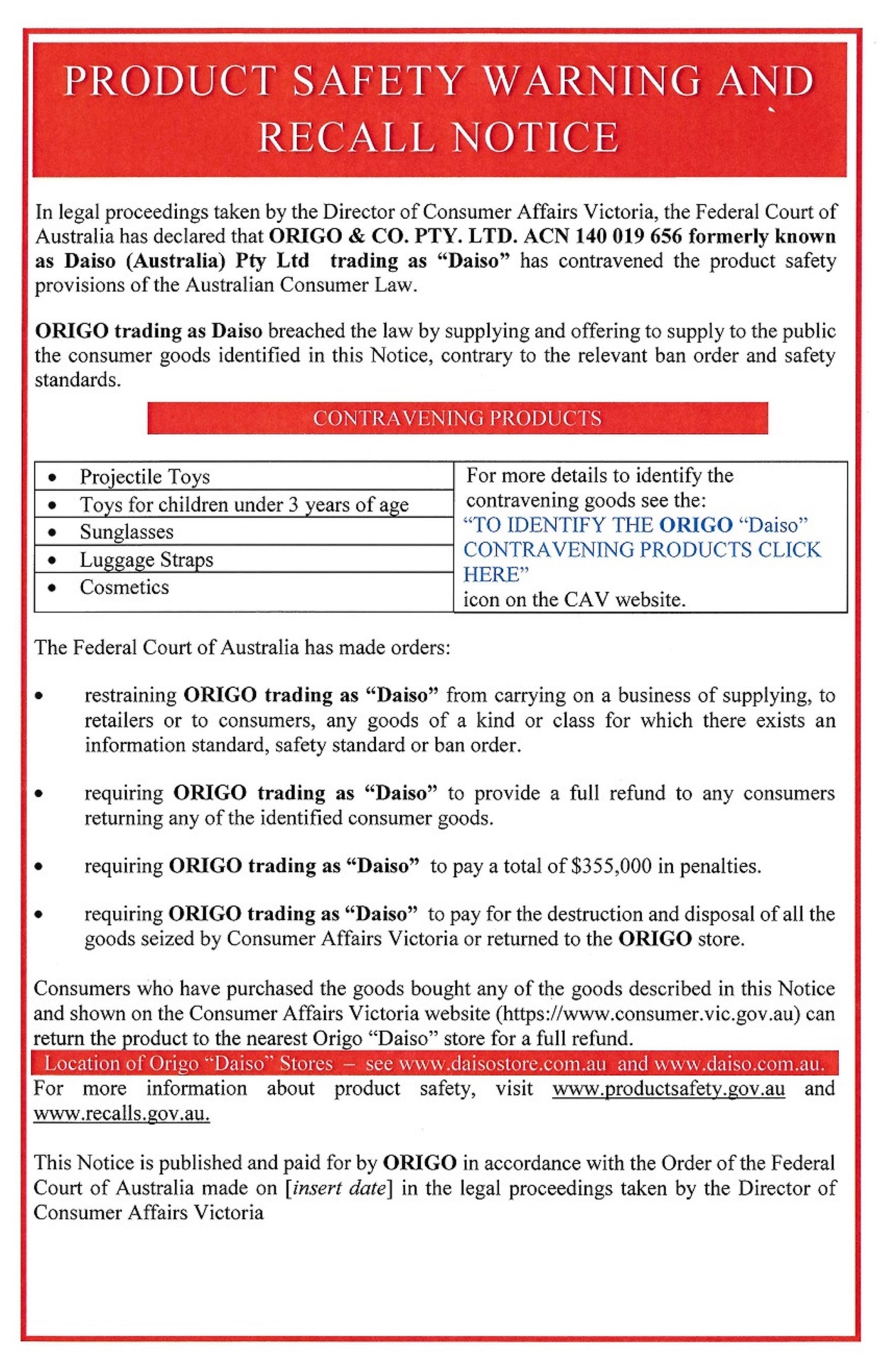
21. Origo cause to be published in a prominent and conspicuous place at each of its stores, at or near the customer entrance and exit, for a period of no less than one month from the date of this Order, an Important Public Notice in the form of Annexure C to this Order (Important Public Notice). Each such notice must:
(a) be a minimum size of 29.7 cm in width by 42 cm in height (A3 size paper);
(b) use a minimum type face of 12 point Times Roman or equivalent; and
(c) be printed in full colour.
22. Origo cause to be published within 10 days from the date of this Order on its Instagram page “daisoau” an Important Public Notice.
23. Origo cause the Important Public Notice to be published on the Internet at the homepage of all websites which are owned, operated or maintained by or on behalf of Origo, including the website accessible via Uniform Resource Locator (URL) at the web address (URL) http://www.daiso.com.au/ and www.daisostore.com.au (Origo websites) (or if any such URL is replaced or changed, the Internet home page of the corresponding website), for a period of 6 months from the date of this Order, and use its best endeavours to ensure that:
(a) the Important Public Notice is to be viewable by clicking through a “click-through” icon located on the Origo website;
(b) the “click-through” icon referred to in the previous sub-paragraph is located in a central position on the page first accessed when the user opens to the home page of the Origo website;
(c) the “click-through” icon contains the words “PRODUCT SAFETY – IMPORTANT NOTICE ORDERED BY FEDERAL COURT OF AUSTRALIA” (in capital letters and using a minimum type size of 16 point Times New Roman or equivalent), clearly and prominently in red on a contrasting background and the words “Click Here”; and
(d) the Important Public Notice occupies the entire webpage which is accessed via the “click-through” icon referred to above.
Refunds
24. Pursuant to s 232(6)(a) of the ACL or ACL (Vic), Origo pay a full refund to all persons returning goods (if any) that are Contravening Products.
Notifications
25. Pursuant to s 232(1) of the ACL or ACL (Vic), Origo:
(a) notify on a monthly basis for 4 months after publication of the Important Public Notices, an Officer designated by the Director of Consumer Affairs Victoria of the details of any Contravening Products returned to that company; and
(b) securely store all such returned goods for collection (destruction and disposal) by the Officer designated by the Director of Consumer Affairs Victoria, as soon as is convenient after the 4 month period, referred to in paragraph 25(a) above, has expired.
Costs
26. Origo pay a contribution to the applicant’s costs in the fixed sum of $15,000 within 6 weeks from the date of this Order.
Note: Entry of orders is dealt with in Rule 39.32 of the Federal Court Rules 2011.
ANNEXURE A CLASSES OF KINDS OF CONSUMER GOODS
1 | Aquatic Toys / Floatation Aids |
2 | Babies’ Dummies with or without decorations and chains |
3 | Baby Walkers, Baby Bath Aids, and Children’s Portable Folding Cots |
4 | Balloon Blowing Kits |
5 | Basketball Rings and Backboards |
6 | Bean Bags and Inflatable Toys, Novelties and Furniture containing Beads |
7 | Blinds, Curtains and Window Fittings |
8 | Bunk Beds |
9 | Clothing and Textiles that are required to have warning labels attached |
10 | Child Restraints for use in Motor Vehicles |
11 | Cosmetics and Toiletries |
12 | Disposable Cigarette Lighters |
13 | Elastic Luggage Straps |
14 | Exercise Cycles |
15 | Hot Water Bottles |
16 | Household Cots |
17 | Finger paints |
18 | Motor Vehicle Recovery Straps |
19 | Motorcycle Helmets |
20 | Moveable Soccer Goals |
21 | Nightwear for Children |
22 | Pedal Bicycles and Bicycle Helmets |
23 | Portable Aerosol Fire Extinguishers and Portable Non-Aerosol Fire Extinguishers |
24 | Prams and Strollers |
25 | Reduced Fire Risk Cigarettes, Novelty Cigarettes, and Smokeless Tobacco Products |
26 | Sunglasses and Fashion Spectacles |
27 | Swimming and Flotation Aids for water familiarisation and swimming tuition |
28 | Toys for children up to and including 36 months of age, Children’s Toys containing Magnets, and Projectile Toys |
29 | Treadmills |
30 | Trolley Jacks, Vehicle Jacks, Vehicle Support Stands, and Portable Ramps for Motor Vehicles |
31 | Candles |
32 | Candle Holders |
33 | Fire Footbags and Sky Lanterns |
34 | Gas Masks |
35 | Glucomannan in tablet form |
36 | Mini Jelly Cups |
37 | Miniature Motorbikes |
38 | Tongue Studs |
39 | Pools and Spas |
40 | Tinted Headlight Covers |
41 | Toothpaste |
42 | Toy-like Novelty Cigarette Lighters |
43 | Knives or Cutters in Stationery Sets |
44 | Yo-Yo Water Balls |
ANNEXURE B
PRODUCT SAFETY COMPLIANCE PROGRAM
ORIGO & CO. PTY. LTD. [ACN 140 019 656] Formerly Daiso (Australia) Pty Ltd (ORIGO)
The respondent, Origo, will carry out a Product Safety Compliance Program (Compliance Program) that complies with International Standard AS/ISO 19600:2015 and each of the following requirements:
Appointments
1. Within one month of the date of the Order, Origo will appoint or confirm a director or a senior manager of the business to be responsible for the development, implementation and maintenance of the Compliance Program (Compliance Officer).
Staff Training
2. Origo will cause all employees of Origo whose duties could result in them being concerned with conduct that may contravene ss 106 and 136 of the ACL and ACL (Vic) (the Relevant Provisions) to receive regular (at least once a year) practical training administered by the Compliance Officer (once trained) or a qualified compliance professional or legal practitioner with expertise in competition and consumer law, that focuses on the Relevant Provisions.
Internal Reporting
3. Origo will ensure that the Compliance Officer reports to their director(s) or governing body every 12 months on the continuing effectiveness of the Compliance Program.
Informing the Director
4. If requested by the Director of Consumer Affairs Victoria (the Director), Origo shall, at their expense, provide copies of documents and information in respect of matters which are the subject of the Compliance Program.
Review
5.
(a) In the event the Director has sufficient reason to believe that the Compliance Program is not being implemented effectively, Origo shall, if requested by the Director, at their expense, cause a review of the Compliance Program elements (the Review) to be carried out in accordance with each of the following requirements:
(b) Scope of the Review – Origo shall use its best endeavours to ensure that the Review:
(i) verifies that Origo has in place a Compliance Program that complies with the requirements of this Annexure and is suitable for its size and structure;
(ii) involves the preparation of a Compliance Program Review Report (Review Report) and opinions detailed at point 6 below.
(c) Independence of Reviewer – Origo shall ensure that the Review is carried out by a suitably qualified, independent compliance professional with expertise in competition and consumer law (the Reviewer). The Reviewer will qualify as independent on the basis that he or she:
(i) did not design or implement the Compliance Program;
(ii) is not a present or past staff member or director of Origo;
(iii) has no significant shareholding or other interests in Origo.
(d) Evidence – Origo shall use its best endeavours to ensure that the Review is able to be conducted on the basis that the Reviewer has access to all relevant sources of information in Origo’s possession or control, including without limitation documents created by Origo’s consultants, legal practitioners and accountants for use in Origo’s Compliance Program.
(e) Origo shall ensure that the Review is completed within 3 months of a written request from the Director.
Reviewer Reports
6.
(a) Origo shall use its best endeavours to ensure that the Reviewer sets out the findings of the Review in a Review Report, which will provide particular and specific information regarding the scope of the Review and the effectiveness of the Compliance Program, including:
(i) details of the evidence gathered and examined during the Review;
(ii) the name and relevant experience of the person appointed as Origo’s Compliance Officer;
(iii) the Reviewer’s opinion on whether the Origo has in place effective staff training, that complies with the requirements of this Annexure; and
(iv) actions recommended by the Reviewer to ensure the continuing effectiveness of the Origo’s Compliance Program.
(b) Origo shall ensure that any Review Report is completed and provided to Origo within 3 months of completion of the Review.
(c) Origo will cause the Review Report to be provided to the Director within 14 days of its receipt from the Reviewer.
(d) Origo shall implement promptly and with due diligence any recommendations made by the Reviewer or required by the Director that are reasonably necessary to ensure that Origo maintains and continues to develop the Compliance Program elements in accordance with the requirements of this Annexure.
ANNEXURE C
MOSHINSKY J:
Introduction
1 The respondent, Origo & Co Pty Ltd (formerly Daiso (Australia) Pty Ltd) (Origo), carries on a business of marketing and selling consumer goods. It sells goods under licence from Daiso Industries Co Limited (Daiso Japan), a company based in Hiroshima, Japan, but is not related to that company. Relevantly for present purposes, Origo sells goods in the following six product categories:
(a) projectile toys;
(b) toys for children up to and including 36 months of age;
(c) luggage straps;
(d) cosmetics;
(e) sunglasses; and
(f) sunscreen products.
2 This proceeding, brought by the Director of Consumer Affairs Victoria (the Director), principally concerns contraventions of product safety and product information standards. It is similar in subject matter to an earlier proceeding brought by the Director against Daiso Industries (Australia) Pty Ltd: see Director of Consumer Affairs Victoria v Daiso Industries (Australia) Pty Ltd [2017] FCA 683 (Daiso No 1); Director of Consumer Affairs Victoria v Daiso Industries (Australia) Pty Ltd (No 2) [2017] FCA 720; and Director of Consumer Affairs Victoria v Daiso Industries (Australia) Pty Ltd (No 3) [2017] FCA 1488 (Daiso No 3). The respondent to that proceeding is a subsidiary of Daiso Japan. As noted, the respondent in the present case is not related to Daiso Japan. Nor is it related to Daiso Industries (Australia) Pty Ltd.
3 The Director’s allegations in the present proceeding are, in summary, that:
(a) Origo contravened s 106 of the Australian Consumer Law, being Sch 2 to the Competition and Consumer Act 2010 (Cth) (the ACL) and the Australian Consumer Law (Victoria), being the Australian Consumer Law text applied by the Australian Consumer Law and Fair Trading Act 2012 (Vic) (the ACL (Vic)) in relation to each of the product categories referred to in [1](a), (b), (c) and (e) above;
(b) Origo contravened s 136 of the ACL and the ACL (Vic) in respect of cosmetics; and
(c) Origo contravened ss 18 and 29(1) of the ACL and the ACL (Vic) in relation to sunscreen products.
4 The Director seeks: declarations; injunctive relief; pecuniary penalties; a non-punitive publication order or adverse publicity order; and costs.
5 Origo has admitted liability in respect of the alleged contraventions and the parties have prepared a statement of agreed facts (SOAF). A copy of the SOAF (omitting footnotes and annexures) is annexed to these reasons. In addition, a number of affidavits have been filed. These provide further detail as to matters covered in the SOAF. The parties have also agreed a form of proposed declarations and a form of proposed orders (together, the Minute of Proposed Orders). In summary, the parties jointly propose that the Court make declarations with respect to each of the alleged contraventions and that the Court make orders to the effect that:
(a) for a period of three years, Origo be restrained from carrying on a business of supplying, offering for supply, or having in its possession, goods of the kind or class listed in Annexure A to the Minute of Proposed Orders unless Origo continues to carry out a compliance program in accordance with Annexure B to the Minute of Proposed Orders;
(b) the Director be permitted to destroy and dispose of all contravening goods that were seized by the Director;
(c) Origo pay the costs of and incidental to the destruction and disposal referred to in paragraph (b) above;
(d) Origo pay a pecuniary penalty of $355,000 in respect of the contraventions of ss 106 and 136 of the ACL (Vic);
(e) Origo cause to be published in various specified ways a public notice in the form of Annexure C to the Minute of Proposed Orders;
(f) Origo pay a full refund to all persons returning any contravening goods;
(g) Origo pay a contribution to the Director’s costs of the proceeding, in the amount of $15,000.
6 For the reasons that follow, I consider it appropriate to make declarations and orders substantially in the form of the Minute of Proposed Orders. In particular, I consider the proposed pecuniary penalty of $355,000 to be an appropriate penalty in the circumstances.
Applicable principles
7 As I noted in Daiso (No 1) at [5], the Court has jurisdiction to deal with the Director’s claims arising under the ACL: see s 138(1) of the Competition and Consumer Act and s 39B(1A)(c) of the Judiciary Act 1903 (Cth). Insofar as the Director brings claims under the ACL (Vic), it has been accepted that, in circumstances such as this, such claims are within the Court’s accrued jurisdiction: see Walker v Sell (2016) 245 FCR 308 at [83]-[85] per Bromwich J; Director of Consumer Affairs Victoria v Gibson [2017] FCA 240 at [1] per Mortimer J. However, the expression “accrued jurisdiction” is best avoided: see Rizeq v Western Australia (2017) 344 ALR 421 at [55]-[56] per Bell, Gageler, Keane, Nettle and Gordon JJ.
8 The applicable principles as regards the making of orders by agreement and as regards declarations are well established. They were summarised by Gordon J in Australian Competition and Consumer Commission v Coles Supermarkets Australia Pty Ltd [2014] FCA 1405 (Coles) at [70]-[79] as follows:
2.3.1 Orders sought by agreement
…
70 The applicable principles are well established. First, there is a well-recognised public interest in the settlement of cases under the Act: NW Frozen Foods Pty Ltd v Australian Competition & Consumer Commission (1996) 71 FCR 285 at 291. Second, the orders proposed by agreement of the parties must be not contrary to the public interest and at least consistent with it: Australian Competition & Consumer Commission v Real Estate Institute of Western Australia Inc (1999) 161 ALR 79 at [18].
71 Third, when deciding whether to make orders that are consented to by the parties, the Court must be satisfied that it has the power to make the orders proposed and that the orders are appropriate: Real Estate Institute at [17] and [20] and Australian Competition & Consumer Commission v Virgin Mobile Australia Pty Ltd (No 2) [2002] FCA 1548 at [1]. Parties cannot by consent confer power to make orders that the Court otherwise lacks the power to make: Thomson Australian Holdings Pty Ltd v Trade Practices Commission (1981) 148 CLR 150 at 163.
72 Fourth, once the Court is satisfied that orders are within power and appropriate, it should exercise a degree of restraint when scrutinising the proposed settlement terms, particularly where both parties are legally represented and able to understand and evaluate the desirability of the settlement: Australian Competition & Consumer Commission v Woolworths (South Australia) Pty Ltd (Trading as Mac’s Liquor) [2003] FCA 530 at [21]; Australian Competition & Consumer Commission v Target Australia Pty Ltd [2001] FCA 1326 at [24]; Real Estate Institute at [20]-[21]; Australian Competition & Consumer Commission v Econovite Pty Ltd [2003] FCA 964 at [11] and [22] and Australian Competition & Consumer Commission v The Construction, Forestry, Mining and Energy Union [2007] FCA 1370 at [4].
73 Finally, in deciding whether agreed orders conform with legal principle, the Court is entitled to treat the consent of Coles as an admission of all facts necessary or appropriate to the granting of the relief sought against it: Thomson Australian Holdings at 164.
2.3.2 Declarations
74 The Court has a wide discretionary power to make declarations under s 21 of the Federal Court Act: Forster v Jododex Australia Pty Ltd (1972) 127 CLR 421 at 437-8; Ainsworth v Criminal Justice Commission (1992) 175 CLR 564 at 581-2 and Tobacco Institute of Australia Ltd v Australian Federation of Consumer Organisations Inc (No 2) (1993) 41 FCR 89 at 99.
75 Where a declaration is sought with the consent of the parties, the Court's discretion is not supplanted, but nor will the Court refuse to give effect to terms of settlement by refusing to make orders where they are within the Court's jurisdiction and are otherwise unobjectionable: see, for example, Econovite at [11].
76 However, before making declarations, three requirements should be satisfied:
(1) The question must be a real and not a hypothetical or theoretical one;
(2) The applicant must have a real interest in raising it; and
(3) There must be a proper contradictor:
Forster v Jododex at 437-8.
77 In this proceeding, these requirements are satisfied. The proposed declarations relate to conduct that contravenes the ACL and the matters in issue have been identified and particularised by the parties with precision: Australian Competition & Consumer Commission v MSY Technology Pty Ltd (2012) 201 FCR 378 at [35]. The proposed declarations contain sufficient indication of how and why the relevant conduct is a contravention of the ACL: BMW Australia Ltd v Australian Competition & Consumer Commission [2004] FCAFC 167 at [35].
78 It is in the public interest for the ACCC to seek to have the declarations made and for the declarations to be made (see the factors outlined in ACCC v CFMEU at [6]). There is a significant legal controversy in this case which is being resolved. The ACCC, as a public regulator under the ACL, has a genuine interest in seeking the declaratory relief and Coles is a proper contradictor because it has contravened the ACL and is the subject of the declarations. Coles has an interest in opposing the making of them: MSY Technology at [30]. No less importantly, the declarations sought are appropriate because they serve to record the Court's disapproval of the contravening conduct, vindicate the ACCC’s claim that Coles contravened the ACL, assist the ACCC to carry out the duties conferred upon it by the Act (including the ACL) in relation to other similar conduct, inform the public of the harm arising from Coles’ contravening conduct and deter other corporations from contravening the ACL.
79 Finally, the facts and admissions in Annexure 1 provide a sufficient factual foundation for the making of the declarations: s 191 of the Evidence Act; Australian Competition & Consumer Commission v Dataline.Net.Au Pty Ltd (2006) 236 ALR 665 at [57]-[59] endorsed by the Full Court in Australian Competition & Consumer Commission v Dataline.Net.Au Pty Ltd (2007) 161 FCR 513 at [92]; Hadgkiss v Aldin (No 2) [2007] FCA 2069 at [21]-[22]; Secretary, Department of Health & Ageing v Pagasa Australia Pty Ltd [2008] FCA 1545 at [77]-[79] and Ponzio v B & P Caelli Constructions Pty Ltd (2007) 158 FCR 543.
9 In Daiso (No 3), I discussed the applicable principles relating to the imposition of pecuniary penalties. The following discussion of the applicable principles is largely based on the discussion in Daiso (No 3).
10 In Commonwealth v Director, Fair Work Building Industry Inspectorate (2015) 258 CLR 482 (FWBII), the High Court held that, in the context of civil penalty provisions, it was open to the Court to receive submissions, including joint submissions, as to an appropriate penalty. French CJ, Kiefel, Bell, Nettle and Gordon JJ (with whom Keane J agreed) stated at [46] that there is “an important public policy involved in promoting predictability of outcome in civil penalty proceedings” and that “the practice of receiving and, if appropriate, accepting agreed penalty submissions increases the predictability of outcome for regulators and wrongdoers”. Their Honours stated that, as was recognised in Trade Practices Commission v Allied Mills Industries Pty Ltd (No 5) (1981) 60 FLR 38; 37 ALR 256 and determined in NW Frozen Foods Pty Ltd v Australian Competition and Consumer Commission (1996) 71 FCR 285 (NW Frozen Foods), “such predictability of outcome encourages corporations to acknowledge contraventions, which, in turn, assists in avoiding lengthy and complex litigation and thus tends to free the courts to deal with other matters and to free investigating officers to turn to other areas of investigation that await their attention”.
11 Their Honours stated, at [57], that in civil proceedings there is generally very considerable scope for the parties to agree on the facts and their consequences; and that there “is also very considerable scope for them to agree upon the appropriate remedy and for the court to be persuaded that it is an appropriate remedy”. In relation to civil penalty proceedings, their Honours stated at [58]:
Subject to the court being sufficiently persuaded of the accuracy of the parties’ agreement as to facts and consequences, and that the penalty which the parties propose is an appropriate remedy in the circumstances thus revealed, it is consistent with principle and, for the reasons identified in Allied Mills, highly desirable in practice for the court to accept the parties’ proposal and therefore impose the proposed penalty.
(Footnote omitted.)
12 Their Honours in FWBII also made observations, at [60]-[61], regarding submissions by a regulator in such a context.
13 It follows from the above that the questions to be determined in the present case are: first, whether the Court is sufficiently persuaded of the accuracy of the parties’ agreement as to facts and consequences; and secondly, whether the penalty that the parties propose is an appropriate remedy in the circumstances thus revealed.
14 In the present case, insofar as the proceeding involves an application by the Director for the imposition of a pecuniary penalty, the application is made under s 228(1) of the ACL (Vic). This provides that the regulator may institute a proceeding in a court for the recovery on behalf of the Commonwealth, a State or a Territory, as the case may be, of a pecuniary penalty referred to in s 224. Section 10(1) of the Australian Consumer Law and Fair Trading Act 2012 (Vic) (the Victorian Act) provides that, in the ACL (Vic), “regulator” means the Director. Section 10(2) of that Act provides that, for the purposes of the application of the ACL (Vic), “court” has the meaning given in s 223 of the Victorian Act. Section 223(1) of the Victorian Act provides that, subject to certain provisions (one of which is s 224), in the ACL (Vic), “court” means the Supreme Court, the County Court, the Magistrates’ Court and VCAT. Section 224 of the Victorian Act provides that, subject to s 223, VCAT “or any court of competent jurisdiction” may hear and determine a cause of action arising under any provision of the ACL (Vic). I proceed on the basis that this Court is such a court. I note that pecuniary penalties have been imposed by this Court in other cases brought by the Director in like circumstances: see Director of Consumer Affairs Victoria v Hocking Stuart (Richmond) Pty Ltd (No 2) [2016] FCA 1435; and Director of Consumer Affairs Victoria v Gibson (No 3) [2017] FCA 1148. Neither party in the present case suggested otherwise.
15 Section 224(2) of the ACL (Vic) sets out certain mandatory considerations relating to the imposition of a pecuniary penalty. Section 224(2) provides:
(2) In determining the appropriate pecuniary penalty, the court must have regard to all relevant matters including:
(a) the nature and extent of the act or omission and of any loss or damage suffered as a result of the act or omission; and
(b) the circumstances in which the act or omission took place; and
(c) whether the person has previously been found by a court in proceedings under Chapter 4 or this Part to have engaged in any similar conduct.
16 The principles applicable to the discretion to impose pecuniary penalties have been discussed in many cases including the following authorities: Trade Practices Commission v CSR Ltd [1991] ATPR 41-076; [1990] FCA 762; Australian Competition and Consumer Commission v Kokos International Pty Ltd (No 2) [2008] ATPR 42-212; [2008] FCA 5; NW Frozen Foods; Singtel Optus Pty Ltd v Australian Competition and Consumer Commission (2012) 287 ALR 249 (Singtel Optus); Australian Competition and Consumer Commission v TPG Internet Pty Ltd (2013) 250 CLR 640 (TPG); FWBII; and Australian Competition and Consumer Commission v Reckitt Benckiser (Australia) Pty Ltd (2016) 340 ALR 25. (See also Australian Competition and Consumer Commission v Cement Australia Pty Ltd [2017] ATPR 42-557; [2017] FCAFC 159 (Cement Australia) at [569].) In these circumstances, it is unnecessary to set out the principles, which are well-established, in any detail.
17 It is convenient, nevertheless, to set out the following list of relevant factors from the judgment of French J (as his Honour then was) in Trade Practices Commission v CSR Ltd at 52,152-52,153:
1. The nature and extent of the contravening conduct.
2. The amount of loss or damage caused [by the contravening conduct].
3. The circumstances in which the conduct took place.
4. The size of the contravening company.
5. The degree of power it has, as evidenced by its market share and ease of entry into the market.
6. The deliberateness of the contravention and the period over which it extended.
7. Whether the contravention arose out of the conduct of senior management or at a lower level.
8. Whether the company has a corporate culture conducive to compliance with the Act, as evidenced by educational programs and disciplinary or other corrective measures in response to an acknowledged contravention.
9. Whether the company has shown a disposition to co-operate with the authorities responsible for the enforcement of the Act in relation to the contravention.
18 In FWBII, French CJ, Kiefel, Bell, Nettle and Gordon JJ explained the purpose of a civil penalty as follows at [55]:
… whereas criminal penalties import notions of retribution and rehabilitation, the purpose of a civil penalty, as French J explained in Trade Practices Commission v CSR Ltd, is primarily if not wholly protective in promoting the public interest in compliance:
“Punishment for breaches of the criminal law traditionally involves three elements: deterrence, both general and individual, retribution and rehabilitation. Neither retribution nor rehabilitation, within the sense of the Old and New Testament moralities that imbue much of our criminal law, have any part to play in economic regulation of the kind contemplated by Pt IV [of the Trade Practices Act] … The principal, and I think probably the only, object of the penalties imposed by s 76 is to attempt to put a price on contravention that is sufficiently high to deter repetition by the contravenor and by others who might be tempted to contravene the Act.”
(Footnotes omitted.)
19 In TPG at [64], French CJ, Crennan, Bell and Keane JJ endorsed the observation of the Full Court in Singtel Optus that the Court, in fixing a penalty, must make it clear to the contravenor and the market that the cost of courting a risk of contravention cannot be regarded as an acceptable cost of doing business.
20 In relation to the course of conduct principle, I refer to Cement Australia at [421]-[426] and Australian Competition and Consumer Commission v Yazaki Corporation [2018] FCAFC 73 at [226]-[236].
Application of principles to the present case
Declarations
21 The Court has the power to make the declarations proposed: Federal Court of Australia Act 1976 (Cth), s 21. Origo has admitted the relevant contraventions in the SOAF and by its consent to the Minutes of Proposed Orders. The Court is entitled to treat this as an admission of all facts necessary or appropriate to the granting of the relief sought against Origo. Further, the requirements for the making of declarations referred to by Gordon J in Coles, set out above, are satisfied. The proposed declarations relate to conduct that contravenes the ACL and the ACL (Vic) and the matters in issue have been identified and particularised by the parties with precision. The proposed declarations contain sufficient indication of how and why the relevant conduct contravened the legislation.
22 It is in the public interest for the Director to seek to have the declarations made and for the declarations to be made. There is a significant legal controversy that is being resolved. The Director, as a public regulator, has a genuine interest in seeking declaratory relief and Origo is a proper contradictor. Additionally, the declarations sought are appropriate because they serve to record the Court’s disapproval of the contravening conduct, vindicate the Director’s claim that Origo contravened the legislation, assist the Director in carrying out his regulatory duties in the future, inform the public of the contravening conduct, and deter other corporations from contravening the legislation.
23 Accordingly, I will make declarations substantially in the terms proposed by the parties.
Pecuniary penalty
24 The facts and circumstances of Origo’s contraventions of ss 106 and 136 of the ACL (Vic) are set out in the SOAF. (As noted above, penalties are sought only in respect of the contraventions of those provisions, not s 29(1) of the ACL (Vic).) I accept that the facts and circumstances are as set out in that document.
25 I will first consider the nature and extent of the relevant acts and omissions, being part of the first mandatory consideration in s 224(2) of the ACL (Vic).
26 In or about April 2011, April 2012, February 2013, November 2013, March 2015 and July 2015, Origo displayed and offered for sale to customers, products from one or more categories of consumer goods in breach of an applicable mandatory safety standard and/or information standard, as set out in the table in [6] of the SOAF.
27 Details of the ways in which the products failed to comply with the applicable standards are set out in [11] to [17] of the SOAF.
28 During the period 2011 to 2017, Origo sold 15,295 items of non-compliant products. The total profit generated from these products was $24,030. The selling price of each product was $2.55 (exclusive of GST) and the cost of goods was between $0.99 and $1.25, depending on the fluctuation in the JPY/AUD exchange rate.
29 The contraventions occurred over a period of some years.
30 The contraventions are serious. Each of the standards contravened exists to mitigate risks to consumers’ safety. The Court is entitled to assume that the safety standards were put in place to address actual or anticipated harm or damage. The nature of the harm and damage is expressed in the following ways in explanatory material published by ACL regulators:
(a) projectile toys – risk of injury by choking, eye injuries and flesh wounds;
(b) toys for children up to and including 36 months of age – risk of injury by choking on unsafe small toys and small parts; choking might cause serious injury or death;
(c) elastic luggage straps – risk of serious injuries to eyes, face and body if they recoil during use;
(d) cosmetics – ingredient labels that are missing or inaccurate can mislead consumers in their purchasing decisions and expose consumers to ingredients that may cause allergic reactions; such allergic reactions could be very harmful and in some cases may lead to death; and
(e) sunglasses – incorrect use and labelling can cause eye injuries or impaired vision.
31 It is not suggested by the Director that Origo’s contraventions are aggravated by any resulting loss or damage (being the other aspect of the first mandatory consideration).
32 The second mandatory consideration in s 224(2) of the ACL (Vic) is the circumstances in which the contraventions took place. The circumstances have been described above and are described more generally in the SOAF. In addition, I note the following facts and matters.
33 Origo was incorporated in 2009 as a vehicle for the operation of a business in Australia selling products supplied by Daiso Japan.
34 The goods sold by Origo are sold under licence from Daiso Japan. They are all developed and manufactured by Daiso Japan.
35 Origo is required to purchase products directly from Daiso Japan using Daiso Japan’s ordering system.
36 Origo pays Daiso Japan a royalty fee, calculated as 1% of its net sales, for use of Daiso Japan’s business model and intellectual property.
37 However, neither Daiso Japan nor Daiso Industries (Australia) Pty Ltd has any connection with Origo in relation to management, shareholding or its compliance with Australian law including its compliance program.
38 In relation to the third mandatory consideration, Origo has not previously been found by a court in proceedings under Ch 4 or Pt 5-2 of the ACL (Vic) to have engaged in any similar conduct.
39 I turn now to refer to other relevant matters.
40 The maximum penalty for each contravention of s 106 or 136 of the ACL (Vic) is $1.1 million.
41 The contravening conduct should be viewed as five courses of conduct, one in relation to each product group relevant to the contraventions of ss 106 and 136 of the ACL (Vic).
42 Prior to April 2011, Origo did not have any form of compliance management system in place to ensure compliance with Australian mandatory standards. There was no assessment of products to determine whether they complied with Australian mandatory standards.
43 Origo took steps in 2011 towards compliance with the standards. Origo acknowledges that, with hindsight, the system it implemented in 2011 did not achieve its compliance objectives.
44 During the years 2012 and 2013, Origo took further steps towards meeting the requirements of the standards. Further steps were taken in 2014, including providing a copy of its compliance program documentation to Consumer Affairs Victoria (CAV) and inviting it to provide suggestions.
45 An independent product safety expert was not consulted at that time, principally because Origo did not appreciate that such people existed. Origo also misunderstood CAV’s role. Origo genuinely, but mistakenly, believed that CAV was providing it with advice in relation to what it needed to do to be compliant in respect of its product safety obligations.
46 Origo now appreciates that this was incorrect and understands that it is responsible for ensuring that the products it sells comply with product safety laws.
47 Origo ultimately retained an independent compliance system consultant on or around 5 September 2017 to review Origo’s compliance program and to provide ongoing compliance training.
48 Origo now has an extensive compliance program in place, as described in [94] of the SOAF.
49 The SOAF indicates that Origo did take steps to address its compliance issues, but these were inadequate. This is not a case where it failed to take any steps to address these issues.
50 It is admitted by Origo’s witnesses that, at a senior management level, they knew about the existence of mandatory standards, but not in particular detail. Origo relied upon an assumption that the products supplied by Daiso Japan would be compliant with Australian mandatory standards and senior management did not appreciate that Origo should have a product safety compliance program.
51 The market in which Origo’s business operates requires that its attention and the attention of its staff be focussed on ongoing compliance. Origo sells very large volumes of inexpensive products selected which are not specifically designed or manufactured to meet Australian mandatory product safety and information standards. It has a large proportion of casual staff, whose participation in compliance is needed. For this reason, in particular, external supervision of Origo’s compliance is required.
52 In relation to Origo’s size and financial position, I would describe Origo as a small to medium size business.
53 Origo’s repeated contraventions were not deliberate, but they were foreseeable in circumstances were Origo lacked a proactive compliance culture.
54 Origo was co-operative with CAV at the inspections and in relation to follow up correspondence from CAV, including face-to-face engagement.
55 Origo has co-operated with the Director, including by way of the admissions and agreeing to the SOAF.
56 Taking these facts and matters into account, I consider the pecuniary penalty proposed by the parties, namely $355,000, to be an appropriate penalty. In my view, it reflects the seriousness of the contraventions of ss 106 and 136 of the ACL (Vic) that are the subject of the declarations and achieves the object of deterrence (both specific and general). It is consistent with the conduct being viewed as five courses of conduct, and appropriately reflects considerations of totality.
Other orders
57 In relation to the other proposed orders, I consider there to be a proper basis to make orders substantially in the terms proposed by the parties.
I certify that the preceding fifty-seven (57) numbered paragraphs are a true copy of the Reasons for Judgment herein of the Honourable Justice Moshinsky. |
Associate:
STATEMENT OF AGREED FACTS
Preliminary
1. This Statement of Agreed Facts is agreed, as between the Applicant and the Respondent, for the purposes of s 191 of the Evidence Act 1995 (Cth).
2. Defined terms and abbreviations used in this Statement of Agreed Facts are set out in Table 1 [Not reproduced].
3. This Statement of Agreed Facts is not intended to prevent parties from adducing evidence that is not consistent with the Statement of Agreed Facts, or prevent parties from making submissions as to the relevance of the facts set out in this Statement to the pecuniary penalty that should be awarded against the Respondent.
Material Facts
4. The Applicant is and was, at all material times, a public official whose office is established by s 107 of the ACLFTA. In that capacity, the Director is “another person” within the meaning of s 232 of the ACL and is authorised by ss 10(1), 109 and 110(1) of the CCA and ss 2, 228, 232, 246 and 247 of the ACL (Vic) to bring this proceeding.
5. Origo & Co Pty Ltd (Origo) (formerly known as Daiso (Australia) Pty Ltd) was, at all material times, incorporated on 15 October 2009 and registered in Victoria with the number ACN 140 019 656. It has, since that time, carried on business operating retail stores in Victoria and New South Wales supplying a variety of consumer goods the subject of product safety laws, standards or ban orders.
Origo possessing, controlling and offering for sale, relevant consumer goods in its warehouse and department stores
6. In or about April 2011, April 2012, February 2013, November 2013, March 2015 and July 2015, Origo displayed and offered for sale to customers, products from one or more categories of consumer goods in breach of an applicable mandatory safety standard and/or information standard.
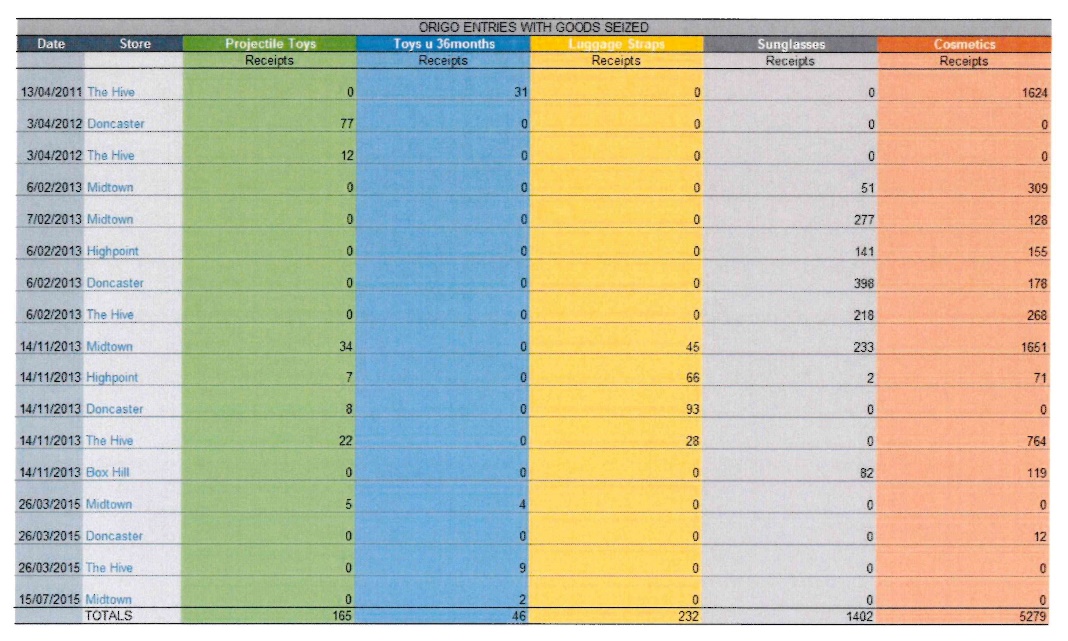
7. In or about April 2017, Origo displayed and offered for sale to customers, products from one or more categories of consumer goods in breach of an applicable mandatory safety standard and/or information standards. In total the following number of different consumer goods were seized and/or purchased:
Date | Store | Toys under 36 Months and squeeze toys for children under 18 months |
10 April 2017 | Bourke Street (Midtown) 246 Bourke St Melbourne | 4 |
11 April 2017 | Victoria Gardens 620 Victoria St Richmond (relocated from Hive Shopping Centre, 313 Victoria Street, Abbotsford) | 6 |
Totals: | 10 |
8. The CAV commenced proceedings against Origo on 13 April 2017. After proceedings were issued, Origo agreed to resolve the matter with the CAV by agreement. Origo chose not to defend the proceeding and has acknowledged liability. Origo’s conduct has saved the CAV significant time and resources.
Relevant goods supplied by Origo
9. From April 2011 until the dates specified below, through one or more of its different department stores in Victoria, Origo sold and/or supplied, from each of the following different types of relevant consumer goods, a total of 15,295 products as set out in Table 2 [Not reproduced]:
(a) projectile toys as defined in Consumer Product Safety Standard for Children’s Projectile Toys, Consumer Protection Notice No 16 of 2010 (Projectile Toys) (until November 2013);
(b) Sunglasses (until November 2013);
(c) Luggage Straps (until November 2013);
(d) Toys for children under 3 years of age (all of which were removed by July 2015, save for bath toys which remained until April 2017);
(e) Cosmetics (April 2017),
all of which are goods that are intended to be used, or are of a kind likely to be used, for personal, domestic, or household use or consumption.
10. From April 2011 until the dates specified below, Origo, in or for the purpose of trade [or] commerce did possess or control the following different types of relevant consumer goods:
(a) Projectile Toys (until November 2013);
(b) Sunglasses (until November 2013);
(c) Luggage Straps (until November 2013);
(d) Toys for children under 3 years of age (all of which were removed by July 2015, save for bath toys which remained until April 2017);
(e) Cosmetics (April 2017),
all of which are goods that are intended to be used, or are of a kind likely to be used, for personal, domestic, or household use or consumption.
Non-compliance with safety and information standards
11. For the purposes of s 106 of the ACL and s 106 of the ACL (Vic), the relevant safety standards were the safety standards imposed by:
(a) Consumer Product Safety Standard: Children’s Projectile Toys, Consumer [Protection] Notice No. 16 of 2010 (Projectile Toys);
(b) Australian/New Zealand Standard Safety of Toys: Part 1 Safety aspects related to mechanical and physical properties (ISO 8124-1:2000,MOD)
(c) Consumer Product Safety Standard: Toys for children up to and including 36 months of age, Consumer Protection Notice No. 14 of 2013 (Toys for Children Under 3 years of Age);
(d) Consumer Product Safety Standard: Sunglasses and fashion spectacles, Consumer Protection Notice No. 13 of 2003 (Sunglasses);
(e) Trade Practices (Consumer Product Safety Standards) Regulations 1979 (11C), Statutory Rules 1979 No. 134 as amended (Elastic Luggage Straps); and
(f) Trade Practices (Consumer Product Information Standards) (Cosmetics) Regulations 1991, Statutory Rules 1979 No. 134 (Cosmetics).
12. Since about 2010 each of the relevant safety standards and related information and guidance materials has been published and publicly available on the internet at www.productsafety.com.au.
13. The Projectile Toys that Origo possessed, controlled and/ or that were supplied by Origo and those that were seized and/or purchased from Origo’s Department Stores did not comply with the Consumer Product Safety Standard: Children’s Projectile Toys, Consumer [Protection] Notice No. 16 of 2010. Contrary to [4.18.1(b)], the Projectile Toys failed to have the high speed propeller or rotor in the form of a ring in order to reduce the risk of injury and contrary to [4.18.2] and [4.18.3] the Projectile Toys failed to have any warnings or labels drawing attention to the potential danger of misuse in aiming them at a person’s eyes or face; or using projectiles other than those supplied or recommended by the [manufacturer].
14. The toys for children under 3 years of age that Origo possessed, controlled and/ or that were supplied by Origo and those that were seized [and/or] purchased from Origo’s Department Stores did not comply with the Consumer Product Safety Standard: Toys for children up to and including 36 months of age, Consumer Protection Notice No. 14 of 2013 because when tested in accordance with the required testing provisions the toys either contained or liberated small parts which fitted entirely into the small part cylinder without compression and in all possible orientations. Toys seized [and/or] purchased failed the [reasonably] foreseeable abuse test and small parts test because:
(a) in accordance with clause 4.2 and 4.4 of the Australian/New Zealand Standard AS/NZS ISO 8124.1:2002 Safety of Toys - the Toys for children up to and including 36 months of age mandatory standard - and clause 4.5, - the design and construction of squeeze toys for children under 18 months- the toys create a choking or suffocation hazard[;]
(b) clause 4.5.1 - squeeze toys, rattles and certain other toys - the squeeze toys for children under 18 months do not meet the design requirements; and
(c) clause 5.3 - the design and construction of squeeze toys for children under 18 months - the squeeze toys penetrate past the full depth of the cavity of the test templates A &B.
15. The sunglasses that Origo possessed, controlled and/or that were supplied by Origo and those that were seized from Origo’s Department Stores did not comply with the Consumer Protection Notice No. 13 of 2003 – Consumer product safety standard: Sunglasses and fashion spectacles and Australia/New Zealand Standard AS/NZS 1067:2003 Sunglasses and Fashion Spectacles. The sunglasses [or] fashion spectacles did not provide information of the lens category number and description and the number of the Australian Standard, AS/NZS 1067 in the form of an indelible marking on the [sunglasses] frame, removable label affixed to the lens, or a removable label securely attached or tied to the frame in contravention of clause 4.2.1, or at all, in contravention of clause 4.1.1(b) & (c) of Australia/New Zealand Standard AS/NZS 1067:2003 Sunglasses and Fashion Spectacles as required by Division 2 of the Schedule to the Consumer Protection Notice No. 13 of 2003.
16. The elastic luggage straps that Origo possessed, controlled and/or that were supplied by Origo and those that were seized from Origo’s Department Stores did not comply with the Trade Practices (Consumer Product Safety Standards) Regulations 1979 (as at November 2013) (Reg 11C), Statutory Rules 1979 No. 134 as amended, because, although having warnings affixed to them, contrary to 11C(3) and (4) of the regulations the elastic luggage straps did not have the requisite prescribed wording as required by clause 11C (3) nor was the warning in the prescribed manner as required by 11C (4) & (5) of the Trade Practices (Consumer Product Safety Standards) Regulations 1979 (as at November 2013).
17. The cosmetics that Origo possessed, controlled and/or that were supplied by Origo and those that were seized from Origo’s Department Stores did not comply with the Trade Practices (Consumer Product Information Standards) (Cosmetics) Regulations 1991 Statutory Rules 1979 No. 134 because contrary to the requirements the cosmetics did not list the ingredients on the container or packaging or in another way that ensured that a consumer could be informed about the ingredients as required by clause 5(1) & (3) and did not prominently show in a clearly legible way their English names or their International Nomenclature Cosmetic Ingredient names as required by clause 6(1) & (2).
Misleading and Deceptive Conduct
18. On 13 April 2011, Origo did, in trade or commerce, by way of sale or offer to sell, supply or offer to supply Face & Body SPF Sunblock Jan Code 4947678649598, Kids SPF15 Sunblock Jan Code 949154048796, Sport SPF15 Sunblock Jan Code 947678600575(Sunblock Products) and thereby engaged in[:]
(a) conduct that was misleading or deceptive or was likely to mislead or deceive in that the labelling and advertising of the Sunblock Products, being products contained in the [Australian Register of Therapeutic Goods (ARTG)], did not comply with the requirements set out in each of the following:
(i) the Labelling Order, Therapeutic Goods Order No 69 (or any subsequent order amending or replacing TGO 69)[;]
(ii) the Therapeutic Goods Advertising Code (as updated from time to time)[;]
(iii) the Australian/New Zealand Standard AS/NZS 2604:2012 Sunscreen products - Evaluation and classification[;]
(iv) the current edition of Required Advisory Statements for Medicine Labels (RASML); and
(v) the requirements of subsection 3(2) of the Labelling Order and section 7 of the Sunscreen Standard AS/NZS 2604:2012, which requires that the main label on the container and the main label of the primary pack (for example, carton), if any, must contain all of the following information: the product name[.] Note: The use of the term ‘sunblock’ is not acceptable as part of a product name (or elsewhere on the label). The term is a misnomer because sunscreens filter to varying degrees but do not completely block the sunburning radiation.
(b) False and misleading representations that the Sunblock Products were of a particular standard, quality, value, grade, composition, style or model or had a particular previous use, in that the labelling and advertising of the Sunblock Products being products contained in the ARTG, did not comply with the relevant requirements of each of the following:
(i) the Labelling Order, Therapeutic Goods Order No 69 (or any subsequent order amending or replacing TGO 69)[;]
(ii) the Therapeutic Goods Advertising Code (as updated from time to time)[;]
(iii) the Australian/New Zealand Standard AS/NZS 2604:2012 Sunscreen products - Evaluation and classification[;]
(iv) the current edition of Required Advisory Statements for Medicine Labels (RASML); and
(v) the requirements of subsection 3(2) of the Labelling Order and section 7 of the Sunscreen Standard AS/NZS 2604:2012, because the main label on the container and the main label of the primary pack (for example, carton), if any, must contain all of the following information: the product name[.] Note: The use of the term ‘sunblock’ is not acceptable as part of a product name (or elsewhere on the label). The term is a misnomer because sunscreens filter to varying degrees but do not completely block the sunburning radiation.
Health or Safety risk from supply of non-complying goods
19. The health or safety risk to members of the public from the supply of non-complying goods is:
(a) Projectile Toys can cause serious facial and eye injuries, including blindness, and/or serious flesh wounds.
(b) Toys for children under 3 years of age can cause choking hazards. Babies and young children can suffer serious internal injuries if they swallow small parts; strangle on cords, ribbons and elastic longer than 22cm; drown if unsupervised while using flotation toys and suffer cuts and wounds from toys that have sharp edges.
(c) sunglasses can expose eyes to very high levels of sunlight causing serious and sometimes irreversible damage and impair night vision or reduce ability to distinguish colours while driving.
(d) luggage straps can cause serious eye, facial and chest injuries.
(e) non-complying cosmetics can cause skin allergies or irritations through the inability to make an informed choice. If ingredients labels are not present or are inaccurate, consumers may unintentionally expose themselves to ingredients causing allergic reactions.
Incorporation and establishment of Origo
20. Origo was incorporated on 15 October 2009 as a vehicle for the operation of a business in Australia selling products supplied by Daiso Industries Co Limited (Daiso Japan), a company based in Hiroshima, Japan.
21. At the time of incorporation, the shareholders of Origo were:
(a) HYH Investments Pty Ltd (with 75 shares);
(b) Ms King Mei (Mimi) Hii (with 13 shares); and
(c) Mr Kenjiro Kobayashi (with 12 shares).
22. Currently, Origo has 4 shareholders as follows:
(a) Ms Hii (with 12.5% of the issued shares);
(b) Mr Kobayashi (with 12.5% of the issued shares);
(c) HYH Investments Ply Ltd (with 70% of the issued shares); and
(d) AHSM Ply Ltd (with 5% of the issued shares).
23. The goods sold by Origo are sold under licence from Daiso Japan[.] They are all developed and manufactured by Daiso Japan. Daiso Japan is a company unrelated to Origo.
24. Origo is required to purchase products directly from Daiso Japan using Daiso Japan’s ordering system.
25. Origo pays Daiso Japan a royalty fee, calculated as 1% of its net sales, for use of Daiso Japan’s business model and intellectual property.
26. Origo’s board, at the time of its incorporation, had five (5) directors being:
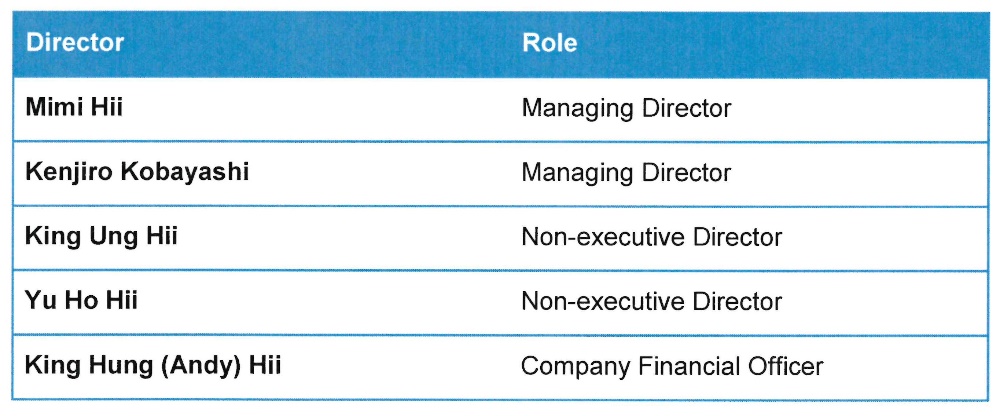
27. The same directors are still on Origo’s board today.
28. Origo commenced business with one store, Daiso “The Hive”.
29. Origo currently has 6 stores in Victoria, and 1 store in New South Wales.
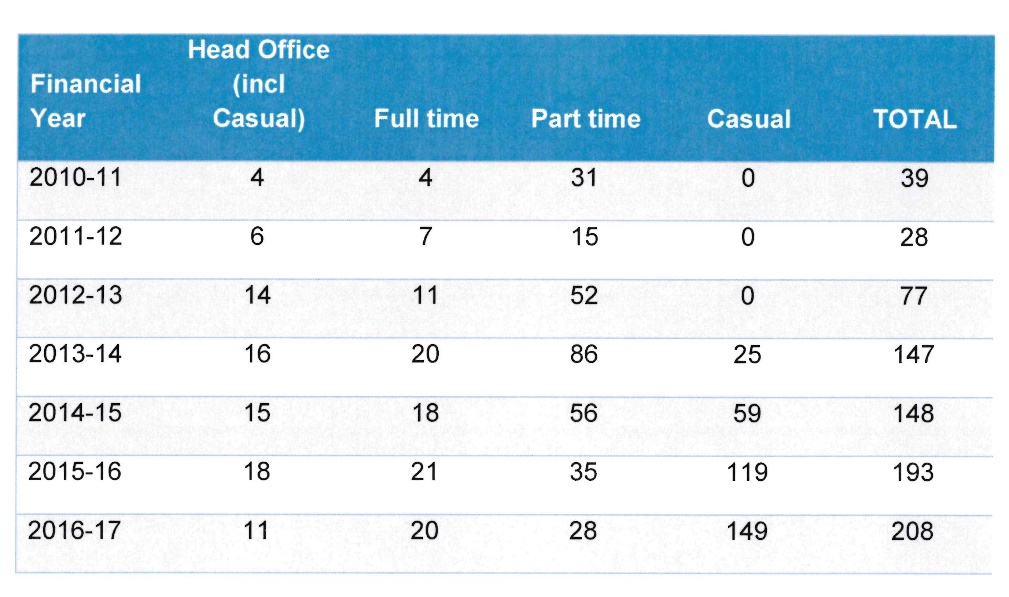
30. The table below sets out the number of employees (full time, part time and casual staff) working for Origo during the period between 2010/2011 and 2016/2017.
31. Up until October 2016, the organisational structure of Origo was:
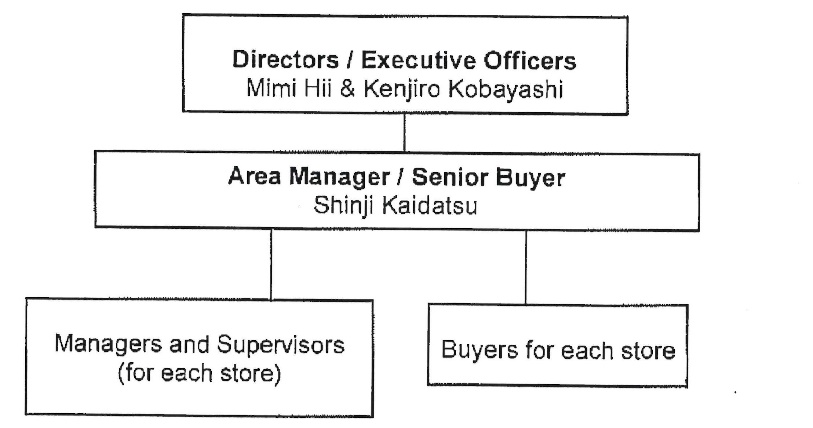
32. Origo’s overall profits from 2011 to 2017 are set out in the table below:
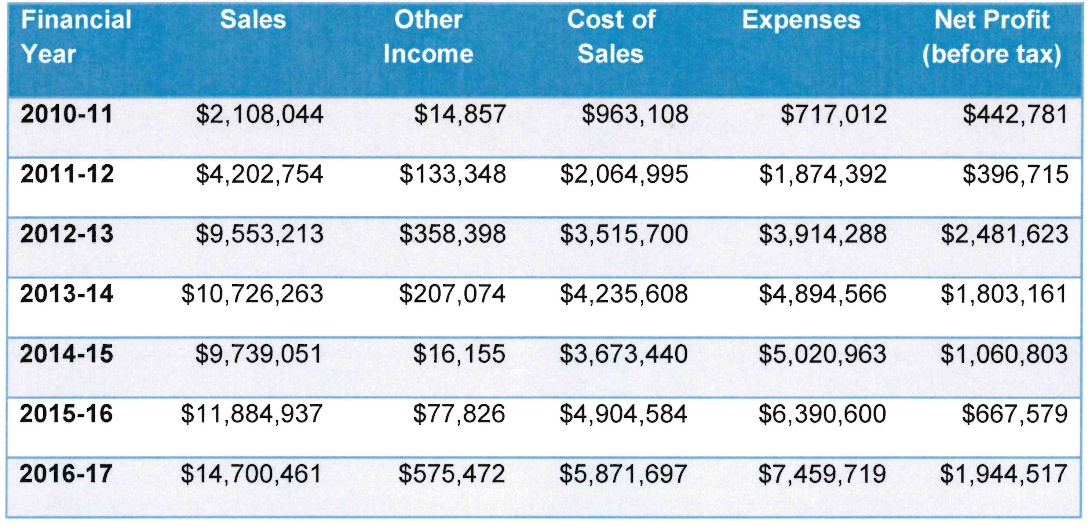
33. During the period of 2011 to 2017, Origo sold 15,295 items of non-compliant products. The total profits generated from those products were $24,030. The selling price of each product is $2.55 (exclusive of GST) and the cost of goods is between $0.99 and $1.25 depending on the fluctuation in the JPY/AUD exchange rate.
CAV INSPECTIONS
34. On 13 April 2011, Consumer Affairs Victoria (CAV) inspectors visited Daiso “The Hive” and seized or purchased (according to CAV’s records) 1,577 units of non-compliant products, comprising:
(a) 1,475 units of cosmetics;
(b) 71 “sunblock” products; and
(c) 31 units of toys, including “Crab and Turtle”, “Drawing Board” and “Rattle Crackle”.
35. On 3 April 2012, CAV inspectors visited Daiso “The Hive” and Daiso Doncaster. The inspectors seized or purchased (according to CAV’s records) 89 units of “Target Shooting Playset”, “Bang Bang Gun” and “Target Shooting Set” (all of which were projectile toys).
36. On 6 February 2013, CAV inspectors visited Daiso “The Hive”, Daiso Doncaster, Daiso Highpoint and Daiso Midtown. The inspectors seized or purchased (according to CAV’s records) 1,718 units of non-compliant products (being 806 units of sunglasses and 912 units of cosmetics).
37. On 7 February 2013, CAV inspectors visited Daiso Midtown again and seized or purchased (according to CAV’s records) 405 units of non-compliant products (being 277 units of sunglasses and 128 [units of] cosmetics).
38. On 14 November 2013, CAV inspectors visited Daiso “The Hive”, Daiso Doncaster, Daiso Highpoint, Daiso Midtown and Daiso Box Hill. The inspectors seized or purchased (according to CAV’s records) 3,225 units of non-compliant products, comprising:
(a) 71 units of projectile toys, including “Bow and Arrow”, “Flying Wing Toy”, “Sky Cyclone Toy” and “Flying Rocket”;
(b) 317 units of sunglasses;
(c) 232 units of “bike ropes”; and
(d) 2,605 units of cosmetics.
39. On 13 April 2014, CAV inspectors visited Daiso Midtown and seized or purchased (according to CAV’s records) a “bath squirter” (being a toy for children under the age of 36 months).
40. On 26 March 2015, CAV inspectors visited Daiso “The Hive”, Daiso Doncaster and Daiso Midtown and seized or purchased (according to CAV’s records) 30 units of non-compliant products, comprising:
(a) 18 units of toys, including “Tiger & Hippo, Stomping Elephant”, “Submarine Toy” and “Ping Pong Catch”; and
(b) 12 units of cosmetics (all of which were brown eyebrow pencils).
41. On 15 July 2015, CAV inspectors visited Daiso Midtown and seized or purchased (according to CAV’s records) 2 units of “Kids Megaphone” (being toys for children under the age of 36 months).
42. On 10 April 2017, CAV inspectors visited Daiso Midtown and seized or purchased (according to CAV’s records) 2 units of “Bobbing Ducks”.
43. On 11 April 2017, CAV inspectors visited Daiso Victoria Gardens and seized or purchased (according to CAV’s records) 6 units of “Bath Squirter” and “Bath Friends”.
44. On 26 April 2017, CAV inspectors visited Daiso Highpoint, Daiso Midtown, Daiso Victoria Gardens and Daiso Doncaster and seized or purchased (according to CAV’s records) 30 units of “Bobbing Ducks”, “Bath Squirter” and “Bath Friends”.
COMPLIANCE INFORMATION PUBLISHED BY REGULATORS
45. On 2 December 2010 the ACCC, ASIC and the State and Territory consumer protection agencies jointly published a guide entitled Compliance and enforcement: How regulators enforce the Australian Consumer Law. The guide has, since 2010, been available for download [at] www.productsafety.gov.au and www.consumerlaw.gov.au.
46. On 17 March 2011, the ACCC published a guide entitled Product safety: Children’s projectile toys: Supplier guide, which provides a summary of the safety requirements for the supply of children’s projectile toys.
47. On 15 June 2011, the ACCC published a product safety bulletin entitled: Chemicals in cosmetics about the use of chemicals in cosmetics. The product safety bulletin included a section relating to the ingredient labelling requirements.
48. In September 2012, CAV developed and published a guide entitled Product safety guide for business to assist businesses in complying with Australia’s product safety laws. At the time of publication of the guide, CAV launched an engagement program. The guide has since September 2012 been available for download at www.productsafety.gov.au, www.consumer.vic.gov.au and www.consumerlaw.gov.au.
49. On 23 June 2013, the ACCC published a guide entitled Product safety: Ingredients labelling on cosmetics [at] www.productsafety.gov.au, which included information about the mandatory labelling standards.
50. On 5 July 2013, the ACCC published a supplier guide entitled Product safety: Sunglasses and fashion spectacles, which included information about the labelling requirements in respect of sunglasses and fashion spectacles.
51. On 4 October 2013, the ACCC published a supplier guide entitled Product safety: A guide to testing [at] www.productsafety.gov.au. The supplier guide contained information on suppliers’ responsibilities in relation to mandatory safety standards.
52. In or about March 2014, the ACCC published a guide for business entitled Consumer Product Safety Online at www.productsafety.gov.au. It included a warning that businesses at all levels of the supply chain must ensure their products comply with Australia’s product safety laws, including by seeking test reports and proof that products meet Australian mandatory safety and information standards.
53. In or about March 2016, ACCC, ASIC and the State and Territory consumer protection agencies jointly published a guide entitled Consumer Product Safety a Guide for Businesses and Legal Practitioners which was available from March 2016 and is available at www.consumerlaw.gov.au and www.productsafety.gov.au.
CURRENT COMPLIANCE REGIME
54. Origo’s current compliance management system has been developed over time with the assistance of experts. … Origo’s compliance system is overseen by Origo’s compliance committee, which is headed by Mimi Hii (a director of Origo), the Senior Buyer and the Manager of Daiso Midtown (Origo’s largest store) (Compliance Committee). …
55. The key features of Origo’s compliance policies and procedures include:
(a) at the product ordering stage:
(i) a ban on ordering any products in high risk categories including luggage straps, projectile toys and toys for children up to and including 36 months of age;
(ii) a number of resources for Origo’s buyers to refer to (such as Buyers Notes, Reference Notes of Product Recalls, Product Safety Guidelines for Businesses by the CAV and Buyers Guide Booklet) when purchasing products subject to product safety standards or information standards;
(iii) daily oversight of both the buying process and retail buyers by the Compliance Committee;
(b) at the product supply stage:
(i) a responsible retailing checklist for Origo’s store managers to complete on a daily basis to ensure all products have appropriate English ingredient and warning labelling. Any product that may not comply with a product safety standard or information standard is removed from sale and quarantined and any product safety issue is recorded;
(ii) monthly oversight of the responsible retail checklist procedure by Origo’s “cluster” managers;
(c) a regulatory compliance training program with annual compliance training delivered by a regulatory compliance professional to Origo’s management team and buyers;
(d) monitoring of CAV product safety alerts by Origo’s Compliance Committee to identify potential product safety risks;
(e) regular communications between Origo’s Compliance Officer and other members of the Compliance Committee and its managers and buyers on product safety risks, including:
(i) monthly compliance committee meetings;
(ii) monthly store monitoring;
(iii) annual reporting to the Board;
(iv) annual reviews of compliance policies and procedures;
(v) annual compliance training for all staff;
(f) external audits of compliance twice a year by an independent compliance system consultant, Mr Bill Dee;
(g) ongoing engagement of an additional independent product safety consultant, Ms Gail Greatorex, to provide advice on specific products.
56. Ms Greatorex was retained to provide:
(a) product category consultation;
(b) advice on Origo’s current compliance policies, procedures and reference materials, including any advice on any further improvements;
(c) training sessions on general hazard assessment, assessing without testing and using warning labels on products;
(d) advice on specific products which have been identified by Origo to be potentially non-compliant and in respect of which, there was doubt. By way of example, Origo was concerned about the risk of children swallowing button batteries. Ms Greatorex advised that button batteries should be placed out of sight and out of reach of small children. Ms Greatorex also suggested using signage to warn consumers about the danger of children ingesting button batteries.
57. The independent [compliance system] consultant, Mr Bill Dee, engaged by Origo is satisfied that Origo’s system is an appropriate compliance system.
HISTORY OF THE CURRENT COMPLIANCE REGIME
Compliance measures in 2011
58. Prior to 13 April 2011, Origo did not have any form of compliance management system in place to ensure compliance with Australian mandatory standards. There was no assessment of products to determine whether they complied with Australian mandatory standards.
59. At the inspection by CAV on 13 April 2011, 71 “sunblock” products, 1475 units of cosmetics and 31 units of toys were deemed to be non-compliant by the CAV.
60. Non-compliant products were immediately removed from sale and quarantined. Origo then took steps to put a compliance management system in place.
61. Origo developed a document known as ‘2011 Product Safety Guidelines’ (2011 Guideline) to provide staff with information about its product safety compliance program. Key features of the 2011 Guideline were:
(a) it was prepared for:
(i) the Area Manager / Buyer and Buyers;
(ii) employees were responsible for receiving inventory (Stock Receipts); and
(iii) employees were responsible for maintaining inventory (Stock Maintenance);
(b) all Buyers were instructed to review information provided by CAV in relation to product safety, including specific products which CAV had generally identified as being potentially unsafe;
(c) the Stock Receipts employees were instructed to follow a procedure in respect of checking labels on products and how to deal with products with no labelling;
(d) the Stock Maintenance employees were instructed to check product labelling once a week and were provided with example photos of products which had the correct labelling.
62. Origo acknowledges that, with hindsight, the system it implemented in April 2011 did not achieve its compliance objectives.
Compliance measures in 2012 to 2014
63. Throughout 2012 and 2013, there were further CAV inspections where non-compliant products were identified. Origo continued to address these defects in its compliance management system.
64. The following steps were taken by Origo throughout 2012 and 2013:
(a) any non-compliant products identified were immediately removed from sale and quarantined;
(b) staff arranged for English labels to be supplied for the cosmetic products CAV had identified as non-compliant;
(c) staff affixed the English language labels to the products;
(d) staff were instructed to check that all cosmetic products had the correct labelling;
(e) staff were informed that hair products (such as hair gels), bath products (such as bath bombs), dental products (such as toothpaste) and hygiene products (such as wet tissues and soap) were considered to be “cosmetics”;
(f) staff were told to remove any sunglasses which the CAV had identified as non-compliant;
(g) “Target Shooting Playset”, “Bang Bang Gun”, “Bow and arrow”, “flying wing toy”, “sky cyclone toy” and “flying rocket toys” or similar Projectile Toys were all banned and were not purchased any further.
65. Additionally, amendments were made to the 2011 Guideline to try to address the issues which had arisen.
66. In early 2014, Origo was concerned that deficiencies remained in its compliance system and it took steps to address this. The 2014 Guideline was created. The key features of the 2014 Guideline included:
(a) monthly management and buyer meetings (sometimes directors would be involved);
(b) a “block” on the ordering system of any products in high risk categories including luggage straps, projectile toys and toys for children up to 36 months of age;
(c) a compliance staff member was to be appointed in each store to conduct a weekly check on the products throughout the entire store;
(d) procedures for staff responsible for monitoring stock received from Daiso Japan prior to approving the product to be displayed for sale;
(e) updated product safety training and monitoring procedures (2014 Product Safety Training) including a clearer description of the duties and responsibilities of Buyers; and
(f) a new guide entitled “Product Safety in Australia” (2014 Product Safety Guide) which sets out (amongst other things) clearly the products which have been deemed to be unsafe and/or high risk.
67. The 2014 Compliance Program was effective as at March 2014.
68. On 7 March 2014, the (then) Area Manager, Shinji Kaidatsu (Shinji), was provided with a Product Safety Pack for his training and for each supervisor/manager and ordering person. Shinji was directed to make the following documents available to all staff in each store:
(a) 2014 Product Safety Guide;
(b) 2014 Compliance Guidelines, including new English label forms;
(c) 2014 Product Safety Training.
69. Origo management emphasised that supervisors were to:
(a) ensure that all staff follow the various guidelines properly;
(b) ensure that all staff are aware of the guidelines;
(c) check all items in the shop and report any items which the staff are unsure about;
(d) conduct a random check of the store once a week;
(e) when new stock arrives in the store, the manager is required to check all cosmetic items and initial boxes to indicate that those products have the correct labelling;
(f) label any products which do not have an English description;
(g) conduct a cosmetic labelling check every week.
70. Origo management relied on Shinji to train each supervisor/manager and ordering person and to make the documents available to all staff in each store. Up until October 2016, Shinji was the main point of contact for staff. The directors had minimal contact with the store managers and supervisors. All staff queries were directed to Shinji and Shinji would inform the directors of any issues which he had difficulty resolving. The directors expected that Shinji would inform the directors of any compliance issues which he had difficulty resolving. Shinji did not report any issues to the directors and the directors therefore assumed that the compliance program was working.
71. Origo provided a copy of the product compliance program documentation to CAV on or around 27 March 2014 and invited CAV to provide any further suggestions.
72. An independent product safety expert was not consulted at that time, principally because Origo did not appreciate that such people existed. Origo also misunderstood CAV’s role. Origo genuinely, but mistakenly, believed that CAV was providing it with advice in relation to what it needed to do to be compliant in respect of its product safety obligations.
73. Origo now appreciates that this was incorrect and understands that it is responsible for ensuring that the products it sells comply with product safety laws.
Compliance measures in 2015 to 2017
74. On or around 4 June 2015, correspondence was sent to Mr Peter Hiland of CAV enclosing all requested information and documents and:
(a) confirming that Origo had immediately blocked the 3 toy items in its ordering system;
(b) confirming that the specific cosmetic items which did not have the required labelling had been properly labelled;
(c) seeking his feedback and advice;
(d) reiterating Origo’s commitment to provide safe products to its customers.
75. On 6 August 2015, Origo received a letter from CAV in respect of certain non-compliant toys for children up to and including 36 months. This included “Submarine Toy”, “Tiger & Hippo, Stomping Elephant” and “Kids Megaphone”. The letter from CAV sought Origo’s response as to whether those toys would be voluntarily recalled by Origo. Those toys had already been removed from sale by Origo.
76. A decision was taken that Origo would no longer sell toys for children under the age of 36 months at all. By this date, Origo had banned all products that had fallen within the categories previously seized by the CAV except for cosmetics.
77. On 13 August 2015, Origo conducted a voluntary recall in respect of each of these products. The voluntary recall involved publication of notices on CAV’s product safety website, Origo’s website and in stores. During the voluntary recall, no products were returned to Origo and there were no reports of injuries or illness to consumers.
78. On 2 September 2015, Ms Mimi Hii sent an email to Sarah Atkinson at CAV confirming that Origo was recalling the products from its stores in Daiso Midtown, Daiso Doncaster, Daiso Box Hill, Daiso “The Hive” and Daiso Highpoint.
79. During 2016, Origo did not make any further changes to its compliance program because:
(a) Origo had in place the 2014 Compliance Program comprising the 2014 Guideline, 2014 Product Safety Guide, 2014 Compliance Guidelines (including labelling forms) and 2014 Product Safety Training;
(b) it was not necessary to place a further ban on sunscreen products, sunglasses, luggage straps, projectile toys and toys for children under the age of 36 months because all such products had been banned by August 2015.
80. On 10 April 2017, CAV inspectors visited Daiso Midtown and seized or purchased (according to CAV’s records) 2 units of “Bobbing Ducks”.
81. On 11 April 2017, CAV inspectors visited Daiso Victoria Gardens and seized or purchased (according to CAV’s records) 6 units of “Bath Squirter” and “Bath Friends”.
82. On 26 April 2017, CAV inspectors visited Daiso Highpoint, Daiso Midtown, Daiso Victoria Gardens and Daiso Doncaster and seized or purchased (according to CAV’s records) 30 units of “Bobbing Ducks”, “Bath Squirter” and “Bath Friends”.
83. These products were being stocked by Origo because:
(a) staff mistakenly assumed that those products were compliant because those items had been for sale for a number of years and CAV inspectors had looked at those products on several different occasions before in store, but had not seized them;
(b) staff genuinely believed that those products did not contain or liberate small parts;
(c) staff did not think there were any further issues with those products because they had previously checked whether there were any issues with the plastic material used in those toys and confirmed there were no issues.
84. After further products were identified by CAV in 2017, Origo made a number of enquiries, including with various agents such as Experts Direct and Unisearch Expert Opinion Services, to try to identify an appropriate compliance expert.
85. Origo ultimately retained Mr Bill Dee on or around 5 September 2017 to review Origo’s compliance program and to provide ongoing compliance training. A training presentation was conducted by Mr Dee for Origo on 9 October 2017. At this training presentation, Mr Dee provided Origo with an interactive training presentation which included a PowerPoint presentation on Australian Consumer Law.
86. Mr Dee was also shown Origo’s existing compliance program documentation including:
(a) 2014 Product Safety Guide;
(b) 2014 Compliance Guidelines, including new English label forms;
(c) 2014 Product Safety Training;
(d) Buyers’ Notes which included information and photos of banned products (including Origo’s previously banned products and those listed on CAV’s website) and extracts of relevant regulations and standards;
(e) Reference Notes of Product Recalls, including all products recalled by Daiso Japan; and
(f) Product Safety Guidelines for Businesses by CAV.
87. Mr Dee recommended that Origo update its 2014 Compliance Guideline with the new information that he provided during the training presentation.
88. Following the training by Mr Dee, the Compliance Team inserted the following items into its existing compliance program:
(a) retailing checklist procedures including:
(i) Daily Product Stock In/Receipt Compliance Checklist;
(ii) Monthly Instore Product Compliance Checklist;
(b) Annual Compliance Plan with scheduled dates for:
(i) monthly Compliance Committee meetings;
(ii) bi-monthly Compliance Committee report to the Board;
(iii) quarterly compliance communication by the Compliance Officer;
(iv) random audits conducted by a member of the Compliance Committee for the purposes of monitoring the stores;
(v) yearly external compliance audit;
(vi) yearly review of Staff Manual and Training materials by the Compliance Officer;
(vii) yearly review of the Annual Compliance Plan;
(viii) yearly compliance training for Managers and Buyers[;]
(ix) compliance training for store managers during state meetings and trade fairs; and
(x) a Toys Test Checklist which requires staff to apply the Choke Check, twisting and dropping test, sharp edges test, labelling, chemicals check, magnet test and whether the toy parts are securely sewn.
89. In February 2018, Mr Dee was commissioned to undertake an audit of one of the Daiso Australia stores.
90. Mr Dee conducted an audit of Daiso Midtown (Origo’s flagship store) on 15 February 2018. Following this audit, Mr Dee concluded that Origo’s compliance management system incorporates all of the necessary features of a comprehensive and effective compliance management system with tasks embedded in day-to-day operation of the business including a commitment to compliance from top and middle management, adequate resources for compliance and a compliance policy and plan.
91. Mr Dee is scheduled to inspect the store on 27 September 2018.
92. In addition to Mr Dee, Origo has also engaged Ms Greatorex, a product safety expert, to provide advice in respect of specific products. Ms Greatorex’s retainer with Origo is set out in [paragraph 56] above.
93. On 29 March 2018, Ms Greatorex attended Daiso Midtown to conduct a preliminary assessment of products. Ms Greatorex provided Origo with additional information and training on identifying products that could be a potential risk.
CURRENT COMPLIANCE PROGRAM IN PRACTICE
94. The following procedures are now in place:
(a) the Senior Buyer receives and reviews regular alerts from Product Safety Australia;
(b) a Shift Leader or Store Manager will complete the Stock Arrive Checklist and Stock In Compliant Checklist when new stock is received;
(c) a Shift Leader will complete the Existing Stock Checklist on a monthly basis;
(d) any non-compliant products will be removed and reported to the Store Manager or Senior Buyer;
(e) a Shift Leader or Store Manager will use the English ingredient labelling checklist when checking products which require labelling;
(f) any concerns about … a product will be escalated to the Senior Buyer;
(g) employees will undertake research if they come across products which might be potentially unsafe;
(h) if the Senior Buyer is unsure about the product, the Senior Buyer will direct all stores to remove the product from sale and block the product on the Ordering System. Once the product is blocked, the product cannot be ordered by any store;
(i) each fortnight prior to the period for ordering products, the Store Manager will discuss with Buyers any concerns or feedback he/she received regarding products.
ORIGO’S VOLUNTARY PRODUCT RECALL
95. On 8 January 2018, Origo started a voluntary recall of the products which the CAV previously … inspected and seized and which Origo immediately removed from sale following the CAV inspections.
96. On 22 January 2018, Origo submitted the first batch of recall notices to the ACCC in respect of the following products:
(a) Hand Creams;
(b) Skin Care Products;
(c) Hair Care Products;
(d) Assorted Make up Products;
(e) Tissue Products;
(f) Dental Products;
(g) Elastic Luggage Straps;
(h) Bath Toys;
(i) Bath/Water Toys;
(j) Projectile Toys;
(k) Toys; and
(l) Sunglasses.
97. On 22 February 2018, Origo’s recall notices were published on the ACCC’s product safety website, its own website and were displayed in Daiso Midtown, Daiso Doncaster, Daiso Box Hill and Daiso Highpoint.
98. On 19 March 2018, Origo submitted the second batch of recall notices to the ACCC in respect of the following remaining products (which did not have photos):
(a) Assorted Makeup Products;
(b) Assorted Skincare Products;
(c) Assorted Sunglasses;
(d) Hand Care Products; and
(e) Men’s Toiletry Products.
99. On 8 April 2018, further recall notices were published on the ACCC’s product safety website, its own website and were displayed in Daiso Midtown, Daiso Doncaster, Daiso Box Hill and Daiso Highpoint.
100. Origo reports that there have been:
(a) 3 products returned and refunded, including “Bath Toy”, “Baby Oil” and “Powerful Car Bath Ball”;
(b) no complaints … made about the products; and
(c) no illnesses or injuries reported.
PROFITS GENERATED FROM THE SALE OF BANNED PRODUCTS
101. The table below sets out Origo’s average cost of goods sold and the profit margin for each financial year from 2010/2011 to 2016/2017.
102. All products purchased and imported from Daiso Japan have the same JPY cost price per item. However, the AUD cost would change due to fluctuation in the JPY/AUD exchange rate. Accordingly, the average cost and gross margin changed from 2010/11 to 2016/17.
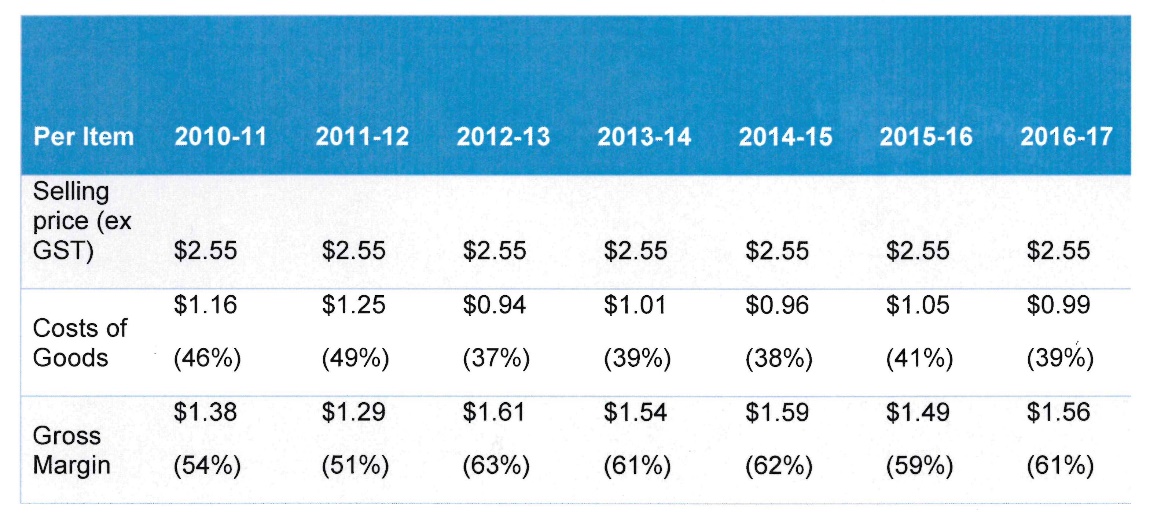
103. Over the period of 2011 to 2017, Origo sold 15,295 items of non-compliant products. The total profits generated from the sale of these items over this 6-year period were $24,030. Table 2 sets out Origo’s calculations.
104. There are certain products which Origo has been unable to find any information about. These products are set out in Table 3 and include:
(a) products where there is no available barcode and Origo cannot find a corresponding barcode based on CAV’s description of the product;
(b) products where the barcode provided is incorrect and Origo cannot find a corresponding barcode based on CAV’s description of the product; and
(c) products which are simply no longer on Origo’s database. This could be due to technical issues which Origo had with its point-of-sale system in or around 2013 (when Origo upgraded the system). It may also be due to an error in recording as Origo regularly receives large volumes of products.


