

FEDERAL COURT OF AUSTRALIA
Neurim Pharmaceuticals (1991) Ltd v Generic Partners Pty Ltd [2018] FCA 1082
Table of Corrections | |
Para [47] first sentence “Europe Union” be amended to read “European Union” | |
Para [49] second sentence “reasonable person it” be amended to read “reasonable person in” |
ORDERS
NEURIM PHARMACEUTICALS (1991) LTD Applicant | ||
AND: | GENERIC PARTNERS PTY LTD (ACN 132 833 777) First Respondent APOTEX PTY LTD (ACN 096 916 148) Second Respondent | |
DATE OF ORDER: |
THE COURT ORDERS THAT:
1. The interlocutory application be dismissed.
2. The respondents pay the applicant’s costs of the interlocutory application.
Note: Entry of orders is dealt with in Rule 39.32 of the Federal Court Rules 2011.
NICHOLAS J:
Background
1 Before me is an interlocutory application brought by the second respondent (“Apotex”) which, in substance, challenges claims for legal professional privilege and patent attorney privilege made by the applicant (“Neurim”), in respect of certain documents. The first respondent (“Generic Partners”) supports Apotex’s application and adopts its submissions.
2 The application arises in a proceeding for infringement of Australian Patent No 2002326114 (“the Patent”) relating to the manufacture and use of medicaments to treat a patient suffering from insomnia. The Patent was granted on 5 July 2007 and is said by Neurim to derive priority from international patent application number WO 03/015690 filed on 14 August 2001.
3 The proceeding was commenced on 5 May 2017 by originating application and statement of claim. On the same date Neurim filed an interlocutory application seeking an order under s 105(1) of the Patents Act 1990 (Cth) (“the Act”) for the amendment of the description of the invention and each of the nine claims of the Patent. The respondents oppose the amendment application which is listed for hearing before me on 12 November 2018.
4 There are particulars included in the statement of claim which indicate that Neurim first became aware that the respondents threatened to infringe the Patent on or about 19 April 2017.
5 Claim 1 of the Patent is a Swiss-style claim. If the proposed amendments were allowed, claim 1 would read:
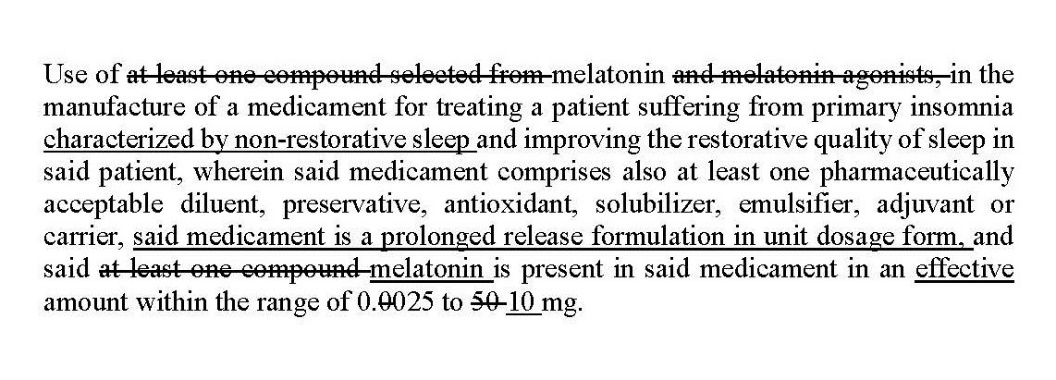
6 I shall refer to the four amendments as follows:
the melatonin limitation which excludes the compounds referred to in claim 1 to melatonin agonists and limits the claim to melatonin;
the non-restorative sleep limitation which limits the claim to use of the relevant medicament to the treatment of patients suffering from “primary insomnia characterised by non-restorative sleep” rather than just “primary insomnia”;
the prolonged release limitation which limits the medicaments referred to in the claim to “prolonged release” formulations; and
the range limitation which limits the range of melatonin present to .025mg to 10mg in place of .0025mg to 50mg.
7 According to ground 8(a)-(d) of Neurim’s Statement of Grounds in Support of the s 105 Amendments (“the Grounds”):
(a) Neurim has complied with each of the formal requirements for amendment pursuant to s 105 of the Act, in the premises of paragraphs 6 and 7 above;
(b) … Neurim has received notice from the Commissioner that the Commissioner has reviewed the proposed amendments and is prima facie satisfied that they meet the requirements of s 102 of the Act;
(c) Neurim’s reasons for making the application to amend the Patent are to:
(i) narrow the claims and narrow the issues to be determined at trial; and
(ii) better align the claims with the claims of the European Patent, in a manner that is also consistent with certain amendments that were made to the claims of the United States Patent during the prosecution of the application for that patent.
…
(d) Neurim has not engaged in unreasonable delay in seeking to amend the Patent, in that:
(i) Neurim filed the Interlocutory Application at the same time as it filed the originating application and statement of claim in this proceeding on 5 May 2017;
(ii) it was not until in or around April 2017 that Neurim decided that it would be desirable to amend the Patent; and
(iii) it was not until in or around April 2017 that a reasonable person in Neurim's position would have decided that it would be desirable to amend the Patent;
…
8 Apotex contends that the proposed amendments are being propounded in light of amendments that were made in August 2011 during the prosecution of the application for European Patent No 1441702 (“the European Patent”) which was granted on 10 May 2017. The European Patent, which is also owned by Neurim, is said to derive its priority from the same international patent application as the Patent for Australia and is of a similar scope and subject matter to the Patent.
9 Apotex also contends that the proposed amendments reflect some of the amendments that were made in August 2008 to claims of United States Patent No. 8,962,024 (“the United States Patent”) during the prosecution of the application for that patent. The United States Patent, which is also owned by Neurim, is also said to derive its priority from the same international patent application and is of similar scope and subject matter to the Patent.
10 Apotex contends that Neurim is guilty of unreasonable delay in seeking the amendments. The particulars given by Apotex in relation to delay are as follows:
Neurim should be taken to have known since at least August 2008 of the need for the proposed amendments because it (or its related parties, also Neurim) made amendments to its related patents in other jurisdictions that have the same effect as the proposed amendments to claim 1 of the Patent:
(i) Neurim filed an amended set of claims for United States patent application no. 10/486,688 (which became the United States Patent) on 28 August 2008 to confine the claims to non-restorative sleep.
(ii) Neurim filed an amended set of claims for Canadian patent application no. 2454699 on 25 July 2011 to confine the claims to non-restorative sleep.
(iii) Neurim filed a request to amend the European patent application no. 02760523.7 (which became the European Patent) on 10 August 2011 to confine the claims:
A. to non-restorative sleep;
B. to prolonged release formulations;
C. to melatonin alone; and
D. to a narrower dose range.
11 Implicit in Apotex’s case on delay is the contention that Neurim should have applied to amend the claims after grant pursuant to s 104(1) of the Act. Section 104(1) provides:
An applicant for a patent or a patentee, may, subject to this Act, and subject to and in accordance with the regulations, ask the Commissioner for leave to amend the relevant patent request or complete specification, or any other filed document, for any purpose including either or both of the following:
(a) removing a lawful ground of objection to the request or specification, whether that objection is raised in the course of an examination or re-examination or otherwise;
(b) correcting a clerical error or an obvious mistake.
12 I made an order for limited discovery on 23 October 2017 which required Neurim to give discovery of various categories of documents including any documents referred to in para 1 of the schedule to the orders which is as follows:
All files or parts thereof held by the Applicant or any related company, or their agents, including lawyers, patent attorneys or patent agents, in Australia or overseas, in relation to the drafting and/or prosecution of the following insofar as they discuss the amendments the subject of the Amendment Application or the same or similar amendments to those the subject of the Amendment Application:
(a) the Patent; and
(b) equivalent patents being:
i. United States patent no. 8,962,024;
ii. Canadian patent no. 2,454,699; and
iii. European patent no. EP1441702.
13 Documents falling within para 1(a) have been produced by Neurim without any claim of privilege being made. Some of these documents record legal advice provided to Neurim by its Australian lawyers in March and April 2017 in relation to the matter of amendment. Neurim has made a claim for privilege in relation to documents falling within para 1(b) which are referred to at item 29 of Neurim’s list of documents. For convenience, I shall refer to them as the “documents in issue”. The nature of the documents in issue is described by Mr Tyacke of DLA Piper, Neurim’s solicitors, in these terms:
1. Less than 10 confidential substantive communications between a licensed Israeli patent attorney of JMB, Factor & Co, Neurim’s Israeli patent attorneys, and a chartered UK patent attorney and European patent attorney, of Wilson Gunn, Neurim’s United Kingdom patent attorneys, or employees of Neurim, in 2008, regarding advice relating to the prosecution of the European Patent;
2. Less than 10 confidential substantive communications between a registered U.S. patent agent and licensed Israel patent attorney, of JMB, Factor & Co, Neurim's Israeli patent attorneys, and a chartered UK patent attorney and European patent attorney, of Wilson Gunn, Neurim’s United Kingdom patent attorneys, or employees of Neurim, in 2011, regarding advice relating to the prosecution of the European Patent; and
3. Less than 10 confidential substantive communications between lawyers and registered U.S. patent agents, of Rothwell, Figg, Ernst & Manbeck, P.C., Neurim’s U.S. patent attorneys, and an employee of Neurim, in 2014, regarding advice relating to the prosecution of the United States Patent.
14 I note that it is not disputed by Apotex that there are no documents within category 1(b)(ii) which relate to Canadian Patent No 2,454,699 (“the Canadian Patent”). Nor does Apotex dispute that the documents in issue would be privileged from production were it not for what Apotex asserts is an implied waiver of the privilege.
The Evidence
15 Professor Nava Zisapel is the Managing Director, and Chief Scientific Officer, of Neurim. She has made an affidavit which Neurim intends to read at the hearing of the amendment application. That affidavit was relied upon for the purposes of the application that is before me. Professor Zisapel was not cross-examined.
16 In her affidavit Professor Zisapel identifies the amendments that Neurim seeks to make to the patent and Neurim’s reasons for seeking them. Her affidavit also provides a brief prosecution history of the Patent, the European Patent, the United States Patent and the Canadian Patent. She also provides a description of the steps taken by Neurim leading up to the filing of the amendment application.
17 Professor Zisapel says she first discussed the possibility of amending the Patent with Mr Tyacke in a telephone conference on 23 March 2017. She says this was the first time the possibility of amending the Patent was suggested to her or, to her knowledge, Neurim. She says that, to her knowledge, Neurim had not previously considered the prospect of amending the Patent.
18 Various amendments were proposed during the prosecution of the European Patent on 4 December 2008, 2 February 2011 and 10 August 2011. On those dates Neurim’s patent attorneys filed a response to the First Examination Report including proposed amendments to the claims. The European Patent was not granted until 17 February 2017.
19 Professor Zisapel says that the amendments proposed to the Patent are generally based on amendments that were made during the prosecution of the application for the European Patent. Some of the proposed amendments also reflect amendments that were made during the prosecution of the United States Patent. Professor Zisapel says in her affidavit at [71]-[72]:
[71] On 23 March 2017, I held a telephone conference with other Neurim staff, Mr Tyacke and some of his team from DLA Piper. During that telephone conference, Mr Tyacke raised for the first time the idea of amending the Australian Patent. Mr Tyacke explained that he had reviewed the prosecution file for the European Patent, which had not yet been granted at this time. He advised that he considered it very likely that, if proceedings were brought for infringement of the Australian Patent, a cross-claim for invalidity would be brought relying on grounds identified in that prosecution file.
[72] This was the first time that the possibility of amending the Australian Patent was suggested to me or, to my knowledge, Neurim. I and, to my knowledge, Neurim had not previously considered the prospect of amending the Australian Patent.
20 Professor Zisapel also says in her affidavit at [94]:
… the idea of amending the Australian patent was raised with Neurim by DLA Piper in late March 2017. Neurim’s rationale for seeking the amendments is that they would narrow the scope of the claims of the Australian patent, such that the scope of the issues that would potentially be litigated would be narrower. This could save time and resources for Neurim, as well as other parties and the court. Other amendments will narrow the claims in order to avoid a potential dispute in relation to the use of therapeutic agents other than melatonin, avoid a dispute in respect of the patient population of which the claims are directed and narrow the claims by limiting the nature of the medicament and the identified dosage range.
She also says she is of the view that the Patent is valid but acknowledges that the court may take a different view and that, as a result, it is possible that the proposed amendments, if made, could improve Neurim’s prospects of successfully defending a challenge to the validity of the Patent.
21 The evidence includes correspondence between Neurim’s UK patent attorneys and the European Patent Office (“EPO”) from between August 2007 and August 2011 concerning proposed amendments to the claims of the European Patent Application and correspondence between Neurim’s US patent attorneys and the United States Patent and Trademark Office (“USPTO”). The proposed amendments to claim 1 introduced the prolonged release limitation, the melatonin limitation and the non-restorative sleep limitation. A figure of 2mg was inserted in place of the range of .0025 to 50mg specified in the claim before amendment.
22 The EPO correspondence shows that Neurim agreed to amend the claims of the European Patent Application in response to objections raised by the Examiner that (inter alia) claim 1 lacked clarity and that it also lacked novelty and an inventive step based upon prior art cited by the Examiner.
23 It is fair to say that the amendments to claim 1 sought to be made to the Patent in this proceeding adopt, in substance, the European amendments except in relation to the amount of melatonin to be used in the manufacture of the formulation. The amendments made to the United States Patent Application introduced the non-restorative sleep limitation but none of the other limitations.
24 Neither party invited me to examine the documents the subject of the present application even though I had previously raised with them the desirability of the judge hearing the application (whether it be me or another judge) doing so for the purpose of assessing whether the claimed privilege had been waived. It was open to Apotex to compel production to the Court so that the relevant documents could be made available for that purpose but it did not take any steps to do so. That has left me in a position of some disadvantage in which I have very little information as to the contents of the documents in issue beyond what can be gleaned from the relevant discovery category, Mr Tyacke’s affidavit, and other less specific evidence.
The Respondents’ Submissions
25 Apotex made three principal submissions.
26 First, Apotex submitted that Neurim’s evidence about the overseas patents reveals that its purpose for wishing to amend the Patent was formulated when similar amendments were made overseas. It submitted that it is inconsistent for Neurim to ask the Court to take into account Neurim’s reasons for seeking the amendments, and to take into account the fact that the amendments sought in this proceeding reflect the same amendments sought in other jurisdictions, while also seeking to maintain privilege in materials recording Neurim’s reasons for seeking the amendments made in other jurisdictions.
27 Secondly, Apotex submitted that Neurim has put in issue its “position” with respect to deciding whether to amend the Patent and that this was necessarily informed by advice about similar amendments made to the overseas patents. It was submitted that it would be inconsistent and forensically unfair to permit Neurim to withhold production of the advice that informed the position upon which it now relies.
28 Thirdly, Apotex referred to Professor Zisapel’s evidence that she is, and has always been, of the understanding that the Patent is valid in its current form, and noted that she does not say how she formed that view. Apotex submitted that the documents in issue are communications between Neurim and its overseas attorneys about the amendment of the overseas patents that are likely to have contributed to Professor Zisapel’s understanding as to the validity of the Patent. It was submitted that it would be inconsistent and forensically unfair to permit Neurim to withhold production of the advice that informed the position upon which it now relies.
The Relevant Principles
29 It is common ground that the issue of whether the documents in issue are privileged from production, including whether any privilege has been lost by waiver, is governed by the common law. Waiver occurs if the party otherwise entitled to the benefit of the privilege conducts itself in a manner that is inconsistent with the maintenance of the confidentiality which the privilege is intended to protect: Mann v Carnell (1999) 201 CLR 1 at [27]-[29]. The plurality said at [29]:
Waiver may be express or implied. Disputes as to implied waiver usually arise from the need to decide whether particular conduct is inconsistent with the maintenance of the confidentiality which the privilege is intended to protect. When an affirmative answer is given to such a question, it is sometimes said that waiver is “imputed by operation of law”. This means that the law recognises the inconsistency and determines its consequences, even though such consequences may not reflect the subjective intention of the party who has lost the privilege … What brings about the waiver is the inconsistency, which the courts, where necessary informed by considerations of fairness, perceive, between the conduct of the client and maintenance of the confidentiality; not some overriding principle of fairness operating at large. [Footnote omitted.]
30 In Macquarie Bank v Arup [2016] FCAFC 117 the Full Court referred with approval to a number of statements of principle including (at [28]) the following statement in Ferella & Anor v Official Trustee in Bankruptcy (2010) 188 FCR 68 at [65] per Yates J:
…the question is not simply whether the holder of the privilege has put that person’s state of mind in issue but whether that person has directly or indirectly put the contents of the otherwise privileged communication in issue: see [Commissioner of Taxation v Rio Tinto Ltd (2006) 151 FCR 341] at [65]. Indeed, even the fact that the holder of the privilege makes clear that advice was relevant or contributed to a particular course of conduct would not be sufficient to waive the privilege unless, possibly, the contents of the legal advice (and not merely the fact of the advice) are specifically put in issue by relying on the contents of the advice to vindicate a claimed state of mind: [Commissioner of Taxation v Rio Tinto Ltd (2006) 151 FCR 341] at [67]. [See also British American Tobacco v Department of Health (2011) 195 FCR 123 at [41]-[47]].
31 The Full Court also referred with approval (at [32]) the following statement of Hodgson JA (Campbell JA agreeing) in Council of the New South Wales Bar Association v Archer (2008) 72 NSWLR 236 at [48]:
It is not enough to bring about a waiver of client legal privilege that the client is bringing proceedings in which the content of the privileged communications could, as a reasonable possibility, be relevant and of assistance to the other party. For the client to do this is not inconsistent with the maintenance of the privilege, and does not give rise to unfairness of the type in question. What would involve inconsistency and relevant unfairness is the making of express or implied assertions about the content of the privileged communications, while at the same time seeking to maintain the privilege. In this respect, it may be sufficient that the client is making assertions about the client's state of mind, in circumstances where there were confidential communications likely to have affected that state of mind.
32 The Full Court also confirmed that the law regarding issue waiver remains as explained by the Full Court in Commissioner of Taxation v Rio Tinto Ltd (2006) 151 FCR 341.
33 In Rio Tinto, the Full Court referred to Thomason v Campbelltown Municipal Council (1939) 39 SR (NSW) 347, which was a case in which the defendant sought to prove that the plaintiff had knowingly made an election to receive compensation in respect of her deceased husband’s death prior to commencing proceedings against his former employer for wrongful death. The Full Court, after referring to the judgment of Jordan CJ (at 358-359), referred to an unreported decision of McLelland J (as his Honour then was) in United States Surgical Corp v Hospital Products International Pty Ltd (unreported, Supreme Court, NSW, McLelland J, 13 October 1981). After referring to Thomason at 358-359, his Honour continued:
In the Thomason Case, the plaintiff was asserting a right to claim damages in a statutory context which rendered it implicit in such an assertion that the plaintiff had not effectively exercised her option to take the alternative course, notwithstanding that on the pleadings the onus of proving the effective exercise by the plaintiff of that option, and in an evidentiary sense the onus of proving the plaintiff’s knowledge of her legal rights, in each case rested on the defendant. So that it may be that the criterion that the otherwise privileged party must himself have raised the fact and nature of the advice as an issue in the case is too rigidly stated. Nevertheless, before the privilege can be said to have been lost on this principle, one must at least be able to identify some element or feature of the claim made, or the evidence adduced, by the party otherwise entitled to the privilege, which would render reliance on the privilege unjust.
The Full Court accepted as correct his Honour’s discussion of Thomason, but noted that his Honour’s statement of the governing principle may need to be qualified by reference to the Mann “inconsistency principle”, rather than some overarching notion of injustice. The Full Court said at [52]:
These authorities show that, where issue or implied waiver is made out, the privilege holder has expressly or impliedly made an assertion about the contents of an otherwise privileged communication for the purpose of mounting a case or substantiating a defence. Where the privilege holder has put the contents of the otherwise privileged communication in issue, such an act can be regarded as inconsistent with the confidentiality that would otherwise pertain to the communication.
34 The Full Court also referred to a statement in the majority judgment in Telstra Corporation Ltd v BT A/asia Pty Ltd (1998) 85 FCR 152 at 168 indicating that where a party relies on a cause of action, an element of which is the party’s state of mind, the party is taken to have waived privilege in respect of legal advice received material to the formation of that state of mind. However, the Full Court in Rio added at [56]:
… As their Honours made clear, however, when they spoke of a communication “material to the formation of that state of mind”, they did not intend to say that privilege would be waived in relation to advice that may only have played a part in the formation of a state of mind relevant to an issue in the proceedings: see Telstra at 167. Their conclusion that BT waived privilege turned entirely on the particular nature of the case, especially BT’s pleadings.
Their Honours referred with apparent approval to the following statement in Beaumont J’s dissenting judgment in Telstra at 157-158:
At this stage, BT has made no use of the legal advice in the proceedings. The advice is not pleaded by BT as an ingredient of its claim. BT does not assert that it relied, or did not rely, on the advice … Questions of degree may be involved, but the advice is not, obviously, central to that issue in the same way as the advice given by the solicitor on the election was, obviously, central to the plea in Thomason, at least as the issues in Thomason had evolved in the course of the trial.
35 It is therefore clear that in a case involving an alleged issue waiver, it is essential that there be some element or feature of the claim made, or the evidence adduced by the party asserting the privilege, that would be inconsistent with the maintenance of the privilege. Such inconsistency may arise if, as Allsop J (as his Honour then was) explained in DSE (Holdings) Pty Ltd v Intertan Inc (2003) 127 FCR 499 at [58]:
… the party entitled to the privilege makes an assertion (express or implied), or brings a case, which is either about the contents of the confidential communication or which necessarily lays open the confidential communication to scrutiny and, by such conduct, an inconsistency arises between the act and the maintenance of the confidence, informed partly by the forensic unfairness of allowing the claim to proceed without disclosure of the communication.
(original emphasis)
36 Whether or not it may be said that the party claiming privilege has brought a case that is inconsistent with the maintenance of the privilege involves questions of degree and an evaluative assessment of the unfairness to the other party in permitting the case to go forward without disclosure of communications that are relevant to that case.
37 Where the case brought by the party claiming privilege includes as an element the existence of a particular state of mind, then the question whether a waiver of privilege should be imputed will depend on a range of matters including the significance of the party’s state of mind to the case sought to be brought, and the probability that the relevant communication will have induced or contributed to that state of mind: see Wayne Lawrence Pty Ltd v Hunt [1999] NSWSC 1044 per Hodgson CJ in Eq. at [12].
38 The fact that the relevant communication is unlikely to have had more than a peripheral or incidental impact on the party’s state of mind is likely to preclude a finding of waiver unless the party whose state of mind is in issue makes some express or implied assertion as to the content of the relevant communication.
Consideration
39 It is common ground that Neurim’s prior knowledge and understanding as to the desirability of amending the Patent is a relevant issue in the amendment application. This would be true even if Apotex had not raised the issue of delay as a ground upon which it relies in opposing the proposed amendments: see CSL Ltd v Novo Nordisk Pharmaceuticals Pty Ltd (2010) 87 IPR 134 at [20] per Jessup J citing Smith Kline & French Laboratories Ltd v Evans Medical Ltd [1989] 1 FSR 561 at 569.
40 Neurim’s pleaded grounds in support of its amendment application allege that Neurim seeks to amend the claims to (inter alia) better align the claims with the claims of the European Patent. It also alleges that Neurim did not decide that it would be desirable to amend the Patent until about April 2017 and that a reasonable person in Neurim’s position would also have not decided that it would be desirable to amend the Patent before then.
41 It is important to distinguish at least two possible scenarios, one in which Neurim asserted that it had received legal advice that it was neither necessary nor desirable to seek to amend the Patent, and the other, in which it asserted that it received no advice at all on the topic before March or April 2017. The present case is within the second category.
42 Neurim is not seeking to rely on the legal advice it obtained during the prosecution of either the European Patent Application or the United States Patent Application nor is it making any express or implied assertion as to the effect of that advice. I do not see any inconsistency in Neurim maintaining its claim for privilege in relation to such advice as it did receive in the course of prosecuting those applications while bringing a case in which it asserts that it did not receive any advice in relation to the amendment of the Patent until in or about April 2017.
43 However, as previously explained, it may be sufficient to bring about a waiver if the person claiming privilege makes assertions about his or her state of mind in circumstances where the confidential communications are likely to have affected that state of mind (Archer at [48]).
44 The allegation that a reasonable person in Neurim’s position would not have decided that it was necessary or desirable to amend the Patent until in or about April 2017 would usually be addressed by reference to the information that was available to Neurim which may, of course, include any legal advice Neurim received relevant to that decision. But the fact that the legal advice is relevant to the decision to amend does not of itself bring about a waiver of privilege. It must first be shown that the documents in issue are likely to have affected Neurim’s state of mind, or that of a reasonable person in Neurim’s position, in some relevant way. Even then, a waiver will only arise where there is an inconsistency in Neurim putting its state of mind in issue and withholding the documents in issue in circumstances that give rise to some unfairness to the respondents.
45 There are two matters that are particularly relevant to the question whether the documents in issue constitute or record confidential communications that are likely to have affected Neurim’s state of mind in some relevant way.
46 First, the Patent had already been granted in Australia by the time any of the relevant communications between Neurim’s patent attorneys, lawyers, patent agents, and employees took place. Further, unlike the position in other jurisdictions, it was not necessary, I infer, for the claims to be amended, at least not in the manner now proposed, in order to overcome any objection raised by the Commissioner prior to acceptance of the patent request and compete specification filed in Australia.
47 The second matter, closely related to the first, is the well-known fact that at all relevant times the patent laws, both substantive and procedural, of the European Union and the United States were materially different from those of Australia particularly in situations where relevant amendments made to the Act by the Intellectual Property Laws Amendment (Raising the Bar) Act 2012 (Cth) do not apply.
48 Even if Neurim had received legal advice that it was necessary or desirable to make amendments to the claims of the relevant applications to facilitate acceptance by either the EPO or the USPTO, it seems to me that this advice would be quite peripheral to the question whether Neurim, or a reasonable person in its position, should have taken steps to amend the Patent after its grant and before March or April 2017.
49 I do not think Neurim has put into issue the contents of the documents in issue. Nor am I satisfied that the documents in issue constitute or record communications that were likely to have suggested to Neurim, or a reasonable person in its position, that it was either necessary or desirable for Neurim to amend the Patent pursuant to s 105 of the Act.
50 In the result, I am not satisfied that there has been an implied waiver of privilege in the documents in issue.
51 With regard to Neurim’s understanding of its legal rights, there is an assumption underlying Apotex’s submission that Professor Zisapel’s opinion as to the validity of the Patent is likely to have been influenced by advice received by Neurim from attorneys in other jurisdictions in relation to what were then pending applications that were the subject of objections raised by the EPO and the USPTO.
52 The main difficulty with Apotex’s submission is that the assumption that Neurim received advice concerning the validity of the claims included in the various overseas patent applications is speculative at best. Assuming that the overseas attorneys advised that the claims of the overseas patent applications should be amended, it does not follow that they did so because, or they advised their client that, the claims in unamended form would be invalid. There is nothing before me to indicate that the documents in issue contain any advice on the question of validity.
53 In any event, even if such advice had been provided, it seems unlikely that it would be central to Professor Zisapel’s views as to the validity of the Patent which must be determined in accordance with Australian law.
54 I am not satisfied that it is inconsistent for Neurim to rely on Professor Zisapel’s statement of opinion at the hearing of the amendment application and to withhold production of any legal advice given by the overseas attorneys in relation to what were then pending applications for patents in different jurisdictions.
55 In the circumstances, I am not satisfied that Professor Zisapel’s statement of opinion with respect to validity gives rise to an implied waiver.
Disposition
56 The interlocutory application will be dismissed. The respondents must pay the costs.
57 Orders accordingly.
I certify that the preceding fifty-seven (57) numbered paragraphs are a true copy of the Reasons for Judgment herein of the Honourable Justice Nicholas. |
Associate:


