

FEDERAL COURT OF AUSTRALIA
Fair Work Ombudsman v Hu (No 2) [2018] FCA 1034
ORDERS
Applicant | ||
AND: | First Respondent MARLAND MUSHROOMS QLD PTY LTD Second Respondent TROY MARLAND Third Respondent | |
NATIONAL FARMERS' FEDERATION LIMITED Intervener | ||
DATE OF ORDER: |
THE COURT ORDERS THAT:
1. The proceeding against the second and third respondents is dismissed.
Note: Entry of orders is dealt with in Rule 39.32 of the Federal Court Rules 2011.
TABLE OF CONTENTS
RANGIAH J:
1 In this proceeding, the applicant, the Fair Work Ombudsman (the FWO), alleges that each of the respondents contravened s 45 of the Fair Work Act 2009 (Cth) (the FWA) by being knowingly involved in contraventions of that provision by another entity.
2 The first respondent, Ms Tao Hu (Ms Hu), has admitted the contraventions alleged against her. The second respondent, Marland Mushrooms Qld Pty Ltd (Marland Mushrooms) and the third respondent, Mr Troy Marland (Mr Marland), have denied the contraventions alleged against them.
3 These reasons deal primarily with the FWO’s case against Marland Mushrooms and Mr Marland. It is convenient to refer to Marland Mushrooms and Mr Marland together as the Marland parties.
4 The National Farmers Federation has been granted leave to intervene in the proceeding on the basis that it has an interest in the proper construction of the Horticulture Award 2010 (Cth) (the Award).
5 I propose to commence by describing the parties and the allegations made by the FWO, before proceeding to consider whether those allegations have been proven.
6 Ms Hu was the sole director of HRS Country Pty Ltd (HRS Country) and its sole shareholder. HRS Country operated as a labour-hire agency. The FWO has not proceeded against HRS Country as it is now in liquidation. However, HRS Country’s conduct remains central to this proceeding.
7 Marland Mushrooms has operated a mushroom farm (the Marland Farm) at Staplyton in Queensland since November 2013. Mr Marland is the sole director of Marland Mushrooms and its sole shareholder.
8 On 1 November 2013, HRS Country and Marland Mushrooms entered into a written agreement for HRS Country to supply labour to pick mushrooms and to do other associated tasks at the Marland Farm. Under the agreement, Marland Mushrooms agreed to pay HRS Country a fixed rate per kilogram of mushrooms picked. That rate was increased under a further agreement made on 27 January 2014.
9 Between 11 November 2013 and 31 August 2014, HRS Country entered into numerous written and oral employment agreements with employees. Those agreements required the employees to pick mushrooms for payment of a rate per kilogram of mushrooms picked—in other words, a piecework rate. The employees were assigned to work at the Marland Farm.
10 HRS Country and its employees were covered by the Award. Clause 15 of the Award allows an employer to enter into an agreement with employees for payment of a piecework rate, provided that at least the minimum piecework rate is fixed. Clause 15 also prescribes a method for determining the minimum piecework rate.
11 The FWO alleges that HRS Country contravened cl 15 by entering into agreements with the employees that fixed the piecework rate at less than the minimum rate and thereby contravened s 45 of the FWA. The FWO alleges that each of the respondents were “involved in” HRS Country’s contraventions, within the meaning of that expression in s 550 of the FWA, and that, consequently, the respondents also contravened s 45 of the FWA. As I have said, the Marland parties deny any such contraventions.
12 There are two principal issues that arise for determination:
(1) Whether HRS Country contravened cl 15 of the Award and s 45 of the FWA.
(2) Whether Marland Mushrooms and Mr Marland were knowingly involved in any such contraventions by HRS Country.
13 The first issue requires the Court to determine whether the piecework rates fixed under HRS Country’s employment agreements would enable the “average competent employee” to earn at least the minimum hourly rate prescribed under cl 15.2 of the Award.
14 The second issue requires the Court to determine whether the Marland parties knew of the essential elements of any contraventions by HRS Country and engaged in conduct which implicates or involves them in the contraventions.
15 It is necessary to examine the terms of the legislation and the Award before turning to these issues.
16 Section 45 of the FWA provides:
45 Contravening a modern award
A person must not contravene a term of a modern award.
Note 1: This section is a civil remedy provision (see Part 4 1).
…
17 Section 550 of the FWA provides:
550 Involvement in contravention treated in same way as actual contravention
(1) A person who is involved in a contravention of a civil remedy provision is taken to have contravened that provision.
…
(2) A person is involved in a contravention of a civil remedy provision if, and only if, the person:
(a) has aided, abetted, counselled or procured the contravention; or
(b) has induced the contravention, whether by threats or promises or otherwise; or
(c) has been in any way, by act or omission, directly or indirectly, knowingly concerned in or party to the contravention; or
(d) has conspired with others to effect the contravention.
18 The FWO alleges that HRS Country contravened cl 15 of the Award, which provides:
15. Pieceworkers
15.1 An employer and a full-time, part-time or casual employee may enter into an agreement for the employee to be paid a piecework rate. An employee on a piecework rate is a pieceworker.
15.2 The piecework rate fixed by agreement between the employer and the employee must enable the average competent employee to earn at least 15% more per hour than the rate prescribed in this award for the type of employment and the classification level of the employee. The piecework rate agreed is to be paid for all work performed in accordance with the piecework agreement.
15.3 The calculation of piecework rates in clause 15.2 for casual employees will include the casual loading prescribed in clause 10.4(b).
15.4 An agreed piecework rate is paid instead of the minimum wages specified in clause 14–Minimum wages.
15.5 The following clauses of this award do not apply to an employee on a piecework rate:
(a) Clause 22–Ordinary hours of work and rostering;
(b) Clause 24–Overtime; and
(c) Clause 24.3–Meal allowance.
15.6 The employer and the individual employee must have genuinely made the piecework agreement without coercion or duress.
15.7 The piecework agreement between the employer and the individual employee must be in writing and signed by the employer and the employee.
15.8 The employer must give the individual employee a copy of the piecework agreement and keep it as a time and wages record.
15.9 Nothing in this award guarantees an employee on a piecework rate will earn at least the minimum ordinary time weekly or hourly wage in this award for the type of employment and the classification level of the employee, as the employee’s earnings are contingent on their productivity.
…
19 Clause 4.1 states that the Award “covers employers throughout Australia in the horticulture industry and their employees in the classifications listed in Schedule B”. Under cl 4.7, this coverage extends to employers which supply labour on an “on-hire” basis. The “horticulture industry” is defined in cl 4.2 to include agricultural holdings in connection with harvesting, picking or packing horticultural crops. It is not in dispute that HRS Country and its employees were covered by the Award.
20 Under Sch B of the Award, employees are classified from Level 1 to Level 5. Level 1 is the lowest of these classifications in terms of the skills required and the minimum hourly wage prescribed. A Level 1 employee is described as an employee who, inter alia, undertakes induction training, performs routine duties essentially of a manual nature, exercises minimal judgement and works under direct supervision. The indicative duties of a Level 1 employee are described in Sch B as including fruit or vegetable picking. The employees in question in this case were Level 1 employees.
21 Clause 14.1 and cl 16.1 of the Award prescribe hourly rates of payment for Level 1 to Level 5 adult and junior employees respectively. However, cl 15.1 allows an employer to enter into an agreement for an employee to be paid a piecework rate instead of an hourly rate.
22 Section 21 of the FWA defines a “pieceworker” as, relevantly, “a national system employee to whom a modern award applies and who is defined or described in the award as a pieceworker”. Clause 15.1 of the Award states that “An employee on a piecework rate is a pieceworker”. The expression “piecework rate” is not defined in the FWA or the Award.
23 The Macquarie Dictionary defines “piecework” as “work done and paid for by the piece”. The Oxford English Dictionary definition is more informative, being “work for which an employee is paid according to the amount produced, rather than receiving a fixed wage”. For present purposes, it is clear that an employee whose payment consists of an amount per kilogram of fruit or vegetables that he or she picks is on a piecework rate.
24 Clause 15.2 of the Award provides a safeguard for pieceworkers. That safeguard is the prescription of a method of calculation of a minimum piecework rate. Clause 15.2 requires that the minimum piecework rate must “enable the average competent employee to earn at least 15% more per hour than the rate prescribed in this award”. That is consistent with s 576L of the Workplace Relations Act 1996 (Cth) (repealed) and s 134 and 138 of the FWA, which require that modern awards must provide a fair minimum safety net of terms and conditions. However, the safeguard that cl 15 provides is limited. It is concerned with fixing minimum piecework rates, but not minimum earnings. As cl 15.9 makes clear, employees’ earnings depend upon their productivity and there is no guarantee that they will earn any minimum amount or hourly rate.
25 Clause 15.2 requires the piecework rate to be fixed by agreement. In practical terms, this will almost invariably mean that the employer fixes the rate and the employee decides whether or not to accept it.
26 The piecework rate must be fixed at the time the employment agreement is entered. An employer proposing to fix a particular piecework rate must assess the adequacy of the rate by first ascertaining the hourly rate prescribed under the Award for the type of employment and the classification level of the employee and then adding 15% to that amount. The employer must then assess the hourly rate an “average competent employee” is able to earn performing the work to be done under the agreement at the proposed piecework rate. The employer must make a comparison of the two rates to ensure that the latter equals or exceeds the former.
27 The hourly rate prescribed under the Award is not difficult to determine. For casual employees, it requires adding the casual loading of 25% prescribed in cl 10.4(b) of the Award to the hourly rate for the relevant classification prescribed in cl 14.1(a) (for adults) or cl 16.1(for juniors). An additional 15% of that total must be added. I propose to refer to the rate that is “at least 15% more per hour than the rate prescribed in this award” as “the Prescribed Hourly Rate” throughout these reasons.
28 Assessing the hourly rate that the average competent employee is able to earn at the piecework rate is more complex. For an employer, it involves a predictive, theoretical exercise. It requires identification of the characteristics of the hypothetical average competent employee and prediction of the pick rate of such an employee.
29 The intervener submits that the word “average” is a mathematical concept and imports a need for some precision in the determination of the pick rates of an average competent employee. It is true that the first definition of “average” given by the Macquarie Dictionary is “an arithmetical mean”. However, the phrase must be read as a whole and in context. As will be seen, the determination of who is an average competent employee is not a precise exercise. In my view, the word has the third meaning given by the Macquarie Dictionary of “the ordinary, normal, or typical amount, rate, quality, kind, etc.; the common run”. The average competent employee is the ordinary, normal or typical competent employee. That is not to say that mathematical averages are irrelevant to determining the pick rates and earning capacity to be attributed to such an employee.
30 The word “competent” is defined, relevantly, in the Macquarie Dictionary as “…suitable, or sufficient for the purpose; adequate”. It is distinguishable from “proficient”, which is defined as “well advanced or expert in any art, science or subject; skilled”. The purpose for which the employee must be suitable, sufficient or adequate is the work to be done at a piecework rate under the employment agreement.
31 The phrase “average competent employee” envisages the existence of a pool of hypothetical competent employees. Hypothetical employees who are not competent must be excluded from the pool. The average competent employee is selected from the pool of hypothetical competent employees.
32 In the case of fruit or vegetable pickers, the hourly rate the hypothetical average competent employee is enabled to earn depends upon the average quantity of fruit or vegetables such an employee would pick per hour. This requires consideration of factors both personal and external to such an employee.
33 Assessment of the hypothetical pick rate requires consideration of the characteristics to be attributed to the hypothetical average competent employee. The relevant personal characteristics of a hypothetical employee will include diligence, aptitude and experience. It can be taken that each employee will receive training, because the provision of induction training is a criterion for the classification as a Level 1 employee under the Award. The evidence does not suggest that mushroom picking is particularly physically demanding, so age, strength and stamina do not appear to be particularly relevant (in contrast to some other types of horticulture). It can be expected that some employees will be more motivated to maximise their income than others, so that some will be more diligent than others. As the intervener put it in a submission made to the Australian Industrial Relations Commission in 2009, the culture of field work is “work at your own pace”. It can also be expected that some mushroom pickers have greater inherent dexterity and aptitude that allows them to pick mushrooms faster than others. The employee’s level of experience is also relevant to the rate of picking. Generally, the pick rate should increase with experience.
34 All that can be said about diligence and aptitude is that the hypothetical average competent worker will have an average level of diligence and an average level of aptitude. Such matters can only be assessed as a matter of impression based upon ordinary human experience. The only variable personal factor that can be empirically measured is experience. A judgement can be made as to how experienced the hypothetical average competent employee will be. That judgement will be influenced by the general level of experience of the available workforce considered as a whole. In other words, the average competent employee in a less experienced workforce should be attributed with less experience, while the converse is also true. The assessment of the average competent employee must be made by reference to the workforce that is available or potentially available to the employer. An employer cannot assess who is an average competent employee by considering the competence of a workforce that is not available, such as a workforce in another country or a workforce from a different era.
35 It may be acknowledged that this produces an incongruity – the piecework rate may have to be set higher where there is a less experienced workforce than for a more competent one. However, that is a product of the method in cl 15.2 which makes the minimum piecework rate inversely proportional to the level of competence of the average competent employee.
36 A number of external factors affect the rate at which an employee can pick fruit and vegetables. Some of those factors are particular to mushroom picking. The relevant factors include the density, quantity and size of the mushrooms grown and the prevalence of unhealthy mushrooms, all of which are affected by growing conditions, as well as the nature and quality of the equipment provided. These factors require an employer setting a piecework rate to make an assessment of the conditions under which the employee can be expected to work over the period of the contract. In the present case, the employment agreements provided for the employees to work only at the Marland Farm. Thus, HRS Country was only required to consider the conditions of work at the Marland Farm.
37 The exercise was made more difficult for HRS Country because the Marland Farm only commenced operating in November 2013. Where there is an established farming enterprise, data about previous pick rates will no doubt assist in determining the rate of the average competent employee. At the beginning of the Marland Farm’s operation, assessment of an adequate piecework rate could only have been done by reference to more general information about probable pick rates, such as data relating to other farms.
38 These personal and external considerations will affect the employer’s assessment of who is an average competent employee and the hourly rate that an average competent employee is enabled to earn at the piecework rate. As will be discussed, the Court’s assessment of whether there has been a contravention of cl 15 of the Award cannot take into account the difficulties faced by an employer in performing the assessment.
39 I will now turn to consider the two issues for determination described earlier.
Whether HRS Country contravened the Award and s 45 of the FWA
40 The FWO’s further amended statement of claim alleges that “the agreements…did not comply with clause 15.2 of the Horticulture Award, and as a consequence HRS Country contravened clause 15.2 of the Horticulture Award.” It is uncertain whether the pleading alleges that HRS Country contravened the clause by entering employment agreements that provided for inadequate piecework rates, or by paying employees inadequate piecework rates.
41 That lack of clarity ran throughout the FWO’s case. Thus, the FWO’s amended outline of submissions describes cl 15 of the Award and then summarises the case as follows:
…The rates paid to the pieceworkers under their agreements did not meet this requirement. As a consequence, HRS Country contravened clause 15.2 of the Award.
The amended outline does not specify precisely how HRS Country is alleged to have contravened cl 15 of the Award.
42 However, in his closing address, senior counsel put the FWO’s case of contravention of cl 15 of the Award in two ways. First, HRS Country contravened cl 15 by entering into employment contracts which did not comply with cl 15.2. Second, HRS Country engaged in an “ongoing breach” when it failed to enter new agreements which did comply with cl 15.2.
43 The Marland parties raised no objection to the FWO finally putting her case in this way. It may be noted that the intervener submits that the FWO’s further amended statement of claim fails to disclose a cause of action as it does not plead all necessary material facts. However, the only parties directly affected by the pleading, the respondents, have made no such complaint. Pleadings serve to apprise opposing parties of the case they are required to meet: Gould v Mount Oxide Mines (in liq) (1916) 22 CLR 490 at 517; Dare v Pulham (1982) 148 CLR 658 at 664; Banque Commerciale SA, En Liquidation v Akhil Holdings Limited (1990) 169 CLR 279 at 286. They are not an end in themselves. In the absence of support for the intervener’s submissions from the respondents, I infer that the respondents do not consider that they are disadvantaged by the form of the pleading. The intervener’s submission therefore has no practical consequence for respondents and it is unnecessary to rule upon the submission.
44 The FWO also contends that as the agreements did not allow HRS Country’s employees to be paid at least the minimum prescribed piecework rates, they were not “pieceworkers” and were therefore required to be paid under the provisions of the Award relevant to non-pieceworkers. This includes payment of the minimum hourly rates prescribed under cl 14.1 and 16.1 plus the casual loading. The FWO alleges that HRS Country breached those clauses by paying the employees less than those hourly rates.
45 The effect of s 140 of the Evidence Act 1995 (Cth) is that the Court must be satisfied that the FWO has proved its case on the balance of probabilities, but that satisfaction must be reached by taking into account the nature of the cause of action, the nature of the subject matter of the proceeding and the gravity of the matters alleged. It has been held that Dixon J’s discussion in Briginshaw v Briginshaw (1938) 60 CLR 336 at 361-363 of how the civil standard of proof operates appositely expresses the considerations which s 140(2) of the Evidence Act requires a court to take into account: Communications, Electrical, Electronic, Energy, Information, Postal, Plumbing and Allied Services Union of Australia v Australian Competition and Consumer Commission (2007) 162 FCR 466 at [31]. In Briginshaw v Briginshaw, Dixon J said at 361–362:
The truth is that, when the law requires the proof of any fact, the tribunal must feel an actual persuasion of its occurrence or existence before it can be found. It cannot be found as a result of a mere mechanical comparison of probabilities independently of any belief in its reality…[I]t is enough that the affirmative of an allegation is made out to the reasonable satisfaction of the tribunal. But reasonable satisfaction is not a state of mind that is attained or established independently of the nature and consequence of the fact or facts to be proved. The seriousness of an allegation made, the inherent unlikelihood of an occurrence of a given description, or the gravity of the consequences flowing from a particular finding are considerations which must affect the answer to the question whether the issue has been proved to the reasonable satisfaction of the tribunal. In such matters “reasonable satisfaction” should not be produced by inexact proofs, indefinite testimony, or indirect inferences.
46 Section 45 of the FWA is a civil penalty provision. A finding of contravention of that provision exposes the respondent to the imposition of civil penalties. The consequences are serious. That is a relevant matter to take into account when deciding whether the allegations have been proved to my reasonable satisfaction.
Whether cl 15 of the Award prohibits an employer from entering an agreement where its terms do not comply with cl 15
47 The FWO’s case proceeds on the assumption that cl 15 of the Award impliedly prohibits an employer from entering into an employment agreement providing for a piecework rate where the rate does not comply with cl 15.2. No submission was made to the contrary. Clause 14 requires that employees be paid a prescribed hourly rate, but cl 15 creates an exception. Clause 15.1 is drafted to permit an employer and an employee to enter an agreement for the payment of a piecework rate, provided that the piecework rate satisfies the requirements of cl 15.2. The corollary is that if the piecework rate is not adequate, the parties are not permitted to enter such an agreement.
48 I accept that an employer contravenes cl 15 of the Award by entering into an employment agreement which fixes a piecework rate that does not enable the average competent employee to earn at least the Prescribed Hourly Rate. The only relevant consideration is whether the piecework rate is less than the minimum required rate. It is irrelevant whether the employer has acted honestly or reasonably. Any difficulty faced by the employer in assessing an adequate rate is irrelevant. The intervener submits that whether the employer fails to comply with cl 15 depends upon the employer having made “an unrealistic and unduly optimistic projection of the picking capability of the average competent employee”. To the extent that the intervener may suggest that any element of fault or absence of fault enters into the issue, that submission must be rejected.
49 An employer fixing a piecework rate fixed in an employment agreement takes a risk that the agreement will not comply with cl 15 of the Award. If an employer is in doubt, the solution is to instead pay an hourly rate. If the employer enters an agreement that fixes a piecework rate that is too low, the employer contravenes cl 15 of the Award.
50 The further amended statement of claim focuses upon employment agreements which HRS Country entered between 11 November 2013 and 31 August 2014. However, in his closing address, senior counsel for the FWO stated that he was “not going to cast the case” earlier than 7 February 2014. That was the date of a meeting that Mr Marland is alleged to have attended at which he is alleged to have acquired knowledge of several essential elements of HRS Country’s contraventions.
51 Accordingly, the FWO’s case is that the Marland parties were involved in HRS Country’s contraventions in respect of employment agreements entered in the period after 7 February 2014 and before 31 August 2014. The FWO’s case must be that HRS Country committed a separate contravention of cl 15 of the Award and s 45 of the FWA each time it entered into one of these agreements.
52 In the period after 7 February and before 31 August 2014, HRS Country entered into both written and oral employment agreements. There were 114 employees who commenced work at the Marland Farm during that period for whom written agreements have not been found. The FWO called evidence from five former employees of HRS Country. I infer from the evidence of those witnesses that there would be only a short period between entry into an employment agreement and the commencement of work at the Marland Farm. That is consistent with the generally transient nature of the workforce at that time. I infer that HRS Country entered oral employment agreements with the 114 employees within the period after 7 February and before 31 August 2014.
53 The Marland parties submit that it is not known what the contractual terms were for the employees with oral employment agreements, so the proceeding cannot succeed in respect of those agreements. However, payslips demonstrate that all HRS Country’s employees were pieceworkers and were paid not more than $0.80 per kg of mushrooms picked. Therefore, it is possible to determine whether the oral agreements complied with the minimum piecework rate requirement under cl 15 of the Award.
54 HRS Country entered into 215 written employment agreements in the period after 7 February and before 31 August 2014. These agreements were in a standard form, except for the following variations. The terms of the agreements generally varied between three months and 12 months. There were six agreements entered on 10 February 2014 which fixed a piecework rate of $0.75 per kg and which did not provide for an hourly rate of payment for other duties. The remainder were for $0.80 per kg picked and also provided for an hourly rate for other duties.
55 The written agreements entered after 10 February 2014 were each in the following form:
Employment Agreement
Dated: This Day of 2014
Between:
HRS Country Pty Ltd
ABN: 13 166 283 941
(The employer)
AND
__________________
(The employee)
The employee agrees to accept employment by the employer for a term of ___ months under the terms of this agreement and as detailed in Appendix A of this agreement.
The employee will be required to pick mushrooms in Marlands Mushroom Farms QLD and conduct other farm duties from time to time associated with the mushroom picking.
Appendix A
Payment terms:
The employee will be required to work up to 4 - 6 days a week.
1. Mushroom Picker - The employee will be paid based on a per kilogram rate of mushrooms picked: $0.80/kilogram.
2. Other farm duties associated with Mushroom growing:
a. Hourly rate $16.37 /hour.
3. Nothing in this award guarantees an employee on a piecework rate will earn at least the minimum ordinary time weekly or hourly wage in this award for the tape of employment and the classification level of the employee, as the employee’s earnings are contingent on their productivity.
…
Termination
…
(b) The employee will be required to achieve a pick rate of 30kg/hr after an initial probationary period of two (2) weeks.
If the employee cannot achieve the required pick rate within the required timeframe, or consistently fails to achieve the required pick rate following the initial probationary period, the employer reserves the right to terminate the employee.
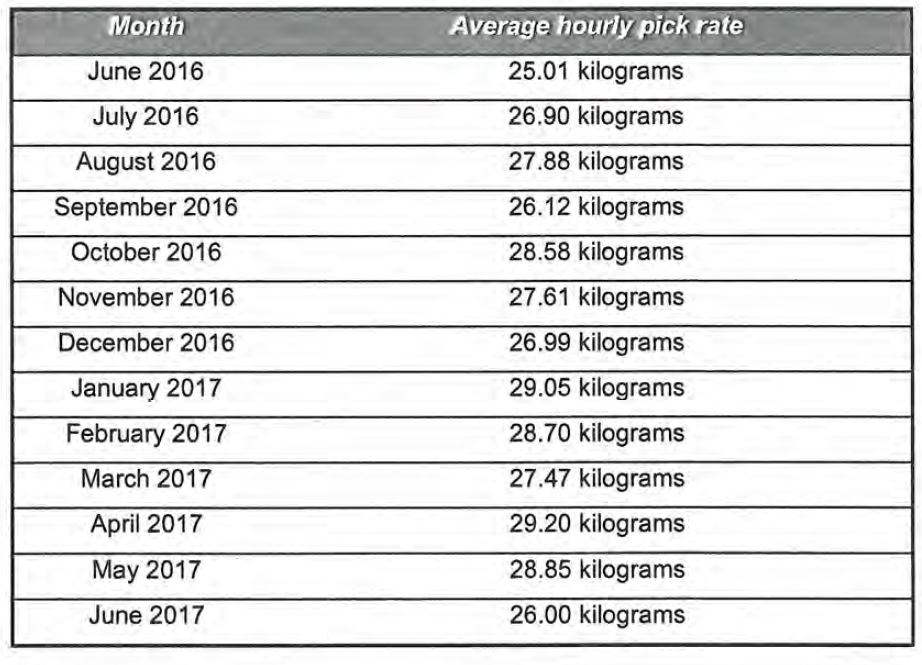
…
56 The FWO contends that HRS Country’s employees were casual employees within cl 10.4 of the Award. The Marland parties’ written and oral submissions do not dispute that contention. I find that they were casual employees. I will return to this issue later in these reasons.
Identification of an hourly rate at least 15% more than the prescribed hourly rate prescribed in the Award
57 The FWO’s case depends upon proving that HRS Country’s employment agreements fixed piecework rates that did not enable the average competent employee to earn at least the Prescribed Hourly Rate. The minimum hourly rates are fixed under cl 14.1 of the Award for adults and cl 16.1 for juveniles. A casual loading of 25% under cl 10.4(b) is required to be added. Another 15% of that total must also be added.
58 It is convenient to proceed on the basis of applying adult rates, since the vast majority of employees were adults. However, I will specifically consider junior rates in relation to one employee later in these reasons.
59 There was an increase in the minimum hourly rate prescribed under cl 14.1 that took effect from 7 July 2014. It is not in dispute that cl 15.2 required the piecework rate to be fixed at a level that would enable the average competent adult employee to earn at least the following hourly rates:
(1) from 7 February 2014 to 6 July 2014 — $22.86 per hour;
(2) from 7 July to 31 August 2014 — $23.62 per hour.
60 The issue is whether the piecework rates fixed by HRS Country were adequate to enable the average competent employee to earn at least the Prescribed Hourly Rate of $22.86 or $23.62 per hour on average over the period of each employment agreement.
The pick rate required for the average competent employee to earn at least the Prescribed Hourly Rate
61 The rate payable by HRS Country under the relevant employment agreements in the period after 7 February and before 31 August 2014 was either $0.75 per kg or $0.80 per kg.
62 The average competent employee would have had to pick the following quantities of mushrooms per hour in order to be able to earn at least the Prescribed Hourly Rate:
(1) At $0.75 per kg — from 7 February to 6 July 2014 — 30.48 kg per hour;
(2) At $0.80 per kg — from 7 February to 6 July 2014 — 28.58 kg per hour;
(3) At $0.80 per kg — from 7 July 2014 to 31 August 2014 — 29.53 kg per hour.
63 It is convenient to generally use the lowest (and most favourable for the respondents) of these required pick rates, namely 28.58 kg per hour in these reasons.
64 The FWO seeks to prove that the pick rate for the average competent employee would not be at least 28.58 kg per hour and, therefore, such an employee was not enabled to earn at least the Prescribed Hourly Rate. The FWO has attempted to do so by using data concerning actual pick rates at the Marland Farm for the period from 1 January 2014 to 31 August 2014. This period will be referred to as “the Assessment Period”.
The characteristics of the average competent employee
65 The Court must make an assessment of how much the hypothetical average competent worker was enabled to earn per hour at the piecework rate when performing the duties contemplated under each employment agreement. As the allegation of contravention of cl 15 of the Award is entering into employment agreements which fixed inadequate piecework rates, the assessment must be made as at the time of entry into each employment agreement. It is necessary to make the assessment in retrospect. However, the assessment must then look forward from the time of entry into each agreement and take into account the work that the hypothetical employee would do and the conditions that would be encountered during the period of the employment agreement.
66 As I have indicated, the assessment of how much the hypothetical average competent worker was enabled to earn per hour at the piecework rate depends upon the pick rate attributed to the employee, which is influenced by factors both personal and external to the employee. In this case, the external factors to be considered concern the density and quality of the mushroom crop that would be available to be picked and the working conditions and equipment that would be provided to the employees at the Marland Farm. Ms Sharon Stevula, a supervisor at the Marland Farm, was called by the Marland parties and gave evidence as to these matters.
67 The Marland Farm is a large, modern and well-organised facility. There are 24 growing rooms within a single building. The carbon dioxide levels, humidity and temperature within the growing rooms can be controlled.
68 Mushrooms are grown in soil contained in large metal trays. The trays are placed in long rows of metal racks that are divided into sections. Each rack has up to six tiers. Employees pick from the bottom two tiers while sitting on stools and reach the higher tiers by standing on adjustable metal platforms. Employees known as “Box Boys” would arrive earlier than the pickers and set up trolleys and picking carts.
69 Ms Stevula deposed that mushrooms take about two weeks to grow, but once they start to come through the soil, they increase in size very quickly. The ideal size is 50–55 mm across the cup of the mushroom. There is a window of 18 hours to pick mushrooms at their optimum size and condition. Smaller mushrooms can be picked, but it is easiest to pick mushrooms that are the optimum size.
70 Ms Stevula deposed that mushrooms grow in “flushes”. The growth is usually most dense in the first flush. The second flush comes through a few days after the first flush has been picked, and the third a few days after the second. The soil is discarded after the third flush.
71 Ms Stevula gave evidence regarding the proper mushroom picking technique. The technique requires holding, in one hand, two or three mushrooms at a time, and removing them from the growing tray with a gentle twisting motion. The mushroom stalk must be cut with a knife after it has been picked.
72 The system of work was generally for an employee to work within a section of a row and pick mushrooms from each tier of that section in turn. For example, an employee might start by picking mushrooms from the top tier while standing on the metal platform. After the employee finished the top tier, a Box Boy would lower the platform to allow the employee to pick from the next tier down, and so on.
73 The employees would place the picked mushrooms into a cardboard box sitting on a trolley, with the cup of the mushroom facing upwards. When a box was filled, the box would be taken away by the Box Boys to be weighed by weigh line staff.
74 The FWO called five employees who worked at the Marland Farm during the Assessment Period to give evidence. Two of these witnesses complained that the metal platforms on which the mushroom pickers stood were too narrow and unstable and that the spaces between the racks did not allow much room for the employees to move. However, I am not satisfied that these factors had any detrimental effect upon picking rates.
75 Mushrooms that were “unhealthy” would be placed in a separate box. These were either infected or too large and dried out. Ms Ting-Jung Huang deposes that the pickers were not paid for picking infected mushrooms. This is consistent with Ms Stevula’s evidence that infected mushrooms were “thrown out, and not put in boxes and weighed”. Employees were paid less for picking the dried out mushrooms because they were lighter. There is some controversy in the evidence as to the frequency with which unhealthy mushrooms appeared, particularly those that were infected. Ms Stevula recalls “only a few incidences of infected mushrooms” during the Assessment Period. The evidence of Ms Weng-Sheng Wu indicates that there were often infected mushrooms. It is not possible to reach any definite conclusion as to the frequency with which infected mushrooms appeared. I am satisfied that they made some difference, but a fairly small difference overall, to average pick rates during the Assessment Period.
76 The mushroom pickers were also engaged in the task of “separation” from time to time. This required the pickers to pick some smaller mushrooms in order to give others space to grow. These were also placed into cardboard boxes and weighed, but the pick rates for these mushrooms were lower as they were smaller. Sometimes, pickers would also be required to spend time “cleaning” the soil to remove remanent stalks. I am satisfied that these tasks made some moderate contribution to reducing average pick rates.
77 There is evidence that the employees would sometimes be required to undertake tasks, such as cleaning the floors, for which they would not be paid. The employment agreements entered after 10 February 2014 envisaged that employees may perform tasks other than mushroom picking and provided for payment of hourly rates for such tasks. Such employees ought to have been paid an hourly rate for such duties. Any unpaid time spent on those tasks ought to be included in the calculation of average pick rates, since the employees would otherwise have been able to pick mushrooms and earn the piecework rate. It is difficult, on the evidence available, to give any real estimate as to how much time these additional tasks would take in an average shift. I am satisfied, however, that these tasks made only a small difference overall to average pick rates.
78 There was also complaint about delays while waiting to wash down trolleys and other equipment at the end of a shift. I accept there could be delays of more than a few minutes at times, but I am not satisfied that the delays were generally long enough to make any real difference to average pick rates.
79 Of course, the accumulation of several factors that made a small contribution to pick rates must have made a somewhat larger difference in combination. It is only possible to say, as a matter of impression, that these factors in combination affected average pick rates to a moderate degree.
80 There is evidence from Ms Jia-Sing Chen that the quantity of the crop was not stable and could vary in quantity. Ms Stevula’s evidence indicates that the number of pickers assigned work for a particular day was adjusted according to the growth rate, volume and size of mushrooms. On the afternoon before, Ms Stevula would make a judgement as to the numbers of employees required for the following day. This obviously involved an element of prediction of growth rates and density by Ms Stevula. I accept Ms Chen’s evidence that sometimes “mushrooms did not grow properly” and that this affected pick rates.
81 There is no evidence that there were changes to the growing conditions at Marland Farms or to the equipment provided in the Assessment Period that could have affected the picking rate of the average competent employee. Therefore, the external factors affecting the picking rates of such an employee (other than growth rates and density) can be taken as being consistent throughout the Assessment Period.
82 The hypothetical average competent employee can be regarded as being of average diligence and having average aptitude. However, the level of experience that should be attributed to the average competent employee is controversial.
83 Ms Stevula deposed that the skills required to become a competent picker involve three particular elements. First, a competent picker must be able to recognise the size of an ideal mushroom by sight. Second, the competent picker must be able to remove the mushrooms without touching them too much or holding them too firmly, so that they do not become bruised. Third, the competent mushroom picker must be able to pick, cut and place the mushroom into the box without transferring soil onto the mushrooms already in the box. In my opinion, there must also be a fourth skill—the ability to work at an adequate pace in the context of a commercial operation where there is a limited window of time to pick the crop.
84 Ms Stevula deposed, and the Marland parties submit, that “new starters”, who have no experience, need approximately four to twelve weeks of training. Under cross-examination, she stated that supervisors would constantly be with pickers and would monitor multiple pickers at any one time. When asked what training was required after two weeks, she stated that “some people get confused on still what size to pick, what boxes to put them in”.
85 Ms Stevula also deposed that it usually takes about three months to become “a reasonable picker”, by which she meant “able to pick 30kg of 50 to 55 mm button mushrooms per hour in a first flush”. I do not understand her to have been expressing the opinion that it usually takes about three months to become a competent picker in the sense I have described, namely suitable, sufficient for the purpose or adequate. I understand her evidence to be that it takes four to twelve weeks of training to become a competent picker. She can be understood as expressing the opinion that, at present, the average competent employee is one who has at least three months’ experience.
86 Three of the witnesses called by the FWO who had worked at the Marland Farm gave evidence as to the training they received. Ms Chen had worked as a mushroom picker in another farm for approximately six months before moving to the Marland Farm. After a week working as a mushroom picker at the Marland Farm, she was promoted to the position of trainer and began training new employees how to pick mushrooms. She deposed that most employees were able to learn how to pick mushrooms by lunchtime on their first day and that a newly arrived worker would receive approximately half-a-day of training. Within one to two weeks an employee would know the right size of mushroom to pick, how to cut the stem properly and how to put mushrooms in the box properly. In her opinion, it would take about two weeks on average for a picker to become a “good” mushroom picker. By “good”, I understand her to mean competent.
87 Ms Chen’s evidence was consistent with the evidence given by two other witnesses called by the FWO. Ms Jian Jing-Sin worked at the Marland Farm for a month. Under cross-examination, she stated that she received approximately two hours of training and that she “got the hang of it…very quickly”. In re-examination, she stated that she was able to do her job well “almost immediately”, and that her supervisor admired her work and explicitly praised her for it.
88 Ms Huang gave evidence that the new employees would receive instructions about the different steps involved in the work on day one and begin “actual work” the next day. She added that it took her a week to do “really well” at the job.
89 I consider the evidence of Ms Chen, Ms Jing-Sin and Ms Huang upon these issues to have been given honestly and reliably. I accept that Ms Jing-Sin and Ms Huang were able to perform the work competently within a week of commencing. That does not necessarily mean the same is true of all or most other employees, but their evidence does tend to support the evidence of Ms Chen.
90 I prefer the evidence of Ms Chen that it would take about two weeks for mushroom pickers to become competent to the evidence of Ms Stevula that they would need four to twelve weeks of training. I prefer Ms Chen’s evidence for the following reasons.
91 The skills described by Ms Stevula to become a competent mushroom picker are skills that, in my opinion, most manual workers could quickly acquire. The tasks of identifying mushrooms of the optimum size, picking them without bruising them, and ensuring that the soil is removed are objectively straight-forward. The relative simplicity of the tasks is reflected in the classification of mushroom pickers at Level 1, the lowest level, under the Award. An employee at this level receives training, performs routine duties and exercises minimal judgement. It is likely to take some further time to acquire a reasonable level of speed, but the repetitive nature of the task suggests that this would generally occur within two weeks, not the four to twelve weeks suggested by Ms Stevula.
92 Ms Chen’s opinion is supported by statements made by Ms Monique Southgate, a supervisor at the Marland Farm, in a record of interview with Inspector Kim De Iacovo. Ms Southgate said:
No, some – most people can pick it up pretty quick, but it’s just the same as any job. You have pickers, or people, that come and they’re never going to get it, but, you know, it’s fairly easy. We try and help them as much as we can, you know. It just – like I say, it depends on every person, you know, but I would say generally after a week or two you should pretty much know what you’re doing.
93 Under cross-examination, Ms Stevula denied that mushroom picking is essentially a simple task, and in fact, stated that in some cases it may be quite complex. That is not supported by her evidence as to the limited skills that are required. I formed the impression that Ms Stevula was inclined to overstate the complexity of the task involved and to overstate the level of training and experience required. I am not satisfied as to the reliability of her evidence as to these matters.
94 Ms Stevula seemed to conflate training with ongoing supervision. While it can be expected that there would initially be some crossover between training and supervision, it seems improbable that training would continue for up to twelve weeks.
95 It must be remembered that the issue presently being considered is the level of experience required for a mushroom picker to become “competent”. A competent employee is one who is suitable, sufficient or adequate for the purpose of picking mushrooms at a commercial farm, in this case, the Marland Farm. In my opinion, the Marland parties’ submissions tended to confuse the level of skill required to be a competent mushroom picker with the level of skill needed to be proficient.
96 While I accept that some employees may never become competent mushroom pickers, the simplicity of the tasks suggests that there will be few people who do not become competent after two weeks. On the other hand, there may be many employees who become competent within a week or so. Those employees would more than compensate for those who never become competent.
97 I have indicated that cl 15 of the Award envisages a pool of competent employees from which the average competent employee will be selected. In my opinion, employees with about two weeks’ experience can be considered competent. It follows that those with less than two weeks’ experience can be regarded as less than competent and should be excluded from this pool.
98 It is then necessary to identify, from that pool of competent employees, the characteristics of the average competent employee. Such an employee will be one who can be regarded as the ordinary, normal or typical competent employee. In particular, it is relevant to determine the level of experience to be attributed to the average competent employee.
99 Assessment of the required level of experience must take into account that the workforce will consist of a mixture of transient employees and longer term employees. During the period from November 2013 to August 2014, the workforce was quite transient and inexperienced. Ms Stevula has deposed that there were problems with getting “enough pickers with enough experience” during that period. She commented that there were then a lot of Taiwanese backpackers and that many of them did not work for very long at the Marland Farm. During re-examination, she said that most of them were on working holiday visas and were backpacking. Those comments do not seem confined to employees provided by HRS Country, but apply more generally to the whole of the workforce at the Marland Farm in that period.
100 Ms Stevula joined the Marland farm from another farm. She said that a few experienced workers also came to the Marland Farm from the same farm. Ms Stevula has 20 years’ experience working on mushroom farms and is able to pick between 30 and 70 kg of mushrooms per hour, depending upon the type of mushroom, size and flush, and how focused she is. However, she was employed as a supervisor, rather than a picker, at the Marland Farm. She says the fastest picker currently at the Marland Farm can pick over 80 kg per hour depending on the type of mushroom, size and flush. That employee seems to be particularly proficient.
101 It seems that some of the employees who started working at the Marland Farm during the Assessment Period have stayed on. The fact that Marland Farms had been operating for some 3½ years by the time of the trial is consistent with the workforce becoming more stable and experienced. The Marland parties’ submission that the workforce is now more stable and less transient than during the Assessment Period is consistent with the evidence.
102 The workforce available to work at the Marland Farm between November 2013 and August 2014 (even excluding employees with less than two weeks’ experience) was, as a whole, less stable and less experienced than the present workforce.
103 However, the assessment of the earnings of the average competent employee at the piecework rate must be made at the time when each employment agreement was entered into between 7 February and 31 August 2014. This requires an assessment of the general level of competence of the workforce at that time, which is partly reflected in the general level of experience of the workforce. That assessment requires an evaluative judgement involving a degree of impression. It is not a precise exercise. I consider that at the times when the employment agreements were entered, the average competent employee should be taken to be an employee with about three months’ experience of picking mushrooms.
The average pick rate of the average competent employee
104 The FWO has not attempted to specifically identify the average pick rate of the average competent employee at the time of entry into each of the employment agreements. The FWO relies on the pick rate data for the Marland Farm for the Assessment Period and submits that the data demonstrates that none of HRS Country’s employees consistently picked enough mushrooms in the Assessment Period to earn at least the Prescribed Hourly Rate. The submission continues that it can be inferred that when the employment agreements were entered, the piecework rates were fixed at levels that did not enable the average competent employee to earn at least the Prescribed Hourly Rate.
105 The intervener submits that the inference sought to be drawn by the FWO is not open. It submits that there is no logical causal link between the picking outcomes and non-compliance with cl 15 of the Award, which must be determined at the times of entry into the employment agreements. The intervener submits, alternatively, that the pick rate data does not provide a reliable guide as to the picking capacity of the average competent employee at the relevant points in time. The intervener submits that such picking capacity must be determined by reference to the conditions prevailing and reasonably forecast at the time that the piece rate is fixed by agreement.
106 The Marland parties submit that the FWO’s case is wrongly premised on the inference that because the employees achieved the pick rate contemplated under cl 15 of the Award on only a small percentage of occasions, the piecework rate fixed was inadequate to enable an average competent employee to earn at least the Prescribed Hourly Rate. They do not submit that the data is incapable of allowing such an inference to be drawn, but submit that it ought not be drawn. The Marland parties submit that the vast preponderance of employees during the Assessment Period were transient, unskilled workers. They submit that picking rates improved when HRS Country began to employ more local workers, rather than short-term visa holders. They submit that while conditions have not changed since the Assessment Period, recent pick rate data from Marland Mushrooms shows that many workers are achieving pick rates in excess of 30 kg per hour, which is more reflective of the pick rate of the average competent employee.
107 The FWO’s case is that HRS Country contravened cl 15 of the Award by entering into employment agreements which fixed inadequate piecework rates between 7 February and 31 August 2014. It is necessary for the Court to determine, at the pick rate attributed to the hypothetical average employee, whether the piecework rates that were fixed would enable that employee to earn at least the Prescribed Hourly Rate. That determination must be made at the time of entry into each agreement and by reference to the duties required under the employment agreement over the term of the agreement.
108 However, the exercise to be undertaken by the Court differs in one important respect from that done by the employer when the employer fixes the rate. The employer’s exercise is entirely predictive and can only be based upon information known or available to the employer. On the other hand, the Court’s determination is made in retrospect and, therefore, can be made with the benefit of information now known but which was not known or available to the employer. That information can include actual pick rates over the whole or part of the period of employment. It is open to the Court to use such data because the question is not concerned with the reasonableness of the employer’s forecast or the difficulty in making such a forecast. The question for the Court is limited to the adequacy of the piecework rates fixed under the agreements—if the rates were too low, cl 15 of the Award was contravened. Contrary to the intervener’s submission, later picking outcomes can be relevant to proof of a breach at an earlier time.
109 The Court may take into account pick rate data over the Assessment Period, as well as more recent pick rate data relied upon by Marland Mushrooms. However, the weight to be given to data concerning pick rates after the employment agreements were entered is a different matter. It is important to consider whether conditions changed between the time of entry into the agreement and the period when the data was taken, including any changes in growing and picking conditions and the composition of the workforce. The evidence does not suggest any such changes between the commencement of the Assessment Period on 1 January 2014 and the end of that period on 31 August 2014. However, there have been such changes since the end of the Assessment Period, as I will discuss later in these reasons.
110 The FWO has analysed the pick rate data in the Assessment Period. The data was obtained from the records of Marland Mushrooms. Ms Wendy Wager, an administration officer employed by Marland Mushrooms, provided evidence that these records were compiled for the benefit of HRS Country. This was evidently to allow HRS Country to calculate the amounts to be paid to its employees.
111 The FWO has analysed the pick rate data by reference to the length of each employee’s employment. The results are as follows:
Length of employment | Number of employees | Average pick rate (kg/h) |
10 days or less | 234 | 8.94 kg/h |
11 to 20 days | 46 | 12.25 kg/h |
21 to 30 days | 45 | 13.06 kg/h |
31 to 40 days | 20 | 13.15 kg/h |
41 to 50 days | 9 | 13.62 kg/h |
51 to 60 days | 7 | 14.32 kg/h |
61 to 70 days | 6 | 18.47 kg/h |
71 to 80 days | 3 | 12.77 kg/h |
81 to 90 days | 6 | 15.97 kg/h |
91 to 100 days | 4 | 15.26 kg/h |
101 to 110 days | 5 | 18.87 kg/h |
111 to 120 days | 4 | 17.01 kg/h |
121 days or more | 2 | 12.57 kg/h |
112 Although the utility of the FWO’s analysis is in dispute, I do not understand the figures themselves to be controversial.
113 As I have indicated, it generally takes two weeks’ experience for an employee to become a competent mushroom picker. In all but a handful of cases, the evidence does not indicate whether the employees employed under the agreements in question had any previous mushroom picking experience. For present purposes, I will proceed on an assumption, favourable to the respondents, that they had no previous experience.
114 The employees who were employed for less than about two weeks must be excluded from the pool of competent employees. There is evidence that the employees worked between three or four to six days per week. On that basis, I will exclude the employees who worked for 10 days or less. That excludes 234 employees from the pool. The remainder can be regarded as competent employees.
115 I have indicated that I consider the average competent employee to be an employee with about three months’ experience (say, 60 working days). The pick rate data is useful because it indicates the pick rates that employees with that level of experience or more achieved at the Marland Farm in the Assessment Period. The limitations of the data must be acknowledged. There were only 30 employees with at least 60 working days’ experience so the data is not from as large a pool as would be ideal. However, the numbers are large enough to conclude that it is improbable that every one of them was of less than average aptitude and diligence. I consider that the data is sufficiently reliable and probative of the pick rates that the average competent employee would achieve to allow the data to be taken into account.
116 The following table produced by the FWO sets out the pick rate data for the adult employees who worked at the Marland Farm for at least 61 days, excluding the data for their first 14 days:
Picker | Average Hourly rate of pay ($/h) | Average hourly pick rate (kg/h) | Number of days picking excluding first 14 days | Percentage of days employee earned ACEMPR | Number of days employee earned ACEMPR |
HSU Wei-Cheng – E0105 | $12.00/h | 15.00 kg/h | 107 days | 0.92% | 1 day |
Te Uira Eva Huti – E0126 | $9.01/h | 11.26 kg/h | 107 days | 0.00% | 0 days |
Li Fang Zhan – E0061 | $20.03/h | 25.04 kg/h | 102 days | 28.43% | 29 days |
Foloi Siu – EE0026 | $11.52/h | 14.40 kg/h | 101 days | 0.00% | 0 days |
Xu Du – 78 | $13.27/h | 16.59 kg/h | 99 days | 3.03% | 3 days |
Lai Chia-Yi – E0106 | $11.61/h | 14.52 kg/h | 96 days | 0.00% | 0 days |
Wu Yue Ping – E0051 | $19.40/h | 24.25 kg/h | 94 days | 26.60% | 25 days |
Tampos Mylene – E0153 | $15.72/h | 19.65 kg/h | 93 days | 9.68% | 9 days |
Lai Chia Ying – E0104 | $16.53/h | 20.66 kg/h | 90 days | 12.22% | 11 days |
$12.4/h | 15.76 kg/h | 104 days | 1.92% | 2 days | |
You-Wei Li (Patrick) – 45 + 31 | $13.26/h | 16.57 kg/h | 88 days | 2.27% | 2 days |
Sagar Pushpalatha – E0040 | $12.41/h | 15.52 kg/h | 82 days | 0.00% | 0 days |
Phaully Ley Seak – E0010 | $11.16/h | 13.95 kg/h | 80 days | 0.00% | 0 days |
Hou Ling – E0111 | $14.95/h | 18.69 kg/h | 78 days | 5.13% | 4 days |
Li Chang Hong –E0112 | $13.33/h | 16.66 kg/h | 77 days | 0.00% | 0 days |
Tsai Pei-Ju – E0032 | $11.64/h | 14.55 kg/h | 75 days | 0.00% | 0 days |
Huang QiHong – E0062 | $18.53/h | 23.16 kg/h | 71 days | 21.13% | 15 days |
Siu Oi Yee – E0027 | $12.88/h | 16.10 kg/h | 71 days | 2.82% | 2 days |
Nguyen Hanh – E0103 | $12.83/h | 16.04 kg/h | 69 days | 0.00% | 0 days |
Ren Yucun (Mary) – E0037 | $15.00/h | 18.75 kg/h | 69 days | 2.90% | 2 days |
Wong Hung Pan – E0029 | $9.58/h | 11.97 kg/h | 66 days | 0.00% | 0 days |
Lath Seak – E0085 | $12.73/h | 15.91 kg/h | 65 days | 0.00% | 0 days |
Waaka Chanele – E0065 | $8.40/h | 10.50 kg/h | 61 days | 0.00% | 0 days |
Chu Wai Yin – E0028 | $8.98/h | 11.22 kg/h | 49 days | 0.00% | 0 days |
Li Yi-Jhen – E0002 | $15.06/h | 18.83 kg/h | 49 days | 8.16% | 4 days |
Chiu Yu Ju – E0059 | $19.19/h | 23.99 kg/h | 47 days | 8.51% | 4 days |
Huang Jin Ping – E0108 | $17.80/h | 22.24 kg/h | 47 days | 17.02% | 8 days |
Lin Yi Ting – 60 | $21.81/h | 27.26 kg/h | 47 days | 38.30% | 18 days |
Ng Chi Hung – E0009 | $9.30/h | 11.62 kg/h | 47 days | 0.00% | 0 days |
[The acronym “ACEMPR” stands for what I have described as “the Prescribed Hourly Rate”: ie. at least 15% above the minimum hourly rate prescribed in the Award.]
117 The FWO has also produced the following table summarising the pick rate data by reference to length of employment for the employees who worked at least 61 days in total at the Marland Farm:
Number of days picking excluding first 14 days | Number of employees | Average pick rate (kg/h) |
60 days or less | 6 | 19.36 kg/h |
61 to 70 days | 5 | 14.70 kg/h |
71 to 80 days | 6 | 17.24 kg/h |
81 to 90 days | 3 | 17.61 kg/h |
91 to 100 days | 4 | 18.84 kg/h |
101 days or more | 5 | 16.41 kg/h |
118 There was also one junior, Villanueva John Paulo, who worked for 74 days. He earnt an average of $9.58 per hour, with an average pick rate of 11.97 kg per hour. He earned the Prescribed Hourly Rate for juniors of his age of $12.96 or $13.50 on only three days.
119 An adult employee was required to pick at an average rate of least 28.58 kg per hour in the Assessment Period in order to earn the Prescribed Hourly Rate. None of the adult employees with at least three months’ experience earned the Prescribed Hourly Rate as an average over the periods of their employment. Neither did the sole junior employee in that category. While the pick rate data for the Assessment Period does not directly prove the FWO’s case that the piecework rate under the employment agreements did not enable the average competent employee to earn at least the Prescribed Hourly Rate, it provides strong support for that case.
120 The Marland parties rely on other data taken from within and outside the Assessment Period. They rely upon pick rate data for seven employees of another labour hire business, Rocube Holding Pty Ltd, with more than three months’ experience over a period of two days in August 2014. That data was selected by Ms Wager. It shows that only one of the seven was able to achieve a pick rate that enabled the employee to earn at least the Prescribed Hourly Rate over the two days. Ms Wager agreed under cross-examination that she had not presented the data for all Rocube employees who had more than three months’ experience. When it was put to Ms Wager that she had selected the best seven pickers, she answered, quite unpersuasively, “Not necessarily” and, later, “maybe”. I do not accept that the data can be accepted as supporting the Marland parties’ case. If anything, the data tends to support the FWO’s case.
121 The Marland parties also rely on average pick rates achieved in November 2014 by 15 HRS Country employees who had more than three months’ experience. The data shows that only one of these employees achieved an average pick rate (29.56 kg per hour) that enabled her to earn at least the Prescribed Hourly Rate. The remainder failed to achieve that level. This data also tends to support the FWO’s case.
122 The Marland parties rely upon a statement made by Ms Chen on 7 December 2015 that she could pick 30 kg of mushrooms per hour if there were a lot of mushrooms. However, the picking capacity of a single employee can only be given limited weight.
123 The Marland parties rely on a “Production Summary” by month for the period from June 2016 to June 2017. The document shows the average pick rates for all pickers at the Marland Farm in those months. It includes the figures for “new starts”, which Ms Wager said were about 5% of the pickers each month. The figures are as follows:
124 This data provides some, but limited, assistance to the Marland parties. It shows that in five of the thirteen months, average pick rates reached at least 28.58 kg per hour. However, it is significant that the rate was not reached in seven of the twelve months. It may be that the average pick rates would be somewhat higher if data for the employees with less than two weeks’ mushroom picking experience was excluded, but that exercise has not been done. The average over the thirteen months was 27.57 kg per hour, which was lower than the 28.58 kg per hour necessary for employees to earn at least the Prescribed Hourly Rate at the piecework rates under the contracts entered in the period after 7 February and before 31 August 2014.
125 As the period covered by the Production Summary is a significant time after the dates of entry into the employment agreements, it is also necessary to consider whether growing and picking conditions at the Marland Farm and the composition of the workforce had changed.
126 Ms Stevula accepted that Marland Farms was “always trying to improve”. One aspect of that improvement was that, “The trainers are getting better to assist pickers to pick faster”. Another was that separation of the mushrooms and cleaning the soil is now done by hourly-paid workers, rather than the pickers. Ms Stevula agreed that this has helped pickers to improve their pick rates. It is probable that these matters led to at least some moderate increase in pick rates in the 2016/2017 period.
127 In addition, Inspector Steven Williams gave evidence that Mr Marland said on 7 February 2014 that the farm was not at full production because “we couldn’t get all the water we need because of an issue with the Council”. The evidence of one witness, Ms Chen, was that growth of mushrooms could vary from time to time and that would affect pick rates. Ms Southgate also referred to the variability of growth. The evidence does not indicate whether the water supply issue had been resolved and whether Marland Farm was at full production by 2016/2017. Nor does the evidence indicate whether or not the volume and density of mushrooms had increased. The Production Summary was adduced by the Marland parties, but these unanswered questions leave the utility of the data contained in that document in considerable doubt.
128 It is also apparent that the level of stability and experience of the workforce available to work at the Marland Farm has improved since the Assessment Period. These changes are likely to have contributed to the increase in pick rates in 2016/2017. The issue that must be determined is the pick rate to be attributed to the average competent employee for the period from 7 February to 31 August 2014. That must take into account the general level of competence of the workforce available at that time. The level of competence of the workforce in 2016/2017 does not reflect the competence of the workforce in the earlier period. Although the Marland parties’ submissions suggest that the fact that the workforce in the Assessment Period was more transient and less experienced tended to support their case, I disagree. It is necessary to determine the pick rate for the average competent employee by reference to the general level of competence of the workforce that is actually available to the employer at the time the agreement is entered. The issue cannot be determined by reference to some other workforce that might have a greater level of skill or experience.
129 Marland Mushrooms’ reliance on pick rates for July 2017 for three former HRS Country employees suffers from the same difficulties. In addition, this data represents the pick rates for the best pickers, rather than for pickers who may be described as average competent employees.
130 There are some other pieces of evidence relevant to the issue of the pick rate to be attributed to the average competent picker. There is Ms Stevula’s opinion that “a reasonable picker” is “able to pick 30kg of 50 to 55 mm button mushrooms per hour in the first flush”. This does not reflect an opinion as to the average rate “a reasonable picker” could pick, as it does not account for second and third flushes, diseased mushrooms and mushrooms that are not the optimum size. It also appears to be an assessment of pick rates under present conditions, and not under the conditions at the relevant time. Ms Stevula’s evidence does not provide a reliable assessment of the rate attributable to the average competent employee in the Assessment Period.
131 There is also the standard form employment agreement which states that, “The employee will be required to achieve a pick rate of 30kg/hr after an initial probationary period of two (2) weeks”. HRS Country’s expectation appears to have been that a competent picker should be able to pick mushrooms at least at that rate. That expectation was not borne out by the pick rate data for the Assessment Period, which I prefer.
132 Two inspectors from the FWO’s office, Inspector De Iacovo and Inspector Williams, gave evidence that Mr Marland participated in a meeting with them at the Marland farm on 7 February 2014. It was suggested in cross-examination that Mr Marland had not attended this meeting, but I find that he did attend, as I will discuss in detail later. During the meeting, Mr Marland said that the average picker at the Marland Farm could pick 25 kg per hour, but that some experienced staff could pick 30 kg or more. That evidence does not support the Marland parties’ submission that the average competent worker should be taken to be able to pick 30 kg per hour, but it does provide some support for the view that the pick rate for such an employee could be in the range of 25 to 30 kg per hour. However, Mr Marland did not explain the basis for his opinion and it should therefore be given little weight when deciding the pick rate to be attributed to the average competent employee. Mr Marland also said that the Australian Mushroom Growers Association (AMGA) “had an industry standard, maybe 20 kilograms per hour”. In the absence of direct evidence from AMGA and an indication of how that figure was arrived at, little weight should be given to this statement.
Whether HRS Country contravened cl 15 and other provisions of the Award
133 In my opinion, the pick rate data from the Assessment Period is reliable and cogent. It demonstrates that of the employees who had at least three months’ experience, none picked at least 28.58 kg of mushrooms per hour on average, the rate sufficient to allow the adult employees to earn at least the Prescribed Hourly Rate. In addition, the pick rate data relied on by the Marland parties tends to be consistent with the FWO’s case. The data allows me to conclude that when each relevant employment agreement was entered, the pick rate attributable to the average competent employee was approximately 20 kg of mushrooms per hour. The piecework rate fixed under each agreement was not adequate to enable the average competent employee to earn at least the Prescribed Hourly Rate.
134 I reject the Marland parties’ argument that because the employees were capable of picking faster if they were so minded, it should not be concluded that they were not enabled to pick at the required rates. The test under cl 15.2 of the Award is directed to the rate at which the average competent employee would, on average, pick. It is not directed to the rate that such an employee could pick, assuming greater than average diligence or motivation to earn money.
135 The relevant agreements were the 215 written agreements and the 114 oral agreements entered after 7 February and before 31 August 2014. HRS Country contravened cl 15 of the Award in respect of each agreement. By contravening cl 15, HRS Country contravened s 45 of the FWA. There were 329 such contraventions.
136 The FWO also submits that HRS Country engaged in ongoing contraventions of cl 15 of the Award throughout the periods of employment of the relevant employees by failing to enter new agreements that fixed a higher piecework rate. Senior counsel for the FWO put the argument in the following way:
We say there’s an ongoing breach in that if you are paying someone a piece rate, it doesn’t meet 15.2…there is an ongoing breach. And so for that breach to be fixed and stop, you would need to enter into new agreements with a piece rate that meets the requirements of 15.2.
137 I do not accept the FWO’s submission. The contraventions in this case lie in HRS Country entering into the non-compliant employment agreements. Clause 15 was contravened at the time of entry into each agreement, but there was no “ongoing” breach after that.
138 The error in the FWO’s submission seems to arise from conflating a contravention consisting of entry into an agreement that fixes an inadequate piecework rate with a contravention consisting of payment of an inadequate piecework rate. In my opinion, cl 15 does not merely prohibit an employer from entering into an agreement which fixes an inadequate piecework rate, but requires the employer to pay at least the minimum piecework rate that ought to have been fixed. Clause 15.2 stipulates that, “The piecework rate agreed is to be paid for all work performed in accordance with the piecework agreement”. The word “agreed” is apparently intended to have the same meaning as “fixed”, but, leaving that aside, the phrase is ambiguous. It could require that the piecework rate that has been agreed, regardless of whether it is inadequate, must be paid for all work performed in accordance with the agreement. Alternatively, it could mean the piecework rate that has been agreed and is at least at the minimum level must be paid for all work performed in accordance with the agreement.
139 In my opinion, the latter construction is to be preferred. The former construction, which could require an employer to pay a piecework rate fixed at a level which does not comply with cl 15, is improbable. Further, that construction would mean that where a piecework rate was initially fixed at an adequate level, but where the piecework rate later becomes inadequate, there is no obligation on the employer to adjust the rate. That would mean, for example, that if the minimum hourly rate prescribed under cl 14.1 of the Award increased during the term of an employment agreement, there would be no corresponding obligation on the employer to increase the piecework rate. Such an outcome cannot have been intended.
140 I recognise the force of the intervener’s submission that this construction produces an inconvenient outcome for employers. The piecework provisions of the Award, seen as a whole, attempt to balance the interests of employers with the risk that employees will be left vulnerable to exploitation. However, the requirements to fix and pay at least minimum piecework rates are protective of employees, and cl 15.2 should be construed in light of that protective purpose. Where the piecework rate was adequate when the agreement was entered, but becomes inadequate during the term of the agreement, it is a contravention of cl 15.2 of the Award for an employer to continue to pay only the agreed, inadequate piecework rate. Contrary to the intervener’s submission, that does not guarantee any employee a minimum wage, but it does guarantee an adequate piecework rate. Such contraventions are capable of fitting the FWO’s description of “ongoing” throughout the period during which the employee is paid an inadequate piecework rate.
141 However, the FWO’s allegation is ultimately that HRS Country contravened cl 15 of the Award by entering into employment agreements that fixed inadequate piecework rates, not that it also paid inadequate piecework rates. Therefore, the allegation that HRS Country committed an “ongoing breach” by failing to enter into new agreements cannot be sustained.
142 The FWO also submits that as a consequence of non-compliance with cl 15 of the Award by fixing inadequate piecework rates, the employees were not “pieceworkers” for the purposes of the Award. The FWO alleges that the employees were therefore entitled to be paid in accordance with the non-pieceworker provisions of the Award. The FWO alleges that HRS Country contravened the Award by: failing to pay the hourly rates prescribed under cl 14.1 and cl 16.1; failing to pay the public holiday rates required by cl 28.3; failing to pay the casual loading required under cl 10.4; and failing to provide the employees with the paid rest breaks required by cl 23.2.
143 It may be noted that the FWO’s submission that these clauses have been contravened are based upon the premise that the piecework rate was inadequate. The FWO does not submit that HRS Country would have been required to comply with any of these clauses if an adequate piecework rate had been fixed.
144 The FWO submits that a person is not a “pieceworker” merely because he or she is paid a “piecework rate”. The FWO points to the protective purpose of the minimum piecework rate and the mandatory language of cl 15.2 of the Award. The FWO submits that in light of that purpose and mandatory language, if an inadequate piecework rate is fixed, employees are entitled to be treated as if they had not entered into the purported piecework agreement at all. The submission continues that in order to be a pieceworker, the employee must be entitled under an agreement to a piecework rate that complies with cl 15. If the employee is not a pieceworker, the employee must be paid the hourly rates and other entitlements prescribed under the Award.
145 The Marland parties and the intervener submit that any employee on any piecework rate, adequate or inadequate, is a pieceworker. They submit that while an employee on an inadequate piecework rate is entitled to be paid at least the minimum piecework rate, the employee is not entitled to be paid the hourly rates and other entitlements of non-pieceworkers under the Award.
146 I prefer this construction. It is supported by the language and context of cl 15. Clause 15.1 provides that an employer and an employee may enter into an agreement for the employee to be paid a piecework rate. It continues, “An employee on a piecework rate is a pieceworker”. The FWO would read that phrase as, “An employee on a piecework rate that complies with cl 15.2 is a pieceworker”, but that reading is not supported by the clear language. Further, nothing in the language or context of cl 15 indicates that provisions such as cl 15.4 and 15.5 will cease to apply where the piecework rate is inadequate.
147 The FWO’s submission is that if an inadequate piecework rate is fixed, employees should be treated as if they have not entered into the piecework agreement at all. Where legislation provides for a penalty in the event of non-compliance with a statutory command (as is the case with s 45 of the FWA) it is presumed that the statutory penalty is intended to cover the field in terms of consequences, and not render acts in contravention of the statute illegal or invalid: Fitzgerald v FJ Leonhardt Pty Ltd (1997) 189 CLR 215 at 219–220, 226–227 and 244; Gnych v Polish Club Ltd (2015) 255 CLR 414 at 427. The FWO’s submission that the piecework agreement is to be treated as having no effect conflicts with this principle.
148 The protective purpose of cl 15 does not assist the FWO’s argument. That protective purpose can be served without the rather artificial construction contended for. If the piecework rate fixed under an agreement is inadequate, employees can be protected by an award of compensation calculated as the difference between the piecework rate that was paid and the piecework rate that ought to have been paid.
149 For these reasons, I reject the FWO’s case that HRS Country contravened cl 10.4(b), 14.1, 16.1, 23.2 and 28.3 of the Award.
Accessorial liability of Marland Mushrooms and Mr Marland
The FWO’s case
150 The FWO alleges that the Marland parties were each “involved in” the contraventions of HRS Country within the meaning of that expression in s 550 of the FWA. The further amended statement of claim asserts that the Marland parties were “knowingly concerned in” or “otherwise involved in” the contraventions of HRS Country. In his closing address, senior counsel for the applicant submitted that “otherwise involved in” encompassed an allegation that the Marland parties “aided or abetted” the contraventions of HRS Country, but did not proceed to develop that submission in any detail. That allegation had not been squarely raised in the further amended statement of claim and was not mentioned in the FWO’s written submissions. The Marland parties objected to the allegation being raised. In the absence of any adequate particularisation and proper development of the allegation that the Marland parties aided or abetted the contraventions, it would be unfair to them to consider the allegation. I do not propose to do so.
151 The further amended statement of claim alleges that the contraventions by the Marland parties occurred in respect of contracts entered between 13 November 2013 and 31 August 2014. As I have said, in his closing address, senior counsel for the FWO narrowed the case to those contracts entered after 7 February 2014 and before 31 August 2014.
152 I have found that HRS Country engaged in 329 contraventions of cl 15 of the Award by entering into agreements which fixed inadequate piecework rates in the period after 7 February and before 31 August 2014. The FWO’s case is that the Marland parties also engaged in each contravention by being knowingly involved in each contravention.
153 I will consider the matters that the FWO is required to prove, and then turn to the relevant evidence.
154 Under s 550(1) of the FWA, a person who is involved in a contravention of a civil remedy provision is treated as having contravened that provision. Section 550(2) identifies when a person is taken to be involved in such a contravention, including when a person is knowingly involved in a contravention.
155 As Marland Mushrooms is a body corporate, s 793 of the FWA is relevant. That section provides, relevantly:
793 Liability of bodies corporate
Conduct of a body corporate
(1) Any conduct engaged in on behalf of a body corporate:
(a) by an officer, employee or agent (an official) of the body within the scope of his or her actual or apparent authority; or
(b) by any other person at the direction or with the consent or agreement (whether express or implied) of an official of the body, if the giving of the direction, consent or agreement is within the scope of the actual or apparent authority of the official;
is taken, for the purposes of this Act and the procedural rules, to have been engaged in also by the body.
State of mind of a body corporate
(2) If, for the purposes of this Act or the procedural rules, it is necessary to establish the state of mind of a body corporate in relation to particular conduct, it is enough to show:
(a) that the conduct was engaged in by a person referred to in paragraph (1)(a) or (b); and
(b) that the person had that state of mind.
Meaning of state of mind
(3) The state of mind of a person includes:
(a) the knowledge, intention, opinion, belief or purpose of the person; and
(b) the person’s reasons for the intention, opinion, belief or purpose.
156 In Fair Work Ombudsman v South Jin Pty Ltd [2015] FCA 1456, White J helpfully summarised a number of principles relevant to the question of whether a party has been knowingly concerned in a contravention. His Honour said:
227 In order to be knowingly concerned in, or party to, a contravention, a person must have engaged in some conduct which “implicates or involves” him or her in the contravention, so that there is a “practical connection” between the person and the contravention: Qantas Airways Ltd v Transports Workers’ Union of Australia [2011] FCA 470; (2011) 280 ALR 503 at [324]-[325]. See also Construction, Forestry, Mining and Energy Union v Clarke [2007] FCAFC 87; (2007) 164 IR 299 at [26]. In Trade Practice Commission v Australian Meat Holdings Pty Ltd (1988) 83 ALR 299, Wilcox J at 357 quoted with approval the following passage from the judgment of the Full Court of the Supreme Court of Western Australia in Ashbury v Reid (1961) WAR 49:
The question which a Court should ask itself in determining whether an act or omission on the part of an individual comes within the terms of section 54 is whether on the facts it can reasonably be said that the act or omission shown to have been done or neglected to be done by the defendant does in truth implicate or involve him in the offence, whether it does show a practical connection between him and the offence.
The statement in Ashbury v Reid was also approved in R v Nifadopoulos (1988) 36 A Crim R 137 at 140 with the Court (Kirby ACJ, Maxwell and Carruthers JJ agreeing) saying that “a person cannot become criminally involved in an act made unlawful by mere knowledge or inaction on his part – some act or conduct on his part is necessary”.
228 In Yorke v Lucas (1983) 49 ALR 672 at 681, the Full Court of this Court approved the following statement of Pennycuick V-C in Re Maidstone Buildings Provisions Ltd [1971] 1 WLR 1085 at 1092-3:
[T]he expression “party to” must on its natural meaning indicate no more than “participates in” or “concurs in”. And that, it seems to me, involves some positive steps of some nature.
See also Sent v Jet Corporation of Australia (1984) 2 FCR 201 at 208-9.
229 In order for a person to have been knowingly concerned in a statutory contravention, that person must have been an intentional participant, with knowledge of the essential elements constituting the contravention: Yorke v Lucas (1985) 158 CLR 661 at 670. However, it is not necessary that a person with knowledge of the essential elements making up the contravention also know that those elements do amount to a contravention: Yorke v Lucas at 667; Rural Press Ltd v Australian Competition and Consumer Commission [2003] HCA 75; (2003) 216 CLR 53 at [48]. An accessory does not have to appreciate that the conduct involved is unlawful: Australian Competition and Consumer Commissioner v Giraffe World Australia Pty Ltd (No 2) [1999] FCA 1161; (1999) 95 FCR 302 at [186].
230 Actual knowledge of the essential elements constituting the contravention is required. Imputed or constructive knowledge is insufficient: Young Investments Group Pty Ltd v Mann [2012] FCAFC 107 at [11]; (2012) 293 ALR 537 at 541.
231 Proof that a person had actual knowledge of each of the essential elements making up a contravention may be derived from direct evidence but more commonly will be a matter of inference from all the circumstances found to be proved. In some cases, actual knowledge can be inferred from the combination of a respondent’s knowledge of suspicious circumstances and the decision by the respondent not to make enquiries to remove those suspicions. Nevertheless it is actual knowledge which is required. In this respect, Wilson, Deane and Dawson JJ in Giorgianni v The Queen (1985) 156 CLR 473 at 505 said:
[A]lthough it may be a proper inference from the fact that a person has deliberately abstained from making an inquiry about some matter that he knew of it and, perhaps, that he refrained from inquiry so that he could deny knowledge, it is nevertheless actual knowledge which must be proved and not knowledge which is imputed or presumed.
And later (at 507-8):
The fact of exposure to the obvious may warrant the inference of knowledge. The shutting of one’s eyes to the obvious is not, however, an alternative to the actual knowledge which is required as the basis of intent to aid, abet, counsel or procure.
232 The conclusion that a person has actual knowledge of the elements of a contravention by reason of that person’s knowledge of suspicious circumstances coupled with a deliberate failure to make enquiries which may have confirmed those suspicions requires consideration of the person’s knowledge of the matters giving rise to the suspicion, the circumstances in which the person did not make the obvious enquiry and the person’s reasons, to the extent that they are known, for not having made the enquiry. It is not every deliberate failure to make enquiry which will support the inference of actual knowledge. In several cases, including Official Trustee in Bankruptcy v Mitchell [1992] FCA 521, (1992) 38 FCR 364 at 371 and Richardson & Wrench (Holdings) Pty Ltd v Ligon No 174 Pty Ltd [1994] FCA 1222, (1994) 123 ALR 681 at 693-4, this Court has referred with approval to a passage from the advice of Lord Sumner in Zamora (No 2) [1921] 1 AC 891 at 812-3 in which his Lordship noted two senses in which a person may be said not to know something because they do not wish to know it:
A thing may be troublesome to learn, and knowledge of it, when acquired, may be uninteresting or distasteful. To refuse to know any more about the subject or anything at all is then a wilful but a real ignorance. On the other hand, a person is said not to know because he does not want to know, where the substance of a thing is borne in upon his mind with a conviction the full details or precise proofs may be dangerous, because they may embarrass his denials or compromise his protests. In such a case he flatters himself that whereas ignorance is safe, ‘tiz folly to be wise, but there he is wrong, for he has been put upon notice and his further ignorance, even though actual and complete, is a mere affectation and disguise.
233 In the former circumstance described by Lord Sumner, the person will not have actual knowledge of the matter. In the latter circumstance, the person does have that knowledge but deliberately refrains from asking questions or seeking further information in order to maintain a state of apparent ignorance. That is not a circumstance of constructive or imputed knowledge, but of actual knowledge reduced to minimum by the person’s wilful conduct: Richardson & Wrench at 694 (Burchett J).
234 The requisite actual knowledge must be present at the time of the contravention. A later acquisition of knowledge of the essential matters is not sufficient.
235 A company may be knowingly concerned in a statutory contravention. The knowledge of an officer of a corporation is imputed to the corporation: s 826 of the WR Act and s 793 of the FW Act.
[See also Australian Securities and Investments Commission v ActiveSuper Pty Ltd (in liq) (2015) 235 FCR 181 at [397]–[411]].
157 I respectfully concur with White J’s exposition of the relevant principles.
What must be proved by the FWO
158 The FWO is required to prove that:
(1) Marland Mushrooms or Mr Marland or both had knowledge of the essential elements constituting HRS Country’s contraventions.
(2) They engaged in conduct which implicates or involves them in the contraventions, such that there is a practical connection between them and the contraventions.
159 The FWO contends that it is required to establish that the Marland parties had knowledge of the following “relevant essential facts” of HRS Country’s contraventions:
(1) The relevant employees were engaged by HRS Country.
(2) The Award provided for the making of piecework agreements and that the piecework provision in the Award required that a piecework agreement must enable the average competent employee to earn 15% above the minimum wage to which they would otherwise be entitled.
(3) HRS Country’s piecework rates did not enable the average competent employee to earn 15% above the minimum wage to which they would otherwise be entitled under the Award.
160 The Marland parties submit that the FWO is also required to prove that they knew:
(4) The rate at which each of the HRS employees were paid.
(5) The piecework rate fixed under each agreement.
(6) That the employees were employed as casual employees.
161 The second of the matters the FWO contends it must prove would require evidence that the Marland parties knew, not only of the existence of the Award, but also of the terms of cl 15.2. However, even leaving aside the question of knowledge of the terms, there is division in the authorities as to whether an accessory is required to have knowledge of the existence of the relevant award.
162 In Potter v Fair Work Ombudsman [2014] FCA 187, where an employer failed to pay employees in accordance with the applicable award, Cowdroy J held at [81]–[82] that it was necessary that the alleged accessory have known that the award applied to the employees. In Fair Work Ombudsman v Al Hilfi [2012] FCA 1166, Besanko J, considered at [44] that there was “a good deal of force” in a submission that the alleged accessory must have known that the relevant award applied to the employees, although his Honour did not go on to express any final view upon that issue.
163 In Australian Building and Construction Commissioner v Parker (2017) 266 IR 340, Flick J held at [127]–[128] that the knowledge required is of the relevant conduct, not of the existence or the terms of the industrial instrument. There are other statements in the authorities, albeit obiter, consistent with there being no requirement of knowledge of the relevant award: see Fair Work Ombudsman v Grouped Property Services Pty Ltd [2016] FCA 1034 at [1018]–[1019] (Katzmann J) and Australian Communications and Media Authority v Mobilegate Ltd A Company Incorporated in Hong Kong (No 8) [2010] FCA 1197 (Mobilegate) at [171]–[172] (Logan J).
164 The FWO relies on Gore v Australian Securities and Investments Commission (2017) 249 FCR 167, where the Full Court considered a provision of the Corporations Act 2001 (Cth) in similar terms to s 550 of the FWA and held at [38] and [222] that knowledge of the legal provisions which rendered the principal contravener’s conduct unlawful was not necessary. However, that principle is not relevant here, as a modern award is not itself a law, although a contravention of its terms is a contravention of s 45 of the Act: see Ex parte McLean (1930) 43 CLR 472 at 479 (Issacs CJ and Starke J); City of Wanneroo v Australian Municipal, Administrative, Clerical and Services Union [2006] FCA 813 at [51] (French J).
165 It may be strictly unnecessary for me to enter the debate for two reasons. Firstly, as I will discuss, I find that Mr Marland was aware of the Award and the terms of cl 15.2. Secondly, the FWO accepts that she is required to prove that the Marland parties knew of the Award and its relevant provisions (notwithstanding a statement elsewhere in her submissions that she is generally not required to prove such matters). However, as it is important to approach the resolution of the case by applying what I consider to be a correct approach to the law, I will indicate my view.
166 In order to prove that an employer has contravened s 45 of the FWA, it is necessary to prove that the employer contravened a term of a modern award. In this case, the relevant term is cl 15 of the Award. It is enough to prove that the employer entered an agreement which fixed a piecework rate that did not enable the average competent employee to earn at least $22.86 per hour up to 7 July 2014 and $23.62 per hour after that date. It is unnecessary to prove that the employer knew of the Award or the content of cl 15. In Yorke v Lucas (1983) 49 ALR 672, it was held at 672 that in order for a party to be knowingly involved in a contravention, the party must have “knowledge of all the essential elements of the contravention.” As it is not an essential element of a contravention of cl 15 that the employer knew of the Award or the content of the clause, it is similarly unnecessary to prove that the alleged accessory had knowledge of the Award or its terms.
167 It is also unnecessary for the FWO to prove that the Marland parties knew the Prescribed Hourly Rate under the Award. It is enough for the FWO to prove that the Marland parties knew that the piecework rate did not enable the average competent adult employee to earn at least $22.86 per hour up to 7 July 2014 and $23.62 per hour after that date.
168 It is unnecessary for the FWO to prove that the Marland parties knew the wages actually paid to the employees. That is because the contraventions alleged against HRS Country consist of entry into the agreements, not underpayment of the employees.
169 It is necessary for the FWO to prove that the Marland parties knew that the relevant employees were employed as casual employees, as I will discuss later in these reasons.
170 In my opinion, the FWO must prove that the Marland parties had actual knowledge of the following essential elements constituting HRS Country’s contraventions of cl 15 of the Award:
(1) HRS Country was entering into each of the agreements with each employee.
(2) Each agreement fixed a piecework rate for payment of the employee.
(3) The employee was employed on a casual basis.
(4) The piecework rate did not enable the average competent employee to earn at least $22.86 per hour for an adult up to 7 July 2014 and $23.62 per hour after that date. This requires proof that the Marland parties knew:
(a) what the piecework rate was, or at least that it was not at a level that would allow the average competent employee to earn the required hourly rate; and
(b) the pick rate to be attributed to the average competent employee.
171 Mr Marland was the sole director of Marland Mushrooms and was its controlling mind. Under s 793(2)(b) of the FWA, if it is necessary to show that a body corporate had particular facts, it is enough to show that an officer of the body corporate had that knowledge. Therefore, if Mr Marland knew of the essential elements of HRS Country’s contraventions, Marland Mushrooms also had that knowledge. The FWO’s case depends principally, although not entirely, upon proving that Mr Marland had the requisite knowledge.
Whether Mr Marland was present at the meeting with Ms Hu on 7 February 2014
172 In December 2013, the FWO received complaints alleging that HRS Country had underpaid employees’ wages and had failed to pay overtime. Inspector De Iacovo and Inspector Williams had a meeting with Ms Hu at the Marland Farm on 7 February 2014. An issue in dispute is whether Mr Marland was also present at the meeting. The significance of the issue is that the FWO alleges that Mr Marland heard exchanges between Ms Hu and Inspector De Iacovo, such that Mr Marland acquired knowledge of a number of relevant matters at that time. It is central to the FWO’s case that Mr Marland was present at the meeting.
173 Inspector De Iacovo’s account of the meeting is as follows.
174 Inspector De Iacovo and Inspector Williams met Mr Marland at the Marland Farm on 7 February 2014. They said they were hoping to speak to a representative of HRS Country. Mr Marland led them into a room, where he introduced them to Ms Hu. The Inspectors sat at a table with Ms Hu and Mr Marland.
175 In the course of the meeting, Ms Hu made statements including the following:
(1) HRS Country’s pickers were “pieceworkers on written contracts”.
(2) She did not know if they were full-time, part-time or casual employees.
(3) The hours of work could vary and could be four to six days per week, or as little as three days per week.
(4) She could not guarantee hours of work as they depended upon the work that was available.
(5) The pickers did not receive annual leave or paid sick leave.
(6) Since 27 January 2014, HRS Country had been “paying 80 cents per kilogram”, and less prior to that date.
(7) HRS Country worked out the piecework rate as follows:
We [HRS Country] are paid $1.05 per kilogram by the farmer. [A]fter we worked out our expenses and costs we are able to pay 80 cents per kilogram.
176 During the meeting, Inspector De Iacovo explained the application of the Award as follows:
Under the Horticulture Award 2010, which provides for a piece rate agreement, the rate paid needs to be worked out based on what the average competent picker is able to pick in an hour, divided into the applicable award rate plus 15%. The casual rate plus 15% is approximately $22.85, therefore the average competent picker needs to be capable of earning this hourly rate.
177 Inspector De Iacovo asked: “How many kilograms can the average competent picker pick in an hour or week?” Ms Hu replied, “Approximately 25 kilograms an hour is probably the average”.
178 Inspector De Iacovo’s evidence was that Mr Marland then said words to the effect that:
“The average picker picks approximately 25 kilograms per hour … some experienced staff could pick 30 kilograms or more. The AMGA had an industry standard, maybe 20 kilograms per hour.”
179 Inspector De Iavoco then said:
If the average competent picker could pick approximately 25 kilograms per hour, the sufficient piece rate is calculated as $22.85/25 kilograms and equals $0.91 per hour.
180 Inspector De Iacovo gave evidence that she handed Ms Hu a copy of the Award and a search result from the FWO’s “PayCheck Plus” tool which set out the pay rates for a Level One employee under the Award. Mr Marland asked, “Can I get one of those too?” Inspector De Iacovo said she would email it to Mr Marland and she wrote down his email address. At the conclusion of the meeting, Inspector De Iacovo said to Ms Hu and Mr Marland, “Thank you. I will email you”.
181 Inspector De Iacovo deposed that Mr Marland asked the Inspectors if they wanted to have a look around the farm. As they were walking, Mr Marland said words to the effect, “I didn’t realise they were paying 80 cents per kilogram. I know I’m paying $1.05”.
182 In cross-examination, it was put to Inspector De Iacovo that Mr Marland was not present at the meeting with Ms Hu and it was suggested that she had made up her evidence that he was present.
183 Inspector De Iacovo made handwritten notes of the 7 February 2014 meeting. She typed a note compiled from her handwritten notes and her recollection of events on the same afternoon. Under cross-examination, she accepted that her handwritten notes did not mention that Mr Marland was at the meeting with Ms Hu, or record him as having said anything during the meeting. However, the handwritten notes do record that Mr Marland was a member of the AMGA and records his email address. Inspector De Iacovo said that this information was provided by Mr Marland during the meeting.
184 The typed note records, “Sat down in the staff tea room with Troy Marland and Tao Hu…” The typed note goes on to say:
Troy indicated that the average picker could pick 25kg per hour, and stated some of his staff who are experience[d] could pick 30kg or more per hour. He stated that the AMGA had an industry standard, maybe 20kg per hour.
185 Further, the typed note records that:
Both Troy and Tao said they are happy to provide what’s need[ed] informally. I advised that I will email them.
186 Inspector De Iacovo followed up Mr Marland’s request for the provision of a document by sending an email to him on 11 February 2014. The email states, in part, “On Friday you also asked if I could give a copy of the PayCheck Plus document which I gave to Tao.”
187 Inspector De Iacovo accepted that it was Ms Hu who was being investigated at that stage and that her general practice would be to conduct an interview privately with Ms Hu. She said, however, that this was not her exclusive practice.
188 Inspector De Iacovo accepted that she did not put to Mr Marland in a record of interview conducted on 26 May 2016 that he was present at the meeting with Ms Hu on 7 February 2014. She indicated that this was an oversight on her part. She accepted that she asked Mr Marland the question, “Were you aware that HRS were paying 80 cents per kilogram?”, rather than putting the proposition to him that he did know that. She accepted that Mr Marland said that he thought the industry standard pick rate was 27 or 30 kg per hour, but did not point out that he had said something different in the first interview.
189 In addition, there are some possible discrepancies between the typed note and Inspector De Iacovo’s evidence. The note refers to Mr Marland saying that he was a member of the AMGA and providing his email address at a time which, on the face of the note, appears to have been before the commencement of the meeting with Ms Hu. When considered in the context of the whole of Inspector De Iacovo’s evidence, those discrepancies are minor, and I place little weight on them.
190 Inspector De Iacovo was an impressive witness. She gave her evidence in a forthright manner, while making concessions when it was appropriate to do so. She was clear in her recollection that Mr Marland was present at the meeting with Ms Hu and as to what was said during that meeting. Her cross-examination and the various criticisms of her evidence made by the Marland parties have failed to persuade me that she had made up that evidence or that her recollection was faulty. To the contrary, I consider that her evidence was honest and reliable. I accept her evidence.
191 I am reinforced in this view by the evidence of Inspector Williams. He confirmed that Mr Marland was in attendance at the meeting. His recollection, consistent with his attending simply to assist Inspector De Iacovo, was not strong. He candidly acknowledged that he could not recall who said what at the meeting. His notes did not record that Mr Marland was present. However, he too was clear and unwavering in his recollection that Mr Marland was present at the meeting. I accept his evidence.
192 Mr Marland did not give evidence. Accordingly, there is no evidence contradicting the evidence of Inspectors De Iacovo and Williams. In fact, in the record of interview on 26 May 2016, when asked when he first knew about the Award, Mr Marland said, “Only when you guys come in and was talkin’ about it”. That is consistent with Mr Marland being present at the meeting with Ms Hu on 7 February 2014.
193 I am satisfied that Mr Marland was present for the whole of the meeting with Ms Hu on 7 February 2014. I am satisfied that he heard the whole of the discussion between Inspector De Iacovo and Ms Hu that took place at that meeting.
194 The FWO also relies upon a series of correspondence between Ms Hu on behalf of HRS Country and Mr David McKeon, the manager of Marland Mushrooms, after the Assessment Period. Although Mr Marland was not copied into those emails, the FWO submits that he was aware of the exchanges.
195 On 19 June 2014, Mr McKeon sent an email to Ms Hu saying:
Hello Tao
I have attached a file for you to send to Fair Work. Print the pages, then re scan and save on your computer before you send it on. DO NOT Forward this email. It is not what they have asked for but will serve its purpose for now.
If they say this is not what we asked for use the, “we don’t speak English good” excuse and indicate that you will contact Dave McKeon at Marlands to help you get the info you need.
In the meantime I am continuing to prepare the as sought figures.
196 Mr McKeon attached to his email six pages of pick rate data for the period from 13 to 18 June 2014 for between eight to eleven employees. The employees chosen seem to be amongst those with higher pick rates. For example, Employee #27 was included on 13 June 2014 when his or her pick rate was 19.13 kg per hour, but was excluded on 16 June 2014 when his or her pick rate was only 9.86 kg per hour. HRS Country then provided that data to the FWO.
197 In her email to Mr McKeon on 17 October 2014, Ms Hu referred to an email from Inspector De Iacovo and asked Mr McKeon to:
…write an email to explain the reason why we can still pay to the pickers $0.80/kg on the 6/10/ 2004...
198 On 2 November 2014, Ms Hu sent an email to Mr McKeon saying:
We really need to do something about the pickers, if we can not prove our AVERAGE COMPETENT PIKE RATE, We going to have a problem. We need to find 10 or 15 pickers from HRS Team or some from other three teams. What ever you think is appropriate. Only need to show Fair Work two weeks of data, we can keep pay $0.80 per kg.
199 Mr McKeon replied on 2 November 2014, saying:
Yes I can see we have a challenge.
I have been talk to the boys for a while now.
I always try to find how we can help each other.
I will talk to them about this tomorrow.
200 Ms Wager gave evidence that a reference to “the boys” was a reference to Mr Marland and his brother.
201 On 10 November 2014, an email was sent from Marland Mushrooms to HRS Country, attaching a letter dated 7 November 2014 which was signed by Mr Marland. This letter said:
I write to your company to advise that Marland Farms Qld Pty Ltd requires HRS Country Pty Ltd pay an increased piecework rate to each of your mushroom pickers employed under the auspices of the Horticultural Award 2010 at our Stapylton Farm.
The piecework rate paid to your employees shall increase to $0.90/kg and this increase payment shall commence from the 17th November 2014.
In addition we require that new Piecework Agreements are written for each of your employees….
202 On 24 November 2014, Ms Hu emailed Mr McKeon, saying:
Dear Dave, How are you? …I have not hear anything from you and Neal or Troy about the piecework rate increase. Is the rate been confirmed by Neal and Troy please. For us to pay $0.90/kg, we have to get $1.18/kg. other wise we could not survive in this business. I am already running loss last year for HRS QLD & TDS SINGLETON. Leawin and I try really hard to keep the business running for Singleton we got paid is exactly we need to pay the workers. So we did not make any money from it, we do have business cost need to cover…
203 Mr McKeon responded on the same day saying:
Hello Tao
Yes I sorry not to call you but we have hard times and I try to fight for as much money as we can give to you …
We are trying to get things on the front foot but are having trouble achieving necessary pick rates.
At present all I am allowed to offer as payment is $1.10 per kg…
204 On 25 November 2014, Ms Hu responded, saying:
Dear Dave
…If we need cut both our cost I have 3 suggestions …
2. I have five worker, we need to monitoring them for two weeks, I am sure they can achieve the 30kg/hour everyday, so we are still pay $0.80/kg …. Please think about it.
3. We all know each week, we have few days of that the worker can not achieve the pick rate, those days we need to pay $0.90/kg. Not other days. That should reduce the cost.
205 Mr McKeon responded on the same day, saying, “I will talk to Troy & Neal at the earliest opportunity”.
206 As a result of his attendance at the meeting on 7 February 2014, Mr Marland knew that HRS Country’s general practice was to engage its employees as pieceworkers under written contracts. He knew that at that time, HRS Country was paying its employees $0.80 per kg. He knew that HRS Country claimed that $0.80 per kg was the piecework rate it was “able to pay” based upon the rate of $1.05 per kg paid by Marland Mushrooms.
207 Mr Marland also knew that the Award applied to the mushroom pickers. He knew that the Award required an employer to set the piecework rate based on the pick rate of the average competent employee. He knew that the average competent casual adult employee had to pick at a sufficient rate to be able to earn $22.85 per hour. He knew that if the average competent employee picked 25 kg per hour, the piecework rate had to be at least $0.91 per kg in order to comply with that requirement. Therefore, he knew that at that pick rate, $0.80 per kg was inadequate for a casual employee.
208 Mr Marland also knew that the hours of work of HRS Country’s employees could vary between three to six days per week, depending upon the amount of work that Marland Mushrooms made available. He knew that the employees did not receive annual leave or paid sick leave. He knew that Ms Hu did not know whether the employees were casual employees.
209 The Marland parties initially raised no objection to the admission of Inspector De Iacovo’s evidence as to the statements Ms Hu made at the 7 February 2014 meeting. However, in their closing address, they contended that Ms Hu’s evidence could not be used against them. In my view, it was too late to raise the point. The evidence had already been admitted. The effect of s 56 of the Evidence Act 1995 (Cth) is that once evidence is admitted at a trial, it is admitted for general purposes: see ASIC v Rich (2004) 213 ALR 338 at [25]. In any event, s 60(1) of the Evidence Act provides that “the hearsay rule does not apply to evidence of a previous representation that is admitted because it is relevant for a purpose other than proof of an asserted fact”. In this case, Ms Hu’s statements were admitted for the purpose of proving that Mr Marland had knowledge, from that time on, of the matters asserted by Ms Hu.
Whether the Marland parties knew that HRS Country was entering into each employment agreement
210 I have found that HRS Country contravened cl 15 of the Award by entering into 329 agreements with employees between 7 February and 31 August 2014. In order to prove that the Marland parties were knowingly involved in each of those contraventions, it is necessary for the FWO to prove that the Marland parties knew that HRS Country was entering into each of those agreements. As HRS Country’s contraventions arose at the time of entry into each agreement, the requisite knowledge of the Marland parties must also be at that time. It is not enough that the Marland parties found out after the event that Marland Mushrooms had entered the agreements.
211 There is no evidence that the Marland parties actually knew that HRS Country was entering any of the relevant employment agreements before they were entered. The evidence of the former mushroom pickers called by the FWO demonstrates that the practice was generally for the employees to sign employment agreements with HRS Country before they commenced work at the Marland Farm. There is no suggestion that HRS Country consulted the Marland parties about the employment of the individual pickers before they entered the agreements.
212 Mr Marland knew, at least from the time of the 7 February 2014 meeting, that HRS Country generally engaged its employees under written employment agreements. I infer that the Marland parties knew that the mushroom pickers who turned up for work at the Marland Farm had already entered agreements with HRS Country. The acquisition of this knowledge after the fact is not enough—the relevant time is at the time of entry into the agreements.
213 However, in my opinion, where the accessory has knowledge of a system of non-compliance, proof of actual knowledge of each individual instance of non-compliance may not be necessary. In that situation, proof of the accessory’s knowledge of the system of non-compliance may be a sufficient means of establishing the accessory’s liability: see Mobilegate at [172]. If the Marland parties knew that HRS Country had a system involving entering agreements with persons who applied for employment for payment at a piecework rate that did not comply with cl 15, they cannot escape liability merely because they did not know that each individual agreement was being entered.
214 The issues, then, are whether HRS Country can be described as having a system of non-compliance with cl 15 of the Award and whether the Marland parties had knowledge of that system. The first of those questions can be answered affirmatively. HRS Country continued to enter a series of individual agreements after 7 February 2014 which fixed the same, inadequate piecework rate. That was a system of non-compliance with the Award. However, the second question is best left until the Marland parties’ knowledge of the other essential elements of HRS Country’s contraventions has been considered.
Whether the Marland parties knew that HRS Country’s employees were engaged on a casual basis
215 The FWO’s case proceeds on the basis that HRS Country’s employees were casual employees who were entitled to a casual loading of 25%. The FWO has not pleaded or run any alternative case that HRS Country would have contravened cl 15 of the Award even if the employees were full-time or part-time employees. As the case relies upon the employees being casual employees, the FWO must prove that the Marland parties knew that the employees were casual employees.
216 Clause 10.1 of the Award states that employees are full-time, part-time or casual employees. Under cl 10.2, a full-time employee is an employee who is engaged to work an average of 38 ordinary hours per week. Under cl 10.3, a part-time employee is an employee who is engaged to work an average of fewer than 38 ordinary hours per week and receives, on a pro rata basis, equivalent pay and conditions to full-time employees who do the same kind of work.
217 Clause 10.4 of the Award has the heading “Casual Employment” and provides that:
(a) A casual employee is one engaged and paid as such…
(b) For each hour worked, a casual employee will be paid no less than 1/38th of the minimum weekly rate of pay for an employee in that classification in cl 14—Minimum wages, plus a casual loading of 25%.
(c) The casual loading is paid instead of annual leave, personal/carer’s leave, notice of termination, redundancy benefits and the other entitlements of full-time or part-time employment provided for in this award.
218 In the course of the interview, Ms Hu stated that she did not know whether the employees were full-time, part-time or casual employees. However, she indicated that the days of work were variable and that the hours of work could not be guaranteed as they depended upon the availability of work. She also said that the employees did not receive annual leave or sick leave.
219 In Fair Work Ombudsman v Devine Marine Group Pty Ltd [2014] FCA 1365 (Devine Group), White J considered cl 14.1 of the Manufacturing and Associated Industries and Occupations Award 2010 (the Manufacturing Award) which, as in the present case, said “A casual employee is one engaged and paid as such”. His Honour referred to Telum Civil (Qld) Pty Ltd v Construction, Forestry, Mining and Energy Union [2013] FWCFB 2434, where the Full Bench of the Fair Work Commission said at [38]:
All of the modern Awards contain a definition of casual employment. Those definitions, notwithstanding some variation in wording, have the same core criteria:
(i) That the employee was “engaged” as a casual—that is, the label of “casual” is applied at the time of engagement; and
(ii) The employee was paid as a casual, and specifically, the employee is paid a casual loading (set at 25% in all of the modern awards, subject to transitional arrangements), which loading is paid as compensation for a range of entitlements that are provided to permanent employees but not to casual employees.
220 In Devine Group, White J held at [144] that the Full Bench’s view that the label of “casual” must be applied at the time of engagement should be adopted for two reasons. First, cl 12 of the Manufacturing Award stated that any employee “not specifically engaged as being a part-time or casual employee is…a full-time employee”, indicating that the focus was on the agreement of the parties as to the character of the employment. Second, cl 14.3 of the Manufacturing Award required that an employer engaging a casual must inform the employee that they are employed as a casual, suggesting that the word “engaged” was directed to the agreement made between the parties, rather than to the manner and circumstances in which the employee does in fact carry out his or her work. His Honour held that as nothing was said to the employees in question at the time of their engagement about being casuals, it could not be concluded that they were engaged as casuals. Further, they were not paid as casuals. His Honour considered that a better characterisation of their employment was that of full-time employees.
221 The Award under consideration in this case is distinguishable from the award considered in Devine Group. Under the Manufacturing Award there was a requirement upon an employer to inform a casual employee that he or she was engaged as a casual, and if not specifically engaged as casual, the default position was that the employee was a full-time employee. In contrast, while cl 10.1 of the Award requires an employer to inform each employee whether they are to be full-time, part-time or casual, there is no default position if the employer fails to give that information.
222 It may be inferred from Ms Hu’s statement that she did not know whether the employees were full-time, part-time or casual, that they were not told of their designation. As the employees were engaged under a piecework rate, and the written employment agreements do not indicate whether the piecework rate takes into account any casual loading, it cannot be determined whether they were paid as casuals. The FWO did not submit, and I do not think it can be concluded as a matter of judicial knowledge, that horticultural pieceworkers are invariably or usually employed as casual employees. In these circumstances, the question of whether the employees were casual employees because they were “engaged and paid as such” can only be decided as a matter of inference from other terms upon which they were engaged.
223 Clause 10.4(c) of the Award indicates that the casual loading is paid instead of the entitlements of full-time or part-time employment provided for in the Award, including annual leave. As HRS Country’s employees were not entitled to annual leave or sick leave, under the agreements, it can be inferred that they were engaged as casual employees.
224 Further, in Hamzy v Tricon International Restaurants (2001) 115 FCR 78, the Full Court said at [38], “The essence of casualness is the absence of a firm advance commitment as to the duration of the employee’s employment or the days (or hours) the employee will work”. I understand the Full Court to have used the word “essence” to indicate that these considerations were important, but not that they were necessarily determinative in and of themselves. In the present case, the employment agreements were for fixed periods, but the days and hours of work were not fixed and were dependent upon Marland Mushrooms’ labour requirements. This provides a strong indication that the employees were engaged as casual employees. In my opinion, the employees were casual employees.
225 The question is whether it can be inferred that Mr Marland had actual knowledge that HRS Country’s employees were engaged and paid as casual employees. In the PayCheck Plus document sent by Inspector De Iacovo to Mr Marland on 11 February 2014, the calculations of pay rates were done by adding a casual loading, and this may have given rise to a suspicion that the employees were casual employees. However, the FWO has not suggested that pieceworkers can only be casual employees.
226 There is no evidence that Mr Marland had seen any of the written employment agreements. Ms Hu’s statement that she did not know whether the employees were engaged full-time, part-time or as casuals must have indicated to Mr Marland that HRS Country had not given the employees any of these designations. The fact that they were not entitled to paid annual leave and sick leave, and that their days of work depended upon the availability of work, must have given rise to at least a suspicion that they were casual employees.
227 However, drawing an inference that Mr Marland actually knew that the employees were casual employees is a different matter. Mr Marland did not give evidence and his failure to do so was unexplained. I draw an inference under the principle in Jones v Dunkel (1959) 101 CLR 298 that his evidence would not have assisted the Marland parties’ case. However, it is difficult to infer that Mr Marland knew what Ms Hu did not know. I am unable to draw the inference that he knew that the employees were casual employees.
228 In some cases, actual knowledge can be inferred from wilful blindness. The issue is whether it can be inferred that Mr Marland had actual knowledge that the employees were casual employees from his suspicion of those matters, together with a deliberate failure to make enquiries.
229 In Taylor’s Central Garages (Exeter) Ltd v Roper [1951] 2 TLR 284, Lord Devlin said:
There is a vast distinction between a state of mind which consists of deliberately refraining from making inquiries, the result of which the person does not care to have, and a state of mind which is merely neglecting to make such inquiries as a reasonable and prudent person would make…The case of shutting the eyes is actual knowledge in the eyes of the law; the case of merely neglecting to make inquiries is not actual knowledge at all.
230 In Jones v Dunkel, Dixon CJ said at 305:
But the law which this passage attempts to explain does not authorise a court to choose between guesses, where the possibilities are not unlimited, on the ground that one guess seems more likely than another or the others. The facts proved must form a reasonable basis for a definite conclusion affirmatively drawn of the truth of which the tribunal of fact may reasonably be satisfied.
231 I cannot conclude that Mr Marland deliberately refrained from enquiring as to the status of employees, rather than merely neglecting to do so.
232 I am not satisfied that Mr Marland knew that HRS Country’s employees were engaged as casual employees. The FWO’s case against Mr Marland must fail at this point.
Whether the Marland parties knew that HRS Country’s agreements fixed a piecework rate and that the piecework rate did not enable the average competent employee to earn at least $22.86 or $23.62 per hour
233 The Marland parties must be proved to have had knowledge that the agreements provided for payment of piecework rates, and that the piecework rates did not enable the average competent employee to earn at least $22.86 per hour before 1 July 2014 or $23.62 per hour after that date. The latter element requires proof that the Marland parties knew what the piecework rates were, or at least that whatever they were, they were insufficient to allow the employees the relevant hourly rates. It also requires that the Marland parties knew what pick rate was to be attributed to the average competent employee.
234 Again, the requisite state of knowledge must have existed at the time of entry into each relevant agreement. This means, in effect, that the Marland parties must have had that knowledge from 7 February 2014 and over the remainder of the Assessment Period to 31 August 2014.
235 At the 7 February 2014 meeting, Ms Hu said that HRS Country had been paying $0.80 per kg to its employees since 27 January 2014. There is no suggestion that Mr Marland might have any reason to think it was untrue. The statement informed Mr Marland that HRS Country was then paying a piecework rate under its employment agreements and that the rate was $0.80 per kg.
236 The Marland parties contend that any knowledge possessed by Mr Marland as at 7 February 2014 of the rate then paid by HRS Country does not impute to him knowledge of what rate would be paid after that date. They submit that it has not been proved that the Marland parties had that knowledge at the date of entry into each of the agreements entered after 7 February 2014.
237 There is no evidence that HRS Country actually told the Marland parties that it was continuing to fix the same rate during that period. The issue is whether it can be inferred that Mr Marland had actual knowledge that HRS Country’s agreements after 7 February 2014 were continuing to provide for a piecework rate of $0.80 per kg.
238 The FWO submits that there is evidence from which such an inference should be drawn. The FWO relies upon Mr McKeon’s email of 19 June 2014. However, there is no evidence that this email or the subject matter to which it relates was drawn to the attention of Mr Marland by Mr McKeon at about the time it was written. I am unable to draw an inference from Mr McKeon’s email of 2 November 2014, which stated that he had been “talk[ing] to the boys for a while now”, that he had told Mr Marland of these matters at some point before 31 August 2014. I will consider the relevance of Mr McKeon’s knowledge later in these reasons. For present purposes, I conclude that the evidence does not demonstrate that Mr Marland himself had knowledge of the email of 19 June 2014 or its subject matter before 31 August 2014.
239 Ms Hu had said at the 7 February 2014 meeting that, “We are paid $1.05 per kilogram by the farmer after we worked out our expenses and costs we are able to pay 80 cents per kilogram”. The FWO submits that as there was no increase in the rates paid by Marland Mushrooms to HRS Country during the Assessment Period (other than one resulting from an increase in the hourly rate prescribed under the Award), Mr Marland must have known that HRS Country could not have increased its piece rate.
240 The FWO also relies on the chain of email correspondence between Ms Hu and Marland Mushrooms after the Assessment Period. The letter dated 7 November 2014 demonstrates that Mr Marland knew at that date that the piecework rate being paid by HRS Country was less than $0.90 per kg. At the 7 February 2014 meeting, Inspector De Iacovo had said that the piecework rate had to be $0.91 if the average competent employee could pick 25 kgs per hour.
241 Emails from Ms Hu to Mr McKeon sent on 17 October and 2 November 2014 refer to a piecework rate of $0.80 per kg. The context of Mr McKeon’s email in reply indicating that he had been talking to “the boys” suggests that the issue he had been talking with them about was the FWO’s investigation of allegations of underpayment. It seems likely that Mr McKeon had told Mr Marland that HRS Country was continuing to pay a rate of $0.80 per kg.
242 Accordingly, I accept that Mr Marland knew on 7 February 2014 that HRS Country had been paying $0.80 per kg and he knew by October 2014 that HRS Country was still paying the same rate. The question is whether it can be inferred that Mr Marland knew, when HRS Country entered the agreements between 7 February 2014 and 31 August 2014, that it was continuing to pay that rate.
243 Ms Hu had explained on 7 February 2014 that HRS Country’s piecework rate of $0.80 per kg rate was pinned to the rate that HRS Country received from Marland Mushrooms. Mr Marland knew that Inspector De Iacovo had warned Ms Hu that the rate needed to rise, based on Ms Hu’s pick rate of 25 kg per hour for the average competent employee. There was no relevant rise in the rate that Marland Mushrooms paid to HRS Country. There is no evidence that HRS Country asked Marland Mushrooms for any other increase to the rate until 2 November 2014.
244 Three possible inferences are available as to Mr Marland’s understanding of the piecework rate fixed under HRS Country’s new agreements following the 7 February 2014 meeting. The first is that the rate had increased to some unknown level, with HRS Country having reduced its profit margin. The second is that the rate had not increased, with HRS Country having retained its profit margin. The third is that Mr Marland simply did not think about the rate at all.
245 It seems unlikely that Mr Marland did not think about the piecework rate for new employees at all after 7 February 2014, given that the piecework rates had been the main subject of the discussion at the meeting, and was the subject of investigation by the FWO. The third possibility can be rejected.
246 The first two of the possible inferences must be considered in the context that it was HRS Country’s responsibility to adjust its piece rate, but was in Marland Mushroom’s financial interests for the rate it was paying to HRS Country to remain unchanged. In the absence of an increase in the latter rate, the former was unlikely to rise. As the rate Marland Mushrooms paid HRS Country did not, relevantly, change during the Assessment Period, Mr Marland must have at least suspected that HRS Country had not increased the piecework rate. I infer that Mr Marland’s evidence would not have assisted his or Marland Mushrooms’ case. However, that inference does not go far enough to allow the gap between suspicion and actual knowledge to be bridged: see Jones v Dunkel at 308, 312. I am unable to draw an inference that Mr Marland knew that the piecework rate had not changed.
247 The FWO submits that Mr Marland was wilfully blind to the fact that HRS Country had not increased its piecework rate. It is necessary to consider Mr Marland’s knowledge of the matters giving rise to the suspicion, the circumstances in which he did not make an enquiry, and his reasons for not making the enquiry. Mr Marland was aware of the Inspectors’ view that HRS Country’s piecework rate was too low. He was interested in that information imparted at the meeting, demonstrated by his request to be provided with further material, which was then provided by email. He must have known that if HRS Country had to pay a higher piecework rate, Marland Mushrooms was likely to be asked to pay more. An email sent subsequent to the Assessment Period as part of a chain (of which Mr Marland was kept informed) from Mr McKeon to HRS Country suggests that Marland Mushrooms was concerned that they should “help each other”. That help seems to have included helping HRS Country to avoid paying more than $0.80 per kg. These matters provide grounds to suspect that Mr Marland deliberately refrained from making an enquiry as to the rates HRS Country was paying after 7 February 2014.
248 However, an inference is also available that Mr Marland merely failed or neglected to make the enquiry, rather than deliberately refraining from making that enquiry. In order to find that Mr Marland deliberately refrained from enquiring, it would be necessary for me to feel an actual persuasion of that fact. I am not actually persuaded of that fact.
249 Therefore, I am unable to find that Mr Marland knew that the piecework rate fixed under HRS Country’s employment agreements remained at $0.80 per kg in the period after 7 February and before 31 August 2014.
250 The next issue is whether Mr Marland had actual knowledge of the average pick rate to be attributed to the average competent employee.
251 Inspector De Iacovo deposed that Mr Marland said words on 7 February 2014 to the effect:
The average picker picks approximately 25 kilograms per hour…some experienced staff could pick 30 kilograms or more.
252 Mr Marland referred to the “average picker”, rather than the “average competent picker”. The difference is fine, but important. That is because the pick rate of the average picker could be expected to be lower than the pick rate of the average competent picker, particularly in the context of the high turnover of pickers at the Marland Farm at that time. Mr Marland stated that the average picker could pick approximately 25 kg per hour and that some experienced pickers could pick 30 kg or more per hour. If these statements are taken at face value, it can be inferred that Mr Marland must have believed that the pick rate for the average competent picker was somewhere between 25 and 30 kg per hour.
253 I am unable to conclude that Mr Marland’s statements should not be taken at face value. Marland Mushrooms compiled the pick rate data and Mr Marland had access to it, but the data relied on by the FWO commences only from 1 January 2014 and his statements were made on 7 February 2014. The FWO has not relied upon pick rate data for November and December 2013. The source of Mr Marland’s information for his statements is not apparent, but it is possible that it included data from November and December 2013 and experience with a mushroom farm in Singleton in New South Wales that he was associated with. I am unable to conclude that Mr Marland’s statements that the average picker could pick 25 kg per hour and that some experienced pickers could pick 30 kg or more were not genuine. While Mr Marland did not give evidence and a Jones v Dunkel inference should be drawn against him, such an inference does not allow me to conclude that he did not have a genuine belief as to those figures.
254 At some point in time after 7 February and before 31 August 2014, as more and more pick rate data became available to Marland Mushrooms, an analysis of the data would have revealed that the average competent picker would pick less than 28.58 kg per hour. That was likely to have become apparent by about June 2014 when the data for a sufficient body of employees with three months’ experience emerged. However, I cannot infer from the evidence that Mr Marland conducted such an analysis and thereby acquired such knowledge, or that he acquired that knowledge through wilful blindness. The data was kept for the benefit of HRS Country to allow it to calculate the wages to be paid to each employee. The Marland parties did not have any direct interest in analysing the pick rates – they had already agreed to pay a fixed rate to HRS Country, which would not vary according to pick rates. Their direct interest was in having the mushrooms picked, and as long as that occurred, the pick rates achieved did not matter. Again, drawing a Jones v Dunkel inference does not enable me to infer that Mr Marland had actual knowledge of the average pick rate to be attributed to the average competent employee.
255 I will assume, contrary to the finding that I have made, that Mr Marland knew that HRS Country was continuing to enter agreements which provided for a piecework rate of $0.80 per kg. At that rate, it was necessary for employees to be able to pick 28.58 kg per hour in order to be able to earn at least $22.86 per hour and, from 7 July 2014, 29.53 kg per hour to earn at least $23.62 per hour. From his statements to the Fair Work Inspectors, I infer that Mr Marland believed that the average competent employee could pick between 25 to 30 kg per hour. The pick rate required for the average competent employee to earn at least $22.86 or $23.62 per hour was towards the top of Mr Marland’s range, but still within that range. The determination of the pick rate to be attributed to the average competent employee is, as I have said, a far from precise exercise. When it comes to the attribution of knowledge, some leeway has to be allowed for imprecision and differing opinions on that issue. The consequence is that I am not satisfied that it has been proven that Mr Marland had actual knowledge that the piecework rate did not allow the average competent employee to earn at least $22.86 or $23.62 per hour under the relevant employment agreements.
256 I therefore conclude that the FWO’s case that Mr Marland was knowingly involved in HRS Country’s contraventions of s 45 of the FWA must fail.
The FWO’s case against Marland Mushrooms
257 Although the FWO’s case that Marland Mushrooms was knowingly involved in HRS Country’s contraventions relies very substantially, upon proof of the knowledge of Mr Marland, the FWO also relies upon the knowledge of Mr McKeon.
258 I do not think that the chain of emails between Mr McKeon and Ms Hu in October and November 2014 assists the FWO’s case. Those emails were sent a significant time after the relevant employment agreements were entered by HRS Country between 7 February and 31 August 2014. Those emails do not by themselves suggest any knowledge by Mr McKeon at the relevant times of the piecework rate or that the pick rate attributed to the average competent employee would not allow such an employee to earn at least $22.86 of $23.62 per hour.
259 The strongest evidence for the FWO in respect of Mr McKeon’s knowledge is his email of 19 June 2014. The email stated:
Hello Tao
I have attached a file for you to send to Fair Work. Print the pages then re scan them and save on your computer before you send it on. DO NOT forward this email.
It is not what they have asked for but will serve its purpose for now.
If they say this is not what we asked for use the “we don’t speak English good” excuse and indicate that you will contact Dave McKeon at Marlands to help you get the info you need.
In the meantime I am continuing to prepare the as sought figures.
260 That email was sent in the context of the FWO’s investigation of allegations of underpayment of employees by HRS Country. In the email Mr McKeon encouraged Ms Hu to engage in subterfuge or deception in its dealings with the FWO. Mr McKeon forwarded data concerning pick rates which he confirmed was not the information that the FWO had asked for. He also encouraged Ms Hu to dishonestly use what he called the, “‘we don’t speak English good’ excuse”. I say dishonest because Ms Hu’s emails to Mr McKeon and statements to Inspector De Iacovo indicate that her English was good.
261 The material that was attached to Mr McKeon’s email was six pages of pick rate data for the period from 13 to 18 June 2014. As I have said, the employees chosen seem to have been those with higher pick rates. The average pick rate over those six days was 21.58 kg per hour.
262 I infer from the fact that Mr McKeon’s email encouraged Ms Hu to engage in subterfuge and deception of the FWO that he was concerned that the FWO would consider the piecework rate to be inadequate. It was against Marland Mushroom’s interests for any such finding to be made, at least because it might be forced to pay a higher rate for labour in the future. I infer that Mr McKeon chose pick rate data that he thought would best assist HRS Country. Despite that, the data revealed an average pick rate of only 21.58 kg per hour.
263 Marland Mushrooms must be attributed with the knowledge of Mr Marland that at 7 February 2014, HRS Country had been paying a piecework rate of $0.80 per kg. The content of the email of 19 June 2014 suggests that Mr McKeon did not merely have a suspicion that HRS Country’s piecework rate was inadequate, but knew it was inadequate. I infer that that was why he encouraged Ms Hu to engage in such subterfuge and deception. I infer from Mr McKeon’s email that he knew that whatever piecework rate was being paid by HRS Country (which must have been less than $1.05 per kg), it was inadequate to allow the average competent employee to earn at least $22.85 per hour at a pick rate in the vicinity of 21.58 kg per hour. I am assisted in drawing that inference by Mr McKeon’s failure to give evidence. Mr McKeon was present in Court during the hearing and no explanation was provided for his absence from the witness box.
264 Marland Mushrooms is taken under s 793 of the FWA to have the knowledge of Mr McKeon. Accordingly, I conclude that Marland Mushrooms knew from 14 June 2014 that HRS Country was continuing to enter employment agreements which fixed a piecework rate that was insufficient to enable the average competent employee to earn at least $22.85 per hour and at least $23.62 from 7 July 2014.
265 There remain two gaps in the FWO’s case. First, Mr McKeon’s knowledge can only be attributed to Marland Mushrooms in respect of contracts entered in the period from 14 June to 31 August 2014. It does not assist the FWO in respect of the employment agreements entered before that time.
266 Second, and fatally, the evidence does not demonstrate that Mr McKeon knew that HRS Country’s employees were employed as casual employees. Neither has it been proven that Mr Marland had that knowledge. The FWO did not submit that any other employee of Marland Mushrooms had that knowledge. Accordingly, the FWO has not demonstrated that Marland Mushrooms had knowledge of this essential element of HRS Country’s contraventions.
Whether Marland Mushrooms had knowledge of HRS Country’s system of non-compliance of cl 15 of the Award
267 I indicated earlier that I would return to the question of whether Marland Mushrooms had knowledge of HRS Country’s system of non-compliance of cl 15 of the Award. In light of my conclusion that the Marland parties did not have knowledge of an essential element of HRS Country’s contraventions, they did not have knowledge of HRS Country’s system of non-compliance.
Whether the Marland parties engaged in conduct which implicates or involves them in the contraventions, such that there is a practical connection between them and the contravention
268 If I had found that the Marland parties had actual knowledge of each essential element of HRS Country’s contraventions, I would have found that they engaged in conduct which implicates or involves them in the contraventions, such that there is a practical connection between them and the contraventions.
269 I would have found that the Marland parties did so by encouraging HRS Country to engage in a system of entering employment agreements that contravened cl 15 of the Award by continuing to make work available to the employees of HRS Country.
270 Ms Hu has admitted each of the contraventions alleged by the FWO. Those contraventions were in the period from 13 November 2014 to 31 August 2014.
271 Counsel for Ms Hu submitted that if it were found that HRS Country did not contravene cl 15 of the Award, Ms Hu’s admissions should be disregarded and the proceeding against her should be dismissed. That issue does not arise as I have found that HRS Country did contravene cl 15 in respect of employment agreements it entered after 7 February and before 31 August 2014, and it has not been necessary to make findings in respect of earlier agreements.
272 I have found that the Marland parties were not knowingly involved in HRS Country’s contraventions of s 45 of the FWA. Therefore, the proceeding must be dismissed against those parties.
273 It will be necessary to make procedural orders to facilitate the hearing of the FWO’s application for declarations, penalties and compensation against Ms Hu.
I certify that the preceding two hundred and seventy-three (273) numbered paragraphs are a true copy of the Reasons for Judgment herein of the Honourable Justice Rangiah. |


