FEDERAL COURT OF AUSTRALIA
Dunlop Aircraft Tyres Limited v The Goodyear Tire & Rubber Company [2018] FCA 1014
|
Table of Corrections |
|
|
Para [78] first sentence “Dunlop US” and “Dunlop Australia” be amended to read “Goodyear US” and “Goodyear Australia” | |
|
Para [83] first sentence “Dunlop Australia” be amended to read “Goodyear Australia” | |
|
Para [88] second sentence “Dunlop US” be amended to read “Goodyear US” | |
|
Paras [149] and [150] the date “4 August 2009” be amended to read “4 August 1989” | |
ORDERS
|
NSD 356 of 2015 | ||
|
| ||
|
BETWEEN: |
THE GOODYEAR TIRE & RUBBER COMPANY First Applicant GOODYEAR & DUNLOP TYRES (AUST) PTY LTD Second Applicant | |
|
AND: |
DUNLOP AIRCRAFT TYRES LIMITED First Respondent AERO PARTS AUSTRALIA PTY LTD Second Respondent | |
|
AND BETWEEN: |
DUNLOP AIRCRAFT TYRES LIMITED First Cross-Claimant AERO PARTS AUSTRALIA PTY LTD Second Cross-Claimant | |
|
AND: |
THE GOODYEAR TIRE & RUBBER COMPANY First Cross-Respondent GOODYEAR & DUNLOP TYRES (AUST) PTY LTD Second Cross-Respondent | |
|
JUDGE: |
NICHOLAS J |
|
DATE OF ORDER: |
6 July 2018 |
THE COURT ORDERS THAT:
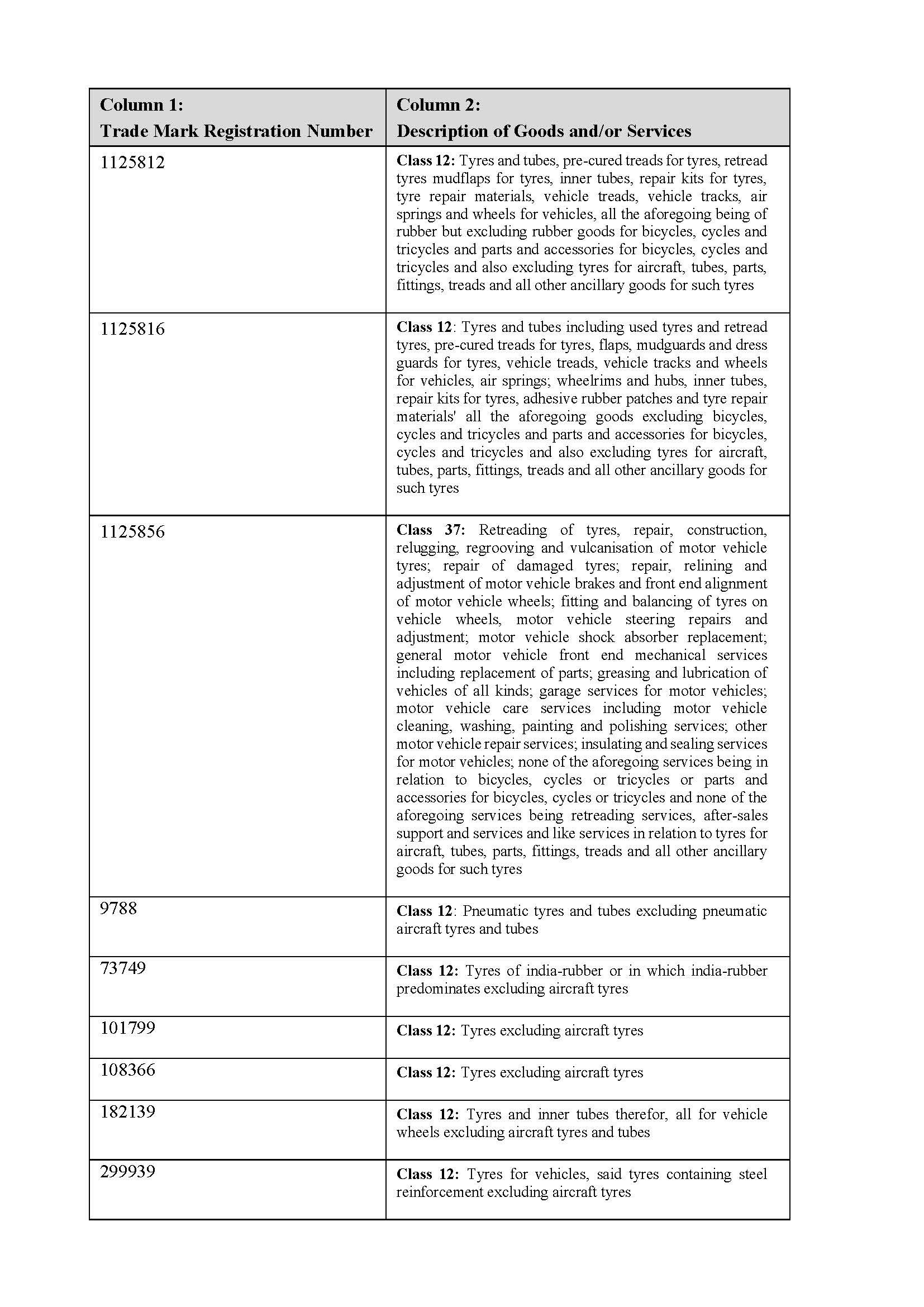
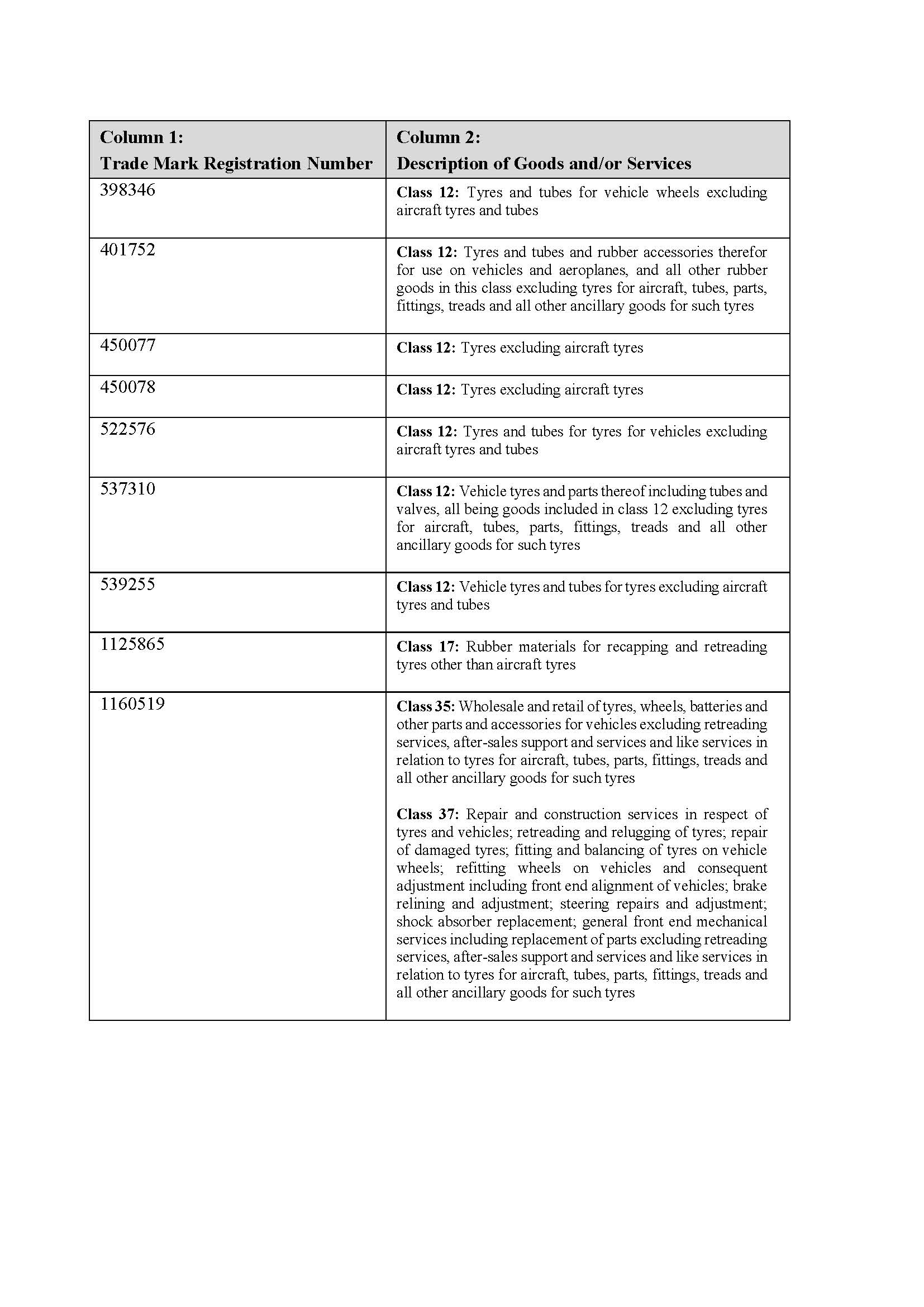
1. Pursuant to s 88(1) of the Trade Marks Act 1995 (Cth), the Register of Trade Marks be rectified by amending the goods and/or services in respect of which each of the registered trade marks identified in column 1 of the Schedule to these Orders (“Schedule”) is registered to correspond to the description of goods and/or services specified in respect of each such registered trade mark set out in column 2 of the Schedule.
2. The Notice of Cross-Claim be otherwise dismissed.
3. The Amended Originating Application be dismissed.
4. The Respondents/Cross-Claimants serve a copy of these Orders on the Registrar of Trade Marks by 4.00pm on 9 July 2018.
5. Within 7 days, the parties file and serve (by way of exchange) brief written submissions (limited to 2 pages in length) on questions of costs, such written submissions to address costs in both this proceeding and proceeding NSD 159 of 2015.
6. Within a further 7 days, the parties file and serve (by way of exchange) brief written submissions in reply (limited to 2 pages in length).
7. Notwithstanding order 2 made on 28 July 2016 and subject to any further order, paragraphs [80]-[81] of the reasons for judgment published today not be further published or disclosed before 4.00pm on 10 July 2018 except to the persons referred to in order 1 made on 28 July 2016.
8. Should the Applicants seek any further order preventing further publication or disclosure of the paragraphs referred in to order 7 they are to give written notice of the order they seek to the Respondents/Cross-Claimants and the Associate to Nicholas J by 11.00am on 10 July 2018.
Note: Entry of orders is dealt with in Rule 39.32 of the Federal Court Rules 2011.
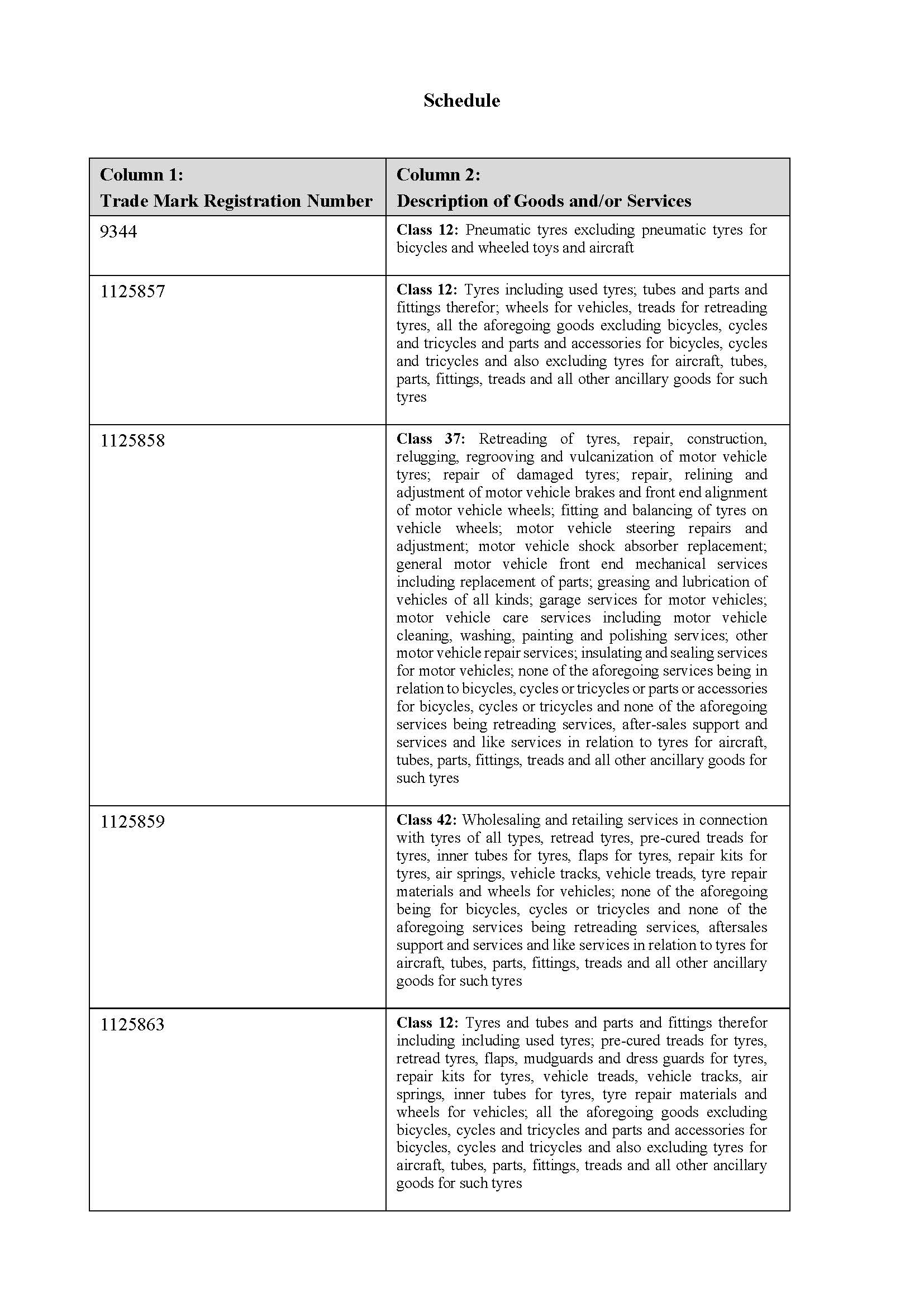
ORDERS
|
NSD 159 of 2015 | ||
|
| ||
|
BETWEEN: |
DUNLOP AIRCRAFT TYRES LIMITED Applicant | |
|
AND: |
THE GOOD YEAR TIRE & RUBBER COMPANY Respondent | |
|
AND BETWEEN: |
THE GOOD YEAR TIRE & RUBBER COMPANY Cross-Claimant | |
|
AND: |
DUNLOP AIRCRAFT TYRES LIMITED Cross-Respondent | |
|
JUDGE: |
NICHOLAS J |
|
DATE OF ORDER: |
6 July 2018 |
THE COURT ORDERS THAT:
1. The Amended Notice of Appeal be dismissed.
2. The Notice of Cross-Appeal be dismissed.
Note: Entry of orders is dealt with in Rule 39.32 of the Federal Court Rules 2011.
NICHOLAS J:
Introduction
1 The following definitions have been used throughout the reasons for judgment:
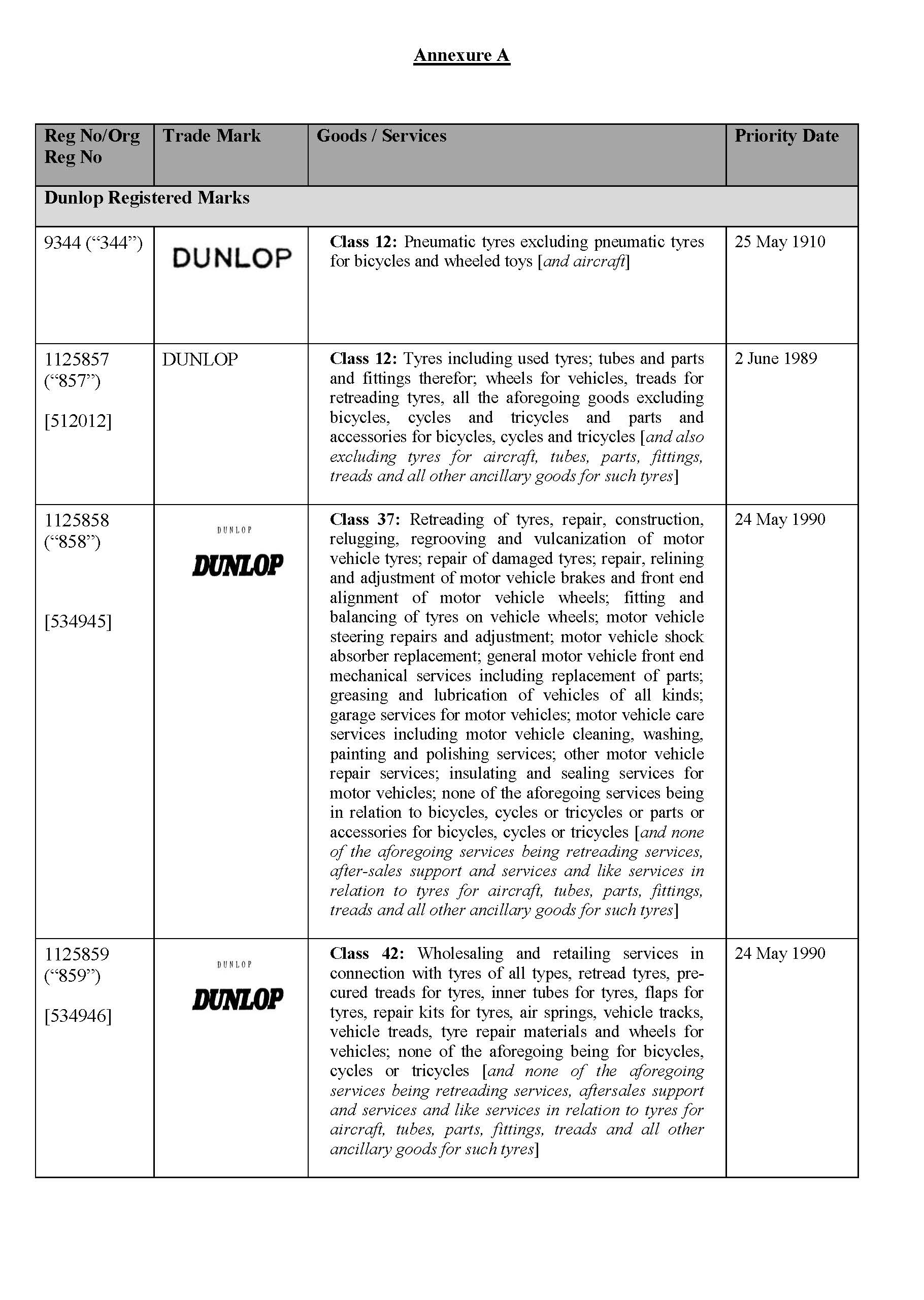
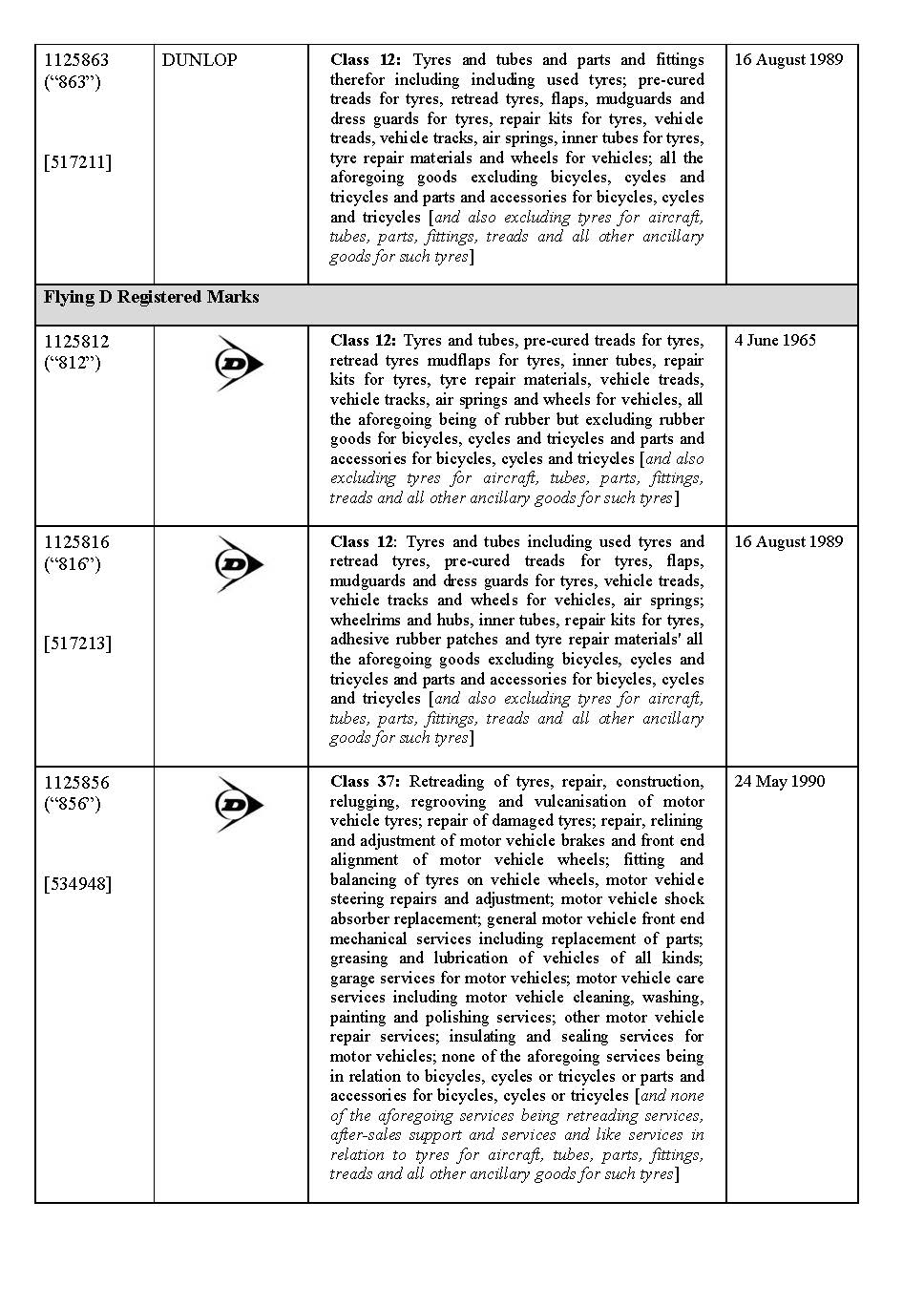
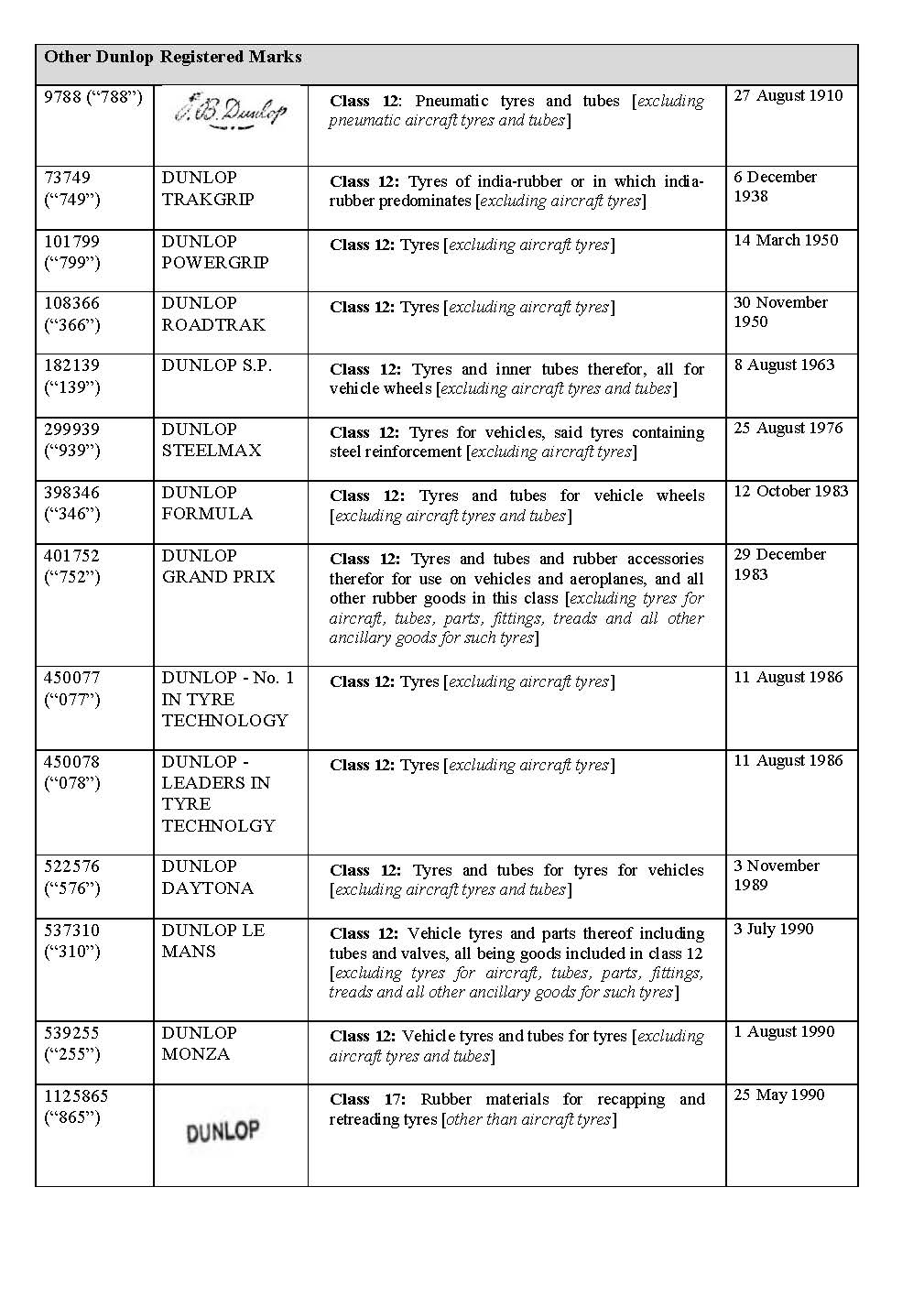
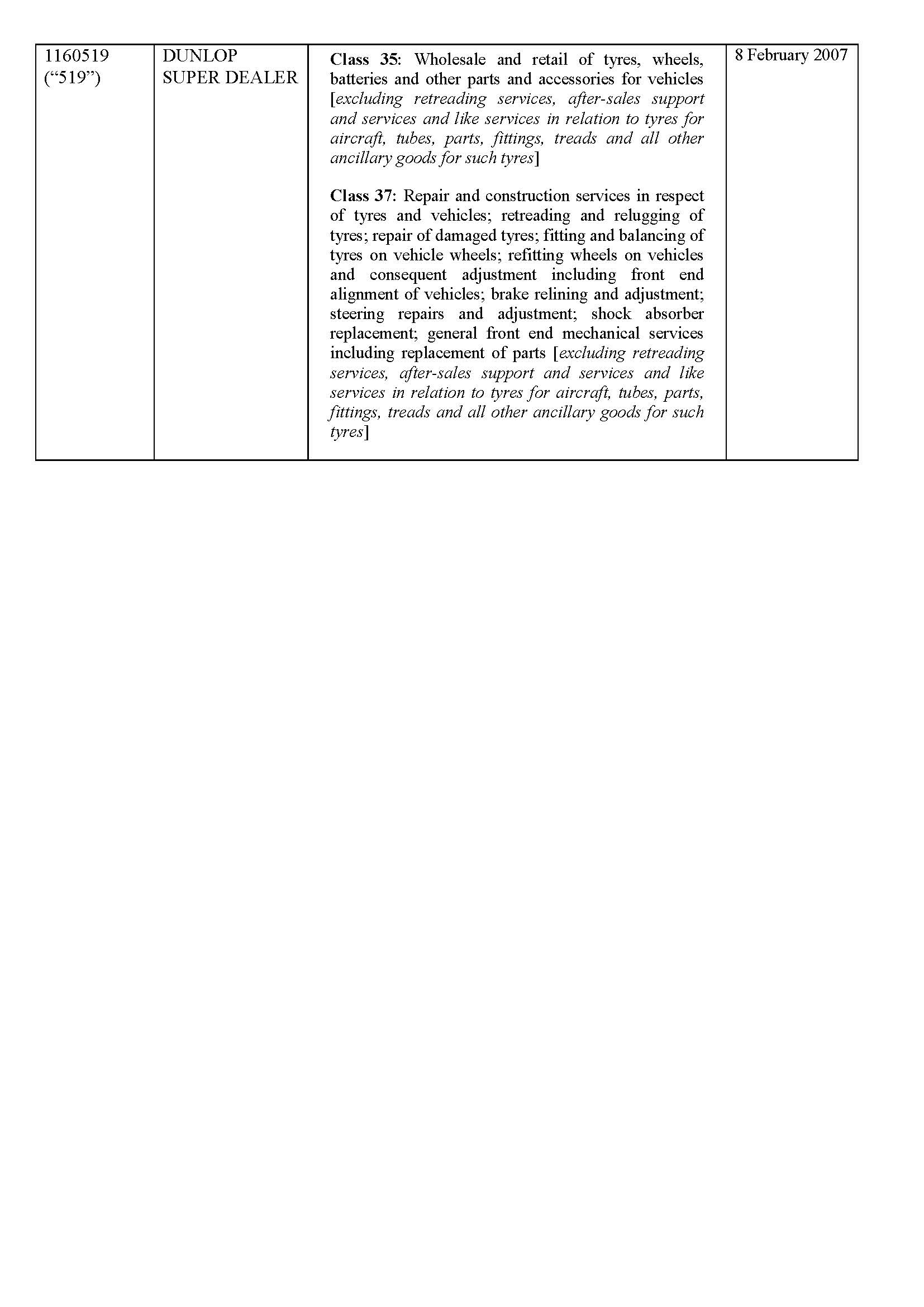
Registered Marks – the Australian registered trade marks listed in Annexure A.
Dunlop Registered Marks – collectively Trade Mark Nos 9344, 112857, 1125858 1125859 and 1125863 for the word mark “Dunlop”;
Flying D Registered Marks – collectively Trade Mark Nos 1125812, 1125816 and 1125856 for the “flying D” device mark;
The Dunlop/Flying D Registered Marks – collectively the Dunlop Registered Marks and the Flying D Registered Marks
Other Registered Marks – collectively, Australian Trade Mark Nos 9788, 73749, 101799, 108366, 182319, 299939, 398346, 401752, 450077, 450078, 522576, 537310, 539255, 1125865 and 1160519 for words or phrases incorporating the word “Dunlop”;
Non-Use Marks – collectively, the Dunlop Registered Marks, the Flying D Registered Marks and the ‘865 mark;
The Dunlop mark - the word mark Dunlop;
Flying D mark – The following device mark:

Dunlop/Flying D marks – collectively the word mark Dunlop and the Flying D mark;
Dunlop branded aircraft tyres – aircraft tyres to which one or both of the Dunlop Mark and the Flying D Mark have been applied;
non-use period – the relevant period of alleged non-use, being 24 June 2012 to 24 June 2015; and
related goods and services – any of tyres for aircraft, tubes, parts, fittings, treads and all other ancillary goods for such tyres, and re-treading services, after-sales support and services and like services in relation to such tyres and ancillary goods.
2 The first applicant, Goodyear Tire & Rubber Company (“Goodyear US”), is the owner of the Australian registered trade marks listed in Annexure A (these are the Registered Marks). Broadly-speaking, the Registered Marks are registered in relation to tyres and related goods and/or services, and fall into three categories:
(a) Trade Mark Nos 9344, 112857, 1125858 1125859 and 1125863 (these are the Dunlop Registered Marks) for the word “Dunlop”;
(b) Trade Mark Nos 1125812, 1125816 and 1125856 (these are the Flying D Registered Marks) for the “flying D” device; and
(c) Trade Mark Nos 9788, 73749, 101799, 108366, 182319, 299939, 398346, 401752, 450077, 450078, 522576, 537310, 539255, 1125865 and 1160519 (these are the Other Registered Marks) for words or phrases incorporating the word “Dunlop”.
3 The second applicant, Goodyear & Dunlop Tyres (Aust) Pty Ltd (“Goodyear Australia”), is a wholly-owned subsidiary of Goodyear US and is licenced to use the Registered Marks. Until around 1987, Goodyear Australia’s predecessor, Ansell Ltd (“Ansell”), then called Pacific Dunlop Ltd, manufactured aircraft tyres and applied the Dunlop/Flying D marks to those tyres at its factories in Victoria, Australia. Thereafter, Goodyear Australia imported Dunlop branded tyres from the first respondent, Dunlop Aircraft Tyres Limited (“DATL)”, and its predecessors in England, and sold them in Australia. In March 2015, Goodyear Australia ceased selling Dunlop branded aircraft tyres when DATL withdrew supply to it.
4 Until 2008, Goodyear Australia also re-treaded aircraft tyres (that is, replaced the remaining tread from a used tyre with a new moulded section) under the Dunlop/Flying D marks at its factories in Victoria. Since 2008, however, it has sent aircraft tyres for re-treading to another Goodyear entity in Thailand, Goodyear Thailand Pcl (“Goodyear Thailand”).
5 DATL is the owner and operator of the Dunlop branded aircraft tyre business in the UK. DATL is presently, and has for about 30 years, been the sole manufacturer of aircraft tyres bearing the Dunlop/Flying D marks, including those sold by the applicants in Australia. Since at least 1963, DATL and its predecessors have also re-treaded aircraft tyres and applied the Dunlop/Flying D marks to the re-treads at its factory in Birmingham, UK.
6 The second respondent (“Aero Parts”) has since 2013 imported Dunlop branded aircraft tyres into Australia for supply to Australian aircraft operators and intermediaries. Aero Parts is supplied with those tyres by a Chinese company, Dunlop Taikoo (Jinjiang) Aircraft Tyres Company Ltd (“Dunlop Taikoo”) which, in turn, sources them from DATL. DATL and Dunlop Taikoo entered into a joint-venture for the distribution and re-treading of Dunlop branded aircraft tyres from Dunlop Taikoo’s facility in China in 2009.
7 On 23 January 2009, DATL filed Australian Trade Mark Applications Nos 1282093 for the Dunlop mark and 1282094 for the Flying D mark in class 12 for “aircraft tyres and tubes” and in class 37 for “aircraft tyre re-treading services”. Goodyear US opposed those applications. In February 2015, a delegate of the Registrar of Trade Marks found that Goodyear US had established grounds of opposition under ss 44 and 58 of the Trade Marks Act 1995 (“the Act”) and refused to register the applications (see Goodyear Tire & Rubber Company v Dunlop Aircraft Tyres Ltd (2015) 111 IPR 517).
8 For convenience, where it is not necessary to distinguish between them, Goodyear US and Goodyear Australia are referred to as the “Goodyear Parties”, and DATL and Aero Parts are referred to as the “Dunlop Parties”.
Broad overview of the parties’ allegations in the proceedings
9 By way of overview, there are three matters that arise in these proceedings.
10 First, by their Amended Statement of Claim, the Goodyear Parties:
allege that DATL and Aero Parts have infringed the Dunlop/Flying D Registered Marks for the purposes of ss 120(1) and 120(2) of the Act; and
further allege that the conduct of DATL and Aero Parts, in using the Dunlop/Flying D marks, contravenes ss 18 and 29(1)(g) of the Australian Consumer Law (“ACL”) and constitutes passing off.
11 Secondly, by their Cross-Claim, the Dunlop Parties:
seek declarations that registered marks ‘858 and ‘856 are not registered in respect of “tyres for aircrafts, tubes, parts, fittings, treads and all other ancillary goods for such tyres, and re-treading services, after-sales support and services and like services in relation to such tyres and ancillary goods”;
allege that each of the Registered Marks, insofar as they are registered in respect of aircraft tyres and related goods and services, should be removed pursuant to s 92(4)(b) of the Act on the ground of non-use;
seek orders for the rectification of each of the Registered Marks, insofar as they are registered in respect of aircraft tyres and related goods and services, pursuant to s 88(2)(a), (c) and (e) on grounds, inter alia, that use of the marks is likely to deceive or cause confusion; and
contend that, if Goodyear Australia has used the Dunlop/Flying D marks in relation to aircraft tyres and related goods and services, it has engaged in misleading and deceptive conduct and passing-off.
12 Thirdly, by notices of appeal and cross-appeal, DATL and Goodyear US each appeal from the decision of the Registrar of Trade Marks (“the Registrar”) in respect of DATL’s Australian Trade Mark Applications Nos 1282093 for the Dunlop mark and 1282094 for the Flying D mark in classes 12 and 37.
13 The parties have distilled the issues in the proceedings in an Agreed Statement of Issues to which I have had regard. Several of the issues identified in this document were either refined or not pressed during final submissions.
Overview of the witnesses
14 The Goodyear Parties led evidence from four witnesses:
(a) Mr Peter Monaghan;
(b) Mr John Castellas;
(c) Mr Lou Mandanici; and
(d) Ms Kellech Smith.
15 Mr Monaghan is the Australian manager of the aviation business unit of Goodyear Australia. He has almost twenty years of experience in the Australian aircraft tyre trade and commenced working at Ansell Ltd (then known as Dunlop Australia Ltd) in 1971 as a management cadet in its tyre business. Mr Monaghan’s evidence addressed, amongst other things, the history of dealings between the Dunlop Parties (and their predecessors) and the Goodyear Parties (and their predecessors), the Australian market for aircraft tyres and related goods and services, Goodyear Australia’s (and its predecessors’) reputation in that market and its use of the Registered Marks. Mr Monaghan was cross-examined.
16 Mr Castellas is a procurement consultant with more than 35 years’ experience in the Australian aviation industry and a teacher at Swinburne University in relation to airline fleet acquisition and management. Relevantly, he worked for Qantas (which also included the Jetstar business from 2003 onwards) in procurement roles between 1994 and 2011, which involved, amongst other things, managing Qantas’ arrangements for the procurement of aircraft tyres. Mr Castellas was not cross-examined.
17 Mr Mandanici is a vice president at Goodyear Australia. He has little experience in relation to aircraft tyres and his evidence was directed to Goodyear Australia’s (and its predecessors’) sale and supply of non-aircraft tyres (such as tyres for trucks, consumer vehicles and motor-sports) under the Dunlop/Flying D marks in Australia. Mr Mandanici was not cross-examined.
18 Ms Smith is the solicitor for the Goodyear Parties. Her affidavit annexed various company search reports, confidential agreements and other documents. Ms Smith was not cross-examined.
19 The Dunlop Parties led evidence from three witnesses:
(a) Mr Martin Pye;
(b) Mr Paul Chisholm; and
(c) Ms Odette Gourley.
20 Mr Pye is the director of original equipment business development at DATL. He has worked in the aviation industry in the UK for more than 30 years and commenced work as a programme manager at DATL in 2000. Mr Pye’s evidence addressed, amongst other things, the history of dealings between the Dunlop Parties (and their predecessors) and the Goodyear Parties (and their predecessors), DATL’s sales and marketing activities under the Dunlop/Flying D marks in relation to aircraft tyres and related goods and services in Australia and the rules and regulations concerning aircraft tyres. Mr Pye was cross-examined.
21 Mr Chisholm has worked in the Australasian aviation industry from 1977 to 2013 and continues to perform consultancy in the industry. He has qualifications in aircraft maintenance engineering and has been involved in the sourcing and fitting of aircraft tyres in New Zealand since 2000. In 2009, he moved to TAE (which was a contractor for wheel, tyre and break maintenance for Australian Airlines) based in Australia. TAE deals directly with suppliers of wheels, tyres and breaks to order the appropriate parts, fit them and perform subsequent maintenance services for aircraft operators such as QantasLink, Skytrans and the Royal Flying Doctor Service. Mr Chisholm’s evidence addressed, amongst other things, the rules and regulations concerning aircraft tyres, the Australian market for such tyres and related services and his understanding of the origin of aircraft tyres and related products and services branded under the Dunlop/Flying D marks. Mr Chisholm was cross-examined briefly.
22 Ms Gourley is the solicitor for the Dunlop Parties. Her affidavit annexed, amongst other things, various documents obtained from Australian Trade Marks Office. Ms Gourley was not cross-examined.
Background
History of the parties and the trade marks
23 In the 1890s, the UK company Dunlop Holdings Ltd (“DHL”) established a tyre distribution outlet in Flinders Lane, Melbourne, Australia, which operated under the Dunlop mark. DHL first registered the Dunlop mark in the UK in April 1909. By 1910 DHL was manufacturing and selling aircraft tyres under the Dunlop mark in the UK.
24 In 1899 DHL disposed of the Australian arm of its tyre business to an entity called Dunlop Pneumatic Tyre Company Co of Australasia (“Dunlop Australia”). Dunlop Australia first registered the Dunlop mark (Dunlop Registered Mark No 9344) in Australia 1910. In 1920 Ansell was incorporated (under a former name, Dunlop Rubber Company of Australasia Ltd but, for convenience, referred to below as Ansell) and took over Dunlop Australia’s tyre business, including its aircraft tyre department. The company that carried on this business was Ansell, although it had various other names until 2002, all of which incorporated the Dunlop name. These names included Dunlop Australia Ltd and Pacific Dunlop Ltd.
25 Prior to the 1930s, Ansell imported aircraft tyres bearing the Dunlop mark from DHL in the UK and distributed them in Australia. In the early 1930s, Ansell established a manufacturing facility in South Melbourne and commenced manufacturing various tyres (including aircraft tyres) branded with the Dunlop mark and, later, the Flying D mark. However, Ansell continued to import from DHL different models of tyres that it did not manufacture itself.
26 In 1953, Ansell commenced providing re-treading services for aircraft and other tyres at its premises in Essendon, Victoria. In 1965, the Flying D mark was registered by DHL in the UK and by Ansell in Australia in respect of “all rubber goods” in class 12, subject to various exclusions.
27 Goodyear Australia was incorporated in 1922 under the name Beaurepaire Tyre Services Proprietary Limited, and later became a subsidiary of the Olympic Tire & Rubber Co. It was acquired by Ansell in 1980.
28 In 1987, a partnership known as South Pacific Tyres (“SPT”) was formed between Pacific Dunlop Tyres Pty Ltd (a subsidiary of Ansell) and Goodyear Tyres Pty Ltd (a subsidiary of Goodyear US). Each party held a 50% interest in SPT. The aviation business of SPT involved both the manufacture and the re-treading of aircraft tyres. The business was conducted by Goodyear Australia, when it was known as Tyre Marketers (Australia) Limited (“TMA”).
29 Around the time of the formation of SPT in 1987, Ansell ceased manufacturing aircraft tyres in Australia. From that time, SPT continued to market and sell Dunlop branded aircraft tyres purchased and imported from the aircraft tyre division of Dunlop in the UK, namely DHL and, later, DATL.
30 All of the Dunlop branded aircraft tyres manufactured by Ansell in Australia between 1930 and 1987 and those imported by Ansell (and its successors) from DATL (and its predecessors) in the UK had either the Dunlop mark or Flying D mark stamped onto the side wall of the tyre, together with a unique serial number.
31 In 2006, Goodyear US purchased Ansell’s interest in SPT. The Registered Marks were also assigned by Ansell to Goodyear US. In March 2009 the name of Goodyear Australia was changed from TMA to Goodyear & Dunlop Tyres (Aust) Pty Ltd.
32 In February 2009, the re-treading facility at Essendon was closed. Goodyear Australia began collecting and shipping its customers’ aircraft tyres off-shore for re-treading at Goodyear Thailand.
33 On 1 January 2012, Goodyear US and Goodyear Australia entered into a written licence agreement pursuant to which Goodyear Australia was granted a non-exclusive and non-transferable licence to use the Registered Marks on and in connection with the manufacture, marketing and sale of products and services in Australia. I shall refer to the detail of the written licence agreement later in these reasons.
34 As noted above, DHL commenced operations in the UK in the late 1800s, at first as a manufacturer of bicycle tyres. By 1910, it had expanded into aircraft and vehicles tyres and associated products and services. From 1910 to the mid-1920s DHL manufactured aircraft tyres at its factories in Aston Cross, Birmingham. In the late 1920s, DHL established a factory at Fort Dunlop, Birmingham. Aircraft tyres have been manufactured at Fort Dunlop since that time. DHL commenced exporting Dunlop branded aircraft tyres manufactured at its Fort Dunlop facility to Ansell to sell in the Australian market in 1925.
35 DHL commenced re-treading aircraft tyres at its Fort Dunlop factory in 1963.
36 DHL was acquired by British Tyre & Rubber Co (“BTR”) in 1985. In 1996 the aircraft tyre business was sold to DATL which has continued to operate it ever since. As part of the asset sale agreement, DATL was licenced to use the Dunlop/Flying D marks that were registered in in the UK and various other territories but not in Australia where Ansell (then known as Pacific Dunlop Australia Ltd) held the Registered Marks. In January 2008, the UK trade mark registrations for the Dunlop/Flying D marks were assigned to DATL insofar as those registrations covered aircraft tyres and re-treading services.
37 In November 2009, DATL officially opened its joint venture facility in China, which is conducted by Dunlop Taikoo. The joint venture was established in China to distribute tyres manufactured at DATL’s Fort Dunlop facility in the UK and to operate a re-trading facility for Asia. DATL has a controlling shareholding in Dunlop Taikoo. Dunlop Taikoo commenced supplying Dunlop branded aircraft tyres to Goodyear Australia in 2009.
38 Dunlop Taikoo received Civil Aviation Safety Authority (“CASA”) approval to re-tread tyres for Australian aircraft on 23 December 2011 and commenced offering re-treading services to Australian customers from this time. In early 2013, Aero Parts was appointed as an Australian distributor for DATL and Goodyear Australia was directed by Dunlop Taikoo to place future orders for Dunlop branded aircraft tyres through Aero Parts.
39 Since around April 2013, Aero Parts has imported into Australia Dunlop branded aircraft tyres for supply to Australian aircraft operators and intermediaries. Aero Parts sources those tyres from Dunlop Taikoo. From April 2013 to March 2015, DATL also continued to supply new Dunlop branded aircraft tyres to Goodyear Australia for on-sale (first directly, then through Dunlop Taikoo, and finally through Aero Parts).
40 DHL was previously licensed by Ansell to use the Dunlop/Flying D Registered Marks on aircraft tyres exported to Australia, provided those tyres which were fitted as original equipment (“OE”) to aircraft manufactured in the UK or were tyres sold to a related-entity of Ansell for the purposes of replacing such OE tyres.
41 Between January 2008 and March 2009, DATL communicated with Goodyear Australia (and its predecessor SPT) seeking a licence to use the Dunlop/Flying D marks in Australia. Goodyear Australia advised that it was not prepared to sub-license use of the marks to DATL.
42 Beginning in early 2008, various discussions took place between representations of DATL (Mr Skepper and Mr Pye) and the Goodyear Parties (Mr Monaghan) concerning the possibility of DATL being granted a trade mark licence. The topic was raised by Mr Pye in an email to Mr Monaghan dated 26 January 2008 in which Mr Pye said:
…
As you know, there are a few operators in your region operating aircraft equipped with tyres which only DATL has certification for (DASH 8 - Q400, Embraer 170/175) etc.). Our Sales and Marketing Director, David Skepper, tells me that you have no plans to retread these tyres at present so we would like to support these operators directly to give them better cost of ownership. Given that Goodyear owns the trade marks for the name “Dunlop” and the D device on aircraft tyres in Australasia, I believe the best way forward, with your agreement, would be for us to enter into a trade mark licence agreement whereby you licence us to sell certain products directly. David tells me that this is something he discussed with your predecessor, Clive Goodwin, some years ago and which he felt may be acceptable in principle. Would you be prepared to consider some form of licence agreement and if so, shall I draft an agreement and send it to you for your review and comment?
…
43 There was further email correspondence exchanged in which Mr Pye followed up his initial request seeking an indication as to whether Goodyear US was open to granting DATL a licence. Mr Monaghan said in an email to Mr Pye dated 4 June 2008:
…
My advice from SPT is that we cannot restrict Dunlop ATL from dealing directly with the Australian airlines. However, it will be a major change for our airlines.
Traditionally, we have ordered new tyres from Dunlop ATL, retreaded those Dunlop tyres for which we gained approval, and supported the airlines with ongoing supply. We store the Dunlop tyres on behalf of the airlines, have contracts with the airlines on the basis that Dunlop ATL will continue to supply us. This has worked well for both the airlines and for us over the years, and we would prefer that it continued.
If the basis on which we have traditionally dealt with Dunlop ATL is to be changed, we need the details of such changes, as well as some time to consider the impact on the airlines and then to advise them.
Please advise such details from the Dunlop ATL perspective, if such changes will occur.
…
44 These discussions were still occurring when Goodyear US decided to close its new tyre plant in Melbourne. Mr Monaghan advised Mr Skepper in an email dated 13 August 2008 that the new tyre plant would close at the end of 2008 and that it was likely that the re-treading plant would also close in 2009.
45 A conference call was held on 27 August 2008 in which Mr Monaghan (“PM”), Mr Skepper (“DAS”) and Mr Pye (“MRP”) participated. According to Mr Skepper’s written summary of the call:
1.1 PM explained the decision to close the retread plant in Melbourne is twofold (a) reduction in future throughput due to the growth of new part numbers that Goodyear is not currently approved for and (b) raw material supply being cut off due to the recent Goodyear automotive plant closure in Australia.
…
1.10 MRP raised the issue again about DATL wanting to take over retreading and distribution of its own product in Australasia. PM explained that some of their existing customers purchase both GY and DATL product albeit that this is generally on different aircraft tyres. Therefore, going forward the customers will purchase from two suppliers rather than one so this will not be an issue.
…
1.12 MRP also raised the issue again about trademark. PM advised that when checking before he understood from South Pacific Tyres legal department that this was not an issue but needed to re-check with Goodyear in Akron.
…
2.11 PM to respond to DAS/MRP in respect of the Dunlop trademark question for Australasia during w/c 01.09.08.
2.12 Date to be fixed between DATL and Goodyear for DATL to take over distribution/retreading. Ideally this should coincide with the official announcement by Goodyear about the plant closure. PM to respond to DAS/MRP during w/c 01.09.08
…
2.14 Date for next conference call to be fixed when info on trademark and distribution is available.
46 Further emails were exchanged in which Mr Skepper sought to progress the matter of the proposed trade mark licence. On 19 November 2008 Mr Monaghan sent an email to Mr Skepper, copied to Mr Pye, advising:
…
This week, the South Pacific Tyres (SPT) Executive Team decided that they are not prepared to sub-licence the Dunlop trademark in Australia, New Zealand or the Pacific Islands.
We are advised that the Dunlop marks for our region are now owned by The Goodyear Tire and Rubber Co, Akron USA. SPT has existing supply agreements with longstanding customers, and we intend to continue supplying tyres with these marks.
I am available to discuss further, when your team has had some time to think about my email.
…
47 Mr Pye sent an email to Mr Monaghan on 28 January 2008 which relevantly stated:
… I am coming back to you now on the issue of support to Australian based customers of Dunlop aircraft tyres.
As you know, over a considerable period of time, your company has ordered new tyres from Dunlop Aircraft Tyres Limited (DATL) for supply to Australian based customers, retreaded DATL tyres for Australian customers and stored the tyres for customers. As you noted in your email of 4 June last year, this was the traditional arrangement and it worked well. The customers knew that the tyres were manufactured by us and they could be confident of the quality of the product. The customers were able to obtain the support they required by way of storage and retreading and Goodyear Aviation Australia (GAA) had the benefit of continuity under your ongoing arrangements with customers.
The traditional arrangement has been affected, however, by various developments. You gave us notice in your email of 13 August last year that the nature of our relationship will be changing due to the closure of Goodyear’s Melbourne tyre factory and the imminent closure of your aircraft tyre retreading plant. Goodyear has a retreading plant in Thailand but you have indicated that considerable cost will be involved in equipping that plant with the tooling to retread DATL tyres and, in fact, that this facility has no plans at all to retread certain sizes hence forcing the operators to purchase new tyres only.
As you know, DATL will have retreading capability for all Dunlop aircraft tyres operational in the Asia Pacific region in 2009. As well, we wish to support directly those Australian customers who know and rely on the quality of tyres manufactured by DATL. As I mentioned when I first raised the topic with you in January last year, this will give our customers better cost control. Against that background, as you can appreciate, continuing supply of tyres to GAA is dependent on cost effective meeting of our customers needs including provision of retreading services. The alternative is a situation where we supply our customers directly.
We are aware that Goodyear has registered Australian trade marks for the Dunlop name and logo for aircraft tyres but, given our reputation for quality with our customers in Australia, we are satisfied that DATL is entitled to use and register the Dunlop name and logo for aircraft tyres and related services (such as aircraft tyre retreading) in Australia. Whether that be concurrently with Goodyear’s own trade mark registrations in Australia or otherwise, we are also satisfied that, without the consent of DATL, it would be a problem for the Dunlop brand name to be used for aircraft tyres not manufactured by DATL given the familiarity of the Australian customers with our company as the source of the tyres of the quality with which they are familiar.
We would like to suggest, therefore, that GAA provides an indication of the best terms that you might propose for continuation of GAA’s resupply of DATL’s tyres in Australia including your proposals for dealing with retreading services so that we can explore the best way forward. In doing so, it would be helpful if you indicated the duration of your current arrangements with customers and clarify what statements have been made to customers about future supply of tyres and retreading services in light of the impending closure of GAA’s plant in Australia.
It would be useful if we could understand your thoughts within the next couple of weeks, I am aware that the matter has been under discussion for some time but it has become more pressing given the lack of progress and the closure of Goodyear in Australia. We are happy to discuss the position in a conference call recognising the complexity of the situation and I will make myself available at your convenience for this purpose.
…
By the time this email was sent, DATL had already filed (on 23 January 2009) its own trade mark applications.
48 Mr Monaghan responded to Mr Pye’s email on 9 February 2009 as follows:
…
The stated legal position of South Pacific Tyres, on this matter, has not changed. Commercially and legally, we intend to continue to exercise and to protect our rights to the Dunlop trademark in Australia, NZ and the Pacific Islands.
However, if you wish to discuss further, I suggest you contact the Goodyear Legal department in Akron, OHIO, USA. The contact there is Nicholas Valenziano. He is the Goodyear legal representative for such matters.
…
49 Mr Pye wrote to Mr Valenziano, a Trade Mark Attorney for Goodyear US, on 13 February 2009 proposing that DATL and Goodyear US enter into a licence agreement. Mr Valenziano advised Mr Pye on 6 March 2009 that Goodyear Australia had decided at that time it was not interested in licensing the Dunlop/Flying D Registered Marks to DATL.
50 On 23 January 2009 (“the priority date”) DATL filed Australian Trade Mark Applications Nos 1282093 for the Dunlop mark (“DATL’s aircraft tyres application”) and 1282094 (“DATL’s re-treading application”) for the Flying D mark in class 12 for “aircraft tyres and tubes” and in class 37 for “aircraft tyre re-treading services”. Goodyear US opposed these applications. In February 2015, a delegate of the Registrar of Trade Marks found that grounds of opposition under ss 44 and 58 of the Act had been established and refused to register the applications. DATL filed its appeal against that decision on 26 February 2015. Shortly thereafter, the Goodyear Parties commenced infringement proceedings against DATL and Aero Parts.
51 On 31 March 2015, DATL wrote to Goodyear Australia stating that Aero Parts would not accept further orders of new Dunlop branded aircraft tyres from Goodyear Australia. The last purchase order filled by Aero Parts was made by Goodyear Australia in June 2015. Goodyear Australia made further requests to Aero Parts for the supply of Dunlop branded aircraft tyres in July and September 2015 which Aero Parts refused. As a result, Goodyear Australia has been unable to supply Dunlop branded aircraft tyres to customers (including Virgin Australia) since mid-2015.
52 DATL has admitted that, since at least January 2013, it has engaged in commercial dealings in Australia in respect of aircraft tyres, after sales support and services in relation to aircraft tyres and re-treading services, under and by reference to the Dunlop/Flying D marks. Aero Parts, similarly, admits that, since April 2013, it has engaged in commercial dealings in Australia in respect of Dunlop branded aircraft tyres and arranged the re-treading of Dunlop branded aircraft tyres by Dunlop Taikoo in China.
The market for aircraft tyres and related services in Australia
53 Broadly, the market for aircraft tyres and related services fall into three segments:
(a) the commercial segment (for example Qantas and Virgin and their service providers);
(b) the general utility aviation segment (for example, private aircraft owners); and
(c) the government and military segment (largely military aircraft).
54 Suppliers of aircraft tyres and related services in Australia to end-users include (i) “brand-name” tyre manufactures and/or suppliers (such as Michelin) (ii) specialised aircraft tyre and part suppliers (such as Aviall and Hawker Pacific) and (iii) wheel and brake maintenance, repair and overhaul (“MRO”) service providers. There are numerous re-sellers or distributors, such as Aero Parts, TAE and (to some extent) Goodyear Australia, which also supply aircraft tyres to the end-users.
55 Large commercial airlines often acquire aircraft tyres and aircraft tyre re-treading services on long-term contracts awarded through a tender process. Small commercial airlines typically buy aircraft tyres and aircraft tyre re-treading as required, without long-term contracts. MRO businesses, distributors and government/military customers also buy aircraft tyres and aircraft tyre re-treading services on an as-needs basis.
Regulatory Requirements for New and re-treaded Aircraft Tyres
56 The aviation industry is subject to various regulations governing, inter alia, the marking of aircraft tyres (which must bear the manufacturer’s name or trade mark) the distribution of aircraft tyres, and the fitting of aircraft tyres to aircraft wheels.
57 Manufacturers of new aircraft tyres are required by United States Federal Aviation Authority (“FAA”), European Aviation Safety Authority (“EASA”) and United States Department of Defence aviation regulations to mark aircraft tyres with their name and/or trade mark. Re-treaders must also mark re-treads with their name or trade mark. DATL complies with the aviation regulations by applying to the new aircraft tyres it manufactures the Dunlop/Flying D marks.
58 Similarly, when DATL and Dunlop Taikoo re-tread aircraft tyres, the Dunlop/Flying D marks are applied to the re-treaded tyres as required by the aviation regulations. Goodyear Australia similarly complies with these regulations by applying a “Goodyear” trade mark to its own in-house aircraft tyres which it manufactures or re-treads.
59 For all Dunlop branded aircraft tyres manufactured by DATL and, before it, by Ansell, the Dunlop/Flying D marks are specially engraved on the side wall of the tyre. This is intended to ensure that the marks are clearly visible for the life of the aircraft tyre, including after re-treading.
60 Before a tyre can be fitted to the wheel of an aircraft, the tyre must be “type certificated” for that aircraft and the end user must have sighted the tyre’s Authorised Release Certificate (“ARC”) evidencing the tyre’s airworthiness. Once a particular design of aircraft meets the airworthiness requirements of the relevant regulations, it is issued with a Type Certificate (“TC”) by the relevant regulatory body (e.g. the FAA, if the aircraft is built by Boeing in the US). When an aircraft manufacturer supplies an airline with a new aircraft, it supplies it with the TC for that aircraft. In Australia, the Civil Aviation Safety Authority (“CASA”) validates TCs issued by foreign regulatory bodies.
61 A TC covers both the design of the aircraft and all of its major parts and appliances, including its tyres. The TC specifies the tyres of a particular manufacturer that may be fitted to the aircraft. Aircraft operators are required to operate their aircraft in accordance with that aircraft’s TC, the detail of which is contained in documentation provided to the aircraft operator and/or service newsletters or bulletins produced by aircraft manufacturers. In effect, the TC governs which tyres may be fitted to the aircraft. Aircraft can have one or multiple types of tyres certificated.
62 Once a specific tyre is type certificated to an aircraft, it becomes a prescribed tyre for that aircraft. Other than tyres having been type certificated when the aircraft was initially designed, the only ways that tyres can be fitted to an aircraft are if they are certified for that purpose by arrangement with the aircraft manufacturer or the subject of what is known as a Supplemental Type Certificate (“STC”) is issued by the applicable regulatory body.
63 An “ARC” is a form prepared pursuant to regulatory requirements by the entity responsible for an aircraft part. For new aircraft tyres this is the manufacturer, and for re-treaded aircraft tyres it is the re-treader. The ARC certifies that a tyre is airworthy and was manufactured or re-treaded in conformity with approved design specification. The ARC travels through the supply chain (including any distributors) until it reaches the end user. It must be checked by each entity to whom it is supplied on the way to the end user. The ARC is checked by the end user prior to and after installation of the tyre, and is then retained as part of its records. A tyre cannot be fitted to an aircraft without the correct ARC. If there is an issue with the ARC, the end user will reject the tyre. Penalties may be imposed on persons who fit a tyre that is not certified for that particular aircraft or if the correct ARC for the tyre is not sighted before it is fitted.
64 In addition to bearing the Dunlop/Flying D marks, DATL and Dunlop Taikoo’s ARCs include the full name and address of those companies and details of the particular aircraft tyre to which the ARC relates.
Removal For Non-Use
65 The Dunlop Parties contend that, insofar as they are registered in respect of aircraft tyres and related goods and services (as described in [1] above), the Registrar of Trade Marks (“Registrar”) should be ordered to remove the Registered Marks from the Register pursuant to s 101(2) of the Act. For convenience, I will refer to the goods as “aircraft tyres”. As to the services, I will refer to these as “re-treading services”.
66 The ground on which the Dunlop Parties rely is that provided by s 92(4)(b) of the Act; namely that each of the Registered Marks has remained registered for a continuous period of 3 years, ending one month before the day on which the Cross-Claim was filed and, at no time during that period, did Goodyear US use the Registered Marks in Australia or use them in good faith in Australia, in relation to aircraft tyres and related goods and services.
67 The Goodyear Parties admit that the ground for removal for non-use is established for each of the Other Registered Marks save for the ‘865 mark. However, they deny that it is established for any of the Non-Use Marks.
68 Section 7(3) of the Act provides that an “authorised use” of a trade mark is taken to be a use of the trade mark by the owner. This is important when one comes to s 92(4)(b) of the Act. It provides that an application may be made to remove a trade mark for non-use if:
… the trade mark has remained registered for a continuous period of 3 years ending one month before the day on which the non-use application is filed, and, at no time during that period, the person who was then the registered owner:
(i) used the trade mark in Australia; or
(ii) used the trade mark in good faith in Australia;
in relation to the goods and/or services to which the application relates.
Section 7(4) of the Act defines “use of a trade mark in relation to goods” to mean “use of the trade mark upon, or in physical or other relation, to the goods…”.
69 Section 100(1)(c) of the Act provides that it is for the Goodyear Parties to rebut the allegation made under s 92(4)(b). Section 100(3)(a) further provides that they will be taken to have done this if they establish that the relevant Non-Use Marks, or that a mark with additions or alterations not substantially affecting its identity, was used in good faith by Goodyear US in Australia in relation to aircraft tyres and related goods and services during the non-use period.
70 The concept of “authorised use” is of some importance in this case because the only use in the non-use period relied upon by Goodyear US to defeat the application for removal of the Non-Use Marks is what is said to be trade mark use of those marks by Goodyear Australia. Goodyear US contends that during the non-use period, Goodyear Australia, its wholly owned subsidiary, was an authorised user that engaged in authorised use of the Non-Use Marks.
71 Section 8 of the Act provides:
8 Definitions of authorised user and authorised use
(1) A person is an authorised user of a trade mark if the person uses the trade mark in relation to goods or services under the control of the owner of the trade mark.
(2) The use of a trade mark by an authorised user of the trade mark is an authorised use of the trade mark to the extent only that the user uses the trade mark under the control of the owner of the trade mark.
(3) If the owner of a trade mark exercises quality control over goods or services:
(a) dealt with or provided in the course of trade by another person; and
(b) in relation to which the trade mark is used;
the other person is taken, for the purposes of subsection (1), to use the trade mark in relation to the goods or services under the control of the owner.
(4) If:
(a) a person deals with or provides, in the course of trade, goods or services in relation to which a trade mark is used; and
(b) the owner of the trade mark exercises financial control over the other person’s relevant trading activities;
the other person is taken, for the purposes of subsection (1), to use the trade mark in relation to the goods or services under the control of the owner.
(5) Subsections (3) and (4) do not limit the meaning of the expression under the control of in subsections (1) and (2).
72 Section 8(1) defines “authorised user” and s 8(2) defines “authorised use”. There are a number of points to make about these terms.
73 First, a person cannot be an authorised user unless the person uses the registered mark under the control of the registered owner. In this context, “control” means actual control: Lodestar Anstalt v Campari America LLC (2016) 244 FCR 557 at [97] per Besanko J (Allsop CJ, Greenwood and Nicholas JJ agreeing).
74 Secondly, not every use of a trade mark by an authorised user need be an “authorised use” as defined. For a use of a mark by the authorised user to constitute an “authorised use” it must occur under the control of the registered owner. The words “to the extent only” in s 8(2) make clear that not all use of trade mark engaged in by an authorised user is necessarily authorised. An authorised user may engage in some use of a mark that is under the control of the owner, and some use that is not.
75 Thirdly, s 8(3) and (4) are deeming provisions that identify a number of situations in which a person will be taken to use a registered mark under the control of the owner. But they are expressed to operate on the definition of “authorised user” in s 8(1) and not the definition of “authorised use” in s 8(2). Hence, a person may be deemed to be an authorised user by reason of the matters referred to in either s 8(3) or s 8(4) but may also engage in use that is not “authorised use” for the purposes of s 8(2).
76 There is an issue between the parties as to whether the use of the Non-Use Marks by Goodyear Australia was trade mark use. I will return to that issue shortly. Assuming for the moment that it was, there is also an issue as to whether the use relied upon was authorised use. It is convenient to deal with this question first.
77 It is necessary when addressing the matter of authorised use to distinguish between use of registered marks in relation to aircraft tyres and use in relation to re-treading services.
78 Goodyear US and Goodyear Australia were party to a number of licence agreements. The agreement in force through-out the non-use period is dated 1 January 2012 (“the Licence Agreement”).
79 The Licence Agreement contains recitals which note that Goodyear US is the owner of the various marks in Australia and that Goodyear US desires to give Goodyear Australia a licence to use such marks in respect of all the products and services for which they are registered. The marks the subject of the licence include the Non-Use Marks.
80 Article 2.1 of the Licence Agreement provided:
Grant. Licensor hereby grants to Licensee a non-exclusive and non-transferable right and license to: (a) use the Goodyear Dunlop Name in its company, trade and/or business name(s): (b) hold itself out to the consuming public and trade and to conduct business under the Goodyear Dunlop Name and the Beaurepaires name, and (c) hold itself out to the consuming public and trade as a Goodyear affiliate and (d) use the Licensed Trademarks on and in connection with the manufacture, marketing, distribution and sale of the products and provision of the services in the Territory and elsewhere as approved by Licensor, all upon the terms and conditions set forth herein and so long as such products are manufactured by or for Licensee in accordance with Licensor's quality standards and the services are provided in a manner prescribed by Licensor. No other rights or licenses are granted to Licensee hereunder except those rights and licenses expressly set forth in this Agreement.
81 Article 4.1 of the Licence Agreement provided:
Production Standards. Licensee will manufacture or have manufactured or will offer in the Territory the products and the services covered by the Licensed Trademarks herein in compliance with the formulae, specifications and directions from time to time supplied to it by Licensor, and not otherwise, and will only use such materials as will have been approved by Licensor and will generally comply with all directions and standards that may from time to time be given to it by Licensor relating to the manufacture of the products or the offering of the services, or to the methods in which the same will be marked, marketed or packaged. Licensor will be the sole judge of whether Licensee is complying with the directions or standards provided by Licensor. In particular, Licensee will always use the Licensed Trademarks upon or in relation to the products and the services in such manner as may from time to time be required or approved by Licensor. Licensee will not commit or permit any acts that might invalidate the Licensed Trademarks or their registration in the name of Licensor.
82 In their written submissions the Goodyear Parties contended that the removal application must fail because Goodyear US had used the Non-Use Marks in relation to aircraft tyres and related goods and services during the non-use period. Reliance was placed on s 7(3) and s 8(3) of the Act on the basis that Goodyear Australia was a wholly owned subsidiary of Goodyear US during the non-use period and that its use of the Non-Use Marks was to be taken to be use of those marks by Goodyear US.
83 The evidence establishes that throughout the non-use period Goodyear Australia acted as a reseller of aircraft tyres that were made by DATL in accordance with DATL’s manufacturing and quality control standards. There was no evidence that the aircraft tyres to which the Non-Use Marks had been applied by DATL were made in accordance with the manufacturing or quality standards of Goodyear US. In his oral submissions Mr Golvan QC made clear that the Goodyear Parties did not rely on quality control for the purpose of establishing that Goodyear Australia used the Non-Use Marks under the control of Goodyear US.
84 Mr Darke SC for the Dunlop Parties submitted that any use of the Non-Use Marks on aircraft tyres imported and sold by Goodyear Australia was not a use permitted under the terms of the Licence Agreement and that any such use was necessarily outside the scope of the grant of rights. It was on that basis he submitted that any use of the Non-Use Marks by Goodyear Australia on aircraft tyres could not constitute authorised use.
85 The difficulty I have with Mr Darke SC’s submission is that its entire focus is on the Licence Agreement. Even if it is true to say that the Licence Agreement did not authorise Goodyear Australia to use the Non-Use Marks in relation to the aircraft tyres it acquired from DATL, it does not follow that any such use did not occur under the control of Goodyear US. In my opinion the submission has insufficient regard to the financial and managerial control exercised by Goodyear US over Goodyear Australia’s entire business operation.
86 One inference that is open is that Goodyear US did not see the Licence Agreement as extending to aircraft tyres made by DATL because it had no control over the manufacturing or quality control standards of DATL. In any event, Goodyear US must have been aware that the aircraft tyres supplied by Goodyear Australia were manufactured by DATL to DATL’s manufacturing and quality control standards, which were matters over which neither Goodyear US nor Goodyear Australia had any control.
87 Goodyear US acquired the Non-Use Marks from Ansell together with Ansell’s interest in SPT in 2006. Goodyear Australia (which remained known as SPT until March 2009) continued to acquire its supplies of Dunlop branded aircraft tyres from DATL until March 2015. The idea that Goodyear US did not know and approve of Goodyear Australia’s importation and sale of aircraft tyres that Goodyear Australia continued to acquire from DATL is contrary to the objective facts.
88 In the circumstances, the inference I draw is that any use Goodyear Australia made of the Non-Use Marks in the non-use period was a use by Goodyear Australia that Goodyear US knew of and approved. Given that fact, and notwithstanding the terms of the Licence Agreement, I am satisfied that Goodyear Australia’s use of the Non-Use Marks was under the control of Goodyear US.
89 The more difficult question is, I think, whether the use made of the Non-Use Marks by Goodyear Australia was trade mark use.
90 An essential feature of a trade mark is that it distinguishes the goods of the registered owner from the goods of other traders and that it indicates a connexion in the course of trade between the registered owner and the goods in relation to which the mark is used: E & J Gallo Winery v Lion Nathan Australia Pty Ltd (2010) 241 CLR 144 (“E & J Gallo”) at [41]-[42] per the plurality, French CJ, Gummow, Crennan and Bell JJ. Their Honours said at [41]-[43]:
[41] The concept of "use" of a trade mark which informs ss 92(4)(b), 100(1)(c) and 100(3)(a) of the Trade Marks Act must be understood in the context of s 17, which describes a trade mark as a sign used, or intended to be used, to "distinguish" the goods of one person from the goods of others.
[42] Whilst that definition contains no express reference to the requirement, to be found in s 6(1) of the Trade Marks Act 1955 (Cth), that a trade mark indicate "a connexion in the course of trade" between the goods and the owner, the requirement that a trade mark "distinguish" goods encompasses the orthodox understanding that one function of a trade mark is to indicate the origin of "goods to which the mark is applied". Distinguishing goods of a registered owner from the goods of others and indicating a connection in the course of trade between the goods and the registered owner are essential characteristics of a trade mark. There is nothing in the relevant Explanatory Memorandum to suggest that s 17 was to effect any change in the orthodox understanding of the function or essential characteristics of a trade mark.
[43] In Coca-Cola Co v All-Fect Distributors Ltd [(1999) 96 FCR 107 at 115 [19] per Black CJ, Sundberg and Finkelstein JJ] a Full Court of the Federal Court of Australia said:
“"Use 'as a trade mark' is use of the mark as a 'badge of origin' in the sense that it indicates a connection in the course of trade between goods and the person who applies the mark to the goods … That is the concept embodied in the definition of 'trade mark' in s 17 – a sign used to distinguish goods dealt with in the course of trade by a person from goods so dealt with by someone else."
That statement should be approved.
(some footnotes omitted)
91 It is important to note that the plurality’s observations were expressly concerned with the nature of the use that may be relied upon to defeat an application to remove a trade mark for non-use under the relevant provisions of the Act.
92 In the present case the question is whether Goodyear Australia as an authorised user used the Non-Use Marks as trade marks during the non-use period by using them to indicate a connexion in the course of trade between goods or services in relation to which they were used and the trade mark owner or its authorised user.
93 Whether there has been trade mark use indicating a connexion in the course of trade between the relevant goods or services and an authorised user (whose use is taken to be that of the owner) or the owner depends on the context in which the use occurs.
94 In determining whether there has been trade mark use, it is useful to recall the test that was applied by Kitto J (with whom Dixon CJ, McTiernan, Taylor and Owen JJ agreed) in Shell Company of Australia Ltd v Esso Standard Oil (Australia) Ltd (1963) 109 CLR 407 (“Shell”). The facts in that case were very different from the present case but the test postulated by his Honour for determining whether there was trade mark use remains relevant in so far as it identifies the nature of the connexion that the use of the mark is required to convey in order to constitute trade mark use.
95 In Shell, the appellant was the owner of a number of registered trade marks for the caricature of a man in the shape of an oil drop. The respondent was alleged to have infringed the registered marks by using a substantially identical or deceptively similar mark in a television commercial. The question was whether the display of moving depictions of the caricature infringed the registered marks. The High Court held that it did not.
96 Kitto J said at 422:
The question, then, is whether such a user of the oil drop figure as takes place by the exhibition of the films on television involves infringement of the trade marks. It is a question not to be answered in favour of the appellant merely by pointing to the brevity of the occasions when substantial identity is achieved. The assumption I have made means, of course, that if the oil drop figure as appearing in some of the individual frames of the films were transferred as separate pictures to another context the use of the pictures in that context could be an infringement. But the context is all-important, because not every use of a mark which is identical with or deceptively similar to a registered trade mark infringes the right of property which the proprietor of the mark possesses in virtue of the registration.
97 Kitto J also said at 425:
With the aid of the definition of “trade mark” in s 6 of the Act, the adverbial expression may be expanded so that the question becomes whether, in the setting in which the particular pictures referred to were presented, they would have appeared to the television viewer as possessing the character of devices, or brands, which the appellant was using or proposing to use in relation to petrol for the purpose of indicating, or so as to indicate, a connexion in the course of trade between the petrol and the appellant. Did they appear to be thrown on to the screen as being marks for distinguishing Shell petrol from other petrol in the course of trade?
[emphasis added]
98 It is now necessary to look at the actual use that is relied upon by the Goodyear Parties. There are a number of different categories of use to be considered.
99 The first category of use involves what is said to be the Goodyear Parties’ use of the Non-Use Marks on aircraft tyres that Goodyear Australia acquired from DATL which were imported and sold in Australia. It is common ground that that those marks had been applied by DATL to the goods at the time of manufacture when DATL was the owner of the corresponding UK trade mark registrations. There is no doubt that DATL was applying its trade marks in the United Kingdom as a badge of origin.
100 Mr Darke SC submitted that throughout the non-use period, the marks affixed to aircraft tyres acquired by Goodyear Australia from DATL, which were imported and sold in Australia, were never used to signify a connexion in the course of trade between those goods and Goodyear Australia.
101 Mr Golvan QC submitted that Goodyear Australia used the Non-Use Marks to indicate a relevant trade connexion between the goods to which those marks had been applied by DATL and Goodyear Australia. He submitted that the relevant trade connexion had been achieved through the use of the Non-Use Marks over many decades by the trading activities of SPT (Goodyear Australia’s immediate predecessor in title to SPT’s business) and Ansell (Goodyear US’s immediate predecessor in title to the Non-Use Marks). He placed considerable reliance on Burchett J’s analysis in Fender Australia Pty Ltd v Bevk (1989) 25 FCR 161 (“Fender”).
102 The nature of the trade connexion necessary to qualify use of a trade mark as trade mark use was considered by the House of Lords in Aristoc Limited v Rysta Limited [1945] AC 68 (“Aristoc”). That was a case decided at a time when trade mark registrations were not available for services. The respondents were engaged in the business of repairing silk stockings, which they neither made nor sold. They were in effect providing consumers with an after sale service for products made and sold by other traders. They applied for a trade mark registration for “Rysta” in respect of stockings, which was ultimately refused. In considering the meaning of the words “connexion in the course of trade” in the definition of “trade mark” in s 68 of the Trade Marks Act 1938 (UK) (“the 1938 UK Act”) (which was in the same terms as s 4 of the Trade Marks Act 1905 (Cth)) Viscount Maugham said at 89:
My Lords, it seems to me beyond doubt that hitherto a registered trade mark has been understood as being used in relation to goods for the purpose of indicating the origin of the goods, in other words, for the purpose of indicating either manufacture or some other dealing with the goods in the process of manufacture or in the course of business before they are offered for sale to the public. It must be remembered that in the early days when trade mark law was being slowly laid down, chiefly in Chancery Courts (where alone an injunction could be obtained), a trade mark was inevitably taken as indicating the origin of the goods. It was used for the purpose of indicating that the goods were those of the manufacturer or the merchant of the goods. It was closely connected with the goodwill of his business, of which it was often a valuable item, for the mark represented a quality or character on which the purchaser could place reliance. The cases mentioned in the introductory chapters of Sebastian on Trade Marks (5th ed.) and Kerly on Trade Marks (6th ed.), which are too numerous to be cited here, are conclusive in my opinion to show that, until at any rate the recent Act, trade marks were always taken as indicative of the origin of the goods.
His Lordship concluded (at 93) that changes made to the statutory definition did not extend its reach to a mark used to indicate “a mere temporary connexion with goods after they have come into the hands of the public”.
103 Lord McMillian, also referring to the statutory definition of trade mark, said at 96-97:
The Act of 1938 in s. 68, sub-s. 1, defines a trade mark as "a mark used or proposed to be used in relation to goods for the purpose of indicating or so as to indicate a connexion in the course of trade between the goods" and the person having the right to use the mark. In construing this definition it is essential to bear in mind what is the function of a trade mark. If there is one thing that may be described as fundamental in this branch of law it is that the function of a trade mark is to indicate the origin of the goods to which it is applied. As it was expressed by Bowen L.J. in In re Powell's Trade Mark [[1893] 2 Ch. 388, 403, 404]: “The function of a trade mark is to give an indication to the purchaser or possible purchaser as to the manufacture or quality of the goods - to give an indication to his eye of the trade source from which the goods come, or the trade hands through which they pass on their way to the market.” I could multiply quotations to the same effect. I was merely repeating a commonplace when on a former occasion I said in this House that it is “of the essence of a trade mark that it should indicate origin and be used as indicative of origin”: Bass, Ratcliff & Gretton, Ld. v. Nicholson & Sons, Ld.[[1932] AC 130 154, 144]. […] A trade mark must still be registered in respect of goods, it must be used in relation to goods, it must indicate a connexion in the course of trade between goods and the user of the trade mark. […] A connexion with goods in the course of trade in my opinion means, in the definition section, an association with the goods in the course of their production and preparation for the market. After goods have reached the consumer they are no longer in the course of trade. The trading in them has reached its objective and its conclusion in their acquisition by the consumer.
104 Lord Wright, after referring to the changes made to the statutory definition, said at 101-102:
The question must now be approached on the basis of the definition in s. 68, sub-s. 1, of the Act of 1938, and in particular the words “used or proposed to be used. ... so as to indicate a connexion in the course of trade between the goods” and the proposed proprietor of the mark. These are indeed very general words, which replaced the catalogue of specific kinds of connexion contained in s. 3 of the Act of 1905. They undoubtedly changed the law to some extent, but they did not in my opinion change the fundamental idea of the function of a trade mark, which was to indicate the origin of the goods. […] The word “origin” is no doubt used in a special and almost technical sense in this connexion, but it denotes at least that the goods are issued as vendible goods under the aegis of the proprietor of the trade mark, who thus assumes responsibility for them, even though the responsibility is limited to selection like that of the salesman of carrots on commission in Major Brothers v. Franklin & Son [[1908] 1 KB 712]. By putting them on the market under his trade mark he vouched his responsibility, and the carrots were “his goods” by selection, though he was neither the owner nor grower of them. The limitation in the Act of 1938, “in the course of trade,” sufficiently, in my opinion, preserves the essential and characteristic function of the mark. The proprietor is required to be a trader who places the goods before the public as being his goods.
105 It could be argued that the case turned on whether there would be any use of the respondents’ mark on stockings “in the course of trade” given that these were goods that had already been supplied to consumers who later made them available to the respondents for repair. However, that would reflect too narrow a view of what was decided. I think this is apparent from the reliance placed on the decision by the plurality in E & J Gallo which specifically referred at [42] to the decision in Aristoc when describing the function of a trade mark. What is essential is that the use of the trade mark act as a badge of origin by providing an indication of the source or quality of the goods to which it is applied.
106 It is also necessary to refer to the judgment of Aickin J in Pioneer Kabushiki Kaisha v Registrar of Trade Marks (1977) 137 CLR 670 (“Pioneer”). His Honour’s exposition of the law with respect to trade mark use informed the structure and content of the Act in so far as it concerns authorised use. Aickin J said at 683:
… the essential requirement for the maintenance of the validity of a trade mark is that it must indicate a connexion in the course of trade with the registered proprietor, even though the connexion may be slight, such as selection or quality control or control of the user in the sense in which a parent company controls a subsidiary. Use by either the registered proprietor or a licensee (whether registered or otherwise) will protect the mark from attack on the ground of non-user, but it is essential both that the user maintains the connexion of the registered proprietor with the goods and that the use of the mark does not become otherwise deceptive. Conversely registration of a registered user will not save the mark if there ceases to be the relevant connexion in the course of trade with the proprietor or the mark otherwise becomes deceptive.
107 His Honour considered that maintenance of the relevant connexion between the registered proprietor of the mark and the goods to which it was applied as essential, not only to ensure that the mark did not become deceptive, but also to protect the mark from an application for removal for non-use. This is consistent with what the plurality later said in E & J Gallo at [41] when describing the concept of trade mark use which informs ss 92(4)(b), 100(1)(c) and 100(3)(a) of the Act. A mark is not used in the sense that word is used in those provisions of the Act unless it indicates a relevant connexion in the course of trade between the relevant goods or services and the owner or authorised user of the mark. However, it does not follow that a registered trade mark cannot be used by the registered owner as a trade mark in the absence of a relevant trade connexion between the goods and the registered owner. Aickin J’s observations in Pioneer at 683 were not directed to a situation in which the use relied upon was that of either the trade mark owner or a registered user. They were directed to the use of a mark by a licensee whose use, in the absence of a sufficient connexion, would not qualify as use of the trade mark owner.
108 If a trade mark owner supplies goods by reference to a registered mark applied to those goods by a third party manufacturer in circumstances where the trade mark owner exercises no control over the manufacture or the quality of the goods to which the mark was applied, the mark will still have been used as a trade mark even though there may be no relevant connexion between the owner and the goods. The absence of any relevant (or using Aickin J’s word “sufficient”) connexion may have implications for the validity of the mark, but it does not preclude a finding that the trade mark owner has used the mark.
Fender
109 Fender was a case concerning the provisions of the Trade Marks Act 1955 (Cth) (“the 1955 Act”). Although there was an issue between the parties in Fender as to the validity of the applicant’s trade mark registrations, the hearing before Burchett J only concerned the issue of infringement. The registered trade marks the subject of the proceedings were first registered in Australia in 1968, and transferred to the applicant in 1987. One of those marks was for the word FENDER, the name of the well-known brand of guitars manufactured by Fender Musical Instruments Corporation (“Fender US”) in the United States. The applicant entered into an agreement with Fender US in 1987 under which it was appointed the exclusive distributor in Australia of Fender guitars. The applicant alleged that its registered marks had been infringed by the respondents who had engaged in the parallel importation of new or second hand guitars made by Fender. The first respondent (“Bevk”) acquired new Fender guitars in the United States and imported them into Australia. The second respondent (“Sullivan”) imported second-hand Fender guitars into Australia.
110 The question that arose at the hearing was whether by importing and selling genuine Fender guitars in Australia the respondents had infringed (inter alia) the FENDER trade mark registered in the name of the applicant. The case brought against Sullivan in relation to his importation of second-hand guitars raised special considerations which it is unnecessary to consider. The following discussion is primarily concerned with the case against Bevk who imported and sold new guitars.
111 Burchett J said at 166:
Notwithstanding that the applicant makes use of advertising material and warranty forms supplied to it by Fender Musical Instruments Corporation, the evidence shows that its own name is constantly associated with the distribution of Fender guitars in Australia. On the evidence, I think it is proper to conclude that members of that section of the Australian public having an interest in acoustic and electric guitars would be likely to understand the trade marks in question as indicating products acquired from their American producer, and distributed in Australia, by the applicant. The marks are badges of a commercial origin in Australia, as well as of an anterior source overseas. Furthermore, the applicant has to some extent been responsible for quality control of the products sold under the marks, in so far as it carries out inspections and rectification work, and has its authorised repairers change electrical parts unsuitable for use in Australia. It also checks the technical expertise of those persons appointed as authorised retailers and repairers, and in some instances restricts the products made available to particular retailers on the ground of insufficient expertise to promote all products in a manner which will maintain and enhance their reputation. In the case of a product made overseas and sold around the world, there may be developed, and has been in this case, an Australian goodwill, associated with a· trade mark registered in Australia, which is distinct from the goodwill in respect of the product overseas: cf R J Reuter Co Ltd v Mulhens [1954] Ch 50 at 89, 95-96.
112 There are four points to make about Fender. First, it was not a non-use case, nor did it address the question whether the applicant’s mark was, or had become, deceptive. Secondly, the applicant, which was the registered proprietor of the mark, was Fender US’s exclusive distributor, but was not otherwise related to Fender US: cf. Revlon Inc v Cripps & Lee Ltd [1980] FSR 85. Thirdly, the applicant exercised some quality control over the products that were sold under its marks. Fourthly, the applicant had its own “independent goodwill” in the trade mark. By this, I take Burchett J to mean that there was a relevant section of the public that associated the use of the marks with guitars made by Fender US that had been selected and modified by the applicant for sale in the Australian market. Burchett J’s finding that the use of the trade mark indicated a relevant connexion in the course of trade between the applicant as owner of the registered trade mark and the guitars it sourced from Fender US was essentially a finding of fact arrived at in light of the evidence before him.
113 In a trade mark infringement case under s 120(1) of the Act (or previously s 62 of the 1955 Act) the question whether there is goodwill or reputation in a mark is usually considered irrelevant. A registered mark is infringed (subject to any relevant defence) if a person uses the mark as a trade mark in relation to the goods or services in respect of which it is registered without the licence of the registered owner.
114 A supplier of goods or services uses a registered mark as a trade mark in relation to goods or services in respect of which the mark is registered if he or she supplies or offers to supply those goods or services by reference to the registered mark so as to indicate a connexion in the course of trade between those goods or services and the person who applies the mark. Whether or not the use of the mark indicates such a connexion depends on the context in which it is used.
115 Burchett J’s reasoning in Fender suggests that the existence of goodwill in a registered mark may be relevant to the question whether a registered mark has been used so as to indicate a connexion between the relevant goods or services and the owner of the registered mark.
116 The fact that a registered trade mark is well-known has been treated as relevant to the issue of trade mark use in a number of cases: see Anheuser-Busch Inc v Budejovicky Budvar (2002) 56 IPR 182 at [187] (Allsop J) and Alcon Inc v Bausch & Lomb (Australia) Pty Ltd (2009) 83 IPR 210 at [155] (Foster J).
117 In Adidas AG v Pacific Brands Footwear Pty Ltd (No 3) (2013) 103 IPR 521 Robertson J found that the respondent’s use of four strips on its sports shoes constituted trade mark use. As Robert Burrell and Michael Handler have pointed out when discussing his Honour’s decision, consumers would be more likely to understand the strips fulfilling the role of a trade mark rather than a mere decorative device if they knew Adidas consistently branded its shoes with three strips on their sides: Burrell R, Handler M, Australian Trade Mark Law 2nd Ed. (Oxford University Press, 2016) at p 37. But this approach has been criticised as being inconsistent with well settled principles; see Davison M, “Reputation in Trade Mark Infringement: Why Some Courts Think it Matters and Why it Should Not” (2010) 38 Federal Law Review 231 at 235-243.
118 I am prepared to assume for present purposes that in certain cases the goodwill or reputation associated with a registered mark may have some bearing on the question whether members of the public would regard the use made of a mark on a product or in an advertisement as a badge of origin. However, I do not think this proposition, even if correct, is of any significance for this case.
Aircraft Tyres
119 In Scandinavian Tobacco Group Eersel BV & Anor v Trojan Trading Company Pty Ltd (2016) 243 FCR 152 at [56] the Full Court confirmed that:
… a person who, in the course of trade, imports and sells goods to which a registered mark was applied by its owner at the time of manufacture will have used the mark as a trade mark.
120 Goodyear Australia did not manufacture the relevant goods or exercise any quality control in relation to their manufacture. Nor did Goodyear Australia itself apply the Dunlop/Flying D marks to the goods. Nevertheless, there is no doubt that the Dunlop/Flying D marks appearing on the aircraft tyres imported and sold by Goodyear Australia acted as a badge of origin.
121 This is not a case in which it could be suggested that Goodyear Australia was not using the Dunlop/Flying D marks except in a descriptive sense or in some other manner that did not imply that there was a trade connexion between the goods and the person who applied the mark to the goods: cf. Irving’s Yeast-Vite Ltd v FA Horsenail (1934) 51 RPC 110, Musidor BV v Tansing (1994) 52 FCR 363, Wingate Marketing Pty Ltd v Levi Strauss & Co (1994) 49 FCR 89 (“Wingate”), Top Heavy Pty Ltd v Killin (1996) 34 IPR 282. The appearance of the Dunlop/Flying D marks on new aircraft tyres indicated that such tyres had been made by or under the aegis of the registered owner of those marks or its authorised licensee. By importing and then selling the aircraft tyres so marked in Australia, Goodyear Australia was using the Dunlop/Flying D marks as trade marks.
Re-treading Services
122 One of Goodyear Australia’s predecessors in business commenced re-treading used aircraft tyres in Australia in about 1953 at Airport West, Essendon. In 2009 Goodyear Australia ceased re-treading operations in Australia. Since that time it has sent aircraft tyres to Thailand where they are re-treaded by another Goodyear US subsidiary (Goodyear Thailand). These include aircraft tyres that were previously sold in Australia as new tyres under the Dunlop/Flying D marks.
123 The aircraft tyres re-treaded by Goodyear Thailand continue to bear the Dunlop/Flying D marks affixed at the time of first manufacture by DATL. However, the Goodyear mark is also applied by Goodyear Thailand to the re-treaded tyre so as to indicate the origin of the re-treading service. The re-treaded tyres are then shipped back to Australia to Goodyear Australia which returns the aircraft tyres to its customers.
124 It was submitted by Mr Golvan SC that the Dunlop/Flying D marks are used by Goodyear Australia in providing re-treading services by collecting the used tyres from the customer, sending them offshore for re-treading, returning them to the customer, and providing a warranty in relation to the re-treads. It was also submitted that it is of no consequence that Goodyear Australia has not placed any of the Dunlop/Flying D marks on the re-treaded tyres.
125 I do not accept this submission.
126 The context in which the alleged use occurs in relation to re-treading services is all important. The fact that the tyres are used is an important factor in assessing whether there has been trade mark use. Like the used denim jeans that were supplied by the respondent in Wingate, the Dunlop/Flying D marks may indicate the trade origin of the aircraft tyres when new, but they do not indicate any relevant trade connexion between the re-treading services and Goodyear Australia. This is the function performed by the Goodyear marks that are affixed to the re-treaded tyres so as to indicate the origin of the re-treading services performed on the second-hand tyres. In my view the Dunlop/Flying D marks that appear on the re-treaded tyres are not used by Goodyear Australia, Goodyear Thailand or Goodyear US to indicate any relevant trade connexion between any of those companies and the re-treading services provided by Goodyear Australia and Goodyear Thailand.
127 The Goodyear Parties also relied upon the use made of the following artwork (“the Goodyear/Dunlop logo”) on invoices and delivery dockets issued by Goodyear Australia to its customers both in relation to the sale of new tyres and its re-treading services:

128 The question is whether by the use of the Goodyear/Dunlop logo Goodyear Australia has used the Dunlop mark or the Flying D mark, or both, as trade marks. In deciding this question, it is necessary to have regard to s 100(3)(a) (which I have previously referred to) which requires a registered owner seeking to defeat an application for removal for non-use to establish that, during the relevant period, it used the trade mark, or the trade mark with additions or alterations not substantially affecting its identity, in good faith in relation to the goods or services in respect of which the mark is registered.
129 Mr Golvan QC submitted that the Goodyear/Dunlop logo consists of several different marks including the Dunlop/Flying D marks. However, Mr Darke SC submitted that the Goodyear/Dunlop logo was one composite mark made up of a number of different components. The resolution of the issue raised by these competing submissions turns on a matter of impression. My view of the matter is that the Goodyear/Dunlop logo is a composite device of which the two well-known brand names each form a part. I doubt that further analysis on this point would be profitable.
130 The next question that arises is whether use of the Goodyear/Dunlop logo on invoices and delivery dockets constitutes use of any of the Dunlop/Flying D marks with additions or alterations not substantially affecting its identity. In my view, this question must be answered in the negative. The presence of the Goodyear name and the associated device substantially affect the identity of the Dunlop/Flying D marks.
131 In E & J Gallo the High Court considered whether the word and device used by the registered owner was substantially identical to the registered mark BAREFOOT. The plurality referred to s 7(1) of the Act at [20] which provides as follows:
If the Registrar or a prescribed court, having regard to the circumstances of a particular case, thinks fit, the Registrar or the court may decide that a person has used a trade mark if it is established that the person has used the trade mark with additions or alterations that do not substantially affect the identity of the trade mark.
132 On the question whether the differences between the mark used by the registered owner and the registered mark substantially affected the identity of the registered mark, the plurality said at [69]:
[…] The addition of the device to the registered trade mark is not a feature which separately distinguishes the goods or substantially affects the identity of the registered trade mark because consumers are likely to identify the products sold under the registered trade mark with the device by reference to the word BAREFOOT. The device is an illustration of the word. The monopoly given by a registration of the word BAREFOOT alone is wide enough to include the word together with a device which does not substantially affect the identity of the trade mark in the word alone. So much is recognised by the terms of s 7(1), which speak of additions or alterations which “do not substantially affect the identity of the trade mark”. Except for a situation of honest concurrent use, another trader is likely to be precluded from registering the device alone while the registered trade mark remains on the Register. The device is an addition to the registered trade mark that does not substantially affect its identity. Accordingly, the use of the registered trade mark with the device constitutes use of the registered trade mark in accordance with s 7(1).
133 The present case is quite different. There is no common idea connecting the word Goodyear and the word Dunlop in the composite device. The composite device has a distinct appearance compared to the Dunlop/Flying D marks due mainly to the presence of the word Goodyear. Were the composite device to be described by a consumer placing an order aurally, he or she would most likely use the words “Goodyear Dunlop” for that purpose, but not the word “Dunlop” alone. In my opinion, the presence of the word “Goodyear” substantially affects the identity of the Dunlop/Flying D marks as they appear in the composite device.
Discretion
134 Section 101, which relates to opposed applications for removal for non-use provides:
101 Determination of opposed application—general
(1) Subject to subsection (3) and to section 102, if:
(a) the proceedings relating to an opposed application have not been discontinued or dismissed; and
(b) the Registrar is satisfied that the grounds on which the application was made have been established;
the Registrar may decide to remove the trade mark from the Register in respect of any or all of the goods and/or services to which the application relates.
(2) Subject to subsection (3) and to section 102, if, at the end of the proceedings relating to an opposed application, the court is satisfied that the grounds on which the application was made have been established, the court may order the Registrar to remove the trade mark from the Register in respect of any or all of the goods and/or services to which the application relates.
(3) If satisfied that it is reasonable to do so, the Registrar or the court may decide that the trade mark should not be removed from the Register even if the grounds on which the application was made have been established.
(4) Without limiting the matters the Registrar may take into account in deciding under subsection (3) not to remove a trade mark from the Register, the Registrar may take into account whether the trade mark has been used by its registered owner in respect of:
(a) similar goods or closely related services; or
(b) similar services or closely related goods;
to those to which the application relates.
(notes omitted)
135 The Goodyear Parties contend that, insofar as the ground of removal under s 92(4)(b) is established for any of the Registered Marks, the Court should decide not to remove that trade mark from the Register in respect of aircraft tyres and related goods and services because, picking up the language of s 102(3) of the Act, it is reasonable not to do so. In that respect the Goodyear Parties rely on the matters referred to in the particulars to [45] of their Further Amended Defence to Cross-Claim set out in their Amended Consolidated Statement of Further Particulars which states:
(i) The Cross-respondents (and their predecessors) commenced using the DUNLOP mark in Australia in the early 20th century and the FLYING D device in Australia in about the 1960s. The DUNLOP mark and the FLYING D device have been used since the 1930s (in the case of the DUNLOP mark) and since 1965 (in the case of the FLYING D device) by the Cross-respondents (and their predecessors) in respect of aircraft tyres and related services and consumer, commercial and motorsport tyres.
(ii) The Cross-respondents have a substantial reputation in Australia in connection with the use of the DUNLOP mark and the FLYING D device in relation to aircraft tyres and related services and to consumer. commercial and motorsport tyres.
(iii) There is a long commercial history between the Cross-respondents (and their predecessors) and the First Cross-claimant (and its predecessors). The First Cross-claimant (and its predecessors) have manufactured aircraft tyres bearing the DUNLOP mark and the FLYING D device which the Cross-respondents (and their predecessors) have imported into Australia and promoted and sold in Australia. Accordingly, the First Cross-claimant (and its predecessors) has been aware of, and facilitated, the use of the DUNLOP mark and the FLYING D device in Australia in relation to aircraft tyres and related services.
(iv) The Other Dunlop Registered Marks (as defined in Statement of Cross-claim) are not asserted against the Cross-claimants in proceeding NSD356/2015. The Cross-claimants have no legitimate interest in the removal of those marks.
136 It is convenient to begin with the Other Registered Marks referred to in (iv) of the particulars. It is not disputed by the Goodyear Parties that these marks were not used during the non-use period and that the power to order their removal is enlivened.
137 The structure and language of s 101 strongly suggests that it is for the registered owner to satisfy the Court that it would be reasonable not to remove the registered mark notwithstanding that the power to order removal is enlivened. This approach to the matter of onus is broadly consistent with the approach taken under s 23(1) of the 1955 Act: see Ritz Hotel Ltd v Charles of the Ritz Ltd (1988) 15 NSWLR 158 (“Charles of the Ritz”) at 221 per McLelland J (as his Honour then was) and Anchorage Capital Partners Pty Limited v ACPA Pty Ltd (2018) 351 ALR 436 at [147]; [2018] FCAFC 6.
138 In the present case the Goodyear Parties contend that the Dunlop Parties have “no legitimate interest” in obtaining an order for the removal of the Other Registered Marks. However, the Act does not require that the person seeking removal be “aggrieved” by the existence of the relevant trade mark registration: cf. s 23(1) the 1955 Act. In any event, each of the Other Registered Marks has been cited against DATL’s own trade mark registration applications. That would have been sufficient to make the DATL a “person aggrieved” under s 23(1) of the 1955 Act and satisfies me that, contrary to the Goodyear Parties’ submission, DATL does have a legitimate interest in having each of the Other Registered Marks removed.
139 I do not think the other matters asserted in particulars (i)-(iii) should carry much weight. Goodyear Australia’s reputation in relation to aircraft tyres is now essentially that of a distributor of Dunlop branded aircraft tyres. The existence of that reputation is not a sufficient reason not to remove registered trade marks covering goods in relation to which they have not been used during the non-use period. The market for aircraft tyres is highly specialised and quite distinct from the market for consumer and motorsport tyres.
140 Further, Goodyear Australia does not suggest that it proposes to use the Other Registered Marks at any time in the future in relation to aircraft tyres. Indeed, many of the Other Registered Marks are evocative of motor racing and are therefore unlikely ever to be used in relation to aircraft tyres (eg. ‘752, ‘576, ‘310 and ‘255).
141 I am not satisfied that it would be reasonable not to make an order for the removal of the Other Registered Marks in so far as they cover aircraft tyres, related parts for such tyres, and aircraft tyre re-treading services.
142 As to the Registered Marks, the application of any of these to a Dunlop branded aircraft tyre re-treaded by the Goodyear Parties would almost certainly lead to deception and confusion because it would indicate that the tyre had been re-treaded by the original manufacturer of the Dunlop branded aircraft tyres. Again, there is no suggestion in the evidence that Goodyear US proposes to use any of the Registered Marks that cover aircraft re-treading services in relation to such services in the future. In the circumstances, I do not think it would be reasonable not to order the removal of the Registered Marks in so far as they relate to aircraft tyre re-treading services.
Rectification
143 It is common ground that the issues that arise in relation to both infringement and validity of the Registered Marks are to be determined under the Act. However, it is also common ground that s 234 applies to all of the Registered Marks except for the ‘519 mark.
144 Section 234 provides:
234 Registration conclusive after 7 years
(1) This section applies in relation to:
(a) a registered trade mark that:
(i) immediately before 1 January 1996, was registered in Part A of the old register; and
(ii) has not at any time on or after that day ceased to be registered; and
(b) a registered trade mark:
(i) whose application for registration in Part A of the old register had been accepted under the repealed Act and was still pending immediately before 1 January 1996; and
(ii) that has not at any time on or after that day ceased to be registered.
(2) In any legal proceedings:
(a) the original registration under the repealed Act of a trade mark referred to in paragraph (1)(a); or
(b) the original registration under this Act of a trade mark referred to in paragraph (1)(b);
is taken to be valid in all respects after a period of 7 years from the date of registration of the trade mark unless it is shown that:
(c) the original registration was obtained by fraud; or
(d) the registration of the trade mark would be contrary to section 28 of the repealed Act; or
(e) the trade mark did not, at the commencement of the proceedings, distinguish the goods or services of the registered owner in relation to which the trade mark is used from the goods or services of other persons.
(notes omitted)
145 The effect of s 234 is, relevantly, with the exception of the ‘519 mark, each of the Registered Marks is taken to be valid unless it is shown that one of the grounds specified in s 234(2)(c), (d) or (e) is made out. The Dunlop Parties rely on s 234(2)(c) and (e) as providing the gateway permitting the Dunlop Parties to challenge the validity of the Registered Marks protected by s 234 under s 88(2)(a) on the ground that their registration could have been opposed on the grounds set out in s 59 and under s 88(2)(b) on the ground that their registration was obtained as a result of fraud, false suggestion or misrepresentation. However, the Dunlop Parties are not required to satisfy the requirements of s 234(2) in order to challenge the validity of the registrations under s 88(1)(b) because s 234(2) does not apply to an application for rectification based on that ground.
Section 234(2)(c)
146 The Dunlop Parties contend that the original registrations for the ‘857, ‘858, ‘859, ‘863, ‘816 and ‘856 marks (“the assigned registrations”) were obtained by fraud and that s 234(2)(c) therefore applies to them. Each of the assigned registrations is the result of partial assignments of prior registrations for some (but not all) of the goods or services in respect of which the marks were originally registered. One practical consequence of this is that the existing registration numbers that were first allocated to the assigned registrations differ from the original registration numbers. The original registration numbers appear in square brackets in Annexure A.
147 The original registration of a trade mark is “obtained by fraud” if the statement of intention to use filed in support of the application for registration was false to the knowledge of its maker. In particular, the statement of intention to use will be false to the knowledge of the maker if he or she knows that the applicant for registration has no present intention to use the trade mark the subject of the application for registration: Charles of the Ritz at 196-198.
148 On 2 June 1989 Ansell applied for registration of the word Dunlop for vehicles, parts and accessories for vehicles and all other goods included in class 12. That application was granted and resulted in trade mark registration 512012. It was later the subject of the partial assignment that resulted in the ‘857 mark.
149 The original application for registration of the trade mark was supported by a statement of intention to use signed by J A Manley on 4 August 1989 pursuant to a power of attorney given to him by Ansell. The statement of intention states that the trade mark the subject of the application “… is now used or presently intended to be used by the applicant throughout the Commonwealth of Australia in respect of the goods or services specified in the … application for registration.”
150 The registrations for what became the ‘863 and ‘861 marks for goods in class 12 have a similar history. The application for the original registrations for what became the ‘863 and ‘816 marks were each supported by a statement of intention signed by Mr Manley in either August or September 1989. The statement of intention was in the same terms as the 4 August 1989 document filed in support of the application for what became the ‘857 mark. Each of the original applications for ‘863 and ‘816 sought a registration for a wide range of goods including aircraft tyres.
151 The Dunlop Parties submitted that in each case the relevant statement of intention to use signed by Mr Manley as agent for Ansell represented to the Registrar of Trade Marks that Ansell presently intended to use the mark with respect to aircraft tyres. It was submitted that because Ansell had ceased manufacturing aircraft tyres in Australia in 1987, it should be inferred that Ansell had no intention to use the mark with respect to aircraft tyres at the time the statement of intention to use was made and that this was a matter that would have been known to Mr Manley.
152 There are a number of difficulties with the Dunlop Parties’ submission.
153 In the first place, the submission assumes that Ansell (whether by itself or SPT as licensee) was not already using the trade mark in respect of aircraft tyres at the time the application was made. It by no means follows that Ansell was not using its registered mark as a trade mark simply because it was not itself manufacturing aircraft tyres. It continued to import and sell aircraft tyres under and by reference to the Dunlop/Flying D marks after 1987. There is no reason to think that Ansell did not believe (rightly or wrongly) that it was using the marks as trade marks at the relevant time.
154 Secondly, accepting that Ansell had ceased making aircraft tyres in 1987, it does not follow that it had no present intention to use its trade mark in relation to aircraft tyres in 1989. There is no evidence to indicate that Ansell had no present intention in August or September 1989 to resume manufacturing operations in either Australia or another country. The fact that it did not later do so is by no means determinative.
155 I do not think the Dunlop Parties have established that Ansell was not using, or did not intend to use, the Dunlop/Flying D marks as trade marks with respect to aircraft tyres at the time Mr Manley signed the statements of intention to use in August and September 1989.
156 The position in relation to the ‘858, ‘859 and ‘856 marks is somewhat different. Each of these registrations is for services including aircraft tyre re-treading. All were the result of applications for registrations originally filed in May 1990 and supported in each case by a statement of intention to use signed by Mr Manley on 19 July 1990. These statements were in the same form as the statement of intention signed by him on 4 August 1990.
157 The Dunlop Parties relied upon evidence given by Mr Monaghan in support of their submission that a Goodyear trade mark rather than the Dunlop/Flying D marks had been used in relation to the re-treading of Dunlop branded aircraft tyres during the period in which the joint venture between Ansell and Goodyear US carried on business. In his cross-examination Mr Monaghan was questioned about the marks applied to aircraft tyres bearing the Dunlop/Flying D marks that were re-treaded by Goodyear Thailand. The question and answer relied upon was as follows (T-106):
… Now, when Goodyear Australia retreaded tyres in Australia, it marked them with the Goodyear trademark in the same way that Goodyear Thailand now does, correct?
--- I believe we did, yes.
158 In my view, Mr Monaghan was most likely speaking of the period after 2006 when Goodyear US acquired Ansell’s interest in SPT and became the parent of Goodyear Australia. I do not accept that his answer relates to the entire period during which the re-treading operations in Australia were being carried out at the re-treading facility in Essendon. In particular, I do not accept that Mr Monaghan’s evidence shows that the Dunlop/Flying D marks were not being used with respect to the re-treading services that were still being supplied in 1990 at the Essendon facility.
159 I do not think the Dunlop Parties have established that Ansell was not using, or did not intend to use, the Dunlop/Flying D marks as trade marks with respect to re-treading services at the time Mr Manley signed the statements of intention to use in July 1990.
Section 234(2)(e)
160 The language of s 234(2)(e) draws on the definition of s 17 of the Act which states that a trade mark is:
… a sign used, or intended to be used, to distinguish goods or services dealt with or provided in the course of trade by a person from goods or services so dealt with or provided by any other person.
161 It will be recalled that the plurality in E & J Gallo observed that the requirement that a trade mark distinguish goods encompasses the orthodox understanding that one function of a trade mark is to indicate the origin of goods to which the mark is applied. Section 234(2)(e) of the Act is concerned with whether a mark distinguishes the goods or services of its registered owner, not merely whether it has the capacity to distinguish. A mark that is inherently distinctive may not actually distinguish the registered owner’s goods or services from those of other persons if by reason of the use made of the registered mark, it will no longer perform that function.
162 In my view, for reasons that I will explain more fully when dealing with the application to rectify the Register under s 88(1)(c) of the Act, none of the Dunlop Registered Marks distinguished aircraft tyres and related parts to which such marks were applied from the goods of DATL as at the date of the filing of the Dunlop Parties’ cross-claim. Similarly, none of the Dunlop Registered Marks distinguished the re-treading, wholesaling or retailing services in so far as they relate to aircraft tyres from services provided by DATL. It follows that s 234 does not protect any of the assigned marks against an order for rectification under s 88(1) of the Act.
Sections 88 and 89
163 Sections 88 and 89 of the Act relevantly provide:
88 Amendment or cancellation—other specified grounds
(1) Subject to subsection (2) and section 89, a prescribed court may, on the application of an aggrieved person or the Registrar, order that the Register be rectified by:
(a) cancelling the registration of a trade mark; or
(b) removing or amending an entry wrongly made or remaining on the Register; or
(c) entering any condition or limitation affecting the registration of a trade mark that ought to be entered.
(2) An application may be made on any of the following grounds, and on no other grounds:
(a) any of the grounds on which the registration of the trade mark could have been opposed under this Act;
(b) an amendment of the application for the registration of the trade mark was obtained as a result of fraud, false suggestion or misrepresentation;
(c) because of the circumstances applying at the time when the application for rectification is filed, the use of the trade mark is likely to deceive or cause confusion;
(e) if the application is in respect of an entry in the Register—the entry was made, or has been previously amended, as a result of fraud, false suggestion or misrepresentation.
…
89 Rectification may not be granted in certain cases if registered owner not at fault etc.
(1) The court may decide not to grant an application for rectification made:
…
(b) on the ground that the trade mark is liable to deceive or confuse (a ground on which its registration could have been opposed, see paragraph 88(2)(a)); or
(c) on the ground referred to in paragraph 88(2)(c);
if the registered owner of the trade mark satisfies the court that the ground relied on by the applicant has not arisen through any act or fault of the registered owner.
(2) In making a decision under subsection (1), the court:
(a) must also take into account any matter that is prescribed; and
(b) may take into account any other matter that the court considers relevant.
(notes omitted)
164 There are a number of matters prescribed for the purpose of s 89(2) of the Act by reg 8.2 of the Trade Marks Regulations 1995 (Cth) which provides:
8.2 Amendment or cancellation—matters for the court
For the purposes of paragraph 89(2)(a) of the Act (which deals with amendment or cancellation by a prescribed court), a prescribed court, in making a decision under subsection 89(1) of the Act on an application for rectification of the Register, must take into account the following matters, so far as they are relevant:
(a) the extent to which the public interest will be affected if registration of the trade mark is not cancelled;
(b) whether any circumstances that gave rise to the application have ceased to exist;
(c) the extent to which the trade mark distinguished the relevant goods and/or services before the circumstances giving rise to the application arose;
(d) whether there is any order or other remedy, other than an order for rectification, that would be adequate in the circumstances.
165 The Act does not contain any provision equivalent to s 46(6) of the Trade Marks Act 1994 (UK) (“the 1994 UK Act”) which provides:
Where the registration of a trade mark is revoked to any extent, the rights of the proprietor shall be deemed to have ceased to that extent as from –
(a) the date of the application for revocation, or
(b) if the registrar or court is satisfied that the grounds for revocation existed at an earlier date, that date.
166 If an order under s 88(1) of the Act is to be made because of circumstances applying at the time the application for rectification was filed, it will be necessary to consider from what effect such an order has on the Goodyear Parties’ claims under s 120 of the Act.
No Intention to Use
167 Section 59 relevantly provides that the registration of a trade mark may be opposed on the ground that the applicant does not intend to use the trade mark in relation to the goods or services specified in the application.
168 The Dunlop Parties contend that, pursuant to s 88(1) of the Act and on the grounds set out in s 88(2)(a) of the Act, the assigned marks ought to be cancelled insofar as they are registered in respect of aircraft tyres and related goods, aircraft re-treading services and wholesaling or retailing services relating to aircraft tyres, because, at the time of their registration, Goodyear US’s predecessor, Ansell, had no intention to use them in respect of such goods and services. For reasons previously stated in relation to the application of s 234(2)(c), I am not satisfied that Ansell did not intend to use the marks in relation to the relevant goods and services at the time it applied for registration of the marks.
False Suggestion
169 The Dunlop Parties also contend that, pursuant to s 88(2)(e), the assigned marks ought to be cancelled in so far as they are registered in respect of either aircraft tyres and related goods, aircraft re-treading services or wholesaling or retailing services relating to aircraft tyres because they were obtained as a result of fraud, false suggestion or misrepresentation. This case is predicated on my finding that the various statements of intention to use conveyed a misrepresentation. For reasons previously stated in relation to s 234(2)(c) of the Act, I do not think any such finding should be made.
Deceptiveness
170 DATL seeks orders under s 88(1)(b) of the Act in respect of each of the Registered Marks on the ground that its use in relation to aircraft tyres and parts for such tyres is likely to deceive or cause confusion. The amendments to the registrations sought by DATL are specified in Annexure A to these reasons. In essence, DATL contends that the goods in respect of which each of the Registered Marks is registered should exclude all tyres for aircraft, and tubes, parts, fittings, treads, and all other goods for such tyres.
171 DATL says that since about 2006, when Goodyear US purchased Ansell’s interest in SPT and the Registered Marks were assigned to Goodyear US, there has been no sufficient connexion between the aircraft tyres bearing the Registered Marks imported and sold into Australia by Goodyear Australia and the registered owner of the marks. Put shortly, it says that the Registered Marks on aircraft tyres imported and sold by Goodyear Australia have ceased to indicate any sufficient connexion between the aircraft tyres and ancillary goods supplied by reference to the Registered Marks and the registered owner, or any authorised user, of any such mark.
172 In its final submissions, DATL relied on the ground for rectification specified in s 88(2)(c) but not s 88(2)(a) when read with s 60. It says that by reason of circumstances applying at the time its application for rectification was filed, the use of any of the Registered Marks on or in relation to aircraft tyres and ancillary goods has been likely to deceive or cause confusion since no later than the beginning of 2009.
173 In the present case it is clear that there is a highly specialised market for aircraft tyres which are not purchased by ordinary consumers, but by aircraft operators and distributors of aircraft tyres and related goods for use in the aviation industry. This means that the judge’s own subjective view based upon his or her own experience cannot overcome deficiencies in the evidence or act as a substitute for evidence of people who have experience in the relevant market: GE Trade Mark [1973] RPC 297 at 321. Nevertheless, the judge is still entitled to draw inferences from the evidence as a whole as to what effect the use of a particular mark is likely to have on people engaged in the relevant market.
174 The relevant principles were summarised by Kitto J in Southern Cross Refrigerating Co v Toowoomba Foundry Pty Ltd (1953) 91 CLR 592. That was a case in which his Honour was considering an opposition to an application under the Trade Marks Act 1905 (Cth) for registration of a trade mark consisting of the words “Southern Cross” in respect of refrigerators, but they are also relevant to the determination of an application to cancel a registered trade mark on the ground set out in s 88(2)(c) of the Act. The principles, which appear at pp 594-595, are as follows:
175 First, it is not necessary in order to find that a trade mark is likely to deceive or cause confusion to prove that there is an actual probability of deception leading to a passing off. However, a mere possibility of confusion is not enough. There must be a real, tangible danger of confusion occurring.
176 Secondly, it is sufficient if the result of the use of the mark will be that a number of persons will be caused to wonder whether it might not be the case that the two products come from the same source. It is enough if the ordinary person entertains a reasonable doubt.
177 Thirdly, in considering the probability of deception all the surrounding circumstances must be taken into account including the circumstances in which the goods will be bought and sold and the character of the probable purchasers of the goods.
178 Another matter referred to by Kitto J that is of some importance in this case concerns the scope of the registration. His Honour noted that the onus on the applicant seeking to obtain registration of a trade mark in respect of the goods or a class of goods extended not only to showing that the use of the mark on those goods on which the applicant proposed to use the mark immediately would not deceive or cause confusion, but to all such goods or classes of goods in respect of which registration was sought.
179 In the present case, I am concerned with an application for an order under s 88(1)(b) amending the existing registrations. DATL bears the onus of satisfying the court that the court’s power to make such an order is enlivened.
180 The question whether the use of a registered trade mark is likely to deceive or cause confusion is a question of fact: Australian Co-Operative Foods Ltd v Norco Co-Operative Ltd (1999) 46 NSWLR 267 at [86]. In answering that question, it is necessary to consider any normal and fair use of the mark. In Re GE Trade Mark Lord Diplock, addressing the significance of evidence of actual confusion and what he referred to as the relevant hypothetical question, said at 321:
Where the question of the likelihood of deception or confusion arises upon an application to expunge a registered mark which has already been the subject of substantial use, the absence of evidence of actual confusion having occurred is a potent factor in determining whether or not the court should exercise its discretion to expunge the mark from the register. But it does not decide the relevant hypothetical question which must be answered in the affirmative before any question of discretion to expunge the mark arises: Would any normal and fair future use of the mark in the course of trade be likely to cause deception or confusion? If actual confusion in the past is proved, this is a strong indication that continued confusion is likely; but the absence of evidence of past confusion may be accounted for by the small extent to which the mark has been used or by special circumstances affecting its past use which may not continue to operate to prevent confusion in the future.
181 The authorities make clear that “normal use” in this context means normal and fair use for all goods or services covered by the trade mark registration in question and that, in answering the relevant hypothetical question, it is necessary to have regard to all legitimate uses to which the mark might be put by its owner: Vivo International Corporation Pty Ltd v Tivo Inc (2012) 99 IPR 1 at [114] and Campomar Sociedad Limitada v Nike International Ltd (2000) 202 CLR 45 at [72].
182 In his submissions Mr Golvan QC emphasised that there is no evidence to suggest that the Goodyear Parties intend to apply any of the Registered Marks to aircraft tyres made by them. I accept this submission so far as it goes. However, while the Goodyear Parties’ intentions may be relevant to the question of discretion, I do not think they bear on the question whether the power to make an order under s 88(1) is enlivened.
183 I will first address the relevant hypothetical question with respect to the Registered Marks in so far as they cover aircraft tyres, tubes, parts, fillings, treads and other ancillary goods for such tyres.
184 Evidence given by Mr Monaghan and Mr Chisholm satisfies me that for many years purchasers of aircraft tyres in Australia have known that the aircraft tyres supplied by Goodyear Australia by reference to the Dunlop/Flying D marks have been made in the United Kingdom by DATL or its predecessors in business. Since at least the beginning of 2009, the use of the Dunlop/Flying D marks on aircraft tyres or their component parts is likely to signify to persons likely to be concerned in their purchase, that such tyres or parts have been made by or under the aegis of the business that has manufactured the aircraft tyres sold in Australia under or by reference to the Dunlop/Flying D marks.
185 How would purchasers react if presented with aircraft tyres made by Goodyear Australia or Goodyear US that were offered for sale under or by reference to any of the Dunlop/Flying D marks assuming normal and fair use? In my opinion, a substantial number of purchasers of new aircraft tyres made by Goodyear Australia or Goodyear US to which the Dunlop/Flying D marks was affixed would be led to believe that they had come from the same source as those which they had previously been supplied by Goodyear Australia or would at the very least be caused to wonder whether the same business was responsible for the manufacture or quality control of all aircraft tyres bearing the Dunlop/Flying D marks.
186 None of that is intended to suggest that a change in the nature of the relevant trade connexion will necessarily render a registered trade mark deceptive. For example, the registered mark of a supplier of goods who has for many years made those goods does not become deceptive because the supplier at some point engages an overseas manufacturer to make them provided that some relevant trade connexion continues to exist. But that is not this case. Here, I am satisfied that by the time the Dunlop Parties’ cross-claim was filed the registered owner no longer had any sufficient trade connexion with the aircraft tyres and related goods which Goodyear Australia supplied under and by reference to the Registered Marks.
187 In my view the use of the Registered Marks on aircraft tyres made by Goodyear Australia or Goodyear US that were not made by DATL would be likely to deceive or cause confusion. It follows that the use of each of the Registered Marks for goods in relation to aircraft tyres or their component parts is likely to deceive or cause confusion in the relevant sense.
188 I will next address the relevant hypothetical question with respect to the Registered Marks in so far as they extend to services. There are two categories of such marks. The first of these cover the re-treading of the aircraft tyres (‘858, ‘856) while the second extends to wholesaling and retail services in connexion with aircraft tyres including re-treaded aircraft tyres (‘819).
189 The evidence shows that when Goodyear Australia performs re-treading services on aircraft tyres that carry the Dunlop/Flying D marks, it affixes a Goodyear mark to the re-treaded tyre so as to indicate that the re-treading operations have been performed by Goodyear Australia. Goodyear Australia never applies the Dunlop/Flying D marks so as to indicate a connexion between Goodyear Australia or Goodyear US and the re-treading operations. Deception and confusion would almost certainly result if the Goodyear Parties were to apply either the Dunlop/Flying D marks to aircraft tyres re-treaded by the Goodyear Parties particularly if the aircraft tyre was one to which either of those marks had been applied at the time of their original manufacture. In those circumstances, application of the Dunlop/Flying D marks to used aircraft tyres would be likely to lead a person to whom re-treading services were provided to believe that the tyres had been re-treaded by or under the aegis of the original manufacturer of the tyre. For that reason I am satisfied that the use of the relevant mark (‘819) by the Goodyear Parties would be likely to deceive and cause confusion.
190 This brings me to the wholesaling and retailing services mark (‘859). Applying the fair and normal use test to this mark, it is my view that the use of this mark is also likely to deceive or cause confusion. This would be likely to occur if the Goodyear Parties commenced using the Dunlop/Flying D marks in relation to retailing or wholesaling services in connection with the supply of aircraft tyres made by the Goodyear Parties. Again, I accept that neither of the Goodyear Parties intends to do any such thing but, as I have explained, that does not mean that normal and fair use of the relevant mark is not likely to deceive or cause confusion.
Discretion
191 I have previously set out s 89 which relates to the exercise of the discretion to make an order under s 88(1) on the grounds specified in s 88(2)(a) and (c). Section 89(1) makes clear that the onus is on the trade mark owner to satisfy the Court that the ground relied upon by the applicant has not arisen through any act or fault of the registered owner.
192 In support of their contention that the Court should in the exercise of its discretion, decline to make any orders under s 88(1), the Goodyear Parties relied in their written submissions upon three matters:
The evidence of usage relied upon to impugn the marks under s 88(2)(c) is infringing usage, which has been the subject of objection by the Goodyear parties, and cannot be attributed to “fault” on their part. It would be unjust if Dunlop UK and Aero Parts were permitted to rely upon their own infringing use that is the subject of Goodyear's claim, in order to support their claim based upon s 88(2)(c).
The maintenance of the Registered Marks in full on the Register of Trade Marks is consistent with the extensive general reputation in respect of a wide class of tyres and related services held by the Goodyear parties in Australia in the Registered Marks.
Goodyear US does not raise claims of infringement based on the Other Dunlop Registered Marks against Dunlop UK and Aero Parts. Dunlop UK and Aero Parts have no meaningful commercial interest in challenging them.
193 Mr Golvan QC in his oral submissions emphasised the fact that Goodyear Australia had been supplying aircraft tyres made by DATL and its predecessors for decades in what is a highly specialised market, in which Goodyear Australia had maintained and developed a reputation in Australia as the sole supplier of aircraft tyres sold under and by reference to the Dunlop/Flying D marks.
194 As to the first of the Goodyear Parties’ submissions, I do not regard any infringing use of any significance when it comes to exercising the discretion. The use of the Dunlop/Flying D Registered Marks is likely to deceive or cause confusion when used in relation to aircraft tyres because their presence on a new aircraft tyre is likely to signify to purchasers or prospective purchasers that the tyre has been manufactured by or under the aegis of the trade mark owner or its authorised licensee. While the Dunlop/Flying D Registered Marks once indicated the existence of such a connexion, they have not done so for a considerable number of years. It is not possible to be precise as to when they lost their capacity to distinguish aircraft tyres made by or under the aegis of Goodyear US (or its predecessor in title) from those of other traders (in particular DATL), but I am satisfied that this probably occurred within a few years of the assignment of the Dunlop/Flying D Registered Marks by Ansell to Goodyear US. This state of affairs came about long before any of the alleged infringements occurred.
195 I do not think this is a case in which a registered trade mark has become deceptive through no act or fault of the registered owner. Here the Dunlop/Flying D Registered Marks have become deceptive as a result of the failure by Goodyear US to exercise any control over the quality of the Dunlop branded aircraft tyres supplied by Goodyear Australia. Of course, this is not so say that there was no quality control. The point is that the quality control was left to DATL. There is no evidence that Goodyear US or Goodyear Australia ever sought to exercise any quality control over the Dunlop branded aircraft tyres manufactured by DATL and supplied to Goodyear Australia.
196 When considering whether to make an order under s 88(1) on the ground referred to in s 88(2)(c), the Court is required by Reg 8.2 to take four matters into account so far as they are relevant. Neither party made any submissions that were specifically directed at Reg 8.2, which suggests that the parties did not think the matters referred to were relevant in the circumstances of this case. In any event, I have considered the four matters referred to in Reg 8.2. In that regard:
(a) “the extent to which the public interest will be affected if registration of the trade mark is not cancelled” – Subject to what I say about the “integrity” of the Register, I do not think the public interest will be affected if the relevant Dunlop/Flying D Registered Marks (in so far as they cover aircraft tyres or re-treading services) are not cancelled.
(b) “whether any circumstances that gave rise to the application have ceased to exist” – The circumstances that gave rise to the application for rectification have not ceased to exist. The circumstances giving rise to DATL’s application were, as best the evidence permits me to say, DATL’s decision to enter the market in Australia for aircraft tyres and re-treading services directly (or through another distributor in place of Goodyear Australia), Goodyear US’s unwillingness (which it communicated to DATL) to grant DATL a trade mark licence, DATL’s appointment of Aero Parts as its Australian distributor, and the commencement of the Goodyear Parties’ trade mark infringement proceeding against the Dunlop Parties.
(c) “the extent to which the trade mark distinguished the relevant goods and/or services before the circumstances giving rise to the application arose” – As previously indicated, the Dunlop/Flying D Registered Marks lost their distinctiveness when used in relation to aircraft tyres and re-treading services long before the circumstances that gave rise to the application for rectification arose.
(d) “whether there is any order or other remedy, other than an order for rectification, that would be adequate in the circumstances” – The Goodyear Parties did not suggest that there was any order or other remedy, other than the particular orders for rectification sought, that would be adequate in the circumstances of this case.
197 The High Court discussed the significance of the “integrity” of the Register in Health World Ltd v Shin-Sun Australia Pty Ltd (2010) 240 CLR 590 in the context of its consideration of the meaning of the word “aggrieved” in s 88 and s 92 of the Act. The plurality (French CJ, Gummow, Heydon and Bell JJ) said at [22]-[23]:
[22] … [T]he legislative scheme reveals a concern with the condition of the Register of Trade Marks. It is a concern that it have “integrity” and that it be “pure”. It is a “public mischief” if the Register is not pure, for there is “public interest in [its] purity”. The concern and the public interest, viewed from the angle of consumers, is to ensure that the Register is maintained as an accurate record of marks which perform their statutory function – to indicate the trade origins of the goods to which it is intended that they be applied.
[23] This concern and this interest are reflected in the following scheme. If an application is made to have a mark registered which does not meet the criteria for registration, there are two opportunities for registration to be prevented. And if a mark has been registered which does not meet the criteria for remaining on the Register, a further opportunity exists to have the Registrar adjust it.
(footnotes omitted)
198 In the highly specialised market for aircraft tyres, it is unlikely that the people working in the relevant enterprises interested in purchasing Dunlop branded aircraft tyres, would not know that those tyres are manufactured by DATL or, at least, by the owner or operator of the UK based business that manufactures those tyres. However, this demonstrates that the Dunlop/Flying D Registered Marks when (or if) used by Goodyear US or Goodyear Australia in relation to aircraft tyres or aircraft tyre re-treading services are failing to perform the essential function of indicating the origin of such goods and services. A person who consulted the Register to determine the ultimate source of new or re-treaded aircraft tyres to which the Dunlop/Flying D Registered Marks had been applied would be entitled to expect this to be Goodyear US or at least another entity over which Goodyear US exercised control.
199 In all the circumstances, I am satisfied that the orders sought under s 88(1) by the Dunlop Parties should be made in relation to the Dunlop/Flying D Registered Marks.
200 The Dunlop Parties also sought orders under s 88(1) with respect to the Other Registered Marks. I am satisfied that an order under s 88(1) should also be made in respect of each of those marks. Each of the Other Registered Marks is a mark the use of which was, as at the relevant date, likely to deceive or cause confusion when used in relation to aircraft tyres or aircraft tyre re-treading services.
201 A significant matter that I take into account in deciding to make such orders is that there was no evidence to show that any of the Other Registered Marks had ever been used in relation to the relevant goods or services. Similarly, there was no evidence to show that the Goodyear Parties would suffer any hardship or inconvenience in the event the orders under s 88(1) sought by the Dunlop Parties are made in relation to the Other Registered Marks.
The Effect of an Order under s 88(1)
202 As previously mentioned, the Act does not include any provision equivalent to s 46(6) of the 1994 UK Act permitting an order for cancellation to take effect prior to the order being made.
203 The Goodyear Parties relied on a decision of Tracey J in Deckers Outdoor Corporation Inc v Farley (No 2) (2009) 176 FCR 33 in support of the proposition that an order cannot be made under s 88(1) that has retrospective effect.
204 The applicant in Deckers commenced proceedings against the respondents alleging that they had (inter alia) infringed the applicant’s registered trade mark. The applicant sought summary judgment on the basis that the respondents did not have any reasonable prospects of defending the trade mark infringement claim. The respondents denied that they had infringed the applicant’s trade mark and contended that they had reasonable prospects of successfully establishing at trial that the applicant’s trade mark registration had wrongly remained on the Register during the period of the alleged infringement and that the registration should therefore be cancelled by the Court pursuant to s 88(1) of the Act. Tracey J held that the applicant was entitled to summary judgment on its trade mark infringement claims.
205 His Honour noted at [47]-[48] that the respondents relied on their cross-claim seeking relief under s 88(1) based on the ground specified in s 80(2)(c) by way of answer to the application for summary judgment. His Honour said at [49]-[56]:
[49] This argument can only succeed if the Court were to make orders, on the Cross-Claim, cancelling the trade mark’s registration and if those orders operated retrospectively so that the trade mark was treated as not being registered, at least, since 2005. The Respondents were unable to point to any authority which supported the proposition that an order, made under s 88, had other than prospective effect.
[50] Ordinarily, orders made by a Court, under power conferred by legislation, will operate prospectively. If the legislature wishes the Court to have power to make orders with retrospective effect it expressly so provides: see, for example, s 16(1)(a) of the Administrative Decisions (Judicial Review) Act 1977 (Cth). The Trade Marks Act itself provides for certain orders, made by the Registrar, to have retrospective effect: see ss 79 and 98. No equivalent provisions are to be found in s 88.
[51] There are good reasons why the cancellation of the registration of a trade mark should only operate prospectively. Were it otherwise the integrity of the Register would be compromised. Those who rely on it to determine whether or not a particular trade mark was registered and protected under the Trade Marks Act could not be certain that a particular registration might not subsequently be cancelled to their detriment.
[52] Such considerations influenced the decision of Flick J in E & J Gallo Winery v Lion Nathan Pty Ltd (No 2) (2008) 78 IPR 334.
[53] In that case his Honour had determined to exercise the power conferred on the Court by s 101(2) of the Trade Marks Act to direct the Registrar to remove a trade mark from the register on the ground of non-use. The parties disagreed as to whether the order for removal should operate prospectively or should be made effective from an earlier date on which the three year non-use period had concluded. His Honour determined that the order should operate prospectively. His Honour’s first reason (at [7]) for rejecting the invitation to make the order retrospective in effect was that:
… there is considered to be a significant public interest in maintaining the integrity of the Register established pursuant to s 207 of the Act. That public interest may be prejudiced if it is subject to orders of this Court ordering the Registrar to remove a mark as from a date which may in some cases be years prior to the date of delivery of judgment. Such orders, if made, may only be productive of considerable uncertainty.
[54] His Honour also noted the absence of any specific provision in s 101 allowing for the retrospective operation of orders and, in this regard, compared that section with ss 79 and 98. In my view these considerations have equal force in relation to orders made under s 88. Orders made under it do not operate retrospectively.
[55] I am fortified in coming to this conclusion by the decision of Lightman J in Second Sight v Novell UK [1995] RPC 423. His Lordship there considered the operation of s 32(1) of the Trade Marks Act 1938 (UK) which like s 88, provided for expunging entries on the register, inter alia, on the grounds that they had been made “without sufficient cause” or that they “wrongly remain[ed] on the register”. He held (at 429) that he could “find neither in the language used nor in principle any grounds upon which it can sensibly be held that such a determination under an application under … section 32 can have any retrospective effect”.
[56] If the [respondents] succeed, at trial, on their Cross-Claim founded on s 88, any orders will be prospective in nature. Such a favourable outcome for them can and will have no bearing on the question of whether or not they infringed [the applicant’s] trade mark in the period between 2005 and 2007. That trade mark was registered under the Trade Marks Act at all relevant times and was protected by the provisions of that Act.
206 There are a number of points to make in relation to his Honour’s reasoning especially that contained in [49] and [56].
207 First it is necessary to refer to s 20 of the Act which relevantly provides:
20 Rights given by registration of trade mark
(1) If a trade mark is registered, the registered owner of the trade mark has, subject to this Part, the exclusive rights:
(a) to use the trade mark; and
(b) to authorise other persons to use the trade mark;
in relation to the goods and/or services in respect of which the trade mark is registered.
(2) The registered owner of a trade mark has also the right to obtain relief under this Act if the trade mark has been infringed.
(3) The rights are taken to have accrued to the registered owner as from the date of registration of the trade mark.
(notes omitted)
Section 20(2) makes clear that it is only the registered owner of a trade mark that is entitled to obtain relief under the Act for infringement of the trade mark.
208 It follows that an applicant in a proceeding seeking relief for trade mark infringement must establish (unless admitted) that he or she is the registered owner of the trade mark in question and that it has been infringed. A person who was once, but is no longer, the registered owner of the mark because the trade mark has been cancelled at or prior to the time of judgment in the proceeding has no entitlement to relief for trade mark infringement. This is not because the order for cancellation operates retrospectively, but because an order cancelling a trade mark registration deprives the registered owner of the standing that is an essential element of the statutory cause of action.
209 Secondly, it is important to recognise that s 88(1) is the source of the power to cancel a registered trade mark on various grounds including those that relate to the registered owner’s entitlement to register the mark in the first place. These grounds (some of which I have already discussed) arise under s 88(2)(a) and include the various grounds specified in ss 58-62A of the Act. It would be a very strange result if a trade mark owner could obtain relief against a respondent who, for the purpose of making out a cross-claim seeking an order under s 88(1), established that the registered owner was never entitled to obtain registration of the mark in the first place.
210 Thirdly, the decision of Flick J in E. & J. Gallo Winery v Lion Nathan Pty Limited (No 2) (2008) 78 IPR 334 concerned s 101(2) of the Act, which permits removal of a registered trade mark on the grounds specified in s 92(4) of the Act. The relevant provisions of the Act permit the Registrar, in an appropriate case, to remove the trade mark from the Register and also permit the Court, in an appropriate case, to order the Registrar to remove the trade mark from the Register (s 101). In circumstances where a trade mark owner seeks relief for infringement of a trade mark that was not used by the trade mark owner during a relevant non-use period, s 127 expressly provides that the Court may not grant relief to the trade mark owner by way of damages or an account of profits in respect of any trade mark that happened during that period. Put shortly, the relevant statutory provisions that deal with cancellation under s 88 and removal under s 101 do so very differently.
211 Fourthly, the decision of Lightman J in Second Sight Ltd v Novell UK Ltd [1995] RPC 423 is distinguishable because it also involved quite different legislative provisions. One of the provisions which Lightman J was required to consider was s 26 of the 1938 UK Act which was concerned with removal for non-use or abandonment. His Lordship held that at 430-431:
… a successful application under s 26 in no way impeaches the validity of a registration; and it operates only to determine the registered proprietor’s rights for the future from the date of the order for rectification. …
Accordingly on the facts of this case, even if the first defendant does succeed in its proceedings for rectification, the defendants will have no defence to the plaintiff's claim for infringement on this ground in respect of the period between the commencement of those proceedings and the determination of them. The proceedings accordingly afford no ground for refusing the plaintiff its prima facie right to damages and an injunction in respect of and over this period.
212 His Lordship also considered the effect of an order for rectification made under s 32(1) (conferring power to rectify entries in the register) of the 1938 UK Act based on abandonment and said at 432:
I can however see no basis on which rectification on the ground of abandonment ordered on application under section 32(1) can have any greater retrospective operation than rectification on the grounds contained in section 26.
213 What his Lordship’s reasoning does not address is whether an order for cancellation made under s 32(1), even if not operating retrospectively, would have the effect of depriving the plaintiff of the standing necessary to obtain relief for trade mark infringement if the order was made prior to or at the time the Court gave judgment on the plaintiff’s claim. However, I think it is fair to say that this question did not arise so clearly under the 1938 UK Act as it does under the Act given the terms of s 20(2).
214 In my view, s 88(1) of the Act does not permit the Court to make an order that the Register be rectified with effect from a date any earlier than the date the order is made. In this respect, I agree with Tracey J. Nevertheless, I do not agree that the trade mark owner whose mark is infringed is entitled to obtain relief for trade mark infringement once the Court orders that the trade mark be cancelled pursuant to s 88(1).
215 In the present case the Dunlop Parties do not seek cancellation of the Dunlop/Flying D Registered Marks, but only rectification in respect of particular goods and services. Whether or not Goodyear US’s infringement claim can succeed in this case depends upon whether there is an infringement of any of the Dunlop/Flying D Registered Marks under s 120(1) or (2) as rectified pursuant to s 88(1). For reasons that will become apparent, I am not satisfied that there has been any such infringement.
The Trade Mark Appeal
216 On 23 January 2009 DATL filed a trade mark application (No. 1282093) for registration of the word Dunlop and another trade mark application (No. 1282094) for the Flying D mark, both in respect of “aircraft tyres and tubes” in class 12 and “aircraft tyre re-treading services” in class 37. On 5 April 2011 both applications were accepted pursuant to the provisions of s 44(3)(b) of the Act. These acceptances were duly advertised. On 5 July 2011 Goodyear US filed notices of opposition which were later upheld following a hearing before a delegate.
217 Before the delegate, Goodyear US relied upon grounds of opposition arising under ss 42(b), 44, 58, 60, 62(b) and 62A of the Act. It also relied upon s 58A in respect of the application to register the word Dunlop as a trade mark. In the published reasons for decision, the delegate noted that the primary matters relied upon were the grounds under ss 44 and 58 of the Act and the question whether the provisions of s 44(3)(b) should be applied. The Registrar upheld the grounds of opposition under s 44 and s 58. The Registrar also declined to apply s 44(3)(b) of the Act.
Section 58
218 Section 58 of the Act provides:
58 Applicant not owner of trade mark
The registration of a trade mark may be opposed on the ground that the applicant is not the owner of the trade mark.
(note omitted)
219 The concept of trade mark ownership was discussed by the Full Court in Anchorage at [44]-[55]. As the Full court said at [47]-[49]:
[47] The concept of ownership in the relevant statutory context was explained by Dixon J (as he then was) in Shell Co of Australia v Rohm & Haas Co (1949) 78 CLR 601 at 627:
The basis of a claim to proprietorship in a trade mark so far unused has been found in the combined effect of authorship of the mark, the intention to use it upon or in connection with the goods and the applying for registration.
[48] Authorship in this context does not require that the applicant for registration be the first to conceive of the mark. Rather, it refers to the applicant’s adoption of the mark with the intention of using it in Australia in relation to the goods or services with respect to which the applicant seeks to register the mark.
[49] Hence, ownership may be acquired by the act of applying for registration of a trade mark even though the applicant has not previously used the mark and the mark has already been used outside Australia by someone else. However, the applicant’s claim to ownership of the mark may be defeated if another person has previously used the mark, or a substantially identical mark, in Australia as a trade mark in relation to the same goods or services, or goods or services of the same kind, as those that are the subject of the application for registration.
220 DATL’s submissions accepted that s 58 cannot apply unless Goodyear US has abandoned the Registered Marks in so far as they extend to aircraft tyres and tubes, and aircraft tyre re-treading services. This is subject to the qualification that Goodyear US might not be considered the owner of any one or more of the Registered Marks in so far as they extend to aircraft tyres and tubes, and aircraft tyre re-treading services if originally applied for without an intention to use them in relation to such goods or services. However, for reasons previously stated, the Dunlop Parties have failed to satisfy me that Ansell (the applicant for registration in the case of each mark in respect of which the s 59 point was taken) lacked the requisite intention.
221 In Settef SpA v Riv-Oland Marble Co (Vic) Pty Ltd (1987) 10 IPR 402 McGarvie J held (at 421) that proprietary title to a trade mark is lost at common law by intentional abandonment but not by mere non-use. On appeal, Bowen CJ, who expressed a similar view, said that slightness of use would not be enough to establish abandonment, and that there would have to be some evidence indicating an intention to abandon the trade mark to result in the right to proprietorship being lost: Riv-Oland Marble Co (Vic) Pty Ltd v Settef SpA (1988) 19 FCR 569 at 572. Lockhart J said, at 602, that he saw no basis for interfering with McGarvie J’s assessment that there was nothing to suggest that the registered proprietor decided to abandon its registered mark.
222 I should note that the abandonment that was relied upon in Settef was alleged to have occurred before the registered proprietor first applied for registration of the trade mark that was in issue. It was not a case in which the abandonment relied upon occurred after the owner obtained registration of its trade mark or after such registration has lapsed.
223 In Charles of the Ritz, McLelland J, referring to the position under the 1955 Act, said at 209:
There is in my opinion no provision of the Act which makes unlawful the continued presence of the entry on the Register of a trade mark on the ground that it has been “abandoned” by the registered proprietor, outside the provisions of s 23(1) which provide an independent basis for removal of a mark from the Register on the ground of, inter alia, non-use for the period there specified.
224 That observation must be viewed in the context of the other provisions of the 1955 Act that his Honour was then considering including, in particular, s 22(b) which referred to “… an entry wrongly made in or remaining in the Register”. Properly understood, I do not think his Honour was saying that a registered trade mark could not be abandoned by its registered proprietor, only that s 22(b) did not enable a registered mark to be cancelled or amended on that ground. However, s 88(1) of the Act is in similar terms to s 22(b). Further, s 58 refers to the applicant’s status as at the application date and may not render unlawful the continuing registration of a trade mark in the applicant’s name that was owned by the applicant at the date of application but abandoned by him or her at some stage after registration.
225 The parties’ submissions assumed that a registered trade mark could be cancelled or removed pursuant to s 88(1) on the ground referred to in s 58 where the abandonment relied upon occurred after registration was obtained. On the view I have taken of the facts of this case, it is not necessary to determine whether the parties’ assumption is correct. For present purposes I shall assume it is.
226 In circumstances where it is alleged that the respondent owner has abandoned its mark some time after it first obtained registration, some allowance must be made for steps taken by the registered owner to maintain the registration (such as payment of renewal fees) which may be inconsistent with the registered owner having abandoned its trade mark: Marcus v Sabra International Pty Ltd (1995) 30 IPR 261 at 266-267. One obvious reason why Goodyear US would not have intended to abandon the Registered Marks is that they were no doubt perceived to have commercial value at least in so far as they could be used to prevent or discourage DATL, or an authorised licensee of DATL, from entering the Australian market in direct competition with Goodyear Australia.
227 In the present case there is no direct evidence of any intention on the part of Goodyear US to abandon its ownership of any of the Registered Marks. Nor would I infer that Goodyear US intended to abandon any of the Registered Marks from the circumstances in which they have been used (or not used) since the time they were acquired from Ansell.
Section 62
228 Section 62 of the Act provides:
62 Application etc. defective etc.
The registration of a trade mark may be opposed on any of the following grounds:
(a) that the application, or a document filed in support of the application, was amended contrary to this Act;
(b) that the Registrar accepted the application for registration on the basis of evidence or representations that were false in material particulars.
(note omitted)
229 The Goodyear Parties relied upon s 62(b) of the Act. They contend that the applications were accepted by the Registrar as the basis of representations that were “false” in material particulars. The alleged misrepresentations were said by the Goodyear Parties to be conveyed by a statutory declaration made by Mr Pye dated 11 March 2011. At the time Mr Pye made his statutory declaration he was the head of original equipment business and intellectual property for DATL.
230 To make out the s 62(b) ground of opposition, the opponent must demonstrate not only that the relevant representation was false in material particulars but also that there is a causal connection between it and the decision to accept the application: Mars Australia Pty Ltd (formerly Effem Foods Pty Ltd) v Societe des Produits Nestle SA (2010) 86 IPR 581 at [20]. Further, in the context of s 62(b), “an omission (if there be any) must render an actual statement false for it to be a misrepresentation”: Colorado Group Ltd v Strandbags Pty Ltd (2006) 67 IPR 628 at [39].
231 The Dunlop Parties submitted that the principles discussed in Briginshaw v Briginshaw (1938) 60 CLR 336 and s 140 of the Evidence Act 1995 (Cth) applied to proof of the s 62(b) allegations. However, s 62(b) can apply to a misrepresentation made innocently, without knowledge of falsity or any intention to mislead or deceive. Goodyear Australia does not allege that the misrepresentations it says were made to the Registrar were fraudulent or made with any intention to mislead or deceive. On that basis, I do not think the principles discussed Briginshaw apply.
232 The relevant parts of Mr Pye’s statutory declaration that became the focus of the Goodyear Parties’ closing submissions are found in paras 9, 12, 14, 26 and 27 though I think to give these paragraphs context it is also necessary to refer to paras 4-6 and 11. Paragraphs 4-6, 9 and 11-12 state:
4. By 1925 the importance of aircraft tyres to the business had grown to such a degree that the Dunlop Pneumatic Tyre Company formed a separate Aviation Division which included the Aircraft Tyre Department. In 1985 this Division was acquired by BTR PLC (“BTR”). In 1996 BTR sold the aircraft tyre business and its associated goodwill to an entrepreneur named Rene Charvillat leading to the creation of the Applicant, Dunlop Aircraft Tyres Limited (see Page 62 of Exhibit “MPl”). In 2007 the shares in DATL were acquired by its present owners.
5. From the records of the Applicant to which I have access and from information available publicly, I am aware that the trade mark Dunlop has been used by the Applicant (or its predecessor) on or in connection with the manufacture and sale of aircraft tyres since its inception more than 100 years ago. The Trade Mark is incorporated as part of the tyre mould and so it is clear throughout the life of the product that is has been manufactured by the Applicant (or its predecessor). To the best of my knowledge, information and belief, no other company currently manufactures aircraft tyres marked with the Trade Mark anywhere in the world.
6. In addition to the Trade Mark, all of the Applicant's products also bear the logo depicted in the Dunlop Logo Application (the 'Dunlop Logo'). Like the Trade Mark, the Dunlop Logo is incorporated within the tyre mould and so appears on all genuine aircraft tyres manufactured by the· Applicant and is visible throughout the life of the product. As far as I am aware, the Dunlop Logo has been used since at least 1964. To the best of my knowledge, information and belief no other company currently manufactures aircraft tyres marked with the Dunlop Logo anywhere in the world.
…
9. As noted above, when in 1996, the aircraft tyre business was sold off and the Applicant was formed, it acquired the goodwill in the aircraft tyre business. At that time the Applicant was given the exclusive right to use the Trade Mark and the Dunlop Logo (as depicted in the Dunlop Logo Application) on or in relation to aircraft tyres and re-treading services. At that time, wherever BTR held trade mark registrations around the world for the Trade Mark and the Dunlop Logo in the relevant classes it granted an exclusive licence of these rights to the Applicant. Since then however, where it has been possible to split the trade mark registrations or otherwise gain control of the trade marks the Applicant has obtained assignments and is now recorded (or is in the process of recording itself) as the registered owner of the Dunlop word mark and Dunlop Logo for aircraft tyres and repair services as in the United Kingdom, Jersey, Guernsey and Gibraltar.
…
11. Since its establishment the Applicant has manufactured tyres at its UK facility in Birmingham, England and from here it has exported aircraft tyres to most territories around the world, either direct to end users or via distributors. It is estimated that in 2009 alone the value of the world market for aircraft tyres (excluding those sold in China and Russia) was US$ 510m. During the same period sales of aircraft tyres by the Applicant accounted for approximately 10% of the total world market. Based on the available data, I believe that the Applicant is ranked fourth in the world in terms of aircraft tyre sales value.
12. To my knowledge, the Applicant has, for at least ten years prior to the date of filing the Dunlop Application and the Dunlop Logo Application, sold all of its products in the Australasian region directly through a distributor, Goodyear Aviation Australia (GAA) (albeit there was no formal, written distribution agreement). The Applicant operated via a distribution arrangement primarily because, until recently, the Applicant had no facilities of its own in the region whilst GAA had at that time re-treading and support facilities in Melbourne, Australia, although the re-treading facilities have since closed.
Paragraph 14 includes annual revenue and unit sales figures for what are described as sales of aircraft tyres by DATL in Australia for the years 2000 to 2009 (inclusive).
233 The Goodyear Parties’ submitted that paragraphs 9, 12 and 14 of Mr Pye’s statutory declaration were false because:
Paragraph 9 conveyed that that DATL had acquired exclusive rights, and goodwill in, the Registered Marks in relation to aircraft tyres and re-treading services. The first two sentences of paragraph 9 do not identify any geographical limitations on the rights acquired by DATL. In contrast, when dealing with the Registered Marks, the balance of paragraph 9 refers to the limited territories in which rights were acquired. In the context of a statutory declaration dealing with use in Australia, this conveyed that the common law rights of use and the goodwill acquired by DATL included those rights in respect of Australia. As previously mentioned, the asset sale agreement under which DATL acquired the aircraft tyre business from BTR, DATL was licensed to use the marks in the UK and other territories but not in Australia.
Paragraph 12 conveyed that Goodyear Australia had acted as DATL’s distributor for at least 10 years. The nature of the commercial relationship between Goodyear Australia and DATL was not akin to that of distributor and principal. The Goodyear parties (and their predecessors) had developed an independent business with its own goodwill and reputation in Australia. That business has never been conducted for the benefit of DATL or its predecessors in business.
Paragraph 14 conveyed that DATL itself had made sales in Australia. DATL has not itself made any sales in Australia. DATL filled orders placed by Goodyear Australia (and its predecessors in business) by supplying aircraft tyres to Goodyear Australia in the UK. Goodyear Australia took possession of the tyres in the UK and then imported and sold them in Australia.
234 Paragraphs 26 and 27 of Mr Pye’s statutory declaration state:
26. Instead of buying new tyres it is possible for operators to have their tyres re-treaded. This involves removing the outer shell of the tyre and replacing it with a new moulded section. Generally speaking re-treading tyres is only economic if it can be carried out close to the customer’s base (i.e. near the operator). For the reasons stated above (in paragraph 12) the Applicant has not been able to offer a re-treading service to its customers in Australia directly but instead GAA had (until to the closure of the facility in 2008) offered customers this service however, when GAA has re-treaded the tyres it has marked them with its own name to make it clear that they have been re-treaded by GAA (and not the Applicant). So far as I am aware, neither GAA nor any other party has for the past ten (10) years offered or provided re-treading services for aircraft tyres in Australia under or by reference to the Trade Mark or the Dunlop Logo. Although the Applicant does provide a re-treading service it has been uneconomic until recently for the Applicant to promote this service to its end users based in Australia. However, now that the Applicant has a joint venture facility in China it is able to offer Australian operators a re-treading service at a competitive price. Had any other organization tried to offer a re-treading service under or by reference to the Trade Mark and/or Dunlop Logo as depicted in the Dunlop Logo Application it would have been very confusing for customers who associate the name and logo exclusively with the Applicant. As it is, there has been no confusion because only the Applicant uses the Trade Mark and the Dunlop Logo on aircraft tyres.
27. We are not aware of any other company which manufactures aircraft tyres, marks aircraft tyres, sells or re-treads aircraft tyres under or by reference to the Trade Mark, or the Dunlop logo (as depicted in the Dunlop Logo Application) anywhere in the world. If we were to become aware of any of these activities, we would immediately seek to initiate legal action because we believe that we are the exclusive users of the word mark DUNLOP and Dunlop Logo in relation to aircraft tyres throughout the world. For this reason, I believe that it is appropriate for the Applicant to be recognised on the Trade Marks Register as the owner of the rights to these marks for aircraft tyres in class 12.
235 The Goodyear Parties submitted that paras 26 and 27 were false because:
Paragraph 26 conveyed that Goodyear Australia (and its predecessors) had not offered or provided aircraft tyre re-treading services under the Registered Marks in Australia for the last 10 years. This was false because Goodyear Australia had done so exclusively for Australian customers. It also represented that DATL was able to offer aircraft tyre re-treading services to the operators of aircraft in Australia through Dunlop Taikoo in China as at March 2011. This was materially false because Dunlop Taikoo was not able to offer such services prior to late December 2011. (Mr Pye accepted that the declaration was inaccurate in the latter respect.)
Paragraph 27 conveyed that DATL was not aware of any other company which sells or re-treads aircraft tyres under or by reference to the Registered Marks anywhere in the world. This was false because, at the time he made his declaration, Mr Pye was well aware of the trading activities of Goodyear Australia conducted by reference to the Registered Marks.
236 The Goodyear Parties submitted that the full effect of the various representations conveyed by these paragraphs was to pass off the history of the business conducted by Goodyear Australia as the history of DATL and to give the overall impression that DATL controlled the trade in Dunlop branded aircraft tyres in Australia, and that the use of the Registered Marks enured entirely to DATL.
Paragraph 9
237 The third sentence of para 9 of the statutory declaration makes clear that BTR did not hold trade mark registrations for the relevant goods and services in all jurisdictions. But para 9 is not only concerned with the legal ownership of registered trade marks. It also refers to the “exclusive right to use” the relevant marks in relation to aircraft tyres and re-treading services which, it is said, was given to DATL at the time it was formed. However, it is then said that DATL was given the exclusive right to use the relevant trade marks in relation to aircraft and re-treading services wherever BTR held trade mark registrations. There is nothing in the statutory declaration to indicate that BTR held trade mark registrations in Australia. I therefore do not think the statutory declaration conveys a representation that the licence granted to DATL extended to Australia.
Paragraphs 12 & 14
238 Paragraph 12 of the statutory declaration represents that Goodyear Australia acted as DATL’s distributor for at least ten years, but that representation was not untrue. Goodyear Australia did distribute aircraft tyres made by DATL in Australia. I do not think para 14 represents that DATL itself sold aircraft tyres in Australia. It is a summary of the number and dollar value of aircraft tyres made by DATL that were sold in Australia by its distributor.
Paragraph 26
239 The Dunlop Parties accept that para 26 of Mr Pye’s statutory declaration contains an error in so far as it states that DATL “is now able to offer Australian operators a re-treading service.” At the time the statutory declaration was made and filed, Dunlop Taikoo was not authorised by CASA to provide re-treading services. Authorisation was not obtained until about 9 months after the date Mr Pye’s statutory declaration was made. However, in my view, the outcome of the trade mark applications was not likely to have been influenced by this discrepancy, viz. whether the joint venture facility was able to offer a re-treading service at the date of Mr Pye’s statutory declaration, or about 9 months thereafter. The establishment of the joint venture suggested that DATL intended to use the Dunlop/Flying D marks in Australia in relation to re-treading services. On that basis, I do not think the misrepresentation was material.
240 The Goodyear Parties also submitted that para 26 conveyed a representation that Goodyear Australia did not supply re-treading services under or by reference to the Dunlop/Flying D marks. However, the re-treading services supplied by Goodyear Australia were supplied by reference to the Goodyear name as is apparent from the markings applied to the aircraft tyres that were re-treaded by or for Goodyear Australia. So I do not think para 26 conveyed a misrepresentation with respect to the re-treading services supplied by Goodyear Australia.
Paragraph 27
241 Given my previous findings in relation to Goodyear Australia’s re-treading operations, I do not think para 27 of Mr Pye’s statutory declaration conveyed any misrepresentation with respect to re-treading services.
242 The position in relation to the use of the Dunlop/Flying D marks on new aircraft tyres is less straightforward because, as I have previously concluded, by importing and selling Dunlop branded aircraft tyres Goodyear Australia was using those marks.
243 The statutory declaration makes clear that Dunlop branded aircraft tyres manufactured by DATL are distributed in Australia by Goodyear Australia. So para 27 would not be understood to mean that there were no aircraft tyres supplied in Australia under and by reference to the Dunlop/Flying D marks. In my view, para 27 is likely to be understood when read in context that there are no aircraft tyres made or sold under or by reference to the Dunlop/Flying D marks apart from those made by DATL.
244 I do not think para 27 conveyed any misrepresentation in relation to the use of the Dunlop/Flying D marks on aircraft tyres imported and sold in Australia.
Section 62A
245 Section 62A of the Act provides:
62A Application made in bad faith
The registration of a trade mark may be opposed on the ground that the application was made in bad faith.
246 The Goodyear Parties contend that DATL made its applications in bad faith.
247 Section 62A was introduced into the Act by an amendment made in 2006. The Explanatory Memorandum, which identified a number of situations in which the new section might apply, states:
1. The Act allows removal of a trade mark on the basis that there was no intention in good faith to use, authorise use of, or assign the trade mark. However, current opposition grounds do not cover instances in which a person has deliberately set out to gain registration of a trade mark, or adopted a trade mark in bad faith. There have been several instances in which trade mark applicants have deliberately set out to gain registration of their trade marks, or have adopted trade marks, in bad faith. Some examples of these include:
• a person who monitors new property developments; registers the name of the new property development as a trade mark for a number of services; and then threatens the property developer with trade mark infringement unless they licence or buy the trade mark;
• a pattern of registering trade marks that are deliberate misspellings of other registered trade marks; and
• business people who identify a trade mark overseas which has no market penetration in Australia, and then register that trade mark with no intention to use it in the Australian market and for the express purpose of selling the mark to the overseas owner.
When such situations occur, there is very little third parties can do to prevent registration of this type of trade mark, because existing grounds for rejection and opposition do not allow the Registrar to take these facts into account.
248 Of course, the circumstances in which s 62A might apply are broadly described with the section, requiring only that the opposed application was made in “bad faith”. Bad faith includes fraud, dishonesty or some other conduct that falls short of the standards of acceptable behaviour observed by honest and reasonable persons.
249 The Goodyear Parties submitted that DATL’s trade mark applications were filed in circumstances where:
(a) there was a long commercial history between the Goodyear parties (and their predecessors in business) and DATL (and its predecessors in business);
(b) DATL was well aware of, and had acknowledged, the rights of the Goodyear Parties in relation to the Registered Marks in Australia and had attempted to secure a licence of those rights both prior to filing and whilst prosecuting the opposed applications;
(c) the rights that DATL itself acquired in relation to the Registered Marks were limited geographically to the UK (and some other less significant territories);
(d) DATL made materially false representations to the Registrar of Trade Marks in the course of prosecuting the opposed applications.
250 It was submitted that the filing of DATL’s trade mark applications were part of a deliberate strategy intended to give DATL leverage that could be used in appropriating the valuable goodwill held by the Goodyear Parties in the Australian aircraft tyre market in relation to the Registered Marks. This was said to fall short of the standards of commercial conduct required in the circumstances.
251 For the reasons previously stated I do not think Mr Pye’s statutory declaration conveyed any material misrepresentation. Nor do I think the misrepresentation in para 26 of Mr Pye’s statutory declaration is evidence of bad faith.
252 I have already recounted the long commercial history of Dunlop branded aircraft tyre manufacture and re-treading in Australia and the more recent dealings between DATL and the Goodyear Parties in relation to a trade mark licence. There is nothing in this history to suggest that by making its trade mark applications, DATL was acting contrary to any agreement or understanding that it had with the Goodyear Parties.
253 It is true, of course, that DATL knew that Goodyear US was the registered owner of the Registered Marks and that DATL sought to obtain a licence from Goodyear US to use the Registered Marks in relation to aircraft tyres and re-treading services. However, I do not regard DATL’s request for a licence, or the circumstances in which it was made, as evidence that DATL’s trade mark applications were made in bad faith.
Section 60
254 Section 60 of the Act provides:
60 Trade mark similar to trade mark that has acquired a reputation in Australia
The registration of a trade mark in respect of particular goods or services may be opposed on the ground that:
(a) another trade mark had, before the priority date for the registration of the first-mentioned trade mark in respect of those goods or services, acquired a reputation in Australia; and
(b) because of the reputation of that other trade mark, the use of the first-mentioned trade mark would be likely to deceive or cause confusion.
(note omitted)
255 It was submitted on behalf of the Goodyear Parties that they had developed a substantial reputation in Australia in the Dunlop marks “in relation to the supply of aircraft tyres and related services” prior to the priority date and that the use of identical marks by DATL would be likely to deceive or cause confusion.
256 By the priority date, the reputation enjoyed by the Goodyear Parties, or at least, Goodyear Australia, in the the Registered Marks when used in relation to aircraft tyres and related parts was that of a mere supplier of Dunlop branded aircraft tyres and related parts made in the United Kingdom by their manufacturer. By the priority date, any residual reputation that Goodyear US may have acquired from Ansell in 2006 as a manufacturer of aircraft tyres had evaporated over time, remembering that Ansell ceased manufacturing aircraft tyres in 1987, following which all Dunlop branded aircraft tyres sold in Australia were made in the United Kingdom by DATL or its predecessor in business. I am not satisfied that there existed, as at the priority date, any “residual reputation” in the the Registered Marks when used in relation to aircraft tyres or related parts that would indicate to relevant persons that such goods had been made by or under the aegis of either Ansell or the Goodyear Parties.
257 In my view, the use of the the Registered Marks in relation to aircraft tyres and related parts was likely to indicate to persons likely to be involved in the supply, installation or maintenance of such equipment that it had been made by or under the aegis of the manufacturer of Dunlop branded aircraft tyres. By the priority date that indication was correct and not likely to deceive or cause confusion.
258 With regard to re-treading services, I am also satisfied that the use of the Registered Marks by DATL in relation to such services would not be likely to deceive or cause confusion. In my view, the use of such marks in relation to such services would be likely to indicate that they were provided by or under the aegis of the manufacturer of Dunlop branded aircraft tyres.
Section 42(b)
259 Section 42(b) of the Act provides:
42 Trade mark scandalous or its use contrary to law
An application for the registration of a trade mark must be rejected if:
…
(b) its use would be contrary to law.
260 The Goodyear Parties submitted that s 42(b) of the Act applied because the use of the Dunlop marks by DATL would contravene ss 18 and 29 of the ACL and also constitute passing off.
261 I am not satisfied that the use of the Dunlop marks by DATL in relation to aircraft tyres and related parts or re-treading services would be likely to mislead, deceive or cause confusion. Accordingly, s 42(b) does not apply.
Section 44
262 Section 44 of the Act relevant provides:
(1) Subject to subsections (3) and (4), an application for the registration of a trade mark (applicant’s trade mark) in respect of goods (applicant’s goods) must be rejected if:
(a) the applicant’s trade mark is substantially identical with, or deceptively similar to:
(i) a trade mark registered by another person in respect of similar goods or closely related services; or
(ii) a trade mark whose registration in respect of similar goods or closely related services is being sought by another person; and
(b) the priority date for the registration of the applicant’s trade mark in respect of the applicant’s goods is not earlier than the priority date for the registration of the other trade mark in respect of the similar goods or closely related services.
Note 1: For deceptively similar see section 10.
Note 2: For similar goods see subsection 14(1).
Note 3: For priority date see section 12.
Note 4: The regulations may provide that an application must also be rejected if the trade mark is substantially identical with, or deceptively similar to, a protected international trade mark or a trade mark for which there is a request to extend international registration to Australia: see Part 17A.
(2) Subject to subsections (3) and (4), an application for the registration of a trade mark (applicant’s trade mark) in respect of services (applicant’s services) must be rejected if:
(a) it is substantially identical with, or deceptively similar to:
(i) a trade mark registered by another person in respect of similar services or closely related goods; or
(ii) a trade mark whose registration in respect of similar services or closely related goods is being sought by another person; and
(b) the priority date for the registration of the applicant’s trade mark in respect of the applicant’s services is not earlier than the priority date for the registration of the other trade mark in respect of the similar services or closely related goods.
Note 1: For deceptively similar see section 10.
Note 2: For similar services see subsection 14(2).
Note 3: For priority date see section 12.
Note 4: The regulations may provide that an application must also be rejected if the trade mark is substantially identical with, or deceptively similar to, a protected international trade mark or a trade mark for which there is a request to extend international registration to Australia: see Part 17A.
(3) If the Registrar in either case is satisfied:
(a) that there has been honest concurrent use of the 2 trade marks; or
(b) that, because of other circumstances, it is proper to do so;
the Registrar may accept the application for the registration of the applicant’s trade mark subject to any conditions or limitations that the Registrar thinks fit to impose. If the applicant’s trade mark has been used only in a particular area, the limitations may include that the use of the trade mark is to be restricted to that particular area.
Note: For limitations see section 6.
(4) If the Registrar in either case is satisfied that the applicant, or the applicant and the predecessor in title of the applicant, have continuously used the applicant’s trade mark for a period:
(a) beginning before the priority date for the registration of the other trade mark in respect of:
(i) the similar goods or closely related services; or
(ii) the similar services or closely related goods; and
(b) ending on the priority date for the registration of the applicant’s trade mark;
the Registrar may not reject the application because of the existence of the other trade mark.
Note 1: An authorised use of the trade mark by a person is taken to be a use of the trade mark by the owner of the trade mark (see subsection 7(3)).
Note 2: For predecessor in title see section 6.
Note 3: For priority date see section 12.
263 Section 44(1) and (2) requires that DATL’s trade mark applications be rejected subject to the operation of s 44(3) which may permit the registration of the marks the subject of those applications where there has been honest concurrent use (s 44(3)(a)) or, because of other circumstances, it is proper to permit the marks to be registered in the name of DATL (s 44 (3)(b)).
264 The rights of the parties are to be determined as at the date of the application for registration: Southern Cross at 594, “Granada” Trade Mark [1979] RPC 303 at 312, Hills Industries Ltd v Bitek Pty Ltd (2011) 90 IPR 337 at [164] and [175]-[176].
265 Section 44(3) was considered by Kenny J in McCormick & Co Inc v McCormick (2000) 51 IPR 102. Her Honour said at [30]:
[30] Section 44(3) gives the registrar a discretion to accept an application that would otherwise be rejected under s 44(1) in the case of honest concurrent use or other circumstances making it proper to do so. The authorities establish that the principal criteria for determining whether registration should be permitted pursuant to s 44(3) include:
(1) the honesty of the concurrent use;
(2) the extent of the use in terms of time, geographic area and volume of sales;
(3) the degree of confusion likely to ensue between the marks in question;
(4) whether any instances of confusion have been proved; and
(5) the relevant inconvenience that would ensue to the parties if registration were to be permitted.
See Re Alex Pirie & Sons Ltd’s Application (1932) 49 RPC 195; (1933) 50 RPC 147 at 159–60; Re John Fitton & Co Ltd’s Application (1949) 66 RPC 110 at 112; and Stingray Surf Co Pty Ltd v Lister (1997) 37 IPR 306 at 310–11. These factors are not necessarily exhaustive of the matters to be considered, but they are a useful guide: see Re Electrix Ltd’s Application [1957] RPC 369 at 379.
With regard to honesty of concurrent use, her Honour also said at [32], citing Re Parkington & Co Ltd’s Application (1946) 63 RPC 171 at 182, that “[t]he honesty of concurrent use refers to ‘commercial honesty, which differs not from common honesty.’”
266 Knowledge of the existing registration is of little importance once it is accepted that the trade mark applicant’s use has been honest. However, as Lord Tomlin explained in Re Alex Pirie & Sons Ltd’s Application (1932) 50 RPC 147 at 159:
… but when once the honesty of the user has been established the fact of knowledge loses much of its significance, though it may be a matter not to be wholly overlooked in balancing the considerations for and against registration.
267 DATL submitted that its use in Australia of the Dunlop/Flying D marks in relation to aircraft tyres made by it and its predecessor in business in the UK was honest use that had occurred over a period of many years without resulting in any deception or confusion. DATL submitted that use may still be honest even though the applicant for registration under s 44(3) was aware of the existence of the registered trade mark at the time it engaged in the concurrent use.
268 In relation to s 44(3)(b), DATL emphasised the breadth of the language used, which would permit the court to take into account a wide range of circumstances relevant to the question whether the applicant should be granted registration of the relevant trade mark under that provision.
269 The Goodyear Parties submitted that neither subparas (a) nor (b) of s 44(3) should be applied in favour of DATL for three reasons.
270 First, it was submitted that, as at the priority date (23 January 2009), DATL had not itself engaged in use of the trade marks to any significant degree (if at all) in Australia. The supply by DATL to Goodyear Australia was an approved use of the Dunlop/Flying D Registered Marks which, according to this submission, inure to the benefit of Goodyear US. It was argued that DATL’s claims to have used the Registered Marks in Australia by supplying goods to Goodyear Australia ignores the territorial nature of trade marks and the historical ownership of the Registered Marks in the UK and Australia.
271 Secondly, it was submitted that DATL’s claimed use of the trade marks in Australia is not honest use. It was argued that there is a long commercial history between the parties and their predecessors, with DATL (and its predecessors) acting as a supplier to Goodyear Australia (and its predecessors) and that DATL and its predecessors have repeatedly acknowledged the rights held by the Goodyear Parties (and their predecessors) in the Registered Marks in Australia. It was submitted that from 2008 onwards, DATL has developed and implemented a commercial strategy designed to obtain rights to the Registered Marks in Australia (at the expense of the Goodyear Parties’ interests). DATL’s conduct was said to involve a lack of commercial honesty in the sense that DATL is seeking to appropriate for itself the goodwill and rights that the Goodyear Parties (and their predecessors) have developed over many decades.
272 Thirdly, it was submitted that the inconvenience that Goodyear US would suffer if DATL’s trade mark applications are allowed to proceed to registration would substantially outweigh any inconvenience that DATL would suffer if the applications were refused.
273 I do not accept that DATL has not itself engaged in the use of the trade marks in any significant degree in Australia. For reasons previously explained, DATL has used the Dunlop/Flying D marks on each new aircraft manufactured by DATL imported and sold in Australia by Goodyear Australia. Each sale in Australia by Goodyear Australia of an aircraft tyre manufactured by DATL involved the use of the Dunlop/Flying D marks as trade marks by both DATL and Goodyear Australia.
274 Nor do I accept that DATL’s use of the Dunlop/Flying D marks in Australia has inured to the benefit of Goodyear US. The Goodyear Parties’ submission to that effect might carry weight if the aircraft tyres supplied by DATL were manufactured, and the trade marks applied to them, for or on behalf of Goodyear US or Goodyear Australia, as might be the case were DATL acting as their contract manufacturer. However, in no sense was DATL a contract manufacturer. The new aircraft tyres acquired by Goodyear Australia from DATL were manufactured to DATL’s specifications, sold to Goodyear Australia and re-sold by Goodyear Australia in the form they took when they left DATL’s factory.
275 The Goodyear Parties’ submission that DATL’s use of the Dunlop/Flying D marks was not honest is based upon the proposition that DATL was seeking to appropriate for itself the Goodyear Parties’ goodwill and reputation in the Dunlop/Flying D marks. Misappropriation of this kind is typically achieved by passing off or some other unlawful conduct whereby one trader falsely represents that its goods are made by or with the approval of another trader. However, DATL could not be said to have made any such misrepresentation merely by importing and selling Dunlop branded aircraft tyres in Australia, either directly or through a distributor. This is because persons likely to be concerned in the purchase of new aircraft tyres will understand that Dunlop branded aircraft tyres are not made by the Goodyear Parties, but by the UK business that has for many years been the sole manufacturer of Dunlop branded aircraft tyres supplied by Goodyear Australia.
276 It is also important to remember that any prospective purchaser who seeks to acquire Dunlop branded aircraft tyres from Aero Parts or any other business besides Goodyear Australia will know that it is not dealing with Goodyear Australia but with a different company that is distributing Dunlop branded aircraft tyres made by the UK manufacturer.
277 It is true that Aero Parts, in its capacity as DATL’s Australian distributor, may win over the whole, or a large proportion, of the Dunlop branded aircraft tyre business previously conducted by Goodyear Australia when it was the only, or at least the principal, source of supply of Dunlop branded aircraft tyres in Australia. But that is not to say that Aero Parts or DATL will have misappropriated any goodwill or reputation that Goodyear Australia may have had as a supplier of Dunlop branded aircraft tyres in the past. As previously explained, the market in aircraft tyres in Australia is highly specialised and persons likely to be concerned in their purchase will quickly understand that the UK manufacturer of Dunlop branded aircraft tyres supplies its products to other distributors besides Goodyear Australia.
278 I reject the suggestion that in seeking to supply its aircraft tyres in Australia directly, or through another distributor, DATL would be taking advantage of the Goodyear Parties’ goodwill and reputation in any of the Registered Marks. The goodwill and reputation it will be taking advantage of is that attaching to its own business as the manufacturer of Dunlop branded aircraft tyres.
279 In my view, DATL’s use of the Dunlop/Flying D marks on aircraft tyres in Australia was honest use for the purposes of s 44(3) of the Act. I am also satisfied that it is highly unlikely that any deception or confusion has occurred, or will occur in the future, arising out of the use by DATL of the Dunlop/Flying D marks on aircraft tyres manufactured by DATL or any other form of normal and fair use in which it may engage.
280 It is now necessary to consider the Goodyear Parties’ submission that Goodyear US will suffer substantial inconvenience if DATL’s trade mark applications in respect of aircraft tyres were granted.
281 The Goodyear Parties submitted that the Dunlop branded aircraft tyre business now operated by the Goodyear Parties in Australia has been operated by them and their predecessors for decades, and that, as a result of their ownership of the Registered Marks in Australia, Goodyear US (and its predecessors) have the exclusive right to use them in relation to aircraft tyres and related services. It was submitted that if DATL’s applications are permitted to proceed to registration, the rights held by Goodyear US will be greatly diminished and, commercially, will be of little value because DATL will be free to trade in Dunlop branded aircraft tyres without the involvement of Goodyear US. This would, it was submitted, result in a substantial diversion of trade from Goodyear Australia to DATL.
282 The vast majority of aircraft tyres sold by Goodyear Australia are Goodyear branded aircraft tyres. And it is clear that Goodyear Australia would always supply a Goodyear branded aircraft tyre ahead of a Dunlop branded aircraft tyre unless there was some compelling reason for it not to do so. This would be the case if the customer’s fleet, or some part of it, had to be fitted with aircraft tyres made by DATL. Where both Goodyear branded tyres and Dunlop branded aircraft tyres are approved for use in an aircraft type, Goodyear Australia will supply Goodyear branded tyres unless it is unable to do so.
283 Mr Monaghan gave evidence of one particular supply arrangement that Goodyear Australia was likely to lose in the event that DATL obtained its own trade mark registrations. Under this arrangement, Goodyear Australia has supplied and re-treaded aircraft tyres for Virgin’s Embraer 190 aircraft, a type of aircraft on which Goodyear branded tyres cannot be used.
284 Mr Monaghan described Virgin as a long-standing and important customer of Goodyear Australia. His evidence indicated, and I accept, that in the event that DATL was able to supply Dunlop branded aircraft tyres to Virgin then Goodyear Australia would lose Virgin’s Embraer 190 tyre management contract which is what Mr Monaghan was expecting to happen at the time he gave evidence.
285 The monthly revenue that would be lost by Goodyear Australia if it cannot provide new Dunlop branded tyres and re-treading services for Virgin’s Embraer 190 fleet is set out in Confidential Exhibit PM-51. I do not propose to refer to the specific figures, which say nothing about the profitability of this part of Goodyear Australia’s business. Nonetheless, I accept that Goodyear Australia will suffer a significant loss of revenue in the event that DATL or Aero Parts supplies Virgin directly.
286 Although I accept that Goodyear Australia has generated significant sales of Dunlop branded aircraft tyres, it seems to me that the real significance of the Registered Marks to Goodyear Australia, and Goodyear US, lies in their usefulness as tools with which to stop DATL entering the Australian market either directly or through another distributor whose interests are not so closely aligned with those of Goodyear US.
287 So far as aircraft tyres are concerned, it seems to me that the case for applying the provisions of s 44(3)(a) of the Act is compelling. I say this because the Dunlop/Flying D marks, when used in relation to aircraft tyres in Australia, signified, as at the priority date, that those aircraft tyres have been made by or under the aegis of the DATL rather than Goodyear Australia or Goodyear US. Further, given the regulatory environment in which aircraft tyres are manufactured and supplied, the trade marks could not be used on any aircraft tyres that were not made by or under the aegis of DATL. Nor would it be feasible for DATL to supply its aircraft tyres in Australia under a different brand name.
288 I am satisfied that it is appropriate to apply s 44(3)(a) of the Act to DATL’s aircraft tyres application. In circumstances where DATL has not used its trade marks in relation to aircraft tyre re-treading services in Australia it is not open to DATL to rely on s 44(3)(a) with respect to DATL’s re-treading application.
289 However, it seems to me that there is a strong public interest in ensuring that the Dunlop/Flying D marks when used in relation to aircraft tyre re-treading services, are only used by or under the aegis of the same entity that manufactures new aircraft tyres under and by reference to those trade marks.
290 I am also mindful that neither Goodyear US nor Goodyear Australia have used the Dunlop/Flying D marks in relation to aircraft tyre re-treading services in Australia for many years and that the marks are to be removed from the Register in so far as they cover any aircraft tyre re-treading services. Use by others at this stage (and at the priority date) would most likely cause deception and confusion. In the circumstances, I think it is appropriate to apply s 44(3)(b) of the Act to DATL’s re-treading application.
291 The fact that I am disposed to apply s 44(3) to DATL’s trademark applications does not mean that DATL is entitled to have them proceed to registration. This is because it has been held that s 44(3) of the Act does not provide an exception to s 60: see McCormick at [79]–[96].
292 Mr Darke SC did not challenge the correctness of that decision nor did he submit that its reasoning did not also apply to an objection to registration based upon s 58 of the Act. Rather, he submitted that because the Registered Marks have been abandoned by Goodyear US, s 58 was no longer an impediment to the registration of the Dunlop/Flying D marks in favour of DATL.
293 For reasons previously explained I am not satisfied that Goodyear US has abandoned the Registered Marks. It follows that DATL’s appeal against the decision of the Registrar refusing registration of the Dunlop/Flying D marks must be dismissed.
Infringement Issues
294 As previously mentioned, the Goodyear Parties allege that the Dunlop parties have infringed a number of the Registered Marks for the purposes of s 120(1) of the Act or, if not, then s 120(2) of the Act. Section 120 relevantly provides:
120 When is a registered trade mark infringed?
(1) A person infringes a registered trade mark if the person uses as a trade mark a sign that is substantially identical with, or deceptively similar to, the trade mark in relation to goods or services in respect of which the trade mark is registered.
(2) A person infringes a registered trade mark if the person uses as a trade mark a sign that is substantially identical with, or deceptively similar to, the trade mark in relation to:
(a) goods of the same description as that of goods (registered goods) in respect of which the trade mark is registered; or
(b) services that are closely related to registered goods; or
(c) services of the same description as that of services (registered services) in respect of which the trade mark is registered; or
(d) goods that are closely related to registered services.
However, the person is not taken to have infringed the trade mark if the person establishes that using the sign as the person did is not likely to deceive or cause confusion.
(notes omitted)
Scope of the registrations
295 The particular marks said to have been infringed, and that part of the specification relevant to the infringement case with respect to each of such mark, are as follows:
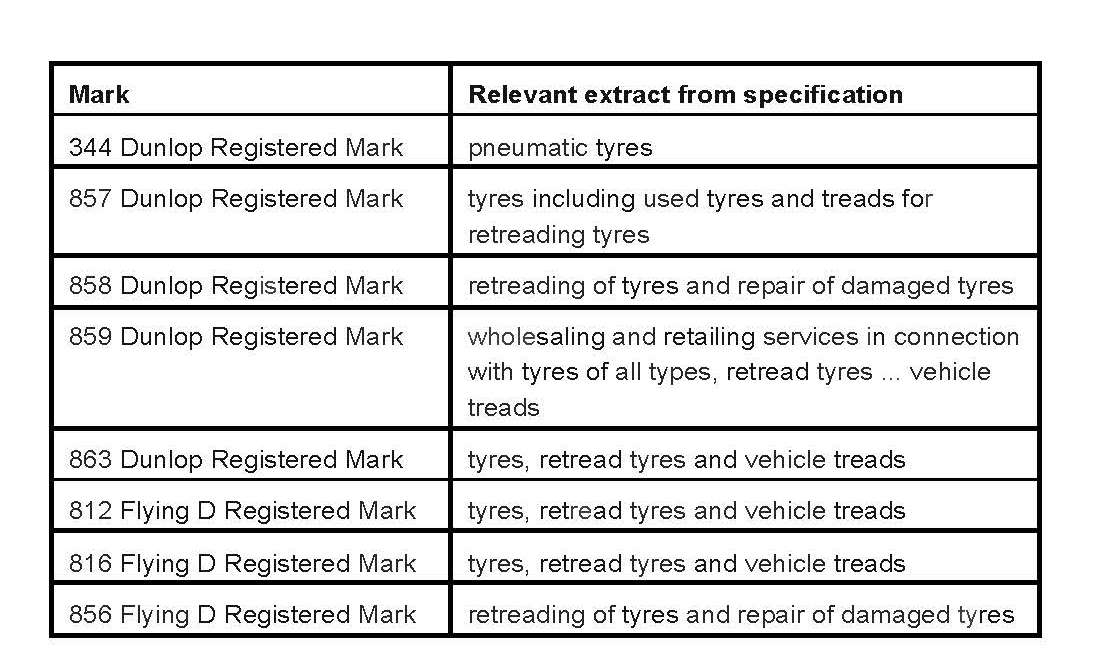
296 It is accepted by the Dunlop Parties that the specification for the ‘344, ‘857, ‘859, ‘863, ‘812 and ‘816 marks, cover aircraft tyres. There is a dispute between the parties as to whether this is also true of the ‘856 and ‘858 marks, each of which is registered in respect of certain services.
297 The specification for both the ‘856 and ‘858 marks state:
Retreading of tyres, repair, construction, relugging, regrooving and vulcanisation of motor vehicle tyres; repair of damaged tyres; repair, relining and adjustment of motor vehicle brakes and front end alignment of motor vehicle wheels; fitting and balancing of tyres on vehicle wheels, motor vehicle steering repairs and adjustment; motor vehicle shock absorber replacement; general motor vehicle front end mechanical services including replacement of parts; greasing and lubrication of vehicles of all kinds; garage services for motor vehicles; motor vehicle care services including motor vehicle cleaning, washing, painting and polishing services; other motor vehicle repair services; insulating and sealing services for motor vehicles; none of the aforegoing services being in relation to bicycles, cycles or tricycles or parts and accessories for bicycles, cycles or tricycles
298 The point raised by the Dunlop Parties is a short one. They submitted that on the proper construction of the specification, the opening words “[r]etreading of tyres, repair, construction, relugging, regrooving and vulcanisation of motor vehicle tyres” is concerned only with motor vehicle tyres and does not cover aircraft tyres. Mr Darke SC, in developing his submission, placed reliance on the location of the semi-colon that appears after the reference to “motor vehicle tyres”.
299 Mr Golvan QC for the Goodyear Parties submitted that the specification covers re-treading of all types of tyres, whether they be motor vehicles or aircraft tyres. He submitted that the location of the semi-colon was not decisive because there are other places in the specification where, if the Goodyear Parties’ argument were correct, one would also expect to see a semi-colon. He referred, in particular, to the presence of the semi-colon both immediately before and after the words “repair of damaged tyres”.
300 In my view the specification covers re-treading of tyres generally subject to the limitation that it does not extend to such services in relation to bicycles, cycles or tricycles or parts or accessories for bicycles, cycles or tricycles. The latter qualification would not be necessary if the specification was confined to services performed only in relation to motor vehicles.
Section 120(1)
301 Subject to the issue of construction of the specification for the ‘856 and ‘858 marks (which I have decided against the Dunlop Parties) and to the issue of rectification (which I have decided against the Goodyear Parties) and various defences (considered below) raised by the Dunlop Parties under ss 122 and 123 of the Act, the Dunlop Parties accept that they have infringed the ‘344, ‘857, ‘859, ‘863, ‘812 and 816 marks under s 120(1) of the Act.
Section 120(2)
302 The Goodyear Parties also relied upon s 120(2) of the Act. As to s 120(2), the Goodyear Parties contend that the Dunlop Parties have infringed the following registered marks:
(a) under s 120(2)(a) of the Act:
(i) ‘344: on the basis that aircraft tyres are goods of the same description as “pneumatic tyres”;
(ii) ‘857: on the basis that aircraft tyres are goods of the same description as “tyres including used tyres” and “treads for re-treading tyres”;
(iii) ‘863: on the basis that aircraft tyres are goods of the same description as “tyres … including used tyres”, “pre-cured treads for tyres”, “re-tread tyres”, “repair kits for tyres”, “vehicle treads”, and/or “tyre repair materials”;
(iv) ‘812: on the basis that aircraft tyres are goods of the same description as “tyres”, “pre-cured treads for tyres”, “re-tread tyres”, “repair kits for tyres”, “vehicle treads”, and/or “tyre repair materials”; and
(v) ‘816: on the basis that aircraft tyres are goods of the same description as “tyres … including used tyres and re-tread tyres”, “pre-cured treads for tyres”, “repair kits for tyres”, “vehicle treads”, and/or “tyre repair materials”.
(e) under s 120(2)(b) of the Act:
(i) ‘344: on the basis that aircraft tyre re-treading services and after-sales service and support in relation to aircraft tyres are services that are closely related to “pneumatic tyres”;
(ii) ‘857: on the basis that aircraft tyre re-treading services and after-sales service and support in relation to aircraft tyres are services that are closely related to “tyres including used tyres” and “treads for re-treading tyres”;
(iii) ‘863: on the basis that aircraft tyre re-treading services and after-sales service and support in relation to aircraft tyres are services that are closely related to “tyres … including used tyres”, “pre-cured treads for tyres”, “re-tread tyres”, “repair kits for tyres”, “vehicle treads”, and/or “tyre repair materials”;
(iv) ‘812: on the basis that aircraft tyre re-treading services and after-sales service and support in relation to aircraft tyres are services that are closely related to “tyres”, “pre-cured treads for tyres”, “re-tread tyres”, “repair kits for tyres”, “vehicle treads”, and/or “tyre repair materials”; and
(v) ‘816: on the basis that aircraft tyre re-treading services and after-sales service and support in relation to aircraft tyres are services that are closely related to “tyres… including used tyres and re-tread tyres”, “pre-cured treads for tyres”, “repair kits for tyres”, “vehicle treads”, and/or “tyre repair materials”.
(f) under s 120(2)(c) of the Act:
(i) ‘858: on the basis that aircraft tyre re-treading services and after-sales service and support in relation to aircraft tyres are services of the same description as “re-treading of tyres” and/or “repair of damaged tyres”;
(ii) ‘859: on the basis that aircraft tyre re-treading services and after-sales service and support in relation to aircraft tyres are services of the same description as “wholesaling and retailing services in connection with tyres of all types, re-tread tyres, pre-cured treads for tyres … repair kits for tyres … vehicle treads, tyre repair materials”; and
(iii) ‘856: on the basis that aircraft tyre re-treading services and after-sales service and support in relation to aircraft tyres are services of the same description as “re-treading of tyres” and “repair of damaged tyres”.
(g) under s 120(2)(d) of the Act:
(i) ‘858: on the basis that aircraft tyres are goods that are closely related to “re-treading of tyres” and/or “repair of damaged tyres”;
(ii) ‘859: on the basis that aircraft tyres are goods that are closely related to “wholesaling and retailing services in connection with tyres of all types, re-tread tyres, pre-cured treads for tyres … repair kits for tyres … vehicle treads, tyre repair materials”; and
(iii) ‘856: on the basis that aircraft tyres are goods that are closely related to “re-treading of tyres” and “repair of damaged tyres”.
303 Sections 120(1) and 120(2) are mutually exclusive in the sense that if the registered mark is infringed because it has been applied to the registered goods it is not open to find that the same goods to which the mark was applied are also goods of the same description. This is also true of service marks. If a registered mark is infringed because it has been used in relation to the registered services then the use of the mark in relation to those same services is not also an infringement under s 120(2)(c): Anchorage at [204]. On that basis, I do not propose to say any more concerning the infringement claims referred to in subparas (a) and (c) of para [302] above.
304 As to other infringement claims made under s 120(2) of the Act, it is necessary to consider whether the goods or services in relation to which the registered mark has been used are closely related to the goods or the services in respect of which the mark is registered. As French J (as his Honour then was) explained in Registrar of Trade Marks v Woolworths (1999) 93 FCR 365 at 378:
The term “closely related” recognises that goods and services are different things. There will be classes of goods which are similar to each other. There will also be classes of services which are similar to each other. But the word “similar” does not apply as between goods and services. So there must be some other form of relationship between the services covered by one mark and the goods covered by another to enable the goods or services in question to be described as “closely related” … [I]t is a term of wider import than “similar” and can apply to the relationships between competing services as well as between goods and services …
305 In the present case the relevant goods include aircraft tyres and the relevant services include re-treading of aircraft tyres. Aircraft re-treading services are typically provided by the same businesses that manufacture aircraft tyres. Further, the supply of new aircraft tyres and the re-treading of those tyres after use typically occurs as part of a maintenance operation in which the tyre supplier re-treads and replaces used aircraft tyres for a fleet of aircraft in accordance with a maintenance program. In the circumstances, I do not think there is any doubt that aircraft tyres and aircraft tyre re-treading services are closely related goods and services for the purposes of s 120(2) of the Act.
306 I am satisfied that the services referred to in subpara (b) of para [302] above are closely related to at least some of the goods referred to in that subparagraph. I am also satisfied that the goods referred to in subpara (d) are also closely related to at least some of the registered services identified in that subparagraph.
307 This brings me to the defence provided for in s 120(2). Given the relevant market, and the circumstances in which the Dunlop/Flying D Registered Marks have been used, I am satisfied that such use was not likely to deceive or cause confusion. The market is highly specialised. Purchasers of the relevant goods and services would understand that the aircraft tyres sold under and by reference to the Dunlop/Flying D Registered Marks were made by or under the aegis of DATL or its predecessor in business. Similarly, they would understand that re-treading services provided under and by reference to those marks were also provided by DATL or its predecessor in business.
Defences
308 Section 122(1) relevantly provides:
122 When is a trade mark not infringed?
(1) In spite of section 120, a person does not infringe a registered trade mark when:
(a) the person uses in good faith:
(i) the person’s name or the name of the person’s place of business; or
(ii) the name of a predecessor in business of the person or the name of the predecessor’s place of business; or
(b) the person uses a sign in good faith to indicate:
(i) the kind, quality, quantity, intended purpose, value, geographical origin, or some other characteristic, of goods or services; or
(ii) the time of production of goods or of the rendering of services; or
…
(e) the person exercises a right to use a trade mark given to the person under this Act; or
(f) the court is of the opinion that the person would obtain registration of the trade mark in his or her name if the person were to apply for it; or
…
(notes omitted)
Section 122(1)(a)
309 Section 122(1)(a)(i) and (ii) are relied upon by DATL as a defence to the infringement claims made against it. It is common ground that this defence has no application in the case of the Flying D Registered Marks.
310 Section 122(1)(a) was recently considered by the Full Court in Anchorage. The Court said at [207]:
The authorities that have considered the defence under s 122(1)(a)(i) of the Act and similar provisions in the 1955 Act and the Trade Marks Act 1938 (UK) provides some guidance as to the circumstances in which a corporation may be regarded as having made use of its own name. The most well-known of these is Parker-Knoll Limited v Knoll International Limited (No 2) [1962] RPC 265, a case in which the defendant, Knoll International Limited, was sued for passing off and infringement of the plaintiff’s registered trade mark PARKER-KNOLL. The House of Lords accepted that the protection afforded by s 8(a) of the 1938 Act extended to the defendant’s use not merely of its full corporate name, but also the natural abbreviation of that name to KNOLL INTERNATIONAL. However, the protection was held not to extend to the defendant’s use of the word KNOLL. There were similar outcomes in Smith & Nephew Plastics (Australia) Pty Ltd v Sweetheart Holding Corporation (1987) 8 IPR 285 where King J held that s 64(1)(a) of the 1955 Act did not permit the respondent to use “Sweetheart” and SAP Australia Pty Ltd v Sapient Australia Pty Ltd (1999) 45 IPR 169 at 181 where Wilcox J observed (obiter) that neither “Sapient” nor “Sapient Corporation” could properly be regarded as the name of the respondent (Sapient Australia) for the purposes of s 122(1)(a) of the Act.
311 DATL submitted that the presence of the words “Aircraft Tyres” in the DATL’s name does not affect the availability of the defence because those words merely describe DATL’s business.
312 I do not accept that submission. The fact that the words “Aircraft Tyres” are descriptive of the business carried on by DATL does not mean that they are not to be treated as part of DATL’s name for s 122(1)(a)(i) purposes. I reject the defence based upon s 122(1)(a) of the Act.
313 It is not necessary to determine whether DATL’s use of the Dunlop mark was use in good faith for the purpose of s 122(1)(a) of the Act. However, I am satisfied that DATL has not used the Dunlop mark in Australia intending to cause deception or confusion. Further, while DATL has sought to profit by direct entry into the market for aircraft tyres and re-treading services in Australia, I do not think that it has been motivated by any dishonest or improper motive.
314 The Goodyear Parties’ submissions suggested that by refusing to supply Goodyear Australia with Dunlop branded aircraft tyres, DATL has acted inconsistently with long standing established arrangements governing the use of the Dunlop/Flying D marks in the Australian market. It was suggested that this conduct was not consistent with DATL having acted in good faith. In the absence of any allegation that DATL has breached any agreement or understanding that it would not supply its goods or services in the Australian market, I do not think there is any basis for concluding that DATL’s use of the Dunlop mark was not use in good faith.
Section 122(1)(b)
315 The Dunlop Parties submitted that their use of the Dunlop/Flying D marks in relation to aircraft tyres made by DATL was protected by s 122(1)(b). They also relied upon s 122(1)(b) as an answer to the infringement case based upon the re-treading services they provide with respect to aircraft tyres made by DATL. It was submitted by the Dunlop Parties that the use of the relevant marks with respect to such goods and services did no more than indicate that the relevant goods or services comply with minimum performance standards imposed by aviation regulatory bodies.
316 The difficulty with this submission is that the Dunlop/Flying D marks are trade marks that act as a badge of origin. Their use in relation to aircraft tyres or related services may also indicate that such goods or services meet certain manufacturing, quality or regulatory standards (as many trade marks do), but the primary function of the marks so used is to indicate that the goods or services are made or supplied by DATL. This is the primary indication conveyed by the use of the marks. I reject the defence based upon s 122(1)(b) of the Act.
Section 122(1)(e)
317 In this case the application of s 122(1)(e) turns on whether DATL is entitled to obtain registration of the Dunlop/Flying D marks that it applied for on 23 January 2009. For reasons previously explained, DATL is not entitled to obtain registration of those marks.
Section 122(1)(f)
318 This defence only arises for consideration if DATL is unsuccessful in its appeal against the Registrar’s decision. If DATL is unsuccessful in that appeal only by reason of the Court not being able to take into account matters that occurred after the priority date and at the time the relevant acts of infringement occurred those matters had come to pass, then it would follow that at the time of those infringements DATL would have been able to obtain registration of the marks for which it previously had applied (unsuccessfully) in its own name if it were to have re-applied for them at the later date. In those circumstances, DATL would have a good defence under s 122(1)(f) in respect of each such act of infringement.
Section 123
319 Section 123 provides:
123 Goods etc. to which registered trade mark has been applied by or with consent of registered owner
(1) In spite of section 120, a person who uses a registered trade mark in relation to goods that are similar to goods in respect of which the trade mark is registered does not infringe the trade mark if the trade mark has been applied to, or in relation to, the goods by, or with the consent of, the registered owner of the trade mark.
(2) In spite of section 120, a person who uses a registered trade mark in relation to services that are similar to services in respect of which the trade mark is registered does not infringe the trade mark if the trade mark has been applied in relation to the services by, or with the consent of, the registered owner of the trade mark.
(notes omitted)
320 Section 123 is relied upon by Aero Parts only. The application of this section is said by the Dunlop Parties to turn on whether DATL is entitled to obtain registration of the marks for which it has applied. If so, then the Dunlop Parties submit that Aero Parts will have a defence under s 123 of the Act on the basis that it was using the Dunlop/Flying D marks by or with the consent of, DATL. It is not necessary to explore the potential difficulties with this submission. For reasons previously explained, DATL is not entitled to obtain registration of the Dunlop/Flying D marks.
Misleading Conduct and Passing Off
321 The Goodyear Parties allege that the Dunlop Parties have engaged in misleading and deceptive conduct, or conduct likely to mislead or deceive, in contravention of s 18 of the ACL. They also allege that the Dunlop Parties have contravened s 29(1)(g) of the ACL by making, in the language of that provision, “a false or misleading representation that goods or services have sponsorship, approval, performance characteristics, accessories, uses or benefits”.
322 As developed in the Goodyear Parties’ written submissions, the case based on s 18 and s 29(1)(g) is founded on the proposition that the use of the Dunlop/Flying D marks in relation to aircraft tyres and re-treading services in Australia by the Dunlop Parties conveys a false representation that the Dunlop Parties and/or those products and services “have a commercial association” with the Goodyear Parties. The Goodyear Parties submitted that this case was supported by the unchallenged evidence of Mr Castellas. I have previously referred to Mr Castellas’ evidence but it is necessary to refer to it now in greater detail.
323 Mr Castellas gave evidence of his knowledge of Dunlop Aviation in the 1970’s and early 1980’s when he worked for Government Aircraft Factories (which later became Boeing Australia) and some dealings he had with Dunlop Aviation while working in the United States on the FA-18 fighter jet program between 1983 and 1985 and while working for Normalair-Garrett (a division of the Westland Helicopter Company) between about 1990 and 1994.
324 According to Mr Castellas, when he joined Qantas, he became aware that aircraft tyres and associated services had been supplied to Australian Airlines (which had merged with Qantas a few years earlier) by a business that was then co-owned by Goodyear and Pacific Dunlop which he knew of first as Air Treads, later as South Pacific Tyres, and still later as Goodyear Aviation. For convenience, I will refer to the business to which Mr Castellas refers as the “Goodyear Aviation business”.
325 According to Mr Castellas:
He was aware of the Dunlop brand in the aviation industry for many decades. He considered that the Dunlop brand had been, and remains, a leading and very well-known brand in the aviation industry both in Australia and globally. He has known of Dunlop branded aircraft tyres and other components since at least the mid-1980s.
During his time at Qantas, he understood that the Goodyear Aviation business was the sole supplier of Dunlop branded aircraft tyres and re-treading services in the Australian commercial aviation market. He did not deal with any other supplier of Dunlop branded aircraft tyres or re-treading services while working at Qantas.
He was aware of a Dunlop business in the UK, but he was not aware of what, if any, relationship existed between it and Air Treads. However, he was aware that some Dunlop branded aircraft tyres were made in the UK and then supplied by the Goodyear Aviation business to Qantas.
326 Mr Castellas left Qantas in 2011. He does not appear to have had any dealings with the Goodyear Aviation business after that time.
327 In his first affidavit Mr Castellas stated that during his time at Qantas he understood the Goodyear Aviation business to be the sole supplier of Dunlop branded aircraft tyres and re-treading services. This was qualified by him in his second affidavit to make clear that, while he understood this to be the case for airlines with large commercial fleets of heavy jets, he did not understand this to be true of customers with smaller fleets of heavy jets who were able to acquire Dunlop branded aircraft tyres from Aviall. He also said that he visited the Aviall facility a number of times in the early 2000’s where he recalled seeing Dunlop branded aircraft tyres. He said that he was not aware of where or from whom Aviall had acquired those tyres. However, he did not suggest that he understood that Aviall had any business association or trading relationship with the Goodyear Aviation business.
328 Mr Castellas’ evidence shows that he and, I would infer, other people working in the aviation industry, would have understood from between about 1994 (when he started at Qantas) through to about 2011 (when he left Qantas) that the Goodyear Aviation business was (for at least a large part of that time) the sole, or at least, the principal distributor in Australia of Dunlop branded aircraft tyres which it sourced from the UK business that manufactured them. His evidence does not establish that the reputation of the Goodyear Aviation business with respect to Dunlop branded aircraft tyres was anything other than that of a distributor (either sole or principal) of such products.
329 The Goodyear Parties’ case assumes that Mr Castellas, and others working in relevant sections of the aviation industry, would not appreciate that the UK manufacturer of Dunlop branded aircraft tyres may be legally entitled to appoint another distributor of its products in Australia in place of Goodyear Australia. That assumption would be an unreasonable assumption to make especially by people working in such a highly specialised and sophisticated industry. In fairness to Mr Castellas, I should make clear that he did not suggest in his evidence that he would make that assumption. No doubt he understands that business relationships and distribution arrangements may change over time.
330 I do not think the use of the Dunlop/Flying D marks on aircraft tyres and related parts, or in relation to re-treading services, is likely to convey to Mr Castellas or any other person that there exists a business association of the kind postulated by the Goodyear Parties. The claims based on s 18 and s 29(1)(g) of the ACL fail.
331 The Goodyear Parties’ case based on passing off was said by them to be made out on the same basis as the ACL claims. I reject the passing off case for the same reasons as I have rejected the ACL claims.
Other matters
332 There are two other matters I should note.
333 First, the Dunlop Parties contended that if the use by the Goodyear Parties of the Goodyear/Dunlop logo constituted trade mark use of any of the Dunlop/Flying D Registered Marks in relation to re-treading services, then the Goodyear Parties will have contravened ss 18 and 29(1)(g) and (h) of the ACL and engaged in passing off in so far as the logo was used in respect of aircraft tyres re-treaded under the Goodyear brand. Given my finding that there was no such use by the Goodyear Parties in relation to aircraft tyre re-treading services it is unnecessary for me to say any more on this issue.
334 Secondly, the Goodyear Parties referred in their submissions to the Dunlop Parties’ failure to call Mr David Skepper as a witness. They submitted that I should infer that his evidence would not have assisted the Dunlop Parties’ case: Jones v Dunkel (1959) 101 CLR 298. The submission was not advanced in anything but the most general terms. In particular, the Goodyear Parties did not identify any specific issue in relation to which Mr Skepper might naturally be expected to be called to give evidence. I am not satisfied that any inference should be drawn from the fact that Mr Skepper did not give evidence.
Disposition
335 There will be an order under s 88(1) of the Act rectifying the Register so as to exclude from the description of the goods and/or services with respect to each of the Registered Marks the particular goods or services identified in italics in the description of the goods and services for each such trade mark in Annexure A. That order provides a complete answer to the infringement claims made under s 120(1) of the Act. To the extent that s 120(2) of the Act has any scope for application, the infringement claims made under that provision must fail because the use said to be infringing use was not likely to deceive or cause confusion.
336 Given the order under s 88(1) that is to be made, and notwithstanding my conclusions in relation to non-use, there is no purpose to be served in making any of the orders sought by the Dunlop Parties under s 101(2) of the Act.
337 The Dunlop Parties’ cross-claim will be otherwise dismissed.
338 The Goodyear Parties’ application will be dismissed.
339 The Dunlop Parties’ appeal, and the Goodyear Parties’ cross-appeal, against the decision of the Delegate given on 5 February 2015 will also be dismissed.
340 The parties will be given an opportunity to make written submissions in relation to questions of costs.
|
I certify that the preceding three hundred and forty (340) numbered paragraphs are a true copy of the Reasons for Judgment herein of the Honourable Justice Nicholas. |