

FEDERAL COURT OF AUSTRALIA
Tox Free Solutions Limited, In the matter of Tox Free Solutions Limited [2018] FCA 977
ORDERS
TOX FREE SOLUTIONS LIMITED (ACN 058 596 124) Plaintiff | ||
CLEANAWAY WASTE MANAGEMENT LIMITED (ACN 101 155 220) Interested Party | ||
DATE OF ORDER: |
THE COURT ORDERS THAT:
1. Pursuant to section 411(1) of the Corporations Act 2001 (Cth) (Act):
(a) the Plaintiff convene a meeting of the holders of its ordinary shares (Shareholders) (scheme Meeting) for the purpose of considering, and if thought fit, approving a scheme of arrangement (with or without modification) proposed to be made between the Plaintiff and the Shareholders (scheme), being the scheme in the form set out in Annexure C of the scheme booklet, containing the explanatory statement, in relation to the scheme which is annexure MAP5 of the affidavit of Mark Anthony Paganin sworn on 2 March 2018 in the proceeding (scheme Booklet);
(b) the scheme Meeting be held at 10:00am (AWST) on Friday, 6 April 2018 at the Parmelia Hilton Perth (Karri Room), 14 Mill Street, Perth, WA 6000;
(c) Robert John McKinnon, or failing him, Michael James Humphris, be the chairperson of the scheme Meeting and report the result of the scheme Meeting to this Court; and
(d) the chairperson appointed to the scheme Meeting have the power to adjourn the scheme Meeting in their absolute discretion for such time that the chairperson considers appropriate, and to a time and place to be advised by the chairperson as necessary.
2. Pursuant to section 1319 of the Act, Rule 2.15 of the Federal Court (Corporations) Rules 2000 (Cth) (Corporations Rules) shall not apply to the scheme Meeting.
3. Subject to these Orders and pursuant to s 1319 o the Act, the scheme Meeting is to be:
(a) convened, held and conducted in accordance with the provisions of Part 2G.2 of the Act that apply to members of a company and the provisions of the Plaintiff's constitution that are not inconsistent therewith and that apply to meetings of members; and
(b) convened using the notice of meeting in the form or to the effect of the notice contained in Annexure E of the scheme Booklet.
4. Pursuant to s 411(1) of the Act, the scheme Booklet, which contains the explanatory statement required by section 412(1)(a) of the Act, is approved for distribution to the Shareholders.
5. Subject to registration of the scheme Booklet with the Australian Securities & Investments Commission (ASIC) pursuant to s 412(6) of the Act, the Plaintiff is to dispatch, on or before 7 March 2018, a document substantially in the form of the scheme Booklet, a proxy form, and a reply-paid envelope addressed to Computershare Investor Services Pty Limited to each Shareholder on the Plaintiff's register of members (Register) to the relevant address set out in the Register by:
(a) in the case of each Shareholder who has a registered address in Australia, prepaid post;
(b) in the case of each Shareholder who has a registered address outside Australia, prepaid airmail or air courier; and
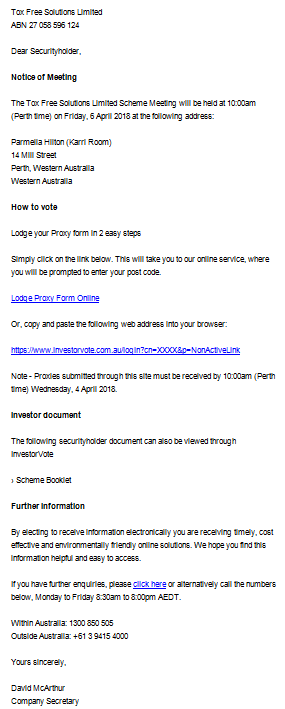
(c) in the case of each Shareholder who has nominated an electronic address for the purposes of receiving notifications of notices of any meeting from Computershare Investor Services Pty Ltd, by email to the email address nominated by that Shareholder, with such email to contain a link to a website at which those Shareholders can access the relevant documents, and lodge a proxy form on the proposed scheme, with such email substantially in the form of Annexure A to these Orders.
6. Dispatch of the documents referred to in paragraph 5 of these Orders in accordance with its terms is to be taken to be sufficient notice of the scheme Meeting.
7. The time by which the Shareholders must return their proxy forms for the scheme Meeting is 10am on Wednesday, 4 April 2018.
8. Two shareholders present in person, or by proxy, corporate representative, or attorney under power and entitled to vote shall constitute a quorum for the scheme Meeting.
9. All voting at the scheme Meeting be by poll declared by the chairperson.
10. All votes cast by:
(a) a director of the Plaintiff (and their associates);
(b) a director, secretary or officer of the Plaintiff (and their associates) who will receive any payment, entitlement or benefit as compensation for their retirement from office as a result of the scheme proceeding;
(c) a director or officer of the Plaintiff (and their associates) who will receive cash bonus entitlements as a result of the scheme proceeding;
(d) any persons (and their associates) who will receive accelerated retention payments as a result of the scheme proceeding; and
(e) holders of performance rights or share appreciation rights in the Plaintiff (and their associates),
(f) be "tagged" and identified by affidavit evidence filed by the section 411(4)(b) hearing.
1. If the matter is relisted, the Plaintiff is to give notice of the hearing of the application pursuant to section 411(4) of the Act and that notice of the hearing of an application pursuant to sub-section 411(4)(b) of the Act for orders approving the scheme be published once in ‘The Australian’ newspaper by an advertisement substantially in the form of Annexure B to these Orders, such advertisements to be published on or before 7 April 2018 and the Plaintiff be otherwise exempted from compliance with Rule 3.4 of the Corporations Rules.
2. The proceeding be adjourned to 16 April 2018 at 10:15am before Justice Banks-Smith for the hearing of an application to approve the scheme.
3. There be liberty to apply on 24 hours written notice.
Note: Entry of orders is dealt with in Rule 39.32 of the Federal Court Rules 2011.
Annexure B
Tox Free Solutions Limited
Notice of Hearing to Approve scheme of Arrangement pursuant to section 411 of the Corporations Act 2001 (Cth)
To all members of Tox Free Solutions Limited ACN 058 596 124 ('Tox')
TAKE NOTICE that at 10:15am on Monday, 16 April 2018, the Federal Court of Australia at Peter Durack Commonwealth Law Courts Building, 1 Victoria Avenue, Perth WA 6000 will hear an application by Tox seeking the approval of the scheme of arrangement between Tox and its ordinary shareholders, as proposed by a resolution passed by the meeting of ordinary shareholders held at the Parmelia Hilton Perth, 14 Mill Street, Perth, WA 6000 at 10:00am on Friday, 6 April 2018.
If you wish to oppose the approval of the above arrangement, you must file and serve on Tox a notice of appearance, in the prescribed form, together with any affidavit which you wish to rely on at the hearing. The notice of appearance and affidavit must be served on Tox at its address for service by no later than one business day before 16 April 2018.
The address for service of Tox is c/- Clayton Utz, Level 27, QV.1 Building, 250 St Georges Terrace, Perth WA 6000 (Reference: Cameron Belyea) Facsimile: 08 9481 3095 Email: cbelyea@claytonutz.com.
A copy of the scheme Booklet is available from the ASX's website at www.asx.com.au.
ORDERS
WAD 47/2018 | ||
BETWEEN: | TOX FREE SOLUTIONS LIMITED ACN 058 596 124 and another/others named in the schedule Plaintiff | |
CLEANAWAY WASTE MANAGEMENT LIMITED (ACN 101 155 220) Interested Party | ||
JUDGE: | BANKS-SMITH J |
DATE OF ORDER: | 28 MARCH 2018 |
THE COURT ORDERS THAT:
1. Pursuant to s 1319 of the Corporations Act 2001 (Cth), order 1(b) of the orders made on 2 March 2018 that the meeting of the Plaintiff's shareholders be held at 10:00am (AWST) on Friday, 6 April 2018 at the Parmelia Hilton (Karri Room), 14 Mill Street, Perth, WA 6000 (scheme Meeting) to consider the proposed scheme of arrangement (with or without modification) between the Plaintiff and its shareholders (scheme), be varied so that the scheme Meeting be held at 11:00am (AWST) on Thursday, 3 May 2018 at the Parmelia Hilton (Karri Room), 14 Mill Street, Perth, WA 6000.
2. Orders 7, 11, and 12 made by Justice Banks-Smith on 2 March 2018 otherwise be vacated.
3. Valid proxy forms for the scheme Meeting that have been lodged by shareholders of the Plaintiff are deemed to still be valid unless revoked, and members who directed their proxies in favour of the scheme are deemed to have directed their proxies to vote in favour of the scheme at the postponed scheme Meeting.
4. The time by which shareholders of the Plaintiff must return their proxy forms for the scheme Meeting is 11:00am (AWST) on Tuesday, 1 May 2018.
5. The notice of meeting issued by the Plaintiff to its shareholders on 7 March 2018 is deemed to still be valid for the purposes of the meeting of members proposed to be held at 11:00am (AWST) on Thursday, 3 May 2018 at the Parmelia Hilton (Karri Room), 14 Mill Street, Perth, WA 6000.
6. The scheme Meeting otherwise be convened and held in accordance with these orders, and the orders of 2 March 2018.
7. The Plaintiff is to dispatch a notice in a form substantially equivalent to the form that is annexure SWLN3 to the affidavit of Stephen Wei Liang Neale sworn on 23 March 2018 to each shareholder on the Plaintiff's register of members (Register) to the relevant address set out in the Register by:
(a) in the case of each shareholder who has a registered address in Australia, prepaid post;
(b) in the case of each shareholder who has a registered address outside of Australia, prepaid airmail or air courier; and
(c) in the case of each shareholder who has nominated an electronic address for the purposes of receiving notifications of notices of any meeting from Computershare Investor Services Pty Ltd by email to the email address nominated by that shareholder.
8. The Plaintiff is to give notice of the hearing of the application pursuant to section 411(4) of the Corporations Act 2001 (Cth) (Act) and that notice of the hearing of an application pursuant to subsection 411(4)(b) of the Act for orders approving the scheme be published once in ‘The Australian’ newspaper by an advertisement substantially in the form of Annexure A to this application, with such advertisement to be published on or before Friday, 4 May 2018 and the Plaintiff be otherwise exempted from compliance with Rule 3.4 of the Federal Court (Corporations) Rules 2000 (Cth).
9. The proceeding be adjourned to Thursday, 10 May 2018 before Justice Banks-Smith for the hearing of any application to approve the scheme.
10. There be liberty to apply on 24 hours written notice.
Note: Entry of orders is dealt with in Rule 39.32 of the Federal Court Rules 2011.
Annexure A
Tox Free Solutions Limited
Notice of Hearing to Approve scheme of Arrangement pursuant to section 411 of the Corporations Act 2001 (Cth)
To all members of Tox Free Solutions Limited ACN 058 596 124 ('Tox')
TAKE NOTICE that at 9:00am on Thursday, 10 May 2018, the Federal Court of Australia at Peter Durack Commonwealth Law Courts Building, 1 Victoria Avenue, Perth WA 6000 will hear an application by Tox seeking the approval of the scheme of arrangement between Tox and its ordinary shareholders, as proposed by a resolution passed by the meeting of ordinary shareholders held at the Parmelia Hilton Perth, 14 Mill Street, Perth, WA 6000 at 11:00am (AWST) on Thursday, 3 May 2018.
If you wish to oppose the approval of the above arrangement, you must file and serve on Tox a notice of appearance, in the prescribed form, together with any affidavit which you wish to rely on at the hearing. The notice of appearance and affidavit must be served on Tox at its address for service by no later than one business day before 10 May 2018.
The address for service of Tox is c/- Clayton Utz, Level 27, QV.1 Building, 250 St Georges Terrace, Perth WA 6000 (Reference: Cameron Belyea) Facsimile: 08 9481 3095 Email: cbelyea@claytonutz.com.
A copy of the scheme Booklet is available from the ASX's website at www.asx.com.au.
ORDERS
WAD 47/2018 | ||
BETWEEN: | TOX FREE SOLUTIONS LIMITED CAN 058 596 124 and another/others named in the schedule Plaintiff | |
CLEANAWAY WASTE MANAGEMENT LIMITED (ACN 101 155 220) Interested Party | ||
JUDGE: | banks-smith |
DATE OF ORDER: | 10 mAY 2018 |
THE COURT ORDERS THAT:
1. Pursuant to section 411(4)(b) and section 411(6) of the Corporations Act 2001 (Cth) (Act), the scheme of arrangement between the plaintiff and its shareholders (scheme), in the form which appears at Annexure C to the scheme Booklet that was dispatched to shareholders in accordance with the orders made by the Court on 2 March 2018, be approved.
2. Pursuant to section 411(2) of the Act, the plaintiff be exempt from complying with section 411(11) of the Act in relation to the scheme.
3. The plaintiff lodge an office copy of these orders with the Australian Securities and Investments Commission as soon as practicable.
Note: Entry of orders is dealt with in Rule 39.32 of the Federal Court Rules 2011.
BANKS-SMITH J:
1 These reasons relate to a members' scheme of arrangement. As is well recognised, there are three stages to an application under s 411 of the Corporations Act 2001 (Cth) (Act) for approval of a scheme. First, there is the application to the Court to approve the convening of a scheme meeting and the explanatory statement to be sent to members concerning the scheme. Second, the scheme meeting is held at which members, or a relevant class of members, vote on the scheme. Third, there is the application to the Court to approve the proposed scheme.
2 On 2 March 2018 I made orders under s 411(1) of the Act relating to the convening of a meeting of shareholders of Tox Free Solutions Ltd (Tox) for the purpose of considering a proposed scheme of arrangement. The proposed scheme did not involve matters of any particular controversy.
3 On 28 March 2018 I made orders postponing the scheme meeting.
4 On 3 May 2018 the scheme meeting of shareholders was held.
5 On 10 May 2018 I made orders under s 411(4)(b) and s 411(6) of the Act that the scheme of arrangement be approved.
6 These are the reasons for the various orders.
First scheme meetinG
Proposed scheme
7 At the relevant time, Tox was a public company with its shares listed on the Australian Securities Exchange (ASX). It had approximately 4,879 registered shareholders of an aggregate 194,418,716 shares. It operated in the waste management field, with a focus on specialist and hazardous waste.
8 Cleanaway Waste Management Limited (Cleanaway) is also a listed company operating in the waste management field. It provides recycling and industrial services, amongst other things.
9 In December 2017 Tox announced that it had entered into a Scheme Implementation Deed (SID) with Cleanaway under which it proposed that Cleanaway acquire 100% of Tox's shares through a subsidiary company, Cleanaway (No 1) Pty Ltd (BidCo).
10 It was proposed that by the scheme:
(a) Tox shareholders will transfer their shares in Tox to BidCo;
(b) Tox shareholders will receive total cash payments of $3.425 for each share, comprising a fully franked 'Special Dividend' of $0.58 payable by Tox, and consideration of $2.845 payable by BidCo;
(c) the scheme will effect the acquisition of Tox by BidCo, and will result in Tox becoming a wholly owned subsidiary of BidCo with Cleanaway as its ultimate parent company;
(d) Tox will cease to be listed on the ASX; and
(e) if the scheme meeting is convened by the Court under section 411(1) of the Act, and subject to the scheme becoming 'Effective', certain unlisted securities in Tox issued under incentive plans will vest.
Materials relied upon
11 For the first hearing Tox relied on:
(a) the affidavit of Mark Anthony Paganin sworn 14 February 2018 and attaching, relevantly, the first draft scheme booklet;
(b) the affidavit of Robert John McKinnon in his capacity as proposed chair of the scheme meeting sworn 28 February 2018;
(c) the affidavit of Michael James Humphris in his capacity as proposed alternate chair of the scheme meeting sworn 28 February 2018;
(d) the affidavit of Daniel James Fortescue Last in his capacity as company secretary of both BidCo and Cleanaway sworn 1 March 2018, verifying aspects of the scheme;
(e) the affidavit of David Maxwell McArthur in his capacity as company secretary of Tox sworn 28 February 2018 attaching, relevantly, the Constitution of Tox, historical company searches from the Australian Securities and Investments Commission (ASIC) register, the SID and various financial records;
(f) two affidavits of Craig Lloyd Edwards of Lonergan Edwards & Associates Limited including an affidavit verifying the independent expert's report;
(g) the affidavit of Michael Scott Constable sworn 2 March 2018 in his capacity as the chief financial officer of Tox and dealing with the proposed source of payment of the Special Dividend; and
(h) the affidavit of Mark Anthony Paganin sworn 2 March 2018 attaching correspondence with ASIC and a further draft scheme booklet, with a schedule of amendments.
12 The materials relied upon were comprehensive and addressed the relevant matters.
Principles
13 Section 411(1) of the Act relevantly provides that, where an arrangement is proposed between a Pt 5.1 body and its members, the Court may, on the application of the body in a summary way, order a meeting of the members to be convened in such manner and to be held in such place as the Court directs. Where the Court makes such an order, the Court may approve the explanatory statement required by s 412(1)(a) to accompany the notice of such a meeting.
14 Section 412(1)(a) of the Act relevantly provides that, where a meeting is convened under s 411, the Pt 5.1 body must, with every notice convening the meeting, send a statement explaining the effect of the arrangement. That statement must state any material interests of the directors and the effect of the proposed arrangement on those interests insofar as they may differ from the effect on the like interests of other persons. The statement must also set out such information as is prescribed and any other information that is material to a member's decision to agree or not agree to the arrangement.
15 The authorities refer generally to six matters to be proved at the first stage:
(1) the plaintiff is a Pt 5.1 body;
(2) the proposed scheme is an 'arrangement' within the meaning of s 411 of the Act;
(3) the explanatory statement will provide proper disclosure to members;
(4) the scheme is bona fide and properly proposed;
(5) ASIC has had reasonable opportunity to examine the proposed scheme and the explanatory statement, has had reasonable opportunity to make submissions and has had 14 days' notice of the hearing date of the first Court hearing; and
(6) any other procedural requirements have been met, such as r 3.2 of the Federal Court (Corporations) Rules 2000 (Cth) (Rules) as to the nomination of a chairperson for the scheme meeting.
See, for example, Amcom Telecommunications Ltd, in the matter of Amcom Telecommunications Ltd [2015] FCA 341 at [8] per McKerracher J; EcoBiotics Limited, in the matter of EcoBiotics Limited [2017] FCA 643 at [19] per Gleeson J.
16 The principles as to the nature of the review at the first Court hearing are summarised elsewhere: for recent examples, see Re Programmed Maintenance Services Ltd [2017] FCA 1265 at [11]–[14] per McKerracher J; Signature Gold Ltd, in the matter of Signature Gold Ltd [2017] FCA 1481 at [22]–[23] per Markovic J. In summary, the standard of review is whether the proposed scheme is not inappropriate and is one that sensible business people might consider is of benefit to its members. If the proposed arrangement is one that seems fit for consideration by a meeting of members and is a commercial proposition likely to gain the Court's approval if passed by the necessary majority, then leave should be given to convene the meeting.
Part 5.1 body
17 Tox is a Part 5.1 body within the meaning of the Act, and an extract of its historical corporate records at ASIC was before the Court.
Arrangement
18 The term 'arrangement' is of wide import: Re NRMA Insurance Ltd (No 1) [2000] NSWSC 82; (2000) 156 FLR 349 at [20] per Santow J. I am satisfied on the basis of the scheme booklet contents that the scheme is an arrangement between Tox and its members.
Explanatory statement – verification of scheme booklet by BidCo and Tox
19 Mr Last gave evidence that BidCo undertook appropriate due diligence and verification processes in relation to all information regarding BidCo, coordinated by Cleanaway's and BidCo's external lawyers. He deposed to the fact that the statements in the scheme booklet were verified by a person with knowledge of the truth of the information, and that the verification process was repeated to address any amendments. He said that based on that information and his own knowledge from his involvement in the scheme process, to the best of his knowledge and belief, all the material statements in the scheme booklet so far as they relate to bidder information were true and correct and not misleading or deceptive, and there were no material omissions.
20 Mr McArthur gave evidence of the process undertaken to verify the information contained in the scheme booklet on behalf of Tox. Prior to lodgement of the scheme booklet with ASIC, the directors approved it by resolution. The directors all confirmed their approval by signing a document called a 'Directors' Statement Sign Off and Consent'. All amendments to the scheme booklet were also made with approvals. A due diligence committee that included an external legal advisor undertook a verification process and Mr McArthur as observer attended each meeting of the committee. He said that based on the verification process, to the best of his knowledge and belief, all the material statements in the scheme booklet so far as they relate to Tox and in connection to the scheme were true and correct and not misleading or deceptive, and there were no material omissions.
A single class
21 There is a single class of shareholders and all members have the same rights under the scheme. Class issues do not arise in this case.
Position of directors
22 The Tox Board unanimously recommended the scheme to the shareholders.
Independent expert
23 The Board appointed Lonergan Edwards & Associates as the independent expert to assess the scheme. Lonergan Edwards provided a report and concluded that the scheme as proposed was in the best interests of the shareholders and was fair and reasonable.
24 In particular, Lonergan Edwards noted that the value of 100% of Tox on a controlling interest basis was in the range of $729 million to $772 million, giving a value per share range of $2.84 to $3.06. The scheme booklet included a copy of their report.
Particular matters
25 Taking into account the ex parte nature of the application, counsel for Tox properly drew the Court's attention to particular matters, being:
(a) the Special Dividend;
(b) retention agreements with key employees;
(c) unlisted securities;
(d) deal protection clauses by way of a break fee and exclusivity provisions; and
(e) conditions precedent.
Special Dividend
26 Tox intends to declare a fully franked 'Special Dividend' in the amount of $0.58, with payment of that Special Dividend dependant on the scheme becoming effective. Tox is entitled to declare and pay the Special Dividend pursuant to clause 5.2 of the SID.
27 Information relating to the Special Dividend is contained in the scheme booklet including statements to the effect that each Tox shareholder should seek professional advice as to whether or not they are able to obtain a benefit from the franking credits attached to the Special Dividend.
28 Under clause 5.5 of the SID, the scheme consideration payable per share to Tox shareholders by BidCo is to be reduced by the value of the Special Dividend.
29 The proposal raised various questions:
(a) whether Tox would be providing financial assistance to BidCo to purchase Tox;
(b) whether the arrangement creates a new class; and
(c) whether the payment of the Special Dividend affects Tox's ability to pay its creditors.
30 Mr Last's evidence disclosed that neither BidCo nor Cleanaway owns any shares in Tox. Therefore, there is no issue of Tox providing financial assistance to BidCo: see In the matter of SMS Management & Technology Limited [2017] VSC 257 at [30] per Robson J.
31 Tox will determine a shareholder's eligibility to receive the Special Dividend after the scheme has become effective and after Tox's shares have been suspended from trading on the ASX. All Tox shareholders as at the day following the 'Effective Date' (as defined in the SID) will be eligible to receive the Special Dividend. All participating shareholders will receive the same benefits under the scheme, and will be entitled to the same total cash payment (comprising the scheme consideration paid by BidCo, and the Special Dividend), and have the same rights against Tox under the scheme.
32 Accordingly, Tox submitted that the Special Dividend arrangement does not create a new class. I accept that submission. This scheme proceeded appropriately on the basis of there being only one class of shareholders.
33 Mr Constable provided evidence that the Special Dividend is being paid out of the profits of the Tox consolidated group. Payment is being funded partly from Tox's available cash and cash equivalents, and partly from debt facilities provided to Tox.
34 Tox submitted that it is not unusual for dividends to be funded from borrowings, so long as the company has sufficient funds to cover the payment of the dividend as well as all other liabilities then presently due and payable: QBE Insurance Group Ltd v Australian Securities and Investments Commission [1992] FCA 697; (1992) 38 FCR 270, 288 per Lockhart J.
35 Tox relied on various matters in submitting that the payment of the Special Dividend will not materially prejudice Tox's ability to pay its creditors:
(a) Mr Constable provided evidence that the chief financial officer of Tox had undertaken an analysis and had confirmed Tox's ability to pay the Special Dividend out of retained earnings;
(b) Mr Constable's evidence disclosed that the Tox Board considered, amongst other things, s 254T of the Act (which deals with the circumstances in which a company may pay a dividend) when assessing whether to declare the Special Dividend;
(c) Mr Constable deposes to the fact that the scheme, including the payment of the Special Dividend, will not affect the interests of Tox's creditors;
(d) the independent expert valued Tox on the basis that the Special Dividend payable by Tox formed part of the 'Total Cash Payment' to be received by Tox shareholders, and this did not impact the opinion as to the scheme being fair and reasonable and in the best interests of shareholders; and
(e) Mr Last's evidence and the scheme booklet disclose that Cleanaway and BidCo have total funds available under certain facilities sufficient to refinance the indebtedness of the Cleanaway and Tox groups).
36 I was satisfied on the basis of the relevant evidence that the proposed Special Dividend payment did not provide any basis for refusing to convene the scheme meeting.
Retention Agreements
37 A question of collateral benefits arose as to two persons. Mr McArthur provided evidence in this regard. The information was also disclosed in the scheme booklet.
38 Prior to entering into the SID, Tox executed a number of retention agreements with key employees and executives of Tox, including the managing director. Under those agreements, the retained employees receive bonus payments in the event that they remain employed by Tox on certain dates in the future, with such payments accelerated if there is a change of control in Tox. The managing director was a shareholder of Tox at the relevant time.
39 Following lodgement of the scheme booklet with ASIC, Tox entered into retention agreements with 14 employees of Daniels Health Services Pty Ltd (Daniels), a wholly owned subsidiary of Tox. Under those agreements, certain payments to be made to those Daniels employees were in part conditional on the scheme becoming effective. One of those employees was also a Tox shareholder at the relevant time.
40 Tox intended to 'tag' the votes of those two persons and monitor the register to ascertain whether any of the other persons who signed retention agreements acquired shares in Tox.
41 In my view, the receipt of benefits by those persons who also happen to be Tox shareholders does not on its face offend shareholder equality principles, as those persons will be receiving the relevant benefits in their capacity not as a shareholder but as managing director and as a Daniels employee respectively. The bonus payments were also available to others in those identified groups who were not Tox shareholders: see generally Gantry Acquisitions Corp v Parker & Parsley Petroleum Australia Pty Ltd [1994] FCA 465; (1994) 51 FCR 554, 563; Australian Takeovers Panel Guidance Note 21 [12].
Tox unlisted securities
42 Mr McArthur deposed to these matters. Tox has 1,406,295 unlisted 'Performance Rights' on issue, and 1,165,904 unlisted 'Share Appreciation Rights' on issue (Tox Unlisted Securities). The existence of those rights is disclosed in the scheme booklet.
43 The Performance Rights were issued under Tox's 2011 Long Term Incentive Plan, and Tox's 2016 Simplified Incentive Plan. The Share Appreciation Rights were issued under Tox's 2011 Long Term Incentive Plan.
44 In short, Tox is required to put in place arrangements so that all outstanding Tox Unlisted Securities vest or lapse prior to the 'Scheme Record Date'.
45 In respect of Tox Unlisted Securities issued under the 2011 Long Term Incentive Plan (and in summary):
(a) the Tox Board is entitled to determine, in its sole and absolute discretion, the manner in which Tox Unlisted Securities issued under that plan will be dealt with;
(b) at a meeting of the Tox Board on 14 February 2018, it was resolved to accelerate the vesting of all outstanding Tox Unlisted Securities issued under that plan; and
(c) Tox Unlisted Securities issued under that plan will vest immediately upon the scheme becoming effective and the relevant number of fully paid ordinary shares in Tox will be issued by no later than the business day immediately prior to the 'Scheme Record Date'.
46 In accordance with the 2016 Simplified Incentive Plan (and again in summary), all Tox Unlisted Securities issued under that plan will vest immediately, and any conditions relating to those vested Tox Unlisted Securities will be waived upon the occurrence of a change of control event, which will occur once the scheme becomes effective.
47 Tox submitted that this is an orthodox manner of dealing with share performance rights issued to directors and executives of a company the subject of an acquisition scheme. I accept that is the case: see, for example, In the matter of Skilled Group Ltd (No 1) [2015] VSC 789; 113 ACSR 525 at [60] per Robson J; Amcom at [29] per McKerracher J; Programmed Maintenance Services at [26] per McKerracher J.
48 Tox submitted that:
To the extent that a Tox Shareholder also holds Tox Unlisted Securities, that Tox Shareholder will receive no different consideration ultimately per share because the conversion of that member's Tox Unlisted Securities only gives an entitlement to a greater share of the scheme consideration (but no greater consideration per share).
A Tox Unlisted Securities holder whose rights automatically vest on the scheme becoming 'Effective' will be treated as a member, will be recorded as a member on the record date, and will share in the scheme consideration.
The receipt of such amounts does not result in a member receiving a right or benefit under the scheme that is different from other members, and the amount is received as holder of, and in exchange for, Tox Unlisted Securities (see Re Skilled Group Ltd (ACN 005 585 811) (No 1) (2015) 113 ACSR 525 per Robson J at [82]).
All holders of Tox Unlisted Securities are separately and independently Tox Shareholders …. In the event that holders of Tox Unlisted Securities did not also hold shares in Tox, they would not be entitled to vote at the scheme Meeting in any capacity (see Re Skilled Group Ltd (ACN 005 585 811) (No 1) supra at [62] per Robson J ).
49 After consultation with ASIC, Tox indicated it would tag those votes cast on the scheme by the holders of Tox Unlisted Securities for the purpose of reporting to the Court at the scheme approval meeting.
50 Further, Tox noted that the Tox Unlisted Securities represent no more than 1.31% of Tox's issued capital on a fully diluted basis, and only 0.32% of Tox's registered shareholders.
51 I was satisfied on the basis of the relevant evidence that the existence and proposed treatment of the unlisted securities did not provide any basis for refusing to convene the scheme meeting.
Exclusivity provisions
52 The SID contains exclusivity or lock-up provisions by way of no shop, no talk and no due-diligence agreements on the part of the target directors. The terms of such provisions must be viewed against the duties of the directors more generally.
53 In general, and as discussed in Re APN News and Media Ltd [2007] FCA 770; (2007) 62 ACSR 400 at [29] per Lindgren J and Re Arthur Yates & Co Ltd [2001] NSWSC 40; (2001) 36 ACSR 758 at [9] per Santow J, exclusivity provisions should:
(a) exist for no more than a reasonable period which is properly defined;
(b) be subject to the directors' fiduciary and other duties; and
(c) be given adequate prominence when disclosed in the scheme booklet.
54 In this case, the relevant period was defined, was for a period of some 6 to 7 months (although capable of extension in certain circumstances), the exclusivity provisions were subject to an overriding obligation not to breach directors' fiduciary and statutory duties, and there was clear disclosure of the provision in the scheme booklet.
Break fee
55 Clause 10 of the SID required Tox to pay a break fee of $6,700,000 in certain circumstances, including where there was a competing proposal which was given effect in a prescribed time frame or where there was a material breach on the part of Tox of the SID. In certain circumstances, a break fee may be considered excessive or otherwise coercive in nature: see generally Rusina Mining NL, in the matter of Rusina Mining [2010] FCA 517 at [52] per Barker J; APN New & Media Ltd at [55] per Lindgren J; Amcom at [35] per McKerracher J.
56 Tox submitted that the break fee in this case was not excessive because:
(a) under the SID the break fee will not be payable where the scheme becomes effective;
(b) the break fee is less than the 1% guideline given by the Australian Takeovers Panel Guidance Note 7;
(c) BidCo is also subject to certain break fees in certain circumstances;
(d) the break fee has been negotiated at arm's length; and
(e) there has been full disclosure of the break fee in both the SID and the scheme booklet.
57 I accept Tox's submissions as to the break fee.
Condition precedent – competition approval
58 The SID contains various conditions precedent to implementation of the scheme, one of which was that the Australian Competition and Consumer Commission (ACCC) state that it did not object to BidCo's acquisition of Tox. The evidence indicated that on 19 December 2017 Cleanaway and BidCo lodged an application with the ACCC seeking written confirmation to that effect.
59 At the time of the first hearing, the parties were awaiting a response. However, Mr McArthur deposed to the fact that there were no known facts or circumstances that suggested the condition precedent (or any of the conditions precedent) would fail.
Other procedural matters
60 The requisite consents to act as chairperson and alternative chairperson were provided by way of the affidavits of Mr McKinnon and Mr Humphris. I was otherwise satisfied that the procedural requirements for making the orders sought were met.
Distribution of scheme booklet
61 Tox retained Computershare Investor Services Pty Ltd (Computershare) to manage notification processes with members.
62 Tox sought an order pursuant to s 1319 of the Act for the despatch of the scheme booklet and proxy form by electronic means to those members who have nominated an electronic address for the purpose of receiving notices of meetings from Tox.
63 As at 28 February 2017, of the 4,879 registered shareholders some 2,481 shareholders were nominated to receive notices of meetings by electronic means.
64 As to those 2,481 shareholders, Tox (via Computershare) proposed to send an email to each nominated electronic address, to inform the member concerned of the convening of the scheme meeting. The email would include a link to the scheme booklet. The email would also include instructions on voting procedure, including on how to appoint a proxy.
65 In this regard, I expressed some concern during the hearing that the Computershare proxy form as drafted suggested that members can 'vote online'. This was intended to be a reference to appointing a proxy online. This issue also arose in Fairfax Media, in the matter of Fairfax Media Ltd [2017] FCA 1149. As Yates J noted in that case (at [36]):
The description “vote online” is inapposite. It may confuse members into thinking that, by following the instructions, votes in favour of or against the scheme can be cast online. The plaintiff’s Constitution does not provide for this means of voting and certainly s 411(4) of the Act does not contemplate such voting.
66 The position is the same in this case. A revised proxy form was provided by Tox to reflect the intended position.
67 Tox proposed that in the case of 'bounce back emails’, Computershare would send by prepaid post the scheme booklet and annexures to the relevant members.
68 The Court may make orders that provide for the electronic dispatch of a scheme booklet: MDA National Ltd v Medical Defence Australia Ltd [2014] FCA 954 at [105] per Yates J; Amcom at [45].
69 Members who did not elect to receive notices of meetings by electronic means were to be sent a copy of the scheme booklet, a proxy form and a reply-paid envelope addressed to Computershare by pre-paid post or courier to their addresses recorded in the register of members.
ASIC
70 Section 411(2) requires that the Court be satisfied that ASIC has been given notice of the hearing and that it has had a reasonable opportunity to examine the terms of the scheme and the draft explanatory statement, and has had the opportunity to make submissions to the Court.
71 I am satisfied on the basis of Mr Paganin's affidavit evidence that there has been proper notice provided. It is also apparent from the correspondence that ASIC has engaged actively in consultation with Tox's solicitors with respect to the scheme. ASIC indicated that it did not wish to make submissions to the Court.
BidCo
72 I note for completion that counsel appeared for Cleanaway and BidCo as interested parties and supported the application.
Conclusion
73 For the reasons set out above, I was satisfied that each of the matters relevant to an order convening a scheme meeting under s 411 was addressed and that it was appropriate to make the orders sought by Tox, including those relating to the convening of the meeting, approving the scheme booklet for distribution and the conduct of the scheme meeting.
The POSTPONEMENT application
74 On 27 March 2018 on short notice, Tox applied for supplementary orders under s 1319 of the Act. In particular, it sought orders facilitating the postponement of the scheme meeting from 6 April 2018 to 3 May 2018. There is no power under the Tox Constitution to allow the directors to postpone the scheme meeting.
75 The affidavit evidence filed in support of the application explained that the basis for the postponement was that on 23 March 2018, the ACCC updated its public register to note that it had delayed the proposed date for announcement of its decision or statement of issues as to BidCo's acquisition of Tox from 29 March 2018 to 26 April 2018, in order to consider additional information.
76 Tox submitted that it was desirable for the ACCC's decision to be released prior to Tox shareholders voting on the scheme, and that was clearly an appropriate submission.
77 Tox therefore wished to provide supplementary information to the shareholders. However, where a meeting has been convened under s 411 of the Act, only information approved by the Court for dispatch to creditors should be provided to members: Coates Hire Limited (No 2), in the matter of Coates Hire Limited [2007] FCA 2105 at [6].
78 Tox prepared a draft letter to shareholders notifying them of the proposed postponement (Postponement Letter) and ASIC indicated that it had no comments on the Postponement Letter and did not wish to be heard on the application.
79 The power under s 1319 has been used by the Court to:
(a) postpone a scheme meeting: Associated Advisory Practices Ltd, in the matter of Associated Advisory Practices Ltd (No 2) [2013] FCA 979 at [8] per Farrell J; and
(b) give leave to dispatch supplementary information in relation to the scheme: Cape Alumina Ltd, in the matter of Cape Alumina Ltd (No 2) [2013] FCA 1238.
80 Having considered the materials, I was of the view that it was appropriate to make orders as to the postponement of the meeting and dispatch of the Postponement Letter to shareholders.
81 However, it was therefore necessary to consider ancillary matters, such as the effect on the programming orders previously made, the validity of the notice of meeting and the validity of proxy forms.
Programming
82 Tox sought variations to the programming orders made previously as to the return of proxies and advertising of the meeting. Those changes were appropriate.
Validity of notice of meeting
83 Rule 3.3(2) of the Rules provides that, unless the Court otherwise orders, a meeting of members under s 411 of the Act must be convened, held and conducted in accordance with:
(a) the provisions of Part 2G.2 of the Act that apply to the members of the company; and
(b) the provisions of the plaintiff's Constitution that apply in relation to meetings of members and are not inconsistent with Part 2G.2 of the Act.
84 Clause 12.6 of the Tox Constitution provides that 'When a meeting is adjourned for 30 days or more, notice of the resumption of the adjourned meeting shall be given in the same manner as for the original meeting'.
85 Clause 11.2 of the Tox Constitution provides that 'A notice of a general meeting shall be given in accordance with the requirements of the Corporations Act ... and the Listing Rules'.
86 Section 249HA of the Act provides that in relation to a listed company 'at least 28 days notice must be given of a meeting of a company's members'.
87 In this case, Tox sought an adjournment of the scheme meeting for only 20 days. As a matter of prudence Tox sought an order pursuant to s 1319 of the Act to the effect that the notice of meeting contained in the scheme booklet is deemed still to be valid for the purposes of the adjourned meeting but that notice of the updated date of the meeting was to be dispatched to all shareholders and there would be fresh advertising. The Postponement Letter expressly advised of the revised date for the scheme meeting.
88 Section 1319 of the Act provides the Court broad powers to grant orders to the effect that the notice of meeting remains valid: Amcom Telecommunications Limited, in the matter of Amcom Telecommunications Ltd (No 3) [2015] FCA 596 at [57]-[61] per McKerracher J.
89 In the circumstances, I considered it appropriate to make such an order.
Validity of proxy forms
90 The discretion conferred by s 1319 of the Act is also sufficiently wide to authorise the Court to give directions as to the return of proxies: Re Amcor Limited [2000] VSC 157; (2000) ACSR 199 at [30] per Warren J; Re Australian Consolidated Press Limited (1994) 14 ACSR 639 at 641 per McLelland CJ.
91 There was no amendment to the proposed scheme as a consequence of the ACCC's extension of its provisional decision date. Accordingly, there is no, or little, reason to doubt that all proxy forms submitted by Tox's shareholders are deemed to be valid: Amcom Telecommunications Limited, in the matter of Amcom Communications Ltd (No 2) [2015] FCA 410 at [16] per McKerracher J.
92 Shareholders of Tox who had already submitted proxy forms were able to revoke and resubmit their proxies if the information contained in the notice to shareholders affected the way in which they wished to vote. This was also explained to shareholders in the Postponement Letter.
93 In those circumstances, I made orders that the proxy forms for the scheme meeting that had been lodged by Tox's shareholders are deemed to still be valid unless revoked.
Second scheme meeting - approval of the scheme
Jurisdiction to approve scheme
94 The scheme meeting was held on 3 May 2018 and the members agreed to the scheme by the requisite statutory majority.
95 Accordingly, Tox sought the Court's approval to the scheme on 10 May 2018.
96 Section 411(4) of the Act relevantly provides that an arrangement is binding on the members of a company and the company if, at a meeting convened in accordance with an order of the Court, a resolution in favour of the arrangement is:
(a) passed by a majority in number of the members present and voting (either in person or in proxy) (s 411(4)(a)(ii)(A)); and
(b) if the body has a share capital – passed by 75% of the votes cast on the resolution (s 411(4)(a)(ii)(B)),
and the arrangement is approved by order of the Court.
Materials
97 Tox relied on a further six affidavits:
(a) the affidavit of Robert McKinnon sworn 7 May 2018 as to his role as chairman, treatment of proxies, tagging of the relevant votes and the voting at the meeting;
(b) the affidavit of Cameron Barnsley of Morgan Stanley Australia sworn 7 May 2018 as to his supervision of Computershare including the dispatch of the scheme booklet to new shareholders (discussed further below);
(c) the affidavit of Vanessa McAuley of Computershare sworn 8 May 2018 as to dispatch of scheme materials, maintenance of the register of shareholders and the website access for shareholders;
(d) the affidavit of David McArthur sworn 8 May 2018 as to tagging of votes, new shareholders, call scripts for a telephone out-bound calling system for new shareholders, and the outcome of the application to the ACCC;
(e) two further affidavits of Mark Paganin sworn 8 May 2018 and 10 May 2018 as to registration of the scheme booklet, notice to ASIC, advertising, certificates of satisfaction of conditions provided by Tox and BidCo, the provision by ASIC of a letter in relation to s 411(17)(b) of the Act and the minor edits and amendments for 'placeholders' made to the scheme booklet prior to dispatch.
Relevant considerations for second Court hearing
98 The considerations relevant to the Court's decision to approve a scheme pursuant to s 411(4)(b) of the Act are well established. Where a majority of members have approved a scheme, the Court is not bound to approve it, however the Court should be slow to conclude that a scheme is unreasonable or unfair, provided that the members have been properly informed of matters relevant to the making of their decision, as that would otherwise involve the Court substituting its commercial judgment for that of the body of members: Re Seven Network Ltd (No 3) [2010] FCA 400; (2010) 267 ALR 583 at [31]-[40] per Jacobson J.
99 The matters the Court must take into account in deciding whether to approve the scheme include whether:
(a) the orders of the Court convening the scheme meeting were complied with:
(b) the resolution to approve the scheme was passed by the requisite majority, and whether other statutory requirements have been satisfied;
(c) all conditions to which the scheme is subject (other than Court approval and lodgement of the Court's orders with ASIC) have been met or waived;
(d) the scheme is fair and reasonable so that an intelligent and honest shareholder, properly informed and acting alone, might approve it;
(e) there was full and fair disclosure to shareholders of all information material to the decision whether to vote for or against the scheme;
(f) Tox has brought to the attention of the Court all matters that could be considered relevant to the exercise of the Court's discretion; and
(g) the Court is satisfied under s 411(17) that the scheme has not been proposed to avoid Chapter 6 of the Act, or that Tox has a statement from ASIC that it has no objection to the scheme: Seven Network Ltd (No 3); David Jones Limited, in the matter of David Jones Ltd (No 3) [2014] FCA 753.
Tox has complied with the orders and other procedural requirements
100 Having reviewed the evidence, I am satisfied that the procedural requirements have been met.
101 The orders and scheme booklet were lodged with ASIC.
102 Subject to what is said below as to new shareholders, the Court's orders of 2 March 2018 as amended by the orders of 28 March 2018 regarding dispatch of the notice of meeting, scheme booklet and proxy form to the members were complied with. The Postponement Letter was dispatched.
103 The meeting was advertised as required by the orders as amended.
104 The scheme meeting was convened and held in accordance with the orders as amended. The outcome of the voting was as follows:
(a) 1587 shareholders present and voting (including by proxy) voted in favour of the scheme resolution and 13 voted against;
(b) 99.19% of shareholders present and voting (including by proxy) voted in favour of the scheme resolution;
(c) 118,119,560 shares, held by shareholders present and voting (including by proxy), were voted in favour of the scheme resolution and 72,049 were voted against; and
(d) 99.94% of shares, held by shareholders present and voting (including by proxy), were voted in favour of the scheme resolution.
Tagging of votes
105 Certain shares were tagged in accordance with the orders of 10 March 2018. All tagged votes were cast in favour of the scheme. However, if the votes of the tagged shareholders were excluded from the poll taken on the scheme resolution, the shareholders would still have voted in favour of the scheme, with 99.94% by number of votes and 99.18% by number of members present and voting in person or by proxy being in favour of the resolution.
106 Therefore, there is no reason to believe that the votes cast at the meeting were not representative of the views of the shareholders and there is no basis upon which I would infer that there was any oppression in respect of the vote.
The scheme is fair and reasonable
107 The Court generally takes the view that the members are in the best position to judge whether an arrangement is in their commercial interests and will be reluctant to make a decision contrary to the views expressed at the meeting.
108 The conclusion of the independent expert was to the effect that the scheme is fair and reasonable. Proof of the relevant statutory majorities is sufficient to establish that prima facie the scheme is fair. The members were provided with an explanation of the operation of the scheme at the meeting. No person came forward at either hearing to oppose the scheme.
109 Taking into account those matters, I considered that the scheme is evidently fair and reasonable and will yield a commercial benefit to Tox's members.
Conditions precedent were satisfied
110 The conditions precedent provided by the SID and the scheme document itself were satisfied and certificates were provided to that effect. The ACCC announced by media release dated 26 April 2018 that it would not oppose the acquisition of Tox by Cleanaway (via BidCo).
ASIC's statement provided
111 ASIC provided a letter advising that it has no objection to the scheme in accordance with s 411(17)(b) of the Act.
Other matters
112 Tox properly raised an issue with respect to shareholders it referred to as 'new shareholders'.
113 The new shareholders acquired shares in Tox after the register was reviewed on 6 March 2018 for the purpose of dispatch of the scheme documents. On 8 March 2018 the scheme documents were dispatched to those shareholders on the register as at 6 March 2018. Between 6 March 2018 and 26 April 2018 a total of 1,322 shareholders holding 19,692,742 shares (being approximately 10.1% of the issued share capital in Tox) became shareholders.
114 It is the standard practice of both Computershare and Tox to not issue meeting materials to shareholders who become shareholders following the initial dispatch of material.
115 However, in this case, Tox and Computershare took steps to both directly and indirectly bring the scheme documents to the attention of new shareholders prior to the scheme meeting.
116 Tox released a copy of the scheme booklet attached to an announcement to the ASX, and also provided a copy of the postponement letter to the ASX, both of which could be accessed via Tox's website.
117 On 26 April 2018 Tox determined to dispatch a copy of the scheme booklet, the proxy form and the postponement letter to the new shareholders (either electronically or by pre-paid courier, depending on the shareholder instructions). That process was undertaken by Computershare on 27 April 2018. Tox also determined to conduct an out-bound calling campaign via Georgeson Shareholder Communications Australia Pty Ltd (Georgeson) to inform the new shareholders of the cut-off date for lodging proxies (being 1 May 2018).
118 The evidence disclosed that:
(a) a total of 721 of the 1322 new shareholders lodged a proxy in favour of the resolution (more than half);
(b) no new shareholders voted against the resolution;
(c) Georgeson was unable to contact some 103 new shareholders;
(d) some 41 new shareholders accessed the scheme booklet via Computershare's online platform but did not lodge a proxy; and
(e) even if the remaining 601 new shareholders who did not vote had voted against the resolution, the scheme would still have been approved by the requisite majority.
119 Tox submitted that because the scheme booklet and Postponement Letter had been dispatched to all shareholders including the new shareholders either electronically or by courier to their identified physical addresses, the terms of the orders of 2 March 2018 and 28 March 2018 as to the dispatch of scheme documents to shareholders had been met. It submitted that the orders made on 2 March 2018 cover dispatch to new shareholders as they do not distinguish between the positon of existing and new shareholders. Tox submitted that the evidence suggests that those new shareholders who wished to lodge proxies had the opportunity to do so, based on the high proportionate number who in fact appointed proxies.
120 It seems to me that there has been technical compliance with the orders as to the dispatch of the scheme documents. To the extent that the new shareholders have been provided with only short notice of the date for the lodgement of proxies, any prejudice would appear to have been limited in that a large number of the relevant shareholders in fact proceeded to lodge proxies.
121 Counsel for Tox drew the Court's attention to two cases where the position of new shareholders has been addressed. In both Consolidated Media Holdings Ltd, in the matter of Consolidated Media Holdings Ltd (No 2) [2012] FCA 1224 and Afterpay Holdings Limited, in the matter of Afterpay Holdings Ltd (No 2) [2017] FCA 737, the Constitution of the respective companies provided that (to paraphrase) a new shareholder would be bound by any notice provided to the shareholder from whom the new shareholder has acquired the shares. There is no such provision in Tox's Constitution. However, as already noted, Tox did in fact attempt to dispatch the scheme documents to the new shareholders in any event. Further, in both Consolidated Media and in Afterpay, the Court considered that deficiencies in service comprised a procedural irregularity which did not impact on the outcome of the meeting. I concur with that approach in the circumstances of this case. To the extent the manner of dispatch to the new shareholders was deficient, such deficiencies were of a procedural nature within the meaning of s 1322(2) of the Act, did not affect the outcome and in my view do not invalidate the convening or holding of the scheme meeting, or any resolution passed at the meeting.
Disposition
122 I was satisfied that the scheme should be approved by the Court and accordingly I made orders to that effect at the hearing. Tox also sought exemption from compliance with s 411(11) of the Act. I considered it appropriate to grant the exemption.
I certify that the preceding one hundred and twenty-two (122) numbered paragraphs are a true copy of the Reasons for Judgment herein of the Honourable Justice Banks-Smith. |
Associate:


