

FEDERAL COURT OF AUSTRALIA
Jack on behalf of the Imarnte, Titjikala and Idracowra Estates v Northern Territory of Australia [2018] FCA 708
ORDERS
DATE OF ORDER: |
THE COURT NOTES THAT:
A. The applicant in this proceeding NTD 35 of 2015 has made a native title determination application (the application) that relates to an area of land and waters which is the subject of a proposed determination of native title (the determination).
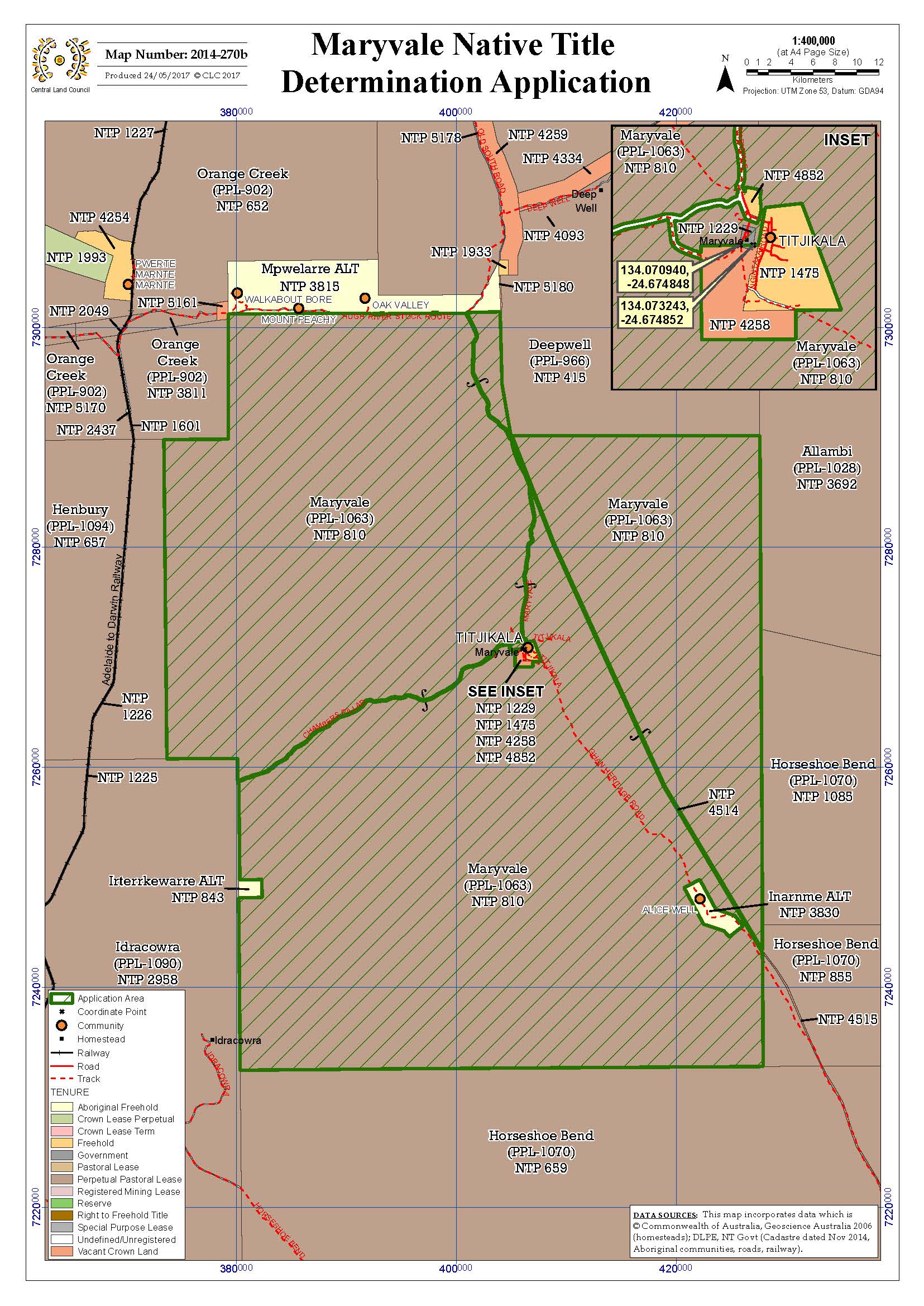
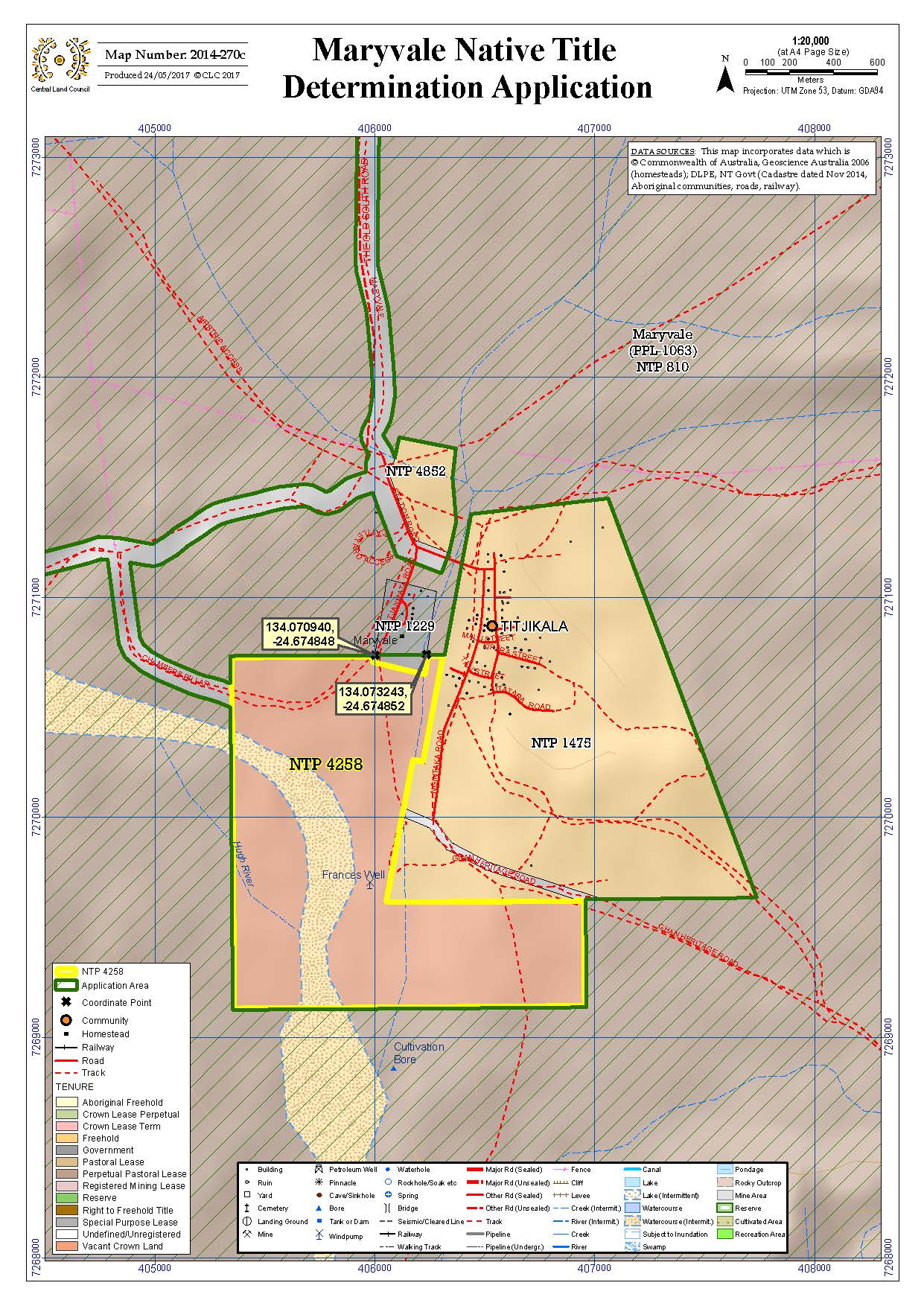
B. The applicant, the Northern Territory of Australia, Helium Australia Pty Ltd and Santos QNT Pty Ltd (the parties) have reached agreement as to the terms of the determination which is to be made in relation to the land and waters covered by the application (the Determination Area). The external boundaries of the Determination Area are described in Schedule A and depicted on the map at Schedule B of the determination.
C. Pursuant to s 87(1)(a)(i) and s 87(1)(b) of the Native Title Act 1993 (Cth) the parties have filed with this Court their agreement in writing.
D. Pursuant to s 87 and s 94A of the Act the terms of the parties’ agreement involve the making of consent orders for a determination that native title exists in relation to the Determination Area as provided by the determination.
E. The parties have acknowledged that the effect of the making of the determination is that the members of the native title claim group, in accordance with the traditional laws acknowledged and the traditional customs observed by them, should be recognised as the native title holders for the Determination Area as provided by the determination.
F. The parties have requested that the Court hear and determine this proceeding in accordance with their agreement.
BEING SATISFIED that a determination of native title in the terms set out in the determination in respect of this proceeding would be within the power of the Court and, it appearing to the Court appropriate to do so, pursuant to s 87 of the Act and by the consent of the parties:
THE COURT ORDERS THAT:
1. There be a determination of native title in terms of the determination set out below.
2. The native title is not to be held on trust.
3. Rodinga Aboriginal Corporation (ICN: 8640) is:
(a) to be the prescribed body corporate for the purposes of s 57(2) of the Act;
(b) to perform the functions outlined in s 57(3) of the Act after becoming a registered native title body corporate.
4. The parties have liberty to apply to establish the precise location and boundaries of any public works and adjacent land and waters identified or otherwise referred to in Schedule C of the determination.
5. There be no order as to costs.
THE COURT DETERMINES THAT:
The Determination Area
1. The Determination Area comprises NT Portions 810 and 1229 (part) being the land and waters more particularly described in Schedule A and depicted on the map comprising Schedule B.
2. Native title exists in the Determination Area.
3. Native title does not exist in those parts of the Determination Area described in Schedule C.
The native title holders
4. The Determination Area comprises three estate areas associated with five family groups – Braedon (Group 1), Taylor and Kenny (Group 2), Johnson (Group 3), Ungwanaka, Schilling, Campbell and Pepperill (Group 4) and Abbott, Armstrong and Corrigan (Group 5).
5. The persons who hold the common or group rights comprising the native title are the Aboriginal persons who are:
(a) members of the five family groups with responsibility for the Imarnte, Titjikala and Idracowra estates respectively by virtue of descent (including adoption) through father’s father, father’s mother, mother’s father and mother’s mother;
(b) accepted as members of one or more of the family and estate groups by senior members of the groups, referred to in sub-paragraph (a), by virtue of the following non-descent connections to the estate:
(i) conception and/or birthplace affiliation with an estate;
(ii) putative or close kinship ties; and
(iii) possession of cultural knowledge, including of neighbouring or shared Dreamings, consolidated by long-term residence in and ongoing ritual involvement with an estate.
Native title rights and interests
6. The native title rights and interests of the native title holders are the non-exclusive native title rights and interests possessed under and exercisable in accordance with the traditional laws acknowledged and traditional customs observed, including the right to conduct activities necessary to give effect to them, being:
(a) the right to access and travel over any part of the land and waters;
(b) the right to live on the land, and for that purpose, to camp, erect shelters and other structures;
(c) the right to hunt, gather and fish on the land and waters;
(d) the right to take and use the natural resources of the land and waters;
(e) the right to access, take and use natural water on or in the land, except water captured by the holder of Perpetual Pastoral Lease No 1063;
(f) the right to light fires for domestic purposes, but not for the clearance of vegetation;
(g) the right to access and to maintain and protect sites and places on or in the land and waters that are important under traditional laws and customs;
(h) the right to conduct and participate in the following activities on the land and waters:
(i) cultural activities;
(ii) ceremonies;
(iii) meetings;
(iv) cultural practices relating to birth and death including burial rites; and
(v) teaching the physical and spiritual attributes of sites and places on the land and waters that are important under traditional laws and customs;
(i) the right to make decisions about the use and enjoyment of the land and waters by Aboriginal people who recognise themselves to be governed by the traditional laws and customs acknowledged by the native title holders provided that the right does not extend to making any decision that purports to control the access of such persons to the Determination Area;
(j) the right to share or exchange natural resources obtained on or from the land and waters, including traditional items made from the natural resources;
(k) the right to be accompanied on the land and waters by persons who, though not native title holders, are:
(i) people required by traditional law and custom for the performance of ceremonies or cultural activities on the land and waters;
(ii) people who have rights in relation to the land and waters according to the traditional laws and customs acknowledged by the native title holders; and
(iii) people required by the native title holders to assist in, observe, or record traditional activities on the areas.
7. The native title rights and interests referred to in paragraph 6 do not confer possession, occupation, use and enjoyment of the land and waters on the native title holders to the exclusion of all others.
8. The native title rights and interests referred to in paragraph 6 hereof are subject to and exercisable in accordance with:
(a) the valid laws of the Northern Territory of Australia and the Commonwealth of Australia; and
(b) the traditional laws and customs of the native title holders for personal or communal needs which are of a domestic or subsistence nature and not for any commercial or business purpose.
9. The nature and extent of the other interests in the Determination Area are:
(a) NT Portion 810 – the interest of Panchek Pty Ltd (ACN 072 868 690) as trustee of The Oldfield Family Trust under Perpetual Pastoral Lease No 1063;
(b) NT Portion 1229 (part) – the interest of the Northern Territory of Australia;
(c) the interests of the holders of the following mining titles granted pursuant to the Mineral Titles Act 2010 (NT) (or its predecessor):
No. | Date Granted | Expiry Date | Holder |
EL 27972 | 20/10/2010 | 19/10/2018 | Tellus Holdings Pty Ltd |
EL 28900 | 05/03/2012 | 04/03/2018 | Tellus Holdings Pty Ltd |
EL 29018 | 12/04/2012 | 11/04/2018 | Tellus Holdings Pty Ltd |
EL 31456 | 01/08/2017 | 31/07/2023 | BMEX Limited |
EL 31509 | 06/11/2017 | 05/11/2023 | BMEX Limited |
EL 31510 | 06/11/2017 | 05/11/2023 | BMEX Limited |
EL 31589 | 15/01/2018 | 14/01/2024 | BMEX Limited |
EP 82 | 02/09/2005 | 29/01/2021 | Helium Australia Pty Ltd and Santos QNT Pty Ltd |
(d) the rights and interests of Telstra Corporation Limited (ACN 051 775 556):
(i) as the owner or operator of telecommunications facilities within the Determination Area;
(ii) created pursuant to the Post and Telegraph Act 1901 (Cth), the Telecommunications Act 1975 (Cth), the Australian Telecommunications Corporation Act 1989 (Cth), the Telecommunications Act 1991 (Cth) and under Sch 3 to the Telecommunications Act 1997 (Cth), including rights:
A. to inspect land;
B. to install and operate telecommunications facilities; and
C. to alter, remove, replace, maintain, repair and ensure the proper functioning of its telecommunications facilities; and
(iii) for its employees, agents or contractors to access its telecommunications facilities in and in the vicinity of the Determination Area in the performance of their duties; and
(iv) under any lease, licence, access agreement or easement relating to its telecommunications facilities within the Determination Area;
(e) in relation to NT Portion 810, the rights of Aboriginal persons (whether or not native title holders) pursuant to the reservation in favour of Aboriginal people contained in pastoral leases set out in ss 38(2) to (6) of the Pastoral Land Act 1992 (NT);
(f) the rights of Aboriginal persons (whether or not native title holders) by virtue of the Northern Territory Aboriginal Sacred Sites Act 1989 (NT);
(g) rights of access by an employee, servant, agent or instrumentality of the Northern Territory of Australia, the Commonwealth of Australia or other statutory authority as required in the performance of his or her statutory duties; and
(h) the interests of persons to whom valid or validated rights and interests have been:
(i) granted by the Crown pursuant to statute or otherwise in the exercise of its executive power; or
(ii) conferred by statute.
Relationship between rights and interests
10. To the extent that the continued existence, enjoyment or exercise of the native title rights and interests referred to in paragraph 6 is inconsistent with the existence, enjoyment or exercise of the other rights and interests referred to in paragraph 9, the other rights and interests and the doing of any activity required or permitted to be done by or under the other interests, prevail over, but do not extinguish, the native title rights and interests.
Other matters
11. There are no native title rights and interests in:
(a) minerals (as defined in s 2 of the Minerals (Acquisition) Act 1953 (NT));
(b) petroleum (as defined in s 5 of the Petroleum Act 1984 (NT));
(c) prescribed substances (as defined in s 5 of the Atomic Energy Act 1953 (Cth) and s 3 of the Atomic Energy (Control of Materials) Act 1946 (Cth)).
12. In this determination the term:
(a) “natural resources” means:
(i) animals ferae naturae, birds, fish and plants, including timber, wax, resin and gum; and
(ii) surface soils, clays, stone, rocks and ochre,
but does not include minerals, petroleum and prescribed substances;
(b) “natural waters” includes springs and rockholes.
13. Unless the contrary intention appears, a word or expression used in the Act has the same meaning in this determination as it has in the Act.
Schedule A
1. The Determination Area comprises the following areas of land and waters:
(a) NT Portion 810 comprising an area of 3,224 square kilometres held under Perpetual Pastoral Lease No 1063; and
(b) NT Portion 1229 (part) comprising an area of 7 hectares 4,003 square metres which is Crown land allocated to the Department of Education.
2. The following areas within the external boundaries of the Determination Area are not included in the Determination Area:
(a) NT Portion 843;
(b) NT Portion 1475;
(c) NT Portion 3830;
(d) NT Portion 4258;
(e) NT Portion 4514;
(f) NT Portion 4852;
(g) That part of NT Portion 1229 contained within NT Portion 4258 that was covered by Miscellaneous Lease No 51 granted on 15 March 1919 for the purpose of supplying water to the public; and
(h) The following roads constructed by or on behalf of the Northern Territory of Australia as public roads:
(i) a road reserve 100 metres wide (Chambers Pillar/Maryvale Access Road) from the northern boundary of NT Portion 810 (Maryvale Station) to the boundary of NT Portion 843 (Irterrkewarre Aboriginal Land Trust);
(ii) a road reserve 100 metres wide from the western boundary of NT Portion 4258 (Crown land) to the Chambers Pillar/Maryvale Access Road, as depicted on the map in Schedule B; and
(iii) a road reserve that is the 100 metre wide prolongation of the southern and south-western boundaries of NT Portion 4852 to the Chambers Pillar/Maryvale Access Road, as depicted on the map in Schedule B.
Schedule B
Determination Area Map
Schedule C
Areas where native title does not exist
Native title rights and interests have been wholly extinguished in the following areas of land and waters.
Public works
1. Those parts of the Determination Area being covered by public works as defined in s 253 of the Act that were constructed or established before 23 December 1996 or commenced to be constructed or established on or before that date (including land and waters within the meaning of s 251D of the Act) including:
(a) public roads, namely, rural public roads (50 metres either side of the centre line), rural arterial roads and national highways and associated road infrastructure;
(b) community, pastoral access and other roads (including access roads and tracks to public works referred to in this clause) which are not otherwise public roads;
(c) gravel and fill pits established to maintain the roads referred to in (a) and (b) above;
(d) government bores and associated works;
(e) river and rain gauges;
(f) transmission water pipes (adjacent area 5 metres either side of the centre line);
(g) distribution water pipes measuring 150 millimetres in diameter or less (adjacent area of 1.5 metres either side of the centre line) and greater than 150 millimetres in diameter (adjacent area 5 metres either side of the centre line);
(h) sewer pipes measuring 150 millimetres in diameter or less (adjacent area 1.5 metres either side of the centre line) and greater than 150 millimetres in diameter (adjacent area 5 metres either side of the centre line); and
(i) bores, sewer pump stations, and overhead power lines.
2. In addition to the areas referred to in paragraph 1 above native title has been wholly extinguished in that part of NT Portion 810 covered by the Overland Telegraph Line (including land and waters within the meaning of s 251D of the Act).
Note: Entry of orders is dealt with in Rule 39.32 of the Federal Court Rules 2011.
CHARLESWORTH J:
1 This application for determination of native title was commenced on 25 June 2016. The claim, as amended, relates to approximately 3225 square kilometres of land in the Central Region of the Northern Territory of Australia.
2 The Court has the power to make a determination of native title under the Native Title Act 1993 (Cth) consistent with the terms of a written agreement between the parties to the application: s 87 of the Act. There is a written agreement before the Court for the determination of native title by consent and orders will be made today in terms consistent with those sought by the parties to the proceeding.
3 The area subject to the claim is NT Portions 810 and 1229 (part), being land and waters more particularly described in Schedule A to the orders and depicted on a map comprising Schedule B (the Determination Area). The Determination Area takes in a Perpetual Pastoral Lease (PPL 1063) and includes what in the present day is known as Maryvale Station.
4 Within the Determination Area are three estates known as Imarnte, Titjikala and Idracowra. There are five family groups associated with these estates. I will refer to them collectively as the claimants. The respondents in the proceedings are the Northern Territory of Australia, Helium Australia Pty Ltd (ACN 078 104 006) and Santos QNT Pty Ltd.
SECTION 87 OF THE ACT
5 A central objective of the Act is to resolve native title claims by negotiation and agreement. Section 87 of the Act advances that objective. It sets out the criteria that must be satisfied before the Court can make a native title consent determination. When a native title determination is made by consent, the parties and the Australian community is spared the cost and delay associated with a contested hearing. Whilst it is unnecessary for the Court to decide the claim on its merits on a contested trial, the Court must nonetheless be satisfied that the requirements of s 87 of the Act are satisfied. As French J observed in Cox on behalf of the Yungngora People v State of Western Australia [2007] FCA 588 at [3]:
A determination of native title not only binds the parties to these proceedings, it is good against the whole world. So the Court must be satisfied that the orders sought are supportable and are in accordance with the law.
6 The first three criteria are procedural and can be shortly dealt with.
7 First, a notice has been issued pursuant to s 66 of the Act and the period specified in the notice has ended: s 87(1). The claim was accepted for registration pursuant to s 190A of the Act on 9 September 2015 and the notification period ended on 3 February 2016.
8 Second, an agreement has been reached which relates to the whole of the proceeding, or to a part of the proceeding, or to a matter arising out of the proceeding: s 87(1)(a). Third, the agreement reached between the parties has been reduced to writing, signed by or on behalf of the parties and filed with the Court: s 87(1)(b).
9 Section 87(1)(c) requires that the Court be satisfied that the terms of the executed consent orders would be within the power of the Court. An order will be within the power of the Court if it is consistent with s 94A of the Act, the rights and interest included in the proposed determination are recognisable by the common law of Australia and there is no other determination affecting the Determination Area: Nelson v Northern Territory (2010) 190 FCR 344 at [4].
10 Section 94A of the Act provides that the Court, when making a determination of native title, is to set out the details of the matters mentioned in s 225 of the Act. Section 225 defines the phrase “determination of native title” as follows:
225 Determination of native title
A determination of native title is a determination whether or not native title exists in relation to a particular area (the determination area) of land or waters and, if it does exist, a determination of:
(a) who the persons, or each group of persons, holding the common or group rights comprising the native title are; and
(b) the nature and extent of the native title rights and interests in relation to the determination area; and
(c) the nature and extent of any other interests in relation to the determination area; and
(d) the relationship between the rights and interests in paragraphs (b) and (c) (taking into account the effect of this Act); and
(e) to the extent that the land or waters in the determination area are not covered by a non exclusive agricultural lease or a non exclusive pastoral lease-whether the native title rights and interests confer possession, occupation, use and enjoyment of that land or waters on the native title holders to the exclusion of all others.
Note: The determination may deal with the matters in paragraphs (c) and (d) by referring to a particular kind or particular kinds of non native title interests.
11 The consent orders executed by the parties contain an order to the effect that native title exists in relation to the Determination Area. The proposed determination specifies who the persons, or each group of persons holding the common or group rights comprising the native title are. The nature and extent of the native title rights and interests in relation to the Determination Area are specified, as are the nature and extent of any other interests in relation to the Determination Area. The parties have agreed that the native title rights and interests are not held to the exclusion of all others.
12 The application is valid and made in accordance with s 61 of the Act. It relates to an area in respect of which there exists no other approved determination of native title: s 13(1)(a) of the Act. There are no other proceedings before the Court relating to native title determination applications that cover any part of the Determination Area which would require orders to be made under s 67(1) of the Act.
13 Accordingly, I am satisfied that a determination of native title in the terms sought by the parties is within the power of the Court to make: s 87(1)(c) of the Act.
14 Before making a determination in terms consistent with the parties’ agreement, the Court must be satisfied that it is appropriate to do so: s 87(1A) of the Act. The principles are summarised in Gepp-Kennedy on behalf of the Dieri People v State of South Australia [2017] FCA 1156 at [16] ⸺ [19] as follows:
16 The power in s 87 of the Act is to be exercised flexibly and with proper regard to the purposes for which it was enacted: Lovett at [36]. The section contemplates that the Court may make a determination of native title in the absence of a comprehensive evidentiary case sufficient to establish all of the facts supporting the determination. The focus is upon the making of the agreement, and especially upon the role of the State party … in scrutinising the claim ‘just as carefully as the community would expect in relation to claims by non-Aborigines to significant rights over such land’: Smith v State of Western Australia (2000) 104 FCR 494 at [38] (Madgwick J).
17 As North J explained in Lovett at [37]:
… when the Court is examining the appropriateness of an agreement, it is not required to examine whether the agreement is grounded on a factual basis which would satisfy the Court at a hearing of the application. The primary consideration of the Court is to determine whether there is an agreement and whether it was freely entered into on an informed basis: Nangkiriny v State of Western Australia (2002) 117 FCR 6; [2002] FCA 660, Ward v State of Western Australia [2006] FCA 1848. Insofar as this latter consideration applies to a State party, it will require the Court to be satisfied that the State party has taken steps to satisfy itself that there is a credible basis for an application: Munn v Queensland (2001) 115 FCR 109; [2001] FCA 1229.
18 In Nelson v Northern Territory of Australia (2010) 190 FCR 344; [2010] FCA 1343 at [12], Reeves J described the role of the State party as one that requires the striking of a balance between:
… its role in protecting the community’s interests, including the stringency of the process it follows in assessing the underlying evidence going to the existence of native title, and its role in the native title system as a whole, to ensure that it, like the Court and all other parties, takes a flexible approach that is aimed at facilitating negotiation and achieving agreement.
19 In satisfying itself that there is a credible basis for a native title determination, the State party is not required to conduct a comprehensive and inflexible inquiry in substitution for a trial. It may rely upon significantly less material that would be necessary to justify a judicial determination of the issues: Lovett at [38].
15 As Reeves J said in Nelson (at [14]), the central issue upon an application for a consent determination is whether there exists a free and informed agreement between the parties. Relevant to that enquiry is the steps the State party (in this case the Northern Territory of Australia) has taken to assess underlying evidence, together with the circumstance that the parties have independent and competent legal representation.
16 The Northern Territory of Australia as the first respondent has played an active role in the negotiation of this consent determination. I am satisfied that the Northern Territory, acting on behalf of the community generally, has had regard to the requirements of the Act and has conducted an appropriate assessment process. It has conveyed to the Court its own satisfaction that the determination is justified in all the circumstances.
17 Anthropologist Dr John Morton conducted field research for the purposes of this proceeding during October 2014, October 2015 and March 2016. The applicant in the proceedings provided Dr Morton’s report to the Northern Territory of Australia. The report examines the known lineage of the claimants and confirmed their long-standing respective responsibilities in relation to the Imarnte estate, the Titjikala estate and the Idracowra estate within the Determination Area. The report addresses anthropological matters relevant to the requirements of s 225 of the Act. According to Dr Morton:
There is wide coverage of Maryvale’s sites and dreamings in all the associated [ethnographic and anthropological] reports, as well as genealogical information and documentation of laws and customs connecting people to land.
18 It is not necessary to give a comprehensive summary of the report as it relates to each of the five family groups referred to in it. It is sufficient to say that the report provides a proper basis for the parties to the proceeding to provide their informed consent to the determination as recorded in their written agreement.
19 In addition, the parties have agreed to a list of commonly occurring Government constructed public works within the Determination Area that wholly extinguish native title (including over adjacent land or waters as defined in s 251D of the Act). The lists are included in Schedule C to the proposed orders.
20 I am satisfied that the parties are competently represented and that it is appropriate, within the meaning of s 87(1A) of the Act, to make a determination in terms consistent with their written agreement.
Prescribed Body Corporate
21 The claimants’ native title is not to be held on trust. It is, however, necessary to determine which body corporate is to perform the functions prescribed by s 57(3) of the Act: see s 57(2).
22 The named applicant has nominated Rodinga Corporation (ICN: 8640) to be that body corporate. An affidavit of an employee of the Central Land Council confirms that Rodinga Corporation consents to becoming the prescribed body corporate to perform the functions as required by the Act. An order will be made giving effect to the applicant’s nomination.
CONCLUSION
23 Before concluding, it is appropriate to specifically mention the family groups who are to be identified as the holders of native title in the Determination Area. They are the Braedons (Group 1), the Kennys and Taylors (Group 2), the Johnsons (Group 3), the lineages with surnames Schilling, Ungwanaka, Campbell and Pepperill (Group 4) and the Abbotts, Armstrongs and Corrigans (Group 5). These five family groups strongly identify as Pertame, although Group 3 also holds a strong Eastern Arrernte identity.
24 As I have mentioned, the report of Dr Morton describes the lineage of the claimants. The report identifies persons long deceased who have previously maintained responsibility for the estates within the Determination Area and their dreaming stories. Dr Morton identifies focal sites situated on each of the three estates and the significance of those sites to the family groups sharing responsibility for them.
25 It is important to emphasise that this determination does not create or grant native title rights in the Determination Area for the benefit of the native title holders. Rather, it marks the recognition under Australian law of the claimants’ present and pre-existing native title held in accordance with their traditional laws and customs. The claimants’ native title existed at sovereignty. It vastly predates the grant of the Pastoral Lease and the establishment of the station that forms a part of its more recent history.
26 The parties are to be congratulated on reaching their agreement and on progressing this application to a resolution without the need of a contested hearing.
27 I am satisfied that a determination should be made in terms consistent with those proposed by the parties, without substantive alteration.
I certify that the preceding twenty-seven (27) numbered paragraphs are a true copy of the Reasons for Judgment herein of the Honourable Justice Charlesworth. |
Associate:


