FEDERAL COURT OF AUSTRALIA
Australian Competition and Consumer Commission v Ford Motor Company of Australia Limited [2018] FCA 703
ORDERS
AUSTRALIAN COMPETITION AND CONSUMER COMMISSION Applicant | ||
AND: | FORD MOTOR COMPANY OF AUSTRALIA LIMITED (ACN 004 116 223) Respondent | |
DATE OF ORDER: |
THE COURT DECLARES THAT:
1. Between 1 May 2015 and 29 February 2016, in connection with the supply to customers of Ford motor vehicles fitted with a ‘PowerShift’ transmission, Ford Australia:
(a) Failed to ensure that customers who had purchased those vehicles were provided with adequate information about their legal rights and potential legal rights (including potential rights under the consumer guarantee provisions of the Australian Consumer Law (which is contained in Schedule 2 to the CCA)).
(b) Had and gave effect to processes for dealing with and responding to complaints from customers about the PowerShift transmission and requests for refunds or replacement vehicles that:
(i) Failed to ensure that proper consideration was given to the individual circumstances and actual or potential legal rights of customers;
(ii) resulted in many customers accepting offers made by Ford Australia because customers were told refunds or no-cost replacements were not an option and had limited time to accept offers, which were conditional on customers entering into settlement agreements that included non-disclosure provisions; and
(iii) failed to ensure that customers who signed settlement agreements understood that they may be compromising their legal rights; and
(c) had inadequate processes which caused many customers to purchase new replacement vehicles at a significant additional cost to the customers.
Ford Australia had thereby engaged, in trade or commerce, in conduct that was in all the circumstances unconscionable in contravention of s 21 of the Australian Consumer Law.
THE COURT ORDERS THAT:
2. Ford Australia pay the Commonwealth of Australia, within 30 days of the date of this order, a pecuniary penalty pursuant to s 224 of the Australian Consumer Law in respect of the contravention declared in paragraph 1 of this order in the sum of $10,000,000.
3. Ford Australia pay the ACCC, within 30 days of the date of this order, a contribution towards the ACCC’s costs of and incidental to these proceedings in the sum of $500,000, and otherwise there be no order as to costs.
4. The proceedings otherwise be dismissed.
Note: Entry of orders is dealt with in Rule 39.32 of the Federal Court Rules 2011.
MIDDLETON J:
INTRODUCTION
1 On 26 April 2018, the Court made the following declaration and orders:
THE COURT DECLARES THAT:
1. Between 1 May 2015 and 29 February 2016, in connection with the supply to customers of Ford motor vehicles fitted with a ‘PowerShift’ transmission, Ford Australia:
(a) Failed to ensure that customers who had purchased those vehicles were provided with adequate information about their legal rights and potential legal rights (including potential rights under the consumer guarantee provisions of the Australian Consumer Law (which is contained in Schedule 2 to the CCA)).
(b) Had and gave effect to processes for dealing with and responding to complaints from customers about the PowerShift transmission and requests for refunds or replacement vehicles that:
(i) Failed to ensure that proper consideration was given to the individual circumstances and actual or potential legal rights of customers;
(ii) resulted in many customers accepting offers made by Ford Australia because customers were told refunds or no-cost replacements were not an option and had limited time to accept offers, which were conditional on customers entering into settlement agreements that included non-disclosure provisions; and
(iii) failed to ensure that customers who signed settlement agreements understood that they may be compromising their legal rights; and
(c) had inadequate processes which caused many customers to purchase new replacement vehicles at a significant additional cost to the customers.
Ford Australia had thereby engaged, in trade or commerce, in conduct that was in all the circumstances unconscionable in contravention of s 21 of the Australian Consumer Law.
THE COURT ORDERS THAT:
2. Ford Australia pay the Commonwealth of Australia, within 30 days of the date of this order, a pecuniary penalty pursuant to s 224 of the Australian Consumer Law in respect of the contravention declared in paragraph 1 of this order in the sum of $10,000,000.
3. Ford Australia pay the ACCC, within 30 days of the date of this order, a contribution towards the ACCC’s costs of and incidental to these proceedings in the sum of $500,000, and otherwise there be no order as to costs.
4. The proceedings otherwise be dismissed.
2 These are the reasons for the making of the declaration and orders.
3 The Australian Competition and Consumer Commission (‘ACCC’) alleged, and Ford Motor Company of Australia Limited (‘Ford Australia’) admitted, that, between 1 May 2015 and 29 February 2016, Ford Australia contravened s 21 of the Australian Consumer Law (‘ACL’), being Schedule 2 to the Competition and Consumer Act 2010 (Cth) (‘CCA’), in its handling of and responses to complaints (‘Complaints’) made by customers (‘Customers’) who had purchased certain Ford Fiesta, Focus and EcoSport vehicles between 2011 and 2016 that were fitted with a six speed dry dual-clutch automatic transmission known as the “PowerShift transmission”, sometimes also described as the “DPS6 transmission” (relevantly described as ‘Vehicles’).
4 The parties reached an agreement as to the terms on which they seek the resolution of this proceeding and jointly filed the following documents:
(1) A Statement of Agreed Facts and Admissions dated 19 April 2018 (‘SoAFA’) setting out facts agreed between the parties and admissions made by Ford Australia pursuant to s 191(3)(a) of the Evidence Act 1995 (Cth); and
(2) the parties’ proposed short minute of consent orders (‘Proposed Order’), setting out the relief sought (including as to penalty).
5 The Court has adopted the joint submissions prepared by Dr O Bigos, Ms C Van Proctor and Mr C Tran for the ACCC and Mr C M Scerri QC, Ms S Gory and Mr T Farhall for Ford Australia.
BACKGROUND
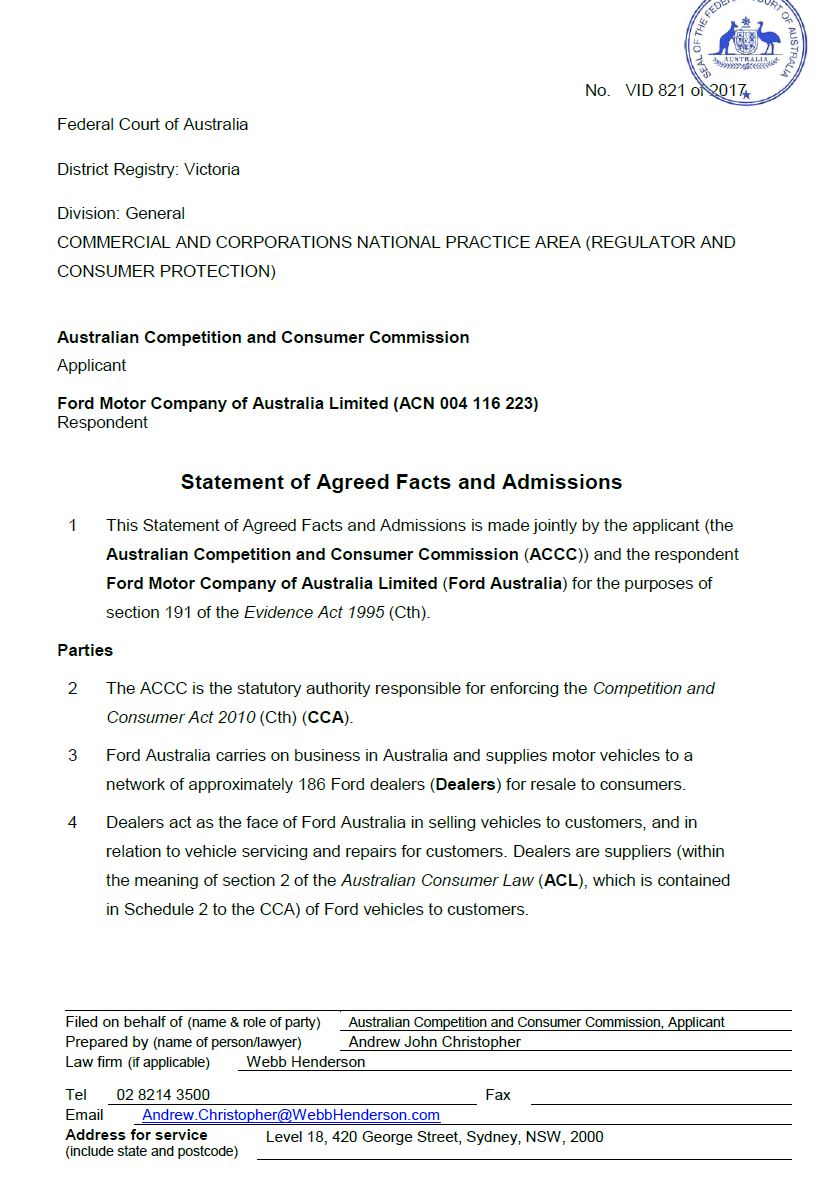
6 The full factual basis for the orders is to be found in the SoAFA which is annexed to these reasons. The salient factual matters to be found in the SoAFA are also referred below. Where a term is defined in the SoAFA and used in these reasons, that term has the meaning defined in the SoAFA.
7 Unless otherwise stated, the conduct the subject of these factual matters relates to the period from 1 May 2015 to 29 February 2016 (‘Relevant Period’).
8 In the Relevant Period, Ford Australia carried on business in Australia as a supplier of motor vehicles to a network of approximately 186 Dealers for resale to consumers Dealers acted as the face of Ford Australia in selling vehicles to customers, and in relation to vehicle servicing and repairs for customers. Dealers are suppliers, within the meaning of s 2 of the ACL, of Ford vehicles to customers.
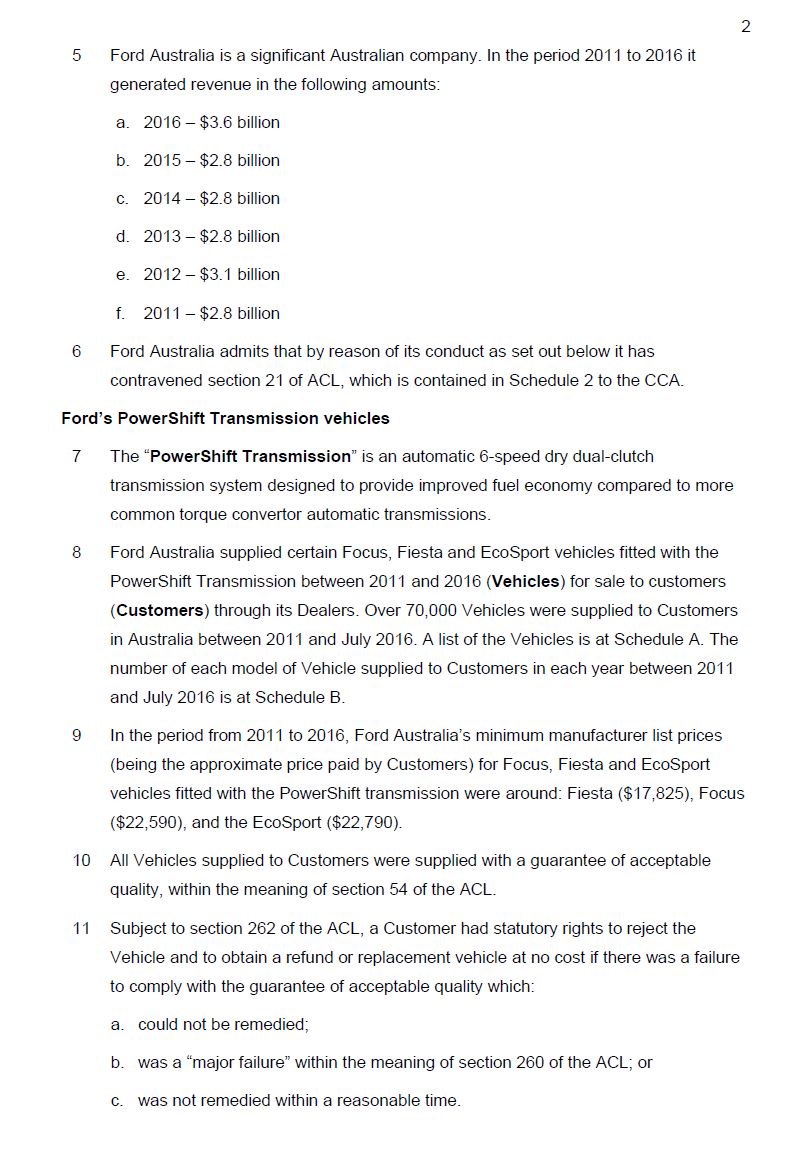
9 Between 2011 and 2016, Ford Australia supplied Vehicles for sale to Customers through its Dealers. Over 70,000 Vehicles were supplied to Customers in Australia between 2011 and July 2016.
10 Ford Australia’s conduct needs to be considered in the context of the statutory consumer guarantees. The consumer guarantee provisions in Division 1 of Part 3-2 of the ACL, and the related remedy provisions in Part 5-4 of the ACL, were introduced in 2011. All Vehicles supplied to Customers were supplied with a guarantee of acceptable quality within the meaning of s 54 of the ACL. The consumer guarantees could not be excluded or restricted. Subject to s 262, a Customer had statutory rights under s 263(4) to reject the Vehicle and obtain a refund or replacement vehicle at no cost if there was a failure to comply with the guarantee that: could not be remedied (s 259(3)), was a “major failure” within the meaning of s 260 (s 259(3)), or was not remedied within a reasonable time (s 259(2)). A supplier’s obligation to refund cannot be satisfied by permitting the consumer to acquire other goods from the supplier: s 263(5). Ford Australia was obliged under s 274(2) of the ACL to indemnify Dealers to the extent of their statutory liability to Customers, including any obligation to provide a refund or replacement vehicle.
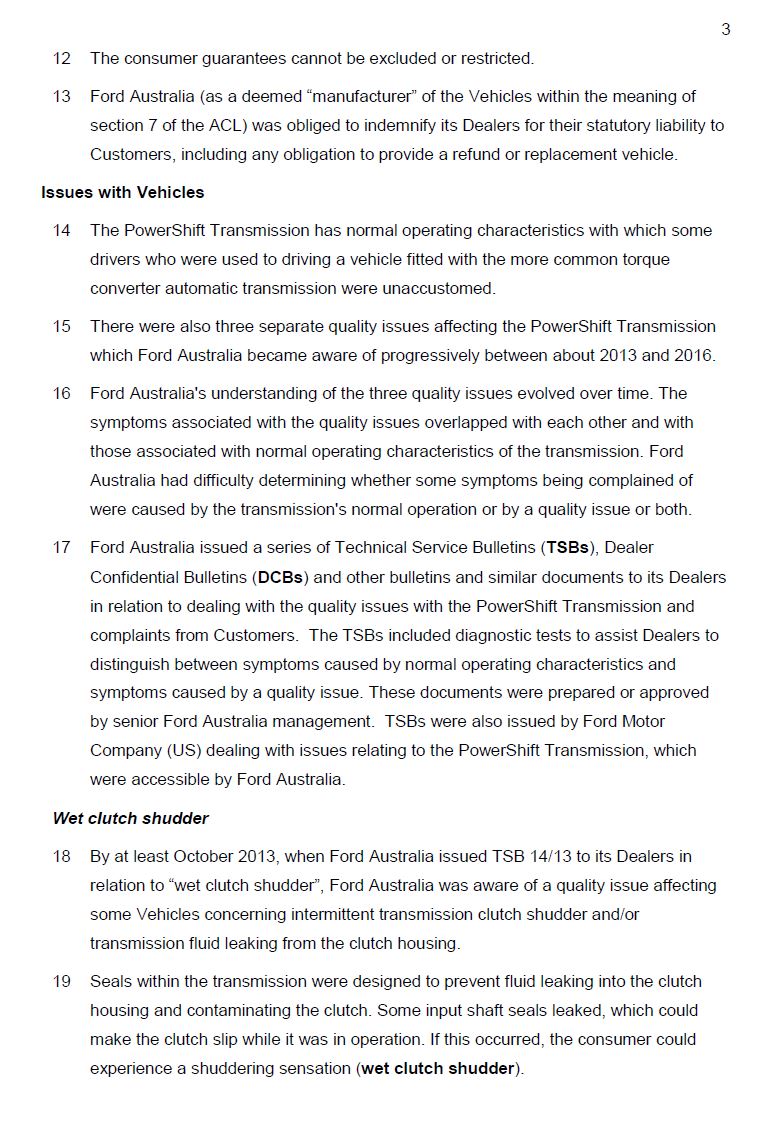
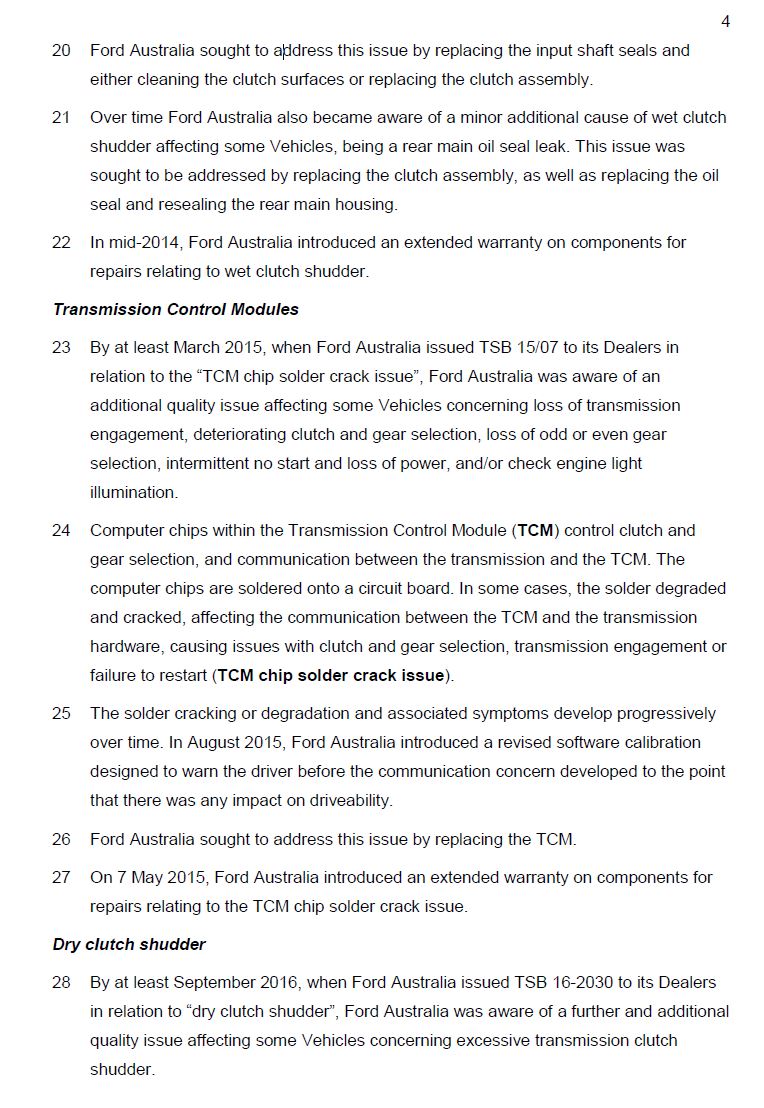
11 The PowerShift Transmission had normal operating characteristics to which some drivers used to driving a vehicle fitted with the more common torque converter automatic transmission were unaccustomed. Moreover, Ford Australia became progressively aware of three separate quality issues affecting the PowerShift Transmission between about 2013 and 2016. The issues were with the clutch and with the Transmission Control Module. The symptoms associated with these issues overlapped with each other and with those associated with normal operating characteristics of the transmission.
12 Ford Australia’s understanding of the quality issues evolved over time. It issued a series of Technical Service Bulletins, Dealer Confidential Bulletins and other bulletins and similar documents to its Dealers about dealing with the quality issues and Complaints from Customers.
13 By 2011, Ford Australia and its Dealers started receiving Complaints from Customers about issues with, and the operation of, their Vehicles. These Complaints increased in number and scale each year between 2011 and 2016. The Complaints related to, among other things, excessive clutch shudder, excessive noisiness from the transmission, delayed acceleration and excessive shuddering and jerking when accelerating.
14 Some Complaints were made to, and many Complaints were passed on or reported by Dealers to, Ford Australia through its Customer Relationship Centre. About 4,300 individual cases in relation to Vehicles were open at some point during the Relevant Period. Ford Australia was aware of the Complaints, often on or about the dates they were received, and tracked them, including to report to senior management.
15 By November 2016, approximately 37% of all Vehicles had one or more clutch assembly replacements, and approximately 10% of all Vehicles had one or more Transmission Control Module replacements. Some Customers had multiple repairs and diagnostic steps relating to the PowerShift Transmission performed on their Vehicles. Some Customers had to wait several months for replacement clutches, including in the first half of 2015 when demand for replacement clutches exceeded supply.
16 Customers who made Complaints about Vehicles and requested refunds or replacement vehicles were referred by Dealers to Ford Australia’s “changeover review” process. Some Customers also made requests directly to Ford Australia, including through the Customer Relationship Centre. The issues that Customers encountered in this changeover review process are set out at paragraphs 72 to 77 of the SoAFA.
17 The “changeover review” process involved Ford Australia senior managers (or their delegates) making a decision as to whether to offer, and if so the terms of, a “changeover” to a Customer. This could involve either selling a new vehicle without a PowerShift Transmission to the Customer, with the Customer and/or Ford Australia meeting the difference between the price of the new vehicle and the trade-in value of their Vehicle, or giving the Customer a full or partial refund in exchange for return of the Vehicle.
18 At least 1600 “changeovers” in respect of Vehicles were approved by Ford Australia in the period 2012 to 2016 (inclusive). At least 1400 of these involved the Customer making a contribution to the price of the replacement vehicle, or receiving a partial refund only of the purchase price of their current vehicle.
19 The significant majority of “changeovers” involved Ford Australia selling the customer a new vehicle and the Customer being required to make a further payment for their new vehicle. Very few Customers were provided a full refund.
20 In May 2015, in response to growing concerns about the Vehicles, Ford Australia introduced the Owner Loyalty Program (‘OLP’) alongside the changeover review process. The OLP involved selling a new vehicle to the Customer, without a PowerShift Transmission, at the price offered to Ford Australia employees, with the Customer meeting the difference between the price and the trade-in price of their current Vehicle. The issues that Customers encountered in the OLP are set out at paragraphs 72 to 77 of the SoAFA.
21 Generally speaking, both the changeover review process and the OLP were often lengthy processes which could take many months and multiple interactions with Ford Australia. The delays and the multiple interactions with Ford Australia in the process were an imposition on Customers’ time and caused inconvenience and often distress for many Customers.
THE ADMITTED CONTRAVENTION
22 Section 21(1) of the ACL relevantly provides that a person must not, in trade or commerce, in connection with the supply or possible supply of goods to a person engage in conduct that is, in all the circumstances, unconscionable. Section 22 sets out a non-exhaustive list of factors to which the Court should have regard in determining whether s 21 has been contravened. They include, relevantly:
(1) The relative strengths of the bargaining positions of Ford Australia and the Customer (s 22(1)(a));
(2) whether, as a result of conduct engaged in by Ford Australia, Customers were required to comply with conditions that were not reasonably necessary for the protection of the legitimate interests of Ford Australia (s 22(1)(b));
(3) whether Customers were able to understand any documents relating to the supply or possible supply of Vehicles (s 22(1)(c));
(4) whether any undue influence or pressure was exerted on, or any unfair tactics were used against, Customers by Ford Australia in relation to the supply or possible supply of the Vehicles (s 22(1)(d));
(5) the extent to which the supplier’s conduct towards the customer was consistent with the supplier’s conduct in similar transactions between the supplier and other like customers (s 22(1)(f));
(6) the extent to which the supplier unreasonably failed to disclose to the customer any intended conduct of the supplier that might affect the interests of the customer and any risks to the customer arising from the supplier’s intended conduct (being risks that the supplier should have foreseen would not be apparent to the customer) (s 22(1)(i)); and
(7) any conduct that the supplier or the customer engaged in, in connection with their commercial relationship, after they entered into the contract (s 22(1)(j)(iv)).
Importantly, s 21 “is not limited by the unwritten law relating to unconscionable conduct” (s 21(4)(a)).
23 In Tonto Home Loans Australia Pty Ltd v Tavares [2011] NSWCA 389; (2011) 15 BPR 29, 699 at [291], President Allsop (then presiding over the NSW Court of Appeal) said:
It is neither possible nor desirable to provide a comprehensive definition. The range of conduct is wide and can include bullying and thuggish behaviour, undue pressure and unfair tactics, taking advantage of vulnerability or lack of understanding, trickery or misleading conduct. A finding requires an examination of all the circumstances.
24 The approach to be adopted by the Court in assessing whether conduct is unconscionable has been authoritatively explained by the Full Federal Court in Paccioco v Australia and New Zealand Banking Group Ltd (2015) 236 FCR 199. Chief Justice Allsop said at [296], with Besanko and Middleton JJ agreeing, that the concept of unconscionability (which informs the related statutory definition of ‘unconscionable conduct’):
...includes a recognition of the deep and abiding requirement of honesty in behaviour; a rejection of trickery or sharp practice; fairness when dealing with consumers; the central importance of the faithful performance of bargains and promises freely made; the protection of those whose vulnerability as to the protection of their own interests places them in a position that calls for a just legal system to respond for their protection, especially from those who would victimise, predate or take advantage; a recognition that inequality of bargaining power can (but not always) be used in a way that is contrary to fair dealing or conscience; the importance of a reasonable degree of certainty in commercial transactions; the reversibility of enrichments unjustly received; the importance of behaviour in a business and consumer context that exhibits good faith and fair dealing; and the conduct of an equitable and certain judicial system that is not a harbour for idiosyncratic or personal moral judgment and exercise of power and discretion based thereon.
25 Relevant principles were summarised by Beach J in Australian Competition and Consumer Commission v Get Qualified Australia Pty Ltd (No 2) [2017] FCA 709 at [60]-[63]) (‘Get Qualified Australia’). Initially, courts sought to construe the unconscionability provision so as to require moral obloquy or moral tainting, but more recently courts have moved away from that requirement because it is not found in the statutory text. In this regard, see most recently Kobelt v ASIC [2018] FCAFC 18 at [193] (Besanko and Gilmour JJ) and Ipstar Australia Pty Ltd v APS Satellite Pty Ltd [2018] NSWCA 15 at [195]-[199] (Bathurst CJ), at [275]-[278] (Leeming JA).
26 Section 21 can apply to “a system of conduct or pattern of behaviour, whether or not a particular individual is identified as having been disadvantaged by the conduct or behaviour” (s 21(4)(b)). This is one of the interpretative principles recommended by the expert panel on unconscionable conduct, designed to ensure that courts treat statutory unconscionable conduct as expansively as was intended: see Australian Government, Strengthening statutory unconscionable conduct and the Franchising Code of Conduct, (February 2010), 30. In Get Qualified Australia, Beach J at [65]-[66] said that proof of examples of similar unconscionable conduct across individual cases may be used to demonstrate the features of a system of conduct or pattern of behaviour, and that evidence of the incidents comprising the alleged system or pattern may be varied and even individually insubstantial, the systemic pattern of behaviour being established from an accumulation of individually minor incidents.
27 Pursuant to s 191 of the Evidence Act 1995 (Cth), Ford Australia admitted that during the Relevant Period, in trade or commerce, in connection with the supply of Vehicles to Customers, Ford Australia engaged in conduct that was, in all of the circumstances, unconscionable in contravention of s 21 of the ACL.
28 Ford Australia contravened in that it:
(1) Failed to ensure that Customers who had purchased Vehicles were provided with adequate information about their legal rights and potential legal rights (including potential rights under the consumer guarantee provisions of the ACL); and
(2) had given effect to processes for dealing with and responding to Complaints from Customers about the PowerShift Transmission and requests for refunds or replacement vehicles that:
(a) Failed to ensure that proper consideration was given to the individual circumstances and actual or potential legal rights of Customers; and
(b) resulted in many Customers accepting offers made by Ford Australia because they were told refunds or no-cost replacements were not an option and had limited time to accept offers, which were conditional on them entering into settlement agreements that included nondisclosure provisions; and
(c) failed to ensure that Customers who signed settlement agreements understood that they may be compromising their legal rights; and
(3) had inadequate processes which caused many Customers to purchase new replacement vehicles at a significant additional cost to them.
29 This conduct was unconscionable in all of the circumstances, including the following:
(1) Ford Australia had significant bargaining strength relative to the Customers who were seeking remedies for their affected Vehicles;
(2) Customers were vulnerable, given that they had outlaid significant amounts on purchasing the Vehicles, relied on them for their daily domestic and business obligations and were entirely dependent on Ford Australia as to how Complaints and quality issues were dealt with;
(3) Ford Australia failed to respond in a timely and adequate way to adapt or alter its response to Complaints as its knowledge of issues affecting the PowerShift Transmission and Complaints increased;
(4) Ford Australia told Customers that refunds and no-cost replacement vehicles were not an available option and Ford Australia required issues to be demonstrated or replicated on demand in the presence of a Dealer for repairs to be undertaken;
(5) Ford Australia provided Customers with limited time to consider and accept offers;
(6) Ford Australia did not advise Customers to seek independent legal advice about the settlement agreements or tell them they may be compromising their legal rights;
(7) Ford Australia treated Complaints in an ad hoc, reactive and inconsistent fashion as it failed to provide information (or adequate information) to Customers about its policies and procedures and did not advise Customers of their legal rights or potential legal rights or alternative options to the changeover review process or OLP;
(8) Ford Australia’s conduct caused Customers economic and non-economic harm.
DECLARATORY RELIEF
30 The declaration proposed by the parties and made by the Court was set out in the Proposed Order. It follows the admission by Ford Australia that, between 1 May 2015 and 29 February 2016, in trade or commerce and in connection with the supply to Customers of Vehicles, Ford Australia engaged in the conduct and circumstances referred to above.
31 The Court has a wide discretionary power to make declarations under s 21 of the Federal Court of Australia Act 1976 (Cth): see for example Forster v Jododex Australia Pty Ltd (1972) 127 CLR 421 (‘Forster’) at 437-438 and Ainsworth v Criminal Justice Commission (1992) 175 CLR 564 (‘Ainsworth’) at 581-582. With this in mind, it was said that “[i]t is neither possible nor desirable to fetter … by laying down rules as to the manner of its exercise”: see Forster at 437 and Ainsworth at 581-582. In Ainsworth at 582, it was stated that because it is “confined by the considerations which mark out the boundaries of judicial power”, it follows that a declaration:
…must be directed to the determination of legal controversies and not to answering abstract or hypothetical questions. The person seeking relief must have “a real interest” and relief will not be granted if the question “is purely hypothetical”, if relief is “claimed in relation to circumstances that [have] not occurred and might never happen” or if “the Court’s declaration will produce no foreseeable consequences for the parties.”
32 Each of these requirements is satisfied in this case:
(1) The proposed declaration determines what was a live controversy between the parties – whether Ford Australia contravened the ACL – and the matters in issue have been identified and particularised by the parties with precision.
(2) The ACCC, as a public regulator under the ACL, has a genuine interest in seeking the declaratory relief.
(3) It cannot be said that a declaration would have no consequences. In particular, declaratory relief serves in this case to:
(a) Record the Court’s disapproval of the contravening conduct;
(b) vindicate the ACCC’s claim that Ford Australia contravened the ACL;
(c) assist the ACCC to carry out the duties conferred upon it by the CCA, including the ACL;
(d) inform the public of the harm arising from Ford Australia’s contravening conduct; and deter other corporations from contravening the ACL: see Australian Competition and Consumer Commission v Construction, Forestry, Mining and Energy Union [2007] ATPR ¶42-140 at [6] (Nicholson J).
(4) Ford Australia is a proper contradictor because it is a company which has contravened the ACL and is the subject of the declarations. It therefore has an interest in opposing the making of them: see Australian Competition and Consumer Commission v MSY Technology Pty Ltd (2012) 201 FCR 378 at [30].
(5) There is also a “considerable public interest” in corporations observing the requirements of the ACL, which warrants the grant of declaratory relief when the ACL is breached: see Plaintiff M61/2010E v Commonwealth (2010) 243 CLR 319 at 359-360 [103] (French CJ, Gummow, Hayne, Heydon, Crennan, Kiefel and Bell JJ).
33 The proposed declaration was thus appropriate, in that it contains sufficient indication of how and why the relevant conduct is a contravention of the ACL: see BMW Australia Ltd v Australian Competition and Consumer Commission (2004) 207 ALR 452 at 465 [35]; Rural Press Ltd v Australian Competition and Consumer Commission (2003) 216 CLR 53 at 91 [90].
PRINCIPLES REGARDING PENALTIES
34 The parties jointly sought the Court’s imposition of particular orders, including orders requiring Ford Australia to pay a pecuniary penalty in relation to its contravention of the ACL, by way of resolution of the proceeding.
35 The High Court reaffirmed the public interest in parties resolving civil penalty matters with regulators such as the ACCC in Commonwealth v Director, Fair Work Building Industry Inspectorate (2015) 258 CLR 482 (‘Inspectorate’) at [28], [46]. The High Court confirmed that:
[57] …in civil proceedings there is generally very considerable scope for the parties to agree on the facts and upon consequences. There is also very considerable scope for them to agree upon the appropriate remedy and for the court to be persuaded that it is an appropriate remedy. … [I]t is entirely consistent with the nature of civil proceedings for a court to make orders by consent and to approve a compromise of proceedings on terms proposed by the parties, provided the court is persuaded that what is proposed is appropriate.
[58] … subject to the court being sufficiently persuaded of the accuracy of the parties’ agreement as to facts and consequences, and that the penalty which the parties propose is an appropriate remedy in the circumstances thus revealed, it is consistent with principle and … highly desirable in practice for the court to accept the parties’ proposal and therefore impose the proposed penalty.
36 It was stated in Australian Competition and Consumer Commission v Real Estate Institute of Western Australia Inc (1999) 161 ALR 79 at [17], as well in Australian Competition and Consumer Commission v Virgin Mobile Australia Pty Ltd (No 2) [2002] FCA 1548 at [1] (French J), that when deciding whether to make orders that are consented to by the parties in regulatory proceedings, the Court must be satisfied that it has the power to make the orders proposed and that the orders are appropriate. However, once the Court is satisfied it has the power to make the orders and the orders are appropriate, it should exercise judicial restraint in scrutinising proposed settlements: see Inspectorate at 507-508 [58]-[59] and Australian Competition and Consumer Commission v Target Australia Pty Ltd [2001] ATPR 41-840 at [24]. That is particularly so in circumstances such as the present, where the consenting parties are legally represented and able to understand and evaluate the desirability of the settlement: see Australian Competition and Consumer Commission v REIWA (1999) 161 ALR 79 at 87 [20]-[21] (French J); Australian Competition and Consumer Commission v Econovite Pty Ltd [2003] ATPR ¶41- 959 at [11] (French J); Australian Competition and Consumer Commission v Woolworths (South Australia) Pty Ltd (Trading as Mac’s Liquor) (2003) 198 ALR 417 at 424 [21] (Mansfield J). In Inspectorate at 504 [47], it was said that an agreed penalty may be adopted if the Court considers it an amount as appropriate as another even if the Court “might otherwise have been disposed to select some other figure”.
37 It is on this basis, the Court proceeds to consider whether the proposed penalty of $10,000,000 is appropriate.
FACTORS TO BE TAKEN INTO ACCOUNT IN ASSESsING PENALTY
Section 224 of the ACL
38 Under s 224(1)(a)(i) of the ACL, the Court may, in respect of contraventions of provisions of Part 2-2 of the ACL (which includes s 21), order the contravener to pay such pecuniary penalties in respect of “each act or omission” as the Court determines to be appropriate.
39 Section 224(3) of the ACL provides that the maximum penalty for a body corporate for each act or omission that constitutes a contravention of s 21 of the ACL is $1.1 million.
Deterrence
40 It is well established that “[d]eterrence is the primary objective for the imposition of civil penalties”: see Australian Competition and Consumer Commission v Cement Australia Pty Ltd [2017] FCAFC 159 at [385] (Middleton, Beach and Moshinsky JJ) and Australian Securities and Investments Commission v Godfrey (2017) 123 ACSR 478 at [20] (Moshinsky J). In Inspectorate at [55], the High Court approved the following statement by French J in Trade Practices Commission v CSR Ltd [1990] FCA 762 at [40].
The principal, and I think probably the only, object of the penalties imposed by s 76 is to attempt to put a price on contravention that is sufficiently high to deter repetition by the contravenor and by others who might be tempted to contravene the Act.
41 The High Court returned to civil penalty provisions such as s 224 in Australian Building and Construction Commissioner v Construction, Forestry, Mining and Energy Union (2018) 92 AJLR 219 (‘ACCC v CFMEU’). Chief Justice Kiefel at 229 [44], referred to “the deterrent effect which is the very point of the penalty” and “the purpose for which the power is given”. Keane, Nettle and Gordon JJ reiterated at 235 [87], that:
…the principal consideration in the imposition of penalties for contravention of civil remedy provisions is deterrence, both specific and general; more particularly, the objective is to put a price on contravention that is sufficiently high to deter repetition by the contravener and by others who might be tempted to contravene.
42 In Australian Competition and Consumer Commission v ABB Transmission and Distribution Ltd (2001) ATPR ¶41-815 at 42, 938 [13] (Finkelstein J), it was stated that what deterrence requires is for the penalty to be imposed “at a meaningful level”, by which is meant that “the penalty must be at a level that a potentially-offending corporation will see as eliminating any prospect of gain”. The Court, as seen in NW Frozen Foods Pty Ltd v Australian Competition and Consumer Commission (1996) 71 FCR 285 at 294-295 (‘NW Frozen Foods’) (Burchett and Kiefel JJ), “should not leave room for any impression of weakness in its resolve to impose penalties sufficient to ensure the deterrence, not only of the parties actually before it, but also of others who might be tempted to think that contravention would pay”. It is in this way that the Court achieves the statutory object of ensuring that contravention not be regarded as a mere “cost of doing business”: see Australian Competition and Consumer Commission v TPG Internet Pty Ltd (2013) 250 CLR 640 at 659 [64] (French CJ, Crennan, Bell and Keane JJ); Singtel Optus Pty Ltd v Australian Competition and Consumer Commission (2012) 287 ALR 249 (‘Singtel’) at 265 [62] (Keane CJ, Finn and Gilmour JJ); Australian Competition and Consumer Commission v Acquire Learning & Careers Pty Ltd (2017) 340 ALR 25 at 65 [164] (Murphy J); Australian Competition and Consumer Commission v Leahy Petroleum Pty Ltd (No 3) (2005) 215 ALR 301 (‘Leahy Petroleum’) at 309 [39] (Goldberg J).
43 In considering the extent to which the penalty achieves deterrence, it is important for the Court to have regard to a company’s size and profitability, as proposed in Australian Competition and Consumer Commission v Navman Australia Pty Ltd (2007) ATPR ¶42-208 at 48, 422 [115]. As Goldberg J observed in Leahy Petroleum at 309 [39], “[o]bviously the sum required to achieve this object [of deterrence] will be larger where the Court is setting a penalty for a company with vast resources”. Plainly, the size of the enterprise affects the significance of the burden of the civil penalty, and thus its deterrent effect. Keane, Nettle and Gordon JJ in ACCC v CMFEU at 241-242 [116], explained it in the following terms:
…specific deterrence inheres in the sting or burden which the penalty imposes on the contravener. Other things being equal, it is assumed that the greater the sting or burden of the penalty, the more likely it will be that the contravener will seek to avoid the risk of subjection to further penalties and thus the more likely it will be that the contravener is deterred from further contraventions; likewise, the more potent will be the example that the penalty sets for other would-be contraveners and therefore the greater the penalty’s general deterrent effect. Conversely, the less the sting or burden that a penalty imposes on a contravener, the less likely it will be that the contravener is deterred from further contraventions and the less the general deterrent effect of the penalty. Ultimately, if a penalty is devoid of sting or burden, it may not have much, if any, specific or general deterrent effect, and so it will be unlikely, or at least less likely, to achieve the specific and general deterrent effects that are the raison d’être of its imposition.
44 The Full Court explained the relevance of deterrence to the calculation of an appropriate penalty in the following way in Australian Competition and Consumer Commission v Reckitt Benckiser (Australia) Pty Ltd (2016) 340 ALR 25 (‘Reckitt’) at 62-63 [150]-[153]:
The objective of any penalty in this case must be to ensure that Reckitt Benckiser and other “would-be wrongdoers” think twice and decide not to act against the strong public interest in consumers being able to making decisions about buying non-prescription medicines free from representations that are liable to mislead and thereby distort their decision-making processes.
All others things being equal, the greater the risk of consumers being misled and the greater the prospect of gain to the contravener, the greater the sanction required, so as to make the risk/benefit equation less palatable to a potential wrongdoer and the deterrence sufficiently effective in achieving voluntary compliance. Tipping the balance of the risk/benefit equation in this way is even more important when the benefit in contemplation is profit or other material gain. It is especially important if there are disadvantages, including increased costs or lesser sales or profits, in complying with legal obligations for those who “decide” to be law-abiding.
If it costs more to obey the law than to breach it, a failure to sanction contraventions adequately de facto punishes all who do the right thing. It is therefore important that those who do comply see that those who do not are dealt with appropriately. This is, in a sense, the other side of deterrence, being a dimension of the general deterrence equation. This is not to give licence to impose a disproportionate or oppressive penalty, which cannot be done, but rather to recognise that proportionality of penalty is measured in the wider context of the demands of effective deterrence and encouraging the corresponding virtue of voluntary compliance.
Breaches of the kind carried out by Reckitt Benckiser will usually involve a high degree of contemplation and choice. The involvement of Reckitt Benckiser’s Australian Regulatory and Medical Affairs Director in deciding to continue with the marketing of the products in 2013 is consistent with this likelihood. The right decision is more likely to be made if the sanction for the conduct is substantial relative to the possible gain to be made from it — a relationship which is closely related to, but not identical with, consumer loss. This critical importance of effective deterrence must inform the assessment of the appropriate penalty. It is the primary consideration in assessing the objective seriousness of Reckitt Benckiser’s conduct and in deciding whether the sanction imposed by the primary judge was manifestly inadequate.
Relevant penalty factors
45 Section 224(2) of the ACL sets out the following non-exhaustive list of mandatory relevant considerations (ultimately, “all relevant matters” must be considered):
(1) The nature and extent of the act or omission and of any loss or damage suffered as a result of the act or omission; and
(2) the circumstances in which the act or omission took place; and
(3) whether the person had previously been found by a court in proceedings under relevant legislation to have engaged in any similar conduct.
46 Additional matters relevant to the assessment of a penalty include the factors listed by French J in Trade Practices Commission v CSR Ltd (1991) ATPR ¶41-076 at 52, 152-52, 153 (French J), which have been cited in numerous later cases:
(1) The nature and extent of the contravening conduct.
(2) The amount of loss or damage caused [by the contravening conduct].
(3) The circumstances in which the conduct took place.
(4) The size of the contravening company.
(5) The degree of power it has, as evidenced by its market share and ease of entry into the market.
(6) The deliberateness of the contravention and the period over which it extended.
(7) Whether the contravention arose out of the conduct of senior management or at a lower level.
(8) Whether the company has a corporate culture conducive to compliance with the legislation, as evidenced by educational programs and disciplinary or other corrective measures in response to an acknowledged contravention.
(9) Whether the company has shown a disposition to co-operate with the authorities responsible for the enforcement of the legislation in relation to the contravention.
47 The significance of those factors in any particular case will ultimately vary, because as stated in Australian Securities and Investments Commission v Australia and New Zealand Banking Group Ltd [2018] FCA 155 at [36] (Middleton J), “the determination of an appropriate penalty is a matter of judgment, not susceptible of scientific or mathematical formulation, but rather requiring an intuitive or instinctive synthesis of all relevant factors”. As Gordon J has explained in Australian Competition and Consumer Commission v Renegade Gas Pty Ltd (trading as Supagas NSW) [2014] ATPR ¶42-485 at [83] and further cited in Australian Competition and Consumer Commission v Coles Supermarkets Australia Pty Ltd [2014] FCA 1405 (‘Coles Supermarkets Australia’)at [85]:
…the role of the Court is to assess what it would do itself based on the facts. What penalty would the Court impose that is proportionate to the gravity of the contravening conduct? There is no prescribed method. The method will invariably vary depending on the facts.
Determining the penalty figure
48 In arriving at a particular penalty figure, “regard must ordinarily be had to the maximum penalty”: see Reckitt at 63 [154]. In the context of criminal sentencing, the High Court explained in Markarian v The Queen (2005) 228 CLR 357 (‘Markarian’) at [31], that:
…careful attention to maximum penalties will almost always be required, first because the legislature has legislated for them; secondly, because they invite comparison between the worst possible case and the case before the court at the time; and thirdly, because in that regard they do provide, taken and balanced with all of the other relevant factors, a yardstick.
49 This explanation applies with equal force to the assessment of pecuniary penalties under s 224 of the ACL: see for example Reckitt at 63 [155]. The High Court went on to explain in Markarian at 372 [31] that “it will rarely be … appropriate for … to look first to a maximum penalty, and to proceed by making a proportional deduction from it”.
Course of conduct principle
50 The ACL does not contain any express limitation requiring a course of conduct involving multiple acts or omissions to be treated as a single contravention or to otherwise limit the penalty payable in relation to the contraventions. However, the Court may, in an appropriate case, apply the “course of conduct” or “one transaction” principle where there is a sufficient interrelationship between the legal and factual elements of the acts or omissions constituting the contraventions.
51 The course of conduct principle has been recently fully explained by the Full Court in Australian Competition and Consumer Commission v Yazaki Corporation [2018] FCAFC 73 (‘Yazaki’)(Allsop CJ, Middleton and Robertson JJ) at [226] – [236].
52 The principle was also explained by Middleton and Gordon JJ in Constructions, Forestry, Mining and Energy Union v Cahill (2010) 269 ALR 1 (‘Cahill’) at 12-13 [39]-[42] as follows:
The principle recognises that where there is an interrelationship between the legal and factual elements of two or more offences for which an offender has been charged, care must be taken to ensure that the offender is not punished twice for what is essentially the same criminality. That requires careful identification of what is “the same criminality” and that is necessarily a factually specific enquiry. Bare identity of motive for commission of separate offences will seldom suffice to establish the same criminality in separate and distinct offending acts or omissions. …
In other words, where two offences arise as a result of the same or related conduct that is not a disentitling factor to the application of the single course of conduct principle but a reason why a Court may have regard to that principle, as one of the applicable sentencing principles, to guide it in the exercise of the sentencing discretion…It is a tool of analysis which a Court is not compelled to utilise.
A Court is not compelled to utilise the principle because, as Owen JA said in Royer v Western Australia [2009] WASCA 139 at [28], “[d]iscretionary judgments require the weighing of elements, not the formulation of adjustable rules or benchmarks”. The exercise of the sentencing discretion does not fall to be exercised in a vacuum. It is a matter of judgment to be exercised according to the facts of each case and having regard to conflicting sentencing objectives: see McHugh J in AB v The Queen (1999) 198 CLR 111 at [14]. For the same reasons, and contrary to the appellants’ submissions, even if offences are properly characterised as arising from the one transaction or a single course of conduct, a judge is not obliged to apply concurrent terms if the resulting effective term fails to reflect the degree of criminality involved. Or, in the case of fines, a judge is not obliged to start from the premise that if there is a single course of conduct, the maximum fine is, in the present case, $110,000 for the CFMEU and $22,000 in the case of Mr Mates.
53 The principle may apply when imposing penalties for multiple contraventions of the CCA and the ACL: see Reckitt at 60-61 [142] and Australian Competition and Consumer Commission v MSY Technology Pty Ltd [2017] FCA 1251 at [124]-[126]. As the passage from Cahill quoted above makes clear and the recent Full Court decision in Yazaki, using this tool of analysis to group contraventions does not necessarily convert the maximum penalty for one contravention into the maximum penalty for the course of conduct as a whole.
54 In Get Qualified Australia at [23], Beach J confirmed that “[s]trictly … each act of unconscionability involves a separate contravening act for the purposes of s 224(1)”. Justice Beach at [47] also explained that “strictly there is nothing arising from the interaction between s 21(4)(b) and s 224(1) which limits the Court’s discretion to impose a penalty of more than $1.1 million in relation to a system that has involved multiple contravening acts or omissions by GQA directed at a very large number of consumers”.
Totality
55 Where multiple penalties are to be imposed upon a particular wrongdoer, the totality principle ought also be considered; Australian Competition and Consumer Commission v Baxter Healthcare Pty Ltd [2010] FCA 929 (‘Baxter Healthcare’) at [22] (Mansfield J); Coles Supermarkets Australia at [132] (Gordon J). The totality principle means that the total penalty for related offences ought not to exceed what is proper for the entire contravening conduct involved: see Trade Practices Commission v TNT Australia Pty Ltd (1995) ATPR ¶41-375 at 40, 169 and Baxter Healthcare at [22] (Mansfield J). The totality principle operates as a “final check” to ensure that the penalties to be imposed on a wrongdoer, considered as a whole, are “just and appropriate”: see Johnson v The Queen (2004) 205 ALR 346 at 347-348 [3]-[5], 354-358 [18]-[35]; Mornington Inn Pty Ltd v Jordan (2008) 168 FCR 383 at 397 [42] (Stone and Buchanan JJ); Clean Energy Regulator v MT Solar Pty Ltd [2013] FCA 205 (‘MT Solar’) at [80]-[83] (Foster J); Australian Competition and Consumer Commission v Australian Power and Gas Company Ltd [2013] FCA 1358 at [23] (Logan J); Australian Competition and Consumer Commission v EnergyAustralia Pty Ltd (2014) 234 FCR 343 at 358 [100]- [102] (Middleton J) and Australian Competition and Consumer Commission v BAJV Pty Ltd [2014] ATPR ¶42-470 at [23] (Rares, Jessup and Flick JJ). In determining whether the final penalties are “just and appropriate”, the correct approach is to start by ascertaining the penalty that would be appropriate for each individual contravention and then to adjust those amounts for reasons of totality: see MT Solar at [82] (Foster J); Ponzio v B & P Caelli Constructions Pty Ltd (2007) 158 FCR 543 at 570-571 [145] (Jessup J); Australian Ophthalmic Supplies v McAlary-Smith (2008) 165 FCR 560 at 567 [23]-[25], 581-582 [95]-[97]; Darlaston v Parker (No 2) (2010) 200 IR 353 at 359-360 [15]-[17] (Flick J) and QR Ltd v CEPU (2010) 204 IR 142 at 166-167 [61]-[63] (Keane CJ and Marshall J).
Other penalties
56 As Burchett and Kiefel JJ noted in NW Frozen Foods at 295, as well as in Australian Competition and Consumer Commission v Woolworths Ltd [2016] ATPR ¶42-521 (‘Woolworths’) at [133] (Edelman J), while “[a] hallmark of justice is equality before the law, and, other things being equal, corporations guilty of similar contraventions should incur similar penalties”, things are rarely equal in ACL cases and comparison may be difficult and of limited utility.
57 Beach J explained the difficulty in applying previous cases in Australian Competition and Consumer Commission v Hillside (Australia New Media) Pty Ltd trading as Bet365 (No 2) [2016] FCA 698 at [28]:
I was not assisted by the respondents’ review of the penalties in other cases for the purposes of applying the so-called parity principle. In one sense it is conceptually incoherent to look at penalties fixed in other cases to calibrate a figure in the present case when all that one has from the other cases are single point determinations produced by opaque intuitive synthesis (where there has been a contest) or single point determinations substantially influenced by the parties’ identification of and then consensus to the relevant figure or range … Deconvolution analysis of the single point determinations in order to work out the causative contribution of any particular factor is unrealistic. But unless that can be done, comparisons outside the co-offender scenario have little value.
58 In Singtel at 264 [60], the Full Court observed that “the Court is not assisted by…citation of penalties imposed in other cases where the combination of circumstances were different from the present, as if that citation is apt to establish a ‘range’ of penalties appropriate in this case”. The Full Court went on to endorse the following passage from the judgment of Middleton J in Australian Competition and Consumer Commission v Telstra Corporation Ltd (2010) 188 FCR 238 at 275 [215]:
It is apparent that there are many difficulties in simply referring to penalties previously imposed for contraventions of legislation in widely differing circumstances or in circumstances where some of the factors are similar but others dissimilar to those of the present proceeding. In each case, the Court must take into account the deterrent effect of the penalty and the fact that the penalties “should reflect the will of Parliament that the commercial standards laid down in the Act must be observed but not be so high as to be oppressive”.
59 In a similar vein, in Woolworths at [136], Edelman J observed that there is little utility in comparisons between cases where there are “unarticulated, but intuitive, assumptions involved in the process of comparison between incommensurables”.
APPLICATION OF PENALTY FACTORS TO THE CONDUCT IN THIS PROCEEDING
60 In applying the principles identified above, the Court will have particular regard to deterrence.
61 In respect of the contravening conduct engaged in by Ford Australia during the Relevant Period of some 10 months, the proposed total penalty of $10 million is an appropriate and adequate deterrent having regard to all relevant matters.
Nature, extent and duration of the conduct, and the circumstances in which the conduct took place
62 By its very nature, a contravention of the prohibition on unconscionable conduct is significant and serious, because unconscionable conduct is “conduct that is clearly unfair or unreasonable, or serious misconduct”, and which is “something not done in good conscience or conduct against conscience by reference to the norms of society”.
63 The contravention admitted by Ford Australia is particularly serious for the following reasons.
64 First, Ford Australia engaged in the contravening conduct for an extended period (the Relevant Period is some 10 months). In that time, a large number of consumers were affected or potentially affected.
65 Second, Ford Australia’s conduct caused Customers economic and non-economic harm, including the inconvenience of having numerous repairs and replacements carried out, having to make a significant payment to obtain a replacement vehicle, incurring other costs as a result of the problems with the Vehicles, and the distress and frustration at being refused any or any adequate remedy for the issues.
66 Third, customers were at a significant disadvantage in terms of bargaining position, and were otherwise vulnerable.
67 Fourth, Ford Australia’s conduct was unfair to customers.
68 Fifth, Ford Australia admits that its conduct evidences a widespread corporate failure to ensure that it had adequate processes to appropriately deal with and respond to Complaints.
Amount of loss caused
69 Proof of unconscionable conduct depends on what Ford Australia did, whether or not it had an effect on Customers: see Australian Competition and Consumer Commission v ACN 117 372 915 Pty Ltd (formerly Advanced Medical Institute Pty Limited) (in liq) [2015] ATPR ¶42-498 at [942]. Section 21(4)(b) of the ACL expressly states Parliament’s intention that s 21 is capable of applying to a system of conduct or pattern of behaviour, whether or not a particular individual is identified as having been disadvantaged by the conduct or behaviour. Nevertheless, where harm is suffered, it is a relevant consideration.
70 During the Relevant Period, at least 234 Customers paid, on average, approximately $6,700 to receive a replacement Ford vehicle, totalling approximately $1.52 million, and at least 400 changeovers were approved by Ford Australia that required Customers to make a payment to obtain a replacement vehicle or involved a partial refund. An unknown number of other Customers also made payments to obtain a replacement vehicle under the OLP process without any contribution from Ford Australia. In the case of the 9 partial refunds, Customers were required to forego, on average, approximately $5,800 of the purchase price of their Vehicle.
71 Additionally, Customers suffered distress, frustration and inconvenience as a result of Ford Australia’s conduct, and incurred other costs associated with the issues the subject of the Complaints. This loss is difficult to quantify, but the Court may nonetheless take into account despite that difficulty.
Whether the respondent has engaged in similar prior conduct
72 Ford Australia has not previously been alleged by the ACCC to have engaged in unconscionable conduct or misleading or deceptive conduct. This is a mitigating factor, and has been taken into account in the determination of the appropriate penalty.
Maximum penalties and one transaction principle
73 As already explained in Get Qualified Australia at [23], Beach J confirmed that “[s]trictly … each act of unconscionability involves a separate contravening act for the purposes of s 224(1)”. Ford Australia’s conduct in responding to Complaints involved multiple contravening acts or omissions.
74 This is a case where the number of contravening acts and omissions is such that it is unhelpful to seek to identify that number with precision (and, by multiplying the number by $1.1 million, identify the maximum penalty): see ACCC v CFMEU at [143], [145] and Reckitt at [139]-[145]. As Beach J observed in Get Qualified Australia at [32], “it is an arid exercise to engage in a mere arithmetical calculation multiplying the maximum penalty by the number of contraventions even if one could theoretically quantify that latter number”.
75 As I have indicated, the “course of conduct” principle does not operate to limit the maximum penalty: Reckitt at 63-64 [157] and Australian Competition and Consumer Commission v Snowdale Holdings Pty Ltd (No 2) [2017] FCA 834. It does not have paramountcy in the process of assessing an appropriate penalty, and it cannot of itself unduly fetter the proper application of the legislation or operate as a de facto limit on the penalty to be imposed for contraventions: see Reckitt at 60 [141] and Australian Competition and Consumer Commission v Morild Pty Ltd [2017] FCA 1308 at [124] (McKerracher J).
76 As McKerracher J explained in Australian Competition and Consumer Commission v Aveling Homes Pty Ltd [2017] FCA 1470 at [52], [55]:
The ‘course of conduct’ (or ‘one transaction’) principle means that consideration should be given to whether the contraventions arise out of the same course of conduct or the one transaction, to determine whether it is appropriate that a ‘concurrent’ or single penalty should be imposed for the contraventions. The principle does not restrict the Court’s discretion as to the amount of penalty to be imposed for the course of conduct, and specifically the maximum penalty for the course of conduct is not restricted to the prescribed statutory maximum penalty for each contravening act or omission.
…
Ultimately, the appropriate characterisation is a matter within the discretion of the Court. So long as the totality principle is applied, whatever characterisation is adopted, the total penalty will be appropriate.
77 In Get Qualified Australia at [37], Beach J explained:
…even if the contraventions are properly characterised as arising from a single course of conduct, I am not obliged to apply the principle if the resulting penalty fails to reflect the seriousness of the contraventions…The principle does not restrict my discretion as to the amount of the penalty to be imposed for contraventions that may be grouped as a course of conduct. Further and as a corollary, the maximum penalty for the course of conduct is not restricted to the prescribed statutory maximum penalty for any one contravening act or omission.
78 The penalty of $10,000,000 in light of the many contravening acts and omissions, is appropriate regardless of the number of courses of conduct those acts and omissions may be grouped into.
Size of contravener
79 Ford Australia is a significant Australian company. It generated revenue of $3.6 billion in 2016, $2.8 billion in 2015, $2.8 billion in 2014, $2.8 billion in 2013, $3.1 billion in 2012 and $2.8 billion in 2011. Further, it is part of a well-known global group of companies.
80 Ford Australia’s size warrants a large penalty being imposed. Anything less is unlikely to be meaningful, and will not achieve the goals of specific and general deterrence that are the raison d’être of the civil penalty regime.
Deliberateness of contravening conduct
81 Ford Australia established inadequate processes for Dealers to refer requests for refunds or replacements from Customers to Ford Australia for decision. It required Dealers to seek approval to offer the OLP to Customers, and it provided guidelines, which were prepared or approved by Ford Australia’s senior management, to its Dealers on the repairs and diagnostic procedures that had to be followed to verify these intermittent symptoms, and in relation to dealing with Complaints. As a result of the decision to adopt these processes, which were ultimately inadequate, Ford Australia told Customers that refunds and no-cost replacement vehicles were not an available option. This is a case where processes, which were ultimately inadequate, were both established, expressly articulated and implemented in respect of many Customers, such as to amount to a pattern of behaviour.
82 The extent of the “widespread corporate failure” is an aggravating factor, and warrants a large penalty being imposed to ensure both general and specific deterrence are achieved.
Involvement of senior employees or management
83 Senior management prepared or approved the guidelines provided to Dealers on repairs and diagnostic procedures and dealing with Complaints, and it was the senior managers or their delegates that made the decisions in the changeover review process. It was largely that process that was insufficiently transparent to Customers. It was largely that process that failed to give adequate consideration to the individual circumstances of each customer, and to the actual or potential legal rights and obligations of Customers and Ford Australia respectively. And it was largely in the execution of that process that Ford Australia treated Customer Complaints in an inconsistent fashion.
84 The involvement of senior employees and management warrants the imposition of a significant penalty. The widespread corporate failure that Ford Australia admits was allowed to occur under the supervision of senior management. Specific and general deterrence, in that context, can only be achieved by a significant penalty.
Culture of compliance and corrective measures in response to contravention
85 Ford Australia admits that there was a widespread corporate failure to ensure that it had adequate processes to appropriately deal with and respond to Complaints during the Relevant Period. This warrants a substantial penalty being imposed.
86 On the other hand, Ford Australia took steps in February 2016 and November 2016 to amend its processes. Ford Australia has also given an undertaking, pursuant to s 87B of the CCA, to put in place a compliance program. These mitigating factors are reflected in the penalty.
Co-operation
87 Ford Australia has cooperated with the ACCC during the course of its investigation and in relation to the resolution of the proceeding.
88 Pursuant to that undertaking, Ford Australia has undertaken to the ACCC to have an independent arbiter reassess Customer entitlements to refunds and replacement vehicles.
General and specific deterrence
89 A substantial penalty is warranted. Any penalty must be substantial in order to be meaningful to deter large enterprises from repeat contravening conduct. There must be a sufficient sting to achieve the necessary deterrent effect.
90 As to general deterrence, the civil penalty should be assessed in this case at an amount that makes it clear to corporations in the car industry that it is not acceptable to contravene the ACL. Because so many customers deal with the car industry, it is imperative that those operating in it comply with the ACL. More generally, corporations that experience high volumes of consumer complaints about issues with products ought be encouraged to respond to those complaints in a consistent and transparent way, which expressly takes into account the ACL including the consumer guarantees.
Totality
91 Given the size of Ford Australia, and the nature and extent of the contravention and the myriad acts or omissions that it comprises, the overall penalty of $10,000,000 proposed for the contravention of s 21 of the ACL does not exceed what is proper for the entire contravening conduct. The penalty of $10,000,000 is the appropriate penalty.
COSTS
92 Ford Australia has agreed to make a contribution of $500,000 towards the ACCC’s costs of and incidental to this proceeding, and no other order as to costs should be made.
I certify that the preceding ninety-two (92) numbered paragraphs are a true copy of the Reasons for Judgment herein of the Honourable Justice Middleton. |