

FEDERAL COURT OF AUSTRALIA
Multisteps Pty Ltd v Specialty Packaging Aust Pty Ltd [2018] FCA 587
ORDERS
DATE OF ORDER: |
THE COURT ORDERS THAT:
1. The parties confer and within 14 days of the date of these orders file agreed or competing proposed orders for the relief which should be granted to the applicant consistent with these reasons for judgment, including a timetable dealing with issues of pecuniary relief and costs.
Note: Entry of orders is dealt with in Rule 39.32 of the Federal Court Rules 2011.
JAGOT J:
Decision
1 I have decided that the patents and designs in dispute, which relate to plastic containers used to store fruit and other fresh produce for sale by retail, are valid. As a result, the respondents’ cross-claim contending that the patents and designs are invalid must be dismissed.
2 I have also decided that the first respondent infringed the patents and designs and the second respondent authorised and thus infringed the patents and designs. As a result, the applicant is entitled to relief, the terms of which should be determined after the parties have considered these reasons for judgment.
3 Questions of pecuniary relief and costs remain for determination. Directions to ensure these issues are resolved expeditiously and at minimal cost should be made (including, if appropriate, the mediation of any issues in dispute about pecuniary relief or costs).
The containers
4 There are eight kinds of containers in dispute, referred to as containers 1 to 8. The first respondent admits that it supplied the containers in Australia as follows:
Container | Time period |
1 | April to November 2014 |
2 | July 2014 to September 2014 |
3 | August 2014 to December 2015 |
4 | December 2015 |
5 | December 2013 to April 2016 |
6 | June 2014 to June 2016 |
7 | January 2015 to January 2017 |
8 | December 2015 to May 2016 |
Patents
Statutory provisions and principles
5 The patents in dispute are Innovation Patent No. AU 2010100641 B4 (the 641 patent) and Innovation Patent No. AU 2014101488 B4 (the 488 patent). The patents are said to be invalid on the grounds of lack of novelty and lack of innovative step.
6 Section 18(1A)(b) of the Patents Act 1990 (Cth) provides that an invention is a patentable invention for the purposes of an innovation patent if the invention, so far as claimed in any claim is novel and involves an innovative step. By s 7(1) of the Patents Act an invention is to be taken to be novel when compared with the prior art base unless it is not novel in the light of any one of the following kinds of information, each of which must be considered separately:
(a) prior art information (other than that mentioned in paragraph (c)) made publicly available in a single document or through doing a single act;
(b) prior art information (other than that mentioned in paragraph (c)) made publicly available in 2 or more related documents, or through doing 2 or more related acts, if the relationship between the documents or acts is such that a person skilled in the relevant art would treat them as a single source of that information;
(c) prior art information contained in a single specification of the kind mentioned in subparagraph (b)(ii) of the definition of prior art base in Schedule 1.
7 Section 7(4), in the form it took before amendment by the Intellectual Laws Amendment (Raising the Bar) Act 2012 (Cth), applies to the 641 patent because this patent was filed, granted and certified before 12 April 2013, the date on which Schedule 1 to the Raising the Bar Act commenced (see cl 55(1)(a) to Schedule 1 of the Raising the Bar Act). Section 7(4), in its unamended form, provides as follows:
(4) For the purposes of this Act, an invention is to be taken to involve an innovative step when compared with the prior art base unless the invention would, to a person skilled in the relevant art, in the light of the common general knowledge as it existed in the patent area before the priority date of the relevant claim, only vary from the kinds of information set out in subsection (5) in ways that make no substantial contribution to the working of the invention.
8 The amendment introduced by the Raising the Bar Act was to replace the words “in the patent area” with the words “(whether in or out of the patent area)”. The amended form of s 7(4) applies to the 488 patent.
9 Section 7 otherwise provides that:
(5) For the purposes of subsection (4), the information is of the following kinds:
(a) prior art information made publicly available in a single document or through doing a single act;
(b) prior art information made publicly available in 2 or more related documents, or through doing 2 or more related acts, if the relationship between the documents or acts is such that a person skilled in the relevant art would treat them as a single source of that information.
(6) For the purposes of subsection (4), each kind of information set out in subsection (5) must be considered separately.
10 “Prior art information” is defined in Schedule 1 to the Patents Act, for the purpose of s 7(5), as “information that is part of the prior art base in relation to deciding whether an invention does or does not involve an innovative step”. Schedule 1 also provides that “prior art base” means:
(a) in relation to deciding whether an invention does or does not involve an inventive step or an innovative step:
(i) information in a document that is publicly available, whether in or out of the patent area; and
(ii) information made publicly available through doing an act, whether in or out of the patent area.
(b) in relation to deciding whether an invention is or is not novel:
(i) information of a kind mentioned in paragraph (a); …
11 The principles applying to questions of novelty and innovative step were not in dispute.
12 For novelty, it is sufficient to refer to parts of the summary provided by Bennett J in H Lundbeck A/S v Alphapharm Pty Ltd [2009] FCAFC 70; (2009) 177 FCR 151 at [173] in these terms:
• An invention is a piece of information (Merrell Dow Pharmaceuticals Inc v HN Norton & Co Ltd (1995) 33 IPR 1 at 8). It follows that a disclosure is the communication of information.
…
• The disclosure is assessed by reference to the skilled addressee, a person of ordinary skill in the art.
• The question is whether the prior publication is sufficient to make the claimed invention apparent to the skilled addressee (Nicaro Holdings Pty Ltd v Martin Engineering Co (1990) 91 ALR 513 at 529).
• A prior publication does not invalidate a patent unless it supplies sufficient information to enable a person of ordinary skill to produce the product subsequently claimed (Acme Bedstead Co Ltd v Newlands Brothers Ltd (1937) 58 CLR 689 at 707). A specification is not to be read as in a vacuum but by the reader having at least the common knowledge of the art (Acme Bedstead at 701; Nicaro at 530).
• The requirement is that a person of ordinary knowledge of the relevant subject would be able practically to apply the prior published discovery without the necessity of making further experiments (Hill v Evans [(1862) 45 ER 1195; (1862) 1A IPR 1] at 6–7).
• The further experiments do not include those that formed part of standard procedure or common general knowledge. They are experiments with a view to discovering something not disclosed (Van der Lely at 90).
• The further experiments do not mean ordinary methods of trial and error (Van der Lely [C Van der Lely NV v Bamfords Ltd (1962) 1A IPR 86 at 90).
…
• Something less than a full description of the invention allegedly anticipated may be sufficient to invalidate it for want of novelty (Nicaro at 529).
…
• A direction, recommendation or suggestion may be implicit in what is described (Bristol-Myers [Bristol-Myers Squibb Co v FH Faulding & Co Ltd (2000) 97 FCR 524] at [67]).
• A disclosure that describes an effective means by which a claimed invention may be produced falls short of anticipation if it requires the exercise of inventive ingenuity or the taking of any inventive step (Nicaro at 531).
13 Bennett J continued in these terms in Alphapharm at [190]:
It follows that, where the prior publication is of the subsequently claimed invention, that is sufficient. Where the prior disclosure falls short of a complete disclosure, the question of the sufficiency of that disclosure arises. It is there that consideration must be given to the quality of a disclosure to the skilled addressee armed with common general knowledge. It is in that context that, in a limited fashion, questions of “enablement” can be said to arise. The use of that expression tends to cause confusion between anticipation and sufficiency. Rather, the court, armed with the evidence of the skilled addressee as to terms of art and the nature and extent of the disclosure in the prior art document, must determine whether the prior disclosure is sufficient to enable the skilled addressee to perceive, understand and, where appropriate, apply the prior disclosure necessarily to obtain the invention.
14 For innovative step, parts of the summaries of principle in Dura-Post (Aust) Pty Ltd v Delnorth Pty Ltd [2009] FCAFC 81; (2009) 177 FCR 239 and Product Management Group Pty Ltd v Blue Gentian LLC [2015] FCAFC 179; (2016) 240 FCR 85 will suffice.
15 In Dura-Post at [54] Kenny and Stone JJ said:
In determining the issue of innovative step, the legislative provisions just mentioned oblige a court applying them to consider and, where necessary, identify:
(a) the invention “so far as claimed in any claim”;
(b) the “person skilled in the relevant art”;
(c) to identify the common general knowledge as it existed in Australia before the priority date; and
(d) to ask in accordance with s 7(4), whether the invention (in (a) above) only varied from the kinds of information in s 7(5) in ways that make no substantial contribution to the working of the invention (in (a) above).
16 At [72] Kenny and Stone JJ held that if “s 7(4) is to operate consistently with s 18(1A), then the word “invention” in s 7(4) must have the same meaning as in s 18(1A)”. They continued in these terms:
[74] In making this comparison, s 7(4) requires that each comparison be made from the perspective of a person skilled in the art, whose task is to identify and assess the variations between the invention as claimed in each claim and the prior disclosure and determine whether or not these variations make a substantial contribution to the working of the invention as claimed in each claim. Dura-Post accepted, as do we, that the primary judge was correct in holding that “substantial” contribution in the context of s 7(4) meant “real” or “of substance”. The place of common general knowledge in this provision is straightforward enough. Section 7(4) contemplates that, in performing this task, a person skilled in the art has certain background knowledge that that person uses in identifying and assessing these variations.
[75] Subsections 7(1) and (4) are alike in so far as both require a comparison to be made between the invention as claimed and particular prior disclosures. Subsection 7(2) operates differently: the question in s 7(2) is whether the invention (as claimed) would have been obvious to a person skilled in the relevant art in the light of the common general knowledge before the priority date of the relevant claim. That is, the question is directly referable to this body of knowledge. Furthermore, the nature of this body of knowledge is subject to the requirements of s 7(3), which do not find their counter-parts with regard to the prior disclosures that fall for consideration under ss 7(1) or 7(4). It follows from this that, although both ss 7(2) and 7(4) refer to “a person skilled in the relevant art in the light of the common general knowledge”, the role of the common general knowledge is different in each provision. Further, the thresholds in ss 7(1), (2) and (4) differ. As already noted, the requirement of innovative step was designed to present a lesser threshold than that of inventive step, which is the subject of s 7(2).
[76] Delnorth argued that the effect of Dura-Post’s construction was to allow a prior disclosure to be supplemented with features forming part of the common general knowledge, or for features of the claimed invention to be disregarded on the basis that they form part of the common general knowledge. We agree, although, as Delnorth noted, Dura-Post did not expressly put its argument in these terms. The effect of this construction is greatly to diminish the importance of each separate claim and to focus attention instead on the “advance in the art” represented by the alleged invention. This does not conform to the requirement to proceed on a claim-by-claim basis.
…
[79]… In substance, s 7(4) deems an invention as claimed to involve an innovative step unless the invention does not differ from the relevant prior disclosure in a way that makes a substantial contribution to the working of the invention as claimed — in the sense of the device or process the subject of each claim. This is a factual inquiry. The assessment is, of course, from the perspective of a person skilled in the art, having regard to the relevant common general knowledge.
17 In Blue Gentian Kenny and Beach JJ observed:
[173] First, the “innovative step“ requirement is a different and lower threshold requirement than the “inventive step“ requirement; one is considering lower level inventions, with the trade-off being the lower patent term of eight years rather than twenty years.
[174] Second, the task to be undertaken is to:
(a) identify the invention as claimed in the particular claim; this is not to be confused with loose concepts such as the “key idea”;
(b) identify the relevant common general knowledge;
(c) identify the relevant prior art information against which the invention as claimed is to be compared;
(d) identify the person skilled in the relevant art; and
(e) then pose and answer the question as to whether the claimed invention only varies from the particular single prior art in a way that makes no substantial contribution to its working.
[175] But what is meant by “substantial” in the phrase “no substantial contribution to the working of the invention”? It does not mean “great” or “weighty”, but rather means “real” or “of substance” (Dura-Post (Aust) Pty Ltd v Delnorth Pty Ltd (2009) 177 FCR 239 at [74] per Kenny, Stone and Perram JJ). So, not only is the “innovative step” a lower threshold than the “inventive step“, the latter of which only requires a “scintilla” of inventiveness in any event (Lockwood Security Products Pty Ltd v Doric Products Pty Ltd (No 2) (2007) 235 CLR 173 at [52]), but for the “innovative step” one only requires a real or of substance contribution to the working of the invention. Moreover, this is in effect deemed to be the case unless PMG proves otherwise.
18 In Streetworx Pty Ltd v Artcraft Urban Group Pty Ltd [2014] FCA 1366; (2014) 110 IPR 82 at [234] Beach J rejected a submission that “the test for “substantial contribution” requires establishing a difference between the prior art and the claim such that it could be characterised as an “advantage”” as that is “not the language of the Act”.
19 There was no dispute about the principles concerning infringement (or, indeed, the fact that the first respondent supplied containers 1 to 7 in Australia). All essential integers of the claimed invention must be taken to constitute infringement (Fresenius Medical Care Australia Pty Ltd v Gambro Pty Ltd [2005] FCAFC 220; (2005) 224 ALR 168 at [49]).
The evidence
20 The applicant relied on evidence of Dr Bruce Field, a mechanical engineer with experience in thermoforming plastics. The respondents relied on evidence of Nicholas Mebberson, a mechanical engineer also with experience in thermoforming plastics. The patents in dispute are concerned with the design of plastic produce containers which I accept would be undertaken by mechanical engineers with expertise in thermoforming plastics. However, It was common ground that none of the documents in dispute contain any special or technical terms. Accordingly, the expert evidence cannot determine the meaning to be given to those documents, but the documents are to be understood as the person skilled in the relevant art would understand them at the priority date (Kimberly-Clark Australia Pty Ltd v Multigate Medical Products Pty Ltd [2011] FCAFC 86 (2011) 92 IPR 21 at [12]-[14] and [39]). The relevant art in the present case involves plastic containers. Dr Field and Mr Mebberson are persons skilled in the art, although their experience and expertise indicates that it should not be inferred that they are non-inventive or possessed only the common general knowledge of the notional ordinary skilled addressee and nothing more.
21 Apart from this it is necessary to record that I reject the respondents’ criticisms of Dr Field. The criticisms were unjustified, particularly given that the allegations his mind was “made up” before he engaged in the expert conference with Mr Mebberson and that he is a “professional witness whose approach to the prior art … is partisan” were not put to Dr Field. Nothing in the evidence supported these submissions. The fact that Dr Field wrote parts of the joint report, including parts relating to Mr Mebberson’s opinions, is immaterial. Mr Mebberson and Dr Field conferred and agreed the contents of the joint report before they signed it. Dr Field exhibited nothing other than what would be expected of an expert witness giving his genuine opinions to assist in resolving the issues in dispute.
22 Identifying the common general knowledge of the ordinary skilled addressee at any time is also not a straightforward exercise. As the applicant submitted, while Mr Mebberson identified matters he said were common general knowledge, he did so relying on information provided by Trevor Dredge, a patent attorney. Mr Dredge identified various designs and patents of plastic containers as representing the prior art base at the priority dates of the 641 and 488 patents (6 June 2010 and 31 August 2012 respectively). But the fact that these documents existed and had been published does not make them part of the common general knowledge. While Mr Mebberson said that he considered that Mr Dredge’s report “is an accurate representation of the state of development of the prior art base in Australia”, he also agreed that he did not routinely search for patents and designs in his professional practice. I am not satisfied that this evidence provides a reliable foundation for identifying the common general knowledge of the ordinary skilled addressee of the patents. It carries too great a risk that Mr Mebberson’s recollection has been infected by reviewing the documents located by Mr Dredge. As such, I accept the applicant’s submission that the respondents simply have not proved the common general knowledge that would be attributed to the skilled addressee of the patents at their respective priority dates or otherwise.
23 This conclusion applies also to the so-called MIXIM containers. The evidence does not persuade me that these containers formed part of the common general knowledge of the skilled addressee of the patents at any time. Glenn Barker, who is in the packaging business, was familiar with MIXIM containers and thought they had been in the Australian market for about 15 years albeit not necessarily identified as a MIXIM container. Mr Barker agreed that MIXIM style containers were “well known” in Australia but, as the applicant said, Mr Barker did not identify who held this knowledge. As the applicant also submitted, the evidence of Charles Marinucci about the MIXIM containers is of limited value. Mr Marinucci, who is also in the packaging industry, gave evidence about 500g and 275g MIXIM containers. As the applicant put it, however:
As to the 500g Mixim container, the high point for his evidence is at [9] in his affidavit where he says they his company has continued to purchase these products from Tacca since November 2007 “to the present day” - but he gives no evidence about volumes or the places to which the products were sold or distributed. The details provided in [11] and [12] of his affidavit are given up to 2005 – some five years before the priority (which leaves the actual position at the priority date in complete darkness).
As to the 275g Mixim, the evidence is worse. Exhibit CPM-7 contains one invoice that refers to the 275g punnet.
24 I accept the applicant’s submission that the evidence does not support an inference that the MIXIM containers were common general knowledge at any material time.
25 This leaves the evidence of Ian Rickards, called by the applicant to give evidence relevant to the designs. Mr Rickards worked as a manager for Coolibah Herbs since 2003 and, as result, became familiar with the kinds of plastic containers used in Australia to store fresh produce for retail sale. I accept that designers would be familiar with the kinds of features of containers which Mr Rickards identified as commonly known in Australia by 2010, being different shapes including square and rectangular, separate and attached lids and no lids, for attached or “clamshell” lids, a hinge between the lid and base, latches to close such a lid to the base, flat portions on the lid or base for a label to be affixed, ribs for strength, use of thin, transparent plastic, and ventilation holes to allow produce to breathe. These features formed part of the common general knowledge of the skilled addressee of the patents at the relevant dates.
26 The parties provided documents which identified the integers of the relevant claims. Those documents are annexed for ease of reference. In so doing, however, I record the caution which the applicant properly expressed that the integers of the claims are not to be construed as if they existed in isolation from the other integers.
The 641 patent – validity
27 The 641 patent has a priority date of 6 June 2010. It is a patent for a produce container. The specification contains a summary of the invention in these terms:
According to the invention, there is provided a produce container including:
a receptacle which defines a mouth circumscribed by a rim, the rim having a first, outwardly extending flange;
a lid associated with the receptacle to close off the mouth, the lid having a second, outwardly extending flange, the second flange being spaced from the first flange when the lid is positioned on the receptacle to close off the mouth; and
a hinge which attaches the lid to the receptacle, each of the flanges being connected to the hinge by a transition portion, the transition portions converging toward the hinge when the lid is positioned on the receptacle to close off the mouth, the receptacle, the lid and the hinge being integrally formed as a one piece unit.
The first flange and the second flange may be substantially parallel to each other.
A length of at least one transition portion may be greater than a spacing between the first flange and the second flange when the lid is positioned on the receptacle to close off the mouth (referred to below as “when the lid is in its closed position”).
A height of the hinge may be less than a spacing between the first flange and the second flange when the lid is in its closed position.
The hinge may be at least as long as a widest dimension of the receptacle excluding the flange. The hinge may be substantially continuous along an end of the container.
The convergence of the transition portions may begin proximate opposed corners of the receptacle.
The first flange may define a land [sic] against which a portion of the lid bears when the lid is in its closed position to maintain the spacing between the first flange and the second flange.
The lid may define a surface against which a portion, for example, the rim, of the receptacle bears when the lid is in its closed position to maintain the spacing between the first flange and the second flange.
28 The specification thereafter describes embodiments of the invention. In particular, the figures within the specification (figures 1 to 8) are described as an “exemplary embodiment of a produce container”, which must be understood as the produce container of the invention. There is also a detailed description of exemplary embodiments of the invention by reference to figures 1 to 8 including this statement:
The first flange 20 connects to the hinge 24 by a first transition portion 46. The
first transition portion 46 is an angled part of the first flange 20 adjacent those corners 44 closest to the hinge 24. The second flange 22 connects to the hinge 24 by a second transition portion 48. The second transition portion 48 is an angled part of the second flange 22 adjacent those comers 45 closest to the hinge 24. As can be seen in Figure 7, the second transition portion 48 on the lid 14 terminates flush with the outer wall portion 38. Conversely, the first transition portion 46 on the receptacle 12 includes a web 50 which connects to the hinge 24. The web 50 extends between the folded portion 26 of the rim 18 and the hinge 24.
As can best be seen in Figures 3 and 5, the first transition portion 46 and the second transition portion 48 converge toward the hinge 24 when the lid 14 is in its closed position. In the embodiment shown in the figures, a height H of the hinge 24 (see Figure 5) is less than the spacing S between the first flange 20 and the second flange 22 when the lid 14 is in its closed position. Typically, the height H of the hinge 24 is about one-third to two-thirds the spacing S between the flanges 20 and 22. Preferably, the H of the hinge 24 is about half the spacing S. For example, the height H of the hinge 24 may be about 3 mm and the spacing S between the first flange 20 and the second flange 22 may be about 6 mm.
29 Figures 3 and 5, referred to in this part of the specification, are set out below.
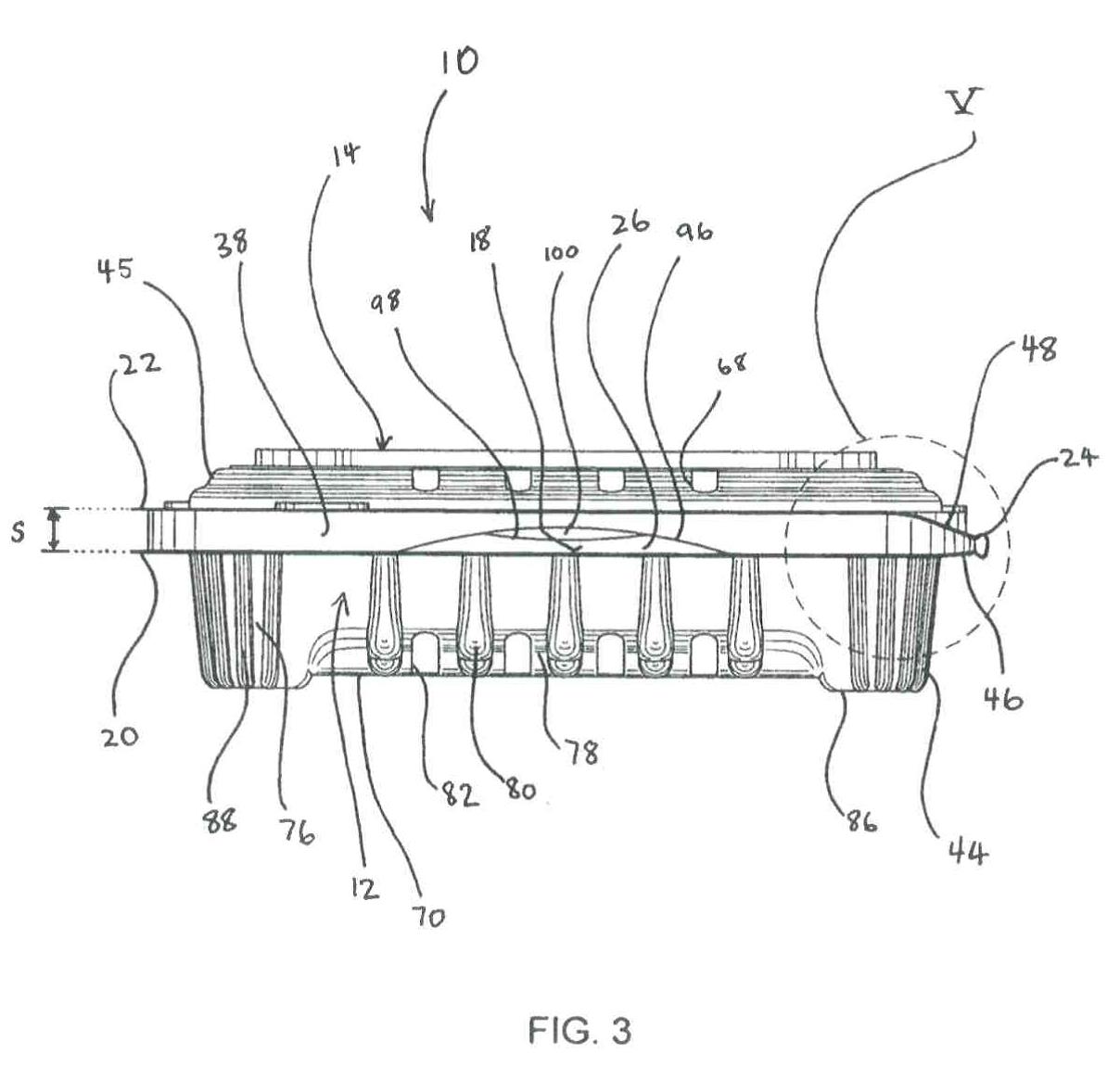
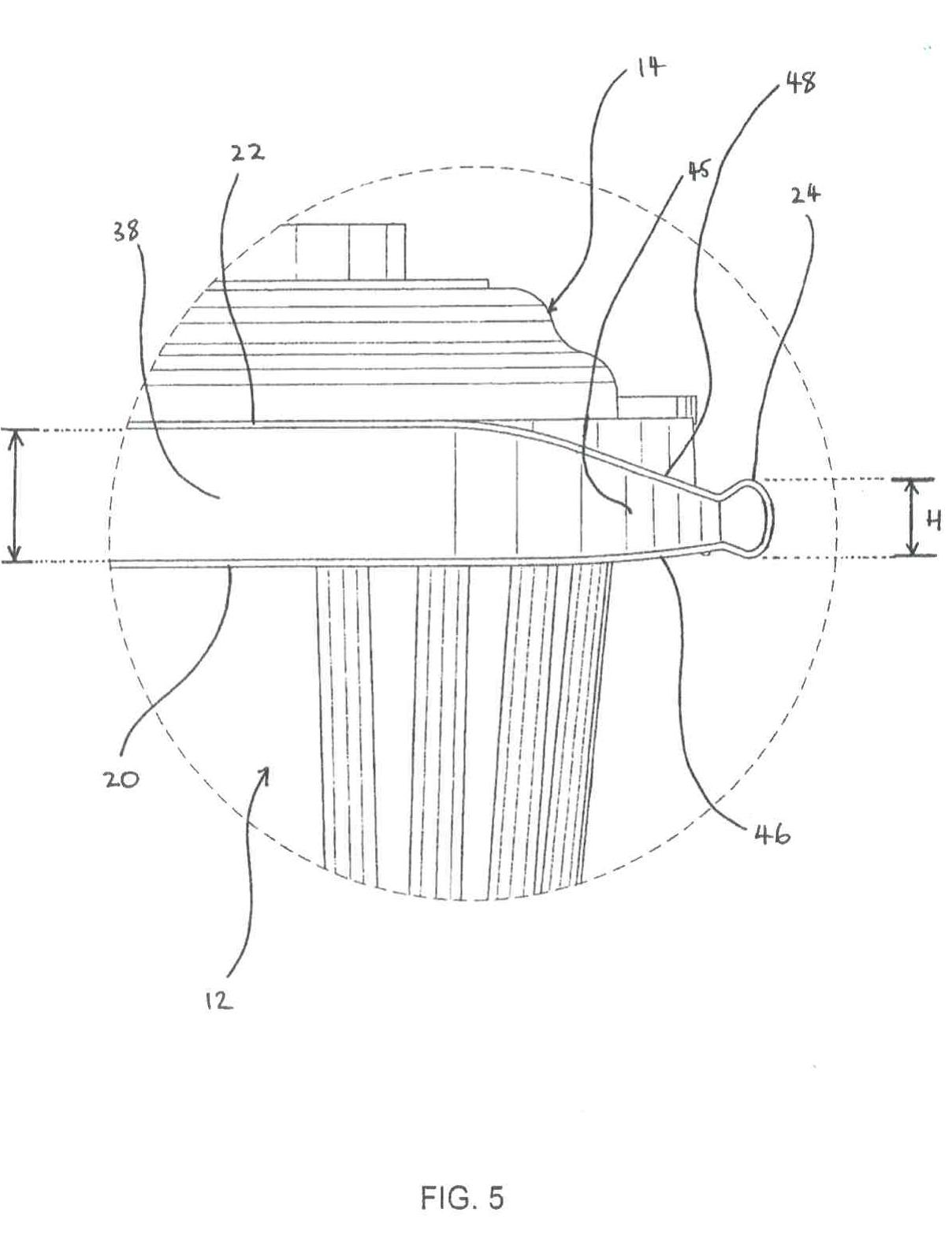
30 The specification also includes the following statement:
As the first transition portion 46 and the second transition portion 48 converge toward the hinge 24 when the lid 14 is in its closed position, it is possible to reduce the width of the connection (including the web 50 and the hinge 24) between the receptacle 12 and the lid 14 in comparison with the case where the first flange 20 and the second flange 22 are substantially parallel to each other in the region of the hinge 24. As a result, there is reduced twisting and flexing along the hinge 24. Furthermore, the amount of material required to form the connection between the receptacle 12 and the lid 14 is reduced.
31 The specification also includes a number of statements, after each description, to the effect that “… the present invention is not limited to this arrangement”. Immediately before the claims, the specification says:
It will be appreciated by persons skilled in the art that numerous variations and/or modifications may be made to the invention as shown in the specific embodiments without departing from the scope of the invention broadly described. The present embodiments are, therefore, to be considered in all respects as illustrative and not restrictive.
32 The claims defining the invention are in these terms:
1. A produce container including:
a receptacle which defines a mouth circumscribed by a rim, the rim having a first, outwardly extending flange;
a lid associated with the receptacle to close off the mouth, the lid having a second, outwardly extending flange, the second flange being spaced from the first flange when the lid is positioned on the receptacle to close off the mouth; and
a hinge which attaches the lid to the receptacle, each of the flanges being connected to the hinge by a transition portion, the transition portions converging toward the hinge when the lid is positioned on the receptacle to close off the mouth, the receptacle, the lid and the hinge being integrally formed as a one piece unit.
2. The produce container of claim 1, in which a length of at least one transition portion is greater than a spacing between the first flange and the second flange when the lid is positioned on the receptacle to close off the mouth.
3. The produce container of claim 1 or 2, in which a height of the hinge is less than the spacing between the first flange and the second flange when the lid is positioned on the receptacle to close off the mouth.
4. The produce container of any one of the preceding claims, in which the hinge is at least as long as the widest dimension of the receptacle excluding the flange.
5. The produce container of any one of the preceding claims, in which the convergence of the transition portion begins proximate opposed corners of the receptacle.
Novelty
33 The respondents rely on two pieces of prior art, Innovation Patent No. AU 2009100244 A4 (the 244 patent) and US patent No 6639199 (the 199 patent) as destroying the novelty of the invention claimed in the 641 patent. Both prior art documents were published before the priority date of the 641 patent.
34 I am aware that there was a dispute between the parties (and Mr Mebberson and Dr Field) about the meaning of these integers. The dispute was confined to the question whether the transition portions or a transition portion needed to be angled so as to converge towards the hinge when the lid is in the open position or only needed to be angled and thus converge towards the hinge when the lid is in the closed position. As explained below, a curious aspect of this case was the focus in the evidence and submissions on this issue of construction, when my inspection of the alleged infringing containers convinces me that the alleged infringing containers all have both transition portions angled towards the hinge when the lid is in the open position in any event. It is also not necessary to resolve this issue to determine the issue of novelty based on the 244 and 199 patents. Whether or not the transition portion(s) disclosed in the 641 patent must be angled towards the hinge when the lid is open, the prior art on which the respondents relied does not anticipate the invention as claimed in the 641 patent, for the reasons given below. As a result I propose to deal briefly with the construction issue in the context of infringement.
35 The 244 patent relates to a produce container. The summary of the invention describes the container as including “a plurality of lid portions arranged about the access opening of the receptacle, each lid portion being movable relative to the receptacle”. Further, the specification states that “when each lid portion is in its open position, produce can be placed into or removed from the receptacle” and “when the lid portions are in their closed position, the access opening is substantially covered”. An exemplary embodiment of the produce container is then described, including reference to figure 1 which is set out below.
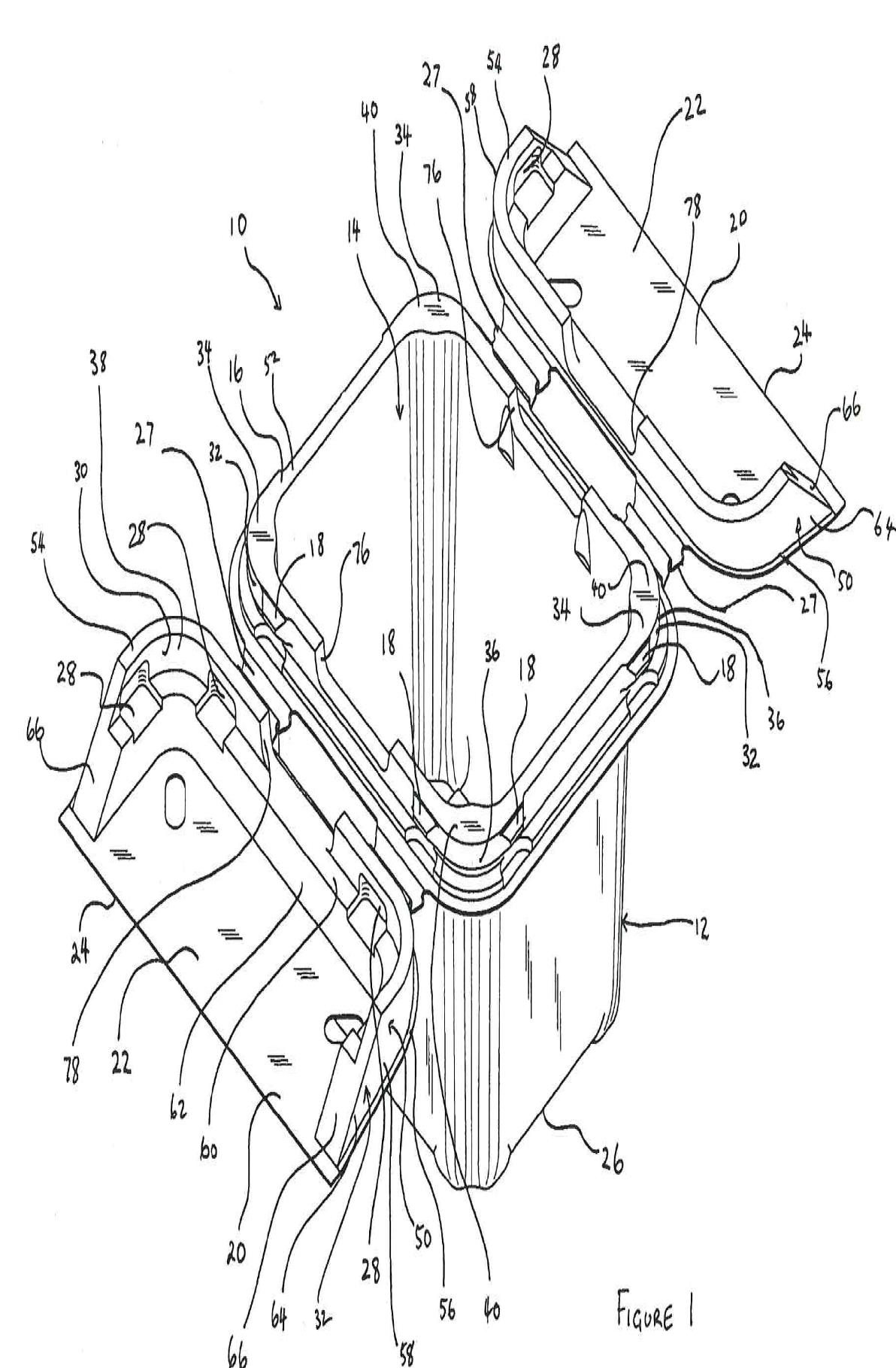
36 The claims of the 244 patent depend on claim 1, which refers to a produce container involving, as described in the specification, “a plurality of lid portions arranged about the access opening of the receptacle”.
37 Mr Mebberson considered that the 244 patent disclosed all of the integers of the 641 patent. As he put it, although there are two lids of the container in the 244 patent, when one lid is closed, the other lid may be then be used “to close off the mouth”, thus satisfying the integer of the 644 patent (identified by the parties as integer 1.4) that there be “a lid associated with the receptacle to close off the mouth”. According to Mr Mebberson the designer of a produce container would focus on the hinges in the 244 patent and would use the disclosed hinge arrangement with a single lid as in the 641 patent, the single lid not being “in any way inventive or innovative”, this modification being a simple “workshop fix”. Mr Mebberson also considered all of the other integers of claim 1 of the 641 patent (and dependent claims) were disclosed in the 244 patent.
38 Dr Field disagreed with Mr Mebberson, as do I. Claim 1 of the 641 patent is for a produce container that has “a lid” and “a hinge” which attaches to “the lid”. The 244 patent discloses a produce container which has two lids and two hinges. The argument that if one of the lids in the produce container in the 244 patent is closed, the other lid then closes off the mouth so as to satisfy the requirement that there be a lid to close off the mouth, in my view, is untenable. The disclosures of the two patents are different. Indeed, they are so different that, in common with Dr Field, I am satisfied that none of the disputed integers of the 641 patent are disclosed in the 244 patent. The container in the 244 patent does not have a second outwardly extending flange as described in the 641 patent, because it has flanges extending from both lids. Thus, the second flange is not spaced from the first flange on the rim as described in the 641 patent. Further, there is not disclosed in the 244 patent “a hinge” which attaches the lid to the receptacle because there are two hinges in the container of the 244 patent. For the same reasons, there is no transition portion as described in the 641 patent because that contemplates the transition portions from the flanges being connected to “the hinge”, which is the single hinge connecting the single lid to the receptacle. The receptacle, the lid and the hinge are also not integrally formed as a one piece unit in the 244 patent, because the container there disclosed has two lids and two hinges. Finally, in terms of claim 5, I am unable to accept Mr Mebberson’s initial evidence that the container in the 244 patent discloses a convergence of the transition portions that begins proximate to the opposed concerns of the receptacle. In oral evidence Mr Mebberson accepted that the convergence of the transition portions in the 244 patent does not begin proximate to the opposed corners of the receptacle, but this requirement, that they begin in that location, is an essential component of claim 5.
39 Mr Mebberson’s evidence that there is nothing inventive or innovative in a single lid, as opposed to two lids, and that the container disclosed in the 244 patent could be modified into the container disclosed in the 641 patent by a simple workshop fix, does not assist the respondents’ case of lack of novelty. It cannot be inferred that the invention claimed in the 641 patent would have been apparent to the ordinary skilled addressee of the 244 patent, relying only on the common general knowledge. Mr Mebberson, as noted, cannot be inferred to represent the notional skilled addressee relying only on the common general knowledge. For one thing, Mr Mebberson, from his experience and expertise, is inventive. For another, he has not purported to confine himself to knowledge which is common general knowledge to the ordinary skilled addressee. The contrary evidence of Dr Field – that although people of his and Mr Mebberson’s expertise may be able to make the necessary modifications based on what appears in the 244 patent to obtain the container of the 641 patent, the ordinary person skilled in the art could not – is persuasive.
40 Two other points should be made before I turn to the 199 patent.
41 The first is that in my view the contention that the 244 patent anticipates the 641 patent is untenable. It is not apparent to me how Mr Mebberson rationally reached his conclusions. I am not suggesting that Mr Mebberson did other than give his expert opinion honestly and fairly. My concern is that, in doing so, Mr Mebberson reached conclusions about the 244 patent which I consider are not reasonably open. This indicates that there is likely to be something awry with Mr Mebberson’s approach to the question whether the prior art documents disclose the integers of the claims of the 641 patent. It may be that the problem is that Mr Mebberson is inventive and has assumed he can bring to bear his inventiveness on the issues about which he gave evidence. It may be that the problem is that Mr Mebberson has not identified the common general knowledge of the skilled addressee clearly or reliably and has not attempted to understand the prior art documents through the eyes of the skilled addressee armed only with the common general knowledge. Whatever the cause, Mr Mebberson’s evidence about the 244 patent indicates that the whole of his evidence must be weighed with caution.
42 The second is that Mr Mebberson agreed that the 244 patent “represents a stronger piece of prior art for the court to rely upon when making conclusions about whether all the integers of claim 1 are disclosed by either the 244 or the 199 [patents]”. Given my conclusions about the 244 patent, this evidence alone indicates that Mr Mebberson’s conclusions about the 199 patent disclosing all of the integers of claim 1 of the 641 patent is unlikely to provide a secure foundation to so conclude.
43 The 199 patent describes a microwave container for evenly cooking seafood. It claims to have a hinge of dimensions that create a gap between the top and bottom portions of the container when it is closed, so that steam can pass out of the gap during cooking. There are numerous problems for the respondents’ case in respect of the 199 patent. Apart from the fundamental problem about Mr Mebberson’s evidence and his view that the 244 patent provides a stronger case for lack of novelty than the 199 patent, it was common ground that the 199 patent would not disclose so-called integers 1.8 and 1.9 of claim 1 of the 641 patent (“each of the flanges being connected to the hinge by a transition portion” and “the transition portions converging toward the hinge when the lid is positioned on the receptacle to close off the mouth” respectively) but for the inclusion of figure 5 in the 199 patent. Figure 5 appears below.
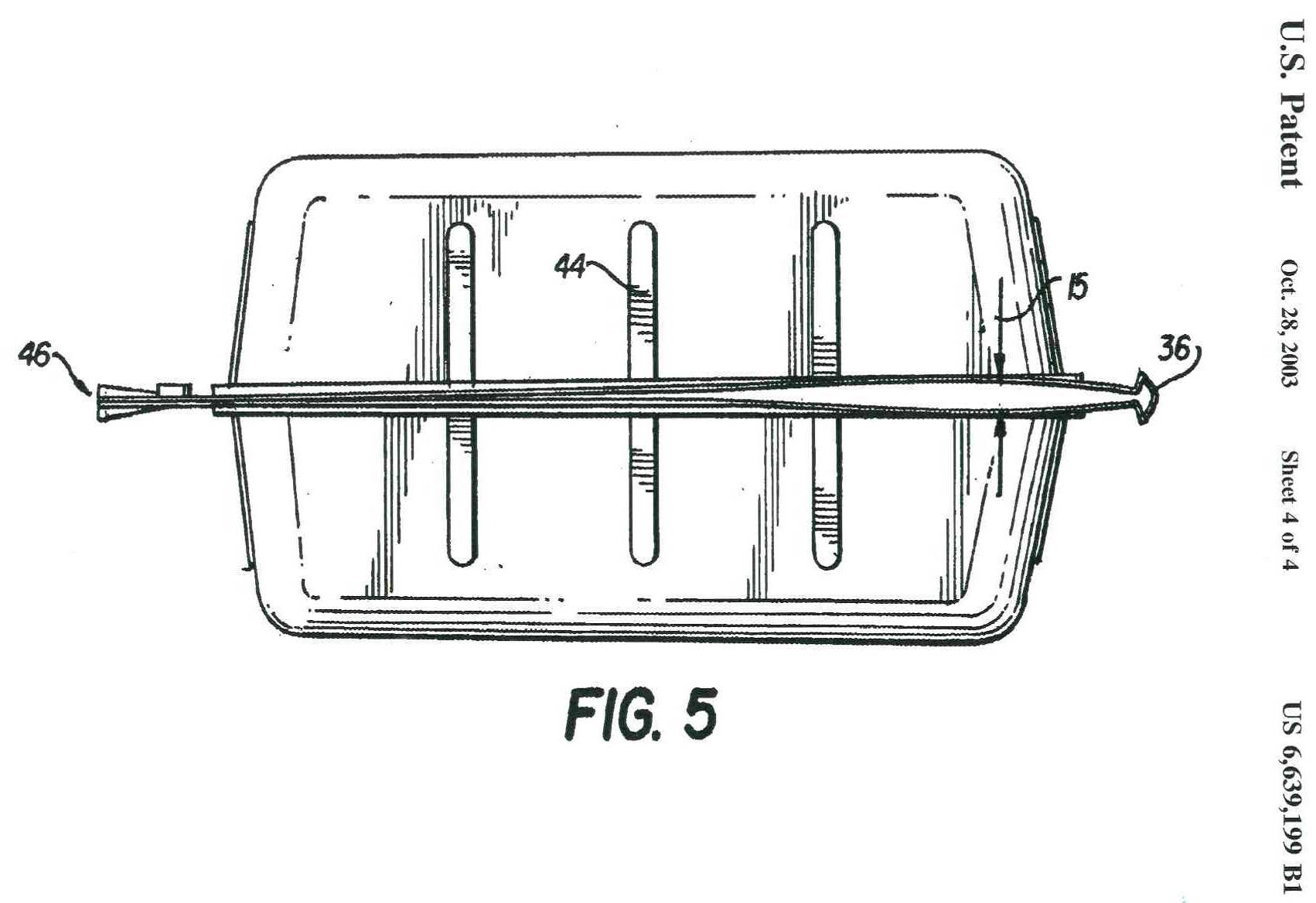
44 It was also common ground between Dr Field and Mr Mebberson that figure 5 in the 199 patent did not correctly represent the invention described in the words of the specification. Dr Field prepared a re-drawn figure 5 reflecting the words of the specification which Mr Mebberson accepted was a “fair attempt” to reflect the text, in contrast to figure 5 itself. The respondents criticised Dr Field for the attempt but I consider the criticisms misplaced. The point which Dr Field was making, and rightly so, was that the skilled addressee of the patent would not understand figure 5 to reflect the invention of the 199 patent as described and as claimed. The evidence supports the applicant’s submission that the ordinary skilled addressee of the 199 patent, armed only with the common general knowledge, would not “at once perceive, understand, and be able to practically apply the discovery without the necessity of making further experiments” so as to arrive at the invention in the 641 patent (Hill v Evans at 1195).
45 The applicant submitted that:
In order to end up with something that looked like Figure 5 as it appears in the ‘199 Patent, the person skilled in the art would have to depart from the teaching otherwise provided in the specification and Figures 1 to 4. It cannot reasonably be concluded that the person skilled in the art would depart from that teaching in favour of arriving at something that looked like Figure 5. The person skilled in the art would at least be as likely (if not more likely) to follow the teaching provided in the specification and Figures 1 to 4 and thereby arrive at something that looks like Dr Field’s drawing. There are no clear and unmistakable directions in the ‘199 Patent to arrive at something that looks like Figure 5, instead of following the teaching of the specification and figures 1 to 4 and arriving at something the looks like Dr Field’s drawing.
46 Given the evidence of Dr Field and Mr Mebberson about figure 5, and the crucial role figure 5 takes in the respondents’ case about the 199 patent destroying the novelty of the 641 patent, the thrust of this submission is persuasive. While I am mindful that the concept of the “teaching” of a patent applies in the context of obviousness rather than novelty, novelty being concerned with what the prior art discloses (Alphapharm at [178]), I am satisfied that the disclosure in the 199 patent, including figure 5 as it would be understood by the skilled addressee in the context of the 199 patent as a whole, contains no clear directions which would enable the skilled addressee to arrive at the container of the 641 patent. Still less would the skilled addressee necessarily arrive at the container of the 641 patent as a result of the disclosure in the 199 patent.
47 As the applicant noted, the specification of the 199 patent states:
FIG. 5 shows the container in a closed position. The hinge 36 is sized so that when the container is closed, a small gap 15, preferably not exceeding a ¼ inch, is provided in the sides of the container between the top and bottom flanges 32, 34. The gap 15 provides a vent for steam to exit the container. In the preferred embodiment depicted in FIG. 5, the hinge 36 is formed from a continuous piece of the container joining the top and bottom flanges 32, 34 which is molded in such a way as to create the gap 15 between the top and bottom flanges 32, 34 in the sides of the container when closed.
48 Claim 1 of the 199 patent claims a “single piece thermal-molded plastic container for microwaving food articles” which comprises, inter alia, “means for maintaining a gap between the top flange and the bottom flange when the container is in a closed position to allow steam to exit”. However, the means of creating the gap is not disclosed. In the applicant’s words:
The description of the hinge being “sized” in a way that creates a “gap” does not disclose how such a gap is created. Nor does the description of the top and bottom flanges being “molded in such a way as to create the gap” disclose how the gap is created. Moreover, with both the hinge and the flanges separately being described as being used to create the “gap”, there is no disclosure of how the hinge and the flanges interact with one another to create the “gap”.
49 Mr Mebberson thought the gap would be created by using stiff plastic in the hinge combined with the dimensions of the container, but there is no such disclosure in the 199 patent. This supports Dr Field’s evidence that the 199 patent does not disclose transition portions as described in the 641 patent even if figure 5 is taken into account as it appears in the specification. Dr Field described the flanges connecting to the hinge in figure 5 as involving a wave form rather than a convergence towards the hinge in the closed position, the flanges being bent or flexing away from and then towards the hinge to create the gap.
50 Whether Dr Field’s description is persuasive or not, the more telling point is the applicant’s proposition that there are numerous ways in which a “gap” could be created in the container described in the 199 patent by “sizing” the hinge and “molding” the flanges, and while those methods could include transition portions as described in the so-called integers 1.8 and 1.9 that is not the only way in which the gap could be created. Nor does the 199 patent disclose any direction to create the gap by transition portions as described in the 641 patent. In terms of the law of novelty, this submission is compelling. It means, as the applicant submitted, that:
a. The ‘199 Patent does not contain clear and unmistakable directions to do what the patentee claims to have invented (General Tire [General Tire & Rubber Co v Firestone Tyre & Rubber Co Ltd [1972] RPC 457 at 486]) – there are no clear and unmistakable direction to include integers 1.8 and 1.9 (i.e. to connect each flange to the hinge by a transition portion, which transition portions converge toward the hinge when the lid is positioned on the receptacle to close off the mouth);
b. The information as to the alleged invention given by the ‘199 Patent is not equal that of the 641 Patent (Hill v Evans) – the ‘641 Patent includes integers 1.8 and 1.9, whereas the ‘199 Patent does not;
c. Specific details which are necessary for the practical working and real utility of the alleged invention claimed in the ‘641 Patent are not found in the ‘199 Patent (Hill v Evans) – integers 1.8 and 1.9 are essential integers of the invention claimed in the ‘641 Patent and are necessary for the practical working and real utility of the invention; specific details about integers 1.8 and 1.9 are not found in the ‘199 Patent;
d. The direction in the ‘199 Patent to create a “gap” by “sizing” the hinge in a non-descript way, and “molding” the flanges in a non-descript way, would be at least as likely to be carried out in the way which would not result a container having integers 1.8 and 1.9 (General Tire).
51 The respondents’ contrary submissions do not confront these issues.
52 For these reasons, I am satisfied that the 199 patent does not anticipate and destroy the novelty of the invention claimed in the 641 patent.
Innovative step
53 The respondents contend that the 641 patent, in light of the common general knowledge, varies from the prior at represented by the 244 and the 199 patents, only in ways that makes no substantial contribution to the working of the invention as claimed in the 641 patent, so that the claimed invention lacks an innovative step.
54 I disagree. I have identified above the problem with Mr Mebberson’s evidence about the common general knowledge and the respondents’ contention about the MIXIM containers being common general knowledge at any material time. I have also identified my conclusion that the 244 and 199 patents do not anticipate the invention claimed in the 641 patent because numerous integers including in particular those identified as integers 1.8 and 1.9 (each of the flanges being connected to the hinge by a transition portion, the transition portion converging towards the hinge when the lid is positioned on the receptacle to close off the mouth) are not disclosed in the 244 and 199 patents. It is the convergence of the transition portions to the hinge when the lid is in the closed position as claimed which is said in the specification to result in “reduced twisting and flexing along the hinge” and reduced amount of material to form the connection between the receptacle and the lid. This alone is sufficient to satisfy the requirement of an innovative step. In the face of this, it cannot be said that the claimed invention only varies from the prior art in ways that make no substantial contribution to the working of the invention.
55 To the extent that more needs to be said, I accept the applicant’s submission that Mr Mebberson’s evidence about innovative step is too fraught with problems to provide a reliable foundation to draw any contrary conclusion. Mr Mebberson’s initial instructions wrongly focused on the question of obviousness which would be relevant to a standard but not an innovation patent. Mr Mebberson was then given instructions which asked him to identify the claims he considered contained an innovative step. As the applicant submitted, this was still the wrong question because the required focus was whether “the claimed invention only varies from the particular single prior art in a way that makes no substantial contribution to its working” (Blue Gentian at [174]). The potential for confusion was real and it seems that confusion resulted because Mr Mebberson’s evidence did not focus on the working of the invention but, rather, the overall art of designing plastic containers. Mr Mebberson’s answers also omitted reference to that part of the test dealing with substantial contribution to the working of the invention. Taken with his evidence as a whole, again it seems that Mr Mebberson may not have had the requirement of the working of the invention at the forefront of his mind when formulating his evidence.
56 It is also the case that Mr Mebberson in fact identified that the claims of the 641 patent included innovative steps, being the configuration of the hinge to allow stable closing which allows a container to be run on automatic machines. Mr Mebberson said that he recalled containers in the market that did this but that they were not apparent in the prior art “as supplied” (by Mr Dredge) and, when asked, could not identify any such containers. Mr Mebberson maintained that this “innovative step” made no substantial contribution (itself a contradiction in terms) but I find his evidence unpersuasive for the reasons given.
57 I also accept the applicant’s submission as follows, having regard to the matters discussed above:
The Respondents bear the onus of proving that the invention as claimed in the relevant claims of the ‘641 Patent only varies from ‘244 Patent and the ‘199 Patent in ways that make no substantial contribution to the working of the invention. The presence or absence of a substantial contribution is a question of fact: Dura-Post at [85]. In order to find that a particular fact has been proven, the Court “must feel an actual persuasion of its occurrence or existence before it can be found”: Briginshaw v Briginshaw (1938) 60 CLR 336 at 361. The Applicant submits that, given that the Respondents have not adduced any evidence relevant to proving whether the invention as claimed in each claim only varies from the ‘244 Patent and/or the ‘199 Patent in ways that make no substantial contribution to the working of the invention, the Court cannot reasonably feel an actual persuasion that the ‘641 Patent does not involve an innovative step.
58 I would go further and note that based on the evidence I am persuaded that the claims of the 641 patent varied from the prior art in a way that does make a substantial contribution to the working of the invention in that integers 1.8 and 1.9 result in a hinge with reduced twisting and flexing.
59 For these reasons, the challenge to the validity of claims of the 641 patent based on lack of innovative step cannot be accepted.
The 488 patent – validity
60 The 488 patent has a priority date of 31 August 2012. It is a patent for a produce container. The background to the invention set out in the specification states as follows:
An existing produce container or punnet typically includes a pair of locking arrangements being located apart near its opposing lateral sides, respectively, so as to keep its lid in a closed position. However, such a container or punnet has a shortcoming in that when an unbalanced force is exerted on the container or punnet, the lid is susceptible to popping open. This most often happens during stacking or picking up of packed containers where a force is exerted only on one side of the container or punnet resulting in popping open of the other side.
It is an object of the present invention to provide a produce container which may overcome or at least ameliorate the above shortcoming or which will at least provide a useful alternative.
61 The specification includes a “non-limiting description of a preferred embodiment” of the invention including 8 figures. Figures 1 and 8 appear below.
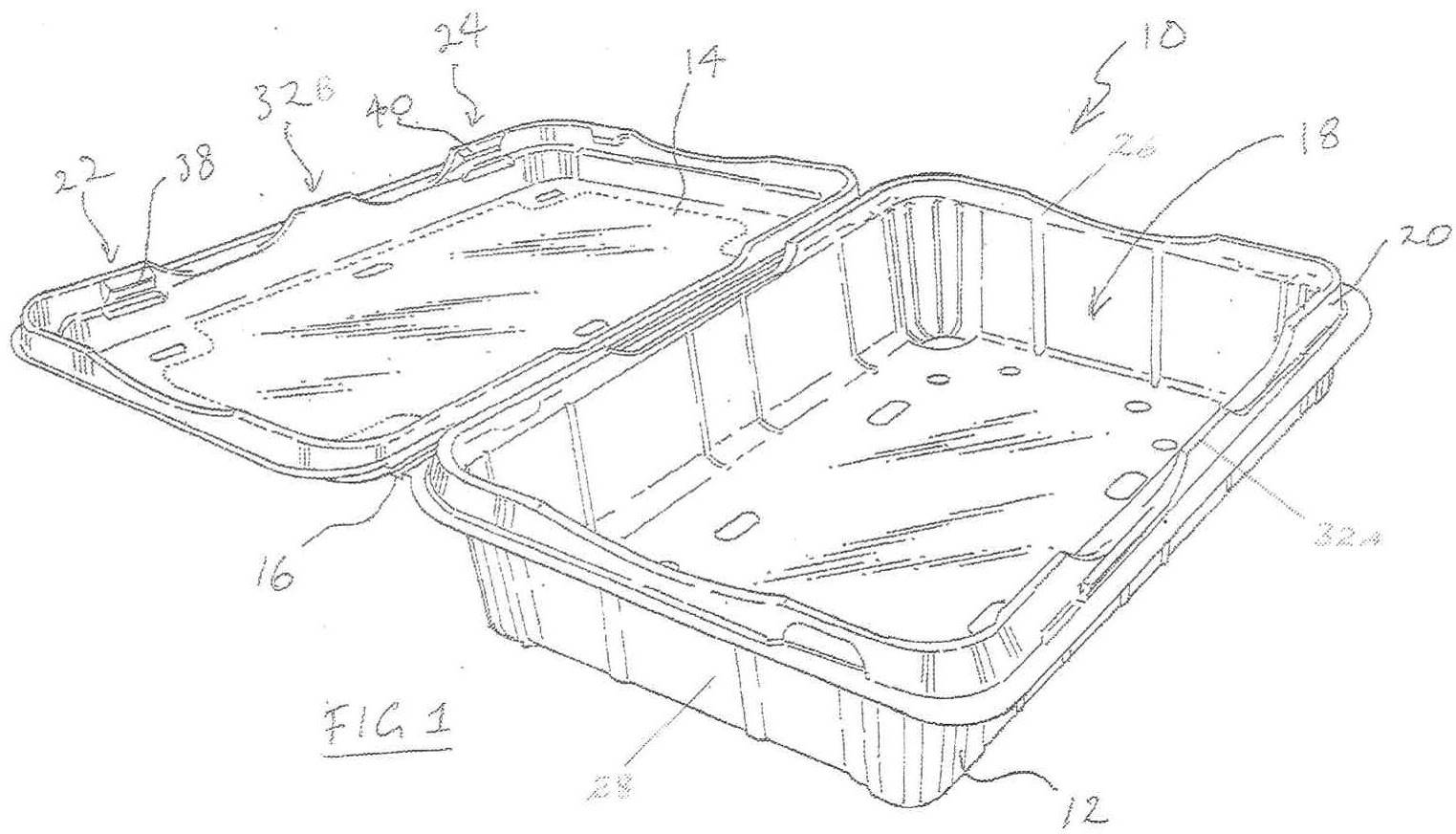
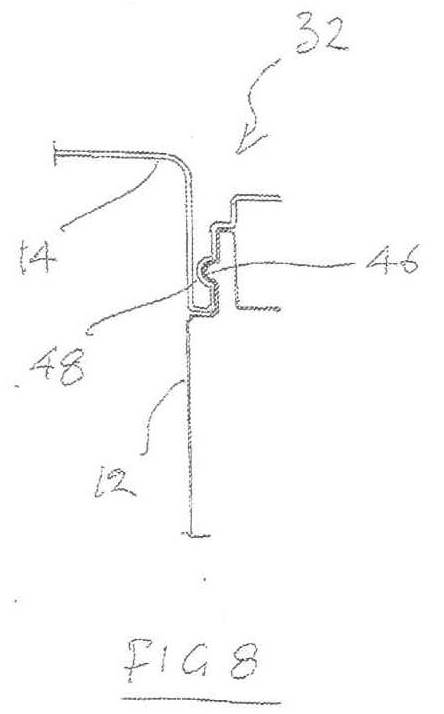
62 Claims 1 to 4 of the 488 patent (there being no challenge to the validity of claim 5) are:
1. A produce container including:
a receptacle defining a mouth circumscribed by a rim;
a lid associated with the receptacle for closing off the mouth;
a hinge located on one side of the produce container when closed, the hinge attaching the lid to the receptacle; and
first and second locking arrangements for releasably locking the lid to the receptacle, the first and second locking arrangements being located spaced apart on a side of the produce container opposite to the hinge;
wherein a third locking arrangement is provided and located between the first and second locking arrangements, the third locking arrangement including a first tongue extending in use upwardly from the receptacle towards the lid and a second tongue extending in use downwardly from the lid towards the receptacle, the first and second tongues being adapted to overlap when the lid is in a closed position; and wherein a first aperture is located in the rim between the first locking arrangement and the third locking arrangement and a second aperture is located in the rim between the third locking arrangement and the second locking arrangement.
2. The produce container of claim 1, wherein the third locking arrangement is located in the vicinity of the centre of the side of the produce container opposite the hinge.
3. The produce container of claim 1 and 2, wherein each of the first and second locking arrangements includes a projection carried on one of the receptacle and the lid and a complementary formation carried on the other of the receptacle and the lid, wherein the lid is in its closed position, the projection and complementary formation releasably engage to effect locking of the lid to the receptacle.
4. The produce container of any one of the claims 1 to 3, wherein the third locking arrangement includes a projection carried on one of the first and second tongues and a recess carried on the other of the first and second tongues, wherein the lid is in its closed position, the projection and the recess releasably engage.
Novelty
63 The respondents rely on US Patent 2008/0217330 A1 (the 330 patent) as destroying the novelty of the invention claimed in the 488 patent. The 330 patent was published before the priority date of the 488 patent.
64 The 330 patent relates to a produce container. The specification includes a detailed description as follows:
FIG. 1 is a perspective view of a large produce carrying container 102 according to some embodiments of the present invention. As seen in FIGS. 1-7, the produce carrying container 102 may be of unitary construction, that is, constructed into a single piece. The container 102 consists of a top 41 and bottom 40. The top 41 of the container 102 has been folded over and clasped using the button locks 44, 45 onto the bottom 40 of the container 102. The button locks are typically a round extrusion on one side and a mating recess on the mating piece that lock with a mild interference fit. The button locks are adapted to be locked with relatively minor force, and to be unlocked with similar force. The container 102 is substantially rectangular in nature, and has a long side 61 and a sort side 60.
65 Figure 1, as referred to in this part of the specification, appears below.
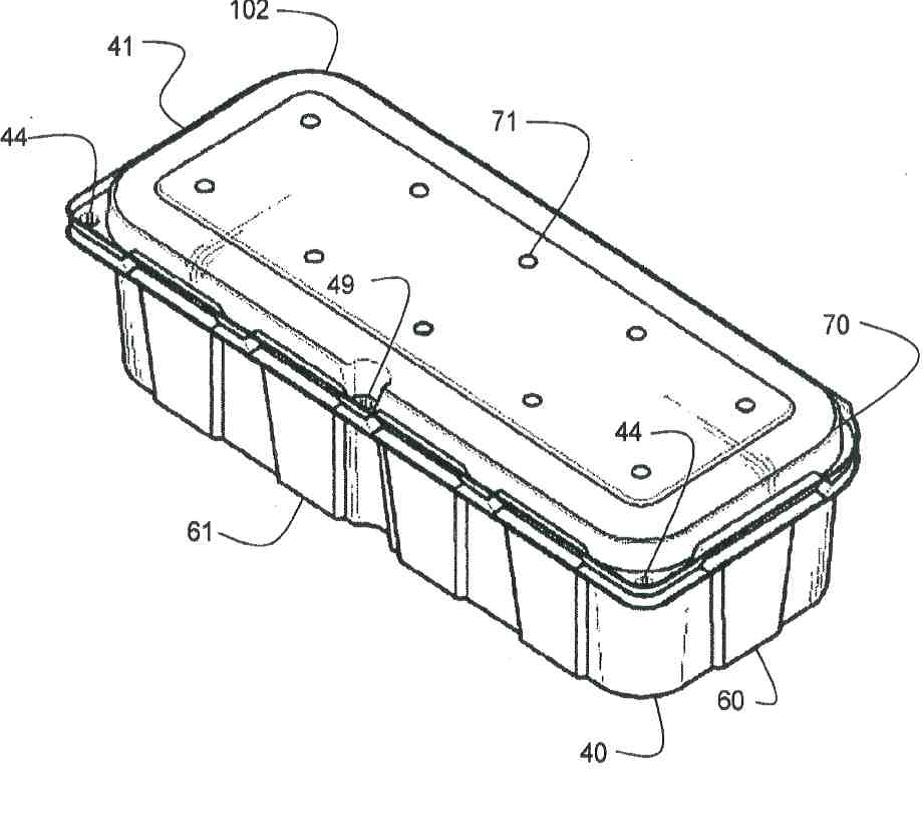
66 The respondents acknowledged that neither Dr Field not Mr Mebberson considered that so-called integer 1.10 of the 488 patent (the first and second tongues being adapted to overlap when the lid is in the closed position) is disclosed in the 330 patent. The respondents, however, contend that I should conclude that integer 1.10 is taken because it is apparent that Mr Mebberson believed a button lock included a tongue and in the 330 patent the tongues are adapted to overlap as required by integer 1.10. As the respondents put it:
If one considers the protrusion or the button for example from the receptacle and the corresponding hole completely covers the protrusion, it is submitted that the hole is “overlapping” the protrusion. The same position exists if the protrusion is in the lid and descended into the matching hole (as here) so that the protrusion is, using Dr Field’s words, “nested” in the groove. The groove or hole would then be overlapping and covering the protrusion.
67 I do not accept this submission. Mr Mebberson agreed that a button lock (which is what is disclosed in the 330 patent) does not involve a tongue, that a button lock does not lock by two tongues, and that the recess or cavity into which the button part of the lock may be inserted in a button lock is not a tongue. I agree. Given this, it cannot be the case that a button lock satisfied the description of the third locking arrangement in claim 1 of the 488 patent.
68 Further, whether a tongue means a protrusion which is of greater length than width or not (a view which Dr Field held), the 330 patent is showing a kind of lock in which the protrusion from the lid is adapted to sit within the recess or cavity in the base. The locking mechanism of the 330 container does not accord with the description in claim 1 of the 488 patent that “the third locking arrangement include[s] a first tongue extending in use upwardly from the receptacle towards the lid and a second tongue extending in use downwardly from the lid towards the receptacle, the first and second tongues being adapted to overlap when the lid is in a closed position”.
69 Claims 2 to 4 are dependent on claim 1 and thus the same conclusion applies to these claims.
70 The 330 patent does not anticipate claims 1 to 4 of the 488 patent for these reasons.
Innovative step
71 The respondents also contend that the invention as claimed in claims 1 to 4 of the 488 patent lacked an innovative step having regard to the 330 patent. As for the 641 patent, Mr Mebberson concluded that claim 1 involves an innovative step described as an additional lock between the corner locks to increase lid security but said this was a “standard workshop practice”, “obvious” and thus did not make a “significant contribution”.
72 Again, I disagree. Mr Mebberson’s evidence about innovative step in the context of the 488 patent suffers from the same problems as identified for the 641 patent. The lack of focus on the required matters in his evidence (resulting from his instructions which first involved the test for inventive step when this was irrelevant) is apparent in the use of the word “significant” when the question asked whether there was a “substantial contribution”. As for the 641 patent, Mr Mebberson’s answers omitted reference to that part of the test dealing with substantial contribution to the working of the invention. Taken with his evidence as a whole, again it seems that Mr Mebberson may not have had the requirement of the working of the invention at the forefront of his mind when formulating his evidence. His evidence also appears to be based, at least in part, on the concept of obviousness (relevant to inventive but not innovative step). Thus, Mr Mebberson considered that the tongue arrangement of the third locking mechanism was an “obvious” fix. But a variation from the prior art may make a substantial contribution to the working of the invention as claimed, even if the variation would have been obvious in the sense that term is used in the context of inventive step. Indeed, Mr Mebberson accepted that the third locking arrangement increased the security of the lid in the invention as claimed in claim 1 of the 488 patent. This is sufficient to satisfy the requirement of a substantial contribution to the working of the invention.
The 641 patent - infringement
73 As foreshadowed above, although evidence and submissions focused on so-called integer 1.8 of claim 1 of the 641 patent (each of the flanges being connected to a hinge by a transition portion), this was a result of the respondents’ contention that the alleged infringing containers have a transition portion which is flat and not angled towards the hinge when the lid is in the open position. As a matter of fact, I disagree with this contention. Each of the alleged infringing containers has transition portions connecting the flanges to the hinge which are angled towards the hinge, even when the lid is in the open position. It is true that some containers show a greater angle towards the hinge than others. It is also true that some containers show slight deformities which, I infer, result from the fact that the containers are used. But I am satisfied that if, as the respondents contend, the transition portion in claim 1 must involve an angle towards the hinge when the lid is open, then that integer is present for both transition portions in each of the alleged infringing containers.
74 For this reason, the disputed issue of construction seems to me to be moot. If it must be resolved, I would prefer the applicant’s submissions (which included the evidence from Mr Jones, patent attorney, which it was agreed is to be treated as submissions) to those of the respondents. The claims must be construed in light of the specification as a whole. It may be accepted what when the specification refers to the transition portions it refers to them as angled. However, it is also apparent that the angling that the specification has in mind is towards the hinge when the lid is closed. This accords with the fact that so-called integer 1.8 is also to be read in the light of so-called integer 1.9 (the transition portions converging towards the hinge when the lid is positioned on the receptacle to close off the mouth). This indicates that the angle of the transition portions, when the lid is in the open position, is immaterial. It is when the lid is closed that the transition portions must converge towards the hinge according to integer 1.9.
75 The respondents’ contrary submissions (including the evidence of Mr Dredge which it was agreed is also to be treated as a submission) are not persuasive. As the applicant noted, all of the arguments against infringement of claims 1, 2, 3 and 5 depended on the respondents’ construction of the meaning of transition portion (which I do not accept) and the contention that the containers in issue have a flat transition portion in the open position (which I also do not accept).
76 This being the extent of the respondents’ arguments against infringement of claims 1, 2, 3 and 5 of the 641 patent, I conclude that the first respondent’s containers 1 to 7 infringe these claims as the applicant contends.
The 488 patent - infringement
77 The respondents concede that the first respondent’s containers 5, 7 and 8 infringe claims 1 to 4 of the 488 patent if, as I have concluded, the 488 patent is valid.
Designs
Statutory provisions and principles
78 The designs in dispute are registered design AU 331565 (the 565 design) which has a priority date of 7 June 2010 and registered design AU 345628 (the 628 design) which has a priority date of 31 August 2012. The designs are said to be invalid on the ground that they lacked distinctiveness at their respective priority dates.
79 By s 15(1) of the Designs Act 2003 (Cth) a design “is a registrable design if the design is new and distinctive when compared with the prior art base for the design as it existed before the priority date of the design”. The prior art base, under s 15(2), consists of designs publicly used in Australia or published in a document within or outside Australia or disclosed in a design application with an earlier priority date than the design in question. Under s 5, a “design” in relation to a product “means the overall appearance of the product resulting from one or more visual features of the product”. By s 7(1) “visual feature”, in relation to a product, includes the shape, configuration, pattern and ornamentation of the product.
80 As noted, the respondents do not contend that the 565 and 628 designs are not new, the challenge to validity being confined to an alleged lack of distinctiveness when compared with the prior art base. This is relevant because s 16 of the Designs Act provides that:
(1) A design is new unless it is identical to a design that forms part of the prior art base for the design.
(2) A design is distinctive unless it is substantially similar in overall impression to a design that forms part of the prior art base for the design (see section 19).
…
81 Section 19 of the Designs Act is in these terms:
(1) If a person is required by this Act to decide whether a design is substantially similar in overall impression to another design, the person making the decision is to give more weight to similarities between the designs than to differences between them.
(2) The person must also:
(a) have regard to the state of development of the prior art base for the design; and
(b) if the design application in which the design was disclosed included a statement (a statement of newness and distinctiveness ) identifying particular visual features of the design as new and distinctive:
(i) have particular regard to those features; and
(ii) if those features relate to only part of the design - have particular regard to that part of the design, but in the context of the design as a whole; and
(c) if only part of the design is substantially similar to another design, have regard to the amount, quality and importance of that part in the context of the design as a whole; and
(d) have regard to the freedom of the creator of the design to innovate.
(3) If the design application in which the design was disclosed did not include a statement of newness and distinctiveness in respect of particular visual features of the design, the person must have regard to the appearance of the design as a whole.
(4) In applying subsections (1), (2) and (3), the person must apply the standard of a person who is familiar with the product to which the design relates, or products similar to the product to which the design relates (the standard of the informed user).
(5) In this section, a reference to a person includes a reference to a court.
82 Section 74 of the Designs Act provides that a defendant in infringement proceedings in respect of a registered design may apply, by way of counter-claim in the proceedings, for the revocation of the registration of the design under s 93. By s 93 of the Designs Act, the Court may revoke a registered design on grounds that include that the design was not a registrable design at its priority date. In other words, a registered design may be revoked if, at the priority date, the design was not distinctive as required by s 15(1), which engages the presumption in s 16(2) (“[a] design is distinctive unless it is substantially similar in overall impression to a design that forms part of the prior art base for the design (see section 19)”). By s 71(1)(a) a person infringes a registered design if, during the term of registration of the design, and without the licence or authority of the registered owner of the design, the person makes or offers to make a product, in relation to which the design is registered, which embodies a design that is identical to, or substantially similar in overall impression to, the registered design. According to s 71(3), in determining whether an allegedly infringing design is substantially similar in overall impression to the registered design, a court is to consider the factors specified in s 19.
83 In GM Holden Ltd v Paine [2011] FCA 569; (2011) 281 ALR 406 at [38] Gordon J provided the following summary of the applicable principles:
The principles relevant to infringement of designs registered under the Designs Act were conveniently summarised in LED Technologies Pty Ltd v Elecspess Pty Ltd (2008) 80 IPR 85 at [68]–[83]. As those paragraphs make clear:
1. infringement is determined by comparing the allegedly infringing product against the registered design, not by comparing a product embodying the registered design against the infringing product: s 71;
2. infringement is determined by comparing only the visible features of the design to the infringing product: ss 7 and 19;
3. the court assesses whether the allegedly infringing design is substantially similar in overall impression to the registered design by comparing the allegedly infringing product to the registered design in the context of the whole appearance of the designs: see s 71 (read with s 19 of the Designs Act);
4. the whole appearance is relevant as the context for the design even though, strictly, the design is only the distinctive visual features of the product. Greater weight is given to distinctive features than to other parts of the design, although still in the context of the whole of the appearance; and
5. in determining whether a design is infringed the court must give more weight to similarities between the designs than to differences between them: s 19(1).
84 In Bluescope Steel Ltd v Gram Engineering Pty Ltd [2014] FCAFC 107; (2014) 313 ALR 311 at [22] Besanko and Middleton JJ said:
The connection between the scope of the monopoly protected by a registered design, including questions of novelty and originality on the one hand and questions of infringement on the other, has been discussed in a number of cases. The principles are not controversial and it is sufficient to refer to the following observations of Lockhart J in Dart Industries v Decor Corporation (1989) 15 IPR 403 (‘Dart Industries’) at 409:
The scope of a registered design must be determined with reference to the background of the prior art at the priority date and questions of infringement and novelty or originality are connected. In Hecla Foundry Co v Walker, Hunter & Co (1889) 14 App Cas 550 Lord Herschell said at 555: “… one may be able to take into account the state of knowledge at the time of registration, and in what respects the design was new or original, when considering whether any variations from the registered design which appear in the alleged infringement are substantial or immaterial.”
Where novelty or originality is discovered in slight variations, there cannot be infringement without a very close resemblance between the registered design and the article alleged to be an infringement of the design. Lloyd-Jacob J in Rosedale Associated Manufacturers Ltd v Airfix Products Ltd [1956] RPC 360 at 364 said that the court would have regard to what was “known and old”, and: “… if the particular features which provide a novel conception have not been reproduced in the alleged infringement, the similarity of appearance between the article complained of and the registered design if present must necessarily reside in the common possession of characteristics which are free to everybody to employ.” See also Macrae Knitting Mills Ltd v Lowes Ltd (1936) 55 CLR 725 per Dixon J at 731 and L J Fisher & Co Ltd v Fabtite Industries Pty Ltd (1978) 49 AOJP 3611 per Fullagar J at 3620.
85 In Hunter Pacific International Pty Ltd v Martec Pty Ltd [2016] FCA 796; (2016) 121 IPR 1 Nicholas J said:
[39] The question whether two designs are substantially similar is ultimately a question for the Court to decide applying the standard of the “informed user”. The informed user is a notional person who is taken to be familiar with the product to which the design relates or products similar to the product to which the design relates. The informed user will also be taken to have a familiarity with the Registered Design and the product that is alleged to infringe based upon a careful and deliberate visual inspection. Section 19 of the Act contemplates that the Court will have regard to all the similarities and the differences between the visual features of the two designs in coming to its ultimate conclusion. Hence, the relevant comparison cannot be based upon a fleeting or casual inspection of the drawings or object in question or some “imperfect recollection” of either of them. That is not to deny that the comparison to be undertaken is essentially impression based. I therefore respectfully agree with the following statement of Yates J in Multisteps Pty Ltd v Source & Sell Pty Ltd (2013) 214 FCR 323 ; 309 ALR 83 ; 105 IPR 342 ; [2013] FCA 743 at [55]:
… although the test is based on impression, it is not based merely on a casual comparison between designs for a given article. There needs to be a studied comparison based on the prescriptions of s 19 of the Designs Act. Thus, the notion of “imperfect recollection”— familiar in trade mark law — has no application when determining design similarity …
[40] In the present case the informed user should also be taken to be a person who has an understanding of the manner and extent to which the design of a ceiling fan hub is dictated by function: Proctor & Gamble Company v Reckitt Benckiser (UK) Ltd [2007] All ER (D) 133 (Oct); (2007) 73 IPR 605 ; [2007] EWCA Civ 936 at [29].
[41] It is, of course, necessary to focus on the overall impression created by the two designs. This is done not by ignoring matters of detail, but by assessing the impact of particular visual features, including any matters of detail, on the overall impression created by each of the two designs. It is the overall impression that constitutes the critical measure of comparison. In Vinidex Tubemakers Pty Ltd v Griffen Brook Pty Ltd (1991) AIPC 90-839 at 37,954 Foster J said:
Clearly a balanced consideration is required, one that focuses upon the total impression created by the respective material, but does not ignore matters of detail, particularly where those matters appear readily on inspection.
His Honour was dealing with an allegation of “obvious imitation” under the Designs Act 1906 (Cth) (the 1906 Act) but I think His Honour’s observation also provides useful guidance for assessing whether two designs are “substantially similar in overall appearance” under the 2003 Act.
The evidence
86 The applicant relied on the evidence of Mr Rickards and the respondents on the evidence of Gilad Sadan about the designs. In common with the approach to Dr Field’s evidence, the respondents made a number of unjustified submissions about Mr Rickard’s evidence, primarily based on the joint report. In short, before the conference between the experts Mr Rickards had expressed the view that the relevant containers, containers 5, 7 and 8, were substantially similar to the 628 design and Mr Sadan had expressed the view they were similar but not substantially similar. Mr Rickards had also expressed the view that the designs were not substantially similar to the prior art on which the respondents relied whereas Mr Sadan considered that the designs were substantially similar with that prior art. The experts were asked to deal with a series of questions in the joint report, each question asking about “substantial” similarity or not. The text of the joint report, however, contains no reference to the qualifier “substantial”, the experts instead expressing themselves in terms of “similar” or not “similar”. Extensive and repetitive oral evidence established that by “similar” in the joint report Mr Rickards meant “substantially similar” (that is, his opinions had not changed) whereas Mr Sadan, in some respects, had changed his opinions (in a manner adverse to the respondents’ case).
87 The respondents submitted that Mr Rickards’ evidence should not be accepted because:
(1) There is no suggestion in the joint report that Mr Rickards meant “substantially similar” when the joint report says “similar” or that he continued to hold the view the containers or designs were “substantially similar” or so informed Mr Sadan.
(2) It was “misleading and improper” for Mr Rickards to refer to “similar” if he meant “substantially similar”. It is more likely Mr Rickards changed his opinions in the joint report and then changed them again in oral evidence.
(3) The joint conference process miscarried in such a serious way that Mr Rickards’ evidence is unreliable.
(4) Mr Rickards was confused about other issues such as whether the lid of the container in the 628 design was flat. He also gave contradictory evidence about other features.
88 I reject all of these submissions. There is no doubt that the experts jointly framed their report in the terms they did because they believed (wrongly) that this would be of greater assistance to the Court. Mr Rickards and Mr Sadan were both responsible for the joint report. There is also no doubt that, through the oral evidence, the opinions of each became clear, when they were not clear in the joint report. There is no basis for the submission that Mr Rickards misled Mr Sadan. Nor did I find Mr Rickards’ evidence confusing or contradictory. The fact that Mr Rickards could not instantly recall every aspect of the designs and containers and needed to correct himself about the lid of the 628 design is immaterial. Similarly, the questions he was asked were repetitive and it is unsurprising that his concentration flagged on a couple of occasions. The occasions when this occurred were few and he quickly realised when he had answered incorrectly. There is nothing in this to raise any concern about Mr Rickards’ evidence. Both he and Mr Sadan gave cogent oral evidence which clarified their respective positions beyond any reasonable argument. The submission that Mr Rickards should be inferred to have changed his mind in the joint report and then changed it again in oral evidence is untenable. Mr Rickards gave clear and cogent evidence about his opinions, as did Mr Sadan. It is Mr Sadan who, in some material respects, changed his views. The fact that Mr Sadan did so is not to be criticised in any way. Mr Sadan was bound to explain his opinions as they existed at the time he gave evidence and, in common with Mr Rickards, did so clearly and cogently.
89 The respondents also submitted, as is the case, that unlike Mr Sadan, Mr Rickards did not design and make plastic containers. Rather, he dealt in the containers the applicant designed and his design input was confined to instructing the applicant about design changes that he considered should be made. As a result, the respondents said Mr Rickards was not able to assist the Court about how an informed user would regard the designs. I do not accept this submission. Mr Rickards dealt with plastic containers of the kind which this case concerns for more than a decade. He understood the design requirements of such containers and gave instructions about design requirements even he did not design and make containers.
The 565 design – validity
90 The respondents contend that the 565 design lacked distinctiveness having regard to Australian Patent No. 2010100195 (the 195 patent), Australian Registered Design No. 330158 (the 158 design) and Australian Registered Design No. 330159 (the 159 design). It is common ground that the 158 design and the 159 design are the same so that conclusions about the 158 design will apply to the 159 design. It is also common ground that the prior art was published before the priority date of the 565 design.
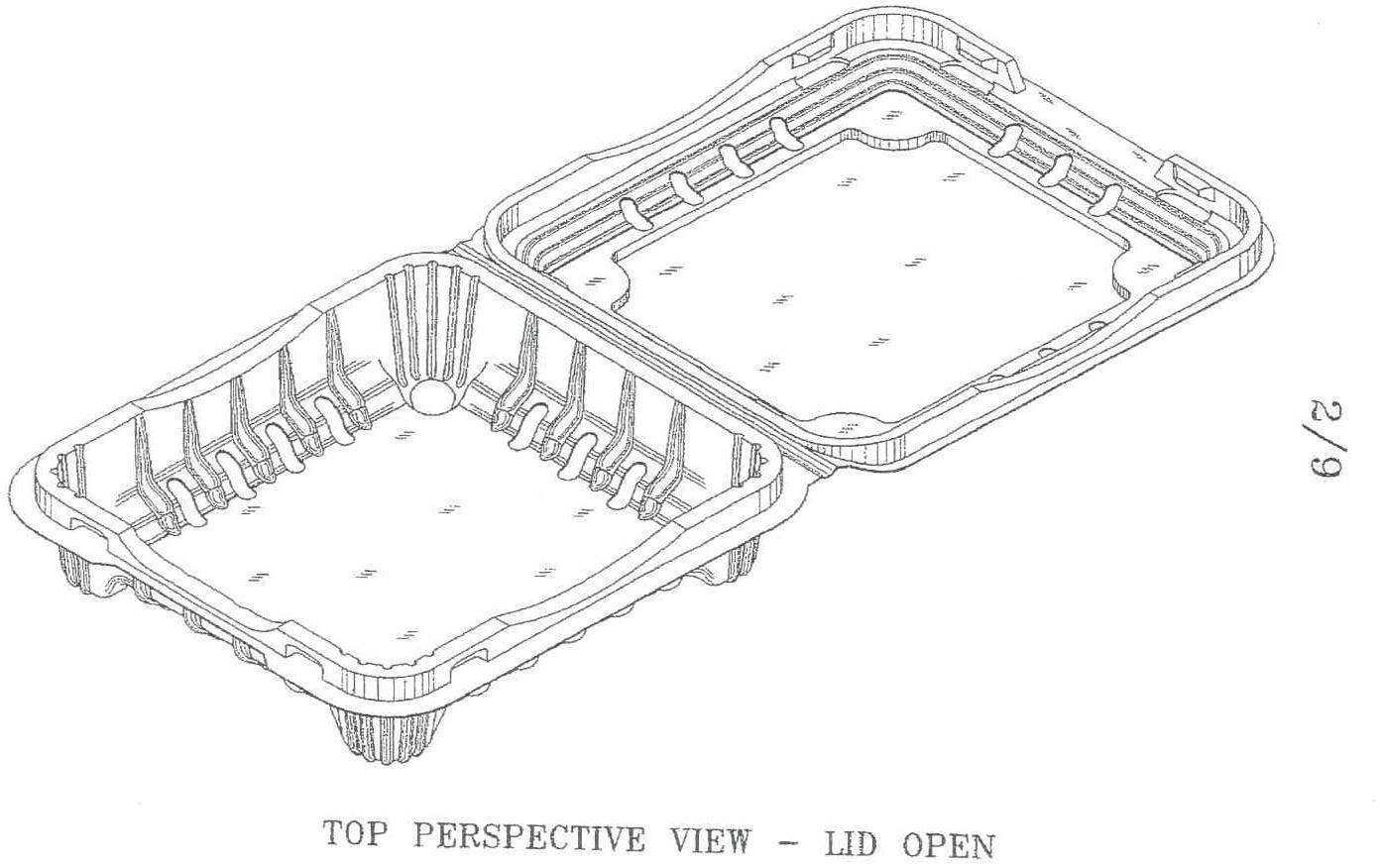
91 Perspective views of the 565 design with the lid closed and open appear below.
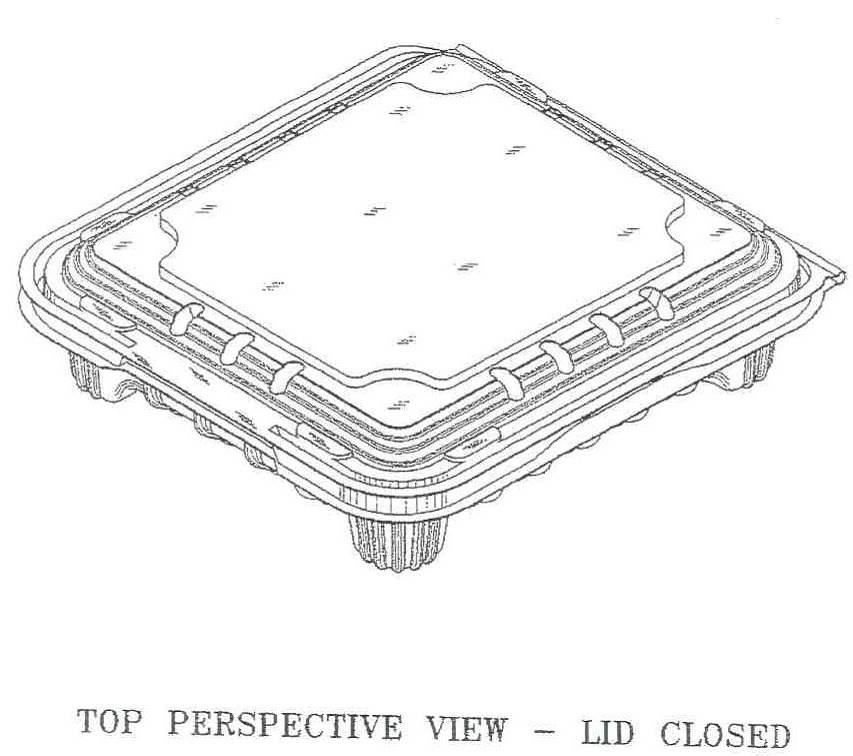
92 The 195 patent is for a produce container, an exemplary embodiment of which is contained in drawings including figures 1 and 2 which appear below.
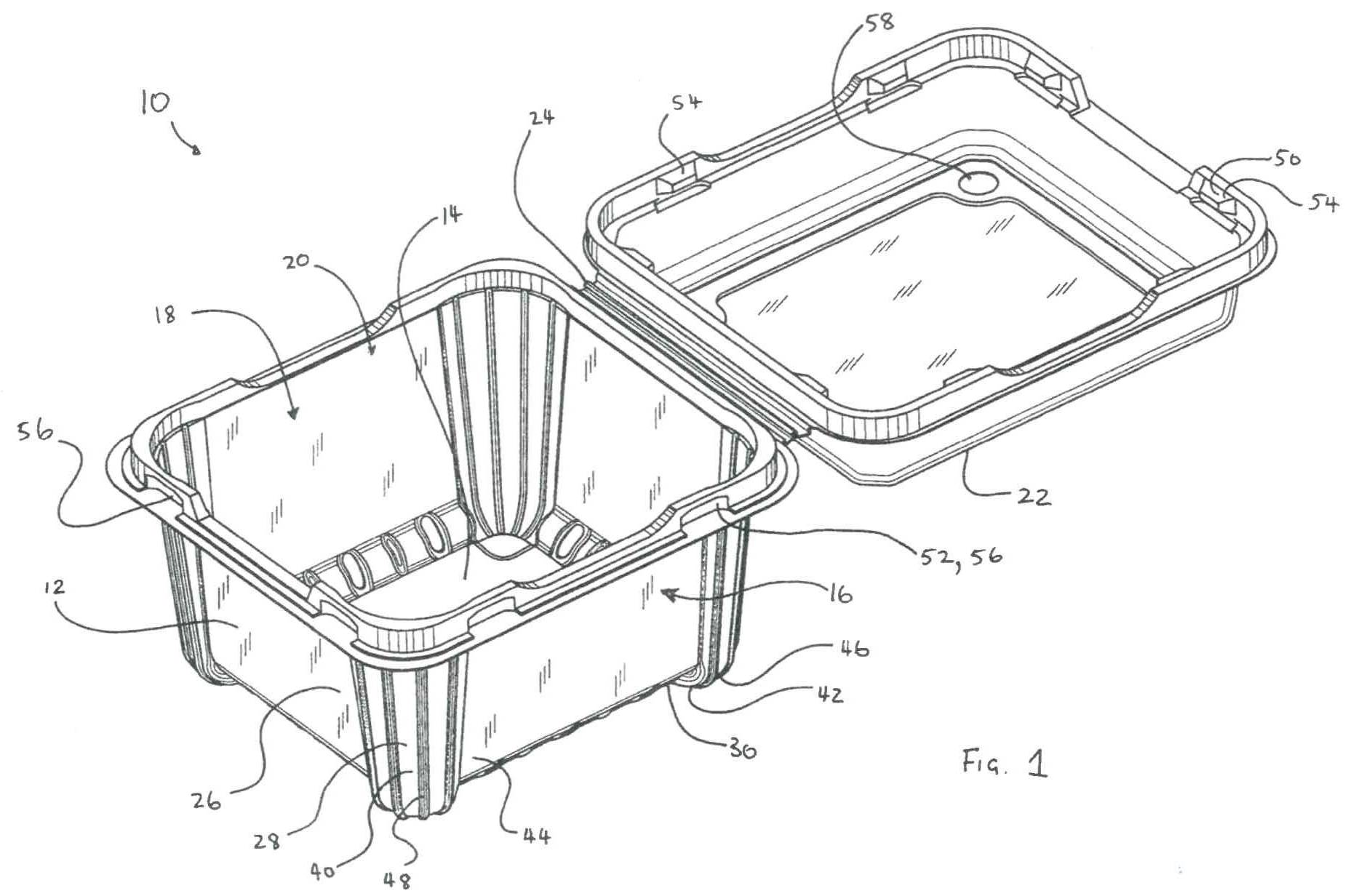
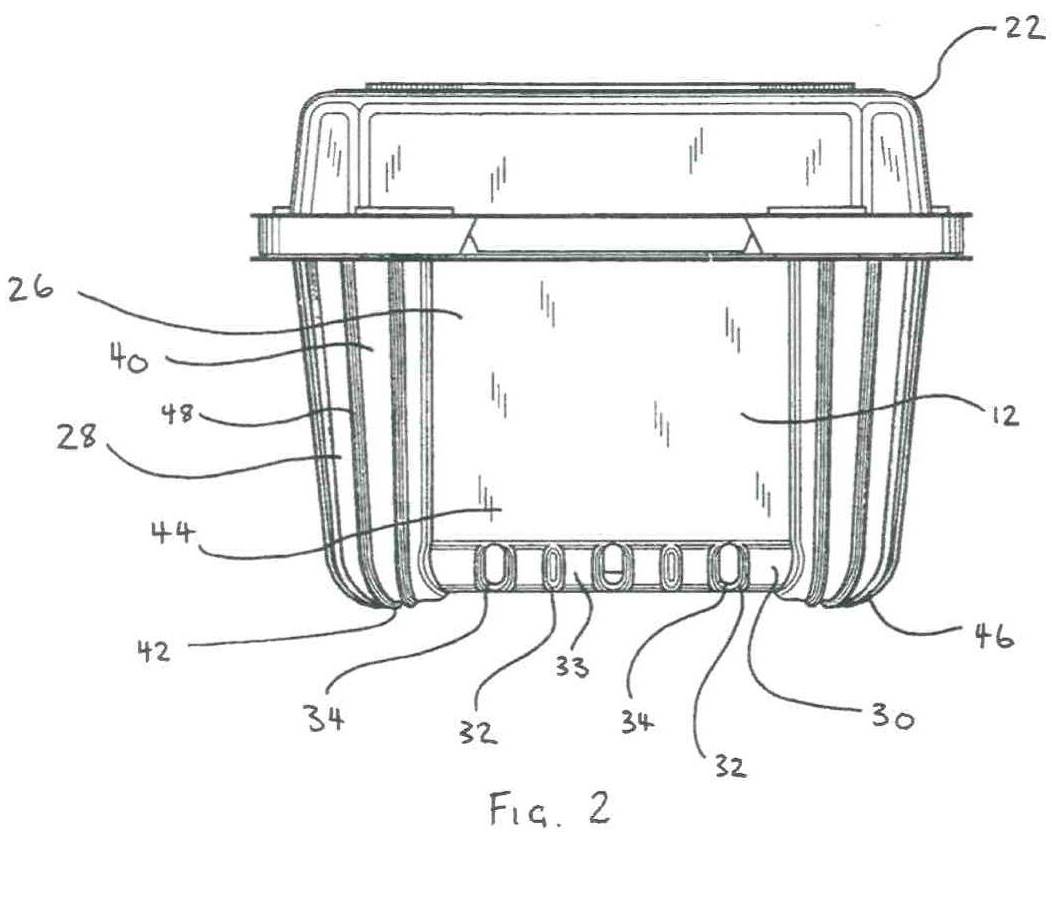
93 In oral evidence Mr Rickards and Mr Sadan confirmed that they held the same ultimate opinion, that the 195 patent is similar to but not substantially similar to the 565 design. Mr Rickards focused on the three steps surrounding the raised platform on the lid, the apertures cut into the steps of the lid, and the strengtheners on the side walls of the 565 design which do not appear in the 195 patent, as well as the fact that the container in the 565 design is smaller, being squat and less voluminous than the container in the 195 patent. Mr Sadan had said the designs were substantially similar in his initial evidence, said they were similar in the joint report, but in oral evidence clarified that having considered the designs further he was of the view that they were “similar in overall impression, but not substantially similar in overall impression”. This was so despite Mr Sadan’s view that the design in the 195 patent also had a stepped lid, a view with which Mr Rickards disagreed.
94 Despite Mr Sadan’s changed conclusion the respondents submitted that the features of similarity he identified, giving more weight to similarities between the designs than to differences between the designs, were sufficient to support a conclusion of substantial similarity. These features comprised the shape, the raised lid, the locking lugs, the apertures, the ribbing, the ventilation slots, and the raised feet. The respondents also submitted that Mr Sadan had not given any reason for his changed view (an argument which fails to appreciate that we are concerned with matters of impression).
95 Taking into account the whole appearance of the designs and giving more weight to the similarities than the differences, I consider that an informed user would not perceive a substantial similarity in overall impression between the design in the 195 patent and the 565 design. I find Mr Rickard’s evidence (and Mr Sadan’s ultimate conclusion in oral evidence that the two designs are not substantially similar in overall impression) persuasive. If there is stepping of the lid in the design in the 195 patent, it is minor and does not take the same appearance as the lid in the 565 design. The feet of the 565 design are different from the slight projections beyond the base in the 195 patent. The lid apertures in the 565 design are also different. The side strengtheners in the 565 design are also different and do not appear in the 195 patent on the sides of the container. The overall impression, leaving aside the different depth of the container, is not one of substantial similarity.
96 The 158 and 159 designs, as noted, may be taken to be the same. The 158 design, depicting the container with its lid closed and open, appears below.
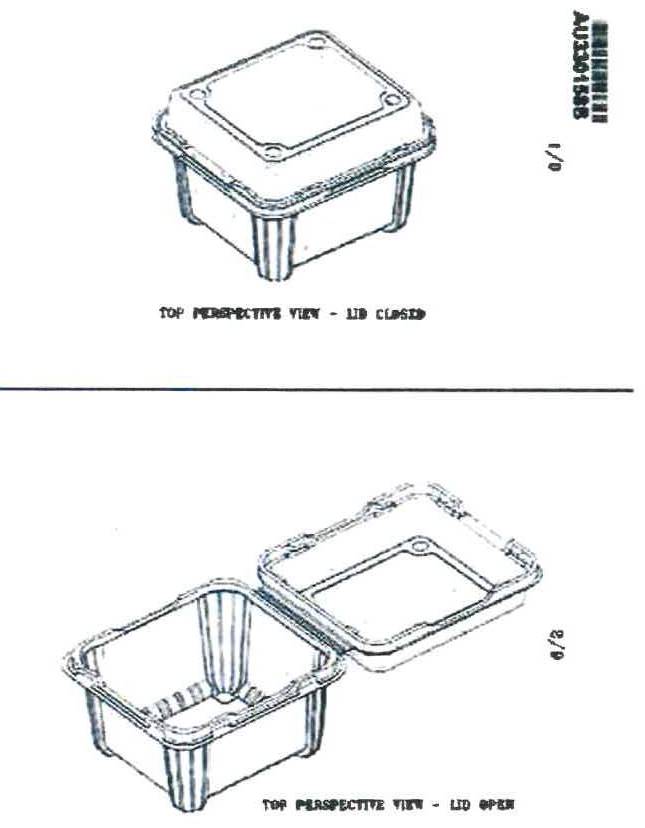
97 Mr Rickards identified the three steps surrounding the raised platform on the lid, the apertures in the steps on the lid, the heavily ribbed pillars, the strengtheners in the side walls, and the squat shape of the 565 design as different from the 158 and 159 designs. Consistent with his approach to the 195 patent, Mr Sadan initially concluded that the designs were substantially similar but, in oral evidence, changed his conclusion to the designs being similar but not substantially similar in overall impression. Despite this, the respondents again submitted that it should be concluded that the designs are substantially similar, as for the 195 patent (which is effectively the same design as shown in the 158 and 159 designs). The respondents repeated the submission that Mr Sadan had not given any reason for his changed view (an argument which I again reject as it fails to appreciate that we are concerned with matters of impression).
98 I again find Mr Rickards’ evidence (and Mr Sadan’s ultimate conclusion) persuasive. Taking into account the whole appearance of the designs and giving more weight to the similarities than the differences, I consider that an informed user would not perceive a substantial similarity in overall impression between the 158 and 159 designs and the 565 design.
99 For these reasons I consider that the 565 design did not lack distinctiveness at its priority date.
The 628 design – validity
100 Design 628 includes perspective views from the top and bottom with the lid open, which appear below:
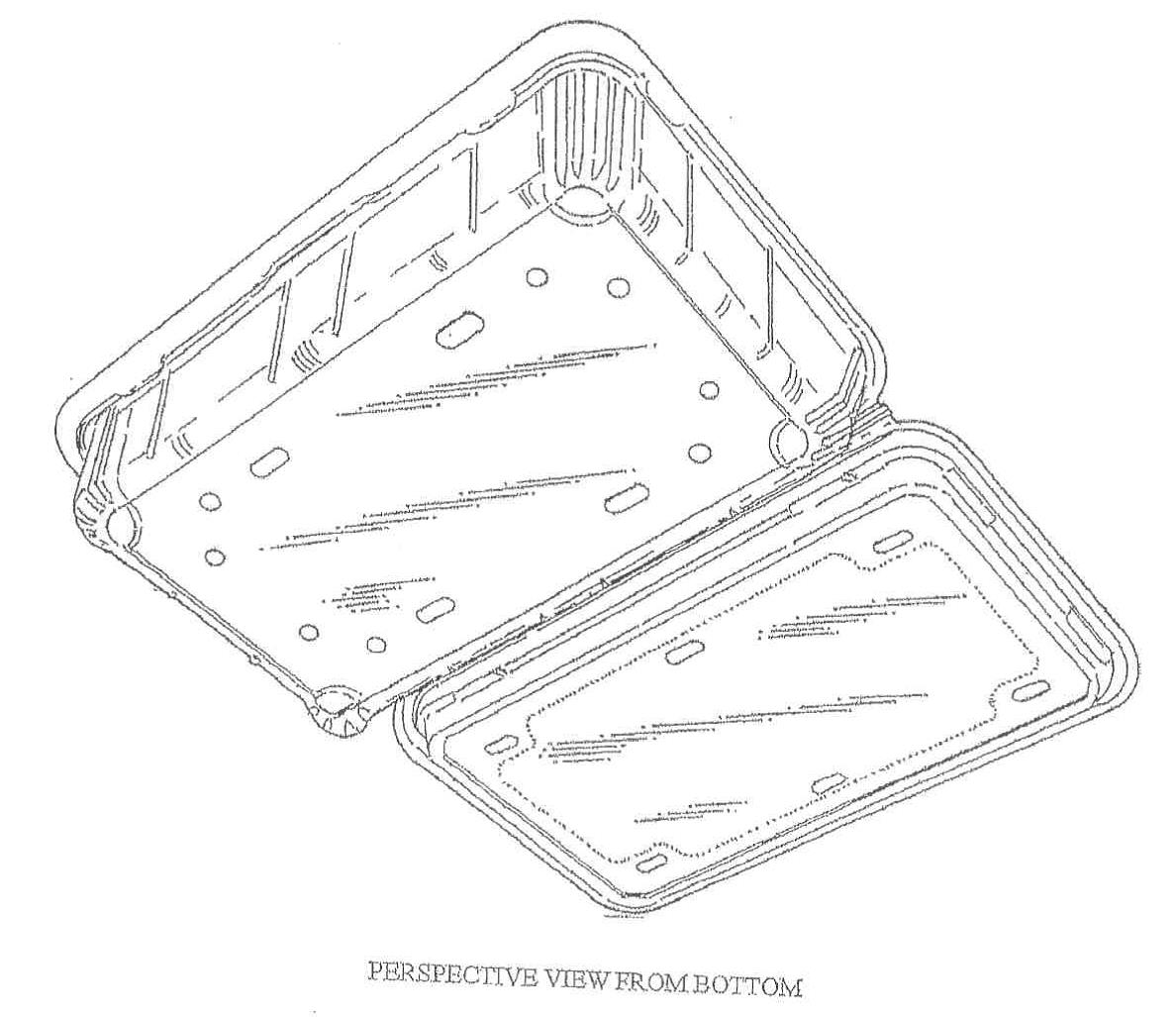
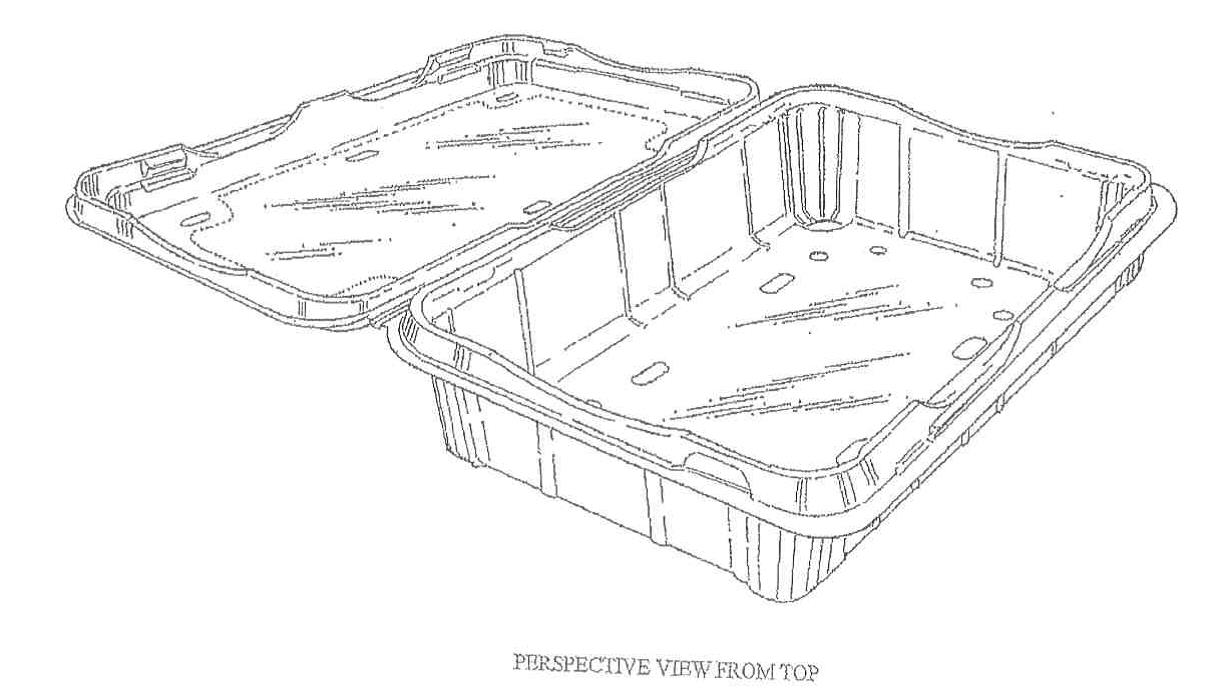
101 Design 628 also includes a side view with the lid closed which appears below.
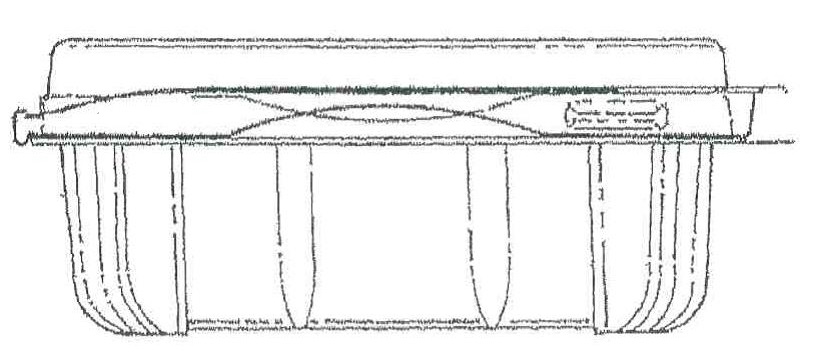
102 The respondents contend that the 628 design lacked distinctiveness having regard to the 330 patent and US Design Patent No. US D604, 604 S (the 604 design).
103 It will be recalled that the 330 patent was dealt with as part of the respondents’ case that the 488 patent is invalid as it was anticipated by the 330 patent (a contention I have rejected above). In that context, I reproduced figure 1 from the 330 patent (see under [65] above).
104 Mr Rickards considered that the central pillar, button lock and size of the design in the 330 patent were different from the 628 design so that the two were not substantially similar in overall impression. Mr Sadan initially considered the two designs to be substantially similar, but as described above, ultimately concluded that they were similar but not substantially similar in overall impression. The respondents relied on similarities which Mr Sadan identified and again said that Mr Sadan had not given any reason for his changed view (an argument which I again reject as it fails to appreciate that we are concerned with matters of impression). The similarities Mr Sadan identified are the rectangular shape, the flat lid with a strengthening indentation and similarly spaced ventilation holes, the positioning of side apertures, and the wall ribbing. The differences are the volume, the design of the locking mechanisms, and the presence of ribbing on the corner pillars of the 628 design.
105 I am satisfied that Mr Rickards’ conclusion and Mr Sadan’s ultimate conclusion that, giving more weight to the similarities than the differences and by reference to the standard of the informed user, the two are not substantially similar in overall impression. The overall impression created by the large ribs on the sides of the container in the 330 patent and the button lock is different from that created by the 628 design. Other differences, also noted by Mr Rickards, including the corner ribbing and apertures on the base and lid in the 628 design, are also apparent.
106 Figures 1 and 2 from the 604 design appear below.
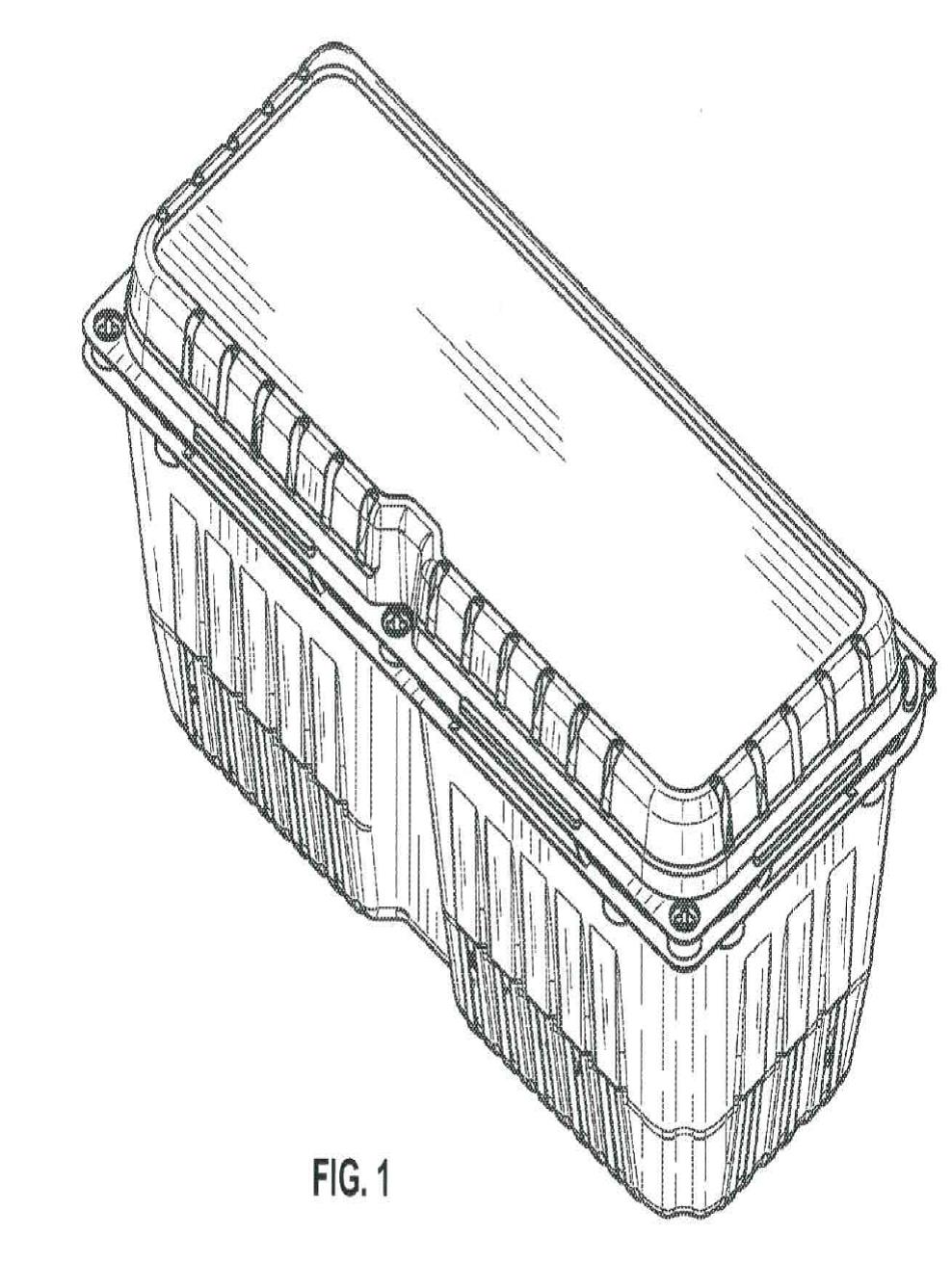
107 Mr Rickards identified that the 604 design includes a central pillar, substantially more strengtheners and a button lock, none of which appear in the 628 design, thus leading him to conclude that, giving more weight to similarities than differences, the two were not substantially similar in overall impression. Mr Sadan ultimately agreed with this conclusion, saying the two were similar but not substantially similar in overall impression. The respondents again argued for a contrary view, noting that Mr Sadan had not given any reason for changing his conclusion as set out in the joint report (a submission I again reject as misconceived) and relying on the similarities he identified (shape, flat lid, flat base, ribbing on the sides, strengthening pillars, side apertures).
108 I again find Mr Rickards’ conclusion and Mr Sadan’s ultimate conclusion persuasive. Giving greater weight to the similarities than the differences, the overall impression of the two designs is different. To take but one example, while both containers have ribbing on the sides,the ribbing on the 604 design appears from the drawings to be more frequent, with a different three-dimensional shape like a rectangle with a raised wedge on the top half, rather than a simple line-shaped rib, and the ribs end well before the top of the receptacle portion of the container. These ribs alone create a material visual difference. Through the eyes of an informed user the designs would not appear substantially similar in overall impression.
109 For these reasons I consider that the 628 design did not lack distinctiveness at its priority date.
The 565 design – infringement
110 The respondents conceded that if the 565 design is valid (and I have rejected the respondents’ challenge to validity above) then the first respondent’s containers 1 and 3 infringe the design, as they are substantially similar in overall impression to the 565 design.
The 628 design – infringement
111 As discussed above, I do not accept that Mr Rickards changed his conclusions. He was and remained of the view that containers 5, 7 and 8 are substantially similar in overall impression to the 628 design. Mr Sadan’s position evolved over time, his ultimate conclusion being that containers 5, 7 and 8 are similar but not substantially similar in overall impression to the 628 design.
112 Mr Rickards pointed to the rectangular shape, ribbed corner pillars and central tongue of the 628 design and containers 5, 7 and 8, describing the central tongue as the dominant visual feature of these containers. He noted that while the ribs on the sides of the container were of different widths, the impression of the sides was “very similar”. He described the lids as all including a raised step. The apertures were differently shaped (round on containers 5, 7 and 8 and rectangular on the 628 design). The 628 design also has six apertures on the lid whereas there are four on containers 5, 7 and 8. The apertures on the base are also different (the 628 design has four round and four rectangular apertures in a particular configuration and containers 5, 7 and 8 have four round apertures on the base). The base of containers 5, 7 and 8 also displays an indented cross shape created by the four corner pillars which is not apparent on design 628. In addition, the base of container 7 has an additional parallel indentation which does not appear on the base of design 628 or containers 5 or 8. Mr Rickards also accepted that there may be a side aperture on the 628 design which is not present on container 7 (but is present on containers 5 and 8).
113 Mr Sadan did not accept that the dotted line on the lid of the 628 design denoted a stepped lid but considering all of the drawings I prefer Mr Rickards’ opinion in this regard (noting, however, that this issue is not determinative in my view). Mr Sadan identified the same differences described above as well as ribbing on the lid of container 5 and the different frequency of ribbing.
114 The respondents’ submissions do not deal with the whole of the evidence, incorrectly maintaining that Mr Sadan considered that containers 5, 7 and 8 were not similar to the 628 design. Further, to the extent the respondents relied on the central tongue feature as being well known at the priority date of the 628 design, I disagree. Mr Rickards’ opinion was to the contrary. Mr Sadan did not identify any designs incorporating this feature at the priority date. Further, as the applicant submitted, there is good reason to prefer Mr Rickards’ opinions about matters of appearance. As the applicant put it:
Mr Rickards’ views on visual similarities and differences, and the weight to be given to them when conducting the comparisons of the designs, is to be preferred to the views expressed by Mr Sadan. Relevantly for design law purposes, Mr Rickards’ background is more closely aligned with a concern for “aesthetics” of container design than that of Mr Sadan – Mr Rickards confirmed his focus and concern with container appearance during cross-examination: T230.18-26. Mr Sadan’s work before 2012 was in sales and marketing: Sadan 1 at [8]-[10], CB F, Tab F11, p792. It was only after he established his consultancy, NAVI Co, that he became more involved in container design by reason of being a manufacturer: CB F, Tab F11, p792 at [10]. The different backgrounds of the expert witnesses before 2012 is therefore submitted to be a relevant factor to be taken into account when evaluating their respective evidence. As a consequence, Mr Rickards’ views are to be preferred.
115 Mr Barker did identify button locks and clip locks as known alternative locking mechanisms at the priority date of the 628 patent but this does not indicate that the central tongue mechanism of the 628 design (which appears also in containers 5, 7 and 8) is merely a “common trade variant”, as the respondents would have it. The visual distinctiveness is the centrality of the tongue lock which Mr Barker did not address. And if the MIXIM container was well known (an issue discussed above), it has two side clip locks, not the central tongue feature.
116 Giving more weight to the similarities than the differences I consider that the informed user would consider design 628 and containers 5, 7 and 8 to be substantially similar in overall impression. There are differences but when the appearance of the designs as a whole is considered, the impression is of substantial similarity. Further, as the applicant submitted, Mr Sadan gave weight to a non-visual feature, the rigidity and strength of the plastic in respect of container 5, which is immaterial. It is also not apparent to me how Mr Sadan gave more weight to the similarities than the differences in reaching his conclusions of similarity but not substantial similarity about containers 5, 7 and 8. The similarities are readily apparent, including the central tongue, the corner pillars, the ribbing on the corner pillars, the ribbing on the side walls which appears similar (whether the rib is the protrusion or the indentation between the protrusions does not matter in this regard), the raised base as a result of the corner pillars, and the ventilation holes on the lid and base (albeit differently shaped and configured).
117 For these reasons I am satisfied that the first respondent’s containers 5, 7 and 8 infringe the 628 design.
Infringement by the second respondent
118 The second respondent, Mr Ainslie, does not dispute that a person may infringe a patent and design by authorising conduct which is within the scope of the exclusive rights of the owner of the patent or design. Mr Ainslie accepted that this follows from the terms of the relevant provisions, s 13(1) of the Patents Act (which says that “a patent gives the patentee the exclusive rights, during the term of the patent, to exploit the invention and to authorise another person to exploit the invention”) and s 10(1)(f) of the Designs Act (which says that the registered owner of a registered design has the exclusive right, during the term of registration of the design, to “authorise another person to do any of the things mentioned in paragraph (a), (b), (c), (d) or (e)” of s 10(1)). This is consistent with the reasoning of Black CJ and Lehane J in Bristol-Myers Squibb Co v FH Faulding & Co Ltd [2000] FCA 316; (2000) 97 FCR 524 at [97] and Bennett J in Inverness Medical Switzerland GmbH v MDS Diagnostics Pty Ltd [2010] FCA 108; (2010) 85 IPR 525 at [193]-[203]. There was also no dispute between the applicant and the second respondent that a person authorises an infringement if the person sanctions, approves or countenances the infringement in the sense described in University of New South Wales v Moorhouse [1975] HCA 26; (1975) 133 CLR 1 at 12 and 20.
119 Other applicable principles were also not in dispute. Accordingly:
(1) A person can authorise conduct that results in infringement of a patent without intending to infringe and without knowing their conduct will have that result (Inverness at [193]).
(2) Control over the conduct constituting the infringement is critical. As explained in Australian Tape Manufacturers Association Ltd v Commonwealth [1993] HCA 10; (1993) 176 CLR 480 at 498, in the context of copyright:
manufacture and sale of articles such as blank tapes or video recorders, which have lawful uses, do not constitute authorization of infringement of copyright, even if the manufacturer or vendor knows that there is a likelihood that the articles will be used for an infringing purpose such as home taping of sound recordings, so long as the manufacturer or vendor has no control over the purchaser’s use of the article. It was the absence of such control in CBS. Songs Ltd [CBS Songs Ltd [1988] AC. at 1055] that constituted the critical distinction between the decision in that case and the decision in University of New South Wales v. Moorhouse, where the University had power to control what was done by way of copying and not only failed to take steps to prevent infringement but provided potential infringers with both the copyright material and the use of the University’s machines by which copies of it could be made (75). Accordingly, in Moorhouse, authorization was made out.
(3) A director of a company need not be a sole director to have the requisite degree of control to authorise an infringement (see, for example, Nominet UK v Diverse Internet Pty Ltd [2004] FCAFC 1244; (2004) 63 IPR 543 and Australasian Performing Right Association Ltd v Jain (1990) 26 FCR 53).
(4) Authorisation may be inferred including by indifference to a sufficient degree, although a person does not authorise an infringement by reason of mere knowledge and a failure to act to prevent the infringement and nothing more (see, for example, Nominet at [129]).
120 Mr Ainslie noted that the evidence shows that he was appointed as a director of the first respondent on 1 February 2013, along with another director, Mr Leong. Mr Leong ceased to be a director on 1 May 2015. Mr Mo was appointed as a director on 3 December 2015. Mr Ainslie ceased to be a director on 22 June 2016. Mr Mei was appointed a director and secretary on 11 July 2016. Mr Ainslie also noted that he had admitted that, until 22 June 2016, “in conjunction with others”, he was involved in management decisions on behalf of and in the management of the first respondent. Further, he admitted that “in conjunction with others” he was involved in the sales of containers 1, 2, 3 and 5 by the first respondent. It was submitted for Mr Ainslie that:
The second respondent has denied the allegation that, from at least 22 June 2016, he was involved in the day to day management and conduct of the business of the first respondent.
The words “in conjunction with others” highlighted above are not an exercise in obfuscation, but quite significant when the evidence (noted below) shows that, largely during the term of his directorship, Mr Ainslie has been a director with another person. It is therefore not established what role he personally had in relation to the company’s business and operations.
…
In this case, the applicant’s evidence, together with admissions, is limited to showing Mr Ainslie was, for a period, a director and with others had some involvement with the management and conduct of the company’s business.
There is no direct evidence of any personal involvement of Mr Ainslie in the alleged acts of infringement. Nor is there evidence of what his role (as distinguished from that of other directors or managers), or extent of involvement or control, was in relation to the company’s business. And such evidence has not been sought by discovery or other means.
There is therefore no basis for the Court to conclude that Mr Ainslie sanctioned, approved or countenanced the alleged acts of infringement by the first respondent, and thereby authorised those infringements.
121 Otherwise, Mr Ainslie contended that other documentary evidence on which the applicant relied was inadmissible. I disagree
122 The first document is a LinkedIn profile printed on 1 February 2016 which identifies a Neil Ainslie with a photograph. The document states:
Neil Ainslie MAIP
General Manager/Director at Specialty Packaging Aust Pty Ltd
…
Previous Flight Group, SCS Plastics Pty Ltd, Marinucci Packaging Australia
…
General Manager/Director
Specialty Packaging Aust Pty Ltd
February 2013 – Present (3 years 1 month) | Underwood, Queensland
…
123 Mr Marinucci, who knew Mr Ainslie and had dealt with him when he was employed by the first respondent, was shown the document and said that this was a photograph of the second respondent. As a result, I consider that the document is admissible as an admission by Mr Ainslie that he occupied the role of general manager of the first respondent as at 1 February 2016 and had occupied the role since February 2013 (see ss 58, 81(1), 88 and 83 of the Evidence Act 1995 (Cth), as well as the reasoning in Australian Competition and Consumer Commission v Air New Zealand Limited (No 1) [2012] FCA 1355; (2012) 207 FCR 488 at [89]-[107] and Capital Securities XV Pty Ltd (formerly known as Prime Capital Securities Pty Ltd) v Calleja [2018] NSWCA 26 at [101]).
124 The second document is a page printed from the website www.specialtypackagingaust.com.au. This document includes the following information:
Specialty Packaging Aust Pty Ltd
…
Address:
Unit A, 153 North Road, Woodridge QLD 4114
Contacts:
Neil Ainslie
General Manager Aust & NZ
125 The address shown in this document, to the extent it refers to 153 North Road, Woodridge QLD 4114, reflects the registered address and principal place of business of the first respondent as shown on a company search dated 18 October 2016. Accordingly, this document (which must be inferred from its face to have been prepared and uploaded by a person with the first respondent’s authority) also constitutes an admission by or on behalf of the first respondent that its general manager for Australia as at 18 October 2016 was Mr Ainslie (see ss 58, 81(1), 87(1), 88 and 183 of the Evidence Act, as well as Air New Zealand and Calleja, as referred to above). It is not, however, an admission by Mr Ainslie to that effect. This does not mean the evidence is irrelevant as against Mr Ainslie. The first respondent’s admission is itself probative evidence of Mr Ainslie’s role within the first respondent as at 18 October 2016.
126 To this evidence must be added Mr Marinucci’s evidence. Mr Marinucci knew Mr Ainslie because Mr Ainslie had worked for a company of Mr Marinnucci’s. Mr Marinucci had also dealt with Mr Ainslie when Mr Ainslie worked for the first respondent. Mr Marinucci explained that about three years ago (that is, about 2015) he had commercial dealings with the first respondent over about a six-month period. The person he dealt with at the first respondent was Mr Ainslie. Mr Ainslie described himself as the general manager of the first respondent. The first respondent provided a product to Mr Marinucci’s company. This occurred after obtaining quotes including from the first respondent. Mr Marinucci dealt with Mr Ainslie alone on behalf of the first respondent. Mr Marinucci understood that another person owned the first respondent but believed Mr Ainslie to be the “go to man” for quotations. Mr Marinucci did not know whether Mr Ainslie was a sole director of the first respondent at any time or about his employment contract.
127 Mr Ainslie did not give evidence. It was submitted for Mr Ainslie that there was no reason for him to do so given that the allegations against him provided no particulars of his conduct said to constitute authorisation of the infringements, the evidence that was filed consisted of inadmissible documents, and thus there were no circumstances that gave rise to a case Mr Ainslie could reasonably be expected to answer. As a result, there was no scope for any inference that Mr Ainslie would not have been assisted by any evidence that he could have given.
128 I disagree with these submissions. The applicant claimed that Mr Ainslie authorised the infringements. It filed documentary evidence that was admissible to prove Mr Ainslie’s status as a director of the first respondent at all material times and sole director between 2 May and 2 December 2015. It also filed documentary evidence that constituted an admissible admission by Mr Ainslie that he was the general manager of the first respondent from February 2013 and as at 1 February 2016 and by the first respondent that Mr Ainslie was the general manager of the first respondent as at 18 October 2016. To this must be added Mr Ainslie’s formal admissions that he was involved in conjunction with others in management decisions on behalf of the first respondent at all material times until 22 June 2016, was involved in conjunction with others in management decisions of the first respondent at all material times until 22 June 2016, and was involved in conjunction with others in the sale by the first respondent of containers 1, 2, 3 and 5. Further, it was apparent from the LinkedIn profile document that Mr Ainslie had worked for one of Mr Marinucci’s companies and thus it was not unexpected that the applicant may cross-examine Mr Marinucci, called by the respondents, about dealings with Mr Ainslie. Mr Ainslie’s decision not to give evidence was made in all of these circumstances. These circumstances, taken together, are capable of supporting an inference that Mr Ainslie had sufficient control over and involvement in the actions of the first respondent to supply all of the disputed containers to be taken to have authorised the infringements. The fact that Mr Ainslie chose not to give evidence to the contrary is a relevant factor in inferring that such evidence as he might have given would not have assisted him. It is also a relevant factor in deciding whether or not to draw the inference of authorisation which is open on the evidence (HIH Insurance Ltd and HIH Casualty and General Insurance Ltd, Re; Australian Securities and Investments Commission (ASIC) v Adler [2002] NSWSC 171; (2002) 168 FLR 253).
129 I accept the applicant’s submission in these terms:
Although it is possible that shared management responsibilities may, in certain circumstances, mean that a particular director cannot be found to have authorised the company’s infringing conduct, it does not automatically follow that management activities undertaken “in conjunction with others” will mean that a particular director cannot be held personally liable for authorising the company’s infringing conduct.
130 Although I prefer not to speak in terms of the shifting of the onus of proof to Mr Ainslie (as the applicant’s submissions did in the circumstances identified), from the whole of the evidence to which I have referred (including the admissions) I infer that Mr Ainslie did have sufficient control over the first respondent’s infringing conduct to be found to have sanctioned, approved and countenanced the infringements given the time periods involved.
131 I also accept the applicant’s submission as follows, which provides further support to these conclusions:
…open correspondence between the parties’ solicitors before the commencement of the proceedings (ie. at a time Mr Ainslie was a director of the First Respondent) provides additional support for its submission that Mr Ainslie was a person who countenanced, sanctioned and approved the conduct of the company. At Annexure KC-24 to Ms Chrysilou’s affidavit (CB Vol E, Tab E2, p77-78) is a letter dated 6 February 2016 from Griffith Hack to Chrysilou IP. Griffith Hack then represented (at least) the First Respondent. The letter includes two paragraphs in the following terms:
“We are assured by our client that there has been no supply by it since approximately November 2014 of punnet SPA-150 into the Australian marketplace. Any appearance of that punnet now in the marketplace can only be explicable on the basis that it is a use of long retained stock by a customer of our client.
As we reiterated in our letter to you of 29 July 2015, if your client requires a director of our client to attest to the accuracy of the statement contained in our letter to you of 5 March 2015 in relation to the retrieval of stocks of the relevant punnets (now including punter SPA-150) then that can be arranged.”
At the time this letter was sent, Mr Ainslie was a director of the company – there was an additional director too, Pengfei Mo, who had only been appointed on 3 December 2015. Prior to 3 December 2015, as noted above, there was a period of some six months in which Mr Ainslie had been the sole director of the company. There is no suggestion in the evidence that prior to 3 December 2015 Pengfei Mo could have attested to the matters set out in the Griffith Hack letter. Only Mr Ainslie could have done so, on the evidence. An inference which may be reasonably drawn from the Griffith Hack letter and the ASIC search of the First Respondent (in particular at CB Vol E, p105) is that Mr Ainslie was the only person who could have attested to the matters set out in the Griffith Hack letter. The Court may safely conclude that this is an additional piece of evidence which supports a finding of authorisation of the company’s conduct by Mr Ainslie.
132 Given these conclusions it is not necessary to consider the period during which Mr Ainslie was the first respondent’s sole director separately from the periods during which he was one of two directors or the sole general manager.
133 Mr Ainslie has also infringed the patents and designs which the first respondent infringed.
Conclusions
134 The applicant has proved its claims. In particular:
(1) The first respondent infringed the 641 patent by the supply of containers 1 to 7.
(2) The first respondent infringed the 488 patent by the supply of containers 5, 7 and 8.
(3) The first respondent infringed the 565 design by the supply of containers 1 and 3.
(4) The first respondent infringed the 628 design by the supply of containers 5, 7 and 8.
(5) Mr Ainslie also infringed the applicant’s patents and designs by authorising the infringements by the first respondent.
I certify that the preceding one hundred and thirty-four (134) numbered paragraphs are a true copy of the Reasons for Judgment herein of the Honourable Justice Jagot. |
Associate:
Annexure 1
Claims Chart for Patent 641
Claim 1
Integer | Integer Description |
1.1 | A produce container including: |
1.2 | a receptacle which defines a mouth circumscribed by a rim, |
1.3 | the rim having a first, outwardly extending flange; |
1.4 | a lid associated with the receptacle to close off the mouth, |
1.5 | the lid having a second, outwardly extending flange, |
1.6 | the second flange being spaced from the first flange when the lid is positioned on the receptacle to close off the mouth; and |
1.7 | a hinge which attaches the lid to the receptacle, |
1.8 | each of the flanges being connected to the hinge by a transition portion, |
1.9 | the transition portions converging toward the hinge when the lid is positioned on the receptacle to close off the mouth, |
1.10 | the receptacle, the lid and the hinge being integrally formed as a one piece unit. |
Claim 2
Integer | Integer Description |
2.1 | The produce container of claim 1, |
2.2 | in which a length of at least one transition portion is greater than a spacing between the first flange and the second flange when the lid is positioned on the receptacle to close off the mouth. |
Claim 3
Integer | Integer Description |
3.1 | The produce container of claim 1 or claim 2, |
3.2 | in which a height of the hinge is less than a spacing between the first flange and the second flange when the lid is positioned on the receptacle to close off the mouth. |
Claim 5
Integer | Integer Description |
5.1 | The produce container of any one of the preceding claims, |
5.2 | in which the convergence of the transition portions begins proximate opposed corners of the receptacle. |
Claims Chart for Patent 488
Claim 1
Integer | Integer Description |
1.1 | A produce container including: |
1.2 | a receptacle defining a mouth circumscribed by a rim; |
1.3 | a lid associated with the receptacle for closing off the mouth; |
1.4 | a hinge located on one side of the produce container when closed, the hinge attaching the lid to the receptacle; and |
1.5 | first and second locking arrangements for releasably locking the lid to the receptacle, |
1.6 | the first and second locking arrangements being located spaced apart on a side of the produce container opposite to the hinge; |
1.7 | wherein a third locking arrangement is provided and located between the first and second locking arrangements, |
1.8 | the third locking arrangement including a first tongue extending in use upwardly from the receptacle towards the lid and |
1.9 | a second tongue extending in use downwardly from the lid towards the receptacle, |
1.10 | the first and second tongues being adapted to overlap when the lid is in a closed position; and |
1.11 | wherein a first aperture is located in the rim between the first locking arrangement and the third locking arrangement and |
1.12 | a second aperture is located in the rim between the third locking arrangement and the second locking arrangement. |
Claim 2
Integer | Integer Description |
2.1 | The produce container of claim 1 |
2.2 | wherein the third locking arrangement is located in the vicinity of the centre of the side of the produce container opposite the hinge |
Claim 3
Integer | Integer Description |
3.1 | The produce container of claim 1 or claim 2 |
3.2 | wherein each of the first and second locking arrangements includes a projection carried on one of the receptacle and the lid and |
3.3 | a complementary formation carried on the other of the receptacle and the lid, |
3.4 | wherein when the lid is in its closed position, the projection and complementary formation releasably engage to effect locking of the lid to the receptacle. |
Claim 4
Integer | Integer Description |
4.1 | The produce container of any one of claims 1 to 3, |
4.2 | wherein the third locking arrangement includes a projection carried on one of the first and second tongues and |
4.3 | a recess carried on the other of the first and second tongues, |
4.4 | wherein when the lid is in its closed position, the projection and recess releasably engage. |


