

FEDERAL COURT OF AUSTRALIA
Sarina v Fairfax Media Publications Pty Ltd [2018] FCA 521
ORDERS
Applicant | ||
AND: | FAIRFAX MEDIA PUBLICATIONS PTY LTD Respondent | |
DATE OF ORDER: |
THE COURT ORDERS THAT:
1. The proceeding is dismissed.
2. The Applicant is to pay the costs of the Respondent.
Note: Entry of orders is dealt with in Rule 39.32 of the Federal Court Rules 2011.
1 The origins of the present dispute may be traced back to 2014.
2 In that year the Applicant in the present proceeding, Mr Clinton Sarina, commenced a proceeding in the District Court of New South Wales claiming damages for defamation.
3 The publication the subject matter of the proceeding in the District Court was an article published on a Fairfax Media website on 19 October 2010. The heading to that article was: “McGurk’s confidants have colourful pasts”. That proceeding was settled and a Deed of Release executed in February 2016.
4 In August 2017, Mr Sarina commenced the present proceeding in this Court. In this proceeding Mr Sarina again claims (inter alia) damages for defamation. The two publications that are said to be defamatory were published on The Sydney Morning Herald website on 14 September 2009 and another on 16 October 2010. The former article was headed: “The jockey, the boxer and the money men”; the latter article was headed: “McGurk duo linked to $150m loan fraud”.
5 The Respondent to the proceeding in this Court, Fairfax Media Publications Pty Ltd, seeks an order for summary judgment pursuant to s 31A(2) of the Federal Court of Australia Act 1976 (Cth). It maintains that the Deed of Release operates as a release from liability which covers the claims made in this Court. The proceeding in this Court, it submits, has no reasonable prospects of success.
6 It is concluded that the proceeding should be dismissed with costs.
The Deed of Release
7 The Deed of Release contains the following statement as to the Background against which the Deed emerged, namely (without alteration):
BACKGROUND
A. The Releasor has brought defamation proceedings against the Releasees in the District Court of New South Wales (Proceedings No. 2014/361937) (the Proceedings), over the publication of an article entitled “‘McGurk’s confidants have colourful pasts” on the website www.smh.com.au (the Article).
B. The Releasees deny liability for the claims made against them in the Proceedings.
C. Without admissions, the parties have agreed to settle the Proceedings on the terms set out in this agreement.
The Deed thereafter provides in Clause 3 for “Settlement and Releases”. Clause 3 provides in part as follows:
3. Settlement and Releases
3.1 In consideration of the matters in clauses 3.2 to 3.4 below, the Releasees agree to:
(a) pay to the Releasor the sum of $75,000, inclusive of his costs of the Proceedings, by 8 March 2016; and
(b) remove the Article from Fairfax internet sites by 11pm on 10 February 2016.
…
3.4 The Releasor hereby:
(a) releases the Releasees (and any persons or entities associated with them) from all actions, suits, causes, debts, claims, liabilities, demands or proceedings whatsoever, whether arising in law, in equity, under statute or otherwise, which the Releasor has or, but for this deed, would or might have had against the Releasees (and any persons or entities associate with them), in respect of the Proceedings and/or the subject matter of the Proceedings, including in respect of the publication of the Article on any other website or wheresoever occurring;
(b) covenants not to sue the Releasees (or any persons or entities associated with them) in respect of any of the matters the subject of the releases in paragraph 3.4(a) above.
Clause 4 provides as follows:
4. Bar to proceedings
This agreement may be pleaded in bar and defence to any proceedings issued by the Releasor arising out of or in any way related to the matters the subject of the releases and covenants in clause 3.4 above.
8 Clause 3, of course, is a release from liability; cl 4 is a bar to the commencement of proceedings. In describing the difference, in Carr v Thomas [2009] NSWCA 208, Beazley, Ipp and McColl JJA observed:
[34] A covenant not to sue does not act as a release of the obligation owed to the other party. Rather, it is a contract between two parties that one will not sue the other. Any attempt to do so constitutes a breach of contract. Parties usually make provision in their agreement that the covenant can be pleaded in bar as was done in this case. This saves the party with the benefit of the covenant from bringing a separate action for breach of contract. The covenant acts as a bar to avoid circuity of action.
[35] A plea in bar is a well known device.
(Citation omitted.)
The publications complained of
9 The Further Amended Statement of Claim as filed in the District Court claimed damages (including aggravated damages), actual or special damages, interest and costs.
10 Paragraph [3] of the Further Amended Statement of Claim pleaded that “[o]n or about 14 November 2014 and throughout the calendar year 2014 to date and continuing the Defendants caused to be placed on The Sydney Morning Herald website a certain defamatory article of and concerning the plaintiff”, namely Mr Sarina. That article was annexed to the Statement of Claim and was dated 19 October 2010.
11 The Statement of Claim as filed in this Court by Mr Sarina pleaded (at para [6]) that he had “been greatly injured in his character, credit, business, personal and professional reputation”. The Particulars provided as to the publications complained of identified the two articles published on The Sydney Morning Herald’s website.
12 A comparison between the content of the three articles was prepared by Counsel for the Respondent to the present proceeding. That comparison, which has been accepted as a factually accurate comparison of the three articles, was as follows:
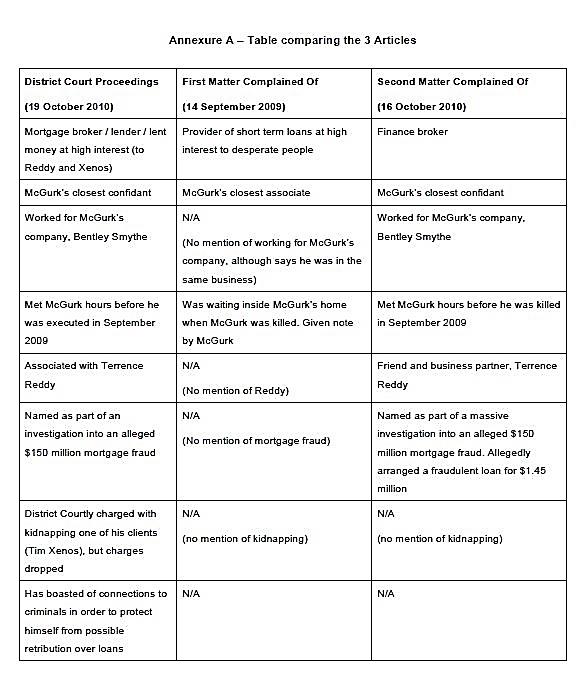
13 From this comparison, and from an independent review of each of the three publications, it is apparent that the 19 October 2010 publication was the most extensive of the three. The 16 October 2010 publication was a publication which contained less material than that published on 19 October 2010 and the 14 September 2009 publication was an even less extensive publication. The 19 October 2010 publication, moreover, contained many statements which were not canvassed or repeated in the other two publications and statements relied upon in the District Court proceeding as being defamatory.
A release from liability for the September 2009 & October 2010 publications?
14 It has been concluded that the Deed of Release operates as a release from liability of the Respondent to the present proceeding for either of two reasons, namely:
clause 3.4 by its terms grants a release from liability for “the subject matter” of the District Court proceedings (being the content of the publications complained of) and cl 4 by its terms operates as a “bar” to the commencement of any other proceeding “arising out of or in any way related to the matters the subject of the releases”; and
there is no ambiguity as to the extent of the release intended to be granted by the parties to the Deed (including Mr Sarina), the two publications relied upon in the present proceeding being unquestionably within the contemplation of the parties when executing the release.
Each of these reasons should be briefly expanded upon.
Clauses 3.4 and 4
15 Clauses 3.4 and 4 of the Deed are drafted in such wide terms as would naturally embrace the matters complained of in the present proceeding, that width of drafting being evident in cl 3.4 from such phrases as:
“from all actions … or proceedings whatsoever”; and
“in respect of the Proceedings and/or the subject matter of the Proceedings … including in respect of the publication of the Article”.
In clause 4, the width of application is evident from the phrase:
“arising out of or in any way related to the matters the subject of the releases and covenants”
The intended width of application of cll 3.4 and 4 is only reinforced by the contrasting language employed in the “Background” section, namely the phrase “deny[ing] liability for the claims made against them in the Proceedings”. The release from liability effected by cl 3.4, it is concluded, is not only evident from the terms employed – that construction only being reinforced by the width of terminology employed in the bar to the commencement of further proceedings in cl 4 – but also from the more limited liability which is denied.
16 The contrary argument advanced on behalf of Mr Sarina by his Counsel is rejected. In particular, it is not considered that cl 3.4 is confined in its operation to a release from liability with respect only to the publication on 19 October 2010. That contrary argument is rejected because:
“the subject matter of the Proceedings”, as that phrase is employed in cl 3.4(a), is not to be confined to the article published on 19 October 2010 but extends to the content of that publication and the imputations identified in the Further Amended Statement of Claim as filed in the District Court. Taken to its extremity, Counsel for Mr Sarina did not resile from a submission that cl 3.4(a) would not operate as a release from liability and would not extend to the publication of exactly the same article as was published on 19 October 2010 save for the deletion of one or other paragraph. Such an artificial construction of cl 3.4 should not be readily embraced and is rejected; and
what was within the contemplation of the parties when the Deed of Release was executed in February 2016 extended well beyond the sole publication on 19 October 2010.
The reliance sought to be placed by Counsel for Mr Sarina upon the definitions effected in para A of the “Background”, it is concluded, does not displace the width of terminology employed in cl 3.4.
The contemplation of the parties
17 It was common ground between the parties that, as a matter of general principle, the general words of a deed of release cannot be relied upon as a release from liability for that which falls outside the true purpose of the deed, that true purpose being ascertained from the nature of the deed itself and the surrounding circumstances including the state of knowledge of the parties.
18 That general principle was established by Grant v John Grant & Sons Pty Ltd (1954) 91 CLR 112. One of the questions posed for resolution was whether a release from liability “from all sums of money and accounts” extended to a debt which was never at any material time the subject of any dispute between the parties. Chief Justice Dixon, Fullagar, Kitto and Taylor JJ observed as follows (at 123 to 124):
The principle which it is thus sought to apply was expressed by Lord Westbury in London & South Western Railway Co v. Blackmore [(1870) LR 4 HL 610 at 623] as follows: “The general words in a release are limited always to that thing or those things which were specially in the contemplation of the parties at the time when the release was given”. It was expressed by Taunton J. in Upton v. Upton [(1832) Dow PC 400 at 406, 36 RR 817 at 821] in this way: “… the general words of a release may be limited by the particular matter out of which the release springs and the particular intent of the parties by whom the release is executed”.
Another question was whether the release extended to a debt of which a party was unaware at the time the release was given. Their Honours went on to review further authorities and expressed the principle to be applied as follows (at 129 to 130):
From the authorities which have already been cited it will be seen that equity proceeded upon the principle that a releasee must not use the general words of a release as a means of escaping the fulfilment of obligations falling outside the true purpose of the transaction as ascertained from the nature of the instrument and the surrounding circumstances including the state of knowledge of the respective parties concerning the existence, character and extent of the liability in question and the actual intention of the releasor.
These general principles have been repeatedly since applied: Doggett v Commonwealth Bank of Australia [2015] VSCA 351 at [52] to [64], (2015) 47 VR 302 at 317 to 320 per Whelan JA; Rinehart v Rinehart (No 3) [2016] FCA 539 at [589] to [591], (2016) 337 ALR 174 at 287 per Gleeson J; Crossman v Sheahan [2016] NSWCA 200 at [235], (2016) 115 ACSR 130 at 177 per Ward JA. The general principle, however, does not operate such that parties may never enter into an agreement to resolve “all conceivable further disputes”: Owners Corporation of Strata Plan 61390 v Multiplex Corporate Agency Pty Ltd (No 2) [2012] NSWSC 322 at [30] per Pembroke J. Evidence of non-awareness of a particular claim may or may not be significant in the particular circumstances of a given case.
19 Not only do the general words employed in cl 3.4 evince an intention to release from liability all other publications “in respect of” the District Court proceeding “and/or the subject matter of” that proceeding, so much was within the contemplation of the parties to the February 2016 Deed of Release.
20 There can be no question but that Mr Sarina was aware of the 16 October 2010 publication as at the time of the District Court proceeding. So much inevitably follows from the express and repeated reliance upon that publication in the response provided on his behalf to a request for further and better particulars which had been made in that proceeding. So much also follows from the agreement as a term of the Deed of Release (cl 3.1(b)) to remove the 19 October 2010 publication from “Fairfax internet sites” – but not the 16 October 2010 publication of which Mr Sarina was aware. That which was, accordingly, within the contemplation of Mr Sarina was that the 19 October 2010 publication was to be withdrawn from the internet but that no similar action was to be taken with respect to the 16 October 2010 publication. That distinction may have been drawn on the part of Mr Sarina by reason of the more abridged character of the 16 October 2010 article; but, whatever the reason, the distinction was drawn.
21 Irrespective of the more abridged content of the September 2009 publication when compared to either of the other two publications, the same inference is drawn with respect to that publication.
22 It is concluded that the September 2009 publication was also within the contemplation of Mr Sarina at the time he signed the Deed of Release. Although no express reference was made to the September 2009 publication during the course of the District Court proceeding, an inference is now drawn that that earlier publication was also within his contemplation and intended to be embraced by the Deed of Release. That conclusion is only reinforced by the failure of Mr Sarina to give evidence: Jones v Dunkel (1959) 101 CLR 298. Had Mr Sarina wished to provide evidence as to what was within his contemplation when signing the February 2016 Deed of Release he had the opportunity to do so. He elected not to do so. Indeed, in the present proceeding an affidavit had been filed by Mr Sarina but his Counsel ultimately elected not to rely upon it, possibly upon the basis that its relevance to the summary judgment application was not readily apparent. But, again for whatever reason, the prospect of Mr Sarina giving evidence was considered by his legal representatives and an election made for him not to do so.
CONCLUSIONS
23 It is concluded that the Deed of Release operates as a release from liability for both of the publications relied upon in the present proceeding, namely the 14 September 2009 and 16 October 2010 publications.
24 The Applicant in the present proceeding, accordingly, has “no reasonable prospect of successfully prosecuting the proceeding” within the meaning of s 31A(2)(b) of the Federal Court of Australia Act.
25 Judgment should thus be entered in favour of the Respondent to the present proceeding and the Originating Application should be dismissed.
26 It was agreed that costs should follow the event.
THE ORDERS OF THE COURT ARE:
1. The proceeding is dismissed.
2. The Applicant is to pay the costs of the Respondent.
I certify that the preceding twenty-six (26) numbered paragraphs are a true copy of the Reasons for Judgment herein of the Honourable Justice Flick. |
Associate:


