

FEDERAL COURT OF AUSTRALIA
Griffiths v Australian Postal Corporation [2018] FCA 520
ORDERS
Applicant | ||
AND: | Respondent | |
DATE OF ORDER: |
THE COURT ORDERS THAT:
2. The decision of the Administrative Appeals Tribunal is set aside.
3. The matter is remitted to the Administrative Appeals Tribunal for reconsideration in accordance with law.
4. The Respondent is to pay the costs of the Applicant.
Note: Entry of orders is dealt with in Rule 39.32 of the Federal Court Rules 2011.
1 On 4 July 2017 the Administrative Appeals Tribunal (the “Tribunal”) affirmed two decisions refusing claims for compensation made by the Applicant, Ms Roslyn Griffiths: Griffiths and Australian Postal Corporation [2017] AATA 1025. One claim was made in August 2014; the second claim was made in August 2015.
2 Those claims were made pursuant to the Safety, Rehabilitation and Compensation Act 1988 (Cth). The claims arose out of allegations made by Ms Griffiths that she had been subjected to bullying and harassment by other employees at the Riverina Mail Sorting Centre at Wagga Wagga in New South Wales – where she was employed by the Respondent, Australian Postal Corporation (“Australia Post”) – culminating in an incident in about July 2014. She claimed that she suffered from “anxiety” and “anxiety & depression”.
3 The Tribunal concluded that Ms Griffiths’ employment “contributed, to a significant degree, to the onset of a psychological condition”: [2017] AATA 1025 at [6]. But the Tribunal nevertheless went on to further conclude that “this condition does not constitute an injury under the Act by virtue of the operation of s 7(7)” of the Safety, Rehabilitation and Compensation Act: at [6]. The Tribunal found that Ms Griffiths had made in respect to her claims “wilfully false representations to Australia Post about her previous experience of anxiety/depression”: [2017] AATA 1025 at [25].
4 Ms Griffiths now appeals to this Court from the decision of the Tribunal.
5 The appeal is to be allowed and the matter remitted to the Tribunal for reconsideration in accordance with law.
The claims as made
6 The claim form as completed by Ms Griffiths in August 2014 asked her (among other things) to specify “[w]hat type of injury/illness do you have and what part of the body has been affected?” Ms Griffiths responded: “Anxiety”. The form also asked Ms Griffiths whether she had “ever had a similar injury/illness?” She responded by ticking a circle next to the word “No”. The claim form provided in part as follows:
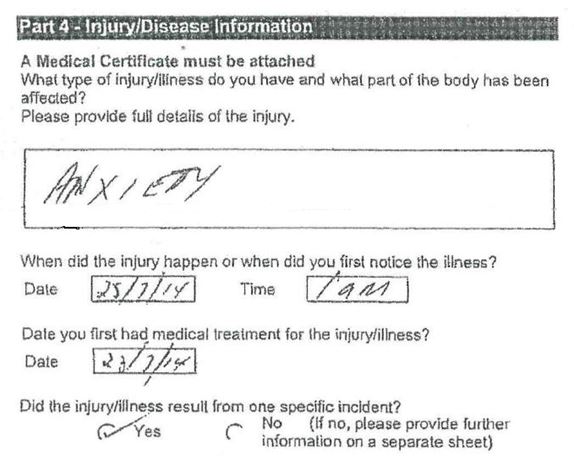
7 The claim form also contained a certification immediately above the signature of Ms Griffiths certifying that the “information that I have supplied on this form and any attachments is complete and correct” and that she was “aware that it is an offence to provide false information in relation to a claim for compensation” under the Act.
8 The claim form as completed in August 2015 also contained the same questions. Ms Griffiths responded on that form that the injury/illness she had was “anxiety & depression” and again indicated that she had not had a similar injury/illness. The August 2015 form included the same certification as to the correctness of the information provided.
9 In both forms, Ms Griffiths also certified that she was “fully aware of [her] rights and obligations (as outlined in the ‘How to Claim Compensation’ leaflet)”. That “leaflet”, at least in 2015, contained a “WARNING” as to “[f]alse declarations and concealing information” and stated that it was “a criminal offence to provide any false or misleading information to the Australian Postal Corporation in order to obtain compensation payments”.
The challenges to the Tribunal’s conclusions
10 The Amended Notice of Appeal sets forth five Questions of Law. Notwithstanding the variety of ways in which those Questions were drafted, the central question to be resolved focuses upon the expression “that disease” as employed in the concluding words to s 7(7).
11 As expressed in the Applicant’s Outline of Submissions in Reply, that central question is whether s 7(7) on its proper construction:
(a) requires no more than a match (to whatever may be the requisite degree) between the description or classification of the “disease” which is the subject of the claim and one or more episodes of the previously suffered “disease” which is the subject of the wilfully false representation; or
(b) requires that the “disease” which is the subject of the claim, and the previously suffered “disease” which is the subject of the wilfully false representation, should be a continuation or manifestation of the same “disease”, not just in description, but in substance.
It is urged on behalf of Ms Griffiths that the latter construction is the correct construction.
12 That central question is answered in the manner proposed on behalf of Ms Griffiths.
13 In addition to that question, a further question arose as to the adequacy of the Tribunal’s reasons and whether such reasons as have been provided comply with s 43(2B) of the Administrative Appeals Tribunal Act 1975 (Cth). Non-compliance with respect to s 43(2B) was raised on behalf of Ms Griffiths both in respect to:
the Tribunal’s findings made as to the “disease” which attracted the entitlement to compensation; and
the Tribunal’s findings as to whether the representations made by Ms Griffiths were “wilful” for the purposes of s 7(7).
14 It is the failure, with respect, on the part of the Tribunal to comply with the requirements imposed by s 43(2B) which leads to the appeal being allowed.
The disease suffered by the employee & “that disease” – s 7(7)
15 The scheme of the Safety, Rehabilitation and Compensation Act has been repeatedly canvassed: e.g., Canute v Comcare [2006] HCA 47 at [4] to [18], (2006) 226 CLR 535 at 538 to 543 per Gummow ACJ, Kirby, Callinan, Heydon and Crennan JJ; Telstra Corporation Ltd v Hannaford [2006] FCAFC 87 at [16] to [19], (2006) 151 FCR 253 at 257 to 258 per Conti J; Comcare v Simmons [2014] FCAFC 4 at [44] to [55], (2014) 220 FCR 102 at 113 to 115 per Perry J.
16 In very summary form, the Act provides in s 14(1) for the payment of compensation “in respect of an injury suffered by an employee if the injury results in death, incapacity for work, or impairment”.
17 Section 5A provides the definition of the term “injury” for the purposes of the Act. That definition includes “a disease suffered by an employee”. Section 5B(1) provides the following definition:
In this Act:
“disease” means:
(a) an ailment suffered by an employee; or
(b) an aggravation of such an ailment;
that was contributed to, to a significant degree, by the employee’s employment by the Commonwealth or a licensee.
The Act does not employ the term “illness”.
18 Section 7 sets forth “[p]rovisions relating to diseases”. Section 7(1), for example, provides for those circumstances in which a disease suffered by an employee is to be “taken to have contributed, to a significant degree, to the contraction of the disease, unless the contrary is established”. Section 7(7) refers to the term “disease” and provides as follows:
A disease suffered by an employee, or an aggravation of such a disease, shall not be taken to be an injury to the employee for the purposes of this Act if the employee has at any time, for purposes connected with his or her employment or proposed employment by the Commonwealth or a licensed corporation, made a wilful and false representation that he or she did not suffer, or had not previously suffered, from that disease.
19 The opening words to the subsection refer to “[a] disease” and conclude with the phrase “from that disease”. The reference in the concluding words to s 7(7), namely “that disease”, is a reference back to the opening words of that subsection, namely the “disease” which attracts the entitlement to compensation. So much is apparent from both:
the terms in which s 7(7) is drafted; and
the decision of Perry J in National Australia Bank Ltd v Georgoulas [2013] FCA 1412, (2013) 217 FCR 382.
20 In Georgoulas, Perry J relevantly concluded (at 399):
[73] In my view, on a plain reading of the provision, the use of the phrase “that disease” in s 7(7) of the Act refers back to the disease, or to the aggravation of the disease, mentioned at the start of the provision, being the disease or aggravation of the disease which is the subject of the claim for compensation and complies with the test in [Comcare v Mooi (1996) 69 FCR 439]. As Hayne, Heydon, Crennan and Kiefel JJ held in Alcan (NT) Alumina Pty Ltd v Commissioner of Territory Revenue (NT) (2009) 239 CLR 27 at [47]:
The language which has actually been employed in the text of legislation is the surest guide to legislative intention.
[74] The suggestion that the question is whether a previous condition could properly be described as “a disease”, as the NAB submits, is contradicted by the plain words of the provision. The text of the section lends no support, in my view, to the proposition that it is sufficient to establish that the representation was false because the employee had suffered from similar symptoms in the context of a different disease. The question then as to whether Ms Georgoulas had previously suffered from the same disease or a disease that was substantially similar was, as the Tribunal stated at [47] of its reasons, a question of fact.
Concurrence is expressed with that reasoning and the conclusion reached by her Honour.
The findings of the Tribunal
21 If the submissions on behalf of Ms Griffiths as to the adequacy of the Tribunal’s findings and its compliance with s 43(2B) of the Administrative Appeals Tribunal Act be presently left to one side, the principal finding of the Tribunal as to the identification of the “disease” which attracted the entitlement to compensation was expressed as follows:
[51] … there is good reason to prefer the view of Dr Allnutt that, at the relevant time, Ms Griffiths was suffering an adjustment disorder against an underlying vulnerability to depression.
Dr Allnutt was a practitioner relied upon by Ms Griffiths. The finding at para [51] follows the following observations of the Tribunal:
[33] Dr Allnutt also gave evidence to the Tribunal. Notwithstanding receiving further information about her psychiatric history, he considered that his original diagnosis of adjustment disorder held good, although – with respect to borderline personality disorder – he told the Tribunal:
I am not saying that she doesn’t have it. What I’m saying is that based on the information provided one cannot give weight because one can’t differentiate with her history between whether she is borderline in depression - depression with borderline traits or purely depressive disorder. I don’t think she has purely got borderline personality disorder without depression, let me say that. It’s certainly depression but one can’t differentiate those and you’ve got to be very careful.
[34] The thrust of this medical evidence supports a finding that Ms Griffiths did indeed suffer from borderline personality disorder, or something closely akin thereto, in July 2014.
Of significance to the case sought to be advanced on behalf of Australia Post were a number of comments made by the Tribunal, including:
the reference at para [51] to an “underlying vulnerability to depression”;
the reference in para [33] to the evidence of Dr Allnutt as to his opinion that it is “certainly depression”; and
the identification by Ms Griffiths in her claim forms, or at least her second claim form, of the injury or illness suffered as “anxiety & depression”.
22 The principal finding of the Tribunal in respect to the “disease” which was the subject matter of the representations which were said to have been “wilful and false” was expressed as follows:
Wilful and false
[17] Ms Griffiths’ claims that she had not previously suffered from an illness similar to anxiety, or anxiety and depression, are evidently false. Even excluding those episodes where the parties are in dispute as to the presence of mental illness, there are several instances in Ms Griffiths’ life where the evidence is plain that she did suffer from conditions of anxiety or depression. Insubstantial variations in the way her condition is described from time to time in the medical record does not detract from this fact. The history of her previous encounters with anxiety and depression is so pronounced, indeed, that [it] is difficult to avoid the conclusion that her claims not to have previously suffered from them were deliberately untrue.
23 The “several instances” referred to by the Tribunal was a reference to, or at least included, the “history” set forth as follows by the Tribunal, which it described as “not controversial”:
[7] Ms Griffiths’ psychiatric history was put before the Tribunal in some detail, and in turn was discussed by two psychiatrists and a psychologist who gave live evidence. It is unnecessary to range over that full history at this juncture, but to note only the following episodes in that history, and to observe that the fact that these episodes occurred was not controversial in these proceedings:
• Ms Griffiths suffered postnatal depression following the birth of her third child in 1996.
• She suffered depression, and attempted suicide, following the discovery in 1996 that her husband was transgender and the failure of her marriage.
• Following the moving away of both her son and her partner, she was diagnosed in November 2008 with a major depressive episode.
• In December 2010 she attended Wagga Wagga Base Hospital feeling extremely distressed after her 14-year-old daughter left home. She was subsequently referred to the Community Mental Health Team at Temora for short-term support.
• She was brought to the Wagga Wagga Base hospital in March 2011 following a (possibly accidental) overdose of paracetamol. The hospital’s clinical notes record depressive symptoms …anxiety +++, and that she reports not wanting to wake up.
• A mental health care plan was prepared for her in May 2011, to facilitate her access through Medicare to a psychologist.
24 The divergence between the parties emerged because Counsel on behalf of Ms Griffiths sought to contend that:
the disease in respect to which the representation was made (namely the disease as identified in para [17]) was not the same as the disease which attracted the entitlement to compensation (namely that identified in para [51]); and
even if the disease was one and the same, there had to be a “continuity” in the disease.
The latter contention can, for present purposes, be left to one side. The Tribunal found “that on balance the evidence discloses the postulated connection between at least some of the previous instances of depression in Ms Griffiths’ life and the depression for which she claimed compensation in 2014 and 2015”: [2017] AATA 1025 at [24]. That finding perhaps sufficiently answers the latter contention that there had to be “continuity” between the former “disease” and the “disease” which attracted the entitlement to compensation.
25 The thrust of the former submission, being the principal submission advanced on behalf of Ms Griffiths, was that the Tribunal had misconstrued s 7(7). But that submission may also be either rejected or placed to one side. The Tribunal correctly expressed the question posed by s 7(7) as follows:
That disease
[23] The exclusion operates where the employee misrepresents that he or she did not suffer from that disease, namely the disease the subject of the present claim. If the claim is for a disease which is not the same as the disease previously suffered from, the exclusion does not apply.
Where a decision-maker such as the Tribunal correctly identifies the test to be applied, it is difficult to thereafter conclude that it misconstrued the statutory provision in question: cf. Inglewood Olive Processors Ltd v Chief Executive Officer of Customs [2005] FCAFC 101 at [26] per Kiefel, Weinberg and Edmonds JJ; Apache Northwest Pty Ltd v Department of Mines and Petroleum (WA) [2012] WASCA 167 at [37] per Newnes JA, Martin CJ and Beech J agreeing.
26 Presumably conscious of these difficulties, and assuming the Tribunal had correctly identified the question posed for resolution by s 7(7), Counsel on behalf of Ms Griffiths took refuge in the submission that the Tribunal had failed to comply with the requirements imposed by s 43(2B) of the Administrative Appeals Tribunal Act in respect to both its conclusion in respect to:
the identification of the “disease” which attracted the entitlement to compensation and “that disease” in respect to which the representation had been made; and/or
the basis upon which the Tribunal concluded that the representation was “wilful and false”.
It is these submissions which it is respectfully concluded should be accepted.
Section 43(2B)
27 Section 43(2B) of the Administrative Appeals Tribunal Act provides as follows:
Where the Tribunal gives in writing the reasons for its decision, those reasons shall include its findings on material questions of fact and a reference to the evidence or other material on which those findings were based.
With respect to this provision, it has long been accepted that “[t]he obligation to furnish reasons, and to furnish reasons which are adequate, is a very important obligation”: Dodds v Comcare Australia (1993) 31 ALD 690 at 691. Burchett J there further observed that the obligation “is a pillar of the system of administrative decision-making by the tribunal, and it is essential that the court should insist on its fulfilment. But it is the substance of the obligation that matters”. See also: Sagigi v Comcare [2009] FCA 385 at [18] per Edmonds J.
28 A court, it has been also concluded, “is entitled to take the reasons of the Tribunal as setting out the findings of fact the Tribunal itself considered material to its decision, and as reciting the evidence and other material which the Tribunal itself considered relevant to the findings it made”: Minister for Immigration and Border Protection v MZYTS [2013] FCAFC 114 at [49], (2013) 230 FCR 431 at 447 per Kenny, Griffiths and Mortimer JJ. The Court there further observed that such reasons may be taken as representing “what the Tribunal itself considered important and material” and that “what is present — and what is absent — from the reasons may in a given case enable a court on review to find jurisdictional error”. These observations of the Full Court were applied in Mulligan v National Disability Insurance Agency [2015] FCA 544 at [64], (2015) 233 FCR 201 at 215 per Mortimer J, where her Honour went on to say (at 215):
[65] Brevity may therefore not necessarily indicate or reveal legal error. However a reviewing court (including review by way of an appeal under s 44 of the [Administrative Appeals Tribunal Act]) is entitled to approach the reasons of an administrative decision-maker as wholly reflective of its reasoning process.
29 It is by reference to the standards imposed by s 43(2B) that the decision of the Tribunal in the present proceeding is to be assessed.
“The disease” & “that disease” – the absence of findings
30 Notwithstanding the correct identification of the question posed for resolution by s 7(7) at para [23] of the Tribunal’s reasons for decision, there was no express finding made by the Tribunal that the disease in respect to which the representation was made was the same disease as attracted the entitlement to compensation.
31 And, contrary to the submission advanced on behalf of Senior Counsel for Australia Post, no conclusion can be reached that the Tribunal implicitly made such a finding. The findings made at paras [7], [8], [17], [23] to [25], [33] and [51], with respect, fall short of providing a satisfactory foundation for drawing any such implication.
32 But, and more centrally relevant to the reasons for allowing the appeal, the Tribunal – with great respect – failed to set forth the factual basis upon which such a finding may satisfactorily be implied. Even though the finding was made that the “disease” which attracted the entitlement to compensation could be described as “an adjustment disorder against an underlying vulnerability to depression” and the fact that Ms Griffiths’ prior history exposed episodes of “depression”, there was no explanation on the part of the Tribunal as to why that history (described at para [7]) exposed any “underlying vulnerability to depression” as opposed to isolated instances of “depression” occasioned by events in the life of Ms Griffiths. Although each of the isolated instances referred to at para [7] of the Tribunal’s reasons could potentially have exposed an “underlying vulnerability to depression”, the Tribunal failed to set forth the findings which would lead to that assessment or otherwise explain why that conclusion was reached. In the absence of findings and reasons, it was with respect not self-evident that isolated instances of depression would lead to the ultimate assessment as to there being an “underlying vulnerability to depression”.
33 Left to one side for present purposes is any question as to whether a mere “underlying vulnerability” to depression may amount to a “disease” for the purpose of s 7(7) of the Safety, Rehabilitation and Compensation Act.
34 In resolving this submission, it should perhaps be expressly noted that it was common ground that a conclusion as to the “disease” which attracted the entitlement to compensation and the “disease” the subject of the representation being the same “disease” was necessarily a conclusion which went beyond the mere coincidence of terminology used by (for example) Ms Griffiths in her claim form or the terminology employed by a medical practitioner. The conclusion to be reached was one as to substance rather than mere correlation of terminology. So much must necessarily be correct. The question as posed in the claim form was not to be parsed and analysed by reference to the terms employed in the Safety, Rehabilitation and Compensation Act. And even the terminology employed by (for example) a treating practitioner at the outset may itself be changed or refined as the claim for compensation progressed through the decision-making process. An initial diagnosis of a “disease” at the time the claim for compensation is made is not decisive as to the correct identification of the “disease” which attracts the entitlement to compensation or the “disease” which is the subject of a representation.
A “wilful and false representation”
35 Separate and distinct from any inadequacy in the Tribunal’s decision in respect to its conclusion that the “disease” referred to in s 7(7) was the same “disease” throughout, the Tribunal’s conclusion in respect to the representation being “wilful” also failed to comply with s 43(2B).
36 In circumstances where the making of a “wilful and false representation” acts to disentitle a claimant to compensation, compliance with s 43(2B) requires there to be express findings as to the facts upon which s 7(7) operates. Deficiencies in compliance with s 43(2B), in such circumstances, are not to be satisfied by an uncertain process of implication.
37 The Tribunal’s findings and reasons in respect to this issue are as follows:
Wilful and false
[17] Ms Griffiths’ claims that she had not previously suffered from an illness similar to anxiety, or anxiety and depression, are evidently false. Even excluding those episodes where the parties are in dispute as to the presence of mental illness, there are several instances in Ms Griffiths’ life where the evidence is plain that she did suffer from conditions of anxiety or depression. Insubstantial variations in the way her condition is described from time to time in the medical record does not detract from this fact. The history of her previous encounters with anxiety and depression is so pronounced, indeed, that [it] is difficult to avoid the conclusion that her claims not to have previously suffered from them were deliberately untrue.
[18] To have once ticked the wrong box in a long government form might be said to fall short of wilful misrepresentation, and might be excused as inadvertent mistake; to do so twice – on separate occasions a year apart – is less easy to characterise in this benign way. This hesitancy is reinforced by evidence of a lack of candour about her medical record in other contexts. Counsel for Australia Post put to the Tribunal that Ms Griffiths had omitted significant details of her psychiatric history when providing histories to Dr Allnutt, Dr Roldan and Dr Champion, and the Tribunal accepts that the evidence for this is strong.
[19] It was put by Ms Griffiths’ counsel that the forms’ questions about previous illness lacked clarity and purpose. No guidance was offered to a claimant as to the meaning of the word similar, nor was a timescale suggested in which to itemise previous illness. No reference to the consequences of false answers was offered at this point in the forms (though it certainly was at the end of the forms), nor did anyone apparently issue an oral warning at the time she completed them about the dangers of falsehood. It was further suggested that an employee might reasonably think that the questions were about previous workplace-related illness. The absence of such protections or clarifications should lead, I infer the argument to be, to support for the conclusion that Ms Griffiths did not intend to wilfully mislead her employer.
[20] These arguments are unpersuasive. The purpose and requirements that the questions demanded of Ms Griffiths are reasonably clear, in my opinion. They sought to discover whether previous illness of this type had occurred, so that the employer could explore whether that previous illness, and not the present asserted injury, was responsible for the employee’s condition. An employee failing to acknowledge previous illness in these circumstances would, in my opinion, knowingly be skating on very thin ice.
38 Again there was no disagreement between the parties as to what was meant by the phrase “wilful and false”. The divergence between the parties was as to whether the reasons and findings provided by the Tribunal were adequate to justify its conclusion that the conduct of Ms Griffiths fell within that phrase.
39 Section 7(7), it should be noted at the outset, does not operate by reference to a “representation” that is merely factually incorrect. Section 7(7) thus does not preclude a “disease” suffered by an employee from being an “injury” merely because an employee has provided information that – for whatever reason – turns out to be factually incorrect. Section 7(7) is confined to a representation that is “wilful and false”. Albeit confined to such a representation, s 7(7), where its terms are satisfied, may have draconian consequences: Secretary, Department of Employment and Workplace Relations v Comcare [2008] FCA 52 at [53]. Madgwick J there envisaged (at [54]), by way of example, the suppressing of information “about an embarrassing condition” which was nevertheless “quite extraneous” to the claim being made. The sub-section may also, for example, operate where an employee has made “a wilful and false representation” even though that representation may not have impacted upon the decision made. The representation may later be withdrawn or corrected by later information.
40 What triggers the operation of s 7(7), accordingly, is not the provision of incorrect information but the making of “a wilful and false representation”. It may be that the more confined circumstance in which such a requirement is satisfied has been perceived by the Legislature as warranting what may otherwise have been seen as a potentially draconian operation of the provision. But that matter may presently be left to one side.
41 Whatever may be the consequences of its operation, a “wilful and false representation” for the purposes of s 7(7), it is considered, requires “that the representation be made without any belief that it is true”: Comcare Australia v Porter (1996) 70 FCR 139 at 150. Jenkinson J, in tracing the evolution of s 7(7), there concluded (at 149 to 150):
It was submitted for the applicant that the construction adopted by the tribunal treated s 7(7) as if in lieu of the words “wilful and false” the phrase “wilfully false” had been substituted. I see no distinction of meaning between the two. Nor does it appear from the history of the legislation that a distinction was intended by the legislature. In the Commonwealth Employees Compensation Act 1930 (Cth), s 10(2) provided:
“If the Commissioner is satisfied that the employee, at the time of entering the employment of the Commonwealth, wilfully and falsely represented himself as not having previously suffered from the disease, compensation shall not be payable.”
When that Act was repealed and the 1971 Act was enacted in its place, s 29(3) provided:
“The last preceding sub-section does not apply in relation to a disease, or an aggravation, acceleration or recurrence of a disease, if the employee has at any time, for purposes connected with his employment or proposed employment by the Commonwealth, made a wilful and false representation that he did not suffer, or had not previously suffered, from that disease.”
(If the “last preceding sub-section” did not apply, no benefit under the Act was available.) There is nothing in explanatory memoranda or parliamentary debates to suggest that the change from “wilfully false” to “wilful and false” was significant.
Barwick CJ observed in Iannella v French (1968) 119 CLR 84 at 94-95:
“It is thus appropriate to consider the meaning and application of the word ‘wilful’ in the specification of an offence. The Chief Justice of South Australia, having examined the case law, has repeated the view that the cases show that the word ‘wilful’ is not a word of fixed meaning. But of this I cannot myself feel absolutely certain. I am inclined to think that in the description of a criminal offence its connotation is fairly constant: but that its denotation varies with the verbal context and the subject matter of the statutory provision. In my opinion, ‘wilful’ connotes intention and knowledge: the problem is to determine in the particular circumstances what is to be intended and what known. The answer, as I have said, must vary with the nature of the act proscribed and the context of the statutory provision creating the offence. Further, the word intention itself obscures a difficulty. Thus it is said on some occasions to be satisfied by mere volition to do the specific act in question. But in truth, in my opinion, the word contains in its connotation elements of purpose. It is not merely that the mind goes with the act but that the mind intends by the act to achieve something. Of course, in some statutory circumstances, the mere doing without consequence or without purpose is forbidden, in which event the conscious doing of the act may suffice to make its performance intentional and in these circumstances wilful.”
That passage, although directed to the interpretation of a criminal statute, is in my opinion apposite in reference to s 7(7). The verbal context supplied by the phrase “false representation” exposes the legislature’s attention to the conceptions and language of the common law, which distinguishes clearly between the objective falsity of a representation, signified by the word “false”, and the representor’s knowledge of the falsity, commonly signified in civil proceedings by the word “fraudulent”. (Halsbury’s Laws of England (4th ed, 1980), Vol 31, pars 1044, 1059, 1063-1065; R v Aspinall (1876) 2 QBD 48 at 56-57.) The clause “if the employee has … made a … false representation” may be expected, therefore, to signify knowledge on the part of the employee that the representation specified was being made by him and an intention on his part that it be made, as well as signifying the objective falsity, the incorrectness, of the representation, but no more. The addition of “wilful” in that verbal context excites the expectation that what the whole clause in the section requires is that, in addition to what the words previously extracted from the clause signify, the employee should have no belief that the representation is true. The subject matter of s 7(7) confirms the conclusion, tentatively reached upon a consideration of the verbal context, that the clause requires that the representation be made without any belief that it is true. There is no reason to suppose, upon a consideration of the whole Act, that the legislature would intend to attach to an innocent misrepresentation about the existence of a disease — a subject notoriously liable to human misapprehension — the dire consequence of exclusion of the representor from the benefits otherwise available under the Act in respect of the disease and its aggravation.
42 Tested by reference to such a standard, the findings and reasons of the Tribunal in the present case may meet the requirements of s 43(2B) in respect to the representations made by Ms Griffiths being “false” – but fail to satisfy the requirements of that provision in respect to the conclusion that the representations were “wilful”.
43 Missing from the findings made by the Tribunal are any findings:
which clearly distinguish between the objective falsity of the representations made and Ms Griffiths’ “knowledge of the falsity”.
44 Notwithstanding the emphatic manner in which the Tribunal expressed its conclusion (e.g. at paras [17] and [20]), no satisfactory conclusion can be reached that the Tribunal in fact directed its attention to the legal requirements to be satisfied before any finding could be made that a representation was “wilful[ly]” untrue. No satisfactory conclusion can be reached that findings of fact were made which would satisfy such a requirement.
CONCLUSIONS
45 The Tribunal has, with respect, failed to comply with s 43(2B) of the Administrative Appeals Tribunal Act.
46 The appeal should thus be allowed.
47 Counsel for Ms Griffiths did not ultimately seek an order, as sought in the Amended Notice of Appeal, that the matter be remitted to the Tribunal differently constituted. There was ultimately agreement between the parties that the order to be made in the event that the appeal was allowed was that the matter should be remitted to the Tribunal for reconsideration in accordance with law. It thus remains a matter for the President of the Tribunal to determine the constitution of the Tribunal upon remittal.
48 There was also agreement that if the appeal were allowed that costs should follow the event.
THE ORDERS OF THE COURT ARE:
1. The appeal is allowed.
2. The decision of the Administrative Appeals Tribunal is set aside.
3. The matter is remitted to the Administrative Appeals Tribunal for reconsideration in accordance with law.
4. The Respondent is to pay the costs of the Applicant.
I certify that the preceding forty-eight (48) numbered paragraphs are a true copy of the Reasons for Judgment herein of the Honourable Justice Flick. |


