FEDERAL COURT OF AUSTRALIA
Parker trading as On Grid Off Grid Solar v Switchee Pty Ltd trading as Australian Solar Quotes [2018] FCA 479
ORDERS
JOHN PARKER TRADING AS ON GRID OFF GRID SOLAR Applicant | ||
AND: | SWITCHEE PTY LTD TRADING AS AUSTRALIAN SOLAR QUOTES (ACN 609 700 594) Respondent | |
DATE OF ORDER: |
THE COURT DECLARES THAT:
1. The respondent’s conduct in publishing the listing at https://www.australiansolarquotes.com.au/retailers/nsw/kiama/on-grid-off-grid-solar/ (“listing”) since 12 October 2016 was and is misleading or deceptive or likely to mislead or deceive in contravention of s 18 of the Australian Consumer Law.
2. By publishing the listing since 12 October 2016, the respondent made and is making a false or misleading representation that the respondent has an affiliation with the applicant in contravention of s 29(1)(h) of the Australian Consumer Law.
3. By:
(a) removing the applicant’s access to the listing on the respondent’s website following the termination of the agreement between the parties;
(b) failing to remove the listing despite the applicant’s request that the listing be removed;
(c) advising the applicant that he will only be able to change the listing if he buys further leads from the respondent;
(d) publishing inaccurate information on the listing and preventing the applicant from correcting such inaccuracies; and
(e) removing a positive review from the listing,
the respondent has engaged in unconscionable conduct in contravention of s 21(1)(a) of the Australian Consumer Law.
THE COURT ORDERS THAT:
4. The respondent remove all references to the business of the applicant known as “On Grid Off Grid Solar” from the respondent’s website within seven days of the date of this order.
5. The respondent through its servants and agents be restrained from using as part of its website or otherwise, the “On Grid Off Grid Solar” name, work or mark.
6. The respondent pay the applicant’s costs of the proceeding to date.
7. The proceeding be adjourned for a case management hearing on 26 April 2018 at 9.30 am.
Note: Entry of orders is dealt with in Rule 39.32 of the Federal Court Rules 2011.
GLEESON J:
1 The applicant (“Mr Parker”) is in the business of installing solar power systems using the business name “On Grid Off Grid Solar” (“OGOG”). The respondent trades as “Australian Solar Quotes” (“ASQ”). ASQ operates a website that can be visited by consumers to seek quotes for the supply of energy related services including the supply and installation of solar panels.
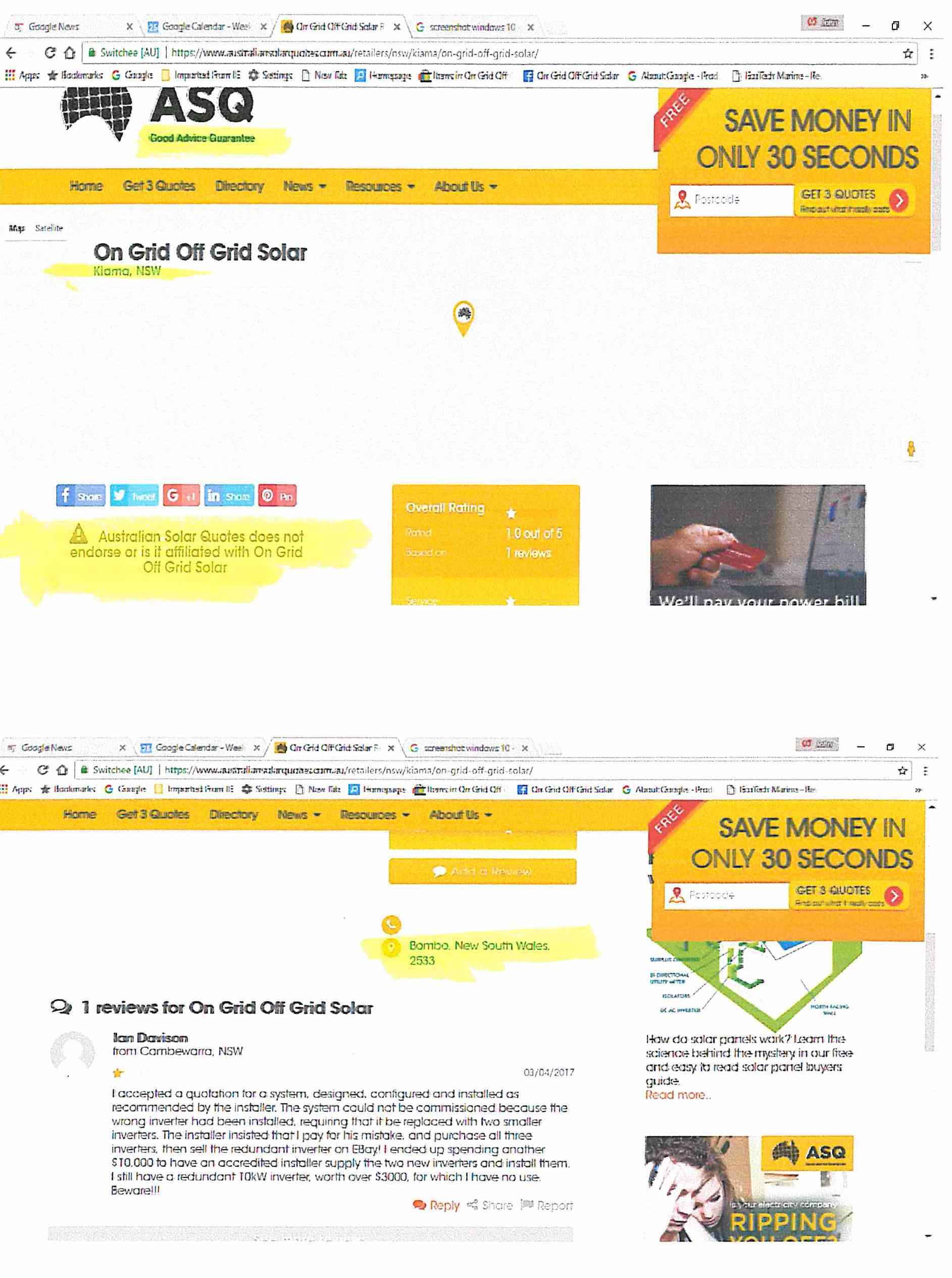
2 On about 1 August 2016, Mr Parker and ASQ entered into a written contract for the supply of marketing services by ASQ to Mr Parker. Pursuant to that agreement, ASQ established a listing for Mr Parker’s business on its website at the following location: https://www.australiansolarquotes.com.au/retailers/nsw/kiama/on-grid-off-grid-solar/ (“listing”).
3 The agreement was terminated in October 2016 in circumstances described below. After the agreement was terminated, ASQ continued to publish the listing. In April 2017, a negative review was published on the listing and Mr Parker asked for the listing to be removed from ASQ’s website. ASQ has refused to remove the listing.
Relief sought by Mr Parker
4 Mr Parker alleges that ASQ has engaged in conduct in contravention of ss 18(1), 20(1), 21(1) and 29(1)(h) of the Australian Consumer Law (“ACL”) (Schedule 2 to the Competition and Consumer Act 2010 (Cth) (“CCA”)).
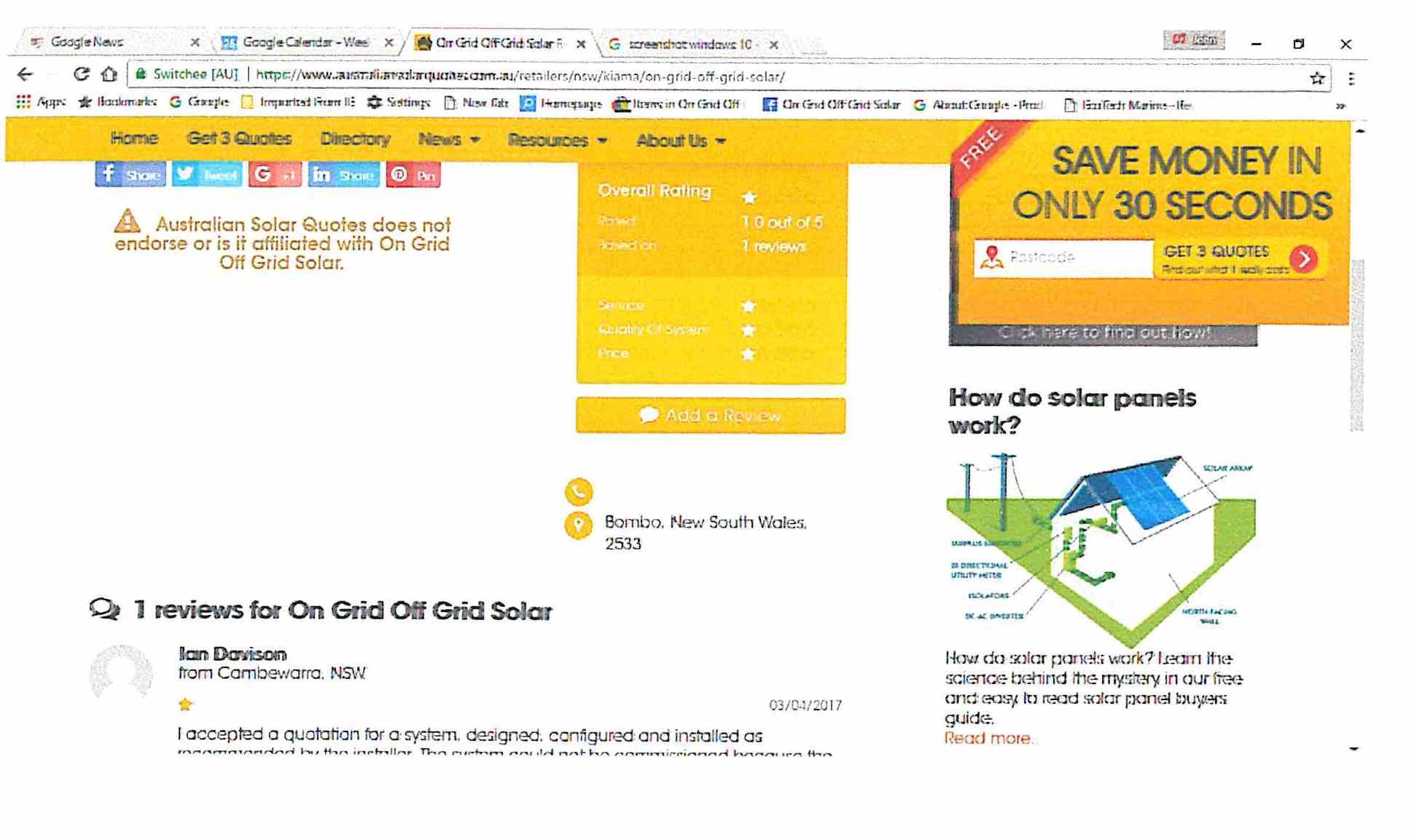
5 By originating application filed 19 May 2017, Mr Parker sought the following relief in respect of ASQ’s conduct in connection with the listing:
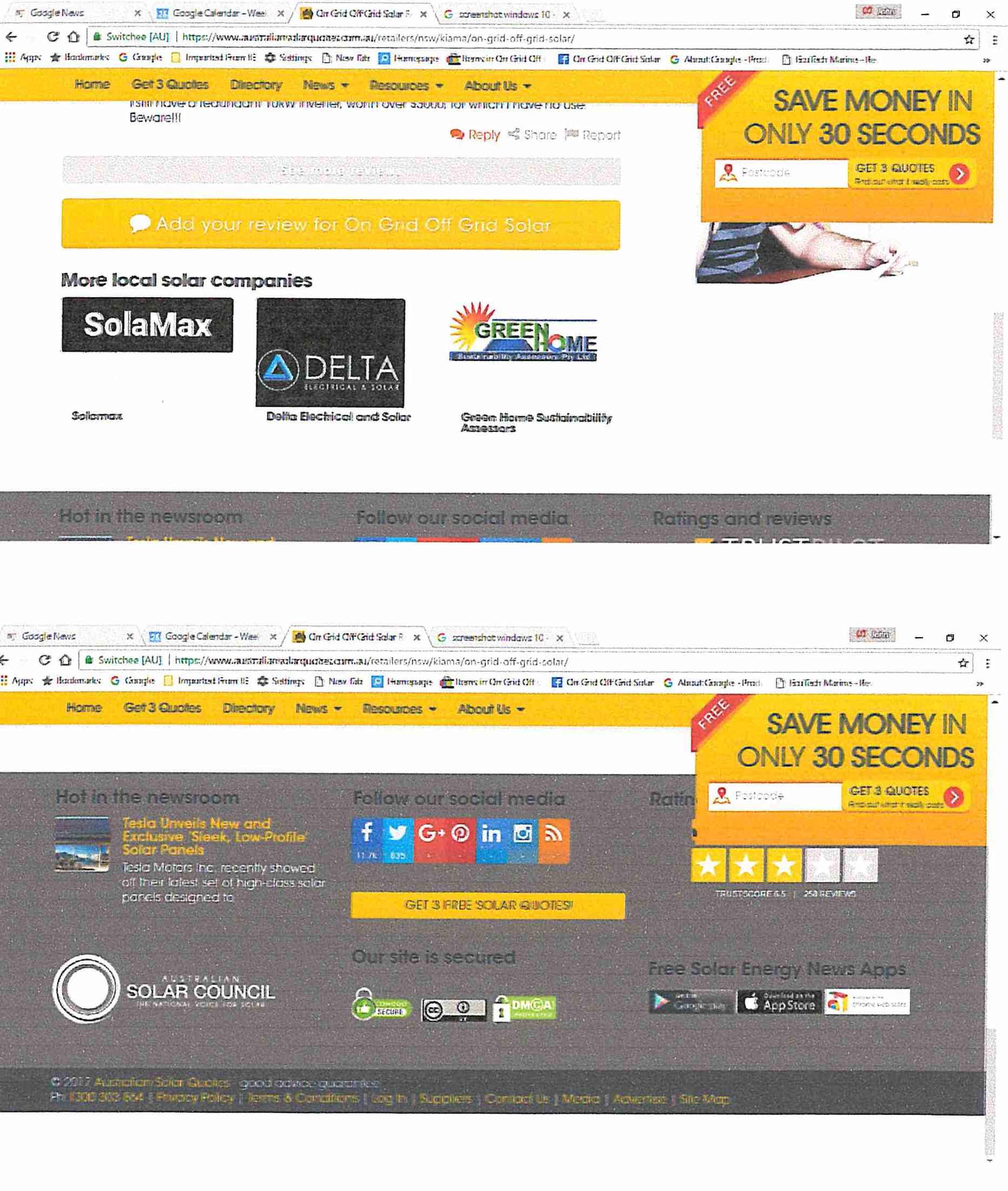
(1) A declaration that ASQ’s conduct in publishing the listing and refusing to remove it from ASQ’s website breaches the provisions of the ACL set out above and constitutes passing off of Mr Parker’s business.
(2) An order that ASQ remove all references to Mr Parker’s business from ASQ’s website within 7 days.
(3) An order that ASQ be restrained from using as part of its website or otherwise, the “On Grid Off Grid Solar” name, work or mark.
(4) Damages pursuant to s 236 of the ACL or otherwise.
(5) Costs.
(6) Such other orders as the Court deems fit.
Procedural history
6 The first case management hearing in the proceeding was held on 15 June 2017.
7 On 14 June 2017, ASQ filed a notice of address for service, signed by Darryn Van Hout who described himself as “Company Director of the Respondent”. That afternoon, Mr Van Hout was given permission to appear at the first case management hearing by telephone from Queensland, after he had sought an adjournment for medical reasons. At the commencement of the case management hearing, Mr Van Hout asked for permission to appear on behalf of ASQ and I granted Mr Van Hout leave to represent the company that day. Orders were made for the filing and service of evidence and the matter was listed for further case management on 17 August 2017, and for a final hearing on 18 September 2017.
8 At the case management hearing, Mr Van Hout stated that ASQ was “vigorously defending” the proceeding, saying:
[I]t’s in my opinion that – well, not my opinion; it’s actual fact – that you know, I’m in no breach of any consumer law or intellectual property law or trademark law by hosting that listing on the website, and bringing that listing down would actually, you know, put me at a financial loss, and you know, it would breach the integrity of the business that I operate, being a consumer care organisation and give him an unfair advantage over the competitors that are – you know, that do work in the industry, but ultimately it would be damaging for my business if I was to pull that down, and that’s why I’m defending it.
9 On 5 July 2017, Mr Parker’s lawyers filed a notice of intention to cease to act.
10 On 6 July 2017, Mr Parker took steps to swear his affidavit (dated 3 July 2017 on the front page), file it, and to serve a copy on ASQ by registered post in accordance with instructions contained in an email to Mr Parker from Kells Lawyers dated 6 July 2017.
11 ASQ did not file evidence in accordance with the 15 June 2017 orders.
12 On 19 July 2017, as foreshadowed by their earlier notice, Mr Parker’s lawyers filed a notice of ceasing to act.
13 On 16 August 2017, the Registry sent an email to Mr Van Hout which noted that the matter was listed for a case management hearing on 17 August 2017 at 9.30 am. The Registry did not receive a response to this email.
14 On 17 August 2017, ASQ did not appear at the case management hearing. In those circumstances, and where Mr Parker claimed that he was suffering ongoing loss as a result of ASQ’s conduct, I vacated the 18 September 2017 hearing and listed the final hearing on 23 August 2017.
15 Later on the morning of 17 August 2017, the Registry sent Mr Van Hout a copy of the orders made that day. The form of the orders included the following notation:
THE COURT NOTES THAT:
1. The respondent did not appear at the case management hearing.
2. The respondent has not complied with the orders made in this proceeding on 15 June 2017.
3. The applicant claims that he is suffering ongoing loss as a result of the respondent’s conduct.
16 There followed email communication between the Registry and Mr Van Hout concerning various matters including a request by Mr Van Hout for permission to represent ASQ at the final hearing, and a request to attend the final hearing by telephone. Among other things, Mr Van Hout stated that, as Mr Parker’s legal representation had “withdrawn” from the matter, it was his understanding that the “matter is now closed”.
17 Later in the day, the Registry informed Mr Van Hout by email that the request for permission to represent ASQ at the 23 August 2017 hearing could be made to the Court on that day, and that Mr Van Hout would need to provide a detailed written request to appear by telephone on that occasion “bearing in mind that the proceeding is currently listed for a final hearing on 23 August 2017 in light of the matters noted on today’s order”. The email also asked Mr Van Hout whether he had been served with a copy of Mr Parker’s affidavit sworn on 3 July 2017 and filed in the proceeding on 10 July 2017. Mr Van Hout did not reply to this question.
18 On the morning of 23 August 2017, Mr Van Hout wrote an email to the Court “to seek permission to represent Switchee Pty Ltd in this unique instance, as well as attend the hearing today remotely, via telephone”. In making that request, Mr Van Hout did not provide a detailed written request of the kind mentioned in the Registry’s 17 August 2017 email.
19 The Registry responded at about 9.30 am, saying that r 4.01(2) of the Federal Court Rules 2011 provides that a corporation must not proceed in court other than by a lawyer and, in the absence of an explanation for why ASQ could not be represented by a lawyer, I would not dispense with the requirement to comply with r 4.01(2).
20 Just before 10.00 am, Mr Van Hout sent another email to the Court in which he sought an adjournment of the matter for four weeks or to a date and time in the future when ASQ’s barrister could attend the hearing. The barrister was not named. Mr Van Hout stated that I had informed him (at the 15 June 2017 case management hearing) that ASQ would be required to engage a lawyer or barrister for the final hearing and stated that this had been done. Mr Van Hout referred to the fact that Mr Parker’s solicitor has ceased to act, the hearing having been brought forward and the short notice as reasons why the matter should be adjourned. Mr Van Hout also stated that ASQ took the matter extremely seriously.
21 Shortly after 10.00 am, Mr Van Hout sent a third email which stated that he had received information that morning “via a phone conversation with the courts” that contradicted the “instruction” given by email dated 17 August 2017 that he would need to “notify/communicate with the parties, and Her Honour Justice Gleeson on the day of the hearing in relation to Switchee Pty Ltd’s request”. This seems to be a reference to the request for permission to represent ASQ, but could also refer to the request to appear by telephone.
22 At the commencement of the hearing, I noted that ASQ had not complied with the Court’s 15 June 2017 orders. Having failed to appear on 17 August 2017, ASQ had been informed that the matter would be listed for hearing on 23 August 2017. ASQ had a week to arrange for legal representatives to appear at the hearing. Mr Van Hout had not explained why ASQ had not obtained legal representation to attend Court either to participate in the final hearing or to seek an extension of time to file evidence, nor had he explained why he had not appeared in person to seek permission to represent ASQ. For these reasons, I refused the adjournment application. Essentially, having regard to the history of the matter and contrary to Mr Van Hout’s email statement, I did not accept that ASQ was taking the proceeding seriously and I did not consider that it was in the interests of justice, or a proper use of the Court’s resources, to give ASQ a further opportunity to defend the proceeding.
23 Accordingly, the final hearing was conducted in ASQ’s absence. At the hearing, Mr Parker appeared in person and relied on his affidavit referred to above, gave sworn evidence and made oral submissions.
Listing
24 An image of the OGOG listing on the ASQ website is annexed to this judgment and marked annexure “A”. At the top left of the page is a logo including the letters ASQ, underneath which are the words “Good Advice Guarantee”. To the right of the page is a prominent yellow box in which are the capitalised words “SAVE MONEY IN ONLY 30 SECONDS” and, in smaller font, “GET 3 QUOTES Find out what it really costs”.
25 Under the ASQ logo is a yellow navigation bar in which the following links to sections of the website appear: “Home | Get 3 Quotes | Directory News | Resources | About Us”.
26 About a third of the way down the page is a white text box in which are the words “On Grid Off Grid Solar Kiama NSW”.
27 Underneath this, there is a triangle containing an exclamation mark, next to which are the words “Australian Solar Quotes does not endorse or is it affiliated with On Grid Off Grid Solar” (“disclaimer”).
28 A second image of the listing, also annexed to this judgment and marked annexure “B”, states OGOG’s location as being “Bombo, New South Wales 2533”. Immediately underneath this appear the words “1 reviews for On Grid Off Grid Solar”, the author “Ian Davison from Cambewarra, NSW”, the date 02/04/2017, a single star out of five and the following review:
I accepted a quotation for a system, designed, configured and installed as recommended by the installer. The system could not be commissioned because the wrong inverter had been installed, requiring that it be replaced with two smaller inverters. The installer insisted that I pay for his mistake, and purchase all three inverters, then sell the redundant inverter on EBay! I ended up spending another $10,000 to have an accredited installer supply the two new inverters and install them. I still have a redundant 10kW inverter, worth over $3000, for which I have no use. Beware!!!
29 At the bottom of the page is another yellow box containing the words “Add your review for On Grid Off Grid Solar”, three logos under the words “More local solar companies” and a grey box including another yellow box containing the words “GET 3 FREE SOLAR QUOTES”.
Mr Parker’s other claims and evidence
30 Mr Parker’s claims are summarised in a concise statement filed on 19 May 2017. Specifically, Mr Parker claimed that he is suffering loss as:
20.1 the listing on the [ASQ] website suggests an affiliation between [OGOG] and [ASQ];
20.2 the details shown on [ASQ’s] website for [OGOG] are inaccurate;
20.3 the listing on [ASQ’s] website appears in priority to genuine listings for [OGOG];
20.4 [ASQ] has published a review of [OGOG] and has not allowed [OGOG] to respond to the review; and
20.5 [ASQ] is not allowing other customers of [OGOG] to post reviews.
31 Mr Parker’s business is conducted from Jerrara, a locality in the vicinity of Kiama on the south coast of New South Wales. Mr Parker’s evidence is that “Bombo” is a beach on the South Coast. As I understood part of his complaint, Bombo is an uninhabited area and is an inaccurate description of the area serviced by his business and the listing conveys the false impression that his business operates within a beach headland.
32 Mr Parker also stated that the listing does not include business hours and other information, in contrast to the information that he said was included about other providers of energy services listed on ASQ’s website. It appears from the screen shot of the listing, for example, that the OGOG listing does not include a telephone number for the business.
33 Mr Parker obtains business by word of mouth, vehicle advertising and through relationships with five companies that sell “email leads” to competing solar installation businesses. I understood Mr Parker’s reference to “email leads” to mean the contact information of prospective customers collected from those persons by the sellers of such “email leads”.
34 In August 2016, Mr Parker and ASQ entered into a contract for the sale and purchase of “email leads” evidenced by a document entitled “Terms of Business - Retailers” (“Terms”) provided by ASQ to Mr Parker. In the Terms, ASQ defined a “lead” as “an electronic correspondence which contains the details of a Prospect”, a “Prospect” as “a Company, business, body corporate, organisation or any other legal entity possessing any legal personality whatsoever that has provided its details to ASQ in respect of obtaining a quote”.
35 In the Terms, ASQ described its services as follows:
ASQ offers individuals and businesses (“Prospect”) the opportunity to research and make informed decisions regarding their energy needs. ASQ aims to bring Prospects and energy related entities including services providers (“Provider”) together by providing the technology and reach for Prospects to obtain three quotes for energy related services (“Quotes”) from various Providers who provide services in their area.
36 The Terms also stated relevantly:
The Provider completes an online Signup form with ASQ that specifies the number and types of Leads it wishes to be assigned over a selected period of time and nominates an Elected Service Area. These specifications can be altered at any time by the Provider through the Online Portal. The Provider receives a flexible Lead generation service based upon their business needs, including space on the ASQ website to advertise and promote their business (“Company Profile Page”).
37 The Terms set out the following obligations of the “Provider” (in this case, OGOG):
l. The Provider agrees to provide ASQ with all requested and accurate information to assist ASQ in provision of the Services.
2. The Provider agrees and acknowledges that ASQ will assign Leads until such time as the Provider either suspends the Services or terminates this Agreement.
3. The Provider agrees and acknowledges that it is the Provider’s responsibility to review the Online Portal regularly for any new Leads or Tax Invoices.
4. The Provider agrees to pay all invoiced amounts to ASQ.
5. The Provider agrees to make its best efforts to contact any Lead and provide a quote to the Prospect for the services they require.
6. The Provider warrants to deal with any Prospect professionally and competently.
7. The Provider agrees that if it rejects a Lead it forfeits all rights to contact the Lead. Contacting a Lead after rejection will constitute a material breach of this Agreement and ASQ will seek to enforce all possible rights and remedies against the Provider in these circumstances.
38 The Terms set out the following obligations of ASQ:
1. ASQ will endeavour to assign the specified number of Leads but makes no guarantee of this.
2. ASQ will not assign more Leads to the Provider than the maximum number specified by the Provider.
3. ASQ will only assign the Lead to the Provider and a maximum of two alternative Providers.
4. ASQ will use reasonable endeavours to monitor the quality of Leads however provides no warranty as regards the quality of Leads.
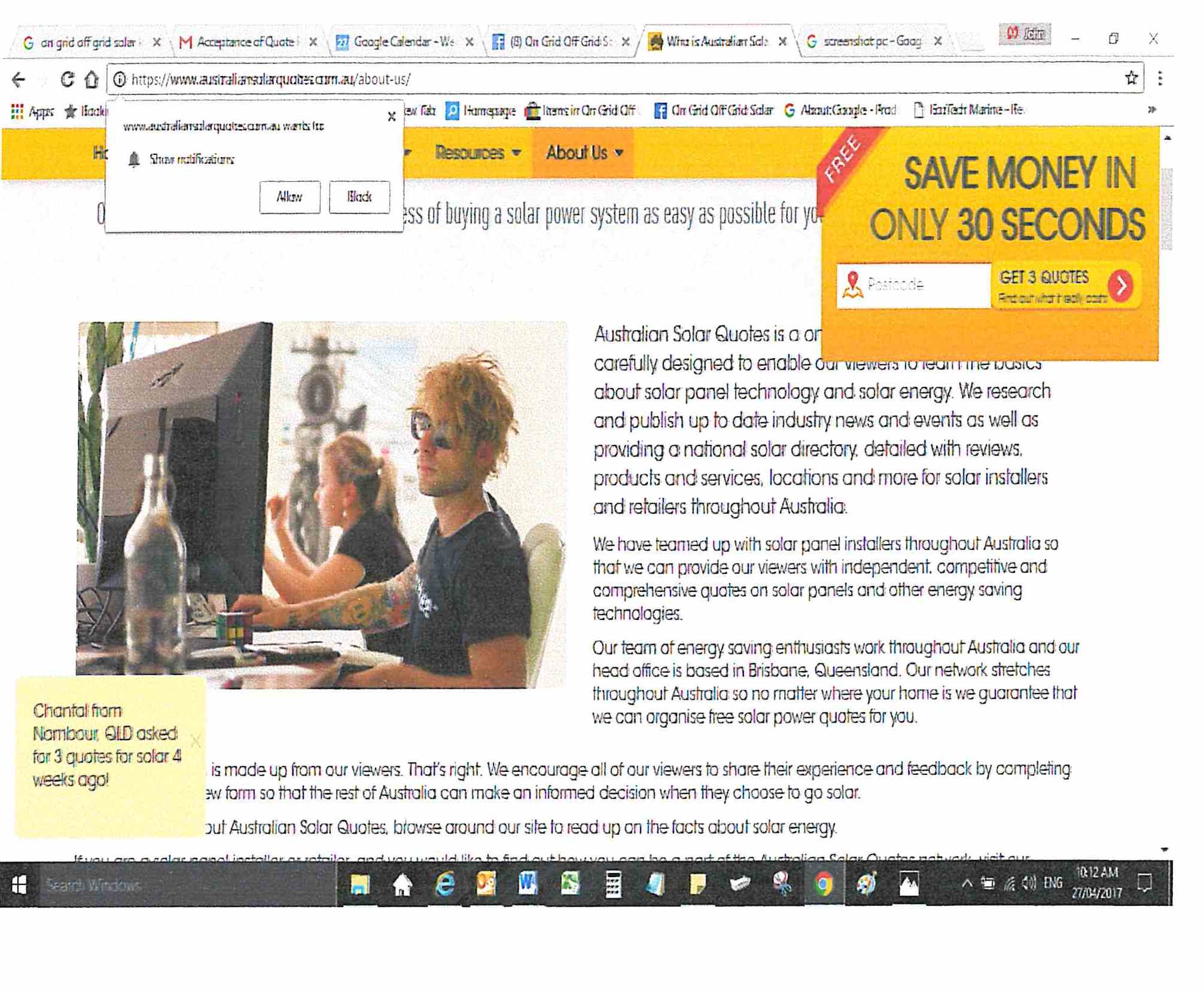
39 Also annexed to Mr Parker’s affidavit is a screen shot of the webpage https://wwwaustraliansolarquotes.com.au/about-us/, apparently from the ASQ website. The page states relevantly:
We research and publish up to date industry news and events as well as providing a national solar directory, detailed with reviews, products and services, locations and more for solar installers and retailers throughout Australia.
We have teamed up with solar panel installers throughout Australia so that we can provide our viewers with independent, competitive and comprehensive quotes on solar panels and other energy saving technologies.
…
The rest of the team is .made up from our viewers. That’s right. We encourage all of our viewers to share their experience and feedback by completing a short installer review form so that the rest of Australia can make an informed decision when they choose to go solar.
40 Within a short period of time, Mr Parker became dissatisfied with ASQ’s service. According to him, he then took steps to terminate his contract with ASQ. The evidence provided by Mr Parker concerning the termination comprised:
(1) Mr Parker’s statement in his affidavit that the contract was terminated by mutual agreement on 11 October 2016.
(2) A chain of emails between Mr Parker and Mr Van Hout dated 11 October 2016 concerning an invoice from ASQ for $95.10 received at 1:21 am. The chain concludes with an email from Mr Van Hout in which he says relevantly:
… I have suspended your account with Switchee.
…
Perhaps in the future, things will change however in the mean time, I is in [sic] our best interest not to continue a professional relationship with On grid off grid solar.
(3) An email from Mr Parker to Mr Van Hout dated 12 October 2016 which concludes:
As we notified yesterday you have no authority to debit our credit card with any more charges, and our agreement with you is null and void.
41 I accept that the contract between Mr Parker and ASQ was terminated on 11 October 2016. Mr Parker gave evidence that he “expected that the company profile in Switchee’s terms and conditions would be removed from publication in accordance with the terms”. He did not identify “the terms” to which he referred and there is no term in the Terms that deals explicitly with the removal of a company profile from the ASQ website. As noted above, the Terms refer to the provision of space on the website for the “Provider” to “advertise and promote their business”.
42 On 3 April 2017, Mr Parker received an email from ASQ stating that his business had received a review from a disgruntled customer. Shortly afterwards, Mr Parker discovered the review set out above had been posted on the ASQ website.
43 At the hearing, Mr Parker gave evidence that the review is untrue and unreasonable in the following respects:
(1) Mr Parker’s business installed a three phase inverter on the basis of an approval from Endeavour Energy. It turned out that Endeavour had mistakenly stated that the property was suitable for the installation of a three phase inverter.
(2) Mr Parker did not insist that the customer pay for Mr Parker’s mistake and purchase all three inverters, then sell the redundant inverter on EBay. First, Mr Parker did not make a mistake: the relevant mistake was made by Endeavour. Further, Mr Parker did not insist on payment in the manner described in the review.
44 Mr Parker complains that ASQ has:
13.1 removed the Applicant’s access to its listing on the Respondent’s website and has prevented the Applicant from removing or updating the listing; and
13.2 prevented the Applicant from responding to a review that has been posed on the listing on the Respondent’s website.
45 As to the first of these complaints, Mr Parker’s affidavit describes the manner in which ASQ prevented him from removing or updating the listing as follows:
I used the issued password to log in to the ASQ portal. The delete account button did not function. The remove name field was blocked. The un publish button did not function[.] I was able to untick and remove some details such as P O Box address, brands, hours [and] incorrect services they had set up originally by Peter Van Hact - an employee of Switchee. Darren Van Hout immediately changed back the information and published our address in Bombo Beach and then blocked us all access to the portal.
46 At the hearing, Mr Parker verified the truthfulness of his complaints. Concerning his inability to access the listing, Mr Parker said:
[W]hat unnerves me about – coming back to that whole idea of him having control over that web page is that on that page there are all sorts of things that you can put there like you can put that you do solar power, solar hot water, electrical work, level 2 electrical work, all sorts of things, and I don’t have access to any of it.
47 However, he clarified that he had not, in fact, tried to post a response to the negative review, contrary to what had been suggested in his concise statement. Emails between Mr Parker and Mr Van Hout show that Mr Parker demanded the removal of the review, and that Mr Van Hout responded by saying relevantly that the review would only be removed “[i]f it is found that our guidelines have been breached”.
48 Mr Parker also gave evidence that he had seen a positive review on the listing (apparently from a satisfied customer), which had appeared immediately below the negative review until Mr Van Hout removed it. This removal was said to have occurred within a few hours of the review’s posting. In his concise statement, Mr Parker also contended that Mr Van Hout has not allowed other customers to post reviews.
49 At the hearing, Mr Parker also verified the following facts set out in his concise statement:
(1) he has repeatedly requested that ASQ remove the listing from its website;
(2) despite acknowledging receipt of Mr Parker’s requests for removal, ASQ has failed to remove the listing;
(3) ASQ has advised Mr Parker that the only way it can change the listing is to buy further leads from ASQ;
(4) ASQ is receiving a commercial benefit at the expense of Mr Parker by continuing to list Mr Parker’s business on its website;
(5) Mr Parker’s listing on ASQ’s website improves traffic to the website and improves its Google search rankings; and
(6) ASQ is attempting to force Mr Parker to buy further services from ASQ by refusing to remove the listing.
50 Mr Parker contends that his business has suffered as a result of the publication of the negative review which, Mr Parker claims, is materially inaccurate and unfair. By email dated 4 April 2017, Mr Parker wrote to ASQ demanding that all references to his business be removed from the ASQ website. In that email, Mr Parker stated that the negative review was “libellous and defamatory” and was authored by a customer who had not been sourced through a lead provided by ASQ.
51 By letter dated 10 April 2017, Kells Lawyers wrote to ASQ demanding that ASQ remove all references to Mr Parker’s business from their website.
52 Instead, on about 10 May 2017, ASQ amended OGOG’s listing to include the “disclaimer” set out above.
Legal basis for claims
53 Mr Parker relied on the following provisions of the ACL:
(1) Section 18(1), which provides that a person must not, in trade or commerce, engage in conduct that is misleading or deceptive or is likely to mislead or deceive.
(2) Section 20(1), which provides that a person must not, in trade or commerce, engage in conduct that is unconscionable, within the meaning of the unwritten law from time to time.
(3) Section 21(1)(a), which provides that a person must not, in trade or commerce, in connection with the supply or possible supply of goods or services to a person (other than a listed public company) engage in conduct that is, in all the circumstances, unconscionable.
(4) Section 29(l)(h), which provides that a person must not, in trade or commerce, in connection with the supply or possible supply of goods or services or in connection with the promotion by any means of the supply or use of goods or services make a false or misleading representation that the person making the representation has a sponsorship, approval or affiliation.
54 While Mr Parker’s concise statement also included a claim that ASQ’s conduct constitutes a passing off of his business, no facts were pleaded in support of this cause of action and nor was it pressed at the hearing.
Consideration of Mr Parker’s claims
55 I accept Mr Parker’s unchallenged evidence set out above.
56 As a general proposition, ASQ is free to publish information concerning Mr Parker’s business. However, this freedom is not unlimited, being subject to laws which include the ACL.
Sections 18 and 29: Misleading or deceptive conduct
57 By s 18(1), a person must not, in trade or commerce, engage in conduct that is misleading or deceptive or is likely to mislead or deceive.
58 Section 29(1) provides, relevantly:
A person must not, in trade or commerce, in connection with the supply or possible supply of goods or services or in connection with the promotion by any means of the supply or use of goods or services:
…
(h) make a false or misleading representation that the person making the representation has a sponsorship, approval or affiliation; or
…
59 While s 29(1)(h) uses the expression “false or misleading” rather than “misleading or deceptive” (as in s 18(1)), there is no meaningful difference between these expressions: Australian Competition and Consumer Commission v Coles Supermarkets Australia [2014] FCA 634; (2014) 317 ALR 73 at [40] per Allsop CJ.
60 In Reckitt Benckiser (Australia) Pty Limited v Procter & Gamble Australia Pty Limited [2015] FCA 753 at [34]-[38], I set out the following uncontroversial principles relevant to an assessment of ASQ’s conduct in this case:
[34] The applicable legal principles in respect of misleading or deceptive conduct in advertising are well-established. They are summarised in the recent decisions of Allsop CJ in Australian Competition and Consumer Commission v Coles Supermarkets Australia Pty Ltd [2014] FCA 634; (2014) 317 ALR 73 (“ACCC v Coles”) at [35]-[47] and Nicholas J in Samsung Electronics Australia Pty Ltd v LG Electronics Australia Pty Ltd [2015] FCA 227 (“Samsung v LG”) at [60]-[76].
[35] A two-step analysis is required, addressing the following issues:
(1) whether each or any of the pleaded representations is conveyed by the advertisement; and
(2) whether each of the representations conveyed is false, misleading or deceptive or likely to mislead or deceive: Novartis Pharmaceuticals Australia Pty Ltd v Bayer Australia Ltd [2015] FCA 35 at [200].
[36] The causing of confusion or questioning is insufficient; it is necessary to establish that the ordinary or reasonable consumer is likely to be led into error: ACCC v Coles at [39].
[37] It is necessary to view the conduct as a whole and in its proper context (ACCC v Coles at [41]). The question whether conduct is misleading or deceptive or likely to mislead or deceive is a question of fact that must be determined in light of the relevant surrounding circumstances: Samsung v LG per Nicholas J at [61], applying Butcher v Lachlan Elder Realty Pty Ltd [2004] HCA 60; (2004) 218 CLR 592 at [109] per McHugh J. The dominant message will be of crucial importance: ACCC v Coles at [42], citing Australian Competition and Consumer Commission v TPG Internet Pty Ltd [2013] HCA 54; (2013) 250 CLR 640 (“TPG”) at [45].
[38] In Samsung v LG at [73], Nicholas J referred to the following observations of Hill J in Tobacco Institute of Australia Ltd v Australian Federation of Consumer Organisations Inc [1992] FCA 630; (1992) 38 FCR 1 at 50, albeit in the context of a newspaper advertisement:
Where, as in the present case, the advertisement is capable of more than one meaning, the question of whether the conduct of placing the advertisement in a newspaper is misleading or deceptive conduct must be tested against each meaning which is reasonably open. This is perhaps but another way of saying that the advertisement will be misleading or likely to mislead or deceive if any reasonable interpretation of it would lead a member of the class, who can be expected to read it, into error.
What representations are conveyed by the listing?
Affiliation between Mr Parker and ASQ
61 Mr Parker’s concise statement alleges that the listing conveys that ASQ has an affiliation with Mr Parker’s business. By “affiliation”, I understand Mr Parker to refer to a current association or connection between ASQ and OGOG.
62 In my view, the class of consumers who are likely to read the listing are consumers or potential consumers of services to install solar panels and other energy saving technologies. They are likely to be a cross-section of society in general, with differing levels of comprehension or experience of services of the kind provided by ASQ. In my view, the listing conveys to a reasonable reader of that broad class that there is an association between ASQ and OGOG pursuant to which a potential consumer may receive a quote from OGOG as one of three quotes, using the service provided by ASQ. That association is conveyed by the words “Get 3 quotes” which appear in three places on the listing, as well as the wider context of the ASQ website. In particular, the “about us” webpage conveys to a reasonable reader that the main purpose of the website is to provide quotes on solar panels and other energy saving technologies. In my view, a reasonable reader of the listing is likely to read it in the context of the “about us” webpage and would understand that OGOG is a provider of the services and technologies whose provision ASQ seeks to enable through the website of which the listing forms part.
63 The “disclaimer” is confusing, in part, because it contains a grammatical or a spelling error. Even so, in my view, a reasonable reader may understand it as a statement that ASQ is not affiliated with OGOG. However, such a reader would probably be confused as to the meaning of that statement in the context of the listing which contains the other messages of association that I have identified. In particular, in my view, a reasonable reader would be confused as to whether he or she could obtain a quote from OGOG through ASQ because the “disclaimer” says nothing explicit about that matter.
64 Mr Parker’s observations that the listing does not include business hours and other information (such as a telephone number), in contrast to information included about other services profiled on the ASQ website, may tell against his case to the extent that it may indicate to a reasonable reader that the business of OGOG is not currently in operation. However, I do not think that these deficiencies detract from the overall strong impression that OGOG is one of the service providers that form part of ASQ’s network.
65 Thus, I conclude that the listing is capable of conveying opposite messages to a reasonable reader: that there is an affiliation between ASQ and OGOG and that there is not such an affiliation. As to the former, the message is that there is a relationship between ASQ and OGOG pursuant to which a potential consumer may obtain a quote from OGOG for solar energy products or services.
Listing contains accurate information
66 The concise statement alleges that the listing contains incorrect details for the business. This allegation involves the implicit allegation that the listing conveys a representation that the information about the business on the listing is accurate. I accept that a reasonable reader of the listing would understand it to convey accurate information because it appears in the context of a website that is designed to provide useful information to potential consumers of solar panels and other energy saving technologies.
Permission to respond to negative review
67 The concise statement alleges that ASQ has published the negative review of OGOG and has not allowed OGOG to post a response.
68 This allegation involves the implicit allegation that the listing conveys a representation that ASQ has not prevented OGOG from responding to the negative review. I accept that a reasonable reader of the listing is likely to expect that there is no restriction on the ability of Mr Parker to post a response addressing any perceived errors in the negative review (subject to lawful restrictions, for example, to prevent the posting of abusive material). That expectation is conveyed by the words “Reply” and “Report” immediately underneath the review. In those circumstances, I find that the listing conveys to a reasonable reader that OGOG is free to reply to the negative review (provided that any such reply is not abusive) and, in the absence of any reply, that OGOG has made a choice not to do so.
Permission to post reviews of OGOG
69 The concise statement alleges that ASQ is not allowing other customers of OGOG to post reviews.
70 This allegation involves the implicit allegation that the listing conveys a representation that ASQ permits the publication of reviews concerning OGOG, subject to lawful restrictions as set out above. As above, I find that the listing conveys to a reasonable reader that customers of OGOG may publish reviews of OGOG’s services on the website and, in the absence of any such review, no customer has sought to do so.
Are the representations misleading?
71 For a reasonable reader who understands from the listing that a potential consumer may obtain a quote from OGOG for solar energy products or services through ASQ, the publication of the listing is misleading because there is no association, connection or affiliation between ASQ and OGOG pursuant to which a quote may be obtained.
72 I am not persuaded that the listing is also misleading because it conveys false information about OGOG. I am not persuaded that a reasonable reader would read the page to mean that OGOG provides services only at Bombo. The listing does not provide a clear explanation for the reference to Bombo.
73 I am not persuaded that the listing is misleading in that it falsely conveys that OGOG had an opportunity to respond to the negative review, because the evidence does not support a finding that OGOG was denied that opportunity. Mr Parker’s evidence was that he had not attempted to post a response. Rather, the correspondence tendered by him showed that Mr Parker had sought to have the review removed and ASQ had declined to do so unless it deemed the review breached its guidelines.
74 I accept that the listing is misleading in that it falsely conveys that consumers are free to post reviews of OGOG when the true position is that a positive review by a consumer was removed shortly after posting.
75 Accordingly, I find that by making the misleading representations, ASQ contravened ss 18(1) and 29(1)(h) of the ACL.
Section 21: Statutory unconscionable conduct
76 By s 21(1)(a) a person must not, in trade or commerce, engage in conduct in connection with the supply or possible supply of goods or services to a person that is, in all the circumstances, unconscionable. By s 4(2)(a) of the CCA, a reference to “engaging in conduct” may be read as a reference to doing or refusing to do any act.
77 “The term “unconscionable” is used as a description of various grounds of equitable intervention to refuse enforcement of or to set aside transactions which offend equity and good conscience”: Australian Competition and Consumer Commission v CG Berbatis Holdings Pty Ltd & Ors [2003] HCA 18; (2003) 214 CLR 51 at [42]. Unconscionability involves a higher moral standard than unfairness or unjustness: Paciocco v Australia and New Zealand Banking Group Limited (No 2) [2017] FCAFC 146; (2017) 236 FCR 199 at [261] (Allsop CJ). In Commercial Bank of Australia Ltd v Amadio [1983] HCA 14; (1983) 151 CLR 447 at 461, Mason J explained that:
[R]elief on the ground of “unconscionable conduct” is usually taken to refer to the class of case in which a party makes unconscientious use of his superior position or bargaining power to the detriment of a party who suffers from some special disability or is placed in some special situation of disadvantage, e.g., a catching bargain with an expectant heir or an unfair contract made by taking advantage of a person who is seriously affected by intoxicating drink.
78 Unlike s 20(1) (considered below), s 21(1)(a) is not limited by the unwritten law relating to unconscionable conduct and possesses a wider meaning: s 21(4)(a). Section 22(1) sets out a non-exhaustive list of matters to which the court may have regard for the purposes of s 21, including relevantly:
(a) the relative strengths of the bargaining positions of the supplier and the customer; and
…
(d) whether any undue influence or pressure was exerted on, or any unfair tactics were used against, the customer or a person acting on behalf of the customer by the supplier or a person acting on behalf of the supplier in relation to the supply or possible supply of the goods or services; …
79 In Australian Competition and Consumer Commission v Get Qualified Australia Pty Ltd (in liq) (No 2) [2017] FCA 709, Beach J considered the operation of s 21. At [60]-[66] his Honour summarised the relevant principles as follows:
First, “unconscionability” means something not done in good conscience or conduct against conscience by reference to the norms of society. But that is to be understood and applied in the context of trade or commerce, but including consumer protection objectives directed at the requirements of honest and fair conduct free of deception (see generally Paciocco v Australia and New Zealand Banking Group Limited (2015) 236 FCR 199 at [259] to [304]). But one must be careful in using the phrase “norms of society” to ensure that the identification thereof is not interlarded with some distorted subjective view of social philosophy. It is fraught with risk to move beyond the explicit and implicit norms enshrined in and bounded by the statutory language of ss 21 and 22 construed in context, being trade or commerce, notwithstanding the apparent breadth of s 21(4) and the non-limiting prefatory words of s 22(1). Moreover, the evaluation of unconscionability must not be decontextualised from the particular case under consideration.
Second and relatedly, in order to determine whether conduct is unconscionable, it is necessary to look at all the conduct, by “[s]tanding back and looking at the whole episode” (Australian Competition and Consumer Commission v Lux Distributors Pty Ltd [2013] FCAFC 90 at [44]).
Third, as the norms of society include statutory prohibitions on deceptive conduct and the regulation of unsolicited consumer agreements, deceptive practices and contraventions of provisions concerning unsolicited consumer agreements can form part of the “whole episode”, for the purpose of assessing whether, in all the circumstances, the conduct in question is unconscionable (Lux Distributors at [41] to [44]).
Fourth, s 22(1) of the ACL sets out a non-exhaustive list of factors to which the Court may have regard for the purpose of determining whether a person has contravened s 21. The matters enumerated assist in understanding the scope of the meaning of unconscionable conduct, but the presence of one or more matters contained in s 22(1) (or indeed their absence) is not necessarily determinative.
Fifth, s 21(4)(b) of the ACL states that it is the intention of Parliament that s 21 is “capable of applying to a system of conduct or pattern of behaviour, whether or not a particular individual is identified as having been disadvantaged by the conduct or behaviour”.
Relatedly, proof of examples of similar unconscionable conduct in respect of individual cases can be used to demonstrate the features of a system of conduct or pattern of behaviour, even though no particular individual need be identified as having been disadvantaged.
Finally, the evidence of unconscionable conduct may be quite varied and, in some cases, not even substantial, but still form part of an overall pattern or system of unconscionability. It may be established by a systemic pattern of behaviour involving an accumulation of minor incidents.
What was the relevant conduct?
80 Mr Parker alleges that the conduct of ASQ described in the concise statement constitutes unconscionable conduct. The alleged conduct comprises:
(1) removing Mr Parker’s access to the listing on the ASQ website following the termination of the agreement between the parties;
(2) failing to remove the listing despite Mr Parker’s request that the listing be removed;
(3) advising Mr Parker that he will only be able to change the listing if he buys further leads from ASQ;
(4) publishing inaccurate information on the OGOG listing and preventing Mr Parker from correcting such inaccuracies;
(5) publishing the negative review on the OGOG listing and not allowing Mr Parker to respond to it; and
(6) removing a positive review from the OGOG listing.
81 I have previously found that ASQ engaged in the alleged conduct, except that the evidence does not support a conclusion that Mr Parker was not permitted by ASQ to respond to the negative review. However, I did find that ASQ refused to remove the negative review.
Was the conduct related to the supply, or possible supply, of a service?
82 Section 2 of the ACL defines “services” as including any rights (including rights in relation to, and interests in, real or personal property), benefits, privileges or facilities that are, or are to be, provided, granted or conferred in trade or commerce.
83 ASQ provided Mr Parker with services under their contract for the sale and purchase of “email leads”.
84 ASQ’s conduct since termination remains conduct in connection with the supply of these services. In Australian Competition and Consumer Commission v Woolworths (South Australia) Pty Ltd (Trading as Mac’s Liquor) [2003] FCA 530; (2003) 198 ALR 417, at [55], Mansfield J said:
The expression “in connection with” was given a wide scope of operation by Kitto J in Berry v Federal Commissioner of Taxation (1953) 89 CLR 653 at 658-659, as requiring ‘a substantial relation, in a practical business sense’. The test does not necessarily require an immediate causal relationship: per Wilcox J in Our Town FM Pty Ltd v Australian Broadcasting Tribunal (1987) 16 FCR 465 at 479-480.
85 While this comment was in the context of s 87B of the Trade Practices Act 1979 (Cth), Markovic J has since cited it with approval in relation to s 21 in Tameeka Group Pty Ltd v Landan Pty Ltd (No 3) [2016] FCA 733 at [165], where her Honour observed that:
The alleged conduct does not have to take place at the time of the supply or acquisition of the services. That would impose a temporal limitation which I do not think is contemplated by the section.
86 In any event, ASQ’s conduct since termination is connected with the possible supply of a service to Mr Parker to the extent that the conduct was designed to encourage Mr Parker’s entry into a fresh contract for the sale and purchase of “email leads”. I find that the conduct referred to in [80(2)] above is conduct of this description.
Was the conduct unconscionable?
87 Considering the whole of the circumstances, in my view, by engaging in the conduct set out at [80] (1) to (4) and (6), ASQ has acted unconscionably within the meaning of s 21 because ASQ has taken advantage of its control over the ASQ webpage to publish the misleading listing without Mr Parker’s consent, and over his objection, for ASQ’s benefit and to the likely detriment of the commercial reputation of OGOG. The likely detrimental impact of the publication has been enhanced by refusing to permit Mr Parker to make changes to the listing that might enhance the business’s reputation and by removing a positive review.
88 In particular, by telling Mr Parker that he can only improve his position by acquiring more services from ASQ, ASQ has engaged in an unfair tactic. It has set the acquisition of a service that Mr Parker does not want as the price for ceasing its misleading or deceptive conduct.
89 As a result, I find that ASQ has contravened s 21(1)(a) of the ACL.
Section 20: Unconscionable conduct within the meaning of the unwritten law
90 Section 20(1) of the ACL provides that a person must not, in trade or commerce, engage in conduct that is unconscionable, within the meaning of the unwritten law from time to time. By s 20(2), s 20(1) does not apply to conduct that is prohibited by s 21(1)(a) of the ACL. Therefore, in light of my finding that ASQ has contravened s 21(1)(a), s 20(1) does not apply in this case.
Relief
91 By way of relief, Mr Parker seeks a declaration, injunctions and damages.
Declaratory relief
92 The Court has a wide discretionary power to make declarations under s 21(1) of the Federal Court of Australia Act 1976 (Cth). Declarations in relation to breaches of the ACL may be made because, relevantly, they:
(a) are an appropriate vehicle to record the Court’s disapproval of the contravening conduct; and
(b) may deter corporations from contravening the ACL: see Australian Competition and Consumer Commission v The Construction, Forestry, Mining and Energy Union [2006] FCA 1730; (2007) ATPR 42-140 at [6].
93 I am satisfied that a declaration identifying the contraventions that I have found is likely to achieve each of these purposes. The declaration I will make will also be framed more specifically so as to identify the contravening conduct with precision.
Injunctive relief
94 The Court’s power to grant injunctive relief to restrain a breach of ss 18, 29 or 21 is contained in s 232 of the ACL. By s 232(4), the Court’s power to grant an injunction under s 232(1) restraining a person from engaging in conduct may be exercised:
(a) whether or not it appears to the court that the person intends to engage again, or to continue to engage, in conduct of a kind referred to in that subsection; and
(b) whether or not the person has previously engaged in conduct of that kind; and
(c) whether or not there is an imminent danger of substantial damage to any other person if the person engages in conduct of that kind.
95 Mandatory injunctions have been granted under s 232 to require the destruction and disposal of convening goods: see, for example, Director of Consumer Affairs v Nightingale Electrics Pty Ltd [2016] FCA 279 and Director of Consumer Affairs Victoria v Daiso Industries (Australia) Pty Ltd (No 3) [2017] FCA 1488.
96 In this case, ASQ has made it clear that it will not remove the offending listing in the absence of a Court order. ASQ’s position, as stated at the 15 June 2016 case management hearing was that its conduct did not involve a contravention of any relevant law. Having failed to participate fully in the proceeding, in my view, the circumstances warrant the making of injunctive orders to ensure that ASQ complies with the requirements of the ACL in relation to Mr Parker and OGOG. Accordingly, I will make orders to achieve that outcome.
Damages
Principles
97 By s 236 of the ACL, if a claimant suffers loss or damage because of the conduct of another person, and the conduct contravened, relevantly, ss 18, 29 or 21 of the ACL, the claimant may recover the amount of the loss or damage.
98 Following from the words of the provision, the relevant question is whether or not there is a sufficient connection between the contravening conduct and the loss or damage suffered such that the latter can be regarded as being “because of” the former: see Marks v GIO Australia Holdings Ltd [1998] HCA 69; (1998) 196 CLR 494 at [38]-[39] and Campbell v Backoffice Investments [2009] HCA 25; (2009) 238 CLR 304 at [102]. While the contravening conduct need not be the sole cause of the claimant’s loss or damage, it must be shown to have “materially contributed” to it: Henville v Walker [2001] HCA 52; (2001) 206 CLR 459 at [106] per McHugh J.
99 For the same reason, recovery is confined to the “amount of the loss or damage” suffered, assessed via comparison between the position in which the person who suffered loss or damage is in and the position that person would have been in had there been no contravention; neither nominal nor punitive damages can be awarded under s 236: Wardley Australia Ltd v Western Australia [1992] HCA 55; (1992) 175 CLR 514 at 525-526.
100 In Enzed Holdings Ltd v Wynthea Pty Ltd [1984] FCA 416; (1984) 57 ALR 167 at 183, the Court considered the obligation to assess damages where there is uncertainty, and said:
The principle is clear. If the court finds that damage has occurred it must do its best to quantify the loss even if a degree of speculation and guess work is involved…We emphasise, however, that the principle applies only when the court finds that loss or damage has occurred. It is not enough for a plaintiff merely to show wrongful conduct by the defendant.
Evidence
101 In his affidavit, Mr Parker stated that he has “lost 10 jobs that he knows of and most of our potential customers see the review as do our competitors. Estimated damages so far are $20,000 in lost profit”.
102 At the hearing, Mr Parker said that email leads are a very large percentage of the business of OGOG. He said that, since the negative review was published, he had been told by “customer after customer after customer” that they saw the review. Mr Parker also compiled a profit and loss statement which, he submitted, showed a steep decline in sales and revenue since the publication of the negative review.
103 Mr Parker tendered a list of 11 individuals and addresses marked “Customers who we believe did not go ahead because of negative review on ASQ”. In support of the contention that these individuals would have acquired services from OGOG but for the negative review, Mr Parker said:
Well, those ones there they have – they were all – I’ve written them in there because they were very, very keen and ready to proceed and all of a sudden having said that they would do some research they’ve gone very cold. Just couldn’t contact them, didn’t hear back, and I was – I felt that I was at the point of signing a deal.
104 Mr Parker said that his average profit per job was $2,000-2,500. Mr Parker also said that the low profit figures were unusual because the domestic solar market was rather buoyant because high electricity bills are attracting customers to the market. Based on the state of the market, Mr Parker claimed that his profit figures should be “a lot higher” than the figures as they stood at the date of the hearing.
105 The profit and loss statement shows OGOG’s trading income, gross profit and net profit for the months August 2016 to July 2017 inclusive. It shows that OGOG made losses in the months of June and July 2017. In May 2017, OGOG made a modest profit after incurring legal expenses of $9,090.91. In the months of August 2016 to April 2017, the monthly net profits ranged from a high of $24,142.63 in December 2016 to a loss of $7,346.79 in August 2016.
Consideration
106 While I accept that Mr Parker has reason to suspect that his business has been damaged by the publication of the negative review, I am not satisfied on the balance of probabilities that such damage has in fact occurred. In particular, there is no evidence from any individual that he or she decided not to deal with OGOG because of the negative review. Mr Parker’s belief, even if it is based on a reasonable suspicion, is not sufficient to prove that it is more likely than not that ASQ’s conduct in contravention of ss 18, 29 and 21 of the ACL materially contributed to any potential customers not retaining OGOG’s services. There is a range of reasons why a potential customer might not proceed to acquire services after obtaining a quote from Mr Parker that are unrelated to the contravening conduct of ASQ.
107 The historical financial information does not, without more, demonstrate that OGOG has lost customers and suffered consequent losses as a result of the publication of the negative review. That information shows OGOG’s profits varied quite significantly from month to month and it is not possible to draw an inference from this alone as to the reasons for the monthly variations.
108 Accordingly, on the currently available evidence, I am not persuaded that Mr Parker has suffered damage as a result of the publication of the negative review.
Further opportunity to prove entitlement to monetary relief
109 This matter was heard within months of the conduct that I have found to be misleading or deceptive and unconscionable. It is likely that any harm suffered by Mr Parker as a result of the impugned conduct, particularly in the nature of harm to commercial reputation (cf. Cryeng Pty Ltd v Loyola [2001] FCA 956 at [97] to [105] per Stone J), had not fully crystallised at that time.
110 Accordingly, I will give Mr Parker a further opportunity to file evidence and make submissions as to his rights to further monetary relief. ASQ will, of course, be able to participate in a further hearing on the question of monetary relief, including by filing its own evidence, should it wish to do so.
Costs
111 Costs of the proceeding to date should follow the event.
I certify that the preceding one hundred and eleven (111) numbered paragraphs are a true copy of the Reasons for Judgment herein of the Honourable Justice Gleeson. |
Associate:
ANNEXURE “A”
ANNEXURE “B”