FEDERAL COURT OF AUSTRALIA
Gill v Ethicon SÁRL [2018] FCA 470
ORDERS
First Applicant DIANE DAWSON Second Applicant ANN SANDERS Third Applicant | ||
AND: | First Respondent ETHICON, INC. Second Respondent JOHNSON & JOHNSON MEDICAL PTY LIMITED (ACN 000 160 400) Third Respondent | |
DATE OF ORDER: |
THE COURT ORDERS THAT:
1. Leave be granted to the applicants to:
(a) file an amended originating application in the form contained in annexure “A” to the amended interlocutory application dated 4 April 2018; and
(b) file an amended statement of claim in the form contained in annexure “B” to the amended interlocutory application dated 4 April 2018, save that the words “before 4 July 2017” be substituted for “(including after the commencement of these Proceedings)” in the definition of Group Members in paragraph 1(b).
2. The parties confer on and agree to an appropriate form of opt-out notice and forward it to my chambers by 4pm on 11 April 2018 for approval under s 33Y(2) of the Federal Court of Australia Act 1976 (Cth).
3. The respondents have leave to file and serve, by 31 May 2018, supplementary submissions on the proposed amendments contained in:
(a) paragraphs 23C and 48 of the Fifth Further Amended Statement of Claim; and
(b) paragraph 2A of the Fifth Further Amended Originating Application.
4. The applicants file any submissions in reply by 14 June 2018.
5. The applicants pay 85% of the respondents’ costs of the interlocutory application, including any costs thrown away.
Note: Entry of orders is dealt with in Rule 39.32 of the Federal Court Rules 2011.
1 This is a representative action brought on behalf of the three named applicants and others (the group members) who were surgically implanted with one or more of nine medical devices made from knitted polypropylene in order to treat either or both of two medical conditions: stress urinary incontinence and pelvic organ prolapse in women. The devices were manufactured by the first two respondents, Ethicon SÁRL, a Swiss company, and Ethicon Inc., an American company, and sold in Australia by the third respondent, Johnson & Johnson Medical Pty Limited. The applicants claim that the devices were defective and/or unfit for the purpose for which they were acquired and that misleading representations were made about them. They contend that the respondents contravened several provisions of the Trade Practices Act 1974 (Cth) and the Competition and Consumer Act 2010 (Cth) and that they were also negligent. They allege that they suffered injury as a result and seek, amongst other forms of relief, compensation for their loss and damage. The action was started on 15 October 2012. The hearing began on 4 July last year and ran for six months in total, concluding in late February this year. Judgment is reserved.
2 By an interlocutory application filed after the conclusion of the hearing, on 14 March 2018, the applicants applied for leave to amend the originating application and the statement of claim (currently in their sixth iterations) so as to:
alter the description of the group members and thereby expand the group (group definition issue);
add claims for declaratory and injunctive relief in respect of the allegation of misleading or deceptive conduct arising from the respondents’ failure to provide a warning about the devices in terms the applicants allege should have been given (declaration and injunction issue); and
add an allegation that the respondents failed to give any or any sufficient information or warning to group members, their treating hospitals and/or treating doctors that the “chronic inflammatory response to the [implanted devices] may be affected by conditions which affect the immune response and healing, including autoimmune and connective tissue disorders” (immune response issue).
3 A proposed Fifth Further Amended Originating Application and Fifth Further Amended Statement of Claim were annexed to the interlocutory application. An amended application including some minor changes was forwarded to my chambers on 4 April 2018.
4 Notice of some of the proposed amendments was given by email to the respondents on 16 February 2018. Notice of the proposed amendments to the statement of claim, however, was not given until 13 March 2018.
5 The interlocutory application was supported by an affidavit sworn on 13 March 2018 by Rebecca Jancauskas, a solicitor and special counsel employed by Shine Lawyers, the lawyers for the applicants. Ms Jancauskas has had the conduct of the proceeding on behalf of the applicants since before the first originating application was filed in October 2012. Annexed to the affidavit are a number of documents including correspondence between the parties.
6 In all but one relatively minor respect, the application is opposed.
The group definition issue
7 Group members are currently described in the Fourth Further Amended Statement of Claim as women who satisfy three criteria:
(1) they had surgery performed on them in Australia to implant one or more of the devices in question;
(2) they were supplied with one or more of the devices for the purpose of use during pelvic surgery for the treatment of pelvic organ prolapse and/or stress urinary incontinence or both, to restore pelvic anatomy and function, and thereby to alleviate their prolapse and/or incontinence symptoms; and
(3) they have suffered from one or more complications, defined in the statement of claim, attributed to the devices and/or the consequences of surgical removal of the devices.
8 The applicants wish to amend the description of the group members to include women who were not implanted with a relevant device until after the proceeding started and those who were implanted with a relevant device before the start of the proceeding but did not suffer a complication until later. They initially proposed that the group members now be described as “persons who have at any time (including after the commencement of these Proceedings)” come within the relevant categories. During oral argument, however, Mr Graham SC, who appeared with Mr Naylor for the applicants, sought to confine the period by adding to the phrase italicised above “but before the date of judgment or the approval of any settlement”. The applicants also seek consequential orders permitting members of the expanded group to opt out of the proceeding pursuant to ss 33J and 33X of the Federal Court of Australia Act 1976 (Cth) (FCA Act). In the event that leave were to be granted to alter the description of the group, the respondents do not quarrel with the consequential orders.
The power to make the orders
9 There is no dispute that the Court has the power to make the order the applicants seek. The dispute concerns whether or not the power should be exercised in this case.
10 Proceedings of this kind are governed by Pt IVA of the FCA Act.
11 Section 33C deals with the commencement of a representative proceeding. Subject to Pt IVA, it enables seven or more persons with claims against the same person arising out of the same, similar or related circumstances to commence a proceeding “as representing some or all of them” provided that the claims of all those persons give rise to “a substantial common issue of law or fact”.
12 Section 33H requires that the group represented by an applicant be “describe[d] or otherwise [identified]”, either in the application commencing the proceeding or in a document filed in support of such an application.
13 Section 33J stipulates that the Court must fix a date before which a group member may opt out of a representative proceeding and provides that that may be done by giving written notice under the Rules of Court before “the date so fixed”. Except with the leave of the Court, the hearing of a representative proceeding must not commence earlier than the date before which a group member may opt out of the proceeding.
14 Section 33K makes express provision for the amendment of the group where the description appears in the originating application. The section reads:
33K Causes of action accruing after commencement of representative proceeding
(1) The Court may at any stage of a representative proceeding, on application made by the representative party, give leave to amend the application commencing the representative proceeding so as to alter the description of the group.
(2) The description of the group may be altered so as to include a person:
(a) whose cause of action accrued after the commencement of the representative proceeding but before such date as the Court fixes when giving leave; and
(b) who would have been included in the group, or, with the consent of the person would have been included in the group, if the cause of action had accrued before the commencement of the proceeding.
(3) The date mentioned in paragraph (2)(a) may be the date on which leave is given or another date before or after that date.
(4) Where the Court gives leave under subsection (1), it may also make any other orders it thinks just, including an order relating to the giving of notice to persons who, as a result of the amendment, will be included in the group and the date before which such persons may opt out of the proceeding.
15 The description of the group in the present case, however, was not included in the originating application but in the statement of claim that accompanied it.
16 The following propositions advanced by the applicants were uncontroversial.
17 First, despite the heading to s 33K, subs (1) empowers the Court to grant leave to permit any amendment to the description of the group once the proceeding has commenced (Bray v F Hoffman-La Roche Ltd [2003] FCA 1505 at [25] (Merkel J)) and leave may be granted at any stage of the proceeding.
18 Secondly, the object of s 33K(2) was to include as many potential group members as possible to facilitate the aims of access to justice and judicial economy (by the resolution of common questions in the one proceeding).
19 In Gibson v Malaysian Airline System Berhad (No 2) [2017] FCA 701 at [12] Perram J pointed out that the section has its origins in the draft bill prepared by the Australian Law Reform Commission (ALRC) in Report No 46 in 1988 entitled “Grouped Proceedings in the Federal Court”. His Honour also pointed out that, at the time s 33K was introduced, a cause of action arising after a proceeding had started could not be included. As his Honour put it, s 33K(2) was “directed to overcoming this difficulty”. The section remains in its original form although the difficulty no longer exists (see now Federal Court Rules 2011 (FCR) r 8.21(g)). Still, there is no reason to read s 33K(1) down by reference to the situation contemplated by s 33K(2) or (3) for that matter: Bray at [25]–[27].
20 The ALRC indicated (at p 67 of its report) that it intended the provision to apply where a class action concerned a latent injury such as that caused by asbestos where new members might become symptomatic after the commencement of the proceeding. But the FCA Act does not expressly confine the scope of relief to such a case.
21 Thirdly, despite the absence of any direct reference in s 33K to pleadings, s 33K(1) does not prevent an amendment to the description of the group where the description appears in a statement of claim filed in support of the originating application. In Gibson Perram J said the source of the power, however, was not s 33K but FCR r 16.53: at [14]–[16]. With respect, strictly speaking r 16.53 could not be the source of the power to amend the pleading; it merely imposes an obligation on a party to apply for the leave of the Court to amend a pleading unless r 16.51 applies (which it does not here). The source of the power is r 1.40 (which provides that the Court may exercise a power mentioned in the Rules either on its own initiative or on the application of a party) or r 1.41 (which gives the Court the power to grant an order sought by a party in an application).
22 FCR r 16.53 is unfettered in its scope but the parties proceeded on the basis that the considerations affecting the exercise of the power to amend the originating application should apply to an amendment to the statement of claim. The applicants asserted, without contradiction, that it was clear that r 16.53 can be used to the same effect as s 33K where the group definition appears in the pleading rather than the originating application.
23 Fourthly, the range of relevant considerations is broad; the Court has the power to do what is “just and convenient”: Sherwood v Commonwealth Bank of Australia (No 5) [2015] FCA 688 (Collier J) at [20]–[21] approving Rod Investments (Vic) Pty Ltd v Clark (No 3) [2007] VSC 306 at [10] (Hansen J) in respect of the identical provision (also s 33K) of the Supreme Court Act 1986 (Vic).
24 I turn now to the critical question: should the Court exercise the power in its discretion? If the answer to that is “yes”, two further questions arise. What should be the cut-off date for the purposes of s 33K(2) and from what point in time should the amendment have effect?
Should the discretion be exercised in the applicants’ favour?
25 The applicants submitted that the purpose of the orders they seek is to achieve the very thing towards which s 33K(2) is directed. But s 33K only gives the Court the power to make an order. It does not mandate its exercise. Nor of course do the Rules of Court.
26 Like any power conferred by the Act or the Rules, the power to grant leave to a representative party to alter the description of the group must be exercised in the way that best promotes the overarching purpose of the civil procedure provisions of the legislation, that is, to facilitate the just resolution of disputes according to law and as quickly, inexpensively, and efficiently as possible: FCA Act, s 37M. That purpose includes the just determination of all proceedings; the efficient use of the judicial and administrative resources available for the purposes of the Court; the efficient disposal of the Court’s overall caseload; the disposal of all proceedings in a timely manner; and the resolution of disputes at a cost that is proportionate to the importance and complexity of the matters in dispute. The power should also be exercised in a way that would conform to the purposes of the statutory scheme for representative proceedings.
27 Neither party referred to the High Court’s decision in Aon Risk Services Australia Limited v Australian National University (2009) 239 CLR 175. That case turned on the application of the Court Procedures Rules 2006 (ACT). But the statements made by the justices of the High Court have a wider application. All matters relevant to the exercise of the power to permit an amendment should be weighed in the balance. Generally speaking, they would include the nature and importance of the amendment to the party seeking it, the stage the litigation had reached when the amendment was sought, and the explanation for any delay in applying for it.
28 The applicants argued that if the proposed orders were not made, a large number of women could be shut out of the proceeding. They maintained that that would be a harsh and unjust outcome particularly when it is clear from the evidence that the complications caused by these devices often do not manifest themselves until years after implantation.
29 Furthermore, the applicants submitted that it would be inconsistent with the legislative object of ensuring that all common issues of fact and law are dealt with in one representative proceeding. If these potential group members were shut out, it would be necessary to start a fresh proceeding at significant cost and impact on the Court’s resources. That is certainly a powerful consideration in the applicants’ favour.
30 Nevertheless, the respondents submitted that leave should not be granted to permit the applicants to amend their description of the group for the following reasons.
31 First, they argued that a substantial part of the applicants’ case turns on what was said or known about the implants at particular points in time. The very fact of the litigation and public comment within the medical community and beyond would affect the assessment of what was known about the risk of the complications of the implants. Several changes to the Instructions for Use (IFUs) for the various devices have been made since the proceeding started. Consequently, the respondents contended, the grant of leave does not merely include additional group members; it “changes and adds to the claims” against the respondents. For that reason alone they submitted leave should be refused.
32 The question of what was known in the medical community about the risks of implanting the various devices is certainly an issue in the proceeding. The applicants allege that the warnings provided by the respondents in the IFUs and the information the respondents disseminated about the devices were deficient because they failed to alert surgeons and patients to the risk of a number of potentially serious complications. That allegation goes to the heart of the applicants’ claim in negligence and is also relevant to their other claims under the Trade Practices and the Competition and Consumer Acts. The respondents argued that they were not obliged to warn of complications where they were known risks of pelvic floor surgery; they were only required to warn of “mesh-specific” risks. They noted that the amount of information in medical journals about the complications associated with the use of pelvic mesh has increased over the years.
33 It is true that changing the description of the group members in the way the applicants propose will require the Court to consider the position over a longer period of time. But I am not persuaded that it would materially change or add to the claims against the respondents. There is no suggestion that any evidence that could have been adduced to address the issue in the trial of the common questions has not been adduced. All the IFUs are in evidence. The applicants’ case is that they are all deficient and they called expert evidence directed to their alleged deficiencies, including those of the most recent warnings. Surgeons for both sides gave evidence about their knowledge and practices up to the current time. Journal articles and scientific papers, including meta-analyses, were tendered by both the applicants and the respondents bringing the information that was available to the medical community up to date. The parties made submissions on the sufficiency of the warnings, including the most recent ones. The respondents called no evidence to indicate (and did not argue) that they would or could have adduced any additional evidence or that they made any forensic decisions that they would otherwise not have made because the description of the group differed from the proposed description. There is no evidence of prejudice to the respondents if leave were granted and, in the circumstances, I can discern no reasonable possibility of prejudice. There is no reason to believe that the respondents would have conducted their case any differently if the group members included women who had received implants and suffered complications after the commencement of the proceeding.
34 At most, the effect of the change in the description may mean that some of the findings and some of the answers to the common questions will not apply to all the women in the group. If so, the additional questions will need to be determined at a later time.
35 Secondly, the respondents argued that granting leave “may cause an outcome inconsistent with the objects of Pt IVA of the Act”.
36 The objects of Pt IVA are not defined in the Act.
37 In recommending the introduction of the procedure for which Pt IVA now provides, the ALRC said (at [2]) that the procedure would advance “the objectives of access to the courts and judicial economy, while providing safeguards against possible abuse”. The ALRC concluded at [69] that:
An effective grouping procedure is needed as a way of reducing the cost of enforcing legal remedies in cases of multiple wrongdoing. Such a procedure could enable people who suffer loss or damage in common with others as a result of a wrongful act or omission by the same respondent to enforce their legal rights in the courts in a cost effective manner. It could overcome the cost and other barriers which impede people from pursuing a legal remedy. People who may be ignorant of their rights or fearful of embarking on proceedings could be assisted to a remedy if one member of a group, all similarly affected, could commence proceedings on behalf of all members. The grouping of claims could also promote efficiency in the use of resources by enabling common issues to be dealt with together. Appropriate grouping procedures are an essential part of the legal system’s response to multiple wrongdoing in an increasingly complex world.
38 At [92] the ALRC said that:
The main objective of a procedure enabling proceedings to be brought on behalf of a group of persons affected by a multiple wrong is to secure a single decision on issues common to all and to reduce the cost of determining all related issues arising from the wrongdoing. To achieve maximum economy in the use of resources and to reduce the cost of proceedings, everyone with related claims should be involved in the proceedings and should be bound by the result.
39 In the second reading speech given when the Federal Court of Australia Amendment Bill 1991 (Cth), which introduced Pt IVA, was presented to the Parliament two purposes were identified:
The first is to provide a real remedy where, although many people are affected and the total amount at issue is significant, each person’s loss is small and not economically viable to recover in individual actions. It will thus give access to the courts to those in the community who have been effectively denied justice because of the high cost of taking action.
The second purpose of the Bill is to deal efficiently with the situation where the damages sought by each claimant are large enough to justify individual actions and a large number of persons wish to sue the respondent. The new procedure will mean that groups of persons, whether they be shareholders or investors, or people pursuing consumer claims, will be able to obtain redress and do so more cheaply and efficiently than would be the case with individual actions.
See Australia, House of Representatives, Debates (1991) Vol HR181, pp 3174–5.
40 In Femcare Ltd v Bright (2000) 100 FCR 331 at [65] the Full Court (Black CJ, Sackville and Emmett JJ) observed that:
The historical developments reflect the fact that the courts, in this as in other areas, have been concerned to develop procedures designed to do justice. The representative procedure was designed to vindicate rights that otherwise could not be pursued, or could be pursued only with great inconvenience and expense.
41 In Bright v Femcare Ltd [2002] FCAFC 243; (2002) 195 ALR 574 Finkelstein J considered (at [152]) that the “class action procedure” had three main objects:
(1) to promote the efficient use of court time and the parties’ resources by eliminating the need to separately try the same issue; (2) to provide a remedy in favour of persons who may not have the funds to bring a separate action, or who may not bring an action because the cost of litigation is disproportionate to the value of the claim; and (3) to protect defendants from multiple suits and the risk of inconsistent findings.
42 Rather than undermining the objects of Pt IVA, the proposed amendment would further them, at least insofar as it would protect the respondents from multiple suits and the risk of inconsistent findings. It would be far more efficient to include these claims in the present suit. That said, as Jacobsen J observed in Multiplex Funds Management Ltd v P Dawson Nominees Pty Ltd (2007) 164 FCR 275 at [178], the risk of multiple proceedings is “an inherent risk of the regime established under Pt IVA”, since s 33C(1) (by the use of the phrase “as representing some or all of them”) permits claims to be brought by a group of people who comprise less than the entire class of persons affected by the conduct complained of and s 33J permits people to opt out if they do not want to be bound by the judgment.
43 The respondents submitted that there is a real issue as to whether there is evidence on which the Court could decide any issue which may affect a new class member and, without that evidence, any such issue will be decided in the respondents’ favour to the disadvantage of the new class members. For the reasons given above, however, I reject that submission.
44 Thirdly, the respondents complained about the delay in bringing the application and submitted that it was open to the applicants to do so at an earlier point in time.
45 At first blush the delay appears considerable. The action was started more than five years ago. The hearing is now over. The applicants contended, however, that, on one view it would have been inappropriate to make the application at an earlier time and that, in any case, because of the interaction between ss 33C, 33H and 33K, it cannot be said that the delay is significant. In substance, as I understood it, this contention was based on two features of the statutory scheme. The first is the fact that, although ss 33C and 33H require the pleading to contain “a precise description” of the group so that its membership is “certain” when proceedings start (City of Swan v McGraw Hill Financial Inc (2014) 223 FCR 328 at [9] per Rares J), s 33K can be used to amend the group definition to accommodate people whose causes of action arise after proceedings have commenced. The second is that the effect of s 33K(3) is to give the Court the power to change the description of the group to include a person whose cause of action does not accrue until after the date the Court grants leave. These features of the scheme demonstrate that the legislative intention was to permit the expansion of the group after proceedings have commenced to capture potential members whose causes of action did not accrue until later. They also militate against the significance of the delay argument. Moreover, the delay itself causes no conceivable prejudice to the respondents.
46 Particularly where there is a contest between the parties about whether leave should be granted, the Court would expect to receive evidence to explain a delay. Ms Jancauskas did not explain the delay. The absence of an explanation will not always be critical, as the plurality in Aon noted at [102]. The plurality said at [103], however, that:
Generally speaking, where a discretion is sought to be exercised in favour of one party, and to the disadvantage of another, an explanation will be called for. The importance attached by r 21 to the factor of delay will require that, in most cases where it is present, a party should explain it. Not only will they need to show that their application is brought in good faith, but they will also need to bring the circumstances giving rise to the amendment to the court's attention, so that they may be weighed against the effects of any delay and the objectives of the Rules ..
47 In Aon the Court was unanimously of the opinion that an explanation was required.
48 In Cement Australia Pty Ltd v Australian Competition and Consumer Commission (2010) 187 FCR 261 at [51] the Full Court (Keane CJ, Gilmore and Logan JJ) counselled that Aon is “not a one size fits all case”. Their Honours noted that in Aon the High Court had referred to a number of factors bearing on the exercise of the discretion and observed that the weight to be given to any one or all of these factors and the outcome of such a process may vary according to the facts of the case. In Aon itself (at [75]) the plurality remarked that statements made in cases concerning amendment of pleadings are best understood by reference to the circumstances of those cases even if they might be expressed in general terms.
49 When I raised the absence of an explanation in the present case with Mr Graham SC, he contended that all the parties and the Court itself had proceeded under a misapprehension that the proceeding covered women who had been implanted with one of the relevant devices and who had suffered relevant damage regardless of when the damage occurred. He pointed to the description of the group in the Fourth Further Amended Statement of Claim which was unlimited as to time and to the agreed form of the opt-out notice. After the hearing of the interlocutory application was over, Mr Graham contacted my chambers, drawing attention to two versions of the proposed common questions, the earlier of which was prepared in 2016 and contained questions delimited by time periods, each ending with October 2012, while the later iteration (dated 13 April 2017) contained questions that were not limited by time periods.
50 The respondents deny that they were under the same misapprehension. Ordinarily, they say, the initiation of the proceeding would operate as a cut-off date.
51 The issue was first raised during the applicants’ closing submissions. In answer to a question I raised, Mr Bannon SC, who then appeared leading the applicants’ legal team, indicated that an application needed to be made under s 33K(2). When I informed the parties that, in the meantime, I would take it that the proceeding covers only those women who were implanted with one or other of the devices in question up until the time of the commencement of the proceeding, no reference was made to the terms of the opt-out notice and Mr Finch SC, who then appeared leading the respondents’ legal team, replied:
We agree with that, your Honour, although as your Honour knows, according to traditional principles they would be assessed by the time of judgment but they are not caught unless they’re implanted at the time of the originating application. And as your Honour would have seen if it’s not that way then the opt-out process doesn’t work properly.
…
You’re caught by the net at the time if you’ve got a device at the time of originating process but your Honour looks at their state – physical state all the way up until the time of judgment. So if they’ve got better or worse your Honour takes that into account.
52 This exchange suggests that it was at least common ground at that point in time that women who had been implanted with a device before the commencement of the proceeding were group members and that the description would also capture those women whose complications had arisen afterwards but before the period in the opt-out notice had expired.
53 The opt-out notice was issued in March 2017 and gave group members the opportunity to opt out of the group by 4.30 pm on 21 April 2017. In one case time was extended to enable one woman to opt out by 24 April 2017.
54 It included the following question and answer:
5. Are you a class member?
You are a class member if you had surgery performed on you in Australia to implant one or more of the Products listed in this Notice and you have suffered complications as a result.
…
55 Upon reflection, the description of the group in the opt-out notice is ambiguous. It did not state that the reader was a group member if she had had surgery before the proceeding started on 15 October 2012. Nor did it state when the complications had to have arisen. Any woman who read it would reasonably assume that, if she had suffered complications from surgery to implant one or more of the respondents’ devices before the date of the notice, she was a group member — regardless of the date of the surgery. For such a woman, amending the description of the group to include women who had suffered complications from an implant at any point up until the date of the opt-out notice would merely clarify what she had in all likelihood understood the position to be.
56 Weighing all the relevant matters in the balance, I am of the opinion that the applicants should have leave to alter the description of the group, certainly to capture those women who suffered complications after the proceeding started, following implant surgery that had taken place, before the start of the proceeding and, having regard to the regrettable ambiguity of the opt-out notice, also those women who have had implant surgery since and who otherwise might have been misled by the terms of the opt-out notice. The more difficult question is whether any greater number should be included.
What should be the cut-off date for the purposes of s 33K(2)?
57 The applicants submitted that the cut-off date should be the date of judgment or the time of approval of the settlement so as to ensure that the largest possible number of group members would be bound by the judgment or settlement (subject to the opportunity to opt out).
58 Assuming the case does not settle, having regard to the length of the hearing, the amount of evidence, and the number and complexity of the issues to be resolved, it will be some considerable time before judgment is published. The prospect of settlement, one would have to say at this time, is no more than theoretical.
59 The proposed new opt-out notice answers the question “are you a class member?” this way:
You are a class member if you had surgery performed on you in Australia to implant one or more of the Products listed in this Notice and you have suffered or will suffer complications as a result on or before the date on which the Court gives judgment or any settlement of the proceedings is approved by the Court.
...
60 This accords with the description of the additional class members on p 2 of the notice. It does not, however, accord with the description of the class in the order sought or in the draft Fifth Further Amended Statement of Claim.
61 Page one of the opt-out notice includes the following statement:
The class action was heard by Justice Katzmann of the Federal Court from 4 July 2017 to 9 (sic) March 2018, at which time her Honour reserved her decision. Judgment will be given at a time in the future not yet determined. There is a possibility that before judgment is given the parties may agree to settle the proceedings, subject to the Court’s approval.
62 The difficulty with this position is that the cut-off date and the description of the group in the draft Fifth Further Amended Statement of Claim are uncertain. Even if the date were certain, I ask rhetorically how could a woman know whether she will suffer complications and, if so, when?
63 The applicants were unable to point to any case in which the date of judgment was fixed under s 33K(2) or, for that matter, any case where the group members were defined by reference to the cause of action accruing up until the date of judgment. No matter how broad its scope and no matter that the date mentioned in para (2)(a) may be a date after the date leave is given, it is doubtful to say the least that Parliament intended that the Court would fix a date that was unknown at the date of the grant of leave. In order for the opt-out procedure to work, a precise date must be fixed before the opt-out notice is sent and included in the notice. If not, a further notice would have to be sent when the date of judgment is known or the settlement is due to be approved and yet another if the settlement is not approved.
64 There are potential advantages and disadvantages in failing to opt out of a representative proceeding. A group member who does not opt out will be bound by the judgment. Why should a person who does not even know whether she will ever develop a complication be vexed with considering the matter? It stands to reason that a person must be able to ascertain from the description of the group whether she is a member: Petrusevski v Bulldogs Rugby League Club Ltd [2003] FCA 61 at [21] (Sackville J).
65 It is both inappropriate and impractical to fix a cut-off date by reference to an uncertain date.
66 Ms Morgan SC, who appeared with Mr Wong for the respondents, told the Court that if the application had been brought in March 2017 and the group members had been properly identified in the opt-out notice, she doubted the respondents would have opposed the application. She submitted that, if the Court were to grant leave, then “1 July, or 4 July, might be the absolute outside date” fixed for the purpose of s 33K(2), 4 July 2017 being the date on which the hearing started (in written submissions, the respondents had proposed 1 June 2017 as the latest date, being the date on which the Fourth Further Amended Statement of Claim was filed). Given the general prohibition on the hearing of a representative proceeding beginning before the date by which a group member may opt out of the proceeding (see s 33J(4)), Ms Morgan’s submission seems reasonable, notwithstanding the benefit of incorporating as many women as possible in the group.
67 Taking all relevant considerations into account, I propose fixing a cut-off date of 3 July 2017, being the day before the hearing started.
When should the amendment take effect?
68 The final question is when the amendment should take effect. The respondents argued that it should take effect from the date that leave is granted but the argument was made on the mistaken belief that r 16.54 applied.
69 Rule 16.54 provides that an amendment of a pleading made under FCR 16.51 takes effect on the date the amendment is made. But r 16.51 does not apply here. As I have already noted, this application is made under r 16.53. The discretion is at large.
70 The applicants submitted that the amendment should take effect from 15 October 2012 when the proceeding started. The respondents have raised limitation defences. The running of any limitation period applying to the claim of a group member to which the proceeding relates is suspended upon the commencement of the proceeding: FCA Act, s 33ZE. The applicants argued that, having regard to the terms of the March 2017 notice, which also advised of the suspension of any limitation period during the proceeding unless a group member were to opt out, women whose actions might have become statute-barred since 2012 but who reasonably believed they were members of the group would be prejudiced. The respondents said that the issue of any potential disadvantage would best be left to the determination of the individual claims.
71 In my opinion considerations of justice, efficiency and economy support the applicants’ argument. The amendment should take effect from the commencement of the action on 15 October 2012. This was also the approach taken by Perram J in Gibson at [18] where his Honour applied the principle from Baldry v Jackson [1976] 2 NSWLR 415 at 419 that the usual position is that an amendment to a pleading or originating process takes effect from the commencement of the proceeding.
The declaration and injunction issue
72 The proposed amendments seek:
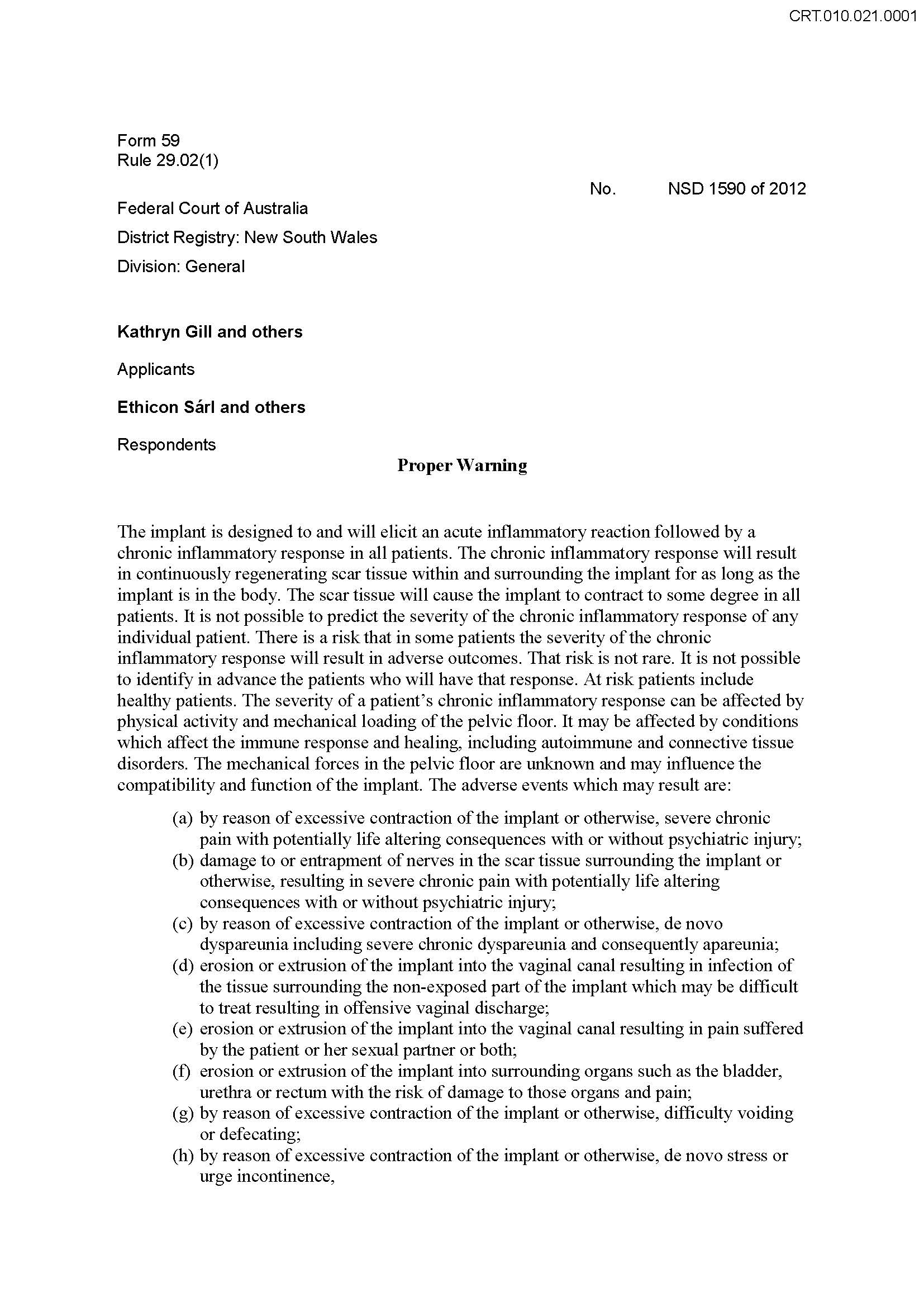
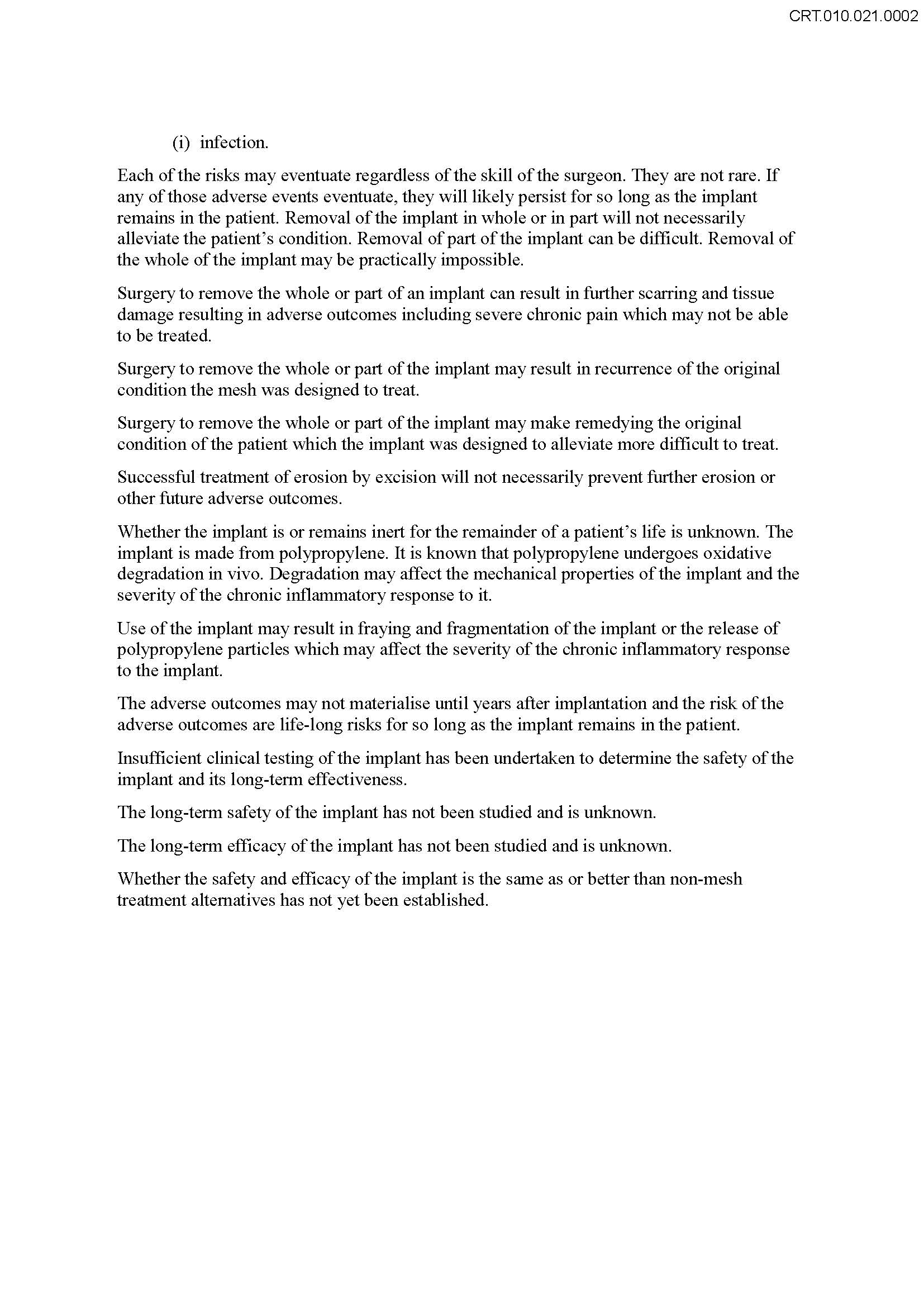
(a) declarations that by marketing, promoting, distributing and supplying the devices without providing “the proper warning set out in CRT.010.021.0001” (annexed to these reasons and marked “A”), Ethicon engaged in conduct that was misleading or deceptive or was likely to mislead or deceive the group members; and
(b) injunctions pursuant to s 80 of the Trade Practices Act or s 232 of the Australian Consumer Law (Sch 2 of the Competition and Consumer Act) restraining the respondents from supplying, distributing, marketing or promoting the devices without providing the proper warning.
73 None of the earlier versions of the originating application included a claim for injunctive relief. But the final order sought from the outset was for “[s]uch further or other orders as the Court thinks fit” and both matters were flagged by the applicants during their final submissions, both in writing and during oral argument.
74 Rule 8.21 of the FCR provides that an applicant may apply to the Court for leave to amend an originating application for any reason including, amongst other things, to add a new claim for relief or a new foundation for relief that arises out of the same, or substantially the same, facts as those already pleaded to support an existing claim for relief (see para (1)(g)). The application may be made even if any relevant period of limitation has lapsed: FCR r 8.21(2). If an application is made, the Court may grant it: FCR 1.41.
75 There is no good reason why leave should not be granted to the applicants to make these amendments. No submissions were made against the application for the additional declaration. The respondents’ objections to the application for leave to amend to seek injunctive relief are as follows:
(a) the proposed form of injunction purports to usurp the role of the Therapeutic Goods Administration (TGA) in regulating the provision of medical devices in Australia;
(b) if relief is pressed the Commonwealth would have been a necessary party and should have been joined at the outset;
(c) the TGA is better placed to supervise the content of warnings necessary to accompany the sale of a medical device and is already doing so;
(d) the form and content of the proposed warning is a “lawyers’ construct based on the applicants’ pleaded case” and should not be the basis on which sales of the devices are permitted;
(e) it would be futile to grant the application because the pre-conditions for the making of the order have not been established and, in the context of a detailed regulatory regime enforced by the TGA, the injunction could not be said to have “the character of enforcing present compliance or inducing future compliance”: Truth About Motorways Pty Limited v Macquarie Infrastructure Investment Management Limited (2000) 200 CLR 591 at [79]-[80] (Gummow J), adopted by the Full Court in Australian Competition and Consumer Commission v Dataline.Net.Au Pty Ltd (In liq) (2007) 161 FCR 513 at [98] (Moore, Dowsett and Greenwood JJ); and
(f) the proposed relief would not be for the benefit of the applicants or the group members, actual or prospective.
76 These submissions should be rejected. Neither individually nor collectively do they provide a sound basis for denying the applicants the opportunity to seek the order. The contentions that the job of regulating the sale of the products should be left to the regulator and that any such order could not be made without adding the regulator as a party are spurious. The TGA does not have an exclusive role in protecting the safety of consumers. As Selway J observed in Australian Competition and Consumer Commission v 4WD Systems Pty Ltd [2003] FCA 850; (2003) 200 ALR 491; (2003) 59 IPR 435 at [217], “[t]he purpose of an appropriately drafted injunction may be merely to reinforce to the market place that the restrained behaviour is unacceptable”.
77 As presently advised I see no reason why the injunction the applicants wish to include in their prayers for relief does not have the character of inducing future compliance. At all events, granting leave to amend in this respect would cause the respondents no prejudice. If they wish to be heard further on whether the injunction should be granted or on a suitable alternative form of order, I will grant them leave to put on additional submissions.
78 As for the final submission, injunctive relief need not be of any benefit to the applicants or the group members. The remedy is not just available to regulators. Section 232 of the ACL, like s 80 of the Competition and Consumer Act, and the Trade Practices Act before it, has always been available at the suit of the regulator or “any other person”. As the Hon Dyson Heydon AO observes in his commentary on the Act (published by Thomson Reuters) at [280.230], the words “any other person” mean what they say. In Phelps v Western Mining Corporation Ltd (1978) 20 ALR 183; 33 FLR 327 the Full Court of this Court rejected an argument that only persons who are affected by a contravention of Pt V of the Trade Practices Act (the consumer protection provisions now contained in the ACL) could seek relief under s 80, holding that the words were to be given an unlimited ambit. An applicant need have no direct or special interest in the proceeding. A competitor of an alleged contravener, for example, may seek injunctive relief. The High Court endorsed this position in Truth About Motorways. See, for example, at [13]–[15] (Gleeson CJ and McHugh J). In any case, the applicants have a direct and special interest in the present proceeding.
79 The enforcement of the Competition and Consumer Act through relief of this kind serves a public purpose. That purpose includes prevention and deterrence of undesirable trade practices. The public interest may justify the making of an injunction to restrain contravening conduct even in circumstances where the applicants have no personal interest and, as Toohey J observed in Trade Practices Commission v Mobil Oil Australia Ltd (1984) 4 FCR 296 at 300, even when the contravener is unlikely to engage in the offending conduct again. The power may be exercised in order “to mark the court’s disapproval” of the contravener’s conduct: ibid. Contrary to the respondents’ position, the TGA is not the sole guardian of the public interest when it comes to medical devices.
80 The contention that the warning the applicants claim should be given if the Ethicon devices are to be sold in the Australian market should not be the basis upon which the sale is permitted is a matter going to the merits or form of an injunction. It has little, if any, bearing on the present question. The same goes for the respondents’ argument that the amendment is futile because the Court does not have sufficient evidence before it to grant the injunction sought. If the contention is that no possible injunction could be crafted to provide relief, then it is incorrect and should be rejected. If the contention is merely that the particular form of the injunction sought should not be granted, then the question does not yet arise. The question, which should be answered in the affirmative, is whether the applicants should be allowed to seek the proposed injunction.
The immune response issue
81 Ms Jancauskas deposed that the immune response issue arises from a question I asked during final addresses on 13 February 2018 when I inquired of Mr Graham SC, who was then appearing for the applicants, whether the absence of a warning about not using mesh in patients with an autoimmune disorder was in the pleadings. The inquiry was made at a point during the oral argument when Mr Graham referred to evidence in the case of Kathryn Gill, the first applicant, who suffered from psoriasis at the time she was implanted with one of the respondents’ devices, known as Prolift. The evidence was given without objection by Dr Robyn Leake, who implanted the device. She said:
In addition, in her case an auto-immune disorder, psoriasis, might have predisposed her to some complications, due to idiosyncratic scarring of tissue around the Prolift mesh implant. I do not recall any warning being provided by Prolift’s manufacturer about not using the mesh in patients with an autoimmune disorder.
82 Evidence had also been given that after Mrs Gill’s operation a warning was included in the IFU issued with Prolift and two other Ethicon devices — Gynemesh PS and Prolift+M — in the following terms:
In patients with compromised immune systems or other conditions that would compromise healing, the risks and benefits should be carefully weighed.
83 No answer was given to my question. The answer, however, is provided by the present application. The applicants’ pleading did not include a claim that Ethicon had failed to warn about the risk implanting the devices might pose for women with autoimmune disorders. By the present application, the applicants seek to add to paragraphs 23C and 48 respectively of their statement of claim allegations that the respondents failed to give any, or any sufficient, information or warnings “that the chronic inflammatory response to the [devices] may be affected by conditions which affect the immune response and healing, including autoimmune and connective tissue disorders”.
84 In her affidavit Ms Jancauskas referred to other evidence on the subject. One was a letter tendered by the respondents from the United States Federal Drug Administration (FDA) dated 12 October 1990 to James O’Donnell, Manager of Regulatory Affairs at Ethicon Inc notifying the company of the reclassification of its nonabsorbable polypropylene suture, Prolene. The letter adverted to potentially delayed wound healing in patients with compromised health due to a number of factors.
85 Amongst the material to which Ms Jancauskas referred was evidence given (without objection) by Professor Andrew Korda, one of the urogynecologists called by the applicants. Another was evidence proffered by the respondents themselves from a biomaterials expert, Professor Paul Santerre, concerning the host response to biomaterials like pelvic mesh. It is sufficient at this point to refer to the Professor Korda’s evidence. I will return later to Professor Santerre.
86 Professor Korda stated in his third report dated 30 March 2017 that:
[P]atients with vaginal atrophy who smoke or who use immunosuppressant medications should not undergo mesh implant surgery. Such contraindications should be listed in the manufacturer’s instructions for use.
87 In oral evidence the professor was asked by Mr Bannon SC for the applicants why patients with those attributes should not undergo mesh implant surgery (ts 1188). He replied:
It actually came out of a study that was performed by the European mesh group that looked at this about five or six years ago and identified patients at high risk. What they found is that patients at high risk were those who have immunosuppressed conditions, for instance, rheumatoid arthritis or any other type of immune disease and/or smoking is associated with a lowered immune response, and, obviously, vaginal atrophy is another condition that doesn’t allow you to dissect the vagina as thickly as we saw on that lady in the video. But this is information that was not around until the inquiry.
88 Mr Bannon asked him what he meant by his statement that the information was “not around”. He answered that obstetricians, gynecologists, and urologists “did not know that people who were immunosuppressed shouldn’t have mesh”. He was not challenged about this evidence in cross-examination.
89 Ms Jancauskas also noted in her affidavit evidence given by Mrs Gill about her psoriasis, including a statement in her first affidavit, affirmed on 27 July 2016, that she would not have consented to the implantation of the Prolift device if she had been told that the mesh was unsuitable for patients with an autoimmune disease like psoriasis. This evidence, along with other evidence from Mrs Gill as to what she would have done had she been warned about other risks said to arise from the Prolift, was admitted without objection but subject to an order sought by the respondents that it be limited under s 136 of the Evidence Act 1995 (Cth) to proof of the statutory counts, it being inadmissible for the purposes of the negligence claim because of the terms of the Civil Liability Act 2002 (WA). Ms Jancauskas also referred to Dr Leake’s evidence extracted above.
90 The applicants submitted that in the light of this evidence, there would be prejudice to some group members, and in particular Mrs Gill, “should the Court take the view that the issue falls outside the current pleading”. In this context, they submitted that the proposed amendments are “relatively minor”. The current pleading includes an allegation that the implants “have a risk of or were susceptible to … causing a chronic inflammatory reaction or an inflammatory reaction which [was neither minimal nor transient]” and that the respondents failed to give any or sufficient information or warning about it. The applicants stressed in oral submissions that the parties dealt with the broader issue of chronic inflammatory reaction in “agonising” detail. All the proposed amendments do is single out a particular class of women who may be or are particularly “at risk” or “susceptible”. On one view, then, the proposed amendments are unnecessary.
91 The respondents submitted that the allegation is outside the scope of the current pleading and the proposed amendments should be disallowed for a number of reasons, none of which is persuasive.
92 First, the respondents contended that they had made forensic decisions based on the current pleading, implying that they could have tendered evidence to respond to the proposed new pleading. They said that Professor Korda was not cross-examined on his evidence on this question because it was unnecessary having regard to the pleaded case. For the same reason, they submitted, nor was Mrs Gill or Dr Leake. Further, while Professor Santerre gave evidence about the variability of the host response, the respondents said he was not examined in chief or cross-examined about knowledge of those matters, which, they submitted is integral to any asserted failure to warn.
93 I accept, as the respondents submitted, that they broadly structured their closing submissions by reference to the pleaded complications, going through each to show why a warning (or a different warning) was not required, in the light of what specialist surgeons (responsible for implanting the devices) “generally” knew. It may also be accepted that their approach to the evidence they gathered and adduced could have been motivated by this strategy.
94 The assertion in the respondents’ submissions that they had made a forensic decision based on the absence of the proposed allegation in the current pleading was not supported by evidence. But Mr Graham SC did not question the assertion. In the circumstances I accept it. As the applicants pointed out, however, there is no reason to think that the respondents would have made different decisions if the matters raised by the proposed amendment were expressly pleaded.
95 Having regard to the allegation that the implants could cause a chronic inflammatory reaction or an inflammatory reaction which was not minimal or transient and that the respondents failed to provide any information or warning to that effect, the evidence given by Professor Korda was relevant and probative. If there was any issue about it, no doubt he would have been cross-examined.
96 In view of what Professor Santerre had said in his first report, there could not have been a genuine issue. The obvious reason he was not examined in chief on the question was because he had already given evidence in chief. He said in his first report that the response to the implantation of a foreign body, like the devices, will vary from patient to patient but that polypropylene mesh “would likely be the wrong choice of a material by the surgeon for a patient with any compromised immune system which could delay tissue integration with the mesh”. Earlier in his report he explained:
55 Immune response will depend on a patient’s genetics (inherently has an active or compromised, or moderate immune reactivity), disease state (e.g. diabetes, connective tissue disorders, blood disorders), age (young people typically have much more active and accommodating wound healing than older patients), gender, extent of injury (e.g. more damage to local tissues from the surgical process will generate a greater inflammatory reaction and more challenging host response), environmental conditions (smoking, diet, stress, etc.) and sensitivity to biomaterial chemistry (non-common patient allergies). … If new tissue cannot integrate fast through a porous biomaterial then the material can possibly dislocate, and in some cases ultimately migrate and protrude from the unresolved surgical insertion site.
56. Hence, it follows on to say that not all patients will achieve a successful integration of biomaterials with new tissue because it is well known that the above parameters compromise wound closure and healing for some patients. If wound healing is different from one human to another, then it also follows that wound healing differs between species. Hence, animal models are not absolute substitutes for human clinical trials and pre-market evaluation.
(Emphasis added.)
97 Several sources were given for the statement in the first sentence of [56]. The earliest was a 1997 publication. The first of the Ethicon devices was not on the market in Australia at that time.
98 On the assumption that the failure to warn about the risk to patients with compromised immune systems is not caught by the current pleadings, the observation by Dawson J in Banque Commerciale SA (In liq) v Akhil Holdings Limited (1990) 169 CLR 279 at 296–7 is apposite. That observation, cited with approval by five justices of the High Court in Vale v Sutherland (2009) 237 CLR 638 at [41], was that:
[M]odern pleadings have never imposed so rigid a framework that if evidence which raises fresh issues is admitted without objection at trial, the case is to be decided upon a basis which does not embrace the real controversy between the parties … cases are determined on the evidence, not the pleadings.
99 Much earlier, Muirhead J said in Caruso Australia Pty Ltd v Portec Australia Pty Ltd [1986] FCA 40, in a passage cited with approval by Davies J in National Australia Bank Ltd v Nobile (1988) 100 ALR 227 at 236:
The powers of this court to amend pursuant to Order 13 Rule 2 are more than wide, they tend to be remedial in that “all necessary amendments shall be made for the purpose of determining the real questions raised by or otherwise depending on the proceedings, or of correcting any defect or error in any proceeding, or of avoiding multiplicity of proceedings”. Consideration of the authorities indicates that an amendment should only be refused where bad faith is demonstrated or where the consequential injury or prejudice to the other party is incapable of remedy. And this reasoning applies to amendments sought during trial or on the eve of trial.
100 In Leotta v Public Transport Commission (NSW) (1976) 9 ALR 437 at 446; 50 ALJR 666 at 668, Stephen, Mason and Jacobs JJ said:
If in the cause of action upon which the plaintiff sued there had emerged at the conclusion of the evidence facts which, if accepted, established that cause of action, then it was the duty of the trial judge to leave the issue of negligence to the jury. The pleadings should have been amended in order to make the facts alleged and the particulars of negligence precisely conform to the evidence which had emerged.
101 Similarly, in Water Board v Moustakas (1988) 180 CLR 491 at 497 Mason CJ, Wilson, Brennan and Dawson JJ said that if issues not apparent from the pleadings are litigated, the pleadings should be amended accordingly.
102 Secondly, the respondents contended that all the evidence to which the applicants pointed was available before the hearing began and before the Fourth Further Amended Statement of Claim was filed, before the close of evidence, and during the time the parties were preparing their written closing submissions. The applicants have had “ample time” to identify the issue and further amend their pleading without prejudicing the respondents.
103 It is quite true that the applicants have had a long time to identify the issue. They could have amended much earlier. In the light of what I have said, however, I find it difficult to believe that the respondents are prejudiced by the late amendment, apart from the fact that they might have made some further submissions directed to the specific point had the matter been included in the last iteration of the applicants’ pleading. Any such prejudice is easily cured by granting leave conditional on the respondents being given the opportunity to make further submissions.
104 Thirdly, the respondents contended that granting leave “likely may cause an outcome inconsistent with the objects of Part IVA”. They argued that in order to discharge their burden of proof the applicants need to establish by evidence what specialist surgeons knew at the relevant time. They contended that any evidentiary gaps concerning autoimmune diseases resulting from a grant of leave “necessitate findings in favour of the [r]espondents” and that would “work an injustice on prospective applicants”.
105 I have already referred to the objects of Pt IVA. Once again, I struggle to see how these objects would be compromised, let alone undermined, by granting leave to make the proposed amendments. In any case it seems counter-intuitive, to say the least, to deny the applicants an application they wish to make on the ground that the evidence upon which they rely is insufficient to make out their case.
106 Finally, the respondents submitted that they were deprived of the opportunity to cross-examine Mrs Gill on her evidence that she would not have consented to implant surgery had she been told that the mesh was unsuitable for patients with an autoimmune disease like psoriasis. I do not accept this submission. The respondents had the opportunity. They simply chose not to avail themselves of it. Mrs Gill also gave evidence that she would not have undergone the surgery if she had been warned of other risks. She was not cross-examined about her evidence in these respects either, although these risks were expressly pleaded. During oral argument Ms Morgan said (at ts 6910) that she was “happy to accept if [she] put … to any of the applicants that they wouldn’t have done it, they would have said –– they would have still done it. Each of them would have said, ‘No, I wouldn’t’”. There is no reason to believe that the respondents’ position would have been any different if the proposed “new” complication had been included in the pleading at the time.
107 Having given careful consideration to the points raised by both parties, I am not satisfied that the amendments would cause any injustice to the respondents.
Conclusion
108 It follows that the applicants should have leave to amend the Fourth Further Amended Statement of Claim by:
(a) altering the description of the group but not in the terms proposed;
(b) adding to para 23C:
(d) that the chronic inflammatory response to the Mesh Implants may be affected by conditions which affect the immune response and healing, including autoimmune and connective tissue disorders.
and
(c) adding to para 48:
(d) that the chronic inflammatory response to the Tape Implants may be affected by conditions which affect the immune response and healing, including autoimmune and connective tissue disorders.
109 The description of the group should be altered so as to expressly include in the group those women who were implanted with one or more of the nine Ethicon devices and who suffered complications as a result after the commencement of the proceeding but before 4 July 2017.
110 The parties should agree to the form of the opt-out notice, having regard to these reasons.
111 The respondents should have leave to make further submissions on the questions relating to the allegations concerning autoimmune disorders and injunctive relief. Those submissions should be filed by 31 May 2018 and any submissions in reply filed within 14 days thereafter.
Costs
112 The applicants did not apply for costs. The respondents asked for costs even if they were unsuccessful. The discretion as to costs is at large. Nevertheless, in circumstances such as these, where the applicants were seeking an indulgence, it is customary for the Court to order that the party applying for the amendments pay the costs of the application, including costs thrown away, unless the opposition was unreasonable — in other words, unless the opponent, acting reasonably, would have consented to appropriate orders: Stanley v Layne Christensen Company [2006] WASCA 56 at [52] (Wheeler JA); Gloucester Shire Council v Fitch Ratings, Inc (No 3) [2017] FCA 553 at [14].
113 Although I was not persuaded by the respondents’ submissions and have been critical of some of them, only in one respect do I think their opposition was truly unreasonable: that is the opposition to the application to amend to seek an injunction. In that instance only do I consider that a party, acting reasonably, would have consented to the application to amend. In truth, their objections were to the merits, if not merely the form, of the proposed relief, not to the grant of an amendment to claim it. In contrast, the application to amend the description of the group was fundamentally flawed for the reasons I have indicated. That I have decided to grant an amendment is beside the point as it was not only an amendment the applicants did not seek but it was one they positively resisted. The applicants argued that the application to amend the class was not an indulgence but the argument was not supported by any reasoning or reference to case law and I am at a loss to understand it. As for the application relating to the immune response issue, while I have allowed the amendment I am not satisfied that the respondents’ opposition was unreasonable. Indeed, the applicants did not contend that it was. They accepted that they should pay the respondents’ costs thrown away by the interlocutory application.
114 Since the argument about the claim for injunctive relief was a relatively minor part of the application, I propose to order that the applicants pay 85% of the respondents’ costs of the interlocutory application, including any costs thrown away.
I certify that the preceding one hundred and fourteen (114) numbered paragraphs are a true copy of the Reasons for Judgment herein of the Honourable Justice Katzmann. |
Associate:
Annexure A