

FEDERAL COURT OF AUSTRALIA
Gordon (on behalf of the Kariyarra Native Title Claim Group) v State of Western Australia [2018] FCA 430
ORDERS
WAD 47 of 2014 | ||
| ||
BETWEEN: | CYRIL GORDON ON BEHALF OF THE KARIYARRA – ABYDOS NATIVE TITLE CLAIM GROUP (and others named in the Schedule) Applicant | |
AND: | THE STATE OF WESTERN AUSTRALIA (and others named in the Schedule) Respondent | |
DATE OF ORDER: |
THE COURT ORDERS THAT:
1. To the question “Who are the persons (if anyone) holding the communal rights comprising the native title claimed by the applicants in the Kariyarra Claim Area?”, being the area of applications WAD6169/1998, WAD232/2009 and WAD47/2014, the Court provides the following answer:
(1) The persons holding the communal rights comprising the native title claimed by the applicants in the Kariyarra Claim Area are the persons who comprise the Kariyarra community, being those Aboriginal persons who:
(a) are a descendant, by cognatic descent, from one or more of the following apical ancestors:
(i) Jinapi
(ii) Wirtinpangu (Jimmy)
(iii) Dougal Robinson
(iv) Puyubungu
(v) Yanki Williams
(vi) Topsy McKenna
(vii) Fanny
(viii) Nyitji
(ix) Maggie
(x) Tommy Anderson
(xi) Fauntleroy (Pontroy)
and
(b) recognise themselves as having rights and interests in the Kariyarra Claim Area under Kariyarra traditional law and custom, and
(c) are recognised by other members of the Kariyarra community as having rights and interests in the Kariyarra claim area under Kariyarra traditional law and custom.
2. Liberty to the applicants and the first respondent to apply by 10 April 2018 to remove the words “by cognatic descent” in paragraph 1(a) of the above answer.
3. Subject to any order made under paragraph 5 of these orders, Mary Attwood, George Dann, Robert Dann, Shirley Lockyer, Patricia Mason and Eugenia Smith are removed as respondents to the Kariyarra – Pipingarra application WAD 232 of 2009.
4. Within a time to be fixed the applicants and the first respondent file in Court a proposed determination of native title.
5. Costs reserved.
Note: Entry of orders is dealt with in Rule 39.32 of the Federal Court Rules 2011.
[1] | |
WHO WERE THE WITNESSES CALLED AND WHAT WAS THE COURSE OF THE HEARING | [9] |
WHAT IS THE WAY IN WHICH THESE REASONS FOR JUDGMENT ARE ARRANGED | [18] |
[27] | |
ARE RIGHTS TO LAND ACQUIRED THROUGH PATRILINEAL OR COGNATIC DESCENT? | [32] |
[35] | |
[40] | |
[53] | |
[118] | |
[127] | |
[142] | |
[156] | |
[168] | |
[186] | |
[208] | |
[224] | |
[255] | |
[278] | |
Introduction | [278] |
[281] | |
Why did the Indigenous respondents challenge the rights of the applicants? | [285] |
[295] | |
[313] | |
[333] | |
SHOULD THE INDIGENOUS RESPONDENTS BE FOUND NOT TO BE PART OF THE KARIYARRA PEOPLE | [350] |
[353] | |
[356] |
NORTH J:
1 On 15 December 2016, the Court ordered that the following question be determined separately from any other question in each of the proceedings WAD 6169 of 1998, the Kariyarra main application, WAD 232 of 2009, the Kariyarra – Pipingarra application, and WAD 47 of 2014, the Kariyarra – Abydos application:
Who are the persons (if anyone) holding the communal rights comprising the native title claimed by the applicants in the Kariyarra Claim Area?
2 The three applications relate to land and waters generally south of Port Hedland in Western Australia. The area of each application are shown on the map which is Annexure A to these reasons for judgment.
3 The reference in the separate question to the claim area is a reference to the land and waters within the external boundaries of the three applications. That area is also referred to in these reasons for judgment as the application area.
4 There has been contention among the Aboriginal people of the area covered by the applications concerning the people who have native title rights and interests in those areas. Some of the history of that disagreement can be seen in earlier judgments of the Court in these proceedings. It is not necessary to describe that history further at this point, although some reference will be made to it later in these reasons for judgment.
5 The purpose for seeking an answer from the Court to the separate question is to resolve a fundamental disagreement over the constitution of the native title holding group. Once that issue is resolved, the path to a determination of native title should be clear because it is accepted by all that native title exists in the application area.
6 The native title claim group is now described in each of the applications in the same way as follows:
The native title claim group comprises those Aboriginal persons who:
(a) are a descendant from one or more of the following apical ancestors:
Jinapi
Wirtinpangu (Jimmy)
Dougal Robinson
Puyubungu
Yanki Williams
Topsy McKenna
Fanny
Nyitji
Maggie
Tommy Anderson
Fauntleroy (Pontroy)
and
(b) recognise themselves as having rights and interests in the Claim Area under Kariyarra traditional law and custom.
7 The applicant in each application argued in favour of the above formulation of the native title claim group. The first respondent, the State of Western Australia, supported the applicants, save that it argued for an additional requirement for inclusion in the native title holding group, namely, recognition of a person as Kariyarra by the community.
8 Six siblings from the Dann, Todd, and Lockyer families namely, Mary Attwood, George Dann, Robert Dann, Shirley Lockyer, Patricia Mason and Eugenia Smith, the Indigenous respondents, opposed the above formulation of the native title holding group. The Indigenous respondents were respondents in the Kariyarra – Pippingarra application. The Court rejected an application by the applicants in that application to remove them as respondents: TR (Deceased) on behalf of the Kariyarra Pippingarra People v State of Western Australia [2016] FCA 1158. The Indigenous respondents are descendants from Tommy Anderson. They disputed that the other apical ancestors, other than Maggie, were Kariyarra and entitled to rights to land. Although the Indigenous respondents were not respondents in the other two applications, the arguments and reasoning apply equally to all three applications.
WHO WERE THE WITNESSES CALLED AND WHAT WAS THE COURSE OF THE HEARING
9 Lay evidence on the separate question was given, first, in 2013 in Yandeyarra by way of preservation evidence from two senior Aboriginal women, Ms E Williams, who has since died, and Ms Irene Roberts. Then, from 4 – 8 September 2017, the applicants called 12 witnesses in Port Hedland being descendants of the proposed apical ancestors. Those witnesses were Margaret Stewart, Rick Watkins, Raelene Button, Jenny Baraga, Vincent Lockyer, Donny Wilson, Diana Robinson, Eileen Rule, Alfred Barker, Jason Alec, Jeannie Snowball, Selina Ali. None of the witnesses trace their rights back to the remaining apical ancestor, Wirtinpangu.
10 The Indigenous respondents called seven lay witnesses. Five of those witnesses were Indigenous respondents, namely, Ms Mary Attwood, Mr George Dann, Ms Shirley Lockyer, Mr Robert Dann and Ms Patricia Mason. They also called Joseph Kickett, an Aboriginal man who is not a respondent, and John Patterson, a non-Aboriginal man. These seven witnesses gave evidence in Perth from 30 October – 1 November 2017.
11 The applicants relied on the expert evidence of the anthropologist, Dr Kingsley Palmer. He wrote an initial report filed on 19 December 2013, the Palmer 2013 report, a further supplementary report filed on 29 September 2015 relating to the Kariyarra – Abydos application area, the Palmer 2015 report, and a responding report dated April 2016 but filed on 9 January 2017, the Palmer 2017 report.
12 The Indigenous respondents relied on the expert evidence of the anthropologist Dr Phillip Clarke. He wrote an initial report filed on 8 October 2015, the Clarke 2015 report, and a reply report to Dr Palmer’s responding report filed on 19 April 2017, the Clarke 2017 report.
13 On 22 and 23 May 2017, Dr Palmer and Dr Clarke participated in a conference of experts conducted by Registrar Herrmann in an attempt to narrow the issues in dispute between the parties. An agreed written record of the result of that conference was received in evidence.
14 Dr Palmer and Dr Clarke gave oral evidence, a part of which was given concurrently. Their evidence was given in Perth on 2 and 3 November 2017.
15 The parties agreed that an expert report dated February 2012, written by the anthropologist Dr John Morton, the Morton report, form part of the evidence without Dr Morton being called to give oral evidence. Dr Morton was commissioned by the Court in 2012 to provide a report as part of an attempt to resolve the divergent views of the parties through mediation. The circumstances in which the report was commissioned are set out in a judgment of the Court: Roberts v State of Western Australia [2010] FCA 1483.
16 Most of the significant places in the application area referred to in these reasons for judgment are indicated on the map which is Annexure B to these reasons for judgment.
17 The experts referred to a number of sources throughout their reports and evidence. Those sources are set out in Annexure C. The abbreviations are used in these reasons for judgment to identify the particular source.
WHAT IS THE WAY IN WHICH THESE REASONS FOR JUDGMENT ARE ARRANGED
18 The source of the entitlement of each of the nine contested apical ancestors’ rights to land under traditional laws and customs is examined in detail in these reasons for judgment. But there are two overarching matters relevant to the consideration of the evidence concerning each or most of those apical ancestors.
19 The first matter is whether the language group to which the apical ancestor is reported as belonging is determinative of rights to land. The experts agree that language group identity is not determinative of rights to land. However, these reasons for judgment need to explain why that is so.
20 Then, it is common ground that rights to land are acquired under traditional laws and customs by descent. However, there is a disagreement over the basis of the descent rule. The applicants contended that cognatic descent governs the acquisition of rights to land. The Indigenous respondents contended that patrilineal descent governs the acquisition of rights to land. That disagreement is the secondary preliminary issue addressed in these reasons for judgment.
21 Then, these reasons for judgment deal in turn with the evidence in relation to each of the contested apical ancestors, namely, Dougal Robinson, Puyubungu, Yanki Williams, Topsy McKenna, Fanny, Nyitji, Pontroy, Wirtinpangu and Jinapi.
22 These reasons for judgment conclude that, on the balance of probabilities, each of the contested apical ancestors had rights and interests in the land in the application area, and their descendants by cognatic descent inherit those rights and interests.
23 The next section of these reasons for judgment explain that it is only by applying the same approach to the evidence of the Indigenous respondents’ apical ancestor, Tommy Anderson, as has been applied to the contested apical ancestors that Tommy Anderson qualifies as a rights holder in the application area.
24 Then, these reasons for judgment address and accept the argument advanced by the State, namely, whether community recognition is a requirement for the acquisition of rights to land under traditional laws and customs.
25 After that, these reasons for judgment address and reject the argument advanced by the applicants’ that the Indigenous respondents should be found not to be part of the Kariyarra society because, by their conduct opposing these applications they have demonstrated that they do not adhere to the traditional laws and customs acknowledged by tha society.
26 Finally, the reasons for judgment address and accept the argument advanced by the applicants that the Indigenous respondents should be removed as respondents in the Kariyarra – Pipingarra application.
IS LANGUAGE GROUP IDENTITY DETERMINATIVE OF RIGHTS TO LAND
27 The question whether identification of people by language group is determinative of their rights to land arises because there were Aboriginal people who lived on the boundary of the application area and who belonged to different language groups. To the west are the Ngarluma and Yindjibarndi people. To the south east are the Palyku people. To the east are the Njamal people. And to the north east are the Ngarla people. Particularly on the borders between language groups there was interaction between the peoples of different language groups. Multilingualism was a feature of those communities. People living near the borders might have a language identity which did not match the landholding group identity. Thus, an Aboriginal person who had rights in Kariyarra country bordering Yindjibarndi country would likely speak both Kariyarra and Yindjibarndi. Particularly when their identity was recorded by early European anthropologists, the person might be identified as Yindjibarndi by language group. That would not, however, determine the person’s landholding group identity which might have been Kariyarra.
28 There was no dispute about this matter between the experts. The record of the conference of the experts stated:
1. Identity group names were not at sovereignty, and are not today, determinative of rights to country. Rather, rights to country were and are gained by reference to a structured, principled system including descent.
Opinion of Dr Palmer | Opinion of Dr Clarke |
Agree. Language group identity and membership of a land-holding corporation are not equivalent. | Agree. There is evidence in the written record relating to the Claim Area of mixed estate groups, where the estate was (for example) identified as being Kariyarra / Ngaluma. |
29 In concurrent evidence, Dr Palmer explained that identity group names are not, and were not at sovereignty, determinative of rights to country. He said:
DR PALMER: Well, my view is that they're not. And my reason for saying that is that, in anthropological terms, you're talking about two different social formations. One is an identity group, which is often founded after the language spoken by a person or by the language with which they are [sic] identify, or say they own if they don't actually speak it, and the land owning, holding group, which, in anthropological understandings, is a descent group, country group, local descent group. There are a number of different names. So the two things are, to my mind, different social formations. But, of course, the one is constituted of members of the other – that is, the language group, the identity group is composed of those who have rights in country. So there is a crossover and a relationship between the two.
30 The experts returned to the issue later in concurrent evidence in the following exchange which concerned whether at sovereignty land in the application area was held by specific estate groups of Aboriginal people:
DR PALMER: Well, the term "estate group" has a particular anthropological meaning in the literature which I - I discuss, and so the question is perhaps predicated on an agreement about what we mean by that. I - I prefer the term "country group" and define that in my - in my report. That is a group of people who together hold a traditional right to - to country, to an area of country, and if the question is saying, well, were the rights to country held by members of a country group, which roughly we could translate as an estate group.
I am being cautious about the term because in the literature, in the anthropological literature, an estate group has quite a narrow meaning which later anthropologists have tended to move away from. But if - if - if I'm to understand the question that way, then my view is - is yes, that members of a country group held rights to more or less defined areas of country.
MR WRIGHT: Dr Clarke?
DR CLARKE: Yes. Well, that - that's my view. It's my view that these - whether they are country groups or estate groups, they are the - they are the groups where Native Title rights were held, so not language groups.
MR WRIGHT: Yes. That being the point, yes.
DR PALMER: Yes, and I - I agree particularly with that - well, I agree with that.
31 In relation to border areas, Dr Clarke explained in concurrent evidence:
DR CLARKE: Well, if the estate group is - is - is mixed and it's sort of, say, on the boundary because it's got a mixture of two people from two different language groups, it's - if you're - you know, does it give - give you rights if you're in that mixed group to, for example, the entirety of all the other estates where they speak the same language of the mixed groups so - and I'm saying well, no, because language is not the thing that's determining, you know, rights to country.
[Emphasis added.]
ARE RIGHTS TO LAND ACQUIRED THROUGH PATRILINEAL OR COGNATIC DESCENT?
32 The second preliminary matter concerns the role played by descent in the acquisition of rights to land under traditional laws and customs of the Kariyarra people.
33 The applicants contended that rights to land were acquired by one generation from another by cognatic descent, that is to say, the rights were passed down either through the patriline or the matriline.
34 The Indigenous respondents contended in their pleaded case that under traditional laws and customs of the Kariyarra people rights to land could only be acquired, subject to one exception, by descent down the patriline. The exception applied when the father was a non-Aboriginal man. In that event, a Kariyarra person acquired rights to land through their mother. But that matrilineal descent applied to that generation alone.
35 The following Aboriginal witnesses called by the applicants gave evidence to the effect that rights to land could be acquired by descent from father or mother, Ms Irene Roberts, Ms E Williams, Mr Donny Wilson, Mr Alfred Barker, Mr Jason Alec, Ms Jeannie Snowball, Ms Selina Ali, Ms Diana Robinson, Mr Vincent Lockyer, and Ms Jenny Baraga.
36 References to the evidence of those witnesses are collected in [71] – [82] of the written submissions of the applicants filed 15 November 2017. It would be needlessly repetitive to set out each of those references. The following example from the cross-examination by the State of the senior woman, Ms Irene Roberts, during preservation evidence, is representative of the evidence of the applicants’ Aboriginal witnesses on the subject:
MR RANSON: Okay. And is – is there one family that has this country, where we are, or are you saying it’s - - -
IRENE ROBERTS: Well, he go - - -
MR RANSON: - - - shared?
IRENE ROBERTS: Well, the people got all of the country, you know? All of the country been before old people, where they yinta and all those sort of things. We go by that.
MR RANSON: Right.
IRENE ROBERTS: Where the father’s country is.
MR RANSON: And so is that – is that the usual rule for Kariyarra people, you go by your father’s country?
IRENE ROBERTS: We go by the father’s country, where our country is, and we stick to that place.
MR RANSON: Okay.
IRENE ROBERTS: Someone else yinta, but they go back to this way. They – they yinta.
MR RANSON: I think we – we’ve heard a little bit about your family and your brothers and your kids, and you’ve told us, I think, that your kids have got some country now, have got the same country as you?
IRENE ROBERTS: Yes.
MR RANSON: And is that – is that okay, under Kariyarra rules, that they’ve got it through you, through their mother’s side - - -
IRENE ROBERTS: Yes.
MR RANSON: - - - rather than their father’s side?
IRENE ROBERTS: From the grandfather.
MR RANSON: Okay.
IRENE ROBERTS: To – to me.
MR RANSON: So they get that - - -
IRENE ROBERTS: From - - -
MR RANSON: - - - from your father, through you.
IRENE ROBERTS: Yes. From our great grandfather, my father’s fathers, and - - -
MR RANSON: I was going to ask you about that, about your – your father’s father. That’s that fellow, Jinnabung.
IRENE ROBERTS: Jimabung.
MR RANSON: Jinnabung *(sic)?
IRENE ROBERTS: From Jimabung to my father.
MR RANSON: Yes.
IRENE ROBERTS: From my father to my brothers.
MR RANSON: Okay. So that’s – that’s that line that your country comes down.
IRENE ROBERTS: Yes.
MR RANSON: From Jinnabung and to your father - - -
IRENE ROBERTS: And - - -
MR RANSON: - - - and down to you.
IRENE ROBERTS: - - - grandmother. Grandmother start from Kangan Station.
MR RANSON: Right. Is that – that your father’s mother - - -
IRENE ROBERTS: Yes, that - - -
MR RANSON: - - - Sarah?
IRENE ROBERTS: Yes. That’s (Wirrbung).
MR RANSON: So you get – you get some country through her side, as well.
IRENE ROBERTS: Yes.
MR RANSON: Is that the same country that you get through - - -
IRENE ROBERTS: Yes, same country.
MR RANSON: - - - Jinnabung’s side?
IRENE ROBERTS: From Wodgina to Kangan.
[Emphasis added.]
37 Another representative example is found in the evidence-in-chief of Mr Alfred Barker as follows:
MR WRIGHT: Now, you’ve chosen to follow your mum you said as Kariyarra. Under Aboriginal law and custom, can a person choose to follow their father?
ALFRED BARKER: Well, my opinion is that a person can follow who they like. You’ve got full choice. You’ve got the parents of the mother and you’ve got the parents of the father...
[Emphasis added.]
38 In view of the case pleaded by the Indigenous respondents, it was surprising that none of the twelve Aboriginal witnesses called by the applicants were challenged in cross-examination by the lawyer representing the Indigenous respondents about their evidence that cognatic descent was the traditional pathway for the acquisition of rights to land.
39 The picture became more curious in the course of the evidence given by the Indigenous respondents themselves, and in the course of the evidence called on their behalf.
The Indigenous respondents’ evidence
40 Mr George Dann, one of the Indigenous respondents, gave evidence that rights to land were acquired through both father and mother and that he had rights in Kariyarra country through his mother. The following exchange occurred in cross-examination:
MR WRIGHT: Mr Dann, I have some questions for you. Your father is an Aboriginal man; is that right?
GEORGE DANN: Yes, that's correct.
MR WRIGHT: And he's from the Nyul Nyul group?
GEORGE DANN: Yes.
MR WRIGHT: Up in the Kimberley?
GEORGE DANN: Yes.
MR WRIGHT: And do you have rights in your father's country?
GEORGE DANN: Only as a - as a family I have. I can go on the land, yes.
MR WRIGHT: Yes.
GEORGE DANN: That's - that's about it.
MR WRIGHT: And could you call yourself a Nyul Nyul person?
GEORGE DANN: No, not exactly but I - I take my father's what you call it as well because all the family up there recognises as one of the family because the Dann family are very big up there.
MR WRIGHT: Yes.
GEORGE DANN: And we - we are one of the family like members for anywhere else.
MR WRIGHT: Yes. And you obviously claim rights through your mother's side of the family in Kariyarra country?
GEORGE DANN: Yes.
MR WRIGHT: And so is that a matter of choice that you could choose to follow your mother more than you follow your father?
GEORGE DANN: My father left there when he was over 16 years old, Beagle Bay Mission. He came down here and he only went back to visit some of the family but as to live, no; he stayed in Port Hedland. But I follow my mother because we had been here all our life.
[Emphasis added.]
41 Mr George Dann denied the proposition pleaded in the Indigenous respondents’ Amended Statement of Issues, Facts and Contentions filed 9 May 2016 that the primary connection to land was through a Kariyarra father. In other words, he denied the very case propounded on his behalf.
42 Mr Joseph Kickett is a grandson of Dan Todd. His mother was Debra Todd and his father was Ike Kickett, a Noongar man. Mr Kickett claimed rights to Kariyarra country which was thus necessarily through his mother. He explained in evidence-in-chief:
MR RUMSLEY: … So what is it that you would have to have to be able to say that country belonged to you or you belonged to country?
JOSEPH KICKETT: Probably old people like through blood.
MR RUMSLEY: So - - -
JOSEPH KICKETT: Blood relations, yeah, connection there; knowledge from the old people.
MR RUMSLEY: So your blood relations from old people who are Kariyarra?
JOSEPH KICKETT: Yeah.
43 Ms Shirley Lockyer’s mother, Molly Todd, is a Kariyarra woman, and her father was George Mason, a non-Aboriginal man. Molly Todd’s mother, Mary Yinbung, was Kariyarra and her father, George Todd, was a non-Aboriginal man. Mary Yinbung’s parents, Tommy Anderson and Sally, were both Kariyarra. Ms Shirley Lockyer explained the descent rules in the following passage in cross-examination:
MR WRIGHT: And he also talked to you, you said, about how you get rights to country through the bloodline.
SHIRLEY LOCKYER: Yes.
MR WRIGHT: Is that right?
SHIRLEY LOCKYER: Yes.
MR WRIGHT: And when you said "through the bloodline", can that be through the mother's line or the father's line?
SHIRLEY LOCKYER: Only if you got two - two parents that are full - you can either have the blood from - you can make a choice between one or the other if you've got the two.
MR WRIGHT: Yes. So if they're both Aboriginal people.
SHIRLEY LOCKYER: Yes, where they're both Kariyarra people.
MR WRIGHT: Both Kariyarra people?
SHIRLEY LOCKYER: People, yes.
MR WRIGHT: So you can choose to go, what, follow - well, you'd be Kariyarra through both then, wouldn't you?
SHIRLEY LOCKYER: Well, if - if - in our case it would be but we chose to follow our great grandfather.
MR WRIGHT: Yes.
SHIRLEY LOCKYER: Because he [Uncle Jimmy Todd] was the main - main man.
MR WRIGHT: Yes. So sorry, coming back to that issue. If you've got let's say an Aboriginal parent who's Kariyarra and another one that's Njamal, for example, can you choose to follow the Kariyarra or the Njamal side?
SHIRLEY LOCKYER: I've never been in that predicament but that's up to the person who - whoever choose - where they choose to go to.
MR WRIGHT: Right.
SHIRLEY LOCKYER: Yeah.
MR WRIGHT: Now - - -
SHIRLEY LOCKYER: But - but I'm only speaking for our case which is patrilineal which is the male line.
MR WRIGHT: Well, it's not in your case is it because you follow your mother?
SHIRLEY LOCKYER: Well, our mother follows her mother plus her father because we all married white people so we had to go back through that way.
MR WRIGHT: Yes. But under Kariyarra law people can choose which side they follow?
SHIRLEY LOCKYER: Well, that's your interpretation but it's not ours.
MR WRIGHT: Right. Well, I thought you agreed with me that for other families, they can make that choice?
SHIRLEY LOCKYER: If they were Kariyarra.
MR WRIGHT: If they were Kariyarra.
SHIRLEY LOCKYER: If they were.
MR WRIGHT: Yes. So if they - for other families, if they had one parent who was Kariyarra and another parent who was some other group, they could choose to follow the Kariyarra side?
SHIRLEY LOCKYER: Like I was saying, if they were Kariyarra.
MR WRIGHT: Yes.
SHIRLEY LOCKYER: Yeah.
[Emphasis added.]
44 The applicants submitted that where Ms Shirley Lockyer referred to patrilineal descent she was referring to the fact that in her family they trace their descent back to the male ancestor Tommy Anderson. She was not saying that Kariyarra people could only acquire rights through the patriline, but that her family did so in fact. Her evidence was that Kariyarra people could choose to follow either mother or father. Her point seems to have been that the choice had to be made by a person who was Kariyarra. That was probably a reference to the Indigenous respondents’ case that none of the applicants’ apical ancestors were Kariyarra. Although the evidence of Ms Shirley Lockyer is not entirely free from confusion, the Indigenous respondents’ lawyer did not take issue with the construction placed on it by the applicants. I accept that Ms Shirley Lockyer’s evidence supports the applicants’ case that rights to land are acquired under traditional law by following either the father or the mother.
45 Ms Mary Attwood, another of the Indigenous respondents, agreed in cross-examination that rights to country could be acquired from either the mother or the father. The following exchange occurred in cross-examination:
MR WRIGHT: … Under your understanding of Kariyarra law and custom, can a person obtain rights in their mother's country and their father's country?
MARY ATTWOOD: Well, that's what the old people told us.
[Emphasis added.]
46 She said that she had rights in Nyul Nyul country coming from her father and rights in Kariyarra country coming from her mother, Molly Todd. Ms Mary Attwood told that her uncle, Norman Todd, married Eileen Dhu, a Banjima woman. Their children identified as Banjima. Ms Mary Attwood said that the children were also entitled to claim Kariyarra identity.
47 Ms Patricia Mason, another of the Indigenous respondents, gave evidence-in-chief about what she was told by her elders concerning how a person can belong to country. She said:
They told you if you’ve got to be a Kariyarra and you’ve got to have bloodline and be a biological descendant, and you’ve got to have – you’ve got to have the knowledge of the land and you’ve got to be people of that land.
48 Also, in evidence-in-chief, Ms Patricia Mason said that her claim to country goes through her mother.
49 Counsel for the applicants took up the question of acquiring rights to land. In the following lengthy but important exchange Ms Patricia Mason explained her understanding and the basis for it as follows:
MR WRIGHT: Yes, Ms Mason, you talked about getting rights in Kariyarra country through the bloodline, is that right?
PATRICIA MASON: That’s exactly right.
MR WRIGHT: And is it your understanding of Kariyarra law and custom that you can – a person can get rights in Kariyarra country if they’ve got a Kariyarra mother or Kariyarra father?
PATRICIA MASON: If they are Kariyarra.
MR WRIGHT: Yes. So, if the mother or father is Kariyarra, then a person can be Kariyarra through that mother or father?
PATRICIA MASON: Just – well, if you want to know how I – because I think you’ve got to get to that question, Mr Wright. How do I define a right? Understanding native title was very challenging in my sense because it wasn’t really up to speed in WA in 2006 when I come back to here, and I didn’t know the clarification that was actually to find people of what method they was using to define that you had a right.
And when I done a little bit of research, I found that it came from the apical ancestor that you generated, or came from. So, in our family it came from Tommy Anderson. And my grandmother was the first born, so it was passed to my grandmother onto her children.
MR WRIGHT: Yes. Yes.
PATRICIA MASON: And we chose to go that way, our family.
MR WRIGHT: Yes.
PATRICIA MASON: And it’s up to the choice of others how their cultures and laws, and whatever they come from, define themselves to follow. But in the essence of Kariyarra, it was the distinguishment of who gave you that authority of who to follow? And my grandfather gave it to my grandmother.
MR WRIGHT: You mean your great grandfather?
PATRICIA MASON: Yes, my great grandfather, Tommy Anderson to Mary Yinbung.
MR WRIGHT: Yes.
PATRICIA MASON: And that’s how we could have went to the other side of our great grand Sally, but we had very little information to track back because when we was told to find a connection, the only connection we found in regards to this country was Tommy Anderson because he was a very, very powerful man, and he upheld his law. So – and he got in a lot of trouble with the police. So, that’s how we actually defined ourselves as being from this land because every time he got in gaol, he’d return to the Pilbara and Port Hedland. He didn’t go anywhere else. So, it was easy for us to get a descendant connection through Tommy rather than to Sally because I wouldn’t be sitting here now after nine years. I’ll be still sitting here in 18 years’ time.
…
MR WRIGHT: Alright. Well, look, just coming back to the question then I was asking you about following, so people – someone can be Kariyarra if they follow the mother’s line or the father’s line, and I think you’ve agreed with that?
PATRICIA MASON: If they were Kariyarra.
MR WRIGHT: If they were Kariyarra, yes.
PATRICIA MASON: And that was the Kariyarra law, I think would be just –but in the Kariyarra law, if you go back to the writers – this is from my research. Sorry about this, Mr Wright.
…
MR WRIGHT: Sorry. If you confine your answers to what you were taught by your parents or, sorry, by your mother or your uncles, did they ever teach you about how a person can become Kariyarra, any particular rules around that?
PATRICIA MASON: If you’re a first born and you come from two Kariyarra people, like my Nana, for instance, then she – he would pass the land onto her. If she was a man, he would pass the land onto him. But there’s certain laws around that. If my nana was not allowed to marry another tribal man. My nana wasn’t allowed to marry another tribal man. My nana was only allowed to marry a white man because she would have lost the land. Does that make sense?
MR WRIGHT: Alright, just – well, you’re explaining it to me. That’s Mary Yinbung you’re talking about is it?
PATRICIA MASON: Yes.
MR WRIGHT: Okay. So, is it fair for me to say that you don’t really know about any rules that might apply to other people? You just know about what’s happened in your family?
PATRICIA MASON: Well, that’s what this court is about. I’m not about other people, I’m about my family getting recognised because these people have been – had rights over the last – since native title started in ’98. So, we bought the cause. We bought this action to identify us as a family, your Honour.
MR WRIGHT: Now, do you remember doing some work with Dr Clarke who’s the anthropologist who is helping your family or engaged on behalf of your family?
PATRICIA MASON: Yes, I have spoke to Mr Clarke and we – I wanted to get someone independent of WA, and finally I actually linked up to try to get someone from outside, and I met Mr Clarke and I’ve actually had many conversations with Mr Clarke.
MR WRIGHT: And did you tell Mr Clarke that for a person to be Kariyarra, they had to follow primarily along the male line, and that it was only in a case where the father was not an Aboriginal man that a person could be Kariyarra by the mother?
PATRICIA MASON: Well, to me – or sorry, I’m getting a bit close. To me, in essence – essence of us, it applies. In the essence of us it applies, okay?
MR WRIGHT: Yes.
PATRICIA MASON: Because we’ve already been proven, you know what I mean? We know we are Kariyarra.
MR WRIGHT: Yes.
PATRICIA MASON: And that was evident in the last hearing. But in the essence of a law, you have got to get it from a Kariyarra apical ancestor like before the time of disruption to actually be a Kariyarra person. So, you must have a strong lineage to get that because you can’t say you come in and you was a custodian and then it gave you a right to being responsible for land, or you can’t say that you was born here and that gave you a right. Or you can’t say that you was married in and that gave you a right. So, the different clarifications of Kariyarra means you are a Kariyarra, you come from a Kariyarra, and you belong to Kariyarra country.
MR WRIGHT: Okay. So, to come back to my question about Dr Clarke, you didn’t explain to Dr Clarke that to be – or you didn’t tell Dr Clarke that to be a Kariyarra person you had to primarily follow along the male line?
PATRICIA MASON: Yes, well, isn’t it evident that the definition they used to – the white man uses, patrilineal or matrilineal?
MR WRIGHT: Yes.
PATRICIA MASON: Well, patrilineal – patrilineal in a sense to us is the man line isn’t it? So, in a matrilineal, isn’t that a follow your mother?
MR WRIGHT: Yes.
PATRICIA MASON: Is that what you’re saying?
MR WRIGHT: Yes.
PATRICIA MASON: Well, in us we follow patrilineal, so we are the people that – we are Kariyarra and have been identified as Kariyarra, and you agreed and Mr Ranson agreed upon it when you asked the question in Hedland. So, in the essence of thing, I think it’s only fair to say that you’ve got to be patrilineal.
MR WRIGHT: And that’s because you ultimately trace your descent from Tommy Anderson, is that - - -
PATRICIA MASON: That’s exactly right. If these people had a law – well, if they’ve got to follow the law, culture and customary law, the man carries the law more so than the woman.
MR WRIGHT: Right.
PATRICIA MASON: A woman participates, but a man is the holder of the law on the land.
MR WRIGHT: Okay. And is it right to say that you explained to Dr Clarke how it worked in your family, but you didn’t explain to him how it might work for other families?
PATRICIA MASON: Well, if it might – well, if that was the essence of all, well, you had – we had no choice. If these people got a mother that come from a father that’s Kariyarra, if – just say - - -
MR WRIGHT: Yes, yes.
PATRICIA MASON: - - - if – I just put someone on the floor there. Can I somebody?
MR WRIGHT: Yes.
PATRICIA MASON: Hypothetically - - -
MR WRIGHT: Yes.
PATRICIA MASON: - - - if Amy Usher is Kariyarra woman, and you are her father, Mr Wright - - -
MR WRIGHT: Yes.
PATRICIA MASON: - - - and you’re a Kariyarra, she can claim Kariyarra because you come from Kariyarra. If her mother was a Kariyarra, hey, and she claims, then the mother would make a choice who that person follows.
MR WRIGHT: Right.
PATRICIA MASON: But a majority of the tribes, the tribes around here, it’s the man’s decision who you follow and not the woman.
[Emphasis added.]
50 Then, in cross-examination Ms Patricia Mason explained that the father of her children is a Ngarlawanga man and that they chose to follow their mother and identify as Kariyarra.
51 The central point about descent which emerges from Ms Patricia Mason’s evidence is that descent must come from a Kariyarra person. In saying that, Ms Patricia Mason was reflecting her belief that the applicants were not Kariyarra people but were outsiders from other tribal groups who had come in from the desert to the east or had come into the area, particularly Yandeyarra, at the time of the strike of Aboriginal station workers seeking better pay and conditions in 1946 lead by Don McLeod. Her focus was on showing that people who were not Kariyarra could not claim rights in land. She did not assert that a Kariyarra person could not claim by descent through the matriline. Indeed her children claim in that way. In the one answer in which Ms Patricia Mason used the word patrilineal she agreed that it was meant to describe her family’s choice to trace descent back to Tommy Anderson. The applicants’ written closing submissions advocated that approach to Ms Patricia Mason’s evidence concerning descent. The Indigenous respondents’ written and oral submissions did not suggest an alternative view of that evidence.
52 It can thus be seen that there is no support for the Indigenous respondents’ case concerning the rules of descent in the evidence of the Aboriginal witnesses either from those called by the applicants or, astoundingly, those called by the Indigenous respondents. It may be that that explains why the lawyer for the Indigenous respondents provided no analysis of the evidence on this issue either in oral or written submissions.
53 The Morton report was the first report in time. However, Dr Morton did not take part in the conference of experts and did not give oral evidence. The parties agreed that his report would be tendered in evidence. As the main contest was between the views of Dr Palmer and Dr Clarke, it is convenient to deal with their evidence first, and at the end, to consider the Morton report. Before turning to the evidence of Dr Palmer, Dr Clarke and Dr Morton an outline of their qualifications and experience will be set out.
54 Dr Palmer commenced work as an anthropologist in the Pilbara in the 1970s as a research officer with the Department of Aboriginal Sites in the Western Australian Museum. Dr Palmer holds a PhD from the University of Western Australia. In the late 1970s he undertook research as part of his doctoral study into the Njamal and Ngungamarta people living in Yandeyarra. At that time Dr Palmer also worked with some Kariyarra people and included an account of the customary system of rights to land in the region.
55 In the 1980s Dr Palmer was employed as head anthropologist by the Northern Land Council, and later in the 1980s as head of research by Australian Institute of Aboriginal and Torres Strait Islander Studies.
56 From the start of native title litigation, Dr Palmer has been involved in some of the major cases including Timber Creek, the single Noongar case, Rubibi, Ngarla, Jurruru, and Banjima as an expert conducting field work, compiling reports and/or giving evidence. A number of those cases involved work in the Pilbara. Dr Palmer’s CV lists an impressive collection of books, articles, reviews and papers produced over his career of over 40 years.
57 Dr Clarke holds a PhD from the University of Adelaide awarded in 1995 in the area of social anthropology and human geography. From 1982 until October 2011, Dr Clarke was employed by the South Australian Museum. He held various curator positions and in 2000 was appointed Head of Anthropology / Manager of Sciences. Initially at the Museum, he worked in the Aboriginal ethnographic collection. His research interest was Aboriginal use of plants as food, medicines and materials for making artefacts. That interest broadened out to the Aboriginal perception and use of land which was the subject of his doctoral thesis. He has continued to publish on the subject of Aboriginal relationships with flora. During his employment with the Museum in 1998 – 2000, he curated the Australian Aboriginal Cultural Gallery Project which he said provides the most comprehensive national survey of Aboriginal culture. As an anthropologist employed by the Museum he was called upon to answer enquiries from government and others about Aboriginal cultural issues. He left the Museum in order to work as a consultant anthropologist. In that capacity he has worked on native title cases in the Barkly Tablelands in the Northern Territory, in the West Coast and Eyre Peninsula of South Australia, in the rainforest region of northern Queensland, and in the present case. He has also done work for several State museums for the Return of Indigenous Cultural Property Program, and for the Northern Land Council in relation to ethnographic clearances for mining sites.
58 Dr Morton is also a highly qualified and experienced anthropologist. He holds a PhD from the Australian National University in social anthropology awarded in 1986. Since 1981 he had engaged in field work with Aboriginal communities in the Northern Territory, South Australia, Victoria, New South Wales and Queensland relating to heritage protection, land rights claims and native title cases. He was engaged by the Court in these proceedings to investigate and report on the traditional laws and customs concerning rights to land of the Kariyarra people in order to try to assist the parties to identify the people entitled to native title rights in view of the differences of opinion within the group on that matter.
59 The expert evidence explained the nature of landholding in the application areas. At sovereignty, under traditional laws and customs, land was held by small family groups which related to a larger tribal grouping which was not itself a landholding group. The pattern of landholding is an issue which arises in the later discussion about the extent of the Tommy Anderson estate. It is convenient to include the expert views about landholding in the area at this point in these reasons for judgment because it appeared by way of introduction, to and in the course of the discussion by the experts of, the descent rule.
60 The Palmer 2013 report is a comprehensive connection report of 339 pages, excluding appendices, which addresses all aspects of Kariyarra society and its traditional laws and customs. Dr Palmer spent 71 days in producing the report including a review of the literature and 38 days of field work. He had a familiarity with the Kariyarra people and the area from his 1970s doctoral work in Yandeyarra. The result is a model of an expert anthropological report for native title purposes. It is well researched, comprehensive, tightly reasoned and the views expressed are balanced. In particular, Dr Palmer acknowledged that many of the views expressed required a judgement which was contestable but he nonetheless offered a view based on his expertise accepting that other views were available. That approach is of considerable assistance to the Court. Of present interest is the way in which the report dealt with the traditional laws and customs concerning the acquisition of rights to land by descent.
61 Dr Palmer surveyed the writings from around the early part of the 20th century from observers of the Aboriginal people of the general area. Those observers were explorers, pastoralists, bureaucrats and Daisy Bates. Dr Palmer related the observations made about Aboriginal presence and cultural practices at the time.
62 Then, in chapter 3 of the report, Dr Palmer examined the work of A R Radcliffe-Brown which was the first investigation of Aboriginal culture in the area by a trained anthropologist. It was also important because Radcliffe-Brown focused attention on the Kariyarra people. Radcliffe-Brown was appointed to the first chair of anthropology at the University of Sydney in 1926, a post he held until 1931. Radcliffe-Brown carried out field work in Western Australia in 1911. As a result, in 1913 he published a description of three tribes of Western Australia, one which was the Kariyarra (Radcliffe-Brown 1913). Then, in 1930, he published an account of the social classification of Australian tribes. That work repeated some of his earlier materials on local organisation and expanded his views of Kariyarra social organisation which he called the Kariyarra system.
63 As to Radcliffe-Brown 1913, Dr Palmer said that:
It has become a citation classic amongst anthropologists because of its succinct statements relating to local and social organisation as well as its comparatively early date in the history of Australian Aboriginal studies.
64 Dr Palmer then related Radcliffe-Brown’s observations and views about the landholding by the Kariyarra people as follows:
95. Members of the group were living on pastoral properties where they also worked, a situation that had been in place for about 50 years. He considered that their numbers were steadily decreasing and only some 80 or 90 had survived to the time of his visit (ibid, 144). They were distinguished from their neighbours by possession of a name (that is to say, Kariyarra), a language and a 'defined territory' (ibid., 144). The Kariyarra had neither chief nor government (ibid., 144). Fights and disputes were localised and there was no unity in warfare. Radcliffe-Brown estimated the Kariyarra to occupy approximately 3,500 to 4,000 square miles (ibid., 145).
96. Radcliffe-Brown understood that the tenurial system was based on, 'Local groups, each with own defined territory' (ibid., 145). Membership of a local group was determined by descent in the male line. The country of a local group was identified by reference to an important place or places within the country of that group (ibid.). He prepared a map of these groups which he numbered I to XIX. However he stated that his map on which he represented the local groups of the Kariyarra was not complete, 'that is to say, it does not show all of the local groups formerly existing' (Radcliffe-Brown 1913, 145).
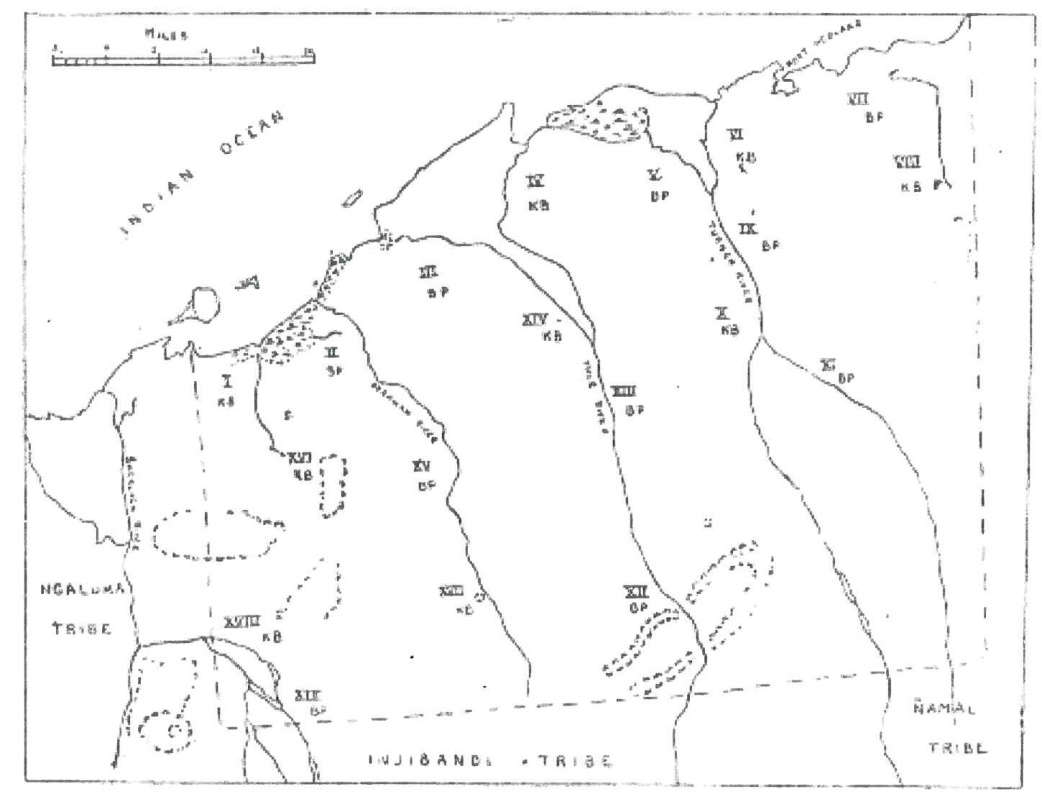
Figure 3.3: Radcliffe-Brown’s map of the ‘Kariera Tribe’ (1913)
97. Rights of ownership within the local group area were exclusive to members of the local group. He wrote,
The country of a local group, with all its products, animal, vegetable, and mineral, belongs to the members of the group in common. Any member has the right to hunt over the country of his group at all times. He may not, however, hunt over the country of any other local group without the permission of the owners. A single exception to this rule seems to have existed where a man was following a kangaroo or emu and it crossed the boundary into the country of his neighbours, when he might follow it and kill it. Hunting, or collecting vegetable products on the country of another local group constitutes an act of trespass and was in former times liable to be punished by death. The importance attached to this law seems to have been so great that offences against it were very rare. In the early days of the settlement of the whites in the country of this and neighbouring tribes, the squatters made use of the natives as shepherds, and I have been told on several occasions that they found it at first impossible to persuade a native to shepherd the sheep anywhere except on his own country. I could not find any evidence of the individual ownership of any part of the soil or any of its products. The whole territory of the group and everything on it seem to belong equally to all the members of the group.
98. Despite these strictures, Radcliffe-Brown noted that visiting and sharing of food was common (ibid., 146-7) such that there was 'a perpetual shifting to and fro both within the country of the group and from one group to another' (ibid., 147). Radcliffe-Brown also observed that the language identity of local groups was not always singular (ibid., 160-161). Some for example were designed, 'half Ngaluma, half Kariera' He observed, 'The fact is that one tribe is not clearly marked off from its neighbours but there are often near the border a number of local groups that occupy an indeterminate position' (ibid., 161 ).
99 Local groups were exogamous so a man had to gain a wife from a local group different to his own. The wife did however retain rights to her own country.
A woman seems to have retained a sort of right over the country of her birth, so that a man and his wife were generally welcome to visit the wife's local group whenever they wished. A man seems also to have a sort of secondary right over the country of his mother, that is the country to which she belonged by birth. In a large number of cases this was the same as the country of his wife. In both cases, however, it seems to have meant no more than that a man was sure of a welcome in the country of his wife or his mother.
[Emphasis added.]
65 Dr Palmer next described the views of Radcliffe-Brown about the Kariyarra kinship system and how they impacted on landholding as follows:
104 Radcliffe-Brown understood the kinship system of the Kariyarra to be characterised by a process of proper relationship founded on behaviour and obligation. Moreover, it was no abstract system, but one founded upon relationships of consanguinity. He saw this system as fundamental to local organisation, which led him to return to a consideration of the local groups discussed in the earlier part of his paper.
Each local group, however, that is, each of the local subdivisions of the tribe, consists of members of one couple only. Thus one local group consists of men and women of the classes Karimera and Burung, while another consists of Banaka and Palyeri men and women.
66 Then, in an important paragraph Dr Palmer explained:
105 Radcliffe-Brown then sought to refine his definition of the local group which he proposes to call a 'clan' in future publications.
I propose in this and future publications to use the word 'clan' to denote a social division of this kind, of which the Kariera local group is an example. A clan by this definition consists of a body of persons who are closely related to one another in one line (that is, either in the male line or in the female line) and who are clearly marked off in some way from the similar divisions of the same society. In the Kariera tribe we have clans with descent in the male line. Each clan includes a number of men who are, by the relationship system, father's father, father, brother, son, or son's son to each other. Each clan is marked off from every other by the possession of its own territory, and as we shall see later, by other features also.
67 Dr Palmer next explained in the following passages that in 1930 Radcliffe-Brown revised (Radcliffe-Brown 1930) but did not substantially change his views.
109 … In 1930 he published a paper which sought to define the social organisation of Australian tribes which, as the title suggests, treated many groups in addition to the Kariyarra (Radcliffe-Brown 1930). In this he generalised from the particular, attempting to set down a definitive account of Australian systems of social and local organisation. He introduced a new term, 'horde' to his account which he hoped would clarify what he meant by use of the word 'clan'.
The horde is a small group of persons owning a certain area of territory, the boundaries of which are known, and possessing in common proprietary rights over the land and its products - mineral, vegetable and animal. It is the primary land-owning or land-holding group. Membership of a horde is determined in the first place by descent, children belonging to the horde of their father.
Radcliffe-Brown 1930, 35.
110 He sought to clarify membership in reality ('an existing group at any moment') by accommodating wives of local group members.
The horde, therefore, as an existing group at any moment, consists of (1) male members of all ages whose fathers and fathers' fathers belonged to the horde, (2) unmarried girls who are the sisters or daughters or son's daughters of the male members, (3) married women, all of whom, in some regions, and most of whom, in others, belonged originally to other hordes, and have become attached to the horde by marriage.
Ibid., 35-6.
111 Later and in the same article (ibid., 59) he attempted to distinguish the horde from the clan. His initial proposition was that for the Kariyarra, 'all the men of any given horde belong to a single line of descent' (ibid., 59). Since the horde is based on descent ego's father's horde is different to ego's mother's horde. Recognising perhaps that the two hordes would then constitute a single social unit (the family or group that lived together on a daily basis) he suggests using the term 'clan' for the residential group. His conclusion in this regard is however not evident.
We can therefore say that in the Kariera tribe, connected with each horde there is a clan. I have defined a horde as consisting of all men born into the horde together with their wives and unmarried daughters. The clan connected with the horde consists of all persons born in the horde. The male members of the clan all remain in the horde from birth to death. The female members of the clan remain with the horde till they are married and then are transferred to other hordes.
Ibid., 59.
68 Dr Palmer then drew attention to the distinction made by Radcliffe-Brown between the tribe and the horde, and stated:
113. … Radcliffe-Brown understood the term 'tribe' to refer to a group of people who spoke the same language and who shared common customs.
Throughout Australia hordes are grouped into larger local or territorial units, which will be spoken of as tribes. The primary mark of a tribe is that it consists of persons speaking one language, or dialects of one language. Its unity is primarily linguistic. The name of the tribe and the name of its language are normally the same. So that the easiest way to ascertain to what tribe an individual belongs is usually to ask him what language he speaks. In addition to this unity that comes from a common language there is also a unity of custom throughout the tribe.
Ibid., 36.
69 Dr Palmer made reference to Radcliffe-Brown’s view that the tribe was not the landholding body. Dr Palmer stated:
117 In terms of proprietary interests in land Radcliffe-Brown provides a corrective to a common misconception. He observed that while, 'a tribe is commonly spoken of as possessing a certain territory' and was 'regarded as a land-holding group' such depiction was 'not quite accurate ... so far as Australia is concerned' (ibid.). The source of the error lay in conflating the tribe with its constituent local groups. The 'tribe' could be regarded as owning land,
... only because it consists of a certain number of hordes, each of which has its territory. The territory of the tribe is the total of the territories of its component hordes.
70 In chapter 3 of the Palmer 2013 report, Dr Palmer undertook a critical assessment of the work of Radcliffe-Brown. Part of that assessment concerned the issue whether patrilineal descent was the only path to the acquisition of rights to land.
71 Dr Palmer argued that Radcliffe-Brown was not always clear about how he distinguished the horde from the clan and that it was likely Radcliffe-Brown conflated the idea of land-owning and land-using groups employing the terms horde and clan without differentiating their intended meaning. Dr Palmer said that partly as a response to that lack of clarity, a debate ensued among anthropologists regarding Aboriginal customary local organisation in Australia. Dr Palmer set out the view of Stanner (Stanner 1965) and Berndt (Berndt 1959) on the issue and continued:
142 While the debate about local organisation has not been fully resolved, a number of important issues have became generally accepted, building on and modifying the original orthodox proposition that a patrilineal descent group (of one sort or another) comprised the basis of the land owning unit. Radcliffe-Brown postulated that there had to be a normative system of laws that regulated the rights of a horde (local group) to its country and to each other (Radcliffe-Brown 1952, first published in 1935). He considered such an arrangement to rely upon a principled system of patrilineal succession that would avoid 'unresolveable conflict'. He thus sought to establish that unilineal systems had a functional origin which if absent would have dysfunctional consequences (ibid., 46).
143 Subsequent studies have demonstrated that patrilineal descent may not have been the only means of gaining rights to country. Evidence produced as a result of land claim research has shown that unilineal descent as the sole basis for owning land may not have been the case everywhere, particularly for the less well-watered areas. In addition, there was evidence that rights to country could be gained through a number of ways, patrifiliation being just one (Peterson 1983, 137-8; Stanner 2001, 112-114). Myers, writing of the Pintupi of central Australia, showed that rights in estates were multiple and perhaps differentiated as to degree rather than singular in relation to one patri-estate only (Myers1986, 138-140). These writers are in broad agreement that there are several different means of gaining rights to country, including Radcliffe-Brown as I discuss below (see paragraph 146 and following).
144 It is likely that in arid regions, where maximum flexibility was required to ensure continuity of inheritance in an uncertain environment, more open systems were to be found, favouring multiple pathways of descent and the acquisition of rights to country through means other than descent (Keen 1997, 66). Other writers have pointed out that such flexibility is likely to have been common in many areas, including those outside of what has been generally identified as the Western Desert cultural bloc (Sutton 1999, 15-19, 26-32; Keen 1997). However, there appears to be much variation in the ethnography (cf. ibid., 73) and perhaps the best conclusion is that no model fits all.
[Footnotes omitted.]
72 Then, in a passage of central importance to this issue, Dr Palmer stated:
146 In his 1913 article (1913, 144-147), Radcliffe-Brown had stated that rights inured in the patriline with 'some sort of a secondary right' to the country of the mother. He wrote, 'A man seems also to have a sort of secondary right over the country of his mother, that is the country to which she belonged by birth. In a large number of cases this was the same as the country of his wife. In both cases, however, it seems to have meant no more than that a man was sure of a welcome in the country of his wife or his mother' (ibid., 147). Later (1952) Radcliffe-Brown elevated these secondary rights to 'quite important rights'.
It is important ... to recognise that in this instance, and, as far as we know, in all instances of patrilineal succession, some rights are also transmitted through the mother. Thus in the Kariera tribe a man has certain quite important rights over his mother's horde, over its individual members, and over its territory.
Radcliffe-Brown 1952, 36.
147 Radcliffe-Brown was of the view that members of a country group were required to seek permission to use another country group's country, or be invited into it (see paragraph 96 and 97 above). This developed from his understanding that a country group was composed of those tracing common patrifiliation, whose members exercised rights in a more or less defined estate. However, if a man had rights in his mother's country he also had rights in the country of another patrilineal group's country. Should he gain rights to country through other means, as later studies have shown to be the case in many areas of Australia (see paragraph 143 above) then he might exercise rights in other estates too. Members of the residence group, drawn from a number of different country groups would together exercise rights over many different countries through these various pathways. Just how the allocation of rights to different areas of country might be actuated would depend upon the manner whereby rights were asserted and membership of the land-using group. This points to a situation where rights to country were multiple rather than singular and would have been exercised across a wide range of country comprising the home estates of a number of different descent groups, as Stanner reported (see paragraph 139).
148 Radcliffe-Brown's particular characterisation of rights inuring to a single patriline within a sole estate is unlikely to have been the case in practice. Certainly subsequent researchers observed a more complex situation. For example, R. and M. Piddington, who worked amongst the Karajarri south of Broome, wrote of the coastal Nadja Karajarri that Radcliffe-Brown's rule of exclusive ownership of the horde did not apply to their field data. They wrote,
this rule does not exist. Certain small exogamous groups exist, but they lack the solidarity which characterises the normal Australian horde; small parties composed of less than a dozen individuals from any horde may go on hunting expeditions lasting several months, over the territory of any other horde, without asking permission of the owners, who would not object.
M. and R. Piddington 1932, 351
149 Elkin disagreed with R. and M. Piddington suggesting that since the Karajarri had been 'under white influence for some sixty years' this made reconstruction 'difficult' (Elkin 1933, 279) and that failure to ask permission was due to the, 'decadent condition of this part of the tribe' (ibid., 280). Elsewhere I have discussed Elkin's own field data in detail and concluded, based on my reading of his materials, that he demonstrated in fact that,
Patrifiliation was an operative principle in the descent of rights to country, but it was not the only one. There was no neat fit between an individual's totemic affiliations and his or her father or father's estate. A singular patrifiliative totemic principle did not govern the descent of rights in an estate.
Palmer 2010c, 88.
150 P. Kaberry worked in the Kimberley region a few years after R. and M. Piddington's work further to the west. She questioned Radcliffe-Brown's justification for accepting patrifiliation as a given, based on economic determinants (Kaberry 1939, 136-7). She cited other researchers (Stanner and Warner) to support her view that a man might live in his mother's country, presumably as of right, as well as his father's (ibid., 137). The real tie to patri-country, she argued, was a result of ritual and spiritual ties that develop as a result of a man's relationship with his father (ibid., 138). Kaberry also distinguishes rights in at least two other countries; country (or area) of birth and mother's country (ibid., 31, 137; 194-5).
151 The evidence supports the view that these researchers had found field data to support the conclusion that proprietary interests in country were multiple and complex, depending on a number of relationships. Permission and the exercise of rights were best understood in the context of the relationships that legitimated their expression. The ideal of the patrilineal descent group whose members exercised exclusive rights within a single estate was not a satisfactory or adequate representation of the ethnographic reality.
[Footnotes omitted. Emphasis added.]
73 Dr Palmer concluded at [239] that at sovereignty rights to land were acquired by Kariyarra people by descent either through the patriline or the matriline.
74 In chapter 8 of the Palmer 2013 report, entitled Accounts of Land Ownership at Yandeyarra, Dr Palmer recounted his doctoral work in Yandeyarra in the 1970s and also his work in 1980 with Penny Taylor for the Department of Aboriginal Studies of the Western Australian Museum to identify sacred sites within the Kangan Pastoral lease. Dr Palmer was careful to explain that most of his work in Yandeyarra was with the immigrant population which greatly outnumbered the local owners. The focus of the work was how the immigrant groups managed to assert dominance in community and ritual matters when living in someone else’s country. Dr Palmer explained:
251 Morton points out that in my research the Kariyarra did not figure very prominently (Morton 2012, 64) and of the six languages groups I recorded at Yandeearra (Palmer 1981b, 22) the Kariyarra were 'conspicuous by [their] absence' (Morton 2012, 64). My account of local organisation at Yandeearra was developed from those with whom I worked: for the most part members of the immigrant community, although some of my informants were locals. An exhaustive account was not possible given that some of the local owners were absent from Yandeearra and so not readily available to me for interview. I then set out to relate the account of local owners to the problems of how immigrant groups managed to assert dominance in community and ritual matters when living in someone else's country (Palmer 1981b, 415-6). My account of local owners was then not one provided in its own right but as necessary contributory data brought to bear on my analyses of the ordering of social relationships.
[Footnotes omitted.]
75 Dr Palmer said in the Palmer 2013 report, that he wrote generally about the Aboriginal residents at Yandeyarra and he cited from his 1981 thesis (Palmer 1981b) as follows:
252 In my thesis I write generally about the Aboriginal residents at Yandeearra with whom I worked. I had, from the outset, made clear who comprised this community and it follows from the statements I have made in the preceding paragraphs that my comments were not for the most part about the Kariyarra (Palmer 1981b, 22-23). Indeed, when I set out to define 'concepts of land and land ownership' I indicated that my data was taken from Nyangamarda speakers (ibid., 333 ff), that language being commonly employed at Yandeearra at the time of my field work there (ibid, 22). I then listed key words that comprise the lexicon of the language of land and their meanings, including terms for country or estate, owner of country, stranger, spiritually potent water source, country and repository of sacred objects (ibid., 334). I go on to state that,
At Yandeearra, people inherit land from their matri-kin or patri-kin as a consequence of being born into a clan, and the inheritance of land is a birth right. Traditionally, all Aboriginal men or women inherited rights in a clan estate. The warany, or estate is, then, inalienable property, and that is one of the encumbrances of ownership.
Palmer 1981b, 335.
[Footnotes omitted. Emphasis added.]
76 In chapter 11 of the Palmer 2013 report, Dr Palmer addressed the contemporary state of laws and customs relating to the acquisition of land. He stated:
456 The claimants with whom I worked are of the view that rights to country are gained via descent. In this regard filiative links with forebears traced through either the male or female line are regarded as equally legitimate. Simply stated then a Kariyarra person gains rights to the country of their forebears in the same way as they gain their Kariyarra identity.
77 Dr Palmer then quoted some of the information provided to him by Ms Diana Robinson, Kerry Robinson, Ms Irene Roberts, Mr Alfred Barker, Les Stevens and by members of the Indigenous respondents’ families at the time when he wrote the Palmer 2013 report and concluded from that material:
458 Descent is afforded by reference to either matri or patri-filiates. Such a system can be termed cognatic in that descent of rights is counted through any combination of male and female links to forebears. This is in contrast to a unilineal system of descent, where descent is traced only through the male or female line. Cognatic descent affords choice and flexibility since the range of country available theoretically increases exponentially with each new generation. Unilineal descent ensures continuity of rights to country reside only within the members of the patriline (or matri-line if it is a matrilineal system).
[Emphasis added.]
78 Finally, on this issue, Dr Palmer concluded that the laws and customs concerning the acquisition of rights to land by cognatic descent have continued in existence from before sovereignty until now. He said:
495 … I also think it possible that patrilineality was formerly understood to afford the most direct pathway to attaining rights to country - a shift to cognation perhaps resulting from the increase in mixed marriages (particularly between European men and Aboriginal women). However, the system is underpinned and relies upon what are in my view incontrovertible aspects of customary belief and practice, reflecting a continuity of a normative system since the time prior to effective sovereignty up to the present.
79 Dr Clarke was instructed to report on the connection of the Indigenous respondents to Kariyarra country. He addressed that issue in the Clarke 2015 report in five pages. Most of the balance of the substance of the report of 54 pages was directly and indirectly focused on the question whether the applicants were entitled to rights in Kariyarra country.
80 Dr Clarke approached that latter question in the Clarke 2015 report by outlining the migration of inland people particularly the Njamal in the 20th century and describing that they took over some of the country of the coastal people including the Kariyarra. In several succeeding sections of the report he explained the major cultural differences between the coastal people and the immigrants, namely, in initiation practices, language and kinship systems.
81 Having set that scene, Dr Clarke posed the following question:
Given that much cultural change has occurred in the Pilbara since European settlement, there remains the question of whether the regional land ownership system had the facility to transfer country from Kariyarra people to incoming desert peoples?
82 The answer is lengthy but comprised Dr Clarke’s response to Dr Palmer’s conclusion that cognatic descent was the basis for the acquisition of rights to land. The passage commencing at page 28 is as follows:
From the early anthropological work on the Kariyarra it was stated that ownership to country was primarily handed down along the patriline. Radcliffe-Brown said that:
Membership of the local group is determined by descent in the male line; that is to say, a child belongs to the local group of its father and inherits hunting rights over the territory of that group.
In spite of the importance of deriving identity from the father’s country, it was recognised that some secondary rights came through the mother. Secondary rights would enable limited access to sites and resources, but with decisions concerning country restricted to those who possessed primary rights as land owners. While Radcliffe-Brown eventually made some modifications to his rigid model of Australian Aboriginal kinship systems, he did not change his view on the primacy of the patriline in regions such as the Pilbara. He did, however, come to acknowledge a broader set of rights that existed outside the immediate concerns of the descent group (clan or his “horde”), and stated that:
… in all instances of patrilineal succession, some rights are also transmitted through the mother. Thus in the Kariera tribe a man has certain quite important rights over his mother’s horde, over its individual members, and over its territory.
The separation of power for decision-making processes relating to land is a situation that commonly occurs in Australian Aboriginal societies. For instance, in many of the communities in the Northern Territory a person is considered to be the ‘owner’ or ‘boss’ of their father’s estate, while at the same time being the ‘manager’ or ‘policeman’ of their mothers’ country. As the use of the Aboriginal English names implies, people have a different relationship with each of their parent’s country, with ‘ownership’ restricted to the father’s estate. But in the contemporary Pilbara, both Palmer and Morton have argued for the existence of a much more flexible situation for Kariyarra land ownership. Based upon his 1970s fieldwork at the Aboriginal settlement in Yandeyarra, Palmer has argued that the prevailing notion of Kariyarra ‘inheritance’ was ‘ambilineal’, that is with recognised descent from all four grandparents and ‘rights and ritual obligations with respect to land’ being traced through both father’s side and mother’s side. This would presumably allow or even encourage individuals to strategically identify with whatever cultural group gave them maximum benefit as each issue arose. These views of Palmer and Morton represent a significant modification to Radcliffe- Brown’s above statements.
Palmer stated that in Kariyarra country the ‘rights and obligations of a landowner are potential’, and could be ‘realized through a number of ritual inductions’. Apart from one case, Palmer did not attribute ownership of the estates surrounding Yandeyarra to Kariyarra people, and the sole Kariyarra owner was ‘generally regarded as being one of the last surviving members of the Gariyara [Kariyarra] socio-linguistic group’. The population living on the former mission at Yandeyarra was predominately Nyangumarta and Nyamil, and by 2005 there were over 300 people living in the settlement. While Palmer’s account of estate group relations at Yandeyarra can be seen as evidence for the continuing operation of an estate system and a wider group maintaining underlying title and allocating rights in country, it must be noted that the wider group he described was not representative of the Kariyarra people but rather composed of the ‘riverline tribes’ who were dominated by the numerically superior Nyamal people. In line with Palmer’s 1970s work, Morton in general accepted the notion of a ‘pan-riverline identity’ for modern Aboriginal people living within the Kariyarra claim area. It is this broader group that he considered to be land owners of the area, stating that ‘While Kariyarra people continued as an identifiable language group connected to a specific riverline territory, the group appears to have suffered some loss of influence in the regional system’.
During my fieldwork I was able to further investigate the contemporary situation regarding Kariyarra land ownership with the descendants of Mary Yinbung (Todd/Dann/Attwood/Mason claimant group). I found that among them there was no support for the flexible set rules for determining cultural identity as described by Palmer and Morton. The people I was able to interview were all adamant that Kariyarra descent was only ‘through the blood line’ and was without the possibility of primary links to country being made through either adoption or birth site. They asserted that cultural identity in the regional system was primarily along the male line, although in cases when the father was not an Aboriginal man it could be determined via the mother at that generation alone. While accepting that a non-Kariyarra person could have some secondary role in looking after Kariyarra country via their matriline or by the possession of ritual knowledge, it was said that such an individual could never become a land owner. They rejected outright the idea that a person had two or more choices (i.e. via parents and grandparents) when establishing their primary link to a local group and its country. For instance, they believe that if someone has a Nyamal father then they must take their primary link as being with Nyamal country further inland, even if they were born within Kariyarra country. This descendant group consider that these rules were those that their ancestor Mary Yinbung had enforced as a Senior Custodian (“Queen’) of the Kariyarra in the early 20th century. They also believe that the Creation ancestors of the inland groups, including the Nyamal, are not Kariyarra. My following comments upon each of the purported Kariyarra claimant families are framed by these notions of identity.
[Footnotes omitted. Emphasis added.]
83 Dr Clarke then concluded, after discussing the applicants’ family groups:
In the case of Tommy Anderson as the apical ancestor of one group of claimant families (Todd/Dann/Attwood/Mason), the available evidence provided here indicates that he was probably a Kariyarra man who was an owner of an estate within the southeast portion of the claim area. The findings of Morton and Palmer are broadly in agreement with this. The difference between my opinion and theirs is over the extent to which other family claimant groups are also connected to the Kariyarra claim area. Today, Tommy Anderson’s descendants do not accept any notion that descent groups that they identify as ‘newcomers’ to their country (i.e. the Nyamal, Yindjibarndi and Palyku) have any status as land owners within the Kariyarra claim area – specifically areas to the west of Mount Edgar, such as Wodgina, Woodstock and Abydos stations. A finding from my fieldwork was that rather than defining an ‘estate’ that they traditionally owned, the Tommy Anderson group conceive the totality of their ‘country’ to be the stations within the Kariyarra claim area where they and their ancestors lived, worked, died and were buried. Analysis of the data provided in this report supports their firm belief that their relationships with country have strong links to the classical Kariyarra culture. Robert Dann traces his detailed knowledge of Kariyarra landscape-based mythology as having come through his maternal uncles, none of who were interviewed by Morton or Palmer.
84 In the Palmer 2017 report, Dr Palmer responded to the Clarke 2015 report. On the question whether descent was patrilineal with limited exceptions or cognatic, Dr Palmer made three points.
85 First, contrary to the information Dr Clarke said he obtained from the Indigenous respondents, Dr Palmer referred to discussion he had in the course of preparation of the Palmer 2013 report, with the Todd, Dann, and Lockyer family members including the Indigenous respondents on 13 and 14 April and 11 – 13 September 2013 recorded in ten pages of his field notes. Dr Palmer then explained:
28 … The matter of the descent of rights was explored in some detail and I recorded what I was told by those with whom I worked. According to the account provided to me, rights to country could be gained through either matri or patrifiliation. Two of the children of Ignatius Dann appeared to place greater priority on their mother’s country (Kariyarra) than on that of their father’s country (Nyulnyul). There was then by this account no impediment to obtaining and exercising vigorous rights within your mother’s country.
86 Second, Dr Palmer recalled the reference in the Palmer 2013 report to the debate among anthropologists about the acquisition of rights to land which followed the work of Radcliffe-Brown and the more accepted view that patrilineal descent was not the only means of acquiring rights to land. Dr Palmer observed that Dr Clarke relied on Radcliffe-Brown’s view without reference to or engagement with the different views expressed by later anthropologists involved in that debate.
87 Third, Dr Palmer raised questions about the exception rule propounded by Dr Clarke as follows:
34 The ‘exception rule’ as defined by Dr Clarke is particularly significant for the descendents [sic] of Tommy Anderson. For this now extended family all present-day descendents [sic] trace ancestry to Tommy’s daughter Mary Yinpung (aka Mary Todd). Thus if the rule of exclusive patrilineal descent were to be applied, none of the descendents [sic] of Tommy Anderson could be regarded as claimants.
88 That conclusion followed because Mary Yinbung had eight children, seven with a European, George Todd, and one with another European, Ronald Parker. Dr Palmer continued:
35 My difficulty with Dr Clarke’s ‘exception rule’ is that it appears to evoke cognation in just one instance, which is undoubtedly to the benefit of those with whom he worked in terms of the pressing of privileged rights to Kariyarra country. There is no examination of what to me would appear to be significant questions of consistency. If rights to country gained via the mother are lesser rights than those gained from the father (as Dr Clarke argues) why should this not be the case for the descendents of Mary Yinpung as it is (according to Dr Clarke’s argument) for other Kariyarra claimants? What is the basis for the exception rule in pre-sovereignty normative systems, where biological paternity occasioned by miscegenation was unknown? Where does Dr Clarke present an argued case for the exception rule being a part of customary process? The exception rule altogether neglects the existence of social fathers who, in my experience, frequently raised children fathered by European station workers, whose identity is sometimes unknown, and treated them as their own. Finally, the question of successive European paternity is not addressed. If the rule applies to ‘that generation alone’ what is the rule if the female child of a union between a Kariyarra person and a European has children with a European. Is the exception rule applied again so establishing matrilineal descent over two generations?
[Footnotes omitted.]
89 Dr Palmer then observed that under the descent rule as propounded by Dr Clarke, some of the Indigenous respondents would not qualify as landholders. Dr Palmer noted that Dr Clarke did not provide genealogies for the Todd / Dann family, but, based on the genealogies attached to the Palmer 2013 report, the father of the Indigenous respondents Gene Smith, Ms Mary Attwood, and Mr George Dann was Ignatius Dann. He was a Nyul Nyul man and hence those Indigenous respondents would not qualify along the patriline and would not fall within the exception.
90 Dr Palmer concluded thus:
42 I have found Dr Clarke’s exposition of the exception rule for a European progenitor quite unsatisfactory. In my view Dr Clarke has failed to explain how the rule might operate in some instances and has provided no evidence that it is based upon or rooted in pre-sovereignty systems. Rather, in my view, it provides evidence that cognatic descent (and in this case matrifiliation) is not only a part of the manner whereby claimants gain rights to country, but arguably and based on a proper and thorough examination of the earlier ethnography, on a system likely to have been in evidence at the time of sovereignty and before. The application of the exception rule would appear to owe its exercise more as a means to provide legitimation for the assertion of exclusive rights to Kariyarra country by the Tommy Anderson descendents, rather than as a feature of a customary normative system.
91 Dr Palmer also took issue with the way Dr Clarke dealt with the rights obtained through the matriline. Dr Clarke accepted the view of Radcliffe-Brown that important rights were acquired in the mother’s estate. Dr Clarke said that those rights were secondary. They enabled access to sites but “decisions concerning country [were] restricted to those who possessed primary rights as landowner”. Dr Palmer responded thus:
48 Dr Clarke provides us with no details of the bases upon which he reaches the conclusion about the distinction he asserts exists between primary and secondary rights and no basis upon which he reaches his conclusions about the nature of the rights primary and secondary. Instead he employs the passive, ‘it was recognised that’ as justification of his views relating to primary and secondary rights, begging the question as to what or who provided this recognition. That decision making was reserved to primary rights holders and limited access was permissible for secondary rights holders is substantiated by no scholarly references whatsoever, so once again the bases for Dr Clarke’s views are not disclosed. Dr Clarke accepts that Radcliffe-Brown did modify his ‘rigid model’ but not, apparently, ‘in regions such as the Pilbara’. Again Dr Clarke provides no basis for reaching this conclusion which would appear to be his own idea entirely. Indeed Radcliffe-Brown in the passage cited by Dr Clarke (Radcliffe-Brown 1952, 36) and quoted by me above (see paragraph 29) specifically identifies the Kariyarra as being a ‘tribe’ where rights were gained via matrifiliation, evidently contradicting Dr Clarke’s opinion that the rigid model prevailed for Radcliffe-Brown in ‘regions such as the Pilbara’.
92 And Dr Palmer concluded as follows:
55 … In my view Dr Clarke’s argument relating to primary and secondary rights does not disqualify matrifiliates from being potential native title holders but rather supports their acceptance as such by defining for us the actual rights they enjoy (Clarke 2015, 29). His apparent acceptance of the incidence of secondary rights amongst those families he seeks to disqualify in fact confirms their status as potential native title claimants. Dr Clarke has avoided such a conclusion by employing the term ‘ownership’ which obfuscates a proper understanding of the incidence and exercise of rights. According to his own account both matri- and well as patrifiliates are in fact ‘owners’ in so far as they exercise rights to the country they claim. Dr Clarke has erroneously utilised his undefined term ‘ownership’ to create a distinction in the exercise of rights to country which is neither supported by the ethnography nor by a proper understanding of how rights to country are manifest. …
93 In Clarke 2017 report, Dr Clarke replied to some of the observations made by Dr Palmer in the responsive Palmer 2017 report.
94 First, Dr Clarke referred to references in the writings of John Withnell (Withnell 1901) and Daisy Bates (Bates 1901) to the passing of rights to talu and totem sites along the male line. The references are superficial and did not engage with the lengthy and detailed analysis of these two writers made by Dr Palmer in his original Palmer 2013 report. If these writers were important to Dr Clarke it is hard to see why they were not included in his initial 2015 report. In truth, Dr Clarke’s references are beside the point. They do not bear on the issue of rights to estate areas but rather to the much more limited talu and totem sites. In any event, they did not engage with Dr Palmer’s assessment of the quality of the work of those early observers, neither of whom was an anthropologist.
95 Next, Dr Clarke addressed Dr Palmer’s criticisms of the exception rule. Initially, Dr Clarke stated that he had been simply reporting the views of the descendants of Tommy Anderson. Then, he referred to other instances in Aboriginal Australia to matrifiliation being used to deal with irregular marriages. The treatment lacked detail and failed to respond to the detailed criticisms made by Dr Palmer.
96 Then, Dr Clarke returned to a theme of his initial 2015 report, not particularly relevant to the reply, that ambilineal descent is a feature of inland cultures. A common failing of Dr Clarke’s reports is that they do not clearly flag the path of reasoning. The reader is left to surmise the point of some of the sections. In this part of his reply, although not stated, the suggestion seems to be that the ambilineal model comes from the inland people who migrated into the coastal areas. Thus, Dr Clarke may have intended to suggest that ambilineal descent is not a traditional rule of the Kariyarra people, but rather an indication of the non-Kariyarra descent of some of the applicants.
97 Finally, Dr Clarke asserted that the evidence of Ms Irene Roberts and Ms E Williams given in the preservation hearing in 2013 expressed a preference for the male line in the determination of rights to land. However, Dr Clarke’s references are selective quotations which take no account of the clear understanding expressed by both witnesses that rights to land may be acquired through either the male or female line. That evidence is dealt with in these reasons for judgment at [36]. Indeed, as the evidence was given in 2013, it is surprising that Dr Clarke did not refer to it in his initial Clarke 2015 report if it was supportive of the case of the Indigenous respondents.
98 In May 2017, when the conference of experts was conducted, Dr Clarke expanded the categories in which matrifiliation applied beyond the case of a non-Aboriginal father under the traditional laws presently observed by the Indigenous respondents. To question six in the record of the conference of experts Dr Clarke stated:
Matrifiliation was part of the Kariyarra laws and customs pre-sovereignty. I consider that the Indigenous Respondents’ position (that matrifiliation is only accepted in the instance of a non-Aboriginal father) reflects a ‘traditional’ system to the extent that it reflects a strong preference for patrifilial connection.
However, matrifiliation is also accepted as part of the traditional/customary system in more instance that [sic] just the instance of a non-Aboriginal father, such as of a deceased or absent Aboriginal (non-Kariyarra) father, socialisation to the mother’s side of the family through life experience and knowledge gained, location of a thalu site in their mother’s country, and others.
I also accept that people could have (under the traditional/customary system) connection to more than one estate at the same time.
By the logic of the Indigenous Respondents which would exclude matrifiliation where there is an Aboriginal father, I agree that some of the descendants of Tommy Anderson would not acquire rights and interests.
[Emphasis added.]
99 The final paragraph accepted the point made by Dr Palmer in the Palmer 2017 report but to which Dr Clarke did not respond in his Clarke 2017 report in reply.
100 There are several aspects of the cross-examination of Dr Clarke which bear on the issue of whether descent was reckoned by the patriline subject to certain exceptions, or whether descent was reckoned cognatically.
101 The first aspect of Dr Clarke’s cross-examination concerned the instructions which Dr Clarke received from the Indigenous respondents about their understanding of the traditional laws concerning descent.
102 After Dr Clarke gave evidence that he had the Palmer 2013 report before he wrote the Clarke 2015 report, but not before he conducted the field work, the following exchange occurred:
MR WRIGHT: … But did you at any point before you prepared and finalised this report, did it occur to you that there was a disconnect between what you were saying about the system being patrilineal according to the Tommy Anderson descendants, and what Dr Palmer had reported that he was told from them?
DR CLARKE: Yes, it was – it was quite apparent there was a difference between the account of his – his conversations with the family, and his interviews with the family and mine. Yes, so I was aware of the difference.
MR WRIGHT: Yes. And did you do anything to try and investigate that difference?
DR CLARKE: Well, it was certainly something I discussed with – with Pat [Mason] and, as I said, with other members of her family in the background from their Port Hedland group.
MR WRIGHT: This was the phone call that’s referenced in your field notes?
DR CLARKE: Oh, that and probably several others. I mean, it was a very – it was a very fast process from the moment I did the fieldwork and received the reports and doing my first report, so, everything was happening sort of fairly quickly. But I did speak to Pat Mason and through her others about that – about that issue, and they said - - -
MR WRIGHT: And do you recall what she told you?
DR CLARKE: Well, they – they confirmed that I had the right version and Dr Palmer had recorded it incorrectly, or – or that he was incorrect.
MR WRIGHT: And so when you say that you had the right version, had they had a draft of your report by then?
DR CLARKE: No. I mean I – the right version meaning that I’ve said that - you know, I’ve put the question is it father to father to father? And, you know, they – you know, they confirmed it that that was – that was the system.
MR WRIGHT: And when you say “they”, it was Pat Mason but with others in the background?
DR CLARKE: That’s correct.
MR WRIGHT: Yes. And you didn’t – you haven’t kept a note of those conversations, or that conversation?
DR CLARKE: Well, I – the – I do have a note of the conversation on 25 August, but I don’t have any other – I’ve checked my field notebook and I didn’t – as I said, I was – and I can’t remember what the deadline was, but there was yes, a lot of pressure to get things done quickly. And I was working on the report and I was using all of that archival material and including material Pat had sent me.
…
MR WRIGHT: Yes. And just to summarise, but you didn’t investigate – or, sorry, you did investigate with them what they previously told Dr Palmer?
DR CLARKE: Yes, well, it’s come up several times, come up several times over – well, at that time and even this week with informal conversations that – you know, the difference between, you know, Dr Palmer’s record of his conversation, which was earlier than mine by probably at least two years, and my conversation with theirs in 2015.
MR WRIGHT: So, is it your understanding that their view changed between 2013 and 2015?
DR CLARKE: Oh, I’m not in any position because I wasn’t there at the – at the meeting with Dr Palmer. I know we had a brief discussion about it at the conference of experts, and Dr Palmer at that conference of experts assured me of the veracity of his field notes and I assured him the veracity of mine. In terms of – oh, we didn’t – we didn’t delve too much into speculating why, so I’m not – I’m not in a position of criticising another anthropologist’s field notes and - - -
103 Dr Clarke accepted that the only record of discussion on the issue was in his field notes which recorded a phone conversation with Ms Patricia Mason on 25 August 2015. The entry stated:
Country through father’s line only.
104 In cross-examination, in the extract set out in [49] of these reasons for judgment, Ms Patricia Mason gave evidence about what she told Dr Clarke.
105 As explained in [51] of these reasons for judgment, that evidence, read in context, was evidence that Ms Patricia Mason relied on descent from the male apical ancestor, Tommy Anderson, but otherwise allowed for descent along the male or female line.
106 The second aspect of Dr Clarke’s cross-examination was his assessment of the evidence of the Indigenous respondents concerning patrilineal descent given in the course of the hearing of this proceeding. The following cross-examination addressed the issue:
MR WRIGHT: Yes. Having heard the evidence now this week of the Tommy Anderson witnesses, does that cause you to change your view as to what their understanding is of traditional law and custom?
…
MR WRIGHT: In terms of the way you couched the conclusion in your report, that – and I’m paraphrasing, that the people you worked with were adamant that the relevant system was a patrilineal system, that doesn’t – my proposition to you that I invite you to comment on, that’s not consistent with the evidence that you’ve heard this week from those people?
DR CLARKE: I sat through and listened to that evidence, and I’m not – I’m not entirely sure it was, sorry, inconsistent. Certainly what I was hearing was father to father to father, but of course as emerged with this family that I was putting to them well, that’s clearly not the case with your family, and then they were – then they were coming up with alterations to that and giving reasons why. So – so, when members of the family in this last week have been asked that question, well, clearly they know that their family doesn’t go father to father to father right through to Tommy Anderson. And so, the answers that I’ve heard are consistent with the truth behind that. And in terms of patrilineal, it’s a word that would be unlikely to be used perhaps or Pat might be – might use it because of her research, but other family members wouldn’t necessarily use an anthropological term like that.
MR WRIGHT: Yes.
DR CLARKE: So, look, I have heard – and I would say that there’s not a clear– not a clear statement that I’ve sort of picked up, and in terms of saying that it’s not the case that in terms of their belief, it was what – it was what I heard back then and what I wrote into the report. So, I stand by my – my report that I was recording what I was being told and what I believed or what I’d took to be the – or could demonstrate to be the case in terms of the beliefs of the descendants of Tommy Anderson.
MR WRIGHT: Yes. And so, just to be clear of where I started was paragraph 69 of your 2007 report, you use the word there that the people you conducted fieldwork with were adamant that under normal circumstances the primary connection to Kariyarra country is passed from father to child on the patriline. So, you’re saying that’s an accurate reflection of what you were told when you did that fieldwork in 2015?
DR CLARKE: That’s correct.
…
MR WRIGHT: … And, again, just to be clear, you’re saying based on what you’ve heard this week, the evidence from the witnesses in the witness box, that doesn’t cause you to want to change what you said?
DR CLARKE: No. No, it doesn’t.
[Emphasis added.]
107 In these exchanges Dr Clarke took a literalistic approach to answering the question. On the face of the exchanges, he said that his report correctly recorded what the Indigenous respondents told him. Nothing in their evidence suggested, so he thought, that the Indigenous respondents had not told him that descent was patrilineal. That is inconsistent with the evidence of Mr George Dann which directly contradicted the information in the report. Whilst the evidence of Ms Margaret Attwood, Ms Patricia Mason and Ms Shirley Lockyer was not always crystal clear, a fair reading of their evidence does not support the patrilineal model proposed in Dr Clarke’s reports. Dr Clarke’s response should also be taken on a broader level to be a statement that his assessment of the evidence of the Indigenous respondents did not change his view that rights to land can only be acquired on the patrilineal model espoused in his reports.
108 The third aspect of Dr Clarke’s cross-examination relates to his field notes recording the genealogy of the Indigenous respondents. The field notes show Molly Todd as the mother of nine children, including the Indigenous respondents from a father noted as “European Dann”. The genealogical charts appended to the Palmer 2013 report show that Molly Todd had children from three men. That chart shows that the father of Eugenia Smith, Mary Attwood and George Dann was Ignatius Dann. Ignatius Dann was a Nyul Nyul man. The information in Dr Clarke’s field notes is wrong. The error went to a matter of central relevance to Dr Clarke’s role acting on behalf of the Indigenous respondents. His field notes for the first day in Port Hedland when he was met at the airport by Ms Patricia Mason and Mr Robert Dann recorded:
My report will hopefully resolve their Kariyarra identity and eliminate the ‘newcomers’ [Njamal] who have usurped the status of the Todd family as the sole traditional owners from Kariyarra country. Some antagonism towards John Morton and Kingsley Palmer, who they believe wrote reports aimed at supporting the YMAC [Yamatji Marlpa Aboriginal Corporation] political line.
109 Dr Clarke’s understanding was that those three Indigenous respondents had a European father and that qualified them through the matriline under the descent rule propounded by Dr Clarke.
110 It is improbable that the incorrect information recorded was provided by the Indigenous respondents. In the circumstances, it is more likely that the mistake demonstrates either a lack of care arising from the pressure of time in which Dr Clarke operated or a propensity to take on the Indigenous respondents’ agenda to “eliminate the new comers” in favour of the Indigenous respondents, or both.
111 It is noteworthy that Dr Clarke did not respond in the Clarke 2017 report after Dr Palmer had pointed out the error in the responsive Palmer 2017 report. Dr Clarke made an oblique concession in the record of the conference of experts.
112 The matter was taken up in cross-examination as follows:
MR WRIGHT: And that genealogy shows Molly Todd has having a single partner, Dann, European, from whom a large number of people are descended?
DR CLARKE: That’s what my field note says.
MR WRIGHT: Yes. And you understand that that’s not correct?
DR CLARKE: I understand that – well, at that point I understand it’s not correct. If we take that relationship as being a biological one, then clearly Molly had other partners and, therefore, some of Pat’s siblings are technically half siblings, so a couple of them are fully siblings, so there’s – yes, there’s been evidence on that more complex family tree than the one that I have here.
MR WRIGHT: Yes. And the reference to Dann being European is also an error. Do you now understand that?
DR CLARKE: Well, I – I understand that it’s – I understand that it’s not correct. In terms of being an error, I – with my field notes I was taught by Tindale when I first came to the museum to only ever write on the right-hand side and number each page, but use the left-hand side for either adding footnotes later on or, if I’m indeed using the field note – sorry, the field book as, you know, the very first source when I’m actually there as distinct from writing on scraps of paper and putting it in later, then I write that information on the left.
So, in terms of reading my field notes, the narrative will jump from 119 through to 121, so the pages on the double photocopy is on the left and the – you know, the even numbers in other words - - -
MR WRIGHT: Yes.
DR CLARKE: - - - they are a mixture of things that I added later when perhaps the encounter was over, and I’m in the car or later that night, but certainly still on the same day, otherwise I’d date it. But yes, that’s information that’s still there.
MR WRIGHT: So, that was your understanding of the genealogy based on what you think?
DR CLARKE: That’s right. And that information I was – extracted from Pat and Robert when I caught up with them from – you know, for dinner that night that I’d flown in from Adelaide via Perth.
MR WRIGHT: Yes.
DR CLARKE: So, that was – that was information that I was sort of putting in there. So - - -
MR WRIGHT: And - - -
DR CLARKE: - - - in terms of an error, I mean in my experience, if you the one family tree three or four times you’re likely to have three or four different versions. But I accept that with – or I agree that the information shows that that’s not a correct representation of the relationships between Molly Todd and Dann who’s not technically European in the sort of non-indigenous sense.
MR WRIGHT: Yes.
DR CLARKE: So, I accept that’s – and it’s not correct. But that’s the information as I believed I heard it at the time.
MR WRIGHT: Yes. When you wrote your 2017 report, which was a response to Dr Palmer, at paragraph 112 - - -
DR CLARKE: Yes, I have paragraph 112.
MR WRIGHT: Yes, do you just want to quickly read that just to refamiliarize yourself with it?
DR CLARKE: Yes, well, I’m acknowledging that there’s – you know, there’s a difference between our two accounts of the family – the family tree.
MR WRIGHT: Yes. And you didn’t go back and recheck that information in light of Dr Palmer’s criticism?
DR CLARKE: Well, I – I take on board – I take on board the fact that – that it appeared to be wrong and certainly during the conference of experts, you know, we spoke quite openly about that.
MR WRIGHT: Yes.
DR CLARKE: By the time – by the time I’d put this report in, I was, you know, in a position of, you know, being able to do, you know, more research. So, at the time that I’ve written this paragraph I didn’t have the information in front of me.
MR WRIGHT: Sorry, this is your 2017 report?
DR CLARKE: That’s correct.
MR WRIGHT: So, you’d already had two years, well, give or taken off?
DR CLARKE: Well, not – not really. The history of my whole involvement of this – with this project is two or three days or five days here and there, so - - -
MR WRIGHT: Yes, but you’ve had plenty of time to check the information before you rebutted Dr Palmer’s criticism?
DR CLARKE: Well, I didn’t – I haven’t gone into detail which version was right here because, in effect, it was beside the point with the criticism because I’d already, you know, made the position clear that, you know, there was – you know, there were points where one can drive descent or connections, you know, to country via the female line, so - - -
MR WRIGHT: Yes, but you were proposing that that was in a circumstance where there was a non-Aboriginal father, and Dr Palmer was pointing out that that didn’t fit the circumstances of this group.
DR CLARKE: Now, you might have to take me to it, but did I actually say non-Aboriginal father? I mean the point I was trying to make was that it was someone who didn’t have country, so whether someone was – and I know this came up at the expert conference, whether – whether it was an indigenous person from the Torres Straits Island or a German person, or someone perhaps even from the Kimberley, if it came from an area which is far enough away, it didn’t really – it didn’t really change my model of patrilineality because it was someone who did come to – let’s say and put it in the words of they didn’t come to the table with any connection to country, and in the region where people were living. And that was the – that was the point and that was the – and I’m trying to avoid the use of the word “exception” because that then became a word that we had a lot of debate on.
MR WRIGHT: Yes.
DR CLARKE: But that became – I will use it. That became the exception that when someone was living on – on country, then if they had a father who’s either no longer there or was there but didn’t have any connection to country in the Pilbara region, then, you know, at that point people were taking, you know, their connection to country via the mother’s line.
MR WRIGHT: Yes.
DR CLARKE: So, that was – that was what I was arguing in this report. So, I didn’t – I didn’t drill into which was the actual correct version. I did actually put Kingsley’s version down here, so I wanted it acknowledged, but I don’t actually say here that he’s incorrect. I left it open. So, I feel I’ve done the academically correct thing in that I’ve acknowledged that Dr Palmer had a different version, and essentially what that difference was, that – that the man Dann was in his – the version he recorded wasn’t technically European.
MR WRIGHT: Yes. So, if we do just take then that family line, and if we take, say, the line going from Tommy Anderson to Mary Yinbung, to Molly, and then to Mary Attwood and presumably her children, would you agree that that demonstrates a claim to country based essentially through the matriline?
DR CLARKE: Yes, well, there’s – there’s – there’s at least two, or am I saying three, you know, connections to the matriline, so it’s matrifiliation.
MR WRIGHT: Yes. And - - -
DR CLARKE: It’s not – it’s not a recognised matriline but it is a series of –you know, the choice has been made to go at, was it, two – two generations or three if we count Mary’s children. A decision has been made at that generation level to – to go with the mother’s line because the father was either European or didn’t have any country in the Pilbara.
MR WRIGHT: Yes. And - - -
DR CLARKE: I think I agree with what you’re saying.
MR WRIGHT: Yes. And it wouldn’t be fair, would it, or it wouldn’t be accurate, would it, to describe that as being a patrilineal descent with exceptions?
DR CLARKE: Well, the – the rules of – or the custom of receiving country is – is one thing, the actual playing out of it is another. So, I believe that I’ve covered the – what the ideal system is. I’ve also, I think, earlier in giving evidence acknowledged that – or I’ll acknowledge it now, if I haven’t, that increasingly the patrilineal model has been under pressure just by the sheer out- marriage of whether the – of Pilbara people, whether they’ve got partners who are European or Afghan or, indeed, indigenous from some other part of Australia which is outside of the Pilbara. So, I’m talking about the system without having that system sort of judged by the actual statistical reality of it, if I can put it that way.
MR WRIGHT: Yes. Yes. Well, can I put it to you that the system was one that really you came up with and one that wasn’t supported by any field data that you had?
DR CLARKE: Well, no, the system – the system that I have there is one that was put to me as the ideal system by the family of Tommy Anderson’s 40 descendants.
[Emphasis added.]
113 The Clarke 2015 report recorded that Dr Clarke’s clients did not give him permission to include their family tree in the report. In cross-examination he explained:
DR CLARKE: Yes, well, there were quite a – there were quite a few things that after I wrote the report and talking to them that I couldn’t put in. They were particularly worried about GPS for sites, but they were also – didn’t want their family tree, so that’s a correct – that’s a correct statement. And I received that not via email, it would have been a phone call not to put it in. And I – I can’t remember whether it came via Mr Rumsley, but certainly I had – I had instruction whether it was from the client in Pat Mason or Mr Rumsley that - - -
MR WRIGHT: Yes.
DR CLARKE: - - - I think at this stage Mr Rumsley was – was involved in terms of the report being produced and making sure that it was in keeping with his client’s wishes.
MR WRIGHT: Yes. Well, can I suggest to you that it’s not appropriate as an independent expert to allow the informants to dictate that you would not put in your report something as fundamental as a genealogy?
DR CLARKE: Oh, I – no, I disagree there. I think when writing reports, as long as I acknowledge, as I have done, that I’ve been instructed not to put it in, I – I’ve – I believe that’s professional. And I’ve drawn the attention to the (Resis) report that – that her family tree is not forthcoming. So, whether it’s ideal from my purposes trying to do the anthropologist’s job is another question, but that was my instruction and I adhere to it.
114 In order to produce the Morton report, Dr Morton conducted a field trip from 11 – 18 October 2011, and 28 October – 5 November 2011. On that trip he interviewed many of the applicants and the Indigenous respondents and their families. Of particular relevance is that he interviewed the Indigenous respondents and their families. This occurred on 16 October and 2 – 4 November 2011 at Port Hedland and at the Boodarie Station.
115 The Morton report addressed the culture and rules of the Kariyarra people at sovereignty by reference to the early writers. Dr Morton gave particular attention to the work of Radcliffe-Brown 1913, but also discussed later ethnographic work of the Wilson (Wilson 1961), and of Palmer in the 1970s as well as the later interpretations by Sutton (Sutton 2003). Of particular relevance to the present discussion, Dr Morton said:
35. Radcliffe-Brown's general model of Aboriginal rights and interests in land, initially worked out in relation to his Pilbara fieldwork, was subject to much criticism during the second half of the twentieth century. Anthropologists now generally maintain that:
a) his use of concepts, such as horde and clan, were confused and confusing;
b) he sometimes ignored, sidelined or dismissed counter-evidence;
c) he increasingly tended towards abstraction and oversimplification;
d) his original data were of relatively poor quality;
e) his generalisations were far from fully supported by better quality data from around Australia.
36. There is no doubt that Radcliffe-Brown accurately identified patrilineal descent as a key principle of Kariyarra group formation. However, his overwhelming concentration on the patrilineal clan as the land-holding unit and the estate as the unit of landed property would now be regarded as inadequate. Matters that Radcliffe-Brown treated as somewhat peripheral (like rights in mother's country) or seemingly irrelevant (such as conception site or 'birthplace', or being welcome in the country of a spouse) might now be explored as vital aspects of the larger system of landed rights and interests.
[Footnotes omitted.]
116 Dr Morton expressed the view at [48] that recruitment was by bilateral inheritance, that is to say, one could belong to the land owning group through either parent or both. He said at [46]:
Although Radcliffe-Brown overwhelmingly emphasised patrilineal descent in land ownership and the inheritance of estates, it is in my opinion unlikely that this was a uniform rule articulating rights and interests in local group areas. Apart from Radcliffe-Brown's own documentation of rights in land gained by matrifiliation (paragraph 28), he also states that some estates were characterised as 'half-Kariyarra, half Ngarluma' (paragraph 33). This situation would not arise unless estate groups had the multiple pathways for recruitment (minimally both patrifiliation and matrifiliation) also operative in the inheritance of language. This implies that border areas would be in some measure shared country.
117 It is significant that these views were expressed following consultation by Dr Morton with the Indigenous respondents and their families.
118 The evidence of the Aboriginal witnesses is of first importance in determining the content of traditional laws and customs. The Aboriginal witnesses called by the applicants and the Indigenous respondents who gave evidence, when properly understood, was all to the same effect, namely, that rights to land are acquired through mother or father. It is possible to isolate a phrase here or there from that evidence which, on its face, supports a patrilineal model. But, in each case, when the evidence is considered in context and read fairly as a whole, those extracts are a reference to the particular line of descent relied upon by the family of that witness, which line happened to be through the father. None of those statements, fairly read, supports a general rule of patrilineal descent. Dr Clarke’s interpretation of the evidence of Ms Irene Roberts and Ms E Williams to the opposite effect cannot be sustained. The interpretation raised in Clarke 2017 report in reply, for the first time four years after the evidence was given, indicates a propensity to advocate for the Indigenous respondents’ case rather than an attempt to provide independent expert advice.
119 The expert evidence of Dr Palmer and Dr Morton support the evidence of the Aboriginal witnesses. That evidence should be preferred to the evidence of Dr Clarke where there is a conflict concerning the descent rule for acquiring rights to land.
120 Dr Palmer’s experience with the Kariyarra people and the Pilbara Aboriginal culture extends back to the 1970s. Further, he spent much longer investigating the current issues than Dr Clarke. The result was that Dr Palmer’s reports, particularly his initial Palmer 2013 report, were detailed and comprehensive. In respect of the position at sovereignty, the Palmer 2013 report set out all the commentators, the scope of their work, and an assessment of their quality and reliability. The reports were also tightly reasoned. That was especially evident in the responsive Palmer 2017 report in which the criticisms made by Dr Palmer were focused, clearly explained and largely unrefuted. Of particular importance is that the reports demonstrated a balanced approach. For instance, when dealing with the anthropological debate about the extent of rights which followed the mother’s line, Dr Palmer acknowledged that the position was evolving and that the debate had not finally settled the issues.
121 The same attributes of depth of scholarship, clear articulation, a high degree of precision, focus, balance, and independence were the hallmarks of Dr Palmer’s oral evidence. Dr Palmer was in all respects the model of an expert witness.
122 On the other hand, little confidence should be placed in the evidence of Dr Clarke. In his defence it should be observed that he had much less time to prepare his reports than did Dr Palmer. Furthermore, Dr Clarke explained that the timing of his preparation meant that it was rushed. That is evident in the Clarke 2015 report which, on the question of the descent rule, is superficial and lacking in detail. Those factors may also explain the fundamental error in Dr Clarke’s field notes concerning the father of Gene Smith, Ms Mary Attwood, and Mr George Dann. However, a major difficulty in his treatment of the at sovereignty rule is that he did not respond adequately or convincingly to the material relied upon by Dr Palmer concerning the post Radcliffe-Brown debate about rights which followed the mother’s side.
123 A further problem with Dr Clarke’s evidence is the inconsistency of his model with the evidence of his clients. Dr Clarke had Dr Palmer’s initial Palmer 2013 report when he wrote his initial Clarke 2015 report. Dr Palmer’s report set out the result of discussions with the Indigenous respondents and their families about the descent rule. Dr Clarke understood that there was an inconsistency in the positions expressed to him by his clients with what they had told Dr Palmer in 2013. However, the initial Clarke 2015 report did not refer to the discussion between the Indigenous respondents and their families with Dr Palmer or the inconsistency between the two versions. To proceed without reference to the inconsistencies again suggests a tendency simply to promote the interests of his clients rather than to exercise the role of an independent expert.
124 Although Dr Clarke believed that the position of his clients was inconsistent, the evidence as a whole does not persuade me that the Indigenous respondents and their families told Dr Clarke that the descent rule was patrilineal. The evidence of Mr George Dann is that he did not tell Dr Clarke that. There was no clear statement from the other Indigenous respondents that they told Dr Clarke of a rule in such terms. The only documented reference is the cryptic comment in Dr Clarke’s field notes. The probabilities favour the conclusion that the Indigenous respondents spoke of following their father’s line as a matter of fact when their family circumstances reflected that line of descent, and that Dr Clarke extrapolated those specific comments to a general rule in order to “eliminate the new comers”. It is a serious criticism to make of an expert witness, but I am bound to say that the evidence satisfies me that Dr Clarke, on this issue, misunderstood what his clients were saying to him and in an effort to advance their case he interpreted their instructions in a way not expressed by them. He failed to explore with them what they meant him to understand. Consequently, the primary foundation for his views about the contemporary descent rule are left without a basis. That Dr Clarke unjustifiably advocated for his clients’ case is confirmed by the response which Dr Clarke gave when asked whether the evidence of the Aboriginal witnesses given to the Court changed his view about the descent rule. He said that the evidence did not change his view. Whilst minds might differ about the assessment of evidence, the amount and general consistency of the Aboriginal evidence on the issue exposes Dr Clarke’s response as especially defensive, and lacking the balance and independence required from an independent expert witness.
125 Based on an assessment of the materials set out, I am satisfied on the balance of probabilities that under the traditional law of the Kariyarra people, rights to land were and are acquired on the basis of cognatic descent.
126 The claims in respect of each of the contested apical ancestors and their descendants now will be examined in the light of the conclusions just expressed on the two preliminary issues.
127 It is common ground between Dr Palmer and Dr Clarke that archival material demonstrated that Dougal Robinson’s father was an Afghan and his mother was Polly. It is also accepted that Polly identified as Kariyarra. Dr Palmer calculated from the archival material that Polly was born around 1851. Polly was the mother of at least two of the other apical ancestors, Jinapi and Wirtinpangu. They had a different father from Dougal Robinson.
128 The issue to be addressed in respect of Dougal Robinson is whether the evidence established that he had rights to country within the application area. The applicants claimed that Dougal Robinson was entitled to rights to country in the west and south west of the application area. That claim is discussed at [277] of these reasons for judgment when dealing with the claim in respect of his brother Jinapi. A claim was also made for Dougal Robinson for rights to country around Port Hedland. That claim relied on the evidence of Ms Diana Robinson.
129 In the Palmer 2013 report, Dr Palmer wrote:
Diana Robinson told me that Percy her father was brought up by Dougal's brother Yawi after Dougal's death. Diana and her brother Kerry were of the view that the area round Port Hedland (Marapikarinha) was Dougal and Yawi's country. Diana also told me that she believed that Dougal's mother, Polly, had rights to Marapikarinha and that this was her country. She was of the view that Boodarie station was in Marapikarinha country, extending east from the west branch of the Turner river to east of Port Hedland. Country to the west of the Turner River was formerly owned by an old man called Waraji who gained his name from a talu of that name (site 62). Diana explained that Waraji died in the 1960s without any heirs so now this country has passed to her to look after.
[Footnotes omitted.]
130 Ms Diana Robinson, a descendant of Dougal Robinson, gave the following evidence-in-chief:
MR WRIGHT: Yes. So just going back to your grandfather, your father's father. I think I forgot to ask you. So that was Dougal. Which Aboriginal group was he from?
DIANA ROBINSON: He's a Kariyarra man.
MR WRIGHT: Yes? And where did you hear that?
DIANA ROBINSON: For the rest of – from the rest of my families, all the people I'm related to, connected to.
MR WRIGHT: Yes?
DIANA ROBINSON: And some other – you know, other people who knew him said so, too.
MR WRIGHT: Just want to ask you how does a person then become a Kariyarra person?
DIANA ROBINSON: Well, as you would say it, our bloodline. Well, we descend from a Kariyarra person. From there, we have to know all our, you know, knowledge of our culture, customs, gathering place, you know? And how we do our things, customs, relationship systems and stuff like that. Then we connected to our country, you know? Those things.
MR WRIGHT: So do you have a particular area of country that you're connected to?
DIANA ROBINSON: My – my connection is here, in Port Hedland. Marapikurrinya country.
MR WRIGHT: And can you describe that area that you call Marapikurrinya country?
DIANA ROBINSON: Well, our clan estate go from other side Boodarie. Where Boodarie is, you got two creeks there: one going that way; one going this way. This side is called Marapikurrinya, then you go right across to Maninjura,
…
DIANA ROBINSON: Then you go round that way on the Turner River towards the falls then comes across this way. You go right round to bit behind Pippingarra Station. There's a – some – a place called the (Marnya). And then 1you come all the way right across Sixteen Mile somewhere there, and you go right into the ocean. They call the place Minin - - -
…
… And we got other places within that clan estate, you know? Place names and stuff like that. But that's our Kariyarra country, but it's a family clan estate.
MR WRIGHT: Do you have brothers and sisters?
DIANA ROBINSON: Yes.
MR WRIGHT: Who's that?
DIANA ROBINSON: I have two brothers. Kerry Robinson and Robert Lee Jenkins.
MR WRIGHT: Yes? And Kerry: can – does Kerry have a – a particular country?
DIANA ROBINSON: We have our country here. This is our family clan estate. He has this area, too.
131 In his reports, Dr Clarke was concerned with the application of his propounded exception rule. As Dougal Robinson had a non-Aboriginal father, under that rule descent could be traced through the matriline from Polly, his Kariyarra mother. Dougal Robinson’s descendants would be entitled along the patriline. Dr Clarke concluded in the Clarke 2017 report:
There is a case for Dougal Robinson’s direct ancestors along the patriline as being Kariyarra.
132 In the record of the conference of experts Dr Clarke answered yes to question 15a, “Did Dougal Robinson have rights or interests in the claim area?”.
133 In concurrent evidence, Dr Clarke offered the following view about Dougal Robinson’s right to country:
MR WRIGHT: Yes. So did Dougal Robinson have an identity as a Kariyarra person …
DR CLARKE: I think it's likely.
MR WRIGHT: And did Dougal Robinson have rights or interests in the Kariyarra claim area?
DR CLARKE: Well, this comes - this comes down to the same - the same - the same issue. I don't - it's - it's complicated because we're trying to work out exactly how Jinapi - Jinapi got his country. Assuming it was his father and that Dougal didn't have the same father, which is our information, then it would rely on whatever country group that the mother, who I believe is Polly, whatever her country was. We don't have that information. So given that we don't have that information, then it's a possibility, and given that most of the claim area takes up a fair percentage of the Kariyarra area, then I guess it's - well, it is a strong possibility.
[Emphasis added.]
134 Dr Palmer then agreed with that view as follows:
DR PALMER: Well, that's correct that Polly is attested by Tindale but he doesn't venture any comment on the - the country - although it seems that Polly was Kariyarra. Oh well, Tindale does identify her as Kariyarra but that's not – not the fundamental question that you're going to at the moment which is where was her country. But it's not true, of course, to say that there's no other evidence been provided about the descended rights of this family.
I mean, there is the claimant evidence and the evidence which I presented in my report which was collected from the claimants which supports the view that Dougal did have rights in the claim area, which rights have flowed to other people. Now, we can subject that in - that information, field data, to further analysis between us if that would be helpful but I simply point that out.
I mean, the exercise for me is not just looking at the archival material. Obviously the field data that I do is - is - is important.
135 The applicants’ written submissions filed on 15 November 2017, addressed the evidence relating to each of the contested apical ancestors. The exercise was done methodically by analysing the lay and expert evidence relevant to the issue.
136 It was then more than a surprise that the Indigenous respondents’ written submissions filed on 30 November 2017, addressed the claims in relation to the apical ancestors, save for Jinapi and Tommy Anderson, in general terms as follows:
64. Although evidence was led in relation to the status of each of those relevant non Kariyarra ancestors, the Indigenous Respondents submit that the evidence is not sufficient to affirmatively satisfy the Court that the necessary facts were established as being more probable than not. References to guesswork, speculation and conjecture may be apt to describe a conclusion which falls short of that state of satisfaction but do not assist in identifying any particular process of reason[ing]. As a corollary of the correct approach, it must follow that the mere fact that two inferences are available and one seems more probable than the other will not entail success for the applicant, unless the preferred inference is itself considered by the Court to be more probable than not. (Jackson v Lithgow City Council [2010] NSWCA 136 at [82].
137 That submission was inadequate to respond to the careful and structured case which had been put by the applicants. The instance of Dougal Robinson presently under consideration illustrates the point. Dr Clarke, the Indigenous respondents’ own expert, said that there was a strong possibility that Dougal Robinson had rights in the application area. Ms Diana Robinson gave evidence of the family estate. That evidence was not challenged. The absence of a submission which engaged with those matters suggested that the Indigenous respondents did not intend to pursue an argument against the eligibility of Dougal Robinson. When the lawyer representing the Indigenous respondents began oral submissions, the Court outlined to him the deficiencies in the written submissions filed on behalf of the Indigenous respondents, and when he indicated that the case in respect of the ancestors such as Dougal Robinson were not conceded, he was asked to provide a written submission which engaged with the case put against the Indigenous respondents in respect of each of the apical ancestors in contest. The hearing was adjourned to allow that to be done. The result was still unsatisfactory. The Indigenous respondents’ lawyer produced a document entitled Indigenous Respondents’ Ancestor Outline dated 7 December 2017. By way of illustration, in relation to Dougal Robinson, the relevant argument was as follows:
11. In the concurrent evidence in relation to country of Dougal, Dr Palmer accepted that “the siblings would share the same country” and as they had the same mother, “the critical issue is where was Polly’s country” and in response to His Honour’s question; “do the archives show something about that” Dr Palmer answered “not to my knowledge” (T 1319).
12. Dr Clarke’s view was that it comes down to the same issue as how Jinapi got his country, as “it would rely on whatever country group the mother who I believe is Polly, whatever her country was. We don’t have that information” (T 1318)
138 The quotations relied upon by the Indigenous respondents were selective and did not reflect the substance of the views of Dr Palmer or Dr Clarke. The substance of Dr Palmer’s view was that field work was important in the absence of archival material. Dr Clarke went on beyond the quoted portion to say, for reasons given, that there was a strong possibility that Dougal Robinson had rights in the application area.
139 The Indigenous respondents’ submissions were not helpful to the Court. They fell well below the quality of submissions expected by the Court. The oral submissions in support of the written submissions did nothing to retrieve the position.
140 The evidence as a whole supports the claim that Dougal Robinson had rights in the application area. Dr Clarke’s initial view expressed in his written reports and in the conference of experts was to that effect. In concurrent evidence, his view had cooled somewhat, but he accepted that there was a strong possibility that Dougal Robinson had such rights. The only element in contest between the experts was whether the rights related to the location of the country around Port Hedland. Ms Diana Robinson gave evidence that her family had rights in that area. Her evidence was credible and was not challenged. It was consistent with what she had told Dr Palmer in 2013.
141 The applicants have established on the balance of probabilities that Dougal Robinson had rights in the country around Port Hedland referred to by Ms Diana Robinson. His descendants inherit those rights by cognatic descent as discussed earlier in these reasons for judgment.
142 Ms Irene Roberts gave evidence that her father was Alfie Roberts, Womarajiti. She said that his mother was Puyubungu, Sarah. Puyubungu identified as Kariyarra and her country was around Wamaranya, north of Kangan. Alfie Roberts’ father was Jinapungu. Ms Irene Roberts said that Jinapungu identified as Kariyarra and his country was around Juriya, Wodgina. Ms Irene Roberts said that Jinapungu and Puyubungu passed their country to her father, Alfie Roberts, and he passed it to her and her siblings.
143 Ms Margaret Stewart gave evidence that she is Kariyarra through her mother, Ms Irene Roberts. She confirmed that Ms Irene Roberts followed her father, Alfie Roberts.
144 The Morton report reviewed the earlier ethnography of Tindale (Tindale 1953), Palmer (Palmer 1981a) and O’Connor (O’Connor 1987) concerning this family and recorded the information as follows:
88. A partial genealogy for the Roberts family can be found overleaf. According to Tindale, 'Alfie Wiruma' (Alfie Roberts) was born c. 1904 and was 'of Tilborough', which appears to be described as at or near a 'gold mine 6 [miles] from Yandeyarra'. Alfie is given as being one of several children to a Nyamal father and a Kariyarra mother (both unnamed) who died at Port Hedland and Mount Satirist respectively. Alfie's children are given as Irene (born c. 1946), Jerry (born c. 1948) and Teddy (born c. 1951), their mother being 'Sally Warili' (born at Sherlock Station c. 1923), who is described as being of Ngarluma, Yindjibarndi and Garadjari descent.
89. Palmer describes Alfie Roberts as a Kariyarra-speaking man who was 'the "real" landowner' for an estate at Yandeyarra (Estate 4 on Map 4). However, according to Palmer, Alfie was at the time both infirm and absent from his estate, making him 'an ineffective landowner', while his (unnamed) son had 'dissociated himself from ritual business' and played 'no practical part in ritual matters relevant to the estate'. Hence, 'the Pontroys are considered to have the right to assume responsibility for the estate in the absence of any effective landowner'. 'The Pontroys' were the four brothers Bronco, Martin, Norton and Gordon Pontroy, who are discussed below. Palmer speculated that the Pontroys might at some future date surrender control of the estate in favour of Alfie's descendants.
90. I note that, while Tindale states that Alfie was Kariyarra only on his mother's side, Palmer states that Alfie inherited the estate 'from his father', who is described by Tindale as Nyamal (paragraph 88). The estate, being at Yandeyarra and on the mid-Yule River, fell inside the Kariyarra boundaries given by Tindale (Map 3), but was not at a great distance from Nyamal country.
91. According to O'Connor, Alfie's father was a man called Tjinabung 'from Kangan and Abydos' - a line which stretches from the Yule across into Nyamal country according to Tindale's map (Map 3). O'Connor states:
Ted Robert [sic], now resident at Yandeearra, inherits traditional title to land from his father Wirrmawanna [Alfie Roberts] (who was born in the creek near Abydos and his father's father Tjinnapang. This ngura [estate] partly overlaps that of Pontroy, stretching from Kangan along the West Turner River and across to Abydos Springs.
The statement about overlapping country corroborates Palmer's view that the Roberts' estate was once in the hands of the Pontroys (paragraph 89). The identification of Ted Roberts as the estate owner suggests that Palmer's view about the Pontroys' possible future validation of the Roberts family's title was well informed.
92. Interviews with the Roberts family confirmed this history. The family described how Alfie Roberts was closely involved in his country, both physically and ritually, and stated that he spoke Kariyarra and inherited his country through Tjinabung. Irene and Ted both claim to know the Yule River area well, being particularly connected to the estate that includes places such as Wodgina, Kangan and Mt Francisco. They say that this country was 'held' for them by Gordon Pontroy until Alfie passed away, when it was handed over to Ted. Alfie is also said to have had a hand in 'rearing' Gordon Pontroy, and Gordon 'knew all the country' and its 'names'.
93. While Irene Roberts and Ted Roberts have inherited country through their father and father's father, they insist that one can inherit country 'both ways'. My notes on this topic read:
You can follow your mother or your father. You choose to do that. They're the same - you don't follow one more than the other. If it's a blood relation, then it's there. But we just talk about our land, even though there are other connections. Must be given to them. We wouldn't claim Garadjeri [on our mother's side] - it's only if you're accepted, when you've a connection to that land.
Neither Irene nor Ted mentioned Tjinabung as being Nyamal rather than Kariyarra, as Tindale suggests. Their implicit view was that the grandparental connection on their father's side was Kariyarra, since Alfie himself was regarded as Kariyarra. As the notes above indicate, Irene and Ted were much more explicit and emphatic about the importance of inheriting an estate in Kariyarra country.
[Footnotes omitted.]
145 In the Palmer 2013 report, Dr Palmer explained the information he obtained in 1977 as follows:
287 Field notes collected from Maltese Sam in December 1977 record that Alfie Roberts was in the Port Hedland hospital (ibid., 12). He had a daughter Cherry and a son Teddy Roberts. The reference to Cherry is I think a mistake, as the daughter is called Irene who married Stephen Stuart. 'Cherry' is likely a mishearing of 'Jerry' who is a son of Alfie. I was told that Alfie inherited his country from his father who was born 'about 5 miles downstream', which I take to mean from Yandeearra homestead and on the Yule River. I recorded this estate as,
Wamarina, Yandeearra up to Pilbody Creek, west from Wadjina. Western extremity not known, but prob. short of Quartz Hill.
Palmer 1976 - 80, 12.
[Footnotes omitted.]
146 On the ethnographic material which he considered in the Palmer 2013 report, Dr Palmer concluded that Puyubungu was born in 1870 and died at Satirist Station in 1927. Ms Irene Roberts showed Dr Palmer Puyubungu’s grave at the old Satirist Station in the course of his preparation of the Palmer 2013 report.
147 In his initial Clarke 2015 report, Dr Clarke said that the Indigenous respondents did not recognise descent from Alfie Roberts’ father because he was a Njamal man, and descent through Alfie Roberts’ mother “is presumably in conflict with that from the Pontroy claimant group”. He concluded the case for the descendants of Puyubungu “is not strong”.
148 Dr Clarke’s first point relied on the correctness of sheet 152 of the Tindale (Tindale 1953b) genealogy concerning Jinapungu which had him as a Njamal man. Dr Palmer, on the other hand, preferred the accounts given to him and to other anthropologists by the Roberts family that Jinapungu identified as Kariyarra. In his Palmer 2013 report, Dr Palmer told how in 1953 Tindale collected many genealogies in areas including Marble Bar, Port Hedland, and Pilgangoora. At Pilgangoora he collected over an hundred genealogies. He was particularly interested in mapping tribal boundaries. Dr Palmer expressed the view in his Palmer 2013 report that:
171 … Tindale slips too easily from the model of local groups whose members held rights to country to a more all-inclusive tribe with a bounded territory and land held in common by the tribesmen. He continues with a discussion of the shape and typical dimensions of 'tribal territory' (ibid., 31) and refers to 'a hunting tribe' when estimating the size of its territory (ibid.). It is upon this basis that he develops his analysis of 'tribal boundaries' to 'discover the real tribal units, to determine their proper names and their real bounds' (ibid., 32). It was an emphasis which resulted in a misrepresentation of the reality of Australian Aboriginal local organisation as first explained by Radcliffe-Brown and later clarified by the scholarly research of R.M. Berndt, W.E.H. Stanner and L. Hiatt. The production of a 'tribal map' in four large folded sheets that accompanied his 1974 work served as a graphic illustration to perpetuate the misrepresentation of the lineally bounded and corporate nature of Australian tribes.
149 And at [181] he cautioned:
Tindale collected many genealogies during this field trip and these he drew up on separate sheets which he dated, numbered and noted the place of collection. These genealogies provide a useful source of information about those with whom he worked since Tindale annotated many of his names, ascribing a language identity and sometimes a place of origin or present location. Like all genealogies, Tindale's records represent one view of genealogical recall and they may contain errors and omissions, depending on the knowledge of his informant. Moreover, Tindale's annotations which relate to his understanding of a 'tribal' identity do not accommodate dual or multi-lingual identities. His notations relating to a person's place of origin or residence are intrinsically unsatisfactory since the use of the preposition 'of' or 'at' does not make clear whether a person was living at the place mentioned or had spent much time there or perhaps whether this was their ancestral country.
[Emphasis added.]
150 Dr Palmer’s observations about the limitation on Tindale’s reliability concerning records of tribal identity causes one to question the Njamal identity attributed to Jinapungu by Tindale in view of the evidence of Ms Irene Roberts.
151 Dr Clarke’s second point concerning Jinapungu seems to reflect a misunderstanding of the facts. He seems to have thought that the Pontroy regency had not come to an end. However, Dr Palmer had explained in his Palmer 2013 report:
468 The Pontroy family were subject to similar comments by Diana and Kerry Robinson. These claimants took the view that the Pontroy brothers 'held the Law' and 'generally looked after things for the Kariyarra people'. Speaking generally of the Pontroy brothers they explained how the old Kariyarra people had taught them about Kariyarra country which is where they had been born and where they lived. 'So they had grown up with the Kariyarra people and had learnt all the Kariyarra culture too'. However, this cultural knowledge (which I take to include esoteric ritual knowledge and command of sacra) were not passed on to their descendents. Rather I was told, 'he had given it back to Teddy Roberts' who was by then ritually inducted and the 'boss for Wamarinha country'. This explanation was independently confirmed by Irene Roberts on another occasion.
469 Stephen Stewart, husband to Irene Stewart is not a claimant but is recognised as a senior ritual leader at Yandeearra. During our discussion of the nature and extent of ritual authority in the command of rights to land I made the following notes of my discussion with him. I have inserted explanatory comment in square brackets where I have judged this to be helpful.
Discussion turns to Gordon Pontroy. He was known as Janta. Stephen says that when he first came to Yandeearra Janta was a young man. He was made a man [initiated] at Wodgina. Alfie was a big brother to Janta and he put him through the Law. He kept him there during the strike and everything that happened and he helped out Alfie. Then Alfie got Peter Coffin and he handed it [his Law, control of ritual objects] to Peter, to look after. Alfie gave it to them like a trust. This was the way until Teddy Roberts came up [became a mature and fully qualified Law man]. So Alfie who was garimara told Peter who was burnngu and Janta who was garimara to look after the country. So this passes down through the father-son line [the patriline]. So Teddy, after he went through the Law and culture took over. So this is the way it worked.
KPFN 18, Stephen Stewart.
470 My reading of this account is based on my prior knowledge of the situation at Yandeearra as well as my familiarity with the persons mentioned. I think it is implicit in this account that Alfie had become too old or infirm to manage his ritual and customary responsibilities for his country. Stephen explains how Peter Coffin, recognised as having high ritual status, and Gordon Pontroy, also regarded highly in ritual matters, looked after country in these circumstances until such time as Alfie's son, Teddy, was able to take control having experienced the necessary ritual inductions. Both men were members of what I have termed 'associative societies' (paragraph 3435437) as they shared laws and customs with members of the Kariyarra language group.
471 This arrangement is explained in kin terms. The owner of the country, Alfie Roberts, was of the karimara section. Being older than Gordon, who was also karimara, he was his big brother. As such he was responsible for Gordon's ritual induction as a jinjangu or 'policeman' and subsequently Gordon assisted Alfie at Wodgina in relation to his responsibilities and ritual duties. Peter Coffin was a purungu man and so was Alfie's classificatory son. Alfie gave him responsibility for his Law (sacred objects), assisted by Gordon who was also Peter's classificatory son. Finally, Alfie's own son Teddy Roberts (also a purungu man, and so 'brother' to Peter Coffin) took over these responsibilities. Upon Teddy's death these have now passed to his own children or nephews (children of Irene). Thus the patri-line remains intact and responsibility for sacred objects and related country sustained through a temporary transfer of ritual responsibilities which are explained in terms of kin relationships.
[Emphasis added. Footnotes omitted.]
152 By the time of the conference of experts Dr Clarke placed less reliance on the Tindale genealogy. The record of the conference of experts includes the following questions and Dr Clarke’s answers:
17. Apical ancestor: Jinapungu
(a) Did Jinapungu have rights or interests in the Claim Area?
(b) Can one or more of the living descendants of Jinapungu hold and exercise rights or interests in the Application Area pursuant to the traditional laws and customs relating to land which apply to the Application Area?
(c) Do one or more of the living descendants of Jinapungu hold and exercise rights or interests in the Claim Area?
Opinion of Dr Clarke
(a) Yes. Tindale has him as 'Nyamil', but other information has him as Kariyarra. On the balance of probabilities, I accept that he was probably Kariyarra with rights in an estate in the Application Area.
(b) Yes.
(c) Yes. Through the patriline, Irene Roberts holds and exercises rights or interests in the Claim Area.
153 Then, in concurrent evidence Dr Clarke said that there was, on the material, a strong possibility that Jinapungu was Kariyarra and had rights to country in the application area. He said:
DR CLARKE: We did consider this in the conference of experts. There's some conflicting information. However, when we discussed it and viewed all the information we could, my - my view became that there was a strong case for Jinapun or Jinapungu if - if that's a variation - to have been Kariyarra. In terms of where their country is, I don't believe we've - we've got that - enough information. However, it's likely that the person concerned, Jinapun, was Kariyarra and it's therefore likely, given that most of the Kariyarra country or a fair bit of it is part of the claim area, then it - it's a strong possibility that there's - that this person had rights to country within the claim area in the absence of anything to say that they didn't.
[Emphasis added.]
154 The Indigenous respondents’ two written submissions did not address the obvious issue that their expert agreed that there was a strong possibility that the descendants of Puyubungu, at least through Jinapungu, had rights in the application area. When the Court drew the attention of the Indigenous respondents’ lawyer to that situation in final oral submissions, he responded “I understand the point, your Honour”. The Court is entitled to take that response as an implicit concession. In any event, the evidence establishes on the balance of probabilities that Puyubungu and Jinapungu were Kariyarra and had rights in the application area. Their descendants are entitled to rights following either the patriline or the matriline in accordance with the traditional law of the Kariyarra people discussed earlier in these reasons for judgment. Dr Palmer’s analysis at [126] – [127] of the Palmer 2015 report establishes that Puyubungu had associations with the Yandeyarra, Friendly Creek, Satirist, Juriya and Kangan including Wamarinha. It also establishes that Jinapungu had associations with country from Kangan to Abydos.
155 In view of the finding that Puyubungu is an apical ancestor, it is unnecessary to include her husband Jinapungu as an apical ancestor in the answer to the separate question, as the descendants of Jinapungu acquire rights to land through Puyubungu.
156 The Indigenous respondents’ position in relation to Yanki Williams is similar to the position taken in respect of Puyubungu. The only argument against Yanki Williams as an apical ancestor derives from a notation in the Tindale journal that he was Yindjibarndi. After an initial hesitation, Dr Clarke agreed that Yanki Williams had rights in the application area. Despite that view, the Indigenous respondents persisted in final submissions to rely on Tindale, albeit in circumstances which can be taken as a concession that Yanki Williams had rights in the application area. Because the concession was not explicit it is necessary to set out the reasons why Yanki Williams is rightly included as an apical ancestor.
157 Evidence was given for the applicants by Ms E Williams who was Yanki Williams’ daughter. Ms E Williams’ son, Mr Donny Wilson, and Ms Raelene Button, the granddaughter of Ms E Williams’ sister, Joan Williams, gave evidence. Each said that Yanki Williams was Kariyarra, his country was Mumbillina, and that he was called Mumbillina after his country. Ms E Williams and Mr Donny Wilson gave evidence that Mumbillina is in Kariyarra country on the border of Yindjibarndi country. Ms E Williams said that she took country from her father, and Mr Donny Wilson said that he followed his mother because he spent a lot of time with her and had responsibility for Mumbillina. He said that his family’s country included north and east of Mumbillina up to Wamaranya.
158 The Morton report examined sheet 59 of the Tindale (1953b), journal which recorded Yanki Williams as “Indjinandi [Yindjibarndi] fb Mumbulina Hill near Yandeyarra Stn Karimara”. Dr Morton then referred to Dr Palmer’s (1981a) PhD thesis which recorded that Yanki Williams told Dr Palmer that he was the owner of three estates in the area. Dr Morton then referred to O’Connor’s work (1987) which stated that Yanki’s country “stretched from Mungaroona Hill to the Upper Yule” and that that reflected the finding of Dr Palmer. Dr Morton concluded:
138. … I note that, while the Williams family undeniably has ancestral connections to land within the main Kariyarra claim area, to the best of my knowledge, the main documentary records currently available to me fail to assign a Kariyarra identity to the family's relevant ancestors, notwithstanding the unspecified link to Johnny Jalyingari. However, this is not to say that there never was any such Kariyarra ancestry, since a 1999 Kariyarra claim affidavit of Norton Williams states, 'I can speak my own language Kariyarra and understand other languages including Ngarla, Nyamal, Yindjibarndi, and Nyangumarta'. An accompanying affidavit by Stephen Stewart, a Ngarla elder and Lawman, confirmed this, adding that Norton's 'father was a Kariyarra' . It is certainly the case that the documentary evidence clearly indicates that ancestors of Williams group had responsibility for areas along the western tributaries of the Yule (Palmer's Estates 5, 6 and 7, Map 4).
[Footnotes omitted.]
159 The Palmer 2013 report added to the account given by Dr Morton by reference to the 2004 work of Chambers and Smith (Chambers and Smith 2004), and by reference to the field data collected by Dr Palmer in 2013 from Ms E Williams, Ms Lena Gordon, and Mr Donny Wilson, and Dr Palmer reached the same conclusion on these materials as Dr Morton.
160 The Clarke 2015 report drew attention to the Tindale reference to Yanki Williams as Yindjibarndi and, based on that reference, concluded that “there is a poor case for this family being considered among the Kariyarra claim group”.
161 In the Palmer 2017 report in response, Dr Palmer pointed out that Dr Clarke made no reference to his field work in Palmer 1981b or in the Palmer 2013 report, to the accounts given by O’Connor 1987 or Chambers and Smith 2004, or to the fact that Mumbillina is located in Kariyarra country. Dr Palmer then repeated his view “that language identity is not necessarily exclusive and may be represented according to different language referents over time”. Dr Palmer concluded that Tindale’s recording of Yanki Williams as Yindjibarndi did not preclude him having exercised rights in country in the application area.
162 In the Clarke 2017 report in reply, Dr Clarke accepted that Yanki Williams having rights in the country “is certainly a possibility”, but he interpreted Tindale as recording not the country in which Yanki Williams held rights, but the place of his abode. As to the account given by Ms E Williams, Dr Clarke said that his clients disputed that she had any connection to the Abydos Woodstock area.
163 By the time of the conference of experts, Dr Clarke’s view had altered. Question 18 and Dr Clarke’s answers are recorded thus:
18. Apical ancestor: Yanki Williams
(a) Did Yanki Williams have rights or interests in the Claim Area?
(b) Can one or more of the living descendants of Yanki Williams hold and exercise rights or interests in the Application Area pursuant to the traditional laws and customs relating to land which apply to the Application Area?
(c) Do one or more of the living descendants of Yanki Williams hold and exercise rights or interests in the Claim Area?
Opinion of Dr Clarke
(a) It is probable that Yanki Williams had rights or interests in the Claim Area.
(b) Yes, Elsie Williams along the patriline.
(c) Yes, Elsie Williams along the patriline.
[Emphasis added.]
164 The concurrent evidence concerning Yanki Williams went as follows:
DR PALMER: Tindale records this man and calls him Yindjibarndi and the other people who have looked at this and - and there's only one - it's Tindale sheet 59 - also shows him as - they've also - well, they form the same view, it's hard not to be of the same view because that's what Tindale says. It's not - it's not - there's no ambiguity about it. So the question, then, is did - you know, was - did he identify as Kariyarra. Well, Tindale identified him as Yindjibarndi.
The evidence, the - the field data that I collected was that he was - he was - that Tindale was wrong and that he was Kariyarra, and certainly with respect to the country which Tindale is quite clear about, he locates him on Mumbillina Hill or Mumbillina Bluff more correctly, which is, as we all know, in the bottom southwest corner of the claim area and an important site or an important area.
MR WRIGHT: Yes.
DR PALMER: So there's a bit of a mixed - a bit of a mixed story coming out of - out of that. In my report I - I do cite what the other researchers have said, like Morton who viewed an affidavit from a very senior Ngarla lawman who was - been a life-long resident of Yandeyarra and who says he was - this man was Kariyarra. So there's a - there's a number of different issues.
The - in general terms, my conclusion was that however he was understood to be in terms of his language identity, it's pretty unambiguous, both in terms of the archival record and the subsequent evidence from the claimants, that this was a man who exercised rights to the country of the application, and therefore my view would be that his descendants would also be able to do likewise.
MR WRIGHT: Yes. Dr Clarke? I know Dr Palmer's wound up the three questions there.
DR PALMER: Yes, sorry, I - - -
MR WRIGHT: No, no, it's quite okay.
DR CLARKE: And it's useful because - because they are all wrapped up but I'm in broad agreement. Of course, this Mumbillina Bluff is right on the boundary area and it may well be another example Yindjibarndi, Kariyarra sort of a mixed estate possibly but I - I accept that - that Yanki Williams had country down either on or near the Bluff, certainly in that area, so the answer to the question whether they had interests there within the claim area, I think the balance of possibility - probabilities - is "yes".
In terms of Yanki being Kariyarra, I know a lot of - a lot of the people giving evidence say that you have to be Kariyarra to - to have links to Kariyarra country. Well, the model that I'm operating on, and I think Dr Palmer as well, that - that there are exceptions to that and I think this is another exception. I think someone from an estate which possibly cuts across the claim area we - we would expect there'd be a different language identity for some of the individuals who recorded those estates.
HIS HONOUR: And that explains why he's described as Yindjibarndi?
DR CLARKE: Yes, that's - that's a - that's a group that comes right up to Mumbillina Bluff.
HIS HONOUR: Yes.
DR CLARKE: I think Dr Palmer would agree.
MR WRIGHT: And so his descendants in terms of having rights in the claim area?
DR CLARKE: Well, with all the - with all - sorry, you should go first, Kingsley.
MR WRIGHT: Oh I think Dr Palmer's answered it.
DR CLARKE: Oh okay.
MR WRIGHT: And said "yes".
DR CLARKE: With all the caveats I've - I've already exhausted in terms of favouring patrilineal lines and things but I've already accepted that matrifiliation does occur, and so the answer is - the simple answer is "yes".
[Emphasis added.]
165 The Indigenous respondents’ written submissions maintained the position that Yanki Williams was Yindjibarndi.
166 In final oral submissions the following exchange occurred:
MR RUMSLEY: Yanki Williams, and I think your Honour yesterday said if the position is you rely upon a Tindale record, then say you rely upon a Tindale record. There's some material there that explains some background to it but it goes no further than relying upon the Tindale account as a Yindjibarndi man, and the Yindjibarndi man would have claims in respect of Yindjibarndi country which is on the border, including the Mumbillina Bluff area.
HIS HONOUR: Having looked at that, having considered it, Dr Clarke in the conference of experts says it was probable that Yanki Williams had rights or interests in the claim area. In concurrent evidence he said that Mumbillina could be a mixed area, and that could explain the description of Yanki as Yindjibarndi, and he stuck to his view.
MR RUMSLEY: And none of that - - -
HIS HONOUR: And in fact at 1323 in the transcript he said, "Yes" to the question whether there were rights. So again, what are you saying?
MR RUMSLEY: The only answer to it is whether the identity can be called a country identity.
HIS HONOUR: But your expert whom you raise as - whom you put forward as a witness says Yanki has rights and interests in the area. You are now saying, "Don't believe him because look at what Tindale said. Despite the fact that he as an expert anthropologist, and Dr Palmer, both looked at Tindale and they both said that's one element in the picture but looking at all of the elements in the picture, he had interests in the area."
MR RUMSLEY: Yes.
HIS HONOUR: And what am I to do with all of that?
MR RUMSLEY: Well - sorry - your Honour said if there's anything that you need to put further than that's the evidence that's there, then put the proposition. I don't say that's a complete answer to it at all; I'm just putting the proposition,
your Honour, and I understand that quite properly can be dealt with in the way that you've indicated. So the position is the only reliance was upon the identity.
167 The lay evidence and the expert evidence was all to the same effect, namely, that Yanki Williams had rights to land in the Mumbillina Bluff area. His descendants through the patriline or matriline inherit those interests.
168 The case in support of Topsy McKenna as an apical ancestor relied entirely on the evidence given by her daughter, Ms Eileen Rule, and her son, Mr Alfred Barker.
169 Ms Eileen Rule said that her mother was Kariyarra from Boodarie. She heard this from her father, Clancy McKenna, from her mother’s sister, Gipsy, and from her mother’s first husband, Adam Barker.
170 Adam Barker told Ms Eileen Rule that her mother’s country was from Port Hedland to Munda and out to Kangan.
171 Ms Eileen Rule was taken away to a mission in Carnarvon when she was six. In 1962, when she was 13, her mother moved to Carnarvon also. Ms Eileen Rule returned to Port Hedland in 2001.
172 Ms Eileen Rule spoke Kariyarra with her mother before she was taken away. Topsy McKenna also spoke Njamal. Ms Eileen Rule said that was unsurprising because her husband, Clancy McKenna was Njamal. She never heard her father speak of her mother as Njamal.
173 Mr Alfred Barker is Topsy McKenna’s son from Adam Barker, Topsy McKenna’s first husband. He said that Topsy McKenna was born at Boodarie Station and that she identified as Kariyarra in Port Hedland. He spoke to his father about Topsy McKenna’s language group when his father was writing the book “The Long Road Back”. In that book Adam Barker told of working at Boodarie Station as head stockman. He wrote “it was at Boodarie that I met my first wife Topsy, a full blood Aborigine of the tribe Kariera (Gariera)”. He wrote that they then went to Muccan Station and he confirmed:
After a while my wife, like all young Aboriginal women, got lonely for her own people and kept pestering me to leave and go back near them. Reluctantly, because I was very happy there, I had to go and take her back to Hedland where she could be near them.
174 Mr Alfred Barker said that his mother’s mother was related to Jinapi and was from the Boodarie area.
175 Mr Alfred Barker was born in Port Hedland in 1949. Like his sister, Eileen, Mr Alfred Barker was taken away to the mission in Carnarvon when he was five and remained there until he was 14. He then worked on pastoral stations around Carnarvon for a few years and returned to Port Hedland.
176 Against the views of Ms Eileen Rule and Mr Alfred Barker are reports in the Palmer 2013 report that another daughter, Kathleen McKenna, who followed her Njamal father, Clancy, said Topsy was Njamal. Further, in the book “Somewhere Between Black and White” written by Dr Palmer and Clancy McKenna, Topsy was described as Njamal. The reference is made in passing and Dr Palmer explained in the Palmer 2013 report:
However, Clancy was no longer living with Topsy at the time I worked with him and my subject was Clancy's life rather than the language identity of his wife.
177 Dr Palmer also explained in the Palmer 2013 report that the sparseness of the family history can be explained by the removal of the children to the mission and that they did not return to Port Hedland until their adulthood.
178 In the Palmer 2013 report, Dr Palmer also recorded the several researchers in 2001 – 2004 who indicated that all of the people with whom they spoke confirmed that Topsy was Kariyarra. That led Dr Palmer to say at [781] that the oral account that Topsy was Kariyarra was “no new thing and appears to have been part of the oral account since enquiries were made in this regard” which was for more than a decade. Dr Palmer concluded that the oral accounts that Topsy McKenna was Kariyarra from the Boodarie area should be accepted.
179 In his Clarke 2015 report, Dr Clarke referred to the contested Kariyarra connection within the family and said that the claim of the family appeared weak.
180 In his Palmer 2017 responsive report, Dr Palmer pointed out that Dr Clarke had not provided any analysis of the material in the Palmer 2013 report which had referred to the work of some other researchers.
181 In reply, Dr Clarke in his Clarke 2017 report, seems to have become more positive about Topsy McKenna’s claim saying that “There is a case for Topsy being treated as possibly being a Kariyarra person”, but went on to justify his view that the family had a weak case because those like Mr Alfred Barker had grown up away from country and it was difficult to see that he maintained a connection with the application area.
182 The record of the conference of experts in relation to Topsy McKenna stated:
19. Apical ancestor: Topsy McKenna
(a) Did Topsy McKenna have rights or interests in the Claim Area?
(b) Can one or more of the living descendants ofTopsy McKenna hold and exercise rights or interests in the Application Area pursuant to the traditional laws and customs relating to land which apply to the Application Area?
(c) Do one or more of the living descendants of Topsy McKenna hold and exercise rights or interests in the Claim Area?
Opinion of Dr Palmer | Opinion of Dr Clarke |
(a) Yes. The evidence available to me is not unambiguous however I am of the view that the prevailing oral accounts should be accepted. (b) Yes. (c) Yes. | (a) Maybe. I consider there is a case for her being regarded as someone with rights or interests in the Claim Area. (b) Maybe. (c) Maybe. |
183 In concurrent evidence it was explained by the Court to Dr Clarke that his answer “maybe” in the record of the expert conference failed to express a view and was therefore not fulfilling the role of an expert. When pressed he said that on the basis of the oral accounts he would favour Topsy having a Kariyarra identity. But he went on to say that her descendants were, except in the exceptional cases, excluded if not claiming through the patriline on the basis of the descent rule which he propounded and which is dealt with earlier in these reasons for judgment. Furthermore, Dr Clarke was not persuaded that the material indicated that Topsy McKenna was associated with a particular family estate for which rights could be claimed.
184 The Indigenous respondents’ written and oral submissions relied on the information provided by Kathleen McKenna to Dr Palmer. The Indigenous respondents presented no analysis why that information should be preferred to the accounts given by the witnesses to the Court.
185 The preference for the account provided by Ms Eileen Rule and Mr Alfred Barker by Dr Palmer is enhanced now that they have given sworn evidence to the Court and no other direct evidence relied on by the Indigenous respondents contradicted those accounts. Kathleen McKenna was not called as a witness nor was it explained by either party whether or not she was available. No other witness, whose evidence was relied upon by the Indigenous respondents, provided evidence contradicting the account provided by Ms Eileen Rule or Mr Alfred Barker. Both of them were credible witnesses whose evidence was persuasive. To the extent that their account lacked a certain degree of depth that was explained by the fact that they were taken away from family and country as children. There is no compelling reason to reject their family knowledge that their mother was Kariyarra from Boodarie and had rights to that country.
186 As with Topsy McKenna, the claim through Fanny turns on preferring the oral evidence over a reference in a Tindale genealogy and some contrary family and community views.
187 Oral evidence concerning this claim was given by Mr Vincent Lockyer. He was born in 1947. He identifies as Kariyarra through his father, Albert Lockyer, Albert Lockyer’s mother, Sylvia Whalebone, and Sylvia’s mother, Fanny.
188 Albert Lockyer was born in 1917 in Port Hedland. He went through Kariyarra law at Munda Station in the 1930s. Mr Vincent Lockyer described the Kariyarra initiation practice of arm tying with a hair belt.
189 Mr Vincent Lockyer learnt about Kariyarra country from his father and from his uncle, Manny Lockyer. He explained:
VINCENT LOCKYER: He [Uncle Manny] taught me Aboriginal place names as well as my father, and he showed – he told me the story – he took me out – both him and my father took me out and showed me the Mubuluna watercourse, and he told me the story from there where they – that Kariyarra mob was camped there, and they then walked west to Balla Balla Pool where they was fishing, and the Ngarluma people was fishing, and they had a big fight. And anyway, the story goes that the Gods were so – the spirits were so angry with them that he turned the two – they had two dogs with them, their camp dog, and he turned them into stone. And that place is called Pira Pidua. It’s two [sic] saline – out on the saline flats between Balla Balla and the Peawah River. There’s two quartz stones out on the flat that can be seen. If you look hard enough you can see them.
Now, the story of the Wamalana, Wamalana is a DPH island. Now, there’s a wida – a wida - wida couple there. And there’s a – if you go west of that island and you go to Sherlock Station and you look back, there’s a notch – a V notch in the side of the hill on the south point of that hill near the south point. That is where that fella got hit with a boomerang in a fight before he was pushed out to sea. Well, that’s it, and this is the story. And off to the right is Mullalana, and that’s another hill near Pudampiti gundan, and it’s – it’s just at the foot of it which is Caine’s Well. And then you have – that is part of the story those two names of hills there for a start.
And then you go further inland to around Mallina, then you’ve got parts of those stories where that fella is. They’re standing guard to make sure that (dipoongulla) don’t come back onto shore. And I was told now also about Balla Balla. There was a Turtle Dreaming, the freshwater turtle. He come out of the water. Now, the Ngarluma – the Ngarluma people they call that freshwater turtle marabidi, bidi, and – and I was told by my mother, my – after my maternal mother had died, Marjorie Jenkins is a brother – sister to Ralph Whalebone. She told me that is – the proper name for that is marawidi. Widi is the Kariyarra word for turtle.
190 Mr Vincent Lockyer learnt about country around Mallina and Mt Satirist from his father. Albert Lockyer identified as Kariyarra through his mother, Sylvia Whalebone. Sylvia Whalebone was born on the Peawah River. Mr Vincent Lockyer said that Sylvia Whalebone always said that she was Kariyarra according to his father, his uncle, and other Whalebone relatives.
191 Albert Lockyer’s father was Horace Lockyer, a Ngarluma man. Some members of Mr Vincent Lockyer’s family identify as Ngarluma.
192 Sylvia Whalebone’s mother was Fanny. Mr Vincent Lockyer was told that she was Kariyarra. Fanny’s country was from Balla Balla east to the western arm of Munda Creek which goes past and south of the Mundabullangana Station and which starts at Garden Well near the vicinity of Reef Island.
193 The Morton report referred to a number of sources some of which recorded Fanny as Ngarluma and some as Kariyarra. Thus, Tindale recorded her as Ngarluma. Dr Morton was told by Mr Vincent Lockyer that Fanny was Kariyarra. O’Connor 1987 did not record Fanny as Kariyarra but in a preliminary native title report by Hill (Hill 2001) there were references which went both ways. Dr Morton summarised some of those references as follows:
h) Jean Mackay [cousin of Vincent Lockyer] (see Figure 8) recalls her grandmother, Sally Lockland, as 'being from Munda Station and identifying as Kariyarra', and her mother, Kathleen Mackay, being a Kariyarra speaker; she added that Sylvia was Kariyarra 'to her dying day' and 'came from Whim Creek'.
…
n) Marjorie Jenkins maintained that Sylvia was Ngarluma and that Manny and Bert Lockyer were not mixed Ngarluma/Kariyarra, 'they are straight out Ngarluma'.
[Footnotes omitted. Emphasis added.]
194 Dr Morton concluded:
I take the Lockyers' claim, based on oral testimony, that Sylvia identified as Kariyarra at face value; I simply note that, to date, I have not been able to independently verify the claim from the records at my disposal. In view of the Lockyers' attachment to Mallina, an area documented as in the Kariyarra/Ngarluma borderlands, it remains possible that Sylvia's tribal identity was multiple or ambiguous …
195 In the Palmer 2013 report, Dr Palmer referred to the sources cited by Dr Morton, and reported on his own discussions with Mr Vincent Lockyer and other members of the family. As to the country of Fanny, Dr Palmer reported:
787 In my discussions with members of this family I asked where they understood Sylvia could go as of right in the vicinity of Mallina. I did this without the aid of a map marked with the claim group boundary. I established that in the interviewees' opinions she had rights to go to areas that included Honeymoon Well, Paruwarranna Hill (also known as Spinifex Hill) and Langenbeck Well on Mallina Station. Vincent Lockyer told me that Sylvia, 'also got the right to go there and she got married at Millindinna Well; it was her country she was free to go there.' I was told that she gained these rights to country from her father and her mother. These places are all to be found within the application area, east of the Peawah River and west of the Yule River.
[Footnotes omitted.]
196 Dr Palmer provided further analysis of Tindale 1953b sheet 172 and said:
795 These data support the conclusion that in Tindale's view members of this family identified as members of the Ngarluma language group. They are however associated through residence with far eastern parts of what might generally be called Ngarluma country as well as with areas that lie in Kariyarra country, including parts of Mallina station, Munda and Port Hedland. Morton's analysis of the Tindale materials (2012, 150) is consistent with my own. Morton also considers materials derived from O'Connor (1987, 50-51 and Appendix 1).
197 Dr Palmer estimated that Fanny was born in 1875. He concluded:
799 In my view and based on the data I have considered above, the Lockyer family trace descent from a woman (Fanny) who appears to have had rights to country in the west of the application area. Such a location is consistent with a mixed Ngarluma-Kariyarra identity and would correspond with Radcliffe-Brown's observations in this regard of over 100 years ago (Radcliffe-Brown 1930, 36-7). Other branches of the family (Mackay, Walker) also trace descent from a woman (Tharaku) who I discuss below (see paragraph 879 and following). With respect to both accounts there is a lack of independent collaborating evidence. Reliance must be placed on the oral traditions of this family which may not be accepted by others. That said, I see no evident reason to doubt the oral account and the Lockyer family is not alone in needing to rely on their own oral tradition to assert connection to ancestors in possession of the application area at sovereignty.
[Emphasis added.]
198 In the Clarke 2015 report, Dr Clarke referred to the Tindale 1953b reference to Fanny as Ngarluma and to the contrary oral accounts and concluded “Without more evidence it is difficult to use written sources alone to support the claim for this group of families being Kariyarra by virtue of their descent from Fanny”.
199 In response, in the Palmer 2017 report, Dr Palmer observed correctly that Dr Clarke did not engage with the several sources referred to by Dr Palmer following Dr Morton or with the analysis of the Tindale genealogy regarding the country of Fanny.
200 In his Clarke 2017 report in reply, Dr Clarke maintained his earlier position.
201 The record of the conference of experts indicated the views of Dr Palmer and Dr Clarke at that time thus:
20. Apical ancestor: Fanny
(a) Did Fanny have rights or interests in the Claim Area?
(b) Can one or more of the living descendants of Fanny hold and exercise rights or interests in the Application Area pursuant to the traditional laws and customs relating to land which apply to the Application Area?
(c) Do one or more of the living descendants of Fanny hold and exercise rights or interests in the Claim Area?
Opinion of Dr Palmer | Opinion of Dr Clarke |
(a) Yes. The evidence is that Fanny had rights in the western-most area of the Claim Area. The data is not conclusive, but in my view the oral evidence should be accepted. (b) Yes. (c) Yes. | (a) Maybe. (b) Maybe. (c) Maybe. |
202 The views of Dr Palmer and Dr Clarke were clearly encapsulated in their concurrent evidence as follows:
DR PALMER: The - the basis of my opinion is largely oral account, although there is a Tindale sheet. My conclusion is that I agree with Morton that the oral history of the family should be taken at its face value. I think that it's likely that Fanny had a mixed Ngarluma Kariyarra identity which would be consistent with what Radcliffe-Brown was describing for that area, and that her country probably included areas in the western portion of the claim but certainly on the account that I have, extended probably westward beyond it.
MR WRIGHT: Yes.
DR PALMER: That would be - that's my opinion as - as I express it in - in the report at 799.
MR WRIGHT: Yes, thank you. Dr Clarke?
DR CLARKE: It's my view that Fanny had a Ngarluma identity. I - I can't see the evidence supporting a Kariyarra, mixed Ngarluma Kariyarra identity. In terms of country, Dr Palmer's, in his report, provided evidence of Fanny's country being around Mallina, and presumably, then, pushing into the north-western parts of the application area. I'm not convinced with all the evidence that Fanny's country does actually push into the claim area, so that would be enough.
…
HIS HONOUR: Well, what do you say about Vincent Lockyer's oral account of things?
DR CLARKE: That - his oral account was - has been disputed by some of the other people giving evidence. I - without - without me having an - unlike perhaps Dr Palmer and others, I've only done field work with one of the applicant families, so I've been reluctant to try and say that one person or one applicant or claimant, that I've interviewed, view is should be taken over another in the full sense.
I do look through the transcript and try and look for what I think are inconsistencies and weaknesses, perhaps, in terms of the arguments. There didn't - there did seem to be a - from Dr Morton's - certainly Dr Morton's account, there did seem to be a lack of broad community support for Fanny being a apical for the Kariyarra, and that - that's still my position even though Dr Morton in his report did leave a lot of these issues sort of open, and I'm not criticising him. I'm sure he was presented with the same - some of the same problems that - that I've been faced with.
HIS HONOUR: Thank you.
MR WRIGHT: Dr Palmer, did you wish to say anything in response to that?
DR PALMER: Well, only perhaps repeating myself. Obviously my conclusion is based on more than one piece of data and that along with Morton I think that the oral history of the family has to be taken into account. I mean, who knows your family best, especially when there's dispute or political manoeuvring? I mean, I - I think my view about that would be that you know your own family best, and while I have some hesitation about either - or some reservations about the depth of oral recalling, how much reliance we can place on it, I don't think you can just sort of ditch it and say that it's the product of a current political argument.
[Emphasis added.]
203 The written and oral submissions of the Indigenous respondents relied on the Tindale genealogy and on the fact that Mallina is outside the application area and consequently any country of Fanny was outside the application area.
204 Mr Vincent Lockyer was a credible and persuasive witness. He demonstrated a knowledge of Kariyarra cultural tradition and of family history. He was not challenged on his understanding that Fanny was Kariyarra and had country in the application area. The Indigenous respondents did not call any witness to directly contradict Mr Vincent Lockyer’s understanding of his Kariyarra ancestry. The anthropological reports cited by Dr Morton suggested that there may be some people who might have been called to give contrary evidence. Mr Vincent Lockyer’s direct evidence, open for cross-examination, has more persuasive quality than the second hand reports contained in anthropological research. Furthermore, his understanding was shared by others referred to by Dr Morton.
205 Mr Vincent Lockyer gave cogent and detailed evidence of the country of Fanny from Balla Balla to near Mundabullangana. This area straddles the Ngarluma Kariyarra boundary. As earlier discussed, in such border areas it is not unusual for people to have mixed language identities. That may explain why some regarded Fanny as Ngarluma. It might also explain the Tindale reference. A further alternative is that Tindale was mistaken, a possibility not unknown in the Tindale recording of people in border areas.
206 The evidence as a whole establishes on the balance of probabilities that Fanny identified as Kariyarra and had rights to country in the application area west from Mundabullangana. Her descendants inherit those rights through the patriline or the matriline as discussed earlier in these reasons for judgment.
207 At the hearing in Port Hedland, Alan Lockyer requested to give evidence to establish rights to land through an ancestor Tartaku. Tartaku is not an apical ancestor proposed by the applicants, and they, along with the State, did not agree to the evidence of Mr Alan Lockyer being taken by the Court. However, as a matter of convenience, the Court permitted him to give evidence. Mr Alan Lockyer said that he traces his decent to Tartaku, the sister of Jinapi. It unnecessary to determine whether Mr Alan Lockyer acquired rights through Tartaku, about which there is some doubt, because it is clear from [903] of the Palmer 2013 report that Mr Alan Lockyer acquires rights through the apical ancestor Fanny.
208 Again, as with Topsy McKenna and Fanny, the evidence in support of Nyitji relies on family oral history in the absence of any conclusive archival materials.
209 The oral evidence in support of Nyitji was given by Mr Jason Alec. He was born in 1974 and grew up in Yandeyarra. He went through Law. He has had an involvement in cultural awareness and is employed at the Roy Hill Mine as a stakeholder engagement advisor.
210 Mr Jason Alec’s father was Tony Alec, and Tony Alec’s brother was Bridie Alec, one of the original members of the applicant group in the Kariyarra main application.
211 Tony and Bridie Alec identified as Kariyarra. Both went through the Law.
212 Tony and Bridie Alec grew up around Munda and spent a lot of time with their mother, Daisy. Daisy died in the early 1980s. Mr Jason Alec spent time with Daisy around Munda and Yandeyarra. Bridie Alec, as the oldest grandchild, knew Daisy’s mother Nyitji. Bridie Alec told Mr Jason Alec that Nyitji identified as Kariyarra and her country was around Munda.
213 In the Morton report, Dr Morton referred to a Tindale genealogy which showed Nyitji “belonged to Croydon Station but was living at Yandeyarra”. The genealogy showed that she was married to Alex Tyikari, a Ngarluma man, who belonged to Croydon Station at Whim Creek. Their daughter, Daisy, was shown as a Ngarluma woman at either Sherlock or Croydon Station. Dr Morton referred to O’Connor 1987, and then to the family view expressed to him that they follow Nyitji who was Kariyarra. Dr Morton referred to three affidavits accompanying the original application, one by Bridie Alec, one by Norton Williams, and one by Gordon Yuline, a Nyiyaparli elder, confirming that Nyitji was Kariyarra.
214 In the Palmer 2013 report, Dr Palmer wrote of his interviews with the family. They told him that they did not know where Nyitji was born, but that she had rights to go to the areas of Munda and Boodarie Stations. Peggy Bandy, a daughter of Daisy, told Dr Palmer that Daisy spoke Kariyarra and her country was “Munda across to Boodarie and back to Yandeyarra”. Dr Palmer then referred to the works of Tindale 1953b, O’Connor 1987 and Morton 2012 and concluded:
833 … The evidence from Tindale places Nyitji at Croyden [sic] (outside the application area) but has her 'at Yandeyarra' while the Ngarluma identity for her daughter Yapa may have been derived from her father, Alec Tjigari. I consider there to be sufficient ambiguity over the placement of language identity labels (as variously discussed above, see paragraph 98, 163 and 198) to accept that Nyitji may have had a mixed language identity- Ngarluma and Kariyarra. The evidence of the family members (both those who live and Bridie now deceased) is strongly supportive of claim to the northern or north western potions of the application area. Based on these considerations I am of the view that it is reasonable to conclude that Nyitji probably enjoyed customary rights in areas that included parts of the application area.
215 Dr Palmer estimated that Daisy was born in the period 1923-1928, and Nyitji in the period 1903-1908.
216 In the Clarke 2015 report, Dr Clarke concluded from the information provided by Tindale and Palmer, “There are insufficient records made prior to the native title era to support the Kariyarra membership of these claimants along the patriline”.
217 In the Palmer 2017 responsive report, Dr Palmer observed that Dr Clarke did not take account of the oral history provided by the family which was recorded in his earlier report, and furthermore, wrongly dwelt on the language identity of Nyitji.
218 In reply in the Clarke 2017 report, Dr Clarke reiterated that Tindale recorded Daisy as Ngarluma FB “meaning her parents Nyitji and Alec Tigari (Tyikari) were both Ngarluma people”. Dr Palmer, therefore, wrongly claimed that Tindale gave no tribal identity to Nyitji. Dr Clarke contended that the oral accounts relied on by Dr Palmer were slim and he gave greater weight to the written records.
219 The record of the conference of experts concerning Nyitji evidenced a change in Dr Clarke’s position. That report contained the following:
21. Apical ancestor: Nyitji
(a) Did Nyitji have rights or interests in the Claim Area?
(b) Can one or more of the living descendants of Nyitji hold and exercise rights or interests in the Application Area pursuant to the traditional laws and customs relating to land which apply to the Application Area?
(c) Do one or more of the living descendants of Topsy McKenna hold and exercise rights or interests in the Claim Area?
Opinion of Dr Palmer | Opinion of Dr Clarke |
(a) Yes. I am satisfied that Nyitji probably had rights and interests in the Claim Area. (b) Yes. (c) Yes. | (a) Maybe - I accept that Nyitji had rights and interests either just outside, just inside, or straddling the western part of the Claim Area. (b) Maybe. (c) Maybe. |
220 In concurrent evidence, Dr Clarke moved away from his position taken in the conference of experts. He said that Nyitji was Ngarluma and not Kariyarra. He said he was partly influenced from the information he had learnt since the experts’ conference that Nyitji was involved in the Ngarluma Yindjibarndi application (Daniel v Western Australia [2004] FCA 849 (Daniel)) and hence had country to the west outside the application area. What was determinative in his mind was that Nyitji’s country was outside the application area. Dr Palmer responded by saying that proper anthropological method required that some account be taken of the field data that had been collected. He explained that it was unsurprising that Nyitji might have a mixed Ngarluma Kariyarra identity because her country was on the border between the Ngarluma and Kariyarra country. Furthermore, as Dr Clarke accepted, language identity did not determine the extent of country.
221 In oral and written closing submissions the Indigenous respondents emphasised the inclusion of Nyitji in the Ngarluma Yindjibarndi application.
222 Mr Jason Alec was a direct and convincing witness. He had been brought up, particularly by his uncle Bridie, in the belief that his great-grandmother, Nyitji, was Kariyarra and had country around Munda. His father and uncle followed their mother, Daisy, and were initiated men. The documentary evidence contained in the affidavits accompanying the original application supported his family belief in Nyitji. There is no oral evidence which contradicts that family’s story. Mr Jason Alec gave sworn evidence. The Indigenous respondents did not challenge that evidence. They did not bring forward any contradictory oral evidence. The fact that there are family members who identified as Ngarluma, or that Nyitji had a mixed language identity, is consistent with the location of the country being on the border between Ngarluma and Kariyarra country. For the same reason it is unsurprising that Nyitji figured in the evidence in the Ngarluma Yindjibarndi application. That case concerned land outside the application area. What occurred in that case has little to say about land outside of the area of that application. Dr Clarke was able to arrive at his final view that the country of Nyitji was outside the application, in effect, only by giving no weight to the evidence of Mr Jason Alec. That is not a valid approach.
223 The applicants have established on the balance of probabilities that Nyitji was Kariyarra and had rights to land around Munda. Her descendants inherit her rights along either the matriline or the patriline as explained earlier in these reasons for judgment.
224 Ms Selina Ali gave evidence in relation to Pontroy. She was born in 1970 and grew up mainly in Yandeyarra. Her father was Martin Pontroy. Her father’s mother was Wagalla. Wagalla was Kariyarra and was born in Wodgina. Ms Selina Ali went out yandying for tin and gold with her grandmother Wagalla around Friendly Creek near Wodgina. Her father told her stories about Wodgina, Mount Frisco and Yandeyarra when the family went out on country. They went hunting from Abydos to Pippingarra. Gordon Pontroy, Martin Pontroy’s brother, also took Ms Selina Ali out to the Woodstock Abydos area. Wagalla spoke Kariyarra. Ms Selina Ali identifies as Kariyarra and is involved in Law ceremonies.
225 Tindale recorded Wagalla as Yindjibarndi married to Old Pontroy, a Njamal man.
226 In his doctoral fieldwork in Yandeyarra, Dr Palmer wrote that Gordon Pontroy’s father’s father was born where the canteen is on the railway line at Abydos Woodstock. Dr Palmer also wrote that Gordon Pontroy claimed to be Njamal (Yindjibarndi). Dr Palmer also wrote that Gordon Pontroy belonged to Abydos where he had been for most of his life. Gordon Pontroy controlled the Law materials at Wadangine.
227 In December 1977, Dr Palmer recorded notes about Pontroy’s country acquired through Martin and Gordon Pontroy’s grandfather and through their mother as follows:
Country from (i) g[rand]father, born at Abydos (or near) had come down straight. Pass to family - brother still young, Martin married with children.
Area (i) Abydos to Stinking Pool (on Turner) to big hill- Bulgana - then west a short distance and back.
Country (ii) from mother straight.
Area (ii) Wadjina south to Pinnacle Hill (West of Turner) and all the land west of the Turner about 6 miles. North to Indee boundary where two creeks come together (One is Turner - other comes from Wadjina.)
These two areas have been joined together to make one.
Palmer 1976 - 80, 11-12.
[Footnotes omitted.]
228 In June 1978, Dr Palmer also ascertained from Peter Coffin, the community leader at Yandeyarra, that the Pontroys were Njamal but had learnt and spoke Yindjibarndi.
229 In 1987, O’Connor was told by the family that Gordon Pontroy inherited his estate from his father and his paternal grandfather. The estate stretched from Wodgina, along the West Turner River to the Upper Yule and across to Abydos Springs. O’Connor wrote about the proximity of the country of the Roberts and Pontroy families thus:
Ted Robert [sic], now resident at Yandeearra, inherits traditional title to land from his father Wirrmawanna [Alfie Roberts] (who was born in the creek near Abydos and his father's father Tjinnapang. This ngura [estate] partly overlaps that of Pontroy, stretching from Kangan along the West Turner River and across to Abydos Springs.
[Footnotes omitted.]
230 In the Morton report, Dr Morton related the work of Tindale and Palmer just described. He recounted his own interview with Ms Selina Ali and her sisters Rena and Anne. His notes of the interview included that “father’s brothers were all in one area here. Family was in the Wodgina mine area … Don’t know any other country, always been here … Old people tells us that it is our country”.
231 Dr Morton included the following map produced by Palmer in 1983 which showed the estate areas about which he had been told when doing his fieldwork in Yandeyarra.
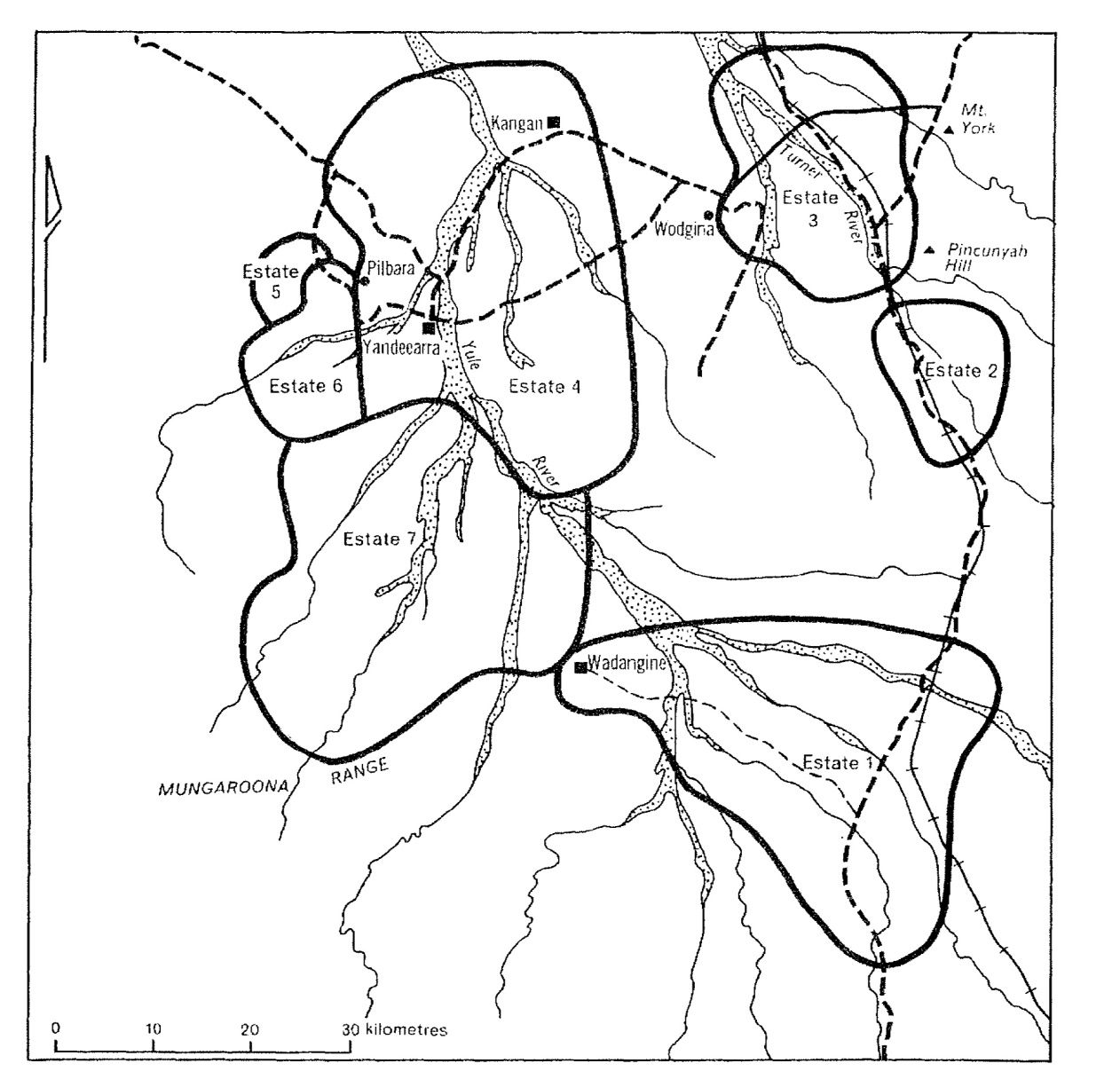
232 Dr Morton explained at [89] that Dr Palmer had found that Estate 4 was the country of Alfie Roberts. As Alfie Roberts was infirm at the time Dr Palmer did his work at Yandeyarra, the country was held for him by the Pontroys. After Alfie’s death the land was handed back to Alfie’s son, Mr T Roberts.
233 Dr Morton further explained at [98] that Dr Palmer had found that Martin Pontroy and his brothers inherited Estate 2 from their father and their father’s father, and that they had inherited Estate 3 through their mother. Dr Morton said that Estate 2 was inside the Njamal boundary as indicated by Tindale 1953, and that Estate 3 was positioned on the borderlands of Njamal and Kariyarra country according to the Tindale boundary.
234 The entirety of that material caused Dr Morton to conclude:
251 . The Pontroys do not have deep Kariyarra descent and oral testimony is in agreement with this fact.
252. The Pontroys have a history of strong ritual control [of] a large part of Kariyarra country.
253. The family is recorded as having outright ownership of an estate that partly falls within the Kariyarra claim boundaries.
254. The family is strongly connected to the Yandeyarra district and beyond by birth, knowledge of country and long-term residence.
235 In the Palmer 2013 report, Dr Palmer reviewed the Tindale reference, his own early work in Yandeyarra, and of O’Connor 1987 and concluded:
877 Based on my considerations of these data I think it reasonable to conclude that the Pontroy family members' claims to much of the Yandeearra Reserve was based on a process of regency which I have discussed above. However, cultural and geographic proximity may have played a part in facilitating these arrangements. On the evidence to hand, it seems likely that this family enjoyed rights gained through filiation to south eastern borders of the application area, extending across into the unclaimed area on the headwaters of the Turner River to include parts of what is now Woodstock and Abydos Stations. The Nyamil language identity for Fauntleroy is in my view consistent with a person who may have lived on the marches of country occupied by members of two different language groups - Nyamil and Kariyarra.
[Emphasis added]
236 In the Clarke 2015 report, Dr Clarke, relying on Tindale and Palmer, responded that the Pontroy family were not considered part of the Kariyarra. He continued:
Palmer outlined how the Pontroy family, while not being part of the Kariyarra, nonetheless came to be in control of land within the claim area through a complex process of recognising links via the matriline and by possession of the relevant ceremonial law, perhaps originating in nearby Nyamal estates owned by their father’s clan. He concluded that ‘Thus in my view Fauntleroy’s father was likely to have been in possession of areas that may have included parts of the current claim and on its south and eastern boundaries at or about the time of effective sovereignty [mid 1860s] in the region’. Palmer, however, stated that the ‘regency’ of Fauntleroy (Pontroy) had a limited life and was not transferable to his descendants. On the basis that a recognised process of succession did not take place, it is difficult to argue for the Pontroy family to be considered part of the Kariyarra claimant group.
[Footnotes omitted.]
237 Thus, Dr Clarke appeared to reject any claim to the area of Estate 4 because the rights obtained from caretaking or regency of the Roberts country had come to an end. Dr Clarke apparently rejected any claim to the area of Estate 3 because it derived through the matriline, and he rejected any claim to the area of Estate 2 because it was “a Njamal estate”, that is to say, because Martin Pontroy’s father’s father was identified as Njamal. Dr Clarke concluded that “it is difficult to argue for the Pontroy family to be considered as part of the Kariyarra claim group”.
238 In the Palmer 2017 report, Dr Palmer replied that, whilst he agreed that Pontroy was recorded as Njamal, that did not prevent the family acquiring rights to country in the application area. Further, Dr Palmer accepted that the regency over the Roberts’ family estate had come to an end, but said that regency arrangements were often effected by agreement with those holding rights to proximate estates or countries. That is what happened in this case. Gordon Pontroy and his brothers obtained control of the Roberts’ country around Yandeyarra because they held rights to land through filiation in the vicinity. In other words, the regency arrangement of local land was some evidence that the Pontroys had their own estate in the vicinity. Dr Palmer referred back to what he had said in his Palmer 2013 report at [877] which is extracted at [235] of these reasons for judgment.
239 In the Clarke 2017, report the only matter raised by way of reply concerned the country said to have come through Wagala. Dr Clarke cited Palmer and Taylor in 1980 who said:
Wugula has rights of ownership in a contiguous estate to the east of Wodjina and these rights will pass to her sons. Wugula is Indjiburndi [Yindjibarndi], and how she came to own this estate is not recorded.
[Footnotes omitted.]
240 Dr Clarke’s reply was that “The exact manner in which the extended Pontroy family gained rights to land within or adjacent to the claim area is not documented”.
241 Otherwise, Dr Clarke reemphasised that the Pontroy family today held no rights to the country of the regency because that arrangement had ended. That, however, was not a matter in contention. The remaining points made by Dr Clarke in relation to the Pontroy claim were difficult to follow because Dr Clarke did not articulate the argument sought to be made by the material which he included in that part of his report.
242 By the time of the conference of experts Dr Clarke had changed his mind. The record of the conference of experts in relation to Pontroy stated:
23. Apical ancestor: Pontroy
(a) Did Pontroy have rights or interests in the Claim Area?
(b) Can one or more of the living descendants of Pontroy hold and exercise rights or interests in the Application Area pursuant to the traditional laws and customs relating to land which apply to the Application Area?
(c) Do one or more of the living descendants of Pontroy hold and exercise rights or interests in the Claim Area?
Opinion of Dr Palmer | Opinion of Dr Clarke |
(a) Yes. Pontroy had country in his own right in the south and east of the Application Area. (b) Yes. (c) Yes. | (a) Yes, Pontroy had rights during the period in which he was a caretaker for country in the central and eastern parts of the Claim Area. Additionally, I consider he possibly had rights in the south-eastern corner of the Claim Area in his own right. (b) Maybe, in the south-eastern corner. (c) Maybe, in the south-eastern corner. |
243 However, at the time of the concurrent evidence, Dr Clarke had changed his mind again as follows:
In terms of the south-east part of it, my reading, well certainly at the time of the expert conference was that there was some likelihood of country somewhere there along the border. However, over this past week, having listened to evidence, in particular the evidence of Jimmy Todd, the tape of Jimmy Todd, and the discussion on that evidence from the Anderson side, that we're looking at a - at an estate, a country group for Anderson that actually takes in that south-eastern area, the very area that we were considering the possibility of Pontroy having an estate.
So with that extra information or - or it's certainly information that - that has come about since the expert conference, I'm - my view now is that Pontroy didn't have - did not have estates within the Kariyarra claim area. It may well be very close but outside of the claim area. That's my view.
244 The recording referred to was of Jimmy Todd speaking to Mr John Patterson, at the time a ranger at Woodstock. The relevant part of the transcript of the recording reads as follows:
JIM TODD: Yes! Woodstock Station is belonged to me and my three, two Brothers but they are they dead and gone now.
JIM TODD: My mother, my mother she was ah! Was like the King’s daughter, that he was the forefathers that ruled the land Woodstock, Yule River right down to the sea
JOHN PATTERSON: What was your grandfather’s name?
JOHN PATTERSON: Aboriginal name
JIM TODD: Ah! Aboriginal name was “Mundadu”(Muntatu, Muntatu, Mundadoo) Stoneman and he was white, not dark, and yet he was an Aborigine. Makes you think doesn’t it /
JOHN PATTERSON: What was the people he belonged to?
JIM TODD: Kariyarra
JIM TODD: They ruled the, from the Yule River down to the sea, from the end of the Yule river right down to the sea, Yindjibardi, Kariyarra, Bunjima three people Mulga Downs from low lands coming down and join em, where we went to that big sacred hill where I cut my finger remember and I said a few words, I said this belong to me, I belong to you, I said ngungu (belong here),
[Emphasis added.]
245 Dr Palmer responded in concurrent evidence as follows:
DR PALMER: Well, I'm - I find the - in relation to what my colleague has said, with respect to Jinapi, he is of the view that his estate was hermetically enclosed and restricted but with respect to Tommy Anderson, his estate was extensive. I - I don't understand - well, my view would be that that is an inconsistency in anthropological terms which needs to be explained. That's one point.
The second point is I didn't raise the regency issue but in the literature on succession of regency or where there's a caretaker role, it's well documented that it's often the case that the neighbouring - a neighbouring estate group will take over control for an estate which is either deceased or where the owners are absent or unable to conduct their affairs for other reasons. And I take that in this case to be supported of the view that the - the Pontroy descent line held rights to proximate country to that of the estate where they held their - their rights.
246 In cross-examination following the concurrent evidence, Dr Clarke answered that he had not read the work of O’Connor referred to by Dr Morton and Dr Palmer in relation to Pontroy, although it was referred to in their reports, and, in particular, the reports referred to the rights of the Pontroys in Estates 2 and 3 on the map prepared by Dr Palmer.
247 Dr Clarke was asked in cross-examination why he preferred what was in the tape of the conversation with Jimmy Todd over the research of O’Connor, Dr Palmer and Dr Morton. The exchange was as follows:
DR CLARKE: Well, yes, there’s an apparent conflict because of what we have – what’s been proposed is an overlap, so there’s an overlap of Pontroy’s interests potentially with - - -
MR WRIGHT: Yes. I just wonder why – if you can explain why you in the face of that conflict would choose to go with the - - -
DR CLARKE: Well, Pontroy has an identity that doesn’t sit well with being Kariyarra, so his country is – and I’d agree – somewhere down the – probably in the southeast, you know, past the boundary for the claim area and down there somewhere, but he has – he’s not a non-Kariyarra person. Now, he’s looking after with the regency Wodgina, that makes sense and that – and we’ve heard – well, sorry, with the earlier transcript I think it was Port Hedland there was evidence from one of the claimants about that which was consistent.
MR WRIGHT: Yes.
DR CLARKE: But I can’t see how someone from country out down so far – well, outside of the claim area would be active in that southern and eastern corner, given that they’re members of the Dann family including Jimmy Woodstock and his brothers, but actually living there and, you know, being there. So, it wasn’t as if they were absent sort of owners of country. They were – they were living out there and had family members who were buried out there. And – so, I took that information as the more likely and more credible explanation than in my thinking of seeing that someone like old Pontroy had an even larger sort of regency which included that southeast corner.
248 Dr Clarke was asked in cross-examination by Mr Ranson, who appeared as counsel for the State, about his view that Tommy Anderson alone had rights to all of the Kariyarra country, a matter which will be further addressed later in these reasons for judgment. In 1913, Radcliffe-Brown produced his map, extracted at [64] of these reasons for judgment, showing 19 groups of Kariyarra people. At that time Tommy Anderson was either an old man or had already died. The exchange, although lengthy, is instructive, not only as to the implausibility of Dr Clarke’s view, but of his reluctance to accept any thesis which impinged on the case of the Indigenous respondents, however unlikely that case appeared to be. The exchange went as follows:
MR RANSON: And your opinion is that during his lifetime he succeeded to all of the estates on the Yule and Turner Rivers?
DR CLARKE: Well, I’m saying he would have already had an estate there, and it may well have been a big one, but I’m saying it’s - the most likely option is that – or the explanation is that he – he enlarged it.
MR RANSON: And Radcliffe-Brown, and again I don’t need to take you to the maps. We’ve been to them several times. Radcliffe-Brown recorded in the area of the Yule and Turner Rivers half a dozen, and perhaps as many as a dozen you might say in that area, estates that Radcliffe-Brown recorded?
DR CLARKE: I don’t think it’s his highest, but there’s – should I have a look at that if it’s important?
MR RANSON: Well, I can take you, for example, to his published map which is on page 365 of Dr Palmer’s report. And I think all of the maps are there, but I’m happy to just work from the published one, exhibit A20.
DR CLARKE: I’m sorry I’ve got the same sort of map and I’ll just make sure it’s – sorry, what page on Dr Palmer’s?
MR RANSON: Page 365.
DR CLARKE: 365. Well, I can’t see a dozen.
MR RANSON: Well, can I suggest to you if we just take the estate groups that he numbers that sit adjacent to the Yule and Turner Rivers on either side, I can count five on the Yule and one, two, three, four – five on the Turner, for example. Do you see that?
DR CLARKE: Yes.
MR RANSON: And we’ve had a discussion about the – up towards the De Grey River where you suggest he may have had some rights during his lifetime as well through that same process?
DR CLARKE: Well, I – yes. No, I don’t think that’s – I don’t think I agree to - - -
MR RANSON: Alright. Well, let’s stay with the Yule and Turner Rivers. And the other thing that Radcliffe-Brown did as well as mapping the groups was in relation to most of them he recorded genealogies, and the members of the groups and their genealogical details?
DR CLARKE: That’s correct.
MR RANSON: And I think you’ve already agreed with Mr Wright that he didn’t record Tommy Anderson or any of Tommy Anderson’s descendants in those genealogies?
DR CLARKE: Well, that’s – that’s my understanding when I went through them, and I haven’t – I don’t think any evidence has been put through that he is there.
MR RANSON: My question for you really in light of all that, how do you explain Radcliffe-Brown missing Tommy Anderson’s succession to all of those that entirely missed in everything that Radcliffe-Brown produced?
DR CLARKE: Well, his own work talks about it being a reconstruction, so he’s – he’s trying to reconstruct the – the country groups, as they were, you know, at the time when Europeans have arrived. So, his – his description of country groups and, you know, the associated genealogies he’s sort of – sort of pushing back as Tindale did with his genealogies too.
MR RANSON: So, your suggestion is he’s ignored that as a recent development and not mentioned it at all in any of his work?
DR CLARKE: But his – you know, his work clearly isn’t a reflection on the state of the nation in 2000 – sorry, in 1910, 1911. So, he is – he’s pushing back to earlier times. So, he complained a lot that people were living mainly on stations and getting rations, and how that was interfering with the quality of his data. So – so, this is a – this is trying to push back towards sovereignty. And he wouldn’t have used the term “sovereignty”, but - - -
MR RANSON: Well, can I put it to you – can I put to you my view and just get your comment, that your thesis about Tommy Anderson’s succession to all of those estates in that area is completely incompatible with Radcliffe-Brown’s research and his published and unpublished right?
DR CLARKE: I don’t think you put to me what – what the incompatibility is.
MR RANSON: Well, can I suggest to you that it just isn’t credible to suggest that Tommy Anderson, having succeeded to all of those areas, you can’t find a single trace of that process anywhere in Radcliffe-Brown’s writings, notwithstanding that they were produced after, and perhaps quite soon after, or perhaps even contemporary with his ownership of all those estate areas?
DR CLARKE: There’s - - -
MR RANSON: You expect to see some trace of him in there somewhere wouldn’t you or his family members?
DR CLARKE: Well, there are – there are limitations on the data. I would agree with you that Tommy Anderson’s not in the Radcliffe-Brown and that is that the Radcliffe-Brown data can – cannot be used to support that notion. So, I agree if that’s your question.
MR RANSON: Would you agree with my proposition that there – the two sets of data - - -
DR CLARKE: I agree that - - -
MR RANSON: - - - are incompatible?
DR CLARKE: I – yes, I – well, I agree that the Radcliffe-Brown data is incompatible with, you know, Tommy Anderson in that, you know, formal sense of having enlarged all of – all of those estate groups into one super one, and therefore have a family tree that sort of goes with it.
MR RANSON: Yes.
DR CLARKE: So – so, yes, it is a problem. It is a problem with that notion
249 The work of Dr Palmer in Yandeyarra and the work of O’Connor recognised that the Pontroy family had a regency role in respect of country around Yandeyarra. Dr Palmer mapped that area as Estate 4. That country was held for the Roberts family and was later relinquished to them in accordance with the rules relating to caretaking or regency. The evidence of Ms Irene Roberts probably located the country of the regency additionally eastward to Wodgina and southward to Mount Frisco.
250 The work of Dr Palmer and O’Connor also recognised that Martin and Gordon Pontroy held country from their father’s father and their mother located as Estates 2 and 3 and extending south to Abydos. They placed at least part of that country in the application area.
251 In the end, the reasons Dr Clarke gave to locate the Pontroy country outside the application area and in Njamal country were based on the information in the recording by Jimmy Todd and the fact that Tindale recorded Pontroy as Njamal. Neither of those reasons is persuasive in view of the analysis made by Dr Morton and Dr Palmer. Jimmy Todds’ description of country is loose, indefinite, and uncertain. It left room for country of others in the vicinity. Indeed it is probable that Jimmy Todd was referring not to his family estate but to the country of the whole Kariyarra society when he spoke of the area from the Yule River down to the sea. Dr Clarke’s thesis also suffers from the insuperable obstacle that at a time when Tommy Anderson was either alive or not long dead, Radcliffe-Brown located 10 family groups in the area Dr Clarke claimed to be solely the country of Tommy Anderson. In cross-examination Dr Clarke, after some attempts to avoid the conclusion, acknowledged that his position that Tommy Anderson controlled all of the Kariyarra country was inconsistent with the work done by Radcliffe-Brown. As for Pontroy’s Njamal identity, all the experts, including Dr Clarke himself, agreed that language identity did not determine landholding. That is particularly so in border country such as the area of the claimed Pontroy estate.
252 In any event, it is difficult to have confidence in Dr Clarke’s views given the several reversals they underwent. In re-examination, counsel for the Indigenous respondents sought to rescue the situation by questions which disclosed that Dr Clarke had been rushed in the preparation of the report. However, the result was that Dr Clarke was poorly prepared and his view in relation to Pontroy carries no weight.
253 In final oral submissions, the lawyer for the Indigenous respondents argued that Dr Palmer’s research in the 1970s did not investigate the position of the Indigenous respondents’ family because the research was focused on the migrant population in Yandeyarra which was Ngungamarta and Njamal. Dr Palmer accepted that that was the case. However, the argument is beside the point presently being considered. The research found that there was country of the Pontroy family. That there could have been other country in the locality with which the Indigenous respondents’ family was connected does not detract from the existence of rights of the Pontroy family.
254 In the end, the applicants have established on the balance of probabilities that Pontroy had rights to country within the application area and his descendants inherit those rights under traditional law by cognatic descent.
255 Two Aboriginal witnesses, called by the applicants, gave evidence in relation to Jinapi.
256 Ms Jeannie Snowball was born in 1968 in Port Hedland. Her mother, Anna Snowball, was born on the Turner River near Indee Station. She identified as Kariyarra. Anna Snowball’s mother was Winnie Snowball. Winnie Snowball was a daughter of Jinapi.
257 Ms Jeannie Snowball’s mother, Anna, spent time with her grandfather, Jinapi, and told Ms Jeannie Snowball that Jinapi’s country was “towards Whim Creek near, Mallina, up that way”, “right around Croydon”. When asked how far east of Mallina Jinapi’s country went, Ms Jeannie Snowball replied that her mother was born on the Turner River. She later explained that her family country went to the Turner River in the vicinity of Indee – “from Indee towards Mallina”. She said Jinapi did not claim the area around Port Hedland or as far as Abydos. In cross-examination she said the boundary of Jinapi’s country was the Sherlock River. In the context of her evidence, that was describing the eastern boundary of Jinapi’s country.
258 Ms Raelene Button was born in 1975 in Port Hedland. Her mother is Lena Alone. Lena Alone’s parents were Gordon Snowball and Joan Williams. Both identified as Kariyarra, as do Lena Alone and Ms Raelene Button. Gordon Snowball’s mother was Winnie and his father was Old Snowball. Winnie’s father was Jinapi. Jinapi identified as Kariyarra.
259 Ms Raelene Button was given cultural knowledge from her grandparents. Ms E Williams was the younger sister of her grandmother. Ms Raelene Button was taught Kariyarra language and was in the process of compiling a dictionary with her mother and late grandmother, Ms E Williams.
260 Ms Raelene Button described the country for which her family speaks as follows:
RAELENE BUTTON: Yes, we speak for around Yandeyarra area, Mumbillina Bluff, some parts of Woodstock, Abydos, and Kapulanya. That's East Turner River. Mundabullangana, which is Munda Station, because the reason I say Munda and Nyunikuntinya which is Portree, those areas because Munda because of my grandmother and all her brothers and sisters, they were born in the flats near Munda Station, including my mother. She was born out in the open flats in Munda Station.
MR WRIGHT: Yes. And those other areas you mentioned around Mumbillina and so on - - -
RAELENE BUTTON: Yeah. Mount Satirist, my grandfather was born there. That's Jinapi's country.
MR WRIGHT: Yes. So that's the country sort of to the west of Yandeyarra.
RAELENE BUTTON: Yes, yes. Whim Creek. Yep.
MR WRIGHT: And that country around Mumbillina and so on - - -
RAELENE BUTTON: Yeah.
261 In cross-examination, Ms Raelene Button indicated that Jinapi’s country followed the Ngarluma and Yindjibarndi determination boundary to the coast and then south to Portree and continued south along the Yule River. In re-examination she said that Jinapi’s country was all around Mt Satirist towards Friendly Creek and all the way back to Whim Creek. She said it was mostly in the unclaimed area, but some is in the application area.
262 There was agreement between Dr Palmer and Dr Clarke that Jinapi identified as Kariyarra. The dispute, as it emerged at the hearing, was whether Jinapi had country within the application area. That issue had been dealt with extensively by Dr Palmer in the Palmer 2013 report and was touched upon in the Clarke 2017 report. Because the location of Jinapi’s country is the only remaining issue concerning Jinapi it is unnecessary to deal with other matters concerning Jinapi contained in the expert reports.
263 In the Palmer 2013 report, Dr Palmer analysed some material produced by Radcliffe-Brown. One genealogy relating to Jinapi noted that he was seen at Croydon Station. The page on which that was recorded concerned a local area designated VI and noted as Tauwarana and Talayindina. Dr Palmer said that Radcliffe-Brown may have meant that Jinapi was a member of the Talayindina local group. However, Dr Palmer said that the area of that group included the western area of the application area and extended west from there to Croydon Station. Dr Palmer also noted that Radcliffe-Brown’s number system changed in his published map where group VI was located at the mouth of the Turner River, that is to say, well within the application area.
264 Dr Palmer then referred to Tindale’s sheet 45 (1953b) which was a genealogy collected 42 years after the Radcliffe-Brown material had been researched. Tindale recorded Jinapi as “from Yandeyarra country” and to be “Kariara”. Dr Palmer estimated that Jinapi was born about 1871. Consequently, he was in possession of country a short time after the date of effective sovereignty. Dr Palmer also concluded from Tindale that Jinapi’s brother Jimmy was identified as belonging to the Yule River and that members of the extended family had worked in the Croydon, Mt Satirist and Yandeyarra areas. Dr Palmer found the Tindale data less problematic than the Radcliffe-Brown material. He concluded:
Based on these data I think it reasonable to conclude that Jinapi and his mother were associated with country in the western and south western portions of the application area. I consider it likely that this association was based upon their exercise and recognition by others of their customary rights to this area. In my view one of my readings of the Radcliffe-Brown manuscripts would also support such a conclusion. Descendents of Jinapi are then able to assert filiative rights to this area or areas of country. Today descendents of Jinapi assert rights to similar areas of country.
[Footnotes omitted.]
265 In the Clarke 2017 report, Dr Clarke cited a passage from Chambers and Smith 2004 which included the following:
Most of the older Aboriginal people in Port Hedland and Roebourne who remember Jinapi link him to the Whim Creek area. Some of these also recall seeing him at places such as Mallina, Mt Satarist, Croydon and Yandeyarra Station as well as at Egina. Bessie Abdullah an elderly Aboriginal resident of Roebourne remembers that as a young girl she saw him c.1930 at Pintapurrunya in the Pilbara goldfields, which she claims was Jinapi’s country. Pansy Munda and Eedie Whalebone who are both slightly younger than Bessie say that he belonged to Yandearra.
266 In the Clarke 2017 report, Dr Clarke suggested that those observations demonstrated that people linked Jinapi to areas where he was seen and worked as a result of the breakdown of the estate system.
267 The record of the conference of experts indicated that Dr Clarke agreed that Jinapi had rights and interests in the claim area.
268 It therefore came as a surprise when in concurrent evidence Dr Clarke said that he had changed his mind and now held the view that Jinapi had rights and interests but not in the application area. He explained the basis of his change of mind as follows:
DR CLARKE: I've read through Dr Palmer's 2013 report in detail, and that came about through realising, of course, the significance of the Daniel v State of Western Australia where Jinapi was identified as a relevant ancestor and linked to members of the Warrie family, so this was - there was a disagreement in evidence heard over the boundary of Ngarluma country where it meets Kariyarra country.
So I went back through all the evidence and back in the conference of experts, we were looking at whether they were - it was Kariyarra or not and I - I certainly came to the conclusion that he was. Having gone through all of Dr Palmer's evidence, and that involves Tindale genealogy sheets and particularly Radcliffe-Brown field maps and field notes, and even going back to Dr Morton's report, I mean Dr Morton's report - just quoting the last bit of it is for Jinapi:
Mostly just outside the main Kariyarra claims northern/western boundary.
So taking that as a starting point and going back through all the evidence, I can't see how Jinapi could have an estate that's actually in the claim area. He clearly has estates Peawah River and you know, places south of Balla Balla, Whim Creek, and even earlier reports by people such as Mr Mark Chambers and Dr Smith also sort of record views of where this person's country are, and they are predominantly on that western side of the claim area.
So - so that's a - that's a change in my position in the sense of location. It's not a change in position in that I accept that the most likely language group is Kariyarra for Jinapi.
269 The issue of the location of Jinapi’s country was then taken up in the separate cross-examination of Dr Clarke and Dr Palmer.
270 Dr Clarke said that the Radcliffe-Brown map showed the location of Talayindina outside the application area, that the map also showed other estates between Talayindina and the Yule River indicating that Talayindina did not extend that far. Further, there was contemporary claimant evidence that Jinapi had rights in the Whim Creek area, and that Tindale’s reference to Yandeyarra was not a reference to his landholding but perhaps to where Jinapi worked. As to Daniel, Dr Clarke accepted that if Jinapi had rights in the Ngarluma Yindjibarndi application area, that did not mean that he had no rights in the adjacent current application area.
271 In cross-examination Dr Palmer said in relation to the reference to Daniel that the descendants of Jinapi could be native title holders in Ngarluma country and also native title holders in Kariyarra country. Further, in cross-examination it was put to Dr Palmer that in the Palmer 2013 report he had criticised Tindale for a tendency to map tribal boundaries without understanding that they did not represent landholding areas. Dr Palmer interpreted Tindale as recording Jinapi as a landholder in Yandeyarra from the notation that he was “from Yandeyarra country”. Dr Palmer explained:
DR PALMER: The controversy relates to Tindale’s assumptions that – or implied assumptions that the landholding group was an undifferentiated tribe that could be defined by reference to lines on a map, but it’s obviously more complicated than that, but in summary that would - - -
MR SCHOOMBEE: Yes.
DR PALMER: - - - would perhaps provide a way of understanding what the difficulty has been with Tindale, as identified by many writers.
MR SCHOOMBEE: Yes. Well, given what you’ve said there, I want to put it to you that Norman Tindale is not the man that one can place much reliance on for relating to one note he made about where Jinapi came from?
DR PALMER: Well, I think we have separate out the different parts of Tindale’s record. He recorded a great deal including genealogical records, which he annotated, going right through to his account of what he called tribes. I’m indicating here, and I would agree that one needs to place some qualifications on Tindale, and like all the other early accounts, you need to discuss them and evaluate them in the context in which they were produced probably on a case by case basis. So, I wouldn’t – I wouldn’t conclude that Tindale was of no account. Perhaps I could say in some cases he’s the best we’ve got.
272 The starting point for the consideration of the claim of Jinapi and his descendants is the evidence given by Ms Jeannie Snowball and Ms Raelene Button concerning the location of Jinapi’s country. Both witnesses were credible and persuasive. Their evidence was not challenged in cross-examination. They were both instructed in the culture of the Kariyarra people by elders who had direct contact with Jinapi. Although the extent of Jinapi’s country was not clearly delineated by fixed boundaries in their evidence, and perhaps the greater part of his country was to the west of the application area, parts of Jinapi’s country were within the application area. For instance, Ms Jeannie Snowball located part of the country on the Turner River in the vicinity of Indee and Ms Raelene Button located part of Jinapi’s country on the Yule River in the vicinity of Portree.
273 Dr Palmer made an assessment of the Radcliffe-Brown and Tindale material and, whilst recognising their limitations, formed the view that Jinapi and his mother had rights within the application area. That material, particularly now, taken with the evidence of Ms Raelene Button and Ms Jeannie Snowball, provides a credible foundation for the conclusion that Jinapi had rights within the application area. Dr Palmer’s approach should be preferred to the approach of Dr Clarke.
274 The fact that Jinapi was an ancestor proposed in Daniel is of no significance. The country of concern in Daniel was different country than the country involved in this case. As the two countries were neighbouring, it is to be expected that some people would have rights on both sides of the border. In the end, Dr Palmer and Dr Clarke expressed the same view on that matter. Daniel was referred to in the Palmer 2013 report. If Dr Clarke did not read that reference, then his preparation was inadequate. If he did read it, then it did not, at the time, prevent him from agreeing in the conference of experts that Jinapi had rights in the application area. Dr Clarke’s last minute reliance on Daniel, contrary to his expressed views on the lack of significance of a concurrent landholding across a border, means that Dr Clarke’s view is without substance.
275 Dr Clarke also said that his change of mind was brought about by his consideration that the Tindale reference to Yandeyarra country was likely to be a reference to where Jinapi was working rather than to his rights as a landholder. It was evident in Dr Clarke’s general approach that he did not take into account all of the information and balance the evidence in an independent way. Rather he selected pieces which favoured the Indigenous respondents’ case and elevated those matters as determinative of his opinion. A further example of that approach is his view of the Radcliffe-Brown material concerning Jinapi. He interpreted Radcliffe-Brown’s location of group VI as entirely outside the application area. However, the nature of the map does not allow such a firm conclusion to be drawn. The location is denoted simply by the group number and the extent of the area occupied by the group is not shown.
276 The applicants have established on the balance of probabilities that Jinapi held rights to country within the application area. His descendants inherit those rights under traditional law by cognatic descent.
277 The rights to land in the west and south west of the claim area were held by Jinapi through his mother, Polly. Those same rights were held by Polly’s other sons, Wirtinpangu and Dougal Robinson, the brother and half-brother of Jinapi respectively.
THE WAY IN WHICH THE COURT HAS APPROACHED THE EVIDENCE AND ITS APPLICATION TO THE APICAL ANCESTOR TOMMY ANDERSON
Introduction
278 In this section of these reasons for judgment, some general observations are made about the approach taken by the Court to the assessment of the evidence. In particular, there is an explanation about the importance of the place of Aboriginal voices in the process of establishing rights to land.
279 Next, there is an analysis of the evidence relating to Tommy Anderson. That analysis is undertaken using the same approach to the assessment of evidence as was applied to the assessment of the evidence relating to the contested apical ancestors.
280 Finally, in this section, the question of the extent of the Tommy Anderson estate is considered.
Some general observations about the approach to evidence
281 The discussion to this point in these reasons for judgment concerning the identity and rights held by the contested apical ancestors demonstrates that there are challenges confronting the proof on the balance of probabilities that people held rights in the application area.
282 At sovereignty, the traditional laws and customs governing Kariyarra society were passed down orally from generation to generation. There are no contemporary written records from that era. As time went on, various observers, such as pastoralists, government officials and missionaries, made written accounts of where people lived, what they believed, and how they were connected to the land. Anthropologists took an interest in particular communities. But that historical and anthropological material, as has been observed earlier in these reasons for judgment, was of varying quality. Where people lived on or near boundaries of different groups, the identity and rights to land were sometimes confusing and ambiguous to the outsider. People who held multiple identities and rights across boundaries could be recorded as linked to one rather than another group. Then, whilst the tradition of handing down information from generation to generation continued, the communities were disrupted by the policies of the new settlers. Children were removed to missions and orphanages where policies prevented them acquiring cultural knowledge and language. In the result, their later accounts were fragmentary.
283 Notwithstanding these challenges, family and cultural history was passed down from the elders to succeeding generations in a continuation of the traditions of the people. They learnt about the place of their family in the wider social order and learnt of the protocols that governed the way they lived and related to each other and to their country. That information has become the foundational material for the assessment of claims to country under the Native Title Act 1993 (Cth) (NTA). No doubt such information can be manipulated for political or personal purposes to advance self-interest. In a native title trial, the process of cross-examination is available to test the genuineness of such evidence. The evidence of the Aboriginal witnesses in this proceeding validates the observation of Dr Palmer in relation to family linkages to the land which was that “you know your own family best”.
284 In the present case, the evidence of all of the Aboriginal witnesses, both for the applicants and the Indigenous respondents, was fundamental to the understanding of the way rights to land were acquired. The evidence of the applicants’ witnesses was largely unchallenged in cross-examination on those issues. It was inherently credible. All the Aboriginal witnesses gave honest and direct, straightforward evidence about their family, their traditions and their connection to country. Their evidence which has been accepted was compelling.
Why did the Indigenous respondents challenge the rights of the applicants?
285 The reasons the Indigenous respondents challenged the rights of the apical ancestors, other than Tommy Anderson and Maggie, despite the evidence of the descendants the apical ancestors, seems to come from a deep resentment arising from a feeling of exclusion.
286 When the Kariyarra main application was filed in 1997, the Tommy Anderson descendants were not included as part of the claim group. When the claim group was amended in 2001, only three of the Indigenous respondents were included. There appears to have been an enduring resentment directed to the representative body involved at the time. Ms Mary Attwood captured the feeling of exclusion from the original application as follows:
MARY ATTWOOD: As far as I'm aware, they all said they were Kariyarra. Okay? I – we aren't – we weren't given the option of saying, in this court, who we considered, because we were told, "You can't say that". You know? And I think it's wrong. This is a court where decisions supposed to be made. We supposed to give our evidence. And yet we're not allowed to.
287 A further exchange in cross-examination was to the same effect as follows:
MR WRIGHT: So, Ms Attwood, am I right in understanding that the case that's been presented by the indigenous respondents is that the descendants of Tommy Anderson are the only Kariyarra people, and all the other family groups in the Kariyarra claim are not the Kariyarra?
MARY ATTWOOD: The case was purely there because they tried to get rid of us, too. And it's not the case. We sought – we had to prove our connection. We had to go and do our own research, because the Yamatji wouldn't do it. And the Yamatji didn't even provide any – support, despite the fact that, under the Act, if there was a conflict, they should've give us the resources to employ a independent lawyer.
[Emphasis added.]
288 The Indigenous respondents regarded some of the descendants of the apical ancestors as newcomers. That is to say, people who had come into the area from the desert and followed a desert culture which had some definite distinctions to their own. When Ms Patricia Mason was asked in cross-examination whether she brought these proceedings to stop the other families coming in she replied:
PATRICIA MASON: I’m not stopping anybody coming in. I’ve got no grudge against anybody, Mr Wright. I want to make that quite clear because we’ve got to go back to the community and live with these people.
MR WRIGHT: Yes. But it is your case that the other families aren’t Kariyarra people isn’t it?
PATRICIA MASON: Well, if they came into the country, they aren’t Kariyarra people - - -
289 But that case was not made out on the facts. The descendants traced their ancestry back to the apical ancestors who were in the area at or about the time of sovereignty. It may be that the Indigenous respondents confused the situation of the apical ancestors with those of their descendants. Since sovereignty there has been a mixing of people in the area. That process has many causes, but they operate equally on the descendants of Tommy Anderson.
290 Then, the Indigenous respondents relied on their own research which was perhaps understandably amateurish and failed to take into account mixed identities of border people. They were too ready to seize on a description in Tindale or Radcliffe-Brown which seemed to suit their purposes without understanding the limitations on those sources.
291 Some of the Indigenous respondents suffered from a denial of access to the traditional sources of knowledge from their elders by removal to missions and orphanages and their culture was either lost or severely depleted. They felt a sense of isolation from other Kariyarra people and exclusion from the culture of the group. Ms Mary Attwood explained:
MARY ATTWOOD: I have rights through my mother's side of the family because I – was born in this area, I lived in this area. Unfortunately, because of the Protection Act, I didn't have the opportunity to learn my culture the way everybody else did. We couldn't particular in ceremonies. We couldn't learn our language. We couldn't live on a reserve. We experienced that. We were taken away. My mother – grandmother was taken away. I never lived – never seen her. She is the teacher of our family. She's the one that arranges for ceremonies to teach us who's who.
MR WRIGHT: So your - - -
MARY ATTWOOD: But she was – my grandmother - - -
MR WRIGHT: Mary Yinbung.
MARY ATTWOOD: Mary – Mary Yinbung. And everybody knew Mary Yinbung. She was a very strong woman. She lived with one of the – she lived with people but, when my father died, she was taken to the mission and they never – only released once, but was sent back again. So - - -
MR WRIGHT: Perhaps - - -
MARY ATTWOOD: Yes?
MR WRIGHT: Did you meet Mary Yinbung?
MARY ATTWOOD: No. She died when I was born. Then my mother was also removed. So she had no knowledge of Kariyarra culture. She was taken in as a foster – foster child. So she didn't learn. My aunty, who would be my next mother, she was also removed. The rest of them is all my uncles. They don't – they don't teach the women. They don't have a lot to do with the women.
The only person that we had to come back to when we returned from Mount Magnet was the Yuline family, because he was promised – my grandmother was promised to – to old – what his name was now? – Chinaman. And that's why we had that connection. But, apart from that, because my – my grandmother never taught me who our connection was, we had to go and learn that, try to learn that.
[Emphasis added.]
292 When asked about whether she learnt from her family how people acquired rights to land, she said in examination-in-chief:
MARY ATTWOOD: I guess a lot of our family – because – because of the – don’t forget they were – they were under the citizenship rights, so they couldn’t participate in ceremonial activities. Couldn’t even – they weren’t allowed to mix with – to mix with their own family.
MR RUMSLEY: So - - -
MARY ATTWOOD: So, they – they never – that sort of information wasn’t shared as much as anybody else because you weren’t allowed to be involved, and couldn’t speak the language, you know, and couldn’t participate in ceremonies. So, it was – it was very restrictive.
293 Mr George Dann said:
MR WRIGHT: Yes. Do you speak any Aboriginal language?
GEORGE DANN: No. The reason why, as I say, we were taken away from our mother and under the Native Welfare Act and we're still - we've got papers there stating that we - we were still under the Native Welfare Act till such a time my sister Gene, which is oldest, had to get papers to get married. If she couldn't get the papers off the Native Welfare, she couldn't get married to a white man.
294 People so affected were forced to rely on the very limited written sources of family histories with all the deficiencies and ambiguities that came with them.
Applying the same approach to the evidence relating to Tommy Anderson as was applied to the evidence relating to the contested apical ancestors
295 Although it is agreed between the parties that Tommy Anderson held rights to country in the application area, it is important to understand the basis upon which that claim was made. The Indigenous respondents faced the same challenges in establishing their claim to rights to land as did the applicants.
296 The Indigenous respondents are six of the 10 children of Molly Todd. Those children, whose birth years are indicated in brackets where known, are Eugenia, Mary (1945), George (1947), Jocelyn, Shirley (1957), Pat (1959), Judy, Helen, Robert (1963), and Charlie.
297 Five of the six Indigenous respondents gave evidence, namely, Ms Mary Attwood, Mr George Dann, Ms Shirley Lockyer, Ms Pat Mason and Mr Robert Dann.
298 Molly Todd was born in 1928 in Tambourah. Tambourah is south east of the Abydos application area and outside the application area. Molly Todd identifies as Kariyarra.
299 Molly Todd had six siblings, Jim, Archie, Don, Norman, Dan and Mavis.
300 The daughter of Dan Todd, Ms Jenny Baraga, was called as a witness by the applicants.
301 Mr Joseph Kickett, who was born in 1981, a grandson of Dan Todd, was called as a witness for the Indigenous respondents.
302 Molly Todd claims rights through her mother, Mary Yinbung, and then from Mary’s father, Tommy Anderson.
303 In the Palmer 2013 report, Dr Palmer related the family history as told to him by the Indigenous respondents and other family members. He was told that Tommy Anderson was born in the 1880s. He was married to Sally. Sally was considered by some to by Njamal. They had daughters who stayed at Woodstock. Tommy and Sally went prospecting at Wodgina. Tommy was convicted of murder and sent to Rottnest Island for four years. On another occasion he was arrested for an assault and taken to Millstream. He was murdered near Tambourah in a dispute over gold.
304 The family told Dr Palmer that Mary Yinbung had her son, Jim, Jimmy Woodstock, from a relationship with Ronald Parker. Jimmy Woodstock was born at Woodstock Station at Taratara Pool on the Yule River. In 1931 Mary Yinbung married George Todd, a European. George Todd ran the post office at Western Shaw or Tambourah. He died in 1938 and was buried in Port Hedland. Some of Mary’s children were then taken from her and she was sent to Moore River. She died there in 1946.
305 In the Palmer 2013 report, Dr Palmer then examined the archival material produced to Dr Morton and analysed in Dr Morton’s report. Dr Palmer agreed with the conclusions of Dr Morton that the genealogical material from Radcliffe-Brown and Bates relied on by the family did not relate to Tommy Anderson or his descendants. Dr Palmer referred to two documents mentioned in the research by Robinson (Robinson 2010) into the claims of the family of a customary connection to Kariyarra country. The documents were a booklet by Mr John Paterson, which was in evidence in this case, and a West Australian Museum historical resources document prepared by Romola McSwain for the Woodstock and Abydos Management Plan. Dr Palmer explained:
865 … Both books confirm Jimmy Woodstock’s association with and knowledge of the Woodstock-Abydos areas and that his social father (Ngundidu Tommy Anderson) was a senior Kariyarra man with rights to the Woodstock area and downstream on the Yule River (Robinson 2010, 10)…
306 Dr Palmer concluded from the material:
As Morton points out (Morton 2012, 171) the family has amassed a large quantity of archival and other materials in support of their bid to gain recognition as descendants of Kariyarra ancestors. Based on the materials I have viewed I agree with Morton that much of it has little to do with the question I am asked to consider here (ibid.). Overall I am of the view that it is the oral accounts of the claimants (and forebears) that constitutes the principal source in support of a Kariyarra identity for Tommy Anderson. Based on these data I think it reasonable to conclude that he was a Kariyarra man whose country probably lay in the Woodstock-Upper Yule region. How far down stream his country extended cannot now be known, in my opinion, but I am of the view that it would certainly have included portions of the south eastern parts of the application area.
[Emphasis added.]
307 In the Clarke 2015 report, Dr Clarke referred to the information told to Dr Palmer, and then elaborated on the life stories of the family members as told to him by them. In particular, Dr Clarke said that Mary Yinbung and her children and grandchildren have largely chosen to live and work within the application area. Dr Clarke recorded Jimmy Woodstock saying:
My mother, my mother she was ah! Was like the kings’ daughter, that he was the forefathers that ruled the land Woodstock, Yule River right down to the sea.
308 Dr Clarke said that Jimmy Woodstock was connected to Kariyarra country through birth and that he wanted his ashes spread in the area of the Taratara Pool. In passing, it should be noted that Taratara Pool near Tambourah is outside the application area. Dr Clarke then recorded the story that Molly Todd was chosen to defend rights to country in the 1930s by fighting a Njamal woman at Mount Edgar. Dr Clarke related that Molly Todd won the fight and as a result the border between Kariyarra and Njamal country remained at Mount Edgar. Mount Edgar is considerably to the east of the application and is now in Njamal country. Dr Clarke remarked that the claimed border is inconsistent with Tindale’s record. Dr Clarke concluded:
The association of Tommy Anderson and his descendants with the claim area is strong and can be dated back to approximately the date of effective sovereignty in the mid-1860s.
309 The remaining references in the reports of Dr Palmer and Dr Clarke principally dealt with the extent of the Tommy Anderson country, a matter which will be addressed separately.
310 Oral evidence given by the Indigenous respondents or sourced to members of the family substantiated the association of the family with the application area and areas in the vicinity. Mr John Paterson related occasions when Jimmy Todd showed him places where sharp stones or ochre could be obtained, where grinding patches were located and where rock carvings could be found. These places are recorded in the booklet prepared by Mr Paterson. It is noteworthy that a number of places referred to are over the border of Kariyarra country in Palyku country although not as far east as Tambourah. However, Ms Mary Attwood and Mr George Dann spoke of going prospecting with their family in the application area.
311 The only relevant archival material available in support of the Tommy Anderson claim is a 1931 West Australian marriage certificate for George Todd and Mary Yinbung which shows Mary’s parents as Tommy Anderson and Yimbermay Sally. Dr Clarke accepted in cross-examination by Mr Ranson that the claim that Tommy Anderson had rights in all of the application area was inconsistent with Radcliffe-Brown who showed many other groups in the application area. Further, Tindale has no record of the Tommy Anderson family. Dr Clarke suggested that the absence of a Tindale record may have been because when Tindale did his research Mary Yinbung was away at Moore River. Additionally, Dr Palmer gathered no material in the 1970s when he was in Yandeyarra in relation to the Tommy Anderson family.
312 The important point which emerges from this discussion is that the Court has accepted the claims of the applicants by accepting the evidence of Aboriginal descendants of the apical ancestors. The same approach supports the claims of the descendants of Tommy Anderson. Only by using that approach can the claim of the Indigenous respondents to rights to land be substantiated.
The extent of the Tommy Anderson estate
313 The final matter to be addressed in relation to Tommy Anderson is the extent of his estate.
314 As with much of the Indigenous respondents’ case, this aspect is attended with confusion, inconsistent positions and changes of view by Dr Clarke in the course of the proceeding.
315 At its high point, the claim of the Indigenous respondents was that Tommy Anderson held rights to all of the Kariyarra country. On this basis the applicants do not have rights in any part of the application area and their claims should fail.
316 In the Morton report, Dr Morton examined the ethnographic writings, particularly of Radcliffe-Brown and Tindale, in relation to the laws and customs relating to the Kariyarra people both at sovereignty and in contemporary times. As related earlier in these reasons for judgment, he concluded that land was held by family groups in small estates at sovereignty and in an adapted form now. He rejected the contention put to him by the Indigenous respondents and their family members that they are the sole holders of rights to country now. He expressed his opinion thus:
186. It is evident from the discussion in Chapter 1 that, in classical times, being Kariyarra, apart from entailing language ownership and belonging to associated country, also entailed being connected to one or more of the ritual estates which instantiated proximate titles to land. As discussed in Chapter 2, the estate system continued in somewhat modified form up to c. 1980. Moreover, it continues today, as is evident from the discussions of the relevant families in the first part of this chapter.
187. On the other hand, it is equally clear that effective connection to estates has not always obtained, which is why Palmer concluded that people at Yandeyarra made a distinction between effective and ineffective ownership of land (paragraph 66). On the other hand, Palmer stated that ineffective owners remained owners by rule and public recognition, if not by demonstrable action, such that estates were in principle 'inalienable property', even though owners would need ritual sponsorship from others in order to realise 'birth rights'. In the contemporary situation, it is generally evident that families regard being associated with one or more local estates as a fundamental aspect of being Kariyarra, although not everybody is clear about who belongs where.
188. To my knowledge, the Todd/Dann family is the single protesting exception, with Pat Mason saying 'we don't talk about yintas (local estates)' (paragraph 171). While it is true that in some situations in Aboriginal Australia 'conjoint succession' to country involving '[whole] language groups or similar-sized regional groups' has occurred, matters do not appear to have progressed to that stage in Kariyarra country, and the suggestion that the family are 'the only Kariyarra left' (paragraph 171) is in any case clearly not sustainable. In my opinion, the current state of law and custom has it that being Kariyarra means that one's family is connected to some estate, whether the family is 'effective' or 'ineffective' in its connection. Ineffective connection may mean that there is no actual control of a relevant estate, but the expectation is that some such estate should exist somewhere in Kariyarra country.
[Footnotes omitted. Emphasis added.]
317 Dr Morton addressed the notion that there had been a process of succession to Kariyarra estates and rejected the idea as follows:
73. It is evident that Kariyarra, as well as other riverline tribes, experienced both population decline and a decrease in political influence in their own region. However, what emerges clearly from the Wilsons' work and that of Palmer is that the riverline tribes' ownership of their territories continued to be formally registered as legitimate. This appears to have been true in both inter-tribal and inter-estate relationships, as evidenced in the riverline-desert distinction (paragraphs 53-54, 64) and the relationship between estate groups at Yandeyarra (paragraph 70). This is unsurprising given what is generally known about processes of succession in Aboriginal Australia. As Sutton has identified, there is hardly any evidence of 'the forcible unilateral takeover of land by Aboriginal groups' or 'the filling of territorial vacuums by uninvited migrants'. Succession to vacant estates is often a lengthy intergenerational process and legitimacy is usually only accomplished when one's ancestors are understood to have been in full possession of local Law - a process which is now often made difficult due to long-term evidence available from written records.
[Footnotes omitted.]
318 In the Palmer 2013 report, Dr Palmer described and analysed at length the early ethnographic writings and concluded, as had Dr Morton, that they described a landholding system of small local groups. For instance, Radcliffe-Brown mapped 19 groups in the area which included the application area. Dr Palmer quoted from the 1930 work of Radcliffe-Brown extracted earlier in these reasons for judgment but repeated here for convenience as follows:
The horde is a small group of persons owning a certain area of territory, the boundaries of which are known, and possessing in common proprietary rights over the land and its products - mineral, vegetable and animal. It is the primary land-owning or land-holding group. Membership of a horde is determined in the first place by descent, children belonging to the horde of their father.
319 It will be recalled that Dr Palmer concluded from what he was told by the Indigenous respondents and their family members that Tommy Anderson had country in the Woodstock upper Yule area. Dr Palmer was uncertain how far downstream the country extended but concluded that it would have included portions of the south east of the application area.
320 To the very detailed analysis undertaken by Dr Morton and Dr Palmer, in the Clarke 2015 report, Dr Clarke responded in what might fairly be described as a cursory way that:
A finding from my fieldwork was that rather than defining an ‘estate’ that they traditionally owned, the Tommy Anderson group conceive the totality of their ‘country’ to be the stations within the Kariyarra claim area where they and their ancestors lived, worked, died and were buried.
321 Unsurprisingly, and with justification, in the Palmer 2017 report, Dr Palmer responded as follows:
Dr Clarke reports this finding from his fieldwork and that the Tommy Anderson group, ‘conceive’ this to be the case. Dr Clarke provides no opinion as to whether he thinks that this accords with the orthodox anthropological account of land tenure. Nor does he explain how such an assertion might be understood in terms of the prior ethnography which in my own account is evidently redolent with localised interests, attachments and estates wherein country groups held rights.
322 In reply, in the Clarke 2017 report, Dr Clarke said that the Clarke 2015 report had provided a “detailed treatment” of “how through historical processes the estate system had broken down”. To describe the treatment as detailed is to overstate the position. Dr Clarke continued:
In the 2015 report [I qualified my] remarks on what the descendants of Tommy Anderson believed was necessary, as I had not had the opportunity to test their statements through in-depth fieldwork with other claimant families.
323 This explanation is not credible. The Morton report and the Palmer 2013 report dealt with each of the apical ancestors and set out the country with which each group claimed to be connected. By way of a random example, in the case of Yanki Williams, Dr Palmer concluded at [769] that there was a consistent assertion of rights to Mumbillina Bluff and the Mungaroona Ranges areas extending north to the Yandeyarra community. It was unnecessary to speak to the applicants to know that they claimed various identified estate areas within the application area. Dr Clarke chose to ignore that material in favour of the assertions made by the Indigenous respondents.
324 Then, the record of the conference of experts reflected a change in Dr Clarke’s view as follows:
11. On the evidence available, the descendants of Tommy Anderson have not to date, based upon a succession model based upon traditional law and custom, acquired rights and interests across the entirety of the Claim Area.
Opinion of Dr Palmer | Opinion of Dr Clarke |
Agree | Agree. There is evidence that suggests that there are people with traditional rights and interests in parts of the Claim Area, and ‘succession’ requires a deceased or vacant estate. |
325 Dr Clarke returned to the issue in cross-examination. The exchange is lengthy but is important to arrive at an understanding of the flaws in the approach taken by Dr Clarke. The passage is as follows:
MR WRIGHT: Well, I’m asking you do you – can you definitively say now that the view of that family that they are the sole traditional owners of Kariyarra country is not correct anthropologically?
DR CLARKE: Oh, sorry, that’s a different question again. Well, I’ve given a lot of evidence to – which would support the notion that the descendants of Tommy Anderson are connected to a large part of that claim area. And I’ve also given evidence that there’s – there’s a case of some other people having rights to that country. So, I think that means if it’s a yes or no, that – well, it’s no in that I’ve modified or recognised a more complex picture.
MR WRIGHT: Yes.
DR CLARKE: So, if it’s a yes or no question, that’s – I’ve given it to you.
MR WRIGHT: Yes. Well, then - - -
DR CLARKE: Well, no.
MR WRIGHT: - - - in terms of how the Tommy Anderson descendants, or Tommy Anderson himself would have such a large area, do you – can you explain how in your view, given – well, just explain in your view how do you conceive of those rights that Tommy Anderson descendants assert as being rights that exist under traditional law and custom?
DR CLARKE: Well, we’ve received evidence from people giving – sorry, from Tommy Anderson descendants about how violent – and there’s no other way to look at it, how violent Tommy Anderson was in terms of some of the things he was caught up in, murder. But, also looking at all of those accounts, and some of them I’ve sighted in terms of the newspaper, he appears to have been quite a physically powerful man, and I think it’s quite in keeping that when estates within the claim area were becoming orphaned and they no longer had effective or had, indeed, anyone, if they were some of those estates getting back to the seven or eight roughly from the Radcliffe-Brown map, then of course he would – he would be the person who would be more likely to assert that through the traditional laws and customs of Kariyarra people. It’s might is right. I mean he would have used those rules and, you know, physically backed them up. So, if that’s – you were asking about the process, and I – I think it’s a succession.
MR WRIGHT: Yes, so that’s how you conceive that he could have a – such a large country?
DR CLARKE: Well, I think he can.
MR WRIGHT: What do you think has happened?
DR CLARKE: Well, I think there’s such a large country given – given Radcliffe-Brown’s model which actually has smaller country groups than – I think that’s a plausible or a reasonable model, you know, through succession.
MR WRIGHT: Yes. And then rights could be extended in that way?
DR CLARKE: Yes, that – you know, they would be extended and well, activated in Dr Palmer’s words.
MR WRIGHT: Yes, excuse me one moment. Yes, do you have the outcome of the experts’ conference which was exhibit A27?
DR CLARKE: Do you have them here? This has been buried I’m afraid. Yes, I do have them, Mr Wright.
MR WRIGHT: Yes, if you could just go to paragraph 11?
DR CLARKE: Is this – so, question 11 is it?
MR WRIGHT: Yes. And this is put as a proposition rather than a question, but yes, the one that’s numbered 11.
DR CLARKE: Yes, I have it.
MR WRIGHT: Yes. It says there:
On the available evidence the descendants of Tommy Anderson have not to date based upon a succession model and based upon traditional law and custom acquired rights and interests across the entirety of the claim area.
And you agreed with that proposition?
DR CLARKE: Yes, by this – by this stage I was of the opinion that there were – there were areas, you know, around the edge, or at least there was a more complex picture. So – so, that’s – that’s correct that record.
MR WRIGHT: Yes. So, do I understand you to be saying wherever there is another family group that has an estate, you would accept there hasn’t been a succession by the Tommy Anderson group?
DR CLARKE: Well, in terms of just succession, yes, I mean succession assumes that – that there are no people, you know, owning or able through – through whatever means to be able to assert or activate their links to that country. So – so, what I’m saying as an anthropologist which is I acknowledge a difference between myself and the descendants of Tommy Anderson, I’m saying it’s a more complex picture, even though I still acknowledge that the vast or a very large part of the claim area in my reading is from the descendants of Tommy Anderson. I’m just saying it’s not all of it.
MR WRIGHT: Yes. Yes. But – and do they have rights in other parts of the claim area outside of what might be called the Tommy Anderson traditional estate on a basis other than succession?
DR CLARKE: Sorry, I’m not quite sure – sorry, the problem I’m having is that with a very – well, we’ve already defined an estate for Tommy Anderson, so if you’re saying they have – or asking whether they have rights to estates outside of that, well, I would say well, no, I haven’t got any evidence that they are rights to estates outside of the estate that I’ve documented for Tommy Anderson.
MR WRIGHT: Yes, but – thank you for that clarification. So, if – if we take an assertion that Tommy Anderson’s descendants have rights all the way down the Yule River?
DR CLARKE: Or, I think, yes, between the Yule and the Turner is – in terms of the tape from Jimmy Woodstock - Jimmy Todd.
MR WRIGHT: Yes.
DR CLARKE: Yes.
MR WRIGHT: And would you accept that that’s not vacant country? Not all of it.
DR CLARKE: Sorry, vacant in what sense?
MR WRIGHT: In terms of vacant estates?
when succession had occurred. It’s not – I’m not – once succession has occurred, it’s no longer vacant, and the clock starts again.
MR WRIGHT: Yes.
DR CLARKE: It’s a reset.
MR WRIGHT: But what I’m suggesting to you is – or what I’m exploring with you is whether it’s your opinion that Tommy Anderson’s descendants have obtained rights in that entire area through succession or through some other means?
DR CLARKE: Well, we’ve already – we’ve already said – well, we’ve talked about – we talked about estates in the south and southeast corner, so succession would take place on the basis that you already had an estate or a country group, as Dr Palmer would call it. So, we’re talking about enlarging that and – so, yes, I am saying that through succession that estate was enlarged and it’s absorbed other estates that have, you know, down streamed, if you like, between those rivers.
MR WRIGHT: But is that the sole explanation for how they could have rights all the way down the Yule River, that all of the previous estates in that area have become vacant and they have taken over them?
DR CLARKE: Well, as I’ve said, there’s a starting point where they’ve already got sort of country which – and where it is I would – I would say most likely in that south, south-eastern corner, and Woodstock and Abydos, you know, that area. So, in terms of how they would get country, I think that’s the –
- -
MR WRIGHT: So, how did that expand then all the way down the Yule River?
DR CLARKE: Well, that’s what I was – that’s what I was saying in terms of Tommy Anderson sort of asserting his rights. He clearly – if he was up around De Grey doing one – one notorious incident, then he was – and he was actively prospecting, I believe that was how he ultimately was killed over gold that he found. So, he was clearly very active in those areas, and he probably – part of him having the rights to prospect in all of those areas probably had an element of gaining that country as well and gave him sort of open slather to be prospecting on country that he would consider was his, so - - -
MR WRIGHT: And that’s – under traditional law and custom that would be acceptable - - -
DR CLARKE: Well - - -
MR WRIGHT: - - - thinking it would serve that right?
DR CLARKE: - - - certainly succession is part of the traditional law - - -
MR WRIGHT: But leaving aside succession?
DR CLARKE: Well, I’m not quite sure what I’m being asked. I mean it is a fact that – that people assert their interests when there’s, you know, orphaned country or some reason why there’s an estate that can be taken over. I mean that’s an anthropological fact, so - - -
MR WRIGHT: Yes, but what I’m trying to establish, and perhaps I’m – we’re going around a little bit in circles, but what I’m trying to establish is whether you’re saying that all of those areas all the way down to the De Grey and all the way down the Yule River, are you saying that they were at one point post sovereignty all vacant estates that Tommy Anderson then acquired rights through succession to?
DR CLARKE: Well, what I’m saying is that the – going back to the Radcliffe- Brown map there were clearly several estates in that area, so – and that – and we can take that as meaning there were several groups of people who aren’t country. Now, some of those groups, for whatever reason, died out or moved on or whatever.
MR WRIGHT: So, it is your opinion that that has happened, that those groups moved on?
DR CLARKE: There has to be. Sorry, that – or perhaps to make it easier I’ll say that – that succession I would – it would be my view that succession has taken place. Now, exactly what the starting point was in terms of - - -
MR WRIGHT: No, no, don’t worry about the starting point but it’s - - -
DR CLARKE: No, but I agree if you’re asking me - - -
MR WRIGHT: Yes.
DR CLARKE: - - - if succession is part of gaining those other – other estates, I would – I would say that that would be my view and most likely most probable.
326 Dr Clarke was also cross-examined by Mr Ranson. Dr Clarke eventually agreed that his assertion that Tommy Anderson had succeeded to large areas of the application area was inconsistent with the existence of other groups recorded by Radcliffe-Brown.
327 Both the manner in which Dr Clarke gave oral evidence and the substance of that evidence gave the impression that he was making it up as he went. There is no evidentiary basis for Tommy Anderson succeeding to vacant estates. The view is speculative.
328 The foregoing discussion deals with the suggested way in which Tommy Anderson came to hold rights in all of the application area. It leaves the question whether there is evidence that Tommy Anderson held rights in the entire Kariyarra country without seeking to explain how that situation arose.
329 Such a claim is inconsistent with the nature of Aboriginal landholding as described by the early ethnographers. The expert view of Dr Morton and Dr Palmer was that the local estate system remained in operation albeit modified as a result of the history of the area. The evidence of the applicants attested to family estates in local areas. That evidence was credible and persuasive. Further, it was not challenged in cross-examination.
330 Then, the Indigenous respondents who gave evidence did not make claims to all of the country in the application area. They spoke about country in terms of places where they lived or where family members were born or buried. That is consistent with the idea of local estate areas. Much of their evidence related to the area around Tambourah, Woodstock and Abydos. Thus, Mr Joseph Kickett said that Yandeyarra to Woodstock was Kariyarra country. Ms Mary Attwood spoke of Tambourah and Yandeyarra and the country between the Yule and Turner Rivers as part of Tommy Anderson’s country. Mr George Dann was asked where was the land owned by his people and replied that it was Mumbillina where he used to live. Ms Shirley Lockyer identified White Springs as her family’s site. When asked about places to which she could not go she responded by identifying Abydos. She spoke of her Uncle Dan’s grave at Tambourah. Ms Pat Mason also said that when she lived at Abydos there were places she could not go.
331 That leaves only the interview by Mr John Paterson with Jimmy Woodstock as the basis for the claim to the entirety of the application area. Jimmy Woodstock spoke of the country from the Yule River down to the sea in response to a question about the identity of his grandfather as Kariyarra. In other words, he was describing country of his Kariyarra people, as a whole, rather than the Tommy Anderson’s estate. Such an interpretation of his interview is consistent with the other evidence in the case. The probabilities favour such an interpretation of Jimmy Woodstock’s interview.
332 The notion that all Kariyarra country was country of Tommy Anderson has no basis in the evidence of the Aboriginal people whether the applicants or the Indigenous respondents. It found its first expression by Dr Clarke. He was not able to offer a credible basis for the view and, indeed, after first embracing it, resiled from it in cross-examination, accepting that there were other Kariyarra people in the application area. Having originally explained that he did not challenge what he thought were the Indigenous respondents’ view because he had not had access to the applicants, he failed to take into account their clear evidence given to the Court. Dr Clarke’s evidence on this subject was simply fanciful. He failed to meet the most basic professional standards in the giving of his evidence.
333 One issue identified in the applicants’ and the State’s Statement of Issues for the Separate Question was whether, in order to be a member of the native title holding group, a person had to be recognised by other members of the group as having rights and interests in the application area, and if so, recognised by which other people.
334 The position of the applicants and the State was set out thus:
15. There is an issue whether in order to be a member of the native title holding community, an Aboriginal person must also (in addition to satisfying the descent requirement and the self-identification requirement) be recognized by other members of the native title holding community as having rights and interests in the Claim Area under Kariyarra traditional law and custom, and if so, which others?
Participating Parties’ positions
The applicant says that the withholding of recognition by some persons associated with the Claim Area does not negate other persons from having rights and interests in land provided those other persons meet the relevant criteria for obtaining rights and interests in the Claim Area.
The applicant further says that recognition may be relevant to:
(a) answering, as part of the separate question, whether a claimed apical ancestor had rights and interests in the Claim Area and whether one or more of the descendants of a claimed apical ancestor are part of the native title holding community;
(b) any future implementation of the answer to the separate question insofar as that involves the making of a decision by a relevant person or body as to whether a person who claims to be a member of the native title holding community satisfies the descent and self-identification requirements;
(c) any future issue as to the intra-mural allocation or exercise of native title rights and interests.
The State agrees with the applicant but says further that recognition by a substantial portion of the persons associated with the Claim Area is necessary for a person to hold rights and interests in the Claim Area.
The applicant and the State understand that the Indigenous Respondents agree with some or all of the above, but it is not clear precisely to what extent.
[Emphasis added.]
335 In [10] of their response, the Indigenous respondents questioned the scope of the phrase “persons associated with the Claim Area” but did not appear otherwise to differ in respect of the substance of the issue.
336 It was common ground between the applicants and the State that the expert and lay evidence provided a place for community recognition in the establishment of rights and interests. Dr Clarke did not disagree. Dr Palmer explained in concurrent evidence:
My understanding as an anthropologist of recognition is that it's not a thing but it's a social process, that, in order that something is recognised – that is, accepted, if that's the meaning of the word – or agreed upon to be a certain thing, or to have certain qualities, or to be a – to – to comprise membership of the group, there has to be a process which takes place, which is a – which is a social process, which is bred from the interaction and knowledge of people. So the recognition itself can only develop within a social context. So if people were saying they don't know anything about somebody, then recognition is not possible, of course, because the process which is required for recognition cannot take place.
[Emphasis added.]
337 That approach seems to reflect the element of recognition referred to in Northern Territory v Alyawarr [2005] FCAFC 135; 145 FCR 442 at [114]:
… The interpretation and application of laws and customs by which membership is defined, even if not expressly incorporating a requirement for ‘recognition’ by members of the relevant society, is likely to involve some process of interpretation and consequential acceptance or non-acceptance of individual membership…
338 One aspect of this issue was addressed in the conference of experts when Dr Palmer and Dr Clarke agreed that the withholding of recognition by some persons associated with the application area did not negate other persons from having rights and interests in land provided those persons met the relevant criteria for obtaining rights and interests in the application area.
339 Much of the cross-examination by the Indigenous respondents’ lawyers was directed to whether the applicants’ witnesses were aware of the Indigenous respondents and their forebears. The Indigenous respondents’ witnesses were also asked in examination-in-chief whether they were aware of the applicants or some of them. It seemed as if evidence that the applicants did not know the Indigenous respondents, or the Indigenous respondents did not know the applicants, might have been intended to be used by the Indigenous respondents to argue that the applicants were not part of the Kariyarra society. In the course of the preservation evidence hearing, then counsel for the Indigenous respondents, Mr Clifford, when asked by the Court the purpose of such questions replied “I’m going to rely upon the absence of knowledge of this witness of who they are or where they are”. By the time of the final hearing, the then and present lawyer for the Indigenous respondents, recognising that “the problem with that is, if there are three or four Kariyarra families being asked to confirm that the others identify them, and the others don’t, the – it’s a double edged sword, effectively”, did not mount such an argument. He recognised that if that type of reasoning were available it might equally show that the Indigenous respondents were not part of that society.
340 As it transpired, the argument was not available on the evidence. The evidence showed that the applicants and the Indigenous respondents were in many instances known to each other. A number of witnesses from each camp knew those of the other camp, from school or work or community interaction in and around Port Hedland. For instance, on the applicants’ side Ms Irene Roberts recognised Molly Todd and Mary Yinbung and had often seen Jimmy Woodstock riding around. She had also seen Norman Todd around. Ms E Williams saw Donny Todd around but did not know him. She also knew Mr George Dann. Ms Margaret Stewart knew Charlie Webb. Mr Rick Watkins knew all the Indigenous respondents and Charlie Webb. He saw Jimmy Todd as an old man. Ms Jenny Baraga knew Mr Vincent Lockyer, Mr Alfred Barker, Peggy Brady, Ms Selina Ali, Ms Jeannie Snowball, Mr Rick Watkins, and Mr Donny Wilson. Mr Vincent Lockyer knew Jimmy Woodstock, Norman Todd, Ms Mary Attwood and Molly Todd. He knew Mr George Dann because he went to school with him. He worked at Yandeyarra with Charlie Webb. He knew Molly Todd, Jimmy Todd, Mr George Dann and Ms Pat Mason. Mr Donny Wilson knew Mary Todd, Dan Todd, Ms Mary Attwood, Mr George Dann, Ms Pat Mason and Charlie Webb. Ms Diana Robinson knew Ms Mary Attwood, Mr George Dann, Jeannie Smith and Charlie Webb. Ms Eileen Rule knew Molly Todd as the mother of Ms Mary Attwood, Mr George Dann and Ms Jeannie Smith. Mr Alfred Barker knew Molly Todd, all her children except Jocelyn and Judy, and her brother Dan. Mr Jason Alec knew Ms Mary Attwood, Ms Pat Mason, Charlie Webb and he worked with Mr Robert Dann.
341 Then, on the Indigenous respondents’ side, for example, Mr Joseph Kickett knew Mr Rick Watkins and knew Mr Alfred Barker, but not well. He knew of Ms Raelene Button, Mr Vincent Lockyer and Ms Diana Robinson. Ms Mary Attwood knew Ms E Williams, Ms Margaret Stewart and Mr Donny Wilson through her work. She knew Ms Raelene Button because she went to school with her mother. She knew Mr Vincent Lockyer really well because she went to school with him. She knew Ms Diana Robinson from when she came to Port Hedland as a toddler. She knew Mr Alfred Barker and Ms Eileen Rule well. And she knew Ms Jeannie Snowball, Ms Selina Ali, Topsy McKenna, Gordon Pontroy and Mr Jason Alec’s grandfather. Mr George Dann knew Ms Eileen Roberts and Ms E Williams. He knew Mr Rick Watkins because he worked with his father. He knew Mr Vincent Lockyer and Ms Jeannie Snowball well, and Ms Eileen Rule very well. He has known Mr Alfred Barker for a long time. He says hello to Mr Donny Wilson “no hard feelings”. Mr Robert Dann knew Mr Rick Watkins, Mr Vincent Lockyer, Ms Diana Robinson, Mr Alfred Barker and Mr Jason Alec.
342 At the final hearing, the lawyer for the Indigenous respondents in opening submissions sought to explain that the failure of the applicants to recognise the Indigenous respondents and their family was the consequence of the others having come to the area in recent times. He contended:
And in relation to that particular area, there is strong evidence that these people [Indigenous respondents and their families] have always been there.
If it is the case that others who have come on that country don't know them to be traditional owners, it doesn't mean that they're not the traditional owners; it means those people have come onto that country. And there's a report that was written in the 80s by Romalo McSweeney about what the government was intending to do in relation to management of those Aboriginal reserves and the tensions they were having. And, effectively, that was where the tensions were between a split in the arriving strikers, or the one group that was identified in her report as actually having the connection back, which was Jimmy Todd and Jimmy Todd's family and descendants.
343 In the main, the lack of knowledge of one witness of other Kariyarra people resulted from the fact that they were from different generations and lived at different times. Land rights were not an issue in those times or situations. To the extent that there was some lack of interaction between the groups it is explained by the disruption caused from the removal of children and parents from the area in accordance with government policy, and the operation of the Native (Citizenship Rights) Act 1944 which limited the contact which the Indigenous respondents who were under the Act could have with other Kariyarra people who were not under the Act. Furthermore, the Indigenous respondents lived independently of missions or Aboriginal reserves by largely engaging in prospecting to provide for their support free of government involvement. That set them apart from many of the other Aboriginal people in the application area.
344 The applicants proposed that the answer to the separate question include a single recognition criteria, namely, that to qualify as a native title holder the person recognise themselves as having rights and interests in the Kariyarra Claim Area under Kariyarra traditional law and custom.
345 The State proposed an additional recognition criterion, namely, that the people in question:
(c) … are recognised by other members of the Kariyarra community as having rights and interests in the Kariyarra claim area under Kariyarra traditional law and custom.
346 In final submissions, senior counsel for the applicants explained the basis for the single recognition criterion as follows:
So, similarly, as part of or as perhaps falling under still this second criteria, we say that does bring in some element also of community recognition, and that is, reciprocal – as a reciprocal matter a person must acknowledge that they are part of the Kariyarra community and that they have rights and interests under Kariyarra law and custom.
But that assertion, if you like, or that acknowledgement has to, we say, have some reality to it, so the community has to accept that in a – in the sense that it can’t be unreal. You can’t have someone who just comes along and says, “Well, I acknowledge that I’m part of this community” if there’s a unanimous view or a consensus view amongst the community that well, no, you’re not, then a person can’t have rights simply by self-assertion. There has to be some reality to the assertion, and how you test the reality to the assertion is how does the community react to it?
Now, that leads us into an issue of whether there is a third criteria, and that’s the criteria of recognition by others, and this is an issue that the State has raised. So, it’s not part of the Form 1 criteria that we’ve pleaded, and in our submissions we say that there isn’t a distinct third criteria of recognition by others. And one of the difficulties of recognition by others is the way in which this third criteria is framed and, if I can just oh, address it now by reference to the State’s submissions, and that’s written submission. So, in the State’s written submission they do press for this third criteria, and at paragraph 4 of their written submission they want to add the words:
So, the first criteria A, being descent, and the second criteria, B, being a person who recognises themselves.
And then they want C:
who are recognised by other members of the Kariyarra community as having rights and interests in the Kariyarra claim area under Kariyarra traditional law and custom.
And the difficulty we say with that is perhaps highlighted by what they’ve said at paragraph 8 of their written submission. And at the very end of paragraph 6 of their written submission they agree with us in terms of what we’ve said about:
You can’t have a person assert that they’re part of a community if the rest of the community simply doesn’t accept it.
And they go on to say:
A Kariyarra person cannot share in a communal right without the agreement of (at least the reasonable proportion of) the remainder of the Kariyarra community.
And this is the difficulty with having a distinct third criteria is it begs the question who has to recognise who, and how many people have to recognise someone in order for them to qualify under that third criteria?
[Emphasis added.]
347 That oral submission reflected the position taken by the applicants in their written submissions as follows:
144. Whether the concept of ‘recognition’ goes to the existence of a right is a more difficult issue. The evidence, and logic, supports the view that in an oral culture, recognition must play a role in determining whether the criterion of descent from a relevant apical ancestor is satisfied, as recognition is in effect the ‘archive’ of relevant information. Thus if a person claimed to be a descendant of a relevant ancestor, but the community did not recognize that to be the fact, then the person could not effectively assert or enforce any right as a descendant. In contemporary times there is an ability to ‘prove’ facts, such as descent or occupation by an ancestor, through archival sources. This is what Dr Morton refers to as ‘deep descent’. This is better seen to be an adaptation of traditional law and custom brought about by changed modern circumstances rather than a wholly new law or custom.
145. Nevertheless, if despite the existence of archival material, the community as a whole does not accept the fact of an apical ancestor having occupied part of the claim area at sovereignty, or of a person being a descendant of a relevant apical ancestor, then whether the right exists or is merely incapable of being exercised may become a semantic distinction. Just as with self recognition addressed above, it does not make sense to recognize a person as being a joint holder of a communal right if the other members of that community simply do not acknowledge their joint ownership. It is a question of fact and degree whether, on the one hand, an apical ancestor, or a descendant of an apical ancestor, is a member of the community because the relevant criteria under traditional law and custom are satisfied notwithstanding there is some disputation about that matter; or whether there is such a level of consensus amongst the community that it may be said the relevant criteria are not satisfied despite documentary records or anthropological opinion to the contrary.
[Emphasis added.]
348 In final submissions, the lawyer for the Indigenous respondents expressed, very briefly, a preference for the applicants’ formulation.
349 There is clearly little between the positions of the parties on this issue. The applicants accepted in final submissions that an element of community recognition was necessary but suggested that it was encapsulated in their single recognition criterion. The criticism of the State’s formulation has little force. In the end, the formulation proffered by the State is supported by the evidence and is not in substance inconsistent with the position of the applicants or the Indigenous respondents. That formulation should be adopted in the answer to the separate question.
SHOULD THE INDIGENOUS RESPONDENTS BE FOUND NOT TO BE PART OF THE KARIYARRA PEOPLE
350 In final submissions the applicants argued that, whilst the Tommy Anderson descendants generally were part of the Kariyarra people, the six Indigenous respondents had demonstrated by their conduct and views that they do not identify themselves as having rights as part of the Kariyarra communal native title under the traditional laws and customs of the Kariyarra people and are not recognised by other members of the Kariyarra people as satisfying that criterion.
351 Largely that submission was based on the Indigenous respondents making the claims in this proceeding to the effect that the Tommy Anderson family is the only rights holder in the application areas. The submission contended “the fact that the Indigenous respondents continued to assert such a view is itself evidence of their disconnection from the Kariyarra community”. Further evidence of that disconnection, so it was submitted, came from the evidence that the Indigenous respondents’ families led lives independent of missions and government and sustained themselves by prospecting particularly in the Woodstock / Abydos area and hence were distant from the other Kariyarra people and the centre of population at Port Hedland.
352 Earlier in these reasons for judgment there was an examination of some of the reasons which might explain why the Indigenous respondents pursued the challenge made in this proceeding. Additionally, it might be surmised that the report obtained from Dr Clarke would have been influential in their decision to challenge the applicants. They were perhaps not to know that his reports and opinions were severely flawed. Then, it is not known whether the legal advice, whatever it was, given to the Indigenous respondents contributed or not to their decision to contest the applications. In other words, it is likely that any exclusion from the Kariyarra native title holding group would require an understanding of a number of factors which have not been the subject of evidence. That, however, raises a more fundamental consideration. What is the basis of the power to exclude the Indigenous respondents from the native title claim group? Ultimately, that question depends on the laws and customs of the Kariyarra people. Do those laws and customs allow for exclusion of those who challenge the constitution of the group? No evidence has been led on that issue. It cannot be assumed that the Kariyarra people have traditional laws and customs which excommunicate dissidents in such circumstances as the present. The future relations between the Kariyarra people and the Indigenous respondents must be dealt with by the Kariyarra people in accordance with the rules applicable to the circumstances rather than by the Court in this proceeding.
SHOULD THE INDIGENOUS RESPONDENTS BE REMOVED AS RESPONDENTS IN THE KARIYARRA – PIPINGARRA APPLICATION?
353 Under s 84(8) of the NTA, the Court may remove a party as respondent to an application for a determination of native title.
354 The Indigenous respondents are respondents to the Kariyarra – Pipingarra application. The Court refused an earlier application of the applicants to remove them as respondents: TR (Deceased) on behalf of the Kariyarra – Pipingarra People v State of Western Australia [2016] FCA 1158. The essential reason for that judgment was that the Indigenous respondents had an expert report to support their challenge. As any determination would be a judgment in rem and perpetual, it was in the public interest and the interest of the Kariyarra people to allow for the ventilation of any credible challenges to the application made to the Court.
355 That process has now been concluded. There is no further justification for the Indigenous respondents to remain respondents in the Kariyarra – Pipingarra application. Their interests are wholly protected as members of the native title claim group. An order will be made that they be removed as respondents from the Kariyarra – Pipingarra application.
356 The Court will provide the answer to the separate question in accordance with these reasons for judgment. Further, in the Kariyarra – Pipingarra application there will be an order that the Indigenous respondents be removed as respondents, subject to any order for costs which might be made against them if any application of that nature is brought.
357 The answer to be provided by the Court follows the draft proposed by the applicants with the addition of the second criterion of recognition proposed by the State. In order to more accurately reflect these reasons for judgment, the answer proposed in [1(a)] of the applicants’ draft adds the words “by cognatic descent” after the word “descendant”. If the applicants or the State wish to vary the answer by excluding those words, that party should apply in writing within seven days of the making of the orders.
358 As the applicants foreshadowed a potential application for costs, there will be an order that the costs of the proceedings are reserved.
359 As there is no further impediment to the preparation of a determination of native title in favour of the Kariyarra people over the application areas, the applicants and the State are directed to file in Court a proposed determination within a timeframe to be discussed.
I certify that the preceding three hundred and fifty-nine (359) numbered paragraphs are a true copy of the Reasons for Judgment herein of the Honourable Justice North. |
Annexure A
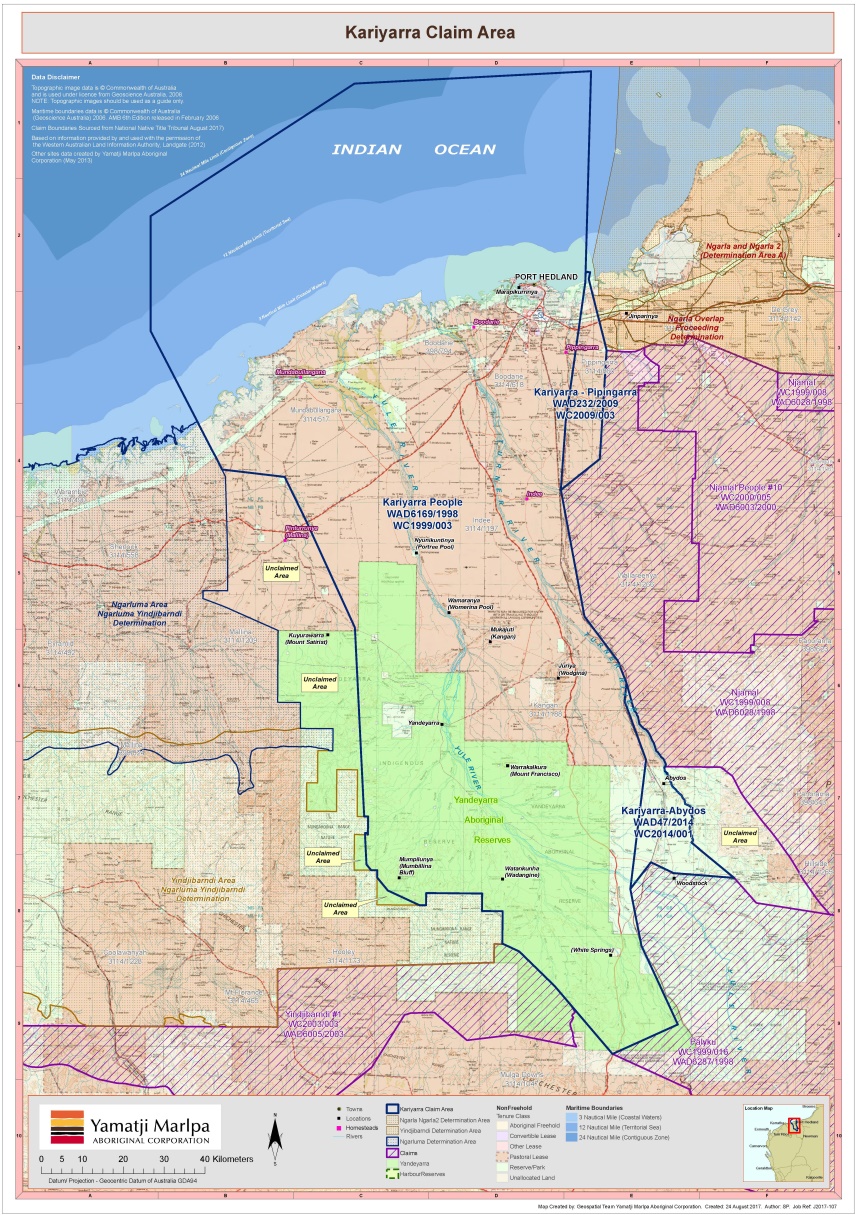
Annexure B
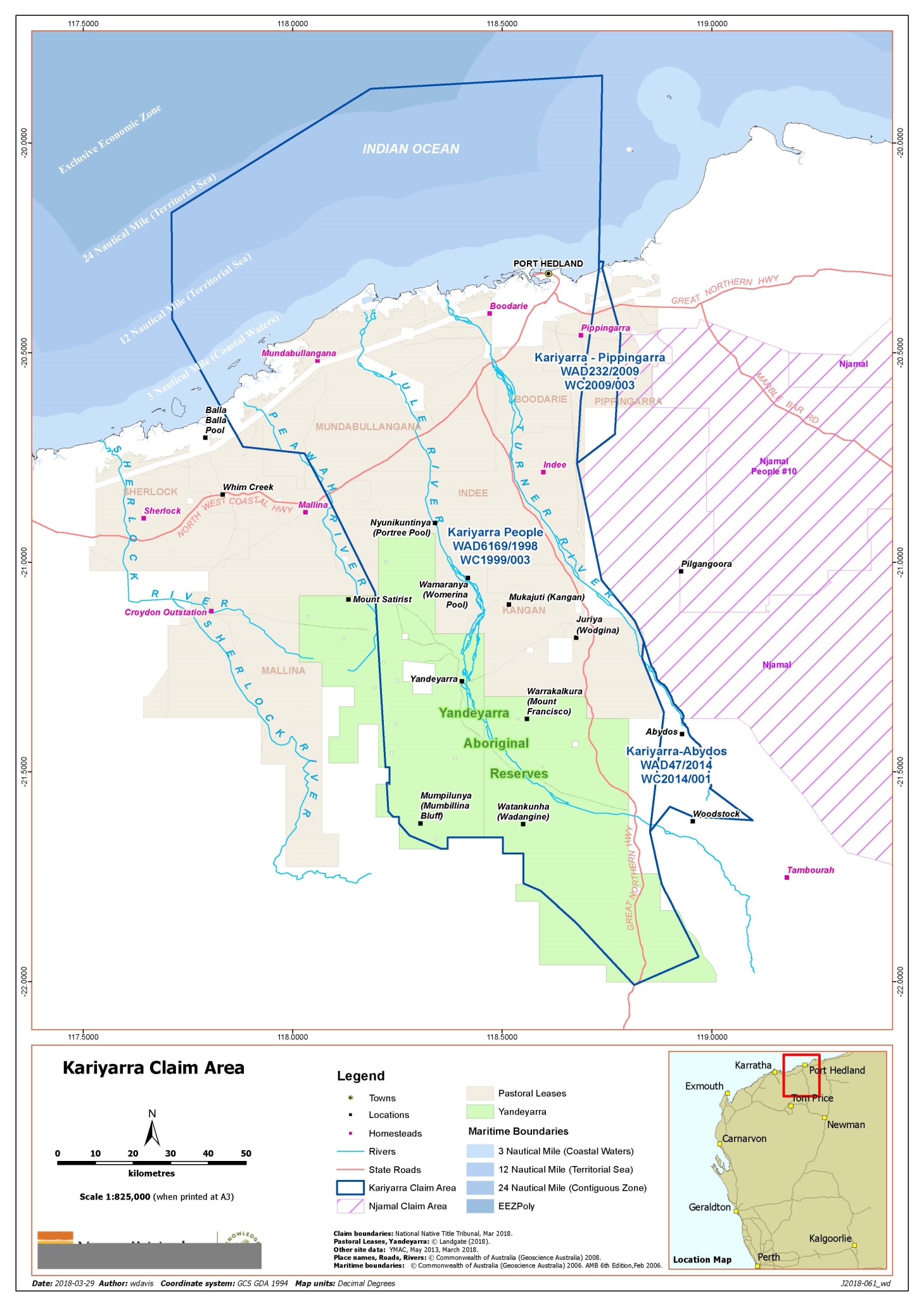 Annexure C
Bates 1901 - Bates, D. ‘From Port Hedland to Carnarvon by Buggy’. Journal of the Dept. Of Agriculture of Western Australia 4. Pp 183-202.
Berndt 1959 - Berndt, R.M. 1959. ‘The Concept of the “Tribe” in the Western Desert of Australia’, Oceania 30, pp. 81-107.
Chambers and Smith 2004 - Chambers, M. and Smith, N. 2004. ‘Kariyarra Native Title Claim. Connection Report’. Yamatji Marlpa Barna Baba Maaja Aboriginal Corporation, Perth.
Hill 2001 - Hill, A. 2001. ‘Preliminary Ethnographic Findings from Fieldwork and Research on the Basis of the Proposed Kariyarra/Ngarluma Claim: Report for Kaiyarra/Ngarluma Claimants’, Perth: Yamatiji Barna Baba Maaja Aboriginal Corporation.
Kaberry 1939 - Kaberry, P.M. 1939. Aboriginal Woman, Sacred and Profane. Routledge, London.
Keen 1997 - Keen, I. 1997. ‘The Western Desert vs. the rest; rethinking the contrast’. In Scholar and Sceptic: Australian Aboriginal Studies in Honour of L.R. Hiatt, F. Merlan, J. Morton and A. Rumsey (eds.). Aboriginal Studies Press, Canberra, pp. 65-94.
Myers 1986 - Myers, F.R. 1986. Pintupi Country, Pintupi Self. Sentiment, Place, and Politics among Western Desert Aborigines. Smithsonian Institute Press, Washington and London and AIAS, Canberra.
O’Connor 1987 - O’Connor, R. and Associates. 1987. ‘Woodstock and Abydos Reserves Management Plan.’ Report to the Department of Aboriginal Sites, West Australian Museum, Perth.
Palmer 1981a - Palmer, K. 1981. Aboriginal Religion and the Ordering of Social Relations: the Explicit and Implicit Meanings of Religious Knowledge of Aboriginal People of the North-west of Western Australia. Unpublished PhD thesis, University of Western Australia.
Palmer 1981b - Palmer, K. and Taylor P. 1981. ‘Kangan Station. An anthropological survey’. Report prepared for Department of Aboriginal Sites Western Australia Museum, Perth.
Palmer 2010c - Palmer, K. 2010c. ‘Understanding another ethnography: the use of early texts in native title inquiries.’ In, T. Bauman (ed.), Dilemmas in Applied Anthropology in Australia. AIATSIS, Canberra, pp. 72-96.
Peterson 1983 - Peterson, N. 1983. ‘Rights, residence and process in Australian territorial organisation’. In, N. Peterson and M Langton (eds), Aborigines, Land and Land Rights, AIAS, Canberra, pp. 134-145.
Piddington 1932 - Piddington, M. and R. 1932. ‘Report on fieldwork in northwestern Australia.’ Oceania 2.3. pp. 342-58.
Radcliffe-Brown 1913 - Radcliffe-Brown, A.R. 1913. ‘Three tribes of Western Australia.’ Journal of the Royal Anthropological Institute, 48.
Radcliffe-Brown 1930 - Radcliffe-Brown, A.R. 1930-1, 35. ‘The social organisation of Australian Tribes’, Oceania 1.1-4. (Oceania Monographs, no.1). University of Sydney, Sydney.
Radcliffe-Brown 1952 - Radcliffe-Brown, A.R. 1952. Structure and function in primitive society. Cohen and West, London.
Robinson 2010 - Robinson, M. 2010. ‘Smith & Ors v Yamatjl Marlpa Aboriginal Corporation (WAD 176 of 2009). Anthropological report concerning Kariyarra indenity’. Unpublished report, Perth.
Stanner 1965 - Stanner, W.E.H. 1965. ‘Aboriginal Territorial organisation: estate, range, domain and regime,’ Oceania 36.1 pp. 1-26.
Stanner 2001 - Stanner, W.E.H. 2001. ‘Some general principles of Aboriginal land holding’. In, People from the Dawn. W.E.H. Stanner and Martin, J.H. (eds.), Solas Press, Antioch, pp. 103-118.
Sutton 1999 - Sutton, P. 1999. ‘The system as it was straining to become – fluidity, stability and Aboriginal country groups’. In, J.D. Finlayson, B. Rigsby and H.J. Bek (eds.), Connections in Native Title: Genealogies, kinship and groups’. Centre for Aboriginal Economic Policy Research, ANU, pp. 13-57.
Sutton 2003 - Sutton, P. 2003. Native Title in Australia: an Ethnographic Perspective. Cambridge University Press, Cambridge.
Tindale 1953 - Tindale, N. 1953. ‘Blacks Struggle for Life in the Great Western Desert’. Adelaide Advertiser, 28 November, p.8.
Tindale 1953b - Tindale, N.B. 1953b. Genealogical Sheets Collected from Western Australia. South Australian Museum Archives, Adelaide.
Wilson 1961 - Wilson, J. 1961. ‘Authority and Leadership in a “New Style” Australian Aboriginal Community: Pindan, Western Australia.’ Unpublished MA thesis, Department of Anthropology, University of Western Australia.
Withnell 1901 - Withnell, J.G. 1901. The Customs and Traditions of the Aboriginal Natives of North Western Australia. Hugh B. Geyer, Roebourne, Western Australia.
WAD 6169 of 1998 | |
Robinson, Kerry Wilson, Donny | |
01 Government Interests | State of Western Australia |
02 Government Interests | Commonwealth of Australia |
05 Mining Interests | BGC Contracting Pty Ltd BHP Billiton Minerals Pty Ltd Dampier Salt Ltd Itochu Minerals & Energy of Australia Pty Ltd Mitsui Iron Ore Corporation Pty Ltd |
06 Pastoral Interests | Brierly, Colin Day, Barkley Marshall Day, Joan Elizabeth Day, Richard Ernest Day, Zane Bradley Four Seasons Corporation (Mundabullangana Station) Pedo Pty Ltd (Mallina Station) |
07 Special Lease Interests | Westraint Resources Pty Ltd |
13 Pearling Interests | MG Kailis Group of Companies |
15 Telecommunications Industry Interests | Telstra Corporation Limited |
Pilbara Ports Authority | |
18 Non Party (For Information Only) | National Native Title Tribunal |
SCHEDULE OF PARTIES
WAD 232 of 2009 | |
Applicants | Gordon, Cyril Robinson, Kerry Wilson, Donny |
Respondents | |
01 Government Interests | State of Western Australia |
02 Government Interests | Commonwealth of Australia |
03 Indigenous Interests | Attwood, Mary Dann, George Dann, Robert Lockyer, Shirley Mason, Patricia Smith, Eugenia |
04 Mining Interests | BHP Billiton Direct Reduced Iron Pty Ltd BHP Billiton Minerals Pty Ltd Boral Contracting Pty Ltd Dampier Salt Ltd FMG Pilbara Pty Ltd Itochu Minerals & Energy of Australia Pty Ltd Mitsui - Itochu Iron Pty Ltd Mitsui Iron Ore Corporation Pty Ltd |
05 Pastoral Interests | Brierly, Colin Day, Barkley Marshall Day, Joan Elizabeth Day, Richard Ernest Day, Zane Bradley |
06 Non Party (For Information Only) | National Native Title Tribunal |
SCHEDULE OF PARTIES
WAD 47 of 2014 | |
Applicants | Robinson, Kerry Wilson, Donny |
Respondents | |
01 Government Interests | State of Western Australia |
02 Mining Interests | BHP Billiton Minerals Pty Ltd FMG Pilbara Pty Ltd Itochu Minerals & Energy of Australia Pty Ltd Mitsui Iron Ore Corporation Pty Ltd Mitsui-Itochu Iron Pty Ltd Pilbara Gas Pipeline Pty Ltd Pilbara Water and Power Pty Ltd The Pilbara Infrastructure Pty Ltd |
03 Pastoral Interests | Day, Barkley Marshall Day, Joan Elizabeth Day, Richard Ernest Day, Zane Bradley |
04 Intervener | Commonwealth of Australia |
05 Non Party (For Information Only) | National Native Title Tribunal |


