

FEDERAL COURT OF AUSTRALIA
Popeye Holdco Pty Limited (Receivers and Managers Appointed) v Intermediate Capital Asia Pacific 2008 GP Limited (No 2) [2018] FCA 408
ORDERS
DATE OF ORDER: |
THE COURT ORDERS THAT:
1. The parties be heard as to the orders to be made in light of these reasons.
Note: Entry of orders is dealt with in Rule 39.32 of the Federal Court Rules 2011.
BESANKO J:
Introduction
1 This is an application within a proceeding in the Court by Mr Richard Sykes and Mr Nicholas Woodward for an injunction restraining the use of a number of documents and an order for delivery up of those documents. To support their claim for such relief, they rely on the equitable duty of confidence. The respondents to the application and the parties against whom the orders are sought are Intermediate Capital Asia Pacific 2008 GP Limited, Intermediate Capital Asia Pacific Fund 2008 LP, Intermediate Capital Asia Pacific Limited, Intermediate Capital Group Plc, Intermediate Capital Australia Pty Limited, Hartland Investments Pte Limited and Mr Ryan Shelswell. The respondents oppose the application.
2 In the proceeding, Popeye Holdco Pty Limited (Receivers and Managers Appointed) (Holdco), Popeye Bidco Pty Limited (Receivers and Managers Appointed) (Bidco), SCF Holdings Pty Limited (SCF Holdings) and SCF Group Pty Limited seek relief against the respondents and another company, AET Structured Finance Services Pty Limited. AET Structured Finance Services Pty Limited is not a party to the present application and it is not necessary to refer to the company again. Holdco has recently filed a notice of discontinuance.
3 The relief sought by the applicant companies in the proceeding included an application for an interlocutory injunction. After hearing detailed submissions from the parties, I refused the application for an interlocutory injunction and I delivered reasons for that decision (Popeye Holdco Pty Limited v Intermediate Capital Asia Pacific 2008 GP Limited [2017] FCA 369).
4 The respondents then sought an order for their costs of the application. They did not seek an order against the applicant companies in the proceeding, but rather they sought an order against Mr Sykes and Mr Woodward who were not and are not parties to the proceeding.
5 Mr Sykes’ involvement in the SCF Group of companies is set out in my earlier reasons and I will not repeat what I have said in those reasons (at [6]-[10]). The directors of the four applicant companies as at May 2012 and thereafter are described in my earlier reasons as follows (at [22]):
Holdco was incorporated on 15 May 2012 and Mr Sykes and Mr Shelswell were appointed as the initial directors. Mr Woodward and Mr Thomas Anning became directors on 22 May 2012 and Dr Heine replaced Mr Anning on 20 November 2012. The same position obtained with respect to Holdco’s wholly owned subsidiary Bidco except that Mr Woodward and Mr Anning became directors on 25 May 2012. In late May 2012, the directors of SCF Holdings were Mr Sykes, Mr Woodward, Mr Shelswell and Mr Anning. The same position obtained with respect to SCF Holdings’ wholly owned subsidiary, SCF Group Pty Limited.
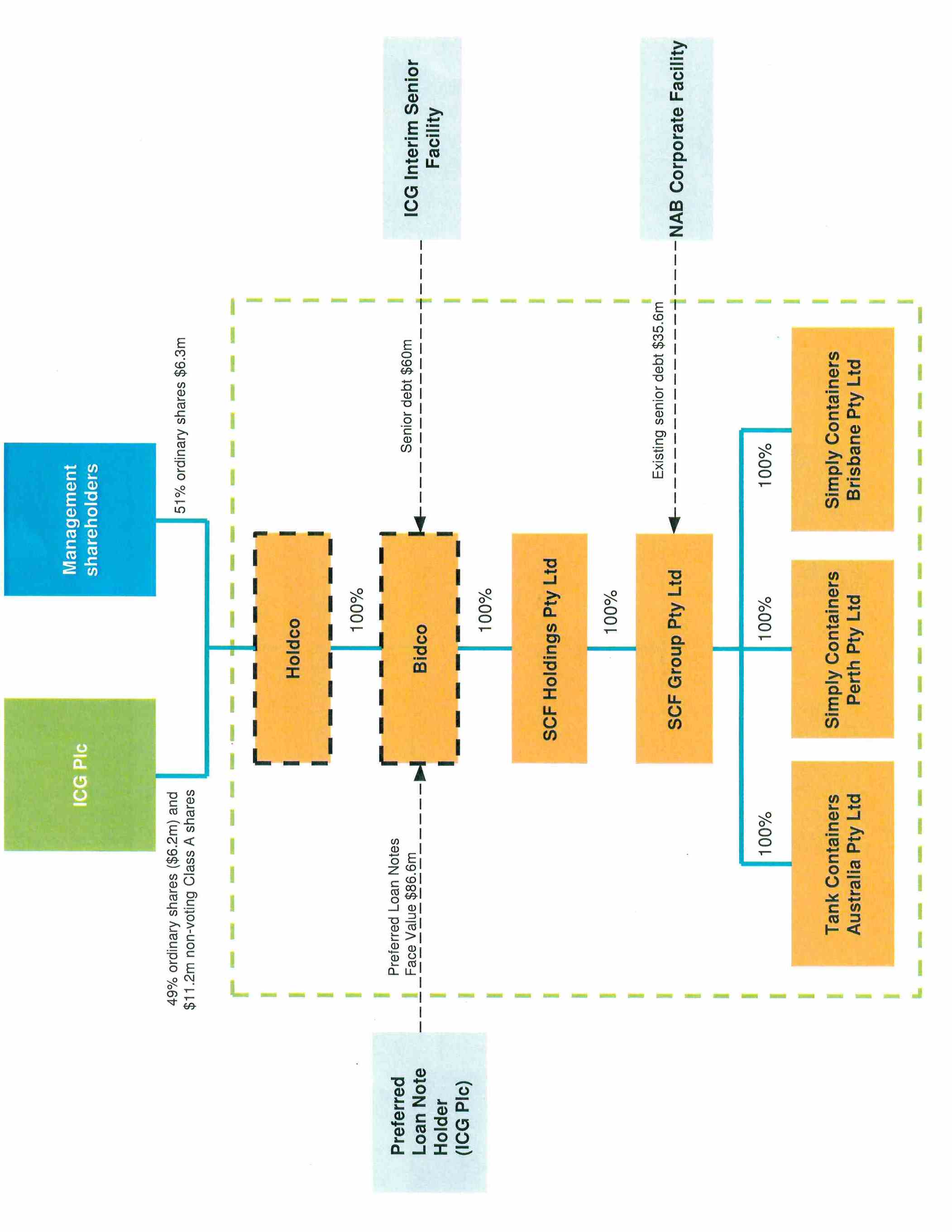
6 The ownership structure of the group after the transactions in May 2012 which I describe in my earlier reasons, including the Preferred Loan Note Subscription Agreement (PLNSA), is shown in Annexure A to these reasons.
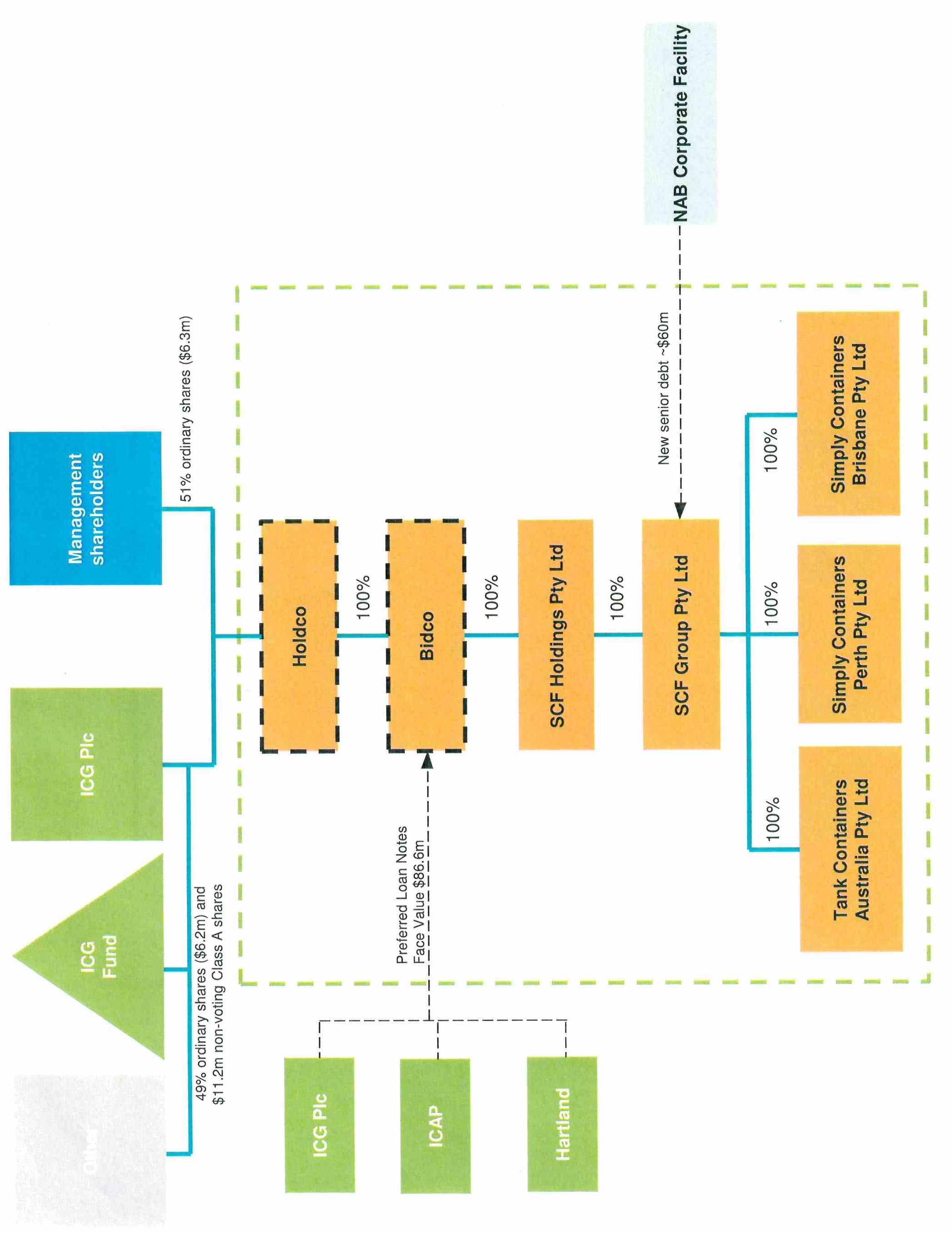
7 The ownership structure of the group at the time of my earlier reasons is shown in Annexure B to these reasons.
8 In February 2017, the ICG Group took action under the PLNSA and that action is described in my earlier reasons as follows (at [38]-[39]):
Bidco has not delivered to the Agent the audited consolidated financial statements for the Holdco group for the financial year ended 30 June 2016 as required by clause 16.1 of the PLNSA. That led to a letter from the ICG to Holdco and Bidco dated 20 February 2017, but not delivered until 21 February 2017. The next step, assuming the interlocutory injunction is not granted, will be a formal demand under clause 18.2(b), and if that is not met, the ICG could (among other things) declare all or part of the Loan payable on demand under clause 18.9. There is also power under the General Security Interest to appoint a receiver.
A meeting of the board of directors of each of the four applicants was held on 22 February 2017. Dr Heine and Mr Shelswell resigned from the board of each of Holdco and Bidco before a resolution authorising the appointment of lawyers on behalf of the companies was passed. In the case of SCF Holdings and SCF Group, the resolution authorising the appointment of lawyers was passed on the casting vote of Mr Sykes.
9 At the time of my earlier reasons, Mr Sykes and Mr Woodward were directors of the applicant companies and they were shareholders, directly or indirectly, of the companies and part of a group of shareholders known as the “management shareholders”. Mr Sykes was the chief executive officer of the group’s operations conducted by SCF Holdings and SCF Group Pty Limited (SCF Group) and Mr Woodward was the chief financial officer. One of the respondents, Mr Shelswell, was a director of the companies.
10 After the interlocutory injunction had been refused, Mr Sykes’ position as chief executive officer and director of SCF Holdings and SCF Group Pty Limited was terminated and he was required to return his mobile telephone and laptop which he did. At about the same time, Mr Sykes, Mr Woodward and others instituted a second proceeding which substantially overlaps with this proceeding. In that second proceeding, they seem to rely primarily on their status as shareholders in the companies. I will refer to that proceeding as the Shareholder Proceeding.
11 As I have said, the respondents seek an order for their costs of the unsuccessful application for the interlocutory injunction by the applicant companies against Mr Sykes and Mr Woodward. The Court’s power to order costs against non-parties is contained in s 43 of the Federal Court of Australia Act 1976 (Cth) (Knight and Another v FP Special Assets Limited and Others [1992] HCA 28; (1992) 174 CLR 178 at 192-193 per Mason CJ and Deane J; Selig and Another v Wealthsure Pty Ltd and Others [2015] HCA 18; (2015) CLR 661 at [43] per Gageler J). It is sufficient at this stage to outline in a broad way the respondents’ arguments in support of their application for costs against the non-parties. They claim that the non-parties have been actively involved in the conduct of the litigation and will benefit from the litigation if it is successful.
12 This Court has jurisdiction to hear and determine the respondents’ application for costs against the non-parties and the application of the non-parties which arises out of it.
13 In the course of preparing their defence to the application for costs, the non-parties became aware that the respondents proposed to rely on communications between the non-parties and their lawyers. This emerged when the respondents filed their Outline of Submissions and a book of documents entitled Respondents’ Further Supplementary Tender Bundle. For example, the respondents seek to rely on a draft opinion of Mr Mark Livesey QC and Mr Anthony Hurren of counsel sent by Mr Woodward from his work email account at the SCF Group to Mr Sykes at his work email account at the SCF Group, and then sent by Mr Sykes from his SCF Group email account to his legal advisers on or about 20 February 2017. Another example is that the respondents seek to rely on a tax invoice rendered by Mr John Levy of JL Lawyers Pty Ltd dated 1 March 2017 and sent to Mr Sykes and Mr Woodward at their respective SCF work email accounts to establish (on the respondents’ case) that a draft statement of claim for the Shareholder Proceeding had been prepared by 24 February 2017. One final example is as follows. After Holdco and Bidco received the letter from ICG dated 20 February 2017 described in my earlier reasons (see [8]), Mr Sykes sent a copy of this letter to his lawyer, Mr Levy from his SCF Group email account.
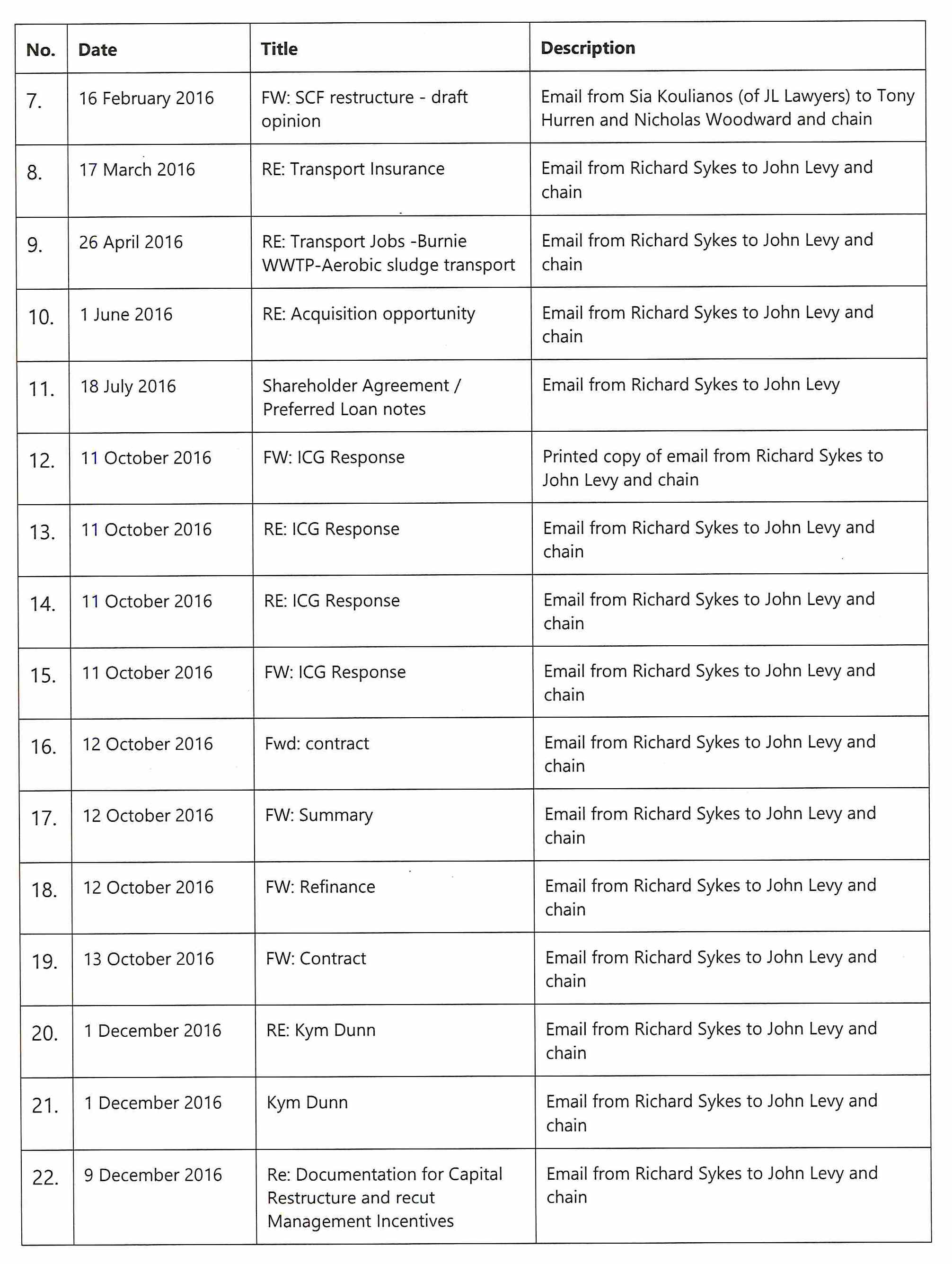
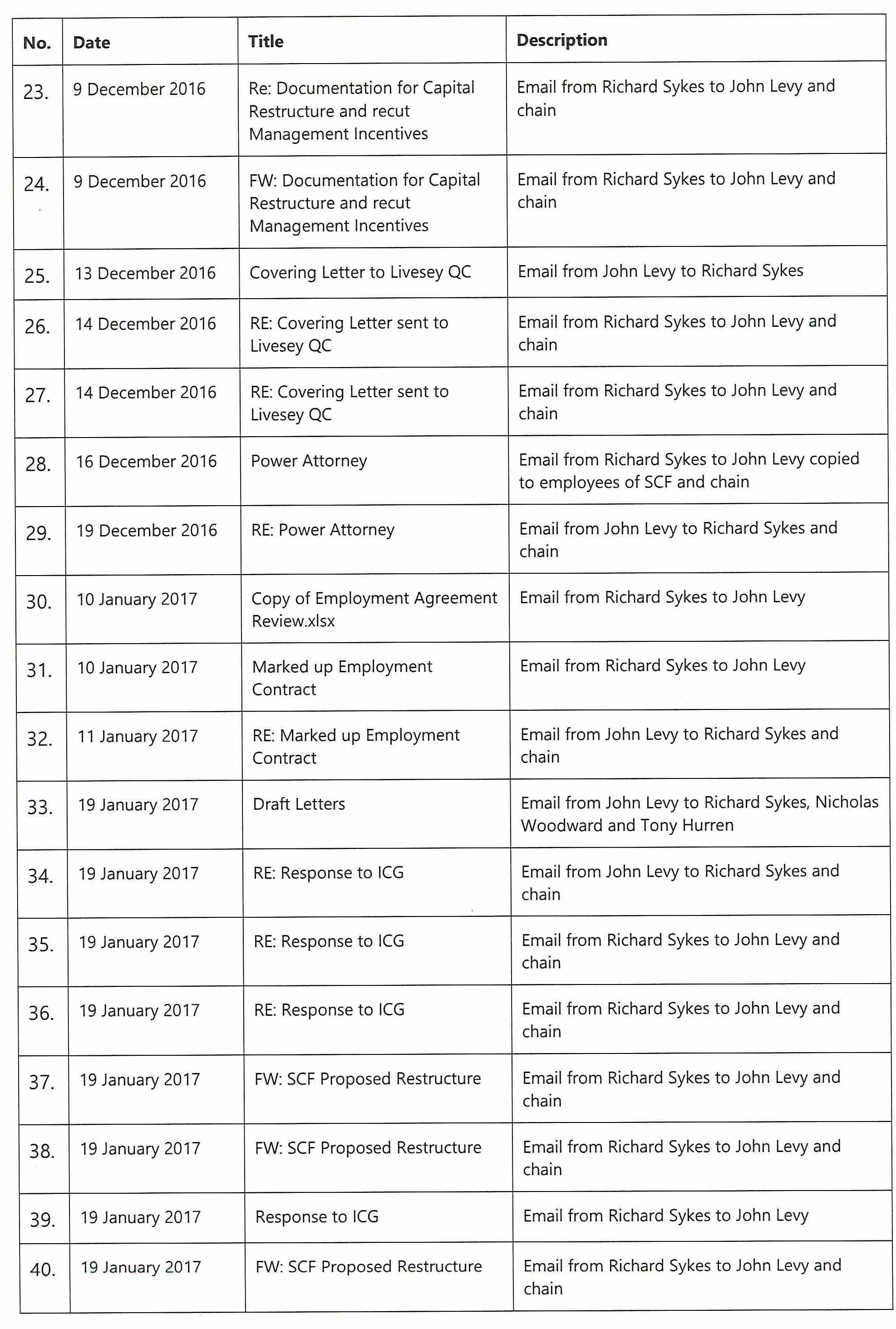
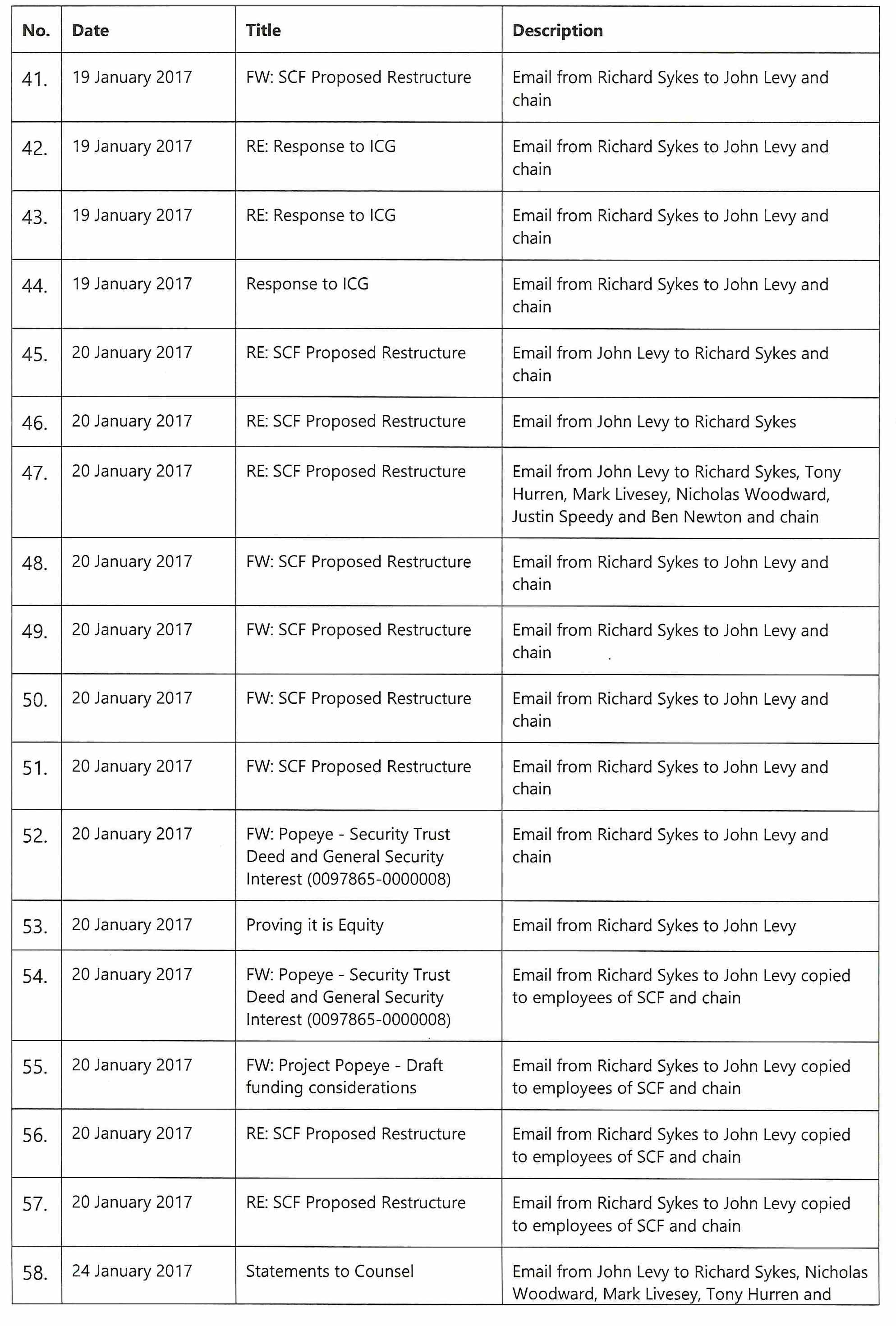
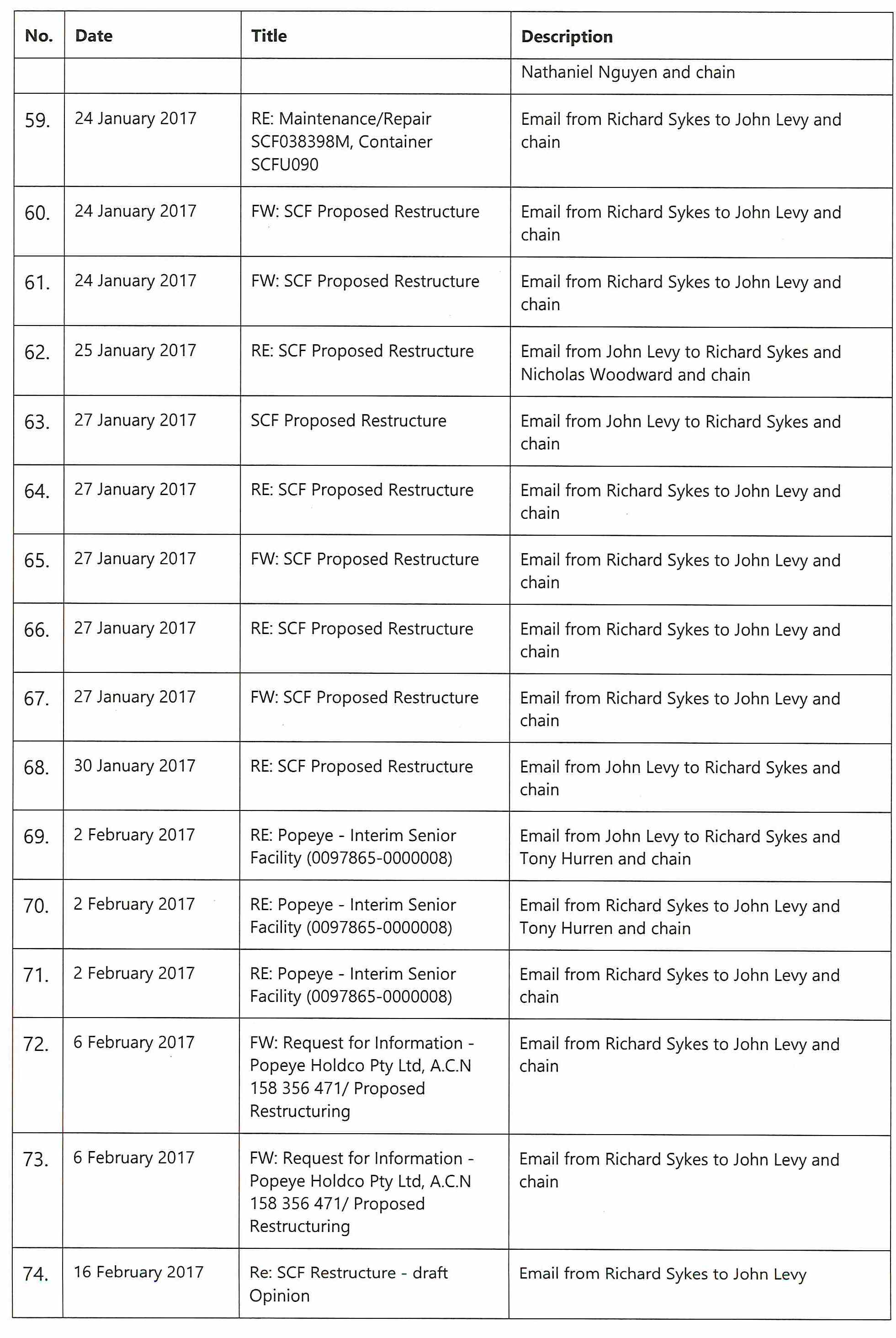
14 I attach to these reasons as Annexure C a list showing the documents which are the subject of the application by the non-parties. It is not clear to me why the numbering begins at number 7. Documents 86-88 are no longer in dispute. The respondents have indicated that they will hand those documents back without any admission that they are required to do so. I will refer to the documents in issue as “the Communications”.
15 As I understand it, the respondents accept that had the Communications been sent from, or been received at, private email accounts of the non-parties, there would be no dispute that they would be confidential communications between the non-parties and their legal advisers for the dominant purpose of giving or receiving legal advice. In those circumstances, there was no need for me to read the documents, or at least those parts of them which are said to be confidential.
16 A number of affidavits were tendered on the application. Mr Sykes swore three affidavits which were tendered. Mr Sykes made a number of statements in his affidavits about his belief that the Communications were confidential or subject to legal professional privilege. The respondents objected to these statements, saying they were irrelevant. I received the statements, subject to arguments as to relevance.
17 Mr Sykes was cross-examined about various matters in his affidavits. These matters included whether he was bound by an Information Technology Agreement of the SCF Group. That document (or at least a version of it), which is in part set out below, contained the general conditions of use for employees and internal users of accounts, internet and email and social media. The issue of whether Mr Sykes was bound by the Information Technology Agreement was no longer a live one by the time the parties came to make their closing submissions. Mr Sykes’ submissions proceeded on the basis that he was bound by the Information Technology Agreement and the conditions therein as to the use of SCF’s electronic equipment. In the circumstances, it is not necessary to address the objections to Mr Sykes’ evidence or his evidence generally. Nevertheless, for the sake of completeness, I would make the following comments. I accept that Mr Sykes believed that the Communications and other personal or private material could not be used by the company or its agents at least up until mid to late February 2017. I do not think he would have used his work email for, among other things, communications relating to private, health and family matters had he thought otherwise. At the same time, I did not find Mr Sykes’ evidence entirely convincing on a couple of matters. Whether or not he approved various company policies seemed clear in his affidavit, but less clear in his cross-examination. Furthermore, I found his evidence of his understanding as to the reasons his solicitors suggested that he should use his private email account to be confusing.
18 The respondents relied on an affidavit of Mr Justin Speedy who is the current acting chief executive officer of SCF Group Pty Ltd. Mr Speedy was not required for cross-examination. I do not need to discuss his evidence because it too was related to the policies and conditions of the company as to the use of its electronic equipment.
Background
19 The non-parties rely on the equitable duty of confidence as the basis for their claim for injunctive orders and an order for delivery up of the Communications. Legal professional privilege is not a basis for the orders which they seek. In other words, the injunctions sought could only be granted on the basis of the equitable duty of confidence or law of confidential information (Armstrong Strategic Management and Marketing Pty Ltd v Expense Reduction Analysts Group Pty Ltd and Others [2012] NSWCA 430; (2012) 295 ALR 348 (Armstrong Strategic Management) at 102 and 105 per Campbell JA (with whom Macfarlan JA and Sackville JA agreed). Both parties proceeded on this basis. The decision of the Court of Appeal in Armstrong Strategic Management was overturned on appeal to the High Court, but that was done by reference to a matter not relevant in this case, namely, the power of the Court to control its own processes, including the process of discovery (Expense Reduction Analysts Group Pty Ltd and Others v Armstrong Strategic Management and Marketing Pty Limited and Others [2013] HCA 46; (2013) 250 CLR 303 at [58] per French CJ, Kiefel J (as her Honour then was), Bell, Gageler and Keane JJ).
20 The Communications consist of documents retrieved from SCF’s server. There is no evidence about the persons who retrieved the documents or the circumstances in which they were retrieved. There is no evidence that they were retrieved by a director of SCF exercising a right under the general law or s 198F of the Corporations Act 2001 (Cth).
21 As I have said, the documents retrieved from Mr Sykes’ personal email account (i.e., items 88-90 in the Schedule) are no longer in issue.
22 The respondents’ redacted Further Supplementary Tender Bundle contains some of the documents listed in Annexure C to these reasons. There are a number of attachments to covering emails where the covering email is in the Further Supplementary Tender Bundle, but the attachments are not. There are also documents to which the respondents have had access, but which are not referred to in the Further Supplementary Tender Bundle at all. They are listed in “RS 5” to Mr Sykes’ third affidavit.
23 The non-parties submitted that the Communications while on the SCF server remained private communications and could only be accessed by the use of a password.
24 In his evidence, Mr Sykes said that he regarded his SCF Group email account as an account to be used predominantly for business purposes, but also available for his private and personal use. Mr Sykes did not use a separate private email address between about 1998 and early 2017. He said that he used his SCF email account for all purposes. He said that, speaking generally, he used the SCF email system through his laptop computer which was connected to a server which operated as part of the SCF Group Businesses. Mr Sykes’ laptop was only accessible by him.
25 Mr Sykes said that he regarded his email account as private and that it was never his intention that his email account should be made available to any other person. He considered it within the scope of his role as chief executive officer for him to use his email account for personal and private communications.
26 My Sykes conducted a number of other private or personal communications (i.e., other than the Communications) through the SCF email account. These communications related to matters such as his family, his health, his other business interests and his non-business interests.
27 Mr Sykes started to use a private email address for communications with his lawyers in mid to late February 2017. He did so after his lawyers asked him whether he had a private email address which could be used for communications with him.
28 The non-parties submitted that Mr Sykes’ “disclosure” of the communications to the SCF Group were confidential because he believed and intended that they be confidential and his state of mind should be attributed to the SCF Group.
Principles
29 In Optus Networks Pty Ltd v Telstra Corporation Ltd [2010] FCAFC 21; (2010) 265 ALR 281 at [39], the Full Court of this Court identified the four elements of a claim in equity for breach of confidence as follows:
(1) the information in question must be identified with specificity;
(2) it must have the necessary quality of confidence;
(3) it must have been received by the respondent in circumstances importing an obligation of confidence; and
(4) there must be an actual or threatened misuse of the information without the applicant’s consent.
30 These four elements were identified and discussed by Gummow J sitting as a judge of this Court in the earlier case of Smith Kline and French Laboratories (Aust) Ltd and Others v Secretary, Department of Community Services and Health [1990] FCA 151; (1990) 22 FCR 73 (Smith Kline) at 87 and the second, third and fourth elements were identified and discussed by Megarry J in Coco v AN Clark (Engineers) Ltd [1969] 86 RPC 41 (Coco v AN Clark (Engineers)) at 47-48.
31 In this case, the first and fourth elements are satisfied. The Communications are identified with specificity and the respondents wish to use the documents on their application for costs against the non-parties without the consent of the non-parties. The second and third elements overlap. The Communications are not common or public knowledge and, to that extent, the second element is satisfied. The third element is in dispute and that is whether, in the circumstances of this case, the Communications were received by the SCF Group in circumstances importing an obligation of confidence. Although it is companies in the ICG Group of companies which wish to deploy the Communications, the parties argued the matter on the basis that the issue was whether the non-parties could enforce a duty of confidence with respect to the Communications as against the SCF Group.
32 Disputes about whether there is an obligation of confidence have arisen in a variety of factual situations and they include the following: where information is entrusted by a person to another in circumstances of confidence; where information that is inherently confidential or private is obtained by another illegally or surreptitiously; and where information is received innocently or is received unsolicited and the recipient knows or ought to know that the information is confidential.
33 In Armstrong Strategic Management, Campbell JA elaborated on the circumstances in which an obligation of confidence arises. His Honour said (at [100]):
Coco v A N Clark (Engineers) Ltd [1969] RPC 41 does not provide an exhaustive statement of when equity will hold that an obligation of confidence has arisen. Even if there is no entrusting of confidential information by A to B in circumstances of confidence, there can sometimes be an obligation of confidence that attaches to information that is inherently confidential or private if that information is illegally or surreptitiously obtained, or is come across in the street, or is received unsolicited: ABC v Lenah Game Meats (2001) 208 CLR 199; 185 ALR 1; [2001] HCA 63 at [34]–[36] (ABC) per Gleeson CJ; [123] per Gummow and Hayne JJ (Gaudron J agreeing); [169]–[170] per Kirby J; [223], [306] per Callinan J (dissenting as to the result); Franklin v Giddens [1978] Qd R 72 esp at 79–80; 1B IPR 807 at 813–14; Sullivan v Sclanders (2000) 77 SASR 419; [2000] SASC 273 at [50]–[51], Campbell v MGN Ltd [2004] 2 AC 457; [2004] 2 All ER 995; [2004] UKHL 22 at [14], [47], [85] and [166] (Campbell); Douglas v Hello! Ltd (No 3) [2006] QB 125; [2005] 4 All ER 128; [2005] EWCA Civ 595. In such a case there is “an obligation of conscience arising from the circumstances in or through which the information was communicated or obtained”: per Deane J, Moorgate Tobacco Co Ltd v Philip Morris Ltd (No 2) (1984) 156 CLR 414 at 438; 56 ALR 193 at 208; 3 IPR 545 at 560. An obligation of confidentiality can be recognised even if there is no particular relationship between the parties and no deliberate malfeasance, but where a person receives information that, by virtue of the circumstances in which it is received, he or she knows or ought to know is confidential: see Attorney-General v Guardian Newspapers Ltd (No 2) [1990] 1 AC 109 at 281; [1988] 3 All ER 545 at 618; Campbell at [14]; Trevorrow v South Australia (No 4) (2006) 94 SASR 64; [2006] SASC 42 at [39] (Trevorrow (No 4)) per Doyle CJ, [80] per Debelle J and [118] per White J; West Australian Newspapers v Bond (2009) 40 WAR 164; [2009] WASCA 127 at [42]. The basis upon which equity intervenes in such circumstances is by deciding whether, in all the circumstances, it would be unconscientious for the recipient of the information to decline to respect the confidentiality of the information: ABC at [45] per Gleeson CJ; [172]–[175] per Kirby J. That can depend not only on what the recipient knew at the time of receiving the information, but also on what the recipient has come to know by the time the court is considering whether or not to grant the remedy: ABC at [46]; Johns v Australian Securities Commission (1993) 178 CLR 408 at 459–60; 116 ALR 567 at 601–3; 31 ALD 417 at 448–9; 11 ACSR 467 at 501–2 per Gaudron J.
34 The well-known English cases of Saltman Engineering Co Ltd, Ferotec Ltd and Monarch Engineering Co (Mitcham), Ltd v Campbell Engineering Co Ltd [1948] 65 RPC 203, Seager v Copydex Ltd [1967] 84 RPC 349 and Coco v AN Clark (Engineers) are all cases where confidential information was entrusted by one person to another in a commercial setting for a limited purpose and then, on the plaintiff’s case, there was a threatened misuse of the information by the defendant. That is not the case in the present proceeding. The non-parties did not entrust the Communications to the SCF Group for a commercial purpose. Nor is this a case of inherently confidential or private material being obtained by the SCF Group illegally or surreptitiously. It was a passive recipient of the information and it did not act illegally or surreptitiously. This is not the type of case discussed in Lord Ashburton v Pape [1913] 2 Ch 469 and Commonwealth of Australia v John Fairfax & Sons Ltd [1980] HCA 44; (1980) 147 CLR 39 at 50 per Mason J (as his Honour then was). The third category of inadvertent disclosure was considered by the Full Court of the Supreme Court of South Australia in Trevorrow v State of South Australia (No 4) [2006] SASC 42; (2006) 94 SASR 64 (Trevorrow). That was a case where the State disclosed documents and those documents inadvertently included legal advice. Debelle J referred to the third category in the following terms (at [80]):
…The principle will apply also where a person innocently comes into possession of confidential information through the inadvertence of another. Assume a person inadvertently leaves confidential information in a satchel on a bus. The person finding the satchel opens it for the purpose of obtaining information as to the person who left the satchel behind and in the course of doing so reads confidential information. If necessary, the court will make an order restraining the finder from using that confidential information. In making that order, the court would be enforcing the obligation of conscience arising from the fact that the finder came into possession of the information in circumstances in which it was not intended that the confidential information could be used by the finder.
35 Doyle CJ drew a distinction between on the one hand, a case where a person should have realised that the files he disclosed might well contain legal advice and a reasonable solicitor would consider that access to the files was being granted whatever they might contain, and on the other, a case where the person disclosing the documents had no reason to believe that they contain a certain document or category of documents and, in fact, does not wish to disclose that document or category of documents. Doyle CJ held that the case before the Court fell within the former category and was not protected by an equitable duty of confidence.
36 This is not a case of misplacing documents or mistaken or inadvertent disclosure of documents. Mr Sykes knew that he was using his work email account to receive and send the Communications. Nor was he unaware of the nature of the documents which he was disclosing, as the State of South Australia claimed to be in Trevorrow. He might have been mistaken as to the consequences of his actions in terms of confidentiality, but that subjective mistake does not give rise to a duty of confidence.
37 The non-parties submitted that this is a case akin to one where information is disclosed for a limited purpose and the person with the information proposes to disclose it or use it for a broader or different purpose. In this case, the email policy is equivalent to limited disclosure for monitoring purposes; that is, checking for misuse or inappropriate use. Where nothing relevant is said about disclosure or the use of the documents, the circumstances are to be examined by reference to their impact on a reasonable person in the position of the recipient (Trevorrow at [41]). In this context, the non-parties also referred to Heydon JD, Leeming MJ and Turner PG, Meagher, Gummow and Lehane’s Equity: Doctrines and Remedies (5th ed, LexisNexis Butterworths, 2015) at 42-090 where the learned authors state (among other matters) that the relevant question is what the person in whom the information is confided is entitled to do with the information, not what use is prohibited.
38 With respect, guidance on the content of the third element may still be obtained from the following observations of Megarry J (referring to what his Lordship identified as the second requirement) in Coco v AN Clark (Engineers) (at 47-48):
The second requirement is that the information must have been communicated in circumstances importing an obligation of confidence. However secret and confidential the information, there can be no binding obligation of confidence if that information is blurted out in public or is communicated in other circumstances which negative any duty of holding it confidential. From the authorities cited to me, I have not been able to derive any very precise idea of what test is to be applied in determining whether the circumstances import an obligation of confidence. In the Argyll case at page 330, Ungoed-Thomas, J. concluded his discussion of the circumstances in which the publication of marital communications should be restrained as being confidential by saying “If this was a well-developed jurisdiction doubtless there would be guides and tests to aid in exercising it” . In the absence of such guides or tests he then in effect concluded that part of the communications there in question would on any reasonable test emerge as confidential. It may be that that hard-worked creature, the reasonable man, may be pressed into service once more; for I do not see why he should not labour in equity as well as at law. It seems to me that if the circumstances are such that any reasonable man standing in the shoes of the recipient of the information would have realised that upon reasonable grounds the information was being given to him in confidence, then this should suffice to impose upon him the equitable obligation of confidence.
Submissions and Analysis
39 As the non-parties ultimately formulated their principal submission, they accepted that the Information Technology Agreement and the conditions therein bound them. Under the General Conditions of Use for employees and internal users in the Information Technology Agreement, the following appears:
• …
• Company facilities are not [to] be used for any improper or unlawful purpose and/or use. This includes access and/or transmission of offensive or pornographic material, the posting or transmission of libellous or defamatory material and the sending of unsolicited mail.
• Inappropriate use of the facilities will result in disciplinary action that may include termination of your employment.
• …
The following appears under the heading “User Accounts”:
• User accounts are to be used only by the designated user.
• You are not authorised to access a user’s account other than your own without the user’s knowledge.
• Do not touch a computer that is logged in by someone other than you when the user is not around. Please report it to the IT department if this becomes an issue.
• User permission may vary between accounts. Permission requests must first be approved by your direct Manager.
• All IT related requests for change are to be recorded in the appropriate electronic form via IT Help Desk online portal under Links on the SCF intranet.
The following appears under the heading, “Internet”:
• SCF internet access is to be used primarily for business purposes.
• Access to inappropriate or non-business related websites may be blocked.
• The IT department will monitor Internet traffic and reserve the right to take action to prevent possible network outages or general network slowness.
• Company mobile and portable devices will only have access to the company wireless network. This includes work phones, laptops and tablets. Personal devices are prohibited.
• Social Media sites are to be managed as per SCF Social Medial Policy
Finally, the following appears under the heading, “email/Social Media”:
• If required, SCF will provide you with email access to be used primarily for business purposes.
• SCF email is not to be used as your private account as it is owned and operated by SCF Group and will be monitored for appropriate content and correct use.
• Personal emails and social media accounts are not to be used as a business tool.
• Do not register your SCF email for any Social Media or non-business related sites.
40 The non-parties submitted that the significance of the policy is that it does not contain an absolute prohibition on personal or private use and insofar as the company has a right to inspect or monitor personal or private use, that right may be exercised (and only exercised) for the purpose of determining if there has been inappropriate use by the user. Furthermore, the non-parties submitted that it is clear that other employees would not access Mr Sykes’ account and any right of a non-executive director to have access would be exercised through the management of the company and, in particular, Mr Sykes as the chief executive officer. The non-parties submitted that Mr Sykes’ evidence of his belief is consistent with this position.
41 The steps in the non-parties’ submission are as follows. First, the Communications are confidential and protected, subject only to the effect of their “disclosure” on the SCF Group system. Secondly, the receipt of the Communications by the SCF Group was an unsolicited receipt that took place by reason of the medium used. Thirdly, the SCF Group received the Communications in circumstances in which it knew they were personal and confidential because Mr Sykes’ knowledge can be attributed to the SCF Group and because of the nature of the documents themselves. Fourthly, it would be unconscientious in the circumstances for the SCF Group not to respect the confidence.
42 The non-parties relied heavily on the decision in Matthews v Clifton [2014] FCA 415; (2014) 99 ACSR 265 (Matthews v Clifton). One of the issues in that case was whether liquidators of a number of family-owned companies should be denied access to the private and personal communications (including legal advice) of directors and owners of the companies retained on the computers on the basis of the equitable duty of confidence. White J analysed the issue by reference to the four criteria identified by Gummow J in Smith Kline.
43 The non-parties relied on the fact that White J upheld the claim that the information was protected by a duty of confidence even though the companies had an “Email and Internet Usage Policy” that restricted the use of the email and internet facilities to business related communications and purposes and provided that a person’s emails were not private and could be reviewed by his or her employer. The non-parties submitted that the position is even stronger in this case because the policy contemplates or allows for some private use and inspection by others is only for the limited purpose of monitoring for misuse. The non-parties also relied on the fact that in Matthews v Clifton, the employees did not have access to the information. That is said to be a significant factor and is also the case here.
44 The respondents accept that the issue is whether the equitable duty of confidence protects the Communications. The respondents submitted that the Communications do not have the necessary quality of confidence and nor did they take place in circumstances importing an obligation of confidence.
45 The respondents made the following submissions.
46 First, the Communications are to and from a company email address. They identify Mr Sykes as chief executive officer, and contain company details and a claim by the company for confidentiality.
47 Secondly, Matthews v Clifton is distinguishable because in that case the parties claiming privilege were the owners of the companies and one of them was the sole director.
48 Thirdly, the directors have a general law right and a statutory right (s 198F) to inspect company documents. Section 198F of the Corporations Act provides as follows:
198F Right of access to company books
Right while director
(1) A director of a company may inspect the books of the company (other than its financial records) at all reasonable times for the purposes of a legal proceeding:
(a) to which the person is a party; or
(b) that the person proposes in good faith to bring; or
(c) that the person has reason to believe will be brought against them.
Note: Section 290 gives the director a right of access to financial records.
Right during 7 years after ceasing to be director
(2) A person who has ceased to be a director of a company may inspect the books of the company (including its financial records) at all reasonable times for the purposes of a legal proceeding:
(a) to which the person is a party; or
(b) that the person proposes in good faith to bring; or
(c) that the person has reason to believe will be brought against them.
This right continues for 7 years after the person ceased to be a director of the company.
Right to take copies
(3) A person authorised to inspect books under this section for the purposes of a legal proceeding may make copies of the books for the purposes of those proceedings.
Company not to refuse access
(4) A company must allow a person to exercise their rights to inspect or take copies of the books under this section.
Interaction with other rules
(5) This section does not limit any right of access to company books that a person has apart from this section.
Mr Shelswell is a director of the SCF Group. He is a party to this proceeding and the Shareholder Proceeding. It is fair to say that the respondents emphasised the common law right of inspection, although they did not abandon reliance on s 198F. The respondents accept that under the general law right the directors need a proper purpose for inspection, but they submit that the context in this case is not, for example, a health issue, but legal advice and opinion connected to the company’s operations.
49 Fourthly, the Information Technology Agreement makes it clear that there could be no expectation of confidentiality. The respondents emphasised the email and Social Media policy and that part of it which states that the SCF email is owned and operated by SCF Group. It is made clear that the email account will be monitored. It is true that the policy refers to monitoring “for appropriate and correct use”, but (the respondents submitted) you cannot monitor an email account without having access to it. The respondents submitted that there is no bright line between something you might want to look at and something you might not want to look at.
50 Fifthly, the respondents rely on their rights of access under the Popeye Holdco Pty Limited Subscription and Shareholders’ Deed (SSD) and the PLNSA. Clauses 12.1(d), 12.2(b) and 12.3 of the SSD are as follows:
12. INFORMATION RIGHTS
12.1 Information to be provided to the Investor
The Company must prepare and provide to the Investor copies of the following:
…
(d) such other information relating to the businesses or affairs of the Group or to its financial position or prospects as any Investor may from time to time reasonably direct.
12.2 Access rights of Investors and Investor Directors
Subject to clause 12.3, the Company must give each Investor, each of their Affiliates and each Investor Director reasonable access on reasonable notice to:
…
(b) inspect and take copies of documents relating to any Group Company, including the statutory registers and books of account of each Group Company; and
…
12.3 Exceptions to Investor’s access rights
Nothing in clause 12.2 requires the Company to give any person access to information if to do so would, in the opinion of the Board:
(a) constitute a breach by any Group Company of any obligation of confidentiality owed to a third party; or
(b) materially disrupt, or have a materially adverse effect on, the business or operations of a Group Company.
Clause 16.5 of the PLNSA is as follows:
16.5 Information: miscellaneous
The Original Guarantor shall supply to the Agent (in sufficient copies for all the Lenders, if the Agent so requests):
…
(b) promptly, such further information regarding the financial condition, business and operations of any member of the Group as any Finance Party (through the Agent) may reasonably request; and
…
51 Finally, this is not a case of inadvertent disclosure by the non-parties. Whatever the subjective views of the non-parties as to the confidentiality of the Communications, they used, and knew that they were using, the SCF Group email accounts.
52 The respondents relied on the approach taken by Brereton J in In the matter of Optimisation Australia Pty Ltd [2016] NSWSC 1581 (Optimisation Australia). The issue in that case arose under the Evidence Act 1995 (Cth) and more particularly, s 122(2) (inconsistent conduct amounting to waiver). That, however, does not affect the significance of Brereton J’s observations. That is because, so the submission proceeds, waiver and whether confidentiality has been maintained raise similar issues. Brereton J said (at [44]):
…Those who created these emails in contention appear to be more than ordinarily computer literate. They did so using company resources and company stationery, in circumstances where every director of the company was entitled to know what correspondence was being sent out from the company. It is as if they took company letterhead, wrote on company letterhead paper, signed as if in their official capacities on that company letterhead paper, sent it in an envelope bearing the logo of the company, and left a copy of it on the company’s outgoing correspondence file for anyone entitled to inspect the company's documents to see. Creating and sending the emails in the manner in which they were created and sent is inconsistent with any legitimate expectation that they would be kept confidential from others entitled to see the company’s records, particularly as these parties were not unfamiliar with the distinction between work and personal email accounts: the evidence reveals – although I am not sure that I have seen evidence of Mr Williams having a private email account – that at least Mrs Williams and Mr Kearney had private as well as work email accounts.
53 The respondents also relied on Simpkin v The Berkeley Group Holdings plc [2017] EWHC 1472 (QB); [2017] 4 WLR 116 (Simpkin v Berkeley Group Holdings). In that case, a former director and employee of a company brought proceedings against the company. In its witness statements, the employer referred to an email from the claimant to his solicitor for the purpose of obtaining advice in divorce proceedings. Garnham J held that the document was not protected by legal professional privileged because it was not confidential. His Lordship said (at [32], [33], [34] and [42]):
32 First, the claimant signed a copy of the company’s IT policy which made clear that e-mails sent and received on its IT system were the property of Berkeley. Berkeley’s IT department had access to all the company's computers and e-mail accounts and did not need authorisation before accessing their computers or accounts. The claimant's employment contract makes clear that his e-mails were subject to monitoring by Berkeley without his consent.
33 Second, I accept Mr Malek’s arguments that the Synopsis was created in the course of the claimant's employment. The Synopsis contained an analysis of the defendant’s financial performance by its group finance director, created on, and transmitted via, its IT system whilst the claimant was at its office. He prepared it using the defendant's financial information. It appears he prepared it over the course of almost an hour whilst working at the defendant's offices in the early morning of 11 August 2014. He prepared it using the defendant's IT system and used the defendant’s e-mail account to e-mail it to his personal account.
34 Third, it is impossible to maintain that the claimant had any reasonable expectation of privacy as regards the preparation of this document. The claimant saved the Synopsis to his folder on one drive of Berkeley’s central servers. As Mr Malek contends, the claimant was, or should have been, aware that documents in that file were stored centrally. The Synopsis was not password protected and was not segregated from the claimant's work related documents.
42 In those circumstances I accept Mr Malek’s submissions that the Synopsis was never confidential as against Berkeley or, if it was, it lost its confidentiality when it was processed on the defendant’s IT system
54 The non-parties responded to these submissions in the following way.
55 The non-parties submitted that an obligation of confidence may arise even where there is no confidential relationship if a reasonable person in the defendant’s position would understand that the information is intended to be secret, or to be available to a limited group to which that person does not belong (Australian Broadcasting Corporation v Lenah Game Meats Pty Limited [2001] HCA 63; (2001) 208 CLR 199 at [34]-[36] per Gleeson CJ). The non-parties submitted that it is not a question of proceeding on the basis that there was a disclosure and then asking whether there was a restriction imposed, but rather, one should ask whether there was, in the circumstances of this case, a disclosure to the SCF Group for a limited permissible purpose.
56 The non-parties submitted that the general law right of a director to inspect company books is not unqualified. They submitted that the right in s 198F goes no further than the common law right of inspection. The non-parties submitted that there is no evidence that Mr Shelswell has exercised any right under s 198F.
57 With respect to the clauses in the SSD and PLNSA, the non-parties submitted that a request has to be made under these clauses, the request must be reasonable and that in each case it must be relating to or regarding the company’s business. None of these clauses evince an intention to abrogate the equitable duty of confidence.
58 The non-parties submitted that the critical feature of the facts in Matthews v Clifton was not the fact that the persons claiming the documents were privileged were owners of the companies and one was the sole director, but that the companies’ documents could not be accessed by the companies’ employees. This, they submitted, was a recognition that confidence in the documents was preserved.
59 The non-parties submitted that the issue in Optimisation Australia was one of privilege, not the duty of confidence and that the two issues are different.
60 The non-parties submitted that Simpkin v Berkeley Group Holdings was a case concerned with legal professional privilege, not the equitable duty of confidence and, critically, the document in issue in that case was a document prepared in the course of the employee’s employment and using the company’s financial information (at [33]). The employee could not ‘retrofit privilege”, as counsel for the non-parties put it, by sending the document to his solicitor. In the circumstances, the document was a company document, and not just a document which was on its system.
61 The first question which I must address is whether the principles identified by White J in Matthews v Clifton apply to this case such that I should follow that case unless I am satisfied that his Honour was clearly wrong. I do not think that they do because there is an important difference between the two cases. In Matthews v Clifton, the persons seeking the protection of equity were, in reality, the companies to whom they were said to have disclosed the information. It is true White J referred to disclosure to the companies’ employees, but that was no more than by way of contrast. In my respectful opinion, the complete identity of the plaintiffs and the companies was the critical feature. That point is made expressly when his Honour considers the knowledge of the companies and concludes that it is the knowledge of the plaintiffs.
62 In my respectful opinion, these points become clear when one has regard to the following passages in his Honour’s reasons (at [58], [69] and [77]):
58. The fourth consideration is that the claim that the Computers contain confidential material of a more general kind is also not implausible. The circumstance that IWH, Scarce Builders and each of the Associated Companies is owned and controlled by Mr and Mrs Scarce makes it unsurprising that they may have used the Computers of one member in their group to record information of the other members of the group and for private purposes. It is commonplace for the owners of family-owned companies to ignore the distinctions of legal identity in the day-to-day running of their businesses and in their personal affairs.
69. In the present case, it is significant, in my opinion, that Mr and Mrs Scarce were not only employees of the companies. They were, either by direct or indirect shareholdings, the sole owners of the companies; and Mr Scarce was the sole director of each. He was also the Managing Director of each. In these circumstances, I consider that it would be artificial to treat Mr Scarce’s disclosure to “the companies” as akin to the disclosure of an ordinary employee. It is also inappropriate to draw any distinction between Mr and Mrs Scarce in this respect. They did “disclose” the information to the companies but in a context in which they controlled access to it. There was no suggestion that the information on the Computers was available to the companies’ employees generally.
77 In the present case, it is appropriate to conclude that the companies had either actual or imputed knowledge of the limited purpose or purposes for which the information was being “disclosed” to them. The knowledge of Mr and Mrs Scarce, in particular, that of Mr Scarce, should be attributed to the companies in this respect. In particular, their knowledge that the information was being recorded on the company computers for the purpose of convenient storage and that the emails were being used for personal matters can be attributed to the companies.
63 In this case, there was disclosure of the Communications to the SCF Group when the Communications appeared on the SCF Group email account of Mr Sykes and Mr Woodward respectively. Of course, SCF Holdings and SCF Group Pty Limited are artificial entities, but when one looks behind the corporate veil, there is a board of directors which consists not only of Mr Sykes and Mr Woodward, but also of Dr Heine and Mr Shelswell. Nor does Mr Sykes’ position as the chief executive officer mean that it is appropriate to conclude that there was no disclosure by Mr Sykes (and Mr Woodward) to the SCF Group. These circumstances distinguish the present case from Matthews v Clifton.
64 There is some awkwardness in concluding that Mr Sykes and Mr Woodward were “disclosing” the Communications to the SCF Group. From their point of view, it is more accurate to say that they used the companies’ work email account for their private and personal purposes and I am prepared to assume that they were not intending to disclose the Communications to the world or, indeed, anybody else in the companies. However, their intention is not the test. They disclosed the Communications in that the Communications are part of the material that can be monitored by the companies for appropriate content and correct use. In addition, personal emails and social media accounts are not to be used as a business tool. In my opinion, the correct interpretation of the Information Technology Agreement is that private and personal emails which are of appropriate content, are not used as a business tool and are secondary to the primary use of the account for business purposes, are permitted. Emails of this nature have been disclosed in the sense that they will be monitored by the companies to ensure that they fall within this category. Emails which fall outside this category cannot be the subject of a duty of confidence. I do not understand it to be suggested that the Communications have inappropriate content, or are being used as a business tool.
65 It seems to me that the companies are, in effect, allowing the non-parties to use and store on its system a certain quantity of personal or private emails. If that was all that was happening, then it is difficult to see why a duty of confidence could not arise in relation to what is inherently personal and private material. But there are additional matters to be considered. First, the companies have the right to monitor the material. This is undoubtedly correct and, as I have said, if there was inappropriate use, then there would be no duty of confidence. Furthermore, the right to monitor is a right vested in the companies, not the chief executive officer and could be exercised by an appropriately authorised agent or delegate of the companies. However, neither of these matters mean that the disclosure (and use to the extent monitoring involves use) is not for a limited purpose and that a duty of confidence in equity cannot operate to prevent disclosure outside the limited purpose. It is difficult to see why material which is plainly private or personal material loses all of its character as confidential material because the person to whom it is disclosed has the limited right to monitor the material. An example will illustrate the point. A person uses their work email account for communicating personal information relating to their health or family. The reasonable person in the position of a recipient is aware of the company’s account and email policy and that this is a permitted use. The reasonable person receiving the material would not assume that all confidentiality in the material had been lost. Of course, the Communications were not material about Mr Sykes’ health or family, but legal advice related in one way or another to the companies and transactions in which they were involved. That may mean that those monitoring the material must do so more closely, but the fact remains that this was legal advice provided to Mr Sykes and Mr Woodward in their personal capacities.
66 Secondly, the Communications were under the companies’ name and addresses and refer, for example, to Mr Sykes as chief executive officer of the companies. That is a relevant matter, but cannot override the fact that the Communications were private and personal.
67 Thirdly, the directors have a general law right to inspect the books of the companies. There is also the right in s 198F of the Corporations Act. It is no answer to this fact that there is no evidence in this case that any director actually exercised the right. I accept the respondents’ submission that it is the existence of the right that is significant, not its exercise. However, the right is a limited right. If I may say, there is a clear summary of the limited nature of the right in Austin RP and Ramsay IM, Ford, Austin and Ramsay’s Principles of Corporations Law (16th ed, LexisNexis Butterworths, 2015) at [11.420]. There is nothing in this case to suggest that a director needed disclosure or use of the Communications over and above that necessary for monitoring purposes in order to discharge his or her fiduciary and statutory obligations.
68 Fourthly, as to the two authorities the respondents relied on, I have considered them carefully. Both addressed legal professional privilege and not the duty of confidence in equity, and in Simpkin v Berkeley Group Holdings, an important consideration was the fact that the employee prepared the relevant document on company time and using company information. In any event, and with all due respect, neither authority persuades me that the approach I propose to take is not the proper one.
69 Finally, although the respondents referred to the clauses in the SSD and PLNSA, they did not make detailed submissions about how they operated. On the face to it, they are not engaged in relation to private legal advice.
70 In my opinion, the Communications are confidential information in respect of which equitable relief should be granted.
Conclusion
71 I consider that the non-parties are entitled to orders with respect to the Communications. I will hear the parties as to the precise terms of those orders in light of these reasons.
I certify that the preceding seventy-one (71) numbered paragraphs are a true copy of the Reasons for Judgment herein of the Honourable Justice Besanko. |
Associate:
Annexure A
Annexure B
Annexure C

SAD 54 of 2017 | |
SCF GROUP PTY LIMITED ACN 065 732 078 | |
INTERMEDIATE CAPITAL GROUP PLC | |
Fifth Respondent: | AET STRUCTURED FINANCE SERVICES PTY LIMITED ACN 106 424 088 |
Sixth Respondent: | INTERMEDIATE CAPITAL AUSTRALIA PTY LIMITED |
Seventh Respondent: | HARTLAND INVESTMENTS PTE LIMITED |
Eighth Respondent: | RYAN SHELSWELL |
Respondents in the Interlocutory Application | |
Fourth Respondent: | INTERMEDIATE CAPITAL GROUP PLC |
Sixth Respondent: | INTERMEDIATE CAPITAL AUSTRALIA PTY LIMITED |
Seventh Respondent: | HARTLAND INVESTMENTS PTE LIMITED |
Eighth Respondent: | RYAN SHELSWELL |


