FEDERAL COURT OF AUSTRALIA
Kimber v The Owners Strata Plan No 48216 (No 2) [2018] FCA 406
ORDERS
Applicant | ||
AND: | THE OWNERS STRATA PLAN NO 48216 Respondent | |
DATE OF ORDER: | 27 March 2018 |
THE COURT ORDERS THAT:
1. Set aside Order 2 made on 4 May 2016.
2. Pursuant to s 41(6A) of the Bankruptcy Act 1966 (Cth) extend the time for compliance with bankruptcy notice 188465 issued on 19 February 2016 to the applicant to 3 April 2018.
3. The amended interlocutory application filed on 11 July 2016 be otherwise dismissed.
4. The applicant pay 40% of the respondent’s costs of the amended interlocutory application as agreed or assessed.
Note: Entry of orders is dealt with in Rule 39.32 of the Federal Court Rules 2011.
[1] | |
[5] | |
[16] | |
[18] | |
[23] | |
[28] | |
[28] | |
[44] | |
5.1.3 Proceedings in the New South Wales Civil and Administrative Tribunal and the Supreme Court | [45] |
[51] | |
[72] | |
[74] | |
[79] | |
[90] | |
6.4. Does Ms Kimber have a counter-claim, set-off or cross demand? | [107] |
[123] | |
[132] | |
[140] | |
[165] | |
[171] |
MARKOVIC J:
1 Janelle Mary Kimber, the applicant, seeks a review of orders made by a Registrar of this Court on 4 May 2016 (Registrar’s Orders) pursuant to s 35A of the Federal Court of Australia Act 1976 (Cth) (Federal Court Act). Among other things, the Registrar’s Orders dismissed Ms Kimber’s application to set aside bankruptcy notice 188465 issued on 19 February 2016 (Bankruptcy Notice) and served on Ms Kimber on 17 March 2016.
2 Ms Kimber is the registered proprietor of lot 110 in strata plan no. 48216 (Lot 110). The Bankruptcy Notice required payment of $12,369.48 to the respondent, The Owners - Strata Plan No. 48216 (Owners Corporation), for a judgment entered in the Local Court of New South Wales (Local Court) in proceeding no. 2009/00359785 on 7 May 2014 for $10,767.00 (Local Court Judgment) and interest thereon of $1,602.48.
3 The matter came on for hearing before me with some urgency as a result of the imminent expiry of a creditor’s petition filed by the Owners Corporation seeking a sequestration order against Ms Kimber’s estate (Creditor’s Petition).
4 This was not the first time that Ms Kimber’s application for a review of the Registrar’s Orders had been before the Court but it was, in effect, the first time that her application was heard. That is explained by the procedural history set out below.
5 On 5 April 2016 Ms Kimber lodged an application with the Court seeking a number of orders including an order that the Bankruptcy Notice be set aside. Because of an error in the title to the proceeding that application was only accepted for filing on 20 April 2016: see Kimber v Owners Strata Plan No 48216 [2016] FCA 1090 (Kimber (No 1)) at [5]. At the time of filing the application to set aside the Bankruptcy Notice, Ms Kimber also filed an affidavit affirmed by her on 20 April 2016, which appears to have been lodged with the Court on 5 April 2016. On 21 April 2016 she filed a document titled “statement of claim” naming herself as the applicant and as respondents: the Owners Corporation and current and former members of its management committee; Linders Strata Management Pty Ltd trading as Strata Choice (Strata Choice) and certain employees and its owner; and Grace Lawyers, the solicitors for the Owners Corporation, and certain solicitors in its employ.
6 On 20 April 2016, on condition that the Bankruptcy Notice was served on Ms Kimber on 17 March 2016, the Court made an order pursuant to s 41(6A) of the Bankruptcy Act 1966 (Cth) (Act) and r 3.03 of the Federal Circuit Court (Bankruptcy) Rules 2006 (Cth) extending the time for compliance with the requirements of the Bankruptcy Notice up to and including 4 May 2016.
7 Ms Kimber served the application to set aside the Bankruptcy Notice on Grace Lawyers on 21 April 2016. On 26 April 2016 the Owners Corporation filed a notice stating grounds of opposition to the application, interim application or petition.
8 In the meantime on 18 April 2016, before the orders were made on 20 April 2016 extending the time for compliance with the Bankruptcy Notice and before, once so ordered, the extended time for compliance with the Bankruptcy Notice or, if applicable, the deemed extension that arises by reason of s 41(7) of the Act had expired, Grace Lawyers lodged the Creditor’s Petition online with the Federal Circuit Court of Australia (Federal Circuit Court). Prior to doing so, Grace Lawyers undertook searches of the records of this Court and the Federal Circuit Court to ascertain if Ms Kimber had made an application to set aside the Bankruptcy Notice. Because, as at that date Ms Kimber’s application had been lodged but not accepted for filing, those searches revealed that no such application had been filed. The Creditor’s Petition was accepted for filing by the Federal Circuit Court on 19 April 2016 and listed for hearing on 24 May 2016. It has subsequently been adjourned.
9 On 4 May 2016 Ms Kimber’s application to set aside the Bankruptcy Notice was listed before the Court. The Registrar’s Orders were made on that day. Those orders were that:
1. The application filed on 20 April 2016 be dismissed.
2. The order made on 20 April be discharged.
3. The applicant pay the respondent’s costs.
10 On 20 May 2016 Ms Kimber filed an interlocutory application seeking various orders including relevantly:
ORDER 1: I SEEK A REVIEW OF THE REGSITRAR’S (sic) DECISION OF 4 May 2016 ORDER 2
11 On 1 June 2016, among other things, the Court granted leave to Ms Kimber to file an amended interlocutory application to seek review of all of the Registrar’s Orders. On 11 July 2016 Ms Kimber filed her amended interlocutory application (Amended IA).
12 On 27 July 2016 the Owners Corporation made an oral application for summary dismissal of the Amended IA which was listed for hearing before a judge of this Court on 1 September 2016.
13 On 8 September 2016 the Court made orders dismissing the proceeding pursuant to s 31A(2) of the Federal Court Act and that Ms Kimber pay the Owners Corporation’s costs: see Kimber (No 1).
14 On 7 April 2017 Ms Kimber was granted leave to appeal from Kimber (No 1) on a limited ground being “whether the primary judge erred in failing to consider whether [Ms Kimber] had a reasonable prospect of success in her claim that [the Bankruptcy Notice] was invalid having regard to s 41(5) of the [Act]”: see Kimber v The Owners Strata Plan No. 48216 [2017] FCA 364.
15 On 22 December 2017 a Full Court of this Court made orders including allowing the appeal; setting aside the orders made in Kimber (No 1); in lieu thereof ordering that the application made orally by the Owners Corporation on 27 July 2016 be dismissed; and remitting the matter to the original jurisdiction of the Court for hearing and determination of Ms Kimber’s application to review the Registrar’s Orders: see Kimber v The Owners Strata Plan No. 48216 [2017] FCAFC 226.
16 Section 35A(1) of the Federal Court Act sets out the powers of the Court which, if the Court or a Judge so directs, may be exercised by a registrar. They include a power of the Court prescribed by Rules of Court: see s 35A(1)(h). There is no dispute that the Registrar’s Orders were an exercise of power pursuant to s 35A(1)(h) of the Federal Court Act: see r 2.02 and Sch 1 of the Federal Court (Bankruptcy) Rules 2016 (Cth) (Bankruptcy Rules).
17 Section 35A(5) of the Federal Court Act permits a party to a proceeding in which a registrar has exercised any powers of the Court under s 35A(1) to apply to the Court to review that exercise of power. Section 35A(6) of the Federal Court Act provides that the Court may, on an application under subs (5), review an exercise of power by a registrar and make such orders as it thinks fit with respect to the power which was exercised. A review under s 35A(6) requires a hearing de novo by the Court: see Martin v Commonwealth Bank of Australia (2001) 217 ALR 634; [2001] FCA 87 at [6].
18 Ms Kimber made her application for review of the Registrar’s Orders by way of the filing of an interlocutory application which was subsequently amended pursuant to orders made by the Court (see [11] above).
19 Rule 2.02(3) of the Bankruptcy Rules provides that, subject to any direction by the Court to the contrary, an application under s 35A(5) of the Federal Court Act for review of the exercise of a power of the Court by a registrar must be made by filing an interim application in accordance with Form B3 within 21 days after the day on which the power was exercised. Ms Kimber has not filed an interim application in accordance with Form B3. She has filed, and relies on, the Amended IA. No point was taken by the Owners Corporation about the form of Ms Kimber’s application. Thus, it is appropriate in my opinion that I dispense with the requirement to file an interim application and that I treat the Amended IA as an interim application pursuant to rr 1.32 and 1.34 of the Federal Court Rules 2011 (Cth) (Rules). I informed the parties in the course of the hearing that I would proceed in that way and no objection was taken.
20 The Amended IA is discursive. It seeks a number of orders by reference to various Acts including the Federal Court Act. It commences with what is described as a “preamble” in the following terms (as written):
I humbly ask Judge Perry to assist to direct my case on a growing set of complex legal issues involving related matters that are in concurrently and presently in process in the Federal Court, Federal Circuit Court and the NSW Supreme Court
Much needed relief from the oppressive circumstances of having multiple proceedings in multiple courts involving multiple parties and need to address court(s) errors took toll. I ask the Honourable Justice to decide to completely and finally determine ALL related matters by constitutional laws, to 'reign in' this controversy and to bring ALL matters together and deal with how an erroneous $154 set aside default created a $10000 judgement order, 2 bankruptcy notices and a creditors petition.
Material evidence is the same in the cases against me, with a cross-claim to be brought against those responsible, not yet joindered, for practising deception, fraud, collusion and/or complicity to commit fraud. There is now the need to also formally address officers of the Commonwealth that are accountable for errors or unfair procedures that have impacted my legal status & well-being.
21 At pages 2-3 of the Amended IA Ms Kimber alleges that the solicitors for the Owners Corporation have “denied relevant evidence in Court”. She says at p 3 (as written):
This precedent did not occur (again) on 4 May 2016 when the last Grace Lawyers solicitor Sylvia Quang knew statements to be false, but still contentiously argued against the 'bona fide' emails and addressee details that confirmed that the bankruptcy notice had been invalidated when the applicant had spoken to the strata manager, sending a 'CC' email to S Martin and all (available) strata committee member email addresses before 21 days on 1 April 2016 under Bankruptcy Act 1966 ss 41 (2) and (5) that related to the 'overstated' amount on the defective bankruptcy notice. 12 days later the ledger was dramatically altered ('Jimmied to-fit') the flawed bankruptcy notice.
22 Ms Kimber then seeks a number of orders which can be summarised as follows:
(1) an order that the costs order made by the registrar in favour of the Owners Corporation on 4 May 2016 be annulled and substituted with an order that the Owners Corporation pay Ms Kimber’s costs;
(2) an order for the joinder of various parties to the proceeding namely, solicitors from Grace Lawyers; employees of Strata Choice; and members of the committee of management for the strata plan. Ms Kimber says that she seeks to “counter claim & cross-claim or start vital 'restoration' proceedings”;
(3) an order for an “estoppel” on the creditor’s petition. Ms Kimber alleges that the registrar’s dismissal of her application was influenced by the “anomalies or errors” that made it possible for the creditor’s petition to be filed in the Federal Circuit Court;
(4) an order for the Court to exercise jurisdiction in relation to matters not otherwise within its jurisdiction that are associated matters. This appears to be an application for other proceedings to be cross vested to this Court including a proceeding before the Supreme Court of New South Wales (Supreme Court);
(5) an order that the orders made on 20 April 2016 to extend the date of compliance with the Bankruptcy Notice, up to and including 4 May 2016, not be discharged and that she be allowed more time to “submit all requirements and rely… on correspondence and other documents that cannot be disputed”. Ms Kimber seeks the Court’s “favour in the process towards accommodating an order to ‘go behind the judgements’ and present the relevant associated submissions to this court”; and
(6) an order pursuant to Art 17 and Art 28 of the International Covenant on Civil and Political Rights.
23 Ms Kimber relied on three affidavits: the first affirmed on 20 April 2016; the second affirmed on 19 May 2016 (May Affidavit); and the third affirmed on 16 February 2018 (February Affidavit).
24 I reserved my ruling on the Owners Corporation’s objection to annexure JMKB to the February Affidavit. Annexure B is described as an “index of evidence files” to “D book” which Ms Kimber had prepared for the purpose of her appeal. Ms Kimber submitted that it was a comprehensive index that had “every bit of evidence that was put in, in a way that was more accessible”. The index lists documents in evidence before me by category and, in some cases, extracts parts of documents. Having considered annexure JMKB and the way in which the parties made their submissions at the hearing, I have decided to allow the objection and to reject the tender of annexure JMKB. The documents referred to in it are in evidence before me and it is not otherwise relevant to the issues before me for determination.
25 The Owners Corporation relied on an affidavit sworn on 22 April 2016 by Sylvia Quang, a solicitor in the employ of Grace Lawyers; an affidavit affirmed on 2 February 2018 by Sally Jane Heimanis, also a solicitor in the employ of Grace Lawyers; and an affidavit affirmed on 5 February 2018 by Jim McDonald, a licensed strata manager in the employ of Strata Choice.
26 Both Ms Kimber and the Owners Corporation tendered additional documents.
27 I set out below a summary of the evidence and my findings of fact relevant to the issues to be determined.
5.1 Proceedings between the parties
28 On 9 January 2009 the Owners Corporation commenced proceeding no. 34676 of 2009 (Local Court Proceeding) against Ms Kimber in the Local Court for unpaid levies, interest and costs of $2,521.58.
29 On 19 March 2009 Ms Kimber had a telephone conversation with Kristie Bayliff, an employee of Grace Lawyers. Ms Bayliff’s file note of the conversation was included in the May Affidavit. It records, among other things (as written):
I received a telephone call from Janelle Kimber. …
She states she refuses to pay legal fees. I told her at the expiry of 28 days that if full payment is not within 28 days that we will seek instructions to enter judgment against her. She was very angry & said ‘Why do people have to be so strict with following policy & procedure.’
She said instruct you to tell you client I will not pay any extra costs’. I told her that I take instructions from my client not her. I said that when we seek our clients instructions to enter judgment we will inform them that she refuses to pay legal costs.
I told her she should see to making arrangements to pay the outstanding amount. I also said if she needs to enter into an instalment payment arrangement that she should contact us before 28 days expire.
30 On 25 May 2009 default judgment was entered against Ms Kimber in the Local Court Proceeding for $952.31(Default Judgment). An affidavit sworn by Daniel Radman, solicitor for the Owners Corporation, on 15 April 2009 in support of the application for the Default Judgment recorded that at the time of commencement of the Local Court Proceeding, Ms Kimber owed $1,932.22 to the Owners Corporation. It also recorded that since commencement of the proceeding, payments had been made by Ms Kimber in the sum of $1,778.07 and that, as at the date of swearing of his affidavit, the amount owing was:
Current amount owing $154.15
Interest under s.79(2) of the Strata Schemes Management Act 1996 $52.14
Filing fees $154.00
Service fees $33.00
Solicitors (sic) fees $559.02
TOTAL $952.31
31 Ms Kimber filed a notice of motion dated 27 August 2013 seeking to set aside the Default Judgment and “[t]hat the proceeding be discontinued and the court judgement (sic) be removed annulled expunged”. Ms Kimber’s affidavit filed in support of the notice of motion annexed a number of communications which took place between early 2009 and early 2011 and reflected, among other things, that:
on 11 March 2009 Ms Kimber requested that Strata Choice update her mailing address;
on 13 March 2009 Martin Rudelle Greig of Strata Choice informed Ms Kimber that the records would be updated and also noted, in relation to Ms Kimber’s query about the “levying of contributions”, that Ms Kimber had said that she had been made aware of the outstanding debt in October and that “[a]s no payment was received a decision was made on 19/11/08 to forward [her] account for debt recovery pursuant to Section 80(1) of the Strata Scheme Management 1996”;
as at October 2009, despite her earlier request, Ms Kimber’s address had not been updated and as a result a levy notice had been returned to Strata Choice;
on 7 September 2010 Strata Choice informed Ms Kimber that, as at that date, she had no outstanding debts to the Owners Corporation and had paid all contributions from June 2009 onwards;
on 14 October 2010 Mr Radman requested that Ms Kimber sign and return consent orders that had been sent to her after which Grace Lawyers would “sign and lodge them with the court”, noting that “[o]nce processed by the Court the default judgment will be removed/annulled/expunged”; and
on 14 February 2011 Mr Radman sent a further email addressing concerns raised by Ms Kimber about her change in address stating that “the Statement of Claim was deemed served prior to [Ms Kimber] providing Strata Choice … with [her] new change of address” and noting that the Owners Corporation would only consent to orders to set aside the Default Judgment in the form provided.
32 On 10 October 2013 the Local Court ordered that the Default Judgment be set aside; that Ms Kimber file a defence; and that the costs of Ms Kimber’s application be costs in the cause.
33 On 7 November 2013 Ms Kimber filed a defence to the statement of claim in the Local Court Proceeding which had been filed some four years earlier. I would infer that she did so in order to comply with the orders made on 10 October 2013 although, given the passage of time, the level of indebtedness, if any, between Ms Kimber and the Owners Corporation had changed.
34 On 13 December 2013 the Local Court made orders striking out Ms Kimber’s defence, for the filing of an amended statement of claim by the Owners Corporation and an amended defence by Ms Kimber and for the parties to attend a Community Justice Centre mediation.
35 On 20 December 2013 the Owners Corporation filed an amended statement of claim. The amended statement of claim included $2,343.00 as the “Amount of [the] Claim” plus amounts for court filing fees, service fees and solicitor’s fees but recorded the total amount of the claim as “TBC”. Paragraph 1 of the amended statement of claim did not refer to Ms Kimber or Lot 110 but to another lot owner and lot 2. That error was subsequently corrected by the filing of a further amended statement of claim (see [36] below). The amended statement of claim correctly recorded that the outstanding levies, interest and costs sought to be recovered up to 6 January 2009 in the amount of $2,521.58 had been repaid; that the only outstanding amount was “costs associated with defending the application brought by [Ms Kimber]”; and that the Owners Corporation claimed “the whole of its costs and/or expenses pursuant to Section 80” of the Strata Schemes Management Act 1996 (NSW) (Strata Schemes Act).
36 On 14 February 2014 the Local Court made orders in chambers granting leave to the Owners Corporation to file the further amended statement of claim correcting the errors in the amended statement of claim.
37 On 29 April 2014 Ms Kimber filed a defence to the further amended statement of claim and a proposed cross-claim naming Strata Choice and Grace Lawyers as first and second cross-defendants respectively. In that defence Ms Kimber alleged, among other things, that:
she was never served with the statement of claim upon its filing in 2009 because of the strata manager’s failure to update her address for the service of notices and that the strata manger continued to send notices to the incorrect address;
the Owners Corporation was attempting to claim its costs on “what amounts to an indemnity basis”; and
upon discovering the Default Judgment in 2010 she emailed Grace Lawyers with “a draft Discontinuance Notice for them to sign and lodge” but the Owners Corporation “refused to consent to the draft Consent Order she had initiated unless it included an order that their costs be paid and [wanted] to charge again for drafting the form”. Ms Kimber said that she “felt completely wronged to be asked to pay costs in circumstances where [she] had not been given proper notice of the claim in the first place and their negligence or some other alleged agenda had permitted the Default Judgment to ‘go ahead’ unchecked choosing ‘profit first not people’”.
As was apparent from Ms Kimber’s oral submissions, this latter statement is thematic of an aspect of Ms Kimber’s complaints in this proceeding.
38 By notice of motion dated 7 March 2014 the Owners Corporation sought orders that Ms Kimber’s amended defence be struck out; judgment be entered in the sum of $9,602.37; and that it was at liberty to apply to re-open the proceeding and/or for a further order in relation to its recovery of costs of the proceeding (including any enforcement costs or other costs associated with the proceeding) pursuant to s 80 of the Strata Schemes Act.
39 On 5 May 2014 Ms Kimber filed a notice of motion seeking leave to file her proposed cross-claim and to join Strata Choice and Grace Lawyers to the proceeding.
40 The notices of motion filed by the Owners Corporation and Ms Kimber were listed for hearing on 7 May 2014. In support of its notice of motion the Owners Corporation relied on four affidavits or statements made by Grace Lawyers solicitors. One of those statements had annexed to it the Owners Corporation’s “submissions regarding recoverability of costs incurred pursuant to section 80 of the [Strata Schemes] Act”. Ms Kimber relied on a statement she had made.
41 On 7 May 2014, after a hearing, the Local Court dismissed Ms Kimber’s notice of motion and entered the Local Court Judgment in favour of the Owners Corporation for $10,000 plus $767.36 for professional costs pursuant to the Local Court scale.
42 By notice of motion dated 6 June 2014 Ms Kimber sought a stay of the Local Court Judgment and an order that the assessor “review his own decision of 7 May 2014 on this matter and rescind the unreasonable and oppressive $10000 claim for costs against [Ms Kimber] or in the alternative, list his reasons and give directions that may be necessary or desirable for [Ms Kimber] to commence an appeal on a relevant basis”. On 26 June 2014 the Local Court made the following order:
The Defendant’s Motion is Dismissed in Chambers by the Assessor. The Assessor noting that the Court does not have power to review its own decision after a hearing on the merits of the Claim.
43 An unfiled copy of a notice of intention to appeal the Local Court Judgment dated 3 June 2014 was in evidence before me. The evidence established that Ms Kimber did not appeal the Local Court Judgment.
5.1.2 The first bankruptcy notice
44 On 4 August 2014 bankruptcy notice BN 173900 was issued based on the Local Court Judgment. That bankruptcy notice, which was served on Ms Kimber on 2 September 2014, expired on 2 March 2015.
5.1.3 Proceedings in the New South Wales Civil and Administrative Tribunal and the Supreme Court
45 Between June 2015 and 30 September 2016 the parties were involved in further proceedings in the New South Wales Civil and Administrative Tribunal (NCAT) and the Supreme Court.
46 On 22 June 2015 Ms Kimber filed an application with NCAT for adjudicator’s orders in which she sought, among others, an order, as recorded in the adjudicator’s decision dated 18 September 2015 at [8] namely “[t]o resolve a dispute regarding an orchestrated bankruptcy notice and costs order”.
47 In a statement attached to her application Ms Kimber included the following in relation to the order described in the preceding paragraph:
Orders sought pursuant to Section 138
COMPLAINT:
The Strata Manager on behalf of the Owners Corporation SP48216 continued its 2009 legal action against Ms Janelle Kimber of Lot 110 even though her account had been bought into balance. The owner Lot 110 claimed there was no basis for continuing legal proceedings against her in April 2009 or in December 2013.
ORDERS:
That [Strata Choice] … be ordered to refund to the owner any and all charges made against her and Lot 110 account and any payment made towards the legal costs and expenses pursuant to the misappropriated Section 80 of the Act that culminated in court proceedings on 7 May, 2014 and any further costs claimed after that date by Grace Lawyers or [Strata Choice] in connection with the litigation.
COMPLAINT:
The Strata Manager continued further legal action in 2013-2104 resulting in Ms Kimber ordered to pay s80 costs in the amount of $10767. The legal action was without cause and not approved by the committee at a general meeting and was conducted by the manager and lawyers. Neither the strata manager nor the committee attended the court ordered CJC Mediation (13 December, 2013) where the parties could have negotiated a positive outcome agreeing that no outstanding levy needed legal action. The figure is now $14000.
ORDERS:
The owner seeks an order restraining the Owners Corporation SP48216 and its agents from relying on the judgment of 7 May 2014 on the basis that the litigation lacked substance and unjustifiable and could have been prevented if the manager and committee had met with the owner at the initial CJC ordered by the court or for that matter, at any strata meeting requested by the owner prior to 2014.
48 Ms Kimber’s application for adjudicator’s orders was dismissed.
49 On 14 October 2015 Ms Kimber lodged an application for tribunal orders with NCAT. However, as Ms Kimber withdrew her application on 22 March 2016, that application was dismissed pursuant to s 55(1)(a) of the Civil and Administrative Tribunal Act 2013 (NSW). The Owners Corporation made an application for its costs. On 25 May 2016 NCAT made an order that Ms Kimber pay the Owners Corporation’s costs from 11 March 2016 to 13 April 2016 as agreed or assessed on the ordinary basis (NCAT Costs Judgment).
50 On 22 June 2016 Ms Kimber filed a summons seeking leave to appeal the NCAT Costs Judgment in the Supreme Court. On 30 September 2016 the Supreme Court dismissed the summons, refused Ms Kimber leave to appeal from the NCAT Costs Judgment and ordered that Ms Kimber pay the Owners Corporation’s costs of the proceeding: see Kimber v The Owners Strata Plan No. 48216 [2016] NSWSC 1397.
5.2 Ms Kimber’s dealings with Strata Choice
51 Jim McDonald, a strata manager employed by Strata Choice who is responsible for the day to day management of a portfolio of strata schemes including strata plan no. 48216, gave evidence on behalf of the Owners Corporation. Generally, I found Mr McDonald’s evidence to be unhelpful and at times, unclear and evasive.
52 The allocation of payments made by Ms Kimber is in issue in this proceeding. Mr McDonald gave evidence in relation to that issue. Strata Choice uses Strata Master by Rockend as its internal accounts software. According to Mr McDonald, it receives and allocates payments for strata levies, costs and interest for individual lots within the strata schemes that it manages as follows:
(1) the majority of payments are made by lot owners via the DEFT payments system, an online electronic payment collection system operated by Macquarie Bank;
(2) upon receipt, DEFT forwards payments to Strata Choice with the client reference number. Those payments are applied according to the following policy:
(a) first, in accordance with any direction received from a lot owner about how the payment is to be applied;
(b) secondly, towards payment of any debts as “may be implied or inferred by reason of the sum of the payment and date received”; and
(c) thirdly, if there is no direction the payment will be automatically allocated to the individual lot owner’s account in the following order:
(i) costs;
(ii) interest;
(iii) outstanding levies.
53 At the end of each month or when debt recovery is required, Mr McDonald reviews the aged arrears list for all of the strata schemes for which he is responsible for the purpose of assessing the arrears position and commencing levy recovery proceedings. Upon identifying any arrears he reviews the owner ledger for the individual lot. If upon that review it is apparent that payments received from a lot owner have been allocated inconsistently with an express direction or the apparent intention of the lot owner, he directs the accounts team to update Strata Choice’s internal business records in accordance with the policy set out in the preceding paragraph, manually reverse the automatic allocation and apply the receipt to the relevant debt.
54 Mr McDonald said that given the automatic nature of the allocation of payments and the propensity for that allocation to be reversed and allocated in some other way, it is not unusual that an owner ledger, at any particular point in time, may not reflect the true arrears position of a lot. To similar effect, in re-examination Mr McDonald said that when payments are made through the DEFT system, the program Strata Master by Rockend automatically allocates the payments first to legal or similar costs, then to interest on levies owing and finally to outstanding levies. He said that was how payments received from Ms Kimber prior to February 2016 were allocated. This evidence is at odds with Mr McDonald’s evidence, set out at [52] above. What it seems happens in practice is that there is an automatic allocation of payments made through the DEFT system in the manner set out at [52(2)(c)] above. Payments are only applied in accordance with Strata Choice’s “policy” by manual reallocation at the time of a review of arrears.
55 Mr McDonald has been aware that Ms Kimber disputes the Local Court Judgment and Grace Lawyers’ fees from at least 22 June 2015.
56 Ms Kimber said that since about June 2014 she had directed Strata Choice that payments made by her were to be allocated to her outstanding levies only. On 20 January 2016 Ms Kimber sent an email to a number of people, including Mr McDonald and Scott Martin who Mr McDonald described as the branch managing director of Strata Choice, with the subject “Seeking a Better Solution” in which she said, among other things:
To SP 48216 Stratachoice Manager and The Committee,
I again request the descriptions of the Owners Ledger codes requested on Wed, January 6, 2016. Please also deliver by email the Owner(Information) Account and Owner Statement for Lot 110 immediately.
The incentive to attempt a Conciliation with the Owner’s Corporation has been created and as a pre-action protocol I again undertake to resolve this dispute without further recourse to the tribunal or transference (with other parties joindered) to a court of common law/criminal law jurisdiction.
…
Re: MISAPPLIED LEVIES
Body Corporate legal invoices were inordinately applied to Lot 110 throughout 2014. Quarterly levies have been taken to pay these invoices without my knowledge or approval placing my Lot 110 into arrears, with more legal action threatened.
On first discovery of this practice, I wrote to Stratachoice on 16 June, 2014, and the situation was corrected on the ledger.
At CJC Mediation in October 2014 committee delegates had agreed to ‘look into’ this practice after intervening on the Bankruptcy Notice issued without committee approval.
9 months passed and a settlement offer was never formalised by the committee who had agreed to acknowledge that previous processes and a $10000 costs order were unreasonable.
I have continued paying levies in good faith, however in June 2015 the AGM financial report revealed that prior to CJC Mediation and beyond, that ALL levies had been taken to pay questionable invoices.
I demand that ALL levies be re-applied appropriately and immediately to the Owners funds as requested and anticipated last year.
…
(emphasis added)
57 On 10 February 2016 the executive committee of the Owners Corporation met and provided an instruction to Mr McDonald, as recorded in the minutes of the meeting held on that date, as follows:
“Arrears: were noted, there are currently two Lots subject to legal action for collection of overdue levies. The meeting also noted that Lot 110 [owned by Janelle Kimber] now has arrears of $13,384.27 to 10 February 2016; that matter is to be referred to Grace Lawyers who are to attend to the matter as appropriate to ensure recovery of the debts and costs incurred pursuant to the provisions of the Strata Schemes Management Act (1996)”.
58 On or about 12 February 2016 Mr McDonald instructed Grace Lawyers to provide advice on the debt recovery proceeding in relation to Lot 110. On or about 18 February 2016, having received advice from Grace Lawyers, Mr McDonald reviewed Ms Kimber’s owner ledger dated 12 February 2016. Mr McDonald’s evidence is that, upon review, it became apparent that:
(1) since the date of the Local Court Judgment Ms Kimber had made seven payments to the Owners Corporation;
(2) of those payments, six had been automatically allocated to outstanding legal costs;
(3) the individual amounts of each of the payments and the dates received corresponded exactly to the quarterly levy payments for September 2014, December 2014, March 2015 and June 2015; and
(4) Mr McDonald had received a direction from Ms Kimber dated 20 January 2016 that all payments were to be allocated to quarterly levies only and that no payments were to be applied or had been made towards the Local Court Judgment.
59 The owner ledger for Lot 110 for the period between 1 February 2012 and 28 February 2018, which appears to have been printed on 12 February 2016 at 4.55 pm by Mr McDonald, was in evidence (February 2016 Ledger). A copy is attached as Schedule A to these reasons.
60 The February 2016 Ledger is divided into two parts: levies and receipts. Under levies, among other things, it records a series of “once-off” charges described as “Lot 110: Debt Recovery Action” and then refers either to a Grace Lawyers invoice by an identifying number for that invoice or a “Debt recovery letter of Demand”. It does not record the amount of the Local Court Judgment.
61 Under receipts the February 2016 Ledger records amounts which were banked on various dates. According to Mr McDonald the numbers in the final column of the receipts part of the February 2016 Ledger are referable to the levy number against which particular payments were banked. For example, an amount of $938.80 received on 16 June 2014 was applied to levy number 14 which was the quarterly levy for the period of 1 March 2014 to 31 May 2014; payments of $957.60 banked on 22 September 2014 and 1 December 2014 were applied to levy number 13 which was an amount due on 14 February 2014 for “Lot 110 Debt Recovery Action Copy of Grace Lawyers Invoice 48248 attached” in the amount of $2,774.15; and subsequent payments received on 23 February 2015, 15 June 2015, 9 September 2015 and 1 December 2015 were also applied to levy number 13 and a subsequent similar item for recovery action costs in the amount of $4,485.22.
62 Mr McDonald said that on 18 February 2016 he instructed Strata Choice’s accounts department to update the Owners Corporation’s internal business records as directed by Ms Kimber and to manually reverse the allocation of payments to Grace Lawyers’ legal fees and apply each of the payments received to the corresponding quarterly levy. According to Strata Choice’s internal work plan management process, Mr McDonald’s request was placed in a queue to be actioned on or after the 6th of the following month. That is, on or after 6 March 2016. But because no payments had been received towards the Local Court Judgment Mr McDonald instructed Grace Lawyers to proceed with issuing the Bankruptcy Notice which was issued on 19 February 2016.
63 Levy notices issued on 5 August 2015 and 29 October 2015 to Ms Kimber for levies for the periods of 1 September to 30 November 2015 and 1 December 2015 to 28 February 2016 respectively each recorded the levy currently due, an amount for arrears, interest on arrears and an amount for outstanding owner invoices. It appears from comparing those invoices that in the later invoice issued in October, the amount for arrears increased while the amount owing on the “outstanding owner invoices” decreased.
64 The levy notice which most immediately predated the Bankruptcy Notice was issued on 1 February 2016 for levies payable for the period 1 March 2016 to 31 May 2016 (February Levy Notice) and showed the following amounts due:
Total of this notice (including GST 92.34) | $1,015.70 |
Arrears | 5,861.80 |
Interest on arrears (calculated to 1/03/2016) | 503.34 |
Outstanding owner invoices | 7,051.23 |
Less prepaid | NIL |
Total payable | $14,432.07 |
65 On 1 April 2016 Ms Kimber and Mr Martin had a telephone conversation during which Ms Kimber alleges that she notified Mr Martin of the overstatement in the Bankruptcy Notice required by s 41(5) of the Act. There is no evidence given by Mr Martin, who was not called to give evidence, about the content of that conversation. In cross examination Mr McDonald said that Mr Martin continued to work at Strata Choice but that he was the strata manager for the strata plan and that it is not Strata Choice’s practice to “send the managing director to every single matter that is before the court. It’s assigned to the individual manager generally to go”. That may be so in a case where the dispute simply concerns recovery of strata levies in a strata plan in a particular manager’s control but here an aspect of the dispute directly concerned Ms Kimber’s dealings with Mr Martin. In those circumstances, Mr Martin’s evidence is directly relevant. There was no evidence given that Mr Martin was unavailable or unable to give evidence. In fact the evidence was to the contrary. In the end, and contrary to Mr McDonald’s evidence, the Owners Corporation conceded that Ms Kimber had provided the requisite notice pursuant to s 41(5) of the Act such that it is not necessary to draw any inferences against Mr Martin or to make any findings on this issue. I will proceed on the basis of that concession.
66 In an email sent by Mr Martin to Ms Kimber on 1 April 2016 at 5.19 pm, Mr Martin said:
Hi Janelle
Thank you for our long discussion with regards to your legal matter I look forward to the instructions from the EC – as per your initiative. As requested I have attached a copy of your ledger.
Have a good weekend.
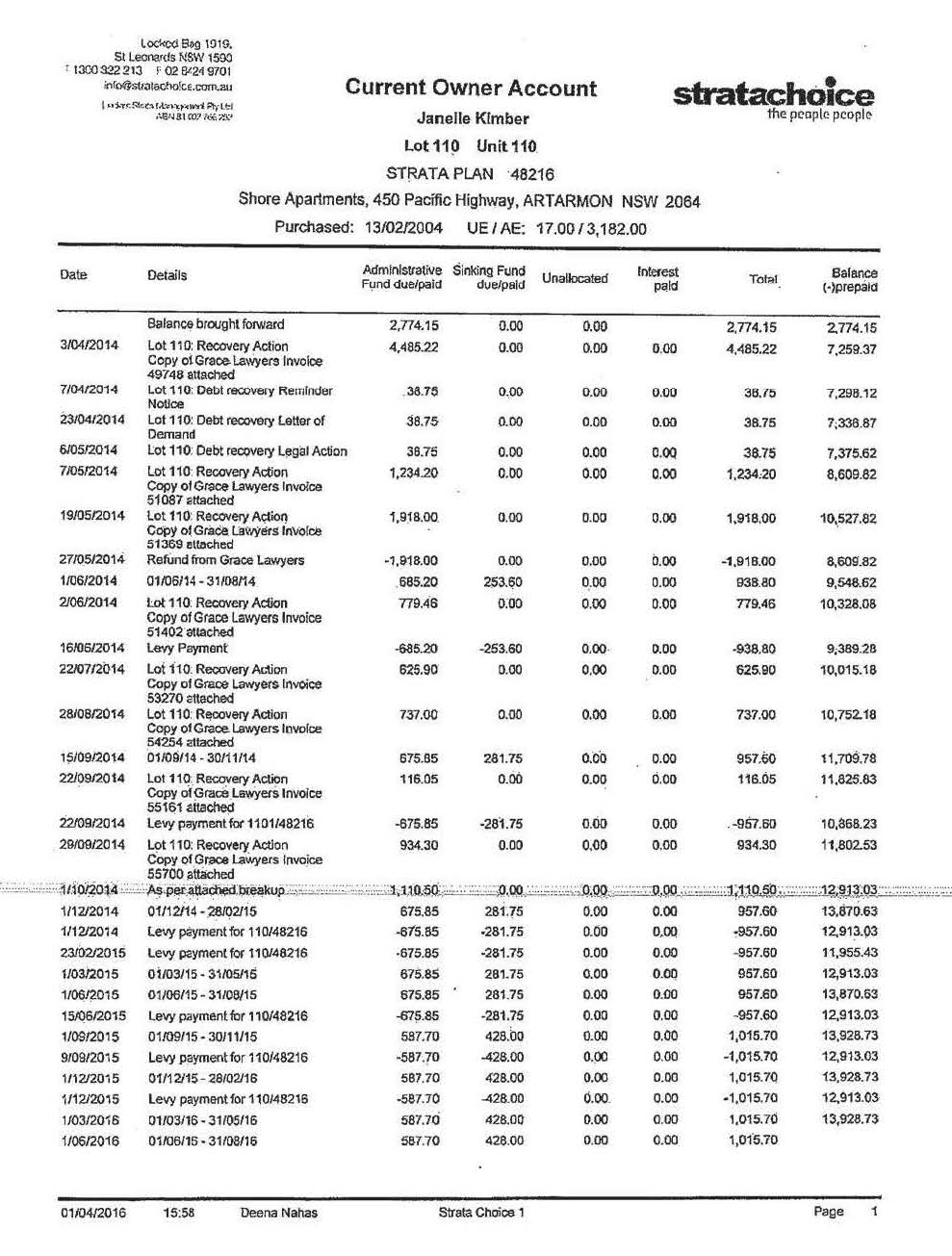
Attached to Mr Martin’s email was a current owner account for Lot 110 printed on 1 April 2016, covering the period from 3 April 2014 to 1 June 2016, which is reproduced at Schedule B.
67 That account, in contrast to the February 2016 Ledger, shows that the amounts charged to Ms Kimber’s account for “Lot 110: Recovery Action” by reference to Grace Lawyers’ invoices on 3 April 2014 and 7 May 2014 and “Lot 110 Debt recovery Letter of Demand” on 23 April 2014 remained outstanding and that amounts received after 3 April 2014 were applied to quarterly levies.
68 On 1 April 2016 at 9.57 pm Ms Kimber sent an email to Mr Martin, among others, in which she wrote:
Dear Mr Martin,
Thank you for sending my current Owner's Statement.
I have question the column displaying '00' allocation of levies, '00' set against all levies banked does not seem right and I would rather have all the details not just patial on the one pag. I have always found your accounts confusing. At at this crucial moment I seek crytal claer clarity. SO please also SEND THE LEDGER TOO ...asap? Much appreciated.
Also, I really would like to view the account/ledger dating from the ‘00' zero balance evident in early 2014, just before Grace Lawyers were engaged and their costs were put on to Lot 110 during the 2013-2014 small claims case, unnecessarily and unlawfully instituted by Jim McDonald's 'SOLO+ONE(?)' instructions to Grace Lawyers, Daniel Radman in 2013.
Scott,
I spent my time too this afternoon talking to you, having not received any replies to my recent correspondence to the Secretary and to the email/connection with the committee of the owners Corporation SP48216.. Initiative? Thanks to Grace Lawyers 'mistake' as I was not ever meant to know? What a nonensical approach. Even memebers of parliament can be emailed.
I have made every attempt possible to obtain decent human being reponses from this 'committee of management' and its agents. The services of your agency and your 'position of power' to intervene to provide guidance to your employees 'in error' would be decent and what any 'client' of yours should expect It wa my time to hear some facts. I was open and transparent. You were given a 'heads up' on this legal matter because quite honestly, you seemed to be inappropriately informed again, either underinformed or misinformed. Forgive me but…. I found you to be quite robotic not applying specific variables to my particular circumstances. At time I felt you were patronising and actually distubingly inappropriately ‘glib’.
My concerns?:
1. I appealed that you have the power to influence other instead of being 'detached' allowing, along with others, for unnecessary costs to be spent on this latest proceeding against me.
2. I appealed that just as the decision to engage solicitors for 'the people's court in NCAT was 'avoidant’, if this proceeding continues it would be reckless spending.
3. You were informed that in REALITY Jim McDonald is functioning as the Secretary of SP 48216 or apparently NOT passing on correspondence in a timely manner or responding or ensuring correspondence receives a response on behalf of the committee for the QC.
Requests LISTED again?:
1. For the Owners Statement/Owners Ledger (LEDGER TOO PLEASE?)
2· As Jim McDonald’s employer, I appealed to you to inform your manager to advise the committee about the IRREGULARITIES of the bankruptcy Notice that I shared with you.
3. You were politely requested to advise your manager to advise the committee to withdraw the bankruptcy notice immediately to save on EXTRA costs and a court process.
4. I added that I saw you as taking a position of condoning the exploitation of legal processes if a process was 'unnecessary' to produce more costs for the owners/solicitors/me.
5. Please have Mr McDonald (Secretary) acknowledge my correspondence of 17 March, 2016 and encourage others to respond to the appeal for peace and settlement conditions.
6. Please confirm the minutes that point to where it states clearly that the Owners Corporation committee AND the manager made the decision together on the issue of issuing and serving another bankruptcy notice on 17 Marc, 2016. Meeting dates, place and time please?
Please note the laws.
(emphasis added)
69 That Ms Kimber asserted that the Bankruptcy Notice was overstated and that she wished to review the ledger for Lot 110 is hardly surprising. The February Levy Notice showed arrears of $5,861.80 and outstanding owner invoices of $7,051.23, each of which is considerably less than the amount claimed in the Bankruptcy Notice. The combined amount does not equate to the amount of the Local Court Judgment. Ms Kimber had been making payments for quarterly levies. Thus she did not understand how the February Levy Notice could show an arrears amount. She inferred, it seems correctly, that those payments had been allocated to recovery expenses.
70 The account subsequently provided by Mr Martin on 1 April 2016 showed a completely different state of affairs which, on its face, is irreconcilable with the February Levy Notice and, indeed, the Local Court Judgment for $10,767, although it showed that Grace Lawyers’ fees remained unpaid.
71 On 4 April 2016 Mr Martin, in replying to Ms Kimber’s email set out at [68] above, wrote:
Dear Janelle
Thank you for your email.
Please note that we act as an agent to the owners corporation and as such act upon the directions of the elected committee.
We as a company have endeavoured to address, meet with you over very many years to address your very many and evolving concerns and have encouraged the Varying EC to consider their position in relation to your long standing matter.
The matter now is subject to legal terms and as such we would recommend that you make contact with the owners corporation appointed solicitors - Grace Lawyers to discuss any special terms you may wish to mediate.
The documentation requested are available by completing a search.
6. SHOULD THE BANKRUPTCY NOTICE BE SET ASIDE?
72 The Amended IA lacks clarity as to the exact grounds upon which Ms Kimber relies to set aside the Bankruptcy Notice. But it became clear from Ms Kimber’s oral submissions that she raises the following grounds as bases upon which she says the Bankruptcy Notice ought to be set aside: first, she relies on s 41(5) of the Act and alleges that the Bankruptcy Notice misstates the amount due; secondly, she alleges that the Court should go behind the Local Court Judgment; thirdly, she alleges that she has a counter-claim, set-off or cross demand that is equal to or exceeds the Local Court Judgment; and fourthly, she alleges that the service of the Bankruptcy Notice constitutes an abuse of process.
73 I will address each of these grounds in turn but before doing so it is useful to set out the relevant provisions of the Act.
74 Section 40(1)(g) of the Act provides that a debtor commits an act of bankruptcy:
if a creditor who has obtained against the debtor a final judgment or final order, being a judgment or order the execution of which has not been stayed, has served on the debtor in Australia or, by leave of the Court, elsewhere, a bankruptcy notice under this Act and the debtor does not:
(i) where the notice was served in Australia—within the time specified in the notice; or
(ii) where the notice was served elsewhere—within the time fixed for the purpose by the order giving leave to effect the service;
comply with the requirements of the notice or satisfy the Court that he or she has a counter‑claim, set‑off or cross demand equal to or exceeding the amount of the judgment debt or sum payable under the final order, as the case may be, being a counter‑claim, set‑off or cross demand that he or she could not have set up in the action or proceeding in which the judgment or order was obtained…
75 An Official Receiver may issue a bankruptcy notice on the application of a creditor who has obtained a final judgment or order of the kind described in s 40(1)(g) that is for an amount of at least $5,000: s 41(1)(a) of the Act.
76 Section 41(5) of the Act provides that:
A bankruptcy notice is not invalidated by reason only that the sum specified in the notice as the amount due to the creditor exceeds the amount in fact due, unless the debtor, within the time allowed for payment, gives notice to the creditor that he or she disputes the validity of the notice on the ground of the misstatement.
77 Section 41(6A) concerns extensions of time to comply with a bankruptcy notice. It provides:
Where, before the expiration of the time fixed for compliance with the requirements of a bankruptcy notice:
(a) proceedings to set aside a judgment or order in respect of which the bankruptcy notice was issued have been instituted by the debtor; or
(b) an application has been made to the Court to set aside the bankruptcy notice;
the Court may, subject to subsection (6C), extend the time for compliance with the bankruptcy notice.
78 Section 41(7) of the Act provides that:
Where, before the expiration of the time fixed for compliance with the requirements of a bankruptcy notice, the debtor has applied to the Court for an order setting aside the bankruptcy notice on the ground that the debtor has such a counter-claim, set-off or cross demand as referred to in paragraph 40(1)(g), and the Court has not, before the expiration of that time, determined whether it is satisfied that the debtor has such a counter-claim, set-off or cross demand, that time shall be deemed to have been extended, immediately before its expiration, until and including the day on which the Court determines whether it is so satisfied.
6.2 Does the Bankruptcy Notice contain a misstatement?
79 As noted at [65] above, the Owners Corporation accepts that, as a result of the exchanges between Ms Kimber and Mr Martin on 1 April 2016, Ms Kimber notified it within the time permitted by s 41(5) of the Act that she disputed the validity of the Bankruptcy Notice on the grounds that the sum claimed in it exceeded the amount in fact due to the Owners Corporation.
80 In a document headed “Evidence Summarised” served with her written submissions, Ms Kimber addresses the issue of whether the Bankruptcy Notice was overstated at the time it was issued. Ms Kimber submitted that the “fluidity of figures” was a result of the strata manager’s practice of banking and cancelling levy payments between the “levy account” and “owner’s account” and then choosing to refund the levy and reversing the payments at any time that it suited a purpose. She further submitted that an overstated bankruptcy notice can be corrected for mistakes pursuant to s 306 of the Act “as an act done by him or her in good faith” but that the ledger was changed in bad faith.
81 Ms Kimber submitted that the account for her lot appeared to have been manipulated, placing her into arrears and ensuring that “claims for legal costs were being made ‘together with’ the collection of [levy] arrears as is … [required by] law”. She contended that having “false arrears created an unfinancial status” and removed her right to vote for four years. She argued that the “imposed arrears achieved the objectives of the strata manager” and a “reversal of levies used to pay Grace Lawyers invoices suited the objective of correcting a bankruptcy notice overstated by the exact amount”.
82 Ms Kimber also submitted that levies had been “banked and cancelled in 2014 and 2015” and that “[o]n 10 March 2016 the mass cancellation effectively ‘paid back’ all standard levies used to pay the legal invoices and it is … no coincidence that the reversal of levy … payments on this date, preceded the service of the overstated, bankruptcy notice in the anticipation that an application was probable before the court” by her. Ms Kimber contended that the Bankruptcy Notice was overstated and that reversing the payments allocated to the invoices forming the notice was not done in good faith but “to give the impression of a valid bankruptcy notice at the time”.
83 In oral submissions Ms Kimber submitted that she was aware that her payments had been applied to invoices that made up the Bankruptcy Notice and not to her levies and that Strata Choice had not taken into account the amount paid out of her levies towards the solicitor’s costs. Ms Kimber submitted that she told Strata Choice that that was “quite irregular”. In effect Ms Kimber contended that, as at 19 February 2016, the day the Bankruptcy Notice was issued claiming $10,767 plus interest, the ledger for her lot would have shown that $5,861.80 had been paid towards solicitor’s costs (and not towards payment of quarterly levies). Thus, the Bankruptcy Notice was incorrect because it should have been issued for an amount that reflected that fact. It was overstated because it claimed the whole of the Local Court Judgment without accounting for the way monies had already been applied.
84 A bankruptcy notice can be invalidated if the sum specified in it, as the amount due to the creditor, exceeds the amount to which the creditor is entitled, provided notice is given in accordance with the terms of s 41(5) of the Act that validity of the notice is disputed on that ground. The amount which must be correctly stated is the amount of the judgment debt owing at the date of issue of the bankruptcy notice: see Walsh v Deputy Commissioner of Taxation (1984) 156 CLR 337 at 340.
85 The Bankruptcy Notice was issued on 19 February 2016. The issue for the Court is whether there was, having regard to the February 2016 Ledger and the subsequent reversal transactions which took place, an overstatement of the amount claimed in the Bankruptcy Notice. That necessarily requires consideration of the effect of any instructions given by Ms Kimber about the way in which her payments were to be applied and whether those instructions prevailed, notwithstanding that Strata Choice did not in the first instance apply monies received according to them.
86 The principles governing the appropriation of payments to particular debts were considered in APX Projects Pty Limited v The Owners – Strata Plan No. 64025 (2015) 108 ACSR 515; [2015] NSWSC 1250. In that case the plaintiff, an owner of lots in a strata scheme administered under the Strata Schemes Act, sought to bring an action to recover loss, on behalf of the scheme’s owners corporation, against the treasurer of that owners corporation. Slattery J identified two factual complaints that underpinned the plaintiff’s action, both of which related to the strata scheme executive committee’s administration of the sinking fund. At [5] his Honour identified the first of those complaints: namely, that when certain litigation brought by the owners corporation settled, the treasurer breached his duties under the Strata Schemes Act by failing to pay the settlement sum which the plaintiff alleged amounted to sinking fund monies into the owners corporation’s sinking fund bank account. In considering that issue, at [30]-[33] Slattery J succinctly summarised the principles for ascertaining to which debt a payment will be appropriated:
30. The principles for ascertaining to which debt a payment will be appropriated work in the following stages. First, a debtor has the right, in the first instance, to declare in respect of which debt he pays money. However as noted by the authors in E Tyler, P Young and C Croft, Fisher & Lightwood’s Law of Mortgage, 3rd ed, LexisNexis, 2013, at 32.52, the debtor’s direction must be in clear terms. For example, entries made by the debtor in his or her own books are not sufficient evidence of a particular appropriation of money paid on a general account.
31. Equally, it is possible that in circumstances where a debtor fails expressly to communicate to the creditor the appropriation of a debt, the circumstances of payment may be such that the proper appropriation of the debt is implied. This may be the case, for example, where two debts of different amounts are owing and the amount paid equates to one of them.
32. Second, where the debtor does not appropriate his or her payment to a particular debt, the creditor enjoys the right of choosing the debt to which the payment is appropriated. As Lord McNaughten in Cory Brothers & Company v Owners of Turkish Steamship “Mecca” [1897] AC 286 at 293:
When a debtor is making a payment to his creditor he may appropriate the money as he pleases, and the creditor must apply it accordingly. If the debtor does not make any appropriation at the time when he makes the payment the right of application devolves on the creditor.
33. Third, where neither the debtor nor the creditor acts upon their successive entitlements to choose how the debt will be appropriated, the default position is that the payment will be applied to the oldest debts first. In Re Walsh; Ex parte Deputy Commissioner of Taxation (1982) 42 ALR 727; 13 ATR 40, Lockhart J explained the application of these three rules governing the appropriation of payments in the following way:
A debtor who owes two debts to a creditor is entitled to appropriate a payment which he makes to his creditor to one debt rather than to the other. If he omits to do so, the creditor may make the appropriation. If neither makes any appropriation, the law appropriates the payment to the earlier debt. If there is specific appropriation by the debtor cadit quaestio. In the absence of a specific appropriation it is a question of fact whether there was any appropriation by the debtor. To constitute an appropriation there must be more than an intention to appropriate by the debtor. I respectfully adopt the following passage from the judgment of Greene LJ in I [1936] 2 KB 156 at 162–3:
“When, however, he does not notify the creditor of his intention, and when the circumstances are such that the creditor receives the payment merely in satisfaction of the debts and the payment is not more appropriate to the payment of the one debt than to that of the other the creditor is entitled to make the appropriation. When it is said that there need not be an express appropriation of a payment, but that the appropriation can be inferred, that does not mean that appropriation of a payment can be inferred from some undisclosed intention in the mind of the debtor. It is to be inferred from the circumstances of the case as known to both parties. Any other view might lead to injustice, as the creditor’s right to appropriate a payment would be defeated. When the matter is examined upon principle it will be found that an undisclosed intention in the mind of the debtor is not sufficient to support an appropriation. If authority is needed for that proposition it can be found in the judgment of Lush J in Parker v Guinness (1910) 27 TLR 129 at 130 where he said: ‘What is to be considered is this. Is the true inference to be drawn from all the circumstances of the case that the debtor paid the moneys generally on account, leaving the creditor to apply them as he thought fit, or is the true inference that he paid them on account of special portions of the debt for the purpose and with a view to wipe these out of the account? His undisclosed intention so to do would, of course, not benefit him. It is what he did in fact, and not what he meant to do that is to be regarded.’ A debtor’s undisclosed intention to appropriate a payment to one of two debts owed by him to a creditor cannot benefit him.”
(citations omitted)
87 In this case the facts clearly establish that:
(1) in 2014, following the entry of the Local Court Judgment, Ms Kimber instructed Strata Choice to apply her payments to her outstanding levies. For example:
(a) in a handwritten letter addressed to Strata Choice dated 16 June 2014, Ms Kimber wrote:
Please apply the enclosed strata levy amount of $938.80 to the Administrative and Sinking funds only [1.6.14-31.8.14].
As my previous levy was paid to Grace Lawyers for fees that are under question and part of a court matter yet to be resolved, I request you refund those monies and apply them also to the Owners Corporation funds.
…
(b) Ms Kimber acknowledged in cross examination that she had provided instruction in 2014 that her payments were to be paid to outstanding levies only; and
(c) Ms Kimber’s instructions given in 2014 were reinforced in her email dated 20 January 2016 (see [56] above); and
(2) even if those express instructions had not been given, the circumstances of the payments were such that the appropriation of the payments to quarterly levies can be implied. Each payment made by Ms Kimber since the date of the Local Court Judgment equated to an amount due for quarterly levies for each successive quarter up to the end of 2015. The February 2016 Ledger shows the following:
Due Date | Total quarterly levy payable | Receipt date | Total paid |
15.09.2014 | $957.60 | 22.09.14 | $957.60 |
01.12.14 | $957.60 | 01.12.14 | $957.60 |
01.03.15 | $957.60 | 23.02.15 | $957.60 |
01.06.15 | $957.60 | 15.06.15 | $957.60 |
01.09.15 | $1,015.70 | 09.09.15 | $1,015.70 |
01.12.15 | $1,015.70 | 01.12.15 | $1,015.70 |
88 Given those facts, the payments made by Ms Kimber should have been appropriated to satisfy the levy payments which, according to the February 2016 Ledger, were due on 15 September 2014, 1 December 2014, 1 March 2015, 1 June 2015, 1 September 2015 and 1 December 2015 and not allocated to Grace Lawyer’s invoices appearing on the February 2016 Ledger. Strata Choice’s appropriation of the payments in that way was not valid. It was not in accordance with Ms Kimber’s instructions.
89 Put another way, the Bankruptcy Notice claiming as it did the Local Court Judgment plus interest on that amount was not overstated. The error was in the books of the Owners Corporation which had not appropriated payments as directed by Ms Kimber. No payment should have been allowed in reduction of that amount which remained outstanding. Ms Kimber’s evidence, consistent with the earlier directions she had given, was that she had not made any payment to reduce the amount owing for the Local Court Judgment. The error was identified and acted upon on 18 February 2016 by Mr McDonald of Strata Choice prior to instructing the Owners Corporation’s lawyers to issue the Bankruptcy Notice on 19 February 2016. The fact that the ledger for Ms Kimber’s lot was not rectified to reflect Ms Kimber’s instructions until after the Bankruptcy Notice was issued does not affect the conclusion I have reached that the Bankruptcy Notice was not misstated.
6.3 Should the Court go behind the Local Court Judgment?
90 Ms Kimber claimed that the Court should go behind the Local Court Judgment and set aside the overstated Bankruptcy Notice because, in effect, the judgment debt was based on a false representation of overdue levies of which the Owners Corporation was aware and, as such, the Owners Corporation was not legally entitled to make the claim that led to the Local Court Judgment.
91 Ms Kimber submitted that at the time she applied to have the Default Judgment set aside, she had no outstanding levies owing. She relied on a levy notice from Strata Choice for the period 1 September 2013 to 30 November 2013 for an amount of $938.80 which recorded “nil” against the items: “arrears”, “interest on arrears”, “outstanding owner invoices” and “less prepaid”. Recorded in handwriting on that notice was “all paid 17/9/13”. The same was the case for the levy notices issued on 30 October 2013 and 29 January 2014 for the periods 1 December 2013 to 28 February 2014 and 1 March 2014 to 31 May 2014 respectively. She further submitted, based on a letter dated 9 January 2009 from Grace Lawyers to the Owners Corporation included in her May Affidavit, that it followed that at the time the Default Judgment was set aside (i.e. 10 October 2013) the Owners Corporation was not entitled to file an amended claim because there were no levies outstanding.
92 In particular, Ms Kimber relies on the following part of that letter:
Section 80
How does an owners corporation recover unpaid contributions and interest?
(1) An owners corporation may recover as a debt a contribution not paid at the end of one month after it becomes due and payable, together with any interest payable and the expenses of the owners corporation incurred in recovering those amounts.
(2) Interest paid or recovered forms part of the fund to which the relevant contribution belongs.
It is our view that Section 80 of the Act allows for all of the Owners’ legal costs incurred in recovering unpaid levies to be recoverable against [Ms Kimber] should the Owners be successful in their claim. We believe that this view is supported by the Supreme Court decision in the matter of Coshott v The Owners of Strata Plan No 48892 [2006] NSWSC 308. However, we also note the Supreme Court decision of Owners of Strata Plan 63800 v Wolfe & Ors [2007] NSWSC 204 (16 March 2007) in which the Supreme Court upheld a decision of the Local Court not to grant to the Owners Corporation their costs pursuant to Section 80 of the Act. The highlighting feature of the Wolfe case to that of the Coshott case appears to be the proposition that where an order is made for Section 80 expenses only, then such a claim may fail and that any claim, in order to succeed in as much as it seeks to recover expenses pursuant to Section 80 of the Act, should also be made together with a claim for unpaid levy contributions. It is our view that any Section 80 claim in those proceedings will be successful on the basis that it has been made together with a claim for unpaid interest and contributions.
93 Ms Kimber submitted that based on the evidence at [31] above, Strata Choice and Grace Lawyers should have known her address and should have been able to notify her of the Local Court Proceeding, of which she says she was not aware in 2009. She submitted that the fact she paid an amount for levies on 24 January 2009 of $1,804.74, as evidenced by an extract of her bank statement for January 2009 included in the May Affidavit, demonstrated that she had been in contact by telephone with somebody who had informed her of the amount due. She submitted that she made that payment believing that was the levy due without knowledge that the proceeding had been commenced against her and without being aware that additional solicitor fees had been added to her levies. She further submitted that by 24 April 2009, that is, within one month of the filing of the statement of claim of which she was unaware, she had paid everything owing except $154. She contended that, having been told on 19 March 2009 (see [29] above) that if she did not make full payment within 28 days then Grace Lawyers would seek instructions to enter judgment, she subsequently paid $1,000 to address any remaining levy arrears within this timeframe. Notwithstanding that, judgment was entered against her for the balance owing of $154 plus interest and costs. She said that she felt she had met the lawyers’ instructions and that at the time, as she was not aware of additional solicitors’ fees being accrued for a statement of claim that had not been served, she did not know why she still owed $154.
94 Olivieri v Stafford (1989) 24 FCR 413 was a case in which the appellant claimed that the bankruptcy notice served on him was overstated. He provided notice in accordance with s 41(5) of the Act. One of the issues raised was whether the Court should go behind the judgment on which the bankruptcy notice was based on the application to set aside the bankruptcy notice. The respondents contended that it could not do so. A majority of a Full Court of this Court (Beaumont and Gummow JJ, Sweeney ACJ dissenting) dismissed the appeal.
95 Only Gummow J considered the question of whether the Court should go behind the judgment. After referring to Corney v Brien (1951) 84 CLR 343 (Corney) and noting that it was on the basis provided by s 52(2) of the Act (concerning creditors’ petitions) that the majority of the High Court in Wren v Mahony (1972) 126 CLR 212 (Wren) held that this Court “was bound to consider for itself whether what was alleged in the petition could and did establish a debt due to the petitioning creditor”, Gummow J said at 427:
What the appellant sought to have the Court do in the present case was to “look behind” the District Court judgment debt at an earlier stage, namely to impugn a bankruptcy notice based on that judgment debt. This was sought in circumstances where under the provisions of the Act the time for compliance with the bankruptcy notice had been extended to permit an approach to be made to the District Court to set aside (or more appropriately on the facts of this case, to vary) the judgment in question, that application was made and was unsuccessful, and yet a further extension of time for compliance with the bankruptcy notice was in force.
96 At 429-430 his Honour said:
In Corney v Brien … Fullagar J said that an inquiry as to what lies behind a judgment might be undertaken either on the petition or after sequestration when the judgment creditor sought to prove. His Honour did not say that the inquiry might be made upon an application to set aside a bankruptcy notice based on the judgment. An early example of such an application to the court of bankruptcy is Re Murray; Ex parte Mercantile Bank (1980) 6 WN (NSW) 104, a decision upon the Bankruptcy Act 1887 (NSW). The decisions to which I have referred above carry over that procedure to the Bankruptcy Act 1924 (Cth) and to the present Act.
The procedure evinced by those authorities is in my view too deeply entrenched to be displaced at this stage; I would not construe the 1980 amendments to s 41 of the Act as meaning that the sole means by which a judgment may be looked behind upon a motion to set aside a bankruptcy notice is by extending the time for compliance with the bankruptcy notice so as to permit sufficient time for an application to the relevant court to set aside or vary the judgment in question. …
What is crucial to the present appeal is an understanding of the basis of the jurisdiction of this Court to set aside bankruptcy notices. In my view, the Court permits the debtor to go behind the judgment so as to have the bankruptcy notice set aside, on the footing that the Act is not given effect to or not carried out if a bankruptcy notice has been issued for a debt which is liable to be set aside or varied such that the creditor does not have a debt upon which bankruptcy proceedings can be founded. I refer later in these reasons to authority for that proposition. …
97 Those comments by Gummow J suggest that in an appropriate case the Court can go behind a judgment on which a bankruptcy notice is based so as to consider whether it should be set aside. The Owners Corporation did not suggest to the contrary and I accept that course is open on this application. The question is, as articulated by Gummow J, whether a bankruptcy notice has been issued for a debt that is liable to be set aside or varied so that the creditor would not have a debt on which bankruptcy proceedings can be founded.
98 I turn then to consider the circumstances in which a Court can go behind a judgment. They were recently considered by the High Court in Ramsay Health Care Australia Pty Ltd v Compton (2017) 345 ALR 534; [2017] HCA 28 (Ramsay). Ramsay Health Care Australia Pty Ltd (Ramsay) had obtained judgment against the respondent, Mr Compton. It then had a bankruptcy notice issued and served on Mr Compton who did not comply with it. Ramsay presented a creditor’s petition. Mr Compton filed a notice of grounds of opposition contending that no debt was owing and that the Court should go behind the judgment upon which the creditor’s petition was based.
99 The plurality of the High Court (Kiefel CJ, Keane and Nettle JJ) commenced their analysis by referring to the decision of the High Court in Corney. Their Honours said at [39] that:
… The plurality in Corney did not hold that a Bankruptcy Court must treat a judgment as satisfactory proof of the petitioning creditor’s debt save in cases of fraud, collusion or miscarriage of justice. Rather, the plurality held that a Bankruptcy Court has “undoubted jurisdiction” to go behind a judgment in those circumstances. To say that the court may do a thing in certain circumstances is not to say it may do that thing only in those circumstances.
(footnotes omitted)
100 Their Honours then considered the decision in Wren at [42]-[44] noting that:
42. In Wren, Barwick CJ, with whom Windeyer and Owen JJ agreed, said:
“The judgment is never conclusive in bankruptcy. It does not always represent itself as the relevant debt of the petitioning creditor, even though under the general law, the prior existing debt has merged in a judgment. But the Bankruptcy Court may accept the judgment as satisfactory proof of the petitioning creditor’s debt. In that sense that court has a discretion. It may or may not so accept the judgment. But it has been made quite clear by the decisions of the past that where reason is shown for questioning whether behind the judgment or as it is said, as the consideration for it, there was in truth and reality a debt due to the petitioning creditor, the Court of Bankruptcy can no longer accept the judgment as such satisfactory proof. It must then exercise its power, or if you will, its discretion to look at what is behind the judgment: to what is its consideration.”
43. There are good reasons why this statement should not be given the artificially narrow application urged on behalf of Ramsay. First, it is not correct to say that Wren involved a default judgment. In truth, it involved a default that resulted from the defendant’s failure to plead a good defence, having chosen to defend the claim on a point of law that was resolved against him. The primary judge in bankruptcy declined to reconsider the resolution of the point of law; and the High Court held that the primary judge erred in failing to reconsider the point, which the High Court went on to uphold.
44. Secondly, Wren held that a Bankruptcy Court may go behind a judgment, notwithstanding that the judgment was obtained after a contested hearing. That can be seen by reference to the reasons of the dissentients, reasons that were necessarily rejected by the majority.
(footnotes omitted)
101 At [48]-[49] their Honours said:
48. Wren has long been accepted as standing against the proposition advanced by Ramsay. Thus, in Simon v O’Gorman Pty Ltd, Lockhart J, with whom Fisher J agreed, said:
“The circumstances in which the court will inquire into the validity of a judgment debt are not closed; but it is clear that the court will not inquire as a matter of course into that question.
Circumstances tending to show fraud, collusion or miscarriage of justice or that a compromise was not a fair and reasonable one are the most frequent examples of the exercise by the court of this jurisdiction.
The courts are reluctant to exercise this jurisdiction where the judgment was entered after a full investigation of the issues at a trial where both parties appeared and had ample opportunity to put their case to the court.”
49. To the same effect are statements by Davies, Lockhart and Neaves JJ in Ahern v Deputy Commissioner of Taxation (Qld), and Sackville, North and Hely JJ in Wenkart v Abignano. As Lockhart J explained in Simon, “fraud, collusion or miscarriage of justice” are the most frequent examples of the exercise of a Bankruptcy Court’s jurisdiction to go behind a judgment; but the overarching obligation imposed by s 52(1) of the Act requires a Bankruptcy Court to be satisfied that there is, in truth and reality, a debt.
(footnotes omitted)
102 At [68] the plurality noted that, “[f]or the purposes of s 52 of the Act, a judgment may usually be taken to be sufficient evidence of a debt … [because] a judgment against a debtor in favour of a creditor obtained after trial is, generally speaking, a reliable indication of the true state of indebtedness” between those parties. Their Honours acknowledged that “the testing of the relevant merits of a claim and counterclaim under the rigours of adversarial litigation will usually establish the true state of accounts as between the parties to the proceeding” and that, in those circumstances, “a Bankruptcy Court will usually have no occasion to investigate whether the judgment debt is a true reflection of the real debt”. However, their Honours also noted that where the merits of the claim or counter-claim had not been tested in adversarial litigation, a judgment debt would not have that practical guarantee of reliability. Their Honours then said at [69]-[70]:
69. In Petrie, Latham CJ, with whom Rich and McTiernan JJ agreed, said that the Bankruptcy Court:
“is entitled to go behind the judgment and inquire into the validity of the debt where there has been fraud, collusion or miscarriage of justice … Also the court looks with suspicion on consent judgments and default judgments … The Bankruptcy Court does not examine every judgment debt. Special circumstances must be established before it will do so. It is impossible to lay down any general rule.”
70. The first two sentences of that passage were cited with evident approval by Dixon, Williams, Webb and Kitto JJ in Corney. The passage was explicitly concerned with consent judgments and default judgments. As a matter of practical experience, these are the sorts of cases in which third parties can be expected to be disadvantaged by the making of a sequestration order based on a judgment which was not the outcome of the rigorous processes of adversarial litigation. The same concern may also arise in a case where the judgment was obtained in circumstances which suggest a failure on the part of the judgment debtor to present his or her case on its merits in the litigation that led to the judgment.
(footnotes omitted)
103 I turn then to consider whether, in this case, there is sufficient reason to question whether there is a real debt behind the Local Court Judgment and, if there is to then determine that issue.
104 Ms Kimber did not appeal the Local Court Judgment. There is evidence that Ms Kimber prepared a notice of intention to appeal for filing in the District Court but she accepted that it was never filed and she never pursued an appeal. The Local Court Judgment was obtained after a contested hearing. It is evident from the material relied on before me that the parties were given an opportunity to provide evidence and to make submissions to that court. The Local Court Judgment was not obtained by default or in the absence of Ms Kimber nor could it be said that there was any fraud or collusion which resulted in the obtaining of that judgment, being the most frequent, but not the only circumstance in which the Court will go behind a judgment: Ramsay at [48]-[49].
105 Ms Kimber is not satisfied with the outcome of the contested hearing. Her submissions suggest that the result was wrong in law but she did not appeal the Local Court Judgment, which she was entitled to do. Ms Kimber complains that she was not aware of the Local Court Proceeding. That may have been so at the time of its commencement but the evidence shows that by 19 March 2009 she was aware of the proceeding and was on notice that, if she did not pay the full amount due, judgment would be entered against her. The Default Judgment was then entered because Ms Kimber failed to pay the full amount due, albeit only by a small amount. The Default Judgment was successfully set aside by Ms Kimber some four years later and, after several interlocutory steps and a contested hearing, the Local Court Judgment was entered.
106 Ms Kimber was not legally represented in the Local Court Proceeding and in particular at the hearing which resulted in the Local Court Judgment. The evidence discloses that she has had no legal representation in any of the proceedings referred to above, either before the Local Court, NCAT, the Supreme Court or in this Court. I accept that self-represented litigants face challenges in presenting their case to the court but that fact in and of itself does not mean that Ms Kimber was not able to argue her case on the merits before the Local Court. Ms Kimber has not provided any evidence to suggest otherwise nor has she satisfied me that there was any other reason for the Court to go behind the Local Court Judgment, for example, by establishing that there was any arguable error in that judgment. There are no special circumstances evident here. Taking account of all the circumstances, I am not satisfied that I should exercise my discretion to go behind the judgment.
6.4. Does Ms Kimber have a counter-claim, set-off or cross demand?
107 Ms Kimber submitted that she has a cross-claim that exceeds the amount of the Local Court Judgment. In the Amended IA Ms Kimber seeks an order that various parties, including employees of Strata Choice, solicitors in the employ of Grace Lawyers and members of the Owners Corporation’s committee of management, be joined to this proceeding.
108 The May Affidavit includes the following (as written):
I believe I have a claim against the applicant(s) and agents for cause harm and damage through intentional negligence and dishonesty set to deliberately mislead and deceive those significant others in the scheme of things, taking financial advantage’ of me using silence and intimidation, administration and legal processes for pure profit and ill-gain
109 The day after her application to set aside the Bankruptcy Notice was accepted for filing Ms Kimber filed a statement of claim described at [5] above. That document, which is also annexed to the May Affidavit, includes under the heading “What cause of action do I bring?” (as written):
1. I bring a claim for damages suffered as a result of the actions and inaction of body corporate officers and corporate agents employed by the body corporate who, in contribution, have intentionally taken advantage by abusing laws and processes.
2. It is the right of any owner in a strata scheme, to reasonably expect a standard of professionalism and respectable behaviour from body corporate officers and agents, there is a general apathy as well as lack of knowledge skill, caution, wisdom or care to ensure financial operations are ethically managed.
3. Various tendencies and well-worn techniques that can only be described as misleading, deceptive and damaging have added up, creating a body of material facts against corporate officers, managers and the solicitors refusing to act in just and fair ways. I am alleging that a 'condition of mind' of a managing agent and the agent's appointed solicitors have a controlling influence on the Committee of Management promoting a 'litigious mindset' which has seemingly always been the case, in my experience since I bought a studio at The Shore Apartments, Lane Cove Nth, NSW in 2004 .
4. CONTRIBUTION OF TORTS
Ambitious revenue raising activities has been a focus fot the manager and chairman with at least one other member to my knowledge, experiencing administrative and accounting structures that use 'errors' to invoke and encourage presumptious collection processes The court processes discovered by an investigative committee members to have been pursued without a true cause in my case and there has been no actualised acceptance of responsibility, and no accountability. The pursuit of falsely created 'debts' continues.
5. ‘IN CONCERT' PARTIES
The chairman and manager maintain a social relationship outside corporation duties and by his own admission the chairman lacks knowledge and skill to represent the committee in a position that defers to the manager. The committee's secretary is the chairman's own lawyer and it is this new officer's disregard for common decency and integrity that I believe has prompted this new bankruptcy notice and this legal path for intervention and relief. Corporation monies are being spent without genuine concern while laws, statutes and regulations concerning protocols, procedures and promises have not been kept. The above named corporate volunteers and paid workers have been abused their positions of power and influence.
110 The statement of claim then sets out, among other things, the relief sought by Ms Kimber under the headings “General damages”, “Aggravated damages” and “Exemplary damages” and refers to ss 129 and 228 of the Corporations Act 2001 (Cth), s 26 of the Australian Human Rights Commission Act 1986 (Cth) and ss 50 and 123 of the Anti-Discrimination Act 1977 (NSW).
111 Ms Kimber tendered a bundle of invoices which she said were evidence of the alleged damages she has suffered and that she would claim in her proceeding. They comprised tax invoices received from various lawyers, Auscript, the Local Court, the Mediation and Arbitration Centre and summaries prepared by Ms Kimber of total stationery and printing costs, solicitor’s fees and travel expenses.
112 In Coshott v Prentice, in the matter of Coshott (No 2) [2016] FCA 1531 (Coshott v Prentice) at [22]-[23] Bromwich J referred to the authorities which considered the meaning of the terms “counter-claim, set-off or cross demand for the purposes of ss 40(1)(g) and 41(7) of the Act as follows:
22 The meaning of the three terms in s 40(1)(g) and s 41(7) of the Bankruptcy Act “counter-claim, set-off or cross demand” was considered in the much cited case of Re Judd; Ex parte Pike (1924) 24 SR (NSW) 537 at 539-540…:
There is no authority of which I am aware deciding what limits (if any) ought to be placed on the words “counter-claim, set-off or cross-demand”. I think that the Legislature by the word “counter-claim” probably referred to those claims which might be the subject of a counter-claim in equity and by the word “set-off” to those claims which might be the subject of a set-off at common law. The other term “cross-demand”, however, is not a technical term and must in my opinion refer to claims other than those which would be comprised in the two expressions “counter-claim” and “set-off”.
Taking the ordinary meaning of the word itself, I can see no reason why “cross-demand” should not be held to include a claim for unliquidated damages for a tort. The case of Re Griffin; Ex parte Soutar (1 B.C. 29) shows that “cross-demand” includes a claim for unliquidated damages for breach of contract. In the case of Re Smyth; Ex parte North (3 B.C. 17) a common law action of Smyth v. North is referred to as constituting a cross-demand. I have sent for and perused the papers in this case and here again it appears that the cause of action was a claim for unliquidated damages for breach of contract. Two recent cases in England—In re G.E.B. ([1903] 2 K.B. 340) and In re A Debtor ([1914] 3 K.B. 726)—show that the cross-demand need not have any connection with the cause of action out of which the judgment debt arose—so much so, that a judgment debtor may even buy up a claim against the judgment creditor in order to have a “cross-demand”. These cases are all in favour of an unrestricted meaning being given to the word.
23. A key aspect of the phase “counter-claim, set-off or cross demand” is that the bankruptcy debt and the offsetting claim sought to be relied upon must be “mutual and due in the same right”. As was stated by the Full Court in Stec v Orfanos [1999] FCA 457 at [24]:
… Where a debtor seeks to set aside a bankruptcy notice on the ground that the debtor has a cross demand which equals or exceeds the amount of the judgment or order on which the bankruptcy notice is founded, the judgment on the one hand and the cross demand on the other must be mutual and due in the same right: Re Anderson; Ex parte Alexander (1927) 27 SR (NSW) 296; James v Abrahams (1981) 51 FLR 16 at 27. The requirement that the two claims be “in the same right” is directed to the capacities in which the claimants claim. Thus a claim by a judgment creditor personally cannot be answered by a claim against the creditor as a member of a partnership or as an executor or trustee. See Re Wedd; Ex parte Wedd (1961) 19 ABC 36; Re Molesworth (1907) 51 Sol J 653; Vogwell v Vogwell (1939) 11 ABC 83 at 89. But the requirement relevant to the present case is that the claims be mutual; that is that they be of the same kind or nature. Thus joint debts cannot be set off against several debts: Middleton v Pollock (1875) LR 20 Eq 515 at 518. …
(original emphasis)
113 A party relying on s 41(7) of the Act is required to provide sufficient proof of the alleged counter-claim, set-off or cross demand. As a procedural matter, r 3.02(3) of the Bankruptcy Rules relevantly provides:
If the application is based on the ground that the debtor has a counter‑claim, set‑off or cross demand referred to in paragraph 40(1)(g) of the Bankruptcy Act, the affidavit must also state:
(a) the full details of the counter‑claim, set‑off or cross demand; and
(b) the amount of the counter‑claim, set‑off or cross demand and the amount by which it exceeds the amount claimed in the bankruptcy notice; and
(c) why the counter‑claim, set‑off or cross demand was not raised in the proceedings that resulted in the judgments or orders to which the bankruptcy notice relates.
114 In Ebert v The Union Trustee Company of Australia Ltd (1960) 104 CLR 346 (Ebert) at 350 Dixon CJ, McTiernan and Windeyer JJ said that in order for a debtor to satisfy the Court that he or she has a counter-claim, set-off or cross demand which equals or exceeds the amount of a judgment debt he or she must satisfy the Court that “there exists in him [or her] a counter-claim, set-off or cross demand”. At 350 their Honours said:
Perhaps the standard may be expressed by saying that the debtor must show that he has a prima facie case, even if then and there he does not adduce the admissible evidence which would make out a prima facie case before a court trying the issues that are involved in his counter-claim, set-off or cross demand.
115 In Re Brink; ex parte Commercial Banking Co of Sydney Ltd (1980) 44 FLR 135; (1980) 30 ALR 433 at 439 Lockhart J said, after referring to Ebert, that while a debtor must show that he has a prima facie case, his Honour did “not understand Ebert’s case as deciding that this court must undertake a preliminary trial of the counter-claim set-off or cross-demand; rather this court must be satisfied that the debtor has a fair chance of success”. His Honour also said at 439:
Upon the hearing of a matter under sub-s 41(7) the court has before it the initial affidavit which brings the sub-section into play. There may, of course, be no other evidence. On the other hand there may be a great deal of evidence. This will depend upon the circumstances of each case. Plainly this court has power to permit the debtor to supplement his case by additional evidence. The initial affidavit filed under s 41(7) operates to extend time for compliance with the requirements of the bankruptcy notice until the court determines whether it is satisfied that the debtor has the requisite counter-claim, set-off or cross demand. Although the mere filing of the requisite affidavit brings the statutory extension automatically into play, the court thereafter controls the matter. The sub-section recognizes that the court may not be able to hear the matter immediately. It may not be convenient to do so or the case may be complex and require that directions be given to both parties to define the issues and as to the giving of evidence. The filing of the affidavit operates as a statutory injunction to preserve the status quo until the court determines the matter, ensuring that, in the meantime, there is no act of bankruptcy.
…
In my opinion the affidavit cannot merely contain an assertion that the debtor has a counter-claim, set-off, or cross demand which he could not have set up in the action in which the judgment or order was obtained. The affidavit must show a counter-claim, set-off or cross demand which equals or exceeds the amount of the judgment debt and which the debtor could not have set up in the action in which the judgment or order was obtained see Vogwell v Vogwell, supra, at 85…
116 Lockhart J acknowledged at 440 that the initial affidavit had to be filed within a limited time and that it was often difficult, if not impossible, for a debtor to present more than a mere outline of his or her case. His Honour did not think any good purpose would be served by attempting to express a definitive formula as to what the original affidavit should contain and that each case would depend on its particular facts and circumstances.
117 I turn then to consider the evidence before me and whether Ms Kimber has satisfied me that she has a counter-claim, set-off or cross demand of the nature required by s 40(1)(g).
118 Ms Kimber’s affidavit in support of her application to set aside the Bankruptcy Notice did not comply with r 3.02(3) of the Bankruptcy Rules. Putting to one side that the statement of claim was not annexed to the affidavit as a means of setting out “the full details” of her cross-claim, that affidavit did not set out the amount of the alleged claim nor did it explain why the claim was not raised in the Local Court. However, Ms Kimber has no legal representation and did provide some evidence of her alleged counter-claim, set-off or cross demand, both at about the time her application to set aside the Bankruptcy Notice was accepted for filing, by providing the statement of claim, and in the May Affidavit, which she has subsequently supplemented.
119 That said, in my opinion the evidence, when taken as a whole, amounts to no more than a bald assertion by Ms Kimber that she has an off-setting claim. The statement of claim, which names the Owners Corporation as well as a series of other parties as respondents, makes claims against those parties generally but does not plead any material facts on which it is said those claims are based. If not entirely incomprehensible, it is very difficult to understand. There is no evidence provided which would support the bare claims made.
120 I am also not satisfied that the claim, even if it amounted to more than a bald assertion, is a claim that equals or exceeds the amount of the Local Court Judgment. In the absence of a proper pleading or explanation of how she has suffered damage, Ms Kimber has not satisfied me of the damages that would flow and that any such damages are evidenced by the documents she tendered.
121 Even if I am wrong in that conclusion, the claim Ms Kimber now asserts is similar to the cross-claim she sought to agitate in the Local Court. That cross-claim, which named Strata Choice and Grace Lawyers (but not the Owners Corporation or individuals from those entities) as cross-defendants, claimed by way of relief judgment in the amount of the Local Court Judgment, “award of costs to attend to court matters – lawyers, lost work days, air travel/accom” and damages. While not identical to and as expansive as the claim now asserted it bears sufficient similarity to it. The Local Court refused leave to Ms Kimber to file her cross-claim. The evidence also shows that Ms Kimber commenced a proceeding in NCAT, which she subsequently withdrew, in which she made similar allegations to those now alleged.
122 I am not satisfied that the alleged counter-claim is one which Ms Kimber could not have set up in the Local Court Proceeding as required by s 40(1)(g) of the Act. Indeed she attempted to do so but was unsuccessful in obtaining leave to file the claim.
123 Ms Kimber submitted that the issue and service of the Bankruptcy Notice was an abuse of process.
124 The only evidence going to that issue was the cross examination of Mr McDonald where he conceded that there were other ways to collect debts, other than by way of issue of a bankruptcy notice, noting that they included payment agreements, writs of execution and several other processes and that the method Strata Choice adopts to collect debts is based on advice from its lawyers. Ms Kimber also relied on an aged arrears list for strata plan 48216 which showed that other lot owners were in arrears. She submitted one other lot owner was 120 days in arrears and that she did not believe any other lot owner had been the subject of proceedings as she put it “for probably just doing something like I am doing now, being bold enough to stand up for myself”.
125 The Court has an inherent jurisdiction to set aside a bankruptcy notice as an abuse of process. In Brunninghausen v Glavanics [1998] FCA 230 (Brunninghausn) Emmett J said at [15]:
I was referred to decisions of this Court of Re Sterling; Ex parte Esanda Pty Limited (1980) 44 FLR 125 and Re Lentini; Ex parte Lentini v CSR Limited (1991) 29 FCR 363 as to the inherent power of the Court to set aside a bankruptcy notice as an abuse of process. I did not understand counsel for the creditor to dispute the Court's jurisdiction to act in that way and I take it to be undisputed that if it is apparent that the purpose of the bankruptcy notice is to put pressure on a debtor to pay a debt rather than to invoke the Court's jurisdiction in relation to insolvency, then the filing of a bankruptcy notice is an abuse of process.
126 In that case, there was evidence before Emmett J that the debtor had offered the creditor security over an asset pending an appeal of the judgment which grounded the bankruptcy notice and that the debtor had more than sufficient assets to meet the judgment debt assuming the appeal was unsuccessful. His Honour found that, in light of the evidence, there was good reason for concluding that the bankruptcy notice would ultimately be ineffective in leading to the sequestration of the debtor’s estate and noted that, in light of the communications between the parties, there did not appear to be any “explanation as to why the creditor considered it appropriate to proceed by way of bankruptcy notice, other than the possibility of putting pressure on the debtor”. In light of that, his Honour concluded that he should set aside the bankruptcy notice.
127 In Killoran v Duncan [1999] FCA 1574 an allegation was made that the issue of a bankruptcy notice was an abuse of process. At [12] Gyles J said:
12. Whilst there is no debate about the jurisdiction of the Court to set aside a bankruptcy notice as an abuse of process where it can be concluded that it was simply to put pressure on the debtor rather than to genuinely invoke the Court's jurisdiction, I am not satisfied that that is the position here. There is nothing to indicate that the respondent creditor does not genuinely intend to pursue the matter if there is default in complying with the notice. In my opinion, there is nothing special about abuse of process in this field, and, if a person wishes to resort to the jurisdiction of the Court for appropriate orders, then it will be an unusual case in which that will be prevented.
13. There is no evidence here of any collateral purpose or of any undue pressure being applied. It is correct, I think, that the time to judge abuse of process is the time that the bankruptcy notice is issued and that subsequent events have relatively slight relevance. They may be relevant insofar as they throw light upon circumstances which might have been appreciated and foreseen at the time of the issue of the notice.
(original emphasis)
128 In HWY Rent Pty Ltd v HWY Rentals (in liq) (No 2) [2014] FCA 449 Perry J set aside a bankruptcy notice finding that its issue was part of a systematic abuse of process. At [74] her Honour said:
74 The categories of abuse of process are not closed. However, certain categories are well-established. As Justice McHugh observed in Rogers v R (1994) 181 CLR 251 at 286:
…abuses of procedure usually fall into one of three categories: (1) the court’s procedures are invoked for an illegitimate purpose; (2) the use of the court’s procedures is unjustifiably oppressive to one of the parties; or (3) the use of the court’s procedures would bring the administration of justice into disrepute. Many, perhaps the majority of, cases of abuse of procedure arise from the institution of proceedings. But any procedural step in the course of proceedings that have been properly instituted is capable of being an abuse of the court’s process. In Walton v. Gardiner, Mason CJ, Deane and Dawson JJ said that the jurisdiction to stay proceedings that are an abuse of process “extends to all those cases in which the processes and procedures of the court, which exist to administer justice with fairness and impartiality, may be converted into instruments of injustice or unfairness”.
129 Unlike the position in Brunninghausen. Ms Kimber has not sought to appeal the Local Court Judgment, and subject to the matters set out in [130] below, there is no evidence of her current financial status.
130 Insofar as Ms Kimber’s financial status is concerned, there is a letter in evidence dated 26 October 2016 from the Mullumbimby branch manager of the National Australia Bank in which the branch manager states that she has known Ms Kimber for three and a half years during which time Ms Kimber has been “consistent with her home loan repayments” and has been paying an additional amount of $100 per fortnight towards her loan. The writer also expresses the opinion that “after viewing [Ms Kimber’s] current state of affairs … it appears that [Ms Kimber] is more than capable of paying her debts as they fall due”. The evidence also establishes that, at least until 28 February 2016, Ms Kimber was paying her quarterly levies on Lot 110. But this evidence, on its own, is not sufficient to demonstrate Ms Kimber’s solvency. It does not demonstrate Ms Kimber’s current income and liabilities and her current capacity to pay her debts as and when they fall due. It is apparent that Ms Kimber is not willing to pay the Local Court Judgment. She objected to the fact that the strata manager and the solicitors had not owned their mistake about the correct amount owing and has consequently continued to defend her actions on principle.
131 It may well be that Ms Kimber is solvent but as I have observed in the preceding paragraph, there is on this application insufficient evidence before me to draw that conclusion. Further, while there are a number of unsettling aspects to this matter, including that it appears on the evidence that the only method of enforcement of the Local Court Judgment has been by way of service of the Bankruptcy Notice and that it appears that the Owners Corporation has continued to charge Ms Kimber’s account with recovery expenses, there is insufficient evidence for me to draw a conclusion that there is any collateral purpose or undue pressure being applied by the Owners Corporation through the issue of the Bankruptcy Notice or that the Court’s processes are being used for an illegitimate purpose.
132 Included in the May Affidavit were extracts from what appeared to be a notice of annual general meeting scheduled to take place on 20 August 2014, an extract from a document with a handwritten annotation “2015 AGM Notice (25 June 2015) Agenda”, and two extracts of minutes from annual general meetings of the Owners Corporation, one of which was undated and the second of which appeared to be for the meeting which took place on 2 July 2015 (2015 AGM).
133 Ms Kimber relied on these documents insofar as they referred to motions proposed and passed in relation to debt collection. She was concerned that there had been a change in the way in which relevant parties could be authorised to undertake the collection of outstanding levies. Ms Kimber relied on the minutes of the 2015 AGM in which item seven titled “Debt Collection” recorded that, pursuant to the Strata Schemes Act, the Owners Corporation resolved that “for the purpose of collecting levy contributions … [the Owners Corporation] authorise the Strata Managing Agent and/or the Executive Committee to do any one or more of the following …” (emphasis added). Thereafter there was a reference to the various steps that could be undertaken to collect unpaid levy contributions.
134 Ms Kimber alleged that the authorisation that was given to the strata managing agent and/or the executive committee to undertake those steps had previously been an authorisation to the strata managing agent and the executive committee. That is they had to act together. She alleged that the agenda for the 2015 AGM in fact proposed a resolution which required the authorisation of both the strata managing agent and the executive committee to undertake debt collection steps and that the minutes of the 2015 AGM were incorrectly recorded. Ms Kimber submitted that the steps taken leading to the Local Court Judgment and thereafter were taken by Strata Choice acting alone and without proper authorisation.
135 The minutes of the Owners Corporation for the annual general meeting which took place on 18 July 2016 were also in evidence. They record under the item “Debt Collection” that it was resolved pursuant to the Strata Schemes Act that “for the purpose of collecting levy contributions … [the Owners Corporation] authorise the Strata Managing Agent and the Executive Committee to do any one or more of the following …” (emphasis added). That is, that resolution is in the form that Ms Kimber asserts was passed and should have been recorded in the minutes of the 2015 AGM.
136 It is not clear that the extract with the handwritten annotation is in fact the agenda for the 2015 AGM. But even if it is, there is no evidence of what in fact happened at the 2015 AGM and the evidence before me, including the evidence given by Mr McDonald, does not establish that the minutes of the 2015 AGM were incorrectly recorded.
137 Further, there is no evidence that any steps were taken against Ms Kimber or that the Bankruptcy Notice was issued without the proper authority to do so. As to the latter issue there is evidence to the contrary. That is, the executive committee in its meeting authorised Strata Choice to refer the collection of overdue amounts for Lot 110 to the Owners Corporation’s lawyers to attend to the matter “as appropriate” (see [57] above). It could not be said that the authority given to Strata Choice by the executive committee did not encompass authority to issue the Bankruptcy Notice.
138 Finally, Ms Kimber seeks a number of other orders in the Amended IA none of which raise any arguable or relevant basis on which the Bankruptcy Notice could be set aside.
139 It follows that Ms Kimber has not succeeded in her application to have the Bankruptcy Notice set aside. She has not established that Order 1 of the Registrar’s Orders should be set aside.
7. SHOULD ORDER 2 OF THE REGISTRAR’S ORDERS BE SET ASIDE?
140 The Bankruptcy Notice required Ms Kimber to pay the amount claimed in it within 21 days after its service on her. The evidence discloses that the Bankruptcy Notice was served on Ms Kimber on 17 March 2016. Thus, absent the making of an order extending the time for compliance with the Bankruptcy Notice or a deemed extension of time, Ms Kimber had until 7 April 2016 to comply with it.
141 The effect of the order made on 20 April 2016 was to extend the time for compliance with the Bankruptcy Notice until 4 May 2016. Order 2 of the Registrar’s Orders discharged that order such that the pre-existing status quo was restored and Ms Kimber was, subject to the application of s 41(7) of the Act, required to comply with the Bankruptcy Notice by the original date, 7 April 2016.
142 The transcript of the hearing before the registrar on 4 May 2016 was in evidence before me. It reveals that Order 2 was discharged on the application of the Owners Corporation. After hearing from the parties the registrar made orders. Prior to doing so he said, among other things:
Registrar: The circumstances are such that I do not - and the request for adjournment are such that I do not - and wanted today for a directions so she could request the attendance of people to attend, I suspect from that, to be examined and cross-examined in relation to her debt. In relation to her application, the reason why it was accepted - it goes on for many pages but the reason why it was accepted because it says the magic words that she seeks an order to set aside the bankruptcy notice and there's case law to the effect that they are the magic words to put it crudely that once someone files an application to set aside the bankruptcy notice, then the register - the threshold is very low, the registrar should accept that application and extend time.
But when you look at all the grounds that are with the application and the supporting affidavit, they do not support or give no legal reasons why an application should be supported or should be given - any ground should be given or any order should be made from those grounds once the hearing is made. Now, there's good reason for that. The debtor may wish - or the applicant debtor may wish to - and they only have a short period of time before they commit an act of bankruptcy - wish to elaborate on their application and the court is usually generous in that respect. But I reiterate that Ms Kimber has not given any legal reasons that justify this court in extending time.
Ms Kimber: What about section 41?
Registrar: Ms Kimber accepts the fact that the judgment that was made or given on 7 May 2014 which is in the sum of $I0,767 even to just a stance - although she's not happy about that judgment, it is not subject to an appeal and has not been set aside so I have before me then a creditor who appears. Now, the fact that the creditor has lodged a creditors petition is irrelevant to me. If I thought that this was a justified application, that should not affect the consequences of that, but in my view the applicant's - sorry - the creditor judgment stands. …
…
Registrar: … Now, Ms Kimber has presented to me and lodged - and I've accepted it on its face value. There's no - it's not attached to an affidavit, it's not sworn, but there is appears to be what is an email from her to Mr Martin and there's a suggestion there's an overstatement or irregularity. Now, query whether that support an application under section 41 (5) of the Bankruptcy Act. It appears to have been made in time but to me does not support an application under 41(5) not being made to the creditors' solicitor or to a person who has authority to issue the bankruptcy notice…
143 In her Amended IA Ms Kimber seeks an order that Order 2 not be discharged. At the hearing no submissions were made by either party in relation to whether that order should have been made. Accordingly, after the conclusion of the hearing, I invited the parties to provide written submissions on whether Order 2 was justified in the circumstances of this case.
144 In response to that invitation the Owners Corporation submitted that Ms Kimber did not lodge or file an application for an extension of time to comply with the Bankruptcy Notice pursuant to s 41(6A) of the Act and that the automatic extension of time to comply with the Bankruptcy Notice can only be granted in respect of an application under s 41(7), relying on Coshott v Prentice at [18]-[19]. The Owners Corporation contended that by reason of the defects in the original documents lodged with the Court, the registry refused to accept them for filing and that the application failed to comply with r 3.02(3) of the Bankruptcy Rules.
145 The Owners Corporation further submitted that, notwithstanding their submissions in the preceding paragraph, on 20 April 2016 an amended version of Ms Kimber’s application lodged on 5 April 2016 was filed and the time for compliance with the Bankruptcy Notice was extended to 4 May 2016 pursuant to s 41(6A) of the Act by an order made ex parte in Chambers on a preliminary basis without proper consideration of the merits of the application. The Owners Corporation contended that, on consideration of the merits of Ms Kimber’s application to set aside the Bankruptcy Notice, the registrar dismissed it and, in accordance with his powers under r 30.21 of Sch 2 of the Rules, discharged the order extending the time for compliance with the Bankruptcy Notice. The Owners Corporation submitted that, given the Creditor’s Petition had been filed, it was appropriate and necessary for the registrar to discharge the order extending the time for compliance with the Bankruptcy Notice because if he did not, the date of the act of bankruptcy would have been 4 May 2016 and the Owners Corporation would have been prevented from proceeding with the Creditor’s Petition.
146 The Owners Corporation submitted that Ms Kimber’s application to set aside the Bankruptcy Notice which was filed on 20 April 2016 was not an application for an extension of time pursuant to s 41(6A) of the Act and that it did not satisfy the jurisdictional requirements of s 41(7) of the Act. As to the latter it submitted that was for three reasons: it was filed out of time; it did not comply with r 3.02(3) of the Bankruptcy Rules or s 41(7) of the Act; and because Ms Kimber does not have a valid cross-claim against the Owners Corporation and by reason of the failed Local Court cross-claim and NCAT applications, she is estopped from bringing any further claim by reason of res judicata, issue estoppel and Anshun estoppel. The Owners Corporation contended that accordingly Ms Kimber failed to satisfy the Court that she had a counter-claim, set-off or cross demand before the expiration of the 21 day period after service of the Bankruptcy Notice.
147 The Owners Corporation submitted that Ms Kimber committed an act of bankruptcy on 7 April 2016 pursuant to s 40(1)(g) of the Act and that, so as not to deprive it from the ability to prosecute the Creditor’s Petition, the order extending time for compliance with the Bankruptcy Notice to 4 May 2016 was appropriately discharged.
148 The registrar made Order 2 because he found that there was no legal basis on which the order extending time could have been made in the first place. That is, while he gave Ms Kimber the benefit of the doubt in making the order on 20 April 2016, when the matter came on for hearing he formed the view that “Ms Kimber has not given any legal reasons that justify this court in extending time”. On that basis the registrar discharged his previous order. In my opinion, contrary to the conclusion reached by the registrar, there was a proper basis for the Court to extend time. Namely, the ground raised by Ms Kimber in her application to set aside the Bankruptcy Notice that relied on s 41(5) of the Act in alleging that the amount claimed in the Bankruptcy Notice was misstated. It could not be said, on the face of that ground, that there was no “legal reason” justifying an extension of time. For that reason the registrar should not have made Order 2.
149 I turn then to consider whether Order 2 should otherwise have been made. Having considered the Owners Corporation’s submissions, I am of the opinion that there is no basis upon which that order should have been or should be made in the circumstances of this case.
150 The first issue raised by the Owners Corporation is that Ms Kimber’s application to set aside the Bankruptcy Notice did not, in its terms, seek an order extending the time for compliance with the Bankruptcy Notice. That may be so but it is not clear in what circumstances the order extending time was made. In her submissions Ms Kimber suggests that she was orally informed on 14 April 2016 that the order extending time would be made. In any event this issue does not affect the validity of the order.
151 In Sockhill v Deputy Commissioner of Taxation (2000) 178 ALR 113; [2000] FCA 1208 at [10] Dowsett J said, after acknowledging that there is power for a registrar to grant such interim relief, that it did not follow that such relief should be granted at the instigation of a registrar rather than the party. But, there is no dispute that a registrar has the power to make such an order, including on an ex parte basis in an appropriate case. Section 41(6A) provides that the power to extend time arises upon the filing of an application before the expiration of the time fixed for compliance with the bankruptcy notice. It is also beyond dispute that the Court has power to extend time for compliance after expiry of the time specified in a bankruptcy notice: see Guss v Johnstone (2000) 171 ALR 598; [2000] HCA 26 at [58].
152 In my opinion this was an appropriate case for the registrar to exercise the power to extend time: Ms Kimber was not legally represented; she had made an application to set aside the Bankruptcy Notice; and the making of the order would preserve the status quo for a short period until the return date of the application on 4 May 2016.
153 Secondly, contrary to the Owners Corporation’s submission, the application to set aside the Bankruptcy Notice was not out of time. Section 41(6A) of the Act requires that an application to set aside a bankruptcy notice be made prior to the expiry of the time for compliance with the bankruptcy notice (emphasis added). Ms Kimber’s application was lodged on 5 April 2016 at 10.30 pm. As that was after the registry was closed the effective date of lodgement was 6 April 2016: see Nugawela v Deputy of Taxation [2016] FCA 578 at [28]-[37]. Whether the date of lodgement is taken to be 5 or 6 April 2016, it was before the time fixed for compliance with the requirements of the Bankruptcy Notice. The Owners Corporation contended that, because the application was not accepted for filing until 20 April 2016, it was out of time. However, s 41(6A) does not require an application to be filed prior to the expiry of the time for compliance with a bankruptcy notice. It requires that it be made.
154 In Purden Pty Ltd v Registrar in Bankruptcy (1982) 43 ALR 512; (1982) 64 FLR 306 (Purden) a Full Court of this Court (Bowen CJ, Fisher and Lockhart JJ) considered the meaning of “presented” in the Act in the context of a creditor presenting a creditor’s petition for a sequestration order against the estate of a debtor. There the creditor’s petition was lodged on 9 February 1982 and was signed and sealed by the deputy registrar on 10 February 1982. The creditor returned to collect the petition the next day, 11 February 1982, but was told it could not be handed out as it was out of time because the period of six months within which the petition should have been presented expired the day before on 10 February 1982. At 515 their Honours said:
In our opinion the words “presented” or “presentation” are used in the Act, not in the sense of the unilateral act of the creditor of showing the petition to the appropriate court officer; but in the sense of handing or delivering the petition to and acceptance by that officer. The showing of the document to the court's officer and its receipt by him are both necessary elements in the notion of presentation of a petition. However, what the officer does with the document thereafter is nothing to the point as by then it has been presented.
Not only is this so according to the ordinary use of the words in the context of the Act; but the far-reaching consequences in bankruptcy law of the presentation of a petition, to which we have already adverted, demonstrate the necessity for the act and date of presentation to be certain and readily ascertainable. Merely to show the petition to the registry clerk without its being received would necessarily introduce an unacceptable element of uncertainty surrounding the date of presentation. Our view is supported by s 47(2) of the Act which provides: “Except with the leave of the court, a creditor's petition shall not be withdrawn after presentation.” There would be no point in this provision if receipt by the registry was not an integral part of the presentation of a petition.
There is a distinction of long-standing between the presentation and the filing of a petition. The act of presentation has been said to be the act of a party and the act of filing to be the act of the court: see for example Re Daunt (1905) 5 SR (NSW) 533, per Walker J at 536 and 537.
Counsel for the respondent argued that a petition is not presented until it is filed.
“Filed” is not a word to be found in the Act in relation to a petition, whether a creditor's or a debtor's petition. The Act uses the word “presented”. “Filed” is a word which appears in the Bankruptcy Rules, and understandably so. Those Rules are concerned with what happens within the bankruptcy registries and with the duties of parties lodging documents there. “Filing” is the word traditionally used to describe the act or process of placing documents in the records of courts or registries.
155 In Ramsay Health Care Australia Pty Ltd v Compton (No 2) [2016] FCA 691, in the context of a creditor’s petition that had been lodged electronically, Flick J held at [17] following Purden that:
… such steps as may be required to be undertaken once a document has been accepted by the Registry of this Court is of no immediate relevance to the question of when a creditor hands to the Registry or otherwise lodges its petition and when it is accepted. To reach any different conclusion would be to deny “certainty” to the date upon which a document is “presented” for the purposes of s 52 of the Bankruptcy Act.
156 Thus Flick J found at [18] that, as the Court’s cover page stated that the document was lodged electronically on 5 June 2015, the creditor’s petition had been presented on that date and not on the later date on which it was filed. That finding was not challenged on appeal: see Ramsay Health Care Australia Pty Ltd v Compton (2016) 247 FCR 387 at [9].
157 By analogy, in my opinion, the application to set aside the Bankruptcy Notice was made when it was lodged. The act of filing is an act of the Court and not of the party, in this case Ms Kimber. The Act does not require an application to set aside a bankruptcy notice to be filed. Rather it is required to have been made. That is done when it is delivered or handed to and accepted by an officer of the Court or relevantly when it is lodged electronically and “accepted for filing under the Court’s Rules”.
158 In my opinion, the registrar was empowered to make the order he did pursuant to s 41(6A) of the Act extending the time for compliance with the Bankruptcy Notice on 20 April 2016. That being so, to the extent I have not already done so in part 6.4 of this judgment, it is not necessary for me to consider the submissions made by the Owners Corporation concerning the application or otherwise of the deemed extension under s 41(7) of the Act.
159 As a more general proposition, the Owners Corporation suggested that, as Ms Kimber had committed an act of bankruptcy on 7 April 2016 and so as not to deprive it of its ability to prosecute the Creditor’s Petition, the order extending time for compliance with the Bankruptcy Notice should be discharged. The interests of creditors are a relevant consideration in the exercise of the discretion under s 41(6A). In particular, of relevance are the consequences that may follow from the delay in the commission of an act of bankruptcy if a bankruptcy notice is not complied with by the debtor and a sequestration order is made. But, equally, an extension of time does not preclude another creditor from issuing a bankruptcy notice or presenting a creditor’s petition based on some other act of bankruptcy: see Conway v Jackson (2001) 107 FCR 201 at [30]. The Owners Corporation’s submission focuses only on the filing of the Creditor’s Petition, which of itself is not, in my opinion, a relevant consideration. The Owners Corporation does not expressly raise that it or the creditors generally will suffer prejudice if the date of the act of bankruptcy is deferred; there is no evidence of other creditors nor any evidence of actions taken by Ms Kimber that may be prejudicial to creditors’ rights generally should the order extending the time for compliance not be discharged.
160 As I have already observed, the registrar should not have discharged the order made on 20 April 2016 extending the time for compliance with the Bankruptcy Notice. There was a basis upon which the order extending time could have been made and the Owners Corporation has not satisfied me that there is any basis for its discharge. It follows that Order 2 of the Registrar’s Orders should be set aside.
161 There are three consequences that follow from setting aside Order 2 of the Registrar’s Orders: first, Ms Kimber had until 4 May 2016 to comply with the Bankruptcy Notice failing which she committed an act of bankruptcy on that date; secondly, the Owners Corporation will not be able to proceed with the Creditor’s Petition; and thirdly, the Owners Corporation will not be able to rely on the act of bankruptcy committed on 4 May 2016 to present a further creditor’s petition because of the operation of s 44(1) of the Act.
162 Those consequences would visit an injustice on the Owner’s Corporation particularly where the Creditor’s Petition was filed in circumstances where the Owners Corporation, despite its best efforts, could not have known about the application to set aside the Bankruptcy Notice. They would also visit an injustice on Ms Kimber as she cannot now retrospectively take any steps to comply with the Bankruptcy Notice as at 4 May 2016. She will have committed an act of bankruptcy due to the passing of time.
163 In those circumstances I propose to make a further order pursuant to s 41(6A) of the Act extending the time for compliance with the Bankruptcy Notice up to and including the date seven days after the date of this judgment. A similar approach was taken in Coshott v Prentice albeit in different factual circumstances. There Bromwich J considered whether to exercise the power to extend time in the face of what he found to be an invalid application under ss 40(1)(g) and 41(7). His Honour held that there was a general power to extend the time for compliance with a bankruptcy notice: at [161]. Relevantly, at [162] his Honour referred to the decision in Streimer v Tamas (1981) 37 ALR 211 as follows:
162. Turning first of all to the question of power, in Streimer v Tamas (1981) 37 ALR 211, the Full Court of this Court considered a situation in which, inadvertently, a further extension of time for compliance with the bankruptcy notice was not sought and therefore not ordered. It was argued that as a result, an act of bankruptcy had occurred, and the appeal court was powerless to do anything about that. Deane and Ellicott JJ did not accept that argument, stating at 214-5:
Section 41(6A) introduced into Commonwealth bankruptcy legislation, for the first time, express provision on the subject of extending the time for compliance with the requirements of a bankruptcy notice. The Parliament plainly turned its attention to the question of what steps needed to be taken before the expiry of the time which the bankruptcy notice fixed for compliance with its terms. It specified two alternative steps, namely, the institution of proceedings to set aside the relevant judgment or order or the filing of an application to set aside the bankruptcy notice. Subject to either of those steps being taken within the time limited for compliance, the power to extend time is conferred in general words. It would, in our view, be contrary to the plain import of the words used by the Parliament to construe s 41(6A) as requiring not only that one or other of the alternative express conditions precedent to jurisdiction be fulfilled within the time originally fixed for compliance, but as also requiring that both the application for an order and any initial order be made within that time. Indeed, such a constricted construction would render otiose a large part of the sub-section, namely, the words “before the expiration of the time fixed by the Court or the Registrar for compliance with the requirements of a bankruptcy notice”.
We do not accept the proposition that, in the absence of an independent power to annul an act of bankruptcy, an order extending the time for compliance with the requirements of a bankruptcy notice would be futile if it were not made within the time initially fixed for compliance or some persisting extension thereof. The power conferred by s 41(6A) is a power to “extend” the previous period of time. It is not a power to establish a new, distinct and independent period of time for compliance. The effect of an order extending the time for compliance, which is made after the expiry of the time originally fixed and any previous extension thereof, will be to enlarge the overall time allowed for compliance with the result that what would otherwise have constituted an act of bankruptcy no longer does (cf Esso Research and Engineering Co v Commissioner of Patents (1960) 102 CLR 347 at 351). Ignoring any transitional problems where special considerations may be applicable, this does not mean that s 41(6A) operates so as retrospectively to divest rights to rely upon an act of bankruptcy which would otherwise exist. What s 41(6A) does is to modify, by the introduction of a contingency, the actual and potential rights and liabilities resulting from failure to comply with the requirements of a bankruptcy notice within the time allowed by the notice in a case where, within that time, one of the two conditions specified in the sub-section has been fulfilled.
164 Here, unlike in Coshott v Prentice, Ms Kimber filed an application under s 41(6A) to have the Bankruptcy Notice set aside and that application was valid. Accordingly, in my opinion it is appropriate, in the interests of justice, to make an order extending the time for compliance with the Bankruptcy Notice up to and including the date seven days after the date of this judgment. The time that has passed since 4 May 2016 has seen the parties engage in protracted and costly litigation, both at a financial and emotional cost. An extension of time to comply with the Bankruptcy Notice will not only address the injustices identified above but will allow the parties to consider their respective positions.
165 I turn now to consider the question of costs of the application. Section 43 of the Federal Court Act gives the Court a wide discretion to award costs. Among other things, the Court can order parties to bear costs in specified proportions: see s 43(3)(c).
166 In this case, both the Owners Corporation and Ms Kimber have achieved some success. That said, the focus of the application was on Order 1 of the Registrar’s Orders and whether the Bankruptcy Notice should be set aside. On that issue the Owners Corporation has been successful. However, I do not propose to make an award that Ms Kimber pay all of its costs of the application. That is for two reasons which are set out below.
167 First, in the context of the application to set aside the Bankruptcy Notice, given the state of the Owners Corporation’s records and more particularly the accounts and statements provided to Ms Kimber, it is not surprising that she raised the alleged misstatement of the Bankruptcy Notice and relied on s 41(5) of the Act as a ground to set aside the Bankruptcy Notice. While the incorrect appropriations were adjusted, that was not evident to Ms Kimber until after service of the Bankruptcy Notice. It is understandable that Ms Kimber was confused by the material she received both prior to and after service of the Bankruptcy Notice and pressed the point.
168 In light of that, Ms Kimber was, in my view, entitled to put the Owners Corporation to proof and she should not be required to pay its costs relating to that issue. Ms Kimber articulated four grounds on which the Bankruptcy Notice should be set aside. Those grounds were the focus of the parties’ submissions but the argument based on s 41(5) of the Act consumed a significant portion of the evidence and the argument before the Court. That should be reflected in the costs order.
169 Secondly, Ms Kimber was successful in relation to Order 2 of the Registrar’s Orders. Although issues concerning that order were identified by the Court and raised late in the proceeding, Ms Kimber had relevantly sought an order in her Amended IA in relation to Order 2. Ms Kimber’s success in having that Order set aside should also be reflected in the costs order.
170 Accordingly, taking the above matters into account, the Owners Corporation should only recover 40% of its costs of the application as agreed or assessed.
171 I will make orders in accordance with my reasons set out above and otherwise dismiss the Amended IA.
I certify that the preceding one hundred and seventy-one (171) numbered paragraphs are a true copy of the Reasons for Judgment herein of the Honourable Justice Markovic. |
SCHEDULE A
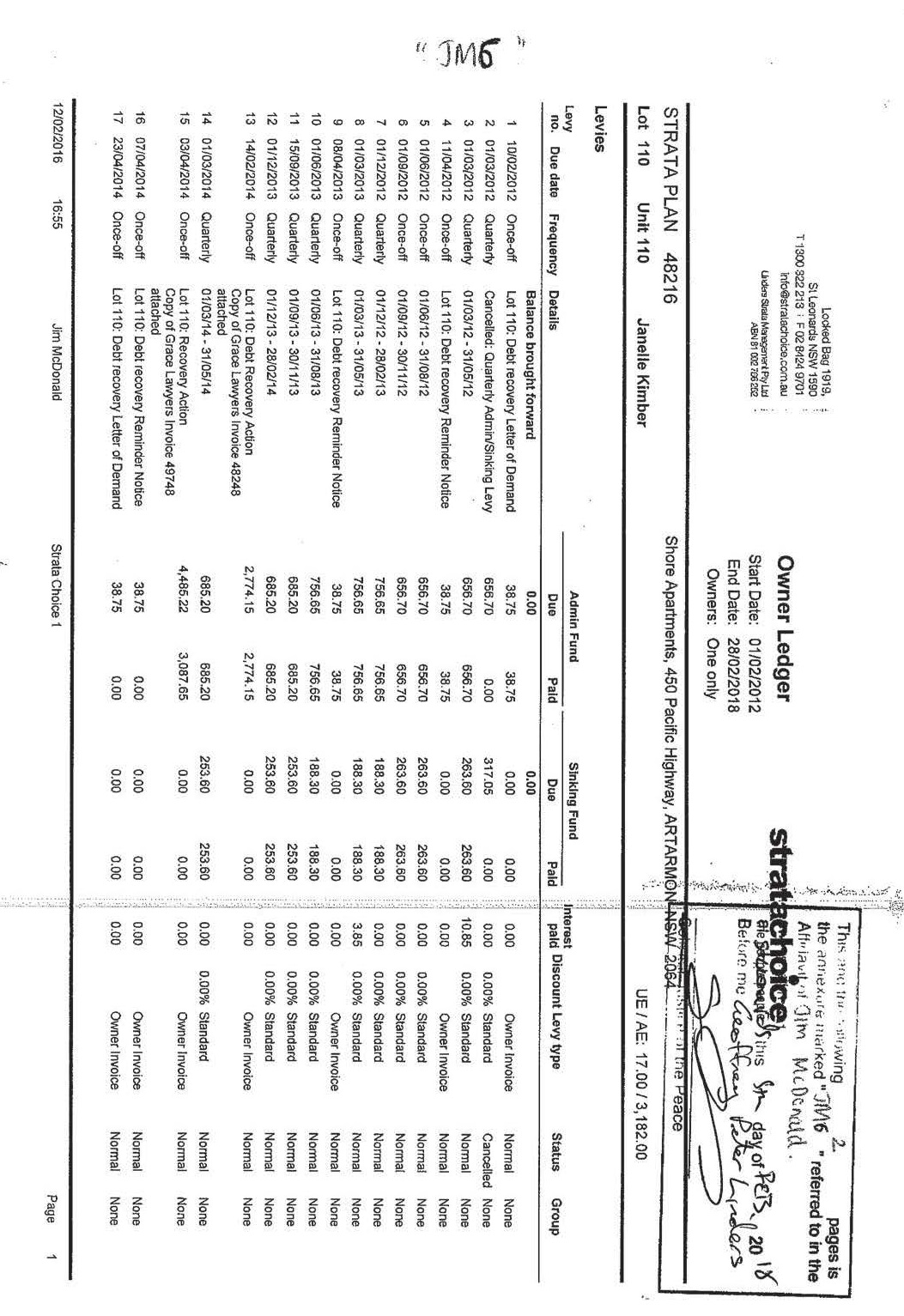
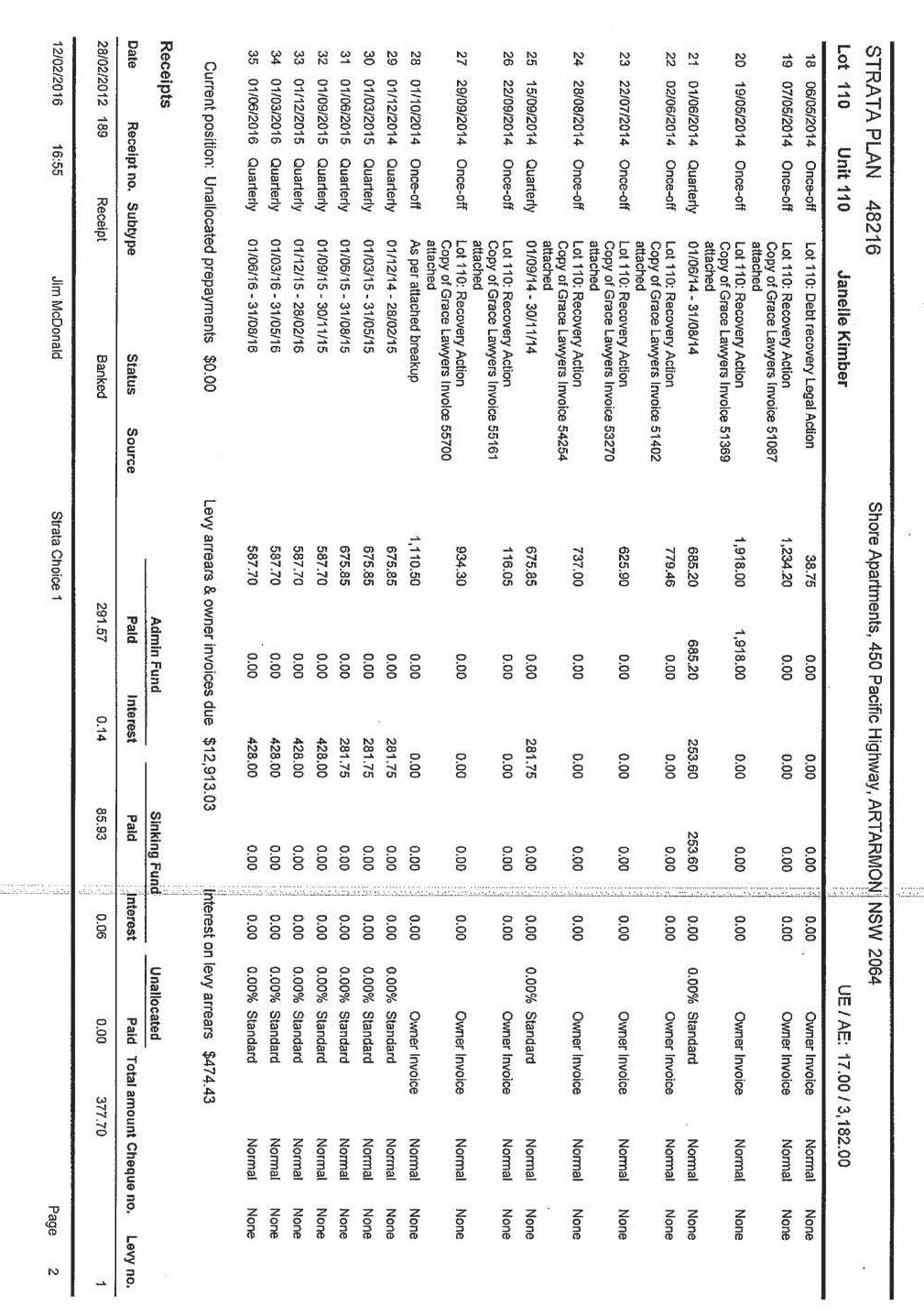
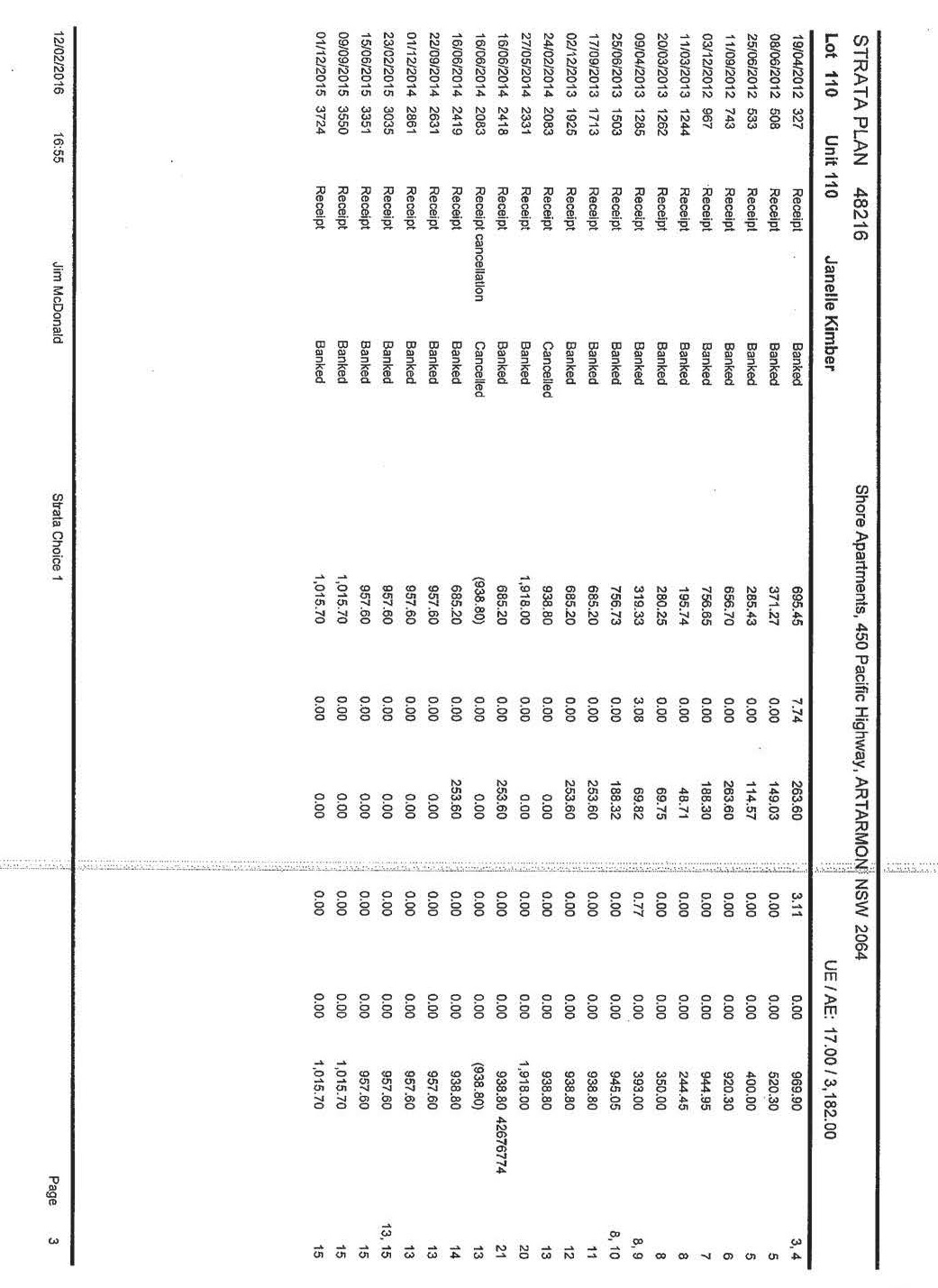
SCHEDULE B