

FEDERAL COURT OF AUSTRALIA
Manado (on behalf of the Bindunbur Native Title Claim Group) v State of Western Australia [2018] FCA 275
File number: | WAD 359 of 2013 WAD 357 of 2013 WAD 374 of 2013 |
Judge: | NORTH J |
Date of judgment: | |
Date of last submissions: | 19 February 2018 |
Registry: | Western Australia |
Division: | General Division |
National Practice Area: | Native Title |
Category: | No Catchwords |
Number of paragraphs: | |
Solicitor for the First Applicant: | Kimberley Land Council |
Counsel for the State of Western Australia: | Mr P Quinlan SC with Ms C Taggart |
Solicitor for the State of Western Australia: | State Solicitors Office |
Counsel for the Commonwealth of Australia: | Mr R Levy |
Solicitor for the Commonwealth of Australia: | Australian Government Solicitor |
ORDERS
DATE OF ORDER: |
THE COURT ORDERS THAT:
1. The parties file a draft determination in accordance with these reasons for judgment.
Note: Entry of orders is dealt with in Rule 39.32 of the Federal Court Rules 2011.
NORTH J:
1 In orders made on 23 November 2017, the parties were given leave to apply for the determination of any of the five outstanding issues referred to in [628], [645], [656], [670], and [734] of the reasons of judgment delivered on that date (the reasons).
2 The parties have since agreed on the issues referred to in [656] and [734].
3 These reasons for judgment address the three outstanding issues referred to above, namely, the land holding areas issue [628], the public access and enjoyment issue [645], and the negative determination issue [670].
4 These reasons for judgment also address three drafting issues which have arisen in the course of discussions between the parties as to the form of the determination. Those issues relate to captured water, the relationship clause, and the description of non-exclusive native title rights and interests.
5 Finally, these reasons for judgment determine a drafting issue which was argued by the parties as part of the original hearing but not addressed in the reasons and not agreed between them in the meantime. That issue is the description of the right to access resources and to protect places and things.
6 Following delivery of the reasons, the Full Court handed down judgment in BHP Billiton Nickel West Pty Ltd v KN (Deceased) (TJIWARL and TJIWARL #2) [2018] FCAFC 8. At the hearing of argument concerning these additional issues the State flagged the need for the application of that judgment to the terms of the determination in this case. That matter is left for the consideration of the parties.
7 Written submissions were filed by the Bindunbur applicants, the State, and the Commonwealth prior to an oral hearing on the issues. The Jabirr Jabirr applicants could not attend that hearing, but, after reviewing the transcript, filed short written submissions in accordance with the leave to do so granted by the Court.
8 The main contest on these issues was between the Bindunbur applicants and the State. The Jabirr Jabirr applicants generally adopted the arguments put by the Bindunbur applicants, and the Commonwealth adopted the arguments put by the State. The hearing of oral argument occurred on 13 February 2018 in Perth.
LAND HOLDING AREAS
9 The land holding areas issue was dealt with in [628] of the reasons. The parties were required to consult on boundary designations for inclusion in the determination. Land holding areas were to be defined by reference to language identity. The consultation did not resolve that issue. Therefore, it is dealt with further in these reasons.
10 In broad terms, the State sought to delineate the land holding areas within the external perimeter of the area of the main claim by reference to language groups using generally straight or defined boundary lines. The reason given for that clear definition was so that those needing to seek authority to do things on the land in the future will know whom they must contact in order to seek permission.
11 The Bindunbur applicants contended that the evidence did not support such delineation. Often boundaries were indefinite and, in some instances, there was country which was shared between members of different language groups. The Bindunbur applicants proposed that the areas of the land holding groups be described by reference to particular sites identified in the evidence as the sites of the group. Further, where country limits were less defined or merged, the Bindunbur applicants proposed that the area be described in the determination as being “generally” in a particular location.
12 There is controversy among some members of the Bindunbur native title holding group over which language group holds rights in some particular areas. That controversy was evidenced by a copy of a letter dated 12 February 2018 sent by Mr Bruno Dann to the KLC contesting the characterisation of Winawal as shared country.
13 In the course of argument, a map prepared by the KLC for internal purposes came to light. It represented boundary areas in a feathered colouring reminiscent of fairy floss. That visual representation, together with a verbal description reflecting the visual representation, seems suitable to accommodate the positions of the parties as near as possible. The parties were directed by the Court to confer to create a map and words in accordance with the fairy floss concept.
PUBLIC ACCESS AND ENJOYMENT
14 The public access and enjoyment issue was dealt with in [633] to [645] of the reasons.
15 A measure of agreement was reached between the parties on that issue. These reasons for judgment deal with the unresolved parts of that issue.
16 The State proposed the following description of the areas where the interest of the public to access and enjoy is to be recognised in the Bindunbur application areas as an other interest.
ANNEXURE A - DESCRIPTION OF AREAS WHERE THE INTEREST OF
THE PUBLIC TO ACCESS AND ENJOY IS TO BE RECOGNISED
[x] Pursuant to section 14 of the Titles (Validation) and Native Title (Effect of Past Acts) Act 1995 (WA) public access to and enjoyment of all of those areas which are seaward of:
1. Reserve 1012;
2. Reserve 1834, excluding:
A. that part of Reserve 1834 which abuts CT 320/168;
B. any area which is within Reserve 51146;
C. UCL 67 (which is entirely abutted by Reserve 51146);
3. CT 320/168;
4. Reserve 7279;
5. Reserve 22615, excluding:
D. that part of Reserve 22615 which abuts lease K 145618; and
E. Reserve 7279;
6. Lease K 145618;
being areas which are
7. waterways;
8. beds and banks or foreshores of waterways;
9. coastal waters; or
10. beaches.
Note: For the avoidance of doubt, paragraph [X] of this Schedule does not confer, create or entitle public access to o enjoyment of any area which is not identified in paragraph [X] above
17 The submissions of the State explained:
The effect, in practical terms, of the First Respondent's [the State’s] proposed description is that the Bindunbur determination would recognise as an "other interest" the existing ability of the public to access and enjoy those areas which are seaward of, and not otherwise in, the areas depicted in pink below:
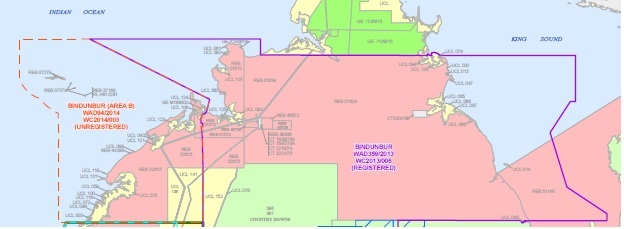
[Footnotes omitted.]
18 The Bindunbur applicants accepted that the public has a right to access and enjoy the areas designated in the State draft for the purpose of exercising the common law public right to fish and to navigate. They proposed an alternative draft limited to access and enjoyment for the purpose of the exercise of those rights.
19 The Bindunbur applicants contended that the public was able to access and enjoy the contested areas only because there was no proscription preventing such access or enjoyment. But they contended that the ability of the public to access and enjoy those coastal areas by reason of the absence of any proscription does not fall within the definition of an other interest. That result, so it was argued, can be seen by reference to the consequence of an interest being recorded as an other interest. The operation of the relationship clause would mean that the ability of the public to access and enjoy the coastal areas would prevail over native title rights and interests. The Bindunbur applicants argued that such an outcome was not likely to have been intended by the legislation.
20 That argument of the Bindunbur applicants should not be accepted. Section 253 of the NTA defines interest to include a privilege in connection with land or waters. The ability of the public to access and enjoy coastal areas because access is not proscribed falls within the definition of an interest because it is a privilege in relation to land and waters.
21 The Bindunbur applicants also criticised the description of the area of the interest of the public to access and enjoy as being seaward of the particular reserves. The Bindunbur applicants argued that the area should be limited to the area which is both seaward of the reserves and also seaward of the common law high water mark.
22 The reserves in question commence at the high water mark as prescribed by the LAA. It is accepted by the parties that the statutory high water mark is further landward than the common law high water mark. The effect of the Bindunbur applicants’ formulation would be to exclude from the area of public access and enjoyment a band of land between the statutory high water mark and the common law high water mark. There is no warrant for that outcome. The ability of the public to access and enjoy the area seaward of the statutory high water mark is the relevant other interest.
23 It follows that the description of the areas where the interest of the public to access and enjoy is to be recognised in the Bindunbur application area proposed by the State should be adopted.
24 The ability of the public to access and enjoy coastal areas in the Jabirr Jabirr application area requires a different description because the areas in question relate to unallocated Crown land or parts of unallocated Crown land rather than reserve areas as in the case of the Bindunbur application area. Nonetheless, the issues otherwise raised by the Jabirr Jabirr applicants in respect of their application area are the same as those raised by the Bindunbur applicants. The State’s draft should be adopted in the case of the Jabirr Jabirr application area also.
NEGATIVE DETERMINATION
25 The negative determination issue was dealt with at [670] of the reasons. In accordance with the argument of the State, that issue was left for resolution in the course of consultation between the parties about the form of the determination. That approach has proved useful because the parties have now come to an agreement about the areas in which native title has been extinguished. Hence, the practical consequences of the making or not making a negative determination are now clearly exposed.
26 The State sought a determination that native title does not exist in areas in which it has been established that native title has been extinguished.
27 The applicants contended that a negative determination should not be made because:
(a) Section 61A(2) of the NTA prevents the application from being made. That section provides:
(2) If:
(a) a previous exclusive possession act (see section 23B) was done in relation to an area; and
(b) either:
(i) the act was an act attributable to the Commonwealth; or
(ii) the act was attributable to a State or Territory and a law of the State or Territory has made provision as mentioned in section 23E in relation to the act;
a claimant application must not be made that covers any of the area.
(b) The way in which the application is framed expressly excludes areas in which native title has been extinguished. Consequently, the applicants have made no claim to those areas and there is therefore no basis to determine that native title does not exist within areas outside the application before the Court.
(c) The rights and interests in those areas exist under traditional laws and customs and only the current tenure situation prevents the recognition of those rights and interests as native title rights and interests. While so long as it remains possible that the tenure situation might change and thereby allow a beneficial provision of the NTA to apply to require extinguishment to be disregarded, it is not appropriate to make a negative determination over the area.
28 Although the parties did not in their submissions identify how this argument would have a practical effect in relation to particular areas of land, it seems that the effect mostly relates to certain roads. The parties now agree that the making of those roads were previous exclusive possession acts, being public works within the meaning of s 23B of the NTA. Under the terms of the NTA, public works extinguish native title and s 47B does not apply to require the extinguishment to be disregarded.
29 What s 61A(2) prevents is the applicant making a claim over an area where there is no debate that a previous exclusive possession act had been done in relation to that area. But where the applicant brings to Court a claim for native title over an area on the basis that the act done was not an exclusive possession act, or native title was not extinguished for some other reason, s 61A(2) is not brought in to operation. The section is directed to restricting the making a particular type of application. That section does not prevent an application from being made where the applicant disputes the question whether native title rights and interests have been extinguished by a previous exclusive possession act. Consequently, there is no merit in the applicants’ argument referred to in (a) above.
30 A similar approach answers the contention set out in (b) above. When the applications were filed, the Bindunbur and Jabirr Jabirr applicants’ claim was made to the area designated. It was necessarily part of the application that the applicants asserted that native title had not been extinguished in the area. Otherwise, they would have had no basis for the application. The application cannot now have the effect of rendering unclaimed what was in fact claimed. That would be to rewrite the history of the claim.
31 It may be that the purpose of including in the application a provision such as [8] which seeks to exclude areas subject to acts such as exclusive possession acts from the application was an attempt to preserve the basis for the present argument. If so, it is not been effective to do so.
32 The argument articulated in (c) above is directed to a discretionary consideration, namely, that the tenure of the area may change in the future and the NTA might provide for past extinguishment to be disregarded. That is not a compelling argument in this case. The present statutory regime concerning public works, such as roads, means that native title is extinguished and the ameliorating effect of s 47B is not available. A change in tenure will not alter that outcome. Only a change in the law might do so. That possibility is speculative.
33 On the other hand, in this proceeding, the Bindunbur and Jabirr Jabirr applicants challenged the State’s position on extinguishment and that matter was litigated until those applicants conceded the extinguishing effect of public works on the specified roads. There is no good reason why the outcome of contested litigation on that extinguishment issue should not be recorded in the determination.
34 The argument of the State should be accepted and the determination specify that there is no native title rights and interests in the agreed areas where they have been extinguished.
CAPTURED WATER
35 The State sought the inclusion of a paragraph as follows:
9. Notwithstanding anything in this Determination there are no native title rights and interests in the Determination Area in or in relation to:
(a) …
(d) water lawfully captured by the holders of Other Interests,
36 The reason advanced by the State for the inclusion of that subparagraph was that, unlike flowing water, captured water is property and capable of being owned. The act of capturing water does not permit of recognition of a right or interest in the native title holders to access, use or take that lawfully captured water.
37 The Bindunbur and Jabirr Jabirr applicants opposed the inclusion of the subparagraph because the capturing of water is the way in which a right is exercised. The capture is not the right itself: Akiba v The Commonwealth [2013] HCA 33, and hence cannot constitute the relevant necessary inconsistency.
38 The difference between the parties is rightly regarded as a drafting issue because both formulations have the same outcome. The Bindunbur and Jabirr Jabirr applicants explained the way the determination would operate without the proposed subparagraph as follows:
17. Rather the water and the activity of lawfully capturing it falls to be dealt with by reference to the relationship between the native title rights and the rights under the ‘other interest’ under which the water is captured.
18. There is no extinguishment of the native title right involved in the exercise of the other interest to capture water. Either the right under which the water is lawfully captured itself extinguishes (or partially extinguishes) the native title or it doesn’t.
39 The argument of the Bindunbur and Jabirr Jabirr applicants should be accepted. The determination should not include the subparagraph proposed by the State.
THE RELATIONSHIP CLAUSe
40 The State proposed the following clause as setting out the relationship between the defined native title rights and interests and the recognised other interests in accordance with s 225(d) of the NTA.
Relationship between native title rights and other interests
13. The relationship between the native title rights and interests described in paragraphs 6 and 7 and the other interests referred to in paragraph 12 ("the other rights and interests") is that:
(a) to the extent that any of the other rights and interests are inconsistent with the continued existence, enjoyment or exercise of the native title rights and interests, the native title rights and interests continue to exist in their entirety, but the native title rights and interests have no effect in relation to the other rights and interests to the extent of the inconsistency during the currency of the other interests; and otherwise,
(b) the existence and exercise of the native title rights and interests do not prevent the doing of any activity required or permitted to be done by or under the other rights and interests. The other rights and interests, and the doing of any activity required or permitted to be done by or under the other rights and interests, prevail over the native title rights and interests and any exercise of the native title rights and interests, but, subject to the operation of section 24JB(2) of the Native Title Act 1993, do not extinguish them.
[Footnotes omitted.]
41 The Bindunbur and Jabirr Jabirr applicants’ proposed equivalent was as follows:
9. The relationship between the native title rights and interests and the other interests is as follows:
(a) the other interests co-exist with the native title rights and interests;
(b) the determination does not affect the validity of those other interests;
(c) to the extent of any inconsistency, the native title rights and interests yield to the other interests;
42 It is accepted that both formulations accurately reflect the legal position.
43 The State contended that its proposed clause more accurately and completely identifies the relationship and avoids shorthand expressions such as “yield”. The Bindunbur and Jabirr Jabirr applicants submitted that their proposed clause is plain and understandable, whilst the State’s proposed clause is lengthy and technical.
44 The Bindunbur and Jabirr Jabirr applicants’ version was adopted by Finn J in the determination made on 23 August 2010 in Akiba on behalf of the Torres Strait Islanders of the Regional Sea Claim Group v State of Queensland (Akiba) and recently used by McKerracher J in the determination made on 27 September 2017 in the matter of Harvey Murray on behalf of the Yilka Native Title Claimants v State of Western Australia (Yilka). There is value in a consistent practice particularly where it is accepted by the State that the applicants’ proposed clause properly reflects the legal position. The Bindunbur and Jabirr Jabirr applicants’ proposed clause should be adopted.
NON-EXCLUSIVE RIGHTS AND INTERESTS
45 The State proposed that [8] of the determination read as follows:
8. The native title rights and interests referred to in paragraphs 6(b) and 7 do not confer:
(a) possession, occupation, use and enjoyment of those parts of the Determination Area on the Native Title Holders to the exclusion of all others, nor
(b) a right to control the access of others to the land or waters of those parts of the Determination Area.
46 The Bindunbur and Jabirr Jabirr applicants argued that (b) is unnecessary and redundant. The State contended that (b) was plain and understandable, attributes which are important where the rights recognised are rights in rem granted in perpetuity.
47 Whilst (b) does not add to the substance of (a) it does serve a purpose. It is explanatory of the practical effect of the limitations expressed in (a). Subparagraph (b) proposed by the State should be included in the determination.
RIGHT TO ACCESS AND USE RESOURCES AND TO PROTECT PLACES, AREAS AND THINGS OF TRADITIONAL SIGNIFICANCE
48 The right to access and use resources and to protect places, areas and things of traditional significance issue again raised drafting issues. Those issues were addressed in the connection submissions of the Bindunbur and Jabirr Jabirr applicants and the State. They were not dealt with in the reasons, and no agreement has been reached between the parties in the meantime. Consequently, the matters are now addressed.
The right to access and use resources
49 The Bindunbur and Jabirr Jabirr applicants sought the inclusion of a clause in the following form to define one of the non-exclusive native title rights:
The right to access and take for any purpose the resources in [specified areas].
50 The State proposed a form of the clause which would delete the words “for any purpose” and add the word “natural” before the word “resources”, thus reading:
The right to access and take the natural resources in [specific areas].
51 The debate centred on the evidence concerning the traditional laws and customs concerning the prohibition on the waste of resources.
52 The State argued that the evidence demonstrated that resources could not be used for the purpose of waste. The Bindunbur and Jabirr Jabirr applicants’ formulation would permit such a use because it allows for the use of resources for all purposes including for the purpose of wasting them. The expression “for any purpose” is so wide that it allows for a right which exceeds the right found in the traditional laws and customs. Traditional laws and customs do not permit resources to be used for the purpose of wasting them.
53 The Bindunbur and Jabirr Jabirr applicants contended that the prohibition on waste under traditional laws and customs was a restriction on the manner of the exercise of the right to use resources. It was not a qualification on the right itself. The evidence, so it was argued, was that the right to access resources was untrammelled.
54 The formulation proposed by the Bindunbur and Jabirr Jabirr applicants has been used in a number of recent determinations, namely, Akiba, Willis on behalf of the Pilki People v State of Western Australia (No 2) (Pilki) (2 December 2014), BP (Deceased) on behalf of the Birriliburu People v State of Western Australia (Birriliburu) (6 June 2016), Rrumburriya Borroloola Claim Group v Northern Territory of Australia (No 2) (Borroloola) (11 August 2016), Keith Narrier & Ors and State of Western Australia & Ors AND Edwin John Beaman & Ors and State of Western Australia (Narrier) (27 April 2017), and Yilka. There is value in adopting a consistent approach to the drafting of the terms of determinations where the evidence justifies the formulation proposed.
55 Further, the articulation of the right must be read with the provision in the determination that the native title rights and interests must be exercised in accordance with traditional laws and customs. That provision would limit the exercise of the right by prohibiting waste whilst at the same time allowing the terms proposed by the Bindunbur and Jabirr Jabirr applicants to reflect the untrammelled right to access the resources.
56 In the present case the evidence supports the draft proposed by the Bindunbur and Jabirr Jabirr applicants and that formulation should be adopted.
57 Further, the State has not made out grounds for limiting the resources concerned to natural resources.
The right to protect places, areas and things of traditional significance
58 The Bindunbur and Jabirr Jabirr applicants sought the following formulation in relation to areas of non-exclusive native title rights and interests:
The right to protect places, areas and things of traditional significance.
59 The State would replace “areas and things” with “sites”.
60 The State argued that using the word “sites” was clearer than the reference to areas. The State further contended that it is unclear whether there is a distinction between places and areas. It further argued that the reference to things should be deleted because the word “things” is unclear and may refer to something more than a right or interest in relation to land or waters contrary to s 223(1) of the NTA.
61 The Bindunbur and Jabirr Jabirr applicants contended that the things referred to are things of traditional significance in the determination area where non-exclusive native title exists. In other words, the word must be read in the context of the clause as a whole. It is unlikely that protecting such things would not be a right in relation to land. The Bindunbur and Jabirr Jabirr applicants contended that the reference to sites has an ambiguity which the reference to areas does not have. Further, there is no reason why place and area should not be used together even if they have some overlapping meaning.
62 In the Birriliburu, Borroloola, and Wiluna determinations, the right to protect was expressed to apply to places and areas. In the in the Yilka and Narrier determinations the right to protect was expressed to apply to places alone.
63 There is a useful distinction between places and areas used in the context of a native title determination. A place suggests something more confined than an area. A site suggests perhaps a yet more confined area. In the end, whilst there is little to argue about, the preferable wording is to use places and areas as proposed by the Bindunbur and Jabirr Jabirr applicants. Sites has not been used in the recent determinations referred to above, and is probably somewhat too confining to reflect the nature of the likely locations intended to be included.
64 Things of traditional significance is a formulation that was recently used in the Borroloola determination. In the Yilka determination the reference was to objects of significance. The argument of the Bindunbur and Jabirr Jabirr applicants that the reference to things read in context properly signifies the necessary relationship with land should be accepted.
65 In the end, the clause reflecting the right to protect proposed by the Bindunbur and Jabirr Jabirr applicants should be adopted.
I certify that the preceding sixty-five (65) numbered paragraphs are a true copy of the Reasons for Judgment herein of the Honourable Justice North. |
SCHEDULE
WAD 359 of 2013
First Applicants CECILIA CHURNSIDE
ALEC DANN
BETTY DIXON
WALTER KOSTER
PHILLIP MCCARTHY
Respondents COMMONWEALTH OF AUSTRALIA
SHIRE OF BROOME
SHEFFIELD RESOURCES LIMITED
JAMIE PETER BURTON
VICTORIA JANE BURTON
KURT ELEZOVICH
YEEDA STATION PTY LTD
JD ARROW
SJ ARROW
WAD 357 of 2013
Third Applicants ELIZABETH DIXON
CECILIA DJIAGWEEN
PADDY IGNATIUS
ANTHONY WATSON
Respondents COMMONWEALTH OF AUSTRALIA
SHIRE OF BROOME
KIMBERLEY LAND COUNCIL ABORIGINAL CORPORATION
CLIPPER PEARLS PTY LTD
THE AUSTRALIAN SOUTH SEA PEARL COMPANY PTY LTD
WAD 374 of 2013
Fourth Applicants BRIAN JOHN COUNCILLOR
TERRENCE HUNTER
JASON DAVID ROE
RONALD LESLIE ROE
Respondents COMMONWEALTH OF AUSTRALIA
SHIRE OF BROOME
KIMBERLEY LAND COUNCIL ABORIGINAL CORPORATION
CLIPPER PEARLS PTY LTD
THE AUSTRALIAN SOUTH SEA PEARL COMPANY PTY LTD


