

FEDERAL COURT OF AUSTRALIA
GlaxoSmithKline Australia Pty Ltd v Reckitt Benckiser (Australia) Pty Limited (No 3) [2018] FCA 183
ORDERS
GLAXOSMITHKLINE AUSTRALIA PTY LTD First Applicant GLAXOSMITHKLINE CONSUMER HEALTHCARE AUSTRALIA PTY LTD Second Applicant | ||
AND: | RECKITT BENCKISER (AUSTRALIA) PTY LIMITED Respondent | |
DATE OF ORDER: |
THE COURT:
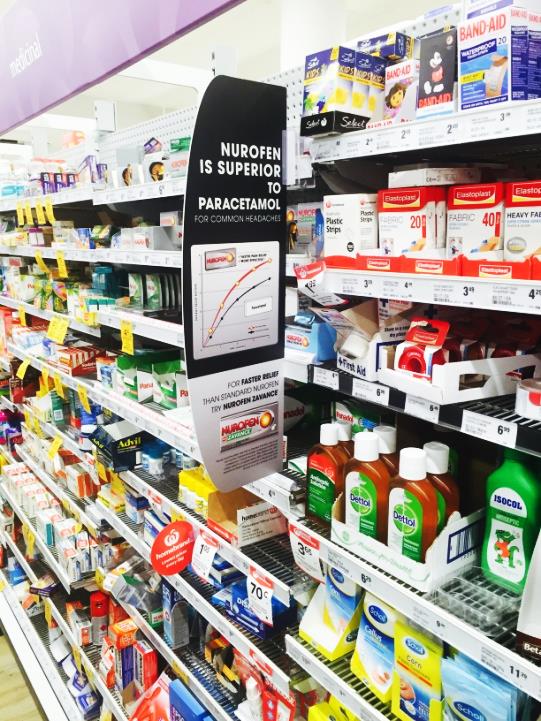
1. DECLARES that, in the period from August to December 2015, the respondent, in trade or commerce, by publishing, distributing, exhibiting, displaying, broadcasting or communicating to the public, or causing to be published, distributed, exhibited, displayed, broadcasted or communicated to the public, each of:
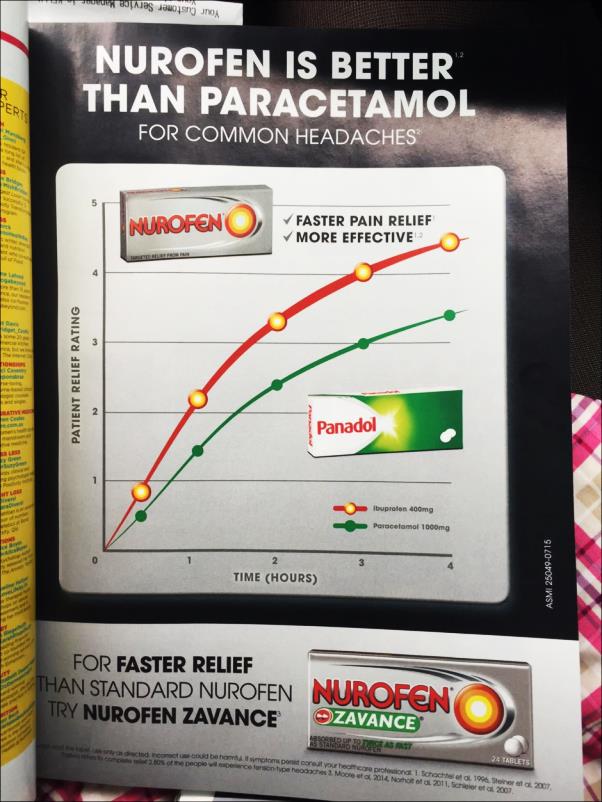
(a) The material annexed to these Orders and marked ‘A’;
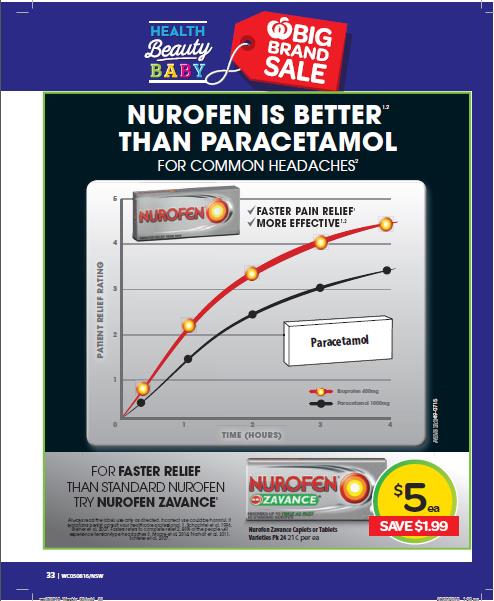
(b) The material annexed to these Orders and marked ‘B’;
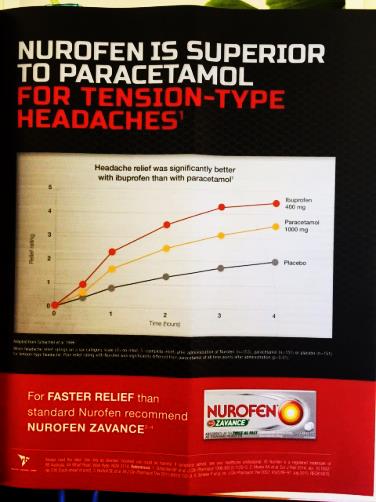
(c) The material annexed to these Orders and marked ‘C’;
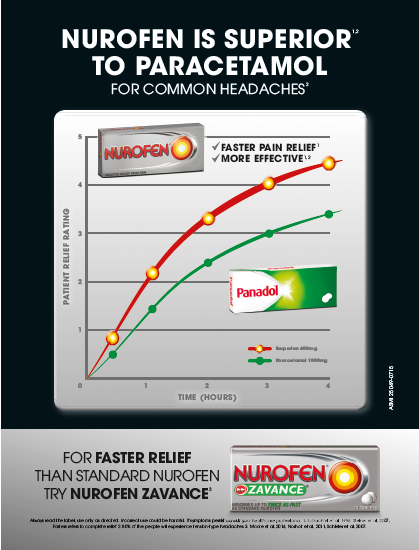
(d) The material annexed to these Orders and marked ‘D;
(e) The material annexed to these Orders and marked ‘E’;
(f) The television commercial appearing on the USB that is Annexure F to the applicants’ Fast Track Application dated 11 September 2015 (Application); and
(g) The following representations, namely that:
(i) Nurofen or ibuprofen, when taken in the recommended dose and as directed by the manufacturer, generally delivers faster and/or more effective relief from pain caused by common headaches, including tension-type headaches, than does Panadol or paracetamol;
(ii) Nurofen or ibuprofen is better than Panadol or paracetamol for the treatment of common headaches, including tension-type headaches and performs in a superior manner to Panadol and paracetamol in delivering pain relief for such headaches; and
(iii) In the period from August to September 2015, there was a current adequate foundation in scientific knowledge to support the representations specified in subparagraphs (i) and (ii) above,
engaged in conduct that was misleading or deceptive, or likely to mislead or deceive, in contravention of s 18 of the Australian Consumer Law and made false representations in contravention of s 29(1)(a) and s 29(1)(g) of the Australian Consumer Law.
2. ORDERS that the respondent be permanently restrained, whether by itself, its servants, agents or otherwise, in trade or commerce, from publishing, distributing, exhibiting, displaying, broadcasting or communicating to the public, or causing to be published, distributed, exhibited, displayed, broadcasted or communicated to the public, any of:
(a) The material annexed to these Orders and marked ‘A’;
(b) The material annexed to these Orders and marked ‘B’;
(c) The material annexed to these Orders and marked ‘C’;
(d) The material annexed to these Orders and marked ‘D’;
(e) The material annexed to these Orders and marked ‘E’;
(f) The television commercial appearing on the USB that is Annexure F to the Application;
(g) The following representations or representations substantially the same as the following representations, namely, that:
(i) Nurofen or ibuprofen, when taken in the recommended dose and as directed by the manufacturer, generally delivers faster and/or more effective relief from pain caused by common headaches, including tension-type headaches, than does Panadol or paracetamol;
(ii) Nurofen or ibuprofen is better than Panadol or paracetamol for the treatment of common headaches, including tension-type headaches and performs in a superior manner to Panadol and paracetamol in delivering pain relief for such headaches; or
(iii) There is a current adequate foundation in scientific knowledge to support the representations set out in subparagraphs (i) and (ii) above; and
(h) Any material or representation which is substantially identical to, or substantially the same as the material or any of the representations referred to in subpars (a) to (g) above,
without having a reasonable basis for so doing.
3. ORDERS that the applicants’ applications that their costs be paid on an indemnity basis and by way of a lump sum both be refused.
4. ORDERS that the respondent pay the applicants’ costs of the proceeding (other than those which were the subject of this Court’s orders made on 12 February 2016), such costs to be taxed and paid on the party/party basis if not agreed.
5. NOTES that the applicants’ claims for an order for corrective advertising and for damages or compensation are abandoned.
6. ORDERS that the Application otherwise be dismissed.
Note: Entry of orders is dealt with in Rule 39.32 of the Federal Court Rules 2011.
ANNEXURE A
ANNEXURE B
ANNEXURE C
ANNEXURE D
ANNEXURE E
FOSTER J:
1 On 8 January 2018, I delivered judgment in this proceeding (GlaxoSmithKline Australia Pty Ltd v Reckitt Benckiser (Australia) Pty Limited (No 2) [2018] FCA 1) (Glaxo No 2). On that day, I made the following orders:
THE COURT ORDERS THAT:
1. By 8 February 2018, the applicants file and serve a draft of the Orders which they consider appropriately reflect Reasons for Judgment published this day (8 January 2018) by Foster J (GlaxoSmithKline Australia Pty Ltd v Reckitt Benckiser (Australia) Pty Limited (No 2) [2018] FCA 1).
2. In the event that it disagrees with the applicants’ proposed Orders, by 15 February 2018, the respondent file and serve a draft of the Orders which it considers appropriately reflect the said Reasons for Judgment.
3. Each party may support its draft with a written submission of no more than three (3) pages in length.
4. The form of relief to be granted in order to give effect to the said Reasons for Judgment be determined on the papers after 15 February 2018.
2 On 9 February 2018, the applicants (GSK) filed and served a Written Submission dated 8 February 2018 to which they attached a draft of the final orders which they contend give effect to my reasons in Glaxo No 2.
3 By that Written Submission, GSK also made submissions in support of an order that the respondent (RB) pay their costs on an indemnity basis and a further order that it do so by way of lump sum.
4 RB answered GSK’s submissions in respect of relief generally and claims in respect of costs with a Written Submission of its own filed on 20 February 2018.
5 There is a contest between the parties as to the appropriate form of declaration and injunction to be made.
6 In addition, RB does not accept that it should be ordered to pay all of GSK’s costs nor does it accept that it should be compelled to do so on an indemnity basis by way of lump sum. RB argues that the appropriate order for costs is an order that RB pay 75% of GSK’s costs of the proceeding (save for those costs ordered on 12 February 2016) on the party/party basis as agreed or taxed. The exclusion of the costs order made on 12 February 2016 from any order for costs which I will now make is a matter which is agreed. There were sound reasons for making that order at the time when it was made. It was not suggested that there was any present justification for altering that order. I will exclude from the orders which I will now make the costs the subject of that order, as requested by the parties.
7 At [212] in Glaxo No 2, I said that I intended to order RB to pay GSK’s costs of and incidental to the proceeding to date. I took the view that GSK had been successful in the case to date. I did not consider that GSK’s abandonment of their claim for corrective advertising justified any different order.
8 In its Written Submissions in respect of costs, RB submitted that GSK should be awarded only 75% of their party/party costs (excluding the costs the subject of the 12 February 2016 order for costs) because RB was successful in its arguments directed to the validity of the Schachtel Study, its contentions in relation to the disputed representations and GSK’s damages claim. I do not agree. The arguments at trial focussed on the use that could legitimately be made of the Schachtel Study rather than on its validity. The arguments directed to the disputed representations occupied only a small part of the case and GSK’s damages claim was not under consideration in the first trial at all. This is not a case where the Court should separate some issues from others for the purpose of determining upon whom the costs burden relating to each of those separate issues should fall.
9 I see no reason to change the view which I expressed at [212] in Glaxo No 2.
10 Subject to the outcome of GSK’s applications that costs be awarded on an indemnity basis and in a lump sum, the order for costs which I will make is an order that RB pay GSK’s costs of the proceeding (other than those costs which were the subject of the Court’s orders made on 12 February 2016), such costs to be taxed and paid on the party/party basis if not agreed.
The Form of the Declaration and Injunction
11 The parties agree that the Court should make a declaration and grant an injunction in order to give effect to my reasons in Glaxo No 2. However, they are not in agreement as to the form of these orders.
12 The main difference of opinion concerns GSK’s claim that I should make an order both by way of declaration and injunction which specifies that the making of the following representations by RB constituted both a contravention of the Australian Consumer Law (ACL) and also conduct which ought to be permanently restrained:
(g) … :
(i) that Nurofen or ibuprofen, when taken in the recommended dose and as directed by the manufacturer, generally delivers faster and/or more effective relief from pain caused by common headaches, including tension-type headaches than does Panadol or paracetamol;
(ii) that Nurofen (ibuprofen), is better than Panadol and paracetamol for the treatment of common headaches, including tension-type headaches and performs in a superior manner to Panadol and paracetamol in delivering pain relief for such headaches; and
(iii) that there was a current adequate foundation in scientific knowledge to support the representations set out in subparagraphs (i) and (ii) above ...
13 RB submitted that my reasons in Glaxo No 2 did not go so far as to authorise the making of a declaration and the granting of an injunction which incorporate the terms which I have extracted at [12] above and suggested that the better option is to make a declaration and grant an injunction which more closely follows the claims made by GSK at par 15 of their Amended Fast Track Statement. RB did not submit that I should follow GSK’s pleaded claims precisely when granting declaratory and injunctive relief. RB submitted that the form of declaration and injunction now claimed by GSK is outside the scope of the claims made by GSK in their Fast Track Application and their Amended Fast Track Statement. RB also argued that the scope of the relief now sought is “… not supported by the manner in which the trial was conducted, the pleadings or the findings of the Court”.
14 RB also submitted that I should not grant an injunction which includes a prohibition upon “… any matter which is substantially identical to, or substantially the same as, any of the above [matters]”. The “above” [matters] is a reference to the specific representations contained in par 2 of GSK’s draft form of orders.
15 At [134]–[135] in Glaxo No 2, I set out what I considered to be the representations made by RB in the impugned advertising campaign. At [207], I summarised the reasons for my conclusions which were more fully explained at [99]–[135].
16 I do not think that the form of declaration and injunction propounded by GSK goes beyond the relief which is supported by my reasons in Glaxo No 2. Nor do I think that those two orders go beyond similar relief claimed by GSK in their Fast Track Application.
17 I also reject RB’s contention that the inclusion in the injunction which I propose to grant of the additional words which I have extracted at [14] above is inappropriate because the words are not specific enough to be the subject of a Court ordered prohibition. These words are commonly used in injunctions granted in matters of this type in order to ensure that representations which might be made in the future and which involve only slight textual variations from those representations which have been found by the Court to be false and misleading or deceptive are also restrained.
18 Accordingly, I propose to make a declaration and to grant an injunction which more closely reflect the form of orders propounded by GSK. I will describe the contravening conduct in the declaration by reference to a specific period of time and to qualify the permanent nature of the injunction by including the words “… without having a reasonable basis for so doing …” at the end of the text of the injunction. This latter amendment to GSK’s draft form of injunction is intended to recognise the possibility that, at some future point in time, it may not be false or misleading or deceptive for RB to make the representations which have been found to be false and misleading or deceptive in the present case if, at the time such future representations are made, there is a reasonable basis for them. That is, the state of scientific knowledge may change in the future in a way which may support the truth of representations of the kind which were made in this case and which have been found to have been false at the time when they were made.
19 I will now consider and determine GSK’s claims for indemnity costs and a lump sum costs order.
Indemnity Costs
20 GSK seeks an order for indemnity costs in respect of the period after 11.00 am on 22 December 2015 or, alternatively, in respect of the period after 11 October 2016.
21 GSK’s claim for indemnity costs is based upon RB’s failure to accept a formal Offer of Compromise dated 18 December 2015 purportedly made under r 25.01 of the Federal Court Rules 2011 (FCR) (Offer 1) or, alternatively, its failure to accept a Calderbank offer made by letter dated 11 October 2016 (Offer 2).
22 At the time Offer 1 was made, r 25.14(3) FCR provided as follows:
25.14 Costs where offer not accepted
…
(3) If an offer is made by an applicant and not accepted by a respondent, and the applicant obtains a judgment that is more favourable than the terms of the offer, the applicant is entitled to an order that the respondent pay the applicant’s costs:
(a) before 11.00 am on the second business day after the offer was served—on a party and party basis; and
(b) after the time mentioned in paragraph (a)—on an indemnity basis.
Note 1: Costs on an indemnity basis is defined in the Dictionary.
Note 2: The Court may make an order inconsistent with these rules—see rule 1.35.
23 Subrule (1) and subr (2) of r 25.14 relate only to an offer made by a respondent.
24 In order to engage subr (3) of r 25.14 FCR, an applicant must satisfy the Court that the judgment (here, the final orders which I propose to make) is “… more favourable than the terms of the offer …”.
25 Offer 1 was in the following terms:
To the Respondent
The Applicants offer to compromise this proceeding.
The offer is:
1. A declaration that the Respondent, in trade or commerce, by publishing, distributing, exhibiting, displaying, broadcasting or communication to the public, or causing to be published, distributed, displayed, broadcasted or communicated to the public each of:
(a) the material in Annexure A of the Fast Track Statement dated 11 September 2015 (Fast Track Statement);
(b) the material in Annexure B of the Fast Track Statement;
(c) the material in Annexure C of the Fast Track Statement;
(d) the material in Annexure D of the Fast Track Statement;
(e) the material in Annexure E of the Fast Track Statement; and
(f) the television commercial appearing on the USB that forms Annexure F of the Fast Track Statement,
has engaged in conduct that was misleading or deceptive, or likely to mislead or deceive, in contravention of section 18 of the Australian Consumer Law in Schedule 2 of the Competition and Consumer Act 2012 (Cth).
2. An order restraining the Respondent for a period of 3 years, whether by itself, its servants, agents or otherwise, in trade or commerce, from publishing, distributing, exhibiting, displaying, broadcasting or communication to the public, or causing to be published, distributed, displayed, broadcasted or communicated to the public each of:
(a) the material in Annexure A of the Fast Track Statement;
(b) the material in Annexure B of the Fast Track Statement;
(c) the material in Annexure C of the Fast Track Statement;
(d) the material in Annexure D of the Fast Track Statement;
(e) the material in Annexure E of the Fast Track Statement; and
(f) the television commercial appearing on the USB that forms Annexure F of the Fast Track Statement;
(g) any matter which is substantially identical to, or substantially the same as, any of the above; and
(h) the following representations:
(i) Nurofen is better than Panadol for common headaches;
(ii) Nurofen is superior than Panadol for common headaches;
(iii) Nurofen is better than paracetamol for common headaches;
(iv) Nurofen is superior than paracetamol for common headaches;
(v) Nurofen is superior than paracetamol for tension-type headaches;
(vi) Nurofen gives faster pain relief and is more effective than Panadol for common headaches; and
(vii) Nurofen gives faster pain relief and is more effective than paracetamol for common headaches.
3. The Respondent, at its own expense:
(a) within 14 days, and for a period of 30 days thereafter, publish on the Nurofen website, accessible at the URL www.nurofen.com.au, (Nurofen Website) a notice in the form to be determined by the Court (Corrective Notice) and ensure that:
(i) the Corrective Notice is accessible by a prominent one-click hyperlink (Click-through Icon) displayed in the top third of the homepage of the Nurofen Website; and
(ii) the Click-through Icon:
(A) consists of a black bordered box at least 255 pixels wide by 60 pixels high;
(B) inside the box, has the title “Corrective Notice ordered by the Federal Court of Australia” in at least 14-point black, bold Arial font, on a white background and centred; and
(C) below the title, has the words “Click here for further information” in at least 14-point black, Arial font on a white background and centred; and
(iii) The Corrective Notice occupies the entire webpage that is accessible via the Click-through Icon.
(b) within 21 days, publish a corrective advertisement, in the form to be determined by the Court in The Australian, and ensure that the advertisement:
(i) occupies no less than one third of a page of the newspaper;
(ii) is in a text which is Arial font and which is at least 12-point and bolded for the headline, and at least 11-point for the remaining text; and
(iii) is placed within the first 10 pages of the newspaper.
4. Subject to paragraph 5, the Respondent pay 90% of the Applicants’ costs of the proceedings determined on a party/party basis.
5. The Respondent pay the Applicants’ costs in relation to the Interlocutory Application as ordered by the Court on 15 December 2015.
6. The proceedings otherwise be dismissed.
This offer of compromise is open to be accepted for 14 days after service of this offer of compromise.
This offer is made without prejudice.
Date: 18 December 2015
26 Offer 1 was made three days after RB provided the undertaking to the Court given on an interlocutory basis and without admissions which I extracted at [11] in Glaxo 2 the effect of which was that RB would cease the impugned advertising campaign from 21 December 2015 until the commencement of the final hearing.
27 At the time Offer 1 was made, for reasons explained in Glaxo No 2, the trial of all questions of whether there had been any contraventions of the ACL and the nature and form of any declaratory and injunctive relief including relief by way of corrective advertising which had been fixed to commence on 21 December 2015 had been vacated.
28 By 18 December 2015, new trial dates (15, 16 and 17 February 2016) in respect of those questions had been allocated. At that time, GSK was pressing all of the claims for relief made by them in their Fast Track Application and their Amended Fast Track Statement filed on 16 October 2015 including their claim for an order for corrective advertising.
29 I now turn to compare the terms of Offer 1 with the terms of the orders which I propose to make.
30 The declaration set out in par 1 of Offer 1 and the injunction set out in par 2 of Offer 1 are broadly in line with the final relief which I now propose to grant. In Offer 1, there was no substantial compromise in respect of those two claims for relief. Nor, subject to one matter to which I will refer in a moment, could it be said that the relief by way of declaration and injunction which I propose to order is more favourable than the declaration and injunction offered in Offer 1.
31 GSK argued that the injunction which I propose to grant is in more favourable terms than that contained in Offer 1 because the injunction which I propose to grant will be permanent whereas the injunction contained in the offer was for a period of three years only. This is true. Also, by limiting the final injunction to a period of three years, GSK compromised to a degree the claim for injunctive relief which it had made in its Fast Track Application.
32 Paragraph 3 of Offer 1 is an order for corrective advertising. GSK abandoned their claim for such an order during final address. For that reason, I do not propose to make any order for corrective advertising. Thus, there is a substantial difference between the terms of Offer 1 and the orders which I shall make insofar as corrective advertising is concerned.
33 GSK submitted that, at the time when Offer 1 was made, the impugned advertising was still current and that pressing for an order for corrective advertising at that time was warranted, sensible and useful. They argued that, by the time of the final hearing in late 2016, an order for corrective advertising would not have had any utility. GSK submitted that the delay which occurred between December 2015 and October 2016 was entirely the fault of RB. GSK contended that they should not be prejudiced by that delay and by their consequent reasonable decision to abandon their claim for corrective advertising in light of that delay when the Court comes to consider the question of indemnity costs.
34 At par 12 and par 13 of its Written Submissions, RB submitted that:
As concerns the first offer of 18 December 2015, it is readily apparent that GSK has not achieved an outcome in the proceedings more favourable than that offer. The offer included onerous orders for RB to publish corrective advertising at its own expense (see order 3 of the orders attached to the offer). Further, the order for corrective advertising required judicial intervention as the Court was to determine the form of the Corrective Notice and corrective advertisement. As such the offer was incapable of acceptance by RB for want of certainty.
The claim for corrective advertising was eventually abandoned (RJ [Reasons for Judgment] at [7]). Accordingly, GSK has obtained an outcome in these proceedings which is less favourable than the 18 December 2015 offer. Put another way, it simply cannot be established that it was unreasonable for RB to reject the 18 December 2015 offer especially noting the requirement for judicial intervention.
35 The other elements of the offer were:
(a) A discount of 10% in respect of GSK’s party/party costs;
(b) The dismissal of GSK’s claim for damages or compensation plus interest and the dismissal of their claim for relief under s 237 of the ACL.
36 As to costs generally, as I have already held, I do not propose to discount GSK’s party/party costs at all. Putting to one side for the moment the question of indemnity costs, I intend to award GSK 100% of its party/party costs. Such an order is more favourable than the costs offered in Offer 1 by 10%.
37 The order for corrective advertising in Offer 1 required RB to accept such an order “… in [a] form to be determined by the Court …” and to publish that corrective advertising in the manner and at the times specified in Offer 1.
38 RB did not accept Offer 1 nor did it respond to that offer or engage in any way with GSK about that offer.
39 The elements of Offer 1 and the terms of the orders which I propose to make (ignoring the question of indemnity costs and lump sum costs) may be compared as follows:
(a) The declaration in Offer 1 is broadly the same as that which I propose to make. However, I intend to include in the declaration which I will make the text extracted at [12] above which more appropriately comes to grips with the vice in RB’s advertising campaign.
(b) The injunctive restraint in Offer 1 and the form of the injunction which I propose to grant are also broadly the same. Again, however, I intend to include in the injunction which I will grant the text extracted at [12] above. The injunction which I will grant will not be limited to a period of three years.
(c) Offer 1 contained a requirement that RB consent to an open-ended order for corrective advertising whereas I do not intend to make any corrective advertising order. There is an explanation for GSK’s decision to abandon their claim for corrective advertising but the fact remains that there is a significant difference between Offer 1 and the “judgment” which I propose to order insofar as corrective advertising is concerned.
(d) GSK’s claims for damages or compensation, interest and s 237 relief were all abandoned in Offer 1 and will be dismissed as part of the orders I propose to make. Thus, the position in respect of these matters is the same in Offer 1 as in the “judgment”.
(e) Offer 1 contained a compromise of 10% in respect of GSK’s party/party costs whereas, in the “judgment”, I propose to order RB to pay 100% of GSK’s costs on the party/party basis (at least).
40 While GSK may have had good reason to abandon their claim for an order for corrective advertising, their decision to do so meant that the “judgment” which I propose to give constituted by the orders which I propose to make, taken as a whole, cannot be said to be … more favourable than the terms of [Offer 1]”. When the elements of Offer 1 are evaluated as a whole and the terms of the orders I propose to make are also evaluated as a whole, I think that the slightly better terms of the declaration and of the injunction which I propose to order coupled with the slightly more valuable costs order which I propose to make are not sufficient to overcome the circumstance that Offer 1 required RB to consent to an open-ended order for corrective advertising whereas the orders which I propose to make do not include any order for corrective advertising.
41 For these reasons, I am of the opinion that subr (3) of r 25.14 FCR is not engaged in this case.
42 GSK did not submit that I should consider Offer 1 as a stand-alone offer not dependent upon the operation of Pt 25 FCR. GSK took the view that, Offer 1 having been made pursuant to r 25.01, its efficacy should stand or fall by reference to Pt 25 FCR and, in particular, by reference to r 25.14(3) FCR. As I have said, in order to engage r 25.14(3), GSK must demonstrate that the orders which I propose to make, taken as a whole, constitute “a judgment that is more favourable than the terms of [Offer 1]”. For the reasons which I have explained, GSK has failed to satisfy that requirement.
43 By letter dated 11 October 2016, GSK made a Calderbank offer to RB (Offer 2) in the following terms (omitting formal parts):
WITHOUT PREJUDICE SAVE AS TO COSTS
Dear Mr Powell
GlaxoSmithKline Australia Pty Ltd & Anor v Reckitt Benckiser (Australia) Pty Limited
Federal Court Proceeding NSD 1090 of 2015 (Proceeding)
In light of the imminent hearing of this proceeding and the costs which each party will be incurring over the next 3 weeks, we have been instructed to write to you to seek to reach a resolution between the parties. Our clients are hopeful that a resolution can be achieved which avoids the need for the parties to continue to invest very significant resources in this proceeding and which also avoids the need to use the Court's time for the hearing.
In putting together this offer, our clients have been mindful that a potentially significant issue for your client is the public nature of any orders that might be made by the Court or any resolution which involves recording undertakings by your client on the public record. Accordingly, while a formal Offer of Compromise was made on 18 December 2015, which if accepted would have involved orders of the Court being made and corrective advertising by your client, this offer seeks to resolve the issue between the parties in a private manner.
This offer also takes into account the injunction which was put in place on 7 October 2016, the effect of which is that the advertising campaign the subject of the proceeding is now likely to be suspended for a very significant period of time.
Our client offers to settle this proceeding on the following basis:
1. Your client undertake to our clients that it will not (whether by itself, its servants, agents or otherwise), and will take all reasonable steps to procure that third parties do not, publish distribute, exhibit, display, broadcast or communicate, or cause to be published, distributed, displayed, broadcasted or communicated, for a period of 3 years in Australia and New Zealand:
(a) the material in Annexure A of the Fast Track Statement;
(b) the material in Annexure B of the Fast Track Statement;
(c) the material in Annexure C of the Fast Track Statement;
(d) the material in Annexure D of the Fast Track Statement;
(e) the material in Annexure E of the Fast Track Statement;
(f) the television commercial appearing on the USB that forms Annexure F of the Fast Track Statement;
(g) any material in whatever form which is substantially the same as, or could reasonably be expected to cause consumers or other members of the public (including without limitation healthcare professionals and pharmacists) to take away the same message as could be taken away from any of the materials in sub-paragraphs (a) to (f) above; and
(h) the following representations in whatever word or other form they are expressed:
(i) Nurofen is better than Panadol for common headaches;
(ii) ibuprofen is better than Panadol for common headaches;
(iii) Nurofen is superior to Panadol for common headaches;
(iv) ibuprofen is superior to Panadol for common headaches;
(v) Nurofen is superior to Panadol for tension-type headaches;
(vi) ibuprofen is superior to Panadol for tension-type headaches;
(vii) Nurofen is better than paracetamol for common headaches;
(viii) ibuprofen is better than paracetamol for common headaches;
(ix) Nurofen is superior to paracetamol for common headaches;
(x) ibuprofen is superior to paracetamol for common headaches;
(xi) Nurofen is superior to paracetamol for tension-type headaches;
(xii) ibuprofen is superior to paracetamol for tension-type headaches;
(xiii) Nurofen gives faster pain relief than Panadol for common headaches;
(xiv) ibuprofen gives faster pain relief than Panadol for common headaches;
(xv) Nurofen is more effective than Panadol for common headaches;
(xvi) ibuprofen is more effective than Panadol for common headaches;
(xvii) Nurofen gives faster pain relief than paracetamol for common headaches;
(xviii) ibuprofen gives faster pain relief than paracetamol for common headaches;
(xix) Nurofen is more effective than paracetamol for common headaches;
(xx) ibuprofen is more effective than paracetamol for common headaches.
2. Subject to paragraph 3, your client pay 90% of our clients’ costs of the proceedings determined on a party/party basis as taxed or agreed.
3. For the avoidance of doubt, the costs referred to in paragraph 2 do not include the costs which were the subject of Order of the Court on 12 February 2016 which have already been paid by the Respondent.
4. The Proceeding be discontinued with no other orders.
It is a term of this offer that if accepted, the settlement would be documented by way of a short form settlement agreement to be executed by the parties within 3 business days of acceptance of the offer. That settlement agreement would include a terms that:
(a) any breach (or threatened breach) of the undertakings in paragraph 1 would entitle our clients to apply for urgent relief from the Court and to rely upon the terms of settlement agreement in seeking such relief; and
(b) other than as required by law, or for the purpose of seeking to enforce its terms or for obtaining legal or professional advice, the parties will keep the terms of the settlement confidential.
The above offer is open for acceptance until 12 midday on Tuesday 20 October 2016. If the offer is not accepted by that time, it will lapse.
If this matter proceeds to hearing and our clients obtain a result no less favourable than the offer contained in the Offer of Compromise made on 18 December 2015, our clients’ primary position is that at any hearing on costs it will rely upon the Offer of Compromise made on 18 December 2015 in seeking an order for indemnity costs from 18 December 2015. However, in the alternative, if this matter proceeds to hearing and our clients obtain a result no less favourable than the offer in this letter as against Reckitt Benckiser, our clients also intend to produce this letter to the Court on the question of costs. On that alternative basis, our clients will seek an order that your client pay their costs from the date of this letter on a scale in excess of the usual party/party costs scale including, but not limited to, indemnity costs, in accordance with the principles applied in Calderbank v Calderbank [1975] 3 All ER 333 and Cutts v Head [1984] Ch 290.
Having said that, we have been instructed to ask you to encourage your client to seriously consider this offer. Our clients are hopeful that this matter can be resolved and that moving forward there will not be a need for further legal action between the companies over issues of this nature.
(Emphasis in original)
44 11 October 2016 was two weeks before the hearing of the separate questions which was, at that time, fixed to commence on 25 October 2016.
45 RB did not accept GSK’s Calderbank offer nor did it respond to that offer. It did not otherwise engage with GSK about settlement.
46 As submitted by RB, the mere refusal of an offer of settlement does not of itself warrant an order for indemnity costs (Alexander v Australian Community Pharmacy Authority (No 3) [2010] FCA 506 at [22]). The refusal to accept an offer of settlement must be shown to be unreasonable in all the circumstances. Hindsight may show that it might have been prudent to accept a particular offer of settlement, but this does not necessarily mean that a party’s conduct in rejecting the offer was imprudent or unreasonable (see Diakyne Pty Ltd v Ralph (No 2) [2009] FCA 780; Gryst v Dromana Estate Ltd (No 2) [2008] FCA 1499).
47 GSK’s Calderbank offer (Offer 2) required RB to provide an inter partes undertaking not to publish the material specified therein or to make any of the representations catalogued in par 1(h) of the offer. In addition, Offer 2 required RB to pay 90% of GSK’s taxed costs if not agreed with the exception of those costs ordered on 12 February 2016. All other claims for relief were to be discontinued. The settlement was to be kept confidential.
48 Leaving aside for the moment the fact that Offer 2 was expressed as an offer which was intended to form the basis of a settlement rather than a set of orders to be made by the Court, I do not think that RB’s failure to accept Offer 2 was unreasonable. While it is true that RB ultimately lost the case, it did have some scientific support in the form of the Schachtel Study for some of the representations which it made in its impugned advertising campaign. Furthermore, Offer 2 did not constitute any real compromise in respect of the conduct which it sought to prohibit. The only real areas of compromise consisted of the 10% reduction in respect of GSK’s party/party costs and the abandonment of GSK’s claims for corrective advertising and pecuniary relief. I do not think that, in all the circumstances, RB’s decision to continue to contest GSK’s claims in the face of Offer 2 was so unreasonable as to amount to conduct which the Court will sanction by means of an indemnity costs order.
49 For all of the above reasons, I refuse GSK’s application that their costs be paid on an indemnity basis.
Lump Sum Costs Order
50 GSK applied to have its costs assessed on the lump sum basis. They relied upon observations made by the Full Court in Paciocco v Australia and New Zealand Banking Group Ltd (No 2) [2017] FCAFC 146 (Paciocco) at [16]. They also relied upon the Court’s Costs Practice Note. GSK’s submission was that the Court’s preference, wherever practicable and appropriate, is to make a lump sum costs order so as to finalise costs promptly and in order to avoid the cost and delay of a taxation.
51 The precise orders sought by GSK in respect of their application for a lump sum costs order are:
3. ORDERS that the Respondent pay the Applicants’ costs of the proceeding (other than those the subject of this Court’s orders on 12 February 2016), such costs to be paid:
…
(c) pursuant to r 40.02(b) and (c) of the Federal Court Rules 2011, in a lump sum, instead of any taxed costs, in a sum to be determined by a Registrar.
4. DIRECTS the applicants to file and serve within 21 days any evidence upon which it intends to rely before the Registrar.
5. DIRECTS the respondents to file and serve any evidence upon which it intends to rely within a further 21 days.
6. DIRECTS the Registrar, pursuant to r 1.37 of the Federal Court Rules, to determine the quantum of the applicants’ costs in such manner as he or she deems fit, including, if thought appropriate, on the papers.
7. DIRECTS the Registrar at the conclusion of that process to order the respondents to pay whatever sum has been determined within 28 days from the date of the order.
52 The orders propounded by GSK in respect of their application for a lump sum costs order are in the same terms as orders made by Perram J in Clipsal Australia Pty Ltd v Clipso Electrical Pty Ltd (No 4) [2017] FCA 436 (Clipsal) and by Robertson J in Laminar Air Flow Pty Ltd v Registrar of Trade Marks (No 2) (Laminar) [2018] FCA 38. Orders in substantially the same form were also made by the Full Court in LFDB v SM (No 2) [2017] FCAFC 207 (LFDB).
53 RB opposed the making of a lump sum costs order. It submitted that r 40.02(b) FCR is more particularly suited to complex litigation where the costs of taxing a bill would be considerable and where the delay and inconvenience involved would also be considerable. It submitted that the present case was not such a case. It submitted that the broad brush approach which is essential to a lump sum costs order might well work an injustice in the present case. It argued that the present case was somewhere between the extremes of the simple and the complex. It argued that there was no reason to depart from the position reflected in the Federal Court of Australia Act 1976 (Cth) (the Act) and in the FCR that costs should be taxed.
54 The starting point for any consideration of the question of costs is s 43 of the Act. That section gives to the Court a broad discretion in respect of the award of costs. That discretion must be exercised in accordance with settled principle and judicially. It must not be exercised arbitrarily or capriciously. The Full Court explained the relevant principles in Kazar v Kargarian (2011) 197 FCR 113 at 115–117 [3]–[9] per Greenwood and Rares JJ and at 123–125 [43]–[48] per Foster J.
55 Section 43(3)(d) provides that the Court or a Judge may award costs in a specified sum. That subsection contemplates that, ordinarily, it will be the same judicial officer (Full Court, single Judge or Registrar) who determines both a party’s entitlement to costs and the question of whether those costs are to be awarded in a specified sum and, if so, the quantum thereof. The process and ultimate decision contemplated by s 43(3)(d) of the Act is quite different from a taxation of costs.
56 Rule 40.02 is in the following terms:
40.02 Other order for costs
A party or a person who is entitled to costs may apply to the Court for an order that costs:
(a) awarded in their favour be paid other than as between party and party; or
(b) be awarded in a lump sum, instead of, or in addition to, any taxed costs; or
(c) be determined otherwise than by taxation.
Note 1: The Court may order that costs be paid on an indemnity basis.
Note 2: The Court may order that the costs be determined by reference to a cost assessment scheme operating under the law of a State or Territory.
57 Although the language is somewhat different, the substance of the rule is the same as O 62 r 4 in the former Rules of Court (the Federal Court Rules).
58 Rule 40.02 FCR does not contain any criteria for the exercise of the undoubted discretion which the rule gives to the Court. The rule is meant to support the power given to the Court by s 43(3)(d) of the Act. Nonetheless, some guidance has been provided by decisions of the Court, both at first instance and at appellate level.
59 In De Brett Seafood Pty Limited v Qantas Airways Limited (No 7) [2015] FCA 979 (De Brett), Middleton J considered and applied certain guidelines explained by Sackville J in Seven Network Limited v News Limited [2007] FCA 2059 (Seven Network) in respect of O 62 r 4 of the Federal Court Rules. Justice Middleton extracted Sackville J’s summary at [49]–[50]. Justice Sackville had said that the purpose of the old rule was to avoid the expense, delay and aggravation involved in protracted litigation arising out of taxation and that an order for lump sum costs does not envisage that any process similar to that involved in taxation should take place. He also said that this did not mean that the Court could ignore the basic principles applicable to a taxation of costs.
60 Justice Middleton then observed (at [52]) that assessments of lump sum orders made in other cases are of limited relevance.
61 In Clipsal, Perram J applied the statement of Von Doussa J in Beach Petroleum NL v Johnson (No 2) (1995) 57 FCR 119 (Beach Petroleum) at 120 which had been cited by Sackville J in Seven Network and by Middleton J in De Brett. In Clipsal, Perram J also referred to an earlier judgment of his own in which he noted with approval the statement of Jacobson J in Sony Entertainment (Australia) Limited v Smith (2005) 215 ALR 788 at 812 [189] ff to the effect that a lump sum order may also be appropriate where the proceedings are complex and where it may be more efficient for the trial judge to determine the issue of costs than to condemn the parties to a taxation. I pause to interpolate here that the particular advantage identified by Jacobson J would not be achieved if the entire process were delegated to a Registrar or to another judicial officer who did not have the same familiarity with the issues in the case as the trial judge.
62 Justice Perram also said that another reason to make a lump sum order is where there is a basis to think that the costs of the taxation itself may turn out to be irrecoverable. Yet another reason might be where the behaviour of one of the parties is likely to be so intractable as to unreasonably prolong the taxation process.
63 In Paciocco, at [13]–[20], the Full Court said:
The Court has a general discretion to award costs under s 43 of the Federal Court of Australia Act 1976 (Cth) (the ‘Federal Court Act’). Under s 43(3), the Court may, among other things:
(a) make an award of costs at any stage in a proceeding, whether before, during or after any hearing or trial;
…
(d) award a party costs in a specified sum;…
Section 43 of the Federal Court Act is supported by r 40.02(b) of the Federal Court Rules 2011 (Cth) (the ‘Rules’), which provides:
A party or a person who is entitled to costs may apply to the court for an order that costs:
…
(b) be awarded in a lump sum, instead of, or in addition to, any taxed costs;…
The purpose of such a rule is “to avoid the expense, delay and aggravation involved in protracted litigation arising out of taxation”: see Beach Petroleum NL v Johnson (No 2) (1995) 57 FCR 119 (‘Beach Petroleum’) at 120.
On 25 October 2016 the Chief Justice issued the Central Practice Note: National Court Framework and Case Management (CPN-1) (‘Central Practice Note’) and the Costs Practice Note (GPN COSTS) (‘Costs Practice Note’). The Central Practice Note states that the determination of the quantum of costs of a successful party (in a proceeding) should not be delayed and, to this end, the Court will, where appropriate, facilitate the making of lump sum costs orders. The Costs Practice Note provides that the Court’s preference, wherever it is practicable and appropriate to do so, is to make a lump sum costs order so as to finalise costs and avoid potentially expensive and lengthy taxation hearings. It makes clear that the Court should now proceed on the basis that taxation “should be the exception” and confined to matters which are unable to be determined otherwise: Costs Practice Note at [3.3]. The guiding principles are to reduce delay and cost when quantifying costs: Costs Practice Note at [3.1].
The Costs Practice Note provides for the Court to make use of sophisticated costs orders and procedures, and to take such steps as it considers necessary to ensure that it has the requisite level of detail to make a costs determination that is fair, logical and reasonable and to avoid orders that lead to potentially expensive and lengthy taxation hearings: Costs Practice Note at [3.3].
We emphasise that in making a lump sum award of costs, the Court in undertaking the task of assessing costs is not precluded from undertaking a close inquiry of costs relating to a particular issue or category of costs, should the Court consider it appropriate to do so: see e.g. Hudson v Sigalla (No 2) [2017] FCA 339 at [30] (‘Sigalla’). The Court is able to adopt its own procedures in inquiring into costs, is able to be flexible in how it conducts that inquiry, including by the obtaining of suitable assistance whether by referee’s report or other reporting, and is able to acquire the level of detail needed to make a determination that is fair, logical and reasonable.
Whilst the Costs Practice Note now suggests that most cases should have a lump sum costs order approach applied unless there is some characteristic that would make it unsuitable, a lump sum costs order is not mandated in all instances. In all cases it is a matter for the Court to exercise the discretion given to the Court by the Federal Court Act and the Rules as appropriate: see Sigalla at [18]-[19].
There is no particular characteristic that a case must possess for it to be suitable for the making of a lump sum costs order. Particular circumstances that may make a lump sum order especially appropriate include where in a large and complex commercial matter it would save the time, trouble, expense and aggravation of a taxation; where a taxation would require the parties to consume additional time and incur additional expenditure prolonging already protracted litigation; and generally to avoid an ongoing, counter-productive dispute as to costs, in the interests of achieving finality.
64 In Paciocco, the Full Court did not make orders of the kind made in Clipsal, Laminar and LFDB. The Court did make an order for lump sum costs expressed in general terms by reference to r 40.02(b). However, it delegated the entire process by which that order was to be executed and the relevant costs quantified to one of the members of the Full Court who had heard the appeal in Paciocco.
65 The Full Court’s judgment in Paciocco offers guidance as to the circumstances in which a lump sum costs order will be appropriate. The overriding considerations remain those identified by Von Doussa J in Beach Petroleum. At [19], the Full Court recognised that, in all instances where it is considering making a lump sum costs order, it is a matter for the Court to exercise its undoubted discretion in such manner as it considers to be appropriate.
66 The present case sits somewhere in the middle of the spectrum between simple and complex. It occupied three hearing days but involved significant preparatory work. The issues included some scientific issues which were not straightforward. The parties here are substantial corporations which are experienced corporate litigants. They are well advised by competent lawyers with appropriate expertise. There is nothing about the case which might suggest that a lump sum costs order would best achieve the efficient, expeditious and relatively inexpensive quantification of the costs order which I propose to make.
67 Furthermore, the process which GSK seeks for giving effect to the general form lump sum costs order which they seek resembles a taxation of costs. In any event, I very much doubt that, in the circumstances of this case, I have the power to order a Registrar to make an order in the terms of the order contemplated by GSK’s draft Order 7 whether pursuant to r 1.37 FCR or otherwise. Other mechanisms may be available to achieve the same result but I need not discuss them here.
68 In my view, in the present case, it is highly likely that the process envisaged by GSK in their proposed orders in respect of their claim for a lump sum costs order will not produce any substantial savings in time or money and may, in fact, end up costing more and taking longer than will a taxation of costs. In addition, I see no reason to exempt the parties in this case from the more rigorous process contemplated by a taxation of the relevant costs.
69 Of course, whether the costs are ordered to be quantified by a Registrar as sought by GSK or ordered to be taxed, the parties can always settle the issue without the need for either process.
70 For the above reasons, I decline to make a lump sum costs order as sought by GSK and will order that the costs be taxed and paid in accordance with Pt 40 FCR if not agreed.
Conclusions
71 There will be orders to give effect to the above conclusions. Those orders will finalise the matter subject to the outcome of the taxation of costs and subject to any appeals.
I certify that the preceding seventy-one (71) numbered paragraphs are a true copy of the Reasons for Judgment herein of the Honourable Justice Foster. |
Associate:


