

FEDERAL COURT OF AUSTRALIA
McKenzie v Cash Converters International Ltd [2017] FCA 1564
ORDERS
DATE OF ORDER: |
THE COURT ORDERS THAT:
1. Within 21 days of the date of these Orders, unredacted copies of document numbers 157 and 174 in the document titled “Privilege Challenges Table” (Privilege Challenges Table) be produced to the applicant.
2. Within 21 days of the date of these Orders, a copy of document number 158 in the Privilege Challenges Table omitting the redaction of the third paragraph commencing with the word “Clearly” on page CCPQ.001.021.2045 be produced to the applicant.
3. The applicant is to file and serve submissions, not exceeding 3 pages in length, on the question of costs of the interlocutory application filed on 23 December 2016 (Interlocutory Application) by 9 February 2018 and is to indicate whether the question of costs can be dealt with on the papers.
4. The respondents and the National Credit Providers Association Limited are each to file and serve submissions, not exceeding 3 pages in length, on the question of costs of the Interlocutory Application by 23 February 2018 and are to indicate whether the question of costs can be dealt with on the papers.
5. The Interlocutory Application be otherwise dismissed.
Note: Entry of orders is dealt with in Rule 39.32 of the Federal Court Rules 2011.
MARKOVIC J:
1 Kim McKenzie commenced this proceeding pursuant to Pt IVA of the Federal Court of Australia Act 1976 (Cth) (Federal Court Act) on her own behalf and on behalf of represented persons who entered into one or more credit contracts styled as "cash advances" in Queensland between 28 April 2010 and 30 June 2013 (Group Members). The respondents to the proceeding are Cash Converters International Limited (CCIL), Cash Converters (Cash Advance) Pty Ltd (Cash Advance), Cash Converters (Stores) Pty Ltd (Cash Stores) and Bak Property Pty Ltd (Bak Property) (collectively, Cash Converters).
2 In summary, Ms McKenzie claims that Cash Advance and Cash Stores, which are wholly owned subsidiaries of CCIL, and Bak Property, which is a wholly owned subsidiary of Cash Advance, contravened certain provisions of the Credit (Commonwealth Powers) Act 2010 (Qld) (QLD Act) and the Consumer Credit (Queensland) Code (QLD Code), being the appendix to the Consumer Credit (Queensland) Act 1994 (Qld), because the brokerage arrangements and fees paid for brokerage formed part of her credit contracts and caused the annual percentage rate under those contracts to exceed the statutory cap of 48% per annum.
3 By interlocutory application filed on 23 December 2016 Ms McKenzie challenges claims for legal professional privilege made by Cash Converters and seeks orders pursuant to r 20.32 of the Federal Court Rules 2011 (Cth) (Rules) that Cash Converters produce for inspection:
(1) unredacted copies of documents over which claims for legal professional privilege are made and which are identified in a document titled "Privilege Challenges Table" (Privilege Challenges Table); and
(2) the class of documents described as "Source Documents", being all documents to which it is necessary to refer to understand certain advices voluntarily disclosed by Cash Converters.
4 The documents the subject of Ms McKenzie's application were originally discovered in a related proceeding commenced in this Court between Sean Lynch as applicant and Cash Converters Personal Finance Pty Ltd (CCPF) and Safrock Finance Corporation (QLD) Pty Ltd (Safrock) as respondents (Lynch Proceeding). By orders made on 9 August 2016 the discovery given by the respondents in the Lynch Proceeding is also discovery in this proceeding.
5 The Privilege Challenges Table is divided into four parts: parts A, B, C and D. As between Ms McKenzie and Cash Converters those documents in parts A, B and D, save for document numbers 165, 173, 174, 177, 179 and 185 in part D, are in issue. The documents in part C and document numbers 165, 173, 174, 177, 179 and 185 in part D (NFSF Documents), although discovered by Cash Converters, are subject to a claim for legal professional privilege by the National Financial Services Federation Limited (now the National Credit Providers Association Limited) (NFSF), a peak body whose membership comprises non-bank providers of consumer credit. With leave, the NFSF appeared at the hearing of the interlocutory application to oppose Ms McKenzie's application that unredacted copies of the NFSF Documents be produced for inspection.
6 As between Ms McKenzie and Cash Converters:
(1) Ms McKenzie accepts that the documents listed in part A of the Privilege Challenges Table were once privileged but says that the privilege has been waived either because they are source documents in relation to voluntarily disclosed advices or because there has been an issue waiver arising from Cash Converters' deliberate forensic deployment in its defence of advice given by Simon Couper QC; and
(2) in relation to the balance of the documents, Ms McKenzie challenges the claim for legal professional privilege and says that if the documents are found to be privileged then the privilege has been waived, again because of the deployment by Cash Converters in its defence of advice given by Mr Couper QC.
7 As between Ms McKenzie and the NFSF, Ms McKenzie challenges the claim for legal professional privilege in the NFSF Documents on the basis that no admissible evidence has been adduced to establish the claim.
a summary of Ms mckenzie’s claims
8 Ms McKenzie’s claims are set out in an amended statement of claim filed on 8 November 2016. She seeks declaratory and other relief on her own behalf and in a representative capacity, including:
(1) an order for recovery of brokerage fees paid on loans styled as “cash advances” obtained from entities wholly owned by, or a subsidiary of, CCIL, being Cash Advance, Cash Stores and Bak Property, and of interest on those fees pursuant to s 21(2) of the QLD Code or s 32(3) of the QLD Act;
(2) an order that Cash Advance, Cash Stores and Bak Property pay an amount as a civil penalty pursuant to s 102(2) of the QLD Code; and
(3) in the alternative, statutory compensation pursuant to s 12GF(1) of the Australian Securities and Investments Commission Act 2001 (Cth) (ASIC Act).
9 Ms McKenzie alleges that:
(1) Cash Advance, Cash Stores and Bak Property contravened certain provisions of the QLD Act and QLD Code in that the provision for brokerage in her credit contracts, and those of the Group Members, caused the annual percentage rate under the credit contracts to exceed the statutory cap of 48% per annum in the period between 28 April 2010 and 30 June 2013;
(2) Cash Advance, Cash Stores and Bak Property engaged in conduct that was in all the circumstances unconscionable in contravention of s 12CB(1) of the ASIC Act because, among other things:
(a) the bargaining positions of Ms McKenzie and the Group Members, on the one hand, and of Cash Advance, Cash Stores and Bak Property respectively, on the other, was grossly unequal;
(b) Cash Advance, Cash Stores and Bak Property used unfair tactics, including in requiring that Ms McKenzie sign an "Appointment of Broker" form, which was a mechanism designed to ensure that the lenders received a return greater than the statutory cap. That conduct was unconscionable because the brokerage service was of negligible value, including because the assessment of her creditworthiness was largely automated;
(c) in the case of Cash Advance, it used unfair tactics in that the alleged brokerage service was illusory because, in relation to some of Ms McKenzie's loans, the lender and the broker were the same entity; and
(d) in causing or permitting the relevant credit contracts to include provision for the payment of brokerage fees, each of Cash Advance, Cash Stores and Bak Property did not act in good faith because their only objective in requiring payment of a brokerage fee was to avoid the operation of the statutory cap provided for under the QLD Act and regulations.
10 In order to consider the allegation that Cash Converters waived its privilege in certain documents because of the deployment in its defence of advice given by Mr Couper QC it is necessary to set out a part of Cash Converters’ amended defence.
11 At [35] of its amended defence Cash Converters responds to [35] of Ms McKenzie’s amended statement of claim, in which Ms McKenzie alleges that Cash Advance engaged in conduct that was unconscionable in all the circumstances in contravention of s 12CB(1) of the ASIC Act. In doing so, Cash Converters rely at [35(e)] on, among others, s 12CC(1) of the ASIC Act, which sets out those matters to which the Court may have regard for the purpose of determining whether a person, referred to as the supplier, has contravened s 12CB of the ASIC Act in connection with the supply or possible supply of financial services to a person, referred to as the service recipient. Those matters include at s 12CC(1)(l) the extent to which the supplier and the service recipient acted in good faith.
12 Paragraph 35(e) of the amended defence relevantly provides:
35. In answer to paragraph 35, the respondents:
…
e. rely on section 12CC(1) of the ASIC Act , in particular sub-sections (c), (e), (f), and (l).
Particulars
...
In respect of sub-paragraph (e):
…
[Cash Advance], in its capacity as lender, acted in good faith in connection with the First Tranche Amount/s of Credit in that:
…
4. in or about December 2008, Cash Converters Pty Ltd obtained legal advice from Simon Couper QC to the effect that the brokerage fee model did not breach the Qld Code.
13 That pleading is substantially repeated at [43] and [51] of Cash Converters’ amended defence in answer to the alleged contravention of s 12CB(1) of the ASIC Act by Cash Stores (pleaded at [42]-[44] of the amended statement of claim) and by Bak Property (pleaded at [50]-[52] of the amended statement of claim).
14 In the Lynch Proceeding, which was commenced by Mr Lynch on his behalf and on behalf of group members, similar relief is sought to that sought in this proceeding against CCPF and Safrock in relation to the payment of brokerage fees by Mr Lynch and the group members on loans styled as “personal loans” in Queensland in the period 30 July 2009 to 30 June 2013. In the Lynch Proceeding Mr Lynch also alleges that the respondents engaged in unconscionable conduct pursuant to s 12CB(1) of the ASIC Act.
the discovery process and the claims for privilege
15 At the time of filing the application now before the Court, Cash Converters had given discovery of 13,720 documents. On 19 July 2016 the respondents to the Lynch Proceeding served an affidavit made by Derek Ralph Groom, the company secretary of CCIL, verifying the discovery given up to that date. Mr Groom’s affidavit was not in evidence before me. However, according to Miranda Nagy, a principal of Maurice Blackburn, the solicitors for Ms McKenzie, part 2 of Mr Groom’s affidavit listed the documents in the control of Cash Converters over which privilege was claimed in whole or in part, at that time 643 documents.
16 Both prior to and following the filing of this application the parties engaged in extensive correspondence about the status of the documents that are the subject of this application. I do not propose to set out that correspondence, which traverses, among other things, the issues for determination before me. Relevantly, there are now 137 documents included in the Privilege Challenges Table over which privilege is claimed in whole or in part by Cash Converters or the NFSF.
The Couper QC advices
17 Cash Converters has waived privilege over four advices provided by Mr Couper QC and has provided copies of those advices to Ms McKenzie together with other documents which relate to the advices.
18 Advice was sought from Mr Couper QC pursuant to a mediation agreement between Cash Converters and certain franchisees to resolve a dispute as to whether the franchisees were compellable by the franchisor to adopt a “brokerage model”. The evidence before me discloses that:
(1) on 21 November 2008 Michael Cooke, Cash Converters’ group legal counsel, sent an email to Paul Venus of Holding Redlich, copied to franchisees who were parties to the mediation agreement, asking whether he could procure “the Cash Converters Pty Ltd QC opinion required under the Mediation Agreement” and stating that “[i]f so, I consent in advance to the other parties to the mediation also using you to procure their QC opinion when that time comes and also using these instructions”. Among other things, Mr Cooke attached to his email the “suite of documents which support a typical loan on the brokerage model”;
(2) on the same day Mr Venus replied to Mr Cooke confirming that he was happy to act to procure the QC opinions sought;
(3) Holding Redlich prepared a document titled “Memorandum to Counsel” for Mr Couper QC which provided at [1.2] that he was “briefed to provide an advice as to whether the Cash Converters ‘loan brokerage model’ … is contrary to the Consumer Credit Code (Queensland) or any other credit legislation”;
(4) on 2 December 2008 Mr Venus forwarded a copy of Mr Couper QC’s advice dated 2 December 2008 (First Advice) to Mr Cooke. In the First Advice Mr Couper QC considered whether:
(a) the Cash Converters loan brokerage model would result in loans with an interest rate exceeding the maximum permissible percentage rate under the Consumer Credit (Queensland) Special Provisions Regulation 2008 (Qld) (QLD Regulation) which came into force on 31 July 2008 and which set a maximum annual percentage interest rate for a credit contract to which the QLD Code applied; and
(b) the loan brokerage model complied with other provisions of the QLD Code;
(5) on 2 December 2008 at 3.55 pm Mr Venus sent an email to Mr Couper QC thanking him for the First Advice and querying whether a problem concerning s 130 of the QLD Code that was identified in the First Advice would be “removed if [Cash Converters] simply delete[d] entirely the second paragraph of the Credit Application, namely, the words ‘I acknowledge that the Broker acts exclusively for the Lender and does not seek to obtain credit from any other credit providers and offers to procure loans for customers only from the Lender’”. At 3.56 pm Mr Venus forwarded that email to Mr Cooke;
(6) on the same day at 5.19 pm Lyn Elkington sent an email to Mr Venus with subject “Cash Converters - Advice No.2”. That email attached a second memorandum of advice dated 2 December 2008 from Mr Couper QC (Second Advice) addressing the question raised by Mr Venus in his email sent at 3.55 pm. In the Second Advice Mr Couper QC said that “[i]n [his] view, removal of those words from the application form will not necessarily overcome the problem” and provided an explanation as to why that was so. Mr Venus forwarded the email received from Ms Elkington with the Second Advice to Mr Cooke;
(7) on 3 December 2008 Mr Cooke sent an email to Mr Venus raising a question about s 7 of the QLD Code. In particular, Mr Cooke requested that Mr Venus ask Mr Couper QC whether “section 7 of the Consumer Credit Code could enable us to avoid the application of section 130 without any change to our documentation”. Mr Venus forwarded Mr Cooke’s email to Mr Couper QC;
(8) on 5 December 2008 Ms Elkington sent an email to Mr Venus attaching a memorandum of advice dated 5 December 2008 from Mr Couper QC (Third Advice). In the Third Advice Mr Couper QC addressed two emails from Mr Venus which forwarded emails from Mr Cooke. Mr Couper QC noted that in the first email Mr Cooke drew attention to “the fact that what he describes as the ‘brokerage system’ has operated in New South Wales without challenge for some years” and that Mr Cooke suggested that “this may be because s.130 of the Code is not breached”. Mr Couper QC accepted that Mr Cooke’s contention was arguable but adhered to the view expressed in his earlier advice. Mr Couper QC then considered the second email from Mr Cooke, which raised the question of whether s 7 of the QLD Code would enable Cash Converters to avoid the application of s 130 without any change to its documentation. Mr Couper QC concluded that if Cash Converters wished to rely on s 7(1) of the QLD Code then changes to the documentation would be required to remove the risk identified by him. Mr Venus forwarded the Third Advice to Mr Cooke;
(9) on 19 December 2008 Ms Elkington emailed a memorandum of advice dated 2 December 2008 from Mr Couper QC (Fourth Advice) to Mr Venus. In the Fourth Advice Mr Couper QC considered whether the “loan brokerage model” adopted by Cash Converters would breach:
(a) certain provisions of the QLD Regulation because it would result in loans with an interest rate exceeding the maximum permissible percentage rate under that regulation; or
(b) other provisions of the QLD Code.
Mr Couper QC noted that he was “briefed with a set of pro forma documents which represent the brokerage model in place from 9 December 2008”. In relation to the first issue Mr Couper QC identified that the question turned upon “whether the brokerage fee falls into the category of ‘all credit fees and charges … under the credit contract’” and considered whether a brokerage fee payable to a person other than the credit provider was a credit fee or charge under the credit contract. He concluded that there was “a very strong argument that a brokerage fee payable to a person other than the credit provider is not a credit fee or charge under the credit contract” because “it is a fee which is payable pursuant to a separate agreement with a different entity”. In relation to the second issue Mr Couper QC considered s 7 of the QLD Code and concluded that the loan brokerage agreement fell within the scope of s 7(1)(a) so that the Code provisions did not apply to the loans. Mr Venus emailed the Fourth Advice to Mr Cooke; and
(10) on 21 December 2008 Mr Cooke forwarded the Fourth Advice to Peter Cumins, the managing director of Cash Converters, and Ian Day, the general manager of Cash Converters in Australia, and suggested that it be sent to “all Qld franchisees including Webber and crew”.
19 On or about 15 June 2016 Cash Converters instructed its solicitors, Herbert Smith Freehills, to request that Holding Redlich provide its relevant file for discovery purposes. That file was produced and reviewed and, according to Jason Betts, a partner of Herbert Smith Freehills, documents that were provided to or relied on by Mr Couper QC in connection with the First Advice, Second Advice, Third Advice and Fourth Advice (collectively, Couper QC Advices) were identified and discovered.
Other voluntarily disclosed advices
20 Cash Converters has also waived privilege over two further advices: the advice of R G Bain QC dated 16 January 2009 (Bain QC Advice) and the advice of Grant Donaldson SC dated 14 May 2012 (Donaldson Advice).
21 The Bain QC Advice was obtained by Fiona Vidler of Gadens Lawyers for franchisees as a result of the same mediation agreement pursuant to which Cash Converters obtained the Couper QC Advices. Cash Converters did not retain Mr Bain QC in relation to the Bain QC Advice and, according to Mr Betts, does not possess any documents that were provided to or relied on by Mr Bain QC in connection with the Bain QC Advice, nor is it able to compel production of Gadens’ file for discovery.
22 The Donaldson Advice was obtained by Mr Cooke in the context of a dispute between Cash Converters and an individual consumer that was conducted through the Credit Ombudsman Service Limited and relates to disclosure of licence fees paid from the brokerage fees charged to consumers.
Mr Cooke
23 A number of documents over which Cash Converters makes claims for legal professional privilege are communications from or to Mr Cooke.
24 Mr Cooke was a legal practitioner and principal of the firm Cooke & Co from 1988 until he retired from practice on or about 31 August 2016. On 27 October 1995, in his capacity as principal of Cooke & Co, Mr Cooke was retained by CCIL to act as group legal counsel to the Cash Converters group, which includes CCPF, Safrock, Cash Advance, Cash Stores and Bak Property. Mr Cooke described the circumstances of his engagement as group legal counsel as follows:
(1) he provided services as group legal counsel which involved the provision of legal advice to a range of officers and employees within the Cash Converters group in addition to the board;
(2) he maintained a practising certificate in Western Australia and professional indemnity insurance under the firm Cooke & Co from January 1988 until he retired from practice;
(3) he had not been a director of any Cash Converters entity since 24 May 2006; and
(4) from 24 May 2006 until he retired from practice he participated by invitation in board meetings of Cash Converters entities from time to time to advise and report on legal matters.
25 Mr Cooke’s retainer agreement dated 27 October 1995, as amended on 24 September 2001 (Retainer), was in evidence before me. It was initially for a term of one year and thereafter until the agreement was terminated by not less than 12 months written notice given by either party, but was amended to continue indefinitely until terminated by the giving of a period of notice which, in the case of CCIL, was to be a period of not less than 12 months.
26 Clause 2.2 of the Retainer relevantly provided that Mr Cooke would “perform all the legal work required for the Business save for litigation matters, in respect of which [Mr Cooke] [would] carry a watching brief and liaise with the solicitors and counsel who [had] the conduct of the litigation”. The term “Business” was defined to mean CCIL’s “business of marketing and promoting its Cash Converters franchised system and any other business in which [CCIL] may [have been] or [have] become engaged and also the business of [Cash Converters Pty Ltd (CCPL)] and [Cash Converters Finance Corporation Limited]”.
27 The Retainer also provided for Mr Cooke’s remuneration. He was to receive a fee by way of an annual retainer, payable in 12 monthly instalments, which after the first year was to be reviewed annually by the board. In addition, CCIL was to issue 3 million options to acquire shares in CCIL at a price of $0.50 per share to Mr Cooke.
28 Mr Cooke was a director of CCIL and CCPL from 26 April 1995 to 24 May 2006. During that period Mr Cooke was an executive director and performed several managerial functions for the Cash Converters group. On 24 May 2006 Mr Cooke became a bankrupt and on that date resigned as a director of CCIL and CCPL. He was discharged from bankruptcy on 25 May 2009.
29 Mr Cooke says that from 25 May 2006 he acted solely as a legal adviser to the Cash Converters group and ceased performing all managerial and other non-legal duties. He filed an application in the Supreme Court of Western Australia on 26 July 2006 seeking leave pursuant to s 206G(1) of the Corporations Act 2001 (Cth) to act as a director and take part in the management of CCIL and certain of its subsidiaries. On 20 September 2006 that court dismissed Mr Cooke’s application.
30 Extracts from the annual reports for CCIL for 2010, 2011, 2012, 2013 and 2014, which include references to Mr Cooke, were in evidence before me.
31 The 2010 annual report relevantly states:
(1) under the heading “Remuneration Report”:
The term ‘senior management’ is used in this remuneration report to refer to the following persons. Except as noted, the named persons held their current position for the whole of the financial year and since the end of the financial year:
• Mr Michael Cooke (Group Legal Counsel)
…
Senior management as used within this remuneration report are officers who are involved in, concerned in, or who take part in, the management of the affairs of Cash Converters International Limited and/or related bodies corporate.
And:
Contracts of employment for Peter Cumins, Michael Cooke, Ralph Groom and Ian Day require a notice period of not less than three months from the executive and twelve months from the company, to terminate employment.
(2) under the heading “Related Party Transactions” in the “Notes to the Consolidated Financial Statements”:
(a) KEY MANAGEMENT PERSONNEL REMUNERATION
Details of directors and other members of key management personnel of Cash Converters International Limited during the year are:
…
• M. Cooke (Legal counsel)
…
In the same section of the report, under the subheading “Directors’ and Specified Key Management Personnel Equity Holdings”, there is the following table:
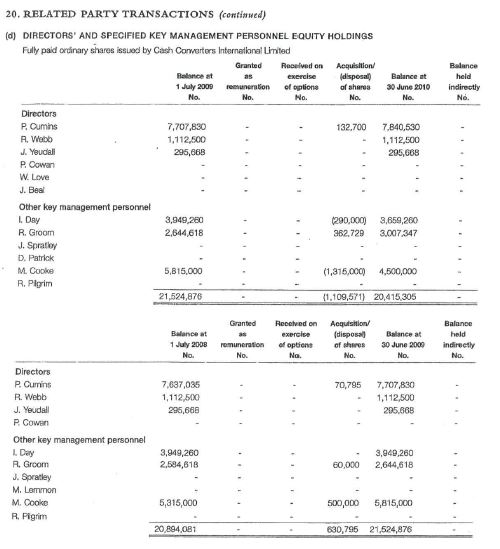
32 Similar references can be found in the extracts from the CCIL annual reports for 2011, 2012, 2013 and 2014, although the number of shares held by Mr Cooke in each case varies.
33 Mr Cooke said that the descriptions of him in the annual reports as being one of CCIL’s “key management personnel” and as being employed by CCIL were not accurate. As to the former, he believed that those statements were made in the annual reports because CCIL’s auditors insisted on describing him as “key management personnel” even though he had told them on a number of occasions that he was not involved in the management of any of the Cash Converters entities. As to the latter, Mr Cooke said that he was engaged and paid pursuant to the Retainer and that, consistently with that arrangement, he worked independently and typically only attended CCIL’s offices three mornings a week.
34 Mr Cooke previously gave evidence in proceedings NSD2089 of 2013 and NSD 2090 of 2013 (Gray Proceedings) in relation to an application challenging claims of legal professional privilege. A copy of the transcript of Mr Cooke’s cross-examination in the Gray Proceedings was in evidence before me. Mr Cooke was asked questions about an annual report and the description of him therein as “senior management”. In relation to that issue the following exchange took place:
Q. As at the date of publication of this annual report, did you consider yourself part of the senior management of this organisation?
A. Yes.
Q. And you appreciated that this was a document, when you first – I withdraw that question. I presume that you saw this annual report and the subsequent annual reports, prior to this date, at or around the time they were [re]leased to the Australian Securities Exchange. Correct?
A. Yes.
Q. And you knew that they were important documents to be released to the capital market upon which Cash Converters traded. Correct?
A. Yes.
Q. And they needed to be entirely accurate. Correct?
A. Yes.
Q. Yes. And so someone – you apprehended, at the time that you read this report, that what was being said to the market – that you were a person involved in the senior management of Cash Converters. Correct?
A. Yes.
Q. With senior managerial responsibilities. Correct?
A. No. As group legal counsel.
Q. So it would be inaccurate to say, would it, that – notwithstanding you were part of the senior management at the time that this report that this report was released to the Australian Security Exchange, do you tell his Honour you had no senior managerial responsibilities?
A. My only responsibility was group legal counsel.
35 Mr Cooke accepted that when he gave evidence in the Gray Proceedings he did not refer to any conversations with the auditors about the description of his role in the annual reports but was firm in his evidence that he had conversations with the auditors and denied that he was content to be described as senior management or key management personnel. I accept that evidence.
36 As well as being paid pursuant to the Retainer Mr Cooke was paid pursuant to CCIL’s executive performance rights plan. Mr Cooke said that when the issue of executive performance rights arose he “put up [his] hand” because he “wanted more money”. He expressed the view that he should get paid more or that his retainer should be increased. In response he was told that he would be included in the executive performance rights plan. Mr Cooke explained that a problem arose because he was not an employee of CCIL for the purpose of receiving those rights. Thus the lawyers handling the matter applied to ASIC for a class order exemption that he be treated as a deemed employee for the purpose of receiving the executive performance rights. But Mr Cooke said that he was not an employee and never became one.
37 The minutes of the CCIL remuneration committee meetings which took place on 26 June 2012 and 22 August 2012 are consistent with Mr Cooke’s evidence that he was not an employee of CCIL. The minutes of the meeting of 26 June 2012 concern executive performance rights for the managing director, Mr Cumins; the group legal counsel, Mr Cooke; and various senior executives. In relation to the managing director and the various senior executives the minutes note that the managing director and each of the senior executives had been “continuously employed by the Group at all times since the Grant Date”. In contrast, in relation to Mr Cooke, the minutes note that he had been “continuously engaged by the Group at all times since the Grant Date” (emphasis added). The same distinction is found in the minutes of the meeting of 22 August 2012.
38 Mr Cooke reviewed the remaining four documents in part A, 107 documents in part B and nine of the documents in part D of the Privilege Challenges Table and gives evidence of his recollection of the purpose and surrounding circumstances of those documents and the communications within them. I do not propose to set out that evidence but note that in each case Mr Cooke describes the parties to the communication and its purpose, for example, requesting or providing legal advice or seeking further information for the purpose of providing legal advice, and the broad subject-matter of the advice sought or provided. In most cases Mr Cooke is a party to the communications.
The NFSF
39 The NFSF relied on two affidavits sworn by Robert Bryant, a director and chairman of the NFSF, on 15 and 17 May 2017. I admitted Mr Bryant’s affidavits into evidence over Ms McKenzie’s objection subject to the weight to be given to the evidence. The basis for Ms McKenzie’s objection was that there was no direct evidence given by Mr Bryant; that he has no knowledge of the facts; that he was not involved in any transaction; and that he could not explain the nature of any communication and whether it was for the dominant purpose of providing or seeking legal advice. In support of her objection Ms McKenzie relied on the decision in Hancock v Rinehart (Privilege) [2016] NSWSC 12 (Hancock).
40 Hancock concerned a claim for legal professional privilege by Mrs Rinehart over certain documents produced to the court, without objection, by Sceales & Company Lawyers in answer to a subpoena. At [5] Brereton J noted that it was not in dispute that Mrs Rinehart, as the person making the claim for privilege, bore the onus of proving the facts on which the claim for privilege was founded. At [7] his Honour said:
To sustain a claim of privilege, the claimant must not merely assert it; but must prove the facts that establish that it is properly made. Thus a mere sworn assertion that the documents are privileged does not suffice, because it is an inadmissible assertion of law; the claimant must set out the facts from which the court can see that the assertion is rightly made, or in other words “expose … facts from which the [court] would have been able to make an informed decision as to whether the claim was supportable”. The evidence must reveal the relevant characteristics of each document in respect of which privilege is claimed, and must do so by admissible direct evidence, not hearsay.
(footnotes omitted)
41 Mrs Rinehart relied on an affidavit of her solicitor which explained how a schedule, referred to as schedule 1 and which listed the documents over which Mrs Rinehart personally claimed privilege, was compiled and exhibited a number of additional documents. At [9] Brereton J noted that the affidavit did not contain any evidence of the circumstances in which, and the purpose for which, the documents listed in schedule 1 were created. Nor did it contain an assertion that the schedule 1 documents were privileged which, his Honour observed, “would be no more than an inadmissible opinion on the deponent’s part, founded on facts not within his knowledge”.
42 At [10] Brereton J turned to consider schedule 1. His Honour noted that it was made up of four columns: (a) item; (b) document; (c) date; and (d) circumstances under which privilege is claimed. His Honour continued:
The solicitor’s affidavit explains how the description of each document in column (b) was prepared, and I am prepared to accept that the description accurately characterises the document to which each relates, so far as it goes. However, the affidavit does not say anything about the column “circumstances under which privilege is claimed”, which purports to state the basis of the privilege claim. The facts asserted in that column are unverified assertions of no evidentiary value. Although Mr McClintock SC offered to call the solicitor who made the affidavit to verify the facts asserted in that column, he could not have done so: the solicitor in question had no contemporaneous involvement in the creation and receipt of the disputed documents, had no personal knowledge of the matters asserted, and could not have given evidence of those matters, other than inadmissible hearsay or opinion.
43 At the hearing Mrs Rinehart requested the court to inspect the documents to determine the claim for privilege. The plaintiffs objected to that course. At [18] Brereton J identified the issue to be whether a person claiming privilege can sustain the claim by adducing no testimonial evidence of the purpose for and circumstances in which the subject documents were created, but by merely asking the court to inspect the documents for the purpose of ruling on the claim.
44 On that issue, after reviewing the authorities about the nature of the privilege being one against production to the Court, not merely against inspection, and the evolution of the procedure applicable to making and testing a claim for privilege, Brereton J said at [23]:
Those cases clearly establish that an objection to production founded on a claim for privilege should be taken at the first stage, and the reason why the objection is properly to be taken at the first stage – before the documents are produced to the court – is that the privilege is a privilege from production to the Court. Because the privilege is one against production, it is inconsistent with maintaining the claim to produce the documents to the court, let alone to tender them on the voir dire as evidence in support of the claim. It may be one thing to produce them pursuant to a requirement of the court to inspect them, but it is quite another to voluntarily produce them and tender them as the evidence to sustain the claim. If the claimant voluntarily uses the documents in that way, it has no legitimate basis for insisting that the opponent seeking production should be precluded from seeing them.
(footnotes omitted)
45 At [30]-[31] Brereton J considered the court’s power to inspect documents the subject of a claim for privilege so that it may rule on the claim. At [34] his Honour held:
Better informed now by the above analysis, in my view, such an approach is not merely unsatisfactory, but impermissible in principle. Whether the creature of judicial decision or, as I think more properly, rules of court, the court’s power to inspect documents – and to require their production for that limited purpose – was a response to the potential injustice in treating the claimant’s oath as conclusive. The power was not intended to detract from the requirement that a person claiming privilege prove, by admissible evidence, the grounds of the claim. While it is clear that the court may now require a document the subject of a claim of privilege to be produced so that it may inspect it for the purpose of ruling on the claim, that is quite a different notion from permitting a person claiming privilege to sustain the claim by adducing no testimonial evidence but asking the court to inspect the documents. The privilege being a privilege against production, it permits the person entitled to the privilege to refuse to produce the document to the court. To voluntarily proffer the documents for inspection – as opposed to doing so pursuant to a requirement made by the court under UCPR r 1.9(5)(c) – is inconsistent with maintaining the claim.
46 At [35] his Honour relevantly concluded that:
…
2. A claim for privilege must be made on sworn direct evidence – not inadmissible hearsay or opinion – proving the facts on which the claim is founded. This is unaffected by the court’s discretionary power to require production in order to enable inspection for the purpose of adjudicating the claim, which exists to enable a claim for privilege to be scrutinised, not to enable it to be proved. No party – least of all the party claiming privilege – may insist that the court inspect the documents.
47 Mr Bryant was not a director of the NFSF at the time that the documents over which the NFSF claims privilege were created. However, he gives evidence that he dealt with the directors of the NFSF, that he is familiar with the people named in the documents and that he has reviewed the documents. Mr Bryant sets out the basis upon which privilege is claimed by the NFSF, describing in broad terms the nature of the communications and by or to whom they were made and giving context to the communications over which the claims for privilege are made. Mr Bryant’s evidence is relevant to the NFSF’s claims for privilege.
48 Ms McKenzie’s objection is not a basis on which I would exclude clearly relevant evidence. This is particularly so where the application is interlocutory and s 75 of the Evidence Act 1995 (Cth) (Evidence Act) applies: see [64] below. In Hancock Brereton J rejected the claim for privilege, finding that no admissible sworn evidence had been tendered that was amenable to being tested by cross-examination probative of the facts on which Mrs Rinehart’s claim was founded: at [36]. In my opinion, Ms McKenzie’s objection went to the weight the Court would give the evidence and her ultimate submission that there is no evidence to sustain the NFSF’s claim for privilege. For that reason I received the evidence subject to weight.
49 Initially, Mr Betts gave evidence about the NFSF Documents. By way of background as to how the NFSF Documents came to be in Cash Converters’ possession, and to put the issue in context, it is of some assistance to set out some of what Mr Betts was told by John Brophy, a director of the NFSF from May 2009 to May 2016:
(1) the NFSF board of directors is drawn from across the small and medium amount credit contract industry and at various times staff of Cash Converters have been appointed to board positions of the NFSF;
(2) during his tenure on the board of the NFSF, Mr Brophy was also the national franchise operations manager of Cash Converters. Mr Brophy ceased employment with Cash Converters in August 2016;
(3) in his role as a director of the NFSF, Mr Brophy was provided with the NFSF Documents on a confidential basis. The NFSF Documents were sent to him at an email address affiliated with Cash Converters;
(4) John Brady was a board member of the NFSF from approximately 7 April 2008 to 8 October 2010 and also held the role of general counsel of City Finance until February 2010, after which he practised as a solicitor. Mr Brady advised the NFSF on legal matters and since late 2010 was engaged by the NFSF to provide legal advice; and
(5) the NFSF also received legal advice from external lawyers. Jon Denovan of Gadens Lawyers provided advice to the NFSF board from time to time.
50 Mr Bryant’s evidence was filed very late. After the service of Mr Bryant’s affidavit sworn on 15 May 2017 there was an exchange of correspondence between Maurice Blackburn and Foster Nicholson Jones, the solicitors for the NFSF:
(1) on 15 May 2017 Maurice Blackburn informed Foster Nicholson Jones of their view that Mr Bryant’s affidavit was:
… plainly insufficient to establish your client’s claims of privilege. In particular: it contains hearsay and opinion evidence which is inadmissible or liable to be excluded; it is made by a person with no personal knowledge of the communications in question; it makes formulaic recitations with respect to the claims of privilege; and lacks direct evidence such as would enable the Court to scrutinise and test your clients claims of privilege.
Maurice Blackburn put Foster Nicholson Jones on notice that, on the assumption that the NFSF would seek leave to rely upon that affidavit, they required Mr Bryant to be present in court for cross-examination should Mr Bryant’s evidence be admitted;
(2) on 16 May 2017 Foster Nicholson Jones sought a schedule of objections in relation to Mr Bryant’s affidavit sworn on 15 May 2017 specifying the paragraphs to which objection was taken and the basis of each objection. They also informed Maurice Blackburn that Mr Bryant would not be available to attend on 18 May 2017 and that they did not consider that his presence was necessary for the determination of the question of privilege, particularly in circumstances where the NFSF Documents were being provided to the Court for inspection. Foster Nicholson Jones said that the “usual and appropriate course” was for the Court “to assess the claim to privilege by reviewing the documents”;
(3) on 16 May 2017, by email sent at 10.26 pm, Maurice Blackburn responded to Foster Nicholson Jones’ letter of the same date. They said:
We cannot speak for the respondents, but please note that the applicant does not agree that the Court ought have regard to an allegedly privileged document in order to determine a claim of privilege over it, where no admissible evidence substantiating the privilege claim has been adduced in respect of that document. We refer you to the decision of Brereton J in Hancock v Rinehart (Privilege) [2016] NSWSC 12 in that regard, especially paragraphs 29-34.
(4) on 17 May 2017 Maurice Blackburn sent a further letter to Foster Nicholson Jones in which they notified of their client’s objections to Mr Bryant’s affidavit sworn on 15 May 2017 and his further affidavit sworn on 17 May 2017.
51 Mr Bryant’s evidence is, as noted above, based on his review of the documents and his knowledge of the persons referred to in them. Leaving aside duplicates, Mr Bryant gives evidence about 12 documents or parts thereof. By way of example, he says in his affidavit sworn on 15 May 2017:
3. I refer to the document entitled ‘National Financial Services Federation Limited Directors Meeting No. 2’ dated 25 August 2008 with document number CCPQ.001.017.0036 which is duplicated at page number CCPQ.001.027.5380 and which contains the minutes of a meeting of the directors of NFSF and says as follows:
(a) The first paragraph under the heading ‘5. Business arising from correspondence in’ refers to communications between NFSF and a legal adviser of NFSF and contains a record of those communications. Those communications were made for the dominant purpose of submission to the legal adviser for advice.
(b) Page ‘CCPQ.001.017.0052’ (duplicated at page CCPQ.001.027.5396) comprises a communication from a legal adviser of NFSF to NFSF made for the dominant purpose of submission to the legal advisor for advice.
4. I refer to the document entitled ‘National Financial Services Federation Limited Directors Meeting No. 3’dated 30 September 2008 with document number CCPQ.001.017.0036 which contains the minutes of a meeting of the directors of NFSF and says as follows:
(a) The first paragraph under the heading ‘3. Business arising from minutes’ refers to communications with a legal adviser of NFSFL (sic) and contains a record of those communications. Those communications were made for the dominant purpose of submission to the legal adviser for advice.
(c) Page ‘CCPQ.001.017.1814’comprises a communication from a legal adviser of NFSF to Mr John Brady of NFSF made for the dominant purpose of submission to the legal adviser for advice.
…
12. I refer to the document contained on pages CCPQ.001.030.5554 to CCPQ.001.030.5579 (both inclusive). That document comprises a communication from a legal adviser of NFSF to NFSF board members and was made for the dominant purpose of legal advice.
…
15. I refer to the copy of an email contained on page CCPQ.002.008.5043. That email refers to communications from Mr John Brady in his capacity as solicitor of NFSF to NFSF and contains a record of those communications. Those communications were made for the dominant purpose of submission to the legal adviser for advice.
52 The balance of Mr Bryant’s evidence in his affidavit sworn on 15 May 2017 and the evidence in his affidavit sworn on 17 May 2017 is in substantially the same form as the evidence set out in the preceding paragraph.
53 Mr Bryant was cross-examined. He said that in preparing his affidavits over a period of six to ten hours he had regard to the documents in question and consulted with both current and former members of the board at the relevant time as well as the NFSF’s solicitors. He said that he was not an NFSF board member at the time of the creation of the documents but that he joined the board some years later and then became the chairman of the NFSF. He said that as a result he was familiar with the people involved and the substance of the material. However, Mr Bryant was not familiar with and was unable to give evidence of the NFSF’s practices prior to the time that he became a member of its board.
54 Mr Bryant was asked about the evidence in [3(a)] of his affidavit sworn on 15 May 2017, which concerns document number 152 in part C of the Privilege Challenges Table. Mr Bryant said that the legal adviser referred to was Jon Denovan; that there was no other legal adviser named in the redacted part of the document; that there was a barrister referred to in the redacted part of the document; and that the barrister was not named.
55 Mr Bryant was also asked about the evidence in [4(a)] of his affidavit sworn on 15 May 2017, which concerns a communication recorded in the minutes of a meeting of the directors of the NFSF dated 30 September 2008, being document number 173 in part D of the Privilege Challenges Table. In particular, Mr Bryant was asked about the identity of the legal adviser with whom there was a communication that is said to be recorded in that part of the minutes. Mr Bryant said that he thought it was Paul Bingham. He also said that, in relation to his evidence in [4(a)] that the communications were made for the dominant purpose of submission to “the legal adviser”, that adviser was again Mr Bingham.
56 The minutes of the meeting of the directors of NFSF dated 30 September 2008 include under the heading “Concerns re vendor broker model” that:
Many of our members now having to deal with two entities, lender and broker, which has increased the corporate governance they need to deal with.
57 Mr Bryant said that he was familiar with that concept. However, he said that he was not aware that the NFSF was dealing with or recording those concerns in 2008. He said that there was “no way [he] could be aware” because he was “not on the [NFSF]”.
58 Mr Bryant was also asked about the document titled “National Financial Services Federation Limited Directors Meeting No. 14 5th May 2010”, which is document 160 in part C of the Privilege Challenges Table, and the discussion under the heading “General Business” about lending models. Mr Bryant said that he was not aware of how the NFSF was trying to deal with these concerns in the period between 2008 and 2010. He said that he “wasn’t there” and that he did not know “what else was not written in these minutes to address members’ concerns”. Mr Bryant was not aware whether in this period members were looking to the NFSF for advice about how to set up a lending model for their business in light of the interest rate caps.
59 In relation to the evidence given in [12] of his affidavit sworn on 15 May 2017, which concerns document 150 in part C of the Privilege Challenges Table, Mr Bryant said that the communication from the legal adviser was the advice from Mr Bingham and that he did not go to any other source of information or ask anyone, other than the NFSF’s solicitors, for the purpose of forming his opinion and giving his evidence that that document was made for the dominant purpose of legal advice. He said that he knows the document contains legal advice but that he did not know if the board sought the advice for the purpose of giving it to the members of the NFSF to assist them with their business lending models. There were then the following exchanges:
Q: Mr Bryant, do you know whether the board sought this advice for the purpose of assisting the members of the [NFSF] understand their options with lending models?
A: I would know the board would have received legal advice for the assistance of the members. That does not construe that they give members legal advice. In fact, they go to every effort not to give legal advice on anything. They receive legal advice, and they give information to their members on every topic possible. This is legal advice to the board.
And:
Q: Prior to August 2009, you cannot say what the practise (sic) of the board was with respect to giving legal advice, can you?
A: Correct.
Q: And Mr Bingham’s advice was sought prior to then, wasn’t it?
A: Yes.
Relevant legal principles
60 It is common ground that the issues that arise on this application are to be determined by reference to the common law, not the Evidence Act: Esso Australia Resources Limited v Commissioner of Taxation of the Commonwealth of Australia (1990) 201 CLR 49 (Esso) at [16] (per Gleeson CJ, Gaudron and Gummow JJ) and [149] (per Callinan J).
61 The following principles can be shortly stated:
(1) legal professional privilege "is a rule of substantive law and an important, indeed fundamental, common law right or immunity": DSE (Holdings) Pty Ltd v Intertan Inc (2003) 127 FCR 499 (DSE v Intertan) at [24];
(2) the privilege exists "to serve the public interest in the administration of justice by encouraging full and frank disclosure by clients to their lawyers": Esso at [35];
(3) in the case of legal advice privilege, a confidential communication will attract the privilege if it was made for the dominant purpose of giving or obtaining legal advice: Esso at [61]; The Daniels Corporation International Pty Ltd v Australian Competition and Consumer Commission (2002) 213 CLR 543 at [9]. In AWB Ltd v Cole (No 5) (2006) 155 FCR 30 (AWB (No 5)) at [44(7)] Young J noted that the concept of legal advice is fairly wide and that "[i]t extends to professional advice as to what a party should prudently or sensibly do in the relevant legal context; but it does not extend to advice that is purely commercial or of a public relations character"; and
(4) the party claiming privilege bears the onus of proving that the communication was made or the document created for the dominant purpose of giving or obtaining legal advice, although there is no fixed or rigid rule as to the nature and content of the evidence that is required to discharge that onus: see Grant v Downs (1976) 135 CLR 674 (Grant v Downs) at 688-689 (per Stephens, Mason and Murphy JJ); and
(5) the Court retains a power to examine the documents for itself, “a power which has perhaps been exercised too sparingly in the past, springing possibly from a misplaced reluctance to go behind the formal claim of privilege”: Grant v Downs at 689; Esso at [52]. In AWB (No 5) Young J said at [44(12)]:
The Court has power to examine documents over which legal professional privilege is claimed. Where there is a disputed claim, the High Court has said that the court should not be hesitant to exercise such a power: Esso; see also Grant v Downs at 689. If the power is exercised, the court will need to recognise that it does not have the benefit of submissions or evidence that might place the document in its proper context. The essential purpose of such an inspection is to determine whether, on its face, the nature and content of the document supports the claim for legal professional privilege.
62 As to the standard of proof required, in National Crime Authority v S (1991) 29 FCR 203 at 211-212 Lockhart J, with whom Keely J agreed, said that it was not sufficient for a party claiming privilege to merely assert that claim without exposing the facts on which the claim is based.
63 In Barnes v Commissioner of Taxation (Cth) (2007) 242 ALR 601; [2007] FCAFC 88 (Barnes) a Full Court of this Court (Tamberlin, Stone and Siopis JJ) considered the nature of the evidence required to establish a claim for legal professional privilege. At [18] their Honours said:
The authorities emphasise the need for focused and specific evidence in order to ground a claim for legal professional privilege. In Kennedy v Wallace (2004) 142 FCR 185; 213 ALR 108; [2004] FCAFC 337 (Kennedy), Black CJ and Emmett J reiterated the principles that verbal formulae and bare conclusory assertions of purpose are not sufficient to make out a claim for privilege: see also National Crime Authority v S (1991) 29 FCR 203 at 211; 100 ALR 151 at 158-60 (per Lockhart J); Grant at CLR 689; ALR 589 (per Stephen, Mason and Murphy JJ). Where possible the court should be assisted by evidence of the thought processes behind, or the nature and purpose of advice being sought in respect of, each particular document. The fact that generalised evidence is not challenged in cross-examination does not mean that such evidence must be accepted, particularly when it is as manifestly inadequate as it is in this case. As in Kennedy, mere general assertions of the purpose of creation of the documents are insufficient to discharge this onus. Even though in that case some evidence as to the purpose of particular records was adduced, Allsop J at [168] considered that the onus had not been discharged because the evidence did not permit a conclusion to be drawn as to the dominant purpose of the creation of any particular document or entry in a document. Simply to show that one purpose for creation of the document was to obtain legal advice or assistance is not good enough.
(original emphasis)
64 The application before me is interlocutory. It is well established that in an application of this kind it is open to follow the usual practice taken when receiving evidence in interlocutory applications and that s 75 of the Evidence Act applies: Kirby v Centro Properties Ltd (No 2) (2012) 87 ACSR 229; [2012] FCA 70 (per Bromberg J) at [14]; Morton v Bolinda Publishing Pty Limited [2017] FCA 187 (per Burley J) at [61].
65 Ms McKenzie's application raises the issue of whether there has been an implied or imputed waiver of the legal professional privilege that would otherwise attach to certain communications. In Mann v Carnell (1999) 201 CLR 1 (Mann v Carnell) a majority of the High Court (Gleeson CJ, Gaudron, Gummow and Callinan JJ) held at [29] that disputes as to implied waiver usually arise from the need to decide "whether particular conduct is inconsistent with the maintenance of the confidentiality which the privilege is intended to protect". Their Honours continued:
What brings about the waiver is the inconsistency, which the courts, where necessary informed by considerations of fairness, perceive, between the conduct of the client and maintenance of the confidentiality; not some overriding principle of fairness operating at large.
66 In DSE v Intertan Allsop J, as his Honour then was, observed that:
(1) the principle in Mann v Carnell is the “overriding guiding principle” and “[t]he expression of that principle and the subordination of the notion of 'fairness' to possible relevance in the assessment of the inconsistency between the act and the confidentiality of the communication produces … an important change to the existing law” (original emphasis): at [14];
(2) it is important to recognise that legal professional privilege is a fundamental common law right or immunity in appreciating “the operation of inconsistency, as opposed to some more broad ranging notion of fairness informed, perhaps, by balancing of competing interests in the administration of justice”: at [24]; and
(3) the "confidentiality is in the nature of an entitlement or a right to keep the communications immune from disclosure; it is acting inconsistently with it that destroys that fundamental entitlement" (original emphasis): at [24].
67 In Commissioner of Taxation v Rio Tinto Ltd (2006) 151 FCR 341 (Rio Tinto) a Full Court of this Court (Kenny, Stone and Edmonds JJ) said at [45]:
Where, as here, one party alleges that another has impliedly waived legal professional privilege, a court is bound to analyse the acts or omissions of the privilege holder that are said to be inconsistent with the maintenance of the privilege. In concluding that the Commissioner had waived the privilege in the eight contested documents, the docket judge in fact applied the “inconsistency” principle of Mann, as he was obliged to do: see Rio Tinto (2) at [20]. Plainly enough, the inquiry that it mandates focuses on the facts of the particular case. It follows that other cases in which implied waiver has been considered provide limited guidance unless they arise out of similar facts.
68 After discussing some of the earlier Australian authorities on issue waiver, their Honours said at [52]:
These authorities show that, where issue or implied waiver is made out, the privilege holder has expressly or impliedly made an assertion about the contents of an otherwise privileged communication for the purpose of mounting a case or substantiating a defence. Where the privilege holder has put the contents of the otherwise privileged communication in issue, such an act can be regarded as inconsistent with the confidentiality that would otherwise pertain to the communication.
69 At [65] their Honours said:
As the previous examination of the authorities shows, the question is not whether the Commissioner has put his state of mind in issue but whether he has directly or indirectly put the contents of the otherwise privileged communications in issue in the litigation, either in making a claim or by way of defence. Put another way, to adapt Allsop J’s language in DSE, has the Commissioner (being the privilege holder) made an assertion as part of his or her case in the litigation that lays open the privileged documents to scrutiny, with the consequence that an inconsistency arises between the making of the assertion and the maintenance of the privilege?
70 In Macquarie Bank Limited v Arup Pty Limited [2016] FCAFC 117 (Arup) a Full Court of this Court (Middleton, Robertson and Gleeson JJ) considered an application for leave to appeal in circumstances where the issue before the primary judge concerned implied waiver of legal professional privilege said to arise from a party's pleading: at [1]. The application was dismissed. Commencing at [23] the Full Court considered the applicable principles relating to implied waiver of legal professional privilege. At [25] the Full Court said:
The governing principle that underpins implied waiver has undergone a process of judicial evolution. In Attorney-General (NT) v Maurice (1986) 161 CLR 475 at 481, 487, 492, 497, the High Court held that implied waiver occurs when, by reason of some conduct on the privilege holder’s part, it becomes unfair to maintain the privilege. However, ‘fairness’ was subsequently abandoned as the touchstone of implied waiver by the High Court in Mann v Carnell.
71 After referring to the decision in Rio Tinto the Full Court said at [28]-[29]:
28 The correct approach was succinctly described by Yates J in Ferella & Anor v Official Trustee in Bankruptcy (2010) 188 FCR 68 at [65] in the following terms:
...However the question is not simply whether the holder of the privilege has put that person’s state of mind in issue but whether that person has directly or indirectly put the contents of the otherwise privileged communication in issue: see [Rio Tinto] at [65]. Indeed, even the fact that the holder of the privilege makes clear that the advice was relevant or contributed to a particular course of conduct would not be sufficient to waive the privilege unless, possibly, the contents of the legal advice (and not merely the fact of the advice) are specifically put in issue by relying on the contents of the advice to vindicate a claimed state of mind: [Rio Tinto] at [67].
29 In determining whether there has been an implied waiver of privilege, the Court’s focus will be on whether there has been conduct that is inconsistent with the maintenance of confidentiality in the communication over which privilege is asserted. An assessment of whether there has been an implied waiver will be informed by considerations of forensic unfairness.
72 At [37] their Honours said:
It may be accepted that the Cross-Claim puts in issue Arup’s state of mind at the time it relied on the conduct of the Sponsor Group. Whilst the privileged documents might be relevant to that state of mind, it is settled that that fact alone will not result in a waiver of privilege: see, eg, Archer Capital at [24] and the authorities referred to at [18] and [31] of the Reasons.
73 At [41] the Full Court concluded that:
This proceeding merely involves the pleading by Arup of reliance and the discovery of privileged documents. Whilst such documents are relevant to the proceeding (and hence discoverable), this is not sufficient to constitute waiver. If it were, then as the primary judge observed, this would ‘come perilously close to, if not amount to, a proposition that a mere pleading of reliance would itself be sufficient to constitute a waiver of privilege’: see [39] of the Reasons.
consideration
Was there an implied or imputed waiver?
74 The first issue that arises for consideration is whether, as Ms McKenzie contends, by reason of Cash Converters’ forensic deployment of the Couper QC Advices in the amended defence, they have waived all claims of privilege over communications that relate to the issue of the loan brokerage model, which was the topic upon which Mr Couper QC was instructed to opine and which Ms McKenzie alleges is the conduct at issue in the unconscionability claim. I accept Ms McKenzie’s submission that that issue should be determined before any inspection of the documents in issue.
75 Ms McKenzie submitted that the relevant “transaction” to be considered by the Court is Cash Converters’ formulation and use of the “loan brokerage model”. She said that the evidence disclosed that this model was in use from August 2008 to 30 June 2013 and appeared to have begun to be formulated no later than July 2008. She further submitted that, similar to proceedings for professional negligence against a party’s lawyer, a party cannot “pick and choose, disclosing such incidents of the relationship as strengthen [its] claim for damages and concealing them from forensic scrutiny such incidents as weaken it”, referring to Paragon Finance Plc v Freshfields [1999] 1 WLR 1183; cited in Vic Hotel Pty Ltd v DC Payments Australasia Pty Ltd (2015) 321 ALR 191; [2015] VSCA 101 at [51].
76 Ms McKenzie contended that whether or not any alleged inconsistency has led to an issue waiver is inherently fact dependent. She submitted that the Couper QC Advices, which provide a positive opinion about the legality of the loan brokerage model at issue in this proceeding, are deployed by Cash Converters in the particulars to [35(e)], [43(f)] and [51(e)] of the amended defence and that they underpin Cash Converters’ assertion that they acted in “good faith” within the meaning of s 12CC(1)(l) of the ASIC Act. Ms McKenzie submitted that the meaning and operation of the unconscionability provisions in the ASIC Act, particularly in the context of the statutory concept of “good faith”, were recently explained by Allsop CJ, with whom Besanko and Middleton JJ agreed, in Paciocco v Australia and New Zealand Banking Group Ltd (2015) 236 FCR 199 (Paciocco) at [285], [288], [292] and [293]. Ms McKenzie further submitted that, against that background, Cash Converters sought to deploy the Couper QC Advices to secure a forensic advantage with respect to conclusions about their acting in “good faith” in implementing and using the loan brokerage model while claiming privilege over all other legal advice in relation to it.
77 Ms McKenzie contended that to selectively deploy legal advice in these circumstances is a classic act of inconsistency in the maintenance of the privilege in other communications on the same subject-matter and that it was unfair to deny her the opportunity to examine the whole of Cash Converters’ legally privileged communications with respect to the loan brokerage model and its implementation over the relevant period of time in which the model was formulated and in use. She further contended that the waiver applies to all communications that relate, expressly or impliedly, to the legality of the loan brokerage model and that this was so whether or not the communication pre- or post-dated the Couper QC Advices.
78 The critical question for the Court in considering whether there has been an inconsistency of the kind referred to in Mann v Carnell is whether the content of an otherwise privileged communication has been put in issue in the litigation. As was recognised in DSE v Intertan, the question is whether the privilege holder has made an assertion about part of its case in the litigation “which is either about the contents of the confidential communication or which necessarily lays open the confidential communication to scrutiny” (original emphasis) such that “an inconsistency arises between the act and the maintenance of the confidence”: at [58].
79 Ms McKenzie referred the Court to the following extracts from Paciocco where Allsop CJ considered the operation of the unconscionability provisions in the ASIC Act:
285 More specific guidance to the meaning and operation of s 12CB as a consumer provision is given by the matters set out in s 12CC … to which a court may have regard for the purposes of considering the question of unconscionable conduct. These matters assist in setting a framework for the values that lie behind the notion of the relevant conscience of the parties in trade or commerce identified in s 12CB. Those values and conceptions can be seen as: fairness and equality: see paras (a), (b), (d) to (k); a lack of understanding or ignorance of a party: para (c); the risk and worth of the bargain: paras (e) and (i); and good faith and fair dealing: para (l).
...
288 The usual content of the obligation of good faith that can be extracted from cases such as Renard Constructions, Hughes Bros Pty Ltd v Trustees of Roman Catholic Church (Archdiocese of Sydney) (1993) 31 NSWLR 91, Burger King Corporation v Hungry Jack's Pty Ltd (2001) 69 NSWLR 558, Alcatel Australia Ltd v Scarcella (1998) 44 NSWLR 349, and United Group Rail Services Ltd is an obligation to act honestly and with a fidelity to the bargain; an obligation not to act dishonestly and not to act to undermine the bargain entered or the substance of the contractual benefit bargained for; and an obligation to act reasonably and with fair dealing having regard to the interests of the parties (which will, inevitably, at times conflict) and to the provisions, aims and purposes of the contract, objectively ascertained.
…
292 Good faith does not import an equitable notion of the fiduciary that is rooted in loyalty to another in the service of her or his interests: Smith L, "Fiduciary Relationships: Ensuring the Loyal Exercise of Judgement on Behalf of Another" (2014) 130 LQR 608. Rather, it is rooted in honest and reasonable fair dealing: Macquarie International Health Clinic Pty Ltd v Sydney South West Area Health Service (2010) 15 BPR 28,563 at [12]-[13].
293 Trickery and sharp practice impede commerce by decreasing trust and increasing risk. Good faith and fair dealing promote commerce by supporting the central conception and basal foundation of commerce: a requisite degree of trust. Business people understand these things.
80 As submitted by Cash Converters, in Ms McKenzie’s pleaded case that Cash Advance, Cash Stores and Bak Property each engaged in conduct that contravened s 12CB(1) of the ASIC Act in that, among other things, they did not act in good faith, she does not allege any dishonesty on the part of Cash Advance, Cash Stores or Bak Property. Given that, the issue that arises is whether Cash Advance, Cash Stores and Bak Property engaged in fair dealing or acted reasonably. That is the context in which the Couper QC Advices have been deployed.
81 More particularly, Cash Converters’ amended defence puts in issue the Couper QC Advices in response to the allegation that each of Cash Advance, Cash Stores and Bak Property engaged in unconscionable conduct, contrary to s 12CB of the ASIC Act, and the allegation that they did not act in good faith. It follows, and Cash Converters accepts, that the amended defence “lays open” that advice to scrutiny. But, in my opinion, the waiver goes no further than the Couper QC Advices.
82 Ms McKenzie characterised the Couper QC Advices as a “positive opinion about the legality of the loan brokerage model at issue” in the proceeding. The nature of the Couper QC Advices is set out at [18] above. Mr Couper QC was asked to advise on two particular issues in relation to the loan brokerage model, namely, whether that model would cause the interest on loans to exceed the maximum permissible percentage rate under the QLD Regulation and whether it would breach any other provision of the QLD Code. To the extent that Mr Couper QC opined on the “legality” of the loan brokerage model, he did so in the context of the specific questions he was asked to address. It is difficult to see how the relevant transaction the subject of Mr Couper QC’s advice could be the “loan brokerage model” more generally, as Ms McKenzie contended. That was not the subject of Mr Couper QC’s advice, which was specifically focused on the two issues identified.
83 Contrary to Ms McKenzie’s submission, it cannot be said that the disclosure of the Couper QC Advices amounted to a waiver of all other legal advice received by Cash Converters on the loan brokerage model. The particular communications that Cash Converters deploys in its amended defence are the advices given by Mr Couper QC. They have been put in issue and that advice, and the documents related to it, have been provided to Ms McKenzie. There has been no waiver of the nature and extent alleged by Ms McKenzie.
84 Ms McKenzie submitted that it was unfair to deny her the opportunity to examine the whole of Cash Converters’ legally privileged communications with respect to the loan brokerage model and its implementation over the relevant period of time that the model was formulated and in use. However, as was observed in Arup, the principle that underpins implied waiver has undergone a process of judicial evolution and “fairness” was abandoned as the touchstone of implied waiver by the High Court in Mann v Carnell. The question for the Court is whether Cash Converters has directly or indirectly put the content of the otherwise privileged communication in issue or, put another way, whether there has been conduct that is inconsistent with the maintenance of the confidentiality in the communication that is subject to the claim for privilege. As the Full Court observed in Arup, the assessment of whether there has been an implied waiver will be informed by “considerations of forensic unfairness”: at [29]. Here, the only otherwise privileged communications that have been put in issue are the Couper QC Advices. There is no inconsistency in Cash Converters maintaining privilege over other advices relating to the loan brokerage model over the relevant period, assuming that they exist.
85 The related issue that arises is the scope of the waiver that results from the voluntarily disclosed advices. This is particularly relevant to the documents in part A of the Privilege Challenges Table. Ms McKenzie accepts that those documents are privileged but contends that privilege has been waived because they are “source documents” with respect to the voluntarily disclosed advices from Mr Couper QC and Mr Bain QC.
86 Ms McKenzie referred to Attorney-General for the Northern Territory v Maurice (1986) 161 CLR 475 (Maurice), where the High Court stated that the test to determine the scope of any waiver of associated material is whether the material that the party has chosen to release from privilege represents the whole of the material relevant to the same issue or subject-matter: at 482 (per Gibbs CJ), 488 (per Mason and Brennan JJ) and 498-499 (per Dawson J).
87 In AWB (No 5) Young J considered in some detail the authorities concerning the scope of an imputed waiver. At [164] his Honour referred to the test set out by the High Court in Maurice, as was adopted by Ms McKenzie in her submissions, and set out the relevant extracts from the judgments of Gibbs CJ and Dawson J: at [165]-[166].
88 Relevantly, in Maurice at 481-482, Gibbs CJ observed that “where a document deals with a single subject-matter it would be unfair to allow a party to use part of the document and claim privilege as to the remainder”. His Honour noted that, similarly, “where a party disclosed a document which contained part only of a memorandum which dealt with a single subject- matter, and then read the document to the judge in the course of opening the case, it was held that privilege was waived as to the whole memorandum”, referring to Great Atlantic Insurance Co. v Home Insurance Co. [1981] 1 WLR 529. His Honour then continued:
The same test must be applied in deciding whether the use in legal proceedings of one document impliedly waives privilege in associated material. In Nea Karteria Maritime Co. Ltd v Atlantic & Great Lakes Steamship Corporation [No. 2] Mustill J. dealt with this question and suggested the following test:
“… where a party is deploying in court material which would otherwise be privileged, the opposite party and the court must have an opportunity of satisfying themselves that what the party has chosen to release from privilege represents the whole of the material relevant to the issue in question. To allow an individual item to be plucked out of context would be to risk injustice through its real weight or meaning being misunderstood.”
(footnotes omitted)
89 In AWB (No 5) at [168] Young J observed that “[a] common application of associated material waiver relates to the case where an expert report has been prepared in reliance upon other documents”. After referring to three Australian decisions which considered the status of material relied on by an expert and noting that, “[i]n England, the principle has been applied to documents which underpin or support expert evidence”, Young J considered at [172]-[176] some of the English cases that he said illustrate the practical operation of the principle:
172 Several English cases illustrate the practical operation of the principle. In Nea Karteria Maritime Co Ltd v Atlantic & Great Lakes Steamship Corp (No 2) [1981] Com LR 138; [1981] Can. Com. R. 132, a lawyer gave evidence that he had conducted an interview on the basis of a list of questions prepared by the plaintiffs’ lawyers. While privilege was waived with respect to the witnesses’ answers, the plaintiffs sought to maintain privilege with respect to the list of questions: at 139-140.
173 Mustill J (as his Lordship then was) held at 140 that privilege over the list of questions had been waived by implication:
It seems to me that the written questions were, so to speak, part of the meeting. They were in a sense an agenda for the meeting. They formed the basis for one-half of the exchange between the lawyer and [the witness]. Evidence to that effect having been given by the lawyer, it seems to me that privilege must have been waived for those questions. And I think the interests of justice, which I believe to underlie the authorities on this part of the case, demand that the opposition and the court should have an opportunity to satisfy itself as to the accuracy of the evidence given to the lawyer as to the way in which he conducted the interview.
174 Mustill J drew a distinction at 140 between the instructions to the lawyer who carried out the questioning and the questions themselves; the instructions did not play a part in the meeting, did not form part of the body of events upon which the Court had to reach conclusions of fact, and were merely part of the prior history of those events.
175 In R v Secretary of State for Transport; Ex parte Factortame [1997] EWHC 445 (Admin); (1997) 9 Admin LR 591 at 599, Auld LJ made the following observations concerning the application of the test stated in Nea Karteria:
Much depends on whether the party making partial disclosure seeks to represent by so doing that the disclosed documents go to part or the whole of an “issue in question”, the expression used by Mustill, J in the passage from his judgment in Nea Karteria that I have cited. The issue may be confined to what was said or done in a single transaction or it may be more complex than that and extend over a series of connected events or transactions. In each case the question for the court is whether the matters in issue and the document or documents in respect of which partial disclosure has been made are respectively severable so that the partially disclosed material clearly does not bear on matters in issue in respect of which material is withheld. The more confined the issue, for example as to the content of a single document or conversation, the more difficult it is likely to be to withhold, by severance, part of the document or other documents relevant to the document or conversation.
176 In Fulham Leisure Holdings Ltd v Nicholson Graham & Jones [2006] 2 All ER 599 at [11], Mann J suggested that it was helpful to approach the application of the test stated in Nea Karteria in three steps: first, identify the transaction in respect of which the disclosure has been made; secondly, ascertain from the nature of the disclosure or other evidence whether the transaction is wider than an advice given on a single occasion, if so, the whole of the wider transaction must be disclosed; and thirdly, the disclosure of the whole transaction may make it plain that further disclosure is necessary to avoid unfairness or misunderstanding of what has been disclosed. Mann J added at [18] that once the transaction has been identified the cases show that the whole of the material relevant to that transaction must be disclosed. It is not open to a waiving party to say that the transaction is simply what the party has chosen to disclose; the court will determine objectively what the real transaction is so that the scope of the waiver can be determined. His Lordship also said that the application of these principles will be very fact sensitive and will vary from case to case: at [19].
90 Young J was satisfied that AWB Ltd had deployed “the gist or substance of legal advice it had obtained” and that its actions in doing so were inconsistent with the maintenance of confidentiality in the advice and “the associated material which underpinned the legal advice”: at [178]. Having come to that conclusion, his Honour was of the view that it was “necessary and appropriate” to make “specific findings as to the nature and consequences of each such disclosure”. His Honour undertook that task at [180]-[197]. At [198]-[201] Young J then considered the scope of the waiver:
198 One question which remains to be dealt with is whether the scope of the waiver that must, in my view, be imputed to AWB is to be confined to any other legal advice that AWB obtained prior to the date of the relevant disclosures that addressed the same subject matters or issues as the advice that AWB voluntarily disclosed. In my opinion, the waiver is not so confined. It extends to the documents and information which were taken into account in formulating, or which otherwise underpinned or influenced, the legal advice that AWB has chosen to disclose.
…
200 According to the authorities discussed above, the limits of any waiver of associated material depend upon the nature of the advice that has been disclosed, what was represented by means of the disclosure, and the character of the transaction that gave rise to the disclosed legal advice. Regard must also be had to the way in which AWB’s legal advice was described in the various disclosures. Essentially, by means of the disclosures, AWB was asserting that a detailed legal review had been undertaken, and that it had concluded that there was no evidence of any wrongdoing or other improper conduct by AWB in connection with its sale of wheat to Iraq under the OFF Programme. In my opinion, the nature and character of this disclosure is inconsistent with the maintenance of confidentiality in those documents which were taken into account by AWB’s legal advisers in arriving at the advice they gave. To adapt the language used by McClellan CJ at Common Law in Thomas at [17] and [20], AWB’s disclosures of its legal advice effect a waiver of privilege in the documents which were reviewed for the purposes of that advice or which influenced its content. Furthermore, AWB emphasised the breadth of its internal review in its various disclosures. In my view, AWB thereby waived privilege in documents which define the scope of the review or which reveal what investigations were in fact undertaken in the course of the review.
201 Much the same answer follows if one asks what was the legal exercise or transaction that gave rise to the disclosed legal advice: see Factortame at 598-599; and Fulham at [11] and [18]. Having regard to the form of the legal advice disclosed by AWB, the relevant legal exercise or transaction encompassed a review of original documents and witness interviews, as well as summaries, chronologies or other analytical documents prepared by the lawyers, with a view to determining whether there was any improper or wrongful conduct by AWB. Material of this kind underpinned or influenced the legal advice which AWB has chosen to disclose, and it is not severable from that advice.
91 The facts of the case before me are different to the facts before Young J in AWB (No 5). However, adopting his Honour’s analysis at [200], the limits of the waiver depend on the nature of the Couper QC Advices, what was represented by their disclosure and the character of the transaction that gave rise to the Couper QC Advices. The Couper QC Advices addressed the two questions referred to at [82] above; Cash Converters deployed those advices in support of its defence that it acted in good faith; and the transaction that gave rise to the advices was a request for advice on those two questions arising out of the mediation described at [18] above. The transaction was not, as Ms McKenzie contended, the loan brokerage model used by Cash Converters over a five year period. The same result is reached adopting the analysis at [201] of AWB (No 5). At the time of this application Cash Converters had not filed evidence. There was nothing that could lead to a conclusion that the “transaction” or “legal exercise” was broader than the two issues considered in the Couper QC Advices.
92 Accordingly, the scope of the waiver in this case “extends to the documents and information which were taken into account in formulating, or which otherwise underpinned or influenced” the Couper QC Advices. It does not extend to “source documents” as defined by Ms McKenzie: see [94(1)] below.
93 I turn then to consider the documents in each part of the Privilege Challenges Table
Part A of the Privilege Challenges Table
94 Four documents remain issue in part A of the Privilege Challenges Table. Ms McKenzie accepts that those documents are privileged but contends that the privilege has been waived because:
(1) the documents are “source documents” with respect to the voluntarily disclosed advices from Mr Couper QC and Mr Bain QC. Ms McKenzie defines “source documents” as “documents to which it is necessary to refer to understand certain legal advices voluntarily discovered and disclosed by [Cash Converters]”; or
(2) the references to the Couper QC Advices in the particulars to [35(e)], [43(f)] and [51(e)] of Cash Converters’ amended defence gives rise to an issue waiver over all communications which relate to the “issue” of the loan brokerage model.
95 Ms McKenzie submitted that, at the level of principle, there appeared to be no dispute between the parties that the voluntary disclosure by Cash Converters of, relevantly for the purpose of the documents listed in part A of the Privilege Challenges Table, the Couper QC Advices and the Bain QC Advice, also waived privilege in the “source documents”. Ms McKenzie further submitted that, because there was no issue that there had been an imputed waiver by reason of the disclosure of the legal advices, but rather an issue about whether that waiver applies to the remaining four documents, the Court should, if needed, inspect the documents to resolve any remaining factual impasse.
96 As I have already set out at [92] above, the scope of the waiver in this case extends to documents and information taken into account in formulating, or which underpinned or influenced, the Couper QC Advices. To the extent that Ms McKenzie’s definition of the term “source documents” goes beyond that category of documents I would reject it. I reject the suggestion that Cash Converters’ voluntary waiver of legal professional privilege in the Couper QC Advices, and for that matter the Bain QC Advice, resulted in a waiver of legal professional privilege in documents falling within the definition of “source documents” propounded by Ms McKenzie.
97 The evidence discloses that Cash Converters instructed its solicitors to request that Holding Redlich provide its file relating to obtaining the Couper QC Advices for discovery purposes; that that file was provided and reviewed by Cash Converters’ solicitors; and that documents that were relied upon or provided to Mr Couper QC in connection with the Couper QC Advices were identified and discovered by Cash Converters. The evidence also establishes that Cash Converters did not engage Mr Bain QC and that it does not have any source documents in relation to the Bain QC Advice.
98 The parties invited me to inspect the Part A documents. Having done so, I am satisfied that they are not source documents in the relevant sense. They are not documents or information that was taken into account in formulating, or which otherwise underpinned or influenced, the voluntarily disclosed advices.
Part B and documents 166 to 172, 175, 176, 178 and 180 to 184 of part D of the Privilege Challenges Table.
99 Ms McKenzie contends that two issues arise in relation to the documents in part B and documents 168 to 172, 175, 176, 178 and 180 to 184 of part D of the Privilege Challenges Table: first, whether they are privileged having regard to the dominant purpose of the communications given Mr Cooke’s apparent management role; and, secondly, if privileged, whether they are affected by the issue waiver arising from Cash Converters’ deployment of the Couper QC Advices.
100 As to the second issue, I have already determined that there has been no issue waiver of the kind alleged by Ms McKenzie arising from the deployment by Cash Converters of the Couper QC Advices in its amended defence: see [91] to [92] above.
101 In relation to the first issue Ms McKenzie submitted that:
(1) Mr Cooke had been Cash Converters’ legal counsel since 1992 and that for 11 years he was an executive director of Cash Converters, during which period he played a vital business role in its expansion and its operations;
(2) Mr Cumins described Mr Cooke’s role as “essential” in dealing with subsidiaries and “impossible” to replace in relation to the franchisees. Mr Webb described Mr Cooke’s legal expertise and intimate knowledge of Cash Converters to have “been an essential element in the success of the company”;
(3) from 2010 to 2014 Mr Cooke was consistently described in the Cash Converters annual reports as part of the “senior management” of the Cash Converters group and as having an employment contract with Cash Converters; and
(4) insofar as Mr Cooke maintained a legal practice trading as Cooke & Co until his recent retirement, from 2006 that practice had no clients other than Cash Converters and prior to 2006 it only had one other client.
102 Ms McKenzie submitted that the evidence discloses that the alleged legal advice given by Mr Cooke occurred after Cash Converters had made positive and conclusive statements to the market in November 2007 and April 2008 that the 48% interest cap would not affect the profitability of their business. Ms McKenzie further submitted that an inference was therefore available that much of Mr Cooke’s role was operational or commercial rather than legal, in the sense of implementing management decisions that had already been made.
103 Ms McKenzie noted that the Court has a discretion to examine the documents to determine whether privilege has been established. Ms McKenzie submitted that, in light of the paucity of evidence adduced to establish the claims; Cash Converters’ statements to the market upon the announcement and introduction of the interest rate cap; and Mr Cooke’s complex role and background at Cash Converters, save in the case of two documents, the Court should inspect the documents.
104 The two documents that Ms McKenzie submitted the Court should not inspect are document numbers 166 and 167 in part D of the Privilege Challenges Table. Ms McKenzie submitted that there was no proper evidence from any person about those documents and that, in light of that and relying on the decision in Hancock, the Court would exercise its discretion not to inspect those documents.
105 Save for document numbers 166 and 167, Ms McKenzie invited the Court to exercise its discretion to inspect the documents to determine whether Cash Converters’ claim of privilege in those documents has been established. Cash Converters also invited the Court to exercise its discretion to inspect the documents for that purpose. Notwithstanding that, given that Mr Cooke was cross-examined and submissions were made on the issue, I will first consider whether there is sufficient evidence to ground Cash Converters’ claim for privilege, including in relation to document numbers 166 and 167.
106 Mr Cooke’s independence is not challenged by Ms McKenzie. Her central proposition was that Mr Cooke was an employee or member of the senior management team of Cash Converters who was involved in providing business and commercial advice and not exclusively legal advice. I accept Mr Cooke’s evidence that he was not an employee of CCIL or any company in the Cash Converters group. The Retainer sets out the terms upon which Mr Cooke was retained by CCIL in the role of general counsel. From 2004 Mr Cooke acted only in the role of general counsel, having resigned as a director of CCIL and CCPL.
107 Mr Cooke conceded in cross-examination and I accept that his role would from time to time involve him giving what might be described as commercial or business advice rather than legal advice. That is understandable given his role as general counsel. But that does not of itself undermine the claim for privilege made in relation to these documents. That claim must be determined by consideration of the evidence in relation to each of the documents and, if necessary, an inspection of the documents.
108 Mr Cooke gave evidence that is focused and specific about the documents which are the subject of Cash Converters’ claim for privilege. His evidence adequately sets out the nature and purpose of the documents and the circumstances in which they were brought into existence. The evidence is not formulaic.
109 Document 166 is described in part D of the Privilege Challenges Table as “Email title: Qld Update” dated 2 November 2008 from Peter Cumins to Reginald Webb, Ralph Groom, Cameron Hetherington, John Yeudall and Paul Cowan. Document 167 is described as “Email title: FW: Qld Update” dated 3 November 2008 from Paul Cowan to Ralph Groom. It is not the case that there is no evidence in relation to those documents. Mr Betts gives the following unchallenged evidence in relation to them, which was admitted subject to weight:
The emails at CCPQ.001.075.4778 and CCPQ.001.075.4769 contain redactions that refer to advice provided by an external legal adviser, David Stone, to Cash Converters. My understanding based on discussions with HSF solicitors conducting discovery review is that David Stone was a director of William & Hughes, a firm of barristers and solicitors that was retained by Cash Converters to provide advice in relation to breaches by Queensland franchisees of the Franchise Agreements. Accordingly, the Respondents have claimed privilege over the redacted part of that email and its attachment.
110 That evidence sufficiently establishes that the redacted parts of the documents came into existence for the dominant purpose of recording legal advice. The authors of those emails were not called to give that evidence. However, the requisite facts to establish the claim for privilege have, in my opinion, been sufficiently proved. It is not the case that the maker of the document or statement must always be called to give the evidence: see [64] above and Hastie Group Ltd (in liq) v Moore [2016] NSWCA 305 at [31]-[34]. To do so in every case, particularly where there are numerous documents in issue and multiple authors, would, among other things, be contrary to the overarching purpose in s 37M of the Federal Court Act, namely, the facilitation of the quick, inexpensive and efficient resolution of disputes.
111 In any event, I considered that it was appropriate for me to inspect the documents in part B and documents 166 to 172, 175, 176, 178 and 180 to 184 of part D of the Privilege Challenges Table. Having done so, I am satisfied that the claims for privilege have been properly made, that the documents are privileged and that there has been no waiver of the privilege in the documents by reason of the deployment of the Couper QC Advices in the amended defence.
The NFSF Documents – part C and the remaining documents in part D of the Privilege Challenges Table
112 Ms McKenzie submitted that Mr Bryant’s evidence should be given no weight and that the Court should exercise its discretion not to look at the NFSF Documents because Ms McKenzie was prejudiced. Ms McKenzie submitted that the prejudice arose because the NFSF relied on evidence that she could not test and, if the Court were to inspect the NFSF Documents, a determination would be made on evidence that she could not see. Ms McKenzie further submitted that inspection by the Court to determine whether the NFSF Documents were privileged would not cure the prejudice because, in order for the Court to form a view that the documents were privileged, it would need to know something about the purpose for which they were obtained.
113 Ms McKenzie submitted that there was a serious question about the purpose for which some of the NFSF Documents were brought into existence because, unlike Cash Converters, which had a vital interest in obtaining confidential advice about its business model, the NFSF could have no interest in obtaining such advice other than for provision to its members. Ms McKenzie submitted that the NFSF’s purpose, as evidenced by its constitution, is to assist its members.
114 Ms McKenzie referred by way of example to the advice obtained by the NFSF from Mr Bingham, which she accepted, prima facie, was the type of document that would ordinarily be privileged. Ms McKenzie submitted that it was known that Mr Bingham’s advice was about alternative lending models but that it was not known how those models were discussed and whether the advice was actually business advice. She contended that it appeared that the purpose of the advice was not for advising the NFSF on its lending business, because it has no lending business, but rather for a non-confidential purpose of assisting the members of the NFSF with information about how they could model their businesses in light of the capping legislation. Ms McKenzie further contended that it seemed that, if given to members, the advice has a non-confidential purpose. She submitted that she could not test the purpose.
115 Ms McKenzie contended that the NFSF had not discharged its onus of proof in establishing that, at least at a prima facie level, the NFSF Documents were privileged. She further contended that Mr Bryant’s evidence can rise no higher than his opinion. She submitted that it was not clear why the NFSF was seeking legal advice on certain matters; whether it was doing so on the basis that the advice was confidential; and, if it was, whether that confidentiality could be maintained.
116 Ms McKenzie submitted that there are inferences that arise in relation to how the NFSF had chosen to prove the privilege in the NFSF Documents, referring to the exchanges of correspondence between her solicitors and, initially, the solicitors for Cash Converters and, more recently, the solicitors for the NFSF. She further submitted that, despite the correspondence pointing out the deficiencies in the affidavits now relied upon by the NFSF, it had made a deliberate decision not to call anyone with whom Ms McKenzie could explore the relevant issues. Ms McKenzie further submitted that that gives rise to an inference as to whether the evidence would have assisted the NFSF and that she had been “hamstrung” in her ability to explore the relevant issues by the NFSF’s decision.
117 Ms McKenzie submitted that there was unfairness. She said that the unfairness arose in circumstances where a person who maintained that she could not see documents relevant to her proceeding could put on evidence from someone who had no personal knowledge of the relevant events; could prevent cross-examination because that person has no personal knowledge of the relevant circumstances; and could then have the benefit of the Court looking at a fraction of the evidence that might be suggestive of one outcome but not conclusive in the absence of more evidence. Once again, Ms McKenzie sought to illustrate the point by reference to Mr Bingham’s advice. She submitted that if that advice, which she knew was in Cash Converters’ possession from 2009, said, for example, that a brokerage model similar to the one used by Cash Converters was not lawful then that would impact on Cash Converters’ defence that they acted in good faith by reason of the Couper QC Advices.
118 The NFSF submitted that a prima facie case on which privilege could be claimed was raised on the evidence and that the Court should exercise its discretion to inspect the documents. In response to Ms McKenzie’s opposition to the Court exercising its discretion to inspect the documents the NFSF submitted that:
(1) there was admissible evidence in support of its claim given that Mr Bryant’s affidavits had been received into evidence over Ms McKenzie’s objection;
(2) Mr Bryant was not cross-examined about whether there was a deliberate decision by the NFSF about who would be called to give evidence and there was no evidence of any such decision or choice being made. It submitted that Ms McKenzie could not put to the Court that an inference should be drawn because Mr Bryant had given evidence rather than another director of the NFSF because that was not a matter that was put to Mr Bryant in cross-examination. The NFSF contended that, even if it were otherwise open to the Court to draw such an inference, it could not do so in the absence of any cross-examination on the issue; and
(3) Mr Bryant made himself available for cross-examination and Ms McKenzie thus had the opportunity to cross-examine him to test the purpose for which the NFSF Documents were created. The NFSF submitted that in cross-examination Mr Bryant was not taken through each document the subject of the claim for privilege, nor was a global proposition put to him about the purpose for which the documents were created or about whether he was capable of giving evidence as to whether the documents in question were created for the purpose of legal advice. The NFSF further submitted that, having not put those matters to Mr Bryant, it was not open to Ms McKenzie, in circumstances where a witness had given unchallenged evidence about the purpose for which the documents were created, to make a submission that that evidence should not be accepted, particularly where Mr Bryant’s credit was not put in issue.
119 The NFSF submitted that imposing on the common law test for legal professional privilege a requirement about the purpose for which legal advice is obtained would be to add words to the decisions of the High Court in Grant v Downs and Esso when there is no such requirement. It further submitted that if legal advice is received and the test as stated in the authorities is satisfied then there is no requirement for the Court to then look at the purpose for which that legal advice was obtained.
120 The NFSF submitted that, even if Mr Bryant had conceded in cross-examination that sometimes his opinion was wrong, that would not cure Ms McKenzie’s problems that arise by reason of the rule in Browne v Dunn (1893) 6 R. 67 (H.L.). It further submitted that there was evidence from Mr Bryant which, while not exhaustive, had directed the Court to specific documents; provided a brief description of the circumstances in which those documents came to be; and in which he stated that, to the best of his knowledge, information and belief, those documents were created for the dominant purpose of submission to a legal adviser for advice.
121 The NFSF accepted that the use by Mr Bryant of the words “dominant purpose” was a question of weight because it appeared that he had adopted the wording of the common law test as stated in Esso. However, the NFSF submitted that, in circumstances where Mr Bryant’s evidence has not been challenged and it had not been put to him that his evidence was not correct or that he was not in a position to give the evidence, it would follow that the Court would accept that a prima facie case of the claim for privilege had been made out.
122 The NFSF bears the onus of establishing its claim that the NFSF Documents are privileged. It has chosen to do so relying on Mr Bryant’s evidence. Mr Bryant was not a director of the NFSF at the time the relevant documents were created and his evidence of the nature and purpose of the NFSF Documents was based on his review of those documents; his knowledge of the persons referred to therein; and his discussions with the solicitors acting for the NFSF in connection with the application and with current board members and board members who served during the relevant period. That broad consultation is not, in my opinion, reflected in the evidence given by Mr Bryant.
123 Mr Bryant’s evidence is not focused or specific and lacks detail, such as the identity of legal advisers. It is in some instances difficult to follow, makes little sense and is formulaic. Mr Bryant attempted to provide further detail in cross-examination and was able to identify the legal advisers involved when questioned. However, leaving aside the answers given in cross-examination, his evidence does not relevantly identify by or to whom the communications were made; explain, where necessary, the roles of the persons involved beyond the category of “legal adviser”; nor does it identify the subject-matter, even in the broadest terms, of the legal advice. Perhaps this is not surprising given that Mr Bryant only joined the NFSF board and became its chairman after the date of creation of the NFSF Documents.
124 Mr Bryant’s evidence of the purpose for which the NFSF Documents were created was not illuminating. It was in relation to that issue that his evidence was most formulaic. For example, he said the communications were variously made “for the dominant purpose of submission to the legal adviser for advice” or “for the dominant purpose of legal advice”. That the communications were made for that purpose was not directly challenged. Rather, what seemed to be challenged was whether the advice was in fact obtained for the NFSF or for its members, the NFSF being an organisation that has varied objectives including promoting the best interests of its members.
125 Ms McKenzie’s proposition concerning the objectives of the NFSF may be right but, even if it is, it does not necessarily affect the privileged nature of the NFSF Documents. If a communication were obtained for dissemination to members of the NFSF, it does not necessarily follow that the communication was not privileged. The circumstances and nature of that dissemination would have to be considered to determine whether, for example, the privilege that may otherwise have subsisted in the communication had been waived. Similarly, if the communication were obtained for one purpose and subsequently used for a different purpose, such as dissemination to members, the circumstances of that later conduct would have to be considered.
126 In Perazzoli v BankSA, a division of Westpac Banking Corporation Limited [2017] FCAFC 204 (Perazzoli) a Full Court of this Court (Perram, Foster and Murphy JJ) said that the purpose of communications can be shown in a number of ways: by evidence as to the circumstances and context in which the communications occurred or the documents were brought into existence; by evidence as to the purpose of the person who made the communication or authored the document, or by reference to the nature of the document; or from the content of the document understood in its full context: at [142]. Here the NFSF has led evidence of the context in which the communications occurred, largely in board meetings as reflected in board minutes, and has led evidence, albeit scant, of purpose.
127 I should add that there is no evidence that the NFSF deliberately made a decision not to call anyone with whom Ms McKenzie could explore matters. While the correspondence shows that Ms Kenzie quite clearly put the NFSF on notice of the issues that she has raised about its evidence, that the NFSF chose to persevere with Mr Bryant’s evidence does not mean that it made the deliberate decision alleged. The making of such a decision was not put to Mr Bryant and no such inference could be drawn.
128 In Barnes a Full Court of this Court concluded that the evidence relied on by the appellant to establish his claim for privilege was unsatisfactory: at [19]. Notwithstanding that, and as a necessary consequence of the unsatisfactory evidence, the Full Court decided to inspect the documents in question. In the circumstances of this case, I am satisfied that the appropriate course is for me to exercise my discretion to inspect the documents. There is a significant contest about the nature of the evidence required to prove the claim and a contest about the nature of the documents, some of which, based on the evidence given in cross-examination, appear prima facie to be privileged: see Perazzoli at [104].
129 It is difficult to see how inspection of the documents by the Court does not cure the prejudice that Ms McKenzie submitted arose by reason of the deficiency in the NFSF’s evidence. The Court is able to form a view about whether the documents are privileged based on the documents themselves. True it is that the evidence led by the NFSF may be of limited assistance in approaching that task, but it may nevertheless be possible and appropriate to draw conclusions from the form and content of the documents. This is what the Full Court did in Barnes at [20]; see also Perazzoli at [142]. Ms McKenzie focused on the purpose for creation of the NFSF Documents and the lack of evidence about that purpose, taking as an example an advice obtained from Mr Bingham. But such a document may on inspection manifest the purpose for which it was created.
130 Having inspected the documents I am of the opinion that, other than the documents identified in the following paragraphs, the NFSF Documents are privileged.
131 Pages CCPQ.001.019.8341 to CCPQ.001.019.8350, which appear in document number 157, being the minutes of the NFSF directors’ meeting on 15 August 2009, are described by Mr Bryant as “a communication from a legal adviser of NFSF to Mr Brian Capamagian as agent of NFSF made for the dominant purpose of submission to the legal adviser for advice”. The communication is an email from McLachlan Thorpe Partners to Mr Capamagian of Money Centre Fortitude Valley. It attaches a draft index and observations to brief counsel and a costs disclosure letter. The communication is addressed in the minutes to which it is annexed in the following terms:
Nick Spilsbury presented documents [See Appendix H] from a Queensland lender who has been hit hard by recent changes in the legislation. The documents are seeking legal opinion about potential legal action in suing QLD and NSW for introducing 48% cap. Nick raised the question of whether a Class action against the government could be started?
Consensus was that we need to know more, such as the timeline, cost and likely outcome. Nick is to advise.
132 The observations to brief indicate that McLachlan Thorpe acted for Mr Capamagian and that their “client [was] also briefing [them] on behalf of Nick Spilsbury of the Financial Network Corporation”. First, it is not evident upon inspection that either Mr Capamagian or Mr Spilsbury obtained the advice as an agent of the NFSF as asserted by Mr Bryant. The communication suggests to the contrary. As noted, the draft observations to counsel refer to two clients; the costs disclosure letter is addressed to Mr Capamagian, Money Centre Fortitude Valley; and that letter states “[w]e confirm your instructions for us to act for you”. Secondly, there is no evidence, and it is not apparent on the face of the minutes, on what basis the email was tabled at the board meeting. In particular, it is not apparent whether it was provided and tabled on a confidential or limited basis such that the privilege that would otherwise attach to that communication is maintained. In those circumstances I am not satisfied that privilege is maintained in the copy of the communication provided to the NFSF.
133 Document number 174 is the minutes of a meeting of the directors of the NFSF held on 20 October 2009. Privilege is claimed over part of the table on page CCPQ.001.020.9221 which Mr Bryant says refers to communications with a legal adviser of the NFSF that were “made for the dominant purpose of submission to the legal adviser for advice”. Privilege is also claimed over pages CCPQ.001.020.9258 to CCPQ.001.020.9262 which Mr Bryant says comprise a communication from a legal adviser of the NFSF to Mr Capamagian as agent of the NFSF that was “made for the dominant purpose of submission to the legal adviser for advice”.
134 Once again, there is no evidence, and it is not apparent on the face of the minutes, on what basis the communication, which is from McLachlan Thorpe, was provided to the NFSF or its board. Nor is it evident that the communication was made to Mr Capamagian as an agent of the NFSF or that the communication was from a legal adviser of the NFSF. I would not infer that the communication was provided to the NFSF on a confidential basis and am not satisfied that privilege is maintained in the copy of the communication provided to the NFSF. Nor am I satisfied that the part of the table on page CCPQ.001.020.9221 is privileged.
135 Document number 158, which comprises pages CCPQ.001.021.2044 and CCPQ.001.021.2045, is an email chain. Mr Bryant gives evidence that the second paragraph on page CCPQ.001.021.2045 refers to a communication with a legal adviser of the NFSF which was “made for the dominant purpose of submission to the legal adviser for advice”. I accept that that paragraph is privileged. However, no evidence is given in relation to the third paragraph appearing on that page, which has also been redacted. That paragraph does not on its face record a communication from a legal adviser and appears to be an expression of opinion by the author of the email. In my opinion, that paragraph is not privileged and should be disclosed to Ms McKenzie.
conclusion
136 In Ms McKenzie’s written submissions she sought to be heard on the question of costs. In light of that and the matters set out above, I will make orders giving effect to these reasons and requiring the parties to provide written submissions on the question of costs and to indicate whether the issue of costs can be dealt with on the papers.
I certify that the preceding one hundred and thirty-six (136) numbered paragraphs are a true copy of the Reasons for Judgment herein of the Honourable Justice Markovic. |
Associate:
NSD 601 of 2016 | |
BAK PROPERTY PTY LTD ACN 103 054 824 |


