

FEDERAL COURT OF AUSTRALIA
Director of Consumer Affairs Victoria v Daiso Industries (Australia) Pty Ltd (No 3) [2017] FCA 1488
ORDERS
DIRECTOR OF CONSUMER AFFAIRS VICTORIA Applicant | ||
AND: | DAISO INDUSTRIES (AUSTRALIA) PTY LTD (ACN 160 576 134) Respondent | |
DATE OF ORDER: |
THE COURT ORDERS THAT:
Compliance plan
1. For a period of three years, the respondent (Daiso) be restrained from carrying on a business of supplying, offering for supply, or having in its possession goods of the kind or class listed in Annexure A to these orders in or for the purposes of trade or commerce (whether by its servants or agents or otherwise, and whether or not such supply, offer, or possession is as part of, or incidental to, the carrying on of another business) unless Daiso:
(a) continues to carry out the compliance plan in Attachment B to the March 2017 report prepared for Daiso by William Dee; and
(b) commissions a review of its compliance plan by Mr Dee or another appropriately qualified independent external compliance consultant and supplies a copy of the review report to Consumer Affairs Victoria on each anniversary of these orders (or the nearest business day thereafter).
2. Daiso commission reviews of its compliance plan as described in paragraph 1(b) of these orders and supply a copy of the review report to Consumer Affairs Victoria on the first, second and third anniversaries of these orders (or the nearest business day thereafter).
Destruction of seized goods
3. Pursuant to s 232 of the Australian Consumer Law, being Sch 2 to the Competition and Consumer Act 2010 (Cth) (the ACL), or the Australian Consumer Law (Victoria), being the Australian Consumer Law text applied by the Australian Consumer Law and Fair Trading Act 2012 (Vic) (the ACL (Vic)), the applicant, NSW Fair Trading and Fair Trading Queensland be permitted to destroy and dispose of any contravening goods seized or sample purchased by them from Daiso which remain in their possession.
4. Daiso pay each of the applicant, NSW Fair Trading and Fair Trading Queensland the costs of and incidental to the destruction and disposal of the contravening goods within seven days of receiving from the applicant, NSW Fair Trading or Fair Trading Queensland a request for payment of its costs of and incidental to the destruction and disposal of the contravening goods setting out particulars of the costs so incurred.
Pecuniary penalties
5. Daiso pay the State of Victoria a pecuniary penalty of $1,000,000 in respect of the contraventions of the ACL (Vic) that were the subject of declarations made by the Court on 23 June 2017 in this proceeding.
Non-Punitive Publication Order (s 246 ACL (Vic)) / Adverse Publicity Order (s 247 ACL (Vic))
6. Daiso cause to be published within 10 days of the date of this order:
(a) within pages 2 to 30 inclusive of the Courier Mail newspaper;
(b) within pages 2 to 30 inclusive of The Daily Telegraph newspaper; and
(c) within pages 2 to 30 inclusive of the Herald Sun newspaper;
– an Important Public Notice in the form and with the content of Annexure A to these orders. Each of the Notices:
(i) be a minimum size of 21 cm x 29.7 cm (A4 size);
(ii) use a minimum type size of 12 point Times New Roman or equivalent; and
(iii) be in full colour.
7. Daiso cause the Important Public Notice to be published on the Internet at the homepage of all websites which are owned, operated or maintained by or on behalf of Daiso, including the website accessible via Uniform Resource Locator (“URL”) at the web address (URL) www.mydaiso.com.au (“Daiso website”) (or if any such URL is replaced or changed, the Internet home page of the corresponding website), for a period of six months from the date of the order, and use its best endeavours to ensure that:
(a) the Important Public Notice is to be viewable by clicking through a “click-through” icon located on the Daiso website;
(b) the “click-through” icon referred to in the previous sub-paragraph is located in a central position on the page first accessed when the user opens to the home page of the Daiso website;
(c) the “click-through” icon must contain the words “IMPORTANT NOTICE ORDERED BY FEDERAL COURT OF AUSTRALIA” (in capital letters and use a minimum type size of 16 point Times New Roman or equivalent), clearly and prominently in red on a contrasting background and the words “Click Here”; and
(d) the Important Public Notice occupies the entire webpage which is accessed via the “click-through” icon referred to above.
Costs
8. Daiso pay the applicant’s costs of the proceeding fixed in the sum of $160,000.
ANNEXURE A
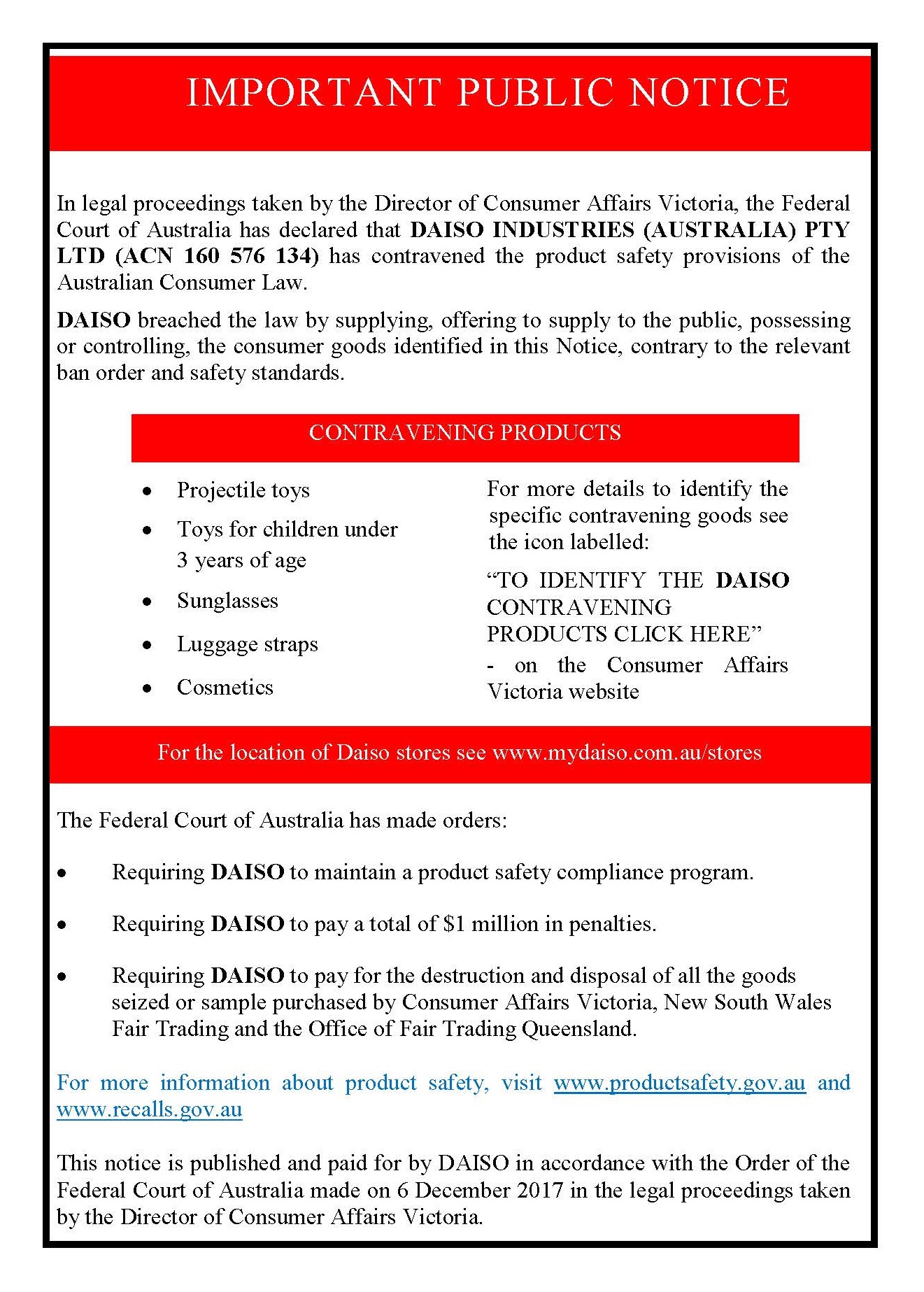
Note: Entry of orders is dealt with in Rule 39.32 of the Federal Court Rules 2011.
MOSHINSKY J:
1 The respondent, Daiso Industries (Australia) Pty Ltd (Daiso), carries on a business of marketing and selling consumer goods. Relevantly for present purposes, Daiso sells goods in the following five product categories:
(a) projectile toys;
(b) toys for children up to and including 36 months of age;
(c) luggage straps;
(d) cosmetics; and
(e) sunglasses and fashion spectacles.
2 This proceeding, brought by the Director of Consumer Affairs Victoria (the Director), concerns contraventions of product safety and product information standards.
3 On 16 June 2017, I determined one issue of contention between the parties relating to liability. This concerned whether certain toys were “[t]oys for children up to and including 36 months of age, being objects manufactured, designed, labelled or marketed as playthings” within the meaning of the applicable standard. I held that each of the toys fell within that phrase: Director of Consumer Affairs Victoria v Daiso Industries (Australia) Pty Ltd [2017] FCA 683. It followed that, in possessing and supplying those toys, Daiso had contravened s 106 of the Australian Consumer Law, being Sch 2 to the Competition and Consumer Act 2010 (Cth) (the ACL), and s 106 of the Australian Consumer Law (Victoria), being the Australian Consumer Law text as applied by the Australian Consumer Law and Fair Trading Act 2012 (Vic) (the ACL (Vic)).
4 Apart from the above issue, Daiso had admitted liability in respect of the other contraventions alleged by the Director.
5 On 23 June 2017, I made declarations of contravention and provided reasons for making those declarations: Director of Consumer Affairs Victoria v Daiso Industries (Australia) Pty Ltd (No 2) [2017] FCA 720. The declarations were substantially in the form proposed by the parties, following my judgment on liability in respect of the toys, and Daiso’s admission of liability in respect of the other alleged contraventions. The declarations related to ss 106 and 136 of the ACL and the ACL (Vic).
6 At the time the declarations were made, it was anticipated that there would need to be a contested hearing on the remedies to be ordered. The matter was set down for a hearing of two days. The parties filed affidavit evidence and outlines of submissions. However, shortly before the hearing was due to commence, the parties reached an agreement as to remedies (including a pecuniary penalty) that would be proposed to the Court. The parties also prepared a statement of agreed facts (SOAF). A copy of the SOAF (but omitting footnotes and annexures) is annexed to these reasons. As a result, at the hearing yesterday, which was to have been the first day of the contested hearing on remedies, the parties each made submissions in support of a “minute of orders by consent” (the Minute of Proposed Orders). In summary, the parties jointly propose that the Court make orders to the effect that:
(a) for a period of three years, Daiso be restrained from carrying on a business of supplying, offering for supply, or having in its possession goods of the kind or class listed in Annexure A to the Minute of Proposed Orders (ie, projectile toys; toys for children under three years of age; sunglasses; luggage straps; and cosmetics) unless Daiso:
(i) continues to carry out the compliance plan in Attachment B to the March 2017 report prepared for Daiso by William Dee; and
(ii) commissions a review of its compliance plan by Mr Dee or another appropriately qualified independent external compliance consultant and supplies a copy of the review report to Consumer Affairs Victoria on each anniversary of these orders;
(b) the Director, New South Wales Fair Trading and Fair Trading Queensland be permitted to destroy and dispose of any contravening goods seized or sample purchased by them from Daiso that remain in their possession;
(c) Daiso pay the costs of and incidental to the destruction and disposal referred to in paragraph (b) above;
(d) Daiso pay a pecuniary penalty of $1 million;
(e) Daiso cause to be published within certain newspapers an Important Public Notice in the form of Annexure A to the Minute of Proposed Orders;
(f) Daiso cause to be published on the internet, at the homepage of all the websites that are owned, operated or maintained by or on behalf of Daiso, the Important Public Notice; and
(g) Daiso pay the Director’s costs of the proceeding, fixed in the sum of $160,000.
7 At the hearing yesterday, the parties relied both on the SOAF and the affidavits that had been filed in the proceeding. The parties each made detailed oral submissions in support of the proposed orders.
8 For the reasons that follow, I consider it appropriate to make orders substantially in the form of the Minute of Proposed Orders. In particular, I consider the proposed pecuniary penalty of $1 million to be appropriate in all the circumstances. These reasons should be read together with my reasons dated 16 June 2017 and 23 June 2017 in this proceeding.
Applicable principles
9 As I noted in the 16 June 2017 reasons at [5], the Court has jurisdiction to deal with the Director’s claims arising under the ACL: see s 138(1) of the Competition and Consumer Act and s 39B(1A)(c) of the Judiciary Act 1903 (Cth). Insofar as the Director brings claims under the ACL (Vic), it has been accepted that, in circumstances such as this, such claims are within the Court’s accrued jurisdiction: see Walker v Sell (2016) 245 FCR 308 at [83]-[85] per Bromwich J; Director of Consumer Affairs Victoria v Gibson [2017] FCA 240 at [1] per Mortimer J. However, the expression “accrued jurisdiction” is best avoided: see Rizeq v Western Australia (2017) 344 ALR 421 at [55]-[56] per Bell, Gageler, Keane, Nettle and Gordon JJ.
10 In Australian Securities and Investments Commission, in the matter of Golden Financial Group Pty Ltd (formerly NSG Services Pty Ltd) v Golden Financial Group Pty Ltd (No 2) [2017] FCA 1267, I discussed the applicable principles relating to the imposition of pecuniary penalties in the context of contraventions of certain provisions of the Corporations Act 2001 (Cth). I set out below certain parts of that discussion that are also applicable in the present context.
11 In Commonwealth v Director, Fair Work Building Industry Inspectorate (2015) 258 CLR 482 (FWBII), the High Court held that, in the context of civil penalty provisions, it was open to the Court to receive submissions, including joint submissions, as to an appropriate penalty. French CJ, Kiefel, Bell, Nettle and Gordon JJ (with whom Keane J agreed) stated at [46] that there is “an important public policy involved in promoting predictability of outcome in civil penalty proceedings” and that “the practice of receiving and, if appropriate, accepting agreed penalty submissions increases the predictability of outcome for regulators and wrongdoers”. Their Honours stated that, as was recognised in Trade Practices Commission v Allied Mills Industries Pty Ltd (No 5) (1981) 60 FLR 38; 37 ALR 256 and determined in NW Frozen Foods Pty Ltd v Australian Competition and Consumer Commission (1996) 71 FCR 285 (NW Frozen Foods), “such predictability of outcome encourages corporations to acknowledge contraventions, which, in turn, assists in avoiding lengthy and complex litigation and thus tends to free the courts to deal with other matters and to free investigating officers to turn to other areas of investigation that await their attention”.
12 Their Honours stated, at [57], that in civil proceedings there is generally very considerable scope for the parties to agree on the facts and their consequences; and that there “is also very considerable scope for them to agree upon the appropriate remedy and for the court to be persuaded that it is an appropriate remedy”. In relation to civil penalty proceedings, their Honours stated at [58]:
Subject to the court being sufficiently persuaded of the accuracy of the parties’ agreement as to facts and consequences, and that the penalty which the parties propose is an appropriate remedy in the circumstances thus revealed, it is consistent with principle and, for the reasons identified in Allied Mills, highly desirable in practice for the court to accept the parties’ proposal and therefore impose the proposed penalty.
(Footnote omitted.)
13 Their Honours in FWBII also made observations, at [60]-[61], regarding submissions by a regulator in such a context.
14 It follows from the above that the questions to be determined in the present case are: first, whether the Court is sufficiently persuaded of the accuracy of the parties’ agreement as to facts and consequences; and secondly, whether the penalty that the parties propose is an appropriate remedy in the circumstances thus revealed.
15 In the present case, insofar as the proceeding involves an application by the Director for the imposition of a pecuniary penalty, the application is made under s 228(1) of the ACL (Vic). This provides that the regulator may institute a proceeding in a court for the recovery on behalf of the Commonwealth, a State or a Territory, as the case may be, of a pecuniary penalty referred to in s 224. Section 10(1) of the Australian Consumer Law and Fair Trading Act 2012 (Vic) (the Victorian Act) provides that, in the ACL (Vic), “regulator” means the Director. Section 10(2) of that Act provides that, for the purposes of the application of the ACL (Vic), “court” has the meaning given in s 223 of the Victorian Act. Section 223(1) of the Victorian Act provides that, subject to certain provisions (one of which is s 224), in the ACL (Vic), “court” means the Supreme Court, the County Court, the Magistrates’ Court and VCAT. Section 224 of the Victorian Act provides that, subject to s 223, VCAT “or any court of competent jurisdiction” may hear and determine a cause of action arising under any provision of the ACL (Vic). I proceed on the basis that this Court is such a court. I note that pecuniary penalties have been imposed by this Court in other cases brought by the Director in like circumstances: see Director of Consumer Affairs Victoria v Hocking Stuart (Richmond) Pty Ltd (No 2) [2016] FCA 1435; and Director of Consumer Affairs Victoria v Gibson (No 3) [2017] FCA 1148. The Director made submissions this morning to the above effect and Daiso accepted this position.
16 Section 224(2) of the ACL (Vic) sets out certain mandatory considerations relating to the imposition of a pecuniary penalty. Section 224(2) provides:
(2) In determining the appropriate pecuniary penalty, the court must have regard to all relevant matters including:
(a) the nature and extent of the act or omission and of any loss or damage suffered as a result of the act or omission; and
(b) the circumstances in which the act or omission took place; and
(c) whether the person has previously been found by a court in proceedings under Chapter 4 or this Part to have engaged in any similar conduct.
17 The principles applicable to the discretion to impose pecuniary penalties have been discussed in many cases including the following authorities: Trade Practices Commission v CSR Ltd [1991] ATPR 41-076; [1990] FCA 762; Australian Competition and Consumer Commission v Kokos International Pty Ltd (No 2) [2008] ATPR 42-212; [2008] FCA 5; NW Frozen Foods; Singtel Optus Pty Ltd v Australian Competition and Consumer Commission (2012) 287 ALR 249 (Singtel Optus); Australian Competition and Consumer Commission v TPG Internet Pty Ltd (2013) 250 CLR 640 (TPG); FWBII; and Australian Competition and Consumer Commission v Reckitt Benckiser (Australia) Pty Ltd (2016) 340 ALR 25. (See also Australian Competition and Consumer Commission v Cement Australia Pty Ltd [2017] FCAFC 159 (Cement Australia) at [569].) In these circumstances, it is unnecessary to set out the principles, which are well-established, in any detail.
18 It is convenient, nevertheless, to set out the following list of relevant factors from the judgment of French J (as his Honour then was) in Trade Practices Commission v CSR Ltd at 52,152-52,153:
1. The nature and extent of the contravening conduct.
2. The amount of loss or damage caused [by the contravening conduct].
3. The circumstances in which the conduct took place.
4. The size of the contravening company.
5. The degree of power it has, as evidenced by its market share and ease of entry into the market.
6. The deliberateness of the contravention and the period over which it extended.
7. Whether the contravention arose out of the conduct of senior management or at a lower level.
8. Whether the company has a corporate culture conducive to compliance with the Act, as evidenced by educational programs and disciplinary or other corrective measures in response to an acknowledged contravention.
9. Whether the company has shown a disposition to co-operate with the authorities responsible for the enforcement of the Act in relation to the contravention.
19 In FWBII, French CJ, Kiefel, Bell, Nettle and Gordon JJ explained the purpose of a civil penalty as follows at [55]:
… whereas criminal penalties import notions of retribution and rehabilitation, the purpose of a civil penalty, as French J explained in Trade Practices Commission v CSR Ltd, is primarily if not wholly protective in promoting the public interest in compliance:
“Punishment for breaches of the criminal law traditionally involves three elements: deterrence, both general and individual, retribution and rehabilitation. Neither retribution nor rehabilitation, within the sense of the Old and New Testament moralities that imbue much of our criminal law, have any part to play in economic regulation of the kind contemplated by Pt IV [of the Trade Practices Act] … The principal, and I think probably the only, object of the penalties imposed by s 76 is to attempt to put a price on contravention that is sufficiently high to deter repetition by the contravenor and by others who might be tempted to contravene the Act.”
(Footnotes omitted.)
20 In TPG at [64], French CJ, Crennan, Bell and Keane JJ endorsed the observation of the Full Court in Singtel Optus that the Court, in fixing a penalty, must make it clear to the contravenor and the market that the cost of courting a risk of contravention cannot be regarded as an acceptable cost of doing business.
21 In relation to the course of conduct principle, I refer to Cement Australia at [421]-[426].
Application of principles to the present case
22 Consistently with the approach of the parties in their submissions, I will focus on the proposed pecuniary penalty.
23 I note at the outset that the maximum pecuniary penalty for each contravention of s 106 or 136 of the ACL (Vic) is $1.1 million (see s 224(3) of the ACL (Vic)). There are 15 such contraventions of the ACL (Vic) identified in the Court’s declarations made on 23 June 2017. The total maximum penalty is therefore $16.5 million.
24 The facts and circumstances of Daiso’s contraventions of ss 106 and 136 of the ACL (Vic) are set out in the SOAF. I accept that the facts and circumstances are as set out in that document.
25 I will first consider the nature and extent of the relevant acts and omissions, being part of the first mandatory consideration in s 224(2) of the ACL (Vic).
26 The Director, and his counterpart regulators in New South Wales and Queensland, conducted inspections of Daiso’s stores on 14 November 2013, 26 March 2015, 3 June 2015, 15 July 2015, 12 August 2015 and 28 April 2016 to 2 May 2016, as set out in Table 1 of the SOAF. That table shows each of the non-compliant product categories and the quantities of non-compliant consumer goods seized or purchased as samples on the occasion of each inspection – 6,559 items in all. Table 1, omitting the notes, is as follows:
Date(s) of inspection | Projectile toys | Cosmetics | Sunglasses / fashion spectacles | Toys children ≤ 36 months | Luggage straps | Totals |
14 Nov 2013 | 17 | 5,475 | 218 | 5,710 | ||
26 Mar 2015, 3 June 2015 | 476 | 68 | 144 | 688 | ||
15 Jul 2015 | 122 | 122 | ||||
12 Aug 2015 | 40 | 7 | 47 | |||
28 Apr 2016 – 2 May 2016 | 3 | 4 | 7 | |||
Totals | 17 | 5,978 | 218 | 203 | 144 | 6,559 |
27 By its document headed “Voluntary Recall Strategy”, Daiso stated that consumer goods in the categories covered by the declarations (made by the Court on 23 June 2017) were offered for sale at 26 stores.
28 Daiso admits that it sold 49,454 units of non-compliant goods as set out in Table 2 of the SOAF, which is as follows:
Product category | Number of product lines affected | Number of units sold |
Projectile toys | 2 | 1,526 |
Toys children ≤ 36 months | 8 | 4,420 |
Luggage straps | 2 | 323 |
Cosmetics | 149 | 42,130 |
Sunglasses and fashion spectacles | 8 | 1,000 |
Totals | 169 | 49,454 |
29 As set out in the SOAF, Daiso’s product supply system involved Daiso ordering Daiso Merchandise from Daiso Japan, which was shipped to distribution centres in Queensland, New South Wales and Victoria and then distributed to Daiso’s stores.
30 Between 1 November 2013 and 2 May 2016, Daiso received 60,969 units of non-compliant consumer goods by way of shipment from Daiso Japan. This number is derived from shipping records produced to the Director pursuant to notices issued to Daiso under s 126 of the Victorian Act (s 126 notices).
31 Annexure C to the SOAF is a spreadsheet that incorporates Daiso’s “List of Dates Goods Acquired” and, in additional columns, adds references to non-compliant product lines identified from their JAN code in the shipping records. For each product line, the spreadsheet in Annexure C identifies:
(a) the product identification code (referred to as a JAN code);
(b) a description of the product;
(c) the date the product was shipped;
(d) the port to which it was shipped;
(e) the file name of the particular shipping record, as recorded on the DVD produced by Daiso in response to a s 126 notice, in which the product is found; and
(f) a tally of the number of units shipped in each product line.
32 Annexure C shows that 60,969 units of non-compliant products were shipped to Daiso by Daiso Japan in the period 1 November 2013 to 24 February 2015.
33 Of the goods shipped to Daiso by Daiso Japan in this period, 58,928 units were in the category of cosmetics and toiletries and were capable of being made compliant by applying ingredients lists to them.
34 It is accepted by Daiso, and I find, that the contraventions are serious.
35 Each of the standards contravened exists to mitigate risks to consumers’ safety. It is to be inferred that the safety standards were put in place to address actual or anticipated harm or damage. The nature of that harm or damage is expressed in the following ways in explanatory material published by ACL regulators:
(a) Projectile toys – risk of injury by choking, eye injuries and flesh wounds.
(b) Toys for children up to and including 36 months of age – risk of choking on unsafe small toys and small parts, which can cause serious injury or death.
(c) Elastic luggage straps – risk of serious injuries to eyes, face and body if they recoil during use.
(d) Cosmetics – ingredient labels that are missing or inaccurate can mislead consumers’ purchasing decisions and expose consumers to ingredients that may cause allergic reactions, which can be very harmful and in some cases may lead to death.
(e) Sunglasses – incorrect use and labelling can cause eye injuries or impaired vision.
36 The commercial context of the contraventions is also relevant. Businesses that do not devote resources to ensuring compliance gain a competitive advantage.
37 Here, where the non-compliance was on a large scale, the effect on the market and the likelihood of non-compliant products circulating in the community were both magnified.
38 It is not suggested by the Director that Daiso’s contraventions are aggravated by any resulting loss or damage (being the other aspect of the first mandatory consideration).
39 I turn then to consider the second mandatory consideration in s 224(2) of the ACL (Vic), namely the circumstances in which the contraventions took place.
40 Daiso was incorporated on 1 October 2012 as a vehicle for the operation in Australia of the Daiso business. The business is the sale of Daiso Merchandise as described in the SOAF. This is a range of products the development and distribution of which is controlled by Daiso Japan.
41 Daiso selected products to purchase from the range of Daiso Merchandise and ordered it from Daiso Japan, which shipped the stock to distribution centres in Queensland, New South Wales and Victoria.
42 Daiso accepts that, before inspections by the staff of the Director in November 2013, it had no system in place to ensure compliance with Australian mandatory standards, and conducted no assessment of products to determine whether they complied with Australian mandatory standards. Daiso’s managers have given evidence that they were initially unaware of the existence of mandatory product safety and information standards.
43 Until March 2017, Daiso’s compliance efforts were incomplete and ineffective to address the legal requirements of the standards. In this regard, I note that:
(a) After the November 2013 inspections, Daiso removed and/or rectified specific products identified in the inspections as non-compliant.
(b) In late 2014, Garry King (then Daiso’s State Manager for New South Wales and Queensland, and now the General Manager of Sales and Operations) instructed store managers to adopt a new labelling procedure aimed at having cosmetics products labelled before they were brought onto the shop floor.
(c) In early 2015, at or around the time of the 26 March 2015 inspections, Mr King began mentioning cosmetics labelling requirements in conversations with cluster managers and store managers.
(d) Around the time of the inspections in mid-2015:
(i) Daiso removed from sale certain further products identified as non- compliant;
(ii) managers began informing themselves about product compliance (by internet searches and their own examination of products); and
(iii) a review of cosmetics labelling identified by Consumer Affairs Victoria as non-compliant was undertaken. The review was, however, confined to 21 products identified by the Director in a s 126 notice. No broader review was undertaken despite more than two-thirds of the labels reviewed being found to be non-compliant.
(e) A suggestion made by the Director in correspondence dated 6 August 2015 that Daiso conduct a voluntary recall of non-compliant products was not acted upon until May 2017.
44 Further, the respondent’s business is to sell Daiso Merchandise in Australia. This is a range of products made by and for Daiso Japan (which is now Daiso’s parent company and was a part owner during the relevant period). It was possible for Daiso, by enquiries with a single entity within its own corporate group, to obtain information necessary to evaluate product compliance and/or bring products into compliance.
45 The Director accepts that the third mandatory consideration in s 224(2) of the ACL (Vic), namely the existence of prior contravention for similar conduct, has no application here.
46 I turn now to refer to other relevant matters.
47 It is common ground between the parties that the contraventions in the present case should be viewed as five courses of conduct. In this case, there are five classes of goods to which the contraventions relate and three kinds of contravention have been declared in relation to each class – supply, offer for supply and possession. It is appropriate to treat the contraventions for the supply, offer for supply and possession of each class of goods as part of the same course of conduct. I accept, therefore, that the case is to be regarded as one concerning five courses of conduct.
48 As the cases referred to above make clear, deterrence plays a primary role in assessing the appropriate quantum of any pecuniary penalty. On the basis of the matters outlined above:
(a) the extent of Daiso’s contraventions is significant; and
(b) the contraventions occurred over a period of some three years during which Daiso had no, or at least insufficient, regard to the requirements of the Australian mandatory standards.
49 Further, Daiso is a retailer with 29 stores (in Victoria, New South Wales, Queensland and South Australia), with another due to open soon.
50 It is not to the point that various of Daiso’s witnesses state that they did not know about the existence of the mandatory standards. Daiso’s professed ignorance of Australian mandatory product safety and information standards does not excuse its conduct. Considering general deterrence, it is for every business operating in Australia to inform itself about its legal obligations, whether by appointing appropriately skilled staff, engaging appropriate advisors, or accessing publicly available information.
51 In relation to specific deterrence, I accept (on the basis of the affidavit evidence to which I was taken) that Daiso has now, albeit belatedly, instituted a rigorous process of ensuring compliance with the applicable product safety and product information standards. The compliance program is detailed and incorporates numerous procedures and checks at various levels of the organisation, including audits on a regular basis.
52 Daiso is a substantial concern. I refer to the facts and matters set out in the SOAF.
53 The Director accepts that Daiso’s contraventions were not deliberate. Nevertheless, the circumstances include that:
(a) Daiso’s management failed to make any enquiry as to the existence or requirements of Australian mandatory product safety standards;
(b) Daiso’s management failed to implement any compliance procedures before November 2013 when non-compliance was first detected; and
(c) thereafter, the compliance efforts of Daiso’s management were incomplete and inadequate until March 2017, when an adequate compliance system was adopted.
54 A relevant consideration is that Daiso largely admitted its contraventions of the relevant standards. Although there was one contentious issue relating to liability, this matter was of a confined nature in the context of the alleged contraventions as a whole, and the points raised by Daiso were genuinely arguable.
55 I note also that, at the hearing yesterday, senior counsel for Daiso stated that Daiso: accepts responsibility for its contraventions; accepts the serious obligation that is imposed upon it to ensure that the goods it sells are compliant with mandatory product safety and information standards; accepts that the contraventions that it has engaged in are of sufficient seriousness to warrant the imposition of the proposed penalty; and accepts the appropriateness of the other orders set out in the Minute of Proposed Orders.
56 Taking these considerations into account, I consider the pecuniary penalty proposed by the parties, namely $1 million, to be appropriate. In my view, it reflects the seriousness of the contraventions of the ACL (Vic) that were the subject of the declarations made by this Court on 23 June 2017 and achieves the object of deterrence. It is consistent with the conduct being viewed as five courses of conduct, and appropriately reflects considerations of totality.
57 In relation to the other proposed orders, I consider that there is a proper basis to make orders substantially in the form proposed by the parties. As discussed at the hearing, I propose to include, out of an abundance of caution, an additional order after the first proposed order to the effect that Daiso commission reviews of its compliance plan and supply a copy of the review report to Consumer Affairs Victoria on the first, second and third anniversaries of these orders (or the nearest business day thereafter). This is simply to make clear that such a review and report is required on the third anniversary of these orders, in circumstances where the first proposed order is framed as an injunction for a period of three years. Neither party objected to the inclusion of an additional order to this effect.
I certify that the preceding fifty-seven (57) numbered paragraphs are a true copy of the Reasons for Judgment herein of the Honourable Justice Moshinsky. |
Associate:
ANNEXURE
STATEMENT OF AGREED FACTS
(Footnotes and annexures omitted.)
A. Preliminary
1. This Statement of Facts is agreed, as between the Applicant and the Respondent, for the purposes of s 191 of the Evidence Act 1995 (Cth).
2. Defined terms and abbreviations used in this statement of agreed facts are set out in Annexure B.
3. This Statement of Agreed Facts is not intended to prevent parties from adducing evidence that is not inconsistent with the Statement of Agreed Facts or prevent parties from making submissions as to the relevance of the facts set out herein to the pecuniary penalty that should be awarded against Daiso.
B. Material Facts
Parties
4. The Applicant is and was, at all material times, a public official whose office is established by s 107 of the ACLFTA. In that capacity, the Director is ‘another person’ within the meaning of s 232 of the ACL and is authorised by ss 10(1), 109 and 110(1) of the Act and ss 2, 228, 232, 246 and 247 of the ACL (Vic) to bring this proceeding.
5. Daiso is:
(a) a corporation for the purposes of s 4 of the Competition and Consumer Act 2010 (Cth) by virtue of being a trading corporation formed within the limits of Australia; and
(b) carrying on business as a retailer of consumer goods, including a variety the subject of product safety standards, with department stores in Victoria, New South Wales and Queensland.
Incorporation of Daiso and establishment of its operations
6. Daiso was incorporated on 1 October 2012 as a vehicle for the operation in Australia of the Daiso business.
7. Daiso’s shareholder at the time of incorporation was Daiso Industries Co Ltd (Daiso Japan). From 25 June 2014, Mitsubishi held 21% of the issued shares in Daiso Japan. On 1 May 2015, Mitsubishi’s shares were transferred to Daiso Japan. Both shareholders are Japanese companies. Daiso’s board at the time of its incorporation comprised two employees of Daiso Japan, two Mitsubishi executives and Ms Yuen-Kit Cheong, its then managing director (Ms Cheong). At all relevant times, at least two Daiso Japan executives have been directors of Daiso.
8. Daiso’s business is marketing and selling consumer goods. The goods are described in intra-group agreements as Daiso Merchandise. They are developed by and manufactured for Daiso Japan. Daiso pays Daiso Japan a royalty in respect of its use of the Daiso business model and associated intellectual property, calculated as 1% of its net sales.
9. Daiso selected products to purchase from the range of Daiso Merchandise and ordered it from Daiso Japan, which shipped the stock to distribution centres in Queensland, New South Wales and Victoria.
10. Today, Daiso operates 29 stores and is soon to open another. It has 68 full time staff and approximately 520 casual staff, many of whom work only a few hours per week. Daiso stores generally have 3 to 4 staff in attendance on any given shift, comprised of a store manager, assistant manager or duty manager and two to three retail staff. Daiso’s financial statements disclose sales revenue as follows:
Year ended 31 March | Sales revenue | Source reference |
2014 | $21,503,657 | Special purpose financial report 31 March 2014: TS-4, p 8 (converted to GST-exclusive) |
2015 | $40,047,715 | 2016 financial statements: TO-1, p 17 |
2016 | $41,001,893 | 2016 financial statements: TO-1, p 17 |
2017 | $49,048,047 | 2017 financial statements: TO-1, p 16 |
11. Daiso financial statements also disclose that it has incurred losses in each year of its operations as follows:
Year ended 31 March | Total loss | Source reference |
2014 | $7,371,621 | Special purpose financial report – 31 March 2014: TS-4, p 5 |
2015 | $15,501,704 | Special purpose financial report – 31 March 2016: TS-4, p 5 |
2016 | $14,490,439 | Special purpose financial report – 31 March 2016: TS-4, p 5 |
2017 | $11,943,455 | Special purpose financial report – 31 March 2017: TS-4, p 5 |
Daiso’s continued operations have been supported by Daiso Japan.
Daiso’s compliance measures during the period 13 November 2013 to 2 May 2016
12. The declarations made by this Honourable Court on 23 June 2017 cover the period 13 November 2013 to 2 May 2016.
13. In 2013, prior to the investigation by Consumer Affairs Victoria (CAV), Daiso had no system in place to ensure compliance with Australian mandatory standards.
14. On 14 November 2013, CAV inspectors visited 4 Daiso stores in Victoria and seized 5,710 units of non-compliant products (5,475 units of cosmetics, 17 units of projectile toys and 218 units of sunglasses or fashion spectacles).
15. After the November 2013 inspections:
(a) Mr King, then Daiso’s State manager for New South Wales and Queensland, directed store managers to remove from sale all cosmetic products without labels identifying ingredients in English and to quarantine them in the back room of stores; and
(b) Daiso prepared English ingredient labels for the cosmetics products CAV had identified as non-compliant and these labels were affixed to the products.
16. Product recall notices issued by Daiso for cosmetics state that Daiso ceased selling those products on 20 December 2013. Nevertheless, samples of non-compliant cosmetics were seized or purchased in inspections on 26 March 2015, 12 August 2015 and 28 April 2016 (see Tables 4, 6 and 7 in Annexure A).
17. On 23 January 2014, CAV served Daiso with the First s 126 Notice which identified cosmetics and toiletries, toys and sunglasses product lines which had been seized or purchased from Daiso.
18. Daiso responded by having managers remove those toys from sale, the cosmetics products having been removed from sale and relabelled following the November 2013 inspections. Product recall notices issued by Daiso in respect of projectile toys and sunglasses state it ceased selling those products on 21 March 2014.
19. In May 2014, Mr Taku Suzuki, then an executive of Daiso Japan, had a short conversation with Ms Cheong who said that Daiso was having a problem with the consumer regulator about some product packaging and specifications but Ms Cheong did not convey to Mr Suzuki that the problem was serious. Mr Suzuki expected that Ms Cheong would have talked to Mr Sato if there was a serious problem as she was meant to liaise with him about Daiso’s operations or with Mr Naito, because he was a director of Daiso Japan at the time and Mr Suzuki was not.
20. On 30 September 2014, Ms Cheong resigned as managing director. Most of Daiso’s senior management team and key personnel resigned around this time as well.
21. In late 2014, by reason of the matters set out in the previous paragraph, Mr King assumed increased management responsibilities. He instructed cluster managers and store managers to change the way the back room of stores operated by directing staff to separate products into categories and affix English language ingredients labels to cosmetics in the back room before bringing the stock into the store.
22. In early 2015:
(a) Mr King first became aware of the existence of product safety standards;
(b) Mr King held state meetings with all cluster managers and store managers where approximately one hour was spent talking about:
(i) the need for cosmetics and toiletries to have English ingredients labelling and the need to check all products in that category;
(ii) the warning labels that needed to be on toys and the need to check all products in that category;
(iii) the need to tell staff that all products delivered in the above categories were checked to ensure they had appropriate English ingredients and warning labels affixed to them;
(c) Mr King visited all stores and:
(i) spoke to store managers so that they understood their role in relation to checking products to ensure they had correct English ingredients and warning labelling;
(ii) told store managers to tell their staff that cosmetics products and toys could not be taken from the back rooms into stores until they had been labelled; and
(iii) provided store managers with English ingredients labels for products in PDF and told them to print the labels and store them in the back room ready to be affixed to products.
23. On 26 March 2015, CAV and New South Wales and Queensland regulators conducted inspections and seized or purchased non-compliant cosmetics (476 units), children’s toys (64 units) and luggage straps (141 units).
24. On 18 May 2015, CAV served Daiso with the Second 126 Notice which, inter alia, identified 21 cosmetics and toiletries product lines which had been seized or purchased from Daiso.
25. In mid-2015, Daiso implemented Daiso Japan’s automated operating system (AOS). The AOS included warning information about products, but that information was directed only at compliance with Japanese product standards. The AOS gave store managers the ability to order products from Daiso’s Australian distribution centres and enabled Daiso to block store managers from ordering product lines from the distribution centres. It also permitted Daiso Japan to place a ban on supply of a particular product to countries outside Japan.
26. In July 2015, Daiso appointed a new general manager, Mr Osumi, who was responsible for supply chain management. Mr Osumi, Mr King and Mr Suzuki have all stated that when they started working for Daiso they were not aware of the existence of mandatory product safety standards or information standards. Mr King became aware of the standards in early 2015, Mr Suzuki became aware of the standards in May 2015 and Mr Osumi was aware of the standards from at least August 2015.
27. Following inspections conducted by CAV on 15 July 2015, Daiso took the following steps to ensure compliance with the mandatory safety standards:
(a) it directed store managers to remove from sale the products identified by CAV as non-compliant and,
(b) it stopped ordering luggage straps and wrote off all existing stock of luggage straps; The instruction to store managers to implement this was conveyed by email on 7 August 2015;
(c) Mr King informed himself about mandatory product safety standards and information standards by his own internet research;
(d) Mr King, Mr Osumi and Daiso’s retail buyer Ms Naoko Ishibashi (Ms Ishibashi) attended Daiso’s Chadstone store, identified every toy that might have small or breakable parts and examined those toys by dropping them onto the ground from above head-height. None of the toys broke;
(e) Mr King sent an email to all store managers attaching a list of products in the range of Daiso Merchandise that were banned from sale in Australia and directed them to review all products in store to ensure products of those kinds were not for sale; and
(f) Mr King and Mr Osumi had a discussion about what they could do to ensure Daiso complied with the product safety standards and information standards and they decided to:
(i) provide training to cluster managers and store managers to ensure all staff understood what they needed to do to ensure Daiso complied with its product safety obligations; and
(ii) implement changes to Daiso’s operations manual.
28. At around this time, Mr King implemented changes to Daiso’s operations manual to include a section on labelling requirements which set out:
(a) the categories of products subject to labelling information standards;
(b) detail about the product safety standards and information standards including what was required to be included on labels for each category of product; and
(c) the process for requesting labels from Japan.
29. On 13 July 2015, Daiso directed a team to investigate whether labelling on the cosmetics and toiletries products identified by CAV in the Second 126 Notice was compliant. For the 21 products reviewed:
(a) 13 labels were found to be non-compliant and were rectified;
(b) one product was identified as having compliant labelling on the manufacturer’s packaging; and
(c) two labels were amended to correct minor typographical errors.
30. On 6 August 2015, CAV wrote to Daiso identifying specific product lines (toys, luggage straps and cosmetics) found to be non-compliant following inspections on 26 March and 15 July 2015 and recommended that Daiso cease supplying the products and institute a voluntary recall in respect of the products.
31. On 7 August 2015, Mr King sent an email to Daiso store managers attaching a further series of English ingredients labels, directing them to affix the labels to cosmetics products that had been removed from sale and write off the toys and luggage straps that had been removed from sale.
32. On 12 August 2015, CAV conducted inspections at five of Daiso’s Victorian stores and found non-compliant children’s toys at one store (7 units) and non-compliant cosmetics at another (40 units).
33. Product recall notices issued by Daiso state that it ceased selling three lines of children’s toys on 18 August 2015 and a further five on 28 August 2015. The recall notice for luggage straps states it ceased selling those on 28 August 2015.
34. In approximately September 2015, Mr King delivered training sessions to all Daiso cluster managers and store managers which focused on Daiso’s obligation to label all cosmetics products with English ingredient labels with ingredients listed by volume in descending order and how to identify cosmetic and personal care products. During these training sessions, Mr King told cluster managers and store managers to pass on the information to their staff and follow up to ensure Daiso’s labelling obligations were being complied with. He also circulated colour photos of cosmetics products that complied with the mandatory information standard.
35. From mid-2015, Mr King started holding weekly telephone conferences and monthly in person conferences with Daiso’s cluster managers during which Daiso’s obligation to label cosmetics and toiletries products were sometimes discussed.
36. In March 2016, during one of the weekly telephone conferences, Mr King directed Daiso’s cluster managers to conduct a full review of all product labels in stores to ensure that all cosmetics and toiletries and arts and crafts products had correct English ingredients labelling and all toys had correct age and warning labelling.
Daiso’s compliance measures subsequent to the commencement of these proceedings
37. CAV served Daiso with the originating application in this proceeding on 10 August 2016.
38. In around August 2016, Daiso decided to engage an organisation to conduct product safety training and make improvements to Daiso’s product ordering and product safety compliance policies and procedures. Also at this time, Mr Suzuki asked Mr Osumi and Mr King to be vigilant with product labelling and to arrange training for cluster managers and store managers.
39. On around 14 September 2016, Mr Osumi, Mr King and Ms Ishibashi reviewed all products in the AOS to make sure they complied with the mandatory standards. They did not identify any products with compliance issues. By that time, Daiso had ceased ordering toys intended for or that might be used for children under 36 months or which contain small or breakable parts.
40. In mid-October 2016, Mr King implemented a responsible retailing checklist procedure that he had prepared following a review of information that related to Daiso’s product lines obtained from the ACCC product safety website. The responsible retailing checklist requires store managers to oversee a full review of the products in store on a weekly basis as follows:
(a) all cosmetics and toiletries products, button batteries and products containing button batteries, cleaning products, sunglasses, toys, balloons and food products are checked to ensure they have appropriate labelling;
(b) any products that may not comply with the mandatory standards are removed from the floors and quarantined; and
Daiso’s cluster managers and store managers were provided with the responsible retailing checklist, told how it worked and directed to tell store managers to complete the checklist each Friday and send the completed forms to the cluster managers and Mr King.
41. On 15 February 2017, Daiso convened training sessions for management, including cluster managers, presented by Dr Michelle Sharpe (Dr Sharpe), a barrister experienced in product safety matters.
42. In around February 2017, Daiso appointed Mr Dee, a regulatory compliance professional, to review Daiso’s ACL compliance management system, help update that system and provide training on the ACL.
43. On 14 March 2017, Mr Dee conducted a training session for Daiso management on the ACL and product safety. Also on that date, Daiso received a report from Mr Dee and established a compliance committee.
44. In mid-March 2017, Daiso implemented improvements to the responsible retail checklist procedure by:
(a) instructing store managers to record details about any product safety issues and actions taken to remedy those issues and report this information to Mr King on a weekly basis; and
(b) instructing cluster managers to visit each of their stores on a monthly basis and personally complete the checklist to ensure there were no product safety issues.
45. In late March 2017, Daiso updated its operations manual to include compliance procedures recommended by Mr Dee. These included, amongst other things, a compliance plan, quarantine and banned products procedure and product ordering procedure.
46. In May 2017, Daiso delivered internal compliance and recall training seminars based on the regulatory compliance training provided by Dr Sharpe and Mr Dee for all cluster managers and store managers. Compliance training for cluster managers is ongoing with Mr King holding weekly one on one sessions by telephone with each cluster manager on product safety issues.
47. In August 2017, Daiso commissioned Mr Dee to audit its compliance management system. Mr Dee reported in his audit report that Daiso’s compliance management system contained all the necessary features of a well-established, comprehensive and effective compliance management system with tasks embedded in the day to day operation of the business including, amongst other things:
(a) a compliance plan and policy;
(b) operating procedures to identify ACL risks including monitoring and reporting systems;
(c) regular communications on compliance issues;
(d) detailed and on-going risk assessment of ACL risks;
(e) a commitment to the compliance management system from top and middle management;
(f) a senior manager as compliance officer; and
(g) education and training on the ACL.
48. On 30 August 2017, Mr Dee conducted a further training session for Daiso management on the ACL and product safety.
49. In September 2017, Daiso implemented changes to its induction procedure to inform new employees about Daiso’s compliance obligations. As part of the new induction process, new employees are told about Daiso’s product safety obligations, how to identify products requiring labelling, how to label products and the holding and quarantine areas in the back room and taken through the responsible retailing checklist.
Daiso’s voluntary product recall
50. In May 2017, Daiso started a voluntary recall of products it had sold that did not comply with product safety standards. Daiso formally notified the ACCC of its intention to conduct a recall on 31 May 2017.
51. On 22 June 2017, Daiso’s recall notices were published on the ACCC’s product safety website, its own website and were displayed in all stores.
52. A document headed ‘Voluntary Recall Strategy’ prepared by or for Daiso provides details of the recall.
53. Daiso reported the progress of the voluntary recall to the ACCC. The voluntary recall resulted in:
(a) 10 products being returned by consumers (in the cosmetics product category);
(b) 10 refunds being made to consumers who returned the above products;
(c) no complaints being made; and
(d) no illnesses or injuries being reported (save for one report of slight reddishness to the face by a consumer who returned a cosmetics product).
Daiso possessing, controlling and offering for sale, relevant consumer goods
54. Contraventions by Daiso of ss 106(1), (2) and (3) and 136(1), (2) and (3) are made out in three ways on the material before the Court.
(a) First, at inspections conducted by CAV and its interstate counterparts, NSW Fair Trading and Fair Trading Queensland, on 14 November 2013, 26 March 2015, 3 June [2015], 15 July 2015, 12 August 2015 and 28 April 2016 to 2 May 2016, Daiso was found to be supplying and offering for supply consumer goods which did not comply either with mandatory safety standards or information standards. Some 6,559 units of non-complying products were either seized or purchased by way of sample. The facts establishing these contraventions are set out below at [55] to [56].
(b) Second, by its notice of voluntary recall, the subject of evidence and admissions made by evidence filed in this proceeding, Daiso has accepted that it sold 49,454 units of non-complying consumer goods. These products had a retail price of $2.80. The facts establishing these contraventions are set out below at [57] to [59];
(c) Third, Daiso’s shipping records and a summary of its shipping records, supplied to CAV in Daiso’s responses to notices given under s 126 of the ACLFTA, establish that in date ranges between 1 November 2013 and 2 May 2016, Daiso possessed or had control of 60,969 units of non-complying consumer goods. The facts establishing these contraventions are set out below at [60] to [64].
Consumer goods seized or sample-purchased at regulator inspections
55. Table 1 below states the dates on which inspectors from Consumer Affairs Victoria, NSW Fair Trading and the Queensland Office of Fair Trading conducted inspections of Daiso stores and gives the number of units of non-compliant products seized or sample purchased.
Table 1: Summary of regulator inspections and goods seized or sample purchased
Date(s) of inspection | Projectile toys | Cosmetics | Sunglasses / fashion spectacles | Toys children ≤ 36 months | Luggage straps | Totals |
14 Nov 2013 [Note 1] | 17 | 5,475 | 218 | 5,710 | ||
26 Mar 2015, 3 June 2015 [Note 2] | 476 | 68 | 144 | 688 | ||
15 Jul 2015 [Note 3] | 122 | 122 | ||||
12 Aug 2015 [Note 4] | 40 | 7 | 47 | |||
28 Apr 2016 – 2 May 2016 [Note 5] | 3 | 4 | 7 | |||
Totals | 17 | 5,978 | 218 | 203 | 144 | 6,559 |
[Note 1] Inspections carried out in Victoria only. All non-compliant products found in stores were seized. Figures reflect number of units of non-compliant goods seized.
[Note 2] Inspections carried out in Victoria, New South Wales and Queensland. In Victoria, all non-compliant products found in stores were seized. In New South Wales and Queensland, samples of non-compliant goods were purchased. Figures reflect number of units of non-compliant products seized or purchased. All inspections were conducted on 26 March 2015 except the inspection at the Chermside (Queensland) Store, which was undertaken on 3 June 2016, see CC-21, CB 660.
[Note 3] Inspections carried out in Victoria only. These inspections involved only the seizure of children’s toys identified as non-compliant by Queensland Office of Fair Trading: see instructions to inspectors, CC-22, CB 700-704.
[Note 4] Inspections carried out in Victoria only. At these inspections, all non-compliant products found in stores were seized. Figures reflect number of units of non-compliant products seized.
[Note 5] Inspections carried out in Victoria only. At these inspections, samples only of non-compliant products found in store were purchased. Figures reflect number of units of non-compliant products purchased.
56. A break-down of the products seized from each store on each occasion is set out in Table 3 in Annexure A below. Tables 4, 5, 6, 7 and 8 reference the evidence for each instance of seizure or sample purchase with regard to the total number of units of consumer goods seized or sample-purchased on each occasion inspections were carried out.
Non-compliant consumer goods Daiso has admitted selling
57. By its document headed Voluntary Recall Strategy Daiso stated that consumer goods in the categories covered by the declarations were offered for sale at 26 stores.
58. Daiso admits that it sold 49,454 units of non-compliant goods as follows:
Table 2: Quantities of non-compliant consumer goods Daiso admits selling
Product category | Number of product lines affected | Number of units sold |
Projectile toys | 2 | 1,526 |
Toys children ≤ 36 months | 8 | 4,420 |
Luggage straps | 2 | 323 |
Cosmetics | 149 | 42,130 |
Sunglasses and fashion spectacles | 8 | 1,000 |
Totals | 169 | 49,454 |
59. Daiso’s record of units is contained in exhibit GK-1, and includes, in respect of each product line: a photograph of the product, its description, the product identification code (referred to as a JAN code) and the number of units sold.
Non-compliant consumer goods Daiso possessed between 1 November 2013 and 2 May 2016
60. As set out above, Daiso’s product supply system involved Daiso ordering Daiso Merchandise from Daiso Japan, which was shipped to distribution centres in Queensland, New South Wales and Victoria and then distributed to Daiso’s stores.
61. Between 1 November 2013 and 2 May 2016, Daiso received 60,969 units of non-compliant consumer goods by way of shipment from Daiso Japan. This number is derived from shipping records produced to the applicant pursuant to s 126 notices issued to Daiso.
62. Annexure C to this document is a spreadsheet which incorporates Daiso’s List of Dates Goods Acquired and, in additional columns, adds references to non-compliant product lines identified from their JAN code in the shipping records. For each product line, the spreadsheet in Annexure C identifies:
(a) the JAN code;
(b) a description of the product;
(c) the date the product was shipped;
(d) the port to which it was shipped;
(e) the file name of the particular shipping record, as recorded on the DVD produced by Daiso in response to a 126 notice, in which the product is found; and
(f) a tally of the number of units shipped in each product line.
63. Annexure C shows that 60,969 units of non-compliant products were shipped to Daiso by Daiso Japan in the period 1 November 2013 to 24 February 2015.
64. Of the goods shipped to Daiso by Daiso Japan in the period 1 November 2013 to 24 February 2015, 58,928 units were in the category of cosmetics and toiletries and were capable of being made compliant by applying ingredients lists to them.
Daiso’s testing records
65. By the First 126 Notice, CAV asked whether Daiso undertook testing of the goods identified in the annexure to the notice for the purposes of determining whether they were subject to any interim or permanent ban order or safety or information standard imposed under the ACL. Daiso responded ‘No.’
66. By the Second 126 Notice, CAV asked whether Daiso undertook testing of the goods identified in the annexure to that notice, for the purposes of determining whether they were subject to any safety or information standard imposed under the ACL. Daiso this time responded that ‘the company caused testing of most of the goods depicted and described in Annexure A to be undertaken or carried out’ and supplied particulars of testing agencies and dates.
67. The testing records supplied by Daiso on the CD-ROM with its response to the Second 126 Notice:
(a) do not refer to Daiso as the entity seeking the testing;
(b) in some instances, pre-date Daiso’s date of registration as an Australian company;
(c) do not refer to the ACL or any Australian standards; and
(d) were prepared by a range of testing agencies, including some European agencies, whose reports refer to EC directives, or are directed at compliance with European Standards.
Consumer goods
68. The projectile toys, toys for children under 3 years of age, sunglasses, luggage straps and cosmetics are consumer goods for the purposes of Schedule 2 Chapter 1 Section 2 of the Competition and Consumer Act 2010 (Cth) being goods that are intended to be used, or are of a kind likely to be used, for personal, domestic, or household use or consumption.
Non-compliance with safety and information standards
69. For the purposes of s 106 of the ACL and s 106 of the ACL (Vic), the relevant safety standards were the safety standards imposed by:
(a) Consumer Product Safety Standard: Children’s Projectile Toys, Consumer Protections Notice No. 16 of 2010 (Projectile Toys);
(b) Consumer Product Safety Standard: Toys for children up to and including 36 months of age, Consumer Protection Notice No. 14 of 2003 (Toys for Children Under 3 years of Age);
(c) Consumer Product Safety Standard: Sunglasses and fashion spectacles, Consumer Protection Notice No. 13 of 2003 (Sunglasses);
(d) Trade Practices (Consumer Product Safety Standards) Regulations 1979 (11C), Statutory Rules 1979 No. 134 as amended (Elastic Luggage Straps); and
(e) Trade Practices (Consumer Product Information Standards) (Cosmetics) Regulations 1991 (Cosmetics).
Compliance information published by regulators
70. On 2 December 2010 the ACCC, ASIC and the State and Territory consumer protection agencies jointly published a guide entitled Compliance and enforcement: How regulators enforce the Australian Consumer Law. The guide has since 2010 been available for download on www.productsafety.gov.au and www.consumerlaw.gov.au.
71. On 17 March 2011, the ACCC published a guide entitled Product safety: Children’s projectile toys: Supplier guide, which provides a summary of the safety requirements for the supply of children’s projectile toys.
72. On 15 June 2011, the ACCC published a product safety bulletin entitled: Chemicals in cosmetics about the use of chemicals in cosmetics. The product safety bulletin included a section relating to the ingredient labelling requirements.
73. In September 2012, CAV developed and published a guide entitled Product safety guide for business to assist businesses in complying with Australia’s product safety laws. At the time of publication of the guide, CAV launched an engagement program. The guide has since September 2012 been available for download at www.productsafety.gov.au, www.consumer.vic.gov.au and www.consumerlaw.gov.au.
74. On 23 June 2013, the ACCC published a guide entitled Product safety: Ingredients labelling on cosmetics on www.productsafety.gov.au, which included information about the mandatory labelling standards.
75. On 5 July 2013, the ACCC published a supplier guide entitled Product safety: Sunglasses and fashion spectacles, which included information about the labelling requirements in respect of sunglasses and fashion spectacles.
76. On 4 October 2013, the ACCC published a supplier guide entitled Product safety: A guide to testing on www.productsafety.gov.au. The supplier guide contained information on suppliers’ responsibilities in relation to mandatory safety standards.
77. In or about March 2014, the ACCC published a guide for business entitled Consumer Product Safety Online at www.productsafety.gov.au. It included a warning that businesses at all levels of the supply chain must ensure their products comply with Australia’s product safety laws, including by seeking test reports and proof that products meet Australian mandatory safety and information standards.
78. In or about March 2016, ACCC, ASIC and the State and Territory consumer protection agencies jointly published a guide entitled Consumer Product Safety a Guide for Businesses and Legal Practitioners which was available from March 2016 and is available at www.consumerlaw.gov.au and www.productsafety.gov.au.
Dated: 4 December 2017


