FEDERAL COURT OF AUSTRALIA
Australian Competition and Consumer Commission v Aveling Homes Pty Ltd [2017] FCA 1470
ORDERS
AUSTRALIAN COMPETITION AND CONSUMER COMMISSION Applicant | ||
AND: | AVELING HOMES PTY LTD ACN 134 703 067 First Respondent SEAN QUARTERMAINE Second Respondent | |
DATE OF ORDER: | 30 November 2017 |
UPON THE UNDERTAKING PROVIDED BY THE FIRST RESPONDENT IN PARAGRAPH 5 BELOW, THE COURT ORDERS THAT:
1. It is declared that the First Respondent, during periods between about January 2016 and about November 2016, by way of websites including www.avelinghomesproductreviews.com.au (Aveling Reviews Website) and www.firsthomeownerscentreproductreviews.com.au (FHOC Reviews Website) (together, Review Websites):
(a) represented to consumers that each of the Review Websites was affiliated or connected with www.productreview.com.au (Product Review Website) (between 28 January 2016 and 16 November 2016 for the Aveling Reviews Website, and between 31 January 2016 and 16 November 2016 for the FHOC Reviews Website); and
(b) represented to consumers that each of the Review Websites was independent of the First Respondent (between March 2016 and 16 November 2016 for the Aveling Reviews Website, and between 21 March 2016 and 16 November 2016 for the FHOC Reviews Website); and
(c) conveyed the impression between March and November 2016 by the overall star rating and the reviews published on the Review Websites that the reviews were not more favourable towards Aveling’s products and services than would have been the case if all reviews received by Aveling were published,
when in fact:
(d) the Review Websites were not affiliated or connected with the Product Review Website;
(e) the Review Websites were not independent of the First Respondent; and
(f) the overall star rating and reviews on the Review Websites were more favourable towards Aveling’s products and services than would have been the case if all the reviews received by Aveling from consumers were published (the star rating was published as 4.5, when it would have been 4.2, out of 5);
and the First Respondent thereby in trade or commerce:
(g) engaged in conduct that was likely to mislead or deceive, in contravention of s 18 of the Australian Consumer Law (Cth) (ACL); and
(h) engaged in conduct that was liable to mislead the public as to the nature, the characteristics or the suitability for purpose of services, in contravention of s 34 of the ACL.
2. It is declared that the Second Respondent, who caused the First Respondent to engage in the conduct in Declaration 1 above, was directly or indirectly knowingly concerned in, or a party to, the contraventions of the First Respondent referred to in the Declaration 1 above.
Pecuniary penalties
3. The First Respondent pay to the Commonwealth of Australia $380,000 by way of pecuniary penalty within 12 months of the making of this Order by four equal quarterly instalments pursuant to s 224 of the ACL.
4. The Second Respondent pay to the Commonwealth of Australia $25,000 by way of pecuniary penalty within 12 months of the making of this Order by four quarterly instalments pursuant to s 224 of the ACL.
Undertakings
5. The First Respondent undertakes that for 3 years from the date of these Orders, whether by itself, its officers, employees, servants, agents or otherwise it will not represent:
(a) that the Aveling Reviews Website (or any other website, from time to time) is affiliated or connected with the Product Review Website; and
(b) that the Aveling Reviews Website (or any other website, from time to time) is independent of the First Respondent; and
(c) that the star rating and the reviews published on the Review Websites (or any other website, from time to time) are more favourable towards Aveling’s products and services than the reviews received by Aveling from consumers.
Publication order
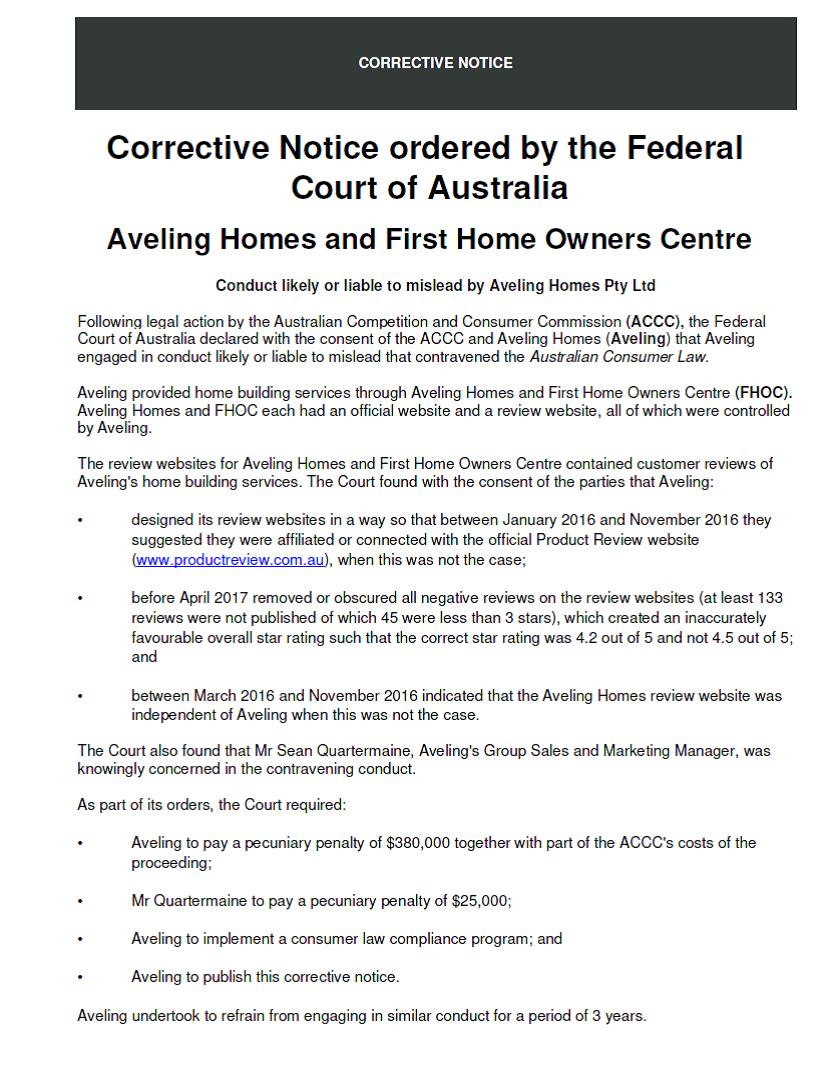
6. An order that the First Respondent, at its own expense, publish an advertisement in the terms set out in Annexure A, for a period of 40 days from the date of this order, on each of the websites ‘www.aveling-homes.com.au’ and the Aveling Reviews Website, that is in the form of a ‘modal’ pop up window, which:
(a) automatically displays and is immediately viewable on a computer screen, mobile phone or portable device upon a user’s access to the website;
(b) displays as a minimum of 50% of the viewable screen size on each website; and
(c) does not allow a user to navigate the remaining content of each website until the user ‘closes’ the ‘modal’ pop up window.
Compliance order
7. An order that the First Respondent, at its own expense:
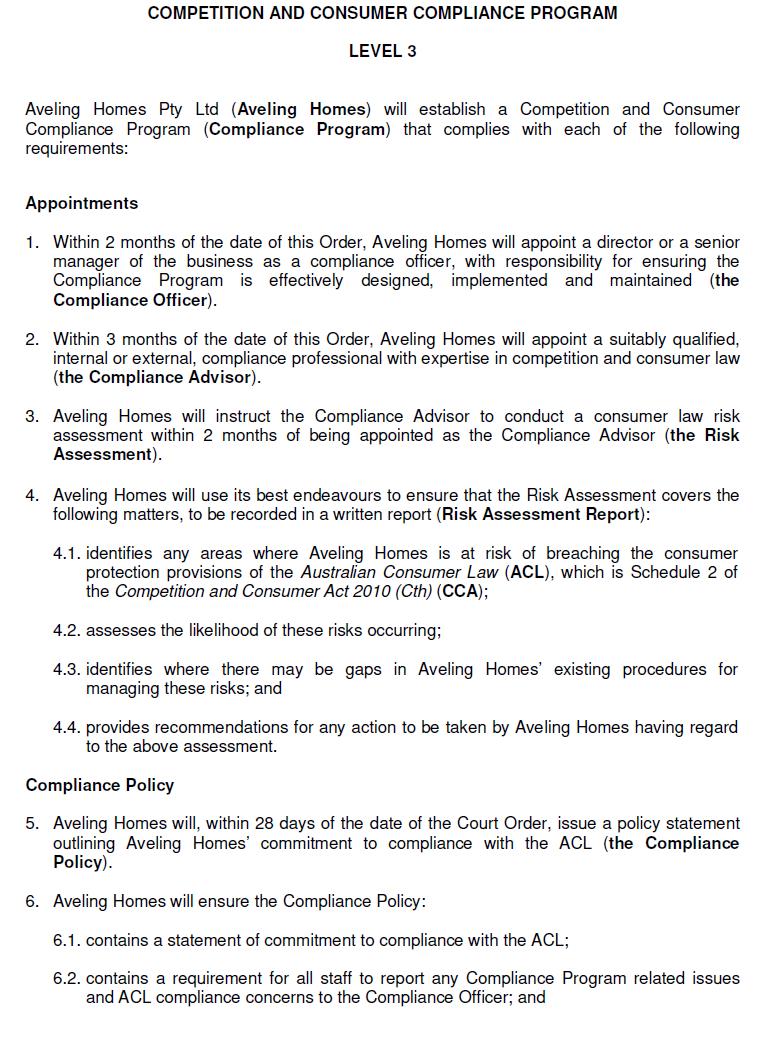
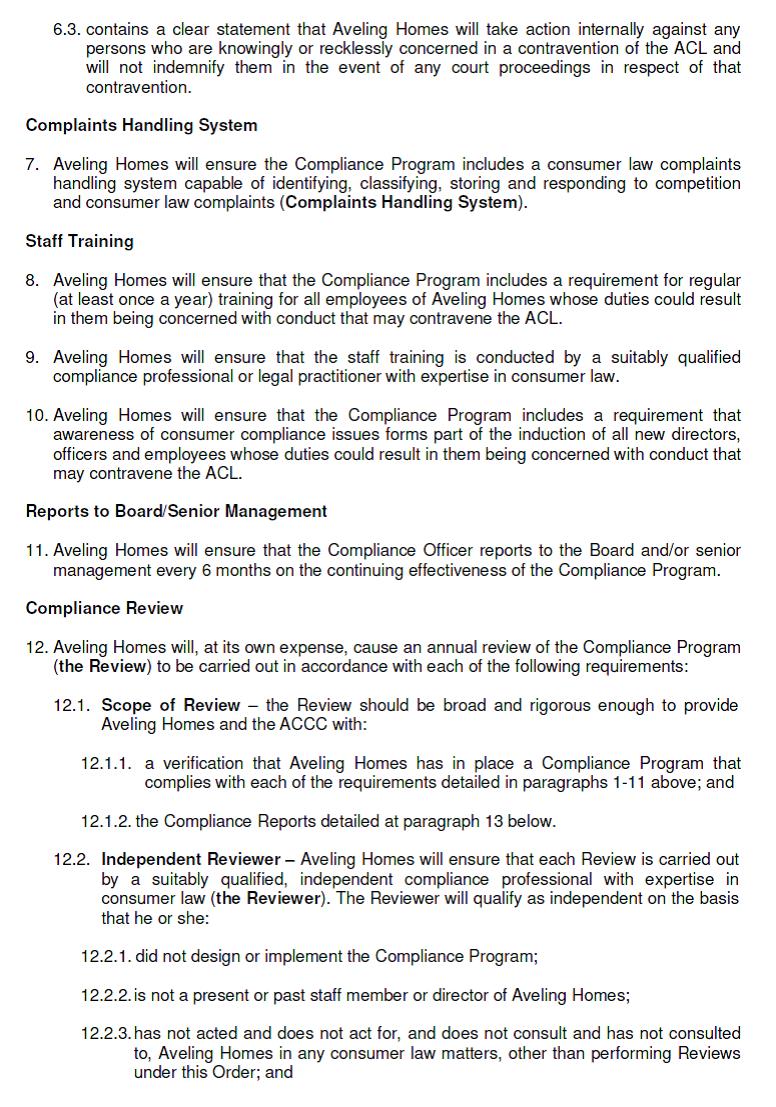
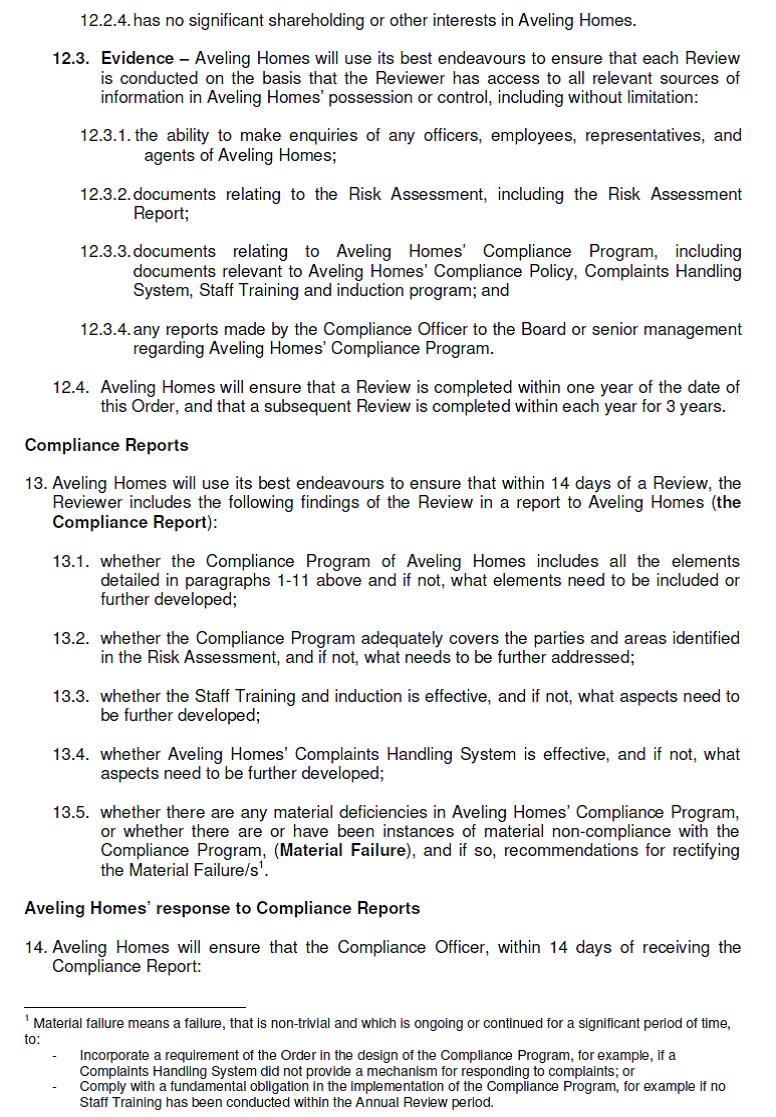
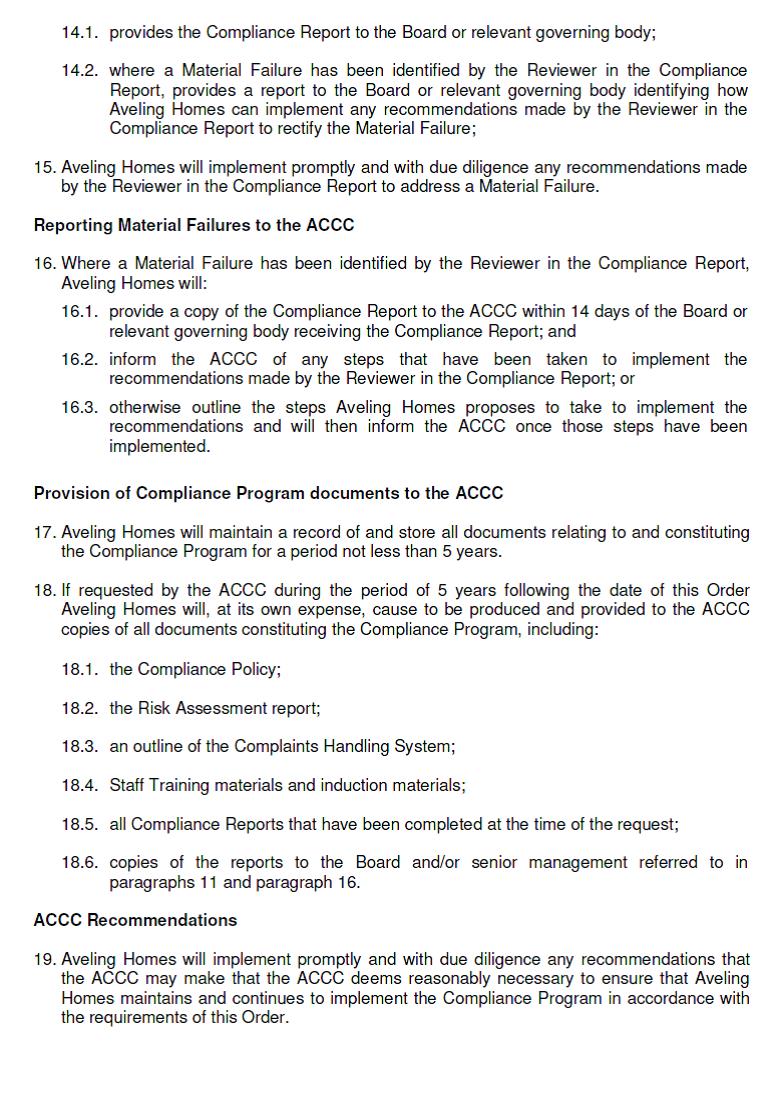
(a) within 2 months of the date of this order, establish a Consumer Law Compliance Program which meets the requirements set out in Annexure B; and
(b) maintain and administer the Consumer Law Compliance Program for a period of 3 years from the date on which it was established.
Other orders
8. An order that the Respondents pay the Applicant’s costs of the proceeding fixed at $95,000 within 12 months of the making of this Order by four equal quarterly instalments.
9. An order that the reasons for judgment with the seal of the Court affixed thereon be retained on the Court file for the purposes of s 137H of the Competition and Consumer Act 2010 (Cth).
Note: Entry of orders is dealt with in Rule 39.32 of the Federal Court Rules 2011.
MCKERRACHER J:
A proposed settlement
1 Shortly prior to a scheduled trial in this proceeding, the parties reached a proposed settlement. The terms of the settlement were recommended to the Court. Having had the advantage of monitoring progress to trial as the matter was in my docket, I was sufficiently familiar with relevant facts, arguments and issues to evaluate the proposed orders on the first day of what would have been the trial. For the reasons that follow, the orders as agreed by the parties were made.
Agreed Facts
2 The parties reached agreement on all of the matters recorded in this section of my reasons and as set out in a Statement of Agreed Facts.
3 The Australian Competition and Consumer Commission (ACCC) is a body corporate established by section 6A of the Competition and Consumer Act 2010 (Cth) (CCA) and is entitled to sue in its corporate name.
4 Aveling Homes Pty Ltd (Aveling) was at all material times:
(a) a company duly incorporated under the Corporations Act 2001 (Cth);
(b) able to be sued in its corporate name; and
(c) a corporation within the meaning of the CCA.
5 Mr Sean Quartermaine was at all material times the group sales and marketing manager of Aveling.
6 The Statement of Agreed Facts was made jointly by the ACCC, Aveling and Mr Quartermaine for the purposes of s 191 of the Evidence Act 1995 (Cth).
7 For the purposes of resolving the issues in this proceeding only, the parties agreed as follows.
8 Aveling is a project home building company that trades under the business name ‘Aveling Homes’.
9 Until 1 February 2017, Aveling operated a separate division known as the First Home Owners Centre (FHOC).
10 Aveling operates and controls the Aveling Homes website at www.avelinghomes.com.au (Aveling Homes Main Website) and a ‘review’ website for Aveling Homes at www.avelinghomesproductreviews.com.au (Aveling Reviews Website).
11 Until 3 February 2017, Aveling operated and controlled the FHOC website at www.firsthomeownerscentre.com.au (FHOC Main Website) and a ‘review’ website for FHOC at www.firsthomeownerscentreproductreviews.com.au (FHOC Reviews Website).
12 At all material times, a third party, ProductReview.com.au Pty Ltd (Product Review) operated and controlled a consumer opinion website, www.productreview.com.au (Product Review Website), which contained consumer reviews of various products and services, including Aveling Homes and (until February 2017) FHOC.
13 Between March 2016 and November 2016, the appearance of the Aveling Homes Main website was materially the same as identified screenshots.
14 Between:
(a) 28 January 2016 and 20 March 2016, the appearance of the Aveling Reviews website was materially the same as identified screenshots.
(b) 21 March 2016 and 26 May 2016, the appearance of the Aveling Reviews website was materially the same as identified screenshots.
(c) 27 May 2016 and November 2016, the appearance of the Aveling Reviews website was materially the same as identified screenshots.
15 Between 31 January 2016 and November 2016, the appearance of the First Home Owners Centre Review website was materially the same as identified screenshots.
16 Between January 2016 and November 2016, the appearance of the Aveling Homes page on the Product Review website was materially the same as the identified screenshots.
17 Between March 2016 and November 2016, the appearance of the FHOC page of the Product Review website was materially the same as the identified screenshots.
18 For the Aveling Reviews Website, in the period from September 2014, at least 133 reviews were not published, 45 of which were for less than 3 stars, the publication of which would have reduced the star rating in the period March 2016 to November 2016 from 4.5 stars out of 5 to 4.2 stars out of 5.
19 On 5 April 2017, 133 reviews were published on the Aveling Reviews Website.
20 In the period from March 2016, 32 reviews were not published on the FHOC Reviews Website, four of which would not have recommended FHOC. Those 32 reviews were never published on the FHOC Review Website.
21 The features and appearance of the Aveling Reviews Website and the FHOC Reviews Website that amounted to the contravening conduct were intentionally designed by Aveling’s group sales and marketing manager, Mr Quartermaine.
22 Since the commencement of this proceeding, Aveling has continued to sell project homes, and it has continued to operate and control the Aveling Homes Main Website and the Aveling Reviews Website. Mr Quartermaine has continued to be employed by Aveling.
23 Between January 2016 and November 2016, Aveling did not have a compliance program to assist it to meet its obligations under the Australian Consumer Law (ACL) (Sch 2 of the CCA).
24 Any loss and damage suffered by consumers cannot be quantified.
25 Any loss and damage suffered by Aveling’s competitors cannot be quantified. Neither Aveling nor Mr Quartermaine have previously been found by a court to have contravened any provision of the ACL or to have engaged in similar conduct to that described in the parties’ Statement of Agreed Facts.
26 Neither Aveling nor Mr Quartermaine made any admissions that they had engaged in wrongdoing during the investigative phase and litigation phase prior to 24 November 2017.
27 In the 2015 financial year, Aveling’s share of the Western Australian project home market was 2.3%. In the 2016 financial year, Aveling had 454 housing starts making it the 10th largest Western Australian project home builder out of 43 project home builders. In 2016, Aveling employed an average of 80 people. Aveling presently employs approximately 105 employees.
28 In the 2016 financial year, Aveling’s gross profit from trading was $14.682 million. In the previous year, it was $16.326 million. In the 2016 financial year, Aveling’s profit before income tax was $3.219 million. In the previous year, it was $3.938 million. In the 2016 financial year, Aveling had $91.316 million in sales. In the previous year, it had $121.875 million in sales.
Proposed consent orders
29 The parties have agreed and have proposed to the Court for its consideration, the orders set out at the commencement of these reasons.
consideration
30 I am satisfied on the basis of the preceding agreed and found facts that by way of the Aveling Reviews Website and FHOC Reviews Website (together the Review Websites):
(a) Aveling represented to consumers that each of the Review Websites was affiliated or connected with the Product Review Website (between 28 January 2016 and 16 November 2016 for the Aveling Reviews Website and between 31 January 2016 and 16 November 2016 for the FHOC Reviews Website);
(b) Aveling represented to consumers that each of the Review Websites was independent of Aveling (between March 2016 and 16 November 2016 for the Aveling reviews Website and between 21 March 2016 and 16 November 2016 for the FHOC Reviews Website); and
(c) Aveling conveyed the impression between March 2016 and November 2016 by the overall star rating and the reviews published on the Review Websites that the reviews published were not more favourable towards Aveling’s products and services than would have been the case if all reviews received by Aveling were published,
when in fact:
(d) the Review Websites were not affiliated or connected with the Product Review Website;
(e) the Review Websites were not independent of Aveling; and
(f) the overall star rating and reviews on the Review Websites were more favourable towards Aveling’s products and services than would have been the case if all the reviews received by Aveling from consumers were published (the star rating was published as 4.5 out of 5, when it would have been 4.2, out of 5).
31 It follows that Aveling, in trade or commerce:
(g) engaged in conduct that was likely to mislead or deceive, in contravention of s 18 of the ACL, which is Sch 2 of the CCA; and
(h) engaged in conduct that was liable to mislead the public as to the nature, the characteristics or the suitability for purpose of services, in contravention of s 34 of the ACL.
32 Mr Quartermaine accepts that he caused Aveling to engage in the contravening conduct referred to above, and was directly and indirectly knowingly concerned in or a party to the contraventions of Aveling.
33 The parties asked the Court to make orders in terms of the minute of proposed consent orders which was filed on 29 November 2017, as amended. On the giving of the undertaking set out in paragraph 5 of the minute, the agreed relief is:
(a) declarations pursuant to s 21 of the Federal Court of Australia Act 1976 (Cth);
(b) a pecuniary penalty pursuant to s 224 of the ACL for each of Aveling and Mr Quartermaine;
(c) an order pursuant to s 246(1) of the ACL requiring Aveling to establish a compliance program;
(d) an order pursuant to s 246(1) of the ACL requiring the publication of a corrective notice by Aveling; and
(e) an order that Aveling and Mr Quartermaine pay costs pursuant to s 43 of the Federal Court Act to the application.
Declarations
34 The power to make declarations under s 21 of the Federal Court Act is a wide power: Forster v Jododex Australia Pty Ltd (1972) 127 CLR 421 (at 437- 438). It includes the power to make declarations on evidence provided in the form of a statement of agreed facts: Australian Competition and Consumer Commission v Dataline.Net.Au Pty Ltd (2007) 161 FCR 513 (at [91]-[92]).
35 The declarations sought in this case are appropriate and meet the requirements set out in Forster v Jododex (at 437-438), given:
(a) the proposed declarations relate to sufficiently particularised contravening conduct;
(b) it is in the public interest for the ACCC to seek to have the declarations made. A significant legal controversy has been resolved and the ACCC (as regulator) has a genuine interest in seeking the declaratory relief; and
(c) Aveling and Mr Quartermaine are the proper contradictors as the parties that have contravened the ACL.
36 The declarations include an adequate description of the impugned conduct and how it contravened the legislation: BMW Australia Ltd v Australian Competition and Consumer Commission (2004) 207 ALR 465 (at [35]).
37 The declaratory relief sought will have utility and will serve the public interest in a number of ways including that it will:
(a) vindicate the ACCC’s claim that Aveling and Mr Quartermaine contravened the relevant section of the ACL in the manner alleged, and serve the purpose of deterrence;
(b) mark the Court’s disapproval of the particular conduct engaged in by Aveling and Mr Quartermaine;
(c) set out clearly the foundation for the pecuniary penalty sought and assist the ACCC in carrying out its duties under the CCA; and
(d) inform consumers of the respondents’ contravening conduct: Australian Competition and Consumer Commission v Construction, Forestry, Mining and Energy Union (2007) ATPR 42-140 (at [6]).
Penalty
38 It is permissible for the regulator to make submissions to the Court as to an appropriate civil penalty and that those submissions should be considered on their merits: Commonwealth v Director, Fair Work Building Industry Inspectorate (2015) 258 CLR 482 (at [61], [64])/
39 The Court may order a person who has contravened (relevantly) s 34 of the ACL to pay a pecuniary penalty, in respect of each act or omission by the person, as the Court determines to be appropriate: s 224(1)(a)(ii) of the ACL.
40 The maximum penalty for a body corporate for each act or omission to which s 224 applies that relates to (relevantly) s 34 of the ACL is not to exceed $1.1 million. For an individual the amount is not to exceed $220,000: s 224(3) of the ACL.
41 Having regard to all necessary and relevant factors (listed above and considered below) I consider that $380,000 for Aveling and $25,000 for Mr Quartermaine are appropriate penalties in the circumstances of this case.
Deterrence - the primary objective
42 The Court has long regarded deterrence (both specific and general) as the primary objective of imposing penalties under the CCA: Trade Practices Commission v CSR Ltd (1991) ATPR 41-076 (at 52, 152).
43 One important consideration in putting a ‘price’ on contravention is that the penalty must be high enough to outweigh any potential gain to the contravener by engaging in the conduct: Australian Competition and Consumer Commission v ABB Transmission and Distribution Limited (2001) ATPR 41-815 (at [13]). In Singtel Optus Pty Ltd v Australian Competition and Consumer Commission (2012) 287 ALR 249 (at [62]-[63]), the Full Court observed that in the setting of a penalty under s 76E of the Trade Practices Act 1974 (TPA) (the precursor to s 224 of the ACL):
There may be room for debate as to the proper place of deterrence in the punishment of some kinds of offences, such as crimes of passion; but in relation to offences of calculation by a corporation where the only punishment is a fine, the punishment must be fixed with a view to ensuring that the penalty is not such as to be regarded by that offender or others as an acceptable cost of doing business … those engaged in trade and commerce must be deterred from the cynical calculation involved in weighing up the risk of penalty against the profits to be made from contravention.
44 The High Court has approved those statements and said that general and specific deterrence must play a primary role in assessing the appropriate penalty in cases of calculated contravention of legislation where commercial profit is the driver of the contravening conduct: Australian Competition and Consumer Commission v TPG Internet Pty Ltd (2013) 250 CLR 640 (at [65]-[66]).
45 The process to be applied in arriving at a particular penalty is an intuitive or instinctive synthesis of all relevant factors, similar in nature to the judicial process involved in determining a sentence for a criminal offence: Australian Competition and Consumer Commission v Coles Supermarkets Australia Pty Ltd (2015) 327 ALR 540 (Coles) (at [6]), Allsop CJ referring to Markarian v The Queen (2006) 228 CLR 357. Recently, in Australian Competition and Consumer Commission v Woolworths Ltd [2016] FCA 44 (at [130]-[131]), Edelman J referred to the process of ‘instinctive synthesis’ in criminal law and observed that:
… [t]he same ‘instinctive synthesis’ approach does not directly apply to civil proceedings (see Commonwealth of Australia v Director, Fair Work Building Industry Inspectorate [2015] HCA 46; (2015) 90 ALJR 113, 127 [56] (French CJ, Kiefel, Bell, Nettle and Gordon JJ)). But there is a common process of assessing the relevant factors and synthesising a conclusion as to penalty where the parties have not agreed an appropriate penalty and the central purpose of the penalty is deterrence.
The factors and this case
46 The relevant considerations or factors are set out below. The first three must be taken into account as per s 224(2) of the ACL; the next nine are taken from CSR (at 52,152-52,153) and the last three derived from J McPhee & Son (Australia) Pty Ltd v Australian Competition and Consumer Commission (2000) 172 ALR 532 (at [156]-[158], [163]) and NW Frozen Foods Pty Ltd v ACCC (1996) 71 FCR 285 (at 292).
47 The significance of each factor will depend on the facts of the particular case: Australian Competition and Consumer Commission v Renegade Gas Pty Ltd (trading as Supergas NSW) [2014] FCA 1135 (at [74]-[83]); Australian Competition and Consumer Commission v Coles Supermarkets Australia Pty Ltd [2014] FCA 1405 (at [85]).
48 The factors as described are:
(a) the nature and extent of the act or omission and of any loss or damage suffered as a result of the act or omission;
(b) the circumstances in which the act or omission took place;
(c) whether the person has previously been found by a Court in proceedings under Ch 4 or Pt 5-2 of the ACL to have engaged in any similar conduct;
(d) the nature and extent of the contravening conduct;
(e) the amount of loss or damage caused;
(f) the circumstances in which the conduct took place;
(g) the size of the contravening company;
(h) the degree of power it has, as evidenced by its market share and ease of entry into the market;
(i) the deliberateness of the contravention and the period over which it extended;
(j) whether the contravention arose out of the conduct of senior management or at a lower level;
(k) whether the company has a corporate culture conducive to compliance with the TPA as evidenced by educational programs and disciplinary or other corrective measures in response to an acknowledged contravention;
(l) whether the company has shown a disposition to cooperate with the authorities responsible for the enforcement of the TPA/CCA in relation to the contravention;
(m) whether the respondent has engaged in similar conduct in the past;
(n) the respondent’s financial position; and
(o) whether the conduct was systematic, deliberate or covert.
49 The facts of the present case relevant to the considerations or factors are:
(a) the contravening conduct was extensive and continued for a significant period of time, between 9 and 11 months;
(b) Aveling and Mr Quartermaine were responsible for developing and maintaining the Review Websites each of which has an appearance materially the same as the Product Review Website. By those websites and their appearance, including the language used on them, Aveling represented that they (the websites) were affiliated or connected with Product Review and independent of Aveling;
(c) further, Aveling, by Mr Quartermaine, did not publish at least 133 reviews (until 5 April 2017, on the Aveling Review Website) and 32 reviews (on the FHOC Review Website);
(d) while the loss and damage suffered by consumers and competitors of Aveling cannot be quantified, it may include the lost opportunity of some consumers to accurately compare Aveling’s products and services against similar products and services of other companies;
(e) likewise, in respect of the loss and damage suffered by Aveling’s competitors, which may include the lost opportunity to gain custom from consumers;
(f) Aveling’s share of the West Australian project home market is about 2.3%. In the 2016 financial year, Aveling had 454 housing starts making it the 10th largest Western Australian project home builder out of 43 project home builders. Aveling currently employs approximately 105 employees;
(g) Aveling is a company in a strong financial position. In the 2016 financial year, Aveling’s gross profit from trading was $14.6 million. In 2015, it was $16.3 million. In the 2016 financial year, Aveling’s profit before income tax was $3.2 million. In 2015, it was $3.9 million. In the 2016 financial year, Aveling had $91.3 million in sales. 2015, it had $121.8 million in sales. (As to the significance of this see Australian Competition and Consumer Commission v Apple [2012] FCA 646 (at [39]) and Coles (at [92]));
(h) the conduct of Aveling and Mr Quartermaine, including the contravening conduct was intentional;
(i) the conduct was the conduct of Mr Quartermaine, the Group Sales and Marketing Manager, a senior management role (not lower level), who continues to be employed by Aveling;
(j) before, during and after the contravening conduct, Aveling did not have a compliance programme in place and, it is to be inferred, did not have a culture of compliance with the ACL;
(k) throughout the investigation phase and litigation phase and until 24 November 2017, neither Aveling nor Mr Quartermaine made any admissions and showed no relevant contrition for the contravening conduct; and
(l) neither Aveling nor Mr Quartermaine have previously contravened the CCA.
‘Totality’ and ‘course of conduct’ principles
50 As noted above (at [40]), the maximum penalty under s 224 of the ACL for each act or omission by a corporation that constitutes a contravention of s 34 is $1.1 million for a corporation and $220,000 for an individual. The parties are not aware of any Australian authorities which directly consider, for the purposes of s 224 of the ACL (or any predecessor provision), the number of contravening acts that occur when a statement liable to mislead is made via a website. For some perhaps limited comparison, though, reference has been made to Australian Competition and Consumer Commission v P & N Pty Ltd [2014] FCA 6 and Australian Competition and Consumer Commission v A Whistle & Co (1979) Pty Ltd [2015] FCA 1447.
51 In cases such as the present, the determination of the appropriate penalty involves an assessment of the overall extent and seriousness of the contravening conduct: Coles (at [18]). In determining the appropriate penalty for multiple civil penalty contraventions, the Court has had regard to the ‘totality’ principle and the ‘course of conduct’ principle. The totality principle requires that the total penalty for related offences ought not exceed what is proper for the entire contravening conduct involved: Trade Practices Commission v TNT Australia Pty Ltd (1995) ATPR 41-375 (at 40,169); Australian Competition and Consumer Commission v Safeway Stores Pty Ltd (1997) 145 ALR 36 (at 53) (among others).
52 The ‘course of conduct’ (or ‘one transaction’) principle means that consideration should be given to whether the contraventions arise out of the same course of conduct or the one transaction, to determine whether it is appropriate that a ‘concurrent’ or single penalty should be imposed for the contraventions: Trade Practices Commission v Bata Shoe Company of Australia Pty Ltd (1980) ATPR 40-162 (at 42,277); Mornington Inn Pty Ltd v Jordan (2008) 168 FCR 383 (at [41]-[45]); Australian Competition and Consumer Commission v Telstra Corporation Ltd (2010) 188 FCR 238 (at [222]-[236]); Singtel (at [53]). The principle does not restrict the Court’s discretion as to the amount of penalty to be imposed for the course of conduct, and specifically the maximum penalty for the course of conduct is not restricted to the prescribed statutory maximum penalty for each contravening act or omission: Secretary, Department of Health and Ageing v Prime Nature Prize Pty Ltd [2010] FCA 597 (at [70]); Australian Competition and Consumer Commission v EDirect Pty Ltd (in liq) (2012) 206 FCR 160 (at [72]-[74]); Coles (at [17], [20]); Australian Competition and Consumer Commission v Reckitt Benckiser (Australia) Pty Ltd (No 7) [2016] FCA 424 (at [29]).
53 These principles should not be given excessive weight or paramountcy in the process of assessing an appropriate penalty and operating as a de facto limit on the penalty to be imposed.
54 Section 224 should be applied in accordance with its terms. The prohibitions in the ACL apply to a wide range of commercial conduct. In some cases, the contravening conduct may involve many acts of contravention that affect a very large number of consumers and a large monetary value of commerce, but the conduct might be characterised as involving a single course of conduct. In other cases, there may be a small number of contraventions, affecting few consumers and having small commercial significance, but the conduct might be characterised as involving a number of courses of conduct.
55 Ultimately, the appropriate characterisation is a matter within the discretion of the Court. So long as the totality principle is applied, whatever characterisation is adopted, the total penalty will be appropriate.
Comparable cases and the parity principle
56 The ‘parity principle’ requires that persons or corporations guilty of similar contraventions should incur similar penalties and that ‘there should not be such an inequality as would suggest that the treatment meted out has not been even handed’: NW Frozen Foods (at 295). By application of the parity principle, assessments of penalty in analogous cases may provide guidance to the Court to ensure that there is parity of treatment of similar circumstances.
57 However, while pecuniary penalties imposed in one case provide a guide, that guide will seldom, if ever, be able to be used mechanically: Australian Competition and Consumer Commission v Universal Music Australia Pty Ltd (No 2) (2002) 201 ALR 618 (at [34]); NW Frozen Foods (at 295). See also Singtel (at [60]). The ACCC is not aware of any analogous decision on penalty.
Corrective notice
58 The Court has the power to make orders for the publication of corrective notices: s 246(2)(d) ACL. That power should be used protectively to inform the relevant markets of the outcome of the litigation so that those in the market have at least a broad understanding of how the contravener has had to change their conduct: Australian Competition and Consumer Commission v On Clinic Australia Pty Ltd (1996) 35 IPR 635; Australian Competition and Consumer Commission v Real Estate Institute of Western Australia Inc (1999) 95 FCR 114 (at [49]).
59 The purpose of a corrective notice is to protect the public interest in dispelling incorrect or false impressions created by contravening conduct, alert the consumer to the fact of contravening conduct, aide the enforcement of primary orders and prevent repetition of contravening conduct: Australian Competition and Consumer Commission v SMS Global Pty Ltd [2011] FCA 855 (at [128]); Medical Benefits Fund of Australia Ltd v Cassidy (2003) 135 FCR 1 (at [49]-[52]).
60 The parties have agreed that a corrective notice to be published on Aveling’s website for the specified number of days is appropriate, and the form of that notice. The proposed notice serves to alert affected consumers and to educate industry.
Compliance order
61 The Court has power under s 246 of the ACL to order that a respondent establish and implement a training program to assist in ensuring that it avoids future contraventions of the CCA and the ACL. Aveling consents to an order requiring the implementation of a compliance program in terms of the minute of proposed orders. The training required by the orders is linked to the relevant conduct, in that the training is to cover the provisions of Pt 2-1 and Div 1 of Pt 3-1 of the ACL. I accept that the orders are reasonable.
Costs
62 Finally, the parties agreed that an order that Aveling and Mr Quartermaine pay costs is appropriate, and agreed on the form of that order. The costs order is appropriate. It is not punitive. It reflects a reasonable contribution by way of compensation for costs properly incurred.
I certify that the preceding sixty-two (62) numbered paragraphs are a true copy of the Reasons for Judgment herein of the Honourable Justice McKerracher. |
Associate:
Annexure A
Annexure B