

FEDERAL COURT OF AUSTRALIA
Kelly on behalf of the Gumbaynggirr People v Attorney General of New South Wales [2017] FCA 1459
ORDERS
DATE OF ORDER: |
BEING SATISFIED that a determination of native title in the terms sought by the parties is within the power of the Court and it appearing to the Court appropriate to do so by consent of the parties and pursuant to ss 87(2) and (5) of the Native Title Act 1993 (Cth) (Native Title Act):
THE COURT NOTES THAT:
1. On 3 June 1998, the applicant made a native title determination application in accordance with ss 13(1) and 61 of the Native Title Act (proceedings number NSD 6104 of 1998) (the Application).
2. The parties have reached an agreement as to the terms of a determination to be made by consent in relation to the land and waters the subject of the Application (the Determination Area), being that:
(a) native title exists in relation to a part of the Determination Area (the Native Title Area); and
(b) native title has been extinguished in relation to another part of the Determination Area (the Extinguished Area).
3. The terms of that agreement involve the making of orders by consent for a determination pursuant to s 87 and in accordance with s 94A of the Native Title Act.
4. Pursuant to s 87(1) of the Native Title Act, the parties have filed a Minute of Proposed Consent Determination of Native Title which reflects the terms of that agreement.
5. The applicant has nominated Gumbaynggirr Wenonah Head Aboriginal Corporation ICN 7376 pursuant to s 56(2) of the Native Title Act to hold the determined native title in trust for the common law holders.
6. Gumbaynggirr Wenonah Head Aboriginal Corporation ICN 7376 has consented in writing to hold the determined rights and interests comprising the native title in trust for the common law holders and to perform the functions of a registered native title body corporate under the Native Title Act.
THE COURT ORDERS THAT:
1. There be a determination of native title in the terms set out below (the Determination).
2. The Determination shall take effect 21 days after the date on which the later of the two agreements referred to in paragraphs 1 and 3 of Schedule Four is registered on the Register of Indigenous Land Use Agreements pursuant to the Native Title Act.
3. In the event that any or both of the agreements referred to in Order 2 above are not registered on the Register of Indigenous Land Use Agreements on or before 26 July 2018, or at such later time as this Court may order, the matter is to be listed before the Court for further directions.
4. On the Determination taking effect, Gumbaynggirr Wenonah Head Aboriginal Corporation ICN 7376 shall hold the determined native title in trust for the common law holders pursuant to s 56(3) of the Native Title Act and is to:
(a) be the prescribed body corporate for the purposes of s 57(1) of the Native Title Act; and
(b) perform the functions set out in s 57(1) of the Native Title Act and the Native Title (Prescribed Bodies Corporate) Regulations 1999 (Cth).
5. There be no order as to costs.
THE COURT DETERMINES THAT:
1. Native title exists in the Native Title Area described and depicted in the map in Schedule One.
2. Native title is extinguished in the Extinguished Area described and depicted in the map in Schedule Two.
3. To the extent of any inconsistency between the written description in Schedules One and Two and the corresponding maps in those Schedules, the written description prevails.
Native title holders
4. Native title in relation to the Native Title Area is held by the Gumbaynggirr People who are Aboriginal persons who are:
(a) the biological descendants of:
(i) King Ben Bennelong;
(ii) Maggie Buchanan and Davy Cowling;
(iii) Biddy, the mother of Lavina Duncan (Bina Whaddy);
(iv) Fanny Purrapine, the mother of Lily Kelly and Hilda Kelly Robinson;
(v) Darby Kelly;
(vi) The father of Maggie Kelly’s mother Biddy;
(vii) William ‘Old Bill’ Dotti;
(viii) John ‘Jack’ Dotti;
(ix) Lucy Flanders;
(x) Dave Ballangarry;
(xi) Robert Walker and Louise Linwood;
(xii) John ‘Jack’ Long;
(xiii) Bridget ‘Biddy’ Briggs Needam;
(xiv) Mary Briggs and Fred Briggs;
(xv) Susan, mother of Charles Jarrett Snr;
(xvi) Rose Taylor;
(xvii) Charles Layton;
(xviii) Mick McDougall;
(xix) Clara Skinner;
(xx) Sylvie Craig;
(xxi) Elizabeth ‘Kitty’ Campbell/Cameron (known as Elizabeth Blakeney);
(xxii) Emily Sutton;
(xxiii) Fred Hookey;
(xxiv) Nobby Neville;
(xxv) Mary Jane Ferguson;
(xxvi) Billy Lardner Jnr;
(xxvii) King Bobby of Oban;
(xxviii) The parent of Charlie Whitton and Lucy Larrigo (nee Whitton);
(xxix) Walter Smith and Stella Jane Davis;
(xxx) Jane Gard/Maskey; and
(b) persons who have been adopted into the families of those persons (and the biological descendants of any such adopted persons); and
(c) persons who have been otherwise incorporated, or who are direct descendants of a person who has been otherwise incorporated, as a member of the Gumbaynggirr People and who identify as and are accepted as a Gumbaynggirr person, in accordance with Gumbaynggirr laws and customs.
Nature and extent of non-exclusive native title rights and interests
5. Subject to paragraphs 7 and 8, the nature and extent of the native title rights and interests in the Native Title Area are the non-exclusive native title rights to:
(a) access, to remain on and traverse the land and waters;
(b) access natural resources and to take, use, share and exchange those natural resources for any purpose;
(c) hunt and gather traditional natural resources;
(d) fish;
(e) take and use water for personal, domestic, communal purposes (including cultural purposes) but not extending to a right to control the use and flow of the water in any creeks or intermittently closing and opening lakes and lagoons;
(f) live, being to camp on and erect temporary shelters and other temporary structures for that purpose, but not to permanently reside on, possess or occupy the land or waters;
(g) light fires for domestic purposes;
(h) conduct and to participate in cultural and religious activities, practices and ceremonies, including the conduct of burials;
(i) conduct and to participate in meetings;
(j) teach on the area the physical, cultural and spiritual attributes of places and areas of importance under traditional laws and customs;
(k) maintain and to protect from physical harm, places and areas of importance or significance under traditional laws and customs;
(l) to be accompanied by persons who, though not Native Title Holders, are:
(i) spouses, partners or parents of native title holders, together with their children and grandchildren; and
(ii) people required under traditional laws and customs for the performance of, and to assist in, observe or record, cultural activities, practices or ceremonies.
General qualifications on native title rights and interests
6. Native title does not exist in:
(a) minerals as defined in the Mining Act 1992 (NSW) and the Mining Regulation 2010 (NSW); and
(b) petroleum as defined in the Petroleum (Onshore) Act 1991 (NSW) and the Petroleum (Submerged Lands) Act 1982 (NSW).
7. The native title rights and interests described in paragraph 5 do not confer:
(a) any right of possession, occupation, use and enjoyment of the land or waters in the Native Title Area to the exclusion of all others; and
(b) any right to control public access to or use of the land or waters in the Native Title Area.
8. The native title rights and interests in relation to the land or waters in the Native Title Area are subject to and exercisable in accordance with:
(a) the laws of the State of New South Wales and of the Commonwealth including any applicable requirement to obtain any licences and/or permits for commercial fishing activities, in particular, any applicable requirements related to commercial fishing activities under the Fisheries Management Act 1994 (NSW); and
(b) the traditional laws acknowledged and traditional customs observed by the Native Title Holders; and
(c) the terms and conditions of the agreements referred to in Schedule Four, except the agreement referred to in paragraph 2 of that Schedule.
Nature and extent of any other rights and interests
9. The Other Interests in relation to the Native Title Area are described in Schedule Five.
Relationship between native title rights and interests and other rights and interests
10. Subject to paragraph 11 of these determinations and except as provided by law, the relationship between the native title rights and interests in relation to land or waters in the Native Title Area and the Other Interests described in Schedule Five is that:
(a) the Other Interests continue to have effect;
(b) the Other Interests co-exist with the native title rights and interests;
(c) the Native Title Holders do not have the right to control access to or the use of the land or waters within the Native Title Area by the holders of the Other Interest; and
(d) to the extent of any inconsistency, the Other Interests and any activity that is required or permitted by or under the exercise of a right conferred or held under the Other Interests, while they are in existence, prevail over but do not extinguish the native title rights and interests and any exercise of those native title rights and interests.
11. The relationship between the native title rights and interests and the rights and interests of Coffs Harbour and District Local Aboriginal Land Council referred to in paragraph 1 of Schedule Five is as determined by ss 36(9), 36AA(8) and 36AA(10) of the Aboriginal Land Rights Act 1983 (NSW). Specifically, a transfer of lands to Coffs Harbour and District Local Aboriginal Land Council pursuant to its rights and interests under the Aboriginal Land Agreement referred to in paragraph 2 of Schedule Four shall be for an estate in fee simple but shall be subject to any of the native title rights and interests existing in relation to the land concerned immediately before the transfers.
Section 47B of the Native Title Act
12. Section 47B of the Native Title Act applies to those areas of lands and waters described in Pt 2 of Schedule One.
Definitions
13. In these orders, unless the contrary intention appears:
Application means the native title claimant application lodged with the National Native Title Tribunal by the Applicant in accordance with ss 13(1) and 61 of the Native Title Act, and is now proceedings number NSD 6104 of 1998 before the Federal Court of Australia as amended.
Determination Area means the Native Title Area together with the Extinguished Area.
external boundary of the Application means the boundary described in Schedule B of the Application which is also described in Schedule Three.
Extinguished Area means the land and waters described in Schedule Two.
Gumbaynggirr People has the same meaning as Native Title Holders.
Gumbaynggirr Wenonah Head Aboriginal Corporation means the Gumbaynggirr Wenonah Head Aboriginal Corporation ICN 7376 incorporated under the Corporations (Aboriginal and Torres Strait Islander) Act 2006 (Cth).
Land has the same meaning as in the Native Title Act.
laws of the State of New South Wales and of the Commonwealth include statutes, regulations, other subordinate legislation and the common law.
Native Title Area means the land and waters described in Schedule One.
Native Title Holders means the persons described in paragraph 4.
native title rights and interests means the rights and interests described in paragraph 5.
Other Interests means the rights and interests described in Schedule Five.
waters has the same meaning as in the Native Title Act.
14. If a word or expression is not defined in these orders or this Determination, but is defined in the Native Title Act or the Native Title (New South Wales) Act 1994 (NSW), then it has the meaning given to it in the Native Title Act or the Native Title (New South Wales) Act 1994 (NSW), whichever is relevant.
Note: Entry of orders is dealt with in Rule 39.32 of the Federal Court Rules 2011.
Schedule One – Native Title Area
A. Description of Native Title Area
The Native Title Area comprises all the land or waters described in Part 1 and Part 2 below which is depicted on the map in this Schedule.
Part 1 – Land or waters in the Native Title Area
1. All the land or waters described in the following list and depicted on the map in this Schedule and hatched green to the extent they fall within the external boundary of the Application:
(a) that part of Lot 7066 DP 1107446 south of the eastern prolongation of the southern boundary of Lot 1 DP 620967;
(b) that eastern part of Lot 1 DP 1193053 being that part subject to former Lot 7065 DP 1107444;
(c) Lot 4 DP 1193053;
(d) Lot 7064 DP 1107434;
(e) the part of Lot 7012 DP 1107438 excluding McGraths Creek;
(f) Lot 7034 DP 1107441
(g) the part of Lot 7035 DP 1107441 excluding Oyster Creek; and
(h) that part of Lot 8 DP 1195331 which is in the external boundary of the Application.
2. The land and waters of the following watercourses that are within the external boundaries of the Application and depicted on the map in this Schedule and shaded blue and hatched green to the extent they fall within the external boundary of the Application:
(a) the saltwater inlet;
(b) Dalhousie Creek;
(c) McGraths Creek; and
(d) Oyster Creek.
Part 2 – Land and waters in the Native Title Area to which s 47B of the Native Title Act applies
All land or waters described in the following list and depicted on the map in this Schedule and hatched green to the extent they fall within the external boundary of the Application:
(a) that part of Lot 7066 DP 1107446 north of the eastern prolongation of the southern boundary of Lot 1 DP 620967;
(b) Lot 1 DP 609510; and
(c) Lot 223 DP 755552.
B. Maps of the Native Title Area
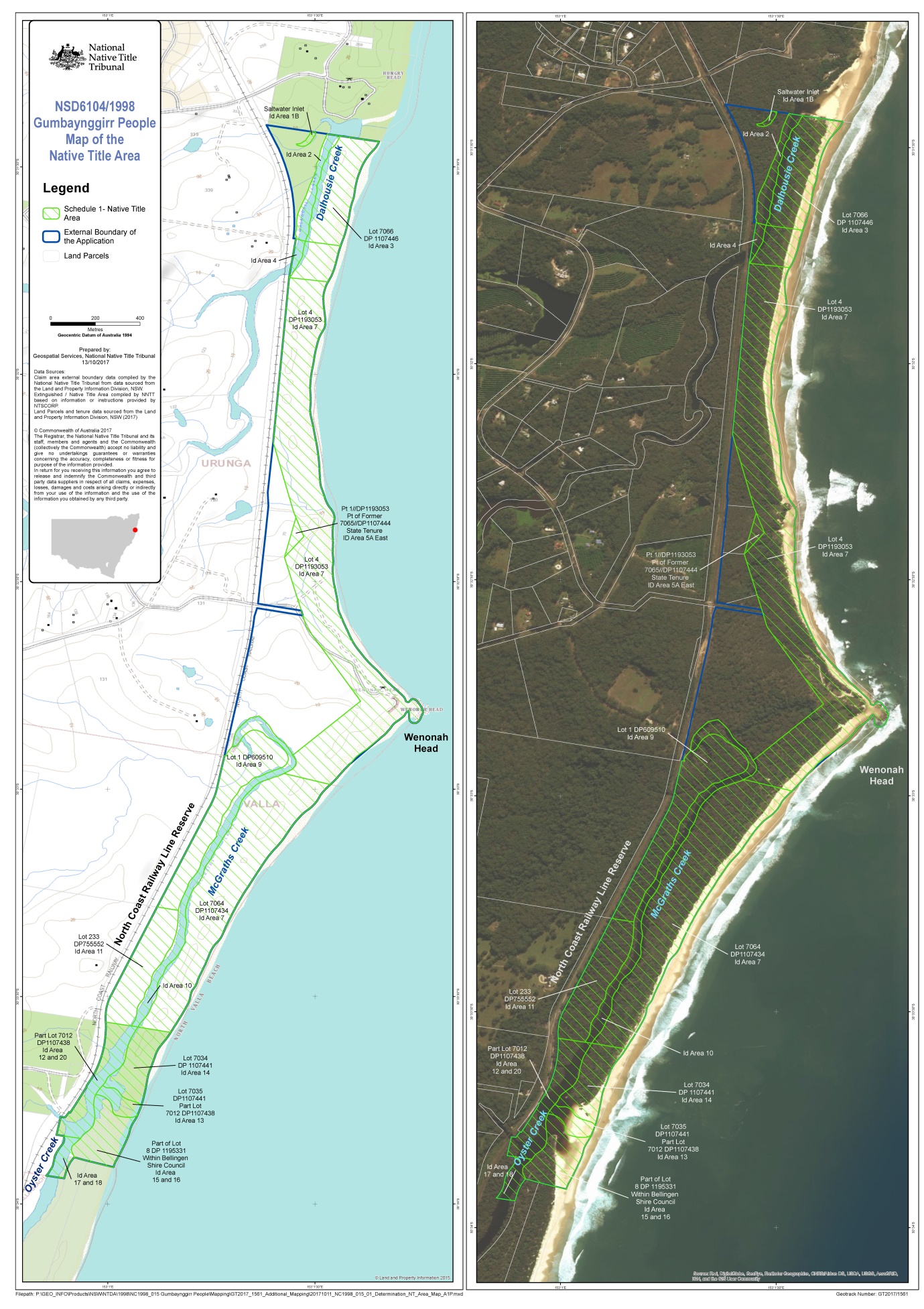
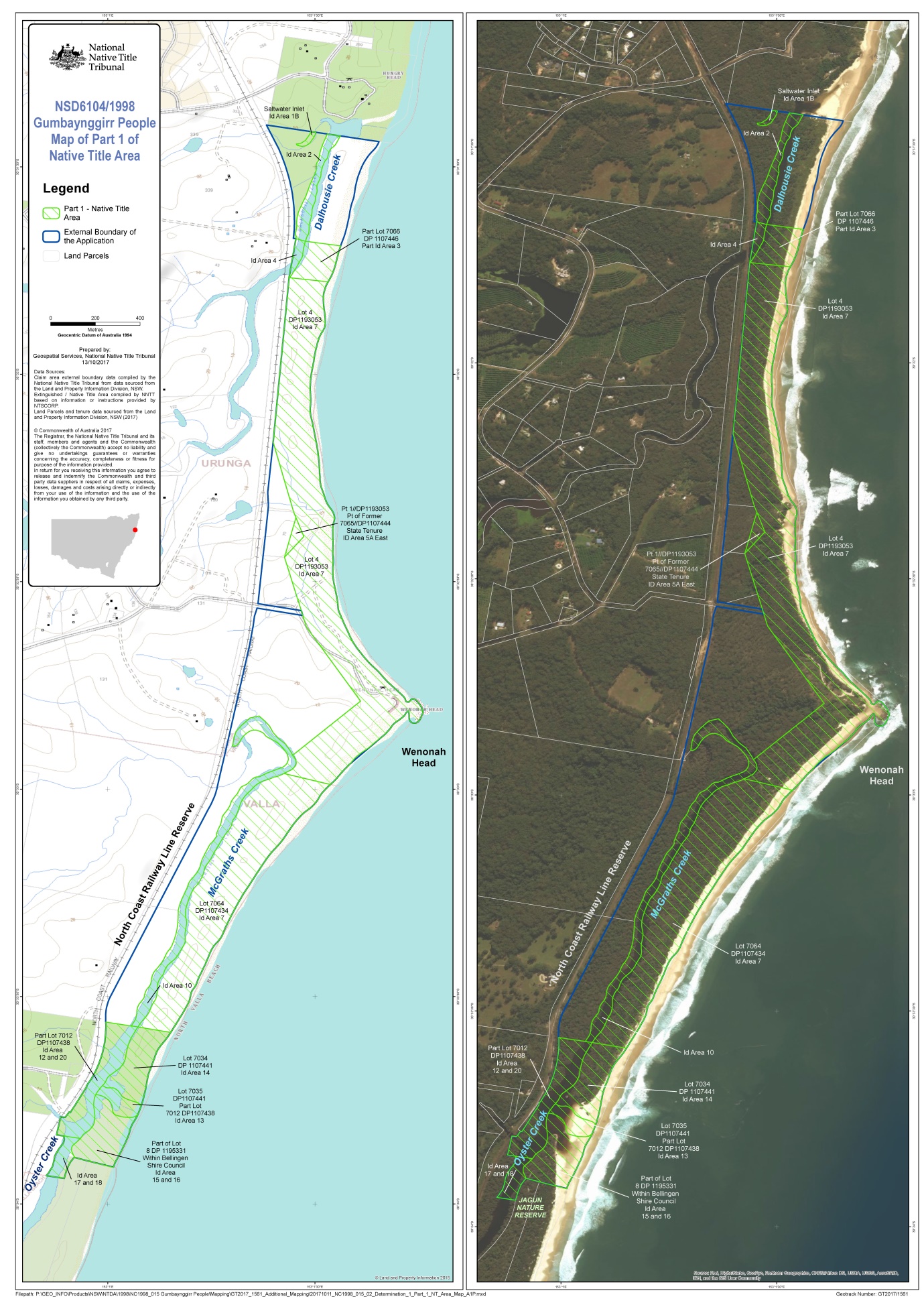
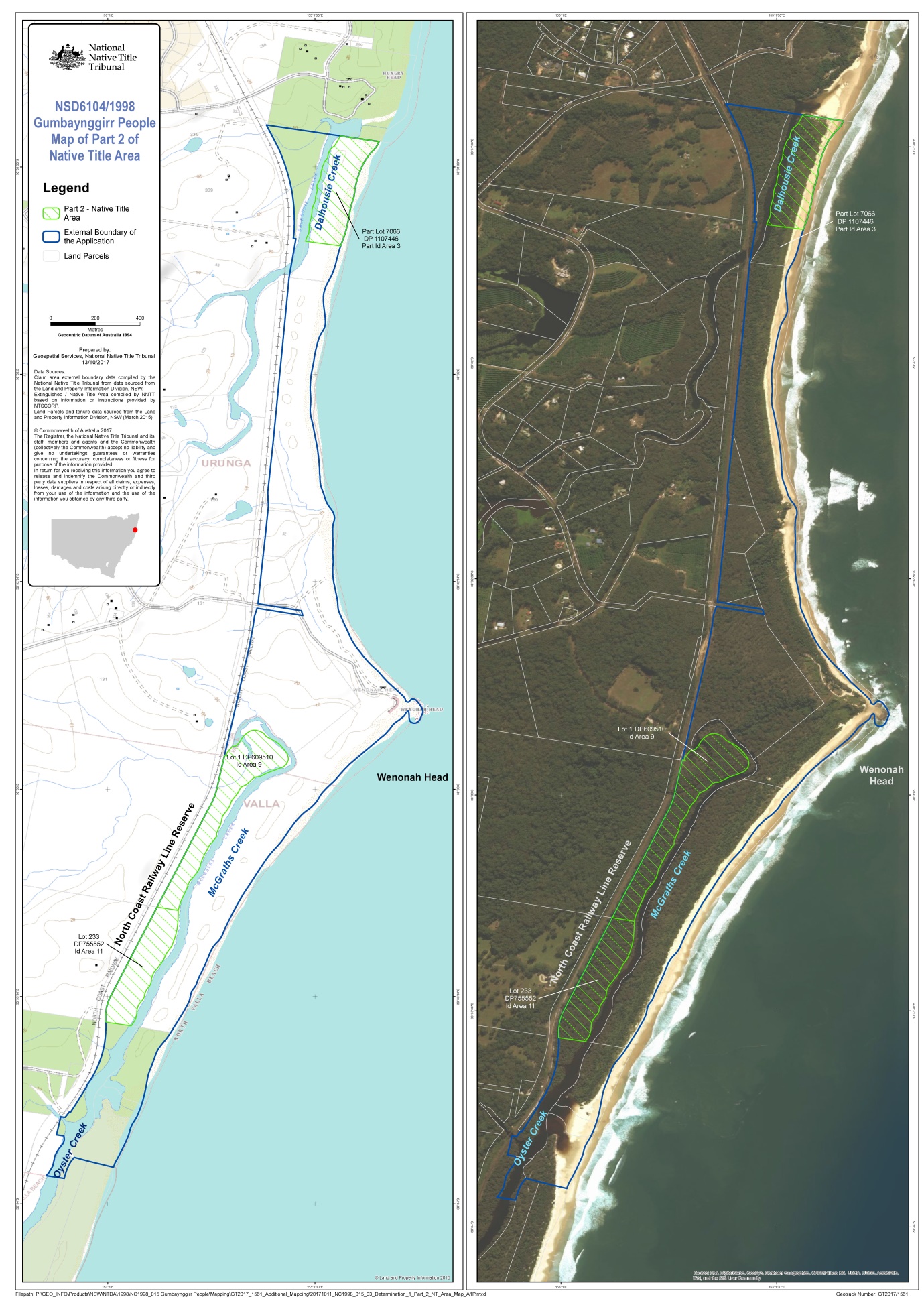
Schedule Two – Extinguished Area
A. Description of Extinguished Area
To the extent they fall within the external boundary of the Application, the Extinguished Area comprises:
(a) any land or waters which would otherwise be within the Native Title Area on which there is or has been constructed or established valid public works (including any adjacent land or waters as described in s 251D of the Native Title Act) which were constructed or established prior to 23 December 1996 or were commenced to be constructed or established on or before that date);
(b) without detracting from the generality of paragraph (a), any land or waters upon which a public road is or was commenced to be constructed or established, on or before 23 December 1996;
(c) any roads established under statute or common law on or before 23 December 1996; and
(d) the land or waters described in the following list and depicted on the map in this Schedule and hatched red:
(i) the western part of Lot 1 DP 1193053 being that part subject to former Lot 1 DP 583777;
(ii) Lot 2 DP 1193053; and
(iii) Lot 3 DP 1193053.
B. Map of Extinguished Area
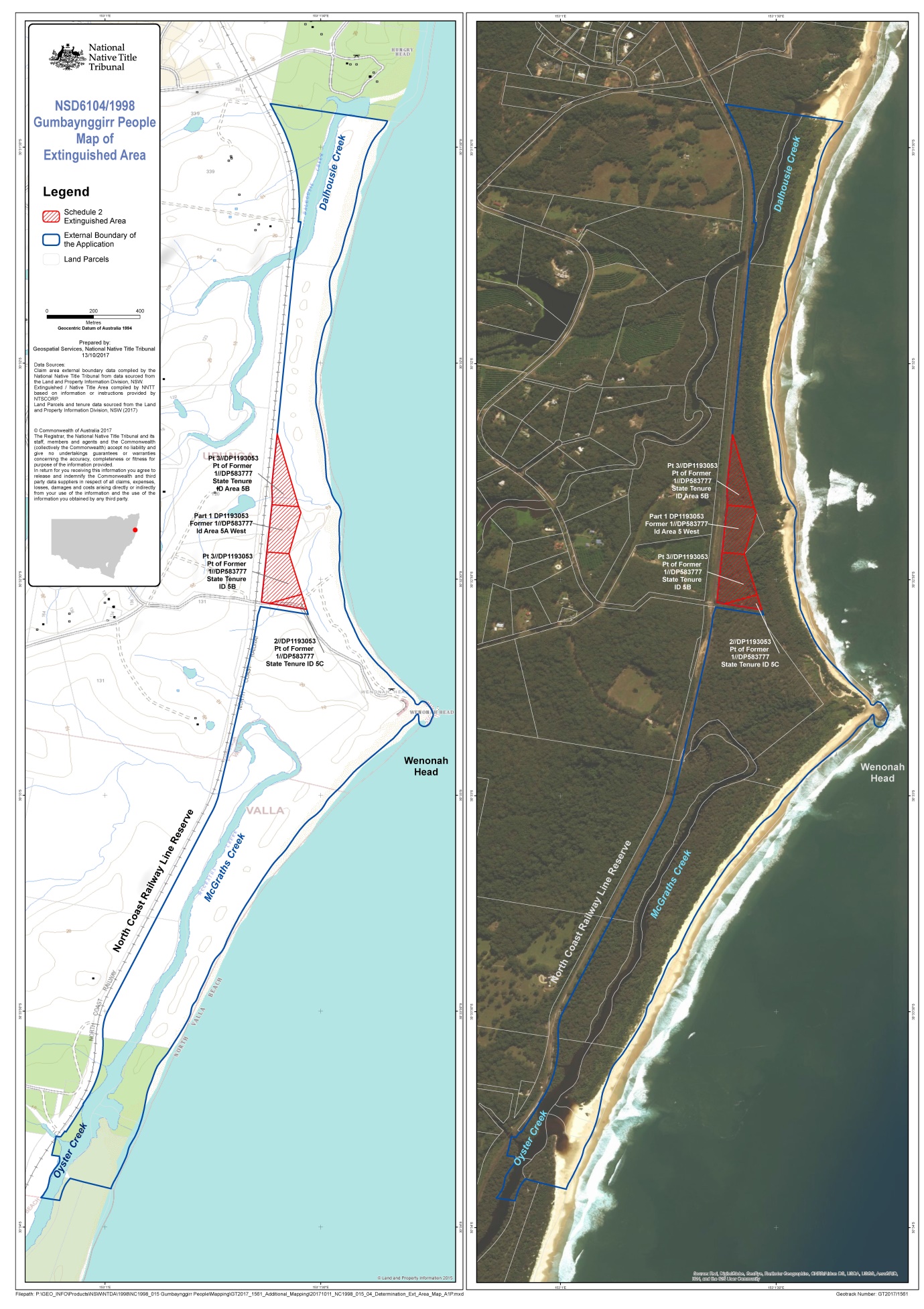
Schedule Three – External Boundary of the Application
The external boundary of the Application is described as follows:
Land and waters east of the North Coast Railway line, west of the mean high water mark of the Pacific Ocean, with the northern boundary at the southern border of Lot 102 in the Parish of Newry, County of Raleigh and the southern boundary at Nambucca Shire.
Schedule Four – Agreements
1. The Indigenous Land Use Agreement under s 24CA of the Native Title Act dated 6 November 2017 made between Laurie (Larry) Kelly, Richard Pacey, Christine Witt, Marion Witt and Frances Witt, as the registered native title claimant in relation to the land and waters within the external boundaries of the Application, for and on behalf of the Gumbaynggirr People, and as persons who claim to hold native title in relation to land or waters in a non-claimed/determined part of the agreement area, the Gumbaynggirr Wenonah Head Aboriginal Corporation, the Attorney General of New South Wales, the Minister administering the Crown Lands Act 1989 (NSW), the Minister administering the National Parks and Wildlife Act 1974 (NSW) and the CEO of the Office of Environment and Heritage.
2. The Aboriginal land agreement under s 36AA of the Aboriginal Land Rights Act 1983 (NSW) made between the Minister administering the Crown Lands Act 1989 (NSW), New South Wales Aboriginal Land Council, and Coffs Harbour and District Local Aboriginal Land Council.
3. The Indigenous Land Use Agreement under s 24CA of the Native Title Act dated 6 November 2017 made between Laurie (Larry) Kelly, Richard Pacey, Christine Witt, Marion Witt and Frances Witt, as the registered native title claimant in relation to the land and waters within the external boundaries of the Application, for and on behalf of the Gumbaynggirr People, and as persons who claim to hold native title in relation to land or waters in a non-claimed/determined part of the agreement area, the Gumbaynggirr Wenonah Head Aboriginal Corporation and Coffs Harbour and District Local Aboriginal Land Council.
4. Any other Indigenous Land Use Agreement, which, after this Determination is made, is registered on the Register of Indigenous Land Use Agreement in relation to any land or waters in the Native Title Area.
Schedule Five – Other Interests in the Native Title Area
The Other Interests, as they exist at the date this Determination takes effect, are as follows:
1. Aboriginal Land Council interests
(a) The rights and interests of Coffs Harbour and District Local Aboriginal Land Council to the transfer of an estate in fee simple of the following areas of land pursuant to the Aboriginal Land Agreement referred to in paragraph 2 of Schedule Four.
Lot and DP | State ID Area |
Lot 7066 in DP 1107446 | 3 |
Lot 4 in DP 1193053 (but not that part which is part of the proposed Recreation reserve) | 7 North (but not that part which is part of the proposed Recreation reserve) |
Lot 7064 in DP 1107434 | 7 South |
Part of Lot 1 in DP 609510 (excluding the waterways) | 9 |
Lot 233 in DP 755552 | 11 |
Part of Lot 7012 in DP 1107438 (excluding the waterways) | 12 and 20 |
Part of Lot 7012 in DP 1107438 and part of Lot 7035 in DP 1107441 (excluding the waterways) | 13 (to the extent, if any, that it is not a waterway) |
Part of Lot 7034 in DP 1107441 (excluding the waterways) | 14 |
(b) The rights and interests of Coffs Harbour and District Local Aboriginal Land Council pursuant to the Indigenous Land Use Agreement described in paragraph 3 of Schedule Four.
2. Fishing Interests
(a) The rights of the holders from time to time of leases, licences and permits granted or issued under the Fisheries Management Act 1994 (NSW) and regulations made under that Act.
(b) Other rights and interests under the care, management and control of the Department of Primary Industry – Fisheries subject to the laws of the State of New South Wales and of the Commonwealth.
(c) The rights of the Department of Primary Industry - Fisheries, and employees or agents of the same under the Fisheries Management Act 1994 (NSW) and Regulations made under that Act.
3. National Parks Interests
(a) The rights of the holders from time to time of leases, licences and permits granted or issued under the National Parks and Wildlife Act 1974 (NSW) and Regulations made under that Act.
(b) The rights of the NSW Office of Environment and Heritage, and employees or agents of the same under the National Parks and Wildlife Act 1974 (NSW) and Regulations made under that Act.
(c) The rights of the NSW Office of Environment and Heritage, and employees or agents of the same, who have the care, control and management of any reserves, subject to the laws of the State of New South Wales and of the Commonwealth.
4. Crown Lands Interests
(a) The rights of the holders from time to time of leases, licences and permits granted or issued under the Crown Lands Act 1989 (NSW) and Regulations made under that Act.
(b) Other rights and interests under the care, management and control of the New South Wales Department of Industry – Lands subject to the laws of the State of New South Wales and of the Commonwealth.
(c) The rights of the New South Wales Department of Industry – Lands, and employees or agents of the same under the Crown Lands Act 1989 (NSW) and Regulations made under that Act.
5. Local Government Interests
The rights and interests of the Bellingen Shire Council as a council under its local government jurisdiction and as an entity exercising statutory powers in respect of the land and waters within its local government area.
6. Other interests generally
(a) Any rights and interests, including licences and permits, granted by the Crown in right of the State of New South Wales or of the Commonwealth pursuant to statute or otherwise in the exercise of its executive power or under regulations made pursuant to such legislation.
(b) Any rights and interests held by reason of the force and operation of the laws of the State of New South Wales or of the Commonwealth.
(c) Rights and interests of members of the public arising under the common law including but not limited to the public right to fish;
(d) So far as confirmed pursuant to ss 16 and 18 of the Native Title (New South Wales) Act 1994 (NSW), any other existing public access to and enjoyment of:
(i) waterways;
(ii) the beds and banks or foreshores of waterways;
(iii) coastal waters;
(iv) beaches;
(v) stock routes; and
(vi) areas that were public places at the end of 31 December 1993.
(e) The rights of:
(i) an employee, agent or instrumentality of the State of New South Wales;
(ii) an employee, agent or instrumentality of the Commonwealth;
(iii) an employee, agent or instrumentality of any Local Government Authority,
to access the Native Title Area and carry out actions as required in the performance of his/ her or its statutory or common law duty.
COLLIER J:
Introduction
1 In 2014 Jagot J delivered judgment in Phyball on behalf of the Gumbaynggirr People v Attorney-General of New South Wales [2014] FCA 851 (Phyball). Before me is a separate claim by the same native title claim group, being referable to an area of land outside that the subject of orders in Phyball.
2 Relevantly, the applicant relies on a fifth amended native title determination application (the native title application) filed on 6 November 2017 in accordance with orders of the Court. The native title application was made pursuant to the Native Title Act 1993 (Cth) (Native Title Act), and following an authorisation meeting of the native title claim group on 20 October 2017 and subsequent orders of Jagot J on 6 November 2017. As a result of changes to the constitution of the applicant since the judgment in [2014] FCA 851, the applicant is now collectively: Laurie (Larry) Kelly, Richard Pacey, Christine Witt, Marion Witt and Frances Witt on behalf of the Gumbaynggirr People (the applicant).
3 The applicant has applied for a determination of native title under s 61(1) of the Native Title Act in respect of an area of land and waters described in the native title application (the determination area). In summary, this area is all Crown land and waters east of the North Coast Railway line, west of the mean high water mark of the Pacific Ocean, with the northern boundary at the southern border of Lot 102 in the Parish of Newry, County of Raleigh and the southern boundary at Nambucca Shire. A particular landmark is Wenonah Head. I shall return more comprehensively to the description of the determination area later in the judgment.
4 As I have already noted, the pleading before me is a further amended application. The proceeding was commenced on 3 June 1998, and has been amended several times including in 1999, 2001, 2016 and most recently in 2017. By the time of this judgment the proceedings will have been on foot for 19 years and six months. This in itself is an astonishing length of time. However, I note that Jagot J in Phyball made particular observations concerning this length of time, and the parties in joint submissions and evidence filed in support of those submissions detail relevant events during this period.
5 It is not in dispute that the native title application currently before the Court was authorised and made in accordance with the Native Title Act. Similarly, it is not in dispute that the determination area the subject of the native title application before me is not the subject of any previously approved determination of native title.
6 Importantly, the parties rely on an agreement reached pursuant to s 87 of the Native Title Act, signed by or on behalf of the parties, and filed on 6 November 2017 (the s 87 Agreement). Joint submissions were filed by the applicant and the first respondent pursuant to orders made by the Court on 27 September 2017. The submissions support the Court making a consent determination of native title under ss 87 and 94A of the Native Title Act in accordance with the terms of the proposed consent determination, a copy of which is Annexure “A” to the s 87 Agreement that has been signed by the parties to the proceeding and filed with the Court. The applicant and the first respondent have also filed evidence in support of these submissions to which I shall shortly return.
7 Complicating the matter further is the fact that the application area is also subject to 10 Aboriginal land claims made under s 36 of the Aboriginal Land Rights Act 1983 (NSW) (Aboriginal Land Rights Act), one of which (ALC 5044) was made in 1993 prior to the applicant commencing this proceeding. In addition to the s 87 Agreement two Indigenous Land Use Agreements (ILUAs) and an agreement under the Aboriginal Land Rights Act have also been executed between relevant parties. As the s 87 Agreement itself recites, that agreement has been facilitated by the execution of the ILUAs and the Aboriginal Land Rights Agreement.
Determination Area
8 I have already generally identified the determination area the subject of the amended application. The external boundaries are more specifically described in Schedule One to the proposed orders annexed to the s 87 Agreement, with more detailed maps and photographs of both the native title area and the extinguishment area that together comprise the determination area.
9 The agreement describes extinguished areas. These are identified in the s 87 Agreement as:
(a) any land or waters which would otherwise be within the Native Title Area on which there is or has been constructed or established valid public works (including any adjacent land or waters as described in section 251D of the Native Title Act 1993 (Cth)) which were constructed or established prior to 23 December 1996 or were commenced to be constructed or established on or before that date);
(b) without detracting from the generality of paragraph (a), any land or waters upon which a public road is or was commenced to be constructed or established, on or before 23 December 1996;
(c) any roads established under statute or common law on or before 23 December 1996; and
(d) the land or waters described in the following list and depicted on the map in this Schedule and hatched red:
(i) the western part of Lot 1 DP 1193053 being that part subject to former Lot 1 DP 583777;
(ii) Lot 2 DP 1193053; and
(iii) Lot 3 DP 1193053.
10 The parties agree also that native title does not exist in minerals or petroleum as defined in [6] of the proposed determination.
11 Although the application area is situated on the coast of New South Wales, the external boundary of the claim area is the mean high-water mark of the Pacific Ocean. Accordingly, the claim area does not extend into or include the sea.
12 There are no overlapping or competing native title claims over any part of the application area.
13 The applicant further makes no claim over any minerals, petroleum or gas wholly owned by the Crown.
The Native Title Claim Group
14 In both the application and the s 87 Agreement the native title claimants identify themselves, collectively, as being the Gumbaynggirr People. In the native title application the applicant affirms that it is authorised to make the native title application on behalf of the Gumbaynggirr People, most recently by a meeting of the native title claim group on 20 October 2017 at Valla Beach Tourist Park. The claim group is described in the native title application as Aboriginal persons who are:
(a) the biological descendants of
(i) King Ben Bennelong;
(ii) Maggie Buchanan and Davy Cowling;
(iii) Biddy, the mother of Lavina Duncan (Bina Whaddy);
(iv) Fanny Purrapine, the mother of Lily Kelly and Hilda Kelly Robinson;
(v) Darby Kelly;
(vi) The father of Maggie Kelly’s mother Biddy;
(vii) William ‘Old Bill’ Dotti;
(viii) John ‘Jack’ Dotti;
(ix) Lucy Flanders;
(x) Dave Ballangarry;
(xi) Robert Walker and Louise Linwood;
(xii) John ‘Jack’ Long;
(xiii) Bridget ‘Biddy’ Briggs Needam;
(xiv) Mary Briggs and Fred Briggs;
(xv) Susan, mother of Charles Jarrett Snr;
(xvi) Rose Taylor;
(xvii) Charles Layton;
(xviii) Mick McDougall;
(xix) Clara Skinner;
(xx) Sylvie Craig;
(xxi) Elizabeth ‘Kitty’ Campbell/Cameron (known as Elizabeth Blakeney);
(xxii) Emily Sutton;
(xxiii) Fred Hookey;
(xxiv) Nobby Neville;
(xxv) Mary Jane Ferguson;
(xxvi) Billy Lardner Jnr;
(xxvii) King Bobby of Oban;
(xxviii) The parent of Charlie Whitton and Lucy Larrigo (nee Whitton);
(xxix) Walter Smith and Stella Jane Davis;
(xxx) Jane Gard/Maskey; and
(b) persons who have been adopted into the families of those persons (and the biological descendants of any such adopted persons); and
(c) persons who have been otherwise incorporated, or who are direct descendants of a person who has been otherwise incorporated, as a member of the Gumbaynggirr People and who identify as and are accepted as a Gumbaynggirr person, in accordance with Gumbaynggirr laws and customs.
15 In their joint submissions the applicant and the first respondent rely on the following evidence:
affidavit of Janet Moss filed 13 November 2017;
affidavit of Joanne Tran filed 6 November 2017; and
affidavit of Joanne Tran filed 13 November 2017.
16 Ms Moss is a solicitor employed in the office of the New South Wales Crown Solicitor, and has carriage of this matter on behalf of the first respondent. Ms Tran is a solicitor employed by NTSCORP Limited, the legal representative of the applicant.
17 I shall return to this evidence in more detail later in the judgment.
Nomination of prescribed body corporate
18 The parties agree that the Gumbaynggirr Wenonah Head Aboriginal Corporation ICN 7376 (the Corporation) has been nominated to be the prescribed body corporate for the purposes of s 57(1) of the Native Title Act, to act as trustee for the Gumbaynggirr People, and to perform the functions set out in s 57(1) of the Native Title Act and the Native Title (Prescribed Bodies Corporate) Regulations 1999 (Cth). In Ms Tran’s 6 November affidavit, Ms Tran gives evidence as to the process whereby the Corporation was nominated:
7. I witnessed the Gumbaynggirr People in attendance at the 2017 Authorisation Meeting unanimously pass the following resolution using the agreed decision-making process described at paragraph [27] of my 30 October Affidavit.
Nominating the Gumbaynggirr Wenonah Head Aboriginal Corporation as the trustee PBC
The Gumbaynggirr People native title claim group nominates the Gumbaynggirr Wenonah Head Aboriginal Corporation ICN 7376 to hold the Gumbaynggirr People’s native title on trust and, following the determination of their native title, to perform the functions of a Registered Native Title Body Corporate set out in s 57(1) of the Native Title Act 1993 (Cth) and the Native Title (Prescribed Body Corporate) Regulations 1999 (Cth).
8. A copy of the resolution signed by some of the Gumbaynggirr People in attendance at the 2017 Authorisation Meeting is annexed to this affidavit and marked “JT-a”.
(Original emphasis.)
19 I note the copy of the resolution annexed to this affidavit.
20 Ms Tran also gave evidence that the Corporation accepted the nomination to hold the Gumbaynggirr People’s native title on trust and, following the determination of their native title, to perform the functions of a Registered Native Title Body Corporate under the Native Title Act and the Native Title (Prescribed Body Corporate) Regulations 1999 (Cth). Written confirmation of the Corporation’s acceptance of its nomination, executed by two Corporation directors, is annexed to that affidavit.
Orders sought
21 The parties have filed an agreement in writing setting out the terms of the agreement. They have also agreed on orders they seek in relation to the determination area.
22 Importantly, the parties ask the Court to make consent orders pursuant to s 87 of the Native Title Act acknowledging that native title exists in respect of the determination area. The proposed orders sought are lengthy, primarily because of the detail identifying the determination area. Otherwise, the orders sought by the parties include that:
native title exists in the native title area described and depicted in the map in Schedule One. Native title is extinguished in the extinguished area described and depicted in the map in Schedule Two. To the extent of any inconsistency between the written description in Schedules One and Two and the corresponding maps in those Schedules, the written description prevails;
there be non-exclusive native title rights to engage in activities such as to access, remain on and traverse the land and waters; camp and live on the land; hunt, fish and gather on the land and waters; take, use, share and exchange natural resources from the land and waters of the area for personal, domestic and non-commercial communal purposes; conduct ceremonies on the area; be buried and bury native title holders within the area; maintain places and areas of importance; teach on the area the physical and spiritual attributes of the area; hold meetings on the area; light fires for personal and domestic purposes; and to be accompanied by defined persons who are not native title holders;
there be no native title rights in or in relation to minerals as defined in the Mining Act 1992 (NSW) and the Mining Regulation 2010 (NSW) and petroleum as defined in the Petroleum (Onshore) Act 1991 (NSW) and the Petroleum (Submerged Lands) Act 1982 (NSW);
any native title rights and interests granted do not confer, inter alia, possession to the exclusion of all others;
native title rights and interests in relation to the land or waters in the native title area are subject to and exercisable in accordance with the laws of the State of New South Wales and of the Commonwealth and the traditional laws acknowledged and traditional customs observed by the native title holders; and
the relationship between the native title rights and interests and the rights and interests of Coffs Harbour and District Local Aboriginal Land Council referred to in [1] of Schedule Five is as determined by ss 36(9), 36AA(8) and 36AA(10) of the Aboriginal Land Rights Act.
Requirements of s 87 of the Native Title Act
23 Orders are sought by the parties pursuant to s 87 of the Native Title Act which materially provides:
Power of Federal Court if parties reach agreement
Application
(1) This section applies if, at any stage of proceedings after the end of the period specified in the notice given under section 66:
(a) agreement is reached between the parties on the terms of an order of the Federal Court in relation to:
(i) the proceedings; or
(ii) a part of the proceedings; or
(iii) a matter arising out of the proceedings; and
(b) the terms of the agreement, in writing signed by or on behalf of the parties, are filed with the Court; and
(c) the Court is satisfied that an order in, or consistent with, those terms would be within the power of the Court.
Power of Court
(1A) The Court may, if it appears to the Court to be appropriate to do so, act in accordance with:
(a) whichever of subsection (2) or (3) is relevant in the particular case; and
(b) if subsection (5) applies in the particular case – that subsection.
Agreement as to order
(2) If the agreement is on the terms of an order of the Court in relation to the proceedings, the Court may make an order in, or consistent with, those terms without holding a hearing or, if a hearing has started, without completing the hearing.
Note: If the native title application involves making a determination of native title, the Court’s order would need to comply with section 94A (which deals with the requirements of native title determination orders).
(Original emphasis.)
24 As the parties correctly submit, the requirements of s 87 are, in summary, that:
the notification period specified in s 66 has expired (s 87(1));
an agreement between the parties has been reached on a proposed determination of native title which has been reduced to writing and signed by or on behalf of each of those parties (ss 87(1)(a) and (b));
a copy of the terms of the proposed determination has been filed with the Court (s 87(1)(b));
the Court is satisfied that an Order consistent with the terms of the agreement would be within the power of the Court (s 87(1)(c)); and
it appears appropriate to make the Order (s 87(1A)(a)).
25 The first three requirements are clearly satisfied here in that the following is common ground:
notification was complete on 17 January 2001;
the terms of the proposed determination have been reduced to writing and signed or and on behalf of each of the parties; and
the terms of the proposed determination has been filed with the agreement under s 87.
26 Accordingly the questions for consideration by me are whether an order consistent with the terms of the agreement the parties have executed is within the power of the Court, and whether it is appropriate to make the orders sought. In doing so it is also appropriate to have regard to ss 94A and 225 of the Native Title Act to which reference is made in s 87. Section 94A of the Native Title Act provides:
An order in which the Federal Court makes a determination of native title must set out details of the matters mentioned in section 225 (which defines determination of native title)
27 Section 225 of the Native Title Act provides:
A determination of native title is a determination whether or not native title exists in relation to a particular area (the determination area) of land or waters and, if it does exist, a determination of:
(a) who the persons, or each group of persons, holding the common or group rights comprising the native title are; and
(b) the nature and extent of the native title rights and interests in relation to the determination area; and
(c) the nature and extent of any other interests in relation to the determination area; and
(d) the relationship between the rights and interests in paragraphs (b) and (c) (taking into account the effect of this Act); and
(e) to the extent that the land or waters in the determination area are not covered by a non exclusive agricultural lease or a non exclusive pastoral lease – whether the native title rights and interests confer possession, occupation, use and enjoyment of that land or waters on the native title holders to the exclusion of all others.
Note: The determination may deal with the matters in paragraphs (c) and (d) by referring to a particular kind or particular kinds of non native title interests.
(Original emphasis.)
Power of Court and appropriateness of order
28 The starting point for the Court in considering whether to make an order under s 87 of the Native Title Act is a recognition that the power must be exercised judicially and within the broad boundaries ascertained by reference to the subject matter, scope and purpose of the Native Title Act: WF (Deceased) on behalf of the Wiluna People v State of Western Australia [2013] FCA 755 at [29].
29 Historically in determining the power and appropriateness of consent order granting native title on the basis of an agreement executed pursuant to s 87 of the Native Title Act, the Court examined, in varying detail, the lay and expert evidence of connection of the native title claim group to the determination area. In more recent years, however, courts have recognised the importance of the process of reaching agreement in which the parties have been involved, and the exhaustive and meaningful engagement of the parties with the material on which the agreement is based. As the evidence of Ms Moss and Ms Tran clearly demonstrates, the achievement of an agreement between the native title claim group on the one hand, and the first respondent and other respondents on the other, can entail years of scrutiny, public advertisement and discussion, research, investigation, negotiation, compromise and concession by not only the parties to the proceedings but the members of the claim group, the many expert and lay witnesses of the parties, various levels of government, interested third parties and the parties’ lawyers. Recognition of the process is relevant to the approach of the Court in performing its task under s 87 of the Native Title Act. As Griffiths J recently observed in Penangk on behalf of the members of the Kwaty and Tywerl Landholding Groups v Northern Territory of Australia [2017] FCA 336:
34 The focus of the Court in considering whether the orders sought are appropriate under ss 87(1A) and (2) is on the making of the agreement by the parties. In Lovett on behalf of the Gunditjmara People v State of Victoria [2007] FCA 474 North J stated at [36] and [37] that:
The Act [Native Title Act] is designed to encourage parties to take responsibility for resolving proceedings without the need for litigation. Section 87 must be construed in this context. The power must be exercised flexibly and with regard to the purpose for which the section is designed.
In this context, when the court is examining the appropriateness of an agreement, it is not required to examine whether the agreement is grounded on a factual basis which would satisfy the Court at a hearing of the application. The primary consideration of the Court is to determine whether there is an agreement and whether it was freely entered into on an informed basis: Nangkiriny v State of Western Australia (2002) 117 FCR 6; [2002] FCA 660, Ward v State of Western Australia [2006] FCA 1848. Insofar as this latter consideration applies to a State party, it will require the Court to be satisfied that the State party has taken steps to satisfy itself that there is a credible basis for an application: Munn v Queensland (2001) 115 FCR 109; [2001] FCA 1229.
35 Therefore, the Court does not need to embark on its own inquiry of the merits of the claim made in the application to be satisfied that the orders sought are supportable and in accordance with the law: Cox on behalf of the Yungngora People v State of Western Australia [2007] FCA 588 at [3] per French J. However, it can consider that evidence for the limited purpose of being satisfied that the State is acting in good faith and rationally, which essentially involves the State satisfying itself that there is a credible basis for the application: Munn for and on behalf of the Gunggari People v State of Queensland [2001] FCA 1229; 115 FCR 109 at [29]-[30] per Emmett J and Yaegl People #1 v Attorney-General of New South Wales [2015] FCA 647 at [9] per Jagot J.
(Emphasis added.)
30 The parties rely on these statements of his Honour, as well as those of Mansfield J in Lander v State of South Australia [2012] FCA 427 at [11]-[12].
31 In light of the relevant statutory provisions and the principles I have identified, I now turn to the evidence relied on by the parties in their joint submissions.
Evidence on which the parties rely
Ms Moss’ evidence
32 In her affidavit, Ms Moss sets out the history of relevant applications by the native title claim group, as well as the extensive discussions and negotiations, case management by the Court, evolution of the description of the native title claim group and the changes to the constitution of the applicant. In particular, Ms Moss details the complex series of events over the years between the original lodgement and today’s judgment, including genuine efforts to resolve this matter from early stages by way of presenting various options for settlement on the basis of a regularisation of living arrangements, transfer of title, and/or negotiation of an ILUA. Her evidence commences with statements to the effect that:
negotiations between the claim group and the first respondent commenced in earnest in or about 2000;
there were arrangements to take preservation evidence from elderly members of the claim group from around 2001;
affidavits were taken from witnesses Margaret Boney-Witt, Neville Buchanan, Barry Phyball, and Richard John Pacey in 2003;
the first respondent first briefed Counsel in 2004 to provide an opinion as to whether available connection material was sufficiently credible to allow the first respondent to join with the applicant in a consent determination, but Counsel’s view at that time was that it was not; and
from 2005 to 2015, the first respondent and the applicant negotiated terms of a proposed ILUA which was intended to resolve the native title determination application and Aboriginal Land Claim 5044.
33 Ms Moss deposed that the length of time required for these negotiations reflected the complexity involved in resolving both the native title determination application and Aboriginal Land Claim 5044 concurrently, with all parties negotiating in good faith. This complexity included:
regularising the living arrangements of members of the native title claim group on the land;
ongoing negotiation of the ILUA;
modification of the Bellingen Local Environmental Plan in 2010 to rezone parts of Lots 1 and 2 in DP 1193053 from Zone No 7 (f) – Environmental Protection (Coastal Land) Zone to Zone E3 – Environmental Management. Under this rezoning application, dwellings were permitted with development consent under the Environmental Planning and Assessment Act 1979 (NSW);
provision of technical assistance by the Department of Planning and Infrastructure to obtain development consent for the establishment of three dwellings, vegetation removal and demolition of existing structures on the rezoned land and the grant of development consent for 2011/DA-152 by Bellingen Shire Council on 12 December 2012;
compilation of a survey plan on 13 October 2010, approved by Crown Lands on 19 March 2013, and registered with LPI on 16 April 2014; and
in 2013-2014 the construction of a private access gravel track through Lot 3 and part of Lot 1 in DP 1193053 for the applicant.
34 There were subsequent discussions between representatives of the claim group and the first respondent in relation to a proposed ILUA in late 2014 however at a meeting in April 2015 the members of the claim group decided not to enter into the proposed ILUA and instead opted to seek a determination of native title over the claim area.
35 Significantly, Ms Moss deposes that on 13 May 2015, orders were made requiring the filing of:
an index of tenure material as well as material referred to in the index, and
a schedule setting out each parcel of land in the application area together with an assessment of whether the first respondent contended that native title had been extinguished.
36 On 27 November 2015, with consent of the parties, the New South Wales Aboriginal Land Council (the NSWALC) and Coffs Harbour and District Local Aboriginal Land Council (the ALCs) were joined as respondents.
37 On 16 December 2015, the applicant served on the first respondent a copy of a Statement of Cultural and Customary Concerns, and witness outlines of claim group members Mr Barry Desmond Phyball, Ms Frances Witt, Mr Laurie (Larry) John Kelly and Ms Marion Witt. This was followed by service by the applicant on the first respondent of:
On 17 December 2015: a copy of the witness outline of Mr Peter Gary Williams; and
On 24 December 2015:
○ a Statement of Facts, Issues and Contentions;
○ an expert Historical Report of Dr Michael Bennett;
○ an expert Anthropological report of Mr Jitendra Kumarage; and
○ a witness outline of Ms Christine Witt.
38 In response, the first respondent filed:
a report prepared by external expert anthropologist, Dr James F Weiner reviewing connection material
a report prepared by historian Mr Michael Flynn;
an affidavit of Mr Wayne Ferguson; and
Points of Response.
39 On 16 June 2016, a conference of experts was convened before the Registrar. On 23 August 2016, the applicant and ALCs provided the first respondent with a joint in-principle settlement proposal. Subsequently on 8 September 2016 the first respondent filed a notice stating that it accepted the applicant’s evidence as sufficient to establish connection for the purposes of negotiating a consent determination recognising non-exclusive native title subject to tenure. The first respondent, however, provided its own counter-proposal (including reference to easements) in early November 2016.
40 On 28 February 2017, the applicant’s fourth amended application was accepted for registration.
41 By email of 22 August 2017, on a confidential and without prejudice basis the applicant provided the first respondent with a report of Dr Ken Lum and Dr Michael Bennett concerning the nature of the claimed rights and interests.
42 Following extensive further discussions, on 28 September 2017, a timetable agreed between the applicant, the first respondent and the ALC respondents was filed. A consent determination in this matter was timetabled for 8 December 2017.
43 Ms Moss also deposed that undetermined land claims lodged by the Coffs Harbour and District Local Aboriginal Land Council added further complexity to an already complex proceeding, and that the comprehensive settlement of the proceeding and of the land claims commenced under the Aboriginal Land Rights Act included various parties entering into the following agreements:
an ILUA between the Applicant, the Gumbaynggirr Wenonah Head Aboriginal Corporation 7376, the Attorney General of New South Wales, the Minister administering the Crown Lands Act 1989 (NSW), the Minister administering the National Parks and Wildlife Act 1974 (NSW) and the chief executive of the Office of Environment and Heritage (the State ILUA);
an ILUA between the Applicant, the Gumbaynggirr Wenonah Head Aboriginal Corporation 7376 and Coffs Harbour and District Local Aboriginal Land Council (Third Respondent) (the CHDLALC ILUA); and
an Aboriginal Land Agreement pursuant to s 36AA of the Aboriginal Land Rights Act between the Minister administering the Crown Lands Act 1989 (NSW) and Coffs Harbour and District Local Aboriginal Land Council (Third Respondent) and New South Wales Aboriginal Land Council (Fourth Respondent).
44 Ms Moss deposed that the basis of these agreements was to enable the recognition of the Gumbaynggirr People’s native title rights and interests by this Court so that the transfer of lands to the Coffs Harbour and District Local Aboriginal Land Council under the Aboriginal Land Agreement would be subject to native title.
45 Further I note that the amended application does not include Lot 1 in DP 620967 and Lot 4 in DP 219743 located within the external boundary of the application area. Ms Moss deposes to the likelihood that these parcels of land would form part of a further application by the Gumbaynggirr People.
Ms Tran’s evidence
46 In her affidavit filed on 13 November 2017, materially Ms Tran gave detailed evidence as to the events at a meeting of the claim group held on 12 - 13 September 2017 at Valla Beach Tourist Park, including her presentations and issues discussed at the meeting. Ms Tran gave evidence as to notices she prepared in the proceedings, including a notice for a claim group authorisation meeting which was held on 20 October 2017 to make decisions in relation to aspects of the application, and further referred to an earlier affidavit sworn by her on 30 October 2017. Ms Tran deposed that, at the meeting of 20 October 2017, NTSCORP staff distributed draft copies of the s 87 Agreement and the Proposed Determination to the attendees of the meeting and Ms Tran explained the contents of the documents to those attendees. She gave evidence that, save for an issue concerning rights of the claim group to access natural resources and to take, use, share and exchange those resources for any purpose, the documents discussed at the meeting of 20 October 2017 were the same as those contained in the filed s 87 Agreement and Proposed Determination.
47 Ms Tran deposed that she witnessed the unanimous passage of the following resolution at the 20 October 2017 meeting in accordance with the Gumbaynggirr People native title claim group’s decision-making process:
The Gumbaynggirr People native title claim group authorises the Applicant as authorised in today’s meeting (20 October 2017) to agree to the Court making a determination of native title in respect of the Gumbaynggirr People’s native title determination application (including the native title consent determination and the s 87 agreement) in terms reviewed at today’s Gumbaynggirr People native title claim group authorisation meeting (20 October 2017).
48 Further Ms Tran gave evidence that the claim group at that meeting passed resolutions to address the question of access and practical matters to be completed in preparation for the proposed determination of the Application by the Court on 8 December 2017, as well as confirming instructions to the applicant and NTSCORP to take all necessary legal steps to seek a determination of native title in the terms discussed at the meeting.
49 In her affidavit filed on 6 November 2017, Ms Tran also referred to the meeting of 20 October 2017. She further deposed:
I witnessed the Gumbaynggirr People in attendance at the 2017 Authorisation Meeting unanimously pass the following resolution using the agreed decision-making process described at paragraph [27] of my 30 October Affidavit.
Nominating the Gumbaynggirr Wenonah Head Aboriginal Corporation as the trustee PBC
The Gumbaynggirr People native title claim group nominates the Gumbaynggirr Wenonah Head Aboriginal Corporation ICN 7376 to hold the Gumbaynggirr People’s native title on trust and, following the determination of their native title, to perform the functions of a Registered Native Title Body Corporate set out in s 57(1) of the Native Title Act 1993 (Cth) and the Native Title (Prescribed Body Corporate) Regulations 1999 (Cth).
(Original emphasis.)
50 Ms Tran gave evidence that she attended the Wenonah Head Aboriginal Corporation annual general meeting on 22 October 2017 and that at that meeting the corporation accepted the nomination to hold the claim group’s native title on trust. Copies of the resolution, the notice of annual general meeting, and a letter of 23 October 2017 from the corporation to Ms Tran signed by two directors and notifying NTSCORP of the acceptance of the nomination, are annexed to Ms Tran’s second affidavit.
Consideration
51 I now make the following observations.
52 First, I am satisfied on the material before me that the s 87 Agreement in this proceeding has been entered into freely, and that the parties have either obtained independent legal advice or have had the opportunity to obtain legal advice. So far as I am aware all parties are legally represented except for the fifth respondent, the Urunga Amateur Anglers Club Inc. There has been no suggestion of bad faith by any party regarding the action or inaction of any other party during what has been a lengthy and sustained period of negotiation.
53 Second, I accept the submission of the parties that the s 87 Agreement and orders sought by the parties endeavour to balance the interests of the applicant together with the Aboriginal Land Councils (being Coffs Harbour and District Local Aboriginal Land Council and NSW Aboriginal Land Council), the State of New South Wales and the other respondent parties. As I noted earlier in this judgment, the applicant asserts (and the respondents accept) that, in relation to native title in the area, members of the claim group, being prospective native title holders, have non-exclusive native title rights to:
(a) access, to remain on and traverse the land and waters;
(b) access natural resources and to take, use, share and exchange those natural resources for any purpose;
(c) hunt and gather traditional natural resources;
(d) fish;
(e) take and use water for personal, domestic, communal purposes (including cultural purposes) but not extending to a right to control the use and flow of the water in any creeks or intermittently closing and opening lakes and lagoons;
(f) live, being to camp on and erect temporary shelters and other temporary structures for that purpose, but not to permanently reside on, possess or occupy the land or waters;
(g) light fires for domestic purposes;
(h) conduct and to participate in cultural and religious activities, practices and ceremonies, including the conduct of burials;
(i) conduct and to participate in meetings;
(j) teach on the area the physical, cultural and spiritual attributes of places and areas of importance under traditional laws and customs;
(k) maintain and to protect from physical harm, places and areas of importance or significance under traditional laws and customs; and
(l) to be accompanied by persons who, though not native title holders, are:
(i) spouses, partners or parents of native title holders, together with their children and grandchildren; and
(ii) people required under traditional laws and customs for the performance of, and to assist in, observe or record, cultural activities, practices or ceremonies.
54 The parties accept that the native title rights and interests in the native title area do not confer on the native title holders rights of possession, occupation, use or enjoyment to the exclusion of all others, nor do they confer any right to control public access to, or public use of, the land or waters within the native title area.
55 Third, I note that the orders sought by the parties are in terms that they are to take effect 21 days after the later in time of registration of the State ILUA and the CHDLALC ILUA.
56 It is clear that the Court has power to make an order that this determination of native title takes effect upon the registration of the State ILUA or CHDLALC ILUA: Doyle on behalf of the Kalkadoon People #4 v State of Queensland (No 3) [2011] FCA 1466; Doctor on behalf of the Bigambul People v State of Queensland [2016] FCA 1447; Bullen on behalf of the Esperance Nyungar People v State of Western Australia [2014] FCA 197; Cashmere on behalf of the Jirrbal People #1 v State of Queensland [2010] FCA 1090; (2010) 283 ALR 610.
57 Fourth, I note that the orders sought by the parties express the native title rights to be subject to the laws of the State of New South Wales and the Commonwealth. The parties submit that this order is intended to reflect the understanding of the parties that where the Fisheries Management Act 1994 (NSW) operates to require native title holders to obtain any licence or permit for commercial fishing activities, such a licence or permit to fish for commercial purposes will be obtained.
58 Fifth, as I have already noted there is detailed explanation in Ms Moss’ affidavit of the first respondent’s consideration of the connection material establishing the entitlement of the claim group to orders under the Native Title Act. I have already referred to the expert anthropological and historical material relevant to the establishment of connection of the native title group to the determination area. I note the satisfaction of the first respondent that the application has a credible basis such that the first respondent has joined with the applicant in asking the Court to make the orders sought.
59 The parties also submit that, in order to address uncertainties expected to arise for all parties and the public in relation to the exercise of native title and the co-existence of other non-native title rights and interests, the first respondent, applicant and other parties agreed to negotiate the two ILUAs and an agreement pursuant to s 36AA of the Aboriginal Land Rights Act to accompany the consent determination. The parties submit that these agreements contain “matters consequential upon or related to the recognition of native title rights and interests” as contemplated by Mansfield J in Brown v The State of South Australia [2010] FCA 875; (2010) FCR 540 at [29].
60 Finally, I note the undisputed evidence of Ms Tran that a meeting of the native title claim group was held on 20 October 2017 to consider a draft of the s 87 Agreement and the proposed orders, and that the claim group authorised the applicant to consent to the proposed orders.
Conclusion
61 The consent orders the Court makes in light of the agreement reached between the parties is significant, not only for the Gumbaynggirr People to the extent that these orders finally determine their native title to the areas the subject of their claims. The settlement of this proceeding also resolves the last pre-2000 native title determination application in New South Wales, which is a milestone in native title determinations in this country. In my view it is clear that the Court has the power to make the orders sought granting native title. I also consider it appropriate that the orders be made.
I certify that the preceding sixty-one (61) numbered paragraphs are a true copy of the Reasons for Judgment herein of the Honourable Justice Collier. |
Associate:
NSD 6104 of 1998 | |
NEW SOUTH WALES ABORIGINAL LAND COUNCIL | |
Fifth Respondent: | URUNGA AMATEUR ANGLERS CLUB INCORPORATED |


