

FEDERAL COURT OF AUSTRALIA
Shearwood (Trustee), in the matter of Allied Resource Partners Pty Ltd v Allied Resource Partners Pty Ltd [2017] FCA 1451
ORDERS
DATE OF ORDER: |
THE COURT:
1. Grants leave to the plaintiffs to discontinue the following parts of the proceeding:
(a) the claims for relief set out in prayers 1-4 inclusive of the further amended originating process; and
(b) the claims pleaded and particularised in paragraphs 10-54 and 69-71 of the statement of claim.
2. Orders that the plaintiffs pay the first defendant's costs of those claims identified in Order 1 and the matters the subject of the plaintiffs’ affidavit material that was not read during the hearing commencing on 25 September 2017, up to 18 September 2017 on a party and party basis and, from 19 September 2017 to 26 September 2017, on an indemnity basis.
3. Orders that no proceeding may be commenced by the plaintiffs in connection with those parts of the claim identified in Order 1 or the matters the subject of the plaintiffs’ affidavit material that was not read during the hearing commencing on 25 September 2017 unless and until:
(a) the plaintiffs have paid all costs payable to the first defendant pursuant to Order 2 above; and
(b) the Court grants leave to the plaintiffs to commence any further proceedings in connection with those parts of the claim identified in Order 1 or the matters the subject of the plaintiffs’ affidavit material that was not read during the hearing commencing on 25 September 2017, such leave to be sought only on seven days' written notice to the first defendant.
4. Grants leave to the plaintiffs to file the second further amended originating process and amended statement of claim in the form of MFI2 and MFI3 respectively.
5. Declares that the purported removal of the second plaintiff as a director of the first defendant on or about 1 June 2017 in reliance upon, or pursuant to, clause 15.3.1(b) of the Allied Resource Partners Pty Ltd Shareholders Agreement dated 4 June 2011 was beyond power, invalid and ineffectual.
6. Declares that the second plaintiff has been at all times since 2 June 2011, and remains, a director of the first defendant.
7. Declares that the purported appointment of the second defendant as a director of the first defendant on or about 1 June 2017 in reliance upon, or pursuant to, clause 15.3.1(c) of the Allied Resource Partners Pty Ltd Shareholders Agreement dated 4 June 2011 and/or rule 10.11(b) and (e)(1) of the Allied Resource Partners Pty Ltd Constitution dated June 2011 was beyond power, invalid and ineffectual.
8. Orders the first defendant to immediately take all steps reasonably required to properly record its current directors in its books and records and correct and update the register and records maintained by the Australian Securities and Investments Commission by:
(a) reinstating the second plaintiff as a director of the first defendant at all times from 2 June 2011 onwards; and
(b) removing the second defendant as a purported director of the first defendant.
9. Within 14 days of the date of these orders the plaintiffs are to file and serve submissions, not exceeding five pages in length, in relation to the costs of the proceeding, including an indication of whether they require an oral hearing on the question of costs or whether it can be determined on the papers.
10. Within 28 days of the date of these orders the first defendant is to file and serve submissions, not exceeding five pages in length, in relation to the costs of the proceeding including an indication of whether it requires an oral hearing on the question of costs or whether it can be determined on the papers.
Note: Entry of orders is dealt with in Rule 39.32 of the Federal Court Rules 2011.
MARKOVIC J:
1 David Shearwood as trustee for the David K Shearwood Superannuation Fund and David Kit Shearwood in his personal capacity, the first and second plaintiffs respectively (Plaintiffs), are shareholders in Allied Resource Partners Pty Ltd (Allied), the first defendant. Allied was incorporated in 2011 to carry on business in the resources sector, including to research resource assets, purchase tenements and projects and mine them, as well as to sell any of the assets it developed.
2 The Plaintiffs, together with two other parties, Atlas Holdings Pty Limited as trustee for the Atlas Trust (Atlas) and David Klinger, commenced this proceeding on an urgent basis by the filing of an originating process. They sought declarations that the conduct of Allied’s affairs was oppressive to, unfairly prejudicial to and unfairly discriminatory against minority shareholders and that it was just and equitable that Allied be wound up. They also sought orders that Allied be wound up under s 233(1)(a) of the Corporations Act 2001 (Cth) (Corporations Act) or on the just and equitable ground under s 461(1)(k) of the Corporations Act and that a liquidator be appointed.
3 For reasons that are explained below, the Plaintiffs amended the originating process such that they have abandoned their claims for declarations that Allied’s affairs were conducted in a manner that was oppressive to, unfairly prejudicial to and unfairly discriminatory against minority shareholders and for orders for the winding up of Allied. They now only seek declarations and orders in relation to the composition of the board of Allied, relief that was added by way of amendment to the originating process.
4 In particular, in issue between the Plaintiffs and Allied is whether, pursuant to the shareholders agreement dated 4 June 2011 between, among others, Allied and several of its shareholders including the Plaintiffs (Shareholders Agreement), Mr Shearwood was removed as a director of Allied and George Raftopulos, the second defendant, was appointed as a director of Allied by the remaining director, Daniel Peters. Mr Raftopulos has not appeared, either personally or by a legal representative, and has not participated in the proceeding.
PRELIMINARY ISSUE – THE TERMS OF DISCONTINUANCE OF THE BALANCE OF THE PLAINTIFFS’ CLAIMS
5 On the second day of the hearing the Plaintiffs applied to discontinue a significant proportion of their claims and relief sought such that the only issue left in the proceeding was the question of who are the directors of Allied. Allied initially opposed the Plaintiffs’ application for leave to discontinue the balance of their claims, submitting that the Court should make an order dismissing those claims. But it subsequently changed its position and ultimately it did not oppose the grant of leave to the Plaintiffs to discontinue those claims.
6 The Plaintiffs and Allied were in agreement on the terms on which the Court would grant the Plaintiffs leave to discontinue save for the issue of costs. The Plaintiffs submitted that Allied’s costs of the discontinued claims should be paid on a party and party basis while Allied submitted that its costs of the discontinued claims to the date of their discontinuance should be paid on an indemnity basis.
7 In order to resolve this issue I first set out a summary of the history of the proceeding.
History of the proceeding
8 The Plaintiffs, Atlas and Mr Klinger commenced this proceeding on an urgent basis on 27 June 2017, when they sought and obtained orders to abridge the time to serve the originating process described at [2] above and an interlocutory process (First Interlocutory Process), each dated 27 June 2017. The originating process and First Interlocutory Process were returnable on 30 June 2017. In the First Interlocutory Process the Plaintiffs, Atlas and Mr Klinger sought orders for the appointment of a provisional liquidator.
9 On 30 June 2017 the Court made orders in relation to the First Interlocutory Process, including an order that the First Interlocutory Process be listed for hearing on a date after 19 July 2017 to be notified to the parties.
10 On 17 July 2017 the Plaintiffs filed a further interlocutory process (Second Interlocutory Process). They sought and obtained orders that the time for service of the Second Interlocutory Process be abridged and that the Second Interlocutory Process be returnable for case management hearing the following day, 18 July 2017. The Second Interlocutory Process concerned an application to restrain Allied from voting its shares in Leigh Creek Energy Limited (Leigh Creek) at a meeting of Leigh Creek to be held on 21 July 2017.
11 The Second Interlocutory Process was returned before the Court on 18 July 2017. At that time the Court listed the Second Interlocutory Process for hearing and made orders for the Plaintiffs, Atlas and Mr Klinger to indicate the affidavit or other material on which they proposed to rely and for Allied to file the affidavits on which it proposed to rely at the hearing of the Second Interlocutory Process.
12 On 20 July 2017 the Second Interlocutory Process was listed for hearing before Lee J. The Court ordered that prayer 3A of the originating process, which the Plaintiffs, Atlas and Mr Klinger had been granted leave to add to their originating process by way of amendment, and prayers 2 and 3 of the Second Interlocutory Process be dismissed and that the Plaintiffs, Atlas and Mr Klinger pay Allied’s costs. The Court also made orders extending the time for Allied to file and serve, among other things, its evidence in relation to prayers 3, 4, 5 and 6 of the First Interlocutory Process
13 On 27 July 2017 the proceeding was listed for a case management hearing. At that hearing orders were made, including, relevantly, that:
Atlas and Mr Klinger cease to be parties and be removed from the proceeding;
the First Interlocutory Process, the balance of Second Interlocutory Process and the originating process be dismissed as between Atlas, Mr Klinger and Allied;
leave be granted to amend the originating process and, upon the grant of leave being made, the balance of the Second Interlocutory Process be dismissed with no order as to costs;
the Plaintiffs file and serve a statement of claim setting out the pleadings and particulars relied upon in relation to the relief sought in the amended originating process on or before 10 August 2017;
Allied file and serve a defence to the statement of claim on or before 24 August 2017, together with any further affidavit evidence on which it intended to rely; and
the proceeding be fixed for final hearing commencing on 25 September 2017 for an estimated three days.
14 The amended originating process which was filed pursuant to the orders made on 27 July 2017 removed Atlas and Mr Klinger as plaintiffs, leaving only the Plaintiffs; added Mr Raftopulos as second defendant; and sought a number of additional orders. Those orders included an order that, in the alternative, Allied be wound up under s 459A of the Corporations Act; an order declaring that the notice of default dated 17 May 2017 issued to Mr Shearwood was invalid and ineffectual; an order that Mr Shearwood be reappointed to the board of Allied; and an order that Mr Raftopulos be removed as a director of Allied.
15 The proceeding was listed for a case management hearing on 12 September 2017. Shortly before that date the Plaintiffs notified their intention to file an interlocutory process dated 7 September 2017 (Third Interlocutory Process) seeking orders that they have leave to further amend their originating process and for the determination of a separate question relating to the composition of the board of Allied, including whether Mr Shearwood’s removal as a director was effective. On 12 September 2017, in addition to making orders for the further preparation of the proceeding for hearing commencing on 25 September 2017, the Court ordered that Allied file and serve its evidence in reply to the evidence on which the Plaintiffs relied in support of the Third Interlocutory Process and listed the Third Interlocutory Process for hearing on 19 September 2017.
16 On 19 September 2017 the Court granted leave to the Plaintiffs to file their further amended originating process, ordered the Plaintiffs to pay Allied’s and Mr Raftopulos’ costs thrown away by reason of the filing of the further amended originating process and otherwise dismissed the Third Interlocutory Process. By their further amended originating process the Plaintiffs sought additional declarations and orders relating to Mr Shearwood’s removal and Mr Raftopulos’ appointment as directors of Allied. Orders were also made in relation to the preparation of the matter for hearing, including an order granting leave to Allied to file and serve any interlocutory application to amend its defence and, if necessary, to withdraw any admissions made in its defence, such application to be returnable on the first morning of the hearing. The need for that order arose in the course of argument on the Third Interlocutory Process.
17 On 20 September 2017 the Plaintiffs provided a list of the evidence on which they proposed to rely at the hearing, which included significant parts of six affidavits sworn by Mr Shearwood and four affidavits sworn by Mr Klinger (List of Evidence). Objections to evidence were prepared by Allied on the basis of the List of Evidence.
18 On 22 September 2017 Allied filed its interlocutory application seeking orders that it be granted leave to withdraw admissions made in its defence and to amend its defence. The amended defence withdrew an admission previously included at paragraphs 1(c) and 56 of Allied’s defence and raised two new matters. The first of those matters concerned whether, by operation of cl 11.1.1 of the Shareholders Agreement and cl 10.1 of the constitution of Allied (Constitution), Mr Shearwood ceased to be a director of Allied three years from his appointment on 4 June 2011. The second matter sought to rely on s 1322 of the Corporations Act to the extent that the removal of Mr Shearwood or the appointment of Mr Raftopulos was not effected in accordance with the Shareholders Agreement or the Constitution.
19 On 25 September 2017 the proceeding was listed for hearing. On the first morning of the hearing, after hearing submissions from the parties, I granted leave to Allied to file its amended defence and made orders that Allied pay the Plaintiffs’ costs thrown away by reason of the filing of the amended defence. The hearing was then adjourned to allow the Plaintiffs time to consider whether they intended to read all of the evidence included in the List of Evidence; to consider the objections to their evidence notified by Allied; and to permit the Plaintiffs to file and serve any evidence in response to the amended defence insofar as it relied on s 1322 of the Corporations Act. The Plaintiffs and Allied also undertook to attempt to provide an agreed statement of facts dealing with the composition of the board of Allied over the period in issue in the proceeding.
20 When the hearing resumed on 26 September 2017, the Plaintiffs informed the Court that they wished to discontinue all of their claims other than those relating to the question of the validity of Mr Shearwood’s removal and Mr Raftopulos’ appointment as directors of Allied and sought leave to file a notice of discontinuance. Mr Shearwood gave the following evidence about why the Plaintiffs sought to discontinue the majority of their claims on the second day of the hearing:
(1) in his opinion it was in the interests of Allied, its directors and its members to resolve the question of who the current directors of Allied are without any further delay and, if possible, before a shareholders’ meeting of Leigh Creek scheduled for 13 October 2017;
(2) for that reason Mr Shearwood sought to have the question of the constitution of the board of Allied determined separately and in advance of all other issues; and
(3) if that was not possible then, because of a concern that two hearing days would be insufficient to conclude the hearing on all issues and for a determination to be made on those issue in the near future, Mr Shearwood indicated that, without any admissions, the Plaintiffs wished to discontinue all issues in the proceeding other than those concerning the validity of his purported removal and Mr Raftopulos’ purported appointment as directors of Allied on 1 June 2017.
Relevant legal principles
21 Rule 26.12(1) of the Federal Court Rules 2011 (Cth) (Rules) provides that a party claiming relief may discontinue a proceeding in whole or in part by filing a notice of discontinuance. Because, at the time the Plaintiffs wished to discontinue their claims, the pleadings had closed, the Plaintiffs either required Allied’s and Mr Raftopulos’ consent to file their notice of discontinuance or the leave of the Court: r 26.12(2).
22 Unless the terms of a consent or an order of the Court provide otherwise, a party who files a notice of discontinuance under r 26.12(2) is liable to pay the costs of each other party to the proceeding in relation to the claim or the part of the claim that is discontinued: r 26.12(7).
23 In McKenzie v State of South Australia [2006] FCA 891 Finn J considered an application for leave to discontinue a proceeding under O 22 of the former Federal Court Rules. At [5] his Honour noted that, when leave to discontinue is sought in a proceeding, the Court will normally allow an applicant to discontinue provided that no injustice will be caused to the defendant. At [6] his Honour said:
The Court has a general discretion under s 43 of the Federal Court of Australia Act 1976 (Cth) to make cost orders. The principles informing the Court's discretion in such cases are well known: see eg. Ruddock v Vadarlis (No 2) (2001) 155 FCR 229 at par 234. However, when costs are sought in discontinuance proceedings, somewhat different considerations obtain to those that obtain under s 43. It has been recognised that the underlying policy of the Rules is that the discontinuing party should be liable to pay the other party's costs unless the Court orders otherwise: see e.g. Grundy v Lewis [1998] FCA 563. That policy, though, has not itself solidified into a principle which parallels the usual rule under s 43 of costs following the event. The Courts have indicated that, on a motion for discontinuance, the conduct of the parties in the matter and the reasons for the discontinuance can bear heavily on the exercise of the discretion as to costs: see O'Neill v Mann [2000] FCA 1680 at par [13].
24 In Wotton v State of Queensland [2009] FCA 758 Rares J considered, among other issues, whether leave should be given to the applicants to discontinue their claim and whether costs should be awarded on an indemnity basis or, alternatively, on a party and party basis. At [55] his Honour said:
As Finn J pointed out in O’Neil v Mann [2000] FCA 1680 at [12] the rules do not provide expressly for the incidence of costs on the discontinuance of proceedings under O 22 r 2(1)(d) with the leave of the Court. The power to order costs in such a situation arises pursuant to s 43 of the Federal Court of Australia Act. That power is not conditioned by any predetermined rule: Foots v Southern Cross Mine Management Pty Ltd (2007) 234 CLR 52 at 63 [26]-[27], 65 [34] per Gleeson CJ, Gummow, Hayne and Crennan JJ; Probiotec Ltd v University of Melbourne (2008) 166 FCR 30 at 42-43 [46]-[48] per myself, Finn J at 32 [1] and Besanko J at 51 [82] agreeing.
25 The usual rule is that, where the Court orders costs, the order is for payment of those costs on a party and party basis. In Colgate-Palmolive Company v Cussons Pty Limited (1993) 46 FCR 225 Sheppard J observed at 233 that, where an order for the payment of costs was made other than on the party and party basis, the circumstances of the case must be such as to warrant departure from the usual course. His Honour identified some of the circumstances that had been thought to warrant the exercise of the discretion to award indemnity costs, including:
the making of false or irrelevant allegations of fraud;
evidence of misconduct causing loss of time to the Court and other parties;
the commencement or continuation of proceedings for an ulterior motive or in wilful disregard of known facts or clearly established law;
making allegations that ought never to have been made or undue prolongation of a case by groundless contentions; and
imprudent refusal of an offer to compromise.
26 At 234 Sheppard J noted that the categories of cases in which indemnity costs may be ordered were not closed and that the question must always be “whether the particular facts and circumstances of the case in question warrant the making of an order for payment of costs other than on a party and party basis”.
Leave to discontinue
27 Allied no longer resists the discontinuance of the claims by the Plaintiffs. However, insofar as the Plaintiffs require the leave of the Court to discontinue their claims, I would grant that leave. It is appropriate that the Court grant leave to discontinue a claim where an applicant or plaintiff no longer wishes to pursue it.
Party and party or indemnity costs?
28 The Plaintiffs do not dispute that they are liable to pay Allied’s costs of the discontinued claims. However, they resisted Allied’s application that those costs should be paid on an indemnity basis.
29 Allied submitted that, in all of the circumstances, the Plaintiffs have acted unreasonably such that they should pay its costs of the discontinued claims on an indemnity basis. It submitted that the Plaintiffs had commenced the proceeding in haste, with an initial application for injunctive relief that was then not pressed; which then became an application to appoint a provisional liquidator; and subsequently became an application to wind up Allied that was pressed vigorously until the second day of the hearing. Allied submitted that it was put to the expense of defending the proceeding, in which the Plaintiffs had made serious allegations of breaches of the Shareholders Agreement and oppressive conduct.
30 Allied contended that, after the Plaintiffs failed in their application to have the issues relating to the composition of the board determined as a separate question, they could, at least at that point, have sought to discontinue the balance of their claims. The Plaintiffs did not do so and continued to press those claims until the second day of the hearing. Allied further contended that Mr Shearwood’s evidence in cross-examination was that he knew all about, and was involved in, the implementation of the deeds of arrangement and the sweat equity scheme that underpinned the oppression suit. It contended that the Court would not accept his evidence that he had some sort of epiphany about them which led to the claims made in the proceeding.
31 The Plaintiffs submitted that the application to appoint a provisional liquidator was withdrawn when the matter was set down for final hearing on an urgent basis and, thus, that it was not correct to say that that application having not proceeded was a basis upon which indemnity costs would be ordered.
32 The Plaintiffs submitted that a special costs order was not warranted. They submitted that they sought to withdraw their claims on the morning of the second day of the hearing for the reasons outlined by Mr Shearwood, namely, to complete the case within the three days allocated, and because the view was taken that the matter would not resolve if all claims were pressed. The Plaintiffs further submitted that, when the application for hearing of a separate question was argued, one of the submissions made was that if the separate question were determined in favour of the Plaintiffs then the balance of the case would fall away. They contended that, although they were “putting all of [their] eggs in one basket” by proceeding in the way in which they had now elected to proceed, it was not unreasonable for them to have done so to ensure the matter could finish within the allocated time.
33 The question is whether the particular facts and circumstances of this case warrant the making of a costs order other than on the usual basis. As is apparent from the history of the proceeding summarised above, until the second morning of the hearing the Plaintiffs pursued all claims in the proceeding. Allied had to prepare its defence on the basis that all issues were to be pursued and on the basis of the substantial amount of evidence included in the List of Evidence.
34 On 7 September 2017 the Plaintiffs gave notice of their intention to apply to have the matter proceed by way of separate questions limited to the issue of the composition of the board of Allied. That application proceeded on 19 September 2017 but failed. On that date the additional argument that was in part the subject of Allied’s application to amend its defence was also notified to the Court and the Plaintiffs. Thereafter the Plaintiffs continued to prepare the case on the basis that all claims would be pursued.
35 The Plaintiffs’ application to discontinue came late, on the second day of the hearing. I accept Mr Shearwood’s evidence that the decision to discontinue the balance of the claims was pragmatic, that is, to ensure that the case was completed within the allocated time. In cross-examination Mr Shearwood frankly admitted that he wished to reserve to himself the ability to agitate the claims that are the subject of the discontinuance at some point in the future should he be unsuccessful in resolving the issues by some other means.
36 Despite that, it is evident that the Plaintiffs’ preferred course, at least since 7 September 2017, was to limit the issues for determination initially to the question of composition of the board of Allied. Their attempt to do so by way of separate questions failed. They have now effectively achieved the same outcome by discontinuing the balance of their claims, albeit doing so for the purpose of allowing the proceeding to conclude, while reserving the ability to re-agitate those claims. Making the application for leave to discontinue on the second morning was, in my opinion, a last-resort attempt to narrow the issues for determination and one which could have been made earlier. It was unreasonable in the circumstances of this case, at least from 19 September 2017, when the application to proceed by way of determination of separate questions was dismissed, for Allied to be put to the trouble and expense of preparing the case on the basis that all claims were to be pursued.
37 Accordingly, I will make an order that the Plaintiffs pay Allied’s costs of the discontinued claims on a party and party basis until 18 September 2017 and on an indemnity basis from 19 September 2017. I will grant leave for the Plaintiffs to discontinue the claims on the terms set out in the draft notice of discontinuance provided which were otherwise agreed. I will also make orders for the Plaintiffs to file their second further amended originating process and amended statement of claim in the form of MFI 2 and MFI 3 respectively, which give effect to the discontinuance of the claims.
THE COMPOSITION OF THE BOARD OF ALLIED
38 The Plaintiffs seek declarations that Mr Shearwood’s purported removal as a director of Allied was beyond power, invalid and ineffectual; that, at all times since 2 June 2011, Mr Shearwood has been and remains a director of Allied; and that the purported appointment of Mr Raftopulos as a director of Allied on or about 1 June 2017 was beyond power, invalid and ineffectual. In addition, the Plaintiffs seek an order that Allied take all steps reasonably required to record the current directors of Allied in its books and records and to update the records maintained by the Australian Securities and Investments Commission (ASIC), the effect of which would be to reinstate Mr Shearwood as a director and to remove Mr Raftopulos.
39 The Plaintiffs allege, among other things, that:
(1) the purported automatic removal of Mr Shearwood as a director, in reliance on a default notice issued to Mr Shearwood and cl 15.3.1(b) of the Shareholders Agreement, was invalid and ineffectual. That is so because he was appointed as a director of Allied by operation of r 10.1 of the Constitution and cl 11.1 of the Shareholders Agreement and was not appointed by any “Defaulting Shareholder” as described in cl 15.3.1(b) of the Shareholders Agreement. Thus, Mr Shearwood has been at all times since 2 June 2011 and remains a director of Allied;
(2) r 10.11(e)(1) of the Constitution provides that if the number of directors in office at any time is not sufficient to constitute a quorum at a meeting of directors then the remaining director must act as soon as possible to increase the number of directors to a sufficient number to constitute a quorum or convene a general meeting of Allied for that purpose;
(3) on or about 1 June 2017, immediately following the purported removal of Mr Shearwood as a director, Mr Raftopulos was purportedly appointed a director of Allied pursuant to r 10.11(e)(1) of the Constitution;
(4) by reason of the invalidity of the removal of Mr Shearwood as a director, the number of directors of Allied remained sufficient to constitute a quorum and the provisions of r 10.11(e) of the Constitution were not engaged. Thus, the purported appointment of Mr Raftopulos as a director pursuant to r 10.11(e)(1) of the Constitution was invalid and ineffectual; and
(5) by removing Mr Shearwood and appointing Mr Raftopulos, Mr Peters caused Allied to breach cl 11.1.3 of the Shareholders Agreement.
40 In summary, Allied raises three matters by way of defence:
(1) by reason of cl 11.1.1 of the Shareholders Agreement and cl 10.1 of the Constitution, Mr Shearwood ceased to be a validly appointed director on and from 4 June 2014 but from that date purported to act as a director of Allied until 1 June 2017;
(2) in the alternative, on or about 1 June 2017, either Mr Shearwood ceased to be a director of Allied pursuant to the terms of the Shareholders Agreement and the Constitution or Mr Peters, in his capacity as chair of the board, caused Mr Shearwood to be removed as a director of Allied in accordance with the Shareholders Agreement and the Constitution; and
(3) if Mr Shearwood was a director of Allied between 17 May 2017 and 1 June 2017 and either his removal or Mr Raftopulos’ appointment as a director of Allied was not effected in accordance with the Shareholders Agreement or the Constitution then Allied relies on s 1322 of the Corporations Act and says that:
(a) the removal of Mr Shearwood and the appointment of Mr Raftopulos as directors were proceedings within the meaning of s 1322;
(b) any irregularity in the removal of Mr Shearwood or the appointment of Mr Raftopulos were procedural irregularities within the meaning of s 1322(2);
(c) the removal of Mr Shearwood and the appointment of Mr Raftopulos are not invalid by reason of any failure to comply with the terms of the Constitution or the Shareholders Agreement because the failure has not and may not cause substantial injustice; and
(d) in the alternative, an order should be made pursuant to s 1322(4) dismissing paragraphs 6 to 9 of the second further amended originating process on the basis that the removal of Mr Shearwood as a director of Allied is not invalid, notwithstanding any contravention of the Corporations Act or the Constitution, because Mr Shearwood’s removal was procedural; because, in removing Mr Shearwood as a director, Mr Peters acted honestly; or because it is just and equitable that an order dismissing those paragraphs be made because Mr Shearwood’s conduct required his removal as a director of Allied.
Agreed facts
41 Save for one matter identified at [41(13)] below, the following facts, set out in an agreed statement of facts concerning the composition of the board of Allied, were not in dispute as between the Plaintiffs and Allied:
(1) on 2 June 2011 Allied was registered and Mr Shearwood was appointed as a director of Allied;
(2) on 20 July 2013 Daniel Peters was appointed as a director of Allied pursuant to a resolution dated 10 May 2013 and cl 10.1.1 of the Shareholders Agreement. Following his appointment on 20 July 2013 there has been no subsequent resolution of shareholders reappointing Mr Peters as a director;
(3) on 30 January 2015 Michael Duligal ceased to be a director of Allied;
(4) after 30 January 2015 and at all times until 1 June 2017, according to records maintained by ASIC, the directors of Allied were Messrs Shearwood and Peters;
(5) on or about 17 May 2017, pursuant to cl 15.2.2 of the Shareholders Agreement, Mr Peters sent a document titled “Default Notice” to Tony Lawry, the company secretary of Allied (Default Notice);
(6) on 31 May 2017 Mr Klinger provided a consent to act as a director of Allied;
(7) on or about 1 June 2017 Mr Peters, acting in reliance upon the Default Notice and cl 15.3.1(b) of the Shareholders Agreement, took steps to cause Mr Shearwood to be removed as a director of Allied, assuming that he remained a director at that time;
(8) on or about 1 June 2017, immediately following the purported removal of Mr Shearwood as a director, Mr Peters took steps pursuant to r 10.11(e)(1) of the Constitution to appoint Mr Raftopulos as a director of Allied;
(9) Mr Shearwood did not respond to the Default Notice at any time prior to at least 8 June 2017;
(10) on 20 June 2017 Mr Klinger was appointed as a director of Allied and he remains a director. It is not in dispute that Mr Klinger’s appointment was valid;
(11) there has been no shareholder vote in respect of either the removal of Mr Shearwood or the appointment of Mr Raftopulos on 1 June 2017;
(12) until 18 September 2017 it had not been disputed that Mr Shearwood was a validly appointed director of Allied until his purported removal on 1 June 2017; and
(13) over the whole of the period from 2 June 2011 to 2 May 2017 or, alternatively, to 1 June 2017 the affairs of Allied were conducted on the basis that Mr Shearwood was a director of Allied and it was not at any time during that period suggested by Allied, nor any of its directors or members, that Mr Shearwood ceased to be a director of Allied in about June 2014 after serving a term of three years as a director. Allied contends that Mr Shearwood was a de facto or shadow director for a part of this period, which is not accepted by the Plaintiffs.
42 In addition, for the purpose of determining the proceeding, the Plaintiffs accept that the Court may determine the issue of the validity of Mr Shearwood’s removal as a director on 1 June 2017 on the basis that the Default Notice is valid.
The Constitution and the Shareholders Agreement
43 Central to the issues raised for determination are the terms of the Constitution and the Shareholders Agreement.
44 The Constitution provides at r 1.2(a) that it is to be interpreted subject to the Corporations Act but that the “rules that apply as replaceable rules to companies under the Act do not apply to” Allied.
45 Rules 1.6 and 1.7 provide:
1.6 Single Director Company
If at any time the Company has appointed only 1 director then, unless the contrary intention appears:
…
(c) unless the Company in (sic) a Single Member Company, then the Director must as first act of business appoint an additional Director from among the members of the Company;
(d) the director may pass a resolution by the director recording it and signing the record;
(e) the director must give the Company notice in writing of any resolution passed in accordance with rule 1.6(c) within 14 days of passing that resolution; and
(f) rule 10.11 does not apply.
1.7 Application of Shareholders' Agreement
(a) If any of the provisions of this Constitution are inconsistent with or contrary to any of the provisions of the Shareholders' Agreement, the provisions of the Shareholders' Agreement shall prevail to the extent of such inconsistency or contradiction subject to compliance with the Act.
(b) This Constitution must at all times be read as being supplemented by and subject to the Shareholders' Agreement and any future amendments to the Shareholders Agreement.
46 Rule 10 concerns directors. It relevantly provides, as written:
10.1 Initial composition of board
Upon commencement of the Shareholders' Agreement, the board shall be composed as follows:
Doyle – co-Managing Director;
Shearwood – co-Managing Director;
Wilson will act as the Company Secretary.
10.2 Removal of Directors
Subject to rule 11.1 of the Shareholders' Agreement:
(a) Seed Investor may appoint 1 (one) non-executive director and replace or remove such person from time to time
(b) A Director automatically ceases to be a director if their appointing member(s) ceases to hold any Securities in the Company;
(c) subject to the Act and rule 10.2(d), a director may only be removed by their appointing member(s); and
(j) an appointment or removal (other than an automatic removal under rule 10.2(d) must be by written notice to the Company, signed by a director or officer of the appointing member(s). The notice takes effect immediately on its receipt by the Company, or at a later time (not exceeding 5 (five) Business Days) specified in the notice.
(d) A director can be removed and their entire shareholding sold including shareholdings of their related parties in accordance with the provisions contained within section 15 of the Shareholders Agreement and any other applicable clauses within the Shareholders agreement which deal with events of default.
10.3 Vacation of office
In addition to the circumstances in which the office of a director becomes vacant under the Act or under the Shareholders' Agreement, the office of a director becomes vacant if the director:
(a) becomes of unsound mind or a person who is, or whose estate is, liable to be dealt with in any way under the law relating to mental health; or
(b) resigns by notice in writing to the Company.
Is removed in accordance to provisions within the Shareholders Agreement which deal with events of default.
…
10.11 Quorum at meetings of directors
(a) No business may be transacted at a meeting of directors unless a quorum of directors is present at the time the business is dealt with.
(b) The quorum for a meeting of directors is 2,directors,
(c) If a quorum is not present at the board meeting, the meeting is adjourned to the same time and place on the next Business Day. If a quorum is not present at the adjourned meeting the meeting is dissolved.
(d) If there is a vacancy in the office of a director then, subject to rule 10.11(e), the remaining director or directors may act.
(e) If the number of directors in office at any time is not sufficient to constitute a quorum at a meeting of directors or is less than the minimum number of directors fixed under this Constitution, the remaining director or directors must act as soon as possible:
(1) to increase the number of directors to a number sufficient to constitute a quorum and to satisfy the minimum number of directors required under this Constitution; or
(2) to convene a general meeting of the Company for that purpose,
and, until that has happened, must only act if and to the extent that there is an emergency requiring them to act.
47 The Shareholders Agreement was executed on 4 June 2011, two days after Allied’s registration. The following definitions are included in cl 1 of the Shareholders Agreement:
1.1.19 "Default Notice" has the meaning given to it in clause 15.2.2;
1.1.20 "Defaulting Shareholder" means a Shareholder that commits or becomes subject to an Event of Default;
1.1.21 "Director" has the meaning ascribed to that term in the Corporations Act but does not include associate director;
1.1.22 "Directors" means the Directors of the Company or such number of them as have authority to act for the Company;
...
1.1.25 "Event of Default" means an event or circumstance described in clause 15.1.1;
…
1.1.35 "Non-Defaulting Shareholder" means where an Event of Default has occurred, a Shareholder other than the Defaulting Shareholder;
…
1.1.45 "Settlement Date" means on or before 5 Business Days after execution of this Agreement or such other date as agreed by the parties;
…
1.1.47 "Shareholders" means Doyle, Holman, Raftopulos, Shearwood, Webb, Wilson, their spouse, parents and children, individual, beneficially owned and associated companies, family trusts, superannuation funds and entities established for the holding and benefit of shares. This definition also applies to any other Member of the Company from time to time;
48 Clause 4.1 relevantly provides:
4.1 Subscription Securities
4.1.1 On the Settlement Date, the Shareholders shall subscribe for and the Company shall issue Ordinary Shares, and Redeemable Shares so the capital of the Company is as follows:
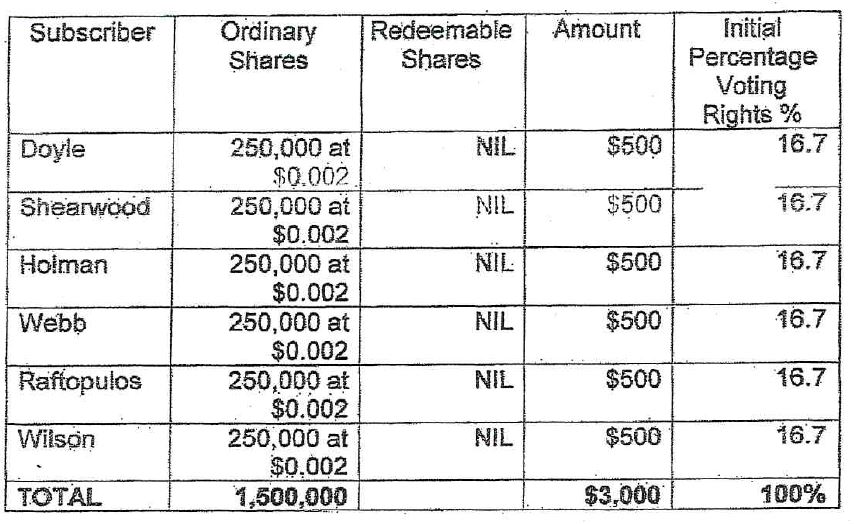
49 Clause 4.2.1 then sets out what was to occur on the Settlement Date, relevantly:
4.2.1 On the Settlement Date and at such time and place as the parties may agree, the following shall occur:
…
(c) (Delivery of Consents to Act as Directors): The Shareholders shall deliver to the Company consents to act as a Director of the Company for Michael Doyle and David Shearwood.
(d) (Company Board Meeting) The Company shall cause a Board meeting to be convened at which the directors shall resolve:
(i) to accept such applications and immediately issue the relevant Subscription Securities to the applicants; and
(ii) to appoint the seed capital provider and an additional nominee of the Shareholders, Directors of the Company.
50 Clause 10.2.1(a) of the Shareholders Agreement provides:
10.2.1 The Company shall cause and procure that:
(a) (Directors) Doyle and Shearwood are to be initial directors. A future Seed Investor may appoint one Non-Executive Director of the Company. The Company will enter into an indemnity and records access deed with any such Directors in a form and content which is reasonably satisfactory to such Director and his or her solicitor and is substantially in accordance with usual business practice; Doyle and Shearwood are to be Executive Directors due to their full time involvement.
51 Clause 11.1 deals with the appointment and removal of directors. It provides:
11.1 Appointment and Removal
11.1.1 The Board of Directors will consist of up to 6 persons including the Company's Managing-Director. The initial term of a Directorship shall be 3 years. The initial Board of Directors will comprise of:
(a) Doyle – Executive Director;
(b) Shearwood – Executive Director
11.1.2 The Seed Investor has the right to appoint to the Board of the Company one Non-Executive Director and to remove those Directors from the Board.
11.1.3 Other than in the circumstances provided in item 10.2, 10.3 and 10.11(e) of the Constitution of the Company additional Directors may only be appointed or removed by the agreement of at least the quantum of 70% of the holders of Ordinary Shares.
11.1.4 The office of a Director becomes vacant where such Director is an Executive Director who, as at the date of the Shareholders Agreement, either personally or through any trust or company under his control, holds Ordinary Shares, and has been appointed by the holders of those Ordinary Shares, ceases, either personally or through that trust or company under his control, to be a Member holding Ordinary Shares (unless the Shareholders consent to that executive Director remaining as a Director).
52 Clause 15.1 is titled “Events of Default”. It sets out, at cl 15.1.1, the circumstances that constitute Events of Default. Clause 15.2.2 provides that “[a]ny Non-Defaulting Shareholder may after becoming aware of an Event of Default, serve on the Defaulting Shareholder a notice (“Default Notice”) containing all relevant details of the Event of Default or suspected event of default”. Clause 15.3, titled “Termination of Defaulting Shareholder’s Rights”, provides:
15.3 Termination of Defaulting Shareholder’s Rights
15.3.1 Despite anything to the contrary in the Constitution, if a Default Notice is served:
(a) the Defaulting Shareholder and their related parties must not attend or be represented or vote at a general meeting of the Company;
(b) each Director, including themselves, appointed by the Defaulting Shareholder is automatically removed;
(c) the Non-Defaulting Shareholders may appoint sufficient Directors to prevent the number of Directors falling below the minimum required by the Constitution;
(d) the Defaulting Shareholder and their related parties are not entitled to any information about the Company's business, other than as required by law.
53 Finally, cl 20.1 of the Shareholders Agreement provides that the Shareholders Agreement is supplemental to the Constitution and that, if there is any inconsistency between the Shareholders Agreement and the Constitution, the Shareholders Agreement shall, to the extent of that inconsistency, prevail subject to compliance with the Corporations Act.
The Default Notice
54 There is no dispute between the parties that, pursuant to cl 15.2.2 of the Shareholders Agreement, on or about 17 May 2017 Mr Peters sent the Default Notice, signed by him, to Mr Lawry, in which he stated:
Being a shareholder of [Allied], I Daniel Justyn Douglas Peters, have been made aware of breaches and non-compliance to the provisions of said Agreement by David Kit Shearwood in particular relating to Clause 15.1.1b.
55 It then set out those acts that were said to constitute breaches by “the Shareholder David Shearwood” in the following terms:
1. David Kit Shearwood provided confidential information regarding the shareholding of Daniel Justyn Douglas Peters and Associates to Leon Carr.
2. David Kit Shearwood provided confidential information regarding the shareholding of Daniel Justyn Douglas Peters and Associates to the Leigh Creek Energy Board.
3. On the 2nd of May 2017, David Kit Shearwood, purporting to represent [Allied] issued a notice under Section 249D of the Corporations Act (Cth) 2001 (“Notice”). The Notice was signed by David Kit Shearwood as a Director of [Allied] and the Notice was served on the Directors of Leigh Creek Energy Ltd (LCK), requesting a general meeting of LCK to put the following resolution to the shareholders of LCK:
“That pursuant to SEC 203D that Daniel Justyn Douglas Peters be removed as a Director of Leigh Creek Energy Ltd”.
The Notice stated it was issued by [Allied] and was signed only by David Kit Shearwood as one of the Directors of [Allied]. The Board of [Allied] was not involved in the issue of the Notice, as David Shearwood acted alone and by doing so attempted to delegate the powers of the board to himself without first seeking the appropriate approvals pursuant to Sec 10 of the Agreement.
4. On the 2nd of May 2017, David Kit Shearwood again purported to represent [Allied] and confirmed the appointment in writing of Leon Carr as the Corporate Advisor to both himself and [Allied] (“Appointment”) and by doing so again attempted to delegate a power of the board to himself without the appropriate approvals pursuant to Sec 10 of the Agreement.
56 The Default Notice described how each of the alleged actions breached the Shareholders Agreement and the Constitution. Under the heading “Outcome” it provided:
As a result of the above non compliances by David Kit Shearwood of Section 15 of the Constitution and Sections 10 and 17 of the Shareholders Agreement, David Kit Shearwood has breached Section 15.1.1b of the Shareholders Agreement, and these breaches are not capable of being remedied by David Kit Shearwood.
This Default Notice has been issued pursuant to clause 15.2.2.
Pursuant to clause 15.3.1 despite anything to the contrary in the Constitution, once a [Default Notice] is served:
a) the Defaulting Shareholder, namely Mr David Kit Shearwood and his related parties must not attend or be represented or vote at a general meeting of the Company;
b) each Director, including themselves, appointed by the Defaulting Shareholder is automatically removed;
c) the Non-Defaulting Shareholders may appoint sufficient Directors to prevent the number of Directors falling below the minimum required by the Constitution; and
d) the Defaulting Shareholder and their related parties are not entitled to any information about the Company’s business, other than as required by law.
This [Default Notice] has been duly served on the company and issued to all Shareholders this 17th day of May 2017 by Daniel Justyn Douglas Peters, a duly registered member of [Allied].
Mr Shearwood’s evidence
57 Mr Shearwood gave evidence. To the extent that his evidence addressed matters that are not the subject of the agreed statement of facts it is summarised below.
58 Mr Shearwood is the largest shareholder in Allied. He was a founding shareholder, a founding director and a former chairperson of the Allied board. Allied’s current chairperson is Mr Peters. Allied currently owns 30% of Leigh Creek and is its largest shareholder. Mr Peters is the executive chairperson of Leigh Creek.
59 Mr Shearwood gives the following evidence in relation to the alleged breaches in the Default Notice:
(1) in relation to the provision of purportedly confidential information to Mr Carr, he says that he appointed Mr Carr as his personal advisor and that he provided him with all necessary information in order for Mr Carr to advise him which, he says, is permitted by the Shareholders Agreement;
(2) in relation to the provision of purportedly confidential information to the board of Leigh Creek, which concerns, among other things, the allocation of shares in 2014 to Mr Peters and Crown Ascent Development Limited, the information is on the public record as set out in a change to company details form lodged with ASIC;
(3) in relation to the removal of Mr Peters as a director of Leigh Creek, the issue is redundant because the s 249D notice was declared invalid; and
(4) in relation to the appointment of Mr Carr as an advisor, Mr Shearwood notes that he appointed Mr Carr as his personal advisor.
60 On 8 June 2017 Mr Shearwood sent a letter to Allied in relation to the Default Notice disputing, among other things, that he had breached any of the provisions of the Shareholders Agreement or the Constitution or that he had been validly terminated as a director of Allied. In that letter he also notified Allied, pursuant to cl 19.2 of the Shareholders Agreement, that he appointed John Rainbow of Watson Mangioni Lawyers to be his representative in relation to the dispute. Watson Mangioni have written to Allied disputing the Default Notice.
61 Mr Shearwood says that his purported removal as a director of Allied has caused or may cause substantial injustice, in particular, because:
(1) he was a founding director and shareholder of Allied and personally paid for all setup costs and expenses, totalling in excess of $20,000, which amount was repaid in early 2017;
(2) he pegged the petroleum leases that now comprise the Leigh Creek Energy Project into a family company which was sold into Allied;
(3) he remains the largest shareholder of Allied, with 22% of issued shares held a combination of by his superannuation fund, him personally and his two children;
(4) he introduced the seed investor, Mr Klinger, who has invested approximately $525,000 into Allied to date;
(5) he was the lead on the first four capital raisings within Leigh Creek after a backdoor listing which raised approximately $13 million;
(6) since he has been a director of Allied he has worked almost on a daily basis and feels that it is imperative to remain a director, especially given the number of critical issues that will arise in the ensuing months;
(7) he has personally encouraged many shareholders to invest in Allied and feels that it is his responsibility to work as a director to monitor matters going forward on their behalf as well as on behalf of the other shareholders;
(8) he has highlighted potential issues with the share register in relation to deeds of arrangement and a sweat equity scheme and a means to solve these issues;
(9) from June 2014 to 31 May 2017 he attended approximately 60 board meetings, including meetings for subsidiaries, and has been involved in approximately 36 shareholder resolutions; and
(10) his purported removal as a director has denied him access to information in relation to the affairs of Allied and an ability to properly participate in the decision-making and management of the affairs of Allied.
62 Mr Shearwood also gave evidence in relation to the particulars included in Allied’s amended defence as to why Allied alleges that his conduct required his removal as a director and that it was not in the best interests of Allied for him to be reappointed as a director. He says that:
(1) where it is alleged that he proposed, drafted and caused to be implemented the deeds of arrangement and the sweat equity scheme – he did not draft those documents alone. They were drafted with the assistance of, and in consultation with, other board members and shareholders;
(2) where it is alleged that he attempted to prevent Allied from defending this proceeding by causing the termination of its solicitors’ retainer – he instructed his lawyers to send a letter to Allied’s lawyers questioning the basis of that firm’s appointment because there had never been a resolution passed or board minutes authorising their appointment to act. Messrs Shearwood and Klinger held a board meeting on 12 September 2017, at which it was agreed that Allied’s lawyers should be directed to immediately cease work, a direction that has been ignored;
(3) where it is alleged that he took active steps to prevent Allied from selling its assets to meet its liabilities, including by voting against resolution 35, concerning the sale of Allied’s shares in Leigh Creek, in order to enable him to claim that Allied is insolvent – Mr Shearwood acknowledges that he voted, and many other shareholders, against resolution 35. He says that the board had asked for approval to sell down Allied’s Leigh Creek shares at an unspecified price, which would have had the impact of destroying the vast bulk of value that the non-deed of arrangement shareholders had in Allied;
(4) where it is alleged that he acts under the direction and advice of Mr Carr, being an individual who has previously been found to be liable for various breaches of directors’ duties and failure to pay income tax, and if reappointed will continue to do so – Mr Carr is an adviser with whom Mr Shearwood has been working sporadically for approximately ten months. He says that he does not act under the “direction and advice” of Mr Carr and that he is unaware of the purported breaches by Mr Carr, although he does understand that Mr Carr currently has an appeal in this Court relating to a personal income tax dispute. Mr Shearwood says that if his appointment as a director of Allied is confirmed then he will continue to exercise his own independent judgment, which he has done since his appointment to the Allied board in 2011, as well as during the course of the approximately 15 other directorships that he has held; and
(5) where it is alleged that he neglected, failed or otherwise refused to respond to the Default Notice or to attempt to remedy his defaults as required by cl 15.1.1(b) of the Shareholders Agreement – Mr Shearwood denies those allegations. He says that he immediately obtained independent legal advice from Watson Mangioni and responded in detail to the allegations, although his initial response was some four days late.
63 Mr Shearwood was cross-examined about a number of issues, including those matters that were the subject of the Default Notice. For the purpose of this proceeding the Plaintiffs did not dispute the validity of the Default Notice but the cross-examination was, as I apprehended, concerned with both Allied’s initial position, later abandoned, that the Court should dismiss the claims that the Plaintiffs no longer wished to press in this proceeding; and with matters that Allied said were relevant to the Court’s consideration of s 1322 of the Corporations Act. I have summarised Mr Shearwood’s evidence below and, to give it context, each of the transactions or events to which the cross-examination related based on the material in evidence before me.
The deeds of arrangement, the sweat equity scheme and private share placements
64 Allied entered into three deeds of arrangement: the first on 7 June 2013 with Martin Cromme, Mr Raftopulos, Mr Shearwood and Christopher Webb (First Deed of Arrangement); the second on 26 March 2014 with Michael Duligal, Elizabeth Mackay and Messrs Cromme, Peters, Raftopulos and Shearwood (Second Deed of Arrangement); and the third on 28 January 2015 with Messrs Duligal, Lawry, Peters and Shearwood (Third Deed of Arrangement).
65 Each of the deeds of arrangement was in substantially the same terms. In each case the recitals provided that the recipients acknowledged that Allied did not have the financial resources to pay respective monthly salaries or fees from their respective commencement dates and that Allied warranted that all outstanding monies in the form of “Make-Up Remuneration” or “Make-Up Salary” would be payable subject to the provisions of the deed. The deeds of arrangement defined “Make-Up Payment” as follows:
"Make-Up Payment" means the obligations and terms to be contemplated by [Allied] in the event that
(a) [Allied] is closed down and has the capacity to pay the Total MUR, the Total MUR payment will take precedence over any and all other payments, dividends, drawdowns, bonuses, capital returns and commitments except those payments bound by law;
(b) [Allied] is closed down and has the capacity to pay a Partial MUR, the Recipients must agree to the Partial MUR payment and this will take precedence over any and all other payments, dividends, drawdowns, bonuses, capital returns and commitments except those payments bound by law;
(c) [Allied] has the capacity to pay the Total MUR at any time, the Total MUR payment will take precedence over any and all other payments, dividends, drawdowns, bonuses, capital returns and commitments except those payments bound by law;
(d) [Allied] has the capacity to pay a Partial MUR at any time, the Recipients must agree to the Partial MUR payment and this will take precedence over any and all other payments, dividends, drawdowns, bonuses, capital returns and commitments except those payments bound by law.
66 In each case the deeds of arrangement included a clause by which Allied acknowledged and warranted that the make-up payment would be paid pursuant to the obligations and terms under the relevant deed of arrangement. In the case of the Second Deed of Arrangement, the payment required by that deed would be made after the obligations that arose pursuant to the First Deed of Arrangement had been extinguished and, in the case of the Third Deed of Arrangement, payment would be made after the obligations that arose pursuant to the First Deed of Arrangement and the Second Deed of Arrangement had been extinguished.
67 In cross-examination Mr Shearwood:
(1) accepted that the deeds of arrangement had been the subject of the discontinued claims and that he was concerned that those deeds may not be valid based on the manner in which they came to be put in place;
(2) accepted that he had been involved in putting the deeds of arrangement into place in about 2013 when Allied was cash-starved because it was important for Allied to keep its staff;
(3) when taken to the Second Deed of Arrangement, accepted that the entitlement to make-up remuneration for each individual set out therein was fair and reasonable. He also understood that if Allied were shut down then the make-up payments would have to be paid in priority to all other payments and that if, for example, Allied were wound up then those debts would become due and payable;
(4) said that legal matters had been discussed internally, but accepted that the representation that Allied had obtained independent legal advice in cl 2.1, headed “Investigations and Advice”, in each of the deeds of arrangement was false. His evidence was that Allied did not get legal advice in relation to the deeds of arrangement; and
(5) accepted that the case that he advanced until the second morning of the hearing was that the execution of the deeds of arrangement was oppressive, unfairly prejudicial and discriminatory. He said that that was so because the shareholders of Allied did not approve the deeds and because, in the “unwind” that was contemplated by resolution 35, there was the capacity for non-deed of arrangement shareholders “to be almost wiped out in terms of the asset value of the company” which was never the intention of the deeds. Mr Shearwood said that if that had been contemplated or even possible then all shareholders should have voted on the deeds. Mr Shearwood accepted that, at the time the deeds of arrangement were entered into, he knew about the uncertainty associated with the Leigh Creek asset, knew that there could be considerable fluctuations in Leigh Creek’s share price and thus knew that there could be considerable fluctuations in the value of Allied’s shareholding in Leigh Creek. However, he did not consider at that time that, if the shareholding in Leigh Creek was at a low value in January 2017 then the payment of amounts due under the deeds of arrangement would have wiped out shareholder value.
68 On 22 January 2014 Allied circulated Shareholder Resolution – No. 22 (Resolution 22) which was subsequently approved by 70.4% of shareholders voting in its favour. Resolution 22 was in the following terms:
That the Board be permitted to enact a Sweat Equity Scheme whereby eligible recipients can replace deferred remuneration accrued during the relevant period of 1 September 2013 to 28 February 2014 with purchase of new ordinary shares to be issued at $0:03 per share. The size of the total Sweat Equity Scheme derived new ordinary shares issued will not exceed 20% of total issued shares of the Company (calculated after issuance of Sweat Equity Scheme shares).
69 The explanatory notes provided with Resolution 22 included, among other things:
The delays to the business becoming cash flow positive have the impact of increasing the length of cash burn (or cash outflow) which puts pressure on shareholders to provide additional capital. The delays also put pressure on the Company’s human capital who are often not being paid (or not being paid a market rate remuneration). In the early months this as an acceptable part of most start-up businesses, but as time goes on the cumulative impact of these realities has an increasing impact on shareholders and workers.
…
It was determined that the ongoing needs of the Company are now best fine-tuned by the establishment of a Sweat Equity Scheme which would operate for a limited period. The Board in determining this way forward, took into account the dilution that may occur to shareholders, as detailed below.
…
The total pool of sweat equity available is to be capped at a maximum of 20% of total issued capital (calculated post the issuance of sweat equity related ordinary shares) for the purposes of this limited period Sweat Equity Scheme.
If this level of sweat equity is taken up, it will correspond to an extinguishment of approximately 35 percent (%) of monetary remuneration not paid during the relevant period (noting the Board has determined the price should be above the current rights issue price to reduce the level of dilution to other shareholders). In other words, recipients will still be expending effort without the bulk of day to day monetary reward due (with this being deferred).
…
70 In cross-examination Mr Shearwood accepted that the sweat equity scheme was implemented for reasons similar to those for the implementation of the deeds of arrangement and a concern that Allied might lose some of its key management. It was Mr Shearwood’s view that it was in the best interests of Allied to enter into the scheme. He accepted that the effect of the scheme, at least in part, was to replace the deferred remuneration arrangements that had accrued through the deeds of arrangement from 1 September 2013 to 28 February 2014.
71 Mr Shearwood was aware that the sweat equity scheme would have the effect of diluting existing shareholdings. He was aware that, when the scheme was considered by the board, he had to factor in the likely future value of Allied at any given point in time, which primarily relied on the value of Allied’s interest in Leigh Creek, in determining the appropriate level of the sweat equity scheme. Mr Shearwood believed at that time that 70% shareholder support was required to approve the sweat equity scheme and accepted that he formed that view by consulting the Shareholders Agreement. However, he did not read the whole of the Shareholders Agreement at that time, which he said was an “error on [his] part and the rest of the team”. Mr Shearwood considered that at the time of proposing the sweat equity scheme he had a conflict of interest as a recipient under the scheme, but that the interest was disclosed to shareholders who were asked to vote on it and voted in favour of it.
72 Mr Shearwood acknowledged that he was a director at the time of the private share placements that took place on 2 October 2013 and 7 August 2015; that he thought they were in the best interests of Allied; that he had authorised them; and that he was aware that each share issue would have the effect of diluting the shareholdings of existing shareholders.
73 Mr Shearwood agreed that he had “some sort of epiphany” and realised that the deeds of arrangement, the sweat equity scheme and the private placements needed to be investigated. He rejected the suggestion that the reason he pursued this proceeding was because he disagreed with Messrs Peters, Webb and Lawry about control of Allied and that he used the allegations made in the proceeding as a means of trying to recover his position as a director.
Leigh Creek
74 On 20 December 2016 an annual general meeting of the members of Allied took place (2016 AGM). Under the heading “Discussion regarding Winding Up Options” the minutes of the meeting record, among other things:
a. David Shearwood reminded members that the Shareholder's Agreement contemplated an [Allied] Exit Strategy to be progressed from early 2017.
…
c. Option 2 – George Raftopulos (GR) spoke to this option; GR expressed concern that if [Allied] Directors continue to vote [Allied] shares as a block re LCK matters, that individual [Allied] members views may not always be correctly represented; Directors agreed that regardless of the outcome of winding up, that Directors would from now on represent individual [Allied] member's views re LCK votes on a proportionate basis
…
75 On 2 May 2017 Mr Shearwood in his capacity as a director of Allied sent a letter to Piper Alderman Lawyers, solicitors for Leigh Creek, which relevantly provided as follows:
Please be advised that Mr Leon Carr is acting as Corporate Advisor to Allied Resource Partners Pty Ltd (ARP) and myself.
I authorize Mr Carr to have meetings with Piper Alderman on my behalf in relation to corporate matters.
76 Mr Shearwood also signed two documents as “Director – Allied Resource Partners Pty Ltd” which were both dated 2 May 2017, addressed to Leigh Creek and titled “Request for Directors to call a General Meeting pursuant to Section 249D of the Corporations Act 2001”. They provided:
The members signing this document, being in total at least 5% of registered holders of shares in Leigh Creek Energy Limited who are entitled to vote at a General Meeting, hereby request:
Pursuant to Section 249D of the Corporations Act 2001, that the directors of Leigh Creek Energy Limited (ACN 107 531 822) call and arrange to hold a General Meeting of the company for the purposes of considering and, if thought fit, pass the resolution listed below.
Resolution:
"That in accordance with Section 203D of the Corporations Act 2001, Mr Daniel Justyn Peters be removed as a Director of Leigh Creek Energy Limited with effect from the close of the meeting."
Please see below the name of the member, number of shares currently held and the signatures of members requesting the meeting.
In each case Allied was named as the member. One of the notices recorded 1.9 million shares (249D Notice) and the other notice recorded 19.9 million shares.
77 An email dated 14 July 2017 from Mr Lawry provided the results for Shareholder Resolution – No. 36 (Resolution 36), part one of which was passed by 97.45% of shareholders. The explanatory notes for Resolution 36 includes:
BACKGROUND
At the [Allied] AGM on 20 December 2016, it was agreed by the Board and [Allied] shareholders that Directors would from now on represent individual [Allied] member's voting preferences on a proportionate basis regarding resolutions before Leigh Creek Energy Limited (LCK) shareholders and at LCK General Meetings (GM). This decision should be ratified by a formal [Allied] Shareholder Resolution.
LCK announced on 16 June 2017 (attached) that it is holding a GM on 21 July 2017 to ratify the placement of shares.
…
The following resolutions are to ratify the 2016 [Allied] AGM decision for [Allied] shareholders regarding individual voting preferences at LCK GMs, and then for [Allied] shareholders to indicate their individual preferences to the Board in regards to the LCK GM on 21 July 2017, by voting as below. By voting below, you will give the [Allied] Chairman your proxy authority to vote according to your preference at the LCK GM.
PROPOSED RESOLUTIONS
To consider, and if thought fit, pass the following Shareholder Resolutions, with or without amendments:
1. That from the date of this Resolution, being the 7 July 2017, that the Allied Resource Partners Pty Ltd Board will cast votes at all future Leigh Creek Energy Limited General Meetings in accordance with individual Allied Resource Partner Pty Ltd shareholder's preferences on a proportionate basis.
78 In cross-examination Mr Shearwood acknowledged that he signed the 249D Notice, that he caused it to be sent to the board of directors of Leigh Creek on 2 May 2017 and that the reference in the notice to the member signing the document, “being in total at least 5% of registered holders”, was Allied. Mr Shearwood said that the reference to 1.9 million shares in the 249D Notice was a reference to Mr Shearwood’s shares in Allied held in his own name. The reference to 19.9 million shares in the second notice addressed to Leigh Creek was a reference to shares held by the David K Shearwood DIY Superannuation Fund in Allied.
79 Mr Shearwood accepted that he did not seek Mr Peters’ permission to send the 249D Notice, nor did he inform Allied that he had sent it. Mr Shearwood said that in issuing the 249D Notice he was doing what he believed he was able to do as a shareholder of Allied. That is, he believed that the 2016 AGM conferred upon him the right to exercise Allied’s right to call the meeting.
80 Mr Shearwood said that the right conferred at the 2016 AGM was ratified by Resolution 36, although he conceded that Resolution 36 was passed after the date of the 249D Notice and that it was narrower in its terms than what is recorded in the minutes of the 2016 AGM.
Leon Carr
81 The alleged breaches recorded in the Default Notice included that Mr Shearwood provided Mr Carr with confidential information and that Mr Shearwood represented that he and Allied had retained Mr Carr as corporate advisor and, by doing so, purported to delegate the powers of the board to himself.
82 In cross-examination Mr Shearwood said that he had been dealing with Mr Carr in relation to Allied and Leigh Creek and that he exchanged email communications with Mr Carr about once or twice a day which may have concerned Allied and Leigh Creek. Mr Shearwood also said that he had been looking at the possibility of doing a capital raising for Leigh Creek with Mr Carr and that he had attempted to persuade Leigh Creek’s executives that Leigh Creek should utilise Mr Carr’s services in conducting the capital raising. Mr Shearwood’s evidence was that he tried to persuade Mr Peters that Allied should use Mr Carr’s services, that Mr Peters met with Mr Carr on 20 December 2016 but that thereafter he took no steps to retain Mr Carr on behalf of Allied.
83 Mr Shearwood said that in the letter to Piper Alderman he had intended to communicate that Mr Carr had been appointed as an advisor to him personally and in his capacity as a director of Allied, but not as an advisor to Allied. He also said that, prior to receiving the amended defence, he was unaware that Mr Carr had previously been found to be liable for various breaches of directors’ duties and improper conduct as a director. He said that he had made inquiries about Mr Carr, but did not carry out a Google search of Mr Carr, and that people had spoken highly of him. Mr Shearwood said that if he had done a Google search on Mr Carr prior to retaining him and had become aware of the matters now raised by Allied then he would have had a chat with Mr Carr to understand what had happened.
84 Mr Shearwood agreed that, as a director of Allied, he would have known that it would not have assisted Allied in any way to have an association with somebody like Mr Carr. However, he did not agree to that proposition in relation to Leigh Creek, in respect of which, in his view, Mr Carr would have been of tremendous assistance in relation to its capital raising because some of the funds that Mr Carr works with are very large.
85 Allied served a notice to produce on Mr Shearwood which required production of, among other things, “[a]ll documents recording or evidencing any communications between the Plaintiffs and Leon Carr in connection with Allied and/or Leigh Creek Energy Limited”. No documents were produced by Mr Shearwood in response to that paragraph of the notice to produce. Despite having previously informed the Court that there had been email communications between him and Mr Carr relating to Allied and Leigh Creek, Mr Shearwood said that this was because a lot of those communications were verbal and that, insofar as he had said that he had exchanged emails with Mr Carr, he could not recall how many emails he had sent. Mr Shearwood also accepted that he had not produced the agreement between him and Mr Carr in relation to his advisory services.
86 Mr Shearwood said that he understood that the notice to produce had been issued pursuant to the Court’s compulsory processes; that it had to be taken seriously; that he had to take care in discharging his obligation to produce documents; and that, when the notice referred to communications, that incorporated email communications.
Was Mr Shearwood effectively removed as a director of Allied on 1 June 2017?
87 The Plaintiffs submitted that Mr Shearwood was not appointed as a director of Allied by any “Defaulting Shareholder” but was appointed by operation of r 10.1 of the Constitution and cl 11.1 of the Shareholders Agreement. They contended that Mr Shearwood clearly did not appoint himself. The Plaintiffs further submitted that the issue of the Default Notice, whether valid or not, did not give rise to any automatic removal of Mr Shearwood as a director pursuant to cl 15.3.1(b) of the Shareholders Agreement, nor did it give Mr Peters any proper basis to cause Mr Shearwood to be removed as a director.
88 The Plaintiffs submitted that the words “including themselves” in cl 15.3.1(b) are intended to cover the situation where any director appointed by a Defaulting Shareholder is automatically removed. The Plaintiffs further submitted that that may include a number of directors, including a director who had been appointed by himself or herself, such as is permitted by cl 11.1.2 of the Shareholders Agreement. They submitted that what was required for automatic removal under cl 15.3.1(b) of the Shareholders Agreement was that a director must be appointed by the Defaulting Shareholder and that that fundamental requirement is missing in this case.
89 Allied submitted that the consequences of the issue of the Default Notice by Mr Peters pursuant to cl 15.2.2, to which Mr Shearwood did not respond within the ten days provided and the validity of which is not in dispute in this proceeding, included, as set out in cl 15.3.1, that:
the Defaulting Shareholder and related parties must not attend, be represented or vote at a general meeting; and
each director, including themselves, appointed by the Defaulting Shareholder is automatically removed.
90 Allied submitted that there is a “very straightforward interpretation” of cl 15 of the Shareholders Agreement. It contended that Mr Shearwood started out as a shareholder of Allied on 2 June 2011 and that he appointed himself a director because he was made a director before the Shareholders Agreement came into being. Allied further contended that Mr Shearwood is and remains a shareholder of Allied and that on 17 May 2017 he became a Defaulting Shareholder because he received the Default Notice.
91 Allied submitted that Mr Shearwood, having received the Default Notice and having not taken any steps to try to cure the defaults specified therein within ten days, was automatically removed pursuant to cl 15.3.1(b). It submitted that, although the clause is clumsily drafted, the term “including themselves” in cl 15.3.1(b) refers to the shareholder who is also a director. Allied further submitted that the clause means that if a person is a shareholder, is on the board and commits an event of default that he or she does not cure then he or she personally is removed.
92 Allied submitted that cl 15.3.1(b) was designed to ensure that shareholders act with loyalty towards Allied. It submitted that Mr Shearwood’s contention that he was appointed by all shareholders because they all signed the Shareholders Agreement cannot be right because:
it would give Mr Shearwood immunity from the automatic removal provision in cl 15.3.1(b) and would mean that, as a Defaulting Shareholder, contrary to the intended operation of the clause, he would continue to have rights to be represented or vote at a general meeting and would continue to be entitled to information about Allied’s business;
r 10.2(d) of the Constitution would have no work to do;
cl 15.3.1(d) of the Shareholders Agreement would have no work to do in the case of Allied’s directors because they would be legally entitled to information. Thus, a Defaulting Shareholder who happens to be a director would continue to receive information about Allied pursuant to his entitlement as a director, but a shareholder who has no representative on the board at the time would receive no further information; and
a Defaulting Shareholder who is a Seed Investor and who appointed a director pursuant to cl 11 of the Shareholders Agreement would have its director automatically removed but Mr Shearwood could never be removed pursuant to cl 15.3.1(b).
93 Allied submitted that it follows that cl 15.3.1(b) and the expression “including themselves” means the director who represents the interest of each shareholder on the board and that, in this case, Mr Shearwood represents himself as majority shareholder. He is the Defaulting Shareholder and thus was automatically removed.
94 For the purposes of determining this issue the Plaintiffs accept the validity of the Default Notice. The Defaulting Shareholder specified in the Default Notice is Mr Shearwood. Central to the Plaintiffs’ argument is their contention that Mr Shearwood was not appointed by the Defaulting Shareholder, that is, not appointed by himself. It is agreed between the parties that Mr Shearwood was appointed as a director of Allied on 2 June 2011. He was appointed upon registration of the company. In issue between the parties is how he was appointed.
95 Section 117 of the Corporations Act prescribes the way in which a person may apply for registration of a company. An application must be lodged with ASIC which must state, among other things, the present given and family name, all former given and family names, the date and place of birth and the address of each person who consents in writing to become a director: ss 117(2)(d) and (f).
96 Section 120(1) of the Corporations Act provides:
Members, directors and company secretary of a company
(1) A person becomes a member, director or company secretary of a company on registration if the person is specified in the application with their consent as a proposed member, director or company secretary of the company.
97 Because neither party addressed the Court on those sections of the Corporations Act, I invited the parties to provide written submissions addressing the effect of those sections on the manner of Mr Shearwood’s appointment as a director of Allied.
98 In response to that invitation the Plaintiffs submitted that, in the alternative to their primary contention that Mr Shearwood was appointed a director of Allied by operation of cl 11.1 of the Shareholders Agreement and r 10.1 of the Constitution, it was open to the Court to find that Mr Shearwood became a director of Allied on 2 June 2011 by operation of s 120(1) of the Corporations Act, relying on Shub v Mon Purse Pty Ltd [2017] NSWSC 1187 at [36] (Shub). They further submitted that, either way, Mr Shearwood was not appointed a director by any “Defaulting Shareholder” as that term is used in cl 15.3.1(b) of the Shareholders Agreement. The Plaintiffs also provided an affidavit of Mr Shearwood sworn on 22 November 2017.
99 Allied submitted in response to my invitation that, properly construed, cl 15.3.1(b) of the Shareholders Agreement has the effect of removing from the board, and from the operations of the company, any director who is a shareholder and who has engaged in an event of default. It submitted that the clause was intended to automatically remove the director from being in a position of controlling or managing the company’s affairs. It contended that its construction of cl 15.3.1(b) was supported by r 10.2(d) of the Constitution and that any alternative construction would lead to a perverse result.
100 Allied submitted that ss 117(2) and 120(1) of the Corporations Act do not impact its construction of cl 15.3.1(b) of the Shareholders Agreement but that, even if those sections were taken into account, the Court ought to find that Mr Shearwood in fact appointed himself as a director and was therefore subject to automatic removal pursuant to cl 15.3.1(b). Allied further submitted that two things are clear about the process set out in ss 117 and 120(1): first, under s 117, a person must be “proposed” to be a director in advance of the application for registration by the company’s incorporators or founding members; and, secondly, s 120(1) gives effect to that “proposal” by deeming those individuals to be directors of the company upon its registration. Allied contended that ss 117 and 120(1) set out a process for the nomination and “appointment” of directors at the inception of a company’s legal existence; that members nominate individuals to be directors; and that those nominated individuals are appointed at the time the company becomes a legal entity. It submitted that it would be specious to suggest that a director is nominated by the company’s founding members and becomes a director by virtue of that nomination but is somehow not “appointed”.
101 Allied submitted that it was registered on 2 June 2011 and that Mr Shearwood was a founding member and shareholder. Allied further submitted that Mr Shearwood’s own description of his appointment was in accordance with its interpretation of ss 117 and 120(1) of the Corporations Act, noting that in cross-examination Mr Shearwood stated that he was appointed a director by or before incorporation; that his appointment became effective upon incorporation; and that he nominated himself to the appointment as director. Allied contended that the Plaintiffs’ assertion that Mr Shearwood was appointed by Allied pursuant to cl 10.2.1 of the Shareholders Agreement cannot be correct as a matter of fact because the Shareholders Agreement was executed on 4 June 2011, two days after Allied’s incorporation. It further contended that Mr Shearwood was appointed by virtue of s 120(1) of the Corporations Act, also relying on the decision in Shub.
102 Allied submitted that the word “appointment” in cl 15.3.1(b) is not a term of art and has no special meaning in the Shareholders Agreement. It submitted that the term is not defined and that the Shareholders Agreement makes provision for persons to be “appointed” to do things in various ways. Allied further submitted that the ordinary English definition of the verb “to appoint”, in the context of putting a person in office or designating them to perform functions, is “to ordain or nominate”. It contended that if the phrase “appointed by the defaulting shareholder” in cl 15.3.1(b) is construed in an ordinary and commercially sensible way then it can only mean that a person who has ordained or nominated a person to be a director has “appointed” that person as a director. Allied further contended that if that person, being a shareholder who is ultimately in default, were among the persons who ordained or nominated themselves to be a director, then they, by definition, appointed themselves as director.
103 Allied opposed the admission of Mr Shearwood’s affidavit sworn on 22 November 2017. No order was made permitting the parties to file further evidence, the Plaintiffs have not sought the Court’s leave to reopen their case to rely on that affidavit and it was not referred to in their further submissions filed in response to the Court’s invitation. I do not intend to allow the Plaintiffs to rely on Mr Shearwood’s affidavit sworn on 22 November 2017 and, to the extent that they implicitly seek leave to rely on it, that leave is refused.
104 In Shub the dispute before the court concerned the question of whether two of the defendants were directors of Mon Purse Pty Ltd (Mon Purse). At the time of its incorporation Mon Purse’s directors were Svetlana and James Hopkins and its sole shareholder was Can of Worms (Australia) Pty Ltd (Can of Worms), a company of which Ms and Mr Hopkins were the sole directors and shareholders. After a capital raising, a shareholders agreement was executed by the shareholders of Mon Purse. Clause 3.2(a) of that agreement provided:
A Shareholder, or a group of Shareholders acting together for the purposes of this clause may, by written notice to the Company, appoint one Director for every 20% of the shares held by that Shareholder [or group of Shareholders]. For the avoidance of doubt, each Shareholder may only use each Share held by it once to appoint a Director under this clause 3.2(a).
105 An order was made for the matter to proceed by way of a separate hearing on three questions which included questions about the validity of the appointments of the two relevant defendants, one of whom was Albert Wong. Mr Wong was appointed a director by a notice signed by a group of shareholders of Mon Purse, acting together for the purpose of cl 3.2(a) of the shareholders agreement. That group of shareholders included Can of Worms.
106 Relying on the second sentence of cl 3.2(a), the plaintiffs submitted that Can of Worms was not entitled to participate in the appointment of Mr Wong because it must have been known to the parties to the shareholders agreement that, on the date of that agreement, Ms and Mr Hopkins were the only directors of Mon Purse and the only directors and shareholders of Can of Worms. They further submitted that the shares held by Can of Worms were shares that, for the purpose of cl 3.2 of the shareholders agreement, must be taken to have been used by Can of Worms to appoint Ms and Mr Hopkins as directors of Mon Purse and were not shares that could be used again to appoint additional directors under cl 3.2(a).
107 Stevenson J rejected that submission for a number of reasons, one of which was because he found that Ms and Mr Hopkins were not appointed as directors under cl 3.2(a) of the shareholders agreement but that they were the founding directors of Mon Purse. His Honour found that they became directors by reason of s 120(1) of the Corporations Act: at [36].
108 In this case it is an agreed fact that on 2 June 2011 Allied was registered and that Mr Shearwood was appointed a director. In my opinion, Mr Shearwood was appointed a director of Allied upon its registration by force of s 120(1) of the Corporations Act, read with s 117(2), as was the case in Shub.
109 Allied’s submissions about the process set out in ss 117 and 120(1) of the Corporations Act read too much into those provisions. Section 117 concerns the way in which a company may be registered, that is, by lodgement of an application with ASIC, and the contents of that application. Section 120(1) relevantly provides that a person becomes a director on registration if he or she is specified in the application lodged with ASIC with his or her consent as a proposed director. There is no requirement that a person be “proposed” in the sense that he or she is nominated by the company’s incorporators or founding members.
110 Mr Shearwood was not appointed by a shareholder or by operation of cl 11.1 of the Shareholders Agreement and r 10.1 of the Constitution. The Constitution and the Shareholders Agreement do no more than reflect the identity of Allied’s officeholders upon its registration and what had occurred by force of ss 117 and 120(1). Rule 10.1 of the Constitution provides that, upon commencement of the Shareholders Agreement, the board would be comprised of Messrs Shearwood and Doyle as co-managing directors and that Mr Wilson would act as company secretary; cl 10.2.1(a) of the Shareholders Agreement provides that Allied would “cause and procure” that Messrs Shearwood and Doyle be initial directors and that, due to their full time involvement, they were to be “Executive Directors”; and cl 11.1.1 of the Shareholders Agreement provides that the initial board of directors will comprise Messrs Shearwood and Doyle. That rule and those clauses mandate that Messrs Shearwood and Doyle were to be directors. That is not expressed to be so because they are shareholders, nor because they are so appointed by shareholders.
111 It is not the case that a director can only be appointed by a shareholder. The balance of cl 11.1 of the Shareholders Agreement sets out how directors may otherwise be appointed. Those methods include:
(1) pursuant to cl 11.1.3, “additional Directors” may be appointed by the agreement of at least 70% of shareholders;
(2) in the circumstances set out in r 10.11(e)(2) of the Constitution, a director can be appointed at a general meeting of Allied; and
(3) pursuant to r 10.11(e)(1) of the Constitution, the existing directors of Allied must, in the circumstances specified in the rule, act to increase the number of directors to a number sufficient to constitute a quorum and to satisfy the minimum number of directors required under the Constitution. That was the method adopted by Mr Peters to appoint Mr Raftopulos. A director appointed in that way would not be appointed by a shareholder, even though the appointee may be a shareholder or may have an interest in an entity which is a shareholder.
112 Appointments in the circumstances of [111(1)] and [111(2)] above would not be by a shareholder. Allied submitted that in such circumstances there would be a nomination by a shareholder and that, where the person so nominated was appointed pursuant to cl 11.1.3 or at a general meeting, cl 15.3.1(b) means that the appointment would in effect be an appointment by the nominating shareholder. I disagree. Clause 15.3.1(b) of the Shareholders Agreement is clear in its terms. It relates to the removal of a director appointed by a Defaulting Shareholder.
113 An appointment in any of the circumstances set out at [111] above would carry with it the same consequences as those which Allied submitted dictated against the construction of cl 15.3.1(b) propounded by Mr Shearwood (see [92] above). Those consequences may not have been intended but result from the way in which the Constitution and the Shareholders Agreement operate. At least in the case of “additional Directors”, that result does not leave Allied without remedy in circumstances where the members wish to remove a director who either is, or is related to, a Defaulting Shareholder. Allied has the ability to remove such a director pursuant to cl 11.1.3 of the Shareholders Agreement with the agreement of at least 70% of the holders of ordinary shares.
114 As I am of the opinion that Mr Shearwood was not appointed by a Defaulting Shareholder, cl 15.3.1(b) could not operate to automatically remove him as a director following the issue of the Default Notice. I consider that he remained a director of Allied notwithstanding its service. It follows from that conclusion that, as at 1 June 2017, the number of directors did not fall below two and the provisions of r 10.11(e) were not enlivened.
Was Mr Shearwood a director after 2 June 2014?
115 The alternative argument raised by Allied by way of defence is that Mr Shearwood’s term as a director expired after three years. Allied relies on cl 11.1.1 of the Shareholders Agreement which provides that “[t]he initial term of a Directorship shall be 3 years”, which it submitted was mandatory language. Allied further submitted that this meant that Mr Shearwood’s term as a director came to an end after three years. Allied contended that this did not mean that Mr Shearwood ceased acting as a director after three years, but that he continued to be either a de facto or shadow director because he participated in the management of Allied and, potentially, because other directors were accustomed to acting in accordance with his instructions or wishes.
116 Allied submitted that that state of affairs only continued until 2 May 2017, when Mr Shearwood sent the 249D Notice, or, alternatively, 17 May 2017, when the Default Notice was served, at which time he ceased to be a director within the meaning of s 9 of the Corporations Act. That is, Allied submitted that Mr Shearwood no longer had an appointed position as director because that came to an end after three years by operation of cl 11.1.1 of the Shareholders Agreement and, while he continued after that time to be a de facto or shadow director, that came to an end in May 2017 because the other members of the board at that time were no longer accustomed to acting in accordance with his directions or permitted him to act as a director.
117 Allied submitted that if Mr Shearwood was no longer a director then it only had one director as at May 2017 and that rr 1.6 and 10 of the Constitution permitted Mr Peters, as the remaining director, to appoint a new director. Allied submitted that Mr Peters appointed Mr Raftopulos, who was appropriately qualified to be appointed to the board, having previously been on the board.
118 The Plaintiffs submitted that Allied’s contention that Mr Shearwood ceased to be a director on 2 June 2014, three years after his appointment, should not be accepted for three reasons. First, the Plaintiffs submitted that there is nothing in either the Shareholders Agreement or Constitution that provides that directors cease to hold office upon the expiry of three years. The Plaintiffs submitted that the word “initial” in cl 11.1.1 of the Shareholders Agreement contemplates that directors may serve for longer than three years. Secondly, the Plaintiffs submitted that, over the whole of the period from 2 June 2011 to May or June 2017, the affairs of Allied were conducted on the basis that Mr Shearwood was a director and it was not at any time during that period suggested by Allied, nor any of its directors or members, that he ceased to be a director in about June 2014 after serving a term of three years. Thirdly, the Plaintiffs submitted that Allied’s proposition, if accepted, would mean that Mr Peters ceased to be a director on 20 July 2016, with the consequence that Allied had no validly appointed directors from 20 July 2016 until Mr Klinger’s appointment on 20 June 2017.
119 The Plaintiffs submitted that the question of whether or not Mr Shearwood should be reappointed as a director of Allied does not arise. They contended that because Mr Shearwood was not validly removed as a director on 1 June 2017, or at any time, he has at all times remained a director. The Plaintiffs further contended that if the Court finds, contrary to their primary submission, that Mr Shearwood was validly removed as a director then that is the end of the matter because the Plaintiffs do not seek an order reappointing Mr Shearwood as a director.
120 In order to consider this issue it is useful to first examine the way in which a director may resign or be removed from a company pursuant to the Corporations Act and, more specifically, the Constitution and the Shareholders Agreement.
121 The Corporations Act provides for three ways in which a director of a proprietary company may resign, cease to be a director or be removed. They are:
(1) by giving a written notice of resignation to the company at its registered office: s 203A;
(2) as a consequence of being disqualified from managing corporations under Pt 2D.6 of the Corporations Act, unless ASIC or the Court allows the person to manage the company: s 203B (which is a signpost to the consequence of disqualification); or
(3) where the members by resolution remove a director from office: s 203C.
122 In addition, s 205A of the Corporations Act relevantly provides that if a director retires or resigns then he or she may give ASIC written notice of the retirement or resignation in the prescribed form. Section 205B(5) relevantly provides that if a person stops being a director of a company then the company must lodge with ASIC notice of that fact in the prescribed form within 28 days.
123 Sections 203A and 203C are replaceable rules. That is, pursuant to s 135 of the Corporations Act, those sections apply as replaceable rules to a company registered after 1 July 1998 and can be displaced or modified by the company’s constitution.
124 Rule 1.2(a) of the Constitution provides that the Constitution is to be interpreted subject to the Corporations Act but that “the rules that apply as replaceable rules to companies under the Act do not apply to” Allied. By this rule Allied has excluded the operation of ss 203A and 203C of the Corporations Act, as well as any other replaceable rule under the Corporations Act that may otherwise have applied to it. The Constitution provides for removal of and vacation of office by directors in rr 10.2 and 10.3 and the Shareholders Agreement provides for removal of directors in cll 11.1.2, 11.1.3, 11.1.4 and 15.3.1(b).
125 The Shareholders Agreement defines “Director” as having the meaning ascribed to that term in the Corporations Act but does not include an associate director. The term “director” is defined in s 9 of the Corporations Act as follows:
director of a company or other body means:
(a) a person who:
(i) is appointed to the position of a director; or
(ii) is appointed to the position of an alternate director and is acting in that capacity;
regardless of the name that is given to their position; and
(b) unless the contrary intention appears, a person who is not validly appointed as a director if:
(i) they act in the position of a director; or
(ii) the directors of the company or body are accustomed to act in accordance with the person’s instructions or wishes.
Subparagraph (b)(ii) does not apply merely because the directors act on advice given by the person in the proper performance of functions attaching to the person’s professional capacity, or the person’s business relationship with the directors or the company or body.
126 Clause 11.1.1 of the Shareholders Agreement provides that the “initial term of a Directorship shall be 3 years”. However, neither the Shareholders Agreement nor the Constitution provide for what is to occur at the conclusion of that three year period. Mr Shearwood was appointed as a director on 2 June 2011. At the expiration of three years no steps were taken by Allied or any of its members to convene a meeting to reappoint him as a director or to appoint someone else in his stead, nor was Mr Shearwood removed at that time by any of the methods set out in the Constitution or the Shareholders Agreement, to the extent that they applied to him.
127 In my opinion, the words in cl 11.1.1 stating that the initial term of a directorship will be three years set out what was intended to be the initial term. But they do not of themselves serve to remove a director at the expiration of the term. The language is plain. It does no more than state the period of an initial term and it does not follow that a director is automatically removed at the expiration of that period. Something more is required. That did not occur here.
128 That this is so is also supported by the relevant facts. Mr Shearwood was appointed as a director on 2 June 2011 and remained a director until he was purportedly removed pursuant to cl 15.3.1(b) of the Shareholders Agreement on 1 June 2017. Mr Peters was appointed as a director on 20 July 2013 and remains a director, beyond a period of three years. No notice as required by s 205B(5) of the Corporations Act was lodged by Allied with ASIC giving notice of Mr Shearwood or Mr Peters no longer being directors at the expiration of three years from their respective appointments.
129 Thus, Mr Shearwood remained a director of Allied after the expiration of a period of three years from his appointment. He did not from that time become a de facto or shadow director, or a director within the meaning of subpara (b) of the definition of director in s 9 of the Corporations Act, as contended by Allied.
Section 1322 of the Corporations Act
130 Allied submitted that the removal of Mr Shearwood as a director pursuant to cl 15 of the Shareholders Agreement was a purported exercise of power and that, if that exercise of power failed, it is common ground that the procedure set out in the Constitution for the removal of Mr Shearwood was not followed. Allied further submitted that these are procedural matters of the type that s 1322 of the Corporations Act is designed to cover and that, by operation of s 1322(2), Mr Shearwood’s removal is “presumptively valid”.
131 Allied submitted that the issue that arises is whether there has been substantial injustice. That is, did the procedural failure give rise to or cause substantial injustice. Allied submitted that it was common ground that the Plaintiffs have the burden of proving that Mr Shearwood’s removal was invalid and that they have to demonstrate that there is or may be substantial injustice. It submitted that that was a burden that the Plaintiffs have not met.
132 Allied submitted that there was no substantial injustice and that it was not in Allied’s best interests for Mr Shearwood to be reappointed as a director for the following reasons:
(1) assuming that the Default Notice had not been validly issued, procedural fairness was accorded to Mr Shearwood because he was given an opportunity to address the allegations made against him in the Default Notice. Notwithstanding his evidence that he has an answer to each of the allegations made in the Default Notice, Mr Shearwood did not respond within the ten day period allowed and has never explained his failure to respond within that period;
(2) Mr Shearwood was an experienced director and was aware of his obligations under the Corporations Act, the Constitution and the Shareholders Agreement. In considering the issue of substantial injustice it was necessary to look at how Mr Shearwood came to be in his present position, which was because, among other things, he committed a deliberate breach of the Constitution in issuing the 249D Notice. Given Mr Shearwood’s experience, there could be no doubt that he knew that he could not send the 249D Notice without the consent of the board, which he did not seek. Allied submitted that the Court would not accept Mr Shearwood’s evidence that he believed he had authority to send the 249D Notice because:
(a) there is no way that Mr Shearwood believed that the 2016 AGM gave him that authority. The minutes of the 2016 AGM were plainly referring to Allied voting its shares at meetings of Leigh Creek;
(b) nothing in the minutes of the 2016 AGM suggest that Allied sought to confer on Mr Shearwood the power under s 249D to call meetings of Leigh Creek, which it would not legally have been able to do in any event;
(c) Mr Shearwood did not raise what occurred at the 2016 AGM as an explanation for sending the 249D Notice until 18 September 2017, had no good explanation for not raising the argument earlier and would not accept that it was an “obvious” thing to raise it if he genuinely believed it; and
(d) his attempt to explain the 249D Notice on the basis of authority conferred upon him by members was a fabrication;
(3) Mr Shearwood made a number of unfounded allegations and the Court ought not believe him. Allied submitted that the Court should not accept:
(a) Mr Shearwood’s evidence in relation to the deeds of arrangement and sweat equity scheme. Allied submitted that Mr Shearwood gave evidence that he was involved in all of the decisions about the deeds of arrangement and sweat equity scheme, drafted Resolution 22 and the deeds of arrangement and believed that they were in the best interests of Allied when he took steps to implement them;
(b) Mr Shearwood’s explanation for bringing this case and alleging that the deeds of arrangement and sweat equity scheme were oppressive; that he did not appreciate that they would operate to the detriment of shareholders; and that, some three or four years after the relevant events, he had what he described as an “epiphany” that those arrangements were oppressive; and
(c) Mr Shearwood’s evidence that he had not read the Shareholders Agreement at the time he came to implement the sweat equity scheme. Allied submitted that was patently false evidence because he had read it, as he acknowledged in giving evidence. Allied contended that the Court would not accept Mr Shearwood’s explanation that he overlooked one of the clauses in the Shareholders Agreement;
(4) Mr Shearwood has acted with reckless indifference to Allied’s affairs. Mr Shearwood commenced this proceeding seeking an oppression remedy when he knew that if Allied were wound up then the deeds of arrangement, presently a contingent liability, would immediately become due and payable. In the context of his vote against resolution 35, Mr Shearwood gave evidence that he was worried about the sell-down of Leigh Creek shares held by Allied because he thought the effects could be catastrophic but, at least until the second day of the hearing, Mr Shearwood sought to wind up the company and appoint a liquidator. The liquidator would then have to sell off the Leigh Creek shares in order to discharge debts that had become due and payable. Allied noted Mr Shearwood’s evidence that he thought that such a sale would be an orderly process but that he acknowledged that he had no experience of what occurred in an insolvency; and
(5) Mr Shearwood’s dealings with Mr Carr were relevant to the issue of Mr Shearwood’s credibility. Allied submitted that:
(a) Mr Shearwood’s letter to Piper Alderman made it clear that Mr Carr was appointed as an advisor to Allied. There has been a dispute, since the Default Notice was issued, about whether Mr Shearwood entered into a corporate advisory arrangement with Mr Carr and, if so, whether it was on behalf of Allied or Mr Shearwood personally. Despite service of a notice to produce on Mr Shearwood which called for his retainer agreement with Mr Carr, no such document was produced, nor were any emails between Messrs Carr, Klinger and Shearwood produced. There was no good explanation for the failure to produce in accordance with the Court’s compulsory processes and, in relation to the failure to produce any emails, Mr Shearwood “backtracked” on his evidence, saying that most of his meetings and discussions with Mr Carr were in person rather than by email;
(b) the retainer agreement was an important document and its non-production means the Court should draw an adverse inference against Mr Shearwood that the document would not assist his case in relation to the issue of whether was an agreement between Allied and Mr Carr; and
(c) Mr Shearwood’s evidence that he had not undertaken any basic due diligence about Mr Carr before he appointed him as a corporate advisor should be taken into account when Mr Shearwood says that he is the best person to be appointed as a director of Allied. Mr Shearwood’s evidence to the effect that, even knowing what he knows now, he would appoint Mr Carr as an advisor sheds light on his commercial judgement.
133 Allied submitted that the Plaintiffs seek declaratory relief which brings into play s 1322 because the question is whether there should be a declaration that Mr Shearwood’s removal was invalid, and the Court’s discretion to make a declaration.
134 Allied submitted that s 1322(4) confers on the Court a very broad discretion as to whether it should make the orders sought by the Plaintiffs or to make the order sought by Allied, which is dismissal of the proceeding. Allied submitted that the discretion is to be exercised within the framework of what is just and equitable. Allied further submitted that those words confer upon the Court the broadest imaginable discretion, with the only limitation being to take into account relevant considerations. In those circumstances, Allied contended that the Court ought to consider the whole of the Plaintiffs’ conduct, including the manner in which they conducted the proceeding; the manner in which Mr Shearwood gave evidence; and Mr Shearwood’s failure to comply with the notice to produce, and draw the conclusion that the appropriate remedy is an order that the proceeding be dismissed.
135 Allied further contended that the Court would not accept any of Mr Shearwood’s evidence, including his evidence of substantial injustice, because he is a witness who should not be believed.
136 Allied submitted that if, as Mr Shearwood says, he is the appropriate person to be appointed as a director of Allied then he can call a meeting pursuant to s 249D of the Corporations Act and, if the shareholders wish to do so, then they will vote in favour of his appointment. Allied contended that, in terms of substantial injustice, Mr Shearwood has a remedy in that he can invoke his rights under s 249D to seek re-election and Allied will not stand in the way of him doing so.
137 The Plaintiffs submitted that, when coming to the question of substantial injustice, the Court would not consider what is or is not in the best interests of Allied but rather would consider the issue in the context of whether there was a validly exercised right to remove Mr Shearwood as a director. The Plaintiffs submitted that there was not. The Plaintiffs further submitted that the Court would look at the material effect that removal as a director had on Mr Shearwood, namely, that he was not able to participate in Allied’s affairs conducted at board level.
138 The Plaintiffs contended that, for the purposes of s 1322(2) of the Corporations Act, an inquiry as to whether or not any “reappointment” of Mr Shearwood is “in the best interests of Allied” as set out in paragraph 68A(e) of the amended defence is not relevant, relying on Cordiant Communications (Australia) Pty Ltd v The Communications Group Holdings Pty Ltd (2005) 55 ACSR 185; [2005] NSWSC 1005 (Cordiant) at [86]. The Plaintiffs submitted that the purported removal of Mr Shearwood as a director was not effected in compliance with the Shareholders Agreement or the Constitution and that that non-compliance does not constitute a procedural irregularity. The Plaintiffs submitted that the removal of a director and the removal of the rights that travel with being a director are clearly matters of substance and no question arises in this case of whether or not a correct procedure was followed. The Plaintiffs further submitted that there was not, in the first place, a power enlivened to remove Mr Shearwood so that one does not get to the point of looking at whether the procedure was implemented properly.
139 The Plaintiffs submitted that if it were found that Mr Shearwood’s removal did constitute a procedural irregularity then an order should not be made validating his removal. The Plaintiffs contended that to do so would cause substantial injustice, given that his removal improperly denied him the right to participate in the management of Allied and the decision-making processes of its board in circumstances where he has, since his appointment on 2 July 2011, been involved to a substantial degree in the operations of the company.
140 The Plaintiffs contended that the Default Notice asserted that the alleged breaches were not capable of remedy and that it is on that basis that Allied alleges that Mr Shearwood was automatically removed as a director on 2 May 2017, the day he requested a general meeting of Leigh Creek pursuant to s 249D of the Corporations Act. The Plaintiffs further contended that it was alleged in the Default Notice that, once it was served, consequences including automatic removal as a director immediately followed. The Plaintiffs submitted that it is clear from the terms of the Default Notice and Mr Peters’ subsequent acts to cause the records maintained by ASIC to be changed that Mr Shearwood had no real opportunity to respond to what was, ultimately, an act of Mr Peters and Allied that was not authorised under the Shareholders Agreement, the Constitution or the Corporations Act.
Relevant legal principles
141 Section 1322 of the Corporations Act, titled “Irregularities”, is in Pt 9.5 – Powers of Courts. It relevantly provides:
(1) In this section, unless the contrary intention appears:
(a) a reference to a proceeding under this Act is a reference to any proceeding whether a legal proceeding or not; and
(b) a reference to a procedural irregularity includes a reference to:
(i) the absence of a quorum at a meeting of a corporation, at a meeting of directors or creditors of a corporation, at a joint meeting of creditors and members of a corporation or at a meeting of members of a registered scheme; and
(ii) a defect, irregularity or deficiency of notice or time.
(2) A proceeding under this Act is not invalidated because of any procedural irregularity unless the Court is of the opinion that the irregularity has caused or may cause substantial injustice that cannot be remedied by any order of the Court and by order declares the proceeding to be invalid.
…
(4) Subject to the following provisions of this section but without limiting the generality of any other provision of this Act, the Court may, on application by any interested person, make all or any of the following orders, either unconditionally or subject to such conditions as the Court imposes:
(a) an order declaring that any act, matter or thing purporting to have been done, or any proceeding purporting to have been instituted or taken, under this Act or in relation to a corporation is not invalid by reason of any contravention of a provision of this Act or a provision of the constitution of a corporation;
…
and may make such consequential or ancillary orders as the Court thinks fit.
….
(6) The Court must not make an order under this section unless it is satisfied:
(a) in the case of an order referred to in paragraph (4)(a):
(i) that the act, matter or thing, or the proceeding, referred to in that paragraph is essentially of a procedural nature;
(ii) that the person or persons concerned in or party to the contravention or failure acted honestly; or
(iii) that it is just and equitable that the order be made; and
…
(c) in every case—that no substantial injustice has been or is likely to be caused to any person.
142 In Weinstock v Beck (2013) 251 CLR 396 the High Court considered the operation of ss 1322(2) and 1322(4) of the Corporations Act. In his judgment French CJ referred to the history of s 1322. His Honour noted at [6] that the section applies, among other things, “to proceedings answering the description ‘a proceeding under this Act’, a term which is defined in s 1322(1)(a) as ‘a reference to any proceeding whether a legal proceeding or not’”. His Honour also observed that the term “procedural irregularity” is defined non-exhaustively.
143 In relation to s 1322(2) his Honour said at [7]:
… The effect of the sub-section is automatic validation subject to a court order to the contrary. In that respect, the sub-section is modelled on precursors which date back to s 3 of the Companies Act 1893 (Qld) and the Companies Acts of the States after federation. Similar saving mechanisms are found in other sub-sections of s 1322 with respect to meetings held for the purposes of the Act where there have been deficiencies in notice or access to notice of the meeting or where a member has not had a reasonable opportunity to participate in multi-venue meetings. Meetings or resolutions based on the exercise of voting rights in contravention of s 259D(3), where a company controls the entity that holds shares in it, are also validated subject to court order.
(footnotes omitted)
144 In relation to s 1322(4)(a) French CJ said at [39]-[40]:
39 Corporations, in contemporary Australian society, serve the purposes of enterprises, large and small, owned and operated by men and women, some of whom are sophisticated, knowledgeable and well-advised on matters of corporate governance and some, perhaps many, of whom are not. Section 1322(4) and related provisions reflect a long-standing legislative recognition that mistakes will happen in corporate governance and that it is not in the public interest that the validity of decisions made in relation to corporations be unduly vulnerable to innocent errors which may be corrected without substantial injustice to third parties. In accordance with its evident purpose, s 1322(4)(a) is to be construed broadly and applied pragmatically, principally by reference to considerations of substance rather than those of form.
40 The dispensing power conferred on the Court by s 1322(4)(a) is not in the nature of a general absolution for all past errors. It does not authorise the making of an order declaring that an impugned act, matter or thing is valid. It allows a determination by the Court that the act, matter or thing done "is not invalid" by reason of a provision of the Corporations Act or a provision of the constitution of a corporation. The remedy may be sought by a party fearing or suspecting invalidity on such a ground or, as in the present case, to meet a contention of invalidity advanced by another party in adversarial proceedings. The effect of a declaration under the provision is limited to overcoming invalidity flowing from a particular contravention or contraventions. It could not be otherwise. It is only with respect to particular contraventions that the Court can reach the state of satisfaction required by s 1322(6).
145 At [53] the plurality (Hayne, Crennan and Kiefel JJ) said of s 1322(4)(a) that:
Section 1322(4)(a) of the Act was cast in very broad terms. It dealt with "any act, matter or thing purporting to have been done, or any proceeding purporting to have been instituted or taken", whether done, instituted or taken under the Act or in relation to a corporation. The power given to the Court was to declare the act, matter or thing, or the proceeding, not invalid. The Court could do that either unconditionally or subject to such conditions as the Court imposed. The Court was given (s 1322(4)) power to "make such consequential or ancillary orders as the Court thinks fit". Section 1322(6) prescribed pre‑conditions to making an order under s 1322(4)(a) but the detail of those pre‑conditions need not be examined.
146 In Cordiant Palmer J considered whether an irregularity in the passing of a special resolution at a meeting was a procedural irregularity for the purposes of s 1322(2). In considering a submission that no substantial injustice had been caused or may be caused by the passing of the special resolution because it was in fact in the best interests of the company his Honour said at [86]:
The last point may be disposed of at once. I do not think that s 1322(2) permits the court to take into account, in determining whether a procedural irregularity has caused or may cause substantial injustice, what are said to be the best interests of the company in any commercial sense. Such a consideration would call for the exercise of business judgment. The court should not enter into the province of the directors and the shareholders in this regard. For the purposes of s 1322(2), an inquiry as to “substantial injustice”, in the context of a shareholders meeting is concerned with whether a shareholder’s rights to attend and vote have been materially affected, not with whether the result of the meeting would be in the best commercial interests of the company.
147 Palmer J then considered whether the passing of a special resolution at a shareholders meeting is a “proceeding” under the Corporations Act for the purposes of s 1322. At [87] his Honour said:
There is no doubt that the passing of a special resolution at a shareholders meeting is a “proceeding” under the Corporations Act for the purposes of s.1322: see R v Mariquita & New Granada Mining Co (1858) 28 LJQB 67 at 69; Scullion v Family Planning Assn of Queensland (1985) 10 ACLR 249 at 253-4; Talbot v NRMA Holdings Ltd (1996) 68 FCR 590 at 592-3; 139 ALR 755 at 757-8; 21 ACSR 577 at 580. However, it is often difficult to draw the line between procedural irregularity and substantial irregularity for the purposes of the section. I think it is fair to say that in some cases irregularity has been regarded as procedural rather than substantial primarily according to the degree of injustice or inconvenience caused rather than according to the nature of the irregularity: see the observations of Gillard J in Re Freehouse Pty Ltd; Jordan v Avram (1997) 26 ACSR 662 at 678-9.
148 After referring to the decision in Integrated Medical Technologies Ltd v Macel Nominees Pty Ltd (1988) 13 ACLR 110 at 119, Palmer J said at [93]:
With the greatest respect, if this view is correct it is very difficult to see how any miscarriage of proceedings at a shareholders meeting would not be “procedural”, no matter how substantial the rights involved and no matter what the consequences were. Yet s 1322(2) does not validate a proceeding affected by “any irregularity” – the irregularity must be a “procedural irregularity” so that the subsection itself recognises that not all irregularities are of the same character: there are “procedural irregularities” and “substantive irregularities”.
149 At [97]-[98] his Honour turned to consider s 1322(4) observing that:
97 The decisions in Industrial Equity and Scullion provide a useful guide to how problems arising out of irregularities at meetings may be resolved as a matter of fairness and practicality. A wrongful denial of a shareholder's statutory right to vote at a meeting is a denial of a substantive right and is not a “procedural irregularity” within the scope of s 1322(2) at all. Nevertheless, a pragmatic means of avoiding injustice or undue inconvenience is available by recourse either to the principles upon which the remedy of a declaratory order is given under the general law or by recourse to a validating order under CA s 1322(4)(a). By virtue of CA s 1322(6)(a)(ii), (iii) and (c), the court can make a validating order under s 1322(4)(a) where the irregularity is substantive rather than procedural if the court is satisfied either that the parties concerned acted honestly or that it is just and equitable that the order be made. In either case, however, the court must also be satisfied that no substantial injustice has been, or is likely to be, caused to any person.
98 The principles and discretionary considerations which govern the grant of a declaration of validity under the general law are very close to, if not identical with, the considerations which the court must take into account under CA s 1322(6)(a)(ii), (iii) and (c). As is illustrated by Industrial Equity and the cases which have followed it, of central importance is that if the result of the meeting would have been different but for the irregularity, a validating order would be refused both under the general law and under s 1322(2) or (4)(a), because substantial injustice would result.
150 At [102]-[104] Palmer J considered the distinction between a substantive irregularity and a procedural irregularity. His Honour said:
102 What, then, is a substantive irregularity as distinct from a procedural irregularity? In my view, the cases concerning the distinction between a substantive law or rule and a procedural law or rule provide some guidance. In John P[f]eiffer Pty Ltd v Rogerson (2000) 203 CLR 503; 172 ALR 625; [2000] HCA 36, Gleeson CJ, Gaudron, McHugh, Gummow and Hayne JJ said at CLR 543-4; ALR 651:
… matters that affect the existence, extent or enforceability of the rights or duties of the parties to an action are matters that, on their face, appear to be concerned with issues of substance, not with issues of procedure. Or to adopt the formulation put forward by Mason CJ in McKain “rules which are directed to governing or regulating the mode or conduct of court proceedings” are procedural and all other provisions or rules are to be classified as substantive.
103 In the light of this observation and of the decisions in Industrial Equity, ANZ Nominees, Scullion and Link Agricultural, I think that the following general proposition may be formulated for the purposes of the application of CA s 1322:
what is a “procedural irregularity” will be ascertained by first determining what is “the thing to be done” which the procedure is to regulate;
if there is an irregularity which changes the substance of “the thing to be done”, the irregularity will be substantive;
if the irregularity merely departs from the prescribed manner in which the thing is to be done without changing the substance of the thing, the irregularity is procedural.
104 The application of such a proposition in any particular case will depend upon the starting point, that is, defining “the thing to be done”. Different answers to the question will be found depending on how broadly or narrowly one defines “the thing to be done”.
151 In Londish v Sheahan & Lock in Re Valofo Pty Ltd [2009] NSWSC 1175 (Londish v Sheahan) the applicant, Peter Londish, sought, among other relief, a declaration that the first respondents, John Sheahan and Ian Lock, had not been validly appointed as administrators of Valofo Pty Ltd (Valofo). Brereton J found that the appointment of Messrs Sheahan and Lock as Valofo’s joint and several administrators pursuant to s 436A of the Corporations Act was not a valid and effective act on the part of Valofo and that the administrators were not duly appointed: at [10].
152 The appointors then made an application for relief under s 447A or, alternatively, s 1322 of the Corporations Act to overcome the defect in the administrators’ purported appointment. Brereton J declined to make an order pursuant to s 1322. At [13]-[15] his Honour said:
13 So far as s 1322 is concerned, it was not suggested that s 1322(2) was attracted. The appointors relied on s 1322(4)(a) to seek an order declaring, in effect, that the purported removal of the applicant and his replacement with Mr Sidney Londish as a director of Valofo was not invalid by reason of the circumstances to which I have referred.
14 There are at least obstacles to this course. First, it was said that the relevant “act … purporting to have been done” for the purposes of s 1322(4)(a) was the notice; but the notice was not an act, matter or thing or proceeding “under this Act” or in relation to a corporation in contravention of a provision of the Corporations Act or the corporate constitution; it was something entirely unauthorised and uncontemplated by the Articles or the Act. It was an act which proceeded with irrelevance to the Constitution, the Act, and without any effect.
15 Secondly, and more significantly, s 1322(6) provides that the court must not make an order under s 1322(4)(a), unless it is satisfied that the act, matter or thing or the proceeding is essentially of a procedural nature. The removal of a director and his replacement by another director cannot be passed off as something essentially of a procedural nature. It is manifestly substantive.
153 Londish v Sheahan was the subject of an application for leave to appeal to the New South Wales Court of Appeal: Sheahan v Londish (2010) 80 ACSR 337; [2010] NSWCA 270 (Sheahan v Londish). The Court of Appeal (Hodgson and Young JJA and Lindgren AJA) granted the administrators leave to appeal and allowed the appeal. Each member of the court delivered separate reasons. Hodgson JA, in dissent, did not determine the appeal on the basis of s 1322 but expressed a tentative view about the applicability of relief under the section at [34].
154 Young JA considered that it would be proper to make an order validating the appointment of the administrators pursuant to s 1322(4)(a). At [143]-[148] his Honour considered whether there was a “proceeding” and a “procedural” irregularity. He said:
143 The questions arise here as to whether the present case involves a “proceeding”’ and a “procedural” irregularity.
144 So far as “proceeding” is concerned, it is a common use of the word to describe what happens in parliament or at a meeting as the proceedings. I can see no reason to exclude the case where an individual by solemnly making a resolution by document purports to produce the same effect as a resolution at a meeting. This view is reinforced by the decision of Gillard J in Re Freehouse Pty Ltd (1997) 26 ACSR 662.
145 Is it then a “procedural irregularity”?
146 The primary judge held in his treatment of the application under s 1322(4) that the removal of a director and his replacement by another director cannot be passed off as something essentially of a procedural nature. It is manifestly substantive.
147 This view is substantiated by the authorities; see for example Re Continental Pacific [2002] NSWSC 789 at [14] (Continental Pacific) and Colorbus at [25]-[26].
148 One must be careful as to what validation is being sought by the applicants. If it is to validate the appointments of themselves or of Mr Sidney Londish as a director, what the primary judge says may well be determinative. However, if the order sought is to validate the “notices” so that they operate as resolutions, that may be procedural, though it would have the flow on effect of making the appointment of the administrators effective.
155 Young JA referred to the reasoning of the primary judge in refusing to make an order under s 1322(4)(a), noting that his Honour had found that the removal of a director and his replacement by another could not be “passed off as something essentially of a procedural nature” and that it was “manifestly substantive”: at [159]. His Honour continued at [160]-[162]:
160 However, s 1322(6) gives three alternative gateways and, if it is just and equitable to make the order, it does not matter that it may be other than of a procedural nature. Although there was some doubt about this proposition for a while, by the time Re MLC Ltd (2006) 60 ACSR 187; [2006] FCA 1357 was decided, it had become the standard construction: see [7]-[12].
161 To my mind, the barrier to making an order until (sic) s 1322(4)(a) is whether the words “contravention of a provision of this Act” are satisfied when the company does not infringe the Act, but merely fails to take advantage of a provision of the Act.
162 I considered this problem in NRMA Ltd v Gould (1995) 18 ACSR 290 at 293 and concluded that the word “contravention” should be given a wide meaning. This was adopted in Victoria by Gillard J in Jordan v Avram (1997) 25 ASCR 153 and by Barrett J in Re Centennial Coal Co Ltd (2006) 226 ALR 341; 56 ACSR 698; [2006] NSWSC 62. The extended meaning would cover the instant case.
156 Lindgren AJA also considered the applicability of s 1322 and was of the opinion that an order pursuant to s 1322(4)(a) should be made: at [231]-[237].
Consideration
157 I turn to first consider whether the removal of Mr Shearwood would nevertheless be not invalidated by reason of s 1322(2) of the Corporations Act. In order for s 1322(2) to be engaged, first, there must be a “proceeding”; secondly, the proceeding must be “under” the Corporations Act; and, thirdly, there must have been a “procedural irregularity” in connection with that proceeding.
158 The term “proceeding” has been given broad definition and the removal of a director is, in my opinion, a “proceeding” for the purposes of s 1322. However, the removal of Mr Shearwood as a director was not a proceeding under the Corporations Act. The removal was effected by operation of cl 15.3.1(b) of the Shareholders Agreement in reliance on the Default Notice. That is, it was in fact a proceeding under the Shareholders Agreement. Removal in that way is not, nor would removal under the Constitution or a different provision of the Shareholders Agreement be, a proceeding under the Corporations Act. For that reason alone Allied would not have the benefit of a presumption of validity pursuant to s 1322(2) of the Corporations Act.
159 But, even if I am wrong in that conclusion, in my opinion the removal of Mr Shearwood as a director of Allied is not a procedural irregularity that would attract the protection of s 1322(2). My reasons for reaching that conclusion follow.
160 Adopting the analysis in Cordiant at [103], if the “‘thing to be done’ which the procedure is to regulate” is the removal of Mr Shearwood as a director then that act is not of a procedural nature but is substantive. Allied submitted that the procedure for removal considered in Londish v Sheahan was “vastly” different to the procedure in this case and that there did not appear to be proper argument on the issue before Brereton J in any event. The extent of argument before Brereton J is not apparent, although I accept that the procedure for removal in the case before his Honour was different. However, in Sheahan v Londish Young JA noted that Brereton J’s view in this regard was substantiated by the authorities: at [146]-[147]. His Honour noted that one must be careful to consider what validation is actually sought and that, if that validation were in respect of the appointments themselves, “what the primary judge [said] may well be determinative”: at [148].
161 The same would apply here. That is, if Allied seeks to validate the removal of Mr Shearwood then that is a substantive matter. The composition of the board was changed, which could impact the way in which Allied operated, and Mr Shearwood’s right to act as director was removed. That cannot be described as a procedural matter.
162 The alternative proposition is that, considered at a more granular level, the “‘thing to be done’ which the procedure is to regulate” is the removal of Mr Shearwood as a director other than in accordance with a procedure permitted by the Constitution or the Shareholders Agreement. But Allied has not identified with specificity the procedure that is said not to have been followed.
163 If the procedural irregularity is said to be a departure from the prescribed procedure for issue of the Default Notice then the automatic validation of that irregularity pursuant to s 1322(2) of the Corporations Act cannot assist Allied. I have already found at [114] above that the Default Notice and cl 15.3.1(b) of the Shareholders Agreement could not operate to automatically remove Mr Shearwood as a director of Allied. That finding was based on the assumption that the Default Notice was validly issued. The Default Notice, whether valid on its face or made valid by force of s 1322(2), could not have the effect of removing Mr Shearwood as a director of Allied.
164 Given these conclusions, the question of substantial injustice does not arise.
165 Allied also relied on s 1322(4), submitting that the Court would deny the Plaintiffs relief by making an order pursuant to s 1322(4)(a). Section 1322(4)(a) is a remedial power that can be invoked to make an order, on the application of an interested person, declaring that any act, matter or thing purportedly done or any proceeding purportedly instituted or taken under the Corporations Act or in relation to a corporation is not invalid by reason of any contravention of a provision of the Corporations Act or a provision of the constitution of the corporation.
166 Allied did not seek an order, by way of cross-claim or otherwise, declaring that the removal of Mr Shearwood as a director was not invalid. Its application was that the Court would refuse to make the declaration sought by the Plaintiffs on the basis of s 1322(4)(a).
167 If that form of order is available under s 1322(4)(a) of the Corporations Act then I would decline to grant it. This is for a number of reasons.
168 First, in order for a party to seek an order pursuant to s 1322(4)(a) of the Corporations Act, the act, matter or thing that was done in relation to the corporation, here, the removal of Mr Shearwood as a director, must have contravened a provision of the Corporations Act or the constitution of a corporation. That is, the order that is sought must be one declaring that the act, matter or thing relating to the corporation is not invalid by reason of any contravention of the Corporations Act or the constitution of a corporation. But here the removal of Mr Shearwood was not invalid by reason of a contravention of the Corporations Act or the Constitution but in contravention of the Shareholders Agreement. There was no relevant contravention to which s 1322(4)(a) could attach.
169 Secondly, a court must not make an order under s 1322(4)(a) unless it is satisfied of one or more of the matters set out in s 1322(6)(a) and, as required by s 1322(6)(c), that no substantial injustice has been, or is likely to be caused, to any person.
170 In relation to s 1322(6)(a):
(1) for the reasons set out at [158]-[162] above, I am not satisfied that the removal of Mr Shearwood as a director of Allied was of a procedural nature;
(2) Allied submitted that it acted honestly, but there is no evidence that it and the persons concerned in or party to the contravention or failure acted honestly, nor is there any evidence that they did not. In those circumstances I am unable to be satisfied in relation to s 1322(6)(a)(ii); and
(3) contrary to Allied’s submissions, I am not satisfied that it is just and equitable that an order be made pursuant to s 1322(4)(a). Allied submitted that in determining what was just and equitable I would have regard to all of the circumstances of the case, including the way in which the proceeding was run, Mr Shearwood’s evidence and the failure to provide a complete answer to the notice to produce. However, whether it is just and equitable to make the order should be considered in the context of the contravening conduct that the interested party seeks to validate. In this case, that is the removal of Mr Shearwood as a director in an impermissible manner and in circumstances where the power to remove him did not arise. In those circumstances, what may be described as the haphazard way in which this proceeding was conducted or the effect of Mr Shearwood’s evidence on some issues plays no, or at best a very limited part, in the determination of whether it is just and equitable to make an order pursuant to s 1322(4)(a).
171 Once again the issue of substantial injustice does not arise for determination but, in the event that I am wrong in any of my conclusions set out above in relation to the application of s 1322(4)(a), I should consider it, albeit briefly. Section 1322(6)(c) provides that a court cannot make an order under s 1322 unless it is satisfied “that no substantial injustice has been or is likely to be caused to any person” (emphasis added). In my opinion, substantial injustice would be caused to Mr Shearwood. He was removed as a director of Allied in circumstances where, as I have found, there was no power to remove him. Further, had a different procedure for removal of Mr Shearwood been adopted by Allied, for example, asking the shareholders to consider the issue, there may have been a different result. As Mr Shearwood said, his removal has denied him the ability to participate in decision-making in relation to Allied. In my opinion, that is sufficient to demonstrate that there would be substantial injustice to Mr Shearwood.
172 To the extent that Allied submitted that it would not be in Allied’s best interests to reappoint Mr Shearwood as a director, the question of reappointment does not arise. To the extent that that submission went to the question of substantial injustice, the bests interests of the company in a commercial sense is not a matter to be taken into account in determining that question: Cordiant at [86]. The range of matters that Allied submitted I would take into account in determining substantial injustice do not in my opinion assist me a great deal in determining whether there has been substantial injustice. Mr Shearwood’s credibility does not impact on the assessment of that issue and I decline Allied’s invitation to make credit findings about aspects of his evidence, although I note that Mr Shearwood’s explanation of why documents were not produced in answer to the notice to produce was less than satisfactory.
173 It follows that I would not, as urged by Allied, in the exercise of my discretion and having regard to the circumstances of the case, decline to make the declarations sought by Mr Shearwood.
CONCLUSION
174 In light of the matters set out above, I will make the declarations and orders contemplated in [38] above and the orders sought by Mr Shearwood at [6] to [9] of his second further amended originating process.
175 The parties asked that I give them an opportunity to address the Court on appropriate costs orders following publication of my reasons on the substantive issues raised in the proceeding. I will make orders requiring the filing and service by the Plaintiffs and Allied of submissions, not exceeding five pages in length, on the question of costs of the proceeding within 14 and 21 days respectively of orders being made. The parties should indicate whether the question of costs can be determined on the papers or if an oral hearing is required.
I certify that the preceding one hundred and seventy-five (175) numbered paragraphs are a true copy of the Reasons for Judgment herein of the Honourable Justice Markovic. |
Associate:


