

FEDERAL COURT OF AUSTRALIA
Director of Consumer Affairs Victoria v Manningham Property Group Pty Ltd [2017] FCA 1448
ORDERS
DIRECTOR OF CONSUMER AFFAIRS VICTORIA Applicant | ||
AND: | MANNINGHAM PROPERTY GROUP PTY LTD (ACN 162 330 994) First Respondent KENNETH JOHN CHAPPELL Second Respondent ANASTASIOS JOHN ADGEMIS Third Respondent | |
DATE OF ORDER: |
THE COURT DECLARES THAT:
1. Manningham Property Group Pty Ltd ACN 162 330 994 (trading as Hocking Stuart Doncaster and hereafter referred to as Hocking Stuart Doncaster), in trade or commerce:
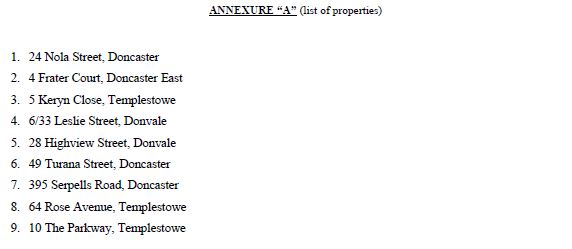
(a) at various times between 1 June 2014 and 1 December 2015, in advertisements published in property magazines titled “The Weekly Review” and “Red” and on property websites known as “realestate.com.au” and “Domain” and in emails in respect of the properties listed in Annexure A (Properties) represented to the potential purchasers of the Properties:
(i) the vendors of the Properties would, or were prepared to, sell the property for a price or price range that was provided (the price range provided) or not substantially more than the price range provided;
(ii) the vendors of the Properties had instructed Hocking Stuart Doncaster to sell the property for a price that was in the price range provided or not substantially more than the price range provided;
(iii) Hocking Stuart Doncaster in fact believed and held the opinion, on reasonable grounds, that the property would be sold at a price that was within the price range provided or not substantially more than the price range provided; and
(iv) the likely selling price, or market value, of the property was within the price range provided or not substantially more than the price range provided.
(b) in circumstances where Hocking Stuart Doncaster had provided an appraisal for some of the Properties that was more, or substantially more, than the price range provided, and had received (one or more of the following) in respect of each of the Properties:
(i) interest from potential buyers to buy the property for a price more, or substantially more, than the price range provided;
(ii) an offer from a potential purchaser to buy the property for a price more, or substantially more, than the price range provided;
(iii) instructions from the vendor not to sell the property below a certain price that was more, or substantially more, than the price range provided; and/or
(iv) a signed authority or engagement to market and attempt to sell the property in which Hocking Stuart Doncaster provided an estimate of the selling price that was more, or substantially more, than the price range provided; -
Hocking Stuart Doncaster between 1 June 2014 and 1 December 2015 has:
A. engaged in conduct, in trade or commerce, that was misleading and deceptive, or likely to mislead and deceive, in contravention of s.18 of schedule 2 to the Competition and Consumer Act 2010 (Cth) (ACL) and s18 of the ACL text as it applies to the law of Victoria (ACL (Vic)) by virtue of s8 of the Australian Consumer Law and Fair Trading Act 2012 (Vic); and
B. made false and misleading representations in connection with sale or possible sale of an interest in land or in connection with the promotion by any means of the sale of an interest in land concerning the price payable for the land identified in Annexure A contrary to s.30(1)(c) of the ACL and ACL (Vic).
THE COURT ORDERS THAT:
1. An order that Hocking Stuart Doncaster (whether by its officers, employees, servants, agents or otherwise):
(a) be restrained from publishing or causing to be published, giving or making, by any means, any public announcement, statement or advertisement of, or about, any Victorian real estate in respect of which it has been engaged or appointed as an estate agent to market and attempt to sell that includes an indication of the estimated, or likely, sale price of that real estate, expressed either as a fixed sum or as a range (Price Estimate) unless such Price Estimate is not less than the highest Price Estimate in:
(i) each prior Price Estimate of that real estate prepared by, or on behalf of, Hocking Stuart Doncaster and published, given or made to any person, at any time within 6 months of Hocking Stuart Doncaster entering into an engagement or appointment as an estate agent to market and attempt to sell that real estate; and
(ii) the estimate of the selling price of that real estate, included in the authority or engagement to market and attempt to sell the real estate, as required by s.47A(1) of the Estate Agents Act 1980 (Vic) (EAA);
(b) be restrained from publishing, giving or making, by any means, a Price Estimate of, or about, any Victorian real estate for sale, either by private sale, auction or otherwise, unless it complies with the requirements imposed upon such Price Estimates under s.47A(1) of the EAA;
(c) be required to retain, for a period of 3 years from their preparation, each document that is or contains a Price Estimate of Victorian real estate prepared by, or on behalf of, Hocking Stuart Doncaster and published, given or made to any person by or on behalf of Hocking Stuart Doncaster;
(d) where a Price Estimate is prepared by, or on behalf of, Hocking Stuart Doncaster and given, made or published by it to any person otherwise than in writing, Hocking Stuart Doncaster be required to prepare and retain, for a period of 3 years of its creation, a document sufficient to identify:
(i) when;
(ii) by whom –
the Price Estimate was prepared by, or on behalf of, Hocking Stuart Doncaster; and
(iii) to whom; and
(iv) when -
the Price Estimate was given, made or published.
Pecuniary penalties
2. An order that Hocking Stuart Doncaster pay to the State of Victoria an aggregate pecuniary penalty of $160,000 in respect of the contravention of s.30 of the ACL (Vic) referred to in paragraph 1 above, payable within 30 days from the date of this order.
Adverse publicity order
3. Hocking Stuart Doncaster, having contravened a provision of Chapter 3 of the ACL (Vic), within 10 days of the date of the order:
(a) take all reasonable steps to cause to be published within the first 10 pages of The Weekly Review newspaper (in the edition that covers its sales territory); and
(b) cause to be displayed, prominently, conspicuously and continuously, for a period of 6 months, in the public area at each of the premises from which it carries on the business of an estate agent –
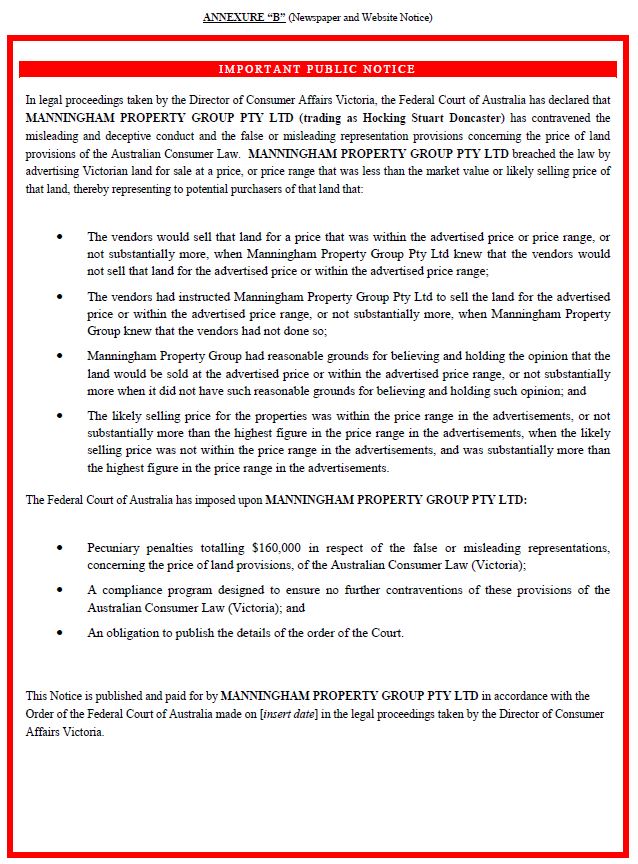
a public notice in the form and with the content of Annexure B to this Application. Each of the notices:
(i) must be at least 28 centimetres by five columns in size or a size of no less than one third of a page in the newspaper;
(ii) use a minimum of type size of 12 point Times New Roman or equivalent; and
(iii) be in full colour.
4. An order that Hocking Stuart Doncaster take all reasonable steps to cause the public notice to be published on:
(a) property websites known as “realestate.com.au” and “Domain” (Property Websites);
for a period of 6 months from the date of the order, and use its best endeavours to ensure that:
(i) the public notice is viewable by clicking through an icon located in a central position on the page first accessed when the user searches for real estate in the Victorian suburbs of Bulleen, Doncaster, Doncaster East, Templestowe, Templestowe Lower and Donvale on the Property Websites;
(ii) the “click-through” icon must contain the words “FALSE, MISLEADING AND DECEPTIVE CONDUCT – IMPORTANT NOTICE ORDERED BY THE FEDERAL COURT OF AUSTRALIA” (in capital letters and a minimum type size of 16 point Times New Roman or equivalent), clearly and prominently in red on a contrasting background and the words “Click Here”; and
(iii) the public notice occupies the entire webpage which is accessed via the “click-through” icon referred to above.
Non-punitive order – compliance program
5. Hocking Stuart Doncaster at its own expense:
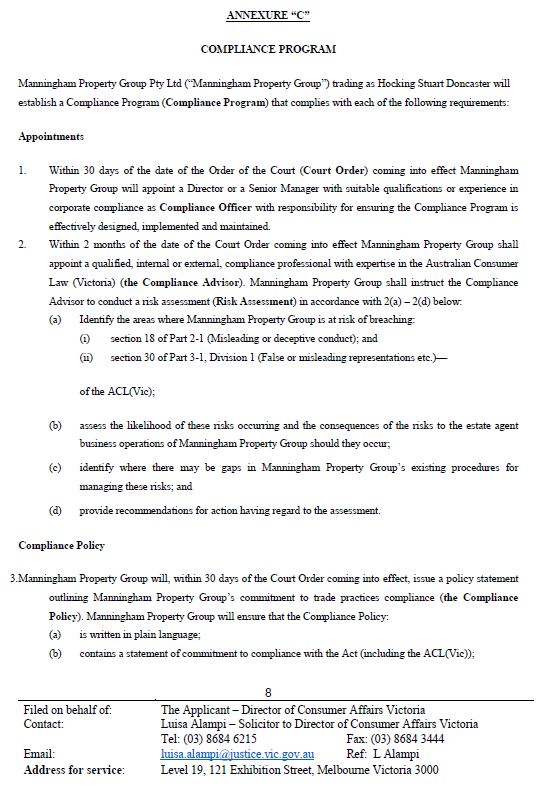
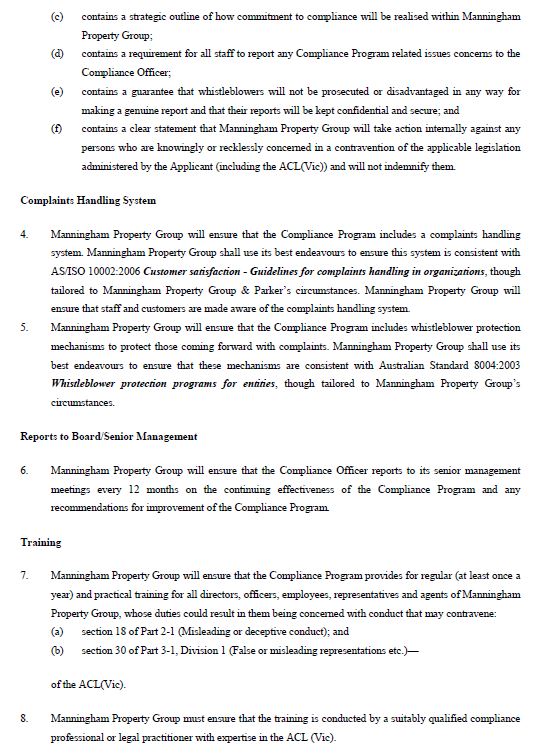
(a) Establish, within 3 months of the date of the order, a compliance program which meets the requirements set out in Annexure C to this Application and maintain the compliance program for 3 years from the date on which it is established; or
(b) If it already maintains an existing compliance program:
(i) within 3 months of the date of the order, review the existing compliance program and make any amendments necessary to ensure that it meets the requirements set out in Annexure C to this Application; and
(ii) maintain this compliance program for at least 3 years from the date on which the amendments, referred to in the preceding sub-paragraph, are made.
Affidavit of compliance
6. Hocking Stuart Doncaster file and serve on the Applicant, within 3 months from the date of the order, an affidavit of its proper officer verifying that it has carried out, or have used it best endeavours to carry out its obligations under the orders of the Court sought under paragraphs 4, 5 and 6 above, detailing what it has done, including:
(a) in respect of paragraph 4(a) above, by providing a copy of the corrective advertisement as published in the Weekly Review;
(b) in respect of both paragraphs 5(a) above, by providing a copy of:
(i) a date-stamped screen capture of each website showing the “click-through” link; and
(ii) a date stamped screen capture of the stand-alone web-page containing the notice.
Costs
7. An order that Hocking Stuart Doncaster pay a contribution towards the Applicant’s costs fixed at $10,000, payable within 60 days from the date of this order.
Claims against Chappell and Adgemis
8. The proceeding as against the Second and Third Respondents is dismissed with no order as to costs.
Note: Entry of orders is dealt with in Rule 39.32 of the Federal Court Rules 2011.
MURPHY J:
INTRODUCTION
1 The first respondent in this proceeding, Manningham Property Group Pty Ltd, is a licensed estate agent under the Estate Agents Act 1980 (Vic) (Estate Agents Act) trading under the name Hocking Stuart Doncaster (Hocking Stuart Doncaster). It operates under that name pursuant to a franchise agreement with Hocking Stuart Pty Limited and carries on its business largely in the suburbs of Bulleen, Doncaster, Doncaster East, Templestowe, Templestowe Lower and Donvale.
2 The applicant, the Director of Consumer Affairs Victoria (Consumer Affairs), alleges that during 2014 and 2015, in the advertising and marketing material it published and in the emails it sent to potential property buyers, Hocking Stuart Doncaster represented to potential buyers that:
(a) the vendors would or were prepared to sell the properties for the advertised price range or a price not substantially more than the advertised price range;
(b) the vendors had instructed Hocking Stuart Doncaster to sell the properties for a price within the advertised price range or not substantially more than the price range;
(c) Hocking Stuart Doncaster in fact believed and held the opinion, on reasonable grounds, that the properties would sell for a price within the advertised price range or not substantially more than the price range; and
(d) the likely selling price or market value of the properties was within the advertised price range or not substantially more than the price range.
3 Hocking Stuart Doncaster now accepts that it made those representations and that they were false. At the time it made the representations one or more of the following had occurred in respect of each of the properties:
(a) Hocking Stuart Doncaster had provided the vendors with an appraisal of the price range for the property that was more or substantially more than the advertised price range;
(b) a potential buyer or buyers had expressed interest in purchasing the property at a price more or substantially more than the advertised price range;
(c) a potential buyer had made an offer for a price more or substantially more than the advertised price range;
(d) Hocking Stuart Doncaster had instructions from the vendor not to sell the property for less than a price that was more or substantially more than the advertised price range; and/or
(e) the vendor had signed an engagement or an appointment to sell the property (Authority) in which Hocking Stuart Doncaster provided an estimate of the selling price that was more or substantially more than the advertised price range.
4 In relation to some of the properties, Hocking Stuart Doncaster’s representatives informed vendors that underquoting the price range for the property was a technique designed to attract initial buyer interest, and that the higher level of interest would operate to drive up the sale price achieved. The evidence shows that Hocking Stuart Doncaster had no expectation that any of the properties would sell at the represented prices. Indeed, each of them sold for an amount well above the advertised price range.
5 Consumer Affairs alleges that by this conduct Hocking Stuart Doncaster:
(a) engaged in misleading or deceptive conduct or conduct which is likely to mislead or deceive in contravention of s 18(1) of the Australian Consumer Law (ACL) in Schedule 2 of the Competition and Consumer Act 2010 (Cth) and s 18(1) of the Australian Consumer Law (Victoria) (ACL (Vic)) (by operation of s 8 of the Australian Consumer Law and Fair Trading Act 2012 (Vic)) (ACLFTA); and
(b) made false or misleading representations concerning the price payable for land in contravention of s 30(1)(c) of the ACL and the ACL (Vic).
6 Hocking Stuart Doncaster now admits the contraventions and the underlying conduct by way of a Statement of Agreed Facts and Documents filed with the Court. It consents to orders which include declarations, injunctions, a pecuniary penalty of $160,000, an adverse publicity order, a compliance program and a contribution to the costs of the proceeding. The parties also agree to dismiss the proceeding as against Kenneth Chappell, the second respondent, and Anastasios Adgemis, the third respondent, being two of the three directors of Manningham Property Group in the relevant period, without order as to costs.
7 For the reasons I explain, it is appropriate to make the orders the parties propose.
THE FACTUAL BACKGROUND
8 This background is drawn from the Statement of Agreed Facts and Documents, the pleadings, affidavits filed in the proceeding and submissions.
Hocking Stuart Doncaster’s business
9 Hocking Stuart Doncaster operates a real estate agency in Doncaster, Victoria which sells residential properties in the eastern suburbs of Melbourne. It is relatively new having incorporated on 11 February 2013. In the relevant period it had three directors and a staff of 8 to 10 people. Mr Chappell and Constantinou Salce commenced as directors upon incorporation and Mr Adgemis became a director on 29 April 2015. Mr Salce has held a real estate agent’s license since February 1997, Mr Chappell since October 2009 and Mr Adgemis since August 2013.
The requirements of the Estate Agents Act
10 Section 47A of the Estate Agents Act provides that before obtaining a person’s signature to an engagement or appointment to sell residential property an estate agent must ensure that the Authority contains an estimate of the selling price of the residential property (price estimate) that is expressed as a single amount or a price range (in which the difference between the upper and lower limits of the price range does not exceed 10% of the lower limit).
11 At the time of the relevant conduct s 47A(2) provided that the price estimate must be the amount that the agent believes, on the basis of his or her own experience, skills and knowledge, to be the amount that a willing but not anxious buyer would pay for the real estate, or in the case of a price range, the range within which that amount is likely to fall.
The properties
12 In 2014 to 2015 Hocking Stuart Doncaster was engaged by the owners of seven residential properties to market and negotiate the sale of the properties, and it was responsible for the marketing of two other residential properties which were listed by other Hocking Stuart franchises but located within Hocking Stuart Doncaster’s territory pursuant to its franchise agreement. The properties were:
(a) 24 Nola Street, Doncaster (the Nola Street Property);
(b) 4 Frater Court, Doncaster East;
(c) 5 Keryn Close, Templestowe (the Keryn Close Property);
(d) 6/33 Leslie Street, Donvale (the Leslie Street Property);
(e) 28 Highview Drive, Doncaster;
(f) 49 Turana Street, Doncaster (the Turana Street Property);
(g) 395 Serpells Road, Doncaster (the Serpells Road Property);
(h) 64 Rose Avenue, Templestowe (the Rose Avenue Property); and
(i) 10 The Parkway, Templestowe (the Parkway Property).
Hocking Stuart Doncaster’s marketing practices
13 In broad terms the evidence shows that Hocking Stuart Doncaster had a practice of providing prospective property vendors with an appraisal of the price range likely to be achieved on sale of the property. Then, if the vendor appointed Hocking Stuart Doncaster to sell the property it would recommend that the written Authority state a price estimate that was below, sometimes substantially below, the price range it provided in the appraisal. On Hocking Stuart Doncaster’s recommendation the vendor would sign an Authority which contained that lower price estimate.
14 Hocking Stuart Doncaster would then advertise the property for sale at that price estimate in a printed lifestyle and property magazine titled “Weekly Review”, in Hocking Stuart’s printed property magazine titled “Red”, and on the property websites known as “Domain” and “realestate.com.au”. It would also underquote the expected price range in its direct interactions with prospective buyers.
15 The purpose of doing so was to attempt to generate a higher level of buyer interest in the property in the expectation that it would translate into a higher sale price. Hocking Stuart Doncaster expected each property to sell at a price above, sometimes substantially above, the price estimate in the Authority. In many cases it had been instructed by the vendor that the property was not available for sale at the price estimate.
16 Usually, but not always, the property would subsequently sell for a price substantially in excess of the price estimate.
17 It is unnecessary to detail the underlying conduct in relation to each of the nine admitted properties. I will use three examples.
The Nola Street Property
18 In January 2014, Valerie Varga, the owner of the Nola Street Property, contacted Hocking Stuart Doncaster and asked for a valuation of her property. Hocking Stuart Doncaster advised her that it was worth about $950,000. On 6 February 2014 Hocking Stuart Doncaster sent her a letter with an estimated sale price “in the vicinity of low to mid $900,000s”, which it said was based on recent comparable sales and their knowledge of the real estate market in the area.
19 In July that year Ms Varga signed an Authority authorising Hocking Stuart Doncaster to market and sell her property. The Authority contained a price estimate of $800,000 to $880,000. She queried the price estimate with Mr Agdemis who said that “he wanted to keep the price low to attract more buyers to the property.”
20 Ms Varga then put the sale of the property on hold for personal reasons. In September 2014 she signed a second Authority which contained a price estimate of $790,000 to $869,000. She again asked Mr Agdemis about the price estimate and he reiterated that a lower price estimate would attract more interest in the property. She informed Mr Agdemis that she expected the property to achieve a sale price of at least $900,000 and that she would not accept less than this.
21 Hocking Stuart Doncaster advertised the property for sale from about 16 October 2014 to 8 November 2014 and stated the price as in excess of $790,000. During the sales campaign a buyer made an offer of around $810,000.
22 On 8 November 2014 the property sold at auction for $1,010,000.
The Keryn Close Property
23 In October 2015 Laura Nucifora, the owner of the Keryn Close Property, contacted Hocking Stuart Doncaster asking for a property valuation. Mr Zhang valued the property at $1 million to $1.1 million. She informed Mr Zhang that she expected to achieve a sale price of $1 million and would not accept less. Mr Zhang assured her that he could get an offer at that price prior to auction and that he had a network of Chinese buyers who would be interested in the property.
24 Ms Nucifora engaged Hocking Stuart Doncaster to sell the property and signed an Authority which contained a price estimate of $950,000 to $1,050,000.
25 From 27 October 2015 to about 2 November 2015 Hocking Stuart Doncaster marketed the property without a sale price, and the advertisements informed potential purchasers that they should contact the agent. After an unsuccessful open house inspection process, Mr Zhang advised Ms Nucifora that there were issues with the property that were putting off buyers and that he had been unable to identify any Chinese buyers ready to make an offer.
26 Ms Nucifora became concerned that Mr Zhang had overstated his network of Chinese buyers and arranged a meeting with Mr Chappell to complain in that regard. At the meeting which took place on about 2 November 2015 Mr Chappell told her that to generate interest among potential buyers, Hocking Stuart Doncaster should advertise the property for a price well below $1,000,000 and suggested advertising the property for “$800,000 plus”. Ms Nucifora told Mr Chappell that she still expected $1 million for the property and would not accept $800,000. Mr Chappell said “you won’t have to. I can guarantee if we lower the price you will get a million dollar buyer.” Mr Chappell sought and obtained an amendment to the price estimate in the Authority to a range of between $800,000 and $880,000.
27 On 2 November 2015 Hocking Stuart Doncaster commenced to advertise the property for sale at a price of “$800,000 plus” and “in excess of $800,000”.
28 On or about 19 November 2015 Ms Nucifora reluctantly accepted a pre-auction offer of $965,000.
The Parkway Property
29 On 17 June 2015 the owner of the Parkway Property signed an Authority with a price estimate of $1,800,000 to $1,980,000.
30 From 21 July 2015 to about 11 August 2015 Hocking Stuart Doncaster advertised the property without stating a price range and informed potential purchasers to contact the agent. In that period Hocking Stuart Doncaster’s representative, Mr Sinni, sent emails to five prospective buyers which said “We are introducing all buyers with the capacity to spend in excess of $1,600,000”.
31 After 12 August 2015 Hocking Stuart Doncaster advertised the property with a price of “$1.7m+”.
32 On 15 August 2015 the property sold at auction for $2,040,000.
PECUNIARY PENALTY
33 Section 224(1) of the ACL (Vic) empowers the Court to impose a pecuniary penalty for breach of specified provisions. Section 30 of the ACL (Vic) is a specified provision and s 18 of the ACL (Vic) is not.
34 Pursuant to s 224 the Court can order a person to pay a pecuniary penalty to the Commonwealth, State or Territory in respect of each act or omission by the person to which the section applies.
35 Section 228 empowers Consumer Affairs to commence a proceeding for recovery of a pecuniary penalty on behalf of the State of Victoria. Pursuant to s 134 of the ACLFTA any pecuniary penalty order will be paid into the Victorian Consumer Law Fund.
The purpose of a pecuniary penalty
36 The central purpose of a civil pecuniary penalty is deterrence, both specific to the contravener and in general. In Commonwealth v Director, Fair Work Building Industry Inspectorate; Construction, Forestry, Mining and Energy Union v Director, Fair Work Building Industry Inspectorate (2015) 258 CLR 482; [2015] HCA 46 (Fair Work Building Industry Inspectorate) (French CJ, Kiefel, Bell, Nettle and Gordon JJ) at [55] the plurality cited with approval the remarks of French J in Trade Practices Commission v CSR Ltd (1991) ATPR 41-076 (TPC v CSR) at 52,152 where his Honour said:
The principal, and I think probably the only, object of the penalties imposed by s 76 is to attempt to put a price on contravention that is sufficiently high to deter repetition by the contravener and by others who might be tempted to contravene the Act.
37 In NW Frozen Foods Pty Ltd v Australian Competition and Consumer Commission (1996) 71 FCR 285 (NW Frozen Foods) Burchett and Kiefel JJ (at 294-295) said:
The Court should not leave room for any impression of weakness in its resolve to impose penalties sufficient to ensure the deterrence, not only of the parties actually before it, but also of others who might be tempted to think that contravention would pay, and detection lead merely to a compliance program for the future.
38 In Singtel Optus v Australian Competition and Consumer Commission (2012) 287 ALR 249; [2012] FCAFC 20 (Singtel Optus) at [68] (Keane CJ, Finn and Gilmour JJ) (cited with approval in Australian Competition and Consumer Commission v TPG Internet Pty Ltd (2013) 250 CLR 640; [2013] HCA 54 at [64] (French CJ, Crennan, Bell and Keane JJ)) the Full Court said:
The Court must fashion a penalty which makes it clear to [the contravener], and to the market, that the cost of courting a risk of contravention of the Act cannot be regarded as [an] acceptable cost of doing business.
39 However, in seeking to deter, a pecuniary penalty should not be set so high as to be oppressive: Trade Practices Commission v Stihl Chainsaws (Aust) Pty Ltd (1978) ATPR 40-091 at 17,896 (Smithers J); NW Frozen Foods at 293; Australian Competition and Consumer Commission v Leahy Petroleum (No 2) [2005] FCA 254 at [9] (Merkel J).
The relevance of the parties’ agreed position on the pecuniary penalty
40 It is desirable that the Court accepts an agreed penalty where it is sufficiently persuaded that the penalty is appropriate in all the circumstances. In Fair Work Building Industry Inspectorate, the plurality said (at [58]) that:
Subject to the court being sufficiently persuaded of the accuracy of the parties' agreement as to facts and consequences, and that the penalty which the parties propose is an appropriate remedy in the circumstances thus revealed, it is consistent with principle and, for the reasons identified in Allied Mills, highly desirable in practice for the court to accept the parties' proposal and therefore impose the proposed penalty.
41 Where a penalty figure cannot be said to be more appropriate than another, the Court ought not depart from the submitted penalty figure merely because “it might otherwise have been disposed to select some other figure”: Fair Work Building Industry Inspectorate at [47] citing NW Frozen Foods at 291.
42 There is an important public policy in the Court accepting an agreed penalty because it promotes predictability in civil proceedings and it encourages corporations to acknowledge contraventions which avoids lengthy and complex litigation and frees the Court to deal with other matters: NW Frozen Foods at 291; Fair Work Building Industry Inspectorate at [46].
The maximum penalty
43 Section 224(4) provides that if conduct contravenes two or more provisions of the ACL (Vic) a person is liable for only one pecuniary penalty in respect of the same conduct. In the period of the contravening conduct in the present case the maximum penalty for each contravention was $1.1 million: s 224(3).
44 Neither party contended that the contraventions should be treated as one course of conduct and I accept Consumer Affairs’ submission that the maximum penalty should be calculated on the basis of one contravention per property. The maximum available penalty for the contravening conduct is therefore $9.9 million but, in the circumstances of the present case, that amount is well beyond what any court would impose.
The relevant considerations in fixing a pecuniary penalty
45 The methodology for fixing a pecuniary penalty in a civil proceeding is not cast in stone and it is not an exact science: Construction, Forestry, Mining and Energy Union v Cahill (2010) 269 ALR 1; [2010] FCAFC 39 (CFMEU v Cahill) at [47] (Middleton and Gordon JJ); NW Frozen Foods at 290-291. The Court must consider all the relevant facts and circumstances and use a process of “instinctive synthesis” to arrive at the appropriate penalty. In Markarian v The Queen (2005) 228 CLR 357; [2005] HCA 25, which concerned criminal sentencing, McHugh J described this process (at [51]) as:
…the method of sentencing by which the judge identifies all the factors that are relevant to the sentence, discusses their significance and then makes a value judgment as to what is the appropriate sentence given all the factors of the case.
46 Section 224(2) of the ACL (Vic) provides that the Court must have regard to all relevant matters including the nature and extent of the act or omission, any loss or damage suffered as a result of the act or omission, the circumstances in which the act or omission took place, and whether the person has previously been found by a court in proceedings to have engaged in similar conduct.
47 In Australian Competition and Consumer Commission v TPG Internet Pty Ltd (No 2) [2012] FCA 629 (TPG No 2) at [61] I summarised a non-exhaustive list of the relevant matters, which include:
(a) the size of the contravening company;
(b) the deliberateness of the contravention and period over which it extended;
(c) whether the contravention arose out of the conduct of senior management of the contravener or at a lower level;
(d) whether the contravener has a corporate culture conducive to compliance with the ACL (Vic), as evidenced by educational programs and disciplinary or other corrective measures in response to an acknowledged contravention;
(e) whether the contravener has shown a disposition to cooperate with the authorities responsible for enforcement of the ACL (Vic);
(f) the financial position of the contravener;
(g) whether the contravening conduct was systematic, deliberate or covert; and
(h) the contravener’s position of influence and importance in its industry sector.
See TPC v CSR at 52,152-52,153 (French J); Australian Competition and Consumer Commission v AGL Sales Pty Ltd [2013] FCA 1030 at [52] (Middleton J); NW Frozen Foods at 292-4; J McPhee & Son (Aust) Pty Ltd v Australian Competition and Consumer Commission [2000] FCA 365 at [150] (Black CJ, Goldberg and Lee JJ). The significance of each factor to the appropriate penalty depends on the facts of the case.
48 In determining the appropriate penalty the Court must also have regard to the “course of conduct principle” and to the “totality principle”. The course of conduct principle recognises that where there is sufficient interrelationship in the legal and factual elements of the acts or omissions that constitute a contravention, the Court may in its discretion penalise the acts or omissions as a single course of conduct. The principle was explained in CFMEU v Cahill at [39] and [41] as follows:
The principle recognises that where there is an interrelationship between the legal and factual elements of two or more offences for which an offender has been charged, care must be taken to ensure that the offender is not punished twice for what is essentially the same criminality.
…
In other words, where two offences arise as a result of the same or related conduct that is not a disentitling factor to the application of the single course of conduct principle but a reason why a Court may have regard to that principle, as one of the applicable sentencing principles, to guide it in the exercise of the sentencing discretion. It is a tool of analysis which a Court is not compelled to utilise.
(Citations omitted.)
49 The totality principle requires the Court to consider the entirety of the underlying contravening conduct to determine whether the total or aggregate penalty is just and appropriate: see TPG No 2 at [138]-[139].
50 I now turn to deal with the relevant considerations having regard to the parties’ submissions.
The nature, extent and deliberateness of the contravening conduct
51 Hocking Stuart Doncaster’s conduct was plainly deliberate. It advised vendors that underquoting was a strategy to heighten buyer interest and it deliberately provided false price estimates in the Authorities so as to provide cover for itself against a charge of underquoting. It approved the publication of advertising and marketing materials which included prices that it knew did not reflect the true price estimate for the properties.
52 Its contravening conduct was serious, as Hocking Stuart Doncaster accepts. It was intended and was apt to create the illusion of a bargain. It involved the deliberate creation of an enticing, but illusory and misleading, marketing web for the sale of nine homes from June 2014 to December 2015. As Middleton J said in Director of Consumer Affairs Victoria v Hocking Stuart (Richmond) Pty Ltd [2016] FCA 1184 (Hocking Stuart Richmond) at [57] in relation to similar contravening conduct:
Price is an essential piece of information about the property being offered for sale for prospective buyers. Buyers should be able to rely on correct information to make an informed decision. Failure to provide the correct range of price by engaging in underquoting is misleading.
53 By now potential property buyers should be taken to be aware that it is illegal for real estate agents to underquote in the residential property market. This will affect their reaction to price representations made to them. The practice of underquoting may significantly inconvenience, disappoint and deceive prospective buyers. By relying on false representations as to price, prospective property buyers have their hopes of purchasing a house raised, they go to the trouble of seeking and obtaining mortgage finance, they may attend auction after auction at which they are unsuccessful, and they a miss out on other opportunities to buy a house. They attend such auctions because they have been induced to believe that the price representations made to them reflect the real estate agent’s assessment of the likely price and the vendor’s reserve, rather than being a false quote to induce their interest.
54 The practice of underquoting also affects the interests of other vendors and real estate agents who comply with the law and do not engage in underquoting. They suffer unfair and improper competition and may miss out on getting prospective buyers to purchase their properties as a result.
55 In mitigation Hocking Stuart Doncaster submits that such practices are widespread in the industry. I accept that but it is a two-edged sword. The fact that underquoting is widespread in the industry indicates a penalty at the higher end of the range because of the requirement for general deterrence. Hocking Stuart Doncaster also argues that the practices took place in a period when the market was both buoyant and unpredictable, being fuelled by low interest rates and interest from overseas buyers. I accept that, but I do not consider it mitigates the seriousness of the misconduct.
56 Hocking Stuart Doncaster also submits that its responsibility to obtain the best result for vendors created a tension with its obligations under the Estate Agents Act and the ACL (Vic). That is a remarkable submission. Of course it had an obligation to endeavour to obtain the highest possible price for vendors who engaged it, but it must operate in accordance with the law including the laws that expressly prohibit the very unfair sale practices which it has now admitted. Nor do I accept that it is likely that Hocking Stuart Doncaster engaged in such conduct only for the benefit of vendors. I infer that it was well aware that it stood to commercially benefit from the contravening conduct.
57 Hocking Stuart Doncaster notes that underquoting was only found in nine of the 25 files that Consumer Affairs seized and reviewed, and argues that this shows that such conduct was not its standard way of conducting business. I do not accept this. First, there is evidence that the practice was adopted when it was deemed necessary to increase the level of buyer interest. For example, in relation to the Keryn Close Property, the initial price estimate was not underquoted and it was not until the level of interest was seen as too low that Mr Chappell recommended the strategy of underquoting. Second, it is plain that the practice was not an isolated one within Hocking Stuart Doncaster. The strategy was used by two directors, Mr Chappell and Mr Adgemis, and four employees, Mr Zhang, Mr Sinni, Mr D’Altera and Ms Weng. Third, the fact that underquoting is established in one third of the files Consumer Affairs reviewed indicates that the practice was widespread. I am satisfied that this practice was a significant part of Hocking Stuart Doncaster’s sales strategy at the time.
The loss or damage suffered
58 It is common ground between the parties that the Court should infer that prospective buyers, other vendors and other real estate agents suffered some loss or damage as a result of the contravening conduct. It is likely that some prospective buyers were inconvenienced and disappointed and that they wasted time and effort in pursuing the purchase of properties they may never have been able to buy. Some would have felt deceived when a house they thought they may be able to purchase sold well outside their budget. Other vendors and real estate agents would have been disadvantaged through unfair and improper competition. Prospective buyers may also have lost the opportunity to make a different property purchase had they been told the truth about the price being sought.
59 While it is impossible to assess the extent of any loss or damage that may have been suffered it is appropriate to sentence on the basis that there has been some loss: Australian Competition and Consumer Commission v Coles Supermarkets Australia Pty Ltd (2015) 327 ALR 540; [2015] FCA 330 at [54]-[57] (Allsop CJ); Singtel Optus at [58]-[59].
The circumstances of the conduct
60 Hocking Stuart Doncaster engaged in the relevant conduct in marketing and selling nine properties in the eastern suburbs of Melbourne. It reiterates the submission that the conduct occurred in the context of similar industry practice and a buoyant market, and that there was a tension between its responsibility to obtain the highest price for vendors and its obligations under the relevant legislation. I have previously dealt with those submissions.
Previous similar conduct
61 Hocking Stuart Doncaster has not been found to have engaged in prior contraventions or similar conduct.
The size of the contravenor
62 Hocking Stuart Doncaster is a business with three directors and between 8 to 10 staff in the relevant period (including administrative staff with not all of them being employed on a full-time basis). It has put on evidence as to its financial position which it is appropriate to treat as confidential, except to the extent necessary to explain the reasons for judgment. Having regard to its staff numbers and its financial position it is appropriate to describe Hocking Stuart Doncaster as a small business.
The financial position of the contravenor and any profit derived from the contravening conduct
63 In respect of the nine properties which are the subject of the proceeding Hocking Stuart Doncaster derived commissions totalling $113,790.54. However, that amount does not reflect profit from the contravening conduct. The evidence tends to show that, in relation to most of the properties, Hocking Stuart Doncaster would have been engaged by the vendor whether or not it had a practice of underquoting and it would therefore have derived significant commissions on the property sales anyway. Further, that amount is gross revenue before deduction of expenses directly and indirectly associated with achieving those sales. Assuming a (generous) profit margin of 30% the company derived profit of a little more than $34,000 from the contravening conduct.
64 The agreed pecuniary penalty of $160,000 extinguishes the commissions Hocking Stuart Doncaster made through the relevant sales, and is almost five times the approximate profit it derived from those sales.
65 Further, in the 2015 financial year Hocking Stuart Doncaster made $136,345 profit before income tax and in the 2016 financial year it made $58,065. The agreed pecuniary penalty is more than its entire profit in 2015, the last year of the contravening conduct, and almost three times its profit in 2016.
66 I also take into account that Hocking Stuart Doncaster’s business is likely to have already suffered some detriment through the negative publicity arising from this case, and further negative publicity that may follow this judgment.
67 In the circumstances a penalty of $160,000 imposes a significant burden on Hocking Stuart Doncaster which should be sufficient to deter it from a repetition of similar conduct. It is unlikely that such a penalty will be considered simply as a cost of doing business, but it does not cripple the business. It is an appropriate reflection of the Court’s condemnation of the conduct.
Level of management involvement
68 The directors of Hocking Stuart Doncaster were directly involved in the contravening conduct. For example, Mr Chappell intervened in the sale of the Keryn Close Property after Ms Nucifora became concerned about a lack of interest in the property and he recommended the strategy of underquoting to generate buyer interest. He persuaded Ms Nucifora to sign an amended Authority with an unrealistic price estimate. Mr Chappell was also directly involved in underquoting in the marketing of the Leslie Street Property, the Turana Street Property and the Rose Avenue Property and Mr Adgemis was directly involved in underquoting in the marketing of the Nola Street Property and the Serpells Road Property.
69 Their involvement shows that the contravening conduct was not only undertaken by junior sales staff or representatives, and it was widespread in the company. Two of the directors, Mr Salce and Mr Chappell, have extensive real estate management experience and must have known better. I have taken this factor into account.
Culture of corporate compliance
70 Consumer Affairs served Hocking Stuart Doncaster’s directors with compulsory examination notices pursuant to s 126 of the ACLFTA. After the Notices were received but before the examinations commenced, Hocking Stuart Doncaster engaged an independent estate agent compliance consultant to review its files and compliance practices. Hocking Stuart Doncaster alleges that the compliance review is ongoing.
71 The parties jointly propose orders for an ongoing compliance program devised by Consumer Affairs. The evidence indicates that Hocking Stuart Doncaster’s culture of compliance with the requirements of the ACL (Vic) was poor during the relevant period, but I have taken into account that it has taken steps to improve its compliance since then.
Cooperation with the regulator
72 Hocking Stuart Doncaster made an early admission of liability and cooperated with Consumer Affairs throughout the investigation. It has saved Consumer Affairs and the Court the time and expense of a contested hearing. I have taken this into account.
The appropriate penalty
73 I am satisfied that the agreed penalty of $160,000 is just and appropriate having regard to the entirety of Hocking Stuart Doncaster’s conduct and taking into account its size and profitability. The penalty averages out to only $17,777 per contravention, but it is significantly more than the gross revenue Hocking Stuart Doncaster derived from the contravening conduct, almost five times the approximate profit it derived from the contravening conduct, more than its profit in the last year of the contravening conduct and almost three times its profit in the financial year immediately preceding the settlement reached.
74 I am satisfied that the penalty is sufficient to deter Hocking Stuart Doncaster from a repetition of such conduct. I also consider it to be sufficient to deter other real estate agents from engaging in such conduct when they understand Hocking Stuart Doncaster’s size and profitability. It is unlikely that Hocking Stuart Doncaster and other real estate agencies will be prepared to treat the risk of a penalty, assessed on such a basis, as an acceptable cost of doing business. Stepping back from the penalty, I am satisfied that it is fair and appropriate having regard to the totality principle.
DECLARATIONS
75 The Court will ordinarily award declaratory relief under s 21 of the Federal Court of Australia Act 1976 (Cth) where the question is a real and not a hypothetical or theoretical one, the applicant has a real interest in raising it, and there is a proper contradictor: see Forster v Jododex Australia Pty Ltd (1972) 127 CLR 421 at 437-438 (Gibbs J).
76 Those requirements are satisfied in the present case. The questions are real, as a regulator Consumer Affairs has a real interest in seeking the declarations, and although the declarations are jointly proposed Hocking Stuart Doncaster is a proper contradictor: see Australian Competition and Consumer Commission v MSY Technology Pty Ltd (2012) 201 FCR 378; [2012] FCAFC 56 at [30] (Greenwood, Logan and Yates JJ).
77 There is a proper evidentiary basis for making the declarations proposed by the parties. In my view they are appropriate, serve a public interest and do justice between the parties. They serve the useful purpose of showing that such conduct breaches the ACL (Vic), they record the Court’s disapproval of the conduct, they vindicate Consumer Affairs’ claims and they assist its future duties by informing consumers of the dangers of such conduct and deterring others from engaging in similar conduct: Australian Competition and Consumer Commission v Eurong Beach Resort Ltd [2005] FCA 1134 at [5]-[6] (Kiefel J); Australian Competition and Consumer Commission v Construction, Forestry, Mining and Energy Union [2006] FCA 1730 at [6] (Nicholson J).
INJUNCTIONS
78 The Court’s power under s 232 of the ACL (Vic) to grant injunctive relief in appropriate terms is subject to the requirements that the injunction will prevent a repetition of the conduct, there is a sufficient nexus between the contravention and the injunction, and the injunction relates to the “matter” before the Court: see Australian Competition and Consumer Commission v Z-Tek Computer Pty Ltd (1997) 78 FCR 197 at 203-204 (Merkel J).
79 The parties jointly propose injunctions which restrain Hocking Stuart Doncaster from underquoting by restraining it from marketing properties for sale at a price that is less than the price estimate that it has given to any other person, including the vendor, or that is quoted in an Authority. Hocking Stuart Doncaster will be required to keep records of price estimates for three years after their preparation.
80 I am satisfied that it is appropriate to order the injunctions sought. They are unambiguous, formulated with sufficient precision and capable of being obeyed without ongoing Court supervision.
THE ADVERSE PUBLICITY ORDER
81 The purpose of adverse publicity orders under s 247 of the ACL (Vic) is to alert consumers that misleading and deceptive conduct has occurred, to protect the public interest by dispelling the false impressions that the misleading representations have created, to support the primary orders and to assist in preventing repetition of the conduct: TPG No 2 at [143] and the authorities there cited.
82 The orders require Hocking Stuart Doncaster to publish a corrective notice in the attached form within ten days of the orders in the first 10 pages of the Weekly Review newspaper, prominently display the corrective notice in Hocking Stuart Doncaster’s offices for six months and publish the corrective notice on the Domain and realestate.com.au websites for six months. The notice sets out Hocking Stuart Doncaster’s contravening conduct, states that it has contravened the ACL (Vic) and states the pecuniary penalty amount. I am satisfied that it is appropriate to make the orders.
THE COMPLIANCE PROGRAM
83 The orders require Hocking Stuart Doncaster to implement a formal compliance program within three months and continue for three years thereafter. They provide for a compliance advisor to conduct relevant training, identify compliance risks and report to senior management on a regular basis.
84 The orders also require that within three months Hocking Stuart Doncaster file and serve on Consumer Affairs an affidavit verifying and detailing that it has carried out its obligations to publish the adverse publicity orders and to institute a compliance program.
85 Such orders are appropriate and may prove to be an important tool for educating Hocking Stuart Doncaster about the legislative requirements under which it operates, thereby reducing the likelihood of future contravening conduct.
THE DISCONTINUANCE OF THE CLAIMS AGAINST THE SECOND AND THIRD RESPONDENTS
86 The parties jointly propose orders to dismiss the proceeding as against Mr Adgemis and Mr Chappell with no order as to costs. Hocking Stuart Doncaster submits that there is no utility in proceeding against them personally when the company has accepted responsibility in full. It also submits that it is appropriate to dismiss the proceeding against them because the third director of the company, Mr Salce, was not made a party.
87 I disagree. There is evidence of direct involvement in the contravening conduct by Mr Adgemis and Mr Chappell and not by Mr Salce. A number of academic studies in relation to deterrence of corporate misconduct indicate that penalties or damages imposed directly upon the responsible company officers have a greater deterrent effect than penalties or damages imposed on the company. However, Consumer Affairs can discontinue the proceeding against Mr Adgemis and Mr Chappell without Court approval. Further, discontinuance of the proceeding against Mr Adgemis and Mr Chappell without costs is part of the package of orders which make up the settlement. I would not lightly undo that package given the public policy in favour of settlement and encouraging corporations to acknowledge contraventions so as to avoid lengthy and complex litigation. In my view it is appropriate to make the proposed orders.
COSTS
88 The parties jointly propose orders that Hocking Stuart Doncaster contribute $10,000 towards Consumer Affairs’ party-party costs of the proceeding, which are estimated to be about double that amount. Such an order is appropriate.
89 I have made orders in terms of the draft minutes provided by the parties, with one small change for clarity.
I certify that the preceding eighty-nine (89) numbered paragraphs are a true copy of the Reasons for Judgment herein of the Honourable Justice Murphy. |


