

FEDERAL COURT OF AUSTRALIA
Malek Fahd Islamic School Limited v Minister for Education and Training (No 2) [2017] FCA 1377
ORDERS
MALEK FAHD ISLAMIC SCHOOL LIMITED Applicant | ||
AND: | MINISTER FOR EDUCATION AND TRAINING Respondent | |
DATE OF ORDER: |
THE COURT ORDERS THAT:
1. The respondent’s decision dated 6 April 2017 delaying the making of payments of financial assistance to the State of New South Wales in respect of the applicant be set aside with effect from 6 April 2017.
2. The respondent pay the applicant’s costs of and incidental to the proceeding.
Note: Entry of orders is dealt with in Rule 39.32 of the Federal Court Rules 2011.
GRIFFITHS J:
Introduction
1 The applicant challenges by way of judicial review the lawfulness of a decision of a delegate of the Minister for Education and Training (the delegate). The decision is dated 6 April 2017. The delegate decided under s 110(1)(c) of the Australian Education Act 2013 (Cth) (the Education Act) to delay making any further payments of financial assistance to New South Wales in respect of Malek Fahd Islamic School Limited (MFISL), which is the approved authority for the Malek Fahd Islamic School (the School). A stated reason for the decision was that the delegate found that MFISL was not complying with ss 75 and 78 of the Education Act (which prescribe basic and ongoing funding requirements for approval).
2 The decision took effect immediately, with the consequence that all further payments of financial assistance in respect of the school for 2017 were delayed until the non-compliance identified in the delegate’s decision was rectified. The delegate voluntarily provided a detailed written statement of reasons for her decision. It was common ground that the decision to delay funding (which totalled approximately $19m in 2016) meant that the School had to close and the students had to be relocated to other schools. The School had a current enrolment of 2342 students, 153 of whom were enrolled in years 11 and 12. There were also 231 teachers and other staff at the School.
3 The lawfulness of the decision is challenged by the applicant on various judicial review grounds. As will emerge, I find that the delegate failed to take into account a mandatory relevant consideration in the exercise of her power under s 110(1)(c), being the effect of delaying the Commonwealth’s provision of funds on students at the School.
Summary of background facts
4 There is a long history of litigation involving MFISL and the School. It may briefly be summarised as follows.
5 On 16 November 2015, the Minister’s delegate made a determination under s 25(1)(d) of the Education Act that the School receive its 2016 recurrent funding entitlement of approximately $19m in four quarterly payments. On 8 February 2016, another Ministerial delegate, acting under s 81 of the Education Act, revoked the status of MFISL as an approved authority. That decision was affirmed on an internal review by another of the Minister’s delegates on 4 April 2016. This decision was the subject of MFISL’s application for review to the Administrative Appeals Tribunal (the AAT), which application was lodged on 6 April 2016. On 28 April 2016, the AAT granted a stay. The effect of the stay was that, for the purposes of the Education Act, MFISL remained an approved authority until further order. The reasons for the stay decision are to be found in Malek Fahd Islamic School Limited v Minister for Education and Training [2016] AATA 300.
6 On 24 May 2016, without prior notice being given to the School, a Ministerial delegate informed the School that a decision had been made pursuant to s 110(1)(c)(i) of the Education Act to delay making any further payment to the State in respect of the School. MFISL challenged that decision in proceedings commenced in the Court on 15 June 2016. The Minister accepted that the 24 May 2016 decision was invalidated because of procedural unfairness. By consent the 24 May 2016 decision was quashed, but the parties could not agree on whether there should be any further relief. In particular, they could not agree on whether the Minister should be compelled to make further quarterly payments to MFISL for 2016. This issue was determined by Rares J in Malek Fahd Islamic School Limited v Minister for Education and Training [2016] FCA 807 (Rares J’s decision). His Honour concluded that the Minister was not entitled to delay further payment in respect of the School for 2016, unless there was a decision under s 110(1)(c)(i). Since there was no such decision (i.e. because the 24 May 2016 decision had been quashed) and no fresh decision had been made under s 110(1)(c)(i), his Honour found that the Minister was legally bound to at least make the second quarterly payment for 2016. Declaratory relief was granted to that effect on MFISL giving certain undertakings.
7 Returning now to MFISL’s appeal to the AAT, that appeal was ultimately dismissed by the AAT in a decision dated 23 December 2016 (Malek Fahd Islamic School Limited v Minister for Education and Training [2016] AATA 1087) (the AAT decision). Although the AAT stated at [6] of its reasons for decision that the evidence suggested that “MFISL is a good school which provides quality education”, the AAT was satisfied that MFISL did not satisfy the requirements of ss 75 and 78 of the Education Act. Those requirements were directed to ensuring that an approved authority conducts a school on a not-for-profit basis, deals with financial assistance it received in accordance with the law, and is a “fit and proper person”.
8 MFISL appealed the AAT decision under s 44 of the Administrative Appeals Tribunal Act 1975 (Cth) (the AAT Act). The appeal was heard by the Full Court on 17 May 2017. Judgment is reserved. It is notable, however, that, notwithstanding the AAT decision, MFISL continues to be an “approved authority” for the purposes of the Education Act because of the stay which was granted by the AAT, which remains on foot.
9 On 28 November 2016, the delegate made a determination under s 25(1)(d) of the Education Act which set the amounts and timing of payments of funding for 2017 in respect of the School. That determination took effect on 1 January 2017.
10 On 11 January 2017, the Minister’s delegate wrote to MFISL and informed its Chairperson that she proposed to make a decision under s 110 to either reduce or delay funding to MFISL on the basis of non-compliance as described in that letter. MFISL took advantage of the opportunity to respond to the 11 January 2017 letter, which was in effect a show cause notice. MFISL provided the delegate with various submissions and material in opposition to the delegate’s proposed decision, including by way of letters dated 20 January 2017 and 3 February 2017. More will be said below about the contents of the first of those letters.
11 In early March 2017, the same Ministerial delegate was provided with an internal Departmental minute which was headed “Malek Fahd Islamic School Limited – February 2017 payment under the Australian Education Act 2013”. The delegate was asked to make a decision as to the preferred action in relation to recurrent funding for MFISL. The delegate was asked to note “the Section’s analysis and recommendations below”. The minute contained a recommendation that, if the delegate considered that MFISL was yet “to demonstrate compliance with the requirements of the Act, you may decide to delay or reduce funding for MFISL”. The delegate circled the word “Delay”. The delegate also circled the word “Noted” alongside the recommendation that she note the “Section’s analysis and recommendations below”. The minute stated that a letter to MFISL would be prepared for the delegate’s signature on the basis of her decision, a matter which was expressly noted by the delegate who signed the minute on 1 March 2017.
12 Although a decision was made by the delegate on 1 March 2017 to delay funding for MFISL, that decision was not communicated to MFISL at that time. More will be said about that later.
13 It is also relevant to note that, in a section of the March minute under the heading “Key Points”, the following statement was made:
2. MFISL’s 20 January 2017 letter implores you to contribute to approve funding for the school to ensure operations continue as cessation of funding will result in the closure of the school, affecting over 2500 students.
As will shortly emerge, the Minister relies upon this statement, together with other material, in support of his submission that the delegate did in fact take into account the effect on the School’s students of the decision to delay funding.
14 On 4 April 2017, the same Ministerial delegate decided to make funding payments in respect of MFISL for February and March 2017, which payments amounted to approximately $3.28m. This decision was communicated to MFISL by a letter dated 4 April 2017 which was signed by the delegate. That letter included the following statement:
This payment should not be understood as involving any concession or acceptance of MFISL’s compliance with the Act, or that further payments to NSW for MFISL will necessarily be made. The decision to delay funding under section 110 of the Act remains open to me for future funding decisions.
15 There was no explanation in the letter as to why the delegate had decided to release funding for February and March 2017, notwithstanding that, as far as MFISL was concerned, she was still considering whether or not to make the proposed decision to delay funding, as set out in the show cause letter dated 11 January 2017. MFISL was later to learn, during the course of the current judicial review proceeding, that the reason why the delegate made the 4 April 2017 decision to release payments for February and March 2017 related to legal advice which the Department had obtained. This advice was to the effect that, if the Department wished to vary a payment arrangement the subject of a s 25 determination, notice and a reasonable time to respond had to be given to the approved authority prior to an existing payment becoming due and payable. This information is set out in an internal Departmental minute dated 4 April 2017 to the delegate. The minute identified a deadline date of 4 April 2017 “to make a decision prior to issuing the delay notice to MFISL”. The reference to issuing a delay notice is presumably a reference to the fact that the delegate had decided on 1 March 2017 to delay funding to MFISL because of its non-compliance. The 4 April 2017 minute explicitly refers to the delegate having made a decision on 1 March 2017 “to delay further 2017 funding to MFISL on the basis of non-compliance with the Act”.
16 The delegate’s decision to delay funding to MFISL was communicated to it by way of a letter dated 6 April 2017. The letter, which is signed by the delegate, is headed “Decision regarding financial assistance under the Australian Education Act”. Although the letter does not explicitly state the date of the decision, MFISL was notified in the letter that the delegate’s decision took effect immediately and all payments of financial assistance, effective from April 2017, in respect of MFISL were “delayed until the non-compliance identified in this decision is rectified”.
17 As noted above, the delegate had decided on 1 March 2017 to delay funding. It is unclear whether this decision was reaffirmed by a subsequent decision made by the same delegate on 6 April 2017 or whether the letter dated 6 April 2017 was intended to provide reasons to MFISL for the 1 March 2017 decision. For convenience, however, I will refer to the delegate’s decision as communicated to MFISL by the 6 April 2017 letter as the “6 April 2017 decision”. This is the decision which is the subject of the current judicial review challenge. It will be necessary to elaborate upon the 6 April 2017 letter shortly.
18 The judicial review application was filed on 29 June 2017. The applicant sought an extension of time to bring that application, as well as interlocutory relief to prevent the respondent from delaying payment of financial assistance to it. The applicant was successful in respect of both matters for reasons which are set out in Malek Fahd Islamic School Limited v Minister for Education and Training [2017] FCA 757 (the interlocutory judgment). I held there that it was arguable that the delegate did not appreciate that she may have been under a legal obligation, in exercising the discretionary power under s 110(1), to consider the likely practical consequences of her decision for the nature and quality of the education of the students affected by it (see at [65]). In expressing that view in the interlocutory judgment, the Court rejected the Minister’s contention that there was no serious question to be tried because, in the oral submission of junior counsel on behalf of the Minister at that interlocutory stage, “matters of disruption, or the continuity of provision of education, this is not – those are not matters within which the Act is concerned” (as noted at [62] of the interlocutory judgment). At that interlocutory stage, it was submitted on behalf of the Minister that, from the Commonwealth’s viewpoint, the Education Act was concerned with the provision of funding on a needs-based model, and not with the quality of education.
19 Brief mention should be made of another set of proceedings. As noted in [28] of the interlocutory judgment, there were also proceedings pending in the Supreme Court of New South Wales. Those proceedings were brought by MFISL against the Australian Federation of Islamic Councils (AFIC). It was noted that in those proceedings MFISL sought to recover monies from AFIC, the payment of which, MFISL alleged, had given rise to its past failures to comply with relevant provisions of the Education Act which underpinned the 6 April 2017 decision. It appears that the Supreme Court proceedings are still on foot.
20 Before turning to consider the judicial review challenge on a final basis, it is desirable to say something more about the reasons given by the delegate for the 6 April 2017 decision.
Reasons for the 6 April 2017 decision
21 As noted above, the delegate set out the reasons for the 6 April 2017 decision in her letter of the same date. The 6 April 2017 letter was annexed to an affidavit by Dr John Bennett affirmed on 29 June 2017, which was read by the applicant. It appears that the reasons were provided voluntarily and not, for example, in response to a request under s 13 of the Administrative Decisions (Judicial Review) Act 1977 (Cth) (the ADJR Act). The reasons are set out in a six and a half page letter. The letter is divided into the following various sections:
(a) Five paragraphs under the heading “Decision”, which set out the terms of the decision and notify MFISL that the decision took effect immediately and that “all payments of financial assistance, effective from April, in respect of MFISL are delayed until the non-compliance identified in this decision is rectified”.
(b) Six paragraphs under the heading “Background”, which briefly note and describe the earlier Departmental and other decisions concerning MFISL’s status as an approved authority (including the AAT’s decision dated 23 December 2016), the delegate’s determination dated 28 November 2016 and the 11 January 2017 show cause notice.
(c) Under a heading “Material taken into account”, the delegate identified the material which she had taken into account in making her decision. It is desirable to set out [13] and [14] which appear under this heading (without alteration):
13. I have taken into account the following material in making this decision:
(a) the Act;
(b) the Australian Education Regulation 2013 (Cth) (the Regulation);
(c) The decision and reasoning of Mr Crowther dated 8 February 2016, and the documentation referred to in that decision;
(d) The decision and reasoning of Mr Pattie dated 4 April 2016, and the documentation referred to in that decision;
(e) The reasoning and decision of the Tribunal dated 23 December 2016, the documentation filed in the Tribunal proceedings and the submissions made on behalf of the parties;
(f) Information provided in response to the 11 January 2017 show cause notice including letters from yourself, as Chair of MFISL, dated 20 January 2017 and 3 February 2017, a copy of a letter from Hoffman & Koops Lawyers, dated 3 February 2017 regarding rental valuations, and the 9 December 2016 Board Pack; and
(g) Information provided as part of the January 2017 monthly report provided on 13 February 2017 and the February 2017 monthly report provided on 10 March 2017, including financial reports and statements included in those reports.
14. The above material is referred in this decision as the ‘material taken into account’.
(d) Under a heading “Non-compliance with the Act”, there are two lengthy paragraphs in which the delegate identifies the “evidence” for her view that MFISL “is not complying and has not complied with sections 75 and 78 of the Act and therefore comes within the terms of paragraph 108(b)”. The evidence included the delegate’s findings that MFISL was not a not-for-profit entity and that loan arrangements between it and AFIC had not been properly documented. It also included the AAT’s decision and reasons dated 23 December 2016 concerning MFISL’s non-compliance. In [16] the delegate made express reference to information provided by MFISL in response to the show cause notice as supporting her conclusion that MFISL has been, and is, non-compliant with the Act, particularly with regard to s 75(3) (not-for-profit) and s 78 (dealing with financial assistance appropriately and keeping adequate records).
(e) The final section of the letter is headed “Reasons for decision to delay”. Because of their importance to the judicial review proceeding, it is desirable to set out the three paragraphs which appear under that heading (without alteration):
Reasons for decision to delay
17. After consideration of the material taken into account, I have decided to delay payments to NSW for Malek Fahd Islamic School effective from April. A substantial part of my reasoning remains as set out in my notice to MFISL dated 11 January 2017. That is, I have decided to delay payments to NSW for Malek Fahd Islamic School because:
(a) The Tribunal’s decision affirmed the decision of the Minister that MFISL has not and is not complying with the requirements of the Act.
(b) The conduct of MFISL identified by the Tribunal as contrary to its statutory obligations under the Act is continuing.
(c) Financial assistance payable through to MFISL has been and will be applied to ‘for profit’ arrangements and not expended on school education.
(d) If MFISL is not successful in its appeal of the Tribunal’s decision to the Federal Court, MFISL would not be eligible for any financial assistance for the 2017 year under the terms of the Tribunal’s decision.
(e) If financial assistance is paid in the 2017 year in respect of MFISL and an appeal is unsuccessful, the Commonwealth is likely to have difficulty recovering those payments of financial assistance as those funds will have been expended in the course of running MFISL (including applying funds for existing lease arrangements with AFIC) and MFISL does not have the asset base to satisfy any subsequent debt.
18. A decision under paragraph 110(1)(c) of the Act, to delay payments to NSW in respect of MFISL is not a reviewable decision under section 118 of the Act.
19. A copy of this letter will be provided to the NSW Department of Education.
22 It should be noted that there is no explicit reference in the letter to the effect on the students of the delegate’s 6 April 2017 decision. The significance of this omission will be developed below.
The legislative regime summarised
23 The interlocutory judgment contains a summary of relevant provisions of the Education Act at [10]-[19], which for convenience is repeated below:
10 The long title of the Act gives some indication of its contents:
An Act in relation to school education and reforms relating to school education, and for related purposes.
11 The objectives of the legislation are amplified in the lengthy Preamble, which should be read in full:
Preamble
The Parliament of Australia acknowledges the following matters.
All students in all schools are entitled to an excellent education, allowing each student to reach his or her full potential so that he or she can succeed, achieve his or her aspirations, and contribute fully to his or her community, now and in the future.
The quality of a student’s education should not be limited by where the student lives, the income of his or her family, the school he or she attends, or his or her personal circumstances.
The quality of education should not be limited by a school’s location, particularly those schools in regional Australia.
It is essential that the Australian schooling system be of a high quality and be highly equitable in order for young Australians to become successful learners, confident and creative individuals, and active and informed citizens. A high quality and highly equitable Australian schooling system will also create a highly skilled, successful and inclusive workforce, strengthen the economy, and increase productivity, leading to greater prosperity for all.
If Australia is to be a prosperous nation with a high standard of living in the 21st century, the performance of Australia’s schools, and school students, must continuously improve, particularly as school performance in countries around the world and in Australia’s region is also improving.
It is also essential that Australian schooling provide school students with opportunities to engage with Australia’s region. Through this engagement, Australia can maximise economic, cultural and social opportunities during the Asian century.
To address these matters, future arrangements will be based on the needs of Australian schools and school students, and on evidence of how to provide an excellent education for school students. These arrangements will build on the Melbourne Declaration on Educational Goals for Young Australians (2008), which reaffirmed the importance of national collaboration and promoting high quality schooling for all Australian students, and successful reforms to date.
Schools will also need to adopt the opportunities offered by digital education and new evidence-based methods of teaching and learning.
Strong partnerships across the broader community are necessary to support all school students, including partnerships between teachers, parents, carers and families, not-for-profit and community organisations, and employers.
As Australia’s schools are diverse, the Australian Government will recognise the role of the Governments of the States and Territories, non-government education authorities, parents, carers and families, not-for-profit and community organisations, other partners and schools in delivering school education, and work with them to support and lift the performance of schools and school students.
12 The express objects of the Act are also important. They are set out in s 3, which relevantly provides (emphasis added):
3 Objects of this Act
(1) The objects of this Act are the following:
(a) to ensure that the Australian schooling system provides a high quality and highly equitable education for all students by having regard to the following national targets:
(i) for Australia to be placed, by 2025, in the top 5 highest performing countries based on the performance of school students in reading, mathematics and science;
(ii) for the Australian schooling system to be considered a high quality and highly equitable schooling system by international standards by 2025;
(iii) lift the Year 12 (or equivalent) or Certificate II attainment rate to 90% by 2015;
(iv) lift the Year 12 (or equivalent) or Certificate III attainment rate to 90% by 2020;
(v) at least halve the gap between Aboriginal and Torres Strait Islander students, and other students, in Year 12 or equivalent attainment rates by 2020 from the baseline in 2006;
(vi) halve the gap between Aboriginal and Torres Strait Islander students, and other students, in reading, writing and numeracy by 2018 from the baseline in 2008;
(b) to acknowledge the matters referred to in the Preamble;
(c) to provide a needs-based funding model for schools applied consistently across all schools which includes:
(i) a base amount of funding for every student; and
(ii) additional loadings for students and schools who need extra support;
(d) to implement the National Plan for School Improvement.
(2) The Commonwealth will work with the governments of the States and Territories, and non-government education authorities, to implement the National Plan for School Improvement set out in the National Education Reform Agreement to meet the objects of this Act by addressing the reform directions set out in subsections (3) to (8).
Note: The governments of the States and Territories, and non-government education authorities, that agree to implement the National Plan for School Improvement set out in the National Education Reform Agreement will be provided with financial assistance in accordance with Part 3.
…
Quality learning
(4) Australian schooling will provide a high quality educational experience with an environment and curriculum that supports all school students to reach their full potential.
…
Meeting student need
(8) Australian schooling will place the highest priority on:
(a) identifying and addressing the needs of school students, including barriers to learning and wellbeing; and
(b) providing additional support to school students who require it.
Note: These reform directions are given effect to by this Act and relevant arrangements.
13 Section 4 contains a helpful guide to the Act. It is stated there that the Act provides Commonwealth financial assistance for schools by way of financial assistance to the States under s 96 of the Constitution and to Territories under s 122 of the Constitution. The financial assistance which the Commonwealth provides is then passed on to the approved authority for the relevant school. An approved authority for a school is a person approved under s 73.
14 The amount of recurrent funding that a school attracts for a year depends on whether the school is a participating or a non-participating school. Financial assistance for participating schools is worked out using a formula in Div 2 of Pt 3 and consists of a base amount for all schools, plus loadings for schools with students with greater needs.
15 The Minister has a discretion to determine in writing an amount or amounts of payments of financial assistance to a State or Territory that appear to the Minister are, or will, become payable under Div 5 of Pt 3 of the Act and may also determine when such payments are payable.
16 The basic requirements for the Minister to approve a person as an approved authority for one or more schools are set out in s 75. They include a requirement that the person is financially viable (s 75(4)).
17 Ongoing funding requirements for an approved authority for a school are set out in s 78, which provides:
78 Ongoing funding requirements for approved authorities
(1) This section sets out the ongoing funding requirements for an approved authority for a school for the purposes of subparagraph 73(1)(b)(ii) and paragraph 81(1)(a).
(2) The ongoing funding requirements for all approved authorities are the following:
(a) the approved authority deals, in accordance with the regulations, with financial assistance that is payable under Division 2 or 5 of Part 3 (recurrent funding for participating schools), Part 4 (recurrent funding for non-participating schools), or Division 2 or 3 of Part 5 (capital and special circumstances funding) to the authority;
(b) the approved authority complies with requirements prescribed by the regulations in relation to monitoring the authority’s compliance with this Act, and with any implementation plan required by Part 7.
(3) The ongoing funding requirements for an approved authority for more than one participating school are also:
(a) to distribute all financial assistance received in accordance with Division 2 or 5 of Part 3, or from a State or Territory, in accordance with a needs-based funding arrangement that complies with any requirements prescribed by the regulations; and
(b) to comply with Part 7 (implementation plans).
18 The Minister is empowered under s 81(1)(a) to vary or revoke an approved authority’s approval on the Minister's own initiative if the Minister is satisfied that the approved authority does not comply, is not complying, or has not complied, with ss 75, 77 or 78.
19 Part 8 of the Act confers additional powers on the Minister where there is non-compliance with the Act. Relevantly, ss 108(b) and 110(1), which are important provisions in this proceeding, provide (emphasis added in text):
108 Application of Division for non compliance
This Division applies to a State or Territory if any of the following applies:
…
(b) an approved authority for one or more schools located in the State or Territory does not comply, is not complying or has not complied with section 75, 77 or 78 (basic and ongoing requirements for approval);
…
110 Actions the Minister may take
(1) The Minister may take any one or more of the following actions in relation to a State or Territory to which this Division applies:
…
(c) delay making any further payment (or a part of a further payment) to the State or Territory under this Act for a year until:
(i) if this Division applies because of section 108 – the non-compliance, breach or failure is rectified;
…
24 Adopting the Minister’s submissions, the structure of the Education Act may be summarised as follows:
(a) Pt 2 provides for the financial assistance payable to States and Territories and the conditions that apply when the Commonwealth provides such financial assistance;
(b) within that Part, s 25 empowers the Minister to determine the amount of Commonwealth recurrent funding payable to a State for an approved authority for a participating school;
(c) Pt 3 contains the formula for determining financial assistance for a participating school by reference to a base amount of funding and additional loadings. Financial assistance for non-participating schools is payable under Pt 4, while Pt 5 provides for additional discretionary funding by way of capital funding and funding for non-government representative bodies;
(d) the Minister approves approved authorities, block grant authorities and non-government representative bodies under Pt 6. All such authorities must satisfy both basic requirements (see s 75) and ongoing policy and funding requirements (ss 77 and 78);
(e) Pt 7 applies only in relation to approved authorities for more than one participating school, and requires them to have an implementation plan setting out activities, programs and initiatives and associated timelines;
(f) Pt 8 is concerned with action for non-compliance that may be taken by the Minister, which includes s 110. Pt 9 contains miscellaneous provisions, including as to reviewable decisions.
25 It is also relevant to note the importance to this legislative regime of the National Education Reform Agreement (the NERA) and the National Plan for School Improvement (NPSI). As noted above, one of the express objects of the Education Act is to implement the NPSI (s 3(1)(d)). Moreover, s 3(2) expressly provides that the Commonwealth will work with State and Territory governments and non-government education authorities to implement the NPSI (which is set out in the NERA) to meet the objects of the Education Act by addressing the “reform directions” specified in ss 3(3) to (8) of the Education Act. Those reform directions include what is described in s 3(4) as “Quality learning” (s 3(4) is set out in sub-paragraph 12 of [23] above). This explicit object is directed in its terms to providing “a high quality educational experience with an environment and curriculum that supports all school students to reach their full potential”.
26 Sub-section 3(8) identifies another object as “meeting student need”. This involves Australian schooling placing the highest priority on identifying and addressing the needs of school students and providing additional support to school students who require it (the terms of s 3(8) are also set out in sub-paragraph 12 of [23] above). The express note at the end of s 3 states that the “reform directions are given effect to by this Act and relevant arrangements”. The term “relevant arrangement” is defined in s 6 in respect of an approved authority for a school as meaning “a written arrangement between the Commonwealth and the authority relating to grants of financial assistance provided in accordance with this Act to the authority for the school”.
27 As noted above, both the NERA and the NPSI are expressly referred to in s 3(2) of the Education Act. It is relevant to say something more about those matters.
28 The NERA is defined in s 6 of the Education Act as meaning the agreement which was made between the Commonwealth and New South Wales on 23 April 2013 (and any other State or Territory that becomes a party to the agreement after that day), as in force from time to time. A copy of the NERA dated 1 January 2014 (which coincides with the commencement date of the Education Act) was in evidence. The following relevant aspects may be noted. Pt 3 of the NERA describes the roles and responsibilities of the Commonwealth and the States or Territories. Paragraph 29 describes the “shared responsibilities” of the Commonwealth and the States and Territories in the following terms:
The Commonwealth and States and Territories will:
a. develop, progress and review the agreed national objective, outcomes and reform directions for school education as set out in Part 4 of this Agreement;
b. fund school education as per the arrangements specified in Part 5 of this Agreement to ensure that each student and school is funded on the basis of need;
…
29 The role of the States and Territories is then set out in more detail in [30]. The role of the Commonwealth is set out in more detail in [31], which includes allocating funding to States and Territories on the basis of need, to support improved service delivery and reform to meet nationally agreed outcomes, and to achieve the national objective.
30 The NPSI is set out in Pt 4 of the NERA. Under the heading “Reform directions”, it is stated in [32] that the Agreement “places students and their achievement of the nationally agreed outcomes at the centre of any reform efforts”. In [35] it is stated that the parties (which includes the Commonwealth):
…commit to the following reform directions:
a. quality teaching;
b. quality learning;
31 There are then separate sections which deal with “quality teaching” and “quality learning”.
32 As noted above, Pt 5 of the NERA describes funding reform arrangements and includes the following statement at [57]:
The Parties agree that needs-based funding arrangements that take account of the specific circumstances of students, individual schools and systems are an important way to minimise disadvantage and to facilitate a high quality education for every student in every school.
The judicial review challenge
33 The applicant was granted leave at the outset of the hearing to rely upon a document entitled “Proposed Further Amended Originating application”. It is desirable to set out the six grounds of review in that document (without alteration):
a. the making of the decision was an improper exercise of the power conferred by the enactment in pursuance of which it was purported to be made, in that a relevant consideration was not taken into account in the exercise of the power, that consideration being the implications for students, their parents, teachers and support staff of the school operated by the Applicant not being able to reopen in Term 3 of the 2017 school year, which would result from the deferring of further payments in respect of the school, which implications were known to the Minister; or
b. the making of the decision was an improper exercise of the power conferred by the enactment in pursuance of which it as purported to be made, in that an irrelevant consideration was taken into account in the exercise of power, that consideration being that, if the Applicant is “not successful in its appeal of the Tribunal’s decision to the Federal Court. MFISL would not be eligible for any financial assistance for the 2017 year under the terms of the Tribunal’s decision”; or
c. the marking of the decision involved an error of law, which appears on the record of the decision, that error being that the decision was made in reliance upon material errors of fact, they being that the Applicant will have expended payments of financial assistance “for existing lease arrangements with AFIC”, and that “MFISL does not have the asset base to satisfy any subsequent debt”; or
d. the making of the decision was an exercise of the power that was so unreasonable that no ordinary reasonable person could have so exercised the power, in the circumstances pleaded above, and in light of the Minister’s decision of 4 April 2017 to make payments of financial assistance to the Applicant in circumstances identical to those in which the decision of 6 April 2017 was made, and in the knowledge that the Applicant’s appeal to the Full Court of the Federal Court against the decision of the Tribunal of 23 December 2016, which decision was stayed, was to be heard on 17 May 2017 would be rendered otiose if the provision of financial assistance were not continued until, at least, that appeal process was finalised; or
e. the making of the decision was an exercise of power that was so unreasonable that no reasonable person could have so exercised the power, in that the decision was an obviously disproportionate response in all the circumstances of the case, including the circumstances particularised above, and the fact that no provision of financial assistance could be used or applied other than for purposes permitted by the Education Act, being expenses directly related to the education of school students.
f. The making of the decision was an improper exercise of the power conferred by the enactment in pursuance of which it was purported to be made, in that a relevant consideration was not taken into account in the exercise of the power, that consideration being the ‘Federal Court Appeal on 17 May 2017’ against the decision of the Administrative Appeals Tribunal upholding the decision of the Minister to revoke the Applicant’s approval pursuant to s 81 of the Education Act, which the Minister took into consideration when approving financial assistance to the Applicant on 4 April 2017.
34 I will now consider each of the grounds of review in turn.
(a) Failure to take into account a mandatory relevant consideration
35 As is evident from the terms of this ground of review, the applicant contended that, in exercising the discretionary power under s 110 of the Education Act, the delegate was bound to consider the implications for students, their parents, teachers and support staff of the School which would result from delaying further payments for financial assistance from the Commonwealth.
36 It is notable that, at the final hearing, the Minister sought to resist this ground on a different basis from that which was advanced by him in the interlocutory proceeding. The Minister’s revised position may be summarised as follows:
(a) It is not necessary for the Court to decide the applicant’s claim raised by this ground because, whether or not there is a mandatory relevant consideration in the terms advanced by the applicant, such a consideration was in fact taken into account in making the s 110(1)(c) decision.
(b) In the alternative, if the Court considered that it is necessary or appropriate to determine the question, the Minister:
(i) denied that there is a mandatory relevant consideration in the terms asserted by the applicant in this ground; but
(ii) conceded that, “for the purposes of making this decision under section 110(1)(c) of the Act, the Minister’s delegate was required to take into account the consideration of the effect of delaying the Commonwealth’s provision of funds to the State in respect of the students of the school”; and
(iii) submitted that this consideration was taken into account in making the decision.
37 Having regard to the Minister’s stated position concerning this ground, it is sufficient to proceed on the basis of his concession that, for the purposes of making the decision under s 110(1)(c) of the Education Act, the delegate was required to take into account the consideration of the effect of delaying the Commonwealth’s provision of funds to the State in respect of the students of the School. This concession was properly made, having regard to relevant provisions of the Education Act and the related relevant provisions of both the NERA and NPIS as summarised above.
38 The central issue therefore is whether or not the delegate did take into account the matter which the Minister now concedes to be a mandatory relevant consideration. That is a question of fact (Minister for Immigration and Citizenship v Khadgi [2010] FCAFC 145; 190 FCR 248 (Khadgi) at [71] per Stone, Foster and Nicholas JJ).
39 Before determining that question of fact, it is desirable to state some relevant principles which guide the task. It is emphasised that these principles are neither exhaustive nor individually determinative. They simply provide a broad framework within which the relevant question of fact falls to be determined.
40 First, in circumstances where the delegate has voluntarily provided a detailed statement of reasons for her decision, that statement will provide a central focus for determining whether or not the conceded mandatory relevant consideration was taken into account by her. That is not to lose sight, however, of the well-established and important need to avoid an over zealous approach in reviewing such a statement and with an eye keenly attuned to error (see Minister for Immigration and Ethnic Affairs v Wu Shan Liang [1996] HCA 6; 185 CLR 1). Such restraint is essential to preserve the legitimacy of judicial review.
41 Secondly, in cases where a statute explicitly lists mandatory relevant considerations and also obliges the decision-maker to give reasons, it has been held that an inference might be drawn that a decision-maker has failed to consider an issue because of a failure expressly to deal with that issue in the reasons. Thus, for example, in Applicant WAEE v Minister for Immigration and Multicultural and Indigenous Affairs [2003] FCAFC 184; 236 FCR 593 (WAEE), at [47] the Full Court said:
47. The inference that the Tribunal has failed to consider an issue may be drawn from its failure to expressly deal with that issue in its reasons. But that is an inference not too readily to be drawn where the reasons are otherwise comprehensive and the issue has at least been identified at some point. It may be that it is unnecessary to make a finding on a particular matter because it is subsumed in findings of greater generality or because there is a factual premise upon which a contention rests which has been rejected. Where however there is an issue raised by the evidence advanced on behalf of an applicant and contentions made by the applicant and that issue, if resolved one way, would be dispositive of the Tribunal’s review of the delegate’s decision, a failure to deal with it in the published reasons may raise a strong inference that it has been overlooked.
Although those observations were directed to a situation where a tribunal was statutorily obliged to consider particular matters and also had a statutory obligation to provide reasons for its decision, it seems to me that they are relevant and provide guidance in a case such as here, where it is conceded that the decision-maker was bound to consider a particular matter and the decision-maker has voluntarily provided a reasonably detailed written statement of reasons for her decision.
42 There is one important qualification. It relates to the need for greater caution in drawing inferences from omissions in a statement of reasons which has been voluntarily provided by a decision-maker and not in discharge of a statutory obligation to do so. The High Court’s decision in Minister for Immigration and Multicultural Affairs v Yusuf [2001] HCA 30; 206 CLR 323 (Yusuf) highlights the importance of paying close regard to the precise terms of a statutory provision, such as s 430(1) of the Migration Act 1958 (Cth), which imposes a statutory obligation on a decision-maker to provide a written statement which sets out various matters and not just the reasons, such as a requirement to set out the findings on any material questions of fact. The precise terms of such a statutory obligation necessarily provide a critical framework in determining, for example, what legal significance should attach to the failure of such a decision-maker to make findings on every matter of fact which is objectively material to its decision. Caution is required in drawing adverse inferences from omissions in a statement of reasons which is volunteered by a decision-maker and absent any immediate legal obligation to do so because there is no detailed legal framework of the kind which operated in cases such as Yusuf and WAEE (and see also s 25D of the Acts Interpretation Act 1901 (Cth)). Having said that, however, the applicant’s complaint here is not that the delegate failed to make relevant findings of fact as such, but rather that she failed to engage in an active intellectual process in relation to, relevantly, the practical effect of delaying the Commonwealth’s funding in respect of the students of the School (see the observations of McHugh, Gummow and Hayne JJ in Yusuf at [75]).
43 Thirdly, in cases where a statute has an explicit list of mandatory relevant considerations and also obliges the decision-maker to give reasons, the Court has emphasised that it is not only prudent, but also desirable, for the decision-maker explicitly to address the mandatory relevant considerations in its reasons for decision (see, for example, Salahuddin v Minister for Immigration and Border Protection [2013] FCAFC 141; 229 FCR 290 at [21]-[22] per Flick J and at [31] per Katzmann J). It is difficult to see why the position should be different in any significant respect in circumstances where it is conceded that a particular matter is a mandatory relevant consideration (even though it is not explicitly stated to be so in the enabling legislation) and the decision-maker voluntarily provides a detailed statement of reasons, as is the case here. In either scenario, if the decision-maker fails directly to address a mandatory relevant consideration in the body of the statement of reasons, there is a risk that it might reasonably be inferred that the particular consideration has not been taken in account.
44 Fourthly, and related to the previous two matters, although the letter dated 6 April 2017 is not a formal statement of reasons as would be required under s 13 of the ADJR Act, it is evident from its terms that it appears on its face to be a comprehensive statement of the reasons for the 6 April 2017 decision. This is a relevant matter because it may affect the Court’s willingness to draw an inference that the delegate failed to consider a mandatory relevant consideration because of the omission in the letter of any express engagement with that consideration.
45 Fifthly, as the Minister submitted here, the Court is entitled to look closely at the structure of an administrative decision-maker’s reasons in order to assess whether the decision-maker truly has had regard to all mandatory criteria (see Khadgi at [70]). The Minister contended that the delegate’s statement of reasons was structured in way such that the “activating” or dispositive reasons for the decision to delay funding are set out in the final section of the letter, under the heading “Reasons for decision to delay”. It was further submitted that, having regard to this structure, the delegate may well have turned her mind to the effect on the students of delaying funding but this was not an “activating” reason for her decision and for that reason does not appear in that section of her reasons letter.
46 Sixthly, the applicant carries the burden of proof of demonstrating, on the balance of probabilities, that an administrative decision-maker has failed to take into account a mandatory relevant consideration (see, for example, SZDXZ v Minister for Immigration and Citizenship [2008] FCAFC 109 at [25] per Heerey, Branson and Emmett JJ).
47 Seventhly, it is relevant to note the current state of legal authorities on the issue of what amounts to “consideration” of a mandatory relevant consideration. The Full Court recently discussed many of the authorities in Carrascalao v Minister for Immigration and Border Protection [2017] FCAFC 107 at [31] ff. The Court acknowledged the danger of using epithets such as give “proper, genuine and realistic consideration” to a mandatory relevant consideration (see at [34]). The Court also identified at [45] the many cases which endorse the principle that when a decision-maker is required by its statute to consider mandatory criteria, the decision-maker “must engage in an active intellectual process directed at that … criteria”. In circumstances where the Minister has conceded the existence of the mandatory relevant consideration in the terms set out in [36(b)(ii)] above, it is appropriate to address the relevant question of fact on the basis that the delegate was required to engage in an active intellectual process directed at that conceded mandatory relevant consideration.
48 Eighthly, although there is no “necessary difficulty” with an assertion in a statement of reasons to the effect that the decision-maker has “considered all matters” or, as is the case here, an assertion that “[A]fter consideration of the material taken into account” (which material is identified in [13] of the 6 April 2017 letter), such an assertion does not shield from scrutiny such consideration as was in fact given to the material (see Minister for Immigration and Border Protection v Nguyen [2017] FCAFC 149 at [32] per Flick, Barker and Rangiah JJ). Other authorities have indicated that, merely because a matter has been “touched upon” by a decision-maker, does not necessarily mean that it has been taken into account or considered in the relevant sense (see, for example, NIB Health Funds Ltd v Private Health Insurance Administration Council [2002] FCA 40; 115 FCR 561 at [155] per Allsop J (as his Honour then was) and Elias v Commissioner of Taxation [2002] FCA 845; 123 FCR 499 at [62] per Hely J). Necessarily, close attention must be given to the particular facts and circumstances of the case.
49 Ninthly, in some cases, matters external to the reasons themselves may help support the drawing of an inference that a particular mandatory relevant consideration was or was not taken into account. That is the case here. As noted above, at the interlocutory hearing the Minister’s clearly stated position was that the effect on students of the School flowing from the decision to delay further funding was not a mandatory relevant consideration. In those circumstances, and in the absence of any evidence or other indication to the contrary from the delegate, a reasonable inference could be drawn that the Minister’s stated position reflected the delegate’s own view when she made the 6 April 2017 decision. As an aside, it might be noted that although the Minister filed an affidavit sworn by the delegate for the purposes of the final hearing, that affidavit was not read and the delegate did not give any evidence or expose herself to cross-examination.
50 Tenthly, (and related to the previous point) there may be other documents apart from a written statement of reasons which cast light on whether or not a particular mandatory matter was in fact taken into account. The Minister submitted that this was the case here. That is because, notwithstanding that there is no express reference to the conceded mandatory relevant consideration in the 6 April 2017 letter, the Minister contended that the Court should infer that the delegate did take the conceded mandatory relevant consideration into account. This submission was based on three particular documents which the Minister submitted gave rise to that inference. Each of those documents will be now described and addressed.
51 (i) The 1 March 2017 minute: This is the minute which is described and summarised in [11] to [13] above. The Minister drew attention to, and relied upon, the passage which is set out in [13] above, in which the delegate was told that MFISL’s letter dated 20 January 2017 “implores you to continue to approve funding for the school to ensure operations continue as cessation of funding will result in the closure of the school, affecting over 2500 students”.
52 I do not consider that this document, whether viewed in isolation or in conjunction with the other two documents identified by the Minister which are considered immediately below, establishes that the conceded mandatory relevant consideration was in fact taken into account. The brief reference in the minute to one part of the MFISL’s 20 January 2017 letter does no more than record MFISL’s plea that funding continue because cessation will result in closure of the School, “affecting over 2500 students”. For the mandatory relevant consideration to be taken into account, in the sense of there being a genuine intellectual engagement, the delegate needed to be aware of the details of the practical effects on the students of the School closing. In my view, this necessarily involved the delegate considering up to date information in relation to matters such as how, when and where the students at the School would be relocated to other schools if the School closed with the withdrawal of further Commonwealth funding. For example, for the delegate to have had an active intellectual engagement with the issue, she needed to know what arrangements would be put in place to minimise the adverse effects of relocation of the many students at the School who, in March-April 2017 were preparing for their Higher School Certificate examinations at the end of the year.
53 It is the case that, in the 1 March 2017 minute, there is a reference to submissions and material provided by MFISL in response to the show cause notice in its letters dated 20 January and 3 February 2017 respectively. Something more will be said about the first of those letters shortly because it contains other statements from MFISL concerning the effect on the students of the School closing. What is of current relevance and significance, however, is that the minute focuses the delegate’s attention very much on MFISL’s failure to advance its case as to why funding should not be delayed or to provide sufficient evidence for the Department to determine progress and improvements in MFISL’s compliance. This focus is not only evident from the terms of the body of the minute, but also in the detailed “formal assessment” of the letters and documents provided by MFISL, which is contained in Attachment E of the minute. That formal assessment, which comprises seven detailed pages, is explicitly directed to an analysis and evaluation of the additional material and information provided by MFISL by reference to the “compliance concerns” as identified in the Department’s internal review and by the AAT. There is not a single reference in the detailed assessment to the practical effects on the students of the School closing. As noted above, the explanation for this stark omission may lie in the fact that the Department did not consider that this was a mandatory relevant consideration for the delegate to take into account in determining to delay recurrent funding to MFISL.
54 (ii) MFISL’s letter dated 20 January 2017: As noted above, this letter formed part of the submissions and material provided by MFISL to the delegate in response to the show cause notice. It contained the following relevant material (without alteration and emphasis added):
In response to your communication foreshadowing the cessation of Commonwealth funding for Malek Fahd Islamic School (MFIS) we are developing a detailed response to the issues you raise. On behalf of the board and school, however, I want to urgently stress the main and immediate issue is the continued existence of the school and the educational opportunities open to its 2527 students. The powers you are exercising on behalf of the Minister are freighted with the gravest responsibility to the welfare of children to whom the Minister owes a duty of care. We as a board must very soon decide whether or not the school can reopen for the first term beginning next week. The parents need to decide whether there is sufficient likelihood of continued funding to re-enrol their children. So far as I am aware there is no clear communicated plan by either State of Commonwealth authorities to cope with the crisis over the next few weeks if the school cannot reopen and 2527 students are suddenly required to terminate the style of education their parents have chosen and instead find places at other schools in the area.
…
As a policy maker you no doubt wish to craft an outcome which so far as possible is both satisfactory to the Commonwealth and protective of the interests of the thousands of children involved. It seem to us in these circumstances that your decision, on the Minister’s behalf, should be at the minimum to continue funding while the appeal against the AAT decision is heard. We recognise that other area schools may be able to squeeze in additional students in coming weeks but no option is as satisfactory to MFIS parents and students as reopening MFIS for the new term. The difficulties of absorbing so many new students so suddenly will discompose other area schools, the students, teachers and parents. For his part the Minister surely has no desire to shut down a large and high performing school, under fresh and respected governance by a new headmaster and by a board clearly and energetically repairing past misdeeds of an earlier administration, when there is now no purpose served by doing so, no gain to Commonwealth policy, and the certainty of grave injury to thousands of parents and students and their teachers if the school is forced to close. As I have pointed out above, the only possible beneficiary would be the organisation that created the problem. It would be an inexplicable decision.
…
55 The highlighted passages from the 20 January 2017 letter put the delegate on clear notice of MFISL’s concerns regarding the effects on the students’ quality of education if the School were to close, as well as the difficulties and ramifications of so many students being relocated to other schools in the area. These matters were not summarised in the 1 March 2017 minute to the delegate, nor is there any reliable indication that the delegate was aware of these matters and took them into account when she decided to delay Commonwealth funding.
56 As noted above, the delegate said in the 6 April 2017 letter that she had taken into account “the following material” which included MFISL’s letter dated 20 January 2017. The delegate did not claim, however, that she took into account those particular aspects of the submission which gave rise to MFISL’s express concerns regarding the “grave injury” to the students if the School were to close. There was simply no engagement at all by the delegate with that conceded mandatory relevant consideration. I infer that the reason lies in the view which apparently was taken at that time that the matter was not a mandatory relevant consideration.
57 (iii) Email exchange May 2016: The Minister submitted that, because of the express statement in [13] of the 6 April 2017 letter that the delegate had taken into account the material identified in that paragraph, which included the “reasoning and decision of the Tribunal dated 23 December 2016, the documentation filed in the Tribunal proceedings and the submissions made on behalf of the parties” ([13(e)], emphasis added), the Court should infer that the delegate had taken into account an email exchange in the period 13 May 2016 to 16 May 2016. This material was included in the documentation before the AAT. The email exchange was between Ms Cathie Maguire, an officer of the Commonwealth Department of Education and Training, and Ms Jodie Lydeker, an officer from the New South Wales Department of Education. In her email dated 13 May 2016 to Ms Lydeker, Ms Maguire made reference to Ms Lydeker having indicated to her that the NSW Department:
… has developed a comprehensive plan to accommodate Malek Fahd students in other schools and I would be grateful to obtain confirmation of these arrangements. I appreciate that you may not be able to provide the detail but if you could provide assurances that the plans are in place and can be activated quickly.
58 Ms Lydeker indicated to Ms Maguire on 13 May 2016 that she would seek advice from relevant officers in her department. On 16 May 2016, Ms Lydeker sent an email to Ms Maguire in which she set out the following advice from senior State Departmental representatives (without alteration):
Contingency planning:
• School Operations and Performance has developed a comprehensive contingency plan in the event of the closure of Malek Fahd Islamic School. The plan takes account of the fact that the school has 3 campuses in NSW with an approximate 2,400 students enrolled.
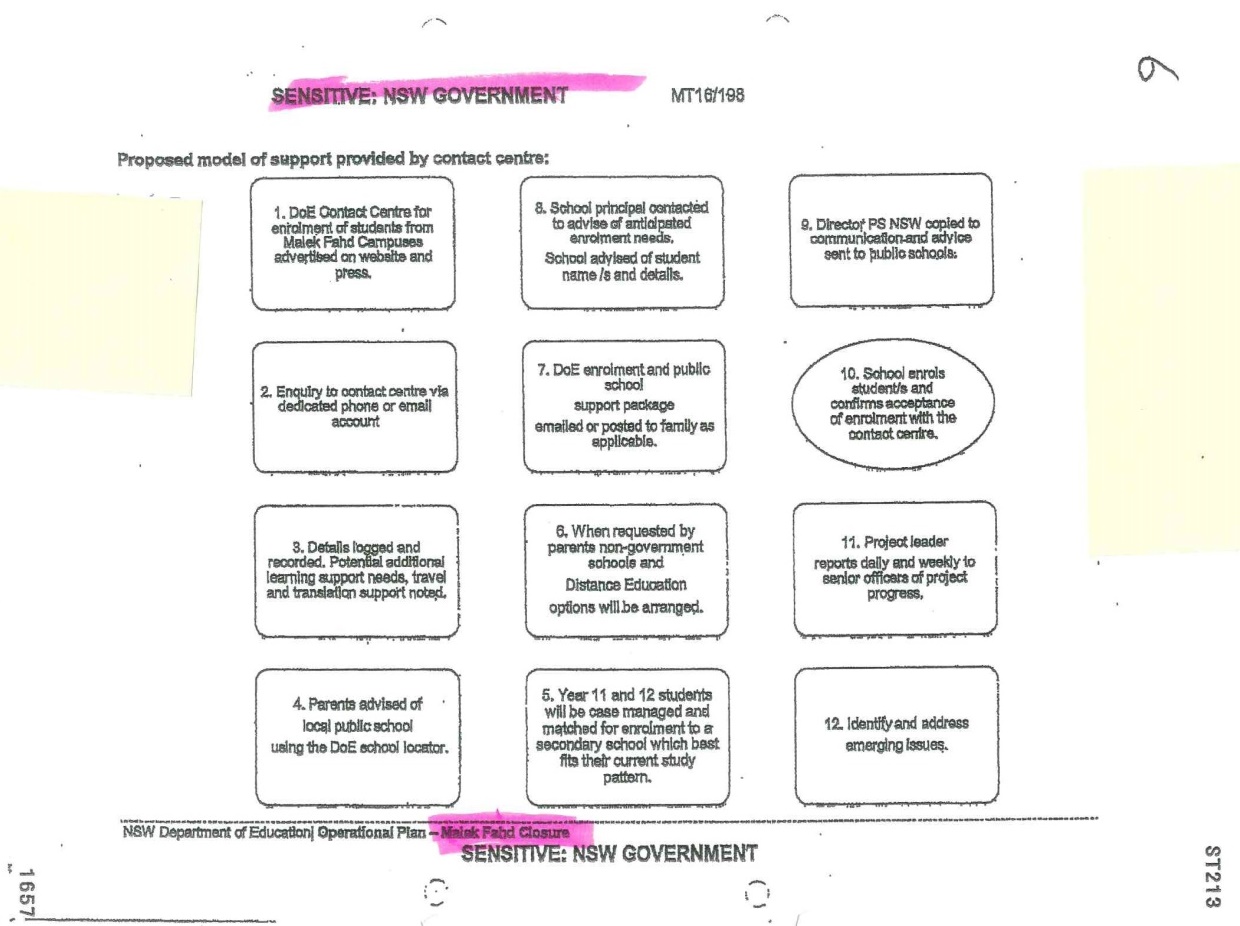
• The plan has a central Contact Centre – with a single phone number access point and website information to facilitate enrolment in a government or non-government school as requested by a parent of Malek Fahd Islamic School who makes contact. The Contact Centre has a project leader (senior officer level) as well as current senior officers, administration personnel, Learning and Wellbeing personnel and a Community Liaison Officer.
• The Association of Independent Schools NSW has committed to allocating a team member to the contact centre team should this be required.
• The attached is a diagrammatic flowchart of how the contact centre would operate. A particular case management focus for the contact centre would be any prospective Year 11 and 12 enrolments including liaising with Sydney Distance Education High School where required. It should also be noted that there has been some preliminary analysis of available enrolment capacity in primary and high schools surrounding the 3 Malek Fahd Islamic School campuses, noting that students of Malek Fahd Islamic School currently come from right across NSW.
• The contact centre is to be physically located at the Department’s Glenfield Education Office – it would take two days’ notice to have it fully operational.
• To date, Internal monitoring indicates that in 2016 there has been 28 enrolments from Malek Fahd Islamic School into government schools.
59 Ms Lydeker attached to her 16 May 2016 email a diagrammatic flowchart of how the contact centre would operate. The flowchart was as follows:
60 There are several reasons why, in my view, this email exchange falls well short of demonstrating that the delegate took into account the conceded mandatory relevant consideration. First, it is notable that the delegate did not state in her 6 April 2017 letter that she had had regard to this particular email exchange or its subject matter. The Minister’s submission is put at a much higher level of generality. He submitted that the Court should infer that the email exchange was taken into account by the delegate because the material which the delegate said she had taken into account included the documentation which had been filed in the AAT proceeding. That documentation included the May 2016 email exchange described above. The email exchange totalled four pages. It was common ground that the documentation filed in the AAT proceeding totalled approximately 3000 pages. In those circumstances, I do not draw the inference that the delegate had engaged in the requisite active intellectual process with the information contained in the four pages simply because she asserted that she had taken into account all of the documentation filed in the AAT.
61 Secondly, it is notable that the email exchange is dated 13 to 16 May 2016, which is almost 9.5 months before the delegate signed the 1 March 2017 minute and almost 10.5 months prior to the 6 April 2017 letter. No evidence was adduced which demonstrated that the “contingency plan” described back on 16 May 2016 was still available the following year when the delegate decided to delay Commonwealth funding to the School. Nor was there any evidence of any inquiries having been made by or on behalf of the delegate in respect of this mandatory consideration to ascertain whether the May 2016 correspondence was still reliable, bearing in mind the obligation to have regard to available and up to date information pertaining to a mandatory relevant consideration (see Minister for Aboriginal Affairs v Peko-Wallsend Ltd [1986] HCA 40; 162 CLR 24 at pages 44-45 per Mason J).
62 For all these reasons, I do not accept the Minister’s submission that the three relevant documents indicate that the conceded mandatory relevant consideration was in fact considered by the delegate.
63 Applying the general guiding principles set out above to the particular circumstances of this case, I find that the conceded mandatory relevant consideration was not taken into account in the relevant legal sense. The matters which have weighed most heavily with me in reaching this finding may be summarised as follows:
(a) The absence of any explicit reference to the conceded mandatory relevant consideration in the delegate’s reasons as set out in her 6 April 2017 letter.
(b) On its face, the delegate’s 6 April 2017 letter focuses exclusively on:
(i) the evidence and other material which underpinned the delegate’s finding that MFISL has not, and is not, complying with relevant requirements under the Education Act which are applicable to an approved authority; and
(ii) the Commonwealth’s difficulty in recovering any payments of financial assistance in 2017 if MFISL’s appeal to the Full Court from the AAT’s decision failed and MFISL’s inadequate asset base to satisfy any debt to the Commonwealth.
(c) It may reasonably be inferred that the delegate only took these kinds of matters into account because the view taken by both her and the Department at that time was that the delegate was not obliged to consider the practical effects on the students of delaying funding. In my view, this inference may more confidently be drawn having regard to the Minister’s change of position on the issue in the proceedings. In my respectful view, this provides a more plausible explanation than that which is implicit in the Minister’s submission, which I reject, that the delegate may have considered the conceded mandatory relevant consideration but not included it in the final section of her 6 April 2017 letter because it was not an “activating” or “dispositive” reason for the decision to delay funding.
(b) Irrelevant consideration concerning outcome of Full Court appeal
64 The discretionary power to delay funding under s 110(1)(c)(i) if s 108(b) applies is premised on the “approved authority” continuing to have that status under the Education Act. In the circumstances here, however, MFISL’s status would revert to what it was prior to the making of the AAT’s stay order if its current appeal to the Full Court did not succeed. I accept the Minister’s submission that the delegate was entitled to take this matter into account and that it did not involve predicting the outcome of the appeal. If the delegate was prohibited from considering “a consequence of the appeal being successful”, as contended by the applicant, this would have the effect of converting the AAT’s stay order into a general immunity from the requirements which attach to Commonwealth funding under Education Act and undermine its operation. I reject this ground.
(c) Errors of fact finding regarding lease arrangements with AFIC and MFISL’s asset base
65 In support of this ground, the applicant submitted that the principles in House v R [1936] HCA 40; 55 CLR 499 and Haritos v Commissioner of Taxation [2015] FCAFC 92; 233 FCR 315 apply. This submission must be rejected. The former authority identifies relevant principles for appellate review of judicial discretionary decisions. The latter authority deals with appellate review under s 44 of the Administrative Appeals Tribunal Act 1975 (Cth). Different principles apply in a case such as the present involving judicial review of administrative action. That is not to deny that there is some scope for review of fact finding in an appropriate judicial review case (see, for example, CQG15 v Minister for Immigration and Border Protection [2016] FCAFC 146 at [38] per McKerracher, Griffiths and Rangiah JJ). Neither of the two alleged errors of fact attract those particular principles. The delegate’s findings in relation to these matters were within the legitimate exercise of her discretionary power under s 110. I reject this ground.
(d) Wednesbury unreasonableness
66 The leading authority in Australia at present in respect of judicial review for unreasonableness in administrative law is Minister for Immigration and Citizenship v Li [2013] HCA 18; 249 CLR 332 (see also Minister for Immigration and Border Protection v Singh [2014] FCAFC 1; 231 FCR 437 and Minister for Immigration and Border Protection v Stretton [2016] FCAFC 11; 237 FCR 1 (Stretton)). It appears that the first of the applicant’s two unreasonableness claims relates to the outcome of the delegate’s decision. In particular, it claims that the outcome was plainly unjust or arbitrary in circumstances where, on the same facts and circumstances, the delegate made a decision on 4 April 2017 to release two months’ funding to MFISL and only two days later determined to delay that funding. I reject this claim. There is a rational explanation for the superficial inconsistency in the decisions. It is to be found in the description of the legal advice in the minute dated 4 April 2017 (see [15] above).
(e) Unreasonableness and disproportionality
67 The applicant placed heavy reliance on the concept of disproportionality in respect of its second unreasonableness claim, with particular reference to what was said in Stretton at [57]. The applicant submitted that the delegate’s decision was a disproportionate response in all the circumstances because “the decision would destroy the subject matter of the applicant’s appeal to the Federal Court, and render the appeal otiose”. The applicant submitted that the delegate ought to have provided financial assistance to MFISL on a month by month basis, or imposed conditions on such funding.
68 I reject these contentions. The need for judicial restraint in assessing disproportionality as an aspect of unreasonableness was emphasised in Stretton at [57]-[58]. I am not satisfied that the delegate gave excessive weight to MFISL’s identified non-compliance, as an approved authority, with the relevant requirements in ss 75 and 78 of the Education Act. Of course, this conclusion does not derogate from the delegate’s failure to take into account the conceded mandatory relevant consideration.
(f) Failure to take into account a relevant consideration
69 The essence of this review ground is that, while the delegate took into account the Full Court appeal when approving financial assistance to MFISL on 4 April 2017, it was not taken into account in the making of the 6 April 2017 decision. There is no substance in this complaint. As is evident from [17(d) and (e)] of the 6 April 2017 letter, the Full Court appeal was taken into account. It is unnecessary to determine whether, in any event, this is a mandatory relevant consideration. The ground is rejected.
Conclusion
70 For these reasons, the applicant has succeeded in one of its six grounds of judicial review. The delegate’s 6 April 2017 decision must be set aside. This is an appropriate case in which to set aside the decision from the day it became effective (see Wattmaster Alco Pty Ltd v Button [1986] FCA 599; 13 FCR 253 at 257-258 per Sheppard and Wilcox JJ). The Minister did not suggest to the contrary. The Minister must pay the applicant’s costs, as agreed or assessed.
I certify that the preceding seventy (70) numbered paragraphs are a true copy of the Reasons for Judgment herein of the Honourable Justice Griffiths. |


