FEDERAL COURT OF AUSTRALIA
Australian Nursing and Midwifery Federation v Bupa Aged Care Australia Pty Ltd [2017] FCA 1246
ORDERS
AUSTRALIAN NURSING AND MIDWIFERY FEDERATION Applicant | ||
AND: | ||
DATE OF ORDER: |
THE COURT ORDERS THAT:
1. The originating application filed 6 October 2017 be dismissed.
Note: Entry of orders is dealt with in Rule 39.32 of the Federal Court Rules 2011.
O’CALLAGHAN J:
introduction
1 By an originating application dated 6 October 2017 the Australian Nursing and Midwifery Federation (the applicant or the ANMF) seeks, pursuant to s 545 of the Fair Work Act 2009 (Cth) (the FW Act), interlocutory and final orders enjoining Bupa Care Services Pty Ltd (the respondent or Bupa) from “taking any steps to abolish the Care Manager and Clinical Manager positions at its [26 age care] facilities [in Victoria], and from taking any steps to introduce a position of Clinical Care Manager [at those facilities]”. The applicant also seeks a declaration under s 21 of the Federal Court of Australia Act 1976 (Cth) “that the [r]espondent has contravened s 50 of the [FW Act] by reason of its breaches of Clause 7 of the Bupa Care Services, ANMF and HSU Victorian Enterprise Agreement 2013” (the agreement). Clause 7 is a provision headed “Consultation and Dispute Resolution – Consultation regarding major workplace change”.
2 By its application filed 6 October 2017, the applicant also sought an interlocutory injunction to the same effect as the declaration described above. The matter came on before me as the duty judge on the same date. The parties requested that the application be adjourned to enable further discussions between them to occur. Accordingly, I adjourned the application to 11 October 2017, on the respondent giving certain undertakings (namely, not to implement, take steps to finalise, or proceed with any of the matters in paras 20(c)-(g) of the affidavit of Paul Gilbert affirmed 6 October 2017).
3 When the matter returned before me on 11 October 2017, I told the parties that I proposed to hear the trial of the proceeding on 16 October 2017. In light of that, the respondent agreed to, and the Court made, orders maintaining the status quo in the meantime.
4 The trial took place on 16 and 17 October 2017. At the conclusion of the hearing, I told the parties that I would, in light of the urgency of the matter, deliver judgment on or before 4:15 p.m. on 24 October 2017. The respondent again agreed to orders maintaining the status quo in the meantime.
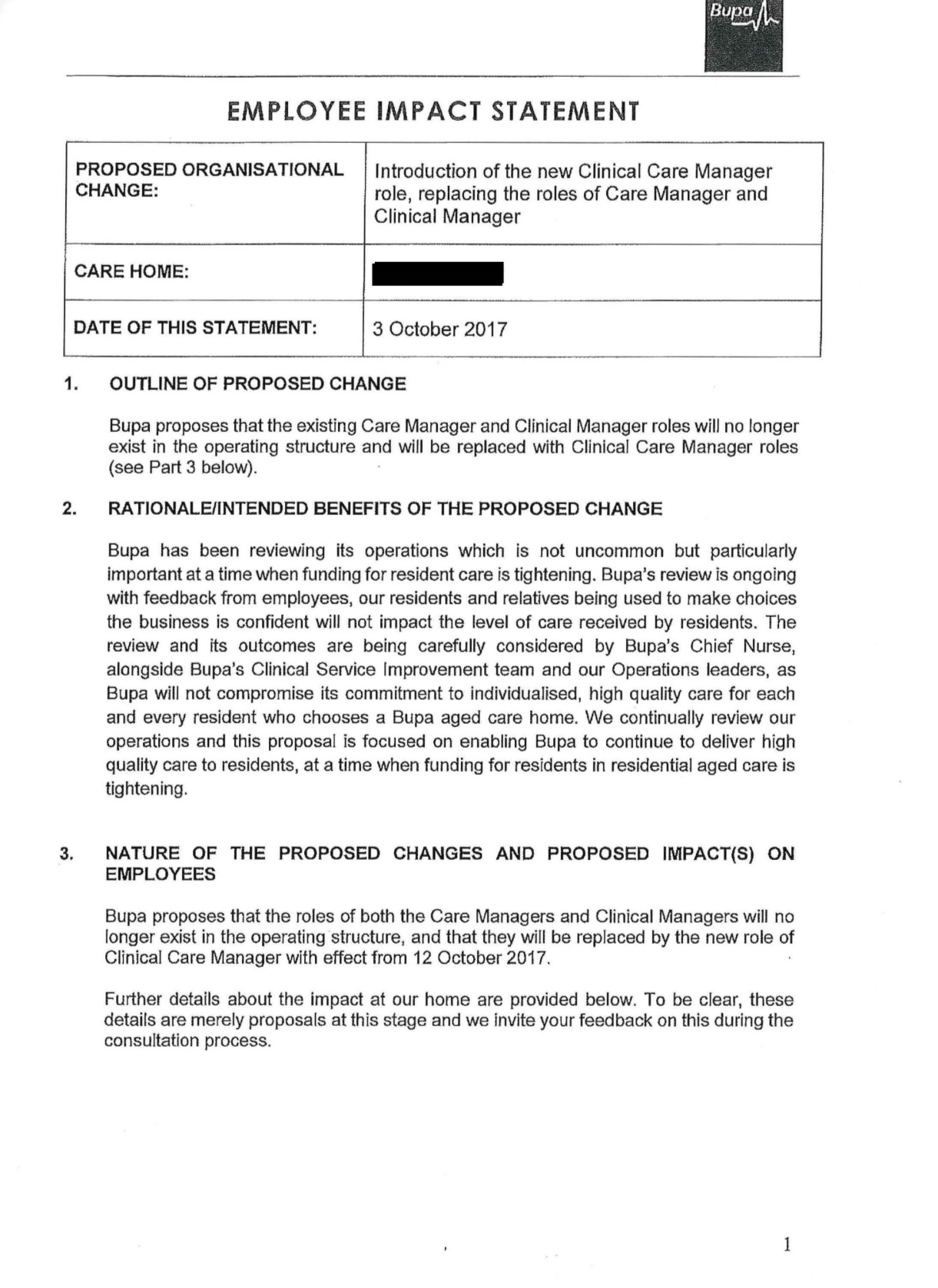
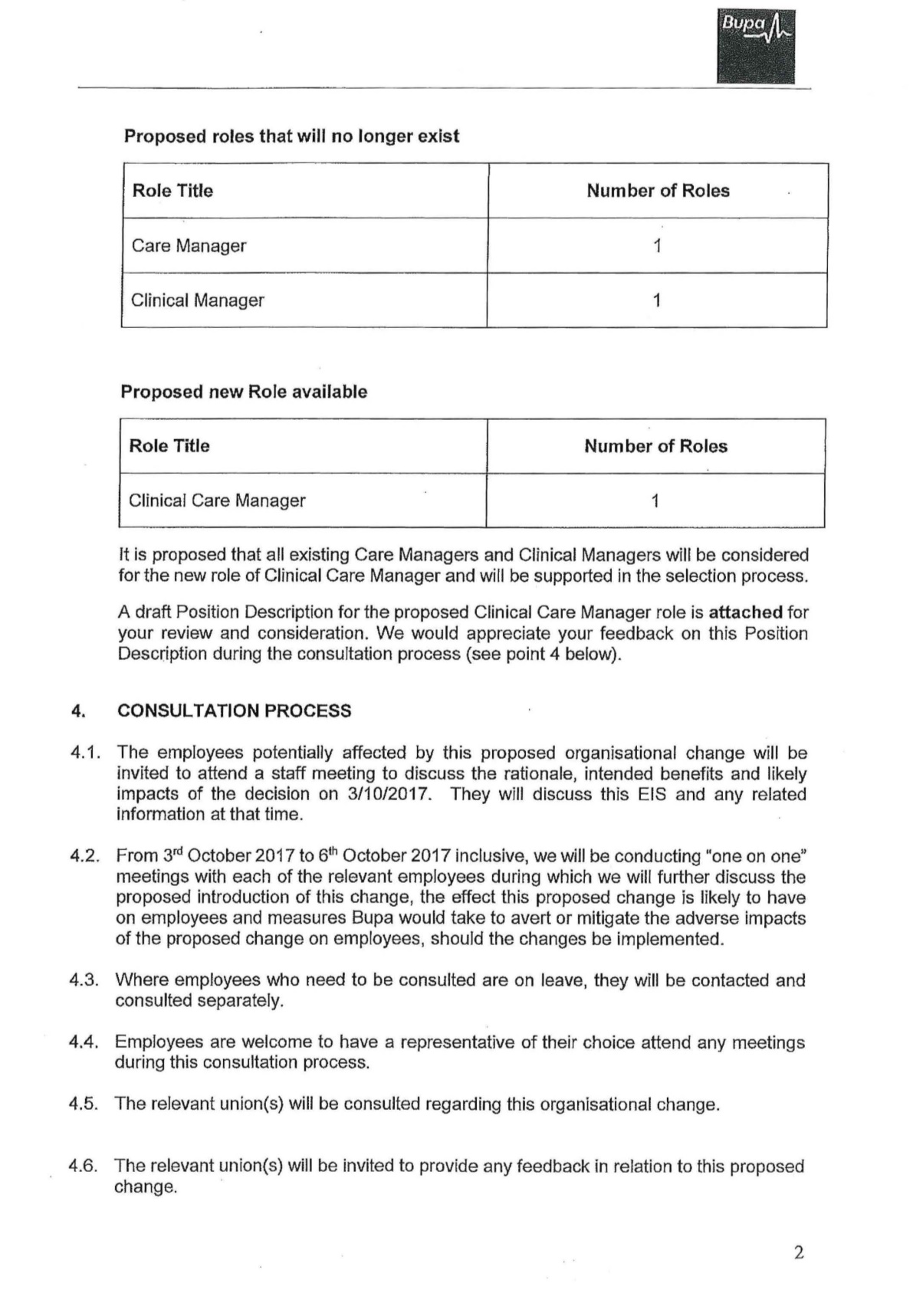
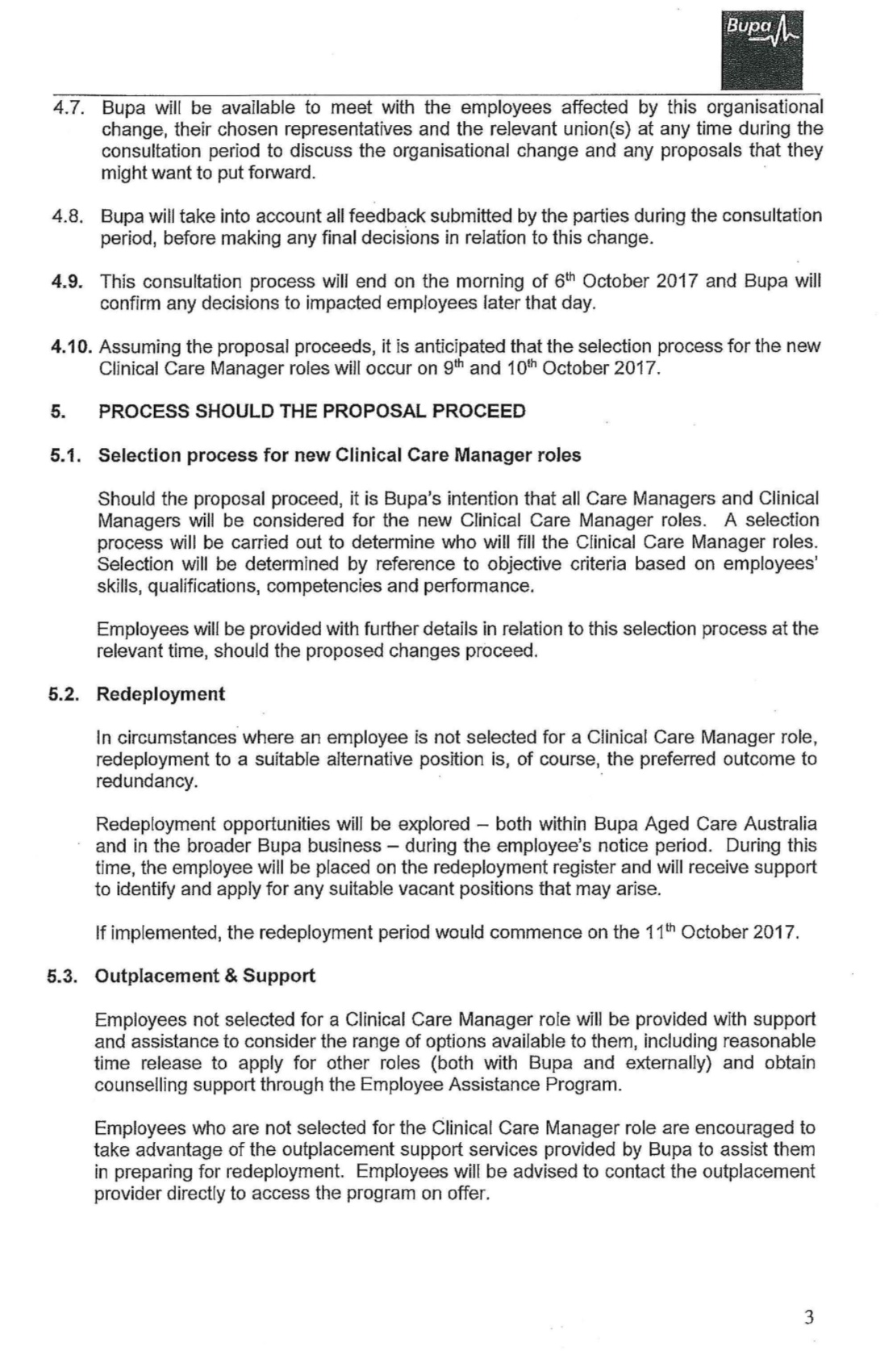
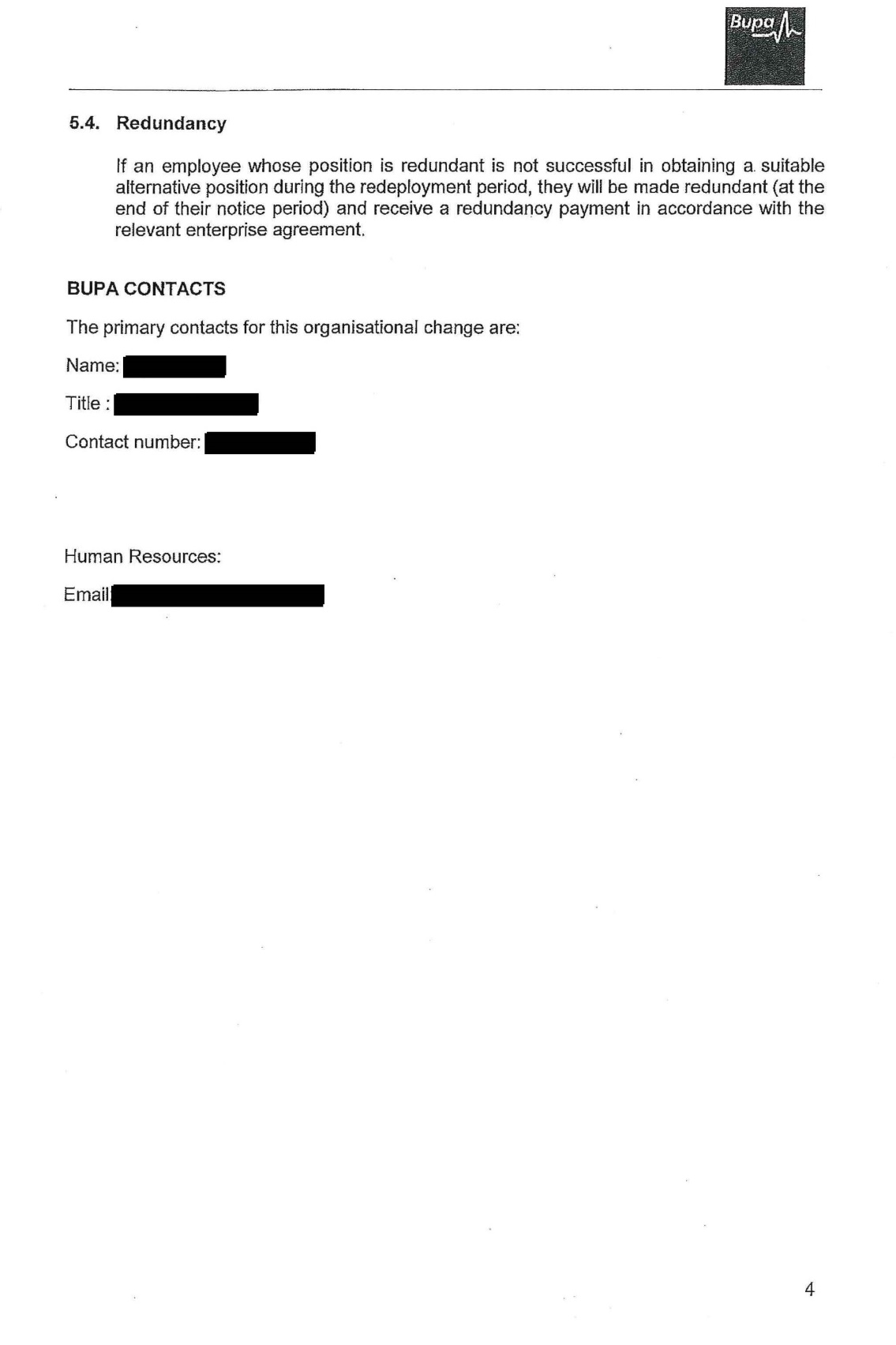
The facts
5 The respondent currently employs 53 Care Managers and 25 Clinical Managers across its 26 aged care facilities in Victoria. It has made what the parties agreed is a “definite decision” within the meaning of cl 7 of the agreement to abolish those positions and appoint 55 Clinical Care Managers in their place, which will, or may, result in 23 position redundancies.
6 Maureen Berry, who is currently the Interim Chief Operating Officer of the respondent, gave evidence that Bupa’s aged care residential homes are a 24-hour, seven-day-per-week operation. Homes are staffed by a combination of registered nurses, enrolled nurses and carers. Staffing levels are reduced at night. The operation of the homes is largely dependent upon funding from the Commonwealth government. Funding levels have recently been decreased, which has led the respondent to make the decision to abolish the Care Manager and Clinical Manager positions and to replace them with Clinical Care Managers.
7 Each of the 26 homes in Victoria is led by a General Manager, who normally is, or once was, a registered nurse. The General Managers are accountable for the commercial operations of the homes, care delivery and clinical delivery. General Managers are not covered by the agreement.
8 Clinical Managers are also registered nurses. They are responsible for supporting medical services and for the provision of clinical leadership within the home. The primary role of a Clinical Manager is to provide support in the delivery of medical services administered by general practitioners. Essentially, they carry out all the administrative and support functions that a general practitioner does not perform. Clinical Managers are covered by the agreement.
9 Care Managers are also registered nurses and are responsible for the outcomes of patient care. Care Managers conduct complex clinical care on an ad hoc basis and also respond to incidents, such as falls. They also are covered by the agreement.
10 Both Care Managers and Clinical Managers work 7.5 hours per day. Because the homes operate seven days per week, 24 hours per day, Care Managers and Clinical Managers are not present at the home for the majority of the time in the day. Further, because they move around the various parts of the home, depending on the task required of them, they are not “on the floor” the whole time that they are at work either. When a Care Manager or a Clinical Manager is not present, their responsibilities are delegated to a registered nurse.
11 Registered nurses, enrolled nurses and carers are responsible for the delivery of resident care. A registered nurse holds a bachelor’s degree, an enrolled nurse holds a TAFE certificate or diploma in nursing and carers hold a TAFE certificate qualification in personal care. Each of these types of employee is covered by the agreement. Each of them reports to the General Manager, and they are supervised by, and consult with, Clinical Managers and Care Managers in the delivery of care.
12 Homes operated by the respondent also employ administration officers to provide general administrative support. They perform all back end and front desk duties, including responding to enquiries, performing data entry, managing roster changes, logging incidents and the like. They are not covered by the agreement.
13 Ms Berry gave the following unchallenged evidence about the development of the proposal to amalgamate the Care Manager and Clinical Manager positions:
[62] [As a result of the process brought about by the changes to funding by the Commonwealth government] we identified the prospect of creating the Clinical Care Manager position. The Clinical Care Manager position is in part an amalgamation of the Clinical Manager and Care Manager positions. In summary, all administrative duties will be stripped from the Clinical Manager and Care Manager positions and reallocated to the Administration Officers and General Manager, depending on the type and complexity of the administrative task. The intention is to ensure that our employees who had previously performed the functions of Clinical Manager and Care Manager, remain wholly focused on our residents, with their administrative functions returning to the administrative stream of the business. Further information is provided in the employee information statement and the draft position description which I reviewed …
[63] The amalgamation of these positions will result in some reduction in head count among Clinical Managers and Care Managers. Although final numbers will depend, present indications are that Bupa … will have 55 Clinical Care Managers. Subject to redeployment therefore, about 23 of the existing Clinical Managers or Care Managers would likely be made redundant if the proposal is implemented in its current form.
[64] The proposal, should it be implemented, would have no impact on the care of our residents, their safety and well-being, or the safety and well-being of our staff. The level of clinical care, clinical experience and expertise will not alter. Nor would the proposal impact upon the workloads of our registered nurses, enrolled nurses or carers/clinicians. In terms of care, benefits of the proposal include:
(a) removal of overlap … ;
(b) removal of conflicting advice and conflicting interactions … ;
(c) returning our senior nurses to a care and clinical focus: over time, there has been “function creep” into both roles but particularly the Clinical Manager. The result of this function creep has meant that the role of Clinical Manager has absorbed various administrative tasks that were never intended to be performed by that position. This is true, to a lesser extent, for the role of Care Manager also by clarifying the role of the Clinical Care Manager and stripping away the administrative functions from that position, the employees in that position will have more time [to] focus on care. The Clinical Care Manager will also have more time to invest into the development and supervision of our registered nurses, enrolled nurses and carers.
[65] No impact arises on the registered nurses, enrolled nurses and carers through this change. There is no change to the work they will do – no functions of the Care Manager and Clinical Manager will be assigned to any of those roles. They will perform the exact same functions as they always have. There is no alteration in the nurse/carer workload as a consequence, nor is there any change to the skills that they will have/require to perform their roles. None of their jobs or roles are restructured or altered, no additional training or retraining is required, their hours of work are not affected at all and none of them will be relocated.
[66] Reporting lines remain unchanged – all positions continue to report to the General Manager. If implemented, the only difference will be that a person will occupy the Clinical Care Manager position in lieu of the two previous positions (at accepting of course that there is not a simple “two for one” reduction in each case). There will be one person to consult with about care and clinical work, not two.
14 Ms Berry further gave the following unchallenged evidence about the question of consultation:
[67] Bupa … is currently [her affidavit was sworn on 16 October] consulting with each of the Care Managers and Clinical Managers, which has been informed by the Employee Information Statements provided for each of the 26 homes. The Employee Information Statements are intended to provide all relevant information bearing upon the proposal and all relevant information that an employee might want to know when considering the proposal. The Employee Information Statements have been supplemented by more information in a frequently asked questions sheet as well as the draft position description for the Clinical Care Manager role.
[68] If there is other information required by an employee, the employee has the opportunity to ask for that information in the consultation process – I understand that there are two avenues for employee feedback during the consultation period, one being via individual meetings with their General Manager, and the other via the … email address, which is an inbox permanently staffed by human resources personnel for the actioning of employee enquiries.
[69] Consultation is continuing. The consultation process is being coordinated by human resources personnel and being implemented by the General Managers of each home. I was consulted on the preparation of the Employee Impact Statement, the Frequently Asked Questions, and the draft position description. I have played no other specific role in consultation with respect to the 26 Victorian homes: this is for the General Managers.
[70] From my perspective, it is important to note that whilst a decision has been made by Bupa … to implement change, it remains a proposal. I wish to receive the benefit of the views [of] affected employees in the consultation process.
[71] The various responses that may come from the consultation process are endless and I cannot speculate as to what each individual employee might say in response to the proposal. Any responses I receive will be genuinely considered in relation to the final decisions that are being made with respect to each home. From my perspective, it would be an opportunity lost to simply dismiss feedback received by affected employees.
[72] It is also critical to understand that the consultation occurring is for each and every home. The consultation will inform what may occur at each individual home. There might be proposals put forward with respect to an individual home which differ from others. I will consider those responses. There might be more global responses that apply to the proposal as a whole. I will consider that feedback too.
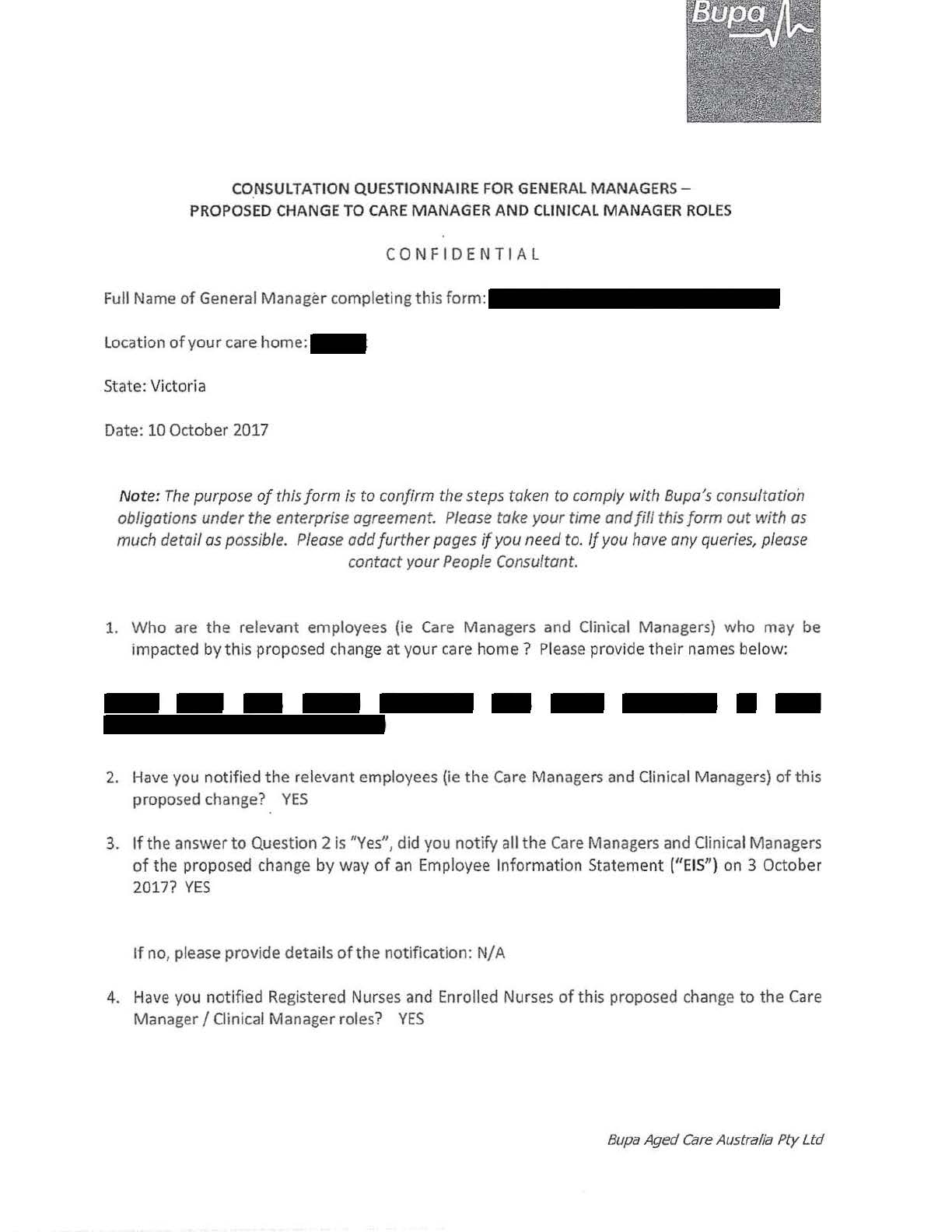
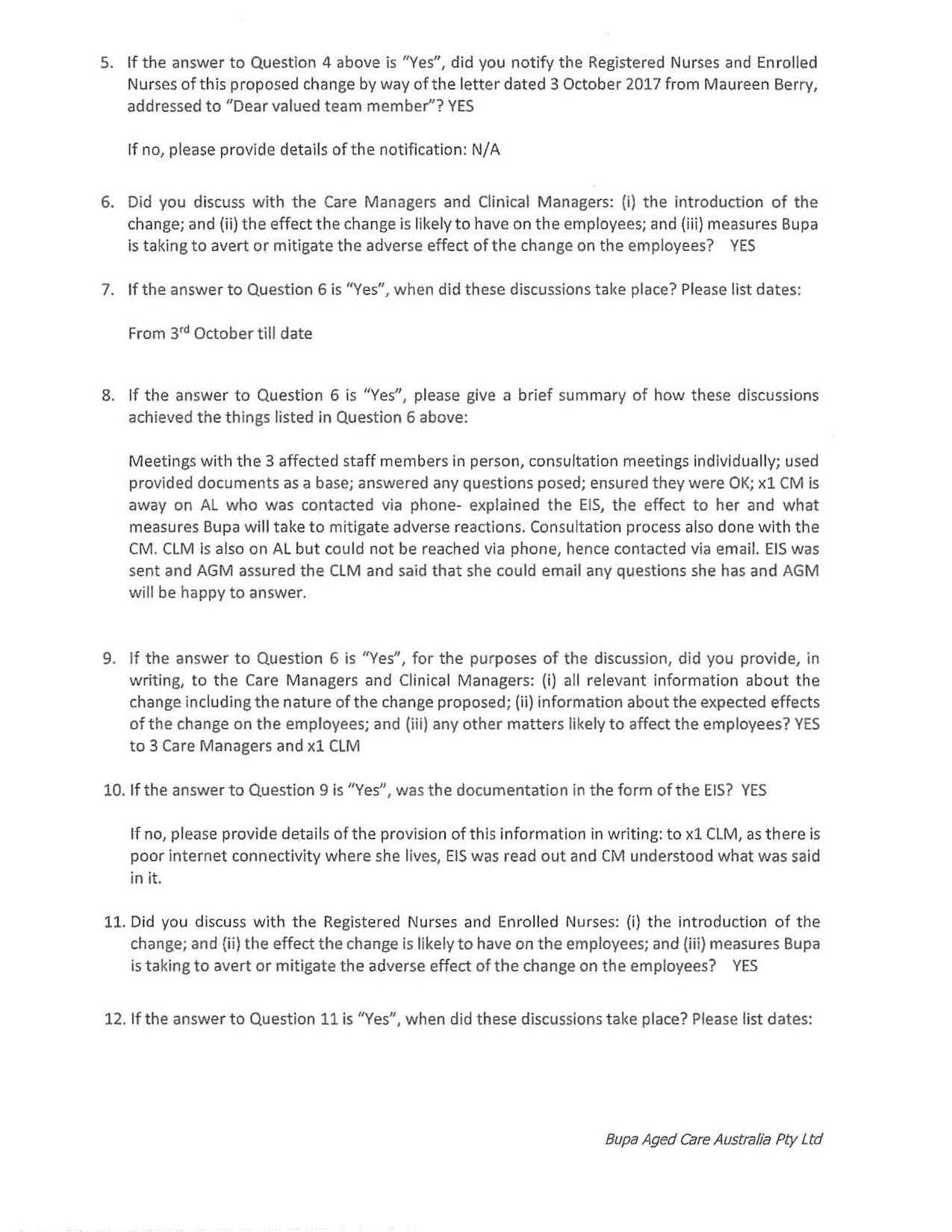
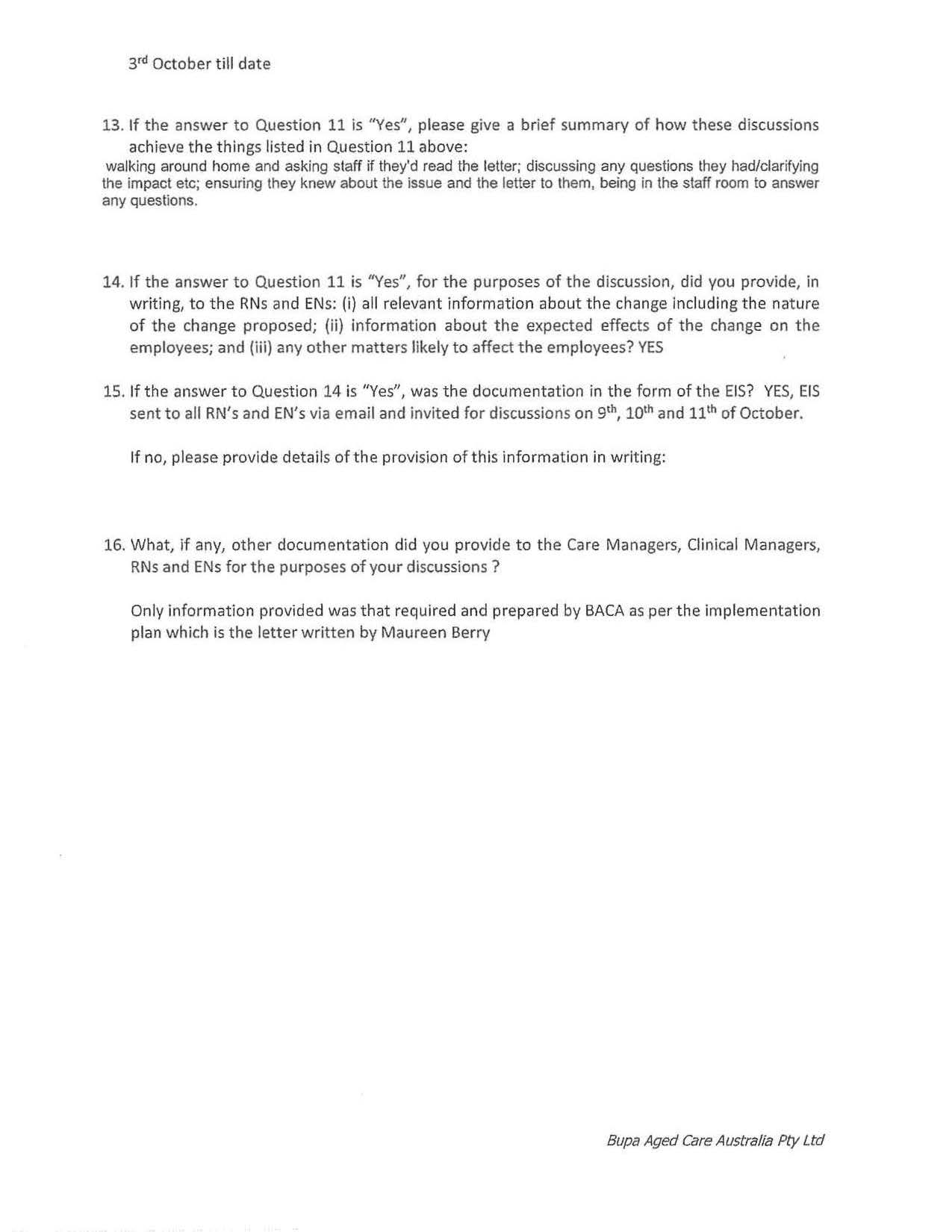
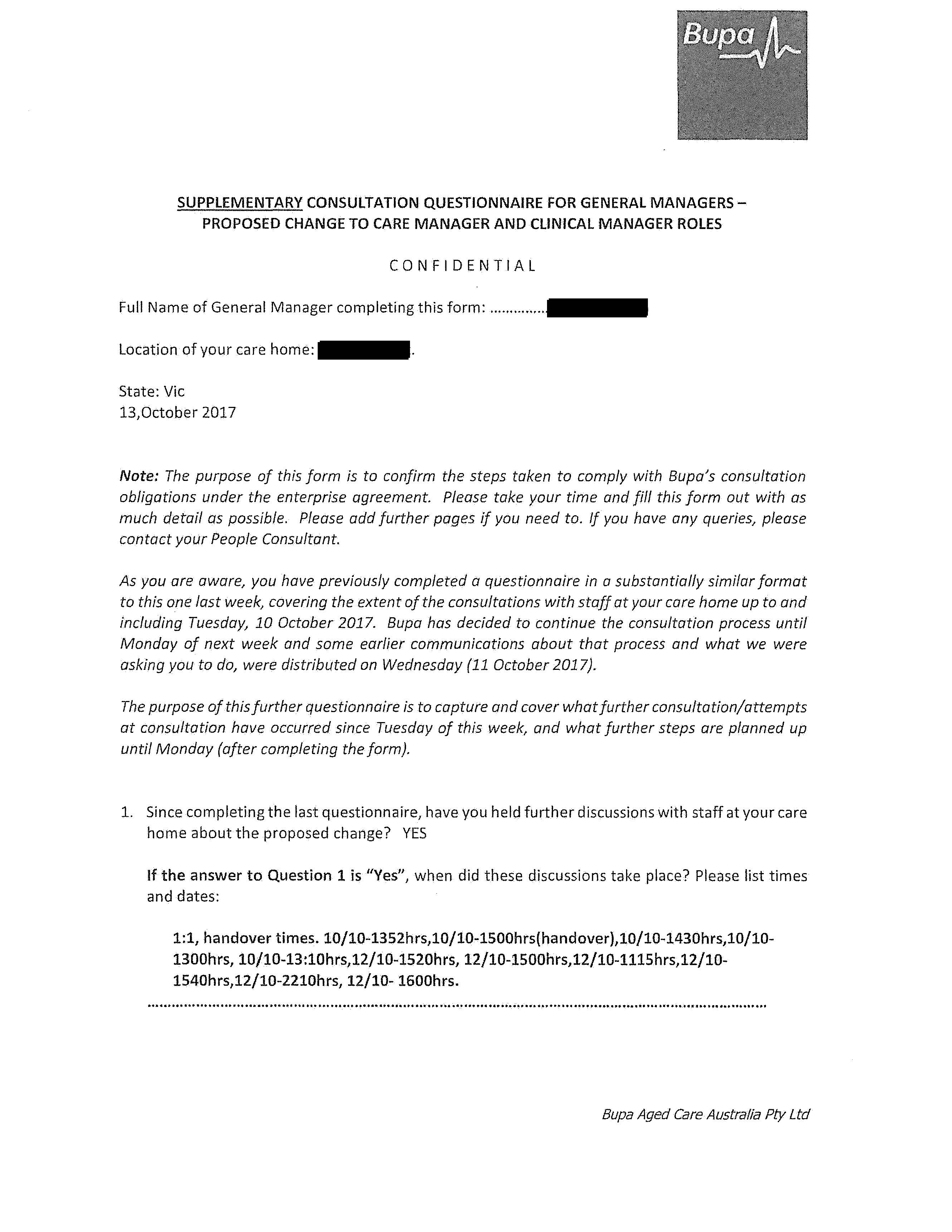
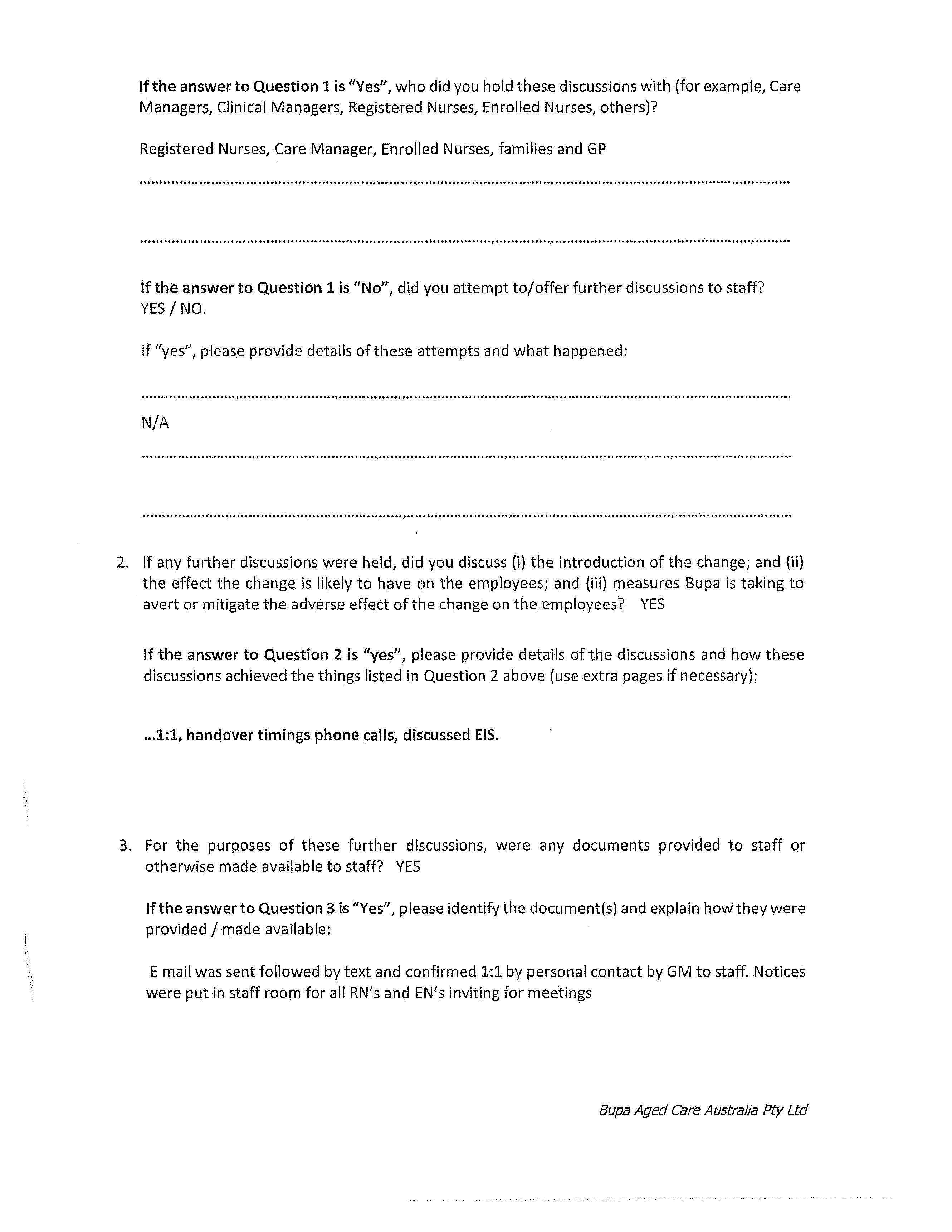
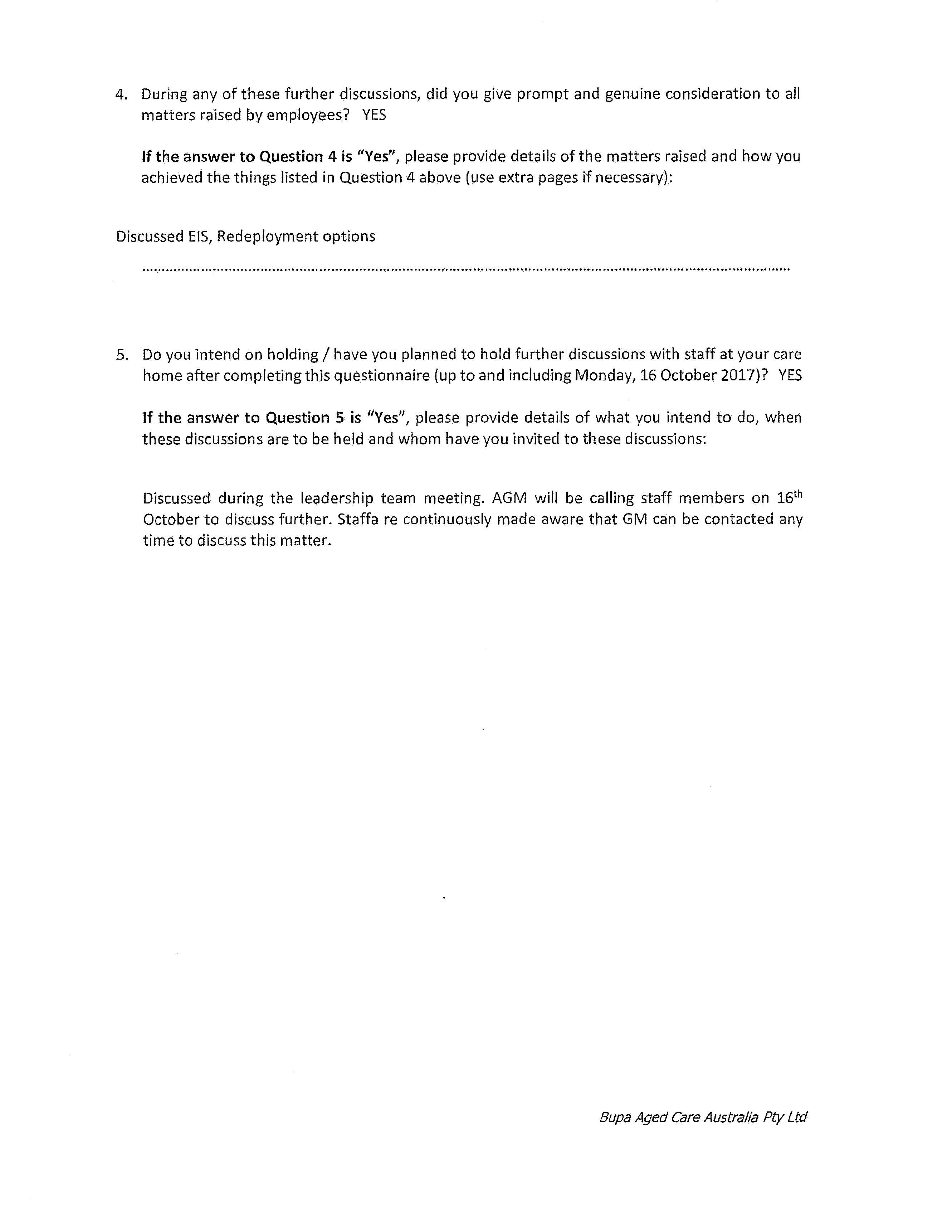
15 Copies of the Employee Impact Statements, together with the consultation questionnaires and supplementary consultation questionnaires for General Managers for each of the 26 facilities in Victoria were also in evidence. An example of these documents, redacted to protect the privacy of named individuals, is attached as Schedule A to these reasons. The consultation questionnaires reflect the relevant requirements and terms of cl 7 of the agreement. Questions numbered 2, 3 and 4 reflect cl 7.2; questions numbered 6, 7, 8, 11, 12 and 13 reflect cl 7.5(a); and questions 9, 10, 14 and 15 reflect cl 7.5(b).
16 The applicant relied on 12 affidavits, namely:
(1) five affidavits of Paul Gilbert – two affirmed 6 October 2017 and the rest affirmed 10, 13 and 16 October 2017, respectively;
(2) three affidavits of Sonja Terpstra, affirmed 10, 13 and 16 October 2017, respectively;
(3) two affidavits of Dimitra Jane Manuele, sworn 10 and 16 October 2017, respectively; and
(4) two affidavits of Pauline Elizabeth Hooper, both sworn 16 October 2017.
17 The respondent relied on the following five affidavits:
(1) two affidavits of Calum Duncan William Cook affirmed 11 and 16 October 2017;
(2) an affidavit of Marie Carigliano, affirmed 16 October 2017;
(3) an affidavit of Maureen Mary Berry, sworn 16 October 2017; and
(4) an affidavit of Daniel Smith, affirmed 16 October 2017.
the issues for resolution
18 The applicant proffered 16 individual questions, some of which contain multiple sub-questions, which it says arise to be determined on its application.
19 For the most part, the respondent agreed that the questions were a convenient way to consider or ventilate the issues which the applicant seeks to raise about the contraventions of the agreement alleged.
20 It may be thought, on one view, surprising that the issue of whether a contravention of a single clause in an enterprise agreement requiring parties to consult about a “definite decision” could give rise to so many questions. For reasons which I will explain below, a number of the questions do not in fact arise because they pose questions that cl 7 does not pose. Again, for reasons which I explain below, in my view, on the proper construction of cl 7, and in the events that have occurred, cl 7 has no application because the “definite decision” to introduce the change in this case is not “a major change” and, in any event, it is not a change that “is likely to have a significant effect on [Bupa’s] employees …”. I will deal with each of the questions in turn, but for the reasons I explain below, on the proper construction of cl 7 of the agreement the remaining questions do not arise.
21 Before turning to the questions, it is convenient to set out the relevant parts of cl 7 of the agreement, as follows:
Part 2 – Consultation and dispute resolution
7. Consultation regarding major workplace change.
7.1 This term applies if:
(a) Bupa has made a definite decision to introduce a major change to production, program, organisation, structure or technology in relation to its enterprise; and
(b) the change is likely to have a significant effect on employees of the enterprise.
7.2 Bupa must notify the relevant employees of the decision to introduce the major change.
7.3 The relevant employees may appoint a representative for the purposes of the procedures in this term.
7.4 If:
(a) a relevant employee appoints, or relevant employees appoint, a representative for the purposes of consultation; and
(b) the employee or employees advise Bupa of the identity of the representative;
Bupa must recognise the representative.
7.5 As soon as practicable after making its decision, Bupa must:
(a) discuss with the relevant employees:
(i) the introduction of the change; and
(ii) the effect the change is likely to have on the employees; and
(iii) measures Bupa is taking to avert or mitigate the adverse effect of the change on the employees; and
(b) for the purposes of the discussion – provide, in writing, to the relevant employees;
(i) all relevant information about the change including the nature of the change proposed; and
(ii) information about the expected effects of the change on the employees; and
(iii) any other matters likely to affect the employees.
7.6 However, Bupa is not required to disclose confidential or commercially sensitive information to the relevant employees.
7.7 Bupa must give prompt and genuine consideration to matters raised about the major change by the relevant employees.
7.8 In this clause, a major change is likely to have significant effect on employees if it results in:
(a) the termination of the employment of employees; or
(b) major change to the composition, operation or size of Bupa’s workforce or to the skills required of employees; or
(c) the elimination or diminution of job opportunities (including opportunities for promotion or tenure); or
(d) the alteration of hours of work; or
(e) the need to retrain employees; or
(f) the need to relocated employees to another workplace; or
(g) the restructuring of jobs.
7.9 In this clause, relevant employees means the employees who may be affected by the major change.
7.10 …
issues for determination
Question 1: Is the proposed change to Care Manager and Clinical Manager positions a “major change” to either production, program, organisation, structure or technology in relation to the respondent’s enterprise, within the meaning of cl 7.1(a) of the agreement?
22 Clause 7 of the agreement applies, and only applies, if Bupa “has made a definite decision to introduce a major change to production, program, organisation, structure or technology in relation to [Bupa’s] … enterprise”.
23 In Port Kembla Coal Terminal Ltd v Construction, Forestry, Mining and Energy Union (2016) 248 FCR 18 (Port Kembla Coal) at 72 [186], Jessup J held as follows:
As to the second of the two ways in which his Honour characterised the circumstances leading to the termination of the employments of these three employees, again I do not, with respect, agree that the occurrence of a “forced redundancy” makes the underlying, or corresponding, change a “major” one. If many employees were to be made redundant, there may well have been a major change with which those redundancies were associated, but the size and importance of the change would have to be assessed by reference to facts which went beyond, although they may include, the facts of the redundancies. In the present case, it is enough to reiterate that the forced redundancy of three employees out of a workforce of about 98 did not of itself constitute a major change within the meaning of cl 7.1.
24 In that same case, White J added this qualification to what Jessup J said about the notion of a “major change” ((2016) 248 FCR 18 at 143 [499]):
The second qualification is that I do not regard a simple comparison between the number of employees to be terminated, and the number of the employees in its workforce overall, for which PKCT contended, as being necessarily conclusive of the question of whether a change is “major”. Much may depend on the circumstances of a given case including, for example, the seniority and importance of the employees in PKCT’s operations, the extent to which PKCT’s employees work in an integrated or disconnected manner; the consequences for the continuing employees of the redundancies and consequent terminations, as well as other matters. In the present case, the primary Judge did not rest his conclusion on an analysis of this kind. Nor did the applicants contend, in the manner of a notice of contention and with references to the evidence, that the Judge should have made findings on these matters in relation to their redundancies and terminations.
25 The applicant “accepted that the mere fact that forced redundancies would occur as a result of the proposed decision does not automatically amount to a ‘major change’”, and after citing Port Kembla Coal (2016) 248 FCR 18, submitted (at [18] of its written closing) that “[h]ere the proposed change does involve a large number of redundancies and the importance of the change is highlighted by the seniority of the roles”.
26 The respondent accepted that the change was a change to the structure of the respondent’s enterprise, but it submitted that whether the nature of the change was assessed by reference to the number of redundancies in relation to the total number of employees (23 out of over 3,000) or the possible impact more broadly – including what White J referred to in Port Kembla Coal (2016) 248 FCR 18 as “the seniority and importance of the employees”, “the extent to which … employees work in an integrated or disconnected manner” and “the consequences for the continuing employees of the redundancies and consequent terminations” – it was not possible to describe the amalgamation proposed in this case as a major change to the structure of the respondent’s enterprise. The respondent also submitted that the changes were being effected to employees who work 7.5 hours out of a 24-hour day, on a five-day week, and that that too is relevant to an assessment of whether a “major change” is contemplated to the structure of the enterprise.
27 The difficulty faced by the applicant is that it did not adduce any evidence about the possible impact of the implementation of the decision “more broadly”. The only evidence before the Court, which, as I have noted above, was unchallenged evidence, was from Ms Berry, who said that “[n]o impact arises on the registered nurses, enrolled nurses and carers through this change”. She swore that “[n]one of their jobs or roles are restructured or altered, no additional training or retraining is required, their hours of work are not affected at all and none of them will be relocated”: see [13] above.
28 The applicant submitted that a change would be effected to the consultation and supervision functions carried out by relevant employees, but, again, there is no evidence to enable me to evaluate that submission. And counsel’s limited cross-examination of Ms Berry on the issue, to which he referred in closing, was of no assistance to the applicant’s case.
29 When making findings of fact in respect of alleged contraventions of the FW Act, due regard must be had to the gravity of the matters alleged. Section 140 of the Evidence Act 1995 (Cth) provides as follows:
140 Civil proceedings: standard of proof
(1) In a civil proceeding, the court must find the case of a party proved if it is satisfied that the case has been proved on the balance of probabilities.
(2) Without limiting the matters that the court may take into account in deciding whether it is so satisfied, it is to take into account:
(a) the nature of the cause of action or defence; and
(b) the nature of the subject-matter of the proceeding; and
(c) the gravity of the matters alleged.
30 As Flick J said in Australian Building and Construction Commissioner v Hall [2017] FCA 274 at [18], the Court must “take into account the fact that the contraventions alleged are contraventions of civil remedy provisions of the [FW Act]. They are, accordingly, properly to be regarded as ‘quasi-criminal’”. Further, the standard of proof referred to in s 140(2) is a re-statement of the standard of proof referred to by Dixon J in Briginshaw v Briginshaw (1938) 60 CLR 336. It follows that “[f]indings as to a contravention of the [FW Act] are not findings lightly to be made”: Australian Building and Construction Commissioner v Hall [2017] FCA 274 at [19] and [20].
31 In my view, there is no evidence before the Court to enable me to conclude that the decision in this case would introduce “a major change” to the structure of the respondent’s enterprise. The evidence before the Court, upon which the respondent relies, all points the other way: see [26] above. It follows, for that reason alone, that on the proper construction of cl 7.1(a) of the agreement, cl 7 has no application to this case, and that accordingly the applicant’s claim must be dismissed.
32 Clause 7 also has no application, even if the change is a major one, if it is not “likely to have a significant effect on employees of the enterprise”. The phrase “likely to have a significant effect on employees” is defined in cl 7.8 of the agreement. That clause is set out above at [21]. That clause gives rise to question number 2.
Question 2: If “yes” to question 1, is the “major change” which is identified likely to have a significant effect on employees of the respondent’s enterprise, within the meaning of cll 7.1(b) and 7.8 of the agreement?
33 The applicant submitted that the proposed change in this case would not only result in the termination of the employment of some 23 employees, but it would also result in “[a] major change to the composition, operation or size of the employer’s workforce or to the skills required of employees, requiring persons employed as clinical managers or care managers to perform different roles and utilise different skills” or “the elimination or diminution of job opportunities (including opportunities for promotion or tenure) by significantly reducing the number [of] positions at the level above the work performed by ordinary registered nurses”. This, it was submitted, “also limits potential job opportunities for enrolled nurses who may upgrade the qualifications to become registered nurses”. It was also submitted that the proposed change would result in the restructuring of jobs.
34 The difficulty with these submissions, as the respondent submitted, is that there is no evidence to support them, let alone the type of evidence that would be necessary in a case such as this. The evidence, such as it is, suggests the contrary.
35 The applicant also sought to rely on what it called a concession by the applicant that cl 7 had been triggered. In an email dated 5 October 2017, sent before this proceeding was commenced, from Mr Cook, Bupa’s solicitor, to Mr Gilbert, the assistant secretary of the Victorian Branch of the applicant, Mr Cook said this:
Let me assure you that Bupa is fully aware that the consultation process in clause 7 of the enterprise agreement has been triggered which is why we have commenced the consultation process with all relevant employees …
36 The applicant does not contend that an estoppel arises as a result of the email. Rather, it says that the concession is correct and the Court should be slow to depart from it.
37 For the reasons I have given, in my view the concession was not correct. And there is no reason that the applicant should now be bound by something the solicitor said before the proceeding was commenced. As counsel for the respondent submitted, it is a legal, not a factual question, it was the applicant who proffered questions 1 and 2 which sought to debate the point, and what Mr Cook said did not “represent a principled consideration” of the applicant’s submission that the facts of the present case did constitute a major change within the meaning a cl 7 of the agreement: cf Port Kembla Coal (2016) 248 FCR 18 at 72 [182] per Jessup J, with whom White J agreed.
38 For those reasons, Mr Cook’s concession may be put to one side.
39 Questions three and four may be dealt with together. Those questions are as follows.
Question 3: If “yes” to question 2, are registered nurses employed to work in the respondent’s aged care homes employees who “may be affected” by the “major change” such that they are “relevant employees” within the meaning of cl 7.9 of the agreement?
Question 4: If “yes” to question two, are enrolled nurses employed to work in the respondent’s aged care homes employees who “may be affected” by the “major change” such that they are “relevant employees” within the meaning of cl 7.9 of the agreement?
40 These questions have been overtaken by events. Although the respondent says that the terms of cl 7 of the agreement do not oblige it to consult with registered nurses or enrolled nurses, it has, since 9 October, in fact done so. So much is readily apparent from the affidavit of Ms Carigliano, which exhibited the consultation questionnaires, examples of which are attached to these reasons.
41 The applicant’s complaint was that registered nurses and enrolled nurses “may be affected” by “a major change” within the meaning of cl 7.9, such that Bupa is obliged to comply with cll 7.5 and 7.7 in respect of them. The applicant contends that such nurses “work closely with”, consult, and are supervised by, Clinical Mangers and Care Managers, and that implementation of a decision to amalgamate the roles would “at the very least” mean that they would “lose the benefit of a role which provides them with supervision”. It was also submitted that the nurses would lose a promotional opportunity, and that “there is at least a tangible risk that the removal of one position from each facility will increase the workload” of registered nurses and enrolled nurses. In respect of the last point, the applicant relied on the evidence of Ms Hooper, who is a registered nurse at the respondent’s Caulfield facility. The applicant submitted that “Ms Hooper’s concern is that the effect of the change would be that even more work will be pushed down to the Care Manager and they will have little time to undertake resident care duties which will then fall to the community nurse [a registered nurse], who is already overburdened”.
42 In my view, none of those matters constitute evidence that registered nurses or enrolled nurses “may” relevantly be “affected”. The evidence, such as it is, is little more than speculation, and does not rise to the level of the evidence required in a case such this, where the applicant seeks the imposition of a penalty in respect of an alleged contravention of the agreement.
43 In any event, as I say, the respondent has now in fact consulted with the registered nurses and the enrolled nurses at each of its facilities in Victoria.
Question 5: Did one or more “relevant employees” appoint the applicant as a representative of the purposes of the procedures in cl 7 of the agreement?
44 The respondent agrees that the answer to this question is “yes”.
Question 6: If “yes” to question five, did any of those employees notify the respondent that the applicant was their representative?
45 The respondent agrees that the answer to this question is “yes”.
Question 7: If “yes” to question 6, did the respondent fail to:
(a) invite the applicant to meetings with relevant employees who had appointed the applicant as their representative;
(b) meet with the applicant to discuss the proposed change after the applicant had been appointed as a representative; and
(c) adequately respond to requests for information by the applicant after the applicant had been appointed as a representative?
46 The applicant contends that the respondent did so fail to invite the applicant, meet with the applicant and adequately respond to the requests for information. It submits that the obligation of the respondent to “recognise” the representative of the applicant carries with it an obligation in the respondent to invite the applicant to meetings with relevant employees who had appointed the applicant as their representative and to discuss the proposed change with it. As to those two points, the respondent says that cl 7.4 of the agreement (set out at [21] above) imposes no such positive obligation on it to invite the applicant to meetings with its employees or to meet with them. The respondent submits that an obligation to “recognise” the representative does not impose any additional obligation beyond acknowledging or treating as valid the appointment by the employee of that representative. It follows, so the respondent contended, that once an employee appoints a representative for the purposes of consultation, and once the respondent recognises the representative, the employer is not entitled to refuse to meet with the representative, either with or without the employee, if the employee invites the representative to a meeting or requests the employer to provide to the representative relevant information. As counsel for the respondent put it: “… if we shut them out and say, ‘No, you’re not coming in’ or ‘we are not giving you this information’ or ‘we are not going to listen to what you say and give consideration to it’, that would be a failure”. But if an employee says to the employer that he or she did not require the attendance of the representative at a meeting, as was the evidence in one case, no contravention of cl 7 could be contemplated.
47 In my view, the contentions of the respondent in this regard must be accepted. There is no obligation in cl 7 imposed upon the respondent to consult separately with the applicant, or separately to invite the applicant to meetings with its employees. In my view, the clear intention of cl 7 is that an employee of the respondent who has appointed a representative for the purposes of consultation under the clause, is entitled to invite the representative to any meeting with his or her employer and is entitled to ask the employer to provide information both to him or her and the representative; but no obligation is imposed upon the respondent to invite the representative to the meeting regardless of the wishes of the employee or to provide information in such circumstances.
48 As to the question dealing with whether the respondent adequately provided information to the applicant, in my view the question does not arise out of cl 7 of the agreement and, in any event, there was no evidence before me to enable me meaningfully to answer the question one way or the other.
Question 8: If “yes” to question 7, did these failures amounts to a contravention of cl 7.4 of the agreement?
49 For the reasons given above, the answer to question 8 must be “no”.
Question 9: Did the respondent fail to:
(a) discuss with the relevant employees:
(i) the introduction of the change;
(ii) the effect the change is likely to have on the employee; and
(iii) measures the respondent is taking to avert or mitigate the adverse effect of the change on the employee;
(b) provide relevant employees with an opportunity to respond to the introduction of the major change;
(c) afford sufficient time for discussions about the major change to occur;
(d) provide relevant employees with correct and accurate information about the proposed change;
(e) provide relevant employees with correct and accurate information about the proposed change;
(f) consult with the applicant, after representing that it would do so; and
(g) give relevant employees adequate opportunity to appoint and give notice of the appointment of a representative, prior to purporting to discuss the introduction of the change?
50 In my view, none of these questions arise for determination because they are not questions that arise from the language of cl 7. The applicant did not submit that they seek to imply terms into the agreement, but its submission must amount to that. Whether terms maybe implied into enterprise agreements is doubtful: see ACTEW Corporation Ltd v Pangallo (2002) 127 FCR 1; McAleer v The University of Western Australia (No 3) (2008) 171 FCR 499. That said, this is not the occasion to debate the point.
51 In any event, even if the questions properly arise on the proper construction of cl 7, there is no evidence to enable the Court to make the findings sought by the applicant.
Question 10: If “yes” to question 9, did these failures amount to a contravention of cl 7.5(a) of the agreement?
52 For the reasons given in respect of question 9, the answer is “no”.
Question 11: Did the respondent fail to provide in writing to relevant employees:
(a) correct and accurate Employee Impact Statements;
(b) correct information about the redundancy entitlements of a Care Manager or Clinical Manager who does not apply for the Clinical Care Manager role and is subsequently made redundant;
(c) information about the agreement classification and rate of pay for the proposed role of Clinical Care Manager;
(d) information about how those with an interest in remaining part-time, returning to work part-time or on changed hours from parental leave etc., express interest in the Clinical Care Manager positions when many are told they are only available on a full-time basis; and
(e) details of the loss of promotion and job opportunities resulting from the proposed restructure?
53 The only facts upon which the applicant relies as giving rise to these questions are as follows.
54 First, it was contended that:
The documentation provided by the respondent to some employees for the purpose of consultation to employees contained errors. For example, the Employee Impact Statements for Traralgon (First Affidavit of Gilbert at “PG-6”) contained errors of the number of proposed roles that would no longer exist. Whilst the respondent did acknowledge that error in writing to the respondent (Second Affidavit of Gilbert at “PG-9”), there is no evidence that it alerted other relevant employees at Traralgon to this error.
Likewise, the respondent acknowledged that one of its Regional Directors informed at least one employee that if she refused to participate in the consultation process, the outcome may be that would resign or be taken to resign or otherwise not be selected for the Clinical Care Manager role (see Cook Affidavit of 11 October 2017 at [22]). Whilst it is asserted that the Regional Director later informed the employee that this statement was erroneous, there is no evidence of this being provided in writing.
55 Secondly, it was contended that “the applicant has written to the respondent a number of times expressly seeking further information. Despite those requests, the matters set out at sub-paragraphs (b) to (e) have not been adequately addressed (see Gilbert 16 October 2017 Affidavit at ‘PG17’ and ‘PG18’)”.
56 In my view, there is an obvious disconnect between the questions and the threadbare facts upon which the applicant ultimately relies. They are nitpicking allegations. Two are about “errors” that were corrected, the third a complaint about whether information was “adequate”. The corrected errors cannot lead to any of the five sub-questions constituting question 11 being answered yes. As for the complaint about inadequate information, there is no substance to it. Exhibits PG 17 and PG 18 to the affidavit of Paul Gilbert affirmed 16 October 2017 make it clear that the applicant’s questions were answered.
57 In any event, as with question 9, none of these questions arise for determination because they are not questions that arise from the language of cl 7.
Question 12: If “yes” to question 11, did the failures amount to a contravention of cl 7.5(b) of the agreement?
58 For the reasons given in respect of question 11, the answer is “no”.
Question 13: Did the respondent fail to:
(a) give active consideration to matters raised about the major change by the relevant employees;
(b) co-ordinate or consolidate matters raised about the major change by the relevant employees; and
(c) respond, or adequately respond, to issues raised by the applicant concerning the major change?
59 The applicant relied upon the following allegations of fact in seeking an affirmative answer to one or more of those three sub-questions. It submitted that the first of the questionnaires:
… is conspicuous in the absence of [a] suggestion that the person conducting the consultation ask if a representative has been appointed or give prompt and genuine consideration to matters raised about the major change by the relevant employees. Rather, the questions are directed towards: the giving of notice of the proposed change to Care Managers and Clinical Managers (Q 2 and 3); the giving of notice of the proposed change to Registered Nurses and Enrolled Nurses (Q 4 and 5); the provision of information to Care Managers and Clinical Managers about the effect of the change (Q 6 to 10 and 16); the provision of information to Registered Nurses and Enrolled Nurses (Q 11 and 16).
60 I must confess that I find that submission hard to follow.
61 As to the second questionnaire, it was alleged that “the person conducting the ‘consultation’ is asked to confirm that they did ‘give prompt and genuine consideration to all matters raised by employees’. Again, few of the questionnaires record substantive feedback from employees …”.
62 It is next alleged that “[b]y neither questionnaire is the person conducting the ‘consultation’ expressly asked to invite affected employees to raise matters of concern to them”.
63 Next it is alleged that “[i]n any event, it is apparent from the evidence of Ms Berry that the responsibility of facility General Managers are limited to matters arising within their respective facilities … The decision about whether or not to implement the proposed change will be made by Ms Berry and those above her … General Managers have not been directly consulted since 3 October 2017 ….”.
64 In my view, none of those allegations is capable of constituting evidence sufficient to enable the Court to give affirmative answers to any of the questions in question 13.
65 In any event, the provisions of cl 7, properly construed, do not give rise to the questions asked.
Question 14: If “yes” to question 13, did these failures amount to a contravention of cl 7.7 of the agreement?
66 For the reasons given in respect of question 13, the answer is “no”.
Question 15: If the respondent has failed to comply with or otherwise contravened one or more requirements of cl 7 of the agreement, does the respondent contravene any term of the agreement by proceeding with any of the steps identified in paras 20(c)-20(g) of the affidavit of Paul Gilbert affirmed on 6 October 2017, before that failure/those failures are rectified? If so, what term?
67 This question does not arise.
Question 16: If the respondent has failed to comply with/otherwise contravened one or more requirements of cl 7 of the agreement, what (if any) relief should flow to the applicant as a consequence?
68 This question does not arise.
Conclusion
69 For the foregoing reasons, the originating application will be dismissed.
I certify that the preceding sixty-nine (69) numbered paragraphs are a true copy of the Reasons for Judgment herein of the Honourable Justice O’Callaghan. |
Associate:
Schedule a –
Example consultation questionnaire
 EXAMPLE SUPPLEMENTARY CONSULTATION QUESTIONNAIRE
EXAMPLE EMPLOYEE IMPACT STATEMENT