

FEDERAL COURT OF AUSTRALIA
Hardy v Reckitt Benckiser (Australia) Pty Limited (No 3) [2017] FCA 1165
ORDERS
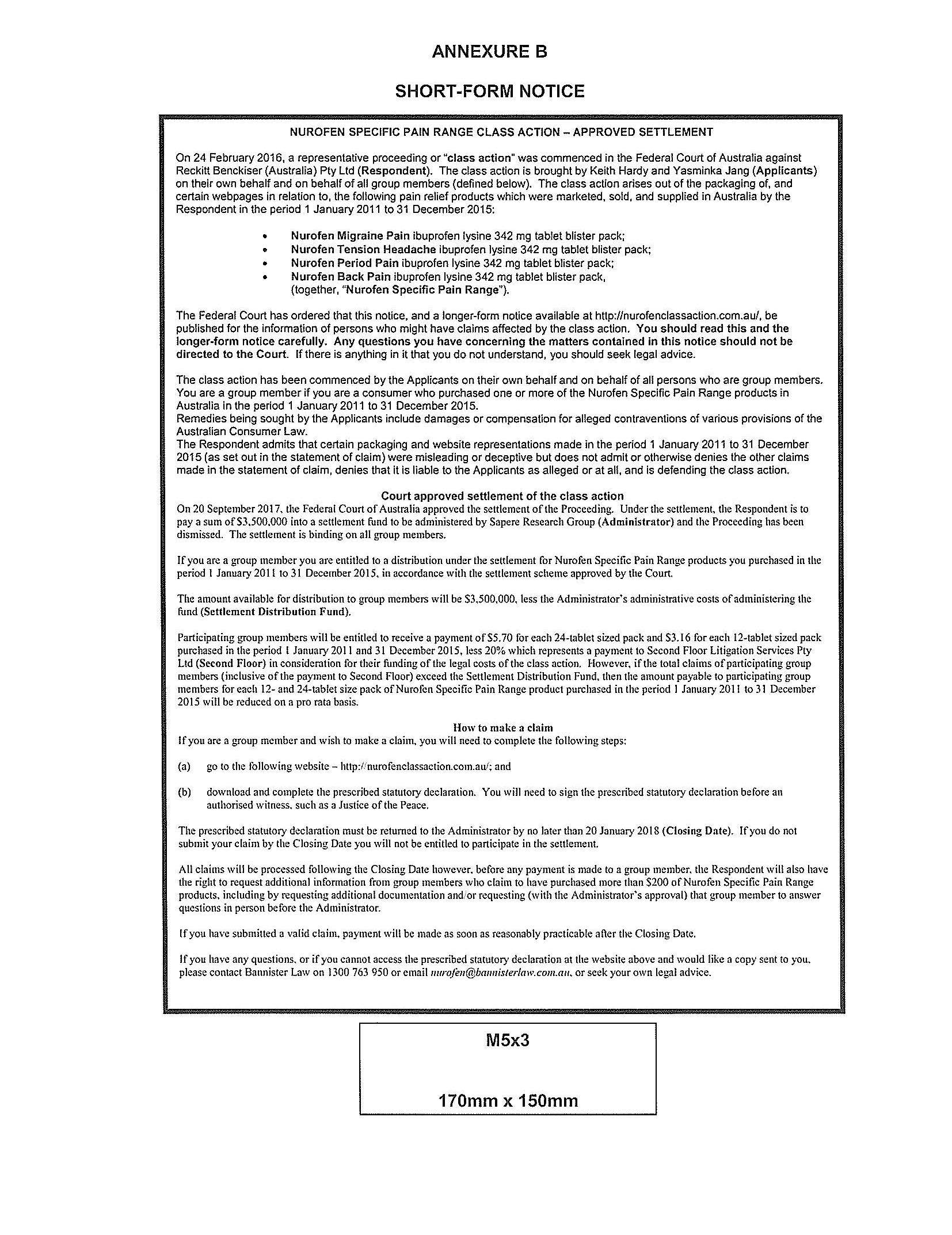
First Applicant YASMINKA JANG Second Applicant | ||
AND: | RECKITT BENCKISER (AUSTRALIA) PTY LIMITED Respondent | |
DATE OF ORDER: |
1. Pursuant to section 33V of the Federal Court of Australia Act 1976 (Cth) (Act), the Court hereby approves the settlement of this Proceeding in accordance with the terms of the Deed of Settlement (the Deed of Settlement).
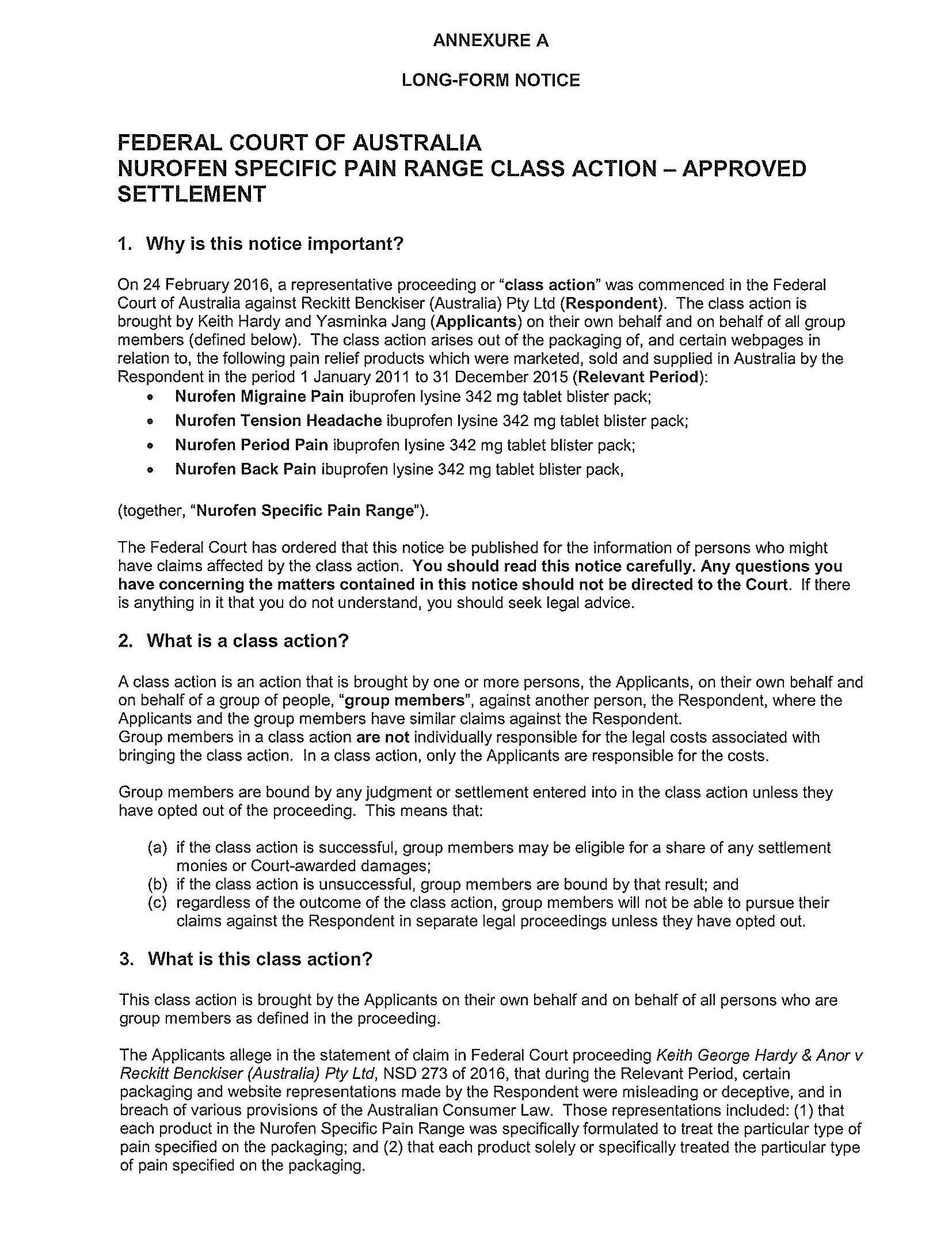
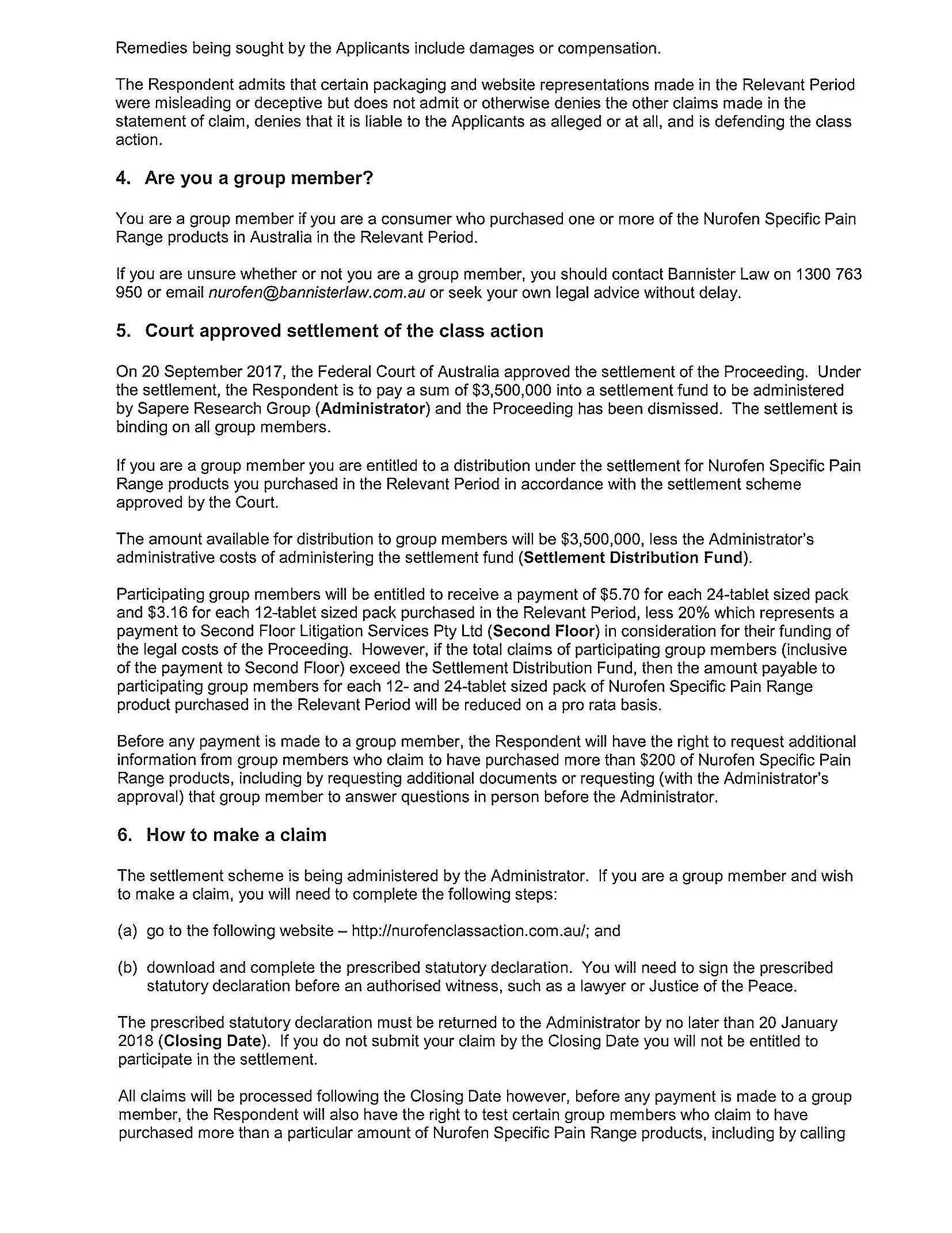
2. The solicitors for the Applicants (Bannister Law) will cause a notice in the form of Annexure A to these Orders (the Long-form Notice) to be sent by email or by pre-paid post to the last known address of each person who has retained Bannister Law in the Proceeding by no later than 1 October 2017.
3. By 11 October 2017, Bannister law:
shall cause to be published, on three occasions, in a weekday edition of each of the following newspapers:
(i) The Advertiser;
(ii) Hobart Mercury;
(iii) The Daily Telegraph;
(iv) The Courier Mail;
(v) Herald Sun;
(vi) Centralian Advocate;
(vii) The West Australian; and
(viii) The Canberra Times,
a quarter-page sized notice in the form set out in Annexure B (Short-form Notice); and
shall cause the Long-form Notice to be posted on the website (http://nurofenclassaction.com.au).
4. Pursuant to sections 33X and 33Y of the Act, the form and content of the Long-form Notice and Short-form Notice is approved.
5. The costs of complying with orders 2 and 3 be paid by the Applicants.
6. All costs orders made to date in the Proceeding are vacated.
7. Pursuant to section 33ZF of the Act or otherwise, the Court authorises the Applicants nunc pro tunc on behalf of the group members described in Order 8 to enter into and to give effect to the Deed of Settlement and the transactions thereby contemplated for and on behalf of those group members.
8. Pursuant to section 33ZB(a) of the Act or otherwise, the Court declares that the persons affected and bound by these orders are the Applicants, the Respondent, and the group members who are defined in the Third Further Amended Statement of Claim filed on 17 July 2017 as follows:
Consumers (within the meaning of section 3 of the Australian Consumer Law) who purchased any of the Nurofen Specific Pain Range products between 1 January 2011 and December 2015, comprising:
• Nurofen Migraine Pain ibuprofen lysine 343 mg tablet blister pack;
• Nurofen Tension Headache ibuprofen lysine 343 mg tablet blister pack;
• Nurofen Period Pain ibuprofen lysine 342 mg tablet blister pack;
• Nurofen Back Pain ibuprofen lysine 342 mg tablet blister pack,
in the form depicted in Annexures A, B, C and D to the Third Further Amended Statement of Claim.
9. Pursuant to sections 33V and 33ZF of the Act, liberty is granted to the Administrator (as defined in the Deed of Settlement) to apply to the Court in connection with the Settlement Scheme (as defined in the Deed of Settlement) including for any order, approval or guidance of the kind contemplated by the Settlement Scheme.
10. The Third Further Amended Originating Application filed on 17 July 2017 be dismissed.
11. Pursuant to section 37AF of the Act, and on the ground set out in s 37AG(1)(a), the Confidential Memorandum of Advice of Bret Walker SC, Dr Peter Cashman and Robert White dated 15 September 2017 not be published to any person without further order of the Court.
12. The Confidential Memorandum of Advice of Bret Walker SC, Dr Peter Cashman and Robert White dated 15 September 2017 be sealed on the Court file and not be disclosed to any person without further order of the Court.
Note: Entry of orders is dealt with in Rule 39.32 of the Federal Court Rules 2011.

NICHOLAS J:
1 These are my reasons for making the consent orders on 20 September 2017 approving the settlement of this proceeding in accordance with a deed of settlement dated 31 July 2017 (“the settlement deed”).
2 The background to the proceeding is set out in my reasons for judgment in Hardy v Reckitt Benckiser (Australia) Pty Limited [2017] FCA 341 and Hardy v Reckitt Benckiser (Australia) Pty Limited (No 2) [2017] FCA 785.
3 The principal proceeding is a representative proceeding brought pursuant to Pt IVA of the Federal Court of Australia Act 1976 (Cth) (“the Act”) for contraventions of the Australian Consumer Law (“ACL”). The initial trial, at which the claims of the applicants and various common questions were to be heard, was fixed to commence on 1 August 2017. The settlement was reached shortly before the trial of the proceeding was scheduled to commence.
4 The applicants and group members are alleged to be consumers (within the meaning of s 3 of the ACL) who between January 2011 and December 2015 (“the relevant period”) purchased pain relief products within the Nurofen Specific Pain Range (“NSPR products”) comprising:
Nurofen Migraine Pain ibuprofen lysine 342 mg tablet blister pack;
Nurofen Tension Headache ibuprofen lysine 342 mg tablet blister pack;
Nurofen Period Pain ibuprofen lysine 342 mg tablet blister pack; and
Nurofen Back Pain ibuprofen lysine 342 mg tablet blister pack.
5 The product formulation for each of the NSPR products was identical. Each was made using ibuprofen lysine, a lysine salt of ibuprofen, together with various excipients.
6 The packaging for each product bore the statement “FAST TARGETED RELIEF FROM PAIN” and also included a further statement that referenced the four pain conditions to which the particular product was directed. For example, in the case of the migraine pain product, the packaging included the following statement:
NUROFEN MIGRAINE PAIN IS FAST AND EFFECTIVE IN THE Temporary RELIEF OF PAIN ASSOCIATED WITH: MIGRAINE HEADACHE
7 The applicants alleged that these statements were misleading and deceptive or likely to mislead or deceive because each product had the same formulation and one was no more or less effective than the others in treating any of the four pain conditions. The applicants alleged that the respondent contravened ss 18 and 33 of the ACL and claimed damages under s 236 of the ACL for loss and damage they were alleged to have suffered because of the respondent’s misleading and deceptive conduct.
8 The respondent admitted in its defence that the packaging of the NSPR products supplied in the period 1 January 2011 and 31 December 2015 was misleading or deceptive or likely to mislead or deceive because the product formulation for each of the NSPR products was the same and that none was any more or less effective than the others in treating any of the symptoms referred to on the packaging. It also admitted that it contravened s 18 and s 33 of the ACL in supplying the NSPR products in packaging that conveyed representations to the contrary effect.
9 The applicants also allege that the respondent failed to comply with statutory guarantees imposed by s 54, s 56 and s 59 of the ACL. The respondent denied that it failed to comply with any applicable statutory guarantee.
10 The applicants also alleged that a new form of packaging of the NSPR products released in 2016 was misleading and deceptive. The new form of packaging included a statement which, in the case of the migraine pain product, stated “EQUALLY EFFECTIVE FOR TENSION HEADACHE, PERIOD PAIN, BACK PAIN & GENERAL PAIN”. The respondent denied that the new form of packaging was misleading or deceptive or likely to mislead or deceive.
11 It is common ground that the respondent has first used the new packaging in early 2016, but ceased using it in about August of that year. No injunctive or pecuniary relief was claimed by the applicants in relation to the 2016 packaging. The only substantive relief that was claimed by the applicants on this account was declaratory.
12 Both applicants claim to have regularly purchased NSPR products between 2011 and 2015. The damages claimed by each of them are modest. Both allege that they would have purchased cheaper products in place of the NSPR products had they known that the product formulation for each of the NSPR products was identical. In the first applicant’s case, the loss Mr Hardy claims to have suffered is between $185.90 and $363.35 depending on what other products might have been purchased instead of the NSPR products. The second applicant, Ms Jang, made a claim for a somewhat larger amount.
13 the parties to the settlement deed are the applicants, the applicants’ solicitors (“Bannister Law”), the respondent and the applicants’ litigation funder, Second Floor Litigation Services Pty Ltd (“the Funder”). The recitals state (inter alia) that the settlement deed has been entered into by the applicants for and on behalf of the group members as representatives of the group members pursuant to Part IVA of the Act.
14 In accordance with the terms of the settlement deed the respondent will pay:
An amount of $3.5 million dollars into a fund (“the Settlement Fund”) out of which approved claims of Group Members will be paid in accordance with a settlement scheme (“the Settlement Scheme”) which is in Schedule 1 to the settlement deed.
The reasonable costs of Bannister Law (calculated on a solicitor-client basis) incurred in the conduct of the proceeding and in seeking approval of the settlement as agreed or assessed.
A premium of $515,419 charged by an insurer, AmTrust, (“Insurer”) in providing an insurance policy in respect of any adverse costs order that may have been made against the applicants if the proceeding had not been successful.
The Settlement Fund will accrue interest whilst claims are being processed and paid and such interest will be added to the Settlement Fund.
15 In consideration of it funding the proceeding, the Funder will be entitled to 20% of the amounts payable to Group Members whose claims are accepted for payment.
16 It is important to note that neither the costs payable to Bannister Law nor the amount of the insurance premium will be deducted from the Settlement Fund. These are payable by the respondent in addition to the $3.5 million that it will pay to establish the Settlement Fund.
17 An independent third party, Sapere Research Group (the “Administrator”), will be responsible for receiving, reviewing and accepting or rejecting claims for payment by Group Members. The Administrator’s costs and expenses will also be paid out of the Settlement Fund.
18 The Administrator will hold the Settlement Fund on trust and administer it in accordance with the terms of the Settlement Scheme. The Settlement Scheme permits the Administrator to approach the Court for directions should it consider it appropriate to do so.
19 If the Settlement Fund is in surplus after payment of the accepted claims and the Administrator’s costs and expenses, then the surplus will be payable to the respondent. The settlement deed contains an acknowledgment that the respondent, as the residual beneficiary of the Settlement Sum, has a legitimate interest to ensure that it is properly administered and that payments are only made to group members who submit legitimate claims.
20 The Settlement Scheme makes provisions for the administration of the Settlement Scheme in cl 1-29. Among other matters, these clauses specify the rights of the parties in relation to the assessment and determination of the claims of group members (or persons claiming to be group members) including the respondent’s right to challenge such claims.
21 Clauses 7-18 of the Settlement Scheme provide:
Challenging Claims Process
7. The Respondent may give notice at any time in writing to the Administrator which sets out:
(a) a list of Challenged Group Members;
(b) any Additional Documentation that the Respondent requests in relation to any Challenged Group Member in order to verify their purchases set out in their Prescribed Statutory Declarations; and/or
(c) any Challenged Group Members that the Respondent wishes to question in the presence of the Administrator and the other Parties for the sole purpose of testing whether those Challenged Group Members in fact made the purchases claimed in their Prescribed Statutory Declaration.
8. Within 7 days of receipt of the notice in paragraph 7, the Administrator (as applicable):
(a) will use its best endeavours to procure from each Challenged Group Member the Additional Documentation and provide copies of those Additional Documentation to the Parties as soon as reasonably practicable after receipt;
(b) to the extent a Challenged Group Member is unable to produce the Additional Documentation, the Administrator will notify the Parties that the Additional Documentation cannot be produced by the relevant Challenged Group Member;
(c) must consider the Respondent's notice given under paragraph 7(c) and, acting reasonably and taking into account all matters the Administrator considers relevant including (i) the amount claimed by the relevant Challenged Group Member, (ii) the detail provided by the relevant Challenged Group Member in respect of their claim and (iii) the cost of allowing the Respondent's request, will decide, in their absolute discretion, whether to arrange the questioning of Challenged Group Members pursuant to the Respondent's notice given under paragraph 7(c).
9. As soon as reasonably practicable following receipt of any Additional Documentation, and subject to the Respondent's exercise of its rights under paragraph 7(c), the Respondent may notify the Administrator of a Revised Purchase Number for the relevant Challenged Group Member.
10. The Administrator will notify any Challenged Group Member of a Revised Purchase Number for that Challenged Group Member and invite the relevant Challenged Group Member to respond to the Administrator and accept or reject the Revised Purchase Number within a period of 7 days.
11. If the relevant Challenged Group Member accepts the Revised Purchase Number, this becomes the Determined Purchase Number for the purpose of calculating that Challenged Group Member's Individual Payment. The Administrator will notify the Parties as soon as reasonably practicable following acceptance by the relevant Challenged Group Member of the Revised Purchase Number.
12. In respect of each Challenged Group Member, if:
(a) the Respondent:
(i) in its reasonable opinion, does not receive adequate Additional Documentation under paragraph 8 and decides not to detem1ine a Revised Purchase Number; or
(ii) after receipt of the Additional Documentation, still has reasonable doubts as to the accuracy of that Challenged Group Member's claim as set out in the Prescribed Statutory Declaration,
and does not subsequently exercise its rights under paragraph 7(c); or
(b) the Challenged Group Member refuses to be questioned by the Respondent pursuant to the exercise of the Respondent's rights under paragraph 7(c) or the Administrator determines not to allow for questioning of a Challenged Group member under paragraph 8(c); or
(c) following the Respondent's questioning of the Challenged Group Member pursuant to the exercise of the Respondent's rights under paragraph 7(c), the Respondent has reasonable doubts as to the accuracy of that Challenged Group Member's claim as set out in their Prescribed Statutory Declaration; or
(d) the Challenged Group Member does not accept the Revised Purchase Number,
then the Respondent may notify the Administrator in writing that it requires an Administrator Determination in respect of that Challenged Group Member's claim.
13. Where notice is given under paragraph 12, the Administrator must, acting reasonably, make a determination of the Determined Purchase Number for that Challenged Group Member within a period of 7 days.
14. The Determined Purchase Number for each Registered Group Member is final and binding on the Registered Group Member and the Parties and, subject to paragraph 18, the Registered Group Member and the Parties waive each of their rights to seek to review, quash or call into question the Determined Purchase Number before any court of law or administrative review body in any proceedings.
15. The Determined Purchase Number for each Registered Group Member must be used to calculate their Individual Payment and is to be included in the Individual Payment Schedule.
Audit of Administrator's administration of the Settlement Scheme
16. Any Party shall have the right to access and inspect the books and records maintained by the Administrator in connection with the Settlement Scheme, including copies of all Additional Documentation submitted by Challenged Group Members.
17. Any Party shall have the right to audit (on an on-going basis and prior to the distribution of Individual Payments to Registered Group Members) the Administrator's administration of the Settlement Scheme and the Administrator shall provide that Party such information about the administration of the Settlement Scheme as that Party reasonably requests.
18. If any Party identifies any errors in the administration of the Settlement Scheme, then they will notify the Administrator and the other Parties in writing and if, the Administrator, acting reasonably, agrees that the errors notified are, in fact, errors then the Administrator must promptly remedy those errors including, if necessary, by revising any Registered Group Member's Individual Payment or the Individual Payment Schedule.
The term “Challenged Group Member” is defined to mean:
A Registered Group Member:
(a) who submits a Prescribed Statutory Declaration estimating that he or she spent more than $200 on the NSPR during the Relevant Period; and
(b) whose claim the Respondent elects to challenge in accordance with paragraph 7.
22 The Settlement Scheme provides, in substance, that the Administrator’s decision in relation to the acceptance or rejection of the group members claims will be final and does not provide for any review process except as provided for in cl 18.
23 Any group members wishing to participate in the distribution of the Settlement Fund will have until 20 January 2018 to lodge a claim with the Administrator. Participating group members whose claims are accepted will be entitled to receive a payment of $5.70 for each 24-tablet sized pack and $3.16 for each 12-tablet sized pack purchased in the relevant period (less 20% payable to the Funder) if the size of the Settlement Fund (relative to the number and size of claims accepted) allows. However, if the total claims of participating group members (inclusive of the amounts payable to the Funder) exceed the amount of the Settlement Fund, then the amount payable to participating group members for each 12-tablet and 24-tablet sized pack of NSPR products purchased in the relevant period will be reduced on a pro rata basis.
24 The open nature of the group makes it impossible to determine with any confidence how many group members may ultimately seek to be paid out of the Settlement Fund or how many NSPR products they will claim to have purchased. In the case of the applicants, they will not know for certain how much they will receive until their claims, and those of all other group members who choose to make a claim, are determined by the Administrator.
25 Among other things, the settlement deed provides for a dismissal of the proceeding, for the applicants (on their own behalf and on behalf of the group members) to release the respondent and its current and former directors, servants or agents, from any claim arising, out of or relating to the proceeding, and for the group members to be bound by the Administrator’s assessment of their individual claims.
26 On 3 August 2017 orders were made noting the proposed settlement and requiring Bannister Law to notify registered group members and to place various advertisements giving notice of the proposed settlement together with details of the time and place at which the hearing of the application for approval of the settlement (“the approval hearing”) would take place. Group members were advised of what steps to take in the event they wished to object to the proposed settlement. They were also advised how they could obtain a copy of the settlement deed which was made available on both the Court’s website and a dedicated website operated by Bannister Law (http://nurofenclassaction.com.au).
27 As at 18 September 2017 there was a total of 10,817 group members who had either registered with Bannister Law or otherwise notified their intention to make a claim.
28 There were five notices of objections received from persons claiming to be group members. Two of these appear to have been based on a misunderstanding of the proposed settlement and were withdrawn. As to the remaining three objections, one objector provided the following reason for his objection:
The proposed settlement amount does not adequately reimburse group members, nor does it penalize Reckitt Benckiser for their actions.
29 The objector concerned did not appear at the approval hearing to explain why he considered that the settlement amount was inadequate. Further, his reasons disclose an apparent misunderstanding as to the function of any potential award of damages in this case, which is to compensate the applicants and group members for loss rather than to penalise the respondent. Substantial penalties have already been imposed on the respondent in respect of the misleading conduct in relation to the packaging NSPR products the subject of the proceeding. (See Australian Competition and Consumer Commission v Reckitt Benckiser (Australia) Pty Ltd [2016] FCAFC 181; 340 ALR 25.)
30 The other two objectors did not provide any reason for their objection in their notices nor did they appear at the approval hearing.
31 The evidence indicates that Bannister Law received approximately 600 emails and telephone calls from registered group members between early August 2017 and 18 September 2017, the overwhelming majority of whom supported the settlement.
32 The evidence includes a confidential memorandum of advice provided by counsel for the applicants, Mr Walker SC, Dr Cashman and Mr White. The memorandum of advice explains why the authors consider the proposed settlement to be fair and reasonable from the perspective of both the parties and the group members. It refers to some of the legal and practical difficulties that would have confronted the applicants and group members particularly in relation to proof of loss were the hearing of the initial trial to have proceeded to judgment.
33 The role of the Court in considering whether to grant approval to a settlement pursuant to s 33V of the Act was explained by Goldberg J’s decision in Williams v FAI Home Security Pty Ltd (No 4) (2000) 180 ALR 459. His Honour said at [19]:
Ordinarily the task of a court upon an application such as this, is to determine whether the proposed settlement or compromise is fair and reasonable, having regard to the claims made on behalf of the group members who will be bound by the settlement. Ordinarily in such circumstances the Court will take into account the amount offered to each group member, the prospects of success in the proceeding, the likelihood of the group members obtaining judgment for an amount significantly in excess of the settlement offer, the terms of any advice received from counsel and from any independent expert in relation to the issues which arise in the proceeding, the likely duration and cost of the proceeding if continued to judgment, and the attitude of the group members to the settlement.
34 Moshinsky J summarised the relevant principles in Camilleri v The Trust Company (Nominees) Limited [2015] FCA 1468 at [5]. Beach J did the same more recently in Blairgowrie Trading Ltd v Allco Finance Group Ltd (Receivers & Managers Appointed) (In Liq) (No 3) [2017] FCA 330 at [81]-[85]. I have had regard to those principles and also to his Honour’s observations in Blairgowrie at [96]-[142] concerning common fund orders and litigation funders’ commission rates.
35 I note the following matters in relation to the settlement in this case:
There is no suggestion that the applicants or registered group members will obtain any preference or advantage over group members. All participating group members (including the applicants) whose claims are accepted will participate in the settlement on an equal footing. The applicants and all other group members are equally exposed to the risk that the amount of their entitlements may be reduced on a pro rata basis depending on the total value of claims that are accepted for payment out of the Settlement Fund.
The only costs that will be paid out of the Settlement Fund are the Administrator’s costs and expenses and the commission payable to the Funder on the amount that each participating group member is ultimately entitled to receive. The applicant’s originating application foreshadowed an order for the payment of any litigation funder’s costs on a common fund (or costs equalization) basis.
I consider the Funder’s commission rate (20%) is reasonable in the circumstances and at the bottom end (if not below) of the range of rates often charged in representative proceedings commenced in this Court.
None of the group members who objected to the settlement expressed any willingness to become an applicant and none have identified any convincing reason not to approve the settlement.
Neither the costs payable to Bannister Law nor the premium payable to the Insurer are payable out of the Settlement Fund.
36 I have given consideration to the fact that if the claims approved for payment exceed the amount available in the Settlement Fund (after payment of the Administrator’s costs and expenses) then those claims will only be paid on a pro rata basis. I am mindful that this could result in the payments to individual group members being reduced substantially. But the countervailing consideration is that other group members who wish to receive payment under the settlement will have until 20 January 2018 to lodge their claims.
37 In my opinion, the Settlement Scheme is likely to provide a relatively cheap, practical and efficient means for assessing group members’ claims. I am satisfied that it is fair and reasonable given the large number of group members and the modest size of their individual claims.
38 Although having filed evidence directed to the quantum of the legal costs and disbursements incurred in bringing the proceeding and in seeking approval of the proposed settlement, the applicants did not ask me to make any order assessing such costs and disbursements. That is something that may need to be done at a later date in the event that the applicants and the respondent cannot reach agreement in relation to an appropriate sum.
39 It was for the above reasons that I was satisfied that the proposed settlement is fair and reasonable as between the parties and as between the group members and that it should be approved.
I certify that the preceding thirty-nine (39) numbered paragraphs are a true copy of the Reasons for Judgment herein of the Honourable Justice Nicholas. |
Associate:


