

FEDERAL COURT OF AUSTRALIA
Korda, in the matter of Ten Network Holdings Ltd (Administrators Appointed) (Receivers and Managers Appointed) [2017] FCA 1144
ORDERS
DATE OF ORDER: |
THE COURT:
1. Orders that, until further order, pursuant to s 37AF of the Federal Court of Australia Act 1976 (Cth) (Federal Court Act) and on the ground that the order is necessary to prevent prejudice to the proper administration of justice, exhibit CCH-12 to the affidavit of Christopher Clarke Hill sworn 29 August 2017 shall be made confidential and prohibited from disclosure to any person other than the Judge hearing the matter and the Judge’s staff and assistants.
2. Orders that, until further order, pursuant to s 37AF of the Federal Court Act and on the ground that the order is necessary to prevent prejudice to the proper administration of justice, annexure JV-C to the affidavit of Jarrod Villani sworn 29 August 2017 shall be made confidential and prohibited from disclosure to any person other than the Judge hearing the matter and the Judge’s staff and assistants.
3. Orders that, pursuant to s 447A(1) of the Corporations Act 2001 (Cth) (Act), Pt 5.3A of the Act is to operate in relation to each of the second and third plaintiffs such that if the indemnity of the administrators under s 443D of the Act from the second and third plaintiffs is insufficient to meet any amount for which the administrators may be liable arising out of or in connection with the Transaction Documents (including in respect of any monies borrowed, interest in respect of monies borrowed and borrowing costs), then the administrators will not be personally liable to repay such amount to the extent of that insufficiency.
4. Orders that, pursuant to s 588FM of the Act, in respect of any security interests created in connection with the New General Security Deed, the registration time for the collateral is fixed to be, for the purposes of s 588FL(2)(b)(iv) of the Act, the time that is the end of 20 business days after the New General Security Deed that gives rise to the security interest comes into force.
5. Directs that, pursuant to s 65-45 of the Insolvency Practice Schedule (Corporations) (IPSC), with effect on and from 1 September 2017:
(a) the first plaintiffs are not required to maintain a separate administration account in relation to each of the second and third plaintiffs as otherwise required by operation of Div 65 of the IPSC; and
(b) section 65-5 of the IPSC is to operate in relation to the second and third plaintiffs such that the administrators must pay all money received by them on behalf of, or in relation to any one or more of the second and third plaintiffs, into one of two administration accounts described in paragraphs 10 and 11 of the affidavit of Jarrod Villani sworn on 29 August 2017 headed "Intermingling Affidavit" within 5 business days after receipt;
(c) section 65-15 of the IPSC is to operate in relation to the second and third plaintiffs such that the administrators must not pay any money into the two administration accounts if the moneys are not received by the administrators on behalf of, or in relation to, one or more of the second or third plaintiffs or ElevenCo Pty Ltd;
(d) section 65-25 of the IPSC is to operate in relation to the second and third plaintiffs such that the administrators must not pay any money out of the two administration accounts otherwise than:
(i) for purposes related to the external administration of any one or more of the second and third plaintiffs;
(ii) for purposes related to the operation of ElevenCo Pty Ltd; or
(iii) in accordance with the Act.
6. Orders that direction 5 shall take effect on and from 1 September 2017.
7. Orders that the administrators are to notify creditors of these Orders by:
(a) within 2 business days of the date of these Orders:
(i) causing them to be published on the creditor information section of the website maintained by the administrators’ firm, KordaMentha, in respect of the administration of the Ten Group;
(ii) sending a copy of the Orders to those persons identified in paragraphs 44 and 45 of the affidavit of Jarrod Villani sworn 29 August 2017 in the same manner as is referred to in those paragraphs; and
(b) annexing a copy of the sealed Orders or, if they are not available, a copy of the draft orders, to the report required to be sent to all creditors of the Ten Group under s 439A of the Act.
8. Orders that the costs of the application be costs in the administrations of the second and third plaintiffs.
THE COURT NOTES THAT:
9. For the purpose of Order 3 above, "Transaction Documents" has the same meaning as it has in the transaction deed dated on or around 27 August 2017 between Ten Network Holdings Limited (Administrators Appointed) (Receivers and Managers Appointed), Network Ten Pty Limited (Administrators Appointed) (Receivers and Managers Appointed), Christopher Clarke Hill, Philip Patrick Carter and David Laurence McEvoy in their capacity as receivers and managers of Ten Network Holdings Limited (Administrators Appointed) (Receivers and Managers Appointed), Mark Korda, Jenny Nettleton and Jarrod Villani in their capacity as administrators of Ten Network Holdings Limited (Administrators Appointed) (Receivers and Managers appointed), CBS International Television Australia Pty Ltd and CBS Studios, Inc.
10. For the purposes of Order 4 above, "New General Security Deed" means the General Security Deed dated on or about 27 August 2017 between the second plaintiffs and CBS Studios, Inc.
Note: Entry of orders is dealt with in Rule 39.32 of the Federal Court Rules 2011.
MARKOVIC J:
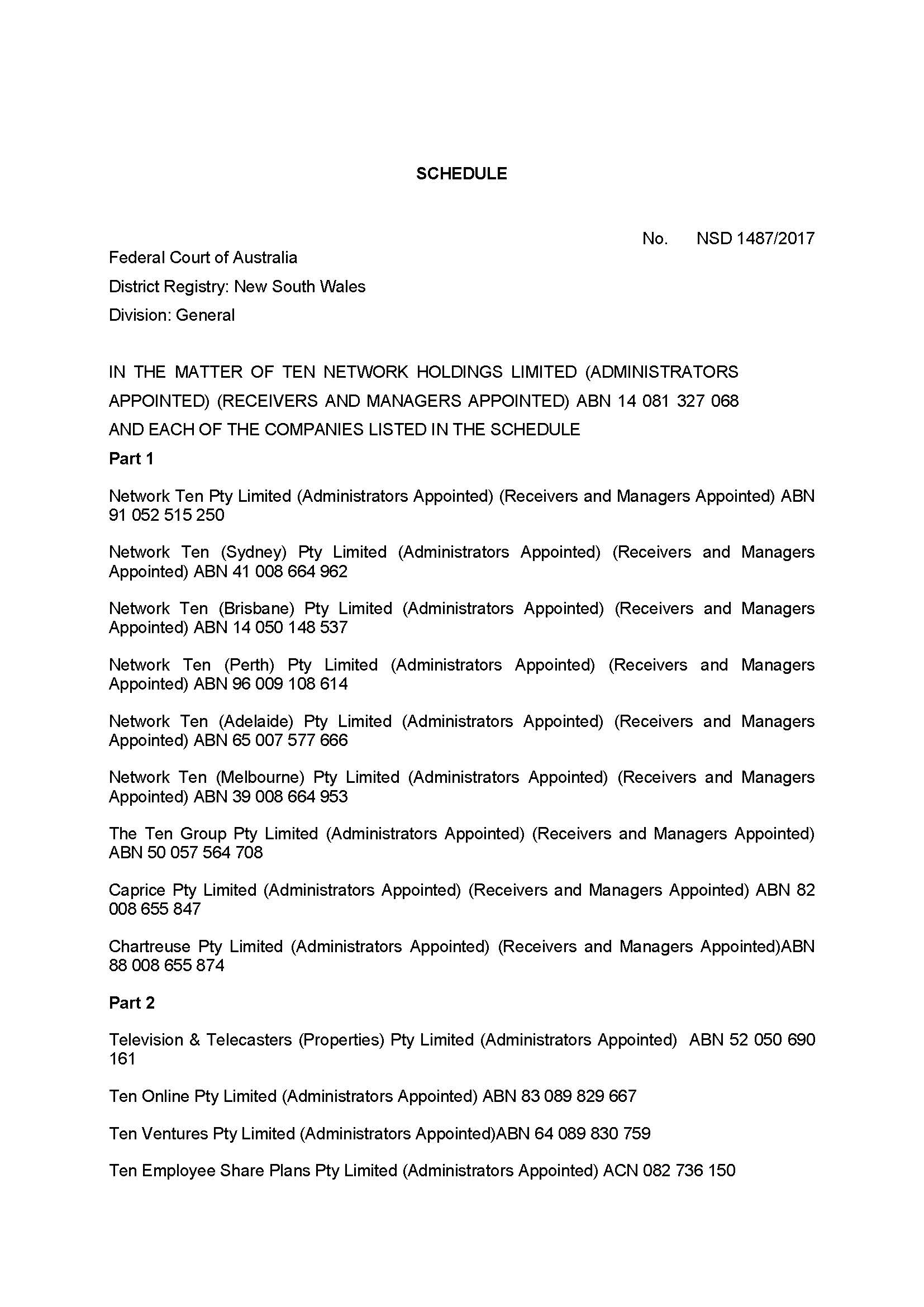
1 On 30 August 2017 I made orders pursuant to ss 447A and 588FM of the Corporations Act 2001 (Cth) (Act) and gave directions pursuant to s 65-45 of Sch 2 to the Act, the Insolvency Practice Schedule (Corporations) (IPSC), in relation to the conduct of the administration of Ten Network Holdings Limited (Administrators Appointed) (Receivers and Managers Appointed) (Ten Network Holdings) and the other companies listed in the schedule to the originating process (collectively, Ten Group).
2 The matter was brought on short notice, principally because of arrangements for new funding that were negotiated as part of a larger transaction for the sale of the Ten Group and the imminent expiry of the funding then in place. Having determined that it was appropriate to make the orders and directions which were made on 30 August 2017, I indicated that I would deliver written reasons at a later date. These are those reasons.
the application
3 In their originating process the plaintiffs sought the following relief:
(1) an order pursuant to s 447A(1) of the Act, modifying the manner in which the administrators would be personally liable under s 443A of the Act in respect of the Transaction Documents, which are described at [18] below;
(2) an order pursuant to s 588FM of the Act in respect of any security interests created in connection with the new general security deed, which is described at [20] below, fixing a later time for registration of the collateral for the purposes of s 588FL(2)(b)(iv) of the Act; and
(3) directions pursuant to s 65-45 of the IPSC that the administrators are not required to maintain separate administration accounts in relation to each of the 14 companies in the Ten Group and can comply with the requirements of Div 65 of the IPSC by operating only two administration accounts in relation to all of the companies under administration.
background facts
The Ten Group
4 The Ten Group comprises a group of companies that are direct or indirect subsidiaries of Ten Network Holdings, a listed Australian company limited by shares, with Network Ten Pty Limited (Administrators Appointed) (Receivers and Managers Appointed) (Network Ten) being the key operating entity. The Ten Group operates various free-to-air television, online and digital platforms across Australia, including broadcasting on channels Ten, One and, pursuant to a joint venture with CBS Studios, Inc. (CBS Studios), Eleven.
5 The Ten Group also has a number of other investments, relevantly including a 66.67% share in Elevenco Pty Limited (ElevenCo), the entity that operates channel Eleven, and a 24.9% interest in advertising sales platform Multi Channel Network Pty Ltd (MCN).
6 The evidence before me disclosed that in recent times the Ten Group had been trading at a loss. Relevantly:
(1) the Ten Group sustained net losses before tax of $151.7 million and $231.7 million respectively for the financial year ended 31 August 2016 (FY16) and the half year ending 28 February 2017 (FY17 Half Year);
(2) at the end of FY16 the Ten Group had $1.3 billion in accumulated losses, owed $90.2 million to its financiers and had $171.8 million in trade creditors; and
(3) at the end of FY17 Half Year the Ten Group had $1.5 billion in accumulated losses, owed $73.8 million to its financiers and had $215 million in trade creditors.
The appointment of the administrators and the receivers
7 On 14 June 2017 the first plaintiffs, Mark Korda, Jennifer Nettleton and Jarrod Villani (Administrators), were appointed pursuant to s 436A of the Act as joint and several administrators of the companies in the Ten Group, being:
Ten Network Holdings;
Network Ten;
Network Ten (Sydney) Pty Limited (Administrators Appointed) (Receivers and Managers Appointed) (Ten Sydney);
Network Ten (Brisbane) Pty Limited (Administrators Appointed) (Receivers and Managers Appointed) (Ten Brisbane);
Network Ten (Perth) Pty Limited (Administrators Appointed) (Receivers and Managers Appointed) (Ten Perth);
Network Ten (Adelaide) Pty Limited (Administrators Appointed) (Receivers and Managers Appointed) (Ten Adelaide);
Network Ten (Melbourne) Pty Limited (Administrators Appointed) (Receivers and Managers Appointed) (Ten Melbourne);
The Ten Group Pty Limited (Administrators Appointed) (Receivers and Managers Appointed);
Caprice Pty Limited (Administrators Appointed) (Receivers and Managers Appointed) (Caprice);
Chartreuse Pty Limited (Administrators Appointed) (Receivers and Managers Appointed) (Chartreuse);
Television & Telecasters (Properties) Pty Limited (Administrators Appointed) (T&T Properties);
Ten Online Pty Limited (Administrators Appointed) (Ten Online);
Ten Ventures Pty Limited (Administrators Appointed) (Ten Ventures); and
Ten Employee Share Plans Pty Limited (Administrators Appointed) (TESP).
8 On 30 June 2017 Christopher Hill, Phillip Carter and David McEvoy (Receivers) were appointed as joint and several receivers and managers of various assets of the companies in the Ten Group other than T&T Properties, Ten Online, Ten Ventures and TESP (Receivership Companies).
9 The Receivership Companies are the second plaintiffs. The balance of the companies in the Ten Group, being those companies in administration but not also in receivership, are the third plaintiffs.
10 On and from the appointment of the Receivers it was agreed between the Receivers and the Administrators that the Administrators would be responsible for the day-to-day conduct of the trading operations of the Receivership Companies’ businesses, subject to the supervision and agreement of the Receivers, while the Receivers would be responsible for conducting a process for sale or recapitalisation of the Receivership Companies.
Financing of the Ten Group
11 Since October 2013 the Ten Group’s operations have been funded by way of a $200 million revolving cash advance facility provided by the Commonwealth Bank of Australia (Existing Facility). As security for that facility each of the Receivership Companies provided a general security agreement over all of their assets and undertaking (Security) to CBA Corporate Services (NSW) Pty Limited in its capacity as security trustee (Security Trustee). A guarantee and indemnity was provided by three shareholders of Ten Network Holdings: Birketu Pty Limited, Illyria Nominees Television Pty Limited as trustee for the Illyria Investment Trust No. 4 and Consolidated Press Holdings Limited (collectively, Shareholder Guarantors).
12 As consideration for providing the guarantees the Shareholder Guarantors were each entitled to receive a fee from the Receivership Companies (Shareholder Guarantee Fees) which is payable in cash on release of the shareholder guarantees.
13 The Security was given in favour of the Security Trustee and held on behalf of the Commonwealth Bank of Australia as security for the obligations of the Receivership Companies in respect of the Existing Facility and in favour of the Shareholder Guarantors as security for the obligations of the Receivership Companies in respect of the Shareholder Guarantee Fees.
14 Shortly after their appointment the Receivers negotiated an amendment to the Existing Facility, as well as continuing support from the Shareholder Guarantors, in order to secure a $30 million funding package for the purposes of funding the receivership (Funding Package). The Funding Package, including the Existing Facility, was available until the earliest of:
(1) the retirement of the Receivers as receivers and managers of the Receivership Companies;
(2) the date that is eight weeks after the Receivers first release an information memorandum to prospective purchasers seeking expressions of interest to restructure, recapitalise or otherwise acquire the assets of one or more of the Receivership Companies, that date being 7 September 2017; and
(3) 31 August 2017.
15 In light of the events that occurred, which are described below, and given that the Receivers had not retired, the Funding Package was to expire on 31 August 2017.
The proposed recapitalisation transaction
16 Since shortly after their appointment the Receivers have been engaged in a competitive bid process pursuant to which interested parties were invited to submit bids to recapitalise or acquire part or all of the business or assets of the Ten Group. Final bids were required to be submitted to the Receivers by 24 August 2017.
17 Following the conclusion of the bid process, and in consultation with the Administrators, the Receivers accepted an offer from CBS International Television Australia Pty Limited (CBS Australia) for a recapitalisation of the Ten Group pursuant to which CBS Australia or its nominee will become the 100% owner of Ten Network Holdings.
18 On 27 August 2017 the Receivers, the Administrators, Ten Network Holdings, Network Ten, CBS Australia and CBS Studios entered into a transaction deed (Transaction Deed) which, together with other documents (collectively, Transaction Documents), will enable the proposed recapitalisation transaction to proceed. The terms of the Transaction Deed are confidential. However, Mr Hill, one of the Receivers, was authorised to disclose the following summary of the transaction contemplated by the Transaction Deed (Transaction):
(1) the Existing Facility, the Funding Package and the Shareholder Guarantee Fees (collectively, the Existing Secured Debt) will be repaid in full by a new facility to be provided to Ten Group by CBS Australia (New Facility);
(2) creditors will be asked to vote on a deed of company arrangement which will provide for a dividend in respect of certain unsecured debts owed by the Ten Group as at 14 June 2017;
(3) the business of the Ten Group will continue as usual; and
(4) an application will be made to the Court for orders pursuant to s 444GA of the Act, following which, if those orders are made, CBS Australia or its nominee will become the 100% owner of Ten Network Holdings.
19 The New Facility, which also provides ongoing funding for the continued operations of the Ten Group, will be provided in advance of completion of the Transaction.
20 The funding to be made available under the New Facility is to be secured by a security interest granted by each of the Receivership Companies to CBS Studios as security trustee pursuant to the terms of a general security deed also dated 27 August 2017 (New Security).
21 It is a condition precedent to the provision of funding under the New Facility that evidence be provided of a court making an order under s 588FM(2)(a)(ii) of the Act to enable the New Security to be registered on the register created under the Personal Property Securities Act 2009 (Cth) (PPS Act) at a later time for the purposes of s 588FL(2)(b)(iv) of the Act and that the New Security be registered under the PPS Act by the time specified in the court’s order.
22 Mr Hill’s evidence was that, subject to the Court making the orders sought by the plaintiffs pursuant to s 588FM of the Act, it was intended that the New Security would rank according to its order of registration on the Personal Property Securities Register (PPSR) and that it would not have priority over any existing security interest granted to a secured party by any company in the Ten Group.
Other creditors of the Ten Group
23 The first meetings of creditors of companies in the Ten Group were held concurrently on 26 June 2017. At the first meeting of creditors of Network Ten the creditors voted in favour of a resolution establishing a committee of creditors for Network Ten. There are 14 members of the committee of creditors including, among others, three employees, content providers, two of the Shareholder Guarantors, the Commonwealth Bank of Australia and CBS Studios.
24 Although resolutions that a committee of creditors be appointed in respect of each of Ten Network Holdings, Ten GPL, Ten Sydney, Ten Brisbane, Ten Melbourne, Ten Perth, Ten Adelaide, Caprice and Chartreuse at their respective first meetings were supported by specific proxies, there were no nominations for membership of such committees.
25 The Ten Group has approximately 750 full-time and part-time employees. As at the date of the Administrators’ appointment, employees were owed $5.4 million for accrued annual leave and $8.7 million for accrued long service leave. All accrued but unpaid wages and superannuation as at the date of the appointment of the Administrators had been paid in full and those employees who continue to be employed by the Ten Group during the administration are being paid their wage and superannuation entitlements in the ordinary course.
26 The Administrators undertook PPSR searches in respect of the Ten Group. Those searches revealed:
(1) a registration in favour of the Security Trustee arising pursuant to the general security agreement in respect of each of the Receivership Companies;
(2) no other registrations in respect of Ten Network Holdings, Ten Sydney, Ten Brisbane and Chartreuse;
(3) various Purchase Money Security Interest (PMSI) registrations in respect of Network Ten, Ten Melbourne, Ten Perth, Ten Adelaide, The Ten Group Pty Limited (Administrators Appointed) (Receivers and Managers Appointed) and Caprice. According to Mr Villani, the creditors who have lodged valid PMSI registrations are collectively owed approximately $10,000 and valid claims will be paid before the end of the administration; and
(4) no registrations in respect of any of the third plaintiffs.
27 As a result of investigations undertaken by the Administrators, they have determined that the total number of unsecured creditors (other than employees) of the Ten Group is approximately 460 to 465, with an estimated value of claims between $580 million to $1,709 million, including ordinary trade creditors who are collectively owed between $30 million and $35 million as at the date of the Administrators’ appointment. Ordinary trade creditors are being paid for goods and services supplied during the administration in the ordinary course. The majority of the value of the unsecured claims comprises claims made by content providers on which the Administrators had not adjudicated as at 29 August 2017.
28 Mr Hill was of the view that the making of the orders sought by the Administrators would not prejudice other creditors of the Ten Group. Mr Hill formed his opinion for the following reasons:
(1) the provision of funding by CBS Australia would allow the Existing Facility, due to terminate on 31 August 2017, the Funding Package and the Shareholder Guarantee Fees to be repaid in full;
(2) the terms of the New Facility are no less favourable than the Existing Secured Debt, noting that the New Facility terms acknowledge that certain defaults are existing so a controller can be appointed immediately; that there will be no further Shareholder Guarantee Fees payable after the refinance has occurred, although the New Facility agreement contains a break fee should the transaction not proceed; and that the assets the subject of the New Security are no more extensive than those the subject of the Security;
(3) the offer received from CBS Australia and the transaction contemplated under the Transaction Deed were, in Mr Hill’s opinion, the most favourable transaction available for the benefit of creditors of the Ten Group;
(4) if the orders sought were not made then CBS Australia was entitled to terminate the Transaction Deed and, on the basis of his involvement in the negotiations, Mr Hill believed that it would be likely to do so in those circumstances;
(5) based on his understanding of the financial position, business affairs and prospects of the Receivership Companies, the New Facility Agreement and the Transaction were essential to ensure the ongoing viability of the Ten Group and to ensure that the return for unsecured creditors is maximised.
29 Mr Hill was of the opinion that the Transaction was the best commercial option available to the Ten Group and its creditors to ensure the Ten Group’s ongoing viability, that its secured debt is repaid and that the return to unsecured creditors is maximised.
30 The Administrators were of the opinion that the Transaction was in the best interests of the creditors and that the Administrators should progress the implementation of the Transaction in accordance with the Transaction Deed. They agreed with the views expressed by Mr Hill recorded at [28] and [29] above. In addition, the Administrators considered that the implementation of the Transaction, the entry into of the New Facility and the granting of the New Security is consistent with the objectives of Pt 5.3A of the Act. They were of the opinion that if the New Facility were not entered into then there was some risk that the Ten Group would have insufficient working capital during the period it will take to complete the Transaction.
31 Mr Villani also gave evidence that the creditors of each of the companies in the Ten Group will receive a report pursuant to s 439A of the Act and will have an opportunity to vote on the deed of company arrangement, which is a condition precedent to the Transaction, at the second creditors’ meeting of each of the companies in the Ten Group.
Notice of this proceeding
32 On 28 August 2017 the Administrators took the following steps to notify creditors of this proceeding:
(1) a notice addressed to certain creditors of Ten Group companies and members of the Network Ten committee of creditors which, among other things, set out the Administrators’ intention to make an application for orders pursuant to ss 447A and 588FM of the Act and the date, time and place for the making of that application (Notice) was sent by email to the members of the Network Ten committee of creditors;
(2) the Notice was sent to the secured creditors of the Ten Group by email to the addresses given for the secured creditors in the PPSR searches undertaken by the Administrators and, in addition, to the email addresses otherwise in the possession of the Administrators for those creditors by reason of the administration; and
(3) the Notice was sent by courier to the Security Trustee.
33 Given the urgency with which the application was made it was not possible for the Administrators to individually notify all of the unsecured creditors of the Ten Group of the application.
34 As at 29 August 2017 the Administrators had not received any response or communication from any creditor.
35 On 28 August 2017 the Administrators also caused their solicitors to give notice of their intention to apply for the orders pursuant to ss 447A and 588FM of the Act and directions pursuant to s 65-45 of the IPSC to the Australian Securities and Investments Commission (ASIC). Copies of the originating process and affidavits in support were subsequently provided to ASIC. On 30 August 2017 ASIC informed the Administrators’ solicitors that it did not propose to intervene in the application or seek leave to appear at the hearing.
relief sought
Section 447A of the Act
36 The Administrators sought an order pursuant to s 447A(1) of the Act to the effect that Pt 5.3A of the Act is to operate in relation to each of the companies in the Ten Group such that if the indemnity of the Administrators under s 443D of the Act from the companies in the Ten Group is insufficient to meet any amount for which the Administrators may be liable arising out of or in connection with the Transaction Documents then the Administrators will not be personally liable to pay such amount to the extent of that insufficiency.
37 Section 447A(1) empowers the Court to make such orders as it thinks appropriate about how Pt 5.3A of the Act is to operate in relation to a particular company. Such an order may be made, in the case of a company under administration, on the application of the administrator.
38 Section 443A of the Act provides:
443A General debts
(1) The administrator of a company under administration is liable for debts he or she incurs, in the performance or exercise, or purported performance or exercise, of any of his or her functions and powers as administrator, for:
(a) services rendered; or
(b) goods bought; or
(c) property hired, leased, used or occupied, including property consisting of goods that is subject to a lease that gives rise to a PPSA security interest in the goods; or
(d) the repayment of money borrowed; or
(e) interest in respect of money borrowed; or
(f) borrowing costs.
(2) Subsection (1) has effect despite any agreement to the contrary, but without prejudice to the administrator’s rights against the company or anyone else.
39 Section 443D of the Act entitles the administrator of a company to be indemnified out of the company’s property (other than certain PPS Act retention of title property that is not relevant for present purposes) for, in summary, expenses incurred in the course of the administration.
40 It is well recognised that the Court has power under s 447A of the Act to make orders limiting an administrator’s personal liability under s 443A: see Re Mentha (in their capacities as joint and several administrators of the Griffin Coal Mining Company Pty Ltd (admins apptd) (2010) 82 ACSR 142; [2010] FCA 1469 (Griffin Coal) at [28]-[29]; In the matter of Nexus Energy Ltd [2014] NSWSC 1041 at [14]; Secatore, in the matter of Fletcher Jones and Staff Pty Limited (Administrators Appointed) [2011] FCA 1493 at [23].
41 In Griffin Coal Gilmour J set out the principles governing the grant of orders pursuant to s 447A to vary the liability of administrators at [30]:
30 The principles governing the granting of an application for orders under s 447A to vary the liability of administrators under s 443A can be summarised as follows:
(a) the proposed arrangements are in the interests of the company's creditors and consistent with the objectives of Pt 5.3A of the Corporations Act: Re Great Southern at [13].
(b) typically the arrangements proposed are to enable the company's business to continue to trade for the benefit of the company's creditors: Re Malanos at [9] and Re View at [17].
(c) the creditors of the company are not prejudiced or disadvantaged by the types of orders sought and stand to benefit from the administrators entering into the arrangement: Re View at [18], and also Re Application of Fincorp Group Holdings Pty Ltd [2007] NSWSC 628 at [17].
(d) notice has been given to those who may be affected by the order: Re Great Southern at [12].
42 At [31] Gilmour J acknowledged that most of the cases where courts have exercised power under s 447A to vary an administrator’s personal liability under s 443A have involved administrators borrowing funds during the period of the administration. His Honour further noted that the orders typically sought have “the effect of limiting recourse of the counterparty to the administrator personally to the extent to which he or she is able to be indemnified from the assets of the company”.
43 Unless an order were made as sought by the Administrators under s 447A of the Act, the Administrators would potentially be exposed to unlimited personal liability for debts incurred under the Transaction Documents, including for the borrowings under the New Facility agreement. Mr Villani gave evidence on behalf of all of the Administrators that:
(1) although the Administrators have an indemnity under s 443D of the Act from the property of each of the companies in the Ten Group, that right of indemnity would be of no value once the administration came to an end;
(2) the parties were working towards completion of the Transaction by early October 2017 and it was contemplated that, on completion, the proposed deed of company arrangement will terminate and a creditors’ trust will come into effect, bringing an end to the deed administration and the right of indemnity under s 443D of the Act; and
(3) the potentially unlimited personal liability of the Administrators was, in all of the circumstances, a commercial risk that they were not prepared to accept and that, without the order, the Transaction would not proceed.
44 I formed the opinion that the order sought pursuant to s 443A of the Act by the Administrators should be made. Such an order was necessary for the Transaction to proceed. The Administrators could not be expected to accept personal liability for the obligations under the Transaction Documents, which include a significant borrowing under the New Facility. My reasons for forming that opinion, having regard to the principles set out by Gilmour J in Griffin Coal, are set out below.
45 First, for the following reasons I was satisfied that the proposed arrangements are in the best interests of Ten Group’s creditors:
(1) both the Administrators and the Receivers believed that it was in the best interests of the creditors of the Ten Group that the Transaction proceed and that the Secured Debt be repaid in full. According to Mr Hill, if the orders sought were not made then there was a real likelihood that CBS Australia would exercise its right under the Transaction Deed to terminate;
(2) entry into the New Facility agreement will prevent the Ten Group from defaulting under the Existing Facility. According to Mr Vilanni, should the New Facility agreement not be entered into then there was some risk that the Ten Group would have insufficient working capital in the period up to completion of the Transaction; and
(3) the proposed arrangements are consistent with the operation and object of Pt 5.3A of the Act. That object, which is found in s 435A of the Act, is to provide for the business, property and affairs of an insolvent company to be administered in a way that “maximises the chances of the company, or as much as possible of its business, continuing in existence” or, if that is not possible, that results in a better return to stakeholders than would result from an immediate winding up of the company. It was apparent that if the orders were made and the Transaction progressed then the business of the Ten Group would continue to trade.
46 Secondly, I was satisfied that the order sought causes no prejudice to creditors. As I have already observed, the Administrators and Receivers were of the opinion that it was in the best interest of the creditors that the Transaction proceed. Mr Hill’s opinion about the effect of the Transaction on creditors is set out at [28] above. Mr Vilanni also expressed the opinion, with which Mr Korda and Ms Nettleton agreed, that the Transaction was in the best interest of the creditors of the Ten Group and that the Administrators should progress its implementation. In summary:
(1) the Ten Group’s major secured creditor and the Shareholder Guarantors will be paid in full;
(2) the only other secured creditors, other than the Security Trustee, registered on the PPSR are PMSI creditors whose secured debts total approximately $10,000 in aggregate. The Administrators anticipate that valid claims will be paid before the end of the administration;
(3) according to Mr Hill, the terms of the New Facility are no less favourable than the existing secured debt, noting those matters set out at [28] above;
(4) it is intended that the New Security will rank according to its order of registration on the PPSR and will not have priority over any existing security interest granted to a secured party by any company in the Ten Group; and
(5) the offer received from CBS Australia and the Transaction was, according to Mr Hill, the most favourable transaction available for the benefit of the creditors of the Ten Group.
47 Finally, the Administrators had provided notice of their application as set out at [32] to [35] above to Network Ten’s committee of creditors, the Security Trustee, secured creditors of the Ten Group and ASIC. Ordinary trade creditors are being paid for goods and services supplied during the administration in the ordinary course and the majority of the value of the unsecured claims is made up of claims by content providers, a number of whom are represented on the creditors’ committee.
48 As at 29 August 2017 the Administrators had not received any response or communication from any creditor, nor any indication that any creditor intended to appear at the hearing of the application. When, at the commencement of the hearing of the application, the matter was called three times outside the courtroom there was no appearance by or on behalf of any creditor.
49 The Administrators indicated their intention to notify creditors of any orders made by the Court and orders reflecting their proposal for notification were made on 30 August 2017.
Extension of time to register collateral – s 588FM of the Act
50 The plaintiffs sought an order pursuant to s 588FM of the Act fixing the time for registration of any security interests created in connection with the New Security at the time that is the end of 20 business days after the new general security deed comes into force. That order was sought to preclude the potential effect of s 588FL(4) of the Act in relation to the vesting of the security interests in the Receivership Companies.
51 Section 588FL applies when, relevantly, an administrator of a company is appointed under s 436A of the Act and a PPSA security interest granted by the company in collateral is covered by s 588FL(2). The term “PPSA security interest” is defined in s 51 of the Act to mean “a security interest within the meaning of the [PPS Act] and to which that Act applies, other than a transitional security interest within the meaning of that Act”.
52 Section 588FL(2) provides:
(2) This subsection covers a PPSA security interest if:
(a) at the critical time, or, if the security interest arises after the critical time, when the security interest arises:
(i) the security interest is enforceable against third parties under the law of Australia; and
(ii) the security interest is perfected by registration, and by no other means; and
(b) the registration time for the collateral is after the latest of the following times:
(i) 6 months before the critical time;
(ii) the time that is the end of 20 business days after the security agreement that gave rise to the security interest came into force, or the time that is the critical time, whichever time is earlier;
(iii) if the security agreement giving rise to the security interest came into force under the law of a foreign jurisdiction, but the security interest first became enforceable against third parties under the law of Australia after the time that is 6 months before the critical time—the time that is the end of 56 days after the security interest became so enforceable, or the time that is the critical time, whichever time is earlier;
(iv) a later time ordered by the Court under section 588FM.
53 The “critical time” for the purposes of s 588FL is defined in subs (7). For present purposes it is the s 513C day for the company. In the case of the Ten Group that is 14 June 2017, being the day on which the Administrators were appointed.
54 Section 588FL(4) provides:
(4) The PPSA security interest vests in the company at the following time, unless the security interest is unaffected by this section because of section 588FN:
(a) if the security interest first becomes enforceable against third parties at or before the critical time—immediately before the event mentioned in paragraph (1)(a);
(b) if the security interest first becomes enforceable against third parties after the critical time—at the time it first becomes so enforceable.
55 Section 588FM provides:
588FM Extension of time for registration
(1) A company, or any person interested, may apply to the Court (within the meaning of section 58AA) for an order fixing a later time for the purposes of subparagraph 588FL(2)(b)(iv).
(2) On an application under this section, the Court may make the order sought if it is satisfied that:
(a) the failure to register the collateral earlier:
(i) was accidental or due to inadvertence or some other sufficient cause; or
(ii) is not of such a nature as to prejudice the position of creditors or shareholders; or
(b) on other grounds, it is just and equitable to grant relief.
(3) The Court may make the order sought on any terms and conditions that seem just and expedient to the Court.
56 The Transaction requires that each of the Receivership Companies grant a security interest to the new security trustee under the New Security. Section 588FL would apply if the registration time for the collateral were after the latest of the times set out s 588FL(2)(b). For the purposes of s 588FL(2)(b)(ii), because the New Security would not come into force until after the critical time, 14 June 2017, the earlier of the two events in s 588FL(2)(b)(ii) is the critical time. Accordingly, subject to the making of an order pursuant to s 588FM, the latest of the times set out in s 588FL(2)(b) is 14 June 2017.
57 The New Security was not and, indeed, could not have been registered before 14 June 2017. Hence, the Administrators applied for an order pursuant to s 588FM of the Act extending the time for registration for the purposes of s 588FL(2)(b)(iv). In the absence of such an order, any security interest granted by the Receivership Companies under the New Security would vest in those companies.
58 In K.J. Renfrey Nominees Pty Ltd (Trustee), in the matter of OneSteel Manufacturing Pty Ltd v OneSteel Manufacturing Pty Ltd [2017] FCA 325 (K.J. Renfrey Nominees) Davies J considered an application for an order under s 588FM of the Act fixing a later time for the purposes of s 588FL(2)(b)(iv) in respect of the registration of security interests granted by the defendant in that case. In summary, the parties had on 25 November 2016 entered into an equipment hire services agreement as part of the resolution of a dispute between them. OneSteel Manufacturing Pty Ltd (OneSteel) had entered into administration on 7 April 2016 and subsequently entered into a deed of company arrangement on 4 November 2016.
59 The critical time, as defined by s 588FL(7), was the date that the administration began, namely, 7 April 2016. While the security interest created by the equipment hire services agreement was registered within 20 business days after it came into force, it was registered after the critical time. Thus, the parties were concerned that by reason of s 588FL(4) the security interest automatically vested in OneSteel when it became enforceable. K.J. Renfrey Nominees Pty Ltd as trustee for the Renfrey Family Trust applied for an order under s 588FM extending the time for registration of its security interest to 12 December 2016, relying on the just and equitable ground in s 588FM(2)(b).
60 Davies J first considered whether s 588FL covers PPSA security interests granted after a relevant s 588FL(1)(a) event. After noting at [15] that s 588FL must be read as a whole, her Honour held at [18] that the words of s 588FL(2)(a) expressly and unambiguously extend the scope of that subsection to cover a PPSA security interest that “arises after the critical time”. At [20] her Honour said:
The express provision in s 588FL(2) that the subsection covers a security interest “arising after the critical time”, being an expression defined by reference to the events prescribed in s 588FL(1)(a), is a powerful textual and contextual reason against OneSteel’s construction of s 588FL(1) that the “granting” of that interest must have already occurred at the time of the triggering event under subparagraph (a). A security interest that “arises after the critical time” is congruent to a security interest “granted” by the company after the relevant event prescribed in s 588FL(1)(a) that “is covered” by s 588FL(2). Read in that way, the different tenses in s 588FL(1)(a) and (b) do not connote that it is necessary that the security interest be “granted” by the company before the relevant event “occurs”, that is, as a requirement to be satisfied as a past event before the relevant s 588FL(1)(a) event occurs.
61 At [24], after further considering submissions made by the parties and the decision of Brereton J in In the matter of OneSteel Manufacturing Pty Ltd (administrators appointed) [2017] NSWSC 21, her Honour held that s 588FL(2)(a) “plainly contemplates that security interests arising after the critical time, which are thereafter registered, are within its scope and no logical reason is apparent for construing the provision in a way that would exclude from the scope of the section, security interests that arise after the critical time but which are only registered after they arose”.
62 Davies J considered that, on the facts before her, s 588FL had been engaged and that the security interest would vest in the grantor company on creation, even if registered within 20 business days after the security interest came into force, unless an order were made under s 588FM fixing a later registration time for the purposes of s 588FL(2)(b)(iv): at [26].
63 Her Honour then considered s 588FM of the Act. Her Honour noted that the terms of s 588FL explicitly contemplate that an order may be made under s 588FM fixing a later time for registration to preclude the operation of s 588FL and that nothing in the terms of the section indicates that an order cannot be made after s 588FL(4) has been triggered: at [27]. At [28] Davies J said:
To make an order under s 588FM(2)(b), the Court must be satisfied that it is just and equitable to grant relief. The circumstances that would justify an order extending the time for registration on the just and equitable ground to avoid the operation of s 588FL(4) will depend upon the circumstances of each particular case. Some general observations can be made though. As the purpose and effect of an order under s 588FM is to avoid the vesting of the security interest in the company and preserve the secured creditor’s security, it is relevant in determining whether it is just and equitable to fix a later time to consider the interests of the creditors: Re Appleyard Capital Pty Ltd [2014] NSWSC 782; (2014) 101 ACSR 629 at [29]-[30]. As Brereton J observed in Re Appleyard Capital Pty Ltd at [30] whilst “the presence or absence of prejudice to unsecured creditors is a relevant discretionary consideration, relevant prejudice is not necessarily established merely by showing that the dividend to unsecured creditors will be less if the security interest does not vest in the company; the unsecured creditors may well have been in no different a position if the security interest been timely registered”. His Honour stated that the type of prejudice that is of particular relevance is prejudice attributable to the failure to effect registration earlier where the delay in the registration of the security interest causes prejudice to creditors who have transacted with the company to their detriment, being unaware of the creation of a security interest. In the present case, there was no delay in registration.
64 It is clear that s 588FL will cover any security interests to be granted under the New Security by the Receivership Companies as they will be registered after the critical time. As I have already noted, and as was the case in K.J. Renfrey Nominees, unless an order fixing a later time for registration was made under s 588FM, those security interests would vest in the Receivership Companies by operation of s 588FL(4).
65 I thus considered whether an order under s 588FM of the Act should be made in the circumstances of this case. The plaintiffs relied on s 588FM(2)(b), which requires that, in order to make an order, the Court must be satisfied that it is just and equitable to grant the relief. Whether that is the case will, as Davies J identified in K.J.Renfrey Nominees, depend on the circumstances of each particular case.
66 In the circumstances of this case I was satisfied that it was just and equitable to fix a later time for the purposes of s 588FL(2)(b)(iv) of the Act.
67 The security interests that will be created under the New Security are part of the Transaction. The Administrators and the Receivers were of the opinion that the Transaction does not adversely prejudice any creditors of the Ten Group. The Transaction facilitates the recapitalisation of the Ten Group’s secured debts and ensures that it can continue to trade until the proposed recapitalisation by CBS Australia is completed. According to Mr Hill, the New Facility Agreement and the Transaction are essential, not only to the ongoing viability of the Ten Group, but to ensure that the return for unsecured creditors is maximised.
68 Members of Network Ten’s committee of creditors, the secured creditors and ASIC were notified of the application that the plaintiffs intended to make under s 588FM of the Act and no objections were received, nor did any of those parties appear at the hearing.
69 Further, there had been no delay in registration of the new general security deed, which was only executed on 27 August 2017 and has not yet come into force. No relevant prejudice to creditors of the type explained by Brereton J in Re Appleyard Capital Pty Ltd; 123 Sweden AB v Appleyard Capital Pty Ltd (2014) 101 ACSR 629; [2014] NSWSC 782 at [30] arises. His Honour there said:
The type of prejudice that is of particular relevance is prejudice attributable to the delay in registration, rather than prejudice from making the order (which is inevitable). This is the type of prejudice contemplated the legislation (see s 588FM(2)(a)(ii), which refers to prejudice from the failure to register earlier, not from making the order), and referred to by Buckley J in Cardiff Workmen’s Cottage Co; by Long Innes J in Limited Company (see also Flinders Trading Co at ACLR 225 per Bray CJ; at ACLR 234 per Mitchell J); and by McLelland J in Guardian Securities (at 98). The period of delay in effecting registration is relevant, because the shorter the delay the less likely that the failure to register within time will have had any impact. The significance of the passage of time is mainly related to the possibility of competing interests having arisen, in particular through others having dealt with the company on the footing that the collateral was unencumbered.
Administrators’ accounts – s 65-45 of the Insolvency Practice Schedule
70 Division 65 of the IPSC concerns funds handling by an external administrator. That division commenced to apply in relation to ongoing external administrations on 1 September 2017: see r 10.25.01(2) of the Corporations Regulations 2001 (Cth).
71 Section 65-5(1) provides that an external administrator of a company must pay all money received by the external administrator on behalf of, or in relation to, the company into an administration account for the company within five business days after receipt. Section 65-5(2) provides that if the Court gives a direction that is inconsistent with s 65-5(1) then s 65-5(1) does not apply to the extent of the inconsistency.
72 The term administration account is defined in s 65-10 as follows:
65‑10 Administration accounts
(1) A bank account is an administration account for a company if:
(a) the account is maintained in relation to the external administration of the company; and
(b) if any requirements are prescribed in relation to the administration accounts of companies under external administration, the account complies with those requirements.
(2) A bank account is an administration account for a member of a pooled group of companies if:
(a) the account is maintained in relation to the external administration of the pooled group of companies; and
(b) if any requirements are prescribed in relation to the administration accounts of companies under external administration, the account complies with those requirements.
73 Sections 65-15 and 65-25 respectively provide:
65‑15 External administrator must not pay other money into the administration account
External administrator must not pay other money into the administration account
(1) The external administrator of a company must not pay any money into an administration account for the company if it is not received by the external administrator on behalf of, or in relation to:
(a) the company; or
(b) if the company is a member of a pooled group—another member of the pooled group.
Exception
(2) If the Court gives a direction that is inconsistent with subsection (1), that subsection does not apply to the extent of the inconsistency.
Offence
(3) A person commits an offence of strict liability if:
(a) the person is subject to the requirement under subsection (1); and
(b) the person fails to comply with the requirement.
Penalty: 50 penalty units
65‑25 Paying money out of administration account
Money only to be paid out of administration account in accordance with this Act etc.
(1) An external administrator of a company must not pay any money out of the administration account for the company otherwise than:
(a) for purposes related to the external administration of the company; or
(b) in accordance with this Act; or
(c) in accordance with a direction of the Court.
Offence
(2) A person commits an offence of strict liability if:
(a) the person is subject to a requirement under subsection (1); and
(b) the person fails to comply with the requirement.
Penalty: 50 penalty units
74 Section 65-45 permits the Court to give directions regarding the payment, deposit or custody of money payable to, or held by, an external administrator of a company. An application under s 65-45 can be made by any person with a financial interest in the external administration of the company or an officer of the company. Section 5-30 provides that a person has a financial interest in the external administration of a company if the person is, among others, an external administrator of the company.
75 Sections 65-45(2) and (3) provide as follows:
65‑45 Handling of money and securities—Court directions
…
(2) The Court may, on application, give directions authorising the external administrator of a company to make payments into and out of a special bank account.
(3) Without limiting subsection (2), the Court may:
(a) authorise the payments for the time and on the terms it thinks fit; and
(b) if the Court thinks the account is no longer required—at any time order it to be closed.
76 The Administrators submitted and I accept that, on and from 1 September 2017, Div 65 of the IPSC would have applied to their handling of the Ten Group’s funds.
The management of Ten Group’s funds
77 Mr Villani gave evidence about the management of the Ten Group’s funds both prior to and after the appointment of the Administrators.
78 Prior to the appointment of the Administrators:
(1) the Ten Group operated 12 bank accounts, 11 of which were in the name of Network Ten. The remaining account, which was held in the name of Ten Network Holdings, was a dividend account; and
(2) Network Ten operated as Ten Group’s treasury management company. It managed the Ten Group’s collection, disbursement, investment and funding activities.
79 Upon their appointment the Administrators opened two bank accounts to manage the financial affairs of the Ten Group. Both accounts were opened on account of Network Ten. One account is held with the Commonwealth Bank of Australia and the second is held with the National Australia Bank. The Administrators continue to operate the financials of the Ten Group with Network Ten as the treasury management company. Payments made or received by Network Ten on behalf of other companies within the Ten Group are recorded in the financials in the same manner in which they were recorded prior to the Administrators’ appointment so that a reconciliation can occur at any time.
80 The Administrators make all payments on behalf of companies in the Ten Group, other than Network Ten, from the Network Ten administration accounts. This includes payments on behalf of:
(1) T&T Properties, the owner of the real property from which Network Ten operates in Brisbane, in relation to expenses incurred in respect of the property;
(2) Ten Adelaide and Ten Perth for their employees’ pay; and
(3) Ten Sydney, Ten Brisbane, Ten Adelaide, Ten Perth and Ten Melbourne for licence fees payable to Australasian Performing Right Association and Australasian Mechanical Copyright Owners Society.
81 Ten Network Holdings is responsible for lodging a business activity statement (BAS) with the Australian Taxation Office (ATO) for entities in the Ten Group GST group, which includes all entities in the Ten Group except Ten Employee Share Plans Pty Ltd. The majority of transactions included in the BAS relate to Network Ten. Ten Network Holdings has a bank account but it is only used as a dividend account. Thus, both prior to and following the Administrators’ appointment, refunds received from or payments made to the ATO in respect of BAS lodgements were received, or paid, by Network Ten.
82 Suppliers presently issue invoices to Network Ten and other entities within the Ten Group which are then paid by Network Ten. Apart from Network Ten, all of the companies within the Ten Group are without available funds. The account in the name of Ten Network Holdings holds unclaimed dividends. Those funds are not available to creditors. Similarly, while invoices are currently issued to debtors by Ten Network Holdings, all funds are received through Network Ten. This in turn enables Network Ten to pay Ten Group’s creditors.
Eleven Co
83 Also relevant to the directions sought by the plaintiffs pursuant to s 65-45 of the IPSC are Network Ten’s dealings with ElevenCo, which is jointly controlled by Network Ten and CBS Australia. ElevenCo is not in administration. Relevantly:
(1) Network Ten has agreements in place with content providers which include the provision of content for ElevenCo. Network Ten is responsible for making payments to content providers in respect of programs provided to ElevenCo; and
(2) Network Ten entered into an agreement with MCN to act as Network Ten’s sales agent pursuant to which Network Ten agreed to receive payments on behalf of ElevenCo in respect of advertising revenue for advertisements aired on Channel Eleven.
84 The funds paid to content providers and advertising revenue received on behalf of ElevenCo are recorded as intercompany transactions in the books of ElevenCo and Network Ten. At the time of the appointment of the Administrators to the Ten Group, ElevenCo was a debtor of Network Ten and, by letter dated 20 June 2017, the Administrators informed the directors of ElevenCo that it was their intention to provide support to ElevenCo. The Administrators have advised ElevenCo to open its own bank account. However, the Administrators were not sure if this would occur prior to 1 September 2017.
Consideration
85 The arrangements put in place by the Administrators upon their appointment for the handling of funds gave rise to the following issues upon commencement of Div 65 of the IPSC on 1 September 2017:
(1) any money received by the Administrators on behalf of a company in the Ten Group, other than Network Ten, that was paid into the Network Ten administration accounts would result in a breach of s 65-5(1) because the monies ought to have been paid into a separate account in the name of the company on whose behalf the money was received;
(2) payments made into the Network Ten administration accounts on account of invoices issued by companies in the Ten Group other than Network Ten may have resulted in a breach of s 65-15 because monies would be deposited into an account in the name of Network Ten that had not been received on behalf of that company; and
(3) payments made out of the Network Ten administration accounts in respect of debts owed by other companies in the Ten Group may have resulted in a breach of s 65-25 because such payments would not necessarily be payments for “purposes related to the external administration of” Network Ten.
86 Based on the manner in which the Administrators are currently managing the financial affairs of the Ten Group, the only accounts that satisfy the definition of administration account in s 65-10 of the IPSC are the two accounts opened by the Administrators on account of Network Ten. The definition of administration account set out in s 65-10(2) does not apply in the present circumstances because no pooling determination can be made in respect of the companies in the Ten Group because they are not in liquidation: see s 571 of the Act.
87 Mr Villani’s evidence was that, if the Administrators were required to comply with the requirements of Div 65, they would need to open bank accounts in the names of each of the companies in the Ten Group that were liable to pay or entitled to receive monies; undertake funds transfers, principally from Network Ten to other companies in the Ten Group, to ensure that they had funds to pay their liabilities; raise invoices between companies in the Ten Group; and record transactions as intercompany transactions where applicable. According to Mr Villani, taking these steps would result in the incurring of unnecessary costs with little foreseeable benefit to creditors, particularly given the anticipated short period of time that the voluntary administrations will continue and the proposed deeds of company arrangement that will be in place.
88 Section 65-45 of the IPSC enables the Court to make directions regarding, relevantly, the payment, deposit or custody of money payable to, or held by, an external administrator of a company. If a direction is made under s 65-45 that is inconsistent with the operation of ss 65-5(1) or 65-15(1) then those subsections will not apply to the extent of the inconsistency: see ss 65-5(2) and 65-15(2). Similarly, s 65-25(1)(c) contemplates that a court may give a direction that allows for payment to be made out of an administration account in circumstances other than those included in s 65-25(1)(a) and (b).
89 At the time the Administrators made their application for directions pursuant to s 65-45 of the IPSC that section had not yet been considered by a court. That was not surprising given that Div 65 commenced on 1 September 2017, two days after the application was before me for hearing. The explanatory memorandum to the Insolvency Law Reform Bill 2015 (Cth) (ILR Bill) does not contain any guidance on the intended scope of directions made under s 65-45. However, in relation to the ILR Bill as a whole, it states that the amendments were intended to create common rules that would, among other things:
remove unnecessary costs and increase efficiency in insolvency administrations;
align the registration and disciplinary frameworks that apply to registered liquidators and registered trustees;
align a range of specific rules relating to the handling of personal bankruptcies and corporate external administrations;
enhance communication and transparency between stakeholders; and
improve overall confidence in the professionalism and competence of insolvency practitioners.
90 The plaintiffs submitted that the statutory proscriptions contained in Div 65 reflect the objectives set out in the explanatory memorandum by requiring external administrators to observe strict rules about the proper receipt and payment of funds into administration accounts. They submitted that the IPSC confers power on the Court to make directions to ensure that such rules would not be applied in such a manner that they cause unnecessary cost and inefficiency in the conduct of an administration, to the detriment of creditors and other stakeholders.
91 The plaintiffs further submitted that a similar power to modify the operation of statutory provisions that apply to a company under external administration is found in s 447A of the Act and that, by analogy to the case law concerning s 447A of the Act and having regard to the objectives of Div 65, the following principles should apply when determining whether directions should be made under s 65-45 of the IPSC:
(1) the power to make directions under s 65-45 is a broad power and includes the power to direct that external administrators be permitted to act in a manner that is inconsistent with the obligations set out in Div 65;
(2) the directions must be made in the interests of the company’s creditors and be consistent with the objectives of Div 65, including the maintenance of proper standards of funds handling and record keeping in relation to the company’s affairs while under external administration and the reduction of unnecessary costs and inefficiencies in the conduct of the external administration;
(3) the creditors of the company should not be prejudiced or disadvantaged by any directions that are sought; and
(4) in some instances it may be necessary to give notice to those who may be affected by the proposed directions.
92 Given the overall purpose of the amendments contained in the IPSC, it is apparent that Parliament’s intention was that there be particular rules for the handling of external corporate administrations, that there be increased transparency; and that there be increased confidence in the professionalism of insolvency practitioners. In the Minister’s second reading speech the Assistant Minister to the Treasurer said that “[t]he government recognises that confidence in how practitioners handle the funds of external administrations, as well as the protection from potentially negligent behaviour, is crucial to the overall confidence in Australia's insolvency laws”. There is no doubt that the consistent handling of funds by external administrators will assist in the building of confidence in the profession and in implementing a consistent approach for the benefit of all stakeholders.
93 To ensure a seamless transition to the new requirements in the IPSC, the operation of Div 65, among other parts of the IPSC, was deferred by regulation until 1 September 2017. Notwithstanding this, there will be cases where it is impractical to comply with the requirements of Div 65 and where the need to promote efficiency will mean that it is appropriate to seek to administer an external administration in a different way so far as the handling of funds is concerned. It was clearly recognised by the legislature that that may be the case from time to time given the power to make directions comprised in s 65-45.
94 As to the way in which the Court should approach an application for directions pursuant to s 65-45, I accept the plaintiffs’ submissions set out at [91] above that an analogy can be drawn with the making of directions pursuant to s 447A of the Act. I accept that, to the extent that it is appropriate, similar considerations should apply to the making of directions pursuant to s 65-45 as apply to the making of directions pursuant to s 447A of the Act and I accept that the matters identified by the plaintiffs are relevant matters for the Court to take into account in considering whether to make directions pursuant to s 65-45.
95 That being so, I accepted that this was a case where it was appropriate to make directions pursuant to s 65-45 relieving the Administrators from complying with the requirements of ss 65-5, 65-15 and 65-25. I was satisfied that it was appropriate to make the directions sought for the following reasons:
(1) the companies under administration are all part of a corporate group and one of those companies, Network Ten, has historically acted as the treasury management company for that group;
(2) the Administrators have continued to operate the Ten Group with Network Ten as the treasury management company. They keep records of all payments made or received by Network Ten on behalf of other companies in the Ten Group. The evidence clearly establishes that the Administrators are maintaining proper records such that a reconciliation can occur at any time;
(3) all of the companies in the Ten Group other than Ten Online, Ten Ventures and TESP are parties to a deed of cross guarantee in which they covenant with Ten Network Holdings, as trustee, that they will guarantee to any creditor payment in full of any debt by any of the other parties to the deed in respect of any winding up application. Those companies that are not parties to the deed of cross guarantee are dormant and have no assets. There is therefore no risk that creditors of a particular company in the Ten Group will be prejudiced by the intermingling of funds held by Network Ten in the two administration accounts;
(4) none of the companies in the Ten Group other than Network Ten has any funds. Strict compliance with the requirements of Div 65 will require separate bank accounts to be opened in the name of each company in the Ten Group; invoices to be raised and monies to be transferred into those accounts to enable payments to be made; and monies to be received by those companies. The taking of these steps would lead to additional costs being incurred in the administrations and a possible loss of efficiency in the conduct of the administrations while not necessarily improving the record keeping of the Ten Group; and
(5) the administrations of the companies in the Ten group are only likely to continue for a relatively short time, that is, until completion of the Transaction, likely to be by or in early October 2017. Thus, the need for relief from the operation of Div 65 only arises for a short period.
96 In the circumstances, I formed the opinion that the directions sought would not prejudice any creditor of the Ten Group and that it is in the interests of the creditors that the directions sought by the Administrators be made. The record keeping being undertaken by the Administrators, combined with the relatively short period for which the administrations are likely to continue, ensures that the interests of creditors are not compromised. Those matters also led to the conclusion that the directions sought are consistent with the objects of Div 65.
97 The plaintiffs submitted that one of the factors the Court would take into account was that the current administrations commenced well prior to 1 September 2017, at a time when the administrators were not required to comply with Div 65. That is so. However, as I have already observed, the commencement of the amendments including Div 65 was deferred for a period of six months. That deferment was presumably enacted to allow the practitioners affected by the amendments to become familiar with them and to organise their affairs and the administration of the personal and corporate insolvency administrations to which they were appointed in conformity with those amendments as the commencement date drew nearer. It would not be appropriate to use the mechanism in s 65-45 to make directions where a practitioner had simply failed to accommodate the impending amendments.
98 Insofar as the issue of notice is concerned, I note that the plaintiffs notified ASIC of their intention to make the application for directions under s 65-45 and that, as noted at [35] above, ASIC informed the plaintiff’s solicitors that it did not intend to appear at the hearing of the application.
99 It is appropriate for me to address separately the position vis-à-vis payments received and made on behalf of ElevenCo. As ElevenCo is not under external administration, I accept the plaintiffs’ submission that the Administrators will not breach s 65-5 of the IPSC by paying monies due to ElevenCo into the administration accounts. There is no obligation to keep a separate administration account in relation to ElevenCo. However, an issue arose as to whether the dealings of Network Ten with ElevenCo will result in breaches of ss 65-15 and 65-25.
100 The issue that arose in relation to s 65-15 was whether the advertising revenue received by Network Ten and deposited into the administration accounts for broadcasting services provided by ElevenCo are monies received “in relation to” Network Ten within the meaning of s 65–15(1)(a).
101 The phrase “in relation to” is an expression of “broad import” that, “subject to any contrary intention derived from its content or drafting history … requires no more than a relationship, whether direct or indirect, between two subject matters”: O’Grady v The Northern Queensland Company Limited (1990) 169 CLR 356 at 374 per Toohey and Gaudron JJ and at 376 per McHugh J. In Travelex Ltd v Commissioner of Taxation of the Commonwealth of Australia (2010) 241 CLR 510 at [25] French CJ and Hayne J said:
It may readily be accepted that "in relation to" is a phrase that can be used in a variety of contexts, in which the degree of connection that must be shown between the two subject matters joined by the expression may differ. It may also be accepted that "the subject matter of the inquiry, the legislative history, and the facts of the case" are all matters that will bear upon the judgment of what relationship must be shown in order to conclude that there is a supply "in relation to" rights.
(footnotes omitted)
102 Network Ten is required, under its contract with MCN, to receive payments on behalf of ElevenCo. The receipt of such monies is recorded in both the accounts of Network Ten and ElevenCo by way of intercompany transfers. There appears to be no detriment to creditors caused by these arrangements. The plaintiffs submitted, and I accept, that there will be instances in which companies that are under administration may legitimately receive monies for the benefit of others as part of their ordinary business operations and that the words “in relation to” are apt to describe such circumstances.
103 The issue that arose in relation to s 65-25 is whether the payments made by Network Ten to CBS Australia for content broadcast on ElevenCo are monies paid “for purposes related to the external administration of the company” within the meaning of s 65-25(1)(a). Network Ten’s payments to content providers to discharge its obligations under contracts that it has with those providers are capable of being described as a purpose related to the external administration of Network Ten. This is so even though some of the content may not be used by Network Ten but by ElevenCo. That is, the payments made by Network Ten pursuant to its contractual obligations would seem to relate to the conduct of the external administration of Network Ten.
104 Accordingly, the payments made and monies received by Network Ten for the benefit of ElevenCo would prima facie be permitted by Div 65. Notwithstanding that, for more abundant caution, the Administrators sought directions that would ensure that Network Ten could continue to make and receive payments on behalf of ElevenCo during the continuing period of the administrations by express inclusion of ElevenCo in the relevant directions sought. Given that I was satisfied that directions pursuant to s 65-45 should be made more generally in relation to the ongoing administration, the urgency with which the application was made and to put the matter beyond doubt, I made the directions on the basis proposed by the Administrators and included ElevenCo in the directions relating to ss 65-15 and 65-25.
other orders
105 Orders were made pursuant to s 37AF of the Federal Court of Australia Act 1976 (Cth) that certain documents relied on by the plaintiffs be made confidential and that they be prohibited from disclosure. In each case I was satisfied that the documents the subject of those orders contain sensitive and confidential information and that the orders were necessary to prevent prejudice to the proper administration of justice.
conclusion
106 For those reasons I made the orders sought by the Administrators.
I certify that the preceding one hundred and six (106) numbered paragraphs are a true copy of the Reasons for Judgment herein of the Honourable Justice Markovic. |


