

FEDERAL COURT OF AUSTRALIA
Peterson on behalf of the Wunna Nyiyaparli People v State of Western Australia [2017] FCA 1056
ORDERS
DATE OF ORDER: |
THE COURT ORDERS THAT:
2. Submissions, if any, as to any additional relief to which the respondents contend they may be entitled not exceeding three pages be filed and served within 28 days.
3. Submissions in response, not exceeding three pages are to be filed and served within 28 days thereafter.
4. Unless the Court otherwise orders, any remaining issue will be determined on the papers.
Note: Entry of orders is dealt with in Rule 39.32 of the Federal Court Rules 2011.
MCKERRACHER J:
1 The appellant (the Wunna Nyiyaparli) appeals from a judgment given in Peterson on behalf of the Wunna Nyiyaparli v State of Western Australia [2016] FCA 1528. The primary judgment was delivered on 16 December 2016. The notice of appeal was filed on 30 January 2017 complaining in essence of a breach of natural justice in the Wunna Nyiyaparli being precluded from leading evidence at the hearing. The central issue the Wunna Nyiyaparli wishes to agitate is the denial of natural justice. There are two active opponents to the appeal, the State of Western Australia and the Nyiyaparli people. The Nyiyaparli apply for the appeal’s dismissal summarily on the basis of lack of competency. The State adopts the arguments advanced by the Nyiyaparli. These reasons deal with this application.
2 I am determining this application on behalf of the Full Court as a single Judge pursuant to s 25(2B) of the Federal Court of Australia Act 1976 (Cth) which provides as follows:
25 Exercise of appellate jurisdiction
…
(2B) A single Judge (sitting in Chambers or in open court) or a Full Court may:
(a) join or remove a party to an appeal to the Court; or
(aa) give summary judgment; or
(ab) make an interlocutory order pending, or after, the determination of an appeal to the Court; or
(b) make an order by consent disposing of an appeal to the Court (including an order for costs); or
(ba) make an order that an appeal to the Court be dismissed for want of prosecution; or
(bb) make an order that an appeal to the Court be dismissed for:
(i) failure to comply with a direction of the Court; or
(ii) failure of the appellant to attend a hearing relating to the appeal; or
(bc) vary or set aside an order under paragraph (ab), (ba) or (bb); or
(bd) give directions under subsection 37P(2); or
(c) give other directions about the conduct of an appeal to the Court, including directions about:
(i) the use of written submissions; and
(ii) limiting the time for oral argument.
3 The notice of objection to competency having been filed, the Wunna Nyiyaparli sought to file a supplementary or amended notice of appeal on 4 May 2017. It was not accepted for filing but I permitted it to be filed in Court without prejudice to the Nyiyaparli being able to pursue their application.
4 There have been fundamental difficulties underlying all of this litigation which is evident from the circumstances discussed by the primary judge, which I will outline in some detail, through to the interlocutory aspects of this appeal. The Wunna Nyiyaparli have clearly been confused as to the relevant procedure and while reasonable allowance has been made in order to attempt to accommodate this difficulty, as is the case of all struggling self-represented litigants, the assistance they should receive should be not so much as to prejudice the other party or parties involved in the litigation. In this instance, the Nyiyaparli have been trying to proceed with a native title claim for some time and are being impeded in the progress of that claim in part by the fact that the Wunna Nyiyaparli have failed to, or have been unable to comply, with directions, orders and rules of the Court.
5 The primary judge was resolving a dispute about the existence of a native title claim group. The dispute affected three proceedings in the Court. The first was an application for the determination of native title filed in 1998 on behalf of the Nyiyaparli in respect of an area of about 40 square kms in the Pilbara district of Western Australia including the town of Newman (the 1998 claim).
6 The second proceeding was an application filed in 2012 ‘on behalf of the Wunna Nyiyaparli People’ by Ms Betty Peterson, Mr Ernest William Coffin, Ms Marjorie Drage, Ms Ailsa Roy and Mr Stephen Peterson (who purportedly act on behalf of the Wunna Nyiyaparli in this proceeding) (the Wunna Nyiyaparli claim). The Wunna Nyiyaparli claim sought a determination of native title in respect of an area coinciding substantially, if not precisely, with the Roy Hill pastoral lease. That lease is wholly within the area to which the 1998 claim relates.
7 The third proceeding was that of the Nyiyaparli in respect of two separate areas contiguous with the south western boundary of the area the subject of the 1998 claim.
8 The essential dispute being dealt with by his Honour was the exclusion of members of the Coffin family from the claim group on whose behalf the claim was brought by the Nyiyaparli. The Wunna Nyiyaparli are descendants of William (Bill) Coffin, born about 1903 (Bill Coffin Junior). The Wunna Nyiyaparli asserted that Bill Coffin Junior obtained his Nyiyaparli identity through his paternal grandmother Maggie. Maggie was the mother of Bill Coffin Junior’s father also named William (Bill) Coffin (Bill Coffin Senior). It was that claim that put Maggie’s status as a Nyiyaparli person at the heart of the Wunna Nyiyaparli claim. The Wunna Nyiyaparli asserted in addition that Bill Coffin Junior was generally identified within the Western Desert society as a Nyiyaparli man and that he had been accepted as Nyiyaparli by other Nyiyaparli.
9 The three proceedings are in the docket of Barker J, but his Honour directed that a preliminary question be heard in the manner discussed in the following paragraph. That question was duly heard and resolved by another judge of the Court. It is that judgment (of the primary judge) which is under appeal.
10 After consultation with counsel, Barker J ordered pursuant of r 30.01 of the Federal Court Rules 2011 (Cth) (FCR) that a question be decided separately from any other questions in the Nyiyaparli and Wunna Nyiyaparli proceedings, namely:
was the paternal grandmother (that is, father’s mother) of William (Bill) Coffin (born circa 1903), being a woman described by the Wunna Nyiyaparli applicant as Maggie, a Nyiyaparli person, that is, a person descended from Nyiyaparli ancestors or possessing rights and interests in the land and waters comprised in the area of the Wunna Nyiyaparli claim and with a connection to those land and waters, both in accordance with tradition laws acknowledged and traditional customs observed by the Nyiyaparli People?
Orders were made by Barker J that the participating parties in the trial of the separate question be the Wunna Nyiyaparli applicant, the Nyiyaparli applicant, the State and any of the respondents who gave notice of intention to participate. Additionally, orders were made programming the matter and with respect to the manner in which the hearing of the separate question was to be conducted. Barker J made orders as to the effect of the Court’s determination of the separate question in these terms:
[27] In the event that the Court answers the separate question negatively, and decides that the paternal grandmother of William (Bill) Coffin (born circa 1903), being a woman described by the Wunna Nyiyaparli applicant as Maggie, was not a Nyiyaparli person, that is, not a person descended from Nyiyaparli ancestors or possessing rights and interests in the land and waters comprised in the area of the Wunna Nyiyaparli claim and with a connection to those land and waters, both in accordance with traditional laws acknowledged and traditional customs observed by the Nyiyaparli :
(a) the claimant application in WAD 22 of 2012 should be dismissed; and
(b) [Ms] Roy, [Ms] Drage and [Mr] Coffin shall be removed as respondents to WAD 6280 of 1998.
[28] The orders to be made if the Wunna Nyiyaparli applicant receives an affirmative answer to the separate question shall be subject to further consideration at a directions hearing on 9 November 2015 at 2.15 pm.
(emphasis in the original)
PROCEDURAL BACKGROUND TO THE SEPARATE QUESTION HEARING
11 Of critical importance to the assertion as to the lack of natural justice, are the steps taken prior to the hearing of the separate question. Those steps were set out in some detail by the primary judge (at [22]-[36]) of his Honour’s reasons, noting the following:
22 On 13 November 2015, Barker J made orders concerning the manner in which the hearing of the separate question would take place. His Honour ordered that the hearing of the separate question commence in the week commencing 11 July 2016, with the Court hearing opening submissions and the evidence of witnesses on country in that week; that the anthropologists retained by the Wunna Nyiyaparli and the Nyiyaparli confer in a conference convened by a Registrar in the week commencing 18 July 2016 and, by 22 July 2016, provide a joint statement; and that in the week commencing 25 July 2016, the anthropologists give concurrent evidence and the parties make their final submissions (an order of Barker J on 16 March 2016 varied this last order and directed that the anthropological evidence and the parties’ closing submissions be heard, instead, in the week of 29 August 2016).
…
36 There matters stood until the commencement of the trial on 11 July 2016 although the Nyiyaparli Applicant did, on 20 May 2016, file some objections to the evidence previously filed by the Wunna Nyiyaparli. It did so in order not to be in breach of the orders made by Barker J.
CONDUCT OF THE SEPARATE QUESTION HEARING
12 Three members of the Wunna Nyiyaparli attended the hearing of the separate question on 11 July 2016 as they did before me on this application. As noted by the primary judge (at [37]) they were Ms Roy, Ms Drage and Mr Coffin. The Court was told that the other two members of the Wunna Nyiyaparli (Ms Peterson and Mr Peterson) ‘couldn’t make it’. Ms Roy, Ms Drage and Mr Coffin did not have legal representation. The primary judge fully records that detail (at [38]-[51]) as follows:
38 The Court was told that there was agreement that Mr Coffin would be the spokesperson for all five of the Wunna Nyiyaparli Applicants. Mr Coffin was of course entitled to speak for himself but I granted him leave to speak for the other four Wunna Nyiyaparli Applicants as well.
39 Mr Coffin acknowledged that the Wunna Nyiyaparli Applicants had not given the Nyiyaparli Applicants any notice of their intention to appear at the hearing.
40 The submissions which Mr Coffin made were, with all respect to him, a little unfocused. At one stage, he submitted that the Wunna Nyiyaparli sought an order that the Court “dismiss” the separate question and said that it did not propose to call any evidence. A later submission appeared to indicate that the Wunna Nyiyaparli did wish to adduce the evidence it had filed in accordance with the orders of Barker J. Mr Coffin also said at one stage that the Wunna Nyiyaparli Applicant wished to adduce evidence to prove that the grandmother, Maggie, was a Nyiyaparli person. At another time, Mr Coffin said that the Wunna Nyiyaparli Applicant had not known about the hearing of the separate question and had not consented to it. The former statement was clearly incorrect and, as to the latter, senior counsel for the Wunna Nyiyaparli Applicant had participated in the directions hearing on 28 October 2015 in which the terms of the separate question had been finalised and the programming orders made.
41 The Nyiyaparli Applicant objected to the Wunna Nyiyaparli Applicant being permitted to lead evidence. Counsel for the Nyiyaparli Applicant referred to the procedural history outlined above. He submitted that the Nyiyaparli Applicant would be prejudiced in a number of respects if the Wunna Nyiyaparli were, despite their non-compliance with the Court’s programming and procedural orders, permitted to lead evidence.
42 First, the process which the Court had earlier put in place for the resolution of objections by one party to the foreshadowed evidence of another would have to be completed.
43 Secondly, the Nyiyaparli Applicant had prepared for the hearing on the basis that the affidavits from its witnesses would be received without them being required to attend for cross-examination. It had not arranged the attendance of those witnesses.
44 Thirdly, counsel said that he had not prepared to cross-examine the foreshadowed witnesses of the Wunna Nyiyaparli.
45 Finally, counsel said that YMAC had not taken instructions on statements in response to the foreshadowed evidence of the Wunna Nyiyaparli and would need the opportunity to do so.
46 Each of these submissions was in my opinion soundly based and understandable. The matters raised by the Nyiyaparli meant that, if the Court did permit the Wunna Nyiyaparli to depart from the requirements of its programming and procedural orders and to lead evidence, an adjournment of the hearing on 11 July 2016 would be necessary. I considered that such a course was inappropriate, especially as it seemed that the Wunna Nyiyaparli Applicants had, until on or shortly before 11 July 2016, made a deliberate decision not to comply with the orders intended by the Court for the conduct of an orderly and fair trial. I ruled that the Wunna Nyiyaparli Applicant should not be permitted to lead evidence in the hearing, and should be confined to making submissions. My reasons for that decision are contained in the transcript of the hearing on 11 July 2016.
47 This meant that the trial proceeded without the Wunna Nyiyaparli adducing evidence, although, as indicated, they were given the opportunity to make submissions on the evidence presented by the Nyiyaparli.
The evidence at the hearing
48 The only evidence adduced at the hearing was that tendered by the Nyiyaparli Applicant. That evidence comprised the following:
(1) Affidavit of David Stock made 17 May 2016;
(2) Affidavit of Hilda Flann made 17 May 2016;
(3) Affidavit of Bruce Bung (Snr) made 30 May 2016;
(4) Affidavit of Keith Hall made 2 June 2016;
(5) Witness Statement of David Stock dated 21 May 2014 (for the preservation of evidence hearing);
(6) Witness Statement of Bonny Tucker dated 21 May 2014 (for the preservation of evidence hearing);
(7) Affidavit of Louis Warren made 31 March 2016.
All of these persons, other than Mr Warren, are Nyiyaparli.
49 For the reasons already given, none of these witnesses was required to attend for cross-examination. I accept their evidence to the extent that it is necessary for the findings which I make below.
50 The Nyiyaparli Applicant and the State of Western Australia also agreed that regard should be had to the evidence of David Stock and Bonny Tucker given at a preservation of evidence hearing conducted on 11-13 June 2014. I add that the agreement of Western Australia to the tender of this evidence was on the basis that it be used only in the trial of the separate question. The Nyiyaparli Applicant accepted that that was so.
51 In addition, the Nyiyaparli Applicant relied on the evidence of two anthropologists, being an affidavit of Kirsty Wissing made 30 November 2015 and an affidavit of Kim McCaul made 6 May 2016. Ms Wissing’s affidavit was confined to limited subject matters but Mr McCaul’s was more extensive and directed to the issues arising on the separate question.
REASONING OF THE PRIMARY JUDGE
13 The primary judge noted that Mr McCaul was a well-qualified and experienced anthropologist who obtained a Batchelor of Arts in Social Anthropology (with Honours), whose evidence and opinions his Honour considered to be reliable. His Honour drew the following matters from the evidence of Mr McCaul (at [53]-[57]):
The Coffin Family Tree
53 The father of the William (Bill) Coffin named in the separate question was also William (Bill) Coffin. In order to distinguish between them, I will, like Mr McCaul, refer to the former as Bill Coffin Senior and to the latter as Bill Coffin Junior. The mothers of both Bill Coffin Senior and Bill Coffin Junior had the name Maggie. Again, in order to distinguish between them, I will refer to the mother of Bill Coffin Senior as Maggie and to the mother of Bill Coffin Junior as Maggie Maguwija, this being her full documented name.
54 Bill Coffin Senior died in 1929 and Bill Coffin Junior died in 1984.
55 The contentions of the Wunna Nyiyaparli Applicant which give rise to the separate question are seen not only in Sch F to its application, but also in a Statement of Issues, Facts and Contentions it filed on 30 April 2015. That Statement asserts that Bill Coffin Junior was born at Roy Hill to Maggie Maguwija and Bill Coffin Senior (who is described in the Statement as “a ‘half cast’ Malay”); that Bill Coffin Junior’s paternal grandfather was a Malay man (Sidong); and that his paternal grandmother was a full blood Nyiyaparli woman named Maggie. Other evidence indicates that Bill Coffin Junior had two half-brothers (Gordon Mackay and Roy Mackay) resulting from Maggie Maguwija’s relationship with a George Mackay. Maggie Maguwija also had a relationship with George Mackay’s brother, Jack Mackay, resulting in Bill Coffin Junior having another half-brother, Alec Mackay.
56 Using information from his own research and from that provided by Mr de Gand (who had provided an anthropological report at the request of the Wunna Nyiyaparli), Mr McCaul provided the following family tree for Bill Coffin Junior. It is a little more complex than many family trees of its kind because Bill Coffin Senior had also had a relationship with Ivy Sandford, who bore him six children and Maggie Maguwija had the relationships just mentioned with George and Jack Mackay, bearing children to both.
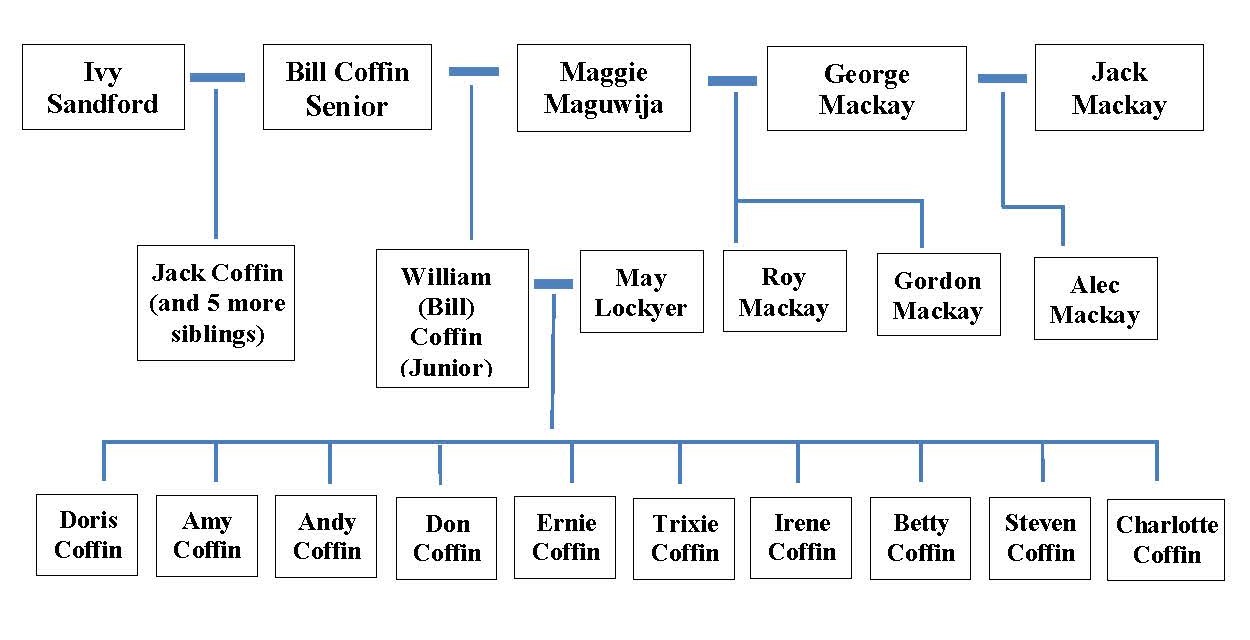
57 Mr McCaul described this family chart as uncontroversial and, on the evidence received in the trial, there is no reason to dispute the accuracy of that assessment.
14 His Honour then considered that the separate question identified two alternative means by which Maggie could be held to be a Nyiyaparli person:
(a) by descent; and
(b) as a person possessing rights or interests in the land and waters claimed and with a connection to those land and waters, both in accordance with the traditional laws acknowledged and the traditional customs observed by the Nyiyaparli.
15 His Honour approached the matter on the balance of probabilities consistent with the preceding authority. His Honour proceeded to address the laws and customs of the Western Desert people and considered it necessary to determine whether the Nyiyaparli traditional laws and customs to which the separate question refers are those of the Western Desert society. Mr Stock addressed this topic in his statement for the preservation evidence hearing to the effect that rights and interests of the Nyiyaparli arise by descent, rather than by any other means which may be recognised by the Western Desert people. That issue was addressed in some detail by Mr McCaul in his report in which he concluded that the Western Desert laws and customs do not govern the way that the Nyiyaparli obtain rights and interests in land. His Honour continued (at [69]-[73]):
69 Mr McCaul reached this conclusion by relying, in part, on the ethnographic works of others. These included Norman Tindale, the ethnologist at the South Australian Museum who had gathered genealogical data in various field expeditions; Carl-Gustaf von Brandenstein, the linguist who had carried out field work with a number of Nyiyaparli speakers in the 1960s; Professor Tonkinson, the Professor of Anthropology at the University of Western Australia who had conducted long term field work at Jigalong (which is towards the eastern border of the area claimed by the Nyiyaparli); Professor Sutton of the University of Adelaide who is an acknowledged linguistic and anthropological consultant; and Professor Berndt who, as Professor of Anthropology at the University of Western Australian, undertook extensive field work with the Western Desert People.
70 Mr McCaul gave a number of reasons for his conclusion that the Nyiyaparli do not obtain interests in land in accordance with Western Desert law and custom:
(a) the ethnographic evidence indicates that Nyiyaparli country is to the west of that of the Western Desert cultural bloc. In particular, the map drawn by Professor Tonkinson published in his work in 1991 showing the approximate boundaries of the Western Desert Society indicates that the western boundary of Western Desert country is a little to the east of Jigalong which is the approximate eastern boundary of Nyiyaparli land. This is significant given the extensive field work Tonkinson had carried out at Jigalong in the 1960s and 1970s;
(b) in his seminal work in 1959, Professor Berndt did not include the Nyiyaparli in the list of the various dialect names which he considered comprised the Western Desert cultural bloc. This was significant as Professor Berndt was aware of the Nyiyaparli, having noted the presence of some of them at Jigalong Mission;
(c) Professor Tonkinson distinguished the Western Desert bloc from the Nyiyaparli, suggesting that:
The rangeland country on the fringes of the western boundary was another significant physiographic boundary between desert groups and those like Nyamal and Nyiyaparli who traditionally occupied the upland areas west of the [Martu] claim area.
Later, Professor Tonkinson recorded explicitly that “the Nyiyaparli are not a desert group”;
(d) both Professors Berndt and Tonkinson regarded a common language composed of a network of related dialects as one of the defining features of the Western Desert cultural bloc. However, Nyiyaparli is not a Western Desert dialect. This was recognised by RMW Dickson, an authority on Australian language classification, who has provided a nationwide classification of dialect into languages and of languages into linguistic groups. Dickson classified the Nyiyaparli as a dialect of a different language, being part of what he called the Pilbara/Ngayarta language group;
(e) contemporary Nyiyaparli claimants such as David Stock in the passage quoted above do not consider themselves be part of the Western Desert bloc;
(f) there are differences in the laws and customs of the two groups. For the Nyiyaparli, the primary path to rights and interests in land is by inheritance from parents and grandparents whereas in the Western Desert cultural bloc, rights and interests may be acquired by other means and, in particular, by long term occupation accompanied by intimate knowledge of the land and its religious geography;
(g) the laws and customs of the Nyiyaparli people are consistent with those of other Pilbara groups rather than with those of the Western Desert cultural bloc.
71 I accept Mr McCaul’s opinions about these matters. He has personal experience with the Western Desert bloc, albeit with its members in South Australia rather than in Western Australia. Mr Caul’s [sic] opinion is soundly based and there is no evidence contradicting it. Mr McCaul did have access to the opinion of Mr de Gand at the time of preparing his opinion but it is not clear that Mr de Gand was in fact expressing an opinion to the contrary.
72 Counsel for the Nyiyaparli drew attention to an apparent inconsistency in the reliance by the Wunna Nyiyaparli Applicant on the laws and customs of the Western Desert cultural bloc. Their contention is that those laws and customs allow that a right or interest in land may be acquired by reason of the place of one’s birth, with the consequence that Bill Coffin Senior acquired the claimed rights and interests in Roy Hill Station by virtue of having been born there. However, if that be right, it should apply to the other descendants of Bill Coffin Senior as well, and yet the Wunna Nyiyaparli Claim specifically excluded some of those descendants.
73 I accept that there is this inconsistency, but prefer not to attach significant weight to it for the purposes of determining the separate question. On my assessment, the matters to which Mr McCaul refers on this issue are much more significant.
16 On turning to examine the Nyiyaparli traditional law and custom, his Honour noted the following (at [74]-[86]):
74 As noted, the second limb of the separate question requires consideration of whether Maggie was a Nyiyaparli person possessing rights and interests in, and a connection with, the land and waters of the claimed area in accordance with traditional laws acknowledged and traditional customs observed, by the Nyiyaparli people. Mr McCaul reported on the pathways by which people obtain rights and interests in land and waters in accordance with Nyiyaparli laws and customs. He noted at the outset that there is no substantial ethnographic record regarding such pathways. In that circumstance, Mr McCaul made use of three sources of information:
(a) general anthropological understandings;
(b) relevant ethnographic data from neighbouring groups; and
(c) information provided by the Nyiyaparli claimants.
75 As to the first, Mr McCaul noted that across most of Australia, descent is the fundamental principle and a basic requirement for membership in a landowning group. There are, however, exceptions. Mr McCaul referred in this respect to the work of Professor Sutton:
The land holding groups of classical Aboriginal societies are widely reported as being based on descendedness, but they were most frequently formed on a basis of serial patrifiliation, not on descent from particular named, apical ancestors. Post classical Aboriginal societies have moved towards the formation of groups of descendants based on common relationships to named individual ancestors. It is important to recall that relationships with forebears are not the exclusive pathway to membership of country-holding groups or sets of people. There are parts of Australia where neither descent groups nor groups formed by a serial parental filiation play a privileged role or perhaps any role in the formation of such groups or sets. The Western Desert is the prime example of this.
76 Mr McCaul also referred to Professor Sutton’s statement that it was commonly patrifiliation which gave rise to rights and interests in land:
Patrifiliation, serial or otherwise, is often the normative or privileged basis of recruitment to groups that are corporate with respect to land and waters as property in classical Aboriginal Australia.
77 Having regard to the extensive review of nationwide ethnographic data undertaken by Professor Sutton and his own native title work in various regions of Australia, Mr McCaul expected that “descent”, or more appropriately “serial-filiation” (the relationship between parents and child) would be a critical factor in establishing rights and interests in land in the Pilbara region. I accept that this is so, while at the same time noting Professor Sutton’s observation that relationship by ancestry is not the exclusive means by which a person may obtain rights and interests in land.
78 In relation to the laws and customs of neighbouring groups, Mr McCaul referred to ethnographic data concerning the Kariyarra People and the Pandjima (Banjima). With respect to the Kariyarra, Mr McCaul referred to the work of Radcliffe-Brown in 1930 who had reported that the social organisation of the Kariyarra was also found in other tribes including the Pandjima (Banjima) and the Bailgu (Palyku). Mr McCaul gave reasons for considering that Radcliff-Brown’s reference to the Bailgu could be taken as applying also to the Nyiyaparli. Radcliff-Brown reported the following concerning group membership among the “Kariera Type” groups:
A tribe is divided into hordes, each with its own defined territory. Membership of the horde is determined by descent in the male line; that is to say, a child belongs to the horde of its father and inherits hunting rights over the territory of the horde. The horde is exogamous and since marriage is apparently always patrilocal a woman changes her horde on marriage, passing from that of her father to that of her husband. There are no specific names for the hordes, but any given horde can be identified by naming any of the important camping places in its territory.
79 With respect to the Pandjima (Banjima), Mr McCaul referred to the work of Palmer in 2008. Palmer found that “descent is a fundamental principle to which claimants make reference when asserting their rights to country”, with such rights able to be gained from both patri-filiates and matri-filiates. That is to say, it seems that the strict patri-filial descent on which Radcliff-Brown reported has evolved among the Banjima to include both matrilineal and patrilineal descent.
80 In relation to information provided by the Nyiyaparli claimants, Mr McCaul referred, by way of example, to what he had been told by six of those claimants:
(a) Gordon Yuline answered the question of how a Nyiyaparli person becomes a landowner by saying: “All depends on your parents. Where they come from. You look after their country. Your children come and look after it then.”
(b) Reggie Malana and John Cadigan said that Bruce Bung should be looking after a hill at Mount Newman “because that was his father’s country”;
(c) Reggie Malana talked about his connection to a place called Wuruwurunha because it was his grandfather’s country;
(d) Raymond Drage said that your “main area” was determined by your grandfather’s country;
(e) Bonny Tucker described her country as “Marilana – that’s my country now. My mother’s country. Weela Wolli Creek – that’s where my grandfather come from”;
(f) Michael Stream said that your country is “where the bloodline is”.
81 Some of the Nyiyaparli witnesses spoke on this topic in their witness statements. Hilda Flann said:
[8] A person becomes Nyiyaparli by having a Nyiyaparli parent and grandparent. You cannot become Nyiyaparli by just being born on Nyiyaparli country. I was born at Shaw River and lived at Marble Bar but cannot claim Nyamal country though (sic) being born or living there.
82 Bruce Bung (Snr) said that he was a Nyiyaparli man through his father and his mother who were both Nyiyaparli and continued:
[5] To be a Nyiyaparli person you need to know your family and how you fit into the country. I was born in Onslow but my country is Nyiyaparli, so being born somewhere does not give you a say in that country, you need to go back to that family connection. Where you are buried does not give you a right to speak for that country, you need to go back to that family connection. If I passed away in Meekathara, I am still a Nyiyaparli man and my country is around Mount Newman and Jigalong – I would not become boss for Meekathara.
Thus, Bruce Bung said that Mintaramunha (Mount Newman) is part of his Nyiyaparli country through his father and the Watch Point Hill area near Jigalong is part of his country through his mother.
83 Keith Hall described himself as being Nyiyaparli by following his mother’s line. He said:
[14] You have to follow your bloodline back to where your people came from. I was born in Port Hedland but that does not give me a right to claim Port Hedland. Cheryl Yuline, Paru, was born in the Spinifex in Googlegong in Nyamal country and my sister Edith was born in Googlegong, but we are all still Nyiyaparli people. People can be born anywhere.
84 David Stock accepted that a lot of Western Desert people did have a strong connection to Nyiyaparli country “because that is where they came in from the desert a long time ago”. Mr Stock continued:
We share Jigalong, but it is in Nyiyaparli country and belongs to the Nyiyaparli. We go and join up with them at law time but we are the boss.
Mr Stock gave evidence to a similar effect in his oral evidence at the preservation hearing.
85 I consider it pertinent that Mr Stock, who had been living in Roebourne was prompted to come back to Nyiyaparli country by Long Bob, Pommy Charlie and Munda Stevens, who he described as “the old fellows that I used to work with in Roy Hill” and who were from the Western Desert. These men had told Mr Stock that he should come and speak for the place because it was not for them to do so. The circumstance that Western Desert men encouraged Mr Stock to come to speak for the country is not necessarily inconsistent with rights and interests in land being acquired in accordance with the laws and customs of the Western Desert cultural bloc but it does seem to reflect a recognition by older Western Desert people that it is not their laws and customs but instead Nyiyaparli laws and customs which govern rights and interests in land in Nyiyaparli country.
86 Finally, I note that in her witness statement provided as part of the preservation evidence hearing, Bonny Tucker said:
[67] Martu are desert people. They came in from the desert long time ago and stopped in Nyiyaparli country. Our languages are different. Our country and culture is different and different ways of eating food. At law time we come together with the desert people. But we have different painting and dress and different songs.
17 Importantly his Honour accepted all of that evidence. He accepted there had been some intermingling of Western Desert people with Nyiyaparli as the Western Desert people came out of the desert and commenced living on Nyiyaparli land. That movement seemed to have been the result of mission activity. However, the evidence did not support the view that the laws and customs of the Western Desert people, particularly those governing the holding of rights and interests in land and waters, had supplanted those of the Nyiyaparli.
18 Against that background, his Honour then turned to examine the key question surrounding Bill Coffin Senior and Maggie saying (at [88]-[98]):
88 There is very little evidence about Maggie, the subject of the separate question. Mr McCaul attributes this in part to the “shallowness of genealogical reckoning” in Australian Aboriginal societies. This is a consequence of the traditional practice of avoidance of mention of the names of deceased persons and the associated limitation of explicit discussion of deceased people more generally, thereby reducing the extent to which knowledge of deceased forebears is transmitted down the generations. Mr McCaul considers it not unusual therefore, that the current generations of the Nyiyaparli and Wunna Nyiyaparli Applicants have limited knowledge only of the generations before that of William Coffin Junior.
89 Accordingly, it is convenient to commence with the consideration of the evidence concerning Bill Coffin Senior, as it is uncontroversial that he was the father of Bill Coffin Junior.
90 In 1978, Bill Coffin Junior was interviewed as part of a Battye Library oral history program, and answered a number of question [sic] concerning the identity of his parents:
A: My mother was a full blood but she had plenty of brains.
Q: She was a full blood from what tribe, do you know what tribe she came from?
…
A: Munda Station near Port Hedland.
Q: Oh Munda Station, yes.
A: Yes, near Port Hedland. That was owned by Mackays too. And Roy Hill was owned by Mackays.
…
Q: Right. And who was your father?
A: Bill Coffin.
Q: Was he a part aborigine was he?
A: He was half cast like myself now.
Q: And where did he come from?
A: Millstream. Roebourne district.
91 Later in the same interview, Bill Coffin Junior said that his father had been a teamster who carted goods between different locations. This lead Mr McCaul to surmise that Bill Coffin Senior had originally come to the Roy Hill area when he carted goods there from Roebourne. Whether that be right or wrong, Bill Coffin Junior’s belief that his father had come from the Millstream Roebourne district is inconsistent with him having been a Nyiyaparli man.
92 As represented in the family chart set out earlier, Bill Coffin Junior had a half-brother, Jack Coffin, who was a child of Bill Coffin Senior and Ivy Sandford. That is to say, Bill Coffin Senior fathered both Bill Coffin Junior and Jack Coffin.
93 On 14 May 1996, Jack Coffin was interviewed by Louis Warren who was then employed in the Western Australian Departments of Aboriginal Sites and Aboriginal Affairs. In that interview (conducted by Mr Warren in a private capacity), Jack Coffin gave the following history concerning his father and Bill Coffin Junior:
Bill [Coffin] was my half-brother – had a different mother. He was older than me. My father was called Bill – he named his son William and thought it was a different name, didn’t know that it would end up as Bill. Bill Coffin was born on Roy Hill. His mother was also born on Roy Hill. My father came from Roebourne way, Cooyapooya (ie Station) or somewhere from down that way. It was a long way for him to travel at that time. People didn’t travel as much in those days.
(Emphasis added)
94 Thus, both Bill Coffin Junior and Jack Coffin thought that their father had come from an area near Roebourne, some distance to the northwest (and well outside) of the Nyiyaparli claim area. Like Mr McCaul, I regard this as suggesting that Bill Coffin Senior had been born and grown up in an area near Roebourne. On the basis that Bill Coffin Senior is likely to have been born before the significant population movements which occurred after colonisation reached the Pilbara, this makes it likely that his mother, Maggie, had also been from that area.
95 Mr McCaul examined the available documentary information concerning Sidong who is said to have been the father of Bill Coffin Senior. That information does not provide any evidence that he fathered Bill Coffin Senior to a Nyiyaparli woman named Maggie. It does indicate that he married an Aboriginal woman named Diana in 1896 in Roebourne and that he had some association with Roy Hill from 1900 to 1914. The evidence concerning Sidong does not permit any inferences to be drawn regarding the identity of Bill Coffin Senior’s mother.
96 None of the Nyiyaparli witnesses had any knowledge of Maggie, with Mr Stock saying that he had never heard about “any old Nyiyaparli Maggie before”, although he had heard of Maggie Maguya (Bill Coffin Junior’s mother).
97 I note that in an interview with Ms Wissing on 3 March 2010, Amy Dhu (Bill Coffin Junior’s daughter) said that all that she knew of her father’s grandmother was that her name was Maggie.
98 The Nyiyaparli Applicant also adduced evidence concerning the identity of Bill Coffin Junior’s mother (Maggie Maguwija). However, it is not necessary to make findings concerning her identity for the purposes of the resolution of the separate question, which focuses on the identity of Bill Coffin Senior’s mother. I note, however, that the evidence suggests that she was a Kariyarra woman from Mundabullangana Station.
19 The primary judge concluded that the Wunna Nyiyaparli had not established on the balance of probabilities that Maggie was a Nyiyaparli person by descent.
20 His Honour then went on to consider the second limb of the separate question, namely that of obtaining rights and interests in land through pathways other than descent. There again, the primary judge turned to the evidence of Mr McCaul noting that (at [100]-[112]):
100 Mr McCaul accepted that the laws and customs of the Nyiyaparli did allow for the possibility of persons becoming Nyiyaparli other than by descent. In fact, Mr Stock stated that Gordon Mackay had been accepted by the old people as Nyiyaparli. Bonny Tucker spoke of a child of non-Nyiyaparli parents who had been adopted by a Nyiyaparli parent and brought up as Nyiyaparli. Mr McCaul stated that that person, and her descendants, are today recognised by the Nyiyaparli community as Nyiyaparli. The Nyiyaparli witnesses were agreed that, for this to occur, the person had, at the least, to have knowledge of Nyiyaparli law and custom. In some cases this was made evident by them going “through the law.”
101 Mr McCaul described this process as being “exceptional”, suggesting that the circumstance that the Nyiyaparli claimants to whom he had spoken had referred to only two cases was an indication of the rarity of the circumstances in which persons had acquired interests other than by descent.
102 I accept the evidence which indicates that mere birth or burial on Nyiyaparli country, speaking the Nyiyaparli language, or marrying a Nyiyaparli person does not make a person Nyiyaparli. I accept in this respect Mr McCaul’s opinion that “if incorporation occurs it is as the result of an ongoing social process, not the simple result of a singular event, such as one-off participation in ceremony, or simple co-residence. It is a process that ultimately requires acceptance both by the community members and by the person being incorporated”.
103 The evidence does not support the conclusion that Maggie, Bill Coffin Senior or Bill Coffin Junior had been recognised by the Nyiyaparli in this way.
104 David Stock is a Nyiyaparli elder. He was born in the early 1930s on Roy Hill Station. Mr Stock’s father was a Banjima man and his mother a Nyiyaparli woman. Mr Stock’s parents worked on Roy Hill Station and sometimes at the adjacent Marilana Station and he grew up on those stations, but mostly at Roy Hill. As an adult, he himself worked for many years on Roy Hill Station. He is acknowledged as authorised to speak on behalf of the Nyiyaparli and is one of the five persons who have brought the Nyiyaparli claim.
105 In his witness statement tendered as part of the preservation evidence, David Stock referred to the claims of the Wunna Nyiyaparli:
[134] I don’t know the name Wunna Nyiyaparli. I have been told by our lawyers that the Coffin family have a claim over Roy Hill Station. But I have never heard of any place or name or people in Nyiyaparli country that is called Wunna or Wunnagnuthagnuthada. I know the Roy Hill area well. I was born and raised there. I have never heard of any place called Wunna at Roy Hill. I believe that if there was a place at Roy Hill, I would know it. If their country was Roy Hill then that name should be there.
[135] I knew William Coffin and his son Ernest. Ernest was the father of Ernest Coffin Jnr and [Ms] Roy and [Ms] Drage. William Coffin was a half-brother to Alec, Gordon and Roy Mackay. Gordon and Roy were the big brothers and Billy Coffin was the nytiy [little one]. … I knew the brothers Gordon and Roy Mackay and I have seen their half-brother Alec Mackay and their half-brother William Coffin. Gordon and Roy Mackay worked on Roy Hill Station as stockmen. I remember seeing William Coffin at Roy Hill when I was young but he moved away. …
[136] The Mackay brothers were all called Wunna. That name Wunna or Wunnanganarra is not the name of a place in Roy Hill or in Nyiyaparli country. I think from what people use to say about them that their family came from around Kariyarra country, near Port Hedland, but I did not know where exactly. Men are often named after a place in the area where their family comes from. I thought Wunna must have been the name of the place where their family came from.
106 Mr Stock said that the mother of Bill Coffin Junior was a Kariyarra woman called “Margaret or Maggie or Maguya”. He had also heard from “the old people” that William Coffin Junior’s father was a “white fellow”. He then said that “if William Coffin had a white father and had a Kariyarra mother, I can’t see how he could become Nyiyaparli. That would not be right under Nyiyaparli laws and customs. He would have to have a Nyiyaparli ancestor to be Nyiyaparli.”
107 Bonny Tucker said in the statement provided as part of the preservation of evidence hearing:
[47] That Coffin mob are not Nyiyaparli, they are Kariyarra. Roy and Gordon Mackay were living with my aunties Annie and Angelina and my mother. They could speak Nyiyaparli very well because they lived in the camp with Nyiyaparli people. I use to hear them and used to cook for them. My mum told me they were Kariyarra. She used to say “I got a Kariyarra man”. She told me that Roy was with her and Angelina was living with Gordon Mackay. My mother said that they came from Munda Station. She said there was a sandy hill near Whim Creek and that was their country. My mother told me Gordon Mackay use to say “good people the Nyiyaparli – looking after me”.
[48] I have heard that the Coffin mob have been claiming to be Nyiyaparli and claiming Nyiyaparli country recently but that’s not right.
…
[51] Billy Coffin [Junior] was a younger brother to those Mackay men. I remember seeing Billy Coffin [Junior] when he visited his brothers. I was told by my mum that they had the same mum Muguya, but a different dad. … I never heard anyone say [Billy Coffin Junior] had any Nyiyaparli family.
108 Hilda Flann is a Nyiyaparli elder. She deposed that she had never heard from her mother or other old people about the Coffin family being Nyiyaparli or that they could speak for, or have rights, in the Roy Hill area; that she never heard about any place at Roy Hill or anywhere else in Nyiyaparli country called Wunna or Wunnanganna or Wunnagnuthugnuthada. Ms Flann asserts that it is her family which can speak for Roy Hill because her grandmother’s father had his “special country” in that area. Ms Flann knew Billy Coffin Junior and confirmed that he could speak some Nyiyaparli. She said however, that Billy Coffin Junior never claimed to be Nyiyaparli and that she did not know him or his children to be Nyiyaparli.
109 Bruce Bung Senior is a Nyiyaparli man. He worked in and around Roy Hill Station in the mid to late 70s. He deposed that he has not heard of any place at Roy Hill called Wunna, Wunnagnuthugnuthada or Wunnanganara and, further, that he had never heard anything about the Coffins being Nyiyaparli until the meetings concerning native title commenced.
110 Mr McCaul spoke to a number of the current generation of Nyiyaparli claimants. They could provide little information about Bill Coffin Senior or his mother Maggie, both of whom had died before any of them were born. However, they did have views about whether Bill Coffin Junior and his descendants were Nyiyaparli. The persons to whom Mr Caul spoke were Gordon Yuline, David Stock, Bill Cadigan, Michael Stream, Bruce Bung, Cheryl Yuline, Lindsay Yuline, Raymond Drage, Reggie Malana. These persons were unanimous in their view that neither Bill Coffin Senior nor Bill Coffin Junior were Nyiyaparli people. Some acknowledged that Bill Coffin Junior and some of his children had shared significant life experiences with Nyiyaparli people and were considered by some to be relations, but none of the Nyiyaparli considered that Bill Coffin Junior and his descendants were Nyiyaparli.
111 None of the persons to whom Mr McCaul spoke knew a place in Nyiyaparli country called “Wunna” or similar. Instead, it seems that the name Wunna may derive from a place in Kariyarra country which is to the northwest of the area claimed by the Nyiyaparli and separated from it by the area claimed by the Palyku People. It is common for family names to derive from the name of a place and to be handed down in successive generations. Several of the Nyiyaparli persons to whom Mr McCaul spoke suggested that the name Wunna is a family name associated with the river known as Wananangara which is said to be in Kariyarra country on Mundaballangana Station. Peter Dershow, a descendant of Bill Coffin Junior but one of those specifically excluded from the Wunna Nyiyaparli claim group, told Mr McCaul that he considered the name Wunna to be a family name which belonged not only to the descendants of Bill Coffin Senior but also to the descendants of his half– brothers Roy, Gordon and Alec Mackay.
112 This evidence was not challenged. I accept it as reliable.
21 His Honour concluded that none of that evidence supported a conclusion that Maggie was a Nyiyaparli person whether by descent or otherwise or that she possessed rights and interests in the land and waters which are the subject of the Wunna Nyiyaparli claim.
22 His Honour also gave attention to the circumstances surrounding the exclusion of the Wunna Nyiyaparli from the Nyiyaparli claim. His Honour relied on some evidence from Ms Wissing and some of the Nyiyaparli witnesses. Ms Wissing had been formerly employed by Yamatji Marlpa Aboriginal Corporation (YMAC), solicitor for the Nyiyaparli. Ms Wissing had been assisting two consultant anthropologists, Mr Vachon and Ms Pannell, who had conducted research into the Nyiyaparli claim for the preparation of a connection report. Mr Vachon provided his findings to the meetings. Mr Vachon informed those in attendance at a meeting in 2009 that research indicated that Bill Coffin Junior had not been Nyiyaparli so his descendants could not claim to be Nyiyaparli through him. Mr Vachon also informed the meetings that it was only descendants of Nyiyaparli ancestors who could hold native title rights in Nyiyaparli country.
23 His Honour then summarised the evidence in response to the claims by the Wunna Nyiyaparli (at [118]-[121]) saying:
118 Bruce Bung Senior said that he had first heard about “the Coffin mob” being Nyiyaparli when native title meetings started happening. He had not heard it before, even though he had been at school with one of the Coffins. Mr Bung explained the circumstances in which the Coffins came to be included in the Nyiyaparli Claim as follows:
[13] Around 2005 or 2006 Gordon Yuline invited the Coffins to be on the Nyiyaparli Claim. Gordon said they made him feel sorry for them and he then invited them on the claim but I had never known them to be Nyiyaparli. I was shocked about this. I didn’t know or think they were Nyiyaparli but we were waiting to see what the anthropologist said. They were allowed to be part of the claim until the anthropologist could work out if they had any connection to the area or not.
119 Keith Hall gave a similar account:
[16] I was at the community meeting in Newman back in 2005 when the Coffins were put into a separate category. They were not included in the same list as the Nyiyaparli people. I remember [Ms] Peterson, [Mr] Peterson and Irene Coffin talking at the meeting and wanting Bill Coffin (Jnr) to be put on the claim as a Nyiyaparli ancestor. The old fellows didn’t want to tell them that they weren’t Nyiyaparli until the research was completed for the claim.
120 David Stock’s account was slightly more extensive:
[155] In the early days when Gumala (Aboriginal Corporation) was set up, we wanted to share the money with family and friends so were happy to look after Amy and the other Coffin women like [Ms] Peterson, Irene Coffin. We were happy for them to be part of Gumala because we wanted to look after them and felt sorry for them. It is marlpa way to look after one another. This did not mean that we thought that they were Nyiyaparli. We thought it does not matter if they are Nyiyaparli or not. It is different from talking for country. They have no right to talk for country. It is not their country.
[156] I was at the Nyiyaparli community meeting in June 2005 when we talked about the claim group description for the Nyiyaparli Claim. I said that I was raised up Nyiyaparli and put through Nyiyaparli law and custom and that gave me connection. Jodi Neale from PNTS (Pilbara Native Title Service) asked questions about how the Coffins could be Nyiyaparli. Irene Coffin was talking loudly and getting angry about this. I tried to make them feel better by saying that I knew Gordon and Roy Mackay at Roy Hill Station. I said they spoke Nyiyaparli. I never said that [Mr] Coffin’s sisters were Nyiyaparli. I did not believe that they were Nyiyaparli. We didn’t want to have a fight with those women or to kick them out. PNTS said they would carry out full research and then if people were Nyiyaparli or had rights in Nyiyaparli country they could be in the claim and if not they should be removed. That was a way of keeping away from trouble at the time.
[157] I did not know that they were claiming to be Nyiyaparli people. The children and grandchildren of Bill Coffin have never been given any traditional rights and interests in Nyiyaparli country.
121 The chronology of amendments set out earlier in these reasons shows that members of the Coffin family were included in the Nyiyaparli Claim from 2001. It seems, however, that particular attention was given to the Coffin family in 2005. The evidence from Bruce Bung Senior, Hilda Flann and David Stock just set out explained how that came about. It was a compromise which the claim group adopted but subject to a condition, namely, the carrying out of further anthropological research. In these circumstances, I do not consider that the inclusion of the descendants of Bill Coffin by the 2005 Amendment should be regarded as a form of admission which now binds the Nyiyaparli Applicant or which should be treated as evidence warranting a different conclusion from that indicated by the other evidence. Instead, the inclusion of the descendants of Bill Coffin was, as I have said, a compromise to resolve a difficult issue which arose at the meetings in 2005. The compromise was reached on the basis that there would be further anthropological research. That further research has confirmed that the descendants of Bill Coffin Senior are not Nyiyaparli.
(emphasis added)
24 Importantly to the present question, his Honour concluded by observing (at [122]):
It is unfortunate that the Wunna Nyiyaparli chose not to participate in an appropriate way in the preparation for, and hearing of, the separate question, Nevertheless, the evidence indicates clearly, in my opinion, that Maggie (the mother of Bill Coffin born circa 1903) was not a Nyiyaparli person, whether by descent or otherwise by possessing rights and interests in the lands and waters comprised in Wunna Nyiyaparli Claim and with a connection to those land and waters in accordance with the traditional laws acknowledged and traditional customs observed by the Nyiyaparli people.
25 The primary judge answered the separate question in the negative.
OBJECTIONS AS TO COMPETENCY OF THE APPEAL
26 The notice of objection to competency is in these terms:
The Fourteenth Respondents (Nyiyaparli) object to the competency of the appeal.
Grounds of objection
1. The [Wunna Nyiyaparli] appeals from the whole of the judgment and all of the orders of the Federal Court given on 16 December 2016. Those orders were made in three proceedings, WAD 22 of 2012, WAD 6280 of 1998 and WAD 196 of 2013, and included orders that a separate question in all three proceedings be answered in the negative and that certain persons (who are some of the appellants) be removed as respondents to WAD 6280 of 1998.
2. Insofar as the [Wunna Nyiyaparli] seek to appeal against the answer to the separate question and the removal of some of the appellants as respondents to WAD 6280 of 1998, the appeal concerns an interlocutory judgment and leave to appeal is required (s 24(1A) of the Federal Court of Australia Act 1976 (Cth)). The [Wunna Nyiyaparli] has not sought nor obtained leave to appeal.
3. Furthermore, an appeal does not lie against an order removing persons as a party (s 24(1AA)(b)(i) of the Federal Court of Australia Act 1976 (Cth)).
4. As the separate question was stated and determined in all three proceedings, it is not possible for the [Wunna Nyiyaparli] to appeal only the orders made in WAD 22 of 2012.
5. Further or alternatively to paragraphs 1 - 4 above, on 4 and 9 February 2017 one of the named appellants, [Ms] Roy, wrote to the Court stating that Hopgood Ganim Lawyers were not authorized to file the notice of appeal dated 30 January 2016. No other notice of appeal has been accepted for filing, and the date for the filing of any notice of appeal without leave has passed.
The Fourteenth Respondent applies for the question of competency to be heard and determined before the hearing of the appeal.
AUTHORISATION OF THE NOTICE OF APPEAL DATED 30 JANUARY 2017
27 I agreed to hear the competency issue before the hearing of the appeal.
28 The argument on the objection to competency followed a slightly different order from the notice. The first ground advanced was a lack of authorisation of the notice of appeal. The State adopted the arguments advanced by the Nyiyaparli and I will refer to those two active respondents as being the respondents.
29 The question of authorisation relied in part upon communications between members of the Wunna Nyiyaparli and their solicitors. Those communications might ordinarily have attracted legal professional privilege but it was clear that the communications had been voluntarily sent particularly by Ms Roy to the Court and to others with a view to responding to the argument as to lack of authorisation of the appeal. Any privilege in those communications was therefore waived.
30 In relation to the authorisation argument, as noted, the judgment of the primary judge was made on 16 December 2016 when orders were pronounced. An appeal or leave to appeal (this will be discussed in the next section) was required to be filed within 21 days from that date. Taking into account r 1.61(4) and r 1.61(5) FCR, it was due to be lodged on or before 30 January 2017. Indeed at 4:29 AWST of that day the original notice of appeal was filed. The document bore file number WAD 22 of 2012. Nonetheless it was accepted for filing and given the filing number WAD 17 of 2017.
31 The issue in relation to authorisation arises because in the footer of the first page and at the bottom of the second page the document says it was prepared and signed by ‘Ernest William Coffin’ as appellant. However, it is clear that in the signature panel at the bottom of the second page, the signature appears to read ‘HopgoodGanim Lawyers’. The signature accords with an email from HopgoodGanim Lawyers to Ms Roy on 31 January 2017 in which HopgoodGanim indicated that they ‘had signed the notice of appeal on behalf of the [Wunna Nyiyaparli], given that it was not possible to obtain the signature of Ernest Coffin in time’.
32 The schedule to the notice of appeal dated 30 January 2017 confirms that Mr Coffin was one of the members of the applicant in the Wunna Nyiyaparli claim. It appears from the list of parties, the heading to the document and from the schedule that the ‘appellant’ purports to be all the members of the applicant in the Wunna Nyiyaparli claim, that is, Mr Coffin, Ms Drage, Ms Peterson, Mr Peterson and Ms Roy.
33 The respondents rely on r 36.31(2) which provides that a person must not be named as an appellant without a person’s consent. The respondents contend that the issue is therefore whether all those persons have consented to the filing of the notice of appeal on 30 January 2017. Significantly, as all those persons together comprised the applicant in the Wunna Nyiyaparli claim, the respondents say they can only act jointly in filing a notice of appeal. The respondents rely on the reasoning in McGlade v Native Title Registrar (2017) 340 ALR 419 (at [234]–[238]) per North and Barker J and (at [379], [438]-[439]) per Mortimer J. In those passages their Honours said:
234 The definition of a “registered native title claimant”, relying as it does on the definition of an “applicant” in s 61(2), contemplates a singular entity that may, in some circumstances, be comprised of multiple “persons” whose names appear on the Register “as the applicant”. In order to construe the provisions of the NTA in a harmonious manner, the reference to “all registered native title claimants” in s 24CD(2)(a) must refer to each “registered native title claimant”, if there is more than one, in the sense of the entity defined by s 253, in relation to an agreement area.
235 This conclusion is strengthened by the parallel such a construction would create between the work done by “all registered native title claimants” and “all registered native title body corporates” in s 24CD(2)(a) and (b) respectively.
236 The parallel is not weakened by Note 1 to s 24CD(2)(a), of which s 24CD(2)(b) has no equivalent, which provides as follows:
Note 1: Registered native title claimants are persons whose names appear on the Register of Native Title Claims as applicants in relation to claims to hold native title: see the definition of registered native title claimant in section 253.
237 The subtle differences in the drafting of Note 1 and the definition of a “registered native title claimant” in s 253 may be noted. A literal reading of Note 1, particularly the reference to “persons whose names appear”, may suggest that, for the purposes of s 24CD, the reference to “registered native title claimants” in the plural, means the individual persons comprising the “applicant”, rather than multiple “registered native title claimants” in the form of entities created by the NTA.
238 Nonetheless, in construing the NTA harmoniously, an interpretation of “registered native title claimant” consistent with s 253 and the use of that phrase in other provisions of the NTA, should be preferred over one possible interpretation of Note 1 to s 24CD(2)(a).
…
379 There are judicial views tending in both directions on the question whether individuals who constitute an applicant can be authorised, in the terms of an authorisation given under s 251B, to act and make decisions by majority (see [435]-[439] below). There is certainly nothing in the text, context or purpose of s 61 which would suggest that would be the case, and the representative and singular nature of an applicant would in my view suggest the contrary. The view that the individuals who constitute an applicant may be able to act or decide by majority comes from a broad reading of the authorisation provision in s 251B, which I deal with later in these reasons. For present purposes, the important point is that s 61 identifies a collective, but singular, body comprising individuals who are claim group members and have been authorised to act under s 251B. The collective character, and singularity, of the applicant suggests the Act does not contemplate acts or decisions by only some of the individuals who constitute an applicant. That does not mean there cannot be debate and disagreement between individuals who comprise an applicant; nor does it preclude some individuals from holding different or dissenting views and remaining as members of the applicant. However, it does mean that when those individuals who comprise the applicant or registered native title claimant are required to act (as in making a decision about the course of a native title application or signing an ILUA), they must act collectively.
…
438 In Tigan, Gilmour J described (at [18]) the contention that individuals constituting an applicant could act by majority as “inimical to the object of ss 61 and 62 in the context of the Act as a whole”, finding (at [28]) that members of the applicant cannot act by majority but must act in concert. His Honour added (at [28]):
If dissension arises, as it seems has occurred here, between the named persons who are the applicant, then there are procedures under the Act for the native title claimant group to effect a change in the membership of the applicant. Indeed that has been foreshadowed in this case.
439 It will be apparent from my reasoning that I would be inclined to agree, respectfully, with his Honour.
34 By the time of the application before me, there was no indication as to whether Ms Peterson or Mr Peterson had authorised the filing of the notice of appeal on 30 January 2017.
35 Indeed to the contrary, there were positive indications that Ms Drage, Mr Coffin and Ms Roy did not authorise the filing of the notice of appeal on 30 January 2017. Those positive indications were confirmed in argument before me and were also contained in an email from Ms Roy to HopgoodGanim dated 14 January 2017 where Ms Roy stated that:
… we have reconsidered applying for an appeal and we do not want to appeal the separate question. We are going to wait on Justice Barker to hand down his decision and that will determine whether we appeal or not.
Please accept this email as notice that we are not going to proceed with the appeal of the separate hearing. …
(emphasis added)
36 In a further email from Ms Roy to HopgoodGanim on 31 January 2017, Ms Roy stated ‘in the application under orders sought, number 2 is not what we seek …’. HopgoodGanim then responded by email again to Ms Roy on the same day saying they had redrafted the notice of appeal and asking that the signed notice be returned to them as soon as possible. On 4 February 2017 Ms Roy sent an email to this Court stating amongst other things:
(a) ‘the application faxed by HopgoodGanim lawyers on 30 January 2017 was not authorized by the Wunna Nyiyaparli applicants for Betty Peterson and Others WAD 22/2012. The application was not prepared by [Mr] Coffin, neither was it signed by [Mr] Coffin. HopgoodGanim are not authorized to sign on behalf of [Mr] Coffin’.
(b) ‘The lawyers for HopgoodGanim do not have written authorization to act or submit documents on behalf of the Wunna Nyiyaparli People. On 15th January 2017 an email was sent to HopgoodGanim lawyers, [named] advising that the Wunna Nyiyaparli People did not want to appeal the separate question judgement handed down by [the primary judge] on 16 December 2016’.
37 In oral submissions, the Nyiyaparli also sought to rely on Roe v Kimberley Land Council Aboriginal Corporation (2010) 215 FCR 131. In that matter, two persons, Mr Shaw and Mr Roe, who were named jointly as the applicant, brought a proceeding challenging the authority of the region’s recognised representative body to represent the claim group in negotiating and entering into an agreement. Mr Shaw subsequently disavowed that proceeding and Mr Roe sought to continue in his own right. The Court held (at [37] and [42]) that it was only the ‘applicant’ in the native title claim, namely, Mr Roe and Mr Shaw acting jointly, who had standing to bring a claim on behalf of the claim group by way of s 62A of the Native Title Act 1993 (Cth).
38 The next event was the lodging by Mr Coffin on 6 February 2017 of a document headed ‘Supplementry [sic] notice of appeal’ (the first supplementary notice of appeal) purportedly dated 30 January 2017 and signed by Mr Coffin. This document was not accepted for filing.
39 Ms Roy sent an email to this Court on 9 February stating in substance that the initiating appeal application filed on 30 January 2017 for ‘Betty Peterson and others’ was signed by HopgoodGanim on behalf of Mr Coffin. It was not signed on behalf of the Wunna Nyiyaparli. Ms Roy said:
I advise that there is no legal retainer agreement with Hopgood Ganim Lawyers to represent the Wunna Nyiyaparli People and please note they are not the lawyers on record for Betty Peterson and others (WAD22/2012) for the Wunna Nyiyaparli People.
Betty Peterson and others (WAD22/2012) for the Wunna Nyiyaparli People are self represented litigants and [Mr] Coffin acts on their behalf.
40 The respondents, or at least the Nyiyaparli in particular, were not served with a notice of appeal dated 30 January 2017, but on 30 March 2017 they were served with the first supplementary notice of appeal by email from Ms Roy who apologised for the delay but confirmed the appeal was proceeding.
41 On 20 April 2017 Ms Roy sent an email to my associate, stating that the solicitors were engaged to draw up the appeal but were never the representatives for the Wunna Nyiyaparli. There was no agreement to retain them: ‘[They were] paid $6,000 to write the appeal for [the Wunna Nyiyaparli] in order for the Wunna Nyiyaparli to file on their own behalf’. On 20 April 2017 Mr Coffin sent a facsimile to this Court stating that the Wunna Nyiyaparli believed that leave may be required to pursue their appeal for the reversal of the ruling by the primary judge. On 3 May 2017 an affidavit of Ms Drage was filed deposing amongst other things to the fact that the solicitors were paid to write up the appeal and send the final copy to Ms Roy and Mr Coffin to file on behalf of themselves and the Wunna Nyiyaparli.
42 It appears that the first supplementary notice of appeal was different again from a document referred to as such by Mr Coffin in a case management hearing on 4 May. At that case management hearing both the Court and the respondents had understood the supplementary notice of appeal being referred to by Mr Coffin to be the first supplementary notice of appeal. Apparently this was not the case and a further supplementary notice of appeal is now relied upon. Little appears to turn on this confusion.
43 It should be briefly noted that during the course of oral submissions, Mr Coffin questioned whether the objection to competency (filed on 3 May 2017) was filed within the prescribed 14 day timeframe pursuant to r 26.72(1) FCR. In my view, this question can be immediately dispensed with. As noted, the notice of appeal filed on 30 January 2017 was not served on the respondents. Secondly, on 30 March 2017, the first supplementary notice of appeal was emailed to the respondents, however, was not accepted for filing. Finally, the further supplementary notice of appeal was accepted for filing in Court on 4 May 2017. Consequently, the issue of timing does not arise.
44 There can be little doubt on either account that the notice of appeal filed on 30 January 2017 was not authorised to be filed by the Wunna Nyiyaparli. Therefore it is not competent. At least some of the people comprising the Wunna Nyiyaparli, including Mr Coffin and Ms Roy appear to wish to appeal in accordance with the further supplementary notice of appeal but that document was not filed until after 30 January 2017. Therefore, even if it is duly authorised, the Wunna Nyiyaparli would require leave in order to file the document out of time regardless of whether it should be a notice of appeal or notice for leave to appeal.
45 Ultimately, regardless of these difficulties with the formalities, the question will be a substantive one once the next bridge has been crossed.
WHETHER LEAVE TO APPEAL IS REQUIRED
46 While it may be somewhat counterintuitive (because the determination of the separate question disposes in a final way of rights and remedies of the Wunna Nyiyaparli in this matter), the better view on the authorities maybe that the judgment was interlocutory in nature. Consequently, if so, it follows that leave to appeal would be required, but has not been sought. Subject to the substantive question below, that could be accommodated by an application to amend. First though it is necessary to address the procedural question.
47 If it be assumed, for the sake of argument, that there was appropriate authorisation for the appeal or an application for leave to appeal, the separate question was answered in three native title claim proceedings as the same issue arose in all three claims. Two of those claims, namely the Wunna Nyiyaparli claim and the 1998 claim, wholly overlapped. Therefore it was necessary they be dealt with together in the same proceeding. By orders made on 24 March 2016, the Wunna Nyiyaparli claim was designated as the ‘lead proceeding’ and all orders made, all documents filed and all evidence received in the lead proceeding were taken to also be orders made, documents filed and evidence received in the Nyiyaparli claims. Therefore any appeal in relation to the answer to the separate question must be an appeal in relation to all three of the native title claim proceedings. It is not possible, for example, for the Wunna Nyiyaparli to appeal only in relation to the answer to the separate question in the Wunna Nyiyaparli claim. Were it otherwise, the appeal, if it succeeded, would give rise to an inconsistent result with the other two native title claim proceedings involving the same issues and the same parties.
48 That is consistent with the fact that the notice of appeal (the first and supplementary versions), indicates that the Wunna Nyiyaparli appeal from the whole of the judgment and all of the orders of the Court made on 16 December 2016, even though the appeal notice was prepared with only the file number WAD 22 of 2012. If indeed it is the intention to appeal only the orders made in WAD 22 of 2012, the appeal would be incompetent. Therefore, for the sake of argument, it will also be assumed that the appeal relates to all three proceedings. Assuming that this is so, the proper characterisation of the orders seems to be that they were interlocutory in nature and as such leave to appeal is required pursuant to s 24(1A) of the Federal Court Act.
49 In N and E Bowder Pty Ltd v Australian Keg Company Pty Ltd (2014) 220 FCR 166, Rangiah J examined the question of whether the answer to a separate question in the proceedings is generally an interlocutory judgment. His Honour said (at [7]-[9]):
7 Before considering the application, there is one further matter I should mention. The primary judge had ordered a separate trial of the issue of infringement. Damages have not yet been determined.
8 There is a division of authority in this Court as to whether a declaration made in respect of a separate issue which does not dispose of the whole proceeding is interlocutory or final. A long line of authority holds that such a judgment is interlocutory: see, for example, the judgments of the Full Court in Australian Builders’ Labourer’s Federated Union of Workers (WA Branch) v J-Corp Pty Ltd (1993) 42 FCR 452 at 454; Fisher & Paykel Healthcare Pty Ltd v Avion Engineering Pty Ltd (1991) 103 ALR 239 at 242; Caboche v Ramsay (1993) 27 ATR 479 at 489-490; 119 ALR 215 at 226; NZI Securities Australia Ltd v Poignand (1994) 51 FCR 584 at 593-594; Fraser v NRMA Holdings Ltd (1995) 55 FCR 452 at 457; Construction, Forestry, Mining and Energy Union v Employment Advocate [2011] FCA 1442 at [8]-[9]; Lewis v Hall (2005) 68 IPR 89 at [7]. These cases applied the reasoning of the High Court in Computer Edge Pty Ltd v Apple Computer Inc (1984) 54 ALR 767 at 767-768.
9 Other decisions of this Court support the view that a declaration made in respect of a separate issue which does not finally dispose of the case is a final judgment, so that leave to appeal is not required. That view was strongly expressed by Finkelstein J in Warramunda Village Inc v Pryde (2002) 116 FCR 58 at [65]-[70]. In Ho v Grigor (2006) 151 FCR 236, the Full Court cited those passages from the judgment of Finkelstein J with approval. However, the Full Court was not directly deciding the question addressed by Finkelstein J and its apparent approval of those views appears to be obiter dicta. For present purposes, I consider that I am bound by the earlier Full Court decisions to conclude that the judgment was interlocutory and that leave to appeal is required.
50 This is so even where part of the orders made are final in nature, as was the case in the order in WAD 22 of 2012 dismissing that proceeding. However, see the discussion in Damorgold Pty Ltd v J.A.I. Products Pty Ltd [2014] FCA 448 per Tracey J at [3]-[9]:
3 The trial of the proceeding was split between issues of liability and the validity of the patent (which were to be heard and determined as preliminary questions) and the issue of pecuniary relief. The orders were made pursuant to Rule 30.01(1) of the Federal Court Rules 2011 (‘the Rules’). This Rule provided for the making of “an order that a question arising in the proceeding be heard separately from any other questions.” His Honour's orders and reasons dealt with the preliminary questions.
4 The patent had 30 product claims. His Honour held that four of these claims were valid and that two of the four had been infringed. He further held that the remaining claims were invalid and should be revoked. He made orders revoking these claims but stayed their operation for 21 days or, in the event that an application was made for leave to appeal, until 21 days after the final determination of that application or, if leave to appeal was granted, 21 days after the final determination of that appeal.
5 Damorgold and Vertilux wish to appeal from the order revoking the patent “insofar as claimed in the claims which were found not to be valid”. They also wish to challenge all of the orders made by his Honour “to the extent that they do not extend” to the invalid claims. They seek leave to do so.
6 The respondent did not oppose the application for leave to appeal.
7 Section 24(1) of the Federal Court of Australia Act 1976 (Cth) (‘the Act’) confers jurisdiction on the Court to hear and determine appeals from “judgments” of single judges exercising the original jurisdiction of the Court. Section 24(1A) provides that an appeal may not be brought from “a judgment” of a single judge “that is an interlocutory judgment” unless leave to appeal is granted. The word “judgment” is defined, in s 4, to mean, inter alia, “a judgment, decree or order, whether final or interlocutory … ”.
8 Although the applicants contend that the orders from which they seek to appeal finally determine substantive rights relating to the validity of the claims found by his Honour not to be valid, they treated those orders as being interlocutory in form. They submit that the orders are attended by sufficient doubt as to warrant reconsideration by a Full Court and that substantial prejudice will flow to the parties and the public if the hearing of the appeal is delayed until determination of the outstanding issue of pecuniary relief: cf Décor Corporation Pty Ltd v Dart Industries Inc (1991) 33 FCR 397.
9 I am not persuaded that the applicants require leave to appeal. In TAG Pacific Limited v McSweeney (1992) 34 FCR 438 Olney J held that, in a split trial in which questions relating to liability are ordered to be determined as preliminary questions, orders finally determining those questions are not to be treated as interlocutory: see at 444-5. A similar conclusion was reached by the majority of the Full Court of the Supreme Court of Victoria in City of Camberwell v Camberwell Shopping Centre Pty Ltd [1994] 1 VR 163 at 173-175. See also Cairns B, Australian Civil Procedure (10th ed, Lawbook Co, 2013) at 568-569. The orders made by His Honour in relation to the revocation of the patent bear the same character of finality as would have attended such orders had they been made following a trial in which questions of liability and relief had been considered in the normal manner. Left undisturbed those orders would finally determine the issues relating to the validity of the patent. They fall within the defined meaning of the word “judgment” for the purposes of s 24(1) of the Act.
51 On balance, I consider that on the present issue, the orders made in the Nyiyaparli claims answering the separate question in the negative are not ‘final’ because those proceedings are continuing and the separate question has resolved only one of a number of issues. That is, by definition, an interlocutory determination.
52 The other complication for the Wunna Nyiyaparli is that the only other order made in those proceedings, apart from answering the separate question adversely to the Wunna Nyiyaparli, was the removal of certain persons, namely the members of the Wunna Nyiyaparli applicant as respondents. There is no appeal from such an order by virtue of the provisions in s 24(1AA)(b)(i) of the Federal Court Act.
53 Finally, it is clear from Computer Edge Pty Ltd v Apple Computer Inc (1984) 54 ALR 767 that in circumstances where an appeal is brought against a number of orders some of which are final and some of which are interlocutory, leave is required.
SHOULD LEAVE TO APPEAL BE GRANTED IF IT WERE SOUGHT?
54 There is not yet any application either for an extension of time to appeal or for leave to appeal or an extension of time for leave to appeal. Assuming in favour of the Wunna Nyiyaparli that such an application were on foot (to attempt to overcome the difficulties described above), each of those applications carries with it, amongst other things, a need to consider the merits of the argument in the appeal. The appropriate application (had it been made in time) would be an application for leave to appeal (as distinct from an application for extension of time to appeal). It is necessary to consider the relevant criteria. The criteria is well established from decisions such as Decor Corp Pty Ltd v Dart Industries Inc (1991) 33 FCR 397. They are that:
(a) the primary decision was attended with sufficient doubt to warrant it being reconsidered on appeal; and
(b) if leave was refused substantial injustice would occur, assuming the original decision to have been wrong.
55 It is clear that the notice of appeal (as confirmed also in the Wunna Nyiyaparli’s oral argument) addresses the natural justice complaint.
56 In addition to the oral argument advanced on this topic by the Wunna Nyiyaparli, the Wunna Nyiyaparli have sought to file two witness statements prepared by Mr Coffin and dated 30 May 2017. The first witness statement appears to address the authorisation of YMAC to file affidavits on behalf of the Wunna Nyiyaparli and the second witness statement indicates that the Wunna Nyiyaparli will be seeking the dismissal of the objection to competency filed by YMAC on 3 March 2017 (as no application was filed by YMAC on behalf of the Nyiyaparli on 3 March 2017, it is presumed that this is a reference to the notice of objection to competency filed on 3 May 2017). More specifically, paras 2-7 of the first witness statement of Mr Coffin assert that certain affidavits filed by the Nyiyaparli in the separate question proceedings were irregular in form. None of that is responsive to the objection to competency or the merits of the appeal. Those affidavits were not part of the evidence on which the primary judge relied when answering the separate question. Those were affidavits concerning proposed amendments to the dates in the programming orders for the hearing of the separate question. As to the second witness statement, it contains a suggestion as to a conflict of interest on the part of counsel for the Nyiyaparli. This submission is clearly without foundation to the extent it is comprehensible. There are then various paragraphs dealing with alleged defects in the Nyiyaparli’s native title claims. None of these matters address questions of competency. The statements go into some detail on a variety of matters, none of which is at all responsive to any of the grounds or submissions advanced on the notice of objection to competency. The materials filed were not relevant in any way to that notice. Each of the respondents has objected to the use of those materials and further made submissions that they do not bear on any of the issues raised in the objection to competency and make allegations which are unsubstantiated. I accept the submissions advanced by the State and adopted by the Nyiyaparli that no weight can be given to these materials in the present application.
57 Turning to the substantive question of a lack of natural justice or procedural fairness in refusing to allow the Wunna Nyiyaparli to adduce any evidence at the hearing of the separate question on 11 July 2016, it is clear from the record set out in detail above by the primary judge that the Wunna Nyiyaparli were given ample opportunity to participate in the hearing of the separate question, including the opportunity to adduce evidence. This material also, importantly, is confirmed in affidavits on behalf of the respondents.
58 It is important to recall, as indicated at the outset, that particularly in the context of contested proceedings initiated by a litigant in person, while a reasonable opportunity to assist the litigant in person is usually necessary, this does not extend to disadvantaging a represented litigant to its prejudice. Moreover, to guarantee procedural fairness is not open-ended. The requirement for procedural fairness is a requirement that a party may be given a reasonable opportunity to present its case, not every opportunity. See the discussion in Wyman v Queensland (2015) 235 FCR 464 per North, Barker and White JJ (at [63]):
Nor, in our opinion, does framing the issue as one of denial of procedural fairness assist the Bidjara people. As noted, a failure to grant an adjournment can in some circumstances constitute a denial of procedural fairness. That circumstance will obtain if a party has been denied a reasonable opportunity to present its case. However, the matters to which we have referred indicate that that is not this case. The Bidjara people had been provided with a reasonable opportunity to prepare and present their case but, by their own action, had removed the possibility of doing so by legal counsel. It is to be remembered that procedural fairness requires that a party be given a reasonable opportunity to present a case: not every opportunity.
59 Additionally, it is to be observed that the question of whether or not further opportunity to adduce evidence should be given was a discretionary judgment. An appeal in respect of the exercise of discretion requires compliance with the principles set out in House v The King (1936) 55 CLR 499 (at 504–505) and summarised also in Wyman (at [41]):
Although the Bidjara people’s ground of appeal relating to the refusal of an adjournment asserted a denial of procedural fairness, a number of counsel’s submissions were directed more to review of the discretionary decision involved. This engaged the principles state in House v The King (1936) 55 CLR 499 (House v The King) at 504-505 (Dixon, Evatt and McTiernan JJ) relating to appellate review of discretionary decisions. As is well-known, it is not enough that the judges of the appellate court consider that, had they been in the position of the trial judge, they would have taken a different course:
It must appear that some error has been made in exercising the discretion. If the judge acts upon a wrong principle, if he allows extraneous or irrelevant matters to guide or affect him, if he mistakes the facts, if he does not take into account some material consideration, then his determination should be reviewed and the appellate court may exercise its own discretion in substitution for his if it has the materials for doing so. It may not appear how the primary judge has reached the result embodied in his order, but, if upon the facts it is unreasonable or plainly unjust, the appellant court may infer that in some way there has been a failure properly to exercise the discretion which the law reposes in the court of first instance. In such a case, although the nature of the error may not be discoverable, the exercise of the discretion is reviewed on the ground that a substantial wrong has in fact occurred.
60 The primary judge’s reasons for exercising discretion were set out with clarity and detail and were plainly correct. It is quite clear that there is not sufficient doubt about the correctness of the judgment under appeal to warrant consideration by the Full Court.
61 As a secondary consideration, there is also real doubt as to whether substantial injustice would occur, assuming the original decision not to allow further evidence had been wrong. This is the second limb of the Décor test.
62 In the present situation the alleged error as indicated is the refusal to receive the Wunna Nyiyaparli’s evidence. It is not said to be a failure to allow the Wunna Nyiyaparli to cross-examine the Nyiyaparli witnesses or to conduct the trial in some other way. To merely receive the Wunna Nyiyaparli’s evidence without any application to cross-examine the Nyiyaparli witnesses in order to resolve any conflicts between the evidence would be unlikely to assist the Wunna Nyiyaparli. Significantly, in this regard, the evidence which the Wunna Nyiyaparli say they would have adduced if permitted, did not materially go to the issues in dispute on the separate question and would undoubtedly have been subject to multiple objections as to lack of relevance. That is because the only lay evidence of any direct relevance from the Wunna Nyiyaparli was a statement by Ms Roy based on family oral history. That, however, was in conflict with evidence adduced by the Nyiyaparli and a genealogy. Also sought to be adduced was a genealogy attached to the witness statement of Mr Coffin of 9 November 2015, but the source of the information in the genealogy was not explained. Significantly, the expert evidence proposed to be adduced by the Wunna Nyiyaparli concerned the question whether the Wunna Nyiyaparli claim area was part of or subject to the same laws and customs as the Western Desert cultural bloc, a proposition which his Honour rejected. The Wunna Nyiyaparli’s expert evidence was canvassed in the evidence of Mr McCaul and to that extent was taken into account by the primary judge who preferred the conclusion reached by Mr McCaul as discussed above. As against this limited evidence proposed to be adduced by the Wunna Nyiyaparli there was a substantial body of evidence adduced by the Nyiyaparli based on oral history and archival sources which his Honour found clearly answered the question.
CONCLUSION
63 I can accept that it is possible, as the Wunna Nyiyaparli argued, that they did not consent to the hearing of the separate question. It was not, however, a matter of consent. The separate question was ordered to be heard by Barker J after hearing argument on that point. Secondly, I can accept that it is possible that the Wunna Nyiyaparli were confused as to some of the procedural orders but taking into account all of the indulgences and considerations they were afforded, the decision below was undoubtedly correct. For that reason, had it been sought, leave to appeal would not be granted.
64 The appeal is unauthorised and, in any event, incompetent. The objection to competency must be upheld.
I certify that the preceding sixty-four (64) numbered paragraphs are a true copy of the Reasons for Judgment herein of the Honourable Justice McKerracher. |
Associate:
WAD 17 of 2017 | |
CHICHESTER METALS PTY LTD | |
Fifth Respondent: | FMG PILBARA PTY LTD |
Sixth Respondent: | HANCOCK PROSPECTING PTY LTD |
Seventh Respondent: | ROY HILL INFRASTRUCTURE PTY LTD |
Eighth Respondent: | ROY HILL IRON ORE PTY LTD |
Ninth Respondent: | KEYDRIVE PTY LTD |
Tenth Respondent: | ANNE CATHERINE PAULL |
Eleventh Respondent: | ROY HILL STATION PTY LTD |
Twelfth Respondent: | STARTLINE NOMINEES PTY LTD |
Thirteenth Respondent: | VANGUARD ENTERPRISES PTY LTD |
Fourteenth Respondent: | DAVID STOCK, GORDON YULINE, RAYMOND DRAGE, VICTOR PARKER AND BILLY CADIGAN ON BEHALF OF THE NYIYAPARLI PEOPLE |


