

FEDERAL COURT OF AUSTRALIA
Cantor v Audi Australia Pty Limited (No 2) [2017] FCA 1042
ORDERS
Applicant | ||
AND: | AUDI AUSTRALIA PTY LIMITED (ACN 077 092 776) Respondent | |
JUDGE: | FOSTER J |
DATE OF ORDER: | 1 September 2017 |
THE COURT ORDERS THAT:
1. Pursuant to s 33J of the Federal Court of Australia Act 1976 (Cth) (the Act), 18 October 2017 is fixed as the date on or before which a group member may opt out of this proceeding.
2. Group members be given notice pursuant to s 33X(1)(a) and s 33X(5) of the Act of the fact that they may opt out of this proceeding in accordance with pars 4 and 5 of these Orders.
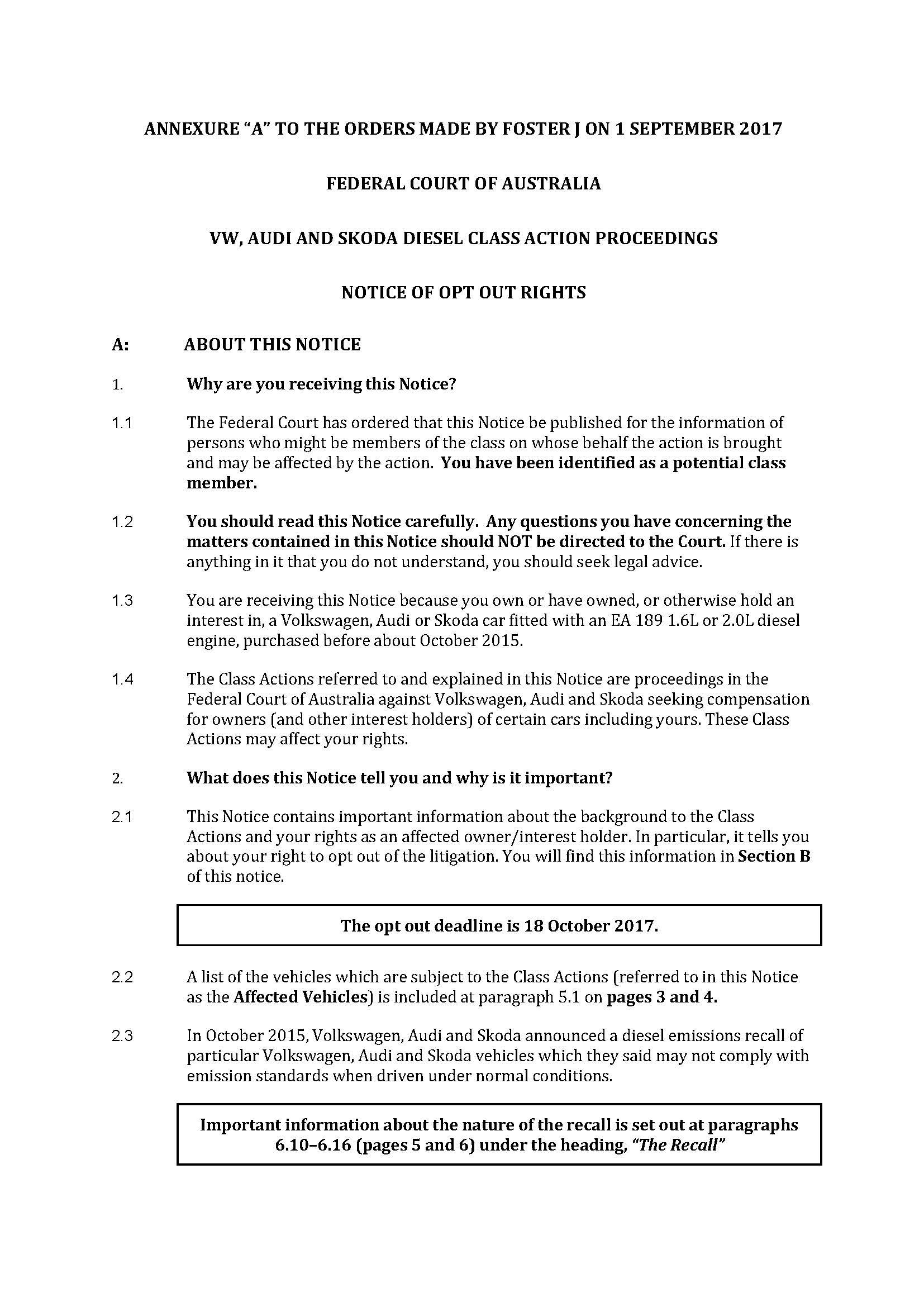
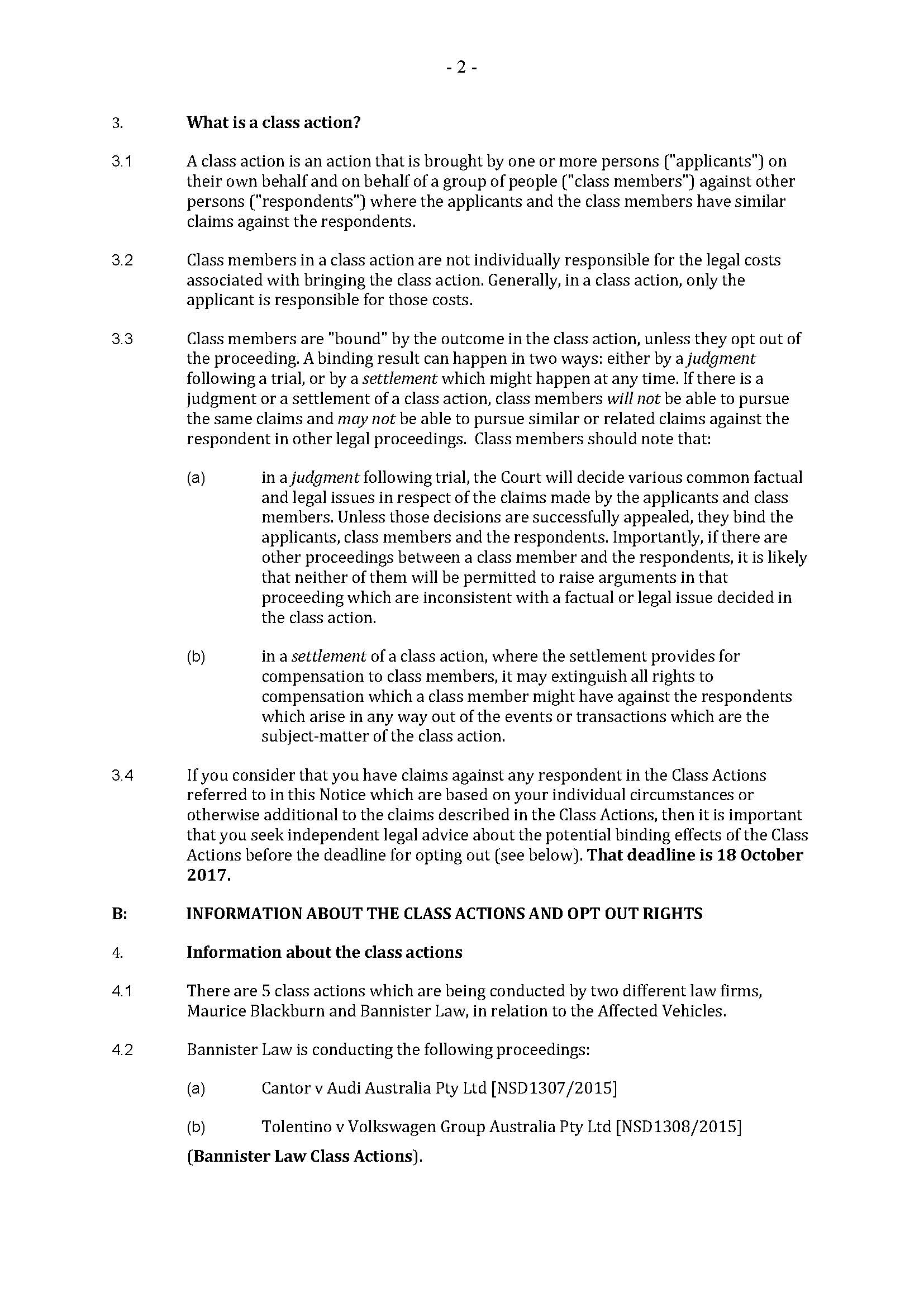
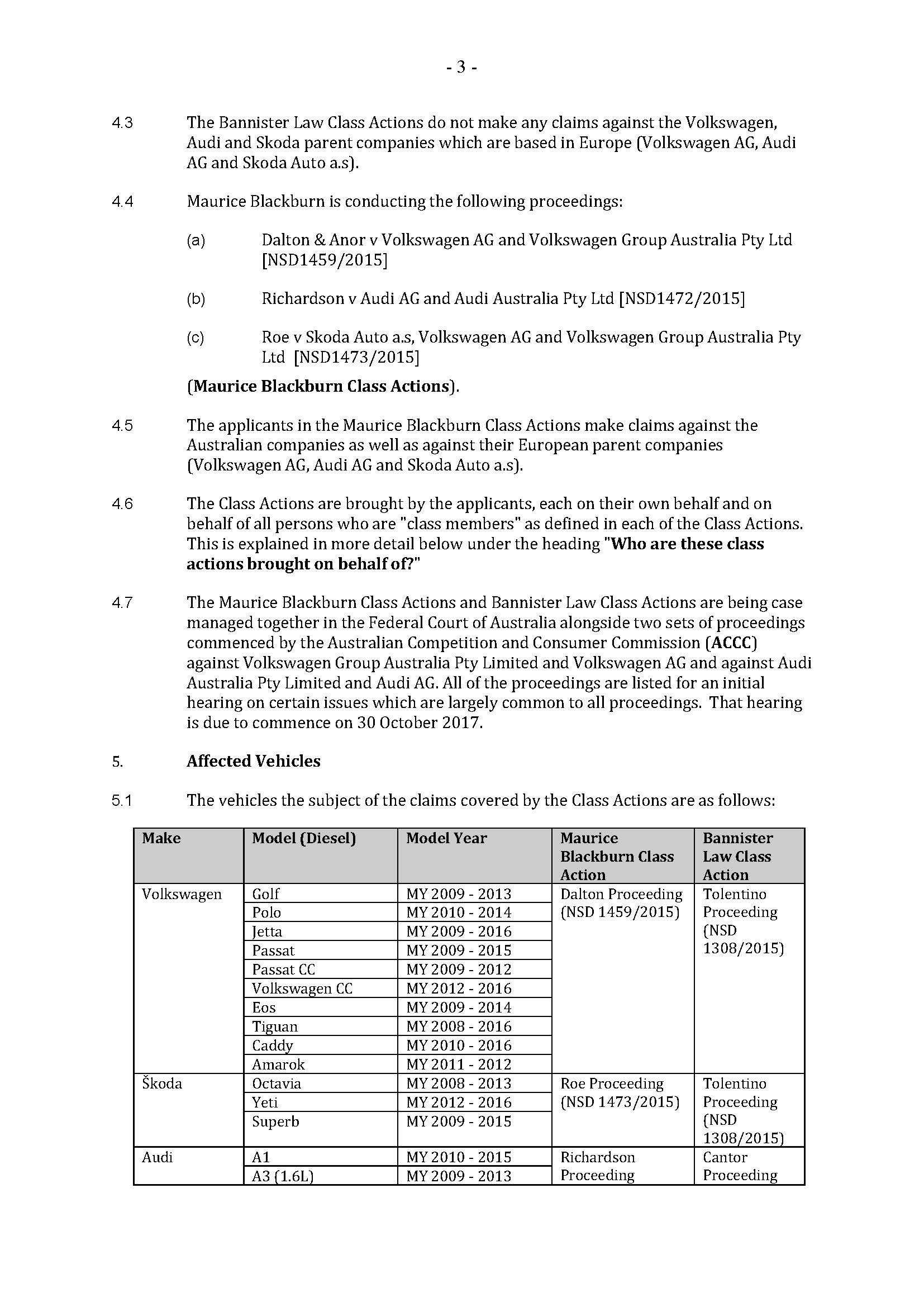
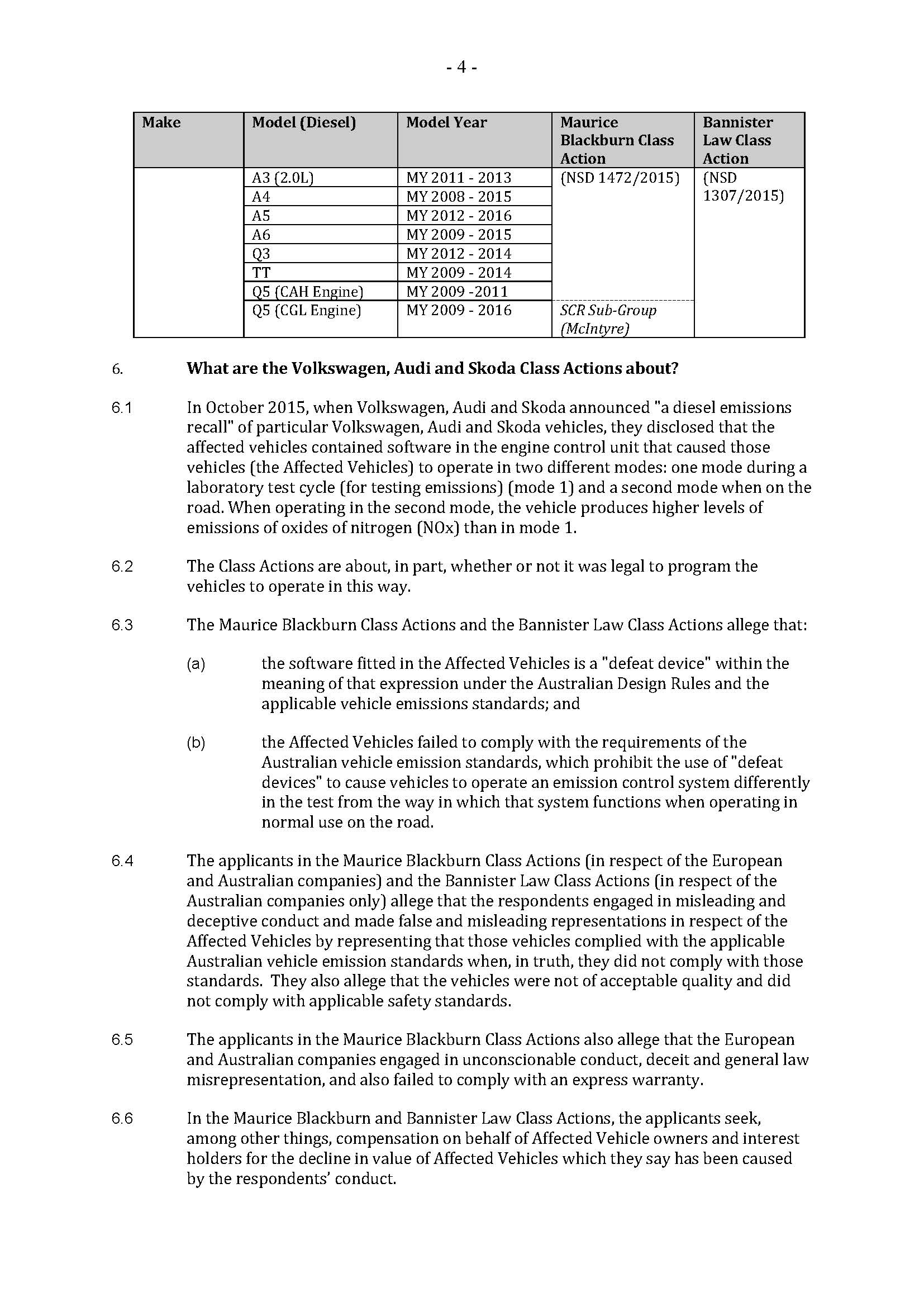
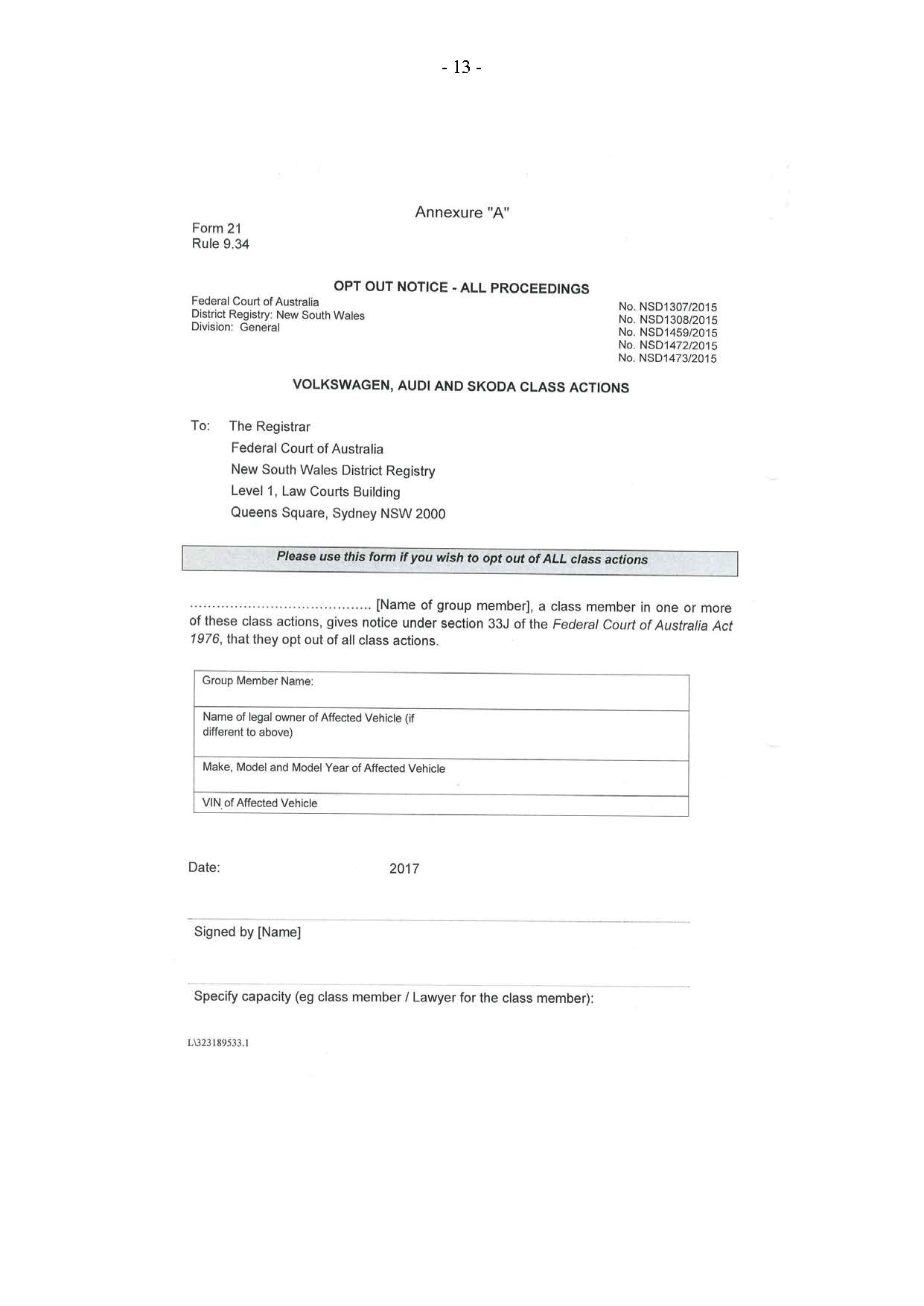
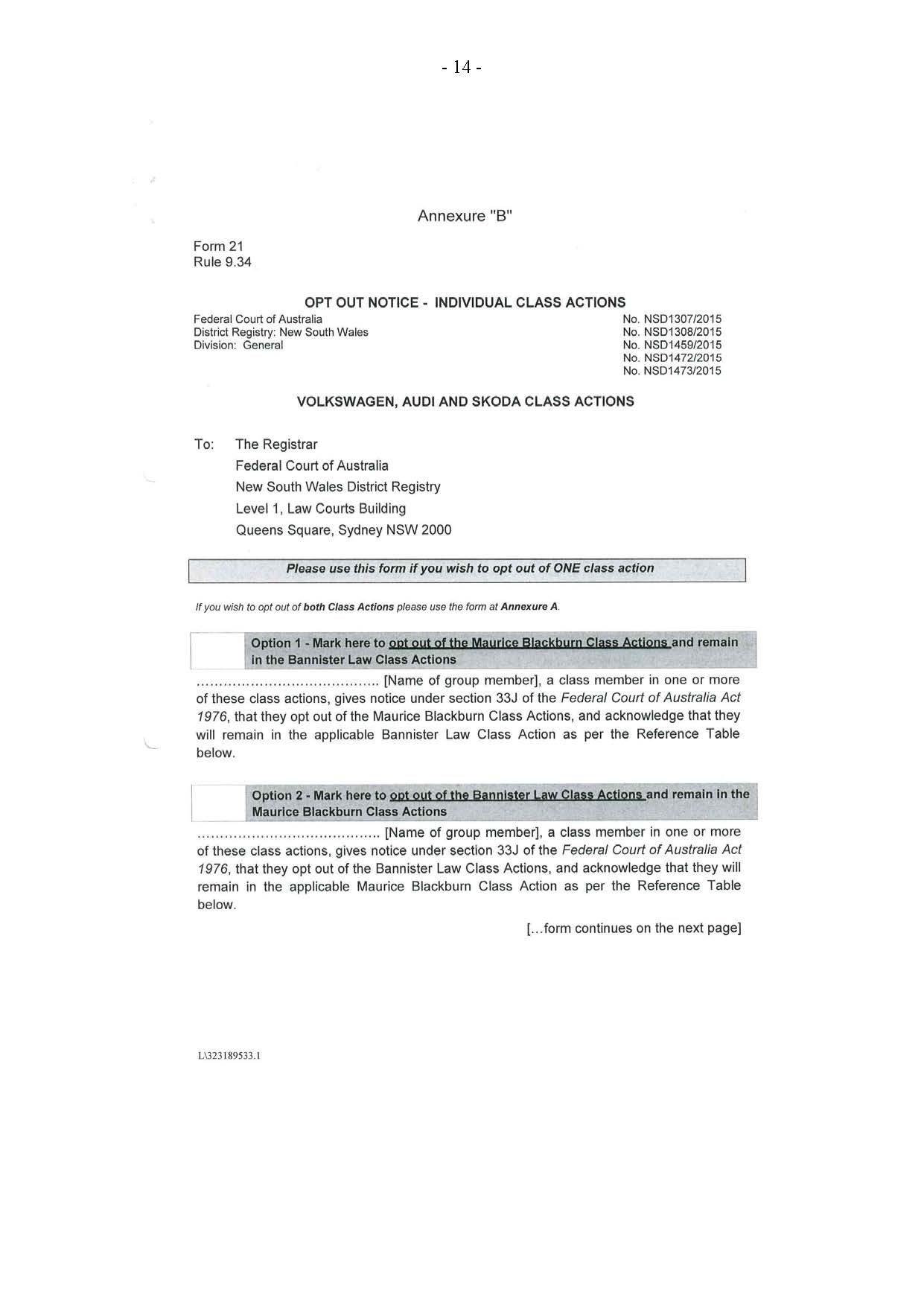
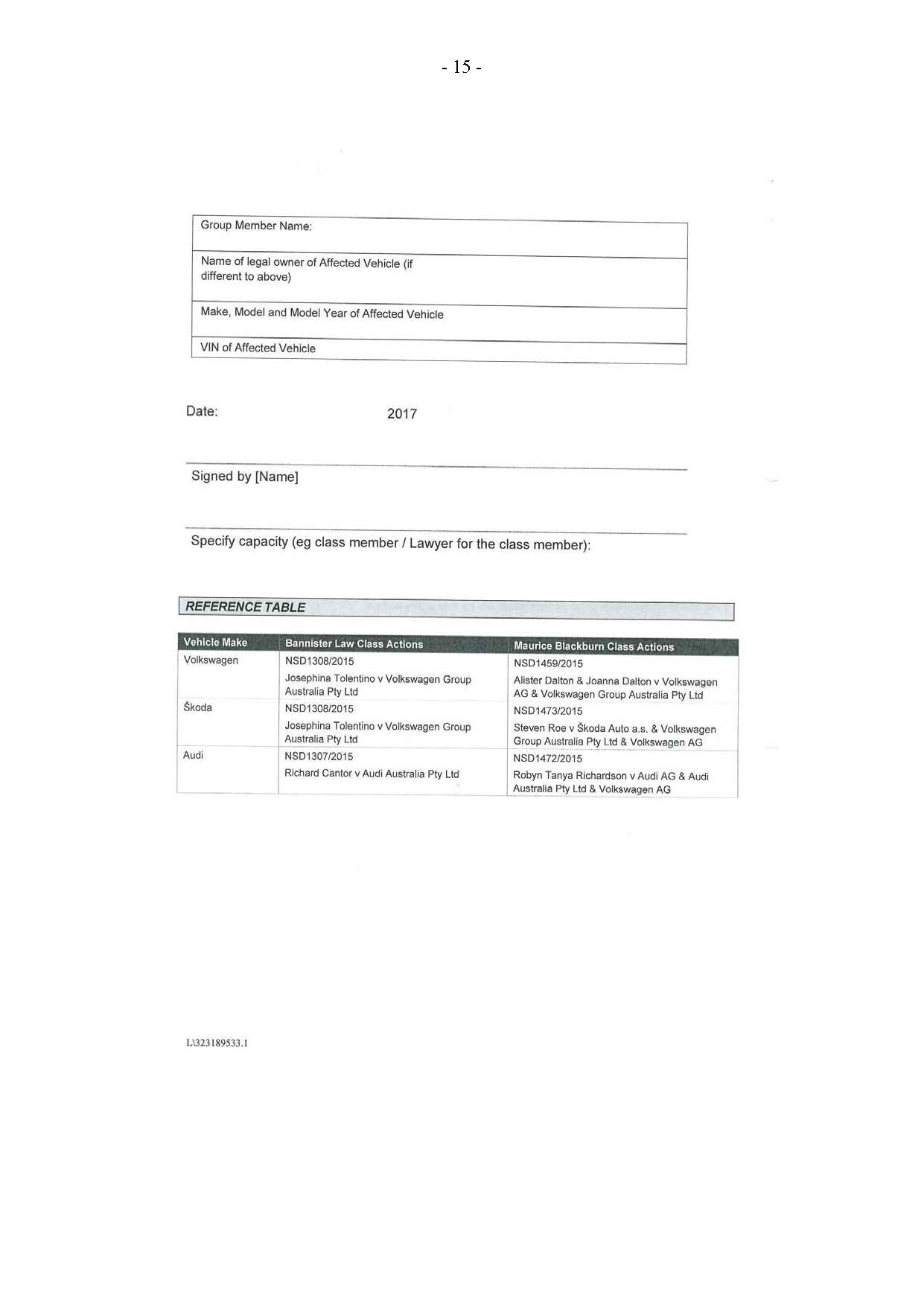
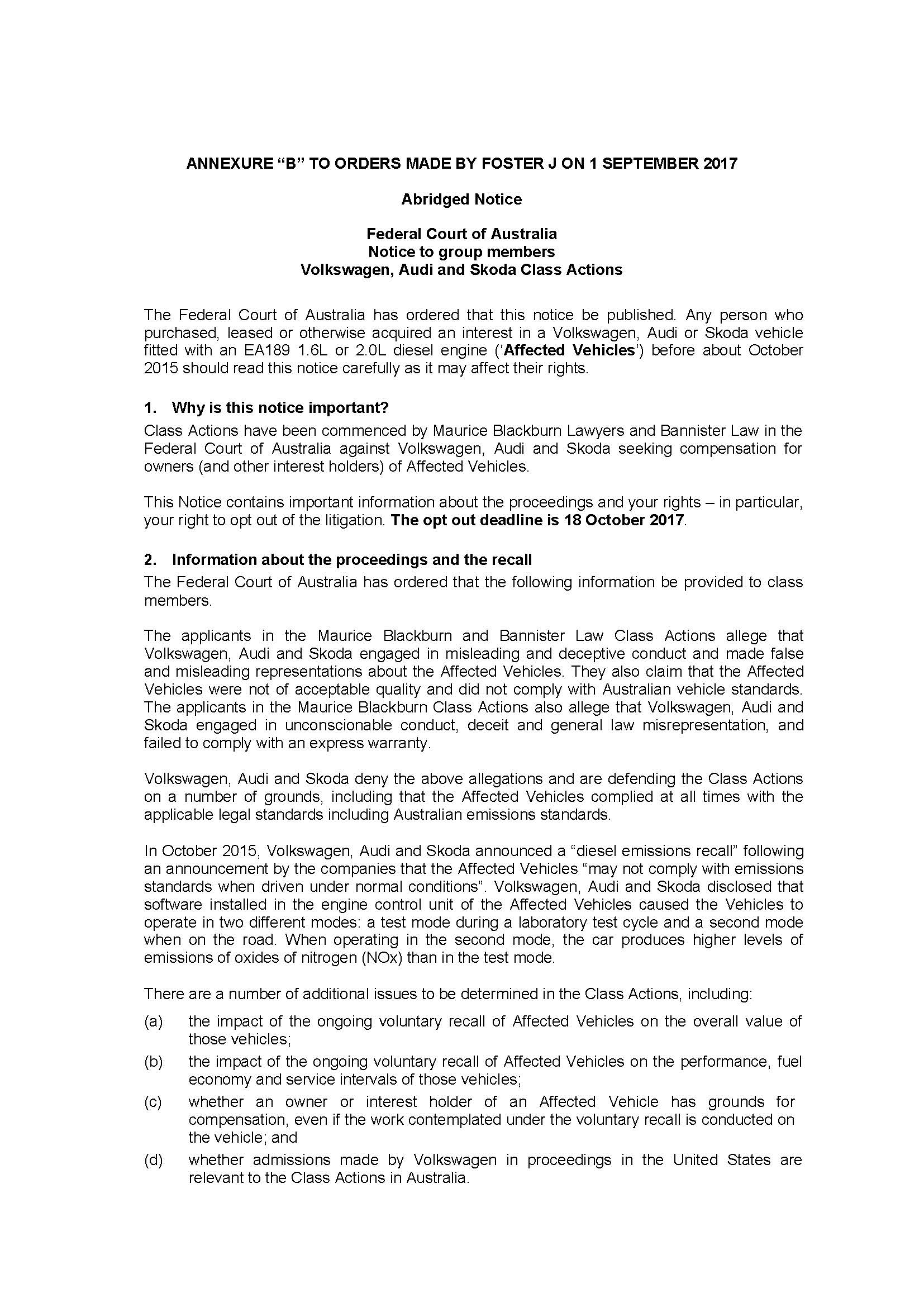
3. The form and content of the long form Notice of Opt Out Rights and short form Notice of Opt Out Rights (Notices) which are Annexure A and Annexure B respectively to these Orders, are approved pursuant to s 33Y(2) of the Act.
4. Pursuant to s 33ZF of the Act, any group member who wishes to opt out of this proceeding must, on or before 18 October 2017, deliver to the New South Wales District Registry of the Court an appropriate opt out notice either in the form of the opt out notice which is Annexure A to the Notice of Opt Out Rights which is Annexure A to these Orders or in the form of Annexure B to the said Notice of Opt Out Rights.
5. Pursuant to s 33Y(3) of the Act, the Notices be provided according to the following procedure:
(a) Prior to 8 September 2017, the respondent provide Annexure A to all potential group members for whom it has email or postal addresses in its possession, including from any NEVDIS data supplied to it by Austroads Ltd, by sending Annexure A by email where possible and by sending Annexure A by post to those addressees where no email address is available or where the particular email address does not accept the requisite notification.
(b) Prior to 8 September 2017, the applicant provide Annexure A to all group members for whom his legal representatives have email or postal addresses in their possession, by sending Annexure A by email where possible and by sending Annexure A by post to those addressees where no email address is available or where the particular email address does not accept the requisite notification.
(c) Continuously throughout the period from 8 September 2017 to 24 October 2017, the respondent display Annexure A prominently on its websites listed below:
(i) http://www.audi.com.au; and
(ii) http://www.audi.com.au/au/brand/en/owners/diesel_service_activity.html/.
(d) Continuously throughout the period from 8 September 2017 to 24 October 2017, the applicant display Annexure A on the website of the applicant’s solicitors (Bannister Law).
(e) Continuously throughout the period from 8 September 2017 to 24 October 2017, Annexure A be displayed on the class action page for this proceeding on the website of the Federal Court of Australia and be available for inspection at the District Registry of the Court in Sydney, Melbourne, Canberra, Brisbane, Adelaide, Perth, Hobart and Darwin.
(f) Continuously throughout the period from 8 September 2017 to 24 October 2017, the respondent include a recorded message for callers to:
(i) 1800 504 076 (the information line referred to at
https://au.volkswagen.com.au/emission) in the following form:
“Class actions have been commenced in the Federal Court of Australia against Volkswagen and Skoda in relation to the diesel emissions issue. Important information for vehicle owners about the class actions, including the right to opt out of those proceedings, is now available on the Federal Court of Australia website at www.fedcourt.gov.au”;
and
(ii) 1800 502 834 (the customer information line referred to at
http://www.audi.com.au/au/web/en/owners/diesel_emissions_activity.html), in the following form:
“Class actions have been commenced in the Federal Court of Australia against Audi in relation to the diesel emissions issue. Important information for vehicle owners about the class actions, including the right to opt out of those proceedings, is now available on the Federal Court of Australia website at www.fedcourt.gov.au”,
such recorded messages to commence playing as soon as practicable after the call is connected.
(g) Continuously throughout the period from 8 September 2017 to 24 October 2017, the respondent publish a link to Annexure A as displayed on the website of the Federal Court of Australia on the social media platform using the following accounts operated by the respondent and its associated corporations:
(i) https://www.facebook.com/VolkswagenAustralia/
(ii) https://www.facebook.com/AudiAustralia/
(iii) https://www.facebook.com/SkodaAustralia/
with the following post:
“Class actions have been commenced in the Federal Court of Australia against Volkswagen, Audi and Skoda in relation to the diesel emissions issue. Important information for vehicle owners about the class actions, including the right to opt out of those proceedings, is now available on the Federal Court of Australia website at www.fedcourt.gov.au.”
(h) As soon as practicable after 8 September 2017, the applicant, acting in conjunction with and co-operatively with the applicants in proceedings NSD 1308 of 2015, NSD 1459 of 2015, NSD 1472 of 2015 and NSD 1473 of 2015, cause to be published Annexure B, as a half page, in the following newspapers:
(i) Herald Sun, Victoria;
(ii) The Daily Telegraph, New South Wales;
(iii) The Advertiser, South Australia;
(iv) The Courier Mail, Queensland;
(v) The Mercury, Tasmania;
(vi) Canberra Times, Australian Capital Territory;
(vii) The West Australian, Western Australia;
(viii) NT News, Northern Territory; and
(ix) The Australian.
6. The costs of sending, displaying and publishing the Notices as described in Order 5 above be paid as follows:
(a) The respondent to bear the initial cost of displaying and linking Annexure A and making available the recorded messages pursuant to Order 5(c), 5(f) and 5(g) above;
(b) The applicant to bear half of the initial cost of distributing Annexure A pursuant to Order 5(b) above and pursuant to Order 5(b) made this day (1 September 2017) in proceeding NSD 1308 of 2015;
(c) The applicant to bear half of the initial cost of displaying Annexure A pursuant to Order 5(d) above and pursuant to Order 5(d) made this day (1 September 2017) in proceeding NSD 1308 of 2015;
(d) The cost of providing a copy of Annexure A to group members using email and postal addresses as provided for in Order 5(a) above, be initially paid by the respondent on the basis that the applicant will pro tem indemnify the respondent in respect of one-fifth of those costs to the extent that they are reasonable, which proportion of those costs, subject to Order 10 below, will be payable by the applicant to the respondent within 14 business days of true copies of the relevant invoices being provided; and
(e) One-fifth of the cost of publishing Annexure B as required by Order 5(h) above be initially paid by the applicant,
on the basis that all of the above costs will subsequently fall to be dealt with by the Court as part of the costs of the proceeding.
7. If, on or before 18 October 2017, the solicitors for any party receive a notice purporting to be an opt out notice referable to this proceeding, the solicitors file that notice with the Federal Court of Australia, NSW District Registry, within three (3) days of receipt of the notice by the solicitors and the notice shall be treated as an opt out notice received by the Court at the time it was received by the solicitors.
8. The solicitors for the parties be granted leave to inspect the Court file from time to time to the extent that material in the Court file has not been the subject of a confidentiality order and to copy any opt out notices filed.
9. The opt out notices referred to in these Orders may be amended by agreement between Clayton Utz, Maurice Blackburn and Bannister Law before they are posted, emailed or published in order to correct any postal, website, email address or telephone number or any typesetting or typographical error.
10. The parties have liberty to apply on three (3) days’ notice in respect of the costs of providing Annexure A in accordance with Order 5(a) above and generally.
11. The applicant’s Interlocutory Application filed on 8 June 2017 otherwise be dismissed.
12. The costs of and incidental to the applicant’s Interlocutory Application filed on 8 June 2017 be costs in the proceeding.
13. This proceeding and the respondent’s Interlocutory Application filed on 26 June 2017 be listed for further case management at 9.30 am on 15 September 2017 before Foster J.
Note: Entry of orders is dealt with in Rule 39.32 of the Federal Court Rules 2011.
ORDERS
NSD 1308 of 2015 | ||
BETWEEN: | JOSEFINA TOLENTINO Applicant | |
AND: | VOLKSWAGEN GROUP AUSTRALIA PTY LIMITED (ACN 093 117 876) Respondent | |
JUDGE: | FOSTER J |
DATE OF ORDER: | 1 September 2017 |
THE COURT ORDERS THAT:
1. Pursuant to s 33J of the Federal Court of Australia Act 1976 (Cth) (the Act), 18 October 2017 is fixed as the date on or before which a group member may opt out of this proceeding.
2. Group members be given notice pursuant to s 33X(1)(a) and s 33X(5) of the Act of the fact that they may opt out of this proceeding in accordance with pars 4 and 5 of these Orders.
3. The form and content of the long form Notice of Opt Out Rights and short form Notice of Opt Out Rights (Notices) which are Annexure A and Annexure B respectively to these Orders, are approved pursuant to s 33Y(2) of the Act.
4. Pursuant to s 33ZF of the Act, any group member who wishes to opt out of this proceeding must, on or before 18 October 2017, deliver to the New South Wales District Registry of the Court an appropriate opt out notice either in the form of the opt out notice which is Annexure A to the Notice of Opt Out Rights which is Annexure A to these Orders or in the form of Annexure B to the said Notice of Opt Out Rights.
5. Pursuant to s 33Y(3) of the Act, the Notices be provided according to the following procedure:
(a) Prior to 8 September 2017, the respondent provide Annexure A to all potential group members for whom it has email or postal addresses in its possession, including from any NEVDIS data supplied to it by Austroads Ltd, by sending Annexure A by email where possible and by sending Annexure A by post to those addressees where no email address is available or where the particular email address does not accept the requisite notification.
(b) Prior to 8 September 2017, the applicant provide Annexure A to all group members for whom her legal representatives have email or postal addresses in their possession, by sending Annexure A by email where possible and by sending Annexure A by post to those addressees where no email address is available or where the particular email address does not accept the requisite notification.
(c) Continuously throughout the period from 8 September 2017 to 24 October 2017, the respondent display Annexure A prominently on its websites listed below:
(i) https://www.volkswagen.com.au/en.html;
(ii) https://au.volkswagen.com.au/emission;
(iii) http://www.skoda.com.au; and
(iv) http://www.skoda.com.au/dieselinfo.
(d) Continuously throughout the period from 8 September 2017 to 24 October 2017, the applicant display Annexure A on the website of the applicant’s solicitors (Bannister Law).
(e) Continuously throughout the period from 8 September 2017 to 24 October 2017, Annexure A be displayed on the class action page for this proceeding on the website of the Federal Court of Australia and be available for inspection at the District Registry of the Court in Sydney, Melbourne, Canberra, Brisbane, Adelaide, Perth, Hobart and Darwin.
(f) Continuously throughout the period from 8 September 2017 to 24 October 2017, the respondent include a recorded message for callers to:
(i) 1800 504 076 (the information line referred to at
https://au.volkswagen.com.au/emission) in the following form:
“Class actions have been commenced in the Federal Court of Australia against Volkswagen and Skoda in relation to the diesel emissions issue. Important information for vehicle owners about the class actions, including the right to opt out of those proceedings, is now available on the Federal Court of Australia website at www.fedcourt.gov.au”;
and
(ii) 1800 502 834 (the customer information line referred to at
http://www.audi.com.au/au/web/en/owners/diesel_emissions_activity.html), in the following form:
“Class actions have been commenced in the Federal Court of Australia against Audi in relation to the diesel emissions issue. Important information for vehicle owners about the class actions, including the right to opt out of those proceedings, is now available on the Federal Court of Australia website at www.fedcourt.gov.au”,
such recorded messages to commence playing as soon as practicable after the call is connected.
(g) Continuously throughout the period from 8 September 2017 to 24 October 2017, the respondent publish a link to Annexure A as displayed on the website of the Federal Court of Australia on the social media platform using the following accounts operated by the respondent and its associated corporations:
(i) https://www.facebook.com/VolkswagenAustralia/
(ii) https://www.facebook.com/AudiAustralia/
(iii) https://www.facebook.com/SkodaAustralia/
with the following post:
“Class actions have been commenced in the Federal Court of Australia against Volkswagen, Audi and Skoda in relation to the diesel emissions issue. Important information for vehicle owners about the class actions, including the right to opt out of those proceedings, is now available on the Federal Court of Australia website at www.fedcourt.gov.au.”
(h) As soon as practicable after 8 September 2017, the applicant, acting in conjunction with and co-operatively with the applicants in proceedings NSD 1307 of 2015, NSD 1459 of 2015, NSD 1472 of 2015 and NSD 1473 of 2015, cause to be published Annexure B, as a half page, in the following newspapers:
(i) Herald Sun, Victoria;
(ii) The Daily Telegraph, New South Wales;
(iii) The Advertiser, South Australia;
(iv) The Courier Mail, Queensland;
(v) The Mercury, Tasmania;
(vi) Canberra Times, Australian Capital Territory;
(vii) The West Australian, Western Australia;
(viii) NT News, Northern Territory; and
(ix) The Australian.
6. The costs of sending, displaying and publishing the Notices as described in Order 5 above be paid as follows:
(a) The respondent to bear the initial cost of displaying and linking Annexure A and making available the recorded messages pursuant to Order 5(c), 5(f) and 5(g) above;
(b) The applicant to bear half of the initial cost of distributing Annexure A pursuant to Order 5(b) above and pursuant to Order 5(b) made this day (1 September 2017) in proceeding NSD 1307 of 2015;
(c) The applicant to bear half of the initial cost of displaying Annexure A pursuant to Order 5(d) above and pursuant to Order 5(d) made this day (1 September 2017) in proceeding NSD 1307 of 2015;
(d) The cost of providing a copy of Annexure A to group members using email and postal addresses as provided for in Order 5(a) above, be initially paid by the respondent on the basis that the applicant will pro tem indemnify the respondent in respect of one-fifth of those costs to the extent that they are reasonable, which proportion of those costs, subject to Order 10 below, will be payable by the applicant to the respondent within 14 business days of true copies of the relevant invoices being provided; and
(e) One-fifth of the cost of publishing Annexure B as required by Order 5(h) above be initially paid by the applicant,
on the basis that all of the above costs will subsequently fall to be dealt with by the Court as part of the costs of the proceeding.
7. If, on or before 18 October 2017, the solicitors for any party receive a notice purporting to be an opt out notice referable to this proceeding, the solicitors file that notice with the Federal Court of Australia, NSW District Registry, within three (3) days of receipt of the notice by the solicitors and the notice shall be treated as an opt out notice received by the Court at the time it was received by the solicitors.
8. The solicitors for the parties be granted leave to inspect the Court file from time to time to the extent that material in the Court file has not been the subject of a confidentiality order and to copy any opt out notices filed.
9. The opt out notices referred to in these Orders may be amended by agreement between Clayton Utz, Maurice Blackburn and Bannister Law before they are posted, emailed or published in order to correct any postal, website, email address or telephone number or any typesetting or typographical error.
10. The parties have liberty to apply on three (3) days’ notice in respect of the costs of providing Annexure A in accordance with Order 5(a) above and generally.
11. The applicant’s Interlocutory Application filed on 8 June 2017 otherwise be dismissed.
12. The costs of and incidental to the applicant’s Interlocutory Application filed on 8 June 2017 be costs in the proceeding.
13. This proceeding and the respondent’s Interlocutory Application filed on 26 June 2017 be listed for further case management at 9.30 am on 15 September 2017 before Foster J.
Note: Entry of orders is dealt with in Rule 39.32 of the Federal Court Rules 2011.
ORDERS
NSD 1459 of 2015 | ||
BETWEEN: | ALISTER DALTON First Applicant JOANNA DALTON Second Applicant | |
AND: | VOLKSWAGEN AG First Respondent VOLKSWAGEN GROUP AUSTRALIA PTY LIMITED (ACN 093 117 876) Second Respondent | |
JUDGE: | FOSTER J |
DATE OF ORDER: | 1 September 2017 |
THE COURT ORDERS THAT:
1. Pursuant to s 33J of the Federal Court of Australia Act 1976 (Cth) (the Act), 18 October 2017 is fixed as the date on or before which a group member may opt out of this proceeding.
2. Group members be given notice pursuant to s 33X(1)(a) and s 33X(5) of the Act of the fact that they may opt out of this proceeding in accordance with pars 4 and 5 of these Orders.
3. The form and content of the long form Notice of Opt Out Rights and short form Notice of Opt Out Rights (Notices) which are Annexure A and Annexure B respectively to these Orders, are approved pursuant to s 33Y(2) of the Act.
4. Pursuant to s 33ZF of the Act, any group member who wishes to opt out of this proceeding must, on or before 18 October 2017, deliver to the New South Wales District Registry of the Court an appropriate opt out notice either in the form of the opt out notice which is Annexure A to the Notice of Opt Out Rights which is Annexure A to these Orders or in the form of Annexure B to the said Notice of Opt Out Rights.
5. Pursuant to s 33Y(3) of the Act, the Notices be provided according to the following procedure:
(a) Prior to 8 September 2017, the respondents provide Annexure A to all potential group members for whom they have email or postal addresses in their possession, including from any NEVDIS data supplied to them by Austroads Ltd, by sending Annexure A by email where possible and by sending Annexure A by post to those addressees where no email address is available or where the particular email address does not accept the requisite notification.
(b) Prior to 8 September 2017, the applicants provide Annexure A to all group members for whom their legal representatives have email or postal addresses in their possession, by sending Annexure A by email where possible and by sending Annexure A by post to those addressees where no email address is available or where the particular email address does not accept the requisite notification.
(c) Continuously throughout the period from 8 September 2017 to 24 October 2017, the respondents display Annexure A prominently on their websites listed below:
(i) https://www.volkswagen.com.au/en.html; and
(ii) https://au.volkswagen.com.au/emission.
(d) Continuously throughout the period from 8 September 2017 to 24 October 2017, the applicants display Annexure A on the website of the applicants’ solicitors (Maurice Blackburn).
(e) Continuously throughout the period from 8 September 2017 to 24 October 2017, Annexure A be displayed on the class action page for this proceeding on the website of the Federal Court of Australia and be available for inspection at the District Registry of the Court in Sydney, Melbourne, Canberra, Brisbane, Adelaide, Perth, Hobart and Darwin.
(f) Continuously throughout the period from 8 September 2017 to 24 October 2017, the respondents include a recorded message for callers to:
(i) 1800 504 076 (the information line referred to at
https://au.volkswagen.com.au/emission) in the following form:
“Class actions have been commenced in the Federal Court of Australia against Volkswagen and Skoda in relation to the diesel emissions issue. Important information for vehicle owners about the class actions, including the right to opt out of those proceedings, is now available on the Federal Court of Australia website at www.fedcourt.gov.au”;
and
(ii) 1800 502 834 (the customer information line referred to at
http://www.audi.com.au/au/web/en/owners/diesel_emissions_activity.html), in the following form:
“Class actions have been commenced in the Federal Court of Australia against Audi in relation to the diesel emissions issue. Important information for vehicle owners about the class actions, including the right to opt out of those proceedings, is now available on the Federal Court of Australia website at www.fedcourt.gov.au”,
such recorded messages to commence playing as soon as practicable after the call is connected.
(g) Continuously throughout the period from 8 September 2017 to 24 October 2017, the respondents publish a link to Annexure A as displayed on the website of the Federal Court of Australia on the social media platform using the following accounts operated by the respondents and their associated corporations:
(i) https://www.facebook.com/VolkswagenAustralia/
(ii) https://www.facebook.com/AudiAustralia/
(iii) https://www.facebook.com/SkodaAustralia/
with the following post:
“Class actions have been commenced in the Federal Court of Australia against Volkswagen, Audi and Skoda in relation to the diesel emissions issue. Important information for vehicle owners about the class actions, including the right to opt out of those proceedings, is now available on the Federal Court of Australia website at www.fedcourt.gov.au.”
(h) As soon as practicable after 8 September 2017, the applicants, acting in conjunction with and co-operatively with the applicants in proceedings NSD 1307 of 2015, NSD 1308 of 2015, NSD 1472 of 2015 and NSD 1473 of 2015, cause to be published publish Annexure B, as a half page, in the following newspapers:
(i) Herald Sun, Victoria;
(ii) The Daily Telegraph, New South Wales;
(iii) The Advertiser, South Australia;
(iv) The Courier Mail, Queensland;
(v) The Mercury, Tasmania;
(vi) Canberra Times, Australian Capital Territory;
(vii) The West Australian, Western Australia;
(viii) NT News, Northern Territory; and
(ix) The Australian.
6. The costs of sending, displaying and publishing the Notices as described in Order 5 above be paid as follows:
(a) The respondents to bear the initial cost of displaying and linking Annexure A and making available the recorded messages pursuant to Order 5(c), 5(f) and 5(g) above;
(b) The applicants to bear one-third of the initial cost of distributing Annexure A pursuant to Order 5(b) above and pursuant to Order 5(b) made this day (1 September 2017) in proceeding NSD 1472 of 2015 and in proceeding NSD 1473 of 2015;
(c) The applicants to bear one-third of the initial cost of displaying Annexure A pursuant to Order 5(d) above and pursuant to Order 5(d) made this day (1 September 2017) in proceeding NSD 1472 of 2015 and in proceeding NSD 1473 of 2015;
(d) The cost of providing a copy of Annexure A to group members using email and postal addresses as provided for in Order 5(a) above, be initially paid by the respondents on the basis that the applicants will pro tem indemnify the respondents in respect of one-fifth of those costs to the extent that they are reasonable, which proportion of those costs, subject to Order 10 below, will be payable by the applicants to the respondents within 14 business days of true copies of the relevant invoices being provided; and
(e) One-fifth of the cost of publishing Annexure B as required by Order 5(h) above be initially paid by the applicants,
on the basis that all of the above costs will subsequently fall to be dealt with by the Court as part of the costs of the proceeding.
7. If, on or before 18 October 2017, the solicitors for any party receive a notice purporting to be an opt out notice referable to this proceeding, the solicitors file that notice with the Federal Court of Australia, NSW District Registry, within three (3) days of receipt of the notice by the solicitors and the notice shall be treated as an opt out notice received by the Court at the time it was received by the solicitors.
8. The solicitors for the parties be granted leave to inspect the Court file from time to time to the extent that material in the Court file has not been the subject of a confidentiality order and to copy any opt out notices filed.
9. The opt out notices referred to in these Orders may be amended by agreement between Clayton Utz, Maurice Blackburn and Bannister Law before they are posted, emailed or published in order to correct any postal, website, email address or telephone number or any typesetting or typographical error.
10. The parties have liberty to apply on three (3) days’ notice in respect of the costs of providing Annexure A in accordance with Order 5(a) above and generally.
11. The applicants’ Amended Interlocutory Application filed on 8 June 2017 otherwise be dismissed.
12. The costs of and incidental to the applicants’ Amended Interlocutory Application filed on 8 June 2017 be costs in the proceeding.
13. This proceeding and the respondents’ Interlocutory Application filed on 26 June 2017 be listed for further case management at 9.30 am on 15 September 2017 before Foster J.
Note: Entry of orders is dealt with in Rule 39.32 of the Federal Court Rules 2011.
ORDERS
NSD 1472 of 2015 | ||
BETWEEN: | ROBYN TANYA RICHARDSON Applicant | |
AND: | AUDI AG First Respondent AUDI AUSTRALIA PTY LIMITED (ACN 077 092 776) Second Respondent VOLKSWAGEN AG Third Respondent | |
JUDGE: | FOSTER J |
DATE OF ORDER: | 1 September 2017 |
THE COURT ORDERS THAT:
1. Pursuant to s 33J of the Federal Court of Australia Act 1976 (Cth) (the Act), 18 October 2017 is fixed as the date on or before which a group member may opt out of this proceeding.
2. Group members be given notice pursuant to s 33X(1)(a) and s 33X(5) of the Act of the fact that they may opt out of this proceeding in accordance with pars 4 and 5 of these Orders.
3. The form and content of the long form Notice of Opt Out Rights and short form Notice of Opt Out Rights (Notices) which are Annexure A and Annexure B respectively to these Orders, are approved pursuant to s 33Y(2) of the Act.
4. Pursuant to s 33ZF of the Act, any group member who wishes to opt out of this proceeding must, on or before 18 October 2017, deliver to the New South Wales District Registry of the Court an appropriate opt out notice either in the form of the opt out notice which is Annexure A to the Notice of Opt Out Rights which is Annexure A to these Orders or in the form of Annexure B to the said Notice of Opt Out Rights.
5. Pursuant to s 33Y(3) of the Act, the Notices be provided according to the following procedure:
(a) Prior to 8 September 2017, the respondents provide Annexure A to all potential group members for whom they have email or postal addresses in their possession, including from any NEVDIS data supplied to them by Austroads Ltd, by sending Annexure A by email where possible and by sending Annexure A by post to those addressees where no email address is available or where the particular email address does not accept the requisite notification.
(b) Prior to 8 September 2017, the applicant provide Annexure A to all group members for whom her legal representatives have email or postal addresses in their possession, by sending Annexure A by email where possible and by sending Annexure A by post to those addressees where no email address is available or where the particular email address does not accept the requisite notification.
(c) Continuously throughout the period from 8 September 2017 to 24 October 2017, the respondents display Annexure A prominently on their websites listed below:
(i) https://www.volkswagen.com.au/en.html;
(ii) https://au.volkswagen.com.au/emission;
(iii) http://www.audi.com.au; and
(iv) http://www.audi.com.au/au/brand/en/owners/diesel_service_activity.html.
(d) Continuously throughout the period from 8 September 2017 to 24 October 2017, the applicant display Annexure A on the website of the applicant’s solicitors (Maurice Blackburn).
(e) Continuously throughout the period from 8 September 2017 to 24 October 2017, Annexure A be displayed on the class action page for this proceeding on the website of the Federal Court of Australia and be available for inspection at the District Registry of the Court in Sydney, Melbourne, Canberra, Brisbane, Adelaide, Perth, Hobart and Darwin.
(f) Continuously throughout the period from 8 September 2017 to 24 October 2017, the respondents include a recorded message for callers to:
(i) 1800 504 076 (the information line referred to at
https://au.volkswagen.com.au/emission) in the following form:
“Class actions have been commenced in the Federal Court of Australia against Volkswagen and Skoda in relation to the diesel emissions issue. Important information for vehicle owners about the class actions, including the right to opt out of those proceedings, is now available on the Federal Court of Australia website at www.fedcourt.gov.au”;
and
(ii) 1800 502 834 (the customer information line referred to at
http://www.audi.com.au/au/web/en/owners/diesel_emissions_activity.html), in the following form:
“Class actions have been commenced in the Federal Court of Australia against Audi in relation to the diesel emissions issue. Important information for vehicle owners about the class actions, including the right to opt out of those proceedings, is now available on the Federal Court of Australia website at www.fedcourt.gov.au”,
such recorded messages to commence playing as soon as practicable after the call is connected.
(g) Continuously throughout the period from 8 September 2017 to 24 October 2017, the respondents publish a link to Annexure A as displayed on the website of the Federal Court of Australia on the social media platform using the following accounts operated by the respondents and their associated corporations:
(i) https://www.facebook.com/VolkswagenAustralia/
(ii) https://www.facebook.com/AudiAustralia/
(iii) https://www.facebook.com/SkodaAustralia/
with the following post:
“Class actions have been commenced in the Federal Court of Australia against Volkswagen, Audi and Skoda in relation to the diesel emissions issue. Important information for vehicle owners about the class actions, including the right to opt out of those proceedings, is now available on the Federal Court of Australia website at www.fedcourt.gov.au.”
(h) As soon as practicable after 8 September 2017, the applicant, acting in conjunction with and co-operatively with the applicants in proceedings NSD 1307 of 2015, NSD 1308 of 2015, NSD 1459 of 2015 and NSD 1473 of 2015, cause to be published publish Annexure B, as a half page, in the following newspapers:
(i) Herald Sun, Victoria;
(ii) The Daily Telegraph, New South Wales;
(iii) The Advertiser, South Australia;
(iv) The Courier Mail, Queensland;
(v) The Mercury, Tasmania;
(vi) Canberra Times, Australian Capital Territory;
(vii) The West Australian, Western Australia;
(viii) NT News, Northern Territory; and
(ix) The Australian.
6. The costs of sending, displaying and publishing the Notices as described in Order 5 above be paid as follows:
(a) The respondents to bear the initial cost of displaying and linking Annexure A and making available the recorded messages pursuant to Order 5(c), 5(f) and 5(g) above;
(b) The applicant to bear one-third of the initial cost of distributing Annexure A pursuant to Order 5(b) above and pursuant to Order 5(b) made this day (1 September 2017) in proceeding NSD 1459 of 2015 and in proceeding NSD 1473 of 2015;
(c) The applicant to bear one-third of the initial cost of displaying Annexure A pursuant to Order 5(d) above and pursuant to Order 5(d) made this day (1 September 2017) in proceeding NSD 1459 of 2015 and in proceeding NSD 1473 of 2015;
(d) The cost of providing a copy of Annexure A to group members using email and postal addresses as provided for in Order 5(a) above, be initially paid by the respondents on the basis that the applicant will pro tem indemnify the respondents in respect of one-fifth of those costs to the extent that they are reasonable, which proportion of those costs, subject to Order 10 below, will be payable by the applicant to the respondents within 14 business days of true copies of the relevant invoices being provided; and
(e) One-fifth of the cost of publishing Annexure B as required by Order 5(h) above be initially paid by the applicant,
on the basis that all of the above costs will subsequently fall to be dealt with by the Court as part of the costs of the proceeding.
7. If, on or before 18 October 2017, the solicitors for any party receive a notice purporting to be an opt out notice referable to this proceeding, the solicitors file that notice with the Federal Court of Australia, NSW District Registry, within three (3) days of receipt of the notice by the solicitors and the notice shall be treated as an opt out notice received by the Court at the time it was received by the solicitors.
8. The solicitors for the parties be granted leave to inspect the Court file from time to time to the extent that material in the Court file has not been the subject of a confidentiality order and to copy any opt out notices filed.
9. The opt out notices referred to in these Orders may be amended by agreement between Clayton Utz, Maurice Blackburn and Bannister Law before they are posted, emailed or published in order to correct any postal, website, email address or telephone number or any typesetting or typographical error.
10. The parties have liberty to apply on three (3) days’ notice in respect of the costs of providing Annexure A in accordance with Order 5(a) above and generally.
11. The applicant’s Amended Interlocutory Application filed on 8 June 2017 otherwise be dismissed.
12. The costs of and incidental to the applicant’s Amended Interlocutory Application filed on 8 June 2017 be costs in the proceeding.
13. This proceeding and the respondents’ Interlocutory Application filed on 26 June 2017 be listed for further case management at 9.30 am on 15 September 2017 before Foster J.
Note: Entry of orders is dealt with in Rule 39.32 of the Federal Court Rules 2011.
ORDERS
NSD 1473 of 2015 | ||
BETWEEN: | STEVEN ROE Applicant | |
AND: | SKODA AUTO A.S. First Respondent VOLKSWAGEN GROUP AUSTRALIA PTY LIMITED (ACN 093 117 876) Second Respondent VOLKSWAGEN AG Third Respondent | |
JUDGE: | FOSTER J |
DATE OF ORDER: | 1 September 2017 |
THE COURT ORDERS THAT:
1. Pursuant to s 33J of the Federal Court of Australia Act 1976 (Cth) (the Act), 18 October 2017 is fixed as the date on or before which a group member may opt out of this proceeding.
2. Group members be given notice pursuant to s 33X(1)(a) and s 33X(5) of the Act of the fact that they may opt out of this proceeding in accordance with pars 4 and 5 of these Orders.
3. The form and content of the long form Notice of Opt Out Rights and short form Notice of Opt Out Rights (Notices) which are Annexure A and Annexure B respectively to these Orders, are approved pursuant to s 33Y(2) of the Act.
4. Pursuant to s 33ZF of the Act, any group member who wishes to opt out of this proceeding must, on or before 18 October 2017, deliver to the New South Wales District Registry of the Court an appropriate opt out notice either in the form of the opt out notice which is Annexure A to the Notice of Opt Out Rights which is Annexure A to these Orders or in the form of Annexure B to the said Notice of Opt Out Rights.
5. Pursuant to s 33Y(3) of the Act, the Notices be provided according to the following procedure:
(a) Prior to 8 September 2017, the respondents provide Annexure A to all potential group members for whom they have email or postal addresses in their possession, including from any NEVDIS data supplied to them by Austroads Ltd, by sending Annexure A by email where possible and by sending Annexure A by post to those addressees where no email address is available or where the particular email address does not accept the requisite notification.
(b) Prior to 8 September 2017, the applicant provide Annexure A to all group members for whom his legal representatives have email or postal addresses in their possession, by sending Annexure A by email where possible and by sending Annexure A by post to those addressees where no email address is available or where the particular email address does not accept the requisite notification.
(c) Continuously throughout the period from 8 September 2017 to 24 October 2017, the respondents display Annexure A prominently on their websites listed below:
(i) https://www.volkswagen.com.au/en.html;
(ii) https://au.volkswagen.com.au/emission;
(iii) http://www.skoda.com.au; and
(iv) http://www.skoda.com.au/dieselinfo.
(d) Continuously throughout the period from 8 September 2017 to 24 October 2017, the applicant display Annexure A on the website of the applicant’s solicitors (Maurice Blackburn).
(e) Continuously throughout the period from 8 September 2017 to 24 October 2017, Annexure A be displayed on the class action page for this proceeding on the website of the Federal Court of Australia and be available for inspection at the District Registry of the Court in Sydney, Melbourne, Canberra, Brisbane, Adelaide, Perth, Hobart and Darwin.
(f) Continuously throughout the period from 8 September 2017 to 24 October 2017, the respondents include a recorded message for callers to:
(i) 1800 504 076 (the information line referred to at
https://au.volkswagen.com.au/emission) in the following form:
“Class actions have been commenced in the Federal Court of Australia against Volkswagen and Skoda in relation to the diesel emissions issue. Important information for vehicle owners about the class actions, including the right to opt out of those proceedings, is now available on the Federal Court of Australia website at www.fedcourt.gov.au”;
and
(ii) 1800 502 834 (the customer information line referred to at
http://www.audi.com.au/au/web/en/owners/diesel_emissions_activity.html), in the following form:
“Class actions have been commenced in the Federal Court of Australia against Audi in relation to the diesel emissions issue. Important information for vehicle owners about the class actions, including the right to opt out of those proceedings, is now available on the Federal Court of Australia website at www.fedcourt.gov.au”,
such recorded messages to commence playing as soon as practicable after the call is connected.
(g) Continuously throughout the period from 8 September 2017 to 24 October 2017, the respondents publish a link to Annexure A as displayed on the website of the Federal Court of Australia on the social media platform using the following accounts operated by the respondents and their associated corporations:
(i) https://www.facebook.com/VolkswagenAustralia/
(ii) https://www.facebook.com/AudiAustralia/
(iii) https://www.facebook.com/SkodaAustralia/
with the following post:
“Class actions have been commenced in the Federal Court of Australia against Volkswagen, Audi and Skoda in relation to the diesel emissions issue. Important information for vehicle owners about the class actions, including the right to opt out of those proceedings, is now available on the Federal Court of Australia website at www.fedcourt.gov.au.”
(h) As soon as practicable after 8 September 2017, the applicant, acting in conjunction with and co-operatively with the applicants in proceedings NSD 1307 of 2015, NSD 1308 of 2015, NSD 1459 of 2015 and NSD 1472 of 2015, cause to be published publish Annexure B, as a half page, in the following newspapers:
(i) Herald Sun, Victoria;
(ii) The Daily Telegraph, New South Wales;
(iii) The Advertiser, South Australia;
(iv) The Courier Mail, Queensland;
(v) The Mercury, Tasmania;
(vi) Canberra Times, Australian Capital Territory;
(vii) The West Australian, Western Australia;
(viii) NT News, Northern Territory; and
(ix) The Australian.
6. The costs of sending, displaying and publishing the Notices as described in Order 5 above be paid as follows:
(a) The respondents to bear the initial cost of displaying and linking Annexure A and making available the recorded messages pursuant to Order 5(c), 5(f) and 5(g) above;
(b) The applicant to bear one-third of the initial cost of distributing Annexure A pursuant to Order 5(b) above and pursuant to Order 5(b) made this day (1 September 2017) in proceeding NSD 1459 of 2015 and in proceeding NSD 1472 of 2015;
(c) The applicant to bear one-third of the initial cost of displaying Annexure A pursuant to Order 5(d) above and pursuant to Order 5(d) made this day (1 September 2017) in proceeding NSD 1459 of 2015 and in proceeding NSD 1472 of 2015;
(d) The cost of providing a copy of Annexure A to group members using email and postal addresses as provided for in Order 5(a) above, be initially paid by the respondents on the basis that the applicant will pro tem indemnify the respondents in respect of one-fifth of those costs to the extent that they are reasonable, which proportion of those costs, subject to Order 10 below, will be payable by the applicant to the respondents within 14 business days of true copies of the relevant invoices being provided; and
(e) One-fifth of the cost of publishing Annexure B as required by Order 5(h) above be initially paid by the applicant,
on the basis that all of the above costs will subsequently fall to be dealt with by the Court as part of the costs of the proceeding.
7. If, on or before 18 October 2017, the solicitors for any party receive a notice purporting to be an opt out notice referable to this proceeding, the solicitors file that notice with the Federal Court of Australia, NSW District Registry, within three (3) days of receipt of the notice by the solicitors and the notice shall be treated as an opt out notice received by the Court at the time it was received by the solicitors.
8. The solicitors for the parties be granted leave to inspect the Court file from time to time to the extent that material in the Court file has not been the subject of a confidentiality order and to copy any opt out notices filed.
9. The opt out notices referred to in these Orders may be amended by agreement between Clayton Utz, Maurice Blackburn and Bannister Law before they are posted, emailed or published in order to correct any postal, website, email address or telephone number or any typesetting or typographical error.
10. The parties have liberty to apply on three (3) days’ notice in respect of the costs of providing Annexure A in accordance with Order 5(a) above and generally.
11. The applicant’s Amended Interlocutory Application filed on 8 June 2017 otherwise be dismissed.
12. The costs of and incidental to the applicant’s Amended Interlocutory Application filed on 8 June 2017 be costs in the proceeding.
13. This proceeding and the respondents’ Interlocutory Application filed on 26 June 2017 be listed for further case management at 9.30 am on 15 September 2017 before Foster J.
Note: Entry of orders is dealt with in Rule 39.32 of the Federal Court Rules 2011.
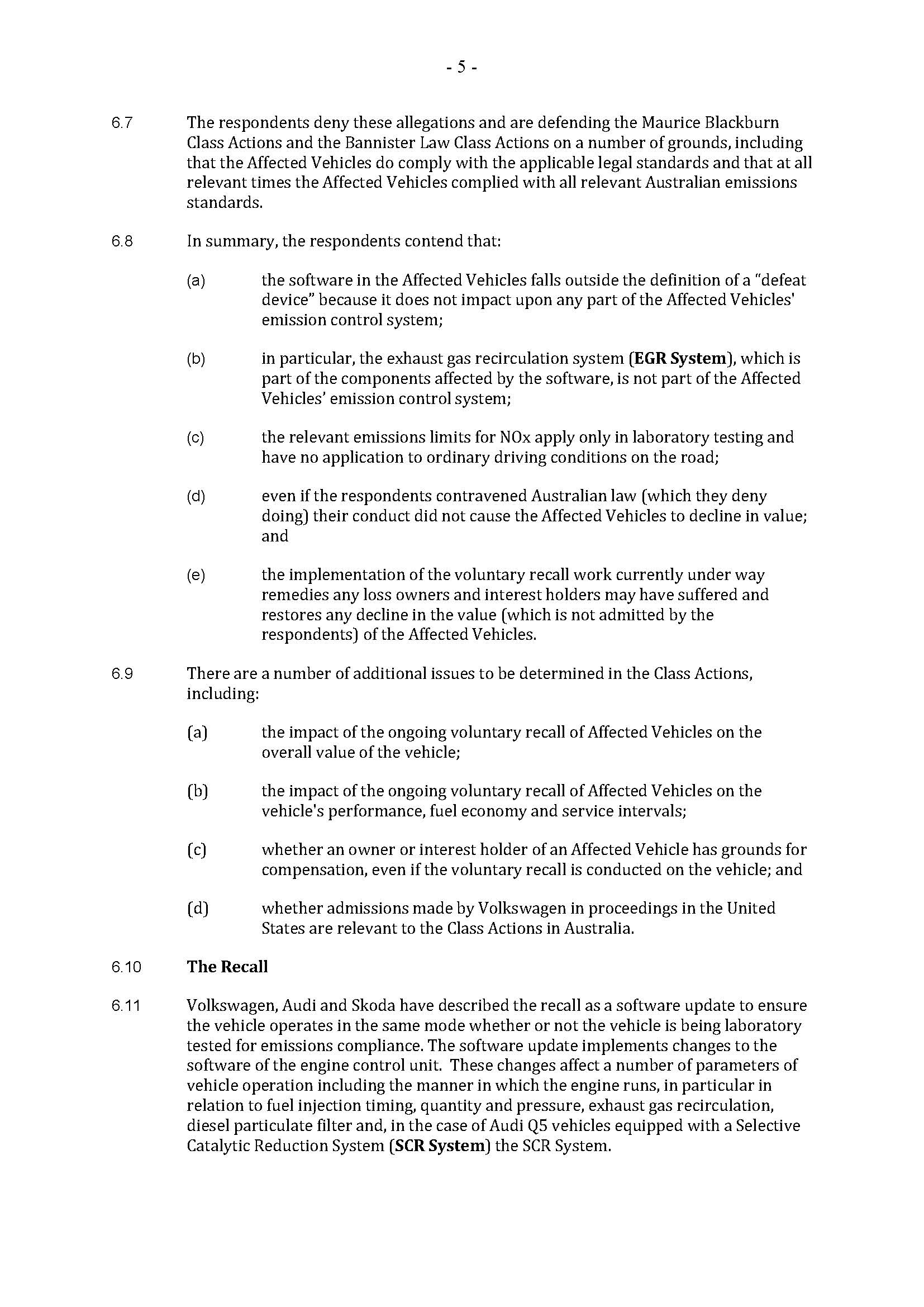
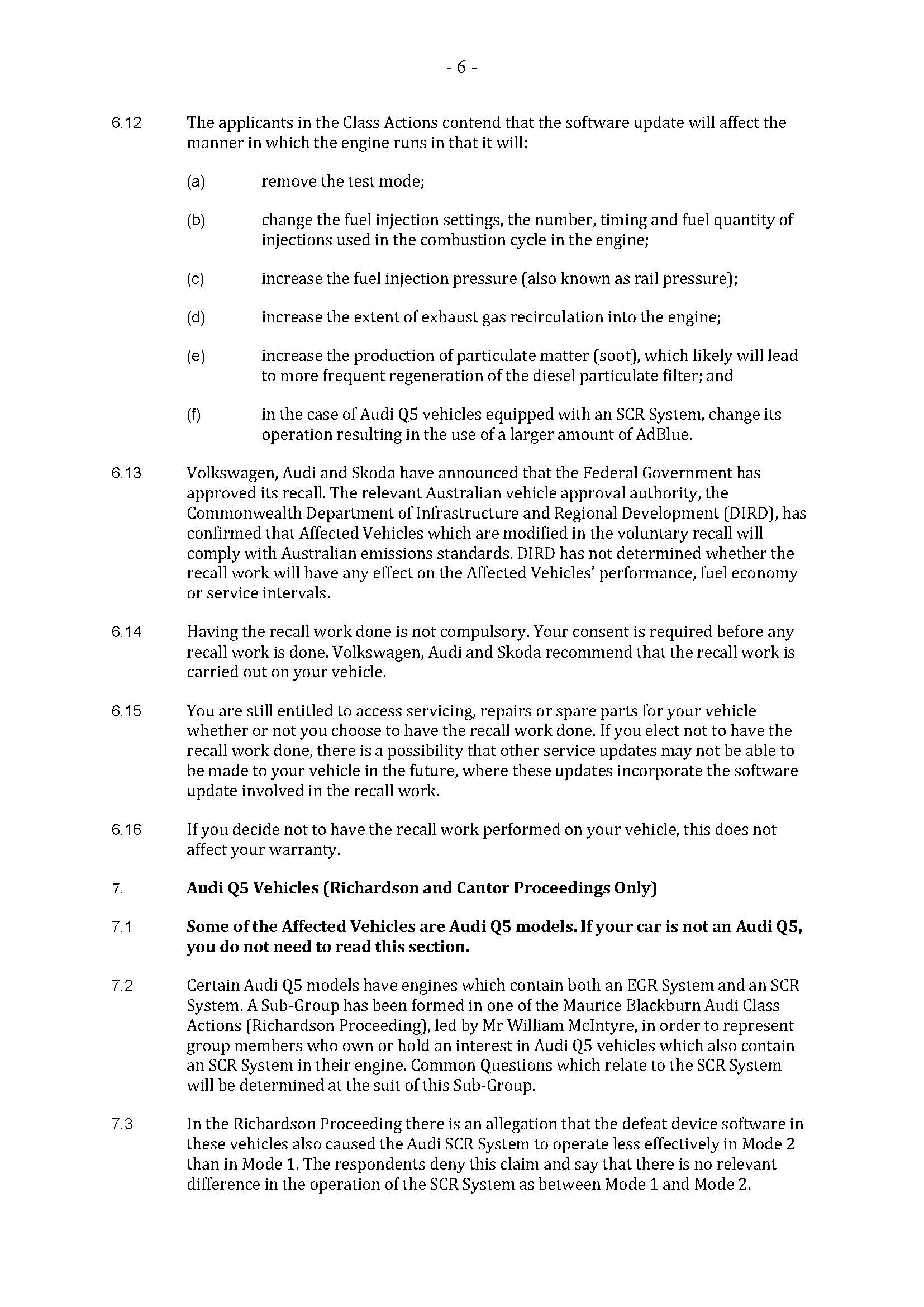
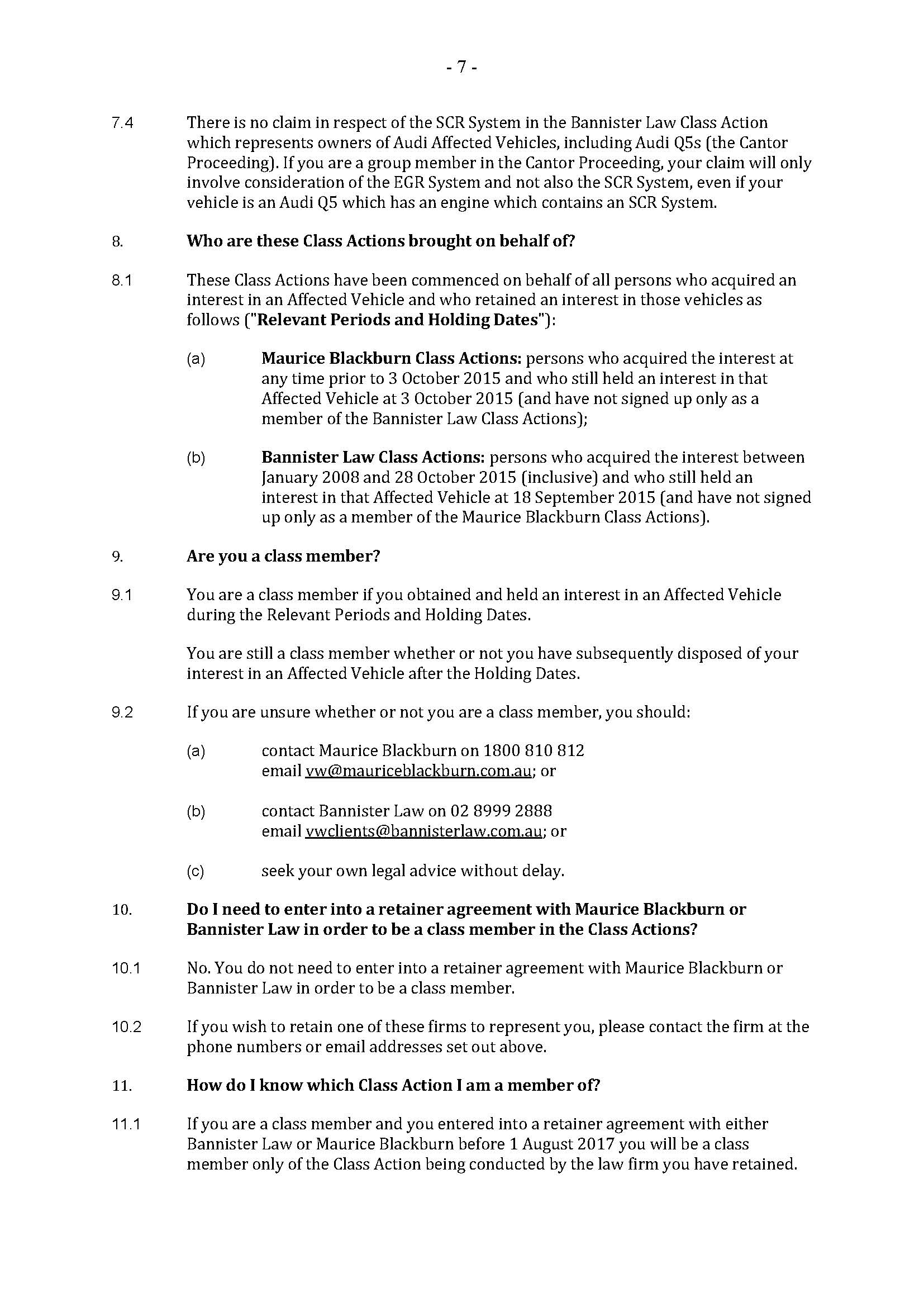
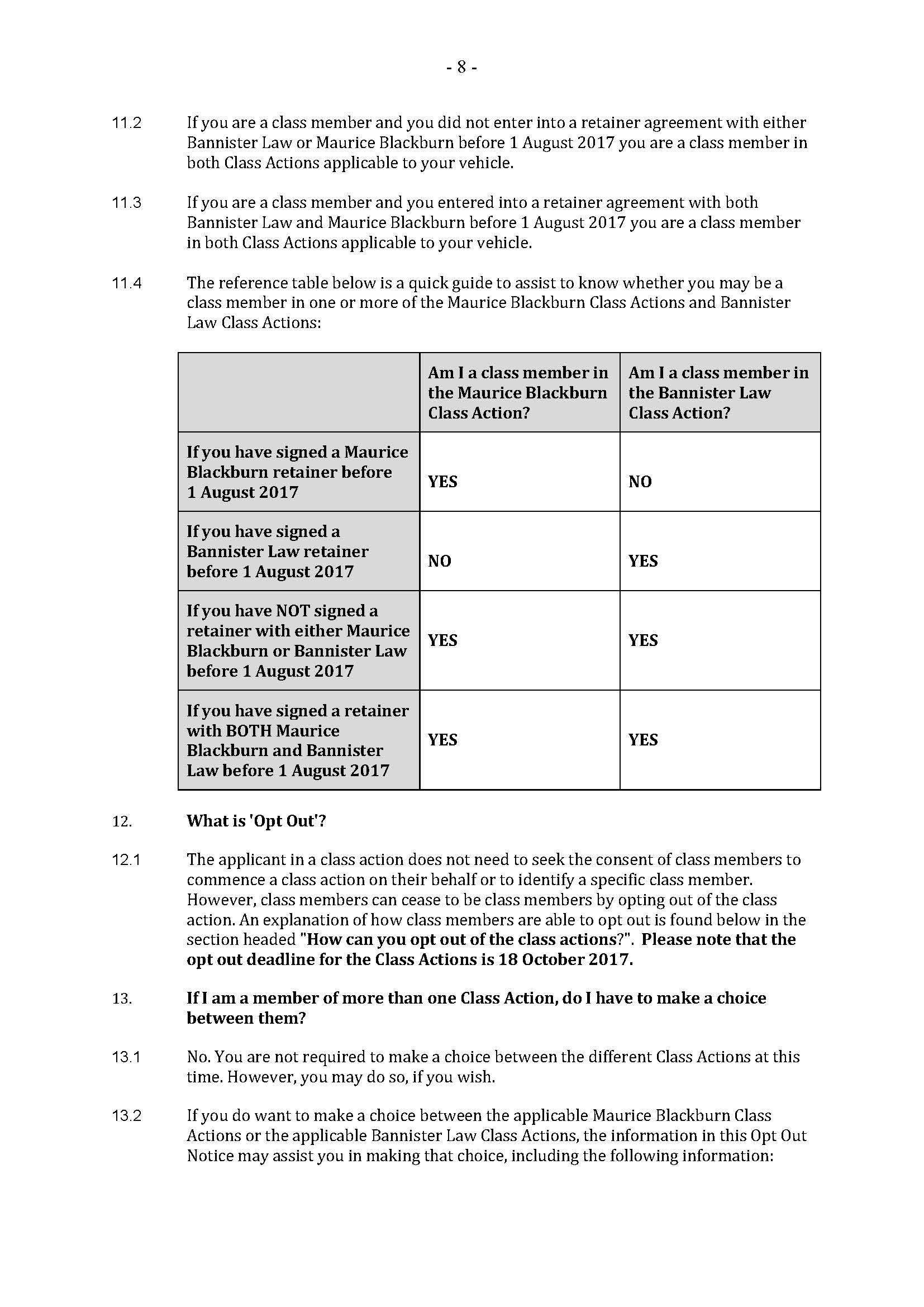
FOSTER J:
Introduction
1 On 3 September 2015, Volkswagen AG (VW Germany) disclosed at a meeting with representatives of the California Air Resources Board and the US Environmental Protection Agency that emissions software in certain four cylinder diesel engines manufactured by VW Germany and its affiliates in the years 2009–2015 contained a “defeat device” in the form of hidden software which could recognise whether a vehicle was being operated in a test laboratory or on the road. The deployment of this software resulted in the affected diesel engines emitting higher levels of nitrogen oxides (NOx) when the affected vehicles were driven on the road than when tested in the laboratory.
2 On or about 7 October 2015, Volkswagen Group Australia Pty Ltd (VW Australia) announced an online tool so that VW and Skoda customers who had purchased vehicles in Australia could check if their vehicles had the affected diesel engines as part of VW Germany’s action plan to respond to “the global emissions issue”. I infer that the “global emissions issue” referred to in that announcement was the capacity of the software in the affected diesel engines to cause those engines to emit lower levels of NOx when being tested in the laboratory than are emitted when the vehicles are driven on the road.
3 On 30 October 2015, Bannister Law, as solicitors on the record, commenced two class actions in this Court—Cantor v Audi Australia Pty Ltd (Audi Australia) (NSD 1307 of 2015) and Tolentino v VW Australia (NSD 1308 of 2015)—in which the applicant in each of those proceedings claimed relief in respect of the emissions issue. I shall refer to these two class actions collectively as “the BL class actions”.
4 On 20 November 2015, Maurice Blackburn commenced a class action in this Court—Dalton v VW Germany and VW Australia (NSD 1459 of 2015). On 22 November 2015, Maurice Blackburn commenced two further class actions in this Court—Richardson v Audi AG (Audi Germany), Audi Australia and VW Germany (NSD 1472 of 2015) and Roe v Skoda Auto a.s. (Skoda), VW Australia and VW Germany (NSD 1473 of 2015). I shall refer to these three class actions collectively as “the MB class actions”.
5 On 1 September 2016, the Australian Competition and Consumer Commission (ACCC) commenced a proceeding against VW Germany and VW Australia (NSD 1462 of 2016) in which it sought declaratory relief, pecuniary penalties, corrective advertising and other relief in respect of allegedly false and misleading conduct and representations concerning VW vehicles sold in Australia in the period from 1 January 2011 to 3 October 2015.
6 On 8 March 2017, the ACCC commenced a similar proceeding against VW Germany, Audi Germany and Audi Australia in respect of certain Audi vehicles sold in Australia in the period from 1 January 2011 to 3 October 2015 (NSD 322 of 2017).
7 A further proceeding brought by Complete Taxi Management Pty Limited and others against VW Australia involving some of the same issues as have been raised in the other proceedings was transferred to this Court by the Supreme Court of Queensland on 7 March 2017. This proceeding is NSD 510 of 2017.
8 All of the above proceedings are being case managed together.
9 The Court has fixed certain issues for a four week hearing commencing on 30 October 2017 (stage 1 trial).
10 In all of the class actions, the applicants allege that:
(a) The software fitted in the diesel engines installed in the affected vehicles is a “defeat device” within the meaning of that expression under the Australian Design Rules applicable to those vehicles and within the meaning of that expression under the Australian Vehicle Emissions Standards; and
(b) The affected vehicles failed to comply with the requirements of the Australian Vehicle Emissions Standards, which prohibit the use of “defeat devices” to cause vehicles to operate an emission control system differently in the test environment from the way in which that system functions when operating in normal use on the road.
11 The applicants in all of the class actions allege that the respondents engaged in misleading and deceptive conduct and made false and misleading representations in respect of the affected vehicles by representing that those vehicles complied with the applicable Australian Vehicle Emissions Standards when, in truth, they did not comply with those Standards. They also allege that the vehicles were not of acceptable quality and did not comply with applicable safety standards.
12 The applicants in the MB class actions (MB applicants) also allege that the European and Australian companies named as respondents in those actions engaged in unconscionable conduct, deceit and general law misrepresentation and also failed to comply with an express warranty provided to their customers.
13 The applicants seek, among other things, compensation on behalf of the owners and interest holders in the affected vehicles for the alleged diminution in value of those vehicles which they contend has been caused by the respondents’ conduct.
14 The respondents in the class actions deny all of the above allegations on various grounds.
15 The issues in dispute and questions for the stage 1 trial are set out in Annexure A to Orders of the Court made in each proceeding on 19 July 2017. Those issues and questions are (omitting notes thereto and related sub-issues):
1. Do the tests in Annex 11 and Annex 13 to the Standard apply in the present case as part of the full range of applicable requirements under the Standard?
2. Which Volkswagen, Audi and Skoda vehicles supplied in Australia contained a device, comprising software in the engine control unit (ECU), and sensors from which the ECU receives signals, which operated in mode 1 and mode 2?
3. Did the Vehicles contain a “defeat device” within the meaning of paragraph 2.16 of UNECE Reg 83 (applied by the Australian Design Rules), and (for NSD 1462 of 2016 only) paragraph 2.16 of Euro 4 and (for NSD 1462 of 2016 and NSD 322 of 2017 only) article 3(10) of Euro 5?
4. What is the extent of the difference between the Vehicles operating in mode 1 as opposed to mode 2 in relation to:
a. exhaust gas recirculation (EGR) rate/target fresh air mass;
b. Injection characteristic;
c. Injection pressure;
d. Injection timing;
e. the emission of oxides of nitrogen (NOx) from the vehicles;
f. particulate emissions;
g. CO2/fuel economy;
h. power and torque;
i. vehicle performance; and
j the operation of the SCR system.
5. Would the Vehicles have passed the NEDC Type I test, in respect of applicable NOx emissions, without the use of mode 1?
6. Did the Vehicles comply with the following provisions of UNECE Reg 83 (sub-paras (a) to (d) (and for NSD 1462 of 2016 only) the following provisions of Euro 4 and (for NSD 1462 of 2016 and NSD 322 of 2017 only) Euro 5 (sub-paras (e) to (k)):
a. 5.1.2.1 of UNECE Reg 83 (prohibition on use of a defeat device);
b. 5.3.1.4 of UNECE Reg 83 (whether the Vehicles did not comply with the applicable NOx emissions limits set by ADR 79, except by reason of the use of a defeat device);
c. 5.1.1 of UNECE Reg 83 (whether the components liable to affect the emissions of pollutants were so designed, constructed and assembled as to enable the Vehicles, in normal use, to comply with the provisions of UNECE Reg 83);
d. 5.1.2 of UNECE Reg 83 (whether the technical measures taken by the manufacturer were such as to ensure that in conformity with the provisions of UNECE Reg 83, exhaust gas emissions are effectively limited throughout the normal life of the vehicle and under normal conditions of use);
e. 5.3.1.4 of Annex 1 of Euro 4 (whether the vehicles did not comply with the applicable NOx emissions limits set by Euro 4, except by reason of the use of a defeat device);
f. section 5.1.1 of Annex 1 of Euro 4 (prohibition on use of a defeat device and whether the technical measures taken by the manufacturer were such as to ensure that pursuant to the provisions of Euro 4, the tailpipe and evaporative emissions are effectively limited throughout the normal life of the vehicle and under normal conditions of use);
g. article 5(2) of Euro 5 (prohibition on use of a defeat device);
h. article 1 and Annex 1, table 1 of Euro 5 (whether the Vehicles did not comply with the applicable NOx emissions limits set by Euro 5, except by reason of the use of a defeat device);
i. article 4(1) of Euro 5 (whether the manufacturer has demonstrated that all new vehicles sold, registered or put into service in the European Community are type approved in accordance with Euro 5 including having met the emissions limits set out in table 1 of Annex 1 of Euro 5 and the implementing measures referred to in article 4 of Euro 5);
j. article 4(2) of Euro 5 (whether the technical measures taken by the manufacturer were such as to ensure that pursuant to the provisions of Euro 5, tailpipe and evaporative emissions are effectively limited through the normal like of the Vehicles under normal conditions of use); and
k. article 5(1) of Euro 5 (whether the manufacturer equipped the Vehicles such that that the components likely to affect emissions are designed, constructed and assembled so as to enable the vehicle in normal use to comply with Euro 5 and its implementing measures)?
7. Did the vehicles contain a “defeat device equivalent”?
In determining the claims of members of the SCR Sub-Group (established by orders of Justice Foster on 19 July 2017 questions 2–7 set out above will involve consideration of the operation of the selective catalytic reduction (SCR) catalytic converter as referred to in particular (iiC)(iv) to paragraph 28 of the Further Amended Statement of Claim.
Definitions
In this statement of questions for the Stage 1 Trial:
a. “Australian design Rules” means:
– Vehicle Standard (Australian Design Rule 79/01 – Emissions Control for Light Vehicles) 2005 (ADR 79/01);
– Vehicle Standard (Australian Design Rule 79/02 – Emissions Control for Light Vehicles) 2005 (ADR 79/02);
– Vehicle Standard (Australian Design Rule 79/03 – Emissions Control for Light Vehicles) 2011 (ADR 79/03); and
– (for NSD 1462 of 2016 only) Vehicle Standard (Australian Design Rule 79/04 – Emissions Control for Light Vehicles) 2011 (ADR 79/04) (collectively, ADR 79);
b. “UNECE Reg 83” means Regulation No 83 of the UN Economic Commission for Europe;
c. “Euro 4” means Annex 1 of the Council Directive 70/200EC as amended by EU Directive 98/69/EC;
d. “Euro 5” means EU Regulation 715/2007.
e. “the Standard” means: Australian Design Rules or the alternative standard UNECE Reg 83 as it then applied to the approval of the Vehicles.
f. “Vehicles” means Audi, Skoda and Volkswagen diesel vehicles fitted with a four cylinder “EA 189” 1.6L or 2.0 engine which are the subject of one or more of Federal Court proceedings Nos. NSD 1307 of 2015, NSD 1308 of 2015, NSD 1459 of 2015, NSD 1472 of 2015, NSD 1473 of 2015, NSD 1462 of 2016 and NSD 322 of 2017;
g. “mode 1” means the mode in which the Vehicles operate in the conditions of the NEDC test;
h. “mode 2” means the mode in which Vehicles operate when outside certain conditions of the NEDC test.
16 The questions to be determined at the stage 1 trial concern technical engineering matters and the correct interpretation of the various relevant Vehicle Emissions Standards.
The Present Applications
17 On 8 June 2017, the applicants filed an Interlocutory Application in each of the class actions in which they sought an injunction against the relevant respondents in those actions restraining them from distributing, or causing to be distributed, certain recall forms. They also claimed orders in relation to Opt Out Notices required to be disseminated in respect of the class actions. The Interlocutory Applications filed in the MB class actions were Amended Interlocutory Applications.
18 The BL applicants and the MB applicants claimed identical relief in the Interlocutory Applications filed in each proceeding. In particular, prior to filing their Interlocutory Applications on 8 June 2017, all of those applicants had agreed the terms of the orders which they would seek in respect of opt out and the form of the relevant opt out notices. They also claimed an injunction in identical terms.
19 On 18, 19 and 24 July 2017 and on 24 August 2017, I heard the above applications. At the same time, I also heard applications made by the applicants in respect of discovery. I also addressed certain other Interlocutory Applications which were listed on those days for case management.
20 The applicants’ claim for injunctive relief was opposed by the respondents. Their proposals in respect of opt out were opposed in some (but not all) respects.
21 The applicants’ claim for injunctive relief concerned conduct on the part of Volkswagen dealers whereby those dealers were requiring customers to sign formal documentation in respect of the recall program being undertaken by VW Australia in respect of Volkswagen vehicles affected by the recall put in train by VW Australia as long ago as October 2015. The applicants sought an order restraining the respondents from distributing or causing to be distributed three particular forms of recall notice. Soon after lunch on the first day of hearings (ie on 18 July 2017) (Transcript 65/1–9), the MB applicants abandoned their claim for injunctive relief. The BL applicants did not adopt a different attitude and I took it that they also had abandoned their claims for injunctive relief. Accordingly, all claims for injunctive relief will be dismissed.
22 Notwithstanding that the applicants’ claims for injunctive relief were abandoned, the applicants maintained their contention that the Court should take remedial action in respect of the conduct of the respondents and their dealers by including various statements in the Opt Out Notices by way of clarification and, in some cases, correction, of representations made by the respondents and their dealers to their customers and to the public in general.
23 By these Reasons for Judgment, I determine the claims for relief made by the applicants in their Interlocutory Applications filed on 8 June 2017. In these Reasons, I also address the appropriate way of progressing an Interlocutory Application filed by the respondents in all of the class actions on 26 June 2017 whereby those respondents seek orders addressing problems which they allege are caused by the circumstance that two different firms of lawyers have mounted two separate groups of class actions against the respondents in which there is a substantial overlap between the two groups insofar as the group definition in each case is concerned and also in terms of the allegations made.
24 At the time when the 8 June 2017 Interlocutory Applications were filed, the applicants and the respondents were in dispute about a large number of matters raised by the applicants’ Interlocutory Applications. However, as the hearing progressed, a number of those issues were resolved. In the end, only a relatively small number of substantive issues remained in dispute. In light of those circumstances, I will address in these Reasons only those matters of significance which remained in dispute at the conclusion of the hearing. The form of the long version of the Opt Out Notice (the long Opt Out Notice) and the form of the abridged version of the Opt Out Notice (the abridged Opt Out Notice) which I propose to approve reflect my decisions in relation to the significant matters of dispute as well as decisions which I have made in relation to matters of less significance or of a drafting nature. I do not intend to advert expressly to the less significant matters and drafting matters in these Reasons.
The Form and Manner of Distribution of the Opt Out Notices
The Evidence
25 In support of their claims for relief made in their Amended Interlocutory Applications filed on 8 June 2017, the MB applicants read and relied upon an affidavit sworn by Jason Andrew Geisker on 7 June 2017 and filed on 8 June 2017. Mr Geisker is the solicitor on the record for the applicants in each of the MB class actions.
26 Mr Geisker exhibited to his affidavit as Exhibit JAG-7 a version of the long Opt Out Notice proposed by all of the applicants and also included within the same exhibit a version of the abridged Opt Out Notice.
27 At pars 11 and 12 of his affidavit, Mr Geisker said:
11. The Applicants propose that the Opt Out Notice be distributed to group members via a combination of:
(a) direct email (or where an email address is unavailable via registered mail) to group members by the Respondents using contact details held by the Respondents;
(b) direct email (or where an email address is unavailable via registered mail) to group members by Maurice Blackburn and Bannister Law to their respective clients;
(c) publication on the Federal Court website;
(d) publication, in an abbreviated form, in various state and national newspapers set out below; and
(e) publication on websites, information telephone lines and social media accounts operated by the Respondents up until the opt-out date.
12. Based on my experience, I believe that these are reasonable and appropriate methods of distribution which, in combination, are likely to bring the Opt Out Notice to the attention of group members in accordance with ss 33X(1)(a) and 33Y. I discuss each of the proposed methods of distribution below.
28 Mr Geisker went on to say in his affidavit that:
(a) He understood that the respondents maintained a database of group member contact details comprising contact details of registered owners of affected vehicles obtained from National Exchange of Vehicle and Driver Information System (NEVDIS) maintained by Austroads Ltd (Austroads) and contact details supplied by authorised dealerships obtained at the time of sale of affected vehicles.
(b) Maurice Blackburn has been retained by a total of 16,626 group members and Bannister Law has been retained by a total of 1,235 group members.
(c) Almost 100,000 vehicles are affected by the alleged defeat device.
(d) The costs of publishing the abridged Opt Out Notice in the national newspapers selected by the class action applicants as the newspapers in which such notice should be published will be approximately $84,000 (incl GST).
(e) The number of followers (that is, the number of accounts, on the relevant social media which are subscribed to the respondents’ Australian Facebook accounts) as at 7 June 2017 was as follows:
VW Australia | Audi Australia | Skoda Australia |
30,295,330 followers | 268,298 followers | 25,643 followers |
(f) In Mr Geisker’s opinion, the publication of a link to the long Opt Out Notice on the respondents’ social media is a low cost, efficient and effective means of reaching a large proportion of group members.
(g) The applicants propose that the Opt Out Notices also address allegedly misleading information being communicated by Volkswagen dealers to their customers when vehicles are brought in from time to time pursuant to the recall or otherwise for service. Mr Geisker contended that addressing these matters in the Opt Out Notices was both a convenient and reasonable manner of dealing with misconceptions which he argued had been created in the minds of affected owners by statements made by VW Australia and its dealers concerning the recall. In summary form, Mr Geisker said that the matters which required attention were:
(i) The suggestion made on behalf of Volkswagen dealers that the recall was compulsory and that the recall work was required to be done to all affected vehicles. Mr Geisker said that the recall was voluntary and that this needed to be made clear;
(ii) The potential for affected consumers to misunderstand the true nature of the approval granted in recent times by the Commonwealth Department of Infrastructure and Regional Development (DIRD) to the carrying out of the recall work on affected vehicles. Mr Geisker submitted that the approval given by DIRD went no further than an approval for the carrying out of the recall work on affected vehicles upon the basis that the recall work was effective to overcome having two modes of operation in the diesel engines the subject of the recall. Mr Geisker claimed that VW Australia and its dealers were also suggesting to their customers that DIRD had agreed with VW Australia’s assertions that, once the recall work was carried out on affected vehicles, there would be little or no impact on those vehicles’ performance on the road. He said that DIRD’s approval did not go that far and argued that, as VW Australia’s assertions concerning the impact of the recall work on the performance of affected vehicles was a matter of contention, particular care should be taken in describing the extent of the approval granted by DIRD;
(iii) In similar vein, Mr Geisker argued that the Opt Out Notices should address the applicants’ assertions that both the performance and value of the affected vehicles were detrimentally impacted by the deployment of the alleged defeat device;
(iv) Mr Geisker also said that the Opt Out Notices should make clear that affected customers can participate in the voluntary recall and still claim compensation in the class actions; and
(v) It was also Mr Geisker’s view that the Opt Out Notices should address the significance of admissions made by VW Germany in certain proceedings in the USA where one or more of the respondents submitted to a substantial pecuniary penalty in respect of the emissions issue.
29 The MB applicants also read and relied upon an earlier affidavit sworn by Mr Geisker, being his affidavit sworn on 6 April 2017 and filed on the same day. They also tendered the documents exhibited to that affidavit. In that affidavit, Mr Geisker catalogued a number of instances where Volkswagen dealers had compelled Volkswagen owners who had brought in their vehicles for service to sign a recall form in the terms of one or other of the three recall forms in respect of which the applicants were seeking injunctive relief. He also described on information and belief a number of instances where recall work was carried out on affected vehicles without the owner’s consent. In addition, he adverted to instances where contestable propositions were being represented as incontestable fact by Volkswagen dealers and, in some cases, by VW Australia itself, as well as instances where Volkswagen dealers misrepresented the true position concerning the likely impact of the implementation of the recall work on affected engines.
30 A number of objections were taken by the respondents to Mr Geisker’s affidavit of 6 April 2017. Those objections are listed in MFI-1. At the hearing, I admitted the evidence over the objection of the respondents upon the basis that, as matters then stood, the matter to which the evidence related was not genuinely in dispute (as to which, see s 190(3) of the Evidence Act 1995 (Cth)). In light of the applicants’ abandonment of the claims for injunctive relief, I intend to make use of this evidence only in relation to the applicants’ claims that the Opt Out Notices should include statements of a clarifying or corrective nature directed to remedying as far as possible any misconceptions created by the respondents and their dealers.
31 The MB applicants also read and relied upon an earlier affidavit of Mr Geisker, being his affidavit sworn on 21 February 2017 and filed on 22 February 2017 and tendered the documents exhibited to that affidavit. In this earlier affidavit, Mr Geisker raised similar concerns to those which he raised in his later two affidavits in respect of public statements made by, and the behaviour of, VW Australia, Audi Australia, Skoda and their dealers. It is not necessary to address that affidavit in any detail.
32 The MB applicants also read and relied upon the affidavit of Angus James Francis affirmed on 14 July 2017 and the documents exhibited thereto (Ex AF-4). In that affidavit, Mr Francis, who is a solicitor employed by Maurice Blackburn, gave evidence that the respondents had used their Facebook pages to communicate features of the recall to owners of affected vehicles.
33 The BL applicants also relied upon all of the evidence tendered by the MB applicants.
34 When Senior Counsel for the MB applicants came to make his oral submissions, he relied upon a bundle of documents (including the relevant affidavits) compiled specifically for the hearing. I marked that bundle of documents as MFI-2.
35 The respondents read and relied upon the affidavit of Bruce Llewellyn Lloyd sworn on 29 June 2017 and tendered the exhibit to that affidavit (Ex BLL-12). In his affidavit, Mr Lloyd endeavoured to address the applicants’ claim for injunctive relief as well as certain aspects of the DIRD approval and the likely effect of the recall work on the operation of affected vehicles. He also provided evidence of the efforts made by Maurice Blackburn and Bannister Law to correct allegedly misleading conduct on the part of VW Australia, its related companies and their dealers. He also addressed the question of whether the publication on Facebook pages was necessary or desirable. He suggested that such publication was unnecessary.
The Issues to be Determined
36 At the end of the hearing in relation to the Opt Out Notices, the following matters of substance remained in dispute:
(a) Whether the provision of the Opt Out Notices should await the determination by the Court of the claims for relief made by the respondents in their Interlocutory Applications filed in the class actions on 26 June 2017 (overlap IA) by which they seek relief in relation to the alleged difficulties caused by the two groups of class actions continuing to proceed in parallel or whether the Opt Out Notices should address some of the overlap issues now in the manner suggested by the applicants.
(b) Whether the respondents should be obliged to publish and to provide a link to the long Opt Out Notice as settled by the Court and as displayed on the Court’s website using specific Facebook accounts operated by each of VW Australia, Audi Australia and Skoda Australia.
(c) Whether the costs of requiring the respondents to provide a copy of the long Opt Out Notice to group members should, in the first instance, be paid by the respondents or by the applicants.
(d) Whether the long Opt Out Notice should contain a reference, prominently displayed on p 1 of that Notice, to the material which all parties accept should, in some form, appear somewhere in the long Opt Out Notice addressing a number of matters concerning the recall undertaken by VW Australia and its affiliates (Par 1.4 of the applicants’ version of the long Opt Out Notice).
(e) Whether, in the material addressing the recall in Section 6 of the long Opt Out Notice, there should be a reasonably detailed list of the likely effects on the affected vehicles of having the recall work carried out (the applicants’ preference) or a more rolled up and circumspect reference to those effects (the respondents’ preference).
(f) Whether, in Section 6 (at par 6.13) of the long Opt Out Notice, there should be included a reference to the position adopted by certain European authorities in relation to the likely effect of the recall work on the performance of the affected vehicles.
(g) Whether, at pars 6.14, 6.15 and 6.16 of the long Opt Out Notice, there should be reference to the fact that, in the case of owners who choose not to have the recall work carried out, there may be difficulties in the future in having further updates to the engine software put in place.
(h) Whether, in Section 6 of the long Opt Out Notice, there should be a reference to the fact that, in the case of owners who choose not to have the recall work carried out, that decision will not constitute a waiver of any rights those owners may have in the class actions.
(i) Whether the long Opt Out Notice should address in detail the impact at the present time of opting out of all of the class actions and the consequences of certain other choices concerning the retainer or non-retainer of Bannister Law or Maurice Blackburn in respect of the two groups of class actions. These matters are addressed in Sections 8–15 of the long Opt Out Notice. In large part, the respondents opposed the inclusion of all of these paragraphs upon the basis that those group members who choose to remain as group members should be compelled by the time of the opt out deadline to choose whether they wish to retain either Bannister Law or Maurice Blackburn or neither, the respondents contending (inter alia) that group members ought not be permitted to retain both firms. In the alternative, the respondents propounded different wording for the critical paragraphs in the event that I did not accept their primary contention, namely, that the problems caused by the overlapping of the two groups of class actions should be addressed prior to the long Opt Out Notice being circulated among group members or, at the very least, in the long Opt Out Notice itself but not in the manner contended for by the class action applicants.
37 At the end of the hearing, the following methods of circulation of the long Opt Out Notice and the abridged Opt Out Notice were agreed between the applicants and the respondents namely:
(a) Direct communication of the long Opt Out Notice to the respective clients of Bannister Law and Maurice Blackburn;
(b) Publication of the long Opt Out Notice on the websites of Bannister Law and Maurice Blackburn;
(c) Publication of the long Opt Out Notice on the Federal Court’s website;
(d) Publication of the abridged Opt Out Notice in certain specified newspapers (although the question of who should pay for this had not been resolved);
(e) Publication of the long Opt Out Notice on the websites of VW Australia, Skoda and Audi Australia; and
(f) Playing an appropriate recording on the hotline maintained by VW Australia, Skoda and Audi Australia advising callers where they can review the long Opt Out Notice.
Consideration
Issue 1—The Overlapping Class Actions Issue
38 In this part of these Reasons, I address the issues which I have identified at [36(a)] and [36(i)] above.
39 On 26 June 2017, the respondents in the class action proceedings filed the overlap IA in each of those proceedings in which they claim relief in respect of the alleged ongoing difficulties caused by the circumstance that two groups of class actions are on foot, namely, the BL class actions and the MB class actions. In substance, the respondents seek orders pursuant to s 33ZF of the Federal Court of Australia Act 1976 (Cth) (the Act):
(a) Deeming those group members who have entered into a retainer agreement with Maurice Blackburn in respect of proceeding NSD 1459 of 2015 to be a group member in that proceeding for all purposes and not to be a group member of the BL class action NSD 1308 of 2015;
(b) Deeming those group members who have entered into a retainer agreement with Bannister Law to be a group member in proceeding NSD 1308 of 2015 for all purposes and not to be a group member in proceeding NSD 1459 of 2015;
(c) Deeming those group members who have not entered into any retainer agreement with either Maurice Blackburn or Bannister Law in respect of either NSD 1308 of 2015 or NSD 1459 of 2015 to be a group member in proceeding NSD 1459 of 2015 for all purposes and not to be a group member in proceeding NSD 1308 of 2015; and
(d) Deeming those group members who have entered into retainer agreements with both Maurice Blackburn and Bannister Law to be a group member in NSD 1459 of 2015 and not to be a group member in proceeding NSD 1308 of 2015 unless they nominate a different intention as part of the opt out process.
40 In the overlap IA, in addition to addressing proceedings NSD 1308 of 2015 and NSD 1459 of 2015, the respondents also seek to address the overlap between NSD 1307 of 2015 and NSD 1472 of 2015 and the overlap between NSD 1308 of 2015 and NSD 1473 of 2015.
41 In the alternative, the respondents seek orders staying the BL class actions until further order of the Court.
42 The claims for relief made in the overlap IA were supported by an affidavit sworn by Gregory John Williams on 28 June 2017. Mr Williams is the respondents’ solicitor on the record.
43 On 29 June 2017, the respondents also filed a Written Submission in support of their claims for relief made in the overlap IA.
44 The overlap IA was, by my direction, listed before the Court on 18 July 2017 for case management. It was not listed on that day for hearing. A number of other applications had previously been listed for hearing on 18 July 2017.
45 In his affidavit, Mr Williams said that the respondents’ then solicitors, Henry Davis York, had first raised by letter sent on 9 December 2015 what the respondents considered to be an unsatisfactory state of affairs brought about by two groups of class actions being maintained at the same time and threatened to bring an application to have some of the claims struck out as an abuse of process.
46 On 5 February 2016, the respondents in the class actions filed Interlocutory Applications in each of those proceedings in which (inter alia) they sought an order that all of the class actions be struck out as an abuse of process.
47 On 27 June 2016, Clayton Utz, who were by then acting for the respondents, in a letter sent to both Bannister Law and Maurice Blackburn on that day, again raised the difficulties caused by the continuation of two groups of class actions. On this occasion, Clayton Utz argued that the difficulties caused by parallel proceedings needed to be resolved before the opt out process was undertaken.
48 Further correspondence between the solicitors ensued.
49 In early June 2017, the respondents abandoned the strike out applications which they had filed on 5 February 2016.
50 Nonetheless, in April and May 2017, they pressed the applicants’ solicitors to address the ongoing difficulties which they asserted were caused by the maintenance of parallel groups of class actions. In their letter of 12 May 2017, Clayton Utz seemed to be prepared to progress the distribution of an appropriate opt out notice even though the matters previously raised by it over the 18 months or so prior to that date had not been addressed by the applicants’ solicitors.
51 On 6 June 2017, Clayton Utz sent a further letter to the applicants’ solicitors. In that letter, Clayton Utz contended that the overlap issues should be resolved prior to the commencement of the stage 1 trial and prior to or as part of the opt out process.
52 As I have already noted, the overlap IA has not yet been heard nor has it yet been allocated a date for hearing. The listing on 18 July 2017 was for case management only.
53 When the applications that were listed on 18 July 2017 for hearing were argued, Senior Counsel for the respondents submitted that I should not authorise the dissemination of any opt out notice until such time as the respondents’ overlap IA had been heard and determined. Senior Counsel also submitted, as a fall-back position, that if I did not embrace his primary submission, I should nonetheless reflect the ideas contained in the respondents’ overlap IA in the Opt Out Notice itself. The respondents’ contention in this regard was that I should compel group members to select which group they wished to be a member of (ie the groups as defined in the BL class actions or the groups as defined in the MB class actions) and that, in default of such election being made, I should compel those group members who had failed to make the necessary choice to be placed in the groups as defined in the MB class actions.
54 Accordingly, in these Reasons, I propose to address only two questions raised by the filing of the overlap IA, namely, whether I should delay the distribution of the requisite Opt Out Notices pending the hearing and determination of the claims for relief made in the overlap IA and, in the event that I choose not to take that course, whether I should embrace some of the ideas in the overlap IA in the Opt Out Notices. I stress that, by these Reasons, I am not determining the claims for relief made in the overlap IA.
55 The respondents relied upon Smith v Australian Executor Trustees Limited [2016] NSWSC 17 (Smith), Hassid v Queensland Bulk Water Supply Authority (T/as Seqwater) [2017] NSWSC 599 (Hassid) and Johnson Tiles Pty Ltd v Esso Australia Ltd (1999) ATPR 41-679 in support of a general proposition that it would not be in the interests of justice to permit parallel proceedings to continue with overlapping group members.
56 Whether or not, as a general rule, that proposition holds good, neither Smith nor Hassid support the respondents’ submission that the so-called difficulties presented by parallel proceedings need to be resolved in some final fashion prior to or as part of the opt out process.
57 In oral submissions before me, Senior Counsel for the respondents submitted that “now … [is] the perfect time to give to group members the information they need and the opportunity to make a decision for themselves … ” as to whether they wish to be part of the BL class actions or the MB class actions or no class actions. Senior Counsel went on to submit that no better opportunity would arise.
58 In developing his primary submission, Senior Counsel for the respondents argued that the vast majority of group members across all class actions are group members in both groups of class actions. He then submitted that, were that circumstance to be permitted to continue, it would constitute an abuse of process and be vexatious and oppressive insofar as the position of the respondents is concerned. For this reason, so it was submitted, the present situation ought not to be permitted to continue.
59 In support of his submissions, Senior Counsel for the respondents relied upon the decision of Griffiths J in Sanda v PTTEP Australasia (Ashmore Cartier) Pty Ltd [2017] FCA 14 and the decision of McKerracher J in Morgan; Re Brighton Hall Securities Pty Ltd (In Liq) (2013) 96 ACSR 232. Neither of those decisions addresses the question raised here, namely, whether the institution of multiple class actions in relation to the same subject matter is an abuse of process, vexatious and oppressive.
60 It is by no means clear or accepted in this Court that the continued maintenance of parallel class action proceedings necessarily constitutes an abuse of process (see, for example, the judgment of Beach J in McKay Super Solutions Pty Ltd (Trustee) v Bellamy’s Australia Ltd [2017] FCA 947 (Bellamy’s) at [36]).
61 After I reserved my decision in respect of the Opt Out Notices, Beach J delivered his judgment in Bellamy’s. In light of that judgment, the respondents sought to make further submissions in support of the proposition that I should not order the dissemination of any Opt Out Notice without first hearing and determining the claims for relief made by the respondents in the overlap IA. As a result, all parties made a brief Written Submission on the point and addressed me orally on 24 August 2017.
62 In their Supplementary Submissions, the respondents prayed in aid of the approach which they advocated the remarks of Beach J at [22] in Bellamy’s. At that paragraph, his Honour said:
Now there is considerable wisdom in a wait and see approach in some contexts. And I do not doubt that such an approach has been warranted by other docket judges in other cases. But in my context where there are two open class proceedings, numerous group members signed up in each of the proceedings to different funding arrangements, and the prospect of a common fund application being made in each of the proceedings, it is desirable that clarity be injected sooner rather than later as to the proceedings to go forward and their constitution. This is not only in the best interests of group members in each of the proceedings, whether signed up or otherwise, but also in the interests of the respondent, who should not be vexed or oppressed by duplicate classes prosecuting duplicate claims. Let me elaborate on one aspect justifying the need to resolve these issues sooner rather than later. The applicant in each of the proceedings is proposing to seek a common fund order. Whether I grant such an order and its terms will need to be dealt with at an early point. In those circumstances, it is necessary to resolve the appropriate constitution of each of the proceedings first before dealing with common fund questions. It is undesirable that a common fund order be made in both proceedings. That would create considerable uncertainty for group members. Moreover, the economics of determining whether such an order and its terms are appropriate and in which proceedings would be considerably complicated if I was to endeavour to address the question at the same time in both proceedings as presently constituted. In summary, I do not consider that I can just wait and see what happens.
63 His Honour’s remarks at [22] in Bellamy’s are of the most general kind and I do not consider that, by making those remarks, his Honour was going so far as to suggest that the so-called problems of duplicate claims made in more than one set of class actions should be addressed before or as part of the opt out process. Nor do I think his Honour’s observations at [36] in Bellamy’s were of that character. At [21], his Honour recorded a submission by the applicant in Bellamy’s in which the applicant referred to the Volkswagen cases and the CIMIC class action before Jagot J in support of an argument that it might be preferable to defer consideration of the overlap problem in that case until a later point in time. That was the context in which he made the observations at [22] which I have extracted at [62] above.
64 The respondents also submitted that, in Bellamy’s, Beach J recognised that the opt out process could be used as a means by which some group members could elect between the two overlapping proceedings. As far as it goes, that observation is correct. However, it does not come to grips with the question of timing. Nor does it constitute a reason for preferring the approach advocated by the respondents in the overlap IA over the approach advocated by the applicants in their proposed Opt Out Notice. The applicants’ approach is to offer to group members the opportunity to choose between groups at this point in time without making it obligatory to do so at this point in time.
65 In oral submissions made to me on 24 August 2017, the essence of the respondents’ Written Submissions was repeated.
66 The MB applicants submitted that no compelling reason had been advanced on behalf of the respondents as to why I should delay dissemination of the Opt Out Notice in order to resolve the so-called overlap issues. They submitted that the opt out procedure cannot, and would not, remove overlap. They also submitted that the only relevant difference of substance between the approach of the respondents and the approach of the MB applicants in this case, is that the respondents’ approach results in group members who fail to make an express choice between the two groups of class actions being allocated to the relevant class action within the MB class actions by default. Also, the MB applicants submitted that, contrary to the respondents’ submissions, it was not inevitably going to be the case that further notices would need to be issued to group members if the Court ultimately accedes to the respondents’ claims for relief in the overlap IA.
67 The MB applicants also made more detailed submissions as to the significance of the judgment of Beach J in Bellamy’s, ultimately contending that there was nothing in that judgment that would compel the Court to delay dissemination of the Opt Out Notice pending the hearing and determination of the respondents’ overlap IA. I agree with this submission.
68 The BL applicants made a separate Written Submission to the Court in light of the respondents’ submissions made both in writing and orally on 24 August 2017.
69 The BL applicants submitted that there is no necessity, or practical utility, for the claims for relief made by the respondents in the overlap IA to be resolved prior to or concurrently with the opt out process. Those applicants also submitted that, were I of the opinion that this basal proposition was not correct, I should defer dealing with opt out until after completing the stage 1 trial. This latter proposition is based upon a view that s 33X(1)(a) of the Act would permit an opt out deadline to be imposed as part of an opt out process which began after the stage 1 trial had been completed. I do not need to decide whether this submission is correct. The BL applicants also submitted that, were I to adopt the course urged upon me by the respondents, the stage 1 trial would inevitably be postponed.
70 The BL applicants also submitted that, unlike the present proceedings, in Bellamy’s there were competing class actions with overlapping classes with common respondents and common causes of action. Each class action was funded by a different funder and in each case a common fund application was to be pursued. This created additional complications and uncertainty that are not present in the Volkswagen cases. The BL applicants went on to submit that the funding issues present in Bellamy’s were simply not present in the Volkswagen litigation. They also submitted that the only present uncertainty related to those group members who are not presently clients of either Bannister Law or Maurice Blackburn. They submitted that the uncertainty identified by them would arise even if there was only one current (funded) class action or one class action whether funded or not.
71 The BL applicants also submitted that the respondents did not move promptly to seek to resolve the difficulties which they now raise in support of the overlap IA. They also contended that there was no demonstrable need for any of the so-called overlap issues to be resolved now or in connection with the proposed opt out process. They went on to contend that, rather than merely giving group members notice of the proceedings and of their right to opt out of each (and details of how to do so), the respondents want the Court to require that the long Opt Out Notice provide notice informing the non-client members of the BL class actions that they have, in effect, been involuntarily opted out or deemed to be no longer class members (as a result of the orders sought by the respondents) and that they have a right to opt back into the BL class actions if they agree to become clients of BL. The BL applicants submitted that this is a highly undesirable outcome.
72 The BL applicants also submitted that the present cases are being run collaboratively and concurrently along with the two ACCC proceedings under active case management. Furthermore, there is no precise commonality between the identity of respondents in the present cases. These are not matters capable of easy and quick resolution through the opt out notice procedure.
73 I do not think that the respondents have advanced any good reason as to why I should delay disseminating the Opt Out Notices required by the Act in order to hear and determine the claims for relief made by them in the overlap IA. The applicants, by way of contrast, have put forward many compelling reasons for not delaying the opt out process. I propose to proceed in the manner advocated by the applicants.
74 In my view, it is not helpful in order to resolve particular issues presented by the existence of parallel proceedings in one case to point to general observations made by judges in other cases or even to point to specific solutions deployed by such judges. There can be no “one size fits all” approach to the various problems that may arise in group proceedings under Pt IVA of the Act. Each case must be considered upon the basis of a full and sensible appreciation of the relevant facts involved in the particular case and also by paying due regard to all relevant circumstances in play in the particular case. For the most part, decisions to be made by the Court in dealing with the issues raised from time to time in group proceedings under Pt IVA of the Act are discretionary. While it is obviously desirable that a consistent approach to problems which surface regularly from time to time is highly desirable, there is always scope, in my view, for judges to respond to particular issues differently and yet to still be appropriately exercising the discretion reposed in them. Whilst there may be some common features between cases, it remains the position that different judges may resolve the difficulties with which they are confronted differently depending upon how those judges assess the relevant considerations.
75 In the present case, I have consistently taken the view that I would permit the two groups of class actions to proceed in parallel for the time being. My decision to adopt that approach was not taken lightly or without due consideration. I do not agree that that decision has unduly vexed the respondents or oppressed them. Nor do I consider that that decision has been productive of undue cost, confusion or delay. To my way of thinking, the approach which I have taken has been a sensible approach to the problem presented to the Court by the existence of two groups of class actions. It may be that, in the future, some further action will need to be taken in order to address problems (which are not present at the moment) caused by the continued maintenance of parallel groups of class actions. This will be a matter to be kept under constant review as the litigation progresses. As is the way with these matters, the Court is attentive to the case management needs of each matter and will not ignore changes to courses of action previously charted which might become necessary as the interlocutory stages of the cases progress.
76 In addition, in the present case, it has been almost 20 months since the solicitors for the respondents first raised concerns about the alleged problems caused by the existence of two groups of class actions. Yet no application was made to the Court until the end of June 2017 (other than the strike out application of 5 February 2016) to bring those concerns to the attention of the Court with a view to having appropriate orders made. By June 2017, the process of settling the form of the relevant Opt Out Notices was well under way and was expected to be resolved by the end of July 2017. The significant delay on the part of the respondents in bringing forward the claims for relief which they now make in the overlap IA must count against the Court accepting their current proposition that the claims for relief in the overlap IA must be dealt with prior to or as part of the opt out process. These observations are even more telling when it is appreciated that, on a number of occasions in the period from about November 2016 until April 2017, the respondents urged upon the Court that the Court should compel the applicants to commence the opt out process because the applicants had not paid due attention to the need to disseminate Opt Out Notices well before any hearing of a final nature in any of the matters.
77 The respondents ultimately accepted by the end of the hearing before me that, if I were minded not to delay the dissemination of the Opt Out Notices until such time as I had heard and determined the claims for relief made by them in the overlap IA and if I were also not minded to make it obligatory for group members to elect between the BL class actions and MB class actions, then the text of pars 13.1, 13.2 and 13.3, as propounded by the applicants, was acceptable, subject to one matter. That matter is this: At the end of par 13.3, the applicants wish to add after the clause: “… there may be a subsequent opportunity for you to choose between the class actions ….” the following words in bold: “… or the Court may determine without further notice to you which of the class actions you will participate in”.
78 The respondents object to the addition of those words. The submission was that those words should not be included because now is the time to address the question of overlap.
79 Given that I have decided not to adopt the approach advanced on behalf of the respondents in relation to the overlap questions, I see no reason not to include the words which the applicants wish to have included at the end of par 13.3. Accordingly, I have included the substance of those words in par 13.3 although I have changed the text slightly.
Issue 2—The Link to Facebook
80 In light of the evidence from Mr Geisker, I see no reason why the respondents should not be compelled to publish a link to their Facebook accounts in the manner sought by the applicants. Mr Geisker (correctly in my view) said that using Facebook in this way is a low cost, efficient and effective means of reaching a large proportion of group members. I have no doubt that this is so. One reason advanced by the respondents against the use of their Facebook accounts in the manner sought by the applicants was that the other means of communicating the subject matter of the proposed Opt Out Notices were more than adequate for getting the message to group members. This may or may not be so. However, I think that using Facebook clearly has the potential to widen the class of persons whose attention is brought to bear on the subject matter of the Opt Out Notices.
81 The respondents also made a submission that the orders sought by the applicants would result in millions of people around the world having the terms of the long Opt Out Notice brought to their attention. This submission is based upon the evidence given by Mr Lloyd at pars 61–66 of his affidavit. At par 63 of that affidavit, Mr Lloyd said:
… The followers of each country’s Volkswagen Facebook accumulate to the total Global Volkswagen Facebook presence followers count, which shows some 30 million followers.
Mr Lloyd went on to say that, in those circumstances, it is unlikely that the readers of the Facebook pages would be limited to Australian customers of Volkswagen, Audi and Skoda, let alone limited to Australian customers who own affected vehicles. While it is likely that some Facebook followers of VW Australia’s Facebook page may not be Australian residents or owners of affected vehicles in Australia, the extent to which non-Australians will be alerted to the long Opt Out Notice is not at all clear. In any event, I do not think that the mere fact that non-Australians may be the recipients of the requisite notice is any reason not to make the orders in respect of Facebook which have been sought by the applicants.
82 Accordingly, I propose to make the orders sought by the applicants in respect of the publication of a link to Facebook.
Issue 3—Who should pay for the Costs incurred by the Respondents to Disseminate the Long Opt Out Notice
83 Order 5(a) which I propose to make in each proceeding provides that the respondent or respondents (as the case may be) provide the long Opt Out Notice to all potential group members by email and, in the event that no email address is held or a bounce back is received, they provide that notice to affected persons at the postal addresses held by them, including as a result of receiving NEVDIS data supplied to it or them by Austroads.
84 I have decided to make such an order because I want to take all reasonable steps in order to ensure that the contents of the long Opt Out Notice are brought to the attention of as many group members as possible.
85 The respondent parties obviously have address details for many more affected persons than do Bannister Law and Maurice Blackburn.
86 The extant matter of dispute between the respondents and the applicants concerns who should bear the costs of this direct contact process in the first instance. For a time, I had under active consideration requiring the respondents and the applicants to share the costs. However, while it is appropriate that the respondents be permitted to carry out the task, I consider that the claimant for final relief in these class actions (viz the applicants) should be required to reimburse to the respondents the reasonable costs of these direct contact procedures.
87 Accordingly, I will make orders requiring the applicants to reimburse such reasonable costs to the respondents. I will build in a mechanism into the orders which I shall make which provides a fair opportunity to the applicants to bring to the Court any legitimate dispute which they may have concerning the quantum of such costs.
Issue 4—The Inclusion of Information about the Recall and the Recall Work
88 These matters are those encompassed within the issues to which I have adverted at [36(d)]–[36(g)] above.
89 The applicants wish to have included in the long Opt Out Notice prominently on p 1 thereof a reference to other material concerning the recall and the recall work found in Section 6 of the long Opt Out Notice. The applicants wish to have this material included as par 1.4 on p 1 of the long Opt Out Notice. They also wish to have a note in a box prominently displayed underneath par 1.4 referring the reader to Section 6 of the Notice.
90 The respondents object to this reference being included upon the basis that it does not naturally fit within the heading “Why are you receiving this Notice?”. They argued that the paragraphs under that heading have been taken from the Court’s Practice Note on Class Actions and should not be altered except for good reason.
91 I think that some appropriate reference to Section 6 should be made in the first one or two pages of the long Opt Out Notice. It is an important part of the Notice and the attention of the group members should be focussed on it at an early stage. For this reason, I have included such a reference as par 2.3 under the heading: “What does this Notice tell you and why is it important?”.
92 The next matter of contention is whether par 6.12 should provide details of the applicants’ contentions as to the effect upon the relevant vehicles of having the software update forming part of the recall work installed in vehicles or whether a more brief account expressed in more summary form (as advocated by the respondents) should be inserted. There was also a suggestion that the applicants may be prepared to abandon subpar (e) of their proposed par 6.12 although I do not think that the applicants ultimately agreed to this.
93 I think that there should be a more detailed adumbration of the applicants’ contentions concerning the effect of the recall work being carried out inserted into the long Opt Out Notice as par 6.12. I say this for two reasons: First, I am of the view that alerting group members to the subject matter of the applicants’ version of that paragraph is appropriate because group members should be aware when considering whether to opt out or choose between law firms that these contentions are part of the current litigation. Second, I think that the text and formatting advocated by the applicants is more likely to catch the eye of group members.
94 Accordingly, for these reasons, I propose to include within the long Opt Out Notice par 6.12 as propounded by the applicants.
95 The applicants also wish to advert to the nature of the approval given to the respondents by DIRD. I think that this is also appropriate in light of the fact that the respondents have endeavoured to gain positive capital from that approval and have, at least arguably, suggested that the approval extended to DIRD stating that the recall work would not have any effect on affected vehicles’ performance, fuel economy or service intervals. In my view, it is necessary to put the record straight on this point.
96 The respondents wish to have included additional material in par 6.13 directed to the position in the UK and Europe where, apparently, the relevant authorities have gone so far as to suggest, at least in some respects, the recall work when installed will not affect previous engine performance. The material which the respondents wish to have included does not go so far as to assert that those authorities have given a blanket assent to the proposition that there will be no effect at all on previous performance. Rather, that material selectively identifies some aspects of performance in respect of which those authorities have apparently said there will be no alteration. In the circumstances, I think that the inclusion of the material which the respondents seek to have included in par 6.13 is problematic and is more likely to create a misleading impression than to assist in clarifying the true position. For this reason, I do not propose to include that material in par 6.13
97 The respondents wish to have certain changes made to the text of pars 6.14, 6.15 and 6.16 in the long Opt Out Notice. I have decided to adopt the respondents’ suggested amendments to this last group of paragraphs in substance although I have changed the wording slightly. I consider that making the changes sought by the respondents more accurately informs readers of the long Opt Out Notice of the true position. In particular, I have not included in par 6.16 the text propounded by the applicants concerning waiver of rights (the issue raised at [36(h)] above). The subject matter to which that text refers is not without complexity and the brief allusion sought to be made by the applicants does not accurately express the full picture.
The NEVDIS Data
98 Austroads, which is a public company limited by guarantee, is owned by Commonwealth and State bodies concerned with road transport. Austroads is provided with certain data by its constituent owners (called the NEVDIS data) which it is required to maintain in the interests of those owners. In broad terms, that data comprises the names and addresses of all registered owners of motor vehicles in Australia. Pursuant to contractual arrangements between VW Australia and its affiliates and Austroads, Austroads provided to VW Australia the names and addresses of owners of Volkswagen, Audi and Skoda vehicles in Australia in order to enable VW Australia and its affiliates to conduct the recall which it set in train in late 2015. Those arrangements contained relevant confidentiality provisions. When the applicants sought an order requiring the respondent parties to deploy the NEVDIS data supplied to them by Austroads in a direct mail out of the long Opt Out Notice, Austroads opposed the use of the NEVDIS data for that purpose. It put VW Australia and its affiliates on notice that it would regard the use of the NEVDIS data for that purpose as a breach of contract. For this reason, the respondents declined to consent to any order involving the deployment of the NEVDIS data by them in the opt out process. However, the respondents’ unwillingness to consent to such deployment was largely founded upon a legitimate concern that, were they to consent to an order as sought by the applicants, Austroads would regard them as having breached their contract with Austroads.
99 On 19 July 2017, Mr Thompson, the solicitor for Austroads, made submissions to me as to why I should not require the respondents to deploy the NEVDIS data in the manner sought by the applicants. Later that day, he furnished to me a Written Submission supplementing the oral submissions which he had made earlier that day. Mr Thompson submitted that Austroads was a quasi-government agency which collected information on a confidential basis for limited purposes upon an implied or express understanding that the information which it collected would not be used other than in accordance with the purposes for which the material was collected. In particular, Mr Thompson relied upon a policy document of Austroads called “Austroads Australian Privacy Principles Policy”. That policy document was created and maintained under the Privacy Act 1988 (Cth). However, under that policy (cl 7.6(c)), there is an exception to the prohibitions on use or disclosure of information contained in the NEVDIS database if the information is required or authorised by or under an Australian law or a court/tribunal order. At the time Mr Thompson made his submission, I took the view that the exception provided for in cl 7.6(c) was engaged in the present case and I informed him that I proposed to require the respondent parties to utilise the NEVDIS data which Austroads had supplied to them in a direct mail out of the long Opt Out Notice. I also took the view that the respondents would not be in breach of their contract with Austroads if they used the NEVDIS data in a manner required by my orders.
100 These are my reasons for rejecting Mr Thompson’s submissions and for making the orders which the applicants sought.
Conclusions
101 I have attached to the orders which I propose to make in each of the class actions the settled form of the long Opt Out Notice and the settled form of the abridged Opt Out Notice. As far as the latter document is concerned, very little remained in dispute at the end of the hearings before me. Ultimately, given the decisions which I have made in respect of the long Opt Out Notice, the matters of dispute were very narrow indeed. Certain of those matters were, as night follows day, resolved by the decisions which I made in respect of the long Opt Out Notice (viz whether there should be reference to the applicants’ contentions concerning the likely impact of the recall work being carried out on the affected engines and whether the respondents’ contentions in respect of proposed pars 6.13, 6.14, 6.15 and 6.16 should be adopted).
102 As far as costs of the present applications are concerned, I think that each side of the record has had some successes and some failures in respect of the matters resolved by these Reasons for Judgment. Appreciating that this is a somewhat broad assessment, I think that the appropriate order for costs is that the costs of and incidental to the present applications be costs in the proceedings.
103 In the orders which I propose to make, I have endeavoured to allocate a fair proportion of the costs to be incurred by the applicants in complying with those orders to each group of applicants (the BL applicants and the MB applicants) and to allocate those costs as between applicants within each of those groups on a fair basis. All applicants will need to make a contribution to the costs of publishing the abridged Opt Out Notice.
104 I also propose to make an order relisting these matters for further case management. As I have a tentative listing on 15 September 2017 relating to these matters, I will make an order listing all of them for further case management at 9.30 am on that day.
105 There will be orders accordingly.
I certify that the preceding one hundred and five (105) numbered paragraphs are a true copy of the Reasons for Judgment herein of the Honourable Justice Foster. |


