

FEDERAL COURT OF AUSTRALIA
Australian Competition and Consumer Commission v Medibank Private Limited [2017] FCA 1006
File number: | VID 642 of 2016 |
Judge: | O’CALLAGHAN J |
Date of judgment: | 30 August 2017 |
Catchwords: | CONSUMER LAW – private health insurance – contract for the provision of insurance in respect of in-hospital pathology and radiology services – where insurer met the out-of-pocket expenses incurred by policyholders in respect of in-hospital pathology and radiology services through direct payment arrangements with providers of those services – where insurer decided to terminate certain of those payment arrangements and, upon termination of those arrangements, to pay a reduced proportion of the provider’s actual charges – whether conduct misleading or deceptive in contravention of ss 18, 29(1)(g), 29(1)(m) or 34 in Sch 2 of the Competition and Consumer Act 2010 (Cth) (“Australian Consumer Law”) – whether conduct unconscionable in contravention of s 21 of the Australian Consumer Law |
Legislation: | Competition and Consumer Act 2010 (Cth), Sch 2, ss 18, 21, 29(1)(g), 29(1)(m), 34 Evidence Act 1995 (Cth), s 191 Health Insurance Act 1973 (Cth), ss 3 (definitions of “approved pathology practitioner”, “item”, “medicare benefit”, “medical practitioner”, “professional service” and “table”), 10, 126 Private Health Insurance Act 2007 (Cth) (as at 1 July 2014), Pts 3-2, 3-3, 3-4, 4-2 (Div 118), Pt 4-3 (Div 126) and Pt 4-4 (Div 134) Private Health Insurance (Prudential Supervision) Act 2015 (Cth), Pt 2, Divs 2 and 3, Pt 3, Div 2 Private Health Insurance (Complying Product) Rules 2010 (No. 2) (Cth) (as at 1 July 2014), r 13, Schs 1-4 Private Health Insurance (Benefits Requirements) Rules 2011 (Cth) (as at 24 July 2014), Pt 2, Schs 1-5 |
Cases cited: | Australian Competition and Consumer Commission v Commonwealth Bank of Australia (2003) 133 FCR 149 Australian Competition and Consumer Commission v Lux Distributors Pty Ltd [2013] FCAFC 90 Australian Competition and Consumer Commission v Simply No-Knead Franchising Pty Ltd (2000) 104 FCR 253 Australian Competition and Consumer Commission v TPG Internet Pty Ltd (2013) 250 CLR 640 Australian Competition and Consumer Commission v 4WD Systems Pty Ltd [2003] FCA 850; 200 ALR 491 Bing! Software Pty Ltd v Bing Technologies Pty Ltd (2009) 180 FCR 191 Butcher v Lachlan Elder Realty (2004) 218 CLR 592 Campbell v Backoffice Investments (2009) 238 CLR 304 Chase Manhattan Overseas Corp v Chase Corp Limited (1986) 12 FCR 375 Health Insurance Commission v Peverill (1994) 179 CLR 226 Metz Holdings Pty Ltd v Simmac Pty Ltd (No 2) [2011] FCA 981 NRM Corporation Pty Ltd v Australian Competition and Consumer Commission [2016] FCAFC 98 Perdaman Chemicals and Fertilisers Pty Ltd v ICICI Bank Ltd [2013] FCA 175 SAP Australia Pty Ltd v Sapient Aust Pty Ltd [1999] FCA 1027 SAP Australia Pty Ltd v Sapient Australia Pty Ltd [1999] FCA 1821; (1999) 169 ALR 1 Trade Practices Commission v Optus Communications Pty Ltd (1996) 64 FCR 326 Wong v Commonwealth (2009) 236 CLR 573 Biggs A, “Medicare: a Quick Guide” (Department of Parliamentary Services, Research Paper Series 2016–2017, 12 July 2016) |
Date of hearing: | 14-17, 20-24 March 2017 and 4-6 April 2017 |
Registry: | Victoria |
Division: | General Division |
National Practice Area: | Commercial and Corporations |
Sub-area: | Regulator and Consumer Protection |
Category: | Catchwords |
Number of paragraphs: | 303 |
Counsel for the Applicant: | |
Solicitor for the Applicant: | Baker & McKenzie |
Counsel for the Respondent: | Mr M H O’Bryan QC and Dr C G Button |
Solicitor for the Respondent: | King & Wood Mallesons |
ORDERS
AUSTRALIAN COMPETITION AND CONSUMER COMMISSION Applicant | ||
AND: | Respondent | |
O’CALLAGHAN J | |
DATE OF ORDER: |
THE COURT ORDERS THAT:
1. The proceeding be dismissed with costs.
Note: Entry of orders is dealt with in Rule 39.32 of the Federal Court Rules 2011.
O’CALLAGHAN J:
1 In this proceeding, the Australian Competition and Consumer Commission (the applicant) alleges that the respondent, Medibank Private Limited (Medibank), one of Australia’s largest providers of private health insurance, engaged in misleading and deceptive conduct, and acted unconscionably. In so doing, it is alleged, Medibank contravened ss 18, 21, 29(1)(g), 29(1)(m) and 34 of the Australian Consumer Law (ACL), which provisions are contained in Sch 2 to the Competition and Consumer Act 2010 (Cth) and applied under Sub-Div A of Div 2 of Pt XI of that Act.
2 The Court heard the trial on the question of liability only over 12 days in March and April 2017.
INTRODUCTION
3 The Commonwealth of Australia subsidises the cost of some medical expenses incurred in respect of certain professional services by the payment of Medicare benefits pursuant to the Health Insurance Act 1973 (Cth) (the Health Insurance Act). Pursuant to the Health Insurance Act, the Commonwealth prescribes a scale of fees in the Medicare Benefits Schedule (MBS fee or schedule fee).
4 Those professional services, among many others, include in-hospital pathology and radiology services (referred to collectively as diagnostic services). Those services are provided, and can only be provided, by pathologists and radiologists, who are medical practitioners.
5 Pathology is a medical specialty that determines the cause and nature of diseases by examining and testing body tissues (for example, from biopsies and pap smears) and bodily fluids (for example, blood and urine). Common pathology services include liver function tests, blood count analysis, urine analysis and iron studies.
6 Radiology is a medical specialty that helps diagnose disease or provide treatment using medical imaging. Typical radiology services include x-rays, ultrasounds, mammograms, angiograms, computed tomography (CT) scans, fluoroscopies and magnetic resonance imaging (MRI) procedures.
7 Where a consumer with private health insurance receives, and submits claims for, in-hospital diagnostic services, Medicare pays 75% of the MBS fee for this service.
8 Medicare was established as Australia’s national health insurance scheme by amendments made to the National Health Act 1953 (Cth) and the Health Insurance Act by the Health Legislation Amendment Act 1983 (Cth). The scheme commenced on 1 February 1984. As A Biggs explains:
Medicare operates by paying a specified benefit (in the form of a rebate) for a health or medical service for which a claim is submitted. Only services provided by private practitioners (the majority of Australian doctors work in private practice) are covered by Medicare … Services covered by Medicare benefits are mandated in specified tables, published as … the MBS. The MBS is updated regularly to reflect changes to the scope of services due to changes in clinical practice … The MBS currently contains around 5,754 items and covers a much wider range of services from when it first commenced. Originally limited to professional medical services, pathology, radiology, acupuncture, dental services for palate deformities and optometry, the MBS now includes technologies such as [positron emission tomography] and MRI scans, as well as new types of care arrangements such as team care and chronic disease management.
(Biggs A, “Medicare: a Quick Guide” (Department of Parliamentary Services, Research Paper Series 2016–2017, 12 July 2016) at 1). For a convenient summary of the legislative provisions establishing the Medicare scheme, see Wong v The Commonwealth of Australia (2009) 236 CLR 573 at [203]-[207] per Hayne, Crennan and Kiefel JJ. See also Health Insurance Commission v Peverill (1994) 179 CLR 226.
9 If a consumer elects also to take out private health insurance, legislation requires the private insurer to pay the balance of the MBS fee after the Medicare payment, namely 25%, of that fee. The private health insurer may agree to provide cover for more than 100% of the MBS fee in those cases where a provider charges more than the MBS fee. Because all private health insurers must pay the 25% balance of the schedule fee, it is the promise of cover of other components of medical charges that differentiates one insurer from another.
10 If a pathology or radiology service provider elects to charge the consumer more than the MBS fee for in-hospital diagnostic services – which amount is commonly referred to as a “gap payment” – then, to the extent that the private health insurer does not cover the gap payment, the member must bear that cost. If the private health insurer has not agreed to meet the whole of such a gap payment, the consumer incurs an “out-of-pocket” expense (or OOP).
Overview of the regulatory context
11 Private health insurance is subject to detailed regulation, principally by the Private Health Insurance Act 2007 (Cth) (the Private Health Insurance Act). Private health insurance products must be “community rated”, which means that private health insurance must be made available to all Australians irrespective of their age, health and claims profile: Private Health Insurance Act, Pt 3-2. The insurance must also be in the form of a complying health insurance product and insurers must make certain information available to people insured: Private Health Insurance Act, Pts 3-3 and 3-4.
12 Private health insurers must be registered under the Private Health Insurance Act and a private health insurer must have at least one health benefits fund in respect of its health insurance business: for the relevant scheme as at 1 July 2014, see Private Health Insurance Act, Divs 118, 126 and 134; for the scheme as currently in force, see Private Health Insurance (Prudential Supervision) Act 2015 (Cth), Pt 2, Divs 2 and 3, Pt 3, Div 2. Insurers must keep the assets of a health benefits fund distinct and separate from assets of other health benefit funds and from all other money and assets or investments of the insurer. Premiums must be paid into the relevant fund and the liabilities of the insurer under its policies must be paid from the relevant fund. Private health insurers are also signatories to the Private Health Insurance Code of Conduct (the Industry Code).
13 Private health insurers are not permitted to insure for outpatient medical services. The Medicare rebate is 85% of the schedule fee for such services. Approximately 90% of pathology services are provided on an outpatient basis and about 87% of those services are bulk billed (that is, where the medical practitioner directly bills Medicare for the relevant service and accepts the Medicare benefit in full payment). The equivalent percentages for radiology services are 92% and 74%.
14 Since about 2010, Medibank has met the out-of-pocket expenses incurred by some of its members (as Medibank policyholders are known) in respect of in-hospital diagnostic services. Medibank did so, and still does, pursuant to agreements called “Medical Purchaser Provider Agreements” (MPPAs). Subject to the terms of any applicable MPPA, the fees charged to patients for in-hospital diagnostic services are determined by the provider of those services. In practice, the selection of the provider is determined by the treating medical practitioner who refers the patient for the in-hospital diagnostic service.
15 Consumers were, generally speaking, unaware of the existence or terms of the MPPAs, or whether the particular service provider to which they had been referred charged more than the schedule fee, because: (a) under the terms of the MPPAs, Medibank paid, and in respect of two significant remaining MPPAs, still, pays, directly to the service providers the full amount of the fee charged above 75%; and (b) Medibank did not publicise the existence of the MPPAs.
16 As at the end of 2011, about 25% of radiology services and nearly 60% of pathology services for which Medibank paid benefits to members were paid under an MPPA – or, to put it conversely, 75% of radiology services and nearly 40% of pathology services for which Medibank paid benefits to members were not paid under an MPPA.
17 In mid- to late 2013, Medibank commissioned a “diagnostic funding review” of the economic feasibility of the MPPA arrangements. As a result of that review, Medibank decided to terminate most, but not all, of the MPPAs as part of its overall efforts to constrain growth in costs in order, in turn, to constrain premium increases. At the time of the hearing of this proceeding, Medibank still had in place MPPAs with two major hospitals – Sonic and Epworth – which, combined, represented approximately 45% of the additional benefits that Medibank paid for pathology services.
18 Medibank acquired ahm Health Insurance (ahm) in 2009. In 2012 Medibank and ahm merged their respective funds into a single health benefits fund. Medibank issues policies under the Medibank Private brand and under the ahm brand. The retail sales channels and product information for each are distinct. ahm is an online and telephone sales business, whereas Medibank sells insurance in retail stores and retail “kiosks”, on the telephone through call centres, and online. In the financial year ending 30 June 2013, Medibank’s private health insurance revenue was a little over $5 billion. The contribution of ahm to that total was 5.34%.
The ACCC’s case in summary
19 The applicant alleges that Medibank engaged in misleading and deceptive conduct, in contravention of ss 18, 29(1)(g) and (m) and 34 of ACL, and acted unconscionably, in contravention of s 21 of the ACL.
20 Section 18 of the ACL provides: “A person must not, in trade or commerce, engage in conduct that is misleading or deceptive or is likely to mislead or deceive”.
21 Section 21 provides:
21 Unconscionable conduct in connection with goods or services
(1) A person must not, in trade or commerce, in connection with:
(a) the supply or possible supply of goods or services to a person (other than a listed public company); or
(b) the acquisition or possible acquisition of goods or services from a person (other than a listed public company);
engage in conduct that is, in all the circumstances, unconscionable.
(2) This section does not apply to conduct that is engaged in only because the person engaging in the conduct:
(a) institutes legal proceedings in relation to the supply or possible supply, or in relation to the acquisition or possible acquisition; or
(b) refers to arbitration a dispute or claim in relation to the supply or possible supply, or in relation to the acquisition or possible acquisition.
(3) For the purpose of determining whether a person has contravened subsection (1):
(a) the court must not have regard to any circumstances that were not reasonably foreseeable at the time of the alleged contravention; and
(b) the court may have regard to conduct engaged in, or circumstances existing, before the commencement of this section.
(4) It is the intention of the Parliament that:
(a) this section is not limited by the unwritten law relating to unconscionable conduct; and
(b) this section is capable of applying to a system of conduct or pattern of behaviour, whether or not a particular individual is identified as having been disadvantaged by the conduct or behaviour; and
(c) in considering whether conduct to which a contract relates is unconscionable, a court’s consideration of the contract may include consideration of:
(i) the terms of the contract; and
(ii) the manner in which and the extent to which the contract is carried out;
and is not limited to consideration of the circumstances relating to formation of the contract.
22 Section 29 relevantly provides:
29 False or misleading representations about goods or services
(1) A person must not, in trade or commerce, in connection with the supply or possible supply of goods or services or in connection with the promotion by any means of the supply or use of goods or services:
(g) make a false or misleading representation that goods or services have sponsorship, approval, performance characteristics, accessories, uses or benefits; or
…
(m) make a false or misleading representation concerning the existence, exclusion or effect of any condition, warranty, guarantee, right or remedy (including a guarantee under Division 1 of Part 3‑2); or
…
Note 1: A pecuniary penalty may be imposed for a contravention of this subsection.
…
23 Section 34 also states that a person “must not, in trade or commerce, engage in conduct that is liable to mislead the public as to the nature, the characteristics, the suitability for their purpose or the quantity of any services”.
Summary of the misleading and deceptive conduct case
24 First, the applicant says that Medibank represented that under the terms of its private health insurance policies, members would not incur any out-of-pocket expenses for “in-hospital diagnostic services” (the diagnostic cover representation).
25 The applicant says that having made the diagnostic cover representation, it became misleading after 1 September 2014, because, after that date, following the abolition of (all but two of) the MPPAs, members did, or could, incur such expenses if their diagnostic service provider charged more than the schedule fee. The applicant says that the “modest amendments” that Medibank made to its marketing and product documents after the abolition of the MPPAs were not sufficient to displace the impression that out-of-pocket expenses for in-hospital diagnostic services would be covered. The applicant further contends that statements of benefits that were sent to some members after they had received in-hospital diagnostic services also conveyed a representation to members that Medibank would indemnify or fully pay for such services.
26 Secondly, the applicant says that Medibank had told its members and potential members that it would tell them in writing if it proposed to make any “detrimental changes” to the benefits it offered, and that it failed to provide such notice when it abolished the MPPAs on 1 September 2014 and, as a result, no longer provided cover for out-of-pocket expenses in those cases where diagnostic providers charged more than the schedule fee for in-hospital diagnostic services (the notice representation).
27 The applicant contends that the diagnostic cover representation was conveyed by Medibank to consumers in two ways: first, via marketing materials, being telephone and web-chat information, websites, and other documents that were sent to members, available in the Medibank retail stores or were available on the Medibank and ahm websites; and secondly, by conduct, when Medibank actually paid diagnostic gap benefits before the termination of the MPPAs.
28 The applicant contends that the diagnostic cover representation and the notice representation “were both in the nature of continuing representations from the time they were made to each member” and that they became false or misleading by September 2014, at the latest, when the MPPAs were terminated.
29 The applicant does not complain that Medibank terminated the MPPAs. Its complaint is that Medibank did not tell consumers that it had done so and that it did not explain the effect that the termination would have on their ability to recoup out-of-pocket expenses in the event that such expenses were incurred.
30 It is said that, as a result of both the diagnostic cover and notice representations, members:
(1) were misled about the ongoing benefits available to them under their policies;
(2) incurred out-of-pocket expenses; and
(3) were denied opportunities to change their level of insurance, cancel their policy or avoid incurring out-of-pocket expenses.
Summary of the unconscionable conduct case
31 The applicant further alleges that Medibank contravened s 21 of the ACL by terminating most of its MPPAs with in-hospital pathology and radiology providers without giving written notice of the effect of doing so to all of its members. The applicant referred to this allegation as the “non-disclosure strategy”.
32 The applicant says, for example, that evidence about the research conducted by Medibank prior to its decision to terminate most of the MPPAs revealed that, if consumers were told of the change, there was a significant risk that they would “lapse” and join another insurer and that publicity about the change would impact Medibank’s brand and reputation or have a negative impact on the lead-up to Medibank’s Initial Public Offering (then mooted for later in 2014).
33 Medibank also knew, so it is alleged, that consumers:
(1) were unlikely to inquire before using the product;
(2) would have difficulty inquiring about the change;
(3) were likely to find out about the change when they were at their most vulnerable;
(4) were likely to be distressed by the change; and
(5) were likely to incur costs for which they did not budget.
34 In sum, the applicant says that Medibank’s decision not to notify members of the benefit change was unconscionable because:
(1) Medibank knowingly exploited what was alleged to be a lack of understanding by members of private health insurance;
(2) Medibank knew that its decision not to notify members would cause them harm; and
(3) not notifying members was unethical because it breached industry norms, contained in the Private Health Insurance Act and the Industry Code, to provide consumers with current information about their entitlement to benefits.
35 The applicant also relies on a number of complaints made by members about the change, the details of which were in evidence.
36 The applicant seeks declaratory relief, penalties, adverse publicity orders and other related relief in the event that it proves the alleged contraventions.
Medibank’s defence in summary
37 Medibank denies that it made either of the two pleaded representations and denies that it acted unconscionably.
Defence to the misleading and deceptive conduct case
38 As to the pleaded representations, Medibank says, among other things, that the applicant’s legal contentions are flawed.
39 Medibank says that the applicant misconstrues the meaning of the word “cover” when used in its marketing and product documents and that the word means the types of risks to which the policy responds and not, as the applicant submits, to “indemnify for all costs”.
40 Medibank also says that the applicant misinterprets and misconceives the information provided to members, both before and after joining as members and that the applicant ignores the significance of the fact that a member may, upon signing up for cover, and after having been given further information about the terms of cover (including about the risk of incurring out-of-pocket expenses), cancel their policy within 30 days and receive a full refund, provided that they have not made a claim for benefits during that period.
41 Medibank says that it has, both before and after termination of the MPPAs, in fact done precisely what the applicant said that it has not done – namely, warn consumers about the possibility that they may incur out-of-pocket expenses. Medibank says that it has never told members or potential members that it would indemnify them for all costs associated with in-hospital diagnostic services and that nothing in Medibank’s marketing and public documents could fairly be said to convey that Medibank would fully indemnify members for any medical services, let alone in-hospital diagnostic services. Medibank says that it clearly and repeatedly stated in its public documentation that: it paid benefits towards the cost of medical services and hospital charges; members were exposed to out-of-pocket expenses for medical services; and “GapCover”, another Medibank product, could assist to eliminate or reduce gaps for doctors’ fees, but did not apply to in-hospital diagnostic services.
42 Medibank says, in substance, that no reasonable member could interpret the statements of benefits in the way contended for by the applicant.
43 As to the notice representation allegation, Medibank says that it has always told its members that it would give them prior notice of any change to Medibank’s Fund Rules (the Fund Rules) that was detrimental to the member, but that the abolition of the MPPAs did not effect a change to those rules.
Defence to the unconscionable conduct case
44 Medibank says that the allegation of unconscionability cannot survive without the misleading and deceptive conduct allegations because there was no need for Medibank to provide members with notice of its decision with respect to the MPPAs, judged by what is right, reasonable and in good conscience: NRM Corporation Pty Ltd v Australian Competition and Consumer Commission [2016] FCAFC 98 at [160]; Australian Competition and Consumer Commission v Lux Distributors Pty Ltd [2013] FCAFC 90 at [41]; Perdaman Chemicals and Fertilisers Pty Ltd v ICICI Bank Ltd [2013] FCA 175 at [22]; Metz Holdings Pty Ltd v Simmac Pty Ltd (No 2) [2011] FCA 981 at [767]; Australian Competition and Consumer Commission v 4WD Systems Pty Ltd [2003] FCA 850; 200 ALR 491 at [183]-[185]; Australian Competition and Consumer Commission v Simply No-Knead Franchising Pty Ltd (2000) 104 FCR 253 at [30].
45 Medibank says that it has always acted conscientiously. Medibank contends that it has always explained to members that the benefit payable to them for medical services was 25% of the MBS fee, and that it has always explained the risk of out-of-pocket expenses, both before and after the termination of the MPPAs. It says that it never made representations to members about the MPPAs because, among other things, MPPAs only applied to about 60% of pathology services and 24% of radiology services. Further, after the decision to terminate the MPPAs, as mentioned earlier, Medibank still retained MPPAs with two providers, Sonic and Epworth, which accounted for 45% of the benefits that Medibank was paying for pathology services in excess of the MBS fee.
46 Medibank also says that it continued to:
(1) explain the benefits payable for medical services (25% of the MBS fee) and the risk of OOPs, without any promotion of MPPAs for diagnostic services (notwithstanding the continued contracts with Sonic and Epworth); and
(2) continued to advise members to seek informed financial consent prior to any hospital procedure, as well as contacting Medibank to receive advice about likely fees and charges and benefits payable.
47 Medibank also says that the market research upon which the applicant relies to found its allegation of unconscionability, among other things, did not represent Medibank’s own views. In particular, Medibank contends that the evidence shows that it believed that:
(1) if MPPAs were terminated, out-of-pocket expenses for in-hospital diagnostic services would either not be charged at all or would be charged at levels that were acceptable to members;
(2) out-of-pocket expenses would be experienced by a very small proportion of members; and
(3) members would not cease to insure with Medibank if they had to incur reasonable out-of-pocket expenses.
48 As for the evidence of complaints, Medibank’s response in substance is to say that unpopular decisions are not thereby unconscionable.
49 In short, Medibank submits that “[t]here was simply no reason, as a matter of law or commercial morality, to advise all 3.8 million members about the termination of many MPPAs”.
LEGISLATIVE AND REGULATORY CONTEXT
50 The legislative and regulatory context in which the applicant’s case arises for consideration consists of legislation – namely, the Private Health Insurance Act and the Health Insurance Act – regulation – principally, the Private Health Insurance (Complying Product) Rules 2010 (No 2) (Cth) (the Product Rules) and the Private Health Insurance (Benefits Requirements) Rules 2011 (Cth) (the Benefit Rules) – and non-legislative regulatory mechanism – such as the Industry Code and the Fund Rules. Since 1 July 2015, the Private Health Insurance (Prudential Supervision) Act 2015 (Cth) has also regulated the provision of private health insurance in Australia.
Legislation and regulation
Health Insurance Act
51 The parties agree that the relevant compilation of the Health Insurance Act for the purposes of this proceeding is that dated 17 July 2014.
52 Section 10(1) of the Health Insurance Act provides that a Medicare benefit, calculated in accordance with s 10(2), is payable where medical expenses are incurred in respect of a professional service.
53 The term “professional service” is defined in s 3 to include, among other things, services provided by medical practitioners that are listed in the table established under the Health Insurance Act for the purposes of “Medicare benefits” (being benefits under Pt II of that Act): Health Insurance Act, s 3 definitions of “medicare benefit”, “professional service” (para (a)), “item” and “table”. Such professional services are also defined to include, relevantly, a pathology service (listed in the pathology services table established under the Health Insurance Act for the purposes of Medicare benefits) that is rendered by or on behalf of an approved pathology practitioner (see para (d) of the s 3 definition of “professional service”) and a diagnostic imaging service rendered by or on behalf of a “medical practitioner” (see paras (f) and (g) of the s 3 definition of “professional service”).
54 The expression “approved pathology practitioner” is defined in s 3 of the Health Insurance Act to mean a person “in respect of whom there is in force an undertaking given by the person, and accepted by the Minister, under section 23DC”. Only a “medical practitioner” can give such an undertaking: see sub-s (1) of s 23DC.
55 The term “medical practitioner” is also defined in s 3 as:
… a person registered or licensed as a medical practitioner under a law of a State or Territory that provides for the registration or licensing of medical practitioners but does not include a person so registered or licensed:
(a) whose registration, or licence to practise, as a medical practitioner in any State or Territory has been suspended, or cancelled, following an inquiry relating to his or her conduct; and
(b) who has not, after that suspension or cancellation, again been authorised to register or practise as a medical practitioner in that State or Territory.
56 In Australia, medical practitioners are now registered and licensed under uniform national medical practitioner legislation enacted in each of the States and Territories: Health Practitioner Regulation National Law (ACT) Act 2010 (ACT); Health Practitioner Regulation National Law No 86a (NSW); Health Practitioner Regulation National Law Act 2009 (Qld); Health Practitioner Regulation National Law (South Australia) Act 2010 (SA); Health Practitioner Regulation National Law (Tasmania) Act 2010 (Tas); Health Practitioner Regulation National Law (Victoria) Act 2009 (Vic); Health Practitioner Regulation National Law (WA) Act 2010 (WA); Health Practitioner Regulation (National Uniform Legislation) Act 2010 (NT).
57 It follows that the pathology and diagnostic services for which Medicare benefits are payable must be provided by medical practitioners.
58 The Medicare Benefits Schedule to the Health Insurance Act lists medical treatments for which the Commonwealth pays Medicare benefits (MBS items) and identifies each medical treatment by reference to an MBS item number. Diagnostic imaging services and pathology services are each identified by relevant MBS item numbers.
59 Under s 126(1) of the Health Insurance Act, it is unlawful to insure medical expenses for which a Medicare benefit is payable. Sub-section (5A) of s 126 provides that the prohibition in s 126(1) does not apply if the insurer is a private health insurer offering a complying health insurance policy under the Private Health Insurance Act that covers hospital treatment or hospital-substitute treatment.
60 The terms “hospital treatment” and “hospital-substitute treatment” are defined in s 3 of the Health Insurance Act by reference to the Private Health Insurance Act. Under the Private Health Insurance Act (discussed in further detail below), hospital treatment is treatment (including the provision of goods and services) that is intended to manage a disease, injury or condition and is provided at a hospital or provided or arranged with direct involvement of a hospital: Private Health Insurance Act, Schedule 1, Dictionary (definition of “hospital treatment”) and s 121-5. This includes accommodation, nursing, surgical, diagnostic, therapeutic, prosthetic, pharmacological or other services or goods intended to manage a disease, injury or condition: Private Health Insurance Act, s 121-5(3).
Private Health Insurance Act
61 The Private Health Insurance Act regulates health insurance products (in Ch 3) and private health insurers (in Ch 4). The parties agree that the relevant compilation of the Private Health Insurance Act for the purposes of this proceeding is that dated 1 July 2014.
62 Private health insurance products must meet the requirements of Ch 3: see s 50-1. Those requirements include that the insurance must be community-rated in accordance with Pt 3-2, that is, it must be made available to all Australians irrespective of their age, health and likely claims profile. The insurance must be in the form of a “complying health insurance product”, in accordance with Pt 3-3, and insurers must make certain information available to people who are insured, in accordance with Pt 3-4.
63 The “community rating principle” is prescribed by s 55-5 in Pt 3-2, which turns on the concept of “improper discrimination”. The prohibition on “improper discrimination” effected by the Private Health Insurance Act ensures that persons may readily transfer between insurers without fear of discrimination on the basis of age, claims history or pre-existing illness.
64 A “complying health insurance policy” is a policy that meets, among other things, the community rating requirements in Div 66, the coverage requirements in Div 69 and, if the policy covers hospital treatment, the benefit requirements in Div 72: Private Health Insurance Act, s 63-10.
65 A policy meets the community rating requirements in Div 66 if, among other things, the premiums payable under the policy meet the requirements in s 66-5. Those requirements are satisfied if, among other things, the premium has been approved under s 66-10. Section 66-10 requires private health insurers to seek approval of the Minister for Health for any change to premiums and the Minister must approve the change unless the Minister is satisfied that a change that would increase the premium would be contrary to the public interest.
66 A policy meets the coverage requirements in Div 69 if, among other things, the only treatments the policy covers are: specified treatments that are hospital treatment; specified treatments that are hospital treatment and specified treatments that are general treatment; or specified treatments that are general treatment but none that are hospital-substitute treatment: Private Health Insurance Act, s 69-1(1).
67 An insurance policy that covers hospital treatment meets the benefit requirements in Div 72 if, among other things, it meets the requirements set out in the table in s 72-1(2) of the Private Health Insurance Act. By the terms of that table, the policy must meet a number of requirements, which include the following.
68 First, for psychiatric, rehabilitation or palliative care treatment forming part of a “hospital treatment”, but in respect of which no Medicare benefit is payable, the insurer must pay the amount set out as the “minimum benefit” by the Benefit Rules, which are made by the Minister under s 333‑20: Private Health Insurance Act, ss 50-5 and 72(2), item 1.
69 Secondly, for “hospital treatment” covered under the policy for which a Medicare benefit is payable, the insurer must pay: if the charge for the treatment is less than the MBS fee for the treatment, so much of the charge as exceeds 75% of the MBS fee; and otherwise, at least 25% of the MBS fee for the treatment: Private Health Insurance Act, s 72(2), item 2. Where the Benefit Rules require that there must be a benefit for a treatment, the insurer must pay the “minimum benefit” specified by those rules: Private Health Insurance Act, s 72(2), item 5.
70 The Private Health Insurance Act also regulates the information that must be given by insurers to people who are insured and to certain governmental or regulatory bodies. The relevant obligations imposed on insurers, under Pt 3-4 of that Act are:
(1) insurers must maintain up to date standard information statements (SISs) (s 93-1);
(2) an SIS for an insurance product must contain the information and be in the form prescribed by the Product Rules (s 93-5);
(3) an SIS must be made available to persons enquiring about the insurer’s products (s 93-10);
(4) when a person takes out a policy, they must be given a copy of the SIS, details about what the policy covers and a statement identifying the health benefits fund to which the policy is referable (s 93-15);
(5) members must be given an updated copy of the SIS each year (s 93-20);
(6) breach of the above obligations constitutes a strict liability offence with a penalty of 60 penalty units (s 93-30); and
(7) new or updated SISs are to be provided to the Secretary of the Department of Health, the Private Health Insurance Administration Council and the Private Health Insurance Ombudsman (ss 96-5 and 96-10). Breach of these obligations also constitutes a strict liability offence with a penalty of 60 penalty units (s 96-20).
71 Sections 93-20(1) and (2) and 93-25(1) are important because they are a partial foundation of one of the applicant’s submissions on its notice representation case.
72 Sub-sections (1) and (2) of s 93-20 provide:
Keeping insured people up to date
(1) A private health insurer must ensure that an *adult insured under a *complying health insurance policy issued by the insurer is given the *standard information statement for the *product subgroup that the policy belongs to, at least once every 12 months.
(2) A private health insurer must ensure that, if a proposed change to the insurer’s *rules:
(a) is or might be detrimental to the interests of an insured person; and
(b) will require an update to the *standard information statements for a *complying health insurance product of the insurer;
an *adult insured under each *complying health insurance policy in the product:
(c) is informed about the proposed change a reasonable time before the change takes effect; and
(d) is given the updated standard information statement for the *product subgroup that the policy belongs to as soon as practicable after the statement is updated.
…
(Terms marked with an asterisk are defined in the Dictionary in Sch 1.)
73 Section 93-25(1) provides:
Giving advance notice of detrimental changes to rules
(1) A private health insurer must ensure an *adult insured under a *complying health insurance policy issued by the insurer is informed about any proposed change to the insurer’s *rules (other than a change to which subsection 93‑20(2) applies), a reasonable time before the change takes effect, if the proposed change is or might be detrimental to the interests of an insured person.
(Terms marked with an asterisk are defined in the Dictionary in Sch 1.)
The Benefit Rules
74 The Benefit Rules establish the “minimum benefit” payable for the purposes of items 1 and 5 of the table in s 72-1(2) of the Private Health Insurance Act: Benefit Rules, Pt 2, Schs 1-5. The parties agree that the relevant version of the Benefit Rules for the purposes of this proceeding is that dated 24 July 2014.
75 The benefits established by the Benefit Rules are for overnight and same-day accommodation. They are not the benefits for the medical services provided while admitted into hospital. Benefits for such medical services, which include diagnostic services, are governed by item 2 of the table in s 72-1(2) of the Private Health Insurance Act. The minimum benefits that are payable by private health insurers for such diagnostic services are prescribed by item 2 to be up to 25% of the MBS fee. The purpose served by reference to MBS numbers in the Schedules to the Benefit Rules is to identify the procedures and services, admission for which attracts a minimum benefit for overnight or same-day accommodation and to classify the patients receiving those medical services when admitted into different categories.
Non-legislative regulatory mechanisms
The Industry Code
76 Medibank was, and is, a signatory to the Industry Code, the purpose of which is to “promote informed relationships” between private health insurers, consumers and intermediaries. Signatories to the Industry Code commit to doing a number of things, including providing information to consumers in “plain language”, ensuring staff are appropriately trained, providing consumers with information on the code itself, and making available internal dispute resolution procedures. The Industry Code also makes provision for notification of changes to hospital policy benefits. I will return to the Industry Code in more detail when dealing with the applicant’s notice representation case.
The Fund Rules
77 A person who acquires a private health insurance policy from Medibank becomes a member of Medibank’s Health Benefits Fund. Membership of the Fund is governed by the Fund Rules. The Fund Rules consist of “Main Rules” and “Schedules”. The Main Rules were available to members in-store and on Medibank’s websites, and were summarised in the Member Guides. The Schedules to the Fund Rules define the specific benefits payable to members in respect of different private health insurance products sold by Medibank. The Schedules were not available to members or prospective members in-store or on Medibank’s websites, but were summarised in the Member Guides and Cover Summaries.
78 A 30-day cooling-off period is also provided for in the Fund Rules. Members may, within 30 days from the date on which their new or changed policy has commenced, cancel their policy and, if the member has not made a claim for benefits during that period, the member is entitled to a full refund of any premiums paid. Members can otherwise change or cancel their policy at any time.
79 The Fund Rules also specify the premiums payable for each insurance product offered by Medibank and ahm.
80 The Fund Rules define the benefits payable to members in respect of hospital treatments, which include benefits for hospital accommodation, medical procedures and Pharmaceutical Benefits Scheme pharmaceuticals, in accordance with the requirements of the Private Health Insurance Act and the Benefit Rules. The Fund Rules also define additional benefits that become payable to a member if Medibank has an arrangement or agreement in place with a private hospital or medical practitioner, and the member receives hospital treatment from that hospital or practitioner. As senior counsel for Medibank put it, “[t]he true legal definition of the policy in a contractual sense is the Fund Rules”.
81 There are three main categories of agreement or arrangement which Medibank may enter into and which, if in place, provide for additional benefits to be paid to members above the amounts prescribed by the Private Health Insurance Act and the Benefit Rules: Hospital Purchaser Provider Agreements (HPPAs), Medical Purchaser Provider Agreements (MPPAs) and GapCover arrangements.
82 An HPPA is an agreement between Medibank and a private hospital pursuant to which the hospital accepts payment by Medibank in satisfaction of amounts that would otherwise be owed by a member to the hospital. One category of HPPA is a Members’ Choice Agreement, which provides for higher benefits than other HPPAs.
83 An MPPA is an agreement between Medibank and a medical practitioner pursuant to which the medical practitioner accepts payment by Medibank in satisfaction of amounts that would otherwise be owed by a member to the medical practitioner.
84 GapCover is an arrangement adopted by Medibank whereby medical practitioners, if they agree to participate, may charge a member in accordance with the permitted charges under the arrangement (which exceed the MBS fee) and Medibank will pay all or a specified amount or percentage of the charge on behalf of the member.
85 As at mid-2014, Medibank was party to approximately 500 HPPAs. About half of those agreements required renewal or renegotiation each year.
86 Prior to 1 September 2014, Medibank was a party to MPPAs with a number of pathology and radiology providers that provided for payments in excess of the MBS fee. A list of those agreements entered into between Medibank and diagnostic providers between 1 January 2010 and 1 September 2014 (when all but two of the agreements were terminated) was in evidence and was an annexure to the statement of agreed facts filed in this proceeding on 2 February 2017. The MPPAs provided that Medibank agreed to pay to the diagnostic provider, where a medical practitioner had provided an in-hospital diagnostic service to a Medibank member, the difference between the relevant MBS fee and the (higher) fee that the diagnostic provider elected to charge the member, up to a specified limit. The diagnostic provider in turn agreed that the fees that it charged for the relevant professional service would be no more than the specified limit. The MPPAs also commonly provided that either party could terminate the agreement on the giving of 60, or in some cases 90, days’ notice, on most occasions following an initial period of 12 months.
87 Under the GapCover arrangements, Medibank had established a “GapCover Schedule of Benefits”, being the amounts that Medibank will pay to medical practitioners for a particular medical service, and which exceed the MBS fee, provided that the practitioner complies with the terms and conditions of the arrangement. To participate in, and benefit from, the GapCover arrangement the medical practitioner must agree:
(1) to register under the arrangement;
(2) to provide Medibank’s members with a written estimate of fees indicating any out-of-pocket expenses that the member will have to pay, consistently with informed financial consent obligations; and
(3) to charge an amount that does not exceed the GapCover schedule of benefits by more than $500.
88 The benefits payable under each of the Medibank and ahm branded products are defined in Schedule J of the Fund Rules, effective from 1 July 2014.
89 The benefits payable for different in-hospital medical procedures depend upon whether the procedure is “included”, “restricted” or “excluded”. Hospital and medical benefits are payable for “included” services. No benefits of any type, either hospital or medical, are payable for “excluded” services. And minimum benefits, as prescribed by the Benefit Rules, for hospital charges are payable for “restricted” services. It follows that diagnostic services cannot be restricted services.
90 Part of Schedule J of the Fund Rules is headed “Medical Services Payments while admitted”. It provides as follows:
Subject to Exclusions (J12 14), the following Benefits are payable where Professional Attention, for which a Medicare Benefit is payable, is rendered to an Admitted Patient:
Charge | Benefit |
Less than the Medicare Benefits Schedule (MBS) fee | The amount (if any) by which the charge exceeds 75% of the MBS fee |
Equal to or greater than the MBS fee | 25% of the MBS fee |
Exceeds the MBS fee and the Medical Practitioner participates in Medibank Private’s GapCover Scheme for the Member’s current Hospital episode | 25% of the MBS fee, plus: • where the Medical Practitioner’s charge is covered under the ‘No Gap’ arrangements: 100% of the difference between the MBS fee and the charge, or • where the Medical Practitioner’s charge is covered under the ‘Known Gap’ arrangements: an amount in accordance with Medibank Private’s ‘GapCover Schedule of Benefits’ |
Exceeds the MBS fee and the Professional Attention is provided under a Contract with the Medical Practitioner (Emphasis added.) | 25% of the MBS fee, plus an amount up to the difference between the MBS fee and the charge, in accordance with the Contract with the Medical Practitioner (Emphasis added.) |
91 Schedule J of the Fund Rules remains effective today, including, in so far as radiology and pathology services are concerned, that part of the above table which refers to a charge including a charge which “exceeds the MBS fee and the Professional Attention is provided under a Contract with the Medical Practitioner”, because there remain two MPPAs in effect.
92 The Fund Rules also define the relevant expressions used in that table excerpted above and elsewhere in the Fund Rules. “Included Services” for Medibank Private means “services for which Benefits are payable”. “Excluded Service” means “services for which Benefits are not payable”. “Restricted services” means “a service or Treatment in respect of which the Benefit payable under a specified Hospital Cover is the relevant Minimum Benefit”. And “Benefit” means “an amount of money payable by the Fund in accordance with the terms of these Fund Rules”.
MISLEADING AND DECEPTIVE CONDUCT CASE
93 In order to succeed on its misleading and deceptive conduct case, the applicant must show that Medibank’s conduct has a tendency to lead the person exposed to the conduct into error, provided that there is a sufficient causal link between the conduct and the error on the part of the person exposed to the conduct: Australian Competition and Consumer Commission v TPG Internet Pty Ltd (2013) 250 CLR 640 at [39] per French CJ, Crennan, Bell and Keane JJ.
94 The alleged misleading conduct must be a cause of an error or misconception on the part of another person. Mere confusion or ambiguity is not enough, and the relevant statements must be considered in context (rather than in isolation): see Chase Manhattan Overseas Corp v Chase Corp Limited (1986) 12 FCR 375 at 377 per Lockhart J; SAP Australia Pty Ltd v Sapient Aust Pty Ltd [1999] FCA 1027 (upheld on appeal in SAP Australia Pty Ltd v Sapient Aust Pty Ltd [1999] FCA 1821; 169 ALR 1 at [32]); Bing! Software Pty Ltd v Bing Technologies Pty Ltd (2009) 180 FCR 191 at [42] per Kenny J; Butcher v Lachlan Elder Realty (2004) 218 CLR 592 at [109] per McHugh J, quoted with approval in Campbell v Backoffice Investments (2009) 238 CLR 304 at [102] per Gummow, Hayne, Heydon and Kiefel JJ.
95 With respect to the tests for ss 18, 29 and 34 of the ACL, the respondent correctly submitted:
While the words and phrases “misleading or deceptive”, “mislead or deceive”, “false or misleading” and “mislead” as used in ss 18, 29 and 34 of the ACL respectively are synonymous, a distinction is to be made between “likely to mislead or deceive” (in s 18) and “liable to mislead” (in s 34). The latter applies to a narrower range of conduct, where what is required is that there is an actual probability that the public has been misled. In the former case, the enquiry into how the intended audience would receive a message is apt to answer both whether conduct is misleading or deceptive and whether it is likely to mislead or deceive.
The alleged diagnostic cover representation
The pleading of the diagnostic cover representation
96 Much of the 12 days over which the trial on liability was heard was occupied by the parties taking the Court, in extensive detail, to marketing and product information documents and to training and instruction materials concerning the large array of policies offered by Medibank and, to a lesser extent, ahm. It was necessary to do so because the applicant chose not to lead any evidence as to Medibank’s actual interactions with consumers. Rather, it invited the Court to draw inferences about their interactions, and the likelihood of consumers being misled, from various of these voluminous documents. The task for the Court in considering such material was explained by McHugh J in Butcher v Lachlan Elder Realty (2004) 218 CLR 592, considering s 52 of the Trade Practices Act 1974 (Cth), where his Honour said (at [109]):
… the task of the court is to examine the relevant course of conduct as a whole. It is determined by reference to the alleged conduct in the light of the relevant surrounding facts and circumstances. It is an objective question that the court must determine for itself. It invites error to look at isolated parts of the corporation’s conduct. The effect of any relevant statements or actions or any silence or inaction occurring in the context of a single course of conduct must be deduced from the whole course of conduct. Thus, where the alleged contravention of s 52 relates primarily to a document, the effect of the document must be examined in the context of the evidence as a whole. The court is not confined to examining the document in isolation. It must have regard to all the conduct of the corporation in relation to the document including the preparation and distribution of the document and any statement, action, silence or inaction in connection with the document
(Citations omitted. Quoted with approval in Campbell v Backoffice Investments (2009) 238 CLR 304 at [102] per Gummow, Hayne, Heydon and Kiefel JJ.)
97 It must also be borne in mind that this case is not about the general adequacy (or otherwise) of the information or instructions contained in those documents and materials. When assessing the evidence about the applicant’s diagnostic cover representation case, it is important to keep in mind the precise terms of the applicant’s pleaded diagnostic cover representation.
98 Relevantly, the concise statement filed by the applicant in this proceeding says as follows:
9. Medibank markets its Policies to Australian consumers through different channels, including (primarily) via websites, and via sales representatives operating by telephone, in-store or through web-chat using prepared scripts (the Marketing).
10. Since at least early 2012, in the Marketing in respect of each policy, Medibank:
(a) stated that, or to the effect that, the Policy would provide cover for all MBS items, save to the extent that a service was “restricted” or “excluded”;
(b) stated that, or to the effect that, where a member received a service that was restricted or excluded, the member might incur an Out-of-pocket Expense; and
(c) did not identify In-hospital Diagnostic Services as restricted or excluded, although other restricted or excluded services were explicitly identified.
11. Further, after selecting and purchasing a policy, members received written summaries of their cover under the policy (Cover Summaries). The Cover Summaries repeated the messages described in paragraph 10.
12. Consumers receiving the Marketing and the Cover Summaries would reasonably have formed the impression that the policies covered In-hospital Diagnostic Services so that members would not incur any Out-of-pocket Expenses for such services.
…
15. By the statements in the Marketing and Cover Summaries … Medibank represented to members and potential members that, absent prior notice to them from Medibank, the policies covered In-hospital Diagnostic Services such that members would not incur any Out-of-pocket Expenses for those services (Diagnostic Cover Representations).
99 I will now turn to deal in detail with the evidence relevant to the applicant’s diagnostic cover representation case.
Evidence relevant to the applicant’s diagnostic cover representation case
100 Medibank offers a range of health insurance products to retail customers. The products are “differentiated” in three main ways.
101 First, the products are differentiated by whether they provide hospital cover, extras cover or both. Hospital cover provides benefits towards the costs of treatment at a hospital, as well as some services arranged or provided by a hospital in a non-hospital setting. Extras cover, sometimes also called “general” or “general treatment” cover, provides benefits towards the costs of out-of-hospital treatment, such as dental, optical and physiotherapy services.
102 Secondly, the products are differentiated by the types of medical procedures that are covered by the policy. Medibank’s policies cover a procedure when the policy pays benefits towards the costs incurred by the member when having that procedure.
103 Thirdly, the products are differentiated by the number of persons included within the insurance cover, including “Singles” products, “Couples” products, “Family” products and “Single Parents” products.
104 ahm offers a range of health insurance products to retail customers, which are distinguished in three main ways.
105 First, products are distinguished by whether they apply to hospital, extras or both. This category applies in much the same way as detailed at [101] above.
106 Secondly, ahm’s hospital products apply to different types of medical procedures within hospitals, depending on the level of cover (e.g. “Top Hospital” or “Budget Hospital”). Hospital products offered by ahm have four types of membership – “Singles”, “Couples”, “Family” and “Single Parent”.
107 Medibank offers its policies for sale to Australian consumers through various channels, including, primarily, on Medibank and ahm websites and via sales representatives operating by telephone, in-store and through web-chat.
108 Medibank provides at least the following documents to reach new members upon purchasing a policy.
109 First, for Medibank branded policies, new members receive a document entitled “Cover Summary” and for ahm branded policies, a document entitled “Quick Guide”, which identifies the main benefits of the member’s policy and refers members to the Member Guide for more information (Cover Summaries). Both Medibank and ahm new members receive a Member Guide.
110 The Member Guide is also available to prospective and current members. For Medibank branded policies, the Member Guide is found in the “Health insurance” section of the Medibank website, as part of the “Forms & brochures” pages and in Medibank’s retail stores. For ahm branded policies, the Member Guide was found in the “Help & downloads” section of the ahm website, as part of the “Downloads” pages.
111 Typical examples of Member Guides, Cover Summaries, webpages and materials available for use by in-store retail staff and by third-party telephone sales representatives were in evidence and are described in more detail below.
112 Medibank also makes available, in-store and on its websites, various brochures. For Medibank branded policies, the brochures include those entitled “Going to Hospital”, “Did you know”, “Informed Financial Consent” (the Informed Financial Consent brochure), “Managing Your Doctors Bills with GapCover”, “A Guide to Private Health Insurance For Parents-To-Be” and “Quick Tour of Your Cover”. For ahm branded policies, the brochures are entitled “Going to Hospital” and “Informed Financial Consent”.
113 ahm sells its policies via telephone, its website, web-chat and aggregators.
114 Prior to the hearing of this proceeding, the parties were at odds about the extent to which documents concerning a particular insurance product could be taken to be relevantly representative. For that reason, the Court Book included examples of each kind of relevant marketing document, for each policy, before and after September 2014 (when the decision to terminate the MPPAs was made). Largely for that reason, the Court Book comprised eight lever arch folders. I make no criticism of that. In the end, however, the parties, sensibly, were content to focus on exemplar documents.
115 In its closing submissions, the applicant, for example, submitted that “… an examination of the set of representations made in respect of any one policy will produce a similar result as for any other policy, although the representations in respect of the more comprehensive policies are, it is submitted, even stronger”. By “the more comprehensive policies” the applicant meant Medibank’s “Ultra Hospital” policy and ahm’s “Top Hospital” policy. Notwithstanding that assertion, the applicant was content to focus on two policies. The applicant also submitted in its closing submissions that:
[s]ince the Medibank “Basic Hospital” policy was Medibank’s entry-level hospital-cover policy, and ahm’s “Budget Hospital” was the entry-level hospital-cover policy for the ahm brand, any “higher” cover could be expected to be more rather than less comprehensive (and is so). It suffices for present purposes to focus on those two policies.
116 Similarly, Medibank was content, generally speaking, to use the information relevant to its, and ahm’s, basic or budget products as being sufficiently representative of the evidence as a whole, for the purposes of adjudicating the applicant’s allegations. Medibank explained why in its written closing submissions as follows:
… [T]he primary difference between the Cover Summaries for the different products is that the higher the grade of cover, the fewer restricted and excluded services there are. While the Cover Summaries differ in that respect, the information in them is presented in a common format using consistent language. It is therefore convenient to consider the Cover Summary for one of Medibank Private’s products – the Basic Hospital policy.
117 I will do likewise. I will also deal with the evidence in the same sequence that the applicant submitted was appropriate. Medibank disagreed with that sequence, essentially because it contended that the applicant was seeking artificially to contrive the “marketing web” that is central to its case about the diagnostic cover representation. I shall deal with that controversy in due course.
Medibank
118 The applicant in its closing submissions addressed the evidence in relation to Medibank’s “Basic Hospital” cover in the following order, submitting that the sequence it contended for was critical because it was “the most likely sequence in which consumers would receive communications from Medibank”:
(1) retail stores – training manual and SPOT resource;
(2) call centres – “Salmat materials”;
(3) online – websites;
(4) Welcome Pack documents;
(5) Cover Summaries;
(6) Member Guide;
(7) Member Guides after the termination of the MPPAs;
(8) Quick Tour of Your Cover brochure;
(9) Going to Hospital brochure; and
(10) Informed Financial Consent brochure.
119 I will now set out the relevant parts of each of those documents in evidence, to the extent necessary.
1. Retail stores – training manual and SPOT resource
120 Consumers attending Medibank stores to make enquiries about private health insurance would be served by Medibank retail staff. Staff are trained to interact with new customers and existing members by reference to a document entitled “Medibank Retail Network – My Best Practice Training Manual” (MBP Manual). The MBP Manual is used in conjunction with something called the SPOT sales tool (SPOT).
121 Mr Mark Brownfield is the Divisional General Manager Customer Channels at Medibank and has held that position since October 2016. He gave unchallenged evidence about Medibank’s retail sales channel (as well as evidence about Medibank’s products, the Welcome Packs, the online and telephone sales channels, the percentage of customers joining through each channel, the “Going to Hospital” brochure and other Medibank brochures, including the “Did You Know” brochure and the “Managing Your Doctors Bills with GapCover” brochure).
122 Mr Brownfield’s evidence about the retail sales channel was as follows.
123 Medibank operates 75 retail stores in Australia and nine retail kiosks. Customers may join Medibank by attending in person at one of the stores or retail kiosks and speaking with a Medibank staff member. For the financial year ending 30 June 2015, the significant majority of “new joins” to Medibank are attributable to retail and telephone contacts (49% and 35%, respectively). The remaining new joins came from online services.
124 The process by which a customer may join Medibank at a retail store is as follows:
(1) the staff member will ask the customer various questions to determine their health insurance needs;
(2) based on the information provided, the staff member will assist the customer to identify and select a policy;
(3) if the customer confirms that she or he wishes to join Medibank, the staff member will generate an entry in Medibank’s computer systems, process the customer’s initial payment, provide the customer with a receipt, and inform the customer that a Welcome Pack will be sent to them; and
(4) the customer will then be sent a copy of the Welcome Pack and can cancel their new membership during the 30-day cooling-off period.
125 Mr Brownfield gave evidence that:
Medibank does not instruct or require its retail staff to follow a script when speaking with customers. Rather, Medibank trains its retail staff about its insurance policies and makes available to staff various tools and documents to assist staff in dealing with customers. Staff can select from these various resources when speaking with customers and responding to customer queries.
2. Call centres – “Salmat materials”
126 Medibank’s call centre operations are contracted to a third-party provider, Salesforce Australia Pty Ltd (referred to as Salmat). Mr Brownfield gave the following evidence about the process by which a customer may join Medibank through the telephone sales channel:
(1) Having received a call from a new customer interested in joining Medibank, the Salmat representative will obtain information from the customer about their insurance needs and, based on that information, will recommend a policy.
(2) Having done so, and if the customer wishes to proceed with the sale, the Salmat representative will generate an entry in Medibank’s computer system, process the customer’s initial payment, and explain that a Welcome Pack will be sent to them.
(3) The Welcome Pack is then sent to the new member, who has 30 days to cancel their new membership, should they wish to take advantage of the cooling-off period.
127 Medibank made various documents and resources available to Salmat to assist its staff in dealing with telephone calls from customers, including the SPOT system described above. Prior to July 2013, Salmat made some documents available to its staff on a “Mi-Cat” system.
3. Websites
128 Voluminous evidence was tendered about the Medibank websites as they existed in 2014, 2015 and 2016. This was in the form of affidavit evidence from Mr Morawetz, Ms Goddard and Ms Coops, who were not cross-examined.
129 Mr Morawetz deposed, and the applicant accepted, that it is not now possible to reconstruct working models of the Medibank website as it existed in 2014. The applicant characterised his evidence, quite fairly, as attempting “to demonstrate the ‘user experience’ that was involved, in clicking through various pages of the website to find information”.
130 The applicant agrees that it is appropriate to infer, on the basis of the uncontroverted evidence, that the “user experience” for the 2014 year was sufficiently similar to that enjoyed by users of the website at all relevant times in 2015 and 2016.
131 It was also common ground that it was not feasible to reproduce in the evidence before the Court the content and “look and feel” of the website by printing various webpages and annexing them to affidavit material.
132 Although the materials in evidence about the relevant websites is voluminous, the applicant’s written closing submissions seek to highlight only a small number of specific statements or representations made therein. Those statements are set out in full in the applicant’s closing written submission, as follows:
A visitor to the Medibank homepage is presented with a sequence of prominent buttons identifying the personal-status category for which the member might seek insurance – that is, there are buttons for Singles, Couples, Families and Single Parents. From there:
(a) a webpage then appears with the button for “Hospital Cover”;
(b) a click on that button present a webpage offering the different levels of cover (eg., for the “Singles” status category). These are “Basic Hospital”, “Standard Hospital”, “Top Hospital Essentials” and “Top Hospital”;
(c) a click on, for example, the “Basic Hospital” button then observe a webpage headed “Basic Hospital from $[x] Weekly”.
The last-mentioned page may be regarded as the homepage for the Basic Hospital policy. Its content seems to be identical whether it is reached via the Singles or Couples or any other route. Several features about it are obvious and relevant:
(a) It offers the general introduction “Hospital costs explained” and states “Hospital cover helps with the cost of treatments in hospital as a private patient …”
(b) It then has a prominent heading “Benefits we pay” which states “For the services included under each of our covers we’ll pay benefits (less the applicable excess) towards” and then sets out a list of some services;
(c) The next heading is “Benefits we don’t pay” which relevantly mentions “Services not covered by Medicare”;
(d) There then appears a table of “Treatments and Features” which identifies whether a treatment or feature is “included” in the cover, and any applicable waiting periods. In this table:
(i) psychiatric and rehabilitation treatments are identified as “Restricted” services, denoted by that word and a “?” symbol appearing in the “Included” column;
(ii) the effect of the “?” icon is to bring up a text window stating “We pay limited benefits for restricted services. This means that if you choose to be treated [e.g., for psychiatric treatment] in a private hospital, the benefits we pay will not cover all hospital costs and are likely to result in significant out-of-pocket expenses” (and another sentence with no apparent relevance to the present issues) [our emphasis]. In short, the window represents that Medibank will pay all costs in hospital unless a service is “restricted”; and
(iii) there is a “tick” in the “Included” column for “All other in-hospital services where a Medicare benefit is payable”, together with the words “The Medicare Benefits Schedule defines what are considered appropriate interventions or treatments in Australia.”
4. Welcome Pack documents
133 Mr Brownfield’s uncontradicted evidence was that a Welcome Pack is issued to each member by email 48 hours after joining and in hard copy within five to 10 days of joining. The Welcome Pack is the same regardless of the sales channel chosen by the member. Apart from formal certificates and forms, the Welcome Pack comprises copies of the Member Guide, the appropriate Cover Summary applicable to the specific policy in question, a brochure entitled “Quick Tour of Your Cover” and the relevant SIS. The (generic) contents of the Welcome Pack were also available at all times online.
134 The Member Guide is also available on the website and in retail stores. It applies to all of Medibank’s policies and thus contains information common to all members regardless of the specific policy. The Member Guide is to be read together with the Cover Summary, which is a customer specific document listing the medical procedures that are “ included”, “restricted” or “excluded” pursuant to the appropriate policy.
135 I shall use the August 2014 version of the Medibank Member Guide as an exemplar, as Medibank did in its closing written submissions. It is not disputed that the August 2014 version of that document is sufficiently similar to the Member Guides published both before and after the termination of the MPPAs, and that it is therefore appropriate to use it as an exemplar. Under the heading “Benefits for in-hospital medical services and GapCover” the following explanation appears:
For medical services provided to an admitted patient of a hospital or day hospital facility, Medicare pays 75% of the Medicare Benefits Schedule (MBS) fee and Medibank Private pays the other 25%, that is up to 100% of the MBS fee …
Doctors may choose to charge above the MBS fee, however Medibank Private only provides benefits for charges above the MBS fee where:
• we have an agreement with your doctor, or
• the hospital has an agreement with your doctor, or
• your doctor participates in our GapCover scheme, or
• your cover includes a feature that provides in-hospital medical benefits in excess of the MBS fee.
The “gap” is the difference between the fee the doctor charges for a service provided to an in-patient in hospital and the MBS fee for that service. The gap can be reduced or even eliminated where the doctor participates in our GapCover scheme.
136 The 2014 Member Guide also stated that GapCover “doesn’t apply to services such as blood tests and x-rays provided by pathologists and radiologists”. That statement is the only express reference to in-hospital diagnostic services contained in the Member Guide. Medibank’s case is that “[o]therwise, in-hospital diagnostic services were treated by inclusion (along with thousands of other medical services attracting Medicare benefits) in this section describing benefits payable for medical services … [which] explained that a benefit of 25% of the MBS fee would be payable”.
137 The Member Guide also makes reference to out-of-pocket expenses. First, it says: “[a]fter Medibank Private has paid you any benefits, you are responsible for paying any amounts remaining on the hospital or medical accounts. You should confirm all likely out-of-pocket expenses with your doctor and/or hospital before your admission” (emphasis in original). Secondly, members are told that “Benefits may not be payable for: … charges by your doctor in excess of the Medicare Benefits Schedule Fee, unless your doctor uses our GapCover scheme … or has an agreement with Medibank Private or with a Members’ Choice hospital”. Thirdly, in the section of the Member Guide concerning medical services rendered in hospital there is the following statement : “If you anticipate treatment, we recommend that you ask your doctor before commencing treatment whether there will be any associated out-of-pocket expenses. Further details are available on our website …”.
138 The information contained in the Cover Summaries that formed part of the Welcome Pack was specific to each Medibank insurance product. Although there are three versions of the Cover Summary for “Basic Hospital” cover in evidence, it is sufficient to refer to one of them only, taking the May 2012 version as an exemplar, as Medibank did in its submissions.
139 The May 2012 Cover Summary starts with a statement that it “provides a summary of your cover. It contains important information about your cover and we recommend that you read and retain it. You can find out more information about your membership and terms defined in this document by referring to your Membership guide or calling us …”.
140 The first page of the document is divided into three parts. The first is headed “Things we pay benefits for when admitted to hospital”. The second part is headed “Things we pay limited benefits for”. The third part is headed “Things we don’t pay benefits for”.
141 Under the first heading, “Things we pay benefits for when admitted to hospital”, the following appears: “All services recognised for Medicare benefit purposes unless on the list of excluded or restricted services”. “Covered services” are then said to “include colonoscopies, appendicitis treatment, surgical removal of wisdom teeth (hospital charges only), removal of tonsils & adenoids, knee & shoulder reconstruction surgery & investigations, gastroscopies, hernia, gallstone surgery and palliative care”.
142 The hospitals are then divided into three categories: Members’ Choice private hospitals, Non Members’ Choice hospitals and public hospitals.
143 For Members’ Choice private hospitals, the Cover Summary says that for all services recognised for Medicare benefit purposes unless on the list of excluded or restricted services, Medibank will “pay benefits towards: private hospital accommodation in a private or shared room, overnight accommodation in a private or shared room, same-day admissions, intensive care and theatre fees”. For Non Members’ Choice hospitals, for the same services, the Cover Summary says that Medibank will “pay benefits as listed above however, the benefits are generally lower …”. For public hospitals, for the same services, the Cover Summary says “where you are treated as a private patient in a public hospital we pay benefits towards: overnight accommodation in a private or shared room [and] same-day admissions (shared room only)”.
144 Under the heading “Things we pay limited benefits for”, the Cover Summary states:
Restricted services
We pay limited benefits for restricted services in private hospitals. This means you may be left with significant out-of-pocket expenses for the following services:
• Psychiatric treatment
• Rehabilitation treatment.
145 Under the heading “things we don’t pay benefits for”, the Cover Summary states:
Excluded services
We don’t pay any benefits towards the following services:
• Heart related services such as angiograms or open-heart & bypass surgery
• Major eye surgery – including cataract & lens-related services
• Hip & knee joint replacement surgery
• Obstetrics-related services
• Fertility treatment such as IVF & GIFT programs
• Plastic & reconstructive surgery
• Renal dialysis and cosmetic surgery/procedures ie. surgery that isn’t clinically necessary and for which Medicare benefits aren’t payable.
146 The concluding words of the Cover Summary include the following:
Where possible before booking treatment, you should always call us to ask about the benefits you can expect to receive and any out-of-pocket expenses you might incur.
It’s also a good idea to confirm any out-of-pocket expenses before admission with the hospital and doctors (including the surgeon, assistant surgeon and anaesthetist).
(Emphasis in original.)
147 The Welcome Pack also included a copy of a brochure called “Quick Tour of Your Cover”. There are four versions of such a brochure in evidence. The first such brochure is dated October 2011. That brochure contains, under the heading “out-of-pocket expenses”, the following: “An out-of-pocket expense is any expense that has to be paid ‘out of your own pocket’ when you go to hospital or use an extras service. Having private health insurance can help reduce your out-of-pockets, but in many cases you will still have to pay for some things”. It was also suggested to members in the brochure that they should call Medibank before admission to hospital in order to understand the out-of-pocket expenses they may incur. The brochure further stated that “in many cases, doctors charge above the fees set out in the MBS. This can leave you to pick up the shortfall or what is often referred to as the ‘gap’ amount”. The other, more recent, “Quick Tour” brochures are in a shorter format but convey essentially the same ideas.
148 SISs (see [70] above) were also included in the Welcome Pack. An example SIS was included in the Court Book. Among other things, the SIS says:
Doctors’ and hospital bills: Almost 9 out of 10 medical services paid for by this health insurer in Victoria have no out-of-pocket expenses. This insurer also has arrangements that may mean lower out-of-pocket expenses on doctors’ bills. You may also have to pay other costs depending upon:
• the doctor(s) chosen
• the treatment you are having
• the hospital you go to.
Before you go to hospital, you should ask your doctor, hospital and health insurer about any out-of-pocket costs that may apply to you.
5. Member Guides after the termination of the MPPAs
149 The Member Guides were revised after the termination of the MPPAs in September 2014. The only revisions of any significance were incorporated in October 2015. The October 2015 version of the Member Guide contains the following:
Going to Hospital
It’s important to be aware that Hospital cover may not fully cover all of the costs associated with hospital treatment. To help understand your potential out-of-pocket expenses, you should contact us prior to any hospital admission. You should also speak to your doctors and hospital to confirm any out-of-pocket expenses you may incur.
…
Under government legislation, Medibank is not allowed to pay benefits for outpatient services …
Informed financial consent
Before going to hospital it’s important to ask your doctor/s and the hospital about any potential out-of-pocket expenses you might incur …
Hospital accommodation benefits
The benefits we pay for hospital accommodation will depend on whether the hospital admission is from an Included, Restricted or Excluded service and the type of hospital you’re admitted to (refer to your Cover Summary) as explained below.
• Included services – we pay benefits towards same day and overnight hospital accommodation and intensive care.
• Restricted services – we pay the minimum benefits for accommodation set by the Federal Government (also known as default benefits) towards same day and overnight hospital accommodation and intensive care. The benefits we pay generally won’t cover the full cost of treatment in a private hospital. This means you could be left with significant out of pocket expenses. For Restricted services in a public hospital we will pay minimum shared room benefits.
• Excluded services – no benefits are payable.
…
Medicare Benefit Schedule (MBS) and medical services
The Medicare Benefit Schedule (MBS) lists all of the medical services subsidised by the Australian government through Medicare. These medical services include:
• doctors’ services, e.g. GPs and specialists
• diagnostic services, e.g. blood tests, x-rays and ultrasounds provided by pathologists and radiologists.
Each service listed in the schedule has an item number and a corresponding fee that’s been set by the government. The benefits we pay for inpatient medical services are based on a percentage of the MBS fee. If a service is listed in the MBS and Included or Restricted under your cover Medicare will pay 75% and we will pay 25% of the MBS fee. This means where the provider charges you no more than the MBS fee, you will not have an out-of-pocket expense for inpatient medical services.
Doctors and providers will not be restricted to charging the MBS fee and may choose to charge more for a particular service. Where this occurs you will have an out-of-pocket expense unless:
• your doctor participates in Medibank’s GapCover; and
• the service provided is eligible for GapCover.
The MBS is available at: www.mbsonline.gov.au
…
Doctors’ fees and GapCover
…
• GapCover doesn’t apply to diagnostic services (e.g. blood tests, x-rays and ultrasounds) …
…
(Emphasis in original.)
150 The October 2015 Member Guide also contained a new “Hospital benefits table”.
151 With respect to “in-hospital diagnostics (e.g. bloods tests, scans etc.)”, and for either “Included” or “Restricted” service, the statement of benefits reads:
Medibank will pay 25% of the MBS fee.
Your potential out-of-pocket expense – any difference between the MBS fee and the amount you are charged.
152 A copy of the Member Guide effective July 2016 was also in evidence. However, it was not suggested that there was any material difference between the July 2016 and October 2015 versions of the Member Guide.
6. Quick Tour of Your Cover brochure
153 Another document included in the Welcome Pack is the “Quick Tour of Your Cover” brochure. Among many other things it contains the following:
If you find you’re not entirely satisfied with the cover you’ve chosen, let us know within 30 days of joining or changing your cover, and you can either change to a more suitable cover or we can refund your premium in full, as long as no claims have been made against your policy.
You should read this document in conjunction with your Membership guide and Cover summary.
…
Using your cover
Before you go to hospital or receive treatment for extras services, it’s important to check with us to see:
…
• … what benefits you can expect to receive.
Going to hospital
Choosing your specialist
To reduce your out-of-pocket expenses, ask your GP to refer you to a medical specialist who has indicated they’ll participate in our GapCover scheme (if available and appropriate for your treatment) and who operates at a Members’ Choice hospital. …
Prior to treatment your specialist and the hospital should obtain Informed Financial Consent from you. This is usually in the form of a written document outlining the out-of-pocket costs that you may have, including the cost of any surgically implanted prostheses and other items associated with your treatment. You should sign this document prior to your treatment to show that you’ve been told about the costs and that you accept them. You can obtain an Informed Financial Consent form from your doctor.
Choosing your hospital
If possible, make sure you are treated at a Members’ Choice hospital where our agreement with the hospital limits what you can be charged for your hospital stay. If you go to a Non Members’ Choice hospital, you’re likely to have significant out-of-pocket expenses.
…
Out-of-pocket expenses
An out-of-pocket expense is any expense that has to be paid ‘out of your own pocket’ when you go to hospital or use an extras service. Having private health insurance can help reduce your out-of-pockets, but in many cases you will still have to pay for some things.
…
Reducing your out-of-pocket expenses
Great benefits with our Members’ Choice network
Medibank has entered into special agreements with most private hospitals and many extras providers across Australia.
Currently, Members’ Choice extras providers include dentists, dental prosthetists, optical retail outlets, physiotherapists, chiropractors, naturopaths, podiatrists, acupuncturists and remedial massage therapists.
Depending on your level of extras cover you’ll have certainty knowing you get a percentage back of 55%, 70%, 85% or 100%* of the charge, whenever you visit a Members’ Choice extras provider.
…
* For eligible services up to applicable limits.
…
Medibank GapCover
…
In many cases, doctors charge above the fees set out in the MBS. This can leave you to pick up the shortfall, or what’s often referred to as the ‘gap’ amount.
…
… GapCover doesn’t apply to pathology and radiology services …
7. Going to Hospital brochure
154 Consumers had, and have, available to them a number of brochures, which are accessible online and in Medibank retail stores. Such brochures include the “Going to Hospital – things you need to know” brochure. This brochure was also sent to members who made enquiries about their admission to hospital. There were four versions of the “Going to Hospital” brochure in evidence, dated: 14 May 2012; 1 September 2013; 1 February 2014; and 1 September 2014. The last of those documents took into account the termination of the MPPAs. Otherwise, there is no substantial difference between each version of the brochure.
155 The 14 May 2012 “Going to Hospital” brochure contained the following:
Going to hospital
We understand that going to hospital can be daunting and that you might not know what to expect. At Medibank, we do more than just pay your bills – we help you access advice, support and information to help you before, during and after your hospital stay – which means you can focus on getting better sooner.
This step-by-step guide offers helpful suggestions on how to prepare for your hospital visit and tips on how to make the most of your cover.
With you all the way
We recommend you call us on 132 331 before you go to hospital to find out what you’re covered for, any likely additional costs you may have to pay, as well as for any other advice you may need about your cover.
…
Before your visit
1. Speak with your GP
If you choose to be treated as a private patient, ask your GP to refer you to a doctor or specialist who uses our GapCover scheme and operates at a Members’ Choice hospital – this will help reduce your out-of-pocket expenses. See pages 6 and 9 for more details.
2. Speak with your doctor
Your doctor will provide information about your condition, treatment, recovery, fees and possible out-of-pocket expenses. See ‘Questions to ask your doctor or specialist’ on page 14 …
3. Call us on 132 331 or visit a Medibank store
Speak with a Medibank advisor to check your level of cover, whether you’ll have to pay an excess, whether any waiting periods apply, the types of out-of-pocket expenses that may apply and what to expect from your time in hospital.
…
156 Later in the 14 May 2012 version of the brochure, in a table comparing coverage levels for private patients in a private hospital, private patients in a public hospital and public patients in a public hospital, the brochure states in the columns for private patients in a private hospital and private patients in a public hospital: “Your doctor’s fees will be covered in part by Medicare and some or all of the remainder may be covered by Medibank”.
157 The “Before you go to hospital” section of the 14 May 2012 “Going to Hospital” brochure relevantly states:
What kind of out-of-pocket expenses can I expect if I go to hospital as a private patient?
Although hospital cover helps reduce the cost of your hospital visit, you’ll still have out-of-pocket expenses for things like any difference between what the hospital charges and the benefit we pay.
You may also have to pay the difference between the charge for in-hospital medical services (e.g. doctors’ services, pathology and radiology) and what you receive from Medibank and Medicare.
To explain it further, the benefits you are entitled to for the medical services you receive while you’re an admitted patient in an overnight or day hospital facility are based on the Medicare Benefits Schedule (MBS) fee. The MBS is a list of all the services Medicare pays benefits for and the rules that apply to payment of those benefits.
Medicare pays 75% of the MBS fee for in-hospital medical services and Medibank pays 25% (if the treatment is included under your health cover).
When a doctor charges more than the MBS fee, you’ll have out-of-pocket expenses. These can vary and may be significant. That is what’s referred to as a ‘gap’ …
…
How can I save with GapCover?
Our GapCover scheme is an arrangement we have with participating doctors, to help you have more certainty and control over doctors’ charges for treatment you receive in hospital as part of your Medibank hospital cover.
…
It’s important to be aware that doctors can choose to participate in GapCover on a claim-by-claim basis. Also, GapCover doesn’t apply to pathology and radiology services …
…
Out-of-pocket expenses
‘Out-of-pocket expenses’ is a common term that refers to any expenses for hospital or extras services or items for which you won’t be reimbursed by either us or Medicare.
Use the table below to help determine what your out-of-pocket expenses will be for your hospital visit …
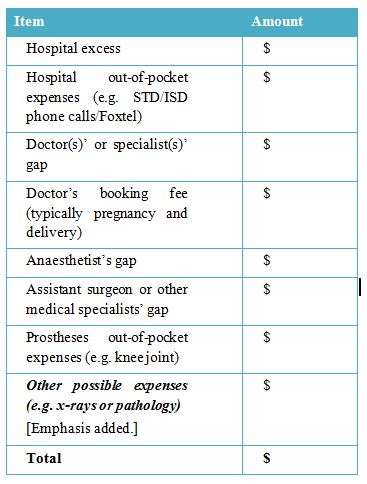
158 The version of the “Going to Hospital” brochure released in September 2014 was in largely identical terms, although it added information about informed financial consent. The brochure said, among other things, “[a]s a private patient, you’re entitled to know who will be treating you, how much each specialist will charge, and if you need to pay any fees out of your own pocket. This right to know is called Informed Financial Consent”.
8. Informed Financial Consent brochure
159 Medibank also released an “Informed Financial Consent” brochure in September 2014. It defined informed financial consent as: “… your right to know the full cost of your in-hospital treatment and how much your out-of-pocket expenses could be”. The brochure also noted that some common out-of-pocket expenses include “x-ray (radiology) or pathology (laboratory) expenses”.
160 That deals with the evidence relevant to the issues in controversy in respect of the diagnostic cover representation.
Consideration – diagnostic cover representation
161 The applicant’s case with respect to the alleged diagnostic cover representation hinges on three critical, interrelated, propositions:
(1) first, that Medibank promised that it would provide protection against medical costs, unless “restricted” or “excluded”;
(2) secondly, that “cover” means “indemnify”; and
(3) thirdly, that the post-sale literature provided to consumers was insufficient because the consumer had already been enticed into the “marketing web”.
162 In my view, each of those propositions is, with respect, misconceived. I will deal with propositions one and two together, because they are related. I will then turn to consider proposition three.
Propositions one and two: Medibank promised that it will provide protection against medical costs, unless “restricted” or “excluded” (proposition one) and “cover” means “indemnify” (proposition two)
163 The first proposition is that the “dominant message” from the communications in the websites and from the “likely call-centre conversations” is that:
(1) Medibank’s policies would provide protection against the costs of medical treatments that are MBS items, save and to the extent that a particular service appears on the accompanying lists of “restricted” or “excluded” services.
(2) Medibank was presenting the information that consumers needed in order to make their choices as between different insurers and policies, and that by acquiring a Medibank policy the consumer could have “peace of mind” against the risk of future medical expenses unless and until Medibank adjusted that peace of mind by alerting the consumer to a change to the scope or level of protection they held.
164 The applicant submits that the message conveyed by the relevant website communications was that: members would be entirely covered for medically necessary procedures for which a Medicare benefit is payable, unless the service was listed as excluded or restricted under the relevant policy; in-hospital diagnostic services were not restricted or excluded; and therefore, members would not incur out-of-pocket costs in respect of in-hospital diagnostic services.
165 The applicant submits that “the impression conveyed by Medibank’s communications was that diagnostic service providers were a different category of medical service provider relative to other doctors and specialists” and the “implication was that diagnostic charges were in a category of ‘MBS treatments’ for which members need not be concerned about out-of-pocket expenses notwithstanding that doctors could charge such expenses”. Put another way, it was contended that the relevant documents suggested that a distinction was to be drawn, for the purposes of construing Medibank’s descriptions of its insurance products in the marketing and product information, between medical practitioners who are doctors and medical practitioners who are pathologists and radiologists.
166 The second, interrelated, proposition is that the word “cover” is to be read in all of the relevant marketing and product information documents, and in the training and instruction materials, as meaning “indemnification or protection for all relevant costs” (specifically, in this case, medical costs incurred in relation to in-hospital diagnostic services) and is not to be read or construed, as Medibank contends, only to describe the risks or the liabilities to which the policy responds. For example, the applicant points to the statement with respect to “Included Services” that appears in the Salmat material, namely “We will cover you for everything in hospital that is medically necessary and where a Medicare benefit is payable except for the restricted/excluded services”. It says that because the word “cover” must be read to mean “indemnify”, “there is nothing to suggest that there is a major category of routine services – namely in-hospital diagnostic services – that is likely to be medically necessary, is covered by Medicare, is not identified as an excluded or restricted service, but nevertheless is not subject to the costs-protection that is the reason for a customer seeking [private health] insurance in the first place”.
167 Medibank’s case is that “all services recognised for Medicare benefit purposes” includes, along with thousands of other services recognised for Medicare benefit purposes, diagnostic services and that such diagnostic services are not “excluded” or “restricted” services. They are not restricted services because, as is made apparent from that which appears under the heading “things we pay limited benefits for” in the “Basic Hospital” Cover Summary (May 2012 version), the category of restricted services in respect of which limited benefits are payable refers only to psychiatric and rehabilitation treatment. Neither are they excluded services because the list of excluded services is exhaustive, namely heart-related services, such as angiograms or open-heart and bypass surgery, and major eye surgery, including cataract and lens-related services, hip and knee joint replacement surgery, obstetrics-related services, fertility treatment such as IVF and GIFT programs, plastic and reconstructive surgery, renal dialysis and cosmetic surgery/procedures (i.e. surgery that is not clinically necessary and for which Medicare benefits are not payable).
168 The simple fact is that diagnostic services are not restricted or excluded procedures, and nothing in the documentary evidence on which the applicant relies suggests otherwise. As Medibank contended, a reasonable consumer would therefore, correctly, understand radiology and pathology services to be included services. The contrary conclusion urged by the applicant relies on the notions that the word “cover”, wherever used, must be read to mean “entirely cover” or “indemnify” and that Medibank’s documents would lead consumers to believe (contrary to the fact) that diagnostic service providers are a different species of medical practitioner or specialist, which, in turn, would lead the consumer to believe that “diagnostic charges were in a category of MBS treatments for which members need not be concerned about out-of-pocket expenses”.
169 The word “cover” cannot be read to mean “entirely cover” or “indemnify”. In my view, no reasonable consumer would understand the word “cover”, used in the context of statements describing medical procedures to which the policy responds, to mean “indemnify”. As Medibank submits, “[a] reasonable consumer would understand the words as they are clearly intended: to identify the types of medical procedures covered by one policy as opposed to another. There is a clear and obvious distinction between the risks covered by insurance and the benefits payable for those risks”.
170 I also do not accept that a reasonable consumer would, or could, be led to believe or infer, from any of the documents or likely communications, that radiologists and pathologists are not medical practitioners or doctors. The applicant’s written closing submissions included an “Annexure C1”, headed “Examples of marketing material drawing distinction between doctors and diagnostic providers”. The high point of the various examples seems to be that with respect to both Medibank and ahm documents a distinction was drawn between “doctors’ services, e.g. GPs and specialists”, on the one hand, and “diagnostic services, e.g. blood tests, x-rays and ultrasounds provided by pathologists and radiologists”, on the other. Other than to point to such language and assert that the “impression” would be conveyed that radiologists and pathologists are not medical practitioners or doctors, the applicant was unable to identify a reason why anyone would read the documents and infer, or be led to believe, that radiologists and pathologists belong to, or constitute, a separate class of medical practitioner or doctor that does not in fact exist. The fact of the matter is that pathology and radiology are areas of medical specialisation. Pathologists are medical doctors with at least 13 years of training. Likewise, a radiologist is a specialist medical doctor who has had specific postgraduate training (in performing and interpreting diagnostic imaging tests and interventional procedures or treatments that involve the use of x-ray, ultrasound and MRI equipment). Although the ordinary or reasonable consumer may not necessarily know that, in my view nothing in any of the evidence can reasonably be construed to suggest otherwise.
171 If the applicant’s contentions were correct, it would follow, as Medibank contended, that on the applicant’s view of things, the documents relied upon by the applicant must also convey a representation to the consumer that Medibank indemnifies members for all costs of all included procedures – which number well over 5000 – not just radiology and pathology. And no one could possibly believe or infer that, because, apart from anything else, it flies in the face of repeated warnings about out-of-pocket expenses in the Cover Summaries, the Member Guide and other product documents.
Proposition three: the marketing web
172 In Australian Competition and Consumer Commission v TPG Internet Pty Ltd (2013) 250 CLR 640, the plurality said (at [50]) that:
It has long been recognised that a contravention of s 52 of the TPA may occur, not only when a contract has been concluded under the influence of a misleading advertisement, but also at the point where members of the target audience have been enticed into “the marketing web” by an erroneous belief engendered by an advertiser, even if the consumer may come to appreciate the true position before a transaction is concluded.
(Citing Trade Practices Commission v Optus Communications Pty Ltd (1996) 64 FCR 326 at 338-339; SAP Australia Pty Ltd v Sapient Australia Pty Ltd [1999] FCA 1821; (1999) 169 ALR 1 at [51]; Australian Competition and Consumer Commission v Commonwealth Bank of Australia (2003) 133 FCR 149 at [47]; and Bridge Stockbrokers Ltd v Bridges (1984) 4 FCR 460 at 475.)
173 In this case, the applicant characterises the Welcome Packs, Cover Summaries and similar material as “post-sale” literature and contends that they are “secondary to the conduct that induced members to treat with Medibank in the first place”. The applicant contends that “[i]t would require particularly prominent and clear disclaimers or qualifications in order to displace the misleading impression created by the ‘point-of-sale’ conduct, if indeed it were legally capable of that effect at all …” and that “the Welcome Packs and other post-sale material did not contain any adequate disclaimer or qualification, much less a disclaimer with sufficient prominence to displace the effect of the earlier representations”. It is said, in essence, that the post-sale literature is too little, too late, because, by then, “the consumer has been enticed into the marketing web”.
174 In my view, the applicant’s submission in this respect must be rejected, because the dichotomy for which the applicant contends is, with respect, artificial and finds no support in the evidence.
175 As Medibank submitted, the notions that the potential member is ensnared in a marketing web, such that he or she must be taken reasonably to have believed that Medibank represented that it would indemnify members for all costs associated with in-hospital diagnostic services, and that such a belief was unshakable or not displaced by subsequent disclaimers, has no evidentiary foundation. It incorrectly assumes “that members and prospective members would not read or receive any other information concerning Medibank’s products, other than the single statement on which the [applicant] relies”. Further, the applicant inaptly relies on the proposition that “all other marketing and product documentation published by Medibank is irrelevant because it is provided to members only after they become a member”. As Medibank pointed out, “[that] material is available for review by prospective members in Medibank’s retail stores and on Medibank’s and ahm’s websites. Further, the material is provided to new members shortly after they become members and during a 30 day cooling-off period, consistently with the Commonwealth regulatory scheme and the Private Health Insurance Industry Code of Conduct”.
176 Because each of the applicant’s three propositions is critical to the existence of the pleaded diagnostic cover representation, and because in my view each of them is wrong for the reasons already given, that is sufficient to necessitate a finding that the applicant has not established that the pleaded diagnostic cover representation was made.
177 In my view, and in any event, none of the documents in evidence upon which the applicant relies, whether they are what it seeks (wrongly) to characterise as “pre” or “post” sale documents, could be read or construed by a reasonable or ordinary consumer as a representation that Medibank would indemnify members for all costs associated with in-hospital diagnostic services.
178 At the risk of repetition, I will now turn to consider that evidence, and the additional or specific submissions made by the parties in respect of that evidence.
The Retail Stores – MBP Manual and SPOT resource
179 The applicant’s closing submissions about the MBP Manual were limited to what it called “three core observations”.
180 First, the applicant submitted that “it commences with a needs analysis which prompts the Medibank salesperson to ask consumers ‘Let’s talk about what you would like to be covered for … Would you like to be covered for any of the following …’. There is no reference in the MBP Manual to ‘cover towards’ or ‘we pay benefits towards’”.
181 Secondly, the applicant submitted that the MBP Manual “offered no clear prescription or guidance as to the basic structure of medical costs and [private health insurance] – no simple statement, for example, to be used to explain to staff and then to members that for items covered by Medicare, Medicare pays the first 75% of the MBS fee and private insurance pays the next 25%, but with the potential for the ‘Additional Gap’ component that consumers ought be aware of”.
182 Thirdly, the applicant took issue with the following “tip” provided to Medibank retail staff in that part of the MBP Manual where staff are given some “recommended words” in response to questions that they may be asked. One anticipated question is: “Am I 100% covered for all costs? (If Gap Cover question)”. The recommended answer is: “Your Doctor may choose to charge more for your service in hospital than the governments’ [sic] recommended fee. Medibank is able to offer you access to our Gap Cover programme, it allows us to pay additional benefits which may reduce or eliminate your costs”. The applicant makes the following submissions about those recommended words:
Importantly, though, the script that is offered refers to the potential for the customer’s “doctor” to charge more for a hospital service “than the government’s recommended fee”. There is:
(i) no explanation as to what is meant by the “recommended fee”, or its breakdown into the “75:25: additional gap” components; and
(ii) no suggestion that the staff explained to the customer that “doctor” in this context should be understood by the customer to include – as Medibank would have it – the nurse who takes a blood sample, or the technician operating a radiology machine.
183 The applicant’s submissions then continue:
In short, the MBP Manual appears to have been the principal information resource for Medibank retail staff in their interactions with customers. It does not provide any support for the proposition that staff explained to customers the “75:25: additional gap” components of medical costs, or that Medibank policies would not or might not provide costs-protection against the additional gap component of the fees charged by medical treatment providers who might not obviously be recognised as falling within Medibank’s usage of the term “doctor”.
184 The MBP Manual also cross-references to the SPOT tool, which is an interactive software application that enables a member of Medibank’s retail staff to identify key features of particular Medibank products and identify a suitable product based on a particular consumer’s needs. The applicant submitted that: “It should be inferred that the information included in the MBP Manual and SPOT form the key (if not the sole) basis for explanations by Medibank’s retail staff to consumers about the features of Medibank’s products …”. It further submitted that “the information resources for the retail staff did not include any explanation for staff, or instruction for them to explain to customers the ‘75:25: additional gap’ components of medical costs” or “the potential for out-of-pocket expenses as a result of any ‘additional gap’ component of charges levied by diagnostic providers, even by cautioning customers to be aware that they should regard the diagnostic service providers as one of their ‘doctors’ for this purpose”.
185 Medibank submits that each of the applicant’s submissions in respect of the MBP Manual and the SPOT resource is misconceived. It says that the applicant “has fastened on a few sentences” from those documents and “has assumed that the text of those documents … was delivered verbatim … and … constituted the totality of the relevant interaction with the consumer”. Medibank also submits that the applicant’s submissions wrongly assume “that consumers did not read any brochures or material on the website or their Welcome Pack”. Medibank makes the point that “[n]one of those assumptions has been proved; the evidence is that retail staff had a wide range of resources available to them, and were not required to treat documents relied on by [the applicant] as ‘scripts’”. Medibank submits that the MBP Manual is just a training manual. As for the applicant’s submission in respect of the GapCover “tip” in SPOT, Medibank says that the criticism sought to be made by the applicant of the suggested answer “displays the fundamental misconception that underlies the [applicant’s] case; ... [the applicant’s] assumption that diagnostic providers are not doctors is wrong. In fact, assuming the exchange set out in [SPOT] even formed part of an interaction with a consumer, the consumer would have been informed of the potential for [out-of-pocket expenses] and put on notice that GapCover did not guarantee a no gap experience”. Medibank further submits that the document contains no representation of indemnity in respect of in-hospital diagnostic services.
186 During his closing oral submissions, senior counsel for Medibank submitted that the applicant “has adduced no direct evidence, and virtually no probative evidence at all, concerning the interactions and the communications that occurred between consumers and Medibank retail store staff and call centre staff at the time of sale of a Medibank product”. He went on to submit that:
… it’s uncontroversial but the bulk of sales occur in a retail store or via the call centre. That has been proved. But the [applicant] has adduced no evidence of the communications that occur in-store or over the phone. What we do know, and what the evidence does show, is that consumers have available to them before sale a range of information including the cover summaries, member guides, various brochures. They were all available in-store and on websites. We also know that that same material was provided to members as soon as they joined, accompanied by a 30-day cooling-off period.
187 Senior counsel also submitted that:
(1) Mr Brownfield “gave unchallenged evidence that Medibank makes available to staff various tools and documents to assist staff in dealing with customers”.
(2) To the extent that the applicant contends that those documents were the only documents used by Medibank staff, “there is simply no evidence to support that submission, and it’s contrary to the evidence”.
(3) The applicant asks the Court to “infer or assume that the only thing that’s communicated from a Medibank retail store staff person to the consumer is word-for-word, some words that appear in the training manual …” and that submission is “frankly absurd … because a training manual is a training manual. And one’s common experience is you don’t walk into a retail store and the retail staff member has a training manual in front of them and is reading from the training manual as they speak to you”. He continued: “… They can’t go any further than that. Now, it is a simple question of evidence. The evidence they bring to the Court to prove that these representations were made to consumers at the point of sale is simply this training manual”. He submitted that what he described as “the high point” of the applicant’s case “fails immediately” and that the Court should not be satisfied “that this is what members were told and, with some precision of the sort of words, a representation of this kind was conveyed to members”.
188 In my view, for the reasons advanced by Medibank, the Court is unable to conclude on the balance of probabilities that the diagnostic cover representation was at any relevant time made to members, or potential members, of Medibank in a retail store. It is not possible to make such a finding on the speculative basis contended for by the applicant in the absence of any actual evidence about interactions between Medibank staff with its customers in retail stores. Further, it is inherently unlikely that the training materials could ever have been used as a rigid script for such interactions and, indeed, Mr Brownfield swore that they were not. It is also inherently unlikely that the interactions took place without due regard to the brochures and other documents available to consumers at the retail stores. In the event, whether or not it is inherently unlikely, the applicant has failed to discharge its burden of proof in relation to this element of its case.
Call centres – “Salmat materials”
189 The applicant contends that these materials were “at least the basis for the call centre interactions with customers. In fact it is the only evidence of the instructions given to call centre operators and it should be inferred that it reflects the tone and contents of the information provided by the operators”. The applicant further contends that “it should be inferred that Salmat sales staff used SPOT to describe and recommend products to consumers with the information generated by that tool”.
190 The documents are lengthy, but the applicant sought to emphasise, by way of example, the following suggested language that call centre operators could use in providing information to, or answering enquiries from, customers. Taking “Salmat material 2” as an example, the applicant drew attention to the following:
Basic Hospital – This is a GREAT cover if you aren’t so concerned about getting cover for pregnant or heart related service and based on what you’ve told me that could be you?
…
Included Services: We will cover you for everything in hospital that is medically necessary and where a Medicare benefit is payable except for the restricted/excluded services
…
Restricted Services:
…
For these services you will receive default benefits as a private patient in a public hospital. Please be aware that if you do use these services you may incur significant out of pocket expenses.
Excluded Services:
• Elective Cosmetic Surgery
• Heart-related services
• Obstetrics-related services (pregnancy)
• Fertility Treatment
• Plastic & reconstructive surgery
• Major eye surgery – including cataract & lens-related services
• Hip & knee joint replacement surgery
• Renal dialysis
…
191 From those extracts the applicant sought to draw the following propositions:
(1) First, that those instructions “plainly emphasised the comprehensiveness of the cover – the costs-protection – being offered under the Medibank policies”.
(2) Secondly, also by reference to two additional quotes from “Salmat material 1” and “Salmat material 3”, that “[t]here is absolutely nothing about this language that puts a customer on notice about any distinction between the different components of medical charges. There is nothing to suggest that the phrase ‘we will cover you for everything medically necessary’ means anything other than ‘we will protect you from the costs’ of the nominated services”.
(3) Thirdly, that “there is nothing to suggest that there is a major category of routine services – namely in-hospital diagnostic services – that is likely to be medically necessary, is covered by Medicare, is not identified as an excluded or restricted service, but nevertheless is not subject to the costs-protection that is the reason for a customer seeking [private health] insurance in the first place”.
192 Medibank submits that the applicant “fixes on” statements contained in the Salmat documents that the particular policy “covers you for everything medically necessary except …” and that there are references to restricted services without a general warning of out-of-pocket expenses, or for in-hospital diagnostic services, in particular. Medibank says that the applicant’s submissions about the Salmat documents are misconceived because they assume that the particular words relied upon are the only words spoken by sales staff and that prospective new members obtained no other information about Medibank’s policies. Medibank submits that there is no evidence to support that assumption. It goes further and says that the assumption is contradicted by the evidence, in particular the evidence concerning the information that a new member obtains in the Welcome Pack.
193 Medibank further submits that even the specific words relied upon by the applicant do not support its allegations. Specifically, it submits:
As is the case with the Cover Summaries, the first statement describes the types of medical procedures (i.e. the liabilities or risks) that are covered by the particular policy. This statement does not describe the benefits payable under the policy for those medical procedures. Indeed, the statement on which the [applicant] relies is followed by a further statement that “For the services included under each of our covers, we’ll pay benefits … towards …” [emphasis added by Medibank] … those services.
Again as is the case with Cover Summaries, the statement that a member will incur significant OOPs in respect of restricted services does not convey a representation that there will be no OOPs for included services. This is an untenable suggestion in light of the likely reference to GapCover during sales calls.
194 Medibank also submits that the Salmat documents contain a hyperlink to a webpage entitled “Things worth knowing”, and that it can be assumed that the sales representative would present information on that page to callers making enquiries.
195 I shall return below to consider in more detail the submissions that arise out of some of the language used in the Salmat documents, including the use of the word “towards”, the definition of “Restricted Services”, and the information that is provided to new customers in the Welcome Pack. As to the Salmat documents specifically, it is not possible for the Court to draw the inferences sought to be drawn by the applicant with respect to the use of those documents. In particular, the Court cannot be satisfied, on the balance of probabilities, that the documents in evidence constitute the only information with which new customers must necessarily be provided. As to the submission that the Salmat materials constitute the only evidence of the instructions given to call centre operators and that it should be inferred that it “reflects the tone … of the information provided by the operators”, I am not satisfied that the evidence allows me to draw that inference. In any event, the Court is unable to conclude, on the balance of probabilities, that the diagnostic cover representation was at any relevant time made to members, or potential members, of Medibank via call centre operators. It is not possible to make such a finding on the speculative basis contended for by the applicant in the absence of any actual evidence about interactions between Medibank staff and customers.
Medibank’s website
196 The applicant contends that “[t]he plain message conveyed by the Basic Hospital homepage – and its cognates for the other policies – is that the policy provides cover for or ‘includes’ all in-hospital services where a Medicare benefit is payable. It does not in any way suggest that the cover provided for those services provided is only partial cover”.
197 The applicant submits that the “message conveyed” by the policy homepages contained on Medibank’s website was that members would be entirely covered for medically necessary procedures for which a Medicare benefit is payable, unless the service was listed as excluded or restricted under the relevant policy; that in-hospital diagnostic services were not restricted or excluded; and that therefore members would not incur out-of-pocket costs in respect of in-hospital diagnostic services.
198 The applicant says that Medibank is wrong to place reliance on the phrase “pay benefits towards” in support of its submission that the word “towards” conveys to consumers that the costs-protection offered by Medibank is, or may be, only a partial protection. The applicant says that such a submission pays insufficient regard to the fact that many consumers are not familiar with the components of medical costs, the operation of Medicare and the private health insurance industry generally. It further says that the expression used by Medibank, “costs protection”, does not mean “partial costs protection” and that “the messaging is ‘you have peace of mind. You don’t need to worry about budgeting or planning or where you’re going to find the money for these costs if you have to go to hospital’”.
199 Taking the Basic Hospital page as an example, Medibank emphasises that it:
(1) explained hospital costs by stating that “hospital cover helps with the cost of treatments in hospital as a private patient …” (emphasis added);
(2) stated, under the heading “Benefits we pay”, that Medibank paid benefits towards various listed categories of services;
(3) stated, under the heading “Benefits we don’t pay”, that Medibank did not pay benefits for “Services not covered by Medicare”;
(4) included a list of services which were stated to be either “Included” or “Restricted” and an explanation as to what “Restricted services” meant;
(5) indicated that “All other in-hospital services where a Medibank benefit is payable” were “Included”; and
(6) set out a list of excluded services.
200 It is not suggested by either party that there was any material difference between the pre-September 2014 version of the webpages and that which existed after that date (that being the month in which the MPPAs were terminated).
201 Medibank emphasises that “nowhere on any of the webpages for any of Medibank’s products was there a statement that Medibank would indemnify members for the costs of in-hospital diagnostic services, or any other medical service”.
202 Medibank also relies on the “Things worth knowing” webpage and in particular the explanations provided there with respect to the cooling-off period and out-of-pocket expenses. As to out-of-pocket expenses, Medibank points to the fact that the webpage explains that such expenses are any expense for a hospital or extras service or item for which the member will not be reimbursed by either Medibank or Medicare.
203 Medibank also points out that the “Things worth knowing” webpage states that:
(1) although hospital cover helps reduce the cost of a private hospital visit, the member will still have out-of-pocket expenses for things like the excess and any difference between what the hospital charges and the benefit Medibank pays;
(2) the member can also expect to pay the difference between the charge for in-hospital medical services (including pathology and radiology services) and what the member receives from Medibank and Medicare;
(3) the benefit a member is entitled to receive for medical services is based on the MBS fee;
(4) for medical services covered by the policy, Medicare pays 75% of the MBS fee and Medibank pays 25%;
(5) if the member’s doctor charges more than the MBS fee, the member will have an out-of-pocket expense which can vary and be significant; and
(6) Medibank’s GapCover scheme can help reduce or eliminate the out-of-pocket expense if the doctor participates in GapCover, but GapCover does not apply to pathology or radiology services.
204 Medibank relies on a webpage entitled “Going to Hospital” and the fact that this page “referred to the potential for ‘unexpected bills’, advised members to call prior to admission and to discuss charges with their doctor”. Medibank says that the expression relied upon by the applicant, that Medibank offers “peace of mind” (which, the applicant says, conveys a representation that members would not incur out-of-pocket expenses) is contradicted by the express words on the page that refer to out-of-pocket expenses. Medibank further says that the expression “peace of mind” has nothing to do with out-of-pocket expenses and that the actual words used are “peace of mind that comes from knowing we’re with you every step of the way”. Medibank also relies on evidence given by Dr Wilson in cross-examination to the effect that “peace of mind comes from the fact that private health insurance enables the member to be treated at a private hospital without incurring expenses that can be many tens of thousands of dollars, notwithstanding that the member may still incur OOPs of some hundreds or possibly thousands of dollars”.
205 Medibank also relies on the fact that its website contained copies of the Member Guides, Fund Rules and the various Cover Summaries for Medibank’s policies.
206 Medibank accordingly submits that nothing on any of the pages of its website in evidence gives rise to the diagnostic cover representation alleged. I agree. For the reasons given by Medibank in its submissions, I cannot be satisfied, on the balance of probabilities, that any statements contained on the Medibank website at any material time conveyed the diagnostic cover representation.
Welcome Packs
207 As discussed above, one critical part of the applicant’s case, which I have rejected, is that the Welcome Packs and the various documents contained in those packs are secondary, “post-sale”, materials that do not displace a misleading impression created by the “point-of-sale” conduct (principally, so it was alleged, the sales via retail stores).
208 Medibank says that, in any event, one should start with a consideration of the documents contained in the Welcome Pack, not with the MBP Manual (or with what the applicant calls “the scripts”), not only because the Welcome Pack documents are also available in the store and online, but because any member who has received one has an opportunity within the 30-day cooling-off period to obtain a complete refund (provided that they have not made a claim during that period). Medibank submits that those various documents make it plain that Medibank members may in many situations incur out-of-pocket expenses for in-hospital treatment and that there is no need specifically to identify in-hospital diagnostic services as a particular subset of such expenses because there are thousands of different procedures or treatments which, depending on the fees charged by the in-hospital provider, may or may not result in the incurring by a member of an out-of-pocket expense.
209 In the end, it does not matter greatly what “starting point” is assumed. But in any event, in my view, nothing contained in the various documents comprising the Welcome Pack is capable of giving rise to the alleged diagnostic cover representation.
SISs
210 I should say something in addition about the SIS document. The applicant submits that the SISs provide “the barest summary of a policy’s features” and that they were “presented in an uninviting, ‘government-form’ manner”. The applicant complains that typically the document stated in respect of doctors’ and hospital bills that “[a]lmost 9 out of 10 medical services paid for by this health insurer in Victoria have no out-of-pocket expenses” and that “before you go to hospital, you should ask your doctor, hospital and health insurer about any out-of-pocket costs that may apply to you”. The applicant submits that “[n]one of these matters provide any basis on which to correct the representations made in the Primary Material”. It further submits that “the SIS contain no reference to in-hospital diagnostic services despite there being references to those services that are ‘… not covered at all? (exclusions)’ or ‘… only covered to a limited extent? (Restrictions) …’, nor MPPAs and their effect”.
211 The fundamental difficulty with the applicant’s submissions about the SISs is that their form and content is prescribed by statute: see Public Health Insurance Act, s 93-5; and the Product Rules (as at 1 July 2014), r 13, Schs 1-4. So it is, with respect, passing strange to criticise Medibank for doing nothing other than comply with its statutory obligations. Further, the Product Rules require medical procedures to be classified as either “covered”, “restricted” or “excluded”. And, further still, the prescribed forms tell the consumer important information that is inconsistent with the pleaded diagnostic cover representation, including that:
(1) whether or not there will be out-of-pocket expenses depends on the doctor chosen, the treatment in question and the hospital the person is attending;
(2) there may be arrangements which lower out-of-pocket expenses on doctors’ bills; and
(3) the member should ask their doctor, hospital and health insurer about out-of-pocket expenses before going to hospital.
212 There is a further reason for there being an air of unreality about the case that the applicant ultimately seeks to advance in respect of the diagnostic cover representation. That reason stems from what the applicant says are “the kinds of qualifying statements that [Medibank] should have displayed prominently on its policies’ homepages and on the Cover Summaries”.
213 A “convenient example” of such a statement is a lengthy passage which the applicant says can be found only “deep within [Medibank’s] website materials”. The passage is as follows:
Although hospital cover helps reduce the cost of your private hospital visit, you will still have out-of-pocket expenses for things like your excess and any difference between what the hospital charges and the benefit we pay for the hospital services.
You can also expect to pay the difference between the charge for in-hospital medical services (eg., doctors’ services, pathology and radiology) and what you receive from Medibank and Medicare. To explain it further, the benefits you’re entitled to for the medical services you receive while you’re in an overnight or day hospital facility are based on the Medicare Benefits Schedule (MBS) fee. The MBS is a list of all the services Medicare pays benefits for and the rules that apply to payment of those benefits.
Medicare pays 75% of the MBS fee and Medibank pays 25% (if the treatment is covered under your policy).
When a doctor charges more than the MBS fee, you’ll have out-of-pocket expenses. These can vary and may be significant. This is what’s referred to as a ‘gap’. Have a look at the diagram below – it shows you the amount Medicare takes care of and the amount we cover for in-hospital medical services. It also shows you the gap.
214 The applicant says that “[t]he absence of that kind of clear explanation, specifically mentioning diagnostic providers and presented to consumers in the opening marketing communications, is the most notable omission from Medibank’s marketing”.
215 It is, however, simply not the case that the “clear explanation” of why members can expect to pay out-of-pocket expenses for in-hospital pathology and radiology services is to be found “deep within [Medibank’s] website materials”. The specific example referred to by the applicant is contained in an exhibit to the second affidavit of Ms Coops (Annexure “CJC-1” to the affidavit of Ms Caroline Jane Coops sworn 23 March 2017, which contains extracts from the Salmat material. A similar document from the ahm website was also in evidence). As senior counsel for Medibank explained in his closing submissions, that “clear explanation” would have been readily accessible to a call centre operator. The second page of the document includes a hyperlinked heading “About out-of-pocket expenses”, which, via that hyperlink, then refers the call centre operator to the heading “About out-of-pocket expenses”, under which the heading “What kind of out-of-pocket expenses can I expect if I go to private hospital?” appears. And it is at that (readily accessible) point that what the applicant agrees is a “clear explanation” of out-of-pocket expenses in respect of pathology and radiology services is to be found.
216 Further, other than perhaps the specific mention of “pathology and radiology”, that which the applicant propounded as a “clear explanation” of the benefits offered by Medibank’s policies, uses exactly the same language as that which is used and repeated over and over again, in the Member Guide and the “Quick Tour of Your Cover” and “Going to Hospital” brochures. Once it is understood that “the opening marketing communications” are not separate and distinct communications and do not constitute a “marketing web” or the like, and once it is recognised (as, in my view, it must be) that it is neither necessary nor practical for Medibank to list the thousands of medical services that are included with a policy, there is nothing left of the applicant’s objections to Medibank’s documents.
Recipient members
217 The final limb of the applicant’s case with respect to the diagnostic cover representation concerns what it referred to as the “recipient members”. The applicant defines those members as “that subset of members who had been admitted to hospital and had enjoyed the benefit of Medibank ‘covering’ – fully indemnifying – them in respect of the costs of in-hospital diagnostic services”.
218 The applicant tendered into evidence a number of examples of “statements of benefits” that were sent to that subset of members. The statements of benefits provide the following information: the applicable MBS item number; a description of the item; the service provider’s charge; the Medibank benefit; and the Medicare benefit. The statements showed that, in those instances, which all occurred before 1 September 2014, those members were not left with any out-of-pocket pocket expenses. The applicant submits that:
[i]t might well be the case that some members received benefit statements and noted the calculations that went into their benefit payments – but the principal point made by the [applicant] is that what members would have noticed is that they handed over their Medibank card to the provider and paid no out-of-pockets for those items. The members were reassured – they retained their “peace of mind” – that their insurance provided “cover” for their in-hospital medical expenses, including at least their diagnostic treatments.
219 In my view, there is, with respect, nothing in this submission. First, it is not immediately clear how a member would be able to identify diagnostic services on the face of the statement. Secondly, and in any event, whatever a reasonable ordinary Medibank member would have made of the statements of benefits, nothing in them could be read or construed as relevantly contradicting the information provided to members in the Welcome Pack and other documents, including brochures, and the information available online, about the possibility of incurring out-of-pocket expenses.
220 Accordingly, the applicant has not established that the diagnostic cover representation was made in respect of the Medibank products.
ahm
221 The diagnostic cover representation is also pleaded in respect of ahm branded products. As outlined earlier, ahm is an online and telephone sales business. Its private health insurance products differ from those branded as Medibank products to some extent, so the relevant documents and the material available on the ahm website differs from the Medibank material.
222 Although the applicant referred to a number of specific ahm documents in an annexure to its written closing submissions, in the end it did not contend that any documents in evidence relating to ahm were relevantly or materially different to the evidence adduced in respect of Medibank or that any different question of construction or principle arises in respect of that evidence for the purposes of the diagnostic cover representation case.
223 Because the diagnostic cover representation case was conducted on that basis, it follows, for the reasons given above in respect of the evidence adduced concerning Medibank branded products, that the applicant has also not established that the diagnostic cover representation was made in respect of the ahm branded products.
The alleged notice representation
The pleading of the notice representation
224 It will be recalled that the applicant contends that Medibank had told its members and potential members that it would tell them in writing if it proposed to make any “detrimental changes” to the benefits it offered, and that when it abolished the MPPAs (or most of them) on 1 September 2014, and as a result no longer provided cover for out-of-pocket expenses in those cases where diagnostic providers charged more than the schedule fee for in-hospital diagnostic services, it effected “detrimental changes” to cover without providing the promised notice.
225 The pleaded case is as follows:
14. After purchasing a Policy, members also received a Member Guide … The Member Guide stated that, or to the effect that, Medibank would provide members with written notice of any detrimental changes to benefits, which was consistent with its obligations under Part E of the Industry Code. Medibank reinforced members’ expectations in that regard by sending notices to them from time to time, informing them about changes to benefits …
…
16. Further, by the statements and conduct described at paragraph 14, Medibank represented to members and potential members that Medibank would give to members prior notice of any detrimental change to their benefits …
The evidence relevant to the applicant’s notice representation case
226 The relevant part of the Medibank Member Guide (effective 16 January 2012) provides as follows:
Changes to the terms and conditions of your membership
Please note that all members of Medibank Private are subject to the Fund Rules, which set out the terms and conditions of their cover, as well as the services we pay benefits for. The Fund Rules can be changed from time to time with the approval of the Minister ... If any changes will have a detrimental effect on your entitlement to benefits we will provide you with reasonable notice in writing before they are due to come into effect.
227 It was not suggested that this version of the Member Guide is not an adequate exemplar. The ahm Member Guide (effective 11 June 2013) is similarly worded:
Fund Rules and policies
When you join ahm Health Insurance, you agree to be bound by our Fund Rules. These are available online at ahm.com.au or you can call us on 134 246 to request a copy. Our Fund Rules, policies and benefits are subject to change from time to time with the agreement of the Minister … If we make changes that affect your cover in a detrimental way we will let you know in writing prior to the change taking place.
(Emphasis added.)
228 The reference to “policies and benefits” in the 11 June 2013 ahm Member Guide was deleted from ahm Member Guides on and after April 2014.
229 The “Agreed Statement of Facts and Documents” filed in this proceeding, pursuant to s 191 of the Evidence Act 1995 (Cth), states: “The termination or expiry of the relevant MPPAs was not a change to the Fund Rules”.
230 The applicant also relies upon the Industry Code. In particular, the applicant relies upon certain provisions contained in Part E of the Industry Code, which is headed “Policy Documentation”. Under the rubric “Clear and Complete Policy Documentation”, signatories to the Industry Code agree, among other things, to “provide in a timely manner to consumers information on any changes to their policy …”.
231 Part E2.1 of the Industry Code, which is headed “Detrimental Changes to Hospital Policy Benefits”, provides as follows:
Where there is a detrimental change to hospital benefits we will:
(a) or [sic – for] significant detrimental changes provide the affected consumer with details of the change giving at least 60 days’ written notice;
(b) for all other detrimental changes provide the affected consumer with details of the change giving at least 30 days’ written notice; and
(c) not apply the changes to pre-booked admissions; and
(d) put in place transitional measures for patients in a course of treatment for a reasonable time period, for example, up to six months.
232 The term “significant detrimental change” to hospital policy benefits is defined to include “removal of material benefits or restriction to default benefits for any identified condition”; “addition of material excesses/co-payments”; or “increases in excesses/co-payments greater than 50%”.
233 The Industry Code also provides in Part E3 under the heading “Changes to Hospital Contracting Arrangements” as follows:
We recognise that while not constituting a change to hospital benefits for the purpose of Section 2 above, changes to hospital contracting arrangements between a fund and a hospital can affect a consumer. We understand that requirements for notification of consumers of such changes and transition arrangements are included in the relevant agreements …
(Emphasis added.)
234 The applicant also relies on the (agreed) fact that Medibank sent notices to its relevant members notifying them of changes to the Fund Rules that related to their particular policy. The so-called “detrimental change notices” were of two types: the first, in respect of changed annual premiums; the second, involving changes to benefits prescribed by the Schedules to the Fund Rules (e.g. the removal or inclusion of cover for a particular medical procedure).
Consideration – notice representation
235 The applicant submits that the Medibank Member Guide “equates” the Fund Rules with the entitlement to benefits, and that members are reassured that any detrimental change to benefits will be the subject of prior notice. Part of that submission involves the proposition that statements in the Industry Code, referred to above, also promise that members will be notified of benefit changes.
236 The applicant submits that “[t]here is no suggestion of a distinction between changes to benefits resulting from changes to the Fund Rules, compared to changes to benefits resulting from other causes. The clear impression is that, if Medibank is going to change benefits in a manner detrimental to the extent of the insurance benefit or advantage or protection enjoyed by members, that Medibank will tell them in advance”. I reject that submission. The decision to terminate the majority of the MPPAs did not effect any change to the Fund Rules.
237 The Fund Rules, both before and after the termination of the MPPAs, included the following, under the headings “Charge” and “Benefit”, respectively:
Exceeds the MBS fee and the Professional Attention is provided under a Contract with the Medical Practitioner | 25% of the MBS fee, plus an amount up to the difference between the MBS fee and the charge, in accordance with the Contract with the Medical Practitioner |
238 It follows that Medibank did not act contrary to its assurance to members that “[i]f any changes [to the Fund Rules] will have a detrimental effect on your entitlement to benefits we will provide you with reasonable notice in writing before they are due to come into effect”. The Fund Rules remain unaltered.
239 Further, I reject the submission that the Medibank Member Guide “equates” the Fund Rules with “the entitlement to benefits”. It does no such thing.
240 As to the submission that the “clear impression is that, if Medibank is going to change benefits in a manner detrimental … Medibank will tell [members] in advance”, the fact is that that is not what the Member Guide says, and I do not accept that a reasonable or ordinary consumer could glean such an “impression”.
241 For those reasons, the termination of the MPPAs did not alter the benefits applicable to any of Medibank’s policies. The benefits payable, both before and after such termination, were 25% of the MBS fee, plus any further benefits under the GapCover scheme, if applicable, plus any additional benefit payable to a member in circumstances where she or he received diagnostic treatment from a provider who was a party to an extant MPPA – which, after September 2014, meant Epworth and Sonic.
242 As for the ahm Member Guide effective between June 2013 and April 2014, the applicant says that its case with respect to the notice representation is “particularly strong” because it amounts to a representation that ahm would notify members of any detrimental change to “policies and benefits”. I also do not accept that submission. For these purposes, there is no relevant distinction between the expressions “fund rules”, “policies” and “benefits” – the benefits payable for each policy are defined by the Fund Rules. As Medibank submitted:
[a]ny changes to benefits payable under a policy must involve a change to the Fund Rules. The Fund Rules prescribe that benefits must only be paid in accordance with the Fund Rules. So too, any change to a “policy” must involve a change to the terms of the schedule to the Fund Rules that define the benefits payable in respect of the policy.
243 Further, the ministerial approval to any relevant change, which is referred to in both the Medibank and ahm Member Guides, is something that is only required for changes to the Fund Rules. The termination of the MPPAs required no such approval.
244 To the extent that the applicant relies on the Industry Code as fortifying its case with respect to the Member Guide, the Industry Code itself expressly recognises that “… changes to hospital contracting arrangements between a fund”, that is changes to MPPAs, among other things, “… [do] not [constitute] a change to hospital benefits for the purpose of Section 2 …”. In any event, as Medibank submitted, “[t]he general reference to the Code in the Member Guide cannot found a representation going beyond the content of the Member Guide itself”.
245 The applicant submits that the detrimental change notices referred to above support its case that Medibank represented to members that it would give prior notice of any change to benefits. That submission cannot be accepted. The fact that detrimental change notices were sent in circumstances where the legislation and Fund Rules required the issuance of such notices, cannot possibly be used in aid of the proposition that a notice is required to be sent in circumstances where they are otherwise not required to be sent.
246 Accordingly, the applicant has not established that the notice representation was made.
the unconscionable conduct case
247 Medibank submits that the applicant’s unconscionable conduct case is dependent upon the success of its case with respect to the diagnostic cover and notice representations. It submits that, in the event that those misleading or deceptive conduct claims fail, which they have, then the unconscionable conduct case must necessarily be dismissed.
248 On the first day of the hearing senior counsel for Medibank made the submission that, on the basis of the pleading, it was not open to the applicant to run a case that the claim founded on unconscionability had any life independent of the success of the misleading or deceptive conduct case. Whether Medibank’s submission is correct depends upon the terms of the applicant’s pleading, to which I now turn.
The applicant’s pleaded case on unconscionability
249 The applicant’s points of claim with respect to its unconscionability case relevantly provide as follows:
Medibank’s decision to implement the Benefit Change
17. By November 2013, Medibank was concerned at its increasing cost of providing cover for Diagnostic Gaps, and in around May 2014, following an internal review, Medibank decided to terminate or let expire its MPPAs with Diagnostic Providers (other than with two providers), and to cease paying the Diagnostic Gaps (Benefit Change).
Medibank’s expectation of the impact on members arising from the Benefit Change
18. By around May 2014, Medibank knew or expected the following:
(a) members did not have a good understanding of private health insurance, and commonly thought that all of their in-hospital medical expenses were covered;
(b) most members made no enquiries about out-of-pocket expenses prior to admission to hospital but, if they were informed about such expenses before treatment, many of them would switch providers to reduce or avoid the out-of-pocket expenses;
(c) the Benefit Change was likely to result in members incurring out of pocket expenses, averaging $151 for pathology and $83 for radiology, with a high risk that the expenses would be higher and that Diagnostic Providers might demand upfront payments from members; and
(d) the members most likely to be affected by the Benefit Change were Recipient Members, and especially those with chronic conditions.
Medibank’s decision to limit disclosure of the Benefit Change
19. Despite the Notice Representations, its knowledge of the matters in paragraph 18 and its obligations under the Industry Code, from around May 2014 Medibank adopted a strategy of keeping communications in relation to the Benefit Change “contained” and “reactive” (the Non-disclosure Strategy). In particular, with respect to disclosure of the Benefit Change, Medibank decided:
(a) to advise individual members of the Benefit Change only when they made enquiries prior to admission to hospital, or submitted complaints in respect of Out-of-pocket Expenses for in-hospital diagnostic services;
(b) not to send Change Notices to members; and
(c) to avoid communications to members not identified as going to hospital.
20. At the time of adopting the Non-disclosure Strategy, Medibank calculated that:
(a) there was a risk that its members (including members who had not claimed for In-hospital Diagnostic Services) were informed of the Benefit Change, they would cease to insure with Medibank; and
(b) there was a high risk that publicity about the Benefit Change would damage Medibank’s brand and reputation, and have a negative impact on the lead up to its planned initial public offering of securities.
21. At the time of adopting the Non-disclosure Strategy, Medibank estimated that the Benefit Change would lead to it making substantial financial gains, including:
(a) as a result of not paying Diagnostic Gaps; and
(b) as a result of not paying the future medical claims of members who ceased to insure with Medibank after becoming aware of the Benefit Change.
22. As a consequence of the Non-disclosure Strategy, members requiring hospital treatment were the most likely to become aware of the Benefit Change.
Characteristics of consumers purchasing private health insurance
23. At the time Medibank adopted the Non-disclosure Strategy, it knew or ought reasonably to have known that consumers of private health insurance are at a significant disadvantage relative to Medibank, because these consumers:
(a) had significantly lower bargaining power relative to Medibank;
(b) typically had a poor familiarity with private health insurance policy terms, and the complexities of private health insurance;
(c) relied on Medibank to inform them about their entitlements to benefits and about potential out-of-pocket expenses;
(d) relied on Medibank to inform them of any changes to their private health insurance arrangements that would have a detrimental impact on them;
(e) had a limited ability to obtain information about Out-of-pocket Expenses prior to admission to hospital, due to the fact that:
(i) prior to admission they may not know what In-hospital Diagnostic services may be required;
(ii) they may be too unwell, preoccupied or anxious to enquire about Out-of-pocket Expenses; and
(ii) even where enquiries were made, their treating medical practitioner may not have known or been able to inform them about any Diagnostic Gaps payable by the member.
24. At the time Medibank adopted the Non-disclosure Strategy, it knew or ought reasonably to have known that Recipient Members were a particularly vulnerable class of consumers, as in addition to the factors in paragraph 23, Recipient Members had been previously hospitalised and/or had chronic medical conditions requiring frequent admissions to hospital.
Implementation of the Benefit Change and Non-disclosure Strategy
25. Pursuant to its decision to implement the Benefit Change, from on or about 1 September 2014 Medibank terminated or let expire the MPPAs (with some limited exceptions) and ceased paying Diagnostic Gaps charged by those providers, save for occasional ad hoc payments in response to complaints from members.
26. Further, in accordance with the Non-disclosure Strategy:
(a) Medibank did not send Change Notices to members, and did not update the marketing or the Cover Summaries to inform members of the Benefit Change;
(b) in about early September 2014, Medibank provided its enquiry handling staff with instructions to explain the Benefit Change to existing members who contacted Medibank prior to entering hospital; and
(c) Medibank made minor amendments to its website and its “Going to Hospital” brochure, and released a new “Informed Financial Consent” brochure which encouraged members to obtain information about Out-of-pocket Expenses from treating doctors and diagnostic providers. These materials were not specific to, and did not identify or explain, the Benefit Change. Medibank did not distribute these materials directly to members, and members could only access the information if they actively searched for it.
27. By November 2014, Medibank was aware (including as a result of numerous complaints by members) that many members had not received information about Out-of-pocket Expenses resulting from the Benefit Change prior to receiving in-hospital diagnostic services. Medibank was also aware that some Diagnostic Providers had significantly increased the amount of their fees following the cessation of the MPPAs, resulting in a higher Diagnostic Gap, and that members had incurred those higher charges as Out-of-pocket Expenses.
250 The applicant next pleads in [31] of the concise statement that by implementing the benefit change and the non-disclosure strategy, Medibank engaged in conduct that was unconscionable, in contravention of s 21 of the ACL, “in the circumstances” where Medibank:
(1) made the diagnostic cover representation and the notice representation as described in the applicant’s concise statement at [15] and [16], respectively;
(2) was and is a signatory to the Industry Code;
(3) knew or expected the matters described in [18] of the concise statement;
(4) knew or expected consumers were disadvantaged or vulnerable as described in the concise statement at [23] and [24] respectively;
(5) had made the calculations as described in [20] and [21] of the concise statement; and
(6) by November 2014 knew the matters described in [27] of the concise statement.
251 In order to understand and address those “circumstances”, it is necessary to pick up the allegations to each of those cross-references. Thus cross-referenced and understood, those “circumstances” alleged are as follows:
(1) Medibank knew or expected around May 2014 that:
(a) members did not have a good understanding of private health insurance and “commonly thought that all of their in-hospital medical expenses were covered”;
(b) “most” members did not make enquiries about out-of-pocket expenses before admission and “if they were informed about such expenses before treatment, many of them would switch providers” to reduce or avoid the out-of-pocket expenses;
(c) the MPPA change was likely to result in members incurring out-of-pocket expenses averaging $151 for pathology and $83 for radiology, with a high risk that expenses would be higher and that diagnostic providers might demand upfront payments from members;
(d) the members most likely to be affected by the MPPA change were members who had previously claimed for in-hospital diagnostic services (so-called recipient members);
(2) Medibank knew or expected consumers were disadvantaged or vulnerable because they had lower bargaining power relative to Medibank, “typically” had poor familiarity with private health insurance and the complexities of private health insurance, relied on Medibank to inform them about their entitlements and potential out-of-pocket expenses, and relied on Medibank to inform them of “any changes” to their private health insurance that would have a detrimental impact on them and had a limited ability to obtain information about out-of-pocket expenses before admission to hospital;
(3) Medibank had “calculated”:
(a) that if members were informed of the MPPA change, they would cease to insure with Medibank;
(b) there was a “high risk” that negative publicity about the benefit change would adversely impact the planned Initial Public Offering;
(c) it would make “substantial financial gains” as a result of not paying diagnostic gap amounts and by not paying the claims of members who ceased to insure with Medibank after finding out about the change;
(4) Medibank knew by November 2014 that many members had not received information about out-of-pocket expenses for diagnostic services before receiving the services and that some providers had significantly increased their fees following the MPPA change, which higher charges had been incurred by members as out-of-pocket expenses.
252 It follows that on the applicant’s pleaded case on unconscionability, it must establish, on the balance of probabilities, each, or sufficient, of those circumstances.
253 I have already explained why, in my view, neither Medibank nor ahm made the diagnostic cover representation or the notice representation: see [161]-[246] above. I have also already explained why, in my view, the fact that Medibank is a signatory to the Industry Code is of no assistance: see [244] above. In my view, because Medibank did not make representations to members about MPPAs, and because Medibank did not engage in misleading or deceptive conduct, it cannot have been unconscionable (that is, contrary to good conscience in the sense of being morally reprehensible or repugnant) for it to have terminated the MPPAs without notifying members. As Medibank submitted:
There was simply no reason, as a matter of law or commercial morality, to advise all 3.8 million members about the termination of many MPPAs when:
(a) Medibank had never made representations to members about the MPPAs;
(b) prior to the decision, the MPPAs only applied to 62% of pathology services and 24% of radiology services received by Medibank’s members; and
(c) after the decision, Medibank retained MPPAs with providers (Sonic and Epworth) that accounted for 45% of the benefits that Medibank was paying for pathology services in excess of the MBS fee.
254 In my view, that is sufficient to dispose of the applicant’s case on unconscionability.
255 If I am wrong about that, it is necessary for me to consider each of the other “circumstances” said by the applicant to give rise to the unconscionability. Accordingly I will now turn to deal with the relevant evidence as to those circumstances, and the submissions made in respect of that evidence.
256 The evidence in the Court Book about the diagnostic funding review conducted by Medibank, which led to the termination of the MPPAs, runs to well in excess of 1500 pages.
257 It comprises, among many other things, market research reports and, in one case, secondary evidence of the contents of the market research report. One of those documents is a report from Ipsos-Eureka dated 14 December 2012, which itself runs to almost 150 pages. Another (internal) market research report, referred to as the “Atchison Report” was also in evidence. A 62-page document that the applicant referred to in submissions as “the Sibbick memo” also loomed large in the course of the hearing. It is entitled “Medical Gaps report”, and was prepared by “Joseph Sibbick – GTM Team”. Among other things, the Sibbick memo summarises market research information apparently provided to Medibank by an organisation rejoicing in the name “TH?NK”.
258 Aside from the market research information, the voluminous evidence about the diagnostic funding review includes minutes of various meetings of the Provider Networks and Integrated Care (PNIC) leadership team from November 2013 onwards – where, among other things, various perceived or actual risks of terminating the MPPAs, or some of them, were discussed – internal memoranda and emails, including about draft “communication strategies”, draft presentations and the like. I will set out below those parts of that evidence which the parties regarded as important. The applicant’s submissions also include a 50-page annexure, entitled “Annexure D – The Medical Funding Review” in which it sets out the critical parts of the documents upon which it relies.
The diagnostic funding review
259 The decision to terminate the MPPAs occurred in the context of the rising costs of Medibank’s health benefits. In the three financial years ending June 2013, hospital and medical benefits paid by Medibank had increased by 24%.
260 Dr Wilson, who is currently the Group Executive – Health Care & Strategy at Medibank, was, between mid-June 2010 and April 2013, the Executive General Manager responsible for the Medibank Health Solutions Business, which provided health services on behalf of business and government. Between April 2013 and September 2016, he was the Executive General Manager for PNIC. The remit of PNIC was systematically to review and oversee Medibank’s healthcare purchasing. The remit was what Dr Wilson described as a response “to the rising cost of providing healthcare services to … members”. Medibank’s “intention was to create a business unit with a high level of insight into the value provided by Medibank’s suppliers, in order to obtain a better understanding of the types of benefits that Medibank should be investing in providing its members”.
261 Dr Wilson deposed that, as part of PNIC’s remit better to understand the Medibank business, from 2013 it undertook a number of funding reviews, which included a review of funding for hospitals and a review of funding for other medical expenses. The first stage was the diagnostic funding review that resulted in the termination of the MPPAs.
262 Dr Wilson also gave evidence which, as he put it, was intended to “put the diagnostic review component of the [Medical Funding Review] into context”. He deposed that for the financial year ending June 2013, Medibank had paid out $4.6 billion in member claims. Of this amount, $2.19 billion was paid for hospital costs, $475 million on medical benefits and $424 million on prostheses. In the 2012 calendar year, of its spend on medical benefits, Dr Wilson deposed that Medibank paid $63 million in diagnostic benefits, with $43 million of that amount paid under an MPPA. Before the decision was taken to terminate the MPPAs, the gross potential savings estimated for the diagnostic component of the Medical Funding Review in April 2014 were $6 million in the financial year ending 30 June 2015, rising to $8.6 million in the financial year ending 30 June 2017 (on the assumption that the MPPAs with Sonic and Epworth were not terminated).
263 Dr Wilson also gave evidence about the regulatory restraints that apply to all private health insurers which operate in such a way that any cost savings that a private health insurer makes in one area effectively reduce the allowable premium increases due to health cost inflation (unless they are spent on other initiatives). Dr Wilson explained as follows:
The benefits Medibank provides to its members are funded through the premiums paid by members. Like all health insurers, any changes to Medibank’s premiums have to be approved by the Federal Minister for Health under the Private Health Insurance Act 2007. To obtain approval, Medibank has to provide detailed financial information, together with cost and benefits projections that justify the proposed changes (this is usually done as part of an annual “rate rise” process). I understand that these submissions are closely scrutinised by the Department of Health and the Australian Prudential Regulation Authority. To obtain approval for a premium increase, Medibank must demonstrate that the increase is needed for Medibank to be able to continue to pay benefits to our members under their policies while sustaining a strong financial risk profile (requiring an appropriate profit margin and sufficient financial reserves for capital adequacy purposes). While the rate rise approval process assumes that Medibank will make a profit margin (within an acceptable range) in order to remain financially viable, margin growth is constrained through the rate rise process. Accordingly, any cost savings that Medibank makes in one area (unless they are spent on other initiatives) would effectively reduce the allowable premium increases due to health cost inflation, rather than being permanently retained by Medibank.
264 Dr Wilson further deposed:
It is an essential part of Medibank’s business that it must make decisions to balance the affordability of insurance premiums paid by members and the level and type of benefits provided under its insurance products equal to or above the minimum legislated requirements. This means that Medibank must continually assess the appropriateness of the benefits that it provides to its members. This includes identifying which benefits and services add the most value for members so that Medibank can direct resources to providing benefits which generate, or which are perceived by members to generate, the most value both economically and in terms of health outcomes. For example, at about the time of the diagnostic funding review, Medibank invested $20 million in increased support and funding to support better health outcomes for members with chronic conditions (such as funding for increased home visits and clinical coordination for care provided by GPs to those members). Unless we had identified savings in other parts of the business (such as in-hospital diagnostics) we would not have been able to make this investment.
265 Dr Wilson also gave evidence during the course of cross-examination, in response to a question from me, to the effect that the object of the decision to terminate the MPPAs was to constrain growth in costs in order to constrain premium increases. That evidence was as follows:
HIS HONOUR: Dr Wilson, you said that you wanted to send a signal to the market that Medibank was taking the rising costs seriously. What did you mean by that?
DR WILSON: Well, a signal to the market – probably I withdraw that. Probably isn’t the right terminology. I mean we were very concerned – and we still are – that one of the real issues with the sustainability of private health insurance is continued rising costs from providers that we then have to pass on to members in terms of premiums, so we were looking at areas where we could constrain the growth of that cost. So ultimately, as we’ve been able to do this year, we can actually keep premium rises as low as they possibly are. So it’s a matter of trying to find where are areas that, you know, costs can be constrained, which then allows – because there’s always continued pressure to invest and provide benefits in all sorts of new areas, so there’s a constant – health care is a constantly evolving industry. So this was one area where we felt was worth exploring to see if, you know, that this could be an area where costs could be constrained.
266 In November 2013, the PNIC project team recommended to the leadership team that Medibank terminate the MPPAs and no longer pay benefits for in-hospital diagnostic services above 25% of the MBS fee. This was called adopting a “fund gap option for diagnostic services”. The project team prepared a “pre-reading pack” for a PNIC meeting that was held in November 2013. That document identified that, in 2012, Medibank had paid about $480 million in benefits for inpatient medical services, $62 million of which represented benefits for in-hospital diagnostic services. Of that figure of $62 million, about $43 million was paid under MPPAs (comprising both 25% of the MBS fee and additional amounts), $8 million was paid under GapCover arrangements and about $10 million was paid outside any arrangement with the provider. The document also identified that of the $43 million paid under the MPPAs, approximately $38 million was paid for services provided to Medibank members in private hospitals and approximately $5 million was paid for services provided to Medibank members in public hospitals, who had elected to be treated as private patients while in a public hospital. The pre-reading pack also stated that the benefits paid to pathology providers who are parties to MPPAs represented approximately 62.6% of the in-hospital pathology services received by Medibank members, which meant, of course, that 37.4% of in-hospital pathology services received by Medibank members were with non-MPPA pathology providers. The equivalent figures for MPPA radiology providers were 24% and 76%.
267 The pre-reading pack materials gave a number of reasons for the project team’s recommendation to move to a “fund gap” option. Those reasons included the following. First, the total benefits that Medibank was paying above the MBS fee for in-hospital diagnostic services were growing disproportionately in comparison to the growth in Medicare benefits. Secondly, the price being paid by Medicare for in-hospital diagnostic services, reflected in the MBS fee, was decreasing while the effective price being paid by Medibank under the MPPAs was increasing. Thirdly, Medibank’s survey data and research indicated that members accepted reasonable out-of-pocket expenses for medical services, and that reasonable out-of-pocket expenses would not cause membership lapse, especially if members were advised of the out-of-pocket expenses beforehand (consistent with receiving informed financial consent).
268 The pre-reading pack materials also contained a risk assessment, which listed risks such as member lapse, brand/reputation damage and complaints, among other things, as being “low”.
269 Dr Wilson was not challenged about any of this evidence and I accept Medibank’s submission that “[t]here is no reason to doubt that the conclusion reached by the relevant Medibank employees [to recommend the termination of the MPPAs] was an honest and reasonable conclusion based on their experience and the data available to them”.
270 Following the November PNIC leadership team meeting, and the recommendation that Medibank should move to a “fund gap” approach for pathology and radiology services, Mr Anthony Goldman was brought into the Medical Funding Review for the project’s implementation phase. As Dr Wilson deposed, part of Mr Goldman’s role, along with other members of the team, was “to work out how the strategy would be implemented, identify what the risks of implementation were and consider how they could be addressed”. Mr Goldman became unwell during the course of the trial and was not called to give evidence. No reliance was placed upon his witness statement, which was filed and served by Medibank prior to the commencement of the trial. Medibank’s written closing submissions indicated that the applicant had been informed of Mr Goldman’s unavailability so that any relevant questions could be directed to Dr Wilson.
271 In late January 2014, Mr Goldman submitted a slide pack to the PNIC leadership team, which addressed implementation risks of the “fund gap” option. Among many other things, the document rated as “impractical” or “unlikely” the risks that providers would refuse to provide services to Medibank members, charge upfront fees or charge unreasonable out-of-pocket expenses. Dr Wilson expressed a similar view in his evidence.
272 As to “member impact”, Mr Goldman’s slide pack said this:
Of the members who have an overnight stay, approx. 69% will have a diagnostic service, but as only 62% of pathology services and 24% of radiology are currently contracted at over 100%, only 39% of separations are likely to experience an “affected” pathology services [sic], and 10% will experience a radiology service impacted by our change benefit.
273 The slide pack also recorded that the average uncontracted rates for overnight admissions were $151 for pathology and $83 for radiology, while the MPPA rates on the same basis were $58 for pathology and $53 for radiology. The document also noted that: “Member research and data analysis of claims has found that out of pockets for medical costs at reasonable levels does not significantly change members’ likelihood to lapse”. It also noted: “If members were surprised by medical gaps then that did cause dissatisfaction, but the gaps themselves (up to approx. $5000) did not impact on intention to lapse or downgrade cover”.
More PNIC meetings
274 In April 2014, an implementation proposal with respect to the diagnostic funding review was presented to the PNIC leadership team. The minutes of the 10 April 2014 meeting of the PNIC leadership team record the team’s approval of the recommendation to proceed with implementation in accordance with the presentation to the meeting. Part of that presentation included a document which, Medibank submits, represented the key rationale for the decision to adopt the “fund gap” model for in-hospital diagnostic services. The document is headed: “MPPAs are driving [Medibank’s] diagnostic benefits to increase disproportionately to Medicare and the rest of the [private health insurance] industry”. The document explained as follows:
The current system of contracting for diagnostic services is inflationary:
• Medicare pathology benefit (price and volume) increased by 7.4% in 2012. Medibank pathology benefits paid in excess of MBS increased by 18.5% in 2012.
• For radiology, the increases are 8.6% Medicare and 16.8% Medibank respectively.
• For outpatient services pathology services are mostly bulk billed (87%) but Medibank is charged above MBS rates in 62% of pathology cases.
• Pathology tenders for public hospital work are being won at rates of 42% to 60% of the MBS rate.
• MBS prices per service are decreasing reflecting scale and technology efficiencies in providing services, but [private health insurance] prices are increasing.
• Other [private health insurance] providers also pay at 100% of the MBS (i.e. NIB).
275 The document concluded: “Member research and data analysis suggests that members do not value the benefits Medibank pay in this area and are more concerned about certainty in out of pocket costs for medical services”.
276 There are two other parts of the implementation proposal to which it is necessary to refer. The first is a page entitled “Analysis suggests that reasonable gaps do not drive lapse, especially if members are advised beforehand”. Among other things, the following statements are made under that heading: (a) “Member research and data analysis of claims has found that out of pockets for medical costs at reasonable levels do not significantly change members’ likelihood to lapse”; and (b) “Even if low levels of lapse do materialise, the Ramsay analysis indicated that lapse of claiming members will result in a positive net financial outcome for Medibank”.
277 The second document is headed “Member impact”. It is a document upon which the applicant placed significant reliance, so I shall set it out in full:
OOPs for overnight treatment is estimated to average $151 (Path), and $83 (Rad), OOPs for same day are even lower
Even if the OOPs for overnight stays did drive a small amount of lapse, the lapse of claiming members is likely to be cash positive overall
• 114k members (170k separations) are assumed likely to be impacted by OOPs
• Average claims per member when diagnostics are involved are $7692 ($4963 per [separation])
• If 10% of those members lapsed then 11k members would be lost
• This would result in $16.5M in lost revenue ([average] premium $1500), and $85M in claims avoided
• The impact on sales and general lapse should also be considered
• If average [gross margin] is assumed to be $140 per member per annum, then 485,000 members would have to be lost before the benefit of net reduction in claims is wiped out – this is considered highly unlikely
The conclusion therefore is that membership loss is not a significant financial risk in the evaluation of this initiative.
278 Dr Wilson gave the following unchallenged evidence about that document:
It suggested that if the change resulted in OOPs and this drove a small amount of member lapse, then the lost premium revenue could be offset by fewer claims. The calculations performed on this page were rough estimates and not detailed calculations. I do not recall this analysis being particularly important or significant for the project. It certainly was not a reason for my support of the initiative. In my experience, member lapse is damaging to Medibank’s business in the longer term, and Medibank tries to minimise member lapses by offering benefits that members value most highly at an affordable premium.
279 A steering group was then established to implement the diagnostic funding decision. It is important to go in a little detail to some of the considerations of the steering group, because a significant part of the applicant’s case with respect to unconscionability – what it calls the “critical issue” – “concerns the reasons why Medibank made the discrete decision not to send a general notice to members, both via direct mail and by prominent messaging on its websites – the Non-disclosure decision”.
280 One of the many documents taken to the steering group for approval concerned a “member communications strategy”. The document is headed: “Member Communication Strategy to focus on supporting members with OOPs”. It reads relevantly as follows:
• Comms strategy to be centred around helping members understand OOPs, their rights to [informed financial consent] and how to minimise OOPs
• Investigation under way into high users of diagnostics to try and identify a group for direct communications ie chronic conditions
• Messaging will support the proposition of ‘call us before you go to hospital’
• Marketing materials and support for frontline will include:
• Scripts/training for frontline – OOPs generally and diagnostics for members going to hospital
• Changes to the ‘going to hospital guide’
• Stand-alone flyer on OOPs
• Website information
• [Private Health Insurance Ombudsman] engagement will occur during June/July.
281 It is necessary to interpolate that although that document refers to investigating the question whether members suffering from chronic conditions were high users of diagnostics, it was ultimately revealed that members suffering from chronic conditions were not, in fact, high users of diagnostic services and the impact upon that group was modest. The applicant and Medibank agreed that Medibank found that there was no identifiable group of members who would be unusually and adversely affected by the decision to terminate the MPPAs.
282 The steering committee met on another two occasions in July 2014.
283 Prior to the implementation of the decision to terminate the MPPAs on 1 September 2014, Medibank revised its “Going to Hospital brochure”, completed the new “Informed Financial Consent” brochure, drafted documents, such as “Q&A” resources, engaged with stakeholders including the Public Health Insurance Ombudsman and implemented an ex gratia scheme to pay benefits to members who contacted Medibank before going to hospital but who were not specifically informed about the possibility of incurring out-of-pocket expenses.
284 After implementation of the decision, Medibank received a number of complaints from members.
Consideration – unconscionability
285 The submissions in respect of the evidence, which I have outlined and with which it is necessary to deal are as follows.
Market research and Medibank’s knowledge of consumers
286 I turn first to the market research upon which the applicant placed much store. It is not necessary to recite that evidence in any detail, because ultimately the applicant’s case was that the relevant reports and internal correspondence about them proved a series of propositions concerning information known to Medibank from early 2014 onwards, which made Medibank’s decision not to notify members of the change unconscionable.
287 Those propositions, which rely principally upon the Sibbick memo referred to earlier and, to a lesser extent, evidence given by Dr Wilson in cross-examination, are as follows:
(1) large proportions of the member base do not have a good understanding of private health insurance in general;
(2) two thirds of members paid an excess in connection with hospital admissions;
(3) large proportions of members who paid an excess did not expect to pay any medical out-of-pocket expenses;
(4) over half of members who claimed on hospital policies (claimers) experienced medical out-of-pocket expenses;
(5) one third of claimers who experienced a medical out-of-pocket expense were surprised by it;
(6) around half of claimers who experienced a medical out-of-pocket expense did not qualify as having given informed financial consent to the out-of-pocket charge;
(7) over half of claimers considered that medical gaps were not easy to understand;
(8) seven in 10 members had no discussions about medical out-of-pocket expenses prior to their admission;
(9) for claimers over 64 years of age, around eight in 10 did not contact Medibank;
(10) around half of Medibank members (generally) were in the 64 year plus cohort and around 20% were on incomes less than $50,000;
(11) 15% of claimers who paid a medical out-of-pocket expense only, and 33% of claimers who paid a medical out-of-pocket expense and an excess, would consider switching health funds as a result;
(12) over half of non-claimers felt they had a vague or poor understanding of out-of-pocket expenses prior to being informed (during surveys);
(13) over half of non-claimers expected to pay no out-of-pocket expenses other than their excess;
(14) one third of members would switch doctors/specialists to reduce/avoid medical out-of-pocket expenses;
(15) one third of claimers who paid medical out-of-pocket expenses considered it was Medibank’s responsibility to inform them about the out-of-pocket expenses in advance;
(16) if educated about the opportunity to discuss out-of-pocket expenses prior to hospital admission, 80% would do so and 80% of that cohort would approach Medibank;
(17) the “surprise” of out-of-pocket expenses left a greater negative impression for members that the amount of out-of-pocket expenses;
(18) members’ first interaction with in-hospital diagnostic service providers is likely to be at the hospital; and
(19) members typically first became aware of medical out-of-pocket expenses when they got home from hospital and began to receive medical bills.
288 The applicant further submitted that:
The essential “bottom line” is that the information available to Medibank, being the only basis for any expectations that it or a person in its position might have had regarding the characteristics of the consumer market it was dealing with, was to the effect that:
(a) a significant proportion of consumers had a poor understanding of medical costs, health insurance and the risk of out-of-pocket expenses;
(b) a significant proportion of consumers did not expect to have to pay medical out-of-pockets where they had private health insurance, especially where their policy already provided for an excess (which most Medibank policies did);
(c) existing mechanisms for encouraging “informed financial consent” were highly unreliable;
(d) a significant proportion of consumers who were informed about medical out-of-pocket expenses in advance would try to change treatment providers to avoid the expense; and
(e) a significant proportion of consumers who received a surprise when they encountered medical out-of-pocket expenses would consider lapsing from their insurance with Medibank.
289 The applicant’s case about the market research and Medibank’s knowledge of consumers is that the information contained in the market research documents, or summaries of them, as the case may be, were adopted by Medibank, or known by it to be true, such that Medibank knew that what the applicant described as the “limited communications strategy” that it adopted “was likely to be ineffective …” and was thus unconscionable.
290 There are myriad difficulties with that submission.
291 First, there is no evidence about how the survey evidence was adduced in the first place, or the constituency of participants. It is difficult therefore accurately to assess the statements about what members did, or did not, understand or know.
292 Secondly, not only is there no evidence that the propositions extracted from the market research materials are sufficiently reliable, there is also no evidence that Medibank adopted the propositions, or had any regard to those matters in making its decision to terminate the MPPAs. On the contrary, a number of the propositions relied upon by the applicant were either expressly disavowed or significantly qualified by Dr Wilson in his evidence. For example, although the applicant asserts that Dr Wilson’s evidence justifies the proposition that “[l]arge proportions of the member base do not have a good understanding of [private health insurance] in general” (proposition (1) above), the very passage of transcript upon which the applicant relies makes clear that Dr Wilson’s evidence was that “a proportion” of members did not have a good understanding about the way in which the overall components of the cost of medical charges are made up. The applicant also asserts that Dr Wilson’s evidence justifies the proposition that “[l]arge proportions of members who paid an excess did not expect to pay any medical [out-of-pocket expenses]” (proposition (3) above). The transcript to which reference is made, however, establishes no more than that Dr Wilson agreed to the statement put to him that “a proportion” of the membership does not have a good understanding about their potential exposure to out-of-pocket expenses. The applicant further asserts that Dr Wilson’s testimony supports the proposition that “[a]round half of claimers who experienced a medical [out-of-pocket expense] did not qualify as having given informed financial consent to the out-of-pocket charge” (proposition (6) above). That was not Dr Wilson’s evidence. He was asked in cross-examination whether, to the best of his recollection, in 2012 and 2013, it was his understanding that a significant proportion of members had not given informed financial consent. His answer was:
No, I … wouldn’t say that. I would – I say I think informed financial consent is also not necessarily binary. A report like this, for example, is relying on valid, but none the less subjective, member recollection. One would need to also speak to providers, which I did on many occasions. And the information that we … were given from providers who were responsible for informed financial consent was a much higher proportion than is reported in this report.
293 One final example will suffice. The applicant asserts that the evidence justifies the proposition that seven in 10 members had no discussions about medical out-of-pocket expenses prior to their admission (proposition (8) above). Dr Wilson’s evidence, in response to the question whether he agreed that “ordinary patients” tend not to be very good at making enquiries regarding their potential out-of-pocket costs before being admitted to hospital was, “Well, I’m not sure I agree with that, no”.
294 Thirdly, as for the Sibbick memo, which formed the basis of virtually all of the critical propositions on which the applicant relied as going to the unconscionability of the limited communications strategy, Dr Wilson swore that he had never seen the Sibbick memo before, and that he did not know who Mr Sibbick was. His evidence in that regard was as follows:
COUNSEL: Now, this is a document titled Medical Gaps Report. It’s dated about a month later: 17 December 2013. And it’s attributed to Joseph Sibbick from the “GTM team”. What does “GTM” mean there?
DR WILSON: Actually, I've … never seen this document prior to having seen it within this courtroom in preparation for this trial. So I don’t know who Joseph Sibbick is, the GTM team is. And I’ve never seen this report.
295 In those circumstances, and in light of Dr Wilson’s evidence about why the decision to terminate the MPPAs was made, I cannot accept, and I do not accept, that Medibank knew or adopted the matters the subject of the propositions set out at [287] above or that they operated in any material fashion, or at all, on the decision.
Ramsay analysis
296 One other main plank of the applicant’s case on unconscionability was the so-called Ramsay analysis contained in a document headed “Ramsay Group Out-of-Contract: Membership and Financial Impact dated 30 July 2013”.
297 The applicant submitted that the Ramsay analysis was important because:
(1) it is referred to repeatedly in internal Medibank presentations, including to the Executive Committee, with no caveat as to its reliability;
(2) it supports the conclusion that in the event that Medibank went out-of-contract with the diagnostic providers and “low levels of lapse” materialised, the members that Medibank was likely to lose would be the ones that cost it money, as they were on the whole higher claiming members and that would result in a positive net financial outcome for Medibank; and
(3) Dr Wilson accepted that the analysis was being presented to the committee as indicating one of the risks associated with the initiative (to terminate the MPPAs), that it was talked about in a number of meetings around that time and that it was the only model in the business.
298 The difficulty with those submissions is that they cannot be reconciled with the unchallenged evidence of Dr Wilson, who swore that the Ramsay analysis was “highly flawed”. As he explained: “The Ramsay analysis refers to work that was done … when Medibank was engaged with a contractual dispute with Ramsay Health Care in relation to the fees they wanted to charge for members in hospital”. Dr Wilson further explained that “the analysis that was done was to look at people that … are claiming members, essentially; if those members lapse, does that lead to a net financial – on a purely financial basis, does – at that time, does that lead to a net financial benefit for Medibank[?]”.
299 Dr Wilson said that the answer to that question is:
… it may, although that has never actually been proven, never actually been tested. And that’s because obviously … even though there is a premium reduction … the problem with that analysis is ... that it’s highly flawed, in that it doesn’t take into account the lifetime value of premium from a financial basis. So when you do that, then that analysis gets turned on its head, and in fact the loss of members – even claiming members – is a net negative for Medibank.
300 I then asked whether this was because claiming members might be very sick one year but healthy for the next decade, to which Dr Wilson responded:
DR WILSON: That’s … correct. So, for example, another … example is of obstetric cover where somebody has a birth that’s highly costly, but if you take the lifetime value of the membership, it’s actually in their benefit.
HIS HONOUR: And is “claiming members” a term that we’ve seen in the documents? Does it mean any persons who raise one claim per year or is it someone who has a significant claim? If so, how are they measured? In excess of the premium or … ?
DR WILSON: Yes … there’s various potential definitions for that …
HIS HONOUR: So some sort of heavy user of the system?
DR WILSON: Well, no. A claiming member would be anybody making a claim in a broad definition. But there could be analysis looking at heavy users, although, again, the concept of a heavy user is very fraught because people – they might be a heavy user for a short period, and then they generally cease to become a heavy user. So there’s very, very, very few people that are continuous heavy users.
HIS HONOUR: People with chronic conditions?
DR WILSON: Even those people generally do not continue to be heavy users. They are only heavy users for a period.
Dr Wilson’s unchallenged evidence about not informing members of the termination of the MPPAs
301 The principal – and, in my view, insuperable – difficulty with the applicant’s case on unconscionability, is that it cannot survive in the face of Dr Wilson’s unchallenged testimony about Medibank’s approach to communications with its members about out-of-pocket expenses for diagnostic services following the decision to terminate the MPPAs, and its decision not to send a letter or communication of the type the applicant contends it ought to have sent. Dr Wilson’s evidence in that respect was as follows:
… [t]he approach was to reinforce communications to members about OOPs in general with specific mention of diagnostics. I considered that that approach was consistent with information Medibank generally provided to members about the potential for OOPs in connection with hospital visits, through its Member Guide and other brochures. I considered that that approach to member communications was appropriate for a number of reasons.
First, Medibank’s MPPAs with the providers of diagnostic service[s] … has never covered the whole market. Medibank has never had an MPPA with every single pathology and radiology provider. As a consequence, it was my understanding at the time that Medibank’s policies did not promise members that they would not receive OOPs for those services, and many members would have received OOPs for those services.
Second, I believed that the expected additional OOPs arising from the diagnostic funding change were not likely to be material in relative terms to the OOPs that members already typically paid for hospital visits, where surgeons’ fees, and anaesthetists’ fees and various hospital charges are typically in the several hundreds, if not, thousands, of dollars.
Third, after it was decided not to terminate the Sonic and Epworth MPPAs (especially since Sonic was and remains one of the largest pathology providers), there was no universal “across-the-board” change being implemented by Medibank (i.e. we did not end up ending all our MPPA arrangements, and members could still access them if treated by a Sonic or Epworth site).
302 Ultimately, that evidence, which I unhesitatingly accept, demonstrates that the decision not to communicate with members (about which the applicant complains) was a decision made in the context of the exercise by the relevant committee of its business judgment. Some may agree with it, some may disagree with it, but, in my view, there was nothing remotely unconscionable about it.
Conclusion
303 The applicant’s case will accordingly be dismissed, with costs.
I certify that the preceding three hundred and three (303) numbered paragraphs are a true copy of the Reasons for Judgment herein of the Honourable Justice O’Callaghan. |
Associate:


