

FEDERAL COURT OF AUSTRALIA
Insurance Australia Limited, in the application of Insurance Australia Limited (No 2) [2017] FCA 980
ORDERS
IN THE APPLICATION OF INSURANCE AUSTRALIA LIMITED (ABN 11 000 016 722) | ||
INSURANCE AUSTRALIA LIMITED (ABN 11 000 016 722) Applicant | ||
DATE OF ORDER: |
THE COURT ORDERS THAT:
1. Pursuant to section 17F(1) of the Insurance Act 1973 (Cth):
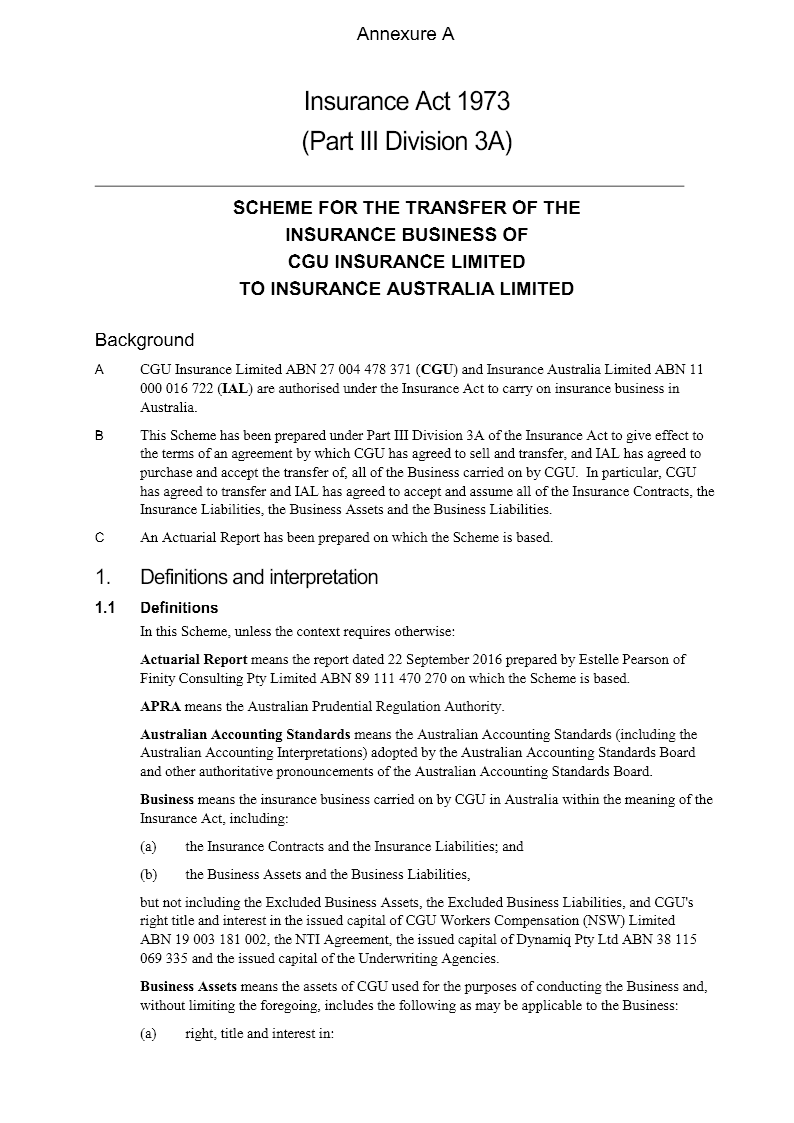
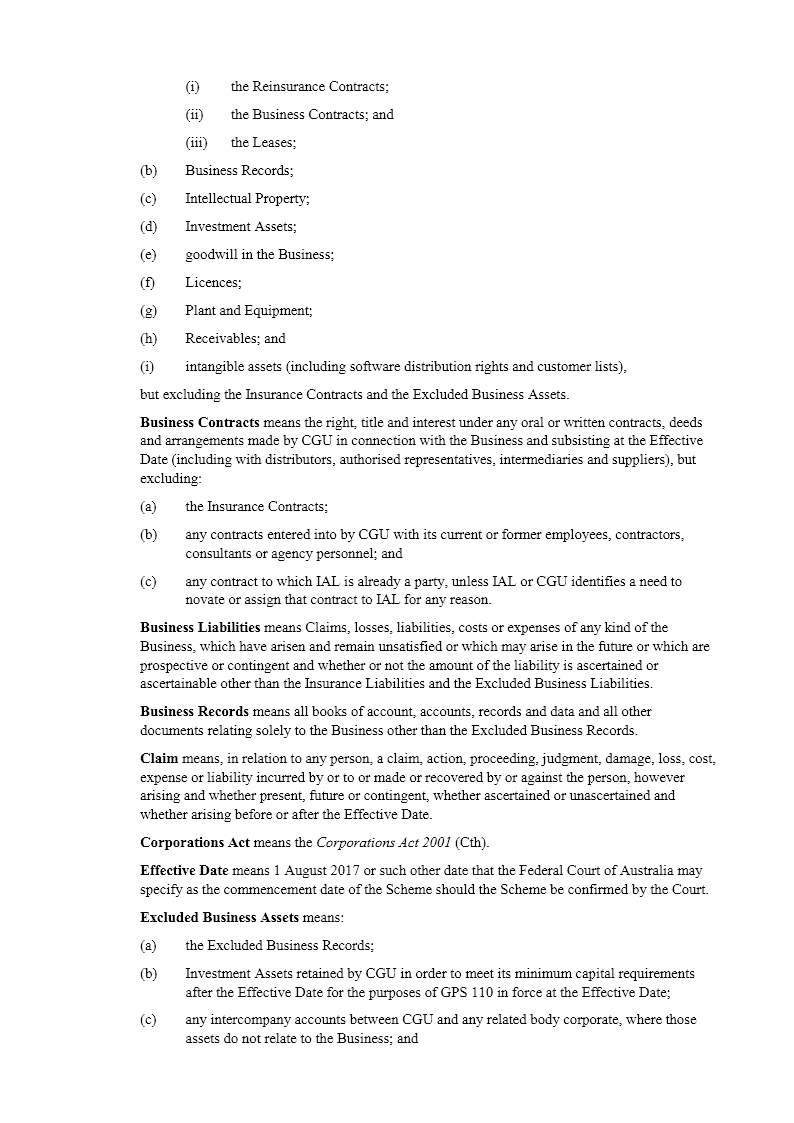
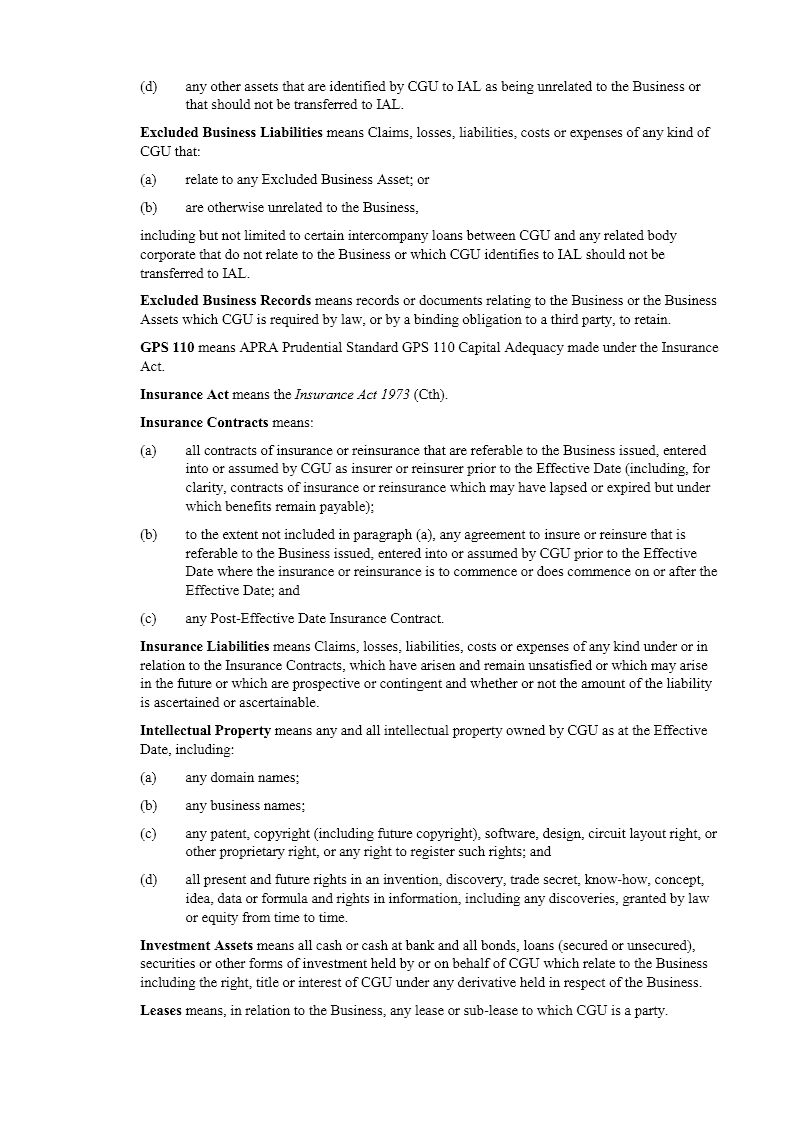
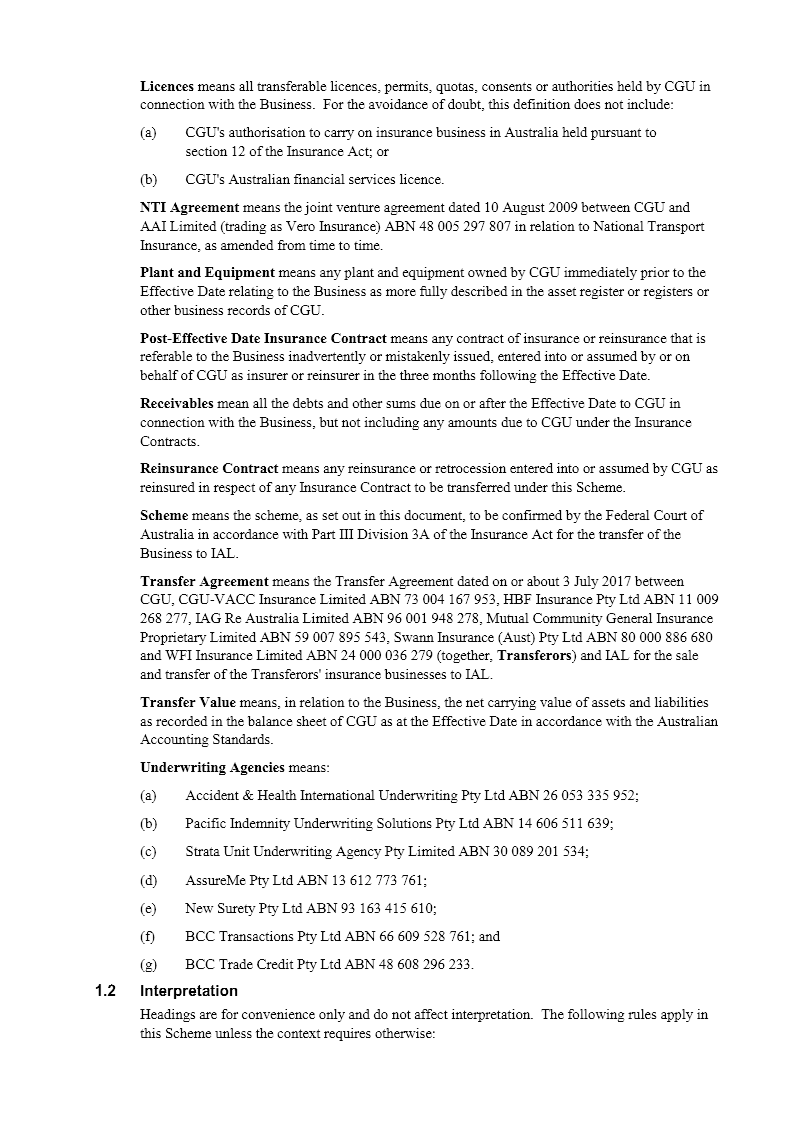
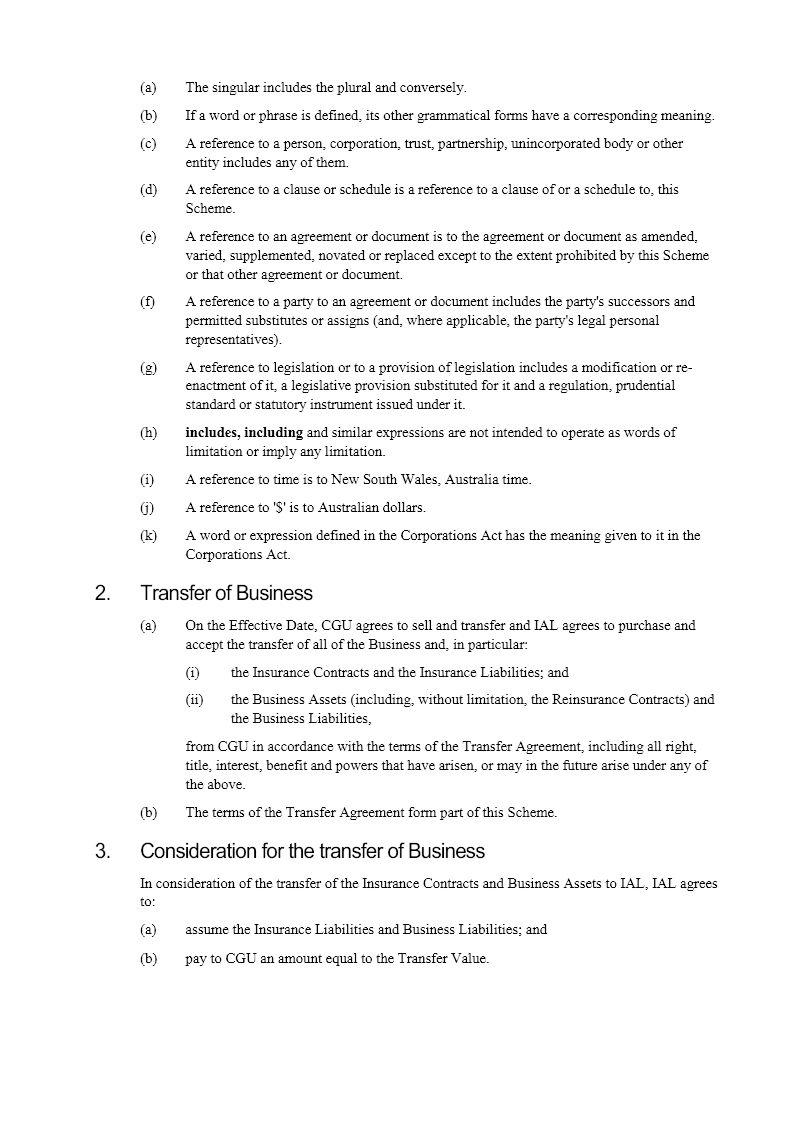
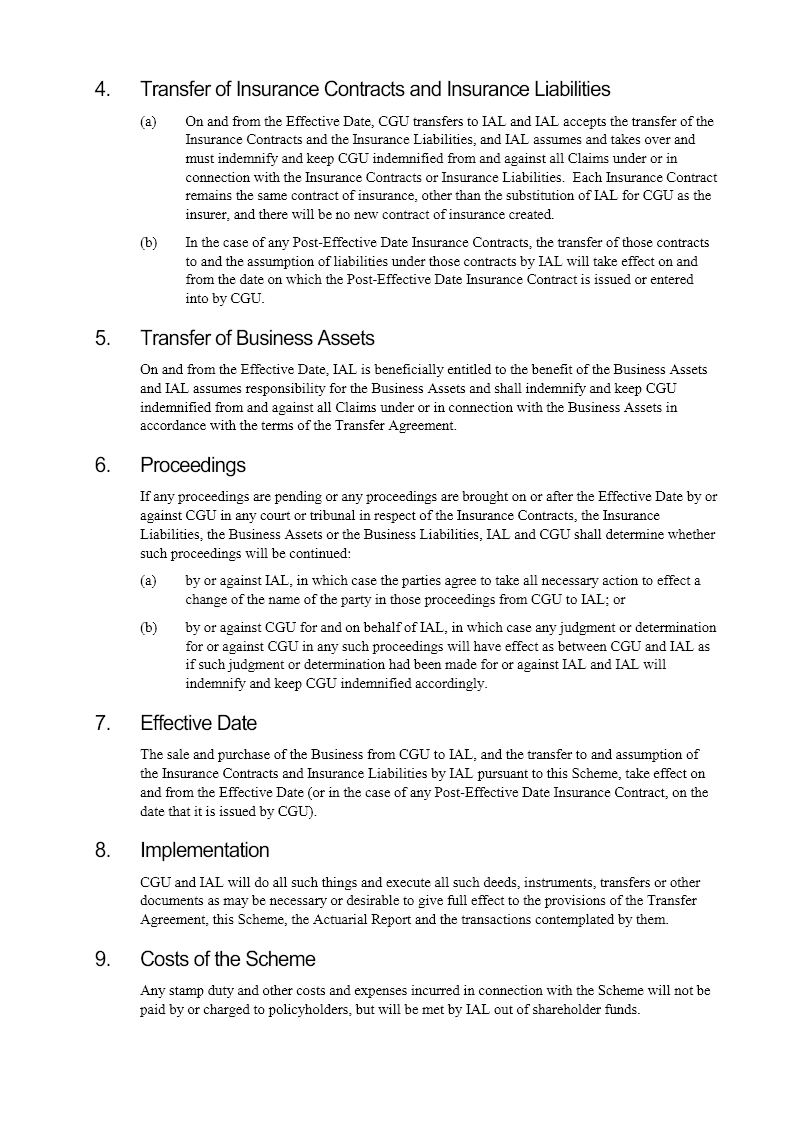
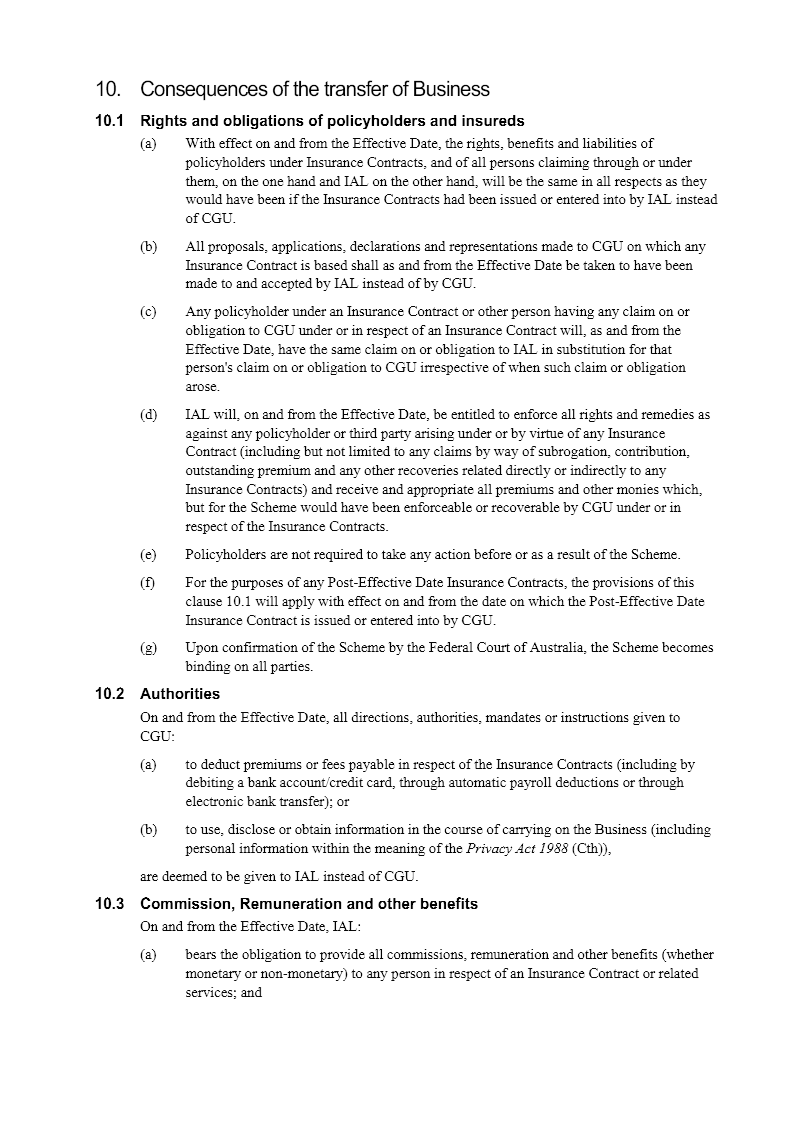
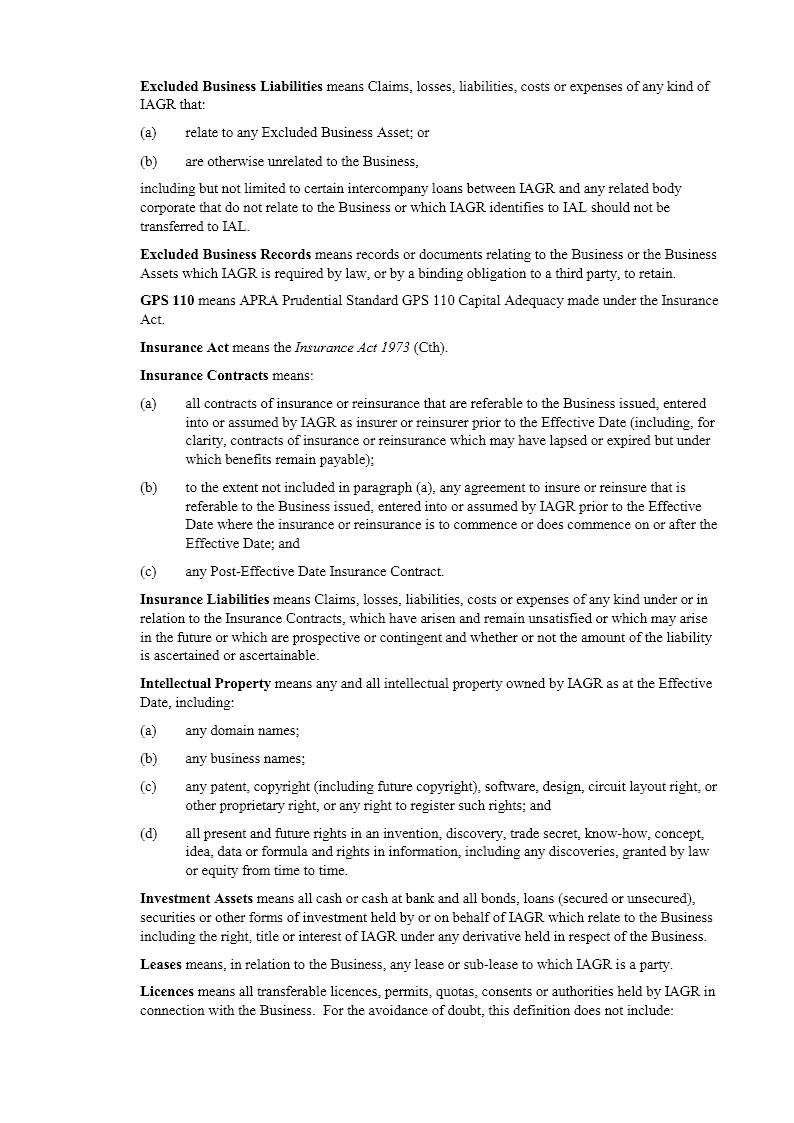
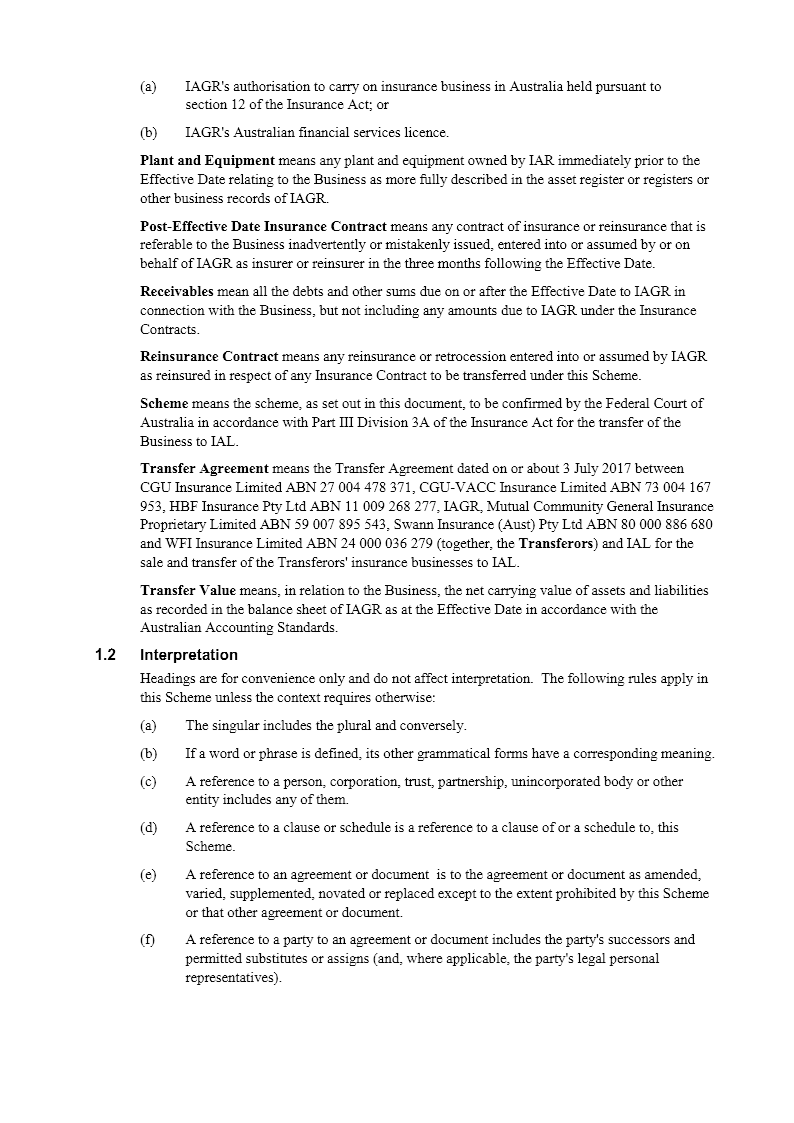
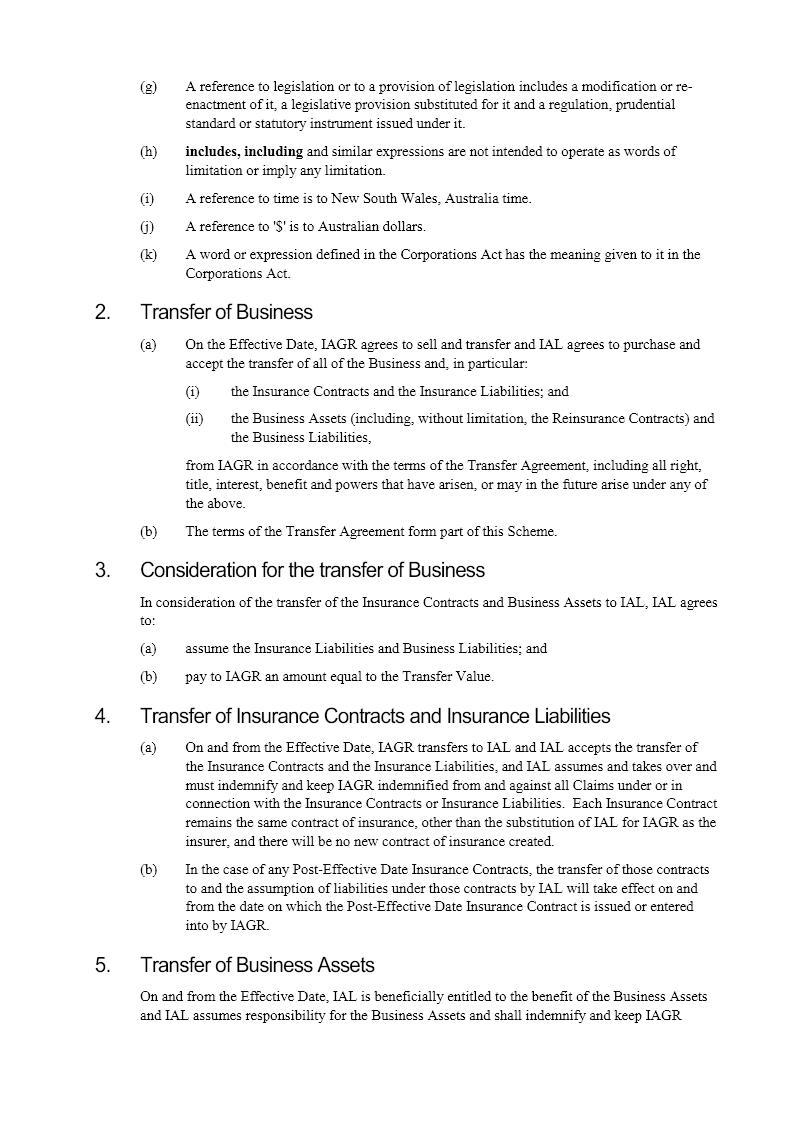
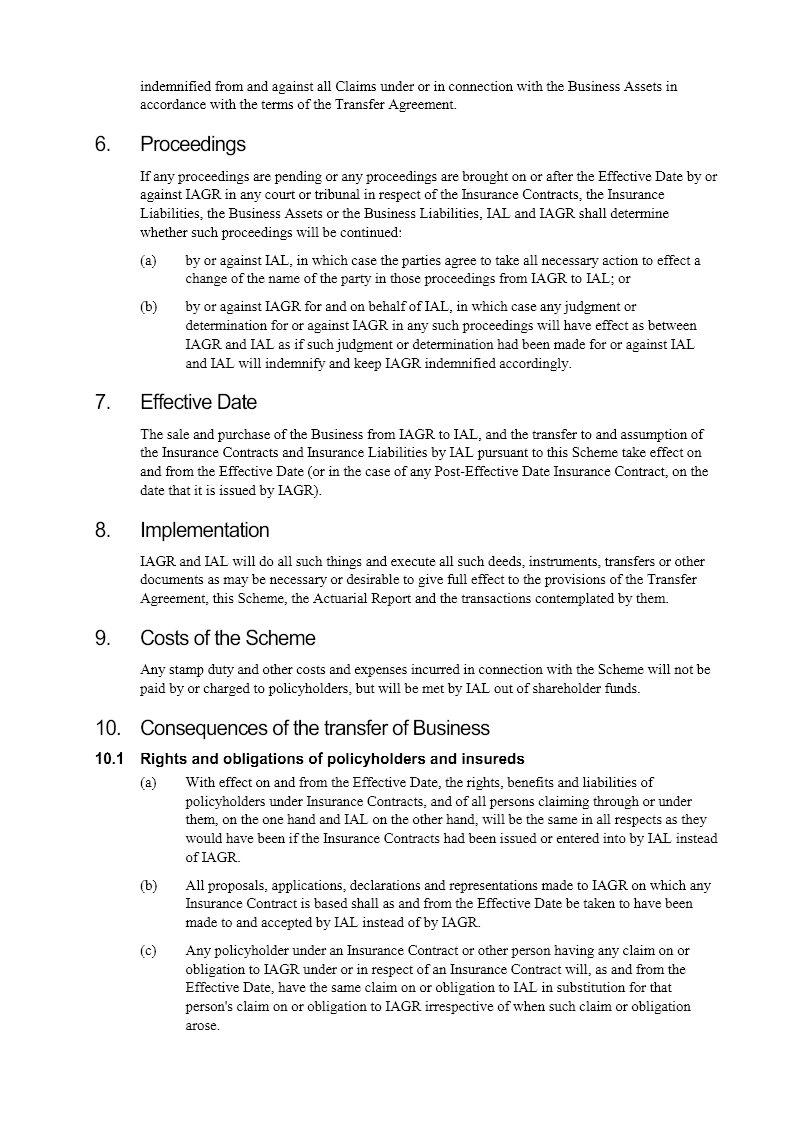
(a) the scheme for the transfer of the insurance business of CGU Insurance Limited ABN 27 004 478 371 (“CGU”) to Insurance Australia Limited ABN 11 000 016 722 (“applicant”) in the form of annexure A to these orders (“CGU scheme”);
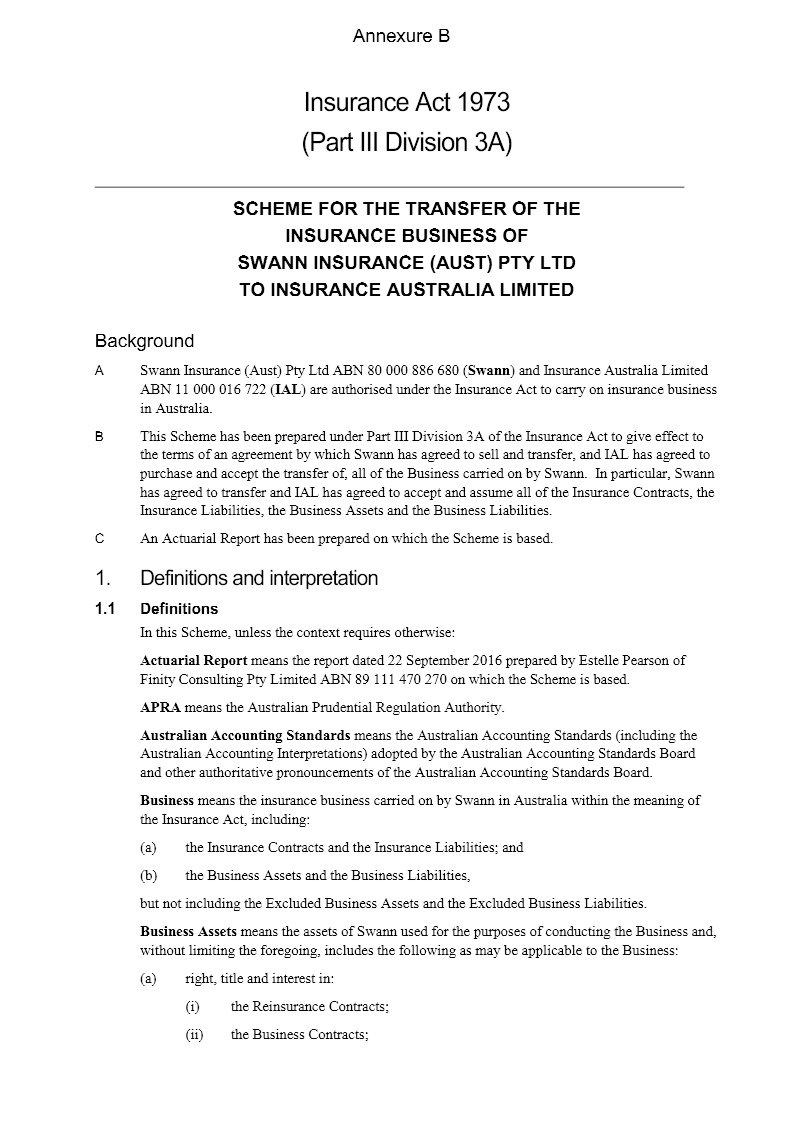
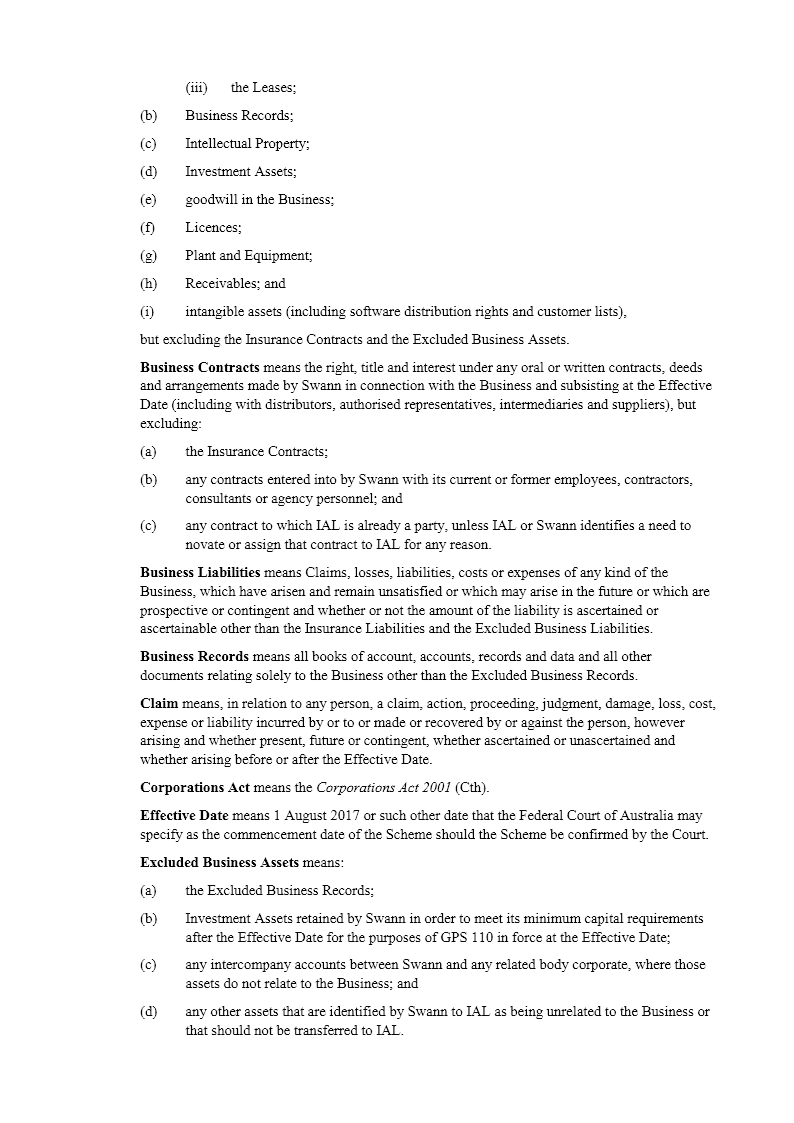
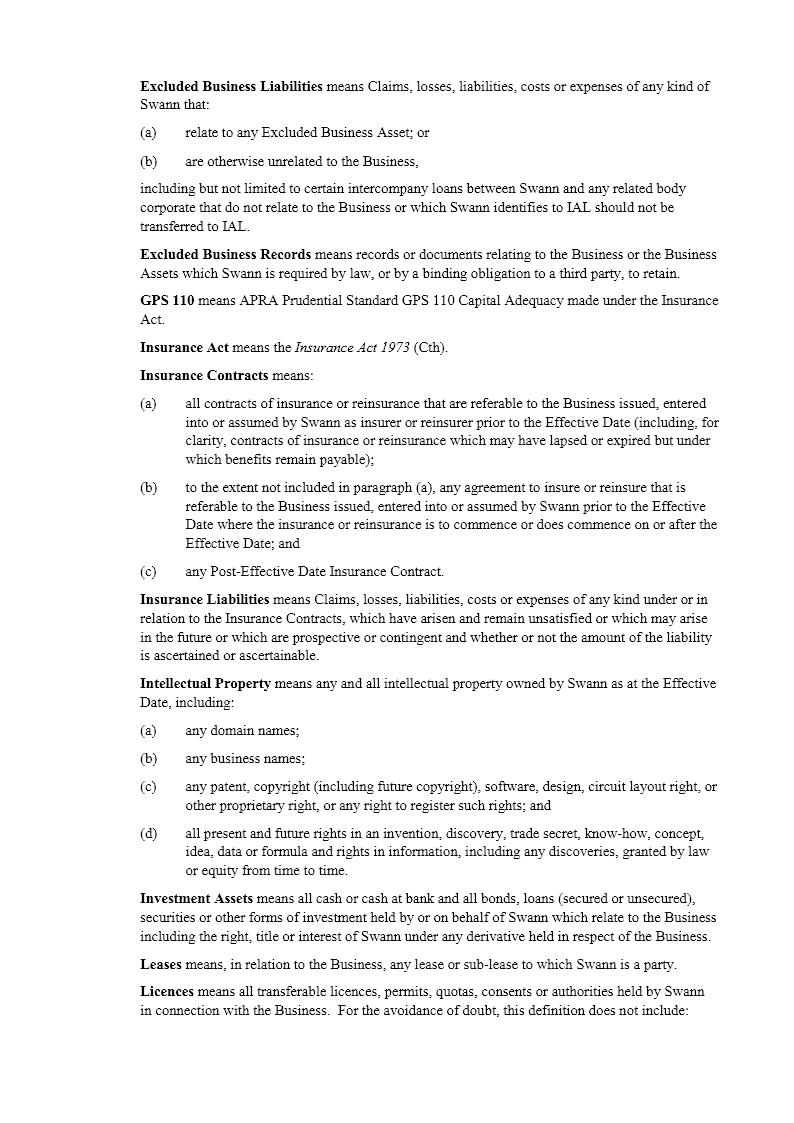
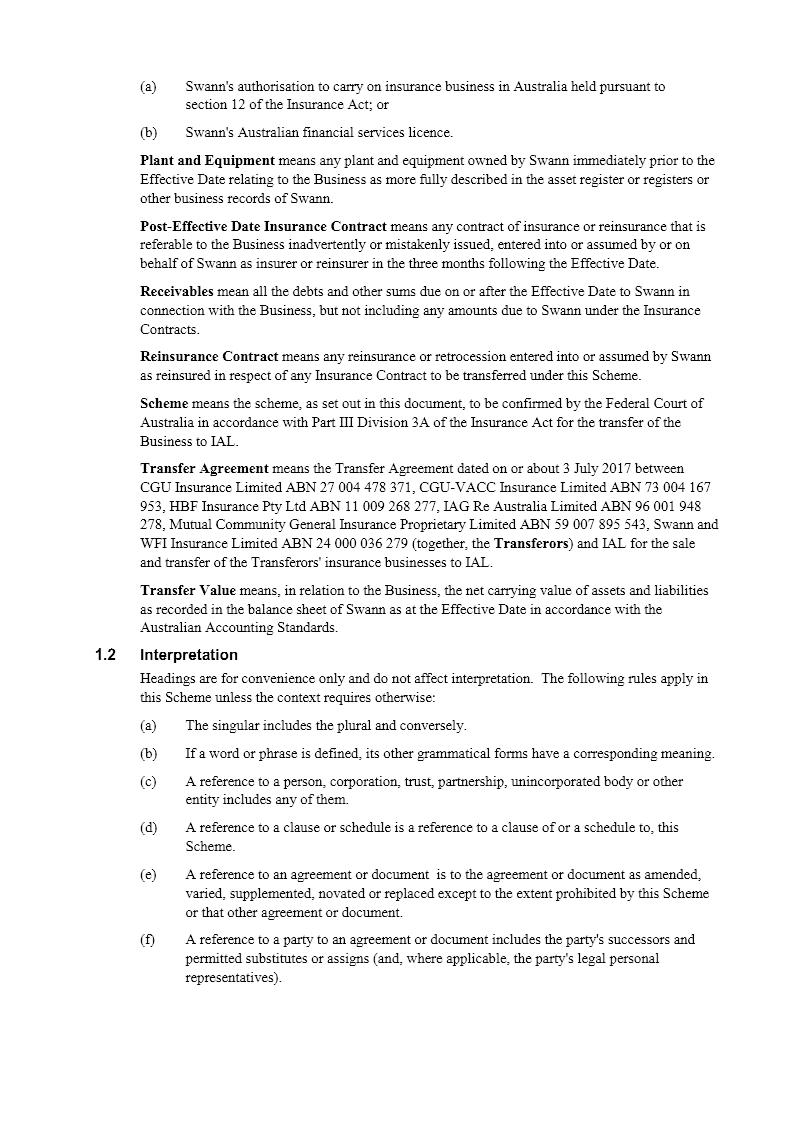
(b) the scheme for the transfer of the insurance business of Swann Insurance (Aust) Pty Ltd ABN 80 000 886 680 (“Swann”) to the applicant in the form of annexure B to these orders (“Swann scheme”);
(c) the scheme for the transfer of the insurance business of WFI Insurance Limited ABN 24 000 036 279 (“WFI”) to the applicant in the form of annexure C to these orders (“WFI scheme”);
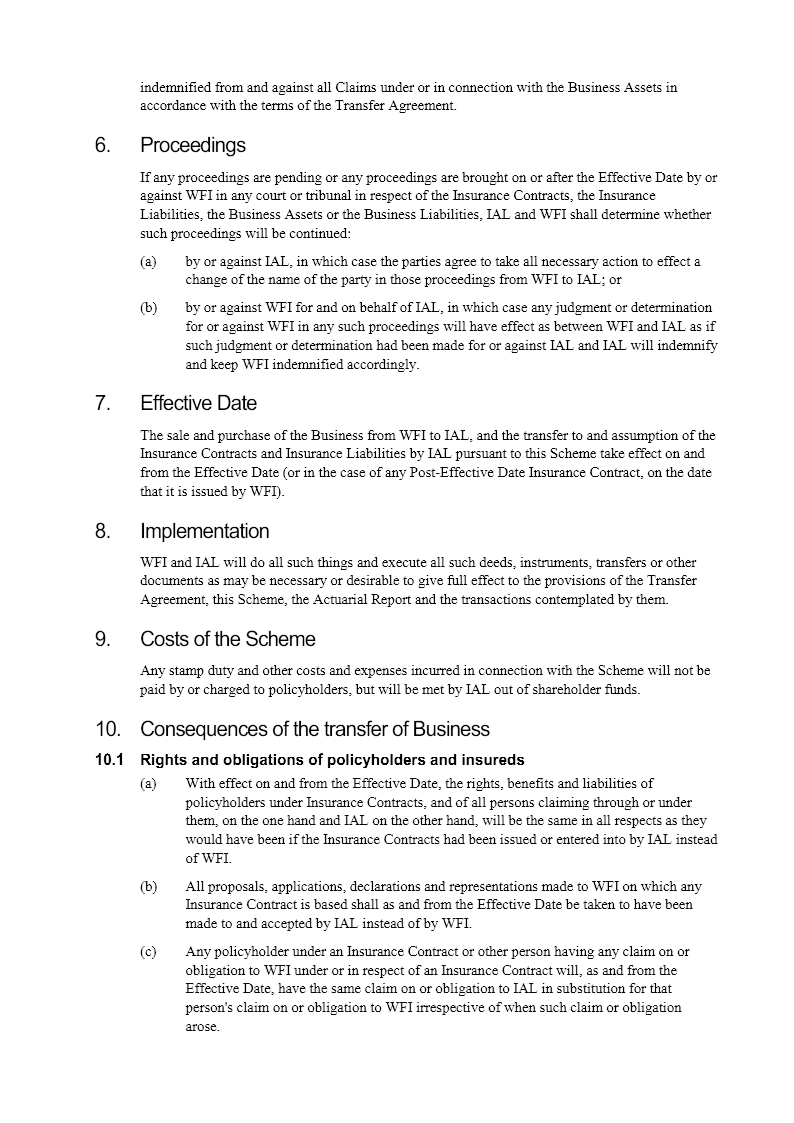
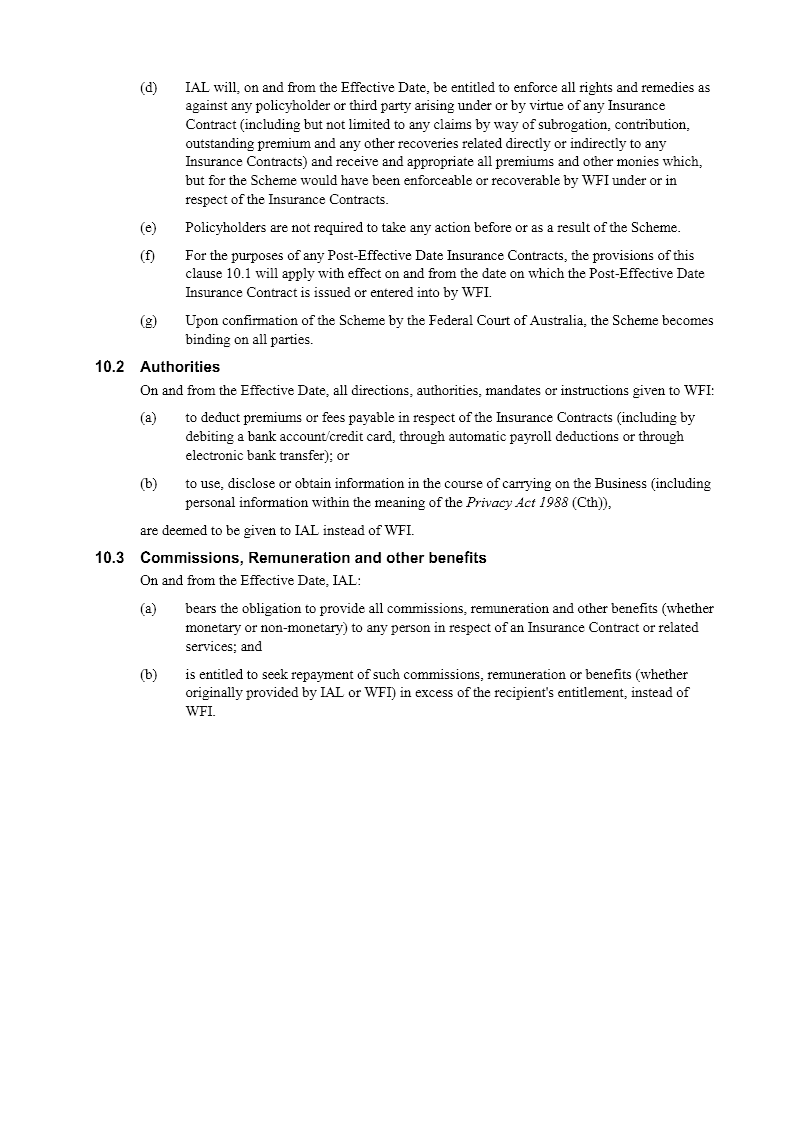
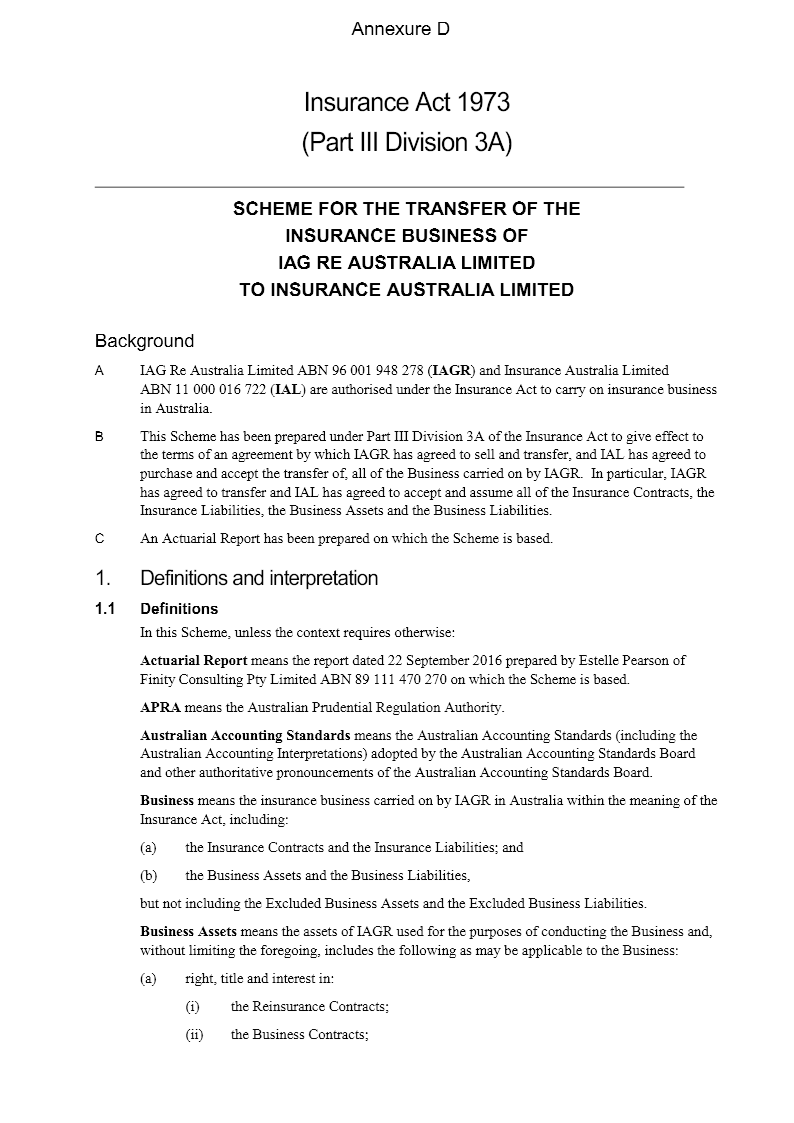
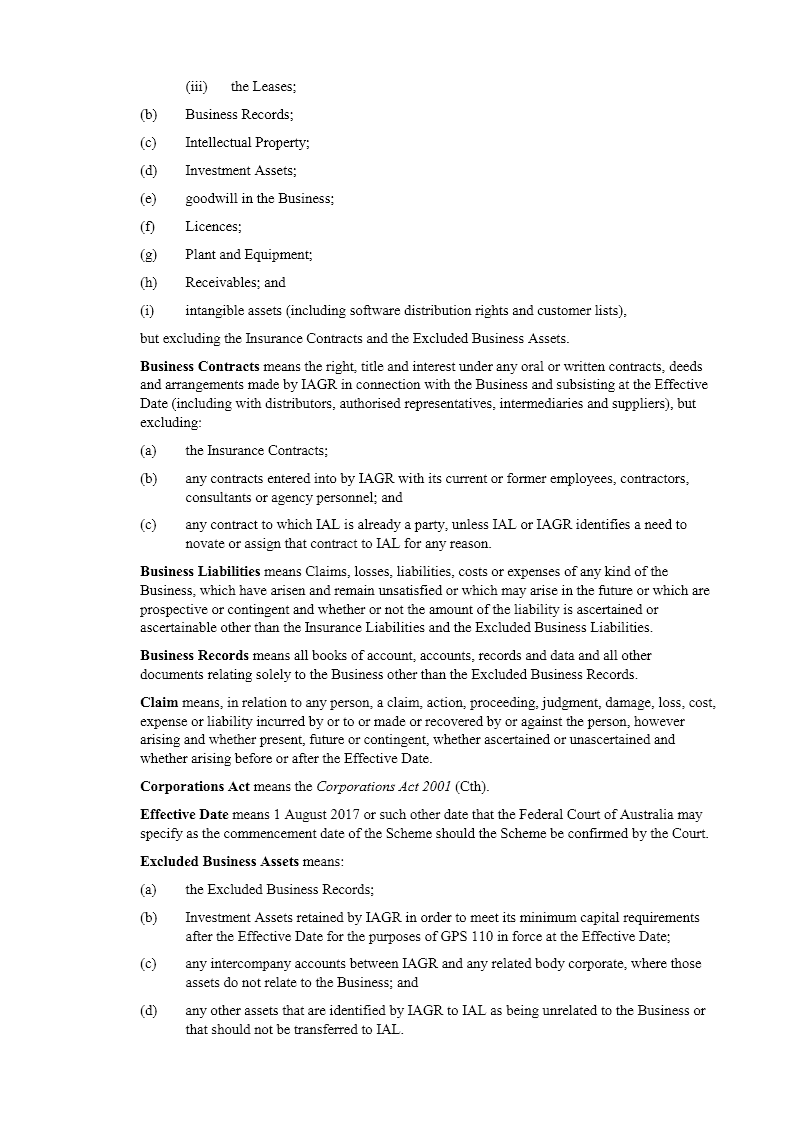
(d) the scheme for the transfer of the insurance business of IAG Re Australia Limited ABN 96 001 948 278 (“IAG Re”) to the applicant in the form of annexure D to these orders (“IAG Re scheme”);
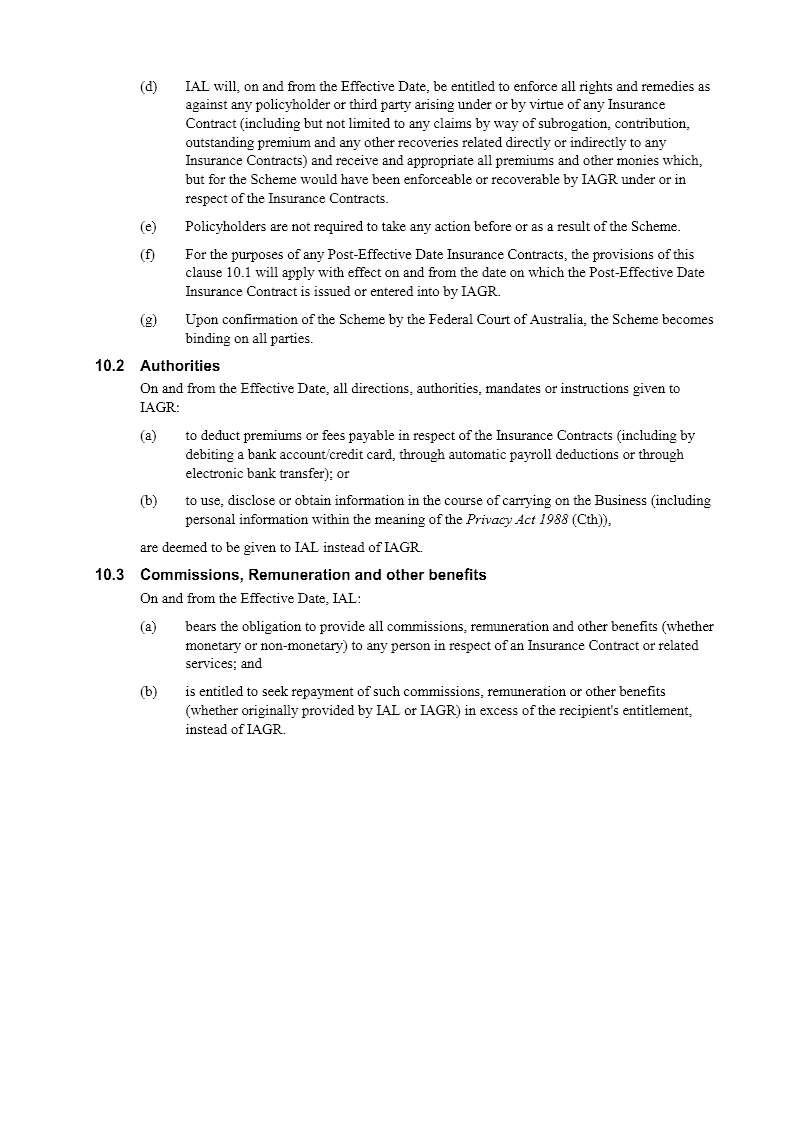
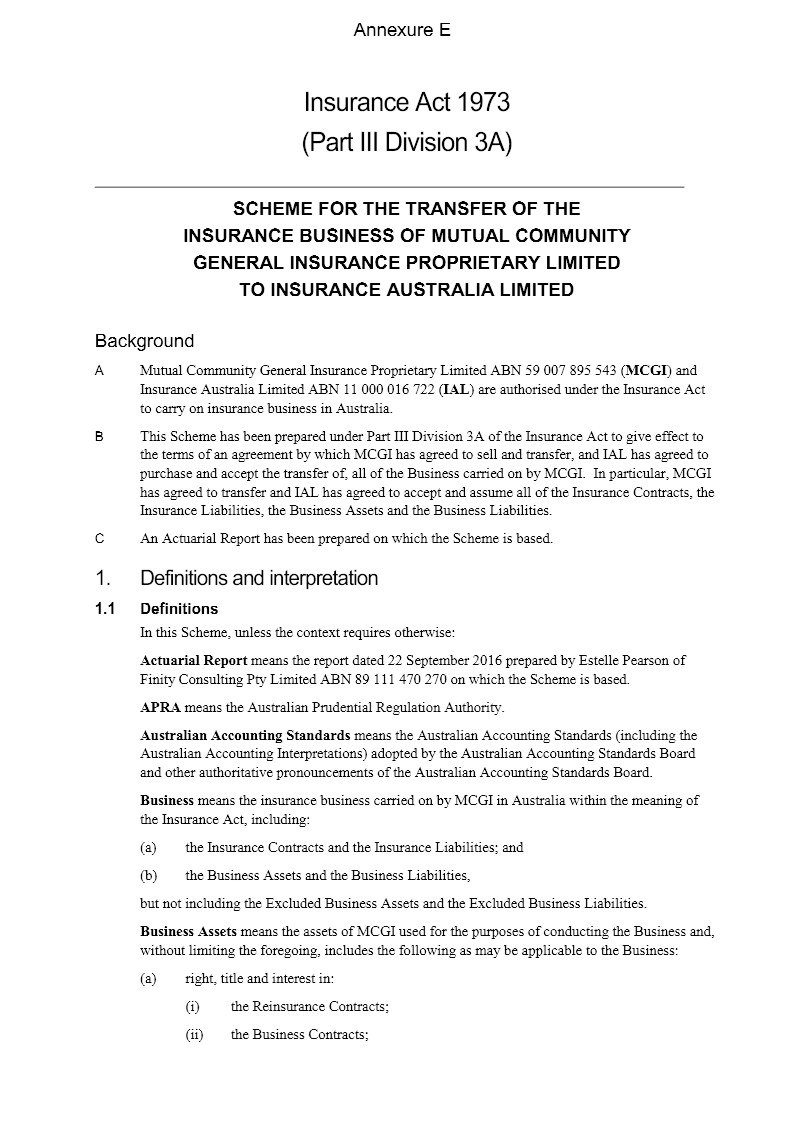
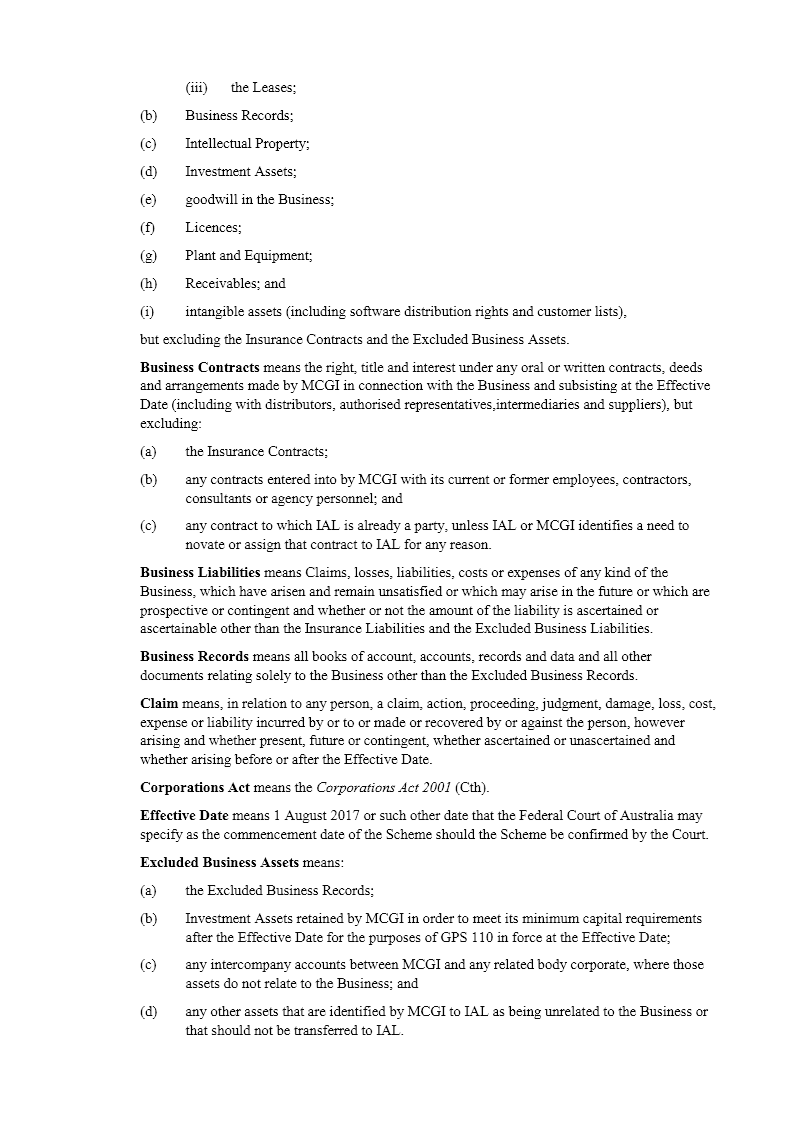
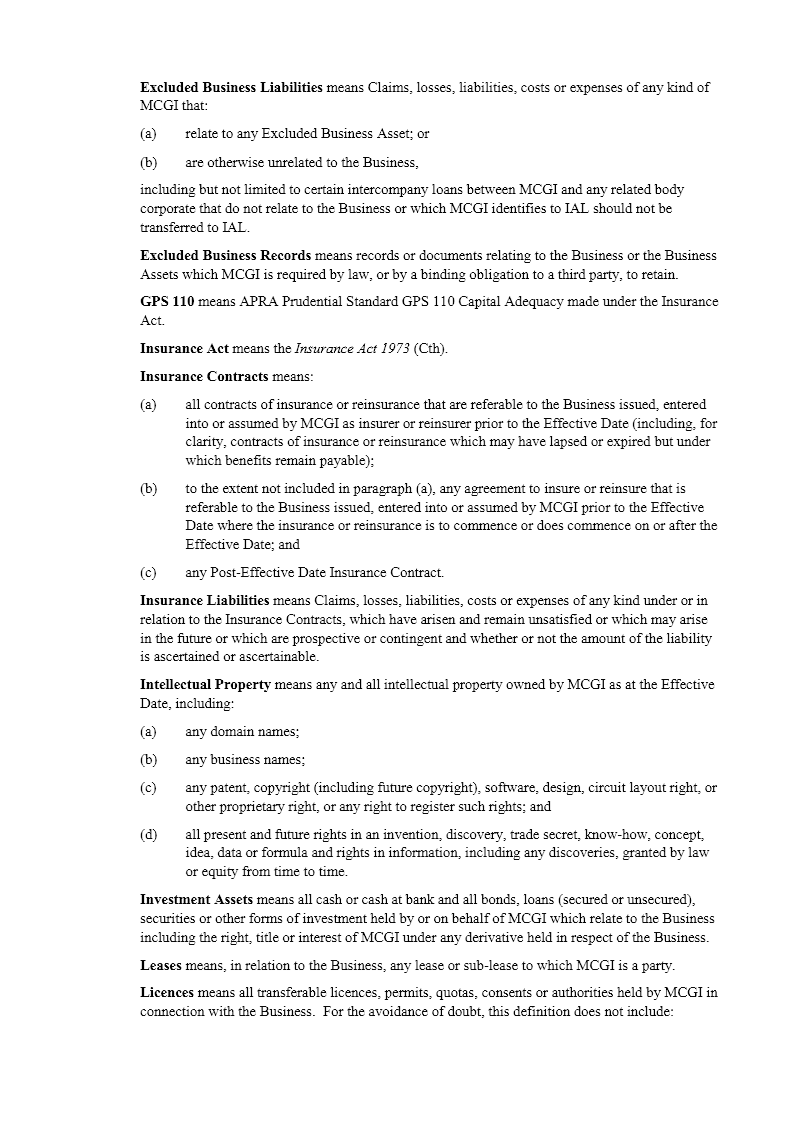
(e) the scheme for the transfer of the insurance business of Mutual Community General Insurance Proprietary Limited ABN 59 007 895 543 (“MCGI”) to the applicant in the form of annexure E to these orders (“MCGI scheme”);
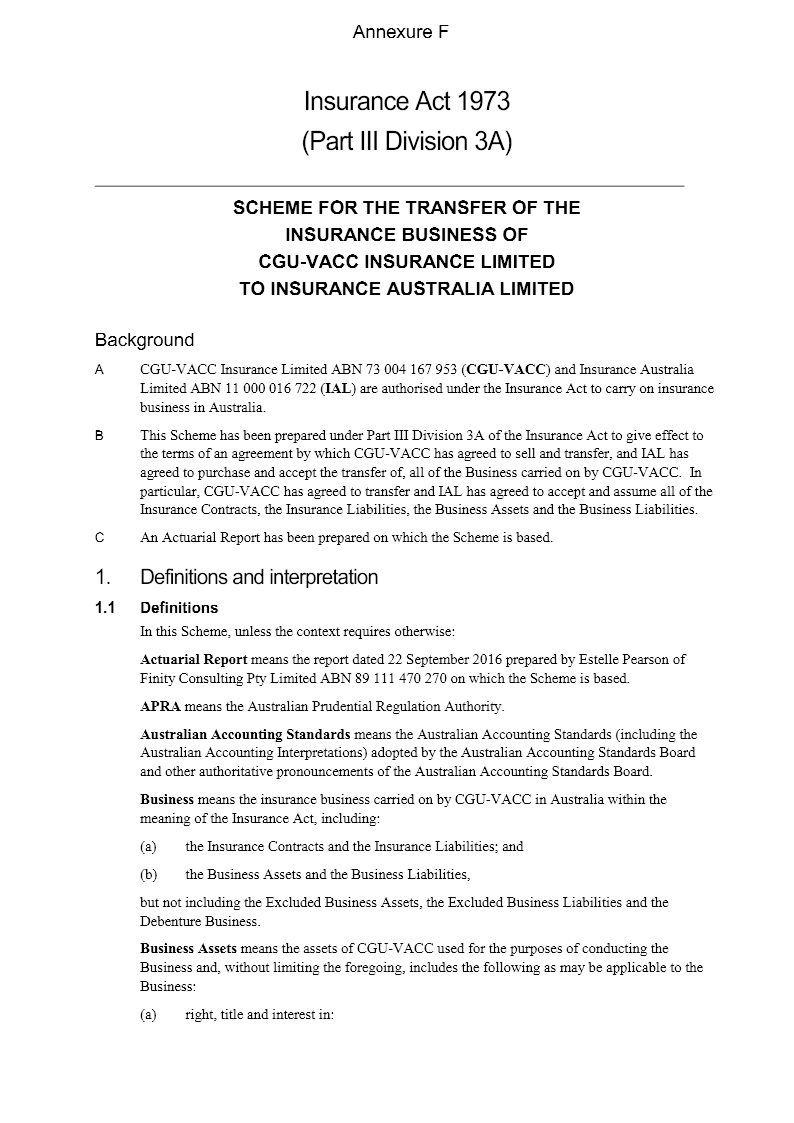
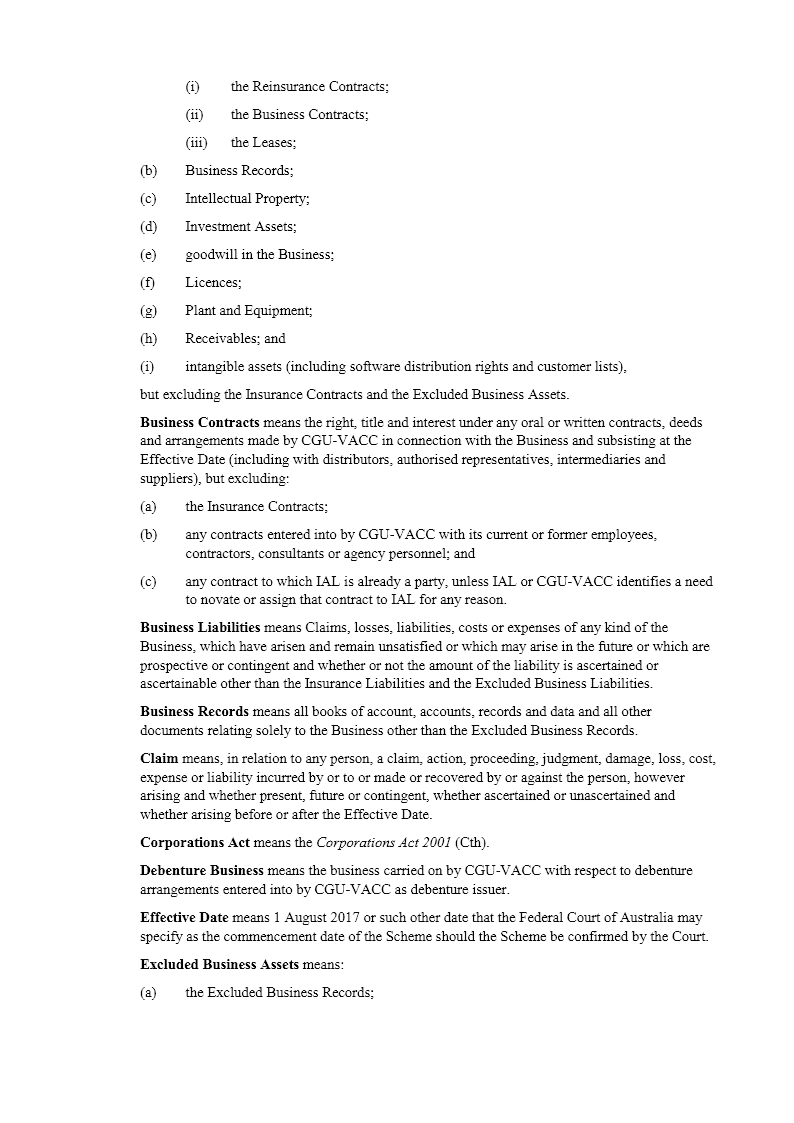
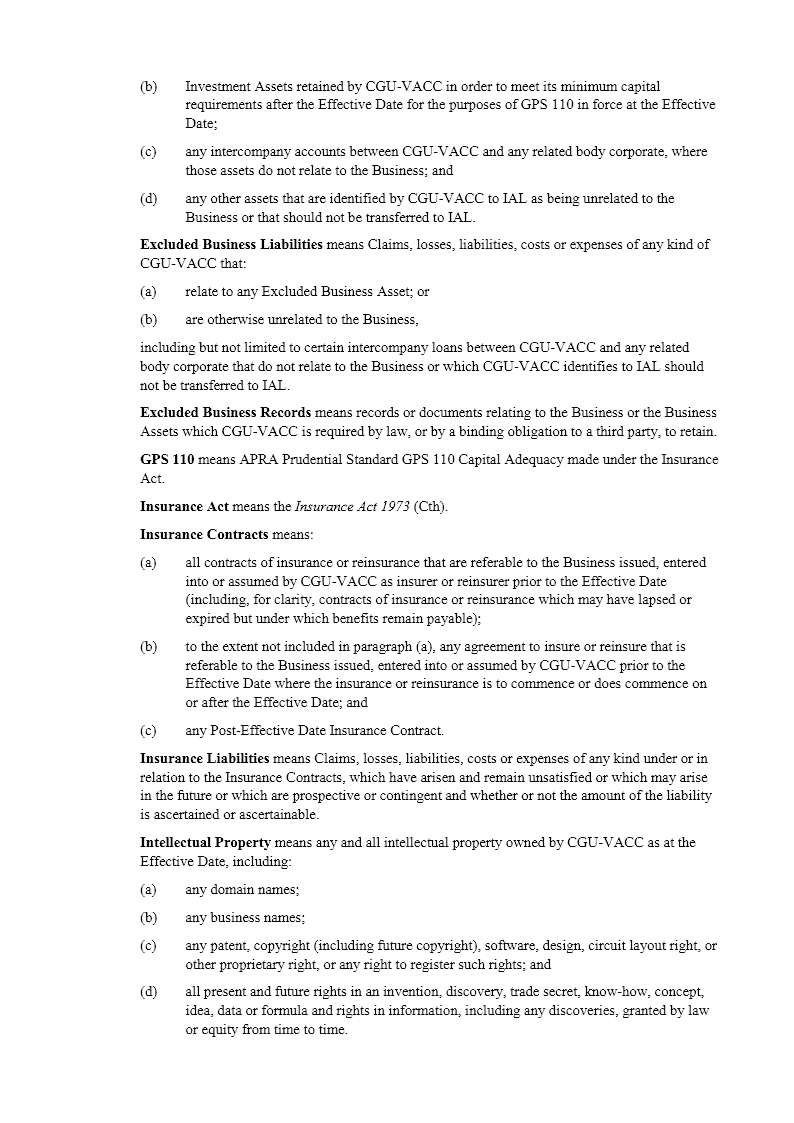
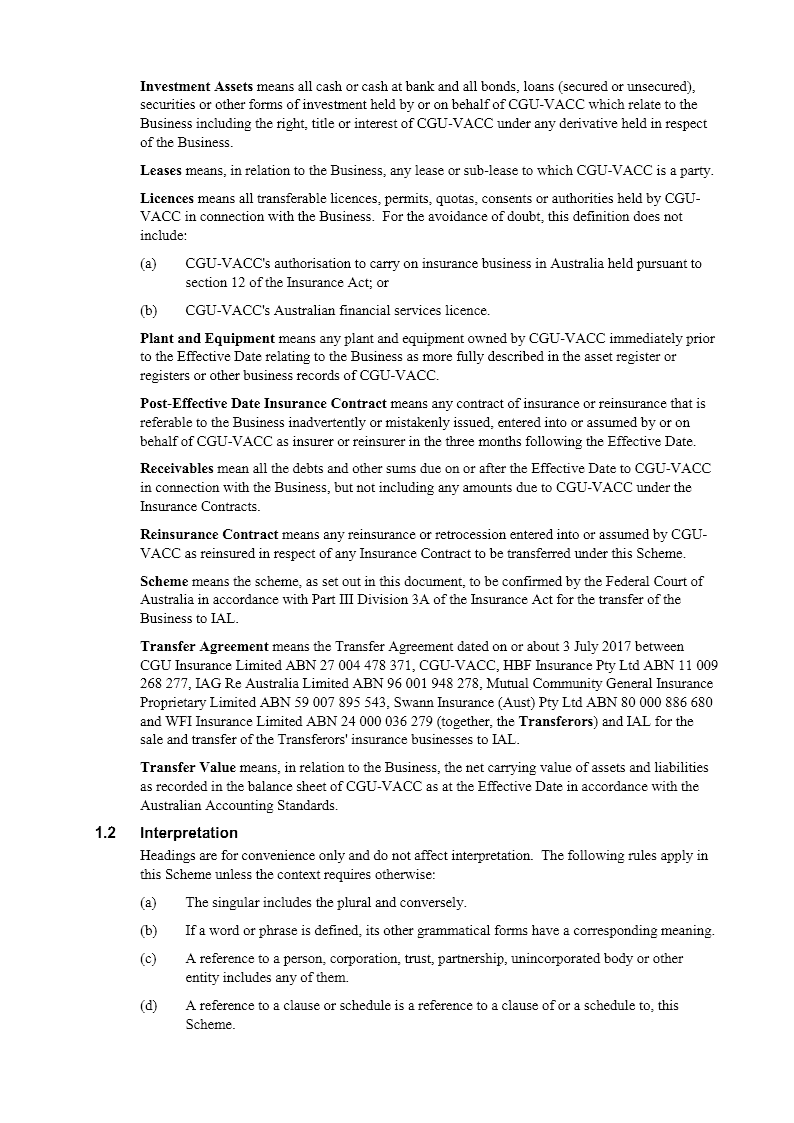
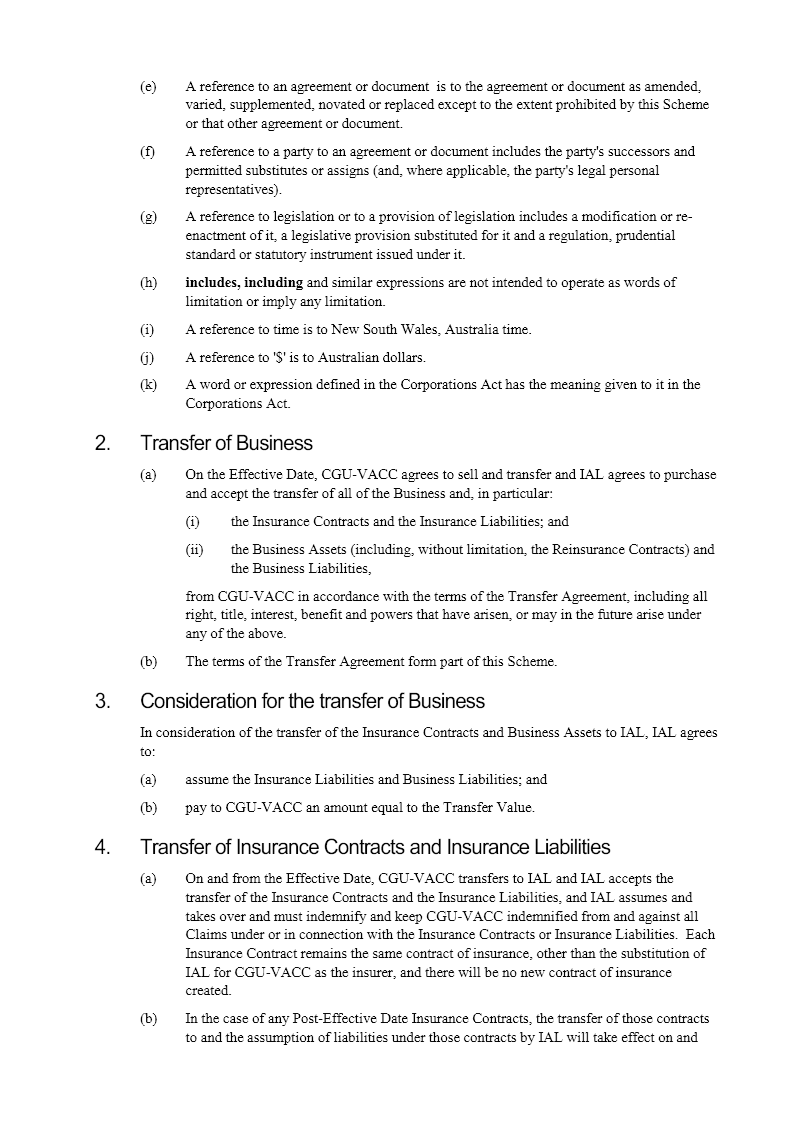
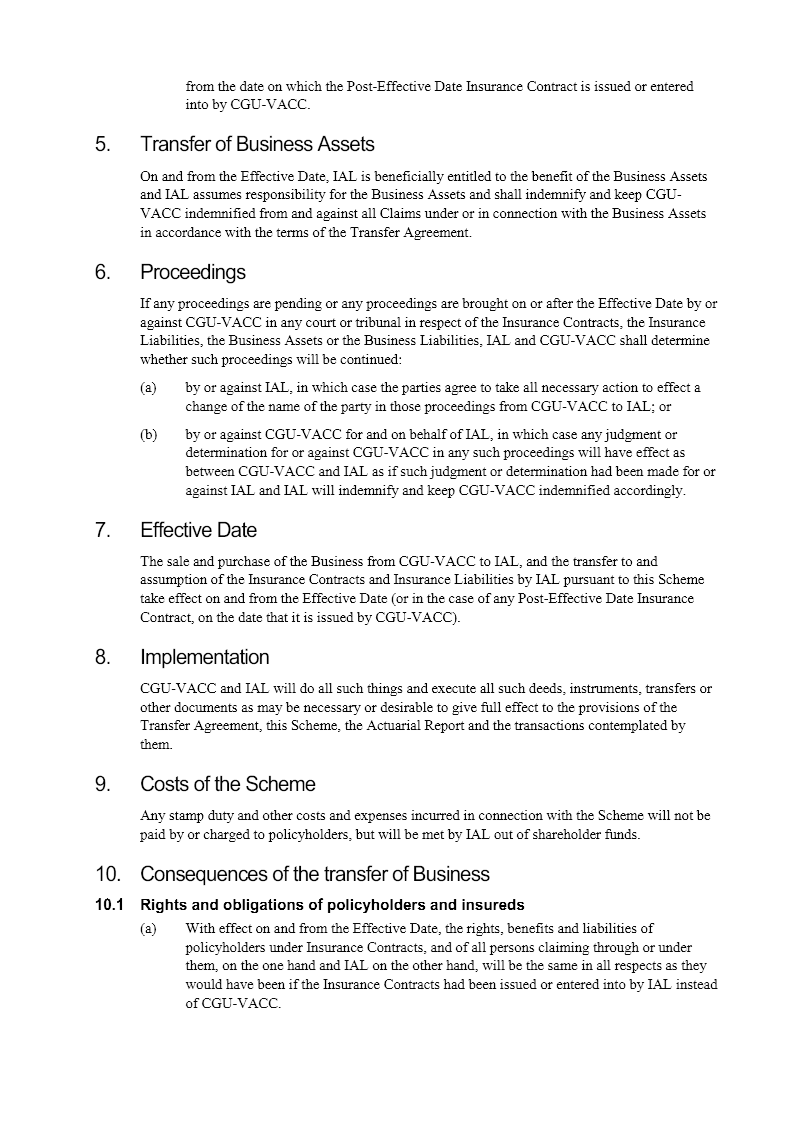
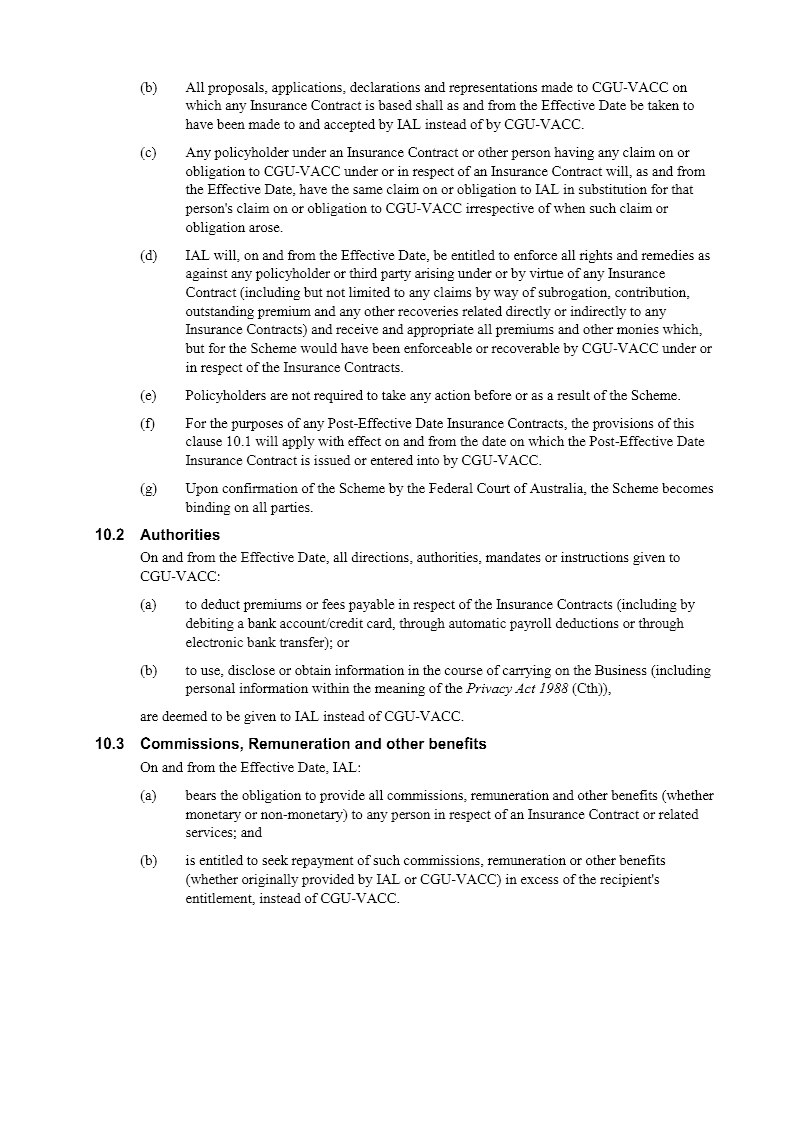
(f) the scheme for the transfer of the insurance business of CGU-VACC Insurance Limited ABN 73 004 167 953 (“CGU-VACC”) to the applicant in the form of annexure F to these orders (“CGU-VACC scheme”); and
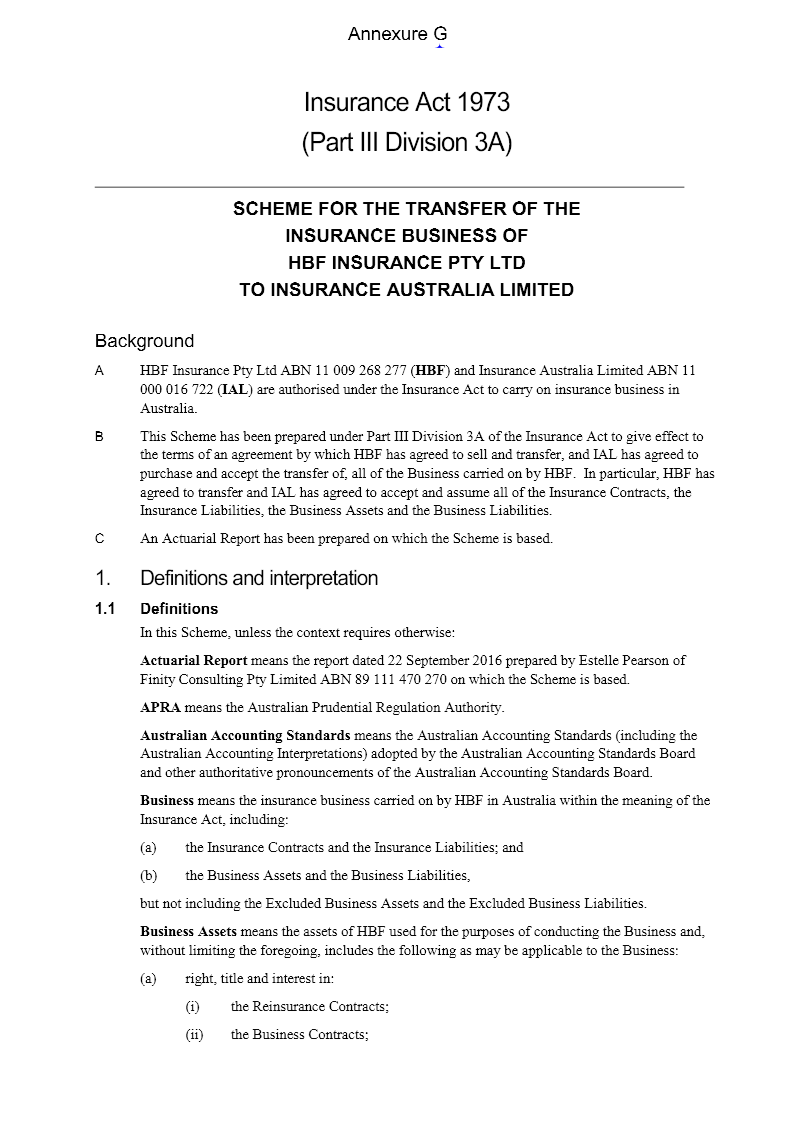
(g) the scheme for the transfer of the insurance business of HBF Insurance Pty Ltd ABN 11 009 268 277 (“HBF”) to the applicant in the form of annexure G to these orders (“HBF scheme”),
each be confirmed without modification, with each of the CGU scheme, the Swann scheme, the WFI scheme, the IAG Re scheme, the MCGI Scheme, the CGU-VACC scheme and the HBF scheme (“schemes”) to take effect at 12.01 am on 1 August 2017.
2. Pursuant to s 17F(2) of the Insurance Act 1973 (Cth), all outwards reinsurance to the extent referable to any policy transferred pursuant to the schemes, including all rights and obligations attaching to such reinsurance, be transferred to the applicant at 12.01 am on 1 August 2017.
3. The applicant pay the costs of the Australian Prudential Regulation Authority of this proceeding as agreed or, if agreement cannot be reached, as assessed.
4. There be liberty to apply.
5. These orders be entered forthwith.
Note: Entry of orders is dealt with in Rule 39.32 of the Federal Court Rules 2011.
GLEESON J:
1 On 20 July 2017, Insurance Australia Limited (“IAL”) sought an order pursuant to s 17F of the Insurance Act 1973 (Cth) (“Act”) confirming seven separate but concurrent proposed schemes for the transfer to IAL of the insurance businesses of:
(1) CGU Insurance Limited (“CGU”);
(2) Swann Insurance (Aust) Pty Ltd (“Swann”);
(3) WFI Insurance Ltd (“WFI”),
(4) IAG Re Australia Limited (“IAG Re”);
(5) Mutual Community General Insurance Proprietary Limited (“MCGI”);
(6) CGU-VACC Insurance Ltd (“CGU-VACC”); and
(7) HBF Insurance Pty Ltd (“HBF”);
(together the “transferring insurers”) (“confirmation application”).
2 IAL also sought ancillary orders including, in particular, that all outwards reinsurance responding to any policy transferred pursuant to the schemes be transferred to IAL.
3 By s 17E(3) of the Act, the Australian Prudential Regulation Authority (“APRA”) was entitled to be heard on the confirmation application. At the hearing, Mr Hollo SC appeared on behalf of APRA. Mr Hollo SC informed the Court that APRA did not oppose the orders sought by IAL and explained APRA’s role in the preparation of the schemes and the process leading to the confirmation application.
4 No other party appeared to oppose the confirmation application.
5 After hearing submissions, I made the orders sought (“confirmation orders”). These are my reasons for making the confirmation orders.
Background
6 On 17 October 2016, I made orders which required IAL to conduct an extensive notification program, designed to draw attention to the schemes (“notification orders”) and dispensed with the requirement, in s 17C(2)(c) of the Act, that an approved summary of the scheme be given to every affected policyholder: Insurance Australia Limited, re Insurance Australia Limited [2016] FCA 1387 (“Re IAL (No 1)”).
7 Re IAL (No 1) records the following matters about the schemes:
[9] Each of IAL and the transferring insurers is an Australian corporation authorised to carry on a general insurance business in Australia under s 12 of the Act.
[10] Each of them is also a wholly owned subsidiary of Insurance Australia Group Limited (“IAG”).
[11] IAG and its related bodies corporate are referred to as the “IAG Group”. The insurance business carried on by the IAG Group in Australia comprises:
(1) Personal insurance (“PI”), which consists of:
(a) the Australian consumer division, providing a wide range of motor, home and other personal insurance products for consumers; and
(b) the Challenger division, predominately providing home, motor, landlord, holiday and rental cover and travel under the Coles, SGIO and SGIC brands; and
(2) Commercial insurance (“CI”), which covers a wide range of business insurance products for small, medium and large businesses. Commercial insurance includes property, liability, commercial motor, marine, professional and financial risks, construction and engineering, crop and workers compensation insurance.
[12] IAL, operating under brands including NRMA, SGIO and SGIC, is one of the largest general insurance companies in Australia.
Business to be transferred under the proposed schemes
[13] IAL’s written submissions contained the following table, summarising the current and non-current types of insurance products issued within the insurance business of the transferring insurers:
Transferring Insurer | Current and non-current types of insurance product(s) | Major brand(s) | Distribution method(s) |
CGU | Current PI and CI Non-current Workers compensation and home warranty insurance are no longer issued. Claims relating to these historical policies are still being managed | CGU | Direct Intermediary |
WFI | Current PI CI (including workers compensation) | Coles Insurance Lumley runoff; LSV and Retail Warranty (“other brands”) WFI | Coles Insurance: Direct Lumley runoff and other brands: Direct and intermediary WFI: Direct and intermediary |
Swann | Current PI | Swann Insurance | Direct Intermediary |
HBF | Non-current PI | HBF | Not applicable |
MCGI | Non-current PI | MCGI | Not applicable |
CGU-VACC | Non-current Prior to 2002, CGU-VACC offered: PI (including compulsory third party) CI (including workers compensation) | VACC | Not applicable |
IAG Re | Current Reinsurance of risks of subsidiary companies of IAG Group Non-current Prior to 2007, IAG Re was NZI Insurance Australia Limited and offered: CI Workers compensation | Not applicable | Not applicable |
[14] The insurance products offered by the transferring insurers include products:
(1) provided through joint ventures and underwriting agencies;
(2) provided as white label products to partners, which can be sole partner branded or co-branded with the partner; and
(3) that have long tail exposure. The key categories of long tail claims currently managed by the transferring insurers are as follows:
(a) liability, professional risks, compulsory third party and workers compensation claims that are generally lodged by the policyholder or claimant;
(b) asbestos and silicosis claims that are lodged under liability or workers compensation policies or professional indemnity policies, generally by the claimant or a solicitor representing the claimant;
(c) molestation claims that are lodged under liability or workers compensation policies or professional indemnity policies, generally by the peak body or institution; and
(d) home/builders warranty claims that are lodged under home warranty policies, generally by the claimant who is the home owner or solicitors representing the claimant if there is a dispute.
[15] As at 30 June 2016, the transferring insurers had issued:
(1) approximately 3,244,900 active policies;
(2) approximately 3,593,300 expired policies over the three year period between 1 July 2013 and 30 June 2016; and
(3) recorded approximately 138,600 open claims.
Overview of the schemes
[16] IAL summarised the schemes in the following terms:
3.1 The essence of the Schemes is that each Transferring Insurer will transfer all of its existing insurance business to IAL. Effectively, IAL will assume the liabilities of each Transferring Insurer in respect of contracts of insurance issued, entered into or assumed by the Transferring Insurer. The substance of the Schemes is to provide for the transfer of policies held from seven insurers within a group to another within the same group.
3.2 IAL and the Transferring Insurers intend to execute a transfer agreement by which IAL will agree with the Transferring Insurers to assume their liabilities in respect of contracts of insurance issued, entered into or assumed by the Transferring Insurers in the course of their insurance businesses (Transfer Agreement). The terms of the Transfer Agreement form part of the Schemes.
3.3 In summary, the Schemes will have the following effect:
(a) all of the insurance business of a Transferring Insurer, including all of the insurance contracts and insurance liabilities as well as certain assets and liabilities related to that business, will be transferred to IAL. IAL will indemnify the Transferring Insurer against all present, future or contingent claims, losses, liabilities, costs and expenses that might arise in connection with the insurance contracts;
(b) the transfer will not change the terms of any insurance contract, or affect any claim in respect of any insurance contract issued by a Transferring Insurer, other than that IAL will become the insurer;
(c) policyholders will continue to have the same rights and obligations under or in respect of any insurance contract or claim, but with IAL as the insurer;
(d) all outstanding claims-related rights and liabilities of a Transferring Insurer in respect of the insurance contracts will be transferred to IAL such that any claims arising under or in connection with any insurance contract must be made against IAL, rather than the Transferring Insurer;
(e) all premiums and other amounts payable to or recoverable by a Transferring Insurer under the insurance contracts will be payable to and recoverable by IAL;
(f) IAL will be entitled to enforce all rights and remedies that but for the Schemes would have been enforceable by a Transferring Insurer under or in respect of the insurance contracts;
(g) any policyholder under an insurance contract or other person who has a claim on or obligation to a Transferring Insurer under or in respect of an insurance contract will have the same claim on or obligation to IAL in substitution for his or her claim on or obligation to the Transferring Insurer irrespective of when such claim or obligation arose;
(h) any stamp duty and other costs and expenses incurred in connection with the Schemes will not be paid by or charged to policyholders, but will be met by IAL; and
(i) the transfers will take effect on 1 August 2017 or another date agreed between IAL and the Transferring Insurers and approved by the Court.
8 Re IAL (No 1) also records (at [39]) that, based on the evidence identified in the judgment, I was satisfied that:
(1) the schemes are not intended to result in any changes to policy terms and conditions for policyholders of the transferring insurers;
(2) nor are the schemes intended to result in any changes to the claim management approaches and procedures for the transferring insurers;
(3) I should accept Ms Pearson’s independent expert actuarial opinion that the interests of the policyholders of the transferring insurers and IAL should not be adversely affected in a material way as a consequence of the schemes.
Transfer agreement and conditions precedent
9 On 17 July 2017, IAL and the transferring insurers executed a transfer agreement by which IAL agreed with the transferring insurers to assume their liabilities in respect of contracts of insurance issued, entered into or assumed by the transferring insurers in the course of their insurance businesses (“transfer agreement”). The terms of the transfer agreement form part of the schemes. The transfer agreement is subject to two conditions precedent:
(1) confirmation of the schemes by the Court; and
(2) the making of a decision by the Treasurer of the Commonwealth of Australia or some other responsible Minister, or a delegate of the Treasurer or responsible Minister, of a go-ahead decision in relation to the schemes in accordance with s 41 of the Insurance Acquisitions and Takeovers Act 1991 (Cth) to the effect that there is no objection to IAL acquiring the general insurance businesses of the transferring insurers (“IATA approval”).
10 The IATA approval has been obtained. The Minister for Revenue and Financial Services has given IAL written advice that she has made an unconditional “go ahead” decision under s 41(1) of the Insurance Acquisitions and Takeovers Act.
Evidence in support of confirmation application
Scheme documents
(1) the CGU scheme is annexure A to the confirmation orders;
(2) the Swann scheme is annexure B to the confirmation orders;
(3) the WFI scheme is annexure C to the confirmation orders;
(4) the IAG Re scheme is annexure D to the confirmation orders;
(5) the MCGI scheme is annexure E to the confirmation orders;
(6) the CGU-VACC scheme is annexure F to the confirmation orders; and
(7) the HBF scheme is annexure G to the confirmation orders.
12 The above forms of the schemes differ from the forms annexed to the originating application in two respects, being:
(1) the definition of “Business Contracts” has been amended to delete the phrase “(excluding any statutory appointment as an authorised representative)”, which appeared in the forms of the schemes annexed to the originating application (“Revised Business Contracts Definition”); and
(2) the removal of the transferring insurers trade marks from the scope of the scheme documents by:
(a) removing the term “Trade Marks” from the definition of “Intellectual Property”; and
(b) removing the definition of “Trade Marks”
(collectively the “Trade Mark Revisions”).
13 Concerning the definition of “Business Contracts”, Ms Chivers gave the following evidence:
[10] The Revised Business Contracts Definition is required as I formed the view that the statutory appointment provisions are fundamental to the [authorised representatives] agreements as this is the mechanism by which the [authorised representatives] are appointed and authorised to deal on behalf of the relevant Transferring Insurers in the provision of insurance business. In the absence of such statutory appointment, I was concerned that the [authorised representatives] agreements would likely have limited utility.
[11] I believe the Revised Business Contracts Definition makes no material change to the terms of the [authorised representatives] agreements and has been adopted to provide legal certainty to enable their continued operation as [authorised representatives] of the Applicant from the effective date of the Schemes.
14 Concerning the “Trade Mark Revisions”, Ms Chivers stated:
[13] The necessity for the Trade Mark Revisions arose because the Transfer Agreement is not in a form that will comply with the requirements of IP Australia to enable the transfer of the trade marks to be registered. I have received advice from IAG’s intellectual property lawyers that the agreement evidencing the transfer of the trade marks from the Transferring Insurers to the Applicant must be unconditional and must specify the date on which the transfer is to occur. The Transfer Agreement is conditional and is subject to an effective date of 1 August 2017 or such other date that this Honourable Court may specify as the commencement date.
[14] In order for the transfer of the trade marks from the Transferring Insurers to the Applicant to occur, it has therefore been necessary to prepare a separate side agreement which overcomes the limitations of the Transfer Agreement as an instrument enabling registration of the transfer of the trade marks as it is unconditional and will be effective from 1 August 2017 which will satisfy the requirements for registration with IP Australia (Trade Mark Assignment Agreement).
[15] The Applicant and the Transferring Insurers entered into the Trade Mark Assignment Agreement on 17 July 2017 to effect the transfer of the trademarks of the Transferring Insurers to IAL on 1 August 2017. Annexed to this affidavit and marked ‘CMC-2’ is a copy of the executed Trade Mark Assignment Agreement.
[16] On 11 July 2017, I provided the revised Transfer Agreement and Trade Mark Assignment Agreement to APRA and convened a teleconference with the key APRA personnel on that same day to discuss the proposed changes to the Transfer Agreement and adoption of the Trade Mark Assignment Agreement.
15 The need for these modifications was identified after the initial approval by APRA of the forms annexed to the originating application and the implementation of the notification program in accordance with the notification orders using the forms as annexed to the originating application.
16 APRA is satisfied that no prejudice or detriment will be suffered by policyholders as a result of these modifications. IAL submitted that no policyholder will have suffered any prejudice or detriment or will have been misled by the modifications to the earlier forms of the schemes or earlier version of the transfer agreement. Having regard to APRA’s submissions and the nature of the modifications, I accepted that submission.
Actuarial evidence
17 The schemes are based on an actuarial report dated 22 September 2016 (“actuarial report”) prepared by Estelle Pearson, an independent actuary engaged by IAL. The actuarial report applies data as at 30 June 2016. Ms Pearson has affirmed two affidavits in this proceeding, one on 10 October 2016 (“first Pearson affidavit”) and another on 11 July 2017 (“second Pearson affidavit”). In the first Pearson affidavit, Ms Pearson confirmed that she held the opinions and supported the conclusions expressed in the actuarial report. In the second Pearson affidavit, Ms Pearson confirmed that she has considered the updated capital positions of IAL and each of the transferring insurers and confirmed that she continued to hold the opinions and support the conclusions expressed in the actuarial report in light of information received and changed circumstances since the actuarial report was prepared.
18 That is, Ms Pearson continues to be of the opinion that the interests of policyholders of IAL and each of the transferring insurers should not be adversely affected in a material way as a consequence of the schemes. Ms Pearson’s assessments, set out at [17] of Re IAL (No 1), are unaltered.
19 In particular, the second Pearson affidavit sets out Ms Pearson’s consideration of developments since the actual report was prepared including the February 2017 Sydney hailstorm, Cyclone Debbie in March 2017 and the Kaikoura earthquake in November 2016.
20 Ms Pearson has also reviewed the feedback from policyholders received as a result of IAL’s notification program and has confirmed that nothing has come to her attention which affects the comments and conclusions expressed in the actuarial report.
21 Brett Ward is the appointed actuary for IAL and the transferring insurers. Mr Ward has sworn two affidavits in the proceeding, one on 5 October 2016 (“first Ward affidavit”) and another on 11 July 2017 (“second Ward affidavit”). In the first Ward affidavit, Mr Ward verified his belief in the truth and accuracy of the statements of fact made about Insurance Australia Group Limited (“IAG”) and its related bodies corporate (“IAG Group”) in the actuarial report and the figures contained in each of the tables in the actuarial report. In the second Ward affidavit, Mr Ward verified his belief in the truth and accuracy of:
(1) the additional documents and other information relating to IAL and the transferring insurers provided to Ms Pearson since the actuarial report was prepared;
(2) each statement of fact made about the IAG Group in the second Pearson affidavit; and
(3) the figures contained in each of the tables in the second Pearson affidavit.
Capital Positions
22 The capital positions of IAL and each transferring insurer as at 31 March 2017 has been set out in the second Pearson affidavit and is reproduced in the tables below:
Table 1: APRA Capital Adequacy at 31 March 2017 – Pre-Transfer | |||||
Capital Base | Prescribed Capital Amount | Capital Surplus | PCA Multiple | ICRC | |
$m | $m | $m | $m | ||
IAL | 1,984 | 950 | 1,034 | 2.09 | 71 |
CGU | 837 | 581 | 256 | 1.44 | 116 |
WFI | 365 | 247 | 118 | 1.48 | 82 |
Swann | 169 | 44 | 125 | 3.87 | 21 |
HBF | 23 | 5 | 18 | 4.63 | 0 |
MCGI | 11 | 5 | 6 | 2.23 | 0 |
CGU-VACC | 27 | 17 | 10 | 1.57 | 12 |
IAG Re Australia | 995 | 457 | 538 | 2.18 | 144 |
IAG Level 2 Group | 4,258 | 2,665 | 1,593 | 1.60 | 200 |
Table 2: Estimated Post Transfer Capital Adequacy at 31 March 2017 | |||||
Capital Base | Prescribed Capital Amount | Capital Surplus | PCA Multiple | ICRC | |
$m | $m | $m | $m | ||
Pre-transfer: sum of entities | 4,411 | 2,306 | 2,105 | ||
Post transfer: new IAL | 4,133 | 1,900 | 2,233 | 2.15 | 200 |
Difference from pre-transfer sum | (278) | (405) | |||
23 The ‘Prescribed Capital Amount’ (“PCA”) in the tables is defined in the actuarial report as the minimum capital requirement defined under APRA’s risk based capital requirements for insurers. Insurers hold capital in excess of the PCA in order to withstand fluctuations in capital levels. The “PCA multiple” is defined in the report as the insurer’s capital base, calculated according to APRA’s standards, expressed as a multiple of the PCA.
24 The “ICRC” in the tables is the “Insurance Concentration Risk Charge”, defined in the actuarial report as the element of the PCA which represents the net cost of the insurer’s 1-in-200 year claim event. No reference was made to these figures in IAL’s submissions.
25 Based on the definitions in the actuarial report, the “IAG Level 2 Group” comprises IAL and the seven transferring insurers. The group position cannot be derived by adding the figures for individual entities.
26 Table 1 summarises the APRA capital base and PCA for the “Level 1 entities” (that is, the individual insurers authorised under the Act, being IAL and each of the transferring insurers) as at 31 March 2017, produced from the annual APRA returns. The “PCA multiple” shown for each insurer represents the ratio of its capital base to its PCA. The target range for the IAG Level 2 Group, set by IAL, is 1.4 to 1.6. Table 1 shows that as at 31 March 2017, the PCA multiples for the eight licensed entities ranged from 1.44 for CGU-VACC to 4.63 for HBF. IAL’s submissions noted that the IAG Level 2 Group’s PCA multiple was 1.60 which, according to Ms Pearson, represents a strong capital adequacy position and sits at the top of the current target range for the IAG Group.
27 Table 2 shows IAG Group’s estimate of the post transfer capital position of the consolidated IAG entity had the proposed schemes taken effect as at 31 March 2017. Table 2 compares the figures with the equivalent totals for the eight relevant entities set out in Table 1. The estimated PCA multiple for the “IAL Level 1 consolidated entity” is 2.17 which, according to Ms Pearson, represents a strong capital adequacy position and sits above the current target range for IAG Group.
28 Ms Pearson expressed the opinion that, considered from the perspective of the individual insurers, the capital adequacy is changed as follows:
(1) Increased adequacy for four insurers (including the main ongoing underwriting entities), where the PCA multiple increases to 2.17 from a lower value:
(a) IAL (increases from 2.09);
(b) CGU (up from 1.44);
(c) WFI (up from 1.48); and
(d) CGU-VACC (up from 1.57).
(2) Reduced adequacy (lower PCA multiple) for four insurers:
(a) IAG Re Australia – down very slightly from 2.18 to 2.17;
(b) Swann (which writes only a small amount of business in the context of the Group) – down from 3.87;
(c) MCGI (in run-off) – down from 2.23; and
(d) HBF (in run-off) – down from 4.63.
29 Ms Pearson has concluded that in light of the above changes in capital positions, she has not identified any material adverse solvency impact to policyholders of IAL and the transferring insurers as a result of the proposed schemes.
Capital adequacy post transfer
30 Mr Ward gave evidence that, in about early February 2017, he received information from the Chief Financial Officer for IAG, Nicholas Hawkins, that there may be a change in the nature of capitalisation for the IAL Level 1 consolidated entity after the effective date of the schemes. Mr Ward’s evidence was that the proposed change arises from proposed adjustments to intercompany loans which have no impact on the IAG Level 2 Group’s capitalisation, but will change the apparent capitalisation for the IAL Level 1 consolidated entity. Should the proposed intercompany loan adjustments be effected, Mr Ward’s understanding is that the PCA multiple for the IAL Level 1 consolidated entity will reduce to about 1.5. Mr Ward confirmed that this does not represent a change to IAG Group policy regarding the capital risk appetite for the IAG Group and is consistent with the policy for capitalisation of subsidiaries within the IAG Group.
31 Ms Pearson stated that she has undertaken her own investigations of the intercompany loan position in order to form a view on the post transfer capital position. Her opinion is that this post transfer change does not have a material adverse impact on policy holders given that the ultimate security provided by the IAG Level 2 Group is unchanged.
Latent claims
32 In relation to latent or long tail claims, Ms Pearson has noted that:
IAG has exposure to latent claims, including asbestos and child molestation claims, across a number of key business entities:
(a) asbestos exposures sit largely within IAG Re Australia and CGU, and to a lesser extent in IAL. Exposure in CGU-VACC has been transferred to IAG Re Australia via a loss portfolio transfer; and
(b) molestation exposures sit mostly with IAG Re Australia.
33 Ms Pearson has noted that liabilities for these exposures are particularly challenging to estimate. As at 31 March 2017, the provisions held across the IAG Group, at a 75% probability of sufficiency and before allowing for a loss portfolio transfer to Berkshire Hathaway, were:
(1) Asbestos: gross central estimate of $465 million and gross provision of $687 million (48% risk margin).
(2) Molestation: gross provision of $31 million. This provision comprises $5.2 million of reported liabilities, $22.2 million of claims incurred but not reported (“IBNR”) provision and a $3.5 million (13%) risk margin.
34 Further, Ms Pearson has noted that IAG holds reserves to a 90% probability of sufficiency on its balance sheet, with gross provisions of $1.216 billion for asbestos (144% risk margin) and $37 million for molestation (37% risk margin). Net reserves for the IAG Group and each entity for asbestos and molestation are zero, after allowing for the loss portfolio transfer. The limits provided by this cover are:
(1) Asbestos: $1.5 billion (2.2 times gross provision at March 2017). There is also an additional amount of up to $250 million.
(2) Molestation: sub-limit of $40 million (29% above March 2017 gross provision).
35 Ms Pearson has also noted that:
(1) for asbestos exposures, the limit is a multiple of the current reserve which means that the liabilities can develop well above the current estimated levels before IAG Group retains further cost; and
(2) there is less “headroom” in the cover for molestation liabilities, but the current molestation provision of $31 million is small in the context of the total provisions for the relevant entities (more than $6.4 billion), and the estimate for incurred but not reported claims is large in relation to reported claim costs. Ms Pearson noted that even if the ultimate cost were a multiple of the current provisions, it would still represent only a small proportion of the liabilities for the combined entities.
Impact of the proposed schemes
36 Ms Pearson stated that her overview of the liabilities of each general insurer did not identify any issues relating to either the valuation or the transfer of the liabilities that she believes are material to policyholders of the transferring insurers. Ms Pearson noted that, after the schemes:
(1) The policyholders of the transferring insurers will be newly exposed to CTP liabilities, which are material in size, and inherently more uncertain than many other risks that the entities have been exposed to in the past. The CTP insurance liability provisions held by IAL have historically proved to be more than adequate.
(2) The policyholders of the insurers other than IAG Re Australia, CGU and IAL will be newly exposed to asbestos liabilities.
(3) The policyholders of the insurers other than IAG Re Australia will be newly exposed to molestation liabilities.
37 Ms Pearson stated that she does not believe that the extra risk to policyholders from exposure to these liabilities is material, noting the relative size and nature of the liabilities, the inclusion of risk margins which reflect the inherent uncertainty, and the protection afforded by the loss portfolio transfer for asbestos and molestation claims.
Compliance with procedural requirements
38 Affidavits of the following persons were read as evidence of compliance with the procedural requirements for confirmation of the scheme:
(1) Jessica Anh To, Senior Business Analyst within the IAG Group – Ms To has overall responsibility for the implementation of the policyholder, broker and intermediary communications and dedicated enquiry channels in relation to the schemes;
(2) Shane Wendy Grimes, Senior Manager of Corporate Affairs within the IAG Group – Ms Grimes has overall responsibility for co-ordinating and executing all online material, print media and media releases in relation to the schemes;
(3) Veronica Mary Atley, Senior Manager of Reinsurance and Latent Claims within the IAG Group – Ms Atley has overall responsibility for the notifications about the schemes sent in relation to reinsurance, asbestos and silicosis claims and molestation claims;
(4) Mark Charles Brassell, National Manager of Builders Warranty Claims within the IAG Group – Mr Brassell has overall responsibility for the notifications about the schemes sent in relation to home warranty claims;
(5) Benjamin James Bessell, Chief Executive of the Australian Business Division within the IAG Group – Mr Bessell has responsibility for management, strategy and financial performance of Australian Business Division;
(6) Caroline Margaret Chivers, Senior Corporate Counsel within the IAG Group;
(7) Kemsley Maxwell Brennan, partner of MinterEllison and solicitor on the record for IAL;
(8) James Richard Stanton, solicitor with MinterEllison located at the firm’s Sydney office;
(9) Cassandra Lee Heilbronn, solicitor with MinterEllison located at the firm’s Brisbane office;
(10) Danielle Kirstin Snell, solicitor with MinterEllison located at the firm’s Melbourne office;
(11) Affidavit of Sarah-Jane Meier, solicitor with MinterEllison located at the firm’s Canberra office;
(12) Alexander Phillip Samuel Gregg, solicitor with MinterEllison located at the firm’s Perth office;
(13) Lhia-Clare Davis, solicitor with MinterEllison located at the firm’s Darwin office;
(14) Paul Ian Doecke, solicitor with MinterEllison located at the firm’s Adelaide office; and
(15) Matthew John Sakaris, solicitor with Dobson Mitchell Allport located at the firm’s Hobart office.
Legal framework
39 Division 3A of Pt III of the Act is entitled “Transfer and amalgamation of insurance business”. Section 17B provides relevantly:
(1) No part of the insurance business of a general insurer may be:
(a) transferred to another general insurer; or
(b) amalgamated with the business of another general insurer;
except under a scheme confirmed by the Federal Court.
…
(3) A scheme must set out:
(a) the terms of the agreement or deed under which the proposed transfer or amalgamation is carried out; and
(b) particulars of any other arrangements necessary to give effect to the scheme.
40 Section 17C provides relevantly:
(1) In this section:
“affected policyholder” means the holder of a policy affected by a scheme.
“approved summary” means a summary approved by APRA.
(2) An application for confirmation of a scheme may not be made unless:
(a) a copy of the scheme and any actuarial report on which the scheme is based have been given to APRA in accordance with the prudential standards; and
(b) notice of intention to make the application has been published by the applicant in accordance with the prudential standards; and
(c) an approved summary of the scheme has been given to every affected policyholder.
(3) Without limiting the provision that may be made by the prudential standards for the purposes of paragraph (2)(b), the notice referred to in that paragraph must include, in relation to each body corporate affected by the scheme, details of the place and time at which an affected policyholder may obtain a copy of the scheme.
(4) An affected policyholder is entitled, on the person’s request, to be provided by the company with one copy of the scheme free of charge.
41 In Re Armstrong Jones Life Assurance Ltd (1997) 74 FCR 160 (“Re Armstrong”) at 162, Emmett J expressed the view that s 191(2)(b) of the Life Insurance Act 1995 (Cth), which is relevantly similar to s 17C(2)(b), was not a condition precedent to the existence of the Court’s jurisdiction to confirm a scheme. In that case, his Honour found that there had been compliance with the relevant regulations and so the Court’s jurisdiction was not in doubt.
42 In The application of Royal & Sun Alliance Life Assurance Ltd [2000] FCA 1259; (2000) 104 FCR 37 (“Royal & Sun Alliance”), Katz J found (at 40) that r 9.02(3) of the Life Insurance Regulations 1995 (Cth) had not been complied with. Katz J adopted Emmett J’s approach in Re Armstrong, concluding that compliance with s 191(2)(b) was not a condition precedent to the existence of the Court’s jurisdiction to confirm the scheme, but may be relevant to the exercise of the Court’ s jurisdiction under s 194 of the Life Insurance Act. Section 194 of the Life Insurance Act is relevantly identical to s 17F of the Act.
43 In Re Insurance Australia Ltd [2004] FCA 524; (2004) 139 FCR 450 (“Re Insurance Australia”), at 463, Lindgren J adopted the same approach to s 17C(2)(a) of the Act (although with some doubt), in a context where s 17C(2)(a) was not complied with because a copy of the actuarial reports on which the scheme in that case was based were not given to APRA in accordance with the prudential standards.
44 Section 17F provides:
(1) The Federal Court may:
(a) confirm a scheme without modification; or
(b) confirm the scheme subject to such modifications as it thinks appropriate; or
(c) refuse to confirm the scheme.
(1A) In deciding whether to confirm a scheme (with or without modifications), the Federal Court must have regard to:
(a) the interests of the policyholders of a body corporate affected by the scheme; and
(b) if a report relevant to all or part of the scheme has been filed with the Court under section 62ZI—that report; and
(c) any other matter the Court considers relevant.
(2) The Federal Court may make such orders as it thinks fit in relation to reinsurance.
45 The relevant prudential standard, for the purposes of s 17C(2)(a) and (b) of the Act, is Prudential Standard GPS 410, Transfer and Amalgamation of Insurance Business for General Insurers (“GPS 410”). Paragraphs 4 to 6 of GPS 410 concern the documents to be provided to APRA prior to a confirmation application being made to the Court. Paragraphs 7 to 11 concern requirements for notification of a confirmation application; paras 12 to 15 concern the approved summary required by s 17C(2)(c); para 16 requires the applicant to make a copy of the scheme available for public inspection.
46 Section 17G provides for the effect of confirmation by the Court. When a scheme is confirmed, it becomes binding on all persons and it has effect in spite of anything in the constitution of any body corporate affected by the scheme.
Discretion to confirm scheme
47 The Court’s choice of which of the three powers conferred by s 17F(1) to exercise ought be made in light of the main object of the Act which, as expressed in s 2A(1) of the Act, is:
... to protect the interests of policyholders and prospective policyholders under insurance policies (issued by general insurers and Lloyd’s underwriters) in ways that are consistent with the continued development of a viable, competitive and innovative insurance industry.
48 There are two aspects to the protection of the interests of policy owners:
(1) the procedural aspects in which the Court is concerned to see that the process undertaken has been properly executed in accordance with the requirements of the Act and the prudential standards; and
(2) the substantive aspect in which the Court is concerned to see that the schemes will not be prejudicial to the interests of policyholders and that the policyholders are properly safeguarded; that is, there is not likely to be any material detriment to policyholders affected by the schemes.
49 The question of whether policyholders would be adversely affected by the schemes is largely actuarial and involves the comparison of their contractual and other rights, their benefit security and their reasonable benefit expectations without the schemes being implemented, with what their position would be if the schemes were implemented.
50 In MDU Australian Insurance Company Pty Ltd, re MDU Australian Insurance Company Pty Ltd [2008] FCA 490, Emmett J identified, at [7], “[t]he critical consideration” as being whether relevant policyholders would be detrimentally affected by the implementation of the scheme. In QBE Insurance (Australia) Ltd, re Division 3A of Part III of the Insurance Act 1973 (Cth) & QBE Insurance (Australia) Ltd (No 2) [2016] FCA 288; (2016) 19 ANZ Insurance Cases 62-100 (“Re QBE Insurance”), Allsop CJ observed, at [25], that “the Court will ask whether the implementation of the scheme will materially detrimentally affect any of the relevant policyholders”.
51 In submitting that the Court should make orders confirming the schemes pursuant to s 17F of the Act, IAL contended that:
(1) IAL has complied with all of the relevant legislative requirements and substantially complied with the notification orders; and
(2) the actuarial evidence, summarised above, supports a conclusion that the schemes will not be prejudicial to the interests of the policyholders of IAL and each of the transferring insurers and in Ms Pearson’s opinion, there is no basis for thinking that there is likely to be any material detriment to policyholders affected by the schemes.
Compliance with procedural requirements
Compliance with s 17B(3)
52 The schemes provide that the terms of the transfer agreement form part of the scheme. In my view, for the reasons I explained in National Mutual Life Association of Australasia Ltd, re National Mutual Life Association of Australasia Ltd and AMP Life Ltd (No 2) [2016] FCA 1591 at [41] to [45] in the context of s 190(3) of the Life Insurance Act, that provision is not sufficient to meet the requirements of s 17B(3).
53 IAL’s lawyers, MinterEllison, prepared a table which compared the terms of each scheme with the terms of the transfer agreement. Ms Chivers verified the accuracy of the table. Mr Jackman SC confirmed, by reference to the table, that the schemes set out the terms of the transfer agreement. On that basis, I was satisfied that the schemes meet the requirements of s 17B(3).
Compliance with s 17C(2)(a)
54 I am satisfied that a copy of the schemes in their unmodified forms was given to APRA on 26 September 2016 in accordance with GPS 410 para 5.
55 I am satisfied that a copy of the actuarial report, being the actuarial report on which the schemes are based, was also given to APRA on 26 September 2016 in accordance with GPS 410 para 5.
Compliance with s 17C(2)(b)
56 By letter dated 28 September 2016, a delegate of APRA approved the form of the notice of intention to make the application for confirmation of the schemes.
57 Paragraphs 7 to 11 of GPS 410 set out notification requirements. Paragraph 7 provides that an application to the Court for confirmation of a scheme cannot be made unless, amongst other things, a notice of intention to make the application has been published by the insurer.
58 As required by para 8 of GPS 410, IAL secured APRA’s approval of the summary of the schemes on 28 September 2016 before publishing the notice of intention. IAL submitted, and I accept, that the modifications to the schemes did not concern matters that would have warranted any difference to the form of the scheme summary.
59 The notice of intention, in the form approved by APRA, was published in accordance with paras 9 and 10 of GPS 410 on 11 March 2017, 18 March 2017, 5 April 2017 and 8 April 2017.
60 As required by para 11 of GPS 410, the notice of intention to make the confirmation application was published before the schemes (in their unmodified forms) were released for public inspection on 8 May 2017.
61 In my view, the correct way to view the confirmation application is as an application to confirm the schemes specified in the originating application, albeit that IAL seeks confirmation of the schemes subject to the modifications identified above. The Court’s power to confirm a scheme subject to such modifications as it thinks appropriate is set out in s 17F(1)(b). On that basis, I accepted that there has been compliance with s 17C(2)(b).
Compliance with notification orders
62 The notification orders set out a detailed notification program addressing the following matters:
(1) the provision by IAL of copy of the scheme summary to policyholders on request (Order 2(a));
(2) email and postal notification of policyholders (Orders 2(b) to (c));
(3) the notification of policyholders in regular operational correspondence (Order 2(d));
(4) notification of brokers and intermediaries (Order 2(e));
(5) advertisements in newspapers and online (Orders 2(f) to (g));
(6) making the scheme documents available on a webpage controlled by IAL (Orders 2(h) to (i));
(7) advertisements in social media (Order 2(j));
(8) operation of an email enquiry facility and call centre (Order 2(k));
(9) issuance of media releases and results announcements (Orders 2(l) to (m));
(10) notification to various entities in relation to long tail claims (Order 2(n));
(11) publication of the notice of intention (Orders (2)(o) to (p)); and
(12) making scheme documents available through public inspection (Order 2(q)),
(together, the “notification program”).
Provision of scheme summary on request (Order 2(a))
63 Order 2(a) required IAL, on request, from on or shortly after 1 November 2016 until the date of the hearing of the confirmation application (being 20 July 2017), as soon as reasonably practicable, to provide a copy of the summary of the schemes approved by APRA to policyholders free of charge.
64 As noted earlier, APRA approved a summary of the schemes on 28 September 2016.
65 As at 14 July 2017, a total of six people had requested to receive a copy of the scheme summary. On 10 March 2017, 14 March 2017, 21 April 2017 and 30 May 2017, IAL provided a copy of the scheme summary free of charge by post or email to four of these people. The remaining two of the six people who had requested to receive a copy by post have to date failed to provide an address in order for the scheme summary to be dispatched.
Email and postal notification (Orders 2(b) and (c))
66 Orders 2(b) and (c) required IAL to carry out the following:
(b) from on or shortly after 1 February 2017 up to and including 30 April 2017, send, by email, a notification containing information about the schemes to current policyholders:
(i) whose email addresses have been collected by IAG in connection with its policy administration functions;
(ii) who have either elected to receive documents and correspondence through email or have not made any election to receive the documents and correspondence through email; and
(iii) who at the time the email is sent hold a policy issued by CGU, Swann, WFI, IAG Re, MCGI, CGU-VACC or HBF,
other than holders of policies issued by CGU through the partner brands described in paragraph 8 of the affidavit of Peter Harmer sworn on 5 October 2016 and holders of policies issued by CGU within IAG’s Australian Business Division’s Retail Business Insurance portfolio, in substantially the form of annexure ‘KR12’ to the affidavit of Kevin Roberts affirmed on 5 October 2016 (“Roberts affidavit”);
(c) from on or shortly after 1 December 2016 up to and including 28 February 2017, send, by regular pre-paid post, a notification about the schemes to holders of policies issued by WFI under the Coles brand who have opted out from receiving email correspondence in substantially the form of annexure ‘KR12’ to the Roberts affidavit;
67 At intervals throughout the period between February 2017 and April 2017, IAL sent, by email, a notification containing information about the schemes to current policyholders:
(1) whose email addresses had been collected by IAG in connection with its policy administration functions;
(2) who had either elected to receive documents and correspondence through email or had not made any election to receive the documents and correspondence through email; and
(3) who at the time the email was sent held a policy issued by CGU, Swann, WFI, IAG Re, MCGI, CGU-VACC or HBF,
other than:
(4) holders of policies issued by CGU through the partner brands described in para 8 of the affidavit of Peter Harmer sworn on 5 October 2016 (“Harmer affidavit”); and
(5) holders of policies issued by CGU within IAG’s Australian Business Division’s Retail Business Insurance portfolio, in substantially the form of annexure “KR12” to the affidavit of Kevin Roberts affirmed on 5 October 2016 (“Roberts affidavit”).
68 The emails were sent in batches that were distributed by the relevant transferring insurer and limited to a size capable of simultaneous distribution. In total, 739,394 emails containing the notification were sent to policyholders at the conclusion of the dispatch process on 7 April 2017.
69 On 20 February 2017, 22 February 2017 and 28 February 2017, IAL sent, by regular pre-paid post, notification about the schemes to holders of policies issued by WFI under the Coles brand who had opted out from receiving email correspondence in substantially the form of annexure “KR12” to the Roberts affidavit. The notifications were sent in a number of batches due to the large volume required to be released. In total, 100,729 notifications were sent to these policyholders.
Regular operations correspondence (Order 2(d))
70 Order 2(d) required IAL to carry out the following:
(d) from on or shortly after 1 November 2016 up to and including the date of the confirmation hearing, insert information about the schemes into the following types of regular operational correspondence sent to policyholders who receive that correspondence:
(i) new business policy documentation;
(ii) policy renewal documentation;
(iii) correspondence sending out policy schedules or certificates of insurance relating to changes to policies or customer details; and
(iv) correspondence sent to policyholders relating to new claims and claim finalisations,
other than holders of policies issued by WFI under the Coles brand, in substantially the form of annexure ‘KR12’ to the Roberts affidavit;
71 Since 1 November 2016 information about the schemes has been inserted by IAG staff members into the following types of regular operational correspondence sent to policyholders who receive that correspondence:
(1) new business policy documentation;
(2) policy renewal documentation;
(3) correspondence sending out policy schedules or certificates of insurance relating to changes to policies or customer details; and
(4) correspondence sent to policyholders relating to new claims and claim finalisations,
other than holders of policies issued by WFI under the Coles brand (“BAU correspondence”), in substantially the form of annexure “KR12” to the Roberts affidavit.
72 Information about the schemes was automatically included in BAU correspondence sent to policyholders generated by IAG’s policy and claims administration systems. Information about the schemes was manually included in the BAU correspondence sent to policyholders that was not generated automatically. During the period between 1 November 2016 and 30 June 2017, 1,852,051 pieces of BAU correspondence have been sent to policyholders. IAG arranged for this notification to continue up to and including the hearing of the application for confirmation of the schemes, that is, 20 July 2017.
Brokers and intermediaries (Order 2(e))
73 Order 2(e) required IAL, between 1 November 2016 and 30 April 2017, by email or, where an email address was not available, by regular pre-paid post, a notification about the schemes to brokers and intermediary networks in substantially the form of annexure “KR15” to the Roberts affidavit.
74 From 1 November 2016 up to and including 4 January 2017, IAL sent, by email, notifications about the schemes to brokers and intermediary networks in substantially the form of annexure ‘KR15”. Email address details were available for all brokers and intermediary networks and accordingly notifications were not sent by pre-paid post. In total, 10,743 notifications were sent by email to the brokers and intermediary networks.
Newspaper and online (Orders 2(f) and (g))
75 Orders 2(f) and (g) required IAL, on three separate occasions between 1 March 2017 and 30 April 2017, to publish advertisements about the schemes in the front section of 11 specified newspapers, substantially in the form of annexure “KR16” to the Roberts affidavit, and a series of banner advertisements about the schemes on the websites for the newspapers (other than the Weekend West (West Australian)).
76 Ms Grimes’ affidavit evidence demonstrated compliance with these orders.
Webpage (Orders 2(h) and (i))
77 Order 2(h) required IAL to make specified information and documents about the schemes available on the dedicated webpage www.iag.com.au/licences.
78 Ms Grimes’ affidavit evidence demonstrated compliance with this order.
79 During the period between 1 November 2016 and 14 July 2017, there were 7,276 visits to the dedicated webpage. Ms Grimes’ evidence was that the webpage would continue to be available up to and including 20 July 2017.
80 Order 2(i) required IAL to make specified information about the schemes available via a link to the dedicated webpage on the following websites:
(1) www.iag.com.au;
(2) www.cgu.com.au;
(3) www.swanninsurance.com.au;
(4) www.wfi.com.au;
(6) www.lsvcarinsurance.com.au; and
(7) www.lumleyretailwarranty.com.au.
81 Ms Grimes’ affidavit evidence demonstrated substantial compliance with this order from 24 October 2016 to 14 July 2017. Ms Grimes’ evidence was that the webpage in [80(5)] above was to be decommissioned on 30 June 2017. Ms Grimes stated that the decision to decommission this website was made because “Lumley” is a legacy brand of the IAG Group, and has not issued a Lumley branded policy since 30 June 2015. Ms Grimes’ evidence stated that the remaining links would continue to be available up to and including 20 July 2017.
Social media (Order 2(j))
82 Order 2(j) required IAL, at least one during the period between 1 March 2017 and 30 April 2017, to advertise the schemes on Facebook, and broadcast the schemes on the Facebook, LinkedIn and Twitter accounts of IAG and CGU, in substantially the form of annexure “KR21” to the Roberts affidavit.
83 Ms Grimes’ affidavit evidence demonstrated compliance with this order. Specifically, during the periods from 10 March 2017 up to and including 25 March 2017 and 7 April 2017 up to and including 13 April 2017, IAL:
(1) advertised the schemes on Facebook by way of sponsorship by CGU; and
(2) broadcast the schemes on the Facebook account for CGU only (as IAG does not hold a Facebook account) and the LinkedIn and Twitter accounts of IAG and CGU,
in substantially the form of annexure “KR21”.
Email enquiry and call centre (Order 2(k))
84 Order 2(k) required IAL, from on or shortly after 1 November 2016 up to and including 20 July 2017, to establish an email enquiry facility and a 1800 telephone number to receive enquiries about the schemes.
85 IAL established a dedicated email enquiry facility using the email address licences@iag.com.au to receive enquiries about the schemes, which has been available from about 24 October 2016. Ms To’s evidence was that the dedicated email address was included in all notifications and accessible through the dedicated webpage and on the various links to that webpage on the websites of the transferring insurers. Ms To also gave evidence that IAG’s Business Partner’s Support Team was engaged from late October 2016 to respond to email enquiries submitted via the various avenues to access the dedicated email address and would continue to do so up to and including until 20 July 2017.
86 On or about 17 October 2016, IAL established a dedicated telephone number to receive enquiries about the Schemes, the number for which is 1800 907 424. Ms To gave evidence that IAG’s Business Partner’s Support Team was engaged from late October 2016 to answer calls to the dedicated telephone number and would continue to do so up to and including until 20 July 2017.
Media releases and results announcements (Orders 2(l) and (m))
87 Orders 2(l) and (m) required IAL to issue media releases about the schemes, and to include information about the schemes in IAG’s results announcements for the half-year ended 31 December 2016.
88 IAL’s actions to comply with those orders were proved by Ms Grimes’ affidavit evidence. In addition, Ms Grimes gave evidence of IAL’s intention to issue the following media releases (and include on the IAG website and advise persons who subscribe for more information about the schemes):
(1) in July 2017 in relation to the hearing of the confirmation application; and
(2) in August 2017, in the event of the schemes being confirmed, in relation to the 1 August 2017 start date for IAL to be the underwriter.
Long tail claims (Order 2(n))
89 Order 2(n) required IAL to send, between 1 April 2017 and 31 May 2017, by regular pre-paid post, notifications about the schemes to:
(1) the corporate office of solicitors who are known to represent claimants relating to asbestos and silicosis and home warranty claims;
(2) key institutions and bodies that may be in contact with policyholders involved with molestation and home warranty claims; and
(3) the Dust Diseases Tribunal in New South Wales,
in substantially the form of annexure “KR12” to the Roberts affidavit.
90 Compliance with this order was demonstrated by the affidavits of Veronica Atley and Mark Brassell.
Publication of notice of intention to make confirmation application (Orders 2(o) and (p))
91 Orders 2(o) and (p) required IAL to publish the notice of intention in the Commonwealth Government Notices Gazette on or shortly after 5 April 2017, and in the public notices section of the newspapers approved by APRA on three separate occasions between 1 March 2017 and 31 May 2017.
92 Mr Brennan gave evidence that the notice of intention was published in the Commonwealth Government Notices Gazette on 5 April 2017.
93 Ms Grimes gave evidence that, on three separate occasions between 1 March 2017 and 30 April 2017, IAL published the notice of intention in the public notices section of the relevant newspapers.
Public inspection (Order 2(q) and para 16 of the Prudential Standard GPS 410)
94 Order 2(q) required IAL to make a copy of the scheme documents available for public inspection, from 9.00 am to 5.00 pm on weekdays from 8 May 2017 to 31 May 2017 (inclusive) at eight locations across the country approved by APRA and listed in the notice of intention.
95 The affidavits of seven solicitors with MinterEllison, the affidavit of Mr Sakaris of Dobson Mitchell Allport lawyers in Hobart and some short oral evidence proved compliance with this order.
96 No person attended the public inspection locations to request to inspect the scheme documents.
Possible deviations from notification orders
97 IAL provided a summary of matters that may have constituted deviations from the notification orders. I reviewed that summary. I am satisfied that there was no lack of compliance with orders 2(a), (b), (c), (f), (g), (h), (j), (l), (m), (o), (p) and (q).
98 In respect of the other notification orders, I am satisfied that there was no material non-compliance. In reaching that conclusion, I am fortified by APRA’s submission that it also satisfied itself that there was no material deviation from the notification orders.
Conclusion
99 I accept IAL’s submission that there was substantial compliance with the notification orders.
CGU bond business notifications
100 In its submissions for the confirmation hearing, IAL noted that CGU underwrites certain surety bonds issued by NewSurety Pty Ltd, an entity in which CGU has a substantial interest. This line of business (“CGU bond business”) will also be transferred to IAL as part of the proposed schemes. At the hearing, Mr Jackman SC submitted that evidence was not provided as to this line of business by oversight.
101 IAL made the following submissions relating to this line of business:
[8.1] The Commercial Insurance (“CI”) business conducted within the Australian Business Division of Insurance Australia Group Limited (“IAG”) includes engineering. BCC Trade Credit Pty Ltd (“BCC”) is an underwriting agency in which CGU has a 50% ownership interest. In 2013, through the ownership interest in BCC, CGU developed a long term strategic alliance with BCC to access the surety bond market in Australia. NewSurety Pty Ltd (“NewSurety”) is the underwriting agency created by this strategic alliance, in which both entities hold a 50% interest, and through which they have combined their respective expertise to offer a suite of surety bonds to the construction and engineering industry.
[8.2] The arrangements between CGU and NewSurety are that CGU acts as underwriter of the surety bonds and has authorised NewSurety to issue and enforce bonds in accordance with CGU’s underwriting guidelines under a binding authority on behalf of CGU (“CGU Bond Business”). As at 31 March 2017, the total exposure for current bonds in the NewSurety portfolio is $655.4 million of which $491.5 million has been ceded to reinsurers, with CGU therefore retaining $163.9 million. This represents 0.4% of the total ABD CI portfolio based on gross written premium.
[8.3] While an important strategic alliance pursued by CGU, the CGU Bond Business represents only a small and incidental part of the CGU business. This is demonstrated by the proportion of the total ABD CI portfolio, as indicated in paragraph 8.2 above of this Outline, and represented in a comparison of the number of customers of each entity with NewSurety managing 84 customers, compared to the approximately 1.2 million CGU customers. Of the 31 key current or prospective customers of NewSurety, 25 of these customers are current or former CGU customers which supports CGU’s strategy to complement their insurance portfolio’s with a full suite of products relevant to the construction and engineering Industry.
[8.4] The CGU Bond Business is also to be transferred under the CGU Scheme as it is incidental to the CGU general insurance business and APRA shares this view.
(footnotes omitted)
102 No provision was made in the notification orders for drawing the CGU scheme to the attention of the bondholders. Mr Hollo SC noted that the bondholders are not affected policyholders within the meaning of s 17C(2)(c) and, accordingly, they were not required to be given an approved summary of the scheme under s 17C(2).
103 Even so, on 15 June 2017, APRA approved a form of notification of the CGU scheme to the 84 bondholders. On 26 and 27 June 2017, IAL caused emails to be sent to the 84 bondholders and 15 to brokers acting for NewSurety Pty Ltd customers sending them the form of notification approved by APRA, including the APRA-approved form of the CGU scheme.
104 IAL noted the following about these notifications:
As at 14 July 2017 there have been two recipients of the above notifications who have raised queries. Both of these queries concerned the Standard & Poor’s credit rating of CGU and IAL, which was confirmed as being the same, and one query questioned the loss of the CGU brand.
(footnotes omitted)
Enquiries and feedback from policyholders
No requests by affected policyholders to be heard by the Court
105 No person has advised IAL’s lawyers, Ms Madafiglio and, from 9 November 2016, Mr Brennan of MinterEllison that they wished to appear before the Court.
Enquiries from policyholders
106 IAL submits that the number of policyholders who have contacted IAL has been very low when considered in the context of the number of people who were notified about the schemes. As at 30 June 2017, IAL had received the following enquiries or requests from policyholders and intermediaries through the dedicated email address and the dedicated telephone number:
(1) 318 enquiries through the online email enquiry facility (of which 56 enquiries related to the schemes, with the remainder being in relation to unrelated policy and claims administration matters);
(2) 12 emails from intermediaries sent to the dedicated email address;
(3) 10 emails through the dedicated webpage that were directed to the dedicated email address (of which 6 emails related to the schemes); and
(4) 1,692 calls to the dedicated telephone number (837 calls were identified and tracked as possibly relating to the schemes, of which only 184 calls were identified as relating to the schemes).
107 Only one policyholder indicated an intention to object to the scheme, by email dated 29 May 2017. The nature of the objection was not identified. The relevant policyholder foreshadowed an intention to pursue her enquiries through the Court but the Court did not receive any communication from the policyholder.
108 Mr Jackman SC did not identify any enquiry received from a policyholder that identified a ground for opposing the schemes. In those circumstances, I am satisfied that no grounds for opposing the schemes were raised in the enquiries received from policyholders.
APRA
109 As established above, APRA has approved the notice of intention to make the confirmation application, the list of newspapers in which the notice of intention was published and the locations in each of the States and Territories where copies of the schemes have been made available for public inspection. APRA has also approved the scheme summary. APRA has elected not to exercise its statutory right to arrange for an independent actuary to make a report on the schemes (at IAL’s expense) pursuant to s 17D(1) of the Act.
110 APRA did not object to IAL moving for confirmation of the schemes.
111 It is apparent from the provisions of the Act and GPS 410 that APRA is a significant participant in the process of confirmation of schemes of transfer. It is entitled to be heard on the application. APRA is charged with ensuring that the interests of policyholders are protected. In The Application of Advance Life Insurance Ltd (ACN 003 182 670) [1997] FCA 83, Sheppard J decided to confirm a scheme for the transfer of life insurance business under provisions in the Life Insurance Act substantially similar to those under consideration in the present application. His Honour said at pages 16 to 18:
I am satisfied by the actuarial evidence that the scheme will operate in the best interests of the policyholders of Advance Life. I am strengthened in that view by the fact that the Commissioner himself, although he could have placed actuarial evidence before the Court, if he had thought it appropriate (see s.192), has decided not to do so. I have assumed that that is because the Commissioner is satisfied with the accuracy of the actuarial evidence which there is. I count that as a very important circumstance because I have relied on the Commissioner to have made an appropriate investigation of the matter. I would have expected him, if he had thought the position otherwise, to have placed evidence before the Court.
…
[T]he Court is a court. It conducts its business as a court. It has no power to call its evidence. It relies on a person such as the Commissioner, especially in the absence of any representation by policyholders, to do his part in protecting them from what might prove, in a different set of circumstances, to be a disadvantageous move.
112 In Colonial Portfolio Services Ltd v Australian Prudential Regulation Authority [1999] FCA 1779; (2000) 11 ANZ Insurance Cases 90-103, Matthews J, in confirming a scheme of transfer again under Pt 9 of the Life Insurance Act, said at [28]:
It is relevant to note that APRA, which operates as something of a watchdog in relation to transfers under Part 9 of the Act, had no objection to the confirmation of the scheme. Nor did APRA arrange for an actuarial report on the scheme, as it is entitled to do under s.192 of the Act. It can be inferred that APRA regarded the reports furnished by the applicants as adequate. Moreover the number of enquiries and responses received by the applicants as a result of its notifications to policy owners was, proportionately, very small indeed.
113 The reliance placed by Sheppard J on the conduct of the Commissioner and Matthews J on the conduct of APRA is also evident in the approach of Katz J in Royal & Sun Alliance at [23]-[28]; see also Re Armstrong at 163 per Emmett J; The Application of Commonwealth Life Ltd [2003] FCA 637 at [13] per Sackville J; The Application of Zurich Insurance Company [2003] FCA 1519 at [4] per Hely J.
114 On behalf of APRA, Mr Hollo SC submitted:
APRA’s frontline supervision team has worked closely with IAG since 2016 regarding the corporate restructure and consolidation of its insurance businesses. All material provided by the applicants to APRA has passed through APRA’s frontline team with the assistance of APRA’s legal and actuarial support teams. The object has been to ensure compliance with the relevant requirements of the prudential standards and the Act, and, in particular, to protect the interests of policyholders viewed as a whole. APRA supports IAG’s initiative to streamline and consolidate the group’s insurance businesses, as it should promote transparency and ongoing management of the group’s insurance business.
While APRA has not sought advice from external actuaries, as it is entitled to do, the actuarial reports and evidence that have been submitted to the court have been reviewed by APRA’s own internal actuaries. That analysis has not suggested any further actuarial evidence ought to be provided to the court. APRA has also, as the evidence reveals, approved the scheme summary, the notice of intention, the list of inspection of the scheme documents. It also extensively consulted with the applicant over the development of its comprehensive alternative communication strategy for bringing the schemes and the summary, findings of the actuarial report, to the attention of affected policyholders.
APRA has also reviewed the notification program that has been undertaken in relation to the scheme. APRA does not regard any deviation from the dispensation orders as such to materially prejudice the interests of policyholders. It is satisfied there has been material compliance with the procedural requirements under the Act and the standards and with the court’s dispensation 10 orders.
115 The approach taken in the cases referred to above to the conduct of APRA (and the Commissioner) in cases dealing with confirmation of schemes under the Life Insurance Act should be followed on this application. The conduct of APRA in the present application reinforces that the interests of affected policyholders are protected by the terms of the schemes and that they are not materially disadvantaged.
116 Given that APRA is the government regulator charged with ensuring that insurance businesses are conducted in such a way that the legitimate interest of policyholders are protected, I place substantial weight on APRA’s non-objection to the scheme.
Reinsurance
117 IAG Re has entered into internal and external reinsurance treaties including:
(1) internal reinsurance treaties between the IAG Re (as the captive reinsurer for IAG businesses located in Australia) and group insurers (including the transferring insurers); and
(2) retrocession or outwards treaties between IAG Re and external reinsurers.
118 Following the schemes, it is intended that IAL will perform the functions currently undertaken by IAG Re including aggregating the reinsurance requirements for the Australian businesses and the centralised management of counterparty risk and capital. IAL together with IAG Group international captives, will enter into retrocession covers for the IAG Group. Post-schemes, the Australian internal reinsurance covers for the transferring insurers will not be required. The counterparties and brokers in relation to the reinsurance contracts held by IAG Re have been notified of the schemes.
119 IAL submitted that orders of the kind sought have frequently been made, in order to ensure that affected policyholders are not deprived of the benefit of reinsurance that existed pre-transfer in relation to their liabilities. See, for example: Re QBE Insurance at [75]-[83]; Application of Sompo Japan Insurance Inc. under the Insurance Act 1973 (Cth) (No 2) [2014] FCA 677 at [43]- [45]; Application of Gordian RunOff Ltd under the Insurance Act 1973 (Cth) (No 2) [2013] FCA 1329 at [25]-[28]; American Home Assurance Company, re American Home Assurance Company (No 2) [2011] FCA 316 at [28]-[30]; HDI-Gerling Australia Insurance Company Pty Ltd, re HDI-Gerling Australia Insurance Company Pty Ltd (ABN 16 069 085 196) (No 2) [2010] FCA 669 at [58]-[59]; SGIC General Insurance Ltd [2004] FCA 1639 at [28]; Re Insurance Australia at [80].
120 IAL also submitted that the effect of an order under s 17F(2) is not dramatically different from that which could be achieved by a standard assignment of contractual rights by the reinsured in any event. That is to say, it would always be open to a reinsured to assign any payments due to it to another entity without the consent of the reinsurer.
121 In the circumstances, I accept that it is appropriate for the Court to make an order transferring all outwards reinsurance to the extent referable to any policy transferred pursuant to the schemes, including all rights and obligations attaching to such reinsurance, to the applicant.
Conclusions
122 IAL has complied with all of the relevant legislative requirements and complied with the notification orders except in some minor and immaterial respects.
123 The actuarial evidence, summarised above, supports a conclusion that the schemes will not be prejudicial to the interests of the policyholders of IAL and each of the transferring insurers and, in Ms Pearson’s opinion, there is no basis for thinking that there is likely to be any material detriment to policyholders affected by the schemes.
124 I was satisfied that the implementation of the schemes, with the two minor modifications identified above, will not materially affect any of the relevant policyholders.
125 Taking into account all of the matters I have set out above, I was satisfied that the schemes should be confirmed with those modifications. The orders refer to the schemes as modified.
I certify that the preceding one hundred and twenty-five (125) numbered paragraphs are a true copy of the Reasons for Judgment herein of the Honourable Justice Gleeson. |


