FEDERAL COURT OF AUSTRALIA
DBE16 v Minister for Immigration and Border Protection [2017] FCA 942
ORDERS
Appellant | ||
AND: | MINISTER FOR IMMIGRATION AND BORDER PROTECTION First Respondent IMMIGRATION ASSESSMENT AUTHORITY Second Respondent | |
DATE OF ORDER: |
THE COURT ORDERS THAT:
2. The appellant pay the costs of the first respondent, to be assessed if not agreed.
Note: Entry of orders is dealt with in Rule 39.32 of the Federal Court Rules 2011.
BARKER J:
1 The appellant is a citizen of Bangladesh who arrived in Australia as an unauthorised maritime arrival on 2 January 2013, and was then taken into immigration detention.
2 He now appeals from the refusal of the Federal Circuit Court of Australia to grant judicial review of a decision of the Immigration Assessment Authority made 22 September 2016, which affirmed a decision of a delegate of the Minister for Immigration and Border Protection not to grant him a protection visa. The appellant had sought a Safe Haven Enterprise visa (SHEV).
Background
3 The background to the appeal has been set out accurately in the judgment of the primary judge in DBE16 v Minister for Immigration and Border Protection [2017] FCCA 487 to the following effect.
4 The appellant attended an entry interview on 20 January 2013, and claimed that he was the defendant in a case to be tried in the Kishoreganj District Court in Bangladesh in relation to a member of the Awami League (AL) who was killed, and that he would be killed by the AL if he returned to Bangladesh because they suspected he had murdered a person named K.
5 He made further claims on 9 September 2013 regarding extortion by the AL, the vandalising of his tea shop, and being beaten unconscious when he refused to pay.
6 During February 2014, there was an inadvertent disclosure by the Department of Immigration and Border Protection (formerly the Department of Immigration and Citizenship) of personal information of persons, including the appellant, who were in immigration detention on 31 January 2014 (the data breach).
7 By letter dated 12 March 2014, the Secretary of the Department wrote to the appellant expressing deep regret for the data breach. The 12 March 2014 letter also stated that:
The department will assess any implications for you personally as part of its normal processes. You may also raise any concerns you have during those processes.
8 By letter to the Minister dated 18 August 2014, a group of Bangladeshi asylum seekers, including the appellant, stated that they were victims of the data breach, and that they were political activists and could not return home as their lives would be in danger.
9 The Minister subsequently exercised the discretion conferred by s 46A of the Migration Act 1958 (Cth) to allow the appellant to lodge an application for a protection visa, and on 5 November 2015 the Department gave a letter to the appellant which invited him to apply for either a Subclass 785 Temporary Protection visa or a Subclass 790 SHEV.
Delegate’s decision
10 On 26 November 2015, the appellant lodged an application for the SHEV. The application included a statement by the appellant regarding his claims.
11 On 28 April 2016, the appellant attended an interview with the delegate. Following the interview, the delegate wrote to the appellant in relation to the information he gave at his entry interview.
12 On 10 May 2016, the appellant’s migration agent sent a post-hearing submission to the Department in relation to the appellant.
13 On 20 July 2016, the delegate decided not to grant the appellant a SHEV. This was a fast track decision under the Migration Act.
The authority’s decision
14 The matter was then referred to the Authority in accordance with s 473CA of the Migration Act, as the delegate was satisfied that the appellant was not an “excluded fast track review appellant” as defined by the Act. Part 7AA of the Migration Act applied to the matter.
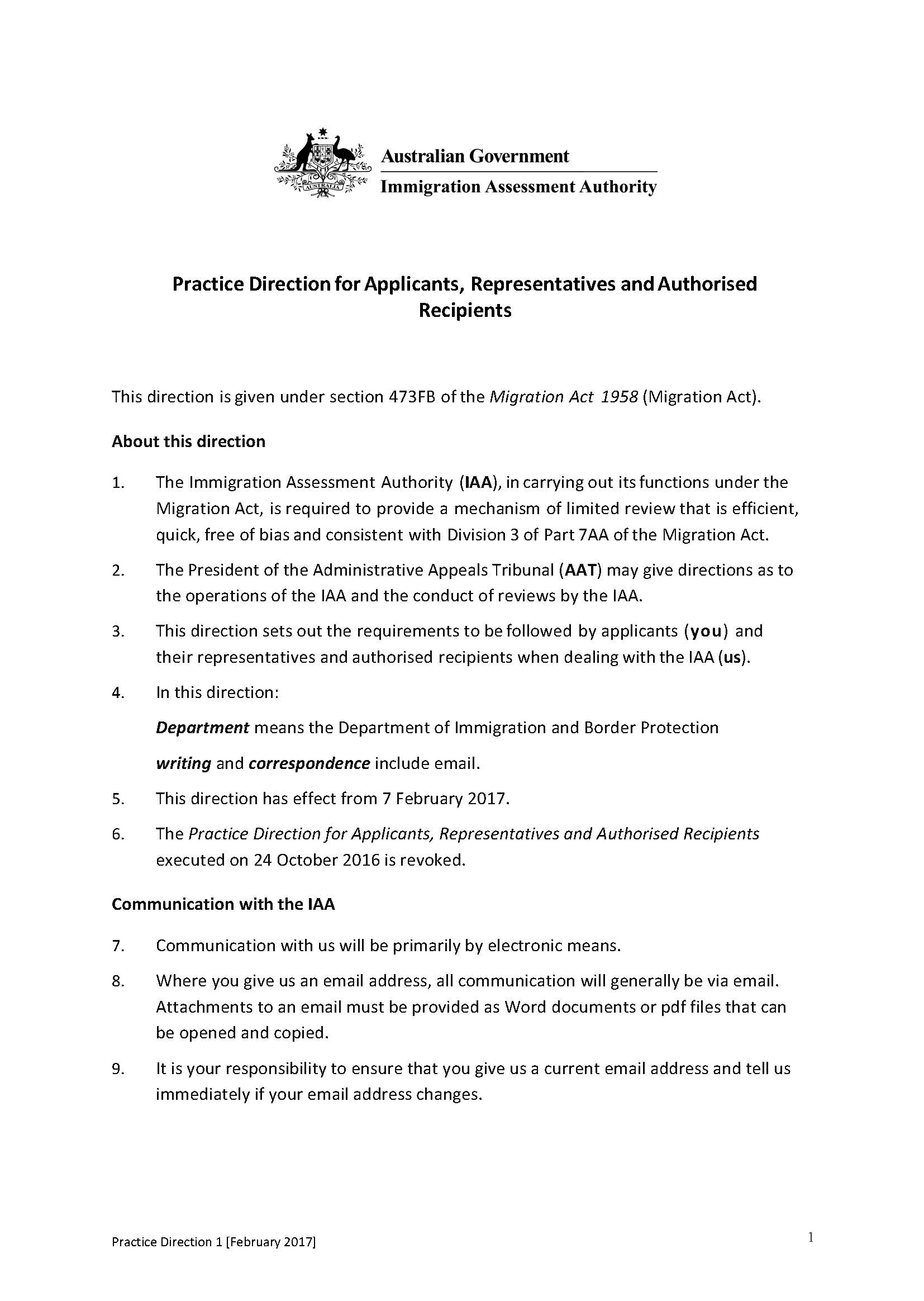
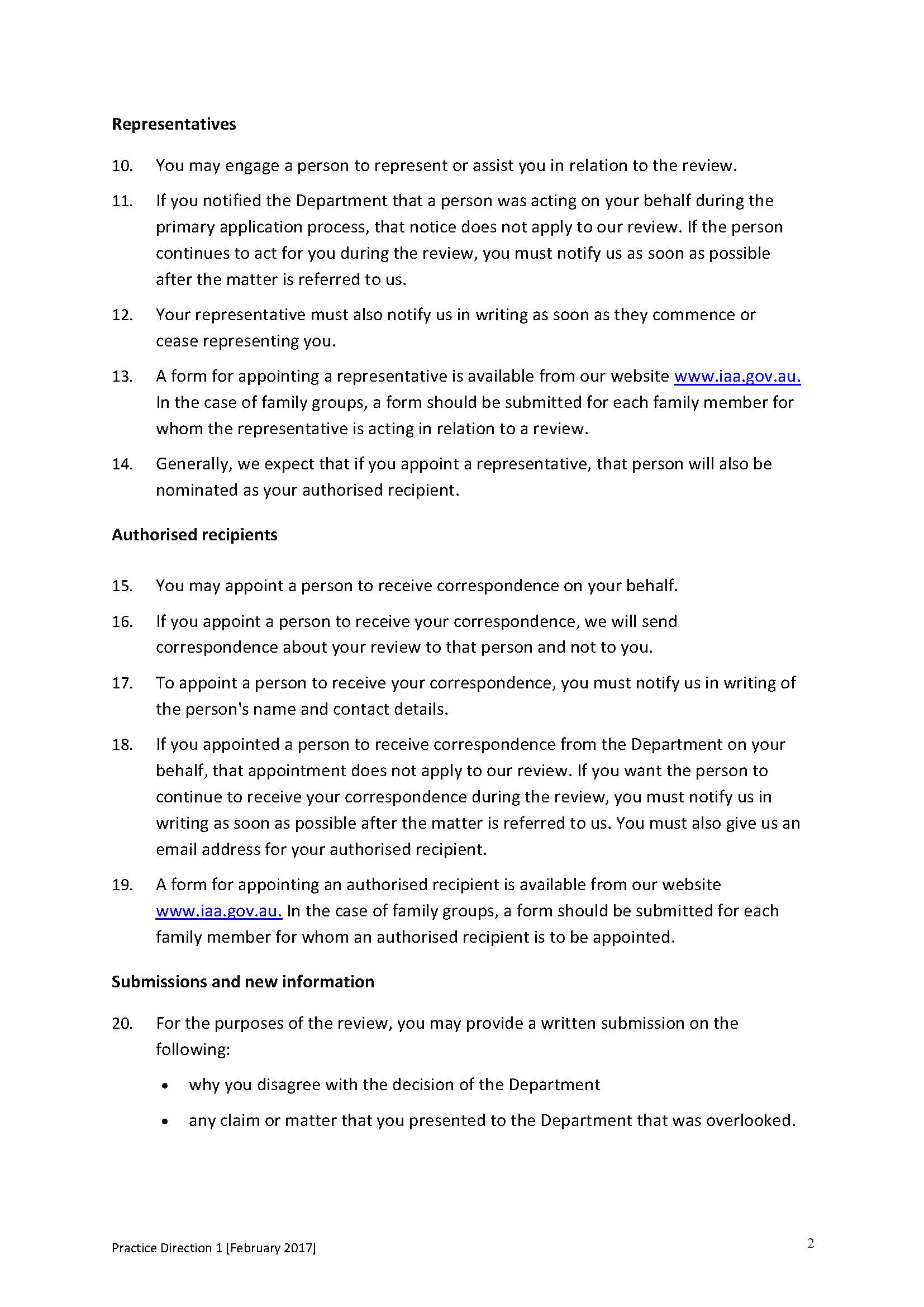
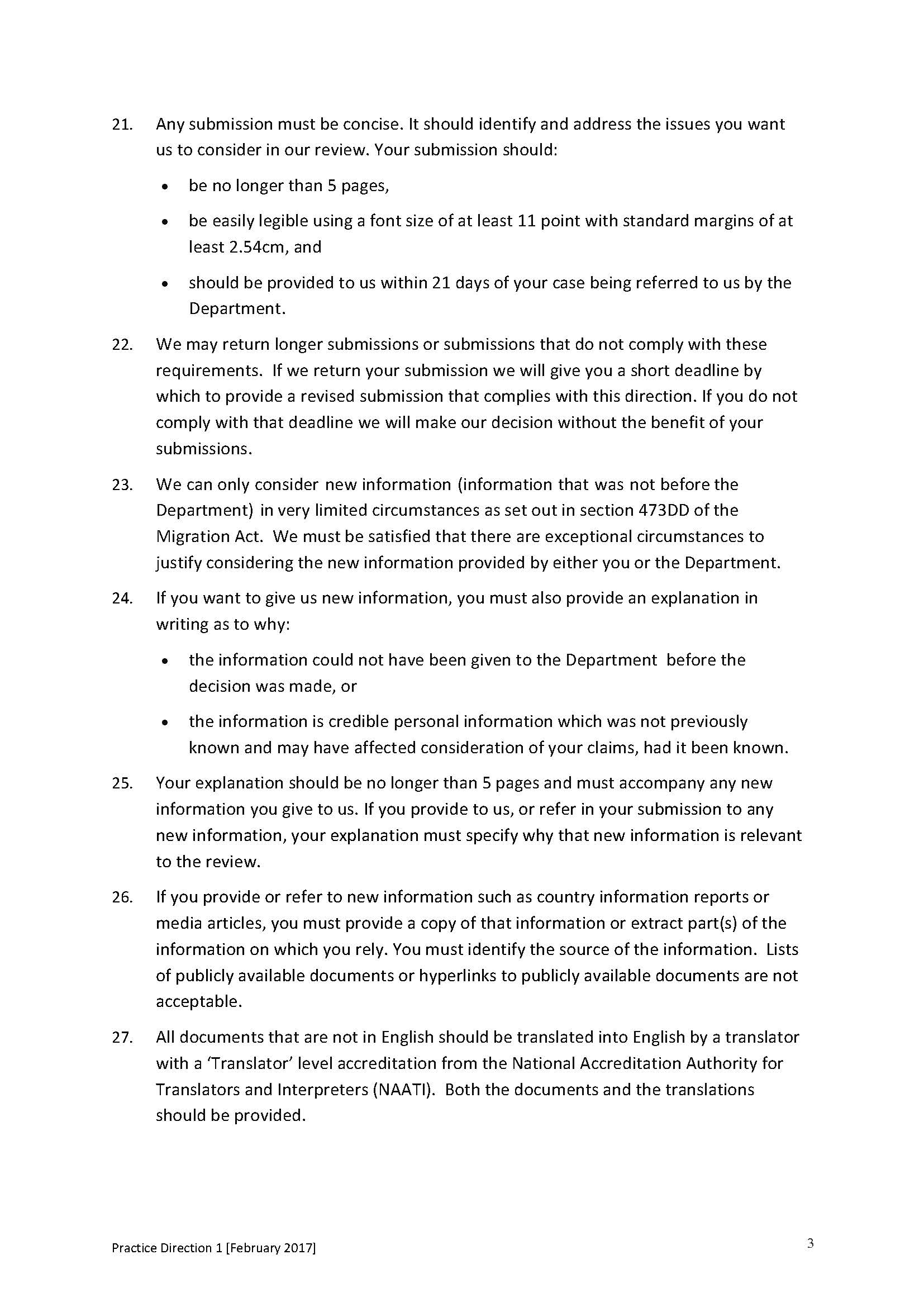
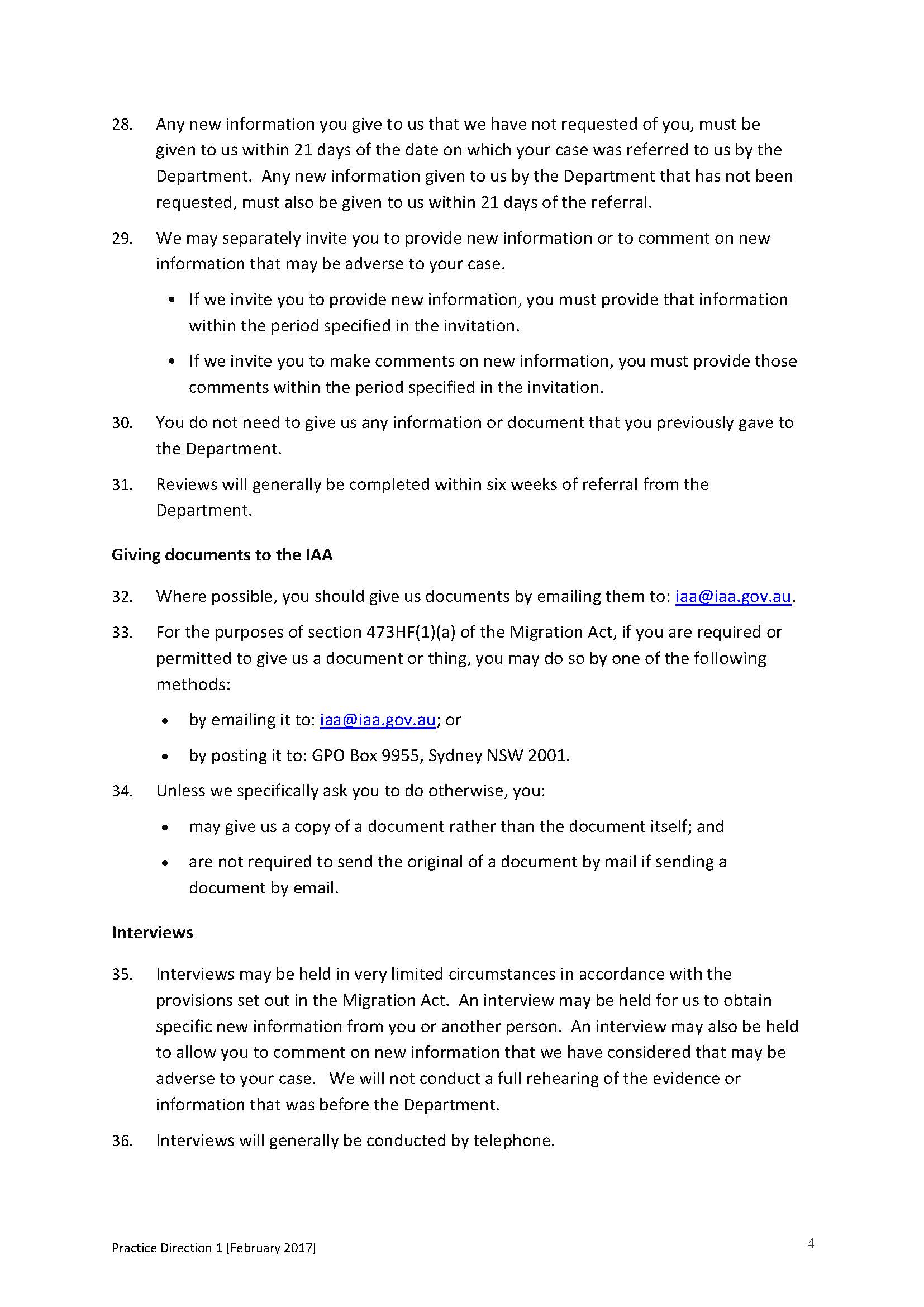
15 On 21 July 2016, the Authority sent to the appellant an acknowledgement of referral enclosing information about the Authority and the Authority’s “Practice Direction for Appellants, Representatives and Authorised Recipients”. A copy of the Practice Direction is attached to these reasons.
16 The Practice Direction reflects the scheme of Pt 7AA, the simplified outline of which appears in s 473BA as follows:
This Part provides a limited form of review of certain decisions (fast track decisions) to refuse protection visas to some applicants, including unauthorised maritime arrivals who entered Australia on or after 13 August 2012, but before 1 January 2014, and who have not been taken to a regional processing country. These applicants are known as fast track review applicants and decisions to refuse to grant them protection visas are known as fast track reviewable decisions.
Fast track decisions made in relation to some applicants are excluded from the fast track review process. These applicants are known as excluded fast track review applicants.
Fast track review applicants and excluded fast track review applicants are collectively known as fast track applicants.
Fast track reviewable decisions must be referred by the Minister to the Immigration Assessment Authority as soon as reasonably practicable after a decision is made. A person cannot make an application for review directly to the Immigration Assessment Authority.
Decisions to refuse to grant protection visas to fast track applicants are generally not otherwise reviewable under this Act, although some decisions are reviewable by the Administrative Appeals Tribunal.
The Immigration Assessment Authority consists of the President of the Administrative Appeals Tribunal, the head of the Migration and Refugee Division of the Tribunal, the Senior Reviewer and other Reviewers. The President and that Division head are responsible for the overall administration and operation of the Immigration Assessment Authority. The Senior Reviewer is appointed by the President or that Division head. The Senior Reviewers and other Reviewers are engaged under the Public Service Act 1999.
In reviewing fast track reviewable decisions, the Immigration Assessment Authority is required to pursue the objective of providing a mechanism of limited review that is efficient, quick, free of bias and consistent with Division 3 (conduct of review).
The Immigration Assessment Authority does not hold hearings and is required to review decisions on the papers that are provided to it when decisions are referred to it. However, in exceptional circumstances the Immigration Assessment Authority may consider new material and may invite referred applicants to provide, or comment on, new information at an interview or in writing.
The Immigration Assessment Authority may affirm a referred decision or may remit the decision for reconsideration in accordance with directions.
The Immigration Assessment Authority may give directions restricting the disclosure of information. There are also specific requirements for the giving and receiving of documents.
17 On 8 August 2016, the appellant provided a statement and documents to the Authority in accordance with the Practice Direction.
18 On 22 September 2016, the Authority affirmed the delegate’s decision not to grant the appellant a SHEV.
19 The appellant was notified of the Authority’s decision on 22 September 2016, and provided with a copy of the decision and a fact sheet about the Authority’s decision.
20 So far as the Authority’s decision is concerned, this too has been accurately and concisely outlined by the primary judge, to the following effect.
21 The Authority noted that it had regard to the material referred by the Secretary under s 473CB of the Migration Act and the statement and documents provided by the appellant on 9 August 2016.
22 The Authority expressed doubts as to the appellant’s credibility based on inconsistencies in the evidence he provided to the Department at his entry and identity interviews, his written statements and submissions, and in his SHEV interview.
23 The Authority:
was willing to accept that the appellant was a member of the Bangladesh Nationalist Pty (BNP) and opposed to the AL and that his involvement amounted to putting up posters at election time, arranging seating and serving refreshments at meetings, but was not willing to accept that the appellant’s involvement went beyond this or that he could be described as a political leader or organiser of BNP meetings;
accepted that the appellant’s father unsuccessfully stood as a candidate for the BNP in 1983 for the office of local union chairman and that the appellant’s brother has been president of the Sadekpur Union Jatiyatabadi Chhatra Dal;
was willing to accept that upon return to Bangladesh, the appellant may again become involved in low level political activities such as putting up posters at election time and arranging seating and serving refreshments at meetings;
did not accept that the appellant or his family had been the targets of acts of violence or extortion perpetrated by a gang (Mr A gang) or the AL, nor that the appellant or his family had been involved in acts of violence against the AL;
did not accept that the appellant was ever accused of murder;
accepted that the appellant departed Bangladesh illegally in mid-2012 and that he was smuggled to Malaysia without a passport; and
accepted that in February 2014, a report was released on the Department’s website which enabled access to the personal details of persons who were held in immigration detention on 31 January 2014, and that the appellant was one of those persons.
24 Based on these findings of fact, and country information in relation to Bangladesh, the Authority:
(1) was not satisfied that there was a real chance that the appellant would be targeted for extortion demands upon his return to Bangladesh for reasons of his being a member of the BNP, or more generally;
(2) was not satisfied that there was a real chance that the appellant would be prevented from attending and assisting at BNP meetings, or putting up posters at election time in his home area in the future;
(3) was not satisfied that the appellant would face a real chance of harm of any other kind for reason of his BNP membership;
(4) was not satisfied that there was a real chance the appellant would be harmed for reason of his being a low level BNP member who is also a family member of two local BNP leaders;
(5) was not satisfied that the appellant would be harmed by AL supporters or associated criminal groups, or by the Bangladesh authorities, if he returned to his home area in Bangladesh;
(6) accepted that the appellant would be returning to Bangladesh as a person who departed illegally and that the Bangladesh authorities would be aware of this if he returned, and that the Bangladesh authorities may be able to infer, as a consequence of the 2014 data breach and possible involuntary removal, that the appellant sought asylum in Australia;
(7) did not accept that the appellant was wanted by the Bangladesh authorities for murder or in any other regard;
(8) was not satisfied that there was a real chance that the appellant would, upon return to Bangladesh, be imputed to be in conflict with the authorities in Bangladesh or that he would be harmed on this basis and/or for reason of his having departed illegally or as a consequence of, or in addition to, his having sought asylum in Australia or his details being released as part of the 2014 data breach, or because of his association with the BNP;
(9) was not satisfied that the appellant would be harmed by non-state actors for having travelled to a western country to seek asylum or for a reason associated with the data breach, or any other reason;
(10) was not satisfied that there was a real chance that the appellant would suffer beatings, intimidation, extortion threats or any other kind of perpetrated harm upon return to Bangladesh, and therefore was not satisfied that there was a real chance that the appellant would live in constant fear and anxiety if returned to Bangladesh or that he would suffer mental harm of any other kind;
(11) having considered the appellant’s profile as a whole, was not satisfied that there was a real chance that the appellant would suffer harm of any kind if returned to Bangladesh; and
(12) considered the complementary protection provisions and was not satisfied that there was a real risk that the appellant would suffer harm of any kind if he returned to Bangladesh, and was therefore not satisfied that there was a real risk that he would suffer significant harm if he returned to Bangladesh.
25 In accordance with those findings, the Authority concluded that the applicant did not meet the requirements of the definition of refugee in s 5H(1) of the Migration Act and so did not meet s 36(2)(a), and also that he did not meet s 36(2)(aa).
Judicial review in the Federal Circuit Court
26 The appellant then sought judicial review of the Authority’s decision in the Federal Circuit Court, on 18 October 2016, on the following grounds:
1. The Second Respondent constructively failed to review the First Respondent’s decision, denied the Applicant procedural fairness in its failure to sufficiently raise critical matters with the applicant and/or extend to him a real opportunity to reply to adverse information.
2. The Second Respondent denied the Applicant procedural fairness and/or made an error of law because the applicant’s credibility was an important factor in the Second Respondent’s decision that he was not a refugee, and an oral interview can give insight into a person’s credibility that is otherwise unavailable. By refusing to schedule an oral interview with the Applicant, the Second Respondent fell into error/denied the Applicant procedural fairness.
27 The primary judge dismissed the application, giving reasons for judgment.
28 Of those grounds, the primary judge noted that they were in “template form”, that is to say, they were in a form with which the Court was familiar on the basis that they had been articulated in that form in other judicial review proceedings in that Court.
29 The judge helpfully explained how the Fast Track Review Process (FTRP) was introduced by the Migration and Maritime Powers Legislation Amendment (Resolving the Asylum Legacy Caseload) Act 2014 (Cth) and how, under it, the appellant became a “fast track review applicant”.
30 The judge observed how various divisions and provisions of the Migration Act established the Authority and the process by which it makes a decision.
31 As to ground 1 of the application before him, the judge noted that the Authority had rejected the appellant’s claims on the basis of his inconsistent statements to the Department and contradictions in his evidence.
32 Having observed that the appellant had misunderstood the statutory framework in Pt 7AA of the Migration Act, the judge said that the appellant had not identified any power of the Authority by which it could have identified “critical matters” to him. The primary judge said that s 473DA(2) of the Migration Act made it clear that nothing in Pt 7AA required the Authority to give the appellant material that was before the delegate at the time the delegate made a decision.
33 The primary judge said that, to the extent that ground 1 could be read as alleging that the Authority denied procedural fairness by not inviting the appellant to give new information at an oral interview or in writing, the allegation failed because, under s 473DC(2), the Authority had no duty to do so in any circumstances.
34 The primary judge added that the appellant’s inconsistent statements were put to him at the delegate interview on 28 April 2016, and his representative addressed the issue of his credibility in a subsequent written submission to the delegate.
35 The judge also noted that the protection visa assessment set out the delegate’s concerns with the inconsistent information provided by the appellant in his entry interview and in his SHEV application and interview, and so plainly the appellant was on notice of “critical matters” relevant to the Authority’s review.
36 The primary judge also said the appellant was sent an acknowledgement letter by the Authority which attached a fact sheet advising he could make a submission to the Authority and why he disagreed with the delegate’s decision. It was translated into Bengali. The appellant had the opportunity to provide “new information”, and while he did make submissions, he did not provide any new information.
37 The primary judge said that, in circumstances where the Authority did not need to consider any new information, there was no obligation on the Authority to put the particulars of any information to him for comment. In any event, the judge said, under s 473DA(2) the Authority was not obliged to give the appellant any information that was before the delegate.
38 Finally, the judge said that the codification of natural justice by s 473DA(1) of the Migration Act was apparently complete and exhaustive and there was nothing to suggest the Authority failed to comply with its obligations as contained in that part of the Migration Act.
39 As a result, the judge found ground 1 was not made out.
40 As to ground 2, which alleged that an interview with the Authority was required when an appellant’s credibility was in issue, the judge said that this allegation was misconceived and the appellant misunderstood the statutory framework within which reviews are conducted by the Authority.
41 In particular, the judge said that it was clear from the legislation inserting Pt 7AA that the Parliament did not intend that an appellant would generally be entitled to attend an interview before the Authority, even where it rejects the credibility of the claim made.
42 The judge said he had accepted a similar submission made on behalf of the Minister in relation to an identical ground to ground 2 in DCG16 v Minister for Immigration & Anor [2017] FCCA 285 at [35] and [36].
43 He noted that, although the delegate had concerns about the credibility of the appellant’s extortion claims, she was willing to accept those claims, while the Authority’s assessor did not accept the claim.
44 Finally, the primary judge said there was no equivalent of s 425 of the Migration Act in Div 3 of Pt 7AA or in s 473GA or s 473GB of the Migration Act, and so it appeared that the requirements of natural justice identified in cases such as SZBEL v Minister for Immigration and Multicultural and Indigenous Affairs (2006) 228 CLR 152; [2006] HCA 63 did not apply. In that regard, the judge also relied on AMA16 v Minister for Immigration & Ors [2017] FCCA 303, which his Honour considered to state the function of Pt 7AA correctly.
45 Accordingly, the judge found the second ground was not made out.
Appeal to this Court
46 The appellant now seeks to appeal from the whole of the judgment of the Federal Circuit Court on the following two grounds, both of which on their face are different from those raised in the Court below:
1. The Authority failed to adequately consider the applicant’s claim for Complimentary Protection as is required by law as in case SZQRB. Complimentary Protection eligibility was assessed by the Authority at paragraphs 25-28. As per SZQRB the Authority is meant to examine each of the reasons the applicant fears harm and assess them in relation to Complimentary Protection. In the Applicant’s case the Authority failed to specifically examine any of the reasons or assess any of the applicant’s personal characteristics thus denying him natural justice.
2. The Authority at Paragraph 17 of the IAA decision does not accept claims made by the applicant which were accepted by the Delegate at paragraph 64 of the SHEV application decision and which are supported by DFAT Country Information which was before the Authority, thus denying the applicant natural justice.
47 The appellant did not file any written submissions prior to the hearing of the appeal. However, at the hearing of the appeal he made brief oral submissions to the effect that he was not believed in the Authority decision and would face harm if he had to return to Bangladesh.
48 The Minister filed an outline of submissions in which he summarised the issues on appeal as:
(1) Whether the appellant should be granted leave to raise grounds of appeal which were not raised before the Federal Circuit Court.
(2) If so, whether the Authority failed to adequately consider the appellant’s claims for complementary protection by failing to specifically examine any of the reasons or assess any of the appellant’s personal characteristics.
(3) If so, whether the Authority denied the appellant natural justice by rejecting claims made by the appellant which were accepted by the delegate.
49 Plainly, the two grounds the appellant raises were not raised in the Court below. The appellant may only rely on them with the leave of the Court. Leave will only be granted where it is expedient in the interests of justice that leave be granted. See MZYPO v Minister for Immigration and Citizenship [2013] FCAFC 1 at [61], [101]; VUAX v Minister for Immigration and Multicultural and Indigenous Affairs (2004) 238 FCR 588; [2004] FCAFC 158 at [46][48].
50 Ordinarily, leave will be refused in the absence of an adequate explanation for the failure to raise the proposed ground in the Court below and where the proposed new ground is of doubtful merit. See APR15 v Minister for Immigration and Border Protection [2017] FCA 713 at [10].
51 Here, the appellant has not proffered any explanation as to why they were not raised in the Federal Circuit Court. Perhaps more significantly, the proposed grounds are also of doubtful merit.
52 As to the appellant’s first proposed ground of appeal, as the Minister submits, while it refers to a denial of natural justice, it is perhaps better understood as alleging a failure of the Authority to consider all claims made by the appellant.
53 The Minister acknowledges that the Authority did not separately refer to each of the appellant’s claims in its discussion of complementary protection provisions. Rather, the Authority referred back to its findings in relation to whether the appellant met the criteria in s 36(2)(a) and, in particular, its finding that the appellant would not suffer any harm if returned to Bangladesh. The Authority said, at [27] of its reasons:
I am not satisfied that there is a real chance that the applicant would suffer harm of any kind if he returned to Bangladesh. As ‘real chance’ and ‘real risk’ involve the same standard, I am therefore not satisfied that there is a real risk the applicant would suffer harm of any kind if he returned to Bangladesh. I am therefore not satisfied there is a real risk that the applicant would suffer significant harm if he returned to Bangladesh.
54 I accept the submission that it is open to a decision-maker to rely on factual findings made in the context of assessing Convention claims (or claims made for the purposes of s 36(2)(a) of the Act) for the purposes of making complementary protection findings, where the same facts and circumstances are relied upon by an applicant for both complementary protection and Convention claims. See MZYXS v Minister for Immigration and Citizenship [2013] FCA 614 at [31]. As a result, [27] of the Authority’s reasons should be read in the context of the following factual findings made by the Authority:
(1) the appellant was never accused of murder ([12] of its reasons);
(2) the appellant is a member of the BNP and opposed to the AL, and may again engage in low level political activities for the BNP, but he will not face any harm on this basis ([17], [18] of its reasons);
(3) the appellant had not been a victim of extortion demands from the AL in the past and there is not a real chance he will be targeted for extortion demands in the future, by reason of being a member of the BNP or more generally (17] of its reasons);
(4) the appellant and his family were not previously harmed or threatened by an AL backed gang, referred to by the Authority as the Mr A gang, and he would not be harmed by AL supporters or associated criminal groups if he were to return to Bangladesh ([18] of its reasons);
(5) the appellant will be returning to Bangladesh as a person who departed illegally, and the authorities will be aware of this, and may be aware from the data breach that the appellant was in detention and may infer that he sought asylum in Australia, but there is not a real chance that the appellant would be imputed to be in conflict with the authorities in Bangladesh or be harmed on this basis and/or for reason of his illegal departure, having sought asylum in Australia or for having his personal information released in the data breach ([19]-[22] of its reasons);
(6) there is not a real chance that the appellant would suffer beating, intimidation, extortion threats or any other kind of perpetrated harm if he returned to Bangladesh ([23] of its reasons); and
(7) there is not a real chance that the appellant would suffer harm of any kind if he were returned to Bangladesh ([23] of its reasons).
55 It is quite clear, in my view, that the Authority considered each of the appellant’s claims for protection under s 36(2)(a) of the Migration Act and found that there was not a real chance that the appellant would suffer any harm, let alone serious harm. The appellant did not make any claims for the purposes of complementary protection additional to those that he made for the purposes of s 36(2)(a). Based on the Authority’s findings of fact just referred to, and in the absence of any further claims relating only to complementary protection, there was no basis on which the Authority could have found that there were substantial grounds for believing that, as a necessary and foreseeable consequence of the appellant being returned to Bangladesh, there was a real risk that he would suffer significant harm.
56 In these circumstances, jurisdictional error is not indicated in circumstances where the Authority simply relied on its earlier findings of facts, rather than again setting out each of the appellant’s claims under the heading of “Complementary protection” and explaining why it was not satisfied that the appellant will face a real risk of significant harm in relation to each individual claim.
57 Nor is jurisdictional error indicated by the Authority’s approach to assessing whether the appellant met the complementary protections provisions.
58 As to the appellant’s second proposed ground of appeal, the delegate, at [64], accepted, despite concerns with the appellant’s credibility, that the appellant may have been extorted whilst working at his business; was beaten when he refused to pay the extortion money; and his shop was looted and torched. The Authority, at [17], found that the appellant had not been the victim of past extortion.
59 I accept the Minister’s submissions that no denial of natural justice arises from the mere fact that the Authority made different findings to those findings made by the delegate on the limited merits review system available under the fast track scheme. The Pt 7AA merits review system appears to operate on the understanding that the reviewer reconsiders all facts and so may make factual findings different to those of the original decision-maker. There is nothing in Pt 7AA of the Migration Act that suggests that the Authority is unable to make findings adverse to an applicant where the delegate made a finding favourable to the applicant in relation to the same issue. In this regard, there is force in the Minister’s submission that the principles in SZBEL v Minister for Immigration (2006) 228 CLR 152; [2006] HCA 63 do not apply to reviews under Pt 7AA of the Migration Act. I note, without needing to interrogate the proposition further, that the Federal Circuit Court has accepted the proposition in such decisions as DZU16 v Minister for Immigration & Anor [2017] FCCA 851 at [101]; AFK16 v Minister for Immigration & Anor [2016] FCCA 1826 at [11]-[12]).
60 Even if the Court were to read this ground as making the broader approach that the appellant was denied natural justice, because of the decision-making process adopted by the Authority in making a different finding of fact to that made by the delegate, there is difficulty with this proposition too. This is because the decision was made in accordance with Pt 7AA of the Migration Act. The key features of Pt 7AA have been outlined above and are set out in appropriate detail in the primary reasons of the judge at [31]-[46], as follows (footnotes omitted):
31. The Fast Track Review Process (FTRP) was introduced by the Migration and Maritime Powers Legislation Amendment (Resolving the Asylum Legacy Caseload) Act 2014 (Cth). The aim of the FTRP is to provide a limited, efficient and quick form of review of certain decisions refusing protection visas some applicants, including those who arrived in Australia as unauthorised maritime arrivals on or after 13 August 2012 and before 1 January 2014. Such a reviewable decision is known as ‘fast track reviewable decision’. A protection visa applicant whose visa refusal decision is subject to the FTRP is known as a ‘fast track review applicant’.
32. The applicant is a ‘fast track applicant’ as defined in s.5(1), as he arrived in Australia on 2 January 2013, the Minister exercised his discretion under s.46A(2) to lift the bar in s.46A(1), and the applicant lodged a valid application for a SHEV.
33. Pursuant to s.5(1) of the Migration Act, a person is a ‘fast track review applicant’ if he or she is a fast track applicant who is not an ‘excluded fast track review applicant’. The applicant is a fast track review applicant as he is a fast track applicant who is not an excluded fast track review applicant.
34. Subject to certain exceptions which are not relevant for present purposes, a ‘fast track decision’ is defined in s.5(1) as a decision to refuse to grant a protection visa to a fast track applicant. Accordingly, the delegate’s decision on 20 July 2016 to refuse to grant a protection visa to the applicant was a fast track decision, and therefore was also a fast track reviewable decision in accordance with paragraph (a) of the definition in s. 473BB.
35. Part 7AA of the Migration Act establishes a comprehensive scheme of review of fast track reviewable decisions.
36. Division 8 of Part 7AA establishes the Authority, the body conducting reviews of fast track reviewable decisions.
37. Division 2 of Part 7AA sets out the procedure for referring fast track reviewable decisions to the Authority. Under s.473CA, the Minister must refer a ‘fast track reviewable decision’ to the Authority as soon as reasonably practicable after the decision is made.
38. Once the Minister has referred a fast track reviewable decision to the Authority, s.473CB requires the Secretary of the Department to give to the Authority certain material in respect of that decision at the same time as, or as soon as reasonably practicable after, such referral, namely:
a) a statement that sets out the findings of fact made by the decision-maker, refers to the evidence on which those findings were based, and gives the reasons for the decision;
b) material provided by the ‘referred applicant’ (defined in s.473BB as an applicant for a protection visa in respect of whom a fast track reviewable decision is referred under s.473CA) to the decision-maker before the decision was made;
c) any other material that is in the Secretary’s possession or control and is considered by the Secretary (at the time the decision is referred to the Authority) to be relevant to the review; and
d) the applicant’s contact details.
39. Subsection 473CC(1) requires the Authority to review a fast track reviewable decision referred to it. Subsection 473CC(2) provides that the Authority may either affirm the decision, or remit the decision for reconsideration in accordance with such directions or recommendations as are permitted by regulation.
40. Division 3 of Part 7AA deals with the manner in which reviews are to be conducted by the Authority.
41. Subsection 473DA(1) provides that Division 3 of Part 7AA, together with ss.473GA and 473GB, is taken to be an exhaustive statement of the requirements of the natural justice hearing rule ‘in relation to reviews conducted by the [Authority]’. This provision is couched in broader terms than ss.357A(1) and 422B(1) and has been found to operate to exclude the common law natural justice hearing rule from conditioning the conduct of reviews before the Authority.
42. Subsection 473DB(1) compels the Authority, subject to Part 7AA, to review a fast track reviewable decision referred to it on the papers, that is, by considering the review material provided to the Authority under s.473CB ‘without accepting or requesting new information’ and ‘without interviewing the referred applicant’.
43. However, s.473DC(1) permits the Authority, subject to Part 7AA, to ‘get any documents or information (new information)’ that ‘were not before the Minister when the Minister made the decision under section 65’ and ‘the [Authority] considers may be relevant’. Subsection (2) confirms the discretionary nature of the power in s.473DC(1) by providing that the Authority ‘does not have a duty to get, request or accept any new information whether the [Authority] is requested to do so by a referred applicant or by any other person, or in any other circumstances.’
44. Further, new information can only be considered by the Authority if the requirements of s.473DD are satisfied. Section 473DD provides that, for the purposes of making a decision in relation to a fast track reviewable decision, the Authority must not consider any new information unless:
(a) the [Authority] is satisfied that there are exceptional circumstances to justify considering the new information; and
(b) the referred applicant satisfies the [Authority] that, in relation to any new information given, or proposed to be given, to the [Authority] by the referred applicant, the new information:
(i) was not, and could not have been, provided to the Minister before the Minister made the decision under s 65; or
(ii) is credible personal information which was not previously known and, had it been known, may have affected the consideration of the referred applicant’s claims.
45. Subsection 473DE(1) imposes certain disclosure obligations on the Authority not dissimilar to those imposed on the AAT by ss.359A and 424A of the Migration Act.
46. Division 5 of Part 7AA contains provisions relating to the exercise of powers and functions by the Authority. Subsection 473FA(1) provides that the Authority, in carrying out its functions under the Migration Act, is to pursue the objective of ‘providing a mechanism of limited review that is efficient, quick, free of bias and consistent with Division 3 (conduct of review).’ This reinforces the legislature’s aim of establishing a form of review that is limited in scope and efficient. Subsection 473FA(2) provides that, in reviewing a decision, the Authority ‘is not bound by technicalities, legal forms or rules of evidence.’
61 The burden of this scheme and these provisions is that the Authority was under no obligation to offer the appellant an interview or invite him to comment prior to making an adverse finding. It might be said that this is part of the nature of the fast track system as envisaged by Pt 7AA.
62 Section 473DA(1) of the Migration Act makes clear that Div 3 of Pt 7AA, together with s 473GA and s 473GB, is an exhaustive statement of the natural justice hearing rule in relation to reviews by the Authority. The provision may be contrasted with s 422B(1), which deals with reviews by the Administrative Appeals Tribunal under Pt 7 of the Migration Act. Section 422B(1) provides that Div 4 of Pt 7 is an exhaustive statement of the natural justice hearing rule “in relation to the matters it deals with”, suggesting that there is still some scope for the operation of common law principles of natural justice that are able to operate consistently with the provisions in Div 4 of Pt 7. See Saeed v Minister for Immigration and Citizenship (2010) 241 CLR 252; [2010] HCA 23. Markedly, s 473DA(1) is not qualified in this manner.
63 There is also no equivalent to s 424A of the Migration Act in Pt 7AA, consequently, the Authority appears not to be required to give to the appellant particulars of any information that the Authority considers would be the reason, or a part of the reason, for affirming the decision under review.
64 Finally, the Authority is required, subject to Pt 7AA, to conduct the review without accepting new information (as defined) and without inviting a referred applicant to attend an interview: s 473DB(1). The Authority is only permitted to consider new information where there are exceptional circumstances to justify considering new information and, in cases where the new information is to be given by a referred applicant, the information was not and could not have been provided to the Minister, or is credible personal information which was not previously known and, had it been known, may have affected consideration of the claims: s 473DD. Although, if exceptional circumstances exist, it is permissible for the Authority to take into account new information provided by an applicant, s 473DC(2) makes it clear that the Authority is not burdened with a duty to get, request or accept any new information.
65 Consequently, it would seem to follow that there was no obligation on the Authority to give any notice to the appellant that it may find that he had not been the victim of past extortion and to invite him to comment on this possibility, either in writing or at an interview. Of course, good and reliable decision-making might be enhanced if a decision-maker adopted this course and sought comment. Its ability to do so will, however, be governed by the constraints imposed by s 473DC and s 473DD. But on the facts of this case, there is no basis to conclude that the Authority failed to exercise the decision-making task entrusted to it by the Act, and thereby committed a jurisdictional error.
66 The Minister notes that the appellant raised a ground in the Court below to the effect that the Authority committed jurisdictional error by failing to afford him an oral interview where credibility was in issue. To the extent that that ground overlaps with the present ground 2, I consider there is no identifiable error in the reasoning of the primary judge at [58]-[63] of his reasons.
67 Thus, each of the proposed grounds lacks merit and leave to raise them should be refused.
68 For these reasons the appeal should be dismissed with costs.
I certify that the preceding sixty-eight (68) numbered paragraphs are a true copy of the Reasons for Judgment herein of the Honourable Justice Barker. |
Associate:
ANNEXURE A