

FEDERAL COURT OF AUSTRALIA
Table of Corrections | |
In the quoted portions of the judgment in [18] through to [24], excluding [21(a)], where the words “Mr Nyonis” appear, they have been replaced with the words “the Applicants”. | |
23 October 2017 | In the quoted portion of the judgment in [21(a)] following the word “have” and following the words “each of”, the words “Mr Nyoni” have been replaced with the words “the Applicants”. |
ORDERS
Applicant | ||
AND: | First Respondent THERESA BEECH Second Respondent CHIEF EXECUTIVE OFFICER OF THE DEPARTMENT OF HEALTH WA Third Respondent | |
DATE OF ORDER: |
THE COURT ORDERS THAT:
1. The application for extension of time to appeal be dismissed.
2. The applicant pay the respondents’ costs, to be assessed if not agreed.
Note: Entry of orders is dealt with in Rule 39.32 of the Federal Court Rules 2011.
BARKER J:
1 At various times since 2010, Mr Emson Nyoni has been engaged in litigation with the Shire of Kellerberrin and certain of its representatives, and the Department of Health of Western Australia and certain of its representatives.
2 As a result of costs orders made against him in favour of the respondents to this proceeding, along the way, Mr Nyoni was the subject of a sequestration order by the Federal Circuit Court of Australia on 17 February 2017 and so became a bankrupt. See Murphy v Nyoni [2017] FCCA 143. The order was made on the application of the present respondents. Mr Nyoni now seeks to appeal from that order.
Background
3 Something of the background to the dispute involving Mr Nyoni and the present respondents can be gleaned from the introduction to the reasons for judgment of North and Rares JJ in the recent decision of the Full Court of this Court in Nyoni v Shire of Kellerberrin [2017] FCAFC 59, at [1]-[4]:
1 Emson Nyoni (the appellant) was a pharmacist. He had migrated to Australia from Zimbabwe. In 2003, he bought and then operated, until early 2013, the only pharmacy in Kellerberrin, Western Australia. Mr Nyoni brought proceedings against the Shire of Kellerberrin (the first respondent), two of its successive chief executive officers, Frank Peczka and Darren Friend (the fourth and second respondents), its President, Stan McDonnell (the third respondent) and an electrical contractor, Peter Mitchell (the fifth respondent).
2 The primary judge, in a careful and thorough judgment, dealt with the five substantive causes of action on which Mr Nyoni relied. Those were claims that:
(a) Mr Peczka and the Shire acted in concert with Robert Bateman, a senior investigating officer of the Health Department, in trespassing upon Mr Nyoni’s pharmacy property in October 2007 (the 2007 trespass claim);
(b) the Shire, by one or more of its agents or officers, had made disparaging statements about Mr Nyoni’s business and, thereby, engaged in misleading or deceptive conduct and/or malicious falsehood (the false statements claim);
(c) the Shire, Mr Friend and Mr McDonnell were liable as joint tortfeasors with Mr Mitchell in trespassing upon Mr Nyoni’s property in the course of disconnecting the electricity supply to Mr Nyoni’s pharmacy in March 2010 and in October 2010 (the 2010 trespass claim);
(d) the conduct of Mr Friend and Mr McDonnell in relation to the disconnection of the electricity supply to Mr Nyoni’s pharmacy on 14 October 2010, amounted to misfeasance in public office (the misfeasance claim); and
(e) the Shire engaged in misleading or deceptive conduct by publishing the minutes of a Shire Council meeting which disparaged Mr Nyoni’s pharmacy business (the minutes claim).
3 The primary judge found in Mr Nyoni’s favour on one aspect of the 2010 trespass claim. He held that Mr Mitchell had committed a trespass at the pharmacy on 14 October 2010 when he intentionally entered and remained on the premises without consent of owner or lawful authority and, in the course of which, he disconnected the electricity without any lawful basis to do so. His Honour awarded Mr Nyoni $12,000 in damages against Mr Mitchell, that included $4,000 in aggravated damages, and ordered Mr Mitchell to pay Mr Nyoni’s costs in relation to the issues between them.
4 However, his Honour dismissed with costs all of Mr Nyoni’s claims against the Shire and Messrs Peczka, Friend and McDonnell, including the balance of the 2010 trespass claim.
Recently partially succesSful appeal
4 In that appeal, Mr Nyoni’s appeal was allowed, in part, by the majority (Dowsett J dissenting) when the Court upheld the claim of Mr Nyoni for damages on the misfeasance claim and remitted the assessment of damages in respect of that tort, and any question of costs in the primary proceeding, to the primary judge in that proceeding. Otherwise the appeal was dismissed with costs. The Court ordered that the Shire and Mr Darren Friend pay 50% of Mr Nyoni’s costs, if any, of the appeal in respect of the grounds of the appeal against the Shire and Mr Friend.
5 That appeal did not, however, involve the present respondents.
6 The Full Court decision is now the subject of an application for special leave to appeal to the High Court of Australia by the unsuccessful respondents to it.
Earlier costs order
7 In another, earlier proceeding in this Court, WAD154/2013, Mr Nyoni sought relief against some 12 respondents, including the present respondents, the Chief Executive Officer of the Department of Health (as ninth respondent), Ms Jillian (incorrectly referred to as Jullian in previous judgments) Murphy (as tenth respondent) and Ms Theresa Beech (as twelfth respondent).
8 A judge of this Court dismissed the claims against these three respondents (and indeed all respondents), with costs, on the basis that Mr Nyoni had no reasonable prospect of success against any of them. See Nyoni v Chee Koon Hee (No 4) [2013] FCA 948.
9 In a subsequent proceeding, WAD382/2013, Mr Nyoni was ordered to pay the additional costs incurred by the respondents when his application for an extension of time to seek leave to appeal the decision and orders in WAD 154/2013 was refused.
10 When the assessed costs in these two proceedings were then not paid by Mr Nyoni, the present respondents served a bankruptcy notice on him on 17 July 2015. When that was not satisfied, the respondents filed a creditor’s petition under the Bankruptcy Act 1966 (Cth) in the Federal Circuit Court of Australia on 2 February 2016.
The bankruptcy proceeding before the primary judge
11 In that bankruptcy proceeding, the respondents relied on the failure of Mr Nyoni to comply with the bankruptcy notice served on him. The bankruptcy notice specified the non-payment of the initial costs order in the sum of $64,685 in WAD154/2013, as well as the non-payment of the subsequent costs order in the sum of $16,619.50 in WAD382/2013.
12 Having regard to the terms of the Bankruptcy Act, Mr Nyoni committed an act of bankruptcy when he failed to comply with the bankruptcy notice as of 7 August 2015.
13 Mr Nyoni opposed the making of the sequestration order against him and advanced four grounds of opposition.
14 The judge was ultimately satisfied that, first, the requirements for the making of a sequestration order were satisfied.
15 The judge considered, secondly, that Mr Nyoni was not in a position to pay debts owed within a reasonable time. In that regard, he noted that Mr Nyoni had provided no evidence of his cashflow or assets and liabilities. Noting that the costs orders constituted unpaid debts in the total sum of $81,304.50, the judge concluded that Mr Nyoni was not solvent, that he had led no evidence and did not demonstrate means by which he may pay his outstanding debts, either presently or within a reasonable time, by the sale of realisable assets.
16 The judge then considered, thirdly, whether there was other sufficient cause for the sequestration not to be made.
17 Noting that the expression “other sufficient cause” confers an unconfined discretion on the Court for the purposes of dismissing a creditor’s petition, the judge then dealt with the four grounds of opposition advanced by Mr Nyoni. The first ground was that the act of bankruptcy relied upon by the creditors was an abuse of process. Particulars were given. The particulars alleged “collusion” between persons connected with the Shire which had the “express purpose of sabotaging [Mr Nyoni’s] appeal WAD734/2016, as shown by the Orders of the Honourable Justice Mortimer”. I should note here that the appeal in WAD734/2016 is the same appeal, referred to at [3]-[5] above, in which Mr Nyoni was ultimately partially successful before the Full Court.
18 The judge, at [42] of his decision, set out Mr Nyoni’s relevant submissions in support of this first ground:
a) the tort of abuse of process will lie where process of a court has been employed for a purpose other than that for which it was designed, providing that damage has been suffered. Every court has the power to stay proceedings where they amount to an abuse of the court’s process;
b) a person who maintains or supports legal proceedings without any direct interest in them may be liable in damages under the tort of maintenance. Where the maintainer agrees to support proceedings in consideration for a ‘share’ of the decision, this constitutes the tort of champerty. These actions will be defeated if the defendant can establish a common interest sufficient to justify the maintenance;
c) Ms Murphy fabricated criminal charges against Mr Nyoni in 2013. That has led to proceedings P63 of 2015, WAD 347 of 2014 and WAD 734 of 2015 which are still on foot. The chronology of events discloses that the Applicants only applied for a sequestration order to undermine Mr Nyoni’s appeal;
d) in order to succeed in an action for collateral abuse of process it is not necessary to allege or prove that the initial proceeding has terminated in favour of Mr Nyoni, or that there was no reasonable and probable cause for instituting the initial proceeding. It is however essential for Mr Nyoni to show that the Applicants instituted proceedings for a purpose or to effect an object beyond that which the legal process offered. Such a purpose is of crucial importance. It is not sufficient to assert that the proceedings were instituted with an improper motive. The ulterior objective needs to be identified, and it also needs to be able to be seen as the predominant purpose of those proceedings and as outweighing any legitimate purpose that they might otherwise have; and
e) the relevant proceedings in the High Court, Federal Court and the Administrative Appeals Tribunal (‘AAT’) establish that the principles in Williams & Ors v Spautz (1992) 174 CLR 509; (1992) 61 A Crim R 431; (1992) 66 ALJR 585; (1992) 107 ALR 635; (1992) 34 AILR 373 (‘Williams’) are engaged, and that the Applicants are engaged in an abuse of process and the petition ought to be dismissed.
19 Ultimately, after reciting a number of features of the stages of litigation between Mr Nyoni, the Shire, Ms Murphy and others, some of which are referred to above, the judge concluded, at [56]-[58] of his reasons for judgment, as follows:
56. There is nothing in the circumstances in Nyoni (No 7) which provides a relevant point of distinguishment between the matters under consideration in Nyoni (No 7) at [18]-[20] per Mortimer J and presently before this Court. It follows, therefore, that this Court must find that no improper purpose is made out by reason of the particulars to ground 1. The Court further observes that, in any event, the same conclusion would have to have been reached on the facts: the Applicants, to whom Mr Nyoni is indebted in a not inconsiderable sum ($81,304.50), are entitled to present the petition and have it heard in circumstances where the debt arises from costs awarded in proceedings in the Federal Court. Further, there is no evidence (apart from mere assertion by Mr Nyoni) that the Applicants are bringing these proceedings for any purpose other than the legitimate end of obtaining a sequestration order.
57. The assertion by Mr Nyoni that the Ms Murphy fabricated criminal charges against Mr Nyoni in 2013 and that that has led to various proceedings in the High Court and Federal Court does not establish that the present proceedings are being brought for an improper purpose. In any event, the nature of the alleged charges, and how it is that they might establish an improper purpose for the purposes of these proceedings, is not the subject of any evidence in either the First or Second Nyoni affidavits. Thus, no proper factual basis for the assertion has been made out.
58. In all of the above circumstances, the heavy onus to establish abuse of process as the basis for establishing other sufficient cause under s.52(2)(b) of the Bankruptcy Act has not been met by Mr Nyoni in relation to ground 1. Ground 1 is therefore not made out.
20 Ground 2 of Mr Nyoni’s opposition was that he had applied to the High Court, Federal Court and the Administrative Appeals Tribunal to have the judgment debt the subject of the petition set aside and had a defence to the claim made by the creditors such that the petition should be dismissed.
21 The judge noted the submissions that Mr Nyoni made in support of ground 2, as follows:
a) the proceedings in WAD 316 of 2010, WAD 154 of 2013, WAD 382 of 2013, WAD 357 of 2014 and WAD 734 of 2015 have the Applicants inextricably linked to the petition so that it ought to be dismissed on the basis that Mr Nyoni has substantial claims against each of the Applicants in the proceedings referred to;
b) an important distinction is to be made between a cross-claim which is likely to succeed and a cross-claim which is a bona fide and reasonably arguable claim. In the former case, where it is established that the claim is likely to succeed, such a claim may warrant the refusal of a sequestration order: Rigg v Baker [2006] FCAFC 179; (2006) 155 FCR 531; (2006) 236 ALR 629; (2006) 4 ABC(NS) 419 at [66] per French J; Singh v Deputy Commissioner of Taxation [2011] FCA 889 (‘Singh’) at [14] per Collier J; and
c) where it is established that a claim is likely to succeed, the case may warrant refusal of a sequestration order. Cases in this category that fit within s.52(2)(b) of the Bankruptcy Act include: St George Bank Ltd v Helfenbaum [1999] FCA 1337 at [13] per Sundberg J; ICM Agriculture Pty Ltd v Young [2009] FCA 1169; (2009) 260 ALR 515; (2009) 7 ABC(NS) 97 at [85] per Lindgren J; Hilellis v Mobil Oil Australia Ltd [2000] FCA 1139 at [8] per Hely J; Singh at [14] per Collier J; Totev 2008 at [85]-[87] per Cowdroy J. Proceedings WAD 257 of 2014, WAD 734 of 2015 and P64 of 2015, together with the AAT process all establish that a claim is likely to succeed, and warrant refusal of a sequestration order.
22 After referring to authority, the judge found that ground 2 had no substance and concluded as follows, at [67]-[70]:
67. Mr Nyoni cannot merely point to an appeal or other proceedings and assert a right to have a petition stayed or dismissed: grounds that point to a real chance of success must be set out: Re Lewin; Ex parte Milner (1986) 11 FCR 312; (1986) 67 ALR 591; FCR at 318 per Pincus J. Likewise, ‘[m]ere assertion is not sufficient’, and Mr Nyoni must establish the substantial nature of the grounds of challenge: Liang v LV Property Investments Pty Ltd [2015] FCA 1057 at [57] per Beach J (‘Liang’), citing Re Verma, Ex parte Deputy Commissioner of Taxation (1984) 4 FCR 181; (1984) 16 ATR 18; FCR at 187 and 188 per Beaumont J; Cumins at [18] per Gilmour J. The Federal Court further observed in Liang at [61] per Beach J as follows:
61 It is important to emphasise that a judgment debtor does not establish a bona fide and reasonably arguable claim by merely producing a statement of claim in a separate proceeding or by pointing to such litigation or indeed by bare assertion; Ms Liang’s position falls into that last category. There must be sufficient evidence or other material to show that it is reasonably arguable or of substance. This may require prima facie verification of the key factual elements as well as demonstrating legal tenability.
68. Mr Nyoni has provided no evidence of the alleged proceedings asserted to have been commenced in order to set aside the judgments giving rise to the First and Second Costs Orders. There is, in these proceedings, no evidence of any originating process, statement of claim, response or defence, or any affidavits in any such proceeding or proceedings. Nor is there any, or any cogent, summary of what is asserted in the proceedings Mr Nyoni says are afoot. As is evident from the authorities the Court must have some proper evidence from which it can make an assessment as to the prospects of success of any application to set aside the judgments giving rise to the First and Second Costs Orders. Here, there is nothing.
69. Mr Nyoni’s assertion that there are ‘huge claims’ was not properly particularised when made, has not been particularised since, and has not been established, either at all or to the requisite degree, in these proceedings. As such, the assertion cannot succeed: Liang at [57] per Beach J.
70. In the above circumstances, Mr Nyoni has not established that he has:
a) taken proceedings to set aside the judgments giving rise to the First and Second Costs Orders; or
b) taken other proceedings which might result in successful claims against the Applicants,
but even if there are such proceedings afoot, there is no evidence in these proceedings which establishes the reasonably arguable grounds, or grounds of some substance, necessary for the setting aside of the judgments giving rise to the First and Second Costs Orders. In the circumstances, ground 2 is not made out.
23 The third ground of opposition expressed by Mr Nyoni was that the bankruptcy would ultimately be an exercise in futility, a waste of public money and merely an instrument of oppression, as the debt claimed by the creditors arose from the legal costs claimed by them only, and that a sequestration order ought to be refused as a result.
24 The judge dismissed this third ground, stating as follows, at [74]-[81]:
74. It is appropriate to observe that ground 3 is difficult to comprehend, both in its terms, and in relation to the particulars and submissions.
75. The applicants, by reason of the Act of Bankruptcy are entitled to file the petition and seek that a sequestration order be made against Mr Nyoni. As is often the case in bankruptcy proceedings, the debts concerned are judgment debts, in this case arising from the First and Second Costs Orders. Given, as the Court has already concluded, that there is no evidence in these proceedings of an application to set aside the judgments giving rise to the First and Second Costs Orders, and certainly no evidence of any such applications having any substance or a reasonable prospect of success, there is no reason to have regard to the fact that the underlying debts arise from legal costs as a vitiating factor, or one which might constitute other sufficient cause for the purposes of s.52(2)(b) of the Bankruptcy Act. Thus, if what is being said in ground 3 is that it would be an exercise in futility, a waste of public money and merely an instrument of oppression to have regard to the First and Second Costs Orders as the basis for the issuance of a sequestration order, and that that would be wrong because the judgments upon which the First and Second Costs Orders are based will be set aside, there is, as set out above: see [66]-[70] above, no basis for making a finding to that effect in these proceedings. If that was what was intended by ground 3, then ground 3 cannot be made out.
76. Ground 3 cannot be made out on the basis of the findings in Nyoni (No 6), Nyoni v Pharmacy Board of Australia [2015] FCA 196 (‘Pharmacy Board (No 1)’), Mr Nyoni’s First affidavit or the orders of Justice Mortimer of 19 February 2016.
77. Insofar as the orders of Justice Mortimer of 19 February 2016 and Nyoni (No 6) are concerned the Court has dealt with those above: see [50]-[58] above.
78. In Pharmacy Board (No 1) the Federal Court refused to grant interlocutory injunctive relief to Mr Nyoni who complained about publication on the website of a health practitioner regulatory body of a list of conditions imposed by the Pharmacy Board of Australia upon Mr Nyoni’s licence to practise as a pharmacist. Mr Nyoni alleged in those proceedings that that conduct was misleading and deceptive under the Australian Consumer Law contained in Schedule 2 to the Competition and Consumer Act 2010 (Cth). The application for injunctive relief was dismissed because there was no urgent need for the injunction pending trial, nor was there evidence that damages would not be an adequate remedy: Pharmacy Board (No 1) at [11] and [13]-[14] per Siopis J. The costs of Pharmacy Board (No 1) were in the cause, save for an order that Mr Nyoni pay each of the solicitors for the other parties costs in the sum of $100 by reason of Mr Nyoni’s lateness in attending the hearing: Pharmacy Board (No 1) at [15] per Siopis J. The Court notes that subsequently in Nyoni v Pharmacy Board of Australia (No 2) [2016] FCA 1397 (‘Pharmacy Board (No 2)’) Mr Nyoni’s application was dismissed as against the second respondent in those proceedings as having no reasonable prospect of success, and Mr Nyoni was ordered to pay costs, including reserved costs, on an indemnity basis. In Nyoni v Pharmacy Board of Australia (No 3) [2016] FCA 1398 (‘Pharmacy Board (No 3)’) a further application for an interlocutory injunction was dismissed, with costs awarded against Mr Nyoni.
79. The judgment in Pharmacy Board (No 1) (and the subsequent judgments in Pharmacy Board (No 2) and Pharmacy Board (No 3)) appear to arise from Mr Nyoni’s ongoing concerns with respect to conditions imposed upon his registration as a pharmacist, and bear no relation to the debts arising from the First and Second Costs Orders which are the subject of these proceedings. Therefore, there is nothing in Pharmacy Board (No 1) which assists Mr Nyoni in these proceedings, and in particular in relation to ground 3. If anything, it harms Mr Nyoni’s case because Pharmacy Board (No 1), together with the subsequent cases of Pharmacy Board (No 2) and Pharmacy Board (No 3), demonstrate that there are still further costs orders against Mr Nyoni, including costs orders on an indemnity basis, which have been made in other proceedings in favour of persons other than the Applicants.
80. There is otherwise nothing in the Nyoni First affidavit which assists Mr Nyoni in relation to ground 3.
81. Nothing in the grounds or particulars or submissions concerning ground 3 gives rise to any basis for there being an ‘other sufficient cause’ sufficient to refuse the sequestration order and dismiss the petition. Ground 3 is not made out.
25 The fourth ground of opposition advanced by Mr Nyoni was that his impecuniosity was a direct result of the creditors’ conduct, the subject of the complaints in the relevant proceedings earlier referred to.
26 After reference to authority and the different approaches that might be taken by a judge where a party is impecunious, the judge dismissed ground 4, concluding, at [90] and [91] that:
90. No matter which approach is adopted in these proceedings, that is:
a) whether Bayne (No 2) [Bayne v Blake (No 2) (1909) 9 CLR 360] is followed on the basis that it is not a justification for not making a sequestration order that a debtor has no current or future assets; or
b) whether Radich [Radich v Bank of New Zealand (1993) 45 FCR 101; (1993) 116 ALR 676] is followed insofar as the Court is said to have a discretion to dismiss the petition if a debtor has no current or future assets,
it does not matter in this case because there is no evidence of Mr Nyoni’s assets before the Court. Thus, there is nothing which would preclude the possibility that a trustee administering Mr Nyoni’s estate might find assets of value. On that basis, ground 4 cannot succeed and is not made out.
91. The Court also observes that it is not in the public interest for the Court to prop up an otherwise apparently insolvent party by not making a sequestration order: Svir FCR at 317 per Burchett J; Totev 2006 at [37] per Allsop J, in circumstances where it is plain that, in addition to the First and Second Costs Orders the subject of the Act of Bankruptcy, there are other significant awards of costs arising from litigation in which Mr Nyoni is involved, including awards of indemnity costs: Nyoni (No 7) at [20] per Mortimer J; Pharmacy Board (No. 1); Pharmacy Board (No 2); Pharmacy Board (No 3).
27 The result was that the judge did not consider there was other sufficient cause to refuse the sequestration order and dismiss the petition.
The appeal to this court
28 I turn now to the application before me. Mr Nyoni was entitled, at material times, as of right to appeal from the judgment and orders of the primary judge in the Federal Circuit Court that made him bankrupt. However, he needed to lodge his appeal within 21 days of the date upon which the orders were made. This meant that he should have filed his appeal in this Court no later than 10 March 2017. As it transpires, he did not actually lodge the relevant documents in this Court until 27 April 2017 some 48 days out of time.
29 At the hearing of Mr Nyoni’s application for an extension of time to appeal, counsel for the respondents, in light of materials produced by Mr Nyoni concerning his many attempts, within time, to file his appeal in the Registry of this Court properly did not press an earlier written submission that there was not a satisfactory explanation for the delay. Rather, counsel for the respondents submitted that, having regard to the lack of merits of any appeal, the extension application sought should be refused substantively.
30 The primary submission made on behalf of the respondents was that there was no error in fact or law made by the judge in the Federal Circuit Court in the course of his reasoning and conclusion that the sequestration order should be made. A question arose, however, in the course of argument and submissions made by Mr Nyoni, whether the prospect of him obtaining a successful outcome on his appeal, along the lines ultimately found by the majority in the Full Court in Nyoni v Shire of Kellerberrin, had been raised at the hearing before the primary judge as another sufficient reason for not making the sequestration order. Put simply, the argument would have been along the lines that if Mr Nyoni were successful on that appeal, and were ultimately to obtain an award of damages in a sufficient sum against the Shire, then he might soon have funds available to meet his debts, including the two costs orders.
31 Mr Nyoni submitted that he had, or had in effect, made a submission to that end which the judge had properly failed to consider.
32 On the other hand, counsel for the respondents submitted that that issue was not raised by Mr Nyoni and thus did not fall for consideration by the primary judge.
33 In light of the broad submissions made and the importance to Mr Nyoni of the outcome of this proceeding, I ordered that he should have leave to file further affidavit materials that assisted in disclosing what issues were raised for consideration before the primary judge and the parties should have leave to put on further submissions on this question.
34 Mr Nyoni then filed a further affidavit, made 28 July 2017, as well as further submissions filed 31 July 2017.
35 In his submissions, Mr Nyoni contends that the primary judge erred in considering the available evidence in relation to the “other sufficient cause” ground. It is appropriate to set out the following relevant paragraphs of his lengthy written submissions:
j.) What is required to establish ‘other sufficient cause’ ground in this proceeding is the fact that if the applicant is not solvent at the time of the order and has cases that have got a reasonable prospect of success , the right course of action would be that the Court wait until those proceedings are exhausted before seeking a sequestration order. As stated in the preceding arguments in this submission, the appeal to WAD316/2010 has been granted in applicant’s favour since the sequestration order. The proceeding WAD357/2014 which is due for trial and has been due for trial since 2015 is substantially in favour of the applicant due to the alleged harm to the applicant and is further evidence of reasonable prospects of success. His Honour had all the affidavits and facts before him and indeed he entertained the principles that are involved in establishing “other sufficient cause”.
k.) The analysis provided by His Honour in paragraphs [74] to [81] fails to identify the essence of the proceedings listed as constituting ‘other sufficient cause’. In WAD357/2014 , the three interlocutory judgments listed are not about the merits of the case, but pre-trial matters and do not remove the core issues in contention which are misleading or deceptive conduct, defamation , malicious falsehood and injunctive application for removal of Conditions on applicant’s registration as a pharmacist. These Conditions were imposed by the respondents in an effort to thwart progress in uncovering the corruption of second respondent, at the Kellerberrin hospital. His Honour therefore fell into error by deeming that any dismissal of minor pre-trial matters amounted to lack of merits for the substantive proceeding. Similarly, in an appeal against WAD316/2010, namely WAD734/2015, His Honour made an erroneous conclusion that the merits of the case were questioned or not established because some pre-trial matters which had not been included in the notice of appeal had been excluded simply because of the fact that the Rules do not permit addition of matters at an appeal which were not hitherto mentioned. For instance, the dismissal by Mortimer J of the respondent’s application to stay the proceedings WAD734/2015 pending the outcome of bankruptcy proceeding PEG40/2016 was more significant than the mere exclusion of applicant’s application for joinder of the respondents to the proceeding or an addition of a further cause of action regarding the theft of applicant’s block of land.
36 On behalf of the respondents, further written submissions were also put on, on 3 August 2017, in response to the additional affidavit materials and submissions made by Mr Nyoni. Those submissions contend that the primary judge did not err by not adjourning, or alternatively, not refusing, the creditors’ petition in circumstances where the applicant had commenced appeal proceedings WAD734/2015. The respondents submit the argument was not raised before the primary judge and cannot now be raised, and even if it had been, it would not have met with success, and so the primary judge did not err.
37 As to the further affidavit material and submissions filed by Mr Nyoni, the respondents contend the further affidavit so far as it related to annexures A6 (to the affidavit filed 8 February 2016 in WAD316/2010) and A7 (to the affidavit sworn 12 June 2017 in WAD357/2014) are irrelevant and they object their admission into evidence.
38 The respondents say that, before the primary judge, Mr Nyoni filed and relied upon:
three affidavits dated 29 February 2016, 21 March 2016 and 4 April 2016 (the February, March and April affidavits), being annexures A3, A2 and A1 (respectively) of the second July affidavit;
written submissions dated 1 April 2016 (debtor’s submissions); and
an application in a case, together with the debtor’s proposed amended grounds of opposition, both dated 4 April 2016.
39 The respondents say the question of an adjournment or a refusal in light of the appeal proceeding was not raised in Mr Nyoni’s application or proposed amended grounds of opposition.
40 The respondents submit that the relevant parts of the February, March and April affidavits are:
February affidavit at [3.17] and March affidavit at [3(w)], in which it is deposed that a supplementary notice of appeal was filed in the appeal proceedings on 23 December 2015.
April affidavit at [2] and annexure A2, in which it is deposed that the appeal proceedings were programmed to a hearing in August 2016.
41 The respondents say that the February, March and April affidavits do not otherwise address whether, in light of the appeal proceedings, the petition should have been adjourned or refused.
42 The respondents’ primary argument is that the applicant did not submit to the primary judge that the petition should be adjourned or refused because the appeal proceeding could result in Mr Nyoni remaining solvent.
43 However, to the extent that an argument of that type could be said to have been put to the primary judge, the respondents say that argument appears to spring most naturally from [2.3.1] and [2.2.1] of the debtor’s submissions.
44 In this respect, the respondents note that in the further outline of submissions at [1a] (repeated to the same effect in the further outline of submissions at [6a]) Mr Nyoni submits that:
The pertinent issue referred to by the applicant in his submissions [by reference to [2.3.1] of the debtor’s submissions] were that proceedings WAD316/2010, WAD357/2014, WAD734/2015 and others were and still are on foot and will result in applicant remaining solvent.
45 The respondents say four things can be said about this submission.
46 First, that is not what [2.3.1] of the debtor’s submissions say.
47 Rather, by [2.3.1] of the debtor’s submissions, Mr Nyoni submitted that:
The findings in Nyoni v Shire of Kellerberrin (No 6) [2015] FCA 1294 (23 November 2015), Nyoni v Pharmacy Board of Australia [2015] FCA 196 (5 February 2015), affidavit of Emson Nyoni filed 28 February 2016 and the creditors’ petition, od 2 February 2016 and the orders of Justice Mortimer of 19 February 2015, establish another sufficient cause for dismissal of the petition pursuant to Bankruptcy Act 1966 (Cth.) s. 52(2)(b).
48 The respondents adopt the primary judge’s description of this submission, and the ground of objection to which it relates (ground 3), as “difficult to comprehend”. Nonetheless, they say, it is clear that there is no reference in [2.3.1] to the possibility of Mr Nyoni remaining solvent, or to a request that the petition be adjourned or refused pending the outcome of the appeal proceedings because of that possibility.
49 Secondly, and in any event, [2.3.1] of the debtor’s submissions was carefully considered and dealt with by the primary judge at [71]-[81] as part of his Honour’s consideration of the third of Mr Nyoni’s grounds for objection to the petition. Nothing in those passages is suggestive of error.
50 Thirdly, even if it is accepted that [2.3.1] of the debtor’s submissions means what Mr Nyoni says he means at [1a] of his further outline of submissions, when regard is had to the February, March and April affidavits, there was no evidence before the primary judge to support that contention: see [32]-[34], [66], [80] of the primary judge’s reasons.
51 Fourthly, the submission now put at [1a] of Mr Nyoni’s further outline of submissions is contrary to the submission put to the primary judge at [2.4.1] of the debtor’s submissions. There, Mr Nyoni submitted that the Court had the discretion to dismiss the petition where the Court is clearly convinced that there cannot be any assets or any prospect of any assets coming into existence to satisfy the petition. It is implicit in that submission that Mr Nyoni conceded he was, and would remain, insolvent.
52 As to [2.2.1] of the debtor’s submissions, Mr Nyoni submitted:
The proceedings WAD316 of 2010, WAD154 of 2013, WAD382 of 1013, WAD357 of 2014 and WAD 734 of 2015 have applicants 1, 3 and 3 inextricably linked such that the bankruptcy petition ought to be dismissed on the basis that the respondent has substantial claims against each of the applicants in the current proceedings still on foot.
53 The respondents say two things can be said about this submission.
54 First, this submission was dealt with by the primary judge at [66]-[70] of his reasons where his Honour found that it was not properly particularised when made, had not been particularised since, and had not been established either at all or to the requisite degree. Accordingly, his Honour properly held that the contention could not succeed.
55 The respondents say there is no error in this approach.
56 Secondly, the respondents submit, in any event, the submission is – and was when made – wrong.
57 The respondents submit that as at 1 April 2016 (the date of the debtor’s submissions), Mr Nyoni did not have “substantial claims” on foot against the respondents.
58 Rather, the respondents submit, the position was as follows:
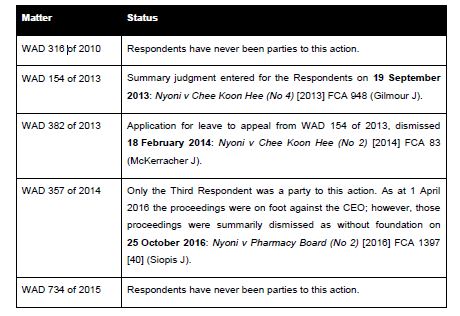
59 According to the respondents, not only was his Honour correct to find that the contention had not been properly particularised or proved, it could not in fact have been particularised or proved.
60 The respondents say that Mr Nyoni never put to the primary judge that the appeal proceedings would result in him remaining solvent, or that the petition should be adjourned or refused as a result. In those circumstances, the primary judge cannot be criticised for failing to determine an argument when that argument was not put, either expressly or by implication, and where there was no evidence led to support the contention. Further, it is not now open to Mr Nyoni to raise the argument for the first time on appeal.
61 However, the respondents submit that, even if the argument had been raised before the primary judge, it would not have been met with success.
62 The respondents note that, as at the hearing of the petition on 11 April 2016, the primary judge may have been able to discern from the filed materials, and from published decisions (to the extent that these were drawn to his Honour’s attention), that:
the appeal proceeding had commenced and had been programmed for hearing in August 2016;
the respondents were not party to the appeal proceeding;
the appeal grounds had not been adequately formulated by Mr Nyoni: April affidavit, annexure A2; Nyoni v Shire of Kellerberrin (No 8) [2016] FCA 245 (Mortimer J); and
the claims being agitated by Mr Nyoni included misleading or deceptive conduct and misfeasance in public office: Nyoni v Shire of Kellerberrin (No 7) [2016] FCA 135 [1] (Mortimer J).
63 The respondents submit, however, that the judge had no evidence before him as to the particular grounds of appeal, the likelihood that any of the grounds would succeed, the factual background to the appeal, the quantum (if any) of any relief that might have been granted, or the timeframe for any decision.
64 In those circumstances, and having regard to:
the uncontested evidence of insolvency: [32]-[34] of the primary judge’s reasons;
the admission of insolvency: [2.4.1] of the debtor’s submissions;
the absence of evidence of cash flow, assets or liabilities: [32] of the primary judge’s reasons; and
importantly, that the test for solvency is the capacity of a debtor to pay debts as and when they become due and payable, from the debtor’s own money (including cash on hand and money reasonably quickly realisable by asset realisation): [27]-[29] of the primary judges reasons,
the respondents say there was no basis upon which the primary judge could, or should, have adjourned or refused the petition.
65 Similarly, the respondents say, there was no evidentiary or legal basis upon which Mr Nyoni, or the respondents, could or should have moved for an adjournment of the petition because of the commencement or maintenance of the appeal proceedings. The respondents say they were entitled to press for the determination of the petition and the public interest was, as the primary judge observed in another context at [91] of his reasons, served by that determination.
66 Accordingly, the respondents submit, the primary judge did not err in fact or in law in failing to adjourn, or failing to refuse, the petition.
Consideration
67 Having regard to the three broad considerations of the primary judge, set out above in some detail, it must be said that no error in the approach or reasoning of the primary judge can be detected. The technical requirements of the Act were met. On the evidence and material before the primary judge, it appeared almost self-evident that Mr Nyoni could not meet his debts as and when they fell due. He did not appear to have any assets that could otherwise be turned into liquid funds to meet debts such as the two costs orders that the respondents held against him.
68 The real question then, as now, was whether there was some other sufficient reason by reference to which the creditors’ petition should either be adjourned or dismissed. The most obvious factor in this regard was the substantive claim made by Mr Nyoni, that the respondents, with Shire representatives, had effectively conspired against him in various ways, including by bringing the creditors’ petition against him to make him bankrupt. So far as that claim was concerned, the primary judge, not unreasonably found that there was no evidence to support the allegation.
69 The fact of the matter was, and is, that the respondents in this proceeding, held costs orders for some $80,000 against Mr Nyoni and wished to have them satisfied. Ultimately, they issued a bankruptcy notice. They were perfectly entitled to do so. Mr Nyoni’s failure to satisfy it constituted an act of bankruptcy and led the primary judge to consider, ultimately, whether there was some other sufficient reason not to make the sequestration order sought.
70 There was no evidence to support an abuse of process claim and the primary judge cannot be said to have erred in making that finding.
71 Mr Nyoni’s grounds of opposition and submissions all focused on his continued belief that the respondents in this proceeding, the Shire and the respondents in other proceedings were guilty of “collusion” against him.
72 Even though the respondents in this proceeding, who were the applicants on the bankruptcy proceeding, were not parties to the proceedings involving the Shire, as it went forward, including in the recent Full Court appeal referred to above. It may have been open to Mr Nyoni to have contended before the primary judge, in the bankruptcy proceeding, that he had good grounds to expect that his forthcoming appeal would be successful, at least in part, that he would be entitled to damages sufficient to put him in funds to pay the costs orders held by the respondents, and therefore that he had provided a sufficient reason for the creditors’ petition to at least be adjourned to await the outcome of the appeal.
73 In that regard, however, the respondents reasonably submit that no such contention was put in the bankruptcy proceeding before the primary judge by Mr Nyoni. Certainly, it was not put expressly and it is difficult to see that it was put by implication.
74 In any event, even if it might be suggested that a judge, faced with a self-represented litigant in the position that Mr Nyoni found himself, might possibly herself or himself have articulated a line of argument along the lines just suggested, it seems to me that the respondents are again correct in the submission that they now make that there really was far too little information before the primary judge to suggest that that line of argument provided a foundation for a view that Mr Nyoni was likely to be successful on the appeal such that he would come into funds that would enable him to pay the costs orders.
75 The information the primary judge had did not particularise the nature of the appeal grounds and there was no information concerning what damages might possibly be paid in any event. With the benefit of hindsight, it might be said, in light of the Full Court decision (which is subject to a special leave to appeal application by the Shire to the High Court), that a sufficient other reason might have been advanced by Mr Nyoni. But hindsight is a wonderful thing. The point was not put by Mr Nyoni. His focus was on demonstrating an abuse of process by the respondents, and others in bringing the bankruptcy proceedings. He was not focused on admitting the costs debt and identifying a future possible means of paying it.
76 In all of these circumstances, with some regret, I must accept the submissions made on behalf of the respondents that, not only was the line of argument identified, as to Mr Nyoni recovering substantial damages in the future, not raised by him in the bankruptcy proceeding before the primary judge, but that even if it had been, it had little prospects of providing the foundation for an other sufficient reason to adjourn or dismiss the creditors’ petition in light of the paucity of information before the Court.
77 In these circumstances, the application for extension of time to appeal must be dismissed.
I certify that the preceding seventy-seven (77) numbered paragraphs are a true copy of the Reasons for Judgment herein of the Honourable Justice Barker. |


