

FEDERAL COURT OF AUSTRALIA
Freddie v Northern Territory [2017] FCA 867
ORDERS
DATE OF ORDER: | 3 August 2017 |
A. The applicant in this proceeding NTD50/2014 has made a native title determination application (“the application”) that relates to an area of land and waters which is the subject of a proposed determination of native title (“the determination”).
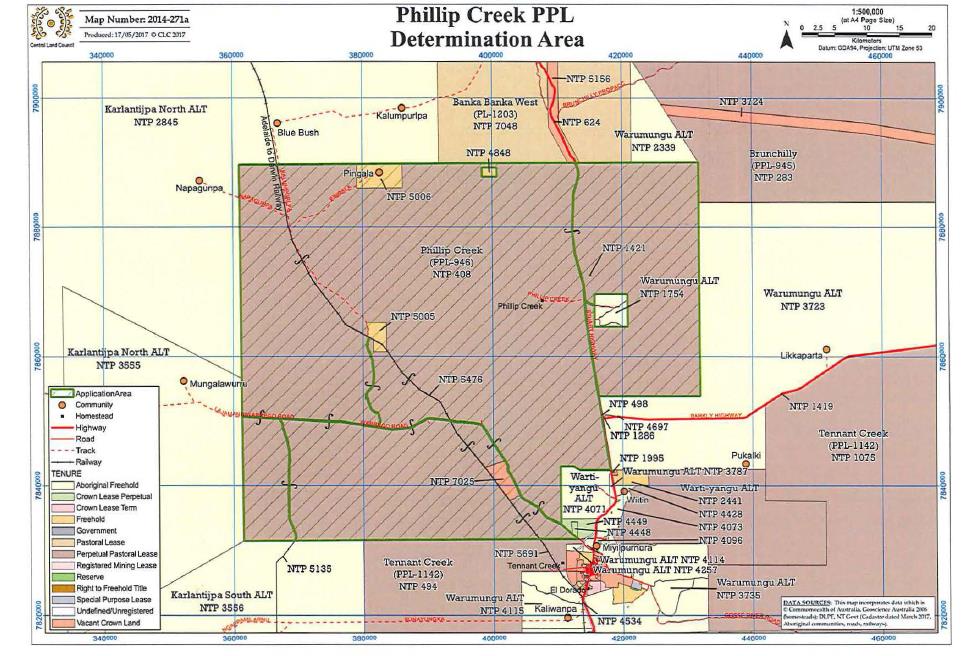
B. The applicant, the Northern Territory of Australia, the pastoralist, the Commonwealth of Australia, Gowan Russell Carter and Jennifer Erica Cook (“the parties”) have reached agreement as to the terms of the determination which is to be made in relation to the land and waters covered by the application (“the Determination Area”). The external boundaries of the Determination Area are described in Schedule A and depicted on the map at Schedule B of the determination.
C. Pursuant to s 87(1)(a)(i) and s 87(1)(b) of the Native Title Act 1993 (Cth) (“the Act”) the parties hereby file with this Court their agreement in writing.
D. Pursuant to ss 87 and 94A of the Act the terms of the parties’ agreement involve the making of consent orders for a determination that native title exists in relation to the Determination Area as provided by the determination.
E. The parties acknowledge that the effect of the making of the determination is that the members of the native title claim group, in accordance with the traditional laws acknowledged and the traditional customs observed by them, should be recognised as the native title holders for the Determination Area as provided by the determination.
F. The parties have requested that the Court hear and determine this proceeding in accordance with their agreement.
BEING SATISFIED that a determination of native title in the terms set out in the determination in respect of this proceeding would be within power of the Court and, it appearing to the Court appropriate to do so, pursuant to s 87 of the Act and by the consent of the parties:
THE COURT ORDERS THAT:
1. There be a determination of native title in terms of the determination set out below. The Determination is to take effect immediately upon the making of a determination under s 56(1) or s 57(2) of the Act as the case may be.
2. Within 12 months of the date upon which these orders are made, a representative of the common law holders of the native title rights and interests shall indicate whether they intend to have the native title rights and interests held in trust and, if so, by whom. They are invited to do so by:
(a) nominating in writing to the Court a prescribed body corporate to be trustee of the native title rights and interests; and
(b) including within the nomination the written consent of the body corporate.
3. If a prescribed body corporate is nominated in accordance with order 2, it will hold the native title rights and interests described in order 1 in trust for the common law holders of the native title rights and interests.
4. In the event that there is no nomination within the time specified in order 2, or such later time as the Court may order, the matter is to be listed for further directions.
5. The parties have liberty to apply to establish the precise location and boundaries of any public works and adjacent land and waters identified or otherwise referred to in Schedule C of the determination.
6. There be no order as to costs.
THE COURT DETERMINES THAT:
The Determination Area
1. The Determination Area comprises NT Portions 408, 5005, 5006, 5476 and 7025 being the land and waters more particularly described in Schedule A and depicted on the map comprising Schedule B.
2. Native title exists in the Determination Area.
3. Native title does not exist in those parts of the Determination Area described in Schedule C.
The native title holders
4. The Determination Area comprises nine estate areas associated with the Kankawarla, Kanturrpa, Jajjinyarra, Linga, Patta, Pirrtangu, Purrurtu, Wapurru and Yurtuminyi landholding groups.
5. The persons who hold the common or group rights comprising the native title are the Aboriginal persons who are:
(a) members of one or more of the landholding groups referred to in paragraph 4 by virtue of descent (including adoption) through father’s father, father’s mother, mother’s father or mother’s mother;
(b) accepted as members of one or more of the landholding groups referred to in paragraph 4 by senior members of a landholding group, referred to in subparagraph (a), by virtue of the following non-descent connections to an estate:
(i) conception and/or birthplace affiliation;
(ii) long-term residence in and/or historical connection with an estate;
(iii) shared subsection and/or moiety affiliation;
(iv) close kinship ties, including intermarriage;
(v) authority and responsibility for shared Dreaming tracks and/or places of significance connected with an estate;
(vi) seniority in traditional matters concerning a landholding group and/or estate; and
(vii) ceremonial knowledge.
Native title rights and interests
6. The native title rights and interests of the native title holders are the nonexclusive native title rights and interests possessed under and exercisable in accordance with the traditional laws acknowledged and traditional customs observed, being:
(a) the right to access and travel over any part of the land and waters;
(b) the right to live on the land, and for that purpose, to camp, erect shelters and other structures;
(c) the right to hunt, gather and fish on the land and waters;
(d) the right to take and use the natural resources of the land and waters;
(e) the right to access, take and use natural water on or in the land, except water captured by the holders of Perpetual Pastoral Lease No. 946;
(f) the right to light fires for domestic purposes, but not for the clearance of vegetation;
(g) the right to share or exchange natural resources obtained on or from the land and waters, including traditional items made from the natural resources;
(h) the right to access and to maintain and protect sites and places on or in the land and waters that are important under traditional laws and customs;
(i) the right to conduct and participate in the following activities on the land and waters:
(i) cultural activities;
(ii) ceremonies;
(iii) meetings;
(iv) cultural practices relating to birth and death including burial rites; and
(v) teaching the physical and spiritual attributes of sites and places on the land and waters that are important under traditional laws and customs;
(j) the right to make decisions about the use and enjoyment of the land and waters by Aboriginal people who recognise themselves to be governed by the traditional laws and customs acknowledged by the native title holders provided that the right does not extend to making any decision that purports to control the access of such persons to the Determination Area;
(k) the right to be accompanied on the land and waters by persons who, though not native title holders, are:
(i) people required by traditional law and custom for the performance of ceremonies or cultural activities on the land and waters;
(ii) people who have rights in relation to the land and waters according to the traditional laws and customs acknowledged by the native title holders;
(iii) people required by the native title holders to assist in, observe, or record traditional activities on the areas.
(l) the right to conduct activities necessary to give effect to the rights referred to in (a) to (k) hereof.
7. The native title rights and interests referred to in paragraph 6 do not confer possession, occupation, use and enjoyment of the land and waters on the native title holders to the exclusion of all others.
8. The native title rights and interests are subject to and exercisable in accordance with:
(a) the valid laws of the Northern Territory of Australia and the Commonwealth of Australia;
(b) the traditional laws and customs of the native title holders for personal or communal needs which are of a domestic or subsistence nature and not for any commercial or business purpose.
Other rights and interests
9. The nature and extent of the other interests in the Determination Area are:
(a) NT Portion 408:
(i) the interest of Alexander John Warby and Katherine Louise Warby under Perpetual Pastoral Lease 946;
(ii) the rights and interests of APT Pipelines (NT) Pty Ltd as the beneficiary of the rights and interests under Energy Supply Easement Dealing No. 193093 granted to the Northern Territory of Australia and as the holder of Pipeline Licence No. 4 granted under the Energy Pipelines Act (NT);
(iii) the rights and interests of the proprietor of NT Portion 1286 as the beneficiary of the rights and interests under Right of Way Easement Dealing No. 349910;
(iv) the rights and interests of APT Pipelines (NT) Pty Ltd as the beneficiary of the rights and interests under Access Easement Dealing Nos. 598482, 598483, 598484, 598485 and 598486 granted to the Northern Territory;
(v) the rights and interests of APT Pipelines (NT) Pty Ltd as the beneficiary of the rights and interests under Access Easement Dealing Nos. 600360 and 600361 granted to the Northern Territory of Australia;
(vi) the rights and interests of Jemena Northern Gas Pipeline Pty Ltd as the holder of Pipeline Licence No. 34 granted under the Energy Pipelines Act (NT).
(b) NT Portion 5005 - the interest of the Yurtuminyi Aboriginal Corporation as the holder of a fee simple estate (subject to Yurtuminyi ILUA Dl2004/016 entered on the Register of Indigenous Land Use Agreements on 11 July 2005).
(c) NT Portion 5006 - the interest of the Jurntu Jungu Aboriginal Corporation as the holder of a fee simple estate (subject to Pingala ILUA DI2004/015 entered on the Register of Indigenous Land Use Agreements on 11 July 2005.
(d) NT Portion 5476:
(i) the interest of AustralAsia Railway Corporation under Crown Lease Term 1880;
(ii) the interest of GWA (North) Pty Ltd under Sublease Dealing No. 465439;
(iii) the rights and interests of APT Pipelines (NT) Pty Ltd as the beneficiary of the rights and interests under Access Easement Dealing Nos. 598482, 598483, 598484, 598485, 598486 and 598629 granted to the Northern Territory;
(iv) the rights and interests of APT Pipelines (NT) Pty Ltd as the beneficiary of the rights and interests under Access Easement Dealing Nos. 600359, 600360 and 600361 granted to the Northern Territory of Australia;
(v) the rights and interests of APT Pipelines (NT) Pty Ltd as the holder of Pipeline Licence No. 4 granted under the Energy Pipelines Act (NT).
(e) the interests of the holders of the following mining and petroleum tenements granted pursuant to the Mineral Titles Act 2010 (NT) (or its predecessor):
Number | Expiry Date | Holder |
Exploration Licence (EL) | ||
EL 23764 | 25/11/2015 | Meteoric Resources NL |
EL 26594 | Renewal pending | Giants Reef Exploration Pty Ltd |
EL 26595 | Renewal pending | Giants Reef Exploration Pty Ltd |
EL 27136 | 21/05/2015 | Giants Reef Exploration Pty Ltd |
EL 28602 | 7/07/2015 | Giants Reef Exploration Pty Ltd |
EL 28603 | 7/07/2015 | Giants Reef Exploration Pty Ltd |
EL 28775 | 13/09/2015 | Giants Reef Exploration Pty Ltd |
EL 28776 | 15/11/2017 | Giants Reef Exploration Pty Ltd |
EL 28777 | 13/09/2015 | Giants Reef Exploration Pty Ltd |
EL 28904 | 26/03/2018 | Manto Mining Pty Ltd |
EL 28907 | 26/03/2018 | Manto Mining Pty Ltd |
EL 28913 | 22/12/2017 | Giants Reef Exploration Pty Ltd |
EL 29012 | Renewal pending | Giants Reef Exploration Pty Ltd |
EL 29488 | 30/04/2019 | Giants Reef Exploration Pty Ltd |
EL 30168 | 18/09/2020 | Giants Reef Exploration Pty Ltd |
EL 30301 | 9/09/2020 | Giants Reef Exploration Pty Ltd |
EL 30488 | 18/09/2020 | Giants Reef Exploration Pty Ltd |
EL 30614 | 5/10/2021 | Giants Reef Exploration Pty Ltd |
EL 31249 | 31/05/2022 | Giants Reef Exploration Pty Ltd |
Extractive Mineral Lease (EML) | ||
EML 22925 | 23/07/2021 | Asia Pacific Transport Pty Ltd (now Genesee & Wyoming Australia Pty Ltd) |
EML 22929 | 23/07/2021 | Asia Pacific Transport Pty Ltd (now Genesee & Wyoming Australia Pty Ltd) |
Extractive Mineral Permit (EMP) | ||
EMP 24719 | 16/03/2019 | Stephen Kenneth Martin |
EMP 31008 | 5/10/2020 | Santexco Pty Ltd |
EMP31010 | 5/10/2020 | Santexco Pty Ltd |
Extractive Mineral Permit (Central) (EMPC) | ||
EMPC73 | 15/08/2017 | Swoocabe Pty Ltd |
Authorised Holdings (Central) (HLDC) | ||
HLDC 37 | Santexco Pty Ltd | |
HLDC 39 | Santexco Pty Ltd | |
HLDC 40 | Emmerson Resources Limited | |
HLDC 41 | Santexco Pty Ltd | |
HLDC 42 | Santexco Pty Ltd | |
HLDC 43 | Santexco Pty Ltd | |
HLDC 44 | Santexco Pty Ltd | |
HLDC 45 | Santexco Pty Ltd | |
HLDC 46 | Santexco Pty Ltd | |
HLDC 55 | Santexco Pty Ltd | |
HLDC 56 | Santexco Pty Ltd | |
HLDC 58 | Santexco Pty Ltd | |
HLDC 59 | Santexco Pty Ltd | |
HLDC 94 | Santexco Pty Ltd | |
HLDC 95 | Santexco Pty Ltd | |
HLDC 96 | Santexco Pty Ltd | |
HLDC 97 | Santexco Pty Ltd | |
HLDC 98 | Santexco Pty Ltd | |
HLDC 99 | Santexco Pty Ltd | |
HLDC 101 | Santexco Pty Ltd | |
Mineral Lease (Central) (MLC) | ||
MLC 21 | 31/12/2020 | Santexco Pty Ltd |
MLC 69 | 31/12/2023 | Santexco Pty Ltd |
MLC 70 | 31/12/2023 | Santexco Pty Ltd |
MLC 78 | 31/12/2023 | Santexco Pty Ltd |
MLC 81 | 31/12/2030 | AARD Metals Limited |
MLC 82 | 31/12/2030 | AARD Metals Limited |
MLC 85 | 31/12/2020 | Santexco Pty Ltd |
MLC 86 | 31/12/2020 | Santexco Pty Ltd |
MLC 87 | 31/12/2020 | Santexco Pty Ltd |
MLC 88 | 31/12/2022 | Santexco Pty Ltd |
MLC 89 | 31/12/2022 | Santexco Pty Ltd |
MLC 90 | 31/12/2022 | Santexco Pty Ltd |
MLC 96 | 31/12/2022 | Santexco Pty Ltd |
MLC 97 | 31/12/2022 | Santexco Pty Ltd |
MLC 103 | 31/12/2022 | AARD Metals Limited |
MLC 104 | 31/12/2022 | AARD Metals Limited |
MLC 105 | 31/12/2022 | AARD Metals Limited |
MLC 106 | 31/12/2022 | AARD Metals Limited |
MLC 120 | 31/12/2014 | Santexco Pty Ltd |
MLC 121 | 31/12/2021 | Santexco Pty Ltd |
MLC 122 | 31/12/2021 | Santexco Pty Ltd |
MLC 123 | 31/12/2021 | Santexco Pty Ltd |
MLC 323 | 31/12/2022 | Santexco Pty Ltd |
MLC 324 | 31/12/2022 | Santexco Pty Ltd |
MLC 325 | 31/12/2022 | Santexco Pty Ltd |
MLC 326 | 31/12/2022 | Santexco Pty Ltd |
MLC 327 | 31/12/2022 | Santexco Pty Ltd |
MLC 506 | 31/12/2017 | Santexco Pty Ltd |
MLC 554 | 31/12/2023 | Santexco Pty Ltd |
MLC 555 | 31/12/2022 | Gowan Russell Carter, Jennifer Erica Cook & ors |
MLC 557 | 31/12/2018 | Santexco Pty Ltd |
MLC 559 | 31/12/2014 | Santexco Pty Ltd |
MLC 560 | 31/12/2024 | Santexco Pty Ltd |
MLC 626 | 31/12/2022 | Giants Reef Exploration Pty Ltd |
MLC 675 | Renewal pending | Santexco Pty Ltd |
MLC 676 | Renewal pending | Santexco Pty Ltd |
MLC 682 | 14/10/2015 | AARD Metals Limited |
MLC 692 | 31/12/2015 | Giants Reef Exploration Pty Ltd |
MLC 700 | 31/12/2015 | Santexco Pty Ltd |
MLC 705 | 31/12/2023 | Giants Reef Exploration Pty Ltd |
Mineral Lease (ML) | ||
ML 23969 | 16/03/2034 | Santexco Pty Ltd |
ML 29917 | 30/09/2023 | Santexco Pty Ltd |
ML 29919 | 30/09/2024 | Santexco Pty Ltd |
ML 30176 | 14/04/2024 | Santexco Pty Ltd |
ML 30177 | 14/04/2024 | Santexco Pty Ltd |
ML 30636 | 6/11/2024 | Santexco Pty Ltd |
ML 30714 | 17/03/2025 | Santexco Pty Ltd |
ML 30715 | 4/02/2025 | Santexco Pty Ltd |
ML 30744 | 16/02/2025 | Santexco Pty Ltd |
ML 30745 | 16/02/2025 | Santexco Pty Ltd |
ML 30781 | 9/04/2025 | Santexco Pty Ltd |
ML 30782 | 9/04/2025 | Santexco Pty Ltd |
ML 30783 | 9/04/2025 | Santexco Pty Ltd |
ML 30784 | 9/04/2025 | Santexco Pty Ltd |
ML 30864 | 18/06/2025 | Santexco Pty Ltd |
ML 30865 | 18/06/2025 | Santexco Pty Ltd |
ML 30867 | 18/06/2025 | Santexco Pty Ltd |
ML 30870 | 9/07/2025 | TC8 Pty Ltd |
ML 30871 | 9/07/2025 | TC8 Pty Ltd |
ML 30873 | 17/08/2020 | Santexco Pty Ltd |
ML 30875 | 9/07/2020 | Santexco Pty Ltd |
ML 30885 | 9/07/2025 | Santexco Pty Ltd |
ML 30886 | 9/07/2025 | Santexco Pty Ltd |
ML 30888 | 9/07/2025 | Giants Reef Exploration Pty Ltd |
ML 30893 | 9/07/2020 | Giants Reef Exploration Pty Ltd |
ML 30909 | 2/08/2020 | Giants Reef Exploration Pty Ltd |
ML 30910 | 13/08/2025 | Santexco Pty Ltd |
ML 30911 | 2/08/2025 | Santexco Pty Ltd |
ML 30912 | 2/08/2025 | Santexco Pty Ltd |
ML 30937 | 17/08/2025 | Santexco Pty Ltd |
ML 30946 | 22/09/2020 | Santexco Pty Ltd |
ML 30947 | 22/09/2020 | Giants Reef Exploration Pty Ltd |
ML 31021 | 18/10/2025 | Santexco Pty Ltd |
ML 31023 | 26/11/2020 | Santexco Pty Ltd |
ML 31055 | 10/11/2025 | Santexco Pty Ltd |
ML 31057 | 10/11/2020 | Santexco Pty Ltd |
ML 31075 | 7/12/2020 | Santexco Pty Ltd |
(f) the rights and interests of Telstra Corporation Limited (ACN 051 775 556):
(i) as the owner or operator of telecommunications facilities within the Determination Area;
(ii) created pursuant to the Post and Telegraph Act 1901 (Cth), the Telecommunications Act 1975 (Cth), the Australian Telecommunications Corporation Acts 1989 (Cth), the Telecommunications Act 1991 (Cth) and under Schedule 3 to the Telecommunications Act 1997 (Cth), including rights:
A. to inspect land;
B. to install and operate telecommunication facilities; and
C. to alter, remove, replace, maintain, repair and ensure the proper functioning of its telecommunication facilities; and
(iii) for its employees, agents or contractors to access its telecommunication facilities in and in the vicinity of the Determination Area in the performance of their duties; and
(iv) under any lease, licence, access agreement or easement relating to its telecommunications facilities within the Determination Area.
(g) NT Portion 408 – the rights of Aboriginal persons (whether or not native title holders) pursuant to the reservation in favour of Aboriginal people contained in pastoral leases identified in section 38(2) to (6) of the Pastoral Land Act 1992 (NT);
(h) the rights of Aboriginal persons (whether or not native title holders) by virtue of the Northern Territory Aboriginal Sacred Sites Act 1989 (NT);
(i) rights of access by an employee, servant, agent or instrumentality of the Northern Territory, Commonwealth or other statutory authority as required in the performance of his or her statutory duties ;
(j) the interests of persons to whom valid or validated rights and interests have been:
(i) granted by the Crown pursuant to statute or otherwise in the exercise of its executive power; or
(ii) conferred by statute.
Relationship between rights and interests
10. To the extent that the continued existence, enjoyment or exercise of the native title rights and interests referred to in paragraph 6 in relation to NT Portions 408 and 7025 is inconsistent with the existence, enjoyment or exercise of the other rights and interests referred to in paragraph 9, the other rights and interests and the doing of any activity required or permitted to be done by or under the other interests, prevail over, but do not extinguish, the native title rights and interests.
11. In relation to NT Portion 5005 the relationship between the native title rights and interests referred to in paragraph 6 and the interest of the Yurtuminyi Aboriginal Corporation as the holder of a fee simple estate in the land is set out in the Yurtuminyi ILUA which was entered on the Register of Indigenous Land Use Agreements on 11 July 2005. The non-extinguishment principle applies:
(a) the grant of the estate in fee simple is wholly inconsistent with the continued existence, enjoyment or exercise of the native title rights and interests;
(b) the native title continues to exist, but has no effect in relation to the grant;
(c) if the grant or its effects are wholly removed or otherwise wholly cease to operate the native title rights and interests again have full effect;
(d) if the grants or its effect are removed to an extent or otherwise cease to operate only to an extent the native title rights and interests again have effect to that extent.
12. In relation to NT Portion 5006 the relationship between the native title rights and interests referred to in paragraph 6 and the interest of the Jurntu Jungu Aboriginal Corporation as the holder of a fee simple estate in the land is set out in the Pingala ILUA which was entered on the Register of Indigenous Land Use Agreements on 11 July 2005. The non-extinguishment principle applies:
(a) the grant of the estate in fee simple is wholly inconsistent with the continued existence, enjoyment or exercise of the native title rights and interests;
(b) the native title continues to exist, but has no effect in relation to the grant;
(c) if the grant or its effects are wholly removed or otherwise wholly cease to operate the native title rights and interests again have full effect;
(d) if the grants or its effect are removed to an extent or otherwise cease to operate only to an extent the native title rights and interests again have effect to that extent.
13. In relation to NT Portion 5476 the relationship between the native title rights and interests referred to in paragraph 6 and the interest of the AustralAsia Railway Corporation as the holder of Crown Lease Term 1880 is that the non-extinguishment principle applies. The lease granted to the Corporation:
(a) is wholly inconsistent with the continued existence, enjoyment or exercise of the native title rights and interests;
(b) the native title continues to exist, but has no effect in relation to the grant;
(c) if the grant or its effect is wholly removed or otherwise wholly cease to operate the native title rights and interests again have full effect;
(d) if the grant or its effect is removed to an extent or otherwise cease to operate only to an extent the native title rights and interests again have effect to that extent.
Other matters
14. There are no native title rights and interests in:
(a) minerals (as defined in s 2 of the Minerals Acquisition Act 1953 (NT));
(b) petroleum (as defined in s 5 of the Petroleum Act 1984 (NT));
(c) prescribed substances (as defined in s 5 of the Atomic Energy Act 1953 (Cth) and s 3 of the Atomic Energy (Control of Materials) Act 1946 (Cth)).
15. In this determination the term:
(a) “natural resources” means:
(i) animals ferae naturae, birds, fish and plants, including timber, wax, resin and gum; and
(ii) surface soils, clays, stone, rocks and ochre,
but does not include minerals, petroleum and prescribed substances;
(b) “natural waters” includes springs and rockholes.
16. Unless the contrary intention appears, a word or expression used in the Act has the same meaning in this determination as it has in the Act.
Note: Entry of orders is dealt with in Rule 39.32 of the Federal Court Rules 2011.
Schedule A
1. The Determination Area comprises the following areas of land and waters:
(a) NT Portion 408 comprising an area of 3,624 square kilometres 51 hectares held under Perpetual Pastoral Lease 946.
(b) NT Portion 5005 comprising an area of 10 square kilometres 80 hectares held for an estate in fee simple by the Yurtuminyi Aboriginal Corporation.
(c) NT Portion 5006 comprising an area of 23 square kilometres 69 hectares held for an estate in fee simple by the Jurntu Jungu Aboriginal Corporation.
(d) NT Portion 5476 comprising an area of 7 square kilometres 26 hectares 9,000 square metres held under Crown Lease Term 1880.
(e) NT Portion 7025 comprising an area of 14 square kilometres 44 hectares is Crown land.
2. The following areas within the external boundaries of the Determination Area are not included in the Determination Area:
(a) NT Portion 1421 comprising an area of 8,460 square metres held for an estate in fee simple by the Australian Telecommunications Commission.
(b) NT Portion 1754 comprising an area of 25 square kilometres 28 hectares held for an estate in fee simple by the Warumungu Aboriginal Land Trust.
(c) NT Portion 4848 comprising an area of 3 square kilometres 29 hectares 5,000 square metres held for an estate in fee simple by the Pawuwa Aboriginal Corporation.
(d) A road 100 and 150 metres wide (Stuart Highway).
(e) A road 100 metres wide which traverses NT Portion 408 from the Stuart Highway to NT Portion 1754.
(f) A road 100 metres wide (Warrego Road) which traverses NT Portion 408 from the boundary with NT Portion 494 (Tennant Creek) north and east to the boundary with NT Portion 3555 (Karlantijpa North ALT).
(g) A road 100 metres wide which traverses NT Portion 408 from the Warrego Road south to the boundary with NT Portion 3556 (Karlantijpa South ALT).
(h) A road 100 metres wide (Kalumpurlpa Road) which traverses NT Portion 408 from the Warrego Road north to the vicinity of the Alice Springs-Darwin Railway.
Schedule B
Determination Area
Schedule C
Areas where native title does not exist
Native title rights and interests have been wholly extinguished in the following areas of land and waters.
Public works
1. Those parts of the Determination Area covered by public works as defined in section 253 of Native Title Act 1993 (Cth) (NTA) that were constructed or established before 23 December 1996 or commenced to be constructed or established on or before that date (including land and waters within the meaning of section 251D of the NTA), including:
(a) public roads, namely, rural public roads (50m either side of the centre line), rural arterial roads and national highways and associated road infrastructure;
(b) community, pastoral access and other roads (including access roads and tracks to public works referred to in this clause) which are not otherwise public roads;
(c) gravel and fill pits established to maintain the roads referred to in (a) and (b) above;
(d) government bores and associated works;
(e) river and rain gauges;
(f) transmission water pipes (adjacent area 5 metres either side of the centreline);
(g) distribution water pipes measuring 150mm diameter or less (adjacent area of 1.5 metres either side of the centreline) and greater than 150mm diameter (adjacent area 5 metres either side of the centreline);
(h) sewer pipes measuring 150mm diameter or less (adjacent area 1.5 metres either side of the centreline) and greater than 150mm diameter (adjacent area 5 metres either side of the centreline);
(i) bores, sewer pump stations and overhead power lines.
2. In addition to the areas referred to in paragraph 1 above native title has been wholly extinguished over those parts of NT Portion 408 covered by the Overland Telegraph Line and the Warrego Primary School respectively (including land and waters within the meaning of section 251D of the NTA).
MORTIMER J:
1 The parties have sought a consent determination under s 87 of the Native Title Act 1993 (Cth) that native title exists over an area which takes in the Phillip Creek Pastoral Lease, together with a number of other areas. The Phillip Creek Pastoral Lease is by far the largest portion of the claim area. The claim area is located approximately five kilometres north of Tennant Creek, in the central region of the Northern Territory and comprises the area referred to at [6] below.
2 For the reasons I set out below, I am satisfied it is appropriate for me to make the orders sought, and that it is within the power of the Court to do so.
Material before the Court
3 The Court has the following material before it on this application:
(1) the application for determination of native title, filed 1 December 2014 as amended on 4 November 2016;
(2) expert anthropology report prepared on behalf of the claimants by Susan Dale Donaldson and Joe Firinu, filed on 29 May 2017;
(3) revised summary anthropological report prepared on behalf of the claimants by Susan Dale Donaldson, filed on 29 May 2017;
(4) minute of proposed orders and determination of native title by consent, dated 23 June 2017;
(5) statement of joint agreed facts in support of the minute of proposed orders and determination, dated 23 June 2017; and
(6) joint submissions of the applicant and the first respondent in support of the minute of proposed orders and determination, dated 23 June 2017.
Amendment to the s 61 application
4 The s 61 application for determination of native title filed on 1 December 2014 was subject to two interlocutory applications for amendment, and was subsequently amended on 4 November 2016. The first interlocutory application to amend was filed on 9 September 2016, supported by an affidavit of Susan Jane Polden affirmed on 19 August 2016. The amendments sought were primarily to remove the original named applicant who passed away on 5 August 2015, as well as to make ancillary amendments, and to update the list of mining interests in the application area. However, no orders were made in relation to that interlocutory application, and no amended application was filed despite the consent of all respondents to the proposed amendments.
5 Subsequently, the amendments sought became time critical due to a pending indigenous land use agreement (ILUA), and a further interlocutory application was filed on 26 October 2016. This second interlocutory application was supported by a further affidavit of Ms Polden affirmed on 26 October 2016, and sought the same amendments as the first interlocutory application, but with additional amendments sought to fix errors in the first interlocutory application. Justice White made orders by consent on 4 November 2016, granting leave for the native title determination application to be so amended, and dispensing with the formal requirements to file and serve the amended native title application.
The claim, the process adopted to reach agreement and the proposed determination
6 The claim area comprises the Phillip Creek Pastoral Lease (NT Portion 408: Perpetual Pastoral Lease (PPL) 946); the Yurtuminyi Aboriginal Community Living Area (NT Portion 5005), Pingala Community Living Area (NT Portion 5006), part of the Alice Springs to Darwin Railway Corridor (NT Portion 5476: Crown Lease Term 1880), and an area of Crown land formerly the subject of the Phillip Creek PPL Bulk Handling Facility (NT Portion 7025: Crown Lease Term 2004). In total the area occupies more than 3,600 square kilometres of land. There are no other proceedings before the Court in relation to native title determination applications that cover any part of the area the subject of the application in this proceeding and which would otherwise require orders to be made under s 67(1) of the Act. The applicant and the Northern Territory agreed (without opposition from the other three respondents) to resolve the claim on what they have described in the agreed facts as a “short-form” approach. This approach has involved two kinds of factual material. First, anthropological evidence in support of the claim, which evidence has been of a briefer compass than in a contested claim. Second, material relating to the construction or establishment of public works in the claim area.
7 The claim group is made up of people from nine estate areas associated with the Kankawarla, Kanturrpa, Jajjinyarra, Linga, Patta, Pirrtangu, Purrurtu, Wapurru and Yurtuminyi landholding groups who, together, hold the common or group rights comprising the native title over the claim area. Those in the claim group are members of one or more of the nine landholding groups because of descent (including adoption) through their father’s father, father’s mother, mother’s father or mother’s mother; or may be accepted by senior members as part of one or more of those landholding groups by reason of one or more of seven other pathways set out in [5] of the proposed determination, including pathways such as long-term residence in an estate, conception or birth place affiliation and close kinship ties including by intermarriage.
8 A determination is sought only in relation to non-exclusive native title rights and interests. The following rights and interests are identified:
(1) the right to access and travel over any part of the land and waters;
(2) the right to live on the land, and for that purpose, to camp, erect shelters and other structures;
(3) the right to hunt, gather and fish on the land and waters;
(4) the right to take and use the natural resources of the land and waters;
(5) the right to access, take and use natural water on or in the land, except water captured by the holders of Perpetual Pastoral Lease No. 946;
(6) the right to light fires for domestic purposes, but not for the clearance of vegetation;
(7) the right to share or exchange natural resources obtained on or from the land and waters, including traditional items made from the natural resources;
(8) the right to access and to maintain and protect sites and places on or in the land and waters that are important under traditional laws and customs;
(9) the right to conduct and participate in the following activities on the land and waters:
(a) cultural activities;
(b) ceremonies;
(c) meetings;
(d) cultural practices relating to birth and death including burial rites; and
(e) teaching the physical and spiritual attributes of sites and places on the land and waters that are important under traditional laws and customs;
(10) the right to make decisions about the use and enjoyment of the land and waters by Aboriginal people who recognise themselves to be governed by the traditional laws and customs acknowledged by the native title holders provided that the right does not extend to making any decision that purports to control the access of such persons to the Determination Area;
(11) the right to be accompanied on the land and waters by persons who, though not native title holders, are:
(a) people required by traditional law and custom for the performance of ceremonies or cultural activities on the land and waters;
(b) people who have rights in relation to the land and waters according to the traditional laws and customs acknowledged by the native title holders;
(c) people required by the native title holders to assist in, observe, or record traditional activities on the areas.
(12) the right to conduct activities necessary to give effect to the rights referred to in (1) to (11) above.
9 The proposed determination also recognises other rights and interests in respect of the claim area, such as the pastoral lease over Phillip Creek Station, various pipeline licences and easements and rights of way connected to those licences, the interests, by way of fee simple estate, of two Aboriginal Corporations (Yurtuminyi Aboriginal Corporation in relation to NT Portion 5005 and Jurntu Jungu Aboriginal Corporation in relation to NT Portion 5006); a substantial number of mining and petroleum tenements (mostly held by two corporations, Giants Reef Exploration Pty Ltd and Santexco Pty Ltd); telecommunications interests held by Telstra and several other leasehold interests in NT Portion 5476. A variety of other interests, including interests held by Aboriginal people who may or may not be included as native title holders in the claim area are also recognised, such as rights and interests arising under the Northern Territory Aboriginal Sacred Sites Act 1989 (NT).
10 In early 2015, the applicant provided the Northern Territory with an anthropological report and dreaming and sites map by Ms Susan Dale Donaldson and Mr Joe Firinu. Following review by the Northern Territory (including responses to some of the matters raised by the Northern Territory) a revised anthropological report was provided in late February 2017 and after further review, the parties reached agreement regarding all outstanding anthropological issues. The agreed facts before the Court state that both reports were assessed by a Legal Officer for the Northern Territory against criteria agreed by the parties as satisfying the requirements of s 223 of the Act.
11 From early November 2016, the parties engaged in correspondence concerning the nature and extent of public works over the claim area and eventually reached agreement as to those parts of the claim area in which native title does and does not exist because of those public works. The extinguishing acts are listed in Schedule C of the proposed determination.
Section 87 and the Court’s function
12 There are three preconditions to an exercise of power under s 87 of the Native Title Act. They are:
(1) the lapse of the specified notification period under s 66 (s 87(1));
(2) the parties have reached agreement on the terms of orders relating to the proceedings, and matters arising out of those terms (s 87(1)(a)); and
(3) the parties have reduced their agreement to writing, the agreement has been signed by or on behalf of the parties, and it has been filed with the Court (s 87(1)(b)).
13 In the present application, the notification period ended on 7 July 2015, there is agreement between the parties of the matters in s 87(1)(a) and that agreement has been reduced to writing and filed with the Court, in the form of the proposed orders and determination.
14 Where those preconditions exist, as they do in relation to the present application, the Court has jurisdiction under s 87(1A) of the Native Title Act to make orders in the form filed by the parties, or consistent with that form. Before it can make such an order, the Court must be satisfied of two matters:
(1) First, that the orders as filed or proposed are “within the power of the Court” to make: s 87(1)(c).
(2) Second, that the orders filed or proposed are “appropriate”: s 87(1A).
15 In order to be satisfied that the orders sought are within the power of the Court, consideration must be given to other restrictions or requirements in the Native Title Act. For example, the area covered by the orders must not overlap with any other application for determination of native title (s 67(1)); similarly, the area covered by the orders cannot have been the subject of a previously approved determination of native title (s 68). Further, the orders sought will only be within power if they set out the details of the matters required by s 225 (see s 94A) and if they concern rights and interests which the Australian common law is able to recognise (s 223(1)(c)).
16 The Court’s function under s 87 is quite different from its function in a contested application for a determination of native title, and this difference has been confirmed in many authorities of this Court: see Lovett on behalf of the Gunditjmara People v State of Victoria [2007] FCA 474 at [36] (North J), which has been endorsed many times; and see for example Thudgari People v State of Western Australia [2009] FCA 1334 at [25] (Barker J); Goonack v State of Western Australia [2011] FCA 516 at [25]-[26] (Gilmour J), in relation to s 87A; Wurrunmurra on behalf of the Bunuba People v State of Western Australia [2015] FCA 1480 at [27] (Barker J). In Lander v State of South Australia [2012] FCA 427 at [11], and by reference to Lovett, Mansfield J emphasised that the focus of the Court under s 87 is on the making of the agreement by the parties.
17 The Court’s function under s 87, and its discretion, must also be understood in the context of the Native Title Act’s emphasis on negotiation and alternative dispute resolution, whereby one particular object of the Native Title Act is to resolve claims to native title without judicial determination in a contested proceeding: see Munn (for and on behalf of the Gunggari People) v Queensland [2001] FCA 1229; 115 FCR 109 at [28] (Emmett J). I note in this context that the Preamble to the Act envisages that:
A special procedure needs to be available for the just and proper ascertainment of native title rights and interests which will ensure that, if possible, this is done by conciliation and, if not, in a manner that has due regard to their unique character.
(Emphasis added.)
18 The concept of “appropriateness” in s 87(1A) also recognises that the determination made by the Court is one made as against the whole world, and not just between the parties to the proceeding: Cox on behalf of the Yungngora People v State of Western Australia [2007] FCA 588 at [3] (French J). The rights conferred are enduring legal rights, proprietary in nature and in recognising them through a determination, the Court must be conscious of their character. The nature of the rights informs considerations such as the clarity of the terms of the determination (as to the claim area, the nature of the native title rights and interests and the manner of affectation on other proprietary interests); the need for appropriate notification and then the free and informed consent of all parties; and finally the State’s agreement that there is a credible and rational basis for the determination proposed.
19 The discretionary evaluation of whether orders are appropriate is a wide one, but the Court must focus on the individual circumstances of each proposed determination: see Hayes on behalf of the Thalanyji People v State of Western Australia [2008] FCA 1487 at [18] (North J).
20 I accept it is also important to see the exercise of the judicial power in s 87 in the context of the Court’s jurisdiction as a whole, and its foundational legislation, the Federal Court of Australia Act 1976 (Cth), and in particular s 37M and s 37N of that Act. In exercising the discretion under s 87, the Court should pursue the objectives there set out, of promoting “just resolution of disputes, according to law, and as quickly, inexpensively and efficiently as possible”. See the observations of Jagot J in Barkandji Traditional Owners #8 v Attorney-General of New South Wales [2015] FCA 604 at [12]; also her Honour’s similar observations in Phyball on behalf of the Gumbaynggirr People v Attorney-General of New South Wales [2014] FCA 851 at [1] and [9] and Yaegl People #1 v Attorney General of New South Wales [2015] FCA 647 at [9]-[10].
21 Since the determination made by the Court must include the matters set out in s 225 of the Native Title Act, there must be some probative material against which the Court can assess whether those matters can be stated in a determination. The principal source will be the parties’ agreed position put to the Court in the proposed orders and determination setting out the matters required by s 225, together with an agreed statement of facts filed pursuant to s 87(8), joint submissions and any supporting documents such as an expert report. That is not to suggest an expert report is always necessary, but if one has been produced and it forms part of the material upon which the State (or Territory) has relied in agreeing to a determination, it is likely to be appropriate for such a report to be before the Court. Such reports, if filed and relied on by the Court, provide an opportunity for the Court to record at least some of the material establishing connection to the claim area in a publicly accessible form. However there is no need to provide the Court with all of the evidence of the primary facts substantiating native title. Again, that is because the premise of s 87, and the Native Title Act’s emphasis on conciliation, is that the parties have freely and on an informed basis come to an agreement: see Hughes (on behalf of the Eastern Guruma People) v State of Western Australia [2007] FCA 365 (at [9]) (Bennett J), cited with approval in Peterson v State of Western Australia [2013] FCA 518 at [22] (McKerracher J). See also Ward v State of Western Australia [2006] FCA 1848 at [8].
22 In Brown v Northern Territory of Australia [2015] FCA 1268 at [23], Mansfield J described the task to be undertaken by the Court in the following way:
The Court is not required to embark upon an inquiry as to the merits of the claim to be itself satisfied that the orders are supported and in accordance with law: Cox on behalf of the Yungngora People v State of Western Australia [2007] FCA 588 at [3] per French J. However, the Court will consider evidence for the limited purpose of determining whether the State has made a rational decision and is acting in good faith: Munn for and on behalf of the Gunggari People v State of Queensland (2001) 115 FCR 109 at [29]-[30] per Emmett J.
23 The State, in particular, comes to an agreement under s 87 only after discharging its public responsibilities to ensure the agreement is in the interests of the community it represents. This must involve, but it is not limited to, satisfaction by the State that there is a sufficient basis to put forward the agreement to the Court as one which is capable of satisfying the requirements of s 225 of the Native Title Act. A s 87 agreement may be reached on behalf of the State (or Territory), and other parties, without the level of proof required in a contested application. Inherent in parties’ agreement to resolve claims by settlement rather than litigation, as in other areas of the law, is a willingness to abide by an outcome without the exhaustive and detailed investigation that accompanies a trial of contested issues of fact and law. The public interest in an outcome of this kind is considerable: see Prior on behalf of the Juru (Cape Upstart) People v State of Queensland (No 2) [2011] FCA 819 at [26], Rares J.
24 The Court is entitled to rely on the processes established by a State (or Territory) for the assessment of claims to native title and, without abdicating its task of determining that the matters set out in s 225 are present in a particular application, is entitled to proceed on the basis the State (or Territory) has made a reasonable and rational assessment of the material to which it has access in deciding to enter into a s 87 agreement: see, in relation to a similar point with respect to s 223 of the Act, King on behalf of the Eringa Native Title Claim Group and the Eringa No 2 Native Title Claim Group v State of South Australia [2011] FCA 1387 at [21] (Keane CJ).
The claim group and their country
25 Although as I have noted, it is not part of the Court’s function under s 87 to assess and make findings about the matters set out in s 223 of the Native Title Act, nevertheless, it is this determination, and these reasons for judgment, which will stand as the permanent record for the claim group of the judicial recognition of their native title rights. Since that is the case, it is in my opinion appropriate to say something about the claimants and their country, as revealed in the evidence before the Court. This evidence comes from anthropologists, rather than the claim group members themselves, but the report is based on accounts from claim group members, many of them senior.
26 The authors of the anthropological report obtained as part of the negotiation towards a s 87 agreement are Ms Susan Donaldson and Mr Joe Firinu. Ms Donaldson is a consultant anthropologist and Mr Firinu is an anthropologist employed by the Central Land Council, the representative body acting on behalf of the applicant in this proceeding.
27 The system of traditional laws and customs observed by the claim group members is one observed by a wider society of Aboriginal people, encompassing people from the Warumungu, Warlmanpa and other Central Australia Aboriginal language groups, and extending well beyond the boundaries of the claim areas in this proceeding. Those traditional laws and customs determine the distribution of specific rights and interests in land amongst members of that wider society, and amongst members of the claim group. The traditional laws and customs connecting the claim group members to the claim area come from the time known in the Warumungu language as the Wirnkarra and in the Warlmanpa language as the Puwarrijpa.
28 Within the claim group, as within other sub-groups within the broader society identified, there is a distribution of specific rights and interests in particular smaller tracts or areas of land, countries and estates (“manu” in Warumungu, and “nguru” in Warlmanpa) and from these more specific rights and interests, the landholding groups within the claim group can be identified. They are the Kankawarla, Kanturrpa, Jajjinyarra, Linga, Patta, Pirrtangu, Purrurtu, Wapurru and Yurtuminyi landholding groups.
29 Although membership of a landholding group is determined principally on the basis of descent (including adoption in accordance with traditional law and custom), other pathways to rights and interests in the claim area are also recognised, provided those persons’ interests have been acknowledged by senior descent-based members of the landholding group.
30 People from neighboring landholding groups, and people Ms Donaldson and Mr Firinu describe as “regionally knowledgeable persons holding religious authority”, are also recognised as having some limited interests and entitlements in the claim area, for purposes such as participation in ceremonies and meetings. The claim group’s traditional laws and customs also recognise other pathways to rights and interests in land in the claim area, such as place of birth, or conception affiliation; extended kinship ties; long-term residence or historical association; possession of ceremonial knowledge; knowledge of and/or association with particular sites or Wirnkarra or Puwarrijpa; or seniority in traditional matters. The report by Ms Donaldson and Mr Firinu gives examples of claim group members who possess these kinds of affiliations and are recognised as having rights and interests in the land in the claim area.
31 Where rights come through descent, there are two main pathways, giving rise to what Ms Donaldson and Mr Firinu describe as “distinct yet complementary traditional roles and responsibilities in relation to the estate”: mangaya, whose class of rights descend through a person’s father’s father and mother’s mother; and kurdungurlu, whose rights are derived through a person’s mother’s father and father’s mother. Within each of the mangaya and kurdungurlu, there are skin groups and these classifications determine the land tenure system within the group.
32 Each of the nine landholding groups has responsibility for particular Wirnkarra or Puwarrijpa, and for particular sites within the claim area.
33 European identification of the claim group’s connection with the country in the claim area is set out in the report of Ms Donaldson and Mr Firinu, beginning in 1938 when approximately 45 ancestors of claim group members were reported as living in Tennant Creek and Banka Banka Station. Three members of the claim group, as identified in the application to this Court (Dick Foster Jangali, Kumanjayi Fitz Nappanangka (now deceased) and Kumanjayi Napurrula (which is the appropriate name of the original named applicant in this proceeding, now deceased)), were also recorded as living in Tennant Creek and Banka Banka Station at this time. The oldest person recorded at this time was Alice Jalakurama, who had been born in 1860 and was the mother of Edgar Jampin, mangaya for Kankawarla.
34 Consistently with the pattern of dispossession experienced by Aboriginal people across Australia, in 1945 some claim group members, and the ancestors of claim group members, were moved to the “Aborigines Inland Mission” on Phillip Creek Station. This mission was located not far from the mangkamanta waterhole within the country of the Purrurtu landholding group, and towards the eastern boundary of the claim area. Several Wirnkarra or Puwarrijpa run through this waterhole site. At least one claimant was initiated on this country. Ms Donaldson and Mr Firinu record several claim group members recounting the conduct of ceremonies at several sites within the claim area. Claim group members maintained physical connection with their country by working on the pastoral stations during the early and mid-20th century, including at Tennant Creek Telegraph Station, the Blue Moon Mine, Phillip Creek Station; Banka Banka Station; Rockhampton Downs and Helen Springs. After the introduction of the Aboriginal Land Rights (Northern Territory) 1976 (Cth), claim group members were able to move back onto their country. In their report, Ms Donaldson and Mr Firinu summarise that movement back to country in the following way:
Claimants and their ancestors began to move back to their country in the mid-1970s following the introduction of land rights legislation. The Linga group moved to Mangarlawurru and Ngappagunpa outstations; the Purrurtu group moved to Pingala and Partalki outstations; the Pirttangu group frequented the Old Phillip Creek Mission block more often; the Kankawarla group established Pawuwa outstation; the Kanturrpa group moved to Karlumpurla and Kunyungyu; the Patta group moved to Wiitin, and the Yurtuminyi group secured access to Yurtuminyi. Pingala, Pawuwa, Phillip Creek Mission and Yurtuminyi are within the application area, the others are between lkm and 10km away.
35 Ms Donaldson and Mr Firinu also set out the biographies of a number of individuals within the claim group, whose life stories are taken to be representative of the experiences of claim group members, their knowledge of traditional law and customs and their connection to their country. Some of these people have since passed away, and accordingly I do not refer to them by name in these reasons, and it is not necessary to set out the accounts given in the report.
36 Suffice to say there is ample material provided supporting close and ongoing connection to country through traditional law and custom, and to provide the foundation for acceptance by the Territory of the claim, and a foundation for the determination in the form sought.
Nomination of a prescribed body corporate
37 By s 55 of the Act the Court must, either at the time of making its orders or “as soon as practicable” after having done so, make such determinations as are required by ss 56 and 57 of the Act, relating to whether the native title is to be held on trust and if so by whom (s 56) and, whether a prescribed body corporate will hold the native title on trust, alternatively whether such a body will perform the non-trustee functions as set out in s 57(3) of the Native Title Act. In the present case, at the time of the making of the Court’s orders and the determination of native title, there has not been any proposal put to the Court concerning the operation of ss 56 and 57 in relation to the claim area. The parties have sought orders which allow the applicant a period of 12 months from the date of the Court’s orders to put a proposal to the Court. In the circumstances, and especially given this claim has been resolved in a relatively short period of time (less than three years) I am satisfied it is appropriate to allow the applicant 12 months to prepare the necessary proposal.
Conclusions on the application
38 I am satisfied that:
(1) The determination sets out the matters required by s 94A;
(2) The determination is within the power of the Court; and
(3) It is appropriate to make the determination.
39 As to s 94A, the parties have agreed that the native title claim group described in [7] above and in the report by Ms Donaldson and Mr Firinu comprises those who hold the native title rights and interests within the meaning of s 223(1) of the Act in the claim area. Their agreement, and the material before the Court, meets the criterion set out in s 225(a) of the Native Title Act that the determination must set out who are the persons, or each group of persons, holding the common or group rights comprising native title. The proposed determination also identifies the nature and extent of the native title rights and interests in relation to the claim area, as s 225(b) requires. It also identifies the nature and extent of any other interests in relation to the claim area, and what relationships those other interests have to the native title rights. Thus, the requirements in s 225(c) and (d) are met.
40 As to power of the Court, I am satisfied of the matters I set out in [12] and [15] above in relation to this application.
41 Finally I am satisfied it is appropriate to make the orders and determination sought. The applicant and the Territory have considered and addressed the necessary matters to reach agreement, and the agreed facts, submissions and anthropological evidence demonstrate that the Northern Territory has a rational and reasonable basis to agree to a consent determination under s 87, in the form proposed.
42 I am also satisfied that the parties’ agreement, and the proposed determination, properly reflect the characteristics of native title rights and interests set out in s 223 of the Native Title Act.
43 The Northern Territory has taken an active role in the assessment and resolution of the claim, including where necessary undertaking searches of land tenure, mining and other relevant interests and providing copies of those searches to other parties. The principal parties have all been legally represented, and this fact assists the Court in being satisfied that the parties have given free and informed consent to the proposed determination and orders.
44 Accordingly, there will be orders in the form sought by way of a determination of native title, and directions relating to the nomination of the prescribed body corporate in accordance with ss 56 and 57 of the Native Title Act.
45 The parties are to be congratulated on reaching agreement, and in particular on reaching an agreement within three years of the s 61 application being filed. That is an admirable achievement.
I certify that the preceding forty-five (45) numbered paragraphs are a true copy of the Reasons for Judgment herein of the Honourable Justice Mortimer. |


